Scala on Android
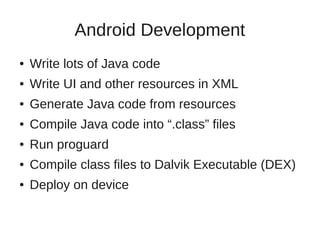
Android Development
●   Write lots of Java code
●   Write UI and other resources in XML
●   Generate Java code from resources
●   Compile Java code into “.class” files
●   Run proguard
●   Compile class files to Dalvik Executable (DEX)
●   Deploy on device
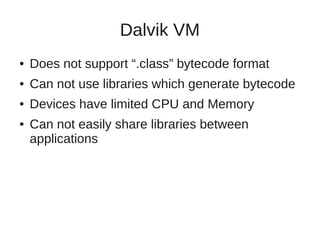
Dalvik VM
●   Does not support “.class” bytecode format
●   Can not use libraries which generate bytecode
●   Devices have limited CPU and Memory
●   Can not easily share libraries between
    applications
Eclipse
●   Has nice UI editors
●   IDE is a build tool
Alternative Languages for Android
Jython
●   Does not have enough community support
●   Slow
●   Dynamic
JRuby
●   Ruboto framework
●   Dynamic
●   Need to use java code generation
Clojure
●   Very cool :)
●   Very slow start-up time
●   Sometimes need to generate bytecode
PHP


Who cares?
Rhino
●   Nice language
●   Can run with optimization turned off
●   Completely interpreted
●   Dynamic
Groovy


 ???
Scala
●   Statically typed
●   Compiled to Java bytecode
●   Has access to all classes in Android
●   Fast
    ●   but sometimes slow :)
●   Has SBT
    ●   Android
    ●   Maven artifacts
How to build Scala apps for Android
●   ANT
●   Maven
●   SBT + Android Plugin
Little nice things about Scala
Type Inference
●   Improve readability
●   Reduce number of imports
●   Less typing
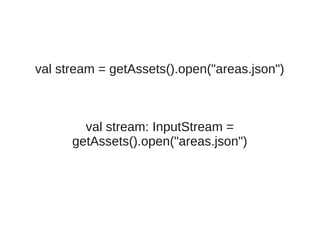
val stream = getAssets().open("areas.json")


        val stream: InputStream =
      getAssets().open("areas.json")
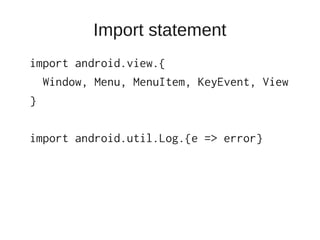
Import statement
import android.view.{
  Window, Menu, MenuItem, KeyEvent, View
}

import android.util.Log.{e => error}
Lazy vals
lazy val searchBox =
  findViewById(R.id.searchBox)
  .asInstanceOf[AutoCompleteTextView]
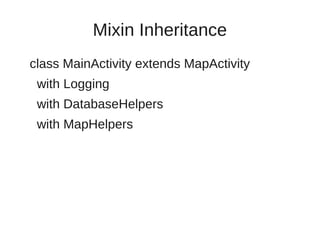
Mixin Inheritance
class MainActivity extends MapActivity
 with Logging
 with DatabaseHelpers
 with MapHelpers
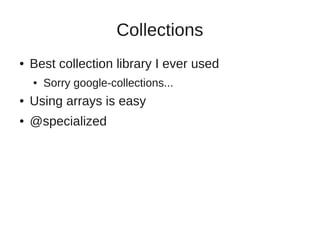
Collections
●   Best collection library I ever used
    ●   Sorry google-collections...
●   Using arrays is easy
●   @specialized
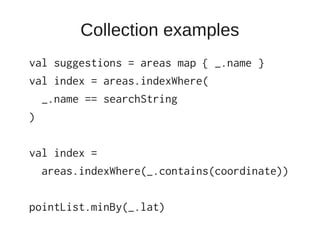
Collection examples
val suggestions = areas map { _.name }
val index = areas.indexWhere(
  _.name == searchString
)

val index =
  areas.indexWhere(_.contains(coordinate))

pointList.minBy(_.lat)
First class functions
class AreaOverlay(
  areas: Array[Area],
  selectListener: Int => Unit
)

new AreaOverlay(
  areas, this.onAreaSelected
)
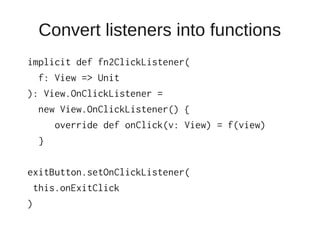
Convert listeners into functions
implicit def fn2ClickListener(
  f: View => Unit
): View.OnClickListener =
  new View.OnClickListener() {
     override def onClick(v: View) = f(view)
  }

exitButton.setOnClickListener(
 this.onExitClick
)
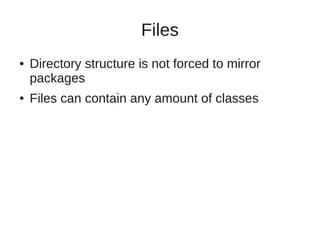
Files
●   Directory structure is not forced to mirror
    packages
●   Files can contain any amount of classes
Pattern matching
●   No NPEs when using Option[T]
●   Easy to work with data objects
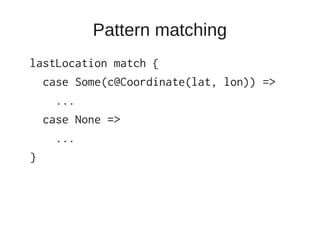
Pattern matching
lastLocation match {
  case Some(c@Coordinate(lat, lon)) =>
    ...
  case None =>
    ...
}
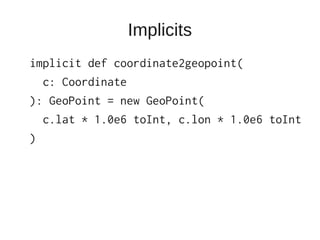
Implicits
implicit def coordinate2geopoint(
  c: Coordinate
): GeoPoint = new GeoPoint(
  c.lat * 1.0e6 toInt, c.lon * 1.0e6 toInt
)
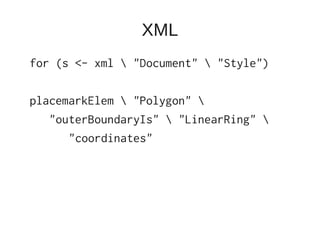
XML
for (s <- xml  "Document"  "Style")

placemarkElem  "Polygon" 
   "outerBoundaryIs"  "LinearRing" 
      "coordinates"
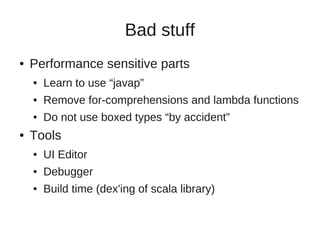
Bad stuff
●   Performance sensitive parts
    ●   Learn to use “javap”
    ●   Remove for-comprehensions and lambda functions
    ●   Do not use boxed types “by accident”
●   Tools
    ●   UI Editor
    ●   Debugger
    ●   Build time (dex'ing of scala library)
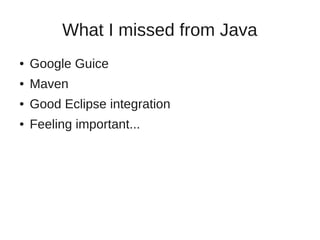
What I missed from Java
●   Google Guice
●   Maven
●   Good Eclipse integration
●   Feeling important...
Thank you!
Questions?

Scala on-android

  • 1.
  • 2.
    Android Development ● Write lots of Java code ● Write UI and other resources in XML ● Generate Java code from resources ● Compile Java code into “.class” files ● Run proguard ● Compile class files to Dalvik Executable (DEX) ● Deploy on device
  • 3.
    Dalvik VM ● Does not support “.class” bytecode format ● Can not use libraries which generate bytecode ● Devices have limited CPU and Memory ● Can not easily share libraries between applications
  • 4.
    Eclipse ● Has nice UI editors ● IDE is a build tool
  • 5.
  • 6.
    Jython ● Does not have enough community support ● Slow ● Dynamic
  • 7.
    JRuby ● Ruboto framework ● Dynamic ● Need to use java code generation
  • 8.
    Clojure ● Very cool :) ● Very slow start-up time ● Sometimes need to generate bytecode
  • 9.
  • 10.
    Rhino ● Nice language ● Can run with optimization turned off ● Completely interpreted ● Dynamic
  • 11.
  • 12.
    Scala ● Statically typed ● Compiled to Java bytecode ● Has access to all classes in Android ● Fast ● but sometimes slow :) ● Has SBT ● Android ● Maven artifacts
  • 13.
    How to buildScala apps for Android ● ANT ● Maven ● SBT + Android Plugin
  • 14.
    Little nice thingsabout Scala
  • 15.
    Type Inference ● Improve readability ● Reduce number of imports ● Less typing
  • 16.
    val stream =getAssets().open("areas.json") val stream: InputStream = getAssets().open("areas.json")
  • 17.
    Import statement import android.view.{ Window, Menu, MenuItem, KeyEvent, View } import android.util.Log.{e => error}
  • 18.
    Lazy vals lazy valsearchBox = findViewById(R.id.searchBox) .asInstanceOf[AutoCompleteTextView]
  • 19.
    Mixin Inheritance class MainActivityextends MapActivity with Logging with DatabaseHelpers with MapHelpers
  • 20.
    Collections ● Best collection library I ever used ● Sorry google-collections... ● Using arrays is easy ● @specialized
  • 21.
    Collection examples val suggestions= areas map { _.name } val index = areas.indexWhere( _.name == searchString ) val index = areas.indexWhere(_.contains(coordinate)) pointList.minBy(_.lat)
  • 22.
    First class functions classAreaOverlay( areas: Array[Area], selectListener: Int => Unit ) new AreaOverlay( areas, this.onAreaSelected )
  • 23.
    Convert listeners intofunctions implicit def fn2ClickListener( f: View => Unit ): View.OnClickListener = new View.OnClickListener() { override def onClick(v: View) = f(view) } exitButton.setOnClickListener( this.onExitClick )
  • 24.
    Files ● Directory structure is not forced to mirror packages ● Files can contain any amount of classes
  • 25.
    Pattern matching ● No NPEs when using Option[T] ● Easy to work with data objects
  • 26.
    Pattern matching lastLocation match{ case Some(c@Coordinate(lat, lon)) => ... case None => ... }
  • 27.
    Implicits implicit def coordinate2geopoint( c: Coordinate ): GeoPoint = new GeoPoint( c.lat * 1.0e6 toInt, c.lon * 1.0e6 toInt )
  • 28.
    XML for (s <-xml "Document" "Style") placemarkElem "Polygon" "outerBoundaryIs" "LinearRing" "coordinates"
  • 29.
    Bad stuff ● Performance sensitive parts ● Learn to use “javap” ● Remove for-comprehensions and lambda functions ● Do not use boxed types “by accident” ● Tools ● UI Editor ● Debugger ● Build time (dex'ing of scala library)
  • 30.
    What I missedfrom Java ● Google Guice ● Maven ● Good Eclipse integration ● Feeling important...
  • 31.
  • 32.