Science Based Targets for Land
Version 1
Craig Beatty
World Wildlife Fund, Co-Lead Science Based Targets Network Land Hub
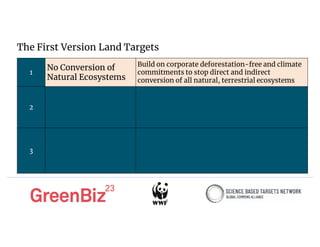
The First Version Land Targets
1
No Conversion of
Natural Ecosystems
Build on corporate deforestation-free and climate
commitments to stop direct and indirect
conversion of all natural, terrestrial ecosystems
2
3
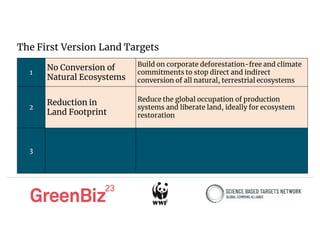
The First Version Land Targets
1
No Conversion of
Natural Ecosystems
Build on corporate deforestation-free and climate
commitments to stop direct and indirect
conversion of all natural, terrestrial ecosystems
2
Reduction in
Land Footprint
Reduce the global occupation of production
systems and liberate land, ideally for ecosystem
restoration
3
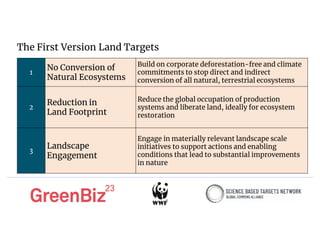
The First Version Land Targets
1
No Conversion of
Natural Ecosystems
Build on corporate deforestation-free and climate
commitments to stop direct and indirect
conversion of all natural, terrestrial ecosystems
2
Reduction in
Land Footprint
Reduce the global occupation of production
systems and liberate land, ideally for ecosystem
restoration
3
Landscape
Engagement
Engage in materially relevant landscape scale
initiatives to support actions and enabling
conditions that lead to substantial improvements
in nature
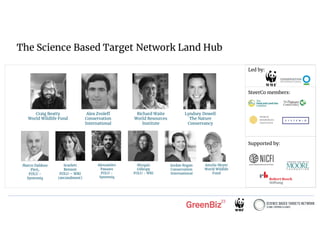
The Science Based Target Network Land Hub
Craig Beatty
World Wildlife Fund
Alex Zvoleff
Conservation
International
Richard Waite
World Resources
Institute
Lyndsey Dowell
The Nature
Conservancy
Morgan
Gillespy
FOLU - WRI
Supported by:
Scarlett
Benson
FOLU – WRI
(secondment)
Marco Daldoss
Pirri,
FOLU -
Systemiq
Led by:
SteerCo members:
Amelia Meyer
World Wildlife
Fund
Alessandro
Passaro
FOLU -
Systemiq
Jordan Rogan
Conservation
International
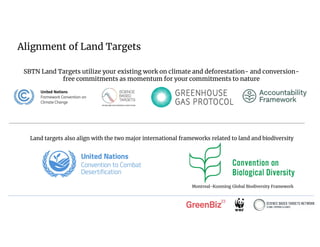
Alignment of Land Targets
SBTN Land Targets utilize your existing work on climate and deforestation- and conversion-
free commitments as momentum for your commitments to nature
Land targets also align with the two major international frameworks related to land and biodiversity
Montreal-Kunming Global Biodiversity Framework
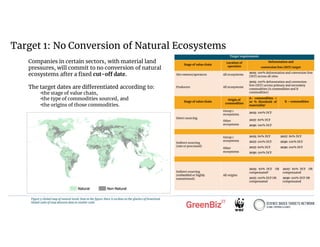
Target 1: No Conversion of Natural Ecosystems
Companies in certain sectors, with material land
pressures, will commit to no conversion of natural
ecosystems after a fixed cut-off date.
The target dates are differentiated according to:
•the stage of value chain,
•the type of commodities sourced, and
•the origins of those commodities.
Target requirements
Stage of value chain
Location of
operation
Deforestation and
conversion free (DCF) target
Site owners/operators All ecosystems
2025: 100% deforestation and conversion free
(DCF) across all sites
Producers All ecosystems
2025: 100% deforestation and conversion
free (DCF) across primary and secondary
commodities (A commodities and B
commodities)
Stage of value chain
Origin of
commodities
A- commodities +
10 % threshold of
materiality1
B – commodities
Direct sourcing
Group 1
ecosystems
2025: 100% DCF
Other
ecosystems
2027: 80% DCF
2030: 100% DCF
Indirect sourcing
(raw or processed)
Group 1
ecosystems
2025: 80% DCF
2027: 100% DCF
2027: 80% DCF
2030: 100% DCF
Other
ecosystems
2027: 80% DCF
2030: 100% DCF
2030: 100% DCF
Indirect sourcing
(embedded or highly
transformed)
All origins
2025: 80% DCF OR
compensated2
2027: 100% DCF OR
compensated
2027: 80% DCF OR
compensated
2030: 100% DCF OR
compensated
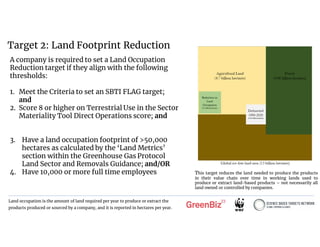
Target 2: Land Footprint Reduction
This target reduces the land needed to produce the products
in their value chain over time in working lands used to
produce or extract land-based products – not necessarily all
land owned or controlled by companies.
A company is required to set a Land Occupation
Reduction target if they align with the following
thresholds:
1. Meet the Criteria to set an SBTI FLAG target;
and
2. Score 8 or higher on Terrestrial Use in the Sector
Materiality Tool Direct Operations score; and
3. Have a land occupation footprint of >50,000
hectares as calculated by the ‘Land Metrics’
section within the Greenhouse Gas Protocol
Land Sector and Removals Guidance; and/OR
4. Have 10,000 or more full time employees
Land occupation is the amount of land required per year to produce or extract the
products produced or sourced by a company, and it is reported in hectares per year.
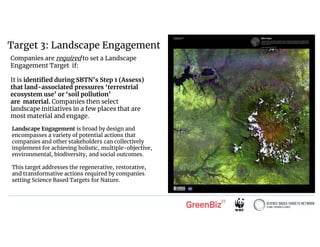
Target 3: Landscape Engagement
Companies are required to set a Landscape
Engagement Target if:
It is identified during SBTN’s Step 1 (Assess)
that land-associated pressures ‘terrestrial
ecosystem use’ or ‘soil pollution’
are material. Companies then select
landscape initiatives in a few places that are
most material and engage.
Landscape Engagement is broad by design and
encompasses a variety of potential actions that
companies and other stakeholders can collectively
implement for achieving holistic, multiple-objective,
environmental, biodiversity, and social outcomes.
This target addresses the regenerative, restorative,
and transformative actions required by companies
setting Science Based Targets for Nature.
Public Consultation
Today the Science Based Targets
Network releases SBTs for Land to a
full public consultation.
Review Period
February 14 – Monday March 6N
For information regarding how to participate
please visit sciencebasedtargetsnetwork.org
-OR-
Join the Land Hub table during the breakout
session
THANK
YOU
Information presented here represents the most recent version of the land targets and was
completed prior to the finalization of the draft for public consultation. It may not accurately
reflect what is included in the draft released for public consultation.

SBTN Session_Land Science Based Targets GreenBiz23.pdf

  • 1.
    Science Based Targetsfor Land Version 1 Craig Beatty World Wildlife Fund, Co-Lead Science Based Targets Network Land Hub
  • 2.
    The First VersionLand Targets 1 No Conversion of Natural Ecosystems Build on corporate deforestation-free and climate commitments to stop direct and indirect conversion of all natural, terrestrial ecosystems 2 3
  • 3.
    The First VersionLand Targets 1 No Conversion of Natural Ecosystems Build on corporate deforestation-free and climate commitments to stop direct and indirect conversion of all natural, terrestrial ecosystems 2 Reduction in Land Footprint Reduce the global occupation of production systems and liberate land, ideally for ecosystem restoration 3
  • 4.
    The First VersionLand Targets 1 No Conversion of Natural Ecosystems Build on corporate deforestation-free and climate commitments to stop direct and indirect conversion of all natural, terrestrial ecosystems 2 Reduction in Land Footprint Reduce the global occupation of production systems and liberate land, ideally for ecosystem restoration 3 Landscape Engagement Engage in materially relevant landscape scale initiatives to support actions and enabling conditions that lead to substantial improvements in nature
  • 5.
    The Science BasedTarget Network Land Hub Craig Beatty World Wildlife Fund Alex Zvoleff Conservation International Richard Waite World Resources Institute Lyndsey Dowell The Nature Conservancy Morgan Gillespy FOLU - WRI Supported by: Scarlett Benson FOLU – WRI (secondment) Marco Daldoss Pirri, FOLU - Systemiq Led by: SteerCo members: Amelia Meyer World Wildlife Fund Alessandro Passaro FOLU - Systemiq Jordan Rogan Conservation International
  • 6.
    Alignment of LandTargets SBTN Land Targets utilize your existing work on climate and deforestation- and conversion- free commitments as momentum for your commitments to nature Land targets also align with the two major international frameworks related to land and biodiversity Montreal-Kunming Global Biodiversity Framework
  • 7.
    Target 1: NoConversion of Natural Ecosystems Companies in certain sectors, with material land pressures, will commit to no conversion of natural ecosystems after a fixed cut-off date. The target dates are differentiated according to: •the stage of value chain, •the type of commodities sourced, and •the origins of those commodities. Target requirements Stage of value chain Location of operation Deforestation and conversion free (DCF) target Site owners/operators All ecosystems 2025: 100% deforestation and conversion free (DCF) across all sites Producers All ecosystems 2025: 100% deforestation and conversion free (DCF) across primary and secondary commodities (A commodities and B commodities) Stage of value chain Origin of commodities A- commodities + 10 % threshold of materiality1 B – commodities Direct sourcing Group 1 ecosystems 2025: 100% DCF Other ecosystems 2027: 80% DCF 2030: 100% DCF Indirect sourcing (raw or processed) Group 1 ecosystems 2025: 80% DCF 2027: 100% DCF 2027: 80% DCF 2030: 100% DCF Other ecosystems 2027: 80% DCF 2030: 100% DCF 2030: 100% DCF Indirect sourcing (embedded or highly transformed) All origins 2025: 80% DCF OR compensated2 2027: 100% DCF OR compensated 2027: 80% DCF OR compensated 2030: 100% DCF OR compensated
  • 8.
    Target 2: LandFootprint Reduction This target reduces the land needed to produce the products in their value chain over time in working lands used to produce or extract land-based products – not necessarily all land owned or controlled by companies. A company is required to set a Land Occupation Reduction target if they align with the following thresholds: 1. Meet the Criteria to set an SBTI FLAG target; and 2. Score 8 or higher on Terrestrial Use in the Sector Materiality Tool Direct Operations score; and 3. Have a land occupation footprint of >50,000 hectares as calculated by the ‘Land Metrics’ section within the Greenhouse Gas Protocol Land Sector and Removals Guidance; and/OR 4. Have 10,000 or more full time employees Land occupation is the amount of land required per year to produce or extract the products produced or sourced by a company, and it is reported in hectares per year.
  • 9.
    Target 3: LandscapeEngagement Companies are required to set a Landscape Engagement Target if: It is identified during SBTN’s Step 1 (Assess) that land-associated pressures ‘terrestrial ecosystem use’ or ‘soil pollution’ are material. Companies then select landscape initiatives in a few places that are most material and engage. Landscape Engagement is broad by design and encompasses a variety of potential actions that companies and other stakeholders can collectively implement for achieving holistic, multiple-objective, environmental, biodiversity, and social outcomes. This target addresses the regenerative, restorative, and transformative actions required by companies setting Science Based Targets for Nature.
  • 10.
    Public Consultation Today theScience Based Targets Network releases SBTs for Land to a full public consultation. Review Period February 14 – Monday March 6N For information regarding how to participate please visit sciencebasedtargetsnetwork.org -OR- Join the Land Hub table during the breakout session
  • 11.
    THANK YOU Information presented hererepresents the most recent version of the land targets and was completed prior to the finalization of the draft for public consultation. It may not accurately reflect what is included in the draft released for public consultation.