Resilience, Trauma,
Technology: JoyPopTM
Dr. Christine Wekerle, Associate Professor,
Pediatrics, McMaster University, Hamilton,
Ontario, Canada
Editor-in-Chief, Child Abuse & Neglect
wekerc@mcmaster.ca
chris.wekerle@gmail.com
Twitter & Instagram: @drwekerle
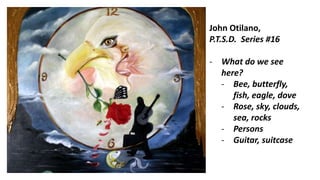
John Otilano,
P.T.S.D. Series #16
- What do we see
here?
- Bee, butterfly,
fish, eagle, dove
- Rose, sky, clouds,
sea, rocks
- Persons
- Guitar, suitcase
What is psychological trauma?
• High stress event – extremely frightening, distressing, maltreating
• Psychological burden (overwhelming) and injury (brain changes; Developmental
Traumatology Model, DeBellis)
• Threaten your life or life of others. Felt sense of security (Cummings)
• Challenges functioning and coping with stress post the event
• Not all children, youth, adults will react with PTSD symptoms following a
traumatic event
• Context: COVID pandemic has been called “collective trauma” – U-report Global
Survey
• Adverse Childhood Events (ACEs) – child autobiographical memory disturbance,
depression, PTSD, smoking, earlier initiation of illicit drugs and alcohol, insomnia
etc. (Zarse et al., 2019)
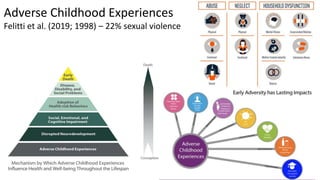
Adverse Childhood Experiences
Felitti et al. (2019; 1998) – 22% sexual violence
Trauma Contexts (Davies & Martin (2013) https://www.ncbi.nlm.nih.gov/pmc/articles/PMC3918896/
For the attachment system activated by trauma: approach behaviours to increase
caregiver attention (clinging, seeking comfort, verbal bids for support, behavioral signals of
distress, and regular monitoring of the whereabouts of the parent) or avoidance behaviours
(attention “cut-off” behaviours: lowering eyes, deflecting attention to environment, exit away
from caregivers) (Bowlby, 1969; Hilburn-Cobb, 2004). No clear response style (called
disorganized behaviours)
For the threat system being activated by trauma: FFFF (flight, fight, freeze, faint)
vigilance, camouflaging (e.g., inhibiting verbal and overt emotional distress), social de-
escalation strategies (e.g., coy behavior, ingratiation, pacifying parents), long-term
demobilization (e.g., fatigue, hopelessness, helplessness, dysphoria), aggressive reactivity
(e.g., dominance posturing) behaviors (Davies & Sturge-Apple, 2007; Gilbert, 1993).
Emphasis toward promoting happiness and resilience in high-stress, high-conflict or high
chaos environments
Resilience = adaptation in challenge - sustainability
Resilience Frameworks
• Overwhelming stress impairs functioning
(e.g., narrows attention)
• Diathesis-stress (pre-existing vulnerability)
• Compensatory – resilience directly impacts
stress/risk (counteracts) [regression – risks;
resilience]
• Protective – resilience buffers (moderates)
the impact of stress/risk (protects) [e.g.,
stress-mhealth interaction effects]
• Challenge - when in stress, deploys
resources to reduce future stress/reactivity
(innoculation x time; growth curve
modeling)
• Zimmerman (2013) – two types of
promotive factors: (1) assets (self-efficacy);
(2) resources (JoyPop)
Picturing Wellness – Student Video
2008-2013 Literature Search
found 8 papers describing 5 apps
4 apps provided direct support
from a mental health professional
2 of the 5 apps were
commercially available – not
youth-focused
24 publications on 15 apps for
youth under age 18
2 small RCTs no impact on mh
outcomes; none designed
specifically for youth
Feasibility good; app usage
moderate; lack standard outcomes
• Theoretical Mechanism: High visuospatial demands (Tetris) task engagement would disrupt consolidation of sensory
elements of trauma memory and impair memory reconsolidation
• Investigators in Germany studied 20 inpatients with complex PTSD (19 women; mean age, 33; median stay, 7 weeks)
• Overall, 70% had childhood abuse histories, 85% had current major depression, and 75% were taking psychotropic
medications; exclusions were recent substance abuse and active suicidality.
• Treatment as usual (TAU) involved weekly individual CBT and multiple group therapy sessions each week.
• 25 minutes of Tetris, and subsequently recorded arousal and intrusive memories
• For the whole group, 75 targeted intrusions were reduced by 64%, compared with an 11% reduction in 84 non-targeted
intrusions; Kessler H et al. Reducing intrusive memories of trauma using a visuospatial interference intervention with
inpatients with posttraumatic stress disorder (PTSD). J Consult Clin Psychol 2018 Dec; 86:1076.
(https://doi.org/10.1037/ccp0000340)
• Preventing PTSD symptoms: Tetris vs. attention placebo RCT Researchers have been able to demonstrate how the
survivors of motor vehicle accidents have fewer symptoms if they play Tetris in hospital ER waiting room within six hours
of admission; as well as after having been asked to recall their memory of the accident.
• https://www.nature.com/articles/mp201723 Iyadurai et al. (2018)
TETRIS game & trauma
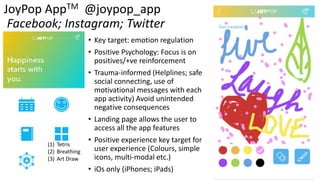
JoyPop AppTM @joypop_app
Facebook; Instagram; Twitter
• Key target: emotion regulation
• Positive Psychology: Focus is on
positives/+ve reinforcement
• Trauma-informed (Helplines; safe
social connecting, use of
motivational messages with each
app activity) Avoid unintended
negative consequences
• Landing page allows the user to
access all the app features
• Positive experience key target for
user experience (Colours, simple
icons, multi-modal etc.)
• iOs only (iPhones; iPads)
(1) Tetris
(2) Breathing
(3) Art Draw
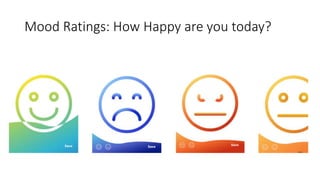
Mood Ratings: How Happy are you today?
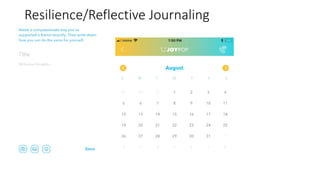
Resilience/Reflective Journaling
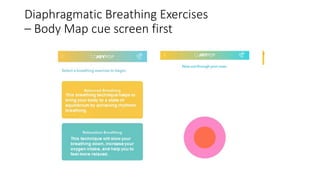
Diaphragmatic Breathing Exercises
– Body Map cue screen first
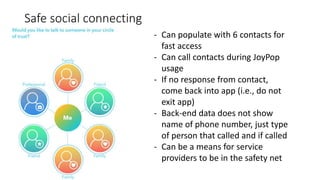
Safe social connecting
- Can populate with 6 contacts for
fast access
- Can call contacts during JoyPop
usage
- If no response from contact,
come back into app (i.e., do not
exit app)
- Back-end data does not show
name of phone number, just type
of person that called and if called
- Can be a means for service
providers to be in the safety net
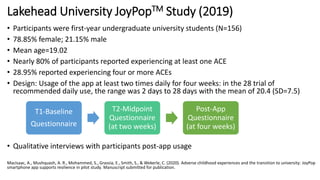
Lakehead University JoyPopTM Study (2019)
• Participants were first-year undergraduate university students (N=156)
• 78.85% female; 21.15% male
• Mean age=19.02
• Nearly 80% of participants reported experiencing at least one ACE
• 28.95% reported experiencing four or more ACEs
• Design: Usage of the app at least two times daily for four weeks: in the 28 trial of
recommended daily use, the range was 2 days to 28 days with the mean of 20.4 (SD=7.5)
• Qualitative interviews with participants post-app usage
MacIsaac, A., Mushquash, A. R., Mohammed, S., Grassia, E., Smith, S., & Wekerle, C. (2020). Adverse childhood experiences and the transition to university: JoyPop
smartphone app supports resilience in pilot study. Manuscript submitted for publication.
T1-Baseline
Questionnaire
T2-Midpoint
Questionnaire
(at two weeks)
Post-App
Questionnaire
(at four weeks)
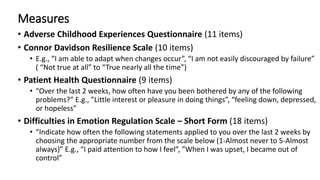
Measures
• Adverse Childhood Experiences Questionnaire (11 items)
• Connor Davidson Resilience Scale (10 items)
• E.g., “I am able to adapt when changes occur”, “I am not easily discouraged by failure”
( “Not true at all” to “True nearly all the time”)
• Patient Health Questionnaire (9 items)
• “Over the last 2 weeks, how often have you been bothered by any of the following
problems?” E.g., ”Little interest or pleasure in doing things”, “feeling down, depressed,
or hopeless”
• Difficulties in Emotion Regulation Scale – Short Form (18 items)
• “Indicate how often the following statements applied to you over the last 2 weeks by
choosing the appropriate number from the scale below (1-Almost never to 5-Almost
always)” E.g., “I paid attention to how I feel”, ”When I was upset, I became out of
control”
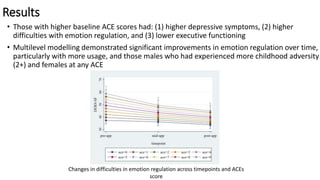
Results
• Those with higher baseline ACE scores had: (1) higher depressive symptoms, (2) higher
difficulties with emotion regulation, and (3) lower executive functioning
• Multilevel modelling demonstrated significant improvements in emotion regulation over time,
particularly with more usage, and those males who had experienced more childhood adversity
(2+) and females at any ACE
Changes in difficulties in emotion regulation across timepoints and ACEs
score
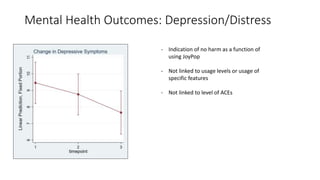
Mental Health Outcomes: Depression/Distress
- Indication of no harm as a function of
using JoyPop
- Not linked to usage levels or usage of
specific features
- Not linked to level of ACEs
Participant Feedback on the JoyPopTM App
• “I feel like it helped . . . bring self-awareness to how I was feeling every
day”
• “As I’ve used it more and more it’s kind of become part of my daily routine”
• "I really liked using the journal feature… I would write about how I was
feeling that day”
• "If I was anxious or in or stressful situations the games or the drawing really
helped“
• "I could go into the breathing exercises and it just [kind of] reset my mood”
JoyPopTM
• JoyPopTM Videos:
• https://www.youtube.com/watch?v=JyV9EMxhzc0
• https://www.youtube.com/watch?v=pb5XwX6s2Rw
• Available in the app store
• Questions & Answer
CIHRTeamSV Resources
• Male childhood sexual abuse (CSA): https://www.youtube.com/watch?v=NAcQaudAt4c&t=3s
• Male CSA and resilience: https://www.youtube.com/watch?v=iCt0wfSKJ6w
• Finding Joy in an App: https://futurumcareers.com/dr-christine-wekerle-finding-joy-in-an-app
• Youth Resilience: Clinical psychology and technology approaches:
https://www.openaccessgovernment.org/youth-resilience-2/80464/
• Male health: The serious challenges with which boys and young men contend:
https://www.openaccessgovernment.org/male-health-challenges/79937/
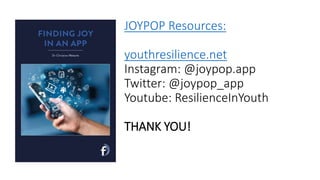
JOYPOP Resources:
youthresilience.net
Instagram: @joypop.app
Twitter: @joypop_app
Youtube: ResilienceInYouth
THANK YOU!

The JoyPop Resilience App for Youth

  • 1.
    Resilience, Trauma, Technology: JoyPopTM Dr.Christine Wekerle, Associate Professor, Pediatrics, McMaster University, Hamilton, Ontario, Canada Editor-in-Chief, Child Abuse & Neglect wekerc@mcmaster.ca chris.wekerle@gmail.com Twitter & Instagram: @drwekerle
  • 2.
    John Otilano, P.T.S.D. Series#16 - What do we see here? - Bee, butterfly, fish, eagle, dove - Rose, sky, clouds, sea, rocks - Persons - Guitar, suitcase
  • 3.
    What is psychologicaltrauma? • High stress event – extremely frightening, distressing, maltreating • Psychological burden (overwhelming) and injury (brain changes; Developmental Traumatology Model, DeBellis) • Threaten your life or life of others. Felt sense of security (Cummings) • Challenges functioning and coping with stress post the event • Not all children, youth, adults will react with PTSD symptoms following a traumatic event • Context: COVID pandemic has been called “collective trauma” – U-report Global Survey • Adverse Childhood Events (ACEs) – child autobiographical memory disturbance, depression, PTSD, smoking, earlier initiation of illicit drugs and alcohol, insomnia etc. (Zarse et al., 2019)
  • 4.
    Adverse Childhood Experiences Felittiet al. (2019; 1998) – 22% sexual violence
  • 5.
    Trauma Contexts (Davies& Martin (2013) https://www.ncbi.nlm.nih.gov/pmc/articles/PMC3918896/ For the attachment system activated by trauma: approach behaviours to increase caregiver attention (clinging, seeking comfort, verbal bids for support, behavioral signals of distress, and regular monitoring of the whereabouts of the parent) or avoidance behaviours (attention “cut-off” behaviours: lowering eyes, deflecting attention to environment, exit away from caregivers) (Bowlby, 1969; Hilburn-Cobb, 2004). No clear response style (called disorganized behaviours) For the threat system being activated by trauma: FFFF (flight, fight, freeze, faint) vigilance, camouflaging (e.g., inhibiting verbal and overt emotional distress), social de- escalation strategies (e.g., coy behavior, ingratiation, pacifying parents), long-term demobilization (e.g., fatigue, hopelessness, helplessness, dysphoria), aggressive reactivity (e.g., dominance posturing) behaviors (Davies & Sturge-Apple, 2007; Gilbert, 1993). Emphasis toward promoting happiness and resilience in high-stress, high-conflict or high chaos environments
  • 6.
    Resilience = adaptationin challenge - sustainability Resilience Frameworks • Overwhelming stress impairs functioning (e.g., narrows attention) • Diathesis-stress (pre-existing vulnerability) • Compensatory – resilience directly impacts stress/risk (counteracts) [regression – risks; resilience] • Protective – resilience buffers (moderates) the impact of stress/risk (protects) [e.g., stress-mhealth interaction effects] • Challenge - when in stress, deploys resources to reduce future stress/reactivity (innoculation x time; growth curve modeling) • Zimmerman (2013) – two types of promotive factors: (1) assets (self-efficacy); (2) resources (JoyPop) Picturing Wellness – Student Video
  • 7.
    2008-2013 Literature Search found8 papers describing 5 apps 4 apps provided direct support from a mental health professional 2 of the 5 apps were commercially available – not youth-focused 24 publications on 15 apps for youth under age 18 2 small RCTs no impact on mh outcomes; none designed specifically for youth Feasibility good; app usage moderate; lack standard outcomes
  • 8.
    • Theoretical Mechanism:High visuospatial demands (Tetris) task engagement would disrupt consolidation of sensory elements of trauma memory and impair memory reconsolidation • Investigators in Germany studied 20 inpatients with complex PTSD (19 women; mean age, 33; median stay, 7 weeks) • Overall, 70% had childhood abuse histories, 85% had current major depression, and 75% were taking psychotropic medications; exclusions were recent substance abuse and active suicidality. • Treatment as usual (TAU) involved weekly individual CBT and multiple group therapy sessions each week. • 25 minutes of Tetris, and subsequently recorded arousal and intrusive memories • For the whole group, 75 targeted intrusions were reduced by 64%, compared with an 11% reduction in 84 non-targeted intrusions; Kessler H et al. Reducing intrusive memories of trauma using a visuospatial interference intervention with inpatients with posttraumatic stress disorder (PTSD). J Consult Clin Psychol 2018 Dec; 86:1076. (https://doi.org/10.1037/ccp0000340) • Preventing PTSD symptoms: Tetris vs. attention placebo RCT Researchers have been able to demonstrate how the survivors of motor vehicle accidents have fewer symptoms if they play Tetris in hospital ER waiting room within six hours of admission; as well as after having been asked to recall their memory of the accident. • https://www.nature.com/articles/mp201723 Iyadurai et al. (2018) TETRIS game & trauma
  • 9.
    JoyPop AppTM @joypop_app Facebook;Instagram; Twitter • Key target: emotion regulation • Positive Psychology: Focus is on positives/+ve reinforcement • Trauma-informed (Helplines; safe social connecting, use of motivational messages with each app activity) Avoid unintended negative consequences • Landing page allows the user to access all the app features • Positive experience key target for user experience (Colours, simple icons, multi-modal etc.) • iOs only (iPhones; iPads) (1) Tetris (2) Breathing (3) Art Draw
  • 10.
    Mood Ratings: HowHappy are you today?
  • 11.
  • 12.
    Diaphragmatic Breathing Exercises –Body Map cue screen first
  • 13.
    Safe social connecting -Can populate with 6 contacts for fast access - Can call contacts during JoyPop usage - If no response from contact, come back into app (i.e., do not exit app) - Back-end data does not show name of phone number, just type of person that called and if called - Can be a means for service providers to be in the safety net
  • 14.
    Lakehead University JoyPopTMStudy (2019) • Participants were first-year undergraduate university students (N=156) • 78.85% female; 21.15% male • Mean age=19.02 • Nearly 80% of participants reported experiencing at least one ACE • 28.95% reported experiencing four or more ACEs • Design: Usage of the app at least two times daily for four weeks: in the 28 trial of recommended daily use, the range was 2 days to 28 days with the mean of 20.4 (SD=7.5) • Qualitative interviews with participants post-app usage MacIsaac, A., Mushquash, A. R., Mohammed, S., Grassia, E., Smith, S., & Wekerle, C. (2020). Adverse childhood experiences and the transition to university: JoyPop smartphone app supports resilience in pilot study. Manuscript submitted for publication. T1-Baseline Questionnaire T2-Midpoint Questionnaire (at two weeks) Post-App Questionnaire (at four weeks)
  • 15.
    Measures • Adverse ChildhoodExperiences Questionnaire (11 items) • Connor Davidson Resilience Scale (10 items) • E.g., “I am able to adapt when changes occur”, “I am not easily discouraged by failure” ( “Not true at all” to “True nearly all the time”) • Patient Health Questionnaire (9 items) • “Over the last 2 weeks, how often have you been bothered by any of the following problems?” E.g., ”Little interest or pleasure in doing things”, “feeling down, depressed, or hopeless” • Difficulties in Emotion Regulation Scale – Short Form (18 items) • “Indicate how often the following statements applied to you over the last 2 weeks by choosing the appropriate number from the scale below (1-Almost never to 5-Almost always)” E.g., “I paid attention to how I feel”, ”When I was upset, I became out of control”
  • 16.
    Results • Those withhigher baseline ACE scores had: (1) higher depressive symptoms, (2) higher difficulties with emotion regulation, and (3) lower executive functioning • Multilevel modelling demonstrated significant improvements in emotion regulation over time, particularly with more usage, and those males who had experienced more childhood adversity (2+) and females at any ACE Changes in difficulties in emotion regulation across timepoints and ACEs score
  • 17.
    Mental Health Outcomes:Depression/Distress - Indication of no harm as a function of using JoyPop - Not linked to usage levels or usage of specific features - Not linked to level of ACEs
  • 18.
    Participant Feedback onthe JoyPopTM App • “I feel like it helped . . . bring self-awareness to how I was feeling every day” • “As I’ve used it more and more it’s kind of become part of my daily routine” • "I really liked using the journal feature… I would write about how I was feeling that day” • "If I was anxious or in or stressful situations the games or the drawing really helped“ • "I could go into the breathing exercises and it just [kind of] reset my mood”
  • 19.
    JoyPopTM • JoyPopTM Videos: •https://www.youtube.com/watch?v=JyV9EMxhzc0 • https://www.youtube.com/watch?v=pb5XwX6s2Rw • Available in the app store • Questions & Answer
  • 20.
    CIHRTeamSV Resources • Malechildhood sexual abuse (CSA): https://www.youtube.com/watch?v=NAcQaudAt4c&t=3s • Male CSA and resilience: https://www.youtube.com/watch?v=iCt0wfSKJ6w • Finding Joy in an App: https://futurumcareers.com/dr-christine-wekerle-finding-joy-in-an-app • Youth Resilience: Clinical psychology and technology approaches: https://www.openaccessgovernment.org/youth-resilience-2/80464/ • Male health: The serious challenges with which boys and young men contend: https://www.openaccessgovernment.org/male-health-challenges/79937/
  • 21.
    JOYPOP Resources: youthresilience.net Instagram: @joypop.app Twitter:@joypop_app Youtube: ResilienceInYouth THANK YOU!