SENATE BILL 1
SCHOOL FUNDING REFORM ACT OF 2015
February 24, 2015
SB 16 Background & Senate Action
Date Action
July 2013 Illinois Senate unanimously voted to
create an Education Funding Advisory
Committee with the recognition that
how Illinois funds public education
was ripe for review
February 2014 Bipartisan Committee released its
recommendations for a new state
education funding system
April 1, 2014 SB 16 filed in its entirety, building on
this groundwork
May 27, 2014 Passed Senate: 32 Yeas, 19 Nays, 6
Present
2
“How” vs. “How Much”
EFAC focused on the premise that regardless of how much or how little is
available for schools in any given State fiscal year, how it is spent should matter.
3
The Task we Face in Illinois
4
• “Due to the impact of district wealth, districts that make lower
tax effort tend to raise higher amounts of local revenue.”
• “We conclude that the Illinois school finance system is
inequitable for both students and taxpayers.”
• “Our concern is that the parameters that drive the allocation of
state formula support . . Have little meaning beyond assuring
that total state aid does not exceed the revenue that the state
is willing to provide for school districts.”
Testimony from Augenblick, Palaich & Associates to the Education Funding Advisory
Committee (EFAC) | September 17, 2013
What did Augenblick say to EFAC?
5
East St. Louis D 189 Arlington Heights D
214
Tax Rate 7.49 1.84
PPS from Local Funds $1,200 $18,400
Low Income % 99% 26%
Proration Cut @ 89% -$935 -$58
80
60
40
20
0
100
Current
system
% of state funding
Integrated
formula
Funding
required
Funding
received
• Foundation level set
to provide base
adequacy
• Weight for need
according to student/
district characteristics
and considering
regional costs
• All funds means tested
against local wealth
• State funding fills the gap
to required amount
• Districts can fund more
using local tax revenues
Weight for
need
Foundation
level
State
funding
closes the gap
Local
contribution
determined
by formula
Added local
funding
GSA
formula
Categorical
Supplemental
grant
Chicago block
Integrated
formula
Categorical
Simplify how state dollars are distributed...
An integrated primary State funding formula accounts for
student need and local resources
...while funding districts according to student
need and local ability to pay
Integrated
formula
Categorica
• Combine all GSA and most
categoricals
• Allocate according to a single,
transparent, integrated formula
Categorical
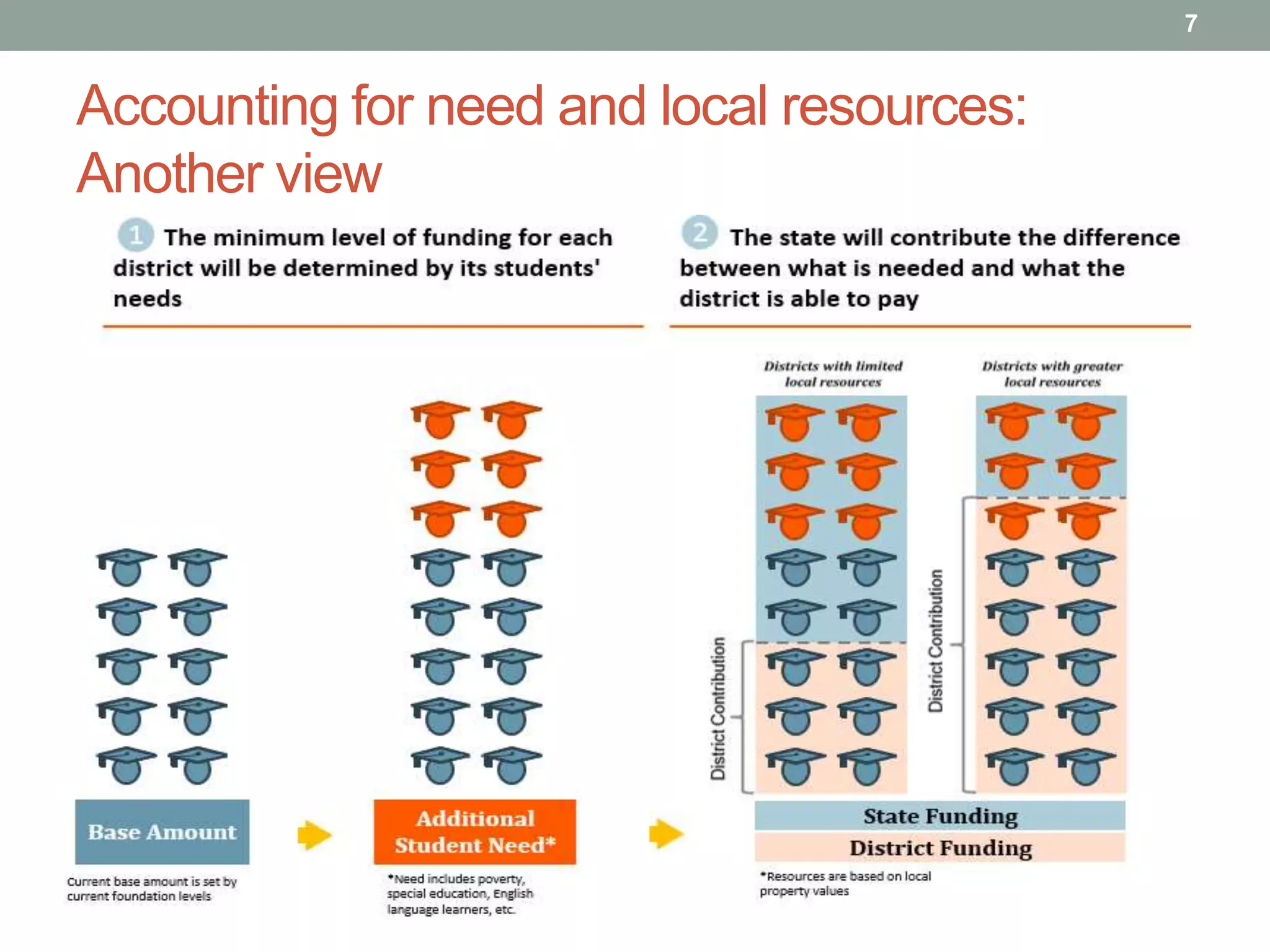
Accounting for need and local resources:
Another view
7
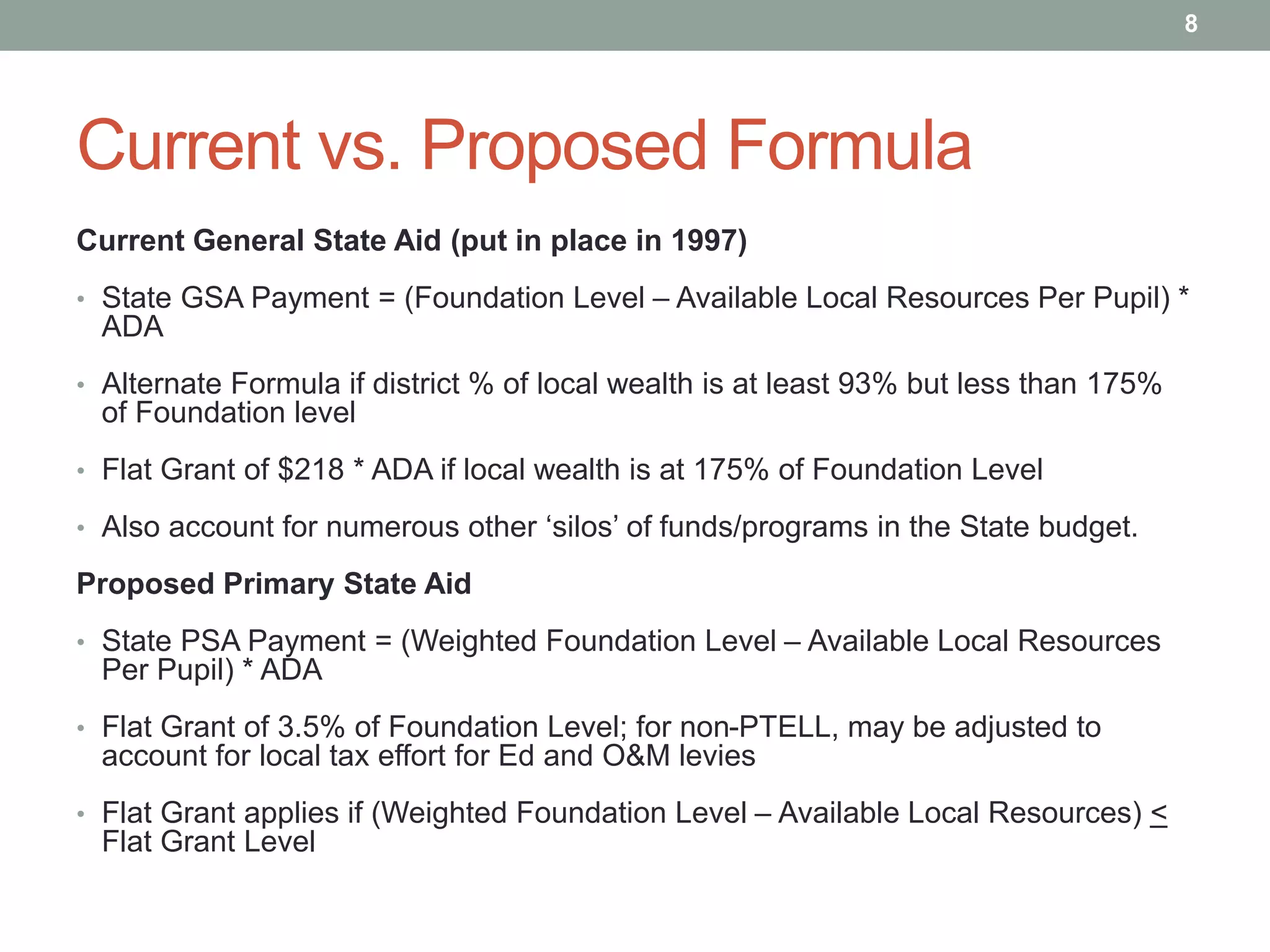
Current vs. Proposed Formula
Current General State Aid (put in place in 1997)
• State GSA Payment = (Foundation Level – Available Local Resources Per Pupil) *
ADA
• Alternate Formula if district % of local wealth is at least 93% but less than 175%
of Foundation level
• Flat Grant of $218 * ADA if local wealth is at 175% of Foundation Level
• Also account for numerous other ‘silos’ of funds/programs in the State budget.
Proposed Primary State Aid
• State PSA Payment = (Weighted Foundation Level – Available Local Resources
Per Pupil) * ADA
• Flat Grant of 3.5% of Foundation Level; for non-PTELL, may be adjusted to
account for local tax effort for Ed and O&M levies
• Flat Grant applies if (Weighted Foundation Level – Available Local Resources) <
Flat Grant Level
8
Weighted Foundation Level
• Weighted Foundation Level = Foundation Level *
District Weighted Average
• District Weighted Average = 1.0 + Additional Weights
(on a cumulative basis)
• Additional Weight = Weighting Factor * Weighting
Percentage
• Regionalization: If applicable, a regionalization factor is
applied to the District Weighted Average.
• The regionalization factor is based on the Comparable Wage Index
developed for the National Center for Education Statistics (which
measures systemic, regional variations in the salaries of college
graduates who are not educators)
9
Additional Weights
Category Weighting Factor Weighting % Notes
English Language
Learners
.20 ELL%
Low-income .25 - .75, depending on
concentration
Low-income % Low-income: Current
DHS count for 2 years;
then 185% of FPL
Special Education 1.0 > of 13.8% or
district %, up to
18.8%
Private placement,
group home, and Sp Ed
Transp. Excluded
Sp Ed Summer
School
.03 % Eligible
Gifted .01 % Eligible No more than 5% of K-8
High School
Outcomes
.02: AP, dual credit
.03: Career Pathway
% Eligible Only in one category
Reg. Transp. .6 - .10, based on
density/sq. mile
% Eligible
Vocational or
Extraordinary
Transp.
.12 – Vocation
Not to exceed .12 -
Extraordinary
% Eligible ISBE to define
“extraordinary” by rule
10
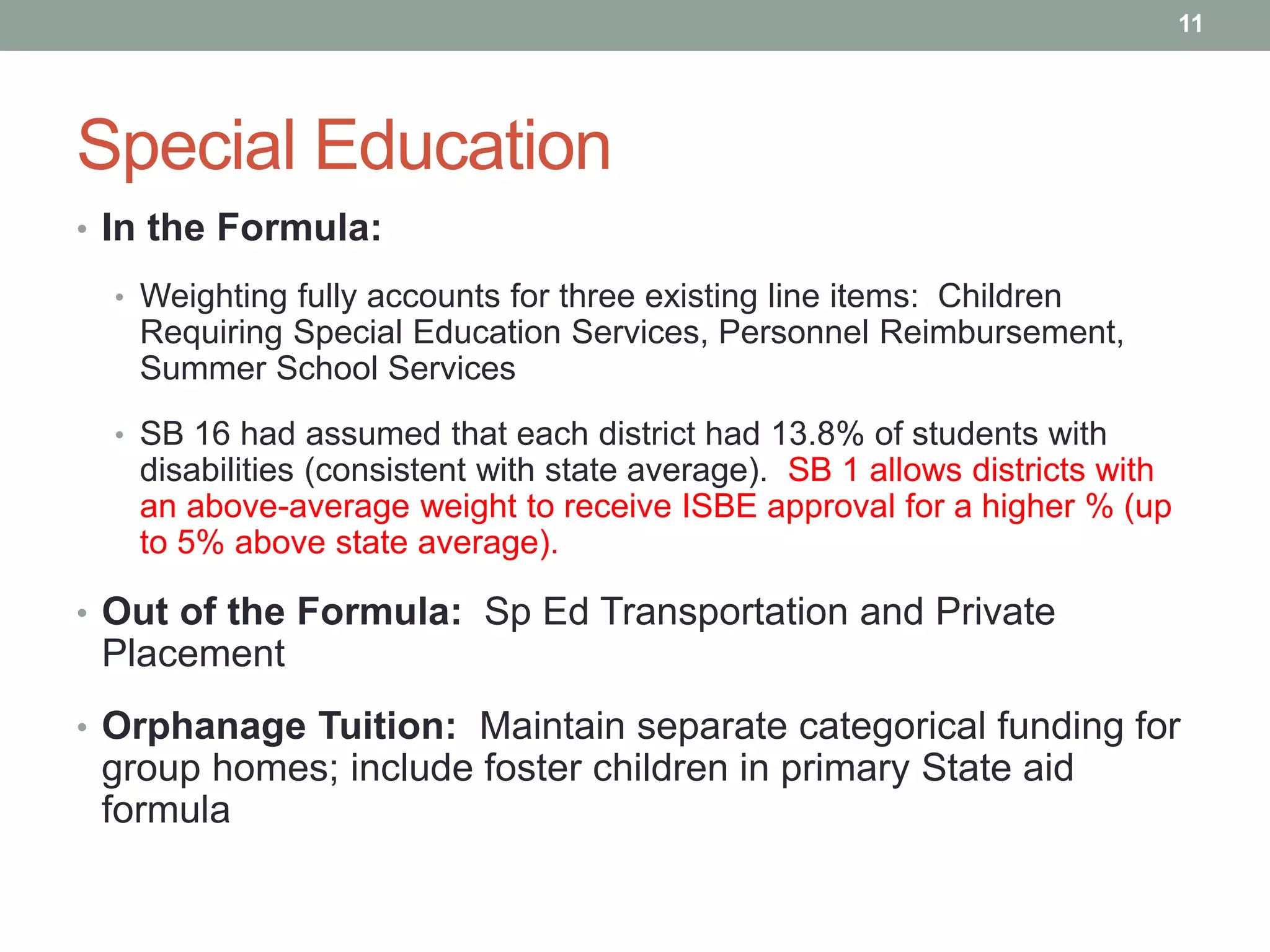
Special Education
• In the Formula:
• Weighting fully accounts for three existing line items: Children
Requiring Special Education Services, Personnel Reimbursement,
Summer School Services
• SB 16 had assumed that each district had 13.8% of students with
disabilities (consistent with state average). SB 1 allows districts with
an above-average weight to receive ISBE approval for a higher % (up
to 5% above state average).
• Out of the Formula: Sp Ed Transportation and Private
Placement
• Orphanage Tuition: Maintain separate categorical funding for
group homes; include foster children in primary State aid
formula
11
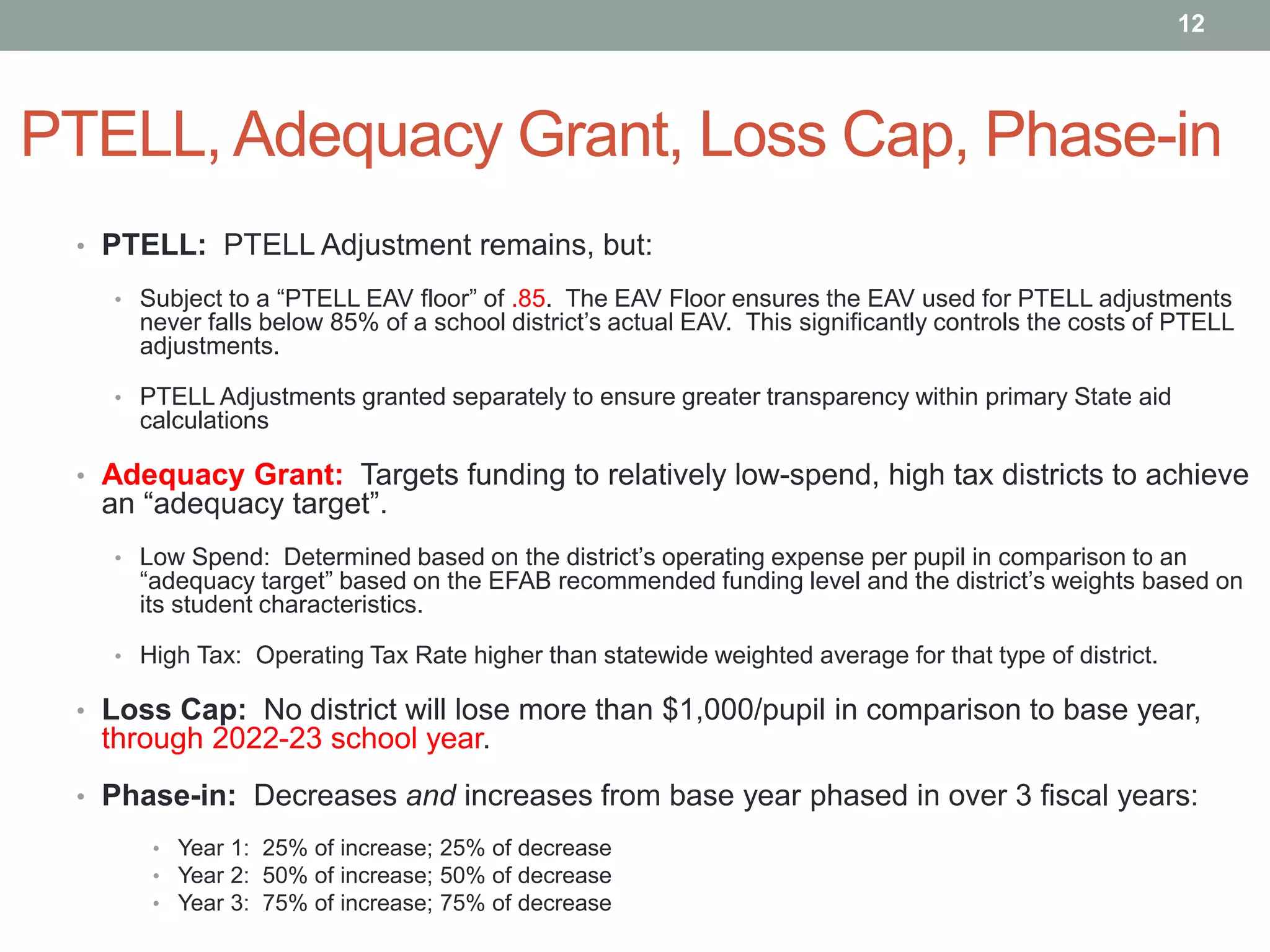
PTELL, Adequacy Grant, Loss Cap, Phase-in
• PTELL: PTELL Adjustment remains, but:
• Subject to a “PTELL EAV floor” of .85. The EAV Floor ensures the EAV used for PTELL adjustments
never falls below 85% of a school district’s actual EAV. This significantly controls the costs of PTELL
adjustments.
• PTELL Adjustments granted separately to ensure greater transparency within primary State aid
calculations
• Adequacy Grant: Targets funding to relatively low-spend, high tax districts to achieve
an “adequacy target”.
• Low Spend: Determined based on the district’s operating expense per pupil in comparison to an
“adequacy target” based on the EFAB recommended funding level and the district’s weights based on
its student characteristics.
• High Tax: Operating Tax Rate higher than statewide weighted average for that type of district.
• Loss Cap: No district will lose more than $1,000/pupil in comparison to base year,
through 2022-23 school year.
• Phase-in: Decreases and increases from base year phased in over 3 fiscal years:
• Year 1: 25% of increase; 25% of decrease
• Year 2: 50% of increase; 50% of decrease
• Year 3: 75% of increase; 75% of decrease
12
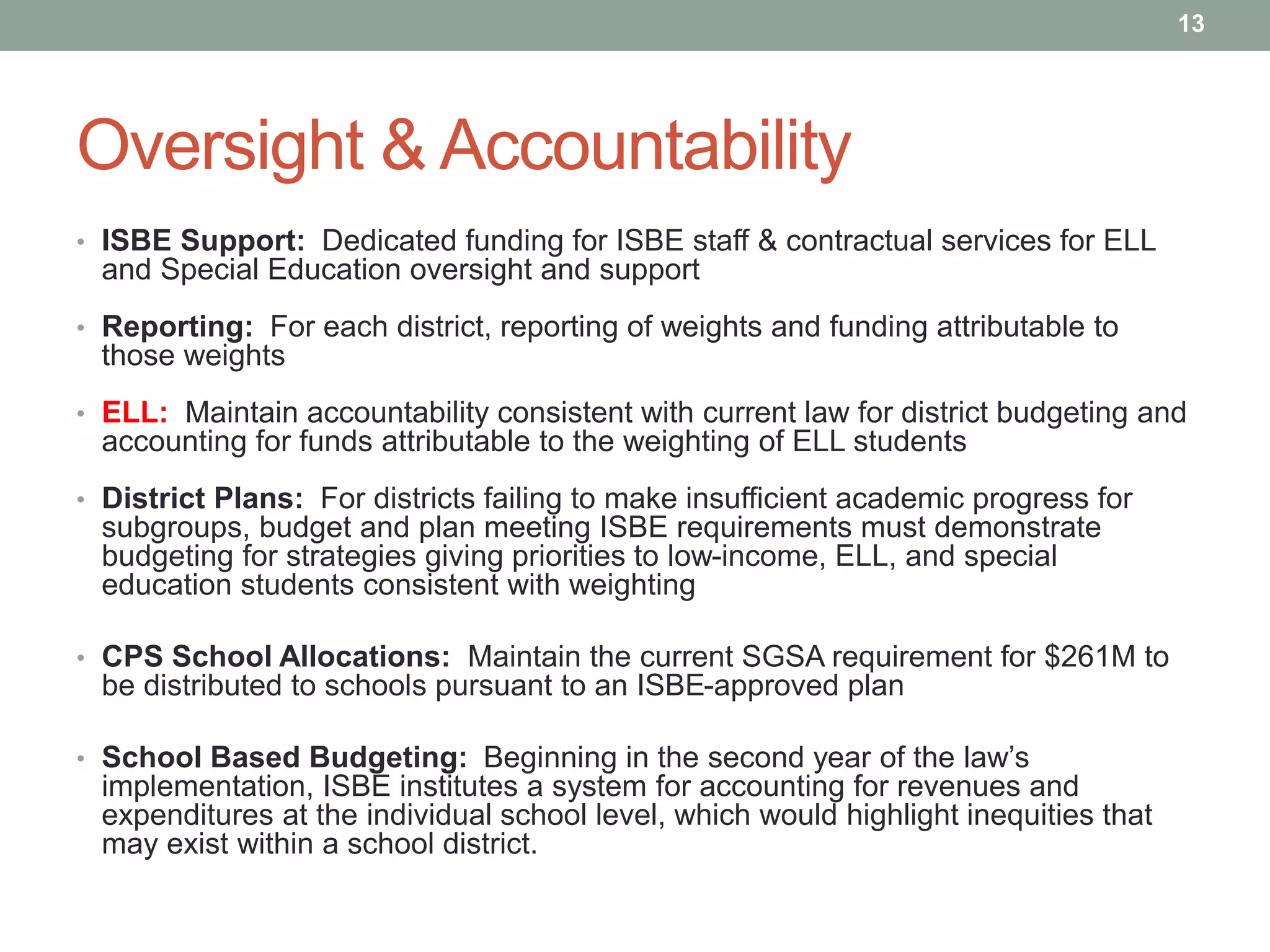
Oversight & Accountability
• ISBE Support: Dedicated funding for ISBE staff & contractual services for ELL
and Special Education oversight and support
• Reporting: For each district, reporting of weights and funding attributable to
those weights
• ELL: Maintain accountability consistent with current law for district budgeting and
accounting for funds attributable to the weighting of ELL students
• District Plans: For districts failing to make insufficient academic progress for
subgroups, budget and plan meeting ISBE requirements must demonstrate
budgeting for strategies giving priorities to low-income, ELL, and special
education students consistent with weighting
• CPS School Allocations: Maintain the current SGSA requirement for $261M to
be distributed to schools pursuant to an ISBE-approved plan
• School Based Budgeting: Beginning in the second year of the law’s
implementation, ISBE institutes a system for accounting for revenues and
expenditures at the individual school level, which would highlight inequities that
may exist within a school district.
13
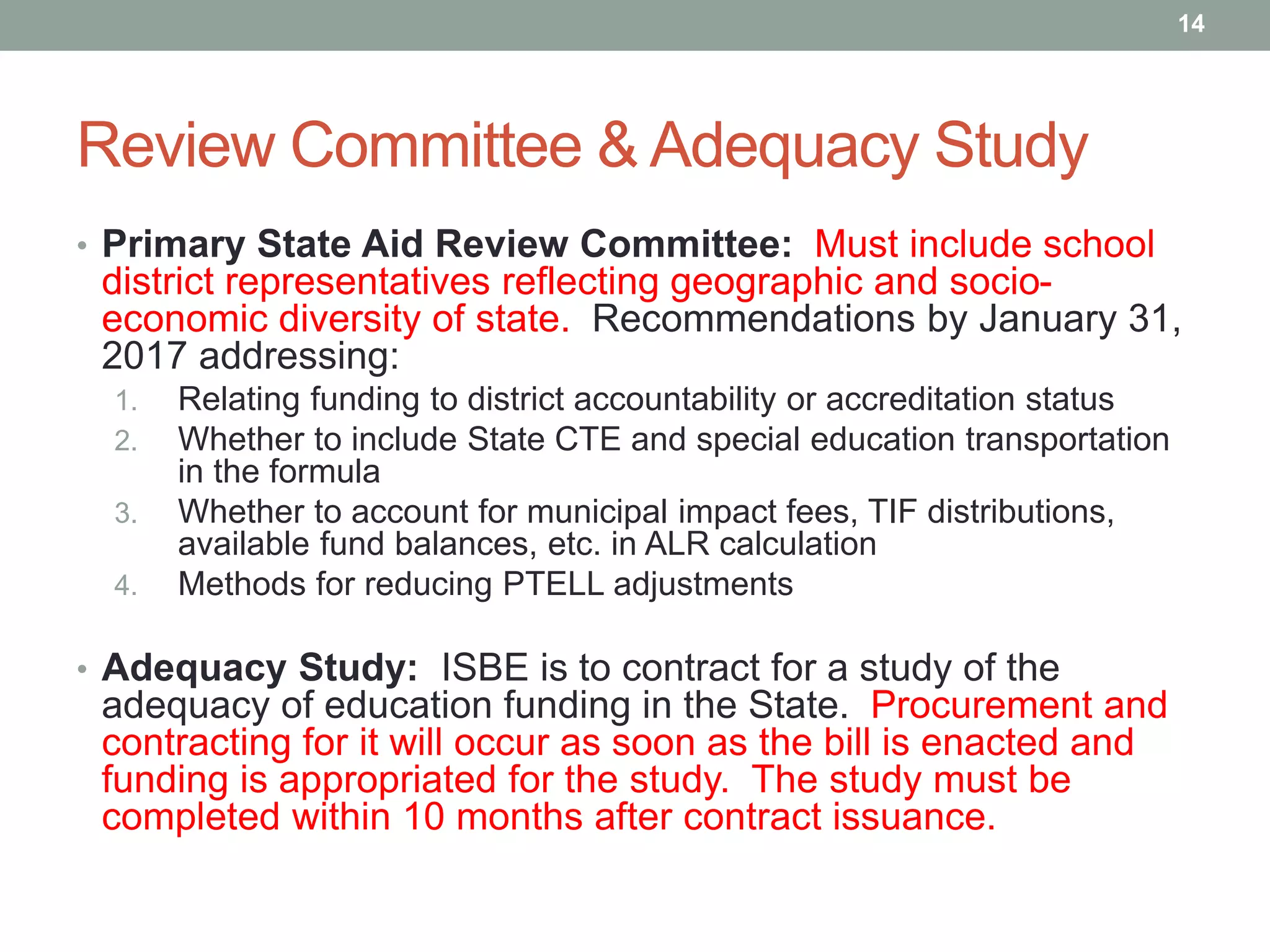
Review Committee & Adequacy Study
• Primary State Aid Review Committee: Must include school
district representatives reflecting geographic and socio-
economic diversity of state. Recommendations by January 31,
2017 addressing:
1. Relating funding to district accountability or accreditation status
2. Whether to include State CTE and special education transportation
in the formula
3. Whether to account for municipal impact fees, TIF distributions,
available fund balances, etc. in ALR calculation
4. Methods for reducing PTELL adjustments
• Adequacy Study: ISBE is to contract for a study of the
adequacy of education funding in the State. Procurement and
contracting for it will occur as soon as the bill is enacted and
funding is appropriated for the study. The study must be
completed within 10 months after contract issuance.
14
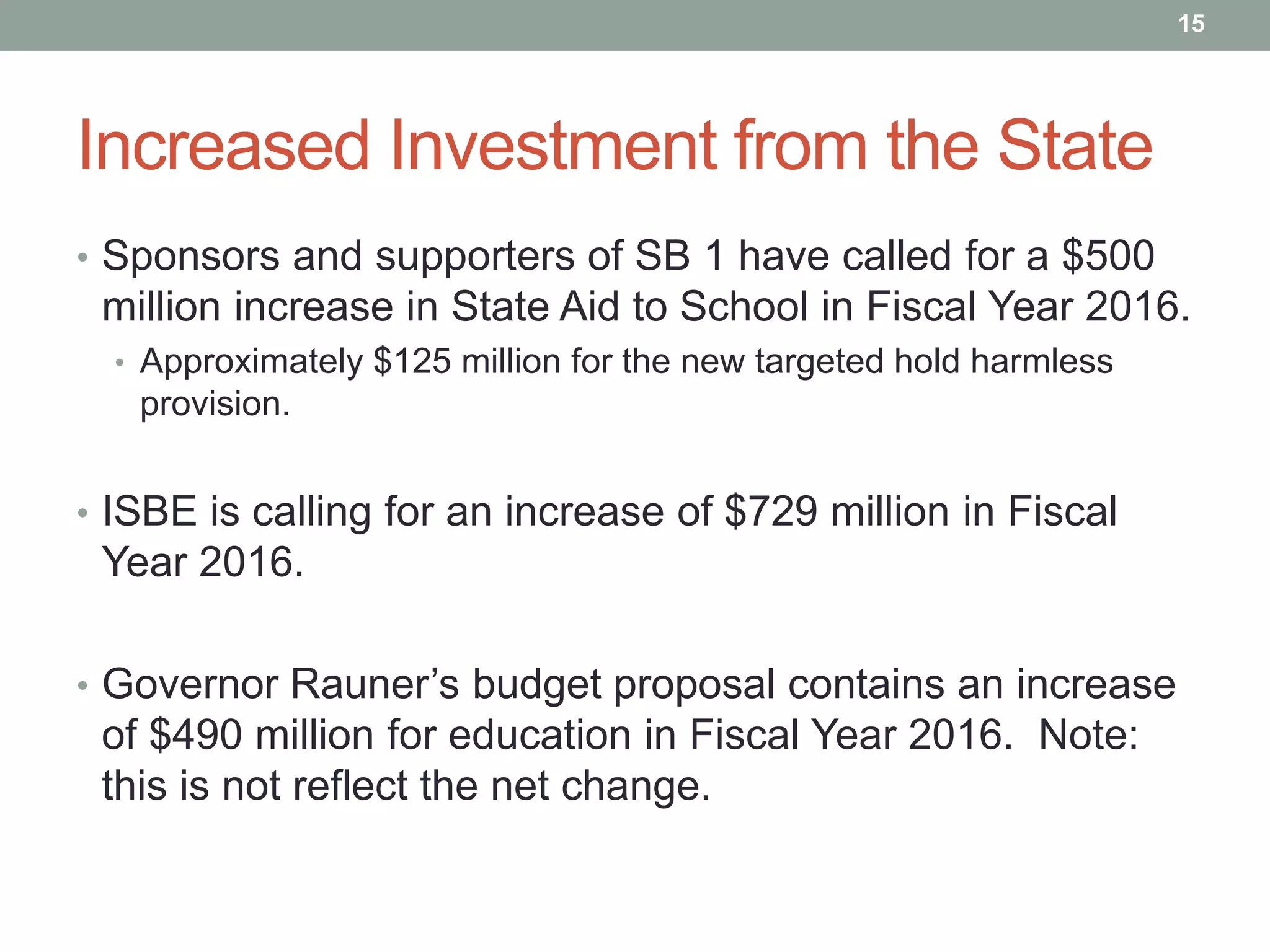
Increased Investment from the State
• Sponsors and supporters of SB 1 have called for a $500
million increase in State Aid to School in Fiscal Year 2016.
• Approximately $125 million for the new targeted hold harmless
provision.
• ISBE is calling for an increase of $729 million in Fiscal
Year 2016.
• Governor Rauner’s budget proposal contains an increase
of $490 million for education in Fiscal Year 2016. Note:
this is not reflect the net change.
15
More Work Ahead
• Vision 20/20
• Determining “Adequacy”
• SB 1403 (Sen. Barickman)
• Mandate Relief
• Other cost reduction and/or efficiency measures
• Accountability Measures
16
Addendum 1
17
Addendum 2
• ARTICLE X | ILLINOIS CONSTITUTION
• SECTION 1. GOAL - FREE SCHOOLS A fundamental
goal of the People of the State is the educational
development of all persons to the limits of their capacities.
The State shall provide for an efficient system of high
quality public educational institutions and services.
Education in public schools through the secondary level
shall be free. There may be such other free education as
the General Assembly provides by law. The State has the
primary responsibility for financing the system of
public education.
18
Addendum 3
19

Illinois School Funding Reform | SB 1

  • 1.
    SENATE BILL 1 SCHOOLFUNDING REFORM ACT OF 2015 February 24, 2015
  • 2.
    SB 16 Background& Senate Action Date Action July 2013 Illinois Senate unanimously voted to create an Education Funding Advisory Committee with the recognition that how Illinois funds public education was ripe for review February 2014 Bipartisan Committee released its recommendations for a new state education funding system April 1, 2014 SB 16 filed in its entirety, building on this groundwork May 27, 2014 Passed Senate: 32 Yeas, 19 Nays, 6 Present 2
  • 3.
    “How” vs. “HowMuch” EFAC focused on the premise that regardless of how much or how little is available for schools in any given State fiscal year, how it is spent should matter. 3
  • 4.
    The Task weFace in Illinois 4 • “Due to the impact of district wealth, districts that make lower tax effort tend to raise higher amounts of local revenue.” • “We conclude that the Illinois school finance system is inequitable for both students and taxpayers.” • “Our concern is that the parameters that drive the allocation of state formula support . . Have little meaning beyond assuring that total state aid does not exceed the revenue that the state is willing to provide for school districts.” Testimony from Augenblick, Palaich & Associates to the Education Funding Advisory Committee (EFAC) | September 17, 2013
  • 5.
    What did Augenblicksay to EFAC? 5 East St. Louis D 189 Arlington Heights D 214 Tax Rate 7.49 1.84 PPS from Local Funds $1,200 $18,400 Low Income % 99% 26% Proration Cut @ 89% -$935 -$58
  • 6.
    80 60 40 20 0 100 Current system % of statefunding Integrated formula Funding required Funding received • Foundation level set to provide base adequacy • Weight for need according to student/ district characteristics and considering regional costs • All funds means tested against local wealth • State funding fills the gap to required amount • Districts can fund more using local tax revenues Weight for need Foundation level State funding closes the gap Local contribution determined by formula Added local funding GSA formula Categorical Supplemental grant Chicago block Integrated formula Categorical Simplify how state dollars are distributed... An integrated primary State funding formula accounts for student need and local resources ...while funding districts according to student need and local ability to pay Integrated formula Categorica • Combine all GSA and most categoricals • Allocate according to a single, transparent, integrated formula Categorical
  • 7.
    Accounting for needand local resources: Another view 7
  • 8.
    Current vs. ProposedFormula Current General State Aid (put in place in 1997) • State GSA Payment = (Foundation Level – Available Local Resources Per Pupil) * ADA • Alternate Formula if district % of local wealth is at least 93% but less than 175% of Foundation level • Flat Grant of $218 * ADA if local wealth is at 175% of Foundation Level • Also account for numerous other ‘silos’ of funds/programs in the State budget. Proposed Primary State Aid • State PSA Payment = (Weighted Foundation Level – Available Local Resources Per Pupil) * ADA • Flat Grant of 3.5% of Foundation Level; for non-PTELL, may be adjusted to account for local tax effort for Ed and O&M levies • Flat Grant applies if (Weighted Foundation Level – Available Local Resources) < Flat Grant Level 8
  • 9.
    Weighted Foundation Level •Weighted Foundation Level = Foundation Level * District Weighted Average • District Weighted Average = 1.0 + Additional Weights (on a cumulative basis) • Additional Weight = Weighting Factor * Weighting Percentage • Regionalization: If applicable, a regionalization factor is applied to the District Weighted Average. • The regionalization factor is based on the Comparable Wage Index developed for the National Center for Education Statistics (which measures systemic, regional variations in the salaries of college graduates who are not educators) 9
  • 10.
    Additional Weights Category WeightingFactor Weighting % Notes English Language Learners .20 ELL% Low-income .25 - .75, depending on concentration Low-income % Low-income: Current DHS count for 2 years; then 185% of FPL Special Education 1.0 > of 13.8% or district %, up to 18.8% Private placement, group home, and Sp Ed Transp. Excluded Sp Ed Summer School .03 % Eligible Gifted .01 % Eligible No more than 5% of K-8 High School Outcomes .02: AP, dual credit .03: Career Pathway % Eligible Only in one category Reg. Transp. .6 - .10, based on density/sq. mile % Eligible Vocational or Extraordinary Transp. .12 – Vocation Not to exceed .12 - Extraordinary % Eligible ISBE to define “extraordinary” by rule 10
  • 11.
    Special Education • Inthe Formula: • Weighting fully accounts for three existing line items: Children Requiring Special Education Services, Personnel Reimbursement, Summer School Services • SB 16 had assumed that each district had 13.8% of students with disabilities (consistent with state average). SB 1 allows districts with an above-average weight to receive ISBE approval for a higher % (up to 5% above state average). • Out of the Formula: Sp Ed Transportation and Private Placement • Orphanage Tuition: Maintain separate categorical funding for group homes; include foster children in primary State aid formula 11
  • 12.
    PTELL, Adequacy Grant,Loss Cap, Phase-in • PTELL: PTELL Adjustment remains, but: • Subject to a “PTELL EAV floor” of .85. The EAV Floor ensures the EAV used for PTELL adjustments never falls below 85% of a school district’s actual EAV. This significantly controls the costs of PTELL adjustments. • PTELL Adjustments granted separately to ensure greater transparency within primary State aid calculations • Adequacy Grant: Targets funding to relatively low-spend, high tax districts to achieve an “adequacy target”. • Low Spend: Determined based on the district’s operating expense per pupil in comparison to an “adequacy target” based on the EFAB recommended funding level and the district’s weights based on its student characteristics. • High Tax: Operating Tax Rate higher than statewide weighted average for that type of district. • Loss Cap: No district will lose more than $1,000/pupil in comparison to base year, through 2022-23 school year. • Phase-in: Decreases and increases from base year phased in over 3 fiscal years: • Year 1: 25% of increase; 25% of decrease • Year 2: 50% of increase; 50% of decrease • Year 3: 75% of increase; 75% of decrease 12
  • 13.
    Oversight & Accountability •ISBE Support: Dedicated funding for ISBE staff & contractual services for ELL and Special Education oversight and support • Reporting: For each district, reporting of weights and funding attributable to those weights • ELL: Maintain accountability consistent with current law for district budgeting and accounting for funds attributable to the weighting of ELL students • District Plans: For districts failing to make insufficient academic progress for subgroups, budget and plan meeting ISBE requirements must demonstrate budgeting for strategies giving priorities to low-income, ELL, and special education students consistent with weighting • CPS School Allocations: Maintain the current SGSA requirement for $261M to be distributed to schools pursuant to an ISBE-approved plan • School Based Budgeting: Beginning in the second year of the law’s implementation, ISBE institutes a system for accounting for revenues and expenditures at the individual school level, which would highlight inequities that may exist within a school district. 13
  • 14.
    Review Committee &Adequacy Study • Primary State Aid Review Committee: Must include school district representatives reflecting geographic and socio- economic diversity of state. Recommendations by January 31, 2017 addressing: 1. Relating funding to district accountability or accreditation status 2. Whether to include State CTE and special education transportation in the formula 3. Whether to account for municipal impact fees, TIF distributions, available fund balances, etc. in ALR calculation 4. Methods for reducing PTELL adjustments • Adequacy Study: ISBE is to contract for a study of the adequacy of education funding in the State. Procurement and contracting for it will occur as soon as the bill is enacted and funding is appropriated for the study. The study must be completed within 10 months after contract issuance. 14
  • 15.
    Increased Investment fromthe State • Sponsors and supporters of SB 1 have called for a $500 million increase in State Aid to School in Fiscal Year 2016. • Approximately $125 million for the new targeted hold harmless provision. • ISBE is calling for an increase of $729 million in Fiscal Year 2016. • Governor Rauner’s budget proposal contains an increase of $490 million for education in Fiscal Year 2016. Note: this is not reflect the net change. 15
  • 16.
    More Work Ahead •Vision 20/20 • Determining “Adequacy” • SB 1403 (Sen. Barickman) • Mandate Relief • Other cost reduction and/or efficiency measures • Accountability Measures 16
  • 17.
  • 18.
    Addendum 2 • ARTICLEX | ILLINOIS CONSTITUTION • SECTION 1. GOAL - FREE SCHOOLS A fundamental goal of the People of the State is the educational development of all persons to the limits of their capacities. The State shall provide for an efficient system of high quality public educational institutions and services. Education in public schools through the secondary level shall be free. There may be such other free education as the General Assembly provides by law. The State has the primary responsibility for financing the system of public education. 18
  • 19.