Threatened Species The Northern Bog Turtle
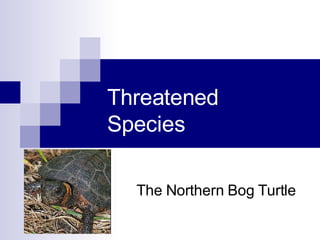
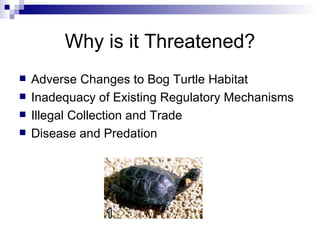
Description of Species Smallest member of the genus  Clemmys  and one of North America’s smallest turtles Recognized by a light brown to ebony carapace and a bright yellow, orange, or red blotch on each side of the head Limbs are dark brown; the feet are weakly webbed
Habitat Small, discrete populations, generally occupying open-canopy, herbaceous sedge meadows and ferns bordered by wooded areas. Wetlands that include dry pockets, saturated areas, and areas that are periodically flooded. Beaver, deer, and cattle may be instrumental in maintaining the open-canopy wetlands essential for this species’ survival.
Location Currently known to live in Connecticut, Delaware, Maryland, Massachusetts, New Jersey, New York, and Pennsylvania  Along with New Jersey and Maryland, eastern Pennsylvania has been considered the stronghold of this species.
Management Problems Wetland drainage basins are vulnerable to a number of factors subdivisions wells road construction activities.  In some areas, fire may have played a role in maintaining the nature of wetlands.  The extent of these wetlands has declined significantly since this routine burning was discontinued in the late 1960s.
Why is it Threatened? Adverse Changes to Bog Turtle Habitat Inadequacy of Existing Regulatory Mechanisms Illegal Collection and Trade Disease and Predation
Save the Northern Bog Turtle! Plants and animals hold value medicinal, agricultural, ecological, aesthetic Future generations should experience their presence and value New York and Pennsylvania have both conducted more extensive and ongoing programs to manage turtle populations.
Resources Bog Turtle (Clemmys muhlenbergii) Northern Population Recovery Plan http://www.fws.gov/northeast/nyfo/es/bogturtle.pdf http://www.endangeredspecie.com/Why_Save_.htm http://www.environmentaldefense.org/article.cfm?ContentID=153 http://www.environmentaldefense.org/documents/3732_Species_Bog%20Turtle.pdf

Save the Northern Bog Turtle

  • 1.
    Threatened Species TheNorthern Bog Turtle
  • 2.
    Description of SpeciesSmallest member of the genus Clemmys and one of North America’s smallest turtles Recognized by a light brown to ebony carapace and a bright yellow, orange, or red blotch on each side of the head Limbs are dark brown; the feet are weakly webbed
  • 3.
    Habitat Small, discretepopulations, generally occupying open-canopy, herbaceous sedge meadows and ferns bordered by wooded areas. Wetlands that include dry pockets, saturated areas, and areas that are periodically flooded. Beaver, deer, and cattle may be instrumental in maintaining the open-canopy wetlands essential for this species’ survival.
  • 4.
    Location Currently knownto live in Connecticut, Delaware, Maryland, Massachusetts, New Jersey, New York, and Pennsylvania Along with New Jersey and Maryland, eastern Pennsylvania has been considered the stronghold of this species.
  • 5.
    Management Problems Wetlanddrainage basins are vulnerable to a number of factors subdivisions wells road construction activities. In some areas, fire may have played a role in maintaining the nature of wetlands. The extent of these wetlands has declined significantly since this routine burning was discontinued in the late 1960s.
  • 6.
    Why is itThreatened? Adverse Changes to Bog Turtle Habitat Inadequacy of Existing Regulatory Mechanisms Illegal Collection and Trade Disease and Predation
  • 7.
    Save the NorthernBog Turtle! Plants and animals hold value medicinal, agricultural, ecological, aesthetic Future generations should experience their presence and value New York and Pennsylvania have both conducted more extensive and ongoing programs to manage turtle populations.
  • 8.
    Resources Bog Turtle(Clemmys muhlenbergii) Northern Population Recovery Plan http://www.fws.gov/northeast/nyfo/es/bogturtle.pdf http://www.endangeredspecie.com/Why_Save_.htm http://www.environmentaldefense.org/article.cfm?ContentID=153 http://www.environmentaldefense.org/documents/3732_Species_Bog%20Turtle.pdf