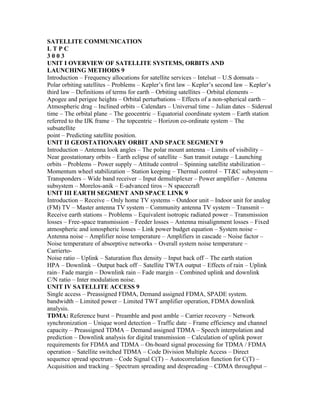
SATELLITE COMMUNICATION
LTPC
3003
UNIT I OVERVIEW OF SATELLITE SYSTEMS, ORBITS AND
LAUNCHING METHODS 9
Introduction – Frequency allocations for satellite services – Intelsat – U.S domsats –
Polar orbiting satellites – Problems – Kepler’s first law – Kepler’s second law – Kepler’s
third law – Definitions of terms for earth – Orbiting satellites – Orbital elements –
Apogee and perigee heights – Orbital perturbations – Effects of a non-spherical earth –
Atmospheric drag – Inclined orbits – Calendars – Universal time – Julian dates – Sidereal
time – The orbital plane – The geocentric – Equatorial coordinate system – Earth station
referred to the IJK frame – The topcentric – Horizon co-ordinate system – The
subsatellite
point – Predicting satellite position.
UNIT II GEOSTATIONARY ORBIT AND SPACE SEGMENT 9
Introduction – Antenna look angles – The polar mount antenna – Limits of visibility –
Near geostationary orbits – Earth eclipse of satellite – Sun transit outage – Launching
orbits – Problems – Power supply – Attitude control – Spinning satellite stabilization –
Momentum wheel stabilization – Station keeping – Thermal control – TT&C subsystem –
Transponders – Wide band receiver – Input demultiplexer – Power amplifier – Antenna
subsystem – Morelos-anik – E-advanced tiros – N spacecraft
UNIT III EARTH SEGMENT AND SPACE LINK 9
Introduction – Receive – Only home TV systems – Outdoor unit – Indoor unit for analog
(FM) TV – Master antenna TV system – Community antenna TV system – Transmit –
Receive earth stations – Problems – Equivalent isotropic radiated power – Transmission
losses – Free-space transmission – Feeder losses – Antenna misalignment losses – Fixed
atmospheric and ionospheric losses – Link power budget equation – System noise –
Antenna noise – Amplifier noise temperature – Amplifiers in cascade – Noise factor –
Noise temperature of absorptive networks – Overall system noise temperature –
Carrierto-
Noise ratio – Uplink – Saturation flux density – Input back off – The earth station
HPA – Downlink – Output back off – Satellite TWTA output – Effects of rain – Uplink
rain– Fade margin – Downlink rain – Fade margin – Combined uplink and downlink
C/N ratio – Inter modulation noise.
UNIT IV SATELLITE ACCESS 9
Single access – Preassigned FDMA, Demand assigned FDMA, SPADE system.
bandwidth – Limited power – Limited TWT amplifier operation, FDMA downlink
analysis.
TDMA: Reference burst – Preamble and post amble – Carrier recovery – Network
synchronization – Unique word detection – Traffic date – Frame efficiency and channel
capacity – Preassigned TDMA – Demand assigned TDMA – Speech interpolation and
prediction – Downlink analysis for digital transmission – Calculation of uplink power
requirements for FDMA and TDMA – On-board signal processing for TDMA / FDMA
operation – Satellite switched TDMA – Code Division Multiple Access – Direct
sequence spread spectrum – Code Signal C(T) – Autocorrelation function for C(T) –
Acquisition and tracking – Spectrum spreading and despreading – CDMA throughput –
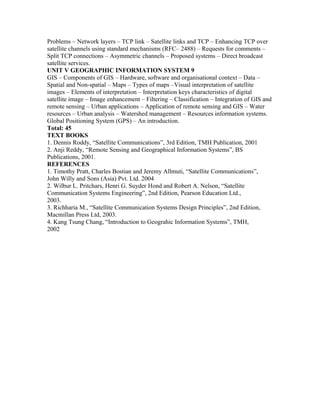
Problems – Network layers – TCP link – Satellite links and TCP – Enhancing TCP over
satellite channels using standard mechanisms (RFC– 2488) – Requests for comments –
Split TCP connections – Asymmetric channels – Proposed systems – Direct broadcast
satellite services.
UNIT V GEOGRAPHIC INFORMATION SYSTEM 9
GIS – Components of GIS – Hardware, software and organisational context – Data –
Spatial and Non-spatial – Maps – Types of maps –Visual interpretation of satellite
images – Elements of interpretation – Interpretation keys characteristics of digital
satellite image – Image enhancement – Filtering – Classification – Integration of GIS and
remote sensing – Urban applications – Application of remote sensing and GIS – Water
resources – Urban analysis – Watershed management – Resources information systems.
Global Positioning System (GPS) – An introduction.
Total: 45
TEXT BOOKS
1. Dennis Roddy, “Satellite Communications”, 3rd Edition, TMH Publication, 2001
2. Anji Reddy, “Remote Sensing and Geographical Information Systems”, BS
Publications, 2001.
REFERENCES
1. Timothy Pratt, Charles Bostian and Jeremy Allmuti, “Satellite Communications”,
John Willy and Sons (Asia) Pvt. Ltd. 2004
2. Wilbur L. Pritchars, Henri G. Suyder Hond and Robert A. Nelson, “Satellite
Communication Systems Engineering”, 2nd Edition, Pearson Education Ltd.,
2003.
3. Richharia M., “Satellite Communication Systems Design Principles”, 2nd Edition,
Macmillan Press Ltd, 2003.
4. Kang Tsung Chang, “Introduction to Geograhic Information Systems”, TMH,
2002

Satellite communication

  • 1.
    SATELLITE COMMUNICATION LTPC 3003 UNIT IOVERVIEW OF SATELLITE SYSTEMS, ORBITS AND LAUNCHING METHODS 9 Introduction – Frequency allocations for satellite services – Intelsat – U.S domsats – Polar orbiting satellites – Problems – Kepler’s first law – Kepler’s second law – Kepler’s third law – Definitions of terms for earth – Orbiting satellites – Orbital elements – Apogee and perigee heights – Orbital perturbations – Effects of a non-spherical earth – Atmospheric drag – Inclined orbits – Calendars – Universal time – Julian dates – Sidereal time – The orbital plane – The geocentric – Equatorial coordinate system – Earth station referred to the IJK frame – The topcentric – Horizon co-ordinate system – The subsatellite point – Predicting satellite position. UNIT II GEOSTATIONARY ORBIT AND SPACE SEGMENT 9 Introduction – Antenna look angles – The polar mount antenna – Limits of visibility – Near geostationary orbits – Earth eclipse of satellite – Sun transit outage – Launching orbits – Problems – Power supply – Attitude control – Spinning satellite stabilization – Momentum wheel stabilization – Station keeping – Thermal control – TT&C subsystem – Transponders – Wide band receiver – Input demultiplexer – Power amplifier – Antenna subsystem – Morelos-anik – E-advanced tiros – N spacecraft UNIT III EARTH SEGMENT AND SPACE LINK 9 Introduction – Receive – Only home TV systems – Outdoor unit – Indoor unit for analog (FM) TV – Master antenna TV system – Community antenna TV system – Transmit – Receive earth stations – Problems – Equivalent isotropic radiated power – Transmission losses – Free-space transmission – Feeder losses – Antenna misalignment losses – Fixed atmospheric and ionospheric losses – Link power budget equation – System noise – Antenna noise – Amplifier noise temperature – Amplifiers in cascade – Noise factor – Noise temperature of absorptive networks – Overall system noise temperature – Carrierto- Noise ratio – Uplink – Saturation flux density – Input back off – The earth station HPA – Downlink – Output back off – Satellite TWTA output – Effects of rain – Uplink rain– Fade margin – Downlink rain – Fade margin – Combined uplink and downlink C/N ratio – Inter modulation noise. UNIT IV SATELLITE ACCESS 9 Single access – Preassigned FDMA, Demand assigned FDMA, SPADE system. bandwidth – Limited power – Limited TWT amplifier operation, FDMA downlink analysis. TDMA: Reference burst – Preamble and post amble – Carrier recovery – Network synchronization – Unique word detection – Traffic date – Frame efficiency and channel capacity – Preassigned TDMA – Demand assigned TDMA – Speech interpolation and prediction – Downlink analysis for digital transmission – Calculation of uplink power requirements for FDMA and TDMA – On-board signal processing for TDMA / FDMA operation – Satellite switched TDMA – Code Division Multiple Access – Direct sequence spread spectrum – Code Signal C(T) – Autocorrelation function for C(T) – Acquisition and tracking – Spectrum spreading and despreading – CDMA throughput –
  • 2.
    Problems – Networklayers – TCP link – Satellite links and TCP – Enhancing TCP over satellite channels using standard mechanisms (RFC– 2488) – Requests for comments – Split TCP connections – Asymmetric channels – Proposed systems – Direct broadcast satellite services. UNIT V GEOGRAPHIC INFORMATION SYSTEM 9 GIS – Components of GIS – Hardware, software and organisational context – Data – Spatial and Non-spatial – Maps – Types of maps –Visual interpretation of satellite images – Elements of interpretation – Interpretation keys characteristics of digital satellite image – Image enhancement – Filtering – Classification – Integration of GIS and remote sensing – Urban applications – Application of remote sensing and GIS – Water resources – Urban analysis – Watershed management – Resources information systems. Global Positioning System (GPS) – An introduction. Total: 45 TEXT BOOKS 1. Dennis Roddy, “Satellite Communications”, 3rd Edition, TMH Publication, 2001 2. Anji Reddy, “Remote Sensing and Geographical Information Systems”, BS Publications, 2001. REFERENCES 1. Timothy Pratt, Charles Bostian and Jeremy Allmuti, “Satellite Communications”, John Willy and Sons (Asia) Pvt. Ltd. 2004 2. Wilbur L. Pritchars, Henri G. Suyder Hond and Robert A. Nelson, “Satellite Communication Systems Engineering”, 2nd Edition, Pearson Education Ltd., 2003. 3. Richharia M., “Satellite Communication Systems Design Principles”, 2nd Edition, Macmillan Press Ltd, 2003. 4. Kang Tsung Chang, “Introduction to Geograhic Information Systems”, TMH, 2002