SAP Interview Questions: Stand Out with
Proven Techniques
What to Expect in SAP Interviews
SAP is known for its comprehensive interview process, which evaluates candidates in a wide
range of areas, including technical expertise, problem-solving abilities, and interpersonal
SAP Interview Questions and Preparation Guide
Getting ready for an SAP interview Questions? Whether you’re experienced or just beginning,
knowing what SAP interviewers look for can make a big difference. SAP roles cover areas
like finance, logistics, and HR, so being prepared can help you stand out.
In this interview tutorial, I'll outline some of the key questions any applicant is bound to come
across. The looming question is, of course, how one goes about tackling each and why doing
so is critical to ace the interview and build a successful career in the SAP ecosystem.
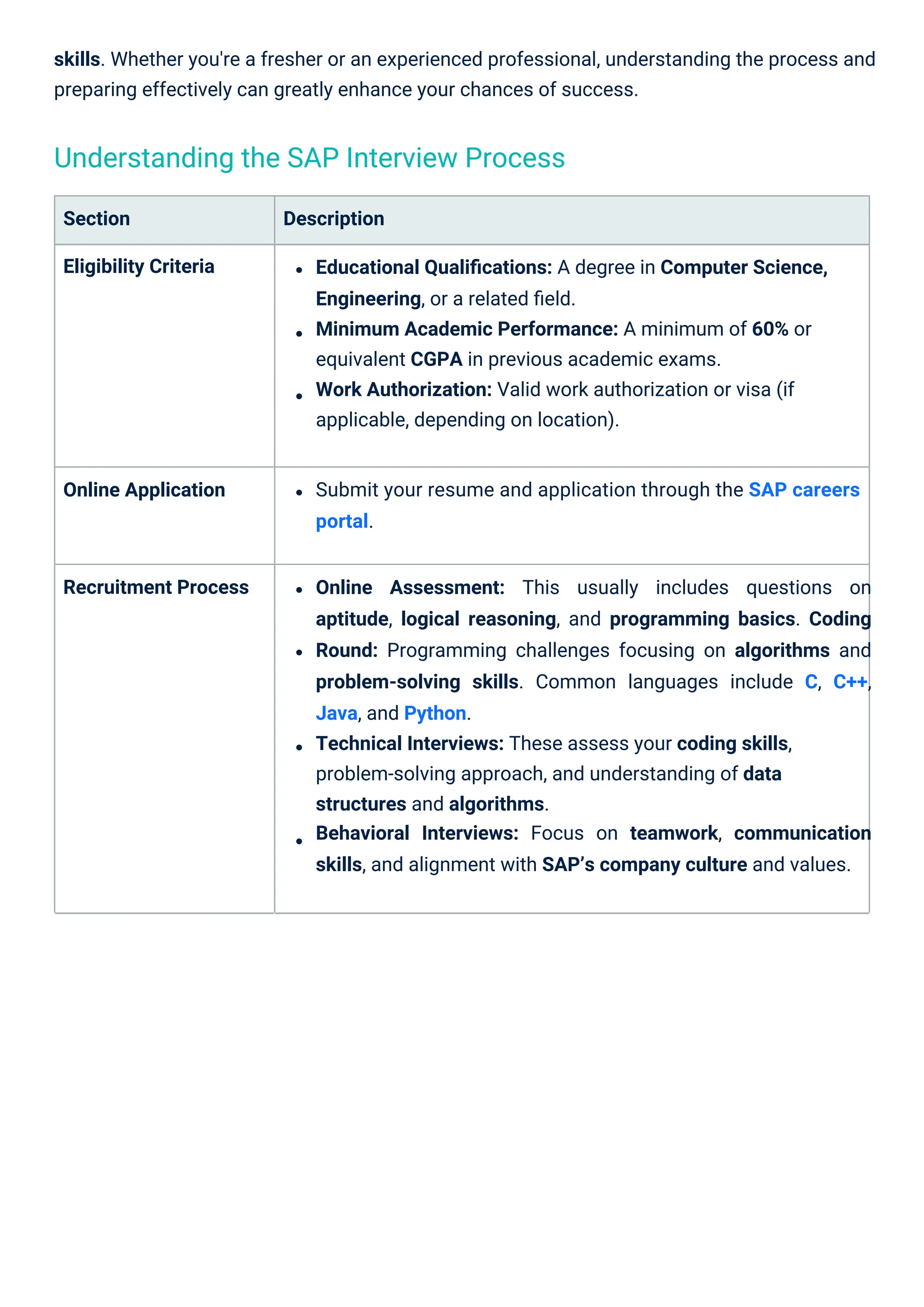
Section
Eligibility Criteria
Online Application
Recruitment Process
Submit your resume and application through the SAP careers
portal.
skills. Whether you're a fresher or an experienced professional, understanding the process and
preparing effectively can greatly enhance your chances of success.
Description
Educational Qualifications: A degree in Computer Science,
Engineering, or a related field.
Minimum Academic Performance: A minimum of 60% or
equivalent CGPA in previous academic exams.
Work Authorization: Valid work authorization or visa (if
applicable, depending on location).
Online Assessment: This usually includes questions on
aptitude, logical reasoning, and programming basics. Coding
Round: Programming challenges focusing on algorithms and
problem-solving skills. Common languages include C, C++,
Java, and Python.
Technical Interviews: These assess your coding skills,
problem-solving approach, and understanding of data
structures and algorithms.
Behavioral Interviews: Focus on teamwork, communication
skills, and alignment with SAP’s company culture and values.
Understanding the SAP Interview Process
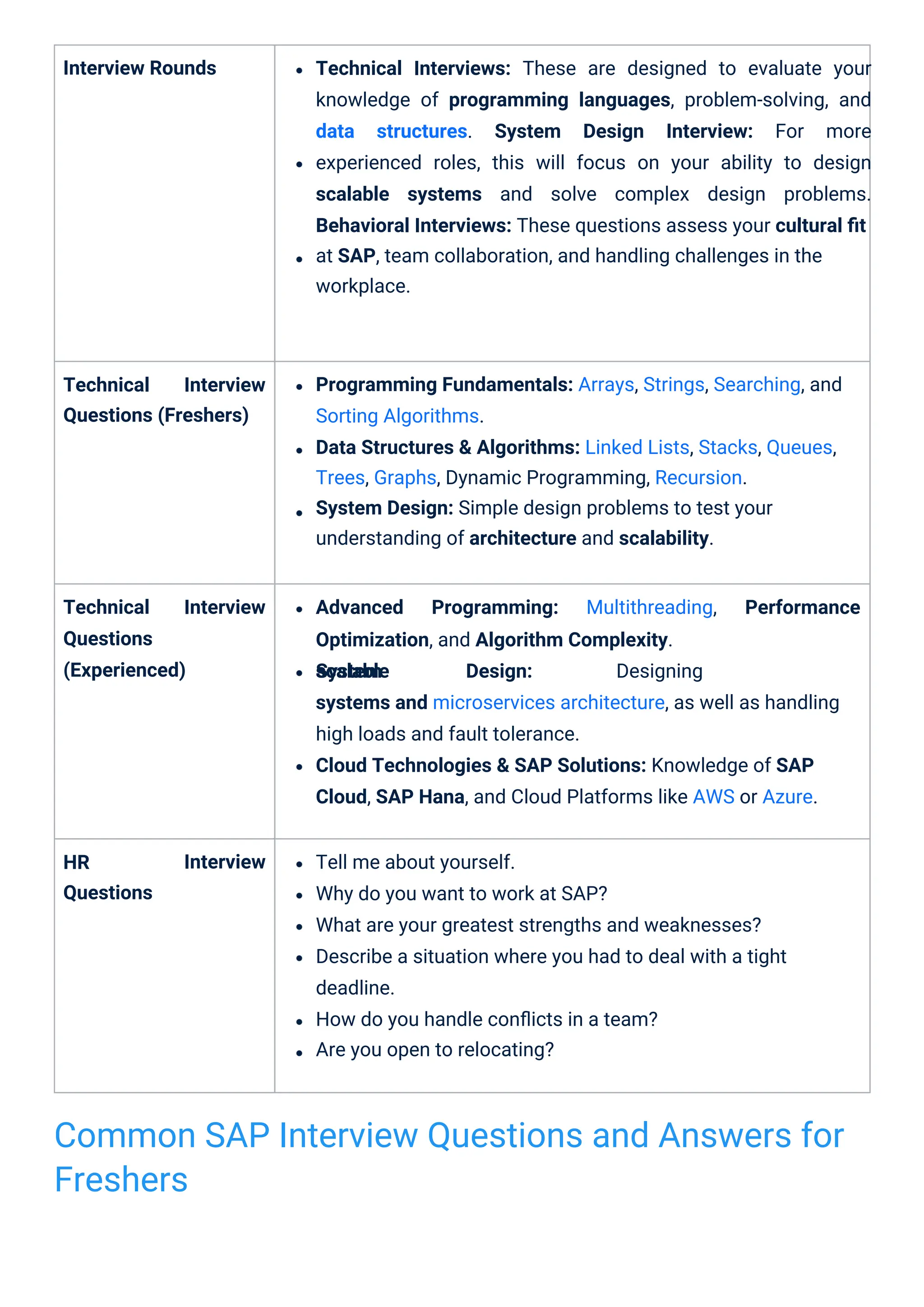
HR
Questions
Interview Rounds
Interview
Technical
Questions (Freshers)
Interview
Technical
Questions
(Experienced)
Interview Advanced Programming: Multithreading, Performance
Optimization, and Algorithm Complexity.
System Design: Designing
scalable
systems and microservices architecture, as well as handling
high loads and fault tolerance.
Cloud Technologies & SAP Solutions: Knowledge of SAP
Cloud, SAP Hana, and Cloud Platforms like AWS or Azure.
Tell me about yourself.
Why do you want to work at SAP?
What are your greatest strengths and weaknesses?
Describe a situation where you had to deal with a tight
deadline.
How do you handle conflicts in a team?
Are you open to relocating?
Technical Interviews: These are designed to evaluate your
knowledge of programming languages, problem-solving, and
data structures. System Design Interview: For more
experienced roles, this will focus on your ability to design
scalable systems and solve complex design problems.
Behavioral Interviews: These questions assess your cultural fit
at SAP, team collaboration, and handling challenges in the
workplace.
Programming Fundamentals: Arrays, Strings, Searching, and
Sorting Algorithms.
Data Structures & Algorithms: Linked Lists, Stacks, Queues,
Trees, Graphs, Dynamic Programming, Recursion.
System Design: Simple design problems to test your
understanding of architecture and scalability.
Common SAP Interview Questions and Answers for
Freshers
Q1. Tell me about yourself.
What to Say: Provide a brief overview of your academic background, technical skills, and any
relevant experience or projects related to SAP.
Q2. Why do you want to work at SAP?
What to Say: Explain why you are interested in SAP specifically, such as its leadership in ERP
solutions or its innovation-driven culture.
Q3. What do you know about SAP and its products?
What to Say: Demonstrate your knowledge of SAP’s main products, like SAP S/4HANA, SAP
ERP, and cloud solutions, and how they align with your skills.
Q4. Describe a project where you used SAP skills or worked with
ERP systems.
Example: "SAP is known for its ERP solutions like SAP S/4HANA, which helps companies
manage operations in real-time. I’m particularly interested in SAP’s focus on cloud solutions
and intelligent technologies, as I see them as critical for digital transformation."
Example: "SAP's commitment to innovation and leadership in ERP solutions is truly inspiring. I
am drawn to the opportunity to contribute to a company that empowers businesses worldwide.
Working here would allow me to grow my technical skills in a collaborative, forward-thinking
environment."
Example: "I recently graduated with a degree in Information Technology from XYZ University,
where I built a strong foundation in ERP systems and data management. I completed an
internship focusing on SAP modules, gaining hands-on experience in SAP FICO and MM, which
helped me understand core ERP processes. I’m eager to bring these skills to a role with SAP."
What to Say: Share strengths that align with the job and a genuine weakness you’re actively
working on improving.
Example: "One of my strengths is my analytical mindset, which helps me solve complex
problems. My weakness is that I tend to be overly critical of my work. I’m learning to balance
quality with efficiency to meet project timelines."
What to Say: Talk about a relevant project where you applied SAP skills or concepts, focusing
on problem-solving and collaboration.
Example: "During my internship, I worked on an ERP implementation project using SAP FICO.
My role involved configuring financial modules and troubleshooting data inconsistencies. I
gained hands-on experience and learned how critical attention to detail is in SAP projects."
Q5. What are your strengths and weaknesses?
Q6. How do you handle constructive criticism?
What to Say: Mention relevant languages and tools and share an example of how you used
them in a project.
Example: "I am proficient in ABAP, SQL, and Java. In my final year project, I used ABAP to
create custom reports in SAP, which enhanced data accessibility for the user. This experience
gave me practical knowledge of SAP development."
What to Say: Highlight your ability to receive feedback positively and apply it to improve your
work.
Example: "I view constructive criticism as a way to learn and grow. During my last project, my
supervisor suggested simplifying my report presentations. I took this advice, which made my
work more accessible to the team."
What to Say: Outline future goals that show a desire to grow within SAP and contribute to the
company’s success.
Example: "In five years, I aim to be a certified SAP consultant leading ERP implementation
projects. I hope to advance my expertise in SAP solutions, contribute to high-impact projects,
and mentor new team members."
What to Say: Describe a positive experience where you worked with a team and contributed
meaningfully.
Example: "Yes, I thrive in team settings. In one project, I collaborated with my classmates to
create an ERP model for a case study. I led the technical part and coordinated with others,
which helped me develop strong teamwork and communication skills."
Q9. Where do you see yourself in five years?
Q10. What do you know about SAP's clients and industries?
Q8. What technical skills or programming languages do you
know?
Q7. Are you comfortable working in a team? Can you give an
example of teamwork from your experience?
What to Say: Discuss your problem-solving approach when faced with configuration
challenges, using an example if possible.
What to Say: Provide a summary of the SAP modules you have experience with, highlighting
your expertise and any projects you've worked on.
Example: "I have extensive experience with SAP S/4HANA, SAP FICO, and SAP MM. In my
previous role, I led an SAP FICO implementation project that optimized financial reporting
processes, reduced data redundancy, and improved our audit readiness."
What to Say: Show that you are aware of SAP’s core industries and solutions tailored to them.
Example: "SAP works with clients in industries like manufacturing, retail, and finance. I’m
impressed by how SAP customizes solutions to meet specific needs, such as SAP Leonardo
for digital innovation in manufacturing."
If you want to be confident about the HR round, you can go through these Most Commonly
Asked HR Interview Questions and Answers. Now, let’s get into the specific interview questions
for different roles and experiences at SAP.
SAP Interview Questions and Answers for
Experienced Professionals
Q11. Can you describe your experience with SAP modules?
Q12. How do you handle complex SAP configuration issues?
What to Say: Share a specific project where you faced difficulties and highlight your approach
to overcoming them.
Example: "I led an SAP implementation for a retail client, where we encountered integration
issues with legacy systems. I coordinated with the client’s IT team to create a middleware
solution, ensuring seamless data transfer and improving the client’s operational efficiency."
What to Say: Explain the security measures you implement, such as role-based access and
audit trails, and discuss how you keep the system compliant with standards.
Example: "I ensure data security by implementing role-based access control and regularly
reviewing user authorizations. In one project, we designed access restrictions in SAP to limit
sensitive financial data to authorized personnel only, aligning with GDPR and SOX compliance
requirements."
What to Say: Share your experience with SAP S/4HANA migrations, including any specific
tasks you handled, challenges you faced, and the impact of the migration.
Example: "Yes, I participated in an SAP S/4HANA migration for a manufacturing client. My role
included data mapping, testing, and customizing modules to align with business requirements.
We faced data conversion challenges, but by conducting thorough testing and collaborating
with the client’s IT team, we successfully migrated with minimal disruption."
Example: "When I encounter complex configuration issues, I start by thoroughly analyzing the
system logs and error messages. For example, during a recent SAP MM project, we faced data
inconsistencies between inventory and financial reporting. I worked with cross-functional
teams, adjusted the configuration, and resolved the issue to ensure accurate reporting."
Q14. How do you ensure data security and compliance in SAP
systems?
Q15. Describe a challenging SAP project you've worked on and
how you handled it.
Q13. Have you worked on SAP S/4HANA migration projects? If so,
describe your experience.
Questions on SAP ERP and SAP HANA
Before we start with the questions, let me just go back to the fact that SAP ERP helps integrate
many functions of business effectively, while SAP HANA is a superior performing in-memory
database that facilitates real-time processing and data analytics. Now, let's look at some of the
important questions about these systems!
Q17. Explain your experience with SAP ABAP development or
customizing SAP functionality.
What to Say: Discuss your knowledge of ABAP programming or any experience you have with
customizing SAP features.
Q16. How do you stay updated with the latest SAP developments
and releases?
What to Say: Mention the methods you use to stay informed, such as SAP training courses,
community forums, or industry events.
These are some important topics that you will probably be tested on if you are aiming for a
technical role. They include programming languages and SAP modules.
Example: "I have solid experience with ABAP and have developed custom reports, user exits,
and enhancements. In a previous role, I customized SAP sales reports to include real-time data,
improving sales forecasting accuracy for the client."
Example: "I regularly attend SAP webinars, complete training on SAP Learning Hub, and
participate in online forums. Staying updated helps me adopt new functionalities quickly, such
as recent updates in SAP S/4HANA and SAP Analytics Cloud."
Ans: SAP ERP is enterprise resource planning software that deals with core business activities,
namely finance, HR, and logistics. On the other hand, SAP HANA is a high-performance, in-
Technical SAP Interview Questions
Q18. What is the major difference between SAP ERP and SAP HANA?
Ans: A transparent table is a one-to-one match with a database table and can be accessed
directly, just like looking into the data. Pooled tables combine several smaller tables into
one table for space-saving issues, although they are less accessible than transparent tables.
memory database. In real-time, data processing used to be much faster, and analysis was
easily carried out.
Before we go into the questions, it is essential to understand what SAP FICO is all about. This
module becomes crucial for maintaining financial information and taking proper care of every
aspect of a company's finances. The various financial aspects together help an organization
make better decisions. Now, let's check out some salient questions which may arise:
Ans: ABAP, or Advanced Business Application Programming, is one of the important
programming languages of SAP. It is used to develop customized reports, applications, and
interfaces in SAP. Because of ABAP, it helps organizations shape SAP software for their
specific needs.
Ans: SAP FICO is an integrated platform for Financial Accounting and Controlling, which will
account for the financial transactions by tracking the revenue and expense transactions of any
Ans: Basically, SAP HANA stores data in memory rather than on disks. Thus, data access and
processing are done at a fast speed. The above setup would, in turn, allow real-time analytics,
which is useful for immediate insight and fast decision-making.
Q20. How does ABAP help in SAP?
Q22. What is the main function of SAP FICO?
Q19. How does SAP HANA speed up data processing?
Q21. What is the difference between a "transparent table" and a "pooled table" in
ABAP?
SAP FICO Consultant Interview Questions
SAP ABAP Developer Interview Questions
Ans: FI does external financial reporting, which includes maintaining balance sheets and
income statements. At the same time, CO does internal cost tracking and budgeting to help the
business understand how to manage its expenses and resources best.
Before answering the questions, let's learn that SAP SD plays a significant role in managing
sales processes and customer distribution. It helps a business optimize its order processing
to strengthen customer satisfaction. Now, let's explore some of the major questions you may
come across in this aspect!
Ans: Pricing procedures in SAP SD define how the prices for sales orders are calculated. They
are enriched with pricing elements, such as discounts, surcharges, and taxes, so the final price
considers all the conditions. This flexibility enables an enterprise to have various prices based
on the agreement with customers or market conditions.
organization. FICO consolidates financial data for a company across large numbers of
business departments and supports firms in financial planning and controlling.
Ans: SAP SD takes care of the whole scenario, from receiving orders from the customers to
delivering the product and receiving the payment. It consolidates customer information,
available inventory, and prices to minimize manual intervention and accelerate the entire
transaction cycle.
Ans: In SAP SD, the delivery documents deal with logistics related to product distribution. They
contain information on the items shipped, including dates and details of shipping. Thus,
documentation helps in order accuracy and tracking the shipment throughout the delivery
process.
Q24. How does SAP SD streamline the order-to-cash cycle?
Q25. Can you explain the role of pricing procedures in SAP SD?
Q26. What is the importance of delivery documents in SAP SD?
Q23. What is the difference between FI (Financial Accounting) and CO
(Controlling)?
SAP SD (Sales and Distribution) Interview Questions
Role-Specific SAP Interview Questions
Here are some role-specific questions you may encounter, depending on the SAP job you’re
applying for.
Ans: SuccessFactors supports employee performance management by offering tools that
help track and improve how well employees are doing. Here’s how it works:
1. Setting Goals: Managers and employees can set clear, measurable goals. It is like having a
roadmap for what the employee needs to achieve.
2. Continuous Feedback: Employees get regular feedback on their work. It is like getting real-
time advice on how to improve instead of waiting until the end of the year.
3. Performance Reviews: SuccessFactors allows managers to conduct formal performance
reviews. It is like sitting down to review what went well and what can be better based on the
Ans: Core modules in SuccessFactors cover key areas of Human Resources (HR)
management.
Some important ones are:
Employee Central: This is the main module for managing employee data. It is like a central
hub where you store all information about your employees, from personal details to job
information.
Performance & Goals: This module helps track employee performance and set goals. It is
like a tool that helps you see how well employees are doing and guide them to improve.
Recruitment Management: Helps manage the hiring process. It is like having a system that
makes finding and hiring new employees easier and faster.
Learning Management: This module is used for employee training and development. It is
like an online school for employees to learn new skills and improve.
Compensation Management: Helps manage salary, bonuses, and rewards. It is like a tool
to ensure that everyone is paid correctly based on their performance.
These modules work together to help companies manage their HR processes efficiently.
SAP SuccessFactors Interview Questions
Q27. What are some core modules in SuccessFactors?
Q28. How does SuccessFactors support employee performance management?
By helping set goals, track progress, and give feedback, SuccessFactors makes performance
management smooth and effective for both managers and employees.
goals set.
4. Development Plans: Employees can create development plans to improve their skills. It is
like having a personal growth plan to become better at the job.
Ans: SAP Basis is important because it keeps your SAP system running well. Here’s why it
matters:
System Management: SAP Basis helps you manage the system by controlling who can use it,
checking how well it’s working, and setting it up. It’s like the backbone that supports everything.
1. Connection: SAP Basis connects different parts of SAP and other systems so they can
work together smoothly, like a bridge linking everything.
Ans: Employee Central is the core of SuccessFactors because it manages all the important
employee data. Here’s why it’s important:
1. Centralized Data: All employee information, like personal details, job titles, and salaries, is
stored in one place. It is like having a central storage system that keeps everything
organized and easy to find.
2. Accurate Records: It ensures employee records are always up to date. It is like having a
real-time database where changes happen instantly, so you never miss important updates.
3. Streamlined HR Processes: Employee Central helps automate HR tasks like onboarding,
payroll, and leave management. It is like having a smart assistant that makes sure
everything runs smoothly and on time.
4. Global Compliance: It helps companies follow local laws and regulations for employees in
different regions. It is like having a built-in guide that ensures you're following the rules no
matter where your employees are.
In short, Employee Central acts as the foundation that supports all other HR functions, making
it critical for smooth HR operations.
Q30. Why is SAP Basis important?
Q29. Can you explain the importance of Employee Central?
SAP Basis Interview Questions
2. Security: SAP Basis protects the system by setting who can see or do what, keeping your
data safe, like a security guard watching over important information.
3. Speed and Performance: SAP Basis checks the system’s speed and fixes slowdowns, like
tuning an engine to make sure it runs smoothly.
4. Updates and Fixes: SAP Basis keeps the system updated and fixes any problems, like
doing regular maintenance.
In short, SAP Basis keeps your SAP system safe, fast, and working properly.
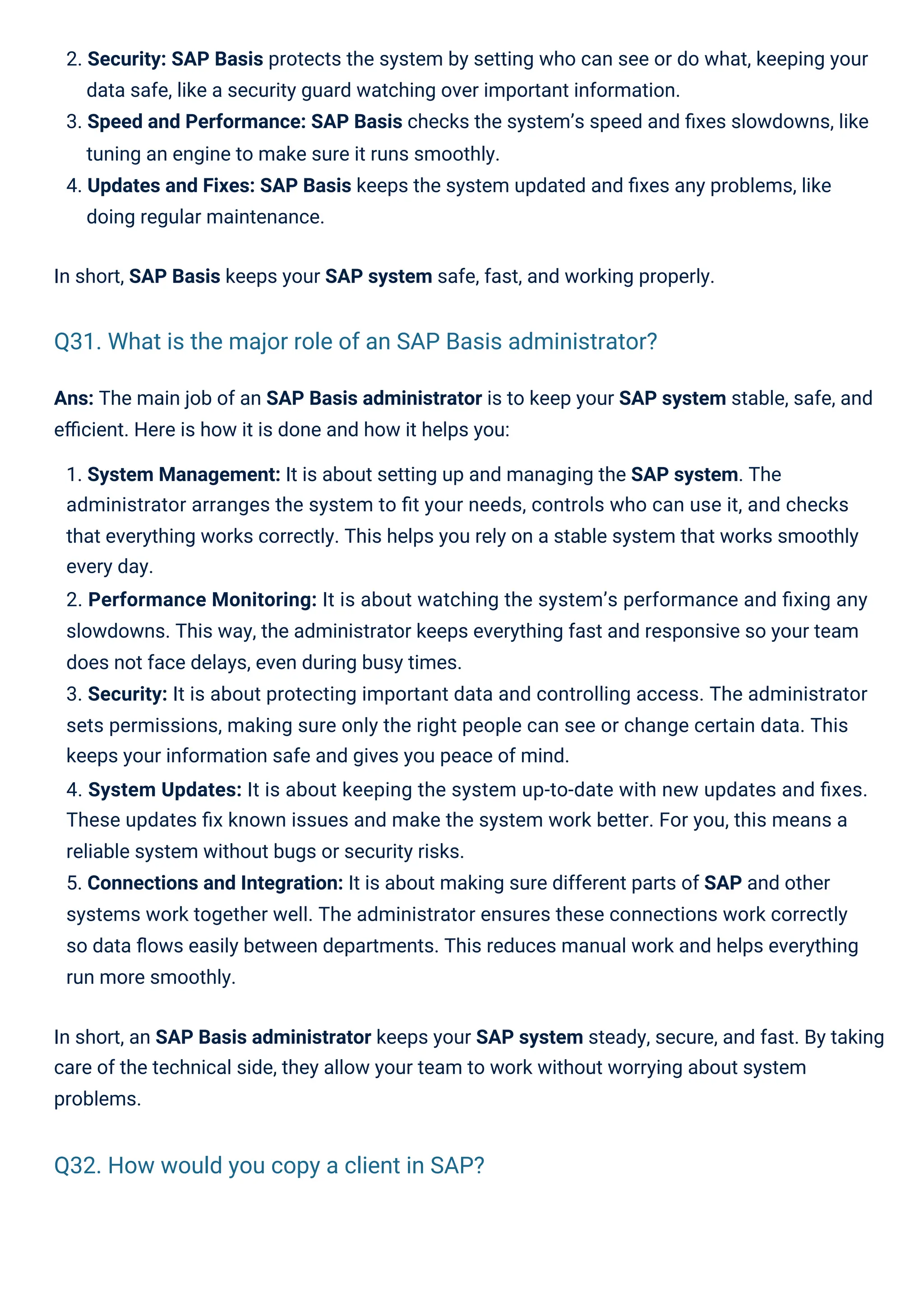
Ans: The main job of an SAP Basis administrator is to keep your SAP system stable, safe, and
efficient. Here is how it is done and how it helps you:
1. System Management: It is about setting up and managing the SAP system. The
administrator arranges the system to fit your needs, controls who can use it, and checks
that everything works correctly. This helps you rely on a stable system that works smoothly
every day.
2. Performance Monitoring: It is about watching the system’s performance and fixing any
slowdowns. This way, the administrator keeps everything fast and responsive so your team
does not face delays, even during busy times.
3. Security: It is about protecting important data and controlling access. The administrator
sets permissions, making sure only the right people can see or change certain data. This
keeps your information safe and gives you peace of mind.
4. System Updates: It is about keeping the system up-to-date with new updates and fixes.
These updates fix known issues and make the system work better. For you, this means a
reliable system without bugs or security risks.
5. Connections and Integration: It is about making sure different parts of SAP and other
systems work together well. The administrator ensures these connections work correctly
so data flows easily between departments. This reduces manual work and helps everything
run more smoothly.
In short, an SAP Basis administrator keeps your SAP system steady, secure, and fast. By taking
care of the technical side, they allow your team to work without worrying about system
problems.
Q32. How would you copy a client in SAP?
Q31. What is the major role of an SAP Basis administrator?
If you’re aiming for a specialized SAP role, here are some questions relevant to advanced
technical positions:
Ans: SAP BW, or Business Warehouse, is specifically designed to structure data in such a
dimension that it becomes more efficient for analysis and reporting purposes. It gathers
data
In short, to copy a client in SAP, you log in, use the client copy tool, select the source and
target clients, pick the copy method, and start the process. Make sure to check the progress
and confirm everything is working after the copy is complete.
Ans: To copy a client in SAP, here is how it is done:
1. Log in to SAP: First, you need to log in to the SAP system. You must have the right
permissions to copy a client. Only users with special rights can do this.
2. Go to Client Copy Tool: It is necessary to open the client copy tool by using the transaction
code SCCL. This tool helps you start the process of copying one client to another.
3. Select Source and Target Clients: In the client copy tool, you need to select the source
client (the one you want to copy from) and the target client (the new one where you want to
copy the data). Make sure you choose the right clients.
4. Choose the Copy Method: It is important to choose the copy method. There are a few
options:
5. Full copy: This copies all the data from the source client to the target client.
. Custom copy: This allows you to pick specific data to copy, like user roles or settings. Pick
the method that fits what you need.
7. Start the Copy Process: Once you choose the method, you can start the copying. It may
take time, depending on how much data is in the source client.
. Monitor the Process: While the copy is running, you can watch its progress. The system will
show you how it’s going and tell you if there are any issues.
9. Finish the Copy: After the copy is done, the target client will be a copy of the source client.
You can log in to the new client and check if everything looks right.
Additional Technical Areas
SAP BW/BI Interview Questions
Q33. How does SAP BW help with data analysis?
Ans: SAP CRM is a Customer Relationship Management tool that allows enterprises to
manage customer interactions, track leads, and streamline sales processes. It is designed to
enhance customer relationships through automation, managing the customer lifecycle.
Ans: The marketing module in SAP CRM helps businesses plan, execute, and analyze
marketing campaigns effectively. It targets customer segments, tracks campaign
performance, and measures return on investment (ROI), aligning marketing efforts with
business goals.
from various sources, arranges it, and models the data in forms that teams can quickly
generate meaningful reports.
Ans: SAP CRM offers tools to control the entire sales process, which ranges from generating
leads to order management. It helps the sales force track opportunities, manage customer
accounts, and analyze sales performance to make better decisions and increase sales
efficiency.
Ans: ETL plays an important role in data integration in SAP BW. It involves the extraction of
data from source systems, transforming data for analysis requirements, and loading it into
the BW system for reporting and analysis, ensuring accuracy and consistency.
Ans: In SAP BW, an InfoCube is a structure that holds data multidimensionally for analysis.
InfoCubes contain data from various sources, integrated into fact tables and dimensions for
efficient reporting and analysis.
Q37. How does SAP CRM support sales activities?
Q34. What is the purpose of the InfoCube in SAP BW?
Q35. Can you explain the role of the ETL process in SAP BW?
Q36. What role does SAP CRM play in customer management?
Q38. What is the importance of the Marketing module in SAP CRM?
SAP CRM Interview Questions
Summary
Preparing for an SAP interview can be challenging, but focusing on these areas and reviewing
common questions will help build your confidence. Keep answers clear and concise,
highlighting your technical abilities and your teamwork skills. SAP offers a rewarding career
path, so investing time in preparation will pay off in the long run.
Tips to Prepare for SAP Interviews in 2024
Preparing for an SAP interview requires a mix of technical expertise, industry knowledge, and
hands-on experience. Here are some tips to help you succeed:
Familiarize yourself with your module: Whether you’re applying for a role in FICO, MM, or
SD, understand the key processes and concepts and practice explaining them with
examples.
Brush up on the basics: Developers should understand ABAP fundamentals, while Basis
administrators should know basic system configurations.
Practice scenario-based questions: Many SAP roles require real-world problem-solving
skills. Practice handling scenarios, such as troubleshooting system errors or optimizing
business processes.
Stay current on new features: SAP continuously evolves, especially with SAP S/4HANA
and SAP Fiori interfaces. Staying updated demonstrates your commitment to the field.
Highlight soft skills: Communication and teamwork are just as crucial as technical skills.
Be prepared to share examples of effective collaboration and problem-solving with teams.

SAP Interview Questions By ScholarHat pdf

  • 1.
    SAP Interview Questions:Stand Out with Proven Techniques What to Expect in SAP Interviews SAP is known for its comprehensive interview process, which evaluates candidates in a wide range of areas, including technical expertise, problem-solving abilities, and interpersonal SAP Interview Questions and Preparation Guide Getting ready for an SAP interview Questions? Whether you’re experienced or just beginning, knowing what SAP interviewers look for can make a big difference. SAP roles cover areas like finance, logistics, and HR, so being prepared can help you stand out. In this interview tutorial, I'll outline some of the key questions any applicant is bound to come across. The looming question is, of course, how one goes about tackling each and why doing so is critical to ace the interview and build a successful career in the SAP ecosystem.
  • 2.
    Section Eligibility Criteria Online Application RecruitmentProcess Submit your resume and application through the SAP careers portal. skills. Whether you're a fresher or an experienced professional, understanding the process and preparing effectively can greatly enhance your chances of success. Description Educational Qualifications: A degree in Computer Science, Engineering, or a related field. Minimum Academic Performance: A minimum of 60% or equivalent CGPA in previous academic exams. Work Authorization: Valid work authorization or visa (if applicable, depending on location). Online Assessment: This usually includes questions on aptitude, logical reasoning, and programming basics. Coding Round: Programming challenges focusing on algorithms and problem-solving skills. Common languages include C, C++, Java, and Python. Technical Interviews: These assess your coding skills, problem-solving approach, and understanding of data structures and algorithms. Behavioral Interviews: Focus on teamwork, communication skills, and alignment with SAP’s company culture and values. Understanding the SAP Interview Process
  • 3.
    HR Questions Interview Rounds Interview Technical Questions (Freshers) Interview Technical Questions (Experienced) InterviewAdvanced Programming: Multithreading, Performance Optimization, and Algorithm Complexity. System Design: Designing scalable systems and microservices architecture, as well as handling high loads and fault tolerance. Cloud Technologies & SAP Solutions: Knowledge of SAP Cloud, SAP Hana, and Cloud Platforms like AWS or Azure. Tell me about yourself. Why do you want to work at SAP? What are your greatest strengths and weaknesses? Describe a situation where you had to deal with a tight deadline. How do you handle conflicts in a team? Are you open to relocating? Technical Interviews: These are designed to evaluate your knowledge of programming languages, problem-solving, and data structures. System Design Interview: For more experienced roles, this will focus on your ability to design scalable systems and solve complex design problems. Behavioral Interviews: These questions assess your cultural fit at SAP, team collaboration, and handling challenges in the workplace. Programming Fundamentals: Arrays, Strings, Searching, and Sorting Algorithms. Data Structures & Algorithms: Linked Lists, Stacks, Queues, Trees, Graphs, Dynamic Programming, Recursion. System Design: Simple design problems to test your understanding of architecture and scalability. Common SAP Interview Questions and Answers for Freshers
  • 4.
    Q1. Tell meabout yourself. What to Say: Provide a brief overview of your academic background, technical skills, and any relevant experience or projects related to SAP. Q2. Why do you want to work at SAP? What to Say: Explain why you are interested in SAP specifically, such as its leadership in ERP solutions or its innovation-driven culture. Q3. What do you know about SAP and its products? What to Say: Demonstrate your knowledge of SAP’s main products, like SAP S/4HANA, SAP ERP, and cloud solutions, and how they align with your skills. Q4. Describe a project where you used SAP skills or worked with ERP systems. Example: "SAP is known for its ERP solutions like SAP S/4HANA, which helps companies manage operations in real-time. I’m particularly interested in SAP’s focus on cloud solutions and intelligent technologies, as I see them as critical for digital transformation." Example: "SAP's commitment to innovation and leadership in ERP solutions is truly inspiring. I am drawn to the opportunity to contribute to a company that empowers businesses worldwide. Working here would allow me to grow my technical skills in a collaborative, forward-thinking environment." Example: "I recently graduated with a degree in Information Technology from XYZ University, where I built a strong foundation in ERP systems and data management. I completed an internship focusing on SAP modules, gaining hands-on experience in SAP FICO and MM, which helped me understand core ERP processes. I’m eager to bring these skills to a role with SAP."
  • 5.
    What to Say:Share strengths that align with the job and a genuine weakness you’re actively working on improving. Example: "One of my strengths is my analytical mindset, which helps me solve complex problems. My weakness is that I tend to be overly critical of my work. I’m learning to balance quality with efficiency to meet project timelines." What to Say: Talk about a relevant project where you applied SAP skills or concepts, focusing on problem-solving and collaboration. Example: "During my internship, I worked on an ERP implementation project using SAP FICO. My role involved configuring financial modules and troubleshooting data inconsistencies. I gained hands-on experience and learned how critical attention to detail is in SAP projects." Q5. What are your strengths and weaknesses? Q6. How do you handle constructive criticism?
  • 6.
    What to Say:Mention relevant languages and tools and share an example of how you used them in a project. Example: "I am proficient in ABAP, SQL, and Java. In my final year project, I used ABAP to create custom reports in SAP, which enhanced data accessibility for the user. This experience gave me practical knowledge of SAP development." What to Say: Highlight your ability to receive feedback positively and apply it to improve your work. Example: "I view constructive criticism as a way to learn and grow. During my last project, my supervisor suggested simplifying my report presentations. I took this advice, which made my work more accessible to the team." What to Say: Outline future goals that show a desire to grow within SAP and contribute to the company’s success. Example: "In five years, I aim to be a certified SAP consultant leading ERP implementation projects. I hope to advance my expertise in SAP solutions, contribute to high-impact projects, and mentor new team members." What to Say: Describe a positive experience where you worked with a team and contributed meaningfully. Example: "Yes, I thrive in team settings. In one project, I collaborated with my classmates to create an ERP model for a case study. I led the technical part and coordinated with others, which helped me develop strong teamwork and communication skills." Q9. Where do you see yourself in five years? Q10. What do you know about SAP's clients and industries? Q8. What technical skills or programming languages do you know? Q7. Are you comfortable working in a team? Can you give an example of teamwork from your experience?
  • 7.
    What to Say:Discuss your problem-solving approach when faced with configuration challenges, using an example if possible. What to Say: Provide a summary of the SAP modules you have experience with, highlighting your expertise and any projects you've worked on. Example: "I have extensive experience with SAP S/4HANA, SAP FICO, and SAP MM. In my previous role, I led an SAP FICO implementation project that optimized financial reporting processes, reduced data redundancy, and improved our audit readiness." What to Say: Show that you are aware of SAP’s core industries and solutions tailored to them. Example: "SAP works with clients in industries like manufacturing, retail, and finance. I’m impressed by how SAP customizes solutions to meet specific needs, such as SAP Leonardo for digital innovation in manufacturing." If you want to be confident about the HR round, you can go through these Most Commonly Asked HR Interview Questions and Answers. Now, let’s get into the specific interview questions for different roles and experiences at SAP. SAP Interview Questions and Answers for Experienced Professionals Q11. Can you describe your experience with SAP modules? Q12. How do you handle complex SAP configuration issues?
  • 8.
    What to Say:Share a specific project where you faced difficulties and highlight your approach to overcoming them. Example: "I led an SAP implementation for a retail client, where we encountered integration issues with legacy systems. I coordinated with the client’s IT team to create a middleware solution, ensuring seamless data transfer and improving the client’s operational efficiency." What to Say: Explain the security measures you implement, such as role-based access and audit trails, and discuss how you keep the system compliant with standards. Example: "I ensure data security by implementing role-based access control and regularly reviewing user authorizations. In one project, we designed access restrictions in SAP to limit sensitive financial data to authorized personnel only, aligning with GDPR and SOX compliance requirements." What to Say: Share your experience with SAP S/4HANA migrations, including any specific tasks you handled, challenges you faced, and the impact of the migration. Example: "Yes, I participated in an SAP S/4HANA migration for a manufacturing client. My role included data mapping, testing, and customizing modules to align with business requirements. We faced data conversion challenges, but by conducting thorough testing and collaborating with the client’s IT team, we successfully migrated with minimal disruption." Example: "When I encounter complex configuration issues, I start by thoroughly analyzing the system logs and error messages. For example, during a recent SAP MM project, we faced data inconsistencies between inventory and financial reporting. I worked with cross-functional teams, adjusted the configuration, and resolved the issue to ensure accurate reporting." Q14. How do you ensure data security and compliance in SAP systems? Q15. Describe a challenging SAP project you've worked on and how you handled it. Q13. Have you worked on SAP S/4HANA migration projects? If so, describe your experience.
  • 9.
    Questions on SAPERP and SAP HANA Before we start with the questions, let me just go back to the fact that SAP ERP helps integrate many functions of business effectively, while SAP HANA is a superior performing in-memory database that facilitates real-time processing and data analytics. Now, let's look at some of the important questions about these systems! Q17. Explain your experience with SAP ABAP development or customizing SAP functionality. What to Say: Discuss your knowledge of ABAP programming or any experience you have with customizing SAP features. Q16. How do you stay updated with the latest SAP developments and releases? What to Say: Mention the methods you use to stay informed, such as SAP training courses, community forums, or industry events. These are some important topics that you will probably be tested on if you are aiming for a technical role. They include programming languages and SAP modules. Example: "I have solid experience with ABAP and have developed custom reports, user exits, and enhancements. In a previous role, I customized SAP sales reports to include real-time data, improving sales forecasting accuracy for the client." Example: "I regularly attend SAP webinars, complete training on SAP Learning Hub, and participate in online forums. Staying updated helps me adopt new functionalities quickly, such as recent updates in SAP S/4HANA and SAP Analytics Cloud." Ans: SAP ERP is enterprise resource planning software that deals with core business activities, namely finance, HR, and logistics. On the other hand, SAP HANA is a high-performance, in- Technical SAP Interview Questions Q18. What is the major difference between SAP ERP and SAP HANA?
  • 10.
    Ans: A transparenttable is a one-to-one match with a database table and can be accessed directly, just like looking into the data. Pooled tables combine several smaller tables into one table for space-saving issues, although they are less accessible than transparent tables. memory database. In real-time, data processing used to be much faster, and analysis was easily carried out. Before we go into the questions, it is essential to understand what SAP FICO is all about. This module becomes crucial for maintaining financial information and taking proper care of every aspect of a company's finances. The various financial aspects together help an organization make better decisions. Now, let's check out some salient questions which may arise: Ans: ABAP, or Advanced Business Application Programming, is one of the important programming languages of SAP. It is used to develop customized reports, applications, and interfaces in SAP. Because of ABAP, it helps organizations shape SAP software for their specific needs. Ans: SAP FICO is an integrated platform for Financial Accounting and Controlling, which will account for the financial transactions by tracking the revenue and expense transactions of any Ans: Basically, SAP HANA stores data in memory rather than on disks. Thus, data access and processing are done at a fast speed. The above setup would, in turn, allow real-time analytics, which is useful for immediate insight and fast decision-making. Q20. How does ABAP help in SAP? Q22. What is the main function of SAP FICO? Q19. How does SAP HANA speed up data processing? Q21. What is the difference between a "transparent table" and a "pooled table" in ABAP? SAP FICO Consultant Interview Questions SAP ABAP Developer Interview Questions
  • 11.
    Ans: FI doesexternal financial reporting, which includes maintaining balance sheets and income statements. At the same time, CO does internal cost tracking and budgeting to help the business understand how to manage its expenses and resources best. Before answering the questions, let's learn that SAP SD plays a significant role in managing sales processes and customer distribution. It helps a business optimize its order processing to strengthen customer satisfaction. Now, let's explore some of the major questions you may come across in this aspect! Ans: Pricing procedures in SAP SD define how the prices for sales orders are calculated. They are enriched with pricing elements, such as discounts, surcharges, and taxes, so the final price considers all the conditions. This flexibility enables an enterprise to have various prices based on the agreement with customers or market conditions. organization. FICO consolidates financial data for a company across large numbers of business departments and supports firms in financial planning and controlling. Ans: SAP SD takes care of the whole scenario, from receiving orders from the customers to delivering the product and receiving the payment. It consolidates customer information, available inventory, and prices to minimize manual intervention and accelerate the entire transaction cycle. Ans: In SAP SD, the delivery documents deal with logistics related to product distribution. They contain information on the items shipped, including dates and details of shipping. Thus, documentation helps in order accuracy and tracking the shipment throughout the delivery process. Q24. How does SAP SD streamline the order-to-cash cycle? Q25. Can you explain the role of pricing procedures in SAP SD? Q26. What is the importance of delivery documents in SAP SD? Q23. What is the difference between FI (Financial Accounting) and CO (Controlling)? SAP SD (Sales and Distribution) Interview Questions
  • 12.
    Role-Specific SAP InterviewQuestions Here are some role-specific questions you may encounter, depending on the SAP job you’re applying for. Ans: SuccessFactors supports employee performance management by offering tools that help track and improve how well employees are doing. Here’s how it works: 1. Setting Goals: Managers and employees can set clear, measurable goals. It is like having a roadmap for what the employee needs to achieve. 2. Continuous Feedback: Employees get regular feedback on their work. It is like getting real- time advice on how to improve instead of waiting until the end of the year. 3. Performance Reviews: SuccessFactors allows managers to conduct formal performance reviews. It is like sitting down to review what went well and what can be better based on the Ans: Core modules in SuccessFactors cover key areas of Human Resources (HR) management. Some important ones are: Employee Central: This is the main module for managing employee data. It is like a central hub where you store all information about your employees, from personal details to job information. Performance & Goals: This module helps track employee performance and set goals. It is like a tool that helps you see how well employees are doing and guide them to improve. Recruitment Management: Helps manage the hiring process. It is like having a system that makes finding and hiring new employees easier and faster. Learning Management: This module is used for employee training and development. It is like an online school for employees to learn new skills and improve. Compensation Management: Helps manage salary, bonuses, and rewards. It is like a tool to ensure that everyone is paid correctly based on their performance. These modules work together to help companies manage their HR processes efficiently. SAP SuccessFactors Interview Questions Q27. What are some core modules in SuccessFactors? Q28. How does SuccessFactors support employee performance management?
  • 13.
    By helping setgoals, track progress, and give feedback, SuccessFactors makes performance management smooth and effective for both managers and employees. goals set. 4. Development Plans: Employees can create development plans to improve their skills. It is like having a personal growth plan to become better at the job. Ans: SAP Basis is important because it keeps your SAP system running well. Here’s why it matters: System Management: SAP Basis helps you manage the system by controlling who can use it, checking how well it’s working, and setting it up. It’s like the backbone that supports everything. 1. Connection: SAP Basis connects different parts of SAP and other systems so they can work together smoothly, like a bridge linking everything. Ans: Employee Central is the core of SuccessFactors because it manages all the important employee data. Here’s why it’s important: 1. Centralized Data: All employee information, like personal details, job titles, and salaries, is stored in one place. It is like having a central storage system that keeps everything organized and easy to find. 2. Accurate Records: It ensures employee records are always up to date. It is like having a real-time database where changes happen instantly, so you never miss important updates. 3. Streamlined HR Processes: Employee Central helps automate HR tasks like onboarding, payroll, and leave management. It is like having a smart assistant that makes sure everything runs smoothly and on time. 4. Global Compliance: It helps companies follow local laws and regulations for employees in different regions. It is like having a built-in guide that ensures you're following the rules no matter where your employees are. In short, Employee Central acts as the foundation that supports all other HR functions, making it critical for smooth HR operations. Q30. Why is SAP Basis important? Q29. Can you explain the importance of Employee Central? SAP Basis Interview Questions
  • 14.
    2. Security: SAPBasis protects the system by setting who can see or do what, keeping your data safe, like a security guard watching over important information. 3. Speed and Performance: SAP Basis checks the system’s speed and fixes slowdowns, like tuning an engine to make sure it runs smoothly. 4. Updates and Fixes: SAP Basis keeps the system updated and fixes any problems, like doing regular maintenance. In short, SAP Basis keeps your SAP system safe, fast, and working properly. Ans: The main job of an SAP Basis administrator is to keep your SAP system stable, safe, and efficient. Here is how it is done and how it helps you: 1. System Management: It is about setting up and managing the SAP system. The administrator arranges the system to fit your needs, controls who can use it, and checks that everything works correctly. This helps you rely on a stable system that works smoothly every day. 2. Performance Monitoring: It is about watching the system’s performance and fixing any slowdowns. This way, the administrator keeps everything fast and responsive so your team does not face delays, even during busy times. 3. Security: It is about protecting important data and controlling access. The administrator sets permissions, making sure only the right people can see or change certain data. This keeps your information safe and gives you peace of mind. 4. System Updates: It is about keeping the system up-to-date with new updates and fixes. These updates fix known issues and make the system work better. For you, this means a reliable system without bugs or security risks. 5. Connections and Integration: It is about making sure different parts of SAP and other systems work together well. The administrator ensures these connections work correctly so data flows easily between departments. This reduces manual work and helps everything run more smoothly. In short, an SAP Basis administrator keeps your SAP system steady, secure, and fast. By taking care of the technical side, they allow your team to work without worrying about system problems. Q32. How would you copy a client in SAP? Q31. What is the major role of an SAP Basis administrator?
  • 15.
    If you’re aimingfor a specialized SAP role, here are some questions relevant to advanced technical positions: Ans: SAP BW, or Business Warehouse, is specifically designed to structure data in such a dimension that it becomes more efficient for analysis and reporting purposes. It gathers data In short, to copy a client in SAP, you log in, use the client copy tool, select the source and target clients, pick the copy method, and start the process. Make sure to check the progress and confirm everything is working after the copy is complete. Ans: To copy a client in SAP, here is how it is done: 1. Log in to SAP: First, you need to log in to the SAP system. You must have the right permissions to copy a client. Only users with special rights can do this. 2. Go to Client Copy Tool: It is necessary to open the client copy tool by using the transaction code SCCL. This tool helps you start the process of copying one client to another. 3. Select Source and Target Clients: In the client copy tool, you need to select the source client (the one you want to copy from) and the target client (the new one where you want to copy the data). Make sure you choose the right clients. 4. Choose the Copy Method: It is important to choose the copy method. There are a few options: 5. Full copy: This copies all the data from the source client to the target client. . Custom copy: This allows you to pick specific data to copy, like user roles or settings. Pick the method that fits what you need. 7. Start the Copy Process: Once you choose the method, you can start the copying. It may take time, depending on how much data is in the source client. . Monitor the Process: While the copy is running, you can watch its progress. The system will show you how it’s going and tell you if there are any issues. 9. Finish the Copy: After the copy is done, the target client will be a copy of the source client. You can log in to the new client and check if everything looks right. Additional Technical Areas SAP BW/BI Interview Questions Q33. How does SAP BW help with data analysis?
  • 16.
    Ans: SAP CRMis a Customer Relationship Management tool that allows enterprises to manage customer interactions, track leads, and streamline sales processes. It is designed to enhance customer relationships through automation, managing the customer lifecycle. Ans: The marketing module in SAP CRM helps businesses plan, execute, and analyze marketing campaigns effectively. It targets customer segments, tracks campaign performance, and measures return on investment (ROI), aligning marketing efforts with business goals. from various sources, arranges it, and models the data in forms that teams can quickly generate meaningful reports. Ans: SAP CRM offers tools to control the entire sales process, which ranges from generating leads to order management. It helps the sales force track opportunities, manage customer accounts, and analyze sales performance to make better decisions and increase sales efficiency. Ans: ETL plays an important role in data integration in SAP BW. It involves the extraction of data from source systems, transforming data for analysis requirements, and loading it into the BW system for reporting and analysis, ensuring accuracy and consistency. Ans: In SAP BW, an InfoCube is a structure that holds data multidimensionally for analysis. InfoCubes contain data from various sources, integrated into fact tables and dimensions for efficient reporting and analysis. Q37. How does SAP CRM support sales activities? Q34. What is the purpose of the InfoCube in SAP BW? Q35. Can you explain the role of the ETL process in SAP BW? Q36. What role does SAP CRM play in customer management? Q38. What is the importance of the Marketing module in SAP CRM? SAP CRM Interview Questions
  • 17.
    Summary Preparing for anSAP interview can be challenging, but focusing on these areas and reviewing common questions will help build your confidence. Keep answers clear and concise, highlighting your technical abilities and your teamwork skills. SAP offers a rewarding career path, so investing time in preparation will pay off in the long run. Tips to Prepare for SAP Interviews in 2024 Preparing for an SAP interview requires a mix of technical expertise, industry knowledge, and hands-on experience. Here are some tips to help you succeed: Familiarize yourself with your module: Whether you’re applying for a role in FICO, MM, or SD, understand the key processes and concepts and practice explaining them with examples. Brush up on the basics: Developers should understand ABAP fundamentals, while Basis administrators should know basic system configurations. Practice scenario-based questions: Many SAP roles require real-world problem-solving skills. Practice handling scenarios, such as troubleshooting system errors or optimizing business processes. Stay current on new features: SAP continuously evolves, especially with SAP S/4HANA and SAP Fiori interfaces. Staying updated demonstrates your commitment to the field. Highlight soft skills: Communication and teamwork are just as crucial as technical skills. Be prepared to share examples of effective collaboration and problem-solving with teams.