Sandra Day O'Connor – Some Activities
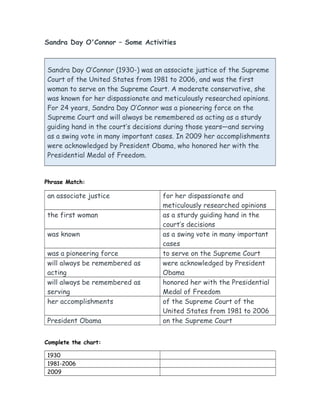
Sandra Day O’Connor (1930-) was an associate justice of the Supreme
Court of the United States from 1981 to 2006, and was the first
woman to serve on the Supreme Court. A moderate conservative, she
was known for her dispassionate and meticulously researched opinions.
For 24 years, Sandra Day O’Connor was a pioneering force on the
Supreme Court and will always be remembered as acting as a sturdy
guiding hand in the court’s decisions during those years—and serving
as a swing vote in many important cases. In 2009 her accomplishments
were acknowledged by President Obama, who honored her with the
Presidential Medal of Freedom.
Phrase Match:
an associate justice for her dispassionate and
meticulously researched opinions
the first woman as a sturdy guiding hand in the
court’s decisions
was known as a swing vote in many important
cases
was a pioneering force to serve on the Supreme Court
will always be remembered as
acting
were acknowledged by President
Obama
will always be remembered as
serving
honored her with the Presidential
Medal of Freedom
her accomplishments of the Supreme Court of the
United States from 1981 to 2006
President Obama on the Supreme Court
Complete the chart:
1930
1981-2006
2009
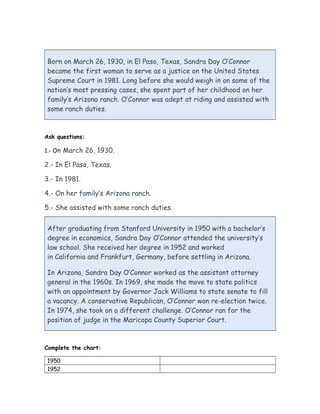
Born on March 26, 1930, in El Paso, Texas, Sandra Day O’Connor
became the first woman to serve as a justice on the United States
Supreme Court in 1981. Long before she would weigh in on some of the
nation’s most pressing cases, she spent part of her childhood on her
family’s Arizona ranch. O’Connor was adept at riding and assisted with
some ranch duties.
Ask questions:
1.- On March 26, 1930.
2.- In El Paso, Texas.
3.- In 1981.
4.- On her family’s Arizona ranch.
5.- She assisted with some ranch duties.
After graduating from Stanford University in 1950 with a bachelor’s
degree in economics, Sandra Day O’Connor attended the university’s
law school. She received her degree in 1952 and worked
in California and Frankfurt, Germany, before settling in Arizona.
In Arizona, Sandra Day O’Connor worked as the assistant attorney
general in the 1960s. In 1969, she made the move to state politics
with an appointment by Governor Jack Williams to state senate to fill
a vacancy. A conservative Republican, O’Connor won re-election twice.
In 1974, she took on a different challenge. O’Connor ran for the
position of judge in the Maricopa County Superior Court.
Complete the chart:
1950
1952
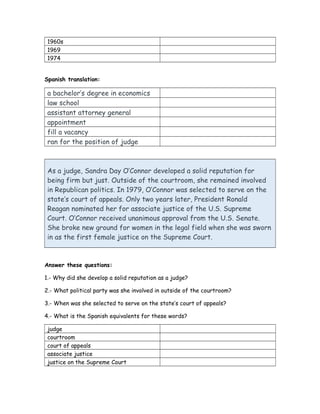
1960s
1969
1974
Spanish translation:
a bachelor’s degree in economics
law school
assistant attorney general
appointment
fill a vacancy
ran for the position of judge
As a judge, Sandra Day O’Connor developed a solid reputation for
being firm but just. Outside of the courtroom, she remained involved
in Republican politics. In 1979, O’Connor was selected to serve on the
state’s court of appeals. Only two years later, President Ronald
Reagan nominated her for associate justice of the U.S. Supreme
Court. O’Connor received unanimous approval from the U.S. Senate.
She broke new ground for women in the legal field when she was sworn
in as the first female justice on the Supreme Court.
Answer these questions:
1.- Why did she develop a solid reputation as a judge?
2.- What political party was she involved in outside of the courtroom?
3.- When was she selected to serve on the state’s court of appeals?
4.- What is the Spanish equivalents for these words?
judge
courtroom
court of appeals
associate justice
justice on the Supreme Court
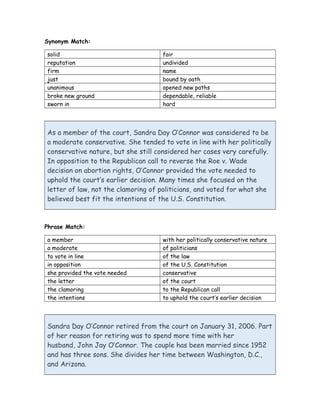
Synonym Match:
solid fair
reputation undivided
firm name
just bound by oath
unanimous opened new paths
broke new ground dependable, reliable
sworn in hard
As a member of the court, Sandra Day O’Connor was considered to be
a moderate conservative. She tended to vote in line with her politically
conservative nature, but she still considered her cases very carefully.
In opposition to the Republican call to reverse the Roe v. Wade
decision on abortion rights, O’Connor provided the vote needed to
uphold the court’s earlier decision. Many times she focused on the
letter of law, not the clamoring of politicians, and voted for what she
believed best fit the intentions of the U.S. Constitution.
Phrase Match:
a member with her politically conservative nature
a moderate of politicians
to vote in line of the law
in opposition of the U.S. Constitution
she provided the vote needed conservative
the letter of the court
the clamoring to the Republican call
the intentions to uphold the court’s earlier decision
Sandra Day O’Connor retired from the court on January 31, 2006. Part
of her reason for retiring was to spend more time with her
husband, John Jay O’Connor. The couple has been married since 1952
and has three sons. She divides her time between Washington, D.C.,
and Arizona.
Answer these questions:
1.- Do you think she was an impartial judge? Why?
2.- What is special about this judge?
3.- What could she do when she retired?
4.- Where does she live?
Answer these questions:
1.- Do you think she was an impartial judge? Why?
2.- What is special about this judge?
3.- What could she do when she retired?
4.- Where does she live?

Sandra Day O'Connor – Some Activities

  • 1.
    Sandra Day O'Connor– Some Activities Sandra Day O’Connor (1930-) was an associate justice of the Supreme Court of the United States from 1981 to 2006, and was the first woman to serve on the Supreme Court. A moderate conservative, she was known for her dispassionate and meticulously researched opinions. For 24 years, Sandra Day O’Connor was a pioneering force on the Supreme Court and will always be remembered as acting as a sturdy guiding hand in the court’s decisions during those years—and serving as a swing vote in many important cases. In 2009 her accomplishments were acknowledged by President Obama, who honored her with the Presidential Medal of Freedom. Phrase Match: an associate justice for her dispassionate and meticulously researched opinions the first woman as a sturdy guiding hand in the court’s decisions was known as a swing vote in many important cases was a pioneering force to serve on the Supreme Court will always be remembered as acting were acknowledged by President Obama will always be remembered as serving honored her with the Presidential Medal of Freedom her accomplishments of the Supreme Court of the United States from 1981 to 2006 President Obama on the Supreme Court Complete the chart: 1930 1981-2006 2009
  • 2.
    Born on March26, 1930, in El Paso, Texas, Sandra Day O’Connor became the first woman to serve as a justice on the United States Supreme Court in 1981. Long before she would weigh in on some of the nation’s most pressing cases, she spent part of her childhood on her family’s Arizona ranch. O’Connor was adept at riding and assisted with some ranch duties. Ask questions: 1.- On March 26, 1930. 2.- In El Paso, Texas. 3.- In 1981. 4.- On her family’s Arizona ranch. 5.- She assisted with some ranch duties. After graduating from Stanford University in 1950 with a bachelor’s degree in economics, Sandra Day O’Connor attended the university’s law school. She received her degree in 1952 and worked in California and Frankfurt, Germany, before settling in Arizona. In Arizona, Sandra Day O’Connor worked as the assistant attorney general in the 1960s. In 1969, she made the move to state politics with an appointment by Governor Jack Williams to state senate to fill a vacancy. A conservative Republican, O’Connor won re-election twice. In 1974, she took on a different challenge. O’Connor ran for the position of judge in the Maricopa County Superior Court. Complete the chart: 1950 1952
  • 3.
    1960s 1969 1974 Spanish translation: a bachelor’sdegree in economics law school assistant attorney general appointment fill a vacancy ran for the position of judge As a judge, Sandra Day O’Connor developed a solid reputation for being firm but just. Outside of the courtroom, she remained involved in Republican politics. In 1979, O’Connor was selected to serve on the state’s court of appeals. Only two years later, President Ronald Reagan nominated her for associate justice of the U.S. Supreme Court. O’Connor received unanimous approval from the U.S. Senate. She broke new ground for women in the legal field when she was sworn in as the first female justice on the Supreme Court. Answer these questions: 1.- Why did she develop a solid reputation as a judge? 2.- What political party was she involved in outside of the courtroom? 3.- When was she selected to serve on the state’s court of appeals? 4.- What is the Spanish equivalents for these words? judge courtroom court of appeals associate justice justice on the Supreme Court
  • 4.
    Synonym Match: solid fair reputationundivided firm name just bound by oath unanimous opened new paths broke new ground dependable, reliable sworn in hard As a member of the court, Sandra Day O’Connor was considered to be a moderate conservative. She tended to vote in line with her politically conservative nature, but she still considered her cases very carefully. In opposition to the Republican call to reverse the Roe v. Wade decision on abortion rights, O’Connor provided the vote needed to uphold the court’s earlier decision. Many times she focused on the letter of law, not the clamoring of politicians, and voted for what she believed best fit the intentions of the U.S. Constitution. Phrase Match: a member with her politically conservative nature a moderate of politicians to vote in line of the law in opposition of the U.S. Constitution she provided the vote needed conservative the letter of the court the clamoring to the Republican call the intentions to uphold the court’s earlier decision Sandra Day O’Connor retired from the court on January 31, 2006. Part of her reason for retiring was to spend more time with her husband, John Jay O’Connor. The couple has been married since 1952 and has three sons. She divides her time between Washington, D.C., and Arizona.
  • 5.
    Answer these questions: 1.-Do you think she was an impartial judge? Why? 2.- What is special about this judge? 3.- What could she do when she retired? 4.- Where does she live?
  • 6.
    Answer these questions: 1.-Do you think she was an impartial judge? Why? 2.- What is special about this judge? 3.- What could she do when she retired? 4.- Where does she live?