1Hair, Babin, Money & Samouel, Essentials
of Business Research, Wiley, 2003.
Learning Objectives:
1. Understand the key principles in sampling.
2. Appreciate the difference between the target
population and the sampling frame.
3. Recognize the difference between probability
and non-probability sampling.
4. Describe the different sampling methods.
5. Determine the appropriate sample size.
Sampling Approaches andSampling Approaches and
ConsiderationsConsiderations
2Hair, Babin, Money & Samouel, Essentials
of Business Research, Wiley, 2003.
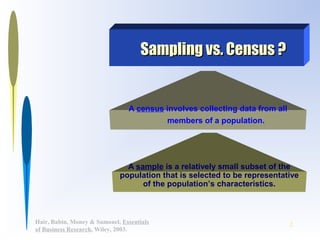
A sample is a relatively small subset of the
population that is selected to be representative
of the population’s characteristics.
A census involves collecting data from all
members of a population.
Sampling vs. Census ?Sampling vs. Census ?
3Hair, Babin, Money & Samouel, Essentials
of Business Research, Wiley, 2003.
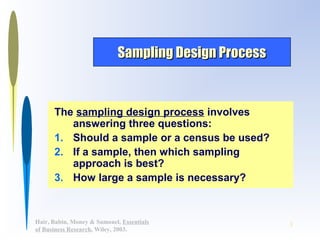
Sampling Design ProcessSampling Design Process
The sampling design process involves
answering three questions:
1. Should a sample or a census be used?
2. If a sample, then which sampling
approach is best?
3. How large a sample is necessary?
4Hair, Babin, Money & Samouel, Essentials
of Business Research, Wiley, 2003.
Steps to follow:
To obtain a representativeTo obtain a representative
sample . . . .sample . . . .
1. Define the target population.
2. Choose the sampling frame.
3. Select the sampling method.
4. Determine the sample size.
5. Implement the sampling plan.
5Hair, Babin, Money & Samouel, Essentials
of Business Research, Wiley, 2003.
Representative SampleRepresentative Sample
A representative sample mirrors the
characteristics of the population and
minimizes the errors associated with
sampling.
6Hair, Babin, Money & Samouel, Essentials
of Business Research, Wiley, 2003.
. . . the complete group of objects or
elements relevant to the research
project. They are relevant because
they possess the information the
research project is designed to
collect.
Target PopulationTarget Population
7Hair, Babin, Money & Samouel, Essentials
of Business Research, Wiley, 2003.
. . . . elements or objects available for
selection during the sampling process are
known as the sampling unit.
Sampling UnitSampling Unit
8Hair, Babin, Money & Samouel, Essentials
of Business Research, Wiley, 2003.
. . . . as complete a list as possible of
all the elements in the population from
which the sample is drawn.
Sampling FrameSampling Frame
9Hair, Babin, Money & Samouel, Essentials
of Business Research, Wiley, 2003.
The sampling frame often is flawed because . . .The sampling frame often is flawed because . . .
It may not be up to date.
It may include elements that do not belong
to the target population.
It may not include elements that do belong
to the target population.
It may be compiled from multiple lists and
contain duplicate elements.
10Hair, Babin, Money & Samouel, Essentials
of Business Research, Wiley, 2003.
Non-Probability
Probability
SamplingSampling
MethodsMethods
11Hair, Babin, Money & Samouel, Essentials
of Business Research, Wiley, 2003.
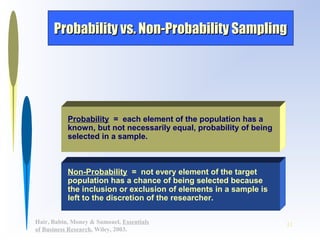
Probability vs. Non-Probability SamplingProbability vs. Non-Probability Sampling
Non-Probability = not every element of the target
population has a chance of being selected because
the inclusion or exclusion of elements in a sample is
left to the discretion of the researcher.
Probability = each element of the population has a
known, but not necessarily equal, probability of being
selected in a sample.
12Hair, Babin, Money & Samouel, Essentials
of Business Research, Wiley, 2003.
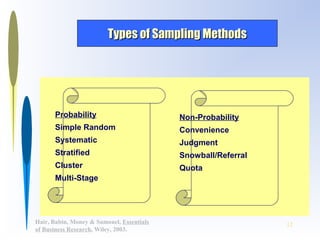
Types of Sampling MethodsTypes of Sampling Methods
Probability
Simple Random
Systematic
Stratified
Cluster
Multi-Stage
Non-Probability
Convenience
Judgment
Snowball/Referral
Quota
13Hair, Babin, Money & Samouel, Essentials
of Business Research, Wiley, 2003.
. . . . a sampling method in which each
element of the population has an equal
probability of being selected.
Simple Random SamplingSimple Random Sampling
14Hair, Babin, Money & Samouel, Essentials
of Business Research, Wiley, 2003.
Systematic SamplingSystematic Sampling
. . . a process that involves
randomly selecting an initial
starting point on a list, and
thereafter every nth
element in
the sampling frame.
15Hair, Babin, Money & Samouel, Essentials
of Business Research, Wiley, 2003.
. . . requires the
researcher to partition the
target population into
relatively homogeneous
subgroups that are distinct
and non-overlapping ..
Stratified SamplingStratified Sampling
16Hair, Babin, Money & Samouel, Essentials
of Business Research, Wiley, 2003.
Two Types of Stratified SamplingTwo Types of Stratified Sampling
Disproportionate = the number of elements chosen
from each of the strata is not based on the size of the
stratum relative to the target population size, but
rather is based either on the importance of a
particular stratum or its variability.
Proportionate = the number of elements chosen
from each of the strata is proportionate to the size of
a particular strata relative to the overall sample size.
17Hair, Babin, Money & Samouel, Essentials
of Business Research, Wiley, 2003.
Cluster SamplingCluster Sampling
. . . a form of probability
sampling in which the
relatively homogeneous
individual clusters where
sampling occurs are chosen
randomly and not all
clusters are sampled.
18Hair, Babin, Money & Samouel, Essentials
of Business Research, Wiley, 2003.
Multi-Stage Cluster SamplingMulti-Stage Cluster Sampling
Cluster sampling involves dividing the
population into clusters and randomly
selecting a pre-specified number of
clusters and then either collecting
information from all the elements in each
cluster or a random sample. With multi-
stage cluster sampling the same process
is completed two or more times.
19Hair, Babin, Money & Samouel, Essentials
of Business Research, Wiley, 2003.
Convenience SamplingConvenience Sampling
. . . involves selecting sample
elements that are most readily
available to participate in the
study and who can provide the
required information.
20Hair, Babin, Money & Samouel, Essentials
of Business Research, Wiley, 2003.
Judgment SamplingJudgment Sampling
. . . a form of convenience sampling,
sometimes referred to as a
purposive sample, in which the
researcher’s judgment is used to
select the sample elements.
21Hair, Babin, Money & Samouel, Essentials
of Business Research, Wiley, 2003.
. . . . similar to proportionately stratified
random sampling but the selection of
the elements from the strata is done on
a convenience basis.
Quota SamplingQuota Sampling
22Hair, Babin, Money & Samouel, Essentials
of Business Research, Wiley, 2003.
. . . also called a referral sample, the initial
respondents typically are chosen using
probability methods and these respondents
then identify others in the target
population.
Snowball SamplingSnowball Sampling
23Hair, Babin, Money & Samouel, Essentials
of Business Research, Wiley, 2003.
Determining sample size involves achieving aDetermining sample size involves achieving a
balance between several factors:balance between several factors:
• The variability of elements in the target population.
• The type of sample required.
• Time available.
• Budget.
• Required estimation precision.
• Whether findings will be generalized.
24Hair, Babin, Money & Samouel, Essentials
of Business Research, Wiley, 2003.
Three decisions to make when statisticalThree decisions to make when statistical
formulas are used to determine sample size:formulas are used to determine sample size:
1. The degree of confidence
(often 95%).
2. The specified level of precision
(amount of acceptable error).
3. The amount of variability
(population homogeneity).

Sampling gud one

  • 1.
    1Hair, Babin, Money& Samouel, Essentials of Business Research, Wiley, 2003. Learning Objectives: 1. Understand the key principles in sampling. 2. Appreciate the difference between the target population and the sampling frame. 3. Recognize the difference between probability and non-probability sampling. 4. Describe the different sampling methods. 5. Determine the appropriate sample size. Sampling Approaches andSampling Approaches and ConsiderationsConsiderations
  • 2.
    2Hair, Babin, Money& Samouel, Essentials of Business Research, Wiley, 2003. A sample is a relatively small subset of the population that is selected to be representative of the population’s characteristics. A census involves collecting data from all members of a population. Sampling vs. Census ?Sampling vs. Census ?
  • 3.
    3Hair, Babin, Money& Samouel, Essentials of Business Research, Wiley, 2003. Sampling Design ProcessSampling Design Process The sampling design process involves answering three questions: 1. Should a sample or a census be used? 2. If a sample, then which sampling approach is best? 3. How large a sample is necessary?
  • 4.
    4Hair, Babin, Money& Samouel, Essentials of Business Research, Wiley, 2003. Steps to follow: To obtain a representativeTo obtain a representative sample . . . .sample . . . . 1. Define the target population. 2. Choose the sampling frame. 3. Select the sampling method. 4. Determine the sample size. 5. Implement the sampling plan.
  • 5.
    5Hair, Babin, Money& Samouel, Essentials of Business Research, Wiley, 2003. Representative SampleRepresentative Sample A representative sample mirrors the characteristics of the population and minimizes the errors associated with sampling.
  • 6.
    6Hair, Babin, Money& Samouel, Essentials of Business Research, Wiley, 2003. . . . the complete group of objects or elements relevant to the research project. They are relevant because they possess the information the research project is designed to collect. Target PopulationTarget Population
  • 7.
    7Hair, Babin, Money& Samouel, Essentials of Business Research, Wiley, 2003. . . . . elements or objects available for selection during the sampling process are known as the sampling unit. Sampling UnitSampling Unit
  • 8.
    8Hair, Babin, Money& Samouel, Essentials of Business Research, Wiley, 2003. . . . . as complete a list as possible of all the elements in the population from which the sample is drawn. Sampling FrameSampling Frame
  • 9.
    9Hair, Babin, Money& Samouel, Essentials of Business Research, Wiley, 2003. The sampling frame often is flawed because . . .The sampling frame often is flawed because . . . It may not be up to date. It may include elements that do not belong to the target population. It may not include elements that do belong to the target population. It may be compiled from multiple lists and contain duplicate elements.
  • 10.
    10Hair, Babin, Money& Samouel, Essentials of Business Research, Wiley, 2003. Non-Probability Probability SamplingSampling MethodsMethods
  • 11.
    11Hair, Babin, Money& Samouel, Essentials of Business Research, Wiley, 2003. Probability vs. Non-Probability SamplingProbability vs. Non-Probability Sampling Non-Probability = not every element of the target population has a chance of being selected because the inclusion or exclusion of elements in a sample is left to the discretion of the researcher. Probability = each element of the population has a known, but not necessarily equal, probability of being selected in a sample.
  • 12.
    12Hair, Babin, Money& Samouel, Essentials of Business Research, Wiley, 2003. Types of Sampling MethodsTypes of Sampling Methods Probability Simple Random Systematic Stratified Cluster Multi-Stage Non-Probability Convenience Judgment Snowball/Referral Quota
  • 13.
    13Hair, Babin, Money& Samouel, Essentials of Business Research, Wiley, 2003. . . . . a sampling method in which each element of the population has an equal probability of being selected. Simple Random SamplingSimple Random Sampling
  • 14.
    14Hair, Babin, Money& Samouel, Essentials of Business Research, Wiley, 2003. Systematic SamplingSystematic Sampling . . . a process that involves randomly selecting an initial starting point on a list, and thereafter every nth element in the sampling frame.
  • 15.
    15Hair, Babin, Money& Samouel, Essentials of Business Research, Wiley, 2003. . . . requires the researcher to partition the target population into relatively homogeneous subgroups that are distinct and non-overlapping .. Stratified SamplingStratified Sampling
  • 16.
    16Hair, Babin, Money& Samouel, Essentials of Business Research, Wiley, 2003. Two Types of Stratified SamplingTwo Types of Stratified Sampling Disproportionate = the number of elements chosen from each of the strata is not based on the size of the stratum relative to the target population size, but rather is based either on the importance of a particular stratum or its variability. Proportionate = the number of elements chosen from each of the strata is proportionate to the size of a particular strata relative to the overall sample size.
  • 17.
    17Hair, Babin, Money& Samouel, Essentials of Business Research, Wiley, 2003. Cluster SamplingCluster Sampling . . . a form of probability sampling in which the relatively homogeneous individual clusters where sampling occurs are chosen randomly and not all clusters are sampled.
  • 18.
    18Hair, Babin, Money& Samouel, Essentials of Business Research, Wiley, 2003. Multi-Stage Cluster SamplingMulti-Stage Cluster Sampling Cluster sampling involves dividing the population into clusters and randomly selecting a pre-specified number of clusters and then either collecting information from all the elements in each cluster or a random sample. With multi- stage cluster sampling the same process is completed two or more times.
  • 19.
    19Hair, Babin, Money& Samouel, Essentials of Business Research, Wiley, 2003. Convenience SamplingConvenience Sampling . . . involves selecting sample elements that are most readily available to participate in the study and who can provide the required information.
  • 20.
    20Hair, Babin, Money& Samouel, Essentials of Business Research, Wiley, 2003. Judgment SamplingJudgment Sampling . . . a form of convenience sampling, sometimes referred to as a purposive sample, in which the researcher’s judgment is used to select the sample elements.
  • 21.
    21Hair, Babin, Money& Samouel, Essentials of Business Research, Wiley, 2003. . . . . similar to proportionately stratified random sampling but the selection of the elements from the strata is done on a convenience basis. Quota SamplingQuota Sampling
  • 22.
    22Hair, Babin, Money& Samouel, Essentials of Business Research, Wiley, 2003. . . . also called a referral sample, the initial respondents typically are chosen using probability methods and these respondents then identify others in the target population. Snowball SamplingSnowball Sampling
  • 23.
    23Hair, Babin, Money& Samouel, Essentials of Business Research, Wiley, 2003. Determining sample size involves achieving aDetermining sample size involves achieving a balance between several factors:balance between several factors: • The variability of elements in the target population. • The type of sample required. • Time available. • Budget. • Required estimation precision. • Whether findings will be generalized.
  • 24.
    24Hair, Babin, Money& Samouel, Essentials of Business Research, Wiley, 2003. Three decisions to make when statisticalThree decisions to make when statistical formulas are used to determine sample size:formulas are used to determine sample size: 1. The degree of confidence (often 95%). 2. The specified level of precision (amount of acceptable error). 3. The amount of variability (population homogeneity).