SAMPLE COLLECTION
PROCEDURE
1. Bacterial
2. Viral
3. Fungal
4. Protozoan
Bacterial such as:
o Streptococcus pyogenes
o Mycobacterium tuberculosis
o Salmonella typhi
o Vibrio cholerae
o Helicobacter pylori
o Staphylococcus aureus
o Bacillus anthracis
o Clostridium tetani
Sample collection of various type
of bacterial disease:
Blood tests including
• Total white blood cells and differential leucocytes’ counts.
• C- reactive protein (CRP) assay – Reading is >50 in serious bacterial
infections.
• Procalcitonin- It is a marker of generalised sepsis.
• Serology
• Observation of any bacilli in blood smear.
 Rountine urine examination : In UTI increase in pus cells.
 In Mastitis cases, slide tests for subclinical mastitis.
 For Faecal samples, low grade fever, straining and stomach cramps
and or loose stool for long duration.
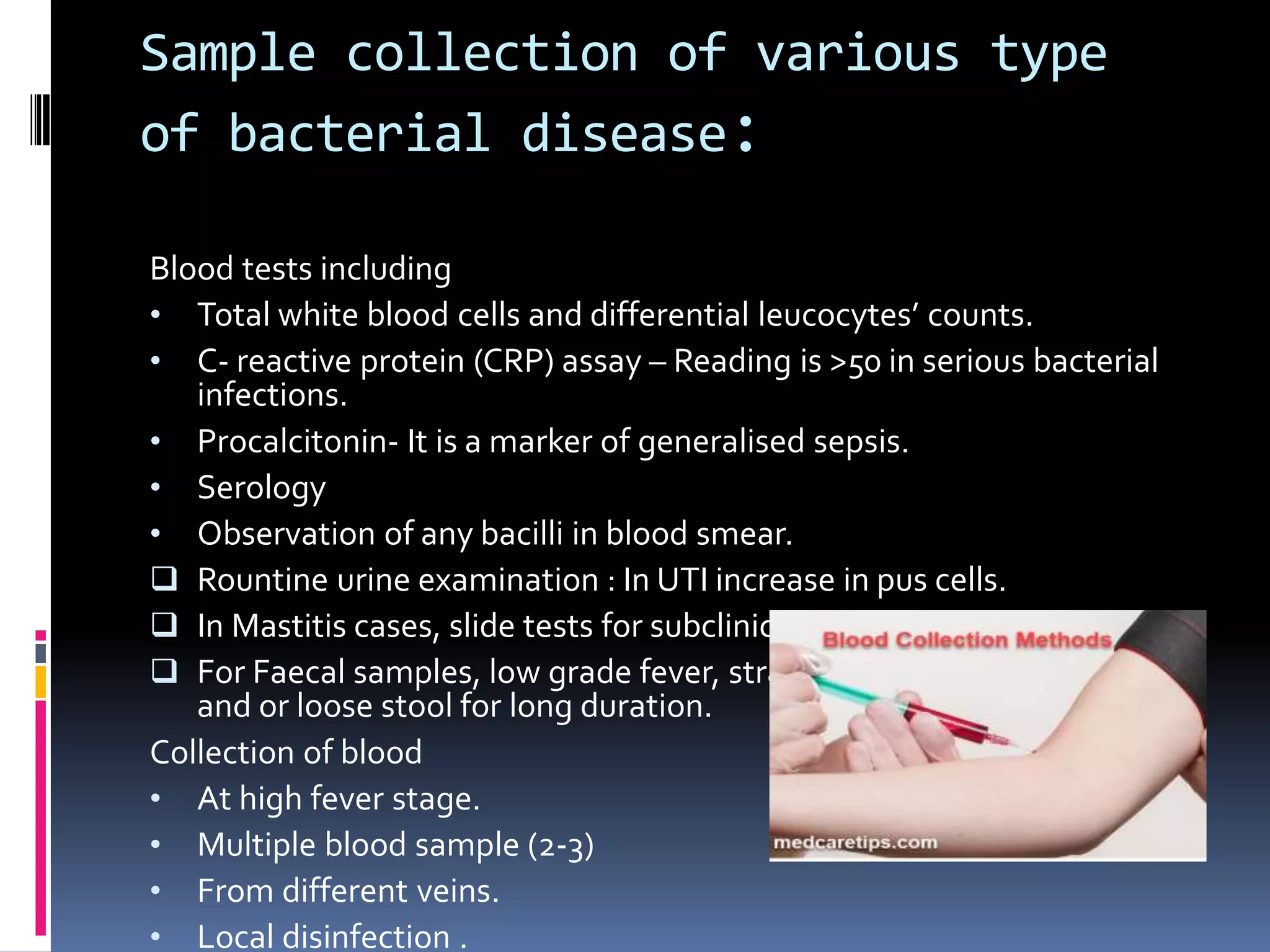
Collection of blood
• At high fever stage.
• Multiple blood sample (2-3)
• From different veins.
• Local disinfection .
Viral such as:
o Polio
o Hepatitis
o Rabies
o Dengue
o AIDS
o Swine flu
o Ebola
o SARS
o COVID-19
Sample Collection of various type
of viral disease:
 CSF (Cerebral Spinal Fluid)
• A CSF is a laboratory test to look for bacteria,
fungi, and viruses in the fluid that moves in
the space around the spinal cord.
• Collect in sterile container. Do not dilute in
universal transport media(UTM) maintain
2-8˚C before and during transport to the
laboratory.
 Stool test : Collect 5-10 grams of stool in
clean container. Maintain at 2-8˚C before and
during transport to the laboratory.
Fungal such as:
o Athlete’s foot
o Candidiasis
o Blastomyosis
Sample Collection of various types of fungal diseases :
 Specimens for fungal microscopy and culture are transported to the laboratory in
a sterile container or a black paper envelope.
They include :
• Scrapings of scale, best taken from the leading edge of the rash after the skin has
been cleaned with alcohol.
• Skin stripped off with adhesive tape, which is then stuck on a glass slide.
• Hair which has been pulled out from the roots.
• Brushings from an area of scaling in the scalp.
• Nail clippings or skin scraped from under a nail.
• A skin biopsy.
• A moist swab from a mucosal surface (inside the mouth or vagina) in a special
transport medium.
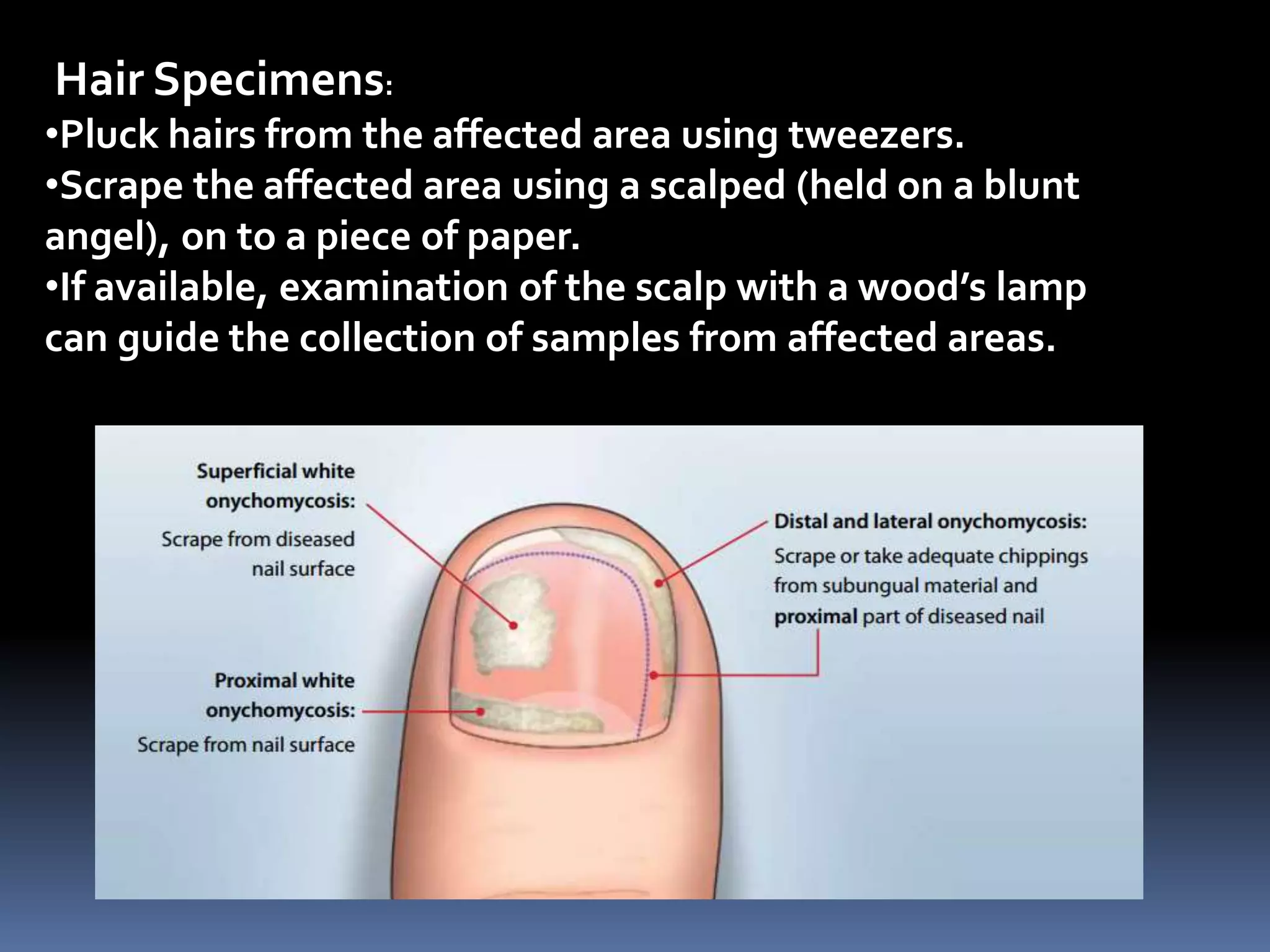
Hair Specimens:
•Pluck hairs from the affected area using tweezers.
•Scrape the affected area using a scalped (held on a blunt
angel), on to a piece of paper.
•If available, examination of the scalp with a wood’s lamp
can guide the collection of samples from affected areas.
Protozoan such as:
o Malaria
o Kala- azar
Sample collection of varius type of protozoan
disease:
• Stool sample collection – Stool sample
collected on separate days, be examined.
• This test looks for ova (eggs) or the parasite.
Your health care provider may instruct you to
put your stool specimens into special
containers with preservative fluid.
ThankYou

Sample Collection Procedure Ppt.pdf

  • 1.
  • 2.
    1. Bacterial 2. Viral 3.Fungal 4. Protozoan
  • 3.
    Bacterial such as: oStreptococcus pyogenes o Mycobacterium tuberculosis o Salmonella typhi o Vibrio cholerae o Helicobacter pylori o Staphylococcus aureus o Bacillus anthracis o Clostridium tetani
  • 4.
    Sample collection ofvarious type of bacterial disease: Blood tests including • Total white blood cells and differential leucocytes’ counts. • C- reactive protein (CRP) assay – Reading is >50 in serious bacterial infections. • Procalcitonin- It is a marker of generalised sepsis. • Serology • Observation of any bacilli in blood smear.  Rountine urine examination : In UTI increase in pus cells.  In Mastitis cases, slide tests for subclinical mastitis.  For Faecal samples, low grade fever, straining and stomach cramps and or loose stool for long duration. Collection of blood • At high fever stage. • Multiple blood sample (2-3) • From different veins. • Local disinfection .
  • 5.
    Viral such as: oPolio o Hepatitis o Rabies o Dengue o AIDS o Swine flu o Ebola o SARS o COVID-19
  • 6.
    Sample Collection ofvarious type of viral disease:  CSF (Cerebral Spinal Fluid) • A CSF is a laboratory test to look for bacteria, fungi, and viruses in the fluid that moves in the space around the spinal cord. • Collect in sterile container. Do not dilute in universal transport media(UTM) maintain 2-8˚C before and during transport to the laboratory.  Stool test : Collect 5-10 grams of stool in clean container. Maintain at 2-8˚C before and during transport to the laboratory.
  • 7.
    Fungal such as: oAthlete’s foot o Candidiasis o Blastomyosis Sample Collection of various types of fungal diseases :  Specimens for fungal microscopy and culture are transported to the laboratory in a sterile container or a black paper envelope. They include : • Scrapings of scale, best taken from the leading edge of the rash after the skin has been cleaned with alcohol. • Skin stripped off with adhesive tape, which is then stuck on a glass slide. • Hair which has been pulled out from the roots. • Brushings from an area of scaling in the scalp. • Nail clippings or skin scraped from under a nail. • A skin biopsy. • A moist swab from a mucosal surface (inside the mouth or vagina) in a special transport medium.
  • 8.
    Hair Specimens: •Pluck hairsfrom the affected area using tweezers. •Scrape the affected area using a scalped (held on a blunt angel), on to a piece of paper. •If available, examination of the scalp with a wood’s lamp can guide the collection of samples from affected areas.
  • 9.
    Protozoan such as: oMalaria o Kala- azar Sample collection of varius type of protozoan disease: • Stool sample collection – Stool sample collected on separate days, be examined. • This test looks for ova (eggs) or the parasite. Your health care provider may instruct you to put your stool specimens into special containers with preservative fluid.
  • 10.