ORAL CAVITY
 Bacteria, spirochetes, viruses, fungi, and
parasites are normal in the oral cavity and are
usually harmless.
 The following terms are used to describe
localized inflammation of the oral cavity:
 Cheilitis (lips)
 Gingivitis (gum)
 Glossitis (tongue)
 Stomatitis (oral mucosa)
 Premalignant lesions include
 leukoplakia,
 Erythroplakia,
 speckled leukoplakia.
 The terms reflecting the presence of a white, red,
or mixed white/red lesion, respectively.
 Leukoplakia is an asymptomatic white lesion
on the surface of a mucous membrane.
 Some of these lesions undergo transformation
to squamous cell carcinoma.
 As a preneoplastic lesion, the causes of
leukoplakia are diverse and include use of
tobacco products,
 alcoholism,
 and local irritation.
 Clinically defined white patch or plaque that
that cannot be scraped off has been excluded
from other disease entities
 Presence of dysplasia, carcinoma in situ, and
invasive carcinoma from all sites 17-25%
 Etiology- associated with tobacco (smoking,
smokeless tobacco), areca nut/betel
preparations
Site of Leukoplakia
 Risk of dysplasia/carcinoma higher
 with floor of mouth,
 Ventro lateral tongue,
 retro molar trig one,
 soft palate than with other oral sites
 Erythroplakia is the red equivalent of
leukoplakia but is less common.
 Red areas associated with leukoplakic lesions
are referred to as speckled leukoplakia
 In contrast to leukoplakia, Erythroplakia may
represent moderate to severe dysplasia or
carcinoma.
 Not all of these lesions herald dysplasia or
carcinoma, as many red oral mucosal lesions
may be inflammatory in nature.
Infections of the Oral Cavity
• Bacteria, spirochetes, viruses, fungi, and parasites
are normal in the oral cavity and are usually
harmless.
• The following terms are used to describe
localized inflammation of the oral cavity:
• Cheilitis (lips)
• Gingivitis (gum)
• Glossitis (tongue)
• Stomatitis (oral mucosa)
Cancer of the tongue common in male around the
age of 50 years (50-70 years)
predisposing causes:
 Chronic irritation by smoking, sepsis, spices and
spirits (alcohol).
 Pre-cancerous lesions which include syphilis, ch.
superficial glossitis, dental ulcers and papilloma.
 Poor oral hygiene and mal-nutrition.
 Betel chewing.
 Two-thirds of the tongue cancer arise in the
ant. 2/3rd and 1/3rd in the posterior part.
 The commonest sites are the sides of the ant.
2/3rd of the tongue.
 Posterior tumors are much more to be in the
midline.
 The tumor usually occurs as malignant ulcer.
 Less often it take, the form of hard sub mucous
nodule or deep fissure.
 Rarely it occurs as diffuse hard infiltration of
whole tongue. (wooden tongue)
The tumor is usually Squamous cell
carcinoma.
.
 Local (direct to the floor of the mouth, gums
and pharynx).
 Lymphatic spread.
 Blood spread (very rare)
 For patient with LN negative with tumors in
the ant. 2/3rd there is 50%, 5 years survival.
 For patient with posterior 1/3rd of the tongue
with negative LN 20-25%, 5 years survival.
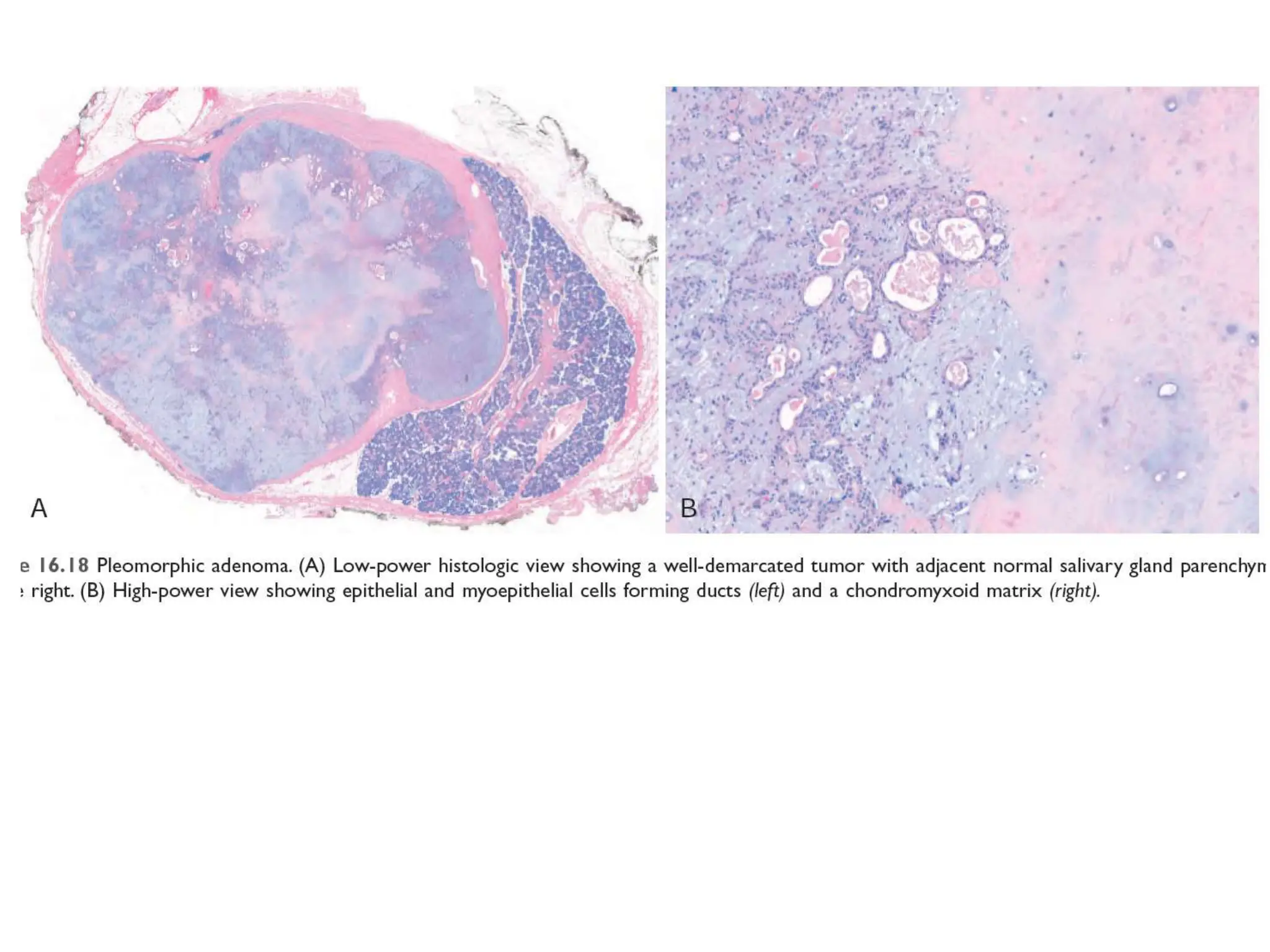
PLEOMORPHIC ADENOMA (BENIGN MIXED
TUMOR)
• Composed of cells exhibiting ability to differentiate
into; epithelial cells and mesenchymal components
• Gross: Round to ovoid, encapsulated or partly
encapsulated mass Cut surface; homogeneous tan to
white
PLEOMORPHIC ADENOMA MICROSCOPY
• Epithelial cells - Trabeculae/ ducts - Cysts lined by
squamous epithelium Mesenchymal components -
Fibrous - Myxochondroid - Osseous
PLEOMORPHIC ADENOMA CLINICAL COURSE
• Most common, any age , common in females
• Slow growing, asymptomatic, presents as single
nodular, firm, mobile mass rarely exceed 6cm in
diameter
• Malignant transformation increases with duration
(2% less than 5 yrs and10% less than 15 yrs duration)
PLEOMORPHIC ADENOMA CLINICAL COURSE
• Carcinoma ex pleomorphic adenoma; adenocarcinoma or
undifferentiated carcinoma-a very aggressive tumor S/S of
malignancy; sudden increase in size in short period, fixity to
surrounding tissue or facial nerve palsy Diagnosis; clinical
assessment, FNA, excision biopsy
WARTHIN’S TUMOR
• May be unilateral or bilateral,
• Common in males (26:1) and in smokers
WARTHIN’S TUMOR
• Gross Round, encapsulated mass, 2-4cm in size Cut
surface multiple cysts exude a clear fluid
• Microscopy Cystic spaces, papillary projections lined
by tall columnar cells Lymphoid tissue with/without
germinal center
ESOPHAGUS
• Normal gross Normal histology
ESOPHAGITIS
• Inflammation of the esophageal mucosa
• Etiological factors physical; e.G intubation, radiations
chemical; e.G uremia, ingestions of corrosive biologic agents;
e.G tuberculosis, candidiasis, herpes simplex, CMV others;
crohn disease, graft verses host disease (GVHD)
REFLUX ESOPHAGITIS (GERD)
• Reflux of gastroduodenal contents into esophagus due to
dysfunction of LES
• Contributory factors
 Presence of sliding hiatal hernia
 Vagal dysfunction
 Increased gastric volume and slowed esophageal clearance of
refluxed material
 Impaired reparative capacity of mucosa by prolong exposure
to gastric juices
 Others ; CNS depressants, tobacco and alcoholism
REFLUX ESOPHAGITIS (GERD)
• Pathogenesis Reflux of gastric juices, mucosal injury,
in severe cases duodenal bile reflux increases the
mucosal damage
• Gross Mucosa, hyperemic and red
REFLUX ESOPHAGITIS (GERD)
• Microscopy Epithelial hyperplasia due to basal cell
proliferation
• Intraepithelial eosinophils Lamina propria; neutrophils,
eosinophils and lymphocytes
• Tips of elongated lamina propria papillae shows congested
venules
REFLUX ESOPHAGITIS CLINICAL
MANIFESTATIONS
• Heartburn, chest pain ,dysphagia
• Outcome: reflux esophagitis may progress to:
• Superficial ulceration
• Bleeding, hematemesis and melena
• Spread of inflammation to the wall Circumferential fibrosis
with stricture formation
• Tendency to develop Barrett esophagus
BARRETT ESOPHAGUS
• A segment of distal esophagus above the level
of LES shows metaplastic columnar epithelial
lining with goblet cells
PATHOGENESIS BARRETT ESOPHAGUS
• Ulceration and subsequent re-epithelization by
columnar cells to cope with existing conditions
• Ulceration, induced by reflux and occurs in 10% of
these patients
• Columnar cells could arise from migration of gastric
mucosa or from stem cells of mucosa
BARRETT ESOPHAGUS
• Endoscopy
 Mucosa red and velvety, involvement might be
circumferential or in the form of finger like projections or
islands
• Microscopy
 Intestinal metaplasia with a villiform surface and crypts
lined by columnar and goblet cells most significant for
diagnosis
BARRETT ESOPHAGUS
• Diagnosis Endoscopic examination and biopsy
• Main complications 1. Peptic ulcer 2. Stricture 3.
Bleeding 4. Dysplasia and adenocarcinoma (Persons
with Barrett esophagus have 30 to 100 fold greater
risk of developing adenocarcinoma)
TUMORS OF ESOPHAGUS
• Non-neoplastic
• Mucosal polyp
• Squamous papilloma
• Benign neoplasms: Leiomyoma, Fibroma,Neurofibroma
• Malignant neoplasms: Squamous cell carcinoma,
Adenocarcinoma Carcinoid
SQUAMOUS CELL CARCINOMA
• Epidemiology
• Most frequent in men over 50yrs of age
• Male to female ratio; 4:1
• Smoking and alcoholism; two well known risk
factors
RISK FACTORS FOR SCC OF THE ESOPHAGUS
• Dietary
 Betel chewing
 Deficiency of vitamins (A, C,
riboflavin, thiamine,
pyridoxine)
 Deficiency of trace elements
(zinc, molybdenum)
 Fungal contamination of
foodstuffs
 High content of nitrites or
nitrosamines
 Lifestyle Burning-hot
beverages or food Alcohol
consumption Tobacco use
• Esophageal Disorders
 Long-standing esophagitis
• Genetic Predisposition
 Others HPV found in SCC
 P53 and p16INK4 mutations
 Ampilfication of CyclinD1, C-
MYC, and EGFR
SCC ESOPHAGUS
• Location
 Any part of esophagus; middle thirds 50%, lower
thirds 30%, upper thirds 20%
• Gross
• Three morphologic pattern; Exophytic 60%,
Ulcerated 25%, Flat 15%
• Early lesion small grey white plaque like thickenings
• Late circumferential tumor mass, thickened wall,
often ulcerated with sharply demarcated margins
SCC ESOPHAGUS
• Microscopy
• Intraepithelial neoplasia/dysplasia/ carcinoma-in-situ
Intramucosal carcinomas; that do not invade beyond
lamina propria
• Superficial carcinomas; do not invade beyond
submucosa
• Superficially spreading carcinomas; shows a lateral
intramucosal spread of at least 2cm beyond the
invasive tumor
• Grade; Well to Poorly-differentiated
SCC ESOPHAGUS CLINICAL FEATURES
• Slow on set of dysphagia, Weight loss, hemorrhage
and anemia
• Diagnosis: Exfoliative cytology and Endoscopic
biopsy
• Prognosis: Overall prognosis is poor; the median
survival after diagnosis being one year
• Metastasis: To distant organs particularly liver, lung
and adrenal gland common
• Stage: In situ and intramucosal carcinomas are almost
always curable
ADENOCARCINOMA OF ESOPHAGUS
• Typically arises in a background of Barrett's
esophagus
• Accounts for 5-10% of all esophageal cancers
• Most patients, white males, average age 57 years
• Tumor may be multicentric and is usually advanced at
the time of diagnosis with extension through the wall
and nodal metastasis
ADENOCARCINOMA ESOPHAGUS
MORPHOLOGY
• Initial flat or raised patches intact mucosa
• Late; nodular polypoid mass up to 5cm
• Diffusely infiltrative or deeply ulcerated
Mucin producing glandular tumor of intestinal
type
• Diagnosis: Multisite biopsy Prognosis: Poor,
stage by stage same as to SCC
THANK YOU

Salivary Gland.pptx

  • 1.
  • 2.
     Bacteria, spirochetes,viruses, fungi, and parasites are normal in the oral cavity and are usually harmless.  The following terms are used to describe localized inflammation of the oral cavity:  Cheilitis (lips)  Gingivitis (gum)  Glossitis (tongue)  Stomatitis (oral mucosa)
  • 4.
     Premalignant lesionsinclude  leukoplakia,  Erythroplakia,  speckled leukoplakia.  The terms reflecting the presence of a white, red, or mixed white/red lesion, respectively.  Leukoplakia is an asymptomatic white lesion on the surface of a mucous membrane.
  • 5.
     Some ofthese lesions undergo transformation to squamous cell carcinoma.  As a preneoplastic lesion, the causes of leukoplakia are diverse and include use of tobacco products,  alcoholism,  and local irritation.
  • 6.
     Clinically definedwhite patch or plaque that that cannot be scraped off has been excluded from other disease entities  Presence of dysplasia, carcinoma in situ, and invasive carcinoma from all sites 17-25%  Etiology- associated with tobacco (smoking, smokeless tobacco), areca nut/betel preparations
  • 7.
    Site of Leukoplakia Risk of dysplasia/carcinoma higher  with floor of mouth,  Ventro lateral tongue,  retro molar trig one,  soft palate than with other oral sites
  • 8.
     Erythroplakia isthe red equivalent of leukoplakia but is less common.  Red areas associated with leukoplakic lesions are referred to as speckled leukoplakia  In contrast to leukoplakia, Erythroplakia may represent moderate to severe dysplasia or carcinoma.  Not all of these lesions herald dysplasia or carcinoma, as many red oral mucosal lesions may be inflammatory in nature.
  • 9.
    Infections of theOral Cavity • Bacteria, spirochetes, viruses, fungi, and parasites are normal in the oral cavity and are usually harmless. • The following terms are used to describe localized inflammation of the oral cavity: • Cheilitis (lips) • Gingivitis (gum) • Glossitis (tongue) • Stomatitis (oral mucosa)
  • 10.
    Cancer of thetongue common in male around the age of 50 years (50-70 years) predisposing causes:  Chronic irritation by smoking, sepsis, spices and spirits (alcohol).  Pre-cancerous lesions which include syphilis, ch. superficial glossitis, dental ulcers and papilloma.  Poor oral hygiene and mal-nutrition.  Betel chewing.
  • 11.
     Two-thirds ofthe tongue cancer arise in the ant. 2/3rd and 1/3rd in the posterior part.  The commonest sites are the sides of the ant. 2/3rd of the tongue.  Posterior tumors are much more to be in the midline.
  • 12.
     The tumorusually occurs as malignant ulcer.  Less often it take, the form of hard sub mucous nodule or deep fissure.  Rarely it occurs as diffuse hard infiltration of whole tongue. (wooden tongue)
  • 15.
    The tumor isusually Squamous cell carcinoma. .
  • 16.
     Local (directto the floor of the mouth, gums and pharynx).  Lymphatic spread.  Blood spread (very rare)
  • 17.
     For patientwith LN negative with tumors in the ant. 2/3rd there is 50%, 5 years survival.  For patient with posterior 1/3rd of the tongue with negative LN 20-25%, 5 years survival.
  • 23.
    PLEOMORPHIC ADENOMA (BENIGNMIXED TUMOR) • Composed of cells exhibiting ability to differentiate into; epithelial cells and mesenchymal components • Gross: Round to ovoid, encapsulated or partly encapsulated mass Cut surface; homogeneous tan to white
  • 25.
    PLEOMORPHIC ADENOMA MICROSCOPY •Epithelial cells - Trabeculae/ ducts - Cysts lined by squamous epithelium Mesenchymal components - Fibrous - Myxochondroid - Osseous
  • 27.
    PLEOMORPHIC ADENOMA CLINICALCOURSE • Most common, any age , common in females • Slow growing, asymptomatic, presents as single nodular, firm, mobile mass rarely exceed 6cm in diameter • Malignant transformation increases with duration (2% less than 5 yrs and10% less than 15 yrs duration)
  • 28.
    PLEOMORPHIC ADENOMA CLINICALCOURSE • Carcinoma ex pleomorphic adenoma; adenocarcinoma or undifferentiated carcinoma-a very aggressive tumor S/S of malignancy; sudden increase in size in short period, fixity to surrounding tissue or facial nerve palsy Diagnosis; clinical assessment, FNA, excision biopsy
  • 29.
    WARTHIN’S TUMOR • Maybe unilateral or bilateral, • Common in males (26:1) and in smokers
  • 30.
    WARTHIN’S TUMOR • GrossRound, encapsulated mass, 2-4cm in size Cut surface multiple cysts exude a clear fluid • Microscopy Cystic spaces, papillary projections lined by tall columnar cells Lymphoid tissue with/without germinal center
  • 32.
  • 33.
    ESOPHAGITIS • Inflammation ofthe esophageal mucosa • Etiological factors physical; e.G intubation, radiations chemical; e.G uremia, ingestions of corrosive biologic agents; e.G tuberculosis, candidiasis, herpes simplex, CMV others; crohn disease, graft verses host disease (GVHD)
  • 34.
    REFLUX ESOPHAGITIS (GERD) •Reflux of gastroduodenal contents into esophagus due to dysfunction of LES • Contributory factors  Presence of sliding hiatal hernia  Vagal dysfunction  Increased gastric volume and slowed esophageal clearance of refluxed material  Impaired reparative capacity of mucosa by prolong exposure to gastric juices  Others ; CNS depressants, tobacco and alcoholism
  • 35.
    REFLUX ESOPHAGITIS (GERD) •Pathogenesis Reflux of gastric juices, mucosal injury, in severe cases duodenal bile reflux increases the mucosal damage • Gross Mucosa, hyperemic and red
  • 36.
    REFLUX ESOPHAGITIS (GERD) •Microscopy Epithelial hyperplasia due to basal cell proliferation • Intraepithelial eosinophils Lamina propria; neutrophils, eosinophils and lymphocytes • Tips of elongated lamina propria papillae shows congested venules
  • 38.
    REFLUX ESOPHAGITIS CLINICAL MANIFESTATIONS •Heartburn, chest pain ,dysphagia • Outcome: reflux esophagitis may progress to: • Superficial ulceration • Bleeding, hematemesis and melena • Spread of inflammation to the wall Circumferential fibrosis with stricture formation • Tendency to develop Barrett esophagus
  • 39.
    BARRETT ESOPHAGUS • Asegment of distal esophagus above the level of LES shows metaplastic columnar epithelial lining with goblet cells
  • 40.
    PATHOGENESIS BARRETT ESOPHAGUS •Ulceration and subsequent re-epithelization by columnar cells to cope with existing conditions • Ulceration, induced by reflux and occurs in 10% of these patients • Columnar cells could arise from migration of gastric mucosa or from stem cells of mucosa
  • 41.
    BARRETT ESOPHAGUS • Endoscopy Mucosa red and velvety, involvement might be circumferential or in the form of finger like projections or islands • Microscopy  Intestinal metaplasia with a villiform surface and crypts lined by columnar and goblet cells most significant for diagnosis
  • 43.
    BARRETT ESOPHAGUS • DiagnosisEndoscopic examination and biopsy • Main complications 1. Peptic ulcer 2. Stricture 3. Bleeding 4. Dysplasia and adenocarcinoma (Persons with Barrett esophagus have 30 to 100 fold greater risk of developing adenocarcinoma)
  • 44.
    TUMORS OF ESOPHAGUS •Non-neoplastic • Mucosal polyp • Squamous papilloma • Benign neoplasms: Leiomyoma, Fibroma,Neurofibroma • Malignant neoplasms: Squamous cell carcinoma, Adenocarcinoma Carcinoid
  • 45.
    SQUAMOUS CELL CARCINOMA •Epidemiology • Most frequent in men over 50yrs of age • Male to female ratio; 4:1 • Smoking and alcoholism; two well known risk factors
  • 46.
    RISK FACTORS FORSCC OF THE ESOPHAGUS • Dietary  Betel chewing  Deficiency of vitamins (A, C, riboflavin, thiamine, pyridoxine)  Deficiency of trace elements (zinc, molybdenum)  Fungal contamination of foodstuffs  High content of nitrites or nitrosamines  Lifestyle Burning-hot beverages or food Alcohol consumption Tobacco use • Esophageal Disorders  Long-standing esophagitis • Genetic Predisposition  Others HPV found in SCC  P53 and p16INK4 mutations  Ampilfication of CyclinD1, C- MYC, and EGFR
  • 47.
    SCC ESOPHAGUS • Location Any part of esophagus; middle thirds 50%, lower thirds 30%, upper thirds 20% • Gross • Three morphologic pattern; Exophytic 60%, Ulcerated 25%, Flat 15% • Early lesion small grey white plaque like thickenings • Late circumferential tumor mass, thickened wall, often ulcerated with sharply demarcated margins
  • 49.
    SCC ESOPHAGUS • Microscopy •Intraepithelial neoplasia/dysplasia/ carcinoma-in-situ Intramucosal carcinomas; that do not invade beyond lamina propria • Superficial carcinomas; do not invade beyond submucosa • Superficially spreading carcinomas; shows a lateral intramucosal spread of at least 2cm beyond the invasive tumor • Grade; Well to Poorly-differentiated
  • 50.
    SCC ESOPHAGUS CLINICALFEATURES • Slow on set of dysphagia, Weight loss, hemorrhage and anemia • Diagnosis: Exfoliative cytology and Endoscopic biopsy • Prognosis: Overall prognosis is poor; the median survival after diagnosis being one year • Metastasis: To distant organs particularly liver, lung and adrenal gland common • Stage: In situ and intramucosal carcinomas are almost always curable
  • 51.
    ADENOCARCINOMA OF ESOPHAGUS •Typically arises in a background of Barrett's esophagus • Accounts for 5-10% of all esophageal cancers • Most patients, white males, average age 57 years • Tumor may be multicentric and is usually advanced at the time of diagnosis with extension through the wall and nodal metastasis
  • 52.
    ADENOCARCINOMA ESOPHAGUS MORPHOLOGY • Initialflat or raised patches intact mucosa • Late; nodular polypoid mass up to 5cm • Diffusely infiltrative or deeply ulcerated Mucin producing glandular tumor of intestinal type • Diagnosis: Multisite biopsy Prognosis: Poor, stage by stage same as to SCC
  • 54.