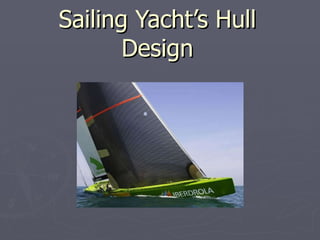

Sailing Yacht’s Hull Design
Index: Forces and moments on a sailing yacht Resistance components: Viscous resistance: The Friction resistance The viscous pressure resistance Wave resistance. Additional resistance.
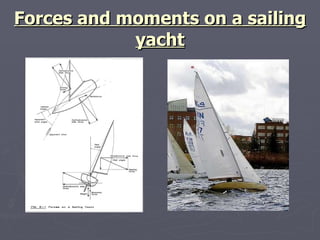
Forces and moments on a sailing yacht
Resistance components: There are three major components: Viscous resistance Wave resistance Additional resistance
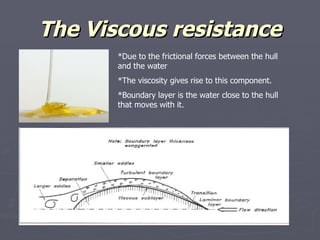
The Viscous resistance *Due to the frictional forces between the hull and the water *The viscosity gives rise to this component. *Boundary layer is the water close to the hull that moves with it.
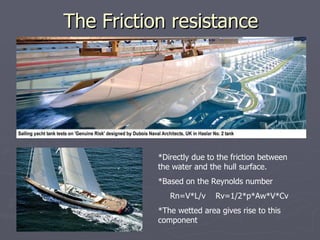
The Friction resistance *Directly due to the friction between the water and the hull surface. *Based on the Reynolds number Rn=V*L/v  Rv=1/2*p*Aw*V*Cv *The wetted area gives rise to this component
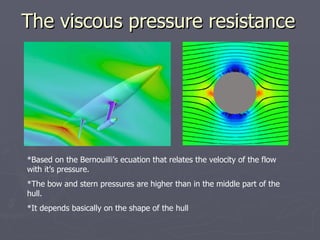
The viscous pressure resistance *Based on the Bernouilli’s ecuation that relates the velocity of the flow with it’s pressure. *The bow and stern pressures are higher than in the middle part of the hull. *It depends basically on the shape of the hull
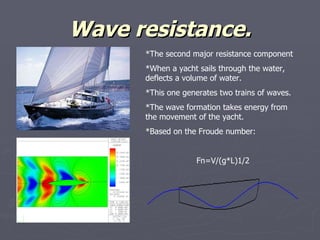
Wave resistance. *The second major resistance component *When a yacht sails through the water, deflects a volume of water. *This one generates two trains of waves. *The wave formation takes energy from the movement of the yacht. *Based on the Froude number: Fn=V/(g*L)1/2
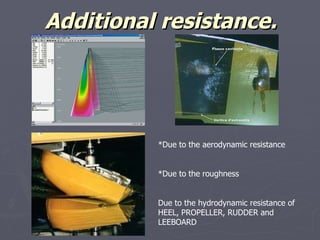
Additional resistance. *Due to the aerodynamic resistance *Due to the roughness Due to the hydrodynamic resistance of HEEL, PROPELLER, RUDDER and LEEBOARD
 
THE END

Sailing Yacht’S Hull Design

  • 1.
  • 2.
    Index: Forces andmoments on a sailing yacht Resistance components: Viscous resistance: The Friction resistance The viscous pressure resistance Wave resistance. Additional resistance.
  • 3.
    Forces and momentson a sailing yacht
  • 4.
    Resistance components: Thereare three major components: Viscous resistance Wave resistance Additional resistance
  • 5.
    The Viscous resistance*Due to the frictional forces between the hull and the water *The viscosity gives rise to this component. *Boundary layer is the water close to the hull that moves with it.
  • 6.
    The Friction resistance*Directly due to the friction between the water and the hull surface. *Based on the Reynolds number Rn=V*L/v Rv=1/2*p*Aw*V*Cv *The wetted area gives rise to this component
  • 7.
    The viscous pressureresistance *Based on the Bernouilli’s ecuation that relates the velocity of the flow with it’s pressure. *The bow and stern pressures are higher than in the middle part of the hull. *It depends basically on the shape of the hull
  • 8.
    Wave resistance. *Thesecond major resistance component *When a yacht sails through the water, deflects a volume of water. *This one generates two trains of waves. *The wave formation takes energy from the movement of the yacht. *Based on the Froude number: Fn=V/(g*L)1/2
  • 9.
    Additional resistance. *Dueto the aerodynamic resistance *Due to the roughness Due to the hydrodynamic resistance of HEEL, PROPELLER, RUDDER and LEEBOARD
  • 10.
  • 11.