SAFETY CULTURE
1
Presented by :
RIDWAN Z SYAAF
scope of discussion
• understanding the Safety Culture Concept as a
part of Organizational Culture
• understanding the indicators of safety culture and
its measurement to describe its maturity level
• understanding the influence of safety culture in
safety practice in the organization related to risk
control and incident/accident occurence
what
how
2
f
-
f
-
Origin of the term ‘safety culture’
The term ‘Safety Culture’
f
irst made its appearance in the International
Atomic Energy Agency’s initial report following the Chernobyl disaster (1986)
Organizational Culture Theory :
Edgar Schein
3
the term ‘safety culture’
➡ Academics
➡ Consultants
➡ Professional Organization
➡ Mining
➡ Industries
➡ Manufactures
➡ Transportation : • Road
• Rail Roads
• Marine
• Aviation
1986 2020
4
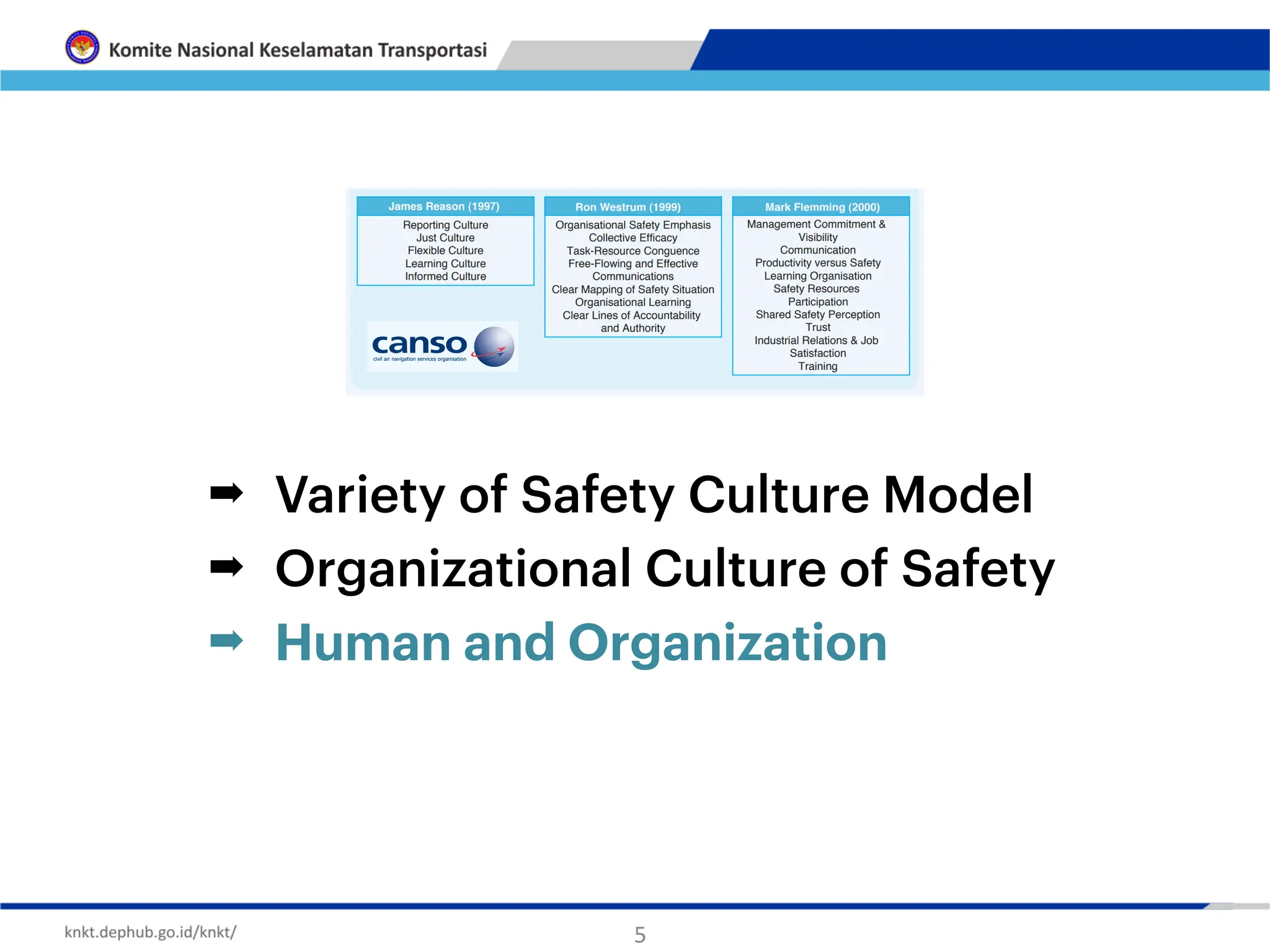
➡ Variety of Safety Culture Model
➡ Organizational Culture of Safety
➡ Human and Organization
5
What are the indicators of
an organization’s safety culture ?
6
Dominic Cooper’s model safety culture model in Aviation
7
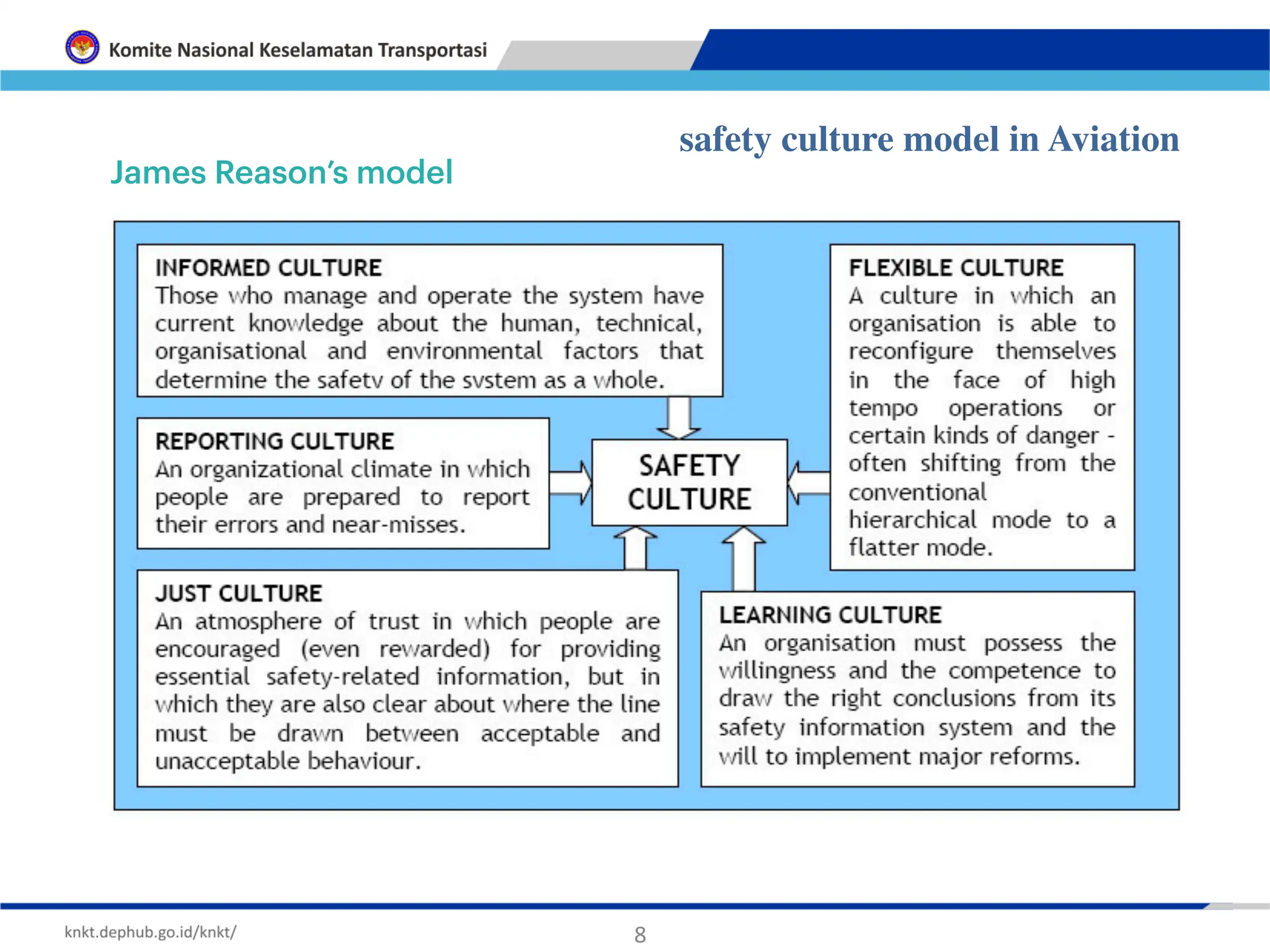
James Reason’s model
safety culture model in Aviation
8
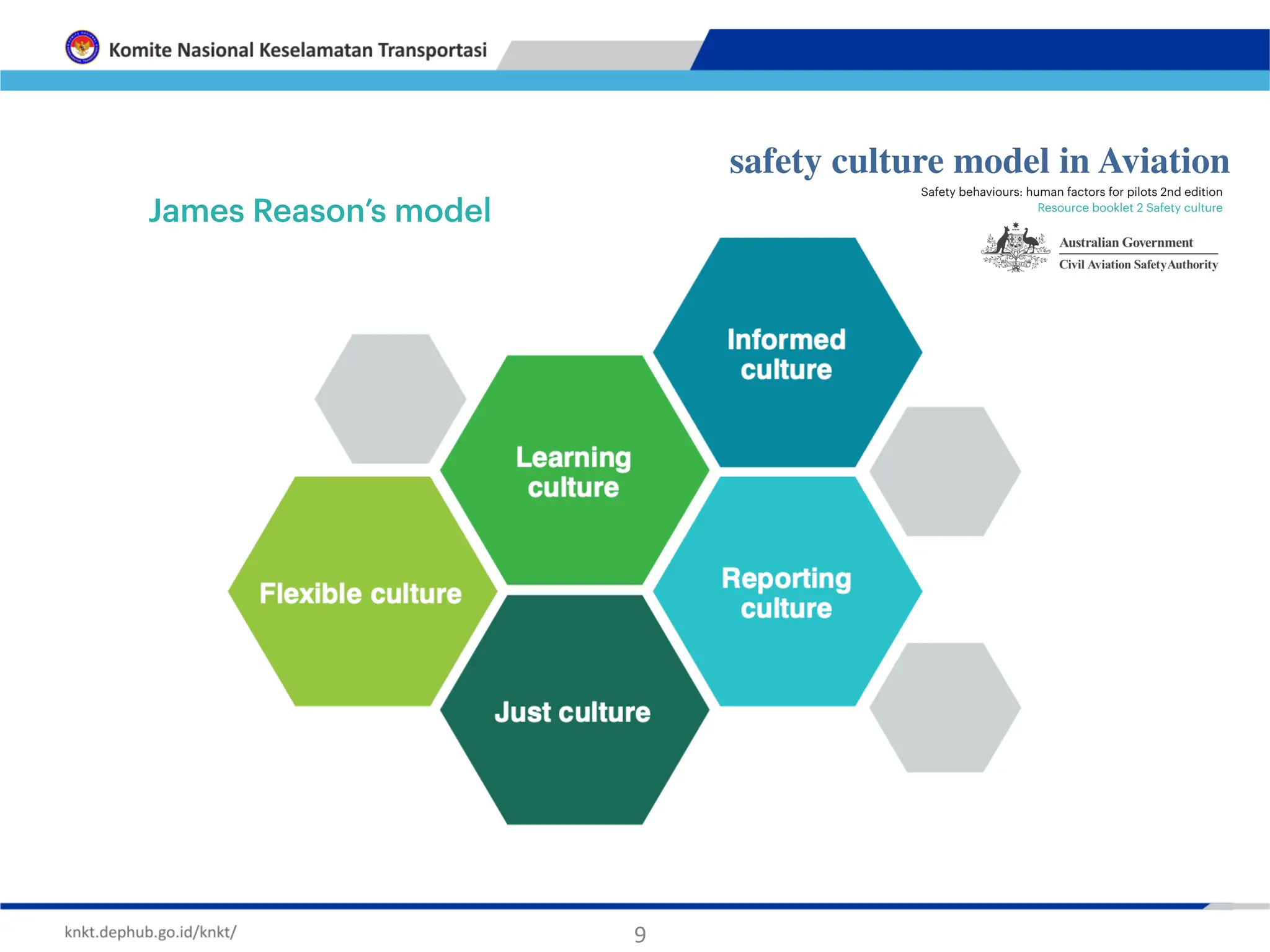
Safety behaviours: human factors for pilots 2nd edition
Resource booklet 2 Safety culture
safety culture model in Aviation
9
James Reason’s model
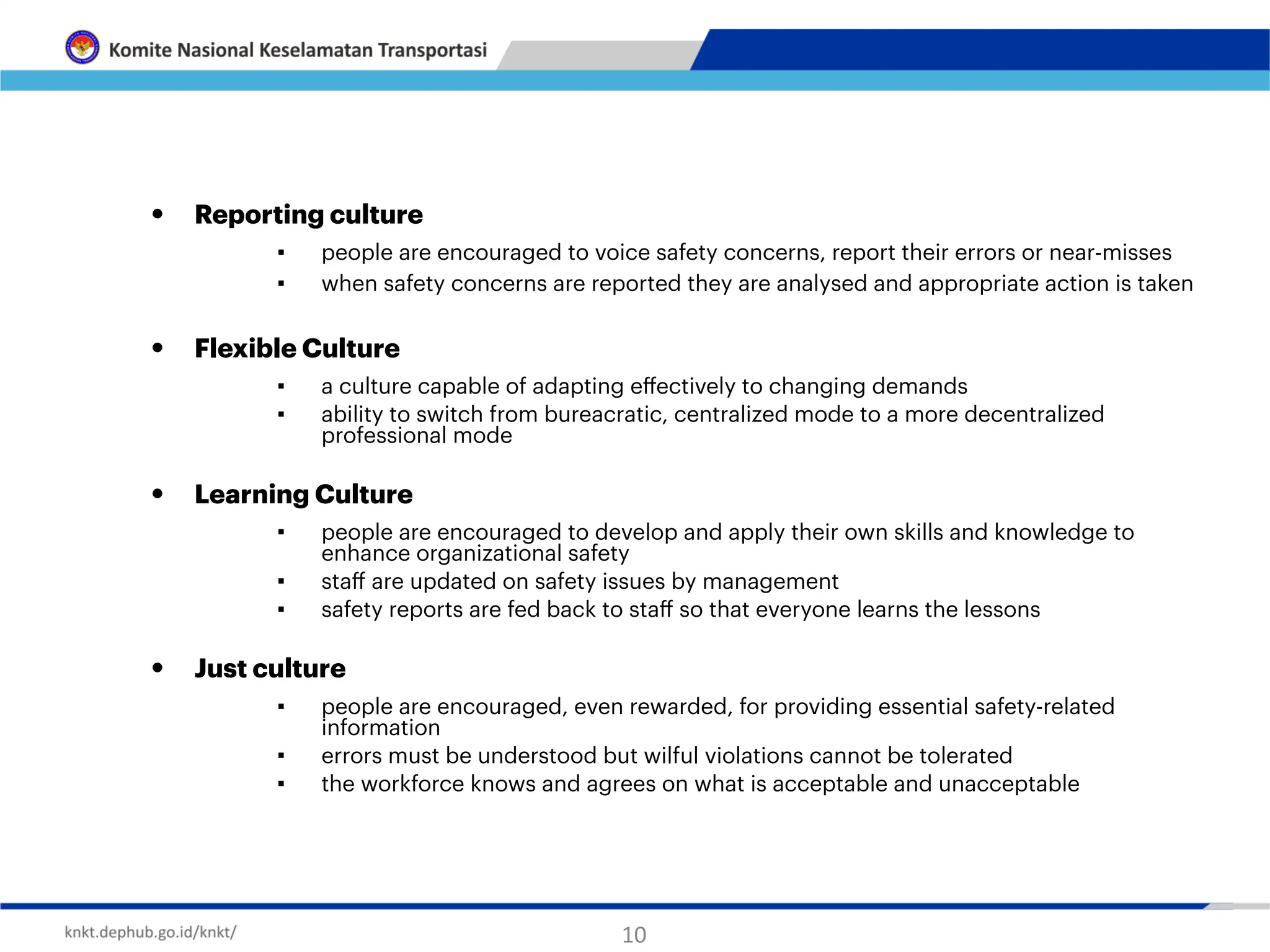
• Reporting culture
▪ people are encouraged to voice safety concerns, report their errors or near-misses
▪ when safety concerns are reported they are analysed and appropriate action is taken
• Flexible Culture
▪ a culture capable of adapting e
ff
ectively to changing demands
▪ ability to switch from bureacratic, centralized mode to a more decentralized
professional mode
• Learning Culture
▪ people are encouraged to develop and apply their own skills and knowledge to
enhance organizational safety
▪ sta
ff
are updated on safety issues by management
▪ safety reports are fed back to sta
ff
so that everyone learns the lessons
• Just culture
▪ people are encouraged, even rewarded, for providing essential safety-related
information
▪ errors must be understood but wilful violations cannot be tolerated
▪ the workforce knows and agrees on what is acceptable and unacceptable
10
Figure 1. Organizational indicators of safety culture. Adapted from Gibbons, von Thaden, and Wiegmann (2006).
safety culture model in Aviation
11
f
-
f
-
Therry von Thaden (2011).
SAFETY CULTURE
ORGANIZATIONAL
COMMITMENT
SAFETY
VALUES
SAFETY
FUNDAMENTALS
GOING BEYOND
COMPLIANCE
FORMAL SAFETY
SYTEM
REPORTING
SYSTEM
RESPONSE AND
FEEDBACK
SAFETY
PERSONNEL
OPERATIONS
INTERACTION
SUPERVISOR
OPERATION
CONTROL
TRAINING
INFORMAL SAFETY
SYTEM
ACCOUNTABILITY AUTHORITY PROFESSIONALISM
SAFETY BEHAVIOR
PERSONAL
RISK
ORGANIZATIONAL
RISK
safety culture model in Aviation
12
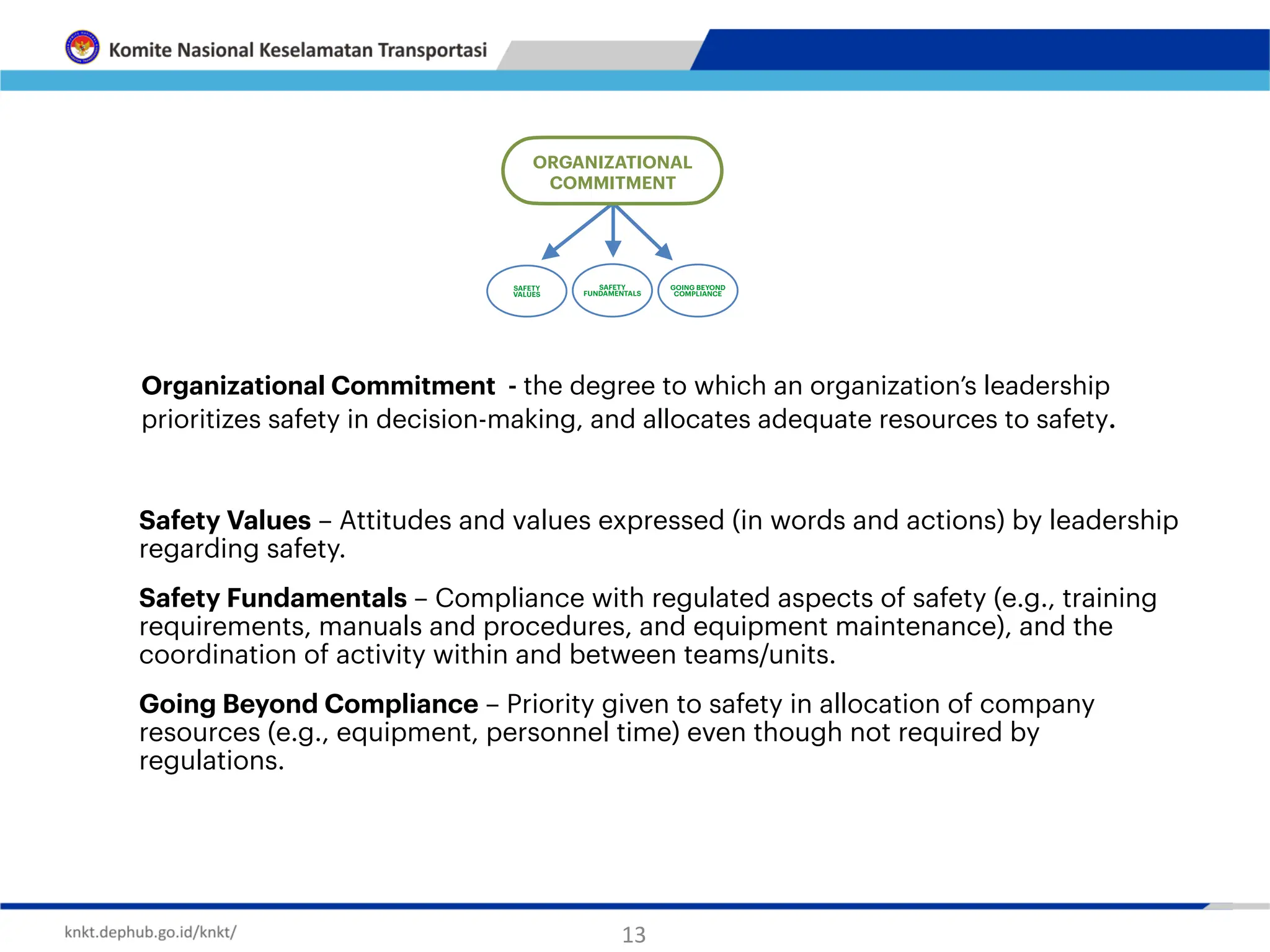
Safety Values – Attitudes and values expressed (in words and actions) by leadership
regarding safety.
Safety Fundamentals – Compliance with regulated aspects of safety (e.g., training
requirements, manuals and procedures, and equipment maintenance), and the
coordination of activity within and between teams/units.
Going Beyond Compliance – Priority given to safety in allocation of company
resources (e.g., equipment, personnel time) even though not required by
regulations.
ORGANIZATIONAL
COMMITMENT
SAFETY
VALUES
SAFETY
FUNDAMENTALS
GOING BEYOND
COMPLIANCE
Organizational Commitment - the degree to which an organization’s leadership
prioritizes safety in decision-making, and allocates adequate resources to safety.
13
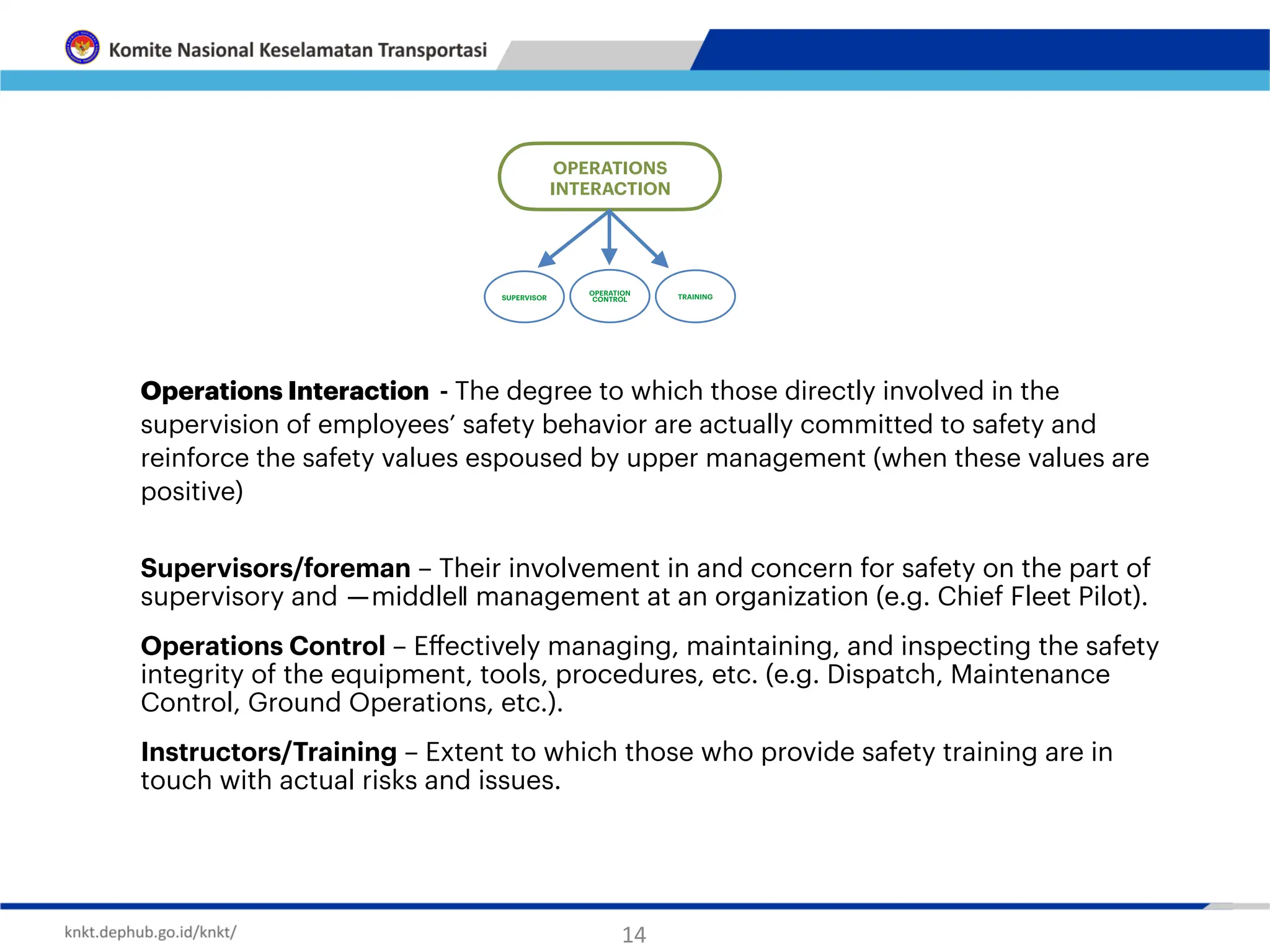
OPERATIONS
INTERACTION
SUPERVISOR
OPERATION
CONTROL TRAINING
Supervisors/foreman – Their involvement in and concern for safety on the part of
supervisory and ―middle‖ management at an organization (e.g. Chief Fleet Pilot).
Operations Control – E
ff
ectively managing, maintaining, and inspecting the safety
integrity of the equipment, tools, procedures, etc. (e.g. Dispatch, Maintenance
Control, Ground Operations, etc.).
Instructors/Training – Extent to which those who provide safety training are in
touch with actual risks and issues.
Operations Interaction - The degree to which those directly involved in the
supervision of employees’ safety behavior are actually committed to safety and
reinforce the safety values espoused by upper management (when these values are
positive)
14
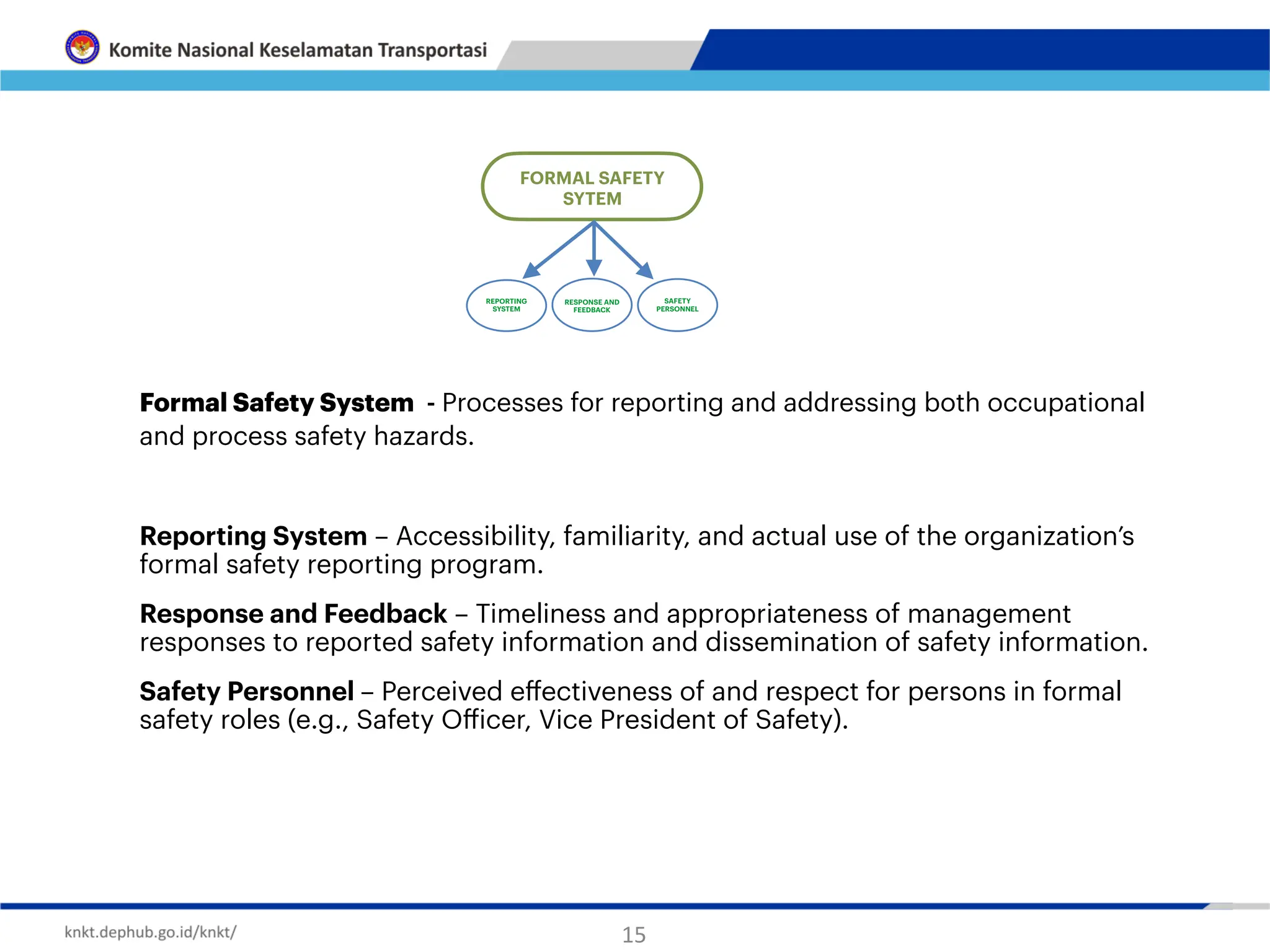
FORMAL SAFETY
SYTEM
REPORTING
SYSTEM
RESPONSE AND
FEEDBACK
SAFETY
PERSONNEL
Reporting System – Accessibility, familiarity, and actual use of the organization’s
formal safety reporting program.
Response and Feedback – Timeliness and appropriateness of management
responses to reported safety information and dissemination of safety information.
Safety Personnel – Perceived e
ff
ectiveness of and respect for persons in formal
safety roles (e.g., Safety O
ff
icer, Vice President of Safety).
Formal Safety System - Processes for reporting and addressing both occupational
and process safety hazards.
15
INFORMAL SAFETY
SYTEM
ACCOUNTABILITY AUTHORITY PROFESSIONALISM
Accountability – The consistency and appropriateness with which employees are
held accountable for unsafe behavior.
Employee Authority – Authorization and employee involvement in safety decision
making.
Employee Professionalism – Peer culture employee group norms pertaining to safe
and unsafe behavior.
Informal Safety System - Includes unwritten rules pertaining to safety, such as
rewards and punishments for safe and unsafe actions. Also includes how rewards and
punishments are instituted in a just and fair manner.
16
SAFETY BEHAVIOR
PERSONAL
RISK
ORGANIZATIONAL
RISK
Personal Risk – The personal level of acceptable risk on behalf of each employee.
Re
f
lected in the employees’ actual safety practice and the their perception of how
others in the organization practice safety.
Perceived Organizational Risk – The perception of the likelihood that the
organization will be involved in an accident or incident.
Safety Behavior - Re
f
lects personal and organizational perception of safety;
attitudes and beliefs
17
18
RISK PERCEPTION
AT-RISK BEHAVIOR
PSYCHOMETRIC APPROACH - CULTURAL APPROACH
ERROR
VIOLATION
f
-
f
-
19
SAFETY CULTURE
ORGANIZATIONAL
COMMITMENT
SAFETY
VALUES
SAFETY
FUNDAMENTAL
S
GOING BEYOND
COMPLIANCE
FORMAL SAFETY
SYTEM
REPORTING
SYSTEM
RESPONSE
AND FEEDBACK
SAFETY
PERSONNEL
OPERATIONS
INTERACTION
SUPERVISOR OPERATION
CONTROL
TRAINING
INFORMAL
SAFETY SYTEM
ACCOUNTABILITY AUTHORITY PROFESSIONALISM
SAFETY
BEHAVIOR
PERSONAL
RISK
ORGANIZATIONAL
RISK
Methods : Questionaire - Interview - Focus Group Discussion - Observation - Documents
Assessment of Safety Culture Safety Culture Maturity Scale
safety climate
20
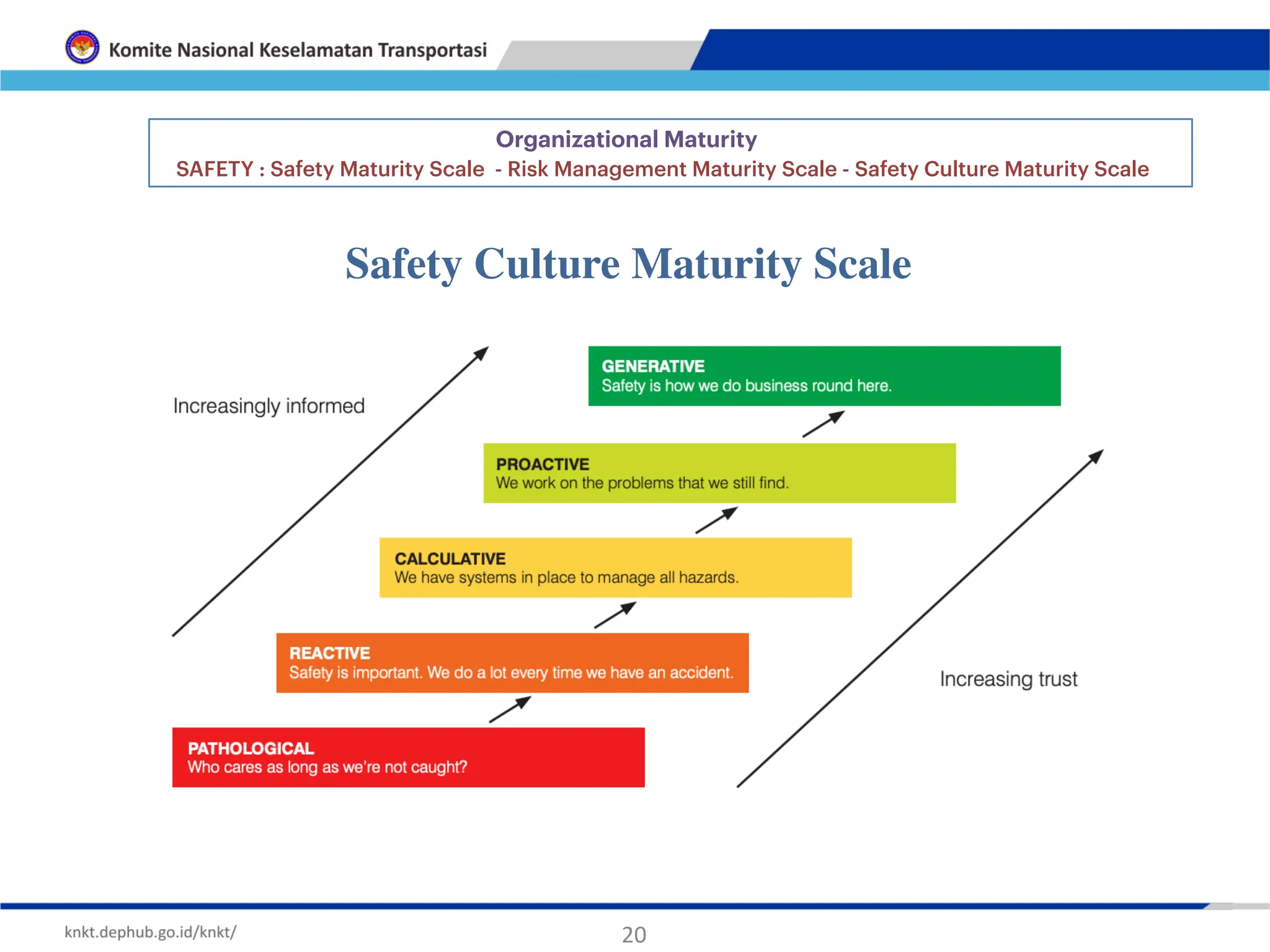
Safety Culture Maturity Scale
SAFETY : Safety Maturity Scale - Risk Management Maturity Scale - Safety Culture Maturity Scale
Organizational Maturity
21
Maturity Pro
fi
le
Maturity Level
Why do accidents happen?
22
Gibbons, von Thaden, and Wiegmann (2006).
the
f
irst stage of scienti
f
ic theorizing about the causes of accidents is commonly referred
to as the technical period, during which developments in new mechanical systems were
rapid and most accidents were viewed as being caused by mechanical malfunctions,
particularly in the structural integrity and reliability of equipment (Wiegmann and
Shappell 2001)
The second stage is known as the period of human error, where limitations of the human
operator rather than catastrophic mechanical malfunctions were identi
f
ied as the source of
system breakdowns, shifting the attention of safety analyses from mechanical aspects to the
person directly involved in committing the error (Rochlin and Von Meier 1994; Coquelle, Cura,
and Fourest 1995).
The third stage is referred to as the sociotechnical period, during which the negative
impact that poor ergonomics and systems design have on the interaction between humans
and technical factors was often cited as a cause of errors and accidents.
Finally, recent years have witnessed the development of a fourth stage, which is often called
the “safety culture” period (Gordon et al. 1996; Wilpert 2000)
23
scienti
fi
c studies proved that safety culture:
associated with employees’ safety-related behavior in
industries
predict on-thejob injury and accident rates in
manufacturing
f
irms, o
ff
shore oil and gas companies
and also in broad cross organizational studies of workers
in general
may not be the only determinant of safety in
organizations, it plays a substantial role in encouraging
people to behave safely.
the concept of safety culture may also prove applicable
to tra
ff
ic safety.
Gibbons, von Thaden, and Wiegmann (2006).
➡ Proactively reviewing safety culture as part of the
investigation process, it may be possible to determine
some of the systemic underlying drivers for individual
safety behaviours
➡ This process can assist the investigator in the
development of systemic recommendations, aimed at
improving overall organisational safety performance..
NOTE FOR THE INVESTIGATOR
24
SUMMARY
25
Human and Organization
Safety : Human and Organization Factors in Socio-Technical System
PRODUCTION
GOALS
SAFETY ISSUES SAFETY INDICATORS
RISK CONTROLS
(RECOVERY)
RISK CONTROLS
(RECOVERY)
ACCIDENTS
INCIDENTS
SAFETY INDICATORS
SAFETY ISSUES
ORGANIZATION
RISK
CONTROLS
(PREVENTIVE)
LOCAL
CONDITIONS
INDIVIDUAL
ACTIONS
TECHNICAL
FAILURE
MECHANISM
SAFETY CULTURE
SAFETY CULTURE
KOMITE NASIONAL KESELAMATAN TRANSPORTASI

Safety_Culture__Implementation and Defin

  • 1.
  • 2.
    scope of discussion •understanding the Safety Culture Concept as a part of Organizational Culture • understanding the indicators of safety culture and its measurement to describe its maturity level • understanding the influence of safety culture in safety practice in the organization related to risk control and incident/accident occurence what how 2
  • 3.
    f - f - Origin of theterm ‘safety culture’ The term ‘Safety Culture’ f irst made its appearance in the International Atomic Energy Agency’s initial report following the Chernobyl disaster (1986) Organizational Culture Theory : Edgar Schein 3
  • 4.
    the term ‘safetyculture’ ➡ Academics ➡ Consultants ➡ Professional Organization ➡ Mining ➡ Industries ➡ Manufactures ➡ Transportation : • Road • Rail Roads • Marine • Aviation 1986 2020 4
  • 5.
    ➡ Variety ofSafety Culture Model ➡ Organizational Culture of Safety ➡ Human and Organization 5
  • 6.
    What are theindicators of an organization’s safety culture ? 6
  • 7.
    Dominic Cooper’s modelsafety culture model in Aviation 7
  • 8.
    James Reason’s model safetyculture model in Aviation 8
  • 9.
    Safety behaviours: humanfactors for pilots 2nd edition Resource booklet 2 Safety culture safety culture model in Aviation 9 James Reason’s model
  • 10.
    • Reporting culture ▪people are encouraged to voice safety concerns, report their errors or near-misses ▪ when safety concerns are reported they are analysed and appropriate action is taken • Flexible Culture ▪ a culture capable of adapting e ff ectively to changing demands ▪ ability to switch from bureacratic, centralized mode to a more decentralized professional mode • Learning Culture ▪ people are encouraged to develop and apply their own skills and knowledge to enhance organizational safety ▪ sta ff are updated on safety issues by management ▪ safety reports are fed back to sta ff so that everyone learns the lessons • Just culture ▪ people are encouraged, even rewarded, for providing essential safety-related information ▪ errors must be understood but wilful violations cannot be tolerated ▪ the workforce knows and agrees on what is acceptable and unacceptable 10
  • 11.
    Figure 1. Organizationalindicators of safety culture. Adapted from Gibbons, von Thaden, and Wiegmann (2006). safety culture model in Aviation 11
  • 12.
    f - f - Therry von Thaden(2011). SAFETY CULTURE ORGANIZATIONAL COMMITMENT SAFETY VALUES SAFETY FUNDAMENTALS GOING BEYOND COMPLIANCE FORMAL SAFETY SYTEM REPORTING SYSTEM RESPONSE AND FEEDBACK SAFETY PERSONNEL OPERATIONS INTERACTION SUPERVISOR OPERATION CONTROL TRAINING INFORMAL SAFETY SYTEM ACCOUNTABILITY AUTHORITY PROFESSIONALISM SAFETY BEHAVIOR PERSONAL RISK ORGANIZATIONAL RISK safety culture model in Aviation 12
  • 13.
    Safety Values –Attitudes and values expressed (in words and actions) by leadership regarding safety. Safety Fundamentals – Compliance with regulated aspects of safety (e.g., training requirements, manuals and procedures, and equipment maintenance), and the coordination of activity within and between teams/units. Going Beyond Compliance – Priority given to safety in allocation of company resources (e.g., equipment, personnel time) even though not required by regulations. ORGANIZATIONAL COMMITMENT SAFETY VALUES SAFETY FUNDAMENTALS GOING BEYOND COMPLIANCE Organizational Commitment - the degree to which an organization’s leadership prioritizes safety in decision-making, and allocates adequate resources to safety. 13
  • 14.
    OPERATIONS INTERACTION SUPERVISOR OPERATION CONTROL TRAINING Supervisors/foreman –Their involvement in and concern for safety on the part of supervisory and ―middle‖ management at an organization (e.g. Chief Fleet Pilot). Operations Control – E ff ectively managing, maintaining, and inspecting the safety integrity of the equipment, tools, procedures, etc. (e.g. Dispatch, Maintenance Control, Ground Operations, etc.). Instructors/Training – Extent to which those who provide safety training are in touch with actual risks and issues. Operations Interaction - The degree to which those directly involved in the supervision of employees’ safety behavior are actually committed to safety and reinforce the safety values espoused by upper management (when these values are positive) 14
  • 15.
    FORMAL SAFETY SYTEM REPORTING SYSTEM RESPONSE AND FEEDBACK SAFETY PERSONNEL ReportingSystem – Accessibility, familiarity, and actual use of the organization’s formal safety reporting program. Response and Feedback – Timeliness and appropriateness of management responses to reported safety information and dissemination of safety information. Safety Personnel – Perceived e ff ectiveness of and respect for persons in formal safety roles (e.g., Safety O ff icer, Vice President of Safety). Formal Safety System - Processes for reporting and addressing both occupational and process safety hazards. 15
  • 16.
    INFORMAL SAFETY SYTEM ACCOUNTABILITY AUTHORITYPROFESSIONALISM Accountability – The consistency and appropriateness with which employees are held accountable for unsafe behavior. Employee Authority – Authorization and employee involvement in safety decision making. Employee Professionalism – Peer culture employee group norms pertaining to safe and unsafe behavior. Informal Safety System - Includes unwritten rules pertaining to safety, such as rewards and punishments for safe and unsafe actions. Also includes how rewards and punishments are instituted in a just and fair manner. 16
  • 17.
    SAFETY BEHAVIOR PERSONAL RISK ORGANIZATIONAL RISK Personal Risk– The personal level of acceptable risk on behalf of each employee. Re f lected in the employees’ actual safety practice and the their perception of how others in the organization practice safety. Perceived Organizational Risk – The perception of the likelihood that the organization will be involved in an accident or incident. Safety Behavior - Re f lects personal and organizational perception of safety; attitudes and beliefs 17
  • 18.
    18 RISK PERCEPTION AT-RISK BEHAVIOR PSYCHOMETRICAPPROACH - CULTURAL APPROACH ERROR VIOLATION
  • 19.
    f - f - 19 SAFETY CULTURE ORGANIZATIONAL COMMITMENT SAFETY VALUES SAFETY FUNDAMENTAL S GOING BEYOND COMPLIANCE FORMALSAFETY SYTEM REPORTING SYSTEM RESPONSE AND FEEDBACK SAFETY PERSONNEL OPERATIONS INTERACTION SUPERVISOR OPERATION CONTROL TRAINING INFORMAL SAFETY SYTEM ACCOUNTABILITY AUTHORITY PROFESSIONALISM SAFETY BEHAVIOR PERSONAL RISK ORGANIZATIONAL RISK Methods : Questionaire - Interview - Focus Group Discussion - Observation - Documents Assessment of Safety Culture Safety Culture Maturity Scale safety climate
  • 20.
    20 Safety Culture MaturityScale SAFETY : Safety Maturity Scale - Risk Management Maturity Scale - Safety Culture Maturity Scale Organizational Maturity
  • 21.
  • 22.
    Why do accidentshappen? 22 Gibbons, von Thaden, and Wiegmann (2006). the f irst stage of scienti f ic theorizing about the causes of accidents is commonly referred to as the technical period, during which developments in new mechanical systems were rapid and most accidents were viewed as being caused by mechanical malfunctions, particularly in the structural integrity and reliability of equipment (Wiegmann and Shappell 2001) The second stage is known as the period of human error, where limitations of the human operator rather than catastrophic mechanical malfunctions were identi f ied as the source of system breakdowns, shifting the attention of safety analyses from mechanical aspects to the person directly involved in committing the error (Rochlin and Von Meier 1994; Coquelle, Cura, and Fourest 1995). The third stage is referred to as the sociotechnical period, during which the negative impact that poor ergonomics and systems design have on the interaction between humans and technical factors was often cited as a cause of errors and accidents. Finally, recent years have witnessed the development of a fourth stage, which is often called the “safety culture” period (Gordon et al. 1996; Wilpert 2000)
  • 23.
    23 scienti fi c studies provedthat safety culture: associated with employees’ safety-related behavior in industries predict on-thejob injury and accident rates in manufacturing f irms, o ff shore oil and gas companies and also in broad cross organizational studies of workers in general may not be the only determinant of safety in organizations, it plays a substantial role in encouraging people to behave safely. the concept of safety culture may also prove applicable to tra ff ic safety. Gibbons, von Thaden, and Wiegmann (2006).
  • 24.
    ➡ Proactively reviewingsafety culture as part of the investigation process, it may be possible to determine some of the systemic underlying drivers for individual safety behaviours ➡ This process can assist the investigator in the development of systemic recommendations, aimed at improving overall organisational safety performance.. NOTE FOR THE INVESTIGATOR 24
  • 25.
    SUMMARY 25 Human and Organization Safety: Human and Organization Factors in Socio-Technical System PRODUCTION GOALS SAFETY ISSUES SAFETY INDICATORS RISK CONTROLS (RECOVERY) RISK CONTROLS (RECOVERY) ACCIDENTS INCIDENTS SAFETY INDICATORS SAFETY ISSUES ORGANIZATION RISK CONTROLS (PREVENTIVE) LOCAL CONDITIONS INDIVIDUAL ACTIONS TECHNICAL FAILURE MECHANISM SAFETY CULTURE SAFETY CULTURE
  • 26.