1
Safety Culture
Policy Statement
Template
The following presentation slides and talking points are intended for
Agreement States to use in communicating about safety culture to their
licensees and can be tailored based on the State’s specific needs.
Slides 19-27 contain additional supporting information and can be
included as appropriate, depending on the length of time available for
the presentation and interest of the audience.
2
• What is Safety Culture?
• Why is Safety Culture Important?
• Safety Culture Policy Statement
– Background/development
– Policy Statement elements
– Case studies (optional)
Presentation Overview
3
• Safety culture is the extent to which safety is
emphasized, both formally and informally, by an
organization and its members
• Safety culture is not separate or distinct from
organizational culture
• Rather, “safety” is a goal that may sometimes
compete with an organization’s primary mission
What is Safety Culture?
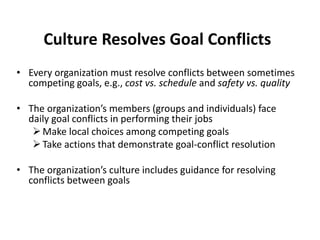
Culture Resolves Goal Conflicts
• Every organization must resolve conflicts between sometimes
competing goals, e.g., cost vs. schedule and safety vs. quality
• The organization’s members (groups and individuals) face
daily goal conflicts in performing their jobs
Make local choices among competing goals
Take actions that demonstrate goal-conflict resolution
• The organization’s culture includes guidance for resolving
conflicts between goals
4
5
• Goal of occupational safety: provide a workplace
free from recognized hazards to safety and health,
such as exposure to toxic chemicals or excessive
noise
• Goal for an organization to develop a positive safety
culture: encourage the development of values and
behaviors that support the safe and secure use of
nuclear materials
Occupational Safety vs.
Safety Culture
6
• Safety culture affects safety performance
Injury rates
Accident rates
Patient safety
• Results supported across industries
Aerospace, healthcare, manufacturing,
construction, agriculture, off-shore oil and gas,
highway safety, aviation
Why Do We Care?
7
Chernobyl
Challenger
Columbia
Deepwater Horizon
Safety Culture Examples
Optional Slide: Overview of State’s
program/agency
•Provide information about State’s program
Optional Slide: State’s Position on
Safety Culture Policy Statement
• Provide State’s Position on Safety Culture
Policy Statement
10
• Operating experience has demonstrated nexus
between safety culture and events
• Safety culture contributes to the safe and secure
use of radioactive materials
• [State name] recognizes that licensees bear the
primary responsibility for the safe and secure use
of nuclear materials, while the [State name], as
the regulator, must consider the importance of
safety culture in its oversight programs
Why is Safety Culture Important to
[State name]?
11
• Effective June 14, 2011
• Includes safety culture definition and nine traits
• Applies to all regulated entities
• Does not address implementation directly
• U.S. Nuclear Regulatory Commission (NRC) and
Agreement States are continuing to engage in
activities to increase awareness and understanding
of the benefits of a positive safety culture
Safety Culture
Policy Statement
12
Sets forth the Commission’s expectation that
individuals and organizations performing
regulated activities establish and maintain a
positive safety culture commensurate with the
safety and security significance of their actions
and the nature and complexity of their
organizations and functions
Statement of Policy
13
Nuclear Safety Culture is the core values and
behaviors resulting from a collective commitment
by leaders and individuals to emphasize safety
over competing goals to ensure protection of
people and the environment.
Safety Culture Definition
Safety Culture Policy Statement
14
• Experience has shown that certain personal and
organizational traits are present in a positive safety
culture
• A trait is a pattern of thinking, feeling, and
behaving that emphasizes safety, particularly in
goal conflict situations, such as:
•Production vs. safety
•Schedule vs. safety
•Cost of the effort vs. safety
Safety Culture Traits
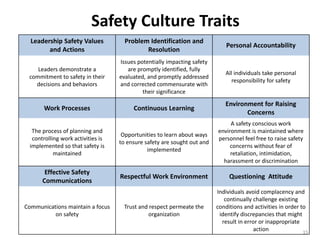
15
Safety Culture Traits
Leadership Safety Values
and Actions
Problem Identification and
Resolution
Personal Accountability
Leaders demonstrate a
commitment to safety in their
decisions and behaviors
Issues potentially impacting safety
are promptly identified, fully
evaluated, and promptly addressed
and corrected commensurate with
their significance
All individuals take personal
responsibility for safety
Work Processes Continuous Learning
Environment for Raising
Concerns
The process of planning and
controlling work activities is
implemented so that safety is
maintained
Opportunities to learn about ways
to ensure safety are sought out and
implemented
A safety conscious work
environment is maintained where
personnel feel free to raise safety
concerns without fear of
retaliation, intimidation,
harassment or discrimination
Effective Safety
Communications
Respectful Work Environment Questioning Attitude
Communications maintain a focus
on safety
Trust and respect permeate the
organization
Individuals avoid complacency and
continually challenge existing
conditions and activities in order to
identify discrepancies that might
result in error or inappropriate
action
What Does Safety Culture
Look Like for You?
• Optional: provide examples of how traits are demonstrated in
practice for the audience’s industry, such as:
– Policies supporting safety culture and/or raising safety concerns
– Procedures for identifying, evaluating, and correcting issues
– Use of error reducing techniques
– Metrics focused on safety and quality vs. cost and production
– Training and knowledge management processes
– Safety communications messages
Note: these examples are being provided for illustrative purposes
only. Specific practices will vary by industry and by organization.
This may be one of the most important slides in the presentation.
Encourage providing high quality examples to demonstrate how
safety culture translates into practice for the audience’s industry.
Final Thoughts
• Concept of safety culture spans across industries
and countries
• Safety culture has contributed to many well known
events (historical & current)
• Field is evolving
• NRC and Agreement States continuing education
and outreach efforts
17
17
18
• NRC safety culture website: http://www.nrc.gov/about-
nrc/regulatory/enforcement/safety-culture.html
• Educational Tools
 Brochures (English and Spanish)
 Case studies/user guide
 Posters
 Pop-ups
• State Contact Information
• NRC contacts:
Cindy Flannery cindy.flannery@nrc.gov or (301) 415-0223
June Cai june.cai@nrc.gov or (301) 415-5192
Division of Intergovernmental Liaison and Rulemaking
Office of Federal and State Materials and Environmental Management Programs
Resources
OPTIONAL SLIDES – ADDITIONAL
INFORMATION ABOUT
ORGANIZATIONAL CULTURE
Organizational Culture –
in Edgar Schein’s terms …
• “A pattern of shared basic assumptions that was learned by
a group as it solved its problems of external adaptation and
internal integration, that has worked well enough to be
considered valid and, therefore, to be taught to new
members as the correct way you perceive, think, and feel
in relation to those problems.”
• A combination of the intended (the formal organization)
and the unintended (the informal organization)
20
Subcultures
• Develop in larger organizations
• May arise from work-related factors, but also
geography or affinity groups
• May be more powerful than overall organizational
culture
• May be inconsistent with some aspects of overall
culture
21
OPTIONAL SLIDES – CASE STUDY
EXAMPLES
22
23
“Broken safety culture” at NASA
• Ineffective communication
• Inadequate concern over deviations from expected
performance
• Silent safety program
• Schedule pressure
NASA’s Space Shuttle Columbia
24
• Existing government reports suggest that Performance
Coal Company/Massey “promoted and enforced a
workplace culture that valued production over safety
including practices calculated to allow it to conduct
mining operations in violation of the law.”
• “While violations of particular safety standards led to
the conditions that caused the explosion, the unlawful
policies and practices implemented by employer were
the root cause of this tragedy.”
Case Study:
April 2010 Upper Big Branch
Mine Explosion
25
• Senior Management dictates the tone for the balance
between safety and corporate performance
• No single event led to this catastrophe -- it resulted
from a series of events that were precipitated by a
weak safety culture which included the absence of a
safety conscious work environment
“Lessons Learned” from
Upper Big Branch Mine Explosion
26
• Washington Metropolitan Area Transit Authority
(WMATA) failed to replace or retrofit 1000-series
railcars, which were shown in a 2004 accident to exhibit
poor crashworthiness
• WMATA failed to institutionalize and employ across the
system an enhanced track circuit verification test
procedure that was developed following a near collision
in 2005
• Lack of safety culture – contributing cause
Case Study:
June 2009 Washington DC
METRO collision
27
•Lose of both engines due to bird strike
•Captain landed plane on Hudson River – all 155 passengers and
crew evacuated safely
•Incident reinforces the importance of promoting a positive
safety culture
–Strong safety culture traits aided the crew in protecting the
safety of the passengers
–Contribution to successful outcome included leadership,
training, and planning and preparation
Case Study:
Jan 2009 US Airways –
Forced Landing on Hudson River

sc-presentation-template-agreement-states (1).pptx

  • 1.
    1 Safety Culture Policy Statement Template Thefollowing presentation slides and talking points are intended for Agreement States to use in communicating about safety culture to their licensees and can be tailored based on the State’s specific needs. Slides 19-27 contain additional supporting information and can be included as appropriate, depending on the length of time available for the presentation and interest of the audience.
  • 2.
    2 • What isSafety Culture? • Why is Safety Culture Important? • Safety Culture Policy Statement – Background/development – Policy Statement elements – Case studies (optional) Presentation Overview
  • 3.
    3 • Safety cultureis the extent to which safety is emphasized, both formally and informally, by an organization and its members • Safety culture is not separate or distinct from organizational culture • Rather, “safety” is a goal that may sometimes compete with an organization’s primary mission What is Safety Culture?
  • 4.
    Culture Resolves GoalConflicts • Every organization must resolve conflicts between sometimes competing goals, e.g., cost vs. schedule and safety vs. quality • The organization’s members (groups and individuals) face daily goal conflicts in performing their jobs Make local choices among competing goals Take actions that demonstrate goal-conflict resolution • The organization’s culture includes guidance for resolving conflicts between goals 4
  • 5.
    5 • Goal ofoccupational safety: provide a workplace free from recognized hazards to safety and health, such as exposure to toxic chemicals or excessive noise • Goal for an organization to develop a positive safety culture: encourage the development of values and behaviors that support the safe and secure use of nuclear materials Occupational Safety vs. Safety Culture
  • 6.
    6 • Safety cultureaffects safety performance Injury rates Accident rates Patient safety • Results supported across industries Aerospace, healthcare, manufacturing, construction, agriculture, off-shore oil and gas, highway safety, aviation Why Do We Care?
  • 7.
  • 8.
    Optional Slide: Overviewof State’s program/agency •Provide information about State’s program
  • 9.
    Optional Slide: State’sPosition on Safety Culture Policy Statement • Provide State’s Position on Safety Culture Policy Statement
  • 10.
    10 • Operating experiencehas demonstrated nexus between safety culture and events • Safety culture contributes to the safe and secure use of radioactive materials • [State name] recognizes that licensees bear the primary responsibility for the safe and secure use of nuclear materials, while the [State name], as the regulator, must consider the importance of safety culture in its oversight programs Why is Safety Culture Important to [State name]?
  • 11.
    11 • Effective June14, 2011 • Includes safety culture definition and nine traits • Applies to all regulated entities • Does not address implementation directly • U.S. Nuclear Regulatory Commission (NRC) and Agreement States are continuing to engage in activities to increase awareness and understanding of the benefits of a positive safety culture Safety Culture Policy Statement
  • 12.
    12 Sets forth theCommission’s expectation that individuals and organizations performing regulated activities establish and maintain a positive safety culture commensurate with the safety and security significance of their actions and the nature and complexity of their organizations and functions Statement of Policy
  • 13.
    13 Nuclear Safety Cultureis the core values and behaviors resulting from a collective commitment by leaders and individuals to emphasize safety over competing goals to ensure protection of people and the environment. Safety Culture Definition Safety Culture Policy Statement
  • 14.
    14 • Experience hasshown that certain personal and organizational traits are present in a positive safety culture • A trait is a pattern of thinking, feeling, and behaving that emphasizes safety, particularly in goal conflict situations, such as: •Production vs. safety •Schedule vs. safety •Cost of the effort vs. safety Safety Culture Traits
  • 15.
    15 Safety Culture Traits LeadershipSafety Values and Actions Problem Identification and Resolution Personal Accountability Leaders demonstrate a commitment to safety in their decisions and behaviors Issues potentially impacting safety are promptly identified, fully evaluated, and promptly addressed and corrected commensurate with their significance All individuals take personal responsibility for safety Work Processes Continuous Learning Environment for Raising Concerns The process of planning and controlling work activities is implemented so that safety is maintained Opportunities to learn about ways to ensure safety are sought out and implemented A safety conscious work environment is maintained where personnel feel free to raise safety concerns without fear of retaliation, intimidation, harassment or discrimination Effective Safety Communications Respectful Work Environment Questioning Attitude Communications maintain a focus on safety Trust and respect permeate the organization Individuals avoid complacency and continually challenge existing conditions and activities in order to identify discrepancies that might result in error or inappropriate action
  • 16.
    What Does SafetyCulture Look Like for You? • Optional: provide examples of how traits are demonstrated in practice for the audience’s industry, such as: – Policies supporting safety culture and/or raising safety concerns – Procedures for identifying, evaluating, and correcting issues – Use of error reducing techniques – Metrics focused on safety and quality vs. cost and production – Training and knowledge management processes – Safety communications messages Note: these examples are being provided for illustrative purposes only. Specific practices will vary by industry and by organization. This may be one of the most important slides in the presentation. Encourage providing high quality examples to demonstrate how safety culture translates into practice for the audience’s industry.
  • 17.
    Final Thoughts • Conceptof safety culture spans across industries and countries • Safety culture has contributed to many well known events (historical & current) • Field is evolving • NRC and Agreement States continuing education and outreach efforts 17 17
  • 18.
    18 • NRC safetyculture website: http://www.nrc.gov/about- nrc/regulatory/enforcement/safety-culture.html • Educational Tools  Brochures (English and Spanish)  Case studies/user guide  Posters  Pop-ups • State Contact Information • NRC contacts: Cindy Flannery cindy.flannery@nrc.gov or (301) 415-0223 June Cai june.cai@nrc.gov or (301) 415-5192 Division of Intergovernmental Liaison and Rulemaking Office of Federal and State Materials and Environmental Management Programs Resources
  • 19.
    OPTIONAL SLIDES –ADDITIONAL INFORMATION ABOUT ORGANIZATIONAL CULTURE
  • 20.
    Organizational Culture – inEdgar Schein’s terms … • “A pattern of shared basic assumptions that was learned by a group as it solved its problems of external adaptation and internal integration, that has worked well enough to be considered valid and, therefore, to be taught to new members as the correct way you perceive, think, and feel in relation to those problems.” • A combination of the intended (the formal organization) and the unintended (the informal organization) 20
  • 21.
    Subcultures • Develop inlarger organizations • May arise from work-related factors, but also geography or affinity groups • May be more powerful than overall organizational culture • May be inconsistent with some aspects of overall culture 21
  • 22.
    OPTIONAL SLIDES –CASE STUDY EXAMPLES 22
  • 23.
    23 “Broken safety culture”at NASA • Ineffective communication • Inadequate concern over deviations from expected performance • Silent safety program • Schedule pressure NASA’s Space Shuttle Columbia
  • 24.
    24 • Existing governmentreports suggest that Performance Coal Company/Massey “promoted and enforced a workplace culture that valued production over safety including practices calculated to allow it to conduct mining operations in violation of the law.” • “While violations of particular safety standards led to the conditions that caused the explosion, the unlawful policies and practices implemented by employer were the root cause of this tragedy.” Case Study: April 2010 Upper Big Branch Mine Explosion
  • 25.
    25 • Senior Managementdictates the tone for the balance between safety and corporate performance • No single event led to this catastrophe -- it resulted from a series of events that were precipitated by a weak safety culture which included the absence of a safety conscious work environment “Lessons Learned” from Upper Big Branch Mine Explosion
  • 26.
    26 • Washington MetropolitanArea Transit Authority (WMATA) failed to replace or retrofit 1000-series railcars, which were shown in a 2004 accident to exhibit poor crashworthiness • WMATA failed to institutionalize and employ across the system an enhanced track circuit verification test procedure that was developed following a near collision in 2005 • Lack of safety culture – contributing cause Case Study: June 2009 Washington DC METRO collision
  • 27.
    27 •Lose of bothengines due to bird strike •Captain landed plane on Hudson River – all 155 passengers and crew evacuated safely •Incident reinforces the importance of promoting a positive safety culture –Strong safety culture traits aided the crew in protecting the safety of the passengers –Contribution to successful outcome included leadership, training, and planning and preparation Case Study: Jan 2009 US Airways – Forced Landing on Hudson River