Winter Driving
and Skid
Recovery

1
Are You Ready for
Winter Driving?
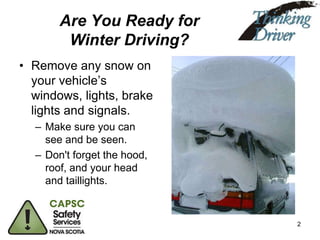
• Remove any snow on
your vehicle’s
windows, lights, brake
lights and signals.
– Make sure you can
see and be seen.
– Don't forget the hood,
roof, and your head
and taillights.

2
How Many Snow Tires?
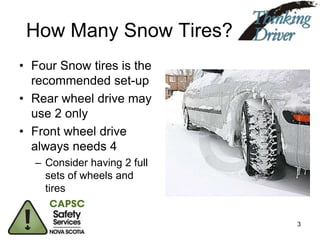
• Four Snow tires is the
recommended set-up
• Rear wheel drive may
use 2 only
• Front wheel drive
always needs 4
– Consider having 2 full
sets of wheels and
tires

3
ABS Antilock Braking
System
• Purpose is to permit steering under full
emergency braking
• Works by automatically pumping the brake
pedal many times a second
• If you feel it engage, hold the brake pedal
down and steer where you want to go
– Ease the brake off when the vehicle is back
under control
4
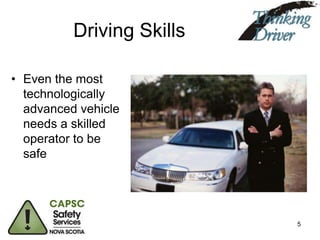
Driving Skills
• Even the most
technologically
advanced vehicle
needs a skilled
operator to be
safe

5
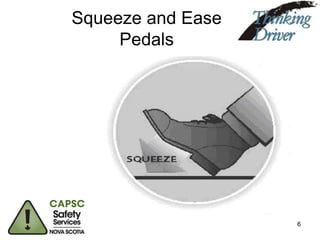
Squeeze and Ease
Pedals

6
Control with
Finesse

7
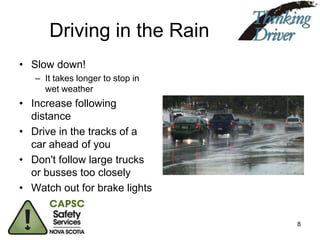
Driving in the Rain
• Slow down!
– It takes longer to stop in
wet weather

• Increase following
distance
• Drive in the tracks of a
car ahead of you
• Don't follow large trucks
or busses too closely
• Watch out for brake lights

8
Driving in the Rain
• Avoid Abrupt or
heavy braking
• Headlights on
• Check/replace
wipers
• Don’t over drive
vision
• Proceed slowly
through standing
water and be sure of
depth
9
Video: Skid Recovery
Skid Recovery
• Steer carefully and avoid overreacting to keep
control of the car.
• Cars with antilock brakes systems (ABS), the
brakes are automatically pumped for you in a
skid situation.
– You should feel the brake pedal pulsating.
• Car without ABS, apply easy pressure in a
pumping motion to the brakes. In the event of an
accident, remain calm, follow these safety tips,
and call for help.
11
Over-Steer Skids
• If your rear wheels
skid...
– Take your foot off the
accelerator.
– Steer in the direction
you want the front
wheels to go. If your
rear wheels are sliding
left, steer left. If they're
sliding right, steer
right.

12
Under-Steer Skids
• Take your foot off the gas
and steer into the skid to
get the wheels turning
and directing the vehicle
again.
• As the wheels skid
sideways, they will slow
the vehicle and traction
will return. As it does,
steer in the direction you
want to go.
13
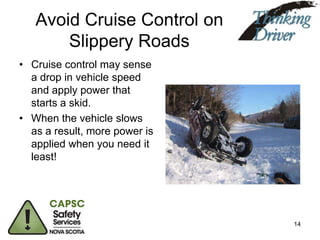
Avoid Cruise Control on
Slippery Roads
• Cruise control may sense
a drop in vehicle speed
and apply power that
starts a skid.
• When the vehicle slows
as a result, more power is
applied when you need it
least!

14
Are You Ready for
Winter Driving?

P A N I C
15
Plan Ahead
Think and Look Ahead
– Look ahead at where you want the car to go and not
at the obstacle or curb that you are trying to avoid
and, with luck, the car will follow your eyes.
– Anticipate turns, stops, and lane changes well before
they occur.
– If the snow falls in the city, leave your car at home.
– If you must venture out, plan your route, avoiding
hills, and overestimate the time it will take you to get
there and then you won't be tempted to put your foot
on the gas.
16
Negotiate In Control
Negotiate roadways ONLY when necessary!
Stay In Control
– SLOW DOWN!!
– Allow extra time to get where you need to be.
– Rely on your skills….Not technologies.
– Stay CALM, COOL and COLLECTED.
– Remember to SQUEEZE and EASE
– Control with Finesse

17
Thank You
Please complete the course
evaluations before leaving

19

Safe Winter Driving

  • 1.
  • 2.
    Are You Readyfor Winter Driving? • Remove any snow on your vehicle’s windows, lights, brake lights and signals. – Make sure you can see and be seen. – Don't forget the hood, roof, and your head and taillights. 2
  • 3.
    How Many SnowTires? • Four Snow tires is the recommended set-up • Rear wheel drive may use 2 only • Front wheel drive always needs 4 – Consider having 2 full sets of wheels and tires 3
  • 4.
    ABS Antilock Braking System •Purpose is to permit steering under full emergency braking • Works by automatically pumping the brake pedal many times a second • If you feel it engage, hold the brake pedal down and steer where you want to go – Ease the brake off when the vehicle is back under control 4
  • 5.
    Driving Skills • Eventhe most technologically advanced vehicle needs a skilled operator to be safe 5
  • 6.
  • 7.
  • 8.
    Driving in theRain • Slow down! – It takes longer to stop in wet weather • Increase following distance • Drive in the tracks of a car ahead of you • Don't follow large trucks or busses too closely • Watch out for brake lights 8
  • 9.
    Driving in theRain • Avoid Abrupt or heavy braking • Headlights on • Check/replace wipers • Don’t over drive vision • Proceed slowly through standing water and be sure of depth 9
  • 10.
  • 11.
    Skid Recovery • Steercarefully and avoid overreacting to keep control of the car. • Cars with antilock brakes systems (ABS), the brakes are automatically pumped for you in a skid situation. – You should feel the brake pedal pulsating. • Car without ABS, apply easy pressure in a pumping motion to the brakes. In the event of an accident, remain calm, follow these safety tips, and call for help. 11
  • 12.
    Over-Steer Skids • Ifyour rear wheels skid... – Take your foot off the accelerator. – Steer in the direction you want the front wheels to go. If your rear wheels are sliding left, steer left. If they're sliding right, steer right. 12
  • 13.
    Under-Steer Skids • Takeyour foot off the gas and steer into the skid to get the wheels turning and directing the vehicle again. • As the wheels skid sideways, they will slow the vehicle and traction will return. As it does, steer in the direction you want to go. 13
  • 14.
    Avoid Cruise Controlon Slippery Roads • Cruise control may sense a drop in vehicle speed and apply power that starts a skid. • When the vehicle slows as a result, more power is applied when you need it least! 14
  • 15.
    Are You Readyfor Winter Driving? P A N I C 15
  • 16.
    Plan Ahead Think andLook Ahead – Look ahead at where you want the car to go and not at the obstacle or curb that you are trying to avoid and, with luck, the car will follow your eyes. – Anticipate turns, stops, and lane changes well before they occur. – If the snow falls in the city, leave your car at home. – If you must venture out, plan your route, avoiding hills, and overestimate the time it will take you to get there and then you won't be tempted to put your foot on the gas. 16
  • 17.
    Negotiate In Control Negotiateroadways ONLY when necessary! Stay In Control – SLOW DOWN!! – Allow extra time to get where you need to be. – Rely on your skills….Not technologies. – Stay CALM, COOL and COLLECTED. – Remember to SQUEEZE and EASE – Control with Finesse 17
  • 19.
    Thank You Please completethe course evaluations before leaving 19