Inventor: John Ernest Burget
1
J. E. Burget: High-Level
Radioactive Waste
Storage System
 Since the onset of the nuclear age, there is one
major question that has not been adequately
resolved: what to do with the waste from the use
of nuclear material.
 After more than 60 years there is still no
consensus on the environmentally safest method
for long-term storage or disposal of high-level
radioactive waste.
 Advanced nuclear countries are currently focusing
primarily on large “geologic repositories”. Most
involve large excavations or tunnels extending
less than 2,000 ft underground that can
accommodate large storage containers and heavy
movable equipment like rail cars.
 Figure 1 shows the scope and cost of all such
current developments including the recently
suspended USA Yucca Mountain project in the
Nevada desert.
 Yucca is the costliest of all such projects on which
$10-$15billion was previously spent. Most of it is
inside a 1,200 ft. Mountain, but its floor is only a
few hundred feet above an existing water table.
2
3
Conceptual Design of Yucca Mountain Disposal Plan
1. Canisters of waste, sealed in special casks, are shipped to the site by truck or train.
2. Shipping casks are removed, and the inner tube with the waste is placed in a steel,
multilayered storage container.
3. An automated system sends storage containers underground to the tunnels.
4. Containers are stored along the tunnels, on their side.
FIGURE 1
According to a recent issue of Nuclear Energy Insider several
advanced nuclear countries (USA, Sweden, Germany, France,
Switzerland, UK, Spain and Canada) had invested a total of
$24 billion in the planning or early development of geologic
repositories. However all besides the suspended Yucca Mt.
project are many years from actual operation.
J. E. Burget: High-Level
Radioactive Waste
Storage System
4
Spent reactor fuel rods can be reprocessed to
reduce their waste volume over 90%, while
recovering fissionable and other materials for new
reactor fuel and other uses like nuclear medicine.
Reprocessing has been successfully conducted in
France and the UK, and a new project for that
purpose is under development in Japan.
Following reprocessing France and a few other
countries have developed vitrification
(glassification) of residual high-level waste with no
remaining useful purpose.
In the USA vitrification technology is now being
applied to large quantities of liquid high-level
waste from nuclear weapons production (from
which all useful material has been removed).
Figure 2 shows Hanford, WA, the most highly
contaminated former nuclear weapons production
site. It contains two-thirds of all USA high-level
radioactive waste, most of it in highly hazardous
liquid form in shallow, rusting underground tanks.
J. E. Burget: High-Level
Radioactive Waste
Storage System
5
HANFORD NUCLEAR WEAPONS SITE
The Hanford Site is a mostly decommissioned nuclear
weapons production complex on the Columbia River
in the state of Washington. It is operated by the US
Federal Government, and was originally established
in 1943 as part of the Manhattan Project.
The weapons production reactors were
decommissioned at the end of the Cold War, but the
decades of manufacturing left behind 53 million US
gallons of high-level radioactive waste. Most of it is
stored in shallow underground tanks, some of which
are rusted and leaking.[5]
J. E. Burget: High-Level
Radioactive Waste
Storage System
6
In the USA Vitrified weapons waste is currently
being formed into solid cylinders or canisters
which can be any length and diameter,
depending on the specifications for their
manufacture.
It is a $12 billion program expected to last more
than ten years, but there is presently no
approved deep storage area into which the
vitrified canisters can be placed.
DEEP DRILLING TECHNOLOGY
The oil and gas industry has developed
advanced technology for drilling to depths
exceeding 15,000 feet below land or the ocean
floor.
Called “borehole disposal” when applied to
nuclear waste, it has previously been examined
by nuclear and geological experts and was given
prominence in a 2003 MIT report.
.
J. E. Burget: High-Level
Radioactive Waste
Storage System
7
After suspending further development of Yucca
Mt., President Obama established a Blue Ribbon
Commission to provide recommendations for
future management of USA high-level nuclear
wastes. It recently stated:
“More generally, the BRC believes that more
extensive research and development is warranted
to help resolve current uncertainties about deep
borehole disposal and the practicality of
employing this approach, especially for high-
level weapons wastes that have no potentially re-
usable materials”.
BLUE RIBBON COMMISSION
J. E. Burget: High-Level
Radioactive Waste
Storage System
1.This is a proprietary system (that is covered by pending
patent applications) utilizing advanced nuclear waste
preparation methods such as vitrification, coupled with
the latest technology for oil/gas drilling at extreme
depths.
2.This technology’s best initial application would be the
large amounts of highly hazardous liquid Cold War
weapons waste from which any useful materials have
been removed, and vitrification is already underway.
3.This system can place such high-level radioactive waste
deeper within the earth’s crust than any other current
system or technology. The waste storage zone can be
completely sealed off, and will be in a geologically stable
area, under impermeable rock and at least two miles
below any possible contact with the earth's ecosystem
including underground water.
J. E. Burget: High-Level
Radioactive Waste
Storage System
4. It should be achievable at a lower cost than any
other presently available centralized long-term
storage method. This system’s basic design
provides for continuous, highly sensitive radiation
monitoring of the fluid surrounding the waste
canisters
5. Though extremely unlikely to be needed, this
system also permits safe removal and repair of any
defective waste canisters, and all the stored
canisters could be safely and completely retrieved
if future developments warrant.
6. Even an unattended radioactive waste storage
facility utilizing this system would provide
unlimited future cooling of its contents through
natural convection of fluid surrounding the waste
containers in the storage zone.
7. This zone could be permanently sealed off from all
possible contact with the Earth’s ecosystem
indefinitely, i.e. many thousands of years.
J. E. Burget: High-Level
Radioactive Waste
Storage System
1
0
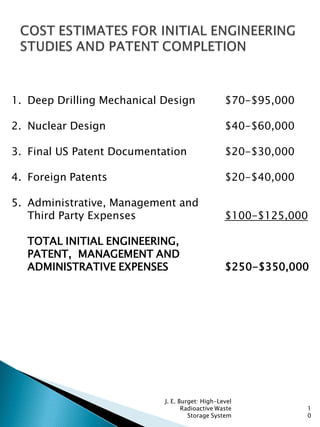
1. Deep Drilling Mechanical Design $70-$95,000
2. Nuclear Design $40-$60,000
3. Final US Patent Documentation $20-$30,000
4. Foreign Patents $20-$40,000
5. Administrative, Management and
Third Party Expenses $100-$125,000
TOTAL INITIAL ENGINEERING,
PATENT, MANAGEMENT AND
ADMINISTRATIVE EXPENSES $250-$350,000
J. E. Burget: High-Level
Radioactive Waste
Storage System

Safe nuclearsolutionsoverview r1

  • 1.
    Inventor: John ErnestBurget 1 J. E. Burget: High-Level Radioactive Waste Storage System
  • 2.
     Since theonset of the nuclear age, there is one major question that has not been adequately resolved: what to do with the waste from the use of nuclear material.  After more than 60 years there is still no consensus on the environmentally safest method for long-term storage or disposal of high-level radioactive waste.  Advanced nuclear countries are currently focusing primarily on large “geologic repositories”. Most involve large excavations or tunnels extending less than 2,000 ft underground that can accommodate large storage containers and heavy movable equipment like rail cars.  Figure 1 shows the scope and cost of all such current developments including the recently suspended USA Yucca Mountain project in the Nevada desert.  Yucca is the costliest of all such projects on which $10-$15billion was previously spent. Most of it is inside a 1,200 ft. Mountain, but its floor is only a few hundred feet above an existing water table. 2
  • 3.
    3 Conceptual Design ofYucca Mountain Disposal Plan 1. Canisters of waste, sealed in special casks, are shipped to the site by truck or train. 2. Shipping casks are removed, and the inner tube with the waste is placed in a steel, multilayered storage container. 3. An automated system sends storage containers underground to the tunnels. 4. Containers are stored along the tunnels, on their side. FIGURE 1 According to a recent issue of Nuclear Energy Insider several advanced nuclear countries (USA, Sweden, Germany, France, Switzerland, UK, Spain and Canada) had invested a total of $24 billion in the planning or early development of geologic repositories. However all besides the suspended Yucca Mt. project are many years from actual operation. J. E. Burget: High-Level Radioactive Waste Storage System
  • 4.
    4 Spent reactor fuelrods can be reprocessed to reduce their waste volume over 90%, while recovering fissionable and other materials for new reactor fuel and other uses like nuclear medicine. Reprocessing has been successfully conducted in France and the UK, and a new project for that purpose is under development in Japan. Following reprocessing France and a few other countries have developed vitrification (glassification) of residual high-level waste with no remaining useful purpose. In the USA vitrification technology is now being applied to large quantities of liquid high-level waste from nuclear weapons production (from which all useful material has been removed). Figure 2 shows Hanford, WA, the most highly contaminated former nuclear weapons production site. It contains two-thirds of all USA high-level radioactive waste, most of it in highly hazardous liquid form in shallow, rusting underground tanks. J. E. Burget: High-Level Radioactive Waste Storage System
  • 5.
    5 HANFORD NUCLEAR WEAPONSSITE The Hanford Site is a mostly decommissioned nuclear weapons production complex on the Columbia River in the state of Washington. It is operated by the US Federal Government, and was originally established in 1943 as part of the Manhattan Project. The weapons production reactors were decommissioned at the end of the Cold War, but the decades of manufacturing left behind 53 million US gallons of high-level radioactive waste. Most of it is stored in shallow underground tanks, some of which are rusted and leaking.[5] J. E. Burget: High-Level Radioactive Waste Storage System
  • 6.
    6 In the USAVitrified weapons waste is currently being formed into solid cylinders or canisters which can be any length and diameter, depending on the specifications for their manufacture. It is a $12 billion program expected to last more than ten years, but there is presently no approved deep storage area into which the vitrified canisters can be placed. DEEP DRILLING TECHNOLOGY The oil and gas industry has developed advanced technology for drilling to depths exceeding 15,000 feet below land or the ocean floor. Called “borehole disposal” when applied to nuclear waste, it has previously been examined by nuclear and geological experts and was given prominence in a 2003 MIT report. . J. E. Burget: High-Level Radioactive Waste Storage System
  • 7.
    7 After suspending furtherdevelopment of Yucca Mt., President Obama established a Blue Ribbon Commission to provide recommendations for future management of USA high-level nuclear wastes. It recently stated: “More generally, the BRC believes that more extensive research and development is warranted to help resolve current uncertainties about deep borehole disposal and the practicality of employing this approach, especially for high- level weapons wastes that have no potentially re- usable materials”. BLUE RIBBON COMMISSION J. E. Burget: High-Level Radioactive Waste Storage System
  • 8.
    1.This is aproprietary system (that is covered by pending patent applications) utilizing advanced nuclear waste preparation methods such as vitrification, coupled with the latest technology for oil/gas drilling at extreme depths. 2.This technology’s best initial application would be the large amounts of highly hazardous liquid Cold War weapons waste from which any useful materials have been removed, and vitrification is already underway. 3.This system can place such high-level radioactive waste deeper within the earth’s crust than any other current system or technology. The waste storage zone can be completely sealed off, and will be in a geologically stable area, under impermeable rock and at least two miles below any possible contact with the earth's ecosystem including underground water. J. E. Burget: High-Level Radioactive Waste Storage System
  • 9.
    4. It shouldbe achievable at a lower cost than any other presently available centralized long-term storage method. This system’s basic design provides for continuous, highly sensitive radiation monitoring of the fluid surrounding the waste canisters 5. Though extremely unlikely to be needed, this system also permits safe removal and repair of any defective waste canisters, and all the stored canisters could be safely and completely retrieved if future developments warrant. 6. Even an unattended radioactive waste storage facility utilizing this system would provide unlimited future cooling of its contents through natural convection of fluid surrounding the waste containers in the storage zone. 7. This zone could be permanently sealed off from all possible contact with the Earth’s ecosystem indefinitely, i.e. many thousands of years. J. E. Burget: High-Level Radioactive Waste Storage System
  • 10.
    1 0 1. Deep DrillingMechanical Design $70-$95,000 2. Nuclear Design $40-$60,000 3. Final US Patent Documentation $20-$30,000 4. Foreign Patents $20-$40,000 5. Administrative, Management and Third Party Expenses $100-$125,000 TOTAL INITIAL ENGINEERING, PATENT, MANAGEMENT AND ADMINISTRATIVE EXPENSES $250-$350,000 J. E. Burget: High-Level Radioactive Waste Storage System