1
First Quarter 2013
Financial Results
Forward Looking Statements
This presentation contains forward-looking statements (as defined in Section 27A of the
Securities Exchange Act of 1933, as amended, and in the Section 21E of the Securities Act of
1934, as amended) concerning future events, the Company’s growth strategy and measures
to implement such strategy, including expected vessel acquisitions and entering into further
time charters. Words such as “expects,” “intends,” “plans,” “believes,” “anticipates,”
“hopes,” “estimates” and variations of such words and similar expressions are intended to
identify forward-looking statements. Although the Company believes that the expectations
reflected in such forward-looking statements are reasonable, no assurance can be given that
such expectations will prove to have been correct. These statements involve known and
unknown risks and are based upon a number of assumptions and estimates that are
inherently subject to significant uncertainties and contingencies, many of which are beyond
the control of the Company. Actual results may differ materially from those expressed or
implied by such forward-looking statements. Factors that could cause actual results to differ
materially include, but are not limited to, changes in the demand for drybulk vessels,
competitive factors in the market in which the Company operates, risks associated with
operations outside the United States and other factors listed from time to time in the
Company’s filings with the Securities and Exchange Commission. The Company expressly
disclaims any obligations or undertaking to release any updates or revisions to any forward-
looking statements contained herein to reflect any change in the Company’s expectations
with respect thereto or any change in events, conditions or circumstances on which any
statement is based.
2
Management Team
Polys Hajioannou
Chairman and CEO
Dr. Loukas Barmparis
President
Konstantinos Adamopoulos
Chief Financial Officer
Ioannis Foteinos
Chief Operating Officer
3
4
INDUSTRY SECTION
$0
$10.000
$20.000
$30.000
$40.000
$50.000
$60.000
$70.000
$80.000
$90.000
$100.000
Jan-09 Apr-09 Jul -09 Oct-09 Jan-10 Apr-10 Jul -10 Oct-10 Jan-11 Apr-11 Jul -11 Oct-11 Jan-12 Apr-12 Jul -12 Oct-12 Jan-13 Apr-13
Daily Closing of Average 4TC
Panamax Index
Cape Index
Source: Baltic Exchange
5
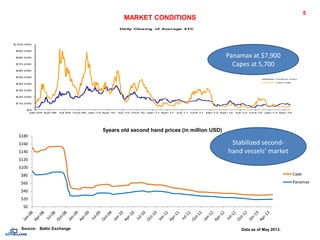
MARKET CONDITIONS
Data as of May 2013.
Panamax at $7,900
Capes at 5,700
5years old second hand prices (in million USD)
$0
$20
$40
$60
$80
$100
$120
$140
$160
$180
Cape
Panamax
Stabilized second-
hand vessels’ market
Source: SSY, Braemar Seascope Research
6
Highlights
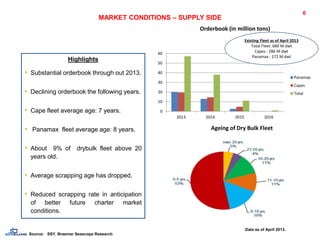
• Substantial orderbook through out 2013.
• Declining orderbook the following years.
• Cape fleet average age: 7 years.
• Panamax fleet average age: 8 years.
• About 9% of drybulk fleet above 20
years old.
• Average scrapping age has dropped.
• Reduced scrapping rate in anticipation
of better future charter market
conditions.
MARKET CONDITIONS – SUPPLY SIDE
Orderbook (in million tons)
Ageing of Dry Bulk Fleet
Data as of April 2013.
0
10
20
30
40
50
60
2013 2014 2015 2016
Panamax
Capes
Total
Existing Fleet as of April 2013
Total Fleet: 689 M dwt
Capes : 286 M dwt
Panamax : 172 M dwt
Source: Morgan Stanley Research, SSY
7
Highlights:
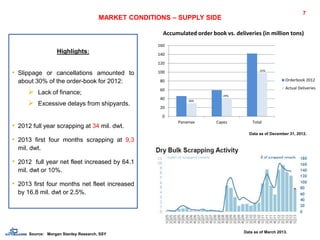
• Slippage or cancellations amounted to
about 30% of the order-book for 2012:
 Lack of finance;
 Excessive delays from shipyards.
• 2012 full year scrapping at 34 mil. dwt.
• 2013 first four months scrapping at 9,3
mil. dwt.
• 2012 full year net fleet increased by 64.1
mil. dwt or 10%.
• 2013 first four months net fleet increased
by 16.8 mil. dwt or 2.5%.
MARKET CONDITIONS – SUPPLY SIDE
Data as of March 2013.
Accumulated order book vs. deliveries (in million tons)
Data as of December 31, 2012.
0
20
40
60
80
100
120
140
160
Panamax Capes Total
Orderbook 2012
Actual Deliveries
-36%
-29%
-31%
Source: IMF, Clarkson Research Services Ltd
8
MARKET CONDITIONS – DEMAND SIDE
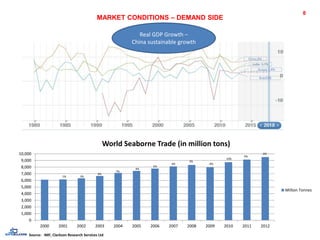
China 8%
India 5.7%
Russia 3.4%
Brazil3%
Real GDP Growth –
China sustainable growth
0
1,000
2,000
3,000
4,000
5,000
6,000
7,000
8,000
9,000
10,000
2000 2001 2002 2003 2004 2005 2006 2007 2008 2009 2010 2011 2012
World Seaborne Trade (in million tons)
Million Tonnes
1% 3%
6%
7%
4%
5%
4%
3%
-4%
10%
5%
4%
Source: Clarkson Research Services Ltd
9
MARKET CONDITIONS – DEMAND SIDE
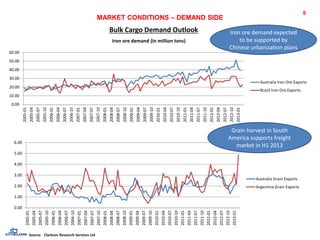
Bulk Cargo Demand Outlook
Iron ore demand (in million tons)
0.00
10.00
20.00
30.00
40.00
50.00
60.00
2005-01
2005-04
2005-07
2005-10
2006-01
2006-04
2006-07
2006-10
2007-01
2007-04
2007-07
2007-10
2008-01
2008-04
2008-07
2008-10
2009-01
2009-04
2009-07
2009-10
2010-01
2010-04
2010-07
2010-10
2011-01
2011-04
2011-07
2011-10
2012-01
2012-04
2012-07
2012-10
2013-01
Australia Iron Ore Exports
Brazil Iron Ore Exports
0.00
1.00
2.00
3.00
4.00
5.00
6.00
2005-01
2005-04
2005-07
2005-10
2006-01
2006-04
2006-07
2006-10
2007-01
2007-04
2007-07
2007-10
2008-01
2008-04
2008-07
2008-10
2009-01
2009-04
2009-07
2009-10
2010-01
2010-04
2010-07
2010-10
2011-01
2011-04
2011-07
2011-10
2012-01
2012-04
2012-07
2012-10
2013-01
Australia Grain Exports
Argentina Grain Exports
Grain harvest in South
America supports freight
market in H1 2013
Iron ore demand expected
to be supported by
Chinese urbanization plans
10
COMPANY SECTION
Highlights as of
May 15, 2013:
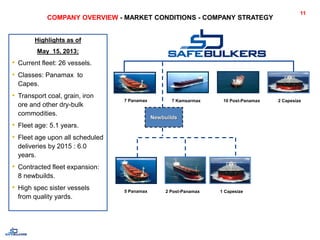
• Current fleet: 26 vessels.
• Classes: Panamax to
Capes.
• Transport coal, grain, iron
ore and other dry-bulk
commodities.
• Fleet age: 5.1 years.
• Fleet age upon all scheduled
deliveries by 2015 : 6.0
years.
• Contracted fleet expansion:
8 newbuilds.
• High spec sister vessels
from quality yards.
7 Kamsarmax7 Panamax
2 Post-Panamax
Newbuilds
10 Post-Panamax 2 Capesize
5 Panamax 1 Capesize
11
COMPANY OVERVIEW - MARKET CONDITIONS - COMPANY STRATEGY
Highlights:
• Our founders invested in shipping since 1958
• Our Manager Safety Management Overseas was founded in 1993
• Safe Bulkers was founded in 2007
• Safe Bulkers IPO 2008 NYSE
• Follow-on Offering: March 2010 $75.0 M Net
• Follow-on Offering: April 2011 $39.6 M Net
• Follow-on Offering: March 2012 $35.3 M Net
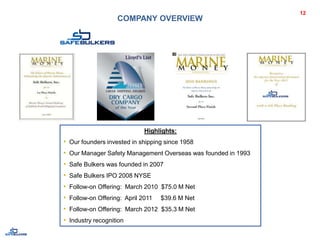
• Industry recognition
12
COMPANY OVERVIEW
• Long history in shipping.
• Management invest in ship owning
activities only through Safe Bulkers.
• Hands - on business approach.
• Significant contracted growth and
acquisitions in second hand market.
• Recognized consistent management
policies over the years.
• Prudent financing.
• Dividend policy.
13
COMPANY OVERVIEW
• Experience, market knowledge and proven
track record over many shipping cycles.
• Management fully aligned with
shareholders’ interests.
• Low OPEX and reputation of operating
excellence reflected in utilization rates.
• Create value for our shareholders.
• Business expansion and investor credibility.
• Financing from equity and debt maintaining
comfortable leverage.
• Paying out a portion of free cash flows while
retain remaining cash to finance expansion
and deleveraging.
ASSET MANAGEMENT POLICY
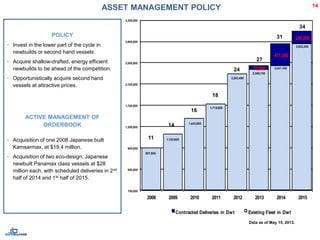
887,900
1,153,900
1,443,800
1,715,600
2,282,400
2,366,100
2,441,100
2,852,300
75,000
411,200
245,000
100,000
500,000
900,000
1,300,000
1,700,000
2,100,000
2,500,000
2,900,000
3,300,000
2008 2009 2010 2011 2012 2013 2014 2015
Contracted Deliveries in Dwt Existing Fleet in Dwt
14
16
18
31
34
24
11
14
Data as of May 15, 2013.
27
POLICY
• Invest in the lower part of the cycle in
newbuilds or second hand vessels.
• Acquire shallow-drafted, energy efficient
newbuilds to be ahead of the competition.
• Opportunistically acquire second hand
vessels at attractive prices.
ACTIVE MANAGEMENT OF
ORDERBOOK
• Acquisition of one 2008 Japanese built
Kamsarmax, at $19.4 million.
• Acquisition of two eco-design, Japanese
newbuilt Panamax class vessels at $28
million each, with scheduled deliveries in 2nd
half of 2014 and 1st half of 2015.
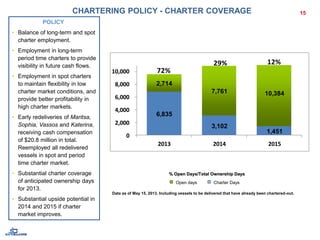
CHARTERING POLICY - CHARTER COVERAGE
POLICY
• Balance of long-term and spot
charter employment.
• Employment in long-term
period time charters to provide
visibility in future cash flows.
• Employment in spot charters
to maintain flexibility in low
charter market conditions, and
provide better profitability in
high charter markets.
• Early redeliveries of Maritsa,
Sophia, Vassos and Katerina,
receiving cash compensation
of $20.8 million in total.
Reemployed all redelivered
vessels in spot and period
time charter market.
• Substantial charter coverage
of anticipated ownership days
for 2013.
• Substantial upside potential in
2014 and 2015 if charter
market improves.
15
6,835
3,102
1,451
2,714
7,761 10,384
0
2,000
4,000
6,000
8,000
10,000
2013 2014 2015
29% 12%
72%
% Open Days/Total Ownership Days
Charter DaysOpen days
Data as of May 15, 2013. Including vessels to be delivered that have already been chartered-out.
$0
$5,000
$10,000
$15,000
$20,000
$25,000
$30,000
$35,000
$40,000
$45,000
Q1
09
Q2
09
Q3
09
Q4
09
Q1
10
Q2
10
Q3
10
Q4
10
Q1
11
Q2
11
Q3
11
Q4
11
Q1
12
Q2
12
Q3
12
Q4
12
Q1
13
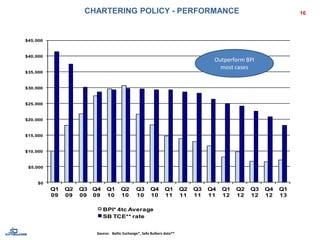
BPI* 4tc Average
SB TCE** rate
16
Source: Baltic Exchange*, Safe Bulkers data**
CHARTERING POLICY - PERFORMANCE
Outperform BPI
most cases
17
Safe Bulkers might do business with companies presented or their affiliates
CHARTERING POLICY : ESTABLISHED CHARTERERS
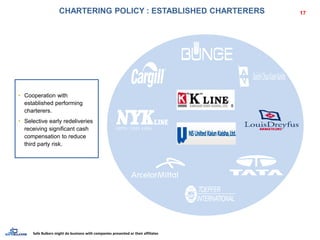
• Cooperation with
established performing
charterers.
• Selective early redeliveries
receiving significant cash
compensation to reduce
third party risk.
18
4,075 4,342 4,350 4,476 4,412
1,463 1,318 1,417 1,289 1,176
$0
$2,000
$4,000
$6,000
$8,000
2009 2010 2011 2012 Q12013
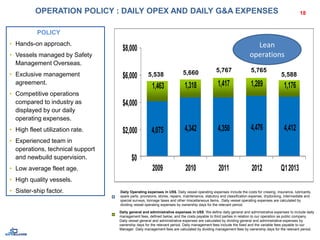
Daily Operating expenses in US$. Daily vessel operating expenses include the costs for crewing, insurance, lubricants,
spare parts, provisions, stores, repairs, maintenance, statutory and classification expense, drydocking, intermediate and
special surveys, tonnage taxes and other miscellaneous items. Daily vessel operating expenses are calculated by
dividing vessel operating expenses by ownership days for the relevant period.
5,538 5,660 5,767 5,765
OPERATION POLICY : DAILY OPEX AND DAILY G&A EXPENSES
POLICY
• Hands-on approach.
• Vessels managed by Safety
Management Overseas.
• Exclusive management
agreement.
• Competitive operations
compared to industry as
displayed by our daily
operating expenses.
• High fleet utilization rate.
• Experienced team in
operations, technical support
and newbuild supervision.
• Low average fleet age.
• High quality vessels.
• Sister-ship factor.
Lean
operations
5,588
Daily general and administrative expenses in US$. We define daily general and administrative expenses to include daily
management fees, defined below, and the costs payable to third parties in relation to our operation as public company.
Daily vessel general and administrative expenses are calculated by dividing general and administrative expenses by
ownership days for the relevant period. Daily management fees include the fixed and the variable fees payable to our
Manager. Daily management fees are calculated by dividing management fees by ownership days for the relevant period.
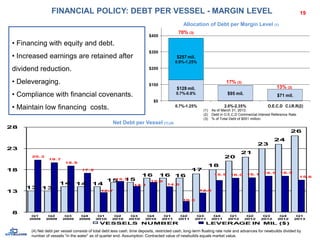
FINANCIAL POLICY: DEBT PER VESSEL - MARGIN LEVEL
13 13
14 14 14
15 15
16 16 16
17
18
20
21
23
24
26
20.3
19.7
18.9
17.2
12.7
15.3
14.1
15.0
14.0
10.6
12.6
15.5 16.0 16.1
16.5 16.5
15.6
8
13
18
23
28
Q1
2009
Q2
2009
Q3
2009
Q4
2009
Q1
2010
Q2
2010
Q3
2010
Q4
2010
Q1
2011
Q2
2011
Q3
2011
Q4
2011
Q1
2012
Q2
2012
Q3
2012
Q4
2012
Q1
2013
VESSELS NUMBER LEVERAGE IN MIL ($)
19
$128 mil.
0.7%-0.8% $95 mil. $71 mil.
$257 mil.
0.9%-1.25%
$0
$100
$200
$300
$400
0.7%-1.25% 2.0%-2.35% O.E.C.D C.I.R.R(2)
(4) Net debt per vessel consists of total debt less cash, time deposits, restricted cash, long-term floating rate note and advances for newbuilds divided by
number of vessels “in the water” as of quarter end. Assumption: Contracted value of newbuilds equals market value.
Allocation of Debt per Margin Level (1)
Net Debt per Vessel (1),(4)
(1) As of March 31, 2013.
(2) Debt in O.E.C.D Commercial Interest Reference Rate.
(3) % of Total Debt of $551 million.
• Financing with equity and debt.
• Increased earnings are retained after
dividend reduction.
• Deleveraging.
• Compliance with financial covenants.
• Maintain low financing costs.
70% (3)
17% (3)
13% (3)
46.1
74.2
51.2
171.5
162.5
53.9
40
68.6
0
20
40
60
80
100
120
140
160
180
200
2013 2014 2015 TOTAL
CAPEX
TOTAL
LIQUIDITY
CASH FRN RCF
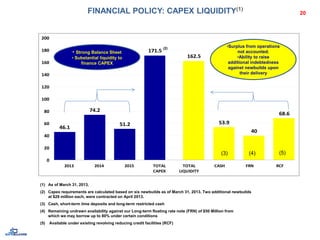
FINANCIAL POLICY: CAPEX LIQUIDITY
(1) As of March 31, 2013.
(2) Capex requirements are calculated based on six newbuilds as of March 31, 2013. Two additional newbuilds
at $28 million each, were contracted on April 2013.
(3) Cash, short-term time deposits and long-term restricted cash
(4) Remaining undrawn availability against our Long-term floating rate note (FRN) of $50 Million from
which we may borrow up to 80% under certain conditions
(5) Available under existing revolving reducing credit facilities (RCF)
20
(3) (4) (5)
• Strong Balance Sheet
• Substantial liquidity to
finance CAPEX
•Surplus from operations
not accounted.
•Ability to raise
additional indebtedness
against newbuilds upon
their delivery
(1)
(2)
DIVIDEND POLICY
The Board of Directors of the
Company is continuing a policy of
paying out a portion of the
Company’s free cash flow at a
level it considers prudent in light
of the current economic and
financial environment.
The declaration and payment of
dividends, if any, will always be
subject to the discretion of the
Board of Directors of the
Company. The timing and amount
of any dividends declared will
depend on, among other things:
(i) the Company’s earnings,
financial condition and cash
requirements and available
sources of liquidity,
(ii) decisions in relation to the
Company’s growth strategies,
(iii) provisions of Marshall Islands
and Liberian law governing the
payment of dividends,
(iv) restrictive covenants in the
Company’s existing and future
debt instruments and
(v) global financial conditions.
Accordingly, dividends might be
reduced or not be paid in the
future.
0.82
0.72
0.22
1.14
1.07
0.410.42
0.58
0.37
0.33
0.47
0.41
0.270.28
0.33
0.300.28
0.27
0.42
0.21
0.146
0.475
0.15 0.15 0.15 0.15 0.15 0.15 0.15 0.15 0.15 0.15 0.15 0.15 0.15 0.15 0.15
0.050.05 0.05
0.0
0.2
0.4
0.6
0.8
1.0
1.2
Q2
2008
Q3
2008
Q4
2008
Q1
2009
Q2
2009
Q3
2009
Q4
2009
Q1
2010
Q2
2010
Q3
2010
Q4
2010
Q1
2011
Q2
2011
Q3
2011
Q4
2011
Q1
2012
Q2
2012
Q3
2012
Q4
2012
Q1
2013
EPS[$] Dividendpershare [$]
21
20 consecutive
quarterly dividends
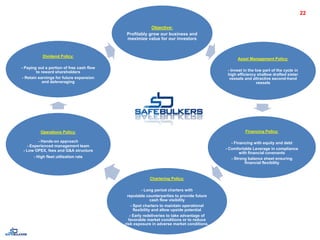
22
Objective:
Profitably grow our business and
maximize value for our investors
Asset Management Policy:
- Invest in the low part of the cycle in
high efficiency shallow drafted sister
vessels and attractive second-hand
vessels
Financing Policy:
- Financing with equity and debt
- Comfortable Leverage in compliance
with financial covenants
- Strong balance sheet ensuring
financial flexibility
Chartering Policy:
- Long period charters with
reputable counterparties to provide future
cash flow visibility
- Spot charters to maintain operational
flexibility and allow upside potential
- Early redeliveries to take advantage of
favorable market conditions or to reduce
risk exposure in adverse market conditions.
Operations Policy:
- Hands-on approach
- Experienced management team
- Low OPEX, fees and G&A structure
- High fleet utilization rate
Dividend Policy:
- Paying out a portion of free cash flow
to reward shareholders
- Retain earnings for future expansion
and deleveraging
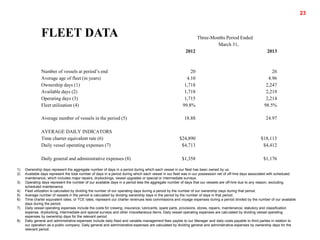
23
1) Ownership days represent the aggregate number of days in a period during which each vessel in our fleet has been owned by us.
2) Available days represent the total number of days in a period during which each vessel in our fleet was in our possession net of off-hire days associated with scheduled
maintenance, which includes major repairs, drydockings, vessel upgrades or special or intermediate surveys.
3) Operating days represent the number of our available days in a period less the aggregate number of days that our vessels are off-hire due to any reason, excluding
scheduled maintenance.
4) Fleet utilization is calculated by dividing the number of our operating days during a period by the number of our ownership days during that period.
5) Average number of vessels in the period is calculated by dividing ownership days in the period by the number of days in that period.
6) Time charter equivalent rates, or TCE rates, represent our charter revenues less commissions and voyage expenses during a period divided by the number of our available
days during the period.
7) Daily vessel operating expenses include the costs for crewing, insurance, lubricants, spare parts, provisions, stores, repairs, maintenance, statutory and classification
expense, drydocking, intermediate and special surveys and other miscellaneous items. Daily vessel operating expenses are calculated by dividing vessel operating
expenses by ownership days for the relevant period.
8) Daily general and administrative expenses include daily fixed and variable management fees payble to our Manager and daily costs payable to third parties in relation to
our operation as a public company. Daily general and administrative expenses are calculated by dividing general and administrative expenses by ownership days for the
relevant period.
FLEET DATA Three-Months Period Ended
March 31,
2012 2013
Number of vessels at period’s end 20 26
Average age of fleet (in years) 4.10 4.96
Ownership days (1) 1,718 2,247
Available days (2) 1,718 2,219
Operating days (3) 1,715 2,214
Fleet utilization (4) 99.8% 98.5%
Average number of vessels in the period (5) 18.88 24.97
AVERAGE DAILY INDICATORS
Time charter equivalent rate (6) $24,890 $18,113
Daily vessel operating expenses (7) $4,713 $4,412
Daily general and administrative expenses (8) $1,358 $1,176
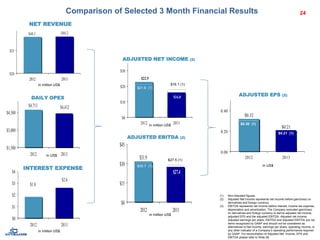
$0.32
$0.21
0.00
0.20
0.40
2012 2013$31.9
$27.4
$0
$15
$30
$45
2012 2013
$22.9
$16.0
$0
$10
$20
$30
2012 2013
$1.8
$2.6
$0
$1
$2
$3
$4
2012 2013
$44.1 $44.2
$20
$35
2012 2013
Comparison of Selected 3 Month Financial Results 24
NET REVENUE
in million US$
ADJUSTED NET INCOME (2)
ADJUSTED EBITDA (2)
(1) Non-Adjusted figures.
(2) Adjusted Net Income represents net income before gain/(loss) on
derivatives and foreign currency.
(3) EBITDA represents net income before interest, income tax expense,
depreciation and amortization. The Company excluded gain/(loss)
on derivatives and foreign currency to derive adjusted net income,
adjusted EPS and the adjusted EBITDA. Adjusted net income,
Adjusted earnings per share, EBITDA and Adjusted EBITDA are not
items recognized by GAAP and should not be considered as
alternatives to Net income, earnings per share, operating income, or
any other indicator of a Company’s operating performance required
by GAAP. For reconciliation of Adjusted Net Income, EPS and
EBITDA please refer to Slide 26.
DAILY OPEX
in million US$
ADJUSTED EPS (2)
in US$
INTEREST EXPENSE
in million US$
in million US$
in US$
$4,713 $4,412
$1,500
$3,000
$4,500
2012 2013
$16.1 (1)
…..…..….
..…….….....
$21.6 (1)
$27.5 (1)
..…….....
..…….….....
$30.7 (1)
..…….….....
$0.21 (1)
..…….….....
$0.30 (1)
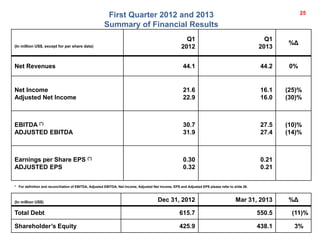
First Quarter 2012 and 2013
Summary of Financial Results
(In million US$) Dec 31, 2012 Mar 31, 2013 %Δ
Total Debt 615.7 550.5 (11)%
Shareholder’s Equity 425.9 438.1 3%
(In million US$, except for per share data)
Q1
2012
Q1
2013
%Δ
Net Revenues 44.1 44.2 0%
Net Income
Adjusted Net Income
21.6
22.9
16.1
16.0
(25)%
(30)%
EBITDA (*)
ADJUSTED EBITDA
30.7
31.9
27.5
27.4
(10)%
(14)%
Earnings per Share EPS (*)
ADJUSTED EPS
0.30
0.32
0.21
0.21
25
* For definition and reconciliation of EBITDA, Adjusted EBITDA, Net Income, Adjusted Net Income, EPS and Adjusted EPS please refer to slide 26.
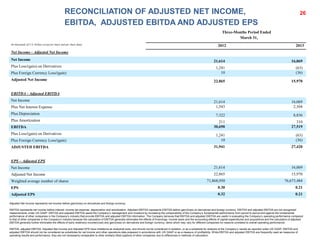
RECONCILIATION OF ADJUSTED NET INCOME,
EBITDA, ADJUSTED EBITDA AND ADJUSTED EPS
26
Adjusted Net Income represents net income before gain/(loss) on derivatives and foreign currency.
EBITDA represents net income before interest, income tax expense, depreciation and amortization. Adjusted EBITDA represents EBITDA before gain/(loss) on derivatives and foreign currency. EBITDA and adjusted EBITDA are not recognized
measurements under US GAAP. EBITDA and adjusted EBITDA assist the Company’s management and investors by increasing the comparability of the Company’s fundamental performance from period to period and against the fundamental
performance of other companies in the Company’s industry that provide EBITDA and adjusted EBITDA information. The Company believes that EBITDA and adjusted EBITDA are useful in evaluating the Company’s operating performance compared
to that of other companies in the Company’s industry because the calculation of EBITDA generally eliminates the effects of financings, income taxes and the accounting effects of capital expenditures and acquisitions and the calculation of adjusted
EBITDA generally further eliminates the effects of early redelivery income/(cost) and gain/(loss) on derivatives and foreign currency, items which may vary for different companies for reasons unrelated to overall operating performance.
EBITDA, adjusted EBITDA, Adjusted Net Income and Adjusted EPS have limitations as analytical tools, and should not be considered in isolation, or as a substitute for analysis of the Company’s results as reported under US GAAP. EBITDA and
adjusted EBITDA should not be considered as substitutes for net income and other operations data prepared in accordance with US GAAP or as a measure of profitability. While EBITDA and adjusted EBITDA are frequently used as measures of
operating results and performance, they are not necessarily comparable to other similarly titled captions of other companies due to differences in methods of calculation.
Three-Months Period Ended
March 31,
(In thousands of U.S. Dollars except for share and per share data)
2012 2013
Net Income - Adjusted Net Income
Net Income 21,614 16,069
Plus Loss/(gain) on Derivatives 1,241 (63)
Plus Foreign Currency Loss/(gain) 10 (36)
Adjusted Net Income 22,865 15,970
EBITDA - Adjusted EBITDA
Net Income 21,614 16,069
Plus Net Interest Expense 1,543 2,304
Plus Depreciation 7,322 8,836
Plus Amortization 211 310
EBITDA 30,690 27,519
Plus Loss/(gain) on Derivatives 1,241 (63)
Plus Foreign Currency Loss/(gain) 10 (36)
ADJUSTED EBITDA 31,941 27,420
EPS – Adjusted EPS
Net Income 21,614 16,069
Adjusted Net Income 22,865 15,970
Weighted average number of shares 71,868,950 76,673,484
EPS 0.30 0.21
Adjusted EPS 0.32 0.21
Dividends
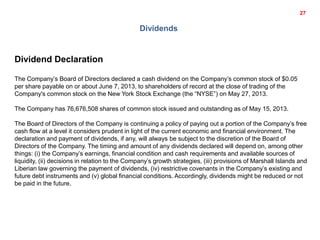
Dividend Declaration
The Company’s Board of Directors declared a cash dividend on the Company’s common stock of $0.05
per share payable on or about June 7, 2013, to shareholders of record at the close of trading of the
Company's common stock on the New York Stock Exchange (the “NYSE”) on May 27, 2013.
The Company has 76,676,508 shares of common stock issued and outstanding as of May 15, 2013.
The Board of Directors of the Company is continuing a policy of paying out a portion of the Company’s free
cash flow at a level it considers prudent in light of the current economic and financial environment. The
declaration and payment of dividends, if any, will always be subject to the discretion of the Board of
Directors of the Company. The timing and amount of any dividends declared will depend on, among other
things: (i) the Company’s earnings, financial condition and cash requirements and available sources of
liquidity, (ii) decisions in relation to the Company’s growth strategies, (iii) provisions of Marshall Islands and
Liberian law governing the payment of dividends, (iv) restrictive covenants in the Company’s existing and
future debt instruments and (v) global financial conditions. Accordingly, dividends might be reduced or not
be paid in the future.
27
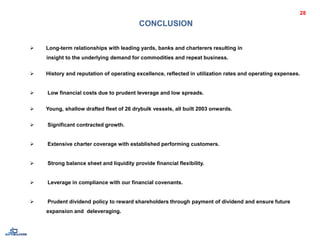
CONCLUSION
 Long-term relationships with leading yards, banks and charterers resulting in
insight to the underlying demand for commodities and repeat business.
 History and reputation of operating excellence, reflected in utilization rates and operating expenses.
 Low financial costs due to prudent leverage and low spreads.
 Young, shallow drafted fleet of 26 drybulk vessels, all built 2003 onwards.
 Significant contracted growth.
 Extensive charter coverage with established performing customers.
 Strong balance sheet and liquidity provide financial flexibility.
 Leverage in compliance with our financial covenants.
 Prudent dividend policy to reward shareholders through payment of dividend and ensure future
expansion and deleveraging.
28
Analyst
Coverage
Company Contact Investor Relations/Media Contact
Dr. Loukas Barmparis Matthew Abenante
President Investor Relations Advisor
Safe Bulkers, Inc. Capital Link Inc.
Athens, Greece New York, USA
Tel: +30 (210) 8994980 Tel: +1 (212) 661-7566
Fax: +30 (210) 8954159 Fax:+1 (212) 661-7526
E-mail: directors@safebulkers.com E-mail: safebulkers@capitallink.com
29
30

Safe Bulkers Q1 2013 results presentation

  • 1.
  • 2.
    Forward Looking Statements Thispresentation contains forward-looking statements (as defined in Section 27A of the Securities Exchange Act of 1933, as amended, and in the Section 21E of the Securities Act of 1934, as amended) concerning future events, the Company’s growth strategy and measures to implement such strategy, including expected vessel acquisitions and entering into further time charters. Words such as “expects,” “intends,” “plans,” “believes,” “anticipates,” “hopes,” “estimates” and variations of such words and similar expressions are intended to identify forward-looking statements. Although the Company believes that the expectations reflected in such forward-looking statements are reasonable, no assurance can be given that such expectations will prove to have been correct. These statements involve known and unknown risks and are based upon a number of assumptions and estimates that are inherently subject to significant uncertainties and contingencies, many of which are beyond the control of the Company. Actual results may differ materially from those expressed or implied by such forward-looking statements. Factors that could cause actual results to differ materially include, but are not limited to, changes in the demand for drybulk vessels, competitive factors in the market in which the Company operates, risks associated with operations outside the United States and other factors listed from time to time in the Company’s filings with the Securities and Exchange Commission. The Company expressly disclaims any obligations or undertaking to release any updates or revisions to any forward- looking statements contained herein to reflect any change in the Company’s expectations with respect thereto or any change in events, conditions or circumstances on which any statement is based. 2
  • 3.
    Management Team Polys Hajioannou Chairmanand CEO Dr. Loukas Barmparis President Konstantinos Adamopoulos Chief Financial Officer Ioannis Foteinos Chief Operating Officer 3
  • 4.
  • 5.
    $0 $10.000 $20.000 $30.000 $40.000 $50.000 $60.000 $70.000 $80.000 $90.000 $100.000 Jan-09 Apr-09 Jul-09 Oct-09 Jan-10 Apr-10 Jul -10 Oct-10 Jan-11 Apr-11 Jul -11 Oct-11 Jan-12 Apr-12 Jul -12 Oct-12 Jan-13 Apr-13 Daily Closing of Average 4TC Panamax Index Cape Index Source: Baltic Exchange 5 MARKET CONDITIONS Data as of May 2013. Panamax at $7,900 Capes at 5,700 5years old second hand prices (in million USD) $0 $20 $40 $60 $80 $100 $120 $140 $160 $180 Cape Panamax Stabilized second- hand vessels’ market
  • 6.
    Source: SSY, BraemarSeascope Research 6 Highlights • Substantial orderbook through out 2013. • Declining orderbook the following years. • Cape fleet average age: 7 years. • Panamax fleet average age: 8 years. • About 9% of drybulk fleet above 20 years old. • Average scrapping age has dropped. • Reduced scrapping rate in anticipation of better future charter market conditions. MARKET CONDITIONS – SUPPLY SIDE Orderbook (in million tons) Ageing of Dry Bulk Fleet Data as of April 2013. 0 10 20 30 40 50 60 2013 2014 2015 2016 Panamax Capes Total Existing Fleet as of April 2013 Total Fleet: 689 M dwt Capes : 286 M dwt Panamax : 172 M dwt
  • 7.
    Source: Morgan StanleyResearch, SSY 7 Highlights: • Slippage or cancellations amounted to about 30% of the order-book for 2012:  Lack of finance;  Excessive delays from shipyards. • 2012 full year scrapping at 34 mil. dwt. • 2013 first four months scrapping at 9,3 mil. dwt. • 2012 full year net fleet increased by 64.1 mil. dwt or 10%. • 2013 first four months net fleet increased by 16.8 mil. dwt or 2.5%. MARKET CONDITIONS – SUPPLY SIDE Data as of March 2013. Accumulated order book vs. deliveries (in million tons) Data as of December 31, 2012. 0 20 40 60 80 100 120 140 160 Panamax Capes Total Orderbook 2012 Actual Deliveries -36% -29% -31%
  • 8.
    Source: IMF, ClarksonResearch Services Ltd 8 MARKET CONDITIONS – DEMAND SIDE China 8% India 5.7% Russia 3.4% Brazil3% Real GDP Growth – China sustainable growth 0 1,000 2,000 3,000 4,000 5,000 6,000 7,000 8,000 9,000 10,000 2000 2001 2002 2003 2004 2005 2006 2007 2008 2009 2010 2011 2012 World Seaborne Trade (in million tons) Million Tonnes 1% 3% 6% 7% 4% 5% 4% 3% -4% 10% 5% 4%
  • 9.
    Source: Clarkson ResearchServices Ltd 9 MARKET CONDITIONS – DEMAND SIDE Bulk Cargo Demand Outlook Iron ore demand (in million tons) 0.00 10.00 20.00 30.00 40.00 50.00 60.00 2005-01 2005-04 2005-07 2005-10 2006-01 2006-04 2006-07 2006-10 2007-01 2007-04 2007-07 2007-10 2008-01 2008-04 2008-07 2008-10 2009-01 2009-04 2009-07 2009-10 2010-01 2010-04 2010-07 2010-10 2011-01 2011-04 2011-07 2011-10 2012-01 2012-04 2012-07 2012-10 2013-01 Australia Iron Ore Exports Brazil Iron Ore Exports 0.00 1.00 2.00 3.00 4.00 5.00 6.00 2005-01 2005-04 2005-07 2005-10 2006-01 2006-04 2006-07 2006-10 2007-01 2007-04 2007-07 2007-10 2008-01 2008-04 2008-07 2008-10 2009-01 2009-04 2009-07 2009-10 2010-01 2010-04 2010-07 2010-10 2011-01 2011-04 2011-07 2011-10 2012-01 2012-04 2012-07 2012-10 2013-01 Australia Grain Exports Argentina Grain Exports Grain harvest in South America supports freight market in H1 2013 Iron ore demand expected to be supported by Chinese urbanization plans
  • 10.
  • 11.
    Highlights as of May15, 2013: • Current fleet: 26 vessels. • Classes: Panamax to Capes. • Transport coal, grain, iron ore and other dry-bulk commodities. • Fleet age: 5.1 years. • Fleet age upon all scheduled deliveries by 2015 : 6.0 years. • Contracted fleet expansion: 8 newbuilds. • High spec sister vessels from quality yards. 7 Kamsarmax7 Panamax 2 Post-Panamax Newbuilds 10 Post-Panamax 2 Capesize 5 Panamax 1 Capesize 11 COMPANY OVERVIEW - MARKET CONDITIONS - COMPANY STRATEGY
  • 12.
    Highlights: • Our foundersinvested in shipping since 1958 • Our Manager Safety Management Overseas was founded in 1993 • Safe Bulkers was founded in 2007 • Safe Bulkers IPO 2008 NYSE • Follow-on Offering: March 2010 $75.0 M Net • Follow-on Offering: April 2011 $39.6 M Net • Follow-on Offering: March 2012 $35.3 M Net • Industry recognition 12 COMPANY OVERVIEW
  • 13.
    • Long historyin shipping. • Management invest in ship owning activities only through Safe Bulkers. • Hands - on business approach. • Significant contracted growth and acquisitions in second hand market. • Recognized consistent management policies over the years. • Prudent financing. • Dividend policy. 13 COMPANY OVERVIEW • Experience, market knowledge and proven track record over many shipping cycles. • Management fully aligned with shareholders’ interests. • Low OPEX and reputation of operating excellence reflected in utilization rates. • Create value for our shareholders. • Business expansion and investor credibility. • Financing from equity and debt maintaining comfortable leverage. • Paying out a portion of free cash flows while retain remaining cash to finance expansion and deleveraging.
  • 14.
    ASSET MANAGEMENT POLICY 887,900 1,153,900 1,443,800 1,715,600 2,282,400 2,366,100 2,441,100 2,852,300 75,000 411,200 245,000 100,000 500,000 900,000 1,300,000 1,700,000 2,100,000 2,500,000 2,900,000 3,300,000 20082009 2010 2011 2012 2013 2014 2015 Contracted Deliveries in Dwt Existing Fleet in Dwt 14 16 18 31 34 24 11 14 Data as of May 15, 2013. 27 POLICY • Invest in the lower part of the cycle in newbuilds or second hand vessels. • Acquire shallow-drafted, energy efficient newbuilds to be ahead of the competition. • Opportunistically acquire second hand vessels at attractive prices. ACTIVE MANAGEMENT OF ORDERBOOK • Acquisition of one 2008 Japanese built Kamsarmax, at $19.4 million. • Acquisition of two eco-design, Japanese newbuilt Panamax class vessels at $28 million each, with scheduled deliveries in 2nd half of 2014 and 1st half of 2015.
  • 15.
    CHARTERING POLICY -CHARTER COVERAGE POLICY • Balance of long-term and spot charter employment. • Employment in long-term period time charters to provide visibility in future cash flows. • Employment in spot charters to maintain flexibility in low charter market conditions, and provide better profitability in high charter markets. • Early redeliveries of Maritsa, Sophia, Vassos and Katerina, receiving cash compensation of $20.8 million in total. Reemployed all redelivered vessels in spot and period time charter market. • Substantial charter coverage of anticipated ownership days for 2013. • Substantial upside potential in 2014 and 2015 if charter market improves. 15 6,835 3,102 1,451 2,714 7,761 10,384 0 2,000 4,000 6,000 8,000 10,000 2013 2014 2015 29% 12% 72% % Open Days/Total Ownership Days Charter DaysOpen days Data as of May 15, 2013. Including vessels to be delivered that have already been chartered-out.
  • 16.
  • 17.
    17 Safe Bulkers mightdo business with companies presented or their affiliates CHARTERING POLICY : ESTABLISHED CHARTERERS • Cooperation with established performing charterers. • Selective early redeliveries receiving significant cash compensation to reduce third party risk.
  • 18.
    18 4,075 4,342 4,3504,476 4,412 1,463 1,318 1,417 1,289 1,176 $0 $2,000 $4,000 $6,000 $8,000 2009 2010 2011 2012 Q12013 Daily Operating expenses in US$. Daily vessel operating expenses include the costs for crewing, insurance, lubricants, spare parts, provisions, stores, repairs, maintenance, statutory and classification expense, drydocking, intermediate and special surveys, tonnage taxes and other miscellaneous items. Daily vessel operating expenses are calculated by dividing vessel operating expenses by ownership days for the relevant period. 5,538 5,660 5,767 5,765 OPERATION POLICY : DAILY OPEX AND DAILY G&A EXPENSES POLICY • Hands-on approach. • Vessels managed by Safety Management Overseas. • Exclusive management agreement. • Competitive operations compared to industry as displayed by our daily operating expenses. • High fleet utilization rate. • Experienced team in operations, technical support and newbuild supervision. • Low average fleet age. • High quality vessels. • Sister-ship factor. Lean operations 5,588 Daily general and administrative expenses in US$. We define daily general and administrative expenses to include daily management fees, defined below, and the costs payable to third parties in relation to our operation as public company. Daily vessel general and administrative expenses are calculated by dividing general and administrative expenses by ownership days for the relevant period. Daily management fees include the fixed and the variable fees payable to our Manager. Daily management fees are calculated by dividing management fees by ownership days for the relevant period.
  • 19.
    FINANCIAL POLICY: DEBTPER VESSEL - MARGIN LEVEL 13 13 14 14 14 15 15 16 16 16 17 18 20 21 23 24 26 20.3 19.7 18.9 17.2 12.7 15.3 14.1 15.0 14.0 10.6 12.6 15.5 16.0 16.1 16.5 16.5 15.6 8 13 18 23 28 Q1 2009 Q2 2009 Q3 2009 Q4 2009 Q1 2010 Q2 2010 Q3 2010 Q4 2010 Q1 2011 Q2 2011 Q3 2011 Q4 2011 Q1 2012 Q2 2012 Q3 2012 Q4 2012 Q1 2013 VESSELS NUMBER LEVERAGE IN MIL ($) 19 $128 mil. 0.7%-0.8% $95 mil. $71 mil. $257 mil. 0.9%-1.25% $0 $100 $200 $300 $400 0.7%-1.25% 2.0%-2.35% O.E.C.D C.I.R.R(2) (4) Net debt per vessel consists of total debt less cash, time deposits, restricted cash, long-term floating rate note and advances for newbuilds divided by number of vessels “in the water” as of quarter end. Assumption: Contracted value of newbuilds equals market value. Allocation of Debt per Margin Level (1) Net Debt per Vessel (1),(4) (1) As of March 31, 2013. (2) Debt in O.E.C.D Commercial Interest Reference Rate. (3) % of Total Debt of $551 million. • Financing with equity and debt. • Increased earnings are retained after dividend reduction. • Deleveraging. • Compliance with financial covenants. • Maintain low financing costs. 70% (3) 17% (3) 13% (3)
  • 20.
    46.1 74.2 51.2 171.5 162.5 53.9 40 68.6 0 20 40 60 80 100 120 140 160 180 200 2013 2014 2015TOTAL CAPEX TOTAL LIQUIDITY CASH FRN RCF FINANCIAL POLICY: CAPEX LIQUIDITY (1) As of March 31, 2013. (2) Capex requirements are calculated based on six newbuilds as of March 31, 2013. Two additional newbuilds at $28 million each, were contracted on April 2013. (3) Cash, short-term time deposits and long-term restricted cash (4) Remaining undrawn availability against our Long-term floating rate note (FRN) of $50 Million from which we may borrow up to 80% under certain conditions (5) Available under existing revolving reducing credit facilities (RCF) 20 (3) (4) (5) • Strong Balance Sheet • Substantial liquidity to finance CAPEX •Surplus from operations not accounted. •Ability to raise additional indebtedness against newbuilds upon their delivery (1) (2)
  • 21.
    DIVIDEND POLICY The Boardof Directors of the Company is continuing a policy of paying out a portion of the Company’s free cash flow at a level it considers prudent in light of the current economic and financial environment. The declaration and payment of dividends, if any, will always be subject to the discretion of the Board of Directors of the Company. The timing and amount of any dividends declared will depend on, among other things: (i) the Company’s earnings, financial condition and cash requirements and available sources of liquidity, (ii) decisions in relation to the Company’s growth strategies, (iii) provisions of Marshall Islands and Liberian law governing the payment of dividends, (iv) restrictive covenants in the Company’s existing and future debt instruments and (v) global financial conditions. Accordingly, dividends might be reduced or not be paid in the future. 0.82 0.72 0.22 1.14 1.07 0.410.42 0.58 0.37 0.33 0.47 0.41 0.270.28 0.33 0.300.28 0.27 0.42 0.21 0.146 0.475 0.15 0.15 0.15 0.15 0.15 0.15 0.15 0.15 0.15 0.15 0.15 0.15 0.15 0.15 0.15 0.050.05 0.05 0.0 0.2 0.4 0.6 0.8 1.0 1.2 Q2 2008 Q3 2008 Q4 2008 Q1 2009 Q2 2009 Q3 2009 Q4 2009 Q1 2010 Q2 2010 Q3 2010 Q4 2010 Q1 2011 Q2 2011 Q3 2011 Q4 2011 Q1 2012 Q2 2012 Q3 2012 Q4 2012 Q1 2013 EPS[$] Dividendpershare [$] 21 20 consecutive quarterly dividends
  • 22.
    22 Objective: Profitably grow ourbusiness and maximize value for our investors Asset Management Policy: - Invest in the low part of the cycle in high efficiency shallow drafted sister vessels and attractive second-hand vessels Financing Policy: - Financing with equity and debt - Comfortable Leverage in compliance with financial covenants - Strong balance sheet ensuring financial flexibility Chartering Policy: - Long period charters with reputable counterparties to provide future cash flow visibility - Spot charters to maintain operational flexibility and allow upside potential - Early redeliveries to take advantage of favorable market conditions or to reduce risk exposure in adverse market conditions. Operations Policy: - Hands-on approach - Experienced management team - Low OPEX, fees and G&A structure - High fleet utilization rate Dividend Policy: - Paying out a portion of free cash flow to reward shareholders - Retain earnings for future expansion and deleveraging
  • 23.
    23 1) Ownership daysrepresent the aggregate number of days in a period during which each vessel in our fleet has been owned by us. 2) Available days represent the total number of days in a period during which each vessel in our fleet was in our possession net of off-hire days associated with scheduled maintenance, which includes major repairs, drydockings, vessel upgrades or special or intermediate surveys. 3) Operating days represent the number of our available days in a period less the aggregate number of days that our vessels are off-hire due to any reason, excluding scheduled maintenance. 4) Fleet utilization is calculated by dividing the number of our operating days during a period by the number of our ownership days during that period. 5) Average number of vessels in the period is calculated by dividing ownership days in the period by the number of days in that period. 6) Time charter equivalent rates, or TCE rates, represent our charter revenues less commissions and voyage expenses during a period divided by the number of our available days during the period. 7) Daily vessel operating expenses include the costs for crewing, insurance, lubricants, spare parts, provisions, stores, repairs, maintenance, statutory and classification expense, drydocking, intermediate and special surveys and other miscellaneous items. Daily vessel operating expenses are calculated by dividing vessel operating expenses by ownership days for the relevant period. 8) Daily general and administrative expenses include daily fixed and variable management fees payble to our Manager and daily costs payable to third parties in relation to our operation as a public company. Daily general and administrative expenses are calculated by dividing general and administrative expenses by ownership days for the relevant period. FLEET DATA Three-Months Period Ended March 31, 2012 2013 Number of vessels at period’s end 20 26 Average age of fleet (in years) 4.10 4.96 Ownership days (1) 1,718 2,247 Available days (2) 1,718 2,219 Operating days (3) 1,715 2,214 Fleet utilization (4) 99.8% 98.5% Average number of vessels in the period (5) 18.88 24.97 AVERAGE DAILY INDICATORS Time charter equivalent rate (6) $24,890 $18,113 Daily vessel operating expenses (7) $4,713 $4,412 Daily general and administrative expenses (8) $1,358 $1,176
  • 24.
    $0.32 $0.21 0.00 0.20 0.40 2012 2013$31.9 $27.4 $0 $15 $30 $45 2012 2013 $22.9 $16.0 $0 $10 $20 $30 20122013 $1.8 $2.6 $0 $1 $2 $3 $4 2012 2013 $44.1 $44.2 $20 $35 2012 2013 Comparison of Selected 3 Month Financial Results 24 NET REVENUE in million US$ ADJUSTED NET INCOME (2) ADJUSTED EBITDA (2) (1) Non-Adjusted figures. (2) Adjusted Net Income represents net income before gain/(loss) on derivatives and foreign currency. (3) EBITDA represents net income before interest, income tax expense, depreciation and amortization. The Company excluded gain/(loss) on derivatives and foreign currency to derive adjusted net income, adjusted EPS and the adjusted EBITDA. Adjusted net income, Adjusted earnings per share, EBITDA and Adjusted EBITDA are not items recognized by GAAP and should not be considered as alternatives to Net income, earnings per share, operating income, or any other indicator of a Company’s operating performance required by GAAP. For reconciliation of Adjusted Net Income, EPS and EBITDA please refer to Slide 26. DAILY OPEX in million US$ ADJUSTED EPS (2) in US$ INTEREST EXPENSE in million US$ in million US$ in US$ $4,713 $4,412 $1,500 $3,000 $4,500 2012 2013 $16.1 (1) …..…..…. ..…….…..... $21.6 (1) $27.5 (1) ..……..... ..…….…..... $30.7 (1) ..…….…..... $0.21 (1) ..…….…..... $0.30 (1)
  • 25.
    First Quarter 2012and 2013 Summary of Financial Results (In million US$) Dec 31, 2012 Mar 31, 2013 %Δ Total Debt 615.7 550.5 (11)% Shareholder’s Equity 425.9 438.1 3% (In million US$, except for per share data) Q1 2012 Q1 2013 %Δ Net Revenues 44.1 44.2 0% Net Income Adjusted Net Income 21.6 22.9 16.1 16.0 (25)% (30)% EBITDA (*) ADJUSTED EBITDA 30.7 31.9 27.5 27.4 (10)% (14)% Earnings per Share EPS (*) ADJUSTED EPS 0.30 0.32 0.21 0.21 25 * For definition and reconciliation of EBITDA, Adjusted EBITDA, Net Income, Adjusted Net Income, EPS and Adjusted EPS please refer to slide 26.
  • 26.
    RECONCILIATION OF ADJUSTEDNET INCOME, EBITDA, ADJUSTED EBITDA AND ADJUSTED EPS 26 Adjusted Net Income represents net income before gain/(loss) on derivatives and foreign currency. EBITDA represents net income before interest, income tax expense, depreciation and amortization. Adjusted EBITDA represents EBITDA before gain/(loss) on derivatives and foreign currency. EBITDA and adjusted EBITDA are not recognized measurements under US GAAP. EBITDA and adjusted EBITDA assist the Company’s management and investors by increasing the comparability of the Company’s fundamental performance from period to period and against the fundamental performance of other companies in the Company’s industry that provide EBITDA and adjusted EBITDA information. The Company believes that EBITDA and adjusted EBITDA are useful in evaluating the Company’s operating performance compared to that of other companies in the Company’s industry because the calculation of EBITDA generally eliminates the effects of financings, income taxes and the accounting effects of capital expenditures and acquisitions and the calculation of adjusted EBITDA generally further eliminates the effects of early redelivery income/(cost) and gain/(loss) on derivatives and foreign currency, items which may vary for different companies for reasons unrelated to overall operating performance. EBITDA, adjusted EBITDA, Adjusted Net Income and Adjusted EPS have limitations as analytical tools, and should not be considered in isolation, or as a substitute for analysis of the Company’s results as reported under US GAAP. EBITDA and adjusted EBITDA should not be considered as substitutes for net income and other operations data prepared in accordance with US GAAP or as a measure of profitability. While EBITDA and adjusted EBITDA are frequently used as measures of operating results and performance, they are not necessarily comparable to other similarly titled captions of other companies due to differences in methods of calculation. Three-Months Period Ended March 31, (In thousands of U.S. Dollars except for share and per share data) 2012 2013 Net Income - Adjusted Net Income Net Income 21,614 16,069 Plus Loss/(gain) on Derivatives 1,241 (63) Plus Foreign Currency Loss/(gain) 10 (36) Adjusted Net Income 22,865 15,970 EBITDA - Adjusted EBITDA Net Income 21,614 16,069 Plus Net Interest Expense 1,543 2,304 Plus Depreciation 7,322 8,836 Plus Amortization 211 310 EBITDA 30,690 27,519 Plus Loss/(gain) on Derivatives 1,241 (63) Plus Foreign Currency Loss/(gain) 10 (36) ADJUSTED EBITDA 31,941 27,420 EPS – Adjusted EPS Net Income 21,614 16,069 Adjusted Net Income 22,865 15,970 Weighted average number of shares 71,868,950 76,673,484 EPS 0.30 0.21 Adjusted EPS 0.32 0.21
  • 27.
    Dividends Dividend Declaration The Company’sBoard of Directors declared a cash dividend on the Company’s common stock of $0.05 per share payable on or about June 7, 2013, to shareholders of record at the close of trading of the Company's common stock on the New York Stock Exchange (the “NYSE”) on May 27, 2013. The Company has 76,676,508 shares of common stock issued and outstanding as of May 15, 2013. The Board of Directors of the Company is continuing a policy of paying out a portion of the Company’s free cash flow at a level it considers prudent in light of the current economic and financial environment. The declaration and payment of dividends, if any, will always be subject to the discretion of the Board of Directors of the Company. The timing and amount of any dividends declared will depend on, among other things: (i) the Company’s earnings, financial condition and cash requirements and available sources of liquidity, (ii) decisions in relation to the Company’s growth strategies, (iii) provisions of Marshall Islands and Liberian law governing the payment of dividends, (iv) restrictive covenants in the Company’s existing and future debt instruments and (v) global financial conditions. Accordingly, dividends might be reduced or not be paid in the future. 27
  • 28.
    CONCLUSION  Long-term relationshipswith leading yards, banks and charterers resulting in insight to the underlying demand for commodities and repeat business.  History and reputation of operating excellence, reflected in utilization rates and operating expenses.  Low financial costs due to prudent leverage and low spreads.  Young, shallow drafted fleet of 26 drybulk vessels, all built 2003 onwards.  Significant contracted growth.  Extensive charter coverage with established performing customers.  Strong balance sheet and liquidity provide financial flexibility.  Leverage in compliance with our financial covenants.  Prudent dividend policy to reward shareholders through payment of dividend and ensure future expansion and deleveraging. 28
  • 29.
    Analyst Coverage Company Contact InvestorRelations/Media Contact Dr. Loukas Barmparis Matthew Abenante President Investor Relations Advisor Safe Bulkers, Inc. Capital Link Inc. Athens, Greece New York, USA Tel: +30 (210) 8994980 Tel: +1 (212) 661-7566 Fax: +30 (210) 8954159 Fax:+1 (212) 661-7526 E-mail: directors@safebulkers.com E-mail: safebulkers@capitallink.com 29
  • 30.