Lesson 7 for May 15, 2021
Adapted from www.fustero.es
www.gmahktanjungpinang.org
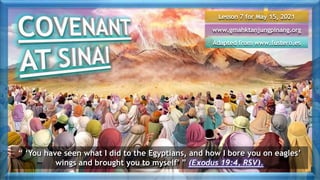
“ ‘You have seen what I did to the Egyptians, and how I bore you on eagles’
wings and brought you to myself’ ” (Exodus 19:4, RSV).
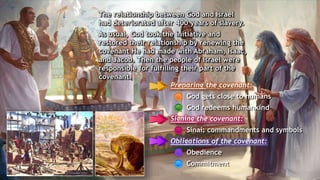
Preparing the covenant:
God gets close to humans
God redeems humankind
Signing the covenant:
Sinai: commandments and symbols
Obligations of the covenant:
Obedience
Commitment
The relationship between God and Israel
had deteriorated after 400 years of slavery.
As usual, God took the initiative and
restored their relationship by renewing the
covenant He had made with Abraham, Isaac,
and Jacob. Then the people of Israel were
responsible for fulfilling their part of the
covenant.
GOD GETS CLOSE
TO HUMANS
“You have seen what I did to the
Egyptians, and how I bore you on
eagles’ wings and brought you to
Myself.” (Exodus 19:4)
God showed grace to Israel by liberating them from
harsh slavery, and tenderly leading them to a new
covenant relationship with Him.
There are two illustrations in Deuteronomy that
represent how God treated Israel:
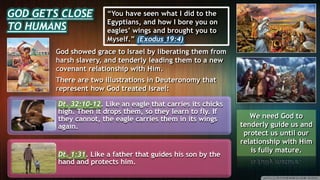
Dt. 32:10-12. Like an eagle that carries its chicks
high. Then it drops them, so they learn to fly. If
they cannot, the eagle carries them in its wings
again.
Dt. 1:31. Like a father that guides his son by the
hand and protects him.
We need God to
tenderly guide us and
protect us until our
relationship with Him
is fully mature.
GOD REDEEMS HUMANKIND
“You in Your mercy have led forth the people whom
You have redeemed; You have guided them in Your
strength to Your holy habitation.” (Exodus 15:13)
God’s first step to help the people of Israel was
to redeem them from slavery (Exodus 6:6-7).
A redeemer was someone who helped a close
relative who had to sell their land or could not
pay for their debts and had become a slave.
This redeemer bought the land back or
liberated the person from slavery.
God was that redeemer for Israel. To redeem them, He had to
“come down to deliver them out of the hand of the
Egyptians” (Exodus 3:8).
What price did God pay to redeem Israel [and ourselves]?
He came down to this world and became human. He paid for
our sins by dying on the cross (John 6:51; Ephesians 1:7).
“According to the law Christ Himself gave, the forfeited
inheritance was ransomed by the nearest of kin. Jesus
Christ laid off His royal robe, His kingly crown, and
clothed His divinity with humanity, in order to become a
substitute and surety for humanity, that dying in humanity
He might by His death destroy him who
had the power of death. He could not
have done this as God, but by
coming as man Christ could die.
By death He overcame death.”
E.G.W. (SDA Bible Commentary, book 7, note on Hebrews 2, p. 925)
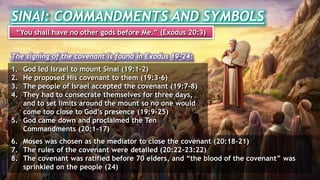
SINAI: COMMANDMENTS AND SYMBOLS
“You shall have no other gods before Me.” (Exodus 20:3)
The signing of the covenant is found in Exodus 19-24:
1. God led Israel to mount Sinai (19:1-2)
2. He proposed His covenant to them (19:3-6)
3. The people of Israel accepted the covenant (19:7-8)
4. They had to consecrate themselves for three days,
and to set limits around the mount so no one would
come too close to God’s presence (19:9-25)
5. God came down and proclaimed the Ten
Commandments (20:1-17)
6. Moses was chosen as the mediator to close the covenant (20:18-21)
7. The rules of the covenant were detailed (20:22-23:22)
8. The covenant was ratified before 70 elders, and “the blood of the covenant” was
sprinkled on the people (24)
SINAI: COMMANDMENTS
AND SYMBOLS
“You shall have no other gods
before Me.” (Exodus 20:3)
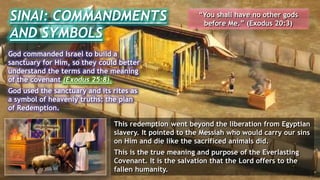
God commanded Israel to build a
sanctuary for Him, so they could better
understand the terms and the meaning
of the covenant (Exodus 25:8).
God used the sanctuary and its rites as
a symbol of heavenly truths: the plan
of Redemption.
This redemption went beyond the liberation from Egyptian
slavery. It pointed to the Messiah who would carry our sins
on Him and die like the sacrificed animals did.
This is the true meaning and purpose of the Everlasting
Covenant. It is the salvation that the Lord offers to the
fallen humanity.
OBEDIENCE “And it shall be that if you
earnestly obey My commandments
which I command you today, to
love the Lord your God and serve
Him with all your heart and with all
your soul.” (Deuteronomy 11:13)
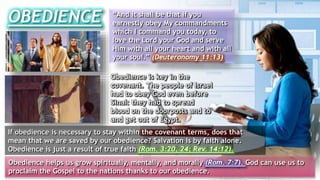
Obedience is key in the
covenant. The people of Israel
had to obey God even before
Sinai: they had to spread
blood on the doorposts and to
and get out of Egypt.
If obedience is necessary to stay within the covenant terms, does that
mean that we are saved by our obedience? Salvation is by faith alone.
Obedience is just a result of true faith (Rom. 3:20, 24; Rev. 14:12).
Obedience helps us grow spiritually, mentally, and morally (Rom. 7:7). God can use us to
proclaim the Gospel to the nations thanks to our obedience.
COMMITMENT
“Then he took the Book of the Covenant and read in the
hearing of the people. And they said, ‘All that the Lord
has said we will do, and be obedient.’” (Exodus 24:7)
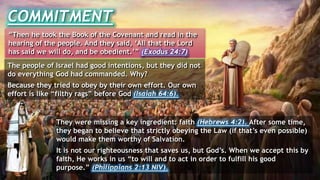
The people of Israel had good intentions, but they did not
do everything God had commanded. Why?
Because they tried to obey by their own effort. Our own
effort is like “filthy rags” before God (Isaiah 64:6).
They were missing a key ingredient: faith (Hebrews 4:2). After some time,
they began to believe that strictly obeying the Law (if that’s even possible)
would make them worthy of Salvation.
It is not our righteousness that saves us, but God’s. When we accept this by
faith, He works in us “to will and to act in order to fulfill his good
purpose.” (Philippians 2:13 NIV).
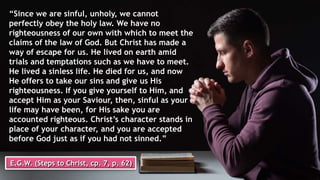
“Since we are sinful, unholy, we cannot
perfectly obey the holy law. We have no
righteousness of our own with which to meet the
claims of the law of God. But Christ has made a
way of escape for us. He lived on earth amid
trials and temptations such as we have to meet.
He lived a sinless life. He died for us, and now
He offers to take our sins and give us His
righteousness. If you give yourself to Him, and
accept Him as your Saviour, then, sinful as your
life may have been, for His sake you are
accounted righteous. Christ’s character stands in
place of your character, and you are accepted
before God just as if you had not sinned.”
E.G.W. (Steps to Christ, cp. 7, p. 62)

Sabbath school lesson_7_2nd_quarter_2021

  • 1.
    Lesson 7 forMay 15, 2021 Adapted from www.fustero.es www.gmahktanjungpinang.org “ ‘You have seen what I did to the Egyptians, and how I bore you on eagles’ wings and brought you to myself’ ” (Exodus 19:4, RSV).
  • 2.
    Preparing the covenant: Godgets close to humans God redeems humankind Signing the covenant: Sinai: commandments and symbols Obligations of the covenant: Obedience Commitment The relationship between God and Israel had deteriorated after 400 years of slavery. As usual, God took the initiative and restored their relationship by renewing the covenant He had made with Abraham, Isaac, and Jacob. Then the people of Israel were responsible for fulfilling their part of the covenant.
  • 3.
    GOD GETS CLOSE TOHUMANS “You have seen what I did to the Egyptians, and how I bore you on eagles’ wings and brought you to Myself.” (Exodus 19:4) God showed grace to Israel by liberating them from harsh slavery, and tenderly leading them to a new covenant relationship with Him. There are two illustrations in Deuteronomy that represent how God treated Israel: Dt. 32:10-12. Like an eagle that carries its chicks high. Then it drops them, so they learn to fly. If they cannot, the eagle carries them in its wings again. Dt. 1:31. Like a father that guides his son by the hand and protects him. We need God to tenderly guide us and protect us until our relationship with Him is fully mature.
  • 4.
    GOD REDEEMS HUMANKIND “Youin Your mercy have led forth the people whom You have redeemed; You have guided them in Your strength to Your holy habitation.” (Exodus 15:13) God’s first step to help the people of Israel was to redeem them from slavery (Exodus 6:6-7). A redeemer was someone who helped a close relative who had to sell their land or could not pay for their debts and had become a slave. This redeemer bought the land back or liberated the person from slavery. God was that redeemer for Israel. To redeem them, He had to “come down to deliver them out of the hand of the Egyptians” (Exodus 3:8). What price did God pay to redeem Israel [and ourselves]? He came down to this world and became human. He paid for our sins by dying on the cross (John 6:51; Ephesians 1:7).
  • 5.
    “According to thelaw Christ Himself gave, the forfeited inheritance was ransomed by the nearest of kin. Jesus Christ laid off His royal robe, His kingly crown, and clothed His divinity with humanity, in order to become a substitute and surety for humanity, that dying in humanity He might by His death destroy him who had the power of death. He could not have done this as God, but by coming as man Christ could die. By death He overcame death.” E.G.W. (SDA Bible Commentary, book 7, note on Hebrews 2, p. 925)
  • 6.
    SINAI: COMMANDMENTS ANDSYMBOLS “You shall have no other gods before Me.” (Exodus 20:3) The signing of the covenant is found in Exodus 19-24: 1. God led Israel to mount Sinai (19:1-2) 2. He proposed His covenant to them (19:3-6) 3. The people of Israel accepted the covenant (19:7-8) 4. They had to consecrate themselves for three days, and to set limits around the mount so no one would come too close to God’s presence (19:9-25) 5. God came down and proclaimed the Ten Commandments (20:1-17) 6. Moses was chosen as the mediator to close the covenant (20:18-21) 7. The rules of the covenant were detailed (20:22-23:22) 8. The covenant was ratified before 70 elders, and “the blood of the covenant” was sprinkled on the people (24)
  • 7.
    SINAI: COMMANDMENTS AND SYMBOLS “Youshall have no other gods before Me.” (Exodus 20:3) God commanded Israel to build a sanctuary for Him, so they could better understand the terms and the meaning of the covenant (Exodus 25:8). God used the sanctuary and its rites as a symbol of heavenly truths: the plan of Redemption. This redemption went beyond the liberation from Egyptian slavery. It pointed to the Messiah who would carry our sins on Him and die like the sacrificed animals did. This is the true meaning and purpose of the Everlasting Covenant. It is the salvation that the Lord offers to the fallen humanity.
  • 8.
    OBEDIENCE “And itshall be that if you earnestly obey My commandments which I command you today, to love the Lord your God and serve Him with all your heart and with all your soul.” (Deuteronomy 11:13) Obedience is key in the covenant. The people of Israel had to obey God even before Sinai: they had to spread blood on the doorposts and to and get out of Egypt. If obedience is necessary to stay within the covenant terms, does that mean that we are saved by our obedience? Salvation is by faith alone. Obedience is just a result of true faith (Rom. 3:20, 24; Rev. 14:12). Obedience helps us grow spiritually, mentally, and morally (Rom. 7:7). God can use us to proclaim the Gospel to the nations thanks to our obedience.
  • 9.
    COMMITMENT “Then he tookthe Book of the Covenant and read in the hearing of the people. And they said, ‘All that the Lord has said we will do, and be obedient.’” (Exodus 24:7) The people of Israel had good intentions, but they did not do everything God had commanded. Why? Because they tried to obey by their own effort. Our own effort is like “filthy rags” before God (Isaiah 64:6). They were missing a key ingredient: faith (Hebrews 4:2). After some time, they began to believe that strictly obeying the Law (if that’s even possible) would make them worthy of Salvation. It is not our righteousness that saves us, but God’s. When we accept this by faith, He works in us “to will and to act in order to fulfill his good purpose.” (Philippians 2:13 NIV).
  • 10.
    “Since we aresinful, unholy, we cannot perfectly obey the holy law. We have no righteousness of our own with which to meet the claims of the law of God. But Christ has made a way of escape for us. He lived on earth amid trials and temptations such as we have to meet. He lived a sinless life. He died for us, and now He offers to take our sins and give us His righteousness. If you give yourself to Him, and accept Him as your Saviour, then, sinful as your life may have been, for His sake you are accounted righteous. Christ’s character stands in place of your character, and you are accepted before God just as if you had not sinned.” E.G.W. (Steps to Christ, cp. 7, p. 62)