GOD GIVES THE TEN
COMMANDMENTS (PART 1):
EXODUS 19:16-20:3
DANNY SCOTTON JR
ALPHA BAPTIST CHURCH, 10.7.18
GOD GIVES THE TEN COMMANDMENTS PART I:
DISCUSSION QUESTIONS
• Why did the LORD lead Israel out of Egypt?
• Has someone ever told you to do something and you
thought (or said!): "Who do you think you're talking to?"
• Has anyone ever given you bad directions?
• *Someone please find: Ex 3:12, Ex 5:1-2, Ex 6:6-8, Ex 19:3-6,
Ex 19:16-20:3
• ** Link to PowerPoint Slides: bit.ly/10Cs-Pt1
FIRST DISCUSSION QUESTION: WHY DID THE LORD
LEAD ISRAEL OUT OF EGYPT?
• 12 And God said, “I will be with you. And this will be the sign to you that it is I who have sent you:
When you have brought the people out of Egypt, you will worship God on this mountain” (Ex 3:12,
NIV)
• Afterward Moses and Aaron went to Pharaoh and said, “This is what the LORD, the God of Israel, says:
‘Let my people go, so that they may hold a festival to me in the wilderness.’ ” 2 Pharaoh said, “Who is
the LORD, that I should obey him and let Israel go? I do not know the LORD and I will not let Israel
go” (Ex 5:1-2).
• 6 “Therefore, say to the Israelites: ‘I am the LORD, and I will bring you out from under the yoke of the
Egyptians. I will free you from being slaves to them, and I will redeem you with an outstretched arm
and with mighty acts of judgment. 7 I will take you as my own people, and I will be your God. Then
you will know that I am the LORD your God, who brought you out from under the yoke of the
Egyptians. 8 And I will bring you to the land I swore with uplifted hand to give to Abraham, to Isaac
and to Jacob. I will give it to you as a possession. I am the LORD." (Ex 6:6-8, NIV)
• Then I will lay my hand on Egypt and with mighty acts of judgment I will bring out my divisions, my
people the Israelites. 5 And the Egyptians will know that I am the LORD when I stretch out my hand
against Egypt and bring the Israelites out of it.” (Ex 7:4b-5)
FIRST DISCUSSION QUESTION: WHY DID THE LORD
LEAD ISRAEL OUT OF EGYPT?
• Then say to him, ‘The LORD, the God of the Hebrews, has sent me to say to you: Let my people go, so
that they may worship me in the wilderness” (Ex 7:16, NIV).
• Then the Lord said to Moses, “Go to Pharaoh and say to him, ‘This is what the Lord says: Let my people
go, so that they may worship me” (Ex 8:1. NIV)
• 20 Then the LORD said to Moses, “Get up early in the morning and confront Pharaoh as he goes to the
river and say to him, ‘This is what the LORD says: Let my people go, so that they may worship me"
(Ex 8:20, NIV)
• Then the Lord said to Moses, “Go to Pharaoh and say to him, ‘This is what the Lord, the God of the
Hebrews, says: “Let my people go, so that they may worship me” (Ex 9:1, NIV).
• 13 Then the LORD said to Moses, “Get up early in the morning, confront Pharaoh and say to him, ‘This
is what the LORD, the God of the Hebrews, says: Let my people go, so that they may worship me” (Ex
9:13)
• So Moses and Aaron went to Pharaoh and said to him, “This is what the LORD, the God of the
Hebrews, says: ‘How long will you refuse to humble yourself before me? Let my people go, so that
they may worship me” (Ex 10:3, NIV)
BACKGROUND:
LAST WEEK’S LESSON: EXODUS 17:1-8
• The Israelites “they tested the Lord saying, “Is the
LORD among us or not?” (NIV)
• God commands Moses to strike the rock, and water
comes out for the people to drink (Ex 17:6)
• After everything God had done for them, the
Israelites should not have doubted that the LORD was
with them by testing God. Neither should we
CONTEXT: THE ISRAELITES BATTLE THE AMALEKITES
(EX 17:8-16)
• “The Amalekites attacked the Israelites where they were camped. God had prepared the
Israelites’ faith for this test through his provision for them in so many ways. So the Israelites
put together an army under the leadership of Joshua and went on the attack. Moses held
high in the air the staff that had struck the rock to get water—“the staff of God.” As long as
Moses held the staff in the air, the Israelites continued to win—so Aaron and Hur helped
hold Moses’ hands up, and the Israelites defeated the Amalekites (Exodus 17:8-16)”
(Faithweaver Fall 2018 Sunday School).
• Joshua leads the battle. Joshua = Yeshua = Jesus (Ἰησοῦς) means “The LORD [YHWH]
Saves”
• “She [Mary] will give birth to a son, and you are to give him the name Jesus, because he will
save his people from their sins.” (Mt 1:21, NIV)
• Moses builds an altar an calls it Jehovah [YHWH] Nissi,
which means “The LORD is my Banner”(Ex 17:15)
CONTEXT: JETHRO ADVISES MOSES
TO FOCUS ON GOD (EXODUS 18)
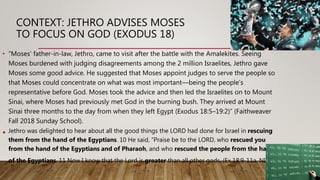
• “Moses’ father-in-law, Jethro, came to visit after the battle with the Amalekites. Seeing
Moses burdened with judging disagreements among the 2 million Israelites, Jethro gave
Moses some good advice. He suggested that Moses appoint judges to serve the people so
that Moses could concentrate on what was most important—being the people’s
representative before God. Moses took the advice and then led the Israelites on to Mount
Sinai, where Moses had previously met God in the burning bush. They arrived at Mount
Sinai three months to the day from when they left Egypt (Exodus 18:5–19:2)” (Faithweaver
Fall 2018 Sunday School).
• Jethro was delighted to hear about all the good things the LORD had done for Israel in rescuing
them from the hand of the Egyptians. 10 He said, “Praise be to the LORD, who rescued you
from the hand of the Egyptians and of Pharaoh, and who rescued the people from the hand
of the Egyptians. 11 Now I know that the Lord is greater than all other gods, (Ex 18:9-11a, NIV)
CONTEXT: MOSES RECEIVES THE
COMMANDMENTS FROM GOD: EX 19:1-15
• “A significant event is recorded in the next few verses (Exodus 19:3-9): God spoke to Moses
and promised him that Israel would be his treasured possession, his holy people—if they
would obey him. After Moses told the people what God had said, they responded
gratefully: “We will do everything the Lord has said.” God responded by telling Moses
that God himself would come down and speak with the Israelites from a cloud”
(Faithweaver Fall 2018 Sunday School).
• “The law God gave spelled out how the Israelites were to honor him through their
obedience. In the thousands of years that have passed since this event, one thing hasn’t
changed: The best way we can honor God is by obeying him” (Faithweaver Fall 2018 Sunday
School)
CONTEXT: KINGDOM OF PRIESTS (EX 19:3-6)
• 3 Then Moses went up to God, and the LORD called to him from the mountain
and said, “This is what you are to say to the descendants of Jacob and what you
are to tell the people of Israel: 4 ‘You yourselves have seen what I did to Egypt,
and how I carried you on eagles’ wings and brought you to myself. 5 Now if
you obey me fully and keep my covenant, then out of all nations you will be my
treasured possession. Although the whole earth is mine, 6 you will be for me
a kingdom of priests and a holy nation.’ These are the words you are to speak
to the Israelites” (Ex 19:3-6, NIV).
• Kingdom of priests: “identifies the nation as serving a priestly role among the
nations, as intermediary between the peoples and God” (IVP Background).
• Israel was to be God’s special vessel through which He would bless all nations
(Gen 12:3, NIV: “and all peoples on earth will be blessed through you”).
Consecrate: to make
holy (set apart), to utterly
devote for the LORD
TEXT: EXODUS 19:16-25
• 16 On the morning of the third day there was thunder and lightning, with a thick cloud over the
mountain, and a very loud trumpet blast. Everyone in the camp trembled. 17 Then Moses led the
people out of the camp to meet with God, and they stood at the foot of the mountain. 18 Mount Sinai
was covered with smoke, because the LORD descended on it in fire. The smoke billowed up from it
like smoke from a furnace, and the whole mountain trembled violently. 19 As the sound of the
trumpet grew louder and louder, Moses spoke and the voice of God answered him (Ex 19:16-19).
• 20 The LORD descended to the top of Mount Sinai and called Moses to the top of the mountain. So
Moses went up 21 and the LORD said to him, “Go down and warn the people so they do not force
their way through to see the LORD and many of them perish. 22 Even the priests, who approach the
LORD, must consecrate themselves, or the LORD will break out against them.” 23 Moses said to the
Lord, “The people cannot come up Mount Sinai, because you yourself warned us, ‘Put limits around the
mountain and set it apart as holy.’ ” 24 The Lord replied, “Go down and bring Aaron up with you. But
the priests and the people must not force their way through to come up to the Lord, or he will break
out against them.” 25 So Moses went down to the people and told them (Ex 19:20-25)
INDICATIVE BEFORE THE IMPERATIVE
• If a random person off the street tries to tell me what to do, that’s one thing. If my mama tells
me to do something that’s different. Because of what my mother has done for me…
• God makes it clear: And God spoke all these words: 2 “I am the LORD your God, who
brought you out of Egypt, out of the land of slavery” (Ex 20:1-2).
• In Genesis, God gives mankind orders to rule over and serve all creation after giving them life,
food, companionship, etc.
• In Romans, among other things we read how we all sin and fall short of the glory of God, that
the wages of sin is death, but that Christ died for us while we were still sinners -- as an
atoning sacrifice. If we confess with our mouths and believe in our Resurrected Lord, we will
be saved and will be indwelled and empowered by the Holy Spirit to become more and more
Christlike children of God.
• Therefore, I urge you, brothers and sisters, in view of God’s mercy, to offer your bodies as a
living sacrifice, holy and pleasing to God—this is your true and proper worship. 2 Do not
conform to the pattern of this world, but be transformed by the renewing of your mind. Then
you will be able to test and approve what God’s will is—his good, pleasing and perfect will
(Rom 12:1-2, NIV)
God doesn’t tell us what
to do without first telling
us what He’s done
Jews actually consider Ex 20:2 the first commandment!
ANYONE EVER GIVE YOU BAD DIRECTIONS?
• “If you want to get the most out of the Microsoft Windows, does it not make
sense to follow the instruction of Bill Gates – the creator of Microsoft
Windows?
• “If you want to cook a dish by Rachel Ray, does it not make sense to follow
the instruction of Rachel Ray, the creator of the recipe?
• “If you want to take care of your Civic, does it not make sense to follow
the instruction of Honda – the creator of the Civic?
• “If you want to get the most out of your life, does it not make sense to follow
the instruction of the Creator of Life?” (Trial Sermon)
• No longer slaves to Egyptians, but free to be fulfill their created purpose as
image-bearers of God (Gen 1:26-27), and as a kingdom of priests (Ex 19:6)
• The Ten Commandments tell them how – by giving directions
FIRST COMMANDMENT:
NO OTHER GODS
• 3 “You shall have no other gods before me.” (Ex 20:3)
• the phrase “before me” (ַַ‫י‬ ָָּֽ֗‫נ‬ָּ‫ל־פ‬ַ‫)ע‬ (more literally “before my face”) was used when referring to someone who took a second wife while the
first was still living
• the phrase “you shall have” (ַ‫ך‬ ְ‫ה־ל‬‫י‬ ְ‫ִה‬‫י‬) (more literally “to be to”) was used when forming a covenant or entering a marriage
• “You struck down Uriah the Hittite with the sword and took his wife to be your own. You killed him with the sword of the Ammonites.
10 Now, therefore, the sword will never depart from your house, because you despised me and took the wife of Uriah the Hittite to be
your own (ַ‫ך‬ ְ‫ֹותַל‬֥‫י‬ ְ‫ה‬ ִ‫’.)ל‬ (2 Sam 12:9b-10, NIV)
• In the ancient world, people worshipped a quid-pro-quo-provider “god” for almost everything (war, fertility, rain, etc.).
• God is saying: Be faithful to me, forsaking all others.
• Does not mean that there are other gods (cf. Dt. 4:39 “There is no other”), but what are some of the false gods that are often
worshipped?
• Money, power, fame, sex… Self
• “We are to entrust ourselves to God. Before anything else, God demands faith…The first commandment is the entryway to
keeping any other commandment.” (Allen)
• Without faith (i.e., active trust), it is impossible to please God (Heb 11:6).
WHAT DOES IT MEAN TO BE FAITHFUL?
• Abel brought God a better offering (Heb 11:4)
• Enoch was commended as one who pleased God (Heb 11:5)
• Noah built an ark (Heb 11:7)
• Abraham left his home country (Heb 11:8)
• “All these people were still living by faith when they died” (Heb 11:13, NIV)
• Abraham offered Isaac as a sacrifice (Heb 11:17f.)
• Isaac blessed Jacob and Esau (Heb 11:20), Jacob blessed Joseph’s sons (Heb
11:21)
• Joseph spoke about the Exodus, etc. (Heb 11:22), Moses’ parents hid him (Heb
11:23)
• Moses led his people (Heb 11:24f.), Rahab welcomed the spies (Heb 11:31f.)
• What is the pattern?
TRUST AND OBEY
• God is not pleased with “faith” that does come with action (Jas 2:14-26), nor with
action that does not come from faith
• We need to do both: trust and obey
• 5 Through him we received grace and apostleship to call all the Gentiles to the
obedience that comes from faith for his name’s sake. 6 And you also are
among those Gentiles who are called to belong to Jesus Christ (Rom 1:5-6, NIV)
• 25 Now to him who is able to establish you in accordance with my gospel, the
message I proclaim about Jesus Christ, in keeping with the revelation of the
mystery hidden for long ages past, 26 but now revealed and made known
through the prophetic writings by the command of the eternal God, so that all
the Gentiles might come to the obedience that comes from faith—27 to the
only wise God be glory forever through Jesus Christ! Amen (Rom 16:25-27, NIV).
JESUS CONNECTION:
WE ARE TO BE A KINGDOM OF PRIESTS
• 3 Then Moses went up to God, and the LORD called to him from the mountain and said, “This is what you are to say to the
descendants of Jacob and what you are to tell the people of Israel: 4 ‘You yourselves have seen what I did to Egypt, and how I
carried you on eagles’ wings and brought you to myself. 5 Now if you obey me fully and keep my covenant, then out of all nations
you will be my treasured possession [LXX: μοι λαὸς περιούσιος]. Although the whole earth is mine, 6 you will be for me a kingdom
of priests [LXX: βασίλειον ἱεράτευμα] and a holy nation [LXX: ἔθνος ἅγιον].’ These are the words you are to speak to the Israelites”
(Ex 19:3-6, NIV).
• Kingdom of priests: “identifies the nation as serving a priestly role among the nations, as intermediary between the peoples and
God” (IVP Background).
• Israel was to be God’s special vessel through which He would bless all nations (Gen 12:3, NIV: “and all peoples on earth will be
blessed through you”). So is the Church.
• “Scripture foresaw that God would justify the Gentiles by faith, and announced the gospel in advance to Abraham: “All nations will
be blessed through you” (Gal 3:8, NIV)
• 1 Pet 2:9, NIV: But you are a chosen people, a royal priesthood [βασίλειον ἱεράτευμα], a holy nation [ἔθνος ἅγιον], God’s treasured
possession [λαὸς εἰς περιποίησιν] that you may declare the praises of him who called you out of darkness into his wonderful light
• God works through us, His crown jewel, to bring the blessings of the Good News to the world!
CONCLUSION
• Why did the LORD lead Israel out of Egypt?
• Israel was led out of Egypt so that they worship the LORD and fulfill His purpose. We were led out
of the darkness of sin, so that we can worship the LORD and fulfill His purpose
• Who is God to command? (God, Who do you think you’re talking to?)
• God graciously freed Israel; Israel should faithfully serve God. The Son of God graciously freed
us from sin; we should faithfully serve the Son of God
• Christ died for us; we should live for Christ (2 Cor 5:15)
• God doesn’t tell us what to do without first telling us what He’s done
• (Ever Got Bad Directions?) God’s Good Directions
• We must trust and obey God
• Directions for fulfilling our purpose as creatures made in the image of God and as a kingdom
of priests through whom God blesses the world
To View or Download PowerPoint Slides:
bit.ly/10Cs-Pt1
BIBLIOGRAPHY
• Alexander, T. Desmond. “Exodus.” In New Bible Commentary: 21st Century Edition, edited by D. A. Carson, R. T. France, J. A. Motyer, and G. J. Wenham, 4th ed., 92–120.
Leicester, England; Downers Grove, IL: Inter-Varsity Press, 1994.
• Allen, R. Michael. ET101 Law and Gospel: The Basis of Christian Ethics. Logos Mobile Education. Bellingham, WA: Lexham Press, 2016.
• Bruckner, James K. Exodus. Edited by W. Ward Gasque, Robert L. Hubbard Jr., and Robert K. Johnston. Understanding the Bible Commentary Series. Grand Rapids, MI:
Baker Books, 2012.
• Cole, R. Alan. Exodus: An Introduction and Commentary. Vol. 2. Tyndale Old Testament Commentaries. Downers Grove, IL: InterVarsity Press, 1973.
• Durham, John I. Exodus. Vol. 3. Word Biblical Commentary. Dallas: Word, Incorporated, 1998.
• Elwell, Walter A. Evangelical Commentary on the Bible. Vol. 3. Baker Reference Library. Grand Rapids, MI: Baker Book House, 1995.
• Enns, Peter. Exodus. The NIV Application Commentary. Grand Rapids, MI: Zondervan, 2000.
• Hamilton, Victor P. Exodus: An Exegetical Commentary. Grand Rapids, MI: Baker Academic, 2011.
• Matthews, Victor Harold, Mark W. Chavalas, and John H. Walton. The IVP Bible Background Commentary: Old Testament. Electronic ed. Downers Grove, IL: InterVarsity
Press, 2000.
• Motyer, Alec. The Message of Exodus: The Days of Our Pilgrimage. Edited by Alec Motyer and Derek Tidball. The Bible Speaks Today. Nottingham, England: Inter-Varsity
Press, 2005.
• Sarna, Nahum M. Exodus. The JPS Torah Commentary. Philadelphia: Jewish Publication Society, 1991.
• Stuart, Douglas K. Exodus. Vol. 2. The New American Commentary. Nashville: Broadman & Holman Publishers, 2006.

Ten Commandments Part I | Sunday School 10.7.18 [Updated]

  • 1.
    GOD GIVES THETEN COMMANDMENTS (PART 1): EXODUS 19:16-20:3 DANNY SCOTTON JR ALPHA BAPTIST CHURCH, 10.7.18
  • 2.
    GOD GIVES THETEN COMMANDMENTS PART I: DISCUSSION QUESTIONS • Why did the LORD lead Israel out of Egypt? • Has someone ever told you to do something and you thought (or said!): "Who do you think you're talking to?" • Has anyone ever given you bad directions? • *Someone please find: Ex 3:12, Ex 5:1-2, Ex 6:6-8, Ex 19:3-6, Ex 19:16-20:3 • ** Link to PowerPoint Slides: bit.ly/10Cs-Pt1
  • 3.
    FIRST DISCUSSION QUESTION:WHY DID THE LORD LEAD ISRAEL OUT OF EGYPT? • 12 And God said, “I will be with you. And this will be the sign to you that it is I who have sent you: When you have brought the people out of Egypt, you will worship God on this mountain” (Ex 3:12, NIV) • Afterward Moses and Aaron went to Pharaoh and said, “This is what the LORD, the God of Israel, says: ‘Let my people go, so that they may hold a festival to me in the wilderness.’ ” 2 Pharaoh said, “Who is the LORD, that I should obey him and let Israel go? I do not know the LORD and I will not let Israel go” (Ex 5:1-2). • 6 “Therefore, say to the Israelites: ‘I am the LORD, and I will bring you out from under the yoke of the Egyptians. I will free you from being slaves to them, and I will redeem you with an outstretched arm and with mighty acts of judgment. 7 I will take you as my own people, and I will be your God. Then you will know that I am the LORD your God, who brought you out from under the yoke of the Egyptians. 8 And I will bring you to the land I swore with uplifted hand to give to Abraham, to Isaac and to Jacob. I will give it to you as a possession. I am the LORD." (Ex 6:6-8, NIV) • Then I will lay my hand on Egypt and with mighty acts of judgment I will bring out my divisions, my people the Israelites. 5 And the Egyptians will know that I am the LORD when I stretch out my hand against Egypt and bring the Israelites out of it.” (Ex 7:4b-5)
  • 4.
    FIRST DISCUSSION QUESTION:WHY DID THE LORD LEAD ISRAEL OUT OF EGYPT? • Then say to him, ‘The LORD, the God of the Hebrews, has sent me to say to you: Let my people go, so that they may worship me in the wilderness” (Ex 7:16, NIV). • Then the Lord said to Moses, “Go to Pharaoh and say to him, ‘This is what the Lord says: Let my people go, so that they may worship me” (Ex 8:1. NIV) • 20 Then the LORD said to Moses, “Get up early in the morning and confront Pharaoh as he goes to the river and say to him, ‘This is what the LORD says: Let my people go, so that they may worship me" (Ex 8:20, NIV) • Then the Lord said to Moses, “Go to Pharaoh and say to him, ‘This is what the Lord, the God of the Hebrews, says: “Let my people go, so that they may worship me” (Ex 9:1, NIV). • 13 Then the LORD said to Moses, “Get up early in the morning, confront Pharaoh and say to him, ‘This is what the LORD, the God of the Hebrews, says: Let my people go, so that they may worship me” (Ex 9:13) • So Moses and Aaron went to Pharaoh and said to him, “This is what the LORD, the God of the Hebrews, says: ‘How long will you refuse to humble yourself before me? Let my people go, so that they may worship me” (Ex 10:3, NIV)
  • 5.
    BACKGROUND: LAST WEEK’S LESSON:EXODUS 17:1-8 • The Israelites “they tested the Lord saying, “Is the LORD among us or not?” (NIV) • God commands Moses to strike the rock, and water comes out for the people to drink (Ex 17:6) • After everything God had done for them, the Israelites should not have doubted that the LORD was with them by testing God. Neither should we
  • 6.
    CONTEXT: THE ISRAELITESBATTLE THE AMALEKITES (EX 17:8-16) • “The Amalekites attacked the Israelites where they were camped. God had prepared the Israelites’ faith for this test through his provision for them in so many ways. So the Israelites put together an army under the leadership of Joshua and went on the attack. Moses held high in the air the staff that had struck the rock to get water—“the staff of God.” As long as Moses held the staff in the air, the Israelites continued to win—so Aaron and Hur helped hold Moses’ hands up, and the Israelites defeated the Amalekites (Exodus 17:8-16)” (Faithweaver Fall 2018 Sunday School). • Joshua leads the battle. Joshua = Yeshua = Jesus (Ἰησοῦς) means “The LORD [YHWH] Saves” • “She [Mary] will give birth to a son, and you are to give him the name Jesus, because he will save his people from their sins.” (Mt 1:21, NIV) • Moses builds an altar an calls it Jehovah [YHWH] Nissi, which means “The LORD is my Banner”(Ex 17:15)
  • 7.
    CONTEXT: JETHRO ADVISESMOSES TO FOCUS ON GOD (EXODUS 18) • “Moses’ father-in-law, Jethro, came to visit after the battle with the Amalekites. Seeing Moses burdened with judging disagreements among the 2 million Israelites, Jethro gave Moses some good advice. He suggested that Moses appoint judges to serve the people so that Moses could concentrate on what was most important—being the people’s representative before God. Moses took the advice and then led the Israelites on to Mount Sinai, where Moses had previously met God in the burning bush. They arrived at Mount Sinai three months to the day from when they left Egypt (Exodus 18:5–19:2)” (Faithweaver Fall 2018 Sunday School). • Jethro was delighted to hear about all the good things the LORD had done for Israel in rescuing them from the hand of the Egyptians. 10 He said, “Praise be to the LORD, who rescued you from the hand of the Egyptians and of Pharaoh, and who rescued the people from the hand of the Egyptians. 11 Now I know that the Lord is greater than all other gods, (Ex 18:9-11a, NIV)
  • 8.
    CONTEXT: MOSES RECEIVESTHE COMMANDMENTS FROM GOD: EX 19:1-15 • “A significant event is recorded in the next few verses (Exodus 19:3-9): God spoke to Moses and promised him that Israel would be his treasured possession, his holy people—if they would obey him. After Moses told the people what God had said, they responded gratefully: “We will do everything the Lord has said.” God responded by telling Moses that God himself would come down and speak with the Israelites from a cloud” (Faithweaver Fall 2018 Sunday School). • “The law God gave spelled out how the Israelites were to honor him through their obedience. In the thousands of years that have passed since this event, one thing hasn’t changed: The best way we can honor God is by obeying him” (Faithweaver Fall 2018 Sunday School)
  • 9.
    CONTEXT: KINGDOM OFPRIESTS (EX 19:3-6) • 3 Then Moses went up to God, and the LORD called to him from the mountain and said, “This is what you are to say to the descendants of Jacob and what you are to tell the people of Israel: 4 ‘You yourselves have seen what I did to Egypt, and how I carried you on eagles’ wings and brought you to myself. 5 Now if you obey me fully and keep my covenant, then out of all nations you will be my treasured possession. Although the whole earth is mine, 6 you will be for me a kingdom of priests and a holy nation.’ These are the words you are to speak to the Israelites” (Ex 19:3-6, NIV). • Kingdom of priests: “identifies the nation as serving a priestly role among the nations, as intermediary between the peoples and God” (IVP Background). • Israel was to be God’s special vessel through which He would bless all nations (Gen 12:3, NIV: “and all peoples on earth will be blessed through you”). Consecrate: to make holy (set apart), to utterly devote for the LORD
  • 10.
    TEXT: EXODUS 19:16-25 •16 On the morning of the third day there was thunder and lightning, with a thick cloud over the mountain, and a very loud trumpet blast. Everyone in the camp trembled. 17 Then Moses led the people out of the camp to meet with God, and they stood at the foot of the mountain. 18 Mount Sinai was covered with smoke, because the LORD descended on it in fire. The smoke billowed up from it like smoke from a furnace, and the whole mountain trembled violently. 19 As the sound of the trumpet grew louder and louder, Moses spoke and the voice of God answered him (Ex 19:16-19). • 20 The LORD descended to the top of Mount Sinai and called Moses to the top of the mountain. So Moses went up 21 and the LORD said to him, “Go down and warn the people so they do not force their way through to see the LORD and many of them perish. 22 Even the priests, who approach the LORD, must consecrate themselves, or the LORD will break out against them.” 23 Moses said to the Lord, “The people cannot come up Mount Sinai, because you yourself warned us, ‘Put limits around the mountain and set it apart as holy.’ ” 24 The Lord replied, “Go down and bring Aaron up with you. But the priests and the people must not force their way through to come up to the Lord, or he will break out against them.” 25 So Moses went down to the people and told them (Ex 19:20-25)
  • 11.
    INDICATIVE BEFORE THEIMPERATIVE • If a random person off the street tries to tell me what to do, that’s one thing. If my mama tells me to do something that’s different. Because of what my mother has done for me… • God makes it clear: And God spoke all these words: 2 “I am the LORD your God, who brought you out of Egypt, out of the land of slavery” (Ex 20:1-2). • In Genesis, God gives mankind orders to rule over and serve all creation after giving them life, food, companionship, etc. • In Romans, among other things we read how we all sin and fall short of the glory of God, that the wages of sin is death, but that Christ died for us while we were still sinners -- as an atoning sacrifice. If we confess with our mouths and believe in our Resurrected Lord, we will be saved and will be indwelled and empowered by the Holy Spirit to become more and more Christlike children of God. • Therefore, I urge you, brothers and sisters, in view of God’s mercy, to offer your bodies as a living sacrifice, holy and pleasing to God—this is your true and proper worship. 2 Do not conform to the pattern of this world, but be transformed by the renewing of your mind. Then you will be able to test and approve what God’s will is—his good, pleasing and perfect will (Rom 12:1-2, NIV) God doesn’t tell us what to do without first telling us what He’s done Jews actually consider Ex 20:2 the first commandment!
  • 12.
    ANYONE EVER GIVEYOU BAD DIRECTIONS? • “If you want to get the most out of the Microsoft Windows, does it not make sense to follow the instruction of Bill Gates – the creator of Microsoft Windows? • “If you want to cook a dish by Rachel Ray, does it not make sense to follow the instruction of Rachel Ray, the creator of the recipe? • “If you want to take care of your Civic, does it not make sense to follow the instruction of Honda – the creator of the Civic? • “If you want to get the most out of your life, does it not make sense to follow the instruction of the Creator of Life?” (Trial Sermon) • No longer slaves to Egyptians, but free to be fulfill their created purpose as image-bearers of God (Gen 1:26-27), and as a kingdom of priests (Ex 19:6) • The Ten Commandments tell them how – by giving directions
  • 13.
    FIRST COMMANDMENT: NO OTHERGODS • 3 “You shall have no other gods before me.” (Ex 20:3) • the phrase “before me” (ַַ‫י‬ ָָּֽ֗‫נ‬ָּ‫ל־פ‬ַ‫)ע‬ (more literally “before my face”) was used when referring to someone who took a second wife while the first was still living • the phrase “you shall have” (ַ‫ך‬ ְ‫ה־ל‬‫י‬ ְ‫ִה‬‫י‬) (more literally “to be to”) was used when forming a covenant or entering a marriage • “You struck down Uriah the Hittite with the sword and took his wife to be your own. You killed him with the sword of the Ammonites. 10 Now, therefore, the sword will never depart from your house, because you despised me and took the wife of Uriah the Hittite to be your own (ַ‫ך‬ ְ‫ֹותַל‬֥‫י‬ ְ‫ה‬ ִ‫’.)ל‬ (2 Sam 12:9b-10, NIV) • In the ancient world, people worshipped a quid-pro-quo-provider “god” for almost everything (war, fertility, rain, etc.). • God is saying: Be faithful to me, forsaking all others. • Does not mean that there are other gods (cf. Dt. 4:39 “There is no other”), but what are some of the false gods that are often worshipped? • Money, power, fame, sex… Self • “We are to entrust ourselves to God. Before anything else, God demands faith…The first commandment is the entryway to keeping any other commandment.” (Allen) • Without faith (i.e., active trust), it is impossible to please God (Heb 11:6).
  • 14.
    WHAT DOES ITMEAN TO BE FAITHFUL? • Abel brought God a better offering (Heb 11:4) • Enoch was commended as one who pleased God (Heb 11:5) • Noah built an ark (Heb 11:7) • Abraham left his home country (Heb 11:8) • “All these people were still living by faith when they died” (Heb 11:13, NIV) • Abraham offered Isaac as a sacrifice (Heb 11:17f.) • Isaac blessed Jacob and Esau (Heb 11:20), Jacob blessed Joseph’s sons (Heb 11:21) • Joseph spoke about the Exodus, etc. (Heb 11:22), Moses’ parents hid him (Heb 11:23) • Moses led his people (Heb 11:24f.), Rahab welcomed the spies (Heb 11:31f.) • What is the pattern?
  • 15.
    TRUST AND OBEY •God is not pleased with “faith” that does come with action (Jas 2:14-26), nor with action that does not come from faith • We need to do both: trust and obey • 5 Through him we received grace and apostleship to call all the Gentiles to the obedience that comes from faith for his name’s sake. 6 And you also are among those Gentiles who are called to belong to Jesus Christ (Rom 1:5-6, NIV) • 25 Now to him who is able to establish you in accordance with my gospel, the message I proclaim about Jesus Christ, in keeping with the revelation of the mystery hidden for long ages past, 26 but now revealed and made known through the prophetic writings by the command of the eternal God, so that all the Gentiles might come to the obedience that comes from faith—27 to the only wise God be glory forever through Jesus Christ! Amen (Rom 16:25-27, NIV).
  • 16.
    JESUS CONNECTION: WE ARETO BE A KINGDOM OF PRIESTS • 3 Then Moses went up to God, and the LORD called to him from the mountain and said, “This is what you are to say to the descendants of Jacob and what you are to tell the people of Israel: 4 ‘You yourselves have seen what I did to Egypt, and how I carried you on eagles’ wings and brought you to myself. 5 Now if you obey me fully and keep my covenant, then out of all nations you will be my treasured possession [LXX: μοι λαὸς περιούσιος]. Although the whole earth is mine, 6 you will be for me a kingdom of priests [LXX: βασίλειον ἱεράτευμα] and a holy nation [LXX: ἔθνος ἅγιον].’ These are the words you are to speak to the Israelites” (Ex 19:3-6, NIV). • Kingdom of priests: “identifies the nation as serving a priestly role among the nations, as intermediary between the peoples and God” (IVP Background). • Israel was to be God’s special vessel through which He would bless all nations (Gen 12:3, NIV: “and all peoples on earth will be blessed through you”). So is the Church. • “Scripture foresaw that God would justify the Gentiles by faith, and announced the gospel in advance to Abraham: “All nations will be blessed through you” (Gal 3:8, NIV) • 1 Pet 2:9, NIV: But you are a chosen people, a royal priesthood [βασίλειον ἱεράτευμα], a holy nation [ἔθνος ἅγιον], God’s treasured possession [λαὸς εἰς περιποίησιν] that you may declare the praises of him who called you out of darkness into his wonderful light • God works through us, His crown jewel, to bring the blessings of the Good News to the world!
  • 17.
    CONCLUSION • Why didthe LORD lead Israel out of Egypt? • Israel was led out of Egypt so that they worship the LORD and fulfill His purpose. We were led out of the darkness of sin, so that we can worship the LORD and fulfill His purpose • Who is God to command? (God, Who do you think you’re talking to?) • God graciously freed Israel; Israel should faithfully serve God. The Son of God graciously freed us from sin; we should faithfully serve the Son of God • Christ died for us; we should live for Christ (2 Cor 5:15) • God doesn’t tell us what to do without first telling us what He’s done • (Ever Got Bad Directions?) God’s Good Directions • We must trust and obey God • Directions for fulfilling our purpose as creatures made in the image of God and as a kingdom of priests through whom God blesses the world To View or Download PowerPoint Slides: bit.ly/10Cs-Pt1
  • 18.
    BIBLIOGRAPHY • Alexander, T.Desmond. “Exodus.” In New Bible Commentary: 21st Century Edition, edited by D. A. Carson, R. T. France, J. A. Motyer, and G. J. Wenham, 4th ed., 92–120. Leicester, England; Downers Grove, IL: Inter-Varsity Press, 1994. • Allen, R. Michael. ET101 Law and Gospel: The Basis of Christian Ethics. Logos Mobile Education. Bellingham, WA: Lexham Press, 2016. • Bruckner, James K. Exodus. Edited by W. Ward Gasque, Robert L. Hubbard Jr., and Robert K. Johnston. Understanding the Bible Commentary Series. Grand Rapids, MI: Baker Books, 2012. • Cole, R. Alan. Exodus: An Introduction and Commentary. Vol. 2. Tyndale Old Testament Commentaries. Downers Grove, IL: InterVarsity Press, 1973. • Durham, John I. Exodus. Vol. 3. Word Biblical Commentary. Dallas: Word, Incorporated, 1998. • Elwell, Walter A. Evangelical Commentary on the Bible. Vol. 3. Baker Reference Library. Grand Rapids, MI: Baker Book House, 1995. • Enns, Peter. Exodus. The NIV Application Commentary. Grand Rapids, MI: Zondervan, 2000. • Hamilton, Victor P. Exodus: An Exegetical Commentary. Grand Rapids, MI: Baker Academic, 2011. • Matthews, Victor Harold, Mark W. Chavalas, and John H. Walton. The IVP Bible Background Commentary: Old Testament. Electronic ed. Downers Grove, IL: InterVarsity Press, 2000. • Motyer, Alec. The Message of Exodus: The Days of Our Pilgrimage. Edited by Alec Motyer and Derek Tidball. The Bible Speaks Today. Nottingham, England: Inter-Varsity Press, 2005. • Sarna, Nahum M. Exodus. The JPS Torah Commentary. Philadelphia: Jewish Publication Society, 1991. • Stuart, Douglas K. Exodus. Vol. 2. The New American Commentary. Nashville: Broadman & Holman Publishers, 2006.

Editor's Notes

  • #5 I counted seven times “Here is the first, but not the last, demand from Yahweh (the Lord) to “Let my people go” (5:1; 7:16; 8:1, 20; 9:1, 13; 10:3; see also 4:22)”   James K. Bruckner, Exodus, ed. W. Ward Gasque, Robert L. Hubbard Jr., and Robert K. Johnston, Understanding the Bible Commentary Series (Grand Rapids, MI: Baker Books, 2012), 57.
  • #6 “By presenting an understandable need in an unreasonable way they exposed their false assumptions about the Lord and Moses.” James K. Bruckner, , ed. W. Ward Gasque, Robert L. Hubbard Jr., and Robert K. Johnston, Understanding the Bible Commentary Series (Grand Rapids, MI: Baker Books, 2012), 157. James K. Bruckner, Exodus, ed. W. Ward Gasque, Robert L. Hubbard Jr., and Robert K. Johnston, Understanding the Bible Commentary Series (Grand Rapids, MI: Baker Books, 2012), 157. “At the mountain the Lord’s presence would be, as at the sea, powerfully manifest for all to see (19:16–25). The rejection of that presence would also escalate. There the question would change from, “Is Yahweh there, or not?” to “Do we want Yahweh there?” (20:18–19)” James K. Bruckner, , ed. W. Ward Gasque, Robert L. Hubbard Jr., and Robert K. Johnston, Understanding the Bible Commentary Series (Grand Rapids, MI: Baker Books, 2012), 159. James K. Bruckner, Exodus, ed. W. Ward Gasque, Robert L. Hubbard Jr., and Robert K. Johnston, Understanding the Bible Commentary Series (Grand Rapids, MI: Baker Books, 2012), 159. “Second, they assumed that if the Lord tested, or “trained” them, they also were free to test the Lord. This is what one did with other kinds of gods. If the god did not produce results, one changed gods. This was the original form of conceiving and creating a god that is one’s personal “water boy.” They challenged the Lord as if the Lord were a false god, suggesting that if they were still thirsty, then the Lord was not really there (v. 7).” James K. Bruckner, , ed. W. Ward Gasque, Robert L. Hubbard Jr., and Robert K. Johnston, Understanding the Bible Commentary Series (Grand Rapids, MI: Baker Books, 2012), 157. James K. Bruckner, Exodus, ed. W. Ward Gasque, Robert L. Hubbard Jr., and Robert K. Johnston, Understanding the Bible Commentary Series (Grand Rapids, MI: Baker Books, 2012), 157.
  • #7 His name is found with various forms/spellings: הוֹשֵׁעַ, salvation (Num 13:8); יְהוֹשֻׁעַ, the Lord saves/delivers (Num 13:16; cf. 1 Chron 7:27); NT Ἰησοῦς (#2652), Jesus. Willem VanGemeren, ed., (Grand Rapids, MI: Zondervan Publishing House, 1997), 808. Willem VanGemeren, ed., New International Dictionary of Old Testament Theology & Exegesis (Grand Rapids, MI: Zondervan Publishing House, 1997), 808.
  • #10 Israel’s deliverance from Egypt is like an eagle swooping down to hover over its young and carrying them off to safety. (2) Eagles are also fierce birds of prey (e.g., Deut. 28:49; Jer. 4:13; 48:40; 49:22). Such imagery is also fitting for Exodus 19:4, for God behaved as a fierce predator with respect to Egypt in order to carry Israel to safety. Peter Enns, , The NIV Application Commentary (Grand Rapids, MI: Zondervan, 2000), 386387. Peter Enns, Exodus, The NIV Application Commentary (Grand Rapids, MI: Zondervan, 2000), 386–387. But having said this, I must make something else clear: That Israel’s faithfulness to the covenant is required should in no way be understood to mean that Israel worked for her salvation in the Old Testament. This entire scene at the mountain and the subsequent laws are predicated on verse 4, what God has done. The Israelites are not to keep the law in order for God to save them. They have already been saved; God has brought them out of Egypt. The law he now gives is the subsequent stage in Israel’s developing relationship with God. It is what is expected of a people already redeemed. It is law, but it is based on the prior establishment of the relationship between them by God’s good pleasure. The people do not earn their salvation; but once saved, they are obligated to act in a manner worthy of their high calling. This is true in the New Testament as well (see Eph. 4:1; 2 Thess. 1:11). Peter Enns, , The NIV Application Commentary (Grand Rapids, MI: Zondervan, 2000), 387. Peter Enns, Exodus, The NIV Application Commentary (Grand Rapids, MI: Zondervan, 2000), 387. As holy and priestly, Israel is the means by which God will, as his plan unfolds more and more, bring the nations to have knowledge of him Peter Enns, , The NIV Application Commentary (Grand Rapids, MI: Zondervan, 2000), 389. Peter Enns, Exodus, The NIV Application Commentary (Grand Rapids, MI: Zondervan, 2000), 389. Priests stand between God and humans to help bring the humans closer to God and to help dispense God’s truth, justice, favor, discipline, and holiness to humans Douglas K. Stuart, , vol. 2, The New American Commentary (Nashville: Broadman & Holman Publishers, 2006), 423. Douglas K. Stuart, Exodus, vol. 2, The New American Commentary (Nashville: Broadman & Holman Publishers, 2006), 423. Israel’s affirmative response will first of all mean the genesis of a people who will be Yahweh’s own סגלה “special treasure.” Greenberg (JAOS 71 [1951] 172–74) has linked this word to an Akkadian term, sikiltu, which refers to a personal collection or hoard. The image presented is that of the unique and exclusive possession, and that image is expanded by what appears to be an addition (“for to me belongs the whole earth”) to suggest the “crown jewel” of a large collection, the masterwork, the one-of-a-kind piece. John I. Durham, , vol. 3, Word Biblical Commentary (Dallas: Word, Incorporated, 1998), 262. John I. Durham, Exodus, vol. 3, Word Biblical Commentary (Dallas: Word, Incorporated, 1998), 262.
  • #12 This is a constant rhythm. Only after giving life and provision and promise, all sorts of blessings, does God encounter the man and the woman in Gen 1 with a mandate and a calling or vocation. Only after freeing Israel from bondage in Egypt does God, atop Sinai, give them a law commanding them, demanding certain behavior from them. And even there in the Ten Commandments, of course, it is prompted by, it is headed by the statement, “I am the Lord your God, who brought you out”—of slavery, of Egypt, of so much trouble, of death itself. The indicative statement of what God has done and is doing always precedes the imperative statement of what God expects from us. R. Michael Allen, , Logos Mobile Education (Bellingham, WA: Lexham Press, 2016). R. Michael Allen, ET101 Law and Gospel: The Basis of Christian Ethics, Logos Mobile Education (Bellingham, WA: Lexham Press, 2016). Of course, Paul, more than anyone else, demonstrates this indicative-imperative dynamic order in all of his epistles. Almost every epistle is marked by a structural order R. Michael Allen, , Logos Mobile Education (Bellingham, WA: Lexham Press, 2016). R. Michael Allen, ET101 Law and Gospel: The Basis of Christian Ethics, Logos Mobile Education (Bellingham, WA: Lexham Press, 2016).
  • #14 Before me: literally, ‘to my face’. This slightly unusual phrase seems also to be used of taking a second wife while the first is still alive. Such a use, of breach of an exclusive personal relationship, would help to explain the meaning here R. Alan Cole, , vol. 2, Tyndale Old Testament Commentaries (Downers Grove, IL: InterVarsity Press, 1973), 161. R. Alan Cole, Exodus: An Introduction and Commentary, vol. 2, Tyndale Old Testament Commentaries (Downers Grove, IL: InterVarsity Press, 1973), 161. The Hebrew idiom hayah le suggests language similar to forming a covenant or entering marriage Peter Enns, , The NIV Application Commentary (Grand Rapids, MI: Zondervan, 2000), 414. Peter Enns, Exodus, The NIV Application Commentary (Grand Rapids, MI: Zondervan, 2000), 414. R. Michael Allen, , Logos Mobile Education (Bellingham, WA: Lexham Press, 2016). R. Michael Allen, ET101 Law and Gospel: The Basis of Christian Ethics, Logos Mobile Education (Bellingham, WA: Lexham Press, 2016). There were gods for various facets of life, and you offered worship to them such that in a quid pro quo manner, they would then offer certain protections or benefits to you and to your family. R. Michael Allen, , Logos Mobile Education (Bellingham, WA: Lexham Press, 2016). R. Michael Allen, ET101 Law and Gospel: The Basis of Christian Ethics, Logos Mobile Education (Bellingham, WA: Lexham Press, 2016). The final clause of v. 23 (“Everything that does not come from faith is sin”) is applicable on a much wider scale than the immediate context. Whatever is done without the conviction that God has approved it is by definition sin.133 God has called us to a life of faith. Trust is the p 259 willingness to put all of life before God for his approval. Any doubt concerning an action automatically removes that action from the category of that which is acceptable. This principle will be of special help to the Christian in what is sometimes called the “gray area.” If it is gray to you, it is wrong—not in itself necessarily but for the one who is considering it. Robert H. Mounce, , vol. 27, The New American Commentary (Nashville: Broadman & Holman Publishers, 1995), 258259. Robert H. Mounce, Romans, vol. 27, The New American Commentary (Nashville: Broadman & Holman Publishers, 1995), 258–259. sin is not only a matter of behaviors, but of motives Craig S. Keener, Romans, New Covenant Commentary Series (Eugene, OR: Cascade Books, 2009), 168. Hebrew does not feature a verb “to have” but expresses possession by h-y-h le-, literally “to be to.” Since the idea of possession necessarily involves relationship, the same term is used for entering into the marriage bond and for establishing the covenant between God and Israel Nahum M. Sarna, , The JPS Torah Commentary (Philadelphia: Jewish Publication Society, 1991), 109. Nahum M. Sarna, Exodus, The JPS Torah Commentary (Philadelphia: Jewish Publication Society, 1991), 109. Sole allegiance to ‘the Lord’ lies at the very heart of the covenant relationship. It is the foundation upon which everything else rests. T. Desmond Alexander, in New Bible Commentary: 21st Century Edition, ed. D. A. Carson et al., 4th ed. (Leicester, England; Downers Grove, IL: Inter-Varsity Press, 1994), 107. T. Desmond Alexander, “Exodus,” in New Bible Commentary: 21st Century Edition, ed. D. A. Carson et al., 4th ed. (Leicester, England; Downers Grove, IL: Inter-Varsity Press, 1994), 107.
  • #16 Our actions and our works are unto God’s glory because they’re not simply actions or works. They are works of faith and actions of trust. R. Michael Allen, , Logos Mobile Education (Bellingham, WA: Lexham Press, 2016). R. Michael Allen, ET101 Law and Gospel: The Basis of Christian Ethics, Logos Mobile Education (Bellingham, WA: Lexham Press, 2016).
  • #17  Victor Harold Matthews, Mark W. Chavalas, and John H. Walton, , electronic ed. (Downers Grove, IL: InterVarsity Press, 2000), Ex 19:56. Victor Harold Matthews, Mark W. Chavalas, and John H. Walton, The IVP Bible Background Commentary: Old Testament, electronic ed. (Downers Grove, IL: InterVarsity Press, 2000), Ex 19:5–6. Whether realized at the time or not, this was to be the mission of Israel (cf. the ultimate promise to Abraham in Gen. 12:3). R. Alan Cole, , vol. 2, Tyndale Old Testament Commentaries (Downers Grove, IL: InterVarsity Press, 1973), 153. R. Alan Cole, Exodus: An Introduction and Commentary, vol. 2, Tyndale Old Testament Commentaries (Downers Grove, IL: InterVarsity Press, 1973), 153. the good news of salvation was to be extended to all peoples, including the Gentiles, who would be declared righteous by God, just like Abraham, on the basis of faith Timothy George, , vol. 30, The New American Commentary (Nashville: Broadman & Holman Publishers, 1994), 225. Timothy George, Galatians, vol. 30, The New American Commentary (Nashville: Broadman & Holman Publishers, 1994), 225.