
Lesson 4
The name of God:
YHWH, the Eternal One
‘El Shaddai, God Almighty
The name of the person:
Abram/Abraham
The covenant:
Stages
Obligations
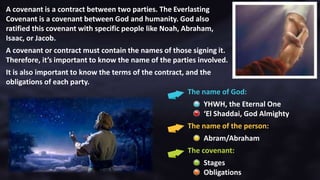
A covenant is a contract between two parties. The Everlasting
Covenant is a covenant between God and humanity. God also
ratified this covenant with specific people like Noah, Abraham,
Isaac, or Jacob.
A covenant or contract must contain the names of those signing it.
Therefore, it’s important to know the name of the parties involved.
It is also important to know the terms of the contract, and the
obligations of each party.
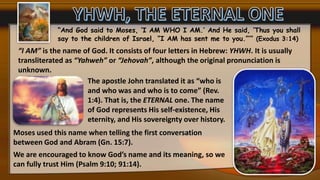
“And God said to Moses, ‘I AM WHO I AM.’ And He said, ‘Thus you shall
say to the children of Israel, “I AM has sent me to you.”’” (Exodus 3:14)
“I AM” is the name of God. It consists of four letters in Hebrew: YHWH. It is usually
transliterated as “Yahweh” or “Jehovah”, although the original pronunciation is
unknown.
The apostle John translated it as “who is
and who was and who is to come” (Rev.
1:4). That is, the ETERNAL one. The name
of God represents His self-existence, His
eternity, and His sovereignty over history.
Moses used this name when telling the first conversation
between God and Abram (Gn. 15:7).
We are encouraged to know God’s name and its meaning, so we
can fully trust Him (Psalm 9:10; 91:14).
“I AM means an eternal presence; the
past, present, and future are alike with
God. He sees the most remote events of
past history and the far distant future
with as clear a vision as we do those
things which are transpiring daily. We
know not what is before us, and if we
did, it would not contribute to our
eternal welfare. God gives us an
opportunity to exercise faith and trust in
the great I AM.” E.G.W. (That I May Know Him, January 6)
When God ratified His covenant with Abram, He introduced
Himself as God Almighty [‘El Shaddai] (Gn. 17:1). Abram
could not have a child because of the weakness and fragility
of the fallen human nature. Nevertheless, the Almighty One
had enough power to make it possible (Gn. 17:6).
Isaac blessed Jacob in the name of ‘El Shaddai (Gn. 28:3), and God appeared
before Jacob using this name (Gn. 35:11). Jacob also used the same name to
bless others (Gn. 43:14; 48:3; 49:25).
God is Almighty, and He also has endless
riches. He’s willing to give from these
riches to everyone who seek them with
faith and obedience (Phil. 4:19).
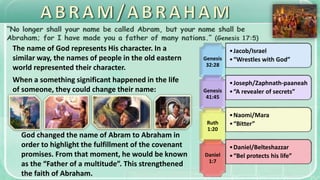
The name of God represents His character. In a
similar way, the names of people in the old eastern
world represented their character.
When a something significant happened in the life
of someone, they could change their name:
Genesis
32:28
•Jacob/Israel
•“Wrestles with God”
Genesis
41:45
•Joseph/Zaphnath-paaneah
•“A revealer of secrets”
Ruth
1:20
•Naomi/Mara
•“Bitter”
Daniel
1:7
•Daniel/Belteshazzar
•“Bel protects his life”
God changed the name of Abram to Abraham in
order to highlight the fulfillment of the covenant
promises. From that moment, he would be known
as the “Father of a multitude”. This strengthened
the faith of Abraham.
“Now the Lord had said to Abram: ‘Get out of your
country, from your family and from your father’s
house, to a land that I will show you.’” (Genesis 12:1)
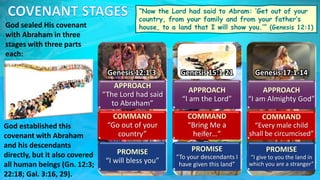
God sealed His covenant
with Abraham in three
stages with three parts
each:
APPROACH
“The Lord had said
to Abraham”
COMMAND
“Go out of your
country”
PROMISE
“I will bless you”
APPROACH
“I am the Lord”
COMMAND
“Bring Me a
heifer…”
PROMISE
“To your descendants I
have given this land”
APPROACH
“I am Almighty God”
COMMAND
“Every male child
shall be circumcised”
PROMISE
“I give to you the land in
which you are a stranger”
God established this
covenant with Abraham
and his descendants
directly, but it also covered
all human beings (Gn. 12:3;
22:18; Gal. 3:16, 29).
Genesis 12:1-3 Genesis 15:1-21 Genesis 17:1-14
This is a covenant of grace. It was God’s initiative, and
He offers to do for us what we cannot. However, it’s not
a unilateral covenant.
Those who accept God’s covenant have to do their part.
The covenant is broken when we disobey God.
But don’t get it wrong. God does not save us because
we obey Him. He saves us by grace alone (Eph. 2:8).
Then our obedience to His Law reflects our response of
faith and love (James 2:17).
God uses our obedience to fulfill the promises of His
covenant in us.
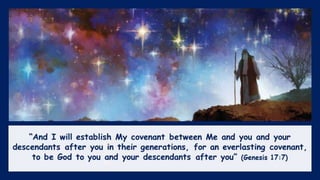
“And you shall be circumcised in the flesh of your foreskins, and it
shall be a sign of the covenant between Me and you.” (Genesis 17:11)
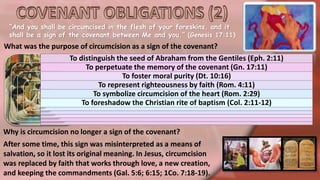
What was the purpose of circumcision as a sign of the covenant?
To distinguish the seed of Abraham from the Gentiles (Eph. 2:11)
To perpetuate the memory of the covenant (Gn. 17:11)
To foster moral purity (Dt. 10:16)
To represent righteousness by faith (Rom. 4:11)
To symbolize circumcision of the heart (Rom. 2:29)
To foreshadow the Christian rite of baptism (Col. 2:11-12)
Why is circumcision no longer a sign of the covenant?
After some time, this sign was misinterpreted as a means of
salvation, so it lost its original meaning. In Jesus, circumcision
was replaced by faith that works through love, a new creation,
and keeping the commandments (Gal. 5:6; 6:15; 1Co. 7:18-19).
“When the principle of love is
implanted in the heart, when man is
renewed after the image of Him that
created him, the new-covenant promise
is fulfilled, ‘I will put My laws into their
hearts, and in their minds will I write
them.’ Hebrews 10:16. And if the law is
written in the heart, will it not shape
the life? Obedience—the service and
allegiance of love—is the true sign of
discipleship.” E.G.W. (Steps to Christ, cp. 7, p. 60)

04 an everlasting covenant

  • 1.
  • 3.
    The name ofGod: YHWH, the Eternal One ‘El Shaddai, God Almighty The name of the person: Abram/Abraham The covenant: Stages Obligations A covenant is a contract between two parties. The Everlasting Covenant is a covenant between God and humanity. God also ratified this covenant with specific people like Noah, Abraham, Isaac, or Jacob. A covenant or contract must contain the names of those signing it. Therefore, it’s important to know the name of the parties involved. It is also important to know the terms of the contract, and the obligations of each party.
  • 4.
    “And God saidto Moses, ‘I AM WHO I AM.’ And He said, ‘Thus you shall say to the children of Israel, “I AM has sent me to you.”’” (Exodus 3:14) “I AM” is the name of God. It consists of four letters in Hebrew: YHWH. It is usually transliterated as “Yahweh” or “Jehovah”, although the original pronunciation is unknown. The apostle John translated it as “who is and who was and who is to come” (Rev. 1:4). That is, the ETERNAL one. The name of God represents His self-existence, His eternity, and His sovereignty over history. Moses used this name when telling the first conversation between God and Abram (Gn. 15:7). We are encouraged to know God’s name and its meaning, so we can fully trust Him (Psalm 9:10; 91:14).
  • 5.
    “I AM meansan eternal presence; the past, present, and future are alike with God. He sees the most remote events of past history and the far distant future with as clear a vision as we do those things which are transpiring daily. We know not what is before us, and if we did, it would not contribute to our eternal welfare. God gives us an opportunity to exercise faith and trust in the great I AM.” E.G.W. (That I May Know Him, January 6)
  • 6.
    When God ratifiedHis covenant with Abram, He introduced Himself as God Almighty [‘El Shaddai] (Gn. 17:1). Abram could not have a child because of the weakness and fragility of the fallen human nature. Nevertheless, the Almighty One had enough power to make it possible (Gn. 17:6). Isaac blessed Jacob in the name of ‘El Shaddai (Gn. 28:3), and God appeared before Jacob using this name (Gn. 35:11). Jacob also used the same name to bless others (Gn. 43:14; 48:3; 49:25). God is Almighty, and He also has endless riches. He’s willing to give from these riches to everyone who seek them with faith and obedience (Phil. 4:19).
  • 7.
    The name ofGod represents His character. In a similar way, the names of people in the old eastern world represented their character. When a something significant happened in the life of someone, they could change their name: Genesis 32:28 •Jacob/Israel •“Wrestles with God” Genesis 41:45 •Joseph/Zaphnath-paaneah •“A revealer of secrets” Ruth 1:20 •Naomi/Mara •“Bitter” Daniel 1:7 •Daniel/Belteshazzar •“Bel protects his life” God changed the name of Abram to Abraham in order to highlight the fulfillment of the covenant promises. From that moment, he would be known as the “Father of a multitude”. This strengthened the faith of Abraham.
  • 8.
    “Now the Lordhad said to Abram: ‘Get out of your country, from your family and from your father’s house, to a land that I will show you.’” (Genesis 12:1) God sealed His covenant with Abraham in three stages with three parts each: APPROACH “The Lord had said to Abraham” COMMAND “Go out of your country” PROMISE “I will bless you” APPROACH “I am the Lord” COMMAND “Bring Me a heifer…” PROMISE “To your descendants I have given this land” APPROACH “I am Almighty God” COMMAND “Every male child shall be circumcised” PROMISE “I give to you the land in which you are a stranger” God established this covenant with Abraham and his descendants directly, but it also covered all human beings (Gn. 12:3; 22:18; Gal. 3:16, 29). Genesis 12:1-3 Genesis 15:1-21 Genesis 17:1-14
  • 9.
    This is acovenant of grace. It was God’s initiative, and He offers to do for us what we cannot. However, it’s not a unilateral covenant. Those who accept God’s covenant have to do their part. The covenant is broken when we disobey God. But don’t get it wrong. God does not save us because we obey Him. He saves us by grace alone (Eph. 2:8). Then our obedience to His Law reflects our response of faith and love (James 2:17). God uses our obedience to fulfill the promises of His covenant in us.
  • 10.
    “And you shallbe circumcised in the flesh of your foreskins, and it shall be a sign of the covenant between Me and you.” (Genesis 17:11) What was the purpose of circumcision as a sign of the covenant? To distinguish the seed of Abraham from the Gentiles (Eph. 2:11) To perpetuate the memory of the covenant (Gn. 17:11) To foster moral purity (Dt. 10:16) To represent righteousness by faith (Rom. 4:11) To symbolize circumcision of the heart (Rom. 2:29) To foreshadow the Christian rite of baptism (Col. 2:11-12) Why is circumcision no longer a sign of the covenant? After some time, this sign was misinterpreted as a means of salvation, so it lost its original meaning. In Jesus, circumcision was replaced by faith that works through love, a new creation, and keeping the commandments (Gal. 5:6; 6:15; 1Co. 7:18-19).
  • 11.
    “When the principleof love is implanted in the heart, when man is renewed after the image of Him that created him, the new-covenant promise is fulfilled, ‘I will put My laws into their hearts, and in their minds will I write them.’ Hebrews 10:16. And if the law is written in the heart, will it not shape the life? Obedience—the service and allegiance of love—is the true sign of discipleship.” E.G.W. (Steps to Christ, cp. 7, p. 60)