2 6 3 
Piotr Kozarzewski 
Corporate Governance and Secondary 
Privatisation in Poland: Legal Framework 
and Changes in Ownership Structure 
W a r s a w , D e c e m b e r 2 0 0 3
Materials published here have a working paper character. They can be subject to further 
publication. The views and opinions expressed here reflect the author(s) point of view 
and not necessarily those of the CASE. 
This paper was prepared for the research project “Partnership for Corporate 
Governance and Secondary Privatization in Transition”. The grant funding was provided 
under the U.S. Agency for International Development SEGIR EP Contract No. PCE-I-00- 
00-00014-00, reference Russia Task Order No. 803 Improvement of Economic Policy 
Through Think Tank Partnership Project. The opinions, findings and conclusions or re-commendations 
expressed herein are those of the author and do not necessarily reflect 
the views of the U.S. Agency for International Development. 
Keywords: corporate governance, privatization, enterprise restructuring, Poland. 
© CASE – Center for Social and Economic Research, Warsaw 2003 
Graphic Design: Agnieszka Natalia Bury 
DTP: CeDeWu Sp. z o.o. 
ISSN 1506-1701, ISBN 83-7178-319-1 
Publisher: 
CASE – Center for Social and Economic Research 
ul. Sienkiewicza 12, 00-944 Warsaw, Poland 
tel.: (48 22) 622 66 27, 828 61 33, fax: (48 22) 828 60 69 
e-mail: case@case.com.pl 
http://www.case.com.pl
Contents 
Abstract . . . . . . . . . . . . . . . . . . . . . . . . . . . . . . . . . . . . . . . . . . 5 
1. Introduction . . . . . . . . . . . . . . . . . . . . . . . . . . . . . . . . . . . . . . 6 
2. Legal framework . . . . . . . . . . . . . . . . . . . . . . . . . . . . . . . . . . . 6 
2.1. Privatisation . . . . . . . . . . . . . . . . . . . . . . . . . . . . . . . . . . . . . . . 6 
2.2. Corporate governance structures within an enterprise . . . . . . . 9 
2.3. External aspects of corporate governance . . . . . . . . . . . . . . . 14 
2.3.1. Capital market . . . . . . . . . . . . . . . . . . . . . . . . . . . . . . . 14 
2.3.2. Investment Funds . . . . . . . . . . . . . . . . . . . . . . . . . . . . . 16 
2.3.3. Banks . . . . . . . . . . . . . . . . . . . . . . . . . . . . . . . . . . . . . . 17 
2.3.4. Insurance companies . . . . . . . . . . . . . . . . . . . . . . . . . . . 17 
2.3.5. Bankruptcies . . . . . . . . . . . . . . . . . . . . . . . . . . . . . . . . . 18 
3. Changes in ownership structure . . . . . . . . . . . . . . . . . . . . . . 18 
3.1. Initial conditions for secondary privatisation . . . . . . . . . . . . . . 18 
3.2. Evolution of ownership structure . . . . . . . . . . . . . . . . . . . . . . 19 
3.2.1. Direct (capital) privatisation. . . . . . . . . . . . . . . . . . . . . . 20 
3.2.2. Direct privatisation . . . . . . . . . . . . . . . . . . . . . . . . . . . . 26 
3.2.3. Studies on assets distribution and redistribution. . . . . . . 29 
4. Conclusions . . . . . . . . . . . . . . . . . . . . . . . . . . . . . . . . . . . . . . 29 
References . . . . . . . . . . . . . . . . . . . . . . . . . . . . . . . . . . . . . . . . 31 
Legal acts and other regulations . . . . . . . . . . . . . . . . . . . . . . . . 33
Piotr Kozarzewski 
Piotr Kozarzewski (born 1960) is a member of the Council of the CASE – Center for 
Social and Economic Research, Warsaw, and Senior Research Fellow at the Institute 
of Political Studies, Polish Academy of Sciences in Warsaw, Poland. He participated 
in numerous research and advisory projects on privatization and restructuring of 
state enterprises in Poland and other post-Communist countries. 
4 
Studies & Analyses No. 263 – P. Kozarzewski
Abstract 
The task of this paper is to provide information and analysis on the legal framework 
of privatisation and corporate governance in Poland and on secondary privatisation pro-cesses 
in Polish privatised enterprises, i.e. changes in ownership structure which are 
taking place after privatisation. The role of regulatory framework in secondary 
privatisation processes is also shown (besides a number of economic, social, 
gnoseological, and other factors). 
5 
Studies & Analyses No. 263 – Corporate Governance and Secondary Privatisation ...
1. Introduction1 
The task of this paper is to provide information and analysis on two topics: 
– legal framework of privatisation and corporate governance in Poland; 
– secondary privatisation in Polish privatised enterprises, e.g. changes in ownership 
structure which are taking place after privatisation. 
The role of regulatory framework in secondary privatisation processes will also be 
shown (besides a number of economic, social, gnoseological, and other factors). 
2. Legal framework 
Polish legal system represents the Roman model, where all rules and regulations are 
codified. In unclear and contradictory cases, supreme legal authorities interpret the 
existing law, providing guidelines for courts. 
Poland has all main legal acts which regulate economic activity of legal entities and 
their governance, as well as functioning of capital, financial and other markets. The law 
regulates both institutional building and behaviour of participants of economic relations. 
In our field of interest, legal acts regulate the following spheres: 
– de-etatisation and privatisation processes; 
– internal structure and functioning of companies; 
– external conditions for the companies, including markets and institutions with whom 
companies have to interact. 
Quite often specific legal acts cover more than one sphere of regulation; on the other 
hand, specific elements of companies’ life are often regulated by more than one legal act. 
2.1. Privatisation 
The main privatisation act is the Act of August 30, 1996 on Commercialisation and 
Privatisation of State-owned Enterprises which came into effect only in April, 1997. 
6 
Studies & Analyses No. 263 – P. Kozarzewski 
1 The author wishes to thank Barbara B³aszczyk and Richard Woodward from CASE for their helpful 
comments and suggestions.
Before that, the Act of July 13, 1990 on Privatisation of State-owned Enterprises had been 
in force. The law distinguish two basic privatisation methods: indirect and direct. 
The indirect (formerly called capital) method consists of two stages. At the first stage, 
a state-owned enterprise (SOE) is commercialised, i.e., it changes its legal form and is 
transformed into a company, where 100 per cent of shares belong to the Treasury (so-called 
sole-shareholder company of the Treasury, Polish acronym: JSSP), and begins to 
operate under provisions of the Company Code, common to all entities (except state-owned 
enterprises and a limited number of companies which are governed by special 
legal acts). At the second stage, the sale of the shares takes place in a number of ways: 
public offering, sale to strategic investor (or combination of these two) and inclusion to 
National Investment Fund program. 
On April 30, 1993, the Act on National Investment Funds (NIF) was adopted 
introducing a kind of mass privatisation program which, contrary to such programs in 
other post-Communist countries, had been designed not only to transfer a significant part 
of the state’s sectors assets to Polish citizens, but also to create a mechanism for actively 
restructuring the companies participating in mass privatisation. NIFs received blocks of 
shares of 512 companies which undergo mass privatisation, and Polish citizens received a 
kind of vouchers which they could invest in the NIFs. It is worth noting, that mass 
character of NIF program was only a demand side (all Polish citizens), and not on supply 
side, as in other countries where mass privatisation took place. The NIF program was 
supposed to accelerate the pace of privatisation, at the same time providing for 
restructuring of companies, facilitated by the experience of the professional management 
companies employed by the NIFs. These goals were never achieved. 
The direct (formerly somewhat misleadingly called liquidation) method consists of 
liquidation of a SOE in a legal sense; then, the assets of the enterprise (in totality or 
divided into separated organized parts) are privatised in one of the three possible ways 
(in Poland often called “paths”): 
– sale; 
– entering as a contribution in kind into a company established by the Treasury and a 
private investor; 
– leasing (employee buy-out). 
The last path needs more attention because it was very popular and is Polish 
contribution into methodology of post-Communist privatisation. A SOE can enter this 
path only on the request and with consent of insiders. A company (as a rule, LLC) with 
participation of employees is being set up which leases the equity of formally liquidated 
SOE. The company signs a leasing contract with the Treasury. The contract provisions 
stipulate that upon repayment of all the capital instalments and leasing fees the assets of 
the liquidated SOE will become the property of the company. 
7 
Studies & Analyses No. 263 – Corporate Governance and Secondary Privatisation ...
Another method of privatisation was provided by Art. 19 of the Act of September 25, 
1981 on State-owned Enterprises. It applies to SOEs in financial distress — the enterprise 
is liquidated and its assets are sold out. Some enterprises in agricultural sector are 
privatised according to the principles provided by the Act of October 19, 1991 on 
Management of Agriculture Property of the Treasury. There are also separate acts 
devoted to ownership transformation of certain enterprises and sectors of the economy. 
Recently, a number of acts have been adopted which link privatisation with sectoral 
restructuring. 
All methods and paths of privatisation are equivalent (buyers pay market price or the 
prise based on valuation), except the NIF program, where certificates of ownership have 
been distributed among the population for a small fee. 
Polish privatisation law is much diversified, if not to say eclectic. It reflects lack of 
consensus of Polish politicians on the scope and ways of ownership transformation, and 
more generally – on the principles of the post-Communist transformation as a whole. 
The privatisation law represents a certain compromise between two main options: liberal 
conceptions patterned after solutions adopted in developed Capitalist countries, and 
participatory approach originating from the Polish labour self-management movement 
and tending towards a kind of “third road” of development through building of the so-called 
“social market economy.” Some provisions of the law were also intended to 
overcome the assumed resistance of insiders. 
The privatisation law regulates not only the privatisation process itself, but also in 
some cases the initial corporate governance structure, including initial ownership 
distribution and composition of corporate governance bodies. The scope and character 
of the impact of the regulations depends on the privatisation method applied (see also the 
next section). However, the common feature is preferences for insiders, both in starting 
privatisation, and in distribution of shares. Before the privatisation act of 1996 was 
adopted, all privatisation deals had been initiated or had needed to be approved by the 
governing bodies of SOEs. In 1997, such a requirement was lifted. 
According to the 1990 Act, in indirect (capital) privatisation employees had a right to 
acquire 10 per cent of shares at reduced price; these preferences were increased by the 
1996 Act by granting a right to insiders to acquire 15 per cent of shares for free. Another 
15 per cent can be received for free by farmers and fishermen if they were suppliers of 
the former SOE (with restrictions regarding the volume of supplies). Besides, the new 
Act lifted the requirement that JSSPs, as a transitional entity, should be privatised within 
2 years after commercialisation. It introduced a legal background for impeding ownership 
transformation in this group of companies. 
Until 1997, the leasing path of direct privatisation preferred extremely insiderised 
patterns of ownership structure: the new company should have been founded by the 
8 
Studies & Analyses No. 263 – P. Kozarzewski
majority of employees, no institutional outsiders were permitted (unless accepted by the 
Ministry of Ownership Transformation). The Act of 1996 imposes certain limits on the 
use of direct privatisation paths and the role of insiders in ownership transformation. 
Limits have been set on the size of enterprises (in terms of employment level, assets and 
turnover); outsiders gained a right to take initiative in privatisation without prior consent 
of insiders; in leasing path, at least 20 per cent of shares in the new company must be in 
the hands of outsiders; possibilities of participation of legal persons have been increased. 
2.2. Corporate governance structures within an enterprise 
The main act which regulates corporate governance relations at a company level is 
the Company Code of September 15, 2000 (enacted on January 1, 2001). It replaces the 
Commercial Code of June 27, 1934. 
In Poland, the continental model of corporate governance structure is developing. 
This model adopts the principle of strict separation between the management function 
and the ownership control function, as distinct from the Anglo-Saxon model in which 
these functions are to a large extent combined. The adoption of the continental model as 
the target, assuring a strict owner control over the company’s executive bodies is 
particularly important, as in Poland, as well as in other post-communist countries, the 
influence of external control (in the form of commodity, financial, take-over and other 
markets) is in many cases still not sufficiently effective. In such conditions, efficient 
functioning of the internal supervision assumes fundamental importance. Moreover, the 
continental model assumes the significant role of a strategic investor, who, especially 
foreign one, is able to bring to a company not only capital, but also a new culture of 
management, of company’s behaviour towards its environment, new technology etc. 
which are badly needed in a post-Communist country. 
On a company level, it means two-tier system with separate executive and 
supervisory boards. Supervisory boards are compulsory in all JSCs and large LLCs. As a 
rule, supervisory board members are elected at the shareholders’ meeting (group voting 
is possible). In most cases, supervisory board appoints the members of the executive 
board (in general, the supervisory board’s position vis-à-vis executive board has been 
strengthened in the new Code). Formally, supervisory board has a wide range of powers, 
especially controlling ones, as a safeguard against opportunism of managers. It supervises 
all spheres of the company’s functioning and has a right to study all documentation and 
to receive all necessary information not only from executive board members, but also 
from every employee in the company. Supervisory board’s powers can be fine-tuned in 
9 
Studies & Analyses No. 263 – Corporate Governance and Secondary Privatisation ...
order to reflect the needs of corporate governance in a specific company. In practice, 
however, widespread weak role of this body in the corporate governance system is 
reported in the surveys, executive boards often being the most influential body (this 
situation is jokingly called “Vistula model” of corporate governance,2 as opposed to 
continental and Anglo-Saxon models). 
In most cases, Polish legislation does not take into account concern of stakeholders 
in corporate governance structures. For example, there is no requirement to include 
representatives of stakeholders (e.g., employees) into the supervisory board. However, 
the surveys show that in many privatised companies stakeholders (first of all managers 
and employees) a represented in this body as a part of personnel policy of core 
shareholders. 
The peculiarity of the Polish legal system is that the main vehicle for representation 
of stakeholder interests is privatisation legislation, rather than regulations affecting the 
enterprise sector in general. Thus, there are fundamental differences in the corporate 
governance regime depending on whether an enterprise originated in the state sector or 
the de novo private sector – a situation which is, to our knowledge, not found in any other 
European country. Apart from above-mentioned insider-dependent originating of 
privatisation cases and establishing preferences for insiders and some suppliers in buying 
shares, privatisation legislation introduces legal support for stakeholder interests in 
corporate governance bodies. In both cases theses are insiders’ interests in privatised 
enterprises: 
– in the course of indirect privatisation, when employees of the former SOE and some 
categories of suppliers are granted an option for free shares, and employees have a 
right to appoint 40 per cent of members of the supervisory board as long as the 
Treasury remains the sole shareholder; 
– in the companies that have been privatised through commercialisation and are 
employing more than 500 persons, employees elect one member of the Executive 
Board. This provision is very unclear. For example, it is not known for what period 
after privatisation employees have such a right. 
There are also provisions dealing with conflict of interests of members of the 
executive board, supervisory board, and shareholders. It covers personal capital links 
with other firms and responsibility towards the company. At the same time, there is no 
legal requirement to include independent members in supervisory boards, although such 
a provision can be found in charter of a few Polish companies. However, the Warsaw 
Stock Exchange has recently introduced a requirement for all listed companies to include 
10 
Studies & Analyses No. 263 – P. Kozarzewski 
2 The term was coined by Krzysztof Lis, Chairman of the Polish Privatisation Agency at the beginning of 
transformation.
before the end of 2004 at least 50 per cent of independent members to their Supervisory 
Boards (see below). 
There is another sphere where conflict of interests is not properly managed. 
Although auditor has to be independent from the audited company (do not possess 
shares, not to be the company’s attorney, etc.), there is no legal prohibition for an auditor 
to be simultaneously a consultant for the same firm. Moreover, if such an auditor provides 
bookkeeping for a firm, he still can perform audit (except for those part of financial 
documents which has been prepared by himself). Lack of proper regulations in this 
sphere is potentially very dangerous, which is confirmed by latest bookkeeping scandals 
in the USA. 
The Commercial Code also contains a system of safeguards against minority 
shareholders abuse. Shareholder has a right to appeal against a decision of the 
shareholder’s meeting if such a decision violates the company charter, good practices or 
the company’s concern. By the way, such a right belongs to executive and supervisory 
boards’ members as well. Minority shareholders have extended rights for group voting. 
There are three types of preferential shares: 
– privileged shares, giving their holders greater than one and no more than 2 voices per 
share (till the end of 2004, the Treasury can have up to 5 voices per share); 
– golden share; 
– non-voting share (since 2001). 
A voting cap can be introduced for shareholders that possess more than 20 per cent of 
voices. On the other hand, most important decisions should be approved by qualified majority 
of voices on the shareholders’ meeting (2/3 to 3/4). There are provisions against collusion of 
shareholders. Every member of the supervisory board and a shareholder who possess at least 
10 per cent of shares has a right to call an extraordinary shareholders’ meeting. 
The Act of January 21, 1997 on Public Securities Trading, which regulates only publicly 
listed companies, grants a shareholder or a group of shareholders that possess at least 5 
per cent of votes a right to appoint a special controller whose task is to investigate a 
concrete problem of the company’s functioning. The same act imposes on a strategic 
investor an obligation of mandatory bid if he possesses more than 50 per cent of votes. 
Such a bid must be also announced when someone is going to buy more than 10 per cent 
of shares. There is a system of safeguards which is intended to ensure proper prices for 
sellers of shares. In publicly listed companies, an investor must obtain a permission of The 
Securities and Exchange Commission to pass a threshold of 25 per cent, 33 per cent, and 
50 per cent of voices. All blocks of shares which give their owners at least 5 per cent of 
voices must be registered. 
One of the most important means of preserving shareholders rights vis-à-vis 
managers and large shareholders are information and disclosure requirements. The rights 
11 
Studies & Analyses No. 263 – Corporate Governance and Secondary Privatisation ...
of the supervisory board were mentioned above. The Company Code grants a right for 
any shareholder to ask the executive board for information that is necessary for 
evaluation of topics discussed at the shareholders’ meeting. According to the Act of 
September 29, 1994 on Accounting, financial statements of companies must include 
information on remuneration of top managers and supervisory board members, as well 
as on any loan they may receive from the company. Information must be provided about 
capital groups (other companies in which the company possess at least 20 per cent of 
shares). The Act on Public Securities Trading provides publicly listed companies with 
additional requirements regarding informational transparency. These companies have to 
publish all information which may influence the prise of shares. There are special 
disclosure provisions devoted to selling and buying shares by major shareholders. 
On the other hand, there are provisions of the Polish law which are intended to 
withstand the misuse of the above-mentioned safeguards. When a shareholder starts a 
legal action against a decision of the shareholders’ meeting, this does not stops its 
execution; in case if the court decides that the protest is groundless, the suer has to pay 
a penalty up to ten times of the cost of the court examination. A company has a right to 
deny a shareholder an access to some data if it would cause damage to the company. 
In practice, in Poland there are a lot of cases both of abuse majority and minority 
rights, as well as of managers’ opportunism. There are three main causes which make 
those violations possible: 
– The problems of corporate governance formation in Poland. As a result of consensual 
privatisation, dispersed and highly insiderised patterns of ownership structure often 
emerged with strong positions of managers and to some extent non-managerial 
employees. That hampers the effective control of shareholders over managers and 
outsiders over insiders (given generally still weak outsider investorship in Poland). This 
provides to preservation of “legacy of Socialism” in former state-owned enterprises with 
very strong position of managers (most of them being directors before privatisation). On 
the other hand, if a company is sold to outsiders, highly concentrated pattern of 
ownership structure emerges which makes possible minority abuses. High role of the 
Treasury in many firms which are undergoing indirect privatisation is also important. 
– The inadequate law. First, the law that describes corporate governance structures in 
companies is not instructive enough, too often giving general idea and principles rather 
than concrete solutions. Second, the system of rights and safeguards that regulates 
corporate governance relations within companies is not extremely efficient. For 
example, minority interests can be (and sometimes are) abused with the help of anti-collusion 
provisions. Disclosure requirements do not cover all cases of gaining control 
over a firm with the help of affiliated and subordinated companies. There are situations 
when mandatory bids can be avoided without breaking the law. Prevention of hostile 
12 
Studies & Analyses No. 263 – P. Kozarzewski
takeovers by outsiders is also possible. Manipulations of the dates of shareholders’ 
meetings are widespread. Managers have legal possibilities of profits stripping and 
tunnelling. Disclosure provisions are often regarded as very complicated and there is 
a widespread opinion among managers, that some of them are impracticable. Third, 
legal acts sometimes contradict each other and overlap (first of all, Company Code, 
Act on Public Securities Trading, and Act on Commercialisation and Privatisation of 
State-owned Enterprises). 
– Poor enforcement of the law. Nor the courts, neither the prosecutors have sufficient 
capacities or skills to cope with cases of illegal actions in companies. Within the 
Warsaw Territorial Public Prosecutor’s Office a department of capital market offences 
has been established, but positive results are still hard to be seen. Fiscal administration 
is incapable to cope with transfer pricing. 
In recent years, attempts have been made to strengthen corporate governance by 
elaborating and introducing best practices of corporate governance. The main idea behind 
this approach was that because legal regulations themselves are incapable of dealing with 
all the problems of corporate governance, a set of principles should be prepared which 
would both serve as instruction on how to behave correctly and as a form of moral 
pressure on companies to introduce these principles. In Poland, two teams prepared their 
own best practices codes: the Polish Corporate Governance Forum affiliated with the 
Gdañsk Institute for Market Economics, and Corporate Governance Forum affiliated with 
the Institute for Business Development. The idea of the first project was rather to explain 
the idea and main principles of proper corporate governance practice, whereas the second 
one was aimed more at giving concrete suggestions how corporate governance bodies 
within a company should behave, what decisions they are to make, etc. 
In 2002, the Warsaw Stock Exchange adopted a Best Practices Code for listed 
companies, based on the second project, but also using some ideas from the first one. As 
a result, the Code became less concrete and instructive, but at the same time tried to 
show some general idea of good corporate behavior. The Code includes a few concrete 
provisions absent in Polish company law: 
– at least 50 per cent of supervisory board members should be independent (they are 
granted extended rights); 
– management remuneration must be disclosed in detail; 
– decisions of the general assembly of shareholders must be formulated in a way which 
makes it possible to sue them; 
– auditors must be changed at least every five years; 
– the special controller must be fully independent; 
– when a company buys back its own shares, all shareholders must have equal rights to 
sell their shares. 
13 
Studies & Analyses No. 263 – Corporate Governance and Secondary Privatisation ...
Other provisions seem to be too general and declarative and therefore not enforceable 
in practice. Beginning July 1, 2003, all listed companies must report whether they comply 
with the provisions of the Code, and if not, what specific provisions are not introduced and 
why. But in fact even the above mentioned concrete provisions will hardly be enforced in a 
large number of companies, because there is no effective punishment for not introducing 
those measures into companies’ charters and everyday behavior. At most, the WSE can 
publish a list of companies which do not comply with the best practices regulations. 
Therefore, this document is rather a kind of moral obligation imposed on companies, than 
a strict regulation. The first three months of enforcement of this new regulation showed 
that most companies at least verbally declared their willingness to play “the best practices 
game”: only 18 out of 205 listed companies declared that they hadn’t introduced the best 
practices and did not intend to do so in future. At the same time, among the rest of the 
companies, none declared compliance to every provision of the Code. The most common 
problem was lack of independent members on the supervisory boards. 
2.3. External aspects of corporate governance 
2.3.1. Capital market 
In Poland, there are several quite different segments of capital market. 
Institutionalised market is strictly regulated by the Act on Public Securities Trading 
and represented by the Warsaw Stock Exchange (WSE). There is popular opinion, that in 
terms of organization and enforcement, the WSE is the best stock exchange in post- 
Communist countries. Act on Public Securities Trading imposes very strict disclosure and 
transparency regulations on entries on organized securities market and on listed 
companies. Companies have to provide information on ownership structure, names of 
shareholders which have voting rights, shareholders which possess at least 5 per cent of 
votes; all information which can influence the price of shares; quarterly, semi-annual and 
annual reports with financial statement, etc. All these data are to be published. Violation 
of the law can be punished by a fine up to 1 million zlotys or by withdrawing the company 
from the WSE. The organized securities market and behaviour of its players is supervised 
by the Securities and Exchange Commission. 
However, the list of flaws in Polish organized securities market is rather long. 
This market is highly concentrated: at the end of 2001, 14 per cent of companies 
listed represented 85 per cent of the whole capitalisation at the WSE3. Large enterprises 
14 
Studies & Analyses No. 263 – P. Kozarzewski
dominate, there very few middle-sizes and small companies. Main players are also big, 
first of all institutional investors; small individual investors are numerous, but very weak; 
their share on the stock market is steadily declining (from 50 per cent of total turnover 
of shares in 2000 to 28 per cent in the first half of 2003). Therefore the concern of small 
individual investors maybe is not abused, but simply ignored. 
The WSE was established mainly to serve initial public offerings in the course of 
indirect privatisation. It is still dominated by privatised sector: 61 per cent companies 
listed are former state-owned enterprises. The largest ones are those which have been 
privatised by indirect method through initial public offering (77 per cent of total 
capitalisation of the WSE). Domination of privatised enterprises becomes a barrier for 
further development of the WSE, because the main task of indirect privatisation is to find 
strategic investors for SOEe, and such investors are not interested in keeping the 
companies public. In many cases, they are forced to do it by the provisions of privatisation 
contracts; very often only small part of shares is on the market. Slowing pace of 
privatisation contributes to further fall on the supply side. 
The situation additionally complicates, because new players are entering the market 
which produce additional demand (e.g., pension funds). The WSE never gained equilibrium 
of demand and supply. During the first years of its existence, there was huge supply of 
shares of larges privatised companies. Now, the situation is the other way round. 
As a result, the WSE represents very small market which has a tendency to shrink. 
Overall capitalisation of the WSE is rather low (15 per cent GDP) and shows falling trend. 
Now the turnover of the WSE on the cash market is shrinking at a pace of over 20 per 
cent a year and by the end of 2002 amounted to 71.7 billion zlotys. There are virtually no 
new entries, and some companies are exiting the market. The total number of companies 
listed is falling (from 230 by the end of 2001 to 216 by the end of 2002). 
The WSE does not properly perform two basic functions of a stock exchange: 
valuation and a source of capital for private sector. The irony is that the Treasury is the 
largest beneficiary of capital inflow through the WSE. 
The securities issued by companies which do not meet tough regulations of the WSE, 
do not want to be listed or cannot be listed (e.g., shares of LLCs) are bought and sold on 
“unregulated” segment of securities market, which is still regulated by the law, although 
not so strict as in the case of publicly listed companies. Banks and brokerage houses made 
an attempt to organize somewhat this segment of market by introducing the over-the 
counter market (known by its Polish abbreviation CTO), but this initiative proved to be 
incapable to gain support from companies which participate in the securities market. 
15 
Studies & Analyses No. 263 – Corporate Governance and Secondary Privatisation ... 
3 In this section, the WSE official data has been used (www.gpw.pl).
2.3.2. Investment Funds 
According to Polish law (Act of August 28, 1997 on Investment Funds and other acts), 
there are 5 main types of investment funds: general opened and closed funds, specialised 
opened and closed funds, and mixed funds. Capital of the funds is accumulated as a result 
of emission of vouchers or investment certificates. 
The investment funds are under strict control of the law and the Securities and 
Exchange Commission. Functioning of open funds which buy shares of companies is 
restricted most. Shares of one company cannot constitute more than 5 per cent of the 
fund’s portfolio (the limit can be increased up to 10 per cent if such investments amount 
to less than 40 per cent of the whole portfolio). Funds cannot buy more than 10 per cent 
of voting shares in a company. In fact, Polish law prevents institutional investors from 
becoming active core investors, limiting their role to passive players on securities markets. 
In mid-2002, there were about 130 investments funds. Their net assets amounted to 
14.9 billion zlotys. 
Two specific groups of investment funds are of special interest from the point of view 
of privatisation and post-privatisation processes. 
The first group are National Investment Funds (NIF), which were mentioned in the 
previous section of the paper. They are a part of mass privatisation program (Law of April 
30, 1994 on National Investment Funds and their Privatisation). NIFs have restructured 
their portfolios and sold a lot of companies. 36 companies from the NIF program entered 
the WSE. Some NIFs changed the character of activity and are engaging themselves in 
venture capital and private equity investments. By the end of 2001, NIFs possessed more 
than 5 per cent shares in 15 listed companies. 
The second group are pension funds which emerged in the course of pension reform 
that started in 1999. There are strict regulations of the pension funds investment activities 
(Act of August 28, 1997 on Set-up and Functioning of Pension Funds and other acts). They 
can invest only in “safe” securities, i.e. they can buy shares of only publicly listed 
companies (no more than 40 per cent of pension funds’ portfolio); a fund cannot have 
more than 5 per cent of shares of one company, ant shares of one company cannot 
amount to more than 5 per cent of the fund’s portfolio. Functioning of pension funds is 
supervised by the Insurance and Pension Funds Supervision Commission. 
Despite the restrictions, a strong group of 17 funds have formed whose investments 
on the WSE amount to 6 per cent of its capitalization. Pension funds have a steady inflow 
of mandatory pension payments. Therefore, they will strengthen their position on 
securities markets, including the WSE. On the other hand, the shallow organized market 
is not able to satisfy the growing demand on securities created by the pension funds. 
16 
Studies & Analyses No. 263 – P. Kozarzewski
2.3.3. Banks 
Given the fact that the stock market in Poland is very weak in supplying companies 
with capital, bank credit is still the most important source of external financial resources. 
However, despite lack of legal restrictions, as a rule banks limit their engagement in 
companies to lending them money and rather are not interested in participation in 
companies’ equity (see the next section). Only one bank tried to actively acquire 
property (BRE Bank). 
Banks are not interested in debt-to-equity swaps, which can be performed under 
provisions of the Act on Commercialisation and Privatisation (as a separate track of 
commercialisation of SOEs – there were only 14 such chases) and the Act of March 4, 
1993 on Financial Restructuring of Enterprises and Banks. One of the goals of the latter 
act (apart from the main goal of overcoming the bad enterprises’ debts crisis and saving 
the Polish banking system), was to encourage banks’ involvement in restructuring and 
privatisation of state-owned enterprises. While the goal of saving the banking system has 
been achieved, in most cases banks proved to be incapable and/or not interested in more 
active involvement in governance of enterprises. 
The role of banks in corporate governance structures and organization is very weak. 
Banks do not perform a role of a proxy in execution of corporate rights (except bank 
brokerage houses which perform asset management services; however, they are formally 
independent from the banks). The quality of the corporate governance control of the 
banks over the companies is often questionable, the spectacular bankruptcy of the 
Szczecin Shipyard being a good example. 
Another reason of small role of banks in corporate control is underdeveloped bank 
credit market, especially in the SME sector. As a rule, banks are very cautious in lending 
money to enterprises, especially small and medium-sized, regarding such activity as more 
risky than other available investment instruments (e.g., Treasury bonds). On the other 
hand, enterprises use retained earnings and trade credit as their basic sources of financing, 
often trying to avoid bank credit because of the high costs of this type of financing. 
2.3.4. Insurance companies 
On Polish insurance market, tens of companies are operating. They can invest in 
publicly traded securities and investment certificates. Their value must not exceed 40 per 
cent of reserve funds of an insurance company. In practice, most insurance companies do 
not actively invest at securities market. On average, in 2001 shares and investment 
17 
Studies & Analyses No. 263 – Corporate Governance and Secondary Privatisation ...
certificates amounted to 12 per cent of companies’ portfolio (4.6 bln zlotys). However, 
there are companies that actively play on the securities market, i.e., state-owned PZU 
and PZU ¯ycie. The latter often uses investment funds as intermediaries. 
2.3.5. Bankruptcies 
There are two methods of property redistribution of insolvent enterprises. One is 
liquidation under provisions of art. 19 of the Act on State-owned Enterprises (mentioned 
in the previous section). It is an administrative procedure which can be applied to state-owned 
enterprises. By the end of the first quarter 2003, out of 1802 such cases started, 
918 have been completed (Ministry of the Treasury 2003). 
Judicial bankruptcy procedures are regulated by the pre-war Act of October 24, 1934 
on Bankruptcy (several times heavily amended). There are about 3000 bankruptcy cases 
started every year; however, their role in property redistribution could be more 
significant if the concern of creditors is properly protected. Very often companies 
proclaim bankruptcy too late, when assets have already been withdrawn; courts often 
dismiss bankruptcy cases, because the value of assets is not enough even to cover the 
costs of court examination. 
3. Changes in ownership structure 
3.1. Initial conditions for secondary privatisation 
The heterogeneous character of Polish privatisation (many different methods and 
“paths,” consensual character of most privatisation cases) led to heterogeneity of 
emerging types of ownership structure and patterns of further property redistribution 
(often called “secondary privatisation”). 
Indirect (capital) privatisation included mostly large SOEs, in relatively good economic 
and financial condition, and in sectors whose privatisation was politically controversial. In 
the “mainstream” indirect privatisation, strategic investors were preferred; minority blocks 
of shares were distributed among employees and other small shareholders. However, one 
should remember, that a significant number of enterprises (475 at the end of 2001) failed 
to privatise after commercialisation and the Treasury remains their sole shareholder 
(comparing with 309 companies where indirect privatisation has been completed). 
18 
Studies & Analyses No. 263 – P. Kozarzewski
In the NIF program, most companies are medium-sized (100-500 employees); the 
main blocks of shares were distributed among 15 investment funds (one, the so-called 
leading fund, received 33 per cent of shares, others received 1,93 per cent each); the 
Treasury was the second largest shareholder, keeping 25 per cent of shares, and 
employees received the remaining 15 per cent. 
Indirect privatisation as a whole included mostly small and medium-sized enterprises, 
even before maximum size of SOEs was imposed in 1997. There is also a significant 
differentiation within the direct method of privatisation: 
– Direct sale mostly covered rather small firms which could be easily sold to a new 
owner. At the same time, a modification of this “path,” called “the fast track,” covered 
enterprises in economic distress, and the buyer had to pay off the firm’s debts. In both 
cases, as a rule, an enterprise was sold to one person, so concentrated patterns of 
ownership were preferred. 
– On the contribution in kind “path,” the were no clear preferences for a specific type 
of enterprise; however, the importance of this path is very small (only 9.7 per cent of 
all direct privatisation cases). 
– For leasing (the so-called employee buy-outs) a specific category of SOEs suited more: 
rather small (in order to be affordable for employees), and in rather good economic 
and financial condition (in order to produce enough profit to pay leasing fees and do 
not need immediate investments). Legal requirements predestined highly insiderised 
and to a large extent dispersed ownership structure. 
Another group of factors which constitute the initial conditions for secondary 
privatisation is a kind of “legacy” after a state-owned enterprise: its organisational 
structure, structures of power and influence, mentality of main insider actors. Further 
changes in ownership structure (pace and character) to a large extend depend on 
whether those “legacy” factors are surmounted during or after privatisation. 
3.2. Evolution of ownership structure 
In Poland, there were a lot of studies and surveys devoted to ownership structure of 
privatised enterprises. The contribution of at least three research teams, which studied 
national samples of enterprises, should be mentioned: 
– A team of the Gdañsk Institute for Market Economics (IBnGR) which studies the 
problems of corporate governance in publicly listed firms. In the first half of the 
nineties, they also studied impact of privatisation on enterprises, including ownership 
issues. 
19 
Studies & Analyses No. 263 – Corporate Governance and Secondary Privatisation ...
– A number of studies performed by the CASE Foundation in co-operation with research 
centres in Great Britain, Czech Republic and other countries. Two of them should be 
mentioned in the first place: the project devoted to secondary privatisation in Poland, 
Slovenia, and Czech Republic (special attention was paid to employee buyouts and NIF 
program), and the project on corporate governance restructuring in Poland and 
Hungary (largest privatised enterprises). 
– Studies performed through the whole nineties by the research team of the Institute of 
Political Studies, Polish Academy of Sciences on direct privatisation, foreign 
investments in privatisation and, recently, a comparative study of direct privatisation, 
foreign investments and the JSSP sector. 
None of the teams have performed a survey which covered the whole sector of 
privatised enterprises in Poland. In each research project, field of study, as well as key for 
choosing companies to be surveyed were different. As a rule, those studies were made 
once and never repeated; they reported a situation for a certain moment, or at least 
period of time if it had been possible to build time series of data; some data are 
overlapping. Therefore data gathered by the research teams are fragmented and not fully 
comparable. 
Fortunately, because of initial diversification and specific regulations concerning 
property redistribution after privatisation, several patterns of ownership structure 
evolution, as well as the whole corporate governance system, are evolving. Therefore, 
analysing ownership structure of Polish privatised enterprises, we should not use mean 
values for the whole population, because it will conceal very important differences 
between various groups of companies. 
The results of most recent surveys are presented below in groups according to 
privatisation methods and types of companies under review. 
3.2.1. Direct (capital) privatisation 
A. The National Investment Funds Program 
In the framework of the Phare ACE project “Secondary Privatisation: The Evolution of 
Ownership Structure of Privatised Companies” (coordinated by Barbara B³aszczyk, CASE 
Foundation), evolution of ownership structure of both 15 the NIFs themselves and 512 
enterprises included in mass privatisation program, have been studied (B³aszczyk et al. 2001). 
After the program started, a significant evolution of ownership structure has taken 
place in enterprises included in the NIF program. There was a strong tendency towards 
concentration of ownership in fewer hands (C1=48.3 in 2000) and at the same time a 
20 
Studies & Analyses No. 263 – P. Kozarzewski
large-scale reallocation of ownership rights. In the five-year period (1995-200), 245 
companies (48 per cent) have been transferred to strategic investors, with 52 of them 
sold to foreign investors (10 per cent of the whole population). 80 companies (15 per 
cent) went bankrupt or have entered bankruptcy or liquidation processes. 36 companies 
(7 per cent) are quoted on the WSE. 
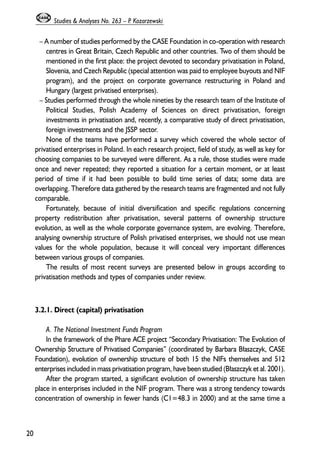
The majority of companies have come out of NIF control and have found dominant 
owners. Other companies and individuals have emerged as major dominant shareholders. 
On average, most strategic investors gained an absolute control (more than 50 per cent) 
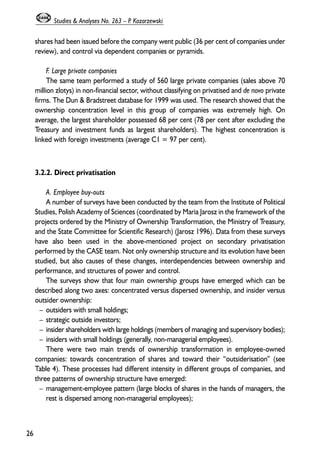
of the firms’ equity (see Table 1). 
It is not clear, what are the determinants of ownership concentration. Firm specific 
factors do not always appear significant. An attempt to find a correlation between 
ownership and performance has been made. It was assumed, that ownership structure is 
endogenous. The results, however, are not unambiguous. If further analysis does not 
confirm that ownership and performance are both determined by unobserved fixed 
effects, the authors of the study promised to look for the impact of ownership on 
performance. 
Changes in ownership stricture of the National Investment Funds have also been 
studied. Share of the Treasury and of small investors (institutional and individual) was 
steadily decreasing (from 25 per cent and 85 per cent respectively at the beginning of the 
program to 13 per cent and 41 per cent at the beginning of 2001). At the same time, the 
share of institutional and large investors has been rising. By January, 2001 institutional 
investors had 46 per cent of the shares of NIFs, and foreign investors 26 per cent. At that 
21 
Studies & Analyses No. 263 – Corporate Governance and Secondary Privatisation ... 
Table 1. The evolution of ownership structure in NIF companies 
Largest sshareholder ggroup 
(more tthan 115 pper ccent oof eequity) 
Number oof ffirms 
in 22000 
Equity hholdings 
in pper ccent, mmean 
Domestic investors 193 58.6 
of which: 
employees 13 55.4 
individuals 48 55.0 
other firms 116 60.6 
financial institutions 10 32.8 
other NIF 6 35.4 
Foreign investorsa 52 73.7 
Others: 
firms listed on the WSEb 36 
liquidation 12 
bankruptcy 68 
a For the firms with foreign investor the 15 per cent threshold is not imposed. 
b 25 of these companies is included in the group with “domestic investors” as the main shareholder. 
Source: Grosfeld and Hashi (2001).
time, Polish large investors’ involvement was more modest (13.5 per cent). All observed 
trends reflected progressing ownership concentration. Over a period from June 1998 to 
December 2000, the C1 index increased from 5 per cent to 24 per cent and C3 index 
increased from 7 per cent to 42 per cent. Now, all NIFs achieved a concentration level 
and ownership structure ensuring full and stable control of the funds. 
However, an impact of NIFs on their portfolio companies has been assessed as 
unsatisfactory. During the whole period, economic and financial performance of the NIF 
companies has been deteriorating, and in 1999 this group of Polish enterprises had the 
worst profitability among other groups of companies. It is clear, that the capital and/or 
strategies of other investors were more effective in generating improvements in 
companies than were the NIFs. 
B. Largest privatised enterprises 
In the framework of the Phare ACE project “Corporate Governance, Relational 
Investors, Strategic Restructuring and Performance in Hungary and Poland” 
(coordinated by Tomasz Mickiewicz, SSEES UCL), a survey of 84 Polish privatised 
industrial companies (the share of the state is less than 50 per cent), sampled from a list 
of the 500 largest firms (in the terms of sales), has been performed. The collected data 
cover the period from 1998 till the end of 2000. All enterprises have been privatised 
through the direct method. 
Ownership structure of this group of companies is highly concentrated (and the 
concentration level is still growing) and insiders’ participation is very limited, unlike in 
privatised SMEs and contrary to pro-insider provisions of Polish privatisation law. 
In almost all companies under review, deep changes in corporate governance 
structures have been introduced, and the “legacy” of state-owned past has already been 
overcome. Thus, the processes of post-communist corporate governance transformation 
seem to be completed. However, changes in corporate control mechanisms appear to be 
conditional on the characteristics of the controlling shareholders group. 
There are four such groups: 
– foreign investors; 
– domestic institutional shareholders; 
– domestic private individuals not working in the companies; 
– insiders. 
Companies with highest levels of ownership concentration, especially dominated by 
foreign investors, have more coherent corporate governance structures. In the 
companies with lowest levels of ownership concentration, the shareholders’ majority is 
often rather formal and does not ensure a real control over the company. 
22 
Studies & Analyses No. 263 – P. Kozarzewski
At the same time, no evidence was found that the level of ownership concentration 
directly affects companies’ performance. The concentration indicator proves to be of 
secondary importance, conversely the type of dominating owner shows a much stronger 
correlation with performance of the firms. However, there is no sufficient proof that the 
type of dominating owner is the sole or the most important factor which affects the 
performance of the companies. In many cases, ownership structure could have an 
endogenous character, because a type of buyer of state property to a great extent was 
determined by companies’ characteristics. At the same time, there is evidence that some 
types of ownership structures can have an exogenous character, first of all ownership 
concentrated in the hands of foreign investors (Kozarzewski 2002). 
C. Enterprises privatised with participation of foreign investor 
In the framework of the project “Privatisation in Poland 1990-2002: Progress, 
Conflicts, Dysfunction” financed by the State Committee for Scientific Research 
(coordinated by Maria Jarosz, Institute of Political Studies, Polish Academy of Sciences), a 
comparative study of three groups of enterprises have been carried out: companies sold 
to a foreign investor, sole-shareholder companies of the Treasury (JSSPs), and employee 
buy-outs (Jarosz 2003). In the course of the survey at the enterprises, data for 1998-2000 
and the moment of privatisation has been gathered, as well as opinions of top managers 
on functioning of their firms. 
In the privatised companies with foreign participation, the highest possible level of 
ownership concentration has apparently been reached. There is a dominating investor 
23 
Studies & Analyses No. 263 – Corporate Governance and Secondary Privatisation ... 
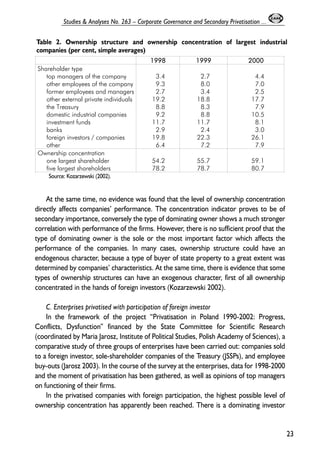
Table 2. Ownership structure and ownership concentration of largest industrial 
companies (per cent, simple averages) 
1998 1999 2000 
Shareholder type 
top managers of the company 3.4 2.7 4.4 
other employees of the company 9.3 8.0 7.0 
former employees and managers 2.7 3.4 2.5 
other external private individuals 19.2 18.8 17.7 
the Treasury 8.8 8.3 7.9 
domestic industrial companies 9.2 8.8 10.5 
investment funds 11.7 11.7 8.1 
banks 2.9 2.4 3.0 
foreign investors / companies 19.8 22.3 26.1 
other 6.4 7.2 7.9 
Ownership concentration 
one largest shareholder 54.2 55.7 59.1 
five largest shareholders 78.2 78.7 80.7 
Source: Kozarzewski (2002).
(more than 50 per cent of shares) in 80 per cent of such firms, and in the rest of firms 
there is at least one strategic investor (20 per cent of shares or more). The ownership 
structure has stabilised: during 1998-2000, no significant changes were seen. Interesting 
feature of corporate governance policy in foreign dominated companies is introducing 
incentives for insiders, first of all managers, in the form of small blocks of shares and/or 
seats on the supervisory board. Corporate governance structures in most of these 
companies are transparent with clear division of powers among executive board, 
supervisory board, and shareholders’ meeting, with broad participation of insiders, 
especially elites of the former SOE. At the same time, foreign investor keeps tight and 
efficient control over the firm. 
D. Sole-shareholder companies of the Treasury (JSSPs) 
Studied in the framework of the same project, JSSPs proved to be the most 
dysfunctional group of companies included in the privatisation process. Lack of progress 
in privatisation of these firms leads to lack of formation of efficient corporate governance 
structures and relations. The existing structures are characterised by high level of 
managers’ and trade unions’ influence and very weak role of the Treasury as the sole 
owner of the company. Besides, in many JSSP the spheres of influence of main actors has 
not stabilised which gives ground for perpetual conflicts. There is nothing to be said about 
ownership structure dynamics in JSSPs under review: during the whole period, it 
remained unchanged. 
E. Listed companies 
A study of 210 listed non-financial companies (190 listed on the WSE and 20 on a free 
market) has been performed at the Gdañsk Institute for Market Economics in the 
framework of the project “Ownership and Control of Polish Corporations” (financed by 
the State Committee for Scientific Research and the CIPE, coordinated by Piotr 
Tamowicz) (Tamowicz and Dzier¿anowski 2001a). The data reflects the situation of the 
companies in November, 2000. Ownership structure was measured by voices at 
shareholders’ meeting. Both concentration indexes and overall ownership structure have 
been analysed. Ownership concentration of the companies under review proved to be 
high and similar to that of in many other countries of continental Europe. Other 
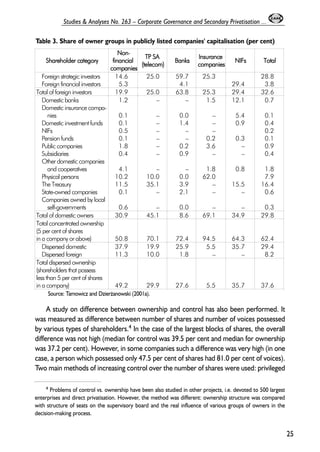
companies and physical persons were the largest shareholder groups (they possessed 
39.4 per cent and 30.8 per cent of all largest blocks of shares). Foreign investors had the 
largest share in companies’ equity, the Treasury and state-owned companies being the 
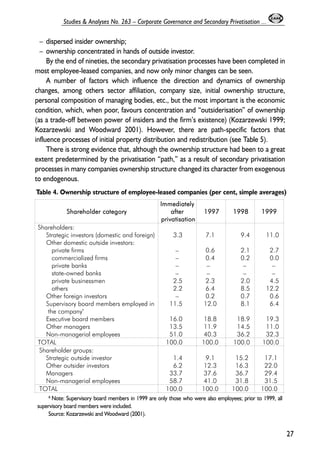
second largest group of owners (see Table 3). 
24 
Studies & Analyses No. 263 – P. Kozarzewski
A study on difference between ownership and control has also been performed. It 
was measured as difference between number of shares and number of voices possessed 
by various types of shareholders.4 In the case of the largest blocks of shares, the overall 
difference was not high (median for control was 39.5 per cent and median for ownership 
was 37.2 per cent). However, in some companies such a difference was very high (in one 
case, a person which possessed only 47.5 per cent of shares had 81.0 per cent of voices). 
Two main methods of increasing control over the number of shares were used: privileged 
25 
Studies & Analyses No. 263 – Corporate Governance and Secondary Privatisation ... 
Table 3. Share of owner groups in publicly listed companies' capitalisation (per cent) 
Shareholder ccategory 
Non-financial 
companies 
TP SSA 
(telecom) Banks Insurance 
companies NIFs Total 
Foreign strategic investors 14.6 25.0 59.7 25.3 28.8 
Foreign financial investors 5.3 4.1 29.4 3.8 
Total of foreign investors 19.9 25.0 63.8 25.3 29.4 32.6 
Domestic banks 1.2 – – 1.5 12.1 0.7 
Domestic insurance compa-nies 
0.1 – 0.0 – 5.4 0.1 
Domestic investment funds 0.1 – 1.4 – 0.9 0.4 
NIFs 0.5 – – – 0.2 
Pension funds 0.1 – – 0.2 0.3 0.1 
Public companies 1.8 – 0.2 3.6 – 0.9 
Subsidiaries 0.4 – 0.9 – – 0.4 
Other domestic companies 
and cooperatives 4.1 – – 1.8 0.8 1.8 
Physical persons 10.2 10.0 0.0 62.0 7.9 
The Treasury 11.5 35.1 3.9 – 15.5 16.4 
State-owned companies 0.1 – 2.1 – – 0.6 
Companies owned by local 
self-governments 0.6 – 0.0 – – 0.3 
Total of domestic owners 30.9 45.1 8.6 69.1 34.9 29.8 
Total concentrated ownership 
(5 per cent of shares 
in a company or above) 50.8 70.1 72.4 94.5 64.3 62.4 
Dispersed domestic 37.9 19.9 25.9 5.5 35.7 29.4 
Dispersed foreign 11.3 10.0 1.8 – – 8.2 
Total dispersed ownership 
(shareholders that possess 
less than 5 per cent of shares 
in a company) 49.2 29.9 27.6 5.5 35.7 37.6 
Source: Tamowicz and Dzier¿anowski (2001a). 
4 Problems of control vs. ownership have been also studied in other projects, i.e. devoted to 500 largest 
enterprises and direct privatisation. However, the method was different: ownership structure was compared 
with structure of seats on the supervisory board and the real influence of various groups of owners in the 
decision-making process.
shares had been issued before the company went public (36 per cent of companies under 
review), and control via dependent companies or pyramids. 
F. Large private companies 
The same team performed a study of 560 large private companies (sales above 70 
million zlotys) in non-financial sector, without classifying on privatised and de novo private 
firms. The Dun & Bradstreet database for 1999 was used. The research showed that the 
ownership concentration level in this group of companies was extremely high. On 
average, the largest shareholder possessed 68 per cent (78 per cent after excluding the 
Treasury and investment funds as largest shareholders). The highest concentration is 
linked with foreign investments (average C1 = 97 per cent). 
3.2.2. Direct privatisation 
A. Employee buy-outs 
A number of surveys have been conducted by the team from the Institute of Political 
Studies, Polish Academy of Sciences (coordinated by Maria Jarosz in the framework of the 
projects ordered by the Ministry of Ownership Transformation, the Ministry of Treasury, 
and the State Committee for Scientific Research) (Jarosz 1996). Data from these surveys 
have also been used in the above-mentioned project on secondary privatisation 
performed by the CASE team. Not only ownership structure and its evolution have been 
studied, but also causes of these changes, interdependencies between ownership and 
performance, and structures of power and control. 
The surveys show that four main ownership groups have emerged which can be 
described along two axes: concentrated versus dispersed ownership, and insider versus 
outsider ownership: 
– outsiders with small holdings; 
– strategic outside investors; 
– insider shareholders with large holdings (members of managing and supervisory bodies); 
– insiders with small holdings (generally, non-managerial employees). 
There were two main trends of ownership transformation in employee-owned 
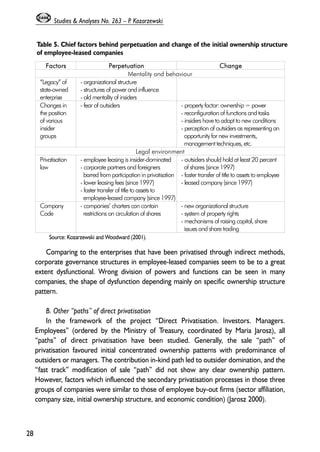
companies: towards concentration of shares and toward their “outsiderisation” (see 
Table 4). These processes had different intensity in different groups of companies, and 
three patterns of ownership structure have emerged: 
– management-employee pattern (large blocks of shares in the hands of managers, the 
rest is dispersed among non-managerial employees); 
26 
Studies & Analyses No. 263 – P. Kozarzewski
– dispersed insider ownership; 
– ownership concentrated in hands of outside investor. 
By the end of nineties, the secondary privatisation processes have been completed in 
most employee-leased companies, and now only minor changes can be seen. 
A number of factors which influence the direction and dynamics of ownership 
changes, among others sector affiliation, company size, initial ownership structure, 
personal composition of managing bodies, etc., but the most important is the economic 
condition, which, when poor, favours concentration and “outsiderisation” of ownership 
(as a trade-off between power of insiders and the firm’s existence) (Kozarzewski 1999; 
Kozarzewski and Woodward 2001). However, there are path-specific factors that 
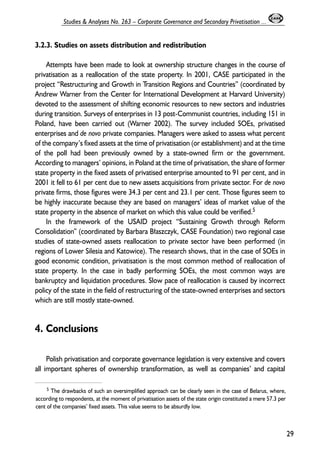
influence processes of initial property distribution and redistribution (see Table 5). 
There is strong evidence that, although the ownership structure had been to a great 
extent predetermined by the privatisation “path,” as a result of secondary privatisation 
processes in many companies ownership structure changed its character from exogenous 
to endogenous. 
27 
Studies & Analyses No. 263 – Corporate Governance and Secondary Privatisation ... 
Table 4. Ownership structure of employee-leased companies (per cent, simple averages) 
Shareholder ccategory 
Immediately 
after 
privatisation 
1997 1998 1999 
Shareholders: 
Strategic investors (domestic and foreign) 3.3 7.1 9.4 11.0 
Other domestic outside investors: 
private firms – 0.6 2.1 2.7 
commercialized firms – 0.4 0.2 0.0 
private banks – – – – 
state-owned banks – – – – 
private businessmen 2.5 2.3 2.0 4.5 
others 2.2 6.4 8.5 12.2 
Other foreign investors – 0.2 0.7 0.6 
Supervisory board members employed in 
11.5 12.0 8.1 6.4 
the companya 
Executive board members 16.0 18.8 18.9 19.3 
Other managers 13.5 11.9 14.5 11.0 
Non-managerial employees 51.0 40.3 36.2 32.3 
TOTAL 100.0 100.0 100.0 100.0 
Shareholder groups: 
Strategic outside investor 1.4 9.1 15.2 17.1 
Other outsider investors 6.2 12.3 16.3 22.0 
Managers 33.7 37.6 36.7 29.4 
Non-managerial employees 58.7 41.0 31.8 31.5 
TOTAL 100.0 100.0 100.0 100.0 
a Note: Supervisory board members in 1999 are only those who were also employees; prior to 1999, all 
supervisory board members were included. 
Source: Kozarzewski and Woodward (2001).
Comparing to the enterprises that have been privatised through indirect methods, 
corporate governance structures in employee-leased companies seem to be to a great 
extent dysfunctional. Wrong division of powers and functions can be seen in many 
companies, the shape of dysfunction depending mainly on specific ownership structure 
pattern. 
B. Other “paths” of direct privatisation 
In the framework of the project “Direct Privatisation. Investors. Managers. 
Employees” (ordered by the Ministry of Treasury, coordinated by Maria Jarosz), all 
“paths” of direct privatisation have been studied. Generally, the sale “path” of 
privatisation favoured initial concentrated ownership patterns with predominance of 
outsiders or managers. The contribution in-kind path led to outsider domination, and the 
“fast track” modification of sale “path” did not show any clear ownership pattern. 
However, factors which influenced the secondary privatisation processes in those three 
groups of companies were similar to those of employee buy-out firms (sector affiliation, 
company size, initial ownership structure, and economic condition) (Jarosz 2000). 
28 
Studies & Analyses No. 263 – P. Kozarzewski 
Table 5. Chief factors behind perpetuation and change of the initial ownership structure 
of employee-leased companies 
Factors Perpetuation Change 
Mentality and behaviour 
“Legacy” of 
state-owned 
enterprise 
- organizational structure 
- structures of power and influence 
- old mentality of insiders 
Changes in 
the position 
of various 
insider 
groups 
- fear of outsiders - property factor: ownership = power 
- reconfiguration of functions and tasks 
- insiders have to adapt to new conditions 
- perception of outsiders as representing an 
opportunity for new investments, 
management techniques, etc. 
Legal environment 
Privatisation 
law 
- employee leasing is insider-dominated 
- corporate partners and foreigners 
barred from participation in privatisation 
- lower leasing fees (since 1997) 
- faster transfer of title to assets to 
employee-leased company (since 1997) 
- outsiders should hold at least 20 percent 
of shares (since 1997) 
- faster transfer of title to assets to employee 
- leased company (since 1997) 
Company 
Code 
- companies’ charters can contain 
restrictions on circulation of shares 
- new organizational structure 
- system of property rights 
- mechanisms of raising capital, share 
issues and share trading 
Source: Kozarzewski and Woodward (2001).
3.2.3. Studies on assets distribution and redistribution 
Attempts have been made to look at ownership structure changes in the course of 
privatisation as a reallocation of the state property. In 2001, CASE participated in the 
project “Restructuring and Growth in Transition Regions and Countries” (coordinated by 
Andrew Warner from the Center for International Development at Harvard University) 
devoted to the assessment of shifting economic resources to new sectors and industries 
during transition. Surveys of enterprises in 13 post-Communist countries, including 151 in 
Poland, have been carried out (Warner 2002). The survey included SOEs, privatised 
enterprises and de novo private companies. Managers were asked to assess what percent 
of the company’s fixed assets at the time of privatisation (or establishment) and at the time 
of the poll had been previously owned by a state-owned firm or the government. 
According to managers’ opinions, in Poland at the time of privatisation, the share of former 
state property in the fixed assets of privatised enterprise amounted to 91 per cent, and in 
2001 it fell to 61 per cent due to new assets acquisitions from private sector. For de novo 
private firms, those figures were 34.3 per cent and 23.1 per cent. Those figures seem to 
be highly inaccurate because they are based on managers’ ideas of market value of the 
state property in the absence of market on which this value could be verified.5 
In the framework of the USAID project “Sustaining Growth through Reform 
Consolidation” (coordinated by Barbara B³aszczyk, CASE Foundation) two regional case 
studies of state-owned assets reallocation to private sector have been performed (in 
regions of Lower Silesia and Katowice). The research shows, that in the case of SOEs in 
good economic condition, privatisation is the most common method of reallocation of 
state property. In the case in badly performing SOEs, the most common ways are 
bankruptcy and liquidation procedures. Slow pace of reallocation is caused by incorrect 
policy of the state in the field of restructuring of the state-owned enterprises and sectors 
which are still mostly state-owned. 
4. Conclusions 
Polish privatisation and corporate governance legislation is very extensive and covers 
all important spheres of ownership transformation, as well as companies’ and capital 
29 
Studies & Analyses No. 263 – Corporate Governance and Secondary Privatisation ... 
5 The drawbacks of such an oversimplified approach can be clearly seen in the case of Belarus, where, 
according to respondents, at the moment of privatisation assets of the state origin constituted a mere 57.3 per 
cent of the companies’ fixed assets. This value seems to be absurdly low.
market’s functioning. At the same time, the real corporate governance mechanisms are 
often inefficient. Minority shareholders abuse is quite common, but at the same time legal 
provisions aimed at minority protection are sometimes used for “majority abuse” by 
minorities that represent powerful industrial interests. There are also numerous cases of 
managers’ opportunism, asset stripping and tunnelling. External corporate governance 
mechanisms are often weak and do not always ensure effective regulation of companies’ 
behaviour. First of all, the weak and shallow capital market must be mentioned. 
It seems that there are the following causes of dysfunction in secondary privatisation 
and corporate governance spheres: 
– Lack of coherent concept of ownership transformation and development of private 
property relations. Some very important issues of interrelations between privatisation 
and desired corporate governance models and mechanisms are still unresolved. 
– Contradictions in the policy of the state (especially concerning securities market, 
external institutional investors, and the role of insiders), clientelism. 
– Not fully adequate legislation: at the same time, overregulated, underregulated and 
misregulated; lack of integrity which hampers meeting the goals of transformation. 
Some provisions of the law have political character and are intended to gain support 
of various actors. Sometimes, provisions of law are too general and are not instructive 
enough. 
– Poor enforcement of the law and other regulations. 
Privatisation in Poland is characterised by high diversification of methods and has 
mainly consensual character. SOEs with different characteristics were designated to 
various methods and paths, which introduced a strong selection bias, exerted a heavy 
impact on initial ownership structure of privatised enterprises, and, quite often, on post-privatisation 
processes as well. Therefore it is very hard to analyse the problem of 
endogeneity vs. erogeneity of ownership structure vis-à-vis companies’ performance and 
other characteristics. 
30 
Studies & Analyses No. 263 – P. Kozarzewski
References 
B³aszczyk, B. (ed.) (1999). Uwarunkowania wzrostu sektora prywatnego w Polsce, CASE 
Reports 30, CASE – Center for Social and Economic Research. 
B³aszczyk, B., A. Cylwik (eds) (1999). Charakterystyka wybranych sektorów 
infrastrukturalnych i wra¿liwych w gospodarce polskiej oraz mo¿liwooeci ich prywatyzacji, 
CASE Reports 27, CASE – Center for Social and Economic Research. 
B³aszczyk, B., M. Górzyñski, T. Kamiñski, B. Paczóski (2001). Secondary Privatisation in 
Poland (Part II): Evolution of Ownership Structure and Performance in National Investment 
Funds and their Portfolio Companies, CASE Reports 48, CASE – Center for Social and 
Economic Research. 
B³aszczyk, B., I. Hoshi, R. Woodward (eds) (2003). Secondary Privatisation in Transition 
Economies. The Evolution of Enterprise Ownership in the Czech Republic, Poland and 
Slovenia, Palgrave Macmillan, Hampshire and New York. 
B³aszczyk, B., R. Woodward (eds) (1999). Privatisation and Company Restructuring in 
Poland, CASE Reports 18, CASE – Center for Social and Economic Research. 
Grosfeld, I., I. Hashi (2001). The Evolution of Ownership Structure in Firms Privatised through 
Wholesale Schemes in the Czech Republic and Poland, CASE Reports 49, CASE – Center 
for Social and Economic Research. 
Dzier¿anowski, M., E. Pietrzak (2001). Dekada sukcesów czy straconych szans, Gazeta 
Wyborcza, March 23. 
Gray, C. W., A. Holle (1996). Bank-led Restructuring in Poland: An Empirical Look at the 
Bank Conciliation Process, Policy Research Working Paper 1650, World Bank. 
IBnGR (2001). Przysz³ooeæ polskiego rynku kapita³owego i GPW w oewietle potrzeb gospodarki 
i wyzwañ technologicznych, the Polish Corporate Governance Forum workshop 
proceedings, Warsaw, July 11. 
IBnGR (2002). Kodeks Nadzoru Korporacyjnego, IBnGR, Gdañsk, April. 
Jach, R. (2001). Piêoeci¹ w stó³, czyli wstêp do katharsis, Parkiet, April 27. 
Jarosz, M. (ed.) (1996). Polish Employee-owned Companies in 1995, ISP PAN, Warsaw. 
Jarosz, M. (ed.) (2000). Ten Years of Direct Privatisation, ISP PAN, Warsaw. 
Jarosz, M. (ed.) (2003). Pu³apki prywatyzacji, ISP PAN, Warsaw. 
Kozarzewski, P. (1999). Elity kierownicze spó³ek pracowniczych: w³asnooeæ – zarz¹dzanie – 
oewiadomooeæ, ISP PAN, Warsaw. 
Kozarzewski, P. (2002). Changes in Corporate Governance Structures in Polish Privatised 
Companies, Working Papers 8, Centre for the Study of Economic and Social Change 
in Europe, SSEES UCL. 
31 
Studies & Analyses No. 263 – Corporate Governance and Secondary Privatisation ...
Kozarzewski, P., R. Woodward (2001). Secondary Privatisation in Poland (Part I): Evolution 
of Ownership Structure and Company Performance in Firms Privatised by Employee 
Buyouts, CASE Reports 47, CASE – Center for Social and Economic Research. 
Michalowicz, T., W. Ulanowski (2002). Pechowe koszule, Gazeta Wyborcza, 18 December. 
Ministry of the Treasury (2003). Privatisation Quarterly, January-March 2003. 
Montes-Negret, F., L. Papi (1996). The Polish Experience in Bank and Enterprise 
Restructuring, Policy Research Working Paper 1705, World Bank. 
OECD (1999). OECD Principles of Corporate Governance, OECD, Paris. 
OECD (2001). Behind the Corporate Veil: Using Corporate Entities for Illicit Purposes, 
OECD, Paris. 
Prusek, T. (2003). Rada wziêta, Gazeta Wyborcza, 25-26 January. 
Samcik, M. (2002). Kto rz¹dzi w garniturach?, Gazeta Wyborcza, 20 December. 
Stec, A. (2003). Inwestorzy indywidualni maj¹ coraz mniej do powiedzenia na gie³dzie, Gazeta 
Wyborcza, 5 February. 
Stec, A. (2003). Przeprosiny na parkiecie, Gazeta Wyborcza, 19-20 July. 
Szomburg, J. (1996a). Efekty prywatyzacji przedsiêbiorstw drog¹ leasingu, Transformacja 
Gospodarki 68, IBnGR, Gdañsk. 
Szomburg, J. (1996b). Efekty prywatyzacji przedsiêbiorstw drog¹ szybkiej sprzeda¿y, 
Transformacja Gospodarki 67, IBnGR, Gdañsk. 
Tamowicz, P., M. Dzier¿anowski (2001a). W³asnooeæ kontrola polskich korporacji, IBnGR, 
Gdañsk. 
Tamowicz, P., M. Dzier¿anowski (2001b). Dekalog dla gie³dy: Jak wyprowadziæ rynek 
kapita³owy z impasu?, Rzeczpospolita, November. 
Tamowicz, P., M. Dzier¿anowski (2002). Bia³a ksiêga nadzoru korporacyjnego, IBnGR, 
Gdañsk. 
The Central Statistical Office data: http://www.stat.gov.pl. 
The Ministry of Treasury data: http://www.mst.gov.pl. 
The Warsaw Stock Exchange data: http://www.gpw.com.pl. 
Warner, A.M. (ed.) (2002). The European Competitiveness and Transition Report 2001- 
2002: Ratings of Accession Progress, Competitiveness, and Economic Restructuring of 
European and Transition Economies, Oxford University Press, New York – Oxford. 
32 
Studies & Analyses No. 263 – P. Kozarzewski
Legal acts and other regulations 
Commercial Code of June 27, 1934. 
Bankruptcy Law of October 24, 1934. 
Act of September 25, 1981 on State-owned Enterprises. 
Act of July 13, 1990 on Privatisation of State-owned Enterprises. 
Act of October 19, 1991 on Management of Agriculture Property of the Treasury. 
Act of March 4, 1993 on Financial Restructuring of Enterprises and Banks. 
Act of April 30, 1993, on National Investment Funds and their Privatisation. 
Act of September 29, 1994 on Accounting. 
Act of August 30, 1996 on Commercialisation and Privatisation of State-owned Enterprises. 
Act of August 28, 1997 on Investment Funds. 
Act of August 28, 1997 on Set-up and Functioning of Pension Funds. 
Act of January 21, 1997 on Public Securities Trading. 
Company Code of September 15, 2000. 
Charter of the Warsaw Stock Exchange, last redaction of December 11, 2002. 
Regulations of the Warsaw Stock Exchange, last redaction of April 22, 2003. 
Regulations of the Stock Court adopted by the Warsaw Stock Exchange on June 14, 2000. 
Best Practices in Publicly Listed Companies, approved by the Warsaw Stock Exchange on 
July 4, 2002. 
33 
Studies & Analyses No. 263 – Corporate Governance and Secondary Privatisation ...
34 
220 Lubarova L., O. Petrushin, A. Radziwi³³, Is Moldova Ready to Grow? Assessment 
of Post-crisis Policies (1999–2000) 
221 	 ., . , . 	, . , . , 	  
!##$ !%!  ##, !% %.  	 
222 '	 (., ). *	, )+ ,- . 	 
!	- #$ 	 	 ## 
223 +	 0., , +#  !.# ! !	 	 
## )!. 
224 Sasin M., Predicting Currency Crises, the Ultimate Significance of Macroeconomic 
Fundamentals in Linear Specifications with Nonlinear Extensions 
225 .% ., 	   2 
226 Kloc K., System bankowy i nadzór bankowy na Ukrainie – skutki niespójnej 
polityki reform 
227 Cukrowski J., J. Janecki, Wp³yw polityki banku centralnego na wielkooeæ 
dochodów bud¿etu z renty emisyjnej 
228 Maliszewski W., Pomiar senioratu: Przegl¹d metod i wyników empirycznych 
229 S³awiñski A., D. Tymoczko, Czynniki wp³ywaj¹ce na wielkooeæ renty menniczej w 
Polsce 
230 Markiewicz M., Prawne, operacyjne i instytucjonalne aspekty funkcjonowania NBP 
231 D¹browski M., M. Tomczyñska, Tax Reforms in Transition Economies 
– a Mixed Record and Complex Future Agenda 
232 '	 (., 3 4	, 5 +#$   
6   	 ## )!. 
233 7-  ., ). *	, 2   	  ## )!.: 
   !!	# 
234 Akimov A. V., Reforming the Financial System. The Case of Uzbekistan 
235 '	 (., ). 9	,#  +# 
!# 6	  	 %	 !	  	 
## )!.
236 ; ., 	 # 4#,   ##  !. 
35 
.	  
237  ., )6	 # + .!-  
	 : 6	# 	   #  
238 '	 (., ). *	, ?66	+ !+	  	 
!@ 	 ## )!. 
239 !+ (., )6	 ,-  	 ## 
)!. 
240 Herczyñski J., The Financing of Georgian Education 
241 D¹browski M., W. Paczyñski, £. Rawdanowicz, Inflation and Monetary Policy in 
Russia: Trensition Experience and Future Recommendations 
242 D¹browski M., R. Gortat, Political Determinants of Economic Reforms in Former 
Communist Countries 
243 	 ., . 	-, . , .# 
6	  		#$!%!   
244 Herczyñski J., Key Issues of Governance and Finance of Kyrgyz Education 
245 Cukrowski J., J. Mironowa, Monitoring Processes of National Development 
in the Kyrgyz Republic 
246 Maliszewski W.S., Monetary Policy in Transition: Structural Econometric Modelling 
and Policy Simulations 
247 Rawdanowicz L., Poland's Accession to EMU - Choosing the Exchange Rate 
Parity 
248 Kowalski P., W. Paczyñski, £. Rawdanowicz, Exchange Rate Regimes and the Real 
Sector: a Sectoral Analysis of the CEE Countries 
249 Markiewicz M., J. Siwiñska-Gorzelak, Wydatki sztywne bud¿etu pañstwa 
250 Górzyñski M., R. Woodward, Konkurencyjnooeæ technologiczna MOEP z trzech dzia- 
³ów przemys³u przetwórczego: silne i s³abe strony w oewietle wejoecia Polski do UE 
251 B³aszkiewicz M., J. Konieczny, A. Myoeliñska, P. WoŸniak, Some Benefits of 
Reducing Inflation in Transition Economies
36 
252 5.	 M., 4  : ! +  !  
253 Rostowski J., When Should the Central Europeans Join EMU? 
255 Cukrowski J., R. Gortat, P. Kazmierkiewicz, Moldova: Assessment of Civil 
Society and Democratic Institutions 
256 Jarociñski M., Nominal and Real Convergence in Spain, Portugal and Greece 
During Their Accession to the EMU 
257 Zoubanov N., Uneven Growth in a Monetary Union: on the Possible 
Implications for its Slow-Growing Members 
258 Brzozowski M., Exchange Rate Variability and Foreign Direct Investment - 
Consequences of EMU Enlargement 
259 Kamiñski B., Economic Regime for Iraq: the Foreign Trade Perspective 
260 Antczak M., Do Acceding Countries Need Higher Fiscal Deficits? 
261 Siwiñska J., P. Bujak, Short-run Macroeconomic Effects of Discretionary 
Fiscal Policy Changes 
262 Paczyñski W., ECB Decision-making and the Status of the Eurogroup in an 
Enlarged EMU

CASE Network Studies and Analyses 263 - Corporate Governance and Secondary Privatisation in Poland: Legal Framework and Changes in Ownership Structure

  • 1.
    2 6 3 Piotr Kozarzewski Corporate Governance and Secondary Privatisation in Poland: Legal Framework and Changes in Ownership Structure W a r s a w , D e c e m b e r 2 0 0 3
  • 2.
    Materials published herehave a working paper character. They can be subject to further publication. The views and opinions expressed here reflect the author(s) point of view and not necessarily those of the CASE. This paper was prepared for the research project “Partnership for Corporate Governance and Secondary Privatization in Transition”. The grant funding was provided under the U.S. Agency for International Development SEGIR EP Contract No. PCE-I-00- 00-00014-00, reference Russia Task Order No. 803 Improvement of Economic Policy Through Think Tank Partnership Project. The opinions, findings and conclusions or re-commendations expressed herein are those of the author and do not necessarily reflect the views of the U.S. Agency for International Development. Keywords: corporate governance, privatization, enterprise restructuring, Poland. © CASE – Center for Social and Economic Research, Warsaw 2003 Graphic Design: Agnieszka Natalia Bury DTP: CeDeWu Sp. z o.o. ISSN 1506-1701, ISBN 83-7178-319-1 Publisher: CASE – Center for Social and Economic Research ul. Sienkiewicza 12, 00-944 Warsaw, Poland tel.: (48 22) 622 66 27, 828 61 33, fax: (48 22) 828 60 69 e-mail: case@case.com.pl http://www.case.com.pl
  • 3.
    Contents Abstract .. . . . . . . . . . . . . . . . . . . . . . . . . . . . . . . . . . . . . . . . . 5 1. Introduction . . . . . . . . . . . . . . . . . . . . . . . . . . . . . . . . . . . . . . 6 2. Legal framework . . . . . . . . . . . . . . . . . . . . . . . . . . . . . . . . . . . 6 2.1. Privatisation . . . . . . . . . . . . . . . . . . . . . . . . . . . . . . . . . . . . . . . 6 2.2. Corporate governance structures within an enterprise . . . . . . . 9 2.3. External aspects of corporate governance . . . . . . . . . . . . . . . 14 2.3.1. Capital market . . . . . . . . . . . . . . . . . . . . . . . . . . . . . . . 14 2.3.2. Investment Funds . . . . . . . . . . . . . . . . . . . . . . . . . . . . . 16 2.3.3. Banks . . . . . . . . . . . . . . . . . . . . . . . . . . . . . . . . . . . . . . 17 2.3.4. Insurance companies . . . . . . . . . . . . . . . . . . . . . . . . . . . 17 2.3.5. Bankruptcies . . . . . . . . . . . . . . . . . . . . . . . . . . . . . . . . . 18 3. Changes in ownership structure . . . . . . . . . . . . . . . . . . . . . . 18 3.1. Initial conditions for secondary privatisation . . . . . . . . . . . . . . 18 3.2. Evolution of ownership structure . . . . . . . . . . . . . . . . . . . . . . 19 3.2.1. Direct (capital) privatisation. . . . . . . . . . . . . . . . . . . . . . 20 3.2.2. Direct privatisation . . . . . . . . . . . . . . . . . . . . . . . . . . . . 26 3.2.3. Studies on assets distribution and redistribution. . . . . . . 29 4. Conclusions . . . . . . . . . . . . . . . . . . . . . . . . . . . . . . . . . . . . . . 29 References . . . . . . . . . . . . . . . . . . . . . . . . . . . . . . . . . . . . . . . . 31 Legal acts and other regulations . . . . . . . . . . . . . . . . . . . . . . . . 33
  • 4.
    Piotr Kozarzewski PiotrKozarzewski (born 1960) is a member of the Council of the CASE – Center for Social and Economic Research, Warsaw, and Senior Research Fellow at the Institute of Political Studies, Polish Academy of Sciences in Warsaw, Poland. He participated in numerous research and advisory projects on privatization and restructuring of state enterprises in Poland and other post-Communist countries. 4 Studies & Analyses No. 263 – P. Kozarzewski
  • 5.
    Abstract The taskof this paper is to provide information and analysis on the legal framework of privatisation and corporate governance in Poland and on secondary privatisation pro-cesses in Polish privatised enterprises, i.e. changes in ownership structure which are taking place after privatisation. The role of regulatory framework in secondary privatisation processes is also shown (besides a number of economic, social, gnoseological, and other factors). 5 Studies & Analyses No. 263 – Corporate Governance and Secondary Privatisation ...
  • 6.
    1. Introduction1 Thetask of this paper is to provide information and analysis on two topics: – legal framework of privatisation and corporate governance in Poland; – secondary privatisation in Polish privatised enterprises, e.g. changes in ownership structure which are taking place after privatisation. The role of regulatory framework in secondary privatisation processes will also be shown (besides a number of economic, social, gnoseological, and other factors). 2. Legal framework Polish legal system represents the Roman model, where all rules and regulations are codified. In unclear and contradictory cases, supreme legal authorities interpret the existing law, providing guidelines for courts. Poland has all main legal acts which regulate economic activity of legal entities and their governance, as well as functioning of capital, financial and other markets. The law regulates both institutional building and behaviour of participants of economic relations. In our field of interest, legal acts regulate the following spheres: – de-etatisation and privatisation processes; – internal structure and functioning of companies; – external conditions for the companies, including markets and institutions with whom companies have to interact. Quite often specific legal acts cover more than one sphere of regulation; on the other hand, specific elements of companies’ life are often regulated by more than one legal act. 2.1. Privatisation The main privatisation act is the Act of August 30, 1996 on Commercialisation and Privatisation of State-owned Enterprises which came into effect only in April, 1997. 6 Studies & Analyses No. 263 – P. Kozarzewski 1 The author wishes to thank Barbara B³aszczyk and Richard Woodward from CASE for their helpful comments and suggestions.
  • 7.
    Before that, theAct of July 13, 1990 on Privatisation of State-owned Enterprises had been in force. The law distinguish two basic privatisation methods: indirect and direct. The indirect (formerly called capital) method consists of two stages. At the first stage, a state-owned enterprise (SOE) is commercialised, i.e., it changes its legal form and is transformed into a company, where 100 per cent of shares belong to the Treasury (so-called sole-shareholder company of the Treasury, Polish acronym: JSSP), and begins to operate under provisions of the Company Code, common to all entities (except state-owned enterprises and a limited number of companies which are governed by special legal acts). At the second stage, the sale of the shares takes place in a number of ways: public offering, sale to strategic investor (or combination of these two) and inclusion to National Investment Fund program. On April 30, 1993, the Act on National Investment Funds (NIF) was adopted introducing a kind of mass privatisation program which, contrary to such programs in other post-Communist countries, had been designed not only to transfer a significant part of the state’s sectors assets to Polish citizens, but also to create a mechanism for actively restructuring the companies participating in mass privatisation. NIFs received blocks of shares of 512 companies which undergo mass privatisation, and Polish citizens received a kind of vouchers which they could invest in the NIFs. It is worth noting, that mass character of NIF program was only a demand side (all Polish citizens), and not on supply side, as in other countries where mass privatisation took place. The NIF program was supposed to accelerate the pace of privatisation, at the same time providing for restructuring of companies, facilitated by the experience of the professional management companies employed by the NIFs. These goals were never achieved. The direct (formerly somewhat misleadingly called liquidation) method consists of liquidation of a SOE in a legal sense; then, the assets of the enterprise (in totality or divided into separated organized parts) are privatised in one of the three possible ways (in Poland often called “paths”): – sale; – entering as a contribution in kind into a company established by the Treasury and a private investor; – leasing (employee buy-out). The last path needs more attention because it was very popular and is Polish contribution into methodology of post-Communist privatisation. A SOE can enter this path only on the request and with consent of insiders. A company (as a rule, LLC) with participation of employees is being set up which leases the equity of formally liquidated SOE. The company signs a leasing contract with the Treasury. The contract provisions stipulate that upon repayment of all the capital instalments and leasing fees the assets of the liquidated SOE will become the property of the company. 7 Studies & Analyses No. 263 – Corporate Governance and Secondary Privatisation ...
  • 8.
    Another method ofprivatisation was provided by Art. 19 of the Act of September 25, 1981 on State-owned Enterprises. It applies to SOEs in financial distress — the enterprise is liquidated and its assets are sold out. Some enterprises in agricultural sector are privatised according to the principles provided by the Act of October 19, 1991 on Management of Agriculture Property of the Treasury. There are also separate acts devoted to ownership transformation of certain enterprises and sectors of the economy. Recently, a number of acts have been adopted which link privatisation with sectoral restructuring. All methods and paths of privatisation are equivalent (buyers pay market price or the prise based on valuation), except the NIF program, where certificates of ownership have been distributed among the population for a small fee. Polish privatisation law is much diversified, if not to say eclectic. It reflects lack of consensus of Polish politicians on the scope and ways of ownership transformation, and more generally – on the principles of the post-Communist transformation as a whole. The privatisation law represents a certain compromise between two main options: liberal conceptions patterned after solutions adopted in developed Capitalist countries, and participatory approach originating from the Polish labour self-management movement and tending towards a kind of “third road” of development through building of the so-called “social market economy.” Some provisions of the law were also intended to overcome the assumed resistance of insiders. The privatisation law regulates not only the privatisation process itself, but also in some cases the initial corporate governance structure, including initial ownership distribution and composition of corporate governance bodies. The scope and character of the impact of the regulations depends on the privatisation method applied (see also the next section). However, the common feature is preferences for insiders, both in starting privatisation, and in distribution of shares. Before the privatisation act of 1996 was adopted, all privatisation deals had been initiated or had needed to be approved by the governing bodies of SOEs. In 1997, such a requirement was lifted. According to the 1990 Act, in indirect (capital) privatisation employees had a right to acquire 10 per cent of shares at reduced price; these preferences were increased by the 1996 Act by granting a right to insiders to acquire 15 per cent of shares for free. Another 15 per cent can be received for free by farmers and fishermen if they were suppliers of the former SOE (with restrictions regarding the volume of supplies). Besides, the new Act lifted the requirement that JSSPs, as a transitional entity, should be privatised within 2 years after commercialisation. It introduced a legal background for impeding ownership transformation in this group of companies. Until 1997, the leasing path of direct privatisation preferred extremely insiderised patterns of ownership structure: the new company should have been founded by the 8 Studies & Analyses No. 263 – P. Kozarzewski
  • 9.
    majority of employees,no institutional outsiders were permitted (unless accepted by the Ministry of Ownership Transformation). The Act of 1996 imposes certain limits on the use of direct privatisation paths and the role of insiders in ownership transformation. Limits have been set on the size of enterprises (in terms of employment level, assets and turnover); outsiders gained a right to take initiative in privatisation without prior consent of insiders; in leasing path, at least 20 per cent of shares in the new company must be in the hands of outsiders; possibilities of participation of legal persons have been increased. 2.2. Corporate governance structures within an enterprise The main act which regulates corporate governance relations at a company level is the Company Code of September 15, 2000 (enacted on January 1, 2001). It replaces the Commercial Code of June 27, 1934. In Poland, the continental model of corporate governance structure is developing. This model adopts the principle of strict separation between the management function and the ownership control function, as distinct from the Anglo-Saxon model in which these functions are to a large extent combined. The adoption of the continental model as the target, assuring a strict owner control over the company’s executive bodies is particularly important, as in Poland, as well as in other post-communist countries, the influence of external control (in the form of commodity, financial, take-over and other markets) is in many cases still not sufficiently effective. In such conditions, efficient functioning of the internal supervision assumes fundamental importance. Moreover, the continental model assumes the significant role of a strategic investor, who, especially foreign one, is able to bring to a company not only capital, but also a new culture of management, of company’s behaviour towards its environment, new technology etc. which are badly needed in a post-Communist country. On a company level, it means two-tier system with separate executive and supervisory boards. Supervisory boards are compulsory in all JSCs and large LLCs. As a rule, supervisory board members are elected at the shareholders’ meeting (group voting is possible). In most cases, supervisory board appoints the members of the executive board (in general, the supervisory board’s position vis-à-vis executive board has been strengthened in the new Code). Formally, supervisory board has a wide range of powers, especially controlling ones, as a safeguard against opportunism of managers. It supervises all spheres of the company’s functioning and has a right to study all documentation and to receive all necessary information not only from executive board members, but also from every employee in the company. Supervisory board’s powers can be fine-tuned in 9 Studies & Analyses No. 263 – Corporate Governance and Secondary Privatisation ...
  • 10.
    order to reflectthe needs of corporate governance in a specific company. In practice, however, widespread weak role of this body in the corporate governance system is reported in the surveys, executive boards often being the most influential body (this situation is jokingly called “Vistula model” of corporate governance,2 as opposed to continental and Anglo-Saxon models). In most cases, Polish legislation does not take into account concern of stakeholders in corporate governance structures. For example, there is no requirement to include representatives of stakeholders (e.g., employees) into the supervisory board. However, the surveys show that in many privatised companies stakeholders (first of all managers and employees) a represented in this body as a part of personnel policy of core shareholders. The peculiarity of the Polish legal system is that the main vehicle for representation of stakeholder interests is privatisation legislation, rather than regulations affecting the enterprise sector in general. Thus, there are fundamental differences in the corporate governance regime depending on whether an enterprise originated in the state sector or the de novo private sector – a situation which is, to our knowledge, not found in any other European country. Apart from above-mentioned insider-dependent originating of privatisation cases and establishing preferences for insiders and some suppliers in buying shares, privatisation legislation introduces legal support for stakeholder interests in corporate governance bodies. In both cases theses are insiders’ interests in privatised enterprises: – in the course of indirect privatisation, when employees of the former SOE and some categories of suppliers are granted an option for free shares, and employees have a right to appoint 40 per cent of members of the supervisory board as long as the Treasury remains the sole shareholder; – in the companies that have been privatised through commercialisation and are employing more than 500 persons, employees elect one member of the Executive Board. This provision is very unclear. For example, it is not known for what period after privatisation employees have such a right. There are also provisions dealing with conflict of interests of members of the executive board, supervisory board, and shareholders. It covers personal capital links with other firms and responsibility towards the company. At the same time, there is no legal requirement to include independent members in supervisory boards, although such a provision can be found in charter of a few Polish companies. However, the Warsaw Stock Exchange has recently introduced a requirement for all listed companies to include 10 Studies & Analyses No. 263 – P. Kozarzewski 2 The term was coined by Krzysztof Lis, Chairman of the Polish Privatisation Agency at the beginning of transformation.
  • 11.
    before the endof 2004 at least 50 per cent of independent members to their Supervisory Boards (see below). There is another sphere where conflict of interests is not properly managed. Although auditor has to be independent from the audited company (do not possess shares, not to be the company’s attorney, etc.), there is no legal prohibition for an auditor to be simultaneously a consultant for the same firm. Moreover, if such an auditor provides bookkeeping for a firm, he still can perform audit (except for those part of financial documents which has been prepared by himself). Lack of proper regulations in this sphere is potentially very dangerous, which is confirmed by latest bookkeeping scandals in the USA. The Commercial Code also contains a system of safeguards against minority shareholders abuse. Shareholder has a right to appeal against a decision of the shareholder’s meeting if such a decision violates the company charter, good practices or the company’s concern. By the way, such a right belongs to executive and supervisory boards’ members as well. Minority shareholders have extended rights for group voting. There are three types of preferential shares: – privileged shares, giving their holders greater than one and no more than 2 voices per share (till the end of 2004, the Treasury can have up to 5 voices per share); – golden share; – non-voting share (since 2001). A voting cap can be introduced for shareholders that possess more than 20 per cent of voices. On the other hand, most important decisions should be approved by qualified majority of voices on the shareholders’ meeting (2/3 to 3/4). There are provisions against collusion of shareholders. Every member of the supervisory board and a shareholder who possess at least 10 per cent of shares has a right to call an extraordinary shareholders’ meeting. The Act of January 21, 1997 on Public Securities Trading, which regulates only publicly listed companies, grants a shareholder or a group of shareholders that possess at least 5 per cent of votes a right to appoint a special controller whose task is to investigate a concrete problem of the company’s functioning. The same act imposes on a strategic investor an obligation of mandatory bid if he possesses more than 50 per cent of votes. Such a bid must be also announced when someone is going to buy more than 10 per cent of shares. There is a system of safeguards which is intended to ensure proper prices for sellers of shares. In publicly listed companies, an investor must obtain a permission of The Securities and Exchange Commission to pass a threshold of 25 per cent, 33 per cent, and 50 per cent of voices. All blocks of shares which give their owners at least 5 per cent of voices must be registered. One of the most important means of preserving shareholders rights vis-à-vis managers and large shareholders are information and disclosure requirements. The rights 11 Studies & Analyses No. 263 – Corporate Governance and Secondary Privatisation ...
  • 12.
    of the supervisoryboard were mentioned above. The Company Code grants a right for any shareholder to ask the executive board for information that is necessary for evaluation of topics discussed at the shareholders’ meeting. According to the Act of September 29, 1994 on Accounting, financial statements of companies must include information on remuneration of top managers and supervisory board members, as well as on any loan they may receive from the company. Information must be provided about capital groups (other companies in which the company possess at least 20 per cent of shares). The Act on Public Securities Trading provides publicly listed companies with additional requirements regarding informational transparency. These companies have to publish all information which may influence the prise of shares. There are special disclosure provisions devoted to selling and buying shares by major shareholders. On the other hand, there are provisions of the Polish law which are intended to withstand the misuse of the above-mentioned safeguards. When a shareholder starts a legal action against a decision of the shareholders’ meeting, this does not stops its execution; in case if the court decides that the protest is groundless, the suer has to pay a penalty up to ten times of the cost of the court examination. A company has a right to deny a shareholder an access to some data if it would cause damage to the company. In practice, in Poland there are a lot of cases both of abuse majority and minority rights, as well as of managers’ opportunism. There are three main causes which make those violations possible: – The problems of corporate governance formation in Poland. As a result of consensual privatisation, dispersed and highly insiderised patterns of ownership structure often emerged with strong positions of managers and to some extent non-managerial employees. That hampers the effective control of shareholders over managers and outsiders over insiders (given generally still weak outsider investorship in Poland). This provides to preservation of “legacy of Socialism” in former state-owned enterprises with very strong position of managers (most of them being directors before privatisation). On the other hand, if a company is sold to outsiders, highly concentrated pattern of ownership structure emerges which makes possible minority abuses. High role of the Treasury in many firms which are undergoing indirect privatisation is also important. – The inadequate law. First, the law that describes corporate governance structures in companies is not instructive enough, too often giving general idea and principles rather than concrete solutions. Second, the system of rights and safeguards that regulates corporate governance relations within companies is not extremely efficient. For example, minority interests can be (and sometimes are) abused with the help of anti-collusion provisions. Disclosure requirements do not cover all cases of gaining control over a firm with the help of affiliated and subordinated companies. There are situations when mandatory bids can be avoided without breaking the law. Prevention of hostile 12 Studies & Analyses No. 263 – P. Kozarzewski
  • 13.
    takeovers by outsidersis also possible. Manipulations of the dates of shareholders’ meetings are widespread. Managers have legal possibilities of profits stripping and tunnelling. Disclosure provisions are often regarded as very complicated and there is a widespread opinion among managers, that some of them are impracticable. Third, legal acts sometimes contradict each other and overlap (first of all, Company Code, Act on Public Securities Trading, and Act on Commercialisation and Privatisation of State-owned Enterprises). – Poor enforcement of the law. Nor the courts, neither the prosecutors have sufficient capacities or skills to cope with cases of illegal actions in companies. Within the Warsaw Territorial Public Prosecutor’s Office a department of capital market offences has been established, but positive results are still hard to be seen. Fiscal administration is incapable to cope with transfer pricing. In recent years, attempts have been made to strengthen corporate governance by elaborating and introducing best practices of corporate governance. The main idea behind this approach was that because legal regulations themselves are incapable of dealing with all the problems of corporate governance, a set of principles should be prepared which would both serve as instruction on how to behave correctly and as a form of moral pressure on companies to introduce these principles. In Poland, two teams prepared their own best practices codes: the Polish Corporate Governance Forum affiliated with the Gdañsk Institute for Market Economics, and Corporate Governance Forum affiliated with the Institute for Business Development. The idea of the first project was rather to explain the idea and main principles of proper corporate governance practice, whereas the second one was aimed more at giving concrete suggestions how corporate governance bodies within a company should behave, what decisions they are to make, etc. In 2002, the Warsaw Stock Exchange adopted a Best Practices Code for listed companies, based on the second project, but also using some ideas from the first one. As a result, the Code became less concrete and instructive, but at the same time tried to show some general idea of good corporate behavior. The Code includes a few concrete provisions absent in Polish company law: – at least 50 per cent of supervisory board members should be independent (they are granted extended rights); – management remuneration must be disclosed in detail; – decisions of the general assembly of shareholders must be formulated in a way which makes it possible to sue them; – auditors must be changed at least every five years; – the special controller must be fully independent; – when a company buys back its own shares, all shareholders must have equal rights to sell their shares. 13 Studies & Analyses No. 263 – Corporate Governance and Secondary Privatisation ...
  • 14.
    Other provisions seemto be too general and declarative and therefore not enforceable in practice. Beginning July 1, 2003, all listed companies must report whether they comply with the provisions of the Code, and if not, what specific provisions are not introduced and why. But in fact even the above mentioned concrete provisions will hardly be enforced in a large number of companies, because there is no effective punishment for not introducing those measures into companies’ charters and everyday behavior. At most, the WSE can publish a list of companies which do not comply with the best practices regulations. Therefore, this document is rather a kind of moral obligation imposed on companies, than a strict regulation. The first three months of enforcement of this new regulation showed that most companies at least verbally declared their willingness to play “the best practices game”: only 18 out of 205 listed companies declared that they hadn’t introduced the best practices and did not intend to do so in future. At the same time, among the rest of the companies, none declared compliance to every provision of the Code. The most common problem was lack of independent members on the supervisory boards. 2.3. External aspects of corporate governance 2.3.1. Capital market In Poland, there are several quite different segments of capital market. Institutionalised market is strictly regulated by the Act on Public Securities Trading and represented by the Warsaw Stock Exchange (WSE). There is popular opinion, that in terms of organization and enforcement, the WSE is the best stock exchange in post- Communist countries. Act on Public Securities Trading imposes very strict disclosure and transparency regulations on entries on organized securities market and on listed companies. Companies have to provide information on ownership structure, names of shareholders which have voting rights, shareholders which possess at least 5 per cent of votes; all information which can influence the price of shares; quarterly, semi-annual and annual reports with financial statement, etc. All these data are to be published. Violation of the law can be punished by a fine up to 1 million zlotys or by withdrawing the company from the WSE. The organized securities market and behaviour of its players is supervised by the Securities and Exchange Commission. However, the list of flaws in Polish organized securities market is rather long. This market is highly concentrated: at the end of 2001, 14 per cent of companies listed represented 85 per cent of the whole capitalisation at the WSE3. Large enterprises 14 Studies & Analyses No. 263 – P. Kozarzewski
  • 15.
    dominate, there veryfew middle-sizes and small companies. Main players are also big, first of all institutional investors; small individual investors are numerous, but very weak; their share on the stock market is steadily declining (from 50 per cent of total turnover of shares in 2000 to 28 per cent in the first half of 2003). Therefore the concern of small individual investors maybe is not abused, but simply ignored. The WSE was established mainly to serve initial public offerings in the course of indirect privatisation. It is still dominated by privatised sector: 61 per cent companies listed are former state-owned enterprises. The largest ones are those which have been privatised by indirect method through initial public offering (77 per cent of total capitalisation of the WSE). Domination of privatised enterprises becomes a barrier for further development of the WSE, because the main task of indirect privatisation is to find strategic investors for SOEe, and such investors are not interested in keeping the companies public. In many cases, they are forced to do it by the provisions of privatisation contracts; very often only small part of shares is on the market. Slowing pace of privatisation contributes to further fall on the supply side. The situation additionally complicates, because new players are entering the market which produce additional demand (e.g., pension funds). The WSE never gained equilibrium of demand and supply. During the first years of its existence, there was huge supply of shares of larges privatised companies. Now, the situation is the other way round. As a result, the WSE represents very small market which has a tendency to shrink. Overall capitalisation of the WSE is rather low (15 per cent GDP) and shows falling trend. Now the turnover of the WSE on the cash market is shrinking at a pace of over 20 per cent a year and by the end of 2002 amounted to 71.7 billion zlotys. There are virtually no new entries, and some companies are exiting the market. The total number of companies listed is falling (from 230 by the end of 2001 to 216 by the end of 2002). The WSE does not properly perform two basic functions of a stock exchange: valuation and a source of capital for private sector. The irony is that the Treasury is the largest beneficiary of capital inflow through the WSE. The securities issued by companies which do not meet tough regulations of the WSE, do not want to be listed or cannot be listed (e.g., shares of LLCs) are bought and sold on “unregulated” segment of securities market, which is still regulated by the law, although not so strict as in the case of publicly listed companies. Banks and brokerage houses made an attempt to organize somewhat this segment of market by introducing the over-the counter market (known by its Polish abbreviation CTO), but this initiative proved to be incapable to gain support from companies which participate in the securities market. 15 Studies & Analyses No. 263 – Corporate Governance and Secondary Privatisation ... 3 In this section, the WSE official data has been used (www.gpw.pl).
  • 16.
    2.3.2. Investment Funds According to Polish law (Act of August 28, 1997 on Investment Funds and other acts), there are 5 main types of investment funds: general opened and closed funds, specialised opened and closed funds, and mixed funds. Capital of the funds is accumulated as a result of emission of vouchers or investment certificates. The investment funds are under strict control of the law and the Securities and Exchange Commission. Functioning of open funds which buy shares of companies is restricted most. Shares of one company cannot constitute more than 5 per cent of the fund’s portfolio (the limit can be increased up to 10 per cent if such investments amount to less than 40 per cent of the whole portfolio). Funds cannot buy more than 10 per cent of voting shares in a company. In fact, Polish law prevents institutional investors from becoming active core investors, limiting their role to passive players on securities markets. In mid-2002, there were about 130 investments funds. Their net assets amounted to 14.9 billion zlotys. Two specific groups of investment funds are of special interest from the point of view of privatisation and post-privatisation processes. The first group are National Investment Funds (NIF), which were mentioned in the previous section of the paper. They are a part of mass privatisation program (Law of April 30, 1994 on National Investment Funds and their Privatisation). NIFs have restructured their portfolios and sold a lot of companies. 36 companies from the NIF program entered the WSE. Some NIFs changed the character of activity and are engaging themselves in venture capital and private equity investments. By the end of 2001, NIFs possessed more than 5 per cent shares in 15 listed companies. The second group are pension funds which emerged in the course of pension reform that started in 1999. There are strict regulations of the pension funds investment activities (Act of August 28, 1997 on Set-up and Functioning of Pension Funds and other acts). They can invest only in “safe” securities, i.e. they can buy shares of only publicly listed companies (no more than 40 per cent of pension funds’ portfolio); a fund cannot have more than 5 per cent of shares of one company, ant shares of one company cannot amount to more than 5 per cent of the fund’s portfolio. Functioning of pension funds is supervised by the Insurance and Pension Funds Supervision Commission. Despite the restrictions, a strong group of 17 funds have formed whose investments on the WSE amount to 6 per cent of its capitalization. Pension funds have a steady inflow of mandatory pension payments. Therefore, they will strengthen their position on securities markets, including the WSE. On the other hand, the shallow organized market is not able to satisfy the growing demand on securities created by the pension funds. 16 Studies & Analyses No. 263 – P. Kozarzewski
  • 17.
    2.3.3. Banks Giventhe fact that the stock market in Poland is very weak in supplying companies with capital, bank credit is still the most important source of external financial resources. However, despite lack of legal restrictions, as a rule banks limit their engagement in companies to lending them money and rather are not interested in participation in companies’ equity (see the next section). Only one bank tried to actively acquire property (BRE Bank). Banks are not interested in debt-to-equity swaps, which can be performed under provisions of the Act on Commercialisation and Privatisation (as a separate track of commercialisation of SOEs – there were only 14 such chases) and the Act of March 4, 1993 on Financial Restructuring of Enterprises and Banks. One of the goals of the latter act (apart from the main goal of overcoming the bad enterprises’ debts crisis and saving the Polish banking system), was to encourage banks’ involvement in restructuring and privatisation of state-owned enterprises. While the goal of saving the banking system has been achieved, in most cases banks proved to be incapable and/or not interested in more active involvement in governance of enterprises. The role of banks in corporate governance structures and organization is very weak. Banks do not perform a role of a proxy in execution of corporate rights (except bank brokerage houses which perform asset management services; however, they are formally independent from the banks). The quality of the corporate governance control of the banks over the companies is often questionable, the spectacular bankruptcy of the Szczecin Shipyard being a good example. Another reason of small role of banks in corporate control is underdeveloped bank credit market, especially in the SME sector. As a rule, banks are very cautious in lending money to enterprises, especially small and medium-sized, regarding such activity as more risky than other available investment instruments (e.g., Treasury bonds). On the other hand, enterprises use retained earnings and trade credit as their basic sources of financing, often trying to avoid bank credit because of the high costs of this type of financing. 2.3.4. Insurance companies On Polish insurance market, tens of companies are operating. They can invest in publicly traded securities and investment certificates. Their value must not exceed 40 per cent of reserve funds of an insurance company. In practice, most insurance companies do not actively invest at securities market. On average, in 2001 shares and investment 17 Studies & Analyses No. 263 – Corporate Governance and Secondary Privatisation ...
  • 18.
    certificates amounted to12 per cent of companies’ portfolio (4.6 bln zlotys). However, there are companies that actively play on the securities market, i.e., state-owned PZU and PZU ¯ycie. The latter often uses investment funds as intermediaries. 2.3.5. Bankruptcies There are two methods of property redistribution of insolvent enterprises. One is liquidation under provisions of art. 19 of the Act on State-owned Enterprises (mentioned in the previous section). It is an administrative procedure which can be applied to state-owned enterprises. By the end of the first quarter 2003, out of 1802 such cases started, 918 have been completed (Ministry of the Treasury 2003). Judicial bankruptcy procedures are regulated by the pre-war Act of October 24, 1934 on Bankruptcy (several times heavily amended). There are about 3000 bankruptcy cases started every year; however, their role in property redistribution could be more significant if the concern of creditors is properly protected. Very often companies proclaim bankruptcy too late, when assets have already been withdrawn; courts often dismiss bankruptcy cases, because the value of assets is not enough even to cover the costs of court examination. 3. Changes in ownership structure 3.1. Initial conditions for secondary privatisation The heterogeneous character of Polish privatisation (many different methods and “paths,” consensual character of most privatisation cases) led to heterogeneity of emerging types of ownership structure and patterns of further property redistribution (often called “secondary privatisation”). Indirect (capital) privatisation included mostly large SOEs, in relatively good economic and financial condition, and in sectors whose privatisation was politically controversial. In the “mainstream” indirect privatisation, strategic investors were preferred; minority blocks of shares were distributed among employees and other small shareholders. However, one should remember, that a significant number of enterprises (475 at the end of 2001) failed to privatise after commercialisation and the Treasury remains their sole shareholder (comparing with 309 companies where indirect privatisation has been completed). 18 Studies & Analyses No. 263 – P. Kozarzewski
  • 19.
    In the NIFprogram, most companies are medium-sized (100-500 employees); the main blocks of shares were distributed among 15 investment funds (one, the so-called leading fund, received 33 per cent of shares, others received 1,93 per cent each); the Treasury was the second largest shareholder, keeping 25 per cent of shares, and employees received the remaining 15 per cent. Indirect privatisation as a whole included mostly small and medium-sized enterprises, even before maximum size of SOEs was imposed in 1997. There is also a significant differentiation within the direct method of privatisation: – Direct sale mostly covered rather small firms which could be easily sold to a new owner. At the same time, a modification of this “path,” called “the fast track,” covered enterprises in economic distress, and the buyer had to pay off the firm’s debts. In both cases, as a rule, an enterprise was sold to one person, so concentrated patterns of ownership were preferred. – On the contribution in kind “path,” the were no clear preferences for a specific type of enterprise; however, the importance of this path is very small (only 9.7 per cent of all direct privatisation cases). – For leasing (the so-called employee buy-outs) a specific category of SOEs suited more: rather small (in order to be affordable for employees), and in rather good economic and financial condition (in order to produce enough profit to pay leasing fees and do not need immediate investments). Legal requirements predestined highly insiderised and to a large extent dispersed ownership structure. Another group of factors which constitute the initial conditions for secondary privatisation is a kind of “legacy” after a state-owned enterprise: its organisational structure, structures of power and influence, mentality of main insider actors. Further changes in ownership structure (pace and character) to a large extend depend on whether those “legacy” factors are surmounted during or after privatisation. 3.2. Evolution of ownership structure In Poland, there were a lot of studies and surveys devoted to ownership structure of privatised enterprises. The contribution of at least three research teams, which studied national samples of enterprises, should be mentioned: – A team of the Gdañsk Institute for Market Economics (IBnGR) which studies the problems of corporate governance in publicly listed firms. In the first half of the nineties, they also studied impact of privatisation on enterprises, including ownership issues. 19 Studies & Analyses No. 263 – Corporate Governance and Secondary Privatisation ...
  • 20.
    – A numberof studies performed by the CASE Foundation in co-operation with research centres in Great Britain, Czech Republic and other countries. Two of them should be mentioned in the first place: the project devoted to secondary privatisation in Poland, Slovenia, and Czech Republic (special attention was paid to employee buyouts and NIF program), and the project on corporate governance restructuring in Poland and Hungary (largest privatised enterprises). – Studies performed through the whole nineties by the research team of the Institute of Political Studies, Polish Academy of Sciences on direct privatisation, foreign investments in privatisation and, recently, a comparative study of direct privatisation, foreign investments and the JSSP sector. None of the teams have performed a survey which covered the whole sector of privatised enterprises in Poland. In each research project, field of study, as well as key for choosing companies to be surveyed were different. As a rule, those studies were made once and never repeated; they reported a situation for a certain moment, or at least period of time if it had been possible to build time series of data; some data are overlapping. Therefore data gathered by the research teams are fragmented and not fully comparable. Fortunately, because of initial diversification and specific regulations concerning property redistribution after privatisation, several patterns of ownership structure evolution, as well as the whole corporate governance system, are evolving. Therefore, analysing ownership structure of Polish privatised enterprises, we should not use mean values for the whole population, because it will conceal very important differences between various groups of companies. The results of most recent surveys are presented below in groups according to privatisation methods and types of companies under review. 3.2.1. Direct (capital) privatisation A. The National Investment Funds Program In the framework of the Phare ACE project “Secondary Privatisation: The Evolution of Ownership Structure of Privatised Companies” (coordinated by Barbara B³aszczyk, CASE Foundation), evolution of ownership structure of both 15 the NIFs themselves and 512 enterprises included in mass privatisation program, have been studied (B³aszczyk et al. 2001). After the program started, a significant evolution of ownership structure has taken place in enterprises included in the NIF program. There was a strong tendency towards concentration of ownership in fewer hands (C1=48.3 in 2000) and at the same time a 20 Studies & Analyses No. 263 – P. Kozarzewski
  • 21.
    large-scale reallocation ofownership rights. In the five-year period (1995-200), 245 companies (48 per cent) have been transferred to strategic investors, with 52 of them sold to foreign investors (10 per cent of the whole population). 80 companies (15 per cent) went bankrupt or have entered bankruptcy or liquidation processes. 36 companies (7 per cent) are quoted on the WSE. The majority of companies have come out of NIF control and have found dominant owners. Other companies and individuals have emerged as major dominant shareholders. On average, most strategic investors gained an absolute control (more than 50 per cent) of the firms’ equity (see Table 1). It is not clear, what are the determinants of ownership concentration. Firm specific factors do not always appear significant. An attempt to find a correlation between ownership and performance has been made. It was assumed, that ownership structure is endogenous. The results, however, are not unambiguous. If further analysis does not confirm that ownership and performance are both determined by unobserved fixed effects, the authors of the study promised to look for the impact of ownership on performance. Changes in ownership stricture of the National Investment Funds have also been studied. Share of the Treasury and of small investors (institutional and individual) was steadily decreasing (from 25 per cent and 85 per cent respectively at the beginning of the program to 13 per cent and 41 per cent at the beginning of 2001). At the same time, the share of institutional and large investors has been rising. By January, 2001 institutional investors had 46 per cent of the shares of NIFs, and foreign investors 26 per cent. At that 21 Studies & Analyses No. 263 – Corporate Governance and Secondary Privatisation ... Table 1. The evolution of ownership structure in NIF companies Largest sshareholder ggroup (more tthan 115 pper ccent oof eequity) Number oof ffirms in 22000 Equity hholdings in pper ccent, mmean Domestic investors 193 58.6 of which: employees 13 55.4 individuals 48 55.0 other firms 116 60.6 financial institutions 10 32.8 other NIF 6 35.4 Foreign investorsa 52 73.7 Others: firms listed on the WSEb 36 liquidation 12 bankruptcy 68 a For the firms with foreign investor the 15 per cent threshold is not imposed. b 25 of these companies is included in the group with “domestic investors” as the main shareholder. Source: Grosfeld and Hashi (2001).
  • 22.
    time, Polish largeinvestors’ involvement was more modest (13.5 per cent). All observed trends reflected progressing ownership concentration. Over a period from June 1998 to December 2000, the C1 index increased from 5 per cent to 24 per cent and C3 index increased from 7 per cent to 42 per cent. Now, all NIFs achieved a concentration level and ownership structure ensuring full and stable control of the funds. However, an impact of NIFs on their portfolio companies has been assessed as unsatisfactory. During the whole period, economic and financial performance of the NIF companies has been deteriorating, and in 1999 this group of Polish enterprises had the worst profitability among other groups of companies. It is clear, that the capital and/or strategies of other investors were more effective in generating improvements in companies than were the NIFs. B. Largest privatised enterprises In the framework of the Phare ACE project “Corporate Governance, Relational Investors, Strategic Restructuring and Performance in Hungary and Poland” (coordinated by Tomasz Mickiewicz, SSEES UCL), a survey of 84 Polish privatised industrial companies (the share of the state is less than 50 per cent), sampled from a list of the 500 largest firms (in the terms of sales), has been performed. The collected data cover the period from 1998 till the end of 2000. All enterprises have been privatised through the direct method. Ownership structure of this group of companies is highly concentrated (and the concentration level is still growing) and insiders’ participation is very limited, unlike in privatised SMEs and contrary to pro-insider provisions of Polish privatisation law. In almost all companies under review, deep changes in corporate governance structures have been introduced, and the “legacy” of state-owned past has already been overcome. Thus, the processes of post-communist corporate governance transformation seem to be completed. However, changes in corporate control mechanisms appear to be conditional on the characteristics of the controlling shareholders group. There are four such groups: – foreign investors; – domestic institutional shareholders; – domestic private individuals not working in the companies; – insiders. Companies with highest levels of ownership concentration, especially dominated by foreign investors, have more coherent corporate governance structures. In the companies with lowest levels of ownership concentration, the shareholders’ majority is often rather formal and does not ensure a real control over the company. 22 Studies & Analyses No. 263 – P. Kozarzewski
  • 23.
    At the sametime, no evidence was found that the level of ownership concentration directly affects companies’ performance. The concentration indicator proves to be of secondary importance, conversely the type of dominating owner shows a much stronger correlation with performance of the firms. However, there is no sufficient proof that the type of dominating owner is the sole or the most important factor which affects the performance of the companies. In many cases, ownership structure could have an endogenous character, because a type of buyer of state property to a great extent was determined by companies’ characteristics. At the same time, there is evidence that some types of ownership structures can have an exogenous character, first of all ownership concentrated in the hands of foreign investors (Kozarzewski 2002). C. Enterprises privatised with participation of foreign investor In the framework of the project “Privatisation in Poland 1990-2002: Progress, Conflicts, Dysfunction” financed by the State Committee for Scientific Research (coordinated by Maria Jarosz, Institute of Political Studies, Polish Academy of Sciences), a comparative study of three groups of enterprises have been carried out: companies sold to a foreign investor, sole-shareholder companies of the Treasury (JSSPs), and employee buy-outs (Jarosz 2003). In the course of the survey at the enterprises, data for 1998-2000 and the moment of privatisation has been gathered, as well as opinions of top managers on functioning of their firms. In the privatised companies with foreign participation, the highest possible level of ownership concentration has apparently been reached. There is a dominating investor 23 Studies & Analyses No. 263 – Corporate Governance and Secondary Privatisation ... Table 2. Ownership structure and ownership concentration of largest industrial companies (per cent, simple averages) 1998 1999 2000 Shareholder type top managers of the company 3.4 2.7 4.4 other employees of the company 9.3 8.0 7.0 former employees and managers 2.7 3.4 2.5 other external private individuals 19.2 18.8 17.7 the Treasury 8.8 8.3 7.9 domestic industrial companies 9.2 8.8 10.5 investment funds 11.7 11.7 8.1 banks 2.9 2.4 3.0 foreign investors / companies 19.8 22.3 26.1 other 6.4 7.2 7.9 Ownership concentration one largest shareholder 54.2 55.7 59.1 five largest shareholders 78.2 78.7 80.7 Source: Kozarzewski (2002).
  • 24.
    (more than 50per cent of shares) in 80 per cent of such firms, and in the rest of firms there is at least one strategic investor (20 per cent of shares or more). The ownership structure has stabilised: during 1998-2000, no significant changes were seen. Interesting feature of corporate governance policy in foreign dominated companies is introducing incentives for insiders, first of all managers, in the form of small blocks of shares and/or seats on the supervisory board. Corporate governance structures in most of these companies are transparent with clear division of powers among executive board, supervisory board, and shareholders’ meeting, with broad participation of insiders, especially elites of the former SOE. At the same time, foreign investor keeps tight and efficient control over the firm. D. Sole-shareholder companies of the Treasury (JSSPs) Studied in the framework of the same project, JSSPs proved to be the most dysfunctional group of companies included in the privatisation process. Lack of progress in privatisation of these firms leads to lack of formation of efficient corporate governance structures and relations. The existing structures are characterised by high level of managers’ and trade unions’ influence and very weak role of the Treasury as the sole owner of the company. Besides, in many JSSP the spheres of influence of main actors has not stabilised which gives ground for perpetual conflicts. There is nothing to be said about ownership structure dynamics in JSSPs under review: during the whole period, it remained unchanged. E. Listed companies A study of 210 listed non-financial companies (190 listed on the WSE and 20 on a free market) has been performed at the Gdañsk Institute for Market Economics in the framework of the project “Ownership and Control of Polish Corporations” (financed by the State Committee for Scientific Research and the CIPE, coordinated by Piotr Tamowicz) (Tamowicz and Dzier¿anowski 2001a). The data reflects the situation of the companies in November, 2000. Ownership structure was measured by voices at shareholders’ meeting. Both concentration indexes and overall ownership structure have been analysed. Ownership concentration of the companies under review proved to be high and similar to that of in many other countries of continental Europe. Other companies and physical persons were the largest shareholder groups (they possessed 39.4 per cent and 30.8 per cent of all largest blocks of shares). Foreign investors had the largest share in companies’ equity, the Treasury and state-owned companies being the second largest group of owners (see Table 3). 24 Studies & Analyses No. 263 – P. Kozarzewski
  • 25.
    A study ondifference between ownership and control has also been performed. It was measured as difference between number of shares and number of voices possessed by various types of shareholders.4 In the case of the largest blocks of shares, the overall difference was not high (median for control was 39.5 per cent and median for ownership was 37.2 per cent). However, in some companies such a difference was very high (in one case, a person which possessed only 47.5 per cent of shares had 81.0 per cent of voices). Two main methods of increasing control over the number of shares were used: privileged 25 Studies & Analyses No. 263 – Corporate Governance and Secondary Privatisation ... Table 3. Share of owner groups in publicly listed companies' capitalisation (per cent) Shareholder ccategory Non-financial companies TP SSA (telecom) Banks Insurance companies NIFs Total Foreign strategic investors 14.6 25.0 59.7 25.3 28.8 Foreign financial investors 5.3 4.1 29.4 3.8 Total of foreign investors 19.9 25.0 63.8 25.3 29.4 32.6 Domestic banks 1.2 – – 1.5 12.1 0.7 Domestic insurance compa-nies 0.1 – 0.0 – 5.4 0.1 Domestic investment funds 0.1 – 1.4 – 0.9 0.4 NIFs 0.5 – – – 0.2 Pension funds 0.1 – – 0.2 0.3 0.1 Public companies 1.8 – 0.2 3.6 – 0.9 Subsidiaries 0.4 – 0.9 – – 0.4 Other domestic companies and cooperatives 4.1 – – 1.8 0.8 1.8 Physical persons 10.2 10.0 0.0 62.0 7.9 The Treasury 11.5 35.1 3.9 – 15.5 16.4 State-owned companies 0.1 – 2.1 – – 0.6 Companies owned by local self-governments 0.6 – 0.0 – – 0.3 Total of domestic owners 30.9 45.1 8.6 69.1 34.9 29.8 Total concentrated ownership (5 per cent of shares in a company or above) 50.8 70.1 72.4 94.5 64.3 62.4 Dispersed domestic 37.9 19.9 25.9 5.5 35.7 29.4 Dispersed foreign 11.3 10.0 1.8 – – 8.2 Total dispersed ownership (shareholders that possess less than 5 per cent of shares in a company) 49.2 29.9 27.6 5.5 35.7 37.6 Source: Tamowicz and Dzier¿anowski (2001a). 4 Problems of control vs. ownership have been also studied in other projects, i.e. devoted to 500 largest enterprises and direct privatisation. However, the method was different: ownership structure was compared with structure of seats on the supervisory board and the real influence of various groups of owners in the decision-making process.
  • 26.
    shares had beenissued before the company went public (36 per cent of companies under review), and control via dependent companies or pyramids. F. Large private companies The same team performed a study of 560 large private companies (sales above 70 million zlotys) in non-financial sector, without classifying on privatised and de novo private firms. The Dun & Bradstreet database for 1999 was used. The research showed that the ownership concentration level in this group of companies was extremely high. On average, the largest shareholder possessed 68 per cent (78 per cent after excluding the Treasury and investment funds as largest shareholders). The highest concentration is linked with foreign investments (average C1 = 97 per cent). 3.2.2. Direct privatisation A. Employee buy-outs A number of surveys have been conducted by the team from the Institute of Political Studies, Polish Academy of Sciences (coordinated by Maria Jarosz in the framework of the projects ordered by the Ministry of Ownership Transformation, the Ministry of Treasury, and the State Committee for Scientific Research) (Jarosz 1996). Data from these surveys have also been used in the above-mentioned project on secondary privatisation performed by the CASE team. Not only ownership structure and its evolution have been studied, but also causes of these changes, interdependencies between ownership and performance, and structures of power and control. The surveys show that four main ownership groups have emerged which can be described along two axes: concentrated versus dispersed ownership, and insider versus outsider ownership: – outsiders with small holdings; – strategic outside investors; – insider shareholders with large holdings (members of managing and supervisory bodies); – insiders with small holdings (generally, non-managerial employees). There were two main trends of ownership transformation in employee-owned companies: towards concentration of shares and toward their “outsiderisation” (see Table 4). These processes had different intensity in different groups of companies, and three patterns of ownership structure have emerged: – management-employee pattern (large blocks of shares in the hands of managers, the rest is dispersed among non-managerial employees); 26 Studies & Analyses No. 263 – P. Kozarzewski
  • 27.
    – dispersed insiderownership; – ownership concentrated in hands of outside investor. By the end of nineties, the secondary privatisation processes have been completed in most employee-leased companies, and now only minor changes can be seen. A number of factors which influence the direction and dynamics of ownership changes, among others sector affiliation, company size, initial ownership structure, personal composition of managing bodies, etc., but the most important is the economic condition, which, when poor, favours concentration and “outsiderisation” of ownership (as a trade-off between power of insiders and the firm’s existence) (Kozarzewski 1999; Kozarzewski and Woodward 2001). However, there are path-specific factors that influence processes of initial property distribution and redistribution (see Table 5). There is strong evidence that, although the ownership structure had been to a great extent predetermined by the privatisation “path,” as a result of secondary privatisation processes in many companies ownership structure changed its character from exogenous to endogenous. 27 Studies & Analyses No. 263 – Corporate Governance and Secondary Privatisation ... Table 4. Ownership structure of employee-leased companies (per cent, simple averages) Shareholder ccategory Immediately after privatisation 1997 1998 1999 Shareholders: Strategic investors (domestic and foreign) 3.3 7.1 9.4 11.0 Other domestic outside investors: private firms – 0.6 2.1 2.7 commercialized firms – 0.4 0.2 0.0 private banks – – – – state-owned banks – – – – private businessmen 2.5 2.3 2.0 4.5 others 2.2 6.4 8.5 12.2 Other foreign investors – 0.2 0.7 0.6 Supervisory board members employed in 11.5 12.0 8.1 6.4 the companya Executive board members 16.0 18.8 18.9 19.3 Other managers 13.5 11.9 14.5 11.0 Non-managerial employees 51.0 40.3 36.2 32.3 TOTAL 100.0 100.0 100.0 100.0 Shareholder groups: Strategic outside investor 1.4 9.1 15.2 17.1 Other outsider investors 6.2 12.3 16.3 22.0 Managers 33.7 37.6 36.7 29.4 Non-managerial employees 58.7 41.0 31.8 31.5 TOTAL 100.0 100.0 100.0 100.0 a Note: Supervisory board members in 1999 are only those who were also employees; prior to 1999, all supervisory board members were included. Source: Kozarzewski and Woodward (2001).
  • 28.
    Comparing to theenterprises that have been privatised through indirect methods, corporate governance structures in employee-leased companies seem to be to a great extent dysfunctional. Wrong division of powers and functions can be seen in many companies, the shape of dysfunction depending mainly on specific ownership structure pattern. B. Other “paths” of direct privatisation In the framework of the project “Direct Privatisation. Investors. Managers. Employees” (ordered by the Ministry of Treasury, coordinated by Maria Jarosz), all “paths” of direct privatisation have been studied. Generally, the sale “path” of privatisation favoured initial concentrated ownership patterns with predominance of outsiders or managers. The contribution in-kind path led to outsider domination, and the “fast track” modification of sale “path” did not show any clear ownership pattern. However, factors which influenced the secondary privatisation processes in those three groups of companies were similar to those of employee buy-out firms (sector affiliation, company size, initial ownership structure, and economic condition) (Jarosz 2000). 28 Studies & Analyses No. 263 – P. Kozarzewski Table 5. Chief factors behind perpetuation and change of the initial ownership structure of employee-leased companies Factors Perpetuation Change Mentality and behaviour “Legacy” of state-owned enterprise - organizational structure - structures of power and influence - old mentality of insiders Changes in the position of various insider groups - fear of outsiders - property factor: ownership = power - reconfiguration of functions and tasks - insiders have to adapt to new conditions - perception of outsiders as representing an opportunity for new investments, management techniques, etc. Legal environment Privatisation law - employee leasing is insider-dominated - corporate partners and foreigners barred from participation in privatisation - lower leasing fees (since 1997) - faster transfer of title to assets to employee-leased company (since 1997) - outsiders should hold at least 20 percent of shares (since 1997) - faster transfer of title to assets to employee - leased company (since 1997) Company Code - companies’ charters can contain restrictions on circulation of shares - new organizational structure - system of property rights - mechanisms of raising capital, share issues and share trading Source: Kozarzewski and Woodward (2001).
  • 29.
    3.2.3. Studies onassets distribution and redistribution Attempts have been made to look at ownership structure changes in the course of privatisation as a reallocation of the state property. In 2001, CASE participated in the project “Restructuring and Growth in Transition Regions and Countries” (coordinated by Andrew Warner from the Center for International Development at Harvard University) devoted to the assessment of shifting economic resources to new sectors and industries during transition. Surveys of enterprises in 13 post-Communist countries, including 151 in Poland, have been carried out (Warner 2002). The survey included SOEs, privatised enterprises and de novo private companies. Managers were asked to assess what percent of the company’s fixed assets at the time of privatisation (or establishment) and at the time of the poll had been previously owned by a state-owned firm or the government. According to managers’ opinions, in Poland at the time of privatisation, the share of former state property in the fixed assets of privatised enterprise amounted to 91 per cent, and in 2001 it fell to 61 per cent due to new assets acquisitions from private sector. For de novo private firms, those figures were 34.3 per cent and 23.1 per cent. Those figures seem to be highly inaccurate because they are based on managers’ ideas of market value of the state property in the absence of market on which this value could be verified.5 In the framework of the USAID project “Sustaining Growth through Reform Consolidation” (coordinated by Barbara B³aszczyk, CASE Foundation) two regional case studies of state-owned assets reallocation to private sector have been performed (in regions of Lower Silesia and Katowice). The research shows, that in the case of SOEs in good economic condition, privatisation is the most common method of reallocation of state property. In the case in badly performing SOEs, the most common ways are bankruptcy and liquidation procedures. Slow pace of reallocation is caused by incorrect policy of the state in the field of restructuring of the state-owned enterprises and sectors which are still mostly state-owned. 4. Conclusions Polish privatisation and corporate governance legislation is very extensive and covers all important spheres of ownership transformation, as well as companies’ and capital 29 Studies & Analyses No. 263 – Corporate Governance and Secondary Privatisation ... 5 The drawbacks of such an oversimplified approach can be clearly seen in the case of Belarus, where, according to respondents, at the moment of privatisation assets of the state origin constituted a mere 57.3 per cent of the companies’ fixed assets. This value seems to be absurdly low.
  • 30.
    market’s functioning. Atthe same time, the real corporate governance mechanisms are often inefficient. Minority shareholders abuse is quite common, but at the same time legal provisions aimed at minority protection are sometimes used for “majority abuse” by minorities that represent powerful industrial interests. There are also numerous cases of managers’ opportunism, asset stripping and tunnelling. External corporate governance mechanisms are often weak and do not always ensure effective regulation of companies’ behaviour. First of all, the weak and shallow capital market must be mentioned. It seems that there are the following causes of dysfunction in secondary privatisation and corporate governance spheres: – Lack of coherent concept of ownership transformation and development of private property relations. Some very important issues of interrelations between privatisation and desired corporate governance models and mechanisms are still unresolved. – Contradictions in the policy of the state (especially concerning securities market, external institutional investors, and the role of insiders), clientelism. – Not fully adequate legislation: at the same time, overregulated, underregulated and misregulated; lack of integrity which hampers meeting the goals of transformation. Some provisions of the law have political character and are intended to gain support of various actors. Sometimes, provisions of law are too general and are not instructive enough. – Poor enforcement of the law and other regulations. Privatisation in Poland is characterised by high diversification of methods and has mainly consensual character. SOEs with different characteristics were designated to various methods and paths, which introduced a strong selection bias, exerted a heavy impact on initial ownership structure of privatised enterprises, and, quite often, on post-privatisation processes as well. Therefore it is very hard to analyse the problem of endogeneity vs. erogeneity of ownership structure vis-à-vis companies’ performance and other characteristics. 30 Studies & Analyses No. 263 – P. Kozarzewski
  • 31.
    References B³aszczyk, B.(ed.) (1999). Uwarunkowania wzrostu sektora prywatnego w Polsce, CASE Reports 30, CASE – Center for Social and Economic Research. B³aszczyk, B., A. Cylwik (eds) (1999). Charakterystyka wybranych sektorów infrastrukturalnych i wra¿liwych w gospodarce polskiej oraz mo¿liwooeci ich prywatyzacji, CASE Reports 27, CASE – Center for Social and Economic Research. B³aszczyk, B., M. Górzyñski, T. Kamiñski, B. Paczóski (2001). Secondary Privatisation in Poland (Part II): Evolution of Ownership Structure and Performance in National Investment Funds and their Portfolio Companies, CASE Reports 48, CASE – Center for Social and Economic Research. B³aszczyk, B., I. Hoshi, R. Woodward (eds) (2003). Secondary Privatisation in Transition Economies. The Evolution of Enterprise Ownership in the Czech Republic, Poland and Slovenia, Palgrave Macmillan, Hampshire and New York. B³aszczyk, B., R. Woodward (eds) (1999). Privatisation and Company Restructuring in Poland, CASE Reports 18, CASE – Center for Social and Economic Research. Grosfeld, I., I. Hashi (2001). The Evolution of Ownership Structure in Firms Privatised through Wholesale Schemes in the Czech Republic and Poland, CASE Reports 49, CASE – Center for Social and Economic Research. Dzier¿anowski, M., E. Pietrzak (2001). Dekada sukcesów czy straconych szans, Gazeta Wyborcza, March 23. Gray, C. W., A. Holle (1996). Bank-led Restructuring in Poland: An Empirical Look at the Bank Conciliation Process, Policy Research Working Paper 1650, World Bank. IBnGR (2001). Przysz³ooeæ polskiego rynku kapita³owego i GPW w oewietle potrzeb gospodarki i wyzwañ technologicznych, the Polish Corporate Governance Forum workshop proceedings, Warsaw, July 11. IBnGR (2002). Kodeks Nadzoru Korporacyjnego, IBnGR, Gdañsk, April. Jach, R. (2001). Piêoeci¹ w stó³, czyli wstêp do katharsis, Parkiet, April 27. Jarosz, M. (ed.) (1996). Polish Employee-owned Companies in 1995, ISP PAN, Warsaw. Jarosz, M. (ed.) (2000). Ten Years of Direct Privatisation, ISP PAN, Warsaw. Jarosz, M. (ed.) (2003). Pu³apki prywatyzacji, ISP PAN, Warsaw. Kozarzewski, P. (1999). Elity kierownicze spó³ek pracowniczych: w³asnooeæ – zarz¹dzanie – oewiadomooeæ, ISP PAN, Warsaw. Kozarzewski, P. (2002). Changes in Corporate Governance Structures in Polish Privatised Companies, Working Papers 8, Centre for the Study of Economic and Social Change in Europe, SSEES UCL. 31 Studies & Analyses No. 263 – Corporate Governance and Secondary Privatisation ...
  • 32.
    Kozarzewski, P., R.Woodward (2001). Secondary Privatisation in Poland (Part I): Evolution of Ownership Structure and Company Performance in Firms Privatised by Employee Buyouts, CASE Reports 47, CASE – Center for Social and Economic Research. Michalowicz, T., W. Ulanowski (2002). Pechowe koszule, Gazeta Wyborcza, 18 December. Ministry of the Treasury (2003). Privatisation Quarterly, January-March 2003. Montes-Negret, F., L. Papi (1996). The Polish Experience in Bank and Enterprise Restructuring, Policy Research Working Paper 1705, World Bank. OECD (1999). OECD Principles of Corporate Governance, OECD, Paris. OECD (2001). Behind the Corporate Veil: Using Corporate Entities for Illicit Purposes, OECD, Paris. Prusek, T. (2003). Rada wziêta, Gazeta Wyborcza, 25-26 January. Samcik, M. (2002). Kto rz¹dzi w garniturach?, Gazeta Wyborcza, 20 December. Stec, A. (2003). Inwestorzy indywidualni maj¹ coraz mniej do powiedzenia na gie³dzie, Gazeta Wyborcza, 5 February. Stec, A. (2003). Przeprosiny na parkiecie, Gazeta Wyborcza, 19-20 July. Szomburg, J. (1996a). Efekty prywatyzacji przedsiêbiorstw drog¹ leasingu, Transformacja Gospodarki 68, IBnGR, Gdañsk. Szomburg, J. (1996b). Efekty prywatyzacji przedsiêbiorstw drog¹ szybkiej sprzeda¿y, Transformacja Gospodarki 67, IBnGR, Gdañsk. Tamowicz, P., M. Dzier¿anowski (2001a). W³asnooeæ kontrola polskich korporacji, IBnGR, Gdañsk. Tamowicz, P., M. Dzier¿anowski (2001b). Dekalog dla gie³dy: Jak wyprowadziæ rynek kapita³owy z impasu?, Rzeczpospolita, November. Tamowicz, P., M. Dzier¿anowski (2002). Bia³a ksiêga nadzoru korporacyjnego, IBnGR, Gdañsk. The Central Statistical Office data: http://www.stat.gov.pl. The Ministry of Treasury data: http://www.mst.gov.pl. The Warsaw Stock Exchange data: http://www.gpw.com.pl. Warner, A.M. (ed.) (2002). The European Competitiveness and Transition Report 2001- 2002: Ratings of Accession Progress, Competitiveness, and Economic Restructuring of European and Transition Economies, Oxford University Press, New York – Oxford. 32 Studies & Analyses No. 263 – P. Kozarzewski
  • 33.
    Legal acts andother regulations Commercial Code of June 27, 1934. Bankruptcy Law of October 24, 1934. Act of September 25, 1981 on State-owned Enterprises. Act of July 13, 1990 on Privatisation of State-owned Enterprises. Act of October 19, 1991 on Management of Agriculture Property of the Treasury. Act of March 4, 1993 on Financial Restructuring of Enterprises and Banks. Act of April 30, 1993, on National Investment Funds and their Privatisation. Act of September 29, 1994 on Accounting. Act of August 30, 1996 on Commercialisation and Privatisation of State-owned Enterprises. Act of August 28, 1997 on Investment Funds. Act of August 28, 1997 on Set-up and Functioning of Pension Funds. Act of January 21, 1997 on Public Securities Trading. Company Code of September 15, 2000. Charter of the Warsaw Stock Exchange, last redaction of December 11, 2002. Regulations of the Warsaw Stock Exchange, last redaction of April 22, 2003. Regulations of the Stock Court adopted by the Warsaw Stock Exchange on June 14, 2000. Best Practices in Publicly Listed Companies, approved by the Warsaw Stock Exchange on July 4, 2002. 33 Studies & Analyses No. 263 – Corporate Governance and Secondary Privatisation ...
  • 34.
    34 220 LubarovaL., O. Petrushin, A. Radziwi³³, Is Moldova Ready to Grow? Assessment of Post-crisis Policies (1999–2000) 221 ., . , . , . , . , !##$ !%! ##, !% %. 222 ' (., ). * , )+ ,- . ! - #$ ## 223 + 0., , +# !.# ! ! ## )!. 224 Sasin M., Predicting Currency Crises, the Ultimate Significance of Macroeconomic Fundamentals in Linear Specifications with Nonlinear Extensions 225 .% ., 2 226 Kloc K., System bankowy i nadzór bankowy na Ukrainie – skutki niespójnej polityki reform 227 Cukrowski J., J. Janecki, Wp³yw polityki banku centralnego na wielkooeæ dochodów bud¿etu z renty emisyjnej 228 Maliszewski W., Pomiar senioratu: Przegl¹d metod i wyników empirycznych 229 S³awiñski A., D. Tymoczko, Czynniki wp³ywaj¹ce na wielkooeæ renty menniczej w Polsce 230 Markiewicz M., Prawne, operacyjne i instytucjonalne aspekty funkcjonowania NBP 231 D¹browski M., M. Tomczyñska, Tax Reforms in Transition Economies – a Mixed Record and Complex Future Agenda 232 ' (., 3 4 , 5 +#$ 6 ## )!. 233 7- ., ). * , 2 ## )!.: !! # 234 Akimov A. V., Reforming the Financial System. The Case of Uzbekistan 235 ' (., ). 9 ,# +# !# 6 % ! ## )!.
  • 35.
    236 ; ., # 4#, ## !. 35 . 237 ., )6 # + .!- : 6 # # 238 ' (., ). * , ?66 + !+ !@ ## )!. 239 !+ (., )6 ,- ## )!. 240 Herczyñski J., The Financing of Georgian Education 241 D¹browski M., W. Paczyñski, £. Rawdanowicz, Inflation and Monetary Policy in Russia: Trensition Experience and Future Recommendations 242 D¹browski M., R. Gortat, Political Determinants of Economic Reforms in Former Communist Countries 243 ., . -, . , .# 6 #$!%! 244 Herczyñski J., Key Issues of Governance and Finance of Kyrgyz Education 245 Cukrowski J., J. Mironowa, Monitoring Processes of National Development in the Kyrgyz Republic 246 Maliszewski W.S., Monetary Policy in Transition: Structural Econometric Modelling and Policy Simulations 247 Rawdanowicz L., Poland's Accession to EMU - Choosing the Exchange Rate Parity 248 Kowalski P., W. Paczyñski, £. Rawdanowicz, Exchange Rate Regimes and the Real Sector: a Sectoral Analysis of the CEE Countries 249 Markiewicz M., J. Siwiñska-Gorzelak, Wydatki sztywne bud¿etu pañstwa 250 Górzyñski M., R. Woodward, Konkurencyjnooeæ technologiczna MOEP z trzech dzia- ³ów przemys³u przetwórczego: silne i s³abe strony w oewietle wejoecia Polski do UE 251 B³aszkiewicz M., J. Konieczny, A. Myoeliñska, P. WoŸniak, Some Benefits of Reducing Inflation in Transition Economies
  • 36.
    36 252 5. M., 4 : ! + ! 253 Rostowski J., When Should the Central Europeans Join EMU? 255 Cukrowski J., R. Gortat, P. Kazmierkiewicz, Moldova: Assessment of Civil Society and Democratic Institutions 256 Jarociñski M., Nominal and Real Convergence in Spain, Portugal and Greece During Their Accession to the EMU 257 Zoubanov N., Uneven Growth in a Monetary Union: on the Possible Implications for its Slow-Growing Members 258 Brzozowski M., Exchange Rate Variability and Foreign Direct Investment - Consequences of EMU Enlargement 259 Kamiñski B., Economic Regime for Iraq: the Foreign Trade Perspective 260 Antczak M., Do Acceding Countries Need Higher Fiscal Deficits? 261 Siwiñska J., P. Bujak, Short-run Macroeconomic Effects of Discretionary Fiscal Policy Changes 262 Paczyñski W., ECB Decision-making and the Status of the Eurogroup in an Enlarged EMU