1
UNITED STATES
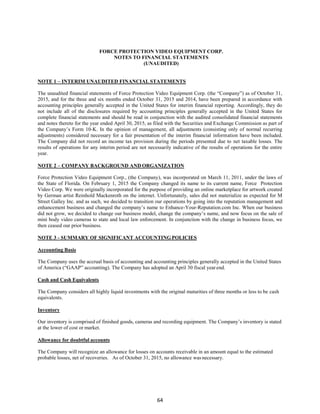
SECURITIES AND EXCHANGE COMMISSION
Washington, D.C. 20549
FORM S-1
Amendment 1
REGISTRATION STATEMENT UNDER
THE SECURITIES ACT OF 1933
Force Protection Video Equipment Corp.
(Exact name of registrant as specified in its charter)
Florida 7382 45-1443512
(State of incorporation or organization) (Primary Standard Industrial Classification Code) (I.R.S. Employer Identification Number)
Force Protection Video Equipment Corp.
140 Iowa Lane
Suite 101
Cary, NC 27511
(919) 780-7897
(Address, including zip code, and telephone number including area code, of registrant’s principal executive offices)
Brenda Hamilton, Esq.
Hamilton & Associates Law Group, P.A.
101 Plaza Real South, Suite 202 N
Boca Raton, FL 33432
Tel: (561) 416-8956
Fax: (561) 416-2855
https://www.securitieslawyer101.com
(Name, address, including zip code, and telephone number,
Including area code, of agent for service)
Copies to:
Brenda Hamilton, Esq.
Hamilton & Associates Law Group, P.A.
101 Plaza Real South, Suite 202 N
Boca Raton, FL 33432
Tel: (561) 416-8956
Fax: (561) 416-2855
https://www.securitieslawyer101.com
Approximate date of commencement of proposed sale to public: As soon as practicable after thisRegistration
Statement becomes effective.
If any of the securities being registered on this Form are to be offered on a delayed or continuous basis pursuant to
Rule 415 under the Securities Act of 1933, check the following box: [X]
If this Form is filed to register additional securities for an offering pursuant to Rule 462(b) under the Securities Act,
please check the following box and list the Securities Act registration statement number of the earlier effective
registration statement for the same offering. [ ]
2
If this Form is a post-effective amendment filed pursuant to Rule 462(c) under the Securities Act, check the
following box and list the Securities Act registration statement number of the earlier effective registration statement
for the same offering. [ ]
If this Form is a post-effective amendment filed pursuant to Rule 462(d) under the Securities Act, check the
following box and list the Securities Act registration statement number of the earlier effective registration statement
for the same offering. [ ]
Indicate by check mark whether the registrant is a large accelerated filer, an accelerated filer, anon-accelerated filer,
or a smaller reporting company. See the definitions of “large accelerated filer,” “accelerated filer” and “smaller
reporting company” in Rule 12b-2 of the Exchange Act.
Large accelerated filer [ ] Accelerated filer [ ]
Non-accelerated filer [ ] Smaller reporting company [X]
(Do not check if a smaller reporting company)
Calculation of Registration Fee
Title of Each Class
of Securities to be
Registered
Amount to be
Registered (1)
Proposed
Maximum
Offering
Price per Share (2)
Proposed
Aggregate
Maximum
Offering Price
Amount of
Registration
Fee (3)
Common stock,
$.0001 par value
2,415,000 $.63 $1,521,450 $153.21
(1) Represents shares of our common stock being registered for resale that have been issued or will be issued to the
sole Selling Stockholder named in the registration statement.
(2) Price per share shown is the average of the high and low prices reported in the consolidated reporting system as
reported on the OTC Markets OTCQB on February 18, 2016.
(3) Estimated solely for the purposes of computing the registration fee in accordance with Rule 457© of the
Securities Act of 1933, as amended.
The registrant hereby amends this registration statement on such date or dates as may be necessary to delay
its effective date until the registrant shall file a further amendment which specifically states that this
registration statement shall thereafter become effective in accordance with Section 8(a) of the Securities Act
of 1933 or until the registration statement shall become effective on such date as the Securities and Exchange
Commission, acting pursuant to said Section 8(a), may determine.
3
The information in this prospectus is not complete and may be changed. We may not sell these securities until
the registration statement filed with the Securities and Exchange Commission is effective. This prospectus is
not an offer to sell these securities and it is not soliciting an offer to buy these securities in any state where the
offer or sale is not permitted.
PRELININARY PROSPECTUS SUBJECT TO COMPLETION DATED
Force Protection Video Equipment Corp.
Up to 2,415,000 Shares of Common Stock
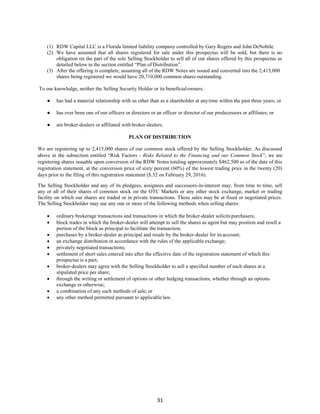
This prospectus relates to the registration and resale of up to 2,415,000 shares of our common stock, par value
$0.0001 per share, the selling stockholder identified herein, by RDW Capital, LLC (“RDW” or the “Selling
Stockholder”). The shares of common stock offered under this prospectus by the Selling Stockholder have been or
are issuable to the Selling Stockholder pursuant to a Securities Purchase Agreement and related documents
described below between the Selling Stockholder and the Company dated November 12, 2015, as amended (the
“RDW Financing”). We will not receive any proceeds from the sale of these shares by the Selling Stockholder. This
registration statement covers 2,415,000 shares of common stock issuable to the Selling Stockholder pursuant to the
RDW Financing, as further detailed in this prospectus.
We will pay all expenses of registering the securities. We will not receive any proceeds of the sale of the securities
by the Selling Stockholder.
Our common stock is currently listed on the OTC Markets OTCQB with the symbol “FPVD.”
The Selling Stockholder may sell the shares of common stock described in this prospectus in a number of different
ways and at varying prices. We provide more information about how the Selling Stockholder may sell its respective
shares of common stock in the section of this prospectus entitled “Plan ofDistribution.”
The Selling Stockholder is an “underwriter” within the meaning of the Securities Act of 1933, as amended (the
“Securities Act”), in connection with the resale of its common stock issued pursuant to RDWFinancing.
Carter, Terry & Company, a registered broker-dealer who served as the placement agent for the RDW Financing is
an underwriter within the meaning of the Securities Act.
This investment involves a high degree of risk. You should purchase shares only if you can afford a complete
loss. See “Risk Factors” beginning on page 7.
NEITHER THE SECURITIES AND EXCHANGE COMMISSION NOR ANY STATE SECURITIES
COMMISSION HAS APPROVED OR DISAPPROVED OF THESE SECURITIES OR DETERMINED IF
THIS PROSPECTUS IS TRUTHFUL OR COMPLETE. ANY REPRESENTATION TO THE CONTRARY
IS A CRIMINAL OFFENSE.
The date of this prospectus is 2016.
4
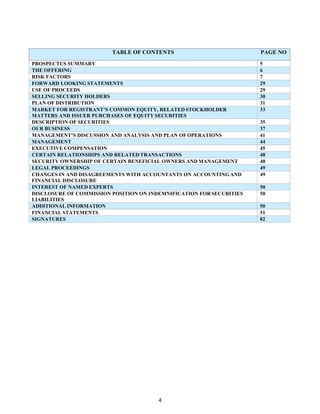
TABLE OF CONTENTS PAGE NO
PROSPECTUS SUMMARY 5
THE OFFERING 6
RISK FACTORS 7
FORWARD LOOKING STATEMENTS 29
USE OF PROCEEDS 29
SELLING SECURITY HOLDERS 30
PLAN OF DISTRIBUTION 31
MARKET FOR REGISTRANT’S COMMON EQUITY, RELATED STOCKHOLDER
MATTERS AND ISSUER PURCHASES OF EQUITY SECURITIES
33
DESCRIPTION OF SECURITIES 35
OUR BUSINESS 37
MANAGEMENT’S DISCUSSION AND ANALYSIS AND PLAN OF OPERATIONS 41
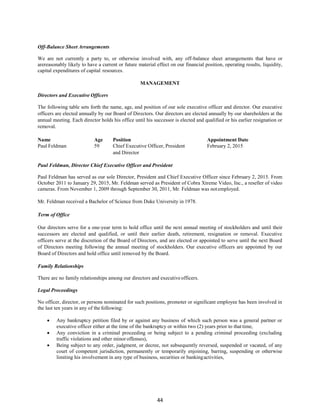
MANAGEMENT 44
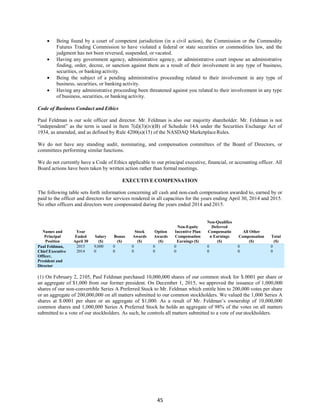
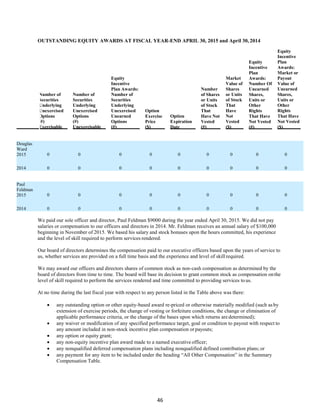
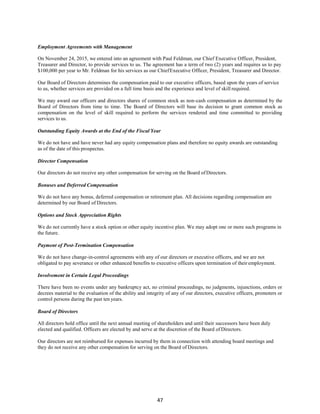
EXECUTIVE COMPENSATION 45
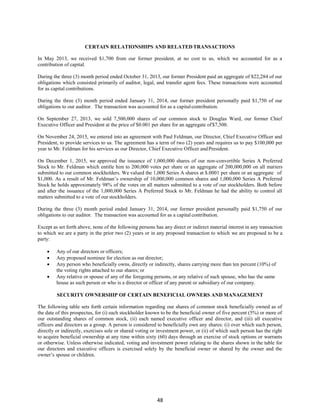
CERTAIN RELATIONSHIPS AND RELATED TRANSACTIONS 48
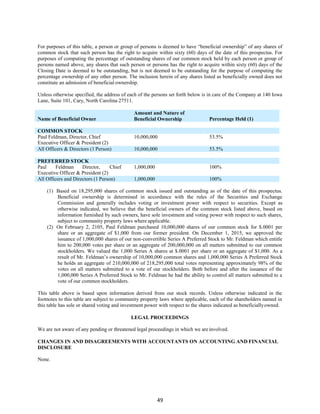
SECURITY OWNERSHIP OF CERTAIN BENEFICIAL OWNERS AND MANAGEMENT 48
LEGAL PROCEEDINGS 49
CHANGES IN AND DISAGREEMENTS WITH ACCOUNTANTS ON ACCOUNTING AND
FINANCIAL DISCLOSURE
49
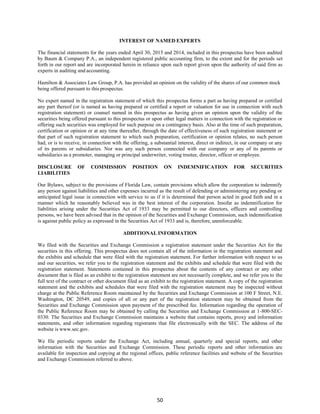
INTEREST OF NAMED EXPERTS 50
DISCLOSURE OF COMMISSION POSITION ON INDEMNIFICATION FOR SECURITIES
LIABILITIES
50
ADDITIONAL INFORMATION 50
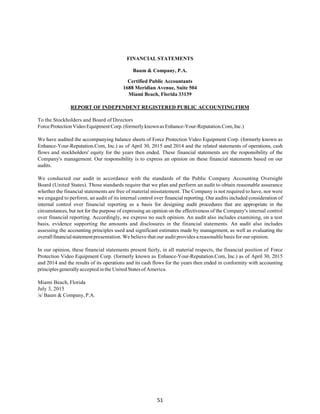
FINANCIAL STATEMENTS 51
SIGNATURES 82
5
We have not authorized any person to give you any supplemental information or to make any representations for us.
You should not rely upon any information about our company that is not contained in this prospectus. Information
contained in this prospectus may become stale. You should not assume that the information contained in this
prospectus or any prospectus supplement is accurate as of any date other than their respective dates, regardless of the
time of delivery of this prospectus, any prospectus supplement or of any sale of the shares. Our business, financial
condition, results of operations and prospects may have changed since those dates. The Selling Stockholder is
offering to sell, and seeking offers to buy, shares of our common stock only in jurisdictions where offers and sales
are permitted.
PROSPECTUS SUMMARY
This summary highlights information contained elsewhere in this prospectus and does not contain all of the
information that you should consider in making your investment decision. Before investing in our securities, you
should carefully read this entire prospectus, including our financial statements and the related notes and the
information set forth under the headings “Risk Factors” and “Management’s Discussion and Analysis of Financial
Condition and Results of Operations” in each case included elsewhere in this prospectus.
In this prospectus, “Force Protection” the “Company,” “we,” “us,” and “our” refer to Force Protection Video
Equipment Corp., a Florida corporation.
Company Information
Our principal executive office is located at 140 Iowa Lane, Suite 101, Cary, North Carolina 27511. Our telephone
number is 919-780-7897. Our website is www.forceprovideo.comand is not part of this prospectus.
We were a development-stage company, incorporated in the state of Florida on March 11, 2011, as M Street Gallery,
Inc to distribute artwork created by German artist Reinhold Mackenroth. On September 25, 2013, we changed our
name to Enhance-Your-Reputation.com, Inc. and changed our business to providing reputation management and
enhancement services.
On February 2, 2015, Douglas Ward our then controlling stockholder, sold 10,000,000 shares of our common stock,
representing approximately fifty-five percent (55%) of our common shares then outstanding to Paul Feldman, our
current Director, President and Chief Executive Officer for the price of $.001 per share or an aggregate of $1,000.
As a result of Mr. Feldman’s purchase of the 10,000,000 commonshares:
 Mr. Feldman became our controlling stockholder holding approximately fifty-five (55%) of our common
stock,
 Mr. Feldman became our Director, President and Chief ExecutiveOfficer,
 We changed our name to Force Protection Video Equipment Corp., and
 Our stopped providing reputation enhancement services and our business became the commercialization of
mini on body video cameras to state and local law enforcement.
As of the date of this prospectus, Paul Feldman is our sole officer and director. Mr. Feldman spends fulltime on our
business. We sold our first on body video camera in May of 2015. To date, our products have been sold to twenty-
nine (29) state and local law enforcement agencies.
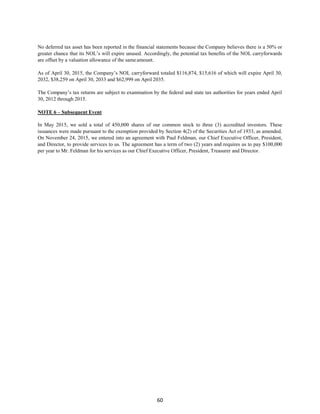
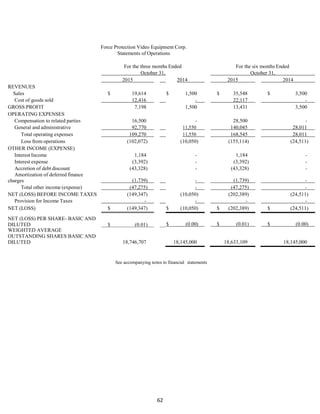
For the six (6) months ending October 31, 2015, we had revenues of $35,548 from the sale of our products. For the
year ended April 30, 2015, we had revenues of $5,000 from our reputation enhancement services. For the year
ended April 30, 2015 and six (6) months ended October 31, 2015, we have a net loss of $10,050 and $202,389
respectively.
As of the date of this prospectus, we had cash on hand of $102,000 for our operational needs. Currently, our
operating expenses are approximately $16,000 per month. If we fail to generate sufficient revenues or raise
additional funds to meet our monthly operating costs, we would have available cash for our operating needs for
approximately six (6) months.
6
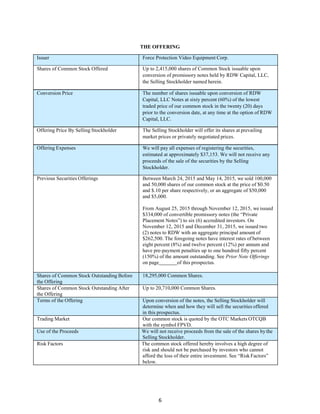
THE OFFERING
Issuer Force Protection Video Equipment Corp.
Shares of Common Stock Offered Up to 2,415,000 shares of Common Stock issuable upon
conversion of promissory notes held by RDW Capital, LLC,
the Selling Stockholder named herein.
Conversion Price The number of shares issuable upon conversion of RDW
Capital, LLC Notes at sixty percent (60%) of the lowest
traded price of our common stock in the twenty (20) days
prior to the conversion date, at any time at the option of RDW
Capital, LLC.
Offering Price By Selling Stockholder The Selling Stockholder will offer its shares at prevailing
market prices or privately negotiated prices.
Offering Expenses We will pay all expenses of registering the securities,
estimated at approximately $37,153. We will not receive any
proceeds of the sale of the securities by the Selling
Stockholder.
Previous Securities Offerings Between March 24, 2015 and May 14, 2015, we sold 100,000
and 50,000 shares of our common stock at the price of $0.50
and $.10 per share respectively, or an aggregate of $50,000
and $5,000.
From August 25, 2015 through November 12, 2015, we issued
$334,000 of convertible promissory notes (the “Private
Placement Notes”) to six (6) accredited investors. On
November 12, 2015 and December 31, 2015, we issued two
(2) notes to RDW with an aggregate principal amount of
$262,500. The foregoing notes have interest rates of between
eight percent (8%) and twelve percent (12%) per annum and
have pre-payment penalties up to one hundred fifty percent
(150%) of the amount outstanding. See Prior Note Offerings
on page of this prospectus.
Shares of Common Stock Outstanding Before
the Offering
18,295,000 Common Shares.
Shares of Common Stock Outstanding After
the Offering
Up to 20,710,000 Common Shares.
Terms of the Offering Upon conversion of the notes, the Selling Stockholder will
determine when and how they will sell the securities offered
in this prospectus.
Trading Market Our common stock is quoted by the OTC Markets OTCQB
with the symbol FPVD.
Use of the Proceeds We will not receive proceeds from the sale of the shares bythe
Selling Stockholder.
Risk Factors The common stock offered hereby involves a high degree of
risk and should not be purchased by investors who cannot
afford the loss of their entire investment. See “Risk Factors”
below.
7
Risk Factors
Our ability to successfully operate our business and achieve our goals and strategies is subject to numerous risks
including:
 We are obligated to issue common shares upon conversion of outstanding promissory notes which will
cause substantial dilution to investors and reduce the trading price of our common shares.
 Note holders will pay less than the then-prevailing market price for our common stock if they convert the
notes that they hold.
 Our stock price is volatile and you may not be able to resell your common shares at or above the current
trading price of our common shares.
 Our stock price will likely materially decline because holders of convertible notes will have the ability to
convert the notes into a large number of common shares which will result in significantdilution.
 There is not now, and there may never be, an active, liquid and orderly trading market for our common
stock, which may make it difficult for you to sell your shares of our common stock.
 We only commenced our present business plan to sell on-body cameras in May of 2015 and as such, there
little or no historical performance for you to base an investment decision upon, and we may never become
profitable.
 We are dependent on sales of our securities to fund our operations.
 Third parties can purchase the same products we sell which may negatively affect our revenues.
 Our failure to compete effectively could adversely affect our market share, financial condition and future
growth.
 We are dependent on our manufacturer in China and any disruption or extended delay in product supply
from our manufacturer could have a significant adverse impact on ouroperations.
 We do not have a written agreement with our manufacturer that obligates it to provide productsto us.
 Expenses required to operate as a public company will reduce funds available to develop our business.
 We may be subject to product liability claims and we do not have insurance coverage for suchclaims.
 There is a limited market for our common shares.
Should we lose the service of Paul Feldman, our sole officer and director, our operations and financial condition
will be adversely affected.
RDW Financing
On November 12, 2015, we entered into a securities purchase agreement (the “RDW Purchase Agreement”) with
RDW Capital, LLC, (“RDW”) a Florida limited liability company controlled by Gary Rogers and John DeNobile.
As amended, the RDW Purchase Agreement obligates RDW to invest in three (3) convertible notes (the “RDW
Notes”) with an aggregate principal amount of $462,000.
In connection with the RDW Purchase Agreement, on November 12, 2015, we issued to RDW, an eight percent
(8%) convertible note in the principal amount of $157,500, in exchange for RDW’s investment of $150,000 (the
“First RDW Note”). Out of the proceeds from the First RDW Note, we paid the sum of $5,000 to RDW’s legal
counsel, and paid $15,000 to our placement agent, Carter, Terry & Company (“CTC”), a broker-dealer registered
with the Securities & Exchange Commission (“SEC”) and Financial Industry Regulatory Authority (“FINRA”).
Pursuant to the terms of our agreement with CTC, we received net proceeds of $130,000 from the First RDW Note.
We are obligated to issue 5,042 common shares to CTC as a commission in connection with the First RDWNote.
In connection with the RDW Purchase Agreement, on December 31, 2015, we issued to RDW a second convertible
note in the principal amount of $105,000 (the “Second RDW Note”) in exchange for RDW’s investment of
$100,000. Out of the proceeds from the Second RDW Note, we paid the sum of $10,000 to CTC, as the placement
agent pursuant to the terms of our agreement with CTC. After payment of these amounts, we received net proceeds
of $90,000 from the Second RDW Note. We are obligated to issue 4,468 common shares to CTC as a commission in
connection with the Second RDW Note.
8
On March 4, 2016, we entered into an amendment to the RDW Purchase Agreement which obligated RDW to fund a
third convertible note in the principle amount of $200,000 (the “Third RDW Note”) in exchange for RDW’s
investment of $200,000 within three (3) days after the Securities & Exchange Commission (“SEC”) declares this
registration statement effective. We are obligated to pay CTC, a cash fee of $20,000 and a stock fee of $8,000 we
receive divided by the closing price of our common stock on that we receive the $200,000 from the Third RDW
Note.
In connection with the RDW Financing, we entered into three agreements (the “RDW FinancingDocuments”):
 A securities purchase agreement, as amended (the “RDW Purchase Agreement”),
 Promissory Note, and
 Registration Rights Agreement.
The RDW Notes have the following terms and conditions:
 The principal amount outstanding accrues interest at a rate of eight percent (8%) perannum.
 Interest is due and payable on each conversion date and on the MaturityDate.
 The RDW Notes mature five (5) months, after issuance.
 At any time, at the option of the holder, the RDW Notes are convertible, into shares of our common stock
at a conversion price equal to sixty percent (60%) of the lowest traded price of our common stock in the
twenty (20) days prior to the conversion date, at any time, at the option of the holder (the “Conversion
Price”).
 The RDW Notes are unsecured obligations.
 We may prepay the RDW Notes in whole or in part at any time with ten (10) days written notice to the
holder for the sum of the outstanding principal and interest multiplied by one hundred and thirty percent
(130%). RDW may continue to convert the notes from the date of the notice of prepayment until the date
of prepayment.
 The RDW Notes have default interest of twenty-four percent (24%) perannum.
 Interest on overdue accrued and unpaid interest will incur a late fee of the lower of eighteen percent (18%)
per annum or the maximum rate permitted by law.
 Upon an event of default under the RDW Notes, RDW may accelerate the outstanding principal, plus
accrued and unpaid interest, and other amounts owing through the date of acceleration (“Acceleration”).
 Upon Acceleration, the amount due will be one hundred thirty percent (130%) of the outstanding principal
amount of the Note and accrued and unpaid interest, together with payment of all other amounts, costs,
expenses and liquidated damages due under the RDW Notes.
 Upon an event of default, RDW may choose to convert all outstanding amounts outstanding into our
common stock at a conversion price equal to sixty percent (60%) of the lowest traded price in the twenty
(20) days prior to conversion (the “Default Conversion Price”).
 In the event of our default, at the request of the holder, we must pay one hundred fifty percent (150%) of
the outstanding balance plus accrued interest and default interest.
 We must reserve three (3) times the amount of shares necessary for the issuance of common stock upon
conversion.
 Conversions of the RDW Notes shall not be permitted if such conversion will result in the holder owning
more than four point ninety-nine percent (4.99%) of our common shares outstanding after giving effect to
such conversion.
We are required to comply with certain “Equity Conditions” set forth in the RDW Purchase Agreement in
connection with the RDW Notes; however, the Equity Conditions are not condition precedents to RDW’s obligation
to purchase the Third RDW Note within three (3) days after the SEC declares this registration statement effective.
9
The Equity Conditions include:
 There must not be an “Event of Default” under any RDW Note.
 We have timely filed (or obtained extensions in respect thereof and filed within the applicable grace period)
all reports other than Current Reports on Form 8-K required to be filed by us pursuant to the Securities
Exchange Act of 1934, as amended (the “Exchange Act”).
 Our common stock must be DWAC (Deposit/Withdrawal at Custodian) eligible and not subject to a “DTC
chill” (a limitation of certain services available for a security on deposit at the Deposit Trust Company
(“DTC”)), the largest securities depository in the world, e.g. a limitation on a DTC participant’s ability to
make a deposit or withdrawal of the security).
 The common shares issued upon conversion of the RDW Note must be delivered via an “Automatic
Conversion” of principal and/or interest.
An “Event of Default” includes the following:
 any default in the payment of the principal amount of any RDW Note,
 a default in the payment of interest, liquidated damages and other amounts owed to the holder of any RDW
Note which is not cured within three (3) trading days;
 our failure to observe or perform any other material covenant or agreement contained in the RDW Notes
(and other than a breach by us of our obligations to deliver shares of common stock to the holder of the
Notes upon conversion, which breach is addressed below) which failure is not cured, if possible to cure,
within the earlier to occur of five (5) trading days after the holder sends us notice and ten (10) trading days
after we become or should have become aware of such failure;
 a material default or material event of default (subject to any grace or cure period provided in the
applicable agreement, document or instrument) shall occur under any of RDW Financing Documents or
any other material agreement, document or instrument to which we are obligated;
 any representation or warranty made in any RDW Financing Document or any written statement pursuant
hereto or thereto or any other report, financial statement or certificate made or delivered to RDW or any
other holder of any such note shall be untrue or incorrect in any material respect as of the date when made
or deemed made;
 we default on any of our obligations under any mortgage, credit agreement or other facility, indenture
agreement, factoring agreement or other instrument under which there may be issued, or by which there
may be secured or evidenced, any indebtedness for borrowed money or money due under any long term
leasing or factoring arrangement that (a) involves an obligation greater than $100,000, whether such
indebtedness now exists or shall hereafter be created, and (b) results in such indebtedness becoming or
being declared due and payable prior to the date on which it would otherwise become due and payable;
 our common stock shall not be eligible for listing or quotation by the OTC Markets OTCQB and shall not
be eligible to resume listing or quotation for trading thereon within five (5) trading days or the transfer of
shares of our common stock through the DTC System is no longer available or“chilled”;
 we are a party to any change of control transaction or transaction involving the sale of all or substantially
all of our assets, or we agree to sell or dispose of all or in excess of fifty percent (50%) of our assets in one
transaction or a series of related transactions;
 we fail to file with the SEC any required reports under Section 13 or 15(d) of the Securities Exchange Act
of 1934;
10
 if, during the Effectiveness Period (as defined in the Registration Rights Agreement), either (a) the
effectiveness of the Registration Statement lapses for any reason or (b) the holder shall not be permitted to
resell Registrable Securities (as defined in the Registration Rights Agreement) under the Registration
Statement for a period of more than twenty (20) consecutive trading days or thirty (30) non-consecutive
trading days during any twelve (12) month period; provided, however, that if we are negotiating a merger,
consolidation, acquisition or sale of all or substantially all of our assets or a similar transaction and, in the
written opinion of our legal counsel, the Registration Statement would be required to be amended to
include information concerning such pending transaction(s) or the parties thereto which information is not
available or may not be publicly disclosed at the time, we shall be permitted an additional ten (10)
consecutive trading days during any twelve (12) month period.
 we do not meet the current public information requirements of Rule 144 in respect of the Registrable
Securities;
 we become subject to a voluntary or involuntary bankruptcy or we (i) apply for or consent to the
appointment of a trustee, custodian or liquidator of our or any of our properties, (ii) admit in writing our
inability to pay our debts as they mature, (iii) make a general assignment for the benefit of creditors, (iv) be
adjudicated as bankrupt or insolvent or be the subject of an order for relief under Title 11 of the United
States Code or any bankruptcy, reorganization, insolvency, readjustment of debt, dissolution or liquidation
law or statute of any other jurisdiction or foreign country, or (v) file a voluntary petition in bankruptcy, or a
petition or an answer seeking reorganization or an arrangement with creditors or to take advantage or any
bankruptcy, reorganization, insolvency, readjustment of debt, dissolution or liquidation law or statute, or an
answer admitting the material allegations of a petition filed against it in any proceeding under any such
law, or (vi) take or permit to be taken any action in furtherance of or for the purpose of effecting any of the
foregoing;
 we fail for any reason to deliver certificates to a holder prior to the third trading day after a conversion, or
we provide at any time notice to the holder, including by way of public announcement, of our intention to
not honor requests for conversions of the RDW Notes in accordance with the terms of the RDW Notes;
 if any order, judgment or decree shall be entered, without our application, approval or consent, by any court
of competent jurisdiction, approving a petition seeking our liquidation or reorganization, or appointing a
receiver, trustee, custodian or liquidator of us, or of all or any substantial part of our assets, and such order,
judgment or decree shall continue unstayed and in effect for any period of sixty (60) days;
 the occurrence of any levy upon or seizure or attachment of, or any uninsured loss of or damage to, any of
our property having an aggregate fair value or repair cost in excess of $100,000 individually or in the
aggregate, and any such levy, seizure or attachment shall not be set aside, bonded or discharged within
thirty (30) days after the date thereof;
 we must reserve and keep available out of our authorized and unissued shares of common stock at least
three hundred percent (300%) of the maximum aggregate number of shares of common stock then issued or
potentially issuable in the future pursuant to the terms of the RDWNotes.
 any monetary judgment, writ or similar final process shall be entered or filed against us or our property or
assets for more than $100,000, and such judgment, writ or similar final process shall remain unvacated,
unbonded or unstayed for a period of forty-five (45) calendar days.
There is no guarantee that we will be able to meet the foregoing conditions or any of the other terms of the RDW
Financing including the Equity Conditions. Even if we do not comply with the terms and conditions of the RDW
Financing, RDW is obligated to invest in the Third RDW Note within three (3) days after the SEC declares this
registration statement effective. There is no guarantee that RDW will invest additional amounts pursuant to the
Third RDW Note even though it is contractually obligated to do so.
The number of common shares we will issue upon conversion of the RDW Notes is dependent upon the price per
share applicable to the conversion of each note. The conversion price for each note varies depending on the trading
price of our common stock and whether there is an Event of Default. If there is an Event of Default, the conversion
price shall be equal to the Default Conversion Price.
11
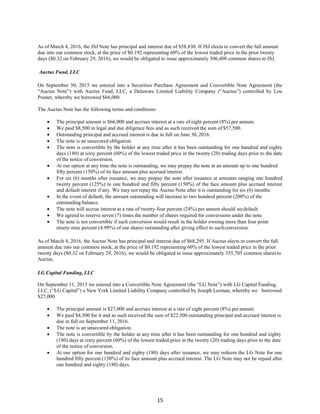
We are seeking to register 2,415,000 shares, which we estimate we would be obligated to issue if the RDW Notes in
the aggregate amount of $462,500 are converted, based on all potential interest and other charges. By registering
2,415,000 shares, we are taking into consideration potential adjustments to the applicable conversion price pursuant
to RDW Financing. There is no assurance our assumptions are correct.
Accordingly, the dilutive effect of the RDW Financing depends upon whether RDW voluntarily converts any RDW
Note, the price when RDW converts and whether an Event of Default has occurred. The dilutive effect of RDW
Financing is directly tied to the performance of our stock during the time the RDW Notes are outstanding, and any
decrease in our stock price will result in additional dilution to our stockholders. If our share price decreases prior to
the time shares are issued upon conversion, we will need to issue more shares than if our share price had increased.
Such issuances will have a dilutive effect and may further decrease our stock price. The effect of this dilution may,
in turn, cause the price of our common stock to decrease further, both because of the downward pressure on the
stock price that would be caused by a large number of sales of our shares into the public market by RDW, and
because our existing stockholders and other convertible note holders may also sell their shares into the public market
based on their belief that the dilutive effect of the RDW Financing will cause our stockprice to further decrease.
In connection with the RDW Financing, on November 12, 2015, we entered into a Registration Rights Agreement
(“RDW Registration Rights Agreement”) pursuant to which we agreed to register for resale on Form S-1 the shares
of common stock issuable conversion of the RDW Notes. Pursuant to RDW Registration Rights Agreement, we
agreed to file the registration statement within forty-five (45) days after execution or by December 27, 2015. We are
obligated to pay financial penalties of one percent (1%) of the subscription amount if this registration statement is
not declared effective by the SEC within ninety (90) days after filing. This registration statement covers the resale
of shares issuable upon conversion of the RDW Notes.
The RDW Notes and the shares of common stock that may be issued to the holder upon conversion of the RDW
Notes will be issued pursuant to an exemption from registration under the Securities Act of 1933, as amended.
Pursuant to the RDW Financing Documents, we have filed a registration statement, of which this prospectus is a
part, covering the possible resale by the RDW of all of the common shares that we may issue to RDW upon
conversion of the RDW Notes. Through this prospectus, RDW may offer to the public for resale shares of our
common stock that we may issue upon conversion of the RDW Notes.
The RDW Financing Documents contain representations and warranties by us and RDW which are typical for
transactions of this type.
As set forth in the RDW Purchase Agreement, RDW has represented to us that commencing on the date we signed
RDW Financing Documents, it has not, directly or indirectly, executed any purchases or sales, including short sales,
of our common stock. The RDW Purchase Agreement, specifically provides that RDW will not purchase our
common shares, long and/or short.
RDW Financing obligates us to indemnify RDW for certain losses resulting from a misrepresentation or breach of
any representation or warranty made by us or breach of any obligation of ours. RDW also indemnifies us for similar
matters.
The issuance of shares of our common stock under the RDW Financing will have no effect on the rights or
privileges of the existing holders of our common stock except that the economic and voting interests of each
stockholder will be substantially diluted as a result of the issuance of additional shares to RDW. Although the
number of shares of common stock that stockholders presently own will not decrease as a result of RDW Financing,
these shares will represent a smaller percentage of our total shares that will be outstanding after any issuances of
shares of common stock to RDW.
12
Rate Principal &
Interest Upon
Default
Interest
Accrued as of
3/4/16
Shares issuable
upon
Conversion (2)
our Common
Stock that may
Be Held by
Note Holder
Black Forest
Capital, LLC
JSJ
$53,000
$56,000
10%
12%
---
18%
Outstanding
Principal and
Interest
Increase by
140%
Outstanding
40% of lowest
traded price
during the 20
days prior to
conversion
60% of lowest
$55,194
$58,830
10/8/16
4/6/16
431,195
306,408
4.99%
4.99%
We entered into RDW Financing to obtain capital to grow our business, which in turn should increase our value. We
plan to add significant positive value through the use of funds received pursuant to RDW Financing. However, as
reflected above, our share price will likely decline significantly.
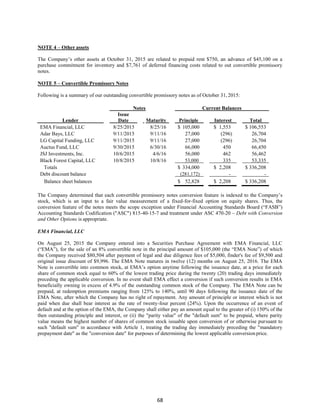
From August 25, 2015 through November 12, 2015, we issued $334,000 of convertible promissory notes (the
“Private Placement Notes”) to six (6) accredited investors. On November 12, 2015 and December 31, 2015, we
issued two (2) notes to RDW with an aggregate principal amount of $262,500. The Private Placement Notes and the
RDW Notes were issued pursuant to Section 4(2) of the Securities Act of 1933, as amended. The RDW Notes bear
interest at 8% per annum and the Private Placement Notes have varied interest rates. This registration statement
covers 2,415,000 common shares issuable to RDW upon conversion of the RDW Notes. Shares issuable to the six
(6) investors upon conversion of the Private Placement Notes are not being registered. The conversion price of the
RDW Notes is sixty percent (60%) of the lowest traded price of our common shares in the twenty (20) days prior to
conversion. The conversion price of the Private Placement Notes is between forty percent (40%) and sixty percent
(60%) of the lowest traded price of our common shares in the twenty (20) days prior to conversion. Based upon the
twenty (20) day period prior to the filing of this registration statement, the lowest traded price was $0.32 on
February 29, 2016. The Private Placement Notes and the RDW Notes are summarized below.
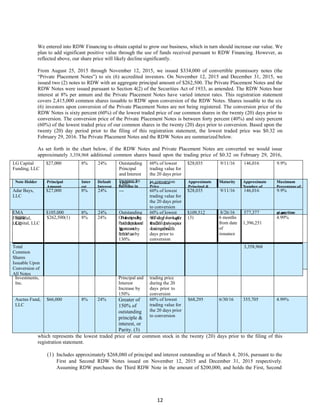
As set forth in the chart below, if the RDW Notes and Private Placement Notes are converted we would issue
approximately 3,358,968 additional common shares based upon the trading price of $0.32 on February 29, 2016,
LG Capital
Funding, LLC
$27,000 8% 24% Outstanding
Principal
and Interest
60% of lowest
trading value for
the 20 days prior
$28,035 9/11/16 146,016 9.9%
Note Holder Principal
Amount
Inter
est
Default
Interest
AIndcdrietaiosneabl y
I1n5c0r%ease in
Ctoocnovnervseirosnion
Price
Approximate
Principal &
Maturity Approximate
Number of
Maximum
Percentage of
Adar Bays,
LLC
$27,000 8% 24% --- 60% of lowest
trading value for
the 20 days prior
to conversion
$28,035 9/11/16 146,016 9.9%
EMA $105,000 8% 24% Outstanding 60% of lowest $109,512 8/26/16 577,377 a4t.9a%nytime
FRinDanWcial,
LCLaCpital, LLC
$262,500(1) 8% 24% OPruitnsctaipnadling
PanridncIinptaelreasntd
IIInnntcerreeassteby
I1n5c0re%aseby
130%
6tr0a%dinogfvloawlueeestfor
ttrhaed2e0ddpariycseprior
dtourcionngvtehresi2o0n
days prior to
conversion
(3) 6 months
from date
of
issuance
1,396,251
4.99%
Total
Common
Shares
Issuable Upon
Conversion of
All Notes
3,358,968
Investments,
Inc.
Principal and
Interest
Increase by
150%
trading price
during the 20
days prior to
conversion
Auctus Fund,
LLC
$66,000 8% 24% Greater of
150% of
outstanding
principle &
interest, or
Parity. (3)
60% of lowest
trading value for
the 20 days prior
to conversion
$68,295 6/30/16 355,705 4.99%
which represents the lowest traded price of our common stock in the twenty (20) days prior to the filing of this
registration statement.
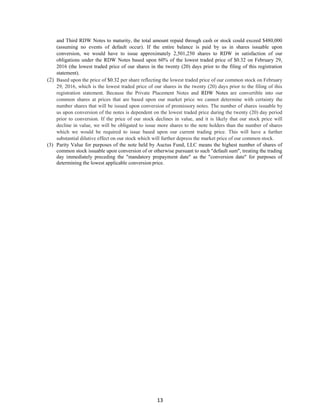
(1) Includes approximately $268,080 of principal and interest outstanding as of March 4, 2016, pursuant to the
First and Second RDW Notes issued on November 12, 2015 and December 31, 2015 respectively.
Assuming RDW purchases the Third RDW Note in the amount of $200,000, and holds the First, Second
13
and Third RDW Notes to maturity, the total amount repaid through cash or stock could exceed $480,000
(assuming no events of default occur). If the entire balance is paid by us in shares issuable upon
conversion, we would have to issue approximately 2,501,250 shares to RDW in satisfaction of our
obligations under the RDW Notes based upon 60% of the lowest traded price of $0.32 on February 29,
2016 (the lowest traded price of our shares in the twenty (20) days prior to the filing of this registration
statement).
(2) Based upon the price of $0.32 per share reflecting the lowest traded price of our common stock on February
29, 2016, which is the lowest traded price of our shares in the twenty (20) days prior to the filing of this
registration statement. Because the Private Placement Notes and RDW Notes are convertible into our
common shares at prices that are based upon our market price we cannot determine with certainty the
number shares that will be issued upon conversion of promissory notes. The number of shares issuable by
us upon conversion of the notes is dependent on the lowest traded price during the twenty (20) day period
prior to conversion. If the price of our stock declines in value, and it is likely that our stock price will
decline in value, we will be obligated to issue more shares to the note holders than the number of shares
which we would be required to issue based upon our current trading price. This will have a further
substantial dilutive effect on our stock which will further depress the market price of our common stock.
(3) Parity Value for purposes of the note held by Auctus Fund, LLC means the highest number of shares of
common stock issuable upon conversion of or otherwise pursuant to such "default sum", treating the trading
day immediately preceding the "mandatory prepayment date" as the "conversion date" for purposes of
determining the lowest applicable conversion price.
14
Black Forest Capital, LLC
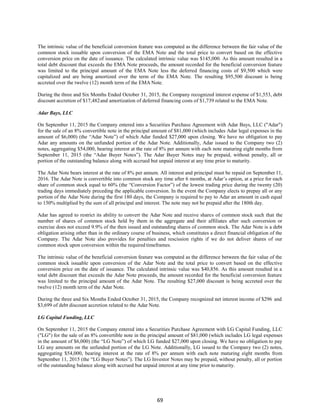
On October 8, 2015, we entered into a Convertible Note (the “Black Forest Note”) with Black Forest Capital, LLC
(“Black Forest”) a Wyoming Limited Liability Company controlled by Keith Vogt, whereby we borrowed$53,000.
The Black Forest Note has the following terms and conditions:
 The principal amount is $53,000 and accrues interest at a rate of ten percent (10%) per annum.
 We paid $3,000 of legal and due diligence fees and as such received the sum of $50,000.
 Outstanding principal and accrued interest is due in full on October 8, 2016.
 The note is an unsecured obligation.
 At our option at any time during the first one hundred eighty (180) days the note is outstanding, we may
redeem the note at one hundred thirty-five percent (135%) of its face amount plus accruedinterest.
 We may not redeem the note after one hundred eighty (180) days.
 The note is convertible by the holder at any time at forty percent (40%) of the lowest traded price in the
twenty (20) trading days prior to the date of the notice ofconversion.
 In the event of our default, the amount outstanding will increase to one hundred forty percent (140%) of the
outstanding balance.
 We must reserve a sufficient number of shares to provide for the issuance of common stock for conversion.
 The note is not convertible if such conversion would result in the holder owning more than four point
ninety-nine percent (4.99%) of our shares outstanding after giving effect to suchconversion.
As of March 4, 2016, the Black Forest Note has principal and interest due of $55,193. If Black Forest elects to
convert the full amount due into our common stock, at the price of $0.128 representing 40% of the lowest traded
price in the prior twenty days ($0.32 on February 29, 2016), we would be obligated to issue approximately 431,195
common shares to Black Forest.
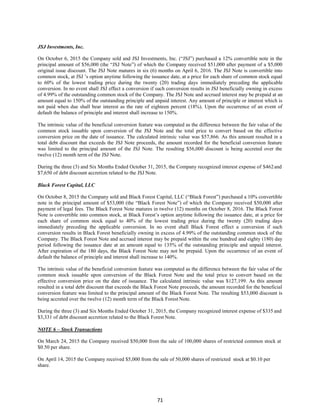
JSJ Investments, Inc.
On October 6, 2015 we entered into a Convertible Note Agreement (“JSJ Note”) with JSJ Investments, Inc. (“JSJ”),
a Texas corporation controlled by Sameer Hirji, whereby we are obligated to pay the principal amount of$56,000.
The JSJ Note has the following terms and conditions:
 The principal amount is $56,000 and accrues interest at a rate of twelve (12) percent (12%) per annum.
 The loan had a discount and as such we received the sum of $51,000.
 Outstanding principal and accrued interest is due in full on April 6, 2016.
 The note is an unsecured obligation.
 We may redeem the note at one hundred fifty percent (150%) of its face amount in addition to accrued
interest only with the consent of the holder.
 The note is convertible by the holder at any time at sixty percent (60%) of the lowest traded price in the
twenty (20) trading days prior to the date of the notice ofconversion.
 In the event of our default, at the request of the holder, we must pay one hundred fifty percent (150%) of
the outstanding balance plus accrued interest and default interest.
 The note will accrue interest at a rate of eighteen percent (18%) per annum in the event of default.
 We must reserve a sufficient number of shares to provide for the issuance of common stock for conversion.
 The note is not convertible if such conversion would result in the holder owning more than four point
ninety-nine percent (4.99%) of our shares outstanding after giving effect to such conversion. The note is an
unsecured obligation.
15
As of March 4, 2016, the JSJ Note has principal and interest due of $58,830. If JSJ elects to convert the full amount
due into our common stock, at the price of $0.192 representing 60% of the lowest traded price in the prior twenty
days ($0.32 on February 29, 2016), we would be obligated to issue approximately 306,408 common shares to JSJ.
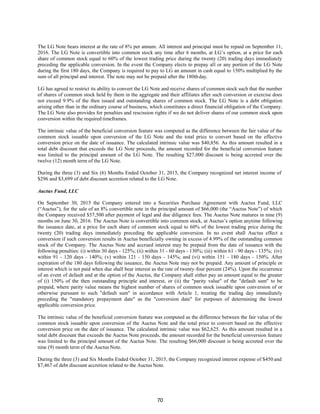
Auctus Fund, LLC
On September 30, 2015 we entered into a Securities Purchase Agreement and Convertible Note Agreement (the
“Auctus Note”) with Auctus Fund, LLC, a Delaware Limited Liability Company (“Auctus”) controlled by Lou
Posner, whereby we borrowed $66,000.
The Auctus Note has the following terms and conditions:
 The principal amount is $66,000 and accrues interest at a rate of eight percent (8%) per annum.
 We paid $8,500 in legal and due diligence fees and as such received the sum of $57,500.
 Outstanding principal and accrued interest is due in full on June 30, 2016.
 The note is an unsecured obligation.
 The note is convertible by the holder at any time after it has been outstanding for one hundred and eighty
days (180) at sixty percent (60%) of the lowest traded price in the twenty (20) trading days prior to the date
of the notice of conversion.
 At our option at any time the note is outstanding, we may prepay the note at an amount up to one hundred
fifty percent (150%) of its face amount plus accrued interest.
 For six (6) months after issuance, we may prepay the note after issuance at amounts ranging one hundred
twenty percent (125%) to one hundred and fifty percent (150%) of the face amount plus accrued interest
and default interest if any. We may not repay the Auctus Note after it is outstanding for six (6) months.
 In the event of default, the amount outstanding will increase to two hundred percent (200%) of the
outstanding balance.
 The note will accrue interest at a rate of twenty-four percent (24%) per annum should wedefault.
 We agreed to reserve seven (7) times the number of shares required for conversions under the note.
 The note is not convertible if such conversion would result in the holder owning more than four point
ninety-nine percent (4.99%) of our shares outstanding after giving effect to suchconversion.
As of March 4, 2016, the Auctus Note has principal and interest due of $68,295. If Auctus elects to convert the full
amount due into our common stock, at the price of $0.192 representing 60% of the lowest traded price in the prior
twenty days ($0.32 on February 29, 2016), we would be obligated to issue approximately 355,705 common sharesto
Auctus.
LG Capital Funding, LLC
On September 11, 2015 we entered into a Convertible Note Agreement (the “LG Note”) with LG Capital Funding,
LLC, (“LG Capital”) a New York Limited Liability Company controlled by Joseph Lerman, whereby we borrowed
$27,000.
 The principal amount is $27,000 and accrues interest at a rate of eight percent (8%) perannum.
 We paid $4,500 for it and as such received the sum of $22,500 outstanding principal and accrued interest is
due in full on September 11, 2016.
 The note is an unsecured obligation.
 The note is convertible by the holder at any time after it has been outstanding for one hundred and eighty
(180) days at sixty percent (60%) of the lowest traded price in the twenty (20) trading days prior to the date
of the notice of conversion.
 At our option for one hundred and eighty (180) days after issuance, we may redeem the LG Note for one
hundred fifty percent (150%) of its face amount plus accrued interest. The LG Note may not be repaid after
one hundred and eighty (180) days.
16
 The note will accrue interest at a rate of twenty-four percent (24%) per annum should wedefault.
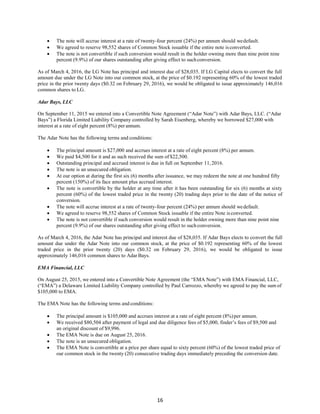
 We agreed to reserve 98,552 shares of Common Stock issuable if the entire note isconverted.
 The note is not convertible if such conversion would result in the holder owning more than nine point nine
percent (9.9%) of our shares outstanding after giving effect to suchconversion.
As of March 4, 2016, the LG Note has principal and interest due of $28,035. If LG Capital elects to convert the full
amount due under the LG Note into our common stock, at the price of $0.192 representing 60% of the lowest traded
price in the prior twenty days ($0.32 on February 29, 2016), we would be obligated to issue approximately 146,016
common shares to LG.
Adar Bays, LLC
On September 11, 2015 we entered into a Convertible Note Agreement (“Adar Note”) with Adar Bays, LLC. (“Adar
Bays”) a Florida Limited Liability Company controlled by Sarah Eisenberg, whereby we borrowed $27,000 with
interest at a rate of eight percent (8%) per annum.
The Adar Note has the following terms and conditions:
 The principal amount is $27,000 and accrues interest at a rate of eight percent (8%) per annum.
 We paid $4,500 for it and as such received the sum of $22,500.
 Outstanding principal and accrued interest is due in full on September 11,2016.
 The note is an unsecured obligation.
 At our option at during the first six (6) months after issuance, we may redeem the note at one hundred fifty
percent (150%) of its face amount plus accrued interest.
 The note is convertible by the holder at any time after it has been outstanding for six (6) months at sixty
percent (60%) of the lowest traded price in the twenty (20) trading days prior to the date of the notice of
conversion.
 The note will accrue interest at a rate of twenty-four percent (24%) per annum should wedefault.
 We agreed to reserve 98,552 shares of Common Stock issuable if the entire Note isconverted.
 The note is not convertible if such conversion would result in the holder owning more than nine point nine
percent (9.9%) of our shares outstanding after giving effect to such conversion.
As of March 4, 2016, the Adar Note has principal and interest due of $28,035. If Adar Bays elects to convert the full
amount due under the Adar Note into our common stock, at the price of $0.192 representing 60% of the lowest
traded price in the prior twenty (20) days ($0.32 on February 29, 2016), we would be obligated to issue
approximately 146,016 common shares to Adar Bays.
EMA Financial, LLC
On August 25, 2015, we entered into a Convertible Note Agreement (the “EMA Note”) with EMA Financial, LLC,
(“EMA”) a Delaware Limited Liability Company controlled by Paul Carrozzo, whereby we agreed to pay the sum of
$105,000 to EMA.
The EMA Note has the following terms and conditions:
 The principal amount is $105,000 and accrues interest at a rate of eight percent (8%)per annum.
 We received $80,504 after payment of legal and due diligence fees of $5,000, finder’s fees of $9,500 and
an original discount of $9,996.
 The EMA Note is due on August 25, 2016.
 The note is an unsecured obligation.
 The EMA Note is convertible at a price per share equal to sixty percent (60%) of the lowest traded price of
our common stock in the twenty (20) consecutive trading days immediately preceding the conversion date.
17
 The EMA Note can be prepaid, at redemption premiums ranging from one hundred twenty-five percent
(125%) to one hundred forty percent (140%), until ninety (90) days following the issuance date of the EMA
Note, after which we have no right ofrepayment.
 Upon the occurrence of an Event of Default and at the option of EMA, we shall either pay an a mount equal
to the greater of (i) one hundred fifty percent (150%) of the then outstanding principle and interest, or (ii)
the “parity value” of the “default sum” to be prepaid, where parity value means the highest number of
shares of common stock issuable upon conversion of or otherwise pursuant to such “default sum” treating
the trading day immediately preceding the “mandatory prepayment date” as the “conversion date” for
purposes of determining the lowest applicable conversion price.
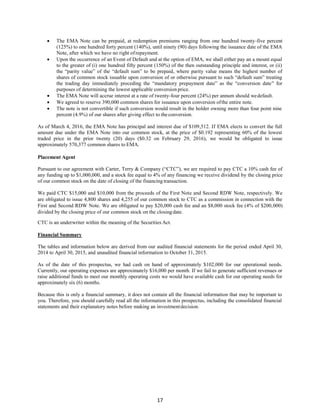
 The EMA Note will accrue interest at a rate of twenty-four percent (24%) per annum should wedefault.
 We agreed to reserve 390,000 common shares for issuance upon conversion ofthe entire note.
 The note is not convertible if such conversion would result in the holder owning more than four point nine
percent (4.9%) of our shares after giving effect to theconversion.
As of March 4, 2016, the EMA Note has principal and interest due of $109,512. If EMA elects to convert the full
amount due under the EMA Note into our common stock, at the price of $0.192 representing 60% of the lowest
traded price in the prior twenty (20) days ($0.32 on February 29, 2016), we would be obligated to issue
approximately 570,377 common shares to EMA.
Placement Agent
Pursuant to our agreement with Carter, Terry & Company (“CTC”), we are required to pay CTC a 10% cash fee of
any funding up to $1,000,000, and a stock fee equal to 4% of any financing we receive dividend by the closing price
of our common stock on the date of closing of the financing transaction.
We paid CTC $15,000 and $10,000 from the proceeds of the First Note and Second RDW Note, respectively. We
are obligated to issue 4,800 shares and 4,255 of our common stock to CTC as a commission in connection with the
First and Second RDW Note. We are obligated to pay $20,000 cash fee and an $8,000 stock fee (4% of $200,000)
divided by the closing price of our common stock on the closingdate.
CTC is an underwriter within the meaning of the Securities Act.
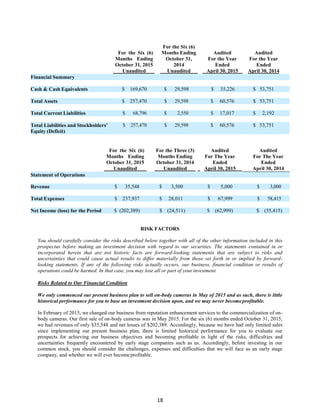
Financial Summary
The tables and information below are derived from our audited financial statements for the period ended April 30,
2014 to April 30, 2015, and unaudited financial information to October 31, 2015.
As of the date of this prospectus, we had cash on hand of approximately $102,000 for our operational needs.
Currently, our operating expenses are approximately $16,000 per month. If we fail to generate sufficient revenues or
raise additional funds to meet our monthly operating costs we would have available cash for our operating needs for
approximately six (6) months.
Because this is only a financial summary, it does not contain all the financial information that may be important to
you. Therefore, you should carefully read all the information in this prospectus, including the consolidated financial
statements and their explanatory notes before making an investmentdecision.
18
For the Six (6)
Months Ending
October 31, 2015
Unaudited
For the Six (6)
Months Ending
October 31,
2014
Unaudited
Audited
For the Year
Ended
April 30, 2015
Audited
For the Year
Ended
April 30, 2014
Financial Summary
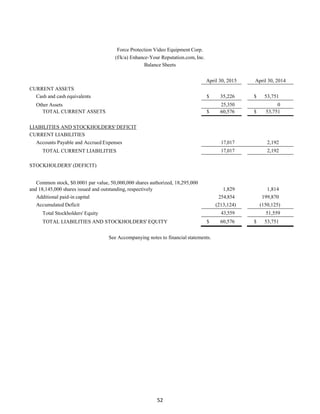
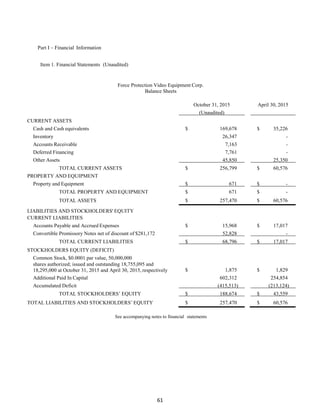
Cash & Cash Equivalents $ 169,670 $ 29,598 $ 35,226 $ 53,751
Total Assets $ 257,470 $ 29,598 $ 60,576 $ 53,751
Total Current Liabilities $ 68,796 $ 2,550 $ 17,017 $ 2,192
Total Liabilities and Stockholders’
Equity (Deficit)
$ 257,470 $ 29,598 $ 60,576 $ 53,751
For the Six (6)
Months Ending
October 31, 2015
Unaudited
For the Three (3)
Months Ending
October 31, 2014
Unaudited
Audited
For The Year
Ended
April 30, 2015
Audited
For The Year
Ended
April 30, 2014
Statement of Operations
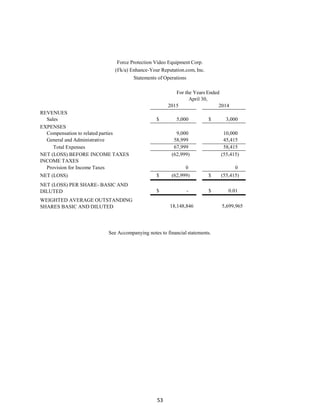
Revenue $ 35,548 $ 3,500 $ 5,000 $ 3,000
Total Expenses $ 237,937 $ 28,011 $ 67,999 $ 58,415
Net Income (loss) for the Period $ (202,389) $ (24,511) $ (62,999) $ (55,415)
RISK FACTORS
You should carefully consider the risks described below together with all of the other information included in this
prospectus before making an investment decision with regard to our securities. The statements contained in or
incorporated herein that are not historic facts are forward-looking statements that are subject to risks and
uncertainties that could cause actual results to differ materially from those set forth in or implied by forward-
looking statements. If any of the following risks actually occurs, our business, financial condition or results of
operations could be harmed. In that case, you may lose all or part of your investment.
Risks Related to Our Financial Condition
We only commenced our present business plan to sell on-body cameras in May of 2015 and as such, there is little
historical performance for you to base an investment decision upon, and we may never becomeprofitable.
In February of 2015, we changed our business from reputation enhancement services to the commercialization of on-
body cameras. Our first sale of on-body cameras was in May 2015. For the six (6) months ended October 31, 2015,
we had revenues of only $35,548 and net losses of $202,389. Accordingly, because we have had only limited sales
since implementing our present business plan, there is limited historical performance for you to evaluate our
prospects for achieving our business objectives and becoming profitable in light of the risks, difficulties and
uncertainties frequently encountered by early stage companies such as us. Accordingly, before investing in our
common stock, you should consider the challenges, expenses and difficulties that we will face as an early stage
company, and whether we will ever becomeprofitable.
19
We are dependent on the sale of our securities to fund our operations.
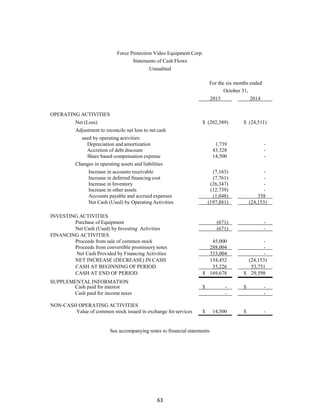
From March 24, 2015 to December 31, 2015, we received proceeds of $55,000 from the sale of 150,000 shares of
our common stock, and $596,500 from the sale of convertible promissory notes which fund our current operations.
As of October 31, 2015 we had generated revenues of only $35,548 from our current business of selling on-body
cameras. We are dependent on the sale of our securities to fund our operations, and will remain so until we generate
sufficient revenues to pay for our operating costs. Our officers and directors have made no written commitments
with respect to providing a source of liquidity in the form of cash advances, loans and/or financial guarantees.
If we are unable to generate sufficient revenues for our operating expenses we will need financing, which we
may be unable to obtain; should we fail to obtain sufficient financing, our revenues will be negatively impacted.
For the six (6) months ending October 31, 2015, we had revenues of $35,548 from the sale of our on-body camera
and related accessories. For the year ended April 30, 2015, and six (6) months ending October 31, 2015, we have a
net loss of $62,999 and $202,389 respectively. Because we have limited revenues and lack historical financial data,
including revenue data, our future revenues are unpredictable.
As of the date of this prospectus, we had cash on hand of $102,000 for our operational needs. Currently, our
operating expenses are approximately $16,000 per month.
Until we generate material operating revenues, we require additional debt or equity funding to continue our
operations and implement our plan of operations. We expected to receive additional funding of $200,000 from the
RDW Financing; however, there is no assurance we will receive such funds. If we fail to generate sufficient
revenues or raise additional funds to meet our monthly operating costs we would have available cash for our
operating needs for approximately six (6) months.
Risks Related to Our Business
Our business depends on the development of markets for detection and surveillance products andsolutions.
Our products are designed to address the markets for detection, surveillance and integrated solutions. Our products
are targeted to both state and local governmental agencies and the private sector. These markets and the types of
products and services sold in these markets are emerging. Our ability to grow will depend in part on the rate at
which markets for our products develop and on our ability to adapt to emerging demands in these markets.
Geopolitical developments, terrorist attacks and government mandates may cause sharp fluctuations in the demand
for our products.
Third parties can purchase the same products we sell which may negatively affect ourrevenues.
We purchase our products from a third party manufacturer in China which sells products to other companies. As
such, third parties can purchase the same products as us which puts us at a competitive disadvantage and may have a
negative impact on our revenues
Our industry is highly competitive, and our failure to compete effectively could adversely affect our market share,
financial condition and future growth.
We operate in a highly competitive environment. In addition to facing competition generally from businesses
seeking to attract discretionary spending dollars, the on-body camera industry itself is highly fragmented, resulting
in intense competition. We compete with single location dealers and, to a lesser degree, with national specialty
stores. Dealer competition is based on the quality of available products, the price and value of the products and
attention to customer service. There is significant competition in the markets which we plan to enter.
20
Our competitors are large national or regional chains that have substantially greater financial, marketing and other
resources than us. There can be no assurance that we will be able to compete successfully against current or future
competitors or that competitive pressure will not have a material adverse effect on our business, operating results
and financial condition.
The success of our business depends on our ability to market our on-body camera and accessorieseffectively.
Our ability to establish effective marketing and advertising campaigns is the key to our success. Our advertisements
must effectively promote our corporate image and the pricing of such products. If we are unable to create awareness
of our products, we may not be able to attract customers. Our marketing activities may not be successful in
promoting the products we sell or pricing strategies or in retaining and increasing our customer base. We cannot
assure you that our marketing programs will be adequate to create a demand for our products or support our future
growth, which may result in a material adverse effect on our results ofoperations.
We may be subject to warranty claims that could result in significant direct or indirect costs, or we could
experience greater returns from retailers than expected, which could harm our business and operatingresults.
We except returns of defective products for two (2) weeks after purchase. Additionally, our manufacturer provides a
ten (10) month warranty on all of our products. The occurrence of any material defects in our products could make
us liable for warranty claims in excess of our current reserves. In addition, we could incur significant costs to correct
any defects, warranty claims or other problems, including costs related to product recalls. A significant product
defect could materially harm our brand image and could force us to conduct a product recall. This could damage our
relationships with our customers and reduce end-user loyalty.
A product recall would be particularly harmful to us because we have limited financial and administrative resources
to effectively manage a product recall and it would detract management’s attention from implementing our core
business strategies. As a result, a significant product defect or product recall could cause a decline in our sales and
profitability, and could reduce or deplete our financial resources. Any negative publicity related to the perceived
quality of our products could affect our brand image, decrease retailer, distributor and customer demand, and
adversely affect our operating results and financial condition. Warranty claims may result in litigation, the
occurrence of which could adversely affect our business and operatingresults.
Purchases of our products may be injured while engaging in activities that they self-capture with our on-body
camera, and we may be exposed to claims, or regulations could be imposed, which could adversely affect our
brand, operating results and financial condition.
Our law enforcement and other customers use our on-body camera and accessories to self-capture their participation
in a wide variety of activities which may carry the risk of significant personal injury or result in death. We may be
subject to claims if our customers are injured while using our products. We have no insurance coverage for such
claims. Additionally, some businesses may ban the use of our products in their facilities to limit their own liability.
If lawmakers or governmental agencies were to determine that the use of our products increased the risk of injury to
all or a subset of our customers, they may pass laws or adopt regulations that limit the use of our products or
increase our liability associated with the use of our products. Any of these events could adversely affect our brand,
operating results or financial condition.
We may be subject to intellectual property rights claims, which are costly to defend, could require us to pay
damages and could limit our ability to sell some of our products.
We have not secured intellectual property protection of the Force Protection name. Our industry is characterized by
vigorous pursuit and protection of intellectual property rights, which has resulted in protracted and expensive
litigation for several companies. Third parties may assert claims of misappropriation of trade secrets or infringement
of intellectual property rights against us for which we may be liable.
21
If our business expands, the number of products and competitors in our markets increases and product overlaps
occur, infringement claims may increase in number and significance. Intellectual property lawsuits are subject to
inherent uncertainties due to the complexity of the technical issues involved, and we cannot be certain that we would
be successful in defending ourselves against intellectual property claims. Further, many potential litigants have the
capability to dedicate substantially greater resources than we can to enforce their intellectual property rights and to
defend claims that may be brought against them. Furthermore, a successful claimant could secure a judgment that
requires us to pay substantial damages or prevents us from distributing ourproducts.
If we fail to develop our brand, cost-effectively, our business may be adversely affected.
The success of our products marketed under the Force Protection brand will depend upon the effectiveness of our
marketing efforts. Brand promotion activities may not yield increased revenue, and even if they do, any increased
revenue may not offset the expenses incurred in building the brands. If we fail to successfully promote and maintain
our brand, or incur substantial expenses in an unsuccessful attempt to promote and maintain our brand, we may fail
to attract enough new customers or retain our existing customers to the extent necessary to realize a sufficient return
on our brand-building efforts, and our business and results of operations couldsuffer.
We must be able to adapt to rapidly changing technology trends and evolving industry standards or we risk our
products becoming obsolete.
The market in which we compete is characterized by intensive development efforts and rapidly advancing
technology. Our future success will depend, in large part, upon our ability to anticipate and keep pace with
advancing technology and competing innovations. We may not be successful in identifying, developing and
marketing new products or enhancing our existing products. We believe that a number of large companies, with
significantly greater financial, manufacturing, marketing, distribution and technical resources and experience than
ours, are focusing on the development of products in the securityand law enforcement industry.
We are dependent on our manufacturer in China. Any disruption or extended delay in product supply from any
of our distributors could have a significant adverse impact on our operations.
We are dependent on one (1) manufacturer in China. We do not have guaranteed supply or pricing arrangements
with our manufacturer, but submit purchase orders and pay for products as needed. As a result, we risk increased
cost of our products.
Our ability to sustain satisfactory levels of sales will be dependent in part upon the ability of third party suppliers of
raw materials to our manufacturer as well as our manufacturer to properly perform its functions and to comply with
local regulations and market our products. While outsourcing manufacturing and distribution to third parties may
reduce the cost of operations, it also reduces direct control by us over the services rendered. Although we attempt to
select a reputable manufacturer, it is possible it could fail to perform as weexpect.
The failure of our manufacturer to supply products as required by us could have a material adverse effect on our
business, results of operations and financial condition. If we do not timely and effectively develop and implement
our outsourcing strategy or if third party providers do not perform as anticipated, we may experience operational
difficulties, increased costs, or even manufacturing delays, which could materially and adversely affect our business,
financial condition and results of operations.
Although a number of alternative manufacturers exist that we believe could replace our manufacturer with
alternative sources at comparable prices and terms, any disruption or extended delay in our manufacturing obtaining
raw material products from any of our third party suppliers could have a significant adverse impact on our
operations. In addition, the time needed to replace our manufacturer could adversely affect our operations by
delaying shipments and potentially losing customers to our competition.
22
Our manufacturer purchases some components, subassemblies and products from third party suppliers. The loss
of any of these suppliers may substantially disrupt our ability to obtain orders and fulfill sales as we design and
qualify new components.
We rely on third party components and technology to build our products, and we rely on our manufacturer to obtain
the components, subassemblies and products necessary for the manufacture of our products. Shortages in
components that we use in our products are possible, and our ability to predict the availability of such components is
limited. While components and supplies are generally available from a variety of sources, we and our manufacturer
currently depend on a single or limited number of suppliers for several components for our products. If our suppliers
of these components or technology were to enter into exclusive relationships with other providers, or were to
discontinue providing such components and technology to us and we were unable to replace them cost effectively,
or at all, our ability to provide our products would be impaired. Our manufacturer generally relies on purchase
orders rather than long-term contracts with these suppliers. As a result, even if available, we and our manufacturer
may not be able to secure sufficient components at reasonable prices or of acceptable quality to build our products in
a timely manner. Therefore, we may be unable to meet customer demand for our products, which would have a
material adverse effect on our business, operating results and financialcondition.
Risks Related To Our Management
Should we lose the services of Paul Feldman, our sole officer and director, our operations and financial
condition may be negatively impacted.
Our future depends on the continued contributions of Paul Feldman, our sole officer and director, who would be
difficult to replace. Mr. Feldman’s services are critical to the management of our business and operations. We do not
maintain key man life insurance on Mr. Feldman. Should we lose the services of Mr. Feldman, we may be unable to
replace their services with equally competent and experienced personnel and our operational goals and strategies
may be adversely affected, which will negatively affect our potentialrevenues.
We incur costs and management time related expenses pertaining to SEC reporting obligations and SEC
compliance matters and our management has no experience in such matters.
Paul Feldman, our sole officer and director is responsible for managing us, including compliance with SEC
reporting obligations and maintaining disclosure controls and procedures and internal control over financial
reporting. These public reporting requirements and controls are relatively new to these individuals and at times will
require us to obtain outside assistance from legal, accounting or other professionals that will increase our costs of
doing business. Should we fail to comply with SEC reporting and internal controls and procedures, we may be
subject to securities law violations that may result in additional compliance costs or costs associated with SEC
judgments or fines, each of which would increase our costs and negatively affect our potential profitability and our
ability to conduct our business.
Because we do not have an audit or compensation committee, shareholders must rely on our sole director Paul
Feldman, who is not independent, to perform these functions.
We have only one officer and director. We do not have an audit or compensation committee or Board of Directors as
a whole that is composed of independent directors. Because Paul Feldman, our sole director, is also our sole officer
and controlling shareholder, he is not independent. There is a potential conflict between his interests, our interests
and our shareholders’ interests, since our sole director is also our sole officer will make decisions concerning his
own compensation and audit issues. Until we have an audit or compensation committee or independent directors,
there may be less oversight of Mr. Feldman’s decisions and activities and little or no ability for our minority
shareholders to challenge or reverse his activities and decisions, even if they are not in the best interests of minority
shareholders.
23
Risks Related to the RDW Financing and our Common Stock
Common Shares that we issue upon conversion of promissory notes will dilute our existing stockholders and
depress the market price of our common stock.
As of the date of this prospectus, we are obligated to issue approximately 1,962,717 common shares upon
conversion of the Private Placement Notes based upon the trading price of $.32 of our common shares on February
29, 2016. Additionally, assuming RDW purchases the Third RDW Note in the amount of $200,000 and holds the
RDW Notes until maturity, after taking into consideration interest accruing on the notes, the total amount repaid
through cash or stock could exceed $480,000 (assuming no events of default occur). If this entire balance is paid by
us in shares issuable upon conversion, we would have to issue approximately 2,501,250 shares to RDW in
satisfaction of our obligations under RDW Financing based upon 60% of the trading price of $0.32 on February 29,
2016. The issuance of these shares upon conversion of the RDW Notes and Private Placement Notes will dilute our
existing shareholders.
The number of common shares issuable by us upon conversion of the RDW Notes and Private Placement Notes is
dependent on the trading price of our common shares during the twenty (20) days prior to conversion. If the price of
our stock declines in value, we will be obligated to issue more shares to the note holders which would have a further
dilutive effect on our stock which could depress the market price of our commonstock.
We may be required to issue significant amount of common shares upon conversion of notes that could result in
a change of control.
The conversion price of the RDW and Private Placement Notes is based upon the trading price of our common
shares. There is no way to determine with certainty the number of common shares we will be required to issue
should note holders convert their notes into our common shares. As the RDW and Private Placement Notes are
converted our stock price will decline requiring us to issue an increased number of common shares. We are currently
authorized to issue 250,000,000 common shares. We presently have 18,295,000 shares outstanding. We could be
required to increase our authorized shares to provide sufficient authorized common stock for conversion of the
RDW and Private Placement Notes. Paul Feldman, our Chief Executive Officer, President and Director presently
holds 210,00,000 votes on matters submitted to our common stockholders. If we increase our authorized shares and
issue more than 210,000,000 common shares, Mr. Feldman could lose voting control of us. This would likely
jeopardize the execution of our business plan and disrupt our operations.
Holders of the RDW and Private Placement Notes convertible into our common stock will pay less than the then-
prevailing market price for our common stock.
The RDW Notes and Private Placement Notes are convertible at prices ranging from forty (40) to sixty percent
(60%) of the lowest traded price in the twenty (20) days prior to the date of conversion. As such, these note holders
have a financial incentive to sell our common stock immediately upon receiving the shares to realize the profit equal
to the difference between the discounted price and the market price. If these noteholders sell the shares, the price of
our common stock will likely decrease. If our stock price decreases, the noteholders may have a further incentive to
sell the shares of our common stock that they hold. These sales may put further downward pressure on our stock
price and reduce the value of your common shares
If our stock price materially declines, the convertible note holders will have the right to a large number of shares
of common stock upon exchange of amounts due under the Notes, which may result in significantdilution.
We have issued notes that have a conversion feature which is based upon a percentage of our lowest trading price
over a twenty (20) day period. If our common stock price materially declines, we will be obligated to issue a large
number of shares to the holders of these notes upon conversion. This will likely materially dilute existing
shareholders. The potential for such dilutive issuances upon conversion of outstanding notes may depress the price
of common stock regardless of our business performance, and could encourage short selling by market participants,
especially if the trading price of our common stock begins to decrease.
24
The market for shares quoted on the OTC Markets OTCQB has experienced numerous frauds and abuses, which
could adversely affect investors in our stock.
We believe that the market for shares of companies quoted on the OTC Markets OTCQB has suffered from patterns
of fraud and abuse. Such patterns include:
 control of the market for the security by one or a fewbroker-dealers;
 manipulation of prices through prearranged matching of purchases and sales and false and misleading
statements made by parties unrelated to the issuer;
 “boiler room” practices involving high pressure sales tactics and unrealistic price projections by
inexperienced sales persons;
 excessive and undisclosed bid-ask differentials and markups by selling broker-dealers;and
 wholesale dumping of the same securities by promoters and broker-dealers after prices have been
manipulated to a desired level, along with the inevitable collapse of those prices with consequent investor
losses.
We believe that many of these abuses have occurred with respect to the promotion of OTC Pink companies that
lacked experienced management, adequate financial resources, an adequate business plan and/or marketable and
successful business or product. Should this occur in our common stock, investors will likely be adversely affected.
Our common shares are thinly traded, so you may be unable to sell at or near asking prices, or at all.
Our common stock is quoted by the OTC Markets OTC Markets OTCQB. Shares of our common stock are thinly-
traded, meaning that the number of persons interested in purchasing our common shares at or near asking prices at
any given time may be relatively small or non-existent. This situation is attributable to a number of factors,
including:
 we are a small company that is relatively unknown to stock analysts, stock brokers, institutional investors
and others in the investment community that generate or influence sales volume;and
 stock analysts, stock brokers and institutional investors may be risk-averse and be reluctant to follow an
unproven, early stage company such as ours or purchase or recommend the purchase of our shares until
such time as we become more seasoned and viable
As a result, our stock price may not reflect an actual or perceived value. Also, there may be periods of several days
or more when trading activity in our shares is minimal, as compared to a seasoned issuer that has a large and steady
volume of trading activity that will generally support continuous sales without an adverse effect on share price. A
broader or more active public trading market for our common shares may not develop or if developed, may not be
sustained. Due to these conditions, you may not be able to sell your shares at or near asking prices or at all should
you attempt to sell your shares.
25
Our stock price may be volatile and you may not be able to resell your shares at or above the current trading
price.
Our common stock is quoted on the OTC Markets Group’s OTC Pink. Trading in stock quoted on the OTC Pink is
often thin and characterized by wide fluctuations in trading prices, due to many factors that may have little to do
with our operations or business prospects. The market price of our Common Stock may be highly volatile. This
volatility could depress the market price of our common stock for reasons unrelated to operating performance.
Moreover, the OTC Pink and other over the counter trading systems do not benefit from the same type of Market-
Maker trading systems utilized by stock exchanges such as the NYSE and AMEX and quotation systems such as the
NASDAQ in which trading of a security is enhanced by to the presence of Market-Maker(s) who are dedicated to
the trading of a particular listed company’s shares. Rather, on the OTC Pink and other over the counter markets,
there is no assurance that a bid/ask will be posted to facilitate trading of an over the counter listed issue at any
particular point in time. As a result, trading of securities on the OTC Pink and other over the counter systems is
often more sporadic than the trading of securities listed on the NYSE, AMEX, NASDAQ or similar large stock
exchanges or stock markets. Accordingly, shareholders may have difficulty selling their shares at any particular
point in time. Additionally, the market price of our common stock is likely to be highly volatile and could fluctuate
widely in price in response to various factors, many of which are beyond our control, including the following:
 our ability to fully execute our business plan;
 changes in our industry;
 our ability to obtain working capital financing;
 additions or departures of key personnel;
 a “public float” in the hands of a small number of persons whose sales or lack of sales could resultin
positive or negative pricing pressure on the market price for our commonstock;
 sales of our common stock (particularly following effectiveness of this resale registration statement) upon
conversion of outstanding promissory notes;
 operating results that fall below expectations;
 regulatory developments;
 economic and other external factors;
 period-to-period fluctuations in our financial results;
 the public’s response to press releases or other public announcements by us or third parties,
 the development and sustainability of an active trading market for our common stock;and
 future sales of common stock by our officers, directors and significantstockholders.
In addition, the securities markets have from time to time experienced significant price and volume fluctuations that
are unrelated to the operating performance of particular companies. These market fluctuations may also materially
and adversely affect the market price of our commonstock.
Our officers and directors have voting control over all matters submitted to a vote of our common stockholders,
which will prevent our minority shareholders from having the ability to control any of our corporateactions.
As of the date of this prospectus, we had 18,295,000 shares of common stock outstanding, each entitled to one vote
per common share and 1,000,000 shares of Series A Preferred Stock which entitled the holder two hundred (200)
votes per share. Our sole officer and director, Paul Feldman, controls 10,000,000 common shares and 1,000,000
Series A Preferred Shares which represent an aggregate of 210,000,000 out of 218,295,000 total votes outstanding
or ninety-eight (98%) of the votes on all matters submitted to a vote of our stockholders. As such, Mr. Feldman has
the ability to determine the outcome of all matters submitted to our stockholders for approval, including the election
of directors. Mr. Feldman’s control of our voting securities may make it impossible to complete some corporate
transactions without his support and may prevent a change in our control. In addition, this ownership could
discourage the acquisition of our common stock by potential investors and could have an anti-takeover effect,
possibly depressing the trading price of our common stock.
26
There is not now, and there may never be, an active, liquid and orderly trading market for our Common Stock,
which may make it difficult for you to sell your shares of our CommonStock.
There is not now, nor has there been since our inception, significant trading activity in our common stock or a
market for our common stock, and an active trading market for our shares may never develop or be sustained. As a
result, investors in our common stock must bear the economic risk of holding those shares for an indefinite period of
time. Although our common stock is quoted on the OTC Markets OTCQB, an over-the-counter quotation system,
operated by the OTC Markets, trading of our common stock is extremely limited and sporadic and at very low
volumes. We do not now, and may not in the future, meet the initial listing standards of any national securities
exchange, and we presently anticipate that our common stock will continue to be quoted by the OTC Markets or
another over-the-counter quotation system in the foreseeable future. In those venues, our stockholders may find it
difficult to obtain accurate quotations as to the market value of their shares of our common stock, and may find few
buyers to purchase their stock and few market makers to support our stock price. As a result of these and other
factors, you may be unable to resell your shares of our common stock at or above the price for which you purchased
them, or at all. Further, an inactive market may also impair our ability to raise capital by selling additional equity in
the future, and may impair our ability to enter into strategic partnerships or acquire companies or products by using
shares of our common stock as consideration.
If we are unable to establish appropriate internal financial reporting controls and procedures, it could cause us
to fail to meet our reporting obligations, result in the restatement of our financial statements, harm our operating
results, subject us to regulatory scrutiny and sanction, cause investors to lose confidence in our reported
financial information and have a negative effect on the market price for shares of our CommonStock.
Effective internal controls are necessary for us to provide reliable financial reports and to effectively prevent fraud.
We maintain a system of internal control over financial reporting, which is defined as a process designed by, or
under the supervision of, our principal executive officer and principal financial officer, or persons performing
similar functions, and effected by our board of directors, management and other personnel, to provide reasonable
assurance regarding the reliability of financial reporting and the preparation of financial statements for external
purposes in accordance with generally accepted accounting principles.
As a public company, we have significant additional requirements for enhanced financial reporting and internal
controls. We are required to document and test our internal control procedures in order to satisfy the requirements of
Section 404 of the Sarbanes-Oxley Act of 2002, which requires annual management assessments of the effectiveness
of our internal controls over financial reporting and a report by our independent registered public accounting firm
addressing these assessments. The process of designing and implementing effective internal controls is a continuous
effort that requires us to anticipate and react to changes in our business and the economic and regulatory
environments and to expend significant resources to maintain a system of internal controls that is adequate to satisfy
our reporting obligations as a public company. This annual report does not include a report of management’s
assessment regarding internal control over financial reporting or an attestation report of our registered public
accounting firm due to a transition period established by rules of the Securities and Exchange Commission for newly
public companies.
We cannot assure you that we will, in the future, identify areas requiring improvement in our internal control over
financial reporting. We cannot assure you that the measures we will take to remediate any areas in need of
improvement will be successful or that we will implement and maintain adequate controls over our financial
processes and reporting in the future as we continue our growth. If we are unable to establish appropriate internal
financial reporting controls and procedures, it could cause us to fail to meet our reporting obligations, result in the
restatement of our financial statements, harm our operating results, subject us to regulatory scrutiny and sanction,
cause investors to lose confidence in our reported financial information and have a negative effect on the market
price for shares of our Common Stock.
27
Because our sole officer and director is our controlling stockholder, he can exert significant control over our
business and affairs, and have actual or potential interests that may depart from those of investors.
As of the date of this prospectus, our sole officer and director, Paul Feldman, holds approximately ninety percent
(90%) of our outstanding voting stock and has the ability to control all matters submitted to a vote of our
stockholders. The interests of Mr. Feldman may differ from the interests of our other stockholders, including
investors. As a result, in addition to board seats and offices, Mr. Feldman controls all corporate actions requiring
stockholder approval, irrespective of how our other stockholders, including investors, may vote, including the
following actions:
 to elect or defeat the election of our directors;
 to amend or prevent amendment of our Certificate of Incorporation or By-laws;
 to effect or prevent a merger, sale of assets or other corporate transaction; and
 to control the outcome of any other matter submitted to our stockholders for vote.
A decline in the price of our common stock could affect our ability to raise further working capital, it may
adversely impact our ability to continue operations and we may go out of business.
A prolonged decline in the price of our common stock could result in a reduction in the liquidity of our common
stock and a reduction in our ability to raise capital. Because we may attempt to acquire a significant portion of the
funds we need in order to conduct our planned operations through the sale of equity securities, a decline in the price
of our common stock could be detrimental to our liquidity and our operations because the decline may cause
investors not to choose to invest in our stock. If we are unable to raise the funds we require for all our planned
operations, we may be forced to reallocate funds from other planned uses and may suffer a significant negative
effect on our business plan and operations, including our ability to develop new products and continue our current
operations. As a result, our business may suffer, and not be successful and we may go out of business. We also
might not be able to meet our financial obligations if we cannot raise enough funds through the sale of our common
stock and we may be forced to go out ofbusiness.
Because we do not intend to pay any cash dividends on our shares of common stock in the near future, our
stockholders will not be able to receive a return on their shares unless they sell them.
We intend to retain any future earnings to finance the development and expansion of our business. We do not
anticipate paying any cash dividends on our common stock in the near future. The declaration, payment and amount
of any future dividends will be made at the discretion of the Board of Directors, and will depend upon, among other
things, the results of operations, cash flows and financial condition, operating and capital requirements, and other
factors as the Board of Directors considers relevant. There is no assurance that future dividends will be paid, and if
dividends are paid, there is no assurance with respect to the amount of any such dividend. For the foreseeable future,
earnings generated from our operations will be retained for use in our business and not to pay dividends. In addition,
the terms of our existing credit facilities preclude, and the terms of any future debt agreements is likely to similarly
preclude, us from paying dividends. As a result, capital appreciation, if any, of our common stock will be your sole
resource of gain for the foreseeable future. Investors seeking cash dividends should not purchase our common stock.
28
Our stock is a penny stock. Trading of our stock may be restricted by the Securities and Exchange Commission
(“SEC”)’s penny stock regulations which may limit a stockholder’s ability to buy and sell ourstock.
Our stock is a penny stock. The Securities and Exchange Commission (“SEC”) has adopted Rule 15g-9 which
generally defines “penny stock” to be any equity security that has a market price (as defined) less than $5.00 per
share or an exercise price of less than $5.00 per share, subject to certain exceptions. Our securities are covered by
the penny stock rules, which impose additional sales practice requirements on broker-dealers who sell to persons
other than established customers and “accredited investors”. The term “accredited investor” refers generally to
institutions with assets in excess of $5,000,000 or individuals with a net worth in excess of $1,000,000 or annual
income exceeding $200,000 or $300,000 jointly with their spouse. The penny stock rules require a broker-dealer,
prior to a transaction in a penny stock not otherwise exempt from the rules, to deliver a standardized risk disclosure
document in a form prepared by the SEC which provides information about penny stocks and the nature and level of
risks in the penny stock market. The broker-dealer also must provide the customer with current bid and offer
quotations for the penny stock, the compensation of the broker-dealer and its salesperson in the transaction and
monthly account statements showing the market value of each penny stock held in the customer’s account. The bid
and offer quotations, and the broker-dealer and salesperson compensation information, must be given to the
customer orally or in writing prior to effecting the transaction and must be given to the customer in writing before or
with the customer’s confirmation. In addition, the penny stock rules require that prior to a transaction in a penny
stock not otherwise exempt from these rules; the broker-dealer must make a special written determination that the
penny stock is a suitable investment for the purchaser and receive the purchaser’s written agreement to the
transaction. These disclosure requirements may have the effect of reducing the level of trading activity in the
secondary market for the stock that is subject to these penny stock rules. Consequently, these penny stock rules may
affect the ability of broker-dealers to trade our securities. We believe that the penny stock rules discourage investor
interest in and limit the marketability of our common stock.
Financial Industry Regulatory Authority (“FINRA”) sales practice requirements may also limit a stockholder’s
ability to buy and sell our stock.
FINRA has adopted rules that require that in recommending an investment to a customer, a broker-dealer must have
reasonable grounds for believing that the investment is suitable for that customer. Prior to recommending
speculative low priced securities to their non-institutional customers, broker-dealers must make reasonable efforts to
obtain information about the customer’s financial status, tax status, investment objectives and other information.
Under interpretations of these rules, the FINRA believes that there is a high probability that speculative low priced
securities will not be suitable for at least some customers. The FINRA requirements make it more difficult for
broker-dealers to recommend that their customers buy our common stock, which may limit your ability to buy and
sell our stock.
We may, in the future, issue additional securities, which would reduce investors’ percent of ownership and may
dilute our share value.
Our Articles of Incorporation authorize us to issue 250,000,000 shares of common stock, $.0001 par value per share
and 1,000,000 shares of Series A Preferred Stock. As of the date of this prospectus, we had 18,295,000 shares of
common stock and 1,000,000 shares of Series A Preferred Stock outstanding. Accordingly, we may issue up to an
additional 231,785,000 shares of common stock including the 2,415,000 shares being registered hereunder which are
issuable upon conversion of the RDW Notes. The future issuance of common stock may result in substantial dilution
in the percentage of our common stock held by our then existing shareholders. We may value any common stock
issued in the future on an arbitrary basis including for services or acquisitions or other corporate actions that may
have the effect of diluting the value of the shares held by our stockholders, and might have an adverse effect on any
trading market for our common stock.
29
As an issuer of “penny stock” the protection provided by the federal securities laws relating to forward looking
statements does not apply to us.
Although the federal securities law provides a safe harbor for forward-looking statements made by a public
company that files reports under the federal securities laws, this safe harbor is not available to issuers of penny
stocks. As a result, if we are a penny stock we will not have the benefit of this safe harbor protection in the event of
any claim that the material provided by us contained a material misstatement of fact or was misleading in any
material respect because of our failure to include any statements necessary to make the statements not misleading.
FORWARD LOOKING STATEMENTS
Some of the statements in this prospectus are “forward-looking statements.” These forward-looking statements
involve certain known and unknown risks, uncertainties and other factors which may cause our actual results,
performance or achievements to be materially different from any future results, performance or achievements
expressed or implied by these forward-looking statements. These factors include, among others, the factors set forth
above under “Risk Factors”. The words “believe,” “expect,” “anticipate,” “intend,” “plan,” and similar expressions
identify forward-looking statements. We caution you not to place undue reliance on these forward-looking
statements. We undertake no obligation to update and revise any forward-looking statements or to publicly
announce the result of any revisions to any of the forward-looking statements in this document to reflect any future
or developments. However, the Private Securities Litigation Reform Act of 1995 is not available to us as a non-
reporting issuer.
Further, Section 27A(b)(2)(D) of the Securities Act and Section 21E(b)(2)(D) of the Securities Exchange Act
expressly state that the safe harbor for forward looking statements does not apply to statements made in connection
with an initial public offering.
USE OF PROCEEDS
We will not receive any proceeds from the sale of common stock offered by RDW, the Selling Stockholder named
in this prospectus. However, we will receive proceeds from the issuance of the Third RDW Note issued pursuant to
RDW Financing. The proceeds from our issuance of the Third RDW Note will be used for working capital that will
include inventory purchases and accounts receivable financing; and also for general corporate expenses.
30
We propose to expend the proceeds as follows:
Proceeds of
$262,500 is
received in the
RDW Financing
Proceeds of
$462,500 is
received in the
RDW Financing
Gross proceeds $ 262,500 $ 462,500
Offering expenses:
Broker-Dealer
commissions
62,500 46,250
Legal fees 10,000 10,000
Accounting and auditing
fees
10,000 10,000
Miscellaneous fees (1) 1,000 2,000
Total offering expenses $ 83,500 $ 68,250
Net proceeds $ 179,000 $ 394,250
Use of proceeds:
Marketing $ 40,000 $ 64,000
Inventory purchases
General working capital
needs (2)
139,000 330,250
Total use of proceeds $ 179,000 $ 394,250
(1) Miscellaneous fees include securities fees, transfer agent fees and other miscellaneousexpense.
(2) General working capital needs consists primarily of accounts receivable financing and inventorypurchases.
We expect to use the net proceeds received from as detailed above.
SELLING SECURITY HOLDERS
The following table details the name of the sole Selling Stockholder, RDW Capital, LLC (“RDW”), the number of
shares owned by such Selling Stockholder and the number of shares that may be offered by such Selling Stockholder
for resale under this prospectus. RDW may sell any number of shares of our common stock which are issuable upon
conversion of amounts due under the RDW Notes. Because RDW may offer all, some or none of the shares it holds,
and because, based upon information provided to us, there are currently no agreements, arrangements or
understandings with respect to the resale of any of the shares, no definitive estimate as to the number of shares that
will be held by RDW after the offering can be provided. The following table has been prepared on the assumption
that the entire 2,415,000 common shares being registered are issued to RDW and that all shares offered under this
prospectus will be sold by RDW to parties unaffiliated with RDW. The following table is based on 18,295,000
shares outstanding as of the date of this registration statement.
Name of selling
security holder
Number of shares
owned before this
offering
Number of shares
to be offered for
sale
Number of share to
be owned after the
offering is complete
(2)
Percent of
Common Stock
owned after the
offering is
complete
RDW Capital, LLC(1) 0 2,415,000 2,415,000 1.17%
31
(1) RDW Capital LLC is a Florida limited liability company controlled by Gary Rogers and John DeNobile.
(2) We have assumed that all shares registered for sale under this prospectus will be sold, but there is no
obligation on the part of the sole Selling Stockholder to sell all of our shares offered by this prospectus as
detailed below in the section entitled “Plan of Distribution”.
(3) After the offering is complete, assuming all of the RDW Notes are issued and converted into the 2,415,000
shares being registered we would have 20,710,000 common shares outstanding.
To our knowledge, neither the Selling Security Holder or its beneficialowners:
● has had a material relationship with us other than as a shareholder at anytime within the past three years; or
● has ever been one of our officers or directors or an officer or director of our predecessors or affiliates; or
● are broker-dealers or affiliated with broker-dealers.
PLAN OF DISTRIBUTION
We are registering up to 2,415,000 shares of our common stock offered by the Selling Stockholder. As discussed
above in the subsection entitled “Risk Factors - Risks Related to the Financing and our Common Stock”, we are
registering shares issuable upon conversion of the RDW Notes totaling approximately $462,500 as of the date of this
registration statement, at the conversion price of sixty percent (60%) of the lowest trading price in the twenty (20)
days prior to the filing of this registration statement ($.32 on February 29, 2016).
The Selling Stockholder and any of its pledgees, assignees and successors-in-interest may, from time to time, sell
any or all of their shares of common stock on the OTC Markets or any other stock exchange, market or trading
facility on which our shares are traded or in private transactions. These sales may be at fixed or negotiated prices.
The Selling Stockholder may use any one or more of the following methods when selling shares:
 ordinary brokerage transactions and transactions in which the broker-dealer solicitspurchasers;
 block trades in which the broker-dealer will attempt to sell the shares as agent but may position and resell a
portion of the block as principal to facilitate the transaction;
 purchases by a broker-dealer as principal and resale by the broker-dealer for itsaccount;
 an exchange distribution in accordance with the rules of the applicable exchange;
 privately negotiated transactions;
 settlement of short sales entered into after the effective date of the registration statement of which this
prospectus is a part;
 broker-dealers may agree with the Selling Stockholder to sell a specified number of such shares at a
stipulated price per share;
 through the writing or settlement of options or other hedging transactions, whether through an options
exchange or otherwise;
 a combination of any such methods of sale; or
 any other method permitted pursuant to applicable law.
32
The Selling Stockholder or its pledgees, donees, transferees or other successors in interest, may also sell the shares
directly to market makers acting as principals and/or broker-dealers acting as agents for themselves or their
customers. Such broker-dealers may receive compensation in the form of discounts, concessions or commissions
from the Selling Stockholder and/or the purchasers of shares for whom such broker-dealers may act as agents or to
whom they sell as principal or both, which compensation as to a particular broker-dealer might be in excess of
customary commissions. Market makers and block purchasers purchasing the shares will do so for their own account
and at their own risk. It is possible that the Selling Stockholder will attempt to sell shares of common stock in block
transactions to market makers or other purchasers at a price per share which may be below the then market price.
The Selling Stockholder cannot assure that all or any of the shares offered in this prospectus will be issued to, or
sold by, such Selling Stockholder.
RDW and Carter, Terry & Company, a registered broker-dealer who served as the placement agent for the RDW
Financing are each underwriters within the meaning of the Securities Act. In addition to RDW and Carter, Terry &
Company being underwriters under the Securities Act, any other brokers, dealers or agents affecting the sale of any
of the shares offered in this prospectus, may be “underwriters” as that term is defined under the Securities Act or the
Exchange Act, or the rules and regulations under such acts. Any commissions received by underwriters and any
profit on the resale of the shares purchased by them may be deemed to be underwriting commissions or discounts
under the Securities Act.
We are paying all fees and expenses incident to the registration of the shares, but excluding brokerage commissions
or underwriter discounts. The Selling Stockholder, alternatively, may sell all or any part of the shares offered in this
prospectus through an underwriter. The Selling Stockholder has not entered into any agreement with a prospective
underwriter and there is no assurance that any such agreement will be enteredinto.
The Selling Stockholder may pledge its shares to its brokers under the margin provisions of customer agreements. If
the Selling Stockholder defaults on a margin loan, the broker may, from time to time, offer and sell the pledged
shares. The Selling Stockholder and any other persons participating in the sale or distribution of the shares will be
subject to applicable provisions of the Exchange Act, and the rules and regulations under such act, including,
without limitation, Regulation M. These provisions may restrict certain activities of, and limit the timing of
purchases and sales of any of the shares by, the Selling Stockholder or any other such person. In the event that the
Selling Stockholder is deemed affiliated with purchasers or distribution participants within the meaning of
Regulation M, then the Selling Stockholder will not be permitted to engage in short sales of common stock.
Furthermore, under Regulation M, persons engaged in a distribution of securities are prohibited from simultaneously
engaging in market making and certain other activities with respect to such securities for a specified period of time
prior to the commencement of such distributions, subject to specified exceptions or exemptions. In regards to short
sales, RDW may engage in the purchase or sale, long and/or short, of our securities or engage in trading of
“derivative” securities based on securities issued by the Company.
We have agreed to indemnify RDW, or its transferees or assignees, against certain liabilities, including liabilities
under the Securities Act, or to contribute to payments RDW or its pledgees, donees, transferees or other successors
in interest, may be required to make in respect of such liabilities.
We agreed to use our commercially reasonable efforts to keep this prospectus effective until the earlier of the date
on which (i) RDW has sold all of the shares of our common stock issued or issuable pursuant to the RDW Notes
and/or the conversion of the Notes; or (ii) RDW has no right to acquire any additional shares of our common stock
pursuant to the RDW Notes and/or the conversion of the Notes.
33
MARKET FOR REGISTRANT’S COMMON EQUITY, RELATED STOCKHOLDER MATTERS AND
ISSUER PURCHASES OF EQUITY SECURITIES
Market Information
Our common stock, par value $0.0001 per share (the "Common Stock"), has been quoted with the symbol “FVPD”
on the OTC Markets OTCQB since February 18, 2016. From March 15, 2015, through February 9, 2016, we were
quoted on the OTC Pinks with the symbol “FVPD”. Prior to March 15, 2015, our stock was quoted on the OTC
Pinks with the symbol “MREY”.
Trading in stocks quoted on the OTC Markets OTCQB and OTC Pink are often thin and is characterized by wide
fluctuations in trading prices due to many factors that may have little to do with a company’s operations or business
prospects.
OTC Markets OTCQB securities are not listed or traded on the floor of an organized national or regional stock
exchange. Instead, OTC Markets OTCQB securities transactions are conducted through a telephone and computer
network connecting dealers in stocks. OTC Markets OTCQB issuers are traditionally smaller companies that do not
meet the financial and other listing requirements of a regional or national stock exchange.
Set forth below are the range of high and low prices for our common stock from the OTC Markets OTC Pinks for
the periods indicated. The quotations reflect inter-dealer prices, without retail mark-up, mark-down or commissions
and may not necessarily represent actual transactions:
Year 2015 High Low
First Quarter $ 0.01 $ 0.01
Second Quarter $ 0.01 $ 0.01
Third Quarter $ 23.96 $ 0.50
Fourth Quarter $ 1.69 $ 0.92
Year 2014 High Low
First Quarter $ 0.01 $ 0.01
Second Quarter $ 0.01 $ 0.01
Third Quarter $ 0.01 $ 0.01
Fourth Quarter $ 0.01 $ 0.01
Transfer Agent
Our Transfer Agent is Interwest Transfer Co., Inc. located at 1981 Murray Holladay Road, Suite 100, Salt Lake
City, Utah. Their telephone number is 801-272-9294 and their website is www.interwesttc.com.
Holders
As of the date of this prospectus, we had 18,295,000 shares of common stock outstanding and forty-one (41) record
holders of our common stock.
Dividends
We have not paid any dividends to the holders of our common stock and we do not expect to pay any such dividends
in the foreseeable future as we expect to retain our future earnings for use in the operation and expansion of our
business.
34
Securities Authorized for Issuance Under Equity Compensation Plans
We presently do not have any equity based or other long-term incentive programs. In the future, we may adopt and
establish an equity-based or other long-term incentive plan if it is in our best interest and our shareholders to doso.
Penny Stock Considerations
Our shares will be "penny stocks", as that term is generally defined in the Securities Exchange Act of 1934 to mean
equity securities with a price of less than $5.00. Thus, our shares will be subject to rules that impose sales practice
and disclosure requirements on broker-dealers who engage in certain transactions involving a penny stock.
Under the penny stock regulations, a broker-dealer selling a penny stock to anyone other than an established
customer must make a special suitability determination regarding the purchaser and must receive the purchaser's
written consent to the transaction prior to the sale, unless the broker-dealer is otherwiseexempt.
In addition, under the penny stock regulations, the broker-dealer is required to:
 Deliver, prior to any transaction involving a penny stock, a disclosure schedule prepared by the Securities
and Exchange Commission relating to the penny stock market, unless the broker-dealer or the transaction is
otherwise exempt;
 Disclose commissions payable to the broker-dealer and our registered representatives and current bid and
offer quotations for the securities;
 Send monthly statements disclosing recent price information pertaining to the penny stock held in a
customer's account, the account's value, and information regarding the limited market in penny stocks; and
 Make a special written determination that the penny stock is a suitable investment for the purchaser and
receive the purchaser's written agreement to the transaction, prior to conducting any penny stock
transaction in the customer's account
Because of these regulations, broker-dealers may encounter difficulties in their attempt to sell shares of our common
stock, which may affect the ability of the Selling Stockholder or other holders to sell their shares in the secondary
market, and have the effect of reducing the level of trading activity in the secondary market. These additional sales
practice and disclosure requirements could impede the sale of our securities, if our securities become publicly
traded. In addition, the liquidity for our securities may be decreased, with a corresponding decrease in the price of
our securities.
Our shares in all probability will be subject to such penny stock rules and our shareholders will, in all likelihood,
find it difficult to sell their securities.
Sales of Our Common Stock Under Rule 144
We presently have 18,295,000 common shares outstanding. Of these shares 8,295,000 common shares are held by
non-affiliates and 10,000,000 common shares are held by affiliates, which Rule 144 of the Securities Act of 1933
defines as restricted securities.
We are registering 2,415,000 common shares that are issuable to the Selling Stockholder upon conversion of the
RDW Notes. We are not registering shares held by affiliates in this offering. The remaining non-affiliate shares as
well as all of the affiliates’ shares will be subject to the resale restrictions of Rule 144. In general, persons holding
restricted securities, including affiliates, must hold their shares for a period of at least six (6) months, may not sell
more than one percent (1%) of the total issued and outstanding shares in any ninety (90) day period, and must resell
the shares in an unsolicited brokerage transaction at the market price. The availability for sale of substantial amounts
of common stock under Rule 144 could reduce prevailing market prices for oursecurities.
35
Where You Can Find Additional Information
We have filed with the Securities and Exchange Commission a registration statement on Form S-1. For further
information about us and the shares of common stock to be sold in the offering, please refer to the registration
statement and the exhibits and schedules thereto. The registration statement and exhibits and any materials we file
with the Commission may be read and copied, at the SEC's Public Reference Room at 100 F St., N.E., Washington,
D.C. 20549, on official business days during the hours of 10:00 a.m. to 3:00 p.m. The public may obtain information
on the operation of the Public Reference Room by calling the SEC at 1-800-SEC- 0330. The SEC maintains an
Internet site that contains reports, proxy and information statements, and other information regarding issuers that file
electronically with the Commission and state the address of that site (http://www.sec.gov). Our
registration statement and other information we file with the SEC is available at the web site maintained by the SEC
at http://www.sec.gov.
DESCRIPTION OF SECURITIES
The following description is a summary of the material terms of the provisions of our Articles of Incorporation and
Bylaws. Our Articles of Incorporation and Bylaws have been filed as exhibits to the registration statement of which
this prospectus is a part.
We are authorized to issue 250,000,000 shares of common stock, $.0001 par value per share and 1,000,000 shares of
Series A Preferred Stock. As of the date of this prospectus there are 18,295,000 shares of our common stock issued
and outstanding held by forty-one (41) stockholders of record and 1,000,000 shares of our Series A Preferred Stock
outstanding held by one (1) person, Paul Feldman, our sole officer and director.
Common Stock
Each share of our common stock entitles the holder to one (1) vote, either in person or by proxy, at meetings of
shareholders. The shareholders are not permitted to vote their shares cumulatively. Accordingly, the holders of more
than fifty percent (50%) of the total voting rights on matters presented to our common stockholders can elect all of
our directors and, in such event, the holders of the remaining minority shares will not be able to elect any such
directors. The vote of the holders of a majority of the holders entitled to vote on matters submitted to our common
stockholders is sufficient to authorize, affirm, ratify, or consent to such act or action, except as otherwise provided
by law.
To date, we have paid no cash dividends on our shares of common stock. Any future payment of dividends will be at
the discretion of our Board of Directors and will depend upon, among other things, our future earnings, operating
and financial condition, capital requirements, and other factors. We have no present plans for future cash or stock
dividends. We intend to retain future earnings, if any, to provide funds for operation of our business.
Holders of our common stock have no preemptive rights.
Upon our liquidation or dissolution, the assets legally available for distribution to holders of shares of the common
stock, after payment of all of our obligations, are distributable ratably among the holders of the then outstanding
common stock.
36
Preferred Stock
We are authorized to issue 1,000,000 preferred shares $.0001 par value which we have designated as Series A
Preferred Stock. The Series A Preferred Stock have the rights designations and preferences set forthbelow:
 No dividends shall be paid on the Series A Preferred Stock.
 The Series A Preferred Stock shall not be convertible into shares of CommonStock.
 Each share of Series A Stock shall be entitled to 200 votes per share on all matters submitted to a vote of
our stockholders.
 We shall redeem the Series A Preferred Stock upon request by the holder for the price of
$.0001 per share.
On December 1, 2015, we approved the issuance of 1,000,000 shares of our non-convertible Series A Preferred
Stock to Mr. Feldman which entitle him to 200,000 votes per share or an aggregate of 200,000,000 on all matters
submitted to our common stockholders. Both before and after the issuance of the 1,000,000 Series A Preferred Stock
to Mr. Feldman he had the abilityto control all matters submitted to a vote of our common stockholders.
Options and Warrants
We have no warrants or options to purchase our sharesoutstanding.
Florida Anti-Takeover Laws
As a Florida corporation, we are subject to certain anti-takeover provisions that apply to public corporations under
Florida law.
Pursuant to Section 607.0901 of the Florida Business Corporation Act, or the Florida Act, a publicly held Florida
corporation may not engage in a broad range of business combinations or other extraordinary corporate transactions
with an interested shareholder without the approval of the holders of two-thirds of the voting shares of the
corporation (excluding shares held by the interested shareholder), unless:
 The transaction is approved by a majority of disinterested directors before the shareholder becomes an
interested shareholder;
 The interested shareholder has owned at least eighty percent (80%) of the corporation’s outstanding voting
shares for at least five (5) years preceding the announcement date of any such business combination;
 The interested shareholder is the beneficial owner of at least ninety percent (90%) of the outstanding voting
shares of the corporation, exclusive of shares acquired directly from the corporation in a transaction not
approved by a majority of the disinterested directors; or
 The consideration paid to the holders of the corporation’s voting stock is at least equal to certain fair price
criteria.
An interested shareholder is defined as a person who, together with affiliates and associates, beneficially owns more
than ten percent (10%) of a corporation’s outstanding voting shares. We have not made an election in our amended
Articles of Incorporation to opt out of Section 607.0901.
In addition, we are subject to Section 607.0902 of the Florida Act which prohibits the voting of shares in a publicly
held Florida corporation that are acquired in a control share acquisition unless (i) our Board of Directors approved
such acquisition prior to its consummation or (ii) after such acquisition, in lieu of prior approval by our Board of
Directors, the holders of a majority of the corporation’s voting shares, exclusive of shares owned by officers of the
corporation, employee directors or the acquiring party, approve the granting of voting rights as to the shares
acquired in the control share acquisition. A control share acquisition is defined as an acquisition that immediately
thereafter entitles the acquiring party to twenty percent (20%) or more of the total voting power in an election of
directors.
37
OUR BUSINESS
Overview
Our principal executive office is located at 140 Iowa Lane, Suite 101, Cary, North Carolina 27511. Our telephone
number is 919-780-7897. Our website is www.forceprovideo.comand is not part of this prospectus.
We were a development-stage company, incorporated in the state of Florida on March 11, 2011, as M Street Gallery,
Inc to distribute artwork created by German artist Reinhold Mackenroth. On September 25, 2013, we changed our
name to Enhance-Your-Reputation.com, Inc. and changed our business to providing reputation management and
enhancement services.
On February 2, 2015, Douglas Ward our then controlling stockholder, sold 10,000,000 shares of our common stock,
representing approximately fifty-five percent (55%) of our common shares then outstanding to Paul Feldman, our
current Director, President and Chief Executive Officer for the price of $.001 per share or an aggregate of $1,000.
As a result of Mr. Feldman’s purchase of the 10,000,000 commonshares:
 Mr. Feldman became our controlling stockholder holding approximately fifty-five (55%) of our common
stock,
 Mr. Feldman became our Director, President and Chief ExecutiveOfficer,
 We changed our name to Force Protection Video Equipment Corp., and
 Our business became the distribution of mini on body video cameras to state and local lawenforcement.
As of the date of this prospectus, Paul Feldman is our sole officer and director. Mr. Feldman spends fulltime on our
business. We sold our first on body video camera in May of 2015. To date, our products have been sold to twenty-
nine (29) state and local law enforcement agencies.
For the year ended April 30, 2015 and six (6) months ending October 31, 2015, we had revenues of $5,000 and
$35,548 from the sale of our products and services. For the year ended April 30, 2015 and six (6) months ended
October 31, 2015, we have a net loss of $10,050 and $202,389 respectively.
As of the date of this prospectus, we had cash on hand of approximately $102,000 for our operational needs.
Currently, our operating expenses are approximately $16,000 per month. If we fail to generate sufficient revenues or
raise additional funds to meet our monthly operating cost, we would have available cash for our operating needs for
approximately six (6) months.
Product Development and Sales
Our on-body mini-camera was developed by Paul Feldman, our Chief Executive Officer, President and Director who
has significant experience in the development and commercialization of security and surveillance related products.
From 2001 through August 2009, Mr. Feldman served as President and a Director of Law Enforcement Associates,
Inc., a manufacturer of surveillance products and audio intelligent devices which were sold to the U.S. military and
law enforcement. Patent technologies previously developed by Mr. Feldman include U.S. Patent Number 7,631,601
Surveillance Projectile and U.S. Patent Number 2006/0283,345 Surveillance Projectile.
The LE10 on-body camera is designed for use by law enforcement and can be mounted on helmets, tactical vest and
riot shields. The LE10 has built-in Wi-Fi, providing connectivity with a smartphone or tablet to enable remote
control and content viewing functionality. Video taken by the LE10 is stored by on a HD micro HD SD card which
can be transferred to a computer for use as evidence. Downloading the video into evidence requires no special
software or expensive cloud storage contracts. The LE10 is equipped with a high definition microphone to capture
and record audio. The LE10 can also be used only as a standalone audio recorder to record witness statements or
conduct interviews.
38
The LE10 allows the use of smartphones as a remote control of the camera and has 100 meter WiFi range allowing
its user to manage the device with their IPhone or Android device. The LE10 provides high quality video and a
sensor that allows the device to shoot in full HD at 30 fps, and 8 MP photos with shutter speed of 8fps in burst
mode. In photo mode, the user can take pictures with a delayed timer. The device has three (3) resolutions and slow
motion capability allowing its user to create highly quality video while engaged in a variety of physical activity.
The LE10 has a retail price of $195.
We also sell accessories that enhance the functionality and versatility of the LE10. Our products include that enable
our customers to capture content while engaged in a wide range of activity. We offer equipment-based mounts, such
as the helmet, handlebar, roll bar and tripod mounts, as well as mounts that enable users to wear the mount on their
bodies, such as the wrist housing, chest harness and head strap. Other accessories include spare batteries, charging
accessories.
Our products are summarized below:
Item Price
LE10 on-body mini camera $ 195.00 USD
Remote Control $ 45.00 USD
SD Card - 64GB $ 40.00 USD
SD Card - 32GB $ 25.00 USD
SD Card - 16GB $ 15.00 USD
Ballistic Helmet Mount $ 19.95 USD
Evidence Bags - 100 Count $ 39.00 USD
Suction Mount $ 29.95 USD
High Rated Suction Mount $ 39.95 USD
Flotation Block - 1" $ 6.95 USD
Flotation Block - 1 1/4" $ 6.95 USD
Handheld Extension $ 49.95 USD
Forcepro Charger $ 12.95 USD
Small Helmet Mount $ 19.95 USD
Side Helmet Mount - Pack of 5 $ 24.95 USD
Small Clamp Mount $ 26.95 USD
Static Dash Mount $ 17.95 USD
Vented Helmet Strap $ 14.95 USD
Helmet Friction Mount $ 14.95 USD
Handheld Monopod $ 26.95 USD
HDMI Cable $ 14.95 USD
12V USB Adapter $ 10.00 USD
Surf Mount $ 19.95 USD
Our manufacturer provides a one (1) year warranty for our products.
Our customers include more than twenty-nine (29) state and local law enforcement agencies.
Distribution
Customers purchase products from our website and by telephone order. All products are shipped from our
manufacturer to our facility in North Carolina where we process and ship product to our customers using Federal
Express or United Parcel Services. Customers pay all shippingcharges.
39
Manufacturing
We purchase our finished products on an as needed basis from our manufacturer Shenzhen AEE Technology Co Ltd
(“AEE”), in Shenzen China who provides production, labeling and packaging of our finished product according to
our specifications. We agree with AEE as to the particular specifications for manufacturing, labeling and packaging
of our products at the time each order is placed.
All material used to manufacture our products is located, purchased and paid for by AEE who invoices us only for
our finished product.
We order our products on an as needed basis and we are not obligated to purchase any minimum amount of product
from AEE. Additionally, AEE is not obligated to manufacture our products in the future. We pay AEE for all
product we order at the time the order is placed. Upon placing an order, AEE creates a purchase order reflecting: (i)
the product ordered, (ii) price per item (iii) total cost for the order, (iv) total cost to ship product ordered from our
manufacturer to our facility, (iv) that immediate payment in required at the time of the order, and (v) the delivery
date and delivery address.
AEE’s purchase order also reflects the twelve (12) month warranty of all product manufactured.
Marketing
Primarily, our sales and marketing efforts include print marketing brochures featuring our products to state and local
law enforcement agencies. We create and deliver brochures to state and local law enforcement, every four (4)
weeks, using U.S. Mail.
We believe that a marketing strategy focused on print marketing to law enforcement will provide our target
customers with the opportunity to view our specific information about our products and their features, which is an
optimal strategy to increase sales.
Property
We occupy approximately 524 square feet at 140 Iowa Lane, Suite 101, Cary, NC 27511 pursuant to a lease
agreement which expires on October 31, 2018. Our annual rent for this location is $7,016 for 2015, $9,207 for 2016,
$9,483 for 2017 and $2,388 for 2018.
We believe this location is suitable for our current needs.
Research and Development
We have not spent any amounts on research and development in the prior two (2) years. All research and
development has been completed by Paul Feldman, our Director, President and Chief Executive Officer.
Employees
As of the date of this prospectus, we have three (3) full time employees including Paul Feldman who is our Director,
President and Chief Executive Officer. Our other two (2) full time employees are sales persons. Mr. Feldman spends
approximately forty (40) hours per week on our business. We have one (1) part time employee who provides clerical
and administrative services.
None of our employees are represented by a collective bargaining agreement, nor have we experienced any work
stoppages. We maintain good relationships with our employees.
40
Dependence On a Few Customers
We are not dependent on one (1) or a few customers and we do not expect to be so in thefuture.
Product Warranty
We except returns of products two (2) weeks after purchase. Additionally, our manufacturer provides a twelve (12)-
month warranty on all products manufactured. The occurrence of any material defects in our products could make us
liable for damages and warranty claims in excess of our current reserves. In addition, we could incur significant
costs to correct any defects, warranty claims or other problems, including costs related to product recalls. Any
negative publicity related to the perceived quality of our products could affect our brand image, decrease retailer,
distributor and customer demand, and adversely affect our operating results and financial condition. Warranty
claims may result in litigation, the occurrence of which could adversely affect our business and operating results.
Competition
The market for on-body cameras is highly competitive. Further, we expect competition to increase in the future as
existing competitors introduce new and more competitive offerings alongside their existing products, and as new
market entrants introduce new products into our markets. We compete against established, well-known camera
manufacturers such as Go Pro, Canon Inc., Nikon Corporation, Olympus Corporation, Polaroid Holding Corporation
and Vivitar Corporation, large, diversified electronics companies such as JVC Kenwood Corporation, Panasonic
Corporation, Samsung Electronics Co., Sony Corporation and Toshiba Corporation, and specialty companies such as
Garmin Ltd. Many of our current competitors have substantial market share, diversified product lines, well-
established supply and distribution systems, strong worldwide brand recognition and greater financial, marketing,
research and development and other resources than we do.
In addition, many of our existing and potential competitors have substantial competitive advantages, such as:
 longer operating histories;
 the capacity to leverage their sales efforts and marketing expenditures across a broader portfolio of
products;
 broader distribution and established relationships with channel partners;
 access to larger established customer bases;
 greater financial resources;
 large intellectual property portfolios; and
 the ability to bundle competitive offerings with other products and services.
Moreover, smartphones and tablets with photo and video functionality have significantly displaced traditional
camera sales. It is possible that, in the future, the manufacturers of these devices, such as Apple Inc. and Samsung,
may design them for use in a range of conditions, including challenging physical environments, or develop products
similar to ours. In addition to competition or potential competition from large, established companies, new
companies may emerge and offer competitive products. Further, we are aware that certain companies have
developed cameras designed and labeled to appear similar to our products, which may confuse consumers or distract
consumers from purchasing our products.
Increased competition may result in pricing pressures and reduced profit margins and may impede our ability to
continue to increase the sales of our products or cause us to lose market share, any of which could substantially harm
our business and results of operations
Seasonality
Our business, as well as the industry in which we operate, is not seasonal.
41
Intellectual Property
We have no registered or patented intellectual property. Trademarks and trade names distinguish the various
companies from each other. If customers are unable to distinguish our products from those of other companies, we
could lose sales to our competitors. We do not have any registered trademarks and trade names, so we only have
common law rights with respect to infractions or infringements on its products. Many subtleties exist in product
descriptions, offering and names that can easily confuse customers. The name of our principal products may be
found in numerous variations of the name and descriptions in various media and product labels. This presents a risk
of losing potential customers looking for our products and buying someone else’s because they cannot differentiate
between them.
Legal Proceedings
We are not a party to any legal proceedings.
MANAGEMENT’S DISCUSSION AND ANALYSIS AND PLAN OF OPERATIONS
Forward Looking Statements
The following discussion of the financial condition and results of operations of the Company should be read in
conjunction with the financial statements and the related notes thereto included elsewhere in this Report. Some of
the statements contained in this Report that are not historical facts are "forward-looking statements" within the
meaning of Section 27A of the Securities Act of 1933, as amended, and Section 21E of the Securities Exchange Act
of 1934, as amended (the “Exchange Act”), which can be identified by the use of terminology such as "estimates,"
"projects," "plans," "believes," "expects," "anticipates," "intends," or the negative or other variations, or by
discussions of strategy that involve risks and uncertainties. However, as the Company intends to issue “penny
stock,” as such term is defined in Rule 3a51-1 promulgated under the Exchange Act, the Company is ineligible to
rely on these safe harbor provisions. We urge you to be cautious of the forward-looking statements, that such
statements, which are contained in this Report, reflect our current beliefs with respect to future events and involve
known and unknown risks, uncertainties and other factors affecting our operations, market growth, services,
products and licenses. No assurances can be given regarding the achievement of future results, as actual results may
differ materially as a result of the risks we face, and actual events may differ from the assumptions underlying the
statements that have been made regarding anticipated events. Factors that may cause actual results, our performance
or achievements, or industry results, to differ materially from those contemplated by such forward-looking
statements include without limitation:
 Our abilityto attract and retain management, and to integrate and maintain technical information and
management information systems;
 Our ability to raise capital when needed and on acceptable terms and conditions;
 The intensity of competition;
 General economic conditions; and
 Changes in government regulations.
42
Comparison of Operating Results for the Twelve (12) Months Ended April 30, 2015 to the Twelve (12)
Months Ended April30, 2014:
Revenues
For the twelve (12) months ended April 30, 2015 we had $5,000 in revenues as compared to $3,000 for the
twelve (12) months ended April 30, 2014. The increase in revenues are attributable to service contracts which we
had with several customers when we are in the business of aiding clients attempting to improve their on-line profile.
As of February 2, 2015, we changed the business of the Company to the selling of mini body cameras with a focus
on law enforcement agencies. During the first quarter of fiscal 2016, the Company already has generated revenues
from sales of its mini body cameras to law enforcement agencies.
Operating Expenses
For the twelve (12) months ended April 30, 2015, we had operating expenses of $67,999, consisting primarily
of accrued officer compensation of $9,000 and $58,999 primarily from legal fees, accounting as well as other
general and administrative expenses. For the twelve (12) months ended April 30, 2014, we had operating
expenses of $58,415, consisting of accrued officer compensation of $10,000 and $48,415 of legal, accounting,
and other general and administrative expenses.
Net Loss
Our Net Loss for the year ended April 30, 2015 was $62,999, as compared to a net loss of $55,415 for the
yearended April 30, 2014. The 2015 fiscal year loss consists of $5,000 of revenues and $67,999 of expenses. The
2014 fiscal year loss consists of $3,000 of revenues and $55,415 of expenses. The detail of the Company’s
revenues and expenses are disclosed in the preceding paragraphs. The net loss per share was $(0.00) in fiscal
2015 and $(0.01) in fiscal 2014.
Liquidity and Working Capital
At April 30, 2015 our current assets (and total assets) were $60,576 as compared to current assets (and total
assets) of $53,751 at April 30, 2014. The assets consisted o f cash, cash equivalents and prepayments. The
decrease in cash in fiscal 2015 is primarily attributable to more operating expenses. The prepaid expenses consist
of $750 prepaid rent and $24,600 of other assets.
At April 30, 2015, our current liabilities (and total liabilities) were $17,017, which consisted of accounts
payable and accrued expenses, primarily attributable to professional fees and accrued compensation, as compared
to $2,192 as of April 30, 2014.
Our net working capital at April 30, 2015 was $43,559 as compared to a net working capital of $51,559 at
April 30, 2014. The decrease in net working capital is primarily attributable to the decrease in cash
explained in the two previous paragraphs.
Comparison of Operating Results for the Six (6) Months Ended October 31, 2015 to the Six (6) Months Ended
October 31, 2014:
Revenues
For the six (6) months ended October 31, 2015 we had $35,548 in revenues as compared to $3,500 for the six (6)
months ended October 31, 2014. Our revenues for the six (6) months ended October 31, 2015 were attributable to
the sale of our cameras to several law enforcements agencies. For the comparison period for the six (6) months
ended October 31, 2014 the sale of cameras had not started yet.
43
Cost of Goods Sold
For the six (6) months ended October 31, 2015 we had cost of goods sold of $22,117 as compared to $0 for the six
(6) months ended October 31, 2014. Our cost of goods for the six (6) months ended October 31, 2015 were
attributable to the cost of our camera, shipping, and merchant costs. Our cost of goods sold for the six (6) months
ended October 31, 2014 were $0 due to camera sales had not started yet.
Operating Expenses
For the six (6) months ended October 31, 2015, we had operating expenses of $168,545 as compared to operating
expenses of $28,011 for the six (6) months ended October 31, 2014. The increase of $140,534 in operating expenses
for the six (6) months ended October 31, 2015 was primarily attributable to an increase in advertising, salary, along
with additional legal and other fees associated with the convertible notes which consisted of $19,952 of advertising
fess, $ 19,756 of accounting and auditor fees, $28,500 of salary, 14,500 of consulting, $57,894 of legal and other
fees mostly related to the convertible notes and $27,943 of other general and administrative expenses.
Other Expense
Other expense was $47,275 for the six (6) months ended October 31, 2015 compared to $0 during the six (6) months
ended October 31, 2014. All the elements of other expense are related to our convertible promissory notes, including
$1,184 of interest income, $3,392 of interest expense, $43,328 of accretion of debt discount and $1,739 of
amortization related to deferred financing costs for finder’s fees paid in connection with our convertible promissory
notes.
Net Loss
Our Net Loss for the six (6) months ended October 31, 2015 was $202,389, consisting of the operating expenses
referred in the preceding paragraph of operating expenses. Our Net Loss for the six (6) months ended October 31,
2014 was $24,511. The $177,878 increase in the Net Loss is attributable to the net increase in operating expenses
referred to in the preceding paragraph.
Liquidity and Working Capital
At October 31, 2015 our current assets were $256,799 as compared to current assets (and total assets) of $60,576
at April 30, 2015. The assets consisted o f cash, cash equivalents, accounts receivable, inventory, fixed assets
and prepayments. The increase of current assets as of October 31, 2015 is primarily attributable to cash received
from the convertible notes and more inventoryreceived.
At October 31, 2015, our current liabilities (and total liabilities) were $68,796, which consisted of accounts
payable, accrued expense, convertible debts. The increase is primarily attributable to the acquisition of short term
convertible debts as compared to $17,017 as of April 30, 2015 when there were no debt agreements.
Our net working capital at October 31, 2015 was $188,003 as compared to a net working capital of $43,559
at April 30, 2015. The increase in net working capital is primarily attributable to the increase in current
assets as explained in the two previous paragraphs.
Inflation
Management believes that the impact of inflation on our operations since inception has not been material.
44
Off-Balance Sheet Arrangements
We are not currently a party to, or otherwise involved with, any off-balance sheet arrangements that have or
arereasonably likely to have a current or future material effect on our financial position, operating results, liquidity,
capital expenditures of capital resources.
MANAGEMENT
Directors and Executive Officers
The following table sets forth the name, age, and position of our sole executive officer and director. Our executive
officers are elected annually by our Board of Directors. Our directors are elected annually by our shareholders at the
annual meeting. Each director holds his office until his successor is elected and qualified or his earlier resignation or
removal.
Name
Paul Feldman
Age
59
Position
Chief Executive Officer, President
Appointment Date
February 2, 2015
and Director
Paul Feldman, Director Chief Executive Officer and President
Paul Feldman has served as our sole Director, President and Chief Executive Officer since February 2, 2015. From
October 2011 to January 29, 2015, Mr. Feldman served as President of Cobra Xtreme Video, Inc., a reseller of video
cameras. From November 1, 2009 through September 30, 2011, Mr. Feldman was notemployed.
Mr. Feldman received a Bachelor of Science from Duke University in 1978.
Term of Office
Our directors serve for a one-year term to hold office until the next annual meeting of stockholders and until their
successors are elected and qualified, or until their earlier death, retirement, resignation or removal. Executive
officers serve at the discretion of the Board of Directors, and are elected or appointed to serve until the next Board
of Directors meeting following the annual meeting of stockholders. Our executive officers are appointed by our
Board of Directors and hold office until removed by the Board.
Family Relationships
There are no family relationships among our directors and executiveofficers.
Legal Proceedings
No officer, director, or persons nominated for such positions, promoter or significant employee has been involved in
the last ten years in any of the following:
 Any bankruptcy petition filed by or against any business of which such person was a general partner or
executive officer either at the time of the bankruptcy or within two (2) years prior to that time,
 Any conviction in a criminal proceeding or being subject to a pending criminal proceeding (excluding
traffic violations and other minor offenses),
 Being subject to any order, judgment, or decree, not subsequently reversed, suspended or vacated, of any
court of competent jurisdiction, permanently or temporarily enjoining, barring, suspending or otherwise
limiting his involvement in any type of business, securities or bankingactivities,
45
 Being found by a court of competent jurisdiction (in a civil action), the Commission or the Commodity
Futures Trading Commission to have violated a federal or state securities or commodities law, and the
judgment has not been reversed, suspended, or vacated.
 Having any government agency, administrative agency, or administrative court impose an administrative
finding, order, decree, or sanction against them as a result of their involvement in any type of business,
securities, or banking activity.
 Being the subject of a pending administrative proceeding related to their involvement in any type of
business, securities, or banking activity.
 Having any administrative proceeding been threatened against you related to their involvement in any type
of business, securities, or banking activity.
Code of Business Conduct and Ethics
Paul Feldman is our sole officer and director. Mr. Feldman is also our majority shareholder. Mr. Feldman is not
“independent” as the term is used in Item 7(d)(3)(iv)(B) of Schedule 14A under the Securities Exchange Act of
1934, as amended, and as defined by Rule 4200(a)(15) of the NASDAQ MarketplaceRules.
We do not have any standing audit, nominating, and compensation committees of the Board of Directors, or
committees performing similar functions.
We do not currently have a Code of Ethics applicable to our principal executive, financial, or accounting officer. All
Board actions have been taken by written action rather than formal meetings.
EXECUTIVE COMPENSATION
The following table sets forth information concerning all cash and non-cash compensation awarded to, earned by or
paid to the officer and directors for services rendered in all capacities for the years ending April 30, 2014 and 2015.
No other officers and directors were compensated during the years ended 2014 and 2015.
Names and
Principal
Position
Year
Ended
April 30
Salary
($)
Bonus
($)
Stock
Awards
($)
Option
Awards
($)
Non-Equity
Incentive Plan
Compensation
Earnings ($)
Non-Qualifies
Deferred
Compensatio
n Earnings
($)
All Other
Compensation
($)
Total
($)
Paul Feldman,
Chief Executive
Officer,
President and
Director
2015
2014
9,000
0
0
0
0
0
0
0
0
0
0
0
0
0
0
0
(1) On February 2, 2105, Paul Feldman purchased 10,000,000 shares of our common stock for $.0001 per share or
an aggregate of $1,000 from our former president. On December 1, 2015, we approved the issuance of 1,000,000
shares of our non-convertible Series A Preferred Stock to Mr. Feldman which entitle him to 200,000 votes per share
or an aggregate of 200,000,000 on all matters submitted to our common stockholders. We valued the 1,000 Series A
shares at $.0001 per share or an aggregate of $1,000. As a result of Mr. Feldman’s ownership of 10,000,000
common shares and 1,000,000 Series A Preferred Stock he holds an aggregate of 98% of the votes on all matters
submitted to a vote of our stockholders. As such, he controls all matters submitted to a vote of ourstockholders.
46
OUTSTANDING EQUITY AWARDS AT FISCAL YEAR-END APRIL 30, 2015 and April 30, 2014
Number of
Securities
Underlying
Unexercised
Options
(#)
Exercisable
Number of
Securities
Underlying
Unexercised
Options
(#)
Unexercisable
Equity
Incentive
Plan Awards:
Number of
Securities
Underlying
Unexercised
Unearned
Options
(#)
Option
Exercise
Price
($)
Option
Expiration
Date
Number
of Shares
or Units
of Stock
That
Have Not
Vested
(#)
Market
Value of
Shares
or Units
of Stock
That
Have
Not
Vested
($)
Equity
Incentive
Plan
Awards:
Number Of
Unearned
Shares,
Units or
Other
Rights
That Have
Not Vested
(#)
Equity
Incentive
Plan
Awards:
Market or
Payout
Value of
Unearned
Shares,
Units or
Other
Rights
That Have
Not Vested
($)
Douglas
Ward
2015 0 0 0 0 0 0 0 0 0
2014 0 0 0 0 0 0 0 0 0
Paul
Feldman
2015 0 0 0 0 0 0 0 0 0
2014 0 0 0 0 0 0 0 0 0
We paid our sole officer and director, Paul Feldman $9000 during the year ended April 30, 2015. We did not pay
salaries or compensation to our officers and directors in 2014. Mr. Feldman receives an annual salary of $100,000
beginning in November of 2015. We based his salary and stock bonuses upon the hours committed, his experience
and the level of skill required to perform services rendered.
Our board of directors determines the compensation paid to our executive officers based upon the years of service to
us, whether services are provided on a full time basis and the experience and level of skillrequired.
We may award our officers and directors shares of common stock as non-cash compensation as determined by the
board of directors from time to time. The board will base its decision to grant common stock as compensation onthe
level of skill required to perform the services rendered and time committed to providing services to us.
At no time during the last fiscal year with respect to any person listed in the Table above was there:
 any outstanding option or other equity-based award re-priced or otherwise materially modified (such asby
extension of exercise periods, the change of vesting or forfeiture conditions, the change or elimination of
applicable performance criteria, or the change of the bases upon which returns aredetermined);
 any waiver or modification of any specified performance target, goal or condition to payout with respect to
any amount included in non-stock incentive plan compensation orpayouts;
 any option or equity grant;
 any non-equity incentive plan award made to a named executive officer;
 any nonqualified deferred compensation plans including nonqualified defined contribution plans; or
 any payment for any item to be included under the heading “All Other Compensation” in the Summary
Compensation Table.
47
Employment Agreements with Management
On November 24, 2015, we entered into an agreement with Paul Feldman, our Chief Executive Officer, President,
Treasurer and Director, to provide services to us. The agreement has a term of two (2) years and requires us to pay
$100,000 per year to Mr. Feldman for his services as our ChiefExecutive Officer, President, Treasurer and Director.
Our Board of Directors determines the compensation paid to our executive officers, based upon the years of service
to us, whether services are provided on a full time basis and the experience and level of skill required.
We may award our officers and directors shares of common stock as non-cash compensation as determined by the
Board of Directors from time to time. The Board of Directors will base its decision to grant common stock as
compensation on the level of skill required to perform the services rendered and time committed to providing
services to us.
Outstanding Equity Awards at the End of the Fiscal Year
We do not have and have never had any equity compensation plans and therefore no equity awards are outstanding
as of the date of this prospectus.
Director Compensation
Our directors do not receive any other compensation for serving on the Board ofDirectors.
Bonuses and Deferred Compensation
We do not have any bonus, deferred compensation or retirement plan. All decisions regarding compensation are
determined by our Board of Directors.
Options and Stock Appreciation Rights
We do not currently have a stock option or other equity incentive plan. We may adopt one or more such programs in
the future.
Payment of Post-Termination Compensation
We do not have change-in-control agreements with any of our directors or executive officers, and we are not
obligated to pay severance or other enhanced benefits to executive officers upon termination of their employment.
Involvement in Certain Legal Proceedings
There have been no events under any bankruptcy act, no criminal proceedings, no judgments, injunctions, orders or
decrees material to the evaluation of the ability and integrity of any of our directors, executive officers, promoters or
control persons during the past ten years.
Board of Directors
All directors hold office until the next annual meeting of shareholders and until their successors have been duly
elected and qualified. Officers are elected by and serve at the discretion of the Board of Directors.
Our directors are not reimbursed for expenses incurred by them in connection with attending board meetings and
they do not receive any other compensation for serving on the Board of Directors.
48
CERTAIN RELATIONSHIPS AND RELATED TRANSACTIONS
In May 2013, we received $1,700 from our former president, at no cost to us, which we accounted for as a
contribution of capital.
During the three (3) month period ended October 31, 2013, our former President paid an aggregate of $22,284 of our
obligations which consisted primarily of auditor, legal, and transfer agent fees. These transactions were accounted
for as capital contributions.
During the three (3) month period ended January 31, 2014, our former president personally paid $1,750 of our
obligations to our auditor. The transaction was accounted for as a capitalcontribution.
On September 27, 2013, we sold 7,500,000 shares of our common stock to Douglas Ward, our former Chief
Executive Officer and President at the price of $0.001 per share for an aggregate of$7,500.
On November 24, 2015, we entered into an agreement with Paul Feldman, our Director, Chief Executive Officer and
President, to provide services to us. The agreement has a term of two (2) years and requires us to pay $100,000 per
year to Mr. Feldman for his services as our Director, Chief Executive Officer andPresident.
On December 1, 2015, we approved the issuance of 1,000,000 shares of our non-convertible Series A Preferred
Stock to Mr. Feldman which entitle him to 200,000 votes per share or an aggregate of 200,000,000 on all matters
submitted to our common stockholders. We valued the 1,000 Series A shares at $.0001 per share or an aggregate of
$1,000. As a result of Mr. Feldman’s ownership of 10,000,000 common shares and 1,000,000 Series A Preferred
Stock he holds approximately 98% of the votes on all matters submitted to a vote of our stockholders. Both before
and after the issuance of the 1,000,000 Series A Preferred Stock to Mr. Feldman he had the ability to control all
matters submitted to a vote of our stockholders.
During the three (3) month period ended January 31, 2014, our former president personally paid $1,750 of our
obligations to our auditor. The transaction was accounted for as a capital contribution.
Except as set forth above, none of the following persons has any direct or indirect material interest in any transaction
to which we are a party in the prior two (2) years or in any proposed transaction to which we are proposed to be a
party:
 Any of our directors or officers;
 Any proposed nominee for election as our director;
 Any person who beneficially owns, directly or indirectly, shares carrying more than ten percent (10%) of
the voting rights attached to our shares; or
 Any relative or spouse of any of the foregoing persons, or any relative of such spouse, who has the same
house as such person or who is a director or officer of any parent or subsidiary of our company.
SECURITY OWNERSHIP OF CERTAIN BENEFICIAL OWNERS AND MANAGEMENT
The following table sets forth certain information regarding our shares of common stock beneficially owned as of
the date of this prospectus, for (i) each stockholder known to be the beneficial owner of five percent (5%) or more of
our outstanding shares of common stock, (ii) each named executive officer and director, and (iii) all executive
officers and directors as a group. A person is considered to beneficially own any shares: (i) over which such person,
directly or indirectly, exercises sole or shared voting or investment power, or (ii) of which such person has the right
to acquire beneficial ownership at any time within sixty (60) days through an exercise of stock options or warrants
or otherwise. Unless otherwise indicated, voting and investment power relating to the shares shown in the table for
our directors and executive officers is exercised solely by the beneficial owner or shared by the owner and the
owner’s spouse or children.
49
For purposes of this table, a person or group of persons is deemed to have “beneficial ownership” of any shares of
common stock that such person has the right to acquire within sixty (60) days of the date of this prospectus. For
purposes of computing the percentage of outstanding shares of our common stock held by each person or group of
persons named above, any shares that such person or persons has the right to acquire within sixty (60) days of the
Closing Date is deemed to be outstanding, but is not deemed to be outstanding for the purpose of computing the
percentage ownership of any other person. The inclusion herein of any shares listed as beneficially owned does not
constitute an admission of beneficial ownership.
Unless otherwise specified, the address of each of the persons set forth below is in care of the Company at 140 Iowa
Lane, Suite 101, Cary, North Carolina 27511.
Name of Beneficial Owner
Amount and Nature of
Beneficial Ownership Percentage Held (1)
COMMON STOCK
Paul Feldman, Director, Chief
Executive Officer & President (2)
10,000,000 53.5%
All Officers & Directors (1 Person) 10,000,000 53.5%
PREFERRED STOCK
Paul Feldman Director, Chief
Executive Officer & President (2)
1,000,000 100%
All Officers and Directors (1 Person) 1,000,000 100%
(1) Based on 18,295,000 shares of common stock issued and outstanding as of the date of this prospectus.
Beneficial ownership is determined in accordance with the rules of the Securities and Exchange
Commission and generally includes voting or investment power with respect to securities. Except as
otherwise indicated, we believe that the beneficial owners of the common stock listed above, based on
information furnished by such owners, have sole investment and voting power with respect to such shares,
subject to community property laws where applicable.
(2) On February 2, 2105, Paul Feldman purchased 10,000,000 shares of our common stock for $.0001 per
share or an aggregate of $1,000 from our former president. On December 1, 2015, we approved the
issuance of 1,000,000 shares of our non-convertible Series A Preferred Stock to Mr. Feldman which entitle
him to 200,000 votes per share or an aggregate of 200,000,000 on all matters submitted to our common
stockholders. We valued the 1,000 Series A shares at $.0001 per share or an aggregate of $1,000. As a
result of Mr. Feldman’s ownership of 10,000,000 common shares and 1,000,000 Series A Preferred Stock
he holds an aggregate of 210,000,000 of 218,295,000 total votes representing approximately 98% of the
votes on all matters submitted to a vote of our stockholders. Both before and after the issuance of the
1,000,000 Series A Preferred Stock to Mr. Feldman he had the ability to control all matters submitted to a
vote of our common stockholders.
This table above is based upon information derived from our stock records. Unless otherwise indicated in the
footnotes to this table are subject to community property laws where applicable, each of the shareholders named in
this table has sole or shared voting and investment power with respect to the shares indicated as beneficiallyowned.
LEGAL PROCEEDINGS
We are not aware of any pending or threatened legal proceedings in which we areinvolved.
CHANGES IN AND DISAGREEMENTS WITH ACCOUNTANTS ON ACCOUNTING AND FINANCIAL
DISCLOSURE
None.
50
INTEREST OF NAMED EXPERTS
The financial statements for the years ended April 30, 2015 and 2014, included in this prospectus have been audited
by Baum & Company P.A., an independent registered public accounting firm, to the extent and for the periods set
forth in our report and are incorporated herein in reliance upon such report given upon the authority of said firm as
experts in auditing and accounting.
Hamilton & Associates Law Group, P.A. has provided an opinion on the validity of the shares of our common stock
being offered pursuant to this prospectus.
No expert named in the registration statement of which this prospectus forms a part as having prepared or certified
any part thereof (or is named as having prepared or certified a report or valuation for use in connection with such
registration statement) or counsel named in this prospectus as having given an opinion upon the validity of the
securities being offered pursuant to this prospectus or upon other legal matters in connection with the registration or
offering such securities was employed for such purpose on a contingency basis. Also at the time of such preparation,
certification or opinion or at any time thereafter, through the date of effectiveness of such registration statement or
that part of such registration statement to which such preparation, certification or opinion relates, no such person
had, or is to receive, in connection with the offering, a substantial interest, direct or indirect, in our company or any
of its parents or subsidiaries. Nor was any such person connected with our company or any of its parents or
subsidiaries as a promoter, managing or principal underwriter, voting trustee, director, officer or employee.
DISCLOSURE OF COMMISSION POSITION ON INDEMNIFICATION FOR SECURITIES
LIABILITIES
Our Bylaws, subject to the provisions of Florida Law, contain provisions which allow the corporation to indemnify
any person against liabilities and other expenses incurred as the result of defending or administering any pending or
anticipated legal issue in connection with service to us if it is determined that person acted in good faith and in a
manner which he reasonably believed was in the best interest of the corporation. Insofar as indemnification for
liabilities arising under the Securities Act of 1933 may be permitted to our directors, officers and controlling
persons, we have been advised that in the opinion of the Securities and Exchange Commission, such indemnification
is against public policy as expressed in the Securities Act of 1933 and is, therefore, unenforceable.
ADDITIONAL INFORMATION
We filed with the Securities and Exchange Commission a registration statement under the Securities Act for the
securities in this offering. This prospectus does not contain all of the information in the registration statement and
the exhibits and schedule that were filed with the registration statement. For further information with respect to us
and our securities, we refer you to the registration statement and the exhibits and schedule that were filed with the
registration statement. Statements contained in this prospectus about the contents of any contract or any other
document that is filed as an exhibit to the registration statement are not necessarily complete, and we refer you to the
full text of the contract or other document filed as an exhibit to the registration statement. A copy of the registration
statement and the exhibits and schedules that were filed with the registration statement may be inspected without
charge at the Public Reference Room maintained by the Securities and Exchange Commission at 100 F Street, N.E.
Washington, DC 20549, and copies of all or any part of the registration statement may be obtained from the
Securities and Exchange Commission upon payment of the prescribed fee. Information regarding the operation of
the Public Reference Room may be obtained by calling the Securities and Exchange Commission at 1-800-SEC-
0330. The Securities and Exchange Commission maintains a website that contains reports, proxy and information
statements, and other information regarding registrants that file electronically with the SEC. The address of the
website is www.sec.gov.
We file periodic reports under the Exchange Act, including annual, quarterly and special reports, and other
information with the Securities and Exchange Commission. These periodic reports and other information are
available for inspection and copying at the regional offices, public reference facilities and website of the Securities
and Exchange Commission referred to above.
51
FINANCIAL STATEMENTS
Baum & Company, P.A.
Certified Public Accountants
1688 Meridian Avenue, Suite 504
Miami Beach, Florida 33139
REPORT OF INDEPENDENT REGISTERED PUBLIC ACCOUNTINGFIRM
To the Stockholders and Board of Directors
ForceProtectionVideoEquipmentCorp.(formerly knownas Enhance-Your-Reputation.Com,Inc.)
We have audited the accompanying balance sheets of Force Protection Video Equipment Corp. (formerly known as
Enhance-Your-Reputation.Com, Inc.) as of April 30, 2015 and 2014 and the related statements of operations, cash
flows and stockholders' equity for the years then ended. These financial statements are the responsibility of the
Company's management. Our responsibility is to express an opinion on these financial statements based on our
audits.
We conducted our audit in accordance with the standards of the Public Company Accounting Oversight
Board (United States). Those standards require that we plan and perform an audit to obtain reasonable assurance
whether the financial statements are free of material misstatement. The Company is not required to have, nor were
we engaged to perform, an audit of its internal control over financial reporting. Our audits included consideration of
internal control over financial reporting as a basis for designing audit procedures that are appropriate in the
circumstances, but not for the purpose of expressing an opinion on the effectiveness of the Company's internal control
over financial reporting. Accordingly, we express no such opinion. An audit also includes examining, on a test
basis, evidence supporting the amounts and disclosures in the financial statements. An audit also includes
assessing the accounting principles used and significant estimates made by management, as well as evaluating the
overallfinancialstatementpresentation. We believe that our audit provides a reasonable basis for our opinion.
In our opinion, these financial statements present fairly, in all material respects, the financial position of Force
Protection Video Equipment Corp. (formerly known as Enhance-Your-Reputation.Com, Inc.) as of April 30, 2015
and 2014 and the results of its operations and its cash flows for the years then ended in conformity with accounting
principles generallyacceptedinthe United Statesof America.
Miami Beach, Florida
July 3, 2015
/s/ Baum & Company, P.A.
52
Force Protection Video Equipment Corp.
(f/k/a) Enhance-Your Reputation.com, Inc.
Balance Sheets
April 30, 2015 April 30, 2014
CURRENT ASSETS
Cash and cash equivalents $ 35,226 $ 53,751
Other Assets 25,350 0
TOTAL CURRENT ASSETS $ 60,576 $ 53,751
LIABILITIES AND STOCKHOLDERS' DEFICIT
CURRENT LIABILITIES
Accounts Payable and Accrued Expenses 17,017 2,192
TOTAL CURRENT LIABILITIES 17,017 2,192
STOCKHOLDERS' (DEFICIT)
Common stock, $0.0001 par value, 50,000,000 shares authorized, 18,295,000
and 18,145,000 shares issued and outstanding, respectively 1,829 1,814
Additional paid-in capital 254,854 199,870
Accumulated Deficit (213,124) (150,125)
Total Stockholders' Equity 43,559 51,559
TOTAL LIABILITIES AND STOCKHOLDERS' EQUITY $ 60,576 $ 53,751
See Accompanying notes to financial statements.
53
Force Protection Video Equipment Corp.
(f/k/a) Enhance-Your Reputation.com, Inc.
Statements of Operations
For the Years Ended
April 30,
2015 2014
REVENUES
Sales $ 5,000 $ 3,000
EXPENSES
Compensation to related parties 9,000 10,000
General and Administrative 58,999 45,415
Total Expenses 67,999 58,415
NET (LOSS) BEFORE INCOME TAXES (62,999) (55,415)
INCOME TAXES
Provision for Income Taxes 0 0
NET (LOSS) $ (62,999) $ (55,415)
NET (LOSS) PER SHARE- BASIC AND
DILUTED $ - $ 0.01
WEIGHTED AVERAGE OUTSTANDING
SHARES BASIC AND DILUTED 18,148,846 5,699,965
See Accompanying notes to financial statements.
54
Force Protection Video Equipment Corp.
(f/k/a) Enhance-Your Reputation.com, Inc.
Statements of Stockholders' Equity
For the Period April 30, 2013 through April 30, 2015
Additional Total
Common Stock Issued Paid-In Accumulated Stockholders'
Shares Amount Capital Deficit Equity
Balance April 30, 2013 2,645,000 $ 264 $ 26,636 $(94,710) $ (67,810)
Common Stock issued for cash to officer on
September 27,2013 7,500,000 750 6,750 7,500
Cash received on November 18, 2013 for
Common Stock issued on April 28, 2014 8,000,000 800 79,200 80,000
Capital Contribution from officers during
fiscal
year 2014 87,284 87,284
Net Loss, Year Ended April 30, 2014 $ (55,415) $ (55,415)
Balance - April 30, 2014 18,145,000 1,814 199,870 $ (150,125) 51,559
Common Stock Issued for Cash in March
2015 100,000 10 49,985 49,995
Common Stock Issued for Cash in April
2015 50,000 5 4,999 5,004
Net Loss, Year Ended April 30, 2015 $ (62,999) $ (62,999)
Balance - April 30, 2015 18,295,000 $ 1,829 $ 254,854 $ (213,124) $ 43,559
See Accompanying notes to financial statements.
55
Force Protection Video Equipment Corp.
(f/k/a) Enhance-Your Reputation.com, Inc.
Statements of Cash Flows
Years Ended April 30,
2015 2014
OPERATING ACTIVITIES
Net (loss) $ (62,999) $ (55,415)
Adjustments to reconcile net (loss) to
net cash used by operating activities:
Changes in operating assets
and liabilities:
Increase in prepaid expenses (25,350) 0
Increase in accounts payable and accrued expenses 14,825 4,218
Net Cash Used by
Operating Activities (73,524) (51,197)
FINANCING ACTIVITIES
Proceeds from sale of common stock 54,999 87,500
Capital contributions from Stockholder 0 17,284
Net Cash Provided by
Financing Activities 54,999 104,784
NET INCREASE (DECREASE) IN CASH (18,525) 53,587
CASH AT BEGINNING OF PERIOD 53,751 164
CASH AT END OF PERIOD $ 35,226 $ 53,751
SUPPLEMENTAL CASH FLOW INFORMATION:
Cash paid for interest $ - $ -
Cash paid for taxes $ - $ -
NON-CASH FINANCING ACTIVITY
Accrued officer compensation
forgiven and donated as
contributed capital $ - $ 70,000
See Accompanying notes to financial statements.
56
FORCE PROTECTION VIDEO EQUIPMENT CORPORATION
(f/k/a ENHANCE-YOUR-REPUTATION.COM, INC.)
NOTES TO FINANCIAL STATEMENTS
AS OF APRIL 30, 2015
NOTE 1 – COMPANY BACKGROUND AND ORGANIZATION
Force Protection Video Equipment Corporation, (the Company), was incorporated on March 11, 2011, under the
laws of the State of Florida. On February 1, 2015, the Company changed its name to its current name, Forced
Protection Video Corporation. We were originally incorporated for the purpose of providing an online marketplace
for artwork created by German artist Reinhold Mackenroth on the internet. Unfortunately, sales did not materialize
as expected for M Street Galley Inc. and as such, we decided to transition our operations by going into the reputation
management and enhancement business and changed the company’s name to Enhance-Your-Reputation.com Inc.
Unfortunately, sales did not materialize as expected and as such, we decided to cease all its prior business and
change the company’s name, now focus on the sale of mini body video cameras to state and local lawenforcement.
NOTE 2 - SUMMARY OF SIGNIFICANT ACCOUNTING POLICIES
Accounting Basis
The Company uses the accrual basis of accounting and accounting principles generally accepted in the United States
of America (“GAAP” accounting). The Company has adopted an April 30 fiscal yearend.
Cash and Cash Equivalents
The Company considers all highly liquid investments with the original maturities of three (3) months or less to be
cash equivalents.
Other Assets
The Company’s other assets are related to prepaid rent and an advance of $24,000 on a purchase commitment for
inventory.
Leases
On March 21, 2015, the Company entered into a lease for approximately 524 square feet. The lease expires on
March 31, 2018. The annual rents are $7016 for 2015, $9207 for 2016, $9483 for 2017 and $2388 for 2018.
Accounts Receivable
The Company may realize accounts receivable consisting of amounts owed by customers for services performed by
the Company pursuant to “Service Agreement” contracts. As of April 30, 2015 and April 30, 2014 there were no
accounts receivable.
57
Fair Value of Financial Instruments
The Company’s financial instruments consist of cash and cash equivalents and accounts payable and accrued
expenses. The carrying amounts of the Company’s financial instruments approximate fair value because of the short
term maturity of these items. These fair value estimates are subjective in nature and involve uncertainties and
matters of significant judgment and, therefore, cannot be determined with precision. Changes in assumptions could
significantly affect those estimates. We do not hold or issue financial instruments for trading purposes, nor do we
utilize derivative instruments.
Income Taxes
In accordance with ASC 740, deferred income taxes and benefits will be provided for the results of operations of the
Company. The tax effects of temporary differences and carry-forwards that give rise to significant portion of
deferred tax assets and liabilities will be recognized as appropriate.
Use of Estimates
The preparation of financial statements in conformity with generally accepted accounting principles requires
management to make estimates and assumptions that affect the reported amounts of assets and liabilities, the
disclosure of contingent assets and liabilities at the date of the financial statements, and the reported amounts of
revenues and expenses during the reporting period. Actual results could differ from those estimates.
Revenue Recognition
The Company recognizes revenue when (a) pervasive evidence of an arrangement exists (b) products are delivered
or services have been rendered (c) the sales price is fixed or determinable, and (d) collection is reasonably assured.
Stock Based Compensation
Stock based compensation is accounted for at fair value in accordance with ASC Topic 718. To date, the Company
has not adopted a stock option plan and has not granted any stockoptions.
Basic Income (Loss) Per Share
Basic income (loss) per share is calculated by dividing the Company’s net loss applicable to common stock by the
weighted average number of shares during the period. Diluted earnings per share is calculated by dividing the
Company’s net income by the diluted weighted average number of shares outstanding during the period. The diluted
weighted average number of shares outstanding is the basic weighted number of shares adjusted for any potentially
dilutive debt or equity. There has not been any dilutive debt sinceinception.
Fair Value Measurements
The Company follows the provision of ASC 820, “Fair Value Measurements and Disclosures”. ASC 820 defines fair
value, establishes a framework for measuring fair value under generally accepted principles, and enhances
disclosures about fair value measurements.
Fair value is defined as the price that would be received to sell an asset or paid to transfer a liability in an orderly
transaction between market participants at the measurement date. To increase the comparability of fair value
measures, the following hierarchy prioritizes the inputs to valuation methodologies used to measure fair value:
58
Level 1 – Valuations based on quoted prices for identical assets and liabilities in active market.
Level 2 – Valuations based on observable inputs other than quoted prices for identical or similar assets and liabilities
in markets that are not active, or other inputs that are observable or can be corroborated by observable market data.
Level 3 – Valuations based on unobservable inputs reflecting the Company’s own assumptions, consistent with
reasonably available assumptions made by other market participants. These valuations require significant
judgement.
As of April 30, 2015 and April 30, 2014 the Company did not have any assets or liabilities that were required to be
measured at fair value on a recurring basis or on a non-recurringbasis.
Recent Accounting Pronouncements
In June 2014, FASB issued ASU 2014-10, Development Stage Entities, which eliminates the concept of a
development stage entity (DSE) in its entirety from current accounting guidance. The removal of the DSE reporting
requirements are effective for public entities for annual reporting periods beginning after December 15, 2014, and
interim periods therein. Early adoption of the new standard is permitted; however, the Company has not adopted the
standard.
The Company does not expect the adoption of recently issued accounting pronouncements to have a material impact
on the Company’s financial statements.
NOTE 3 - Stockholders’ Equity, sales of common stock, and contributed capital transactions
Throughout the 2013 fiscal year, the company received a total of $10,650 from its president, at no cost to the
company, and is accounted for as a contribution of capital.
In May 2013, the Company received a total of $1,700 from its president, at no cost to the company, and is accounted
for as contribution of capital.
On September 27, 2013, the Company received $750 from its new President in exchange for 7,500,000 common
shares sold at $0.001 per share.
During the quarter ended October 31, 2013, the Company’s former President forgave $70,000 of accrued
compensation as a contribution of capital.
During the quarter ended October 31, 2013, both the Company’s former and successor Presidents’ personally paid in
the aggregate $22,284 of the Company’s obligations which consisted primarily of auditor, legal, and transfer agent
fees. These transactions were accounted for as capitalcontributions.
On November 18, 2013, the Company received $80,000 from the sale of 8,000,000 share of restricted common stock
at $0.01 per share. The 8,000,000 shares were issued on April 28, 2014
During the quarter ended January 31, 2014, the Company’s former President paid $1,750 of the Company’s
obligation to its auditor. The transaction was accounted for as a capital contribution.
On March 24, 2015 the Company received $50,000 from the sale of 100,000 shares of restricted common stock at
$0.50 per share.
59
On April 14, 2015 the Company received $5,000 from the sale of 50,000 shares of restricted stock at $0.10 per
share.
NOTE 4 - Related Party Transactions
The Company’s CEO’s ceased receiving any compensation for services as of July 31, 2013 because of the minimal
time required to oversee the Company’s operations.
Commencing November 1, 2011 the Company’s former CEO and President, Mr. Mackenroth, was to receive a
salary of $40,000 per year. This compensation was to be deferred until funds were available. In September 2013, the
former officer sold his common stock to the Company’s current CEO and President and forgave $70,000 of accrued
compensation that was owed to him as a capital contribution to theCompany.
In May 2013, the Company received $1,700 from its president, at no cost to the Company, and is accounted for as a
contribution of capital.
On September 27, 2013, the Company’s new CEO/President purchased 7,500,000 common shares at $0.001 per
share for $7,500.
During the three (3) month period ended October 31, 2013, both the Company’s former and successor Presidents’
personally paid in the aggregate $22,284 of the Company’s obligations which consisted primarily of auditor, legal,
and transfer agent fees. These transactions were accounted for as capitalcontributions.
During the three (3) month period ended January 31, 2014, the Company’s former president personally paid $1,750
of the Company’s obligation to its auditor. The transaction was accounted for as a capital contribution.
On November 24, 2015, we entered into an agreement with Paul Feldman, our Chief Executive Officer, President,
and Director, to provide services to us. The agreement has a term of two (2) years and requires us to pay $100,000
per year to Mr. Feldman for his services as our Chief Executive Officer, President, Treasurer and Director.
On December 1, 2015, we approved the issuance of 1,000,000 shares of our non-convertible Series A Preferred
Stock to Mr. Feldman which entitle him to 200,000 votes per share or an aggregate of 200,000,000 on all matters
submitted to our common stockholders. We valued the 1,000 Series A shares at $.0001 per share or an aggregate of
$1,000. As a result of Mr. Feldman’s ownership of 10,000,000 common shares and 1,000,000 Series A Preferred
Stock he holds an aggregate of 210,000,000 of 218,295,000 total votes representing approximately 98% of the votes
on all matters submitted to a vote of our stockholders. Both before and after the issuance of the 1,000,000 Series A
Preferred Stock to Mr. Feldman he had the ability to control all matters submitted to a vote of our common
stockholders.
NOTE 5 – Income Taxes
In September 2013, the Company’s sole shareholder/President sold all of his common stock, which represented
94.5% of the Company’s issued and outstanding stock, to the Company’s new president. Pursuant to Internal
Revenue Service (IRS) Code Section 382, an ownership change of greater than 50% triggers certain limits to the
corporation’s right to use its net operating loss (NOL) carryovers each year thereafter to an annual percentage of the
fair market value of the corporation at the time of the ownershipchange.
The Company determined that the ownership change referred to above will limit the Company to utilize $15,616 of
the $41,828 of NOL’s it incurred prior to the ownership change.
60
No deferred tax asset has been reported in the financial statements because the Company believes there is a 50% or
greater chance that its NOL’s will expire unused. Accordingly, the potential tax benefits of the NOL carryforwards
are offset by a valuation allowance of the sameamount.
As of April 30, 2015, the Company’s NOL carryforward totaled $116,874, $15,616 of which will expire April 30,
2032, $38,259 on April 30, 2033 and $62,999 on April 2035.
The Company’s tax returns are subject to examination by the federal and state tax authorities for years ended April
30, 2012 through 2015.
NOTE 6 – Subsequent Event
In May 2015, we sold a total of 450,000 shares of our common stock to three (3) accredited investors. These
issuances were made pursuant to the exemption provided by Section 4(2) of the Securities Act of 1933, as amended.
On November 24, 2015, we entered into an agreement with Paul Feldman, our Chief Executive Officer, President,
and Director, to provide services to us. The agreement has a term of two (2) years and requires us to pay $100,000
per year to Mr. Feldman for his services as our Chief Executive Officer, President, Treasurer and Director.
61
Part I – Financial Information
Item 1. Financial Statements (Unaudited)
Force Protection Video Equipment Corp.
Balance Sheets
October 31, 2015 April 30, 2015
(Unaudited)
CURRENT ASSETS
Cash and Cash equivalents $ 169,678 $ 35,226
Inventory 26,347 -
Accounts Receivable 7,163 -
Deferred Financing 7,761 -
Other Assets 45,850 25,350
TOTAL CURRENT ASSETS $ 256,799 $ 60,576
PROPERTY AND EQUIPMENT
Property and Equipment $ 671 $ -
TOTAL PROPERTY AND EQUIPMENT $ 671 $ -
TOTAL ASSETS $ 257,470 $ 60,576
LIABILITIES AND STOCKHOLDERS' EQUITY
CURRENT LIABILITIES
Accounts Payable and Accrued Expenses $ 15,968 $ 17,017
Convertible Promissory Notes net of discount of $281,172 52,828 -
TOTAL CURRENT LIABILITIES $ 68,796 $ 17,017
STOCKHOLDERS EQUITY (DEFICIT)
Common Stock, $0.0001 par value, 50,000,000
shares authorized; issued and outstanding 18,755,095 and
18,295,000 at October 31, 2015 and April 30, 2015, respectively $ 1,875 $ 1,829
Additional Paid In Capital 602,312 254,854
Accumulated Deficit (415,513) (213,124)
TOTAL STOCKHOLDERS’ EQUITY $ 188,674 $ 43,559
TOTAL LIABILITIES AND STOCKHOLDERS’ EQUITY $ 257,470 $ 60,576
See accompanying notes to financial statements
62
Force Protection Video Equipment Corp.
Statements of Operations
For the three months Ended For the six months Ended
October 31, October 31,
2015 2014 2015 2014
REVENUES
Sales $ 19,614 $ 1,500 $ 35,548 $ 3,500
Cost of goods sold 12,416 - 22,117 -
GROSS PROFIT 7,198 1,500 13,431 3,500
OPERATING EXPENSES
Compensation to related parties 16,500 - 28,500 -
General and administrative 92,770 11,550 140,045 28,011
Total operating expenses 109,270 11,550 168,545 28,011
Loss from operations (102,072) (10,050) (155,114) (24,511)
OTHER INCOME (EXPENSE)
Interest Income 1,184 - 1,184 -
Interest expense (3,392) - (3,392) -
Accretion of debt discount (43,328) - (43,328) -
Amortization of deferred finance
charges (1,739) - (1,739) -
Total other income (expense) (47,275) - (47,275) -
NET (LOSS) BEFORE INCOME TAXES (149,347) (10,050) (202,389) (24,511)
Provision for Income Taxes - - - -
NET (LOSS) $ (149,347) $ (10,050) $ (202,389) $ (24,511)
NET (LOSS) PER SHARE- BASIC AND
DILUTED $ (0.01) $ (0.00) $ (0.01) $ (0.00)
WEIGHTED AVERAGE
OUTSTANDING SHARES BASIC AND
DILUTED 18,746,707 18,145,000 18,633,109 18,145,000
See accompanying notes to financial statements
63
Force Protection Video Equipment Corp.
Statements of Cash Flows
Unaudited
For the six months ended
October 31,
2015 2014
OPERATING ACTIVITIES
Net (Loss) $ (202,389) $ (24,511)
Adjustment to reconcile net loss to net cash
used by operating activities:
Depreciation and amortization 1,739 -
Accretion of debt discount 43,328 -
Share based compensation expense 14,500 -
Changes in operating assets and liabilities
Increase in accounts receivable (7,163) -
Increase in deferred financing cost (7,761) -
Increase in Inventory (26,347) -
Increase in other assets (12,739) -
Accounts payable and accrued expenses (1,048) 358
Net Cash (Used) by Operating Activities (197,881) (24,153)
INVESTING ACTIVITIES
Purchase of Equipment (671) -
Net Cash (Used) by Investing Activities (671) -
FINANCING ACTIVITIES
Proceeds from sale of common stock 45,000 -
Proceeds from convertible promissory notes 288,004 -
Net Cash Provided by Financing Activities 333,004 -
NET INCREASE (DECREASE) IN CASH 134,452 (24,153)
CASH AT BEGINNING OF PERIOD 35,226 53,751
CASH AT END OF PERIOD $ 169,678 $ 29,598
SUPPLEMENTAL INFORMATION
Cash paid for interest $ - $ -
Cash paid for income taxes - -
NON-CASH OPERATING ACTIVITIES
Value of common stock issued in exchange for services $ 14,500 $ -
See accompanying notes to financial statements
64
FORCE PROTECTION VIDEO EQUIPMENT CORP.
NOTES TO FINANCIAL STATEMENTS
(UNAUDITED)
NOTE 1 – INTERIM UNAUDITED FINANCIAL STATEMENTS
The unaudited financial statements of Force Protection Video Equipment Corp. (the “Company”) as of October 31,
2015, and for the three and six months ended October 31, 2015 and 2014, have been prepared in accordance with
accounting principles generally accepted in the United States for interim financial reporting. Accordingly, they do
not include all of the disclosures required by accounting principles generally accepted in the United States for
complete financial statements and should be read in conjunction with the audited consolidated financial statements
and notes thereto for the year ended April 30, 2015, as filed with the Securities and Exchange Commission as part of
the Company’s Form 10-K. In the opinion of management, all adjustments (consisting only of normal recurring
adjustments) considered necessary for a fair presentation of the interim financial information have been included.
The Company did not record an income tax provision during the periods presented due to net taxable losses. The
results of operations for any interim period are not necessarily indicative of the results of operations for the entire
year.
NOTE 2 – COMPANY BACKGROUND AND ORGANIZATION
Force Protection Video Equipment Corp., (the Company), was incorporated on March 11, 2011, under the laws of
the State of Florida. On February 1, 2015 the Company changed its name to its current name, Force Protection
Video Corp. We were originally incorporated for the purpose of providing an online marketplace for artwork created
by German artist Reinhold Mackenroth on the internet. Unfortunately, sales did not materialize as expected for M
Street Galley Inc. and as such, we decided to transition our operations by going into the reputation management and
enhancement business and changed the company’s name to Enhance-Your-Reputation.com Inc. When our business
did not grow, we decided to change our business model, change the company’s name, and now focus on the sale of
mini body video cameras to state and local law enforcement. In conjunction with the change in business focus, we
then ceased our prior business.
NOTE 3 - SUMMARY OF SIGNIFICANT ACCOUNTING POLICIES
Accounting Basis
The Company uses the accrual basis of accounting and accounting principles generally accepted in the United States
of America (“GAAP” accounting). The Company has adopted an April 30 fiscal yearend.
Cash and Cash Equivalents
The Company considers all highly liquid investments with the original maturities of three months or less to be cash
equivalents.
Inventory
Our inventory is comprised of finished goods, cameras and recording equipment. The Company’s inventory is stated
at the lower of cost or market.
Allowance for doubtful accounts
The Company will recognize an allowance for losses on accounts receivable in an amount equal to the estimated
probable losses, net of recoveries. As of October 31, 2015, no allowance wasnecessary.
65
Commitments
On March 21, 2015, the Company entered into a lease of office space, approximately 524 square feet. The lease
expires on March 31, 2018. The annual rents are $7,016 for 2015, $9,207 for 2016, $9,483 for 2017 and $2,388 for
2018.
Property and Equipment
Property and equipment are recorded at cost. Depreciation is computed on the straight line method over their useful
lives (5-7 years).
Income Taxes
In accordance with ASC 740, deferred income taxes and benefits will be provided for the results of operations of the
Company. The tax effects of temporary differences and carry-forwards that give rise to significant portion of
deferred tax assets and liabilities will be recognized as appropriate.
Use of Estimates
The preparation of financial statements in conformity with generally accepted accounting principles requires
management to make estimates and assumptions that affect the reported amounts of assets and liabilities, the
disclosure of contingent assets and liabilities at the date of the financial statements, and the reported amounts of
revenues and expenses during the reporting period. Actual results could differ from those estimates.
Revenue Recognition
The Company recognizes revenue when (a) pervasive evidence of an arrangement exists (b) products are delivered
or services have been rendered (c) the sales price is fixed or determinable, and (d) collection is reasonably assured.
The Company’s revenue recognition policies are in compliance with SAB104.
Stock Based Compensation
Stock based compensation is accounted for at fair value in accordance with ASC Topic 718. To date, the Company
has not adopted a stock option plan and has not granted any stockoptions.
Basic Income (Loss) Per Share
Basic income (loss) per share is calculated by dividing the Company’s net loss applicable to common stock by the
weighted average number of shares outstanding during the period. Diluted earnings per share is calculated by
dividing the Company’s net income by the diluted weighted average number of shares outstanding during the period.
The diluted weighted average number of shares outstanding is the basic weighted number of shares adjusted for any
potentially dilutive debt or equity. There has not been any dilutive debt since inception.
66
Fair Value Measurements
The Company follows the provision of ASC 820, “Fair Value Measurements And Disclosures”. ASC 820 defines
fair value, establishes a framework for measuring fair value under generally accepted principles, and enhances
disclosures about fair value measurements.
Fair value is defined as the price that would be received to sell an asset or paid to transfer a liability in an orderly
transaction between market participants at the measurement date. To increase the comparability of fair value
measures, the following hierarchy prioritizes the inputs to valuation methodologies used to measure fair value:
Level 1 – Valuations based on quoted prices for identical assets and liabilities in active market.
Level 2 – Valuations based on observable inputs other than quoted prices for identical or similar assets and
liabilities in markets that are not active, or other inputs that are observable or can be corroborated by observable
market data.
Level 3 – Valuations based on unobservable inputs reflecting the Company’s own assumptions, consistent with
reasonably available assumptions made by other market participants. These valuations require significant
judgement.
As of October 31, 2015 and April 30, 2015, the Company did not have any assets or liabilities that were required to
be measured at fair value on a recurring basis or on a non-recurringbasis.
Fair Value of Financial Instruments
The Company’s financial instruments consist of cash and cash equivalents and accounts payable and accrued
expenses. The carrying amounts of the Company’s financial instruments approximate fair value because of the short
term maturity of these items. These fair value estimates are subjective in nature and involve uncertainties and
matters of significant judgment and, therefore, cannot be determined with precision. Changes in assumptions could
significantly affect those estimates. We do not hold or issue financial instruments for trading purposes, nor do we
utilize derivative instruments.
Recent Accounting Pronouncements
In September 2015, the Financial Accounting Standards Board ("FASB") issued Accounting Standards Update
("ASU") 2015-16, Business Combinations (Topic 805). This ASU eliminates the requirement for retrospective
application of measurement period adjustments relating to provisional amounts recorded in a business combination
as of the acquisition date. The amendments in this update require an entity to present separately on the face of the
income statement or disclose in the notes the portion of the amount recorded in current-period earnings by line item
that would have been recorded in previous reporting periods if the adjustment to the provisional amounts had been
recognized as of the acquisition date. For public business entities, the amendments will be effective for fiscal years
beginning after December 15, 2015. Early adoption is permitted. The Company does not expect this accounting
update to have a material effect on its consolidated financial statements in future periods, although that could
change.
In April 2015, the FASB issued ASU 2015-05, Intangibles - Goodwill and Other - Internal-Use Software (Subtopic
350-40). This ASU provides guidance about whether a cloud computing arrangement includes a software license. If
a cloud computing arrangement includes a software license, then the software license element of the arrangement
should be accounted for consistent with the acquisition of other software licenses. If a cloud computing arrangement
does not include a software license, the arrangement should be accounted for as a service contract. For public
business entities, the amendments will be effective for annual periods, including interim periods within those annual
periods, beginning after December 15, 2015. Early adoption is permitted.
67
In April 2015, the FASB issued ASU 2015-03, Interest - Imputation of Interest (Subtopic 835-30): Simplifying the
Presentation of Debt Issuance Costs, which requires that debt issuance costs related to a recognized debt liability be
presented in the balance sheet as a direct deduction from the carrying amount of that debt liability, consistent with
debt discounts. This ASU requires retrospective adoption and will be effective for fiscal years beginning after
December 15, 2015 and for interim periods within those fiscal years. We expect the adoption of this guidance will
not have a material impact on our financial statements.
In February 2015, the FASB issued ASU 2015-02, “Amendments to the Consolidation Analysis”, which amends the
consolidation requirements in ASC 810 and significantly changes the consolidation analysis required under U.S.
GAAP relating to whether or not to consolidate certain legal entities. Early adoption is permitted. The Company’s
effective date for adoption is January 1, 2016. The Company does not expect this accounting update to have a
material effect on its consolidated financial statements in future periods, although that couldchange.
In January 2015, the FASB issued ASU 2015-01, “Simplifying Income Statement Presentation by Eliminating the
Concept of Extraordinary Items”, which eliminates the concept from U.S. GAAP the concept of an extraordinary
item. Under the ASU, an entity will no longer (1) segregate an extraordinary item from the results of ordinary
operations; (2) separately present an extraordinary item on its income statement, net of tax, after income from
continuing operations; or (3) disclose income taxes and earnings-per-share data applicable to an extraordinary item.
Early adoption is permitted. The Company’s effective date for adoption is May 1, 2016. The Company does not
expect this accounting update to have a material effect on its consolidated financial statements in future periods,
although that could change.
In August 2014, the FASB issued ASU No. 2014-15, Presentation of Financial Statements - Going Concern
(Subtopic 205 40): Disclosure of Uncertainties about an Entity’s Ability to Continue as a Going Concern, which is
intended to define management’s responsibility to evaluate whether there is substantial doubt about an entity’s
ability to continue as a going concern and to provide related footnote disclosures. Specifically, ASU 2014-15
provides a definition of the term substantial doubt and requires an assessment for a period of one year after the date
that the financial statements are issued (or available to be issued). It also requires certain disclosures when
substantial doubt is alleviated as a result of consideration of management’s plans and requires an express statement
and other disclosures when substantial doubt is not alleviated. The new standard will be effective for reporting
periods beginning after December 15, 2016, with early adoption permitted. Management does not expect the
adoption of ASU 2014-15 to have a material impact on our financial statements anddisclosures.
In May 2014, the FASB issued ASU 2014-09, Revenue from Contracts with Customers (ASU 2014-09), which
supersedes most existing revenue recognition guidance under US GAAP. The core principle of ASU 2014-09 is to
recognize revenues when promised goods or services are transferred to customers in an amount that reflects the
consideration to which an entity expects to be entitled for those goods or services. ASU 2014-09 defines a five step
process to achieve this core principle and, in doing so, more judgment and estimates may be required within the
revenue recognition process than are required under existing U.S. GAAP. The standard is effective for annual
periods beginning after December 15, 2016, and interim periods therein, using either of the following transition
methods: (i) a full retrospective approach reflecting the application of the standard in each prior reporting period
with the option to elect certain practical expedients, or (ii) a retrospective approach with the cumulative effect of
initially adopting ASU 2014-09 recognized at the date of adoption (which includes additional footnote disclosures).
On July 9, 2015, the FASB voted to defer the effective date of the new revenue recognition standard by one year.
Based on the Board's decision, public organizations would apply the new revenue standard to annual reporting
periods beginning after December 15, 2017. We are currently evaluating the impact of the pending adoption of ASU
2014-09 on our consolidated financial statements and have not yet determined the method by which we will adopt
the standard.
We review new accounting standards as issued. Although some of these accounting standards issued or effective
after the end of our previous fiscal year may be applicable to us, we have not identified any standards that we
believe merit further discussion. We believe that none of the new standards will have a significant impact on our
financial statements.
68
NOTE 4 – Other assets
The Company’s other assets at October 31, 2015 are related to prepaid rent $750, an advance of $45,100 on a
purchase commitment for inventory and $7,761 of deferred financing costs related to out convertible promissory
notes.
NOTE 5 – Convertible Promissory Notes
Following is a summary of our outstanding convertible promissory notes as of October 31, 2015:
Notes Current Balances
Lender
Issue
Date Maturity Principle Interest Total
EMA Financial, LLC 8/25/2015 8/25/16 $ 105,000 $ 1,553 $ 106,553
Adar Bays, LLC 9/11/2015 9/11/16 27,000 (296) 26,704
LG Capital Funding, LLC 9/11/2015 9/11/16 27,000 (296) 26,704
Auctus Fund, LLC 9/30/2015 6/30/16 66,000 450 66,450
JSJ Investments, Inc. 10/6/2015 4/6/16 56,000 462 56,462
Black Forest Capital, LLC 10/8/2015 10/8/16 53,000 335 53,335
Totals $ 334,000 $ 2,208 $ 336,208
Debt discount balance (281,172) - -
Balance sheet balances $ 52,828 $ 2,208 $ 336,208
The Company determined that each convertible promissory notes conversion feature is indexed to the Company’s
stock, which is an input to a fair value measurement of a fixed-for-fixed option on equity shares. Thus, the
conversion feature of the notes meets the scope exception under Financial Accounting Standards Board (“FASB”)
Accounting Standards Codification ("ASC") 815-40-15-7 and treatment under ASC 470-20 – Debt with Conversion
and Other Options is appropriate.
EMA Financial, LLC
On August 25, 2015 the Company entered into a Securities Purchase Agreement with EMA Financial, LLC
(“EMA”), for the sale of an 8% convertible note in the principal amount of $105,000 (the “EMA Note”) of which
the Company received $80,504 after payment of legal and due diligence fees of $5,000, finder's fee of $9,500 and
original issue discount of $9,996. The EMA Note matures in twelve (12) months on August 25, 2016. The EMA
Note is convertible into common stock, at EMA’s option anytime following the issuance date, at a price for each
share of common stock equal to 60% of the lowest trading price during the twenty (20) trading days immediately
preceding the applicable conversion. In no event shall EMA effect a conversion if such conversion results in EMA
beneficially owning in excess of 4.9% of the outstanding common stock of the Company. The EMA Note can be
prepaid, at redemption premiums ranging from 125% to 140%, until 90 days following the issuance date of the
EMA Note, after which the Company has no right of repayment. Any amount of principle or interest which is not
paid when due shall bear interest as the rate of twenty-four percent (24%). Upon the occurrence of an event of
default and at the option of the EMA, the Company shall either pay an amount equal to the greater of (i) 150% of the
then outstanding principle and interest, or (ii) the "parity value" of the "default sum" to be prepaid, where parity
value means the highest number of shares of common stock issuable upon conversion of or otherwise pursuant to
such "default sum" in accordance with Article 1, treating the trading day immediately preceding the "mandatory
prepayment date" as the "conversion date" for purposes of determining the lowest applicable conversion price.
69
The intrinsic value of the beneficial conversion feature was computed as the difference between the fair value of the
common stock issuable upon conversion of the EMA Note and the total price to convert based on the effective
conversion price on the date of issuance. The calculated intrinsic value was $145,000. As this amount resulted in a
total debt discount that exceeds the EMA Note proceeds, the amount recorded for the beneficial conversion feature
was limited to the principal amount of the EMA Note less the deferred financing costs of $9,500 which were
capitalized and are being amortized over the term of the EMA Note. The resulting $95,500 discount is being
accreted over the twelve (12) month term of the EMA Note.
During the three and Six Months Ended October 31, 2015, the Company recognized interest expense of $1,553, debt
discount accretion of $17,482and amortization of deferred financing costs of $1,739 related to the EMA Note.
Adar Bays, LLC
On September 11, 2015 the Company entered into a Securities Purchase Agreement with Adar Bays, LLC ("Adar")
for the sale of an 8% convertible note in the principal amount of $81,000 (which includes Adar legal expenses in the
amount of $6,000) (the “Adar Note”) of which Adar funded $27,000 upon closing. We have no obligation to pay
Adar any amounts on the unfunded portion of the Adar Note. Additionally, Adar issued to the Company two (2)
notes, aggregating $54,000, bearing interest at the rate of 8% per annum with each note maturing eight months from
September 11, 2015 (the “Adar Buyer Notes”). The Adar Buyer Notes may be prepaid, without penalty, all or
portion of the outstanding balance along with accrued but unpaid interest at any time prior to maturity.
The Adar Note bears interest at the rate of 8% per annum. All interest and principal must be repaid on September 11,
2016. The Adar Note is convertible into common stock any time after 6 months, at Adar’s option, at a price for each
share of common stock equal to 60% (the “Conversion Factor”) of the lowest trading price during the twenty (20)
trading days immediately preceding the applicable conversion. In the event the Company elects to prepay all or any
portion of the Adar Note during the first 180 days, the Company is required to pay to Adar an amount in cash equal
to 150% multiplied by the sum of all principal and interest. The note may not be prepaid after the 180th day.
Adar has agreed to restrict its ability to convert the Adar Note and receive shares of common stock such that the
number of shares of common stock held by them in the aggregate and their affiliates after such conversion or
exercise does not exceed 9.9% of the then issued and outstanding shares of common stock. The Adar Note is a debt
obligation arising other than in the ordinary course of business, which constitutes a direct financial obligation of the
Company. The Adar Note also provides for penalties and rescission rights if we do not deliver shares of our
common stock upon conversion within the required timeframes.
The intrinsic value of the beneficial conversion feature was computed as the difference between the fair value of the
common stock issuable upon conversion of the Adar Note and the total price to convert based on the effective
conversion price on the date of issuance. The calculated intrinsic value was $40,856. As this amount resulted in a
total debt discount that exceeds the Adar Note proceeds, the amount recorded for the beneficial conversion feature
was limited to the principal amount of the Adar Note. The resulting $27,000 discount is being accreted over the
twelve (12) month term of the Adar Note.
During the three and Six Months Ended October 31, 2015, the Company recognized net interest income of $296 and
$3,699 of debt discount accretion related to the Adar Note.
LG Capital Funding, LLC
On September 11, 2015 the Company entered into a Securities Purchase Agreement with LG Capital Funding, LLC
("LG") for the sale of an 8% convertible note in the principal amount of $81,000 (which includes LG legal expenses
in the amount of $6,000) (the “LG Note”) of which LG funded $27,000 upon closing. We have no obligation to pay
LG any amounts on the unfunded portion of the LG Note. Additionally, LG issued to the Company two (2) notes,
aggregating $54,000, bearing interest at the rate of 8% per annum with each note maturing eight months from
September 11, 2015 (the “LG Buyer Notes”). The LG Investor Notes may be prepaid, without penalty, all or portion
of the outstanding balance along with accrued but unpaid interest at any time prior tomaturity.
70
The LG Note bears interest at the rate of 8% per annum. All interest and principal must be repaid on September 11,
2016. The LG Note is convertible into common stock any time after 6 months, at LG’s option, at a price for each
share of common stock equal to 60% of the lowest trading price during the twenty (20) trading days immediately
preceding the applicable conversion. In the event the Company elects to prepay all or any portion of the LG Note
during the first 180 days, the Company is required to pay to LG an amount in cash equal to 150% multiplied by the
sum of all principal and interest. The note may not be prepaid after the 180thday.
LG has agreed to restrict its ability to convert the LG Note and receive shares of common stock such that the number
of shares of common stock held by them in the aggregate and their affiliates after such conversion or exercise does
not exceed 9.9% of the then issued and outstanding shares of common stock. The LG Note is a debt obligation
arising other than in the ordinary course of business, which constitutes a direct financial obligation of the Company.
The LG Note also provides for penalties and rescission rights if we do not deliver shares of our common stock upon
conversion within the required timeframes.
The intrinsic value of the beneficial conversion feature was computed as the difference between the fair value of the
common stock issuable upon conversion of the LG Note and the total price to convert based on the effective
conversion price on the date of issuance. The calculated intrinsic value was $40,856. As this amount resulted in a
total debt discount that exceeds the LG Note proceeds, the amount recorded for the beneficial conversion feature
was limited to the principal amount of the LG Note. The resulting $27,000 discount is being accreted over the
twelve (12) month term of the LG Note.
During the three (3) and Six (6) Months Ended October 31, 2015, the Company recognized net interest income of
$296 and $3,699 of debt discount accretion related to the LG Note.
Auctus Fund, LLC
On September 30, 2015 the Company entered into a Securities Purchase Agreement with Auctus Fund, LLC
(“Auctus”), for the sale of an 8% convertible note in the principal amount of $66,000 (the “Auctus Note”) of which
the Company received $57,500 after payment of legal and due diligence fees. The Auctus Note matures in nine (9)
months on June 30, 2016. The Auctus Note is convertible into common stock, at Auctus’s option anytime following
the issuance date, at a price for each share of common stock equal to 60% of the lowest trading price during the
twenty (20) trading days immediately preceding the applicable conversion. In no event shall Auctus effect a
conversion if such conversion results in Auctus beneficially owning in excess of 4.99% of the outstanding common
stock of the Company. The Auctus Note and accrued interest may be prepaid from the date of issuance with the
following penalties: (i) within 30 days - 125%; (ii) within 31 - 60 days - 130%; (iii) within 61 - 90 days - 135%; (iv)
within 91 - 120 days - 140%; (v) within 121 - 150 days - 145%; and (vi) within 151 - 180 days - 150%. After
expiration of the 180 days following the issuance, the Auctus Note may not be prepaid. Any amount of principle or
interest which is not paid when due shall bear interest as the rate of twenty-four percent (24%). Upon the occurrence
of an event of default and at the option of the Auctus, the Company shall either pay an amount equal to the greater
of (i) 150% of the then outstanding principle and interest, or (ii) the "parity value" of the "default sum" to be
prepaid, where parity value means the highest number of shares of common stock issuable upon conversion of or
otherwise pursuant to such "default sum" in accordance with Article 1, treating the trading day immediately
preceding the "mandatory prepayment date" as the "conversion date" for purposes of determining the lowest
applicable conversion price.
The intrinsic value of the beneficial conversion feature was computed as the difference between the fair value of the
common stock issuable upon conversion of the Auctus Note and the total price to convert based on the effective
conversion price on the date of issuance. The calculated intrinsic value was $62,625. As this amount resulted in a
total debt discount that exceeds the Auctus Note proceeds, the amount recorded for the beneficial conversion feature
was limited to the principal amount of the Auctus Note. The resulting $66,000 discount is being accreted over the
nine (9) month term of the Auctus Note.
During the three (3) and Six Months Ended October 31, 2015, the Company recognized interest expense of $450 and
$7,467 of debt discount accretion related to the Auctus Note.
71
JSJ Investments, Inc.
On October 6, 2015 the Company sold and JSJ Investments, Inc. (“JSJ”) purchased a 12% convertible note in the
principal amount of $56,000 (the “JSJ Note”) of which the Company received $51,000 after payment of a $5,000
original issue discount. The JSJ Note matures in six (6) months on April 6, 2016. The JSJ Note is convertible into
common stock, at JSJ ’s option anytime following the issuance date, at a price for each share of common stock equal
to 60% of the lowest trading price during the twenty (20) trading days immediately preceding the applicable
conversion. In no event shall JSJ effect a conversion if such conversion results in JSJ beneficially owning in excess
of 4.99% of the outstanding common stock of the Company. The JSJ Note and accrued interest may be prepaid at an
amount equal to 150% of the outstanding principle and unpaid interest. Any amount of principle or interest which is
not paid when due shall bear interest as the rate of eighteen percent (18%). Upon the occurrence of an event of
default the balance of principle and interest shall increase to 150%.
The intrinsic value of the beneficial conversion feature was computed as the difference between the fair value of the
common stock issuable upon conversion of the JSJ Note and the total price to convert based on the effective
conversion price on the date of issuance. The calculated intrinsic value was $57,866. As this amount resulted in a
total debt discount that exceeds the JSJ Note proceeds, the amount recorded for the beneficial conversion feature
was limited to the principal amount of the JSJ Note. The resulting $56,000 discount is being accreted over the
twelve (12) month term of the JSJ Note.
During the three (3) and Six Months Ended October 31, 2015, the Company recognized interest expense of $462and
$7,650 of debt discount accretion related to the JSJ Note.
Black Forest Capital, LLC
On October 8, 2015 the Company sold and Black Forest Capital, LLC (“Black Forest”) purchased a 10% convertible
note in the principal amount of $53,000 (the “Black Forest Note”) of which the Company received $50,000 after
payment of legal fees. The Black Forest Note matures in twelve (12) months on October 8, 2016. The Black Forest
Note is convertible into common stock, at Black Forest’s option anytime following the issuance date, at a price for
each share of common stock equal to 40% of the lowest trading price during the twenty (20) trading days
immediately preceding the applicable conversion. In no event shall Black Forest effect a conversion if such
conversion results in Black Forest beneficially owning in excess of 4.99% of the outstanding common stock of the
Company. The Black Forest Note and accrued interest may be prepaid within the one hundred and eighty (180) day
period following the issuance date at an amount equal to 135% of the outstanding principle and unpaid interest.
After expiration of the 180 days, the Black Forest Note may not be prepaid. Upon the occurrence of an event of
default the balance of principle and interest shall increase to 140%.
The intrinsic value of the beneficial conversion feature was computed as the difference between the fair value of the
common stock issuable upon conversion of the Black Forest Note and the total price to convert based on the
effective conversion price on the date of issuance. The calculated intrinsic value was $127,199. As this amount
resulted in a total debt discount that exceeds the Black Forest Note proceeds, the amount recorded for the beneficial
conversion feature was limited to the principal amount of the Black Forest Note. The resulting $53,000 discount is
being accreted over the twelve (12) month term of the Black Forest Note.
During the three (3) and Six Months Ended October 31, 2015, the Company recognized interest expense of $335 and
$3,331 of debt discount accretion related to the Black Forest Note.
NOTE 6 – Stock Transactions
On March 24, 2015 the Company received $50,000 from the sale of 100,000 shares of restricted common stock at
$0.50 per share.
On April 14, 2015 the Company received $5,000 from the sale of 50,000 shares of restricted stock at $0.10 per
share.
72
On May 5. 2015 the Company received $35,000 from the sale of 350,000 shares of restricted stock at $0.10 per
share.
On May 14, 2015 the Company received $10,000 from the sale of 100,000 shares of restricted stock at $0.10 per
share.
On September 1, 2015 the Company received $4,000 of services for 2,165 shares of restricted stock at $1.85 per
share.
On September 11, 2015 the Company received $2,500 of services for 1,320 shares of restricted stock at $1.90 per
share.
On October 1, 2015 the Company received $3,000 of services for 2,805 shares of restricted stock at $1.07 per share.
On October 9, 2015 the Company received $2,500 of services for 1,955 shares of restricted stock at $1.28 pershare.
On October 12, 2015 the Company received $2,500 of services for 1,850 shares of restricted stock at $1.35 per
share.
NOTE 7 - Related Party Transactions
The Company’s CEO’s and president has an informal agreement to receive $4,000 per month that will increase to
$5,000 per month beginning November 1, 2015 for his services.
NOTE 8 – Income Taxes
In September 2013, the Company’s sole shareholder and former President sold all of his common stock, which
represented 94.5% of the Company’s issued and outstanding stock, to the Company’s new president. Pursuant to
Internal Revenue Service (IRS) Code Section 382, an ownership change of greater than 50% triggers certain limits
to the corporation’s right to use its net operating loss (NOL) carryovers each year thereafter to an annual percentage
of the fair market value of the corporation at the time of the ownershipchange.
The Company determined that the ownership change referred to above will limit the Company to utilize $15,616 of
the $41,828 of NOL’s it incurred prior to the ownership change.
No deferred tax asset has been reported in the financial statements because the Company believes there is a 50% or
greater chance that it’s NOL’s will expire unused. Accordingly, the potential tax benefits of the NOL carryforwards
are offset by a valuation allowance of the same amount.
As of October 31, 2015, the Company’s NOL carryforward totaled $319,263; $15,616 of which will expire April 30,
2032, $38,259 on April 30, 2033, $62,999 on April 30, 2034 and $202,389 on April 30, 2035.
The Company’s tax returns are subject to examination by the federal and state tax authorities for years ended April
30, 2012 through 2015.
73
NOTE 9 – Subsequent Events
On November 12, 2015, we entered into a securities purchase agreement (the “RDW Purchase Agreement”) with
RDW Capital, LLC, (“RDW”) a Florida limited liability company controlled by Gary Rogers and John DeNobile.
As amended, the RDW Purchase Agreement obligates RDW to invest in three (3) convertible notes (the “RDW
Notes”) with an aggregate principal amount of $462,000.
In connection with the RDW Purchase Agreement, on November 12, 2015, we issued to RDW, an eight percent
(8%) convertible note in the principal amount of $157,500, in exchange for RDW’s investment of $150,000 (the
“First RDW Note”). Out of the proceeds from the First RDW Note, we paid the sum of $5,000 to RDW’s legal
counsel, and paid $15,000 to our placement agent, Carter, Terry & Company (“CTC”), a broker-dealer registered
with the Securities & Exchange Commission (“SEC”) and Financial Industry Regulatory Authority (“FINRA”).
Pursuant to the terms of our agreement with CTC, we received net proceeds of $130,000 from the First RDW Note.
We are obligated to issue 5,042 common shares to CTC as a commission in connection with the First RDW Note.
In connection with the RDW Purchase Agreement, on December 31, 2015, we issued to RDW a second convertible
note in the principal amount of $105,000 (the “Second RDW Note”) in exchange for RDW’s investment of
$100,000. Out of the proceeds from the Second RDW Note, we paid the sum of $10,000 to CTC, as the placement
agent pursuant to the terms of our agreement with CTC. After payment of these amounts, we received net proceeds
of $90,000 from the Second RDW Note. We are obligated to issue 4,468 common shares to CTC as a commission in
connection with the Second RDW Note.
On March 4, 2016, we entered into an amendment to the RDW Purchase Agreement which obligated RDW to fund a
third convertible note in the principle amount of $200,000 (the “Third RDW Note”) in exchange for RDW’s
investment of $200,000 within three (3) days after the Securities & Exchange Commission (“SEC”) declares this
registration statement effective. We are obligated to pay CTC, a cash fee of $20,000 and a stock fee of $8,000 we
receive divided by the closing price of our common stock on that we receive the $200,000 from the Third RDW
Note.
On December 8, 2015, we filed a Preliminary Schedule 14c with the SEC which disclosed that by a Consent Action
by our majority shareholder that we intend to file an amendment to our Articles of Incorporation which will increase
our authorized common stock from 50,000,000 shares to 250,000,000 shares and authorizes the creation of
1,000,000 shares of Series A preferred stock with each share being entitled to 200 votes pershare.
On February 2, 2105, Paul Feldman purchased 10,000,000 shares of our common stock for $.0001 per share or an
aggregate of $1,000 from our former president. On December 17, 2015, we approved the issuance of 1,000,000
shares of our non-convertible Series A Preferred Stock to Mr. Feldman which entitle him to 200,000 votes per share
or an aggregate of 200,000,000 on all matters submitted to our common stockholders. We valued the 1,000 Series A
shares at $.0001 per share or an aggregate of $1,000. As a result of Mr. Feldman’s ownership of 10,000,000
common shares and 1,000,000 Series A Preferred Stock he will hold an aggregate of 210,000,000 of 218,295,000
total votes representing approximately 98% of the votes on all matters submitted to a vote of our stockholders. Both
before and after the issuance of the 1,000,000 Series A Preferred Stock to Mr. Feldman he had the ability to control
all matters submitted to a vote of our common stockholders.
74
2,415,000 Shares of Common Stock
FORCE PROTECTION VIDEO EQUIPMENT CORP.
PROSPECTUS
YOU SHOULD RELY ONLY ON THE INFORMATION CONTAINED IN THIS DOCUMENT OR THAT WE
HAVE REFERRED YOU TO. WE HAVE NOT AUTHORIZED ANYONE TO PROVIDE YOU WITH
INFORMATION THAT IS DIFFERENT. THIS PROSPECTUS IS NOT AN OFFER TO SELL COMMON
STOCK AND IS NOT SOLICITING AN OFFER TO BUY COMMON STOCK IN ANY STATE WHERE THE
OFFER OR SALE IS NOT PERMITTED.
Until , all dealers that effect transactions in these securities whether or not participating in this
offering may be required to deliver a prospectus. This is in addition to the dealer’s obligation to deliver a prospectus
when acting as underwriters and with respect to their unsold allotments orsubscriptions.
The Date of This Prospectus is 2016
PART II
INFORMATION NOT REQUIRED IN THE PROSPECTUS
Item 13. OTHER EXPENSES AND ISSUANCE AND DISTRIBUTION
The following table is an itemization of all expenses incurred or expected to be incurred by us inconnection with the
issuance and distribution of the common shares being offered by this Prospectus. Items marked with an asterisk (*)
represent offering expenses that we previously paid. We have agreed to pay all the costs and expenses of this
offering. Selling security holders will pay no offering expenses.
SEC Registration Fee $ 153.21
Accounting fees and expenses $ 8,000.00
Legal fees and expense $ 25,000.00
Edgar Fees $ 2,500.00
Miscellaneous $ 1,500.00
Total $ 37,153.21
All amounts are estimates other than the Commission’s registration fee. We are paying all expenses of the offering
listed above. No portion of these expenses will be borne by the Selling Stockholder. The Selling Stockholder,
however, will pay any other expenses incurred in selling their common stock, including any brokerage commissions
or costs of sale.
75
Item 14. INDEMNIFICATION OF DIRECTORS AND OFFICERS
Florida law permits, under certain circumstances, the indemnification of any person with respect to any threatened,
pending or completed action, suit or proceeding, whether civil, criminal, administrative or investigative, to which
such person was or is a party or is threatened to be made a party, by reason of his or her being an officer, director,
employee or agent of the corporation or is or was serving at the request of such corporation as a director, officer,
employee or agent of another corporation, partnership, joint venture, trust or other enterprise, against liability
incurred in connection with such proceeding, including appeals thereof; provided, however, that the officer, director,
employee or agent acted in good faith and in a manner that he or she reasonably believed to be in, or not opposed to,
the best interests of the corporation and, with respect to any criminal action or proceeding, had no reasonable cause
to believe his or her conduct was unlawful. The termination of any such third-party action by judgment, order,
settlement, or conviction or upon a plea of nolo contendere or its equivalent does not, of itself, create a presumption
that the person (i) did not act in good faith and in a manner which he or she reasonably believed to be in, or not
opposed to, the best interests of the corporation or (ii) with respect to any criminal action or proceeding, had
reasonable cause to believe that his or her conduct was unlawful. In the case of proceedings by or in the right of the
corporation, Florida law permits indemnification of any person by reason of the fact that such person is or was a
director, officer, employee or agent of the corporation or is or was serving at the request of such corporation as a
director, officer, employee or agent of another corporation, partnership, joint venture, trust or other enterprise,
against liability incurred in connection with such proceeding, including appeals thereof; provided, however, that the
officer, director, employee or agent acted in good faith and in a manner that he or she reasonably believed to be in,
or not opposed to, the best interests of the corporation, except that no indemnification is made where such person is
adjudged liable, unless a court of competent jurisdiction determines that, despite the adjudication of liability but in
view of all circumstances of the case, such person is fairly and reasonably entitled to indemnity for such expenses
which such court shall deem proper.
To the extent that such person is successful on the merits or otherwise in defending against any such proceeding,
Florida law provides that he or she shall be indemnified against expenses actually and reasonably incurred by him or
her in connection therewith.
Also, under Florida law, expenses incurred by an officer or director in defending a civil or criminal proceeding may
be paid by the corporation in advance of the final disposition of such proceeding upon receipt of an undertaking by
or on behalf of such director or officer to repay such amount if he or she is ultimately found not to be entitled to
indemnification by the corporation pursuant to this section. Expenses incurred by other employees and agents may
be paid in advance upon such terms or conditions that the Board of Directors deemsappropriate.
Our Bylaws provides that we shall indemnify our officers, directors, and employees, and agents unless specifically
approved in writing by the Board of Directors, to the fullest extent authorized by Section 607.0850 of the Florida
Business Corporation Act, or the FBCA, as it existed when the Bylaws were adopted or as it may hereafter be
amended, but, in the case of any such amendment, only to the extent that such amendment permits us to provide
broader indemnification rights than were permitted prior to such amendment. Such indemnification shall continue as
to a person who has ceased to be a director, officer, employee, or agent; provided, however, that we shall indemnify
any such person seeking indemnity in connection with an action, suit, or proceeding (or part thereof) initiated by
such person only if such action, suit, or proceeding (or part thereof) was authorized by the our Board of Directors.
The Bylaws also provide that such rights of indemnification shall be a contract right and shall include the right to be
paid by us for all reasonable expenses incurred in defending any such proceeding in advance of final disposition;
provided, however, that the payment of such expenses incurred by a director or officer in his or her capacity as a
director or officer in advance of the final disposition of such proceeding shall be made only upon delivery to us of an
undertaking, by or on behalf of such director or officer, to repay amounts so advanced if it should be determined
ultimately that such director or officer is not entitled to be indemnified under the Bylaws or otherwise.
76
In addition to the authority granted to us by Florida law to indemnify our directors, certain other provisions of the
Florida Act have the effect of further limiting the personal liability of our directors. Pursuant to Florida law, a
director of a Florida corporation cannot be held personally liable for monetary damages to the corporation or any
other person for any act or failure to act regarding corporate management or policy except in the case of certain
qualifying breaches of the director’s duties.
Insofar as indemnification for liabilities arising under the Securities Act, as amended, may be permitted to our
directors and officers, or to persons controlling us, pursuant to our charter documents and Florida law, we have been
informed that in the opinion of the Securities and Exchange Commission such indemnification is against public
policy as expressed in the Securities Act of 1933, as amended and is thereforeunenforceable.
Item 15. RECENT SALES OF UNREGISTERED SECURITIES
In the prior two years, we offered and sold securities below. None of the issuances involved underwriters,
underwriting discounts or commissions. We relied upon Sections 4(2) of the Securities Act, as amended for the offer
and sale of the securities. We believed these exemptions were available because sales were made to persons with a
pre-existing relationship to our management.
Common Shares
On September 27, 2013, we sold 7,500,000 shares of our common stock to Douglas Ward, our former Chief
Executive Officer and President at the price of $0.001 per share for an aggregate of$7,500.
On November 24, 2013, we sold 900,000 shares of our common stock to Arc Capital Corp, a company controlled by
Justin West at the price of $.01 per share or an aggregate of $9,000.
On November 24, 2013, we sold 800,000 shares of our common stock to Scott Clayton at the price of $.01 per share
or an aggregate of $8,000.
On November 24, 2013, we sold 900,000 shares of our common stock to Clipper Explorations LTD a company
controlled by Dale Trujeque at the price of $.01 per share or an aggregate of $9,000.
On November 24, 2013, we sold 900,000 shares of our common stock to Current Capital Corp a company controlled
by John D. Robinson at the price of $.01 per share or an aggregate of $9,000.
On November 24, 2013, we sold 900,000 shares of our common stock to Euro Atlantic Holdings, Inc. a company
controlled by Lelua Sericum at the price of $.01 per share or an aggregate of $9,000.
On November 24, 2013, we sold 900,000 shares of our common stock to Genuity Merchantil Corp, a company
controlled by Miguel Sanchia at the price of $.01 per share or an aggregate of$9,000.
On November 24, 2013, we sold 900,000 shares of our common stock to Fairfax Capital BV a company controlled
by Jeffrey Smarts at the price of $.10 per share or an aggregate of $9,000.
On November 24, 2013, we sold 900,000 shares of our common stock to Vantage Management Services Inc. a
company controlled by Monica Stuart.
On November 24, 2013, we sold 900,000 shares of our common stock to Vertex Financial LTD a company
controlled by Lucae Brughton at the price of $.01 per share or an aggregate of $9,000.
On March 30, 2015, we sold 100,000 shares of our common stock to Sai Ying Pun Trading, Ltd, a company
controlled by J.P. Regli, at the per share price of $.50 or an aggregate of $50,000.
77
On April 8, 2015, we sold 50,000 shares of our common stock to David Feldman at the per share price of $.10 or an
aggregate of $5,000.
On May 1, 2015, we sold 50,000 shares of our common stock to David Feldman at the price of $.10 per share or an
aggregate of $5,000.
On May 3, 2015 we sold 100,000 shares of our common stock to Rose Faye Parrish at the price of $.10 per share or
an aggregate of $10,000.
On May 1, 2015, we sold 200,000 shares of our common stock to James Sally at the price of $.10 per share or an
aggregate of $20,000.
On May 13, 2015 we sold 100,000 shares of our common stock to Rose Faye Parrish at the price of $0.10 per share
or an aggregate of $10,000.
Shares Issued for Services
On September 1, 2015, we issued 2,165 shares of restricted stock for services rendered to us. We valued these shares
at $1.85 per share or an aggregate of $4,000.
On September 11, 2015, we issued 1,320 shares of restricted stock for services rendered to us. We valued these
shares at $1.90 per share or an aggregate of $2,000.
On October 1, 2015, we issued 2,805 shares of restricted stock for services rendered to us. We valued these shares at
$1.07 per share or an aggregate of $2,000.
On October 9, 2015, we issued 1,955 shares of restricted stock for services rendered to us. We valued these shares at
$1.28 per share or an aggregate of $2,000.
On October 12, 2015, we issued 1,850 shares of restricted stock for services rendered to us. We valued these shares
at $1.38 per share or an aggregate of $2,000.
On December 17, 2015, we approved the issuance of 1,000,000 shares of our non-convertible Series A Preferred
Stock to Mr. Feldman which entitle him to 200,000 votes per share or an aggregate of 200,000,000 on all matters
submitted to our common stockholders. We valued the 1,000 Series A shares at $.0001 per share or an aggregate of
$1,000.
Convertible Notes
In the prior two years, we offered and sold securities below. We relied upon Sections 4(2) of the Securities Act, as
amended because the offer and sale did not involve a public offering. Sales were made to persons with a pre-
existing relationship with our placement agent and/or finders. Other than the issuance of the RDW Notes to the
Selling Stockholder and fees payable to our placement agent, Carter, Terry & Company, none of the issuances
involved underwriters, underwriting discounts or commissions.
On November 12, 2015, we issued a convertible note to RDW Capital, LLC, a Florida limited liability company
controlled by Gary Rogers and John DeNobile whereby we borrowed the sum $157,500. On December 31, 2015, we
issued a second convertible note to RDW whereby we borrowed the sum $105,000. As of March 4, 2016, the First
and Second RDW Notes have aggregate principal and interest due of $268,080.
78
On October 8, 2015, we issued a convertible note to Black Forest Capital, LLC, a Wyoming Limited Liability
Company controlled by Keith Vogt, whereby we borrowed the sum of $53,000. As of March 4, 2016, the note has
principal and interest due of $55,193.
On October 6, 2015, we issued a convertible note to JSJ Investments, Inc., a Texas corporation controlled by Sameer
Hirji, whereby we borrowed the sum of $57,000. As of March 4, 2016, the JSJ Note has principal and interest due of
$58,830.
On September 30, 2015 we issued a convertible note to Auctus Fund, LLC, a Delaware Limited Liability Company
controlled by Lou Posner, whereby we borrowed the sum of $66,000. As of March 4, 2016, the note has principal
and interest due of $68,295.
On September 11, 2015, we issued a convertible note to LG Capital Funding, LLC, (“LG Capital”) a New York
Limited Liability Company controlled by Joseph Lerman, whereby we borrowed the sum of $27,000. As of March
4, 2016, the note has principal and interest due of $28,035.
On September 11, 2015, we issued a convertible note to Adar Bays, LLC, a Florida Limited Liability Company
controlled by Sarah Eisenberg, whereby we borrowed the sum of $27,000 with interest at a rate of eight percent
(8%) per annum. As of March 4, 2016, the note has principal and interest due of$28,035.
On August 25, 2015, we issued a convertible note to EMA Financial, LLC, a Delaware Limited Liability Company
controlled by Paul Carrozzo, whereby we borrowed the sum of $105,000. As of March 4, 2016, the note has
principal and interest due of $109,512.
Item 16. EXHIBITS
Exhibit No. Description
3.1 Articles of Incorporation dated March 11, 2011 (i)
3.2 Amendment to Articles of Incorporation dated March 28, 2011 (i)
3.3 Amendment to Articles of Incorporation dated September 25, 2013 (i)
3.4 Amendment to Articles of Incorporation dated January 30, 2015 (i)
3.5 Amendment to Articles of Incorporation dated December 1, 2015 (i)
3.6 Bylaws (i)
5.1 Opinion Regarding Legality (ii)
10.1 Securities Purchase Agreement with RDW Capital, LLC (i)
10.2 First Amended Securities Purchase Agreement with RDW Capital LLC (i)
10.3 Convertible Promissory Note Held by RDW Capital, LLC (i)
10.4 Registration Rights Agreement with RDW Capital, LLC (i)
10.5 Convertible Promissory Note with Black Forest Capital, LLC (i)
10.6 Securities Purchase Agreement with Auctus Funds, LLC (i)
10.7 Convertible Promissory Note Agreement with Auctus Funds, LLC (i)
10.8 Convertible Promissory Note LG Capital Funding, LLC (i)
10.9 Convertible Promissory Note Adar Bays, LLC (i)
10.10 Convertible Promissory Note with JSJ Investments, Inc. (i)
10.11 Convertible Promissory Note with EMA Financial, LLC (i)
10.12 Securities Purchase Agreement with EMA Financial, LLC (i)
10.13 Employment Agreement Paul Feldman (i)
10.14 Shenzen AE Technology Purchase Order (i)
10.15 Agreement with Carter, Terry & Company (i)
10.16 Second Amended Securities Purchase Agreement with RDW Capital, LLC (i)
10.17 Third Amended Securities Purchase Agreement with RDW Capital, LLC (i)
10.18 Fourth Amended Securities Purchase Agreement with RDW Capital, LLC (ii)
23.1 Consent of Baum & Company P.A. (ii)
23.2 Consent of Hamilton & Associates Law Group, P.A. (Included in Exhibit 5.1) (ii)
79
(i) Included as an Exhibit to our Form S-1 registration statement filed with the Securities & Exchange Commission
on February 22, 2016.
(ii) Filed herewith.
Item 17. UNDERTAKINGS
The undersigned registrant hereby undertakes:
(b) Rule 415 Offering:
(i) To file, during any period in which offers or sales are being made, a post-effective amendment to this registration
statement:
(ii) To include any prospectus required by section 10(a)(3) of the Securities Act;
(iii) To reflect in the prospectus any facts or events arising after the effective date of the registration statement (or
the most recent post-effective amendment thereof) which, individually or in the aggregate, represent a fundamental
change in the information set forth in the registration statement. Notwithstanding the foregoing, any increase or
decrease in volume of securities offered (if the total dollar value of securities offered would not exceed that which
was registered) and any deviation from the low or high end of the estimated maximum offering range may be
reflected in the form of prospectus filed with the SEC pursuant to Rule 424(b) if, in the aggregate, the changes in
volume and price represent no more than 20% change in the maximum aggregate offering price set forth in the
“Calculation of Registration Fee” table in the effective registration statement;and
(iv) To include any material information with respect to the plan of distribution not previously disclosed in the
registration statement or any material change to such information in the registration statement;
Provided, however, that:
(A) Paragraphs (a)(1)(i) and (a)(1)(ii) of this section do not apply if the registration statement is on Form S-8 (§
239.16b of this chapter), and the information required to be included in a post-effective amendment by those
paragraphs is contained in reports filed with or furnished to the Securities and Exchange Commission by the
registrant pursuant to section 13 or section 15(d) of the Securities Exchange Act of 1934 (15 U.S.C. 78m or 78o(d))
that are incorporated by reference in the registration statement;and
(B) Paragraphs (a)(1)(i), (a)(1)(ii) and (a)(1)(iii) of this section do not apply if the registration statement is on Form
S-3 (§ 239.13 of this chapter) or Form F-3 (§ 239.33 of this chapter) and the information required to be included in a
post-effective amendment by those paragraphs is contained in reports filed with or furnished to the Securities and
Exchange Commission by the registrant pursuant to section 13 or section 15(d) of the Securities Exchange Act of
1934 that are incorporated by reference in the registration statement, or is contained in a form of prospectus filed
pursuant to Rule 424(b) (§ 230.424(b) of this chapter) that is part of the registration statement.
.
(C) Provided further, however, that paragraphs (a)(1)(i) and (a)(1)(ii) do not apply if the registration statement is for
an offering of asset-backed securities on Form S-1 (§ 239.11 of this chapter) or Form S-3 (§ 239.13 of this chapter),
and the information required to be included in a post-effective amendment is provided pursuant to Item 1100(c) of
Regulation AB (§ 229.1100(c)).
(2) That, for the purpose of determining any liability under the Securities Act, each such post-effective amendment
shall be deemed to be a new registration statement relating to the securities offered therein, and the offering of such
securities at that time shall be deemed to be the initial bona fide offeringthereof.
(3) To remove from registration by means of a post-effective amendment any of the securities being registered
which remain unsold at the termination of the offering.
80
(4) If the registrant is a foreign private issuer, to file a post-effective amendment to the registration statement to
include any financial statements required by “Item 8.A. of Form 20-F (17 CFR 249.220f)” at the start of any delayed
offering or throughout a continuous offering. Financial statements and information otherwise required by Section
10(a)(3) of the Act need not be furnished, provided that the registrant includes in the prospectus, by means of a post-
effective amendment, financial statements required pursuant to this paragraph (a)(4) and other information necessary
to ensure that all other information in the prospectus is at least as current as the date of those financial statements.
Notwithstanding the foregoing, with respect to registration statements on Form F-3 (§239.33 of this chapter), a post-
effective amendment need not be filed to include financial statements and information required by Section 10(a)(3)
of the Act or §210.3-19 of this chapter if such financial statements and information are contained in periodic reports
filed with or furnished to the Securities and Exchange Commission by the registrant pursuant to section 13 or
section 15(d) of the Securities Exchange Act of 1934 that are incorporated by reference in the Form F-3.
(5) That, for the purpose of determining liability under the Securities Act to anypurchaser:
(i) If the registrant is relying on Rule 430B:
(A) Each prospectus filed by the registrant pursuant to Rule 424(b)(3) (§230.424(b)(3) of this chapter) shall be
deemed to be part of the registration statement as of the date the filed prospectus was deemed part of and included in
the registration statement; and
(B) Each prospectus required to be filed pursuant to Rule 424(b)(2), (b)(5), or (b)(7) (§230.424(b)(2), (b)(5), or
(b)(7) of this chapter) as part of a registration statement in reliance on Rule 430B relating to an offering made
pursuant to Rule 415(a)(1)(i), (vii), or (x) (§230.415(a)(1)(i), (vii), or (x) of this chapter) for the purpose of
providing the information required by section 10(a) of the Securities Act shall be deemed to be part of and included
in the registration statement as of the earlier of the date such form of prospectus is first used after effectiveness or
the date of the first contract of sale of securities in the offering described in the prospectus. As provided in Rule
430B, for liability purposes of the issuer and any person that is at that date an underwriter, such date shall be deemed
to be a new effective date of the registration statement relating to the securities in the registration statement to which
that prospectus relates, and the offering of such securities at that time shall be deemed to be the initial bona
fide offering thereof. Provided, however, that no statement made in a registration statement or prospectus that is part
of the registration statement or made in a document incorporated or deemed incorporated by reference into the
registration statement or prospectus that is part of the registration statement will, as to a purchaser with a time of
contract of sale prior to such effective date, supersede or modify any statement that was made in the registration
statement or prospectus that was part of the registration statement or made in any such document immediately prior
to such effective date; or
(ii) If the registrant is subject to Rule 430C (§230.430C of this chapter), each prospectus filed pursuant to Rule
424(b) as part of a registration statement relating to an offering, other than registration statements relying on Rule
430B or other than prospectuses filed in reliance on Rule 430A (§230.430A of this chapter), shall be deemed to be
part of and included in the registration statement as of the date it is first used after effectiveness. Provided, however,
that no statement made in a registration statement or prospectus that is part of the registration statement or made in a
document incorporated or deemed incorporated by reference into the registration statement or prospectus that is part
of the registration statement will, as to a purchaser with a time of contract of sale prior to such first use, supersede or
modify any statement that was made in the registration statement or prospectus that was part of the registration
statement or made in any such document immediately prior to such date of firstuse.
(iii) If the registrant is relying on §230.430D of this chapter:
(A) Each prospectus filed by the registrant pursuant to §230.424(b)(3) and (h) of this chapter shall be deemed to be
part of the registration statement as of the date the filed prospectus was deemed part of and included in the
registration statement; and
81
(B) Each prospectus required to be filed pursuant to §230.424(b)(2), (b)(5), or (b)(7) of this chapter as part of a
registration statement in reliance on §230.430D of this chapter relating to an offering made pursuant to
§230.415(a)(1)(vii) or (a)(1)(xii) of this chapter for the purpose of providing the information required by section
10(a) of the Securities Act of 1933 (15 U.S.C. 77j(a)) shall be deemed to be part of and included in the registration
statement as of the earlier of the date such form of prospectus is first used after effectiveness or the date of the first
contract of sale of securities in the offering described in the prospectus. As provided in §230.430D of this chapter,
for liability purposes of the issuer and any person that is at that date an underwriter, such date shall be deemed to be
a new effective date of the registration statement relating to the securities in the registration statement to which that
prospectus relates, and the offering of such securities at that time shall be deemed to be the initial bona fide offering
thereof. Provided, however, that no statement made in a registration statement or prospectus that is part of the
registration statement or made in a document incorporated or deemed incorporated by reference into the registration
statement or prospectus that is part of the registration statement will, as to a purchaser with a time of contract of sale
prior to such effective date, supersede or modify any statement that was made in the registration statement or
prospectus that was part of the registration statement or made in any such document immediately prior to such
effective date; or
(6) That, for the purpose of determining liability of the registrant under the Securities Act of 1933 to any purchaser
in the initial distribution of the securities:
The undersigned registrant undertakes that in a primary offering of securities of the undersigned registrant pursuant
to this registration statement, regardless of the underwriting method used to sell the securities to the purchaser, if the
securities are offered or sold to such purchaser by means of any of the following communications, the undersigned
registrant will be a seller to the purchaser and will be considered to offer or sell such securities to such purchaser:
(i) Any preliminary prospectus or prospectus of the undersigned registrant relating to the offering
required to be filed pursuant to Rule 424 (§230.424 of this chapter);
(ii) Any free writing prospectus relating to the offering prepared by or on behalf of the undersigned
registrant or used or referred to by the undersigned registrant;
(iii) The portion of any other free writing prospectus relating to the offering containing material
information about the undersigned registrant or its securities provided by or on behalf of the
undersigned registrant; and
(iv) Any other communication that is an offer in the offering made by the undersigned registrant to the
purchaser.
(7) If the registrant is relying on §230.430D of this chapter, with respect to any offering of securities registered on
Form SF-3 (§239.45 of this chapter), to file the information previously omitted from the prospectus filed as part of
an effective registration statement in accordance with §§230.424(h) and 230.430D of thischapter.
82
SIGNATURES
Pursuant to the requirements of the Securities Act of 1933, the registrant has duly caused this registration statement
to be signed on its behalf by the undersigned, thereunto duly authorized, in the City of Cary North Carolina on
March 7, 2016.
Force Protection Video Equipment Corp.
Date: March 7, 2016 By: /s/ Paul Feldman
Paul Feldman
Chief Executive Officer, President and Director
(Principal Executive Officer)
Date: March 7, 2016 By: /s/ Paul Feldman
Paul Feldman
Acting Chief Financial Officer
(Principal Accounting Officer)
In accordance with the requirements of the Securities Act of 1933, this Registration Statement on Form S-1 was
signed by the following persons in the capacities and on the dates stated.
Date
March 7, 2016
Name
/s/ Paul Feldman
Paul Feldman
Title
Chief Executive Officer, President and Director
March 7, 2016 /s/ Paul Feldman
Paul Feldman
Acting Chief Financial Officer
(Principal Accounting Officer)

S-1 Edgarized

  • 1.
    1 UNITED STATES SECURITIES ANDEXCHANGE COMMISSION Washington, D.C. 20549 FORM S-1 Amendment 1 REGISTRATION STATEMENT UNDER THE SECURITIES ACT OF 1933 Force Protection Video Equipment Corp. (Exact name of registrant as specified in its charter) Florida 7382 45-1443512 (State of incorporation or organization) (Primary Standard Industrial Classification Code) (I.R.S. Employer Identification Number) Force Protection Video Equipment Corp. 140 Iowa Lane Suite 101 Cary, NC 27511 (919) 780-7897 (Address, including zip code, and telephone number including area code, of registrant’s principal executive offices) Brenda Hamilton, Esq. Hamilton & Associates Law Group, P.A. 101 Plaza Real South, Suite 202 N Boca Raton, FL 33432 Tel: (561) 416-8956 Fax: (561) 416-2855 https://www.securitieslawyer101.com (Name, address, including zip code, and telephone number, Including area code, of agent for service) Copies to: Brenda Hamilton, Esq. Hamilton & Associates Law Group, P.A. 101 Plaza Real South, Suite 202 N Boca Raton, FL 33432 Tel: (561) 416-8956 Fax: (561) 416-2855 https://www.securitieslawyer101.com Approximate date of commencement of proposed sale to public: As soon as practicable after thisRegistration Statement becomes effective. If any of the securities being registered on this Form are to be offered on a delayed or continuous basis pursuant to Rule 415 under the Securities Act of 1933, check the following box: [X] If this Form is filed to register additional securities for an offering pursuant to Rule 462(b) under the Securities Act, please check the following box and list the Securities Act registration statement number of the earlier effective registration statement for the same offering. [ ]
  • 2.
    2 If this Formis a post-effective amendment filed pursuant to Rule 462(c) under the Securities Act, check the following box and list the Securities Act registration statement number of the earlier effective registration statement for the same offering. [ ] If this Form is a post-effective amendment filed pursuant to Rule 462(d) under the Securities Act, check the following box and list the Securities Act registration statement number of the earlier effective registration statement for the same offering. [ ] Indicate by check mark whether the registrant is a large accelerated filer, an accelerated filer, anon-accelerated filer, or a smaller reporting company. See the definitions of “large accelerated filer,” “accelerated filer” and “smaller reporting company” in Rule 12b-2 of the Exchange Act. Large accelerated filer [ ] Accelerated filer [ ] Non-accelerated filer [ ] Smaller reporting company [X] (Do not check if a smaller reporting company) Calculation of Registration Fee Title of Each Class of Securities to be Registered Amount to be Registered (1) Proposed Maximum Offering Price per Share (2) Proposed Aggregate Maximum Offering Price Amount of Registration Fee (3) Common stock, $.0001 par value 2,415,000 $.63 $1,521,450 $153.21 (1) Represents shares of our common stock being registered for resale that have been issued or will be issued to the sole Selling Stockholder named in the registration statement. (2) Price per share shown is the average of the high and low prices reported in the consolidated reporting system as reported on the OTC Markets OTCQB on February 18, 2016. (3) Estimated solely for the purposes of computing the registration fee in accordance with Rule 457© of the Securities Act of 1933, as amended. The registrant hereby amends this registration statement on such date or dates as may be necessary to delay its effective date until the registrant shall file a further amendment which specifically states that this registration statement shall thereafter become effective in accordance with Section 8(a) of the Securities Act of 1933 or until the registration statement shall become effective on such date as the Securities and Exchange Commission, acting pursuant to said Section 8(a), may determine.
  • 3.
    3 The information inthis prospectus is not complete and may be changed. We may not sell these securities until the registration statement filed with the Securities and Exchange Commission is effective. This prospectus is not an offer to sell these securities and it is not soliciting an offer to buy these securities in any state where the offer or sale is not permitted. PRELININARY PROSPECTUS SUBJECT TO COMPLETION DATED Force Protection Video Equipment Corp. Up to 2,415,000 Shares of Common Stock This prospectus relates to the registration and resale of up to 2,415,000 shares of our common stock, par value $0.0001 per share, the selling stockholder identified herein, by RDW Capital, LLC (“RDW” or the “Selling Stockholder”). The shares of common stock offered under this prospectus by the Selling Stockholder have been or are issuable to the Selling Stockholder pursuant to a Securities Purchase Agreement and related documents described below between the Selling Stockholder and the Company dated November 12, 2015, as amended (the “RDW Financing”). We will not receive any proceeds from the sale of these shares by the Selling Stockholder. This registration statement covers 2,415,000 shares of common stock issuable to the Selling Stockholder pursuant to the RDW Financing, as further detailed in this prospectus. We will pay all expenses of registering the securities. We will not receive any proceeds of the sale of the securities by the Selling Stockholder. Our common stock is currently listed on the OTC Markets OTCQB with the symbol “FPVD.” The Selling Stockholder may sell the shares of common stock described in this prospectus in a number of different ways and at varying prices. We provide more information about how the Selling Stockholder may sell its respective shares of common stock in the section of this prospectus entitled “Plan ofDistribution.” The Selling Stockholder is an “underwriter” within the meaning of the Securities Act of 1933, as amended (the “Securities Act”), in connection with the resale of its common stock issued pursuant to RDWFinancing. Carter, Terry & Company, a registered broker-dealer who served as the placement agent for the RDW Financing is an underwriter within the meaning of the Securities Act. This investment involves a high degree of risk. You should purchase shares only if you can afford a complete loss. See “Risk Factors” beginning on page 7. NEITHER THE SECURITIES AND EXCHANGE COMMISSION NOR ANY STATE SECURITIES COMMISSION HAS APPROVED OR DISAPPROVED OF THESE SECURITIES OR DETERMINED IF THIS PROSPECTUS IS TRUTHFUL OR COMPLETE. ANY REPRESENTATION TO THE CONTRARY IS A CRIMINAL OFFENSE. The date of this prospectus is 2016.
  • 4.
    4 TABLE OF CONTENTSPAGE NO PROSPECTUS SUMMARY 5 THE OFFERING 6 RISK FACTORS 7 FORWARD LOOKING STATEMENTS 29 USE OF PROCEEDS 29 SELLING SECURITY HOLDERS 30 PLAN OF DISTRIBUTION 31 MARKET FOR REGISTRANT’S COMMON EQUITY, RELATED STOCKHOLDER MATTERS AND ISSUER PURCHASES OF EQUITY SECURITIES 33 DESCRIPTION OF SECURITIES 35 OUR BUSINESS 37 MANAGEMENT’S DISCUSSION AND ANALYSIS AND PLAN OF OPERATIONS 41 MANAGEMENT 44 EXECUTIVE COMPENSATION 45 CERTAIN RELATIONSHIPS AND RELATED TRANSACTIONS 48 SECURITY OWNERSHIP OF CERTAIN BENEFICIAL OWNERS AND MANAGEMENT 48 LEGAL PROCEEDINGS 49 CHANGES IN AND DISAGREEMENTS WITH ACCOUNTANTS ON ACCOUNTING AND FINANCIAL DISCLOSURE 49 INTEREST OF NAMED EXPERTS 50 DISCLOSURE OF COMMISSION POSITION ON INDEMNIFICATION FOR SECURITIES LIABILITIES 50 ADDITIONAL INFORMATION 50 FINANCIAL STATEMENTS 51 SIGNATURES 82
  • 5.
    5 We have notauthorized any person to give you any supplemental information or to make any representations for us. You should not rely upon any information about our company that is not contained in this prospectus. Information contained in this prospectus may become stale. You should not assume that the information contained in this prospectus or any prospectus supplement is accurate as of any date other than their respective dates, regardless of the time of delivery of this prospectus, any prospectus supplement or of any sale of the shares. Our business, financial condition, results of operations and prospects may have changed since those dates. The Selling Stockholder is offering to sell, and seeking offers to buy, shares of our common stock only in jurisdictions where offers and sales are permitted. PROSPECTUS SUMMARY This summary highlights information contained elsewhere in this prospectus and does not contain all of the information that you should consider in making your investment decision. Before investing in our securities, you should carefully read this entire prospectus, including our financial statements and the related notes and the information set forth under the headings “Risk Factors” and “Management’s Discussion and Analysis of Financial Condition and Results of Operations” in each case included elsewhere in this prospectus. In this prospectus, “Force Protection” the “Company,” “we,” “us,” and “our” refer to Force Protection Video Equipment Corp., a Florida corporation. Company Information Our principal executive office is located at 140 Iowa Lane, Suite 101, Cary, North Carolina 27511. Our telephone number is 919-780-7897. Our website is www.forceprovideo.comand is not part of this prospectus. We were a development-stage company, incorporated in the state of Florida on March 11, 2011, as M Street Gallery, Inc to distribute artwork created by German artist Reinhold Mackenroth. On September 25, 2013, we changed our name to Enhance-Your-Reputation.com, Inc. and changed our business to providing reputation management and enhancement services. On February 2, 2015, Douglas Ward our then controlling stockholder, sold 10,000,000 shares of our common stock, representing approximately fifty-five percent (55%) of our common shares then outstanding to Paul Feldman, our current Director, President and Chief Executive Officer for the price of $.001 per share or an aggregate of $1,000. As a result of Mr. Feldman’s purchase of the 10,000,000 commonshares:  Mr. Feldman became our controlling stockholder holding approximately fifty-five (55%) of our common stock,  Mr. Feldman became our Director, President and Chief ExecutiveOfficer,  We changed our name to Force Protection Video Equipment Corp., and  Our stopped providing reputation enhancement services and our business became the commercialization of mini on body video cameras to state and local law enforcement. As of the date of this prospectus, Paul Feldman is our sole officer and director. Mr. Feldman spends fulltime on our business. We sold our first on body video camera in May of 2015. To date, our products have been sold to twenty- nine (29) state and local law enforcement agencies. For the six (6) months ending October 31, 2015, we had revenues of $35,548 from the sale of our products. For the year ended April 30, 2015, we had revenues of $5,000 from our reputation enhancement services. For the year ended April 30, 2015 and six (6) months ended October 31, 2015, we have a net loss of $10,050 and $202,389 respectively. As of the date of this prospectus, we had cash on hand of $102,000 for our operational needs. Currently, our operating expenses are approximately $16,000 per month. If we fail to generate sufficient revenues or raise additional funds to meet our monthly operating costs, we would have available cash for our operating needs for approximately six (6) months.
  • 6.
    6 THE OFFERING Issuer ForceProtection Video Equipment Corp. Shares of Common Stock Offered Up to 2,415,000 shares of Common Stock issuable upon conversion of promissory notes held by RDW Capital, LLC, the Selling Stockholder named herein. Conversion Price The number of shares issuable upon conversion of RDW Capital, LLC Notes at sixty percent (60%) of the lowest traded price of our common stock in the twenty (20) days prior to the conversion date, at any time at the option of RDW Capital, LLC. Offering Price By Selling Stockholder The Selling Stockholder will offer its shares at prevailing market prices or privately negotiated prices. Offering Expenses We will pay all expenses of registering the securities, estimated at approximately $37,153. We will not receive any proceeds of the sale of the securities by the Selling Stockholder. Previous Securities Offerings Between March 24, 2015 and May 14, 2015, we sold 100,000 and 50,000 shares of our common stock at the price of $0.50 and $.10 per share respectively, or an aggregate of $50,000 and $5,000. From August 25, 2015 through November 12, 2015, we issued $334,000 of convertible promissory notes (the “Private Placement Notes”) to six (6) accredited investors. On November 12, 2015 and December 31, 2015, we issued two (2) notes to RDW with an aggregate principal amount of $262,500. The foregoing notes have interest rates of between eight percent (8%) and twelve percent (12%) per annum and have pre-payment penalties up to one hundred fifty percent (150%) of the amount outstanding. See Prior Note Offerings on page of this prospectus. Shares of Common Stock Outstanding Before the Offering 18,295,000 Common Shares. Shares of Common Stock Outstanding After the Offering Up to 20,710,000 Common Shares. Terms of the Offering Upon conversion of the notes, the Selling Stockholder will determine when and how they will sell the securities offered in this prospectus. Trading Market Our common stock is quoted by the OTC Markets OTCQB with the symbol FPVD. Use of the Proceeds We will not receive proceeds from the sale of the shares bythe Selling Stockholder. Risk Factors The common stock offered hereby involves a high degree of risk and should not be purchased by investors who cannot afford the loss of their entire investment. See “Risk Factors” below.
  • 7.
    7 Risk Factors Our abilityto successfully operate our business and achieve our goals and strategies is subject to numerous risks including:  We are obligated to issue common shares upon conversion of outstanding promissory notes which will cause substantial dilution to investors and reduce the trading price of our common shares.  Note holders will pay less than the then-prevailing market price for our common stock if they convert the notes that they hold.  Our stock price is volatile and you may not be able to resell your common shares at or above the current trading price of our common shares.  Our stock price will likely materially decline because holders of convertible notes will have the ability to convert the notes into a large number of common shares which will result in significantdilution.  There is not now, and there may never be, an active, liquid and orderly trading market for our common stock, which may make it difficult for you to sell your shares of our common stock.  We only commenced our present business plan to sell on-body cameras in May of 2015 and as such, there little or no historical performance for you to base an investment decision upon, and we may never become profitable.  We are dependent on sales of our securities to fund our operations.  Third parties can purchase the same products we sell which may negatively affect our revenues.  Our failure to compete effectively could adversely affect our market share, financial condition and future growth.  We are dependent on our manufacturer in China and any disruption or extended delay in product supply from our manufacturer could have a significant adverse impact on ouroperations.  We do not have a written agreement with our manufacturer that obligates it to provide productsto us.  Expenses required to operate as a public company will reduce funds available to develop our business.  We may be subject to product liability claims and we do not have insurance coverage for suchclaims.  There is a limited market for our common shares. Should we lose the service of Paul Feldman, our sole officer and director, our operations and financial condition will be adversely affected. RDW Financing On November 12, 2015, we entered into a securities purchase agreement (the “RDW Purchase Agreement”) with RDW Capital, LLC, (“RDW”) a Florida limited liability company controlled by Gary Rogers and John DeNobile. As amended, the RDW Purchase Agreement obligates RDW to invest in three (3) convertible notes (the “RDW Notes”) with an aggregate principal amount of $462,000. In connection with the RDW Purchase Agreement, on November 12, 2015, we issued to RDW, an eight percent (8%) convertible note in the principal amount of $157,500, in exchange for RDW’s investment of $150,000 (the “First RDW Note”). Out of the proceeds from the First RDW Note, we paid the sum of $5,000 to RDW’s legal counsel, and paid $15,000 to our placement agent, Carter, Terry & Company (“CTC”), a broker-dealer registered with the Securities & Exchange Commission (“SEC”) and Financial Industry Regulatory Authority (“FINRA”). Pursuant to the terms of our agreement with CTC, we received net proceeds of $130,000 from the First RDW Note. We are obligated to issue 5,042 common shares to CTC as a commission in connection with the First RDWNote. In connection with the RDW Purchase Agreement, on December 31, 2015, we issued to RDW a second convertible note in the principal amount of $105,000 (the “Second RDW Note”) in exchange for RDW’s investment of $100,000. Out of the proceeds from the Second RDW Note, we paid the sum of $10,000 to CTC, as the placement agent pursuant to the terms of our agreement with CTC. After payment of these amounts, we received net proceeds of $90,000 from the Second RDW Note. We are obligated to issue 4,468 common shares to CTC as a commission in connection with the Second RDW Note.
  • 8.
    8 On March 4,2016, we entered into an amendment to the RDW Purchase Agreement which obligated RDW to fund a third convertible note in the principle amount of $200,000 (the “Third RDW Note”) in exchange for RDW’s investment of $200,000 within three (3) days after the Securities & Exchange Commission (“SEC”) declares this registration statement effective. We are obligated to pay CTC, a cash fee of $20,000 and a stock fee of $8,000 we receive divided by the closing price of our common stock on that we receive the $200,000 from the Third RDW Note. In connection with the RDW Financing, we entered into three agreements (the “RDW FinancingDocuments”):  A securities purchase agreement, as amended (the “RDW Purchase Agreement”),  Promissory Note, and  Registration Rights Agreement. The RDW Notes have the following terms and conditions:  The principal amount outstanding accrues interest at a rate of eight percent (8%) perannum.  Interest is due and payable on each conversion date and on the MaturityDate.  The RDW Notes mature five (5) months, after issuance.  At any time, at the option of the holder, the RDW Notes are convertible, into shares of our common stock at a conversion price equal to sixty percent (60%) of the lowest traded price of our common stock in the twenty (20) days prior to the conversion date, at any time, at the option of the holder (the “Conversion Price”).  The RDW Notes are unsecured obligations.  We may prepay the RDW Notes in whole or in part at any time with ten (10) days written notice to the holder for the sum of the outstanding principal and interest multiplied by one hundred and thirty percent (130%). RDW may continue to convert the notes from the date of the notice of prepayment until the date of prepayment.  The RDW Notes have default interest of twenty-four percent (24%) perannum.  Interest on overdue accrued and unpaid interest will incur a late fee of the lower of eighteen percent (18%) per annum or the maximum rate permitted by law.  Upon an event of default under the RDW Notes, RDW may accelerate the outstanding principal, plus accrued and unpaid interest, and other amounts owing through the date of acceleration (“Acceleration”).  Upon Acceleration, the amount due will be one hundred thirty percent (130%) of the outstanding principal amount of the Note and accrued and unpaid interest, together with payment of all other amounts, costs, expenses and liquidated damages due under the RDW Notes.  Upon an event of default, RDW may choose to convert all outstanding amounts outstanding into our common stock at a conversion price equal to sixty percent (60%) of the lowest traded price in the twenty (20) days prior to conversion (the “Default Conversion Price”).  In the event of our default, at the request of the holder, we must pay one hundred fifty percent (150%) of the outstanding balance plus accrued interest and default interest.  We must reserve three (3) times the amount of shares necessary for the issuance of common stock upon conversion.  Conversions of the RDW Notes shall not be permitted if such conversion will result in the holder owning more than four point ninety-nine percent (4.99%) of our common shares outstanding after giving effect to such conversion. We are required to comply with certain “Equity Conditions” set forth in the RDW Purchase Agreement in connection with the RDW Notes; however, the Equity Conditions are not condition precedents to RDW’s obligation to purchase the Third RDW Note within three (3) days after the SEC declares this registration statement effective.
  • 9.
    9 The Equity Conditionsinclude:  There must not be an “Event of Default” under any RDW Note.  We have timely filed (or obtained extensions in respect thereof and filed within the applicable grace period) all reports other than Current Reports on Form 8-K required to be filed by us pursuant to the Securities Exchange Act of 1934, as amended (the “Exchange Act”).  Our common stock must be DWAC (Deposit/Withdrawal at Custodian) eligible and not subject to a “DTC chill” (a limitation of certain services available for a security on deposit at the Deposit Trust Company (“DTC”)), the largest securities depository in the world, e.g. a limitation on a DTC participant’s ability to make a deposit or withdrawal of the security).  The common shares issued upon conversion of the RDW Note must be delivered via an “Automatic Conversion” of principal and/or interest. An “Event of Default” includes the following:  any default in the payment of the principal amount of any RDW Note,  a default in the payment of interest, liquidated damages and other amounts owed to the holder of any RDW Note which is not cured within three (3) trading days;  our failure to observe or perform any other material covenant or agreement contained in the RDW Notes (and other than a breach by us of our obligations to deliver shares of common stock to the holder of the Notes upon conversion, which breach is addressed below) which failure is not cured, if possible to cure, within the earlier to occur of five (5) trading days after the holder sends us notice and ten (10) trading days after we become or should have become aware of such failure;  a material default or material event of default (subject to any grace or cure period provided in the applicable agreement, document or instrument) shall occur under any of RDW Financing Documents or any other material agreement, document or instrument to which we are obligated;  any representation or warranty made in any RDW Financing Document or any written statement pursuant hereto or thereto or any other report, financial statement or certificate made or delivered to RDW or any other holder of any such note shall be untrue or incorrect in any material respect as of the date when made or deemed made;  we default on any of our obligations under any mortgage, credit agreement or other facility, indenture agreement, factoring agreement or other instrument under which there may be issued, or by which there may be secured or evidenced, any indebtedness for borrowed money or money due under any long term leasing or factoring arrangement that (a) involves an obligation greater than $100,000, whether such indebtedness now exists or shall hereafter be created, and (b) results in such indebtedness becoming or being declared due and payable prior to the date on which it would otherwise become due and payable;  our common stock shall not be eligible for listing or quotation by the OTC Markets OTCQB and shall not be eligible to resume listing or quotation for trading thereon within five (5) trading days or the transfer of shares of our common stock through the DTC System is no longer available or“chilled”;  we are a party to any change of control transaction or transaction involving the sale of all or substantially all of our assets, or we agree to sell or dispose of all or in excess of fifty percent (50%) of our assets in one transaction or a series of related transactions;  we fail to file with the SEC any required reports under Section 13 or 15(d) of the Securities Exchange Act of 1934;
  • 10.
    10  if, duringthe Effectiveness Period (as defined in the Registration Rights Agreement), either (a) the effectiveness of the Registration Statement lapses for any reason or (b) the holder shall not be permitted to resell Registrable Securities (as defined in the Registration Rights Agreement) under the Registration Statement for a period of more than twenty (20) consecutive trading days or thirty (30) non-consecutive trading days during any twelve (12) month period; provided, however, that if we are negotiating a merger, consolidation, acquisition or sale of all or substantially all of our assets or a similar transaction and, in the written opinion of our legal counsel, the Registration Statement would be required to be amended to include information concerning such pending transaction(s) or the parties thereto which information is not available or may not be publicly disclosed at the time, we shall be permitted an additional ten (10) consecutive trading days during any twelve (12) month period.  we do not meet the current public information requirements of Rule 144 in respect of the Registrable Securities;  we become subject to a voluntary or involuntary bankruptcy or we (i) apply for or consent to the appointment of a trustee, custodian or liquidator of our or any of our properties, (ii) admit in writing our inability to pay our debts as they mature, (iii) make a general assignment for the benefit of creditors, (iv) be adjudicated as bankrupt or insolvent or be the subject of an order for relief under Title 11 of the United States Code or any bankruptcy, reorganization, insolvency, readjustment of debt, dissolution or liquidation law or statute of any other jurisdiction or foreign country, or (v) file a voluntary petition in bankruptcy, or a petition or an answer seeking reorganization or an arrangement with creditors or to take advantage or any bankruptcy, reorganization, insolvency, readjustment of debt, dissolution or liquidation law or statute, or an answer admitting the material allegations of a petition filed against it in any proceeding under any such law, or (vi) take or permit to be taken any action in furtherance of or for the purpose of effecting any of the foregoing;  we fail for any reason to deliver certificates to a holder prior to the third trading day after a conversion, or we provide at any time notice to the holder, including by way of public announcement, of our intention to not honor requests for conversions of the RDW Notes in accordance with the terms of the RDW Notes;  if any order, judgment or decree shall be entered, without our application, approval or consent, by any court of competent jurisdiction, approving a petition seeking our liquidation or reorganization, or appointing a receiver, trustee, custodian or liquidator of us, or of all or any substantial part of our assets, and such order, judgment or decree shall continue unstayed and in effect for any period of sixty (60) days;  the occurrence of any levy upon or seizure or attachment of, or any uninsured loss of or damage to, any of our property having an aggregate fair value or repair cost in excess of $100,000 individually or in the aggregate, and any such levy, seizure or attachment shall not be set aside, bonded or discharged within thirty (30) days after the date thereof;  we must reserve and keep available out of our authorized and unissued shares of common stock at least three hundred percent (300%) of the maximum aggregate number of shares of common stock then issued or potentially issuable in the future pursuant to the terms of the RDWNotes.  any monetary judgment, writ or similar final process shall be entered or filed against us or our property or assets for more than $100,000, and such judgment, writ or similar final process shall remain unvacated, unbonded or unstayed for a period of forty-five (45) calendar days. There is no guarantee that we will be able to meet the foregoing conditions or any of the other terms of the RDW Financing including the Equity Conditions. Even if we do not comply with the terms and conditions of the RDW Financing, RDW is obligated to invest in the Third RDW Note within three (3) days after the SEC declares this registration statement effective. There is no guarantee that RDW will invest additional amounts pursuant to the Third RDW Note even though it is contractually obligated to do so. The number of common shares we will issue upon conversion of the RDW Notes is dependent upon the price per share applicable to the conversion of each note. The conversion price for each note varies depending on the trading price of our common stock and whether there is an Event of Default. If there is an Event of Default, the conversion price shall be equal to the Default Conversion Price.
  • 11.
    11 We are seekingto register 2,415,000 shares, which we estimate we would be obligated to issue if the RDW Notes in the aggregate amount of $462,500 are converted, based on all potential interest and other charges. By registering 2,415,000 shares, we are taking into consideration potential adjustments to the applicable conversion price pursuant to RDW Financing. There is no assurance our assumptions are correct. Accordingly, the dilutive effect of the RDW Financing depends upon whether RDW voluntarily converts any RDW Note, the price when RDW converts and whether an Event of Default has occurred. The dilutive effect of RDW Financing is directly tied to the performance of our stock during the time the RDW Notes are outstanding, and any decrease in our stock price will result in additional dilution to our stockholders. If our share price decreases prior to the time shares are issued upon conversion, we will need to issue more shares than if our share price had increased. Such issuances will have a dilutive effect and may further decrease our stock price. The effect of this dilution may, in turn, cause the price of our common stock to decrease further, both because of the downward pressure on the stock price that would be caused by a large number of sales of our shares into the public market by RDW, and because our existing stockholders and other convertible note holders may also sell their shares into the public market based on their belief that the dilutive effect of the RDW Financing will cause our stockprice to further decrease. In connection with the RDW Financing, on November 12, 2015, we entered into a Registration Rights Agreement (“RDW Registration Rights Agreement”) pursuant to which we agreed to register for resale on Form S-1 the shares of common stock issuable conversion of the RDW Notes. Pursuant to RDW Registration Rights Agreement, we agreed to file the registration statement within forty-five (45) days after execution or by December 27, 2015. We are obligated to pay financial penalties of one percent (1%) of the subscription amount if this registration statement is not declared effective by the SEC within ninety (90) days after filing. This registration statement covers the resale of shares issuable upon conversion of the RDW Notes. The RDW Notes and the shares of common stock that may be issued to the holder upon conversion of the RDW Notes will be issued pursuant to an exemption from registration under the Securities Act of 1933, as amended. Pursuant to the RDW Financing Documents, we have filed a registration statement, of which this prospectus is a part, covering the possible resale by the RDW of all of the common shares that we may issue to RDW upon conversion of the RDW Notes. Through this prospectus, RDW may offer to the public for resale shares of our common stock that we may issue upon conversion of the RDW Notes. The RDW Financing Documents contain representations and warranties by us and RDW which are typical for transactions of this type. As set forth in the RDW Purchase Agreement, RDW has represented to us that commencing on the date we signed RDW Financing Documents, it has not, directly or indirectly, executed any purchases or sales, including short sales, of our common stock. The RDW Purchase Agreement, specifically provides that RDW will not purchase our common shares, long and/or short. RDW Financing obligates us to indemnify RDW for certain losses resulting from a misrepresentation or breach of any representation or warranty made by us or breach of any obligation of ours. RDW also indemnifies us for similar matters. The issuance of shares of our common stock under the RDW Financing will have no effect on the rights or privileges of the existing holders of our common stock except that the economic and voting interests of each stockholder will be substantially diluted as a result of the issuance of additional shares to RDW. Although the number of shares of common stock that stockholders presently own will not decrease as a result of RDW Financing, these shares will represent a smaller percentage of our total shares that will be outstanding after any issuances of shares of common stock to RDW.
  • 12.
    12 Rate Principal & InterestUpon Default Interest Accrued as of 3/4/16 Shares issuable upon Conversion (2) our Common Stock that may Be Held by Note Holder Black Forest Capital, LLC JSJ $53,000 $56,000 10% 12% --- 18% Outstanding Principal and Interest Increase by 140% Outstanding 40% of lowest traded price during the 20 days prior to conversion 60% of lowest $55,194 $58,830 10/8/16 4/6/16 431,195 306,408 4.99% 4.99% We entered into RDW Financing to obtain capital to grow our business, which in turn should increase our value. We plan to add significant positive value through the use of funds received pursuant to RDW Financing. However, as reflected above, our share price will likely decline significantly. From August 25, 2015 through November 12, 2015, we issued $334,000 of convertible promissory notes (the “Private Placement Notes”) to six (6) accredited investors. On November 12, 2015 and December 31, 2015, we issued two (2) notes to RDW with an aggregate principal amount of $262,500. The Private Placement Notes and the RDW Notes were issued pursuant to Section 4(2) of the Securities Act of 1933, as amended. The RDW Notes bear interest at 8% per annum and the Private Placement Notes have varied interest rates. This registration statement covers 2,415,000 common shares issuable to RDW upon conversion of the RDW Notes. Shares issuable to the six (6) investors upon conversion of the Private Placement Notes are not being registered. The conversion price of the RDW Notes is sixty percent (60%) of the lowest traded price of our common shares in the twenty (20) days prior to conversion. The conversion price of the Private Placement Notes is between forty percent (40%) and sixty percent (60%) of the lowest traded price of our common shares in the twenty (20) days prior to conversion. Based upon the twenty (20) day period prior to the filing of this registration statement, the lowest traded price was $0.32 on February 29, 2016. The Private Placement Notes and the RDW Notes are summarized below. As set forth in the chart below, if the RDW Notes and Private Placement Notes are converted we would issue approximately 3,358,968 additional common shares based upon the trading price of $0.32 on February 29, 2016, LG Capital Funding, LLC $27,000 8% 24% Outstanding Principal and Interest 60% of lowest trading value for the 20 days prior $28,035 9/11/16 146,016 9.9% Note Holder Principal Amount Inter est Default Interest AIndcdrietaiosneabl y I1n5c0r%ease in Ctoocnovnervseirosnion Price Approximate Principal & Maturity Approximate Number of Maximum Percentage of Adar Bays, LLC $27,000 8% 24% --- 60% of lowest trading value for the 20 days prior to conversion $28,035 9/11/16 146,016 9.9% EMA $105,000 8% 24% Outstanding 60% of lowest $109,512 8/26/16 577,377 a4t.9a%nytime FRinDanWcial, LCLaCpital, LLC $262,500(1) 8% 24% OPruitnsctaipnadling PanridncIinptaelreasntd IIInnntcerreeassteby I1n5c0re%aseby 130% 6tr0a%dinogfvloawlueeestfor ttrhaed2e0ddpariycseprior dtourcionngvtehresi2o0n days prior to conversion (3) 6 months from date of issuance 1,396,251 4.99% Total Common Shares Issuable Upon Conversion of All Notes 3,358,968 Investments, Inc. Principal and Interest Increase by 150% trading price during the 20 days prior to conversion Auctus Fund, LLC $66,000 8% 24% Greater of 150% of outstanding principle & interest, or Parity. (3) 60% of lowest trading value for the 20 days prior to conversion $68,295 6/30/16 355,705 4.99% which represents the lowest traded price of our common stock in the twenty (20) days prior to the filing of this registration statement. (1) Includes approximately $268,080 of principal and interest outstanding as of March 4, 2016, pursuant to the First and Second RDW Notes issued on November 12, 2015 and December 31, 2015 respectively. Assuming RDW purchases the Third RDW Note in the amount of $200,000, and holds the First, Second
  • 13.
    13 and Third RDWNotes to maturity, the total amount repaid through cash or stock could exceed $480,000 (assuming no events of default occur). If the entire balance is paid by us in shares issuable upon conversion, we would have to issue approximately 2,501,250 shares to RDW in satisfaction of our obligations under the RDW Notes based upon 60% of the lowest traded price of $0.32 on February 29, 2016 (the lowest traded price of our shares in the twenty (20) days prior to the filing of this registration statement). (2) Based upon the price of $0.32 per share reflecting the lowest traded price of our common stock on February 29, 2016, which is the lowest traded price of our shares in the twenty (20) days prior to the filing of this registration statement. Because the Private Placement Notes and RDW Notes are convertible into our common shares at prices that are based upon our market price we cannot determine with certainty the number shares that will be issued upon conversion of promissory notes. The number of shares issuable by us upon conversion of the notes is dependent on the lowest traded price during the twenty (20) day period prior to conversion. If the price of our stock declines in value, and it is likely that our stock price will decline in value, we will be obligated to issue more shares to the note holders than the number of shares which we would be required to issue based upon our current trading price. This will have a further substantial dilutive effect on our stock which will further depress the market price of our common stock. (3) Parity Value for purposes of the note held by Auctus Fund, LLC means the highest number of shares of common stock issuable upon conversion of or otherwise pursuant to such "default sum", treating the trading day immediately preceding the "mandatory prepayment date" as the "conversion date" for purposes of determining the lowest applicable conversion price.
  • 14.
    14 Black Forest Capital,LLC On October 8, 2015, we entered into a Convertible Note (the “Black Forest Note”) with Black Forest Capital, LLC (“Black Forest”) a Wyoming Limited Liability Company controlled by Keith Vogt, whereby we borrowed$53,000. The Black Forest Note has the following terms and conditions:  The principal amount is $53,000 and accrues interest at a rate of ten percent (10%) per annum.  We paid $3,000 of legal and due diligence fees and as such received the sum of $50,000.  Outstanding principal and accrued interest is due in full on October 8, 2016.  The note is an unsecured obligation.  At our option at any time during the first one hundred eighty (180) days the note is outstanding, we may redeem the note at one hundred thirty-five percent (135%) of its face amount plus accruedinterest.  We may not redeem the note after one hundred eighty (180) days.  The note is convertible by the holder at any time at forty percent (40%) of the lowest traded price in the twenty (20) trading days prior to the date of the notice ofconversion.  In the event of our default, the amount outstanding will increase to one hundred forty percent (140%) of the outstanding balance.  We must reserve a sufficient number of shares to provide for the issuance of common stock for conversion.  The note is not convertible if such conversion would result in the holder owning more than four point ninety-nine percent (4.99%) of our shares outstanding after giving effect to suchconversion. As of March 4, 2016, the Black Forest Note has principal and interest due of $55,193. If Black Forest elects to convert the full amount due into our common stock, at the price of $0.128 representing 40% of the lowest traded price in the prior twenty days ($0.32 on February 29, 2016), we would be obligated to issue approximately 431,195 common shares to Black Forest. JSJ Investments, Inc. On October 6, 2015 we entered into a Convertible Note Agreement (“JSJ Note”) with JSJ Investments, Inc. (“JSJ”), a Texas corporation controlled by Sameer Hirji, whereby we are obligated to pay the principal amount of$56,000. The JSJ Note has the following terms and conditions:  The principal amount is $56,000 and accrues interest at a rate of twelve (12) percent (12%) per annum.  The loan had a discount and as such we received the sum of $51,000.  Outstanding principal and accrued interest is due in full on April 6, 2016.  The note is an unsecured obligation.  We may redeem the note at one hundred fifty percent (150%) of its face amount in addition to accrued interest only with the consent of the holder.  The note is convertible by the holder at any time at sixty percent (60%) of the lowest traded price in the twenty (20) trading days prior to the date of the notice ofconversion.  In the event of our default, at the request of the holder, we must pay one hundred fifty percent (150%) of the outstanding balance plus accrued interest and default interest.  The note will accrue interest at a rate of eighteen percent (18%) per annum in the event of default.  We must reserve a sufficient number of shares to provide for the issuance of common stock for conversion.  The note is not convertible if such conversion would result in the holder owning more than four point ninety-nine percent (4.99%) of our shares outstanding after giving effect to such conversion. The note is an unsecured obligation.
  • 15.
    15 As of March4, 2016, the JSJ Note has principal and interest due of $58,830. If JSJ elects to convert the full amount due into our common stock, at the price of $0.192 representing 60% of the lowest traded price in the prior twenty days ($0.32 on February 29, 2016), we would be obligated to issue approximately 306,408 common shares to JSJ. Auctus Fund, LLC On September 30, 2015 we entered into a Securities Purchase Agreement and Convertible Note Agreement (the “Auctus Note”) with Auctus Fund, LLC, a Delaware Limited Liability Company (“Auctus”) controlled by Lou Posner, whereby we borrowed $66,000. The Auctus Note has the following terms and conditions:  The principal amount is $66,000 and accrues interest at a rate of eight percent (8%) per annum.  We paid $8,500 in legal and due diligence fees and as such received the sum of $57,500.  Outstanding principal and accrued interest is due in full on June 30, 2016.  The note is an unsecured obligation.  The note is convertible by the holder at any time after it has been outstanding for one hundred and eighty days (180) at sixty percent (60%) of the lowest traded price in the twenty (20) trading days prior to the date of the notice of conversion.  At our option at any time the note is outstanding, we may prepay the note at an amount up to one hundred fifty percent (150%) of its face amount plus accrued interest.  For six (6) months after issuance, we may prepay the note after issuance at amounts ranging one hundred twenty percent (125%) to one hundred and fifty percent (150%) of the face amount plus accrued interest and default interest if any. We may not repay the Auctus Note after it is outstanding for six (6) months.  In the event of default, the amount outstanding will increase to two hundred percent (200%) of the outstanding balance.  The note will accrue interest at a rate of twenty-four percent (24%) per annum should wedefault.  We agreed to reserve seven (7) times the number of shares required for conversions under the note.  The note is not convertible if such conversion would result in the holder owning more than four point ninety-nine percent (4.99%) of our shares outstanding after giving effect to suchconversion. As of March 4, 2016, the Auctus Note has principal and interest due of $68,295. If Auctus elects to convert the full amount due into our common stock, at the price of $0.192 representing 60% of the lowest traded price in the prior twenty days ($0.32 on February 29, 2016), we would be obligated to issue approximately 355,705 common sharesto Auctus. LG Capital Funding, LLC On September 11, 2015 we entered into a Convertible Note Agreement (the “LG Note”) with LG Capital Funding, LLC, (“LG Capital”) a New York Limited Liability Company controlled by Joseph Lerman, whereby we borrowed $27,000.  The principal amount is $27,000 and accrues interest at a rate of eight percent (8%) perannum.  We paid $4,500 for it and as such received the sum of $22,500 outstanding principal and accrued interest is due in full on September 11, 2016.  The note is an unsecured obligation.  The note is convertible by the holder at any time after it has been outstanding for one hundred and eighty (180) days at sixty percent (60%) of the lowest traded price in the twenty (20) trading days prior to the date of the notice of conversion.  At our option for one hundred and eighty (180) days after issuance, we may redeem the LG Note for one hundred fifty percent (150%) of its face amount plus accrued interest. The LG Note may not be repaid after one hundred and eighty (180) days.
  • 16.
    16  The notewill accrue interest at a rate of twenty-four percent (24%) per annum should wedefault.  We agreed to reserve 98,552 shares of Common Stock issuable if the entire note isconverted.  The note is not convertible if such conversion would result in the holder owning more than nine point nine percent (9.9%) of our shares outstanding after giving effect to suchconversion. As of March 4, 2016, the LG Note has principal and interest due of $28,035. If LG Capital elects to convert the full amount due under the LG Note into our common stock, at the price of $0.192 representing 60% of the lowest traded price in the prior twenty days ($0.32 on February 29, 2016), we would be obligated to issue approximately 146,016 common shares to LG. Adar Bays, LLC On September 11, 2015 we entered into a Convertible Note Agreement (“Adar Note”) with Adar Bays, LLC. (“Adar Bays”) a Florida Limited Liability Company controlled by Sarah Eisenberg, whereby we borrowed $27,000 with interest at a rate of eight percent (8%) per annum. The Adar Note has the following terms and conditions:  The principal amount is $27,000 and accrues interest at a rate of eight percent (8%) per annum.  We paid $4,500 for it and as such received the sum of $22,500.  Outstanding principal and accrued interest is due in full on September 11,2016.  The note is an unsecured obligation.  At our option at during the first six (6) months after issuance, we may redeem the note at one hundred fifty percent (150%) of its face amount plus accrued interest.  The note is convertible by the holder at any time after it has been outstanding for six (6) months at sixty percent (60%) of the lowest traded price in the twenty (20) trading days prior to the date of the notice of conversion.  The note will accrue interest at a rate of twenty-four percent (24%) per annum should wedefault.  We agreed to reserve 98,552 shares of Common Stock issuable if the entire Note isconverted.  The note is not convertible if such conversion would result in the holder owning more than nine point nine percent (9.9%) of our shares outstanding after giving effect to such conversion. As of March 4, 2016, the Adar Note has principal and interest due of $28,035. If Adar Bays elects to convert the full amount due under the Adar Note into our common stock, at the price of $0.192 representing 60% of the lowest traded price in the prior twenty (20) days ($0.32 on February 29, 2016), we would be obligated to issue approximately 146,016 common shares to Adar Bays. EMA Financial, LLC On August 25, 2015, we entered into a Convertible Note Agreement (the “EMA Note”) with EMA Financial, LLC, (“EMA”) a Delaware Limited Liability Company controlled by Paul Carrozzo, whereby we agreed to pay the sum of $105,000 to EMA. The EMA Note has the following terms and conditions:  The principal amount is $105,000 and accrues interest at a rate of eight percent (8%)per annum.  We received $80,504 after payment of legal and due diligence fees of $5,000, finder’s fees of $9,500 and an original discount of $9,996.  The EMA Note is due on August 25, 2016.  The note is an unsecured obligation.  The EMA Note is convertible at a price per share equal to sixty percent (60%) of the lowest traded price of our common stock in the twenty (20) consecutive trading days immediately preceding the conversion date.
  • 17.
    17  The EMANote can be prepaid, at redemption premiums ranging from one hundred twenty-five percent (125%) to one hundred forty percent (140%), until ninety (90) days following the issuance date of the EMA Note, after which we have no right ofrepayment.  Upon the occurrence of an Event of Default and at the option of EMA, we shall either pay an a mount equal to the greater of (i) one hundred fifty percent (150%) of the then outstanding principle and interest, or (ii) the “parity value” of the “default sum” to be prepaid, where parity value means the highest number of shares of common stock issuable upon conversion of or otherwise pursuant to such “default sum” treating the trading day immediately preceding the “mandatory prepayment date” as the “conversion date” for purposes of determining the lowest applicable conversion price.  The EMA Note will accrue interest at a rate of twenty-four percent (24%) per annum should wedefault.  We agreed to reserve 390,000 common shares for issuance upon conversion ofthe entire note.  The note is not convertible if such conversion would result in the holder owning more than four point nine percent (4.9%) of our shares after giving effect to theconversion. As of March 4, 2016, the EMA Note has principal and interest due of $109,512. If EMA elects to convert the full amount due under the EMA Note into our common stock, at the price of $0.192 representing 60% of the lowest traded price in the prior twenty (20) days ($0.32 on February 29, 2016), we would be obligated to issue approximately 570,377 common shares to EMA. Placement Agent Pursuant to our agreement with Carter, Terry & Company (“CTC”), we are required to pay CTC a 10% cash fee of any funding up to $1,000,000, and a stock fee equal to 4% of any financing we receive dividend by the closing price of our common stock on the date of closing of the financing transaction. We paid CTC $15,000 and $10,000 from the proceeds of the First Note and Second RDW Note, respectively. We are obligated to issue 4,800 shares and 4,255 of our common stock to CTC as a commission in connection with the First and Second RDW Note. We are obligated to pay $20,000 cash fee and an $8,000 stock fee (4% of $200,000) divided by the closing price of our common stock on the closingdate. CTC is an underwriter within the meaning of the Securities Act. Financial Summary The tables and information below are derived from our audited financial statements for the period ended April 30, 2014 to April 30, 2015, and unaudited financial information to October 31, 2015. As of the date of this prospectus, we had cash on hand of approximately $102,000 for our operational needs. Currently, our operating expenses are approximately $16,000 per month. If we fail to generate sufficient revenues or raise additional funds to meet our monthly operating costs we would have available cash for our operating needs for approximately six (6) months. Because this is only a financial summary, it does not contain all the financial information that may be important to you. Therefore, you should carefully read all the information in this prospectus, including the consolidated financial statements and their explanatory notes before making an investmentdecision.
  • 18.
    18 For the Six(6) Months Ending October 31, 2015 Unaudited For the Six (6) Months Ending October 31, 2014 Unaudited Audited For the Year Ended April 30, 2015 Audited For the Year Ended April 30, 2014 Financial Summary Cash & Cash Equivalents $ 169,670 $ 29,598 $ 35,226 $ 53,751 Total Assets $ 257,470 $ 29,598 $ 60,576 $ 53,751 Total Current Liabilities $ 68,796 $ 2,550 $ 17,017 $ 2,192 Total Liabilities and Stockholders’ Equity (Deficit) $ 257,470 $ 29,598 $ 60,576 $ 53,751 For the Six (6) Months Ending October 31, 2015 Unaudited For the Three (3) Months Ending October 31, 2014 Unaudited Audited For The Year Ended April 30, 2015 Audited For The Year Ended April 30, 2014 Statement of Operations Revenue $ 35,548 $ 3,500 $ 5,000 $ 3,000 Total Expenses $ 237,937 $ 28,011 $ 67,999 $ 58,415 Net Income (loss) for the Period $ (202,389) $ (24,511) $ (62,999) $ (55,415) RISK FACTORS You should carefully consider the risks described below together with all of the other information included in this prospectus before making an investment decision with regard to our securities. The statements contained in or incorporated herein that are not historic facts are forward-looking statements that are subject to risks and uncertainties that could cause actual results to differ materially from those set forth in or implied by forward- looking statements. If any of the following risks actually occurs, our business, financial condition or results of operations could be harmed. In that case, you may lose all or part of your investment. Risks Related to Our Financial Condition We only commenced our present business plan to sell on-body cameras in May of 2015 and as such, there is little historical performance for you to base an investment decision upon, and we may never becomeprofitable. In February of 2015, we changed our business from reputation enhancement services to the commercialization of on- body cameras. Our first sale of on-body cameras was in May 2015. For the six (6) months ended October 31, 2015, we had revenues of only $35,548 and net losses of $202,389. Accordingly, because we have had only limited sales since implementing our present business plan, there is limited historical performance for you to evaluate our prospects for achieving our business objectives and becoming profitable in light of the risks, difficulties and uncertainties frequently encountered by early stage companies such as us. Accordingly, before investing in our common stock, you should consider the challenges, expenses and difficulties that we will face as an early stage company, and whether we will ever becomeprofitable.
  • 19.
    19 We are dependenton the sale of our securities to fund our operations. From March 24, 2015 to December 31, 2015, we received proceeds of $55,000 from the sale of 150,000 shares of our common stock, and $596,500 from the sale of convertible promissory notes which fund our current operations. As of October 31, 2015 we had generated revenues of only $35,548 from our current business of selling on-body cameras. We are dependent on the sale of our securities to fund our operations, and will remain so until we generate sufficient revenues to pay for our operating costs. Our officers and directors have made no written commitments with respect to providing a source of liquidity in the form of cash advances, loans and/or financial guarantees. If we are unable to generate sufficient revenues for our operating expenses we will need financing, which we may be unable to obtain; should we fail to obtain sufficient financing, our revenues will be negatively impacted. For the six (6) months ending October 31, 2015, we had revenues of $35,548 from the sale of our on-body camera and related accessories. For the year ended April 30, 2015, and six (6) months ending October 31, 2015, we have a net loss of $62,999 and $202,389 respectively. Because we have limited revenues and lack historical financial data, including revenue data, our future revenues are unpredictable. As of the date of this prospectus, we had cash on hand of $102,000 for our operational needs. Currently, our operating expenses are approximately $16,000 per month. Until we generate material operating revenues, we require additional debt or equity funding to continue our operations and implement our plan of operations. We expected to receive additional funding of $200,000 from the RDW Financing; however, there is no assurance we will receive such funds. If we fail to generate sufficient revenues or raise additional funds to meet our monthly operating costs we would have available cash for our operating needs for approximately six (6) months. Risks Related to Our Business Our business depends on the development of markets for detection and surveillance products andsolutions. Our products are designed to address the markets for detection, surveillance and integrated solutions. Our products are targeted to both state and local governmental agencies and the private sector. These markets and the types of products and services sold in these markets are emerging. Our ability to grow will depend in part on the rate at which markets for our products develop and on our ability to adapt to emerging demands in these markets. Geopolitical developments, terrorist attacks and government mandates may cause sharp fluctuations in the demand for our products. Third parties can purchase the same products we sell which may negatively affect ourrevenues. We purchase our products from a third party manufacturer in China which sells products to other companies. As such, third parties can purchase the same products as us which puts us at a competitive disadvantage and may have a negative impact on our revenues Our industry is highly competitive, and our failure to compete effectively could adversely affect our market share, financial condition and future growth. We operate in a highly competitive environment. In addition to facing competition generally from businesses seeking to attract discretionary spending dollars, the on-body camera industry itself is highly fragmented, resulting in intense competition. We compete with single location dealers and, to a lesser degree, with national specialty stores. Dealer competition is based on the quality of available products, the price and value of the products and attention to customer service. There is significant competition in the markets which we plan to enter.
  • 20.
    20 Our competitors arelarge national or regional chains that have substantially greater financial, marketing and other resources than us. There can be no assurance that we will be able to compete successfully against current or future competitors or that competitive pressure will not have a material adverse effect on our business, operating results and financial condition. The success of our business depends on our ability to market our on-body camera and accessorieseffectively. Our ability to establish effective marketing and advertising campaigns is the key to our success. Our advertisements must effectively promote our corporate image and the pricing of such products. If we are unable to create awareness of our products, we may not be able to attract customers. Our marketing activities may not be successful in promoting the products we sell or pricing strategies or in retaining and increasing our customer base. We cannot assure you that our marketing programs will be adequate to create a demand for our products or support our future growth, which may result in a material adverse effect on our results ofoperations. We may be subject to warranty claims that could result in significant direct or indirect costs, or we could experience greater returns from retailers than expected, which could harm our business and operatingresults. We except returns of defective products for two (2) weeks after purchase. Additionally, our manufacturer provides a ten (10) month warranty on all of our products. The occurrence of any material defects in our products could make us liable for warranty claims in excess of our current reserves. In addition, we could incur significant costs to correct any defects, warranty claims or other problems, including costs related to product recalls. A significant product defect could materially harm our brand image and could force us to conduct a product recall. This could damage our relationships with our customers and reduce end-user loyalty. A product recall would be particularly harmful to us because we have limited financial and administrative resources to effectively manage a product recall and it would detract management’s attention from implementing our core business strategies. As a result, a significant product defect or product recall could cause a decline in our sales and profitability, and could reduce or deplete our financial resources. Any negative publicity related to the perceived quality of our products could affect our brand image, decrease retailer, distributor and customer demand, and adversely affect our operating results and financial condition. Warranty claims may result in litigation, the occurrence of which could adversely affect our business and operatingresults. Purchases of our products may be injured while engaging in activities that they self-capture with our on-body camera, and we may be exposed to claims, or regulations could be imposed, which could adversely affect our brand, operating results and financial condition. Our law enforcement and other customers use our on-body camera and accessories to self-capture their participation in a wide variety of activities which may carry the risk of significant personal injury or result in death. We may be subject to claims if our customers are injured while using our products. We have no insurance coverage for such claims. Additionally, some businesses may ban the use of our products in their facilities to limit their own liability. If lawmakers or governmental agencies were to determine that the use of our products increased the risk of injury to all or a subset of our customers, they may pass laws or adopt regulations that limit the use of our products or increase our liability associated with the use of our products. Any of these events could adversely affect our brand, operating results or financial condition. We may be subject to intellectual property rights claims, which are costly to defend, could require us to pay damages and could limit our ability to sell some of our products. We have not secured intellectual property protection of the Force Protection name. Our industry is characterized by vigorous pursuit and protection of intellectual property rights, which has resulted in protracted and expensive litigation for several companies. Third parties may assert claims of misappropriation of trade secrets or infringement of intellectual property rights against us for which we may be liable.
  • 21.
    21 If our businessexpands, the number of products and competitors in our markets increases and product overlaps occur, infringement claims may increase in number and significance. Intellectual property lawsuits are subject to inherent uncertainties due to the complexity of the technical issues involved, and we cannot be certain that we would be successful in defending ourselves against intellectual property claims. Further, many potential litigants have the capability to dedicate substantially greater resources than we can to enforce their intellectual property rights and to defend claims that may be brought against them. Furthermore, a successful claimant could secure a judgment that requires us to pay substantial damages or prevents us from distributing ourproducts. If we fail to develop our brand, cost-effectively, our business may be adversely affected. The success of our products marketed under the Force Protection brand will depend upon the effectiveness of our marketing efforts. Brand promotion activities may not yield increased revenue, and even if they do, any increased revenue may not offset the expenses incurred in building the brands. If we fail to successfully promote and maintain our brand, or incur substantial expenses in an unsuccessful attempt to promote and maintain our brand, we may fail to attract enough new customers or retain our existing customers to the extent necessary to realize a sufficient return on our brand-building efforts, and our business and results of operations couldsuffer. We must be able to adapt to rapidly changing technology trends and evolving industry standards or we risk our products becoming obsolete. The market in which we compete is characterized by intensive development efforts and rapidly advancing technology. Our future success will depend, in large part, upon our ability to anticipate and keep pace with advancing technology and competing innovations. We may not be successful in identifying, developing and marketing new products or enhancing our existing products. We believe that a number of large companies, with significantly greater financial, manufacturing, marketing, distribution and technical resources and experience than ours, are focusing on the development of products in the securityand law enforcement industry. We are dependent on our manufacturer in China. Any disruption or extended delay in product supply from any of our distributors could have a significant adverse impact on our operations. We are dependent on one (1) manufacturer in China. We do not have guaranteed supply or pricing arrangements with our manufacturer, but submit purchase orders and pay for products as needed. As a result, we risk increased cost of our products. Our ability to sustain satisfactory levels of sales will be dependent in part upon the ability of third party suppliers of raw materials to our manufacturer as well as our manufacturer to properly perform its functions and to comply with local regulations and market our products. While outsourcing manufacturing and distribution to third parties may reduce the cost of operations, it also reduces direct control by us over the services rendered. Although we attempt to select a reputable manufacturer, it is possible it could fail to perform as weexpect. The failure of our manufacturer to supply products as required by us could have a material adverse effect on our business, results of operations and financial condition. If we do not timely and effectively develop and implement our outsourcing strategy or if third party providers do not perform as anticipated, we may experience operational difficulties, increased costs, or even manufacturing delays, which could materially and adversely affect our business, financial condition and results of operations. Although a number of alternative manufacturers exist that we believe could replace our manufacturer with alternative sources at comparable prices and terms, any disruption or extended delay in our manufacturing obtaining raw material products from any of our third party suppliers could have a significant adverse impact on our operations. In addition, the time needed to replace our manufacturer could adversely affect our operations by delaying shipments and potentially losing customers to our competition.
  • 22.
    22 Our manufacturer purchasessome components, subassemblies and products from third party suppliers. The loss of any of these suppliers may substantially disrupt our ability to obtain orders and fulfill sales as we design and qualify new components. We rely on third party components and technology to build our products, and we rely on our manufacturer to obtain the components, subassemblies and products necessary for the manufacture of our products. Shortages in components that we use in our products are possible, and our ability to predict the availability of such components is limited. While components and supplies are generally available from a variety of sources, we and our manufacturer currently depend on a single or limited number of suppliers for several components for our products. If our suppliers of these components or technology were to enter into exclusive relationships with other providers, or were to discontinue providing such components and technology to us and we were unable to replace them cost effectively, or at all, our ability to provide our products would be impaired. Our manufacturer generally relies on purchase orders rather than long-term contracts with these suppliers. As a result, even if available, we and our manufacturer may not be able to secure sufficient components at reasonable prices or of acceptable quality to build our products in a timely manner. Therefore, we may be unable to meet customer demand for our products, which would have a material adverse effect on our business, operating results and financialcondition. Risks Related To Our Management Should we lose the services of Paul Feldman, our sole officer and director, our operations and financial condition may be negatively impacted. Our future depends on the continued contributions of Paul Feldman, our sole officer and director, who would be difficult to replace. Mr. Feldman’s services are critical to the management of our business and operations. We do not maintain key man life insurance on Mr. Feldman. Should we lose the services of Mr. Feldman, we may be unable to replace their services with equally competent and experienced personnel and our operational goals and strategies may be adversely affected, which will negatively affect our potentialrevenues. We incur costs and management time related expenses pertaining to SEC reporting obligations and SEC compliance matters and our management has no experience in such matters. Paul Feldman, our sole officer and director is responsible for managing us, including compliance with SEC reporting obligations and maintaining disclosure controls and procedures and internal control over financial reporting. These public reporting requirements and controls are relatively new to these individuals and at times will require us to obtain outside assistance from legal, accounting or other professionals that will increase our costs of doing business. Should we fail to comply with SEC reporting and internal controls and procedures, we may be subject to securities law violations that may result in additional compliance costs or costs associated with SEC judgments or fines, each of which would increase our costs and negatively affect our potential profitability and our ability to conduct our business. Because we do not have an audit or compensation committee, shareholders must rely on our sole director Paul Feldman, who is not independent, to perform these functions. We have only one officer and director. We do not have an audit or compensation committee or Board of Directors as a whole that is composed of independent directors. Because Paul Feldman, our sole director, is also our sole officer and controlling shareholder, he is not independent. There is a potential conflict between his interests, our interests and our shareholders’ interests, since our sole director is also our sole officer will make decisions concerning his own compensation and audit issues. Until we have an audit or compensation committee or independent directors, there may be less oversight of Mr. Feldman’s decisions and activities and little or no ability for our minority shareholders to challenge or reverse his activities and decisions, even if they are not in the best interests of minority shareholders.
  • 23.
    23 Risks Related tothe RDW Financing and our Common Stock Common Shares that we issue upon conversion of promissory notes will dilute our existing stockholders and depress the market price of our common stock. As of the date of this prospectus, we are obligated to issue approximately 1,962,717 common shares upon conversion of the Private Placement Notes based upon the trading price of $.32 of our common shares on February 29, 2016. Additionally, assuming RDW purchases the Third RDW Note in the amount of $200,000 and holds the RDW Notes until maturity, after taking into consideration interest accruing on the notes, the total amount repaid through cash or stock could exceed $480,000 (assuming no events of default occur). If this entire balance is paid by us in shares issuable upon conversion, we would have to issue approximately 2,501,250 shares to RDW in satisfaction of our obligations under RDW Financing based upon 60% of the trading price of $0.32 on February 29, 2016. The issuance of these shares upon conversion of the RDW Notes and Private Placement Notes will dilute our existing shareholders. The number of common shares issuable by us upon conversion of the RDW Notes and Private Placement Notes is dependent on the trading price of our common shares during the twenty (20) days prior to conversion. If the price of our stock declines in value, we will be obligated to issue more shares to the note holders which would have a further dilutive effect on our stock which could depress the market price of our commonstock. We may be required to issue significant amount of common shares upon conversion of notes that could result in a change of control. The conversion price of the RDW and Private Placement Notes is based upon the trading price of our common shares. There is no way to determine with certainty the number of common shares we will be required to issue should note holders convert their notes into our common shares. As the RDW and Private Placement Notes are converted our stock price will decline requiring us to issue an increased number of common shares. We are currently authorized to issue 250,000,000 common shares. We presently have 18,295,000 shares outstanding. We could be required to increase our authorized shares to provide sufficient authorized common stock for conversion of the RDW and Private Placement Notes. Paul Feldman, our Chief Executive Officer, President and Director presently holds 210,00,000 votes on matters submitted to our common stockholders. If we increase our authorized shares and issue more than 210,000,000 common shares, Mr. Feldman could lose voting control of us. This would likely jeopardize the execution of our business plan and disrupt our operations. Holders of the RDW and Private Placement Notes convertible into our common stock will pay less than the then- prevailing market price for our common stock. The RDW Notes and Private Placement Notes are convertible at prices ranging from forty (40) to sixty percent (60%) of the lowest traded price in the twenty (20) days prior to the date of conversion. As such, these note holders have a financial incentive to sell our common stock immediately upon receiving the shares to realize the profit equal to the difference between the discounted price and the market price. If these noteholders sell the shares, the price of our common stock will likely decrease. If our stock price decreases, the noteholders may have a further incentive to sell the shares of our common stock that they hold. These sales may put further downward pressure on our stock price and reduce the value of your common shares If our stock price materially declines, the convertible note holders will have the right to a large number of shares of common stock upon exchange of amounts due under the Notes, which may result in significantdilution. We have issued notes that have a conversion feature which is based upon a percentage of our lowest trading price over a twenty (20) day period. If our common stock price materially declines, we will be obligated to issue a large number of shares to the holders of these notes upon conversion. This will likely materially dilute existing shareholders. The potential for such dilutive issuances upon conversion of outstanding notes may depress the price of common stock regardless of our business performance, and could encourage short selling by market participants, especially if the trading price of our common stock begins to decrease.
  • 24.
    24 The market forshares quoted on the OTC Markets OTCQB has experienced numerous frauds and abuses, which could adversely affect investors in our stock. We believe that the market for shares of companies quoted on the OTC Markets OTCQB has suffered from patterns of fraud and abuse. Such patterns include:  control of the market for the security by one or a fewbroker-dealers;  manipulation of prices through prearranged matching of purchases and sales and false and misleading statements made by parties unrelated to the issuer;  “boiler room” practices involving high pressure sales tactics and unrealistic price projections by inexperienced sales persons;  excessive and undisclosed bid-ask differentials and markups by selling broker-dealers;and  wholesale dumping of the same securities by promoters and broker-dealers after prices have been manipulated to a desired level, along with the inevitable collapse of those prices with consequent investor losses. We believe that many of these abuses have occurred with respect to the promotion of OTC Pink companies that lacked experienced management, adequate financial resources, an adequate business plan and/or marketable and successful business or product. Should this occur in our common stock, investors will likely be adversely affected. Our common shares are thinly traded, so you may be unable to sell at or near asking prices, or at all. Our common stock is quoted by the OTC Markets OTC Markets OTCQB. Shares of our common stock are thinly- traded, meaning that the number of persons interested in purchasing our common shares at or near asking prices at any given time may be relatively small or non-existent. This situation is attributable to a number of factors, including:  we are a small company that is relatively unknown to stock analysts, stock brokers, institutional investors and others in the investment community that generate or influence sales volume;and  stock analysts, stock brokers and institutional investors may be risk-averse and be reluctant to follow an unproven, early stage company such as ours or purchase or recommend the purchase of our shares until such time as we become more seasoned and viable As a result, our stock price may not reflect an actual or perceived value. Also, there may be periods of several days or more when trading activity in our shares is minimal, as compared to a seasoned issuer that has a large and steady volume of trading activity that will generally support continuous sales without an adverse effect on share price. A broader or more active public trading market for our common shares may not develop or if developed, may not be sustained. Due to these conditions, you may not be able to sell your shares at or near asking prices or at all should you attempt to sell your shares.
  • 25.
    25 Our stock pricemay be volatile and you may not be able to resell your shares at or above the current trading price. Our common stock is quoted on the OTC Markets Group’s OTC Pink. Trading in stock quoted on the OTC Pink is often thin and characterized by wide fluctuations in trading prices, due to many factors that may have little to do with our operations or business prospects. The market price of our Common Stock may be highly volatile. This volatility could depress the market price of our common stock for reasons unrelated to operating performance. Moreover, the OTC Pink and other over the counter trading systems do not benefit from the same type of Market- Maker trading systems utilized by stock exchanges such as the NYSE and AMEX and quotation systems such as the NASDAQ in which trading of a security is enhanced by to the presence of Market-Maker(s) who are dedicated to the trading of a particular listed company’s shares. Rather, on the OTC Pink and other over the counter markets, there is no assurance that a bid/ask will be posted to facilitate trading of an over the counter listed issue at any particular point in time. As a result, trading of securities on the OTC Pink and other over the counter systems is often more sporadic than the trading of securities listed on the NYSE, AMEX, NASDAQ or similar large stock exchanges or stock markets. Accordingly, shareholders may have difficulty selling their shares at any particular point in time. Additionally, the market price of our common stock is likely to be highly volatile and could fluctuate widely in price in response to various factors, many of which are beyond our control, including the following:  our ability to fully execute our business plan;  changes in our industry;  our ability to obtain working capital financing;  additions or departures of key personnel;  a “public float” in the hands of a small number of persons whose sales or lack of sales could resultin positive or negative pricing pressure on the market price for our commonstock;  sales of our common stock (particularly following effectiveness of this resale registration statement) upon conversion of outstanding promissory notes;  operating results that fall below expectations;  regulatory developments;  economic and other external factors;  period-to-period fluctuations in our financial results;  the public’s response to press releases or other public announcements by us or third parties,  the development and sustainability of an active trading market for our common stock;and  future sales of common stock by our officers, directors and significantstockholders. In addition, the securities markets have from time to time experienced significant price and volume fluctuations that are unrelated to the operating performance of particular companies. These market fluctuations may also materially and adversely affect the market price of our commonstock. Our officers and directors have voting control over all matters submitted to a vote of our common stockholders, which will prevent our minority shareholders from having the ability to control any of our corporateactions. As of the date of this prospectus, we had 18,295,000 shares of common stock outstanding, each entitled to one vote per common share and 1,000,000 shares of Series A Preferred Stock which entitled the holder two hundred (200) votes per share. Our sole officer and director, Paul Feldman, controls 10,000,000 common shares and 1,000,000 Series A Preferred Shares which represent an aggregate of 210,000,000 out of 218,295,000 total votes outstanding or ninety-eight (98%) of the votes on all matters submitted to a vote of our stockholders. As such, Mr. Feldman has the ability to determine the outcome of all matters submitted to our stockholders for approval, including the election of directors. Mr. Feldman’s control of our voting securities may make it impossible to complete some corporate transactions without his support and may prevent a change in our control. In addition, this ownership could discourage the acquisition of our common stock by potential investors and could have an anti-takeover effect, possibly depressing the trading price of our common stock.
  • 26.
    26 There is notnow, and there may never be, an active, liquid and orderly trading market for our Common Stock, which may make it difficult for you to sell your shares of our CommonStock. There is not now, nor has there been since our inception, significant trading activity in our common stock or a market for our common stock, and an active trading market for our shares may never develop or be sustained. As a result, investors in our common stock must bear the economic risk of holding those shares for an indefinite period of time. Although our common stock is quoted on the OTC Markets OTCQB, an over-the-counter quotation system, operated by the OTC Markets, trading of our common stock is extremely limited and sporadic and at very low volumes. We do not now, and may not in the future, meet the initial listing standards of any national securities exchange, and we presently anticipate that our common stock will continue to be quoted by the OTC Markets or another over-the-counter quotation system in the foreseeable future. In those venues, our stockholders may find it difficult to obtain accurate quotations as to the market value of their shares of our common stock, and may find few buyers to purchase their stock and few market makers to support our stock price. As a result of these and other factors, you may be unable to resell your shares of our common stock at or above the price for which you purchased them, or at all. Further, an inactive market may also impair our ability to raise capital by selling additional equity in the future, and may impair our ability to enter into strategic partnerships or acquire companies or products by using shares of our common stock as consideration. If we are unable to establish appropriate internal financial reporting controls and procedures, it could cause us to fail to meet our reporting obligations, result in the restatement of our financial statements, harm our operating results, subject us to regulatory scrutiny and sanction, cause investors to lose confidence in our reported financial information and have a negative effect on the market price for shares of our CommonStock. Effective internal controls are necessary for us to provide reliable financial reports and to effectively prevent fraud. We maintain a system of internal control over financial reporting, which is defined as a process designed by, or under the supervision of, our principal executive officer and principal financial officer, or persons performing similar functions, and effected by our board of directors, management and other personnel, to provide reasonable assurance regarding the reliability of financial reporting and the preparation of financial statements for external purposes in accordance with generally accepted accounting principles. As a public company, we have significant additional requirements for enhanced financial reporting and internal controls. We are required to document and test our internal control procedures in order to satisfy the requirements of Section 404 of the Sarbanes-Oxley Act of 2002, which requires annual management assessments of the effectiveness of our internal controls over financial reporting and a report by our independent registered public accounting firm addressing these assessments. The process of designing and implementing effective internal controls is a continuous effort that requires us to anticipate and react to changes in our business and the economic and regulatory environments and to expend significant resources to maintain a system of internal controls that is adequate to satisfy our reporting obligations as a public company. This annual report does not include a report of management’s assessment regarding internal control over financial reporting or an attestation report of our registered public accounting firm due to a transition period established by rules of the Securities and Exchange Commission for newly public companies. We cannot assure you that we will, in the future, identify areas requiring improvement in our internal control over financial reporting. We cannot assure you that the measures we will take to remediate any areas in need of improvement will be successful or that we will implement and maintain adequate controls over our financial processes and reporting in the future as we continue our growth. If we are unable to establish appropriate internal financial reporting controls and procedures, it could cause us to fail to meet our reporting obligations, result in the restatement of our financial statements, harm our operating results, subject us to regulatory scrutiny and sanction, cause investors to lose confidence in our reported financial information and have a negative effect on the market price for shares of our Common Stock.
  • 27.
    27 Because our soleofficer and director is our controlling stockholder, he can exert significant control over our business and affairs, and have actual or potential interests that may depart from those of investors. As of the date of this prospectus, our sole officer and director, Paul Feldman, holds approximately ninety percent (90%) of our outstanding voting stock and has the ability to control all matters submitted to a vote of our stockholders. The interests of Mr. Feldman may differ from the interests of our other stockholders, including investors. As a result, in addition to board seats and offices, Mr. Feldman controls all corporate actions requiring stockholder approval, irrespective of how our other stockholders, including investors, may vote, including the following actions:  to elect or defeat the election of our directors;  to amend or prevent amendment of our Certificate of Incorporation or By-laws;  to effect or prevent a merger, sale of assets or other corporate transaction; and  to control the outcome of any other matter submitted to our stockholders for vote. A decline in the price of our common stock could affect our ability to raise further working capital, it may adversely impact our ability to continue operations and we may go out of business. A prolonged decline in the price of our common stock could result in a reduction in the liquidity of our common stock and a reduction in our ability to raise capital. Because we may attempt to acquire a significant portion of the funds we need in order to conduct our planned operations through the sale of equity securities, a decline in the price of our common stock could be detrimental to our liquidity and our operations because the decline may cause investors not to choose to invest in our stock. If we are unable to raise the funds we require for all our planned operations, we may be forced to reallocate funds from other planned uses and may suffer a significant negative effect on our business plan and operations, including our ability to develop new products and continue our current operations. As a result, our business may suffer, and not be successful and we may go out of business. We also might not be able to meet our financial obligations if we cannot raise enough funds through the sale of our common stock and we may be forced to go out ofbusiness. Because we do not intend to pay any cash dividends on our shares of common stock in the near future, our stockholders will not be able to receive a return on their shares unless they sell them. We intend to retain any future earnings to finance the development and expansion of our business. We do not anticipate paying any cash dividends on our common stock in the near future. The declaration, payment and amount of any future dividends will be made at the discretion of the Board of Directors, and will depend upon, among other things, the results of operations, cash flows and financial condition, operating and capital requirements, and other factors as the Board of Directors considers relevant. There is no assurance that future dividends will be paid, and if dividends are paid, there is no assurance with respect to the amount of any such dividend. For the foreseeable future, earnings generated from our operations will be retained for use in our business and not to pay dividends. In addition, the terms of our existing credit facilities preclude, and the terms of any future debt agreements is likely to similarly preclude, us from paying dividends. As a result, capital appreciation, if any, of our common stock will be your sole resource of gain for the foreseeable future. Investors seeking cash dividends should not purchase our common stock.
  • 28.
    28 Our stock isa penny stock. Trading of our stock may be restricted by the Securities and Exchange Commission (“SEC”)’s penny stock regulations which may limit a stockholder’s ability to buy and sell ourstock. Our stock is a penny stock. The Securities and Exchange Commission (“SEC”) has adopted Rule 15g-9 which generally defines “penny stock” to be any equity security that has a market price (as defined) less than $5.00 per share or an exercise price of less than $5.00 per share, subject to certain exceptions. Our securities are covered by the penny stock rules, which impose additional sales practice requirements on broker-dealers who sell to persons other than established customers and “accredited investors”. The term “accredited investor” refers generally to institutions with assets in excess of $5,000,000 or individuals with a net worth in excess of $1,000,000 or annual income exceeding $200,000 or $300,000 jointly with their spouse. The penny stock rules require a broker-dealer, prior to a transaction in a penny stock not otherwise exempt from the rules, to deliver a standardized risk disclosure document in a form prepared by the SEC which provides information about penny stocks and the nature and level of risks in the penny stock market. The broker-dealer also must provide the customer with current bid and offer quotations for the penny stock, the compensation of the broker-dealer and its salesperson in the transaction and monthly account statements showing the market value of each penny stock held in the customer’s account. The bid and offer quotations, and the broker-dealer and salesperson compensation information, must be given to the customer orally or in writing prior to effecting the transaction and must be given to the customer in writing before or with the customer’s confirmation. In addition, the penny stock rules require that prior to a transaction in a penny stock not otherwise exempt from these rules; the broker-dealer must make a special written determination that the penny stock is a suitable investment for the purchaser and receive the purchaser’s written agreement to the transaction. These disclosure requirements may have the effect of reducing the level of trading activity in the secondary market for the stock that is subject to these penny stock rules. Consequently, these penny stock rules may affect the ability of broker-dealers to trade our securities. We believe that the penny stock rules discourage investor interest in and limit the marketability of our common stock. Financial Industry Regulatory Authority (“FINRA”) sales practice requirements may also limit a stockholder’s ability to buy and sell our stock. FINRA has adopted rules that require that in recommending an investment to a customer, a broker-dealer must have reasonable grounds for believing that the investment is suitable for that customer. Prior to recommending speculative low priced securities to their non-institutional customers, broker-dealers must make reasonable efforts to obtain information about the customer’s financial status, tax status, investment objectives and other information. Under interpretations of these rules, the FINRA believes that there is a high probability that speculative low priced securities will not be suitable for at least some customers. The FINRA requirements make it more difficult for broker-dealers to recommend that their customers buy our common stock, which may limit your ability to buy and sell our stock. We may, in the future, issue additional securities, which would reduce investors’ percent of ownership and may dilute our share value. Our Articles of Incorporation authorize us to issue 250,000,000 shares of common stock, $.0001 par value per share and 1,000,000 shares of Series A Preferred Stock. As of the date of this prospectus, we had 18,295,000 shares of common stock and 1,000,000 shares of Series A Preferred Stock outstanding. Accordingly, we may issue up to an additional 231,785,000 shares of common stock including the 2,415,000 shares being registered hereunder which are issuable upon conversion of the RDW Notes. The future issuance of common stock may result in substantial dilution in the percentage of our common stock held by our then existing shareholders. We may value any common stock issued in the future on an arbitrary basis including for services or acquisitions or other corporate actions that may have the effect of diluting the value of the shares held by our stockholders, and might have an adverse effect on any trading market for our common stock.
  • 29.
    29 As an issuerof “penny stock” the protection provided by the federal securities laws relating to forward looking statements does not apply to us. Although the federal securities law provides a safe harbor for forward-looking statements made by a public company that files reports under the federal securities laws, this safe harbor is not available to issuers of penny stocks. As a result, if we are a penny stock we will not have the benefit of this safe harbor protection in the event of any claim that the material provided by us contained a material misstatement of fact or was misleading in any material respect because of our failure to include any statements necessary to make the statements not misleading. FORWARD LOOKING STATEMENTS Some of the statements in this prospectus are “forward-looking statements.” These forward-looking statements involve certain known and unknown risks, uncertainties and other factors which may cause our actual results, performance or achievements to be materially different from any future results, performance or achievements expressed or implied by these forward-looking statements. These factors include, among others, the factors set forth above under “Risk Factors”. The words “believe,” “expect,” “anticipate,” “intend,” “plan,” and similar expressions identify forward-looking statements. We caution you not to place undue reliance on these forward-looking statements. We undertake no obligation to update and revise any forward-looking statements or to publicly announce the result of any revisions to any of the forward-looking statements in this document to reflect any future or developments. However, the Private Securities Litigation Reform Act of 1995 is not available to us as a non- reporting issuer. Further, Section 27A(b)(2)(D) of the Securities Act and Section 21E(b)(2)(D) of the Securities Exchange Act expressly state that the safe harbor for forward looking statements does not apply to statements made in connection with an initial public offering. USE OF PROCEEDS We will not receive any proceeds from the sale of common stock offered by RDW, the Selling Stockholder named in this prospectus. However, we will receive proceeds from the issuance of the Third RDW Note issued pursuant to RDW Financing. The proceeds from our issuance of the Third RDW Note will be used for working capital that will include inventory purchases and accounts receivable financing; and also for general corporate expenses.
  • 30.
    30 We propose toexpend the proceeds as follows: Proceeds of $262,500 is received in the RDW Financing Proceeds of $462,500 is received in the RDW Financing Gross proceeds $ 262,500 $ 462,500 Offering expenses: Broker-Dealer commissions 62,500 46,250 Legal fees 10,000 10,000 Accounting and auditing fees 10,000 10,000 Miscellaneous fees (1) 1,000 2,000 Total offering expenses $ 83,500 $ 68,250 Net proceeds $ 179,000 $ 394,250 Use of proceeds: Marketing $ 40,000 $ 64,000 Inventory purchases General working capital needs (2) 139,000 330,250 Total use of proceeds $ 179,000 $ 394,250 (1) Miscellaneous fees include securities fees, transfer agent fees and other miscellaneousexpense. (2) General working capital needs consists primarily of accounts receivable financing and inventorypurchases. We expect to use the net proceeds received from as detailed above. SELLING SECURITY HOLDERS The following table details the name of the sole Selling Stockholder, RDW Capital, LLC (“RDW”), the number of shares owned by such Selling Stockholder and the number of shares that may be offered by such Selling Stockholder for resale under this prospectus. RDW may sell any number of shares of our common stock which are issuable upon conversion of amounts due under the RDW Notes. Because RDW may offer all, some or none of the shares it holds, and because, based upon information provided to us, there are currently no agreements, arrangements or understandings with respect to the resale of any of the shares, no definitive estimate as to the number of shares that will be held by RDW after the offering can be provided. The following table has been prepared on the assumption that the entire 2,415,000 common shares being registered are issued to RDW and that all shares offered under this prospectus will be sold by RDW to parties unaffiliated with RDW. The following table is based on 18,295,000 shares outstanding as of the date of this registration statement. Name of selling security holder Number of shares owned before this offering Number of shares to be offered for sale Number of share to be owned after the offering is complete (2) Percent of Common Stock owned after the offering is complete RDW Capital, LLC(1) 0 2,415,000 2,415,000 1.17%
  • 31.
    31 (1) RDW CapitalLLC is a Florida limited liability company controlled by Gary Rogers and John DeNobile. (2) We have assumed that all shares registered for sale under this prospectus will be sold, but there is no obligation on the part of the sole Selling Stockholder to sell all of our shares offered by this prospectus as detailed below in the section entitled “Plan of Distribution”. (3) After the offering is complete, assuming all of the RDW Notes are issued and converted into the 2,415,000 shares being registered we would have 20,710,000 common shares outstanding. To our knowledge, neither the Selling Security Holder or its beneficialowners: ● has had a material relationship with us other than as a shareholder at anytime within the past three years; or ● has ever been one of our officers or directors or an officer or director of our predecessors or affiliates; or ● are broker-dealers or affiliated with broker-dealers. PLAN OF DISTRIBUTION We are registering up to 2,415,000 shares of our common stock offered by the Selling Stockholder. As discussed above in the subsection entitled “Risk Factors - Risks Related to the Financing and our Common Stock”, we are registering shares issuable upon conversion of the RDW Notes totaling approximately $462,500 as of the date of this registration statement, at the conversion price of sixty percent (60%) of the lowest trading price in the twenty (20) days prior to the filing of this registration statement ($.32 on February 29, 2016). The Selling Stockholder and any of its pledgees, assignees and successors-in-interest may, from time to time, sell any or all of their shares of common stock on the OTC Markets or any other stock exchange, market or trading facility on which our shares are traded or in private transactions. These sales may be at fixed or negotiated prices. The Selling Stockholder may use any one or more of the following methods when selling shares:  ordinary brokerage transactions and transactions in which the broker-dealer solicitspurchasers;  block trades in which the broker-dealer will attempt to sell the shares as agent but may position and resell a portion of the block as principal to facilitate the transaction;  purchases by a broker-dealer as principal and resale by the broker-dealer for itsaccount;  an exchange distribution in accordance with the rules of the applicable exchange;  privately negotiated transactions;  settlement of short sales entered into after the effective date of the registration statement of which this prospectus is a part;  broker-dealers may agree with the Selling Stockholder to sell a specified number of such shares at a stipulated price per share;  through the writing or settlement of options or other hedging transactions, whether through an options exchange or otherwise;  a combination of any such methods of sale; or  any other method permitted pursuant to applicable law.
  • 32.
    32 The Selling Stockholderor its pledgees, donees, transferees or other successors in interest, may also sell the shares directly to market makers acting as principals and/or broker-dealers acting as agents for themselves or their customers. Such broker-dealers may receive compensation in the form of discounts, concessions or commissions from the Selling Stockholder and/or the purchasers of shares for whom such broker-dealers may act as agents or to whom they sell as principal or both, which compensation as to a particular broker-dealer might be in excess of customary commissions. Market makers and block purchasers purchasing the shares will do so for their own account and at their own risk. It is possible that the Selling Stockholder will attempt to sell shares of common stock in block transactions to market makers or other purchasers at a price per share which may be below the then market price. The Selling Stockholder cannot assure that all or any of the shares offered in this prospectus will be issued to, or sold by, such Selling Stockholder. RDW and Carter, Terry & Company, a registered broker-dealer who served as the placement agent for the RDW Financing are each underwriters within the meaning of the Securities Act. In addition to RDW and Carter, Terry & Company being underwriters under the Securities Act, any other brokers, dealers or agents affecting the sale of any of the shares offered in this prospectus, may be “underwriters” as that term is defined under the Securities Act or the Exchange Act, or the rules and regulations under such acts. Any commissions received by underwriters and any profit on the resale of the shares purchased by them may be deemed to be underwriting commissions or discounts under the Securities Act. We are paying all fees and expenses incident to the registration of the shares, but excluding brokerage commissions or underwriter discounts. The Selling Stockholder, alternatively, may sell all or any part of the shares offered in this prospectus through an underwriter. The Selling Stockholder has not entered into any agreement with a prospective underwriter and there is no assurance that any such agreement will be enteredinto. The Selling Stockholder may pledge its shares to its brokers under the margin provisions of customer agreements. If the Selling Stockholder defaults on a margin loan, the broker may, from time to time, offer and sell the pledged shares. The Selling Stockholder and any other persons participating in the sale or distribution of the shares will be subject to applicable provisions of the Exchange Act, and the rules and regulations under such act, including, without limitation, Regulation M. These provisions may restrict certain activities of, and limit the timing of purchases and sales of any of the shares by, the Selling Stockholder or any other such person. In the event that the Selling Stockholder is deemed affiliated with purchasers or distribution participants within the meaning of Regulation M, then the Selling Stockholder will not be permitted to engage in short sales of common stock. Furthermore, under Regulation M, persons engaged in a distribution of securities are prohibited from simultaneously engaging in market making and certain other activities with respect to such securities for a specified period of time prior to the commencement of such distributions, subject to specified exceptions or exemptions. In regards to short sales, RDW may engage in the purchase or sale, long and/or short, of our securities or engage in trading of “derivative” securities based on securities issued by the Company. We have agreed to indemnify RDW, or its transferees or assignees, against certain liabilities, including liabilities under the Securities Act, or to contribute to payments RDW or its pledgees, donees, transferees or other successors in interest, may be required to make in respect of such liabilities. We agreed to use our commercially reasonable efforts to keep this prospectus effective until the earlier of the date on which (i) RDW has sold all of the shares of our common stock issued or issuable pursuant to the RDW Notes and/or the conversion of the Notes; or (ii) RDW has no right to acquire any additional shares of our common stock pursuant to the RDW Notes and/or the conversion of the Notes.
  • 33.
    33 MARKET FOR REGISTRANT’SCOMMON EQUITY, RELATED STOCKHOLDER MATTERS AND ISSUER PURCHASES OF EQUITY SECURITIES Market Information Our common stock, par value $0.0001 per share (the "Common Stock"), has been quoted with the symbol “FVPD” on the OTC Markets OTCQB since February 18, 2016. From March 15, 2015, through February 9, 2016, we were quoted on the OTC Pinks with the symbol “FVPD”. Prior to March 15, 2015, our stock was quoted on the OTC Pinks with the symbol “MREY”. Trading in stocks quoted on the OTC Markets OTCQB and OTC Pink are often thin and is characterized by wide fluctuations in trading prices due to many factors that may have little to do with a company’s operations or business prospects. OTC Markets OTCQB securities are not listed or traded on the floor of an organized national or regional stock exchange. Instead, OTC Markets OTCQB securities transactions are conducted through a telephone and computer network connecting dealers in stocks. OTC Markets OTCQB issuers are traditionally smaller companies that do not meet the financial and other listing requirements of a regional or national stock exchange. Set forth below are the range of high and low prices for our common stock from the OTC Markets OTC Pinks for the periods indicated. The quotations reflect inter-dealer prices, without retail mark-up, mark-down or commissions and may not necessarily represent actual transactions: Year 2015 High Low First Quarter $ 0.01 $ 0.01 Second Quarter $ 0.01 $ 0.01 Third Quarter $ 23.96 $ 0.50 Fourth Quarter $ 1.69 $ 0.92 Year 2014 High Low First Quarter $ 0.01 $ 0.01 Second Quarter $ 0.01 $ 0.01 Third Quarter $ 0.01 $ 0.01 Fourth Quarter $ 0.01 $ 0.01 Transfer Agent Our Transfer Agent is Interwest Transfer Co., Inc. located at 1981 Murray Holladay Road, Suite 100, Salt Lake City, Utah. Their telephone number is 801-272-9294 and their website is www.interwesttc.com. Holders As of the date of this prospectus, we had 18,295,000 shares of common stock outstanding and forty-one (41) record holders of our common stock. Dividends We have not paid any dividends to the holders of our common stock and we do not expect to pay any such dividends in the foreseeable future as we expect to retain our future earnings for use in the operation and expansion of our business.
  • 34.
    34 Securities Authorized forIssuance Under Equity Compensation Plans We presently do not have any equity based or other long-term incentive programs. In the future, we may adopt and establish an equity-based or other long-term incentive plan if it is in our best interest and our shareholders to doso. Penny Stock Considerations Our shares will be "penny stocks", as that term is generally defined in the Securities Exchange Act of 1934 to mean equity securities with a price of less than $5.00. Thus, our shares will be subject to rules that impose sales practice and disclosure requirements on broker-dealers who engage in certain transactions involving a penny stock. Under the penny stock regulations, a broker-dealer selling a penny stock to anyone other than an established customer must make a special suitability determination regarding the purchaser and must receive the purchaser's written consent to the transaction prior to the sale, unless the broker-dealer is otherwiseexempt. In addition, under the penny stock regulations, the broker-dealer is required to:  Deliver, prior to any transaction involving a penny stock, a disclosure schedule prepared by the Securities and Exchange Commission relating to the penny stock market, unless the broker-dealer or the transaction is otherwise exempt;  Disclose commissions payable to the broker-dealer and our registered representatives and current bid and offer quotations for the securities;  Send monthly statements disclosing recent price information pertaining to the penny stock held in a customer's account, the account's value, and information regarding the limited market in penny stocks; and  Make a special written determination that the penny stock is a suitable investment for the purchaser and receive the purchaser's written agreement to the transaction, prior to conducting any penny stock transaction in the customer's account Because of these regulations, broker-dealers may encounter difficulties in their attempt to sell shares of our common stock, which may affect the ability of the Selling Stockholder or other holders to sell their shares in the secondary market, and have the effect of reducing the level of trading activity in the secondary market. These additional sales practice and disclosure requirements could impede the sale of our securities, if our securities become publicly traded. In addition, the liquidity for our securities may be decreased, with a corresponding decrease in the price of our securities. Our shares in all probability will be subject to such penny stock rules and our shareholders will, in all likelihood, find it difficult to sell their securities. Sales of Our Common Stock Under Rule 144 We presently have 18,295,000 common shares outstanding. Of these shares 8,295,000 common shares are held by non-affiliates and 10,000,000 common shares are held by affiliates, which Rule 144 of the Securities Act of 1933 defines as restricted securities. We are registering 2,415,000 common shares that are issuable to the Selling Stockholder upon conversion of the RDW Notes. We are not registering shares held by affiliates in this offering. The remaining non-affiliate shares as well as all of the affiliates’ shares will be subject to the resale restrictions of Rule 144. In general, persons holding restricted securities, including affiliates, must hold their shares for a period of at least six (6) months, may not sell more than one percent (1%) of the total issued and outstanding shares in any ninety (90) day period, and must resell the shares in an unsolicited brokerage transaction at the market price. The availability for sale of substantial amounts of common stock under Rule 144 could reduce prevailing market prices for oursecurities.
  • 35.
    35 Where You CanFind Additional Information We have filed with the Securities and Exchange Commission a registration statement on Form S-1. For further information about us and the shares of common stock to be sold in the offering, please refer to the registration statement and the exhibits and schedules thereto. The registration statement and exhibits and any materials we file with the Commission may be read and copied, at the SEC's Public Reference Room at 100 F St., N.E., Washington, D.C. 20549, on official business days during the hours of 10:00 a.m. to 3:00 p.m. The public may obtain information on the operation of the Public Reference Room by calling the SEC at 1-800-SEC- 0330. The SEC maintains an Internet site that contains reports, proxy and information statements, and other information regarding issuers that file electronically with the Commission and state the address of that site (http://www.sec.gov). Our registration statement and other information we file with the SEC is available at the web site maintained by the SEC at http://www.sec.gov. DESCRIPTION OF SECURITIES The following description is a summary of the material terms of the provisions of our Articles of Incorporation and Bylaws. Our Articles of Incorporation and Bylaws have been filed as exhibits to the registration statement of which this prospectus is a part. We are authorized to issue 250,000,000 shares of common stock, $.0001 par value per share and 1,000,000 shares of Series A Preferred Stock. As of the date of this prospectus there are 18,295,000 shares of our common stock issued and outstanding held by forty-one (41) stockholders of record and 1,000,000 shares of our Series A Preferred Stock outstanding held by one (1) person, Paul Feldman, our sole officer and director. Common Stock Each share of our common stock entitles the holder to one (1) vote, either in person or by proxy, at meetings of shareholders. The shareholders are not permitted to vote their shares cumulatively. Accordingly, the holders of more than fifty percent (50%) of the total voting rights on matters presented to our common stockholders can elect all of our directors and, in such event, the holders of the remaining minority shares will not be able to elect any such directors. The vote of the holders of a majority of the holders entitled to vote on matters submitted to our common stockholders is sufficient to authorize, affirm, ratify, or consent to such act or action, except as otherwise provided by law. To date, we have paid no cash dividends on our shares of common stock. Any future payment of dividends will be at the discretion of our Board of Directors and will depend upon, among other things, our future earnings, operating and financial condition, capital requirements, and other factors. We have no present plans for future cash or stock dividends. We intend to retain future earnings, if any, to provide funds for operation of our business. Holders of our common stock have no preemptive rights. Upon our liquidation or dissolution, the assets legally available for distribution to holders of shares of the common stock, after payment of all of our obligations, are distributable ratably among the holders of the then outstanding common stock.
  • 36.
    36 Preferred Stock We areauthorized to issue 1,000,000 preferred shares $.0001 par value which we have designated as Series A Preferred Stock. The Series A Preferred Stock have the rights designations and preferences set forthbelow:  No dividends shall be paid on the Series A Preferred Stock.  The Series A Preferred Stock shall not be convertible into shares of CommonStock.  Each share of Series A Stock shall be entitled to 200 votes per share on all matters submitted to a vote of our stockholders.  We shall redeem the Series A Preferred Stock upon request by the holder for the price of $.0001 per share. On December 1, 2015, we approved the issuance of 1,000,000 shares of our non-convertible Series A Preferred Stock to Mr. Feldman which entitle him to 200,000 votes per share or an aggregate of 200,000,000 on all matters submitted to our common stockholders. Both before and after the issuance of the 1,000,000 Series A Preferred Stock to Mr. Feldman he had the abilityto control all matters submitted to a vote of our common stockholders. Options and Warrants We have no warrants or options to purchase our sharesoutstanding. Florida Anti-Takeover Laws As a Florida corporation, we are subject to certain anti-takeover provisions that apply to public corporations under Florida law. Pursuant to Section 607.0901 of the Florida Business Corporation Act, or the Florida Act, a publicly held Florida corporation may not engage in a broad range of business combinations or other extraordinary corporate transactions with an interested shareholder without the approval of the holders of two-thirds of the voting shares of the corporation (excluding shares held by the interested shareholder), unless:  The transaction is approved by a majority of disinterested directors before the shareholder becomes an interested shareholder;  The interested shareholder has owned at least eighty percent (80%) of the corporation’s outstanding voting shares for at least five (5) years preceding the announcement date of any such business combination;  The interested shareholder is the beneficial owner of at least ninety percent (90%) of the outstanding voting shares of the corporation, exclusive of shares acquired directly from the corporation in a transaction not approved by a majority of the disinterested directors; or  The consideration paid to the holders of the corporation’s voting stock is at least equal to certain fair price criteria. An interested shareholder is defined as a person who, together with affiliates and associates, beneficially owns more than ten percent (10%) of a corporation’s outstanding voting shares. We have not made an election in our amended Articles of Incorporation to opt out of Section 607.0901. In addition, we are subject to Section 607.0902 of the Florida Act which prohibits the voting of shares in a publicly held Florida corporation that are acquired in a control share acquisition unless (i) our Board of Directors approved such acquisition prior to its consummation or (ii) after such acquisition, in lieu of prior approval by our Board of Directors, the holders of a majority of the corporation’s voting shares, exclusive of shares owned by officers of the corporation, employee directors or the acquiring party, approve the granting of voting rights as to the shares acquired in the control share acquisition. A control share acquisition is defined as an acquisition that immediately thereafter entitles the acquiring party to twenty percent (20%) or more of the total voting power in an election of directors.
  • 37.
    37 OUR BUSINESS Overview Our principalexecutive office is located at 140 Iowa Lane, Suite 101, Cary, North Carolina 27511. Our telephone number is 919-780-7897. Our website is www.forceprovideo.comand is not part of this prospectus. We were a development-stage company, incorporated in the state of Florida on March 11, 2011, as M Street Gallery, Inc to distribute artwork created by German artist Reinhold Mackenroth. On September 25, 2013, we changed our name to Enhance-Your-Reputation.com, Inc. and changed our business to providing reputation management and enhancement services. On February 2, 2015, Douglas Ward our then controlling stockholder, sold 10,000,000 shares of our common stock, representing approximately fifty-five percent (55%) of our common shares then outstanding to Paul Feldman, our current Director, President and Chief Executive Officer for the price of $.001 per share or an aggregate of $1,000. As a result of Mr. Feldman’s purchase of the 10,000,000 commonshares:  Mr. Feldman became our controlling stockholder holding approximately fifty-five (55%) of our common stock,  Mr. Feldman became our Director, President and Chief ExecutiveOfficer,  We changed our name to Force Protection Video Equipment Corp., and  Our business became the distribution of mini on body video cameras to state and local lawenforcement. As of the date of this prospectus, Paul Feldman is our sole officer and director. Mr. Feldman spends fulltime on our business. We sold our first on body video camera in May of 2015. To date, our products have been sold to twenty- nine (29) state and local law enforcement agencies. For the year ended April 30, 2015 and six (6) months ending October 31, 2015, we had revenues of $5,000 and $35,548 from the sale of our products and services. For the year ended April 30, 2015 and six (6) months ended October 31, 2015, we have a net loss of $10,050 and $202,389 respectively. As of the date of this prospectus, we had cash on hand of approximately $102,000 for our operational needs. Currently, our operating expenses are approximately $16,000 per month. If we fail to generate sufficient revenues or raise additional funds to meet our monthly operating cost, we would have available cash for our operating needs for approximately six (6) months. Product Development and Sales Our on-body mini-camera was developed by Paul Feldman, our Chief Executive Officer, President and Director who has significant experience in the development and commercialization of security and surveillance related products. From 2001 through August 2009, Mr. Feldman served as President and a Director of Law Enforcement Associates, Inc., a manufacturer of surveillance products and audio intelligent devices which were sold to the U.S. military and law enforcement. Patent technologies previously developed by Mr. Feldman include U.S. Patent Number 7,631,601 Surveillance Projectile and U.S. Patent Number 2006/0283,345 Surveillance Projectile. The LE10 on-body camera is designed for use by law enforcement and can be mounted on helmets, tactical vest and riot shields. The LE10 has built-in Wi-Fi, providing connectivity with a smartphone or tablet to enable remote control and content viewing functionality. Video taken by the LE10 is stored by on a HD micro HD SD card which can be transferred to a computer for use as evidence. Downloading the video into evidence requires no special software or expensive cloud storage contracts. The LE10 is equipped with a high definition microphone to capture and record audio. The LE10 can also be used only as a standalone audio recorder to record witness statements or conduct interviews.
  • 38.
    38 The LE10 allowsthe use of smartphones as a remote control of the camera and has 100 meter WiFi range allowing its user to manage the device with their IPhone or Android device. The LE10 provides high quality video and a sensor that allows the device to shoot in full HD at 30 fps, and 8 MP photos with shutter speed of 8fps in burst mode. In photo mode, the user can take pictures with a delayed timer. The device has three (3) resolutions and slow motion capability allowing its user to create highly quality video while engaged in a variety of physical activity. The LE10 has a retail price of $195. We also sell accessories that enhance the functionality and versatility of the LE10. Our products include that enable our customers to capture content while engaged in a wide range of activity. We offer equipment-based mounts, such as the helmet, handlebar, roll bar and tripod mounts, as well as mounts that enable users to wear the mount on their bodies, such as the wrist housing, chest harness and head strap. Other accessories include spare batteries, charging accessories. Our products are summarized below: Item Price LE10 on-body mini camera $ 195.00 USD Remote Control $ 45.00 USD SD Card - 64GB $ 40.00 USD SD Card - 32GB $ 25.00 USD SD Card - 16GB $ 15.00 USD Ballistic Helmet Mount $ 19.95 USD Evidence Bags - 100 Count $ 39.00 USD Suction Mount $ 29.95 USD High Rated Suction Mount $ 39.95 USD Flotation Block - 1" $ 6.95 USD Flotation Block - 1 1/4" $ 6.95 USD Handheld Extension $ 49.95 USD Forcepro Charger $ 12.95 USD Small Helmet Mount $ 19.95 USD Side Helmet Mount - Pack of 5 $ 24.95 USD Small Clamp Mount $ 26.95 USD Static Dash Mount $ 17.95 USD Vented Helmet Strap $ 14.95 USD Helmet Friction Mount $ 14.95 USD Handheld Monopod $ 26.95 USD HDMI Cable $ 14.95 USD 12V USB Adapter $ 10.00 USD Surf Mount $ 19.95 USD Our manufacturer provides a one (1) year warranty for our products. Our customers include more than twenty-nine (29) state and local law enforcement agencies. Distribution Customers purchase products from our website and by telephone order. All products are shipped from our manufacturer to our facility in North Carolina where we process and ship product to our customers using Federal Express or United Parcel Services. Customers pay all shippingcharges.
  • 39.
    39 Manufacturing We purchase ourfinished products on an as needed basis from our manufacturer Shenzhen AEE Technology Co Ltd (“AEE”), in Shenzen China who provides production, labeling and packaging of our finished product according to our specifications. We agree with AEE as to the particular specifications for manufacturing, labeling and packaging of our products at the time each order is placed. All material used to manufacture our products is located, purchased and paid for by AEE who invoices us only for our finished product. We order our products on an as needed basis and we are not obligated to purchase any minimum amount of product from AEE. Additionally, AEE is not obligated to manufacture our products in the future. We pay AEE for all product we order at the time the order is placed. Upon placing an order, AEE creates a purchase order reflecting: (i) the product ordered, (ii) price per item (iii) total cost for the order, (iv) total cost to ship product ordered from our manufacturer to our facility, (iv) that immediate payment in required at the time of the order, and (v) the delivery date and delivery address. AEE’s purchase order also reflects the twelve (12) month warranty of all product manufactured. Marketing Primarily, our sales and marketing efforts include print marketing brochures featuring our products to state and local law enforcement agencies. We create and deliver brochures to state and local law enforcement, every four (4) weeks, using U.S. Mail. We believe that a marketing strategy focused on print marketing to law enforcement will provide our target customers with the opportunity to view our specific information about our products and their features, which is an optimal strategy to increase sales. Property We occupy approximately 524 square feet at 140 Iowa Lane, Suite 101, Cary, NC 27511 pursuant to a lease agreement which expires on October 31, 2018. Our annual rent for this location is $7,016 for 2015, $9,207 for 2016, $9,483 for 2017 and $2,388 for 2018. We believe this location is suitable for our current needs. Research and Development We have not spent any amounts on research and development in the prior two (2) years. All research and development has been completed by Paul Feldman, our Director, President and Chief Executive Officer. Employees As of the date of this prospectus, we have three (3) full time employees including Paul Feldman who is our Director, President and Chief Executive Officer. Our other two (2) full time employees are sales persons. Mr. Feldman spends approximately forty (40) hours per week on our business. We have one (1) part time employee who provides clerical and administrative services. None of our employees are represented by a collective bargaining agreement, nor have we experienced any work stoppages. We maintain good relationships with our employees.
  • 40.
    40 Dependence On aFew Customers We are not dependent on one (1) or a few customers and we do not expect to be so in thefuture. Product Warranty We except returns of products two (2) weeks after purchase. Additionally, our manufacturer provides a twelve (12)- month warranty on all products manufactured. The occurrence of any material defects in our products could make us liable for damages and warranty claims in excess of our current reserves. In addition, we could incur significant costs to correct any defects, warranty claims or other problems, including costs related to product recalls. Any negative publicity related to the perceived quality of our products could affect our brand image, decrease retailer, distributor and customer demand, and adversely affect our operating results and financial condition. Warranty claims may result in litigation, the occurrence of which could adversely affect our business and operating results. Competition The market for on-body cameras is highly competitive. Further, we expect competition to increase in the future as existing competitors introduce new and more competitive offerings alongside their existing products, and as new market entrants introduce new products into our markets. We compete against established, well-known camera manufacturers such as Go Pro, Canon Inc., Nikon Corporation, Olympus Corporation, Polaroid Holding Corporation and Vivitar Corporation, large, diversified electronics companies such as JVC Kenwood Corporation, Panasonic Corporation, Samsung Electronics Co., Sony Corporation and Toshiba Corporation, and specialty companies such as Garmin Ltd. Many of our current competitors have substantial market share, diversified product lines, well- established supply and distribution systems, strong worldwide brand recognition and greater financial, marketing, research and development and other resources than we do. In addition, many of our existing and potential competitors have substantial competitive advantages, such as:  longer operating histories;  the capacity to leverage their sales efforts and marketing expenditures across a broader portfolio of products;  broader distribution and established relationships with channel partners;  access to larger established customer bases;  greater financial resources;  large intellectual property portfolios; and  the ability to bundle competitive offerings with other products and services. Moreover, smartphones and tablets with photo and video functionality have significantly displaced traditional camera sales. It is possible that, in the future, the manufacturers of these devices, such as Apple Inc. and Samsung, may design them for use in a range of conditions, including challenging physical environments, or develop products similar to ours. In addition to competition or potential competition from large, established companies, new companies may emerge and offer competitive products. Further, we are aware that certain companies have developed cameras designed and labeled to appear similar to our products, which may confuse consumers or distract consumers from purchasing our products. Increased competition may result in pricing pressures and reduced profit margins and may impede our ability to continue to increase the sales of our products or cause us to lose market share, any of which could substantially harm our business and results of operations Seasonality Our business, as well as the industry in which we operate, is not seasonal.
  • 41.
    41 Intellectual Property We haveno registered or patented intellectual property. Trademarks and trade names distinguish the various companies from each other. If customers are unable to distinguish our products from those of other companies, we could lose sales to our competitors. We do not have any registered trademarks and trade names, so we only have common law rights with respect to infractions or infringements on its products. Many subtleties exist in product descriptions, offering and names that can easily confuse customers. The name of our principal products may be found in numerous variations of the name and descriptions in various media and product labels. This presents a risk of losing potential customers looking for our products and buying someone else’s because they cannot differentiate between them. Legal Proceedings We are not a party to any legal proceedings. MANAGEMENT’S DISCUSSION AND ANALYSIS AND PLAN OF OPERATIONS Forward Looking Statements The following discussion of the financial condition and results of operations of the Company should be read in conjunction with the financial statements and the related notes thereto included elsewhere in this Report. Some of the statements contained in this Report that are not historical facts are "forward-looking statements" within the meaning of Section 27A of the Securities Act of 1933, as amended, and Section 21E of the Securities Exchange Act of 1934, as amended (the “Exchange Act”), which can be identified by the use of terminology such as "estimates," "projects," "plans," "believes," "expects," "anticipates," "intends," or the negative or other variations, or by discussions of strategy that involve risks and uncertainties. However, as the Company intends to issue “penny stock,” as such term is defined in Rule 3a51-1 promulgated under the Exchange Act, the Company is ineligible to rely on these safe harbor provisions. We urge you to be cautious of the forward-looking statements, that such statements, which are contained in this Report, reflect our current beliefs with respect to future events and involve known and unknown risks, uncertainties and other factors affecting our operations, market growth, services, products and licenses. No assurances can be given regarding the achievement of future results, as actual results may differ materially as a result of the risks we face, and actual events may differ from the assumptions underlying the statements that have been made regarding anticipated events. Factors that may cause actual results, our performance or achievements, or industry results, to differ materially from those contemplated by such forward-looking statements include without limitation:  Our abilityto attract and retain management, and to integrate and maintain technical information and management information systems;  Our ability to raise capital when needed and on acceptable terms and conditions;  The intensity of competition;  General economic conditions; and  Changes in government regulations.
  • 42.
    42 Comparison of OperatingResults for the Twelve (12) Months Ended April 30, 2015 to the Twelve (12) Months Ended April30, 2014: Revenues For the twelve (12) months ended April 30, 2015 we had $5,000 in revenues as compared to $3,000 for the twelve (12) months ended April 30, 2014. The increase in revenues are attributable to service contracts which we had with several customers when we are in the business of aiding clients attempting to improve their on-line profile. As of February 2, 2015, we changed the business of the Company to the selling of mini body cameras with a focus on law enforcement agencies. During the first quarter of fiscal 2016, the Company already has generated revenues from sales of its mini body cameras to law enforcement agencies. Operating Expenses For the twelve (12) months ended April 30, 2015, we had operating expenses of $67,999, consisting primarily of accrued officer compensation of $9,000 and $58,999 primarily from legal fees, accounting as well as other general and administrative expenses. For the twelve (12) months ended April 30, 2014, we had operating expenses of $58,415, consisting of accrued officer compensation of $10,000 and $48,415 of legal, accounting, and other general and administrative expenses. Net Loss Our Net Loss for the year ended April 30, 2015 was $62,999, as compared to a net loss of $55,415 for the yearended April 30, 2014. The 2015 fiscal year loss consists of $5,000 of revenues and $67,999 of expenses. The 2014 fiscal year loss consists of $3,000 of revenues and $55,415 of expenses. The detail of the Company’s revenues and expenses are disclosed in the preceding paragraphs. The net loss per share was $(0.00) in fiscal 2015 and $(0.01) in fiscal 2014. Liquidity and Working Capital At April 30, 2015 our current assets (and total assets) were $60,576 as compared to current assets (and total assets) of $53,751 at April 30, 2014. The assets consisted o f cash, cash equivalents and prepayments. The decrease in cash in fiscal 2015 is primarily attributable to more operating expenses. The prepaid expenses consist of $750 prepaid rent and $24,600 of other assets. At April 30, 2015, our current liabilities (and total liabilities) were $17,017, which consisted of accounts payable and accrued expenses, primarily attributable to professional fees and accrued compensation, as compared to $2,192 as of April 30, 2014. Our net working capital at April 30, 2015 was $43,559 as compared to a net working capital of $51,559 at April 30, 2014. The decrease in net working capital is primarily attributable to the decrease in cash explained in the two previous paragraphs. Comparison of Operating Results for the Six (6) Months Ended October 31, 2015 to the Six (6) Months Ended October 31, 2014: Revenues For the six (6) months ended October 31, 2015 we had $35,548 in revenues as compared to $3,500 for the six (6) months ended October 31, 2014. Our revenues for the six (6) months ended October 31, 2015 were attributable to the sale of our cameras to several law enforcements agencies. For the comparison period for the six (6) months ended October 31, 2014 the sale of cameras had not started yet.
  • 43.
    43 Cost of GoodsSold For the six (6) months ended October 31, 2015 we had cost of goods sold of $22,117 as compared to $0 for the six (6) months ended October 31, 2014. Our cost of goods for the six (6) months ended October 31, 2015 were attributable to the cost of our camera, shipping, and merchant costs. Our cost of goods sold for the six (6) months ended October 31, 2014 were $0 due to camera sales had not started yet. Operating Expenses For the six (6) months ended October 31, 2015, we had operating expenses of $168,545 as compared to operating expenses of $28,011 for the six (6) months ended October 31, 2014. The increase of $140,534 in operating expenses for the six (6) months ended October 31, 2015 was primarily attributable to an increase in advertising, salary, along with additional legal and other fees associated with the convertible notes which consisted of $19,952 of advertising fess, $ 19,756 of accounting and auditor fees, $28,500 of salary, 14,500 of consulting, $57,894 of legal and other fees mostly related to the convertible notes and $27,943 of other general and administrative expenses. Other Expense Other expense was $47,275 for the six (6) months ended October 31, 2015 compared to $0 during the six (6) months ended October 31, 2014. All the elements of other expense are related to our convertible promissory notes, including $1,184 of interest income, $3,392 of interest expense, $43,328 of accretion of debt discount and $1,739 of amortization related to deferred financing costs for finder’s fees paid in connection with our convertible promissory notes. Net Loss Our Net Loss for the six (6) months ended October 31, 2015 was $202,389, consisting of the operating expenses referred in the preceding paragraph of operating expenses. Our Net Loss for the six (6) months ended October 31, 2014 was $24,511. The $177,878 increase in the Net Loss is attributable to the net increase in operating expenses referred to in the preceding paragraph. Liquidity and Working Capital At October 31, 2015 our current assets were $256,799 as compared to current assets (and total assets) of $60,576 at April 30, 2015. The assets consisted o f cash, cash equivalents, accounts receivable, inventory, fixed assets and prepayments. The increase of current assets as of October 31, 2015 is primarily attributable to cash received from the convertible notes and more inventoryreceived. At October 31, 2015, our current liabilities (and total liabilities) were $68,796, which consisted of accounts payable, accrued expense, convertible debts. The increase is primarily attributable to the acquisition of short term convertible debts as compared to $17,017 as of April 30, 2015 when there were no debt agreements. Our net working capital at October 31, 2015 was $188,003 as compared to a net working capital of $43,559 at April 30, 2015. The increase in net working capital is primarily attributable to the increase in current assets as explained in the two previous paragraphs. Inflation Management believes that the impact of inflation on our operations since inception has not been material.
  • 44.
    44 Off-Balance Sheet Arrangements Weare not currently a party to, or otherwise involved with, any off-balance sheet arrangements that have or arereasonably likely to have a current or future material effect on our financial position, operating results, liquidity, capital expenditures of capital resources. MANAGEMENT Directors and Executive Officers The following table sets forth the name, age, and position of our sole executive officer and director. Our executive officers are elected annually by our Board of Directors. Our directors are elected annually by our shareholders at the annual meeting. Each director holds his office until his successor is elected and qualified or his earlier resignation or removal. Name Paul Feldman Age 59 Position Chief Executive Officer, President Appointment Date February 2, 2015 and Director Paul Feldman, Director Chief Executive Officer and President Paul Feldman has served as our sole Director, President and Chief Executive Officer since February 2, 2015. From October 2011 to January 29, 2015, Mr. Feldman served as President of Cobra Xtreme Video, Inc., a reseller of video cameras. From November 1, 2009 through September 30, 2011, Mr. Feldman was notemployed. Mr. Feldman received a Bachelor of Science from Duke University in 1978. Term of Office Our directors serve for a one-year term to hold office until the next annual meeting of stockholders and until their successors are elected and qualified, or until their earlier death, retirement, resignation or removal. Executive officers serve at the discretion of the Board of Directors, and are elected or appointed to serve until the next Board of Directors meeting following the annual meeting of stockholders. Our executive officers are appointed by our Board of Directors and hold office until removed by the Board. Family Relationships There are no family relationships among our directors and executiveofficers. Legal Proceedings No officer, director, or persons nominated for such positions, promoter or significant employee has been involved in the last ten years in any of the following:  Any bankruptcy petition filed by or against any business of which such person was a general partner or executive officer either at the time of the bankruptcy or within two (2) years prior to that time,  Any conviction in a criminal proceeding or being subject to a pending criminal proceeding (excluding traffic violations and other minor offenses),  Being subject to any order, judgment, or decree, not subsequently reversed, suspended or vacated, of any court of competent jurisdiction, permanently or temporarily enjoining, barring, suspending or otherwise limiting his involvement in any type of business, securities or bankingactivities,
  • 45.
    45  Being foundby a court of competent jurisdiction (in a civil action), the Commission or the Commodity Futures Trading Commission to have violated a federal or state securities or commodities law, and the judgment has not been reversed, suspended, or vacated.  Having any government agency, administrative agency, or administrative court impose an administrative finding, order, decree, or sanction against them as a result of their involvement in any type of business, securities, or banking activity.  Being the subject of a pending administrative proceeding related to their involvement in any type of business, securities, or banking activity.  Having any administrative proceeding been threatened against you related to their involvement in any type of business, securities, or banking activity. Code of Business Conduct and Ethics Paul Feldman is our sole officer and director. Mr. Feldman is also our majority shareholder. Mr. Feldman is not “independent” as the term is used in Item 7(d)(3)(iv)(B) of Schedule 14A under the Securities Exchange Act of 1934, as amended, and as defined by Rule 4200(a)(15) of the NASDAQ MarketplaceRules. We do not have any standing audit, nominating, and compensation committees of the Board of Directors, or committees performing similar functions. We do not currently have a Code of Ethics applicable to our principal executive, financial, or accounting officer. All Board actions have been taken by written action rather than formal meetings. EXECUTIVE COMPENSATION The following table sets forth information concerning all cash and non-cash compensation awarded to, earned by or paid to the officer and directors for services rendered in all capacities for the years ending April 30, 2014 and 2015. No other officers and directors were compensated during the years ended 2014 and 2015. Names and Principal Position Year Ended April 30 Salary ($) Bonus ($) Stock Awards ($) Option Awards ($) Non-Equity Incentive Plan Compensation Earnings ($) Non-Qualifies Deferred Compensatio n Earnings ($) All Other Compensation ($) Total ($) Paul Feldman, Chief Executive Officer, President and Director 2015 2014 9,000 0 0 0 0 0 0 0 0 0 0 0 0 0 0 0 (1) On February 2, 2105, Paul Feldman purchased 10,000,000 shares of our common stock for $.0001 per share or an aggregate of $1,000 from our former president. On December 1, 2015, we approved the issuance of 1,000,000 shares of our non-convertible Series A Preferred Stock to Mr. Feldman which entitle him to 200,000 votes per share or an aggregate of 200,000,000 on all matters submitted to our common stockholders. We valued the 1,000 Series A shares at $.0001 per share or an aggregate of $1,000. As a result of Mr. Feldman’s ownership of 10,000,000 common shares and 1,000,000 Series A Preferred Stock he holds an aggregate of 98% of the votes on all matters submitted to a vote of our stockholders. As such, he controls all matters submitted to a vote of ourstockholders.
  • 46.
    46 OUTSTANDING EQUITY AWARDSAT FISCAL YEAR-END APRIL 30, 2015 and April 30, 2014 Number of Securities Underlying Unexercised Options (#) Exercisable Number of Securities Underlying Unexercised Options (#) Unexercisable Equity Incentive Plan Awards: Number of Securities Underlying Unexercised Unearned Options (#) Option Exercise Price ($) Option Expiration Date Number of Shares or Units of Stock That Have Not Vested (#) Market Value of Shares or Units of Stock That Have Not Vested ($) Equity Incentive Plan Awards: Number Of Unearned Shares, Units or Other Rights That Have Not Vested (#) Equity Incentive Plan Awards: Market or Payout Value of Unearned Shares, Units or Other Rights That Have Not Vested ($) Douglas Ward 2015 0 0 0 0 0 0 0 0 0 2014 0 0 0 0 0 0 0 0 0 Paul Feldman 2015 0 0 0 0 0 0 0 0 0 2014 0 0 0 0 0 0 0 0 0 We paid our sole officer and director, Paul Feldman $9000 during the year ended April 30, 2015. We did not pay salaries or compensation to our officers and directors in 2014. Mr. Feldman receives an annual salary of $100,000 beginning in November of 2015. We based his salary and stock bonuses upon the hours committed, his experience and the level of skill required to perform services rendered. Our board of directors determines the compensation paid to our executive officers based upon the years of service to us, whether services are provided on a full time basis and the experience and level of skillrequired. We may award our officers and directors shares of common stock as non-cash compensation as determined by the board of directors from time to time. The board will base its decision to grant common stock as compensation onthe level of skill required to perform the services rendered and time committed to providing services to us. At no time during the last fiscal year with respect to any person listed in the Table above was there:  any outstanding option or other equity-based award re-priced or otherwise materially modified (such asby extension of exercise periods, the change of vesting or forfeiture conditions, the change or elimination of applicable performance criteria, or the change of the bases upon which returns aredetermined);  any waiver or modification of any specified performance target, goal or condition to payout with respect to any amount included in non-stock incentive plan compensation orpayouts;  any option or equity grant;  any non-equity incentive plan award made to a named executive officer;  any nonqualified deferred compensation plans including nonqualified defined contribution plans; or  any payment for any item to be included under the heading “All Other Compensation” in the Summary Compensation Table.
  • 47.
    47 Employment Agreements withManagement On November 24, 2015, we entered into an agreement with Paul Feldman, our Chief Executive Officer, President, Treasurer and Director, to provide services to us. The agreement has a term of two (2) years and requires us to pay $100,000 per year to Mr. Feldman for his services as our ChiefExecutive Officer, President, Treasurer and Director. Our Board of Directors determines the compensation paid to our executive officers, based upon the years of service to us, whether services are provided on a full time basis and the experience and level of skill required. We may award our officers and directors shares of common stock as non-cash compensation as determined by the Board of Directors from time to time. The Board of Directors will base its decision to grant common stock as compensation on the level of skill required to perform the services rendered and time committed to providing services to us. Outstanding Equity Awards at the End of the Fiscal Year We do not have and have never had any equity compensation plans and therefore no equity awards are outstanding as of the date of this prospectus. Director Compensation Our directors do not receive any other compensation for serving on the Board ofDirectors. Bonuses and Deferred Compensation We do not have any bonus, deferred compensation or retirement plan. All decisions regarding compensation are determined by our Board of Directors. Options and Stock Appreciation Rights We do not currently have a stock option or other equity incentive plan. We may adopt one or more such programs in the future. Payment of Post-Termination Compensation We do not have change-in-control agreements with any of our directors or executive officers, and we are not obligated to pay severance or other enhanced benefits to executive officers upon termination of their employment. Involvement in Certain Legal Proceedings There have been no events under any bankruptcy act, no criminal proceedings, no judgments, injunctions, orders or decrees material to the evaluation of the ability and integrity of any of our directors, executive officers, promoters or control persons during the past ten years. Board of Directors All directors hold office until the next annual meeting of shareholders and until their successors have been duly elected and qualified. Officers are elected by and serve at the discretion of the Board of Directors. Our directors are not reimbursed for expenses incurred by them in connection with attending board meetings and they do not receive any other compensation for serving on the Board of Directors.
  • 48.
    48 CERTAIN RELATIONSHIPS ANDRELATED TRANSACTIONS In May 2013, we received $1,700 from our former president, at no cost to us, which we accounted for as a contribution of capital. During the three (3) month period ended October 31, 2013, our former President paid an aggregate of $22,284 of our obligations which consisted primarily of auditor, legal, and transfer agent fees. These transactions were accounted for as capital contributions. During the three (3) month period ended January 31, 2014, our former president personally paid $1,750 of our obligations to our auditor. The transaction was accounted for as a capitalcontribution. On September 27, 2013, we sold 7,500,000 shares of our common stock to Douglas Ward, our former Chief Executive Officer and President at the price of $0.001 per share for an aggregate of$7,500. On November 24, 2015, we entered into an agreement with Paul Feldman, our Director, Chief Executive Officer and President, to provide services to us. The agreement has a term of two (2) years and requires us to pay $100,000 per year to Mr. Feldman for his services as our Director, Chief Executive Officer andPresident. On December 1, 2015, we approved the issuance of 1,000,000 shares of our non-convertible Series A Preferred Stock to Mr. Feldman which entitle him to 200,000 votes per share or an aggregate of 200,000,000 on all matters submitted to our common stockholders. We valued the 1,000 Series A shares at $.0001 per share or an aggregate of $1,000. As a result of Mr. Feldman’s ownership of 10,000,000 common shares and 1,000,000 Series A Preferred Stock he holds approximately 98% of the votes on all matters submitted to a vote of our stockholders. Both before and after the issuance of the 1,000,000 Series A Preferred Stock to Mr. Feldman he had the ability to control all matters submitted to a vote of our stockholders. During the three (3) month period ended January 31, 2014, our former president personally paid $1,750 of our obligations to our auditor. The transaction was accounted for as a capital contribution. Except as set forth above, none of the following persons has any direct or indirect material interest in any transaction to which we are a party in the prior two (2) years or in any proposed transaction to which we are proposed to be a party:  Any of our directors or officers;  Any proposed nominee for election as our director;  Any person who beneficially owns, directly or indirectly, shares carrying more than ten percent (10%) of the voting rights attached to our shares; or  Any relative or spouse of any of the foregoing persons, or any relative of such spouse, who has the same house as such person or who is a director or officer of any parent or subsidiary of our company. SECURITY OWNERSHIP OF CERTAIN BENEFICIAL OWNERS AND MANAGEMENT The following table sets forth certain information regarding our shares of common stock beneficially owned as of the date of this prospectus, for (i) each stockholder known to be the beneficial owner of five percent (5%) or more of our outstanding shares of common stock, (ii) each named executive officer and director, and (iii) all executive officers and directors as a group. A person is considered to beneficially own any shares: (i) over which such person, directly or indirectly, exercises sole or shared voting or investment power, or (ii) of which such person has the right to acquire beneficial ownership at any time within sixty (60) days through an exercise of stock options or warrants or otherwise. Unless otherwise indicated, voting and investment power relating to the shares shown in the table for our directors and executive officers is exercised solely by the beneficial owner or shared by the owner and the owner’s spouse or children.
  • 49.
    49 For purposes ofthis table, a person or group of persons is deemed to have “beneficial ownership” of any shares of common stock that such person has the right to acquire within sixty (60) days of the date of this prospectus. For purposes of computing the percentage of outstanding shares of our common stock held by each person or group of persons named above, any shares that such person or persons has the right to acquire within sixty (60) days of the Closing Date is deemed to be outstanding, but is not deemed to be outstanding for the purpose of computing the percentage ownership of any other person. The inclusion herein of any shares listed as beneficially owned does not constitute an admission of beneficial ownership. Unless otherwise specified, the address of each of the persons set forth below is in care of the Company at 140 Iowa Lane, Suite 101, Cary, North Carolina 27511. Name of Beneficial Owner Amount and Nature of Beneficial Ownership Percentage Held (1) COMMON STOCK Paul Feldman, Director, Chief Executive Officer & President (2) 10,000,000 53.5% All Officers & Directors (1 Person) 10,000,000 53.5% PREFERRED STOCK Paul Feldman Director, Chief Executive Officer & President (2) 1,000,000 100% All Officers and Directors (1 Person) 1,000,000 100% (1) Based on 18,295,000 shares of common stock issued and outstanding as of the date of this prospectus. Beneficial ownership is determined in accordance with the rules of the Securities and Exchange Commission and generally includes voting or investment power with respect to securities. Except as otherwise indicated, we believe that the beneficial owners of the common stock listed above, based on information furnished by such owners, have sole investment and voting power with respect to such shares, subject to community property laws where applicable. (2) On February 2, 2105, Paul Feldman purchased 10,000,000 shares of our common stock for $.0001 per share or an aggregate of $1,000 from our former president. On December 1, 2015, we approved the issuance of 1,000,000 shares of our non-convertible Series A Preferred Stock to Mr. Feldman which entitle him to 200,000 votes per share or an aggregate of 200,000,000 on all matters submitted to our common stockholders. We valued the 1,000 Series A shares at $.0001 per share or an aggregate of $1,000. As a result of Mr. Feldman’s ownership of 10,000,000 common shares and 1,000,000 Series A Preferred Stock he holds an aggregate of 210,000,000 of 218,295,000 total votes representing approximately 98% of the votes on all matters submitted to a vote of our stockholders. Both before and after the issuance of the 1,000,000 Series A Preferred Stock to Mr. Feldman he had the ability to control all matters submitted to a vote of our common stockholders. This table above is based upon information derived from our stock records. Unless otherwise indicated in the footnotes to this table are subject to community property laws where applicable, each of the shareholders named in this table has sole or shared voting and investment power with respect to the shares indicated as beneficiallyowned. LEGAL PROCEEDINGS We are not aware of any pending or threatened legal proceedings in which we areinvolved. CHANGES IN AND DISAGREEMENTS WITH ACCOUNTANTS ON ACCOUNTING AND FINANCIAL DISCLOSURE None.
  • 50.
    50 INTEREST OF NAMEDEXPERTS The financial statements for the years ended April 30, 2015 and 2014, included in this prospectus have been audited by Baum & Company P.A., an independent registered public accounting firm, to the extent and for the periods set forth in our report and are incorporated herein in reliance upon such report given upon the authority of said firm as experts in auditing and accounting. Hamilton & Associates Law Group, P.A. has provided an opinion on the validity of the shares of our common stock being offered pursuant to this prospectus. No expert named in the registration statement of which this prospectus forms a part as having prepared or certified any part thereof (or is named as having prepared or certified a report or valuation for use in connection with such registration statement) or counsel named in this prospectus as having given an opinion upon the validity of the securities being offered pursuant to this prospectus or upon other legal matters in connection with the registration or offering such securities was employed for such purpose on a contingency basis. Also at the time of such preparation, certification or opinion or at any time thereafter, through the date of effectiveness of such registration statement or that part of such registration statement to which such preparation, certification or opinion relates, no such person had, or is to receive, in connection with the offering, a substantial interest, direct or indirect, in our company or any of its parents or subsidiaries. Nor was any such person connected with our company or any of its parents or subsidiaries as a promoter, managing or principal underwriter, voting trustee, director, officer or employee. DISCLOSURE OF COMMISSION POSITION ON INDEMNIFICATION FOR SECURITIES LIABILITIES Our Bylaws, subject to the provisions of Florida Law, contain provisions which allow the corporation to indemnify any person against liabilities and other expenses incurred as the result of defending or administering any pending or anticipated legal issue in connection with service to us if it is determined that person acted in good faith and in a manner which he reasonably believed was in the best interest of the corporation. Insofar as indemnification for liabilities arising under the Securities Act of 1933 may be permitted to our directors, officers and controlling persons, we have been advised that in the opinion of the Securities and Exchange Commission, such indemnification is against public policy as expressed in the Securities Act of 1933 and is, therefore, unenforceable. ADDITIONAL INFORMATION We filed with the Securities and Exchange Commission a registration statement under the Securities Act for the securities in this offering. This prospectus does not contain all of the information in the registration statement and the exhibits and schedule that were filed with the registration statement. For further information with respect to us and our securities, we refer you to the registration statement and the exhibits and schedule that were filed with the registration statement. Statements contained in this prospectus about the contents of any contract or any other document that is filed as an exhibit to the registration statement are not necessarily complete, and we refer you to the full text of the contract or other document filed as an exhibit to the registration statement. A copy of the registration statement and the exhibits and schedules that were filed with the registration statement may be inspected without charge at the Public Reference Room maintained by the Securities and Exchange Commission at 100 F Street, N.E. Washington, DC 20549, and copies of all or any part of the registration statement may be obtained from the Securities and Exchange Commission upon payment of the prescribed fee. Information regarding the operation of the Public Reference Room may be obtained by calling the Securities and Exchange Commission at 1-800-SEC- 0330. The Securities and Exchange Commission maintains a website that contains reports, proxy and information statements, and other information regarding registrants that file electronically with the SEC. The address of the website is www.sec.gov. We file periodic reports under the Exchange Act, including annual, quarterly and special reports, and other information with the Securities and Exchange Commission. These periodic reports and other information are available for inspection and copying at the regional offices, public reference facilities and website of the Securities and Exchange Commission referred to above.
  • 51.
    51 FINANCIAL STATEMENTS Baum &Company, P.A. Certified Public Accountants 1688 Meridian Avenue, Suite 504 Miami Beach, Florida 33139 REPORT OF INDEPENDENT REGISTERED PUBLIC ACCOUNTINGFIRM To the Stockholders and Board of Directors ForceProtectionVideoEquipmentCorp.(formerly knownas Enhance-Your-Reputation.Com,Inc.) We have audited the accompanying balance sheets of Force Protection Video Equipment Corp. (formerly known as Enhance-Your-Reputation.Com, Inc.) as of April 30, 2015 and 2014 and the related statements of operations, cash flows and stockholders' equity for the years then ended. These financial statements are the responsibility of the Company's management. Our responsibility is to express an opinion on these financial statements based on our audits. We conducted our audit in accordance with the standards of the Public Company Accounting Oversight Board (United States). Those standards require that we plan and perform an audit to obtain reasonable assurance whether the financial statements are free of material misstatement. The Company is not required to have, nor were we engaged to perform, an audit of its internal control over financial reporting. Our audits included consideration of internal control over financial reporting as a basis for designing audit procedures that are appropriate in the circumstances, but not for the purpose of expressing an opinion on the effectiveness of the Company's internal control over financial reporting. Accordingly, we express no such opinion. An audit also includes examining, on a test basis, evidence supporting the amounts and disclosures in the financial statements. An audit also includes assessing the accounting principles used and significant estimates made by management, as well as evaluating the overallfinancialstatementpresentation. We believe that our audit provides a reasonable basis for our opinion. In our opinion, these financial statements present fairly, in all material respects, the financial position of Force Protection Video Equipment Corp. (formerly known as Enhance-Your-Reputation.Com, Inc.) as of April 30, 2015 and 2014 and the results of its operations and its cash flows for the years then ended in conformity with accounting principles generallyacceptedinthe United Statesof America. Miami Beach, Florida July 3, 2015 /s/ Baum & Company, P.A.
  • 52.
    52 Force Protection VideoEquipment Corp. (f/k/a) Enhance-Your Reputation.com, Inc. Balance Sheets April 30, 2015 April 30, 2014 CURRENT ASSETS Cash and cash equivalents $ 35,226 $ 53,751 Other Assets 25,350 0 TOTAL CURRENT ASSETS $ 60,576 $ 53,751 LIABILITIES AND STOCKHOLDERS' DEFICIT CURRENT LIABILITIES Accounts Payable and Accrued Expenses 17,017 2,192 TOTAL CURRENT LIABILITIES 17,017 2,192 STOCKHOLDERS' (DEFICIT) Common stock, $0.0001 par value, 50,000,000 shares authorized, 18,295,000 and 18,145,000 shares issued and outstanding, respectively 1,829 1,814 Additional paid-in capital 254,854 199,870 Accumulated Deficit (213,124) (150,125) Total Stockholders' Equity 43,559 51,559 TOTAL LIABILITIES AND STOCKHOLDERS' EQUITY $ 60,576 $ 53,751 See Accompanying notes to financial statements.
  • 53.
    53 Force Protection VideoEquipment Corp. (f/k/a) Enhance-Your Reputation.com, Inc. Statements of Operations For the Years Ended April 30, 2015 2014 REVENUES Sales $ 5,000 $ 3,000 EXPENSES Compensation to related parties 9,000 10,000 General and Administrative 58,999 45,415 Total Expenses 67,999 58,415 NET (LOSS) BEFORE INCOME TAXES (62,999) (55,415) INCOME TAXES Provision for Income Taxes 0 0 NET (LOSS) $ (62,999) $ (55,415) NET (LOSS) PER SHARE- BASIC AND DILUTED $ - $ 0.01 WEIGHTED AVERAGE OUTSTANDING SHARES BASIC AND DILUTED 18,148,846 5,699,965 See Accompanying notes to financial statements.
  • 54.
    54 Force Protection VideoEquipment Corp. (f/k/a) Enhance-Your Reputation.com, Inc. Statements of Stockholders' Equity For the Period April 30, 2013 through April 30, 2015 Additional Total Common Stock Issued Paid-In Accumulated Stockholders' Shares Amount Capital Deficit Equity Balance April 30, 2013 2,645,000 $ 264 $ 26,636 $(94,710) $ (67,810) Common Stock issued for cash to officer on September 27,2013 7,500,000 750 6,750 7,500 Cash received on November 18, 2013 for Common Stock issued on April 28, 2014 8,000,000 800 79,200 80,000 Capital Contribution from officers during fiscal year 2014 87,284 87,284 Net Loss, Year Ended April 30, 2014 $ (55,415) $ (55,415) Balance - April 30, 2014 18,145,000 1,814 199,870 $ (150,125) 51,559 Common Stock Issued for Cash in March 2015 100,000 10 49,985 49,995 Common Stock Issued for Cash in April 2015 50,000 5 4,999 5,004 Net Loss, Year Ended April 30, 2015 $ (62,999) $ (62,999) Balance - April 30, 2015 18,295,000 $ 1,829 $ 254,854 $ (213,124) $ 43,559 See Accompanying notes to financial statements.
  • 55.
    55 Force Protection VideoEquipment Corp. (f/k/a) Enhance-Your Reputation.com, Inc. Statements of Cash Flows Years Ended April 30, 2015 2014 OPERATING ACTIVITIES Net (loss) $ (62,999) $ (55,415) Adjustments to reconcile net (loss) to net cash used by operating activities: Changes in operating assets and liabilities: Increase in prepaid expenses (25,350) 0 Increase in accounts payable and accrued expenses 14,825 4,218 Net Cash Used by Operating Activities (73,524) (51,197) FINANCING ACTIVITIES Proceeds from sale of common stock 54,999 87,500 Capital contributions from Stockholder 0 17,284 Net Cash Provided by Financing Activities 54,999 104,784 NET INCREASE (DECREASE) IN CASH (18,525) 53,587 CASH AT BEGINNING OF PERIOD 53,751 164 CASH AT END OF PERIOD $ 35,226 $ 53,751 SUPPLEMENTAL CASH FLOW INFORMATION: Cash paid for interest $ - $ - Cash paid for taxes $ - $ - NON-CASH FINANCING ACTIVITY Accrued officer compensation forgiven and donated as contributed capital $ - $ 70,000 See Accompanying notes to financial statements.
  • 56.
    56 FORCE PROTECTION VIDEOEQUIPMENT CORPORATION (f/k/a ENHANCE-YOUR-REPUTATION.COM, INC.) NOTES TO FINANCIAL STATEMENTS AS OF APRIL 30, 2015 NOTE 1 – COMPANY BACKGROUND AND ORGANIZATION Force Protection Video Equipment Corporation, (the Company), was incorporated on March 11, 2011, under the laws of the State of Florida. On February 1, 2015, the Company changed its name to its current name, Forced Protection Video Corporation. We were originally incorporated for the purpose of providing an online marketplace for artwork created by German artist Reinhold Mackenroth on the internet. Unfortunately, sales did not materialize as expected for M Street Galley Inc. and as such, we decided to transition our operations by going into the reputation management and enhancement business and changed the company’s name to Enhance-Your-Reputation.com Inc. Unfortunately, sales did not materialize as expected and as such, we decided to cease all its prior business and change the company’s name, now focus on the sale of mini body video cameras to state and local lawenforcement. NOTE 2 - SUMMARY OF SIGNIFICANT ACCOUNTING POLICIES Accounting Basis The Company uses the accrual basis of accounting and accounting principles generally accepted in the United States of America (“GAAP” accounting). The Company has adopted an April 30 fiscal yearend. Cash and Cash Equivalents The Company considers all highly liquid investments with the original maturities of three (3) months or less to be cash equivalents. Other Assets The Company’s other assets are related to prepaid rent and an advance of $24,000 on a purchase commitment for inventory. Leases On March 21, 2015, the Company entered into a lease for approximately 524 square feet. The lease expires on March 31, 2018. The annual rents are $7016 for 2015, $9207 for 2016, $9483 for 2017 and $2388 for 2018. Accounts Receivable The Company may realize accounts receivable consisting of amounts owed by customers for services performed by the Company pursuant to “Service Agreement” contracts. As of April 30, 2015 and April 30, 2014 there were no accounts receivable.
  • 57.
    57 Fair Value ofFinancial Instruments The Company’s financial instruments consist of cash and cash equivalents and accounts payable and accrued expenses. The carrying amounts of the Company’s financial instruments approximate fair value because of the short term maturity of these items. These fair value estimates are subjective in nature and involve uncertainties and matters of significant judgment and, therefore, cannot be determined with precision. Changes in assumptions could significantly affect those estimates. We do not hold or issue financial instruments for trading purposes, nor do we utilize derivative instruments. Income Taxes In accordance with ASC 740, deferred income taxes and benefits will be provided for the results of operations of the Company. The tax effects of temporary differences and carry-forwards that give rise to significant portion of deferred tax assets and liabilities will be recognized as appropriate. Use of Estimates The preparation of financial statements in conformity with generally accepted accounting principles requires management to make estimates and assumptions that affect the reported amounts of assets and liabilities, the disclosure of contingent assets and liabilities at the date of the financial statements, and the reported amounts of revenues and expenses during the reporting period. Actual results could differ from those estimates. Revenue Recognition The Company recognizes revenue when (a) pervasive evidence of an arrangement exists (b) products are delivered or services have been rendered (c) the sales price is fixed or determinable, and (d) collection is reasonably assured. Stock Based Compensation Stock based compensation is accounted for at fair value in accordance with ASC Topic 718. To date, the Company has not adopted a stock option plan and has not granted any stockoptions. Basic Income (Loss) Per Share Basic income (loss) per share is calculated by dividing the Company’s net loss applicable to common stock by the weighted average number of shares during the period. Diluted earnings per share is calculated by dividing the Company’s net income by the diluted weighted average number of shares outstanding during the period. The diluted weighted average number of shares outstanding is the basic weighted number of shares adjusted for any potentially dilutive debt or equity. There has not been any dilutive debt sinceinception. Fair Value Measurements The Company follows the provision of ASC 820, “Fair Value Measurements and Disclosures”. ASC 820 defines fair value, establishes a framework for measuring fair value under generally accepted principles, and enhances disclosures about fair value measurements. Fair value is defined as the price that would be received to sell an asset or paid to transfer a liability in an orderly transaction between market participants at the measurement date. To increase the comparability of fair value measures, the following hierarchy prioritizes the inputs to valuation methodologies used to measure fair value:
  • 58.
    58 Level 1 –Valuations based on quoted prices for identical assets and liabilities in active market. Level 2 – Valuations based on observable inputs other than quoted prices for identical or similar assets and liabilities in markets that are not active, or other inputs that are observable or can be corroborated by observable market data. Level 3 – Valuations based on unobservable inputs reflecting the Company’s own assumptions, consistent with reasonably available assumptions made by other market participants. These valuations require significant judgement. As of April 30, 2015 and April 30, 2014 the Company did not have any assets or liabilities that were required to be measured at fair value on a recurring basis or on a non-recurringbasis. Recent Accounting Pronouncements In June 2014, FASB issued ASU 2014-10, Development Stage Entities, which eliminates the concept of a development stage entity (DSE) in its entirety from current accounting guidance. The removal of the DSE reporting requirements are effective for public entities for annual reporting periods beginning after December 15, 2014, and interim periods therein. Early adoption of the new standard is permitted; however, the Company has not adopted the standard. The Company does not expect the adoption of recently issued accounting pronouncements to have a material impact on the Company’s financial statements. NOTE 3 - Stockholders’ Equity, sales of common stock, and contributed capital transactions Throughout the 2013 fiscal year, the company received a total of $10,650 from its president, at no cost to the company, and is accounted for as a contribution of capital. In May 2013, the Company received a total of $1,700 from its president, at no cost to the company, and is accounted for as contribution of capital. On September 27, 2013, the Company received $750 from its new President in exchange for 7,500,000 common shares sold at $0.001 per share. During the quarter ended October 31, 2013, the Company’s former President forgave $70,000 of accrued compensation as a contribution of capital. During the quarter ended October 31, 2013, both the Company’s former and successor Presidents’ personally paid in the aggregate $22,284 of the Company’s obligations which consisted primarily of auditor, legal, and transfer agent fees. These transactions were accounted for as capitalcontributions. On November 18, 2013, the Company received $80,000 from the sale of 8,000,000 share of restricted common stock at $0.01 per share. The 8,000,000 shares were issued on April 28, 2014 During the quarter ended January 31, 2014, the Company’s former President paid $1,750 of the Company’s obligation to its auditor. The transaction was accounted for as a capital contribution. On March 24, 2015 the Company received $50,000 from the sale of 100,000 shares of restricted common stock at $0.50 per share.
  • 59.
    59 On April 14,2015 the Company received $5,000 from the sale of 50,000 shares of restricted stock at $0.10 per share. NOTE 4 - Related Party Transactions The Company’s CEO’s ceased receiving any compensation for services as of July 31, 2013 because of the minimal time required to oversee the Company’s operations. Commencing November 1, 2011 the Company’s former CEO and President, Mr. Mackenroth, was to receive a salary of $40,000 per year. This compensation was to be deferred until funds were available. In September 2013, the former officer sold his common stock to the Company’s current CEO and President and forgave $70,000 of accrued compensation that was owed to him as a capital contribution to theCompany. In May 2013, the Company received $1,700 from its president, at no cost to the Company, and is accounted for as a contribution of capital. On September 27, 2013, the Company’s new CEO/President purchased 7,500,000 common shares at $0.001 per share for $7,500. During the three (3) month period ended October 31, 2013, both the Company’s former and successor Presidents’ personally paid in the aggregate $22,284 of the Company’s obligations which consisted primarily of auditor, legal, and transfer agent fees. These transactions were accounted for as capitalcontributions. During the three (3) month period ended January 31, 2014, the Company’s former president personally paid $1,750 of the Company’s obligation to its auditor. The transaction was accounted for as a capital contribution. On November 24, 2015, we entered into an agreement with Paul Feldman, our Chief Executive Officer, President, and Director, to provide services to us. The agreement has a term of two (2) years and requires us to pay $100,000 per year to Mr. Feldman for his services as our Chief Executive Officer, President, Treasurer and Director. On December 1, 2015, we approved the issuance of 1,000,000 shares of our non-convertible Series A Preferred Stock to Mr. Feldman which entitle him to 200,000 votes per share or an aggregate of 200,000,000 on all matters submitted to our common stockholders. We valued the 1,000 Series A shares at $.0001 per share or an aggregate of $1,000. As a result of Mr. Feldman’s ownership of 10,000,000 common shares and 1,000,000 Series A Preferred Stock he holds an aggregate of 210,000,000 of 218,295,000 total votes representing approximately 98% of the votes on all matters submitted to a vote of our stockholders. Both before and after the issuance of the 1,000,000 Series A Preferred Stock to Mr. Feldman he had the ability to control all matters submitted to a vote of our common stockholders. NOTE 5 – Income Taxes In September 2013, the Company’s sole shareholder/President sold all of his common stock, which represented 94.5% of the Company’s issued and outstanding stock, to the Company’s new president. Pursuant to Internal Revenue Service (IRS) Code Section 382, an ownership change of greater than 50% triggers certain limits to the corporation’s right to use its net operating loss (NOL) carryovers each year thereafter to an annual percentage of the fair market value of the corporation at the time of the ownershipchange. The Company determined that the ownership change referred to above will limit the Company to utilize $15,616 of the $41,828 of NOL’s it incurred prior to the ownership change.
  • 60.
    60 No deferred taxasset has been reported in the financial statements because the Company believes there is a 50% or greater chance that its NOL’s will expire unused. Accordingly, the potential tax benefits of the NOL carryforwards are offset by a valuation allowance of the sameamount. As of April 30, 2015, the Company’s NOL carryforward totaled $116,874, $15,616 of which will expire April 30, 2032, $38,259 on April 30, 2033 and $62,999 on April 2035. The Company’s tax returns are subject to examination by the federal and state tax authorities for years ended April 30, 2012 through 2015. NOTE 6 – Subsequent Event In May 2015, we sold a total of 450,000 shares of our common stock to three (3) accredited investors. These issuances were made pursuant to the exemption provided by Section 4(2) of the Securities Act of 1933, as amended. On November 24, 2015, we entered into an agreement with Paul Feldman, our Chief Executive Officer, President, and Director, to provide services to us. The agreement has a term of two (2) years and requires us to pay $100,000 per year to Mr. Feldman for his services as our Chief Executive Officer, President, Treasurer and Director.
  • 61.
    61 Part I –Financial Information Item 1. Financial Statements (Unaudited) Force Protection Video Equipment Corp. Balance Sheets October 31, 2015 April 30, 2015 (Unaudited) CURRENT ASSETS Cash and Cash equivalents $ 169,678 $ 35,226 Inventory 26,347 - Accounts Receivable 7,163 - Deferred Financing 7,761 - Other Assets 45,850 25,350 TOTAL CURRENT ASSETS $ 256,799 $ 60,576 PROPERTY AND EQUIPMENT Property and Equipment $ 671 $ - TOTAL PROPERTY AND EQUIPMENT $ 671 $ - TOTAL ASSETS $ 257,470 $ 60,576 LIABILITIES AND STOCKHOLDERS' EQUITY CURRENT LIABILITIES Accounts Payable and Accrued Expenses $ 15,968 $ 17,017 Convertible Promissory Notes net of discount of $281,172 52,828 - TOTAL CURRENT LIABILITIES $ 68,796 $ 17,017 STOCKHOLDERS EQUITY (DEFICIT) Common Stock, $0.0001 par value, 50,000,000 shares authorized; issued and outstanding 18,755,095 and 18,295,000 at October 31, 2015 and April 30, 2015, respectively $ 1,875 $ 1,829 Additional Paid In Capital 602,312 254,854 Accumulated Deficit (415,513) (213,124) TOTAL STOCKHOLDERS’ EQUITY $ 188,674 $ 43,559 TOTAL LIABILITIES AND STOCKHOLDERS’ EQUITY $ 257,470 $ 60,576 See accompanying notes to financial statements
  • 62.
    62 Force Protection VideoEquipment Corp. Statements of Operations For the three months Ended For the six months Ended October 31, October 31, 2015 2014 2015 2014 REVENUES Sales $ 19,614 $ 1,500 $ 35,548 $ 3,500 Cost of goods sold 12,416 - 22,117 - GROSS PROFIT 7,198 1,500 13,431 3,500 OPERATING EXPENSES Compensation to related parties 16,500 - 28,500 - General and administrative 92,770 11,550 140,045 28,011 Total operating expenses 109,270 11,550 168,545 28,011 Loss from operations (102,072) (10,050) (155,114) (24,511) OTHER INCOME (EXPENSE) Interest Income 1,184 - 1,184 - Interest expense (3,392) - (3,392) - Accretion of debt discount (43,328) - (43,328) - Amortization of deferred finance charges (1,739) - (1,739) - Total other income (expense) (47,275) - (47,275) - NET (LOSS) BEFORE INCOME TAXES (149,347) (10,050) (202,389) (24,511) Provision for Income Taxes - - - - NET (LOSS) $ (149,347) $ (10,050) $ (202,389) $ (24,511) NET (LOSS) PER SHARE- BASIC AND DILUTED $ (0.01) $ (0.00) $ (0.01) $ (0.00) WEIGHTED AVERAGE OUTSTANDING SHARES BASIC AND DILUTED 18,746,707 18,145,000 18,633,109 18,145,000 See accompanying notes to financial statements
  • 63.
    63 Force Protection VideoEquipment Corp. Statements of Cash Flows Unaudited For the six months ended October 31, 2015 2014 OPERATING ACTIVITIES Net (Loss) $ (202,389) $ (24,511) Adjustment to reconcile net loss to net cash used by operating activities: Depreciation and amortization 1,739 - Accretion of debt discount 43,328 - Share based compensation expense 14,500 - Changes in operating assets and liabilities Increase in accounts receivable (7,163) - Increase in deferred financing cost (7,761) - Increase in Inventory (26,347) - Increase in other assets (12,739) - Accounts payable and accrued expenses (1,048) 358 Net Cash (Used) by Operating Activities (197,881) (24,153) INVESTING ACTIVITIES Purchase of Equipment (671) - Net Cash (Used) by Investing Activities (671) - FINANCING ACTIVITIES Proceeds from sale of common stock 45,000 - Proceeds from convertible promissory notes 288,004 - Net Cash Provided by Financing Activities 333,004 - NET INCREASE (DECREASE) IN CASH 134,452 (24,153) CASH AT BEGINNING OF PERIOD 35,226 53,751 CASH AT END OF PERIOD $ 169,678 $ 29,598 SUPPLEMENTAL INFORMATION Cash paid for interest $ - $ - Cash paid for income taxes - - NON-CASH OPERATING ACTIVITIES Value of common stock issued in exchange for services $ 14,500 $ - See accompanying notes to financial statements
  • 64.
    64 FORCE PROTECTION VIDEOEQUIPMENT CORP. NOTES TO FINANCIAL STATEMENTS (UNAUDITED) NOTE 1 – INTERIM UNAUDITED FINANCIAL STATEMENTS The unaudited financial statements of Force Protection Video Equipment Corp. (the “Company”) as of October 31, 2015, and for the three and six months ended October 31, 2015 and 2014, have been prepared in accordance with accounting principles generally accepted in the United States for interim financial reporting. Accordingly, they do not include all of the disclosures required by accounting principles generally accepted in the United States for complete financial statements and should be read in conjunction with the audited consolidated financial statements and notes thereto for the year ended April 30, 2015, as filed with the Securities and Exchange Commission as part of the Company’s Form 10-K. In the opinion of management, all adjustments (consisting only of normal recurring adjustments) considered necessary for a fair presentation of the interim financial information have been included. The Company did not record an income tax provision during the periods presented due to net taxable losses. The results of operations for any interim period are not necessarily indicative of the results of operations for the entire year. NOTE 2 – COMPANY BACKGROUND AND ORGANIZATION Force Protection Video Equipment Corp., (the Company), was incorporated on March 11, 2011, under the laws of the State of Florida. On February 1, 2015 the Company changed its name to its current name, Force Protection Video Corp. We were originally incorporated for the purpose of providing an online marketplace for artwork created by German artist Reinhold Mackenroth on the internet. Unfortunately, sales did not materialize as expected for M Street Galley Inc. and as such, we decided to transition our operations by going into the reputation management and enhancement business and changed the company’s name to Enhance-Your-Reputation.com Inc. When our business did not grow, we decided to change our business model, change the company’s name, and now focus on the sale of mini body video cameras to state and local law enforcement. In conjunction with the change in business focus, we then ceased our prior business. NOTE 3 - SUMMARY OF SIGNIFICANT ACCOUNTING POLICIES Accounting Basis The Company uses the accrual basis of accounting and accounting principles generally accepted in the United States of America (“GAAP” accounting). The Company has adopted an April 30 fiscal yearend. Cash and Cash Equivalents The Company considers all highly liquid investments with the original maturities of three months or less to be cash equivalents. Inventory Our inventory is comprised of finished goods, cameras and recording equipment. The Company’s inventory is stated at the lower of cost or market. Allowance for doubtful accounts The Company will recognize an allowance for losses on accounts receivable in an amount equal to the estimated probable losses, net of recoveries. As of October 31, 2015, no allowance wasnecessary.
  • 65.
    65 Commitments On March 21,2015, the Company entered into a lease of office space, approximately 524 square feet. The lease expires on March 31, 2018. The annual rents are $7,016 for 2015, $9,207 for 2016, $9,483 for 2017 and $2,388 for 2018. Property and Equipment Property and equipment are recorded at cost. Depreciation is computed on the straight line method over their useful lives (5-7 years). Income Taxes In accordance with ASC 740, deferred income taxes and benefits will be provided for the results of operations of the Company. The tax effects of temporary differences and carry-forwards that give rise to significant portion of deferred tax assets and liabilities will be recognized as appropriate. Use of Estimates The preparation of financial statements in conformity with generally accepted accounting principles requires management to make estimates and assumptions that affect the reported amounts of assets and liabilities, the disclosure of contingent assets and liabilities at the date of the financial statements, and the reported amounts of revenues and expenses during the reporting period. Actual results could differ from those estimates. Revenue Recognition The Company recognizes revenue when (a) pervasive evidence of an arrangement exists (b) products are delivered or services have been rendered (c) the sales price is fixed or determinable, and (d) collection is reasonably assured. The Company’s revenue recognition policies are in compliance with SAB104. Stock Based Compensation Stock based compensation is accounted for at fair value in accordance with ASC Topic 718. To date, the Company has not adopted a stock option plan and has not granted any stockoptions. Basic Income (Loss) Per Share Basic income (loss) per share is calculated by dividing the Company’s net loss applicable to common stock by the weighted average number of shares outstanding during the period. Diluted earnings per share is calculated by dividing the Company’s net income by the diluted weighted average number of shares outstanding during the period. The diluted weighted average number of shares outstanding is the basic weighted number of shares adjusted for any potentially dilutive debt or equity. There has not been any dilutive debt since inception.
  • 66.
    66 Fair Value Measurements TheCompany follows the provision of ASC 820, “Fair Value Measurements And Disclosures”. ASC 820 defines fair value, establishes a framework for measuring fair value under generally accepted principles, and enhances disclosures about fair value measurements. Fair value is defined as the price that would be received to sell an asset or paid to transfer a liability in an orderly transaction between market participants at the measurement date. To increase the comparability of fair value measures, the following hierarchy prioritizes the inputs to valuation methodologies used to measure fair value: Level 1 – Valuations based on quoted prices for identical assets and liabilities in active market. Level 2 – Valuations based on observable inputs other than quoted prices for identical or similar assets and liabilities in markets that are not active, or other inputs that are observable or can be corroborated by observable market data. Level 3 – Valuations based on unobservable inputs reflecting the Company’s own assumptions, consistent with reasonably available assumptions made by other market participants. These valuations require significant judgement. As of October 31, 2015 and April 30, 2015, the Company did not have any assets or liabilities that were required to be measured at fair value on a recurring basis or on a non-recurringbasis. Fair Value of Financial Instruments The Company’s financial instruments consist of cash and cash equivalents and accounts payable and accrued expenses. The carrying amounts of the Company’s financial instruments approximate fair value because of the short term maturity of these items. These fair value estimates are subjective in nature and involve uncertainties and matters of significant judgment and, therefore, cannot be determined with precision. Changes in assumptions could significantly affect those estimates. We do not hold or issue financial instruments for trading purposes, nor do we utilize derivative instruments. Recent Accounting Pronouncements In September 2015, the Financial Accounting Standards Board ("FASB") issued Accounting Standards Update ("ASU") 2015-16, Business Combinations (Topic 805). This ASU eliminates the requirement for retrospective application of measurement period adjustments relating to provisional amounts recorded in a business combination as of the acquisition date. The amendments in this update require an entity to present separately on the face of the income statement or disclose in the notes the portion of the amount recorded in current-period earnings by line item that would have been recorded in previous reporting periods if the adjustment to the provisional amounts had been recognized as of the acquisition date. For public business entities, the amendments will be effective for fiscal years beginning after December 15, 2015. Early adoption is permitted. The Company does not expect this accounting update to have a material effect on its consolidated financial statements in future periods, although that could change. In April 2015, the FASB issued ASU 2015-05, Intangibles - Goodwill and Other - Internal-Use Software (Subtopic 350-40). This ASU provides guidance about whether a cloud computing arrangement includes a software license. If a cloud computing arrangement includes a software license, then the software license element of the arrangement should be accounted for consistent with the acquisition of other software licenses. If a cloud computing arrangement does not include a software license, the arrangement should be accounted for as a service contract. For public business entities, the amendments will be effective for annual periods, including interim periods within those annual periods, beginning after December 15, 2015. Early adoption is permitted.
  • 67.
    67 In April 2015,the FASB issued ASU 2015-03, Interest - Imputation of Interest (Subtopic 835-30): Simplifying the Presentation of Debt Issuance Costs, which requires that debt issuance costs related to a recognized debt liability be presented in the balance sheet as a direct deduction from the carrying amount of that debt liability, consistent with debt discounts. This ASU requires retrospective adoption and will be effective for fiscal years beginning after December 15, 2015 and for interim periods within those fiscal years. We expect the adoption of this guidance will not have a material impact on our financial statements. In February 2015, the FASB issued ASU 2015-02, “Amendments to the Consolidation Analysis”, which amends the consolidation requirements in ASC 810 and significantly changes the consolidation analysis required under U.S. GAAP relating to whether or not to consolidate certain legal entities. Early adoption is permitted. The Company’s effective date for adoption is January 1, 2016. The Company does not expect this accounting update to have a material effect on its consolidated financial statements in future periods, although that couldchange. In January 2015, the FASB issued ASU 2015-01, “Simplifying Income Statement Presentation by Eliminating the Concept of Extraordinary Items”, which eliminates the concept from U.S. GAAP the concept of an extraordinary item. Under the ASU, an entity will no longer (1) segregate an extraordinary item from the results of ordinary operations; (2) separately present an extraordinary item on its income statement, net of tax, after income from continuing operations; or (3) disclose income taxes and earnings-per-share data applicable to an extraordinary item. Early adoption is permitted. The Company’s effective date for adoption is May 1, 2016. The Company does not expect this accounting update to have a material effect on its consolidated financial statements in future periods, although that could change. In August 2014, the FASB issued ASU No. 2014-15, Presentation of Financial Statements - Going Concern (Subtopic 205 40): Disclosure of Uncertainties about an Entity’s Ability to Continue as a Going Concern, which is intended to define management’s responsibility to evaluate whether there is substantial doubt about an entity’s ability to continue as a going concern and to provide related footnote disclosures. Specifically, ASU 2014-15 provides a definition of the term substantial doubt and requires an assessment for a period of one year after the date that the financial statements are issued (or available to be issued). It also requires certain disclosures when substantial doubt is alleviated as a result of consideration of management’s plans and requires an express statement and other disclosures when substantial doubt is not alleviated. The new standard will be effective for reporting periods beginning after December 15, 2016, with early adoption permitted. Management does not expect the adoption of ASU 2014-15 to have a material impact on our financial statements anddisclosures. In May 2014, the FASB issued ASU 2014-09, Revenue from Contracts with Customers (ASU 2014-09), which supersedes most existing revenue recognition guidance under US GAAP. The core principle of ASU 2014-09 is to recognize revenues when promised goods or services are transferred to customers in an amount that reflects the consideration to which an entity expects to be entitled for those goods or services. ASU 2014-09 defines a five step process to achieve this core principle and, in doing so, more judgment and estimates may be required within the revenue recognition process than are required under existing U.S. GAAP. The standard is effective for annual periods beginning after December 15, 2016, and interim periods therein, using either of the following transition methods: (i) a full retrospective approach reflecting the application of the standard in each prior reporting period with the option to elect certain practical expedients, or (ii) a retrospective approach with the cumulative effect of initially adopting ASU 2014-09 recognized at the date of adoption (which includes additional footnote disclosures). On July 9, 2015, the FASB voted to defer the effective date of the new revenue recognition standard by one year. Based on the Board's decision, public organizations would apply the new revenue standard to annual reporting periods beginning after December 15, 2017. We are currently evaluating the impact of the pending adoption of ASU 2014-09 on our consolidated financial statements and have not yet determined the method by which we will adopt the standard. We review new accounting standards as issued. Although some of these accounting standards issued or effective after the end of our previous fiscal year may be applicable to us, we have not identified any standards that we believe merit further discussion. We believe that none of the new standards will have a significant impact on our financial statements.
  • 68.
    68 NOTE 4 –Other assets The Company’s other assets at October 31, 2015 are related to prepaid rent $750, an advance of $45,100 on a purchase commitment for inventory and $7,761 of deferred financing costs related to out convertible promissory notes. NOTE 5 – Convertible Promissory Notes Following is a summary of our outstanding convertible promissory notes as of October 31, 2015: Notes Current Balances Lender Issue Date Maturity Principle Interest Total EMA Financial, LLC 8/25/2015 8/25/16 $ 105,000 $ 1,553 $ 106,553 Adar Bays, LLC 9/11/2015 9/11/16 27,000 (296) 26,704 LG Capital Funding, LLC 9/11/2015 9/11/16 27,000 (296) 26,704 Auctus Fund, LLC 9/30/2015 6/30/16 66,000 450 66,450 JSJ Investments, Inc. 10/6/2015 4/6/16 56,000 462 56,462 Black Forest Capital, LLC 10/8/2015 10/8/16 53,000 335 53,335 Totals $ 334,000 $ 2,208 $ 336,208 Debt discount balance (281,172) - - Balance sheet balances $ 52,828 $ 2,208 $ 336,208 The Company determined that each convertible promissory notes conversion feature is indexed to the Company’s stock, which is an input to a fair value measurement of a fixed-for-fixed option on equity shares. Thus, the conversion feature of the notes meets the scope exception under Financial Accounting Standards Board (“FASB”) Accounting Standards Codification ("ASC") 815-40-15-7 and treatment under ASC 470-20 – Debt with Conversion and Other Options is appropriate. EMA Financial, LLC On August 25, 2015 the Company entered into a Securities Purchase Agreement with EMA Financial, LLC (“EMA”), for the sale of an 8% convertible note in the principal amount of $105,000 (the “EMA Note”) of which the Company received $80,504 after payment of legal and due diligence fees of $5,000, finder's fee of $9,500 and original issue discount of $9,996. The EMA Note matures in twelve (12) months on August 25, 2016. The EMA Note is convertible into common stock, at EMA’s option anytime following the issuance date, at a price for each share of common stock equal to 60% of the lowest trading price during the twenty (20) trading days immediately preceding the applicable conversion. In no event shall EMA effect a conversion if such conversion results in EMA beneficially owning in excess of 4.9% of the outstanding common stock of the Company. The EMA Note can be prepaid, at redemption premiums ranging from 125% to 140%, until 90 days following the issuance date of the EMA Note, after which the Company has no right of repayment. Any amount of principle or interest which is not paid when due shall bear interest as the rate of twenty-four percent (24%). Upon the occurrence of an event of default and at the option of the EMA, the Company shall either pay an amount equal to the greater of (i) 150% of the then outstanding principle and interest, or (ii) the "parity value" of the "default sum" to be prepaid, where parity value means the highest number of shares of common stock issuable upon conversion of or otherwise pursuant to such "default sum" in accordance with Article 1, treating the trading day immediately preceding the "mandatory prepayment date" as the "conversion date" for purposes of determining the lowest applicable conversion price.
  • 69.
    69 The intrinsic valueof the beneficial conversion feature was computed as the difference between the fair value of the common stock issuable upon conversion of the EMA Note and the total price to convert based on the effective conversion price on the date of issuance. The calculated intrinsic value was $145,000. As this amount resulted in a total debt discount that exceeds the EMA Note proceeds, the amount recorded for the beneficial conversion feature was limited to the principal amount of the EMA Note less the deferred financing costs of $9,500 which were capitalized and are being amortized over the term of the EMA Note. The resulting $95,500 discount is being accreted over the twelve (12) month term of the EMA Note. During the three and Six Months Ended October 31, 2015, the Company recognized interest expense of $1,553, debt discount accretion of $17,482and amortization of deferred financing costs of $1,739 related to the EMA Note. Adar Bays, LLC On September 11, 2015 the Company entered into a Securities Purchase Agreement with Adar Bays, LLC ("Adar") for the sale of an 8% convertible note in the principal amount of $81,000 (which includes Adar legal expenses in the amount of $6,000) (the “Adar Note”) of which Adar funded $27,000 upon closing. We have no obligation to pay Adar any amounts on the unfunded portion of the Adar Note. Additionally, Adar issued to the Company two (2) notes, aggregating $54,000, bearing interest at the rate of 8% per annum with each note maturing eight months from September 11, 2015 (the “Adar Buyer Notes”). The Adar Buyer Notes may be prepaid, without penalty, all or portion of the outstanding balance along with accrued but unpaid interest at any time prior to maturity. The Adar Note bears interest at the rate of 8% per annum. All interest and principal must be repaid on September 11, 2016. The Adar Note is convertible into common stock any time after 6 months, at Adar’s option, at a price for each share of common stock equal to 60% (the “Conversion Factor”) of the lowest trading price during the twenty (20) trading days immediately preceding the applicable conversion. In the event the Company elects to prepay all or any portion of the Adar Note during the first 180 days, the Company is required to pay to Adar an amount in cash equal to 150% multiplied by the sum of all principal and interest. The note may not be prepaid after the 180th day. Adar has agreed to restrict its ability to convert the Adar Note and receive shares of common stock such that the number of shares of common stock held by them in the aggregate and their affiliates after such conversion or exercise does not exceed 9.9% of the then issued and outstanding shares of common stock. The Adar Note is a debt obligation arising other than in the ordinary course of business, which constitutes a direct financial obligation of the Company. The Adar Note also provides for penalties and rescission rights if we do not deliver shares of our common stock upon conversion within the required timeframes. The intrinsic value of the beneficial conversion feature was computed as the difference between the fair value of the common stock issuable upon conversion of the Adar Note and the total price to convert based on the effective conversion price on the date of issuance. The calculated intrinsic value was $40,856. As this amount resulted in a total debt discount that exceeds the Adar Note proceeds, the amount recorded for the beneficial conversion feature was limited to the principal amount of the Adar Note. The resulting $27,000 discount is being accreted over the twelve (12) month term of the Adar Note. During the three and Six Months Ended October 31, 2015, the Company recognized net interest income of $296 and $3,699 of debt discount accretion related to the Adar Note. LG Capital Funding, LLC On September 11, 2015 the Company entered into a Securities Purchase Agreement with LG Capital Funding, LLC ("LG") for the sale of an 8% convertible note in the principal amount of $81,000 (which includes LG legal expenses in the amount of $6,000) (the “LG Note”) of which LG funded $27,000 upon closing. We have no obligation to pay LG any amounts on the unfunded portion of the LG Note. Additionally, LG issued to the Company two (2) notes, aggregating $54,000, bearing interest at the rate of 8% per annum with each note maturing eight months from September 11, 2015 (the “LG Buyer Notes”). The LG Investor Notes may be prepaid, without penalty, all or portion of the outstanding balance along with accrued but unpaid interest at any time prior tomaturity.
  • 70.
    70 The LG Notebears interest at the rate of 8% per annum. All interest and principal must be repaid on September 11, 2016. The LG Note is convertible into common stock any time after 6 months, at LG’s option, at a price for each share of common stock equal to 60% of the lowest trading price during the twenty (20) trading days immediately preceding the applicable conversion. In the event the Company elects to prepay all or any portion of the LG Note during the first 180 days, the Company is required to pay to LG an amount in cash equal to 150% multiplied by the sum of all principal and interest. The note may not be prepaid after the 180thday. LG has agreed to restrict its ability to convert the LG Note and receive shares of common stock such that the number of shares of common stock held by them in the aggregate and their affiliates after such conversion or exercise does not exceed 9.9% of the then issued and outstanding shares of common stock. The LG Note is a debt obligation arising other than in the ordinary course of business, which constitutes a direct financial obligation of the Company. The LG Note also provides for penalties and rescission rights if we do not deliver shares of our common stock upon conversion within the required timeframes. The intrinsic value of the beneficial conversion feature was computed as the difference between the fair value of the common stock issuable upon conversion of the LG Note and the total price to convert based on the effective conversion price on the date of issuance. The calculated intrinsic value was $40,856. As this amount resulted in a total debt discount that exceeds the LG Note proceeds, the amount recorded for the beneficial conversion feature was limited to the principal amount of the LG Note. The resulting $27,000 discount is being accreted over the twelve (12) month term of the LG Note. During the three (3) and Six (6) Months Ended October 31, 2015, the Company recognized net interest income of $296 and $3,699 of debt discount accretion related to the LG Note. Auctus Fund, LLC On September 30, 2015 the Company entered into a Securities Purchase Agreement with Auctus Fund, LLC (“Auctus”), for the sale of an 8% convertible note in the principal amount of $66,000 (the “Auctus Note”) of which the Company received $57,500 after payment of legal and due diligence fees. The Auctus Note matures in nine (9) months on June 30, 2016. The Auctus Note is convertible into common stock, at Auctus’s option anytime following the issuance date, at a price for each share of common stock equal to 60% of the lowest trading price during the twenty (20) trading days immediately preceding the applicable conversion. In no event shall Auctus effect a conversion if such conversion results in Auctus beneficially owning in excess of 4.99% of the outstanding common stock of the Company. The Auctus Note and accrued interest may be prepaid from the date of issuance with the following penalties: (i) within 30 days - 125%; (ii) within 31 - 60 days - 130%; (iii) within 61 - 90 days - 135%; (iv) within 91 - 120 days - 140%; (v) within 121 - 150 days - 145%; and (vi) within 151 - 180 days - 150%. After expiration of the 180 days following the issuance, the Auctus Note may not be prepaid. Any amount of principle or interest which is not paid when due shall bear interest as the rate of twenty-four percent (24%). Upon the occurrence of an event of default and at the option of the Auctus, the Company shall either pay an amount equal to the greater of (i) 150% of the then outstanding principle and interest, or (ii) the "parity value" of the "default sum" to be prepaid, where parity value means the highest number of shares of common stock issuable upon conversion of or otherwise pursuant to such "default sum" in accordance with Article 1, treating the trading day immediately preceding the "mandatory prepayment date" as the "conversion date" for purposes of determining the lowest applicable conversion price. The intrinsic value of the beneficial conversion feature was computed as the difference between the fair value of the common stock issuable upon conversion of the Auctus Note and the total price to convert based on the effective conversion price on the date of issuance. The calculated intrinsic value was $62,625. As this amount resulted in a total debt discount that exceeds the Auctus Note proceeds, the amount recorded for the beneficial conversion feature was limited to the principal amount of the Auctus Note. The resulting $66,000 discount is being accreted over the nine (9) month term of the Auctus Note. During the three (3) and Six Months Ended October 31, 2015, the Company recognized interest expense of $450 and $7,467 of debt discount accretion related to the Auctus Note.
  • 71.
    71 JSJ Investments, Inc. OnOctober 6, 2015 the Company sold and JSJ Investments, Inc. (“JSJ”) purchased a 12% convertible note in the principal amount of $56,000 (the “JSJ Note”) of which the Company received $51,000 after payment of a $5,000 original issue discount. The JSJ Note matures in six (6) months on April 6, 2016. The JSJ Note is convertible into common stock, at JSJ ’s option anytime following the issuance date, at a price for each share of common stock equal to 60% of the lowest trading price during the twenty (20) trading days immediately preceding the applicable conversion. In no event shall JSJ effect a conversion if such conversion results in JSJ beneficially owning in excess of 4.99% of the outstanding common stock of the Company. The JSJ Note and accrued interest may be prepaid at an amount equal to 150% of the outstanding principle and unpaid interest. Any amount of principle or interest which is not paid when due shall bear interest as the rate of eighteen percent (18%). Upon the occurrence of an event of default the balance of principle and interest shall increase to 150%. The intrinsic value of the beneficial conversion feature was computed as the difference between the fair value of the common stock issuable upon conversion of the JSJ Note and the total price to convert based on the effective conversion price on the date of issuance. The calculated intrinsic value was $57,866. As this amount resulted in a total debt discount that exceeds the JSJ Note proceeds, the amount recorded for the beneficial conversion feature was limited to the principal amount of the JSJ Note. The resulting $56,000 discount is being accreted over the twelve (12) month term of the JSJ Note. During the three (3) and Six Months Ended October 31, 2015, the Company recognized interest expense of $462and $7,650 of debt discount accretion related to the JSJ Note. Black Forest Capital, LLC On October 8, 2015 the Company sold and Black Forest Capital, LLC (“Black Forest”) purchased a 10% convertible note in the principal amount of $53,000 (the “Black Forest Note”) of which the Company received $50,000 after payment of legal fees. The Black Forest Note matures in twelve (12) months on October 8, 2016. The Black Forest Note is convertible into common stock, at Black Forest’s option anytime following the issuance date, at a price for each share of common stock equal to 40% of the lowest trading price during the twenty (20) trading days immediately preceding the applicable conversion. In no event shall Black Forest effect a conversion if such conversion results in Black Forest beneficially owning in excess of 4.99% of the outstanding common stock of the Company. The Black Forest Note and accrued interest may be prepaid within the one hundred and eighty (180) day period following the issuance date at an amount equal to 135% of the outstanding principle and unpaid interest. After expiration of the 180 days, the Black Forest Note may not be prepaid. Upon the occurrence of an event of default the balance of principle and interest shall increase to 140%. The intrinsic value of the beneficial conversion feature was computed as the difference between the fair value of the common stock issuable upon conversion of the Black Forest Note and the total price to convert based on the effective conversion price on the date of issuance. The calculated intrinsic value was $127,199. As this amount resulted in a total debt discount that exceeds the Black Forest Note proceeds, the amount recorded for the beneficial conversion feature was limited to the principal amount of the Black Forest Note. The resulting $53,000 discount is being accreted over the twelve (12) month term of the Black Forest Note. During the three (3) and Six Months Ended October 31, 2015, the Company recognized interest expense of $335 and $3,331 of debt discount accretion related to the Black Forest Note. NOTE 6 – Stock Transactions On March 24, 2015 the Company received $50,000 from the sale of 100,000 shares of restricted common stock at $0.50 per share. On April 14, 2015 the Company received $5,000 from the sale of 50,000 shares of restricted stock at $0.10 per share.
  • 72.
    72 On May 5.2015 the Company received $35,000 from the sale of 350,000 shares of restricted stock at $0.10 per share. On May 14, 2015 the Company received $10,000 from the sale of 100,000 shares of restricted stock at $0.10 per share. On September 1, 2015 the Company received $4,000 of services for 2,165 shares of restricted stock at $1.85 per share. On September 11, 2015 the Company received $2,500 of services for 1,320 shares of restricted stock at $1.90 per share. On October 1, 2015 the Company received $3,000 of services for 2,805 shares of restricted stock at $1.07 per share. On October 9, 2015 the Company received $2,500 of services for 1,955 shares of restricted stock at $1.28 pershare. On October 12, 2015 the Company received $2,500 of services for 1,850 shares of restricted stock at $1.35 per share. NOTE 7 - Related Party Transactions The Company’s CEO’s and president has an informal agreement to receive $4,000 per month that will increase to $5,000 per month beginning November 1, 2015 for his services. NOTE 8 – Income Taxes In September 2013, the Company’s sole shareholder and former President sold all of his common stock, which represented 94.5% of the Company’s issued and outstanding stock, to the Company’s new president. Pursuant to Internal Revenue Service (IRS) Code Section 382, an ownership change of greater than 50% triggers certain limits to the corporation’s right to use its net operating loss (NOL) carryovers each year thereafter to an annual percentage of the fair market value of the corporation at the time of the ownershipchange. The Company determined that the ownership change referred to above will limit the Company to utilize $15,616 of the $41,828 of NOL’s it incurred prior to the ownership change. No deferred tax asset has been reported in the financial statements because the Company believes there is a 50% or greater chance that it’s NOL’s will expire unused. Accordingly, the potential tax benefits of the NOL carryforwards are offset by a valuation allowance of the same amount. As of October 31, 2015, the Company’s NOL carryforward totaled $319,263; $15,616 of which will expire April 30, 2032, $38,259 on April 30, 2033, $62,999 on April 30, 2034 and $202,389 on April 30, 2035. The Company’s tax returns are subject to examination by the federal and state tax authorities for years ended April 30, 2012 through 2015.
  • 73.
    73 NOTE 9 –Subsequent Events On November 12, 2015, we entered into a securities purchase agreement (the “RDW Purchase Agreement”) with RDW Capital, LLC, (“RDW”) a Florida limited liability company controlled by Gary Rogers and John DeNobile. As amended, the RDW Purchase Agreement obligates RDW to invest in three (3) convertible notes (the “RDW Notes”) with an aggregate principal amount of $462,000. In connection with the RDW Purchase Agreement, on November 12, 2015, we issued to RDW, an eight percent (8%) convertible note in the principal amount of $157,500, in exchange for RDW’s investment of $150,000 (the “First RDW Note”). Out of the proceeds from the First RDW Note, we paid the sum of $5,000 to RDW’s legal counsel, and paid $15,000 to our placement agent, Carter, Terry & Company (“CTC”), a broker-dealer registered with the Securities & Exchange Commission (“SEC”) and Financial Industry Regulatory Authority (“FINRA”). Pursuant to the terms of our agreement with CTC, we received net proceeds of $130,000 from the First RDW Note. We are obligated to issue 5,042 common shares to CTC as a commission in connection with the First RDW Note. In connection with the RDW Purchase Agreement, on December 31, 2015, we issued to RDW a second convertible note in the principal amount of $105,000 (the “Second RDW Note”) in exchange for RDW’s investment of $100,000. Out of the proceeds from the Second RDW Note, we paid the sum of $10,000 to CTC, as the placement agent pursuant to the terms of our agreement with CTC. After payment of these amounts, we received net proceeds of $90,000 from the Second RDW Note. We are obligated to issue 4,468 common shares to CTC as a commission in connection with the Second RDW Note. On March 4, 2016, we entered into an amendment to the RDW Purchase Agreement which obligated RDW to fund a third convertible note in the principle amount of $200,000 (the “Third RDW Note”) in exchange for RDW’s investment of $200,000 within three (3) days after the Securities & Exchange Commission (“SEC”) declares this registration statement effective. We are obligated to pay CTC, a cash fee of $20,000 and a stock fee of $8,000 we receive divided by the closing price of our common stock on that we receive the $200,000 from the Third RDW Note. On December 8, 2015, we filed a Preliminary Schedule 14c with the SEC which disclosed that by a Consent Action by our majority shareholder that we intend to file an amendment to our Articles of Incorporation which will increase our authorized common stock from 50,000,000 shares to 250,000,000 shares and authorizes the creation of 1,000,000 shares of Series A preferred stock with each share being entitled to 200 votes pershare. On February 2, 2105, Paul Feldman purchased 10,000,000 shares of our common stock for $.0001 per share or an aggregate of $1,000 from our former president. On December 17, 2015, we approved the issuance of 1,000,000 shares of our non-convertible Series A Preferred Stock to Mr. Feldman which entitle him to 200,000 votes per share or an aggregate of 200,000,000 on all matters submitted to our common stockholders. We valued the 1,000 Series A shares at $.0001 per share or an aggregate of $1,000. As a result of Mr. Feldman’s ownership of 10,000,000 common shares and 1,000,000 Series A Preferred Stock he will hold an aggregate of 210,000,000 of 218,295,000 total votes representing approximately 98% of the votes on all matters submitted to a vote of our stockholders. Both before and after the issuance of the 1,000,000 Series A Preferred Stock to Mr. Feldman he had the ability to control all matters submitted to a vote of our common stockholders.
  • 74.
    74 2,415,000 Shares ofCommon Stock FORCE PROTECTION VIDEO EQUIPMENT CORP. PROSPECTUS YOU SHOULD RELY ONLY ON THE INFORMATION CONTAINED IN THIS DOCUMENT OR THAT WE HAVE REFERRED YOU TO. WE HAVE NOT AUTHORIZED ANYONE TO PROVIDE YOU WITH INFORMATION THAT IS DIFFERENT. THIS PROSPECTUS IS NOT AN OFFER TO SELL COMMON STOCK AND IS NOT SOLICITING AN OFFER TO BUY COMMON STOCK IN ANY STATE WHERE THE OFFER OR SALE IS NOT PERMITTED. Until , all dealers that effect transactions in these securities whether or not participating in this offering may be required to deliver a prospectus. This is in addition to the dealer’s obligation to deliver a prospectus when acting as underwriters and with respect to their unsold allotments orsubscriptions. The Date of This Prospectus is 2016 PART II INFORMATION NOT REQUIRED IN THE PROSPECTUS Item 13. OTHER EXPENSES AND ISSUANCE AND DISTRIBUTION The following table is an itemization of all expenses incurred or expected to be incurred by us inconnection with the issuance and distribution of the common shares being offered by this Prospectus. Items marked with an asterisk (*) represent offering expenses that we previously paid. We have agreed to pay all the costs and expenses of this offering. Selling security holders will pay no offering expenses. SEC Registration Fee $ 153.21 Accounting fees and expenses $ 8,000.00 Legal fees and expense $ 25,000.00 Edgar Fees $ 2,500.00 Miscellaneous $ 1,500.00 Total $ 37,153.21 All amounts are estimates other than the Commission’s registration fee. We are paying all expenses of the offering listed above. No portion of these expenses will be borne by the Selling Stockholder. The Selling Stockholder, however, will pay any other expenses incurred in selling their common stock, including any brokerage commissions or costs of sale.
  • 75.
    75 Item 14. INDEMNIFICATIONOF DIRECTORS AND OFFICERS Florida law permits, under certain circumstances, the indemnification of any person with respect to any threatened, pending or completed action, suit or proceeding, whether civil, criminal, administrative or investigative, to which such person was or is a party or is threatened to be made a party, by reason of his or her being an officer, director, employee or agent of the corporation or is or was serving at the request of such corporation as a director, officer, employee or agent of another corporation, partnership, joint venture, trust or other enterprise, against liability incurred in connection with such proceeding, including appeals thereof; provided, however, that the officer, director, employee or agent acted in good faith and in a manner that he or she reasonably believed to be in, or not opposed to, the best interests of the corporation and, with respect to any criminal action or proceeding, had no reasonable cause to believe his or her conduct was unlawful. The termination of any such third-party action by judgment, order, settlement, or conviction or upon a plea of nolo contendere or its equivalent does not, of itself, create a presumption that the person (i) did not act in good faith and in a manner which he or she reasonably believed to be in, or not opposed to, the best interests of the corporation or (ii) with respect to any criminal action or proceeding, had reasonable cause to believe that his or her conduct was unlawful. In the case of proceedings by or in the right of the corporation, Florida law permits indemnification of any person by reason of the fact that such person is or was a director, officer, employee or agent of the corporation or is or was serving at the request of such corporation as a director, officer, employee or agent of another corporation, partnership, joint venture, trust or other enterprise, against liability incurred in connection with such proceeding, including appeals thereof; provided, however, that the officer, director, employee or agent acted in good faith and in a manner that he or she reasonably believed to be in, or not opposed to, the best interests of the corporation, except that no indemnification is made where such person is adjudged liable, unless a court of competent jurisdiction determines that, despite the adjudication of liability but in view of all circumstances of the case, such person is fairly and reasonably entitled to indemnity for such expenses which such court shall deem proper. To the extent that such person is successful on the merits or otherwise in defending against any such proceeding, Florida law provides that he or she shall be indemnified against expenses actually and reasonably incurred by him or her in connection therewith. Also, under Florida law, expenses incurred by an officer or director in defending a civil or criminal proceeding may be paid by the corporation in advance of the final disposition of such proceeding upon receipt of an undertaking by or on behalf of such director or officer to repay such amount if he or she is ultimately found not to be entitled to indemnification by the corporation pursuant to this section. Expenses incurred by other employees and agents may be paid in advance upon such terms or conditions that the Board of Directors deemsappropriate. Our Bylaws provides that we shall indemnify our officers, directors, and employees, and agents unless specifically approved in writing by the Board of Directors, to the fullest extent authorized by Section 607.0850 of the Florida Business Corporation Act, or the FBCA, as it existed when the Bylaws were adopted or as it may hereafter be amended, but, in the case of any such amendment, only to the extent that such amendment permits us to provide broader indemnification rights than were permitted prior to such amendment. Such indemnification shall continue as to a person who has ceased to be a director, officer, employee, or agent; provided, however, that we shall indemnify any such person seeking indemnity in connection with an action, suit, or proceeding (or part thereof) initiated by such person only if such action, suit, or proceeding (or part thereof) was authorized by the our Board of Directors. The Bylaws also provide that such rights of indemnification shall be a contract right and shall include the right to be paid by us for all reasonable expenses incurred in defending any such proceeding in advance of final disposition; provided, however, that the payment of such expenses incurred by a director or officer in his or her capacity as a director or officer in advance of the final disposition of such proceeding shall be made only upon delivery to us of an undertaking, by or on behalf of such director or officer, to repay amounts so advanced if it should be determined ultimately that such director or officer is not entitled to be indemnified under the Bylaws or otherwise.
  • 76.
    76 In addition tothe authority granted to us by Florida law to indemnify our directors, certain other provisions of the Florida Act have the effect of further limiting the personal liability of our directors. Pursuant to Florida law, a director of a Florida corporation cannot be held personally liable for monetary damages to the corporation or any other person for any act or failure to act regarding corporate management or policy except in the case of certain qualifying breaches of the director’s duties. Insofar as indemnification for liabilities arising under the Securities Act, as amended, may be permitted to our directors and officers, or to persons controlling us, pursuant to our charter documents and Florida law, we have been informed that in the opinion of the Securities and Exchange Commission such indemnification is against public policy as expressed in the Securities Act of 1933, as amended and is thereforeunenforceable. Item 15. RECENT SALES OF UNREGISTERED SECURITIES In the prior two years, we offered and sold securities below. None of the issuances involved underwriters, underwriting discounts or commissions. We relied upon Sections 4(2) of the Securities Act, as amended for the offer and sale of the securities. We believed these exemptions were available because sales were made to persons with a pre-existing relationship to our management. Common Shares On September 27, 2013, we sold 7,500,000 shares of our common stock to Douglas Ward, our former Chief Executive Officer and President at the price of $0.001 per share for an aggregate of$7,500. On November 24, 2013, we sold 900,000 shares of our common stock to Arc Capital Corp, a company controlled by Justin West at the price of $.01 per share or an aggregate of $9,000. On November 24, 2013, we sold 800,000 shares of our common stock to Scott Clayton at the price of $.01 per share or an aggregate of $8,000. On November 24, 2013, we sold 900,000 shares of our common stock to Clipper Explorations LTD a company controlled by Dale Trujeque at the price of $.01 per share or an aggregate of $9,000. On November 24, 2013, we sold 900,000 shares of our common stock to Current Capital Corp a company controlled by John D. Robinson at the price of $.01 per share or an aggregate of $9,000. On November 24, 2013, we sold 900,000 shares of our common stock to Euro Atlantic Holdings, Inc. a company controlled by Lelua Sericum at the price of $.01 per share or an aggregate of $9,000. On November 24, 2013, we sold 900,000 shares of our common stock to Genuity Merchantil Corp, a company controlled by Miguel Sanchia at the price of $.01 per share or an aggregate of$9,000. On November 24, 2013, we sold 900,000 shares of our common stock to Fairfax Capital BV a company controlled by Jeffrey Smarts at the price of $.10 per share or an aggregate of $9,000. On November 24, 2013, we sold 900,000 shares of our common stock to Vantage Management Services Inc. a company controlled by Monica Stuart. On November 24, 2013, we sold 900,000 shares of our common stock to Vertex Financial LTD a company controlled by Lucae Brughton at the price of $.01 per share or an aggregate of $9,000. On March 30, 2015, we sold 100,000 shares of our common stock to Sai Ying Pun Trading, Ltd, a company controlled by J.P. Regli, at the per share price of $.50 or an aggregate of $50,000.
  • 77.
    77 On April 8,2015, we sold 50,000 shares of our common stock to David Feldman at the per share price of $.10 or an aggregate of $5,000. On May 1, 2015, we sold 50,000 shares of our common stock to David Feldman at the price of $.10 per share or an aggregate of $5,000. On May 3, 2015 we sold 100,000 shares of our common stock to Rose Faye Parrish at the price of $.10 per share or an aggregate of $10,000. On May 1, 2015, we sold 200,000 shares of our common stock to James Sally at the price of $.10 per share or an aggregate of $20,000. On May 13, 2015 we sold 100,000 shares of our common stock to Rose Faye Parrish at the price of $0.10 per share or an aggregate of $10,000. Shares Issued for Services On September 1, 2015, we issued 2,165 shares of restricted stock for services rendered to us. We valued these shares at $1.85 per share or an aggregate of $4,000. On September 11, 2015, we issued 1,320 shares of restricted stock for services rendered to us. We valued these shares at $1.90 per share or an aggregate of $2,000. On October 1, 2015, we issued 2,805 shares of restricted stock for services rendered to us. We valued these shares at $1.07 per share or an aggregate of $2,000. On October 9, 2015, we issued 1,955 shares of restricted stock for services rendered to us. We valued these shares at $1.28 per share or an aggregate of $2,000. On October 12, 2015, we issued 1,850 shares of restricted stock for services rendered to us. We valued these shares at $1.38 per share or an aggregate of $2,000. On December 17, 2015, we approved the issuance of 1,000,000 shares of our non-convertible Series A Preferred Stock to Mr. Feldman which entitle him to 200,000 votes per share or an aggregate of 200,000,000 on all matters submitted to our common stockholders. We valued the 1,000 Series A shares at $.0001 per share or an aggregate of $1,000. Convertible Notes In the prior two years, we offered and sold securities below. We relied upon Sections 4(2) of the Securities Act, as amended because the offer and sale did not involve a public offering. Sales were made to persons with a pre- existing relationship with our placement agent and/or finders. Other than the issuance of the RDW Notes to the Selling Stockholder and fees payable to our placement agent, Carter, Terry & Company, none of the issuances involved underwriters, underwriting discounts or commissions. On November 12, 2015, we issued a convertible note to RDW Capital, LLC, a Florida limited liability company controlled by Gary Rogers and John DeNobile whereby we borrowed the sum $157,500. On December 31, 2015, we issued a second convertible note to RDW whereby we borrowed the sum $105,000. As of March 4, 2016, the First and Second RDW Notes have aggregate principal and interest due of $268,080.
  • 78.
    78 On October 8,2015, we issued a convertible note to Black Forest Capital, LLC, a Wyoming Limited Liability Company controlled by Keith Vogt, whereby we borrowed the sum of $53,000. As of March 4, 2016, the note has principal and interest due of $55,193. On October 6, 2015, we issued a convertible note to JSJ Investments, Inc., a Texas corporation controlled by Sameer Hirji, whereby we borrowed the sum of $57,000. As of March 4, 2016, the JSJ Note has principal and interest due of $58,830. On September 30, 2015 we issued a convertible note to Auctus Fund, LLC, a Delaware Limited Liability Company controlled by Lou Posner, whereby we borrowed the sum of $66,000. As of March 4, 2016, the note has principal and interest due of $68,295. On September 11, 2015, we issued a convertible note to LG Capital Funding, LLC, (“LG Capital”) a New York Limited Liability Company controlled by Joseph Lerman, whereby we borrowed the sum of $27,000. As of March 4, 2016, the note has principal and interest due of $28,035. On September 11, 2015, we issued a convertible note to Adar Bays, LLC, a Florida Limited Liability Company controlled by Sarah Eisenberg, whereby we borrowed the sum of $27,000 with interest at a rate of eight percent (8%) per annum. As of March 4, 2016, the note has principal and interest due of$28,035. On August 25, 2015, we issued a convertible note to EMA Financial, LLC, a Delaware Limited Liability Company controlled by Paul Carrozzo, whereby we borrowed the sum of $105,000. As of March 4, 2016, the note has principal and interest due of $109,512. Item 16. EXHIBITS Exhibit No. Description 3.1 Articles of Incorporation dated March 11, 2011 (i) 3.2 Amendment to Articles of Incorporation dated March 28, 2011 (i) 3.3 Amendment to Articles of Incorporation dated September 25, 2013 (i) 3.4 Amendment to Articles of Incorporation dated January 30, 2015 (i) 3.5 Amendment to Articles of Incorporation dated December 1, 2015 (i) 3.6 Bylaws (i) 5.1 Opinion Regarding Legality (ii) 10.1 Securities Purchase Agreement with RDW Capital, LLC (i) 10.2 First Amended Securities Purchase Agreement with RDW Capital LLC (i) 10.3 Convertible Promissory Note Held by RDW Capital, LLC (i) 10.4 Registration Rights Agreement with RDW Capital, LLC (i) 10.5 Convertible Promissory Note with Black Forest Capital, LLC (i) 10.6 Securities Purchase Agreement with Auctus Funds, LLC (i) 10.7 Convertible Promissory Note Agreement with Auctus Funds, LLC (i) 10.8 Convertible Promissory Note LG Capital Funding, LLC (i) 10.9 Convertible Promissory Note Adar Bays, LLC (i) 10.10 Convertible Promissory Note with JSJ Investments, Inc. (i) 10.11 Convertible Promissory Note with EMA Financial, LLC (i) 10.12 Securities Purchase Agreement with EMA Financial, LLC (i) 10.13 Employment Agreement Paul Feldman (i) 10.14 Shenzen AE Technology Purchase Order (i) 10.15 Agreement with Carter, Terry & Company (i) 10.16 Second Amended Securities Purchase Agreement with RDW Capital, LLC (i) 10.17 Third Amended Securities Purchase Agreement with RDW Capital, LLC (i) 10.18 Fourth Amended Securities Purchase Agreement with RDW Capital, LLC (ii) 23.1 Consent of Baum & Company P.A. (ii) 23.2 Consent of Hamilton & Associates Law Group, P.A. (Included in Exhibit 5.1) (ii)
  • 79.
    79 (i) Included asan Exhibit to our Form S-1 registration statement filed with the Securities & Exchange Commission on February 22, 2016. (ii) Filed herewith. Item 17. UNDERTAKINGS The undersigned registrant hereby undertakes: (b) Rule 415 Offering: (i) To file, during any period in which offers or sales are being made, a post-effective amendment to this registration statement: (ii) To include any prospectus required by section 10(a)(3) of the Securities Act; (iii) To reflect in the prospectus any facts or events arising after the effective date of the registration statement (or the most recent post-effective amendment thereof) which, individually or in the aggregate, represent a fundamental change in the information set forth in the registration statement. Notwithstanding the foregoing, any increase or decrease in volume of securities offered (if the total dollar value of securities offered would not exceed that which was registered) and any deviation from the low or high end of the estimated maximum offering range may be reflected in the form of prospectus filed with the SEC pursuant to Rule 424(b) if, in the aggregate, the changes in volume and price represent no more than 20% change in the maximum aggregate offering price set forth in the “Calculation of Registration Fee” table in the effective registration statement;and (iv) To include any material information with respect to the plan of distribution not previously disclosed in the registration statement or any material change to such information in the registration statement; Provided, however, that: (A) Paragraphs (a)(1)(i) and (a)(1)(ii) of this section do not apply if the registration statement is on Form S-8 (§ 239.16b of this chapter), and the information required to be included in a post-effective amendment by those paragraphs is contained in reports filed with or furnished to the Securities and Exchange Commission by the registrant pursuant to section 13 or section 15(d) of the Securities Exchange Act of 1934 (15 U.S.C. 78m or 78o(d)) that are incorporated by reference in the registration statement;and (B) Paragraphs (a)(1)(i), (a)(1)(ii) and (a)(1)(iii) of this section do not apply if the registration statement is on Form S-3 (§ 239.13 of this chapter) or Form F-3 (§ 239.33 of this chapter) and the information required to be included in a post-effective amendment by those paragraphs is contained in reports filed with or furnished to the Securities and Exchange Commission by the registrant pursuant to section 13 or section 15(d) of the Securities Exchange Act of 1934 that are incorporated by reference in the registration statement, or is contained in a form of prospectus filed pursuant to Rule 424(b) (§ 230.424(b) of this chapter) that is part of the registration statement. . (C) Provided further, however, that paragraphs (a)(1)(i) and (a)(1)(ii) do not apply if the registration statement is for an offering of asset-backed securities on Form S-1 (§ 239.11 of this chapter) or Form S-3 (§ 239.13 of this chapter), and the information required to be included in a post-effective amendment is provided pursuant to Item 1100(c) of Regulation AB (§ 229.1100(c)). (2) That, for the purpose of determining any liability under the Securities Act, each such post-effective amendment shall be deemed to be a new registration statement relating to the securities offered therein, and the offering of such securities at that time shall be deemed to be the initial bona fide offeringthereof. (3) To remove from registration by means of a post-effective amendment any of the securities being registered which remain unsold at the termination of the offering.
  • 80.
    80 (4) If theregistrant is a foreign private issuer, to file a post-effective amendment to the registration statement to include any financial statements required by “Item 8.A. of Form 20-F (17 CFR 249.220f)” at the start of any delayed offering or throughout a continuous offering. Financial statements and information otherwise required by Section 10(a)(3) of the Act need not be furnished, provided that the registrant includes in the prospectus, by means of a post- effective amendment, financial statements required pursuant to this paragraph (a)(4) and other information necessary to ensure that all other information in the prospectus is at least as current as the date of those financial statements. Notwithstanding the foregoing, with respect to registration statements on Form F-3 (§239.33 of this chapter), a post- effective amendment need not be filed to include financial statements and information required by Section 10(a)(3) of the Act or §210.3-19 of this chapter if such financial statements and information are contained in periodic reports filed with or furnished to the Securities and Exchange Commission by the registrant pursuant to section 13 or section 15(d) of the Securities Exchange Act of 1934 that are incorporated by reference in the Form F-3. (5) That, for the purpose of determining liability under the Securities Act to anypurchaser: (i) If the registrant is relying on Rule 430B: (A) Each prospectus filed by the registrant pursuant to Rule 424(b)(3) (§230.424(b)(3) of this chapter) shall be deemed to be part of the registration statement as of the date the filed prospectus was deemed part of and included in the registration statement; and (B) Each prospectus required to be filed pursuant to Rule 424(b)(2), (b)(5), or (b)(7) (§230.424(b)(2), (b)(5), or (b)(7) of this chapter) as part of a registration statement in reliance on Rule 430B relating to an offering made pursuant to Rule 415(a)(1)(i), (vii), or (x) (§230.415(a)(1)(i), (vii), or (x) of this chapter) for the purpose of providing the information required by section 10(a) of the Securities Act shall be deemed to be part of and included in the registration statement as of the earlier of the date such form of prospectus is first used after effectiveness or the date of the first contract of sale of securities in the offering described in the prospectus. As provided in Rule 430B, for liability purposes of the issuer and any person that is at that date an underwriter, such date shall be deemed to be a new effective date of the registration statement relating to the securities in the registration statement to which that prospectus relates, and the offering of such securities at that time shall be deemed to be the initial bona fide offering thereof. Provided, however, that no statement made in a registration statement or prospectus that is part of the registration statement or made in a document incorporated or deemed incorporated by reference into the registration statement or prospectus that is part of the registration statement will, as to a purchaser with a time of contract of sale prior to such effective date, supersede or modify any statement that was made in the registration statement or prospectus that was part of the registration statement or made in any such document immediately prior to such effective date; or (ii) If the registrant is subject to Rule 430C (§230.430C of this chapter), each prospectus filed pursuant to Rule 424(b) as part of a registration statement relating to an offering, other than registration statements relying on Rule 430B or other than prospectuses filed in reliance on Rule 430A (§230.430A of this chapter), shall be deemed to be part of and included in the registration statement as of the date it is first used after effectiveness. Provided, however, that no statement made in a registration statement or prospectus that is part of the registration statement or made in a document incorporated or deemed incorporated by reference into the registration statement or prospectus that is part of the registration statement will, as to a purchaser with a time of contract of sale prior to such first use, supersede or modify any statement that was made in the registration statement or prospectus that was part of the registration statement or made in any such document immediately prior to such date of firstuse. (iii) If the registrant is relying on §230.430D of this chapter: (A) Each prospectus filed by the registrant pursuant to §230.424(b)(3) and (h) of this chapter shall be deemed to be part of the registration statement as of the date the filed prospectus was deemed part of and included in the registration statement; and
  • 81.
    81 (B) Each prospectusrequired to be filed pursuant to §230.424(b)(2), (b)(5), or (b)(7) of this chapter as part of a registration statement in reliance on §230.430D of this chapter relating to an offering made pursuant to §230.415(a)(1)(vii) or (a)(1)(xii) of this chapter for the purpose of providing the information required by section 10(a) of the Securities Act of 1933 (15 U.S.C. 77j(a)) shall be deemed to be part of and included in the registration statement as of the earlier of the date such form of prospectus is first used after effectiveness or the date of the first contract of sale of securities in the offering described in the prospectus. As provided in §230.430D of this chapter, for liability purposes of the issuer and any person that is at that date an underwriter, such date shall be deemed to be a new effective date of the registration statement relating to the securities in the registration statement to which that prospectus relates, and the offering of such securities at that time shall be deemed to be the initial bona fide offering thereof. Provided, however, that no statement made in a registration statement or prospectus that is part of the registration statement or made in a document incorporated or deemed incorporated by reference into the registration statement or prospectus that is part of the registration statement will, as to a purchaser with a time of contract of sale prior to such effective date, supersede or modify any statement that was made in the registration statement or prospectus that was part of the registration statement or made in any such document immediately prior to such effective date; or (6) That, for the purpose of determining liability of the registrant under the Securities Act of 1933 to any purchaser in the initial distribution of the securities: The undersigned registrant undertakes that in a primary offering of securities of the undersigned registrant pursuant to this registration statement, regardless of the underwriting method used to sell the securities to the purchaser, if the securities are offered or sold to such purchaser by means of any of the following communications, the undersigned registrant will be a seller to the purchaser and will be considered to offer or sell such securities to such purchaser: (i) Any preliminary prospectus or prospectus of the undersigned registrant relating to the offering required to be filed pursuant to Rule 424 (§230.424 of this chapter); (ii) Any free writing prospectus relating to the offering prepared by or on behalf of the undersigned registrant or used or referred to by the undersigned registrant; (iii) The portion of any other free writing prospectus relating to the offering containing material information about the undersigned registrant or its securities provided by or on behalf of the undersigned registrant; and (iv) Any other communication that is an offer in the offering made by the undersigned registrant to the purchaser. (7) If the registrant is relying on §230.430D of this chapter, with respect to any offering of securities registered on Form SF-3 (§239.45 of this chapter), to file the information previously omitted from the prospectus filed as part of an effective registration statement in accordance with §§230.424(h) and 230.430D of thischapter.
  • 82.
    82 SIGNATURES Pursuant to therequirements of the Securities Act of 1933, the registrant has duly caused this registration statement to be signed on its behalf by the undersigned, thereunto duly authorized, in the City of Cary North Carolina on March 7, 2016. Force Protection Video Equipment Corp. Date: March 7, 2016 By: /s/ Paul Feldman Paul Feldman Chief Executive Officer, President and Director (Principal Executive Officer) Date: March 7, 2016 By: /s/ Paul Feldman Paul Feldman Acting Chief Financial Officer (Principal Accounting Officer) In accordance with the requirements of the Securities Act of 1933, this Registration Statement on Form S-1 was signed by the following persons in the capacities and on the dates stated. Date March 7, 2016 Name /s/ Paul Feldman Paul Feldman Title Chief Executive Officer, President and Director March 7, 2016 /s/ Paul Feldman Paul Feldman Acting Chief Financial Officer (Principal Accounting Officer)