Transaction
  Pricing
Company Information


Annual Meeting
  The annual stockholders meeting will be held on Thursday,
  June 4, 2009 at 8:00 a.m. CST at our corporate headquarters
  located at 3100 Main Street, Suite 900, Houston, Texas 77002.
  Only stockholders of record at the close of business on
  April 9, 2009 will be entitled to vote at the Annual Meeting.

Common Stock Data
  The Company’s stock trades on the New York Stock Exchange
  under the symbol PRO.
  As of February 20, 2009, there were outstanding 25,691,735
  shares of common stock, par value $0.001, of the registrant.

Transfer Agent
  Computershare
  P.O. Box 43070
  Providence, RI 02940-3070
  www.computershare.com
  Inside U.S. 800-962-4284
  Outside U.S. 781-575-3120

Corporate Headquarters
  3100 Main Street, Suite 900
  Houston, TX 77002
  Phone: (713) 335-5151
  www.prospricing.com

Investor Relations
  Contact us at: (713) 335-5879
  IR@prospricing.com

Corporate Communications
  Contact us at (713) 335-5197
  CorpComm@prospricing.com
UNITED STATES SECURITIES AND EXCHANGE COMMISSION
                                                         Washington, D.C. 20549

                                                               Form 10-K
      (MARK ONE)

                   ANNUAL REPORT PURSUANT TO SECTION 13 OR 15(d) OF THE
                   SECURITIES EXCHANGE ACT OF 1934
                                                 For the year ended December 31, 2008
                                                                  OR

                   TRANSITION REPORT PURSUANT TO SECTION 13 OR 15(d) OF THE
                   SECURITIES EXCHANGE ACT OF 1934
                                               For the transition period from    to
                                                 Commission File Number 333-141884


                                   PROS HOLDINGS, INC.
                                           (Exact name of registrant as specified in its charter)

                           Delaware                                                                    76-0168604
(State or other jurisdiction of incorporation or organization)                              (I.R.S. Employer Identification No.)


                  3100 Main Street, Suite 900                                           77002
                         Houston, Texas                                               (Zip code)
              (Address of principal executive offices)
                                    Registrant’s telephone number, including area code:
                                                       (713) 335-5151
                                Securities Registered Pursuant to Section 12(b) of the Act:

                   Title of Each Class                               Name of Each Exchange on Which
           Common Stock, par value $0.001 per share                               Registered
                                                                          New York Stock Exchange
                             Securities Registered Pursuant to Section 12(g) of the Act:
                                                     None
Indicate by check mark if the registrant is a well-known seasoned issuer, as defined in Rule 405 of the Securities Act. Yes            No

Indicate by check mark if the registrant is not required to file reports pursuant to Section 13 or Section 15(d) of the Exchange Act. Yes
           No

Indicate by check mark whether the registrant: (1) has filed all reports required to be filed by Section 13 or 15(d) of the Securities Exchange Act
of 1934 during the preceding 12 months (or for such shorter period that the registrant was required to file such reports), and (2) has been subject
to such filing requirements for the past 90 days. Yes               No

Indicate by check mark if disclosure of delinquent filers pursuant to Item 405 of Regulation S-K is not contained herein, and will not be
contained, to the best of registrant’s knowledge, in definitive proxy or information statements incorporated by reference in Part III of this Form
10-K or any amendment to this Form 10-K.

Indicate by check mark whether the registrant is a large accelerated filer, an accelerated filer, a non-accelerated filer or a smaller reporting
company. See definition of “large accelerated filer, “” accelerated filer” and “smaller reporting company" in Rule 12b-2 of the Exchange Act.
(Check one):
                Large Accelerated Filer           Accelerated Filer          Non-Accelerated Filer        Smaller Reporting Company

Indicate by check mark whether the registrant is a shell company (as defined in Rule 12b-2 of the Exchange Act). Yes          No

The aggregate market value of voting and non-voting common equity held by non-affiliates of the registrant was approximately $215,126,574 as
of June 30, 2008 based upon the closing sale price of the common stock on the New York Stock Exchange reported such date. Shares of common
stock held by each officer and director and by each person who owns 5% or more of the outstanding Common Stock have been excluded in that
such persons may be deemed to be affiliates. This determination of affiliate status was based on publicly filed documents and is not necessarily a
conclusive determination for other purposes.

As of February 20, 2009, there were outstanding 25,691,735 shares of common stock, par value $0.001, of the registrant.

                                               DOCUMENTS INCORPORATED BY REFERENCE:
                    Portions of the registrant’s Proxy Statement relating to its 2009 Annual Stockholders Meeting, to be filed subsequently are
                    incorporated by reference into Part III.
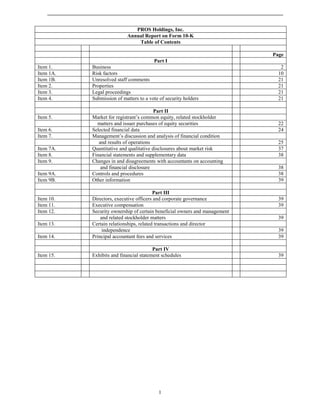
PROS Holdings, Inc.
                           Annual Report on Form 10-K
                               Table of Contents

                                                                            Page
                                        Part I
Item 1.    Business                                                            2
Item 1A.   Risk factors                                                       10
Item 1B.   Unresolved staff comments                                          21
Item 2.    Properties                                                         21
Item 3.    Legal proceedings                                                  21
Item 4.    Submission of matters to a vote of security holders                21

                                         Part II
Item 5.    Market for registrant’s common equity, related stockholder
             matters and issuer purchases of equity securities                22
Item 6.    Selected financial data                                            24
Item 7.    Management’s discussion and analysis of financial condition
              and results of operations                                       25
Item 7A.   Quantitative and qualitative disclosures about market risk         37
Item 8.    Financial statements and supplementary data                        38
Item 9.    Changes in and disagreements with accountants on accounting
               and financial disclosure                                       38
Item 9A.   Controls and procedures                                            38
Item 9B.   Other information                                                  39

                                         Part III
Item 10.   Directors, executive officers and corporate governance             39
Item 11.   Executive compensation                                             39
Item 12.   Security ownership of certain beneficial owners and management
               and related stockholder matters                                39
Item 13.   Certain relationships, related transactions and director
                independence                                                  39
Item 14.   Principal accountant fees and services                             39

                                        Part IV
Item 15.   Exhibits and financial statement schedules                         39


                                          1
SIGNIFICANT RELATIONSHIPS REFERENCED IN THIS ANNUAL REPORT

        The terms “we,” “us,” and “our” refers to PROS Holdings Inc. and all of its subsidiaries that are
consolidated in conformity with the accounting principles generally accepted in the United States of America
(“GAAP”).


           CAUTIONARY STATEMENT REGARDING FORWARD LOOKING STATEMENTS

         This annual report on Form 10-K contains certain statements that may be deemed to be “forward-looking
statements” that anticipate results based on our estimates, assumptions and plans that are subject to uncertainty.
These statements are made subject to the safe-harbor provisions of the Private Securities Litigation Reform Act of
1995, Section 27A of the Securities Act of 1933 and Section 21E of the Securities Exchange Act of 1934. All
statements in this report not dealing with historical results or current facts are forward-looking and are based on
estimates, assumptions and projections. Statements which include the words “believes,” “seeks,” “expects,” “may,”
“should,” “intends,” “likely,” “targets,” “plans,” “anticipates,” “estimates,” or the negative version of those words
and similar statements of future or forward-looking nature identify forward-looking statements.

         Numerous important factors, risks and uncertainties affect our operating results, including, without
limitation, those contained in this Report, and could cause our actual results to differ materially, from the results
implied by these or any other forward-looking statements made by us or on our behalf. There can be no assurance
that future results will meet expectations. You should pay particular attention to the important risk factors and
cautionary statements described in the section of this Report entitled Risk Factors. You should also carefully review
the cautionary statements described in the other documents we file from time to time with the Securities and
Exchange Commission (“SEC”), specifically all Quarterly Reports on Form 10-Q and Current reports on Form 8-K.
Information contained on our website is not part of this report.

                                                        Part I

Item 1.    Business

    Overview

         We are a leading provider of pricing and margin optimization software, an emerging category of enterprise
applications designed to allow companies to improve financial performance by implementing pricing excellence best
practices through the use of our software products. We were founded in 1985 and initially focused our efforts on
providing complex, science-based revenue management solutions to the global airline industry. In 1999, we began
to consider ways to diversify our product offering to include a broader suite of pricing and margin optimization
functionality. We expanded our focus beyond the airline industry to include other industries that we believed to
have similar pricing challenges and a need for advanced pricing and margin optimization solutions. In July 2007,
we completed our initial public offering (“IPO”) of our common stock in which we sold and issued 5,118,750 shares
of common stock and selling stockholders sold an additional 1,706,250 shares of common stock. In addition, in
December 2007, we completed a follow on offering of 5,000,000 shares of our common stock in which we sold and
issued 65,000 shares of common stock and selling stockholders sold an additional 4,935,000 shares of common
stock.

          By using our software products, our customers gain insight into their pricing strategies, identify detrimental
pricing practices, optimize their pricing decision-making and improve their business processes and financial
performance. Our software products incorporate advanced pricing science, which includes operations research,
forecasting and statistics. Our innovative science-based software products analyze, execute and optimize pricing
strategies using data from traditional enterprise applications, often augmenting it with real-time and historical data.
Our software also uses data elements that are determined using advanced pricing science and are stored in our
database. Our high performance software architecture supports real-time high volume transaction processing and
allows us to handle the processing and database requirements of the most sophisticated and largest customers,
including customers with hundreds of simultaneous users and sub-second electronic transactions. We provide
professional services to configure our software products to meet the specific pricing needs of each customer. Our
software products have a single code base and a single integrated database.

         Many of our customers process large volumes of individually priced business-to-consumer and business-to-
business transactions every day. Our high-performance, real-time, dynamic pricing products differ from static retail
pricing products by delivering the relevant pricing information at the time the price is quoted, the deal is negotiated
and the sale transaction is made. Our software products are also used to provide optimized price lists and goal-driven
                                                           2
price guidance. While companies in our target industries differ in the wide range of business-to-business and
business-to-customer products and services that they provide, many are similar in their need to optimally and
dynamically price each individual transaction. We have installed over 200 solutions for over 100 customers across a
range of industries in more than 40 countries.

    Industry background

         Pricing is an important component of an enterprise's business processes and financial performance.
Companies in the manufacturing, distribution, services, hotel and cruise, and airline industries can face a variety of
pricing problems such as unnecessary discounting and quoting prices below breakeven. We believe that improving
pricing is one of the most strategic and powerful ways for companies to improve their business and financial
performance.

          A variety of trends are accelerating the need for better pricing. They include increasingly complex markets
and business models as is evidenced through uncertain demand for products and services and volatile costs, greater
sophistication of purchasers, proliferation of pricing entities and competitive alternatives, growing quantities of
enterprise data and diminishing returns from traditional enterprise applications. One element contributing to pricing
problems is the limited visibility into effective prices and margins after accounting for discounts, promotions, rebates
and allowances. In addition, a lack of uniform pricing and goals, an unscientific, ad-hoc approach to pricing and a lack
of complete, relevant and timely data further add to the pricing problems that we believe most companies in our target
industries face. We believe most companies in our target industries have yet to develop or systematically implement
pricing technology solutions that can best meet business goals and generate optimal prices.

         We believe the market for pricing and margin optimization software is a large and rapidly growing
opportunity that spans most major industries. We are a leading provider of pricing and revenue optimization solutions
and we implement and support our products on a global basis across multiple industries and in complex and changing
information technology and business environments.

    Our solution

         Our software solutions are not like ERP, SCM and CRM which automate a paper intensive current process
or a people intensive current process. The goal of a pricing and margin optimization software implementation for
analytics, execution, or optimization is to improve pricing processes in an effort to achieve pricing excellence. Our
software products currently operate in some of the largest, most complex and demanding information technology
environments.

         The PROS Pricing Solution Suite is our set of integrated software products that enables enterprises in the
manufacturing, distribution, services, hotel and cruise, and airline industries to apply pricing science to determine,
analyze and execute optimal pricing strategies. Our software products support pricing decisions through the
aggregation and analysis of extensive enterprise application data, transactional data and market information. Our
software also uses data elements that are determined using advanced pricing science and are stored in our database.
Our high performance software architecture supports real-time high volume transaction processing and allows us to
handle the processing and database requirements of the most sophisticated and largest customers, including
customers with hundreds of simultaneous users and sub-second electronic transactions. We provide professional
services to configure our software products to meet the specific pricing needs of each customer. Our software
products have a single code base and a single integrated database.

        Our PROS Pricing Solution Suite provides science-based software solutions that address three areas
necessary to implement and execute an effective pricing solution:

             • Scientific analytics. Our Scientific Analytics software product provides dynamic visibility into
               pricing data and performance across pricing the different segments of a business including markets,
               customers, products, distribution channels, divisions, etc. These analytics help companies understand
               the pocket margin and its components and locate detrimental pricing trends and underperforming
               segments of their businesses that might otherwise be hard to identify.

             • Pricing execution. Our pricing execution software products (Deal Optimizer and Price Optimizer) help
               companies set and implement pricing policies throughout an enterprise and improve execution through
               pricing decision and negotiation support. Our software products give our customers the ability to propagate
               pricing decisions to either users or to another enterprise application, such as a CRM or ERP application. Our
               execution software products allow our customers to strategically manage a large number of prices, which
               helps to institutionalize pricing best practices and enforce compliance with pricing policies.
                                                            3
• Pricing optimization. Our pricing optimization software products provide companies with pricing-
               related predictive analytics in the form of science-based price guidance in order to offer frontline
               sales representatives easy-to-use guidelines that help them in quoting a profitable price and to
               optimize their pricing decision-making. Using market and company data, our optimization software
               products enable our customers to forecast and determine an optimal price within a given set of
               objectives, such as maximizing market share, revenue or profit.

    Products

         Our software products help our customers improve their business and financial performance through
several key benefits, which include:

         •   Science-based approach to pricing. Our software products enable our customers to apply advanced
             pricing science to identify and address their unique and complex pricing challenges. Our software
             products include a variety of advanced pricing analytics and forecasting and optimization engines that
             incorporate our pricing expertise and support real-time, high volume, individually priced transactions
             with accurate pricing information.
         •   Improved business insight. Our software products enable our customers to gain insight into their
             business strategy, segment and product profitability and pricing challenges. As a result, our customers
             can identify and characterize the relative attractiveness of products, customers, geographies and even
             individual transactions based on sales volume and overall profitability.
         •   Enhanced planning and decision making. Our software products enhance our customers' ability to
             process and implement pricing policies in a systematic manner. As a result, they are able to pursue
             more sophisticated and effective pricing strategies and make more informed pricing decisions.
             Additionally, our software products help companies implement best practices uniformly throughout an
             enterprise, from sales to marketing to finance.

          Our PROS Pricing Solution Suite consists of our scientific pricing analytics, pricing execution and pricing
optimization software products. The design of our PROS Pricing Solution Suite allows our customers to deploy all
of the products at once or to implement our products incrementally. Our scientific analytics software product is the
base product that is present in all implementations. Our pricing execution products, price optimizer and deal
optimizer, extend the usability of the base analytics product and provide real-time transaction level optimized prices
by customer and product. Our pricing optimization products help companies arrive at an optimal price by analyzing
the relationships among demand, price and profit margin to provide pricing-related predictive analytics in the form
of science-based price guidance in order to offer frontline sales representatives easy-to-use guidelines that help them
in quoting a profitable price and to optimize their pricing decision-making. By deploying multiple products, our
customers can analyze their pricing trends, execute consistent pricing policies, effectively negotiate prices and
optimize their prices to support organizational goals.


                                                          4
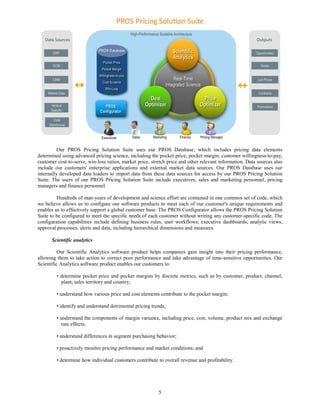
Our PROS Pricing Solution Suite uses our PROS Database, which includes pricing data elements
determined using advanced pricing science, including the pocket price, pocket margin, customer willingness-to-pay,
customer cost-to-serve, win-loss ratios, market price, stretch price and other relevant information. Data sources also
include our customers' enterprise applications and external market data sources. Our PROS Database uses our
internally developed data loaders to import data from these data sources for access by our PROS Pricing Solution
Suite. The users of our PROS Pricing Solution Suite include executives, sales and marketing personnel, pricing
managers and finance personnel.

         Hundreds of man-years of development and science effort are contained in one common set of code, which
we believe allows us to configure our software products to meet each of our customer's unique requirements and
enables us to effectively support a global customer base. The PROS Configurator allows the PROS Pricing Solution
Suite to be configured to meet the specific needs of each customer without writing any customer-specific code. The
configuration capabilities include defining business rules, user workflows, executive dashboards, analytic views,
approval processes, alerts and data, including hierarchical dimensions and measures.

      Scientific analytics

          Our Scientific Analytics software product helps companies gain insight into their pricing performance,
allowing them to take action to correct poor performance and take advantage of time-sensitive opportunities. Our
Scientific Analytics software product enables our customers to:

         • determine pocket price and pocket margins by discrete metrics, such as by customer, product, channel,
           plant, sales territory and country;

         • understand how various price and cost elements contribute to the pocket margin;

         • identify and understand detrimental pricing trends;

         • understand the components of margin variance, including price, cost, volume, product mix and exchange
            rate effects;

         • understand differences in segment purchasing behavior;

         • proactively monitor pricing performance and market conditions; and

         • determine how individual customers contribute to overall revenue and profitability.


                                                          5
Pricing execution

         Our pricing execution software products consist of the Price Optimizer and Deal Optimizer products.

          Price Optimizer. Our Price Optimizer product allows companies to streamline pricing processes and
institute control of pricing policies to support corporate business goals. It allows organizations to create multiple
rules-based price lists and quickly modify prices or guidelines in response to changes in business conditions or
strategy. Our Price Optimizer product enables our customers to:

         • create and manage pricing policies and rules that are aligned with corporate strategies;

         • automatically generate mass price updates when pricing inputs change, including costs, competitor prices,
            market indices, supply availability or demand metrics;

         • set up and manage field pricing and discounting guidelines based on pricing policies and benchmarks; and

         • manage pricing approval and exception thresholds and the pricing approval workflow to ensure
           consistency in the pricing process and maintain transaction histories.

         Deal Optimizer. Our Deal Optimizer product provides a sales force with the guidelines, additional context
and information to negotiate better prices over the entire deal horizon. Specifically, the Deal Optimizer product
enables our customers to:

         • more accurately understand transaction economics including the impact of discounts, rebates, allowances,
           shipping terms, payment terms, replacement costs and other factors that can influence the profitability of
           a transaction;

         • communicate price targets, price floors and profitability guidelines to appropriate decision-makers within
           an organization;

         • consider important transaction context to aid in better price negotiations, including insight into customer
            price history and willingness-to-pay, current and planned inventory levels and recent trends in demand,
            supply, cost or competition; and

         • evaluate transaction scenarios and allow comparisons to previous transactions and peer group benchmarks
            based on relevant metrics.

      Pricing optimization

         Our pricing optimization software products help companies arrive at an optimal price by analyzing the
relationships among demand, price and profit margin taking into account operational and financial constraints. Our
pricing optimization software products use advanced statistical techniques to determine optimal prices consistent
with pricing strategies to provide pricing-related predictive analytics in the form of science-based price guidance.
This guidance can be offered frontline sales representatives as easy-to-use guidelines that help them in quoting a
profitable price and to optimize their pricing decision. These products utilize optimization and forecasting engines to
solve many distinct pricing problems. Our pricing optimization software products enable our customers to:

         • analyze and understand factors that influence demand in conjunction with price;

         • understand customer or segment price elasticities and customer indifferences which supports the ability to
            cluster customers into segments based on purchasing behavior;

         • construct and execute price testing to systematically manage and evaluate results of price changes;

         • forecast demand and response to demand using a library of forecasting algorithms that support a vast
           number of business scenarios and that consider relevant variables; and

         • run optimization algorithms and apply appropriate methodology to recommend optimized prices or other
            business controls.


                                                           6
Technology

       Software architecture. Our software architecture is based on open standards such as Java, XML and
HTTP. We have created a component-based design in a service-oriented architecture to develop a flexible, layered
framework. This framework supports evolution and innovation in technologies and product features.

         Optimization. We have developed robust science-based forecasting and optimization engines, leveraging
the deep expertise and research of our science and research group. These engines are industry-independent and are
validated using our internally-developed verification and testing processes.

          Configuration vs. customization. Rather than developing custom code for each customer, our PROS
Pricing Solution Suite can be configured to meet each customer's business needs. The configuration capabilities
include defining user workflows, executive dashboards, analytic views, approval processes, alerts and configuring
data, including hierarchical dimensions and measures.

         Performance and scalability. Our solutions operate in some of the largest and most demanding enterprise
environments. The scalability of our technology has been tested at leading vendor benchmark performance centers,
which validated the ability of our software products to scale to large data volumes and high request rates. For
example, in one implementation of our real-time pricing execution product, our software products handled over 300
requests per second with 250 millisecond average response times. Another implementation of our pricing execution
product handles 750 concurrent users. Also, an implementation of our pricing optimization product refreshes and
maintains a data set with over one billion forecast entries and 150 million optimization results.

          Data integration. The data needed to execute pricing and margin optimization functionality typically
resides in a company's ERP, SCM and CRM systems, industry-specific transaction systems, office productivity tools
such as spreadsheets and external market data sources. Rarely can the data needed to formulate and execute optimal
pricing strategies be found in a single data source within a company. Our data integration capabilities utilize web
services and file-based data interfacing to bring data from these disparate sources together into a single cohesive
database to support our PROS Pricing Solution Suite. Our data integration capabilities allow us to quickly deploy
our solutions to our customers.

         User interface. Our technology provides a rich, browser-based interface that supports local and remote
users. The user interface supports a wide variety of highly interactive charts and other data views and provides a
comprehensive data security model based on user roles and scope of responsibility.

         Platform support. Our software products run on most standard information technology platforms
including Microsoft SQL Server and Oracle databases, 32-bit and 64-bit processors from HP, SUN, Intel, AMD and
IBM, and the HP-UX, Solaris, Linux, Windows and AIX operating systems.

    Science and research

         We believe that our long-term investment in pricing science differentiates us from our competitors. We are
committed to developing high value science-based pricing and margin optimization software products as is evident
by our continued investment in research and development. Research and development spending was 27% of total
revenue for the year ended December 31, 2008.

          We employ 30 scientists, of which 16 are PhDs, and all of whom are engaged to the advancement of
pricing and margin optimization technology and its implementation in our software products. These scientists have
specialties including but not limited to operations research, management science, statistics, econometrics and
computational methods. Our scientists regularly interact with our customers, and our product development, sales and
marketing, and professional services staff, to keep our science efforts relevant to real-world demands.

    Services

      Pricing and implementation professional services

         Our software product implementations are different from most IT projects. We have developed a
standardized and tested implementation process and have experience implementing our software products in global
enterprises across multiple industries. We have implemented over 200 solutions across a range of industries in more
than 40 countries.

                                                         7
Our pricing services personnel are responsible for planning the implementations of our software products and
they accelerate time to value realization for our customers by starting with industry based pricing best practices
already embedded in our products. Our pricing professional services include analyzing a customer’s current pricing
processes, identifying specific high-value pricing needs and relevant pricing data and initial configuration of our
software products to meet the requirements of the customer’s specific business. Our implementation services
personnel are responsible for the configuration and the technical deployment of our software products. Our
implementation professional services include implementing our software products to configuration specifications,
assisting customers in loading and validating pricing data and supporting organizational activities to assist our
customers’ transition from awareness of their pricing challenges to adoption of pricing excellence best practices.

      Customer support

         After our software products are installed and training is complete, our customer support personnel provide
ongoing support and maintenance of our software products. Our customer support personnel are responsible for
providing product support for our customers through our SupportWeb Portal, a web-based interface for submitting
and tracking issues, distributing software releases and bug fixes and hosting our knowledge base. In addition, our
customer support personnel respond to customer issues promptly using an escalation process that prioritizes reported
issues based on a defined set of severity levels and assist customers in deploying our standard releases for each
software product by providing release web seminars and documentation.

    Customers

         We provide our software products to customers in the manufacturing, distribution, services, hotel and
cruise, and airline industries. Our customers are generally large global enterprises, although we have customers that
are smaller in scope of operations. Approximately 54% of our total revenue came from customers outside the
United States for the years ended December 31, 2008 and approximately 63% of our total revenue came from
customers outside the United States for the year ended December 31, 2007 and 2006. In 2008, 2007 and 2006, we
had no single customer that accounted for 10% or more of revenue.

    Sales and marketing

         We sell and market our software products primarily through our direct sales force from our headquarters in
Houston, Texas. Our sales force is organized by our target markets of manufacturing, distribution, services, hotel
and cruise, and airline and is responsible for the worldwide sale of our products to new customers. Our sales force
works in concert with our pricing solutions personnel for selling and product demonstrations to new customers.
Sales to our existing customers are generally the responsibility of our pricing professional services personnel.

         Our marketing activities consist of a variety of programs designed to generate sales leads and build
awareness of PROS and our pricing and margin optimization software products. We host conferences for pricing
and margin optimization professionals, host informational web seminars and we participate in and sponsor other
industry conferences and organizations.

    Competition

         The market for price and margin optimization solutions is competitive, fragmented and rapidly evolving.
We believe the following factors are the principal basis of competition in the pricing and margin optimization
software market:

        • ability to offer integrated high-value solutions;

        • pricing focus and domain expertise;

        • organizational change management expertise;

        • product architecture, functionality, performance, reliability and scalability;

        • breadth and depth of product offerings;

        • time to value for the customer;

        • services organization and customer support;

                                                              8
• existing enterprise relationships;

        • large and referenceable customer base;

        • vendor viability; and

        • price.

         We compete with a number of larger and smaller companies and in the future we expect competition will
increase as companies come into this market segment. We believe we are able to compete successfully with these
vendors due to our long history of providing pricing and margin optimization software products, the scope of our
offerings and the flexibility and scalability of our architecture.

         There are also several large enterprise application providers, such as JDA Software, Oracle and SAP that
have developed offerings that include pricing and margin optimization functionality. JDA Software and Oracle
entered the market primarily through their acquisitions of Manugistics and Siebel Systems, respectively, and SAP
resells Vendavo's products. We believe these vendors do not provide all of the pricing and margin optimization
functionality needed to support a pricing excellence-focused organization. These vendors may seek to compete on
price and by bundling their pricing and margin optimization applications with other enterprise applications. We
distinguish ourselves from these vendors with the breadth and depth of the functionality of our products and
providing high-value pricing and margin optimization software to a global customer base in multiple industries.

         In addition, there are a number of vendors that provide pricing and margin optimization software for
specific industries. In the hotel industry, we compete with IDeaS and Easy RMS, and in the airline industry, we
compete with Sabre Airline Solutions and Lufthansa Systems. One industry in which we do not compete is retail,
where vendors include DemandTec, JDA Software, Oracle and SAP. Oracle and SAP entered this retail market
through their acquisitions of ProfitLogic and Khimetrics, respectively.

        Our products also compete with solutions developed internally by businesses. These businesses rely upon a
combination of manual processes, external consultants, spreadsheets or internally developed software tools to
conduct pricing activities.

    Intellectual property

         Our success and ability to compete is dependent in part on our ability to develop and maintain the
proprietary aspects of our technology and operate without infringing upon the proprietary rights of others. We rely
primarily on a combination of copyright, trade secret, confidentiality procedures, contractual provisions and other
similar measures to protect our proprietary information. Due to the rapidly changing nature of applicable
technologies, we believe that the improvement of existing products, reliance upon trade secrets and unpatented
proprietary know-how and development of new products are generally more advantageous than patent and
trademark protection.

    Research and development

         Our research and development program involves enhancing existing products to add new functionality and
creating new products to meet other market demands. Our research and development expenses include costs
associated with our product management, product development and science and research groups. Our research and
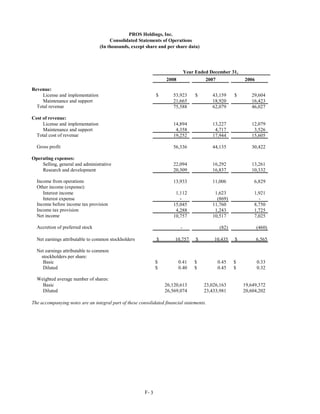
development expenses were $20.3 million, $16.8 million and $10.3 million for the years ended December 31, 2008,
2007 and 2006, respectively.

    Employees

         As of December 31, 2008, we had 381 full-time personnel which include 351 employees and 30
independent contractors. None of our employees are represented by a labor union or covered by a collective
bargaining agreement. We have not experienced any work stoppages and consider our employee relations to be
good. We expect that our continued success will depend in part on our ability to attract and retain highly skilled
technical, sales, marketing and management personnel.


                                                        9
Where you can find additional information

         Our website address is www.prospricing.com. We make available free of charge through our website our
Annual Reports on Form10-K, Quarterly Reports on Form 10-Q, Current Reports on Form 8-K and all amendments
to those reports as soon as reasonably practicable after such material is electronically filed with or furnished to the
SEC. In addition, you may read and copy all or any portion of the registration statement or any reports, statements
or other information in the files at the public reference room of the SEC located at 100 F Street, N.E.,
Washington, D.C. 20549. You can request copies of these documents upon payment of a duplicating fee by writing
to the SEC. You may call the SEC at 1-800-SEC-0330 for further information on the operation of its public
reference room. Our filings, including our registration statement, will also be available to you on the web site
maintained by the SEC at http://www.sec.gov. No information on our website is incorporated by reference herein.

    Annual CEO Certification

      Pursuant to Section 303A.12(a) of the New York Stock Exchange Listed Company Manual, we submitted to
the New York Stock Exchange an annual certification signed by our Chief Executive Officer certifying that he was
not aware of any violation by us of New York Stock Exchange corporate governance listing standards on June 9,
2008.


Item 1A.    Risk factors

         We operate in a dynamic environment that involves numerous risks and uncertainties. The following
section describes some of the risks that may adversely affect our business, financial condition or results of
operations; these are not necessarily listed in terms of their importance or level of risk.

    Risks relating to our business and industry:

       The continued deterioration of general U. S. and global economic conditions could adversely affect our
sales and operating results.

         The implementation of our software products, which is often accompanied by hardware purchases and
other capital commitments, involves significant capital expenditure by our customers. Customers may reduce or
defer their spending on technology during the current economic downturn. In addition, the weak and uncertain U.S.
and global economic conditions could impair our customers’ ability to pay for our products or services. Any of
these factors could adversely impact our business, quarterly or annual operating results and financial condition.

         Periodic fluctuations in the U.S. Dollar, corporate profits, lower spending, the availability of credit, the
impact of conflicts throughout the world, terrorist acts, natural disasters, volatile energy costs, the outbreak of
diseases and other geopolitical factors have had, and may continue to have, a negative impact on the U.S. and global
economies. Our customers and prospects may experience consolidation or bankruptcies in their industries which
may result in project delays or cancellations. We are unable to predict the strength or duration of current market
conditions or effects of consolidation. Uncertainties in anticipated spending levels or further consolidation may
adversely affect our business, financial condition and results of operations.

     A significant or prolonged economic downturn in industries in which we focus, may result in our
customers reducing or postponing spending on the products we offer.

          There are a number of factors, other than our performance, that could affect the size, frequency and renewal
rates of our customer contracts. For instance, if economic conditions weaken in any industry in which we focus, our
customers may reduce or postpone their spending significantly which may, in turn, lower the demand for our
products and negatively affect our revenue and profitability. As a way of dealing with a challenging economic
environment, customers may change their purchasing strategy, including increased negotiation of price or deciding
to license one product rather than multiple products. Customers could also terminate or delay their implementations
or maintenance contracts. The loss of, or any significant decline in business from, one or more of our customers
likely would lead to a significant decline in our revenue and operating margins, particularly if we are unable to make
corresponding reductions in our expenses in the event of any such loss or decline. Moreover, a significant change in
the liquidity or financial position of any of these customers could have a material adverse effect on the collectability
of our accounts receivable, liquidity, customers’ ability to complete implementation and future operating results.


                                                          10
A weakening economy and changing business conditions could result in substantial defaults or slowing of
payments by our customers on our accounts receivable which could have a significant negative impact on our
business, results of operations, financial condition or liquidity.

          A significant portion of our working capital consists of accounts receivable from customers. If customers
responsible for a significant amount of accounts receivable were to become insolvent or otherwise unable to pay for
products and services, or were to become unwilling or unable to make payments in a timely manner, our business,
results of operations, financial condition or liquidity could be adversely affected.

      We focus exclusively on the pricing and revenue optimization software market, and if this market develops
more slowly than we expect, our business will be harmed.

         We derive, and expect to continue to derive, all of our revenue from providing pricing and revenue
optimization software products, implementation services and ongoing customer support. The pricing and revenue
optimization software market is relatively new and still evolving, and it is uncertain whether this software will
achieve and sustain high levels of demand and market acceptance. Our success will depend on the willingness of
businesses in the manufacturing, distribution, services, hotel and cruise, and airline industries to implement pricing
and revenue optimization software.

         Some businesses may be reluctant or unwilling to implement pricing and revenue optimization software for
a number of reasons, including failure to understand the potential returns of improving their pricing processes and
lack of knowledge about the potential benefits that such software may provide. Even if businesses recognize the
need for improved pricing processes, they may not select our pricing and revenue optimization software products
because they previously have made investments in internally developed pricing and revenue optimization solutions.
Some businesses may elect to improve their pricing processes through solutions obtained from their existing
enterprise software providers, whose solutions are designed principally to address one or more functional areas other
than pricing. These enterprise solutions may appeal to customers that wish to limit the number of software vendors
on which they rely and the number of different types of solutions used to run their businesses.

          If businesses do not perceive the benefits of pricing and revenue optimization software, the pricing and
revenue optimization software market may not continue to develop or may develop more slowly than we expect,
either of which would significantly and adversely affect our revenue and operating results. Because the pricing and
revenue optimization software market is developing and the manner of its development is difficult to predict, we
may make errors in predicting and reacting to relevant business trends, which could harm our operating results.

       Any downturn in sales to our target markets of manufacturing, distribution, services, hotel and cruise, and
airline would adversely affect our operating results.

         Our success is highly dependent upon our ability to sell our software products to customers in the
manufacturing, distribution, services, hotel and cruise, and airline industries. If we are unable to market and sell our
software products effectively to customers in these industries, we may not be able to grow our business. It is
uncertain whether our software products will achieve and sustain the levels of demand and market acceptance that
we anticipate. Such uncertainty is attributable to, among other factors, the following:

         · the possibility that it may be more difficult than we currently anticipate to implement our software
         products in our target industries;

         · the possibility that it may be more difficult than we currently anticipate to increase our customer base in
         our target industries;

         · the possibility that it may take more time to train our personnel in the implementation of our software
         products in our target industries; and

         · our limited experience implementing our software products in certain of our target industries.

         Revenue from customers in the airline industry accounted for 40%, 43% and 44% of our total revenue for
the years ended December 31, 2008, 2007, and 2006, respectively. Our revenue growth has been derived principally
from customers in the manufacturing, distribution, services and hotel and cruise industries, where our products have
recently begun to achieve market acceptance. Our revenue growth is highly dependent upon continued growth of
market acceptance in all of these industries, and there is no assurance our products will achieve or sustain
widespread acceptance among these potential customers. Failure to expand market acceptance of our products in the
manufacturing, distribution, services and hotel and cruise industries or to maintain sales in the airline industry would
                                                          11
adversely affect our operating results and financial condition.

      Our software products require implementation projects that are subject to significant risks and delays, the
materialization of which could negatively impact the effectiveness of our solutions, resulting in harm to our
reputation, business and financial performance.

          The implementation of our software products can involve complex, large-scale projects that require
substantial support operations, significant resources and reliance on certain factors that may not be under our
control. For example, the success of our implementation projects is heavily dependent upon the quality of data used
by our software products, the commitment of customers’ resources and personnel to the projects and the stability,
functionality and scalability of the customer’s information technology infrastructure. If weaknesses or problems in
infrastructure or data or our customers’ commitment and investment in personnel and resources exist, we may not be
able to correct or compensate for such weaknesses. In addition, implementation of our software products can be
highly complex and require substantial efforts and cooperation on the part of our customers and us. If we are unable
to successfully manage the implementation of our software products such that those products do not meet customer
needs or expectations, we may become involved in disputes with our customers and our business, reputation and
financial performance may be significantly harmed. We recognize our license and implementation revenues as
implementation services are performed. Any delays in an implementation project or changes in the scope or timing
of an implementation project would delay or alter the corresponding revenue recognition and could adversely affect
our operating results. If an implementation project for a large customer or a number of customers is substantially
delayed or cancelled, our ability to recognize the associated revenue and our operating results would be adversely
affected.

       Competition from vendors of pricing solutions and enterprise applications as well as from companies
internally developing their own solutions could adversely affect our ability to sell our software products and could
result in pressure to price our software products in a manner that reduces our margins and harms our operating
results.

        The pricing and revenue optimization software market is competitive, fragmented and rapidly evolving.
Our software products compete with solutions developed internally by businesses as well as solutions offered by
competitors. Our principal competition consists of:

         · pricing and revenue optimization software vendors, including a number of vendors that provide pricing
         and revenue optimization software for specific industries; and

         · large enterprise application providers that have developed offerings that include pricing and revenue
         optimization functionality.

         We expect additional competition from other established and emerging companies to the extent the pricing
and revenue optimization software market continues to develop and expand. We also expect competition to increase
as a result of the entrance of new competitors in the market and industry consolidation, including through a merger
or partnership of two or more of our competitors or the acquisition of a competitor by a larger company. A number
of our current and potential competitors have larger installed bases of users, longer operating histories and greater
name recognition than we have. In addition, many of these companies have significantly greater financial, technical,
marketing, service and other resources than we have. As a result, these companies may be able to respond more
quickly to new or emerging technologies and changes in customer demands and to devote greater resources to the
development, promotion and sale of their products than we can.

         Competition could seriously impede our ability to sell additional software products and related services on
terms favorable to us. We do not know how our competition will set prices for their products during a period of
economic downturn. Businesses may continue to enhance their internally developed solutions, rather than investing in
commercially-available solutions such as ours. Our current and potential competitors may develop and market new
technologies that render our existing or future products obsolete, unmarketable or less competitive. In addition, if these
competitors develop products with similar or superior functionality to our products, or if they offer products with
similar functionality at a substantially lower price than our products, we may need to decrease the prices for our
products in order to remain competitive. If we are unable to maintain our current product, services and maintenance
pricing due to competitive pressures, our margins will be reduced and our operating results will be adversely affected.
We cannot assure you that we will be able to compete successfully against current or future competitors or that
competitive pressures will not materially and adversely affect our business, financial condition and operating results.


                                                           12
Our revenue recognition is primarily based upon our ability to estimate the efforts required to complete
our implementation projects, which may be difficult to estimate.

         We generally recognize revenue from our software licenses and implementation services over the period
during which such services are performed using the percentage-of-completion method. The length of this period
depends on the number of licensed software products and the scope and complexity of the customer’s deployment
requirements. Under the percentage-of-completion method, the revenue we recognize during a reporting period is
based on the percentage of man-days incurred during the reporting period as compared to the estimated total man-
days required to implement our software products. If we are unable to accurately estimate the overall total man-days
required to implement our software products, such inaccuracies could have a material effect on the timing of our
revenue. Any change in the timing of revenue recognition as a result of inaccurate estimates could adversely impact
our quarterly or annual operating results.

       Failure to sustain our historical maintenance and support renewal rates and pricing would adversely
affect our operating result.

         Maintenance and support agreements are typically for a term of one to two years. Historically,
maintenance and support revenue has represented a significant portion of our total revenue, including approximately
29%, 30% and 36% of our total revenue for the years ended December 31, 2008, 2007 and 2006, respectively. If
our customers choose not to renew their maintenance and support agreements with us on favorable terms or at all,
our business, operating results and financial condition could be harmed.


       Our Global Growth is Subject to a Number of Economic Risks

         As widely reported, global financial markets have been experiencing extreme disruption in recent months,
including, among other things, extreme volatility in security prices, limited ability to raise capital in public financial
markets, severely diminished liquidity, credit unavailability and company rating downgrades. These conditions
have a negative impact on our prospects' and customers' ability to raise capital and operate their businesses. This
global financial crisis and economic recessions will negatively affect our business although the extent to which it
will do so and our ability to manage the business in the face of those challenges are uncertain. For example, a
contraction in spending by our prospects or customers, including reduced spending on products such as ours, would
have a negative effect on our operating results and our business would suffer.

       We might not generate increased business from our current customers, which could limit our revenue in
the future.

         We sell our software products to both new customers and existing customers. Many of our existing
customers initially purchase our software products for a specific business segment or a specific geographic location
within their organization and later purchase additional software products for the same or other business segments
and geographic locations within their organization. These customers might not choose to make additional purchases
of our software products or to expand their existing software products to other business segments. In addition, as we
deploy new applications and features for our software products or introduce new software products, our current
customers could choose not to purchase these new offerings. If we fail to generate additional business from our
existing customers, our revenue could grow at a slower rate or even decrease.

      We are subject to a lengthy sales cycle and delays or failures to complete sales may harm our business and
cause our revenue and operating income to decline in the future.

         Our sales cycle may take several months to over a year. To sell our products successfully and obtain an
executed contract, we generally have to educate our potential customers about the use and benefits of our products,
which can require significant time, expense and capital without the ability to realize any revenue. During this sales
cycle, we may expend substantial resources with no assurance that a sale will ultimately result. The length of a
customer’s sales cycle depends on a number of factors, many of which we may not be able to control. These factors
include the customer’s product and technical requirements and the level of competition we face for that customer’s
business. Any unexpected lengthening of the sales cycle would negatively affect the timing of our revenue, and
hinder our revenue growth. Furthermore, a delay in our ability to obtain a signed agreement or other persuasive
evidence of an arrangement or to complete certain contract requirements in a particular quarter could reduce our
revenue in that quarter. Overall, any significant failure to generate revenue or delays in recognizing revenue after
incurring costs related to our sales or services process could have a material adverse effect on our business, financial
condition and results of operations.
                                                           13
If our cost estimates for fixed-fee arrangements do not accurately anticipate the cost and complexity of
implementing our software products, our profitability could be reduced and we could experience losses on these
arrangements.

         The majority of our license and implementation arrangements are priced on a fixed-fee basis. If we
underestimate the amount of effort required to implement our software products, our profitability could be reduced.
Moreover, if the actual costs of completing the implementation exceed the agreed upon fixed price, we would incur
a loss on the arrangement.

     Our revenue recognition policy may cause any decreases in sales not to be reflected in our revenue
immediately.

        The period over which we recognize license and implementation revenue for an implementation depends
on the number of licensed software products and the scope and complexity of the customer’s deployment
requirements which may range from six months to several years. As a result, a significant majority of our revenue is
recognized on arrangements that were executed in previous periods. Any shortfall in new sales of our software
products may not be reflected in our revenue for several quarters, and as such the adverse impact on our business
may not be readily apparent.

       We incur significant increased costs as a result of operating as a public company, and our management
will be required to devote substantial time to new compliance initiatives.

         As a public company, we incur significant legal, accounting and other expenses that we did not incur as a
private company. SEC and New York Stock Exchange (“NYSE”) rules and regulations impose heightened
requirements on public companies, including requiring changes in corporate governance practices. Our management
and other personnel devote a substantial amount of time to these compliance initiatives. We may also need to hire
additional finance and administrative personnel to support our compliance requirements. Moreover, these rules and
regulations increase our legal and financial costs and make some activities more time-consuming.

         In addition, we are required to maintain effective internal controls for financial reporting and disclosure
controls and procedures. In particular, we are required to perform system and process evaluation and testing of our
internal controls over financial reporting to allow management to report on, and our independent registered public
accounting firm to report on, the effectiveness of our internal controls over financial reporting, as required by
Section 404 of the Sarbanes-Oxley Act. Our testing, or the subsequent testing by our independent registered public
accounting firm, may reveal deficiencies or material weaknesses in our internal controls over financial reporting.
Our compliance with Section 404 will require that we incur substantial accounting expense and expend significant
management efforts. We may need to hire additional accounting and financial staff or a third party firm with
appropriate public company experience and technical accounting knowledge. Moreover, if we are not able to
comply with the requirements of Section 404 in a timely manner, or if we or our independent registered public
accounting firm identifies deficiencies or material weaknesses in our internal controls over financial reporting, the
market price of our stock could decline and we could be subject to sanctions or investigations by the NYSE, SEC or
other regulatory authorities, which would require additional financial and management resources.

      If we fail to develop or acquire new pricing and revenue optimization functionality to enhance our existing
software products, we will not be able to grow our business and it could be harmed.

        The pricing and revenue optimization software market is characterized by:

        · rapid technological developments;

        · newly emerging and changing customer requirements; and

        · frequent product introductions, updates and functional enhancements.

         We must introduce new pricing and revenue optimization functionality that enhances our existing software
products in order to meet our business plan, maintain or improve our competitive position, keep pace with
technological developments, satisfy increasing customer requirements and increase awareness of pricing and
revenue optimization software generally and of our software products in particular. Any new functionality we
develop may not be introduced in a timely manner and may not achieve market acceptance sufficient to generate
material revenue. Furthermore, we believe our competitors are heavily investing in research and development, and
may develop and market new solutions that will compete with, and may reduce the demand for, our software
                                                         14
products. We cannot assure you that we will be successful in developing or otherwise acquiring, marketing and
licensing new functionality, or delivering updates and upgrades that meet changing industry standards and customer
demands. In addition, we may experience difficulties that could delay or prevent the successful development,
marketing and licensing of such functionality. If we are unable to develop or acquire new functionality, enhance our
existing software products or adapt to changing industry requirements to meet market demand, we may not be able
to grow our business and our revenue and operating results would be adversely affected.

          In addition, because our software products are intended to operate on a variety of technology platforms, we
must continue to modify and enhance our software products to keep pace with changes in these platforms. Any
inability of our software products to operate effectively with existing or future platforms could reduce the demand
for our software products, result in customer dissatisfaction and limit our revenue.

      Defects or errors in our software products could harm our reputation, impair our ability to sell our
products and result in significant costs to us.

         Our pricing and revenue optimization software products are complex and may contain undetected defects
or errors. Several of our products have recently been developed and may therefore be more likely to contain
undetected defects or errors. In addition, we frequently develop enhancements to our software products that may
contain defects. We have not suffered significant harm from any defects or errors to date, but we have found defects
in our software products from time to time. We may discover additional defects in the future, and such defects
could be material. We may not be able to detect and correct defects or errors before the final implementation of our
software products. Consequently, we or our customers may discover defects or errors after our software products
have been implemented. We have in the past issued, and may in the future need to issue, corrective releases of our
products to correct defects or errors. The occurrence of any defects or errors could result in:

         · lost or delayed market acceptance and sales of our software products;

         · delays in payment to us by customers;

         · injury to our reputation;

         · diversion of our resources;

         · legal claims, including product liability claims, against us;

         · increased maintenance and support expenses; and

         · increased insurance costs.

          Our license agreements with our customers typically contain provisions designed to limit our liability for
defects and errors in our software products and damages relating to such defects and errors, but these provisions may
not be enforced by a court or otherwise effectively protect us from legal claims. Our liability insurance may not be
adequate to cover all of the costs resulting from these legal claims. Moreover, we cannot assure you that our current
liability insurance coverage will continue to be available on acceptable terms. In addition, the insurer may deny
coverage on any future claim. The successful assertion against us of one or more large claims that exceeds available
insurance coverage, or the occurrence of changes in our insurance policies, including premium increases or the
imposition of large deductible or co-insurance requirements, could have a material adverse effect on our business
and operating results. Furthermore, even if we prevail in any litigation, we are likely to incur substantial costs and
our management’s attention will be diverted from our operations.

       If we fail to retain our key personnel or if we fail to attract additional qualified personnel, our operating
results could be adversely affected.

          Our future success depends upon the continued service of our executive officers and other key sales,
development, science and professional services staff. The loss of the services of our executive officers and other
key personnel would harm our operations. In addition, our future success will depend in large part on our ability to
attract and retain a sufficient number of highly qualified personnel, and there can be no assurance that we will be
able to do so. In particular, given the highly sophisticated pricing science included in our products, the pool of
scientists and software developers qualified to work on our products is limited. In addition, the implementation of
our software products requires highly-qualified personnel, and hiring and retaining such personnel to support our
growth may be challenging. Competition for such qualified personnel is intense, and we compete for these
individuals with other companies that have greater financial, technical, marketing, service and other resources than
                                                           15
we do. If we fail to retain our key personnel and attract new personnel, our operating results could be adversely
affected.

      Intellectual property litigation and infringement claims may cause us to incur significant expense or
prevent us from selling our software products.

          Our industry is characterized by the existence of a large number of patents, trademarks and copyrights, and
by frequent litigation based on allegations of infringement or other violations of intellectual property rights. A third
party may assert that our technology violates its intellectual property rights, or we may become the subject of a
material intellectual property dispute. Pricing and revenue optimization solutions may become increasingly subject
to infringement claims as the number of commercially available pricing and revenue optimization solutions
increases and the functionality of these solutions overlaps. Future litigation may involve patent holding companies
or other adverse patent owners who have no relevant product revenue and against whom our own potential patents
may therefore provide little or no deterrence. Regardless of the merit of any particular claim that our technology
violates the intellectual property rights of others, responding to such claims may require us to:

         · incur substantial expenses and expend significant management efforts to defend such claims;

         · pay damages, potentially including treble damages, if we are found to have willfully infringed such
         parties’ patents or copyrights;

         · cease making, licensing or using products that are alleged to incorporate the intellectual property of
         others;

         · distract management and other key personnel from performing their duties for us;

         · enter into potentially unfavorable royalty or license agreements in order to obtain the right to use
         necessary technologies; and

         · expend additional development resources to redesign our products.

         Any license required as a result of litigation under any patent may not be made available on commercially
acceptable terms, if at all. In addition, some licenses may be nonexclusive, and therefore our competitors may have
access to the same technology licensed to us. If we fail to obtain a required license or are unable to design around a
patent, we may be unable to effectively develop or market our products, which could limit our ability to generate
revenue or maintain profitability.

         We may also be required to indemnify our customers for their use of the intellectual property associated
with our current product suite or for other third-party products that are incorporated into our solutions and that
infringe the intellectual property rights of others. If we are unable to resolve our legal obligations by settling or
paying an infringement claim or a related indemnification claim as described above, we may be required to
compensate our customers under the contractual arrangement with the customers. Some of our intellectual property
indemnification obligations are contractually capped at a very high amount or not capped at all.

     If we fail to protect our proprietary rights and intellectual property adequately, our business and prospects
may be harmed.

         Our success will depend in part on our ability to protect our proprietary methodologies and intellectual
property. We rely upon a combination of trade secrets, confidentiality policies, nondisclosure and other contractual
arrangements, and patent, copyright and trademark laws to protect our intellectual property rights. We cannot,
however, be sure that steps we take to protect our proprietary rights will prevent misappropriation of our intellectual
property, or the development and marketing of similar and competing products and services by third parties.

          We rely, in some circumstances, on trade secrets to protect our technology. Trade secrets, however, are
difficult to protect. In addition, our trade secrets may otherwise become known or be independently discovered by
competitors, and in such cases, we could not assert such trade secret rights against such parties. We seek to protect
our proprietary technology and processes, in part, by confidentiality agreements with our employees, consultants,
customers, scientific advisors and other contractors. These agreements may be breached, and we may not have
adequate remedies for any breach. To the extent that our employees, consultants or contractors use intellectual
property owned by others in their work for us, disputes may arise as to the rights in related or resulting know-how
and inventions.

                                                          16
As of the date of this filing, we have 2 issued U.S. patents and 7 pending U.S. patent applications. We have
not pursued patent protection in any foreign countries. Our pending patent applications may not result in issued
patents. The patent position of technology-oriented companies, including ours, is generally uncertain and involves
complex legal and factual considerations. The standards that the United States Patent and Trademark Office use to
grant patents are not always applied predictably or uniformly and can change. Accordingly, we do not know the
degree of future protection for our proprietary rights or the breadth of claims allowed in any patents that may be
issued to us or to others. If any of our patent applications issue, they may not contain claims sufficiently broad to
protect us against third parties with similar technologies or products, or provide us with any competitive advantage.
Moreover, once they have been issued, our patents and any patent for which we have licensed or may license rights
may be challenged, narrowed, invalidated or circumvented. If our patents are invalidated or otherwise limited, other
companies will be better able to develop products that compete with ours, which could adversely affect our
competitive business position, business prospects and financial condition.

          Patent applications in the U.S. are typically not published until 18 months after filing or in some cases not
at all, and publications of discoveries in industry-related literature lag behind actual discoveries. We cannot be
certain that we were the first to make the inventions claimed in our pending patent applications or that we were the
first to file for patent protection. Additionally, the process of obtaining patent protection is expensive and time-
consuming, and we may not be able to prosecute all necessary or desirable patent applications at a reasonable cost or
in a timely manner. As a result, we may not be able to obtain adequate patent protection.

         In addition, despite our efforts to protect our proprietary rights, unauthorized parties may be able to obtain
and use information that we regard as proprietary. The issuance of a patent does not guarantee that it is valid or
enforceable. As such, even if we obtain patents, they may not be valid or enforceable against third parties. In
addition, the issuance of a patent does not guarantee that we have a right to practice the patented invention. Third
parties may have blocking patents that could be used to prevent us from marketing or practicing our potentially
patented products. As a result, we may be required to obtain licenses under these third-party patents. If licenses are
not available to us on acceptable terms, or at all, we will not be able to make and sell our software products and
competitors would be more easily able to compete with us.

      We use open source software in our products that may subject our software products to general release or
require us to re-engineer our products, which may cause harm to our business.

          We use open source software in our products and may use more open source software in the future. From
time to time, there have been claims challenging the ownership of open source software against companies that
incorporate open source software into their products. As a result, we could be subject to suits by parties claiming
ownership of what we believe to be open source software. Some open source licenses contain requirements that we
make available source code for modifications or derivative works we create based upon the open source software
and that we license such modifications or derivative works under the terms of a particular open source license or
other license granting third parties certain rights of further use. If we combine our proprietary software products
with open source software in a certain manner, we could, under certain of the open source licenses, be required to
release the source code of our proprietary software products. In addition to risks related to license requirements,
usage of open source software can lead to greater risks than use of third party commercial software, as open source
licensors generally do not provide warranties or controls on origin of the software. In addition, open source license
terms may be ambiguous and many of the risks associated with usage of open source cannot be eliminated, and
could, if not properly addressed, negatively affect our business. If we were found to have inappropriately used open
source software, we may be required to re-engineer our products, to discontinue the sale of our products in the event
re-engineering cannot be accomplished on a timely basis or take other remedial action that may divert resources
away from our development efforts, any of which could adversely affect our business, operating results and financial
condition.

       We utilize third-party software that we incorporate into our software products, and impaired relations with
these third parties, defects in third-party software or a third party’s inability or failure to enhance their software
over time could adversely affect our operating performance and financial condition.

           We incorporate and include third-party software into our software products. If our relations with any of
these third parties are impaired, or if we are unable to obtain or develop a replacement for the software, our business
could be harmed. The operation of our products could be impaired if errors occur in the third-party software that we
utilize. It may be more difficult for us to correct any defects in third-party software because the software is not
within our control. Accordingly, our business could be adversely affected in the event of any errors in this software.
There can be no assurance that these third parties will continue to invest the appropriate levels of resources in their
products and services to maintain and enhance the capabilities of their software.

                                                          17
New accounting standards or interpretations of existing accounting standards, including those related to
revenue recognition, could adversely affect our operating results.

         GAAP in the United States are subject to interpretation by the Financial Accounting Standards Board, the
American Institute of Certified Public Accountants, the SEC and various bodies formed to promulgate and interpret
appropriate accounting principles. A change in principles or interpretations, in particular those related to revenue
recognition, could have an adverse effect on our reported financial results.

      Our international sales subject us to risks that may adversely affect our operating results.

          Over the last several years, we derived a significant portion of our revenue from customers outside the
United States. For the years ended December 31, 2008, 2007, and 2006, approximately 54%, 63% and 63% of our
total revenue, respectively, was derived from outside the United States. We may not be able to maintain or increase
international market demand for our products. Managing overseas growth could require significant resources and
management attention and may subject us to new or larger levels of regulatory, economic, foreign currency
exchange, tax and political risks. Among the risks we believe are most likely to affect us with respect to our
international sales and operations are:

        · economic conditions in various parts of the world;

        · unexpected changes in regulatory requirements;

        · less protection for intellectual property rights in some countries;

        · new and different sources of competition;

        · multiple, conflicting and changing tax laws and regulations that may affect both our international and
        domestic tax liabilities and result in increased complexity and costs;

        · if we were to establish international offices, the difficulty of managing and staffing such international
        offices and the increased travel, infrastructure and legal compliance costs associated with multiple
        international locations;

        · difficulties in enforcing contracts and collecting accounts receivable, especially in developing countries;

        · if contracts become denominated in local currency, fluctuations in exchange rates; and

        · tariffs and trade barriers, import/export controls and other regulatory or contractual limitations on our
        ability to sell or develop our products in certain foreign markets.

         If we continue to expand our business globally, our success will depend, in large part, on our ability to
anticipate and effectively manage these and other risks associated with our international operations. Our failure to
manage any of these risks successfully could harm our international operations and reduce our international sales,
adversely affecting our business, operating results and financial condition.

      We may enter into acquisitions that may be difficult to integrate, fail to achieve our strategic objectives,
disrupt our business, dilute stockholder value or divert management attention.

         We currently do not have any agreements with respect to any acquisitions, but in the future we may pursue
acquisitions of businesses, technologies and products that we intend to complement our existing business, products
and technologies. We cannot assure you that any acquisition we make in the future will provide us with the benefits
we anticipated in entering into the transaction. Acquisitions are typically accompanied by a number of risks,
including:

        · difficulties in integrating the operations and personnel of the acquired companies;

        · difficulties in maintaining acceptable standards, controls, procedures and policies;

        · potential disruption of ongoing business and distraction of management;

        · inability to maintain relationships with customers of the acquired business;

                                                          18
· impairment of relationships with employees and customers as a result of any integration of new
         management and other personnel;

         · difficulties in incorporating acquired technology and rights into our products and services;

         · unexpected expenses resulting from the acquisition; and

         · potential unknown liabilities associated with acquired businesses.

          In addition, acquisitions may result in the incurrence of debt, restructuring charges and write-offs.
Acquisitions may also result in goodwill and other intangible assets that are subject to impairment tests, which could
result in future impairment charges. Furthermore, if we finance acquisitions by issuing convertible debt or equity
securities, our existing stockholders may be diluted and earnings per share may decrease. To the extent we finance
future acquisitions with debt; such debt could include financial or operational covenants that restrict our business
operations.

         We may enter into negotiations for acquisitions that are not ultimately consummated. Those negotiations
could result in diversion of management time and significant out-of-pocket costs. If we fail to evaluate and execute
acquisitions successfully, we may not be able to achieve our anticipated level of growth and our business and
operating results could be adversely affected.

     Our operations might be affected by the occurrence of a natural disaster or other catastrophic event in
Houston, Texas.

          Our headquarters are located in Houston, Texas, from which we base our operations. Although we have
contingency plans in effect for natural disasters or other catastrophic events, these events, including terrorist attacks
and natural disasters such as hurricanes, could disrupt our operations. Even though we carry business interruption
insurance and typically have provisions in our contracts that protect us in certain events, we might suffer losses as a
result of business interruptions that exceed the coverage available under our insurance policies or for which we do
not have coverage. For example, even a temporary disruption to our business operations may create a negative
perception in the marketplace. Any natural disaster or catastrophic event affecting us could have a significant
negative impact on our operations.

      Our ability to raise capital in the future may be limited, and our failure to raise capital when needed could
prevent us from executing our growth strategy.

         We believe that our existing cash and cash equivalents and our cash flow from future operating activities
will be sufficient to meet our anticipated cash needs for the foreseeable future. The timing and amount of our
working capital and capital expenditure requirements may vary significantly depending on numerous factors,
including the other risk factors described in this Annual Report on Form 10-K. In addition, we may require
additional financing to fund the purchase price of future acquisitions. Additional financing may not be available on
terms favorable to us, or at all. Any additional capital raised through the sale of equity or convertible debt securities
may dilute your percentage ownership of our common stock. Furthermore, any new debt or equity securities we
issue could have rights, preferences and privileges superior to our common stock. Capital raised through debt
financings could require us to make periodic interest payments and could impose potentially restrictive covenants on
the conduct of our business.

    Risks relating to ownership of our common stock:

      Market volatility may affect our stock price and the value of your investment.

          The market price for our common stock has been and is likely to continue to be volatile, in part because our
shares has been traded publicly since June 2007. Volatility could make it difficult to trade shares of our common
stock at predictable prices or times.

         Many factors could cause the market price of our common stock to be volatile, including the following:

         · variations in our quarterly or annual operating results;

         · decreases in market valuations of comparable companies;

         · fluctuations in stock market prices and volumes;
                                                           19
· decreases in financial estimates by equity research analysts;

         · announcements by our competitors of significant contracts, new products or product enhancements,
         acquisitions, distribution partnerships, joint ventures or capital commitments;

         · departure of key personnel;

         · changes in governmental regulations and standards affecting the software industry and our products;

         · sales of common stock or other securities by us in the future;

         · damages, settlements, legal fees and other costs related to litigation, claims and other contingencies;

         · deterioration of the general U. S. and global economic condition; and

         · other risks described elsewhere in this section.

          In the past, securities class action litigation often has been initiated against a company following a period of
volatility in the market price of the company’s securities. If class action litigation is initiated against us, we will
incur substantial costs and our management’s attention will be diverted from our operations. All of these factors
could cause the market price of our stock to decline, and you may lose some or all of your investment.

       Shares of our common stock are relatively illiquid

          Our common stock is thinly traded and we have a relatively small public float. Our common stock may be
less liquid than the stock of companies with a broader public ownership. In addition, trading of a large volume of
our common stock may also have a significant impact on its trading price.

    If equity research analysts cease to publish research or reports about us or if they issue unfavorable
commentary or downgrade our common stock, the price of our common stock could decline.

         The trading market for our common stock relies in part on the research and reports that equity research
analysts publish about us and our business. The price of our stock could decline if one or more equity research
analysts downgrade our stock or if those analysts issue other unfavorable commentary or cease publishing reports
about our business.

      Anti-takeover provisions in our Certificate of Incorporation and Bylaws and under Delaware law could
make an acquisition of us, which may be beneficial to our stockholders, more difficult and may prevent attempts
by our stockholders to replace or remove our current management.

         Our Certificate of Incorporation and by-laws and Section 203 of the Delaware General Corporation Law
contain provisions that might enable our management to resist a takeover of our company. These provisions include
the following:

         · the division of our board of directors into three classes to be elected on a staggered basis, one class each
         year;

         · a prohibition on actions by written consent of our stockholders;

         · the elimination of the right of stockholders to call a special meeting of stockholders;

         · a requirement that stockholders provide advance notice of any stockholder nominations of directors or
         any proposal of new business to be considered at any meeting of stockholders;

         · a requirement that a supermajority vote be obtained to amend or repeal certain provisions of our
         certificate of incorporation; and

         · the ability of our board of directors to issue preferred stock without stockholder approval.

        In addition, because we are incorporated in Delaware, we are governed by the provisions of Section 203 of
the Delaware General Corporation Law, which limits the ability of stockholders owning in excess of 15% of our
                                                           20
outstanding voting stock to merge or combine with us. Although we believe these provisions collectively provide
for an opportunity to obtain higher bids by requiring potential acquirors to negotiate with our board of directors, they
would apply even if an offer were considered beneficial by some stockholders. In addition, these provisions may
frustrate or prevent any attempts by our stockholders to replace or remove our current management by making it
more difficult for stockholders to replace members of our board of directors, which is responsible for appointing the
members of our management.

       We do not intend to pay dividends on our common stock in the foreseeable future.

         We do not anticipate paying any cash dividends on our common stock in the foreseeable future. We
currently anticipate that we will retain all of our available cash, if any, for use as working capital and for other
general corporate purposes. Any payment of future dividends will be at the discretion of our board of directors and
will depend upon, among other things, our earnings, financial condition, capital requirements, level of indebtedness,
statutory and contractual restrictions applying to the payment of dividends and other considerations that the board of
directors deems relevant. Investors seeking cash dividends should not purchase our common stock.


Item 1B.    Unresolved staff comments

          None.


Item 2.     Properties

         We lease approximately 73,200 square feet of office space for our headquarters in Houston, Texas. This
lease expires in July 2011. In addition, we lease approximately 4,300 square feet of office space in Austin, Texas.
This lease expires June 2009. We may add new facilities and expand our existing facilities as we add employees,
and we believe that suitable additional or substitute space will be available as needed to accommodate any such
expansion of our operations.


Item 3.     Legal proceedings

         In the ordinary course of our business, we regularly become involved in contract and other negotiations
and, in more limited circumstances, become involved in legal proceedings, claims and litigation. We periodically
assess our liabilities and contingencies in connection with these matters, based upon the latest information available.
Should it be probable that we have incurred a loss and the loss, or range of loss, can be reasonably estimated, we
will record reserves in the consolidated financial statements. In other instances, because of the uncertainties related
to the probable outcome and/or amount or range of loss, we are unable to make a reasonable estimate of a liability,
no reserve will be recorded. As additional information becomes available, we will adjust our assessment and
estimates of such liabilities accordingly. It is possible that the ultimate resolution of our liabilities and contingencies
could be at amounts that are different from any recorded reserves and that such differences could be material.

         In April 2008, a customer delivered a notice of termination of its contract and filed a breach of contract
complaint alleging failure to deliver software the customer purchased. In May 2008, we filed a counterclaim. We
believe the customer’s termination is wrongful and intend to vigorously defend this matter and to seek payment of
remaining amounts owed under the contract. Given the inherent uncertainties in any litigation, we are unable to
make any predictions as to the ultimate outcome and no provision for loss or other costs has been recorded. For
additional information, see Note 10 to our Notes to the Consolidated Financial Statements.

         Based on our review of the latest information available, we do not believe any liability, in connection with
current contracts and other negotiations or pending or threatened legal proceedings, claims and litigation would have
a material adverse effect on our financial statements.

Item 4.    Submission of matters to a vote of security holders

       No matter was submitted to a vote of our shareholders during the fourth quarter of the year ended
December 31, 2008.


                                                         Part II
                                                            21
Item 5.   Market for registrant’s common equity, related stockholders matters and issuer purchases of equity
          securities

    Market information and dividends

          Our common stock began trading on the NYSE under symbol “PRO” on June 28, 2007. The following
table sets forth the high and low prices for shares of our common stock, as reported by the NYSE for the periods
indicated.
                                                                              Price Range of
                                                                             Common Stock
                                                                             Low         High
                   For the year ended December 31, 2007

                    Second Quarter (commencing June 28, 2007)           $    11.32   $   13.64
                    Third Quarter                                       $    10.40   $   14.69
                    Fourth Quarter                                      $    12.02   $   20.71


                For the year ended December 31, 2008
                   First Quarter                                        $    10.40   $   15.51
                   Second Quarter                                       $     9.53   $   13.50
                   Third Quarter                                        $     6.50   $   12.45
                   Fourth Quarter                                       $     3.13   $    9.40


          On February 20, 2008 there were 102 stockholders of record of our common stock. On March 29, 2007,
the Company paid a one-time cash dividend on its common stock of $2.00 per share, totaling $41.3 million. We
currently expect to retain all remaining available funds and any future earnings for use in the operation and
development of our business. Accordingly, we do not anticipate declaring or paying cash dividends on our common
stock in the foreseeable future.


                                                      22
The graph below presents the relative investment performance of our common stock, the Standard & Poor’s
500 Stock Index (“S&P 500”) and the NASDAQ Computer Index for the period commencing on June 28, 2007, the
date of our initial public offering, and ending December 31, 2008. The graph is presented pursuant to the SEC rules
and is not meant to be an indication of our performance.


                                                               Comparison of Cumulative Total Return (1)

      $160.00


      $140.00


      $120.00


      $100.00


        $80.00


        $60.00


        $40.00
               6/28/07                6/30/07                9/30/07                 12/31/07                3/31/08                  6/30/08                 9/30/08                  12/31/08

                                                                        PRO                      S&P 500                    NASDAQ Computer Index


      (1) The graph assumes that $100 was invested on June 28, 2007, at the closing price on the date of our initial
          public offering the S&P 500 and the NASDAQ Computer Index, in our common stock and all dividends
          were reinvested. No cash dividends have been paid on our common stock since June 28, 2007.

                                      6/28/2007          6/30/2007            9/30/2007          12/31/2007           3/31/2008           6/30/2008           9/30/2008           12/31/2008
PRO                               $         100.00   $         101.95    $           92.14   $         149.77     $          95.80    $          85.73    $          71.68    $           43.89
S&P 500                           $         100.00   $          99.84    $          101.56   $          97.67     $          87.98    $          85.14    $          77.48    $           60.08
NASDAQ Computer Index             $         100.00   $          99.51    $          105.33   $         111.31     $          88.88    $          93.22    $          78.74    $           59.34


      Issuer purchase of equity securities

         On August 25, 2008, we announced that the Board of Directors of the Company authorized a stock
repurchase program for the purchase of up to $15.0 million of our common stock. Under the board-approved
repurchase program, share purchases may be made from time to time in the open market or through privately
negotiated transactions depending on market conditions, share price, trading volume and other factors, and such
purchases, if any, will be made in accordance with applicable insider trading and other securities laws and
regulations. These repurchases may be commenced or suspended at any time or from time to time without prior
notice.

        The table below presents information about shares of common stock repurchased during the three months
ended December 31, 2008 under the stock repurchase program.

                                                                                                                                                                                         Approximate
                                                                                                                                                                                         Dollar Value
                                                                                                                         Total Number of                 Total Dollar Value             of Shares that
                                                                 Total                         Average                  Shares Purchased as             of Shares Purchased               may yet be
                                                              Number of                         Price                    Part of a Publicly                  as Part of a                 Purchased
                                                                Shares                         Paid per                 Announced Plan or               Publicly Annopunced             Under the Plan
                       Period                                 Purchased                         Share                        Program                          Program                    of Program

Beginning balance, October 1, 2008                                        286,100     $                    9.41                           286,100   $               2,700,808      $              12,299,920
October 1, 2008 through October 31, 2008                                  284,445                          8.46                           284,445                   2,299,857                     10,000,063
November 1, 2008 through November 30, 2008                                    -                             -                                 -                           -                       10,000,063
December 1, 2008 through December 31, 2008                                    -                             -                                 -                           -                       10,000,063
Total for the three months ended December 31, 2008                        284,445                                                         284,445                   2,299,857                     10,000,063
Total for the year ended December 31, 2008                                570,545                                                         570,545   $               5,000,665      $              10,000,063


                                                                                          23
Equity Compensation Plan Information

     The following table sets forth information as of December 31, 2008 with respect to compensation plans under
which equity securities of the Company are authorized for issuance. For additional information on our equity
compensation plans, see Note 8 of the Notes to the Consolidated Financial Statements.

                                                                                 I                                II                          III
                                                                                                                                   Number of securities
                                                                                                                                    remaining available
                                                                                                                                     for future issuance
                                                                     Number of securities to be         Weighted-average                 under plans
                                                                      issued upon exercise of           exercise price of          (excluding securities
Plan Category                                                             equity securities             equity securities          listed in Column (I))
  Equity compensation plans approved by security holders                                    -      $                     -                               -
  Equity compensation plans not approved by security holders                         2,732,488                         10.15                          8,451
Total                                                                                2,732,488     $                     -                            8,451


Item 6.        Selected financial data

         The following selected consolidated financial data presented under the captions Selected Statement of
Operations Data and Balance Sheet Data for, and as of the end of, each of the five years in the five year period
ended December 31, 2008 are derived from the Consolidated Financial Statements of PROS Holdings, Inc. The
selected consolidated financial data set forth below should be read in conjunction with “Management’s discussion
and analysis of financial condition and result of operations” and our Consolidated Financial Statements and the
related notes included elsewhere in this report. As presented in the table, amounts are in thousands (except per share
data).

                                                                     PROS Holdings, Inc.
                                                          Condensed Consolidated Statements of Income

                                                                                                       Year Ended December 31,
                                                                     2008                   2007                2006           2005                               2004
Selected statement of operations data:
   Total revenue                                                $        75,588       $           62,079      $        46,027      $        35,130       $          32,446
   Gross profit                                                          56,336                   44,135               30,422               21,749                  19,057
   Income from operations                                                13,933                   11,006                6,829                3,339                   3,826
   Net income                                                            10,757                   10,517                7,025                3,440                   3,656
   Accretion of preferred stock                                             -                        (82)                (460)                (852)                 (1,256)
   Net earnings attributable to common stockholders             $        10,757        $           10,435      $         6,565      $         2,587           $       2,400


   Net earnings attributable to common
     stockholders per share:
     Basic                                                      $           0.41      $             0.45      $             0.33   $           0.19      $               0.24
     Diluted                                                    $           0.40      $             0.45      $             0.32   $           0.16      $               0.19

   Weighted average number of shares:
     Basic                                                               26,121                   23,026               19,649               13,891                   9,822
     Diluted                                                             26,569                   23,434               20,604               20,012                  19,618


                                                                                                             December 31,
Balance sheet data:                                                  2008                   2007                 2006                    2005                     2004
  Cash and cash equivalents                                      $       51,979        $       44,378         $     42,540          $       38,490            $      32,314
  Working capital                                                        41,741                33,917               27,575                  27,079                   22,218
  Total assets                                                           76,594                68,980               63,046                  50,290                   45,373
  Redeemable preferred stock                                                  -                     -               17,283                  25,269                        -
  Convertible redeemable preferred stock                                      -                     -                    -                       -                   31,913
  Total stockholders' equity (deficit)                           $       43,752        $       33,688         $     10,677          $        4,044        $         (6,057)


                                                                            24
Item 7.    Management’s discussion and analysis of financial condition and results of operations

    Overview

          We are a leading provider of pricing and margin optimization software, an emerging category of enterprise
applications designed to allow companies to improve financial performance by implementing pricing excellence best
practices through the use of our software products. By using our software products, our customers gain insight into
their pricing strategies, identify detrimental pricing practices, optimize their pricing decision-making and improve
their business processes and financial performance. Our software products incorporate advanced pricing science,
which includes operations research, forecasting and statistics. Our innovative science-based software products
analyze, execute and optimize pricing strategies using data from traditional enterprise applications, often
augmenting it with real-time and historical data. Our software also uses data elements that are determined using
advanced pricing science and are stored in our database. Our high performance software architecture supports real-
time high volume transaction processing and allows us to handle the processing and database requirements of the
most sophisticated and largest customers, including customers with hundreds of simultaneous users and sub-second
electronic transactions. We provide professional services to configure our software products to meet the specific
pricing needs of each customer, they do not write custom code for each implementation.

         Many of our customers process large volumes of individually priced business-to-consumer and business-to-
business transactions every day. Our high-performance, real-time, dynamic pricing products differ from static retail
pricing products by delivering the relevant pricing information at the time the price is quoted, the deal is negotiated
and the sale transaction is made. Our software products are also used to provide optimized price lists and goal-driven
price guidance. While companies in our target industries differ in the wide range of business-to-business and
business-to-customer products and services that they provide, many are similar in their need to optimally and
dynamically price each individual transaction. We have installed over 200 solutions for over 100 customers across a
range of industries in more than 40 countries.

         We recorded revenue of $75.6 million, $62.1 million and $46.0 million for the years ended December 31,
2008, 2007, and 2006, respectively, and have achieved ten consecutive years of profitability. Approximately 54% of
our total revenue came from customers outside the United States for the year ended December 31, 2008 and
approximately 63% of our total revenue came from customers outside the United States for the years ended
December 31, 2007 and December 31, 2006.

          Generally, we recognize the majority of our license and implementation revenue on a
percentage-of-completion basis because we consider implementation services to be essential to our customers’
usability of our licensed software. Under this recognition policy, the revenue we recognize during a reporting period
is based on the total man-days expended on an implementation of our software products during the reporting period
as a percentage of the total man-days estimated to be necessary to complete the implementation of our software
products. As a result of our revenue recognition policy, revenue from license arrangements are recognized over the
implementation period, which typically ranges from six months to several years.

         Our revenue recognition policy provides visibility into a significant portion of our revenue in the near-term
quarters, although the actual timing of recognition of revenue will vary based on the nature and requirements of our
contracts. We do not recognize license and implementation revenue upon signing a new contract with a customer.
Our revenue recognition only begins when efforts are expended toward implementation, which alleviates pressure to
enter into license agreements by the end of any particular quarter as we would not be able to recognize the
corresponding revenue during the period in which the agreement is signed except to the extent we provide
implementation services during the period.

          Background

          We were founded in 1985 and initially focused our efforts on providing complex, science-based revenue
management solutions to the global airline industry. In 1999, we began to consider ways to diversify our product
offering to include a broader suite of pricing and margin optimization functionality. We expanded our focus beyond
the airline industry to include other industries that we believed to have similar pricing challenges and a need for
advanced pricing and margin optimization solutions. Our efforts toward diversification of products and customers
intensified following September 11, 2001 as a result of the ensuing challenges faced by many airlines following
those events. Despite the events of September 11, 2001 and the resulting decline in our revenue, we remained
profitable as we sought additional ways to grow our business, and we have had ten consecutive years of profitability.


                                                          25
Our future revenue growth and profitability will depend on the continued acceptance of our pricing and
margin optimization software products, further penetration of our target industries and the increased adoption of
pricing and margin optimization software generally.

         In July 2007, we completed our initial public offering (“IPO”) of our common stock in which we sold and
issued 5,118,750 shares of common stock and the selling stockholders sold an additional 1,706,250 shares of
common stock. As a result of the IPO, we raised $56.3 million in gross proceeds, before deducting underwriter’s
discounts and commission of $3.9 million and offering costs of $1.8 million. In addition, in December 2007, we
completed a follow on offering of 5,000,000 shares of our common stock in which we sold and issued 65,000 shares
of common stock and the selling stockholders sold an additional 4,935,000 shares of common stock. As a result of
the follow on offering, we raised $1.0 million in gross proceeds before deducting offering costs of $0.4 million.

    Trends

We have noted several trends that we believe are significant to understand our financial results and condition.

    •    Difficult Economic Conditions. We believe the market for pricing and margin optimization software is
         underpenetrated and in the early innovator stage of adoption. The market demand had been increasing over
         the past several years; however the world economies are in a recession which may have a negative impact
         on the adoption of pricing and margin optimization software. We believe our solutions provide value to
         our customers during periods of growth as well as in recessions, but it is uncertain the extent to which a
         slowdown in technology investment will effect our business.

    •    Variability in revenue among industries and geography. Historically a substantial portion of our revenue
         has come from the airline industry. However, as we began to diversify our product offering, we saw our
         revenue growth driven by increases in sales to non-airline industry customers in manufacturing,
         distribution, services and hotel and cruise. From a geographical standpoint we have diversification our
         revenue with 54% of our revenue in 2008 outside the United States. The current economic environment
         could change our trends of revenue within industries and across geographies if certain industries or
         geographies are more impacted than others.

Discussion of consolidated financial information

        Revenue:

         We derive our revenue from license fees, implementation services and maintenance and support services.
Our arrangements with customers typically include: (a) license fees paid for the use of our products either in
perpetuity or over a specified term and implementation fees for configuration, implementation and training services
and (b) maintenance and support fees related to technical support and software updates. We consider our
implementation services essential to our customers’ usability of our licensed software products, and therefore we
recognize revenue from perpetual software license and implementation services together as the services are
performed. For certain of our arrangements, we engage an independent contractor to assist in the implementation.
We recognize revenue from these engagements net of the fees owed to the independent contractor.

         License and implementation revenue. We derive the majority of our license and implementation revenue
from the sale of perpetual licenses for our software products and related implementation services. Revenue from our
perpetual licenses and implementation services are generally recognized as implementation services are performed
using the percentage-of-completion accounting method.

         We also recognize revenue from the sale of a limited number of fixed-term licenses, which have terms
ranging from two to five years, and related implementation services. Revenue from fixed-term licenses, which is
included in License and implementation revenue in the Consolidated Statements of Operations, represented
approximately 4.2%, 5.2% and 7.7%, of total revenue for the years ended December 31, 2008, 2007 and 2006,
respectively. Revenue from fixed-term licenses, which includes maintenance and support during the license period,
are recognized ratably over the license term.

        In addition, we also license software products through subscriptions. Similar to fixed term license
arrangements, revenue and costs for subscription licenses are deferred until the delivery of the product and then
recognized ratably over the subscription term. Revenue from subscriptions, which is included in License and
implementation revenue in the Consolidated Statements of Operations, represented approximately 5.5%, 6.6% and
2.5%, of total revenue for the years ended December 31, 2008, 2007 and 2006, respectively. Maintenance revenue

                                                         26
from subscriptions, which is stated separately in the agreement, is recognized in accordance with the terms of the
agreements and is included in Maintenance revenue and represented approximately 1.1%, 1.5% and 0.9%, of total
revenue for the years ended December 31, 2008, 2007 and 2006, respectively.

         We had $1.1 million of capitalized implementation costs included in other assets, $0.2 million in accounts
receivable and $6.1 million of long-term deferred revenue related to a subscription contract from a customer that
delivered a notice of contract termination in April 2008. These amounts have been netted and are classified as other
current liabilities as future recognition of revenue has been discontinued due to the uncertainty of its realization.
This amount has not changed since April 2008 and will continue to be presented in the Consolidated Balance Sheet
as Other current liabilities until the matter is resolved.

         Maintenance and support revenue. We generate maintenance and support revenue from the sale of
maintenance and support services for our software products. Our maintenance and support arrangements are sold
with terms generally ranging from one to two years. Maintenance and support fees are invoiced to our customers
either monthly, quarterly or on an annual basis. Maintenance and support revenue includes post-contract customer
support and the right to unspecified software updates and enhancements on a when and if available basis.
Maintenance and support renewals by customers continues to be greater than 90%.

         Software license and implementation services that have been performed, but for which we have not
invoiced the customer, are recorded as unbilled receivables, and invoices that have been issued before the software
license and implementation services have been performed are recorded as deferred revenue in the accompanying
Condensed Balance Sheets. We generally invoice for maintenance and support services on a monthly, quarterly or
on an annual basis through the maintenance and support period.

    Revenue distribution

         Our revenue is geographically dispersed as we sell our solutions to a global customer base. We do not
believe there are significant trends or uncertainties among our customers based on geography, and the percentages of
revenue among geographic areas fluctuate from year to year. The substantial majority of our customer arrangements
are denominated in U.S. dollars. For the year ended December 31, 2008, 46% of our revenue was from the United
States. We believe that we are diversified, both geographically and across industries.

    Cost of revenue

         Cost of license and implementation revenue. Cost of license and implementation revenue includes those
costs related to the implementation of our solutions. Cost of license and implementation revenue consists of (a)
compensation and benefits related to personnel providing professional services, (b) billable and non-billable travel,
lodging and other out-of-pocket expenses and (c) facilities and other overhead costs. Since 2003, we have seen
improvement in our license and implementation gross margin as a result of improvements in our implementation
processes and the standardization of our software products. This trend may not continue if the economy negatively
impacts our revenue and we are unable to reduce costs. License and implementation costs may vary from period to
period depending on a number of factors, including the amount of implementation services required to deploy our
products.

          Cost of maintenance and support revenue. Cost of maintenance and support revenue includes those costs
related to post-contract support on our deployed solutions. Cost of maintenance and support revenue consists of (a)
compensation and benefits related to personnel providing customer support and (b) facilities and other overhead
costs. Maintenance and support gross margin increased during 2008 due to (i) an increase in maintenance and
support revenue following the completion of a number of implementations of our software products and an
inflationary index increase in the rate charged on maintenance renewals and (ii) a decrease in cost of maintenance
and support resulting from the reduced resources required to provide support during the period. This trend may not
continue if the economy negatively impacts our revenue and we are unable to reduce costs.

    Operating expenses

         Selling, general and administrative. Selling, general and administrative expenses consist of (a)
compensation and benefits related to selling, general and administrative activities; (b) travel, lodging and other
out-of-pocket expenses; (c) marketing programs such as our conferences and participating in industry trade shows;
(d) accounting, legal and other professional fees and (e) facilities and other related overhead.


                                                         27
Research and development. Research and development expenses consist of (a) compensation and benefits
of software developers, scientists and product managers working on the development of our new products,
enhancements of existing products, scientific research, quality assurance and testing and (b) facilities and other
related overhead. We expense all of our research and development costs as incurred, and we expect to continue to do
so in the foreseeable future.

    Income taxes

           We are subject to income taxes in the United States and abroad, and we use estimates in determining our
provision for income taxes. We estimate separately our deferred tax assets, related valuation allowances, current tax
liabilities and deferred tax liabilities. At December 31, 2008, our deferred tax assets consisted primarily of
temporary differences related to the timing of deductions for federal income tax and financial reporting purposes and
the deferral of revenue on subscription contracts for financial reporting purposes. We assess the likelihood that
deferred tax assets will be realized and we recognize a valuation allowance if it is more likely than not that some
portion of the deferred tax assets will not be realized. This assessment requires judgment as to the likelihood and
amounts of future taxable income. Although we believe that our tax estimates are reasonable, the ultimate tax
determination involves significant judgment that is subject to audit by tax authorities in the ordinary course of
business.

          Our effective tax rates for the years ended December 31, 2008, 2007 and 2006 were 28%, 11% and 20%
respectively. In the third quarter of 2007, we recognized a tax benefit of $1.1 million upon the reversal of a
valuation allowance previously recorded against the deferred tax asset on our Research & Experimentation (“R&E”)
tax credit carryforwards. This reversal was the result of our determination during the third quarter that it was more
likely than not that our R&E tax credit carryforwards would be utilized. Without this reversal, our effective tax rate
would have been 20%.

          Our Federal effective tax rate historically has been lower than the statutory rate of 35% largely due to the
application of general business tax credits. In December 2007, Congress recessed without reinstating the Research
and Experimentation (“R&E”) tax credit. However, on October 3, 2008, Congress passed and the President of the
United States of America enacted H. R. 1424, the Emergency Economic Stabilization Act of 2008, which included,
among other items, the extension of the R&E tax credit. The passage of this legislation makes the R&E tax credit
retroactive to January 1, 2008 and extends the R&E tax credit until December 2009. As a result of the retroactive
reinstatement of the R&E tax credit, we recorded the full benefit of the R&E tax credit in the fourth quarter of 2008
which resulted in an estimated effective Federal effective tax rate of approximately 28% for the year ended
December 31, 2008.

    Deferred revenue and unbilled receivables

         For our license fees and implementation services, we invoice and are paid based upon negotiated
milestones in each customer arrangement with an initial payment due upon execution and remaining payments due
throughout the implementation period. We record as deferred revenue any invoices that have been issued before
implementation services have been performed and before the corresponding license and implementation revenue is
recognized. We record as unbilled receivables any recognized license and implementation revenue in excess of the
amount invoiced to the customer. We generally invoice for our maintenance and support services on a monthly,
quarterly or annual basis through the maintenance and support period. Deferred revenue does not reflect the total
contract value of our customer arrangements at any point in time because we only record deferred revenue as
amounts are invoiced ahead of the performance of implementation services. As a result, there is little correlation
between the timing of our revenue recognition, the timing of our invoicing and the amount of deferred revenue.

    Critical accounting policies and estimates

          We prepare our Consolidated Financial Statements in accordance with GAAP. We make estimates and
assumptions in the preparation of our Consolidated Financial Statements, and our estimates and assumptions may
affect the reported amounts of assets and liabilities and the disclosure of contingent assets and liabilities at the date
of the Consolidated Financial Statements, and the reported amounts of revenue and expenses during the reporting
periods. Actual results could differ from those estimates. The complexity and judgment of our estimation process
and issues related to the assumptions, risks and uncertainties inherent in the application of the
percentage-of-completion method of accounting affect the amounts of revenue, expenses, unbilled receivables and
deferred revenue. Estimates are also used for, but not limited to, receivables, allowance for doubtful accounts,
useful lives of assets, depreciation, income taxes and deferred tax asset valuation, valuation of stock options, other
current liabilities and accrued liabilities. Numerous internal and external factors can affect estimates. Our

                                                           28
management has reviewed these critical accounting policies, our use of estimates and the related disclosures with
our Audit Committee.

         We believe the critical accounting policies listed below affect significant judgment and estimates used in
the preparation of our Consolidated Financial Statements.

      Revenue recognition

         License and implementation. We consider our implementation services essential to our customers’
usability of our licensed software products, and therefore, we recognize revenue from perpetual software licenses
and implementation services together as the services are performed. We do so using the percentage-of-completion
method in accordance with the provisions contained within American Institute of Certified Public Accountants
Statement of Position (“SOP”) 81-1, Accounting for Performance of Construction-Type and Certain
Production-Type Contracts. The percentage-of-completion is measured as the total number of man-days expended
on an implementation of our software products during a reporting period as a percentage of the total man-days
estimated to be necessary to complete the implementation. The period over which we recognize license and
implementation revenue depends on the number of licensed software products and the scope and complexity of the
implementation requirements. Our revenue recognition period for an arrangement generally ranges from six months
to several years.

         Maintenance and support. Maintenance and support revenue includes post-contract customer support and
the right to unspecified software updates and enhancements on a when and if available basis. Once an
implementation is completed, maintenance and support revenue is recognized ratably over the term of the
maintenance and support arrangement.

      Allowance for doubtful accounts

         In addition to our initial credit evaluations at the inception of arrangements, we regularly assess our ability
to collect outstanding customer invoices. To do so, we must make estimates of the collectability of accounts
receivable. We provide an allowance for doubtful accounts when we determine that the collection of an outstanding
customer receivable is not probable. We also analyze accounts receivable and historical bad debt experience,
customer creditworthiness, changes in our customer payment history and industry concentration on an aggregate
basis when evaluating the adequacy of the allowance for doubtful accounts. If any of these factors change, our
estimates may also change, which could affect the level of our future provision for doubtful accounts.

      Stock based compensation

          On January 1, 2006, we adopted the provisions of FASB Statement of Financial Accounting Standards No.
123(R), Share-Based Payment (“SFAS No.123(R)”). Under this standard, the fair value of each share-based
payment award is estimated on the date of grant using an option pricing model that meets certain requirements. We
currently use the Black-Scholes option pricing model to estimate the fair value of our share-based payment awards.
The determination of the fair value of share-based payment awards utilizing the Black-Scholes model is affected by
our stock price and a number of assumptions, including expected volatility, expected life, risk-free interest rate and
expected dividends. We do not have an established history of market prices of our common stock as we only
recently became a public company, and as such we estimate volatility in accordance with Staff Accounting Bulletin
No. 107, using historical volatilities of similar public entities. The expected life of the share-based payment awards
is a historical weighted average of the expected lives of similar securities of comparable public companies. The
risk-free interest rate assumption is based on observed interest rates appropriate for the terms of our awards. The
dividend yield assumption is based on our expectation of paying no dividends. Stock-based compensation expense
recorded in our financial statements under SFAS No.123(R) is based on awards that are ultimately expected to vest.

         We evaluate the assumptions used to value our awards as we issue options. If factors change and we
employ different assumptions, stock-based compensation expense may differ significantly from what we have
recorded in the past. If there are any modifications or cancellations of the underlying unvested securities, we may be
required to accelerate, increase or cancel any remaining unearned stock-based compensation expense. Future
stock-based compensation expense and unearned stock-based compensation will increase to the extent that we grant
additional equity awards to employees.

         We account for stock options granted to non-employees in accordance with Emerging Issues Task Force
No. 96-18, Accounting for Equity Instruments That Are Issued to Other Than Employees for Acquiring, or in
Conjunction with Selling, Goods or Services, (“EITF No. 96-18”), and related interpretations. We grant stock
options to certain consultants and advisory board members for a fixed number of shares with an exercise price equal
                                                          29
to the fair value of our common stock at the date of grant. Under EITF No. 96-18, compensation expense on
non-employee stock options is calculated using the Black-Scholes option-pricing model.

         The fair value of our common stock for options granted before our initial public offering was estimated by
our board, with input from management. Determining the fair value of our common stock requires making complex
and subjective judgments. Our board considered objective and subjective factors including our financial results and
financial condition, and discussions with the underwriters related to our potential initial public offering.

          At December 31, 2008, there were an estimated $13.1 million of total unrecognized compensation costs
related to share-based compensation arrangements for options and restricted stock units granted. These costs will be
recognized over a weighted average period of 2.6 years.

       In November 2008, we issued restricted stock units to employees, directors, and consultants. We account for
the issuance of restricted stock units under SFAS 123(R). The fair value of the restricted stock units is based on the
closing price of our stock on the date of grant. The expected life of the restricted stock units is a historical weighted
average of the expected lives of similar securities of comparable public companies. The restricted stock units are
amortized over the vesting period. Stock based compensation expense recorded in our financial statements under
SFAS No.123(R) is based on awards that are ultimately expected to vest.

      Accounting for income taxes

         We use the asset and liability method to account for income taxes, including recognition of deferred tax
assets and liabilities for the anticipated future tax consequences attributable to differences between financial
statement amounts and their respective tax basis. We review our deferred tax assets for recovery. A valuation
allowance is established when we believe that it is more likely than not that some portion of our deferred tax assets
will not be realized. Changes in the valuation allowance from period to period are included in our tax provision in
the period of change.

          In June 2006, the FASB issued FASB Interpretation No. 48, Accounting for Uncertainty in Income Taxes,
an interpretation of FASB Statement No. 109, (“FIN 48”). FIN 48 clarifies the accounting for uncertainties in
income taxes recognized in an enterprise’s financial statements. FIN 48 requires us to determine whether it is more
likely than not that a tax position will be sustained upon examination by the appropriate taxing authority. If a tax
position meets the “more likely than not” recognition criteria, FIN 48 requires the tax position be measured at the
largest amount of benefit greater than 50% likely of being realized upon ultimate settlement. We adopted the
provisions of FIN 48 on January 1, 2007. The adoption of FIN 48 did not have a material effect on our consolidated
financial position, results of operations or cash flows.

         Our Federal effective tax rate historically has been lower than the statutory rate of 35% largely due to the
application of general business tax credits. In December 2007, Congress recessed without reinstating the Research
and Experimentation (“R&E”) tax credit. However, on October 3, 2008, Congress passed, the Emergency
Economic Stabilization Act of 2008, which included, among other items, the extension of the R&E tax credit. The
passage of this legislation makes the R&E tax credit retroactive to January 1, 2008 and extends the R&E tax credit
until December 2009. As a result of the retroactive reinstatement of the R&E tax credit, we recorded the full benefit
of the R&E tax credit in the fourth quarter of 2008 which resulted in an estimated effective Federal effective tax rate
of approximately 28% for the year ended December 31, 2008.


                                                           30
Results of operations

         The following table sets forth our statements of operations data expressed as a percentage of total revenues
for the periods indicated.


        Comparison of year ended December 31, 2008 with year ended December 31, 2007
         Revenue:

                                                       Year Ended December 31,
                                              2008                               2007
                                                 As a percentage                    As a percentage
 (Dollars in thousands)              Amount       of total revenue     Amount        of total revenue               Variance $       Variance %
 License and implementation      $      53,923          71%         $      43,159          70%                    $       10,764        25%
 Maintenance and support                21,665          29%                18,920          30%                             2,745        15%
   Total                         $      75,588         100%         $      62,079          100%                   $       13,509        22%

         License and implementation. License and implementation revenue increased $10.8 million to $53.9 million
for the year ended December 31, 2008 from $43.2 million for the year ended December 31, 2007, representing a
25% increase. Generally, revenue is recognized over the implementation period using the percentage of completion
accounting method. The increase was principally the result of an increase in the number of implementations and the
current mix of business.

         Maintenance and support. Maintenance and support revenue increased $2.7 million to $21.7 million for
the year ended December 31, 2008 from $18.9 million for the year ended December 31, 2007, representing a 15%
increase. The increase was the result of the completion of a number of implementations of our software products
following which we are able to begin recognizing maintenance and support revenue and an inflationary index
increase in the rate charged on maintenance renewals.

         Total revenue. For the year ended December 31, 2008, approximately 54% of our total revenue was
generated outside the United States, compared with 63% for the year ended December 31, 2007. For the year ended
December 31, 2008 and 2007, approximately 97% and 96%, respectively, of our airline revenue was generated
outside the United States.

           Cost of revenue and gross profit:

                                                             Year Ended December 31,
                                                  2008                                    2007
                                                      As a percentage                        As a percentage
   (Dollars in thousands)            Amount          of related revenue     Amount           of related revenue       Variance $     Variance %
   Cost of license and
      implementation             $       14,894            28%           $       13,227            31%            $          1,667      13%
   Cost of maintenance and
      support                             4,358            20%                    4,717            25%                       (359)      (8)%
         Total cost of revenue   $       19,252            25%           $       17,944            29%            $         1,308        7%
   Gross profit                  $       56,336            75%           $       44,135            71%            $        12,201       28%


            Cost of license and implementation. Cost of license and implementation increased $1.7 million to $14.9
million for the year ended December 31, 2008 from $13.2 million for the year ended December 31, 2007,
representing a 13% increase. The increase in cost of license and implementation is attributable to an increase of
$0.8 million in amortized costs related to subscription contracts, an increase of $0.4 million in stock based
compensation expenses, an increase of $0.3 million from a foreign currency loss resulting from currency exchange
rates, and an increase of $0.3 million in travel expense offset by a decrease of $0.1 million of personnel resources
required to implement our software products. License and implementation gross margins increased from 69% to
72% for the year ended December 31, 2008 primarily due to improvements in our implementation processes, the
standardization of software products and our current mix of business. License and implementation costs may vary
from period to period depending on factors, including the amount of implementation services required to deploy our
products relative to the total contract price.

           Cost of maintenance and support. Cost of maintenance and support decreased by $0.4 million to $4.4
million for the year ended December 31, 2008 from $4.7 million for the year ended December 31, 2007,
representing an 8% decrease. The decrease in cost of maintenance and support is primarily attributed to a decrease
of $0.3 million as a result of a reduction in resources associated with specific maintenance projects. Maintenance
and support margins increased from 75% to 80% for the year ended December 31, 2008 due to an increase in
maintenance and support revenue as a result of the completion of a number of implementations of our software

                                                                        31
products and an inflationary index increase in the rate charged on maintenance renewals as well as a decrease in cost
of maintenance and support resulting from the reduced resources required to provide support during the period.

           Gross profit. Gross profit increased $12.2 million to $56.3 million for the year ended December 31, 2008
from $44.1 million for the year ended December 31, 2007, representing a 28% increase. The increase in our overall
gross profit was attributable to the increase in overall revenue and the improvement in our license and
implementation and maintenance and support gross margins. License and implementation gross margins may vary
from period to period depending on factors, including the amount of implementation services required to deploy our
products relative to the total contracted price. Maintenance and support gross margins may vary from period to
period depending on factors, including the cost of providing maintenance and support relative to maintenance and
support revenue.

           Operating expenses:

                                                             Year Ended December 31,
                                                    2008                                2007
                                                       As a percentage                     As a percentage
(Dollars in thousands)                    Amount        of total revenue     Amount         of total revenue     Variance $     Variance %
Selling, general and administrative   $       22,094          29%         $       16,292          26%          $        5,802      36%
Research and development                      20,309          27%                 16,837          27%                   3,472      21%
  Total operating expenses            $       42,403          56%         $       33,129          53%          $        9,274      28%


          Selling, general and administrative expenses. Selling, general and administrative expenses increased $5.8
million to $22.1 million for the year ended December 31, 2008 from $16.3 million for the year ended December 31,
2007, representing a 36% increase. The increase in selling, general and administrative expenses is primarily
attributable to an increase of $1.9 million in personnel expenses principally as a result of an increase in selling and
marketing personnel, an increase of $1.3 million in stock based compensation expenses, an increase of $1.0 million
in travel expense associated with sales activities, an increase of $0.9 million in professional fees, directors and
officer insurance and directors fees associated with being a publicly traded company and $0.4 million of marketing
expenses.

          Research and development expenses. Research and development expenses increased $3.5 million to $20.3
million for the year ended December 31, 2008 from $16.8 million for the year ended December 31, 2007,
representing a 21% increase. The increase in research and development expenses is attributable to an increase of
$2.6 million in personnel expenses resulting from an increase in our products and product management activities and
$0.7 in stock based compensation expenses.

           Other income (expense):

                                                   Year Ended December 31,
        (Dollars in thousands)                      2008            2007                    Variance $             Variance %
        Interest income                       $         1,112   $       1,623             $         (511)             (31)%
        Interest expense                                    -             (869)                      869             (100)%
           Other income (expense), net        $         1,112   $          754            $          358               47%


         Interest income. Interest income decreased $0.5 million to $1.1 million for the year ended December 31,
2008 from $1.6 million for the year ended December 31, 2007, representing a 31% decrease. Interest income is
generated from the investments of cash balances in short term interest bearing obligations with original maturities
less than 90 days, primarily diversified money market funds and treasury money market funds in 2008. The
decrease in interest income is due to a decrease in rates earned on invested cash and short-term investments.

          Interest expense. Interest expense of $0.9 million for the year ended December 31, 2007 is the result of
interest incurred on a $20.0 million credit facility and the expensing of $0.4 million of deferred financing costs. In
July 2007, we used the proceeds from our initial public offering to retire and terminate the credit facility.


                                                                   32
Income tax provision:

                                               Year Ended December 31,
          (Dollars in thousands)                2008              2007             Variance $      Variance %
          Effective tax rate                          28%               11%                  n/a            17%
          Income tax provision             $        4,288    $        1,243    $          3,045                -


          Income tax provision. Our income tax provision increased $3.0 million to $4.3 million for the year ended
December 31, 2008 from $1.2 million for the year ended December 31, 2007. Included in our income tax provision of
$1.2 million (effective tax rate of 11%) for the year ended December 31, 2007 is a benefit of $1.1 million due to the
reversal of a valuation allowance previously recorded against the deferred tax asset on our Research and
Experimentation (“R&E”) tax credit carryforwards. The reversal is the result of our conclusion that it is more likely
than not that our R&E tax credit carryforwards would be utilized. The income tax provision of $4.3 million (effective
tax rate of 28%) for the year ended December 31, 2008 was the result of an increase of $3.3 million in pre-tax income
compared to the year ended December 31, 2007. The reversal of the valuation allowance in 2007 was the result of our
conclusion that it is more likely than not that the associated deferred tax asset would be realized.

          Our Federal effective tax rate historically has been lower than the statutory rate of 35% largely due to the
application of general business tax credits. In December 2007, Congress recessed without reinstating the R&E tax
credit. However, on October 3, 2008, Congress passed the Emergency Economic Stabilization Act of 2008, which
included, among other items, the extension of the R&E tax credit. The passage of this legislation makes the R&E
tax credit retroactive to January 1, 2008 and extends the R&E tax credit until December 2009. As a result of the
retroactive reinstatement of the R&E tax credit; we recorded the full benefit of the R&E tax credit in the fourth
quarter of 2008 which resulted in an estimated effective Federal tax rate of approximately 28% for the year ended
December 31, 2008.

      Comparison of year ended December 31, 2007 with year ended December 31, 2006

         Revenue:

                                                     Year Ended December 31,
                                            2007                               2006
                                               As a percentage                    As a percentage
(Dollars in thousands)             Amount       of total revenue     Amount        of total revenue     Variance $     Variance %
License and implementation     $      43,159          70%         $      29,604           64%         $       13,555      46%
Maintenance and support               18,920          30%                16,423           36%                  2,497      15%
  Total                        $      62,079         100%         $      46,027          100%         $       16,052      35%


        License and implementation. License and implementation revenue increased $13.6 million to $43.2 million
in 2007 from $29.6 million in 2006, representing a 46% increase. Beginning in 2006 and continuing in 2007, we
experienced increased sales of our software products. The increase was principally the result of an increase in the
number of implementations and the current mix of business.

          Maintenance and support. Maintenance and support revenue increased $2.5 million to $18.9 million in
2007 from $16.4 million in 2006, representing a 15% increase. The increase was a result of our completion of
implementations of our software products following which we were able to begin recognizing maintenance and
support revenue related to those implementations offset by $0.3 million in reductions and non-renewals of
maintenance contracts.


                                                            33
Cost of revenue and gross profit:

                                                                   Year Ended December 31,
                                                        2007                                    2006
                                                            As a percentage                        As a percentage
(Dollars in thousands)                    Amount           of related revenue     Amount           of related revenue           Variance $        Variance %
Cost of license and
   implementation                     $        13,227            31%           $       12,079            41%                $          1,148         10%
Cost of maintenance and
   support                                      4,717            25%                    3,526            21%                          1,191          34%
      Total cost of revenue           $        17,944            29%           $       15,605            34%                $         2,339          15%
      Gross profit                    $        44,135            71%           $       30,422            66%                $        13,713          45%


            Cost of license and implementation. Cost of license and implementation revenue increased $1.1 million
to $13.2 million in 2007 from $12.1 million in 2006, representing a 10% increase. The increase in cost of license
and implementation revenue is attributable to a $0.5 million increase in travel expenses, $0.3 million increase in
stock-based compensation expense from options issued in 2007 and $0.3 million attributable to personnel costs and
overhead costs. License and implementation gross margin increased from 59% to 69% in 2007 due to
improvements in our implementation processes and the standardization of our software products. License and
implementation costs may vary from period to period depending on factors, including the amount of implementation
services required to deploy our products relative to the total contracted price.

           Cost of maintenance and support. Cost of maintenance and support revenue increased $1.2 million to
$4.7 million in 2007 from $3.5 million in 2006, representing a 34% increase. The increase in cost of maintenance
and support revenue is primarily attributable to an increase in average support personnel in 2007. Maintenance and
support gross margin decreased from 79% to 75% in 2007 due to an overall increase in resources dedicated to
maintenance and support projects to provide increased levels of support to our current and future installed customer
base.

             Gross profit. Gross profit increased $13.7 million to $44.1 million in 2007 from $30.4 million in 2006,
representing a 45% increase. The increase in our overall gross profit was attributable to the improvement in our
license and implementation gross margins. License and implementation gross margins may vary from period to
period depending on factors, including the amount of implementation services required to deploy our products
relative to the total contracted price.

            Operating expenses:

                                                                 Year Ended December 31,
                                                        2007                                2006
                                                           As a percentage                     As a percentage
(Dollars in thousands)                        Amount        of total revenue     Amount         of total revenue          Variance $           Variance %
Selling, general and administrative       $       16,292          26%         $       13,261          29%               $        3,031            23%
Research and development                          16,837          27%                 10,332          22%                        6,505            63%
  Total operating expenses                $       33,129          53%         $       23,593          51%               $        9,536            40%


           Selling, general and administrative expenses. Selling, general and administrative expenses increased
$3.0 million to $16.3 million in 2007 from $13.3 million in 2006, representing a 23% increase. The increase is
primarily attributable to a $1.0 million increase in compensation and benefits related to the increase in the number of
personnel in selling and marketing, $0.8 million increase in stock-based compensation expenses from options issued
in 2007, $0.6 million of expenses associated with being a publicly traded company, primarily professional fees, and
$0.5 million of travel expenses associated with selling & marketing.

           Research and development expenses. Research and development expenses increased $6.5 million to
$16.8 million in 2007 from $10.3 million in 2006, representing a 63% increase. The increase in research and
development expenses is attributable to a $5.1 million increase in compensation and benefits expenses resulting
from an increase in our product development and product management activities, $0.5 million increase in stock-
based compensation expenses from options issued in 2007, and $0.3 million of third party consulting fees.


                                                                          34
Other income (expense):

                                           Year Ended December 31,
   (Dollars in thousands)                   2007            2006                 Variance $            Variance %
   Interest income                     $        1,623   $       1,921          $         (298)           (16)%
   Interest expense                              (869)             -                     (869)              -
      Other income (expense), net      $          754   $       1,921          $       (1,167)           (61)%


           Interest income. Interest income decreased $0.3 million from $1.9 million for 2006 to $1.6 million in
2007, representing a 16% decrease. The decrease was the result of the interest earned on smaller average cash and
cash equivalent balances due to the redemption of the preferred stock in the amount of $17.3 million and the
payment of a one-time cash dividend of $41.3 million to all common stockholders in March 2007.

          Interest expense. Interest expense of $0.9 million for the year ended December 31, 2007 is the result of
interest incurred on the $20.0 million credit facility and the expensing of $0.4 million of deferred financing costs. In
July 2007, we used the proceeds from our initial public offering to retire and terminate the credit facility.

         Income tax provision:

                                            Year Ended December 31,
     (Dollars in thousands)                  2007                2006              Variance $         Variance %
     Effective tax rate                             11%                  20%                n/a               (9)%
     Income tax provision              $          1,243    $           1,725   $          (482)              (28)%


            Income tax provision. Our income tax provision decreased $0.5 million from $1.7 million for 2006 to
$1.2 million for 2007, representing a 28% decrease. Included in our tax expense for 2007 is a benefit of $1.1 million
due to the reversal of a valuation allowance previously recorded against the deferred tax asset on our R&E tax credit
carryforwards. The reversal is the result of our conclusion that it is more likely than not that our R&E tax credit
carryforwards would be utilized. Without this reversal our effective tax rate would have been 20%.

    Liquidity and capital resources:

          At December 31, 2008, we had $52.0 million of cash and cash equivalents and $41.7 million in working
capital as compared to $44.4 million of cash and cash equivalents and $33.9 million in working capital at December
31, 2007. Our principal source of liquidity is our cash flows provided by operating activities. Based on existing
cash and cash equivalent balances, and our current estimates of revenues and expenses, we believe that the
anticipated cash flows provided by operating activities will be adequate to finance our operations and anticipated
capital expenditures for the foreseeable future. However, at some future date we may need to seek additional
sources of capital to meet our requirements. If such need arises, we may be required to raise additional funds
through equity or debt financing. We do not currently have a bank line of credit. We can provide no assurance that
bank lines of credit or other financing will be available on terms acceptable to us. If available, such financing may
result in dilution to our shareholders or higher interest expense.

        The following table presents key components of our Consolidated Statements of Cash Flows for the years
ended December 31, 2008, 2007 and 2006.
                                                                           Year Ended December 31,
        (Dollars in thousands)                                          2008        2007         2006

        Net cash provided from operating activities                $    13,823      $   10,024    $     13,519
        Net cash used in investing activities                           (1,208)         (1,678)         (1,090)
        Net cash used in financing activities                           (5,014)         (6,508)         (8,378)
        Cash and cash equivalents (end of period)                  $    51,979      $   44,378    $     42,540


                                                          35
The increase in cash and cash equivalents from the year ended December 31, 2007 to the year ended
December 31, 2008 can be attributed to cash provided by operating activities of $13.8 million, offset by cash used in
investing activities of $1.2 million and net cash used in financing activities of $5.0 million.

      Cash flow analysis:

         Sources of cash from operating activities for the year ended December 31, 2008 consisted of (a) $10.8
million of net income, (b) $5.4 million of non-cash expense comprised of depreciation and non-cash compensation
related to the issuance of stock options, (c) a $0.8 million decrease in prepaid expenses and (d) $0.3 million of
provision for doubtful accounts. Uses of cash from operating activities for the year ended December 31, 2008
consisted of (a) a $1.1 million increase in unbilled receivables from unbilled implementations in process, (b) a $0.8
million non-cash increase in deferred tax assets, (c) a $0.7 million increase in net accounts receivable (d) a $0.6
million decrease in deferred revenue and (e) a $0.3 million decrease in accounts payable, accrued liabilities and
accrued payroll.

          Uses of cash from investing activities for the year ended December 31, 2008 consisted of $1.2 million of
purchases of property and equipment. Net uses of cash from financing activities consisted of (a) $5.0 million as a
result of the stock repurchase program and (b) $0.3 million of costs associated with the secondary offering. Sources
of cash from financing activities consisted of $0.3 million from the exercise of options.

          Sources of cash from operating activities for the year ended December 31, 2007 consisted of (a) $10.5
million of net income, (b) $2.8 million of non-cash expense comprised of depreciation and non-cash compensation
related to the issuance of stock options in 2007, (c) $0.4 million of provision for doubtful accounts and (d) a $0.4
million non-cash expense of deferred financing costs. Uses of cash from operating activities for the year ended
December 31, 2007 consisted of (a) a $1.9 million non-cash increase in deferred tax assets, of which $1.1 million
resulted from the reversal of the valuation allowance previously recorded against the deferred tax asset on our R&E
tax credit carryforwards, (b) a $1.3 million increase in unbilled receivables from unbilled implementations in
process, (c) a $0.4 million increase in prepaid expenses and other, (d) a $0.2 million decrease in accounts payable,
accrued liabilities and accrued payroll, (e) a $0.2 million increase in net accounts receivable and (f) a $0.1 million
decrease in deferred revenue.

         Uses of cash from investing activities for the year ended December 31, 2007 consisted of $1.7 million of
purchases of property and equipment. Net uses of cash from financing activities consisted of (a) a $17.4 million
redemption of preferred stock, (b) a $41.3 million payment of a one-time cash dividend to our stockholders and (c)
$1.8 million of initial public offering costs. Sources of cash from financing activities in the same period consisted
principally of (a) $52.4 million of net proceeds received from our initial public offering, (b) $1.1 million from the
exercise of stock options and stock warrants and (c) $1.0 million of proceeds from the follow on offering.

          Sources of cash provided by operating activities in 2006 consisted primarily of (a) a $12.3 million increase
in deferred revenue due to an increase in invoiced amounts on contracts in progress; (b) $7.0 million of net income,
(c) a $1.9 million increase in accrued expenses and accounts payable resulting from an increase in accrued employee
payroll costs and an increase in accrued contract labor expenses (d) $1.3 million of non-cash expenses comprised of
depreciation and amortization and (e) $0.1 million of provision for doubtful accounts. Uses of cash in operating
activities in the same period consisted principally of (a) a $5.4 million increase in accounts receivable due to an
increase in invoiced amounts on contracts in progress, net of cash collected; (b) a $1.4 million increase in prepaid
and other assets; (c) a $1.2 million increase in deferred taxes and (d) a $1.1 million increase in unbilled accounts
receivable.

       In 2006, net cash used in investing activities was $1.1 million as a result of the purchase of property and
equipment, and net cash used in financing activities was $8.4 million primarily due to the partial redemption of our
redeemable preferred stock in August 2006.

      Stock repurchases

         On August 25, 2008, we announced that the Board of Directors of the Company authorized a stock
repurchase program for the purchase of up to $15.0 million of our common stock. During the year ended December
31, 2008, we purchased 570,545 shares for $5.0 million. As of December 31, 2008, there was $10.0 million
remaining in the stock repurchase program. The repurchase of stock will continue to be funded primarily with cash
generated from our operations. The timing of any repurchases will depend upon various factors including but not
limited to market conditions, the market price of our common stock and management’s assessment of our liquidity
and cash flow needs. For additional information on the stock repurchase program see “Market for registrant’s
                                                         36
common equity, related stockholder matters and issuer purchases of equity securities.”

      Contractual obligations

         The following table sets forth our contractual obligations as of December 31, 2008:

                                                                              Payment due by period
                                                             Less than
(Dollars in thousands)                                        1 year        1 to 3 years      3 to 5 years         Total
Operating leases                                           $       1,242    $      1,918     $          -      $     3,160
Total contractual obligations                              $       1,242    $      1,918     $          -      $     3,160


         Our only significant operating lease obligation relates to our corporate headquarters in Houston, Texas
which we lease under a single non-cancelable operating lease agreement. In March 2006, we executed an
amendment to the lease that extended the lease term until July 31, 2011. In addition, we lease approximately 4,300
square feet in Austin, Texas. This lease expires June 2009.

      Off-balance sheet arrangements

          We do not have any relationships with unconsolidated entities or financial partnerships, such as variable
interest entities, which would have been established for the purpose of facilitating off-balance sheet arrangements or
other contractually narrow or limited purposes.

      Recently issued accounting pronouncements

         In May 2008, the Financial Accounting Standards Board (“FASB”) issued Statement of Financial
Accounting Standards (“SFAS”) No. 162, The Hierarchy of Generally Accepted Accounting Principles. SFAS
No. 162 identifies, within the accounting literature established by the FASB, the sources and hierarchy of the
accounting principles to be used in the preparation of financial statements of nongovernmental entities that are
presented in conformity with GAAP. SFAS No. 162 is effective 60 days following the SEC’s approval of the Public
Company Accounting Oversight Board (“PCAOB”) amendments to AU Section 411, The Meaning of Present Fairly
in Conformity With Generally Accepted Accounting Principles. On September 16, 2008, the SEC approved Audit
Standard No. 6, which included, among other items, the PCAOB amendments to AU Section 411. On November
15, 2008, we adopted SFAS No. 162 and it did not have an impact on our Consolidated Financial Statements.

          In March 2008, the FASB issued SFAS No. 161, Disclosure about Derivative Instruments and Hedging
Activities, an amendment of FASB Statement No. 133. SFAS No. 161 establishes, among other things, the disclosure
requirements for derivative instruments and for hedging activities. SFAS No. 161 amends and expands the
disclosure requirements of SFAS No. 133, Accounting for Derivative Instruments and Hedging Activities, with the
intent to provide users of financial statements with enhanced understanding of: how and why an entity uses
derivative securities; how derivatives and hedges are being accounted for under SFAS No. 133; and how derivatives
and hedges affect an entity’s financial position, financial performance and cash flows. SFAS No. 161 is effective for
financial statements issued for fiscal years beginning after November 15, 2008 with early adoption permitted. The
adoption is not expected to have an impact on the Company’s Consolidated Financial Statements.

          In December 2007, the FASB issued SFAS No. 141 (revised 2007) Business Combinations. SFAS
No. 141(R) retains the fundamental requirements of the original pronouncement requiring that the purchase method
be used for all business combinations. SFAS No. 141(R) defines the acquirer as the entity that obtains control of one
or more businesses in the business combination, establishes the acquisition date as the date that the acquirer achieves
control and requires the acquirer to recognize the assets acquired, liabilities assumed and any non-controlling
interest at their fair values as of the acquisition date. SFAS No. 141(R) also requires that acquisition-related costs be
recognized as expense separately from the acquisition. SFAS No. 141(R) is effective for the Company for fiscal
years beginning after December 31, 2008. We expect SFAS No. 141(R) will have an impact on accounting for
business combinations once adopted but the effect is dependent upon acquisitions at that time.


Item 7A. Quantitative and qualitative disclosures about market risk


                                                           37
Foreign currency risk

         Historically, some of our contracts are denominated in foreign currencies and therefore a portion of our
revenue is subject to foreign currency risks. Our cash flows are subject to fluctuations due to changes in foreign
currency exchange rates. The effect of an immediate 10% adverse change in exchange rates on foreign denominated
receivables as of December 31, 2008 would result in a $0.2 million loss. To date, we have not entered into any
hedging contracts although we may do so in the future. Fluctuations in currency exchange rates could harm our
business in the future.

    Interest rate sensitivity

          We had cash and cash equivalents totaling $52.0 million at December 31, 2008. These amounts have been
invested in short-term interest bearing obligations with original maturities less than 90 days, primarily diversified
money market funds and treasury money market funds. Unrestricted cash and cash equivalents are held for working
capital purposes. We do not enter into investments for trading or speculative purposes. We believe that we do not have
any material exposure to changes in the fair value as a result of changes in interest rates. Declines in interest rates,
however, will reduce future investment income. If overall interest rates fell by 10% in the year ended December 31,
2008, our interest income would have had a $0.1 million decline assuming consistent investment levels.

Item 8.     Financial statements and supplementary data

          The response to this section is submitted as a separate section of this Report. See Item 15 (a)(1) and (2).

Item 9.     Change in and disagreements with accountants on accounting and financial disclosure

          None.

Item 9A. Controls and procedures

    Evaluation of Disclosure Controls and Procedures

         As of the end of the period covered by this report, we carried out an evaluation, under the supervision and
with the participation of our management, including our Chief Executive Officer (“CEO”) and Chief Financial
Officer (“CFO”), of the effectiveness of our disclosure controls and procedures as defined in Rule 13a-15(e) under
the Exchange Act of 1934 (“Exchange Act”). Based on that evaluation, our management, including our CEO and
CFO have concluded that our disclosure controls and procedures are effective (i) to provide reasonable assurance
that information required to be disclosed by us in the reports filed or submitted by us under the Exchange Act is
recorded, processed, summarized and reported within the time periods specified in the SEC’s rules and forms (ii)
ensure that information required to be disclosed is accumulated and communicated to our management, including
our CEO and CFO, to allow timely decisions regarding required disclosures.

    Changes in Internal Control over Financial Reporting

         There have been no changes in the Company’s internal control over financial reporting that occurred during
the three months ended December 31, 2008 that has materially affected, or is reasonably likely to materially affect,
the Company’s internal control over financial reporting.

    Management’s Report on Internal Control over Financial Reporting

         Our management is responsible for establishing and maintaining adequate internal control over financial
reporting (as defined in Rules 13a-15(f) and 15d-15(f) under the Exchange Act). Internal control over financial
reporting is a process designed to provide reasonable assurance regarding the reliability of financial reporting and
the preparation of financial statements for external purposes in accordance with GAAP. Our internal control over
financial reporting includes those policies and procedures that: (i) pertain to the maintenance of records that, in
reasonable detail, accurately and fairly reflect the transactions and dispositions of our assets; (ii) provide reasonable
assurance that transactions are recorded as necessary to permit preparation of financial statements in accordance
with GAAP, and that our receipts and expenditures are being made only in accordance with authorizations of our
management and directors; and (iii) provide reasonable assurance regarding prevention or timely detection of
unauthorized acquisition, use, or disposition of our assets that could have a material effect on the financial
statements.


                                                           38
Our management , with the participation of our CEO and CFO conducted an evaluation of the effectiveness
of our internal control over financial reporting as of December 31, 2008, based on the framework in Internal
Control — Integrated Framework issued by the Committee of Sponsoring Organizations of the Treadway
Commission. Based on this evaluation, management concluded that our internal control over financial reporting was
effective as of December 31, 2008.

        The effectiveness of our internal control over financial reporting as of December 31, 2008 has been audited
by PricewaterhouseCoopers LLP, as stated in their report, which is included herein.

Item 9B. Other information

           None.


                                                       Part III

Item 10.     Directors, executive officers and corporate governance

        The information required by this item will be included in our definitive Proxy Statement in connection with
our 2009 Annual Meeting of Stockholders which will be held on June 4, 2009.

Item 11.     Executive compensation

        The information required by this item will be included in our definitive Proxy Statement in connection with
our 2009 Annual Meeting of Stockholders which will be held on June 4, 2009.


Item 12.     Security ownership of certain beneficial owners and management and related stockholder matters

        The information required by this item will be included in our definitive Proxy Statement in connection with
our 2009 Annual Meeting of Stockholders which will be held on June 4, 2009.

Item 13.     Certain relationships, related transactions and director independence

        The information required by this item will be included in our definitive Proxy Statement in connection with
our 2009 Annual Meeting of Stockholders which will be held on June 4, 2009.

Item 14.     Principal accountant fees and services

        The information required by this item will be included in our definitive Proxy Statement in connection with
our 2009 Annual Meeting of Stockholders which will be held on June 4, 2009.


                                                       Part IV

Item 15.     Exhibits and financial statements schedules

(a)(1)       Financial Statements

        The Consolidated Financial Statements of PROS Holdings, Inc. and Report of PricewaterhouseCoopers
LLP, Independent Registered Public Accounting Firm are included in a separate section of this Annual Report
beginning on page F-1.

(a)(2)       Financial Statement Schedules

           Refer to Schedule II, Valuation and Qualifying Accounts, hereto.

         Schedules not listed above have been omitted because they are not applicable or are not required or the
information required to be set forth therein is included in the Consolidated Financial Statements or Notes thereto.


                                                           39
(a)(3)       Exhibits


 Index to Exhibits

           3.1     Amended and Restated Certificate of Incorporation (incorporated by reference to Exhibit 3.1.1 of
                   the Registrant’s Form S-1 Registration Statement (Registration No. 333-141884), declared
                   effective by the Securities and Exchange Commission on June 27, 2007).
           3.2     Amended and Restated Bylaws (incorporated by reference to Exhibit 3.3 of the Registrant’s Form
                   8-K filed with the Securities and Exchange Commission on August 27, 2008).
           4.1     Specimen certificate for shares of common stock (incorporated by reference to the exhibit of the
                   same number to the Registrant’s Form S-1 Registration Statement (Registration No. 333-
                   141884), declared effective by the Securities and Exchange Commission on June 27, 2007).
          10.1     1999 Equity Incentive Plan, as amended to date, and form of stock option agreement
                   (incorporated by reference to the exhibit 10.2 to the Registrant’s Form S-1 Registration Statement
                   (Registration No. 333-141884), declared effective by the Securities and Exchange Commission
                   on June 27, 2007).
          10.2     2007 Equity Incentive Plan and form of stock option agreement (incorporated by reference to the
                   exhibit 10.3 to the Registrant’s Form S-1 Registration Statement (Registration No. 333-141884),
                   declared effective by the Securities and Exchange Commission on June 27, 2007).
          10.3     Stock Purchase and Stockholders Agreement, dated June 8, 1998, by and among Registrant (as
                   successor in interest to PROS Strategic Solutions, Inc.) and certain stockholders (incorporated by
                   reference to the exhibit 10.4 to the Registrant’s Form S-1 Registration Statement (Registration No.
                   333-141884), declared effective by the Securities and Exchange Commission on June 27, 2007).
         10.3.1    Amendment to Stock Purchase and Stockholders Agreement dated March 26, 2007 by and among
                   Registrant (as successor in interest to PROS Strategic Solutions, Inc.) and certain stockholders.
                   (incorporated by reference to the exhibit 10.4.1 to the Registrant’s Form S-1 Registration
                   Statement (Registration No. 333-141884), declared effective by the Securities and Exchange
                   Commission on June 27, 2007).
          10.5     Registration Rights Agreement, dated May 25, 1999, by and between Registrant (as successor in
                   interest to PROS Strategic Solutions, Inc.) and David Samuel Coats (incorporated by reference to
                   the exhibit 10.6 to the Registrant’s Form S-1 Registration Statement (Registration No. 333-
                   141884), declared effective by the Securities and Exchange Commission on June 27, 2007).
          10.6     Registration Rights Agreement, dated April 13, 2000, by and between Registrant (as successor in
                   interest to PROS Strategic Solutions, Inc.) and Robert Salter (incorporated by reference to the
                   exhibit 10.7 to the Registrant’s Form S-1 Registration Statement (Registration No. 333-141884),
                   declared effective by the Securities and Exchange Commission on June 27, 2007).
          10.7     Registration Rights Agreement, dated June 8, 2007, by and among Registrant, Mariette M.
                   Woestemeyer and Ronald F. Woestemeyer (incorporated by reference to the exhibit 10.8 to the
                   Registrant’s Form S-1 Registration Statement (Registration No. 333-141884), declared effective
                   by the Securities and Exchange Commission on June 27, 2007).
          10.8     Office Lease, dated January 31, 2001, by and between PROS Revenue Management L.P. and
                   Houston Community College System (incorporated by reference to the exhibit 10.10 to the
                   Registrant’s Form S-1 Registration Statement (Registration No. 333-141884), declared effective
                   by the Securities and Exchange Commission on June 27, 2007).
         10.8.1    First Amendment to Office Lease, dated May 31, 2006, by and between PROS Revenue
                   Management L.P. and Houston Community College System (incorporated by reference to the
                   exhibit 10.10.1 to the Registrant’s Form S-1 Registration Statement (Registration No. 333-
                   141884), declared effective by the Securities and Exchange Commission on June 27, 2007).
         10.9*     Employment Agreement, dated September 30, 2005, by and between PROS Revenue
                   Management L.P. and Albert Winemiller (incorporated by reference to the exhibit 10.11 to the
                   Registrant’s Form S-1 Registration Statement (Registration No. 333-141884), declared effective
                   by the Securities and Exchange Commission on June 27, 2007).
     10.9.1*       Immediately Exercisable Stock Option Grant, dated April 2, 2007, by and between Registrant and
                   Albert Winemiller (incorporated by reference to the exhibit 10.11.1 to the Registrant’s Form S-1
                   Registration Statement (Registration No. 333-141884), declared effective by the Securities and
                   Exchange Commission on June 27, 2007).
                                                          40
10.9.2*     Amendment No.1 to Employment Agreement, dated April 2, 2007, by and between Registrant
                and Albert Winemiller (incorporated by reference to the exhibit 10.11.2 to the Registrant’s Form
                S-1 Registration Statement (Registration No. 333-141884), declared effective by the Securities
                and Exchange Commission on June 27, 2007).
     10.10*     Employment Agreement, dated September 30, 2005, by and between PROS Revenue
                Management L.P. and Charles Murphy (incorporated by reference to the exhibit 10.12 to the
                Registrant’s Form S-1 Registration Statement (Registration No. 333-141884), declared effective
                by the Securities and Exchange Commission on June 27, 2007).
   10.10.1*     Immediately Exercisable Incentive Stock Option Grant, dated September 30, 2005, by and
                between Registrant and Charles Murphy (incorporated by reference to the exhibit 10.12.1 to the
                Registrant’s Form S-1 Registration Statement (Registration No. 333-141884), declared effective
                by the Securities and Exchange Commission on June 27, 2007).
   10.10.2*     Immediately Exercisable Stock Option Grant, dated April 2, 2007, by and between Registrant and
                Charles Murphy (incorporated by reference to the exhibit 10.12.2 to the Registrant’s Form S-1
                Registration Statement (Registration No. 333-141884), declared effective by the Securities and
                Exchange Commission on June 27, 2007).
   10.10.3*     Amendment No.1 to Employment Agreement, dated April 2, 2007, by and between Registrant
                and Charles Murphy (incorporated by reference to the exhibit 10.12.3 to the Registrant’s Form S-
                1 Registration Statement (Registration No. 333-141884), declared effective by the Securities and
                Exchange Commission on June 27, 2007).
     10.11*     Employment Agreement, dated January 15, 1999, by and between PROS Revenue
                Management L.P. and Ronald Woestemeyer (incorporated by reference to the exhibit 10.12 to the
                Registrant’s Form S-1 Registration Statement (Registration No. 333-141884), declared effective
                by the Securities and Exchange Commission on June 27, 2007).
   10.11.1*     Amendment No. 1 to Employment Agreement, dated February 2, 2004, by and between PROS
                Revenue Management L.P. and Ronald Woestemeyer (incorporated by reference to the exhibit
                10.13.1 to the Registrant’s Form S-1 Registration Statement (Registration No. 333-141884),
                declared effective by the Securities and Exchange Commission on June 27, 2007).
     10.12*     Form of Indemnification Agreement entered into among Registrant, its affiliates and its directors
                and officers (incorporated by reference to the exhibit number 10.16 to the Registrant’s Form S-1
                Registration Statement (Registration No. 333-141884), declared effective by the Securities and
                Exchange Commission on June 27, 2007).
     10.13*     Employment Agreement, dated April 24, 2008, by and between PROS Revenue
                Management L.P. and Jeff Robinson – Senior Vice-President Pricing Solutions. (incorporated by
                reference to the exhibit 10.16 to the Registrant’s Form 10-Q filed the Securities and Exchange
                Commission on August 7, 2008).
     10.14*     Employment Agreement, dated April 24, 2008, by and between PROS Revenue
                Management L.P. and Andres Reiner – Senior Vice-President Product Development.
                (incorporated by reference to the exhibit 10.17 to the Registrant’s Form 10-Q filed the Securities
                and Exchange Commission on August 7, 2008).
       21.1     List of Subsidiaries (incorporated by reference to the exhibit of the same number to the
                Registrant’s Form S-1 Registration Statement (Registration No. 333-141884), declared effective
                by the Securities and Exchange Commission on June 27, 2007).
      23.1#     Consent of PricewaterhouseCoopers LLP
      31.1#     Certification of Chief Executive Officer Pursuant to Exchange Act Rule 13a-14(a) or 15d-14(a),
                as Adopted Pursuant to Section 302 of the Sarbanes Oxley Act of 2002.
      31.2#     Certification of Chief Financial Officer Pursuant to Exchange Act Rule 13a-14(a) or 15d-14(a),
                as Adopted Pursuant to Section 302 of the Sarbanes-Oxley Act of 2002.
      32.1#     Certifications of Chief Executive Officer and Chief Financial Officer Pursuant to 18 U.S.C.
                Section 1350, as Adopted Pursuant to Section 906 of the Sarbanes-Oxley Act of 2002.

• Constitutes management contracts or compensatory arrangements
# Filed with this report.


                                                      41
Signatures

         Pursuant to the requirements of Section 13 or 15(d) of the Securities and Exchange Act of 1934, the
Registrant has duly caused this report to be signed on its behalf by the undersigned, thereunto duly authorized, on
February 26, 2009.


PROS Holdings Inc.

By:       /s/ Albert E. Winemiller
              Albert E. Winemiller
          President and Chief Executive
                   Officer


        Pursuant to the requirement of the Securities and Exchange Act of 1934, this report has been signed by the
following persons on behalf of the Registrant and in the capacity and on the date indicated.

           Signatures                                   Title                           Date

  /s/ Albert E. Winemiller                President, Chief Executive Officer   February 26, 2009
    Albert E. Winemiller                     And Chairman of the Board

      /s/ Charles H. Murphy           Executive Vice President and Chief       February 26, 2009
        Charles H. Murphy                     Financial Officer

 /s/ Ronald F. Woestemeyer            Executive Vice President, Strategic      February 26, 2009
     Ronald Woestemeyer                Business Planning and Director

       /s/ Kurt R. Jaggers                            Director                 February 26, 2009
         Kurt R. Jaggers

        /s/ Ellen Keszler                             Director                 February 26, 2009
          Ellen Keszler

       /s/ Greg B. Petersen                           Director                 February 26, 2009
         Greg B. Petersen

       /s/ William Russell                            Director                 February 26, 2009
         William Russell

  /s/ Timothy V. Williams                             Director                 February 26, 2009
    Timothy V. Williams

/s/ Mariette M. Woestemeyer                           Director                 February 26, 2009
  Mariette M. Woestemeyer


                                                            42
PROS Holdings, Inc.
                                  Index to the Consolidated Financial Statements

                                                                                             Page
Report of independent registered public accounting firm                                       F-2
Consolidated balance sheets at December 31, 2008 and 2007                                     F-3
Consolidated statements of operations for the years ended December 31, 2008, 2007 and 2006    F-4
Consolidated statements of cash flows for the years ended December 31, 2008, 2007 and 2006    F-5
Consolidated statements of redeemable preferred stock and stockholders’ equity
  for the years ended December 31, 2008, 2007 and 2006                                        F-6
Notes to the consolidated financial statements                                                F-7
Schedule II – valuation and qualifying accounts                                              F-23
Report of Independent Registered Public Accounting Firm

To the Board of Directors and Stockholders of
PROS Holdings, Inc.

In our opinion, the accompanying consolidated balance sheets and the related consolidated statements of operations,
of redeemable preferred stock and stockholders' equity and of cash flows present fairly, in all material respects, the
financial position of PROS Holdings, Inc. and its subsidiaries at December 31, 2008 and 2007, and the results of
their operations and their cash flows for each of the three years in the period ended December 31, 2008 in
conformity with accounting principles generally accepted in the United States of America. In addition, in our
opinion, the financial statement schedule listed in the accompanying index presents fairly, in all material respects,
the information set forth therein when read in conjunction with the related consolidated financial statements. Also
in our opinion, the Company maintained, in all material respects, effective internal control over financial reporting
as of December 31, 2008, based on criteria established in Internal Control - Integrated Framework issued by the
Committee of Sponsoring Organizations of the Treadway Commission (COSO). The Company's management is
responsible for these financial statements and the financial statement schedule, for maintaining effective internal
control over financial reporting and for its assessment of the effectiveness of internal control over financial
reporting, included in Management's Report on Internal Control over Financial Reporting under Item 9A. Our
responsibility is to express opinions on these financial statements, on the financial statement schedule and on the
Company's internal control over financial reporting based on our audits (which was an integrated audit in 2008).
We conducted our audits in accordance with the standards of the Public Company Accounting Oversight Board
(United States). Those standards require that we plan and perform the audits to obtain reasonable assurance about
whether the financial statements are free of material misstatement and whether effective internal control over
financial reporting was maintained in all material respects. Our audits of the financial statements included
examining, on a test basis, evidence supporting the amounts and disclosures in the financial statements, assessing the
accounting principles used and significant estimates made by management, and evaluating the overall financial
statement presentation. Our audit of internal control over financial reporting included obtaining an understanding of
internal control over financial reporting, assessing the risk that a material weakness exists, and testing and
evaluating the design and operating effectiveness of internal control based on the assessed risk. Our audits also
included performing such other procedures as we considered necessary in the circumstances. We believe that our
audits provide a reasonable basis for our opinions.

A company’s internal control over financial reporting is a process designed to provide reasonable assurance
regarding the reliability of financial reporting and the preparation of financial statements for external purposes in
accordance with generally accepted accounting principles. A company’s internal control over financial reporting
includes those policies and procedures that (i) pertain to the maintenance of records that, in reasonable detail,
accurately and fairly reflect the transactions and dispositions of the assets of the company; (ii) provide reasonable
assurance that transactions are recorded as necessary to permit preparation of financial statements in accordance
with generally accepted accounting principles, and that receipts and expenditures of the company are being made
only in accordance with authorizations of management and directors of the company; and (iii) provide reasonable
assurance regarding prevention or timely detection of unauthorized acquisition, use, or disposition of the company’s
assets that could have a material effect on the financial statements.

Because of its inherent limitations, internal control over financial reporting may not prevent or detect misstatements. Also,
projections of any evaluation of effectiveness to future periods are subject to the risk that controls may become inadequate
because of changes in conditions, or that the degree of compliance with the policies or procedures may deteriorate.


/s/ PricewaterhouseCoopers LLP

Houston, Texas
February 26, 2009


                                                           F- 1
PROS Holdings, Inc.
                                                        Consolidated Balance Sheets
                                              (In thousands, except share and per share data)

                                                                                                 December 31,
                                                                                          2008                  2007

                                      Assets:
Current assets:
     Cash and cash equivalents                                                        $     51,979       $        44,378
     Accounts and unbilled receivables, net of allowance
         of $1,900 and $1,550 respectively                                                  16,179                14,896
     Prepaid and other current assets                                                        3,238                 4,050
Total current assets                                                                        71,396                63,324
Property and equipment, net                                                                  2,901                 3,063
Other long term assets, net                                                                  2,297                 2,593
Total assets                                                                          $     76,594       $        68,980

                        Liabilities and Stockholders' Equity:
Current liabilities:
     Accounts payable                                                                 $      1,088       $         1,466
     Accrued liabilities                                                                     2,920                 2,904
     Accrued payroll and other employee benefits                                             4,493                 4,778
     Deferred revenue                                                                       16,288                20,259
     Other current liabilities                                                               4,866                     -
Total current liabilities                                                                   29,655                29,407
Long-term deferred revenue                                                                   3,187                 5,885

Commitments and contingencies (Note 9)

Stockholders' equity:
     Common stock, $0.001 par value, 75,000,000 shares
            authorized, 30,095,846 and 29,926,529 shares issued, respectively,
            25,678,261 and 26,079,489 shares outstanding respectively                           30                    30
     Additional paid-in capital                                                             57,668                53,361
     Treasury stock, 4,417,585 and 3,847,040 common shares,
         respectively, at cost                                                             (13,938)               (8,938)
     Accumulated deficit                                                                         (8)             (10,765)
Total stockholders' equity                                                                   43,752                33,688
Total liabilities and stockholders' equity                                            $      76,594      $         68,980


The accompanying notes are an integral part of these consolidated financial statements.


                                                            F- 2
PROS Holdings, Inc.
                                       Consolidated Statements of Operations
                                  (In thousands, except share and per share data)


                                                                              Year Ended December 31,
                                                                   2008                2007              2006
Revenue:
    License and implementation                                 $      53,923       $      43,159     $      29,604
    Maintenance and support                                           21,665              18,920            16,423
  Total revenue                                                       75,588              62,079            46,027

Cost of revenue:
     License and implementation                                       14,894              13,227            12,079
     Maintenance and support                                           4,358               4,717             3,526
  Total cost of revenue                                               19,252              17,944            15,605

  Gross profit                                                        56,336              44,135            30,422

Operating expenses:
    Selling, general and administrative                               22,094              16,292            13,261
    Research and development                                          20,309              16,837            10,332

  Income from operations                                              13,933              11,006              6,829
  Other income (expense):
     Interest income                                                   1,112               1,623              1,921
     Interest expense                                                    -                  (869)               -
  Income before income tax provision                                  15,045              11,760              8,750
  Income tax provision                                                 4,288               1,243              1,725
  Net income                                                          10,757              10,517              7,025

  Accretion of preferred stock                                            -                   (82)              (460)

  Net earnings attributable to common stockholders             $       10,757      $       10,435    $          6,565

  Net earnings attributable to common
    stockholders per share:
     Basic                                                     $          0.41    $           0.45   $          0.33
     Diluted                                                   $          0.40    $           0.45   $          0.32

  Weighted average number of shares:
    Basic                                                          26,120,613          23,026,163        19,649,372
    Diluted                                                        26,569,074          23,433,981        20,604,202

The accompanying notes are an integral part of these consolidated financial statements.


                                                        F- 3
PROS Holdings, Inc.
                                                         Consolidated Statements of Cash Flows
                                                                    (In thousands)


                                                                                                        Year Ended December 31,
                                                                                                 2008             2007             2006

Operating activities:
      Net income                                                                          $        10,757     $     10,517     $      7,025
        Adjustments to reconcile net income to net
          cash provided by operating activities:
              Depreciation and amortization                                                         1,363             1,182            1,270
              Stock based compensation                                                              4,021             1,601                -
              Deferred income taxes                                                                  (821)           (1,871)          (1,161)
              Deferred financing costs                                                                   -              418                -
              Provision for doubtful accounts                                                         288               360              170
        Changes in operating assets and liabilities:
              Accounts receivable                                                                     (669)            (183)          (5,444)
              Unbilled receivables                                                                  (1,064)          (1,284)          (1,086)
              Prepaid expenses and other                                                               860             (427)          (1,365)
              Accounts payable, accrued liabilities
                and accrued payroll                                                                  (340)            (221)           1,860
              Deferred revenue                                                                       (572)             (68)          12,250
    Net cash provided by operating activities                                                      13,823           10,024           13,519

Investing activities:
        Purchases of property and equipment                                                         (1,208)          (1,678)          (1,090)
   Net cash used in investing activities                                                            (1,208)          (1,678)          (1,090)

Financing activities:
        Proceeds from long-term debt                                                                     -           20,000                -
        Payments on long-term debt                                                                       -          (20,000)               -
        Proceeds from initial public offering, net of underwriters' costs                                -           52,365                -
        Dividend on common stock                                                                         -          (41,328)               -
        Proceeds from follow on offering                                                                              1,028
        Redemption of redeemable preferred stock                                                          -         (17,365)          (8,445)
        Exercise of stock options                                                                      286              709               67
        Exercise of stock warrants                                                                        -             410                -
        Initial public offering costs                                                                     -          (1,793)               -
        Secondary offering costs                                                                      (300)            (116)               -
        Purchase of treasury stock                                                                  (5,000)                -               -
        Deferred financing costs                                                                          -            (418)               -
    Net cash used in financing activities                                                           (5,014)          (6,508)          (8,378)
Net increase in cash and cash
    equivalents                                                                                     7,601            1,838            4,051
Cash and cash equivalents:
   Beginning of period                                                                             44,378           42,540           38,489
   End of period                                                                          $        51,979     $     44,378     $     42,540


Supplemental disclosure of cash flow information:
   Cash paid during period for:
      Taxes                                                                               $         4,895     $      3,412     $      1,826
      Interest                                                                            $            -      $        869     $          -

The accompanying notes are an integral part of these consolidated financial statements.


                                                                            F- 4
PROS Holdings, Inc.
                 Consolidated Statements of Redeemable Preferred Stock and Stockholders’ Equity
                                                                                (In thousands, except share data)
                                           Preferred Stock
                                   Series A
                                  Convertible                                                                      Additional       Common                                   Accumulated             Total
                                  Redeemable           Redeemable                        Common Stock               Paid-In          Stock           Treasury Stock            (Deficit)         Stockholders’
                               Shares Amount       Shares    Amount                     Shares  Amount              Capital         Warrants        Shares   Amount           Earnings              Equity
Balances at
   December 31,
   2005 ................................ —         $   —    3,921,312    $ 25,269       19,584,134          $ 23         $ 7,745        $    226    3,847,040    $ (8,938)         $ 4,987               $ 4,043
Exercise of stock
   options ................................ —          —           —              —       149,555             —               67              —           —            —                   —                 67
Accretion of
   redeemable
   preferred stock ................................
                                            —          —           —             459           —              —               —               —           —            —                (459)              (459)
Redemption of
   redeemable
   preferred stock ................................
                                            —          —   (1,294,030)        (8,445)          —              —               —               —           —            —                   —                  —
Net income ................................ —          —            —              —           —              —               —               —           —            —                7,025              7,025
Balances at
   December 31,
   2006 ................................ —             —    2,627,282         17,283    19,733,689            23           7,812             226    3,847,040      (8,938)             11,553             10,676
Exercise of stock
   options ................................ —          —           —              —       962,050              2             707              —           —            —                   —                709
Accretion of
   redeemable
   preferred stock ................................
                                            —          —           —              82           —              —               —               —           —            —                  (82)              (82)
Redemption of
   redeemable
   preferred stock ................................
                                            —          —   (2,627,282)       (17,365)          —              —               —                —          —            —                   —                 —
Exercise of warrants                        —          —            —              —      200,000             —              636            (226)         —            —                   —                410
Follow on offering,
   net of issuance
   costs incurred                           —          —           —              —        65,000             —              613              —           —            —                   —                613
Stock based
   compensation ................................
                                            —          —           —              —            —              —            1,601              —           —            —                   —               1,601
Issuance of common
   stock in
   connection with
   the initial public
   offering, net of
   issuance costs
   incurred ................................—          —           —              —      5,118,750             5          50,567              —           —            —                   —              50,572
Common stock
   dividend ................................—          —           —              —            —              —           (8,575)             —           —            —           (32,753)             (41,328)
Net income ................................ —          —           —              —            —              —                —              —           —            —             10,517               10,517
Balance at
   December 31,
   2007 ................................ —             —           —              —     26,079,489            30          53,361              —     3,847,040      (8,938)            (10,765)            33,688
Exercise of stock
   options ................................ —          —           —              —       169,317             —              286              —           —            —                   —                286
Stock based
   compensation ................................
                                            —          —           —              —            —              —            4,021              —           —            —                   —               4,021
Stock repurchase
   program ................................ —          —           —              —      (570,545)            —               —               —      570,545       (5,000)                 —             (5,000)
Net income ................................ —          —           —              —             —             —               —               —           —             —              10,757            10,757
Balance at
   December 31,
   2008 ................................ —        $    —           —     $        —     25,678,261      $     30     $    57,668    $         —     4,417,585   $ (13,938)        $        (8)      $     43,752


              The accompanying notes are an integral part of these consolidated financial statements.


                                                                                                     F- 5
PROS Holdings, Inc.
                           Notes to Consolidated Financial Statements

1. Organization and summary of significant accounting policies
    Nature of operations

          PROS Holdings, Inc., a Delaware corporation and subsidiaries (the “Company”), is a provider of pricing
and margin optimization software products, an emerging category of enterprise applications designed to allow
companies to improve financial performance by implementing pricing excellence best-practices. Customers use the
Company’s software products to gain insight into their pricing strategies, identify detrimental pricing activities,
optimize their pricing decision-making and improve their business processes and financial performance. The
Company’s software products incorporate advanced pricing science, which includes operations research, forecasting
and statistics. These innovative science-based software products analyze, execute and optimize pricing strategies
using data elements determined using advanced pricing science, including the pocket price, pocket margin, customer
willingness-to-pay, customer cost-to-serve, win-loss ratios, market price, stretch price and other relevant information
as well as data from traditional enterprise applications, often augmenting it with real-time and historical data and
external market data sources. The Company also provides a range of services that include analyzing a company’s
current pricing processes and implementing the Company’s software products to improve pricing performance. The
Company provides its software products to enterprises across a range of industries, including manufacturing,
distribution, services, hotel and cruise, and airline.

    Initial public offering

         In July 2007, the Company completed its initial public offering of common stock (the “IPO”) in which the
Company sold and issued 5,118,750 shares of common stock and selling stockholders sold an additional 1,706,250
shares of common stock. The Company’s Certificate of Incorporation, as restated on June 22, 2007, authorizes the
issuance of 75,000,000 shares of common stock and 5,000,000 shares of preferred stock, each with $0.001 par value
per share.

          As a result of the IPO, the Company raised a total of $56.3 million in gross proceeds, and $52.4 million in
net proceeds after deducting underwriting discounts and commissions of $3.9 million. In addition, the Company
incurred $1.8 million of offering costs associated with the IPO that were recorded to additional paid-in capital and
netted against the IPO proceeds. The Company did not receive any proceeds from the sale of shares in the IPO by
the selling stockholders. In addition, the underwriters of its initial public offering have exercised in full their
over-allotment option to purchase an additional 1,023,750 shares of common stock from selling stockholders at the
initial public offering price of $11.00 per share. The over-allotment option was granted to the underwriters by the
selling stockholders and the Company did not issue any new shares of common stock or receive any proceeds from
the sale of these shares.

    Follow on offering

         On December 11, 2007, the Company completed a follow on offering of 5,000,000 shares of common stock
in which the Company sold and issued 65,000 shares of common stock and selling stockholders sold an additional
4,935,000 shares of common stock at an offering price of $16.75 per share. As a result of the follow on offering, the
Company raised $1.0 million in gross proceeds and approximately $0.6 million in net proceeds after deducting
offering costs of approximately $0.4 million. The Company did not receive any proceeds from the sale of shares in
the follow on offering by the selling stockholders.

    Basis of presentation

         The Consolidated Financial Statements of the Company have been prepared in accordance with accounting
principles generally accepted in the United States (“GAAP”).


                                                        F- 6
Basis of consolidation

         The Consolidated Financial Statements include the accounts of PROS Holdings, Inc., and its wholly-owned
subsidiaries. All significant intercompany transactions and balances have been eliminated in consolidation.

    Dollar amounts

          The dollar amounts presented in the tabular data within these footnote disclosures are stated in thousands of
dollars, except per unit amounts, or as noted within the context of each footnote disclosure.

    Use of estimates

          The Company’s management makes estimates and assumptions in the preparation of its Consolidated
Financial Statements in conformity with GAAP. These estimates and assumptions may affect the reported amounts
of assets and liabilities, the disclosure of contingent assets and liabilities at the date of the Consolidated Financial
Statements and the reported amounts of revenue and expenses during the reporting periods. Actual results could
differ from those estimates. The complexity of the estimation process and issues related to the assumptions, risks
and uncertainties inherent in the application of the percentage-of-completion method of revenue recognition affects
the amounts of revenue, expenses, unbilled receivables and deferred revenue. Numerous internal and external
factors can affect estimates. Estimates are also used for, but not limited to, receivables, allowance for doubtful
accounts, useful lives of assets, depreciation, income taxes and deferred tax asset valuation, valuation of stock
options and accrued liabilities.

    Cash and cash equivalents

         The Company considers all highly liquid investments with an original maturity of three months or less at
the time of purchase to be cash equivalents. The Company has a cash management program that provides for the
investment of excess cash balances, primarily in short-term money market instruments.

    Financial instruments

        The carrying amount of the Company’s financial instruments, which include cash equivalents, receivables
and accounts payable, approximates their fair values at December 31, 2008 and 2007.

    Fair Value Measurements

         On January 1, 2008, the Company adopted Statement of Financial Accounting Standards (“SFAS”) No.
157, Fair Value Measurements, for the fair value measurement of financial assets and financial liabilities measured
on a recurring basis. There was no impact to the Consolidated Financial Statements as a result of the adoption of
SFAS No. 157 as it relates to financial assets and financial liabilities. In February 2008, the Financial Accounting
Standards Board (“FASB”) issued FASB Staff Position No. FAS 157-2, Effective Date of FASB Statement No. 157,
which defers the effective date for the Company to January 1, 2009 for all nonfinancial assets and liabilities, except
those that are recognized or disclosed at fair value on a recurring basis (that is, at least annually). The Company
elected to delay the application of SFAS No. 157 to nonfinancial assets and nonfinancial liabilities, as allowed by
FASB Staff Position No. FAS 157-2. The Company believes there will be no impact from the adoption of SFAS
No. 157 as it relates to nonfinancial assets and nonfinancial liabilities. For additional information on the Company’s
adoption of SFAS No. 157, please see Note 5 to the Consolidated Financial Statements.

    Prepaid expenses and other assets

        Prepaid expenses and other assets consist primarily of short-term deferred tax assets, deferred project costs
and prepaid third-party license fees.

    Property and equipment, net

         Property and equipment are recorded at cost, less accumulated depreciation and amortization.
Maintenance, repairs and minor replacements are charged to expense as incurred. Significant renewals and
betterments are capitalized. Depreciation on property and equipment, with the exception of leasehold
improvements, is recorded using the straight-line method over the estimated useful lives of the assets. Depreciation
on leasehold improvements is recorded using the shorter of the lease term or useful life. When property is retired or
                                                         F- 7
disposed of, the cost and related accumulated depreciation are removed from the accounts and any resulting gains or
losses are reflected in the Consolidated Statements of Operations.

    Treasury Stock

        The Company makes treasury stock purchases in the open market pursuant to the share repurchase
program, which was approved by its Board of Directors on August 28, 2008. The Company accounts for the
purchase of treasury stock under the cost method. For additional information on the Company’s stock repurchase
program see Note 7 to the Consolidated Financial Statements.

    Revenue recognition

         The Company’s revenue is recognized in accordance with the provisions of the American Institute of
Certified Public Accountants Statement of Position (“SOP”) 97-2, Software Revenue Recognition and related
interpretations. The Company generates revenue from the licensing of the right to use its software products directly
to end-users, implementation, training services, sales of post-contract support and maintenance and support.

          Revenue from perpetual software licenses and implementation services is recognized as the services are
performed using the percentage-of-completion method in accordance with the provisions contained within SOP
81-1, Accounting for Performance of Construction-Type and Certain Production-Type Contracts. The Company’s
software license arrangements typically include implementation services that are considered essential to the
customers’ usability of the licensed software products and therefore new software license revenue is generally
recognized with the implementation services based on the percentage-of-completion method.                         The
percentage-of-completion computation is measured by the percentage of man-days incurred during the reporting
period as compared to the estimated total man-days necessary for each contract for implementation of the software
products. If, at the commencement of a contract, the contract fee is not fixed or determinable, revenue is deferred
until the contract fee becomes fixed or determinable. If there is significant uncertainty about contract completion or
receipt of payment, revenue is deferred until the uncertainty is sufficiently resolved. Under fixed-fee contracts,
should a loss be anticipated on a contract, the full amount thereof is recorded when the loss is determined.

         The Company also licenses software products for fixed terms. Fixed-term licenses include maintenance
during the license period. As products are not delivered at the inception of the term, revenue and costs for
fixed-term licenses are deferred until the delivery of the product and then recognized ratably over the term of the
license. Revenue from fixed-term licenses, which is included in license and implementation revenue in the
Consolidated Statements of Operations, represented approximately 4.2%, 5.2% and 7.7%, of total revenue for the
years ended December 31, 2008, 2007 and 2006, respectively.

         Maintenance and support revenue includes post-contract customer support and the right to unspecified
software updates and enhancements on a when and if available basis. For arrangements containing both license and
implementation and post-contract customer support, maintenance and support revenue is generally attributed to
those contracts based on specific renewal pricing contained therein, which provides vendor-specific fair value of the
maintenance and support services, and is recognized ratably over the period in which the services are provided.

         The Company also licenses software products through subscriptions. Similar to fixed-term license
arrangements, revenue and costs for subscription licenses are deferred until the delivery of the product and then
recognized ratably over the subscription term. Maintenance, which is stated separately in the agreement, is
recognized in accordance with the terms of the agreements and is included in maintenance revenue and represented
approximately 1.1%, 1.5% and 0.9%, of total revenue for the years ended December 31, 2008, 2007 and 2006,
respectively. Revenue from subscriptions, which is included in license and implementation revenue in the
Consolidated Statements of Operations, represented approximately 5.5%, 6.6% and 2.5%, of total revenue for the
years ended December 31, 2008, 2007 and 2006, respectively.

         Software license and implementation services that have been performed, but for which the Company has
not invoiced the customer, are recorded as unbilled receivables, and invoices that have been issued before the
software license and implementation services have been performed are recorded as deferred revenue in the
accompanying Consolidated Balance Sheets. The Company generally invoices for maintenance and support
services on a monthly, quarterly or on an annual basis through the maintenance and support period.

        The Company had $1.1 million of capitalized implementation costs included in other assets, $0.2 million in
accounts receivable and $6.1 million of long-term deferred revenue related to a subscription contract from a
                                                        F- 8
customer that delivered a notice of contract termination in April 2008. In April 2008, these amounts were netted and
classified as Other current liabilities as future recognition of revenue has been discontinued due to the uncertainty of
its realization. This amount has not changed since April 2008 and will continue to be presented in the Consolidated
Balance Sheet as Other current liabilities until the matter is resolved. For additional information on the Company’s
commitments and contingencies, please see Note 9 to the Consolidated Financial Statements.

    Foreign currency

         The Company has contracts denominated in foreign currencies and therefore a portion of the Company’s
revenue is subject to foreign currency risks. Gains and losses from foreign currency transactions, such as those
resulting from the settlement of receivables, are classified in the within License and implementation cost of revenue
included in the Consolidated Statements of Operations.

    Research and Development

         Research and development costs are expensed as incurred. They include salaries and human resources
costs, third-party contractor expenses, software development tools, an allocation of facilities and depreciation
expenses and other expenses in developing new products and upgrading and enhancing existing products.

    Impairment of long-lived assets

          Property and equipment are reviewed for impairment whenever an event or change in circumstances
indicates that the carrying amount of an asset or group of assets may not be recoverable. The impairment review
includes comparison of future cash flows expected to be generated by the asset or group of assets with the associated
assets’ carrying value. If the carrying value of the asset or group of assets exceeds its expected future cash flows
(undiscounted and without interest charges), an impairment loss is recognized to the extent that the carrying amount
of the asset exceeds its fair value. The Company has not recorded any impairment charges in any of the years ended
December 31, 2008, 2007 and 2006.

    Software development costs

         Software development costs associated with new products and enhancements to existing software products
are expensed as incurred until technological feasibility, in the form of a working model, has been established. To
date, the time period between the establishment of technological feasibility and the completion of software
development has been short, and no significant development costs have been incurred during this period.
Accordingly, the Company has not capitalized any software development costs to date.

    Stock based compensation

        The Company adopted SFAS No.123(R) effective January 1, 2006 using the prospective transition method.
Under this transition method, no compensation expense is recorded for employee stock options issued prior to the
adoption of SFAS No.123(R).

         Under this standard, the Company currently uses the Black-Scholes valuation model to estimate the fair
value of its share-based payments. Share-based compensation expense recognized in the Company’s financial
statements starting on January 1, 2006 and thereafter is based on awards that are expected to vest. These amounts
are reduced using an estimated forfeiture rate. Forfeitures are estimated based on historical experiences at the time
of grant and revised, if necessary, in subsequent periods if actual forfeitures differ from those estimates.

         The Company accounts for equity instruments issued to non-employees in accordance with provisions of
Emerging Issues Task Force No. 96-18, Accounting for Equity Instruments that are Issued to Other Than Employees
for Acquiring, or in Conjunction with Selling, Goods or Services (“EITF 96-18”). Under EITF 96-18, stock option
awards issued to non-employees are accounted for at fair value using the Black-Scholes option-pricing model and
are recorded using the straight-line method over the vesting period, which approximates the service period.
Historically, these stock options vested immediately upon grant and the Company therefore recorded compensation
expense in the same period in which the options were granted.

      In November 2008, the Company issued restricted stock units to employees, directors, and consultants. The
Company accounts for the issuance of restricted stock units under SFAS 123(R). The fair value of the restricted
stock units is based on the closing price of the Company’s stock on the date of grant. The expected life of the
                                                         F- 9
restricted stock units is a historical weighted average of the expected lives of similar securities of comparable public
companies. The restricted stock units are amortized over the vesting period. Stock-based compensation expense
recorded in the Company’s financial statements under SFAS No.123(R) is based on awards that are ultimately
expected to vest.

        For further discussion of the Company’s stock-based employee compensation plans, see Note 8 to the
Consolidated Financial Statements.

    Product warranties

        The Company generally issues warranties for 90 days from the completion of implementation, depending
on the contract, for software licenses and implementation services. In the Company’s experience, warranty costs
have been insignificant.

    Income taxes

         The Company uses the asset and liability method to account for income taxes, including recognition of
deferred tax assets and liabilities for the anticipated future tax consequences attributable to differences between
financial statement amounts and their respective tax basis. The Company reviews its deferred tax assets for
recovery. A valuation allowance is established when the Company believes that it is more likely than not that some
portion of its deferred tax assets will not be realized. Changes in the valuation allowance from period to period are
included in the Company’s tax provision in the period of change.

        Effective January 1, 2007, the Company adopted the provisions of the FASB issued Interpretation No. 48
(“FIN 48”), Accounting for Uncertainty in Income Taxes. The adoption of FIN 48 did not have a material effect on
the Company’s consolidated financial position, results of operations or cash flow.

         For additional information regarding the Company’s income taxes, see Note 9 to the Consolidated
Financial Statements.

    Earnings per share

          Basic earnings per share is computed by dividing net earnings attributable to common stockholders by the
weighted average number of common shares outstanding for the period. Diluted earnings per share is computed
using the weighted average number of common shares outstanding and, when dilutive, potential common shares
from options and warrants (using the treasury-stock method) and potential common shares from convertible
securities (using the if-converted method).

    Segment reporting

         SFAS No. 131, Disclosure about Segments of an Enterprise and Related Information, establishes standards
for reporting information about operating segments in annual financial statement and in interim financial reports
issued to stockholders. Operating segments are defined as components of an enterprise about which separate
financial information is available that is evaluated on a regular basis by the chief operating decision-maker, or
decision making group, in deciding how to allocate resources to an individual segment and in assessing performance
of the segment. In light of the Company’s offering of one solution suite, which is pricing and revenue optimization
software, management has determined that the primary form of internal reporting is aligned with the offering of this
suite. In addition, the Company’s assets are primarily located in its corporate office in the United States. Although
the Company sells its pricing and revenue optimization software to customers in several industries and geographies,
the Company does not produce reports for, assess the performance of, or allocate resources to these industries or
regions based upon any asset-based metrics, or based upon income or expenses, operating income or net income.
Therefore, the Company believes that it operates in one segment.

    Recent accounting pronouncements

         In May 2008, the FASB issued SFAS No. 162, The Hierarchy of Generally Accepted Accounting
Principles (“SFAS No. 162”). SFAS No. 162 identifies, within the accounting literature established by the FASB,
the sources and hierarchy of the accounting principles to be used in the preparation of financial statements of
nongovernmental entities that are presented in conformity with GAAP. SFAS No. 162 is effective 60 days following
the SEC’s approval of the Public Company Accounting Oversight Board (“PCAOB”) amendments to AU
                                                         F- 10
Section 411, The Meaning of Present Fairly in Conformity With Generally Accepted Accounting Principles. On
September 16, 2008, the SEC approved Audit Standard No. 6, which included, among other items, the PCAOB
amendments to AU Section 411. On November 15, 2008, the Company adopted SFAS No. 162 and it did not have
an impact on the Company’s Consolidated Financial Statements.

          In March 2008, the FASB issued SFAS No. 161, Disclosure about Derivative Instruments and Hedging
Activities, an amendment of FASB Statement No. 133. SFAS No. 161 establishes, among other things, the disclosure
requirements for derivative instruments and for hedging activities. SFAS No. 161 amends and expands the
disclosure requirements of SFAS No. 133, Accounting for Derivative Instruments and Hedging Activities, with the
intent to provide users of financial statements with enhanced understanding of: how and why an entity uses
derivative securities; how derivatives and hedges are being accounted for under SFAS No. 133; and how derivatives
and hedges affect an entity’s financial position, financial performance and cash flows. SFAS No. 161 is effective
for financial statements issued for fiscal years beginning after November 15, 2008 with early adoption permitted.
The adoption is not expected to have an impact on the Company’s Consolidated Financial Statements.

          In December 2007, the FASB issued SFAS No. 141 (revised 2007) “Business Combinations” (“FASB No.
141(R)”). SFAS No. 141(R) retains the fundamental requirements of the original pronouncement requiring that the
purchase method be used for all business combinations. SFAS No. 141(R) defines the acquirer as the entity that
obtains control of one or more businesses in the business combination, establishes the acquisition date as the date
that the acquirer achieves control and requires the acquirer to recognize the assets acquired, liabilities assumed and
any non-controlling interest at their fair values as of the acquisition date. SFAS No. 141(R) also requires that
acquisition-related costs be recognized as expense separately from the acquisition. SFAS No. 141(R) is effective for
the Company for fiscal years beginning after December 31, 2008. The Company expects SFAS No. 141(R) will
have an impact on accounting for business combinations once adopted but the effect is dependent upon acquisitions
at that time.


2. Accounts receivable and contracts in progress

         Accounts receivable at December 31, 2008 and 2007, consist of the following:

                                                                                      December 31,
                                                                              2008                   2007
   Accounts receivable                                                 $             13,924    $            13,355
   Unbilled receivables                                                               4,155                  3,091
      Total receivables                                                              18,079                 16,446
   Less: allowance for doubtful accounts                                             (1,900)                (1,550)
      Accounts receivable, net                                         $             16,179    $            14,896

        The bad debt expense reflected in selling, general and administrative expenses in the accompanying
Consolidated Statements of Operations for the years ended December 31, 2008, 2007 and 2006, totaled
approximately $0.3 million, $0.4 million and $0.2 million, respectively.

         Activity related to contracts in progress at December 31, 2008 and 2007, is summarized as follows:

                                                                                      December 31,
                                                                              2008                   2007
   Costs and estimated earnings recognized to date                     $           79,436      $          76,099
   Progress billings to date                                                      (94,756)               (99,152)
      Total                                                            $          (15,320)     $         (23,053)


          The foregoing table reflects the aggregate invoiced amount of all contracts in progress as of the respective
dates, including amounts that have already been collected.


                                                        F- 11
These amounts are included in the accompanying Consolidated Balance Sheets at December 31, 2008 and
2007, as follows:

                                                                                     December 31,
                                                                             2008                       2007
   Unbilled receivables                                               $              4,155        $              3,091
   Deferred revenue                                                                (19,475)                    (26,144)
      Total                                                           $            (15,320)       $            (23,053)

         During the years ended December 31, 2008 and 2007, the Company had approximately $3.7 million and
$3.0 million, respectively, in deferred maintenance and support revenue, which is reflected within the above in
deferred revenue.


3. Earnings per share

        The following table sets forth the computation of basic and diluted earnings per share:

                                                                 Year Ended December 31,
                                                       2008                 2007                      2006
      Numerator:
       Net earnings attributable to
         common stockholders                    $          10,757     $         10,435        $              6,565

      Denominator:
        Weighted average shares (basic)                    26,121               23,026                   19,649
        Dilutive effect of stock options,
        restricted stock units and warrants                   448                  408                      955
        Weighted average shares (diluted)                  26,569               23,434                   20,604
        Basic earnings per share                $            0.41     $           0.45        $            0.33
        Diluted earnings per share              $            0.40     $           0.45        $            0.32


        The Company has excluded 1,297,916, 652,500, and 108,150 potential common shares from the
computation of full year 2008, 2007 and 2006 dilutive earnings per share, respectively, because the effect would
have been antidilutive.


4. Property and equipment, net

        Property and equipment, net as of December 31, 2008 and 2007 consist of the following:

                                                   Estimated                         December 31,
                                                   useful life               2008                       2007
   Furniture and fixtures                          7-10 years         $             1,947         $              2,259
   Computers and equipment                         3-10 years                       6,639                        6,321
   Software                                        2-5 years                        1,688                        1,510
                                              Shorter of lease term
   Leasehold improvements                        or useful life                      1,038                         996
   Less: accumulated depreciation                                                   (8,411)                     (8,023)
        Property and equipment, net                                   $              2,901        $              3,063


       Depreciation and amortization expense was $1.4 million, $1.2 million and $1.3 million for the years ended
December 31, 2008, 2007 and 2006, respectively. During the years ended December 31, 2008, 2007 and 2006, the
Company disposed of approximately $1.0 million, $0.7 million and $0.4 million, respectively, of fully depreciated
                                                       F- 12
assets. As of December 31, 2008 and 2007, the Company had approximately $5.8 million and $5.2 million,
respectively, of fully depreciated assets in use.


5. Fair value measurements

         The Company adopted SFAS No. 157 effective January 1, 2008 for financial assets and financial liabilities
measured on a recurring basis. SFAS No. 157 applies to all financial assets and financial liabilities that are being
measured and reported on a fair value basis. There was no impact as a result of the adoption of SFAS No. 157 to the
Consolidated Financial Statements as it relates to financial assets and financial liabilities. SFAS No. 157 requires
disclosure that establishes a framework for measuring fair value and expands disclosure about fair value
measurements. The statement requires fair value measurements to be classified and disclosed in one of the following
three categories:

           Level 1: Unadjusted quoted prices in active markets that are accessible at the measurement date for
           identical, unrestricted assets or liabilities;

           Level 2: Quoted prices in markets that are not active or inputs which are observable, either directly or
           indirectly, for substantially the full term of the asset or liability;

           Level 3: Prices or valuation techniques that require inputs that are both significant to the fair value
           measurement and unobservable (i.e., supported by little or no market activity).

          The Company’s existing investments are short-term interest bearing obligations with original maturities
less than 90 days, primarily various types of money market funds. The Company does not enter into investments for
trading or speculative purposes.

        At December 31, 2008, the Company had $27.8 million invested in diversified money market funds and
$22.6 million invested in treasury money market fund. These investments are required to be measured at fair value
on a recurring basis. The Company has determined that the treasury money market funds and diversified money
market funds are defined as Level 1 in the fair value hierarchy.

           In February 2008, the FASB issued FASB Staff Position No. FAS 157-2, Effective Date of FASB Statement
No. 157, which defers the effective date for the Company to January 1, 2009 for all nonfinancial assets and
liabilities, except those that are recognized or disclosed at fair value on a recurring basis (that is, at least annually).
The Company elected to delay the application of SFAS No. 157 to nonfinancial assets and nonfinancial liabilities, as
allowed by FASB Staff Position No. FAS 157-2. The Company believes the adoption of FASB Staff Position No.
FAS 157-2 will not have a material impact to its Consolidated Financial Statements.


6. Debt

          On March 23, 2007, the Company entered into a $28.0 million credit facility with a commercial bank,
consisting of a $20.0 million term loan and an $8.0 million line of credit. Interest was payable at a Eurodollar rate
plus 2.75% or a base rate plus 1.5%, at the Company’s option (8.09% at June 30, 2007). The term loan required
repayment of principal of $50,000 plus interest every three months for five years, with all unpaid principal due on
March 23, 2012. On July 3, 2007, the Company used $20.1 million of proceeds from its initial public offering to
retire the remaining $20.0 million principal balance of the credit facility and related accrued interest totaling $0.1
million. In addition, on July 3, 2007, the Company terminated the credit facility. In connection with the payoff and
termination of the credit facility on July 3, 2007, financing fees in the amount of $0.4 million, which were included
in other assets in the Company’s Consolidated Balance Sheet, were expensed in the third quarter of 2007.


7. Stockholders’ equity

    Preferred stock financing

         On June 8, 1998, the Company entered into a stock purchase and stockholders agreement (the “Purchase
Agreement”) with certain investment partnerships and individuals. The Company sold 3,921,312 shares of its
authorized Series A convertible redeemable preferred stock, par value $0.001 per share (“Series A Preferred Stock”)
                                                          F- 13
for $25.0 million. The Company incurred approximately $1.5 million in transaction fees in connection with the
financing. The Company also designated another 3,921,312 shares of its preferred stock to be issued as redeemable
preferred stock (“Redeemable Preferred Stock”) with a par value of $0.001 per share, upon the conversion of the
Series A Preferred Stock.

    Series A preferred stock

          On August 15, 2005 (“Conversion Date”), the holders of the Series A Preferred Stock elected to convert the
Series A Preferred Stock into 9,750,000 shares of common stock at a defined conversion rate of 2.486 per share plus
3,921,312 shares of Redeemable Preferred Stock. There were no shares of Series A Preferred Stock outstanding
after this transaction, as all shares were cancelled upon the conversion.

    Redeemable preferred stock

         In August 2006, the holders of the Redeemable Preferred Stock elected to redeem 33% of the Redeemable
Preferred Stock and on August 15, 2006 a redemption payment of $8.4 million was made, consisting of $5.8 million
representing the liquidation value of the surrendered shares, $0.2 million of accreted dividends on the Redeemable
Preferred Stock and $2.5 million of accreted dividends on the Series A Preferred Stock.

         As of December 31, 2006, the redemption amount for the Redeemable Preferred Stock was $17.3 million.
The Redeemable Preferred Stock had a liquidation value of $4.463 per share plus accrued and unpaid dividends on
the Redeemable Preferred Stock, plus accrued and unpaid dividends on the Series A Preferred Stock as of the
Conversion Date. Included in the Redeemable Preferred Stock are cumulative unpaid dividends on the Series A
Preferred Stock in the amount of $5.1 million, cumulative unpaid dividends on the Redeemable Preferred Stock in
the amount of $0.5 million, and the liquidation value of remaining outstanding Redeemable Preferred Stock, in the
amount of $11.7 million.

       On March 27, 2007, by mutual consent of the Company and the holders of Redeemable Preferred Stock,
the Company redeemed its remaining outstanding Redeemable Preferred Stock for approximately $17.4 million.

    Common stock dividends

          On March 29, 2007, the Company paid a one-time cash dividend on its common stock of $2.00 per share,
totaling $41.3 million.

    Common stock warrants

         In December 1998, the Company granted warrants to purchase 100,000 shares of common stock (the
“Warrants”) to each of the Company’s two founders. The Company has recorded the Warrants as a component of
equity pursuant to EITF issue No. 00-19, Accounting for Derivative Financial Instruments Indexed to, and
Potentially Settled in, a Company’s Own Stock, at their estimated fair value at the date of issuance, which is
$226,000, in the accompanying financial statements. On October 16, 2007, the Company’s two founders exercised
warrants to purchase an aggregate of 200,000 shares of the Company’s common stock at a price of $2.05 per share.

        Stock repurchase

          On August 25, 2008, the Company’s Board of Directors approved a stock repurchase program that
authorized the Company to purchase up to $15.0 million of the Company’s outstanding shares of common stock.
Under the board-approved repurchase program, share purchases may be made from time to time in the open market
or through privately negotiated transactions depending on market conditions, share price, trading volume and other
factors, and such purchases, if any, will be made in accordance with applicable insider trading and other securities
laws and regulations. These repurchases may be commenced or suspended at any time or from time to time without
prior notice.

        For the year ended December 31, 2008, the Company repurchased 570,545 shares under this plan with an
average price per share of $8.74. The Company accounts for the purchase of treasury stock under the cost method,
which resulted in an increase to the treasury stock balance of $5.0 million as of December 31, 2008. The remaining
amount available to purchase common stock under this plan was $10.0 million as of December 31, 2008.


                                                       F- 14
8. Stock-based compensation

    Employee stock-based compensation plans:

          The Company has two share-based compensation plans; the 1999 equity incentive plan and the 2007 equity
incentive plan. These plans authorize the discretionary granting of various types of stock awards to key employees,
officers, directors and consultants. The discretionary issuance of stock awards generally contains vesting provisions
ranging from one to four years.

          The Company issues or has issued two types of stock awards under these two plans: stock options and
restricted stock units. The following table presents the number of awards outstanding for each award type as of
December 31, 2008 and 2007.

                                                                    Year ended December 31,
                 Award type                                        2008                2007
                 Stock option                                            2,537              2,062
                 Restricted stock unit                                     350                -

         1999 equity incentive plan. The Company’s 1999 equity incentive plan authorized the Company to grant
options to purchase shares of common stock to its employees, directors and consultants at the Company’s discretion.
Stock option grants under this plan was usually made at the commencement of employment and, occasionally,
following a significant change in job responsibilities or to meet other special retention or performance objectives.
Periodic stock option grants were made at the discretion of the compensation committee to eligible employees and,
in appropriate circumstances, the Compensation Committee of the Board of Directors considered the
recommendations of our CEO and other members of management. No options were awarded in 2006 since the
compensation committee had determined there was sufficient retention value in the outstanding options and
common stock subject to restrictions held by the Company’s executive officers. Stock options granted by the
Company have an exercise price equal to the fair market value of its common stock on the day of grant, typically
vest 25% on the first anniversary and monthly thereafter, based upon continued employment over a four-year period,
and generally expire ten years after the date of grant. The Company’s 1999 equity incentive plan was terminated in
March 2007 for purposes of granting any future equity awards. There were issued and outstanding stock options to
purchase 154,114 shares of the Company’s common stock under this plan on December 31, 2008. None of these
options were held by the Company’s executive officers.

          2007 equity incentive plan. The Company’s 2007 equity incentive plan (“2007 plan”) was adopted in
March 2007. The purpose of the 2007 plan is to promote the Company’s long-term growth and profitability. The
2007 plan is intended to make available incentives that will help the Company to attract, retain and reward
employees whose contributions are essential to its success. Under the 2007 plan, the Company’s employees,
officers, directors and other individuals providing services to the Company or any of its affiliates are eligible to
receive awards. The 2007 plan has an evergreen provision that allows for an annual increase equal to the lesser of
(i) 3.5% of the Company’s outstanding shares (ii) 900,000 shares or (iii) any lesser amount determined by the
Compensation Committee of the Board of Directors. The Company may provide these incentives through the grant
of: (i) restricted stock awards; (ii) restricted stock unit awards; (iii) stock options; (iv) stock appreciation rights; (v)
phantom stock; and (vii) performance awards.

          A total of 2,770,000 shares have been reserved for issuance under the 2007 plan. As of December 31,
2008, the Company had outstanding equity awards to acquire 2,732,488 shares of its common stock held by the
Company’s employees, directors and consultants under the 2007 plan. Included in the outstanding equity awards is
350,000 restricted stock units held by the Company’s employees, directors and consultants. As of December 31,
2008, 8,451 shares remain available for grant or award under the 2007 plan. As of December 31, 2008, there has not
been any issuance of restricted stock awards, stock appreciation rights, phantom stock or performance awards under
this plan.

         In February 2008, the Company increased the number of shares available by 900,000 under the evergreen
provision in the Company’s 2007 equity incentive plan increasing the number shares reserved for issuance to
2,770,000 under the 2007 plan.


                                                           F- 15
Options generally have a ten-year term and typically vest over four years. At December 31, 2008, there
were an estimated $13.1 million of total unrecognized compensation costs related to share-based compensation
arrangements for options and restricted stock units granted. These costs will be recognized over a weighted average
period of 2.6 years.

    Stock Options:

         The following is a summary of the Company’s option activity for the year ended December 31, 2008:

                                                Number of shares         Weighted average           Aggregate
     (in thousands)                               under option             exercise price        intrinsic value (1)
     Outstanding, December 31, 2007                         2,062                      8.00
       Granted                                              1,009                     14.06
       Forfeited                                             (365)                    12.72
       Exercised                                             (169)                     1.68
     Outstanding, December 31, 2008                         2,537        $            10.16      $             735


     Exercisable December 31, 2008                               747     $            7.06       $             510

    (1) The aggregate intrinsic value was calculated based on the positive difference between the estimated fair
        value of the Company’s common stock on December 31, 2008 of $5.75 and the exercise price of the
        underlying options.

         The weighted average grant date fair of the options granted was $5.76 and $6.22 for the years ended
December 31, 2007 and 2008, respectively. No options were granted during the year ended December 31, 2006. All
outstanding options granted by the Company had a fair market value assigned at grant date on the use of the Black-
Scholes option pricing model. Significant assumptions used in that model for stock options granted in 2008 are as
follows:

                                                                  2008                    2007
                Volatility                                               48.0%                   54.70%
                Dividend yield                                             -                           0
                Risk-free interest rate                                   3.0%                    3.70%
                Expected option life in years                                4.6                     4.9

          The Company estimate volatility in accordance with Staff Accounting Bulletin No. 107, using historical
volatilities of similar public companies. The dividend yield is based on the adopted dividend policy in effect at the
time of grant. The risk free rate is based on observed interest rates appropriate for the weighted average expected
life of the options. The expected option life in years is based on the historical weighted average of the expected
lives of similar securities of comparable public entities. Forfeitures are estimated based on the historical experiences
since January 1, 2004 at the time of grant and revised, if necessary, in subsequent periods if actual forfeitures differ
from those estimates. No options were granted during the year ended December 31, 2006.

         For the years ended December 31, 2008 and 2007, compensation expense for the fair value of stock options
granted to non-employees totaled $0.1 million and $0.1 million, respectively. The total intrinsic value of options
exercised for the years ended December 31, 2008, 2007 and 2006 was $1.8 million, $7.4 million and $0.4 million,
respectively.


                                                         F- 16
The following table summarizes information about stock options outstanding at December 31, 2008:

                                                                  Options outstanding                                                          Options exercisable
                                        Outstanding as of           Weighted average                                  Exercisable as of          Weighted average
                                        December 31, 2008         remaining contractual        Weighted average       December 31, 2008        remaining contractual       Weighted average
Range of exercise prices                (in thousands)                life (in years)           exercise price        (in thousands)               life (in years)          exercise price
  $0.26-$1.00                                               125                         6.8                $0.62                          81                         6.8              $0.59
  $1.01-$3.00                                                29                         1.5                $2.61                          29                         1.5              $2.61
  $3.01-$6.00                                          1,012                            8.1                $6.00                      444                            8.1              $6.00
  $6.01-$11.00                                              257                         8.6               $10.32                      100                            8.6             $10.89
  $11.01-$16.73                                        1,114                            9.1               $15.17                          93                         9.1             $15.05
                                                       2,537                            8.5               $10.16                      747                            8.5              $7.06


      Restricted Stock Units:

          The Company has also granted restrict stock units subject to certain restrictions under the 2007 Stock Plan.
Generally, restricted stock units granted to employees, directors and consultants vest in equal annual installments
over a one to three year periods from the grant date. The fair market value of the stock at the time of the grant is
amortized on a straight-line basis to expense over the period of vesting. At December 31, 2008, there were
350,000 shares related to restricted stock outstanding and unvested. The Company did not grant restricted stock
units in 2007 and 2006.

          A summary of unvested restricted stock as of December 31, 2008, and changes during the year then ended,
is as follows:

                                                                                  Number of                       Weighted average
                           (in thousands)                                          shares                           exercise price
                           Unvested at December 31, 2007                                            -             $              -
                             Granted                                                                350                         5.51
                             Vested                                                                 -
                             Forfeited                                                              -                                     -
                           Unvested at December 31, 2008                                            350           $                       -


       The weighted average grant-date fair value of restricted stock granted during the years ended December 31,
2008 was $5.51.


9. Income taxes

         As of December 31, 2008 and 2007, the Company had income taxes payable of approximately $0.6 million
and $0.8 million, respectively, which are classified as Accrued liabilities in the accompanying Consolidated Balance
Sheets.

              The income tax provision consisted of the following for the years ended December 31, 2008, 2007 and 2006:

                                                                                                   Year Ended December 31,
                                                                                        2008                2007                               2006
    Current:
      Federal                                                                $                4,739        $             2,987            $            2,805
      State and Foreign                                                                         370                        127                            81
                                                                                              5,109                      3,114                         2,886
    Deferred:
       Federal                                                                                 (821)                    (1,871)                       (1,161)
    Income tax provision                                                     $                4,288        $             1,243            $            1,725


                                                                            F- 17
The differences between the effective tax rates reflected in the total provision for income taxes and the U.S.
federal statutory rate of 35% for the years ended December 31, 2008 and 2007, and 34% for the year ended
December 31, 2006, respectively, were as follows:

                                                                         Year Ended December 31,
                                                                  2008            2007                    2006
   Provision at the U.S. federal statutory rate            $          5,266   $       4,116 $                 2,975
   Increase (decrease) resulting from:
      State income taxes, net of federal taxes                          177                   58                   18
      Foreign income taxes, net of federal taxes                         98                   25                   36
      Nondeductible expenses                                            129                  101                   81
      Extraterritorial income                                           -                    -                    (47)
      Domestic production activities                                   (178)                (144)                 (40)
      Incremental benefits for tax credits                             (981)                (998)                (731)
      Change in tax rate/income subject
          to lower tax rates and other                                 (259)                (111)                (44)
      Change in valuation allowance                                      36               (1,804)               (523)
                                                           $          4,288    $           1,243    $          1,725

         The Company’s effective tax rate historically has been lower than the statutory rate of 35% for the years
ended December 31, 2008 and 2007, and 34% for the year ended December 31, 2006, respectively, largely due to
the application of general business tax credits. The Company’s effective tax rates for the year ended December 31,
2008, 2007 and 2006 were 28%, 11% and 20%, respectively.

         In December 2007, Congress recessed without reinstating the Research and Experimentation (“R&E”) tax
credit. However, on October 3, 2008, Congress passed and the President of the United States of America enacted H.
R. 1424, the Emergency Economic Stabilization Act of 2008, which included, among other items, the extension of
the R&E tax credit. The passage of this legislation allows for the retroactive treatment of the R&E tax credit to
January 1, 2008 and extends the R&E tax credit until December 2009. The full tax benefit of the R&E tax credit
was recorded in the fourth quarter of 2008 which resulted in an estimated effective Federal effective tax rate of
approximately 28% for the year ended December 31, 2008.

         In the third quarter of 2007, the Company recognized a tax benefit of $1.1 million upon the reversal of a
valuation allowance previously recorded against the deferred tax asset on its R&E tax credit carryforwards. This
reversal was the result of the Company’s determination during the third quarter that it was more likely than not that
the R&E tax credit carryforwards would be utilized.

         As of December 31, 2008, the Company had approximately $0.1 million of foreign tax credit (“FTC”)
carryforwards arising from foreign taxes paid. These FTC carryforwards may be carried forward for a period of five
years and are available as an offset against any future regular tax liability if there is sufficient foreign source income
in the year of use. The foreign tax credits begin to expire in 2012.


                                                          F- 18
The tax effects of temporary differences that give rise to significant portions of the deferred tax assets and
liabilities as of December 31, 2008 and 2007 are as follows:

                                                                         Year Ended December 31,
                                                                          2008            2007
             Current deferred tax asset:
               Accruals not currently deductible                    $          2,216     $          1,830
             Total current deferred tax asset                                  2,216                1,830

             Noncurrent deferred tax asset:
               Property and equipment                                           (108)                  43
               Deferred revenue                                                2,056                1,470
               FTC carryforwards                                                 123                   87
             Total noncurrent deferred tax assets                              2,071                1,600
               Less: valuation allowance                                        (123)                 (87)
             Total noncurrent deferred tax assets                              1,948                1,513
             Total net deferred tax asset                           $          4,164     $          3,343


         The current net deferred tax asset and noncurrent net deferred tax asset are classified as Prepaids and other
current assets, and other long term assets, respectively, in the accompanying Consolidated Balance Sheets.

       The Company has a valuation allowance on its foreign tax credit carry forwards as it is unknown whether
the Company will generate enough foreign source income to fully utilize the foreign tax credit carry forwards.

         The Company adopted the provisions of FIN 48 on January 1, 2007. As a result of the adoption of FIN 48,
the Company did not incur a tax liability. The Company has not recorded a material tax liability as a result of FIN
48 in 2008. The Company recognizes interest accrued related to unrecognized tax benefits and penalties in income
tax provision. For the years ended December 31, 2008, 2007 and 2006, the Company did not recognize any interest
and penalties. In addition, the Company does not have any accruals for the payment of interest and penalties at
December 31, 2008 and 2007.


10. Commitments and contingencies

    Litigation:

          In the ordinary course of the Company’s business, it regularly becomes involved in contract and other
negotiations and, in more limited circumstances, becomes involved in legal proceedings, claims and litigation. The
Company periodically assesses its liabilities and contingencies in connection with these matters, based upon the
latest information available. Should it be probable that the Company has incurred a loss and the loss, or range of
loss, can be reasonably estimated, the Company will record reserves in the consolidated financial statements. In
other instances, because of the uncertainties related to the probable outcome and/or amount or range of loss, the
Company is unable to make a reasonable estimate of a liability, no reserve will be recorded. As additional
information becomes available, the Company will adjust its assessment and estimates of such liabilities accordingly.
It is possible that the ultimate resolution of the Company liabilities and contingencies could be at amounts that are
different from any recorded reserves and that such differences could be material.

          In April 2008, a customer delivered a notice of termination of its contract and filed a breach of contract
complaint alleging failure to deliver software the customer purchased. In May 2008, the Company filed a
counterclaim. The Company believes the customer’s termination is wrongful and intends to vigorously defend this
matter and to seek payment of remaining amounts owed under the contract. Given the inherent uncertainties in any
litigation, the Company is unable to make any predictions as to the ultimate outcome and no provision for loss or
other costs has been recorded. For additional information, see Note 1 to the Consolidated Financial Statements.

        Based on the Company’s review of the latest information available, it does not believe any liability, in
connection with current contracts and other negotiations or pending or threatened legal proceedings, claims and
                                                      F- 19
litigation would have a material adverse effect on its financial statements.

    Indemnification:

           The Company’s software license agreements generally include certain provisions for indemnifying
customers against liabilities if the Company’s software products infringe a third party’s intellectual property rights.
To date, the Company has not incurred any losses as a result of such indemnifications and has not accrued any
liabilities related to such obligations in the Company’s consolidated financial statements.

    Lease commitments:

         The Company leases office space and office equipment under non-cancelable operating leases that expire at
various dates through 2011. Total rent expense incurred during the years ended December 31, 2008, 2007 and 2006,
was approximately $1.2 million, $1.1 million and $1.1 million, respectively. The Company has future minimum
payments relating to non-cancelable operating lease agreements of $1.2 million in 2009, $1.2 million in 2010 and
$0.7 million in 2011. The Company does not have any future minimum payments relating to non-cancelable
operating leases extending further than 2011.

         The Company had no capital leases at December 31, 2008. In 2007, the Company leased approximately
4,300 square feet of office space in Austin, Texas. This lease expires June 2009. In 2006, the Company
renegotiated its office lease which expired in May 2006. The new lease expires on July 31, 2011.


11. Geographic information

         The Company evaluates the performance of its geographic regions based solely on revenue. The Company
does not assess the performance of its geographic regions based upon income or expenses, such as depreciation and
amortization, operating income or net income. In addition, as the Company’s assets are primarily located in its
corporate office in the United States and not allocated to any specific region, the Company does not produce reports
for, or measure the performance of, its geographic regions based on any asset-based metrics.

         International revenue for the years ended December 31, 2008, 2007 and 2006, amounted to approximately
$40.5 million, $39.3 million and $28.8 million, respectively, representing 54%, 63% and 63%, respectively, of
annual revenue.

         The following geographic information is presented for the years ended December 31, 2008, 2007 and 2004.

                                                                 Year Ended December 31,
                                               2008                       2007                         2006
                                         Revenue    Percent         Revenue     Percent          Revenue    Percent
The Americas:
      United States of America       $       35,091     46%       $       22,777    37%      $       17,197     37%
      Other                                   3,751      5%                5,304    9%                4,182      9%
Subtotal                                     38,842     51%               28,081    46%              21,379     46%
Europe, the Middle East and
 Africa:
      United Kingdom                          6,321       8%               7,135    11%               5,223     11%
      Germany                                 3,469       5%               2,513    4%                3,514      8%
      Other                                  17,070      23%              14,321    23%               8,866     19%
Asia Pacific                                  9,886      13%              10,029    16%               7,045     15%
Subtotal                                     36,746      49%              33,998    54%              24,648     54%
Total revenue                        $       75,588     100%      $       62,079   100%      $       46,027     100%


                                                         F- 20
12. Concentrations of credit risk

         For the years ended December 31, 2008, 2007 and 2006, no customer accounted for 10% or more of
revenue. For the year ended December 31, 2008, one client accounted for 10% or more of accounts receivables.
For the year ended December 31, 2007, no client accounted for 10% or more of accounts receivables.

         The Company’s operations could be affected, either positively or negatively, due to the level of revenue
derived from the airline industry. A significant portion of the Company’s airline revenue is derived from
maintenance and support revenue from over 40 different airlines. For the years ended December 31, 2008, 2007 and
2006, airline revenue derived from outside of the United States of America represented, 97%, 96% and 93%,
respectively, of total airline revenue.

         The Company’s short-term investments on deposit with any one party and at any point in time may exceed
federally insured limits. To date, the Company has not incurred any losses in connection with short term
investments.


13. Related-party transactions

         The Company currently has employment agreements with its executive officers. The employment
agreements provide for six months to one and half years of salary upon termination without cause or, in some cases,
for good reason.


14. Employee retirement savings plan

         The Company sponsors the PROS Holdings, Inc. 401(k) Plan. The 401(k) Plan is designed to provide
eligible employees with an opportunity to make regular contributions to a long-term investment and savings
program. All employees are eligible to participate in the 401(k) Plan following the completion of six consecutive
months of service. The Company’s matching contribution is defined as 50% of the first 6% of employee
contributions. The Company may also make discretionary contributions. Matching contributions by the Company
in 2008, 2007 and 2006 totaled $0.6 million, $0.6 million and $0.5 million, respectively.

15. Quarterly results (Unaudited)

         The following table presents certain unaudited quarterly financial data for the years ended December 31,
2008 and 2007. This information has been prepared on the same basis as the accompanying Consolidated Financial
Statements and all necessary adjustments have been included in the amounts below to state fairly the selected
quarterly information when read in conjunction with the accompanying Consolidated Financial Statements and notes
thereto.

                                                                                                     Quarters Ended
                                                December 31,   September 30,       June 30,       March 31,  December 31, September 30,      June 30,      March 31,
(Dollars in thousands, except per share data)       2008            2008            2008            2008         2007          2007           2007           2007
Total revenue                                   $     19,765   $      19,291   $       18,612   $     17,920 $     17,783 $       16,429   $     14,416    $    13,452
Gross profit                                    $     14,630   $      14,422   $       13,957   $     13,327 $     12,981 $       11,788   $     10,093    $     9,274
Income from operations                          $      3,805   $       3,393   $        3,205   $      3,530 $      3,775 $        2,854   $       1,992   $     2,385
Net income                                      $      3,585   $       2,359   $        2,241   $      2,572 $      3,453 $        3,501   $       1,268   $     2,295

Net earnings attributable to common
stockholders per share:
     Basic                                      $       0.14 $          0.09 $           0.09 $         0.10   $      0.13   $     0.14    $       0.06    $      0.11
     Diluted                                    $       0.14 $          0.09 $           0.08 $         0.10   $      0.13   $     0.13    $       0.06    $      0.11


                                                                               F- 21
Schedule II
                                     Valuation and Qualifying Accounts


                                                                   Additions
                                             Balance at           charged to                                    Balance at
                                             beginning             costs and                                     end of
                                             of period              expenses             Deductions (1)          period
   Allowance for doubtful accounts
    deducted from accounts
    receivable in the balance sheet
                                 2008    $           1,550   $                 288   $                62    $           1,900
                                 2007    $           1,190   $                 395   $               (35)   $           1,550
                                 2006    $           1,020   $                 205   $               (35)   $           1,190

 Allowance for deferred tax assets not
     expected to be realized
                                 2008    $              87   $                99     $               (63)   $             123
                                 2007    $           1,891   $              -        $            (1,804)   $              87
                                 2006    $           2,414   $            1,562      $            (2,085)   $           1,891

(1) Represents uncollectible accounts written off, net of recoveries for allowance for doubtful accounts,
    and the utilization of tax assets that previously had a valuation allowance for deferred tax assets


                                                          F- 22
Board of Directors and Committee Composition


 Albert E. Winemiller
                                         Audit Committee
     Chairman
                                         Timothy V. Williams, Chairman
 Bill Russell                            Greg B. Petersen
      Lead Independent Director          Ellen Keszler
 Ronald F. Woestemeyer
                                         Compensation Committee
     Director
                                         Greg B. Petersen, Chairman
 Timothy V. Williams                     Timothy V. Williams
     Director                            Bill Russell

 Greg B. Petersen
     Director                            Nominating and Governance Committee
 Mariette M. Woestemeyer                 Bill Russell, Chairman
    Director                             Timothy V. Williams
                                         Greg B. Petersen
 Ellen Keszler                           Ellen Keszler
      Director


Executive Officers


 Albert E. Winemiller
 Chairman of the Board, President, and Chief Executive Officer
 Charles H. Murphy
 Executive Vice President and Chief Financial Officer
 Ronald F. Woestemeyer
 Executive Vice President and Director
 Jeffrey E. Robinson
 Senior Vice President, Pricing
 Andres D. Reiner
 Senior Vice President, Product Development
NYSE:PRO 2008 Annual Report

NYSE:PRO 2008 Annual Report

  • 1.
  • 2.
    Company Information Annual Meeting The annual stockholders meeting will be held on Thursday, June 4, 2009 at 8:00 a.m. CST at our corporate headquarters located at 3100 Main Street, Suite 900, Houston, Texas 77002. Only stockholders of record at the close of business on April 9, 2009 will be entitled to vote at the Annual Meeting. Common Stock Data The Company’s stock trades on the New York Stock Exchange under the symbol PRO. As of February 20, 2009, there were outstanding 25,691,735 shares of common stock, par value $0.001, of the registrant. Transfer Agent Computershare P.O. Box 43070 Providence, RI 02940-3070 www.computershare.com Inside U.S. 800-962-4284 Outside U.S. 781-575-3120 Corporate Headquarters 3100 Main Street, Suite 900 Houston, TX 77002 Phone: (713) 335-5151 www.prospricing.com Investor Relations Contact us at: (713) 335-5879 IR@prospricing.com Corporate Communications Contact us at (713) 335-5197 CorpComm@prospricing.com
  • 3.
    UNITED STATES SECURITIESAND EXCHANGE COMMISSION Washington, D.C. 20549 Form 10-K (MARK ONE) ANNUAL REPORT PURSUANT TO SECTION 13 OR 15(d) OF THE SECURITIES EXCHANGE ACT OF 1934 For the year ended December 31, 2008 OR TRANSITION REPORT PURSUANT TO SECTION 13 OR 15(d) OF THE SECURITIES EXCHANGE ACT OF 1934 For the transition period from to Commission File Number 333-141884 PROS HOLDINGS, INC. (Exact name of registrant as specified in its charter) Delaware 76-0168604 (State or other jurisdiction of incorporation or organization) (I.R.S. Employer Identification No.) 3100 Main Street, Suite 900 77002 Houston, Texas (Zip code) (Address of principal executive offices) Registrant’s telephone number, including area code: (713) 335-5151 Securities Registered Pursuant to Section 12(b) of the Act: Title of Each Class Name of Each Exchange on Which Common Stock, par value $0.001 per share Registered New York Stock Exchange Securities Registered Pursuant to Section 12(g) of the Act: None Indicate by check mark if the registrant is a well-known seasoned issuer, as defined in Rule 405 of the Securities Act. Yes No Indicate by check mark if the registrant is not required to file reports pursuant to Section 13 or Section 15(d) of the Exchange Act. Yes No Indicate by check mark whether the registrant: (1) has filed all reports required to be filed by Section 13 or 15(d) of the Securities Exchange Act of 1934 during the preceding 12 months (or for such shorter period that the registrant was required to file such reports), and (2) has been subject to such filing requirements for the past 90 days. Yes No Indicate by check mark if disclosure of delinquent filers pursuant to Item 405 of Regulation S-K is not contained herein, and will not be contained, to the best of registrant’s knowledge, in definitive proxy or information statements incorporated by reference in Part III of this Form 10-K or any amendment to this Form 10-K. Indicate by check mark whether the registrant is a large accelerated filer, an accelerated filer, a non-accelerated filer or a smaller reporting company. See definition of “large accelerated filer, “” accelerated filer” and “smaller reporting company" in Rule 12b-2 of the Exchange Act. (Check one): Large Accelerated Filer Accelerated Filer Non-Accelerated Filer Smaller Reporting Company Indicate by check mark whether the registrant is a shell company (as defined in Rule 12b-2 of the Exchange Act). Yes No The aggregate market value of voting and non-voting common equity held by non-affiliates of the registrant was approximately $215,126,574 as of June 30, 2008 based upon the closing sale price of the common stock on the New York Stock Exchange reported such date. Shares of common stock held by each officer and director and by each person who owns 5% or more of the outstanding Common Stock have been excluded in that such persons may be deemed to be affiliates. This determination of affiliate status was based on publicly filed documents and is not necessarily a conclusive determination for other purposes. As of February 20, 2009, there were outstanding 25,691,735 shares of common stock, par value $0.001, of the registrant. DOCUMENTS INCORPORATED BY REFERENCE: Portions of the registrant’s Proxy Statement relating to its 2009 Annual Stockholders Meeting, to be filed subsequently are incorporated by reference into Part III.
  • 5.
    PROS Holdings, Inc. Annual Report on Form 10-K Table of Contents Page Part I Item 1. Business 2 Item 1A. Risk factors 10 Item 1B. Unresolved staff comments 21 Item 2. Properties 21 Item 3. Legal proceedings 21 Item 4. Submission of matters to a vote of security holders 21 Part II Item 5. Market for registrant’s common equity, related stockholder matters and issuer purchases of equity securities 22 Item 6. Selected financial data 24 Item 7. Management’s discussion and analysis of financial condition and results of operations 25 Item 7A. Quantitative and qualitative disclosures about market risk 37 Item 8. Financial statements and supplementary data 38 Item 9. Changes in and disagreements with accountants on accounting and financial disclosure 38 Item 9A. Controls and procedures 38 Item 9B. Other information 39 Part III Item 10. Directors, executive officers and corporate governance 39 Item 11. Executive compensation 39 Item 12. Security ownership of certain beneficial owners and management and related stockholder matters 39 Item 13. Certain relationships, related transactions and director independence 39 Item 14. Principal accountant fees and services 39 Part IV Item 15. Exhibits and financial statement schedules 39 1
  • 6.
    SIGNIFICANT RELATIONSHIPS REFERENCEDIN THIS ANNUAL REPORT The terms “we,” “us,” and “our” refers to PROS Holdings Inc. and all of its subsidiaries that are consolidated in conformity with the accounting principles generally accepted in the United States of America (“GAAP”). CAUTIONARY STATEMENT REGARDING FORWARD LOOKING STATEMENTS This annual report on Form 10-K contains certain statements that may be deemed to be “forward-looking statements” that anticipate results based on our estimates, assumptions and plans that are subject to uncertainty. These statements are made subject to the safe-harbor provisions of the Private Securities Litigation Reform Act of 1995, Section 27A of the Securities Act of 1933 and Section 21E of the Securities Exchange Act of 1934. All statements in this report not dealing with historical results or current facts are forward-looking and are based on estimates, assumptions and projections. Statements which include the words “believes,” “seeks,” “expects,” “may,” “should,” “intends,” “likely,” “targets,” “plans,” “anticipates,” “estimates,” or the negative version of those words and similar statements of future or forward-looking nature identify forward-looking statements. Numerous important factors, risks and uncertainties affect our operating results, including, without limitation, those contained in this Report, and could cause our actual results to differ materially, from the results implied by these or any other forward-looking statements made by us or on our behalf. There can be no assurance that future results will meet expectations. You should pay particular attention to the important risk factors and cautionary statements described in the section of this Report entitled Risk Factors. You should also carefully review the cautionary statements described in the other documents we file from time to time with the Securities and Exchange Commission (“SEC”), specifically all Quarterly Reports on Form 10-Q and Current reports on Form 8-K. Information contained on our website is not part of this report. Part I Item 1. Business Overview We are a leading provider of pricing and margin optimization software, an emerging category of enterprise applications designed to allow companies to improve financial performance by implementing pricing excellence best practices through the use of our software products. We were founded in 1985 and initially focused our efforts on providing complex, science-based revenue management solutions to the global airline industry. In 1999, we began to consider ways to diversify our product offering to include a broader suite of pricing and margin optimization functionality. We expanded our focus beyond the airline industry to include other industries that we believed to have similar pricing challenges and a need for advanced pricing and margin optimization solutions. In July 2007, we completed our initial public offering (“IPO”) of our common stock in which we sold and issued 5,118,750 shares of common stock and selling stockholders sold an additional 1,706,250 shares of common stock. In addition, in December 2007, we completed a follow on offering of 5,000,000 shares of our common stock in which we sold and issued 65,000 shares of common stock and selling stockholders sold an additional 4,935,000 shares of common stock. By using our software products, our customers gain insight into their pricing strategies, identify detrimental pricing practices, optimize their pricing decision-making and improve their business processes and financial performance. Our software products incorporate advanced pricing science, which includes operations research, forecasting and statistics. Our innovative science-based software products analyze, execute and optimize pricing strategies using data from traditional enterprise applications, often augmenting it with real-time and historical data. Our software also uses data elements that are determined using advanced pricing science and are stored in our database. Our high performance software architecture supports real-time high volume transaction processing and allows us to handle the processing and database requirements of the most sophisticated and largest customers, including customers with hundreds of simultaneous users and sub-second electronic transactions. We provide professional services to configure our software products to meet the specific pricing needs of each customer. Our software products have a single code base and a single integrated database. Many of our customers process large volumes of individually priced business-to-consumer and business-to- business transactions every day. Our high-performance, real-time, dynamic pricing products differ from static retail pricing products by delivering the relevant pricing information at the time the price is quoted, the deal is negotiated and the sale transaction is made. Our software products are also used to provide optimized price lists and goal-driven 2
  • 7.
    price guidance. Whilecompanies in our target industries differ in the wide range of business-to-business and business-to-customer products and services that they provide, many are similar in their need to optimally and dynamically price each individual transaction. We have installed over 200 solutions for over 100 customers across a range of industries in more than 40 countries. Industry background Pricing is an important component of an enterprise's business processes and financial performance. Companies in the manufacturing, distribution, services, hotel and cruise, and airline industries can face a variety of pricing problems such as unnecessary discounting and quoting prices below breakeven. We believe that improving pricing is one of the most strategic and powerful ways for companies to improve their business and financial performance. A variety of trends are accelerating the need for better pricing. They include increasingly complex markets and business models as is evidenced through uncertain demand for products and services and volatile costs, greater sophistication of purchasers, proliferation of pricing entities and competitive alternatives, growing quantities of enterprise data and diminishing returns from traditional enterprise applications. One element contributing to pricing problems is the limited visibility into effective prices and margins after accounting for discounts, promotions, rebates and allowances. In addition, a lack of uniform pricing and goals, an unscientific, ad-hoc approach to pricing and a lack of complete, relevant and timely data further add to the pricing problems that we believe most companies in our target industries face. We believe most companies in our target industries have yet to develop or systematically implement pricing technology solutions that can best meet business goals and generate optimal prices. We believe the market for pricing and margin optimization software is a large and rapidly growing opportunity that spans most major industries. We are a leading provider of pricing and revenue optimization solutions and we implement and support our products on a global basis across multiple industries and in complex and changing information technology and business environments. Our solution Our software solutions are not like ERP, SCM and CRM which automate a paper intensive current process or a people intensive current process. The goal of a pricing and margin optimization software implementation for analytics, execution, or optimization is to improve pricing processes in an effort to achieve pricing excellence. Our software products currently operate in some of the largest, most complex and demanding information technology environments. The PROS Pricing Solution Suite is our set of integrated software products that enables enterprises in the manufacturing, distribution, services, hotel and cruise, and airline industries to apply pricing science to determine, analyze and execute optimal pricing strategies. Our software products support pricing decisions through the aggregation and analysis of extensive enterprise application data, transactional data and market information. Our software also uses data elements that are determined using advanced pricing science and are stored in our database. Our high performance software architecture supports real-time high volume transaction processing and allows us to handle the processing and database requirements of the most sophisticated and largest customers, including customers with hundreds of simultaneous users and sub-second electronic transactions. We provide professional services to configure our software products to meet the specific pricing needs of each customer. Our software products have a single code base and a single integrated database. Our PROS Pricing Solution Suite provides science-based software solutions that address three areas necessary to implement and execute an effective pricing solution: • Scientific analytics. Our Scientific Analytics software product provides dynamic visibility into pricing data and performance across pricing the different segments of a business including markets, customers, products, distribution channels, divisions, etc. These analytics help companies understand the pocket margin and its components and locate detrimental pricing trends and underperforming segments of their businesses that might otherwise be hard to identify. • Pricing execution. Our pricing execution software products (Deal Optimizer and Price Optimizer) help companies set and implement pricing policies throughout an enterprise and improve execution through pricing decision and negotiation support. Our software products give our customers the ability to propagate pricing decisions to either users or to another enterprise application, such as a CRM or ERP application. Our execution software products allow our customers to strategically manage a large number of prices, which helps to institutionalize pricing best practices and enforce compliance with pricing policies. 3
  • 8.
    • Pricing optimization.Our pricing optimization software products provide companies with pricing- related predictive analytics in the form of science-based price guidance in order to offer frontline sales representatives easy-to-use guidelines that help them in quoting a profitable price and to optimize their pricing decision-making. Using market and company data, our optimization software products enable our customers to forecast and determine an optimal price within a given set of objectives, such as maximizing market share, revenue or profit. Products Our software products help our customers improve their business and financial performance through several key benefits, which include: • Science-based approach to pricing. Our software products enable our customers to apply advanced pricing science to identify and address their unique and complex pricing challenges. Our software products include a variety of advanced pricing analytics and forecasting and optimization engines that incorporate our pricing expertise and support real-time, high volume, individually priced transactions with accurate pricing information. • Improved business insight. Our software products enable our customers to gain insight into their business strategy, segment and product profitability and pricing challenges. As a result, our customers can identify and characterize the relative attractiveness of products, customers, geographies and even individual transactions based on sales volume and overall profitability. • Enhanced planning and decision making. Our software products enhance our customers' ability to process and implement pricing policies in a systematic manner. As a result, they are able to pursue more sophisticated and effective pricing strategies and make more informed pricing decisions. Additionally, our software products help companies implement best practices uniformly throughout an enterprise, from sales to marketing to finance. Our PROS Pricing Solution Suite consists of our scientific pricing analytics, pricing execution and pricing optimization software products. The design of our PROS Pricing Solution Suite allows our customers to deploy all of the products at once or to implement our products incrementally. Our scientific analytics software product is the base product that is present in all implementations. Our pricing execution products, price optimizer and deal optimizer, extend the usability of the base analytics product and provide real-time transaction level optimized prices by customer and product. Our pricing optimization products help companies arrive at an optimal price by analyzing the relationships among demand, price and profit margin to provide pricing-related predictive analytics in the form of science-based price guidance in order to offer frontline sales representatives easy-to-use guidelines that help them in quoting a profitable price and to optimize their pricing decision-making. By deploying multiple products, our customers can analyze their pricing trends, execute consistent pricing policies, effectively negotiate prices and optimize their prices to support organizational goals. 4
  • 9.
    Our PROS PricingSolution Suite uses our PROS Database, which includes pricing data elements determined using advanced pricing science, including the pocket price, pocket margin, customer willingness-to-pay, customer cost-to-serve, win-loss ratios, market price, stretch price and other relevant information. Data sources also include our customers' enterprise applications and external market data sources. Our PROS Database uses our internally developed data loaders to import data from these data sources for access by our PROS Pricing Solution Suite. The users of our PROS Pricing Solution Suite include executives, sales and marketing personnel, pricing managers and finance personnel. Hundreds of man-years of development and science effort are contained in one common set of code, which we believe allows us to configure our software products to meet each of our customer's unique requirements and enables us to effectively support a global customer base. The PROS Configurator allows the PROS Pricing Solution Suite to be configured to meet the specific needs of each customer without writing any customer-specific code. The configuration capabilities include defining business rules, user workflows, executive dashboards, analytic views, approval processes, alerts and data, including hierarchical dimensions and measures. Scientific analytics Our Scientific Analytics software product helps companies gain insight into their pricing performance, allowing them to take action to correct poor performance and take advantage of time-sensitive opportunities. Our Scientific Analytics software product enables our customers to: • determine pocket price and pocket margins by discrete metrics, such as by customer, product, channel, plant, sales territory and country; • understand how various price and cost elements contribute to the pocket margin; • identify and understand detrimental pricing trends; • understand the components of margin variance, including price, cost, volume, product mix and exchange rate effects; • understand differences in segment purchasing behavior; • proactively monitor pricing performance and market conditions; and • determine how individual customers contribute to overall revenue and profitability. 5
  • 10.
    Pricing execution Our pricing execution software products consist of the Price Optimizer and Deal Optimizer products. Price Optimizer. Our Price Optimizer product allows companies to streamline pricing processes and institute control of pricing policies to support corporate business goals. It allows organizations to create multiple rules-based price lists and quickly modify prices or guidelines in response to changes in business conditions or strategy. Our Price Optimizer product enables our customers to: • create and manage pricing policies and rules that are aligned with corporate strategies; • automatically generate mass price updates when pricing inputs change, including costs, competitor prices, market indices, supply availability or demand metrics; • set up and manage field pricing and discounting guidelines based on pricing policies and benchmarks; and • manage pricing approval and exception thresholds and the pricing approval workflow to ensure consistency in the pricing process and maintain transaction histories. Deal Optimizer. Our Deal Optimizer product provides a sales force with the guidelines, additional context and information to negotiate better prices over the entire deal horizon. Specifically, the Deal Optimizer product enables our customers to: • more accurately understand transaction economics including the impact of discounts, rebates, allowances, shipping terms, payment terms, replacement costs and other factors that can influence the profitability of a transaction; • communicate price targets, price floors and profitability guidelines to appropriate decision-makers within an organization; • consider important transaction context to aid in better price negotiations, including insight into customer price history and willingness-to-pay, current and planned inventory levels and recent trends in demand, supply, cost or competition; and • evaluate transaction scenarios and allow comparisons to previous transactions and peer group benchmarks based on relevant metrics. Pricing optimization Our pricing optimization software products help companies arrive at an optimal price by analyzing the relationships among demand, price and profit margin taking into account operational and financial constraints. Our pricing optimization software products use advanced statistical techniques to determine optimal prices consistent with pricing strategies to provide pricing-related predictive analytics in the form of science-based price guidance. This guidance can be offered frontline sales representatives as easy-to-use guidelines that help them in quoting a profitable price and to optimize their pricing decision. These products utilize optimization and forecasting engines to solve many distinct pricing problems. Our pricing optimization software products enable our customers to: • analyze and understand factors that influence demand in conjunction with price; • understand customer or segment price elasticities and customer indifferences which supports the ability to cluster customers into segments based on purchasing behavior; • construct and execute price testing to systematically manage and evaluate results of price changes; • forecast demand and response to demand using a library of forecasting algorithms that support a vast number of business scenarios and that consider relevant variables; and • run optimization algorithms and apply appropriate methodology to recommend optimized prices or other business controls. 6
  • 11.
    Technology Software architecture. Our software architecture is based on open standards such as Java, XML and HTTP. We have created a component-based design in a service-oriented architecture to develop a flexible, layered framework. This framework supports evolution and innovation in technologies and product features. Optimization. We have developed robust science-based forecasting and optimization engines, leveraging the deep expertise and research of our science and research group. These engines are industry-independent and are validated using our internally-developed verification and testing processes. Configuration vs. customization. Rather than developing custom code for each customer, our PROS Pricing Solution Suite can be configured to meet each customer's business needs. The configuration capabilities include defining user workflows, executive dashboards, analytic views, approval processes, alerts and configuring data, including hierarchical dimensions and measures. Performance and scalability. Our solutions operate in some of the largest and most demanding enterprise environments. The scalability of our technology has been tested at leading vendor benchmark performance centers, which validated the ability of our software products to scale to large data volumes and high request rates. For example, in one implementation of our real-time pricing execution product, our software products handled over 300 requests per second with 250 millisecond average response times. Another implementation of our pricing execution product handles 750 concurrent users. Also, an implementation of our pricing optimization product refreshes and maintains a data set with over one billion forecast entries and 150 million optimization results. Data integration. The data needed to execute pricing and margin optimization functionality typically resides in a company's ERP, SCM and CRM systems, industry-specific transaction systems, office productivity tools such as spreadsheets and external market data sources. Rarely can the data needed to formulate and execute optimal pricing strategies be found in a single data source within a company. Our data integration capabilities utilize web services and file-based data interfacing to bring data from these disparate sources together into a single cohesive database to support our PROS Pricing Solution Suite. Our data integration capabilities allow us to quickly deploy our solutions to our customers. User interface. Our technology provides a rich, browser-based interface that supports local and remote users. The user interface supports a wide variety of highly interactive charts and other data views and provides a comprehensive data security model based on user roles and scope of responsibility. Platform support. Our software products run on most standard information technology platforms including Microsoft SQL Server and Oracle databases, 32-bit and 64-bit processors from HP, SUN, Intel, AMD and IBM, and the HP-UX, Solaris, Linux, Windows and AIX operating systems. Science and research We believe that our long-term investment in pricing science differentiates us from our competitors. We are committed to developing high value science-based pricing and margin optimization software products as is evident by our continued investment in research and development. Research and development spending was 27% of total revenue for the year ended December 31, 2008. We employ 30 scientists, of which 16 are PhDs, and all of whom are engaged to the advancement of pricing and margin optimization technology and its implementation in our software products. These scientists have specialties including but not limited to operations research, management science, statistics, econometrics and computational methods. Our scientists regularly interact with our customers, and our product development, sales and marketing, and professional services staff, to keep our science efforts relevant to real-world demands. Services Pricing and implementation professional services Our software product implementations are different from most IT projects. We have developed a standardized and tested implementation process and have experience implementing our software products in global enterprises across multiple industries. We have implemented over 200 solutions across a range of industries in more than 40 countries. 7
  • 12.
    Our pricing servicespersonnel are responsible for planning the implementations of our software products and they accelerate time to value realization for our customers by starting with industry based pricing best practices already embedded in our products. Our pricing professional services include analyzing a customer’s current pricing processes, identifying specific high-value pricing needs and relevant pricing data and initial configuration of our software products to meet the requirements of the customer’s specific business. Our implementation services personnel are responsible for the configuration and the technical deployment of our software products. Our implementation professional services include implementing our software products to configuration specifications, assisting customers in loading and validating pricing data and supporting organizational activities to assist our customers’ transition from awareness of their pricing challenges to adoption of pricing excellence best practices. Customer support After our software products are installed and training is complete, our customer support personnel provide ongoing support and maintenance of our software products. Our customer support personnel are responsible for providing product support for our customers through our SupportWeb Portal, a web-based interface for submitting and tracking issues, distributing software releases and bug fixes and hosting our knowledge base. In addition, our customer support personnel respond to customer issues promptly using an escalation process that prioritizes reported issues based on a defined set of severity levels and assist customers in deploying our standard releases for each software product by providing release web seminars and documentation. Customers We provide our software products to customers in the manufacturing, distribution, services, hotel and cruise, and airline industries. Our customers are generally large global enterprises, although we have customers that are smaller in scope of operations. Approximately 54% of our total revenue came from customers outside the United States for the years ended December 31, 2008 and approximately 63% of our total revenue came from customers outside the United States for the year ended December 31, 2007 and 2006. In 2008, 2007 and 2006, we had no single customer that accounted for 10% or more of revenue. Sales and marketing We sell and market our software products primarily through our direct sales force from our headquarters in Houston, Texas. Our sales force is organized by our target markets of manufacturing, distribution, services, hotel and cruise, and airline and is responsible for the worldwide sale of our products to new customers. Our sales force works in concert with our pricing solutions personnel for selling and product demonstrations to new customers. Sales to our existing customers are generally the responsibility of our pricing professional services personnel. Our marketing activities consist of a variety of programs designed to generate sales leads and build awareness of PROS and our pricing and margin optimization software products. We host conferences for pricing and margin optimization professionals, host informational web seminars and we participate in and sponsor other industry conferences and organizations. Competition The market for price and margin optimization solutions is competitive, fragmented and rapidly evolving. We believe the following factors are the principal basis of competition in the pricing and margin optimization software market: • ability to offer integrated high-value solutions; • pricing focus and domain expertise; • organizational change management expertise; • product architecture, functionality, performance, reliability and scalability; • breadth and depth of product offerings; • time to value for the customer; • services organization and customer support; 8
  • 13.
    • existing enterpriserelationships; • large and referenceable customer base; • vendor viability; and • price. We compete with a number of larger and smaller companies and in the future we expect competition will increase as companies come into this market segment. We believe we are able to compete successfully with these vendors due to our long history of providing pricing and margin optimization software products, the scope of our offerings and the flexibility and scalability of our architecture. There are also several large enterprise application providers, such as JDA Software, Oracle and SAP that have developed offerings that include pricing and margin optimization functionality. JDA Software and Oracle entered the market primarily through their acquisitions of Manugistics and Siebel Systems, respectively, and SAP resells Vendavo's products. We believe these vendors do not provide all of the pricing and margin optimization functionality needed to support a pricing excellence-focused organization. These vendors may seek to compete on price and by bundling their pricing and margin optimization applications with other enterprise applications. We distinguish ourselves from these vendors with the breadth and depth of the functionality of our products and providing high-value pricing and margin optimization software to a global customer base in multiple industries. In addition, there are a number of vendors that provide pricing and margin optimization software for specific industries. In the hotel industry, we compete with IDeaS and Easy RMS, and in the airline industry, we compete with Sabre Airline Solutions and Lufthansa Systems. One industry in which we do not compete is retail, where vendors include DemandTec, JDA Software, Oracle and SAP. Oracle and SAP entered this retail market through their acquisitions of ProfitLogic and Khimetrics, respectively. Our products also compete with solutions developed internally by businesses. These businesses rely upon a combination of manual processes, external consultants, spreadsheets or internally developed software tools to conduct pricing activities. Intellectual property Our success and ability to compete is dependent in part on our ability to develop and maintain the proprietary aspects of our technology and operate without infringing upon the proprietary rights of others. We rely primarily on a combination of copyright, trade secret, confidentiality procedures, contractual provisions and other similar measures to protect our proprietary information. Due to the rapidly changing nature of applicable technologies, we believe that the improvement of existing products, reliance upon trade secrets and unpatented proprietary know-how and development of new products are generally more advantageous than patent and trademark protection. Research and development Our research and development program involves enhancing existing products to add new functionality and creating new products to meet other market demands. Our research and development expenses include costs associated with our product management, product development and science and research groups. Our research and development expenses were $20.3 million, $16.8 million and $10.3 million for the years ended December 31, 2008, 2007 and 2006, respectively. Employees As of December 31, 2008, we had 381 full-time personnel which include 351 employees and 30 independent contractors. None of our employees are represented by a labor union or covered by a collective bargaining agreement. We have not experienced any work stoppages and consider our employee relations to be good. We expect that our continued success will depend in part on our ability to attract and retain highly skilled technical, sales, marketing and management personnel. 9
  • 14.
    Where you canfind additional information Our website address is www.prospricing.com. We make available free of charge through our website our Annual Reports on Form10-K, Quarterly Reports on Form 10-Q, Current Reports on Form 8-K and all amendments to those reports as soon as reasonably practicable after such material is electronically filed with or furnished to the SEC. In addition, you may read and copy all or any portion of the registration statement or any reports, statements or other information in the files at the public reference room of the SEC located at 100 F Street, N.E., Washington, D.C. 20549. You can request copies of these documents upon payment of a duplicating fee by writing to the SEC. You may call the SEC at 1-800-SEC-0330 for further information on the operation of its public reference room. Our filings, including our registration statement, will also be available to you on the web site maintained by the SEC at http://www.sec.gov. No information on our website is incorporated by reference herein. Annual CEO Certification Pursuant to Section 303A.12(a) of the New York Stock Exchange Listed Company Manual, we submitted to the New York Stock Exchange an annual certification signed by our Chief Executive Officer certifying that he was not aware of any violation by us of New York Stock Exchange corporate governance listing standards on June 9, 2008. Item 1A. Risk factors We operate in a dynamic environment that involves numerous risks and uncertainties. The following section describes some of the risks that may adversely affect our business, financial condition or results of operations; these are not necessarily listed in terms of their importance or level of risk. Risks relating to our business and industry: The continued deterioration of general U. S. and global economic conditions could adversely affect our sales and operating results. The implementation of our software products, which is often accompanied by hardware purchases and other capital commitments, involves significant capital expenditure by our customers. Customers may reduce or defer their spending on technology during the current economic downturn. In addition, the weak and uncertain U.S. and global economic conditions could impair our customers’ ability to pay for our products or services. Any of these factors could adversely impact our business, quarterly or annual operating results and financial condition. Periodic fluctuations in the U.S. Dollar, corporate profits, lower spending, the availability of credit, the impact of conflicts throughout the world, terrorist acts, natural disasters, volatile energy costs, the outbreak of diseases and other geopolitical factors have had, and may continue to have, a negative impact on the U.S. and global economies. Our customers and prospects may experience consolidation or bankruptcies in their industries which may result in project delays or cancellations. We are unable to predict the strength or duration of current market conditions or effects of consolidation. Uncertainties in anticipated spending levels or further consolidation may adversely affect our business, financial condition and results of operations. A significant or prolonged economic downturn in industries in which we focus, may result in our customers reducing or postponing spending on the products we offer. There are a number of factors, other than our performance, that could affect the size, frequency and renewal rates of our customer contracts. For instance, if economic conditions weaken in any industry in which we focus, our customers may reduce or postpone their spending significantly which may, in turn, lower the demand for our products and negatively affect our revenue and profitability. As a way of dealing with a challenging economic environment, customers may change their purchasing strategy, including increased negotiation of price or deciding to license one product rather than multiple products. Customers could also terminate or delay their implementations or maintenance contracts. The loss of, or any significant decline in business from, one or more of our customers likely would lead to a significant decline in our revenue and operating margins, particularly if we are unable to make corresponding reductions in our expenses in the event of any such loss or decline. Moreover, a significant change in the liquidity or financial position of any of these customers could have a material adverse effect on the collectability of our accounts receivable, liquidity, customers’ ability to complete implementation and future operating results. 10
  • 15.
    A weakening economyand changing business conditions could result in substantial defaults or slowing of payments by our customers on our accounts receivable which could have a significant negative impact on our business, results of operations, financial condition or liquidity. A significant portion of our working capital consists of accounts receivable from customers. If customers responsible for a significant amount of accounts receivable were to become insolvent or otherwise unable to pay for products and services, or were to become unwilling or unable to make payments in a timely manner, our business, results of operations, financial condition or liquidity could be adversely affected. We focus exclusively on the pricing and revenue optimization software market, and if this market develops more slowly than we expect, our business will be harmed. We derive, and expect to continue to derive, all of our revenue from providing pricing and revenue optimization software products, implementation services and ongoing customer support. The pricing and revenue optimization software market is relatively new and still evolving, and it is uncertain whether this software will achieve and sustain high levels of demand and market acceptance. Our success will depend on the willingness of businesses in the manufacturing, distribution, services, hotel and cruise, and airline industries to implement pricing and revenue optimization software. Some businesses may be reluctant or unwilling to implement pricing and revenue optimization software for a number of reasons, including failure to understand the potential returns of improving their pricing processes and lack of knowledge about the potential benefits that such software may provide. Even if businesses recognize the need for improved pricing processes, they may not select our pricing and revenue optimization software products because they previously have made investments in internally developed pricing and revenue optimization solutions. Some businesses may elect to improve their pricing processes through solutions obtained from their existing enterprise software providers, whose solutions are designed principally to address one or more functional areas other than pricing. These enterprise solutions may appeal to customers that wish to limit the number of software vendors on which they rely and the number of different types of solutions used to run their businesses. If businesses do not perceive the benefits of pricing and revenue optimization software, the pricing and revenue optimization software market may not continue to develop or may develop more slowly than we expect, either of which would significantly and adversely affect our revenue and operating results. Because the pricing and revenue optimization software market is developing and the manner of its development is difficult to predict, we may make errors in predicting and reacting to relevant business trends, which could harm our operating results. Any downturn in sales to our target markets of manufacturing, distribution, services, hotel and cruise, and airline would adversely affect our operating results. Our success is highly dependent upon our ability to sell our software products to customers in the manufacturing, distribution, services, hotel and cruise, and airline industries. If we are unable to market and sell our software products effectively to customers in these industries, we may not be able to grow our business. It is uncertain whether our software products will achieve and sustain the levels of demand and market acceptance that we anticipate. Such uncertainty is attributable to, among other factors, the following: · the possibility that it may be more difficult than we currently anticipate to implement our software products in our target industries; · the possibility that it may be more difficult than we currently anticipate to increase our customer base in our target industries; · the possibility that it may take more time to train our personnel in the implementation of our software products in our target industries; and · our limited experience implementing our software products in certain of our target industries. Revenue from customers in the airline industry accounted for 40%, 43% and 44% of our total revenue for the years ended December 31, 2008, 2007, and 2006, respectively. Our revenue growth has been derived principally from customers in the manufacturing, distribution, services and hotel and cruise industries, where our products have recently begun to achieve market acceptance. Our revenue growth is highly dependent upon continued growth of market acceptance in all of these industries, and there is no assurance our products will achieve or sustain widespread acceptance among these potential customers. Failure to expand market acceptance of our products in the manufacturing, distribution, services and hotel and cruise industries or to maintain sales in the airline industry would 11
  • 16.
    adversely affect ouroperating results and financial condition. Our software products require implementation projects that are subject to significant risks and delays, the materialization of which could negatively impact the effectiveness of our solutions, resulting in harm to our reputation, business and financial performance. The implementation of our software products can involve complex, large-scale projects that require substantial support operations, significant resources and reliance on certain factors that may not be under our control. For example, the success of our implementation projects is heavily dependent upon the quality of data used by our software products, the commitment of customers’ resources and personnel to the projects and the stability, functionality and scalability of the customer’s information technology infrastructure. If weaknesses or problems in infrastructure or data or our customers’ commitment and investment in personnel and resources exist, we may not be able to correct or compensate for such weaknesses. In addition, implementation of our software products can be highly complex and require substantial efforts and cooperation on the part of our customers and us. If we are unable to successfully manage the implementation of our software products such that those products do not meet customer needs or expectations, we may become involved in disputes with our customers and our business, reputation and financial performance may be significantly harmed. We recognize our license and implementation revenues as implementation services are performed. Any delays in an implementation project or changes in the scope or timing of an implementation project would delay or alter the corresponding revenue recognition and could adversely affect our operating results. If an implementation project for a large customer or a number of customers is substantially delayed or cancelled, our ability to recognize the associated revenue and our operating results would be adversely affected. Competition from vendors of pricing solutions and enterprise applications as well as from companies internally developing their own solutions could adversely affect our ability to sell our software products and could result in pressure to price our software products in a manner that reduces our margins and harms our operating results. The pricing and revenue optimization software market is competitive, fragmented and rapidly evolving. Our software products compete with solutions developed internally by businesses as well as solutions offered by competitors. Our principal competition consists of: · pricing and revenue optimization software vendors, including a number of vendors that provide pricing and revenue optimization software for specific industries; and · large enterprise application providers that have developed offerings that include pricing and revenue optimization functionality. We expect additional competition from other established and emerging companies to the extent the pricing and revenue optimization software market continues to develop and expand. We also expect competition to increase as a result of the entrance of new competitors in the market and industry consolidation, including through a merger or partnership of two or more of our competitors or the acquisition of a competitor by a larger company. A number of our current and potential competitors have larger installed bases of users, longer operating histories and greater name recognition than we have. In addition, many of these companies have significantly greater financial, technical, marketing, service and other resources than we have. As a result, these companies may be able to respond more quickly to new or emerging technologies and changes in customer demands and to devote greater resources to the development, promotion and sale of their products than we can. Competition could seriously impede our ability to sell additional software products and related services on terms favorable to us. We do not know how our competition will set prices for their products during a period of economic downturn. Businesses may continue to enhance their internally developed solutions, rather than investing in commercially-available solutions such as ours. Our current and potential competitors may develop and market new technologies that render our existing or future products obsolete, unmarketable or less competitive. In addition, if these competitors develop products with similar or superior functionality to our products, or if they offer products with similar functionality at a substantially lower price than our products, we may need to decrease the prices for our products in order to remain competitive. If we are unable to maintain our current product, services and maintenance pricing due to competitive pressures, our margins will be reduced and our operating results will be adversely affected. We cannot assure you that we will be able to compete successfully against current or future competitors or that competitive pressures will not materially and adversely affect our business, financial condition and operating results. 12
  • 17.
    Our revenue recognitionis primarily based upon our ability to estimate the efforts required to complete our implementation projects, which may be difficult to estimate. We generally recognize revenue from our software licenses and implementation services over the period during which such services are performed using the percentage-of-completion method. The length of this period depends on the number of licensed software products and the scope and complexity of the customer’s deployment requirements. Under the percentage-of-completion method, the revenue we recognize during a reporting period is based on the percentage of man-days incurred during the reporting period as compared to the estimated total man- days required to implement our software products. If we are unable to accurately estimate the overall total man-days required to implement our software products, such inaccuracies could have a material effect on the timing of our revenue. Any change in the timing of revenue recognition as a result of inaccurate estimates could adversely impact our quarterly or annual operating results. Failure to sustain our historical maintenance and support renewal rates and pricing would adversely affect our operating result. Maintenance and support agreements are typically for a term of one to two years. Historically, maintenance and support revenue has represented a significant portion of our total revenue, including approximately 29%, 30% and 36% of our total revenue for the years ended December 31, 2008, 2007 and 2006, respectively. If our customers choose not to renew their maintenance and support agreements with us on favorable terms or at all, our business, operating results and financial condition could be harmed. Our Global Growth is Subject to a Number of Economic Risks As widely reported, global financial markets have been experiencing extreme disruption in recent months, including, among other things, extreme volatility in security prices, limited ability to raise capital in public financial markets, severely diminished liquidity, credit unavailability and company rating downgrades. These conditions have a negative impact on our prospects' and customers' ability to raise capital and operate their businesses. This global financial crisis and economic recessions will negatively affect our business although the extent to which it will do so and our ability to manage the business in the face of those challenges are uncertain. For example, a contraction in spending by our prospects or customers, including reduced spending on products such as ours, would have a negative effect on our operating results and our business would suffer. We might not generate increased business from our current customers, which could limit our revenue in the future. We sell our software products to both new customers and existing customers. Many of our existing customers initially purchase our software products for a specific business segment or a specific geographic location within their organization and later purchase additional software products for the same or other business segments and geographic locations within their organization. These customers might not choose to make additional purchases of our software products or to expand their existing software products to other business segments. In addition, as we deploy new applications and features for our software products or introduce new software products, our current customers could choose not to purchase these new offerings. If we fail to generate additional business from our existing customers, our revenue could grow at a slower rate or even decrease. We are subject to a lengthy sales cycle and delays or failures to complete sales may harm our business and cause our revenue and operating income to decline in the future. Our sales cycle may take several months to over a year. To sell our products successfully and obtain an executed contract, we generally have to educate our potential customers about the use and benefits of our products, which can require significant time, expense and capital without the ability to realize any revenue. During this sales cycle, we may expend substantial resources with no assurance that a sale will ultimately result. The length of a customer’s sales cycle depends on a number of factors, many of which we may not be able to control. These factors include the customer’s product and technical requirements and the level of competition we face for that customer’s business. Any unexpected lengthening of the sales cycle would negatively affect the timing of our revenue, and hinder our revenue growth. Furthermore, a delay in our ability to obtain a signed agreement or other persuasive evidence of an arrangement or to complete certain contract requirements in a particular quarter could reduce our revenue in that quarter. Overall, any significant failure to generate revenue or delays in recognizing revenue after incurring costs related to our sales or services process could have a material adverse effect on our business, financial condition and results of operations. 13
  • 18.
    If our costestimates for fixed-fee arrangements do not accurately anticipate the cost and complexity of implementing our software products, our profitability could be reduced and we could experience losses on these arrangements. The majority of our license and implementation arrangements are priced on a fixed-fee basis. If we underestimate the amount of effort required to implement our software products, our profitability could be reduced. Moreover, if the actual costs of completing the implementation exceed the agreed upon fixed price, we would incur a loss on the arrangement. Our revenue recognition policy may cause any decreases in sales not to be reflected in our revenue immediately. The period over which we recognize license and implementation revenue for an implementation depends on the number of licensed software products and the scope and complexity of the customer’s deployment requirements which may range from six months to several years. As a result, a significant majority of our revenue is recognized on arrangements that were executed in previous periods. Any shortfall in new sales of our software products may not be reflected in our revenue for several quarters, and as such the adverse impact on our business may not be readily apparent. We incur significant increased costs as a result of operating as a public company, and our management will be required to devote substantial time to new compliance initiatives. As a public company, we incur significant legal, accounting and other expenses that we did not incur as a private company. SEC and New York Stock Exchange (“NYSE”) rules and regulations impose heightened requirements on public companies, including requiring changes in corporate governance practices. Our management and other personnel devote a substantial amount of time to these compliance initiatives. We may also need to hire additional finance and administrative personnel to support our compliance requirements. Moreover, these rules and regulations increase our legal and financial costs and make some activities more time-consuming. In addition, we are required to maintain effective internal controls for financial reporting and disclosure controls and procedures. In particular, we are required to perform system and process evaluation and testing of our internal controls over financial reporting to allow management to report on, and our independent registered public accounting firm to report on, the effectiveness of our internal controls over financial reporting, as required by Section 404 of the Sarbanes-Oxley Act. Our testing, or the subsequent testing by our independent registered public accounting firm, may reveal deficiencies or material weaknesses in our internal controls over financial reporting. Our compliance with Section 404 will require that we incur substantial accounting expense and expend significant management efforts. We may need to hire additional accounting and financial staff or a third party firm with appropriate public company experience and technical accounting knowledge. Moreover, if we are not able to comply with the requirements of Section 404 in a timely manner, or if we or our independent registered public accounting firm identifies deficiencies or material weaknesses in our internal controls over financial reporting, the market price of our stock could decline and we could be subject to sanctions or investigations by the NYSE, SEC or other regulatory authorities, which would require additional financial and management resources. If we fail to develop or acquire new pricing and revenue optimization functionality to enhance our existing software products, we will not be able to grow our business and it could be harmed. The pricing and revenue optimization software market is characterized by: · rapid technological developments; · newly emerging and changing customer requirements; and · frequent product introductions, updates and functional enhancements. We must introduce new pricing and revenue optimization functionality that enhances our existing software products in order to meet our business plan, maintain or improve our competitive position, keep pace with technological developments, satisfy increasing customer requirements and increase awareness of pricing and revenue optimization software generally and of our software products in particular. Any new functionality we develop may not be introduced in a timely manner and may not achieve market acceptance sufficient to generate material revenue. Furthermore, we believe our competitors are heavily investing in research and development, and may develop and market new solutions that will compete with, and may reduce the demand for, our software 14
  • 19.
    products. We cannotassure you that we will be successful in developing or otherwise acquiring, marketing and licensing new functionality, or delivering updates and upgrades that meet changing industry standards and customer demands. In addition, we may experience difficulties that could delay or prevent the successful development, marketing and licensing of such functionality. If we are unable to develop or acquire new functionality, enhance our existing software products or adapt to changing industry requirements to meet market demand, we may not be able to grow our business and our revenue and operating results would be adversely affected. In addition, because our software products are intended to operate on a variety of technology platforms, we must continue to modify and enhance our software products to keep pace with changes in these platforms. Any inability of our software products to operate effectively with existing or future platforms could reduce the demand for our software products, result in customer dissatisfaction and limit our revenue. Defects or errors in our software products could harm our reputation, impair our ability to sell our products and result in significant costs to us. Our pricing and revenue optimization software products are complex and may contain undetected defects or errors. Several of our products have recently been developed and may therefore be more likely to contain undetected defects or errors. In addition, we frequently develop enhancements to our software products that may contain defects. We have not suffered significant harm from any defects or errors to date, but we have found defects in our software products from time to time. We may discover additional defects in the future, and such defects could be material. We may not be able to detect and correct defects or errors before the final implementation of our software products. Consequently, we or our customers may discover defects or errors after our software products have been implemented. We have in the past issued, and may in the future need to issue, corrective releases of our products to correct defects or errors. The occurrence of any defects or errors could result in: · lost or delayed market acceptance and sales of our software products; · delays in payment to us by customers; · injury to our reputation; · diversion of our resources; · legal claims, including product liability claims, against us; · increased maintenance and support expenses; and · increased insurance costs. Our license agreements with our customers typically contain provisions designed to limit our liability for defects and errors in our software products and damages relating to such defects and errors, but these provisions may not be enforced by a court or otherwise effectively protect us from legal claims. Our liability insurance may not be adequate to cover all of the costs resulting from these legal claims. Moreover, we cannot assure you that our current liability insurance coverage will continue to be available on acceptable terms. In addition, the insurer may deny coverage on any future claim. The successful assertion against us of one or more large claims that exceeds available insurance coverage, or the occurrence of changes in our insurance policies, including premium increases or the imposition of large deductible or co-insurance requirements, could have a material adverse effect on our business and operating results. Furthermore, even if we prevail in any litigation, we are likely to incur substantial costs and our management’s attention will be diverted from our operations. If we fail to retain our key personnel or if we fail to attract additional qualified personnel, our operating results could be adversely affected. Our future success depends upon the continued service of our executive officers and other key sales, development, science and professional services staff. The loss of the services of our executive officers and other key personnel would harm our operations. In addition, our future success will depend in large part on our ability to attract and retain a sufficient number of highly qualified personnel, and there can be no assurance that we will be able to do so. In particular, given the highly sophisticated pricing science included in our products, the pool of scientists and software developers qualified to work on our products is limited. In addition, the implementation of our software products requires highly-qualified personnel, and hiring and retaining such personnel to support our growth may be challenging. Competition for such qualified personnel is intense, and we compete for these individuals with other companies that have greater financial, technical, marketing, service and other resources than 15
  • 20.
    we do. Ifwe fail to retain our key personnel and attract new personnel, our operating results could be adversely affected. Intellectual property litigation and infringement claims may cause us to incur significant expense or prevent us from selling our software products. Our industry is characterized by the existence of a large number of patents, trademarks and copyrights, and by frequent litigation based on allegations of infringement or other violations of intellectual property rights. A third party may assert that our technology violates its intellectual property rights, or we may become the subject of a material intellectual property dispute. Pricing and revenue optimization solutions may become increasingly subject to infringement claims as the number of commercially available pricing and revenue optimization solutions increases and the functionality of these solutions overlaps. Future litigation may involve patent holding companies or other adverse patent owners who have no relevant product revenue and against whom our own potential patents may therefore provide little or no deterrence. Regardless of the merit of any particular claim that our technology violates the intellectual property rights of others, responding to such claims may require us to: · incur substantial expenses and expend significant management efforts to defend such claims; · pay damages, potentially including treble damages, if we are found to have willfully infringed such parties’ patents or copyrights; · cease making, licensing or using products that are alleged to incorporate the intellectual property of others; · distract management and other key personnel from performing their duties for us; · enter into potentially unfavorable royalty or license agreements in order to obtain the right to use necessary technologies; and · expend additional development resources to redesign our products. Any license required as a result of litigation under any patent may not be made available on commercially acceptable terms, if at all. In addition, some licenses may be nonexclusive, and therefore our competitors may have access to the same technology licensed to us. If we fail to obtain a required license or are unable to design around a patent, we may be unable to effectively develop or market our products, which could limit our ability to generate revenue or maintain profitability. We may also be required to indemnify our customers for their use of the intellectual property associated with our current product suite or for other third-party products that are incorporated into our solutions and that infringe the intellectual property rights of others. If we are unable to resolve our legal obligations by settling or paying an infringement claim or a related indemnification claim as described above, we may be required to compensate our customers under the contractual arrangement with the customers. Some of our intellectual property indemnification obligations are contractually capped at a very high amount or not capped at all. If we fail to protect our proprietary rights and intellectual property adequately, our business and prospects may be harmed. Our success will depend in part on our ability to protect our proprietary methodologies and intellectual property. We rely upon a combination of trade secrets, confidentiality policies, nondisclosure and other contractual arrangements, and patent, copyright and trademark laws to protect our intellectual property rights. We cannot, however, be sure that steps we take to protect our proprietary rights will prevent misappropriation of our intellectual property, or the development and marketing of similar and competing products and services by third parties. We rely, in some circumstances, on trade secrets to protect our technology. Trade secrets, however, are difficult to protect. In addition, our trade secrets may otherwise become known or be independently discovered by competitors, and in such cases, we could not assert such trade secret rights against such parties. We seek to protect our proprietary technology and processes, in part, by confidentiality agreements with our employees, consultants, customers, scientific advisors and other contractors. These agreements may be breached, and we may not have adequate remedies for any breach. To the extent that our employees, consultants or contractors use intellectual property owned by others in their work for us, disputes may arise as to the rights in related or resulting know-how and inventions. 16
  • 21.
    As of thedate of this filing, we have 2 issued U.S. patents and 7 pending U.S. patent applications. We have not pursued patent protection in any foreign countries. Our pending patent applications may not result in issued patents. The patent position of technology-oriented companies, including ours, is generally uncertain and involves complex legal and factual considerations. The standards that the United States Patent and Trademark Office use to grant patents are not always applied predictably or uniformly and can change. Accordingly, we do not know the degree of future protection for our proprietary rights or the breadth of claims allowed in any patents that may be issued to us or to others. If any of our patent applications issue, they may not contain claims sufficiently broad to protect us against third parties with similar technologies or products, or provide us with any competitive advantage. Moreover, once they have been issued, our patents and any patent for which we have licensed or may license rights may be challenged, narrowed, invalidated or circumvented. If our patents are invalidated or otherwise limited, other companies will be better able to develop products that compete with ours, which could adversely affect our competitive business position, business prospects and financial condition. Patent applications in the U.S. are typically not published until 18 months after filing or in some cases not at all, and publications of discoveries in industry-related literature lag behind actual discoveries. We cannot be certain that we were the first to make the inventions claimed in our pending patent applications or that we were the first to file for patent protection. Additionally, the process of obtaining patent protection is expensive and time- consuming, and we may not be able to prosecute all necessary or desirable patent applications at a reasonable cost or in a timely manner. As a result, we may not be able to obtain adequate patent protection. In addition, despite our efforts to protect our proprietary rights, unauthorized parties may be able to obtain and use information that we regard as proprietary. The issuance of a patent does not guarantee that it is valid or enforceable. As such, even if we obtain patents, they may not be valid or enforceable against third parties. In addition, the issuance of a patent does not guarantee that we have a right to practice the patented invention. Third parties may have blocking patents that could be used to prevent us from marketing or practicing our potentially patented products. As a result, we may be required to obtain licenses under these third-party patents. If licenses are not available to us on acceptable terms, or at all, we will not be able to make and sell our software products and competitors would be more easily able to compete with us. We use open source software in our products that may subject our software products to general release or require us to re-engineer our products, which may cause harm to our business. We use open source software in our products and may use more open source software in the future. From time to time, there have been claims challenging the ownership of open source software against companies that incorporate open source software into their products. As a result, we could be subject to suits by parties claiming ownership of what we believe to be open source software. Some open source licenses contain requirements that we make available source code for modifications or derivative works we create based upon the open source software and that we license such modifications or derivative works under the terms of a particular open source license or other license granting third parties certain rights of further use. If we combine our proprietary software products with open source software in a certain manner, we could, under certain of the open source licenses, be required to release the source code of our proprietary software products. In addition to risks related to license requirements, usage of open source software can lead to greater risks than use of third party commercial software, as open source licensors generally do not provide warranties or controls on origin of the software. In addition, open source license terms may be ambiguous and many of the risks associated with usage of open source cannot be eliminated, and could, if not properly addressed, negatively affect our business. If we were found to have inappropriately used open source software, we may be required to re-engineer our products, to discontinue the sale of our products in the event re-engineering cannot be accomplished on a timely basis or take other remedial action that may divert resources away from our development efforts, any of which could adversely affect our business, operating results and financial condition. We utilize third-party software that we incorporate into our software products, and impaired relations with these third parties, defects in third-party software or a third party’s inability or failure to enhance their software over time could adversely affect our operating performance and financial condition. We incorporate and include third-party software into our software products. If our relations with any of these third parties are impaired, or if we are unable to obtain or develop a replacement for the software, our business could be harmed. The operation of our products could be impaired if errors occur in the third-party software that we utilize. It may be more difficult for us to correct any defects in third-party software because the software is not within our control. Accordingly, our business could be adversely affected in the event of any errors in this software. There can be no assurance that these third parties will continue to invest the appropriate levels of resources in their products and services to maintain and enhance the capabilities of their software. 17
  • 22.
    New accounting standardsor interpretations of existing accounting standards, including those related to revenue recognition, could adversely affect our operating results. GAAP in the United States are subject to interpretation by the Financial Accounting Standards Board, the American Institute of Certified Public Accountants, the SEC and various bodies formed to promulgate and interpret appropriate accounting principles. A change in principles or interpretations, in particular those related to revenue recognition, could have an adverse effect on our reported financial results. Our international sales subject us to risks that may adversely affect our operating results. Over the last several years, we derived a significant portion of our revenue from customers outside the United States. For the years ended December 31, 2008, 2007, and 2006, approximately 54%, 63% and 63% of our total revenue, respectively, was derived from outside the United States. We may not be able to maintain or increase international market demand for our products. Managing overseas growth could require significant resources and management attention and may subject us to new or larger levels of regulatory, economic, foreign currency exchange, tax and political risks. Among the risks we believe are most likely to affect us with respect to our international sales and operations are: · economic conditions in various parts of the world; · unexpected changes in regulatory requirements; · less protection for intellectual property rights in some countries; · new and different sources of competition; · multiple, conflicting and changing tax laws and regulations that may affect both our international and domestic tax liabilities and result in increased complexity and costs; · if we were to establish international offices, the difficulty of managing and staffing such international offices and the increased travel, infrastructure and legal compliance costs associated with multiple international locations; · difficulties in enforcing contracts and collecting accounts receivable, especially in developing countries; · if contracts become denominated in local currency, fluctuations in exchange rates; and · tariffs and trade barriers, import/export controls and other regulatory or contractual limitations on our ability to sell or develop our products in certain foreign markets. If we continue to expand our business globally, our success will depend, in large part, on our ability to anticipate and effectively manage these and other risks associated with our international operations. Our failure to manage any of these risks successfully could harm our international operations and reduce our international sales, adversely affecting our business, operating results and financial condition. We may enter into acquisitions that may be difficult to integrate, fail to achieve our strategic objectives, disrupt our business, dilute stockholder value or divert management attention. We currently do not have any agreements with respect to any acquisitions, but in the future we may pursue acquisitions of businesses, technologies and products that we intend to complement our existing business, products and technologies. We cannot assure you that any acquisition we make in the future will provide us with the benefits we anticipated in entering into the transaction. Acquisitions are typically accompanied by a number of risks, including: · difficulties in integrating the operations and personnel of the acquired companies; · difficulties in maintaining acceptable standards, controls, procedures and policies; · potential disruption of ongoing business and distraction of management; · inability to maintain relationships with customers of the acquired business; 18
  • 23.
    · impairment ofrelationships with employees and customers as a result of any integration of new management and other personnel; · difficulties in incorporating acquired technology and rights into our products and services; · unexpected expenses resulting from the acquisition; and · potential unknown liabilities associated with acquired businesses. In addition, acquisitions may result in the incurrence of debt, restructuring charges and write-offs. Acquisitions may also result in goodwill and other intangible assets that are subject to impairment tests, which could result in future impairment charges. Furthermore, if we finance acquisitions by issuing convertible debt or equity securities, our existing stockholders may be diluted and earnings per share may decrease. To the extent we finance future acquisitions with debt; such debt could include financial or operational covenants that restrict our business operations. We may enter into negotiations for acquisitions that are not ultimately consummated. Those negotiations could result in diversion of management time and significant out-of-pocket costs. If we fail to evaluate and execute acquisitions successfully, we may not be able to achieve our anticipated level of growth and our business and operating results could be adversely affected. Our operations might be affected by the occurrence of a natural disaster or other catastrophic event in Houston, Texas. Our headquarters are located in Houston, Texas, from which we base our operations. Although we have contingency plans in effect for natural disasters or other catastrophic events, these events, including terrorist attacks and natural disasters such as hurricanes, could disrupt our operations. Even though we carry business interruption insurance and typically have provisions in our contracts that protect us in certain events, we might suffer losses as a result of business interruptions that exceed the coverage available under our insurance policies or for which we do not have coverage. For example, even a temporary disruption to our business operations may create a negative perception in the marketplace. Any natural disaster or catastrophic event affecting us could have a significant negative impact on our operations. Our ability to raise capital in the future may be limited, and our failure to raise capital when needed could prevent us from executing our growth strategy. We believe that our existing cash and cash equivalents and our cash flow from future operating activities will be sufficient to meet our anticipated cash needs for the foreseeable future. The timing and amount of our working capital and capital expenditure requirements may vary significantly depending on numerous factors, including the other risk factors described in this Annual Report on Form 10-K. In addition, we may require additional financing to fund the purchase price of future acquisitions. Additional financing may not be available on terms favorable to us, or at all. Any additional capital raised through the sale of equity or convertible debt securities may dilute your percentage ownership of our common stock. Furthermore, any new debt or equity securities we issue could have rights, preferences and privileges superior to our common stock. Capital raised through debt financings could require us to make periodic interest payments and could impose potentially restrictive covenants on the conduct of our business. Risks relating to ownership of our common stock: Market volatility may affect our stock price and the value of your investment. The market price for our common stock has been and is likely to continue to be volatile, in part because our shares has been traded publicly since June 2007. Volatility could make it difficult to trade shares of our common stock at predictable prices or times. Many factors could cause the market price of our common stock to be volatile, including the following: · variations in our quarterly or annual operating results; · decreases in market valuations of comparable companies; · fluctuations in stock market prices and volumes; 19
  • 24.
    · decreases infinancial estimates by equity research analysts; · announcements by our competitors of significant contracts, new products or product enhancements, acquisitions, distribution partnerships, joint ventures or capital commitments; · departure of key personnel; · changes in governmental regulations and standards affecting the software industry and our products; · sales of common stock or other securities by us in the future; · damages, settlements, legal fees and other costs related to litigation, claims and other contingencies; · deterioration of the general U. S. and global economic condition; and · other risks described elsewhere in this section. In the past, securities class action litigation often has been initiated against a company following a period of volatility in the market price of the company’s securities. If class action litigation is initiated against us, we will incur substantial costs and our management’s attention will be diverted from our operations. All of these factors could cause the market price of our stock to decline, and you may lose some or all of your investment. Shares of our common stock are relatively illiquid Our common stock is thinly traded and we have a relatively small public float. Our common stock may be less liquid than the stock of companies with a broader public ownership. In addition, trading of a large volume of our common stock may also have a significant impact on its trading price. If equity research analysts cease to publish research or reports about us or if they issue unfavorable commentary or downgrade our common stock, the price of our common stock could decline. The trading market for our common stock relies in part on the research and reports that equity research analysts publish about us and our business. The price of our stock could decline if one or more equity research analysts downgrade our stock or if those analysts issue other unfavorable commentary or cease publishing reports about our business. Anti-takeover provisions in our Certificate of Incorporation and Bylaws and under Delaware law could make an acquisition of us, which may be beneficial to our stockholders, more difficult and may prevent attempts by our stockholders to replace or remove our current management. Our Certificate of Incorporation and by-laws and Section 203 of the Delaware General Corporation Law contain provisions that might enable our management to resist a takeover of our company. These provisions include the following: · the division of our board of directors into three classes to be elected on a staggered basis, one class each year; · a prohibition on actions by written consent of our stockholders; · the elimination of the right of stockholders to call a special meeting of stockholders; · a requirement that stockholders provide advance notice of any stockholder nominations of directors or any proposal of new business to be considered at any meeting of stockholders; · a requirement that a supermajority vote be obtained to amend or repeal certain provisions of our certificate of incorporation; and · the ability of our board of directors to issue preferred stock without stockholder approval. In addition, because we are incorporated in Delaware, we are governed by the provisions of Section 203 of the Delaware General Corporation Law, which limits the ability of stockholders owning in excess of 15% of our 20
  • 25.
    outstanding voting stockto merge or combine with us. Although we believe these provisions collectively provide for an opportunity to obtain higher bids by requiring potential acquirors to negotiate with our board of directors, they would apply even if an offer were considered beneficial by some stockholders. In addition, these provisions may frustrate or prevent any attempts by our stockholders to replace or remove our current management by making it more difficult for stockholders to replace members of our board of directors, which is responsible for appointing the members of our management. We do not intend to pay dividends on our common stock in the foreseeable future. We do not anticipate paying any cash dividends on our common stock in the foreseeable future. We currently anticipate that we will retain all of our available cash, if any, for use as working capital and for other general corporate purposes. Any payment of future dividends will be at the discretion of our board of directors and will depend upon, among other things, our earnings, financial condition, capital requirements, level of indebtedness, statutory and contractual restrictions applying to the payment of dividends and other considerations that the board of directors deems relevant. Investors seeking cash dividends should not purchase our common stock. Item 1B. Unresolved staff comments None. Item 2. Properties We lease approximately 73,200 square feet of office space for our headquarters in Houston, Texas. This lease expires in July 2011. In addition, we lease approximately 4,300 square feet of office space in Austin, Texas. This lease expires June 2009. We may add new facilities and expand our existing facilities as we add employees, and we believe that suitable additional or substitute space will be available as needed to accommodate any such expansion of our operations. Item 3. Legal proceedings In the ordinary course of our business, we regularly become involved in contract and other negotiations and, in more limited circumstances, become involved in legal proceedings, claims and litigation. We periodically assess our liabilities and contingencies in connection with these matters, based upon the latest information available. Should it be probable that we have incurred a loss and the loss, or range of loss, can be reasonably estimated, we will record reserves in the consolidated financial statements. In other instances, because of the uncertainties related to the probable outcome and/or amount or range of loss, we are unable to make a reasonable estimate of a liability, no reserve will be recorded. As additional information becomes available, we will adjust our assessment and estimates of such liabilities accordingly. It is possible that the ultimate resolution of our liabilities and contingencies could be at amounts that are different from any recorded reserves and that such differences could be material. In April 2008, a customer delivered a notice of termination of its contract and filed a breach of contract complaint alleging failure to deliver software the customer purchased. In May 2008, we filed a counterclaim. We believe the customer’s termination is wrongful and intend to vigorously defend this matter and to seek payment of remaining amounts owed under the contract. Given the inherent uncertainties in any litigation, we are unable to make any predictions as to the ultimate outcome and no provision for loss or other costs has been recorded. For additional information, see Note 10 to our Notes to the Consolidated Financial Statements. Based on our review of the latest information available, we do not believe any liability, in connection with current contracts and other negotiations or pending or threatened legal proceedings, claims and litigation would have a material adverse effect on our financial statements. Item 4. Submission of matters to a vote of security holders No matter was submitted to a vote of our shareholders during the fourth quarter of the year ended December 31, 2008. Part II 21
  • 26.
    Item 5. Market for registrant’s common equity, related stockholders matters and issuer purchases of equity securities Market information and dividends Our common stock began trading on the NYSE under symbol “PRO” on June 28, 2007. The following table sets forth the high and low prices for shares of our common stock, as reported by the NYSE for the periods indicated. Price Range of Common Stock Low High For the year ended December 31, 2007 Second Quarter (commencing June 28, 2007) $ 11.32 $ 13.64 Third Quarter $ 10.40 $ 14.69 Fourth Quarter $ 12.02 $ 20.71 For the year ended December 31, 2008 First Quarter $ 10.40 $ 15.51 Second Quarter $ 9.53 $ 13.50 Third Quarter $ 6.50 $ 12.45 Fourth Quarter $ 3.13 $ 9.40 On February 20, 2008 there were 102 stockholders of record of our common stock. On March 29, 2007, the Company paid a one-time cash dividend on its common stock of $2.00 per share, totaling $41.3 million. We currently expect to retain all remaining available funds and any future earnings for use in the operation and development of our business. Accordingly, we do not anticipate declaring or paying cash dividends on our common stock in the foreseeable future. 22
  • 27.
    The graph belowpresents the relative investment performance of our common stock, the Standard & Poor’s 500 Stock Index (“S&P 500”) and the NASDAQ Computer Index for the period commencing on June 28, 2007, the date of our initial public offering, and ending December 31, 2008. The graph is presented pursuant to the SEC rules and is not meant to be an indication of our performance. Comparison of Cumulative Total Return (1) $160.00 $140.00 $120.00 $100.00 $80.00 $60.00 $40.00 6/28/07 6/30/07 9/30/07 12/31/07 3/31/08 6/30/08 9/30/08 12/31/08 PRO S&P 500 NASDAQ Computer Index (1) The graph assumes that $100 was invested on June 28, 2007, at the closing price on the date of our initial public offering the S&P 500 and the NASDAQ Computer Index, in our common stock and all dividends were reinvested. No cash dividends have been paid on our common stock since June 28, 2007. 6/28/2007 6/30/2007 9/30/2007 12/31/2007 3/31/2008 6/30/2008 9/30/2008 12/31/2008 PRO $ 100.00 $ 101.95 $ 92.14 $ 149.77 $ 95.80 $ 85.73 $ 71.68 $ 43.89 S&P 500 $ 100.00 $ 99.84 $ 101.56 $ 97.67 $ 87.98 $ 85.14 $ 77.48 $ 60.08 NASDAQ Computer Index $ 100.00 $ 99.51 $ 105.33 $ 111.31 $ 88.88 $ 93.22 $ 78.74 $ 59.34 Issuer purchase of equity securities On August 25, 2008, we announced that the Board of Directors of the Company authorized a stock repurchase program for the purchase of up to $15.0 million of our common stock. Under the board-approved repurchase program, share purchases may be made from time to time in the open market or through privately negotiated transactions depending on market conditions, share price, trading volume and other factors, and such purchases, if any, will be made in accordance with applicable insider trading and other securities laws and regulations. These repurchases may be commenced or suspended at any time or from time to time without prior notice. The table below presents information about shares of common stock repurchased during the three months ended December 31, 2008 under the stock repurchase program. Approximate Dollar Value Total Number of Total Dollar Value of Shares that Total Average Shares Purchased as of Shares Purchased may yet be Number of Price Part of a Publicly as Part of a Purchased Shares Paid per Announced Plan or Publicly Annopunced Under the Plan Period Purchased Share Program Program of Program Beginning balance, October 1, 2008 286,100 $ 9.41 286,100 $ 2,700,808 $ 12,299,920 October 1, 2008 through October 31, 2008 284,445 8.46 284,445 2,299,857 10,000,063 November 1, 2008 through November 30, 2008 - - - - 10,000,063 December 1, 2008 through December 31, 2008 - - - - 10,000,063 Total for the three months ended December 31, 2008 284,445 284,445 2,299,857 10,000,063 Total for the year ended December 31, 2008 570,545 570,545 $ 5,000,665 $ 10,000,063 23
  • 28.
    Equity Compensation PlanInformation The following table sets forth information as of December 31, 2008 with respect to compensation plans under which equity securities of the Company are authorized for issuance. For additional information on our equity compensation plans, see Note 8 of the Notes to the Consolidated Financial Statements. I II III Number of securities remaining available for future issuance Number of securities to be Weighted-average under plans issued upon exercise of exercise price of (excluding securities Plan Category equity securities equity securities listed in Column (I)) Equity compensation plans approved by security holders - $ - - Equity compensation plans not approved by security holders 2,732,488 10.15 8,451 Total 2,732,488 $ - 8,451 Item 6. Selected financial data The following selected consolidated financial data presented under the captions Selected Statement of Operations Data and Balance Sheet Data for, and as of the end of, each of the five years in the five year period ended December 31, 2008 are derived from the Consolidated Financial Statements of PROS Holdings, Inc. The selected consolidated financial data set forth below should be read in conjunction with “Management’s discussion and analysis of financial condition and result of operations” and our Consolidated Financial Statements and the related notes included elsewhere in this report. As presented in the table, amounts are in thousands (except per share data). PROS Holdings, Inc. Condensed Consolidated Statements of Income Year Ended December 31, 2008 2007 2006 2005 2004 Selected statement of operations data: Total revenue $ 75,588 $ 62,079 $ 46,027 $ 35,130 $ 32,446 Gross profit 56,336 44,135 30,422 21,749 19,057 Income from operations 13,933 11,006 6,829 3,339 3,826 Net income 10,757 10,517 7,025 3,440 3,656 Accretion of preferred stock - (82) (460) (852) (1,256) Net earnings attributable to common stockholders $ 10,757 $ 10,435 $ 6,565 $ 2,587 $ 2,400 Net earnings attributable to common stockholders per share: Basic $ 0.41 $ 0.45 $ 0.33 $ 0.19 $ 0.24 Diluted $ 0.40 $ 0.45 $ 0.32 $ 0.16 $ 0.19 Weighted average number of shares: Basic 26,121 23,026 19,649 13,891 9,822 Diluted 26,569 23,434 20,604 20,012 19,618 December 31, Balance sheet data: 2008 2007 2006 2005 2004 Cash and cash equivalents $ 51,979 $ 44,378 $ 42,540 $ 38,490 $ 32,314 Working capital 41,741 33,917 27,575 27,079 22,218 Total assets 76,594 68,980 63,046 50,290 45,373 Redeemable preferred stock - - 17,283 25,269 - Convertible redeemable preferred stock - - - - 31,913 Total stockholders' equity (deficit) $ 43,752 $ 33,688 $ 10,677 $ 4,044 $ (6,057) 24
  • 29.
    Item 7. Management’s discussion and analysis of financial condition and results of operations Overview We are a leading provider of pricing and margin optimization software, an emerging category of enterprise applications designed to allow companies to improve financial performance by implementing pricing excellence best practices through the use of our software products. By using our software products, our customers gain insight into their pricing strategies, identify detrimental pricing practices, optimize their pricing decision-making and improve their business processes and financial performance. Our software products incorporate advanced pricing science, which includes operations research, forecasting and statistics. Our innovative science-based software products analyze, execute and optimize pricing strategies using data from traditional enterprise applications, often augmenting it with real-time and historical data. Our software also uses data elements that are determined using advanced pricing science and are stored in our database. Our high performance software architecture supports real- time high volume transaction processing and allows us to handle the processing and database requirements of the most sophisticated and largest customers, including customers with hundreds of simultaneous users and sub-second electronic transactions. We provide professional services to configure our software products to meet the specific pricing needs of each customer, they do not write custom code for each implementation. Many of our customers process large volumes of individually priced business-to-consumer and business-to- business transactions every day. Our high-performance, real-time, dynamic pricing products differ from static retail pricing products by delivering the relevant pricing information at the time the price is quoted, the deal is negotiated and the sale transaction is made. Our software products are also used to provide optimized price lists and goal-driven price guidance. While companies in our target industries differ in the wide range of business-to-business and business-to-customer products and services that they provide, many are similar in their need to optimally and dynamically price each individual transaction. We have installed over 200 solutions for over 100 customers across a range of industries in more than 40 countries. We recorded revenue of $75.6 million, $62.1 million and $46.0 million for the years ended December 31, 2008, 2007, and 2006, respectively, and have achieved ten consecutive years of profitability. Approximately 54% of our total revenue came from customers outside the United States for the year ended December 31, 2008 and approximately 63% of our total revenue came from customers outside the United States for the years ended December 31, 2007 and December 31, 2006. Generally, we recognize the majority of our license and implementation revenue on a percentage-of-completion basis because we consider implementation services to be essential to our customers’ usability of our licensed software. Under this recognition policy, the revenue we recognize during a reporting period is based on the total man-days expended on an implementation of our software products during the reporting period as a percentage of the total man-days estimated to be necessary to complete the implementation of our software products. As a result of our revenue recognition policy, revenue from license arrangements are recognized over the implementation period, which typically ranges from six months to several years. Our revenue recognition policy provides visibility into a significant portion of our revenue in the near-term quarters, although the actual timing of recognition of revenue will vary based on the nature and requirements of our contracts. We do not recognize license and implementation revenue upon signing a new contract with a customer. Our revenue recognition only begins when efforts are expended toward implementation, which alleviates pressure to enter into license agreements by the end of any particular quarter as we would not be able to recognize the corresponding revenue during the period in which the agreement is signed except to the extent we provide implementation services during the period. Background We were founded in 1985 and initially focused our efforts on providing complex, science-based revenue management solutions to the global airline industry. In 1999, we began to consider ways to diversify our product offering to include a broader suite of pricing and margin optimization functionality. We expanded our focus beyond the airline industry to include other industries that we believed to have similar pricing challenges and a need for advanced pricing and margin optimization solutions. Our efforts toward diversification of products and customers intensified following September 11, 2001 as a result of the ensuing challenges faced by many airlines following those events. Despite the events of September 11, 2001 and the resulting decline in our revenue, we remained profitable as we sought additional ways to grow our business, and we have had ten consecutive years of profitability. 25
  • 30.
    Our future revenuegrowth and profitability will depend on the continued acceptance of our pricing and margin optimization software products, further penetration of our target industries and the increased adoption of pricing and margin optimization software generally. In July 2007, we completed our initial public offering (“IPO”) of our common stock in which we sold and issued 5,118,750 shares of common stock and the selling stockholders sold an additional 1,706,250 shares of common stock. As a result of the IPO, we raised $56.3 million in gross proceeds, before deducting underwriter’s discounts and commission of $3.9 million and offering costs of $1.8 million. In addition, in December 2007, we completed a follow on offering of 5,000,000 shares of our common stock in which we sold and issued 65,000 shares of common stock and the selling stockholders sold an additional 4,935,000 shares of common stock. As a result of the follow on offering, we raised $1.0 million in gross proceeds before deducting offering costs of $0.4 million. Trends We have noted several trends that we believe are significant to understand our financial results and condition. • Difficult Economic Conditions. We believe the market for pricing and margin optimization software is underpenetrated and in the early innovator stage of adoption. The market demand had been increasing over the past several years; however the world economies are in a recession which may have a negative impact on the adoption of pricing and margin optimization software. We believe our solutions provide value to our customers during periods of growth as well as in recessions, but it is uncertain the extent to which a slowdown in technology investment will effect our business. • Variability in revenue among industries and geography. Historically a substantial portion of our revenue has come from the airline industry. However, as we began to diversify our product offering, we saw our revenue growth driven by increases in sales to non-airline industry customers in manufacturing, distribution, services and hotel and cruise. From a geographical standpoint we have diversification our revenue with 54% of our revenue in 2008 outside the United States. The current economic environment could change our trends of revenue within industries and across geographies if certain industries or geographies are more impacted than others. Discussion of consolidated financial information Revenue: We derive our revenue from license fees, implementation services and maintenance and support services. Our arrangements with customers typically include: (a) license fees paid for the use of our products either in perpetuity or over a specified term and implementation fees for configuration, implementation and training services and (b) maintenance and support fees related to technical support and software updates. We consider our implementation services essential to our customers’ usability of our licensed software products, and therefore we recognize revenue from perpetual software license and implementation services together as the services are performed. For certain of our arrangements, we engage an independent contractor to assist in the implementation. We recognize revenue from these engagements net of the fees owed to the independent contractor. License and implementation revenue. We derive the majority of our license and implementation revenue from the sale of perpetual licenses for our software products and related implementation services. Revenue from our perpetual licenses and implementation services are generally recognized as implementation services are performed using the percentage-of-completion accounting method. We also recognize revenue from the sale of a limited number of fixed-term licenses, which have terms ranging from two to five years, and related implementation services. Revenue from fixed-term licenses, which is included in License and implementation revenue in the Consolidated Statements of Operations, represented approximately 4.2%, 5.2% and 7.7%, of total revenue for the years ended December 31, 2008, 2007 and 2006, respectively. Revenue from fixed-term licenses, which includes maintenance and support during the license period, are recognized ratably over the license term. In addition, we also license software products through subscriptions. Similar to fixed term license arrangements, revenue and costs for subscription licenses are deferred until the delivery of the product and then recognized ratably over the subscription term. Revenue from subscriptions, which is included in License and implementation revenue in the Consolidated Statements of Operations, represented approximately 5.5%, 6.6% and 2.5%, of total revenue for the years ended December 31, 2008, 2007 and 2006, respectively. Maintenance revenue 26
  • 31.
    from subscriptions, whichis stated separately in the agreement, is recognized in accordance with the terms of the agreements and is included in Maintenance revenue and represented approximately 1.1%, 1.5% and 0.9%, of total revenue for the years ended December 31, 2008, 2007 and 2006, respectively. We had $1.1 million of capitalized implementation costs included in other assets, $0.2 million in accounts receivable and $6.1 million of long-term deferred revenue related to a subscription contract from a customer that delivered a notice of contract termination in April 2008. These amounts have been netted and are classified as other current liabilities as future recognition of revenue has been discontinued due to the uncertainty of its realization. This amount has not changed since April 2008 and will continue to be presented in the Consolidated Balance Sheet as Other current liabilities until the matter is resolved. Maintenance and support revenue. We generate maintenance and support revenue from the sale of maintenance and support services for our software products. Our maintenance and support arrangements are sold with terms generally ranging from one to two years. Maintenance and support fees are invoiced to our customers either monthly, quarterly or on an annual basis. Maintenance and support revenue includes post-contract customer support and the right to unspecified software updates and enhancements on a when and if available basis. Maintenance and support renewals by customers continues to be greater than 90%. Software license and implementation services that have been performed, but for which we have not invoiced the customer, are recorded as unbilled receivables, and invoices that have been issued before the software license and implementation services have been performed are recorded as deferred revenue in the accompanying Condensed Balance Sheets. We generally invoice for maintenance and support services on a monthly, quarterly or on an annual basis through the maintenance and support period. Revenue distribution Our revenue is geographically dispersed as we sell our solutions to a global customer base. We do not believe there are significant trends or uncertainties among our customers based on geography, and the percentages of revenue among geographic areas fluctuate from year to year. The substantial majority of our customer arrangements are denominated in U.S. dollars. For the year ended December 31, 2008, 46% of our revenue was from the United States. We believe that we are diversified, both geographically and across industries. Cost of revenue Cost of license and implementation revenue. Cost of license and implementation revenue includes those costs related to the implementation of our solutions. Cost of license and implementation revenue consists of (a) compensation and benefits related to personnel providing professional services, (b) billable and non-billable travel, lodging and other out-of-pocket expenses and (c) facilities and other overhead costs. Since 2003, we have seen improvement in our license and implementation gross margin as a result of improvements in our implementation processes and the standardization of our software products. This trend may not continue if the economy negatively impacts our revenue and we are unable to reduce costs. License and implementation costs may vary from period to period depending on a number of factors, including the amount of implementation services required to deploy our products. Cost of maintenance and support revenue. Cost of maintenance and support revenue includes those costs related to post-contract support on our deployed solutions. Cost of maintenance and support revenue consists of (a) compensation and benefits related to personnel providing customer support and (b) facilities and other overhead costs. Maintenance and support gross margin increased during 2008 due to (i) an increase in maintenance and support revenue following the completion of a number of implementations of our software products and an inflationary index increase in the rate charged on maintenance renewals and (ii) a decrease in cost of maintenance and support resulting from the reduced resources required to provide support during the period. This trend may not continue if the economy negatively impacts our revenue and we are unable to reduce costs. Operating expenses Selling, general and administrative. Selling, general and administrative expenses consist of (a) compensation and benefits related to selling, general and administrative activities; (b) travel, lodging and other out-of-pocket expenses; (c) marketing programs such as our conferences and participating in industry trade shows; (d) accounting, legal and other professional fees and (e) facilities and other related overhead. 27
  • 32.
    Research and development.Research and development expenses consist of (a) compensation and benefits of software developers, scientists and product managers working on the development of our new products, enhancements of existing products, scientific research, quality assurance and testing and (b) facilities and other related overhead. We expense all of our research and development costs as incurred, and we expect to continue to do so in the foreseeable future. Income taxes We are subject to income taxes in the United States and abroad, and we use estimates in determining our provision for income taxes. We estimate separately our deferred tax assets, related valuation allowances, current tax liabilities and deferred tax liabilities. At December 31, 2008, our deferred tax assets consisted primarily of temporary differences related to the timing of deductions for federal income tax and financial reporting purposes and the deferral of revenue on subscription contracts for financial reporting purposes. We assess the likelihood that deferred tax assets will be realized and we recognize a valuation allowance if it is more likely than not that some portion of the deferred tax assets will not be realized. This assessment requires judgment as to the likelihood and amounts of future taxable income. Although we believe that our tax estimates are reasonable, the ultimate tax determination involves significant judgment that is subject to audit by tax authorities in the ordinary course of business. Our effective tax rates for the years ended December 31, 2008, 2007 and 2006 were 28%, 11% and 20% respectively. In the third quarter of 2007, we recognized a tax benefit of $1.1 million upon the reversal of a valuation allowance previously recorded against the deferred tax asset on our Research & Experimentation (“R&E”) tax credit carryforwards. This reversal was the result of our determination during the third quarter that it was more likely than not that our R&E tax credit carryforwards would be utilized. Without this reversal, our effective tax rate would have been 20%. Our Federal effective tax rate historically has been lower than the statutory rate of 35% largely due to the application of general business tax credits. In December 2007, Congress recessed without reinstating the Research and Experimentation (“R&E”) tax credit. However, on October 3, 2008, Congress passed and the President of the United States of America enacted H. R. 1424, the Emergency Economic Stabilization Act of 2008, which included, among other items, the extension of the R&E tax credit. The passage of this legislation makes the R&E tax credit retroactive to January 1, 2008 and extends the R&E tax credit until December 2009. As a result of the retroactive reinstatement of the R&E tax credit, we recorded the full benefit of the R&E tax credit in the fourth quarter of 2008 which resulted in an estimated effective Federal effective tax rate of approximately 28% for the year ended December 31, 2008. Deferred revenue and unbilled receivables For our license fees and implementation services, we invoice and are paid based upon negotiated milestones in each customer arrangement with an initial payment due upon execution and remaining payments due throughout the implementation period. We record as deferred revenue any invoices that have been issued before implementation services have been performed and before the corresponding license and implementation revenue is recognized. We record as unbilled receivables any recognized license and implementation revenue in excess of the amount invoiced to the customer. We generally invoice for our maintenance and support services on a monthly, quarterly or annual basis through the maintenance and support period. Deferred revenue does not reflect the total contract value of our customer arrangements at any point in time because we only record deferred revenue as amounts are invoiced ahead of the performance of implementation services. As a result, there is little correlation between the timing of our revenue recognition, the timing of our invoicing and the amount of deferred revenue. Critical accounting policies and estimates We prepare our Consolidated Financial Statements in accordance with GAAP. We make estimates and assumptions in the preparation of our Consolidated Financial Statements, and our estimates and assumptions may affect the reported amounts of assets and liabilities and the disclosure of contingent assets and liabilities at the date of the Consolidated Financial Statements, and the reported amounts of revenue and expenses during the reporting periods. Actual results could differ from those estimates. The complexity and judgment of our estimation process and issues related to the assumptions, risks and uncertainties inherent in the application of the percentage-of-completion method of accounting affect the amounts of revenue, expenses, unbilled receivables and deferred revenue. Estimates are also used for, but not limited to, receivables, allowance for doubtful accounts, useful lives of assets, depreciation, income taxes and deferred tax asset valuation, valuation of stock options, other current liabilities and accrued liabilities. Numerous internal and external factors can affect estimates. Our 28
  • 33.
    management has reviewedthese critical accounting policies, our use of estimates and the related disclosures with our Audit Committee. We believe the critical accounting policies listed below affect significant judgment and estimates used in the preparation of our Consolidated Financial Statements. Revenue recognition License and implementation. We consider our implementation services essential to our customers’ usability of our licensed software products, and therefore, we recognize revenue from perpetual software licenses and implementation services together as the services are performed. We do so using the percentage-of-completion method in accordance with the provisions contained within American Institute of Certified Public Accountants Statement of Position (“SOP”) 81-1, Accounting for Performance of Construction-Type and Certain Production-Type Contracts. The percentage-of-completion is measured as the total number of man-days expended on an implementation of our software products during a reporting period as a percentage of the total man-days estimated to be necessary to complete the implementation. The period over which we recognize license and implementation revenue depends on the number of licensed software products and the scope and complexity of the implementation requirements. Our revenue recognition period for an arrangement generally ranges from six months to several years. Maintenance and support. Maintenance and support revenue includes post-contract customer support and the right to unspecified software updates and enhancements on a when and if available basis. Once an implementation is completed, maintenance and support revenue is recognized ratably over the term of the maintenance and support arrangement. Allowance for doubtful accounts In addition to our initial credit evaluations at the inception of arrangements, we regularly assess our ability to collect outstanding customer invoices. To do so, we must make estimates of the collectability of accounts receivable. We provide an allowance for doubtful accounts when we determine that the collection of an outstanding customer receivable is not probable. We also analyze accounts receivable and historical bad debt experience, customer creditworthiness, changes in our customer payment history and industry concentration on an aggregate basis when evaluating the adequacy of the allowance for doubtful accounts. If any of these factors change, our estimates may also change, which could affect the level of our future provision for doubtful accounts. Stock based compensation On January 1, 2006, we adopted the provisions of FASB Statement of Financial Accounting Standards No. 123(R), Share-Based Payment (“SFAS No.123(R)”). Under this standard, the fair value of each share-based payment award is estimated on the date of grant using an option pricing model that meets certain requirements. We currently use the Black-Scholes option pricing model to estimate the fair value of our share-based payment awards. The determination of the fair value of share-based payment awards utilizing the Black-Scholes model is affected by our stock price and a number of assumptions, including expected volatility, expected life, risk-free interest rate and expected dividends. We do not have an established history of market prices of our common stock as we only recently became a public company, and as such we estimate volatility in accordance with Staff Accounting Bulletin No. 107, using historical volatilities of similar public entities. The expected life of the share-based payment awards is a historical weighted average of the expected lives of similar securities of comparable public companies. The risk-free interest rate assumption is based on observed interest rates appropriate for the terms of our awards. The dividend yield assumption is based on our expectation of paying no dividends. Stock-based compensation expense recorded in our financial statements under SFAS No.123(R) is based on awards that are ultimately expected to vest. We evaluate the assumptions used to value our awards as we issue options. If factors change and we employ different assumptions, stock-based compensation expense may differ significantly from what we have recorded in the past. If there are any modifications or cancellations of the underlying unvested securities, we may be required to accelerate, increase or cancel any remaining unearned stock-based compensation expense. Future stock-based compensation expense and unearned stock-based compensation will increase to the extent that we grant additional equity awards to employees. We account for stock options granted to non-employees in accordance with Emerging Issues Task Force No. 96-18, Accounting for Equity Instruments That Are Issued to Other Than Employees for Acquiring, or in Conjunction with Selling, Goods or Services, (“EITF No. 96-18”), and related interpretations. We grant stock options to certain consultants and advisory board members for a fixed number of shares with an exercise price equal 29
  • 34.
    to the fairvalue of our common stock at the date of grant. Under EITF No. 96-18, compensation expense on non-employee stock options is calculated using the Black-Scholes option-pricing model. The fair value of our common stock for options granted before our initial public offering was estimated by our board, with input from management. Determining the fair value of our common stock requires making complex and subjective judgments. Our board considered objective and subjective factors including our financial results and financial condition, and discussions with the underwriters related to our potential initial public offering. At December 31, 2008, there were an estimated $13.1 million of total unrecognized compensation costs related to share-based compensation arrangements for options and restricted stock units granted. These costs will be recognized over a weighted average period of 2.6 years. In November 2008, we issued restricted stock units to employees, directors, and consultants. We account for the issuance of restricted stock units under SFAS 123(R). The fair value of the restricted stock units is based on the closing price of our stock on the date of grant. The expected life of the restricted stock units is a historical weighted average of the expected lives of similar securities of comparable public companies. The restricted stock units are amortized over the vesting period. Stock based compensation expense recorded in our financial statements under SFAS No.123(R) is based on awards that are ultimately expected to vest. Accounting for income taxes We use the asset and liability method to account for income taxes, including recognition of deferred tax assets and liabilities for the anticipated future tax consequences attributable to differences between financial statement amounts and their respective tax basis. We review our deferred tax assets for recovery. A valuation allowance is established when we believe that it is more likely than not that some portion of our deferred tax assets will not be realized. Changes in the valuation allowance from period to period are included in our tax provision in the period of change. In June 2006, the FASB issued FASB Interpretation No. 48, Accounting for Uncertainty in Income Taxes, an interpretation of FASB Statement No. 109, (“FIN 48”). FIN 48 clarifies the accounting for uncertainties in income taxes recognized in an enterprise’s financial statements. FIN 48 requires us to determine whether it is more likely than not that a tax position will be sustained upon examination by the appropriate taxing authority. If a tax position meets the “more likely than not” recognition criteria, FIN 48 requires the tax position be measured at the largest amount of benefit greater than 50% likely of being realized upon ultimate settlement. We adopted the provisions of FIN 48 on January 1, 2007. The adoption of FIN 48 did not have a material effect on our consolidated financial position, results of operations or cash flows. Our Federal effective tax rate historically has been lower than the statutory rate of 35% largely due to the application of general business tax credits. In December 2007, Congress recessed without reinstating the Research and Experimentation (“R&E”) tax credit. However, on October 3, 2008, Congress passed, the Emergency Economic Stabilization Act of 2008, which included, among other items, the extension of the R&E tax credit. The passage of this legislation makes the R&E tax credit retroactive to January 1, 2008 and extends the R&E tax credit until December 2009. As a result of the retroactive reinstatement of the R&E tax credit, we recorded the full benefit of the R&E tax credit in the fourth quarter of 2008 which resulted in an estimated effective Federal effective tax rate of approximately 28% for the year ended December 31, 2008. 30
  • 35.
    Results of operations The following table sets forth our statements of operations data expressed as a percentage of total revenues for the periods indicated. Comparison of year ended December 31, 2008 with year ended December 31, 2007 Revenue: Year Ended December 31, 2008 2007 As a percentage As a percentage (Dollars in thousands) Amount of total revenue Amount of total revenue Variance $ Variance % License and implementation $ 53,923 71% $ 43,159 70% $ 10,764 25% Maintenance and support 21,665 29% 18,920 30% 2,745 15% Total $ 75,588 100% $ 62,079 100% $ 13,509 22% License and implementation. License and implementation revenue increased $10.8 million to $53.9 million for the year ended December 31, 2008 from $43.2 million for the year ended December 31, 2007, representing a 25% increase. Generally, revenue is recognized over the implementation period using the percentage of completion accounting method. The increase was principally the result of an increase in the number of implementations and the current mix of business. Maintenance and support. Maintenance and support revenue increased $2.7 million to $21.7 million for the year ended December 31, 2008 from $18.9 million for the year ended December 31, 2007, representing a 15% increase. The increase was the result of the completion of a number of implementations of our software products following which we are able to begin recognizing maintenance and support revenue and an inflationary index increase in the rate charged on maintenance renewals. Total revenue. For the year ended December 31, 2008, approximately 54% of our total revenue was generated outside the United States, compared with 63% for the year ended December 31, 2007. For the year ended December 31, 2008 and 2007, approximately 97% and 96%, respectively, of our airline revenue was generated outside the United States. Cost of revenue and gross profit: Year Ended December 31, 2008 2007 As a percentage As a percentage (Dollars in thousands) Amount of related revenue Amount of related revenue Variance $ Variance % Cost of license and implementation $ 14,894 28% $ 13,227 31% $ 1,667 13% Cost of maintenance and support 4,358 20% 4,717 25% (359) (8)% Total cost of revenue $ 19,252 25% $ 17,944 29% $ 1,308 7% Gross profit $ 56,336 75% $ 44,135 71% $ 12,201 28% Cost of license and implementation. Cost of license and implementation increased $1.7 million to $14.9 million for the year ended December 31, 2008 from $13.2 million for the year ended December 31, 2007, representing a 13% increase. The increase in cost of license and implementation is attributable to an increase of $0.8 million in amortized costs related to subscription contracts, an increase of $0.4 million in stock based compensation expenses, an increase of $0.3 million from a foreign currency loss resulting from currency exchange rates, and an increase of $0.3 million in travel expense offset by a decrease of $0.1 million of personnel resources required to implement our software products. License and implementation gross margins increased from 69% to 72% for the year ended December 31, 2008 primarily due to improvements in our implementation processes, the standardization of software products and our current mix of business. License and implementation costs may vary from period to period depending on factors, including the amount of implementation services required to deploy our products relative to the total contract price. Cost of maintenance and support. Cost of maintenance and support decreased by $0.4 million to $4.4 million for the year ended December 31, 2008 from $4.7 million for the year ended December 31, 2007, representing an 8% decrease. The decrease in cost of maintenance and support is primarily attributed to a decrease of $0.3 million as a result of a reduction in resources associated with specific maintenance projects. Maintenance and support margins increased from 75% to 80% for the year ended December 31, 2008 due to an increase in maintenance and support revenue as a result of the completion of a number of implementations of our software 31
  • 36.
    products and aninflationary index increase in the rate charged on maintenance renewals as well as a decrease in cost of maintenance and support resulting from the reduced resources required to provide support during the period. Gross profit. Gross profit increased $12.2 million to $56.3 million for the year ended December 31, 2008 from $44.1 million for the year ended December 31, 2007, representing a 28% increase. The increase in our overall gross profit was attributable to the increase in overall revenue and the improvement in our license and implementation and maintenance and support gross margins. License and implementation gross margins may vary from period to period depending on factors, including the amount of implementation services required to deploy our products relative to the total contracted price. Maintenance and support gross margins may vary from period to period depending on factors, including the cost of providing maintenance and support relative to maintenance and support revenue. Operating expenses: Year Ended December 31, 2008 2007 As a percentage As a percentage (Dollars in thousands) Amount of total revenue Amount of total revenue Variance $ Variance % Selling, general and administrative $ 22,094 29% $ 16,292 26% $ 5,802 36% Research and development 20,309 27% 16,837 27% 3,472 21% Total operating expenses $ 42,403 56% $ 33,129 53% $ 9,274 28% Selling, general and administrative expenses. Selling, general and administrative expenses increased $5.8 million to $22.1 million for the year ended December 31, 2008 from $16.3 million for the year ended December 31, 2007, representing a 36% increase. The increase in selling, general and administrative expenses is primarily attributable to an increase of $1.9 million in personnel expenses principally as a result of an increase in selling and marketing personnel, an increase of $1.3 million in stock based compensation expenses, an increase of $1.0 million in travel expense associated with sales activities, an increase of $0.9 million in professional fees, directors and officer insurance and directors fees associated with being a publicly traded company and $0.4 million of marketing expenses. Research and development expenses. Research and development expenses increased $3.5 million to $20.3 million for the year ended December 31, 2008 from $16.8 million for the year ended December 31, 2007, representing a 21% increase. The increase in research and development expenses is attributable to an increase of $2.6 million in personnel expenses resulting from an increase in our products and product management activities and $0.7 in stock based compensation expenses. Other income (expense): Year Ended December 31, (Dollars in thousands) 2008 2007 Variance $ Variance % Interest income $ 1,112 $ 1,623 $ (511) (31)% Interest expense - (869) 869 (100)% Other income (expense), net $ 1,112 $ 754 $ 358 47% Interest income. Interest income decreased $0.5 million to $1.1 million for the year ended December 31, 2008 from $1.6 million for the year ended December 31, 2007, representing a 31% decrease. Interest income is generated from the investments of cash balances in short term interest bearing obligations with original maturities less than 90 days, primarily diversified money market funds and treasury money market funds in 2008. The decrease in interest income is due to a decrease in rates earned on invested cash and short-term investments. Interest expense. Interest expense of $0.9 million for the year ended December 31, 2007 is the result of interest incurred on a $20.0 million credit facility and the expensing of $0.4 million of deferred financing costs. In July 2007, we used the proceeds from our initial public offering to retire and terminate the credit facility. 32
  • 37.
    Income tax provision: Year Ended December 31, (Dollars in thousands) 2008 2007 Variance $ Variance % Effective tax rate 28% 11% n/a 17% Income tax provision $ 4,288 $ 1,243 $ 3,045 - Income tax provision. Our income tax provision increased $3.0 million to $4.3 million for the year ended December 31, 2008 from $1.2 million for the year ended December 31, 2007. Included in our income tax provision of $1.2 million (effective tax rate of 11%) for the year ended December 31, 2007 is a benefit of $1.1 million due to the reversal of a valuation allowance previously recorded against the deferred tax asset on our Research and Experimentation (“R&E”) tax credit carryforwards. The reversal is the result of our conclusion that it is more likely than not that our R&E tax credit carryforwards would be utilized. The income tax provision of $4.3 million (effective tax rate of 28%) for the year ended December 31, 2008 was the result of an increase of $3.3 million in pre-tax income compared to the year ended December 31, 2007. The reversal of the valuation allowance in 2007 was the result of our conclusion that it is more likely than not that the associated deferred tax asset would be realized. Our Federal effective tax rate historically has been lower than the statutory rate of 35% largely due to the application of general business tax credits. In December 2007, Congress recessed without reinstating the R&E tax credit. However, on October 3, 2008, Congress passed the Emergency Economic Stabilization Act of 2008, which included, among other items, the extension of the R&E tax credit. The passage of this legislation makes the R&E tax credit retroactive to January 1, 2008 and extends the R&E tax credit until December 2009. As a result of the retroactive reinstatement of the R&E tax credit; we recorded the full benefit of the R&E tax credit in the fourth quarter of 2008 which resulted in an estimated effective Federal tax rate of approximately 28% for the year ended December 31, 2008. Comparison of year ended December 31, 2007 with year ended December 31, 2006 Revenue: Year Ended December 31, 2007 2006 As a percentage As a percentage (Dollars in thousands) Amount of total revenue Amount of total revenue Variance $ Variance % License and implementation $ 43,159 70% $ 29,604 64% $ 13,555 46% Maintenance and support 18,920 30% 16,423 36% 2,497 15% Total $ 62,079 100% $ 46,027 100% $ 16,052 35% License and implementation. License and implementation revenue increased $13.6 million to $43.2 million in 2007 from $29.6 million in 2006, representing a 46% increase. Beginning in 2006 and continuing in 2007, we experienced increased sales of our software products. The increase was principally the result of an increase in the number of implementations and the current mix of business. Maintenance and support. Maintenance and support revenue increased $2.5 million to $18.9 million in 2007 from $16.4 million in 2006, representing a 15% increase. The increase was a result of our completion of implementations of our software products following which we were able to begin recognizing maintenance and support revenue related to those implementations offset by $0.3 million in reductions and non-renewals of maintenance contracts. 33
  • 38.
    Cost of revenueand gross profit: Year Ended December 31, 2007 2006 As a percentage As a percentage (Dollars in thousands) Amount of related revenue Amount of related revenue Variance $ Variance % Cost of license and implementation $ 13,227 31% $ 12,079 41% $ 1,148 10% Cost of maintenance and support 4,717 25% 3,526 21% 1,191 34% Total cost of revenue $ 17,944 29% $ 15,605 34% $ 2,339 15% Gross profit $ 44,135 71% $ 30,422 66% $ 13,713 45% Cost of license and implementation. Cost of license and implementation revenue increased $1.1 million to $13.2 million in 2007 from $12.1 million in 2006, representing a 10% increase. The increase in cost of license and implementation revenue is attributable to a $0.5 million increase in travel expenses, $0.3 million increase in stock-based compensation expense from options issued in 2007 and $0.3 million attributable to personnel costs and overhead costs. License and implementation gross margin increased from 59% to 69% in 2007 due to improvements in our implementation processes and the standardization of our software products. License and implementation costs may vary from period to period depending on factors, including the amount of implementation services required to deploy our products relative to the total contracted price. Cost of maintenance and support. Cost of maintenance and support revenue increased $1.2 million to $4.7 million in 2007 from $3.5 million in 2006, representing a 34% increase. The increase in cost of maintenance and support revenue is primarily attributable to an increase in average support personnel in 2007. Maintenance and support gross margin decreased from 79% to 75% in 2007 due to an overall increase in resources dedicated to maintenance and support projects to provide increased levels of support to our current and future installed customer base. Gross profit. Gross profit increased $13.7 million to $44.1 million in 2007 from $30.4 million in 2006, representing a 45% increase. The increase in our overall gross profit was attributable to the improvement in our license and implementation gross margins. License and implementation gross margins may vary from period to period depending on factors, including the amount of implementation services required to deploy our products relative to the total contracted price. Operating expenses: Year Ended December 31, 2007 2006 As a percentage As a percentage (Dollars in thousands) Amount of total revenue Amount of total revenue Variance $ Variance % Selling, general and administrative $ 16,292 26% $ 13,261 29% $ 3,031 23% Research and development 16,837 27% 10,332 22% 6,505 63% Total operating expenses $ 33,129 53% $ 23,593 51% $ 9,536 40% Selling, general and administrative expenses. Selling, general and administrative expenses increased $3.0 million to $16.3 million in 2007 from $13.3 million in 2006, representing a 23% increase. The increase is primarily attributable to a $1.0 million increase in compensation and benefits related to the increase in the number of personnel in selling and marketing, $0.8 million increase in stock-based compensation expenses from options issued in 2007, $0.6 million of expenses associated with being a publicly traded company, primarily professional fees, and $0.5 million of travel expenses associated with selling & marketing. Research and development expenses. Research and development expenses increased $6.5 million to $16.8 million in 2007 from $10.3 million in 2006, representing a 63% increase. The increase in research and development expenses is attributable to a $5.1 million increase in compensation and benefits expenses resulting from an increase in our product development and product management activities, $0.5 million increase in stock- based compensation expenses from options issued in 2007, and $0.3 million of third party consulting fees. 34
  • 39.
    Other income (expense): Year Ended December 31, (Dollars in thousands) 2007 2006 Variance $ Variance % Interest income $ 1,623 $ 1,921 $ (298) (16)% Interest expense (869) - (869) - Other income (expense), net $ 754 $ 1,921 $ (1,167) (61)% Interest income. Interest income decreased $0.3 million from $1.9 million for 2006 to $1.6 million in 2007, representing a 16% decrease. The decrease was the result of the interest earned on smaller average cash and cash equivalent balances due to the redemption of the preferred stock in the amount of $17.3 million and the payment of a one-time cash dividend of $41.3 million to all common stockholders in March 2007. Interest expense. Interest expense of $0.9 million for the year ended December 31, 2007 is the result of interest incurred on the $20.0 million credit facility and the expensing of $0.4 million of deferred financing costs. In July 2007, we used the proceeds from our initial public offering to retire and terminate the credit facility. Income tax provision: Year Ended December 31, (Dollars in thousands) 2007 2006 Variance $ Variance % Effective tax rate 11% 20% n/a (9)% Income tax provision $ 1,243 $ 1,725 $ (482) (28)% Income tax provision. Our income tax provision decreased $0.5 million from $1.7 million for 2006 to $1.2 million for 2007, representing a 28% decrease. Included in our tax expense for 2007 is a benefit of $1.1 million due to the reversal of a valuation allowance previously recorded against the deferred tax asset on our R&E tax credit carryforwards. The reversal is the result of our conclusion that it is more likely than not that our R&E tax credit carryforwards would be utilized. Without this reversal our effective tax rate would have been 20%. Liquidity and capital resources: At December 31, 2008, we had $52.0 million of cash and cash equivalents and $41.7 million in working capital as compared to $44.4 million of cash and cash equivalents and $33.9 million in working capital at December 31, 2007. Our principal source of liquidity is our cash flows provided by operating activities. Based on existing cash and cash equivalent balances, and our current estimates of revenues and expenses, we believe that the anticipated cash flows provided by operating activities will be adequate to finance our operations and anticipated capital expenditures for the foreseeable future. However, at some future date we may need to seek additional sources of capital to meet our requirements. If such need arises, we may be required to raise additional funds through equity or debt financing. We do not currently have a bank line of credit. We can provide no assurance that bank lines of credit or other financing will be available on terms acceptable to us. If available, such financing may result in dilution to our shareholders or higher interest expense. The following table presents key components of our Consolidated Statements of Cash Flows for the years ended December 31, 2008, 2007 and 2006. Year Ended December 31, (Dollars in thousands) 2008 2007 2006 Net cash provided from operating activities $ 13,823 $ 10,024 $ 13,519 Net cash used in investing activities (1,208) (1,678) (1,090) Net cash used in financing activities (5,014) (6,508) (8,378) Cash and cash equivalents (end of period) $ 51,979 $ 44,378 $ 42,540 35
  • 40.
    The increase incash and cash equivalents from the year ended December 31, 2007 to the year ended December 31, 2008 can be attributed to cash provided by operating activities of $13.8 million, offset by cash used in investing activities of $1.2 million and net cash used in financing activities of $5.0 million. Cash flow analysis: Sources of cash from operating activities for the year ended December 31, 2008 consisted of (a) $10.8 million of net income, (b) $5.4 million of non-cash expense comprised of depreciation and non-cash compensation related to the issuance of stock options, (c) a $0.8 million decrease in prepaid expenses and (d) $0.3 million of provision for doubtful accounts. Uses of cash from operating activities for the year ended December 31, 2008 consisted of (a) a $1.1 million increase in unbilled receivables from unbilled implementations in process, (b) a $0.8 million non-cash increase in deferred tax assets, (c) a $0.7 million increase in net accounts receivable (d) a $0.6 million decrease in deferred revenue and (e) a $0.3 million decrease in accounts payable, accrued liabilities and accrued payroll. Uses of cash from investing activities for the year ended December 31, 2008 consisted of $1.2 million of purchases of property and equipment. Net uses of cash from financing activities consisted of (a) $5.0 million as a result of the stock repurchase program and (b) $0.3 million of costs associated with the secondary offering. Sources of cash from financing activities consisted of $0.3 million from the exercise of options. Sources of cash from operating activities for the year ended December 31, 2007 consisted of (a) $10.5 million of net income, (b) $2.8 million of non-cash expense comprised of depreciation and non-cash compensation related to the issuance of stock options in 2007, (c) $0.4 million of provision for doubtful accounts and (d) a $0.4 million non-cash expense of deferred financing costs. Uses of cash from operating activities for the year ended December 31, 2007 consisted of (a) a $1.9 million non-cash increase in deferred tax assets, of which $1.1 million resulted from the reversal of the valuation allowance previously recorded against the deferred tax asset on our R&E tax credit carryforwards, (b) a $1.3 million increase in unbilled receivables from unbilled implementations in process, (c) a $0.4 million increase in prepaid expenses and other, (d) a $0.2 million decrease in accounts payable, accrued liabilities and accrued payroll, (e) a $0.2 million increase in net accounts receivable and (f) a $0.1 million decrease in deferred revenue. Uses of cash from investing activities for the year ended December 31, 2007 consisted of $1.7 million of purchases of property and equipment. Net uses of cash from financing activities consisted of (a) a $17.4 million redemption of preferred stock, (b) a $41.3 million payment of a one-time cash dividend to our stockholders and (c) $1.8 million of initial public offering costs. Sources of cash from financing activities in the same period consisted principally of (a) $52.4 million of net proceeds received from our initial public offering, (b) $1.1 million from the exercise of stock options and stock warrants and (c) $1.0 million of proceeds from the follow on offering. Sources of cash provided by operating activities in 2006 consisted primarily of (a) a $12.3 million increase in deferred revenue due to an increase in invoiced amounts on contracts in progress; (b) $7.0 million of net income, (c) a $1.9 million increase in accrued expenses and accounts payable resulting from an increase in accrued employee payroll costs and an increase in accrued contract labor expenses (d) $1.3 million of non-cash expenses comprised of depreciation and amortization and (e) $0.1 million of provision for doubtful accounts. Uses of cash in operating activities in the same period consisted principally of (a) a $5.4 million increase in accounts receivable due to an increase in invoiced amounts on contracts in progress, net of cash collected; (b) a $1.4 million increase in prepaid and other assets; (c) a $1.2 million increase in deferred taxes and (d) a $1.1 million increase in unbilled accounts receivable. In 2006, net cash used in investing activities was $1.1 million as a result of the purchase of property and equipment, and net cash used in financing activities was $8.4 million primarily due to the partial redemption of our redeemable preferred stock in August 2006. Stock repurchases On August 25, 2008, we announced that the Board of Directors of the Company authorized a stock repurchase program for the purchase of up to $15.0 million of our common stock. During the year ended December 31, 2008, we purchased 570,545 shares for $5.0 million. As of December 31, 2008, there was $10.0 million remaining in the stock repurchase program. The repurchase of stock will continue to be funded primarily with cash generated from our operations. The timing of any repurchases will depend upon various factors including but not limited to market conditions, the market price of our common stock and management’s assessment of our liquidity and cash flow needs. For additional information on the stock repurchase program see “Market for registrant’s 36
  • 41.
    common equity, relatedstockholder matters and issuer purchases of equity securities.” Contractual obligations The following table sets forth our contractual obligations as of December 31, 2008: Payment due by period Less than (Dollars in thousands) 1 year 1 to 3 years 3 to 5 years Total Operating leases $ 1,242 $ 1,918 $ - $ 3,160 Total contractual obligations $ 1,242 $ 1,918 $ - $ 3,160 Our only significant operating lease obligation relates to our corporate headquarters in Houston, Texas which we lease under a single non-cancelable operating lease agreement. In March 2006, we executed an amendment to the lease that extended the lease term until July 31, 2011. In addition, we lease approximately 4,300 square feet in Austin, Texas. This lease expires June 2009. Off-balance sheet arrangements We do not have any relationships with unconsolidated entities or financial partnerships, such as variable interest entities, which would have been established for the purpose of facilitating off-balance sheet arrangements or other contractually narrow or limited purposes. Recently issued accounting pronouncements In May 2008, the Financial Accounting Standards Board (“FASB”) issued Statement of Financial Accounting Standards (“SFAS”) No. 162, The Hierarchy of Generally Accepted Accounting Principles. SFAS No. 162 identifies, within the accounting literature established by the FASB, the sources and hierarchy of the accounting principles to be used in the preparation of financial statements of nongovernmental entities that are presented in conformity with GAAP. SFAS No. 162 is effective 60 days following the SEC’s approval of the Public Company Accounting Oversight Board (“PCAOB”) amendments to AU Section 411, The Meaning of Present Fairly in Conformity With Generally Accepted Accounting Principles. On September 16, 2008, the SEC approved Audit Standard No. 6, which included, among other items, the PCAOB amendments to AU Section 411. On November 15, 2008, we adopted SFAS No. 162 and it did not have an impact on our Consolidated Financial Statements. In March 2008, the FASB issued SFAS No. 161, Disclosure about Derivative Instruments and Hedging Activities, an amendment of FASB Statement No. 133. SFAS No. 161 establishes, among other things, the disclosure requirements for derivative instruments and for hedging activities. SFAS No. 161 amends and expands the disclosure requirements of SFAS No. 133, Accounting for Derivative Instruments and Hedging Activities, with the intent to provide users of financial statements with enhanced understanding of: how and why an entity uses derivative securities; how derivatives and hedges are being accounted for under SFAS No. 133; and how derivatives and hedges affect an entity’s financial position, financial performance and cash flows. SFAS No. 161 is effective for financial statements issued for fiscal years beginning after November 15, 2008 with early adoption permitted. The adoption is not expected to have an impact on the Company’s Consolidated Financial Statements. In December 2007, the FASB issued SFAS No. 141 (revised 2007) Business Combinations. SFAS No. 141(R) retains the fundamental requirements of the original pronouncement requiring that the purchase method be used for all business combinations. SFAS No. 141(R) defines the acquirer as the entity that obtains control of one or more businesses in the business combination, establishes the acquisition date as the date that the acquirer achieves control and requires the acquirer to recognize the assets acquired, liabilities assumed and any non-controlling interest at their fair values as of the acquisition date. SFAS No. 141(R) also requires that acquisition-related costs be recognized as expense separately from the acquisition. SFAS No. 141(R) is effective for the Company for fiscal years beginning after December 31, 2008. We expect SFAS No. 141(R) will have an impact on accounting for business combinations once adopted but the effect is dependent upon acquisitions at that time. Item 7A. Quantitative and qualitative disclosures about market risk 37
  • 42.
    Foreign currency risk Historically, some of our contracts are denominated in foreign currencies and therefore a portion of our revenue is subject to foreign currency risks. Our cash flows are subject to fluctuations due to changes in foreign currency exchange rates. The effect of an immediate 10% adverse change in exchange rates on foreign denominated receivables as of December 31, 2008 would result in a $0.2 million loss. To date, we have not entered into any hedging contracts although we may do so in the future. Fluctuations in currency exchange rates could harm our business in the future. Interest rate sensitivity We had cash and cash equivalents totaling $52.0 million at December 31, 2008. These amounts have been invested in short-term interest bearing obligations with original maturities less than 90 days, primarily diversified money market funds and treasury money market funds. Unrestricted cash and cash equivalents are held for working capital purposes. We do not enter into investments for trading or speculative purposes. We believe that we do not have any material exposure to changes in the fair value as a result of changes in interest rates. Declines in interest rates, however, will reduce future investment income. If overall interest rates fell by 10% in the year ended December 31, 2008, our interest income would have had a $0.1 million decline assuming consistent investment levels. Item 8. Financial statements and supplementary data The response to this section is submitted as a separate section of this Report. See Item 15 (a)(1) and (2). Item 9. Change in and disagreements with accountants on accounting and financial disclosure None. Item 9A. Controls and procedures Evaluation of Disclosure Controls and Procedures As of the end of the period covered by this report, we carried out an evaluation, under the supervision and with the participation of our management, including our Chief Executive Officer (“CEO”) and Chief Financial Officer (“CFO”), of the effectiveness of our disclosure controls and procedures as defined in Rule 13a-15(e) under the Exchange Act of 1934 (“Exchange Act”). Based on that evaluation, our management, including our CEO and CFO have concluded that our disclosure controls and procedures are effective (i) to provide reasonable assurance that information required to be disclosed by us in the reports filed or submitted by us under the Exchange Act is recorded, processed, summarized and reported within the time periods specified in the SEC’s rules and forms (ii) ensure that information required to be disclosed is accumulated and communicated to our management, including our CEO and CFO, to allow timely decisions regarding required disclosures. Changes in Internal Control over Financial Reporting There have been no changes in the Company’s internal control over financial reporting that occurred during the three months ended December 31, 2008 that has materially affected, or is reasonably likely to materially affect, the Company’s internal control over financial reporting. Management’s Report on Internal Control over Financial Reporting Our management is responsible for establishing and maintaining adequate internal control over financial reporting (as defined in Rules 13a-15(f) and 15d-15(f) under the Exchange Act). Internal control over financial reporting is a process designed to provide reasonable assurance regarding the reliability of financial reporting and the preparation of financial statements for external purposes in accordance with GAAP. Our internal control over financial reporting includes those policies and procedures that: (i) pertain to the maintenance of records that, in reasonable detail, accurately and fairly reflect the transactions and dispositions of our assets; (ii) provide reasonable assurance that transactions are recorded as necessary to permit preparation of financial statements in accordance with GAAP, and that our receipts and expenditures are being made only in accordance with authorizations of our management and directors; and (iii) provide reasonable assurance regarding prevention or timely detection of unauthorized acquisition, use, or disposition of our assets that could have a material effect on the financial statements. 38
  • 43.
    Our management ,with the participation of our CEO and CFO conducted an evaluation of the effectiveness of our internal control over financial reporting as of December 31, 2008, based on the framework in Internal Control — Integrated Framework issued by the Committee of Sponsoring Organizations of the Treadway Commission. Based on this evaluation, management concluded that our internal control over financial reporting was effective as of December 31, 2008. The effectiveness of our internal control over financial reporting as of December 31, 2008 has been audited by PricewaterhouseCoopers LLP, as stated in their report, which is included herein. Item 9B. Other information None. Part III Item 10. Directors, executive officers and corporate governance The information required by this item will be included in our definitive Proxy Statement in connection with our 2009 Annual Meeting of Stockholders which will be held on June 4, 2009. Item 11. Executive compensation The information required by this item will be included in our definitive Proxy Statement in connection with our 2009 Annual Meeting of Stockholders which will be held on June 4, 2009. Item 12. Security ownership of certain beneficial owners and management and related stockholder matters The information required by this item will be included in our definitive Proxy Statement in connection with our 2009 Annual Meeting of Stockholders which will be held on June 4, 2009. Item 13. Certain relationships, related transactions and director independence The information required by this item will be included in our definitive Proxy Statement in connection with our 2009 Annual Meeting of Stockholders which will be held on June 4, 2009. Item 14. Principal accountant fees and services The information required by this item will be included in our definitive Proxy Statement in connection with our 2009 Annual Meeting of Stockholders which will be held on June 4, 2009. Part IV Item 15. Exhibits and financial statements schedules (a)(1) Financial Statements The Consolidated Financial Statements of PROS Holdings, Inc. and Report of PricewaterhouseCoopers LLP, Independent Registered Public Accounting Firm are included in a separate section of this Annual Report beginning on page F-1. (a)(2) Financial Statement Schedules Refer to Schedule II, Valuation and Qualifying Accounts, hereto. Schedules not listed above have been omitted because they are not applicable or are not required or the information required to be set forth therein is included in the Consolidated Financial Statements or Notes thereto. 39
  • 44.
    (a)(3) Exhibits Index to Exhibits 3.1 Amended and Restated Certificate of Incorporation (incorporated by reference to Exhibit 3.1.1 of the Registrant’s Form S-1 Registration Statement (Registration No. 333-141884), declared effective by the Securities and Exchange Commission on June 27, 2007). 3.2 Amended and Restated Bylaws (incorporated by reference to Exhibit 3.3 of the Registrant’s Form 8-K filed with the Securities and Exchange Commission on August 27, 2008). 4.1 Specimen certificate for shares of common stock (incorporated by reference to the exhibit of the same number to the Registrant’s Form S-1 Registration Statement (Registration No. 333- 141884), declared effective by the Securities and Exchange Commission on June 27, 2007). 10.1 1999 Equity Incentive Plan, as amended to date, and form of stock option agreement (incorporated by reference to the exhibit 10.2 to the Registrant’s Form S-1 Registration Statement (Registration No. 333-141884), declared effective by the Securities and Exchange Commission on June 27, 2007). 10.2 2007 Equity Incentive Plan and form of stock option agreement (incorporated by reference to the exhibit 10.3 to the Registrant’s Form S-1 Registration Statement (Registration No. 333-141884), declared effective by the Securities and Exchange Commission on June 27, 2007). 10.3 Stock Purchase and Stockholders Agreement, dated June 8, 1998, by and among Registrant (as successor in interest to PROS Strategic Solutions, Inc.) and certain stockholders (incorporated by reference to the exhibit 10.4 to the Registrant’s Form S-1 Registration Statement (Registration No. 333-141884), declared effective by the Securities and Exchange Commission on June 27, 2007). 10.3.1 Amendment to Stock Purchase and Stockholders Agreement dated March 26, 2007 by and among Registrant (as successor in interest to PROS Strategic Solutions, Inc.) and certain stockholders. (incorporated by reference to the exhibit 10.4.1 to the Registrant’s Form S-1 Registration Statement (Registration No. 333-141884), declared effective by the Securities and Exchange Commission on June 27, 2007). 10.5 Registration Rights Agreement, dated May 25, 1999, by and between Registrant (as successor in interest to PROS Strategic Solutions, Inc.) and David Samuel Coats (incorporated by reference to the exhibit 10.6 to the Registrant’s Form S-1 Registration Statement (Registration No. 333- 141884), declared effective by the Securities and Exchange Commission on June 27, 2007). 10.6 Registration Rights Agreement, dated April 13, 2000, by and between Registrant (as successor in interest to PROS Strategic Solutions, Inc.) and Robert Salter (incorporated by reference to the exhibit 10.7 to the Registrant’s Form S-1 Registration Statement (Registration No. 333-141884), declared effective by the Securities and Exchange Commission on June 27, 2007). 10.7 Registration Rights Agreement, dated June 8, 2007, by and among Registrant, Mariette M. Woestemeyer and Ronald F. Woestemeyer (incorporated by reference to the exhibit 10.8 to the Registrant’s Form S-1 Registration Statement (Registration No. 333-141884), declared effective by the Securities and Exchange Commission on June 27, 2007). 10.8 Office Lease, dated January 31, 2001, by and between PROS Revenue Management L.P. and Houston Community College System (incorporated by reference to the exhibit 10.10 to the Registrant’s Form S-1 Registration Statement (Registration No. 333-141884), declared effective by the Securities and Exchange Commission on June 27, 2007). 10.8.1 First Amendment to Office Lease, dated May 31, 2006, by and between PROS Revenue Management L.P. and Houston Community College System (incorporated by reference to the exhibit 10.10.1 to the Registrant’s Form S-1 Registration Statement (Registration No. 333- 141884), declared effective by the Securities and Exchange Commission on June 27, 2007). 10.9* Employment Agreement, dated September 30, 2005, by and between PROS Revenue Management L.P. and Albert Winemiller (incorporated by reference to the exhibit 10.11 to the Registrant’s Form S-1 Registration Statement (Registration No. 333-141884), declared effective by the Securities and Exchange Commission on June 27, 2007). 10.9.1* Immediately Exercisable Stock Option Grant, dated April 2, 2007, by and between Registrant and Albert Winemiller (incorporated by reference to the exhibit 10.11.1 to the Registrant’s Form S-1 Registration Statement (Registration No. 333-141884), declared effective by the Securities and Exchange Commission on June 27, 2007). 40
  • 45.
    10.9.2* Amendment No.1 to Employment Agreement, dated April 2, 2007, by and between Registrant and Albert Winemiller (incorporated by reference to the exhibit 10.11.2 to the Registrant’s Form S-1 Registration Statement (Registration No. 333-141884), declared effective by the Securities and Exchange Commission on June 27, 2007). 10.10* Employment Agreement, dated September 30, 2005, by and between PROS Revenue Management L.P. and Charles Murphy (incorporated by reference to the exhibit 10.12 to the Registrant’s Form S-1 Registration Statement (Registration No. 333-141884), declared effective by the Securities and Exchange Commission on June 27, 2007). 10.10.1* Immediately Exercisable Incentive Stock Option Grant, dated September 30, 2005, by and between Registrant and Charles Murphy (incorporated by reference to the exhibit 10.12.1 to the Registrant’s Form S-1 Registration Statement (Registration No. 333-141884), declared effective by the Securities and Exchange Commission on June 27, 2007). 10.10.2* Immediately Exercisable Stock Option Grant, dated April 2, 2007, by and between Registrant and Charles Murphy (incorporated by reference to the exhibit 10.12.2 to the Registrant’s Form S-1 Registration Statement (Registration No. 333-141884), declared effective by the Securities and Exchange Commission on June 27, 2007). 10.10.3* Amendment No.1 to Employment Agreement, dated April 2, 2007, by and between Registrant and Charles Murphy (incorporated by reference to the exhibit 10.12.3 to the Registrant’s Form S- 1 Registration Statement (Registration No. 333-141884), declared effective by the Securities and Exchange Commission on June 27, 2007). 10.11* Employment Agreement, dated January 15, 1999, by and between PROS Revenue Management L.P. and Ronald Woestemeyer (incorporated by reference to the exhibit 10.12 to the Registrant’s Form S-1 Registration Statement (Registration No. 333-141884), declared effective by the Securities and Exchange Commission on June 27, 2007). 10.11.1* Amendment No. 1 to Employment Agreement, dated February 2, 2004, by and between PROS Revenue Management L.P. and Ronald Woestemeyer (incorporated by reference to the exhibit 10.13.1 to the Registrant’s Form S-1 Registration Statement (Registration No. 333-141884), declared effective by the Securities and Exchange Commission on June 27, 2007). 10.12* Form of Indemnification Agreement entered into among Registrant, its affiliates and its directors and officers (incorporated by reference to the exhibit number 10.16 to the Registrant’s Form S-1 Registration Statement (Registration No. 333-141884), declared effective by the Securities and Exchange Commission on June 27, 2007). 10.13* Employment Agreement, dated April 24, 2008, by and between PROS Revenue Management L.P. and Jeff Robinson – Senior Vice-President Pricing Solutions. (incorporated by reference to the exhibit 10.16 to the Registrant’s Form 10-Q filed the Securities and Exchange Commission on August 7, 2008). 10.14* Employment Agreement, dated April 24, 2008, by and between PROS Revenue Management L.P. and Andres Reiner – Senior Vice-President Product Development. (incorporated by reference to the exhibit 10.17 to the Registrant’s Form 10-Q filed the Securities and Exchange Commission on August 7, 2008). 21.1 List of Subsidiaries (incorporated by reference to the exhibit of the same number to the Registrant’s Form S-1 Registration Statement (Registration No. 333-141884), declared effective by the Securities and Exchange Commission on June 27, 2007). 23.1# Consent of PricewaterhouseCoopers LLP 31.1# Certification of Chief Executive Officer Pursuant to Exchange Act Rule 13a-14(a) or 15d-14(a), as Adopted Pursuant to Section 302 of the Sarbanes Oxley Act of 2002. 31.2# Certification of Chief Financial Officer Pursuant to Exchange Act Rule 13a-14(a) or 15d-14(a), as Adopted Pursuant to Section 302 of the Sarbanes-Oxley Act of 2002. 32.1# Certifications of Chief Executive Officer and Chief Financial Officer Pursuant to 18 U.S.C. Section 1350, as Adopted Pursuant to Section 906 of the Sarbanes-Oxley Act of 2002. • Constitutes management contracts or compensatory arrangements # Filed with this report. 41
  • 46.
    Signatures Pursuant to the requirements of Section 13 or 15(d) of the Securities and Exchange Act of 1934, the Registrant has duly caused this report to be signed on its behalf by the undersigned, thereunto duly authorized, on February 26, 2009. PROS Holdings Inc. By: /s/ Albert E. Winemiller Albert E. Winemiller President and Chief Executive Officer Pursuant to the requirement of the Securities and Exchange Act of 1934, this report has been signed by the following persons on behalf of the Registrant and in the capacity and on the date indicated. Signatures Title Date /s/ Albert E. Winemiller President, Chief Executive Officer February 26, 2009 Albert E. Winemiller And Chairman of the Board /s/ Charles H. Murphy Executive Vice President and Chief February 26, 2009 Charles H. Murphy Financial Officer /s/ Ronald F. Woestemeyer Executive Vice President, Strategic February 26, 2009 Ronald Woestemeyer Business Planning and Director /s/ Kurt R. Jaggers Director February 26, 2009 Kurt R. Jaggers /s/ Ellen Keszler Director February 26, 2009 Ellen Keszler /s/ Greg B. Petersen Director February 26, 2009 Greg B. Petersen /s/ William Russell Director February 26, 2009 William Russell /s/ Timothy V. Williams Director February 26, 2009 Timothy V. Williams /s/ Mariette M. Woestemeyer Director February 26, 2009 Mariette M. Woestemeyer 42
  • 47.
    PROS Holdings, Inc. Index to the Consolidated Financial Statements Page Report of independent registered public accounting firm F-2 Consolidated balance sheets at December 31, 2008 and 2007 F-3 Consolidated statements of operations for the years ended December 31, 2008, 2007 and 2006 F-4 Consolidated statements of cash flows for the years ended December 31, 2008, 2007 and 2006 F-5 Consolidated statements of redeemable preferred stock and stockholders’ equity for the years ended December 31, 2008, 2007 and 2006 F-6 Notes to the consolidated financial statements F-7 Schedule II – valuation and qualifying accounts F-23
  • 48.
    Report of IndependentRegistered Public Accounting Firm To the Board of Directors and Stockholders of PROS Holdings, Inc. In our opinion, the accompanying consolidated balance sheets and the related consolidated statements of operations, of redeemable preferred stock and stockholders' equity and of cash flows present fairly, in all material respects, the financial position of PROS Holdings, Inc. and its subsidiaries at December 31, 2008 and 2007, and the results of their operations and their cash flows for each of the three years in the period ended December 31, 2008 in conformity with accounting principles generally accepted in the United States of America. In addition, in our opinion, the financial statement schedule listed in the accompanying index presents fairly, in all material respects, the information set forth therein when read in conjunction with the related consolidated financial statements. Also in our opinion, the Company maintained, in all material respects, effective internal control over financial reporting as of December 31, 2008, based on criteria established in Internal Control - Integrated Framework issued by the Committee of Sponsoring Organizations of the Treadway Commission (COSO). The Company's management is responsible for these financial statements and the financial statement schedule, for maintaining effective internal control over financial reporting and for its assessment of the effectiveness of internal control over financial reporting, included in Management's Report on Internal Control over Financial Reporting under Item 9A. Our responsibility is to express opinions on these financial statements, on the financial statement schedule and on the Company's internal control over financial reporting based on our audits (which was an integrated audit in 2008). We conducted our audits in accordance with the standards of the Public Company Accounting Oversight Board (United States). Those standards require that we plan and perform the audits to obtain reasonable assurance about whether the financial statements are free of material misstatement and whether effective internal control over financial reporting was maintained in all material respects. Our audits of the financial statements included examining, on a test basis, evidence supporting the amounts and disclosures in the financial statements, assessing the accounting principles used and significant estimates made by management, and evaluating the overall financial statement presentation. Our audit of internal control over financial reporting included obtaining an understanding of internal control over financial reporting, assessing the risk that a material weakness exists, and testing and evaluating the design and operating effectiveness of internal control based on the assessed risk. Our audits also included performing such other procedures as we considered necessary in the circumstances. We believe that our audits provide a reasonable basis for our opinions. A company’s internal control over financial reporting is a process designed to provide reasonable assurance regarding the reliability of financial reporting and the preparation of financial statements for external purposes in accordance with generally accepted accounting principles. A company’s internal control over financial reporting includes those policies and procedures that (i) pertain to the maintenance of records that, in reasonable detail, accurately and fairly reflect the transactions and dispositions of the assets of the company; (ii) provide reasonable assurance that transactions are recorded as necessary to permit preparation of financial statements in accordance with generally accepted accounting principles, and that receipts and expenditures of the company are being made only in accordance with authorizations of management and directors of the company; and (iii) provide reasonable assurance regarding prevention or timely detection of unauthorized acquisition, use, or disposition of the company’s assets that could have a material effect on the financial statements. Because of its inherent limitations, internal control over financial reporting may not prevent or detect misstatements. Also, projections of any evaluation of effectiveness to future periods are subject to the risk that controls may become inadequate because of changes in conditions, or that the degree of compliance with the policies or procedures may deteriorate. /s/ PricewaterhouseCoopers LLP Houston, Texas February 26, 2009 F- 1
  • 49.
    PROS Holdings, Inc. Consolidated Balance Sheets (In thousands, except share and per share data) December 31, 2008 2007 Assets: Current assets: Cash and cash equivalents $ 51,979 $ 44,378 Accounts and unbilled receivables, net of allowance of $1,900 and $1,550 respectively 16,179 14,896 Prepaid and other current assets 3,238 4,050 Total current assets 71,396 63,324 Property and equipment, net 2,901 3,063 Other long term assets, net 2,297 2,593 Total assets $ 76,594 $ 68,980 Liabilities and Stockholders' Equity: Current liabilities: Accounts payable $ 1,088 $ 1,466 Accrued liabilities 2,920 2,904 Accrued payroll and other employee benefits 4,493 4,778 Deferred revenue 16,288 20,259 Other current liabilities 4,866 - Total current liabilities 29,655 29,407 Long-term deferred revenue 3,187 5,885 Commitments and contingencies (Note 9) Stockholders' equity: Common stock, $0.001 par value, 75,000,000 shares authorized, 30,095,846 and 29,926,529 shares issued, respectively, 25,678,261 and 26,079,489 shares outstanding respectively 30 30 Additional paid-in capital 57,668 53,361 Treasury stock, 4,417,585 and 3,847,040 common shares, respectively, at cost (13,938) (8,938) Accumulated deficit (8) (10,765) Total stockholders' equity 43,752 33,688 Total liabilities and stockholders' equity $ 76,594 $ 68,980 The accompanying notes are an integral part of these consolidated financial statements. F- 2
  • 50.
    PROS Holdings, Inc. Consolidated Statements of Operations (In thousands, except share and per share data) Year Ended December 31, 2008 2007 2006 Revenue: License and implementation $ 53,923 $ 43,159 $ 29,604 Maintenance and support 21,665 18,920 16,423 Total revenue 75,588 62,079 46,027 Cost of revenue: License and implementation 14,894 13,227 12,079 Maintenance and support 4,358 4,717 3,526 Total cost of revenue 19,252 17,944 15,605 Gross profit 56,336 44,135 30,422 Operating expenses: Selling, general and administrative 22,094 16,292 13,261 Research and development 20,309 16,837 10,332 Income from operations 13,933 11,006 6,829 Other income (expense): Interest income 1,112 1,623 1,921 Interest expense - (869) - Income before income tax provision 15,045 11,760 8,750 Income tax provision 4,288 1,243 1,725 Net income 10,757 10,517 7,025 Accretion of preferred stock - (82) (460) Net earnings attributable to common stockholders $ 10,757 $ 10,435 $ 6,565 Net earnings attributable to common stockholders per share: Basic $ 0.41 $ 0.45 $ 0.33 Diluted $ 0.40 $ 0.45 $ 0.32 Weighted average number of shares: Basic 26,120,613 23,026,163 19,649,372 Diluted 26,569,074 23,433,981 20,604,202 The accompanying notes are an integral part of these consolidated financial statements. F- 3
  • 51.
    PROS Holdings, Inc. Consolidated Statements of Cash Flows (In thousands) Year Ended December 31, 2008 2007 2006 Operating activities: Net income $ 10,757 $ 10,517 $ 7,025 Adjustments to reconcile net income to net cash provided by operating activities: Depreciation and amortization 1,363 1,182 1,270 Stock based compensation 4,021 1,601 - Deferred income taxes (821) (1,871) (1,161) Deferred financing costs - 418 - Provision for doubtful accounts 288 360 170 Changes in operating assets and liabilities: Accounts receivable (669) (183) (5,444) Unbilled receivables (1,064) (1,284) (1,086) Prepaid expenses and other 860 (427) (1,365) Accounts payable, accrued liabilities and accrued payroll (340) (221) 1,860 Deferred revenue (572) (68) 12,250 Net cash provided by operating activities 13,823 10,024 13,519 Investing activities: Purchases of property and equipment (1,208) (1,678) (1,090) Net cash used in investing activities (1,208) (1,678) (1,090) Financing activities: Proceeds from long-term debt - 20,000 - Payments on long-term debt - (20,000) - Proceeds from initial public offering, net of underwriters' costs - 52,365 - Dividend on common stock - (41,328) - Proceeds from follow on offering 1,028 Redemption of redeemable preferred stock - (17,365) (8,445) Exercise of stock options 286 709 67 Exercise of stock warrants - 410 - Initial public offering costs - (1,793) - Secondary offering costs (300) (116) - Purchase of treasury stock (5,000) - - Deferred financing costs - (418) - Net cash used in financing activities (5,014) (6,508) (8,378) Net increase in cash and cash equivalents 7,601 1,838 4,051 Cash and cash equivalents: Beginning of period 44,378 42,540 38,489 End of period $ 51,979 $ 44,378 $ 42,540 Supplemental disclosure of cash flow information: Cash paid during period for: Taxes $ 4,895 $ 3,412 $ 1,826 Interest $ - $ 869 $ - The accompanying notes are an integral part of these consolidated financial statements. F- 4
  • 52.
    PROS Holdings, Inc. Consolidated Statements of Redeemable Preferred Stock and Stockholders’ Equity (In thousands, except share data) Preferred Stock Series A Convertible Additional Common Accumulated Total Redeemable Redeemable Common Stock Paid-In Stock Treasury Stock (Deficit) Stockholders’ Shares Amount Shares Amount Shares Amount Capital Warrants Shares Amount Earnings Equity Balances at December 31, 2005 ................................ — $ — 3,921,312 $ 25,269 19,584,134 $ 23 $ 7,745 $ 226 3,847,040 $ (8,938) $ 4,987 $ 4,043 Exercise of stock options ................................ — — — — 149,555 — 67 — — — — 67 Accretion of redeemable preferred stock ................................ — — — 459 — — — — — — (459) (459) Redemption of redeemable preferred stock ................................ — — (1,294,030) (8,445) — — — — — — — — Net income ................................ — — — — — — — — — — 7,025 7,025 Balances at December 31, 2006 ................................ — — 2,627,282 17,283 19,733,689 23 7,812 226 3,847,040 (8,938) 11,553 10,676 Exercise of stock options ................................ — — — — 962,050 2 707 — — — — 709 Accretion of redeemable preferred stock ................................ — — — 82 — — — — — — (82) (82) Redemption of redeemable preferred stock ................................ — — (2,627,282) (17,365) — — — — — — — — Exercise of warrants — — — — 200,000 — 636 (226) — — — 410 Follow on offering, net of issuance costs incurred — — — — 65,000 — 613 — — — — 613 Stock based compensation ................................ — — — — — — 1,601 — — — — 1,601 Issuance of common stock in connection with the initial public offering, net of issuance costs incurred ................................— — — — 5,118,750 5 50,567 — — — — 50,572 Common stock dividend ................................— — — — — — (8,575) — — — (32,753) (41,328) Net income ................................ — — — — — — — — — — 10,517 10,517 Balance at December 31, 2007 ................................ — — — — 26,079,489 30 53,361 — 3,847,040 (8,938) (10,765) 33,688 Exercise of stock options ................................ — — — — 169,317 — 286 — — — — 286 Stock based compensation ................................ — — — — — — 4,021 — — — — 4,021 Stock repurchase program ................................ — — — — (570,545) — — — 570,545 (5,000) — (5,000) Net income ................................ — — — — — — — — — — 10,757 10,757 Balance at December 31, 2008 ................................ — $ — — $ — 25,678,261 $ 30 $ 57,668 $ — 4,417,585 $ (13,938) $ (8) $ 43,752 The accompanying notes are an integral part of these consolidated financial statements. F- 5
  • 53.
    PROS Holdings, Inc. Notes to Consolidated Financial Statements 1. Organization and summary of significant accounting policies Nature of operations PROS Holdings, Inc., a Delaware corporation and subsidiaries (the “Company”), is a provider of pricing and margin optimization software products, an emerging category of enterprise applications designed to allow companies to improve financial performance by implementing pricing excellence best-practices. Customers use the Company’s software products to gain insight into their pricing strategies, identify detrimental pricing activities, optimize their pricing decision-making and improve their business processes and financial performance. The Company’s software products incorporate advanced pricing science, which includes operations research, forecasting and statistics. These innovative science-based software products analyze, execute and optimize pricing strategies using data elements determined using advanced pricing science, including the pocket price, pocket margin, customer willingness-to-pay, customer cost-to-serve, win-loss ratios, market price, stretch price and other relevant information as well as data from traditional enterprise applications, often augmenting it with real-time and historical data and external market data sources. The Company also provides a range of services that include analyzing a company’s current pricing processes and implementing the Company’s software products to improve pricing performance. The Company provides its software products to enterprises across a range of industries, including manufacturing, distribution, services, hotel and cruise, and airline. Initial public offering In July 2007, the Company completed its initial public offering of common stock (the “IPO”) in which the Company sold and issued 5,118,750 shares of common stock and selling stockholders sold an additional 1,706,250 shares of common stock. The Company’s Certificate of Incorporation, as restated on June 22, 2007, authorizes the issuance of 75,000,000 shares of common stock and 5,000,000 shares of preferred stock, each with $0.001 par value per share. As a result of the IPO, the Company raised a total of $56.3 million in gross proceeds, and $52.4 million in net proceeds after deducting underwriting discounts and commissions of $3.9 million. In addition, the Company incurred $1.8 million of offering costs associated with the IPO that were recorded to additional paid-in capital and netted against the IPO proceeds. The Company did not receive any proceeds from the sale of shares in the IPO by the selling stockholders. In addition, the underwriters of its initial public offering have exercised in full their over-allotment option to purchase an additional 1,023,750 shares of common stock from selling stockholders at the initial public offering price of $11.00 per share. The over-allotment option was granted to the underwriters by the selling stockholders and the Company did not issue any new shares of common stock or receive any proceeds from the sale of these shares. Follow on offering On December 11, 2007, the Company completed a follow on offering of 5,000,000 shares of common stock in which the Company sold and issued 65,000 shares of common stock and selling stockholders sold an additional 4,935,000 shares of common stock at an offering price of $16.75 per share. As a result of the follow on offering, the Company raised $1.0 million in gross proceeds and approximately $0.6 million in net proceeds after deducting offering costs of approximately $0.4 million. The Company did not receive any proceeds from the sale of shares in the follow on offering by the selling stockholders. Basis of presentation The Consolidated Financial Statements of the Company have been prepared in accordance with accounting principles generally accepted in the United States (“GAAP”). F- 6
  • 54.
    Basis of consolidation The Consolidated Financial Statements include the accounts of PROS Holdings, Inc., and its wholly-owned subsidiaries. All significant intercompany transactions and balances have been eliminated in consolidation. Dollar amounts The dollar amounts presented in the tabular data within these footnote disclosures are stated in thousands of dollars, except per unit amounts, or as noted within the context of each footnote disclosure. Use of estimates The Company’s management makes estimates and assumptions in the preparation of its Consolidated Financial Statements in conformity with GAAP. These estimates and assumptions may affect the reported amounts of assets and liabilities, the disclosure of contingent assets and liabilities at the date of the Consolidated Financial Statements and the reported amounts of revenue and expenses during the reporting periods. Actual results could differ from those estimates. The complexity of the estimation process and issues related to the assumptions, risks and uncertainties inherent in the application of the percentage-of-completion method of revenue recognition affects the amounts of revenue, expenses, unbilled receivables and deferred revenue. Numerous internal and external factors can affect estimates. Estimates are also used for, but not limited to, receivables, allowance for doubtful accounts, useful lives of assets, depreciation, income taxes and deferred tax asset valuation, valuation of stock options and accrued liabilities. Cash and cash equivalents The Company considers all highly liquid investments with an original maturity of three months or less at the time of purchase to be cash equivalents. The Company has a cash management program that provides for the investment of excess cash balances, primarily in short-term money market instruments. Financial instruments The carrying amount of the Company’s financial instruments, which include cash equivalents, receivables and accounts payable, approximates their fair values at December 31, 2008 and 2007. Fair Value Measurements On January 1, 2008, the Company adopted Statement of Financial Accounting Standards (“SFAS”) No. 157, Fair Value Measurements, for the fair value measurement of financial assets and financial liabilities measured on a recurring basis. There was no impact to the Consolidated Financial Statements as a result of the adoption of SFAS No. 157 as it relates to financial assets and financial liabilities. In February 2008, the Financial Accounting Standards Board (“FASB”) issued FASB Staff Position No. FAS 157-2, Effective Date of FASB Statement No. 157, which defers the effective date for the Company to January 1, 2009 for all nonfinancial assets and liabilities, except those that are recognized or disclosed at fair value on a recurring basis (that is, at least annually). The Company elected to delay the application of SFAS No. 157 to nonfinancial assets and nonfinancial liabilities, as allowed by FASB Staff Position No. FAS 157-2. The Company believes there will be no impact from the adoption of SFAS No. 157 as it relates to nonfinancial assets and nonfinancial liabilities. For additional information on the Company’s adoption of SFAS No. 157, please see Note 5 to the Consolidated Financial Statements. Prepaid expenses and other assets Prepaid expenses and other assets consist primarily of short-term deferred tax assets, deferred project costs and prepaid third-party license fees. Property and equipment, net Property and equipment are recorded at cost, less accumulated depreciation and amortization. Maintenance, repairs and minor replacements are charged to expense as incurred. Significant renewals and betterments are capitalized. Depreciation on property and equipment, with the exception of leasehold improvements, is recorded using the straight-line method over the estimated useful lives of the assets. Depreciation on leasehold improvements is recorded using the shorter of the lease term or useful life. When property is retired or F- 7
  • 55.
    disposed of, thecost and related accumulated depreciation are removed from the accounts and any resulting gains or losses are reflected in the Consolidated Statements of Operations. Treasury Stock The Company makes treasury stock purchases in the open market pursuant to the share repurchase program, which was approved by its Board of Directors on August 28, 2008. The Company accounts for the purchase of treasury stock under the cost method. For additional information on the Company’s stock repurchase program see Note 7 to the Consolidated Financial Statements. Revenue recognition The Company’s revenue is recognized in accordance with the provisions of the American Institute of Certified Public Accountants Statement of Position (“SOP”) 97-2, Software Revenue Recognition and related interpretations. The Company generates revenue from the licensing of the right to use its software products directly to end-users, implementation, training services, sales of post-contract support and maintenance and support. Revenue from perpetual software licenses and implementation services is recognized as the services are performed using the percentage-of-completion method in accordance with the provisions contained within SOP 81-1, Accounting for Performance of Construction-Type and Certain Production-Type Contracts. The Company’s software license arrangements typically include implementation services that are considered essential to the customers’ usability of the licensed software products and therefore new software license revenue is generally recognized with the implementation services based on the percentage-of-completion method. The percentage-of-completion computation is measured by the percentage of man-days incurred during the reporting period as compared to the estimated total man-days necessary for each contract for implementation of the software products. If, at the commencement of a contract, the contract fee is not fixed or determinable, revenue is deferred until the contract fee becomes fixed or determinable. If there is significant uncertainty about contract completion or receipt of payment, revenue is deferred until the uncertainty is sufficiently resolved. Under fixed-fee contracts, should a loss be anticipated on a contract, the full amount thereof is recorded when the loss is determined. The Company also licenses software products for fixed terms. Fixed-term licenses include maintenance during the license period. As products are not delivered at the inception of the term, revenue and costs for fixed-term licenses are deferred until the delivery of the product and then recognized ratably over the term of the license. Revenue from fixed-term licenses, which is included in license and implementation revenue in the Consolidated Statements of Operations, represented approximately 4.2%, 5.2% and 7.7%, of total revenue for the years ended December 31, 2008, 2007 and 2006, respectively. Maintenance and support revenue includes post-contract customer support and the right to unspecified software updates and enhancements on a when and if available basis. For arrangements containing both license and implementation and post-contract customer support, maintenance and support revenue is generally attributed to those contracts based on specific renewal pricing contained therein, which provides vendor-specific fair value of the maintenance and support services, and is recognized ratably over the period in which the services are provided. The Company also licenses software products through subscriptions. Similar to fixed-term license arrangements, revenue and costs for subscription licenses are deferred until the delivery of the product and then recognized ratably over the subscription term. Maintenance, which is stated separately in the agreement, is recognized in accordance with the terms of the agreements and is included in maintenance revenue and represented approximately 1.1%, 1.5% and 0.9%, of total revenue for the years ended December 31, 2008, 2007 and 2006, respectively. Revenue from subscriptions, which is included in license and implementation revenue in the Consolidated Statements of Operations, represented approximately 5.5%, 6.6% and 2.5%, of total revenue for the years ended December 31, 2008, 2007 and 2006, respectively. Software license and implementation services that have been performed, but for which the Company has not invoiced the customer, are recorded as unbilled receivables, and invoices that have been issued before the software license and implementation services have been performed are recorded as deferred revenue in the accompanying Consolidated Balance Sheets. The Company generally invoices for maintenance and support services on a monthly, quarterly or on an annual basis through the maintenance and support period. The Company had $1.1 million of capitalized implementation costs included in other assets, $0.2 million in accounts receivable and $6.1 million of long-term deferred revenue related to a subscription contract from a F- 8
  • 56.
    customer that delivereda notice of contract termination in April 2008. In April 2008, these amounts were netted and classified as Other current liabilities as future recognition of revenue has been discontinued due to the uncertainty of its realization. This amount has not changed since April 2008 and will continue to be presented in the Consolidated Balance Sheet as Other current liabilities until the matter is resolved. For additional information on the Company’s commitments and contingencies, please see Note 9 to the Consolidated Financial Statements. Foreign currency The Company has contracts denominated in foreign currencies and therefore a portion of the Company’s revenue is subject to foreign currency risks. Gains and losses from foreign currency transactions, such as those resulting from the settlement of receivables, are classified in the within License and implementation cost of revenue included in the Consolidated Statements of Operations. Research and Development Research and development costs are expensed as incurred. They include salaries and human resources costs, third-party contractor expenses, software development tools, an allocation of facilities and depreciation expenses and other expenses in developing new products and upgrading and enhancing existing products. Impairment of long-lived assets Property and equipment are reviewed for impairment whenever an event or change in circumstances indicates that the carrying amount of an asset or group of assets may not be recoverable. The impairment review includes comparison of future cash flows expected to be generated by the asset or group of assets with the associated assets’ carrying value. If the carrying value of the asset or group of assets exceeds its expected future cash flows (undiscounted and without interest charges), an impairment loss is recognized to the extent that the carrying amount of the asset exceeds its fair value. The Company has not recorded any impairment charges in any of the years ended December 31, 2008, 2007 and 2006. Software development costs Software development costs associated with new products and enhancements to existing software products are expensed as incurred until technological feasibility, in the form of a working model, has been established. To date, the time period between the establishment of technological feasibility and the completion of software development has been short, and no significant development costs have been incurred during this period. Accordingly, the Company has not capitalized any software development costs to date. Stock based compensation The Company adopted SFAS No.123(R) effective January 1, 2006 using the prospective transition method. Under this transition method, no compensation expense is recorded for employee stock options issued prior to the adoption of SFAS No.123(R). Under this standard, the Company currently uses the Black-Scholes valuation model to estimate the fair value of its share-based payments. Share-based compensation expense recognized in the Company’s financial statements starting on January 1, 2006 and thereafter is based on awards that are expected to vest. These amounts are reduced using an estimated forfeiture rate. Forfeitures are estimated based on historical experiences at the time of grant and revised, if necessary, in subsequent periods if actual forfeitures differ from those estimates. The Company accounts for equity instruments issued to non-employees in accordance with provisions of Emerging Issues Task Force No. 96-18, Accounting for Equity Instruments that are Issued to Other Than Employees for Acquiring, or in Conjunction with Selling, Goods or Services (“EITF 96-18”). Under EITF 96-18, stock option awards issued to non-employees are accounted for at fair value using the Black-Scholes option-pricing model and are recorded using the straight-line method over the vesting period, which approximates the service period. Historically, these stock options vested immediately upon grant and the Company therefore recorded compensation expense in the same period in which the options were granted. In November 2008, the Company issued restricted stock units to employees, directors, and consultants. The Company accounts for the issuance of restricted stock units under SFAS 123(R). The fair value of the restricted stock units is based on the closing price of the Company’s stock on the date of grant. The expected life of the F- 9
  • 57.
    restricted stock unitsis a historical weighted average of the expected lives of similar securities of comparable public companies. The restricted stock units are amortized over the vesting period. Stock-based compensation expense recorded in the Company’s financial statements under SFAS No.123(R) is based on awards that are ultimately expected to vest. For further discussion of the Company’s stock-based employee compensation plans, see Note 8 to the Consolidated Financial Statements. Product warranties The Company generally issues warranties for 90 days from the completion of implementation, depending on the contract, for software licenses and implementation services. In the Company’s experience, warranty costs have been insignificant. Income taxes The Company uses the asset and liability method to account for income taxes, including recognition of deferred tax assets and liabilities for the anticipated future tax consequences attributable to differences between financial statement amounts and their respective tax basis. The Company reviews its deferred tax assets for recovery. A valuation allowance is established when the Company believes that it is more likely than not that some portion of its deferred tax assets will not be realized. Changes in the valuation allowance from period to period are included in the Company’s tax provision in the period of change. Effective January 1, 2007, the Company adopted the provisions of the FASB issued Interpretation No. 48 (“FIN 48”), Accounting for Uncertainty in Income Taxes. The adoption of FIN 48 did not have a material effect on the Company’s consolidated financial position, results of operations or cash flow. For additional information regarding the Company’s income taxes, see Note 9 to the Consolidated Financial Statements. Earnings per share Basic earnings per share is computed by dividing net earnings attributable to common stockholders by the weighted average number of common shares outstanding for the period. Diluted earnings per share is computed using the weighted average number of common shares outstanding and, when dilutive, potential common shares from options and warrants (using the treasury-stock method) and potential common shares from convertible securities (using the if-converted method). Segment reporting SFAS No. 131, Disclosure about Segments of an Enterprise and Related Information, establishes standards for reporting information about operating segments in annual financial statement and in interim financial reports issued to stockholders. Operating segments are defined as components of an enterprise about which separate financial information is available that is evaluated on a regular basis by the chief operating decision-maker, or decision making group, in deciding how to allocate resources to an individual segment and in assessing performance of the segment. In light of the Company’s offering of one solution suite, which is pricing and revenue optimization software, management has determined that the primary form of internal reporting is aligned with the offering of this suite. In addition, the Company’s assets are primarily located in its corporate office in the United States. Although the Company sells its pricing and revenue optimization software to customers in several industries and geographies, the Company does not produce reports for, assess the performance of, or allocate resources to these industries or regions based upon any asset-based metrics, or based upon income or expenses, operating income or net income. Therefore, the Company believes that it operates in one segment. Recent accounting pronouncements In May 2008, the FASB issued SFAS No. 162, The Hierarchy of Generally Accepted Accounting Principles (“SFAS No. 162”). SFAS No. 162 identifies, within the accounting literature established by the FASB, the sources and hierarchy of the accounting principles to be used in the preparation of financial statements of nongovernmental entities that are presented in conformity with GAAP. SFAS No. 162 is effective 60 days following the SEC’s approval of the Public Company Accounting Oversight Board (“PCAOB”) amendments to AU F- 10
  • 58.
    Section 411, TheMeaning of Present Fairly in Conformity With Generally Accepted Accounting Principles. On September 16, 2008, the SEC approved Audit Standard No. 6, which included, among other items, the PCAOB amendments to AU Section 411. On November 15, 2008, the Company adopted SFAS No. 162 and it did not have an impact on the Company’s Consolidated Financial Statements. In March 2008, the FASB issued SFAS No. 161, Disclosure about Derivative Instruments and Hedging Activities, an amendment of FASB Statement No. 133. SFAS No. 161 establishes, among other things, the disclosure requirements for derivative instruments and for hedging activities. SFAS No. 161 amends and expands the disclosure requirements of SFAS No. 133, Accounting for Derivative Instruments and Hedging Activities, with the intent to provide users of financial statements with enhanced understanding of: how and why an entity uses derivative securities; how derivatives and hedges are being accounted for under SFAS No. 133; and how derivatives and hedges affect an entity’s financial position, financial performance and cash flows. SFAS No. 161 is effective for financial statements issued for fiscal years beginning after November 15, 2008 with early adoption permitted. The adoption is not expected to have an impact on the Company’s Consolidated Financial Statements. In December 2007, the FASB issued SFAS No. 141 (revised 2007) “Business Combinations” (“FASB No. 141(R)”). SFAS No. 141(R) retains the fundamental requirements of the original pronouncement requiring that the purchase method be used for all business combinations. SFAS No. 141(R) defines the acquirer as the entity that obtains control of one or more businesses in the business combination, establishes the acquisition date as the date that the acquirer achieves control and requires the acquirer to recognize the assets acquired, liabilities assumed and any non-controlling interest at their fair values as of the acquisition date. SFAS No. 141(R) also requires that acquisition-related costs be recognized as expense separately from the acquisition. SFAS No. 141(R) is effective for the Company for fiscal years beginning after December 31, 2008. The Company expects SFAS No. 141(R) will have an impact on accounting for business combinations once adopted but the effect is dependent upon acquisitions at that time. 2. Accounts receivable and contracts in progress Accounts receivable at December 31, 2008 and 2007, consist of the following: December 31, 2008 2007 Accounts receivable $ 13,924 $ 13,355 Unbilled receivables 4,155 3,091 Total receivables 18,079 16,446 Less: allowance for doubtful accounts (1,900) (1,550) Accounts receivable, net $ 16,179 $ 14,896 The bad debt expense reflected in selling, general and administrative expenses in the accompanying Consolidated Statements of Operations for the years ended December 31, 2008, 2007 and 2006, totaled approximately $0.3 million, $0.4 million and $0.2 million, respectively. Activity related to contracts in progress at December 31, 2008 and 2007, is summarized as follows: December 31, 2008 2007 Costs and estimated earnings recognized to date $ 79,436 $ 76,099 Progress billings to date (94,756) (99,152) Total $ (15,320) $ (23,053) The foregoing table reflects the aggregate invoiced amount of all contracts in progress as of the respective dates, including amounts that have already been collected. F- 11
  • 59.
    These amounts areincluded in the accompanying Consolidated Balance Sheets at December 31, 2008 and 2007, as follows: December 31, 2008 2007 Unbilled receivables $ 4,155 $ 3,091 Deferred revenue (19,475) (26,144) Total $ (15,320) $ (23,053) During the years ended December 31, 2008 and 2007, the Company had approximately $3.7 million and $3.0 million, respectively, in deferred maintenance and support revenue, which is reflected within the above in deferred revenue. 3. Earnings per share The following table sets forth the computation of basic and diluted earnings per share: Year Ended December 31, 2008 2007 2006 Numerator: Net earnings attributable to common stockholders $ 10,757 $ 10,435 $ 6,565 Denominator: Weighted average shares (basic) 26,121 23,026 19,649 Dilutive effect of stock options, restricted stock units and warrants 448 408 955 Weighted average shares (diluted) 26,569 23,434 20,604 Basic earnings per share $ 0.41 $ 0.45 $ 0.33 Diluted earnings per share $ 0.40 $ 0.45 $ 0.32 The Company has excluded 1,297,916, 652,500, and 108,150 potential common shares from the computation of full year 2008, 2007 and 2006 dilutive earnings per share, respectively, because the effect would have been antidilutive. 4. Property and equipment, net Property and equipment, net as of December 31, 2008 and 2007 consist of the following: Estimated December 31, useful life 2008 2007 Furniture and fixtures 7-10 years $ 1,947 $ 2,259 Computers and equipment 3-10 years 6,639 6,321 Software 2-5 years 1,688 1,510 Shorter of lease term Leasehold improvements or useful life 1,038 996 Less: accumulated depreciation (8,411) (8,023) Property and equipment, net $ 2,901 $ 3,063 Depreciation and amortization expense was $1.4 million, $1.2 million and $1.3 million for the years ended December 31, 2008, 2007 and 2006, respectively. During the years ended December 31, 2008, 2007 and 2006, the Company disposed of approximately $1.0 million, $0.7 million and $0.4 million, respectively, of fully depreciated F- 12
  • 60.
    assets. As ofDecember 31, 2008 and 2007, the Company had approximately $5.8 million and $5.2 million, respectively, of fully depreciated assets in use. 5. Fair value measurements The Company adopted SFAS No. 157 effective January 1, 2008 for financial assets and financial liabilities measured on a recurring basis. SFAS No. 157 applies to all financial assets and financial liabilities that are being measured and reported on a fair value basis. There was no impact as a result of the adoption of SFAS No. 157 to the Consolidated Financial Statements as it relates to financial assets and financial liabilities. SFAS No. 157 requires disclosure that establishes a framework for measuring fair value and expands disclosure about fair value measurements. The statement requires fair value measurements to be classified and disclosed in one of the following three categories: Level 1: Unadjusted quoted prices in active markets that are accessible at the measurement date for identical, unrestricted assets or liabilities; Level 2: Quoted prices in markets that are not active or inputs which are observable, either directly or indirectly, for substantially the full term of the asset or liability; Level 3: Prices or valuation techniques that require inputs that are both significant to the fair value measurement and unobservable (i.e., supported by little or no market activity). The Company’s existing investments are short-term interest bearing obligations with original maturities less than 90 days, primarily various types of money market funds. The Company does not enter into investments for trading or speculative purposes. At December 31, 2008, the Company had $27.8 million invested in diversified money market funds and $22.6 million invested in treasury money market fund. These investments are required to be measured at fair value on a recurring basis. The Company has determined that the treasury money market funds and diversified money market funds are defined as Level 1 in the fair value hierarchy. In February 2008, the FASB issued FASB Staff Position No. FAS 157-2, Effective Date of FASB Statement No. 157, which defers the effective date for the Company to January 1, 2009 for all nonfinancial assets and liabilities, except those that are recognized or disclosed at fair value on a recurring basis (that is, at least annually). The Company elected to delay the application of SFAS No. 157 to nonfinancial assets and nonfinancial liabilities, as allowed by FASB Staff Position No. FAS 157-2. The Company believes the adoption of FASB Staff Position No. FAS 157-2 will not have a material impact to its Consolidated Financial Statements. 6. Debt On March 23, 2007, the Company entered into a $28.0 million credit facility with a commercial bank, consisting of a $20.0 million term loan and an $8.0 million line of credit. Interest was payable at a Eurodollar rate plus 2.75% or a base rate plus 1.5%, at the Company’s option (8.09% at June 30, 2007). The term loan required repayment of principal of $50,000 plus interest every three months for five years, with all unpaid principal due on March 23, 2012. On July 3, 2007, the Company used $20.1 million of proceeds from its initial public offering to retire the remaining $20.0 million principal balance of the credit facility and related accrued interest totaling $0.1 million. In addition, on July 3, 2007, the Company terminated the credit facility. In connection with the payoff and termination of the credit facility on July 3, 2007, financing fees in the amount of $0.4 million, which were included in other assets in the Company’s Consolidated Balance Sheet, were expensed in the third quarter of 2007. 7. Stockholders’ equity Preferred stock financing On June 8, 1998, the Company entered into a stock purchase and stockholders agreement (the “Purchase Agreement”) with certain investment partnerships and individuals. The Company sold 3,921,312 shares of its authorized Series A convertible redeemable preferred stock, par value $0.001 per share (“Series A Preferred Stock”) F- 13
  • 61.
    for $25.0 million.The Company incurred approximately $1.5 million in transaction fees in connection with the financing. The Company also designated another 3,921,312 shares of its preferred stock to be issued as redeemable preferred stock (“Redeemable Preferred Stock”) with a par value of $0.001 per share, upon the conversion of the Series A Preferred Stock. Series A preferred stock On August 15, 2005 (“Conversion Date”), the holders of the Series A Preferred Stock elected to convert the Series A Preferred Stock into 9,750,000 shares of common stock at a defined conversion rate of 2.486 per share plus 3,921,312 shares of Redeemable Preferred Stock. There were no shares of Series A Preferred Stock outstanding after this transaction, as all shares were cancelled upon the conversion. Redeemable preferred stock In August 2006, the holders of the Redeemable Preferred Stock elected to redeem 33% of the Redeemable Preferred Stock and on August 15, 2006 a redemption payment of $8.4 million was made, consisting of $5.8 million representing the liquidation value of the surrendered shares, $0.2 million of accreted dividends on the Redeemable Preferred Stock and $2.5 million of accreted dividends on the Series A Preferred Stock. As of December 31, 2006, the redemption amount for the Redeemable Preferred Stock was $17.3 million. The Redeemable Preferred Stock had a liquidation value of $4.463 per share plus accrued and unpaid dividends on the Redeemable Preferred Stock, plus accrued and unpaid dividends on the Series A Preferred Stock as of the Conversion Date. Included in the Redeemable Preferred Stock are cumulative unpaid dividends on the Series A Preferred Stock in the amount of $5.1 million, cumulative unpaid dividends on the Redeemable Preferred Stock in the amount of $0.5 million, and the liquidation value of remaining outstanding Redeemable Preferred Stock, in the amount of $11.7 million. On March 27, 2007, by mutual consent of the Company and the holders of Redeemable Preferred Stock, the Company redeemed its remaining outstanding Redeemable Preferred Stock for approximately $17.4 million. Common stock dividends On March 29, 2007, the Company paid a one-time cash dividend on its common stock of $2.00 per share, totaling $41.3 million. Common stock warrants In December 1998, the Company granted warrants to purchase 100,000 shares of common stock (the “Warrants”) to each of the Company’s two founders. The Company has recorded the Warrants as a component of equity pursuant to EITF issue No. 00-19, Accounting for Derivative Financial Instruments Indexed to, and Potentially Settled in, a Company’s Own Stock, at their estimated fair value at the date of issuance, which is $226,000, in the accompanying financial statements. On October 16, 2007, the Company’s two founders exercised warrants to purchase an aggregate of 200,000 shares of the Company’s common stock at a price of $2.05 per share. Stock repurchase On August 25, 2008, the Company’s Board of Directors approved a stock repurchase program that authorized the Company to purchase up to $15.0 million of the Company’s outstanding shares of common stock. Under the board-approved repurchase program, share purchases may be made from time to time in the open market or through privately negotiated transactions depending on market conditions, share price, trading volume and other factors, and such purchases, if any, will be made in accordance with applicable insider trading and other securities laws and regulations. These repurchases may be commenced or suspended at any time or from time to time without prior notice. For the year ended December 31, 2008, the Company repurchased 570,545 shares under this plan with an average price per share of $8.74. The Company accounts for the purchase of treasury stock under the cost method, which resulted in an increase to the treasury stock balance of $5.0 million as of December 31, 2008. The remaining amount available to purchase common stock under this plan was $10.0 million as of December 31, 2008. F- 14
  • 62.
    8. Stock-based compensation Employee stock-based compensation plans: The Company has two share-based compensation plans; the 1999 equity incentive plan and the 2007 equity incentive plan. These plans authorize the discretionary granting of various types of stock awards to key employees, officers, directors and consultants. The discretionary issuance of stock awards generally contains vesting provisions ranging from one to four years. The Company issues or has issued two types of stock awards under these two plans: stock options and restricted stock units. The following table presents the number of awards outstanding for each award type as of December 31, 2008 and 2007. Year ended December 31, Award type 2008 2007 Stock option 2,537 2,062 Restricted stock unit 350 - 1999 equity incentive plan. The Company’s 1999 equity incentive plan authorized the Company to grant options to purchase shares of common stock to its employees, directors and consultants at the Company’s discretion. Stock option grants under this plan was usually made at the commencement of employment and, occasionally, following a significant change in job responsibilities or to meet other special retention or performance objectives. Periodic stock option grants were made at the discretion of the compensation committee to eligible employees and, in appropriate circumstances, the Compensation Committee of the Board of Directors considered the recommendations of our CEO and other members of management. No options were awarded in 2006 since the compensation committee had determined there was sufficient retention value in the outstanding options and common stock subject to restrictions held by the Company’s executive officers. Stock options granted by the Company have an exercise price equal to the fair market value of its common stock on the day of grant, typically vest 25% on the first anniversary and monthly thereafter, based upon continued employment over a four-year period, and generally expire ten years after the date of grant. The Company’s 1999 equity incentive plan was terminated in March 2007 for purposes of granting any future equity awards. There were issued and outstanding stock options to purchase 154,114 shares of the Company’s common stock under this plan on December 31, 2008. None of these options were held by the Company’s executive officers. 2007 equity incentive plan. The Company’s 2007 equity incentive plan (“2007 plan”) was adopted in March 2007. The purpose of the 2007 plan is to promote the Company’s long-term growth and profitability. The 2007 plan is intended to make available incentives that will help the Company to attract, retain and reward employees whose contributions are essential to its success. Under the 2007 plan, the Company’s employees, officers, directors and other individuals providing services to the Company or any of its affiliates are eligible to receive awards. The 2007 plan has an evergreen provision that allows for an annual increase equal to the lesser of (i) 3.5% of the Company’s outstanding shares (ii) 900,000 shares or (iii) any lesser amount determined by the Compensation Committee of the Board of Directors. The Company may provide these incentives through the grant of: (i) restricted stock awards; (ii) restricted stock unit awards; (iii) stock options; (iv) stock appreciation rights; (v) phantom stock; and (vii) performance awards. A total of 2,770,000 shares have been reserved for issuance under the 2007 plan. As of December 31, 2008, the Company had outstanding equity awards to acquire 2,732,488 shares of its common stock held by the Company’s employees, directors and consultants under the 2007 plan. Included in the outstanding equity awards is 350,000 restricted stock units held by the Company’s employees, directors and consultants. As of December 31, 2008, 8,451 shares remain available for grant or award under the 2007 plan. As of December 31, 2008, there has not been any issuance of restricted stock awards, stock appreciation rights, phantom stock or performance awards under this plan. In February 2008, the Company increased the number of shares available by 900,000 under the evergreen provision in the Company’s 2007 equity incentive plan increasing the number shares reserved for issuance to 2,770,000 under the 2007 plan. F- 15
  • 63.
    Options generally havea ten-year term and typically vest over four years. At December 31, 2008, there were an estimated $13.1 million of total unrecognized compensation costs related to share-based compensation arrangements for options and restricted stock units granted. These costs will be recognized over a weighted average period of 2.6 years. Stock Options: The following is a summary of the Company’s option activity for the year ended December 31, 2008: Number of shares Weighted average Aggregate (in thousands) under option exercise price intrinsic value (1) Outstanding, December 31, 2007 2,062 8.00 Granted 1,009 14.06 Forfeited (365) 12.72 Exercised (169) 1.68 Outstanding, December 31, 2008 2,537 $ 10.16 $ 735 Exercisable December 31, 2008 747 $ 7.06 $ 510 (1) The aggregate intrinsic value was calculated based on the positive difference between the estimated fair value of the Company’s common stock on December 31, 2008 of $5.75 and the exercise price of the underlying options. The weighted average grant date fair of the options granted was $5.76 and $6.22 for the years ended December 31, 2007 and 2008, respectively. No options were granted during the year ended December 31, 2006. All outstanding options granted by the Company had a fair market value assigned at grant date on the use of the Black- Scholes option pricing model. Significant assumptions used in that model for stock options granted in 2008 are as follows: 2008 2007 Volatility 48.0% 54.70% Dividend yield - 0 Risk-free interest rate 3.0% 3.70% Expected option life in years 4.6 4.9 The Company estimate volatility in accordance with Staff Accounting Bulletin No. 107, using historical volatilities of similar public companies. The dividend yield is based on the adopted dividend policy in effect at the time of grant. The risk free rate is based on observed interest rates appropriate for the weighted average expected life of the options. The expected option life in years is based on the historical weighted average of the expected lives of similar securities of comparable public entities. Forfeitures are estimated based on the historical experiences since January 1, 2004 at the time of grant and revised, if necessary, in subsequent periods if actual forfeitures differ from those estimates. No options were granted during the year ended December 31, 2006. For the years ended December 31, 2008 and 2007, compensation expense for the fair value of stock options granted to non-employees totaled $0.1 million and $0.1 million, respectively. The total intrinsic value of options exercised for the years ended December 31, 2008, 2007 and 2006 was $1.8 million, $7.4 million and $0.4 million, respectively. F- 16
  • 64.
    The following tablesummarizes information about stock options outstanding at December 31, 2008: Options outstanding Options exercisable Outstanding as of Weighted average Exercisable as of Weighted average December 31, 2008 remaining contractual Weighted average December 31, 2008 remaining contractual Weighted average Range of exercise prices (in thousands) life (in years) exercise price (in thousands) life (in years) exercise price $0.26-$1.00 125 6.8 $0.62 81 6.8 $0.59 $1.01-$3.00 29 1.5 $2.61 29 1.5 $2.61 $3.01-$6.00 1,012 8.1 $6.00 444 8.1 $6.00 $6.01-$11.00 257 8.6 $10.32 100 8.6 $10.89 $11.01-$16.73 1,114 9.1 $15.17 93 9.1 $15.05 2,537 8.5 $10.16 747 8.5 $7.06 Restricted Stock Units: The Company has also granted restrict stock units subject to certain restrictions under the 2007 Stock Plan. Generally, restricted stock units granted to employees, directors and consultants vest in equal annual installments over a one to three year periods from the grant date. The fair market value of the stock at the time of the grant is amortized on a straight-line basis to expense over the period of vesting. At December 31, 2008, there were 350,000 shares related to restricted stock outstanding and unvested. The Company did not grant restricted stock units in 2007 and 2006. A summary of unvested restricted stock as of December 31, 2008, and changes during the year then ended, is as follows: Number of Weighted average (in thousands) shares exercise price Unvested at December 31, 2007 - $ - Granted 350 5.51 Vested - Forfeited - - Unvested at December 31, 2008 350 $ - The weighted average grant-date fair value of restricted stock granted during the years ended December 31, 2008 was $5.51. 9. Income taxes As of December 31, 2008 and 2007, the Company had income taxes payable of approximately $0.6 million and $0.8 million, respectively, which are classified as Accrued liabilities in the accompanying Consolidated Balance Sheets. The income tax provision consisted of the following for the years ended December 31, 2008, 2007 and 2006: Year Ended December 31, 2008 2007 2006 Current: Federal $ 4,739 $ 2,987 $ 2,805 State and Foreign 370 127 81 5,109 3,114 2,886 Deferred: Federal (821) (1,871) (1,161) Income tax provision $ 4,288 $ 1,243 $ 1,725 F- 17
  • 65.
    The differences betweenthe effective tax rates reflected in the total provision for income taxes and the U.S. federal statutory rate of 35% for the years ended December 31, 2008 and 2007, and 34% for the year ended December 31, 2006, respectively, were as follows: Year Ended December 31, 2008 2007 2006 Provision at the U.S. federal statutory rate $ 5,266 $ 4,116 $ 2,975 Increase (decrease) resulting from: State income taxes, net of federal taxes 177 58 18 Foreign income taxes, net of federal taxes 98 25 36 Nondeductible expenses 129 101 81 Extraterritorial income - - (47) Domestic production activities (178) (144) (40) Incremental benefits for tax credits (981) (998) (731) Change in tax rate/income subject to lower tax rates and other (259) (111) (44) Change in valuation allowance 36 (1,804) (523) $ 4,288 $ 1,243 $ 1,725 The Company’s effective tax rate historically has been lower than the statutory rate of 35% for the years ended December 31, 2008 and 2007, and 34% for the year ended December 31, 2006, respectively, largely due to the application of general business tax credits. The Company’s effective tax rates for the year ended December 31, 2008, 2007 and 2006 were 28%, 11% and 20%, respectively. In December 2007, Congress recessed without reinstating the Research and Experimentation (“R&E”) tax credit. However, on October 3, 2008, Congress passed and the President of the United States of America enacted H. R. 1424, the Emergency Economic Stabilization Act of 2008, which included, among other items, the extension of the R&E tax credit. The passage of this legislation allows for the retroactive treatment of the R&E tax credit to January 1, 2008 and extends the R&E tax credit until December 2009. The full tax benefit of the R&E tax credit was recorded in the fourth quarter of 2008 which resulted in an estimated effective Federal effective tax rate of approximately 28% for the year ended December 31, 2008. In the third quarter of 2007, the Company recognized a tax benefit of $1.1 million upon the reversal of a valuation allowance previously recorded against the deferred tax asset on its R&E tax credit carryforwards. This reversal was the result of the Company’s determination during the third quarter that it was more likely than not that the R&E tax credit carryforwards would be utilized. As of December 31, 2008, the Company had approximately $0.1 million of foreign tax credit (“FTC”) carryforwards arising from foreign taxes paid. These FTC carryforwards may be carried forward for a period of five years and are available as an offset against any future regular tax liability if there is sufficient foreign source income in the year of use. The foreign tax credits begin to expire in 2012. F- 18
  • 66.
    The tax effectsof temporary differences that give rise to significant portions of the deferred tax assets and liabilities as of December 31, 2008 and 2007 are as follows: Year Ended December 31, 2008 2007 Current deferred tax asset: Accruals not currently deductible $ 2,216 $ 1,830 Total current deferred tax asset 2,216 1,830 Noncurrent deferred tax asset: Property and equipment (108) 43 Deferred revenue 2,056 1,470 FTC carryforwards 123 87 Total noncurrent deferred tax assets 2,071 1,600 Less: valuation allowance (123) (87) Total noncurrent deferred tax assets 1,948 1,513 Total net deferred tax asset $ 4,164 $ 3,343 The current net deferred tax asset and noncurrent net deferred tax asset are classified as Prepaids and other current assets, and other long term assets, respectively, in the accompanying Consolidated Balance Sheets. The Company has a valuation allowance on its foreign tax credit carry forwards as it is unknown whether the Company will generate enough foreign source income to fully utilize the foreign tax credit carry forwards. The Company adopted the provisions of FIN 48 on January 1, 2007. As a result of the adoption of FIN 48, the Company did not incur a tax liability. The Company has not recorded a material tax liability as a result of FIN 48 in 2008. The Company recognizes interest accrued related to unrecognized tax benefits and penalties in income tax provision. For the years ended December 31, 2008, 2007 and 2006, the Company did not recognize any interest and penalties. In addition, the Company does not have any accruals for the payment of interest and penalties at December 31, 2008 and 2007. 10. Commitments and contingencies Litigation: In the ordinary course of the Company’s business, it regularly becomes involved in contract and other negotiations and, in more limited circumstances, becomes involved in legal proceedings, claims and litigation. The Company periodically assesses its liabilities and contingencies in connection with these matters, based upon the latest information available. Should it be probable that the Company has incurred a loss and the loss, or range of loss, can be reasonably estimated, the Company will record reserves in the consolidated financial statements. In other instances, because of the uncertainties related to the probable outcome and/or amount or range of loss, the Company is unable to make a reasonable estimate of a liability, no reserve will be recorded. As additional information becomes available, the Company will adjust its assessment and estimates of such liabilities accordingly. It is possible that the ultimate resolution of the Company liabilities and contingencies could be at amounts that are different from any recorded reserves and that such differences could be material. In April 2008, a customer delivered a notice of termination of its contract and filed a breach of contract complaint alleging failure to deliver software the customer purchased. In May 2008, the Company filed a counterclaim. The Company believes the customer’s termination is wrongful and intends to vigorously defend this matter and to seek payment of remaining amounts owed under the contract. Given the inherent uncertainties in any litigation, the Company is unable to make any predictions as to the ultimate outcome and no provision for loss or other costs has been recorded. For additional information, see Note 1 to the Consolidated Financial Statements. Based on the Company’s review of the latest information available, it does not believe any liability, in connection with current contracts and other negotiations or pending or threatened legal proceedings, claims and F- 19
  • 67.
    litigation would havea material adverse effect on its financial statements. Indemnification: The Company’s software license agreements generally include certain provisions for indemnifying customers against liabilities if the Company’s software products infringe a third party’s intellectual property rights. To date, the Company has not incurred any losses as a result of such indemnifications and has not accrued any liabilities related to such obligations in the Company’s consolidated financial statements. Lease commitments: The Company leases office space and office equipment under non-cancelable operating leases that expire at various dates through 2011. Total rent expense incurred during the years ended December 31, 2008, 2007 and 2006, was approximately $1.2 million, $1.1 million and $1.1 million, respectively. The Company has future minimum payments relating to non-cancelable operating lease agreements of $1.2 million in 2009, $1.2 million in 2010 and $0.7 million in 2011. The Company does not have any future minimum payments relating to non-cancelable operating leases extending further than 2011. The Company had no capital leases at December 31, 2008. In 2007, the Company leased approximately 4,300 square feet of office space in Austin, Texas. This lease expires June 2009. In 2006, the Company renegotiated its office lease which expired in May 2006. The new lease expires on July 31, 2011. 11. Geographic information The Company evaluates the performance of its geographic regions based solely on revenue. The Company does not assess the performance of its geographic regions based upon income or expenses, such as depreciation and amortization, operating income or net income. In addition, as the Company’s assets are primarily located in its corporate office in the United States and not allocated to any specific region, the Company does not produce reports for, or measure the performance of, its geographic regions based on any asset-based metrics. International revenue for the years ended December 31, 2008, 2007 and 2006, amounted to approximately $40.5 million, $39.3 million and $28.8 million, respectively, representing 54%, 63% and 63%, respectively, of annual revenue. The following geographic information is presented for the years ended December 31, 2008, 2007 and 2004. Year Ended December 31, 2008 2007 2006 Revenue Percent Revenue Percent Revenue Percent The Americas: United States of America $ 35,091 46% $ 22,777 37% $ 17,197 37% Other 3,751 5% 5,304 9% 4,182 9% Subtotal 38,842 51% 28,081 46% 21,379 46% Europe, the Middle East and Africa: United Kingdom 6,321 8% 7,135 11% 5,223 11% Germany 3,469 5% 2,513 4% 3,514 8% Other 17,070 23% 14,321 23% 8,866 19% Asia Pacific 9,886 13% 10,029 16% 7,045 15% Subtotal 36,746 49% 33,998 54% 24,648 54% Total revenue $ 75,588 100% $ 62,079 100% $ 46,027 100% F- 20
  • 68.
    12. Concentrations ofcredit risk For the years ended December 31, 2008, 2007 and 2006, no customer accounted for 10% or more of revenue. For the year ended December 31, 2008, one client accounted for 10% or more of accounts receivables. For the year ended December 31, 2007, no client accounted for 10% or more of accounts receivables. The Company’s operations could be affected, either positively or negatively, due to the level of revenue derived from the airline industry. A significant portion of the Company’s airline revenue is derived from maintenance and support revenue from over 40 different airlines. For the years ended December 31, 2008, 2007 and 2006, airline revenue derived from outside of the United States of America represented, 97%, 96% and 93%, respectively, of total airline revenue. The Company’s short-term investments on deposit with any one party and at any point in time may exceed federally insured limits. To date, the Company has not incurred any losses in connection with short term investments. 13. Related-party transactions The Company currently has employment agreements with its executive officers. The employment agreements provide for six months to one and half years of salary upon termination without cause or, in some cases, for good reason. 14. Employee retirement savings plan The Company sponsors the PROS Holdings, Inc. 401(k) Plan. The 401(k) Plan is designed to provide eligible employees with an opportunity to make regular contributions to a long-term investment and savings program. All employees are eligible to participate in the 401(k) Plan following the completion of six consecutive months of service. The Company’s matching contribution is defined as 50% of the first 6% of employee contributions. The Company may also make discretionary contributions. Matching contributions by the Company in 2008, 2007 and 2006 totaled $0.6 million, $0.6 million and $0.5 million, respectively. 15. Quarterly results (Unaudited) The following table presents certain unaudited quarterly financial data for the years ended December 31, 2008 and 2007. This information has been prepared on the same basis as the accompanying Consolidated Financial Statements and all necessary adjustments have been included in the amounts below to state fairly the selected quarterly information when read in conjunction with the accompanying Consolidated Financial Statements and notes thereto. Quarters Ended December 31, September 30, June 30, March 31, December 31, September 30, June 30, March 31, (Dollars in thousands, except per share data) 2008 2008 2008 2008 2007 2007 2007 2007 Total revenue $ 19,765 $ 19,291 $ 18,612 $ 17,920 $ 17,783 $ 16,429 $ 14,416 $ 13,452 Gross profit $ 14,630 $ 14,422 $ 13,957 $ 13,327 $ 12,981 $ 11,788 $ 10,093 $ 9,274 Income from operations $ 3,805 $ 3,393 $ 3,205 $ 3,530 $ 3,775 $ 2,854 $ 1,992 $ 2,385 Net income $ 3,585 $ 2,359 $ 2,241 $ 2,572 $ 3,453 $ 3,501 $ 1,268 $ 2,295 Net earnings attributable to common stockholders per share: Basic $ 0.14 $ 0.09 $ 0.09 $ 0.10 $ 0.13 $ 0.14 $ 0.06 $ 0.11 Diluted $ 0.14 $ 0.09 $ 0.08 $ 0.10 $ 0.13 $ 0.13 $ 0.06 $ 0.11 F- 21
  • 69.
    Schedule II Valuation and Qualifying Accounts Additions Balance at charged to Balance at beginning costs and end of of period expenses Deductions (1) period Allowance for doubtful accounts deducted from accounts receivable in the balance sheet 2008 $ 1,550 $ 288 $ 62 $ 1,900 2007 $ 1,190 $ 395 $ (35) $ 1,550 2006 $ 1,020 $ 205 $ (35) $ 1,190 Allowance for deferred tax assets not expected to be realized 2008 $ 87 $ 99 $ (63) $ 123 2007 $ 1,891 $ - $ (1,804) $ 87 2006 $ 2,414 $ 1,562 $ (2,085) $ 1,891 (1) Represents uncollectible accounts written off, net of recoveries for allowance for doubtful accounts, and the utilization of tax assets that previously had a valuation allowance for deferred tax assets F- 22
  • 71.
    Board of Directorsand Committee Composition Albert E. Winemiller Audit Committee Chairman Timothy V. Williams, Chairman Bill Russell Greg B. Petersen Lead Independent Director Ellen Keszler Ronald F. Woestemeyer Compensation Committee Director Greg B. Petersen, Chairman Timothy V. Williams Timothy V. Williams Director Bill Russell Greg B. Petersen Director Nominating and Governance Committee Mariette M. Woestemeyer Bill Russell, Chairman Director Timothy V. Williams Greg B. Petersen Ellen Keszler Ellen Keszler Director Executive Officers Albert E. Winemiller Chairman of the Board, President, and Chief Executive Officer Charles H. Murphy Executive Vice President and Chief Financial Officer Ronald F. Woestemeyer Executive Vice President and Director Jeffrey E. Robinson Senior Vice President, Pricing Andres D. Reiner Senior Vice President, Product Development