LOCAL-EXPATRIATE DIFFERENCES IN PAY: HOW JUSTIFIED ARE THEY IN A GLOBAL ECONOMY? Stuart Carr & Ishbel McWha Project  ADDUP New Zealand Psychological Society Annual Conference, Palmerston North August 29 th , 2009
A Thought to carry with us… Left hand side of the room:  Remember a job you have done Which entailed teamwork Imagine your colleague/peer is receiving 1/4 of your remuneration Right hand side of the room As above, except You are the lower paid party Exercise (for both sides of the room together):  Can you predict your  reactions ? E.g., in terms of “Contextual performance”?
A Context The United Nations’ Millennium Development Goals are a “grand plan” to  bring poverty down .  Grand goals work best when translated into  context In poverty reduction,  a common denominator is  people working in organizations   Much of which is is collaborative “capacity development” Hence poverty may be more effectively reduced by  good work relations, in organisations
An Issue “ Critical Incident” at UNIMA Organisational Survey, with Rose Chipande (1998) Expatriates reported guilt and superiority  Locals reported  unfairness and de-motivation Presented these findings to DAC/OECD (2005) Collated anecdotal evidence from other countries Secured grant from UK’s ESRC/DFID, to explore more systematically across different economies Landlocked (Malaŵi, Uganda), Island Nation (PNG, Solomon Islands), and Transition (India, China) A tentative journey, difficult terrain;  Exploratory …
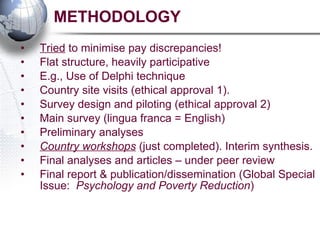
METHODOLOGY Tried  to minimise pay discrepancies! Flat structure, heavily participative E.g., Use of Delphi technique Country site visits (ethical approval 1). Survey design and piloting (ethical approval 2) Main survey (lingua franca = English) Preliminary analyses Country workshops  (just completed). Interim synthesis. Final analyses and articles – under peer review Final report & publication/dissemination (Global Special Issue:  Psychology and Poverty Reduction )
Participants Total Number of Participants  N =1290 Nationalities represented:  N  = 42 Local 77%,  Expatriate 23% Response rate = 46%(overall);  50%(local);  38%(expatriate) Pay type:  Local 76%, International 17%, [Volunteer 7%] Gender breakdown =  64% males,  36% females Age: Mean=36.5yrs, sd=9.5 yrs More than 90% of the sample tertiary-educated, from tertiary diploma (9%) and Bachelor degree (37%) through to postgraduate diploma (12%), masters degrees (26%) and doctoral or postdoctoral-qualified (9%).  Number of Organisations (nesting) = 202 Mean  n  per organization = 6.4 Breakdown by type (sector) = Aid: 60 orgs, Commercial: 75 orgs, Education: 27 orgs, Government: 40
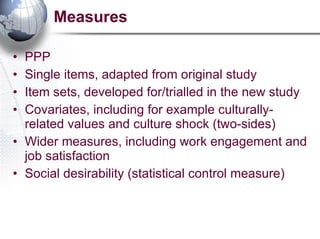
Measures PPP Single items, adapted from original study Item sets, developed for/trialled in the new study Covariates, including for example culturally-related values and culture shock (two-sides) Wider measures, including work engagement and job satisfaction Social desirability (statistical control measure)
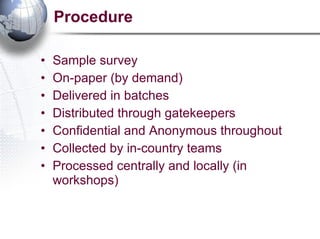
Procedure Sample survey On-paper (by demand) Delivered in batches Distributed through gatekeepers Confidential and Anonymous throughout Collected by in-country teams Processed centrally and locally (in workshops)
FINDINGS: PPP   Salary Type   International   Local ------------------------------------------------ Expatriate  107,939  (50,260)  32,680 (15,194) n=95  n=26 Worker  ------------------------------------------------ Local  90,805  26,587   n=22  n=624 ------------------------------------------------ CENTRAL PPP RATIO -  4: 1  (2: 1) ______________________________________ * We note a reduction in sample size, by about half, for reasons like contracts, reticence, etcetera * Volunteer category has been dropped due to multiple different interpretations of the term
Paris Declaration: Alignment? Both expatriates and locals indicated that their job brings them into contact with differently paid and benefited colleagues  Asked at what ratio expatriate: local salary differences become “unacceptably large,” modal threshold ( N  = 1106) = between 2 (frequency=250) and 3 (frequency=254).  Stable across expatriate and local groups For the majority of expatriates  n =216/286), their remuneration is sufficient - But for the majority of locals ( n =610/970), it is  not .  Hence : For local workers, expatriate: local pay ratios tend to exceed subjective tolerance thresholds; + their needs are reportedly unmet. - NON ALIGNMENT (2) For expatriate workers, the threshold may  not  appear to be clearly exceeded – at least if they often use home as the main comparison - BLIND SPOT?
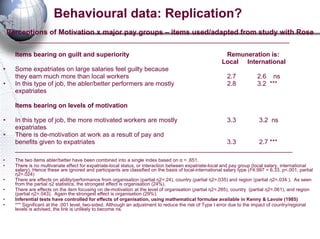
Behavioural data: Replication? Perceptions of Motivation x major pay groups – items used/adapted from study with Rose ____________________________________________________________________________ Items bearing on guilt and superiority Remuneration is:   Local  International Some expatriates on large salaries feel guilty because  they earn much more than local workers   2.7  2.6  ns  In this type of job, the abler/better performers are mostly  2.8  3.2  *** expatriates Items bearing on levels of motivation In this type of job, the more motivated workers are mostly  3.3  3.2  ns expatriates There is de-motivation at work as a result of pay and  benefits given to expatriates 3.3  2.7 *** ______________________________________________________________________________ The two items abler/better have been combined into a single index based on α = .651. There is no multivariate effect for expatriate-local status, or interaction between expatriate-local and pay group (local salary, international salary). Hence these are ignored and participants are classified on the basis of local-international salary type ( F 4,997 = 6.33,  p <.001, partial η2=.024) There are effects on ability/performance from organisation (partial η2=.24), country (partial η2=.035) and region (partial η2=.034 ).  As seen from the partial η2 statistics, the strongest effect is organisation (24%).  There are effects on the item focusing on de-motivation at the level of organisation ( p artial η2=.285), country  (partial η2=.061), and region (partial η2=.043).  Again the strongest effect is organisation (29%).  Inferential tests have controlled for effects of organisation, using mathematical formulae available in Kenny & Lavoie (1985)  *** Significant at the .001 level, two-sided. Although an adjustment to reduce the risk of Type I error due to the impact of country/regional levels is advised, the link is unlikely to become ns.
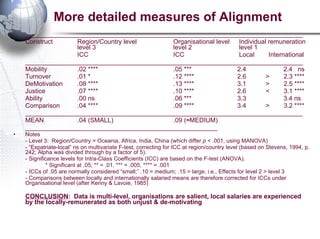
More detailed measures of Alignment ______________________________________________________________________________ Construct Region/Country level  Organisational level  Individual remuneration level 3 level 2  level 1 ICC ICC    Local  International ______________________________________________________________________________ Mobility .02 **** .05 *** 2.4   2.4  ns Turnover .01 * .12 **** 2.6  >  2.3 **** DeMotivation .08 **** .13 **** 3.1  >  2.5 **** Justice .07 **** .10 **** 2.6  <  3.1 **** Ability .00 ns .06 *** 3.3   3.4 ns Comparison .04 **** .09 **** 3.4  >  3.2 **** ______________________________________________________________________________ MEAN .04 (SMALL) .09 (≈MEDIUM) ______________________________________________________ Notes - Level 3:  Region/Country = Oceania, Africa, India, China (which differ  p  < .001, using MANOVA) - “Expatriate-local” ns on multivariate F-test, correcting for ICC at region/country level (based on Stevens, 1994, p. 242; Alpha was divided through by a factor of 5). - Significance levels for Intra-Class Coefficients (ICC) are based on the F-test (ANOVA).  * Significant at .05; ** = .01, *** = .005, **** = .001 - ICCs of .05 are normally considered “small;” .10 = medium; .15 = large, i.e., Effects for level 2 > level 3 - Comparisons between locally and internationally salaried means are therefore corrected for ICCs under Organisational level (after Kenny & Lavoie, 1985) CONCLUSION :  Data is multi-level, organisations are salient, local salaries are experienced by the locally-remunerated as both unjust & de-motivating
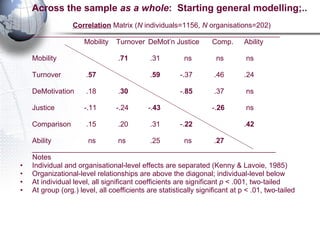
Across the sample  as a whole :  Starting general modelling;.. Correlation  Matrix ( N  individuals=1156,  N  organisations=202) _________________________________________________________________ Mobility Turnover DeMot’n Justice Comp. Ability Mobility  . 71   .31   ns   ns  ns Turnover  . 57    . 59 -.37  .46 .24 DeMotivation  .18   . 30 -. 85  .37  ns Justice -.11 -.24 -. 43 -. 26  ns Comparison  .15  .20  .31 -. 22 . 42 Ability   ns  ns  .25   ns  . 27 _____________________________________________________________ Notes Individual and organisational-level effects are separated (Kenny & Lavoie, 1985) Organizational-level relationships are above the diagonal; individual-level below At individual level, all significant coefficients are significant  p  < .001, two-tailed At group (org.) level, all coefficients are statistically significant at p < .01, two-tailed
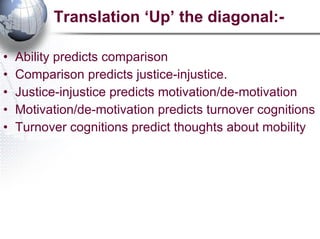
Translation ‘Up’ the diagonal:- Ability predicts comparison Comparison predicts justice-injustice.  Justice-injustice predicts motivation/de-motivation Motivation/de-motivation predicts turnover cognitions Turnover cognitions predict thoughts about mobility
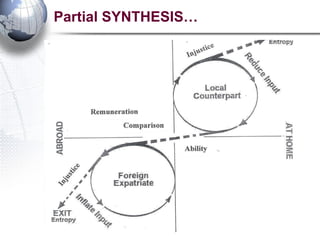
Partial SYNTHESIS…
Across Levels ? Multi-level modelling: Let slopes + intercepts vary By organisation only (level 2) Power too low for country/region (separate country studies) Controlling for individual differences in cultural values etc:-  Top predictors of De-motivation = In-Justice (and comparative Ability) Top predictors of turnover cogs = job satisfaction/work engagement (-), AND de-motivation (from remuneration) With both functions  moderated by Organization International  mobility  cogn was predicted incrementally more by de-motivation than by job satisfaction/work engagement (no level 2 effects on this criterion)
Workshop Recommendations Recommended, on basis of data, by subject-matter experts and stakeholders  Interdisciplinary, and by consensus (although few expats showed up): Close the Gap More Transparency Performance-based remuneration Including fair and equitable Benefits (JUSTICE) Localisation Need to reduce DISCRIMINATION… ‘ I/O’ CAN DO (SOME OF) THAT, AS  ADVOCACY ?...
Some Source Publications Carr, S. C., MacLachlan, M., & Chipande, R.  (1998).  Expatriate aid salaries in Malaŵi:  A doubly de-motivating influence?  International Journal of Educational Development, 18 (2), 133-143. MacLachlan, M., & Carr, S. C.  (2005). The Human dynamics of aid.  OECD Policy Insights, 10 ,  http:// www.oecd.org /dev/insights .  Acknowledgements We sincerely thank Professor Raymond Saner for his expert developmental insights, and Drs. Duncan Jackson and Richard Fletcher for statistical advice.

S Carr Project ADDUP

  • 1.
    LOCAL-EXPATRIATE DIFFERENCES INPAY: HOW JUSTIFIED ARE THEY IN A GLOBAL ECONOMY? Stuart Carr & Ishbel McWha Project ADDUP New Zealand Psychological Society Annual Conference, Palmerston North August 29 th , 2009
  • 2.
    A Thought tocarry with us… Left hand side of the room: Remember a job you have done Which entailed teamwork Imagine your colleague/peer is receiving 1/4 of your remuneration Right hand side of the room As above, except You are the lower paid party Exercise (for both sides of the room together): Can you predict your reactions ? E.g., in terms of “Contextual performance”?
  • 3.
    A Context TheUnited Nations’ Millennium Development Goals are a “grand plan” to bring poverty down . Grand goals work best when translated into context In poverty reduction, a common denominator is people working in organizations Much of which is is collaborative “capacity development” Hence poverty may be more effectively reduced by good work relations, in organisations
  • 4.
    An Issue “Critical Incident” at UNIMA Organisational Survey, with Rose Chipande (1998) Expatriates reported guilt and superiority Locals reported unfairness and de-motivation Presented these findings to DAC/OECD (2005) Collated anecdotal evidence from other countries Secured grant from UK’s ESRC/DFID, to explore more systematically across different economies Landlocked (Malaŵi, Uganda), Island Nation (PNG, Solomon Islands), and Transition (India, China) A tentative journey, difficult terrain; Exploratory …
  • 5.
    METHODOLOGY Tried to minimise pay discrepancies! Flat structure, heavily participative E.g., Use of Delphi technique Country site visits (ethical approval 1). Survey design and piloting (ethical approval 2) Main survey (lingua franca = English) Preliminary analyses Country workshops (just completed). Interim synthesis. Final analyses and articles – under peer review Final report & publication/dissemination (Global Special Issue: Psychology and Poverty Reduction )
  • 6.
    Participants Total Numberof Participants N =1290 Nationalities represented: N = 42 Local 77%, Expatriate 23% Response rate = 46%(overall); 50%(local); 38%(expatriate) Pay type: Local 76%, International 17%, [Volunteer 7%] Gender breakdown = 64% males, 36% females Age: Mean=36.5yrs, sd=9.5 yrs More than 90% of the sample tertiary-educated, from tertiary diploma (9%) and Bachelor degree (37%) through to postgraduate diploma (12%), masters degrees (26%) and doctoral or postdoctoral-qualified (9%). Number of Organisations (nesting) = 202 Mean n per organization = 6.4 Breakdown by type (sector) = Aid: 60 orgs, Commercial: 75 orgs, Education: 27 orgs, Government: 40
  • 7.
    Measures PPP Singleitems, adapted from original study Item sets, developed for/trialled in the new study Covariates, including for example culturally-related values and culture shock (two-sides) Wider measures, including work engagement and job satisfaction Social desirability (statistical control measure)
  • 8.
    Procedure Sample surveyOn-paper (by demand) Delivered in batches Distributed through gatekeepers Confidential and Anonymous throughout Collected by in-country teams Processed centrally and locally (in workshops)
  • 9.
    FINDINGS: PPP Salary Type International Local ------------------------------------------------ Expatriate 107,939 (50,260) 32,680 (15,194) n=95 n=26 Worker ------------------------------------------------ Local 90,805 26,587 n=22 n=624 ------------------------------------------------ CENTRAL PPP RATIO - 4: 1 (2: 1) ______________________________________ * We note a reduction in sample size, by about half, for reasons like contracts, reticence, etcetera * Volunteer category has been dropped due to multiple different interpretations of the term
  • 10.
    Paris Declaration: Alignment?Both expatriates and locals indicated that their job brings them into contact with differently paid and benefited colleagues Asked at what ratio expatriate: local salary differences become “unacceptably large,” modal threshold ( N = 1106) = between 2 (frequency=250) and 3 (frequency=254). Stable across expatriate and local groups For the majority of expatriates n =216/286), their remuneration is sufficient - But for the majority of locals ( n =610/970), it is not . Hence : For local workers, expatriate: local pay ratios tend to exceed subjective tolerance thresholds; + their needs are reportedly unmet. - NON ALIGNMENT (2) For expatriate workers, the threshold may not appear to be clearly exceeded – at least if they often use home as the main comparison - BLIND SPOT?
  • 11.
    Behavioural data: Replication?Perceptions of Motivation x major pay groups – items used/adapted from study with Rose ____________________________________________________________________________ Items bearing on guilt and superiority Remuneration is: Local International Some expatriates on large salaries feel guilty because they earn much more than local workers 2.7 2.6 ns In this type of job, the abler/better performers are mostly 2.8 3.2 *** expatriates Items bearing on levels of motivation In this type of job, the more motivated workers are mostly 3.3 3.2 ns expatriates There is de-motivation at work as a result of pay and benefits given to expatriates 3.3 2.7 *** ______________________________________________________________________________ The two items abler/better have been combined into a single index based on α = .651. There is no multivariate effect for expatriate-local status, or interaction between expatriate-local and pay group (local salary, international salary). Hence these are ignored and participants are classified on the basis of local-international salary type ( F 4,997 = 6.33, p <.001, partial η2=.024) There are effects on ability/performance from organisation (partial η2=.24), country (partial η2=.035) and region (partial η2=.034 ). As seen from the partial η2 statistics, the strongest effect is organisation (24%). There are effects on the item focusing on de-motivation at the level of organisation ( p artial η2=.285), country (partial η2=.061), and region (partial η2=.043). Again the strongest effect is organisation (29%). Inferential tests have controlled for effects of organisation, using mathematical formulae available in Kenny & Lavoie (1985) *** Significant at the .001 level, two-sided. Although an adjustment to reduce the risk of Type I error due to the impact of country/regional levels is advised, the link is unlikely to become ns.
  • 12.
    More detailed measuresof Alignment ______________________________________________________________________________ Construct Region/Country level Organisational level Individual remuneration level 3 level 2 level 1 ICC ICC Local International ______________________________________________________________________________ Mobility .02 **** .05 *** 2.4 2.4 ns Turnover .01 * .12 **** 2.6 > 2.3 **** DeMotivation .08 **** .13 **** 3.1 > 2.5 **** Justice .07 **** .10 **** 2.6 < 3.1 **** Ability .00 ns .06 *** 3.3 3.4 ns Comparison .04 **** .09 **** 3.4 > 3.2 **** ______________________________________________________________________________ MEAN .04 (SMALL) .09 (≈MEDIUM) ______________________________________________________ Notes - Level 3: Region/Country = Oceania, Africa, India, China (which differ p < .001, using MANOVA) - “Expatriate-local” ns on multivariate F-test, correcting for ICC at region/country level (based on Stevens, 1994, p. 242; Alpha was divided through by a factor of 5). - Significance levels for Intra-Class Coefficients (ICC) are based on the F-test (ANOVA). * Significant at .05; ** = .01, *** = .005, **** = .001 - ICCs of .05 are normally considered “small;” .10 = medium; .15 = large, i.e., Effects for level 2 > level 3 - Comparisons between locally and internationally salaried means are therefore corrected for ICCs under Organisational level (after Kenny & Lavoie, 1985) CONCLUSION : Data is multi-level, organisations are salient, local salaries are experienced by the locally-remunerated as both unjust & de-motivating
  • 13.
    Across the sample as a whole : Starting general modelling;.. Correlation Matrix ( N individuals=1156, N organisations=202) _________________________________________________________________ Mobility Turnover DeMot’n Justice Comp. Ability Mobility . 71 .31 ns ns ns Turnover . 57 . 59 -.37 .46 .24 DeMotivation .18 . 30 -. 85 .37 ns Justice -.11 -.24 -. 43 -. 26 ns Comparison .15 .20 .31 -. 22 . 42 Ability ns ns .25 ns . 27 _____________________________________________________________ Notes Individual and organisational-level effects are separated (Kenny & Lavoie, 1985) Organizational-level relationships are above the diagonal; individual-level below At individual level, all significant coefficients are significant p < .001, two-tailed At group (org.) level, all coefficients are statistically significant at p < .01, two-tailed
  • 14.
    Translation ‘Up’ thediagonal:- Ability predicts comparison Comparison predicts justice-injustice. Justice-injustice predicts motivation/de-motivation Motivation/de-motivation predicts turnover cognitions Turnover cognitions predict thoughts about mobility
  • 15.
  • 16.
    Across Levels ?Multi-level modelling: Let slopes + intercepts vary By organisation only (level 2) Power too low for country/region (separate country studies) Controlling for individual differences in cultural values etc:- Top predictors of De-motivation = In-Justice (and comparative Ability) Top predictors of turnover cogs = job satisfaction/work engagement (-), AND de-motivation (from remuneration) With both functions moderated by Organization International mobility cogn was predicted incrementally more by de-motivation than by job satisfaction/work engagement (no level 2 effects on this criterion)
  • 17.
    Workshop Recommendations Recommended,on basis of data, by subject-matter experts and stakeholders Interdisciplinary, and by consensus (although few expats showed up): Close the Gap More Transparency Performance-based remuneration Including fair and equitable Benefits (JUSTICE) Localisation Need to reduce DISCRIMINATION… ‘ I/O’ CAN DO (SOME OF) THAT, AS ADVOCACY ?...
  • 18.
    Some Source PublicationsCarr, S. C., MacLachlan, M., & Chipande, R. (1998). Expatriate aid salaries in Malaŵi: A doubly de-motivating influence? International Journal of Educational Development, 18 (2), 133-143. MacLachlan, M., & Carr, S. C. (2005). The Human dynamics of aid. OECD Policy Insights, 10 , http:// www.oecd.org /dev/insights . Acknowledgements We sincerely thank Professor Raymond Saner for his expert developmental insights, and Drs. Duncan Jackson and Richard Fletcher for statistical advice.