R A N w o r k s h o p o n 5 G , S e p . 2 0 1 5
© 3GPP 2012
© 3GPP 2015 1
RAN workshop on 5G:
Chairman Summary
Dino Flore
Chairman of 3GPP RAN
R A N w o r k s h o p o n 5 G , S e p . 2 0 1 5
© 3GPP 2012
© 3GPP 2015 2
Outline
Introduction
Usecases & services
New radio
Phasing and its implications
Next steps
R A N w o r k s h o p o n 5 G , S e p . 2 0 1 5
© 3GPP 2012
© 3GPP 2015 3
Introduction
This document is my synthesis of the workshop
contributions and discussion, to help companies
achieve convergence in follow-up discussions
The document tries to highlight the emerging
consensus on the RAN project planning on “5G” as
well as the issues where more discussion is needed
R A N w o r k s h o p o n 5 G , S e p . 2 0 1 5
© 3GPP 2012
© 3GPP 2015 4
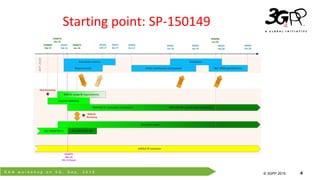
Starting point: SP-150149
R A N w o r k s h o p o n 5 G , S e p . 2 0 1 5
© 3GPP 2012
© 3GPP 2015 5
Usecases & Services
Three emerging high level usecases for Next Generation Radio Technology
(also from IMT 2020 discussion):
1. Enhanced Mobile Broadband
2. Massive Machine Type Communications
3. Ultra-reliable and Low Latency Communications
Wide agreement that the Next Generation Radio Technology should be able
to support a variety of new services
• Automotive, Health, Energy, Manufacturing …
• Some of these new services are being described by SA1 in the SMARTER project
R A N w o r k s h o p o n 5 G , S e p . 2 0 1 5
© 3GPP 2012
© 3GPP 2015 6
New radio
Emerging consensus that there will be a new, non-backward
compatible, radio as part of Next Generation Radio Technology
• Strong LTE evolution continued in parallel
The requirements and scope of the new radio will be
established by RAN in the SI starting in December
• WGs will then proceed with the evaluation of technology solutions in
the SI starting in March
R A N w o r k s h o p o n 5 G , S e p . 2 0 1 5
© 3GPP 2012
© 3GPP 2015 7
Phasing
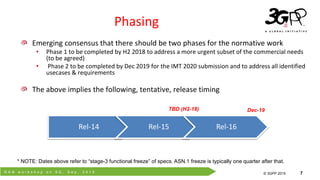
Emerging consensus that there should be two phases for the normative work
• Phase 1 to be completed by H2 2018 to address a more urgent subset of the commercial needs
(to be agreed)
• Phase 2 to be completed by Dec 2019 for the IMT 2020 submission and to address all identified
usecases & requirements
The above implies the following, tentative, release timing
Rel-14 Rel-15 Rel-16
TBD (H2-18) Dec-19
* NOTE: Dates above refer to “stage-3 functional freeze” of specs. ASN.1 freeze is typically one quarter after that.
R A N w o r k s h o p o n 5 G , S e p . 2 0 1 5
© 3GPP 2012
© 3GPP 2015 8
It seems widely agreed that, while the normative work can be phased to initially
specify support for only a subset of the identified usecases & requirements, the
design of the new radio should be forward compatible so it can optimally support
the remaining usecases & requirements that will be added in a later phase
So forward compatibility should be a design requirement for the new radio from the
get-go
• Study item should include careful investigation of design options to ensure forward
compatibility for all use cases
• Phase 1 work item should include specification support to ensure the forward
compatibility to enable later deployment of the additional services
The exact forward compatibility requirement needs to be defined and captured in
the technology SID for approval in March
Phasing: forward compatibility
R A N w o r k s h o p o n 5 G , S e p . 2 0 1 5
© 3GPP 2012
© 3GPP 2015 9
Phasing: prioritization
Phasing of the normative work will lead to some form of
prioritization for phase I
However at this stage there is lack of consensus on
• Whether prioritization should already occur in the study phase
• Whether there should be prioritization of frequency ranges
• Which usecases should be prioritized
Ideally the above should be resolved by March 2016 when we
are likely to approve the WGs study
R A N w o r k s h o p o n 5 G , S e p . 2 0 1 5
© 3GPP 2012
© 3GPP 2015 10
Channel modeling for high frequencies
RAN#69 just approved new Study Idem on channel
modeling for spectrum above 6 GHz (RP-151606)
• In Q4 2015 RAN will identify status & expectations on high
frequencies (e.g. spectrum allocation, scenarios of interest,
measurements, etc)
• From Q1 2016 RAN1 will develop a channel model(s) for
frequencies up to 100 GHz
R A N w o r k s h o p o n 5 G , S e p . 2 0 1 5
© 3GPP 2012
© 3GPP 2015 11
Interworking & System Architecture
There seems to be a need to also rethink the System
Architecture for “5G”
• This will be debated under the new SI to be approved by SA
The level of interworking of the new radio with the legacy
systems needs to be discussed more in detail – different
opinion & nuances seems to exist
• This discussion will be done in cooperation with SA group (for this
it may be also useful the joint workshop tentatively planned for
H2-16)
R A N w o r k s h o p o n 5 G , S e p . 2 0 1 5
© 3GPP 2012
© 3GPP 2015 12
Next steps
RAN to identify status & expectations on high frequencies in Q4-15
so that the channel modeling work can start in RAN1 in Q1-16
RAN to approve in December a Study Item to develop scenarios and
requirements for next generation radio technology
RAN to approve in March a Study Item for RAN WGs to evaluate
technology solutions for next generation radio technology
Companies should look for convergence on the outstanding high
level items where there is lack of consensus (see slide 9)

Rws 150073 chairman summary

  • 1.
    R A Nw o r k s h o p o n 5 G , S e p . 2 0 1 5 © 3GPP 2012 © 3GPP 2015 1 RAN workshop on 5G: Chairman Summary Dino Flore Chairman of 3GPP RAN
  • 2.
    R A Nw o r k s h o p o n 5 G , S e p . 2 0 1 5 © 3GPP 2012 © 3GPP 2015 2 Outline Introduction Usecases & services New radio Phasing and its implications Next steps
  • 3.
    R A Nw o r k s h o p o n 5 G , S e p . 2 0 1 5 © 3GPP 2012 © 3GPP 2015 3 Introduction This document is my synthesis of the workshop contributions and discussion, to help companies achieve convergence in follow-up discussions The document tries to highlight the emerging consensus on the RAN project planning on “5G” as well as the issues where more discussion is needed
  • 4.
    R A Nw o r k s h o p o n 5 G , S e p . 2 0 1 5 © 3GPP 2012 © 3GPP 2015 4 Starting point: SP-150149
  • 5.
    R A Nw o r k s h o p o n 5 G , S e p . 2 0 1 5 © 3GPP 2012 © 3GPP 2015 5 Usecases & Services Three emerging high level usecases for Next Generation Radio Technology (also from IMT 2020 discussion): 1. Enhanced Mobile Broadband 2. Massive Machine Type Communications 3. Ultra-reliable and Low Latency Communications Wide agreement that the Next Generation Radio Technology should be able to support a variety of new services • Automotive, Health, Energy, Manufacturing … • Some of these new services are being described by SA1 in the SMARTER project
  • 6.
    R A Nw o r k s h o p o n 5 G , S e p . 2 0 1 5 © 3GPP 2012 © 3GPP 2015 6 New radio Emerging consensus that there will be a new, non-backward compatible, radio as part of Next Generation Radio Technology • Strong LTE evolution continued in parallel The requirements and scope of the new radio will be established by RAN in the SI starting in December • WGs will then proceed with the evaluation of technology solutions in the SI starting in March
  • 7.
    R A Nw o r k s h o p o n 5 G , S e p . 2 0 1 5 © 3GPP 2012 © 3GPP 2015 7 Phasing Emerging consensus that there should be two phases for the normative work • Phase 1 to be completed by H2 2018 to address a more urgent subset of the commercial needs (to be agreed) • Phase 2 to be completed by Dec 2019 for the IMT 2020 submission and to address all identified usecases & requirements The above implies the following, tentative, release timing Rel-14 Rel-15 Rel-16 TBD (H2-18) Dec-19 * NOTE: Dates above refer to “stage-3 functional freeze” of specs. ASN.1 freeze is typically one quarter after that.
  • 8.
    R A Nw o r k s h o p o n 5 G , S e p . 2 0 1 5 © 3GPP 2012 © 3GPP 2015 8 It seems widely agreed that, while the normative work can be phased to initially specify support for only a subset of the identified usecases & requirements, the design of the new radio should be forward compatible so it can optimally support the remaining usecases & requirements that will be added in a later phase So forward compatibility should be a design requirement for the new radio from the get-go • Study item should include careful investigation of design options to ensure forward compatibility for all use cases • Phase 1 work item should include specification support to ensure the forward compatibility to enable later deployment of the additional services The exact forward compatibility requirement needs to be defined and captured in the technology SID for approval in March Phasing: forward compatibility
  • 9.
    R A Nw o r k s h o p o n 5 G , S e p . 2 0 1 5 © 3GPP 2012 © 3GPP 2015 9 Phasing: prioritization Phasing of the normative work will lead to some form of prioritization for phase I However at this stage there is lack of consensus on • Whether prioritization should already occur in the study phase • Whether there should be prioritization of frequency ranges • Which usecases should be prioritized Ideally the above should be resolved by March 2016 when we are likely to approve the WGs study
  • 10.
    R A Nw o r k s h o p o n 5 G , S e p . 2 0 1 5 © 3GPP 2012 © 3GPP 2015 10 Channel modeling for high frequencies RAN#69 just approved new Study Idem on channel modeling for spectrum above 6 GHz (RP-151606) • In Q4 2015 RAN will identify status & expectations on high frequencies (e.g. spectrum allocation, scenarios of interest, measurements, etc) • From Q1 2016 RAN1 will develop a channel model(s) for frequencies up to 100 GHz
  • 11.
    R A Nw o r k s h o p o n 5 G , S e p . 2 0 1 5 © 3GPP 2012 © 3GPP 2015 11 Interworking & System Architecture There seems to be a need to also rethink the System Architecture for “5G” • This will be debated under the new SI to be approved by SA The level of interworking of the new radio with the legacy systems needs to be discussed more in detail – different opinion & nuances seems to exist • This discussion will be done in cooperation with SA group (for this it may be also useful the joint workshop tentatively planned for H2-16)
  • 12.
    R A Nw o r k s h o p o n 5 G , S e p . 2 0 1 5 © 3GPP 2012 © 3GPP 2015 12 Next steps RAN to identify status & expectations on high frequencies in Q4-15 so that the channel modeling work can start in RAN1 in Q1-16 RAN to approve in December a Study Item to develop scenarios and requirements for next generation radio technology RAN to approve in March a Study Item for RAN WGs to evaluate technology solutions for next generation radio technology Companies should look for convergence on the outstanding high level items where there is lack of consensus (see slide 9)