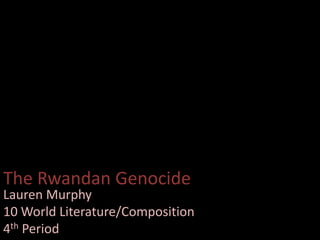
The Rwandan Genocide
Lauren Murphy
10 World Literature/Composition
4th Period
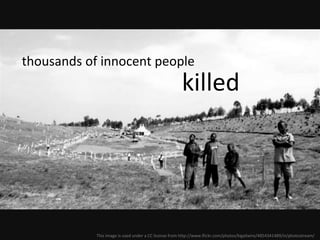
This image is used under a CC license from http://www.flickr.com/photos/kigaliwire/4854341489/in/photostream/
thousands of innocent people
killed
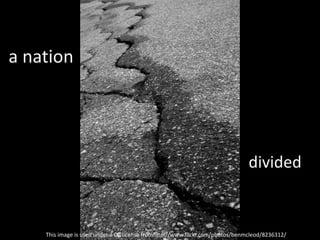
This image is used under a CC license fromhttp://www.flickr.com/photos/benmcleod/8236312/
a nation
divided
This image is used under a CC license from http://www.flickr.com/photos/kigaliwire/4854341489/in/photostream/
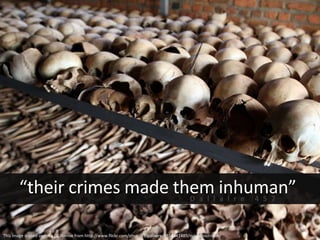
“their crimes made them inhuman”D a l l a i r e 4 5 7
This image is used under a CC license from http://www.flickr.com/photos/kigaliwire/4854341489/in/photostream/
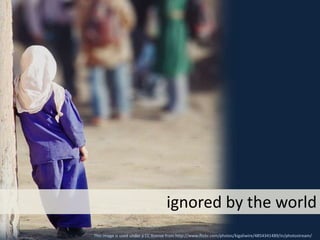
ignored by the world
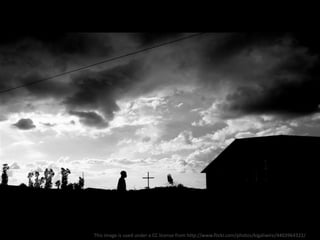
This image is used under a CC license from http://www.flickr.com/photos/kigaliwire/4403964322/
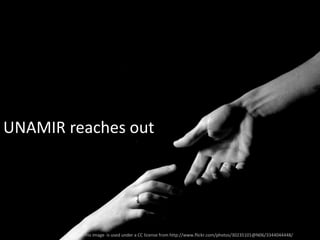
UNAMIR reaches out
This image is used under a CC license from http://www.flickr.com/photos/30235101@N06/3344044448/
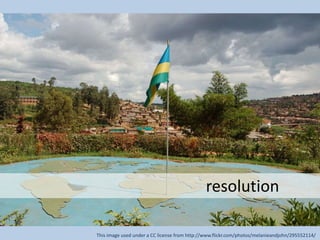
resolution
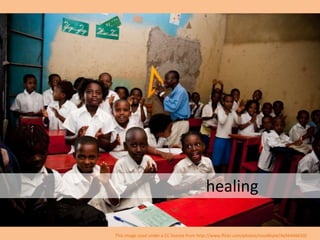
This image used under a CC license from http://www.flickr.com/photos/melanieandjohn/295552114/
healing
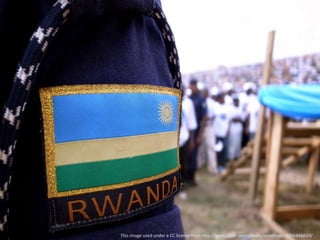
This image used under a CC license from http://www.flickr.com/photos/noodlepie/4a56446610/
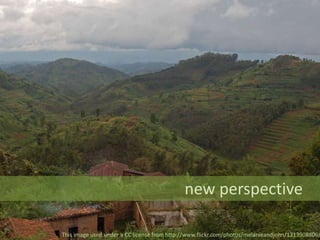
new perspective
This image used under a CC license from http://www.flickr.com/photos/melanieandjohn/1313908806/
This image used under a CC license from http://www.flickr.com/photos/noodlepie/4856446610/
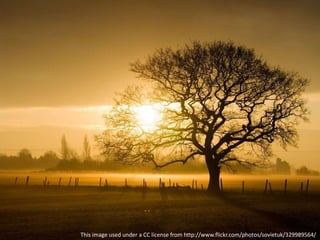
This image used under a CC license from http://www.flickr.com/photos/sovietuk/329989564/
Wo rks C ited
Dallaire, Romeo. Shake Hands with the Devil. N.p.: New York,
2003. Print. This novel is written from the point of view of Lt. Gen.
Romeo Dallaire, who led UNAMIR during the genocide.
I checked the accuracy of many facts Dallaire claimed
in his book by using a Google search. All of the claims I
checked did match what I found in my research. This
source really helped my understanding of the issue
because the author describes what he personally
experienced during the genocide. This is useful
because I now know how serious the genocide was on
a personal level. I got a very different perspective from
his experience compared to reading about the genocide
in an encyclopedia article.
“Hutus ‘killed Rwanda President Juvenal Habyarimana.’” BBC
News. BBC, 12 Jan. 2010. Web. 25 Oct. 2010.
<http://news.bbc.co.uk/2/hi/8453832.stm>. This article
details the assassination of Rwandan President Juvenal
Habyarimana. I used a Google Search to verify several
of the facts in the article such as the exact dates of the
assassination. I also tried to find the author of the
article, which I could not do. This article has helped me
understand what triggered the genocide and the tension
related to it. I can use this information to figure out how
the genocide was connected to political problems.
This image used under a CC License from http://www.flickr.com/photos/sara_joachim/2043986656/
“Nyarubuye Memorial.” Nyarubuye Genocide Memorial Site. N.p., n.d. Web. 25 Oct. 2010.
<www.cnlg.gov.rw/sites/nyarubuye/pages/text_nyarubuye-1.htm>. This website has information about
a specific massacre of the Rwandan Genocide, the Nyarubuye Church Massacre.
I found several Gale Reference Articles that referenced the Nyarubuye massacre. Every detail that the
website mentioned was correct according to the Gale articles.
This website helped me understand a specific event of the genocide. It was useful to me to get a
feeling of daily life during the killings.
“Rwanda: How the Genocide Happened.” BBC News. BBC, 18 Dec. 2008. Web. 25 Oct. 2010.
<http://news.bbc.co.uk/2/hi/africa/1288230.stm>. This news article discussed the causes of the
genocide. It went into depth about the trigger: the assassination of President Habyarimana.
A simple Google search helped me verify the accuracy of this article. It was written by a journalist from
a reputable organization: the BBC.
This article helped my understanding of the genocide because it gave me details about the tensions
between the two groups who were responsible for the it. It informed me about the very beginnings of
the genocide and the catalyst for the killings.
Works Cited
This image used under a CC License from http://www.flickr.com/photos/david-lloyd/3497939104/

Rwandan genocide presentation lauren

  • 1.
    The Rwandan Genocide LaurenMurphy 10 World Literature/Composition 4th Period
  • 2.
    This image isused under a CC license from http://www.flickr.com/photos/kigaliwire/4854341489/in/photostream/ thousands of innocent people killed
  • 3.
    This image isused under a CC license fromhttp://www.flickr.com/photos/benmcleod/8236312/ a nation divided
  • 4.
    This image isused under a CC license from http://www.flickr.com/photos/kigaliwire/4854341489/in/photostream/ “their crimes made them inhuman”D a l l a i r e 4 5 7
  • 5.
    This image isused under a CC license from http://www.flickr.com/photos/kigaliwire/4854341489/in/photostream/ ignored by the world
  • 6.
    This image isused under a CC license from http://www.flickr.com/photos/kigaliwire/4403964322/
  • 7.
    UNAMIR reaches out Thisimage is used under a CC license from http://www.flickr.com/photos/30235101@N06/3344044448/
  • 8.
    resolution This image usedunder a CC license from http://www.flickr.com/photos/melanieandjohn/295552114/
  • 9.
    healing This image usedunder a CC license from http://www.flickr.com/photos/noodlepie/4a56446610/
  • 10.
    new perspective This imageused under a CC license from http://www.flickr.com/photos/melanieandjohn/1313908806/
  • 11.
    This image usedunder a CC license from http://www.flickr.com/photos/noodlepie/4856446610/
  • 12.
    This image usedunder a CC license from http://www.flickr.com/photos/sovietuk/329989564/
  • 13.
    Wo rks Cited Dallaire, Romeo. Shake Hands with the Devil. N.p.: New York, 2003. Print. This novel is written from the point of view of Lt. Gen. Romeo Dallaire, who led UNAMIR during the genocide. I checked the accuracy of many facts Dallaire claimed in his book by using a Google search. All of the claims I checked did match what I found in my research. This source really helped my understanding of the issue because the author describes what he personally experienced during the genocide. This is useful because I now know how serious the genocide was on a personal level. I got a very different perspective from his experience compared to reading about the genocide in an encyclopedia article. “Hutus ‘killed Rwanda President Juvenal Habyarimana.’” BBC News. BBC, 12 Jan. 2010. Web. 25 Oct. 2010. <http://news.bbc.co.uk/2/hi/8453832.stm>. This article details the assassination of Rwandan President Juvenal Habyarimana. I used a Google Search to verify several of the facts in the article such as the exact dates of the assassination. I also tried to find the author of the article, which I could not do. This article has helped me understand what triggered the genocide and the tension related to it. I can use this information to figure out how the genocide was connected to political problems. This image used under a CC License from http://www.flickr.com/photos/sara_joachim/2043986656/
  • 14.
    “Nyarubuye Memorial.” NyarubuyeGenocide Memorial Site. N.p., n.d. Web. 25 Oct. 2010. <www.cnlg.gov.rw/sites/nyarubuye/pages/text_nyarubuye-1.htm>. This website has information about a specific massacre of the Rwandan Genocide, the Nyarubuye Church Massacre. I found several Gale Reference Articles that referenced the Nyarubuye massacre. Every detail that the website mentioned was correct according to the Gale articles. This website helped me understand a specific event of the genocide. It was useful to me to get a feeling of daily life during the killings. “Rwanda: How the Genocide Happened.” BBC News. BBC, 18 Dec. 2008. Web. 25 Oct. 2010. <http://news.bbc.co.uk/2/hi/africa/1288230.stm>. This news article discussed the causes of the genocide. It went into depth about the trigger: the assassination of President Habyarimana. A simple Google search helped me verify the accuracy of this article. It was written by a journalist from a reputable organization: the BBC. This article helped my understanding of the genocide because it gave me details about the tensions between the two groups who were responsible for the it. It informed me about the very beginnings of the genocide and the catalyst for the killings. Works Cited This image used under a CC License from http://www.flickr.com/photos/david-lloyd/3497939104/