Running head: EMPLOYEE COMPENSATION AND BENEFITS
EMPLOYEE COMPENSATION AND BENEFITS 5
HRM 530 Assignment 5: Employee Compensation and Benefits
Section 1: Narrative
(Student’s Name)
(Professor’s Name)
(Course Title)
(Date of Submission)
Introduction
Employee compensation and benefits refers to the
combination of wages, salaries and benefits that a worker
receives as exchange for work done either in accordance to the
formulated duties or in excesses of overtime and other viable
bonuses. Compensation can be calculable hourly wages plus
bonuses and incentives while benefits may include healthcare
insurance policies and retirement savings. Thus, the total
employee compensation and benefits may refer to collective
gain components that a worker is paid for the services that
he/she offers to an organization (Cardinal & Florin, 2012).
In this paper, the discussion will based according with a
medium-based enterprise employee compensation and benefits
package for a position of a secretary. A medium-based
organization need to provide an elaborate employee
compensation and benefits package to attract and retain
employees such as secretaries. The competitive compensation
and benefits package that befit a secretary position in a
medium-based organization that anticipate future growth
include annual salaries, retirement savings, salary increments,
bonuses, paid time-off from work plans, employee non-
monetary assistance plans, and group health benefits.
Compensation and Benefits Package for a new Secretary
Position
Compensation and benefits package for a new secretary
position in a medium-based organization need to be developed
in accordance to the stipulated labor laws as well as to the
benefits of an organization. In the first place, employing a
secretary is very essential for an aspiring medium-based
company and retaining the acquired professional skills should
be a priority in addition to motivating the employee into
improving performance. Furthermore, competition across the
different industry players is leading to increased job turnover
rates and therefore, developing a compensation and benefits
package plan for new secretaries will include the most attractive
offers.
The employee compensation and benefits plan for a new
secretary should include annual salaries, retirement savings,
salary increments and bonuses, payment plans for time-off from
work duties, employee non-monetary assistance plans, and
group health benefits. According to employment standards,
annual salaried employments accosted with other various
benefits are more preferred than hourly-based form of
employment due to job-based security and rights to various
benefits for the employee. In addition, annual salaried
employment opportunities provide an organization with several
advantages such as productivity, employee retention, improved
skill acquisition, and tax benefits.
Thus, a secretary’s compensation plan that will be developed
will be based on annual salary and should also be defined in
accordance with the Bureau of Labor Statistics’ formulas in
order to comply with the indicated minimum annual salary
which range between $35,000 and $41,000. Thus, it is
appropriate to consider a $36,550 a baseline annual salary for a
new secretary employee and frequent increments that should
depend on personal skill acquisition degrees as well as on
individual performance level. Secondly, on the annual salary
agenda for a new secretary, aspects such as progressive salary
increments, bonuses, incentives, rewards for recognizable jobs,
and payment plans for time-off from work duties should be
widely be enacted in order to improve motivation levels as well
as to provide job and skill retention mechanisms (Lassila &
Kilpatrick, 2016).
Finally, benefits should be included in annual-based salary
employment scheme. They include employee non-monetary
assistance plans, retirement benefits, and group health benefits.
Employee non-monetary assistance plans include attributes such
as personal skill development approaches while retirement
benefits plans are strategies that are established by an
organization to ensure that an organization caters for the
welfares of retired employees. On the other hand, group health
benefits constitutes to the medical care advantages that
employee will be provided by an organization in the event of
suffering from chronic diseases during work periods.
All these compensation and benefits approaches are very
essential to a new secretary and the entire organization. The
advantages of documenting a compensation and benefits plan on
the outlined system from an employer’s perspective include
provision of increased access and flexibility in employee
benefits, management of high-risk coverage at low costs hence,
lowering the entities financial burden, improving productivity
through highly highlighted benefits, and high retention rates for
skills as well as enhancing reduced tax deductibles as premiums
are accounted as corporation expenses. On the other hand,
attractive annual salaried employment compensation and other
benefits lead to increased productivity and satisfaction from an
employee perspective (Lassila & Kilpatrick, 2016).
Conclusion
In conclusion, competitive compensation and benefits package
that befit a secretary position in a medium-based organization
that anticipates future growth include annual salaries,
retirement savings, salary increments, bonuses, paid time-off
from work plans, employee non-monetary assistance plans, and
group health benefits. According to employment settings,
annual salaried employments accosted with other various
benefits are more preferred than hourly-based form of
employment due to job-based security and rights to various
benefits for the employee.
References
Lassila, D. R., & Kilpatrick, B. G. (2016). Employee
compensation and benefits tax guide, 2016.
Bloom, D. E., & Trahan, J. T. (2016). Flexible Benefits and
Employee Choice: Highlights of the Literature. Saint Louis:
Elsevier Science.
Dalton, J. F., Dalton, M. A., & Cangelosi, R. R.
(2016). Retirement planning and employee benefits.
Wilson, J. W., Pensions Management Institute,, & JLT (Firm).
(2014). Employee compensation and benefits.
Cardinal, K., & Florin, B. (2012). Handbook for Conducting
Compensation and Benefits Surveys. Scottsdale: WorldatWork
Press.
HRM 530 Assignment 5: Employee Compensation and Benefits
(Student’s Name)
(Professor’s Name)
(Course Title)
(Date of Submission)
-Welcome-
1
Introduction
Employee compensation and benefits structure.
It includes wages and annual or hourly salaries.
Attempts to distinguish exempts and non-exempts.
Other compensation structure include benefits such as bonuses,
incentives, retirement benefits, and insurance policies.
Well-structured compensation scheme key to improving
performance and job retention.
Employee compensation and benefits refers to the combination
of wages, salaries and benefits that a worker receives as
exchange for work done either in accordance to the formulated
duties or in excesses of overtime and other viable bonuses.
Compensation can be calculable hourly wages plus bonuses and
incentives while benefits may include healthcare insurance
policies and retirement savings.
2
Agenda
Develop a comprehensive and an elaborate compensation
scheme.
Enhance HR organization and structuring.
Illustrate key benefits.
Outline overall benefits of the concept to an enterprise.
Eliminate employer-employee conflict of interest.
The agenda of developing a comprehensive and well-structured
compensation and benefits scheme helps in enhancing human
resource organization and structuring in an enterprise. The
reason behind re-evaluating and creating a new compensation
scheme are to update the traditional concept with the emerging
approaches so as to remain competitive.
3
Employee compensation and benefit structure
4
Medium-enterprise employee’s compensation factors to consider
Attractive compensation and benefits.
Job retention.
Performance.
Duties and skill requirements.
Personal ability development opportunities.
Exempts and non-exempt regulations.

Fair labor compensation compliance.
A medium-based organization need to provide an elaborate
employee compensation and benefits package to attract and
retain employees such as secretaries. The competitive
compensation and benefits package that befit a secretary
position in a medium-based organization that anticipate future
growth include annual salaries, retirement savings, salary
increments, bonuses, paid time-off from work plans, employee
non-monetary assistance plans, and group health benefits.
5
Exempt factors
Are salaried compensation schemes.
Refers to annually-based compensation plan.
Considers educational background, professional duties,
experience, and qualifications.
Does not protect against overtime pay.
Exempted are salaried employees who are not entitled to
overtime pay. The term ‘exempts’ generally refers to the annual
salary that an employee receives or an approach of employee
compensation that does not require overtime pay. Exempts
regulations under the Fair Labor Standards Act requires an
employee compensation plan to based on a salary scale and the
aspects considered include educational levels, professional
experience level, exempts duties, expertize credentials,
qualifications, and job competency.
6
Non-exempt factors
Non-exempt employees are not paid on annual salaried payment
scheme.
Non-exempt covers only hourly-based payment workers.
Earn less than $455 per week.
Does not cover for holidays and rest days.
Working on the non-exempted duties.
Non-exempt employees are covered by the protections of the
FLSA and employee who fall under this category are eligible to
overtime pay due to the fact that they are paid on a hourly basis.
In addition to hourly-based payment scheme, they are also fall
under the non-exempt category because they earn less than $455
per week and perform non-exempted duties. Employees covered
by the Act must be compensated for hours worked over 40 in a
workweek at a rate not less than time and one-half their fixed
rates of pay. There is no limitation of the number of hours
employees aged 16 and older may work in any workweek.
7
Factors determining a secretary compensation plan
Attractive compensation and benefits.
Job retention.
Performance.
Exempts factors;
Typically, professional and administrative position
Not entitled to overtime
Meet both salary test and duties test
A medium-based enterprise should consider several factors that
may be influential into developing an appropriate compensation
and benefits package. They include attractive compensation and
benefits, job retention and performance. In addition, other
factors that should also be consider result due to the non-
exempt and exempt regulations.
8
Total compensation plan for a secretary
Compensation inform of salary.
Rewards inform of bonuses, awards, promotions, equity
offering, salary increment, new job assignment, and
recognitions.
Benefits in terms of healthcare insurance, retirement benefits,
paid leave periods, and paid training programs.
The total compensation plan for a secretary should include the
salary, rewards, and benefits that the organization deem as
baseline as well as those which can enhance job retention,
support to gain a competitive advantage, improve performance,
and create confidence among all stakeholders.
9
Salary and reward scales
Annual salary which range between $35,000 and $41,000 for
starters.
12 percent increment after every 2 years.
Monetary-based awards.
Performance-based promotions.
The average annual salary of a secretary should range between
$35,000 and $41,000, and should be backed-up with a 12
percent increment after every two years of service. Other reward
should include performance-based promotions and recognitions.
10
Secretary’s benefit structureBenefits offered
rankpriorityHealthcare insurance 1highLife
insurance2mediumRetirement benefits3highPaid leave4highPre-
tax deductions5optionalPaid training6highPaid sick
leave7medium
The compensation and benefits package should also establish a
benefits prioritization scale in order to outline the most
prioritized aspects of the benefits program.
11
Other important benefits
Supplement life insurance.
Auto-homeowners insurance.
Mortgage services and discounts.
Tuition disbursements.
On-site day-care services.
In addition, it is appropriate to outline other non-mandatory
benefits within the next few months to enhance employee
performance and provide job motivation. They include
supplement life insurance, auto-homeowners insurance,
mortgage services and discounts, tuition disbursements, and on-
site day-care services.
12
Impacts of government regulations
Baseline employment standards.
They influence employers costs on employee compensation.
Determines minimum wages and required baseline benefits.
Determines exempts and non-exempts factors.
Establishes supplemental pay.
Government regulations on employment compensation provide
baseline employment standards and also influence employers
costs on employee compensation as well as determines
minimum wages and the required baseline benefits.
In addition, government regulations such as the fair labor
standards law determines exempts and non-exempts factors
which are critical in classifying employees and determining
their payment basis. They establishes basis for supplemental
pay.
13
Governmental laws affecting compensation and benefits
Fair Labor Standards Act (FLSA)
Employee Income Retirement Security Act (ERISA)
Age Discrimination and Employment Act (ADEA)
Family Medical Leave Act (FMLA)
Economic Growth and Tax Relief Reconciliation Act
(EGTRRA) of 2001
Health Insurance Portability and Accountability Act (HIPAA)
(including amendments)
Pension Protection Act of 2006
Average compensation for a non-profit organizationJob
descriptionAverage annual salaryAdministrative
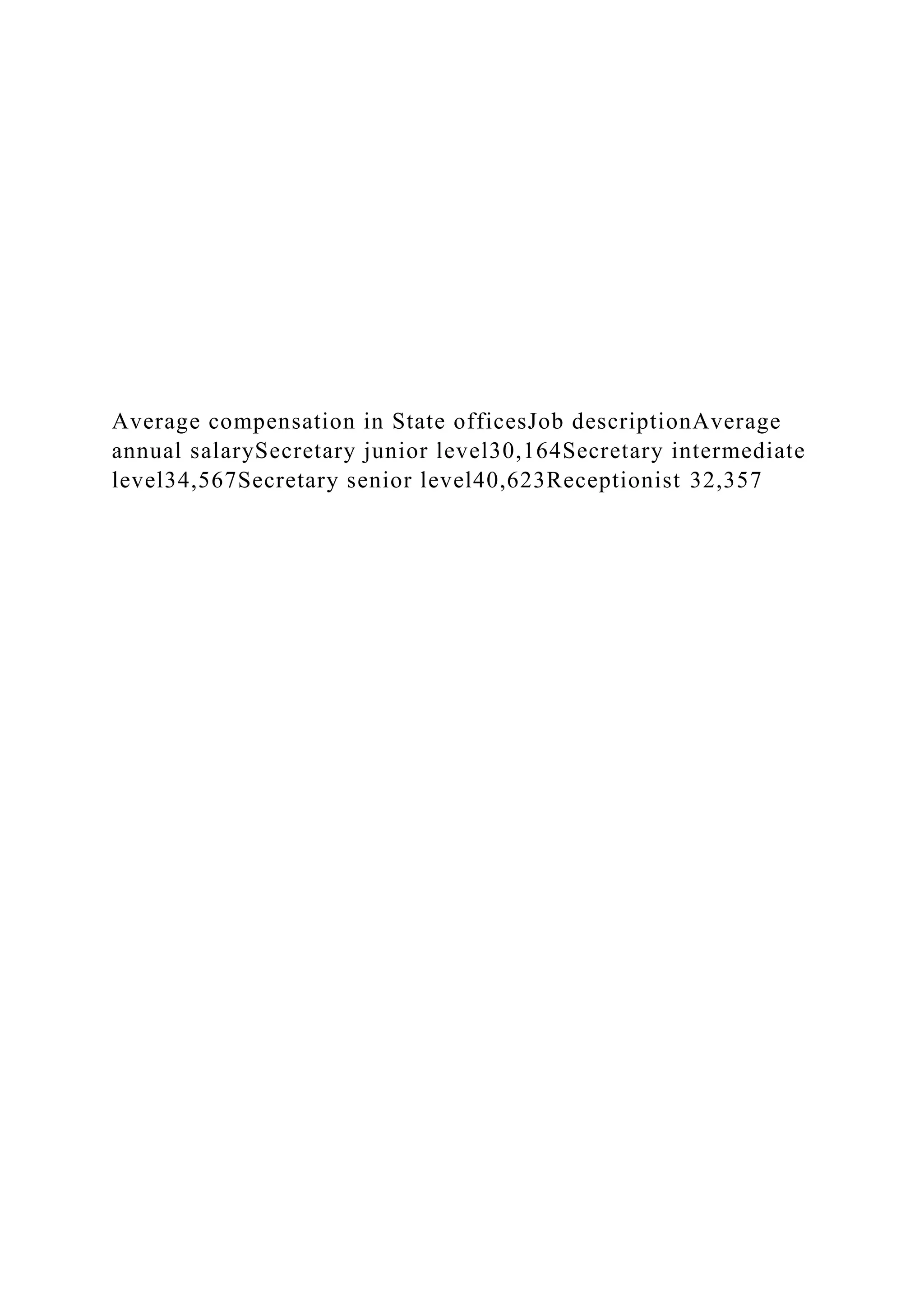
assistant32,632Receptionist31,067Office
manager36,875Secretary34,364Mail manager30,799
Average compensation in State officesJob descriptionAverage
annual salarySecretary junior level30,164Secretary intermediate
level34,567Secretary senior level40,623Receptionist 32,357
16
Comparison and recommendations
The Bureau of Labor Statistics survey indicate almost identical
pay ranges.
The management should update compensation in order to align
it with other sectors.
It will enhance the competitive advantage concept in the
organization.
According to the Bureau of Labor Statistics, most organizations
base their payment level for each job category in accordance to
the provisions of employment laws thus, most identical job
categories are likely to have an almost similar compensation
level.
17
Competitive compensation impact on HRM
Job retention.
Maintaining skills and professionalism.
Eliminating employer/employee conflict.
Sustaining HR organization and improved structures.
Management of high-risk coverages.
Competitive compensation and benefits packages for a new
secretary aspects such as progressive salary increments,
bonuses, incentives, rewards for recognizable jobs, and payment
plans for time-off from work duties can improve motivation
levels as well as to provide job and skill retention mechanisms.
18
Conclusion
Well-structured compensation scheme key to improving
performance and job retention.
It will enhance the competitive advantage concept in the
organization.
Also eliminates employer/employee conflict.
Support to sustain HR organization and improved structures.
In conclusion, a medium-based organization need to provide an
elaborate employee compensation and benefits package to
attract and retain employees such as secretaries.
19
References
Bloom, D. E., & Trahan, J. T. (2016). Flexible Benefits and
Employee Choice: Highlights of the Literature. Saint Louis:
Elsevier Science.
Dalton, J. F., Dalton, M. A., & Cangelosi, R. R. (2016).
Retirement planning and employee benefits.
Wilson, J. W., Pensions Management Institute,, & JLT (Firm).
(2014). Employee compensation and benefits.
The End.
20

Running head EMPLOYEE COMPENSATION AND BENEFITSEMPLOYEE COMPENS.docx

  • 1.
    Running head: EMPLOYEECOMPENSATION AND BENEFITS EMPLOYEE COMPENSATION AND BENEFITS 5 HRM 530 Assignment 5: Employee Compensation and Benefits Section 1: Narrative (Student’s Name) (Professor’s Name) (Course Title) (Date of Submission) Introduction Employee compensation and benefits refers to the combination of wages, salaries and benefits that a worker receives as exchange for work done either in accordance to the formulated duties or in excesses of overtime and other viable bonuses. Compensation can be calculable hourly wages plus bonuses and incentives while benefits may include healthcare insurance policies and retirement savings. Thus, the total
  • 2.
    employee compensation andbenefits may refer to collective gain components that a worker is paid for the services that he/she offers to an organization (Cardinal & Florin, 2012). In this paper, the discussion will based according with a medium-based enterprise employee compensation and benefits package for a position of a secretary. A medium-based organization need to provide an elaborate employee compensation and benefits package to attract and retain employees such as secretaries. The competitive compensation and benefits package that befit a secretary position in a medium-based organization that anticipate future growth include annual salaries, retirement savings, salary increments, bonuses, paid time-off from work plans, employee non- monetary assistance plans, and group health benefits. Compensation and Benefits Package for a new Secretary Position Compensation and benefits package for a new secretary position in a medium-based organization need to be developed in accordance to the stipulated labor laws as well as to the benefits of an organization. In the first place, employing a secretary is very essential for an aspiring medium-based company and retaining the acquired professional skills should be a priority in addition to motivating the employee into improving performance. Furthermore, competition across the different industry players is leading to increased job turnover rates and therefore, developing a compensation and benefits package plan for new secretaries will include the most attractive offers. The employee compensation and benefits plan for a new secretary should include annual salaries, retirement savings, salary increments and bonuses, payment plans for time-off from work duties, employee non-monetary assistance plans, and group health benefits. According to employment standards, annual salaried employments accosted with other various benefits are more preferred than hourly-based form of employment due to job-based security and rights to various
  • 3.
    benefits for theemployee. In addition, annual salaried employment opportunities provide an organization with several advantages such as productivity, employee retention, improved skill acquisition, and tax benefits. Thus, a secretary’s compensation plan that will be developed will be based on annual salary and should also be defined in accordance with the Bureau of Labor Statistics’ formulas in order to comply with the indicated minimum annual salary which range between $35,000 and $41,000. Thus, it is appropriate to consider a $36,550 a baseline annual salary for a new secretary employee and frequent increments that should depend on personal skill acquisition degrees as well as on individual performance level. Secondly, on the annual salary agenda for a new secretary, aspects such as progressive salary increments, bonuses, incentives, rewards for recognizable jobs, and payment plans for time-off from work duties should be widely be enacted in order to improve motivation levels as well as to provide job and skill retention mechanisms (Lassila & Kilpatrick, 2016). Finally, benefits should be included in annual-based salary employment scheme. They include employee non-monetary assistance plans, retirement benefits, and group health benefits. Employee non-monetary assistance plans include attributes such as personal skill development approaches while retirement benefits plans are strategies that are established by an organization to ensure that an organization caters for the welfares of retired employees. On the other hand, group health benefits constitutes to the medical care advantages that employee will be provided by an organization in the event of suffering from chronic diseases during work periods. All these compensation and benefits approaches are very essential to a new secretary and the entire organization. The advantages of documenting a compensation and benefits plan on the outlined system from an employer’s perspective include provision of increased access and flexibility in employee benefits, management of high-risk coverage at low costs hence,
  • 4.
    lowering the entitiesfinancial burden, improving productivity through highly highlighted benefits, and high retention rates for skills as well as enhancing reduced tax deductibles as premiums are accounted as corporation expenses. On the other hand, attractive annual salaried employment compensation and other benefits lead to increased productivity and satisfaction from an employee perspective (Lassila & Kilpatrick, 2016). Conclusion In conclusion, competitive compensation and benefits package that befit a secretary position in a medium-based organization that anticipates future growth include annual salaries, retirement savings, salary increments, bonuses, paid time-off from work plans, employee non-monetary assistance plans, and group health benefits. According to employment settings, annual salaried employments accosted with other various benefits are more preferred than hourly-based form of employment due to job-based security and rights to various benefits for the employee. References Lassila, D. R., & Kilpatrick, B. G. (2016). Employee compensation and benefits tax guide, 2016. Bloom, D. E., & Trahan, J. T. (2016). Flexible Benefits and Employee Choice: Highlights of the Literature. Saint Louis: Elsevier Science. Dalton, J. F., Dalton, M. A., & Cangelosi, R. R. (2016). Retirement planning and employee benefits. Wilson, J. W., Pensions Management Institute,, & JLT (Firm). (2014). Employee compensation and benefits. Cardinal, K., & Florin, B. (2012). Handbook for Conducting Compensation and Benefits Surveys. Scottsdale: WorldatWork Press.
  • 5.
    HRM 530 Assignment5: Employee Compensation and Benefits (Student’s Name) (Professor’s Name) (Course Title) (Date of Submission)
  • 7.
    -Welcome- 1 Introduction Employee compensation andbenefits structure. It includes wages and annual or hourly salaries. Attempts to distinguish exempts and non-exempts. Other compensation structure include benefits such as bonuses, incentives, retirement benefits, and insurance policies. Well-structured compensation scheme key to improving performance and job retention.
  • 8.
    Employee compensation andbenefits refers to the combination of wages, salaries and benefits that a worker receives as exchange for work done either in accordance to the formulated duties or in excesses of overtime and other viable bonuses. Compensation can be calculable hourly wages plus bonuses and
  • 9.
    incentives while benefitsmay include healthcare insurance policies and retirement savings. 2 Agenda Develop a comprehensive and an elaborate compensation scheme. Enhance HR organization and structuring. Illustrate key benefits. Outline overall benefits of the concept to an enterprise. Eliminate employer-employee conflict of interest.
  • 10.
    The agenda ofdeveloping a comprehensive and well-structured compensation and benefits scheme helps in enhancing human resource organization and structuring in an enterprise. The reason behind re-evaluating and creating a new compensation scheme are to update the traditional concept with the emerging approaches so as to remain competitive. 3 Employee compensation and benefit structure
  • 11.
    4 Medium-enterprise employee’s compensationfactors to consider Attractive compensation and benefits. Job retention. Performance. Duties and skill requirements.
  • 12.
    Personal ability developmentopportunities. Exempts and non-exempt regulations. Fair labor compensation compliance.
  • 13.
    A medium-based organizationneed to provide an elaborate employee compensation and benefits package to attract and retain employees such as secretaries. The competitive compensation and benefits package that befit a secretary position in a medium-based organization that anticipate future growth include annual salaries, retirement savings, salary increments, bonuses, paid time-off from work plans, employee non-monetary assistance plans, and group health benefits. 5 Exempt factors Are salaried compensation schemes. Refers to annually-based compensation plan. Considers educational background, professional duties, experience, and qualifications. Does not protect against overtime pay.
  • 14.
    Exempted are salariedemployees who are not entitled to overtime pay. The term ‘exempts’ generally refers to the annual salary that an employee receives or an approach of employee compensation that does not require overtime pay. Exempts regulations under the Fair Labor Standards Act requires an employee compensation plan to based on a salary scale and the aspects considered include educational levels, professional experience level, exempts duties, expertize credentials, qualifications, and job competency. 6
  • 15.
    Non-exempt factors Non-exempt employeesare not paid on annual salaried payment scheme. Non-exempt covers only hourly-based payment workers. Earn less than $455 per week. Does not cover for holidays and rest days. Working on the non-exempted duties.
  • 16.
    Non-exempt employees arecovered by the protections of the FLSA and employee who fall under this category are eligible to overtime pay due to the fact that they are paid on a hourly basis. In addition to hourly-based payment scheme, they are also fall under the non-exempt category because they earn less than $455 per week and perform non-exempted duties. Employees covered by the Act must be compensated for hours worked over 40 in a workweek at a rate not less than time and one-half their fixed rates of pay. There is no limitation of the number of hours employees aged 16 and older may work in any workweek. 7 Factors determining a secretary compensation plan Attractive compensation and benefits. Job retention. Performance. Exempts factors; Typically, professional and administrative position Not entitled to overtime Meet both salary test and duties test
  • 18.
    A medium-based enterpriseshould consider several factors that may be influential into developing an appropriate compensation and benefits package. They include attractive compensation and benefits, job retention and performance. In addition, other factors that should also be consider result due to the non- exempt and exempt regulations. 8 Total compensation plan for a secretary Compensation inform of salary. Rewards inform of bonuses, awards, promotions, equity offering, salary increment, new job assignment, and recognitions. Benefits in terms of healthcare insurance, retirement benefits, paid leave periods, and paid training programs.
  • 19.
    The total compensationplan for a secretary should include the salary, rewards, and benefits that the organization deem as baseline as well as those which can enhance job retention, support to gain a competitive advantage, improve performance, and create confidence among all stakeholders. 9 Salary and reward scales Annual salary which range between $35,000 and $41,000 for starters. 12 percent increment after every 2 years. Monetary-based awards. Performance-based promotions.

  • 21.
    The average annualsalary of a secretary should range between $35,000 and $41,000, and should be backed-up with a 12 percent increment after every two years of service. Other reward should include performance-based promotions and recognitions. 10 Secretary’s benefit structureBenefits offered rankpriorityHealthcare insurance 1highLife insurance2mediumRetirement benefits3highPaid leave4highPre- tax deductions5optionalPaid training6highPaid sick leave7medium
  • 22.
    The compensation andbenefits package should also establish a benefits prioritization scale in order to outline the most prioritized aspects of the benefits program. 11 Other important benefits Supplement life insurance. Auto-homeowners insurance. Mortgage services and discounts. Tuition disbursements. On-site day-care services.
  • 23.
    In addition, itis appropriate to outline other non-mandatory benefits within the next few months to enhance employee performance and provide job motivation. They include supplement life insurance, auto-homeowners insurance, mortgage services and discounts, tuition disbursements, and on-
  • 24.
    site day-care services. 12 Impactsof government regulations Baseline employment standards. They influence employers costs on employee compensation. Determines minimum wages and required baseline benefits. Determines exempts and non-exempts factors. Establishes supplemental pay.
  • 25.
    Government regulations onemployment compensation provide baseline employment standards and also influence employers costs on employee compensation as well as determines minimum wages and the required baseline benefits. In addition, government regulations such as the fair labor standards law determines exempts and non-exempts factors which are critical in classifying employees and determining their payment basis. They establishes basis for supplemental pay. 13 Governmental laws affecting compensation and benefits Fair Labor Standards Act (FLSA) Employee Income Retirement Security Act (ERISA) Age Discrimination and Employment Act (ADEA) Family Medical Leave Act (FMLA) Economic Growth and Tax Relief Reconciliation Act (EGTRRA) of 2001 Health Insurance Portability and Accountability Act (HIPAA) (including amendments) Pension Protection Act of 2006
  • 27.
    Average compensation fora non-profit organizationJob descriptionAverage annual salaryAdministrative assistant32,632Receptionist31,067Office manager36,875Secretary34,364Mail manager30,799
  • 28.
    Average compensation inState officesJob descriptionAverage annual salarySecretary junior level30,164Secretary intermediate level34,567Secretary senior level40,623Receptionist 32,357
  • 29.
    16 Comparison and recommendations TheBureau of Labor Statistics survey indicate almost identical pay ranges. The management should update compensation in order to align it with other sectors. It will enhance the competitive advantage concept in the organization.
  • 30.
    According to theBureau of Labor Statistics, most organizations base their payment level for each job category in accordance to the provisions of employment laws thus, most identical job categories are likely to have an almost similar compensation level. 17
  • 31.
    Competitive compensation impacton HRM Job retention. Maintaining skills and professionalism. Eliminating employer/employee conflict. Sustaining HR organization and improved structures. Management of high-risk coverages.
  • 32.
    Competitive compensation andbenefits packages for a new secretary aspects such as progressive salary increments, bonuses, incentives, rewards for recognizable jobs, and payment plans for time-off from work duties can improve motivation levels as well as to provide job and skill retention mechanisms. 18 Conclusion Well-structured compensation scheme key to improving performance and job retention. It will enhance the competitive advantage concept in the organization. Also eliminates employer/employee conflict. Support to sustain HR organization and improved structures.
  • 33.
    In conclusion, amedium-based organization need to provide an elaborate employee compensation and benefits package to attract and retain employees such as secretaries. 19 References Bloom, D. E., & Trahan, J. T. (2016). Flexible Benefits and Employee Choice: Highlights of the Literature. Saint Louis: Elsevier Science.
  • 34.
    Dalton, J. F.,Dalton, M. A., & Cangelosi, R. R. (2016). Retirement planning and employee benefits. Wilson, J. W., Pensions Management Institute,, & JLT (Firm). (2014). Employee compensation and benefits.
  • 35.