Running head: APPLE INC
APPLE INC
8
Apple's SWOT Analysis and Strategic Scorecard
Introduction
One of the most important actions the management of a
company can take towards improving a company's performance
and competitiveness is to conduct a business environment scan.
The output of a scan is the often the company's strengths,
weaknesses, threats and available opportunities. The analysis
should be followed by a set of recommendations on how the
company can make use of strengths and opportunities, as well as
how to improve the weaknesses. This paper will conduct a
SWOT analysis on Apple Inc, then followed by a balanced
scorecard assessment of the company.
SWOT Analysis
The internal environment of a company is a matrix of its
financial position, management, employees, objective, and so
forth. Apple Inc has enjoyed enviable financial success in the
recent past and as such its strong financial position is its
biggest strength. Currently, the company can afford to fund big
acquisitions of other companies that can be useful in pursuit of
its strategic goals. The financial strength means that other
companies are willing to work with Apple because its
operations can only get bigger. Another internal strength of the
company is its team of employees who are innovative and
highly motivated (Husso, 2011). The company does not have a
hierarchy in management and all employees interact freely. The
company also encourages employees to take responsibility for
projects they work on. The result is high productivity. Another
major strength of Apple Inc is the large portfolio of products
that it sells customers which helps in boosting annual revenue
as well as creating a brand image. Currently, customers know
Apple as a producer of high quality and premium products. This
makes it easier for the company to introduce new products into
the market (Husso, 2011).
The company's major weakness lies in the high prices they
charge for its products. Consumers are becoming more mindful
of their spending habits due to economic conditions. Premium
pricing has been Apple's marketing strategy but the company
could be forced to relook the strategy due to consumer
behaviors (Maltz, 2003). The company is also facing court cases
regarding copyright infringement and this could result in fines
against the company. This could hurt Apple's financial position
and possibly force it to withdraw certain products from the
company. Critics are also arguing that the company's innovative
engine is starting to slow down compared to three years ago.
The company's iPhone 5S is seen as only a slight improvement
on the iPhone 4S. If consumers realize this they could begin to
stop purchasing new products from the company (Husso, 2011).
On the positive side though, the company has an opportunity to
make the iPad its biggest product yet. The company's tablet has
been received well in the market so far and demand is
increasing exponentially. The company also has a chance to
acquire many small and upcoming technology companies that
will help it improve its innovativeness and market share.
Currently, the company has begun offering cloud computing
services and the demand is growing rapidly. Therefore, the
company has a chance to use this avenue to even out revenues
when demand for gadgets slumps (Kossek et al., 2012).
The main threat to Apple's dominance in the devices market lies
in the growth of Google's Android Operating system. This
operating system is compatible with smart phones from
Samsung, LG, Sony and all other major hardware
manufacturers. The growth of the operating system is
threatening Apple's market share and the company has to find
ways to counter this threat by perhaps opening its devices to
other operating system. The fact that the dollar is quite strong
against many currencies also makes the company's products
seem expensive. This is another challenge to the company that
quotes all its items in US dollars (Kossek et al., 2012).
Balanced Scorecard
The balanced scorecard helps to understand a company's
performance not only in financial terms but also on other fronts
that are critical to a company's operations. This section will
review how Apple has done financially, in satisfying customer's
needs, learning and growth, as well as internal processes.
Financial
Apple's financial growth is mainly to grow its revenue,
minimize its cost of sales and overheads so that it increases its
bottom line. The main indicators of this performance lie in the
company's financial statements that are then used to calculate
financial ratios. For Apple, the main indicators of financial
performance include a comparison of revenues between the
current year and previous one, the gross profit margin, the net
profit margin, and the ration between overheads and sales
revenue. The company wants the revenues to increase and the
main strategy towards achieving this involves lies in increasing
the number of products in its portfolio as well as acquiring
smaller companies that can make huge revenues when managed
properly (Kossek et al., 2012).
Currently, Apple has a lot of products and this has helped boost
its sales significantly. Computers were their main source of
income about a decade ago, but their focus shifted to the iPod,
the iPhone and now the iPad. The company has managed to
capture the imagination of their customers continually and thus
making them buy new devices and stick to the old ones as well.
The creation of customer loyalty and an iPad way of life has
helped the company become a global giant in the consumer
electronics world. Another way of growing revenue lies in the
pricing strategy which targets consumers seeking premium
products. These consumers do not mind paying high prices when
they are assured that the quality of a given product is high. For
Apple Inc, this strategy has helped it earn a high profit margin
on all items sold. The company does not have to appeal to the
mass market to make its huge profits (Kossek et al., 2012).
Customer Satisfaction
Customer satisfaction is important for the continuity of any
business entity because it determines whether a given customer
is likely to return for a repeat purchase and also whether that
customer will recommend the company to a friend, family, or
colleague. For Apple, their main objective is to keep the
customer amazed by the quality of products produced as well as
the level of customer service the company is willing to provide.
Apple begins all innovations with the customer in mind and this
has led to groundbreaking innovations such as the iPhone and
iPad. When the company developed these products, it was
aiming to manufacture gadgets that were so relevant to daily
life that the customers could not leave them behind. The
company relies heavily on word of mouth for marketing and
therefore it has to amaze customers with every gadget they
produce (Palermo, 2011).
The main indicators of performance include reviews from
customers on social media, the company's website as well as in
their distribution stores. The company has call centers in the
countries where its products sell and this gives a chance to
customers to register their comments. As stated, the customer
satisfaction program begins with having the customer in mind
when developing products. This stretches to the manner in
which the company packages products for customers. It strives
to give value to customer by providing regular updates to the
programs and operating systems that customers have already
purchased (Kossek et al., 2012). This means that a customer
could purchase a device today, but still be getting regular
updates a year later. This helps Apple to surpass the
expectations of customers (Palermo, 2011).
Learning and Growth
As highlighted, Apple benefits from having a team of dedicated
and motivated employees that would are willing to go the extra
mile to improve their skills and come up with groundbreaking
innovations. The company learning and growth objectives
include bettering the skills of employees each year and making
them feel important and a part of the company. The company
allows workers to attend as many useful conferences, seminars,
and debates as they would possibly like. The company has a
generous research budget that allows people who have ideas
within the company to try them and possibly commercialize
them. Apple has been ranked severally as one of the best placed
to work because of the freedom employees are allowed to
explore their creativity (Palermo, 2011).
Apple measures the level of learning and growth at its premises
by following the number of innovations each year. A drop in the
number of innovations could point to a drop in the level
creativity and the company could decide to hire a few people to
bring in fresh ideas at the company. Employees are also
provided with things such as loans to finance education while
the company is always ready to afford employees time-off from
work to concentrate on examinations or short courses. This also
adds to the company's reputation as an employer of choice
(Palermo, 2011).
Internal Processes
The internal processes refer to all activities that have to take
place before the company. Apple aims to streamline all its
processes to ensure that it keeps all stakeholders pleased. At the
same time, these processes have to be carried out in accordance
with the law and in such a way that minimizes operating costs.
The processes begin with designing of products, which have to
be original to avoid patent infringement suits. The company has
to ensure that it place orders in a timely manner from reliable
partners. It has to ensure that there are no delays in delivery and
that suppliers are paid in time. Other internal processes the
company has to take care of include recruitment, appraisal,
rewards, sales, marketing, and distribution and so forth
(Palermo, 2011). The company sets benchmarks against which
all these processes are evaluated.
Conclusion
Apple is a company whose internal strengths include a strong
balance sheet position, a large portfolio of products, loyal
customers, and a strong brand image. The company should
leverage on these strengths to continue strengthening its
workforce to produce items that satisfy customer needs. The
company could to use aggressive marketing to fend off
competition from Android in the operating systems market. The
company should also bank on the growing demand for tablets
and smart phones to increase revenues and profitability in the
future. However, the company should have plans to keep up
with the rapid changing technology so that it protects its title as
a market leader in innovation.

References
Husso, M. (2011). Analysis of Competition in the Mobile Phone
Markets of the United States and Europe.
Kossek, E. E., Kalliath, T., & Kalliath, P. (2012). Achieving
Employee Well-Being in a Changing Work Environment: An
Expert Commentary on Current Scholarship. International
Journal of Manpower, 33(7), 738-753.
Kumari, N. (2011). Balanced Scorecard for Superior
Organizational Performance. European Journal of Business and
Management, 3(5), 73-86.
Maltz, A. C., Shenhar, A. J., & Reilly, R. R. (2003). Beyond the
Balanced Scorecard: Refining the Search for Organizational
Success Measures. Long Range Planning, 36(2), 187-204.
Palermo, T. (2011). Integrating Risk and Performance in
Management Reporting. Chartered Institute of Management
Accountants.
1
Problem 1
a) Suppose there are two relations, R1 and R2. Relation
R1(A,B) has the tuples:
A B
0 1
2 3
4 5
and the relation R2(B,C,D) has tuples:
B C D
1 3 5
3 5 7
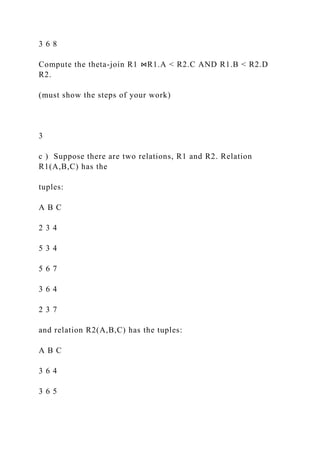
3 6 8
Compute the natural join of R1 and R2.
2
b ) Suppose there are two relations, R1 and R2. Relation
R1(A,B) has the tuples:
A B
0 1
2 3
4 5
and the relation R2(B,C,D) has tuples:
B C D
1 3 5
3 5 7
3 6 8
Compute the theta-join R1 ⋈R1.A < R2.C AND R1.B < R2.D
R2.
(must show the steps of your work)
3
c ) Suppose there are two relations, R1 and R2. Relation
R1(A,B,C) has the
tuples:
A B C
2 3 4
5 3 4
5 6 7
3 6 4
2 3 7
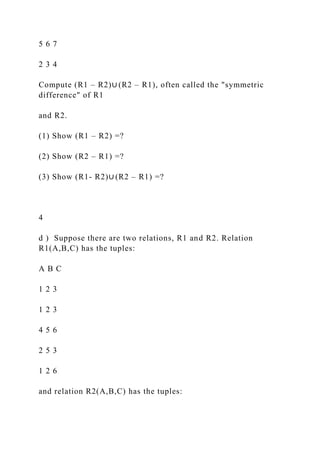
and relation R2(A,B,C) has the tuples:
A B C
3 6 4
3 6 5
5 6 7
2 3 4
Compute (R1 – R2)∪ (R2 – R1), often called the "symmetric
difference" of R1
and R2.
(1) Show (R1 – R2) =?
(2) Show (R2 – R1) =?
(3) Show (R1- R2)∪ (R2 – R1) =?
4
d ) Suppose there are two relations, R1 and R2. Relation
R1(A,B,C) has the tuples:
A B C
1 2 3
1 2 3
4 5 6
2 5 3
1 2 6
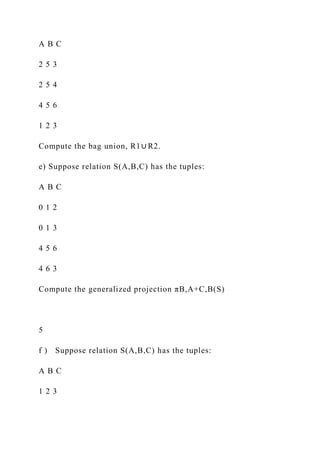
and relation R2(A,B,C) has the tuples:
A B C
2 5 3
2 5 4
4 5 6
1 2 3
Compute the bag union, R1∪ R2.
e) Suppose relation S(A,B,C) has the tuples:
A B C
0 1 2
0 1 3
4 5 6
4 6 3
Compute the generalized projection πB,A+C,B(S)
5
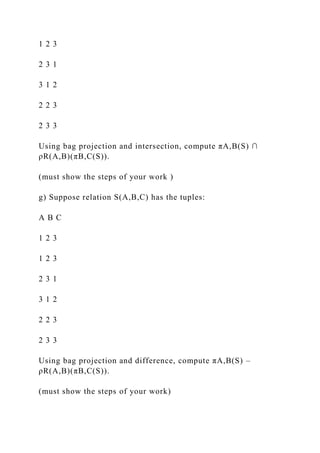
f ) Suppose relation S(A,B,C) has the tuples:
A B C
1 2 3
1 2 3
2 3 1
3 1 2
2 2 3
2 3 3
Using bag projection and intersection, compute πA,B(S) ∩
ρR(A,B)(πB,C(S)).
(must show the steps of your work )
g) Suppose relation S(A,B,C) has the tuples:
A B C
1 2 3
1 2 3
2 3 1
3 1 2
2 2 3
2 3 3
Using bag projection and difference, compute πA,B(S) –
ρR(A,B)(πB,C(S)).
(must show the steps of your work)
6
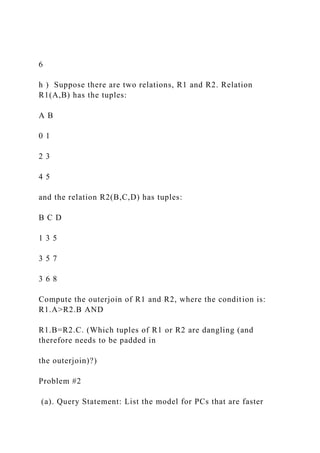
h ) Suppose there are two relations, R1 and R2. Relation
R1(A,B) has the tuples:
A B
0 1
2 3
4 5
and the relation R2(B,C,D) has tuples:
B C D
1 3 5
3 5 7
3 6 8
Compute the outerjoin of R1 and R2, where the condition is:
R1.A>R2.B AND
R1.B=R2.C. (Which tuples of R1 or R2 are dangling (and
therefore needs to be padded in
the outerjoin)?)
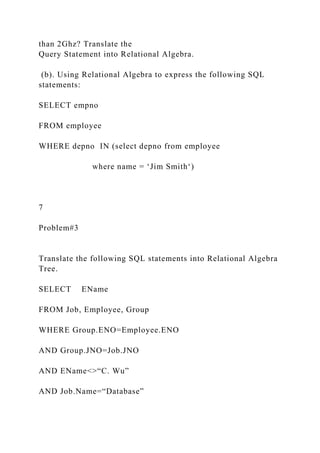
Problem #2
(a). Query Statement: List the model for PCs that are faster
than 2Ghz? Translate the
Query Statement into Relational Algebra.
(b). Using Relational Algebra to express the following SQL
statements:
SELECT empno
FROM employee
WHERE depno IN (select depno from employee
where name = ‘Jim Smith‘)
7
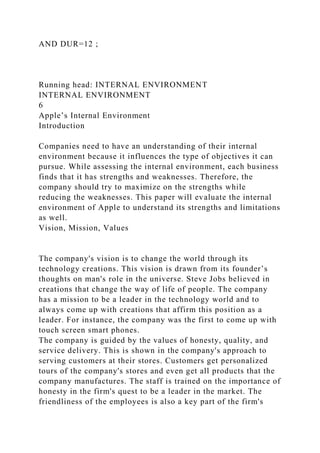
Problem#3
Translate the following SQL statements into Relational Algebra
Tree.
SELECT EName
FROM Job, Employee, Group
WHERE Group.ENO=Employee.ENO
AND Group.JNO=Job.JNO
AND EName<>“C. Wu”
AND Job.Name=“Database”
AND DUR=12 ;
Running head: INTERNAL ENVIRONMENT
INTERNAL ENVIRONMENT
6
Apple’s Internal Environment
Introduction
Companies need to have an understanding of their internal
environment because it influences the type of objectives it can
pursue. While assessing the internal environment, each business
finds that it has strengths and weaknesses. Therefore, the
company should try to maximize on the strengths while
reducing the weaknesses. This paper will evaluate the internal
environment of Apple to understand its strengths and limitations
as well.
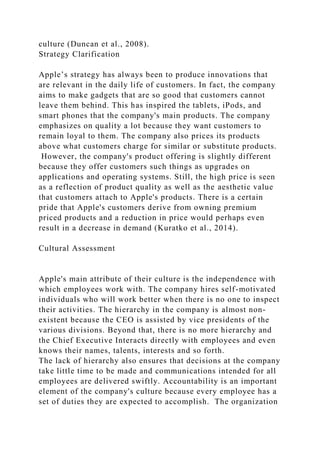
Vision, Mission, Values
The company's vision is to change the world through its
technology creations. This vision is drawn from its founder’s
thoughts on man's role in the universe. Steve Jobs believed in
creations that change the way of life of people. The company
has a mission to be a leader in the technology world and to
always come up with creations that affirm this position as a
leader. For instance, the company was the first to come up with
touch screen smart phones.
The company is guided by the values of honesty, quality, and
service delivery. This is shown in the company's approach to
serving customers at their stores. Customers get personalized
tours of the company's stores and even get all products that the
company manufactures. The staff is trained on the importance of
honesty in the firm's quest to be a leader in the market. The
friendliness of the employees is also a key part of the firm's
culture (Duncan et al., 2008).
Strategy Clarification
Apple’s strategy has always been to produce innovations that
are relevant in the daily life of customers. In fact, the company
aims to make gadgets that are so good that customers cannot
leave them behind. This has inspired the tablets, iPods, and
smart phones that the company's main products. The company
emphasizes on quality a lot because they want customers to
remain loyal to them. The company also prices its products
above what customers charge for similar or substitute products.
However, the company's product offering is slightly different
because they offer customers such things as upgrades on
applications and operating systems. Still, the high price is seen
as a reflection of product quality as well as the aesthetic value
that customers attach to Apple's products. There is a certain
pride that Apple's customers derive from owning premium
priced products and a reduction in price would perhaps even
result in a decrease in demand (Kuratko et al., 2014).
Cultural Assessment
Apple's main attribute of their culture is the independence with
which employees work with. The company hires self-motivated
individuals who will work better when there is no one to inspect
their activities. The hierarchy in the company is almost non-
existent because the CEO is assisted by vice presidents of the
various divisions. Beyond that, there is no more hierarchy and
the Chief Executive Interacts directly with employees and even
knows their names, talents, interests and so forth.
The lack of hierarchy also ensures that decisions at the company
take little time to be made and communications intended for all
employees are delivered swiftly. Accountability is an important
element of the company's culture because every employee has a
set of duties they are expected to accomplish. The organization
has even coined an acronym 'DRI', to mean Directly
Responsible Individual. Blame placing is almost alien to the
company (Duncan et al., 2008).
Value Chain Analysis
Apple's value chain is composed of a set of activities that the
company does itself and some which it opts to outsource. The
company starts by coming up with the designs for products it
intends to create. Design is quite important for the company
because it wants to be sell sleek and uniquely designed
products. All designs are created in a factory in California.
Another activity the company does for itself in the sales and
distribution of final products (Duncan et al., 2008). The
company does the sales work at its stores because it wants to
give customers a uniform message. Outsourcing this function
could lead to distortions of messages given to customers.
Activities that the company outsources include the production
of screens and semi-conductors. These products are bought from
companies in Asia because their production is a labor-intensive
process. These items are also not item-specific and screens can
be used by many gadgets and many companies as well. There is
no need for Apple to invest in factories to produce them because
the other companies can produce the much more efficiently.
Conclusion
The internal environment is characterized by a strong mission
statement to which the company has strived to abide. The
company always produces quality products that sell it as the
ultimate market leader in consumer electronics. The company
has a culture that encourages employees to be accountable,
creative, and work under minimal supervision. The company
also strives to reward its employees generously and create a
conductive working environment where employees do not have
to be ordered around.
Therefore, the employees reciprocate by showing loyalty to the
company. Lastly, the company's value chain is made up of
activities that the company outsources and those which it strives
to do by itself. The company outsources labor intensive and
non-unique processes such as screen making and assembling.
However, the company controls essential processes such as
product design, distribution, and sales services.
References
Duncan, W. J., Ginter, P. M., & Swayne, L. E. (2008).
Competitive Advantage and Internal Organizational Assessment.
The Academy of Management Executive, 12(3), 6-16.
Kuratko, D. F., Hornsby, J. S., & Covin, J. G. (2014).
Diagnosing a Firm's Internal Environment for Corporate
Entrepreneurship. Business Horizons, 57(1), 37-47.
Running head: APPLE'S EXTERNAL ENVIRONMENT
1
APPLE'S EXTERNAL ENVIRONMENT
6
Apple Inc's External Business Environment
Introduction
Companies do not operate in a vacuum and as such they have to
pay attention to their external environmental in order to remain
competitive. Managers have little influence on the external
environment and businesses have to adapt as the external factors
keep on changing. External business environment factors
include the political landscape, technology, legal and regulatory
frameworks, societal factors, the economy in general, and
competition. These factors are not static and the more they
shift, the more volatile the environment becomes. Apple Inc.
operates on a global scale, which means that the external
business environment is quite complex. This paper will explore
some of these factors which affect the business strategy that the
company uses.
Political Factors
Political factors are perhaps what the company cannot exert any
influence on because of the complexities involved. Apple Inc is
an American company which has customers all over the world
including those countries whose relations with the US are
strained (Grant, 2003). The company has to hope that tensions
between the various countries it has interests do not become
rocky to a point where business becomes impossible to run. The
company has factories in China and other Asian countries where
there is an ample supply of labor. Potential conflict between the
US and China could force the company to shift the locations of
the labor-intensive factories.
Economic conditions affect the demand for Apple's products
because of people's purchasing power. Increase in inflation and
recessions have a negative effect on demand because people
tend to check their spending habits (Grant, 2003). The
company's products can be classified as luxury products, which
mean that people can decide to reduce spending on them to be
able to purchase their basic needs. Further, economic conditions
affect the cost of raw materials for production and labor as well.
Therefore, the company has to keep track of developments in
the economy because they have to adjust their prices and
product offering to match the changes (Husso, 2011).
Social factors are quite important to Apple because their
competitive advantage currently lies in the perception that their
products are of high quality. Their customers feel classy
because of the premium pricing which the company practices.
The company has to keep track of the people’s attitude towards
their products so that they can produce what people want in case
their preferences change. Another dimension of the external
business environment is technology. Apple has to invest in
research and development to produce innovations that will keep
customers interested in what the company is producing. Further,
the company has to keep an eye on any developments in
technology which could help it improve its products (Grant,
2003).
The regulatory and legal environment is quite important for
Apple to keep an eye on because it has operations in many
countries. The company has to ensure that their factories do not
violate any rules meant to protect the environment because that
would lead to time-consuming lawsuits (Husso, 2011). The
company must also ensure that it abides by the labor laws in the
countries of operation. The company often has to go beyond the
labor laws in the countries of operation so that its image in the
eyes of employees and the public in general. The company
ensures that the factories are safe and healthy for workers, and
they also remunerate employees competitively (Grant, 2003).
The geographical factors that Apple has to pay attention to
relate to the distance between the factories and markets. The
company has to invest in an elaborate supply chain management
system to ensure that parts reach the respective factories for
assembly. The same has to be done to ensure that the company's
products are equally available in all markets.
Five Force Analysis
The five force analysis tool is useful in analyzing the
competitive environment in which the company operates in. The
competition between players in the industry is quite fierce
especially because Apple has to compete in the operating
systems market, smart phones market, and personal computers
front as well. However, the company has gathered customer
loyalty by manufacturing quality products for the premium
market. The bargaining power of Apple's suppliers has been
reducing as the company continues to grow in size. Apple
places orders in large quantities and many suppliers want to do
business with it and as such Apple is able to put conditions in
the supply contracts (Mason, 2007).
The company has cut a niche in the luxury phones and personal
computers market and customers are very loyal. The bargaining
power of buyers is therefore little and is expected to continue
buying even when prices increase. The threat of new entrants
entering the market and reducing Apple's market share is little
because of the loyal customer base and a strong brand image the
company has built over the years. Lastly, the threat of substitute
products is real for Apple because there are companies in the
market that manufacture quality products. An example is
Google's Android operating system and Samsung's Galaxy smart
phone (Mason, 2007). However, the company is working to
reduce this threat by cultivating customer loyalty. In
conclusion, the company has managed to place itself
strategically in a manner that reduces the threat of competition.
The strengths of the company include its strong financial
position and brand loyalty of customers. Weakness includes the
incompatibility of its products with rival operating systems and
high prices. The opportunities existing in the market include an
increasing demand for smart phones and tablets. The main threat
to the company' success is the growth of Google Android
operating system and increased scrutiny on working conditions
in the company's factories in China (Mason, 2007).
References
Grant, R. M. (2003). Strategic Planning in a Turbulent
Environment: Evidence from the Oil Majors. Strategic
Management Journal, 24(6), 491-517.
Husso, M. (2011). Analysis of Competition in the Mobile Phone
Markets of the United States and Europe.
Mason, R. B. (2007). The External Environment's Effect on
Management and Strategy: A c
Complexity Theory Approach. Management Decision, 45(1), 10-
28.
Running head: APPLE'S MARKET POSITION
1
APPLE'S MARKET POSITION
2
APPLE'S MARKET POSITION
Apple Inc. is a consumer electronics company that is
headquartered in California, USA. The company began in 1978
by manufacturing computer hardware and software. The
company has evolved over the years and entered the mobile
phone market, tablets, music players, operating systems, and
television sets. The company is one of the most valuable brands
in the world and enjoys customer loyalty that most of its
competitors cannot match. The company's current Chief
executive is Timothy Cook who has carried on the company's
legacy of producing elegant products and premium pricing
(Mushtaq et al., 2013).
The first target group of Apple’s products is teens and college
students. The company targets them through products such as
iPod music player, smart phones that can easily access social
networking sites, and enable easy research for university
students. The company's tablet, the iPad can easily record notes
for students and is easy to carry around. The second target
group of Apple is business people who want to use products that
portray an enviable image. The company targets these people by
producing elegant products that do not break down easily and as
such are efficient for storing sensitive business information
(Mushtaq et al., 2013).
Young people in college and teenagers need products that are
easy to carry around and serving many functions. For instance,
they need to call, message, store and listen to music, carry out
research, and appear fashionable in the midst of their social
cluster. The company's smartphone, the iPhone, can serve all
these purposes. The business people on the other hand need
products that only serious and reputable persons should be
identified with. Apple Inc. therefore develops durable and
premium priced products such as Mac books. In addition, the
company offers such things as updates to the software their
products use so that customers keep purchasing their products.
Businesspeople need to feel as if they are in a partnership with
the company and Apple provides this by increasing the number
of interactions with clients beyond the purchase point (Mushtaq
et al., 2013).
Customer satisfaction
Apple's products satisfy customer's needs by giving them a
sense of belonging to a unique class of customers that can
afford elegant products. Although Apple's pricing can be
described as high, not many of its customers complain. In fact,
every time the company releases an upgrade of the current
product, there are hundreds of thousands of customer waiting to
replace their current product with the new one (Mushtaq et al.,
2013). In addition, the company's products are long lasting and
perform beyond customers' expectations. The company rarely
faces situations where it has to recall products due to glitches in
performance. One area however it should relook is the
compatibility of its products with other operating systems.
Although this could be the company's strategy, it often limits
the ability of customers to use software applications that do not
have a version that is compatible with Mac computers (Mushtaq
et al., 2013).
In the smart phone market, Samsung is Apple's main competitor
in terms of sales. Samsung has origins in Asia and is therefore
quite popular in the Eastern hemisphere. The rivalry between
the two companies is fierce and there are court cases involving
accusations of copyright infringements between them. In the
tablets market, Amazon is perhaps Apple's biggest competitor
because they design quality and affordable products. They also
bundle the tablets with other products such as music and e-
books from their business partners. Google is Apple's biggest
competitor in the operating system's market. The two companies
are always competing to have their operating systems used in
tablets and smartphones as it results in revenues (Mushtaq et
al., 2013).
The company differentiates itself by pricing products at a price
that is high but at the same time gives updates to operating
systems. Further, their products do not allow the use of other
operating system and the company does not advertise its
products directly. Instead, the publicity created by its customers
is enough to attract new customers while keeping the current
ones satisfied. The company's competitive advantage arises
from the compatibility of all its products due to the use of a
single operating system. Their iPod is compatible with their
computers and so are the phones. Therefore, loyal customers
tend to purchase all their personal electronics from the
company. Competitors find it hard to win customers from the
company and to build such a high level of loyalty (Mushtaq et
al., 2013).
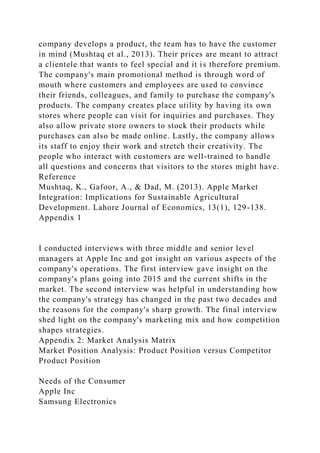
5P's Analysis
Renowned scholar Philip Kotler insisted that a proper marketing
strategy has to pay attention to the critical elements that include
product, price, place, and people. Apple's products are designed
to look elegant and to serve customers efficiently. Each time the
company develops a product, the team has to have the customer
in mind (Mushtaq et al., 2013). Their prices are meant to attract
a clientele that wants to feel special and it is therefore premium.
The company's main promotional method is through word of
mouth where customers and employees are used to convince
their friends, colleagues, and family to purchase the company's
products. The company creates place utility by having its own
stores where people can visit for inquiries and purchases. They
also allow private store owners to stock their products while
purchases can also be made online. Lastly, the company allows
its staff to enjoy their work and stretch their creativity. The
people who interact with customers are well-trained to handle
all questions and concerns that visitors to the stores might have.
Reference
Mushtaq, K., Gafoor, A., & Dad, M. (2013). Apple Market
Integration: Implications for Sustainable Agricultural
Development. Lahore Journal of Economics, 13(1), 129-138.
Appendix 1
I conducted interviews with three middle and senior level
managers at Apple Inc and got insight on various aspects of the
company's operations. The first interview gave insight on the
company's plans going into 2015 and the current shifts in the
market. The second interview was helpful in understanding how
the company's strategy has changed in the past two decades and
the reasons for the company's sharp growth. The final interview
shed light on the company's marketing mix and how competition
shapes strategies.
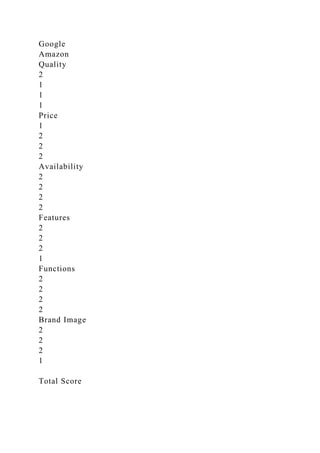
Appendix 2: Market Analysis Matrix
Market Position Analysis: Product Position versus Competitor
Product Position
Needs of the Consumer
Apple Inc
Samsung Electronics
Google
Amazon
Quality
2
1
1
1
Price
1
2
2
2
Availability
2
2
2
2
Features
2
2
2
1
Functions
2
2
2
2
Brand Image
2
2
2
1
Total Score
Narrative/Comments

Running head APPLE INCAPPLE INC .docx

  • 1.
    Running head: APPLEINC APPLE INC 8 Apple's SWOT Analysis and Strategic Scorecard Introduction One of the most important actions the management of a company can take towards improving a company's performance and competitiveness is to conduct a business environment scan. The output of a scan is the often the company's strengths, weaknesses, threats and available opportunities. The analysis should be followed by a set of recommendations on how the company can make use of strengths and opportunities, as well as how to improve the weaknesses. This paper will conduct a SWOT analysis on Apple Inc, then followed by a balanced scorecard assessment of the company. SWOT Analysis The internal environment of a company is a matrix of its financial position, management, employees, objective, and so forth. Apple Inc has enjoyed enviable financial success in the recent past and as such its strong financial position is its biggest strength. Currently, the company can afford to fund big acquisitions of other companies that can be useful in pursuit of its strategic goals. The financial strength means that other companies are willing to work with Apple because its operations can only get bigger. Another internal strength of the company is its team of employees who are innovative and highly motivated (Husso, 2011). The company does not have a hierarchy in management and all employees interact freely. The company also encourages employees to take responsibility for
  • 2.
    projects they workon. The result is high productivity. Another major strength of Apple Inc is the large portfolio of products that it sells customers which helps in boosting annual revenue as well as creating a brand image. Currently, customers know Apple as a producer of high quality and premium products. This makes it easier for the company to introduce new products into the market (Husso, 2011). The company's major weakness lies in the high prices they charge for its products. Consumers are becoming more mindful of their spending habits due to economic conditions. Premium pricing has been Apple's marketing strategy but the company could be forced to relook the strategy due to consumer behaviors (Maltz, 2003). The company is also facing court cases regarding copyright infringement and this could result in fines against the company. This could hurt Apple's financial position and possibly force it to withdraw certain products from the company. Critics are also arguing that the company's innovative engine is starting to slow down compared to three years ago. The company's iPhone 5S is seen as only a slight improvement on the iPhone 4S. If consumers realize this they could begin to stop purchasing new products from the company (Husso, 2011). On the positive side though, the company has an opportunity to make the iPad its biggest product yet. The company's tablet has been received well in the market so far and demand is increasing exponentially. The company also has a chance to acquire many small and upcoming technology companies that will help it improve its innovativeness and market share. Currently, the company has begun offering cloud computing services and the demand is growing rapidly. Therefore, the company has a chance to use this avenue to even out revenues when demand for gadgets slumps (Kossek et al., 2012). The main threat to Apple's dominance in the devices market lies
  • 3.
    in the growthof Google's Android Operating system. This operating system is compatible with smart phones from Samsung, LG, Sony and all other major hardware manufacturers. The growth of the operating system is threatening Apple's market share and the company has to find ways to counter this threat by perhaps opening its devices to other operating system. The fact that the dollar is quite strong against many currencies also makes the company's products seem expensive. This is another challenge to the company that quotes all its items in US dollars (Kossek et al., 2012). Balanced Scorecard The balanced scorecard helps to understand a company's performance not only in financial terms but also on other fronts that are critical to a company's operations. This section will review how Apple has done financially, in satisfying customer's needs, learning and growth, as well as internal processes. Financial Apple's financial growth is mainly to grow its revenue, minimize its cost of sales and overheads so that it increases its bottom line. The main indicators of this performance lie in the company's financial statements that are then used to calculate financial ratios. For Apple, the main indicators of financial performance include a comparison of revenues between the current year and previous one, the gross profit margin, the net profit margin, and the ration between overheads and sales revenue. The company wants the revenues to increase and the main strategy towards achieving this involves lies in increasing the number of products in its portfolio as well as acquiring smaller companies that can make huge revenues when managed properly (Kossek et al., 2012). Currently, Apple has a lot of products and this has helped boost
  • 4.
    its sales significantly.Computers were their main source of income about a decade ago, but their focus shifted to the iPod, the iPhone and now the iPad. The company has managed to capture the imagination of their customers continually and thus making them buy new devices and stick to the old ones as well. The creation of customer loyalty and an iPad way of life has helped the company become a global giant in the consumer electronics world. Another way of growing revenue lies in the pricing strategy which targets consumers seeking premium products. These consumers do not mind paying high prices when they are assured that the quality of a given product is high. For Apple Inc, this strategy has helped it earn a high profit margin on all items sold. The company does not have to appeal to the mass market to make its huge profits (Kossek et al., 2012). Customer Satisfaction Customer satisfaction is important for the continuity of any business entity because it determines whether a given customer is likely to return for a repeat purchase and also whether that customer will recommend the company to a friend, family, or colleague. For Apple, their main objective is to keep the customer amazed by the quality of products produced as well as the level of customer service the company is willing to provide. Apple begins all innovations with the customer in mind and this has led to groundbreaking innovations such as the iPhone and iPad. When the company developed these products, it was aiming to manufacture gadgets that were so relevant to daily life that the customers could not leave them behind. The company relies heavily on word of mouth for marketing and therefore it has to amaze customers with every gadget they produce (Palermo, 2011). The main indicators of performance include reviews from customers on social media, the company's website as well as in their distribution stores. The company has call centers in the
  • 5.
    countries where itsproducts sell and this gives a chance to customers to register their comments. As stated, the customer satisfaction program begins with having the customer in mind when developing products. This stretches to the manner in which the company packages products for customers. It strives to give value to customer by providing regular updates to the programs and operating systems that customers have already purchased (Kossek et al., 2012). This means that a customer could purchase a device today, but still be getting regular updates a year later. This helps Apple to surpass the expectations of customers (Palermo, 2011). Learning and Growth As highlighted, Apple benefits from having a team of dedicated and motivated employees that would are willing to go the extra mile to improve their skills and come up with groundbreaking innovations. The company learning and growth objectives include bettering the skills of employees each year and making them feel important and a part of the company. The company allows workers to attend as many useful conferences, seminars, and debates as they would possibly like. The company has a generous research budget that allows people who have ideas within the company to try them and possibly commercialize them. Apple has been ranked severally as one of the best placed to work because of the freedom employees are allowed to explore their creativity (Palermo, 2011). Apple measures the level of learning and growth at its premises by following the number of innovations each year. A drop in the number of innovations could point to a drop in the level creativity and the company could decide to hire a few people to bring in fresh ideas at the company. Employees are also provided with things such as loans to finance education while the company is always ready to afford employees time-off from work to concentrate on examinations or short courses. This also
  • 6.
    adds to thecompany's reputation as an employer of choice (Palermo, 2011). Internal Processes The internal processes refer to all activities that have to take place before the company. Apple aims to streamline all its processes to ensure that it keeps all stakeholders pleased. At the same time, these processes have to be carried out in accordance with the law and in such a way that minimizes operating costs. The processes begin with designing of products, which have to be original to avoid patent infringement suits. The company has to ensure that it place orders in a timely manner from reliable partners. It has to ensure that there are no delays in delivery and that suppliers are paid in time. Other internal processes the company has to take care of include recruitment, appraisal, rewards, sales, marketing, and distribution and so forth (Palermo, 2011). The company sets benchmarks against which all these processes are evaluated. Conclusion Apple is a company whose internal strengths include a strong balance sheet position, a large portfolio of products, loyal customers, and a strong brand image. The company should leverage on these strengths to continue strengthening its workforce to produce items that satisfy customer needs. The company could to use aggressive marketing to fend off competition from Android in the operating systems market. The company should also bank on the growing demand for tablets and smart phones to increase revenues and profitability in the future. However, the company should have plans to keep up with the rapid changing technology so that it protects its title as a market leader in innovation. References
  • 7.
    Husso, M. (2011).Analysis of Competition in the Mobile Phone Markets of the United States and Europe. Kossek, E. E., Kalliath, T., & Kalliath, P. (2012). Achieving Employee Well-Being in a Changing Work Environment: An Expert Commentary on Current Scholarship. International Journal of Manpower, 33(7), 738-753. Kumari, N. (2011). Balanced Scorecard for Superior Organizational Performance. European Journal of Business and Management, 3(5), 73-86. Maltz, A. C., Shenhar, A. J., & Reilly, R. R. (2003). Beyond the Balanced Scorecard: Refining the Search for Organizational Success Measures. Long Range Planning, 36(2), 187-204. Palermo, T. (2011). Integrating Risk and Performance in Management Reporting. Chartered Institute of Management Accountants. 1 Problem 1 a) Suppose there are two relations, R1 and R2. Relation R1(A,B) has the tuples: A B 0 1 2 3 4 5
  • 8.
    and the relationR2(B,C,D) has tuples: B C D 1 3 5 3 5 7 3 6 8 Compute the natural join of R1 and R2. 2 b ) Suppose there are two relations, R1 and R2. Relation R1(A,B) has the tuples: A B 0 1 2 3 4 5 and the relation R2(B,C,D) has tuples: B C D 1 3 5 3 5 7
  • 9.
    3 6 8 Computethe theta-join R1 ⋈R1.A < R2.C AND R1.B < R2.D R2. (must show the steps of your work) 3 c ) Suppose there are two relations, R1 and R2. Relation R1(A,B,C) has the tuples: A B C 2 3 4 5 3 4 5 6 7 3 6 4 2 3 7 and relation R2(A,B,C) has the tuples: A B C 3 6 4 3 6 5
  • 10.
    5 6 7 23 4 Compute (R1 – R2)∪ (R2 – R1), often called the "symmetric difference" of R1 and R2. (1) Show (R1 – R2) =? (2) Show (R2 – R1) =? (3) Show (R1- R2)∪ (R2 – R1) =? 4 d ) Suppose there are two relations, R1 and R2. Relation R1(A,B,C) has the tuples: A B C 1 2 3 1 2 3 4 5 6 2 5 3 1 2 6 and relation R2(A,B,C) has the tuples:
  • 11.
    A B C 25 3 2 5 4 4 5 6 1 2 3 Compute the bag union, R1∪ R2. e) Suppose relation S(A,B,C) has the tuples: A B C 0 1 2 0 1 3 4 5 6 4 6 3 Compute the generalized projection πB,A+C,B(S) 5 f ) Suppose relation S(A,B,C) has the tuples: A B C 1 2 3
  • 12.
    1 2 3 23 1 3 1 2 2 2 3 2 3 3 Using bag projection and intersection, compute πA,B(S) ∩ ρR(A,B)(πB,C(S)). (must show the steps of your work ) g) Suppose relation S(A,B,C) has the tuples: A B C 1 2 3 1 2 3 2 3 1 3 1 2 2 2 3 2 3 3 Using bag projection and difference, compute πA,B(S) – ρR(A,B)(πB,C(S)). (must show the steps of your work)
  • 13.
    6 h ) Supposethere are two relations, R1 and R2. Relation R1(A,B) has the tuples: A B 0 1 2 3 4 5 and the relation R2(B,C,D) has tuples: B C D 1 3 5 3 5 7 3 6 8 Compute the outerjoin of R1 and R2, where the condition is: R1.A>R2.B AND R1.B=R2.C. (Which tuples of R1 or R2 are dangling (and therefore needs to be padded in the outerjoin)?) Problem #2 (a). Query Statement: List the model for PCs that are faster
  • 14.
    than 2Ghz? Translatethe Query Statement into Relational Algebra. (b). Using Relational Algebra to express the following SQL statements: SELECT empno FROM employee WHERE depno IN (select depno from employee where name = ‘Jim Smith‘) 7 Problem#3 Translate the following SQL statements into Relational Algebra Tree. SELECT EName FROM Job, Employee, Group WHERE Group.ENO=Employee.ENO AND Group.JNO=Job.JNO AND EName<>“C. Wu” AND Job.Name=“Database”
  • 15.
    AND DUR=12 ; Runninghead: INTERNAL ENVIRONMENT INTERNAL ENVIRONMENT 6 Apple’s Internal Environment Introduction Companies need to have an understanding of their internal environment because it influences the type of objectives it can pursue. While assessing the internal environment, each business finds that it has strengths and weaknesses. Therefore, the company should try to maximize on the strengths while reducing the weaknesses. This paper will evaluate the internal environment of Apple to understand its strengths and limitations as well. Vision, Mission, Values The company's vision is to change the world through its technology creations. This vision is drawn from its founder’s thoughts on man's role in the universe. Steve Jobs believed in creations that change the way of life of people. The company has a mission to be a leader in the technology world and to always come up with creations that affirm this position as a leader. For instance, the company was the first to come up with touch screen smart phones. The company is guided by the values of honesty, quality, and service delivery. This is shown in the company's approach to serving customers at their stores. Customers get personalized tours of the company's stores and even get all products that the company manufactures. The staff is trained on the importance of honesty in the firm's quest to be a leader in the market. The friendliness of the employees is also a key part of the firm's
  • 16.
    culture (Duncan etal., 2008). Strategy Clarification Apple’s strategy has always been to produce innovations that are relevant in the daily life of customers. In fact, the company aims to make gadgets that are so good that customers cannot leave them behind. This has inspired the tablets, iPods, and smart phones that the company's main products. The company emphasizes on quality a lot because they want customers to remain loyal to them. The company also prices its products above what customers charge for similar or substitute products. However, the company's product offering is slightly different because they offer customers such things as upgrades on applications and operating systems. Still, the high price is seen as a reflection of product quality as well as the aesthetic value that customers attach to Apple's products. There is a certain pride that Apple's customers derive from owning premium priced products and a reduction in price would perhaps even result in a decrease in demand (Kuratko et al., 2014). Cultural Assessment Apple's main attribute of their culture is the independence with which employees work with. The company hires self-motivated individuals who will work better when there is no one to inspect their activities. The hierarchy in the company is almost non- existent because the CEO is assisted by vice presidents of the various divisions. Beyond that, there is no more hierarchy and the Chief Executive Interacts directly with employees and even knows their names, talents, interests and so forth. The lack of hierarchy also ensures that decisions at the company take little time to be made and communications intended for all employees are delivered swiftly. Accountability is an important element of the company's culture because every employee has a set of duties they are expected to accomplish. The organization
  • 17.
    has even coinedan acronym 'DRI', to mean Directly Responsible Individual. Blame placing is almost alien to the company (Duncan et al., 2008). Value Chain Analysis Apple's value chain is composed of a set of activities that the company does itself and some which it opts to outsource. The company starts by coming up with the designs for products it intends to create. Design is quite important for the company because it wants to be sell sleek and uniquely designed products. All designs are created in a factory in California. Another activity the company does for itself in the sales and distribution of final products (Duncan et al., 2008). The company does the sales work at its stores because it wants to give customers a uniform message. Outsourcing this function could lead to distortions of messages given to customers. Activities that the company outsources include the production of screens and semi-conductors. These products are bought from companies in Asia because their production is a labor-intensive process. These items are also not item-specific and screens can be used by many gadgets and many companies as well. There is no need for Apple to invest in factories to produce them because the other companies can produce the much more efficiently. Conclusion The internal environment is characterized by a strong mission statement to which the company has strived to abide. The company always produces quality products that sell it as the ultimate market leader in consumer electronics. The company has a culture that encourages employees to be accountable, creative, and work under minimal supervision. The company also strives to reward its employees generously and create a conductive working environment where employees do not have
  • 18.
    to be orderedaround. Therefore, the employees reciprocate by showing loyalty to the company. Lastly, the company's value chain is made up of activities that the company outsources and those which it strives to do by itself. The company outsources labor intensive and non-unique processes such as screen making and assembling. However, the company controls essential processes such as product design, distribution, and sales services. References Duncan, W. J., Ginter, P. M., & Swayne, L. E. (2008). Competitive Advantage and Internal Organizational Assessment. The Academy of Management Executive, 12(3), 6-16. Kuratko, D. F., Hornsby, J. S., & Covin, J. G. (2014). Diagnosing a Firm's Internal Environment for Corporate Entrepreneurship. Business Horizons, 57(1), 37-47. Running head: APPLE'S EXTERNAL ENVIRONMENT 1 APPLE'S EXTERNAL ENVIRONMENT 6 Apple Inc's External Business Environment Introduction Companies do not operate in a vacuum and as such they have to pay attention to their external environmental in order to remain competitive. Managers have little influence on the external environment and businesses have to adapt as the external factors keep on changing. External business environment factors include the political landscape, technology, legal and regulatory frameworks, societal factors, the economy in general, and competition. These factors are not static and the more they shift, the more volatile the environment becomes. Apple Inc. operates on a global scale, which means that the external
  • 19.
    business environment isquite complex. This paper will explore some of these factors which affect the business strategy that the company uses. Political Factors Political factors are perhaps what the company cannot exert any influence on because of the complexities involved. Apple Inc is an American company which has customers all over the world including those countries whose relations with the US are strained (Grant, 2003). The company has to hope that tensions between the various countries it has interests do not become rocky to a point where business becomes impossible to run. The company has factories in China and other Asian countries where there is an ample supply of labor. Potential conflict between the US and China could force the company to shift the locations of the labor-intensive factories. Economic conditions affect the demand for Apple's products because of people's purchasing power. Increase in inflation and recessions have a negative effect on demand because people tend to check their spending habits (Grant, 2003). The company's products can be classified as luxury products, which mean that people can decide to reduce spending on them to be able to purchase their basic needs. Further, economic conditions affect the cost of raw materials for production and labor as well. Therefore, the company has to keep track of developments in the economy because they have to adjust their prices and product offering to match the changes (Husso, 2011). Social factors are quite important to Apple because their competitive advantage currently lies in the perception that their products are of high quality. Their customers feel classy because of the premium pricing which the company practices. The company has to keep track of the people’s attitude towards their products so that they can produce what people want in case
  • 20.
    their preferences change.Another dimension of the external business environment is technology. Apple has to invest in research and development to produce innovations that will keep customers interested in what the company is producing. Further, the company has to keep an eye on any developments in technology which could help it improve its products (Grant, 2003). The regulatory and legal environment is quite important for Apple to keep an eye on because it has operations in many countries. The company has to ensure that their factories do not violate any rules meant to protect the environment because that would lead to time-consuming lawsuits (Husso, 2011). The company must also ensure that it abides by the labor laws in the countries of operation. The company often has to go beyond the labor laws in the countries of operation so that its image in the eyes of employees and the public in general. The company ensures that the factories are safe and healthy for workers, and they also remunerate employees competitively (Grant, 2003). The geographical factors that Apple has to pay attention to relate to the distance between the factories and markets. The company has to invest in an elaborate supply chain management system to ensure that parts reach the respective factories for assembly. The same has to be done to ensure that the company's products are equally available in all markets. Five Force Analysis The five force analysis tool is useful in analyzing the competitive environment in which the company operates in. The competition between players in the industry is quite fierce especially because Apple has to compete in the operating systems market, smart phones market, and personal computers front as well. However, the company has gathered customer loyalty by manufacturing quality products for the premium market. The bargaining power of Apple's suppliers has been
  • 21.
    reducing as thecompany continues to grow in size. Apple places orders in large quantities and many suppliers want to do business with it and as such Apple is able to put conditions in the supply contracts (Mason, 2007). The company has cut a niche in the luxury phones and personal computers market and customers are very loyal. The bargaining power of buyers is therefore little and is expected to continue buying even when prices increase. The threat of new entrants entering the market and reducing Apple's market share is little because of the loyal customer base and a strong brand image the company has built over the years. Lastly, the threat of substitute products is real for Apple because there are companies in the market that manufacture quality products. An example is Google's Android operating system and Samsung's Galaxy smart phone (Mason, 2007). However, the company is working to reduce this threat by cultivating customer loyalty. In conclusion, the company has managed to place itself strategically in a manner that reduces the threat of competition. The strengths of the company include its strong financial position and brand loyalty of customers. Weakness includes the incompatibility of its products with rival operating systems and high prices. The opportunities existing in the market include an increasing demand for smart phones and tablets. The main threat to the company' success is the growth of Google Android operating system and increased scrutiny on working conditions in the company's factories in China (Mason, 2007). References Grant, R. M. (2003). Strategic Planning in a Turbulent Environment: Evidence from the Oil Majors. Strategic Management Journal, 24(6), 491-517. Husso, M. (2011). Analysis of Competition in the Mobile Phone Markets of the United States and Europe.
  • 22.
    Mason, R. B.(2007). The External Environment's Effect on Management and Strategy: A c Complexity Theory Approach. Management Decision, 45(1), 10- 28. Running head: APPLE'S MARKET POSITION 1 APPLE'S MARKET POSITION 2 APPLE'S MARKET POSITION Apple Inc. is a consumer electronics company that is headquartered in California, USA. The company began in 1978 by manufacturing computer hardware and software. The company has evolved over the years and entered the mobile phone market, tablets, music players, operating systems, and television sets. The company is one of the most valuable brands in the world and enjoys customer loyalty that most of its competitors cannot match. The company's current Chief executive is Timothy Cook who has carried on the company's legacy of producing elegant products and premium pricing (Mushtaq et al., 2013). The first target group of Apple’s products is teens and college students. The company targets them through products such as iPod music player, smart phones that can easily access social networking sites, and enable easy research for university students. The company's tablet, the iPad can easily record notes for students and is easy to carry around. The second target group of Apple is business people who want to use products that portray an enviable image. The company targets these people by producing elegant products that do not break down easily and as such are efficient for storing sensitive business information (Mushtaq et al., 2013).
  • 23.
    Young people incollege and teenagers need products that are easy to carry around and serving many functions. For instance, they need to call, message, store and listen to music, carry out research, and appear fashionable in the midst of their social cluster. The company's smartphone, the iPhone, can serve all these purposes. The business people on the other hand need products that only serious and reputable persons should be identified with. Apple Inc. therefore develops durable and premium priced products such as Mac books. In addition, the company offers such things as updates to the software their products use so that customers keep purchasing their products. Businesspeople need to feel as if they are in a partnership with the company and Apple provides this by increasing the number of interactions with clients beyond the purchase point (Mushtaq et al., 2013). Customer satisfaction Apple's products satisfy customer's needs by giving them a sense of belonging to a unique class of customers that can afford elegant products. Although Apple's pricing can be described as high, not many of its customers complain. In fact, every time the company releases an upgrade of the current product, there are hundreds of thousands of customer waiting to replace their current product with the new one (Mushtaq et al., 2013). In addition, the company's products are long lasting and perform beyond customers' expectations. The company rarely faces situations where it has to recall products due to glitches in performance. One area however it should relook is the compatibility of its products with other operating systems. Although this could be the company's strategy, it often limits the ability of customers to use software applications that do not have a version that is compatible with Mac computers (Mushtaq et al., 2013).
  • 24.
    In the smartphone market, Samsung is Apple's main competitor in terms of sales. Samsung has origins in Asia and is therefore quite popular in the Eastern hemisphere. The rivalry between the two companies is fierce and there are court cases involving accusations of copyright infringements between them. In the tablets market, Amazon is perhaps Apple's biggest competitor because they design quality and affordable products. They also bundle the tablets with other products such as music and e- books from their business partners. Google is Apple's biggest competitor in the operating system's market. The two companies are always competing to have their operating systems used in tablets and smartphones as it results in revenues (Mushtaq et al., 2013). The company differentiates itself by pricing products at a price that is high but at the same time gives updates to operating systems. Further, their products do not allow the use of other operating system and the company does not advertise its products directly. Instead, the publicity created by its customers is enough to attract new customers while keeping the current ones satisfied. The company's competitive advantage arises from the compatibility of all its products due to the use of a single operating system. Their iPod is compatible with their computers and so are the phones. Therefore, loyal customers tend to purchase all their personal electronics from the company. Competitors find it hard to win customers from the company and to build such a high level of loyalty (Mushtaq et al., 2013). 5P's Analysis Renowned scholar Philip Kotler insisted that a proper marketing strategy has to pay attention to the critical elements that include product, price, place, and people. Apple's products are designed to look elegant and to serve customers efficiently. Each time the
  • 25.
    company develops aproduct, the team has to have the customer in mind (Mushtaq et al., 2013). Their prices are meant to attract a clientele that wants to feel special and it is therefore premium. The company's main promotional method is through word of mouth where customers and employees are used to convince their friends, colleagues, and family to purchase the company's products. The company creates place utility by having its own stores where people can visit for inquiries and purchases. They also allow private store owners to stock their products while purchases can also be made online. Lastly, the company allows its staff to enjoy their work and stretch their creativity. The people who interact with customers are well-trained to handle all questions and concerns that visitors to the stores might have. Reference Mushtaq, K., Gafoor, A., & Dad, M. (2013). Apple Market Integration: Implications for Sustainable Agricultural Development. Lahore Journal of Economics, 13(1), 129-138. Appendix 1 I conducted interviews with three middle and senior level managers at Apple Inc and got insight on various aspects of the company's operations. The first interview gave insight on the company's plans going into 2015 and the current shifts in the market. The second interview was helpful in understanding how the company's strategy has changed in the past two decades and the reasons for the company's sharp growth. The final interview shed light on the company's marketing mix and how competition shapes strategies. Appendix 2: Market Analysis Matrix Market Position Analysis: Product Position versus Competitor Product Position Needs of the Consumer Apple Inc Samsung Electronics
  • 26.
  • 27.