RUMI’S
POETRY
&
oRIENTALISM
BY HAFSA MARYAM
EDWARD SAID AND
ORIENTALISM
â—Ź He was a Palestinian
intellectual
â—Ź He was famous for his book
“Orientalism”
â—Ź Orientalism is the depiction
of Middle Eastern, Asian and
North African societies.
â—Ź Knowledge was seen through the
western lens
â—Ź Western scholars wrote about
the east in their own versions
What does it have to do with Rumi?
Muhammad
Jalaluddin Rumi
Balkhi
â—Ź He was a thirteenth century Islamic
scholar and Sufi poet born in
Afghanistan.
● he studied Qur’an as a youth before
moving to Konya, in modern Turkey,
where he wrote the bulk of his
literary collection.
â—Ź Today, his Divan-e Shams-e Tabriz
and Masnavi-e Manavi are among the
most admired texts in the classical
Persian literary canon.
â—Ź And since the 1990s, he has been
called the best-selling poet in the
United States.
Do you know the person who
translated the rumi we are reading?
Coleman Barks
...Coleman doesn’t even
know farsi
Barks does not
actually have any
proficiency in
working with original
text, therefore, he
formulates new, free-
verse iterations of
rumi’s poems.
Unsurprisingly, Barks has been the
subject of numerous critiques from
scholars and journalistic
commentators alike. He has been
charged with unfaithfully
rendering Rumi’s texts and
erasing Islam from his works.
Rumi’s scholars such as Franklin
Lewis refer to Barks’ renderings
not as translations, but as
versions...
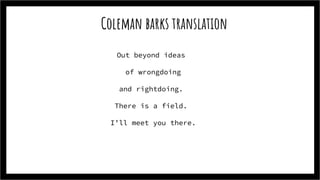
Coleman barks translation
Out beyond ideas
of wrongdoing
and rightdoing.
There is a field.
I’ll meet you there.
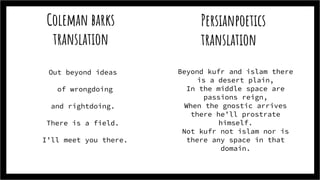
Coleman barks
translation
Out beyond ideas
of wrongdoing
and rightdoing.
There is a field.
I’ll meet you there.
Persianpoetics
translation
Beyond kufr and islam there
is a desert plain,
In the middle space are
passions reign,
When the gnostic arrives
there he’ll prostrate
himself.
Not kufr not islam nor is
there any space in that
domain.
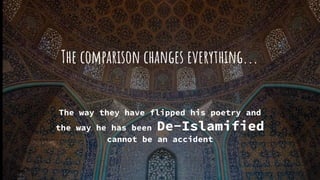
The comparison changes everything...
The way they have flipped his poetry and
the way he has been De-Islamified
cannot be an accident
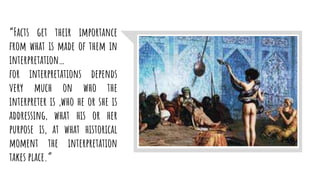
“Facts get their importance
from what is made of them in
interpretation…
for interpretations depends
very much on who the
interpreter is ,who he or she is
addressing, what his or her
purpose is, at what historical
moment the interpretation
takes place.”
Barks is one in a long history of Orientalists divorcing Persian poetry from its context
in order to reflect western culture.
In a 1995 PBS interview, host Bill Moyers said to Barks, “Sometimes I don’t know where
Rumi stops and Barks begins.” Moyers was actually right: the poetry we read in Barks’
works is, in fact, more Barks than Rumi.
( Or As edward said would call it: orientalized)
Thank you

Rumi's poetry and orientalism

  • 1.
  • 2.
    EDWARD SAID AND ORIENTALISM ●He was a Palestinian intellectual ● He was famous for his book “Orientalism” ● Orientalism is the depiction of Middle Eastern, Asian and North African societies. ● Knowledge was seen through the western lens ● Western scholars wrote about the east in their own versions
  • 3.
    What does ithave to do with Rumi?
  • 4.
    Muhammad Jalaluddin Rumi Balkhi ● Hewas a thirteenth century Islamic scholar and Sufi poet born in Afghanistan. ● he studied Qur’an as a youth before moving to Konya, in modern Turkey, where he wrote the bulk of his literary collection. ● Today, his Divan-e Shams-e Tabriz and Masnavi-e Manavi are among the most admired texts in the classical Persian literary canon. ● And since the 1990s, he has been called the best-selling poet in the United States.
  • 5.
    Do you knowthe person who translated the rumi we are reading?
  • 6.
  • 7.
    Barks does not actuallyhave any proficiency in working with original text, therefore, he formulates new, free- verse iterations of rumi’s poems.
  • 8.
    Unsurprisingly, Barks hasbeen the subject of numerous critiques from scholars and journalistic commentators alike. He has been charged with unfaithfully rendering Rumi’s texts and erasing Islam from his works. Rumi’s scholars such as Franklin Lewis refer to Barks’ renderings not as translations, but as versions...
  • 9.
    Coleman barks translation Outbeyond ideas of wrongdoing and rightdoing. There is a field. I’ll meet you there.
  • 10.
    Coleman barks translation Out beyondideas of wrongdoing and rightdoing. There is a field. I’ll meet you there. Persianpoetics translation Beyond kufr and islam there is a desert plain, In the middle space are passions reign, When the gnostic arrives there he’ll prostrate himself. Not kufr not islam nor is there any space in that domain.
  • 11.
    The comparison changeseverything... The way they have flipped his poetry and the way he has been De-Islamified cannot be an accident
  • 12.
    “Facts get theirimportance from what is made of them in interpretation… for interpretations depends very much on who the interpreter is ,who he or she is addressing, what his or her purpose is, at what historical moment the interpretation takes place.”
  • 13.
    Barks is onein a long history of Orientalists divorcing Persian poetry from its context in order to reflect western culture. In a 1995 PBS interview, host Bill Moyers said to Barks, “Sometimes I don’t know where Rumi stops and Barks begins.” Moyers was actually right: the poetry we read in Barks’ works is, in fact, more Barks than Rumi. ( Or As edward said would call it: orientalized) Thank you