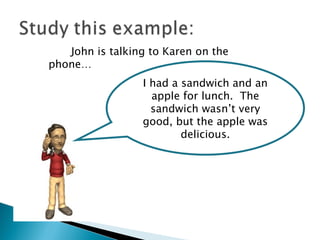
I had a sandwich and an apple for lunch.  The sandwich wasn’t very good, but the apple was delicious. John is talking to Karen on the phone…
 
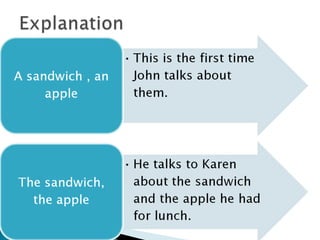
Use “the” when you are thinking of a particular thing  Use “a” or “an” when talking or describing something for the first time
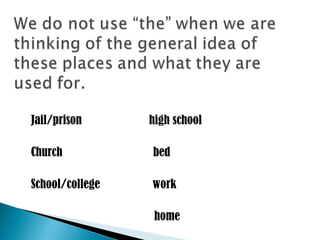
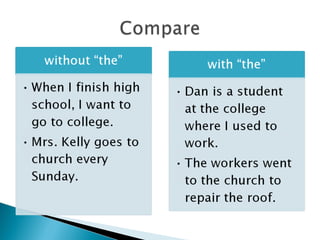
Jail/prison  high school Church  bed School/college  work  home
 
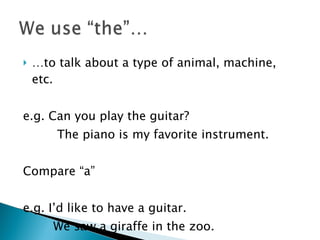
… to talk about a type of animal, machine, etc. e.g. Can you play the guitar? The piano is my favorite instrument. Compare “a”  e.g. I’d like to have a guitar. We saw a giraffe in the zoo.
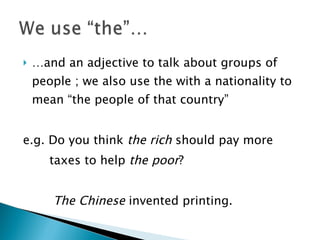
… and an adjective to talk about groups of people ; we also use the with a nationality to mean “the people of that country” e.g. Do you think  the rich  should pay more  taxes to help  the poor ? The Chinese  invented printing.
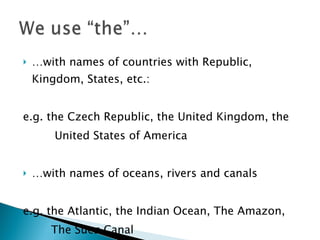
… with names of countries with Republic, Kingdom, States, etc.: e.g. the Czech Republic, the United Kingdom, the  United States of America  … with names of oceans, rivers and canals e.g. the Atlantic, the Indian Ocean, The Amazon,  The Suez Canal
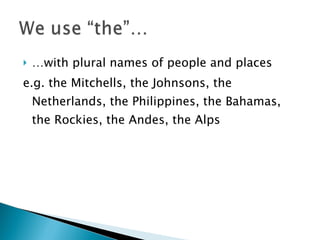
… with plural names of people and places e.g. the Mitchells, the Johnsons, the Netherlands, the Philippines, the Bahamas, the Rockies, the Andes, the Alps
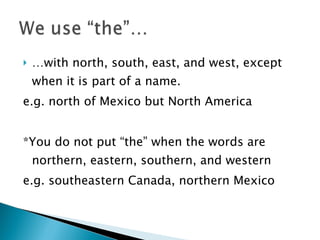
… with north, south, east, and west, except when it is part of a name.  e.g. north of Mexico but North America  *You do not put “the” when the words are northern, eastern, southern, and western  e.g. southeastern Canada, northern Mexico
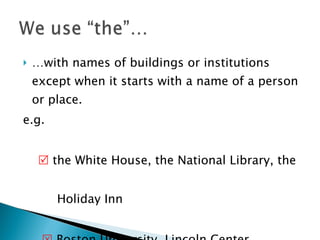
… with names of buildings or institutions except when it starts with a name of a person or place. e.g.     the White House, the National Library, the  Holiday Inn     Boston University, Lincoln Center
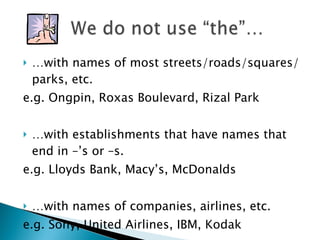
… with names of most streets/roads/squares/parks, etc. e.g. Ongpin, Roxas Boulevard, Rizal Park … with establishments that have names that end in –’s or –s.  e.g. Lloyds Bank, Macy’s, McDonalds  … with names of companies, airlines, etc. e.g. Sony, United Airlines, IBM, Kodak
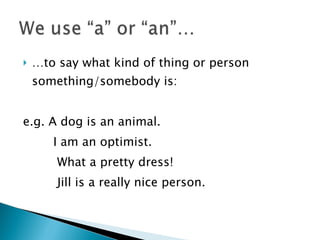
… to say what kind of thing or person something/somebody is:  e.g. A dog is an animal.  I am an optimist. What a pretty dress! Jill is a really nice person.
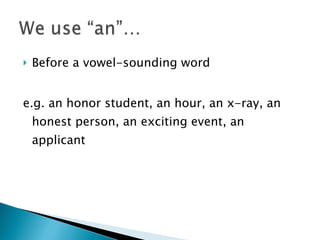
Before a vowel-sounding word e.g. an honor student, an hour, an x-ray, an honest person, an exciting event, an applicant
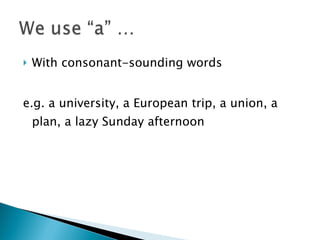
With consonant-sounding words  e.g. a university, a European trip, a union, a plan, a lazy Sunday afternoon
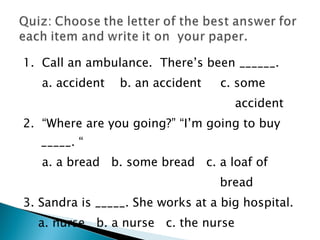
1.  Call an ambulance.  There’s been ______.  a. accident  b. an accident  c. some  accident 2.  “Where are you going?” “I’m going to buy _____. “ a. a bread  b. some bread  c. a loaf of  bread 3. Sandra is _____. She works at a big hospital.  a. nurse  b. a nurse  c. the nurse
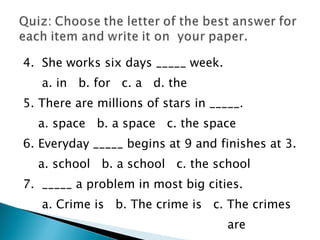
4.  She works six days _____ week. a. in  b. for  c. a  d. the  5. There are millions of stars in _____. a. space  b. a space  c. the space 6. Everyday _____ begins at 9 and finishes at 3. a. school  b. a school  c. the school  7.  _____ a problem in most big cities. a. Crime is  b. The crime is  c. The crimes  are
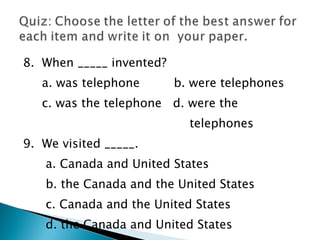
8.  When _____ invented?  a. was telephone  b. were telephones  c. was the telephone  d. were the  telephones 9.  We visited _____.  a. Canada and United States  b. the Canada and the United States  c. Canada and the United States  d. the Canada and United States
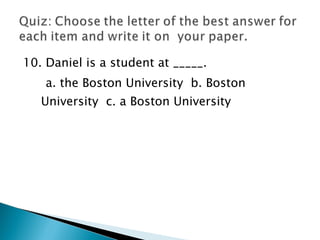
10. Daniel is a student at _____. a. the Boston University  b. Boston University  c. a Boston University
Source:  Grammar In Use: Intermediate 2 nd  edition Authors: Raymond Murphy with William R. Smalzer (Published by Cambridge University Press)

Rules on articles

  • 1.
  • 2.
    I had asandwich and an apple for lunch. The sandwich wasn’t very good, but the apple was delicious. John is talking to Karen on the phone…
  • 3.
  • 4.
    Use “the” whenyou are thinking of a particular thing Use “a” or “an” when talking or describing something for the first time
  • 5.
    Jail/prison highschool Church bed School/college work home
  • 6.
  • 7.
    … to talkabout a type of animal, machine, etc. e.g. Can you play the guitar? The piano is my favorite instrument. Compare “a” e.g. I’d like to have a guitar. We saw a giraffe in the zoo.
  • 8.
    … and anadjective to talk about groups of people ; we also use the with a nationality to mean “the people of that country” e.g. Do you think the rich should pay more taxes to help the poor ? The Chinese invented printing.
  • 9.
    … with namesof countries with Republic, Kingdom, States, etc.: e.g. the Czech Republic, the United Kingdom, the United States of America … with names of oceans, rivers and canals e.g. the Atlantic, the Indian Ocean, The Amazon, The Suez Canal
  • 10.
    … with pluralnames of people and places e.g. the Mitchells, the Johnsons, the Netherlands, the Philippines, the Bahamas, the Rockies, the Andes, the Alps
  • 11.
    … with north,south, east, and west, except when it is part of a name. e.g. north of Mexico but North America *You do not put “the” when the words are northern, eastern, southern, and western e.g. southeastern Canada, northern Mexico
  • 12.
    … with namesof buildings or institutions except when it starts with a name of a person or place. e.g.  the White House, the National Library, the Holiday Inn  Boston University, Lincoln Center
  • 13.
    … with namesof most streets/roads/squares/parks, etc. e.g. Ongpin, Roxas Boulevard, Rizal Park … with establishments that have names that end in –’s or –s. e.g. Lloyds Bank, Macy’s, McDonalds … with names of companies, airlines, etc. e.g. Sony, United Airlines, IBM, Kodak
  • 14.
    … to saywhat kind of thing or person something/somebody is: e.g. A dog is an animal. I am an optimist. What a pretty dress! Jill is a really nice person.
  • 15.
    Before a vowel-soundingword e.g. an honor student, an hour, an x-ray, an honest person, an exciting event, an applicant
  • 16.
    With consonant-sounding words e.g. a university, a European trip, a union, a plan, a lazy Sunday afternoon
  • 17.
    1. Callan ambulance. There’s been ______. a. accident b. an accident c. some accident 2. “Where are you going?” “I’m going to buy _____. “ a. a bread b. some bread c. a loaf of bread 3. Sandra is _____. She works at a big hospital. a. nurse b. a nurse c. the nurse
  • 18.
    4. Sheworks six days _____ week. a. in b. for c. a d. the 5. There are millions of stars in _____. a. space b. a space c. the space 6. Everyday _____ begins at 9 and finishes at 3. a. school b. a school c. the school 7. _____ a problem in most big cities. a. Crime is b. The crime is c. The crimes are
  • 19.
    8. When_____ invented? a. was telephone b. were telephones c. was the telephone d. were the telephones 9. We visited _____. a. Canada and United States b. the Canada and the United States c. Canada and the United States d. the Canada and United States
  • 20.
    10. Daniel isa student at _____. a. the Boston University b. Boston University c. a Boston University
  • 21.
    Source: GrammarIn Use: Intermediate 2 nd edition Authors: Raymond Murphy with William R. Smalzer (Published by Cambridge University Press)