ARRAIGNMENT and PLEA
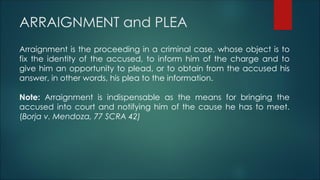
Arraignment is the proceeding in a criminal case, whose object is to
fix the identity of the accused, to inform him of the charge and to
give him an opportunity to plead, or to obtain from the accused his
answer, in other words, his plea to the information.
Note: Arraignment is indispensable as the means for bringing the
accused into court and notifying him of the cause he has to meet.
(Borja v. Mendoza, 77 SCRA 42)
ARRAIGNMENT and PLEA
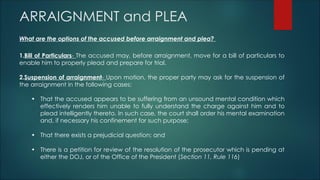
What are the options of the accused before arraignment and plea?
1.Bill of Particulars- The accused may, before arraignment, move for a bill of particulars to
enable him to properly plead and prepare for trial.
2.Suspension of arraignment- Upon motion, the proper party may ask for the suspension of
the arraignment in the following cases:
• That the accused appears to be suffering from an unsound mental condition which
effectively renders him unable to fully understand the charge against him and to
plead intelligently thereto. In such case, the court shall order his mental examination
and, if necessary his confinement for such purpose;
• That there exists a prejudicial question; and
• There is a petition for review of the resolution of the prosecutor which is pending at
either the DOJ, or of the Office of the President (Section 11, Rule 116)
ARRAIGNMENT and PLEA
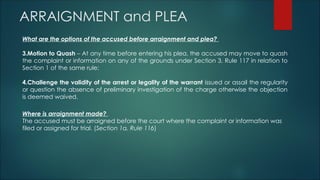
What are the options of the accused before arraignment and plea?
3.Motion to Quash – At any time before entering his plea, the accused may move to quash
the complaint or information on any of the grounds under Section 3, Rule 117 in relation to
Section 1 of the same rule;
4.Challenge the validity of the arrest or legality of the warrant issued or assail the regularity
or question the absence of preliminary investigation of the charge otherwise the objection
is deemed waived.
Where is arraignment made?
The accused must be arraigned before the court where the complaint or information was
filed or assigned for trial. (Section 1a, Rule 116)
ARRAIGNMENT and PLEA
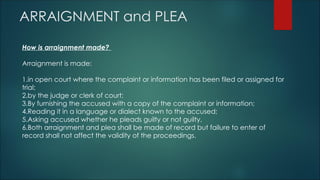
How is arraignment made?
Arraignment is made:
1.in open court where the complaint or information has been filed or assigned for
trial;
2.by the judge or clerk of court;
3.By furnishing the accused with a copy of the complaint or information;
4.Reading it in a language or dialect known to the accused;
5.Asking accused whether he pleads guilty or not guilty.
6.Both arraignment and plea shall be made of record but failure to enter of
record shall not affect the validity of the proceedings.
ARRAIGNMENT and PLEA
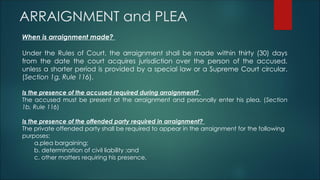
When is arraignment made?
Under the Rules of Court, the arraignment shall be made within thirty (30) days
from the date the court acquires jurisdiction over the person of the accused,
unless a shorter period is provided by a special law or a Supreme Court circular.
(Section 1g, Rule 116).
Is the presence of the accused required during arraignment?
The accused must be present at the arraignment and personally enter his plea. (Section
1b, Rule 116)
Is the presence of the offended party required in arraignment?
The private offended party shall be required to appear in the arraignment for the following
purposes:
a.plea bargaining;
b. determination of civil liability ;and
c. other matters requiring his presence.
ARRAIGNMENT and PLEA
Note: in case the offended party fails to appear despite due notice, the court
may allow the accused to enter a plea of guilty to a lesser offense which is
necessarily included in the offense charged with the conformity of the trial
prosecutor alone. (Section 1f, Rule 116)
What is plea?
It pertains to the matter which the accused, on his arraignment, alleges in answer to the
charge against him.
What is the effect of a plea of guilty?
A plea of guilty is a judicial confession of guilt (People v. Comendador GR No. L-38000,
September 19, 1980). It is an unconditional plea of guilt admits of the crime and all the
attendant circumstances alleged in the information including the allegations of conspiracy
and warrants of judgment of conviction without need of further evidence
ARRAIGNMENT and PLEA
Note: in case the offended party fails to appear despite due notice, the court
may allow the accused to enter a plea of guilty to a lesser offense which is
necessarily included in the offense charged with the conformity of the trial
prosecutor alone. (Section 1f, Rule 116)
What is plea?
It pertains to the matter which the accused, on his arraignment, alleges in answer to the
charge against him.
What is the effect of a plea of guilty?
A plea of guilty is a judicial confession of guilt (People v. Comendador GR No. L-38000,
September 19, 1980). It is an unconditional plea of guilt admits of the crime and all the
attendant circumstances alleged in the information including the allegations of conspiracy
and warrants of judgment of conviction without need of further evidence
ARRAIGNMENT and PLEA
WHEN SHOULD PLEA OF NOT GUILTY BE ENTERED
1.When the accused so pleaded;
2.When he refuses to plead;
3.Where in admitting the act charged he sets up matters of defense or with lawful
justification;
4.When he enters a conditional plea of guilty;
5.Where after a plea of guilty he introduces evidence of self- defense or other exculpatory
circumstances;
6.When the plea is indefinite or ambiguous.
WHEN MAY ACCUSED ENTER A PLEA OF GUILTY TO A LESSER OFFENSE
Plea bargaining in criminal cases is a process whereby the accused and the prosecution
work a mutually satisfactory disposition of the case subject to court approval.
It usually involves the defendant’s pleading guilty to a lesser offense or to only one or some
of the counts of a multi- count indictment in return for a lighter sentence than that for the
graver charge (Daan v. Sandiganbayan GR No. 163972-77, March 28, 2008).
ARRAIGNMENT and PLEA
May the accused enter a plea of guilty to a lower offense?
Yes:
1. During arraignment
a) If the offended party is present, the latter must consent with the prosecutor
consented plea; and
b) That the lesser offense is necessarily included in the offense charged.
2. After arraignmentbut beforetrial provided the following requisites are present:
a) The plea of guilty is withdrawn;
b) The plea of not guilty and the withdrawal of the previous guilty plea shall be made
before trial;
c) The lesser offense is necessarily included in the offense charged; and
d) The plea must have the consent of the prosecutor and the offended party (Section
2, Rule 116)
Note: No amendment of complaint or information is necessary (Sec. 2).
3. After prosecution rests – allowed only when the prosecution does not have
sufficient evidence to establish guilt for the crime charged.
ARRAIGNMENT and PLEA
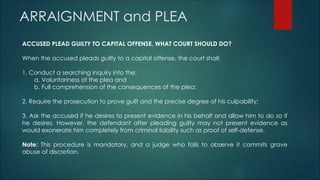
ACCUSED PLEAD GUILTY TO CAPITAL OFFENSE, WHAT COURT SHOULD DO?
When the accused pleads guilty to a capital offense, the court shall:
1. Conduct a searching inquiry into the:
a. Voluntariness of the plea and
b. Full comprehension of the consequences of the plea;
2. Require the prosecution to prove guilt and the precise degree of his culpability;
3. Ask the accused if he desires to present evidence in his behalf and allow him to do so if
he desires. However, the defendant after pleading guilty may not present evidence as
would exonerate him completely from criminal liability such as proof of self-defense.
Note: This procedure is mandatory, and a judge who fails to observe it commits grave
abuse of discretion.
ARRAIGNMENT and PLEA
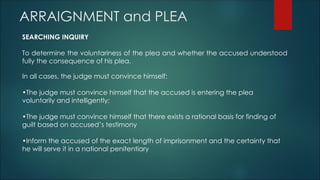
SEARCHING INQUIRY
To determine the voluntariness of the plea and whether the accused understood
fully the consequence of his plea.
In all cases, the judge must convince himself:
•The judge must convince himself that the accused is entering the plea
voluntarily and intelligently;
•The judge must convince himself that there exists a rational basis for finding of
guilt based on accused’s testimony
•Inform the accused of the exact length of imprisonment and the certainty that
he will serve it in a national penitentiary
ARRAIGNMENT and PLEA
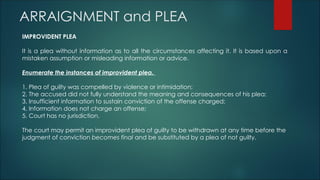
IMPROVIDENT PLEA
It is a plea without information as to all the circumstances affecting it. It is based upon a
mistaken assumption or misleading information or advice.
Enumerate the instances of improvident plea.
1. Plea of guilty was compelled by violence or intimidation;
2. The accused did not fully understand the meaning and consequences of his plea;
3. Insufficient information to sustain conviction of the offense charged;
4. Information does not charge an offense;
5. Court has no jurisdiction.
The court may permit an improvident plea of guilty to be withdrawn at any time before the
judgment of conviction becomes final and be substituted by a plea of not guilty.
Rules on ARRAIGNMENT-and-PLEA in the Phils.ppt

  • 1.
    ARRAIGNMENT and PLEA Arraignmentis the proceeding in a criminal case, whose object is to fix the identity of the accused, to inform him of the charge and to give him an opportunity to plead, or to obtain from the accused his answer, in other words, his plea to the information. Note: Arraignment is indispensable as the means for bringing the accused into court and notifying him of the cause he has to meet. (Borja v. Mendoza, 77 SCRA 42)
  • 2.
    ARRAIGNMENT and PLEA Whatare the options of the accused before arraignment and plea? 1.Bill of Particulars- The accused may, before arraignment, move for a bill of particulars to enable him to properly plead and prepare for trial. 2.Suspension of arraignment- Upon motion, the proper party may ask for the suspension of the arraignment in the following cases: • That the accused appears to be suffering from an unsound mental condition which effectively renders him unable to fully understand the charge against him and to plead intelligently thereto. In such case, the court shall order his mental examination and, if necessary his confinement for such purpose; • That there exists a prejudicial question; and • There is a petition for review of the resolution of the prosecutor which is pending at either the DOJ, or of the Office of the President (Section 11, Rule 116)
  • 3.
    ARRAIGNMENT and PLEA Whatare the options of the accused before arraignment and plea? 3.Motion to Quash – At any time before entering his plea, the accused may move to quash the complaint or information on any of the grounds under Section 3, Rule 117 in relation to Section 1 of the same rule; 4.Challenge the validity of the arrest or legality of the warrant issued or assail the regularity or question the absence of preliminary investigation of the charge otherwise the objection is deemed waived. Where is arraignment made? The accused must be arraigned before the court where the complaint or information was filed or assigned for trial. (Section 1a, Rule 116)
  • 4.
    ARRAIGNMENT and PLEA Howis arraignment made? Arraignment is made: 1.in open court where the complaint or information has been filed or assigned for trial; 2.by the judge or clerk of court; 3.By furnishing the accused with a copy of the complaint or information; 4.Reading it in a language or dialect known to the accused; 5.Asking accused whether he pleads guilty or not guilty. 6.Both arraignment and plea shall be made of record but failure to enter of record shall not affect the validity of the proceedings.
  • 5.
    ARRAIGNMENT and PLEA Whenis arraignment made? Under the Rules of Court, the arraignment shall be made within thirty (30) days from the date the court acquires jurisdiction over the person of the accused, unless a shorter period is provided by a special law or a Supreme Court circular. (Section 1g, Rule 116). Is the presence of the accused required during arraignment? The accused must be present at the arraignment and personally enter his plea. (Section 1b, Rule 116) Is the presence of the offended party required in arraignment? The private offended party shall be required to appear in the arraignment for the following purposes: a.plea bargaining; b. determination of civil liability ;and c. other matters requiring his presence.
  • 6.
    ARRAIGNMENT and PLEA Note:in case the offended party fails to appear despite due notice, the court may allow the accused to enter a plea of guilty to a lesser offense which is necessarily included in the offense charged with the conformity of the trial prosecutor alone. (Section 1f, Rule 116) What is plea? It pertains to the matter which the accused, on his arraignment, alleges in answer to the charge against him. What is the effect of a plea of guilty? A plea of guilty is a judicial confession of guilt (People v. Comendador GR No. L-38000, September 19, 1980). It is an unconditional plea of guilt admits of the crime and all the attendant circumstances alleged in the information including the allegations of conspiracy and warrants of judgment of conviction without need of further evidence
  • 7.
    ARRAIGNMENT and PLEA Note:in case the offended party fails to appear despite due notice, the court may allow the accused to enter a plea of guilty to a lesser offense which is necessarily included in the offense charged with the conformity of the trial prosecutor alone. (Section 1f, Rule 116) What is plea? It pertains to the matter which the accused, on his arraignment, alleges in answer to the charge against him. What is the effect of a plea of guilty? A plea of guilty is a judicial confession of guilt (People v. Comendador GR No. L-38000, September 19, 1980). It is an unconditional plea of guilt admits of the crime and all the attendant circumstances alleged in the information including the allegations of conspiracy and warrants of judgment of conviction without need of further evidence
  • 8.
    ARRAIGNMENT and PLEA WHENSHOULD PLEA OF NOT GUILTY BE ENTERED 1.When the accused so pleaded; 2.When he refuses to plead; 3.Where in admitting the act charged he sets up matters of defense or with lawful justification; 4.When he enters a conditional plea of guilty; 5.Where after a plea of guilty he introduces evidence of self- defense or other exculpatory circumstances; 6.When the plea is indefinite or ambiguous. WHEN MAY ACCUSED ENTER A PLEA OF GUILTY TO A LESSER OFFENSE Plea bargaining in criminal cases is a process whereby the accused and the prosecution work a mutually satisfactory disposition of the case subject to court approval. It usually involves the defendant’s pleading guilty to a lesser offense or to only one or some of the counts of a multi- count indictment in return for a lighter sentence than that for the graver charge (Daan v. Sandiganbayan GR No. 163972-77, March 28, 2008).
  • 9.
    ARRAIGNMENT and PLEA Maythe accused enter a plea of guilty to a lower offense? Yes: 1. During arraignment a) If the offended party is present, the latter must consent with the prosecutor consented plea; and b) That the lesser offense is necessarily included in the offense charged. 2. After arraignmentbut beforetrial provided the following requisites are present: a) The plea of guilty is withdrawn; b) The plea of not guilty and the withdrawal of the previous guilty plea shall be made before trial; c) The lesser offense is necessarily included in the offense charged; and d) The plea must have the consent of the prosecutor and the offended party (Section 2, Rule 116) Note: No amendment of complaint or information is necessary (Sec. 2). 3. After prosecution rests – allowed only when the prosecution does not have sufficient evidence to establish guilt for the crime charged.
  • 10.
    ARRAIGNMENT and PLEA ACCUSEDPLEAD GUILTY TO CAPITAL OFFENSE, WHAT COURT SHOULD DO? When the accused pleads guilty to a capital offense, the court shall: 1. Conduct a searching inquiry into the: a. Voluntariness of the plea and b. Full comprehension of the consequences of the plea; 2. Require the prosecution to prove guilt and the precise degree of his culpability; 3. Ask the accused if he desires to present evidence in his behalf and allow him to do so if he desires. However, the defendant after pleading guilty may not present evidence as would exonerate him completely from criminal liability such as proof of self-defense. Note: This procedure is mandatory, and a judge who fails to observe it commits grave abuse of discretion.
  • 11.
    ARRAIGNMENT and PLEA SEARCHINGINQUIRY To determine the voluntariness of the plea and whether the accused understood fully the consequence of his plea. In all cases, the judge must convince himself: •The judge must convince himself that the accused is entering the plea voluntarily and intelligently; •The judge must convince himself that there exists a rational basis for finding of guilt based on accused’s testimony •Inform the accused of the exact length of imprisonment and the certainty that he will serve it in a national penitentiary
  • 12.
    ARRAIGNMENT and PLEA IMPROVIDENTPLEA It is a plea without information as to all the circumstances affecting it. It is based upon a mistaken assumption or misleading information or advice. Enumerate the instances of improvident plea. 1. Plea of guilty was compelled by violence or intimidation; 2. The accused did not fully understand the meaning and consequences of his plea; 3. Insufficient information to sustain conviction of the offense charged; 4. Information does not charge an offense; 5. Court has no jurisdiction. The court may permit an improvident plea of guilty to be withdrawn at any time before the judgment of conviction becomes final and be substituted by a plea of not guilty.