Resourcing and Talent Planning (BUSS 24002) – FALL21 – CW3 (ASSMNT) – ALL-QP
MEC_AMO_TEM_035_04 Page 1 of 15
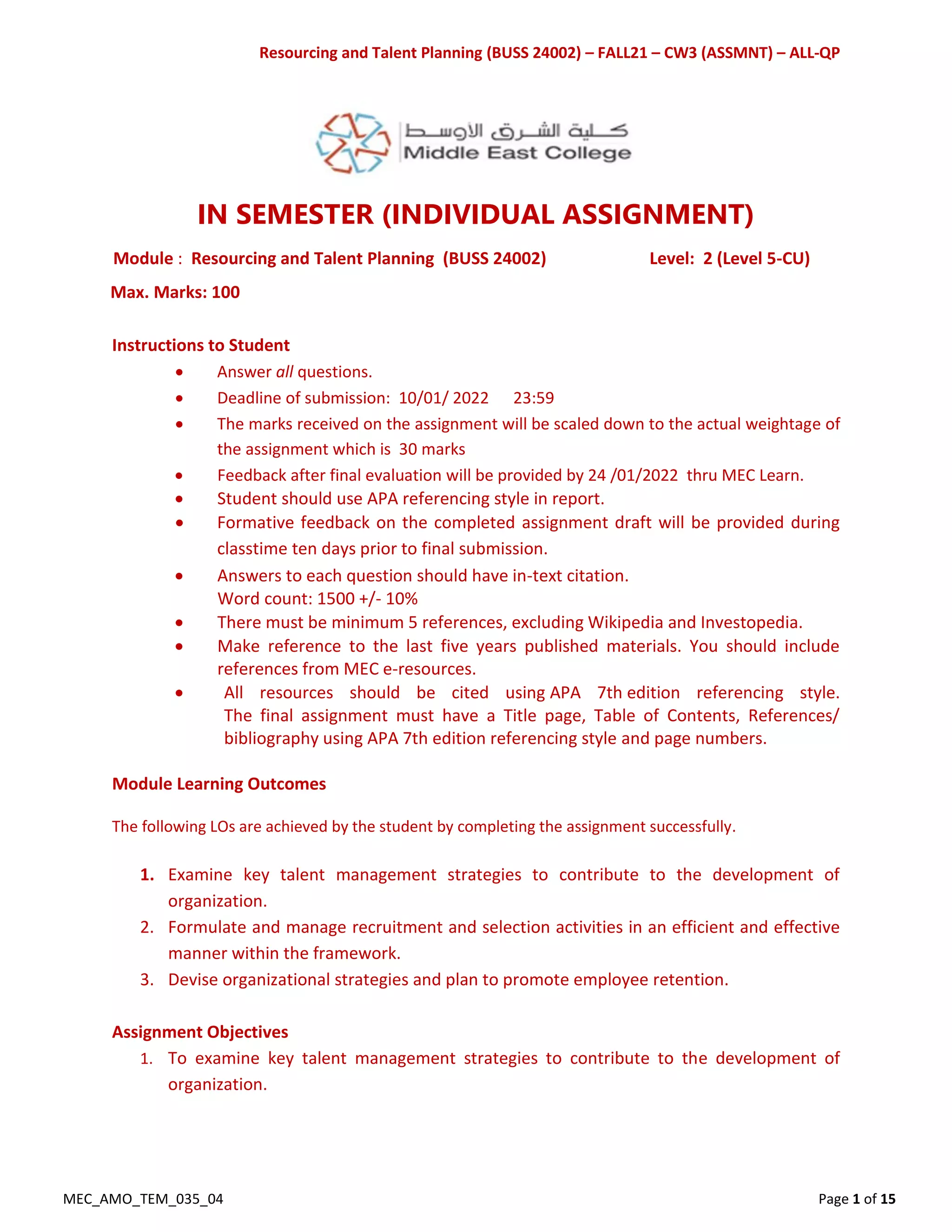
IN SEMESTER (INDIVIDUAL ASSIGNMENT)
Module : Resourcing and Talent Planning (BUSS 24002) Level: 2 (Level 5-CU)
: Max. Marks: 100
Instructions to Student
 Answer all questions.
 Deadline of submission: 10/01/ 2022 23:59
 The marks received on the assignment will be scaled down to the actual weightage of
the assignment which is 30 marks
 Feedback after final evaluation will be provided by 24 /01/2022 thru MEC Learn.
 Student should use APA referencing style in report.
 Formative feedback on the completed assignment draft will be provided during
classtime ten days prior to final submission.
 Answers to each question should have in-text citation.
Word count: 1500 +/- 10%
 There must be minimum 5 references, excluding Wikipedia and Investopedia.
 Make reference to the last five years published materials. You should include
references from MEC e-resources.
 All resources should be cited using APA 7th edition referencing style.
The final assignment must have a Title page, Table of Contents, References/
bibliography using APA 7th edition referencing style and page numbers.
Module Learning Outcomes
The following LOs are achieved by the student by completing the assignment successfully.
1. Examine key talent management strategies to contribute to the development of
organization.
2. Formulate and manage recruitment and selection activities in an efficient and effective
manner within the framework.
3. Devise organizational strategies and plan to promote employee retention.
Assignment Objectives
1. To examine key talent management strategies to contribute to the development of
organization.
Resourcing and Talent Planning (BUSS 24002) – FALL21 – CW3 (ASSMNT) – ALL-QP
MEC_AMO_TEM_035_04 Page 2 of 15
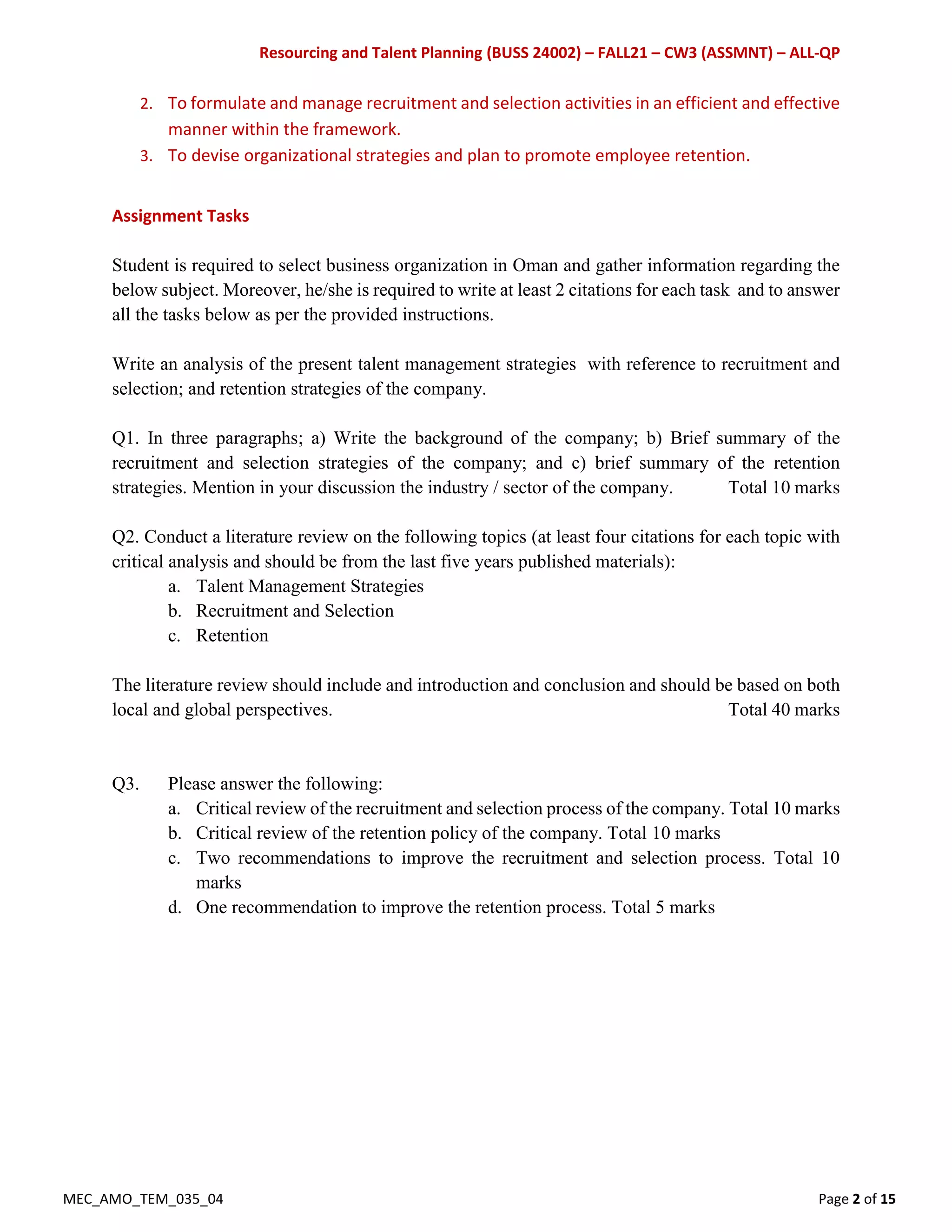
2. To formulate and manage recruitment and selection activities in an efficient and effective
manner within the framework.
3. To devise organizational strategies and plan to promote employee retention.
Assignment Tasks
Student is required to select business organization in Oman and gather information regarding the
below subject. Moreover, he/she is required to write at least 2 citations for each task and to answer
all the tasks below as per the provided instructions.
Write an analysis of the present talent management strategies with reference to recruitment and
selection; and retention strategies of the company.
Q1. In three paragraphs; a) Write the background of the company; b) Brief summary of the
recruitment and selection strategies of the company; and c) brief summary of the retention
strategies. Mention in your discussion the industry / sector of the company. Total 10 marks
Q2. Conduct a literature review on the following topics (at least four citations for each topic with
critical analysis and should be from the last five years published materials):
a. Talent Management Strategies
b. Recruitment and Selection
c. Retention
The literature review should include and introduction and conclusion and should be based on both
local and global perspectives. Total 40 marks
Q3. Please answer the following:
a. Critical review of the recruitment and selection process of the company. Total 10 marks
b. Critical review of the retention policy of the company. Total 10 marks
c. Two recommendations to improve the recruitment and selection process. Total 10
marks
d. One recommendation to improve the retention process. Total 5 marks
Resourcing and Talent Planning (BUSS 24002) – FALL21 – CW3 (ASSMNT) – ALL-QP
MEC_AMO_TEM_035_04 Page 3 of 15
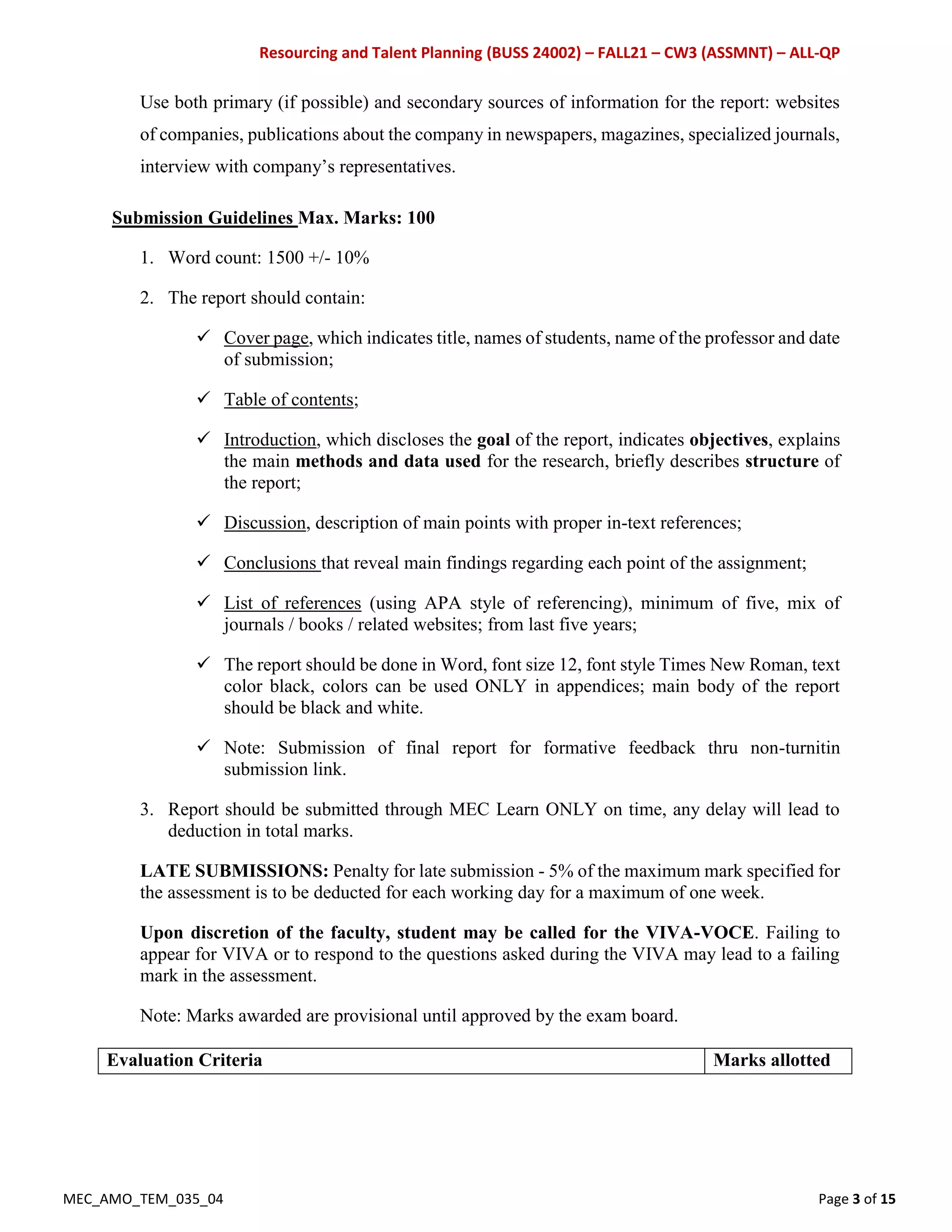
Use both primary (if possible) and secondary sources of information for the report: websites
of companies, publications about the company in newspapers, magazines, specialized journals,
interview with company’s representatives.
Submission Guidelines Max. Marks: 100
1. Word count: 1500 +/- 10%
2. The report should contain:
 Cover page, which indicates title, names of students, name of the professor and date
of submission;
 Table of contents;
 Introduction, which discloses the goal of the report, indicates objectives, explains
the main methods and data used for the research, briefly describes structure of
the report;
 Discussion, description of main points with proper in-text references;
 Conclusions that reveal main findings regarding each point of the assignment;
 List of references (using APA style of referencing), minimum of five, mix of
journals / books / related websites; from last five years;
 The report should be done in Word, font size 12, font style Times New Roman, text
color black, colors can be used ONLY in appendices; main body of the report
should be black and white.
 Note: Submission of final report for formative feedback thru non-turnitin
submission link.
3. Report should be submitted through MEC Learn ONLY on time, any delay will lead to
deduction in total marks.
LATE SUBMISSIONS: Penalty for late submission - 5% of the maximum mark specified for
the assessment is to be deducted for each working day for a maximum of one week.
Upon discretion of the faculty, student may be called for the VIVA-VOCE. Failing to
appear for VIVA or to respond to the questions asked during the VIVA may lead to a failing
mark in the assessment.
Note: Marks awarded are provisional until approved by the exam board.
Evaluation Criteria Marks allotted
Resourcing and Talent Planning (BUSS 24002) – FALL21 – CW3 (ASSMNT) – ALL-QP
MEC_AMO_TEM_035_04 Page 4 of 15
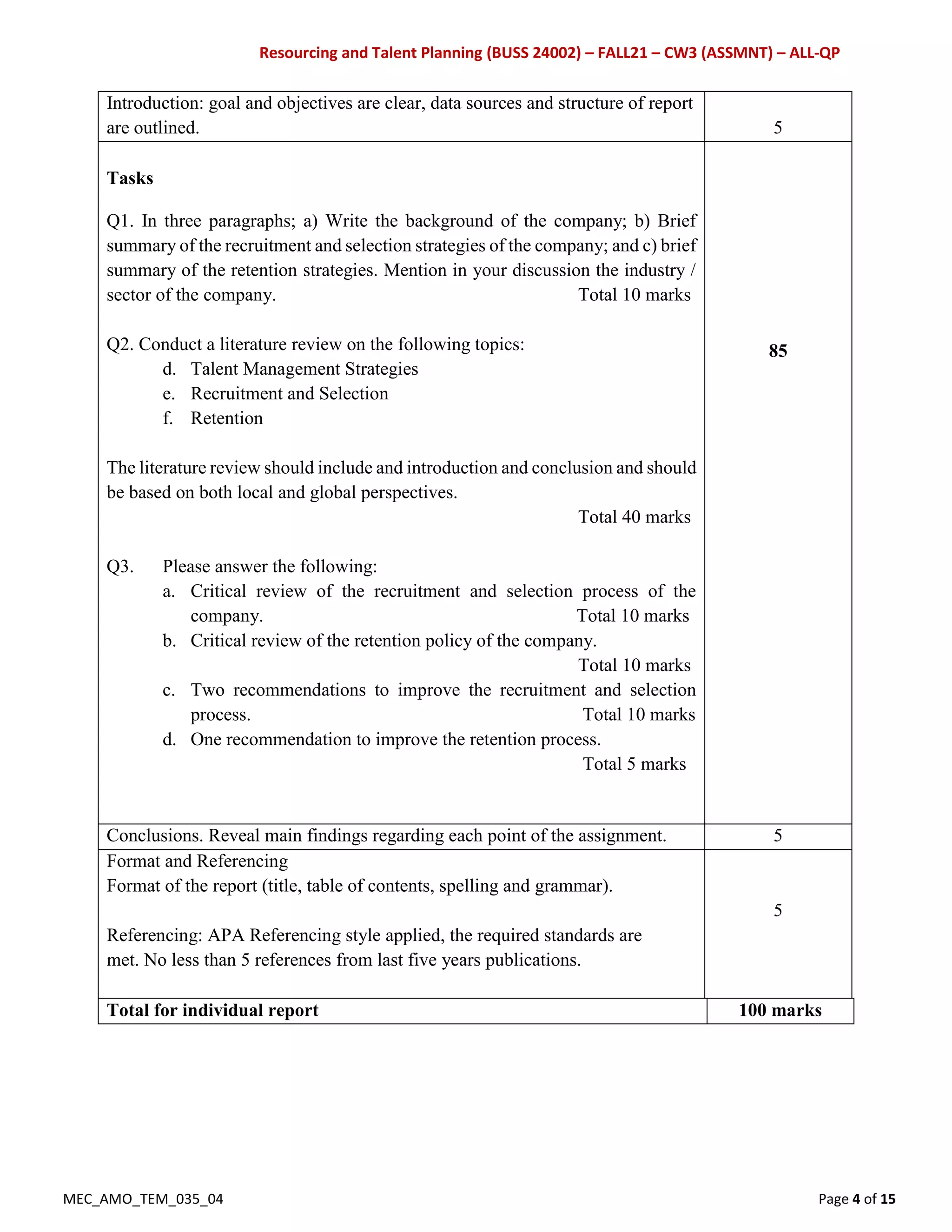
Introduction: goal and objectives are clear, data sources and structure of report
are outlined. 5
Tasks
Q1. In three paragraphs; a) Write the background of the company; b) Brief
summary of the recruitment and selection strategies of the company; and c) brief
summary of the retention strategies. Mention in your discussion the industry /
sector of the company. Total 10 marks
Q2. Conduct a literature review on the following topics:
d. Talent Management Strategies
e. Recruitment and Selection
f. Retention
The literature review should include and introduction and conclusion and should
be based on both local and global perspectives.
Total 40 marks
Q3. Please answer the following:
a. Critical review of the recruitment and selection process of the
company. Total 10 marks
b. Critical review of the retention policy of the company.
Total 10 marks
c. Two recommendations to improve the recruitment and selection
process. Total 10 marks
d. One recommendation to improve the retention process.
Total 5 marks
85
Conclusions. Reveal main findings regarding each point of the assignment. 5
Format and Referencing
Format of the report (title, table of contents, spelling and grammar).
Referencing: APA Referencing style applied, the required standards are
met. No less than 5 references from last five years publications.
5
Total for individual report 100 marks
Resourcing and Talent Planning (BUSS 24002) – FALL21 – CW3 (ASSMNT) – ALL-QP
MEC_AMO_TEM_035_04 Page 5 of 15
Notes to Student:
1. For all assessment parts, student is expected to do an indepth answer with analysis to
qualify for distinction marks.
2. Students should attach the student coursework declaration form in the final submission.
Rules & Regulations:
 All resources should be cited using APA 7th edition referencing style.
 The final assignment must have a Title page, Table of Contents, References/ bibliography
using APA 7th edition referencing style and page numbers.
 Title Page must have Assignment Name, Module name, Session, your name, ID, and the
name of the faculty.
 Softcopy in word format is to be submitted through Turnitin link on MEC Learn (Moodle).
 Viva will be conducted after the assignment submission as per the dates informed earlier.
Guidelines:
 Assignment must be computer typed.
 Font - Times New Roman
 Font – Style - Regular
 Font - Size - 12
 Heading should be with Font Size 14, Bold, Capital and Underline.
 Explain with suitable diagrams wherever required. Diagrams must be drawn using suitable
software or by pencil.
 Each student has to do the assignment individually.
 You can refer on books in E-Library or use internet resource. But you should not cut and
paste material from internet nor provide photocopied material from books. The assignment
answers should be in your own words after understanding the matter from the above
resources.
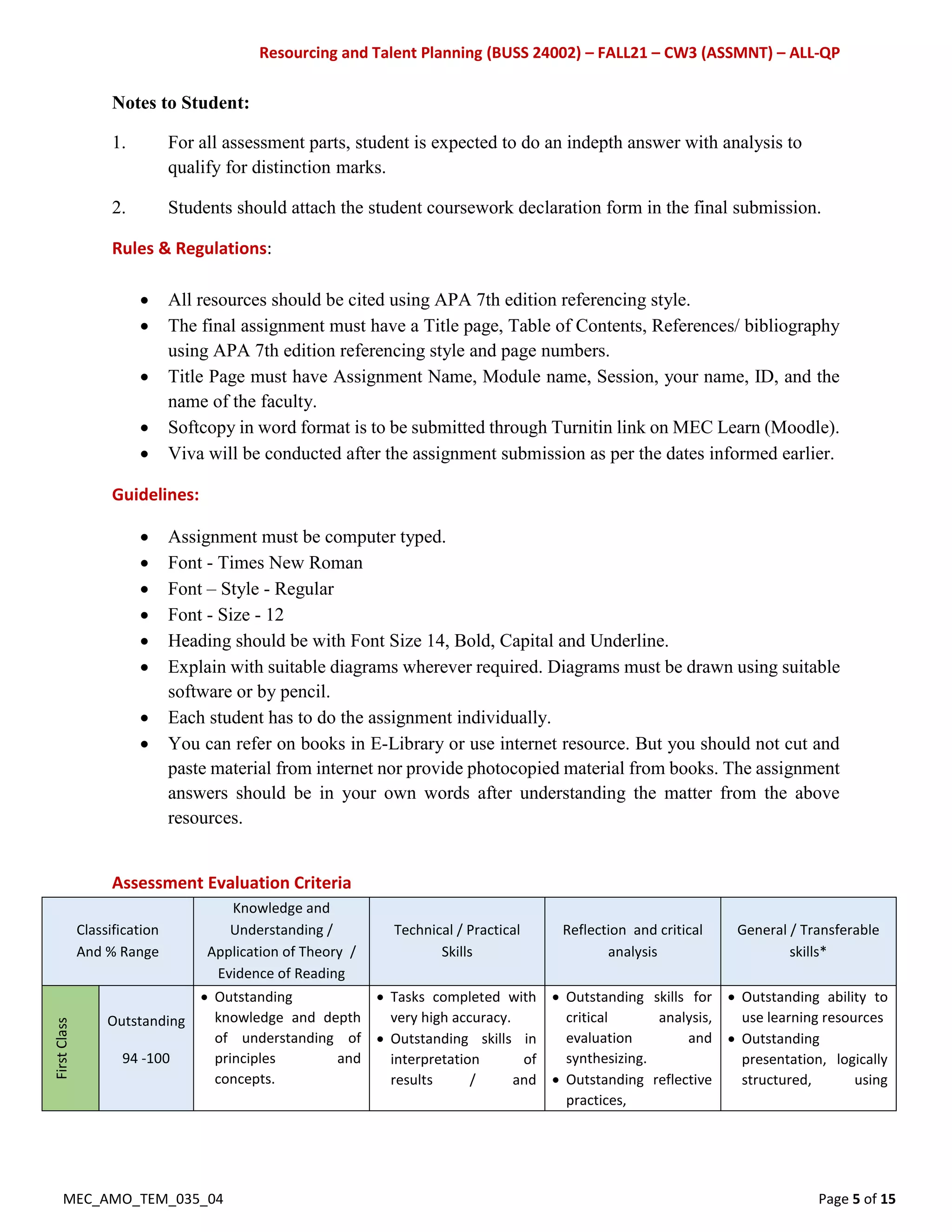
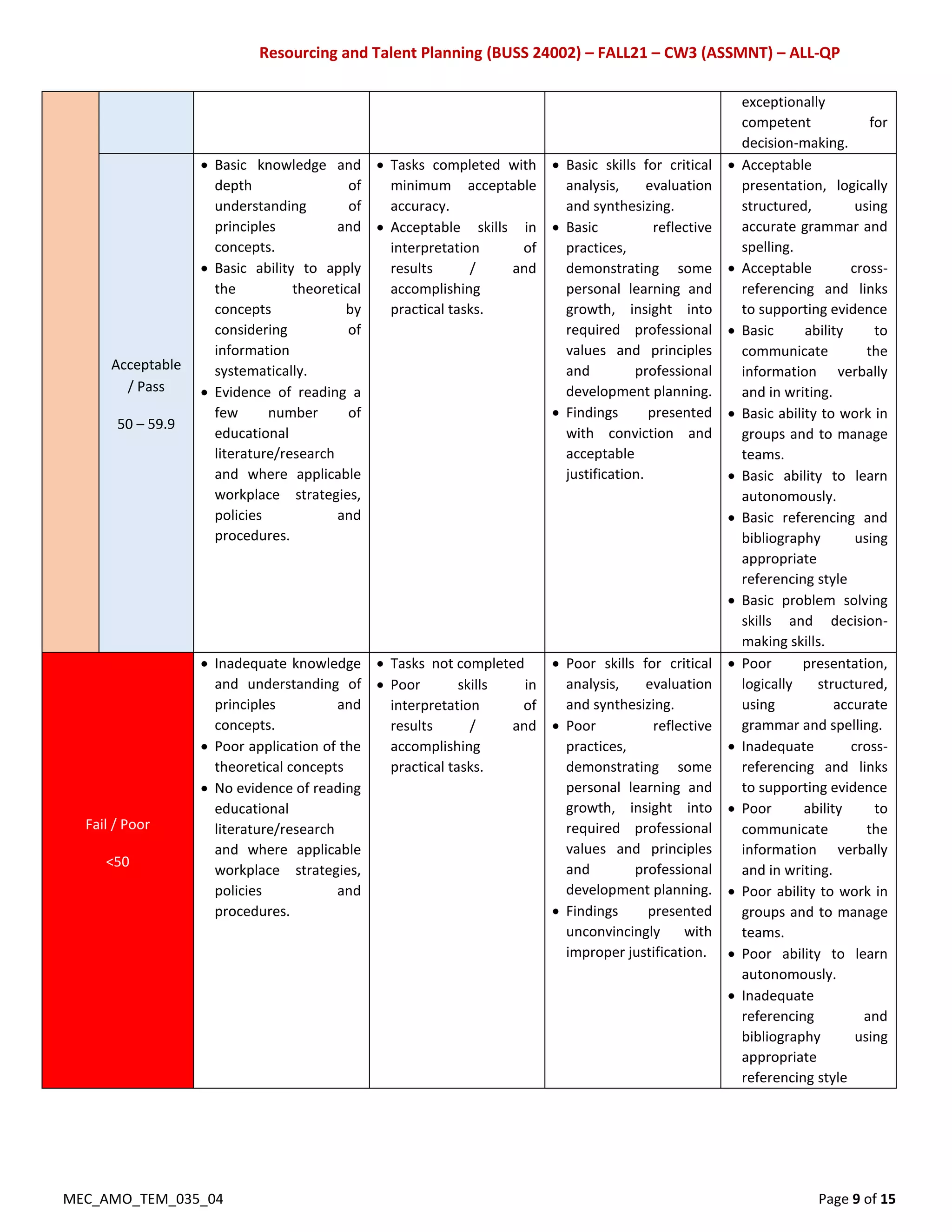
Assessment Evaluation Criteria
Classification
And % Range
Knowledge and
Understanding /
Application of Theory /
Evidence of Reading
Technical / Practical
Skills
Reflection and critical
analysis
General / Transferable
skills*
First
Class
Outstanding
94 -100
 Outstanding
knowledge and depth
of understanding of
principles and
concepts.
 Tasks completed with
very high accuracy.
 Outstanding skills in
interpretation of
results / and
 Outstanding skills for
critical analysis,
evaluation and
synthesizing.
 Outstanding reflective
practices,
 Outstanding ability to
use learning resources
 Outstanding
presentation, logically
structured, using
Resourcing and Talent Planning (BUSS 24002) – FALL21 – CW3 (ASSMNT) – ALL-QP
MEC_AMO_TEM_035_04 Page 6 of 15
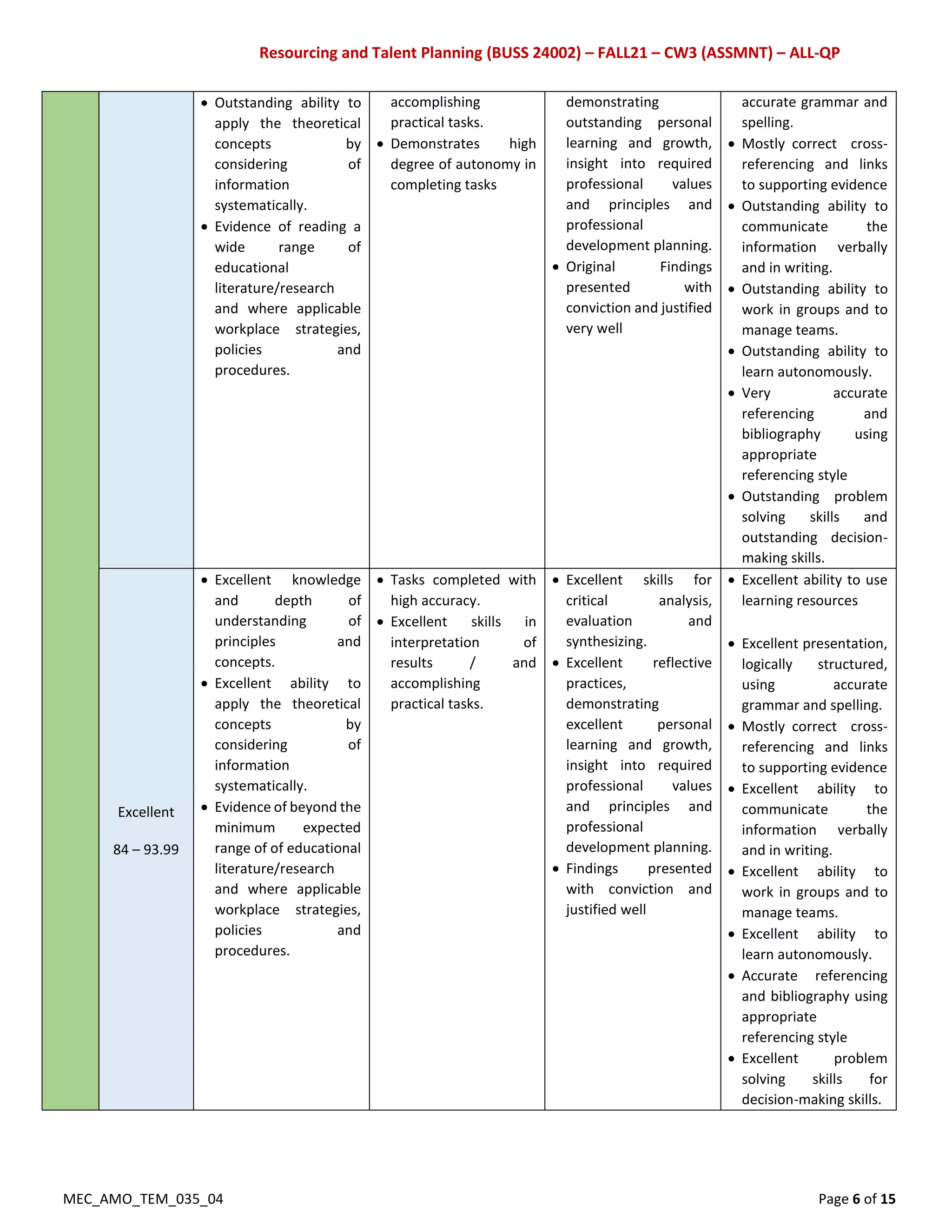
 Outstanding ability to
apply the theoretical
concepts by
considering of
information
systematically.
 Evidence of reading a
wide range of
educational
literature/research
and where applicable
workplace strategies,
policies and
procedures.
accomplishing
practical tasks.
 Demonstrates high
degree of autonomy in
completing tasks
demonstrating
outstanding personal
learning and growth,
insight into required
professional values
and principles and
professional
development planning.
 Original Findings
presented with
conviction and justified
very well
accurate grammar and
spelling.
 Mostly correct cross-
referencing and links
to supporting evidence
 Outstanding ability to
communicate the
information verbally
and in writing.
 Outstanding ability to
work in groups and to
manage teams.
 Outstanding ability to
learn autonomously.
 Very accurate
referencing and
bibliography using
appropriate
referencing style
 Outstanding problem
solving skills and
outstanding decision-
making skills.
Excellent
84 – 93.99
 Excellent knowledge
and depth of
understanding of
principles and
concepts.
 Excellent ability to
apply the theoretical
concepts by
considering of
information
systematically.
 Evidence of beyond the
minimum expected
range of of educational
literature/research
and where applicable
workplace strategies,
policies and
procedures.
 Tasks completed with
high accuracy.
 Excellent skills in
interpretation of
results / and
accomplishing
practical tasks.
 Excellent skills for
critical analysis,
evaluation and
synthesizing.
 Excellent reflective
practices,
demonstrating
excellent personal
learning and growth,
insight into required
professional values
and principles and
professional
development planning.
 Findings presented
with conviction and
justified well
 Excellent ability to use
learning resources
 Excellent presentation,
logically structured,
using accurate
grammar and spelling.
 Mostly correct cross-
referencing and links
to supporting evidence
 Excellent ability to
communicate the
information verbally
and in writing.
 Excellent ability to
work in groups and to
manage teams.
 Excellent ability to
learn autonomously.
 Accurate referencing
and bibliography using
appropriate
referencing style
 Excellent problem
solving skills for
decision-making skills.
Resourcing and Talent Planning (BUSS 24002) – FALL21 – CW3 (ASSMNT) – ALL-QP
MEC_AMO_TEM_035_04 Page 7 of 15
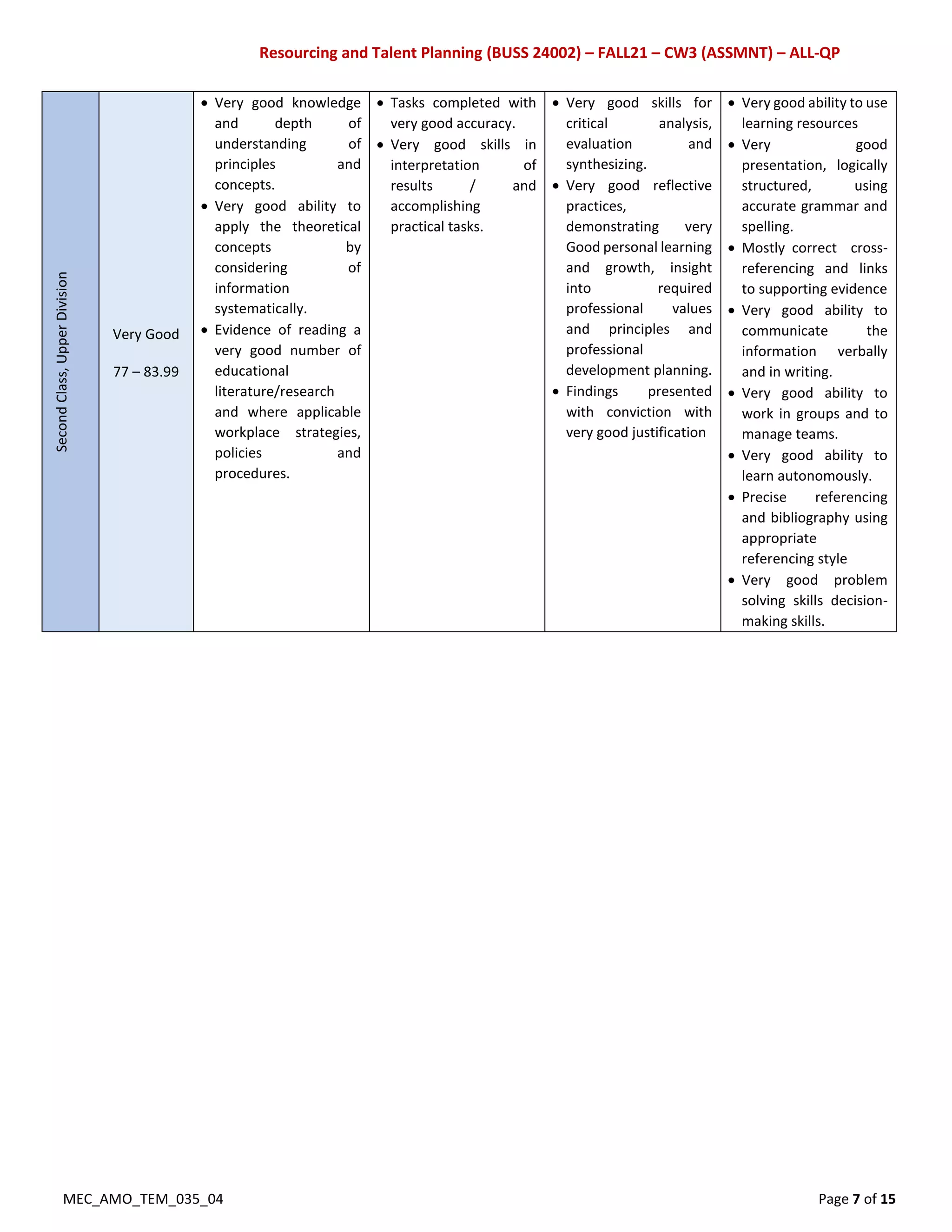
Second
Class,
Upper
Division
Very Good
77 – 83.99
 Very good knowledge
and depth of
understanding of
principles and
concepts.
 Very good ability to
apply the theoretical
concepts by
considering of
information
systematically.
 Evidence of reading a
very good number of
educational
literature/research
and where applicable
workplace strategies,
policies and
procedures.
 Tasks completed with
very good accuracy.
 Very good skills in
interpretation of
results / and
accomplishing
practical tasks.
 Very good skills for
critical analysis,
evaluation and
synthesizing.
 Very good reflective
practices,
demonstrating very
Good personal learning
and growth, insight
into required
professional values
and principles and
professional
development planning.
 Findings presented
with conviction with
very good justification
 Very good ability to use
learning resources
 Very good
presentation, logically
structured, using
accurate grammar and
spelling.
 Mostly correct cross-
referencing and links
to supporting evidence
 Very good ability to
communicate the
information verbally
and in writing.
 Very good ability to
work in groups and to
manage teams.
 Very good ability to
learn autonomously.
 Precise referencing
and bibliography using
appropriate
referencing style
 Very good problem
solving skills decision-
making skills.
Resourcing and Talent Planning (BUSS 24002) – FALL21 – CW3 (ASSMNT) – ALL-QP
MEC_AMO_TEM_035_04 Page 8 of 15
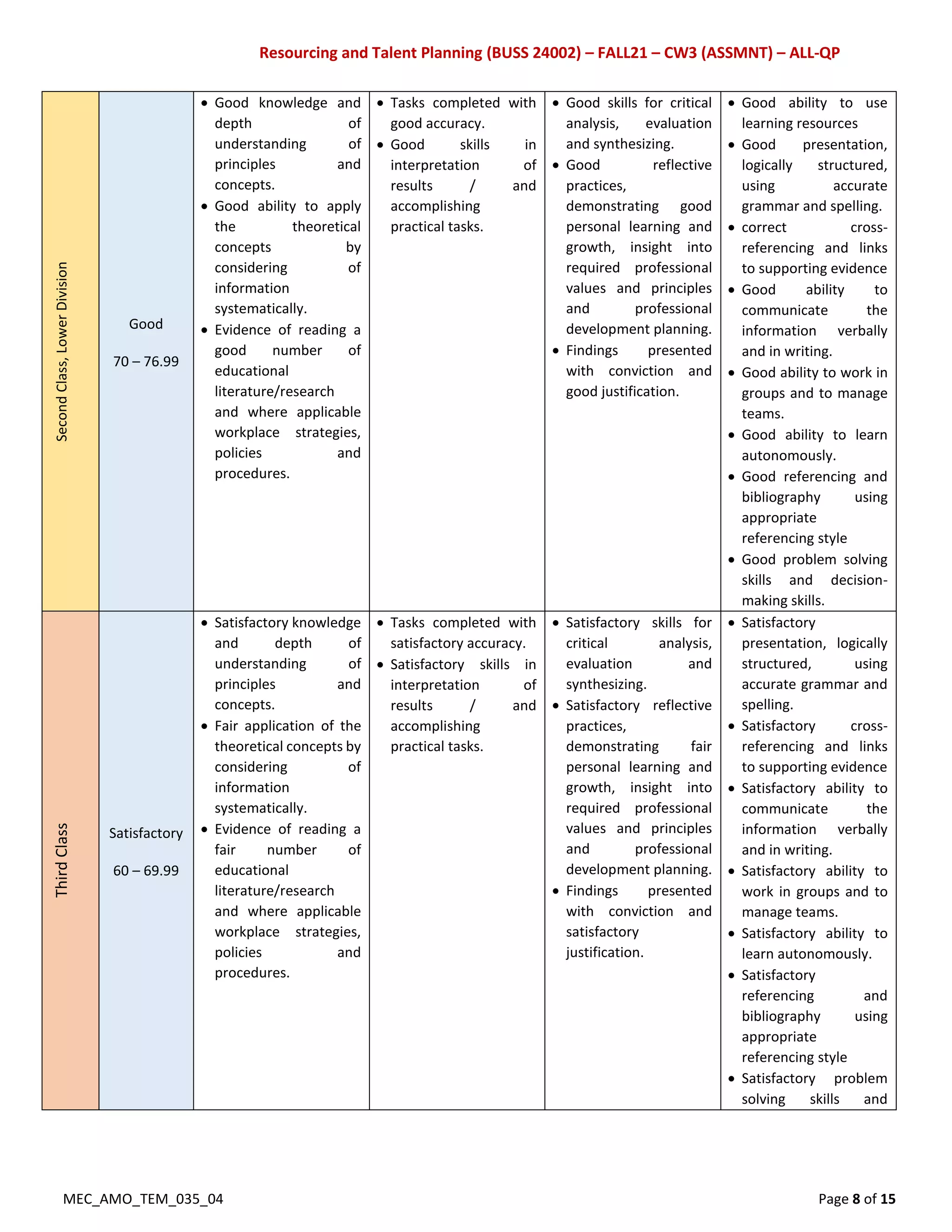
Second
Class,
Lower
Division
Good
70 – 76.99
 Good knowledge and
depth of
understanding of
principles and
concepts.
 Good ability to apply
the theoretical
concepts by
considering of
information
systematically.
 Evidence of reading a
good number of
educational
literature/research
and where applicable
workplace strategies,
policies and
procedures.
 Tasks completed with
good accuracy.
 Good skills in
interpretation of
results / and
accomplishing
practical tasks.
 Good skills for critical
analysis, evaluation
and synthesizing.
 Good reflective
practices,
demonstrating good
personal learning and
growth, insight into
required professional
values and principles
and professional
development planning.
 Findings presented
with conviction and
good justification.
 Good ability to use
learning resources
 Good presentation,
logically structured,
using accurate
grammar and spelling.
 correct cross-
referencing and links
to supporting evidence
 Good ability to
communicate the
information verbally
and in writing.
 Good ability to work in
groups and to manage
teams.
 Good ability to learn
autonomously.
 Good referencing and
bibliography using
appropriate
referencing style
 Good problem solving
skills and decision-
making skills.
Third
Class
Satisfactory
60 – 69.99
 Satisfactory knowledge
and depth of
understanding of
principles and
concepts.
 Fair application of the
theoretical concepts by
considering of
information
systematically.
 Evidence of reading a
fair number of
educational
literature/research
and where applicable
workplace strategies,
policies and
procedures.
 Tasks completed with
satisfactory accuracy.
 Satisfactory skills in
interpretation of
results / and
accomplishing
practical tasks.
 Satisfactory skills for
critical analysis,
evaluation and
synthesizing.
 Satisfactory reflective
practices,
demonstrating fair
personal learning and
growth, insight into
required professional
values and principles
and professional
development planning.
 Findings presented
with conviction and
satisfactory
justification.
 Satisfactory
presentation, logically
structured, using
accurate grammar and
spelling.
 Satisfactory cross-
referencing and links
to supporting evidence
 Satisfactory ability to
communicate the
information verbally
and in writing.
 Satisfactory ability to
work in groups and to
manage teams.
 Satisfactory ability to
learn autonomously.
 Satisfactory
referencing and
bibliography using
appropriate
referencing style
 Satisfactory problem
solving skills and
Resourcing and Talent Planning (BUSS 24002) – FALL21 – CW3 (ASSMNT) – ALL-QP
MEC_AMO_TEM_035_04 Page 9 of 15
exceptionally
competent for
decision-making.
Acceptable
/ Pass
50 – 59.9
 Basic knowledge and
depth of
understanding of
principles and
concepts.
 Basic ability to apply
the theoretical
concepts by
considering of
information
systematically.
 Evidence of reading a
few number of
educational
literature/research
and where applicable
workplace strategies,
policies and
procedures.
 Tasks completed with
minimum acceptable
accuracy.
 Acceptable skills in
interpretation of
results / and
accomplishing
practical tasks.
 Basic skills for critical
analysis, evaluation
and synthesizing.
 Basic reflective
practices,
demonstrating some
personal learning and
growth, insight into
required professional
values and principles
and professional
development planning.
 Findings presented
with conviction and
acceptable
justification.
 Acceptable
presentation, logically
structured, using
accurate grammar and
spelling.
 Acceptable cross-
referencing and links
to supporting evidence
 Basic ability to
communicate the
information verbally
and in writing.
 Basic ability to work in
groups and to manage
teams.
 Basic ability to learn
autonomously.
 Basic referencing and
bibliography using
appropriate
referencing style
 Basic problem solving
skills and decision-
making skills.
Fail / Poor
<50
 Inadequate knowledge
and understanding of
principles and
concepts.
 Poor application of the
theoretical concepts
 No evidence of reading
educational
literature/research
and where applicable
workplace strategies,
policies and
procedures.
 Tasks not completed
 Poor skills in
interpretation of
results / and
accomplishing
practical tasks.
 Poor skills for critical
analysis, evaluation
and synthesizing.
 Poor reflective
practices,
demonstrating some
personal learning and
growth, insight into
required professional
values and principles
and professional
development planning.
 Findings presented
unconvincingly with
improper justification.
 Poor presentation,
logically structured,
using accurate
grammar and spelling.
 Inadequate cross-
referencing and links
to supporting evidence
 Poor ability to
communicate the
information verbally
and in writing.
 Poor ability to work in
groups and to manage
teams.
 Poor ability to learn
autonomously.
 Inadequate
referencing and
bibliography using
appropriate
referencing style
Resourcing and Talent Planning (BUSS 24002) – FALL21 – CW3 (ASSMNT) – ALL-QP
MEC_AMO_TEM_035_04 Page 10 of 15
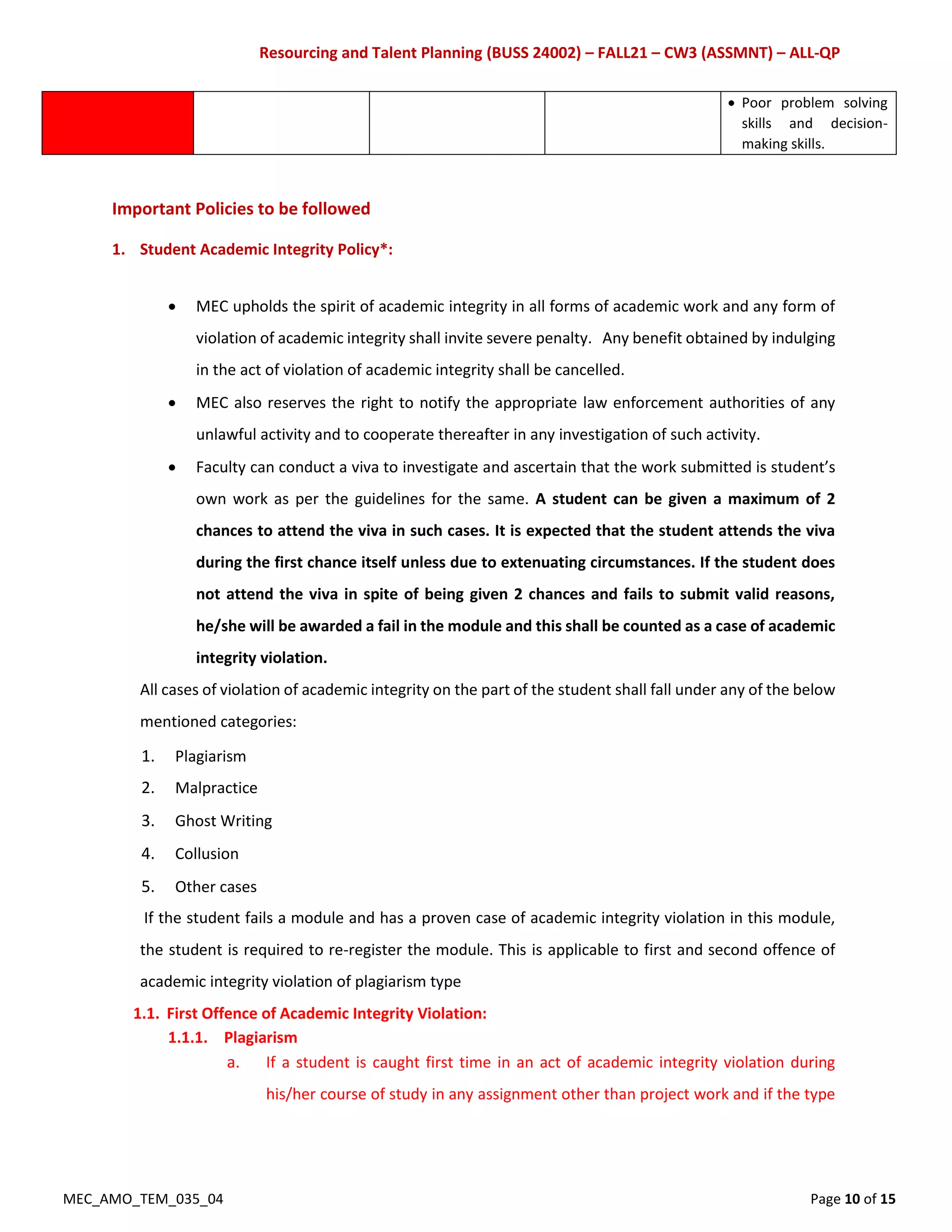
 Poor problem solving
skills and decision-
making skills.
Important Policies to be followed
1. Student Academic Integrity Policy*:
 MEC upholds the spirit of academic integrity in all forms of academic work and any form of
violation of academic integrity shall invite severe penalty. Any benefit obtained by indulging
in the act of violation of academic integrity shall be cancelled.
 MEC also reserves the right to notify the appropriate law enforcement authorities of any
unlawful activity and to cooperate thereafter in any investigation of such activity.
 Faculty can conduct a viva to investigate and ascertain that the work submitted is student’s
own work as per the guidelines for the same. A student can be given a maximum of 2
chances to attend the viva in such cases. It is expected that the student attends the viva
during the first chance itself unless due to extenuating circumstances. If the student does
not attend the viva in spite of being given 2 chances and fails to submit valid reasons,
he/she will be awarded a fail in the module and this shall be counted as a case of academic
integrity violation.
All cases of violation of academic integrity on the part of the student shall fall under any of the below
mentioned categories:
1. Plagiarism
2. Malpractice
3. Ghost Writing
4. Collusion
5. Other cases
If the student fails a module and has a proven case of academic integrity violation in this module,
the student is required to re-register the module. This is applicable to first and second offence of
academic integrity violation of plagiarism type
1.1. First Offence of Academic Integrity Violation:
1.1.1. Plagiarism
a. If a student is caught first time in an act of academic integrity violation during
his/her course of study in any assignment other than project work and if the type
Resourcing and Talent Planning (BUSS 24002) – FALL21 – CW3 (ASSMNT) – ALL-QP
MEC_AMO_TEM_035_04 Page 11 of 15
of violation is plagiarism, then the student will be allowed to re-submit the
assignment once as per the period allowed for re submission However, a penalty
of deduction of 25% of the marks obtained for the resubmitted work will be
imposed.
b. Period of re-submission: The student will have to re-submit the work within one
week (5 working days) from the date he or she is advised to re-submit.
c. Re-submission of the work beyond the allowed period of resubmission will not be
accepted and the assessment will be awarded a zero mark.
d. If the re-submitted work (within the allowed period of resubmission) is also found
to be plagiarized, then that assessment component will be awarded a zero mark.
It shall also contribute to the total count of academic integrity violation for that
student.
e. If plagiarism is detected in UG Project work (Project 1, Project Planning and Project
Design and Implementation), the above clauses do not apply, and the work will be
summarily rejected. In these cases the student will be awarded a fail (F) grade and
is required to reregister the module.
1.1.2. Malpractice / Ghostwriting / Collusion
If a student is caught first time in an act academic integrity violation during his/her course
of study for an assessment component irrespective of coursework or end semester and
if the type of violation is Malpractice/Ghostwriting/Collusion, then the student shall fail
the module.
1.2. Second Offence of Academic Integrity Violation:
1.2.1. Plagiarism
a. If any student is caught second time in an act of academic integrity violation during
his/her course of study and if the type of violation is plagiarism, then the student
will not be allowed to resubmit the work, and s/he will directly be awarded zero
for the work in which plagiarism is detected.
b. The student shall also receive a warning of suspension in such cases.
1.2.2. Malpractice/Ghostwriting/Collusion
a. If a student is caught a second time in an act academic integrity violation for an
assessment component irrespective of coursework or end semester and if the type
of violation is Malpractice/Ghostwriting/Collusion, then the student shall fail the
module.
Resourcing and Talent Planning (BUSS 24002) – FALL21 – CW3 (ASSMNT) – ALL-QP
MEC_AMO_TEM_035_04 Page 12 of 15
b. The student shall also receive a warning of suspension in such cases.
1.3. Third Offence of Academic Integrity Violation:
a. If a student is caught a third time in an act of academic integrity violation for an
assessment component irrespective of coursework or end semester then the student
shall fail the module and also shall be suspended for one semester from the College,
once the academic integrity violation case is confirmed by Institutional Assessment
Review Committee.
b. The student shall be suspended for the immediate subsequent semester and can
register for modules only after having served the suspension period fully. This is also
applicable for semesters offered in block mode.
c. During the suspension period, the student shall have to mandatorily complete a course
on academic integrity/writing before s/he can register for any modules.
d. During the period of suspension, the student shall be allowed to attempt
supplementary examinations if s/he is eligible for the same. S/he shall also be allowed
access to all college facilities permitted for a regular student except for registering the
modules.
1.4. Fourth Offence of Academic Integrity Violation:
a. If a student is caught a fourth time in an act of academic integrity violation for an
assessment component irrespective of coursework or end semester, the student shall
fail the module and also shall be expelled from the College, once the case is confirmed
by Institutional Assessment Review Committee.
b. The student shall be expelled from the college and all access to the college facilities
and premises shall cease to exist. The documents shall be released only after getting
the NOC (No Objection Certificate) from Registration Office.
c. `On termination, the student shall not be refunded any fees paid for the academic
semester in which academic integrity violation was observed.
1.5. Other cases
If a student commits an act of academic integrity violation as per the definition of “other
cases” mentioned in the previous section or of a different nature, student’s case shall be
forwarded to an Institutional Assessment Review Committee, Chaired by the Associate
Dean, Academic Affairs. The committee shall investigate the case by means of a viva and/or
a hearing of the parties concerned if required and shall take appropriate decision. The
penalty that can be granted to a proven case of academic integrity violation which falls in
this category of “other cases” can be a warning/component zero/ module
fail/suspension/expulsion depending on the nature and gravity of the offence.
1.6. Types/Variations of cases of Plagiarism and associated actions
Type 1: In case plagiarism is detected in any component or part submission (submitted at
different times) of one assessment (assignment), the deduction in marks will be applicable
for the whole assessment (assignment), even if only the component or part submission alone
needs to be resubmitted.
Type 2: In case plagiarism is detected in a group assessment, all students of the group will be
considered as having committed an act of plagiarism irrespective of whether plagiarism is on
Resourcing and Talent Planning (BUSS 24002) – FALL21 – CW3 (ASSMNT) – ALL-QP
MEC_AMO_TEM_035_04 Page 13 of 15
account of the act of all or a few or only one member. The policy will then be applied to all
students.
If some students in the group are eligible to re-submit (first offence) and others are not
eligible, only eligible students will be allowed to re-submit within a period of one week and
the penalty will be applied as per the policy for each student according to his / her history of
violations.
Type 3: Combination of Type 1 and Type 2: In case plagiarism is detected in any component
or part submission (submitted at different times) of a group assessment (assignment), the
deduction in marks will be applicable for the whole assessment (assignment), even if only the
component or part submission alone needs to be resubmitted. All students of the group
would be considered as having committed an act of plagiarism irrespective of whether
plagiarism is on account of the act of all or a few or only one member. The policy will then be
applied to all the students of the group.
If some students in the group are eligible to re-submit (first offence) and others are not
eligible, only eligible students will be allowed to re-submit within a period of one week and
the penalty will be applied as per the policy for each student according to his / her history of
violation.
Type 4: Variation of Type 1 and Type 2: In cases where the assessment consists of
components or part submissions that could be a group assessment component (e.g. group
assignment) and an individual assessment component (e.g. individual reflection), the
following will be applicable:
a. If plagiarism is detected in the group assessment component, all students of the group will
be considered as having committed an act of plagiarism, irrespective of whether plagiarism
is on account of the act of all or a few or only one member. The policy will then be applied to
all students of the group. In such cases the group assessment component will be resubmitted.
If some students in the group are eligible to re-submit (first offence) and others are not
eligible, only eligible students will be allowed to re-submit within a period of one week and
the penalty will be applied for each student according to his / her history of violation.
b. If plagiarism is detected in the individual assessment component, the individual assessment
component will be resubmitted - if the student is eligible for resubmission-. The policy will
then be applied to that student alone.
c. In both cases (a) and/or (b), the deduction in marks will be applicable for the whole
assessment (assignment).
1.7. Types/Variation of Cases of Multiple Offences
If student is caught with multiple violations of same or different nature in different modules
of the same semester, they will be considered as one offence and student will be penalized
for each violation according to the type of the offence.
Resourcing and Talent Planning (BUSS 24002) – FALL21 – CW3 (ASSMNT) – ALL-QP
MEC_AMO_TEM_035_04 Page 14 of 15
If student is caught with multiple violations of same or different nature in the same module
of the same semester, then they will be considered as different offences and each will
contribute to the overall count of AIV. The student then shall be penalized for each violation
according to the count and type of each offence.
* For further details Refer to MEC Student Academic Integrity Policy in Student Handbook.
2. Late Submission Regulations:
It is the students’ responsibility to check all relevant timelines related to assessments.
As per the Assessment Policy at MEC, late submissions are allowed for one week (5 working days)
for all UG modules with a penalty. In such cases, a deduction of 5% of the marks obtained for the
submitted work shall be imposed for each working day following the last date of submission
till the date of actual submission. Assessment documents submitted beyond a period of one
week (5 working days) after the last date of submission will not be accepted and will be awarded
a zero for that assessment. In cases where the submission has been delayed due to extenuating
circumstances, the student may be permitted to submit the work without imposing the late
submission policy stated above. The extended period of submission will be one week from the
original last date of submission. In such cases, the student is expected to submit the supporting
certificates on or before the original last date of submission of the assessment and the decision
of extension rests with faculty responsible for the assessment .The late submission policy shall be
applied if the student fails to submit the work within one week of the original last date of
submission.
Students may contact their teachers for clarification on specific details of the submission time if
required.
3. Research Ethics and Biosafety Policy
To protect and respect the rights, dignity, health, safety, and privacy of research subjects involved
including the welfare of animals and the integrity of environment, all student projects are
expected to be undertaken as per the MEC Research Ethics and Biosafety Policy. Accordingly the
following shall apply.
 Research and other enterprise activities shall be conducted by maintaining the high ethical
standards consistent with national and international standards and conventions.
 Any research at MEC that is categorized as high-risk research shall be subject to review and
approval by the Research Ethics and Biosafety Committee.
 Research activities involving collection of human or animal tissues and manipulation of microbial,
animal or plant cells shall be subject to review and approval by the Research Ethics and Biosafety
Committee.
Resourcing and Talent Planning (BUSS 24002) – FALL21 – CW3 (ASSMNT) – ALL-QP
MEC_AMO_TEM_035_04 Page 15 of 15
 Participants involved in research must be informed about the purpose of research and intended
uses of research findings. Written consent must be obtained from people involved prior to the
commencement of research.
 Data obtained from participants must be treated with high confidence and should be used only
for the intended purpose of research.

Rtp (buss 24002) fall 21-cw3-all-qp (1)

  • 1.
    Resourcing and TalentPlanning (BUSS 24002) – FALL21 – CW3 (ASSMNT) – ALL-QP MEC_AMO_TEM_035_04 Page 1 of 15 IN SEMESTER (INDIVIDUAL ASSIGNMENT) Module : Resourcing and Talent Planning (BUSS 24002) Level: 2 (Level 5-CU) : Max. Marks: 100 Instructions to Student  Answer all questions.  Deadline of submission: 10/01/ 2022 23:59  The marks received on the assignment will be scaled down to the actual weightage of the assignment which is 30 marks  Feedback after final evaluation will be provided by 24 /01/2022 thru MEC Learn.  Student should use APA referencing style in report.  Formative feedback on the completed assignment draft will be provided during classtime ten days prior to final submission.  Answers to each question should have in-text citation. Word count: 1500 +/- 10%  There must be minimum 5 references, excluding Wikipedia and Investopedia.  Make reference to the last five years published materials. You should include references from MEC e-resources.  All resources should be cited using APA 7th edition referencing style. The final assignment must have a Title page, Table of Contents, References/ bibliography using APA 7th edition referencing style and page numbers. Module Learning Outcomes The following LOs are achieved by the student by completing the assignment successfully. 1. Examine key talent management strategies to contribute to the development of organization. 2. Formulate and manage recruitment and selection activities in an efficient and effective manner within the framework. 3. Devise organizational strategies and plan to promote employee retention. Assignment Objectives 1. To examine key talent management strategies to contribute to the development of organization.
  • 2.
    Resourcing and TalentPlanning (BUSS 24002) – FALL21 – CW3 (ASSMNT) – ALL-QP MEC_AMO_TEM_035_04 Page 2 of 15 2. To formulate and manage recruitment and selection activities in an efficient and effective manner within the framework. 3. To devise organizational strategies and plan to promote employee retention. Assignment Tasks Student is required to select business organization in Oman and gather information regarding the below subject. Moreover, he/she is required to write at least 2 citations for each task and to answer all the tasks below as per the provided instructions. Write an analysis of the present talent management strategies with reference to recruitment and selection; and retention strategies of the company. Q1. In three paragraphs; a) Write the background of the company; b) Brief summary of the recruitment and selection strategies of the company; and c) brief summary of the retention strategies. Mention in your discussion the industry / sector of the company. Total 10 marks Q2. Conduct a literature review on the following topics (at least four citations for each topic with critical analysis and should be from the last five years published materials): a. Talent Management Strategies b. Recruitment and Selection c. Retention The literature review should include and introduction and conclusion and should be based on both local and global perspectives. Total 40 marks Q3. Please answer the following: a. Critical review of the recruitment and selection process of the company. Total 10 marks b. Critical review of the retention policy of the company. Total 10 marks c. Two recommendations to improve the recruitment and selection process. Total 10 marks d. One recommendation to improve the retention process. Total 5 marks
  • 3.
    Resourcing and TalentPlanning (BUSS 24002) – FALL21 – CW3 (ASSMNT) – ALL-QP MEC_AMO_TEM_035_04 Page 3 of 15 Use both primary (if possible) and secondary sources of information for the report: websites of companies, publications about the company in newspapers, magazines, specialized journals, interview with company’s representatives. Submission Guidelines Max. Marks: 100 1. Word count: 1500 +/- 10% 2. The report should contain:  Cover page, which indicates title, names of students, name of the professor and date of submission;  Table of contents;  Introduction, which discloses the goal of the report, indicates objectives, explains the main methods and data used for the research, briefly describes structure of the report;  Discussion, description of main points with proper in-text references;  Conclusions that reveal main findings regarding each point of the assignment;  List of references (using APA style of referencing), minimum of five, mix of journals / books / related websites; from last five years;  The report should be done in Word, font size 12, font style Times New Roman, text color black, colors can be used ONLY in appendices; main body of the report should be black and white.  Note: Submission of final report for formative feedback thru non-turnitin submission link. 3. Report should be submitted through MEC Learn ONLY on time, any delay will lead to deduction in total marks. LATE SUBMISSIONS: Penalty for late submission - 5% of the maximum mark specified for the assessment is to be deducted for each working day for a maximum of one week. Upon discretion of the faculty, student may be called for the VIVA-VOCE. Failing to appear for VIVA or to respond to the questions asked during the VIVA may lead to a failing mark in the assessment. Note: Marks awarded are provisional until approved by the exam board. Evaluation Criteria Marks allotted
  • 4.
    Resourcing and TalentPlanning (BUSS 24002) – FALL21 – CW3 (ASSMNT) – ALL-QP MEC_AMO_TEM_035_04 Page 4 of 15 Introduction: goal and objectives are clear, data sources and structure of report are outlined. 5 Tasks Q1. In three paragraphs; a) Write the background of the company; b) Brief summary of the recruitment and selection strategies of the company; and c) brief summary of the retention strategies. Mention in your discussion the industry / sector of the company. Total 10 marks Q2. Conduct a literature review on the following topics: d. Talent Management Strategies e. Recruitment and Selection f. Retention The literature review should include and introduction and conclusion and should be based on both local and global perspectives. Total 40 marks Q3. Please answer the following: a. Critical review of the recruitment and selection process of the company. Total 10 marks b. Critical review of the retention policy of the company. Total 10 marks c. Two recommendations to improve the recruitment and selection process. Total 10 marks d. One recommendation to improve the retention process. Total 5 marks 85 Conclusions. Reveal main findings regarding each point of the assignment. 5 Format and Referencing Format of the report (title, table of contents, spelling and grammar). Referencing: APA Referencing style applied, the required standards are met. No less than 5 references from last five years publications. 5 Total for individual report 100 marks
  • 5.
    Resourcing and TalentPlanning (BUSS 24002) – FALL21 – CW3 (ASSMNT) – ALL-QP MEC_AMO_TEM_035_04 Page 5 of 15 Notes to Student: 1. For all assessment parts, student is expected to do an indepth answer with analysis to qualify for distinction marks. 2. Students should attach the student coursework declaration form in the final submission. Rules & Regulations:  All resources should be cited using APA 7th edition referencing style.  The final assignment must have a Title page, Table of Contents, References/ bibliography using APA 7th edition referencing style and page numbers.  Title Page must have Assignment Name, Module name, Session, your name, ID, and the name of the faculty.  Softcopy in word format is to be submitted through Turnitin link on MEC Learn (Moodle).  Viva will be conducted after the assignment submission as per the dates informed earlier. Guidelines:  Assignment must be computer typed.  Font - Times New Roman  Font – Style - Regular  Font - Size - 12  Heading should be with Font Size 14, Bold, Capital and Underline.  Explain with suitable diagrams wherever required. Diagrams must be drawn using suitable software or by pencil.  Each student has to do the assignment individually.  You can refer on books in E-Library or use internet resource. But you should not cut and paste material from internet nor provide photocopied material from books. The assignment answers should be in your own words after understanding the matter from the above resources. Assessment Evaluation Criteria Classification And % Range Knowledge and Understanding / Application of Theory / Evidence of Reading Technical / Practical Skills Reflection and critical analysis General / Transferable skills* First Class Outstanding 94 -100  Outstanding knowledge and depth of understanding of principles and concepts.  Tasks completed with very high accuracy.  Outstanding skills in interpretation of results / and  Outstanding skills for critical analysis, evaluation and synthesizing.  Outstanding reflective practices,  Outstanding ability to use learning resources  Outstanding presentation, logically structured, using
  • 6.
    Resourcing and TalentPlanning (BUSS 24002) – FALL21 – CW3 (ASSMNT) – ALL-QP MEC_AMO_TEM_035_04 Page 6 of 15  Outstanding ability to apply the theoretical concepts by considering of information systematically.  Evidence of reading a wide range of educational literature/research and where applicable workplace strategies, policies and procedures. accomplishing practical tasks.  Demonstrates high degree of autonomy in completing tasks demonstrating outstanding personal learning and growth, insight into required professional values and principles and professional development planning.  Original Findings presented with conviction and justified very well accurate grammar and spelling.  Mostly correct cross- referencing and links to supporting evidence  Outstanding ability to communicate the information verbally and in writing.  Outstanding ability to work in groups and to manage teams.  Outstanding ability to learn autonomously.  Very accurate referencing and bibliography using appropriate referencing style  Outstanding problem solving skills and outstanding decision- making skills. Excellent 84 – 93.99  Excellent knowledge and depth of understanding of principles and concepts.  Excellent ability to apply the theoretical concepts by considering of information systematically.  Evidence of beyond the minimum expected range of of educational literature/research and where applicable workplace strategies, policies and procedures.  Tasks completed with high accuracy.  Excellent skills in interpretation of results / and accomplishing practical tasks.  Excellent skills for critical analysis, evaluation and synthesizing.  Excellent reflective practices, demonstrating excellent personal learning and growth, insight into required professional values and principles and professional development planning.  Findings presented with conviction and justified well  Excellent ability to use learning resources  Excellent presentation, logically structured, using accurate grammar and spelling.  Mostly correct cross- referencing and links to supporting evidence  Excellent ability to communicate the information verbally and in writing.  Excellent ability to work in groups and to manage teams.  Excellent ability to learn autonomously.  Accurate referencing and bibliography using appropriate referencing style  Excellent problem solving skills for decision-making skills.
  • 7.
    Resourcing and TalentPlanning (BUSS 24002) – FALL21 – CW3 (ASSMNT) – ALL-QP MEC_AMO_TEM_035_04 Page 7 of 15 Second Class, Upper Division Very Good 77 – 83.99  Very good knowledge and depth of understanding of principles and concepts.  Very good ability to apply the theoretical concepts by considering of information systematically.  Evidence of reading a very good number of educational literature/research and where applicable workplace strategies, policies and procedures.  Tasks completed with very good accuracy.  Very good skills in interpretation of results / and accomplishing practical tasks.  Very good skills for critical analysis, evaluation and synthesizing.  Very good reflective practices, demonstrating very Good personal learning and growth, insight into required professional values and principles and professional development planning.  Findings presented with conviction with very good justification  Very good ability to use learning resources  Very good presentation, logically structured, using accurate grammar and spelling.  Mostly correct cross- referencing and links to supporting evidence  Very good ability to communicate the information verbally and in writing.  Very good ability to work in groups and to manage teams.  Very good ability to learn autonomously.  Precise referencing and bibliography using appropriate referencing style  Very good problem solving skills decision- making skills.
  • 8.
    Resourcing and TalentPlanning (BUSS 24002) – FALL21 – CW3 (ASSMNT) – ALL-QP MEC_AMO_TEM_035_04 Page 8 of 15 Second Class, Lower Division Good 70 – 76.99  Good knowledge and depth of understanding of principles and concepts.  Good ability to apply the theoretical concepts by considering of information systematically.  Evidence of reading a good number of educational literature/research and where applicable workplace strategies, policies and procedures.  Tasks completed with good accuracy.  Good skills in interpretation of results / and accomplishing practical tasks.  Good skills for critical analysis, evaluation and synthesizing.  Good reflective practices, demonstrating good personal learning and growth, insight into required professional values and principles and professional development planning.  Findings presented with conviction and good justification.  Good ability to use learning resources  Good presentation, logically structured, using accurate grammar and spelling.  correct cross- referencing and links to supporting evidence  Good ability to communicate the information verbally and in writing.  Good ability to work in groups and to manage teams.  Good ability to learn autonomously.  Good referencing and bibliography using appropriate referencing style  Good problem solving skills and decision- making skills. Third Class Satisfactory 60 – 69.99  Satisfactory knowledge and depth of understanding of principles and concepts.  Fair application of the theoretical concepts by considering of information systematically.  Evidence of reading a fair number of educational literature/research and where applicable workplace strategies, policies and procedures.  Tasks completed with satisfactory accuracy.  Satisfactory skills in interpretation of results / and accomplishing practical tasks.  Satisfactory skills for critical analysis, evaluation and synthesizing.  Satisfactory reflective practices, demonstrating fair personal learning and growth, insight into required professional values and principles and professional development planning.  Findings presented with conviction and satisfactory justification.  Satisfactory presentation, logically structured, using accurate grammar and spelling.  Satisfactory cross- referencing and links to supporting evidence  Satisfactory ability to communicate the information verbally and in writing.  Satisfactory ability to work in groups and to manage teams.  Satisfactory ability to learn autonomously.  Satisfactory referencing and bibliography using appropriate referencing style  Satisfactory problem solving skills and
  • 9.
    Resourcing and TalentPlanning (BUSS 24002) – FALL21 – CW3 (ASSMNT) – ALL-QP MEC_AMO_TEM_035_04 Page 9 of 15 exceptionally competent for decision-making. Acceptable / Pass 50 – 59.9  Basic knowledge and depth of understanding of principles and concepts.  Basic ability to apply the theoretical concepts by considering of information systematically.  Evidence of reading a few number of educational literature/research and where applicable workplace strategies, policies and procedures.  Tasks completed with minimum acceptable accuracy.  Acceptable skills in interpretation of results / and accomplishing practical tasks.  Basic skills for critical analysis, evaluation and synthesizing.  Basic reflective practices, demonstrating some personal learning and growth, insight into required professional values and principles and professional development planning.  Findings presented with conviction and acceptable justification.  Acceptable presentation, logically structured, using accurate grammar and spelling.  Acceptable cross- referencing and links to supporting evidence  Basic ability to communicate the information verbally and in writing.  Basic ability to work in groups and to manage teams.  Basic ability to learn autonomously.  Basic referencing and bibliography using appropriate referencing style  Basic problem solving skills and decision- making skills. Fail / Poor <50  Inadequate knowledge and understanding of principles and concepts.  Poor application of the theoretical concepts  No evidence of reading educational literature/research and where applicable workplace strategies, policies and procedures.  Tasks not completed  Poor skills in interpretation of results / and accomplishing practical tasks.  Poor skills for critical analysis, evaluation and synthesizing.  Poor reflective practices, demonstrating some personal learning and growth, insight into required professional values and principles and professional development planning.  Findings presented unconvincingly with improper justification.  Poor presentation, logically structured, using accurate grammar and spelling.  Inadequate cross- referencing and links to supporting evidence  Poor ability to communicate the information verbally and in writing.  Poor ability to work in groups and to manage teams.  Poor ability to learn autonomously.  Inadequate referencing and bibliography using appropriate referencing style
  • 10.
    Resourcing and TalentPlanning (BUSS 24002) – FALL21 – CW3 (ASSMNT) – ALL-QP MEC_AMO_TEM_035_04 Page 10 of 15  Poor problem solving skills and decision- making skills. Important Policies to be followed 1. Student Academic Integrity Policy*:  MEC upholds the spirit of academic integrity in all forms of academic work and any form of violation of academic integrity shall invite severe penalty. Any benefit obtained by indulging in the act of violation of academic integrity shall be cancelled.  MEC also reserves the right to notify the appropriate law enforcement authorities of any unlawful activity and to cooperate thereafter in any investigation of such activity.  Faculty can conduct a viva to investigate and ascertain that the work submitted is student’s own work as per the guidelines for the same. A student can be given a maximum of 2 chances to attend the viva in such cases. It is expected that the student attends the viva during the first chance itself unless due to extenuating circumstances. If the student does not attend the viva in spite of being given 2 chances and fails to submit valid reasons, he/she will be awarded a fail in the module and this shall be counted as a case of academic integrity violation. All cases of violation of academic integrity on the part of the student shall fall under any of the below mentioned categories: 1. Plagiarism 2. Malpractice 3. Ghost Writing 4. Collusion 5. Other cases If the student fails a module and has a proven case of academic integrity violation in this module, the student is required to re-register the module. This is applicable to first and second offence of academic integrity violation of plagiarism type 1.1. First Offence of Academic Integrity Violation: 1.1.1. Plagiarism a. If a student is caught first time in an act of academic integrity violation during his/her course of study in any assignment other than project work and if the type
  • 11.
    Resourcing and TalentPlanning (BUSS 24002) – FALL21 – CW3 (ASSMNT) – ALL-QP MEC_AMO_TEM_035_04 Page 11 of 15 of violation is plagiarism, then the student will be allowed to re-submit the assignment once as per the period allowed for re submission However, a penalty of deduction of 25% of the marks obtained for the resubmitted work will be imposed. b. Period of re-submission: The student will have to re-submit the work within one week (5 working days) from the date he or she is advised to re-submit. c. Re-submission of the work beyond the allowed period of resubmission will not be accepted and the assessment will be awarded a zero mark. d. If the re-submitted work (within the allowed period of resubmission) is also found to be plagiarized, then that assessment component will be awarded a zero mark. It shall also contribute to the total count of academic integrity violation for that student. e. If plagiarism is detected in UG Project work (Project 1, Project Planning and Project Design and Implementation), the above clauses do not apply, and the work will be summarily rejected. In these cases the student will be awarded a fail (F) grade and is required to reregister the module. 1.1.2. Malpractice / Ghostwriting / Collusion If a student is caught first time in an act academic integrity violation during his/her course of study for an assessment component irrespective of coursework or end semester and if the type of violation is Malpractice/Ghostwriting/Collusion, then the student shall fail the module. 1.2. Second Offence of Academic Integrity Violation: 1.2.1. Plagiarism a. If any student is caught second time in an act of academic integrity violation during his/her course of study and if the type of violation is plagiarism, then the student will not be allowed to resubmit the work, and s/he will directly be awarded zero for the work in which plagiarism is detected. b. The student shall also receive a warning of suspension in such cases. 1.2.2. Malpractice/Ghostwriting/Collusion a. If a student is caught a second time in an act academic integrity violation for an assessment component irrespective of coursework or end semester and if the type of violation is Malpractice/Ghostwriting/Collusion, then the student shall fail the module.
  • 12.
    Resourcing and TalentPlanning (BUSS 24002) – FALL21 – CW3 (ASSMNT) – ALL-QP MEC_AMO_TEM_035_04 Page 12 of 15 b. The student shall also receive a warning of suspension in such cases. 1.3. Third Offence of Academic Integrity Violation: a. If a student is caught a third time in an act of academic integrity violation for an assessment component irrespective of coursework or end semester then the student shall fail the module and also shall be suspended for one semester from the College, once the academic integrity violation case is confirmed by Institutional Assessment Review Committee. b. The student shall be suspended for the immediate subsequent semester and can register for modules only after having served the suspension period fully. This is also applicable for semesters offered in block mode. c. During the suspension period, the student shall have to mandatorily complete a course on academic integrity/writing before s/he can register for any modules. d. During the period of suspension, the student shall be allowed to attempt supplementary examinations if s/he is eligible for the same. S/he shall also be allowed access to all college facilities permitted for a regular student except for registering the modules. 1.4. Fourth Offence of Academic Integrity Violation: a. If a student is caught a fourth time in an act of academic integrity violation for an assessment component irrespective of coursework or end semester, the student shall fail the module and also shall be expelled from the College, once the case is confirmed by Institutional Assessment Review Committee. b. The student shall be expelled from the college and all access to the college facilities and premises shall cease to exist. The documents shall be released only after getting the NOC (No Objection Certificate) from Registration Office. c. `On termination, the student shall not be refunded any fees paid for the academic semester in which academic integrity violation was observed. 1.5. Other cases If a student commits an act of academic integrity violation as per the definition of “other cases” mentioned in the previous section or of a different nature, student’s case shall be forwarded to an Institutional Assessment Review Committee, Chaired by the Associate Dean, Academic Affairs. The committee shall investigate the case by means of a viva and/or a hearing of the parties concerned if required and shall take appropriate decision. The penalty that can be granted to a proven case of academic integrity violation which falls in this category of “other cases” can be a warning/component zero/ module fail/suspension/expulsion depending on the nature and gravity of the offence. 1.6. Types/Variations of cases of Plagiarism and associated actions Type 1: In case plagiarism is detected in any component or part submission (submitted at different times) of one assessment (assignment), the deduction in marks will be applicable for the whole assessment (assignment), even if only the component or part submission alone needs to be resubmitted. Type 2: In case plagiarism is detected in a group assessment, all students of the group will be considered as having committed an act of plagiarism irrespective of whether plagiarism is on
  • 13.
    Resourcing and TalentPlanning (BUSS 24002) – FALL21 – CW3 (ASSMNT) – ALL-QP MEC_AMO_TEM_035_04 Page 13 of 15 account of the act of all or a few or only one member. The policy will then be applied to all students. If some students in the group are eligible to re-submit (first offence) and others are not eligible, only eligible students will be allowed to re-submit within a period of one week and the penalty will be applied as per the policy for each student according to his / her history of violations. Type 3: Combination of Type 1 and Type 2: In case plagiarism is detected in any component or part submission (submitted at different times) of a group assessment (assignment), the deduction in marks will be applicable for the whole assessment (assignment), even if only the component or part submission alone needs to be resubmitted. All students of the group would be considered as having committed an act of plagiarism irrespective of whether plagiarism is on account of the act of all or a few or only one member. The policy will then be applied to all the students of the group. If some students in the group are eligible to re-submit (first offence) and others are not eligible, only eligible students will be allowed to re-submit within a period of one week and the penalty will be applied as per the policy for each student according to his / her history of violation. Type 4: Variation of Type 1 and Type 2: In cases where the assessment consists of components or part submissions that could be a group assessment component (e.g. group assignment) and an individual assessment component (e.g. individual reflection), the following will be applicable: a. If plagiarism is detected in the group assessment component, all students of the group will be considered as having committed an act of plagiarism, irrespective of whether plagiarism is on account of the act of all or a few or only one member. The policy will then be applied to all students of the group. In such cases the group assessment component will be resubmitted. If some students in the group are eligible to re-submit (first offence) and others are not eligible, only eligible students will be allowed to re-submit within a period of one week and the penalty will be applied for each student according to his / her history of violation. b. If plagiarism is detected in the individual assessment component, the individual assessment component will be resubmitted - if the student is eligible for resubmission-. The policy will then be applied to that student alone. c. In both cases (a) and/or (b), the deduction in marks will be applicable for the whole assessment (assignment). 1.7. Types/Variation of Cases of Multiple Offences If student is caught with multiple violations of same or different nature in different modules of the same semester, they will be considered as one offence and student will be penalized for each violation according to the type of the offence.
  • 14.
    Resourcing and TalentPlanning (BUSS 24002) – FALL21 – CW3 (ASSMNT) – ALL-QP MEC_AMO_TEM_035_04 Page 14 of 15 If student is caught with multiple violations of same or different nature in the same module of the same semester, then they will be considered as different offences and each will contribute to the overall count of AIV. The student then shall be penalized for each violation according to the count and type of each offence. * For further details Refer to MEC Student Academic Integrity Policy in Student Handbook. 2. Late Submission Regulations: It is the students’ responsibility to check all relevant timelines related to assessments. As per the Assessment Policy at MEC, late submissions are allowed for one week (5 working days) for all UG modules with a penalty. In such cases, a deduction of 5% of the marks obtained for the submitted work shall be imposed for each working day following the last date of submission till the date of actual submission. Assessment documents submitted beyond a period of one week (5 working days) after the last date of submission will not be accepted and will be awarded a zero for that assessment. In cases where the submission has been delayed due to extenuating circumstances, the student may be permitted to submit the work without imposing the late submission policy stated above. The extended period of submission will be one week from the original last date of submission. In such cases, the student is expected to submit the supporting certificates on or before the original last date of submission of the assessment and the decision of extension rests with faculty responsible for the assessment .The late submission policy shall be applied if the student fails to submit the work within one week of the original last date of submission. Students may contact their teachers for clarification on specific details of the submission time if required. 3. Research Ethics and Biosafety Policy To protect and respect the rights, dignity, health, safety, and privacy of research subjects involved including the welfare of animals and the integrity of environment, all student projects are expected to be undertaken as per the MEC Research Ethics and Biosafety Policy. Accordingly the following shall apply.  Research and other enterprise activities shall be conducted by maintaining the high ethical standards consistent with national and international standards and conventions.  Any research at MEC that is categorized as high-risk research shall be subject to review and approval by the Research Ethics and Biosafety Committee.  Research activities involving collection of human or animal tissues and manipulation of microbial, animal or plant cells shall be subject to review and approval by the Research Ethics and Biosafety Committee.
  • 15.
    Resourcing and TalentPlanning (BUSS 24002) – FALL21 – CW3 (ASSMNT) – ALL-QP MEC_AMO_TEM_035_04 Page 15 of 15  Participants involved in research must be informed about the purpose of research and intended uses of research findings. Written consent must be obtained from people involved prior to the commencement of research.  Data obtained from participants must be treated with high confidence and should be used only for the intended purpose of research.