1
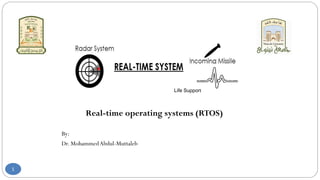
Real-time operating systems (RTOS)
By:
Dr. MohammedAbdul-Muttaleb
Life Support
Introduction: what is the OS?
 The Operating System OS is a program that acts as an intermediary between the
user of a computer and the computer hardware.
 The purpose of the OS is to provide an environment in which a user can execute
programs in a convenient and efficient manner.
2
Introduction: what is RTOS?
 Real-time Operating System RTOS is a special purpose OS.
1. Operating systems operate the digital processor with peripherals.
2. The system has certain time constraints.
If both conditions 1 & 2 are applied then we will have RTOS.
3
Examples of RTOS?
 Any OS that controls:
1. Medical imaging systems.
2. Flight control systems
3. Automobile-engine fuel injection.
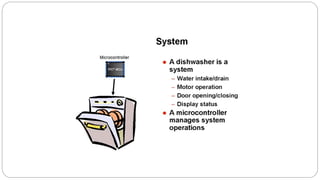
4. Home-appliance controllers
5. Virtual reality.
4
Hard RTOS specifications
 Critical (or Real-time) tasks (processes) must be
completed on time.
 Secondary storage are limited or missing.
 Short-term memories are used instead.
9
Soft RTOS Specifications
 A critical (or Real-time) tasks (processes) gets priority
over other tasks and retain that priority until it
completes.
 Kernel delays must be bounded because the RT task
cannot wait indefinitely for the kernel to run it.
10
RTOS Constraints
The following types of constraints are considered:
1. Timing constraints: meet your deadline.
2. Resource constraints: access only available resources.
14
1. Timing Constraints
 Real-time systems are characterized mostly by timing constraints
 Typical timing constraint: deadline
deadline = time before which task has to be performed
 Deadline missing separates two classes of RT systems:
 Hard : missing of deadline can cause catastrophic consequences
 Soft : missing of deadline decreases performance of system
15
Parameters to Characterize RT-task Ji
 Arrival time ai : the time Ji becomes ready for execution
also called request time or release time, denoted by ri
 Computation time Ci: time necessary for execution without
interruption
 Deadline di: time before which task has to be completed its
execution
 Start time Si: time at which Ji start its execution
 Finishing time fi: time at which Ji finishes its execution
16
2. Resource Constraints
 Process‘s view:
Resource is any SW structure to be used by process
Examples: data structure, set of variables, memory area, file or
a device driver (Hardware). So, resources might be:
 Private resource : dedicated to a particular process
 Shared resource : to be used by more than any process
 Exclusive resource : shared resource where simultaneous
access from different processes is not allowed.
17
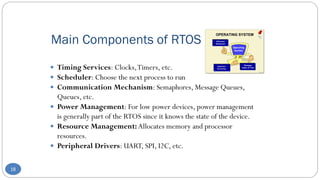
Main Components of RTOS
 Timing Services: Clocks,Timers, etc.
 Scheduler: Choose the next process to run
 Communication Mechanism: Semaphores, Message Queues,
Queues, etc.
 Power Management: For low power devices, power management
is generally part of the RTOS since it knows the state of the device.
 Resource Management: Allocates memory and processor
resources.
 Peripheral Drivers: UART, SPI, I2C, etc.
18
Scheduler
19
Scheduling disciplines are algorithms used for
distributing resources among parties which
simultaneously and asynchronously request them.
Scheduling disciplines are used in routers (to handle
packet traffic) as well as in operating systems (to
share CPU time among both threads and processes),
disk drives (I/O scheduling), printers (print spooler),
most embedded systems, etc.
RTOS.pdf

RTOS.pdf

  • 1.
    1 Real-time operating systems(RTOS) By: Dr. MohammedAbdul-Muttaleb Life Support
  • 2.
    Introduction: what isthe OS?  The Operating System OS is a program that acts as an intermediary between the user of a computer and the computer hardware.  The purpose of the OS is to provide an environment in which a user can execute programs in a convenient and efficient manner. 2
  • 3.
    Introduction: what isRTOS?  Real-time Operating System RTOS is a special purpose OS. 1. Operating systems operate the digital processor with peripherals. 2. The system has certain time constraints. If both conditions 1 & 2 are applied then we will have RTOS. 3
  • 4.
    Examples of RTOS? Any OS that controls: 1. Medical imaging systems. 2. Flight control systems 3. Automobile-engine fuel injection. 4. Home-appliance controllers 5. Virtual reality. 4
  • 9.
    Hard RTOS specifications Critical (or Real-time) tasks (processes) must be completed on time.  Secondary storage are limited or missing.  Short-term memories are used instead. 9
  • 10.
    Soft RTOS Specifications A critical (or Real-time) tasks (processes) gets priority over other tasks and retain that priority until it completes.  Kernel delays must be bounded because the RT task cannot wait indefinitely for the kernel to run it. 10
  • 14.
    RTOS Constraints The followingtypes of constraints are considered: 1. Timing constraints: meet your deadline. 2. Resource constraints: access only available resources. 14
  • 15.
    1. Timing Constraints Real-time systems are characterized mostly by timing constraints  Typical timing constraint: deadline deadline = time before which task has to be performed  Deadline missing separates two classes of RT systems:  Hard : missing of deadline can cause catastrophic consequences  Soft : missing of deadline decreases performance of system 15
  • 16.
    Parameters to CharacterizeRT-task Ji  Arrival time ai : the time Ji becomes ready for execution also called request time or release time, denoted by ri  Computation time Ci: time necessary for execution without interruption  Deadline di: time before which task has to be completed its execution  Start time Si: time at which Ji start its execution  Finishing time fi: time at which Ji finishes its execution 16
  • 17.
    2. Resource Constraints Process‘s view: Resource is any SW structure to be used by process Examples: data structure, set of variables, memory area, file or a device driver (Hardware). So, resources might be:  Private resource : dedicated to a particular process  Shared resource : to be used by more than any process  Exclusive resource : shared resource where simultaneous access from different processes is not allowed. 17
  • 18.
    Main Components ofRTOS  Timing Services: Clocks,Timers, etc.  Scheduler: Choose the next process to run  Communication Mechanism: Semaphores, Message Queues, Queues, etc.  Power Management: For low power devices, power management is generally part of the RTOS since it knows the state of the device.  Resource Management: Allocates memory and processor resources.  Peripheral Drivers: UART, SPI, I2C, etc. 18
  • 19.
    Scheduler 19 Scheduling disciplines arealgorithms used for distributing resources among parties which simultaneously and asynchronously request them. Scheduling disciplines are used in routers (to handle packet traffic) as well as in operating systems (to share CPU time among both threads and processes), disk drives (I/O scheduling), printers (print spooler), most embedded systems, etc.