A Query Model to Capture Event Pattern
Matching in RDF Stream Processing Languages
Daniele Dell’Aglio, Minh Dao-Tran, Jean-Paul Calbimonte,
Danh Le Phuoc and Emanuele Della Valle
dellaglio@ifi.uzh.ch http://dellaglio.org @dandellaglio
Bologna, Italy, 21.11.2016
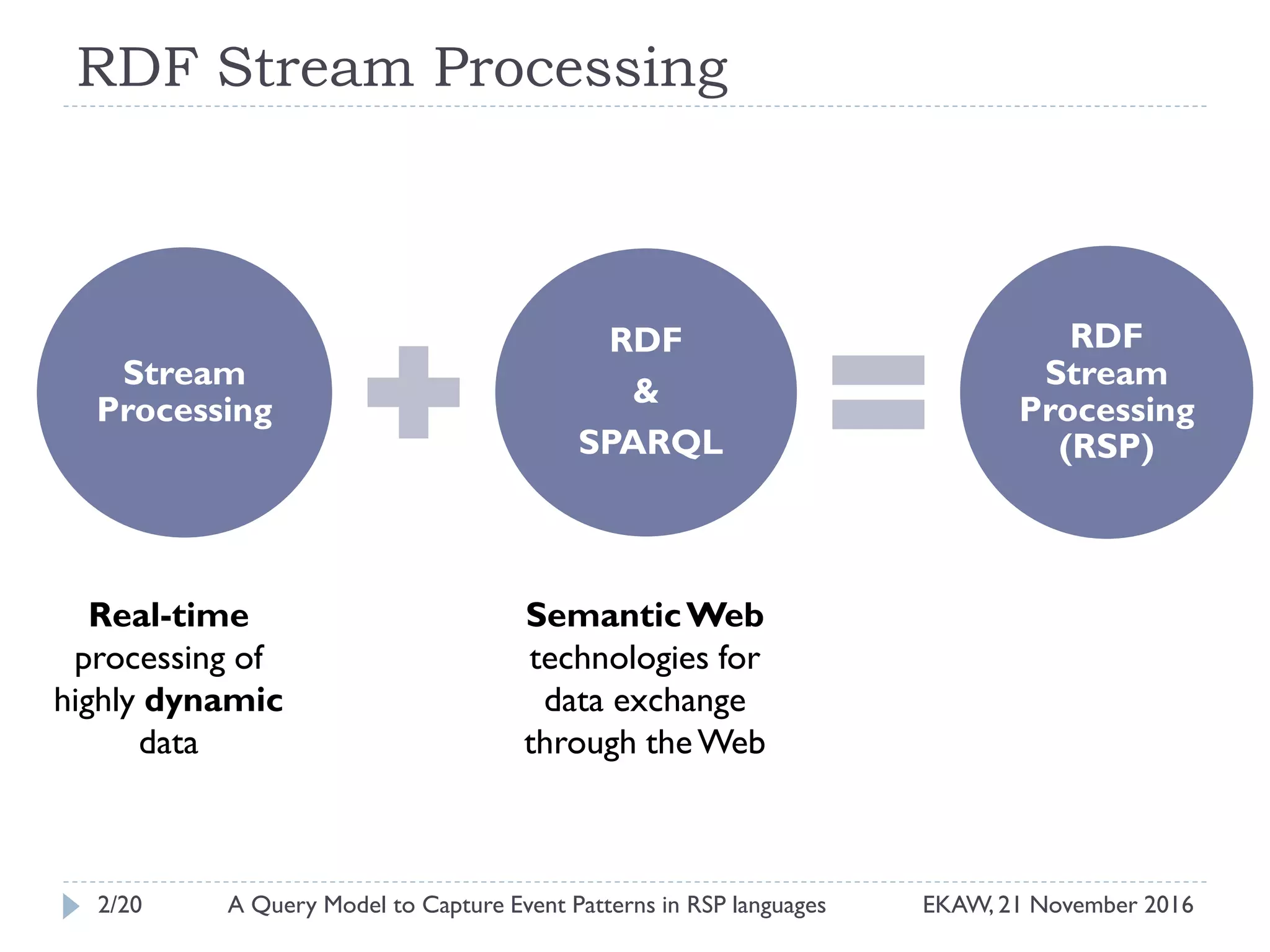
RDF Stream Processing
Stream
Processing
RDF
&
SPARQL
RDF
Stream
Processing
(RSP)
Real-time
processing of
highly dynamic
data
SemanticWeb
technologies for
data exchange
through theWeb
2/20 EKAW, 21 November 2016A Query Model to Capture Event Patterns in RSP languages
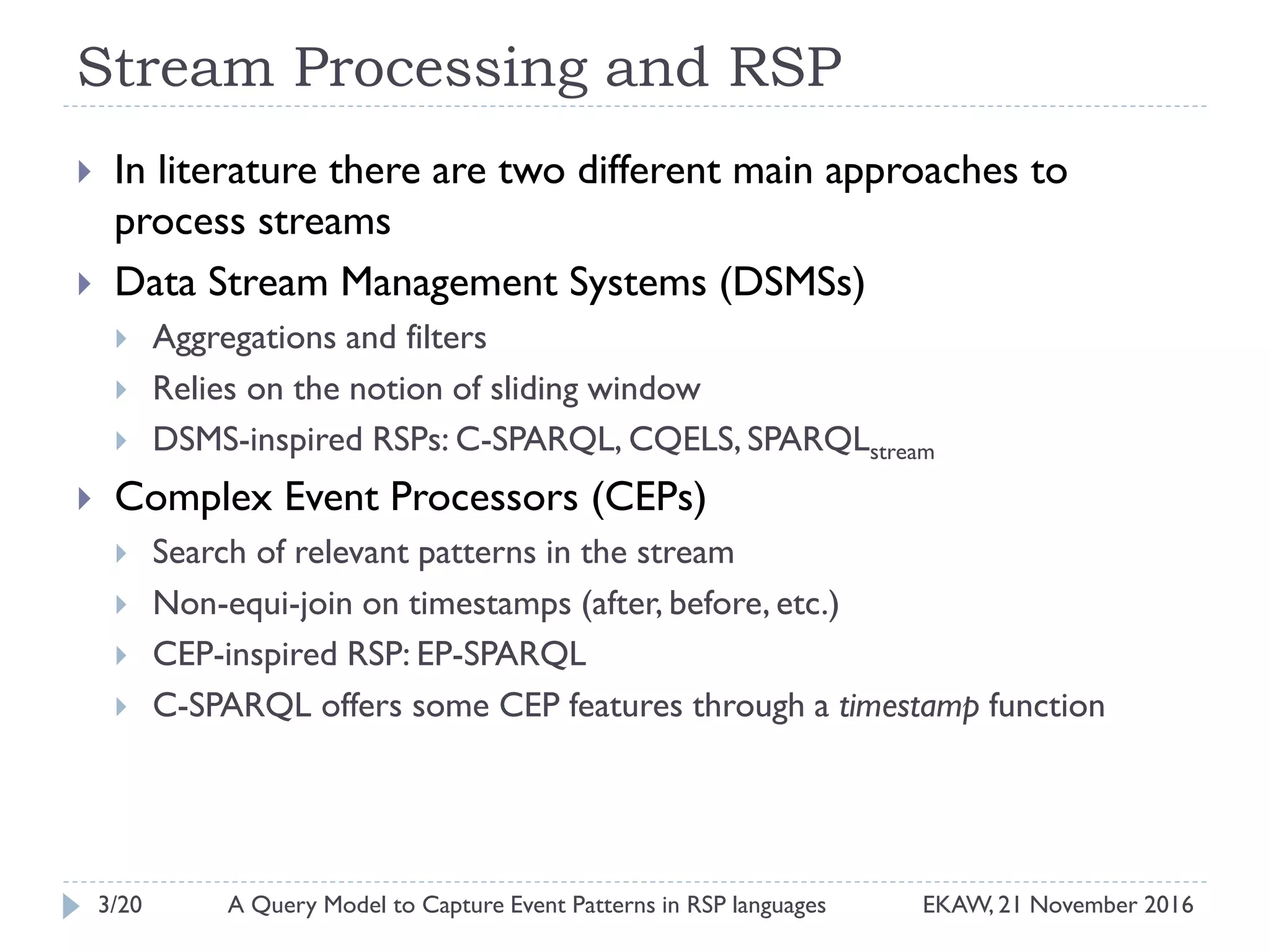
Stream Processing and RSP
 In literature there are two different main approaches to
process streams
 Data Stream Management Systems (DSMSs)
 Aggregations and filters
 Relies on the notion of sliding window
 DSMS-inspired RSPs: C-SPARQL, CQELS, SPARQLstream
 Complex Event Processors (CEPs)
 Search of relevant patterns in the stream
 Non-equi-join on timestamps (after, before, etc.)
 CEP-inspired RSP: EP-SPARQL
 C-SPARQL offers some CEP features through a timestamp function
3/20 EKAW, 21 November 2016A Query Model to Capture Event Patterns in RSP languages
The problem
Execution 7 8 9
EP-SPARQL
(unrestricted)
:a, :c [1,5]
:b, :d [3,5]
:b, :d [3,7]
:a, :c [1,9]
EP-SPARQL
(chronological)
:a, :c [1,5]
:b, :d [3,5]
EP-SPARQL
(recent)
:b, :d [3,5]
:b, :d [3,7]
C-SPARQL
(sl. win. 7,1)
:b, :d [3,7]
Who is listening to who?
{?att :isIn ?room}
SEQ
{?spe :talksIn ?room}
G1 G2 G3 G4
t
{:a :isIn :rRoom}
{:b :isIn :bRoom}
{:c :talksIn :rRoom,
:d :talksIn :bRoom}
{:d :talksIn :bRoom}
G6
{:e :isIn :bRoom}
S G5
{:c :talksIn :rRoom}
3 5 91 7 8
4/20 EKAW, 21 November 2016A Query Model to Capture Event Patterns in RSP languages
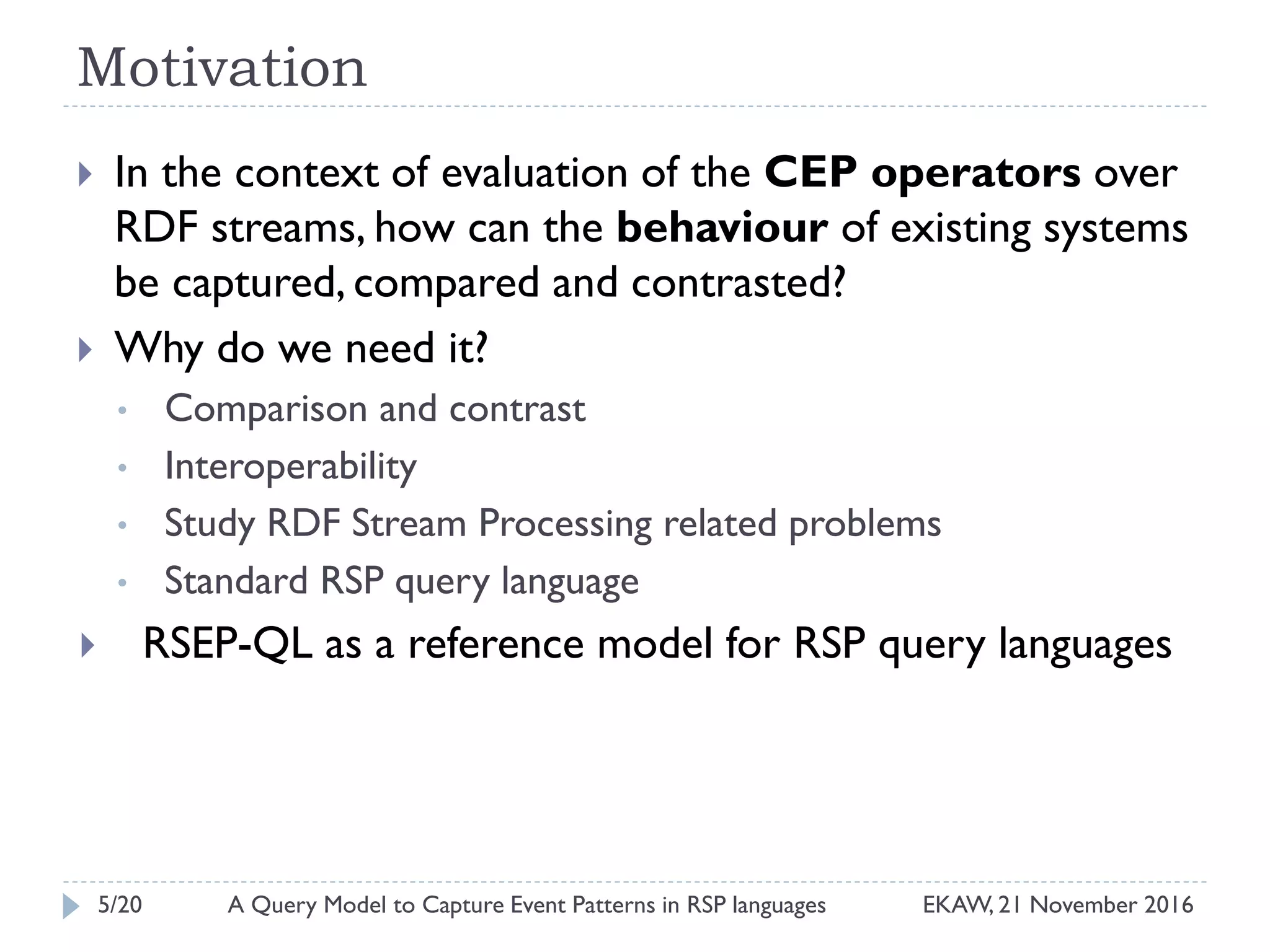
Motivation
 In the context of evaluation of the CEP operators over
RDF streams, how can the behaviour of existing systems
be captured, compared and contrasted?
 Why do we need it?
• Comparison and contrast
• Interoperability
• Study RDF Stream Processing related problems
• Standard RSP query language
 RSEP-QL as a reference model for RSP query languages
5/20 EKAW, 21 November 2016A Query Model to Capture Event Patterns in RSP languages
Data model: RDF streams and windows
 An RDF stream is an (infinite) ordered sequence of time-
annotated data items (RDF graphs)
t
𝕎(3,1,0)
𝕃(1)
𝑊(2,5]
G1 G2 G3 G4
t
{:a :isIn :rRoom}
{:b :isIn :bRoom}
{:c :talksIn :rRoom,
:d :talksIn :bRoom}
{:d :talksIn :bRoom}
G6
{:e :isIn :bRoom}
S G5
{:c :talksIn :rRoom}
3 5 91 7 8
Window
Landmark window
Sliding window
6/20 EKAW, 21 November 2016A Query Model to Capture Event Patterns in RSP languages
Operators
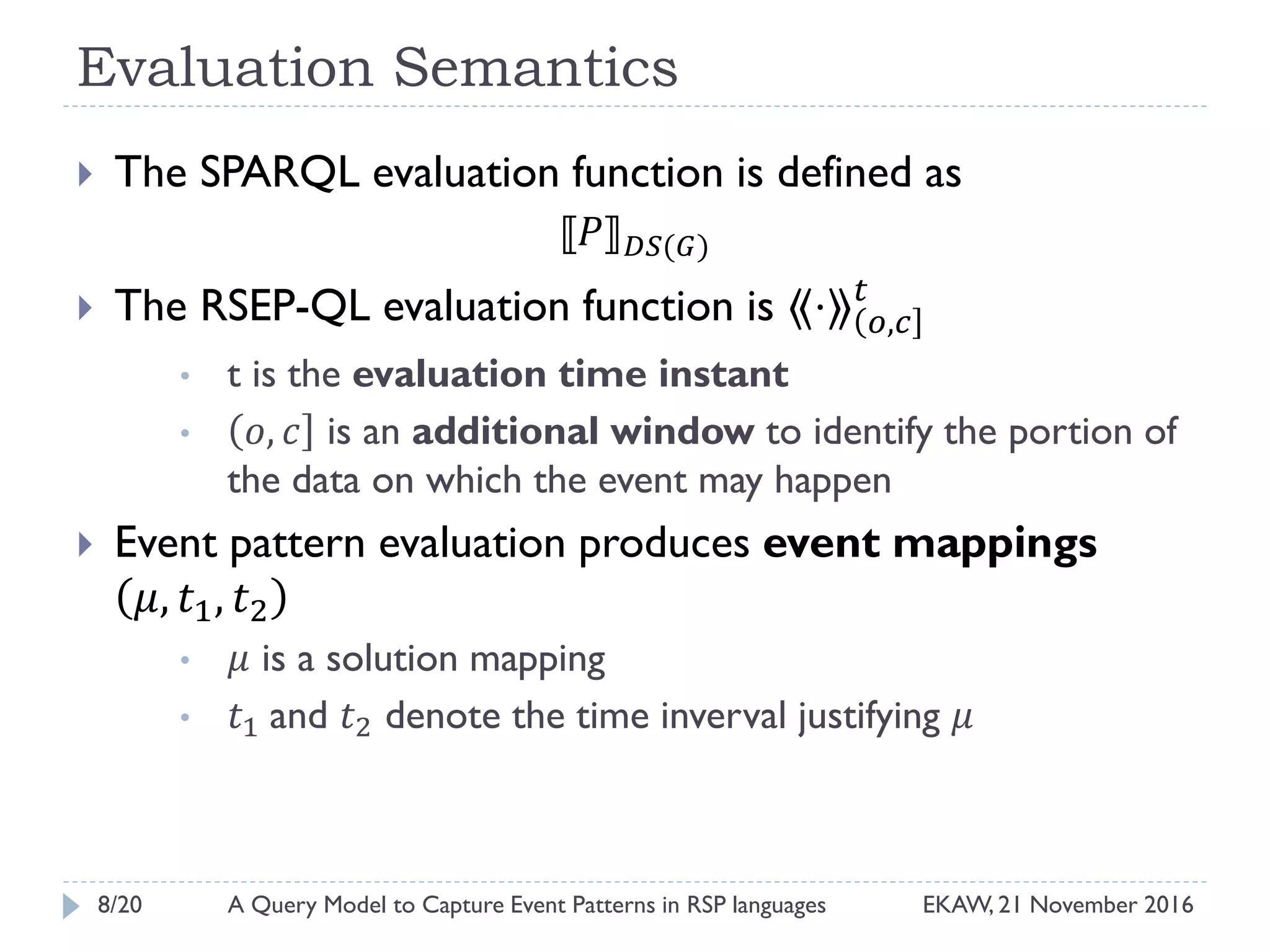
 Event Processing operators
• EVENT w P (Basic Event Pattern)
• E1 SEQ E2
• FIRST E1
• LAST E1
• MATCH to describe an event pattern
 Stream Processing operators
 SPARQL operators
7/20 EKAW, 21 November 2016A Query Model to Capture Event Patterns in RSP languages
Evaluation Semantics
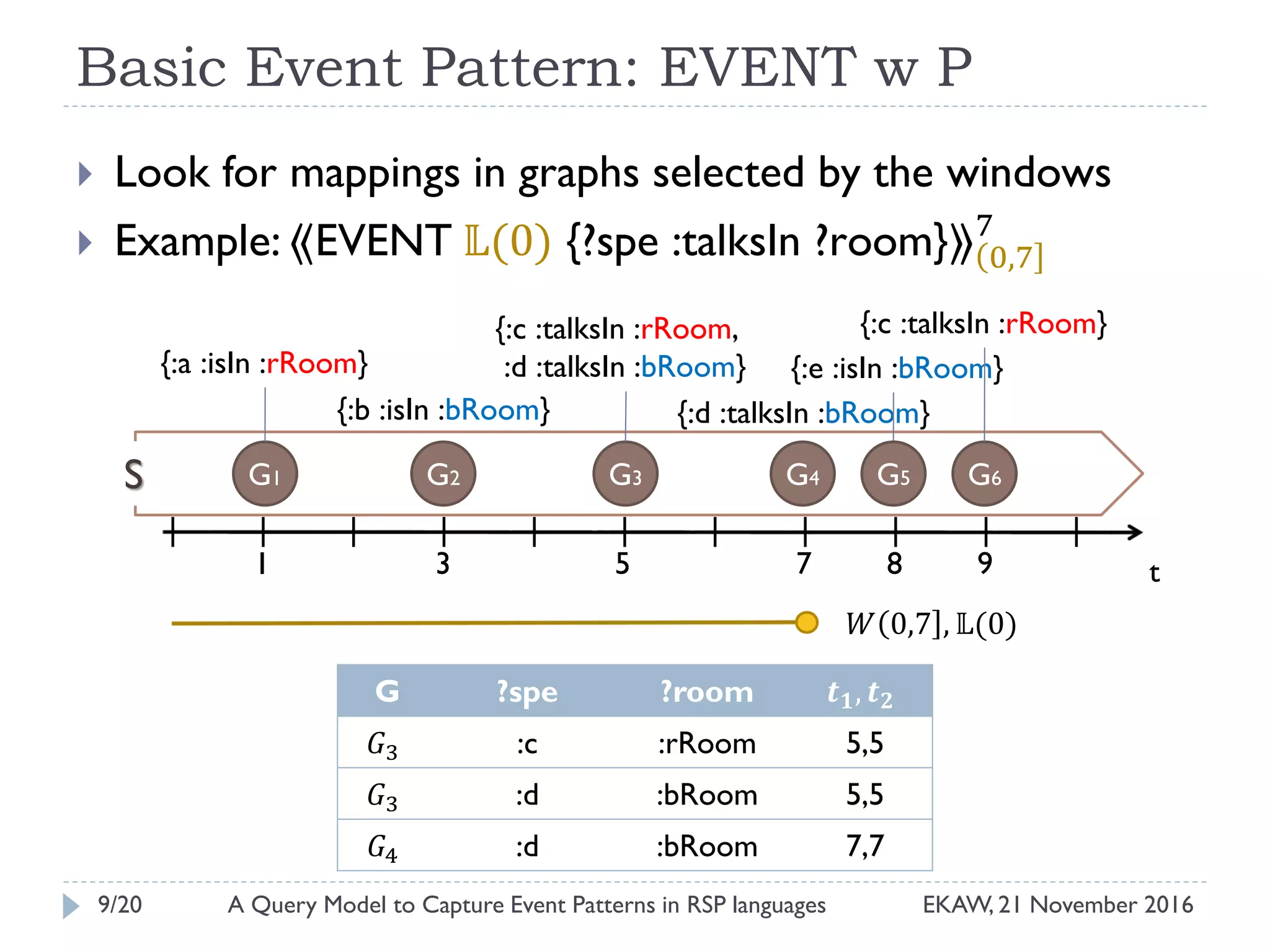
 The SPARQL evaluation function is defined as
⟦𝑃⟧ 𝐷𝑆(𝐺)
 The RSEP-QL evaluation function is ⟪⋅⟫ 𝑜,𝑐
𝑡
• t is the evaluation time instant
• 𝑜, 𝑐 is an additional window to identify the portion of
the data on which the event may happen
 Event pattern evaluation produces event mappings
𝜇, 𝑡1, 𝑡2
• 𝜇 is a solution mapping
• 𝑡1 and 𝑡2 denote the time inverval justifying 𝜇
8/20 EKAW, 21 November 2016A Query Model to Capture Event Patterns in RSP languages
Basic Event Pattern: EVENT w P
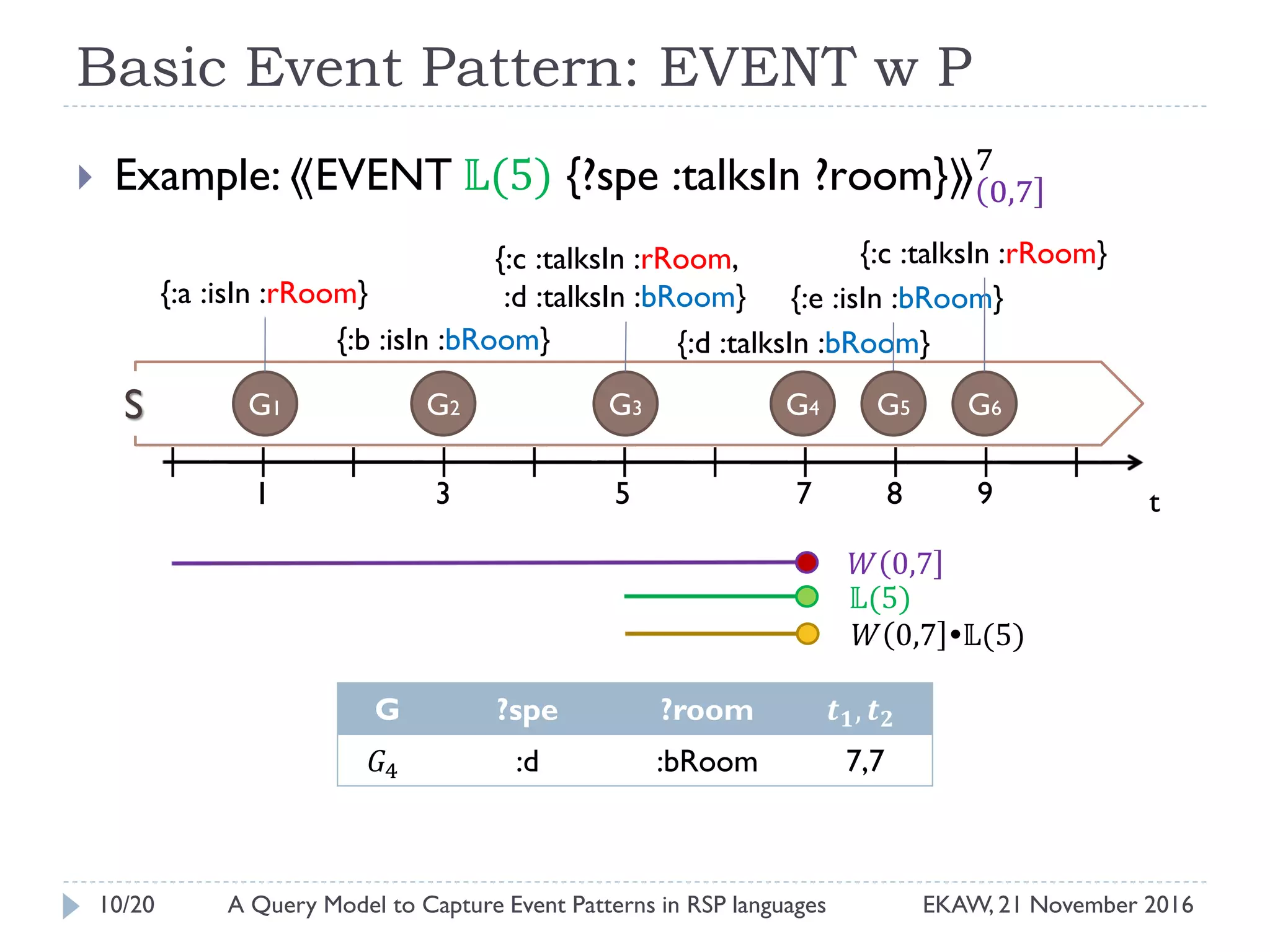
 Look for mappings in graphs selected by the windows
 Example: ⟪EVENT 𝕃(0) {?spe :talksIn ?room}⟫ 0,7
7
𝑊 0,7 , 𝕃(0)
G ?spe ?room 𝒕 𝟏, 𝒕 𝟐
𝐺3 :c :rRoom 5,5
𝐺3 :d :bRoom 5,5
𝐺4 :d :bRoom 7,7
G1 G2 G3 G4
t
{:a :isIn :rRoom}
{:b :isIn :bRoom}
{:c :talksIn :rRoom,
:d :talksIn :bRoom}
{:d :talksIn :bRoom}
G6
{:e :isIn :bRoom}
S G5
{:c :talksIn :rRoom}
3 5 91 7 8
9/20 EKAW, 21 November 2016A Query Model to Capture Event Patterns in RSP languages
Basic Event Pattern: EVENT w P
 Example: ⟪EVENT 𝕃(5) {?spe :talksIn ?room}⟫ 0,7
7
𝑊 0,7
G ?spe ?room 𝒕 𝟏, 𝒕 𝟐
𝐺4 :d :bRoom 7,7
𝕃(5)
𝑊 0,7 𝕃(5)
G1 G2 G3 G4
t
{:a :isIn :rRoom}
{:b :isIn :bRoom}
{:c :talksIn :rRoom,
:d :talksIn :bRoom}
{:d :talksIn :bRoom}
G6
{:e :isIn :bRoom}
S G5
{:c :talksIn :rRoom}
3 5 91 7 8
10/20 EKAW, 21 November 2016A Query Model to Capture Event Patterns in RSP languages
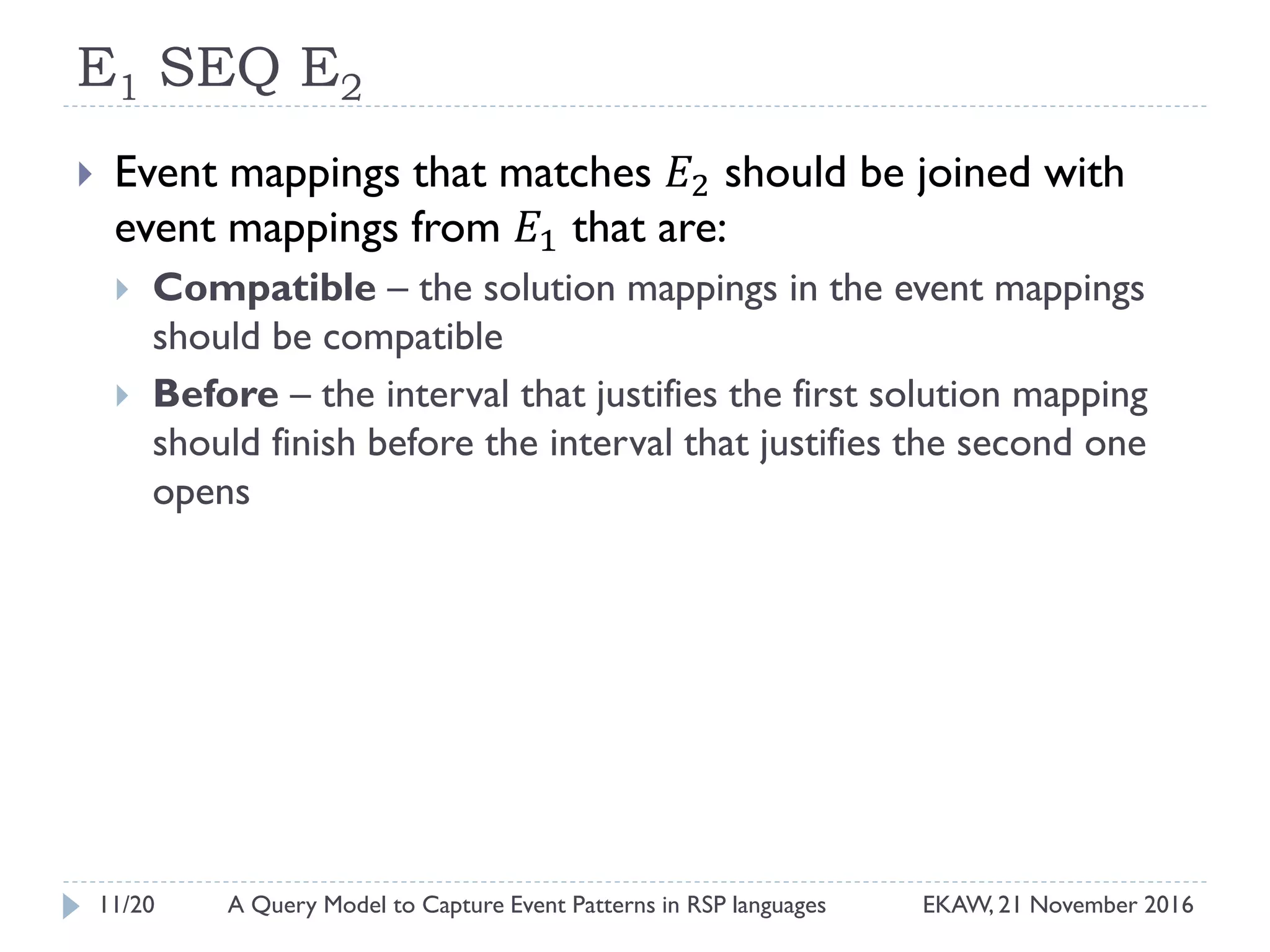
E1 SEQ E2
 Event mappings that matches 𝐸2 should be joined with
event mappings from 𝐸1 that are:
 Compatible – the solution mappings in the event mappings
should be compatible
 Before – the interval that justifies the first solution mapping
should finish before the interval that justifies the second one
opens
11/20 EKAW, 21 November 2016A Query Model to Capture Event Patterns in RSP languages
Example
⟪EVENT 𝕃(0) {?att :isIn ?room} SEQ EVENT 𝕃(0) {?spe :talksIn ?room} ⟫(0,8]
8
𝑊 0,8 , 𝕃(0)
G1 G2 G3 G4
t
{:a :isIn :rRoom}
{:b :isIn :bRoom}
{:c :talksIn :rRoom,
:d :talksIn :bRoom}
{:d :talksIn :bRoom}
G6
{:e :isIn :bRoom}
?spe ?room 𝒕 𝟏, 𝒕 𝟐
:c :rRoom 5,5
:d :bRoom 5,5
:d :bRoom 7,7
?att ?room 𝒕 𝟏, 𝒕 𝟐
:a :rRoom 1,1
:b :bRoom 3,3
:e :bRoom 8,8
?att ?spe ?room 𝒕 𝟏, 𝒕 𝟐
S G5
{:c :talksIn :rRoom}
3 5 91 7 8
12/20 EKAW, 21 November 2016A Query Model to Capture Event Patterns in RSP languages
Example
⟪EVENT 𝕃(0) {?att :isIn ?room} SEQ EVENT 𝕃(0) {?spe :talksIn ?room} ⟫(0,8]
8
?spe ?room 𝒕 𝟏, 𝒕 𝟐
:c :rRoom 5,5
:d :bRoom 5,5
:d :bRoom 7,7
?att ?room 𝒕 𝟏, 𝒕 𝟐
:a :rRoom 1,1
:b :bRoom 3,3
:e :bRoom 8,8
?att ?spe ?room 𝒕 𝟏, 𝒕 𝟐
𝑊 0,8 , 𝕃(0)
G1 G2 G3 G4
t3 5 91
{:a :isIn :rRoom}
{:b :isIn :bRoom}
{:c :talksIn :rRoom,
:d :talksIn :bRoom}
{:d :talksIn :bRoom}
G6
{:e :isIn :bRoom}
7
S G5
{:c :talksIn :rRoom}
8
12/20 EKAW, 21 November 2016A Query Model to Capture Event Patterns in RSP languages
Example
⟪EVENT 𝕃(0) {?att :isIn ?room} SEQ EVENT 𝕃(0) {?spe :talksIn ?room} ⟫(0,8]
8
?spe ?room 𝒕 𝟏, 𝒕 𝟐
:c :rRoom 5,5
:d :bRoom 5,5
:d :bRoom 7,7
?att ?room 𝒕 𝟏, 𝒕 𝟐
:a :rRoom 1,1
:b :bRoom 3,3
:e :bRoom 8,8
?att ?spe ?room 𝒕 𝟏, 𝒕 𝟐
𝑊 0,8 , 𝕃(0)
G1 G2 G3 G4
t3 5 91
{:a :isIn :rRoom}
{:b :isIn :bRoom}
{:c :talksIn :rRoom,
:d :talksIn :bRoom}
{:d :talksIn :bRoom}
G6
{:e :isIn :bRoom}
7
S G5
{:c :talksIn :rRoom}
8
not compatible
12/20 EKAW, 21 November 2016A Query Model to Capture Event Patterns in RSP languages
Example
⟪EVENT 𝕃(0) {?att :isIn ?room} SEQ EVENT 𝕃(0) {?spe :talksIn ?room} ⟫(0,8]
8
?spe ?room 𝒕 𝟏, 𝒕 𝟐
:c :rRoom 5,5
:d :bRoom 5,5
:d :bRoom 7,7
?att ?room 𝒕 𝟏, 𝒕 𝟐
:a :rRoom 1,1
:b :bRoom 3,3
:e :bRoom 8,8
?att ?spe ?room 𝒕 𝟏, 𝒕 𝟐
𝑊 0,8 , 𝕃(0)
G1 G2 G3 G4
t3 5 91
{:a :isIn :rRoom}
{:b :isIn :bRoom}
{:c :talksIn :rRoom,
:d :talksIn :bRoom}
{:d :talksIn :bRoom}
G6
{:e :isIn :bRoom}
7
S G5
{:c :talksIn :rRoom}
8
not compatible
not before
12/20 EKAW, 21 November 2016A Query Model to Capture Event Patterns in RSP languages
Example
⟪EVENT 𝕃(0) {?att :isIn ?room} SEQ EVENT 𝕃(0) {?spe :talksIn ?room} ⟫(0,8]
8
?spe ?room 𝒕 𝟏, 𝒕 𝟐
:c :rRoom 5,5
:d :bRoom 5,5
:d :bRoom 7,7
?att ?room 𝒕 𝟏, 𝒕 𝟐
:a :rRoom 1,1
:b :bRoom 3,3
:e :bRoom 8,8
?att ?spe ?room 𝒕 𝟏, 𝒕 𝟐
:b :d :bRoom 3,5
𝑊 0,8 , 𝕃(0)
G1 G2 G3 G4
t3 5 91
{:a :isIn :rRoom}
{:b :isIn :bRoom}
{:c :talksIn :rRoom,
:d :talksIn :bRoom}
{:d :talksIn :bRoom}
G6
{:e :isIn :bRoom}
7
S G5
{:c :talksIn :rRoom}
8
not compatible
not before
12/20 EKAW, 21 November 2016A Query Model to Capture Event Patterns in RSP languages
Example
⟪EVENT 𝕃(0) {?att :isIn ?room} SEQ EVENT 𝕃(0) {?spe :talksIn ?room} ⟫(0,8]
8
?spe ?room 𝒕 𝟏, 𝒕 𝟐
:c :rRoom 5,5
:d :bRoom 5,5
:d :bRoom 7,7
?att ?room 𝒕 𝟏, 𝒕 𝟐
:a :rRoom 1,1
:b :bRoom 3,3
:e :bRoom 8,8
?att ?spe ?room 𝒕 𝟏, 𝒕 𝟐
:b :d :bRoom 3,5
:a :c :rRoom 1,5
:b :d :bRoom 3,7
𝑊 0,8 , 𝕃(0)
G1 G2 G3 G4
t3 5 91
{:a :isIn :rRoom}
{:b :isIn :bRoom}
{:c :talksIn :rRoom,
:d :talksIn :bRoom}
{:d :talksIn :bRoom}
G6
{:e :isIn :bRoom}
7
S G5
{:c :talksIn :rRoom}
8
12/20 EKAW, 21 November 2016A Query Model to Capture Event Patterns in RSP languages
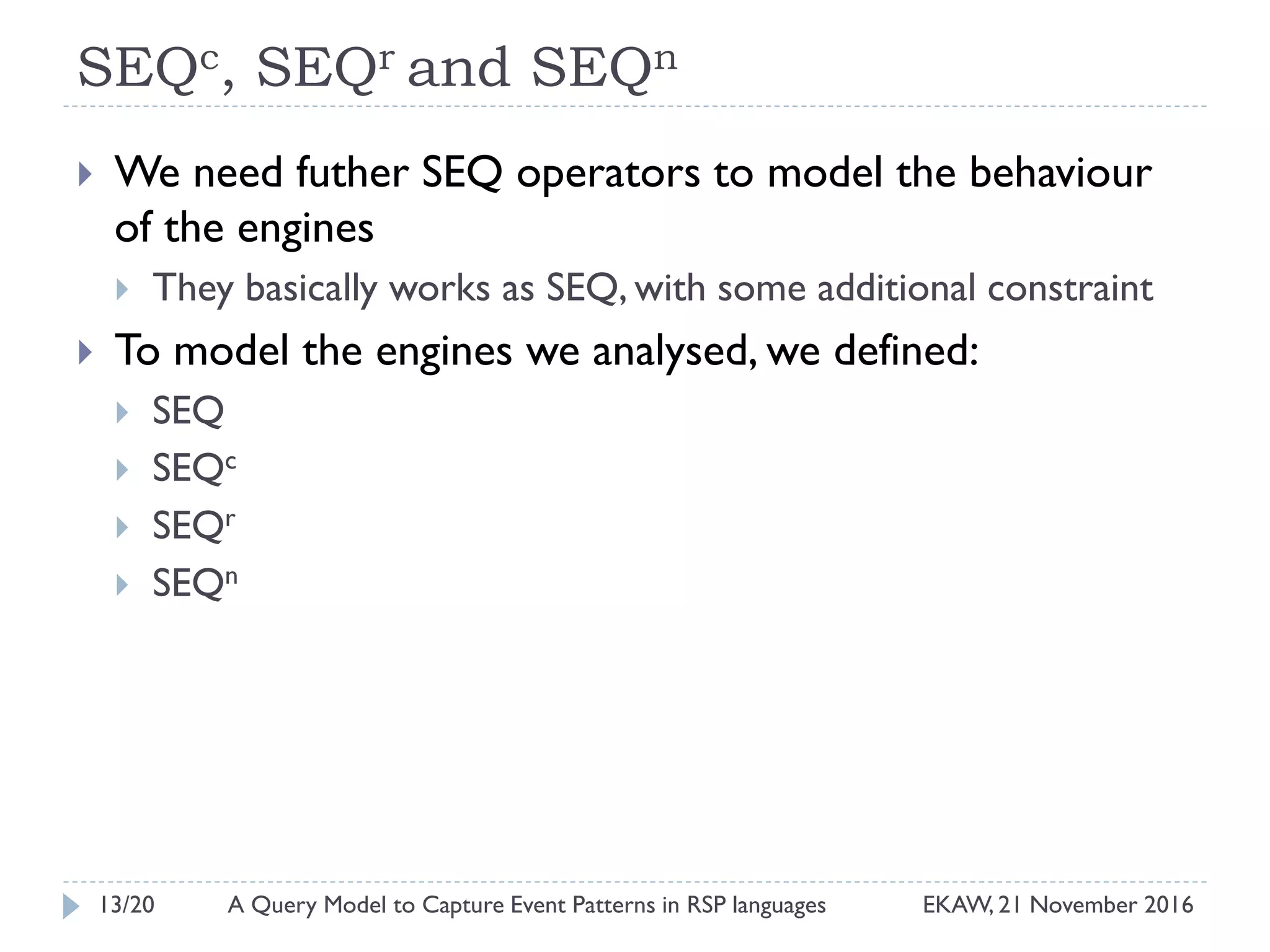
SEQc, SEQr and SEQn
 We need futher SEQ operators to model the behaviour
of the engines
 They basically works as SEQ, with some additional constraint
 To model the engines we analysed, we defined:
 SEQ
 SEQc
 SEQr
 SEQn
13/20 EKAW, 21 November 2016A Query Model to Capture Event Patterns in RSP languages
E1 SEQc E2
 If there are two output event mappings with the same solution mapping,
SEQc considers the least recent one
⟪EVENT 𝕃(0) {?att :isIn ?room} SEQc EVENT 𝕃(0) {?spe :talksIn ?room}⟫(0,8]
8
?spe ?room 𝒕 𝟏, 𝒕 𝟐
:c :rRoom 5,5
:d :bRoom 5,5
:d :bRoom 7,7
?att ?room 𝒕 𝟏, 𝒕 𝟐
:a :rRoom 1,1
:b :bRoom 3,3
:e :bRoom 8,8
?att ?spe ?room 𝒕 𝟏, 𝒕 𝟐
:a :c :rRoom 1,5
:b :d :bRoom 3,5
:b :d :bRoom 3,7
G1 G2 G3 G4
t3 5 91
{:a :isIn :rRoom}
{:b :isIn :bRoom}
{:c :talksIn :rRoom,
:d :talksIn :bRoom}
{:d :talksIn :bRoom}
G6
{:e :isIn :bRoom}
7
S G5
{:c :talksIn :rRoom}
8
14/20 EKAW, 21 November 2016A Query Model to Capture Event Patterns in RSP languages
E1 SEQr E2
 If there are two output event mappings with the same solution mapping,
SEQr considers the most recent one
⟪EVENT 𝕃(0) {?att :isIn ?room} SEQr EVENT 𝕃(0) {?spe :talksIn ?room}⟫(0,8]
8
?spe ?room 𝒕 𝟏, 𝒕 𝟐
:c :rRoom 5,5
:d :bRoom 5,5
:d :bRoom 7,7
?att ?room 𝒕 𝟏, 𝒕 𝟐
:a :rRoom 1,1
:b :bRoom 3,3
:e :bRoom 8,8
?att ?spe ?room 𝒕 𝟏, 𝒕 𝟐
:a :c :rRoom 1,5
:b :d :bRoom 3,5
:b :d :bRoom 3,7
G1 G2 G3 G4
t3 5 91
{:a :isIn :rRoom}
{:b :isIn :bRoom}
{:c :talksIn :rRoom,
:d :talksIn :bRoom}
{:d :talksIn :bRoom}
G6
{:e :isIn :bRoom}
7
S G5
{:c :talksIn :rRoom}
8
15/20 EKAW, 21 November 2016A Query Model to Capture Event Patterns in RSP languages
E1 SEQn E2
 If there are two input event mappings with the same solution mapping,
SEQn considers the most recent one
⟪EVENT 𝕃(0) {?att :isIn ?room} SEQn EVENT 𝕃(0) {?spe :talksIn ?room}⟫(0,8]
8
?spe ?room 𝒕 𝟏, 𝒕 𝟐
:c :rRoom 5,5
:d :bRoom 5,5
:d :bRoom 7,7
?att ?room 𝒕 𝟏, 𝒕 𝟐
:a :rRoom 1,1
:b :bRoom 3,3
:e :bRoom 8,8
?att ?spe ?room 𝒕 𝟏, 𝒕 𝟐
:a :c :rRoom 1,5
:b :d :bRoom 3,7
G1 G2 G3 G4
t3 5 91
{:a :isIn :rRoom}
{:b :isIn :bRoom}
{:c :talksIn :rRoom,
:d :talksIn :bRoom}
{:d :talksIn :bRoom}
G6
{:e :isIn :bRoom}
7
S G5
{:c :talksIn :rRoom}
8
16/20 EKAW, 21 November 2016A Query Model to Capture Event Patterns in RSP languages
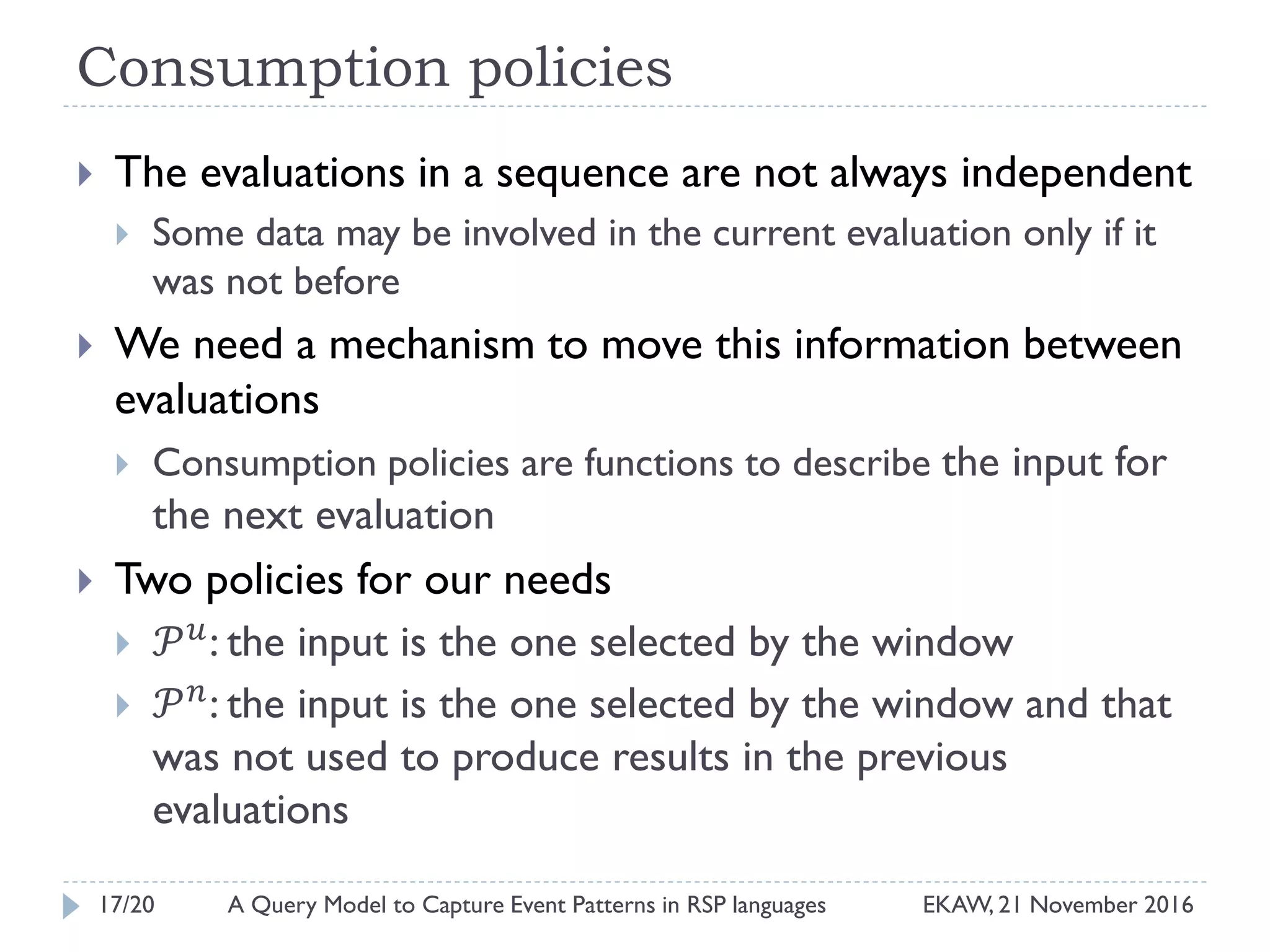
Consumption policies
 The evaluations in a sequence are not always independent
 Some data may be involved in the current evaluation only if it
was not before
 We need a mechanism to move this information between
evaluations
 Consumption policies are functions to describe the input for
the next evaluation
 Two policies for our needs
 𝒫 𝑢
: the input is the one selected by the window
 𝒫 𝑛
: the input is the one selected by the window and that
was not used to produce results in the previous
evaluations
17/20 EKAW, 21 November 2016A Query Model to Capture Event Patterns in RSP languages
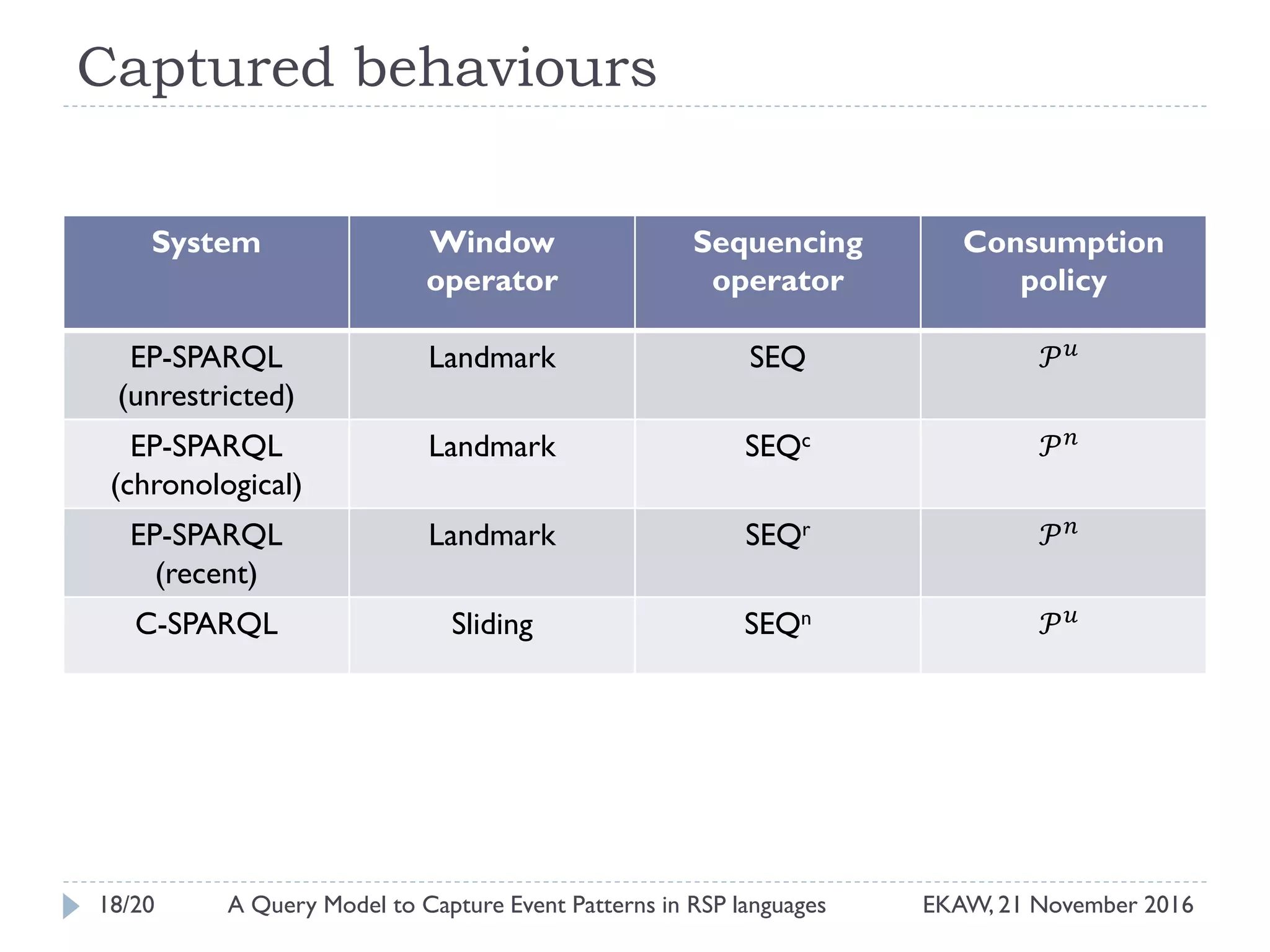
Captured behaviours
System Window
operator
Sequencing
operator
Consumption
policy
EP-SPARQL
(unrestricted)
Landmark SEQ 𝒫 𝑢
EP-SPARQL
(chronological)
Landmark SEQc 𝒫 𝑛
EP-SPARQL
(recent)
Landmark SEQr 𝒫 𝑛
C-SPARQL Sliding SEQn 𝒫 𝑢
18/20 EKAW, 21 November 2016A Query Model to Capture Event Patterns in RSP languages
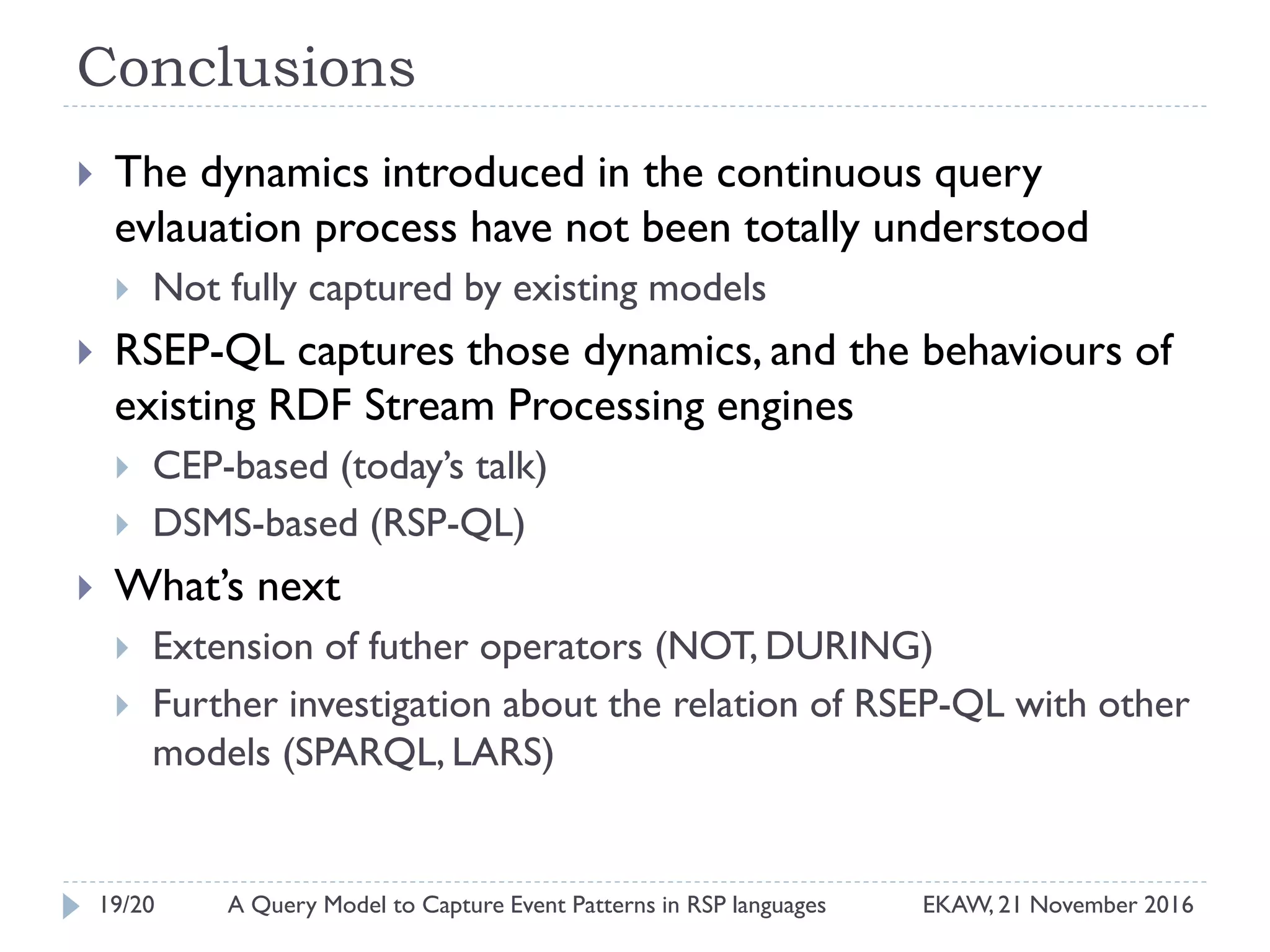
Conclusions
 The dynamics introduced in the continuous query
evlauation process have not been totally understood
 Not fully captured by existing models
 RSEP-QL captures those dynamics, and the behaviours of
existing RDF Stream Processing engines
 CEP-based (today’s talk)
 DSMS-based (RSP-QL)
 What’s next
 Extension of futher operators (NOT, DURING)
 Further investigation about the relation of RSEP-QL with other
models (SPARQL, LARS)
19/20 EKAW, 21 November 2016A Query Model to Capture Event Patterns in RSP languages
Thank you! Questions?
A Query Model to Capture Event Pattern
Matching in RDF Stream Processing Languages
Daniele Dell’Aglio, Minh Dao-Tran, Jean-Paul Calbimonte,
Danh Le Phuoc and Emanuele DellaValle
dellaglio@ifi.uzh.ch
http://dellaglio.org
@dandellaglio
20/20 EKAW, 21 November 2016A Query Model to Capture Event Patterns in RSP languages

RSEP-QL: A Query Model to Capture Event Pattern Matching in RDF Stream Processing Languages

  • 1.
    A Query Modelto Capture Event Pattern Matching in RDF Stream Processing Languages Daniele Dell’Aglio, Minh Dao-Tran, Jean-Paul Calbimonte, Danh Le Phuoc and Emanuele Della Valle dellaglio@ifi.uzh.ch http://dellaglio.org @dandellaglio Bologna, Italy, 21.11.2016
  • 2.
    RDF Stream Processing Stream Processing RDF & SPARQL RDF Stream Processing (RSP) Real-time processingof highly dynamic data SemanticWeb technologies for data exchange through theWeb 2/20 EKAW, 21 November 2016A Query Model to Capture Event Patterns in RSP languages
  • 3.
    Stream Processing andRSP  In literature there are two different main approaches to process streams  Data Stream Management Systems (DSMSs)  Aggregations and filters  Relies on the notion of sliding window  DSMS-inspired RSPs: C-SPARQL, CQELS, SPARQLstream  Complex Event Processors (CEPs)  Search of relevant patterns in the stream  Non-equi-join on timestamps (after, before, etc.)  CEP-inspired RSP: EP-SPARQL  C-SPARQL offers some CEP features through a timestamp function 3/20 EKAW, 21 November 2016A Query Model to Capture Event Patterns in RSP languages
  • 4.
    The problem Execution 78 9 EP-SPARQL (unrestricted) :a, :c [1,5] :b, :d [3,5] :b, :d [3,7] :a, :c [1,9] EP-SPARQL (chronological) :a, :c [1,5] :b, :d [3,5] EP-SPARQL (recent) :b, :d [3,5] :b, :d [3,7] C-SPARQL (sl. win. 7,1) :b, :d [3,7] Who is listening to who? {?att :isIn ?room} SEQ {?spe :talksIn ?room} G1 G2 G3 G4 t {:a :isIn :rRoom} {:b :isIn :bRoom} {:c :talksIn :rRoom, :d :talksIn :bRoom} {:d :talksIn :bRoom} G6 {:e :isIn :bRoom} S G5 {:c :talksIn :rRoom} 3 5 91 7 8 4/20 EKAW, 21 November 2016A Query Model to Capture Event Patterns in RSP languages
  • 5.
    Motivation  In thecontext of evaluation of the CEP operators over RDF streams, how can the behaviour of existing systems be captured, compared and contrasted?  Why do we need it? • Comparison and contrast • Interoperability • Study RDF Stream Processing related problems • Standard RSP query language  RSEP-QL as a reference model for RSP query languages 5/20 EKAW, 21 November 2016A Query Model to Capture Event Patterns in RSP languages
  • 6.
    Data model: RDFstreams and windows  An RDF stream is an (infinite) ordered sequence of time- annotated data items (RDF graphs) t 𝕎(3,1,0) 𝕃(1) 𝑊(2,5] G1 G2 G3 G4 t {:a :isIn :rRoom} {:b :isIn :bRoom} {:c :talksIn :rRoom, :d :talksIn :bRoom} {:d :talksIn :bRoom} G6 {:e :isIn :bRoom} S G5 {:c :talksIn :rRoom} 3 5 91 7 8 Window Landmark window Sliding window 6/20 EKAW, 21 November 2016A Query Model to Capture Event Patterns in RSP languages
  • 7.
    Operators  Event Processingoperators • EVENT w P (Basic Event Pattern) • E1 SEQ E2 • FIRST E1 • LAST E1 • MATCH to describe an event pattern  Stream Processing operators  SPARQL operators 7/20 EKAW, 21 November 2016A Query Model to Capture Event Patterns in RSP languages
  • 8.
    Evaluation Semantics  TheSPARQL evaluation function is defined as ⟦𝑃⟧ 𝐷𝑆(𝐺)  The RSEP-QL evaluation function is ⟪⋅⟫ 𝑜,𝑐 𝑡 • t is the evaluation time instant • 𝑜, 𝑐 is an additional window to identify the portion of the data on which the event may happen  Event pattern evaluation produces event mappings 𝜇, 𝑡1, 𝑡2 • 𝜇 is a solution mapping • 𝑡1 and 𝑡2 denote the time inverval justifying 𝜇 8/20 EKAW, 21 November 2016A Query Model to Capture Event Patterns in RSP languages
  • 9.
    Basic Event Pattern:EVENT w P  Look for mappings in graphs selected by the windows  Example: ⟪EVENT 𝕃(0) {?spe :talksIn ?room}⟫ 0,7 7 𝑊 0,7 , 𝕃(0) G ?spe ?room 𝒕 𝟏, 𝒕 𝟐 𝐺3 :c :rRoom 5,5 𝐺3 :d :bRoom 5,5 𝐺4 :d :bRoom 7,7 G1 G2 G3 G4 t {:a :isIn :rRoom} {:b :isIn :bRoom} {:c :talksIn :rRoom, :d :talksIn :bRoom} {:d :talksIn :bRoom} G6 {:e :isIn :bRoom} S G5 {:c :talksIn :rRoom} 3 5 91 7 8 9/20 EKAW, 21 November 2016A Query Model to Capture Event Patterns in RSP languages
  • 10.
    Basic Event Pattern:EVENT w P  Example: ⟪EVENT 𝕃(5) {?spe :talksIn ?room}⟫ 0,7 7 𝑊 0,7 G ?spe ?room 𝒕 𝟏, 𝒕 𝟐 𝐺4 :d :bRoom 7,7 𝕃(5) 𝑊 0,7 𝕃(5) G1 G2 G3 G4 t {:a :isIn :rRoom} {:b :isIn :bRoom} {:c :talksIn :rRoom, :d :talksIn :bRoom} {:d :talksIn :bRoom} G6 {:e :isIn :bRoom} S G5 {:c :talksIn :rRoom} 3 5 91 7 8 10/20 EKAW, 21 November 2016A Query Model to Capture Event Patterns in RSP languages
  • 11.
    E1 SEQ E2 Event mappings that matches 𝐸2 should be joined with event mappings from 𝐸1 that are:  Compatible – the solution mappings in the event mappings should be compatible  Before – the interval that justifies the first solution mapping should finish before the interval that justifies the second one opens 11/20 EKAW, 21 November 2016A Query Model to Capture Event Patterns in RSP languages
  • 12.
    Example ⟪EVENT 𝕃(0) {?att:isIn ?room} SEQ EVENT 𝕃(0) {?spe :talksIn ?room} ⟫(0,8] 8 𝑊 0,8 , 𝕃(0) G1 G2 G3 G4 t {:a :isIn :rRoom} {:b :isIn :bRoom} {:c :talksIn :rRoom, :d :talksIn :bRoom} {:d :talksIn :bRoom} G6 {:e :isIn :bRoom} ?spe ?room 𝒕 𝟏, 𝒕 𝟐 :c :rRoom 5,5 :d :bRoom 5,5 :d :bRoom 7,7 ?att ?room 𝒕 𝟏, 𝒕 𝟐 :a :rRoom 1,1 :b :bRoom 3,3 :e :bRoom 8,8 ?att ?spe ?room 𝒕 𝟏, 𝒕 𝟐 S G5 {:c :talksIn :rRoom} 3 5 91 7 8 12/20 EKAW, 21 November 2016A Query Model to Capture Event Patterns in RSP languages
  • 13.
    Example ⟪EVENT 𝕃(0) {?att:isIn ?room} SEQ EVENT 𝕃(0) {?spe :talksIn ?room} ⟫(0,8] 8 ?spe ?room 𝒕 𝟏, 𝒕 𝟐 :c :rRoom 5,5 :d :bRoom 5,5 :d :bRoom 7,7 ?att ?room 𝒕 𝟏, 𝒕 𝟐 :a :rRoom 1,1 :b :bRoom 3,3 :e :bRoom 8,8 ?att ?spe ?room 𝒕 𝟏, 𝒕 𝟐 𝑊 0,8 , 𝕃(0) G1 G2 G3 G4 t3 5 91 {:a :isIn :rRoom} {:b :isIn :bRoom} {:c :talksIn :rRoom, :d :talksIn :bRoom} {:d :talksIn :bRoom} G6 {:e :isIn :bRoom} 7 S G5 {:c :talksIn :rRoom} 8 12/20 EKAW, 21 November 2016A Query Model to Capture Event Patterns in RSP languages
  • 14.
    Example ⟪EVENT 𝕃(0) {?att:isIn ?room} SEQ EVENT 𝕃(0) {?spe :talksIn ?room} ⟫(0,8] 8 ?spe ?room 𝒕 𝟏, 𝒕 𝟐 :c :rRoom 5,5 :d :bRoom 5,5 :d :bRoom 7,7 ?att ?room 𝒕 𝟏, 𝒕 𝟐 :a :rRoom 1,1 :b :bRoom 3,3 :e :bRoom 8,8 ?att ?spe ?room 𝒕 𝟏, 𝒕 𝟐 𝑊 0,8 , 𝕃(0) G1 G2 G3 G4 t3 5 91 {:a :isIn :rRoom} {:b :isIn :bRoom} {:c :talksIn :rRoom, :d :talksIn :bRoom} {:d :talksIn :bRoom} G6 {:e :isIn :bRoom} 7 S G5 {:c :talksIn :rRoom} 8 not compatible 12/20 EKAW, 21 November 2016A Query Model to Capture Event Patterns in RSP languages
  • 15.
    Example ⟪EVENT 𝕃(0) {?att:isIn ?room} SEQ EVENT 𝕃(0) {?spe :talksIn ?room} ⟫(0,8] 8 ?spe ?room 𝒕 𝟏, 𝒕 𝟐 :c :rRoom 5,5 :d :bRoom 5,5 :d :bRoom 7,7 ?att ?room 𝒕 𝟏, 𝒕 𝟐 :a :rRoom 1,1 :b :bRoom 3,3 :e :bRoom 8,8 ?att ?spe ?room 𝒕 𝟏, 𝒕 𝟐 𝑊 0,8 , 𝕃(0) G1 G2 G3 G4 t3 5 91 {:a :isIn :rRoom} {:b :isIn :bRoom} {:c :talksIn :rRoom, :d :talksIn :bRoom} {:d :talksIn :bRoom} G6 {:e :isIn :bRoom} 7 S G5 {:c :talksIn :rRoom} 8 not compatible not before 12/20 EKAW, 21 November 2016A Query Model to Capture Event Patterns in RSP languages
  • 16.
    Example ⟪EVENT 𝕃(0) {?att:isIn ?room} SEQ EVENT 𝕃(0) {?spe :talksIn ?room} ⟫(0,8] 8 ?spe ?room 𝒕 𝟏, 𝒕 𝟐 :c :rRoom 5,5 :d :bRoom 5,5 :d :bRoom 7,7 ?att ?room 𝒕 𝟏, 𝒕 𝟐 :a :rRoom 1,1 :b :bRoom 3,3 :e :bRoom 8,8 ?att ?spe ?room 𝒕 𝟏, 𝒕 𝟐 :b :d :bRoom 3,5 𝑊 0,8 , 𝕃(0) G1 G2 G3 G4 t3 5 91 {:a :isIn :rRoom} {:b :isIn :bRoom} {:c :talksIn :rRoom, :d :talksIn :bRoom} {:d :talksIn :bRoom} G6 {:e :isIn :bRoom} 7 S G5 {:c :talksIn :rRoom} 8 not compatible not before 12/20 EKAW, 21 November 2016A Query Model to Capture Event Patterns in RSP languages
  • 17.
    Example ⟪EVENT 𝕃(0) {?att:isIn ?room} SEQ EVENT 𝕃(0) {?spe :talksIn ?room} ⟫(0,8] 8 ?spe ?room 𝒕 𝟏, 𝒕 𝟐 :c :rRoom 5,5 :d :bRoom 5,5 :d :bRoom 7,7 ?att ?room 𝒕 𝟏, 𝒕 𝟐 :a :rRoom 1,1 :b :bRoom 3,3 :e :bRoom 8,8 ?att ?spe ?room 𝒕 𝟏, 𝒕 𝟐 :b :d :bRoom 3,5 :a :c :rRoom 1,5 :b :d :bRoom 3,7 𝑊 0,8 , 𝕃(0) G1 G2 G3 G4 t3 5 91 {:a :isIn :rRoom} {:b :isIn :bRoom} {:c :talksIn :rRoom, :d :talksIn :bRoom} {:d :talksIn :bRoom} G6 {:e :isIn :bRoom} 7 S G5 {:c :talksIn :rRoom} 8 12/20 EKAW, 21 November 2016A Query Model to Capture Event Patterns in RSP languages
  • 18.
    SEQc, SEQr andSEQn  We need futher SEQ operators to model the behaviour of the engines  They basically works as SEQ, with some additional constraint  To model the engines we analysed, we defined:  SEQ  SEQc  SEQr  SEQn 13/20 EKAW, 21 November 2016A Query Model to Capture Event Patterns in RSP languages
  • 19.
    E1 SEQc E2 If there are two output event mappings with the same solution mapping, SEQc considers the least recent one ⟪EVENT 𝕃(0) {?att :isIn ?room} SEQc EVENT 𝕃(0) {?spe :talksIn ?room}⟫(0,8] 8 ?spe ?room 𝒕 𝟏, 𝒕 𝟐 :c :rRoom 5,5 :d :bRoom 5,5 :d :bRoom 7,7 ?att ?room 𝒕 𝟏, 𝒕 𝟐 :a :rRoom 1,1 :b :bRoom 3,3 :e :bRoom 8,8 ?att ?spe ?room 𝒕 𝟏, 𝒕 𝟐 :a :c :rRoom 1,5 :b :d :bRoom 3,5 :b :d :bRoom 3,7 G1 G2 G3 G4 t3 5 91 {:a :isIn :rRoom} {:b :isIn :bRoom} {:c :talksIn :rRoom, :d :talksIn :bRoom} {:d :talksIn :bRoom} G6 {:e :isIn :bRoom} 7 S G5 {:c :talksIn :rRoom} 8 14/20 EKAW, 21 November 2016A Query Model to Capture Event Patterns in RSP languages
  • 20.
    E1 SEQr E2 If there are two output event mappings with the same solution mapping, SEQr considers the most recent one ⟪EVENT 𝕃(0) {?att :isIn ?room} SEQr EVENT 𝕃(0) {?spe :talksIn ?room}⟫(0,8] 8 ?spe ?room 𝒕 𝟏, 𝒕 𝟐 :c :rRoom 5,5 :d :bRoom 5,5 :d :bRoom 7,7 ?att ?room 𝒕 𝟏, 𝒕 𝟐 :a :rRoom 1,1 :b :bRoom 3,3 :e :bRoom 8,8 ?att ?spe ?room 𝒕 𝟏, 𝒕 𝟐 :a :c :rRoom 1,5 :b :d :bRoom 3,5 :b :d :bRoom 3,7 G1 G2 G3 G4 t3 5 91 {:a :isIn :rRoom} {:b :isIn :bRoom} {:c :talksIn :rRoom, :d :talksIn :bRoom} {:d :talksIn :bRoom} G6 {:e :isIn :bRoom} 7 S G5 {:c :talksIn :rRoom} 8 15/20 EKAW, 21 November 2016A Query Model to Capture Event Patterns in RSP languages
  • 21.
    E1 SEQn E2 If there are two input event mappings with the same solution mapping, SEQn considers the most recent one ⟪EVENT 𝕃(0) {?att :isIn ?room} SEQn EVENT 𝕃(0) {?spe :talksIn ?room}⟫(0,8] 8 ?spe ?room 𝒕 𝟏, 𝒕 𝟐 :c :rRoom 5,5 :d :bRoom 5,5 :d :bRoom 7,7 ?att ?room 𝒕 𝟏, 𝒕 𝟐 :a :rRoom 1,1 :b :bRoom 3,3 :e :bRoom 8,8 ?att ?spe ?room 𝒕 𝟏, 𝒕 𝟐 :a :c :rRoom 1,5 :b :d :bRoom 3,7 G1 G2 G3 G4 t3 5 91 {:a :isIn :rRoom} {:b :isIn :bRoom} {:c :talksIn :rRoom, :d :talksIn :bRoom} {:d :talksIn :bRoom} G6 {:e :isIn :bRoom} 7 S G5 {:c :talksIn :rRoom} 8 16/20 EKAW, 21 November 2016A Query Model to Capture Event Patterns in RSP languages
  • 22.
    Consumption policies  Theevaluations in a sequence are not always independent  Some data may be involved in the current evaluation only if it was not before  We need a mechanism to move this information between evaluations  Consumption policies are functions to describe the input for the next evaluation  Two policies for our needs  𝒫 𝑢 : the input is the one selected by the window  𝒫 𝑛 : the input is the one selected by the window and that was not used to produce results in the previous evaluations 17/20 EKAW, 21 November 2016A Query Model to Capture Event Patterns in RSP languages
  • 23.
    Captured behaviours System Window operator Sequencing operator Consumption policy EP-SPARQL (unrestricted) LandmarkSEQ 𝒫 𝑢 EP-SPARQL (chronological) Landmark SEQc 𝒫 𝑛 EP-SPARQL (recent) Landmark SEQr 𝒫 𝑛 C-SPARQL Sliding SEQn 𝒫 𝑢 18/20 EKAW, 21 November 2016A Query Model to Capture Event Patterns in RSP languages
  • 24.
    Conclusions  The dynamicsintroduced in the continuous query evlauation process have not been totally understood  Not fully captured by existing models  RSEP-QL captures those dynamics, and the behaviours of existing RDF Stream Processing engines  CEP-based (today’s talk)  DSMS-based (RSP-QL)  What’s next  Extension of futher operators (NOT, DURING)  Further investigation about the relation of RSEP-QL with other models (SPARQL, LARS) 19/20 EKAW, 21 November 2016A Query Model to Capture Event Patterns in RSP languages
  • 25.
    Thank you! Questions? AQuery Model to Capture Event Pattern Matching in RDF Stream Processing Languages Daniele Dell’Aglio, Minh Dao-Tran, Jean-Paul Calbimonte, Danh Le Phuoc and Emanuele DellaValle dellaglio@ifi.uzh.ch http://dellaglio.org @dandellaglio 20/20 EKAW, 21 November 2016A Query Model to Capture Event Patterns in RSP languages