Daniele Dell’Aglio
On Unified Stream Reasoning
Daniele Dell’Aglio
Advisor: Prof. Emanuele Della Valle
Milano, 15/07/2016. Ph.D. Viva
Daniele Dell’Aglio
Problem setting
Real time integration of dynamic data from heterogeneous
sources
– Traffic Prediction
2/33
Daniele Dell’Aglio
Problem setting
Real time integration of dynamic data from heterogeneous
sources
– Traffic Prediction
– Social media analytics
2/33
Daniele Dell’Aglio
Problem setting
Real time integration of dynamic data from heterogeneous
sources
– Traffic Prediction
– Social media analytics
– Personalised services
2/33
Daniele Dell’Aglio
Information Flow Processing
In literature there are two different main approaches to
process streams
3/33
Daniele Dell’Aglio
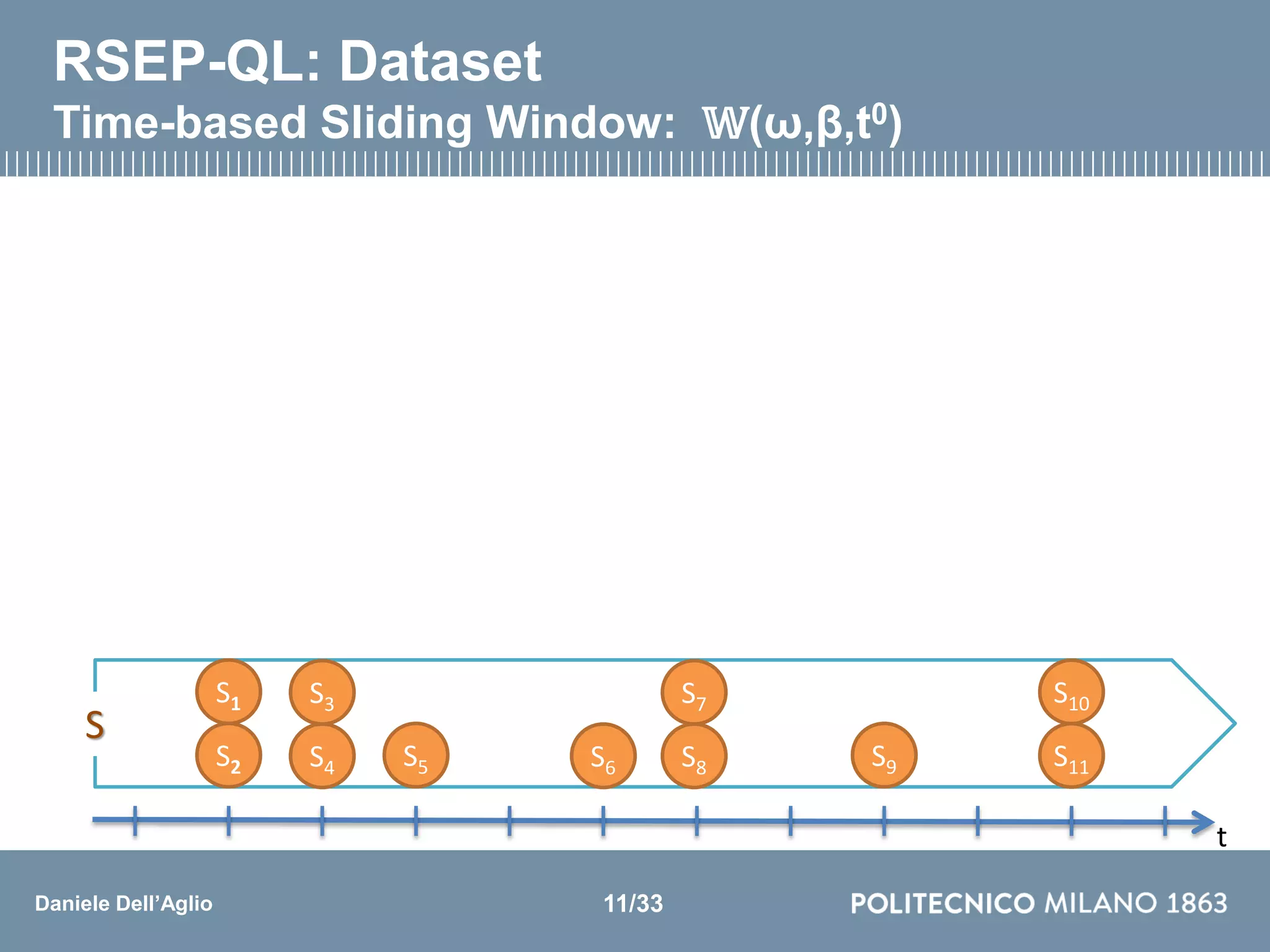
Information Flow Processing
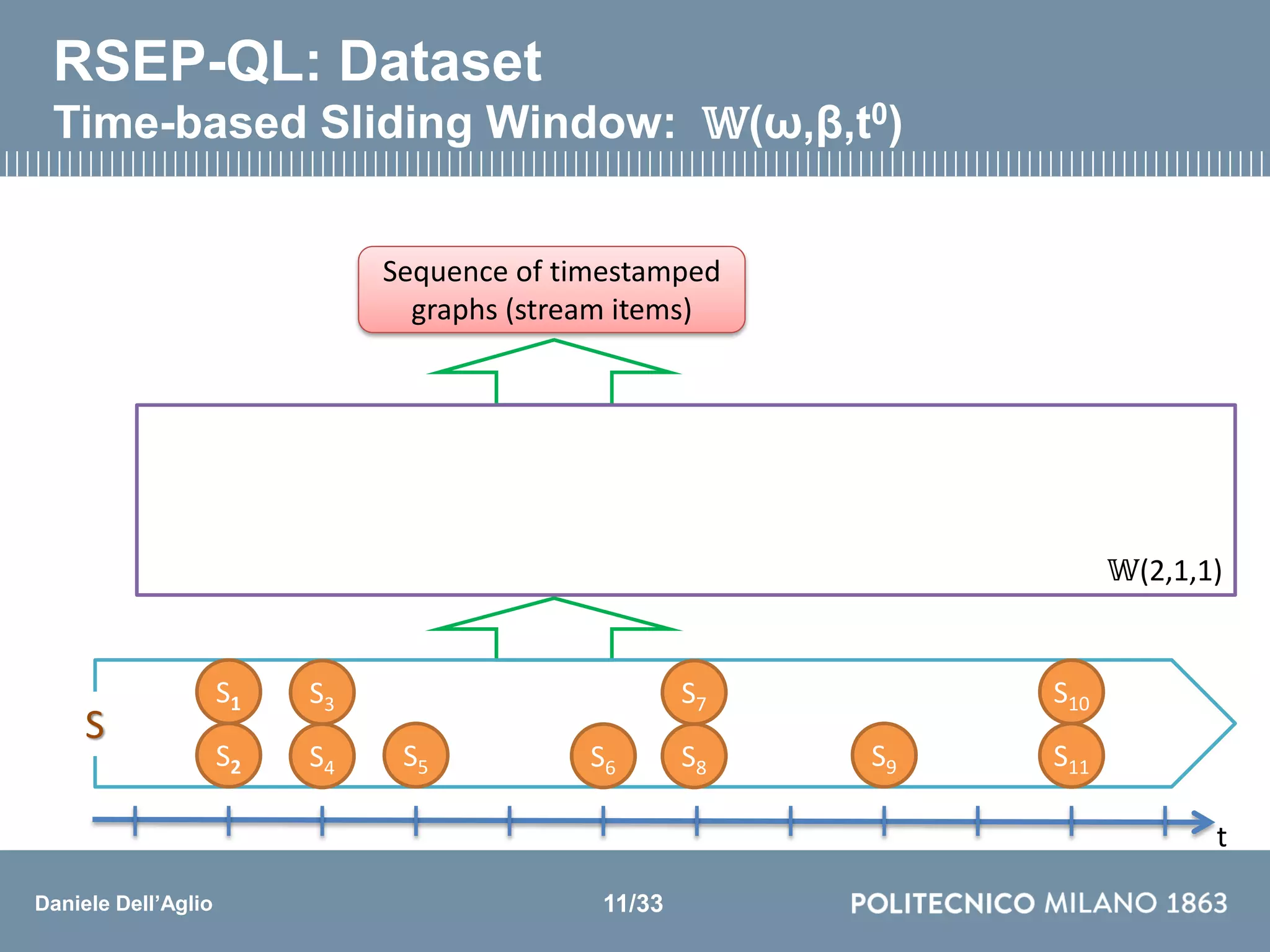
In literature there are two different main approaches to
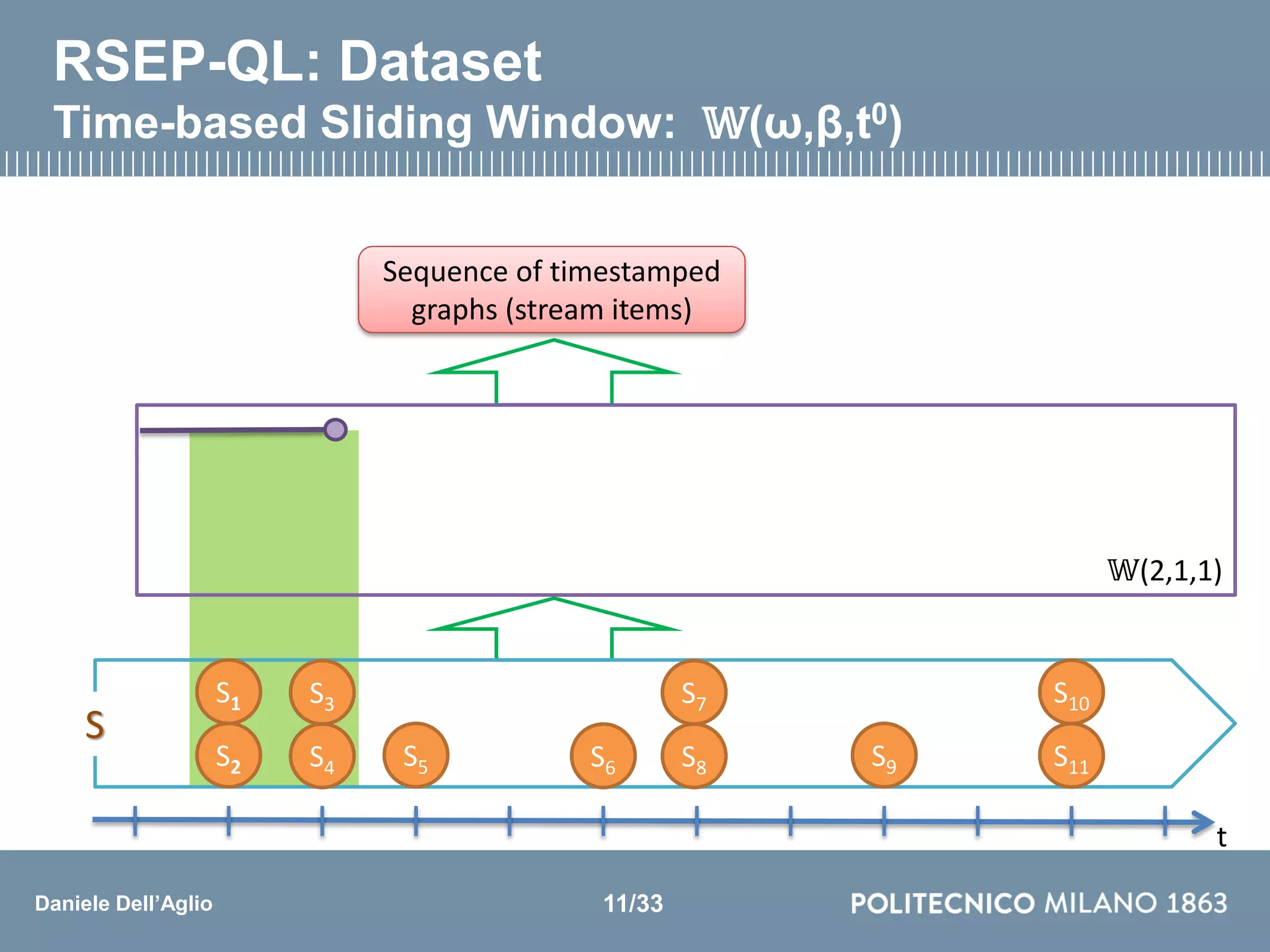
process streams
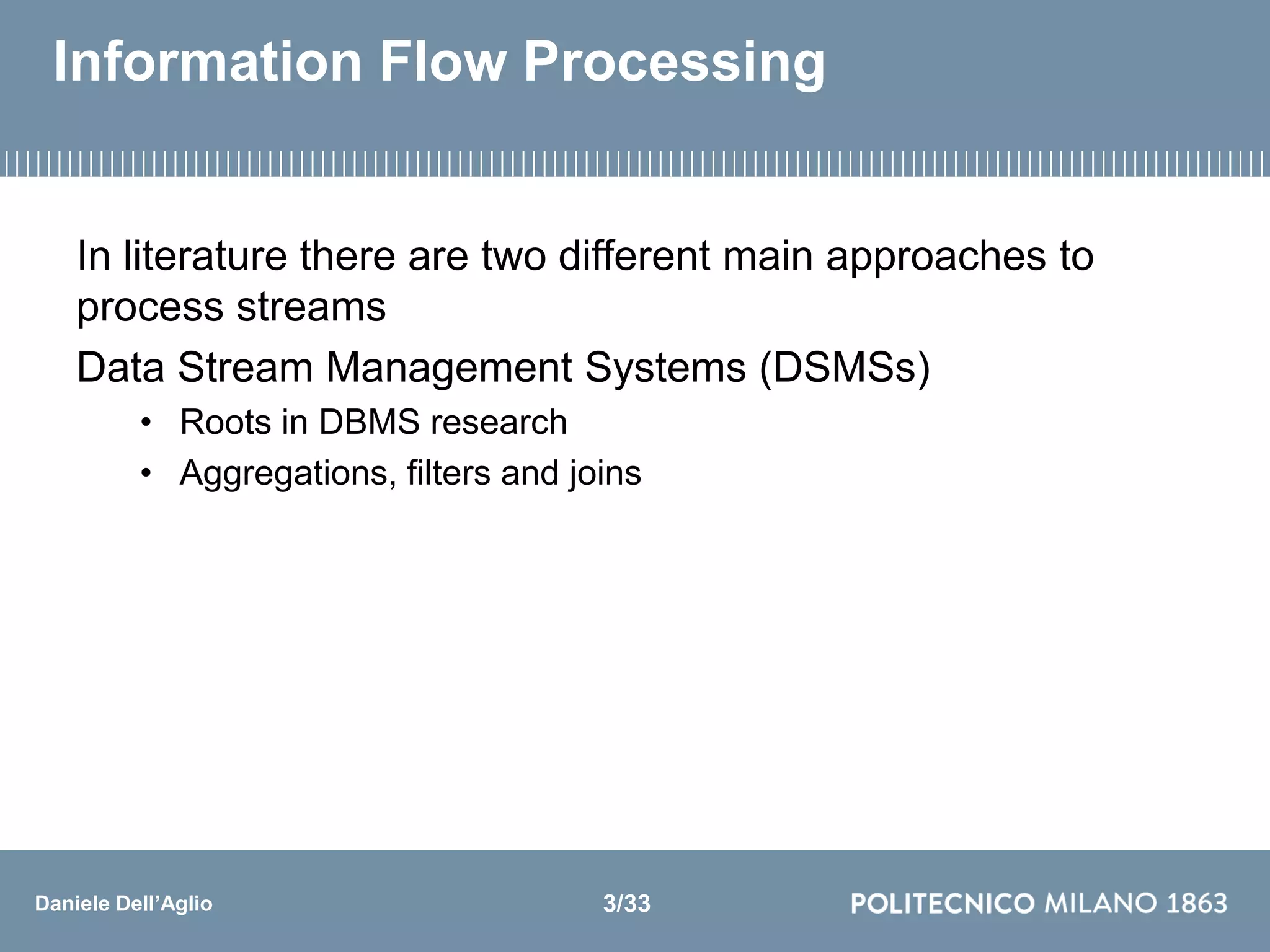
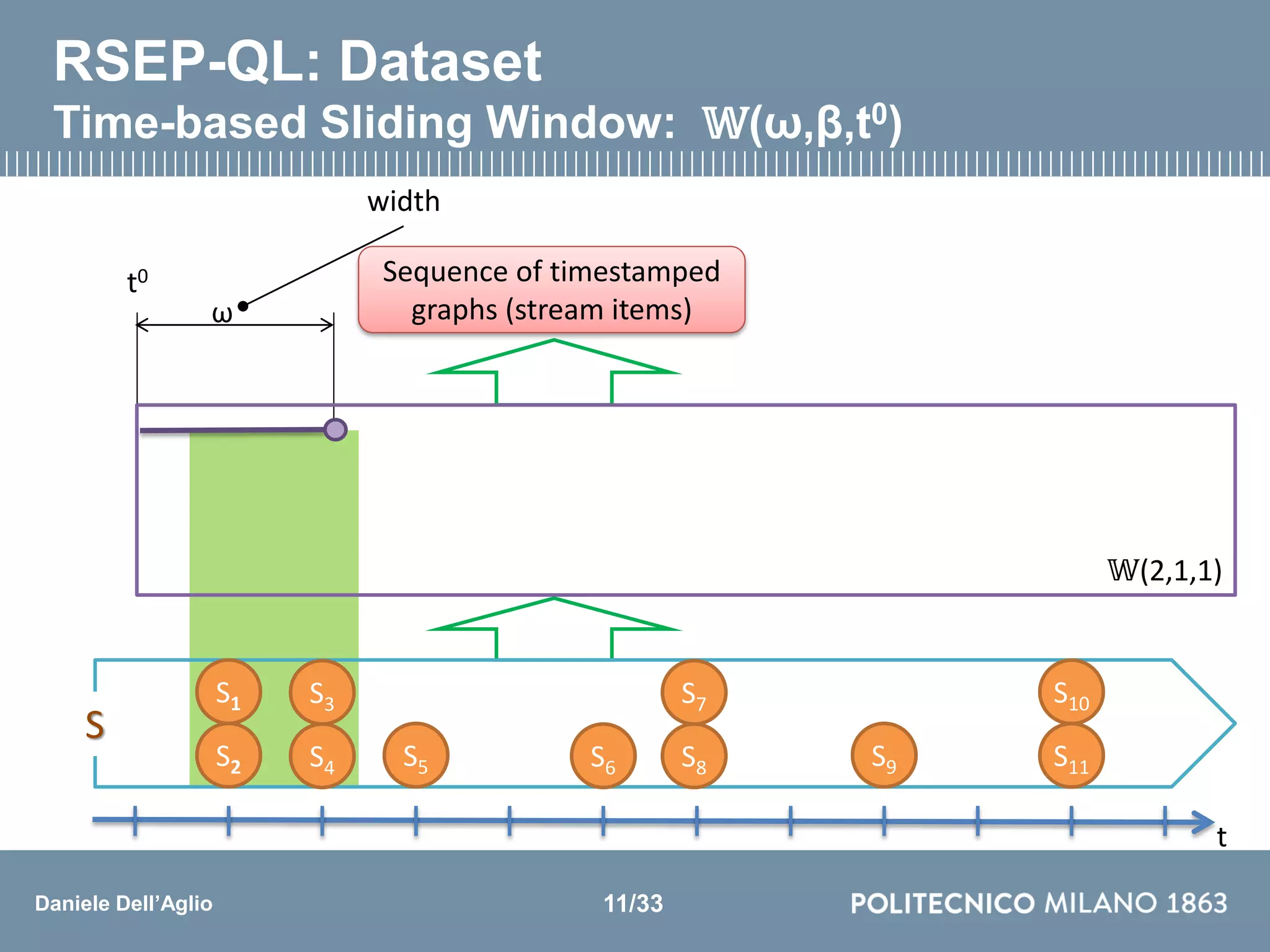
Data Stream Management Systems (DSMSs)
• Roots in DBMS research
• Aggregations, filters and joins
3/33
Daniele Dell’Aglio
Information Flow Processing
In literature there are two different main approaches to
process streams
Data Stream Management Systems (DSMSs)
• Roots in DBMS research
• Aggregations, filters and joins
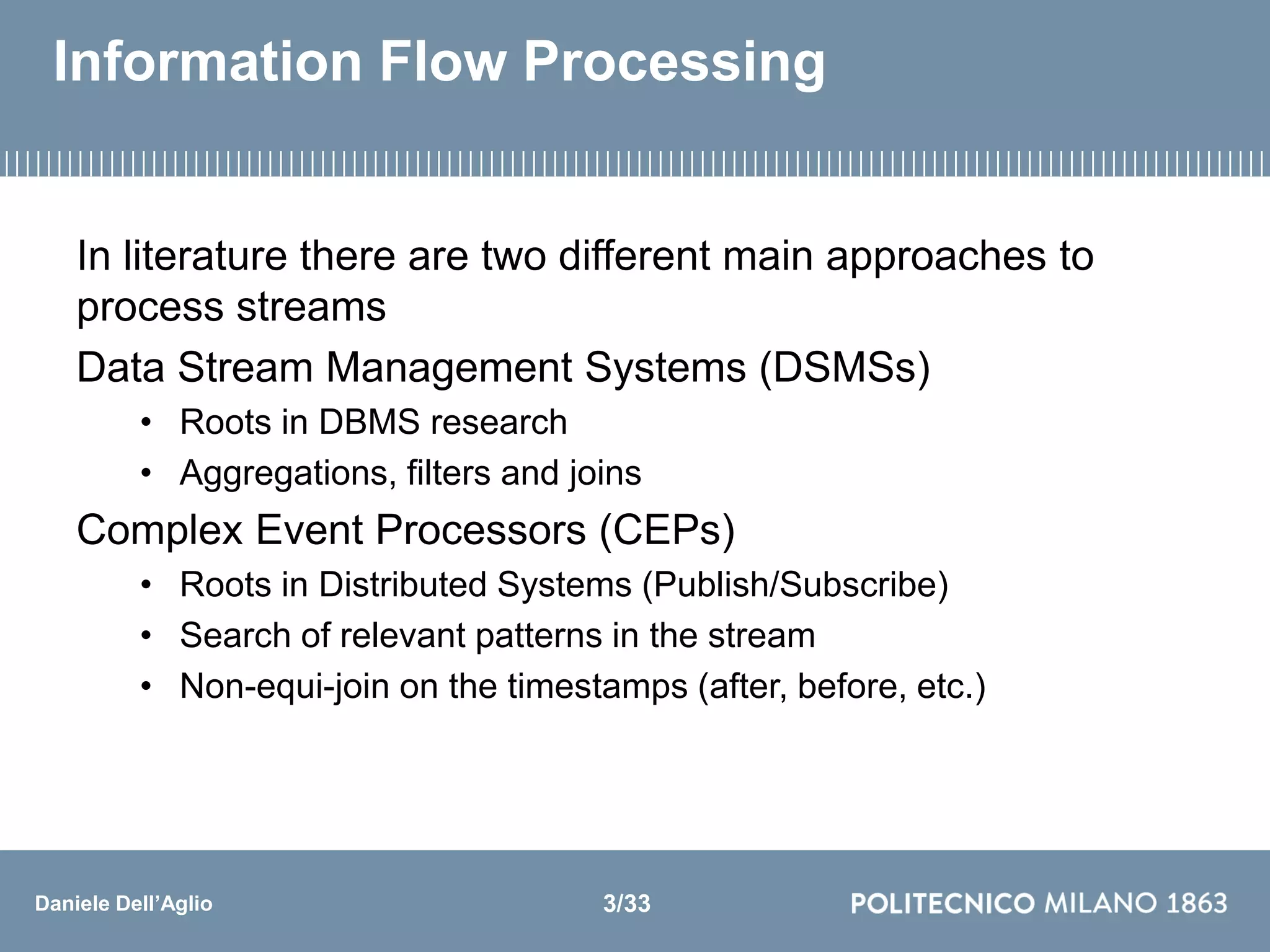
Complex Event Processors (CEPs)
• Roots in Distributed Systems (Publish/Subscribe)
• Search of relevant patterns in the stream
• Non-equi-join on the timestamps (after, before, etc.)
3/33
Daniele Dell’Aglio
Information Flow Processing
In literature there are two different main approaches to
process streams
Data Stream Management Systems (DSMSs)
• Roots in DBMS research
• Aggregations, filters and joins
Complex Event Processors (CEPs)
• Roots in Distributed Systems (Publish/Subscribe)
• Search of relevant patterns in the stream
• Non-equi-join on the timestamps (after, before, etc.)
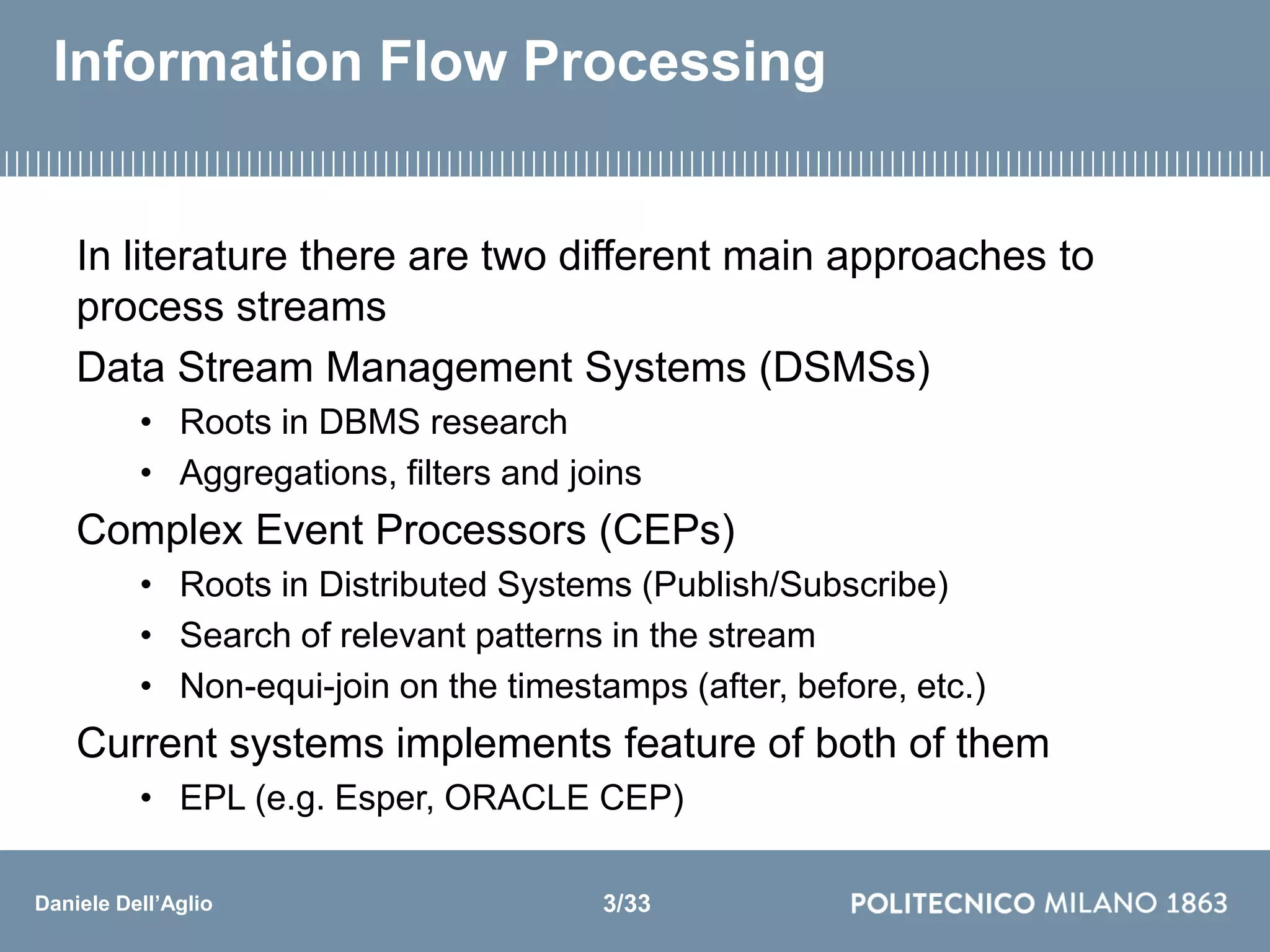
Current systems implements feature of both of them
• EPL (e.g. Esper, ORACLE CEP)
3/33
Daniele Dell’Aglio
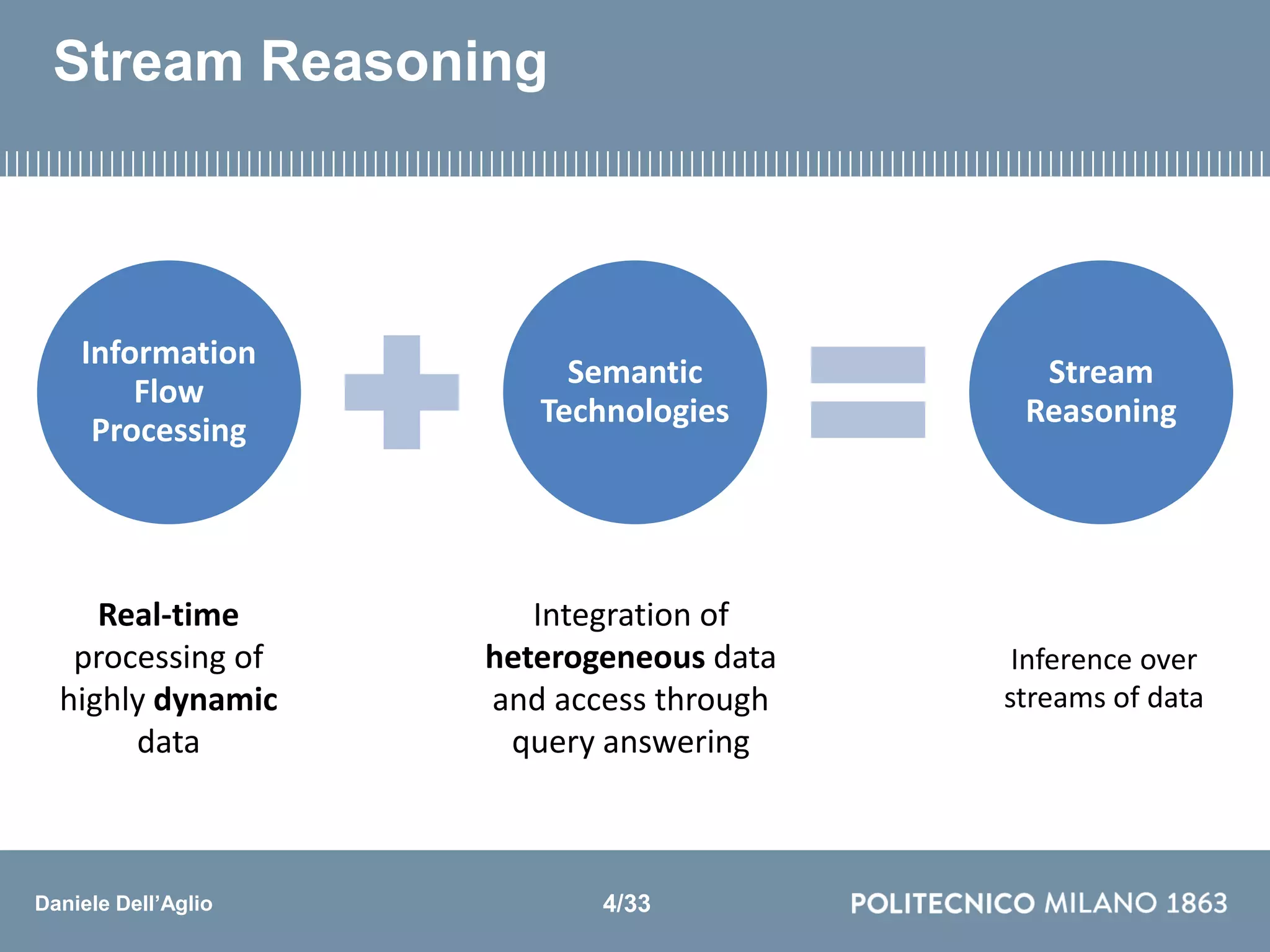
Stream Reasoning
Information
Flow
Processing
Semantic
Technologies
Stream
Reasoning
Inference over
streams of data
Real-time
processing of
highly dynamic
data
Integration of
heterogeneous data
and access through
query answering
4/33
Daniele Dell’Aglio
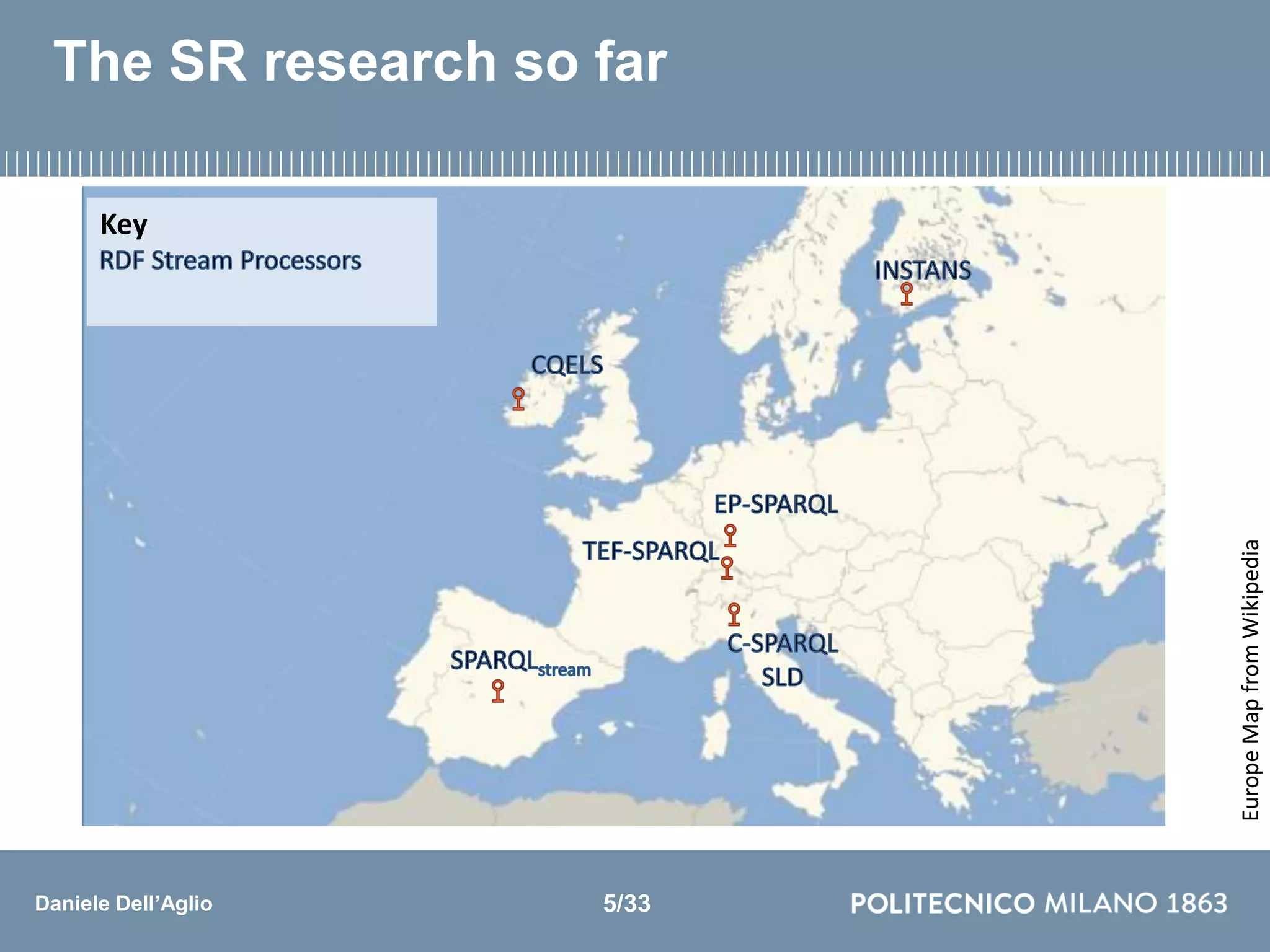
The SR research so far
EuropeMapfromWikipedia
Key
5/33
Daniele Dell’Aglio
The SR research so far
EuropeMapfromWikipedia
Key
5/33
Daniele Dell’Aglio
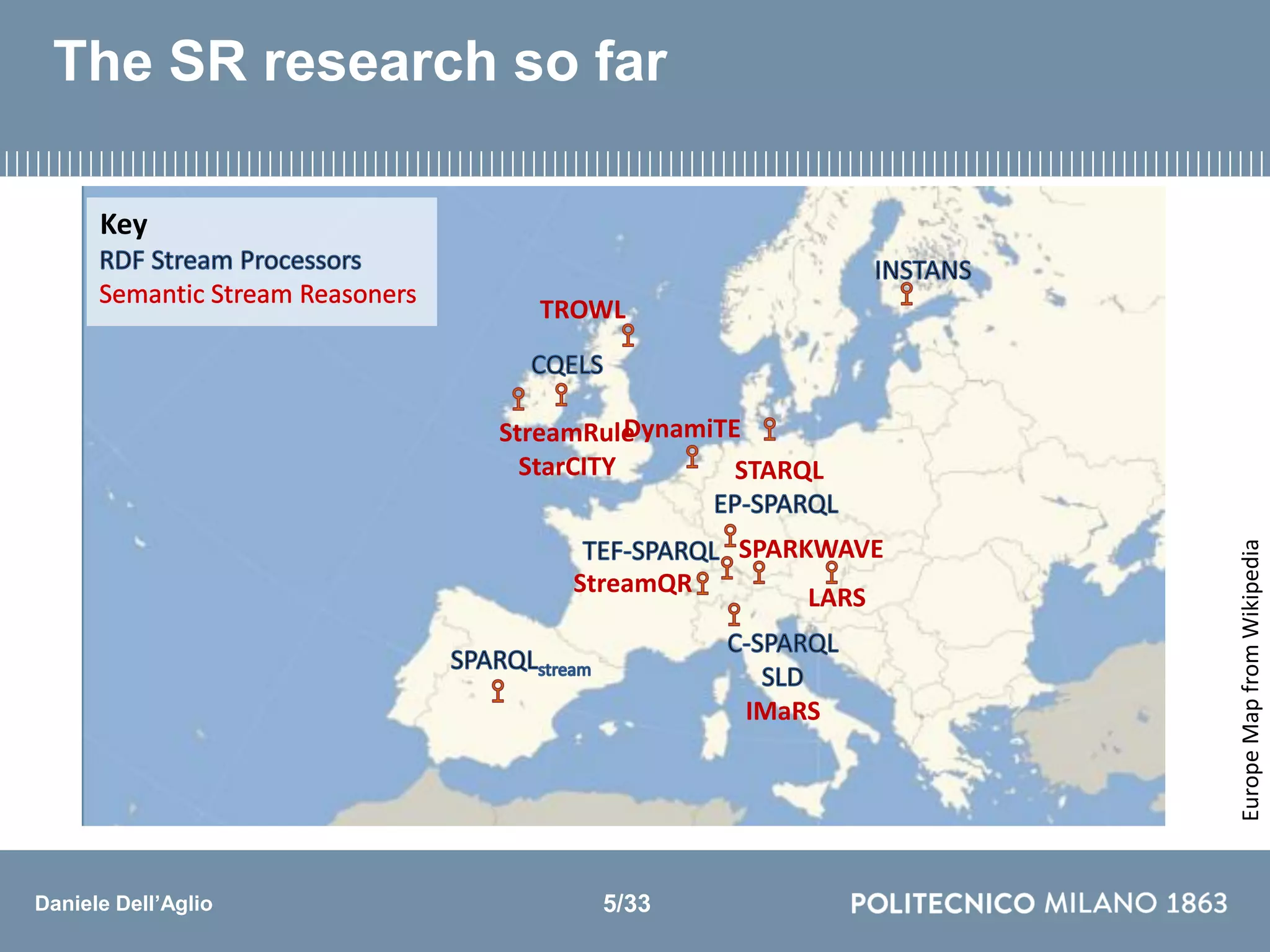
The SR research so far
IMaRS
STARQL
DynamiTE
TROWL
EuropeMapfromWikipedia
StreamRule
StarCITY
SPARKWAVE
LARS
Key
5/33
StreamQR
Daniele Dell’Aglio
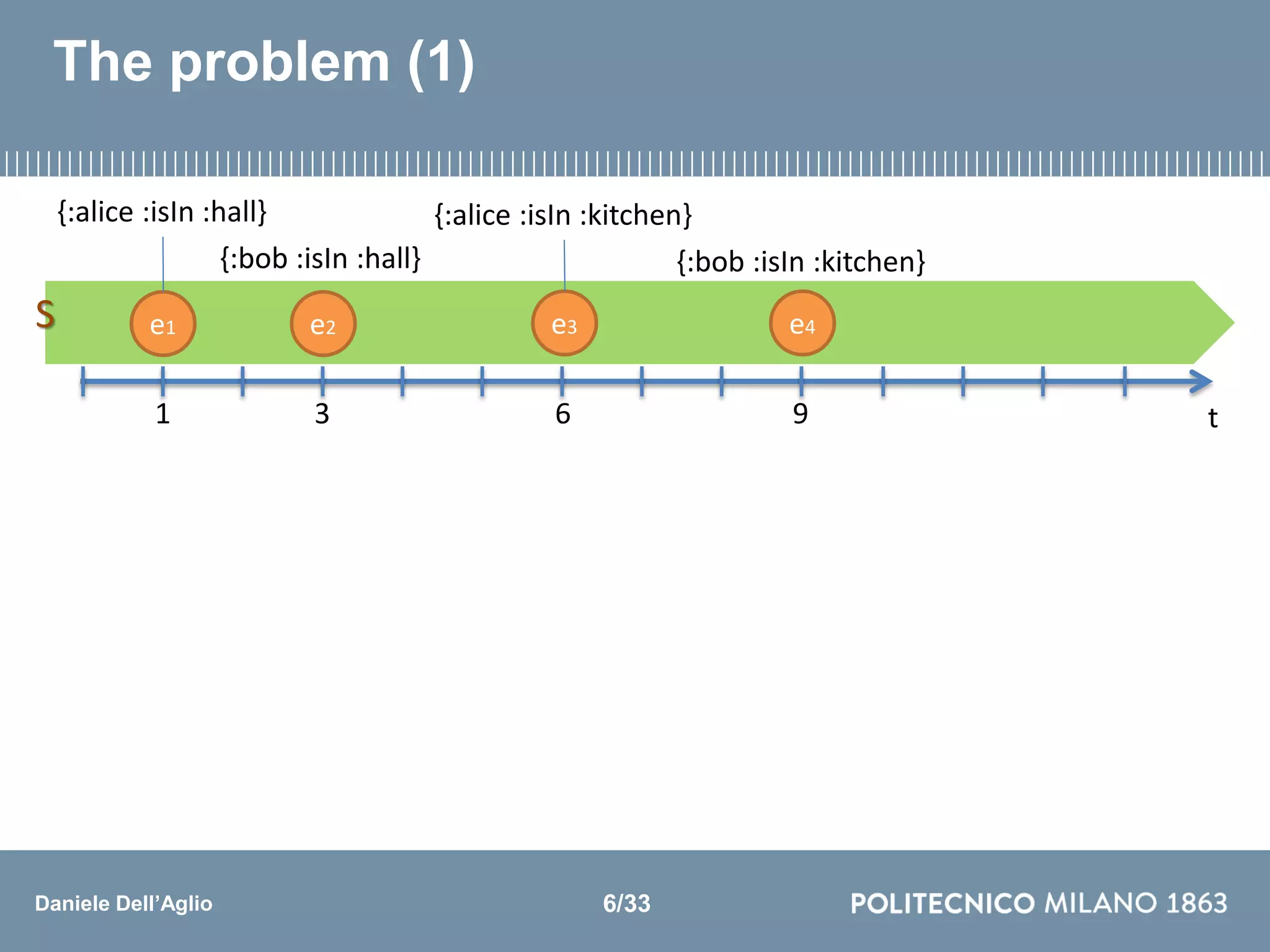
The problem (1)
t3 6 91
{:alice :isIn :hall}
{:bob :isIn :hall}
{:alice :isIn :kitchen}
{:bob :isIn :kitchen}
e1 e2 e3 e4S
6/33
Daniele Dell’Aglio
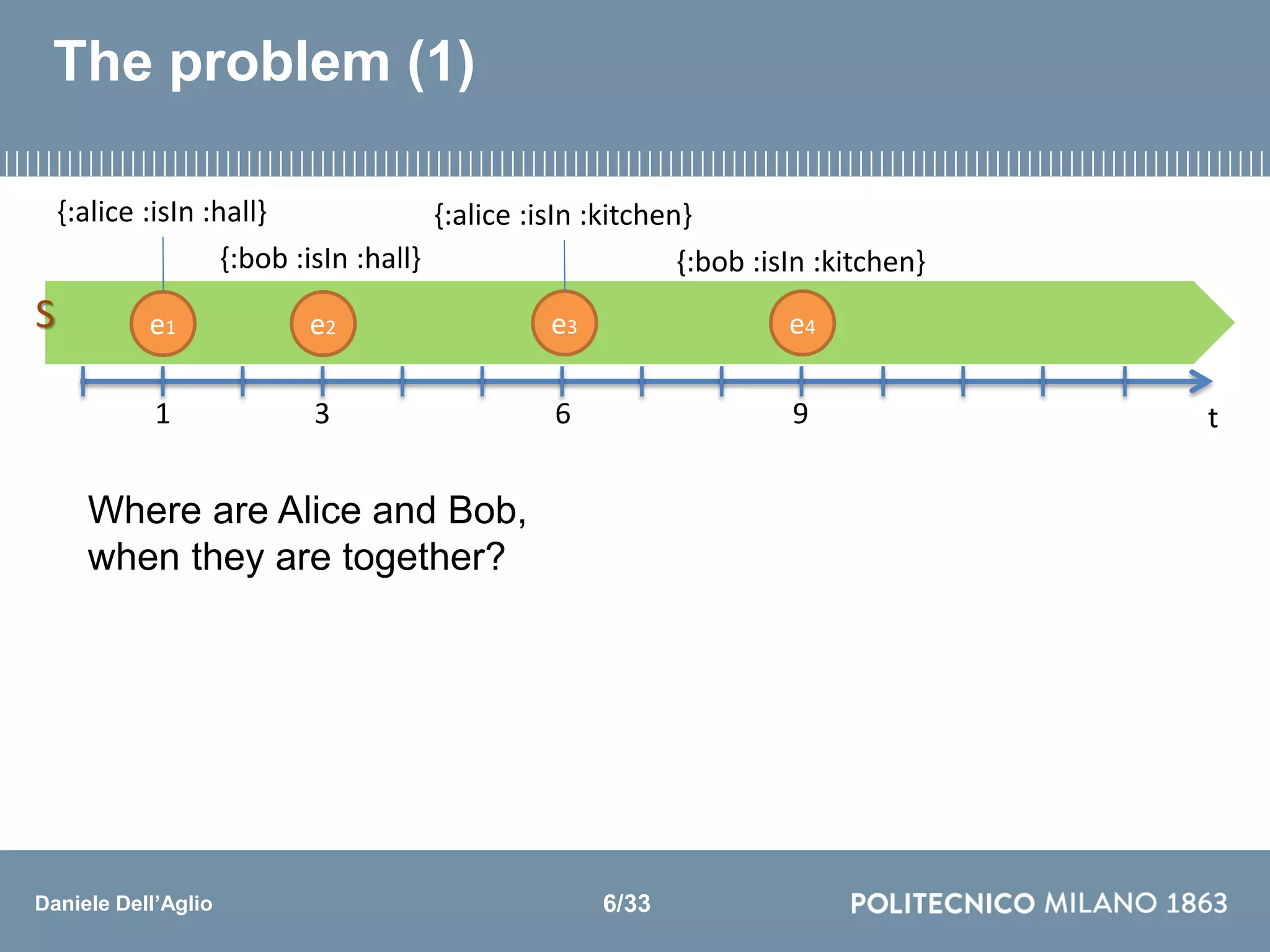
The problem (1)
Where are Alice and Bob,
when they are together?
t3 6 91
{:alice :isIn :hall}
{:bob :isIn :hall}
{:alice :isIn :kitchen}
{:bob :isIn :kitchen}
e1 e2 e3 e4S
6/33
Daniele Dell’Aglio
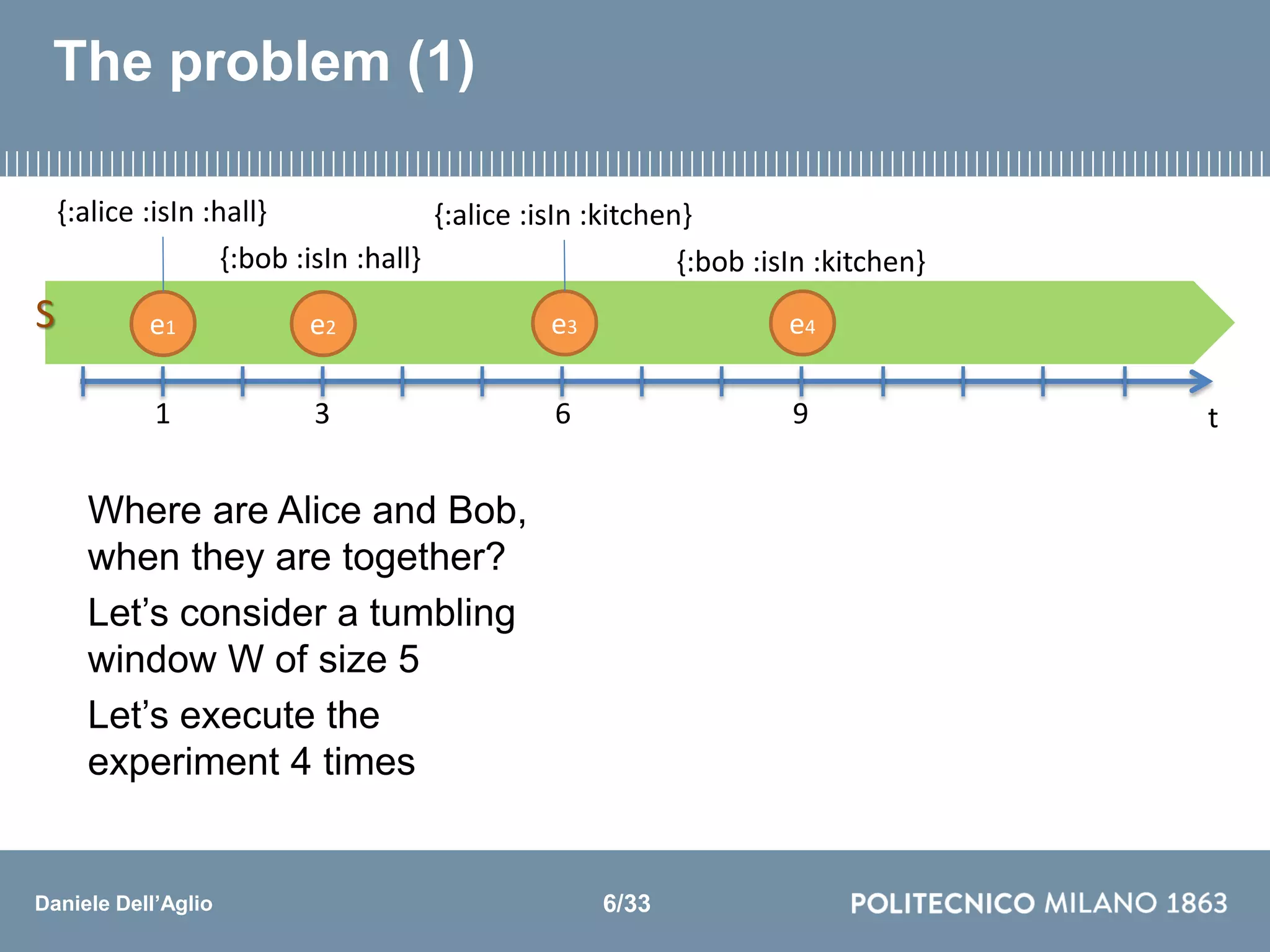
The problem (1)
Where are Alice and Bob,
when they are together?
Let’s consider a tumbling
window W of size 5
Let’s execute the
experiment 4 times
t3 6 91
{:alice :isIn :hall}
{:bob :isIn :hall}
{:alice :isIn :kitchen}
{:bob :isIn :kitchen}
e1 e2 e3 e4S
6/33
Daniele Dell’Aglio
The problem (1)
Execution 1° answer 2° answer
1 :hall [6] :kitchen [11]
2 :hall [5] :kitchen [10]
3 :hall [6] :kitchen [11]
4 - [7] - [12]
Where are Alice and Bob,
when they are together?
Let’s consider a tumbling
window W of size 5
Let’s execute the
experiment 4 times
t3 6 91
{:alice :isIn :hall}
{:bob :isIn :hall}
{:alice :isIn :kitchen}
{:bob :isIn :kitchen}
Which is the correct answer?
e1 e2 e3 e4S
6/33
Daniele Dell’Aglio
The problem (2)
Execution 1° answer 2° answer
1 :hall [6] :kitchen [11]
2 :hall [5] :kitchen [10]
3 :hall [6] :kitchen [11]
4 - [7] - [12]
CSPARQL
t3 6 91
{:alice :isIn :hall}
{:bob :isIn :hall}
{:alice :isIn :kitchen}
{:bob :isIn :kitchen}
e1 e2 e3 e4S
7/33
Daniele Dell’Aglio
The problem (2)
Execution 1° answer 2° answer
1 :hall [6] :kitchen [11]
2 :hall [5] :kitchen [10]
3 :hall [6] :kitchen [11]
4 - [7] - [12]
Execution 1° answer 2° answer
1 :hall [3] :kitchen [9]
2 No answers
3 :hall [3] :kitchen [9]
4 No answers
CSPARQL CQELS
Which system behaves in the correct way?
t3 6 91
{:alice :isIn :hall}
{:bob :isIn :hall}
{:alice :isIn :kitchen}
{:bob :isIn :kitchen}
e1 e2 e3 e4S
7/33
Daniele Dell’Aglio
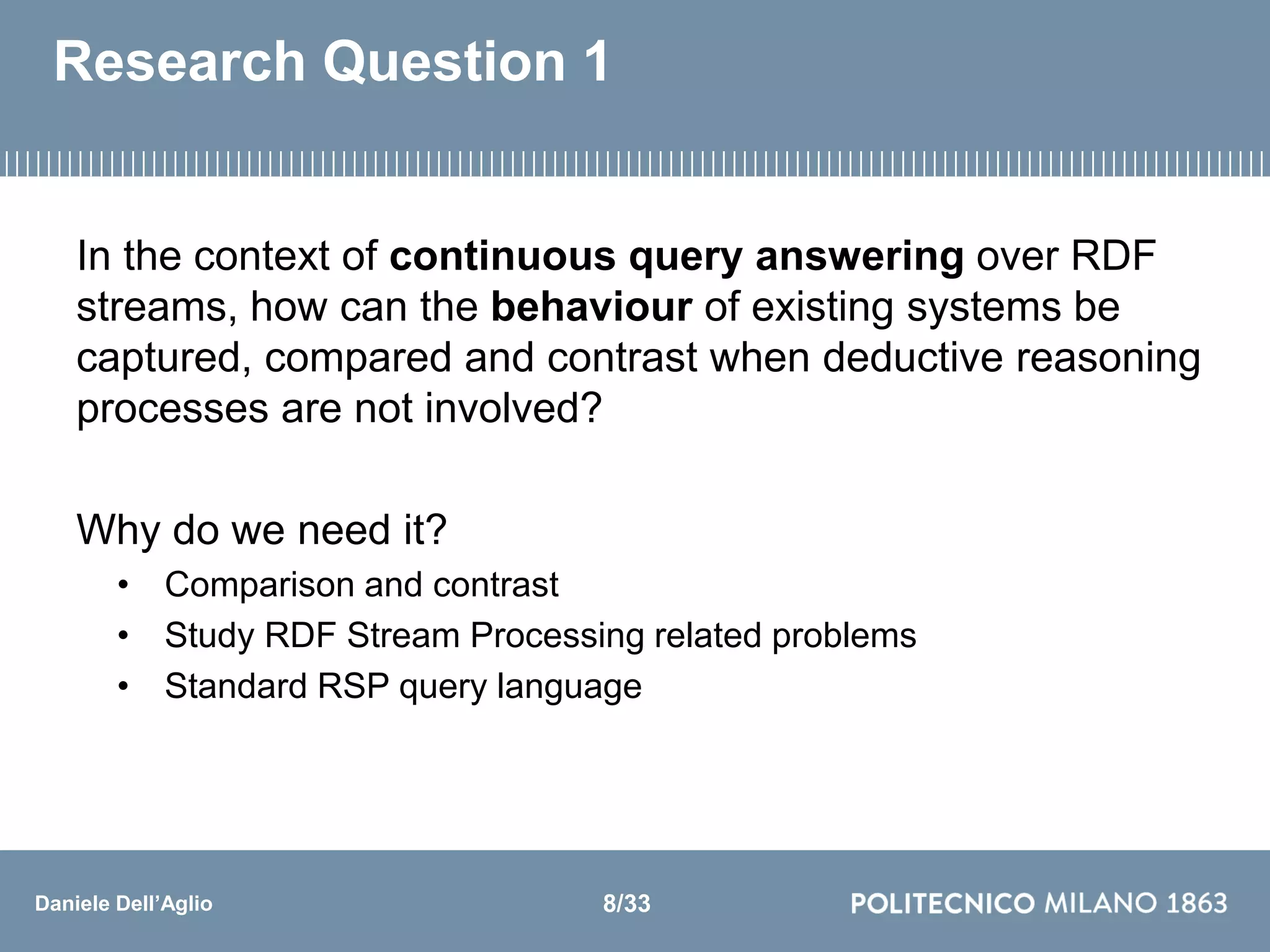
Research Question 1
In the context of continuous query answering over RDF
streams, how can the behaviour of existing systems be
captured, compared and contrast when deductive reasoning
processes are not involved?
8/33
Daniele Dell’Aglio
Research Question 1
In the context of continuous query answering over RDF
streams, how can the behaviour of existing systems be
captured, compared and contrast when deductive reasoning
processes are not involved?
Why do we need it?
• Comparison and contrast
• Study RDF Stream Processing related problems
• Standard RSP query language
8/33
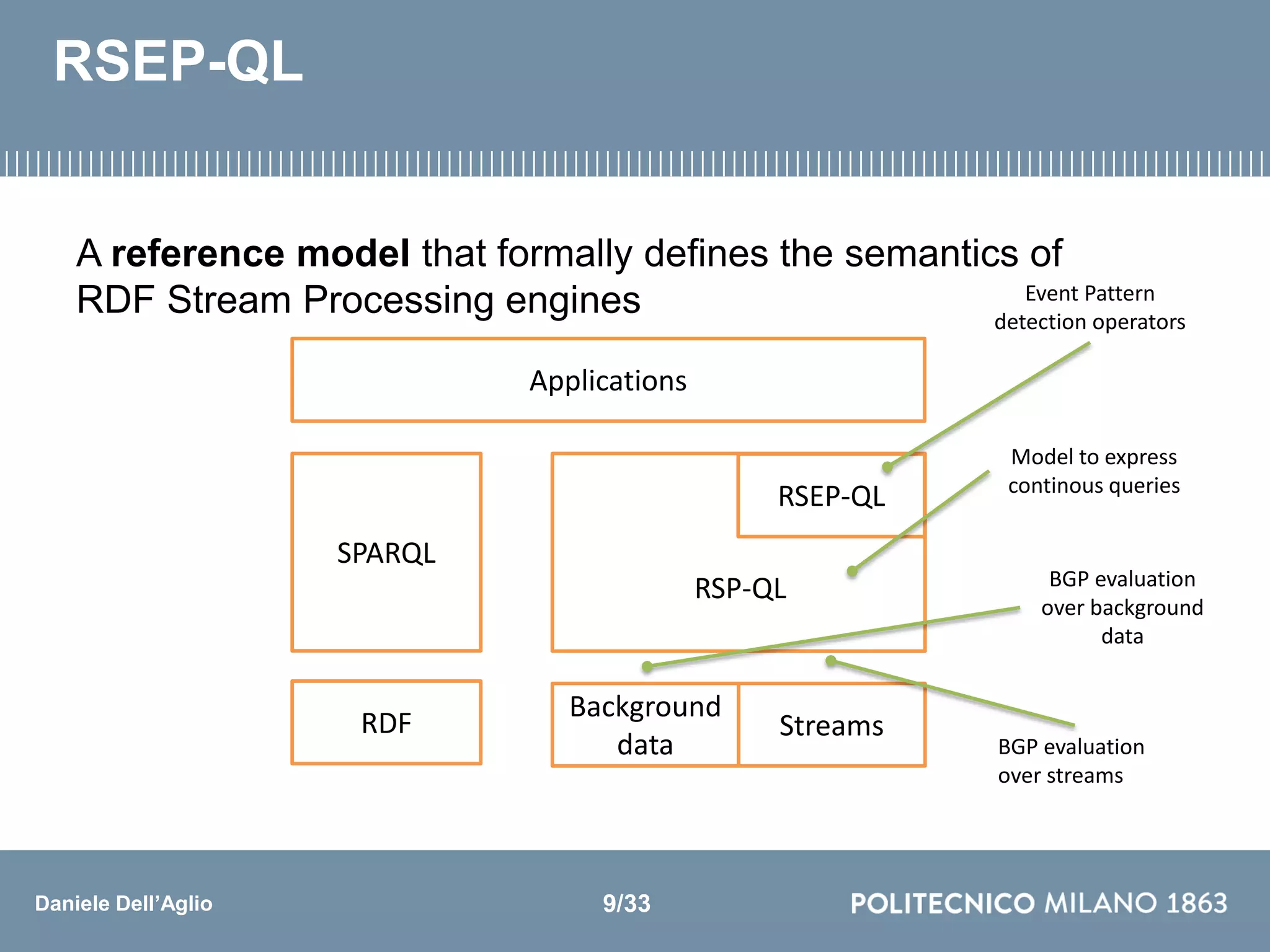
Daniele Dell’Aglio
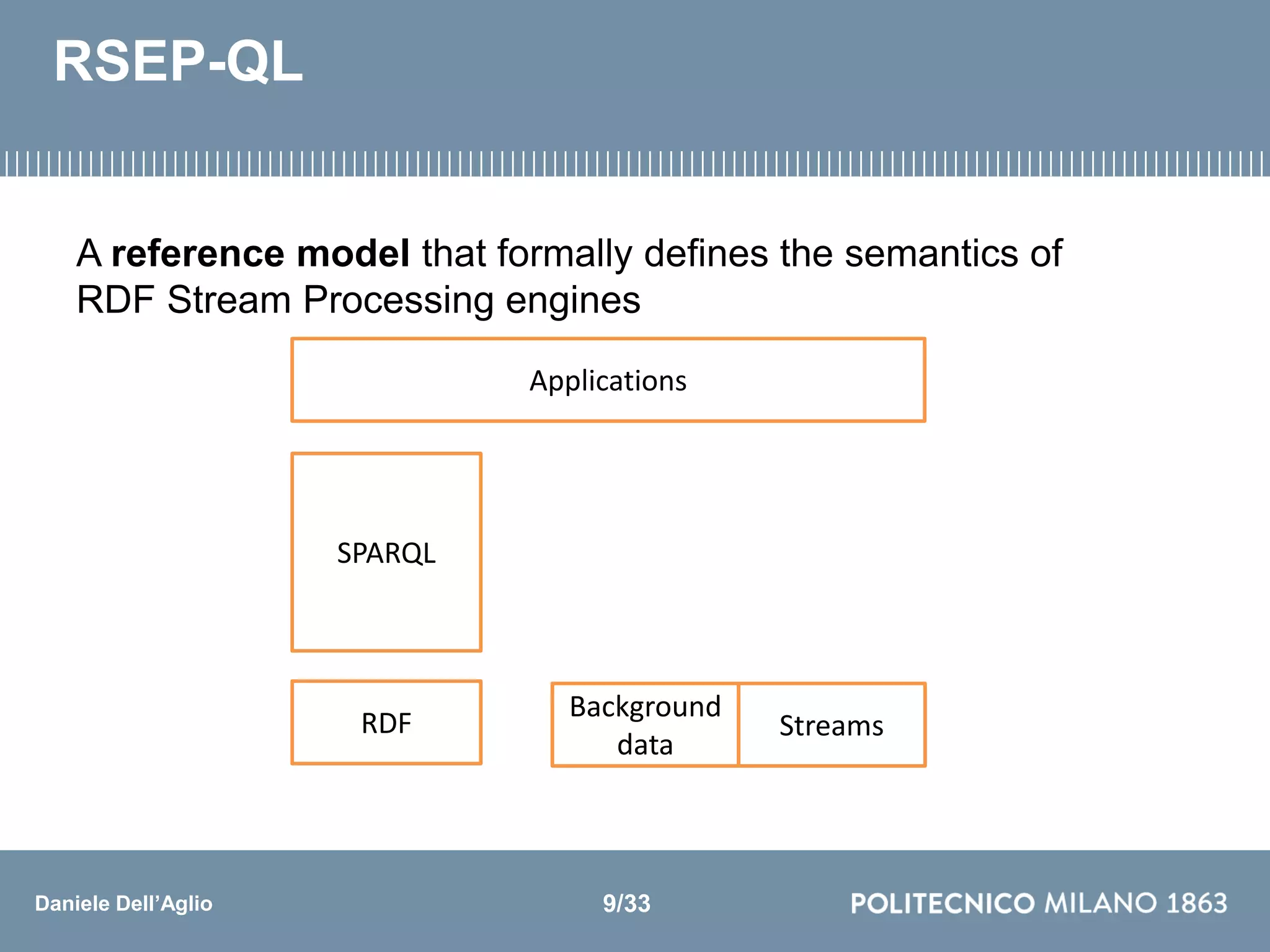
Background
data
Streams
Applications
RDF
SPARQL
RSEP-QL
A reference model that formally defines the semantics of
RDF Stream Processing engines
9/33
Daniele Dell’Aglio
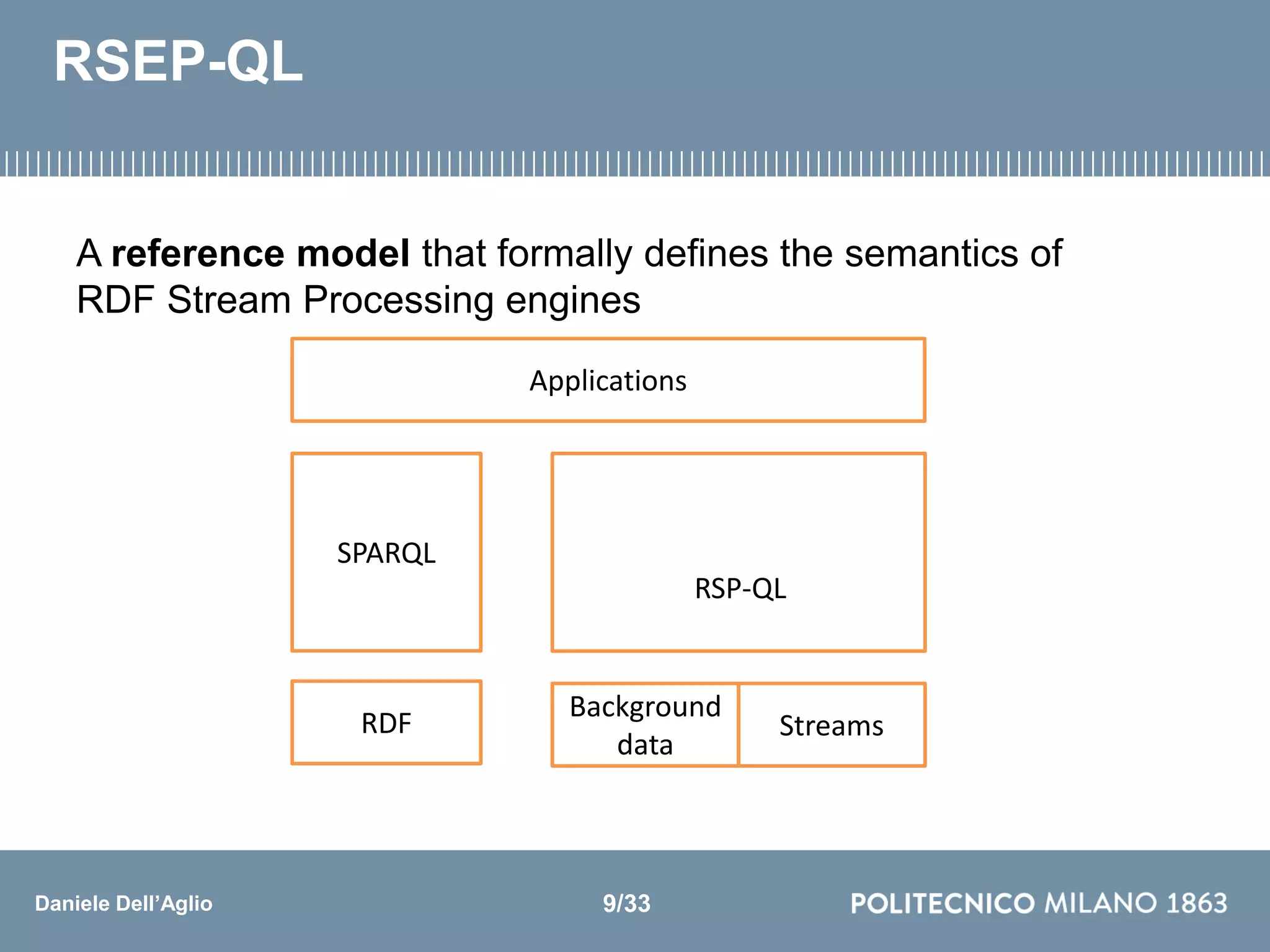
Background
data
Streams
Applications
RSP-QL
RDF
SPARQL
RSEP-QL
A reference model that formally defines the semantics of
RDF Stream Processing engines
9/33
Daniele Dell’Aglio
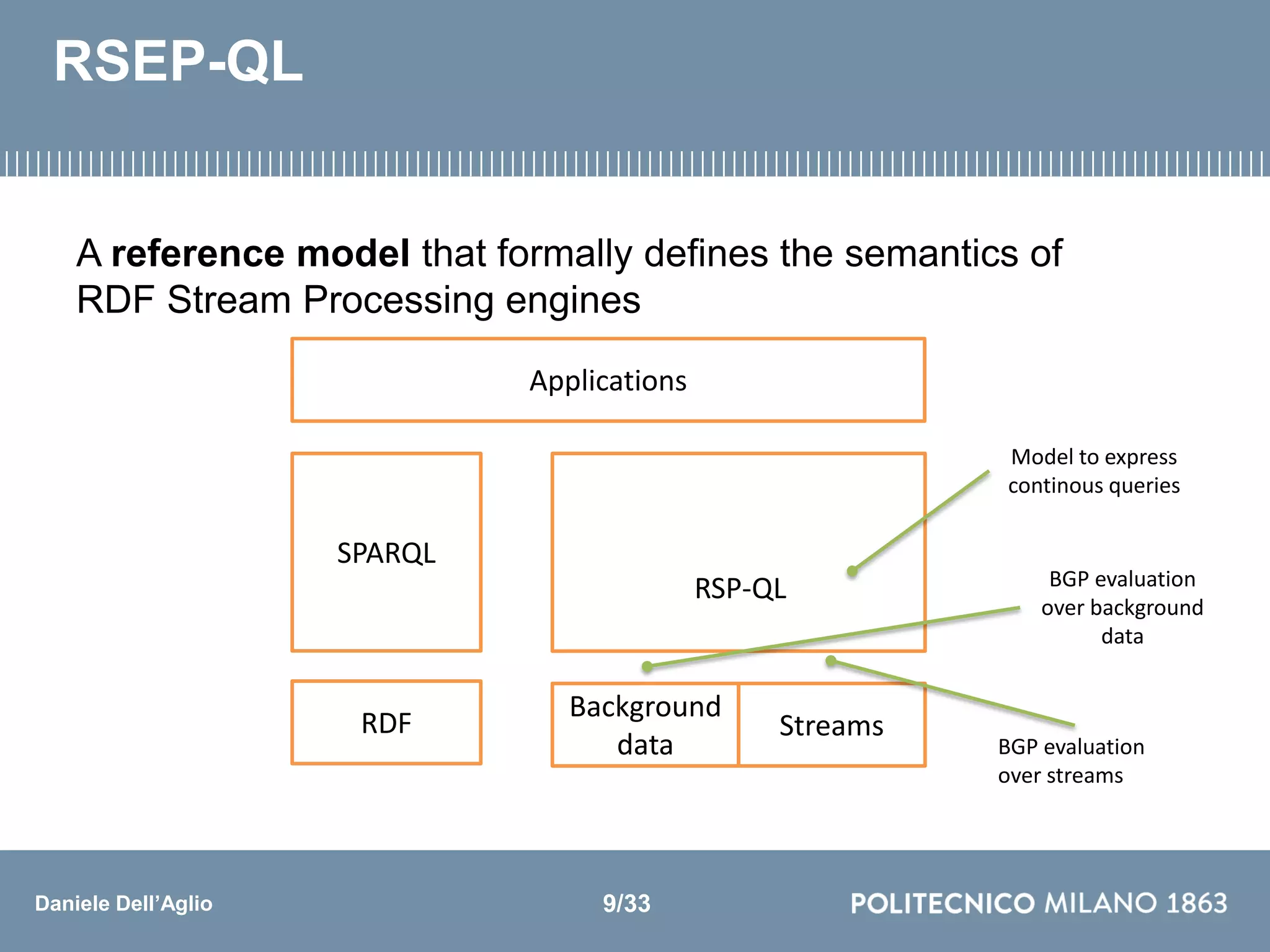
Background
data
Streams
Applications
RSP-QL BGP evaluation
over background
data
BGP evaluation
over streams
Model to express
continous queries
RDF
SPARQL
RSEP-QL
A reference model that formally defines the semantics of
RDF Stream Processing engines
9/33
Daniele Dell’Aglio
Background
data
Streams
RSEP-QL
Applications
RSP-QL BGP evaluation
over background
data
BGP evaluation
over streams
Event Pattern
detection operators
Model to express
continous queries
RDF
SPARQL
RSEP-QL
A reference model that formally defines the semantics of
RDF Stream Processing engines
9/33
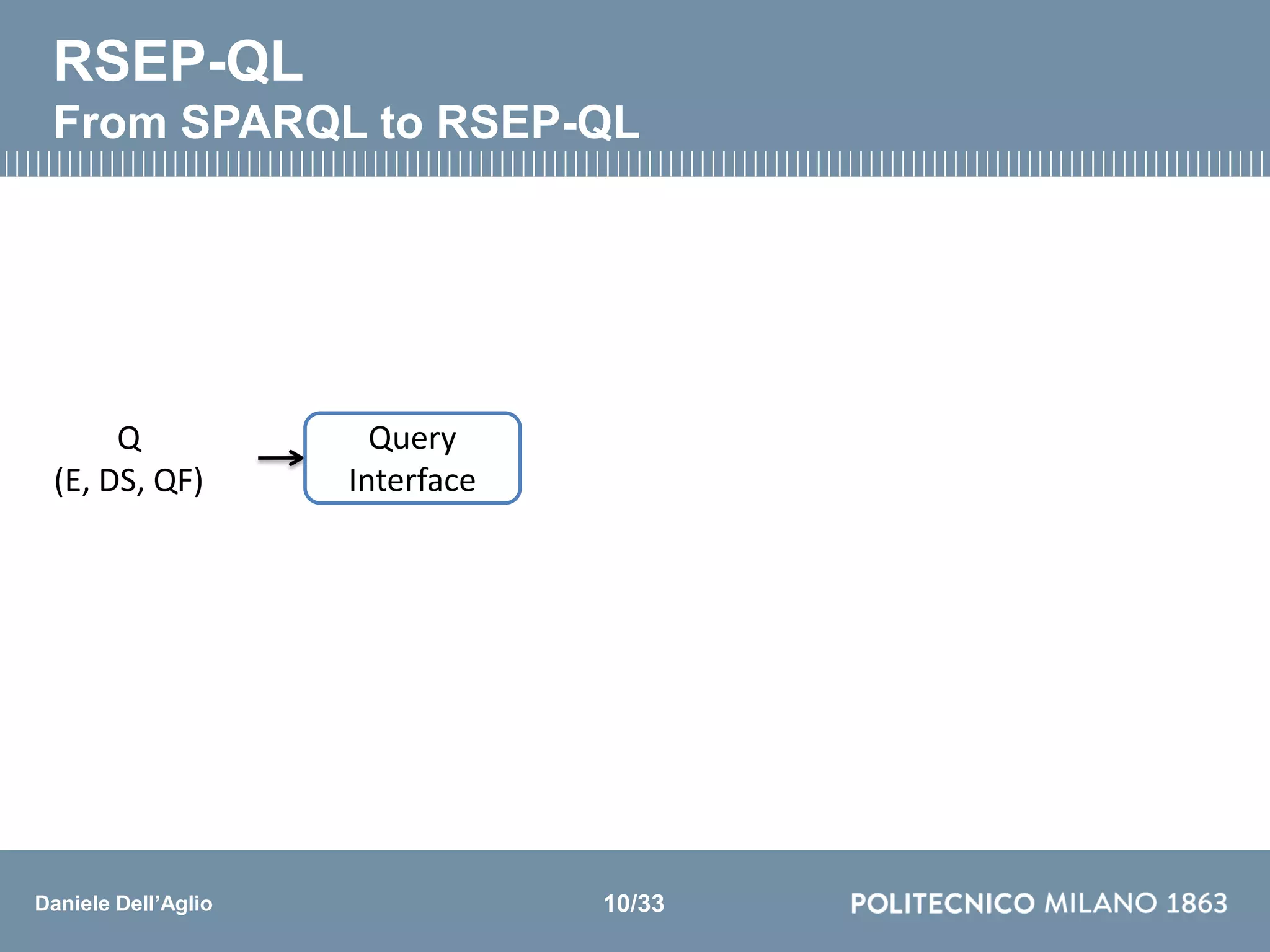
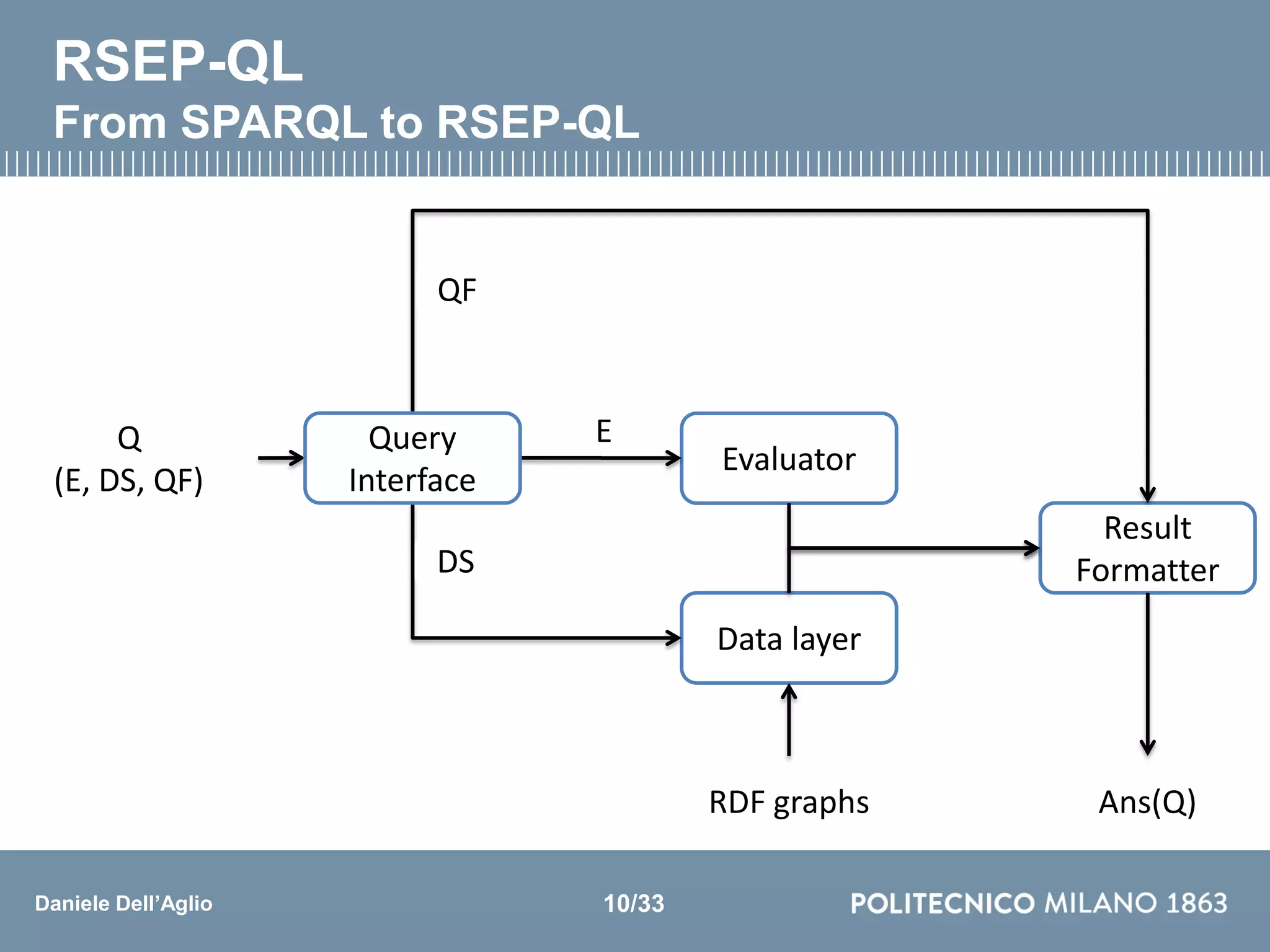
Daniele Dell’Aglio
Q
(E, DS, QF)
RSEP-QL
From SPARQL to RSEP-QL
Query
Interface
10/33
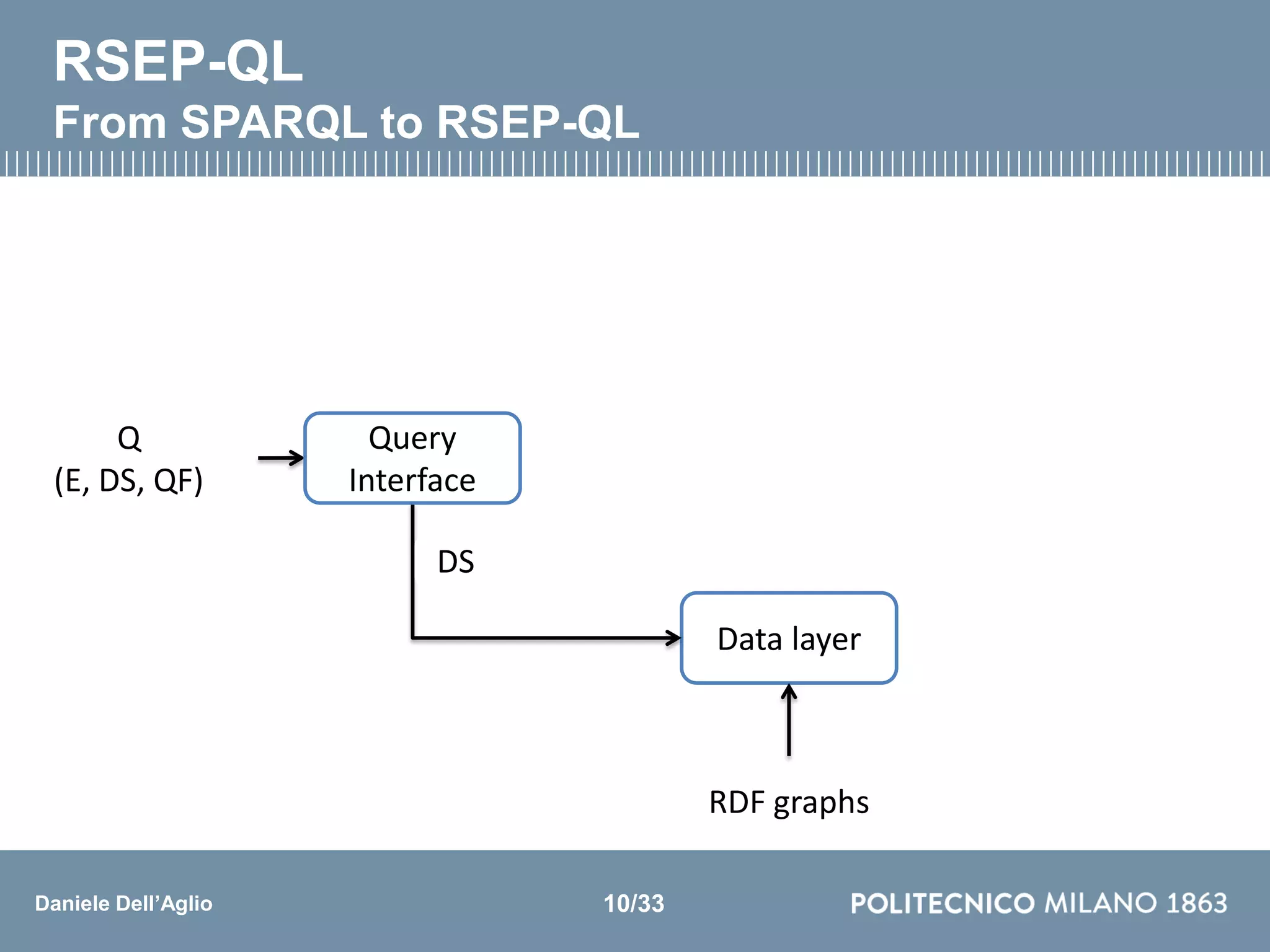
Daniele Dell’Aglio
Q
(E, DS, QF)
RSEP-QL
From SPARQL to RSEP-QL
Data layer
RDF graphs
DS
Query
Interface
10/33
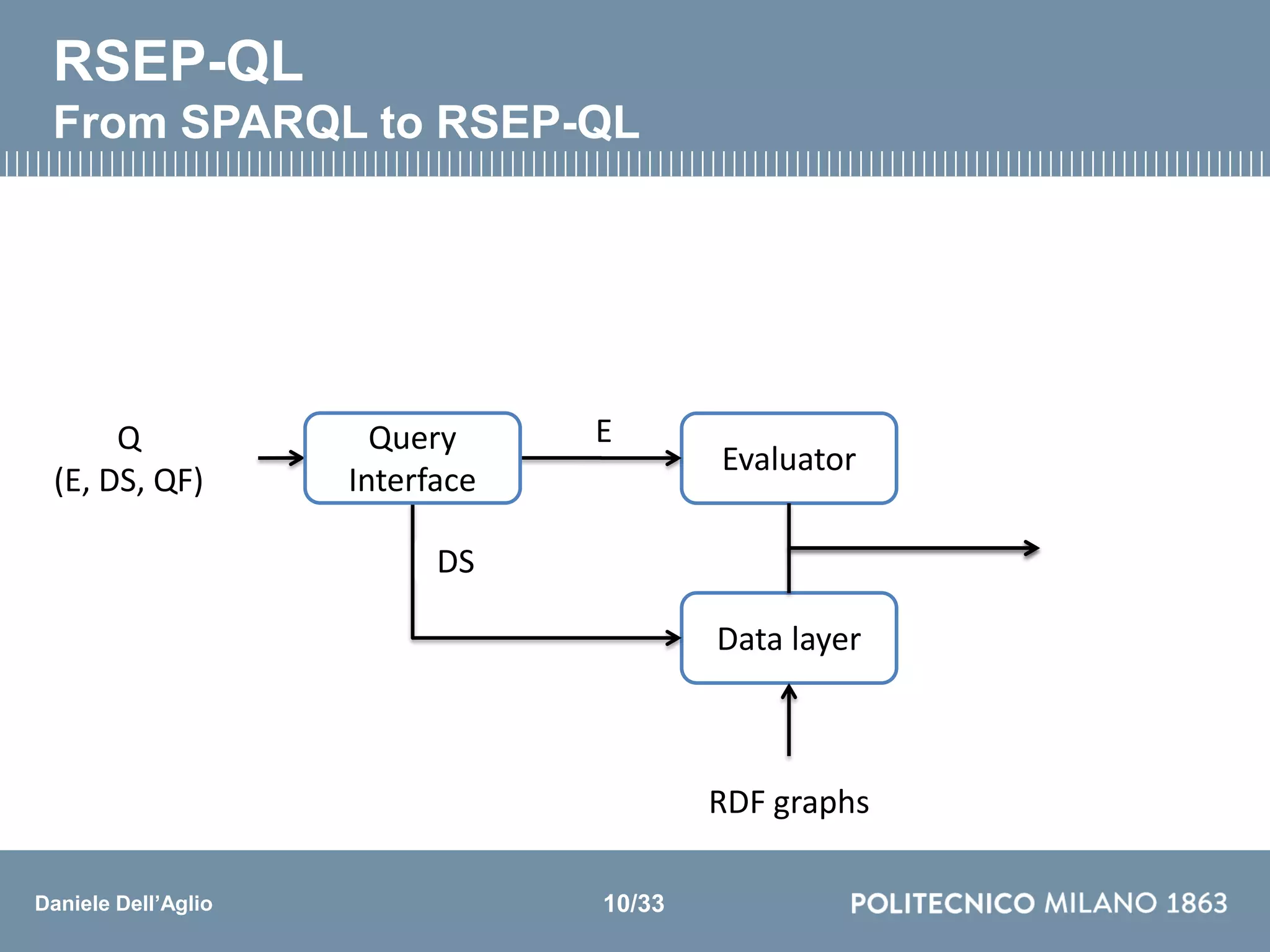
Daniele Dell’Aglio
Q
(E, DS, QF)
RSEP-QL
From SPARQL to RSEP-QL
Evaluator
Data layer
RDF graphs
E
DS
Query
Interface
10/33
Daniele Dell’Aglio
Q
(E, DS, QF)
RSEP-QL
From SPARQL to RSEP-QL
Evaluator
Data layer
Result
Formatter
Ans(Q)RDF graphs
E
DS
QF
Query
Interface
10/33
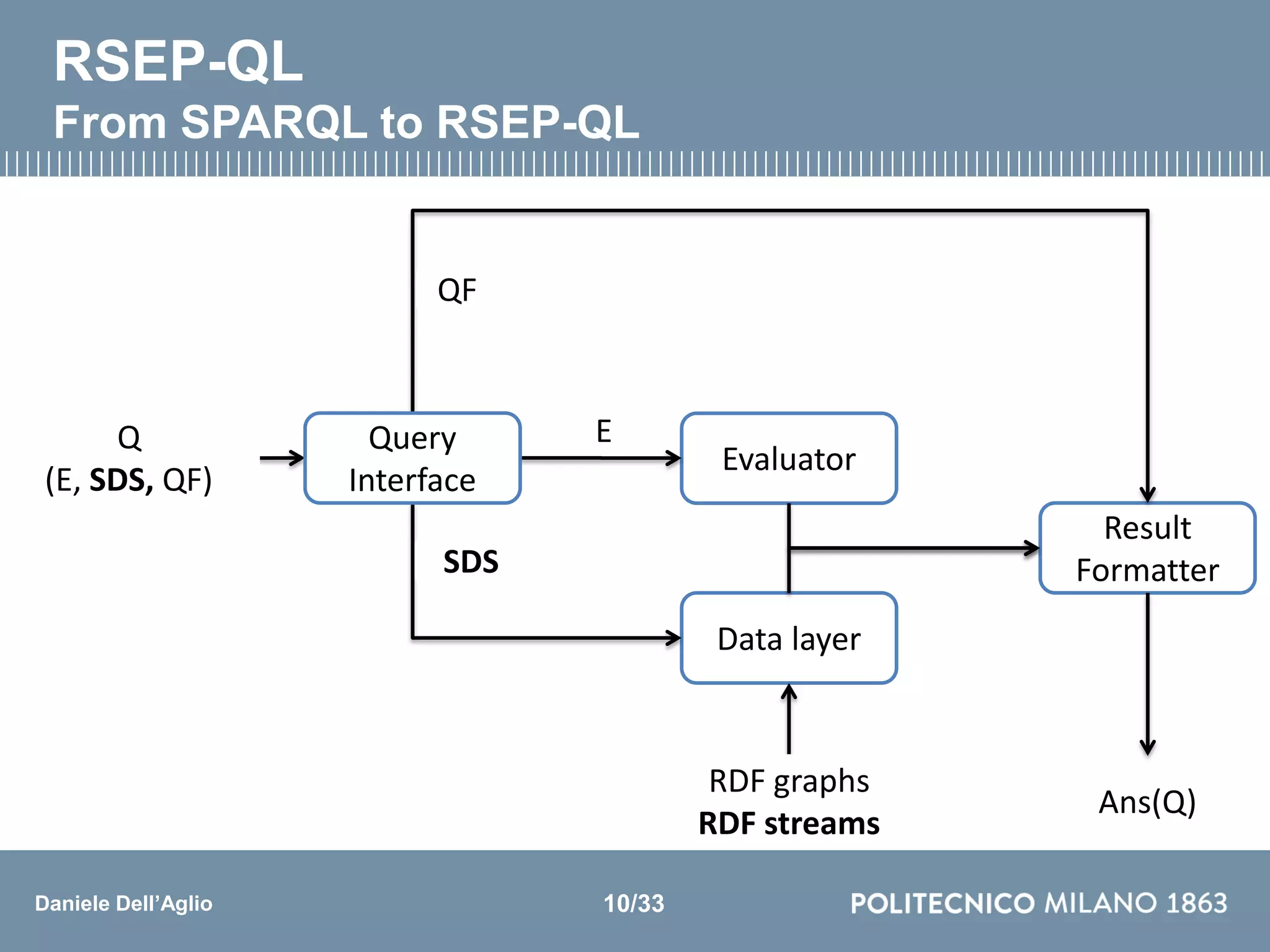
Daniele Dell’Aglio
Q
(E, DS, QF)
RSEP-QL
From SPARQL to RSEP-QL
Evaluator
Data layer
Result
Formatter
Ans(Q)RDF graphs
E
DS
QF
RDF graphs
RDF streams
Query
Interface
SDS
Q
(E, SDS, QF)
10/33
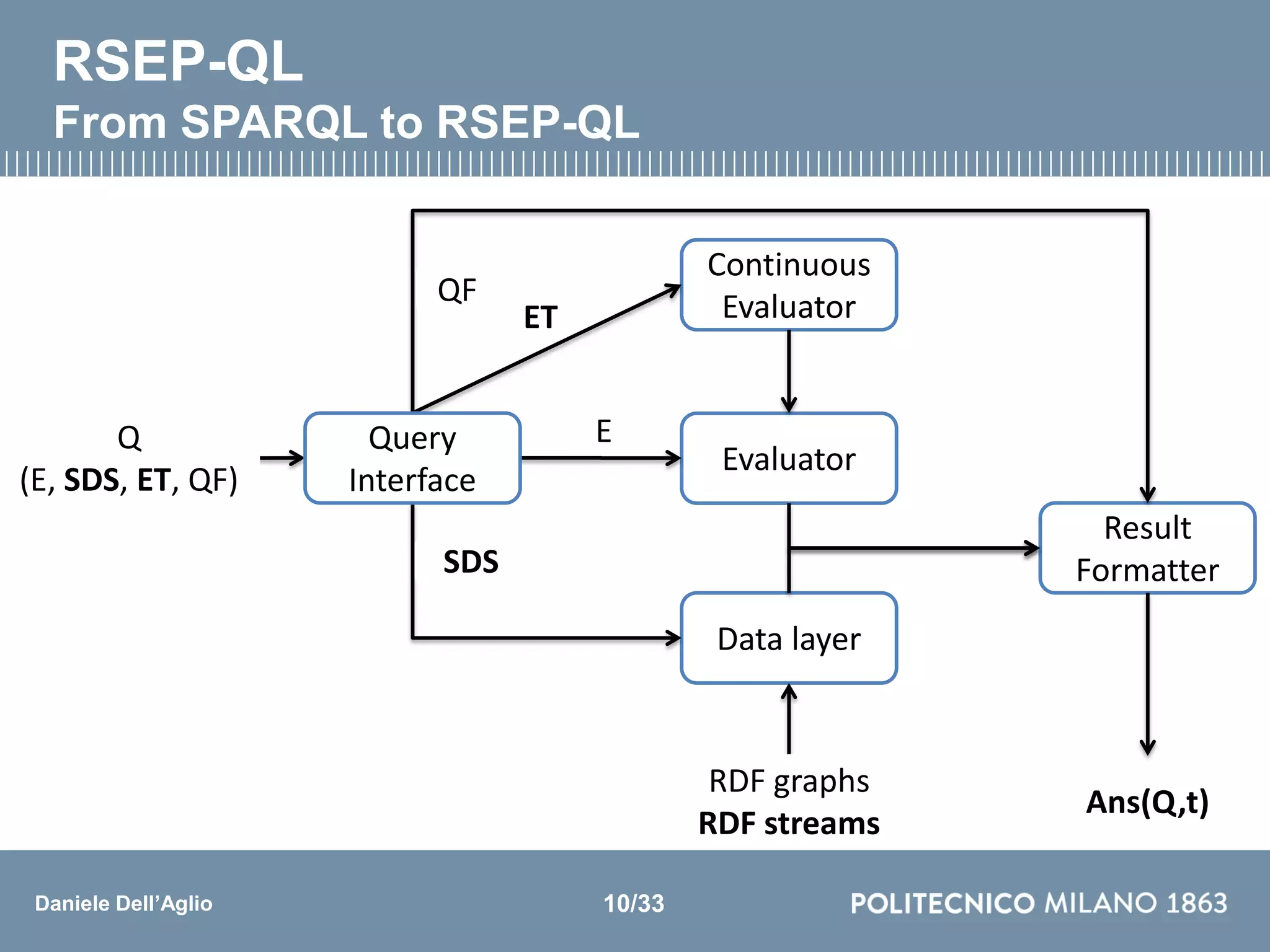
Daniele Dell’Aglio
Q
(E, DS, QF)
RSEP-QL
From SPARQL to RSEP-QL
Evaluator
Data layer
Result
Formatter
Ans(Q)RDF graphs
E
DS
QF
Continuous
EvaluatorET
RDF graphs
RDF streams
Query
Interface
SDS
Q
(E, SDS, QF)
Q
(E, SDS, ET, QF)
10/33
Ans(Q,t)
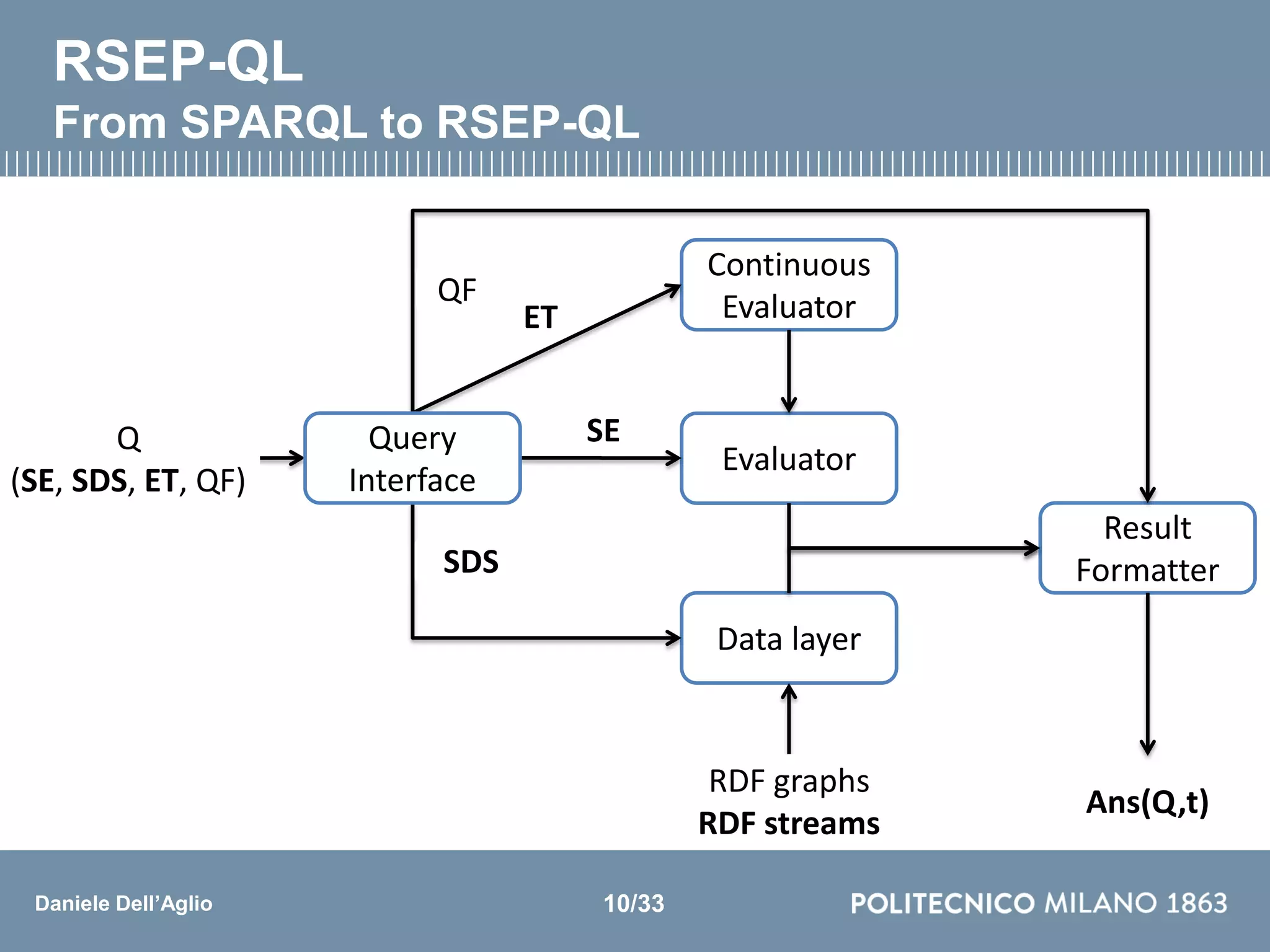
Daniele Dell’Aglio
Q
(E, DS, QF)
RSEP-QL
From SPARQL to RSEP-QL
Evaluator
Data layer
Result
Formatter
Ans(Q)RDF graphs
E
DS
QF
Continuous
EvaluatorET
RDF graphs
RDF streams
Query
Interface
SDS
Q
(E, SDS, QF)
Q
(E, SDS, ET, QF)
SE
10/33
Q
(SE, SDS, ET, QF)
Ans(Q,t)
Daniele Dell’Aglio
t
S3
S4 S5 S6
S7
S8 S9
S10
S11
S
S1
S2
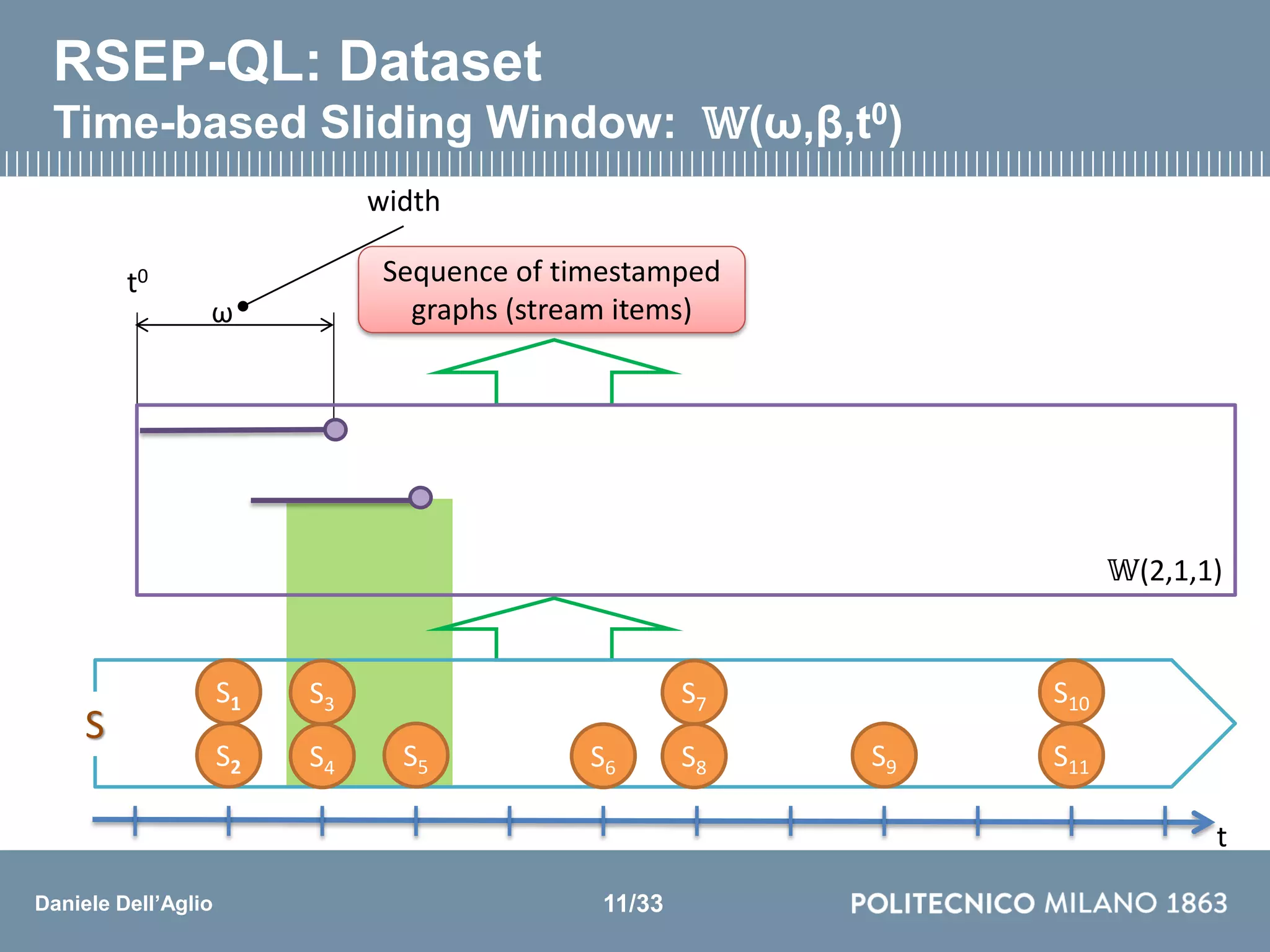
RSEP-QL: Dataset
Time-based Sliding Window: 𝕎(ω,β,t0)
11/33
Daniele Dell’Aglio
Sequence of timestamped
graphs (stream items)
𝕎(2,1,1)
t
S3
S4 S5 S6
S7
S8 S9
S10
S11
S
S1
S2
RSEP-QL: Dataset
Time-based Sliding Window: 𝕎(ω,β,t0)
11/33
Daniele Dell’Aglio
Sequence of timestamped
graphs (stream items)
𝕎(2,1,1)
t
S3
S4 S5 S6
S7
S8 S9
S10
S11
S
S1
S2
RSEP-QL: Dataset
Time-based Sliding Window: 𝕎(ω,β,t0)
11/33
Daniele Dell’Aglio
Sequence of timestamped
graphs (stream items)
𝕎(2,1,1)
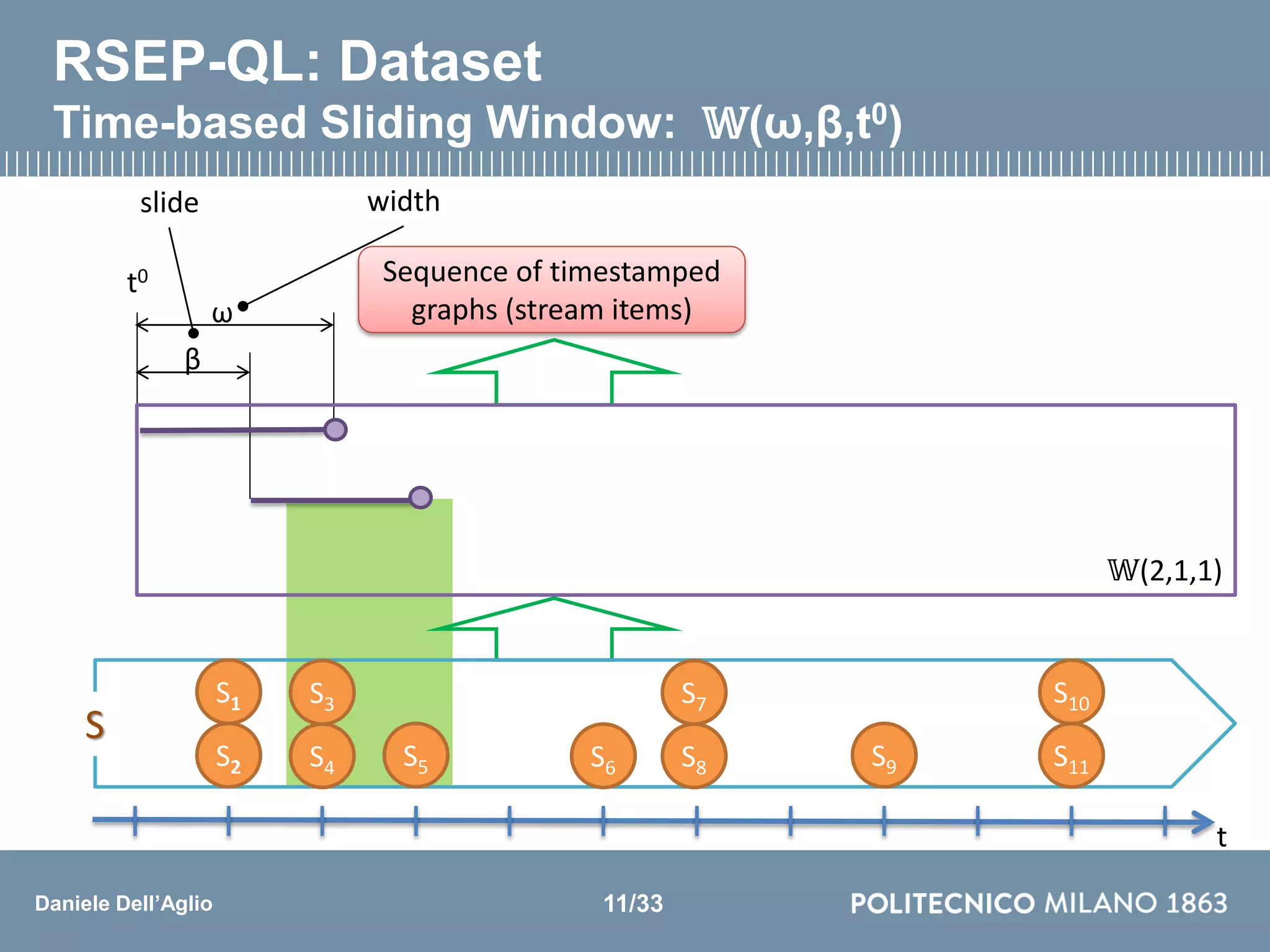
ω
t
width
S3
S4 S5 S6
S7
S8 S9
S10
S11
S
S1
S2
t0
RSEP-QL: Dataset
Time-based Sliding Window: 𝕎(ω,β,t0)
11/33
Daniele Dell’Aglio
Sequence of timestamped
graphs (stream items)
𝕎(2,1,1)
ω
t
width
S3
S4 S5 S6
S7
S8 S9
S10
S11
S
S1
S2
t0
RSEP-QL: Dataset
Time-based Sliding Window: 𝕎(ω,β,t0)
11/33
Daniele Dell’Aglio
Sequence of timestamped
graphs (stream items)
𝕎(2,1,1)
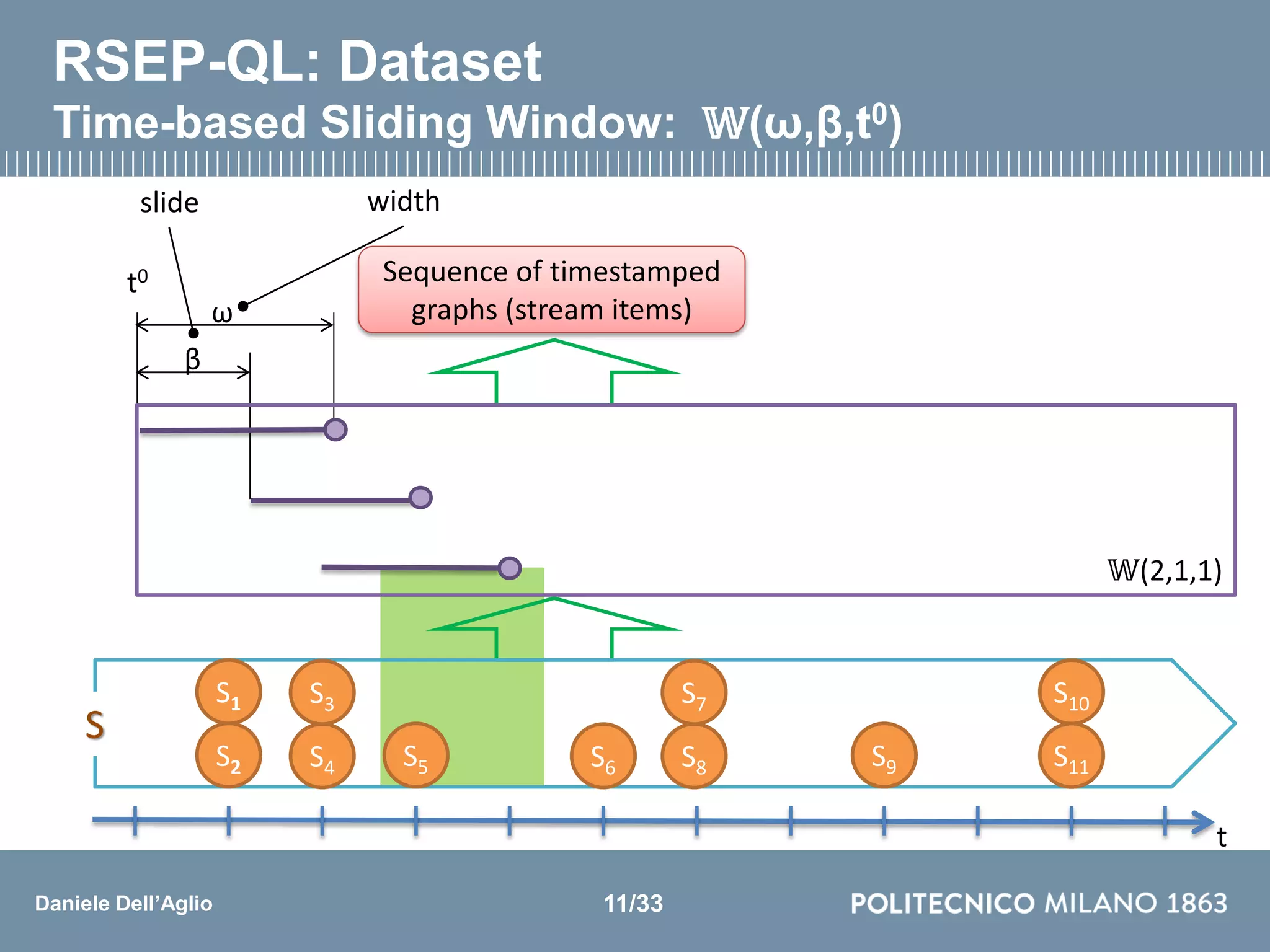
β
ω
t
widthslide
S3
S4 S5 S6
S7
S8 S9
S10
S11
S
S1
S2
t0
RSEP-QL: Dataset
Time-based Sliding Window: 𝕎(ω,β,t0)
11/33
Daniele Dell’Aglio
Sequence of timestamped
graphs (stream items)
𝕎(2,1,1)
β
ω
t
widthslide
S3
S4 S5 S6
S7
S8 S9
S10
S11
S
S1
S2
t0
RSEP-QL: Dataset
Time-based Sliding Window: 𝕎(ω,β,t0)
11/33
Daniele Dell’Aglio
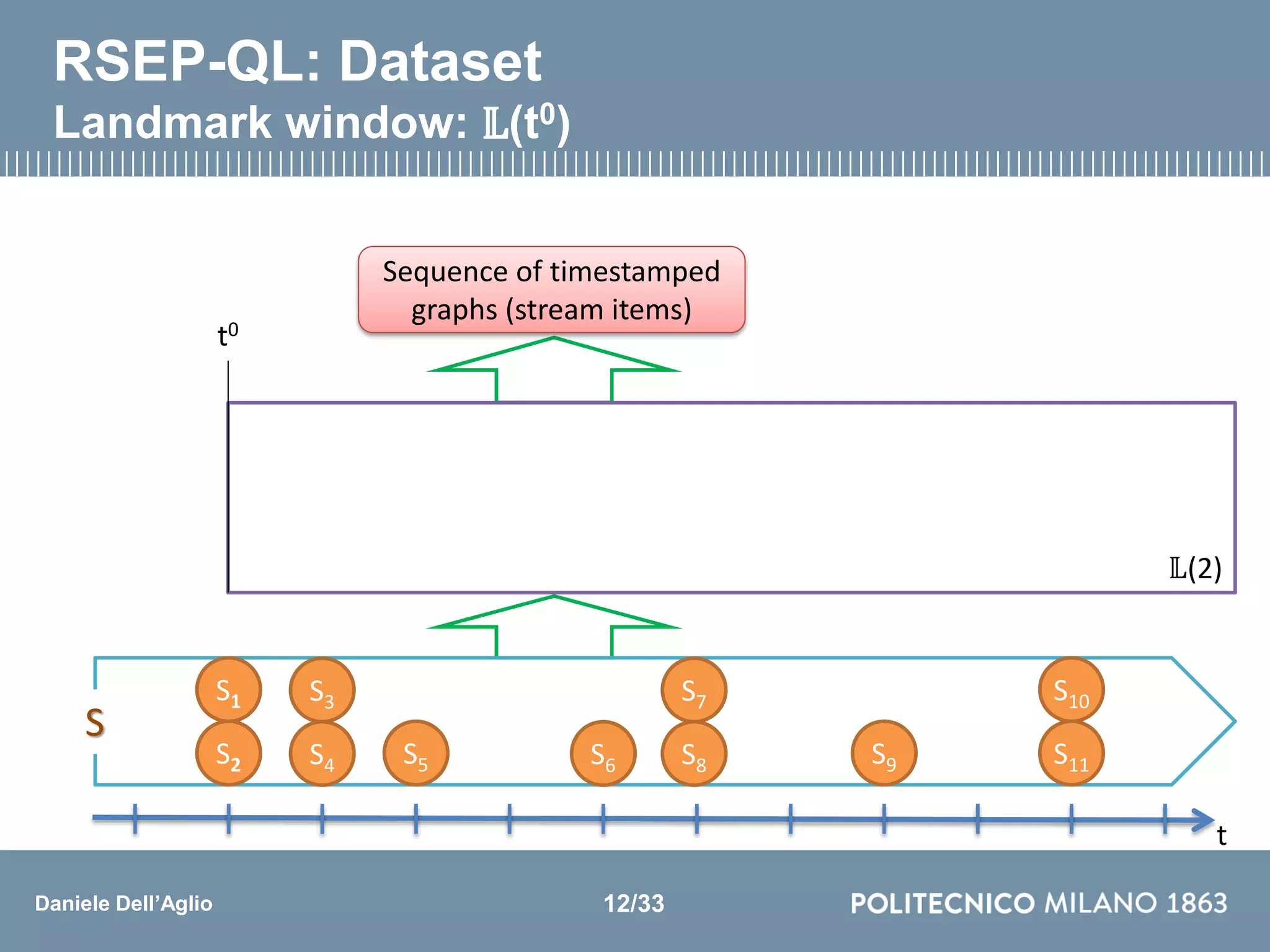
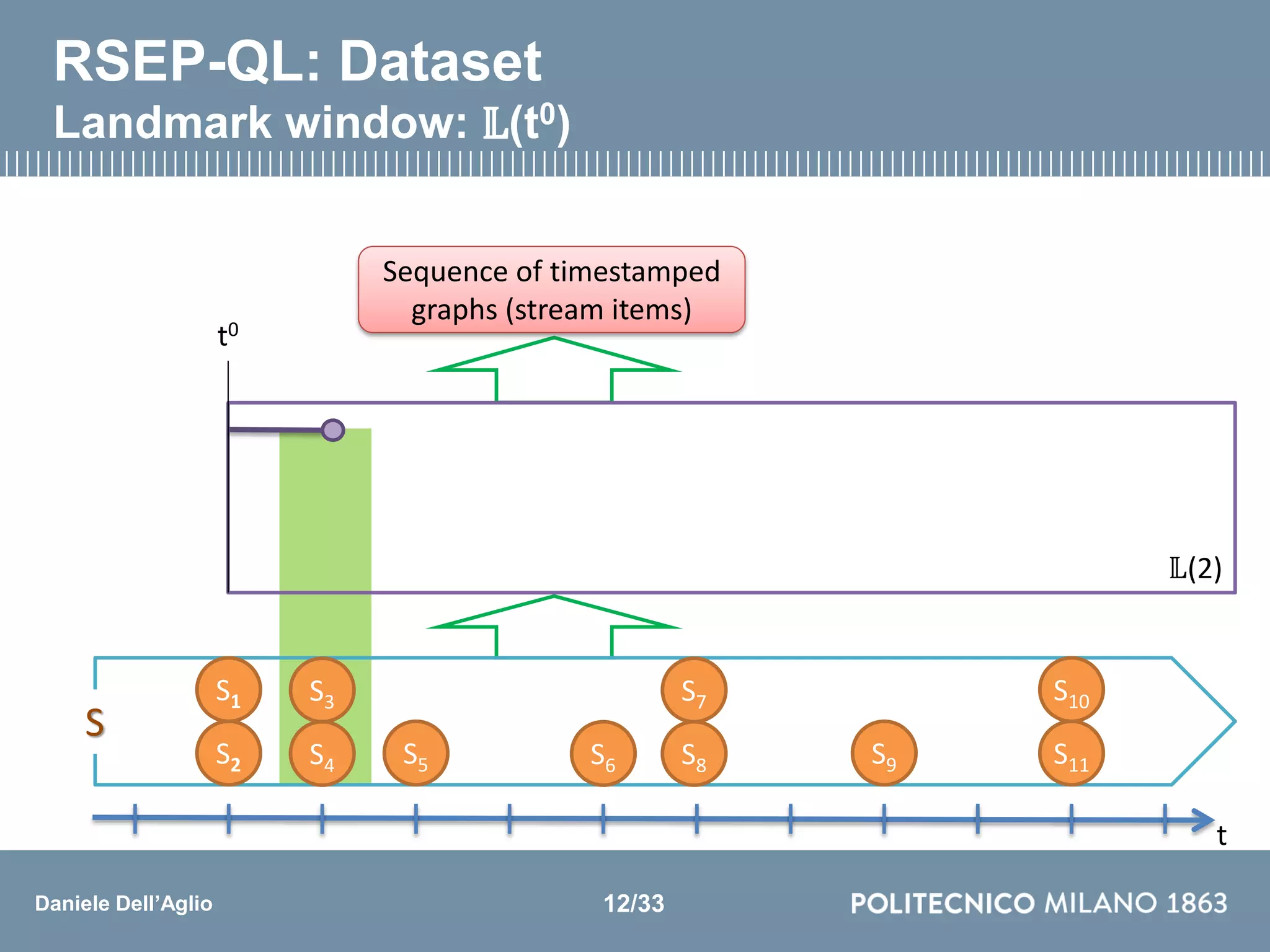
𝕃(2)
t
S3
S4 S5 S6
S7
S8 S9
S10
S11
S
S1
S2
t0
Sequence of timestamped
graphs (stream items)
RSEP-QL: Dataset
Landmark window: 𝕃(t0)
12/33
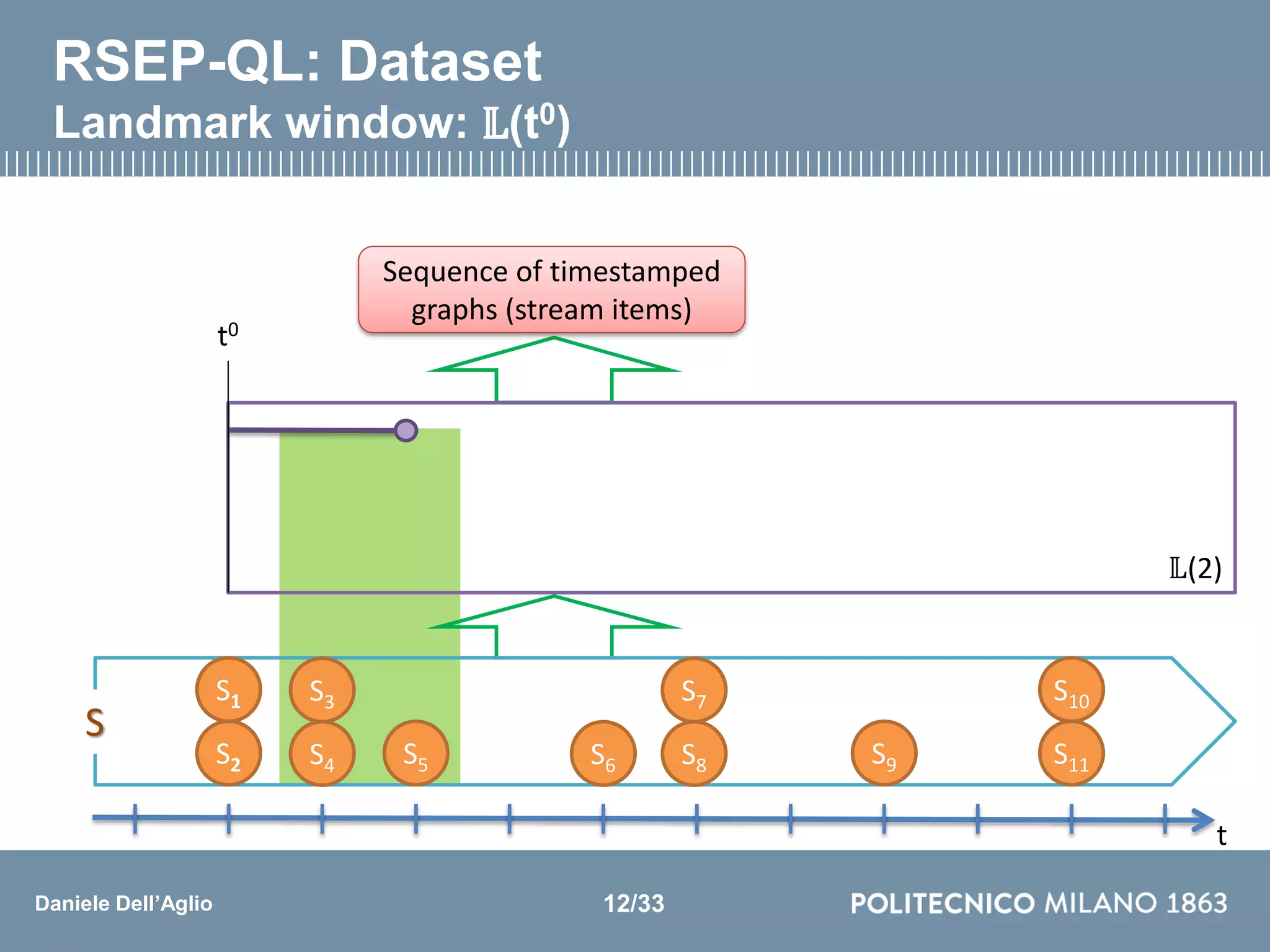
Daniele Dell’Aglio
𝕃(2)
t
S3
S4 S5 S6
S7
S8 S9
S10
S11
S
S1
S2
t0
Sequence of timestamped
graphs (stream items)
RSEP-QL: Dataset
Landmark window: 𝕃(t0)
12/33
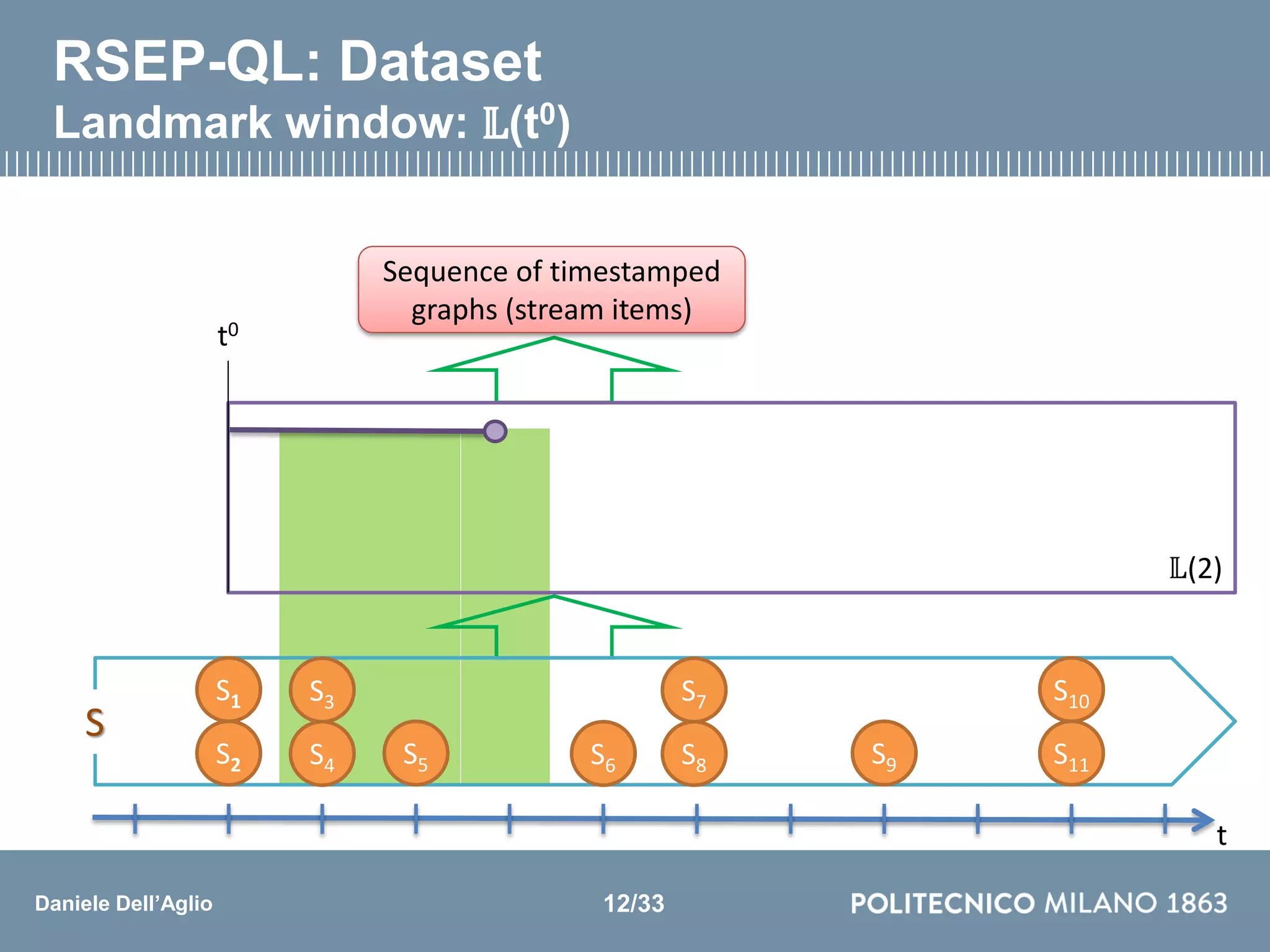
Daniele Dell’Aglio
𝕃(2)
t
S3
S4 S5 S6
S7
S8 S9
S10
S11
S
S1
S2
t0
Sequence of timestamped
graphs (stream items)
RSEP-QL: Dataset
Landmark window: 𝕃(t0)
12/33
Daniele Dell’Aglio
𝕃(2)
t
S3
S4 S5 S6
S7
S8 S9
S10
S11
S
S1
S2
t0
Sequence of timestamped
graphs (stream items)
RSEP-QL: Dataset
Landmark window: 𝕃(t0)
12/33
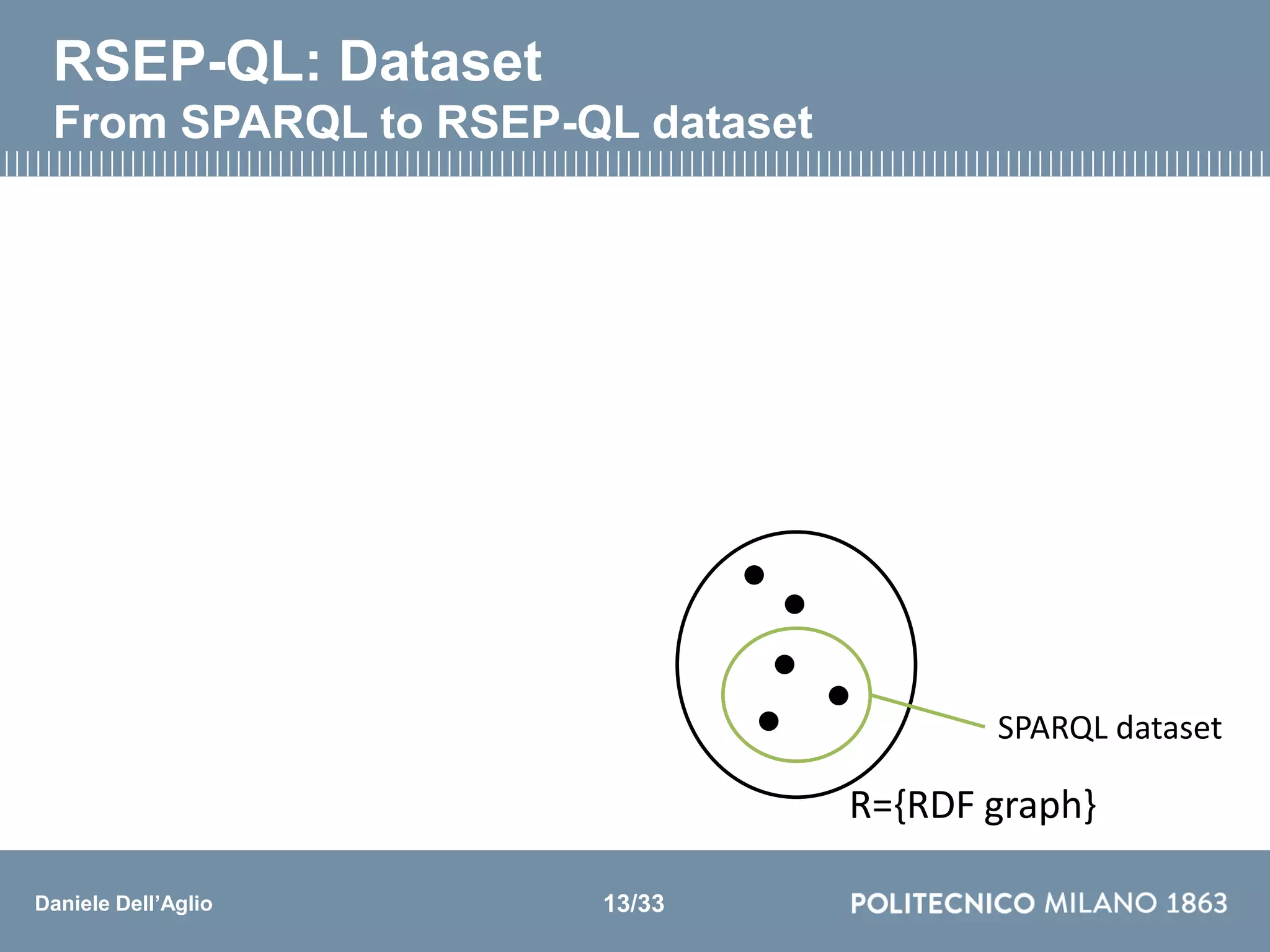
Daniele Dell’Aglio
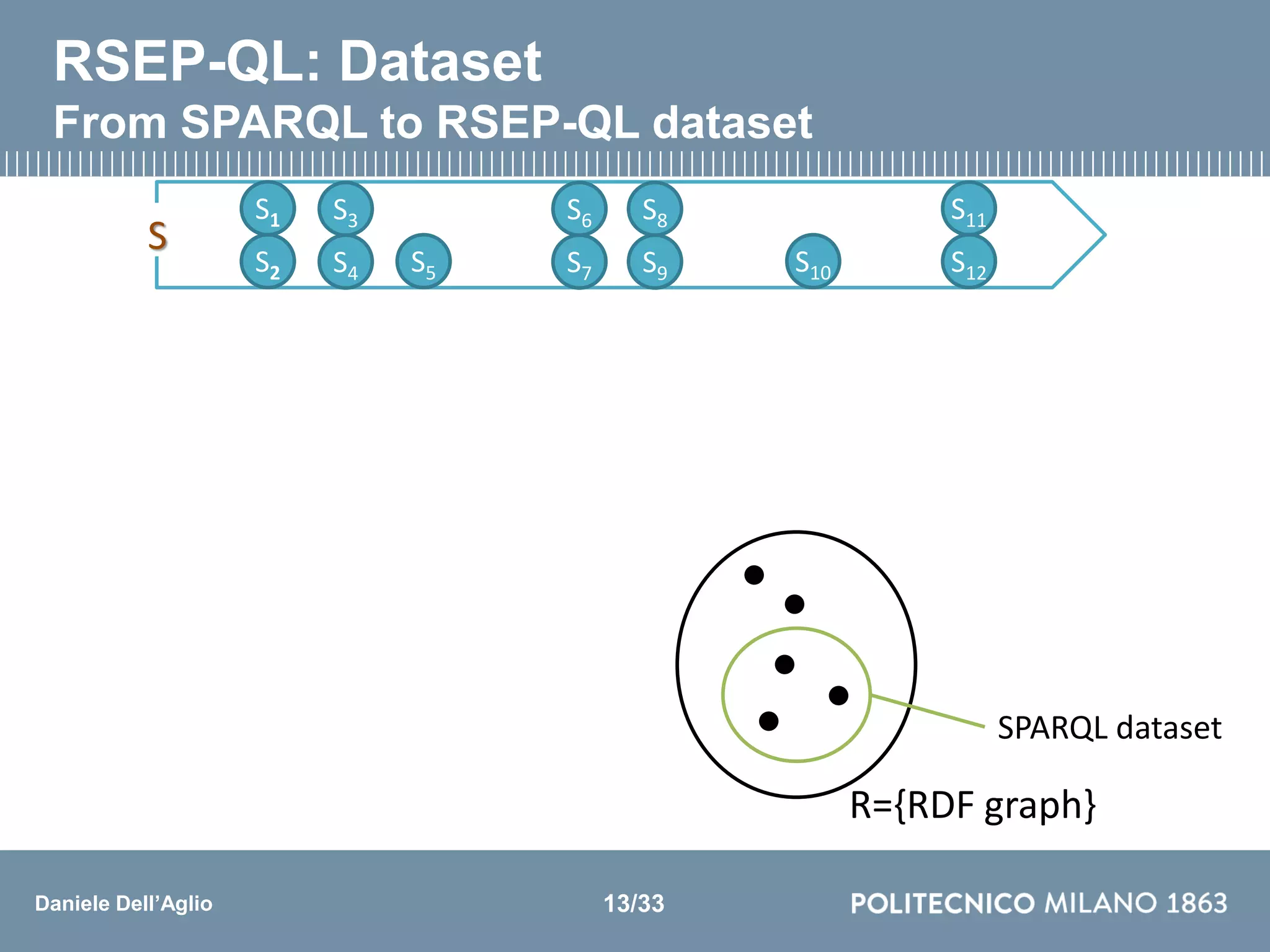
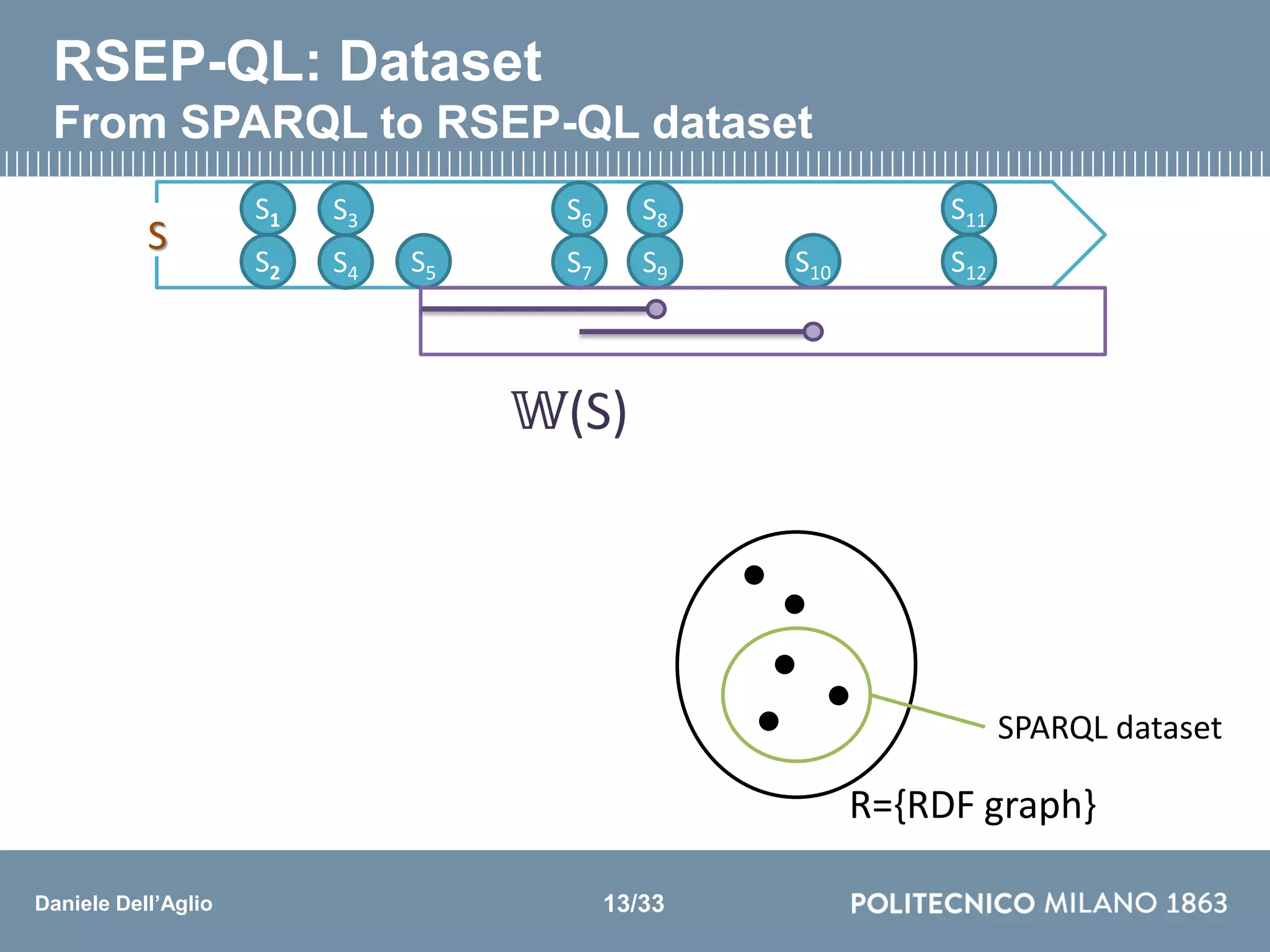
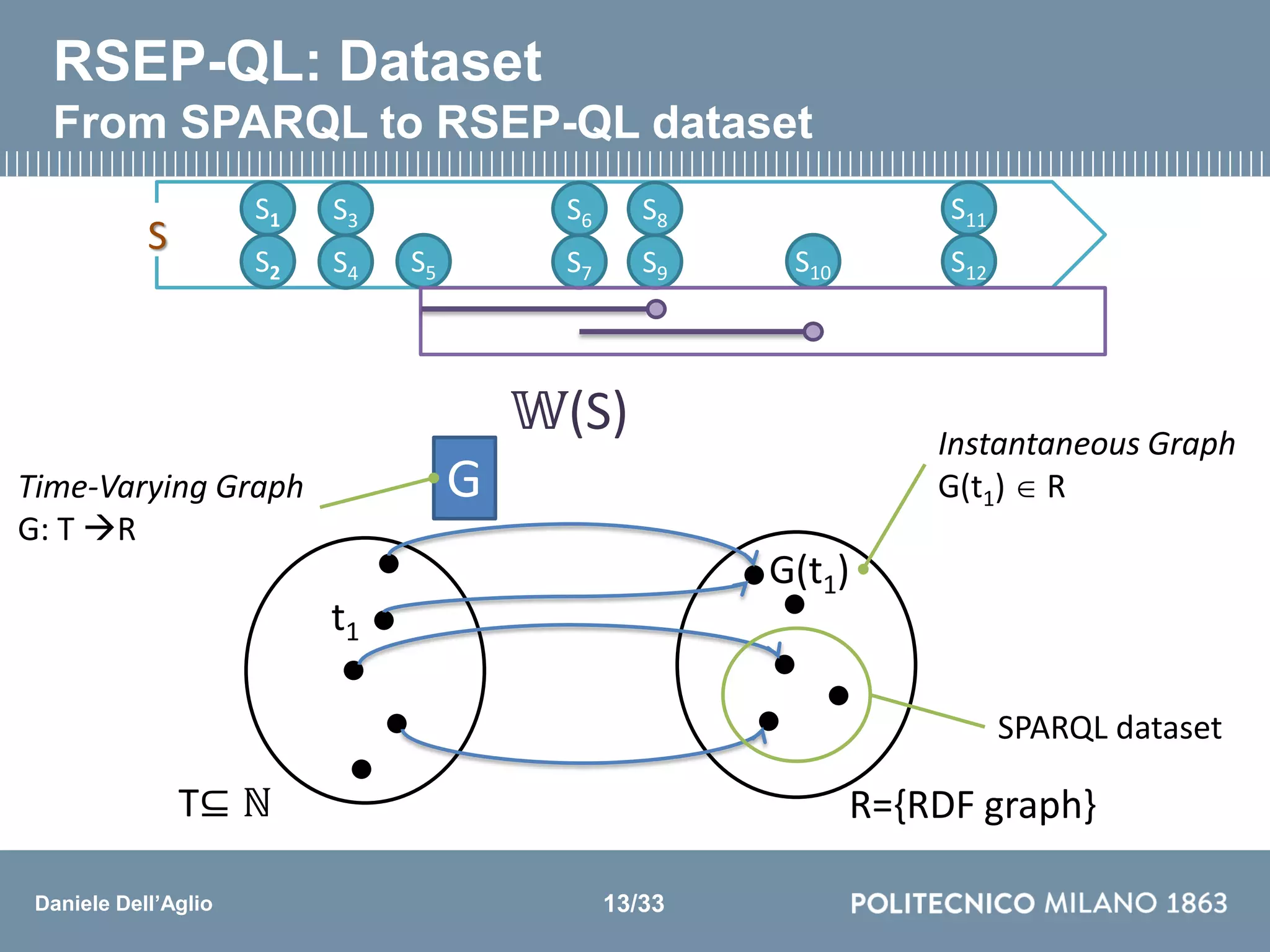
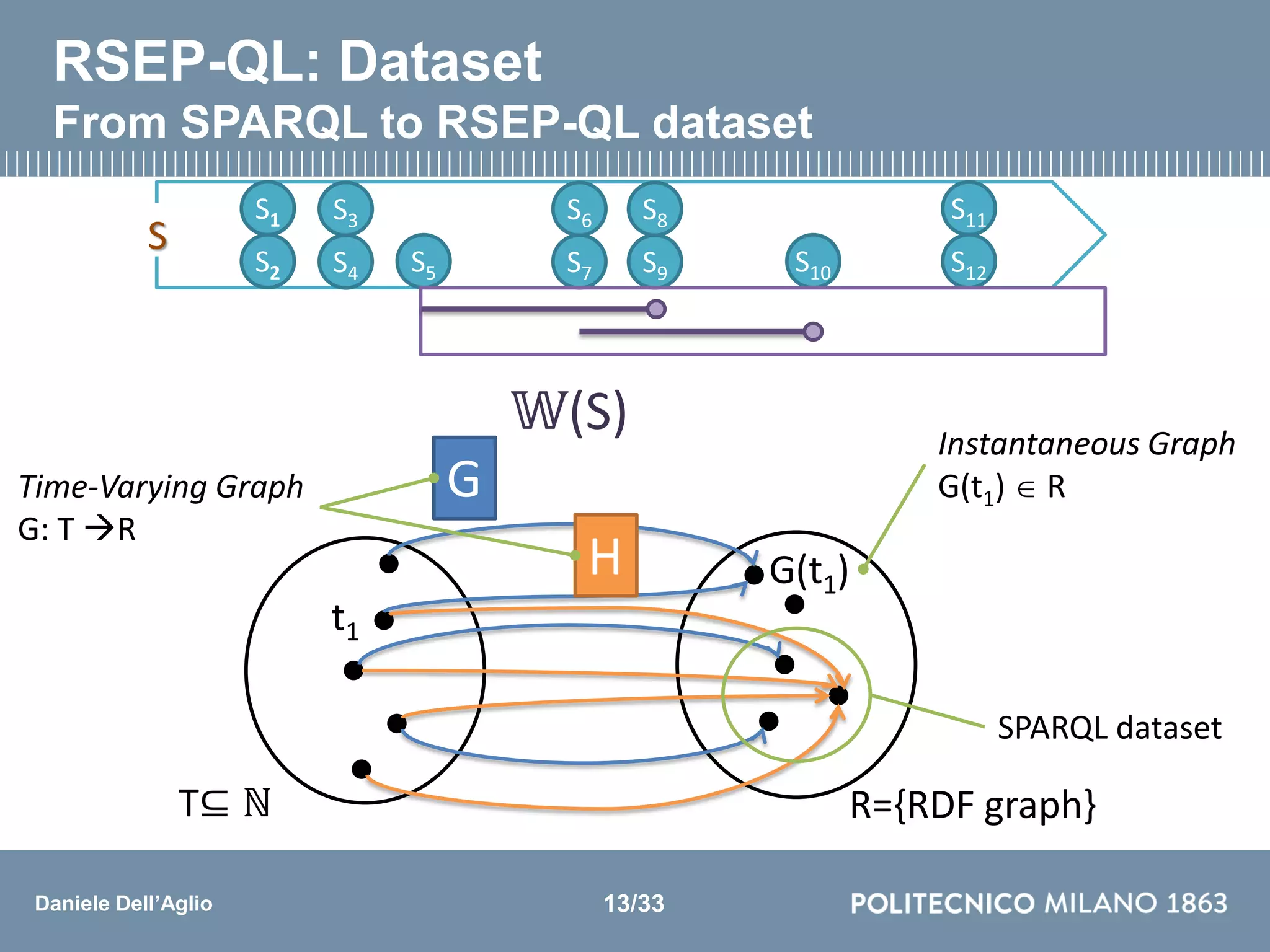
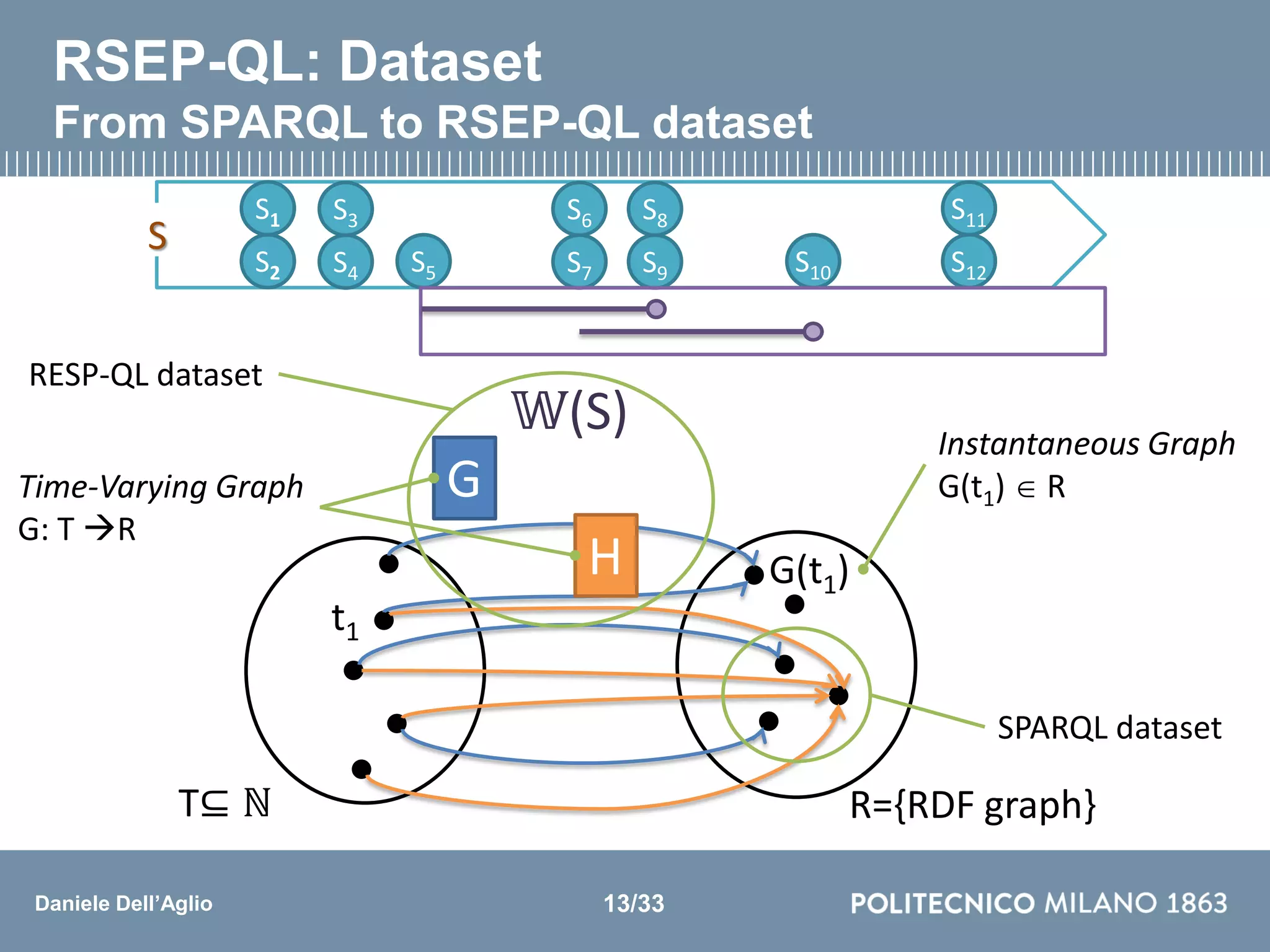
RSEP-QL: Dataset
From SPARQL to RSEP-QL dataset
R={RDF graph}
SPARQL dataset
13/33
Daniele Dell’Aglio
RSEP-QL: Dataset
From SPARQL to RSEP-QL dataset
R={RDF graph}
SPARQL dataset
S3
S4 S5
S6
S7
S8
S9 S10
S11
S12
S
S1
S2
13/33
Daniele Dell’Aglio
RSEP-QL: Dataset
From SPARQL to RSEP-QL dataset
R={RDF graph}
SPARQL dataset
S3
S4 S5
S6
S7
S8
S9 S10
S11
S12
S
S1
S2
𝕎(S)
13/33
Daniele Dell’Aglio
RSEP-QL: Dataset
From SPARQL to RSEP-QL dataset
t1
G(t1)
T⊆ ℕ R={RDF graph}
SPARQL dataset
G
Instantaneous Graph
G(t1)  RTime-Varying Graph
G: T R
S3
S4 S5
S6
S7
S8
S9 S10
S11
S12
S
S1
S2
𝕎(S)
13/33
Daniele Dell’Aglio
RSEP-QL: Dataset
From SPARQL to RSEP-QL dataset
t1
G(t1)
T⊆ ℕ R={RDF graph}
SPARQL dataset
G
H
Instantaneous Graph
G(t1)  RTime-Varying Graph
G: T R
S3
S4 S5
S6
S7
S8
S9 S10
S11
S12
S
S1
S2
𝕎(S)
13/33
Daniele Dell’Aglio
RSEP-QL: Dataset
From SPARQL to RSEP-QL dataset
t1
G(t1)
T⊆ ℕ R={RDF graph}
SPARQL dataset
G
H
Instantaneous Graph
G(t1)  RTime-Varying Graph
G: T R
RESP-QL dataset
S3
S4 S5
S6
S7
S8
S9 S10
S11
S12
S
S1
S2
𝕎(S)
13/33
Daniele Dell’Aglio
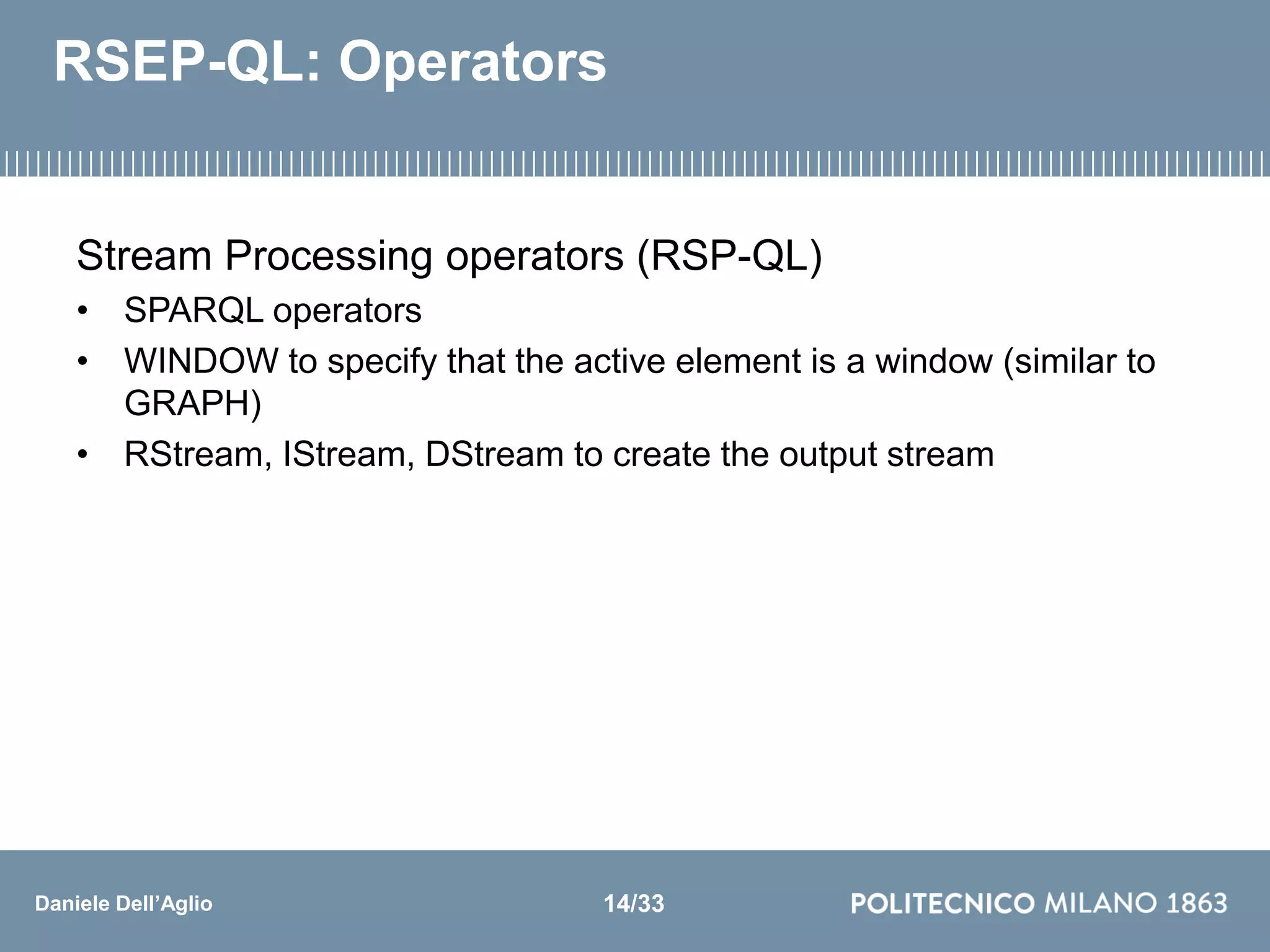
RSEP-QL: Operators
Stream Processing operators (RSP-QL)
• SPARQL operators
• WINDOW to specify that the active element is a window (similar to
GRAPH)
• RStream, IStream, DStream to create the output stream
14/33
Daniele Dell’Aglio
RSEP-QL: Operators
Stream Processing operators (RSP-QL)
• SPARQL operators
• WINDOW to specify that the active element is a window (similar to
GRAPH)
• RStream, IStream, DStream to create the output stream
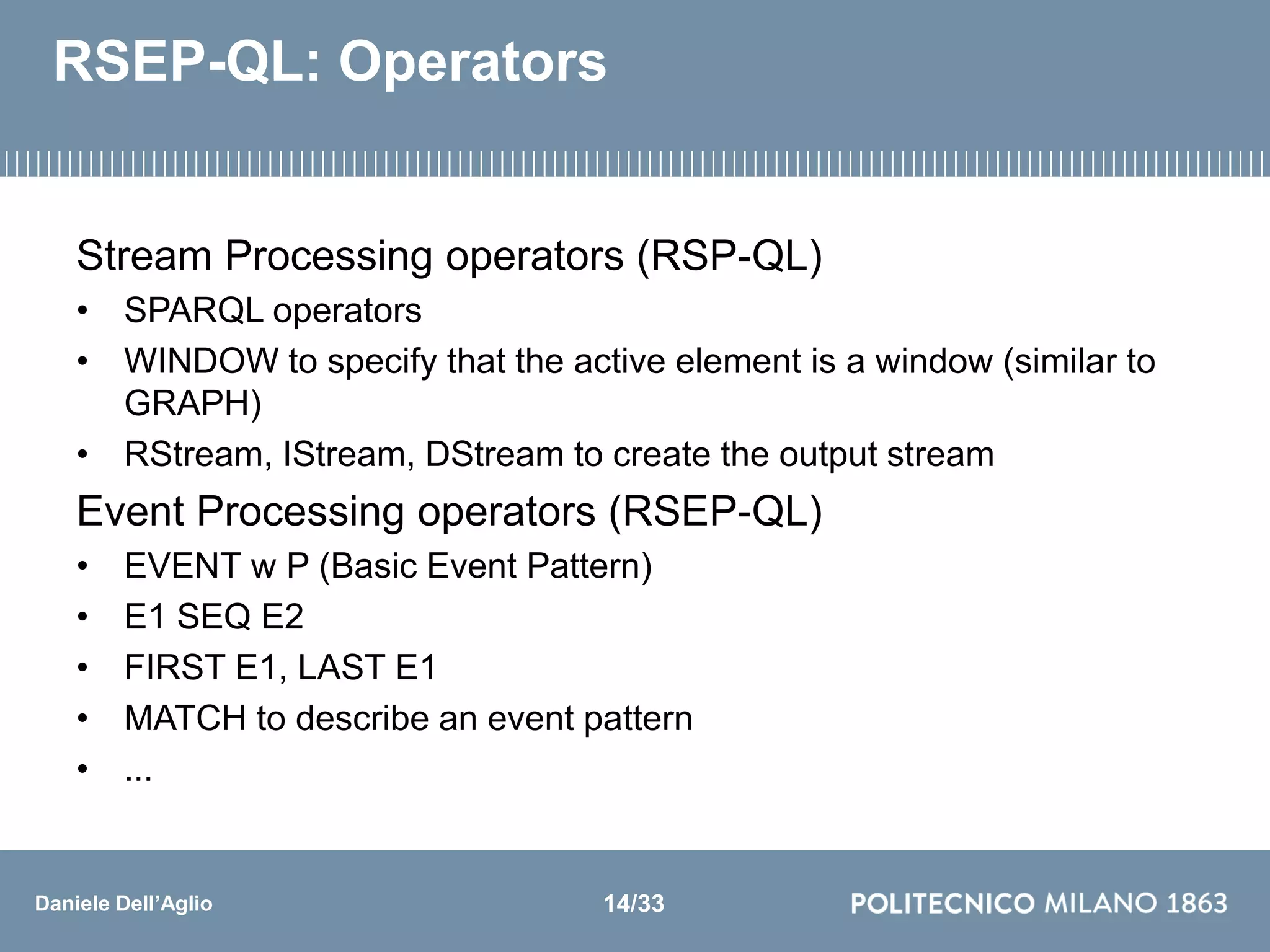
Event Processing operators (RSEP-QL)
• EVENT w P (Basic Event Pattern)
• E1 SEQ E2
• FIRST E1, LAST E1
• MATCH to describe an event pattern
• ...
14/33
Daniele Dell’Aglio
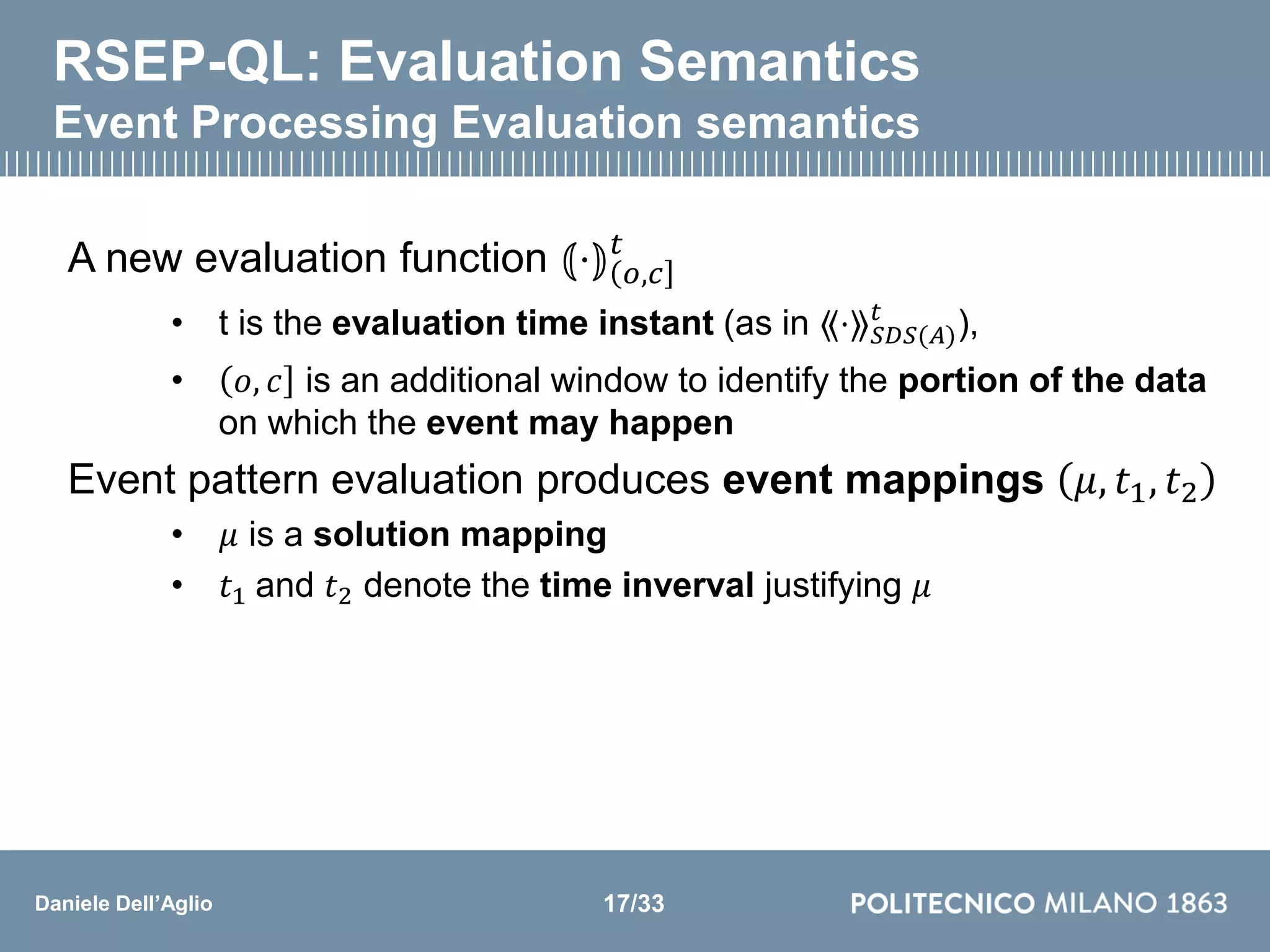
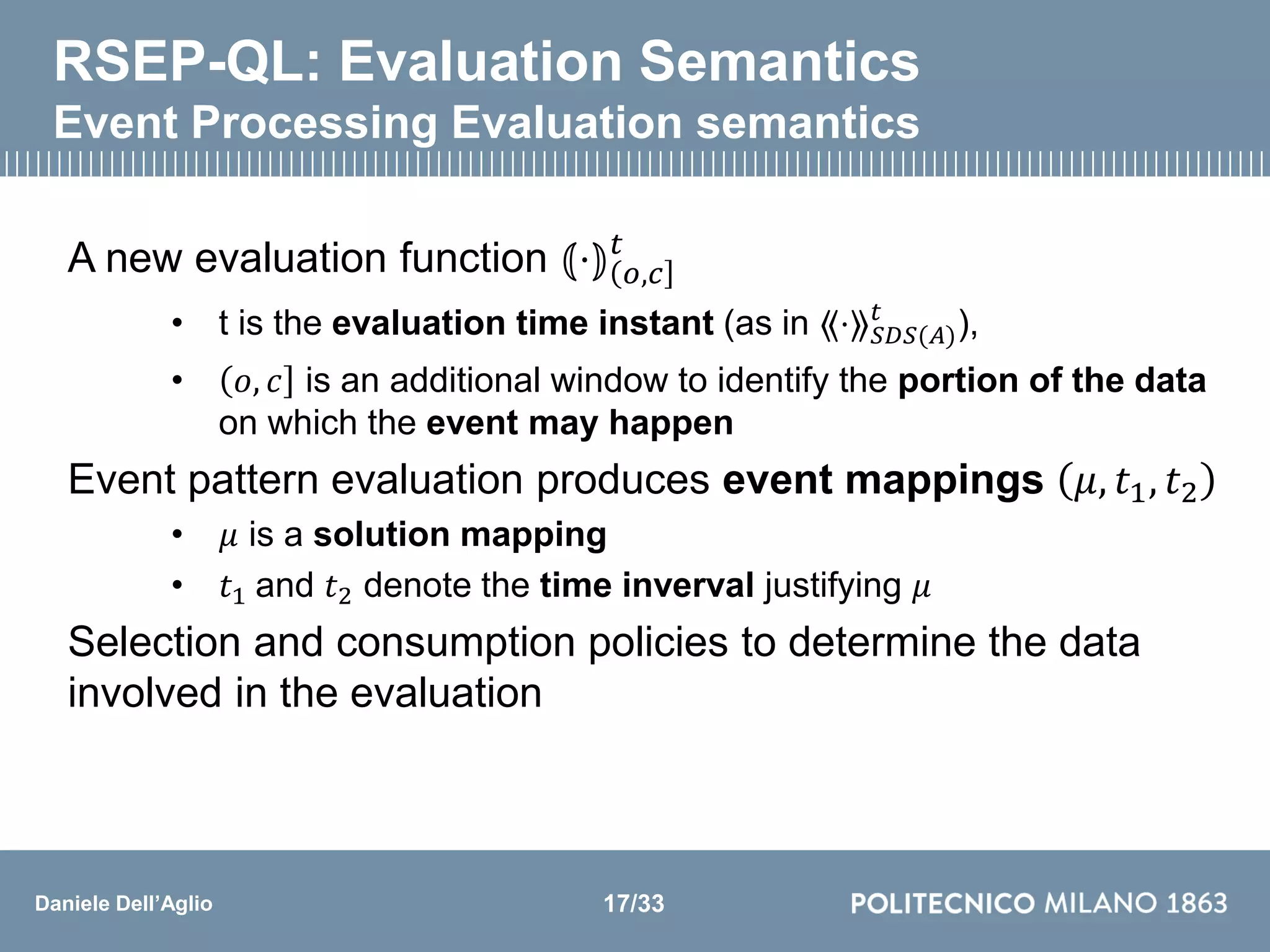
RSEP-QL: Evaluation Semantics
Stream Processing Evaluation Semantics
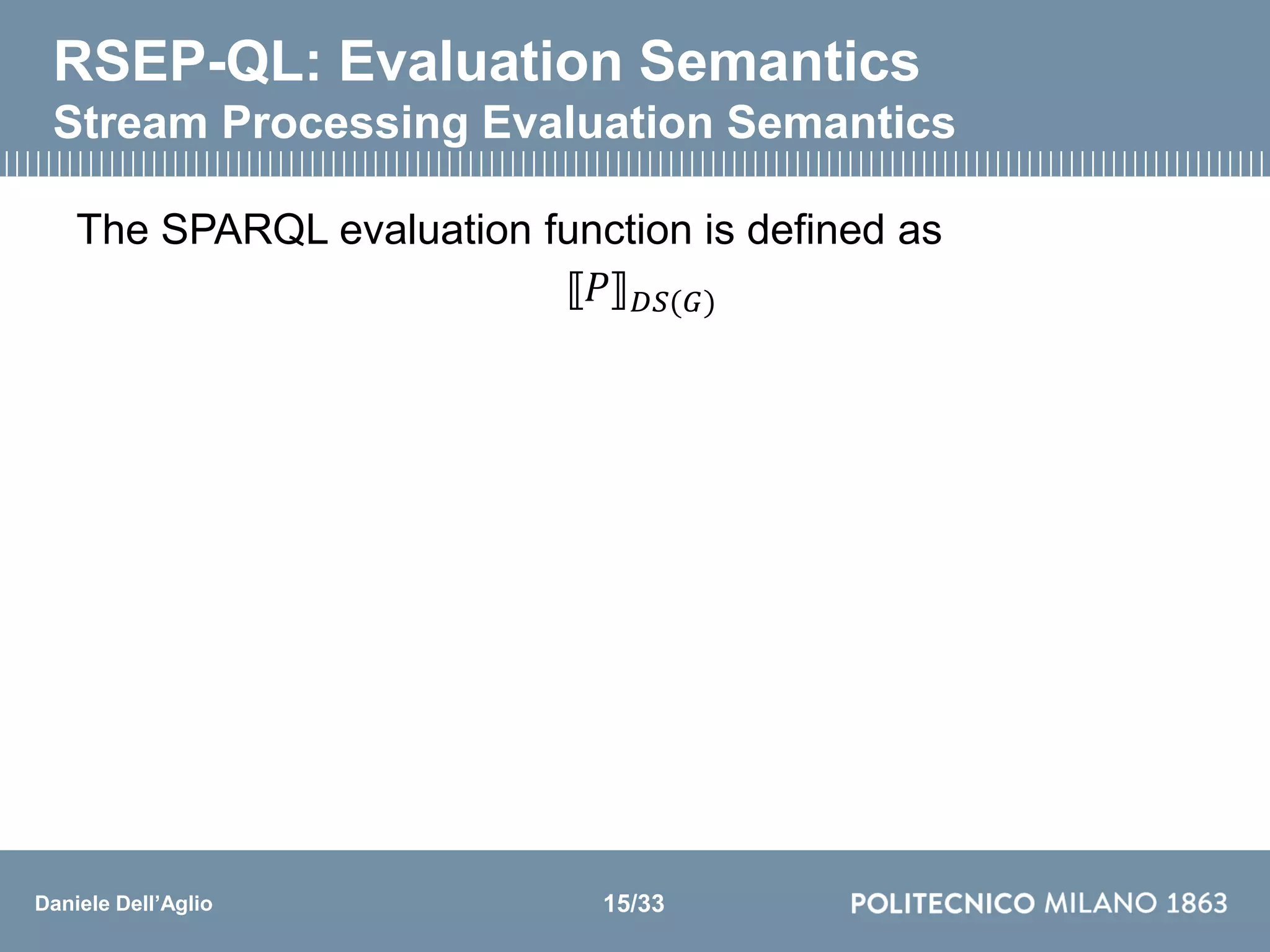
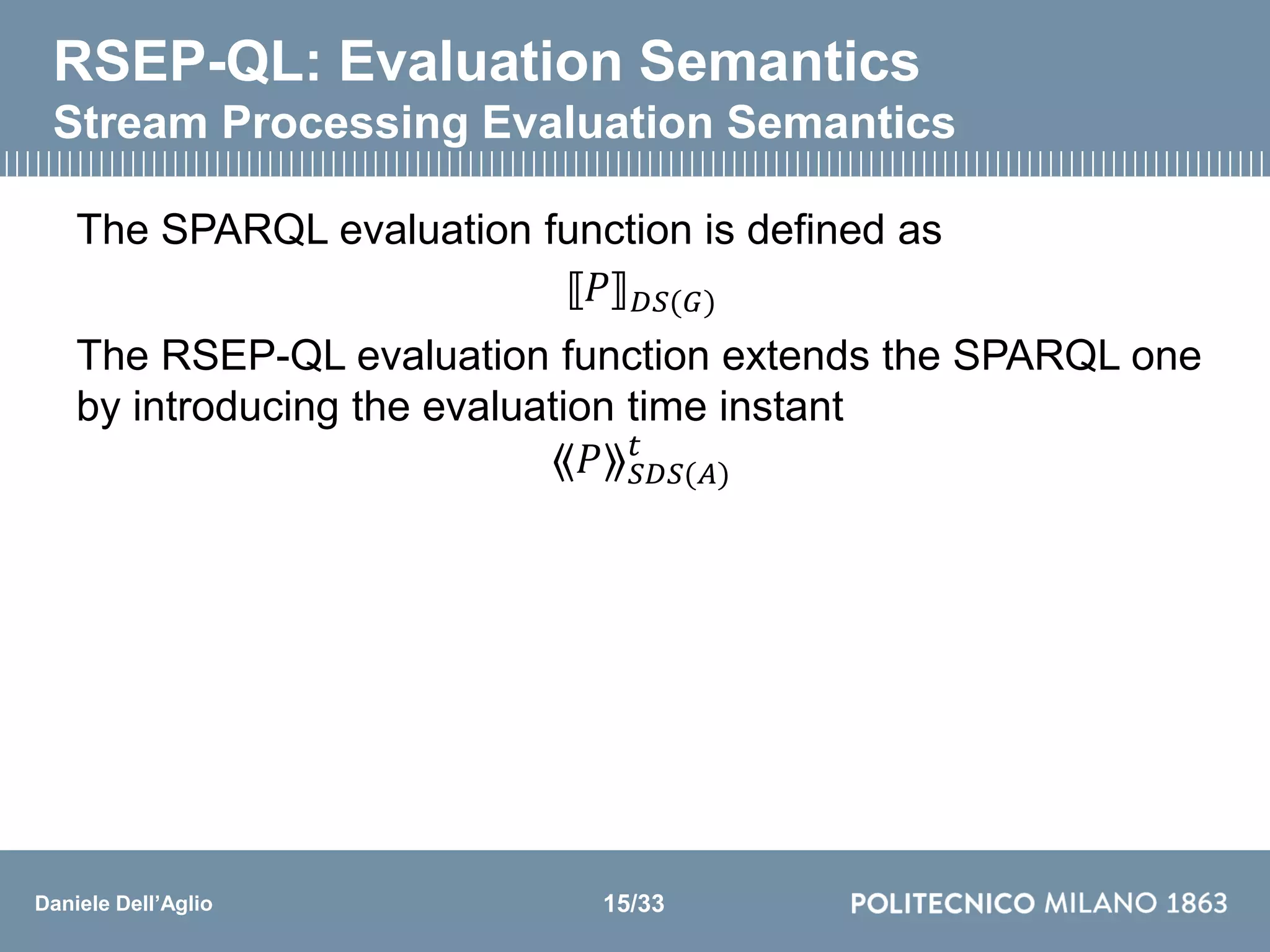
The SPARQL evaluation function is defined as
⟦𝑃⟧ 𝐷𝑆(𝐺)
15/33
Daniele Dell’Aglio
RSEP-QL: Evaluation Semantics
Stream Processing Evaluation Semantics
The SPARQL evaluation function is defined as
⟦𝑃⟧ 𝐷𝑆(𝐺)
The RSEP-QL evaluation function extends the SPARQL one
by introducing the evaluation time instant
⟪𝑃⟫ 𝑆𝐷𝑆(𝐴)
𝑡
15/33
Daniele Dell’Aglio
RSEP-QL: Evaluation Semantics
Stream Processing Evaluation Semantics
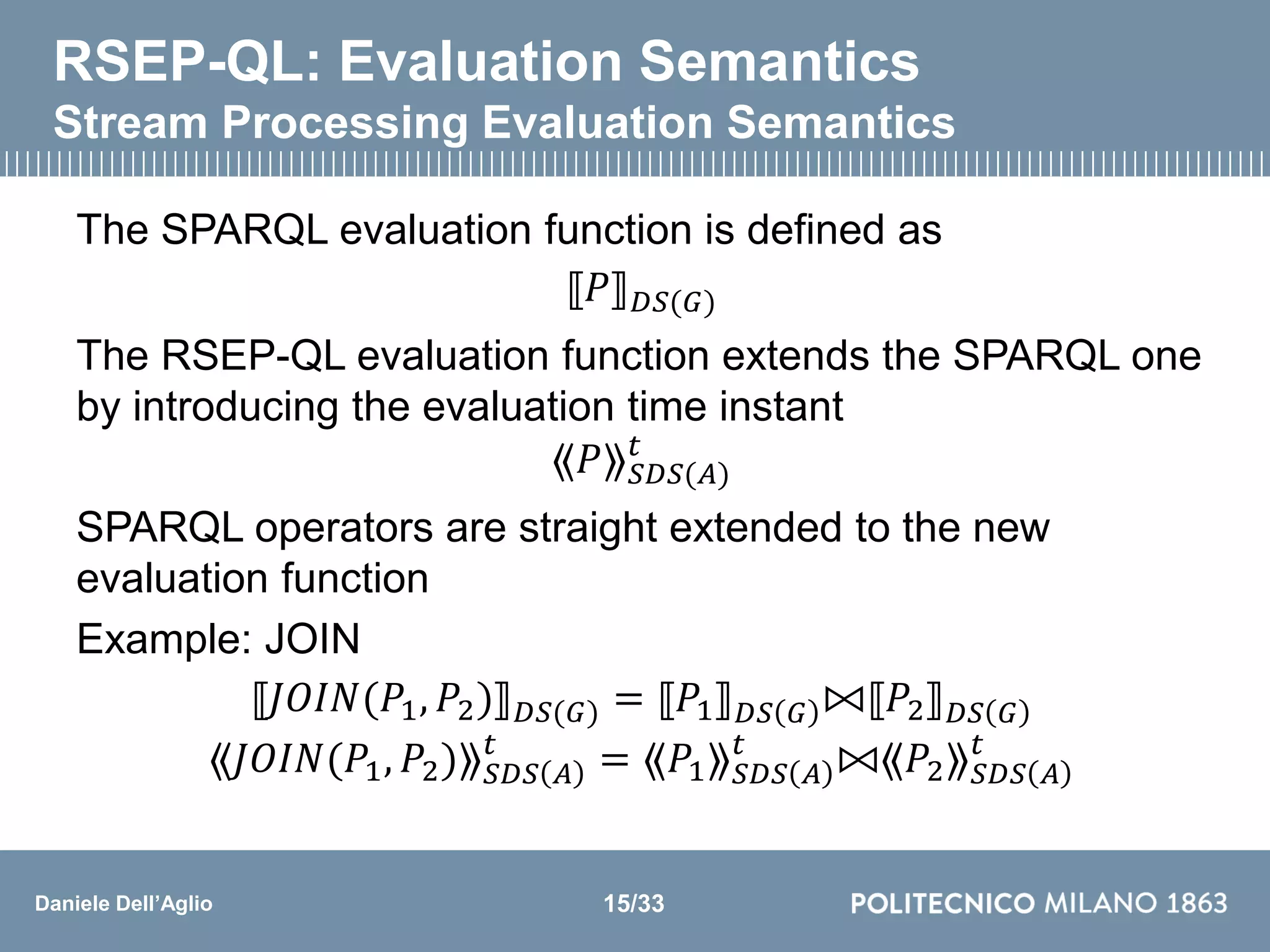
The SPARQL evaluation function is defined as
⟦𝑃⟧ 𝐷𝑆(𝐺)
The RSEP-QL evaluation function extends the SPARQL one
by introducing the evaluation time instant
⟪𝑃⟫ 𝑆𝐷𝑆(𝐴)
𝑡
SPARQL operators are straight extended to the new
evaluation function
Example: JOIN
⟦𝐽𝑂𝐼𝑁(𝑃1, 𝑃2)⟧ 𝐷𝑆(𝐺) = ⟦𝑃1⟧ 𝐷𝑆 𝐺 ⨝⟦𝑃2⟧ 𝐷𝑆 𝐺
⟪𝐽𝑂𝐼𝑁(𝑃1, 𝑃2)⟫ 𝑆𝐷𝑆 𝐴
𝑡
= ⟪𝑃1⟫ 𝑆𝐷𝑆 𝐴
𝑡
⨝⟪𝑃2⟫ 𝑆𝐷𝑆 𝐴
𝑡
15/33
Daniele Dell’Aglio
RSEP-QL: Evaluation Semantics
Stream Processing Evaluation Semantics
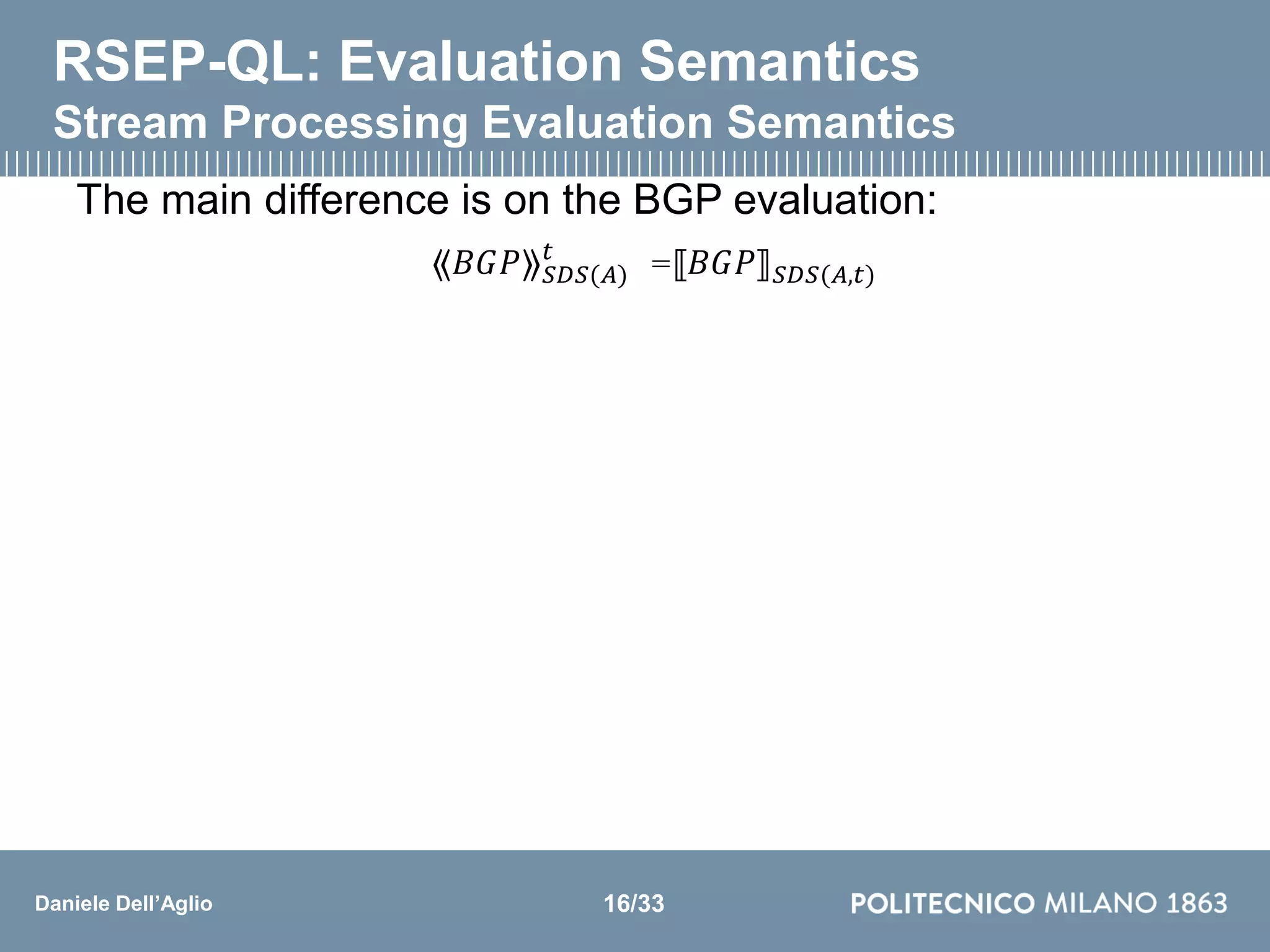
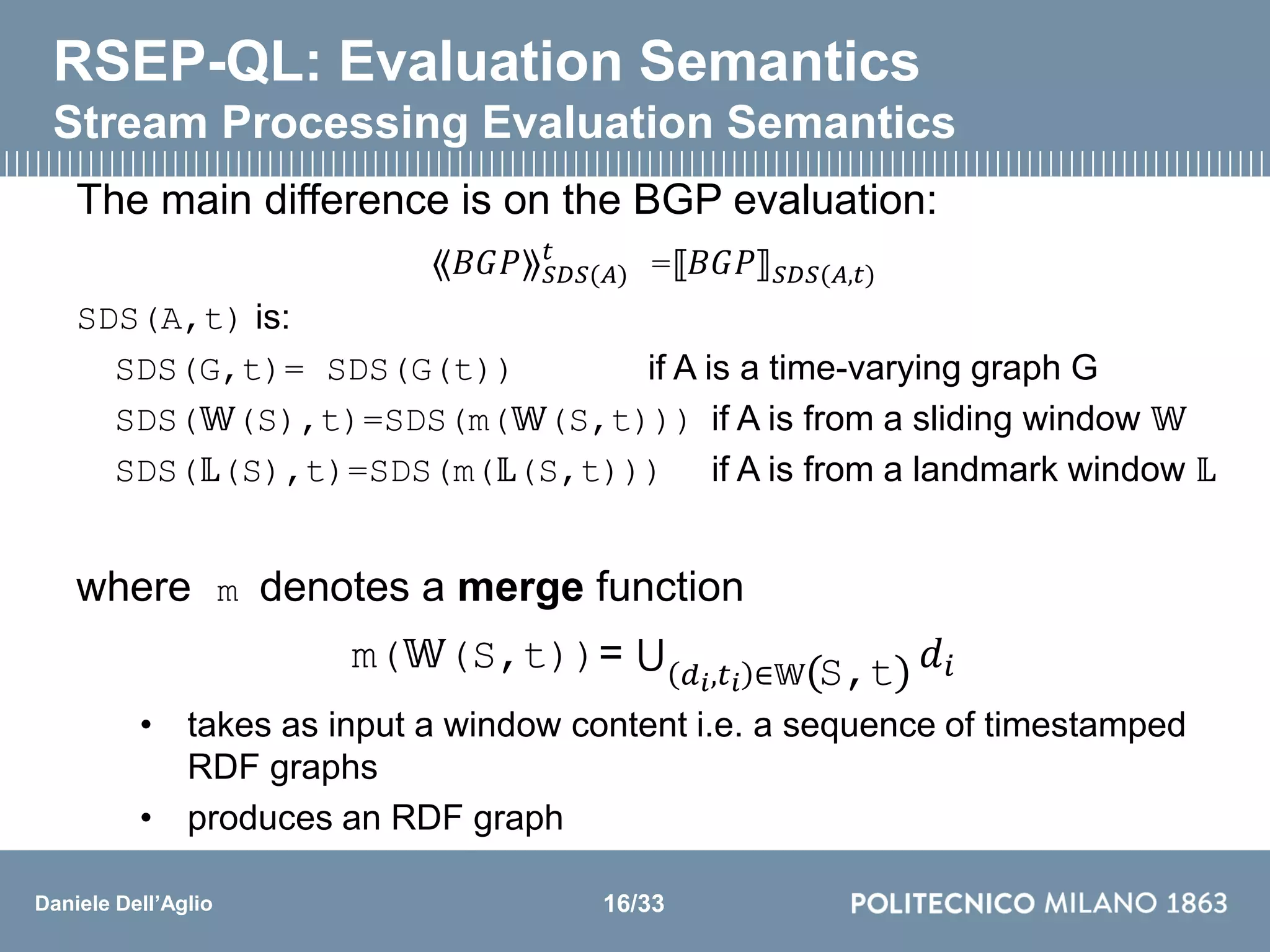
The main difference is on the BGP evaluation:
⟪𝐵𝐺𝑃⟫ 𝑆𝐷𝑆(𝐴)
𝑡
=⟦𝐵𝐺𝑃⟧ 𝑆𝐷𝑆(𝐴,𝑡)
16/33
Daniele Dell’Aglio
RSEP-QL: Evaluation Semantics
Stream Processing Evaluation Semantics
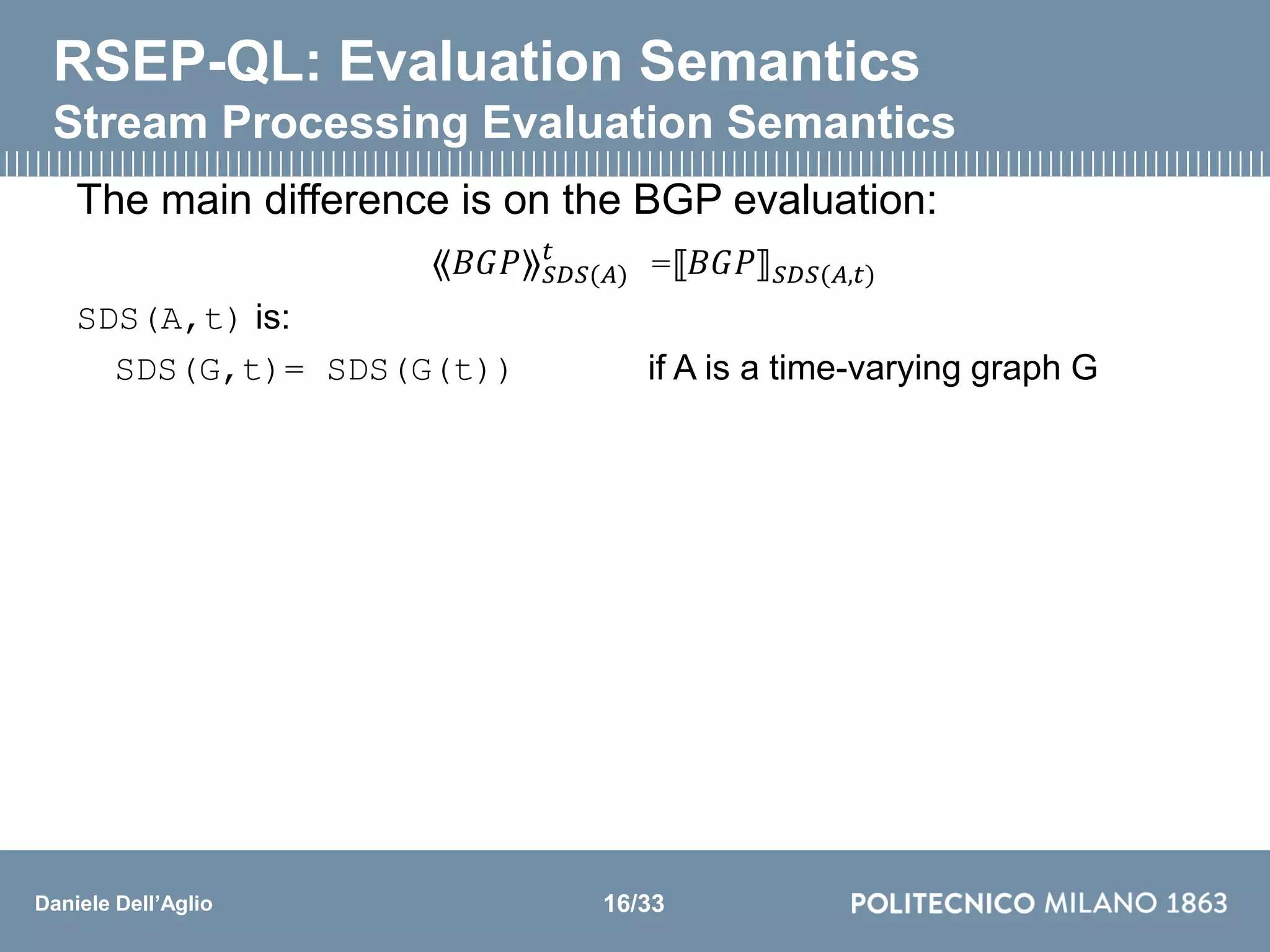
The main difference is on the BGP evaluation:
⟪𝐵𝐺𝑃⟫ 𝑆𝐷𝑆(𝐴)
𝑡
=⟦𝐵𝐺𝑃⟧ 𝑆𝐷𝑆(𝐴,𝑡)
SDS(A,t) is:
SDS(G,t)= SDS(G(t)) if A is a time-varying graph G
16/33
Daniele Dell’Aglio
RSEP-QL: Evaluation Semantics
Stream Processing Evaluation Semantics
The main difference is on the BGP evaluation:
⟪𝐵𝐺𝑃⟫ 𝑆𝐷𝑆(𝐴)
𝑡
=⟦𝐵𝐺𝑃⟧ 𝑆𝐷𝑆(𝐴,𝑡)
SDS(A,t) is:
SDS(G,t)= SDS(G(t)) if A is a time-varying graph G
SDS(𝕎(S),t)=SDS(m(𝕎(S,t))) if A is from a sliding window 𝕎
SDS(𝕃(S),t)=SDS(m(𝕃(S,t))) if A is from a landmark window 𝕃
where m denotes a merge function
m(𝕎(S,t))= 𝑑 𝑖,𝑡 𝑖 ∈𝕎(S,t) 𝑑𝑖
• takes as input a window content i.e. a sequence of timestamped
RDF graphs
• produces an RDF graph
16/33
Daniele Dell’Aglio
RSEP-QL: Evaluation Semantics
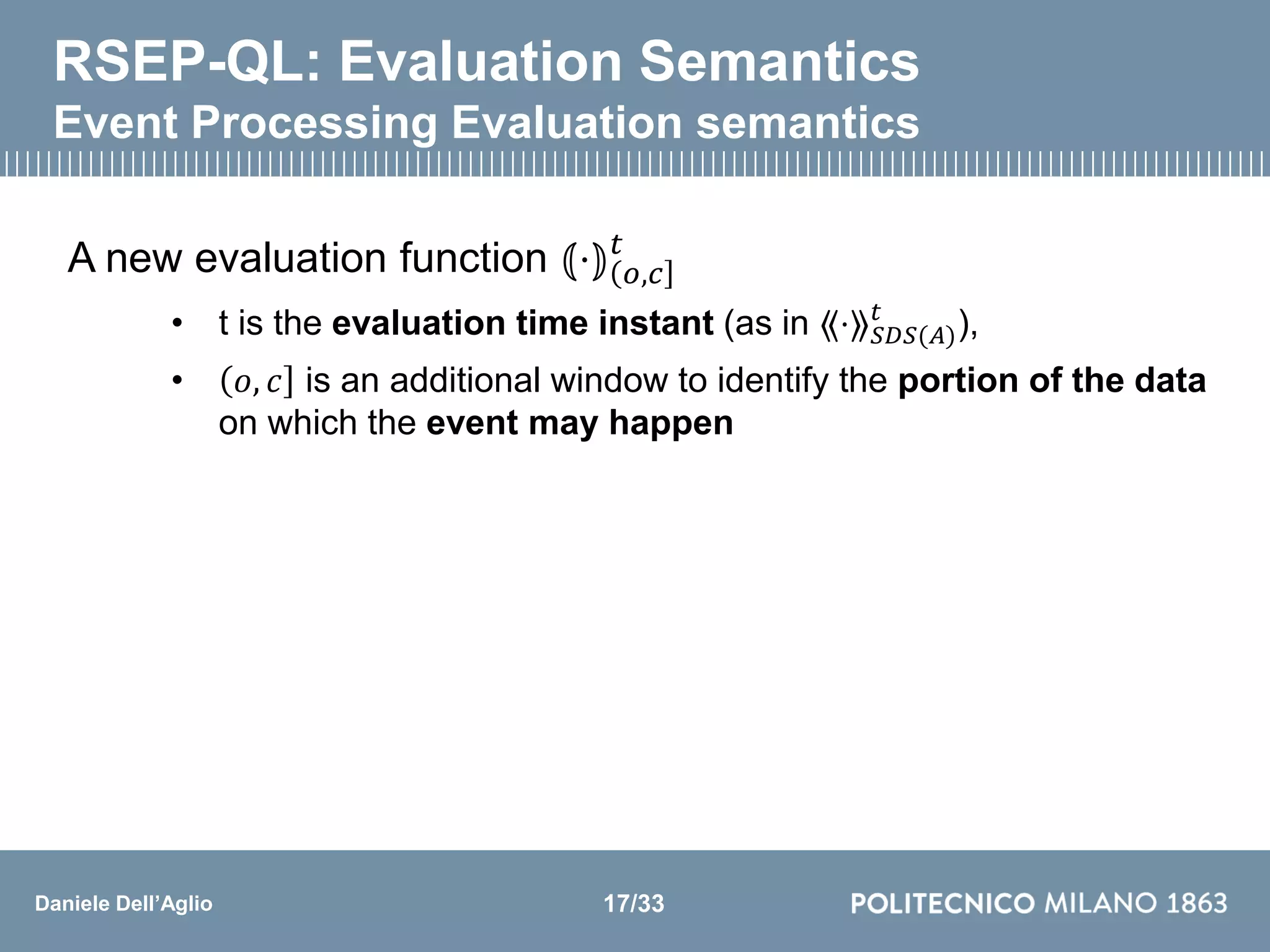
Event Processing Evaluation semantics
A new evaluation function ⦅⋅⦆ 𝑜,𝑐
𝑡
• t is the evaluation time instant (as in ⟪⋅⟫ 𝑆𝐷𝑆(𝐴)
𝑡
),
• 𝑜, 𝑐 is an additional window to identify the portion of the data
on which the event may happen
17/33
Daniele Dell’Aglio
RSEP-QL: Evaluation Semantics
Event Processing Evaluation semantics
A new evaluation function ⦅⋅⦆ 𝑜,𝑐
𝑡
• t is the evaluation time instant (as in ⟪⋅⟫ 𝑆𝐷𝑆(𝐴)
𝑡
),
• 𝑜, 𝑐 is an additional window to identify the portion of the data
on which the event may happen
Event pattern evaluation produces event mappings 𝜇, 𝑡1, 𝑡2
• 𝜇 is a solution mapping
• 𝑡1 and 𝑡2 denote the time inverval justifying 𝜇
17/33
Daniele Dell’Aglio
RSEP-QL: Evaluation Semantics
Event Processing Evaluation semantics
A new evaluation function ⦅⋅⦆ 𝑜,𝑐
𝑡
• t is the evaluation time instant (as in ⟪⋅⟫ 𝑆𝐷𝑆(𝐴)
𝑡
),
• 𝑜, 𝑐 is an additional window to identify the portion of the data
on which the event may happen
Event pattern evaluation produces event mappings 𝜇, 𝑡1, 𝑡2
• 𝜇 is a solution mapping
• 𝑡1 and 𝑡2 denote the time inverval justifying 𝜇
Selection and consumption policies to determine the data
involved in the evaluation
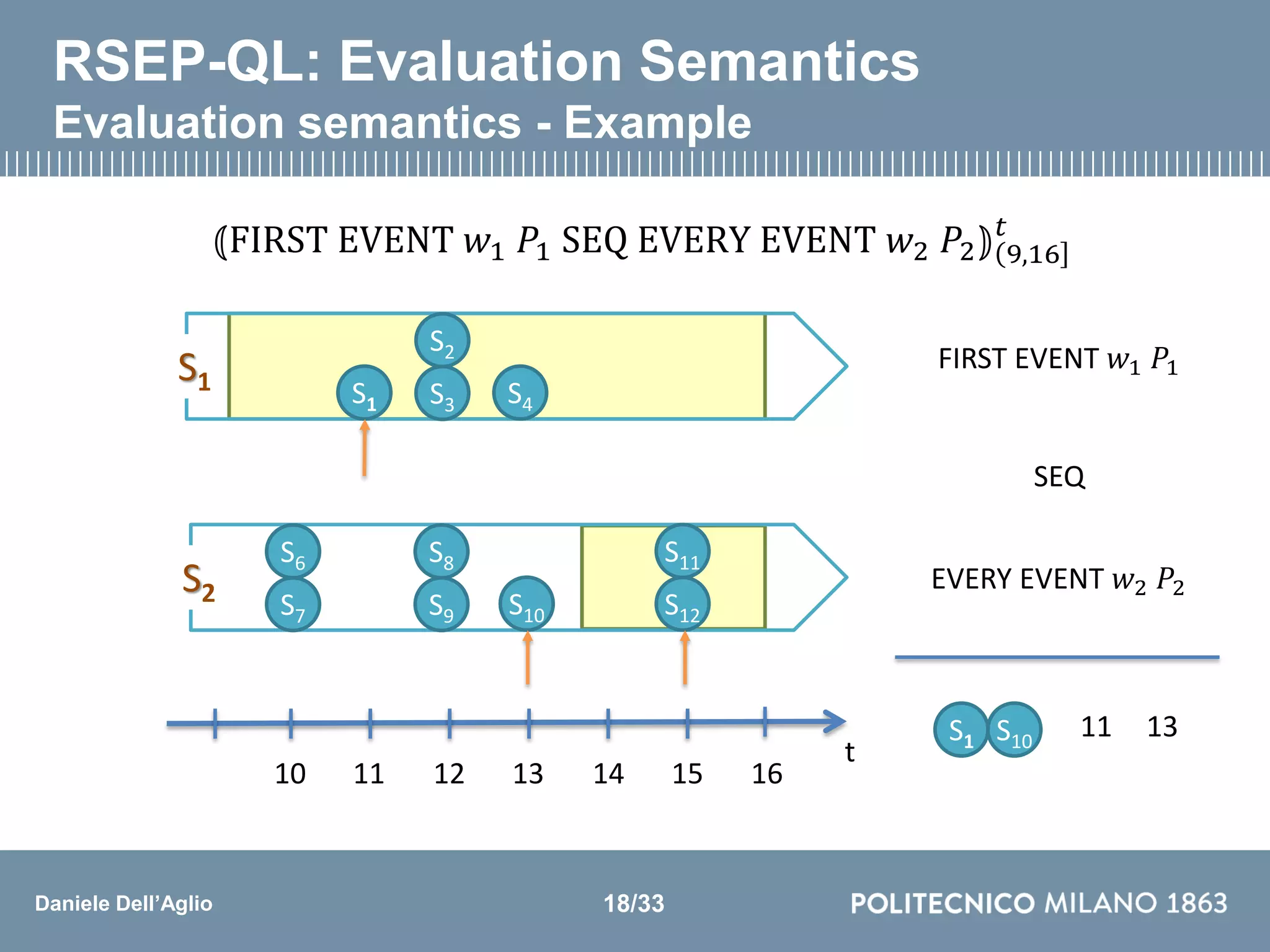
17/33
Daniele Dell’Aglio
RSEP-QL: Evaluation Semantics
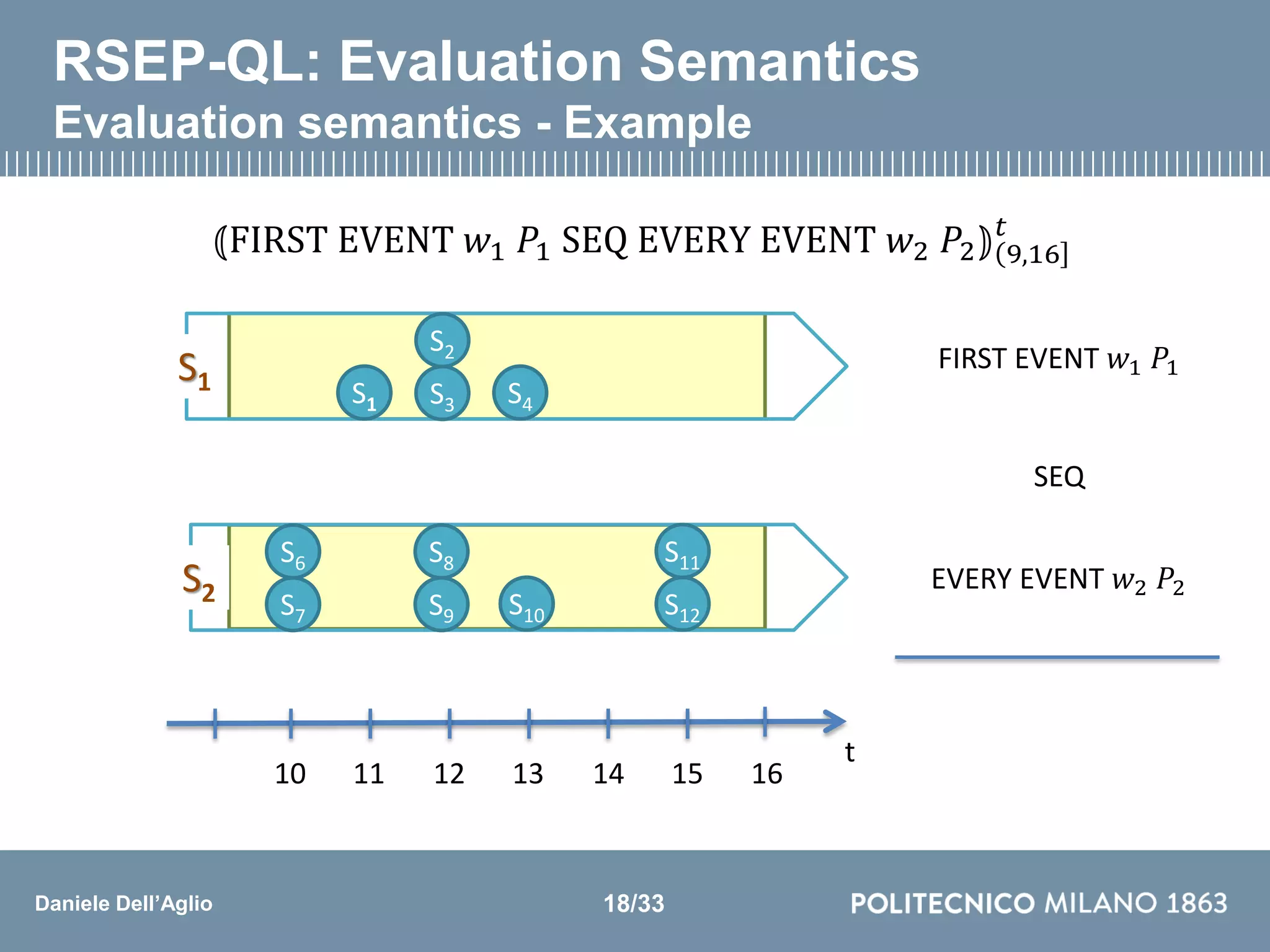
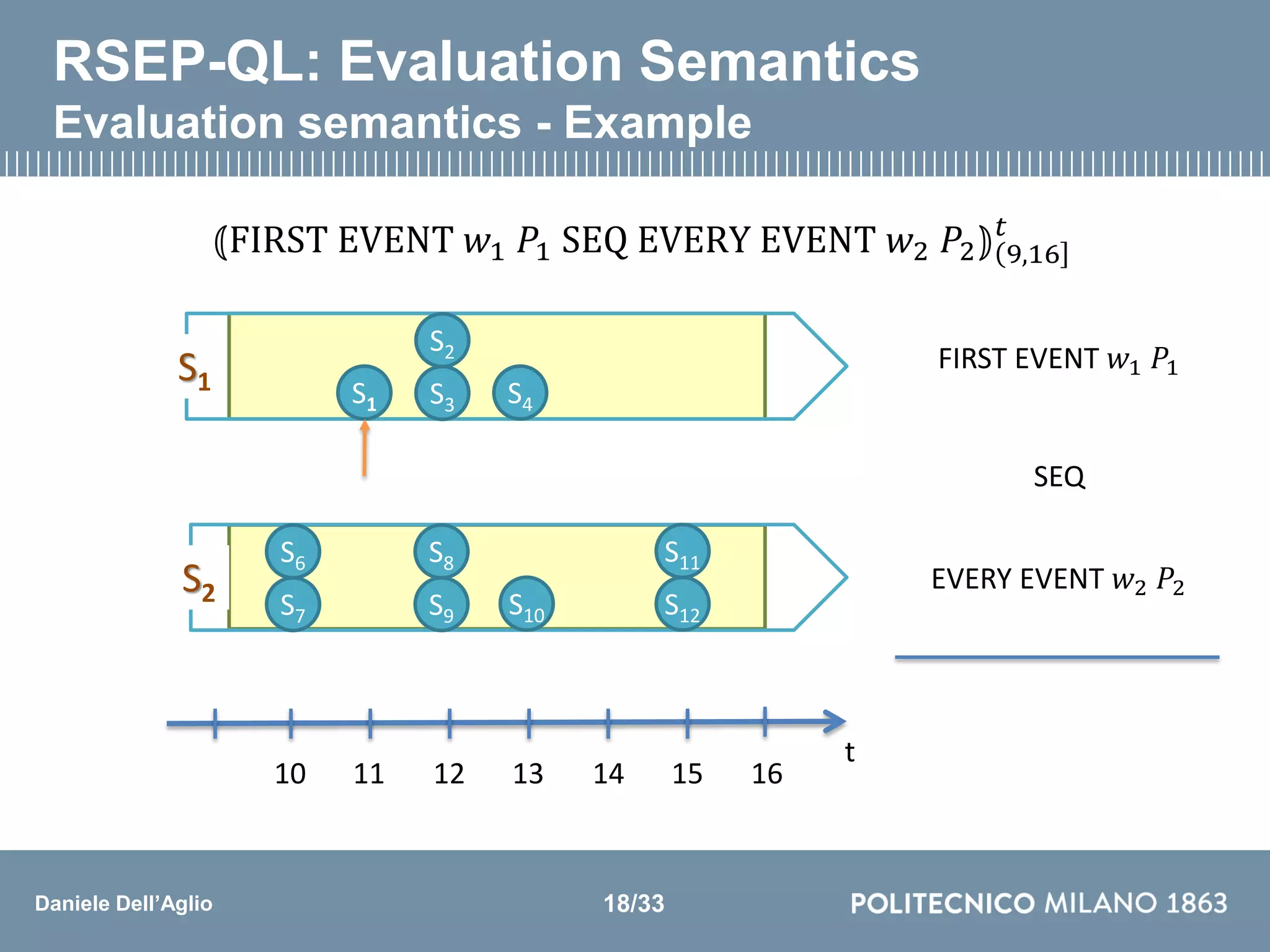
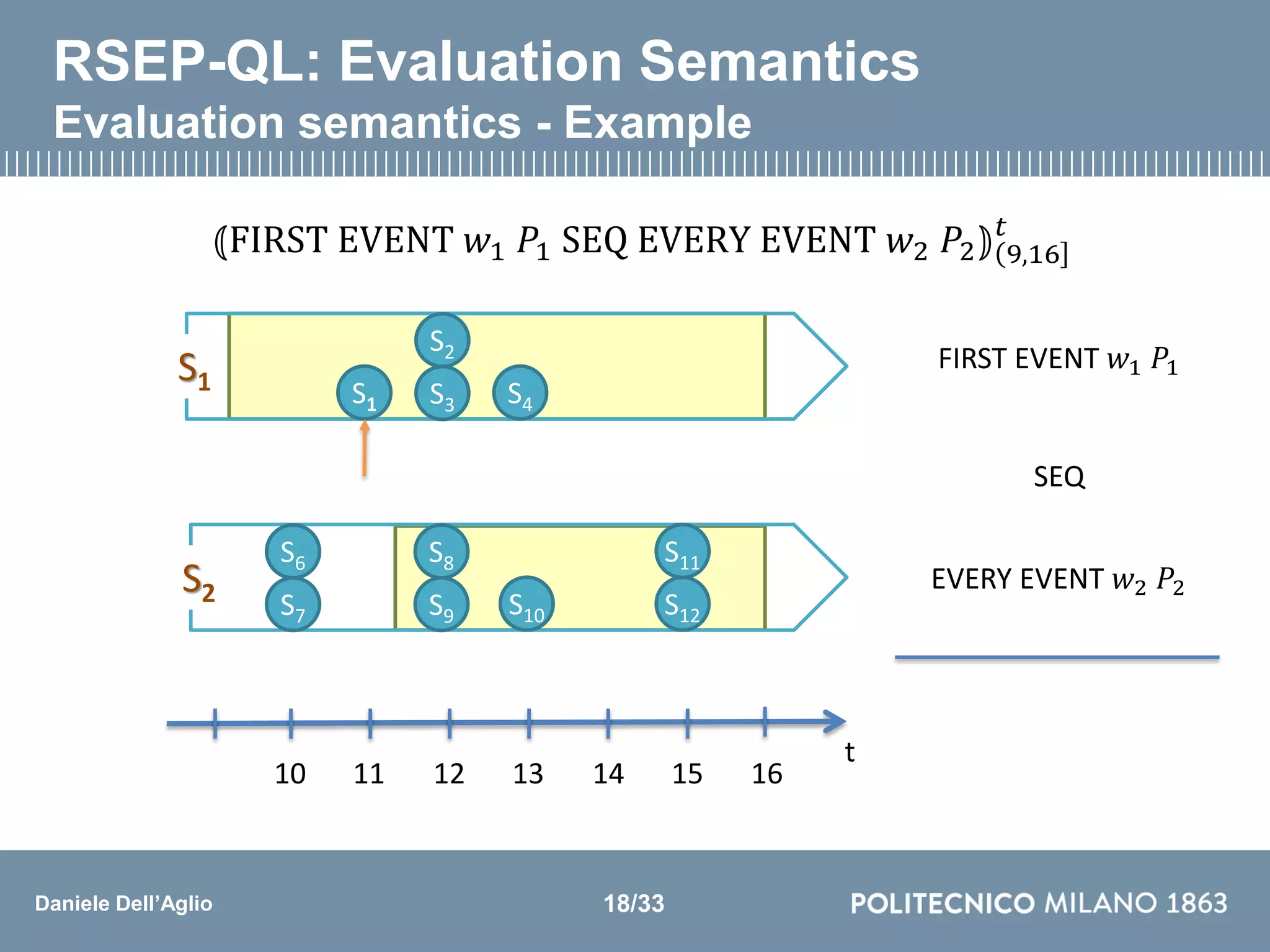
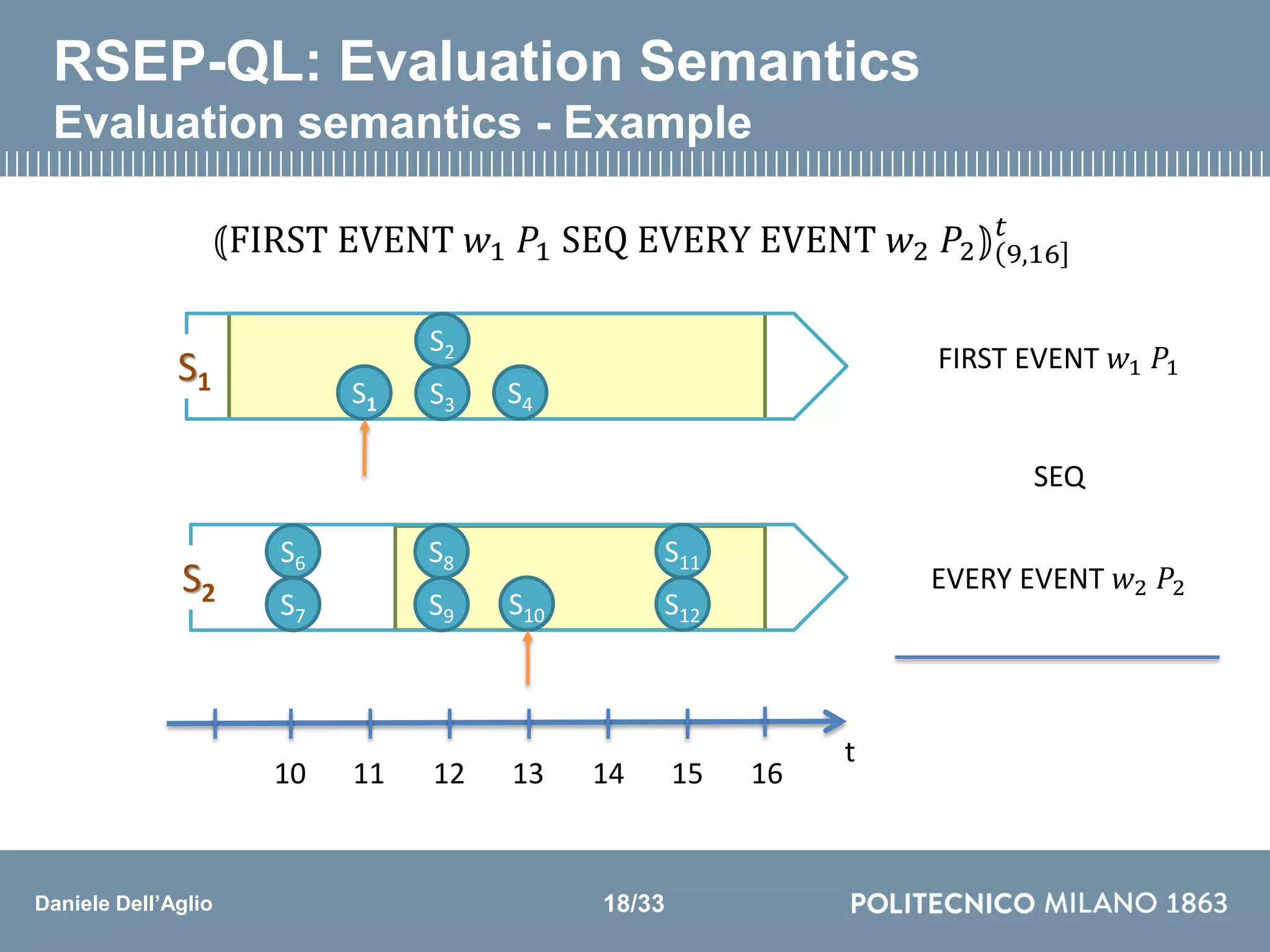
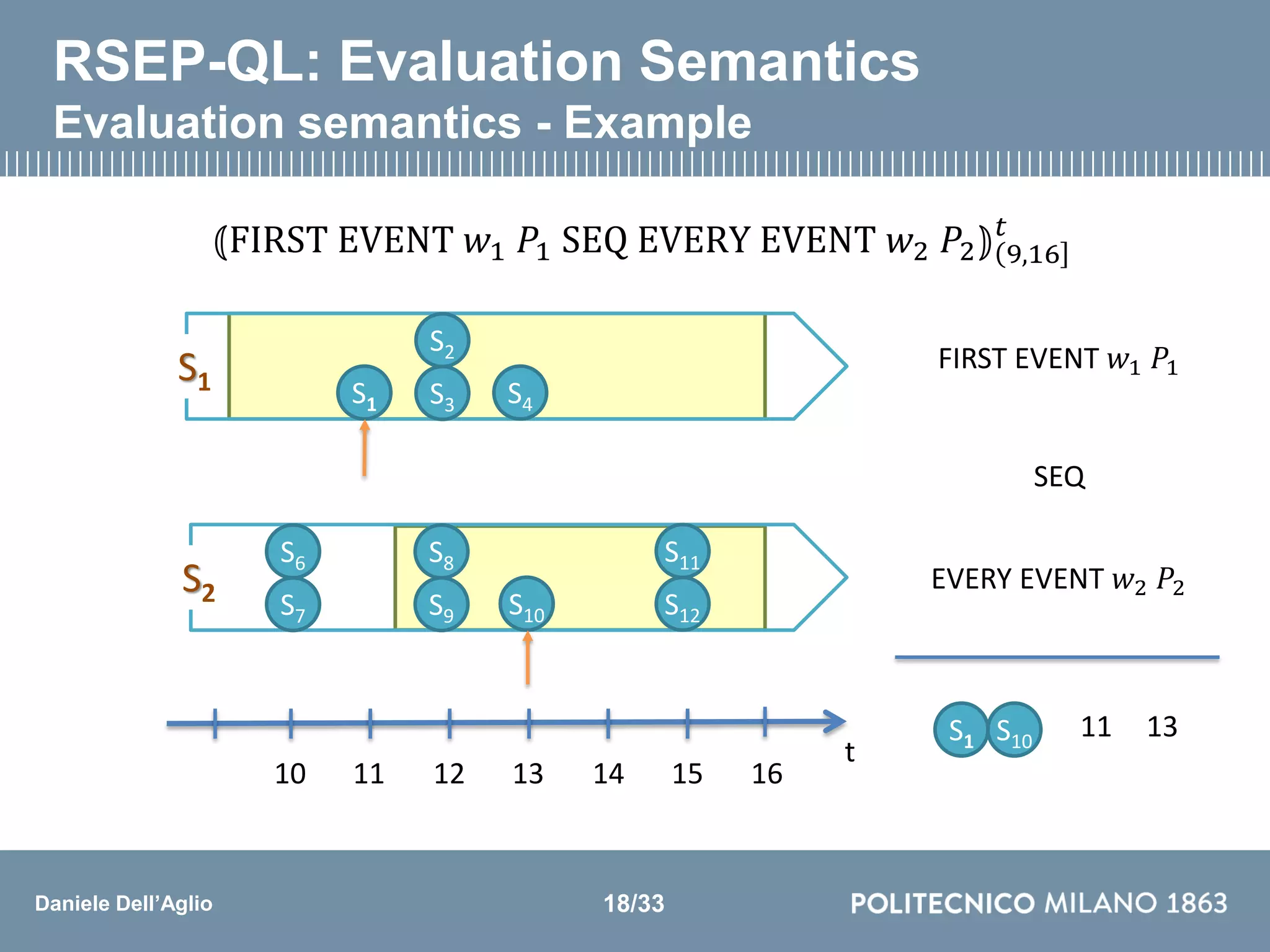
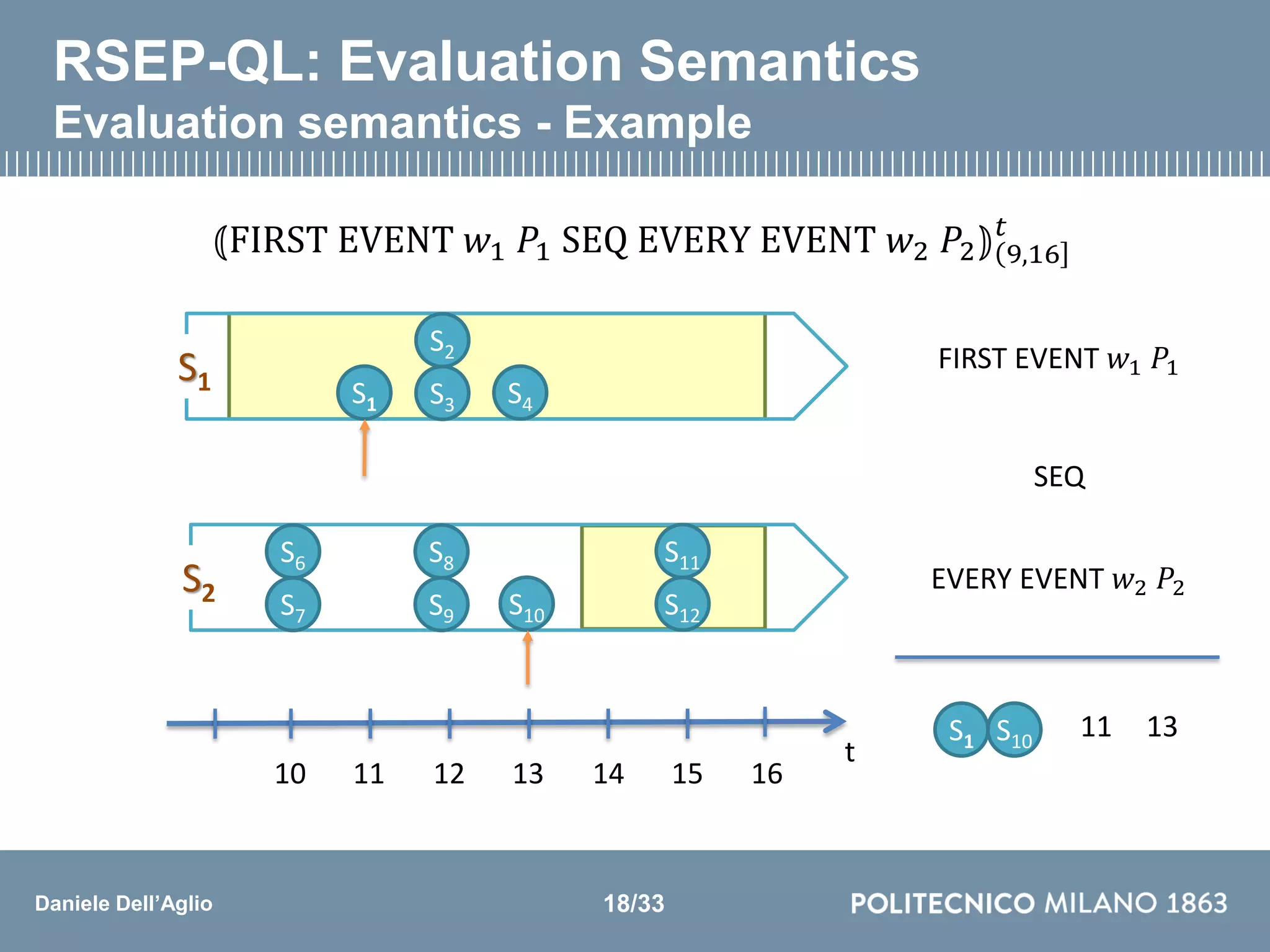
Evaluation semantics - Example
⦅FIRST EVENT 𝑤1 𝑃1 SEQ EVERY EVENT 𝑤2 𝑃2⦆ 9,16
𝑡
S2
S3 S4
S1 S1
S6
S7
S8
S9 S10
S11
S12
S2
FIRST EVENT 𝑤1 𝑃1
SEQ
EVERY EVENT 𝑤2 𝑃2
t
10 12 14 1611 13 15
18/33
Daniele Dell’Aglio
RSEP-QL: Evaluation Semantics
Evaluation semantics - Example
⦅FIRST EVENT 𝑤1 𝑃1 SEQ EVERY EVENT 𝑤2 𝑃2⦆ 9,16
𝑡
S2
S3 S4
S1 S1
S6
S7
S8
S9 S10
S11
S12
S2
FIRST EVENT 𝑤1 𝑃1
SEQ
EVERY EVENT 𝑤2 𝑃2
t
10 12 14 1611 13 15
18/33
Daniele Dell’Aglio
RSEP-QL: Evaluation Semantics
Evaluation semantics - Example
⦅FIRST EVENT 𝑤1 𝑃1 SEQ EVERY EVENT 𝑤2 𝑃2⦆ 9,16
𝑡
S2
S3 S4
S1 S1
S6
S7
S8
S9 S10
S11
S12
S2
FIRST EVENT 𝑤1 𝑃1
SEQ
EVERY EVENT 𝑤2 𝑃2
t
10 12 14 1611 13 15
18/33
Daniele Dell’Aglio
RSEP-QL: Evaluation Semantics
Evaluation semantics - Example
⦅FIRST EVENT 𝑤1 𝑃1 SEQ EVERY EVENT 𝑤2 𝑃2⦆ 9,16
𝑡
S2
S3 S4
S1 S1
S6
S7
S8
S9 S10
S11
S12
S2
FIRST EVENT 𝑤1 𝑃1
SEQ
EVERY EVENT 𝑤2 𝑃2
t
10 12 14 1611 13 15
18/33
Daniele Dell’Aglio
RSEP-QL: Evaluation Semantics
Evaluation semantics - Example
⦅FIRST EVENT 𝑤1 𝑃1 SEQ EVERY EVENT 𝑤2 𝑃2⦆ 9,16
𝑡
S2
S3 S4
S1 S1
S6
S7
S8
S9 S10
S11
S12
S2
S1 S10
FIRST EVENT 𝑤1 𝑃1
SEQ
EVERY EVENT 𝑤2 𝑃2
t
10 12 14 1611 13 15
11 13
18/33
Daniele Dell’Aglio
RSEP-QL: Evaluation Semantics
Evaluation semantics - Example
⦅FIRST EVENT 𝑤1 𝑃1 SEQ EVERY EVENT 𝑤2 𝑃2⦆ 9,16
𝑡
S2
S3 S4
S1 S1
S6
S7
S8
S9 S10
S11
S12
S2
S1 S10
FIRST EVENT 𝑤1 𝑃1
SEQ
EVERY EVENT 𝑤2 𝑃2
t
10 12 14 1611 13 15
11 13
18/33
Daniele Dell’Aglio
RSEP-QL: Evaluation Semantics
Evaluation semantics - Example
⦅FIRST EVENT 𝑤1 𝑃1 SEQ EVERY EVENT 𝑤2 𝑃2⦆ 9,16
𝑡
S2
S3 S4
S1 S1
S6
S7
S8
S9 S10
S11
S12
S2
S1 S10
FIRST EVENT 𝑤1 𝑃1
SEQ
EVERY EVENT 𝑤2 𝑃2
t
10 12 14 1611 13 15
11 13
18/33
Daniele Dell’Aglio
RSEP-QL: Evaluation Semantics
Evaluation semantics - Example
⦅FIRST EVENT 𝑤1 𝑃1 SEQ EVERY EVENT 𝑤2 𝑃2⦆ 9,16
𝑡
S2
S3 S4
S1 S1
S6
S7
S8
S9 S10
S11
S12
S2
S1 S10
S1 S12
FIRST EVENT 𝑤1 𝑃1
SEQ
EVERY EVENT 𝑤2 𝑃2
t
10 12 14 1611 13 15
11 13
11 15
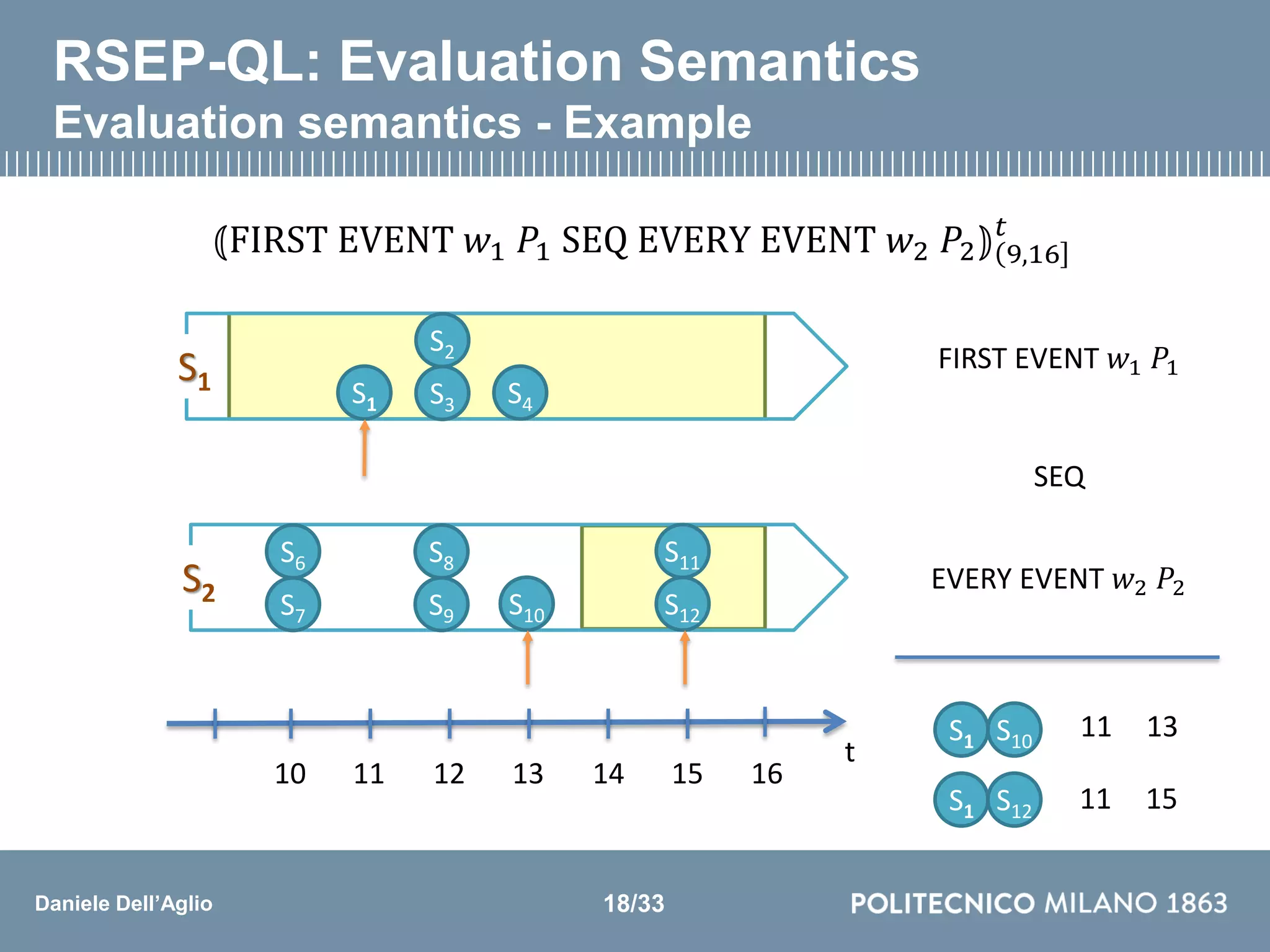
18/33
Daniele Dell’Aglio
RSEP-QL: Evaluation Semantics
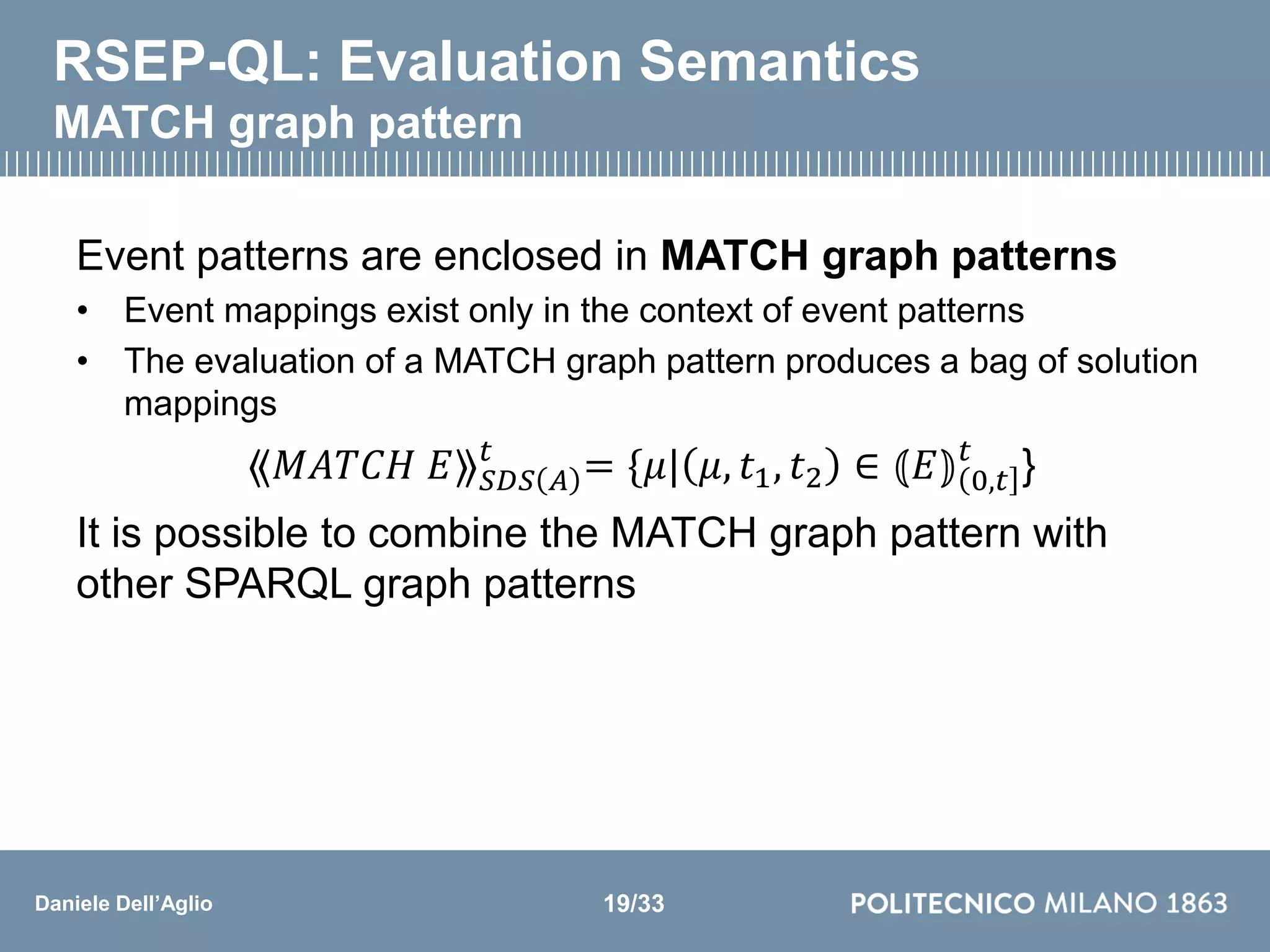
MATCH graph pattern
Event patterns are enclosed in MATCH graph patterns
• Event mappings exist only in the context of event patterns
• The evaluation of a MATCH graph pattern produces a bag of solution
mappings
⟪𝑀𝐴𝑇𝐶𝐻 𝐸⟫ 𝑆𝐷𝑆 𝐴
𝑡
= {𝜇| 𝜇, 𝑡1, 𝑡2 ∈ ⦅𝐸⦆ 0,𝑡
𝑡
}
It is possible to combine the MATCH graph pattern with
other SPARQL graph patterns
19/33
Daniele Dell’Aglio
RSEP-QL: Evaluation Semantics
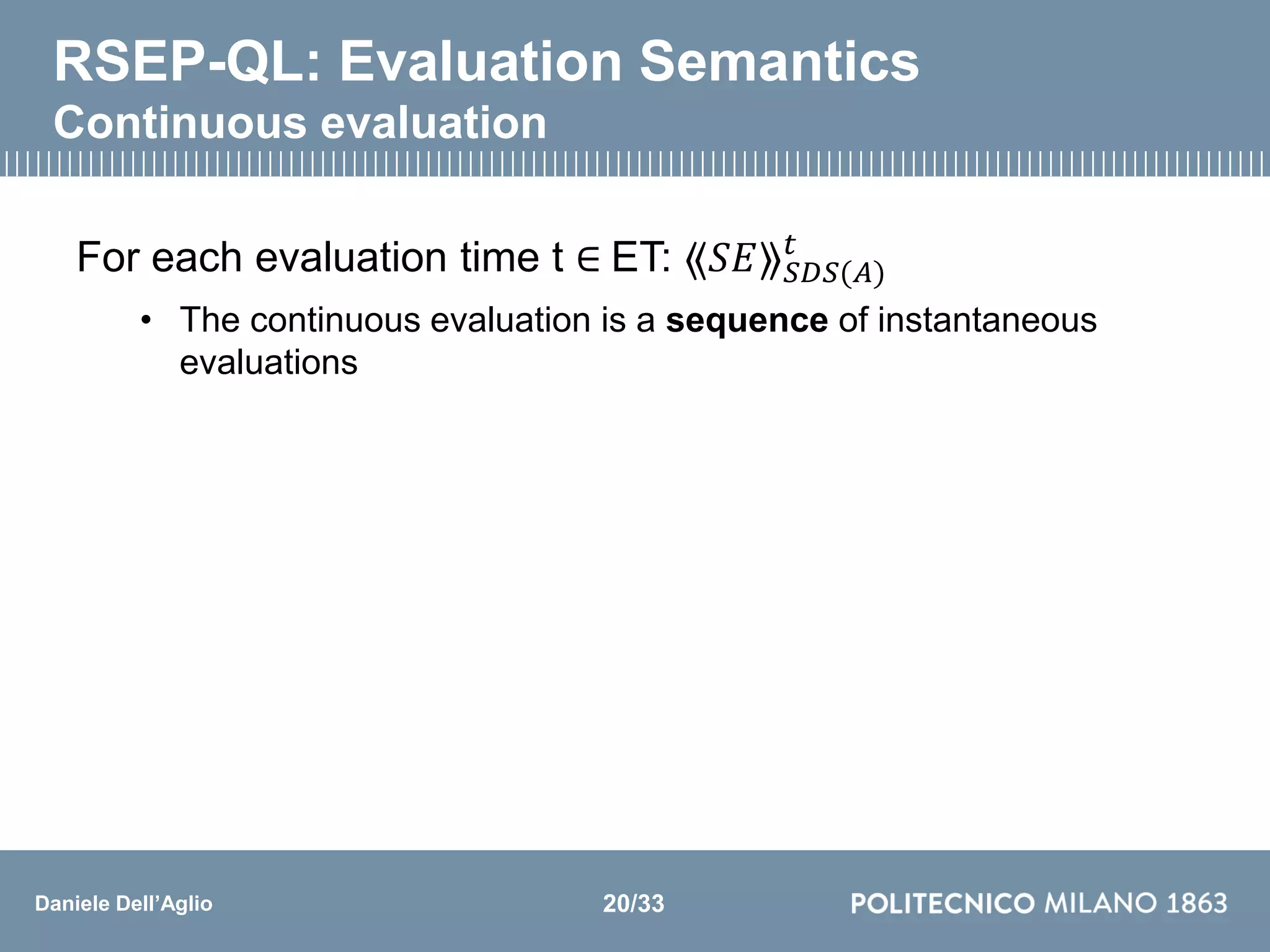
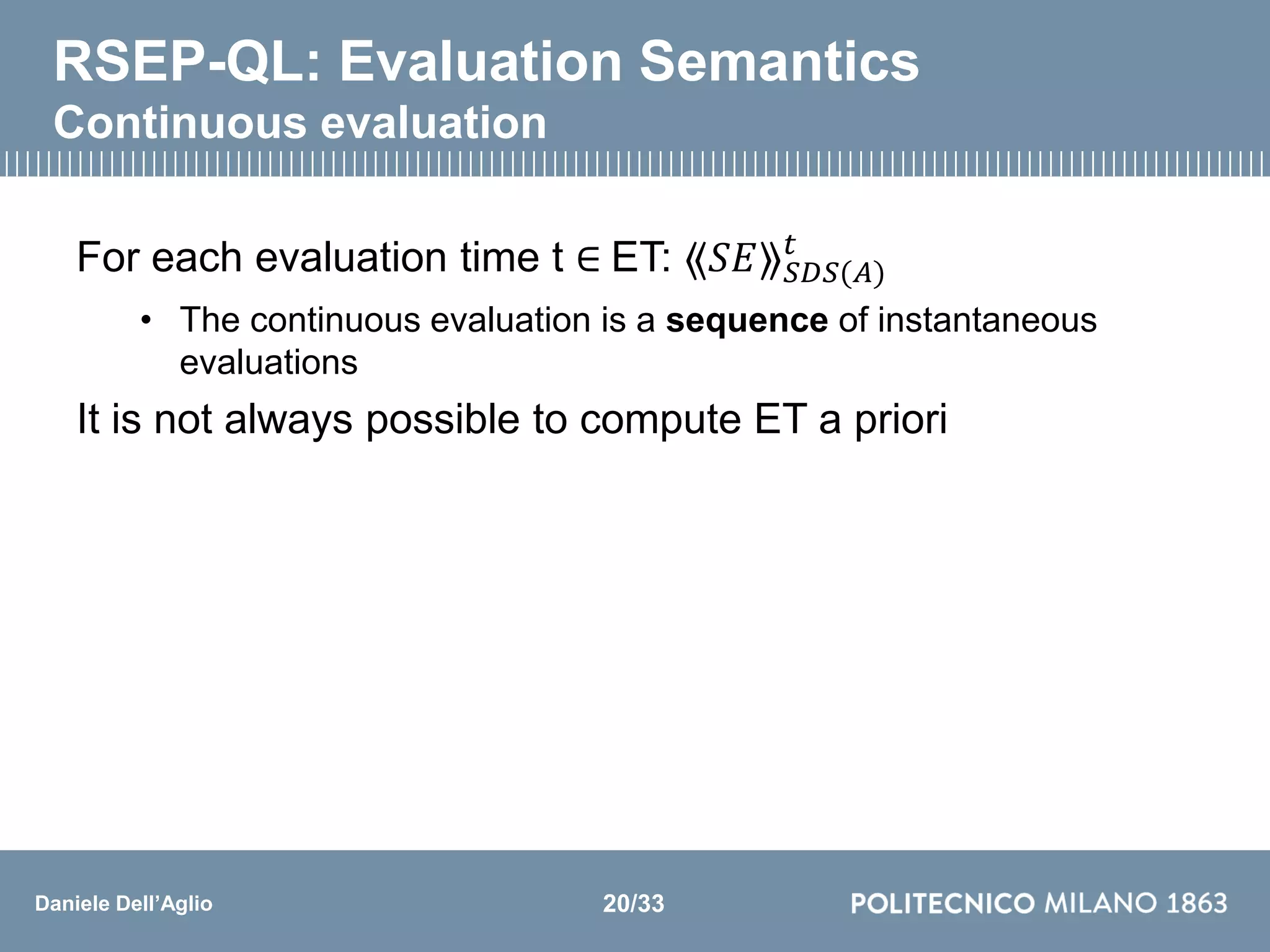
Continuous evaluation
For each evaluation time t ∈ ET: ⟪𝑆𝐸⟫ 𝑆𝐷𝑆(𝐴)
𝑡
• The continuous evaluation is a sequence of instantaneous
evaluations
20/33
Daniele Dell’Aglio
RSEP-QL: Evaluation Semantics
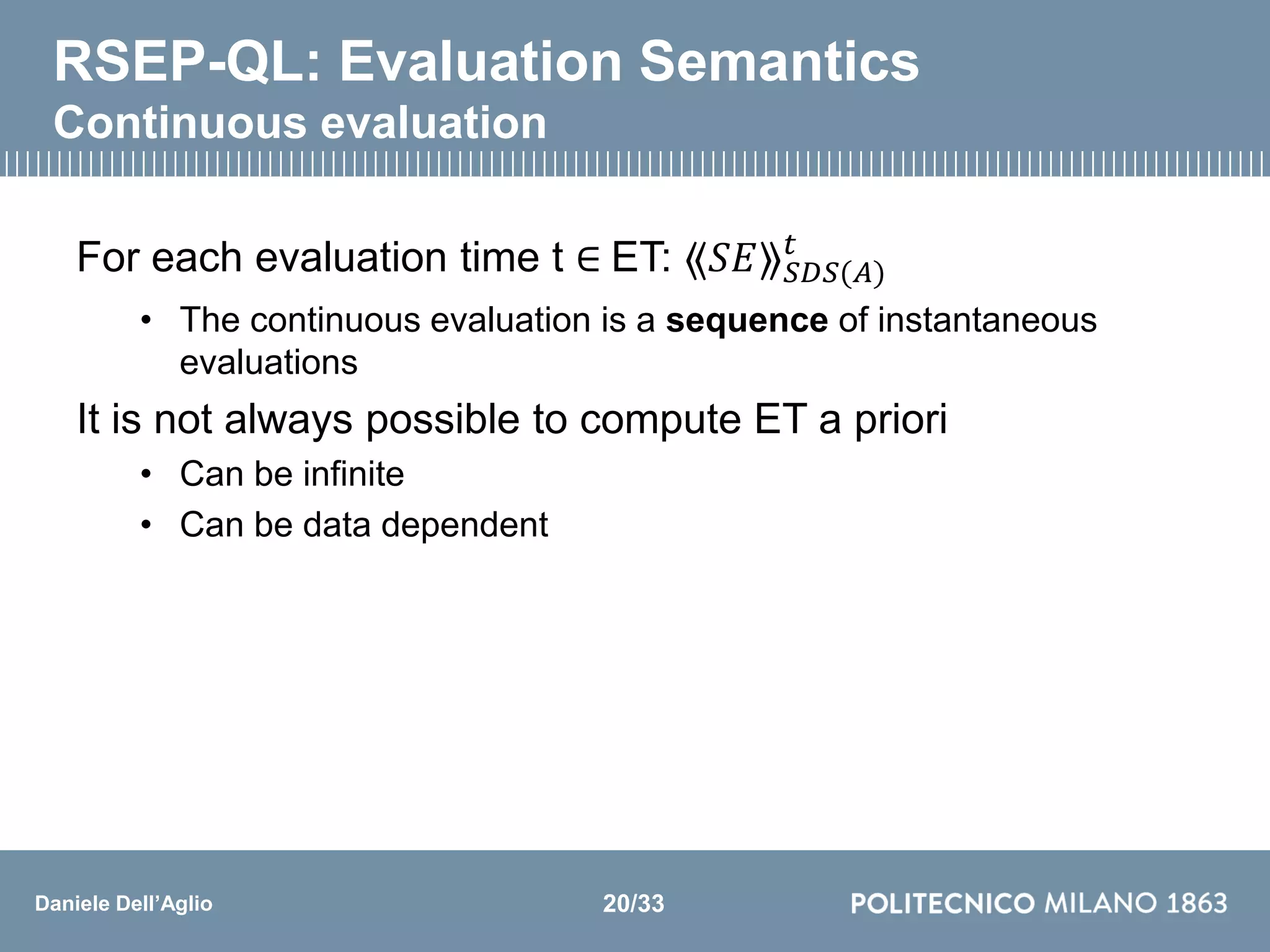
Continuous evaluation
For each evaluation time t ∈ ET: ⟪𝑆𝐸⟫ 𝑆𝐷𝑆(𝐴)
𝑡
• The continuous evaluation is a sequence of instantaneous
evaluations
It is not always possible to compute ET a priori
20/33
Daniele Dell’Aglio
RSEP-QL: Evaluation Semantics
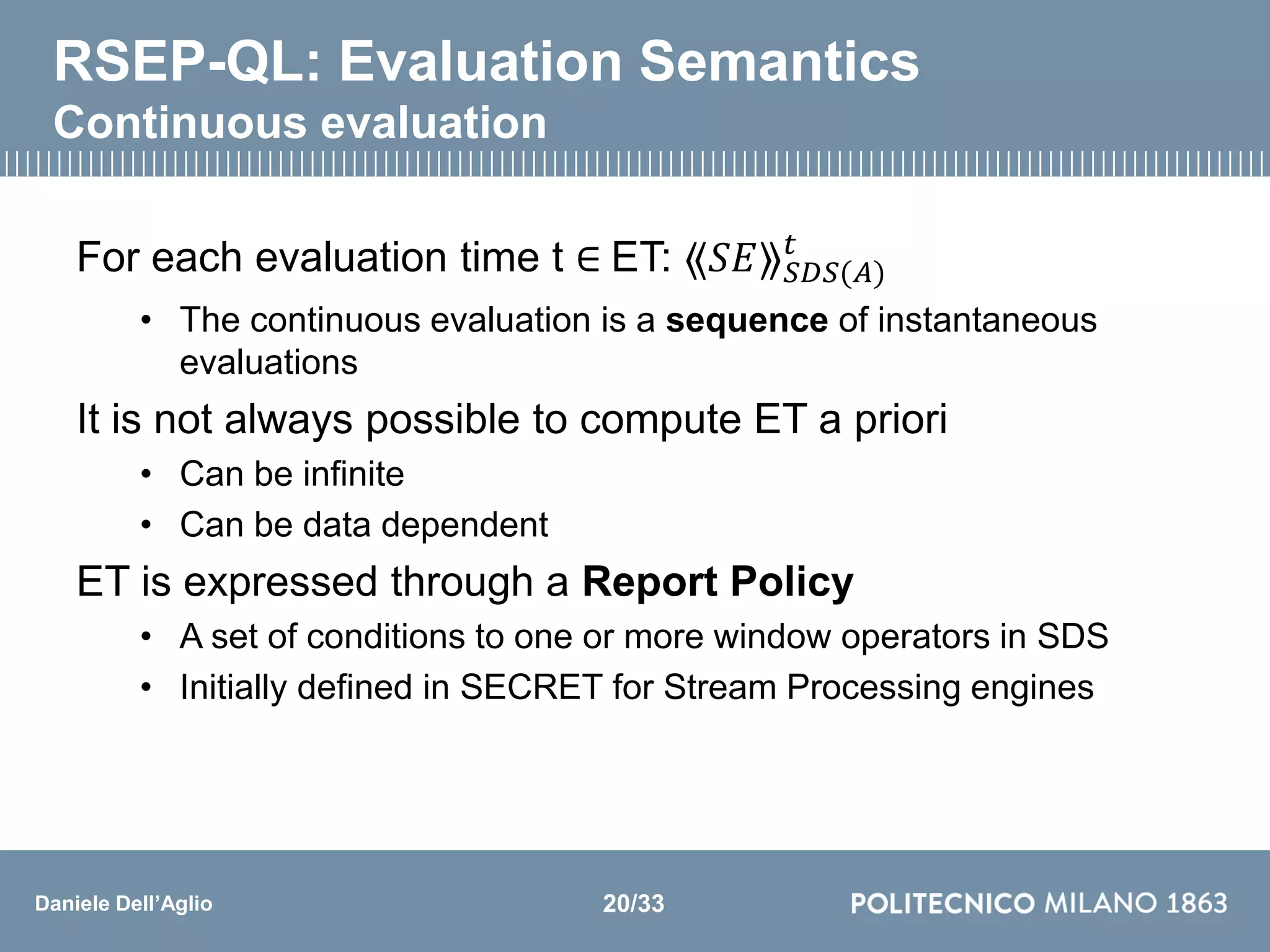
Continuous evaluation
For each evaluation time t ∈ ET: ⟪𝑆𝐸⟫ 𝑆𝐷𝑆(𝐴)
𝑡
• The continuous evaluation is a sequence of instantaneous
evaluations
It is not always possible to compute ET a priori
• Can be infinite
• Can be data dependent
20/33
Daniele Dell’Aglio
RSEP-QL: Evaluation Semantics
Continuous evaluation
For each evaluation time t ∈ ET: ⟪𝑆𝐸⟫ 𝑆𝐷𝑆(𝐴)
𝑡
• The continuous evaluation is a sequence of instantaneous
evaluations
It is not always possible to compute ET a priori
• Can be infinite
• Can be data dependent
ET is expressed through a Report Policy
• A set of conditions to one or more window operators in SDS
• Initially defined in SECRET for Stream Processing engines
20/33
Daniele Dell’Aglio
RSEP-QL: Evaluation Semantics
Continuous evaluation
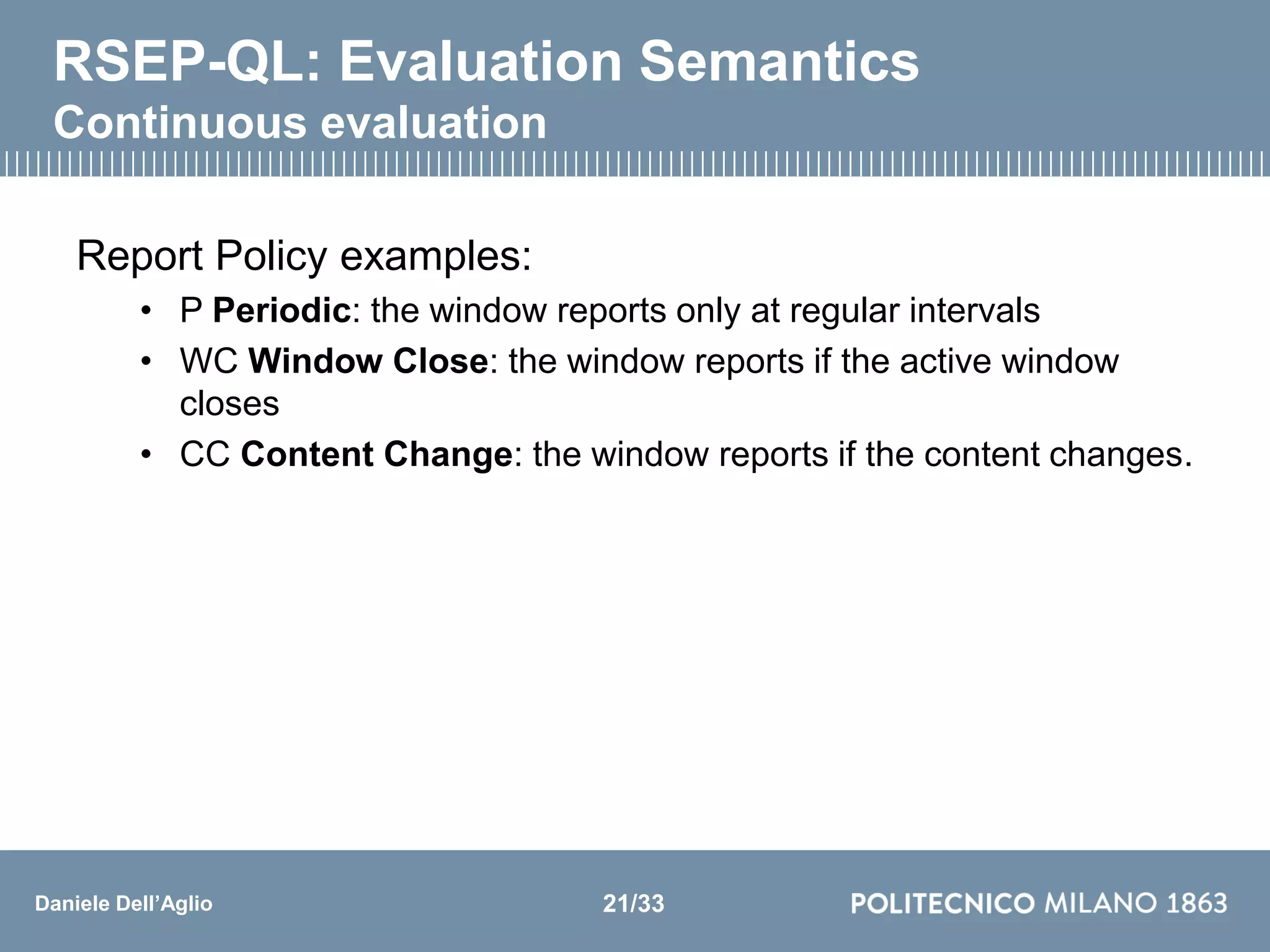
Report Policy examples:
• P Periodic: the window reports only at regular intervals
• WC Window Close: the window reports if the active window
closes
• CC Content Change: the window reports if the content changes.
21/33
Daniele Dell’Aglio
Research Question 2
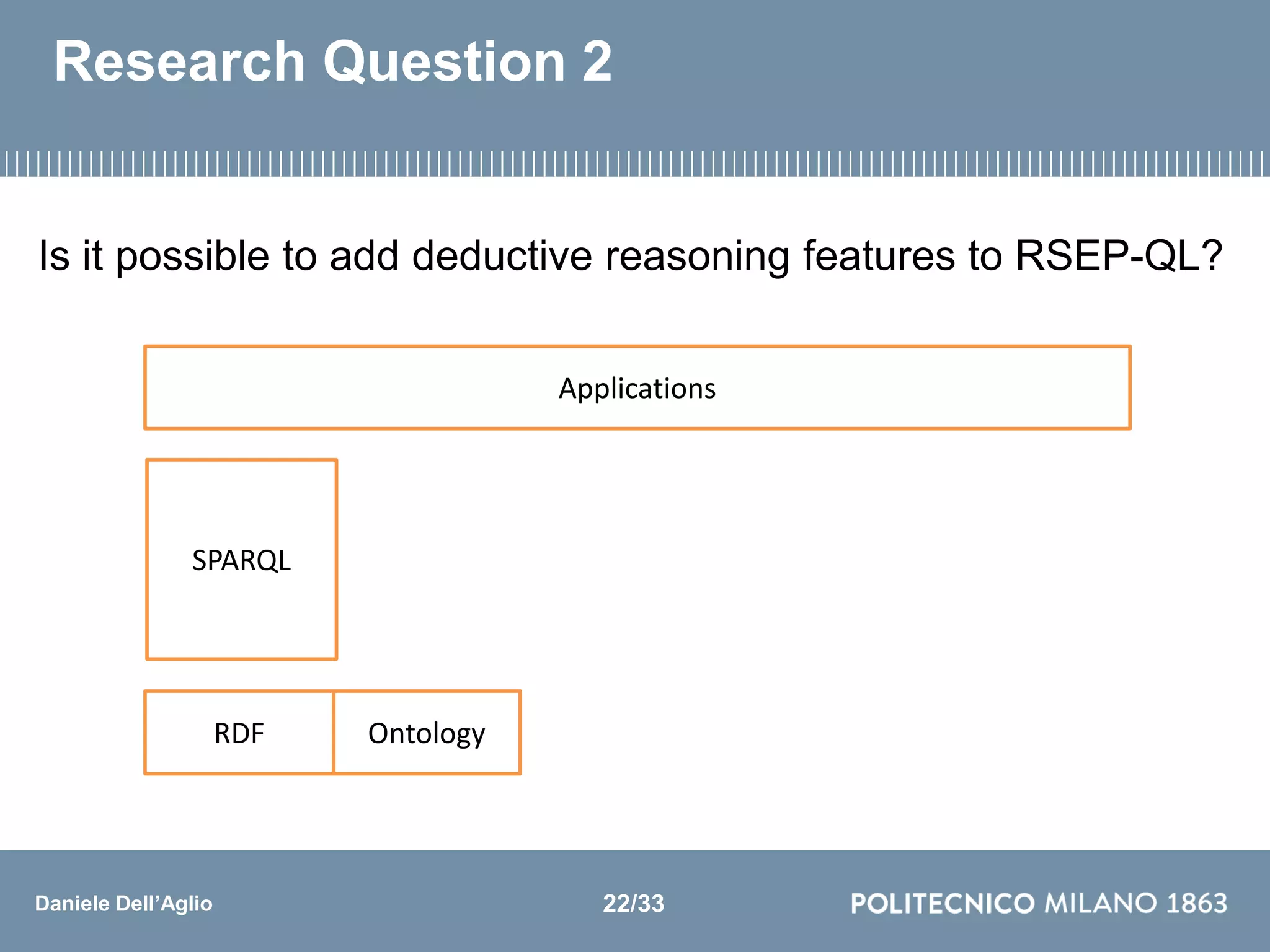
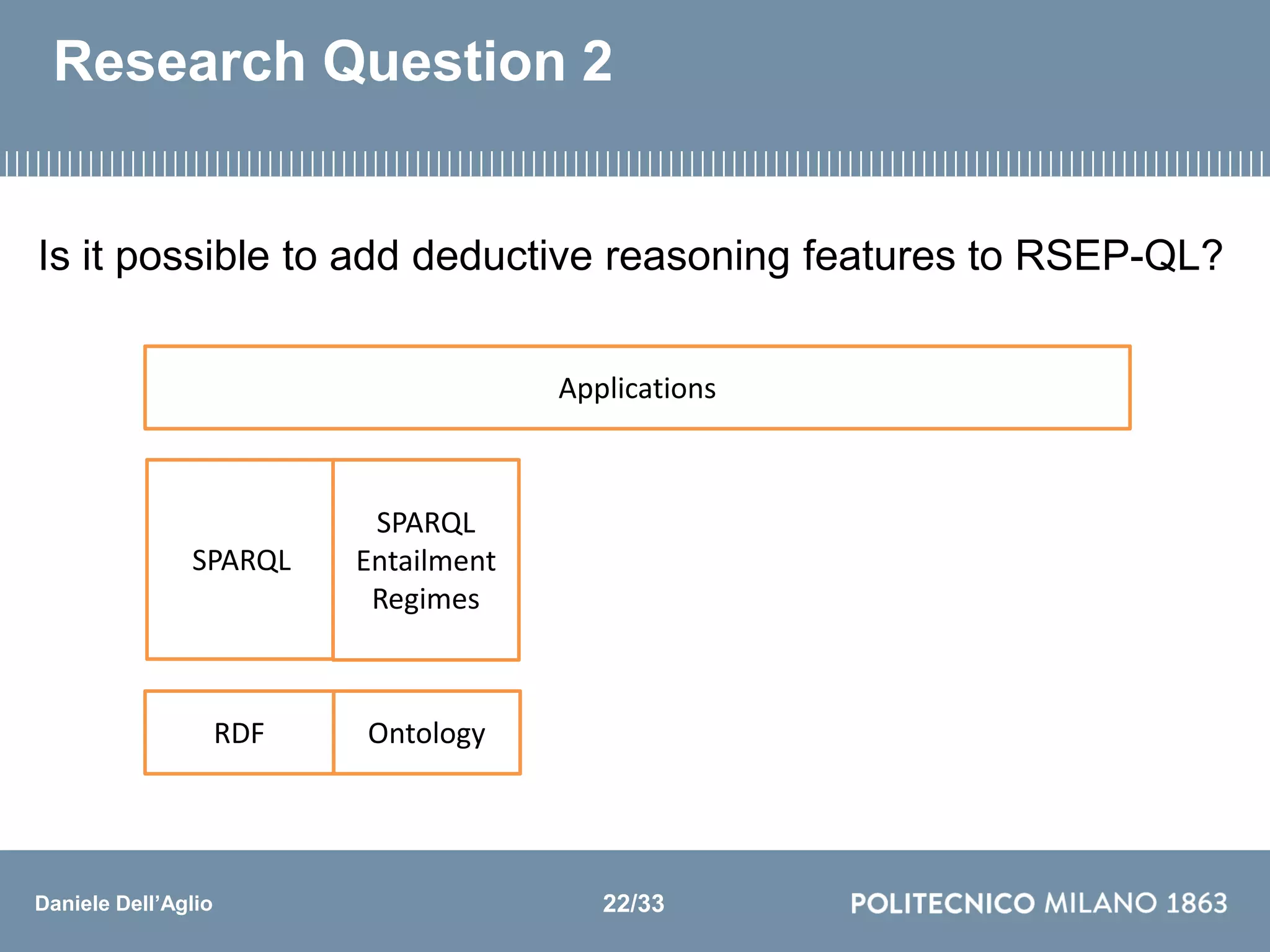
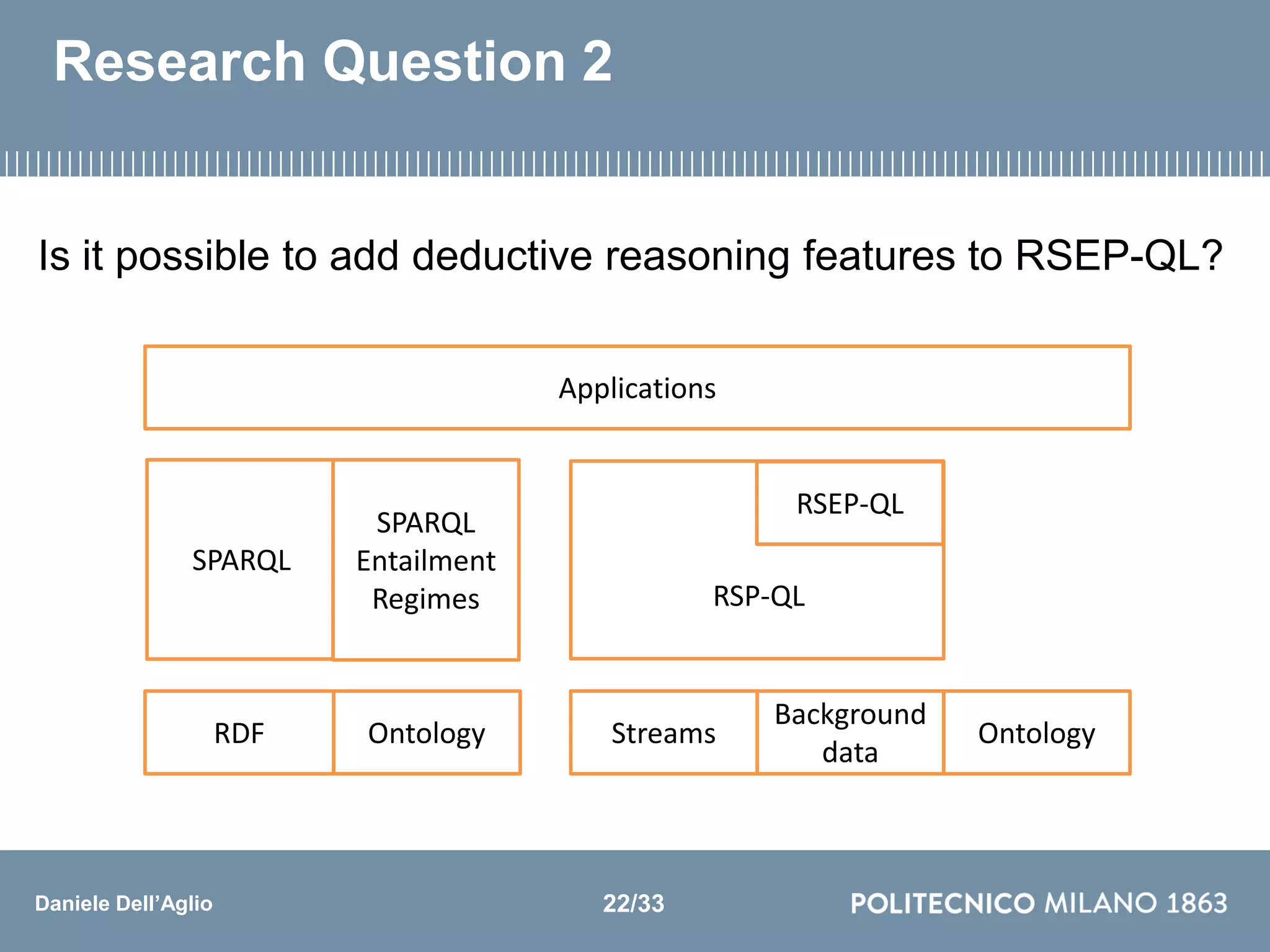
Is it possible to add deductive reasoning features to RSEP-QL?
22/33
Daniele Dell’Aglio
Research Question 2
Is it possible to add deductive reasoning features to RSEP-QL?
Applications
RDF
SPARQL
Ontology
22/33
Daniele Dell’Aglio
Research Question 2
Is it possible to add deductive reasoning features to RSEP-QL?
Applications
RDF
SPARQL
Ontology
SPARQL
Entailment
Regimes
22/33
Daniele Dell’Aglio
Research Question 2
Is it possible to add deductive reasoning features to RSEP-QL?
Streams Ontology
Background
data
RSEP-QL
Applications
RSP-QL
RDF
SPARQL
Ontology
SPARQL
Entailment
Regimes
22/33
Daniele Dell’Aglio
Research Question 2
Is it possible to add deductive reasoning features to RSEP-QL?
Streams Ontology
Background
data
RSEP-QL
Entailment
Regimes
RSEP-QL
Applications
RSP-QL
RDF
SPARQL
Ontology
SPARQL
Entailment
Regimes
22/33
Daniele Dell’Aglio
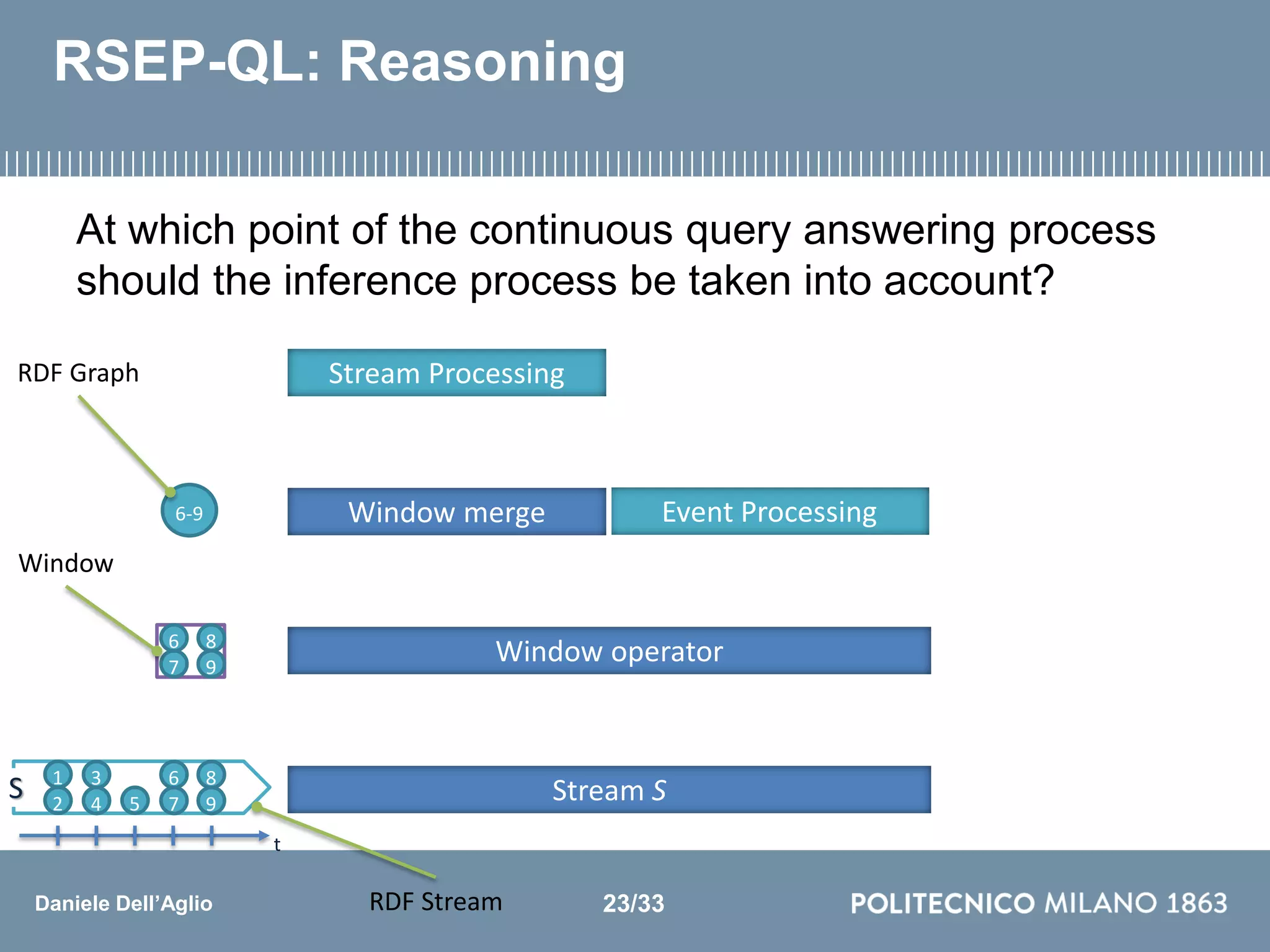
RSEP-QL: Reasoning
Stream Processing
At which point of the continuous query answering process
should the inference process be taken into account?
Event ProcessingWindow merge
Window operator
Stream S3
4 5
6
7
8
9
S 1
2
6
7
8
9
6-9
t
RDF Graph
RDF Stream
Window
23/33
Daniele Dell’Aglio
RSEP-QL: Reasoning
Stream Processing
At which point of the continuous query answering process
should the inference process be taken into account?
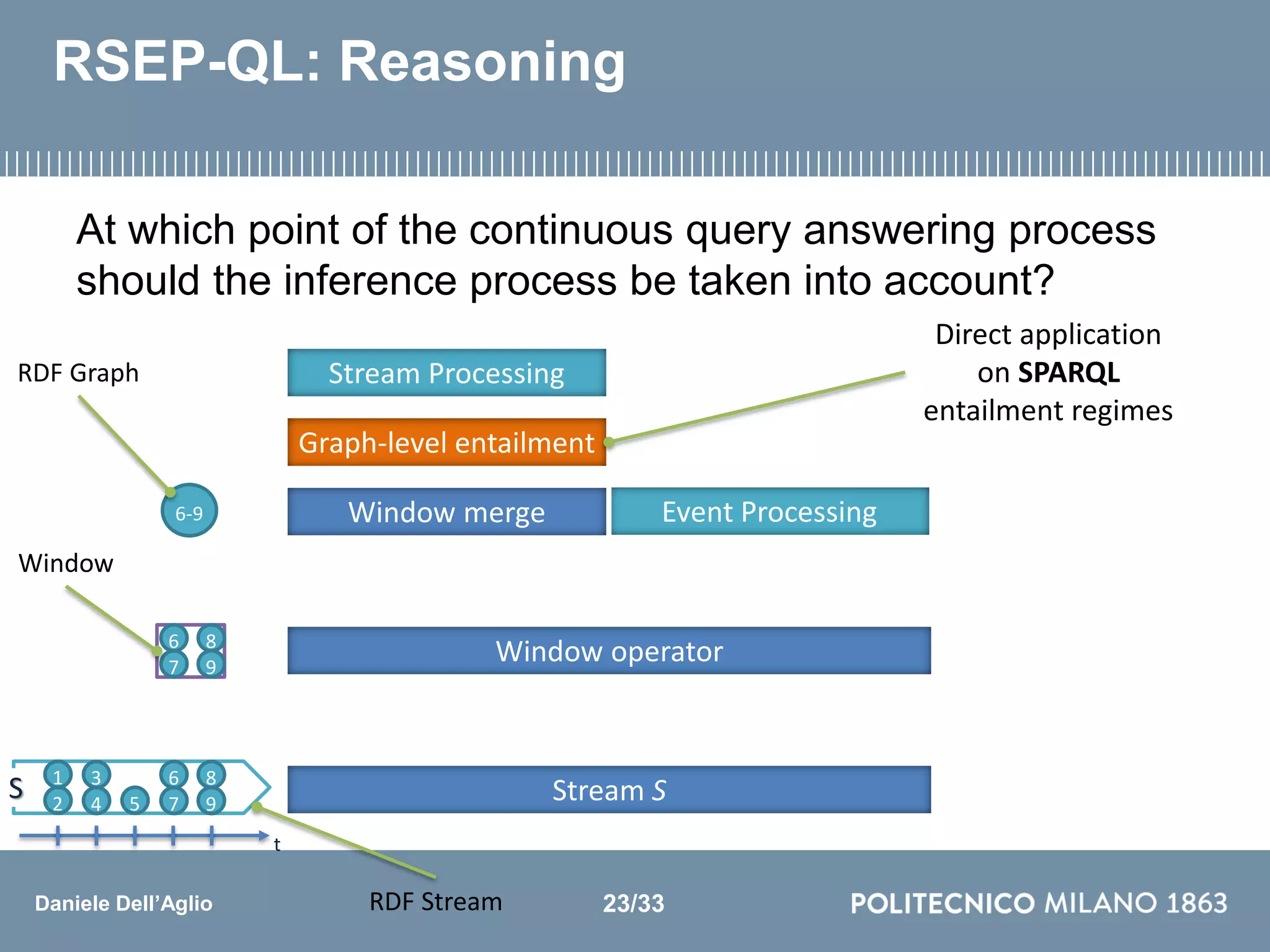
Direct application
on SPARQL
entailment regimes
Event ProcessingWindow merge
Window operator
Stream S
Graph-level entailment
3
4 5
6
7
8
9
S 1
2
6
7
8
9
6-9
t
RDF Graph
RDF Stream
Window
23/33
Daniele Dell’Aglio
RSEP-QL: Reasoning
Stream Processing
At which point of the continuous query answering process
should the inference process be taken into account?
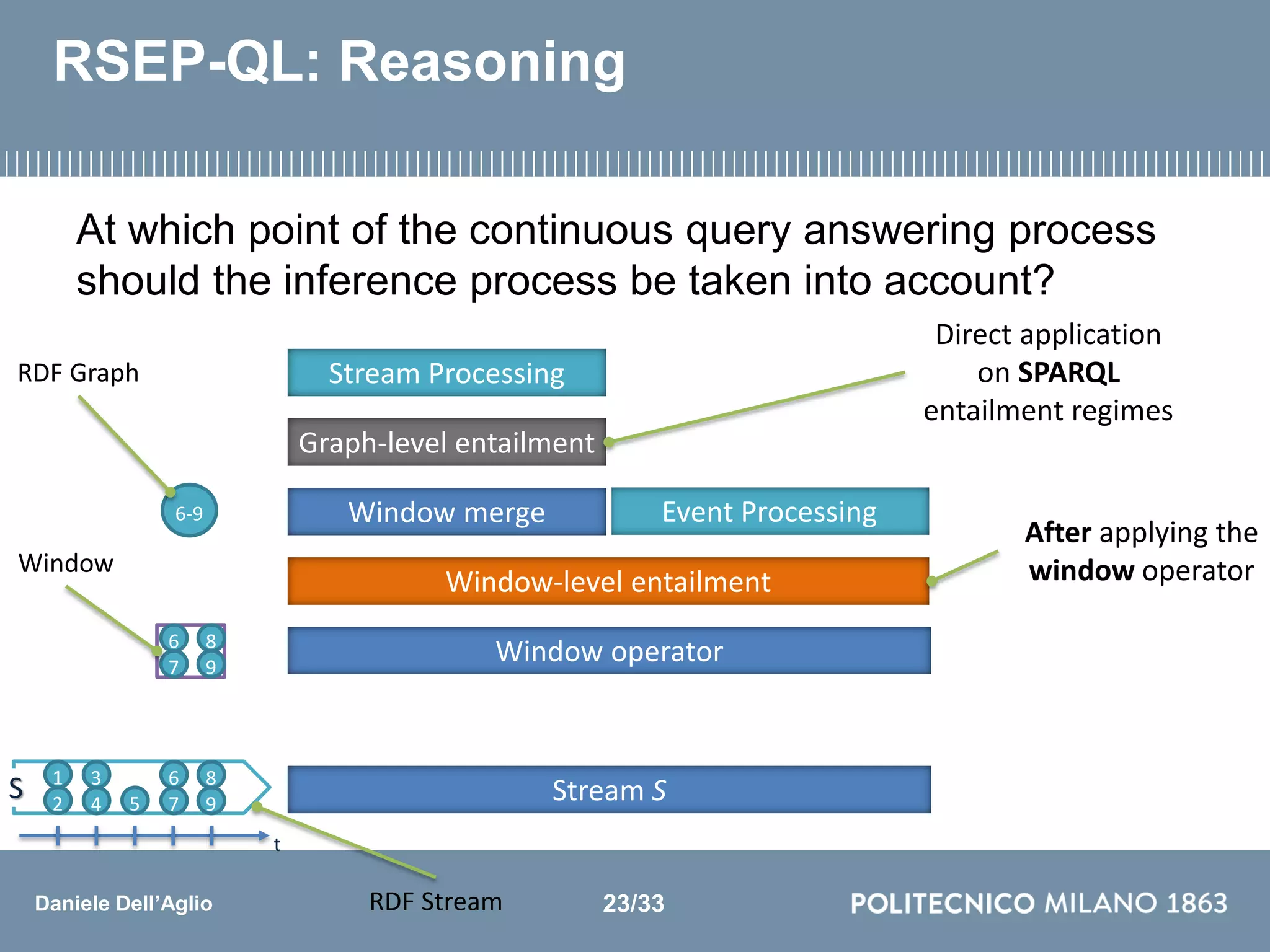
After applying the
window operator
Direct application
on SPARQL
entailment regimes
Event ProcessingWindow merge
Window operator
Stream S
Graph-level entailment
Window-level entailment
3
4 5
6
7
8
9
S 1
2
6
7
8
9
6-9
t
RDF Graph
RDF Stream
Window
23/33
Daniele Dell’Aglio
RSEP-QL: Reasoning
Stream Processing
At which point of the continuous query answering process
should the inference process be taken into account?
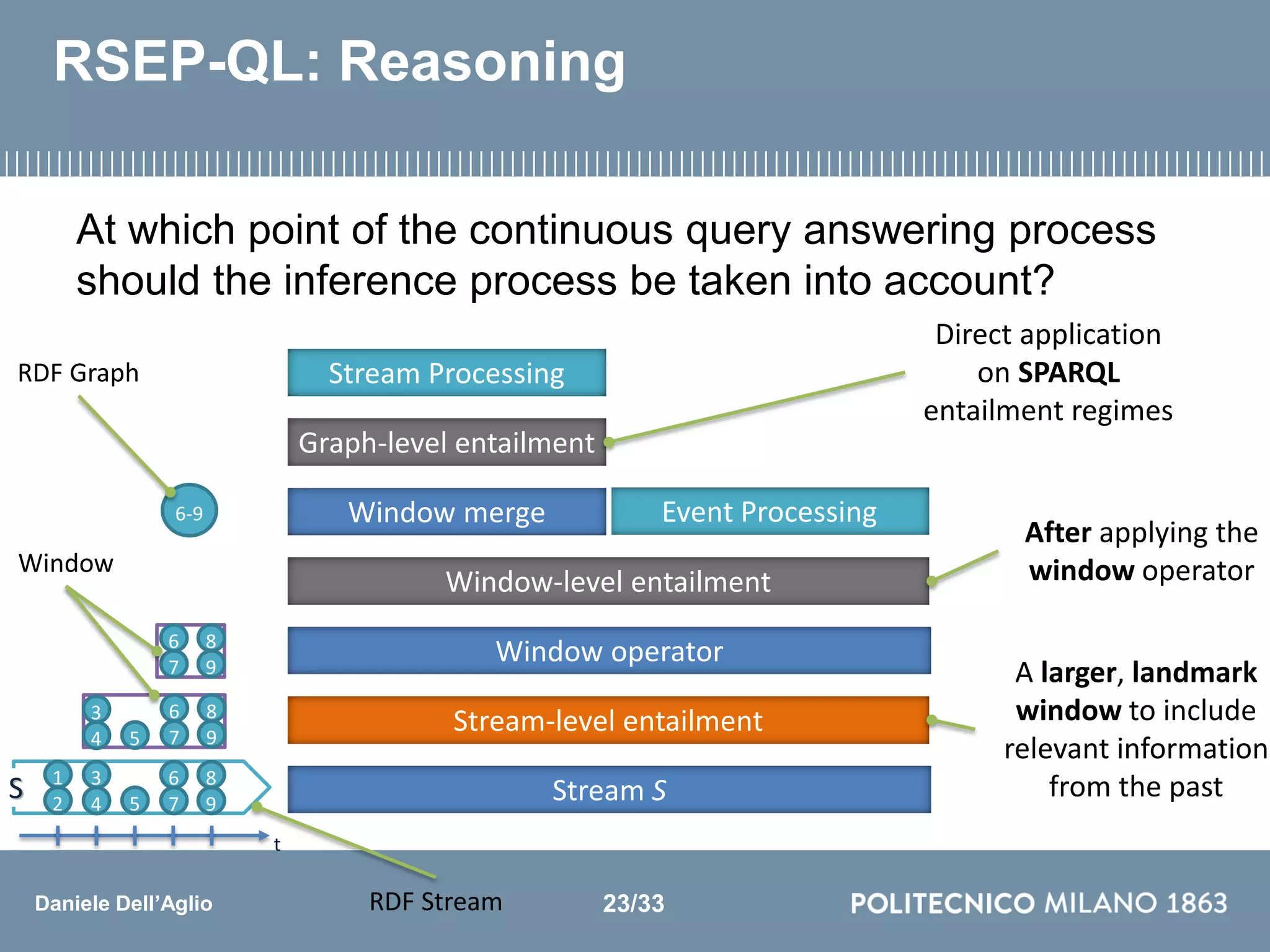
A larger, landmark
window to include
relevant information
from the past
After applying the
window operator
Direct application
on SPARQL
entailment regimes
Event ProcessingWindow merge
Window operator
Stream S
Graph-level entailment
Window-level entailment
Stream-level entailment
3
4 5
6
7
8
9
S 1
2
6
7
8
9
6-9
t
6
7
8
9
3
4 5
RDF Graph
RDF Stream
Window
23/33
Daniele Dell’Aglio
RSEP-QL: Reasoning
Window-level and stream-level entailment regimes
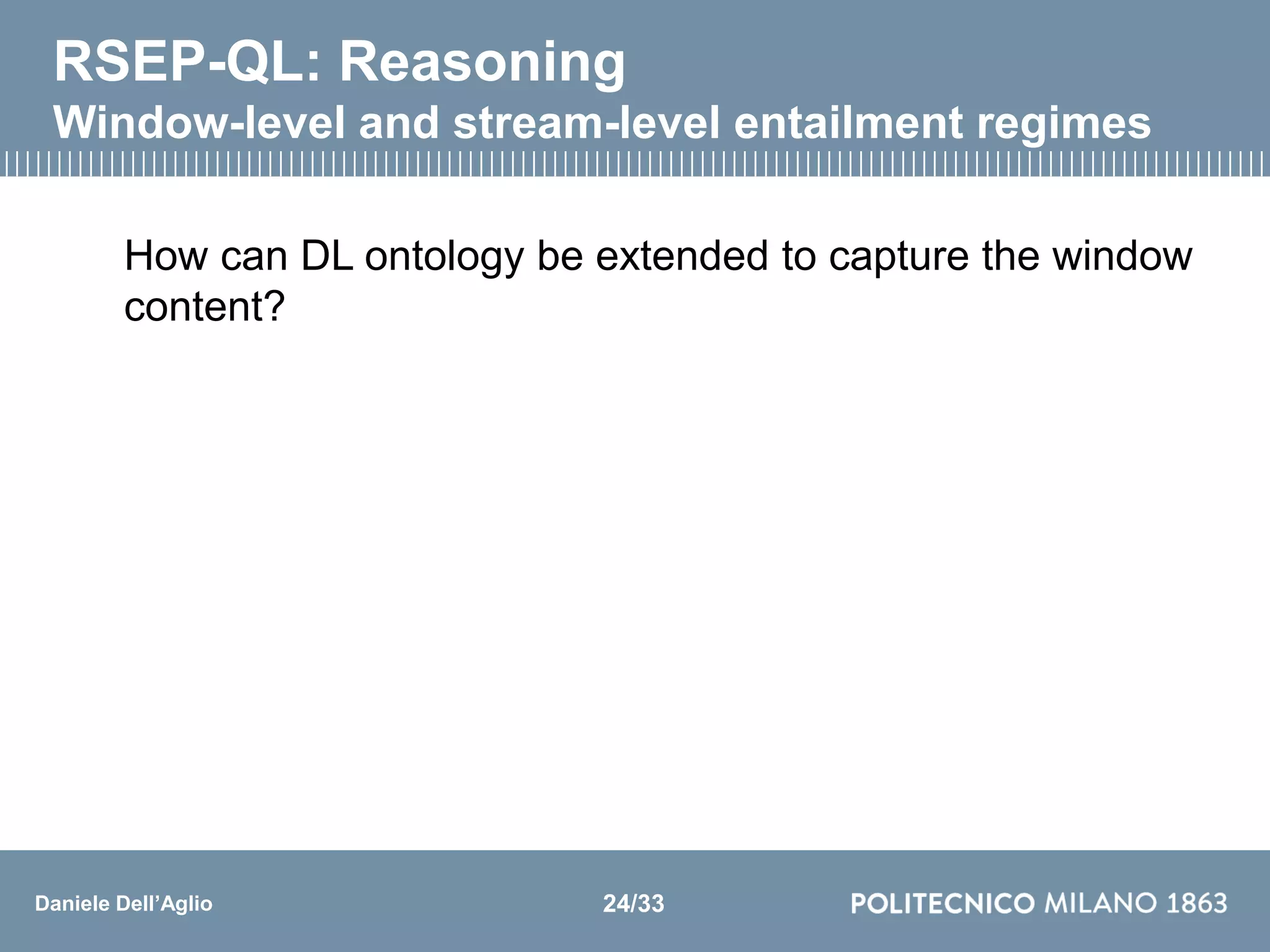
How can DL ontology be extended to capture the window
content?
24/33
Daniele Dell’Aglio
RSEP-QL: Reasoning
Window-level and stream-level entailment regimes
How can DL ontology be extended to capture the window
content?
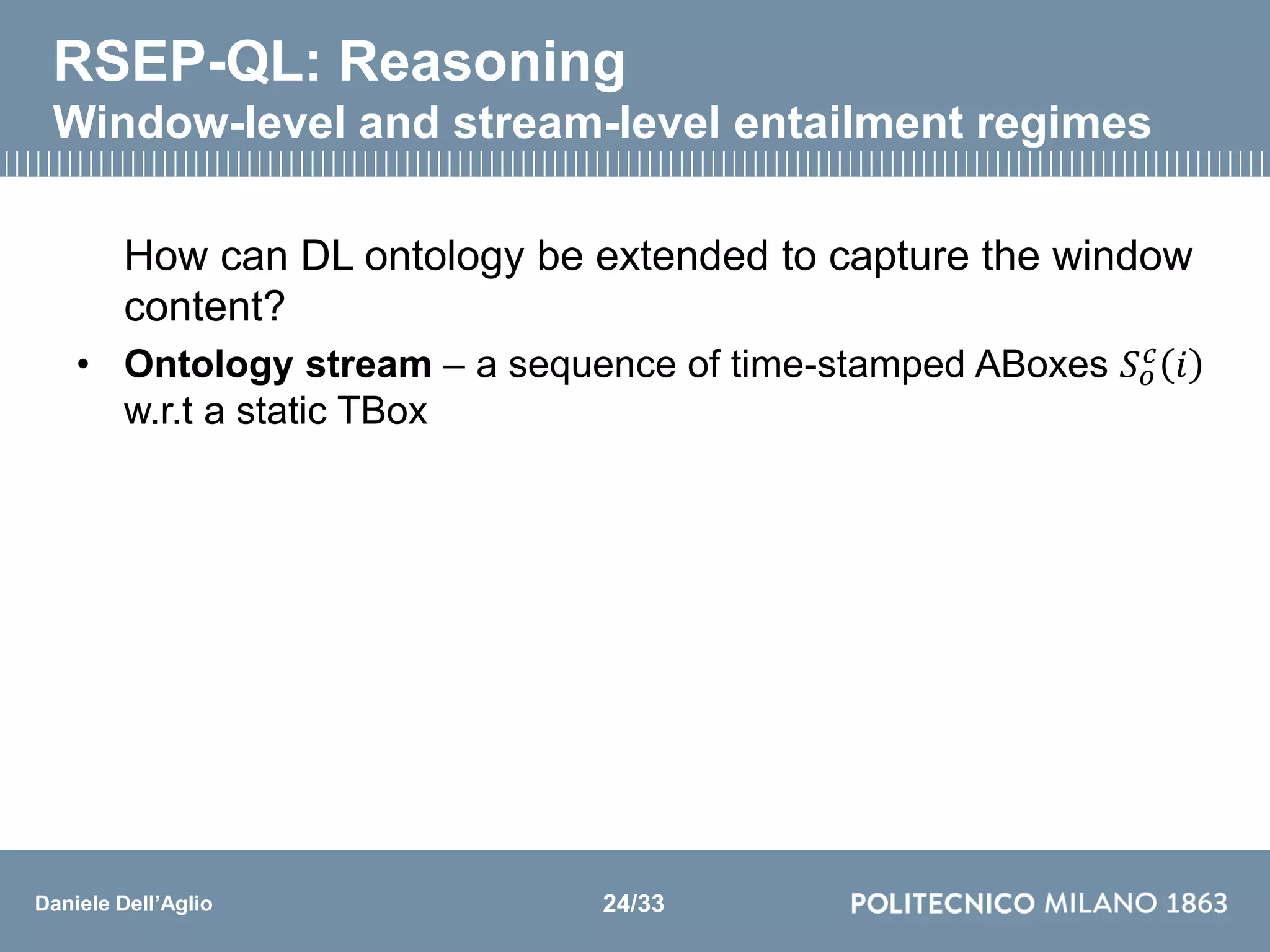
• Ontology stream – a sequence of time-stamped ABoxes 𝑆 𝑜
𝑐
𝑖
w.r.t a static TBox
24/33
Daniele Dell’Aglio
RSEP-QL: Reasoning
Window-level and stream-level entailment regimes
How can DL ontology be extended to capture the window
content?
• Ontology stream – a sequence of time-stamped ABoxes 𝑆 𝑜
𝑐
𝑖
w.r.t a static TBox
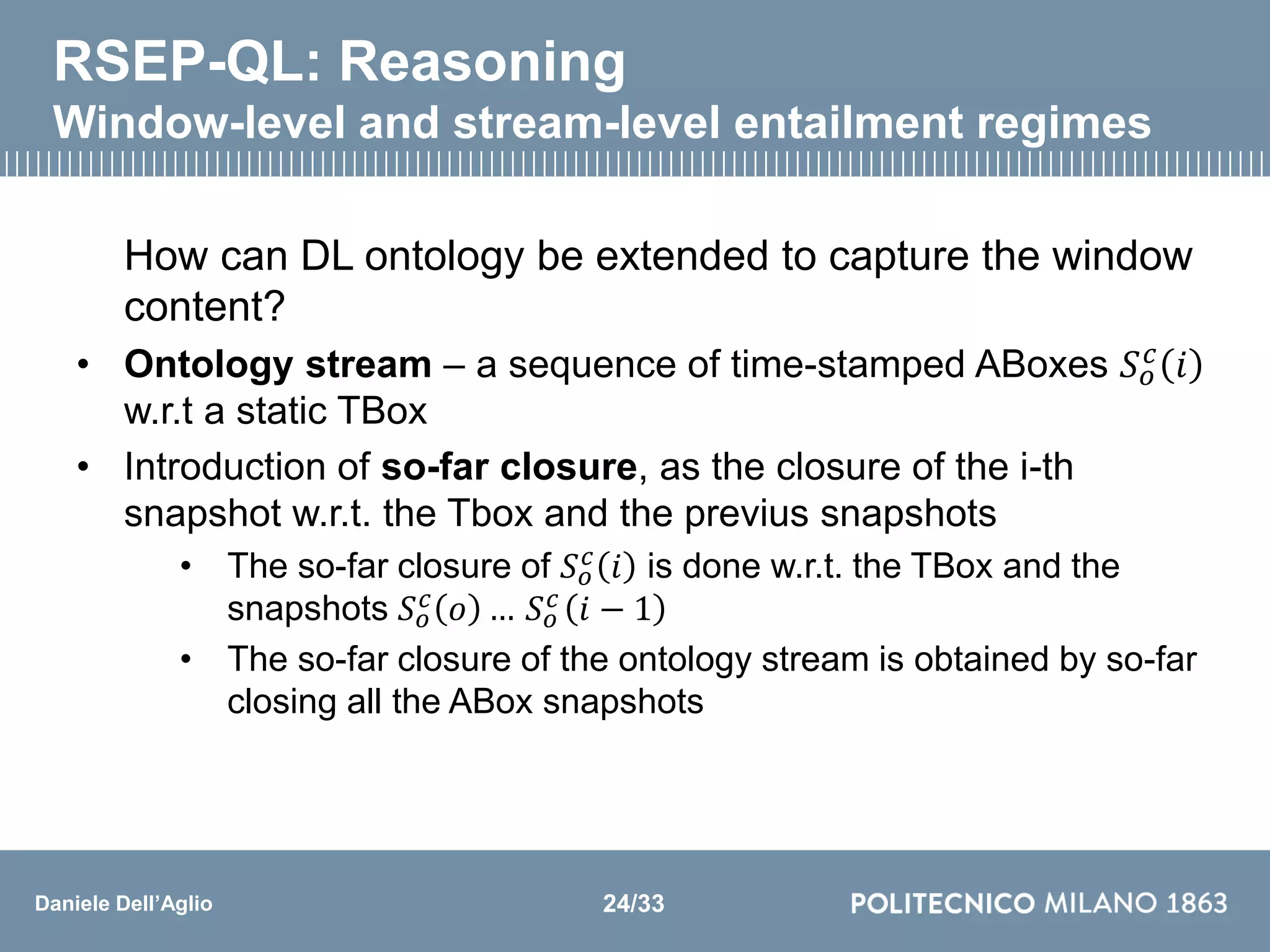
• Introduction of so-far closure, as the closure of the i-th
snapshot w.r.t. the Tbox and the previus snapshots
• The so-far closure of 𝑆 𝑜
𝑐 𝑖 is done w.r.t. the TBox and the
snapshots 𝑆 𝑜
𝑐 𝑜 … 𝑆 𝑜
𝑐 𝑖 − 1
• The so-far closure of the ontology stream is obtained by so-far
closing all the ABox snapshots
24/33
Daniele Dell’Aglio
Event Processing
Stream-level entailment
RSEP-QL: Reasoning
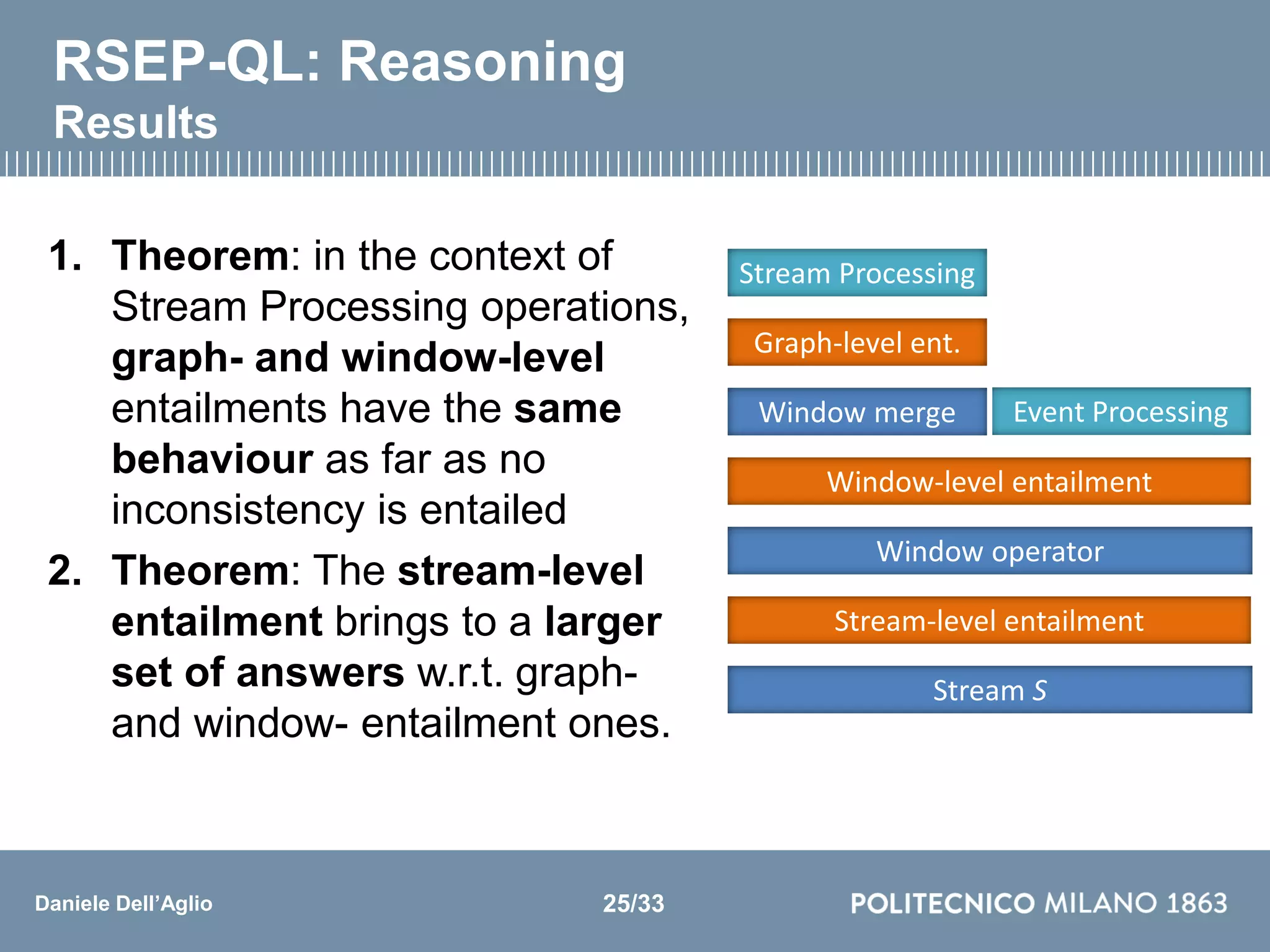
Results
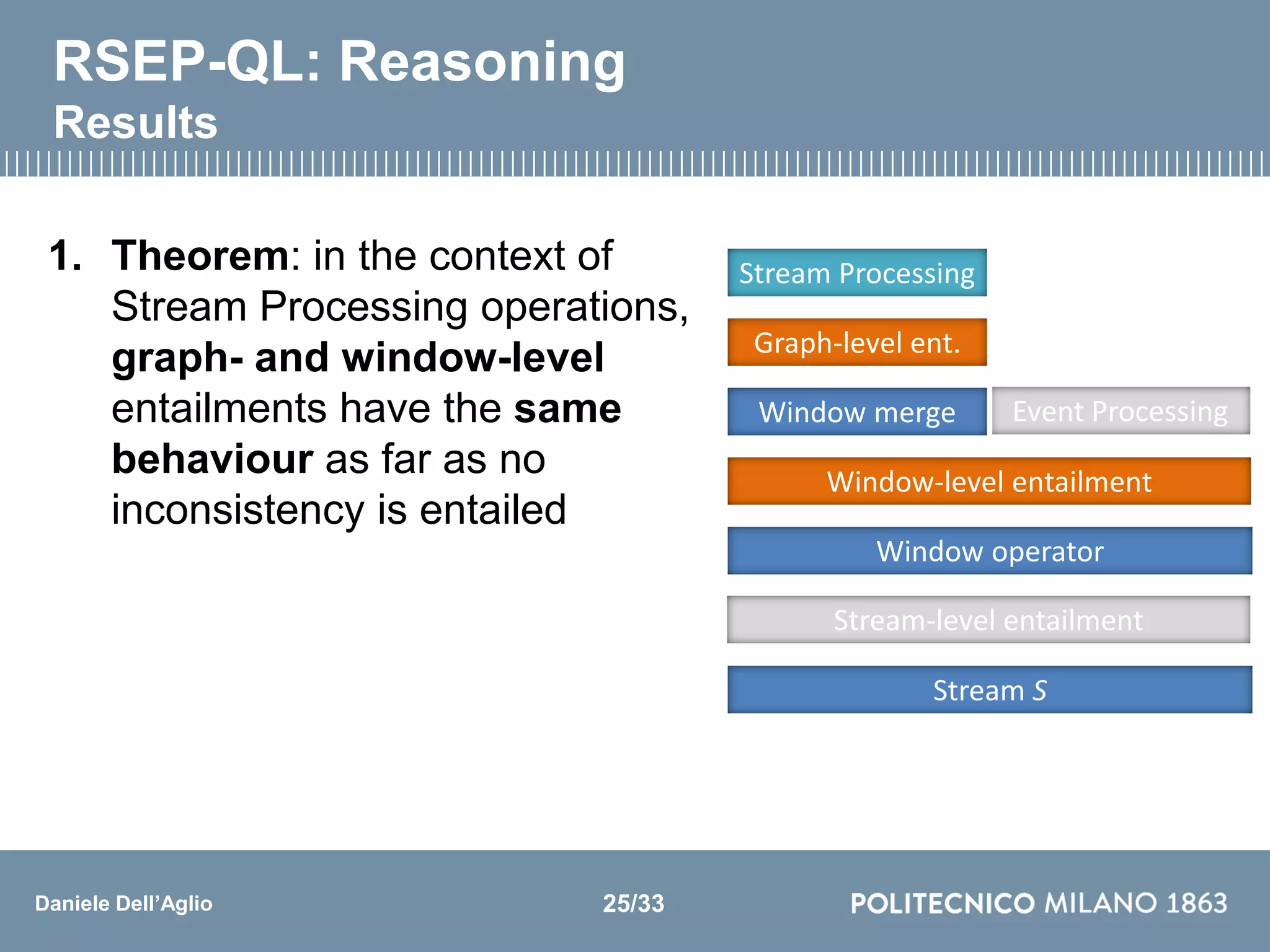
1. Theorem: in the context of
Stream Processing operations,
graph- and window-level
entailments have the same
behaviour as far as no
inconsistency is entailed
25/33
Stream Processing
Window merge
Window operator
Stream S
Graph-level ent.
Window-level entailment
Daniele Dell’Aglio
Event Processing
Stream-level entailment
RSEP-QL: Reasoning
Results
1. Theorem: in the context of
Stream Processing operations,
graph- and window-level
entailments have the same
behaviour as far as no
inconsistency is entailed
2. Theorem: The stream-level
entailment brings to a larger
set of answers w.r.t. graph-
and window- entailment ones.
25/33
Stream Processing
Event ProcessingWindow merge
Window operator
Stream S
Graph-level ent.
Window-level entailment
Stream-level entailment
Daniele Dell’Aglio
Execution 1° answer 2° answer
1 :hall [6] :kitchen [11]
2 :hall [5] :kitchen [10]
3 :hall [6] :kitchen [11]
4 - [7] - [12]
RSEP-QL in action
Correctness assessment
t3 6 91
{:alice :isIn :hall}
{:bob :isIn :hall}
{:alice :isIn :kitchen}
{:bob :isIn :kitchen}
e1 e2 e3 e4S
26/33
Daniele Dell’Aglio
Execution 1° answer 2° answer
1 :hall [6] :kitchen [11]
2 :hall [5] :kitchen [10]
3 :hall [6] :kitchen [11]
4 - [7] - [12]
t0=0
RSEP-QL in action
Correctness assessment
t3 6 91
{:alice :isIn :hall}
{:bob :isIn :hall}
{:alice :isIn :kitchen}
{:bob :isIn :kitchen}
e1 e2 e3 e4S
26/33
Daniele Dell’Aglio
Execution 1° answer 2° answer
1 :hall [6] :kitchen [11]
2 :hall [5] :kitchen [10]
3 :hall [6] :kitchen [11]
4 - [7] - [12]
t0=0
Window 1° answer 2° answer
t0=0 :hall [5] :kitchen [10]
RSEP-QL in action
Correctness assessment
t3 6 91
{:alice :isIn :hall}
{:bob :isIn :hall}
{:alice :isIn :kitchen}
{:bob :isIn :kitchen}
e1 e2 e3 e4S
26/33
Daniele Dell’Aglio
Execution 1° answer 2° answer
1 :hall [6] :kitchen [11]
2 :hall [5] :kitchen [10]
3 :hall [6] :kitchen [11]
4 - [7] - [12]
t0=0
Window 1° answer 2° answer
t0=0 :hall [5] :kitchen [10]
t0=1
RSEP-QL in action
Correctness assessment
t3 6 91
{:alice :isIn :hall}
{:bob :isIn :hall}
{:alice :isIn :kitchen}
{:bob :isIn :kitchen}
e1 e2 e3 e4S
26/33
Daniele Dell’Aglio
Execution 1° answer 2° answer
1 :hall [6] :kitchen [11]
2 :hall [5] :kitchen [10]
3 :hall [6] :kitchen [11]
4 - [7] - [12]
t0=0
Window 1° answer 2° answer
t0=0 :hall [5] :kitchen [10]
t0=1 :hall [6] :kitchen [11]
t0=1
RSEP-QL in action
Correctness assessment
t3 6 91
{:alice :isIn :hall}
{:bob :isIn :hall}
{:alice :isIn :kitchen}
{:bob :isIn :kitchen}
e1 e2 e3 e4S
26/33
Daniele Dell’Aglio
Execution 1° answer 2° answer
1 :hall [6] :kitchen [11]
2 :hall [5] :kitchen [10]
3 :hall [6] :kitchen [11]
4 - [7] - [12]
t0=0
Window 1° answer 2° answer
t0=0 :hall [5] :kitchen [10]
t0=1 :hall [6] :kitchen [11]
t0=1
t0=2
RSEP-QL in action
Correctness assessment
t3 6 91
{:alice :isIn :hall}
{:bob :isIn :hall}
{:alice :isIn :kitchen}
{:bob :isIn :kitchen}
e1 e2 e3 e4S
26/33
Daniele Dell’Aglio
Execution 1° answer 2° answer
1 :hall [6] :kitchen [11]
2 :hall [5] :kitchen [10]
3 :hall [6] :kitchen [11]
4 - [7] - [12]
t0=0
Window 1° answer 2° answer
t0=0 :hall [5] :kitchen [10]
t0=1 :hall [6] :kitchen [11]
t0=2 - [7] - [12]
t0=1
t0=2
RSEP-QL in action
Correctness assessment
t3 6 91
{:alice :isIn :hall}
{:bob :isIn :hall}
{:alice :isIn :kitchen}
{:bob :isIn :kitchen}
e1 e2 e3 e4S
26/33
Daniele Dell’Aglio
Execution 1° answer 2° answer
1 :hall [6] :kitchen [11]
2 :hall [5] :kitchen [10]
3 :hall [6] :kitchen [11]
4 - [7] - [12]
t0=0
Window 1° answer 2° answer
t0=0 :hall [5] :kitchen [10]
t0=1 :hall [6] :kitchen [11]
t0=2 - [7] - [12]
t0=1
t0=2
RSEP-QL in action
Correctness assessment
t3 6 91
{:alice :isIn :hall}
{:bob :isIn :hall}
{:alice :isIn :kitchen}
{:bob :isIn :kitchen}
e1 e2 e3 e4S
26/33
Daniele Dell’Aglio
Execution 1° answer 2° answer
1 :hall [6] :kitchen [11]
2 :hall [5] :kitchen [10]
3 :hall [6] :kitchen [11]
4 - [7] - [12]
Execution 1° answer 2° answer
1 :hall [3] :kitchen [9]
2 No answers
3 :hall [3] :kitchen [9]
4 No answers
CSPARQL CQELS
RSEP-QL in action
Correctness assessment
27/33
t3 6 91
{:alice :isIn :hall}
{:bob :isIn :hall}
{:alice :isIn :kitchen}
{:bob :isIn :kitchen}
e1 e2 e3 e4S
Daniele Dell’Aglio
Execution 1° answer 2° answer
1 :hall [6] :kitchen [11]
2 :hall [5] :kitchen [10]
3 :hall [6] :kitchen [11]
4 - [7] - [12]
Execution 1° answer 2° answer
1 :hall [3] :kitchen [9]
2 No answers
3 :hall [3] :kitchen [9]
4 No answers
CSPARQL CQELS
Window-close vs
content-change
Empty relation
notification (yes|no)
RSEP-QL in action
Correctness assessment
27/33
t3 6 91
{:alice :isIn :hall}
{:bob :isIn :hall}
{:alice :isIn :kitchen}
{:bob :isIn :kitchen}
e1 e2 e3 e4S
Daniele Dell’Aglio
CSR Bench
CSR Bench is an extension of the SRbench benchmark
that focuses on correctness
A test suite
• LinkedSensorData as dataset
• 8 parametric queries to tests the RSP engines in different
conditions
An oracle (an automatic correctness validator)
• Based on RSP-QL
28/33
Daniele Dell’Aglio
CSR Bench
Experimental Results
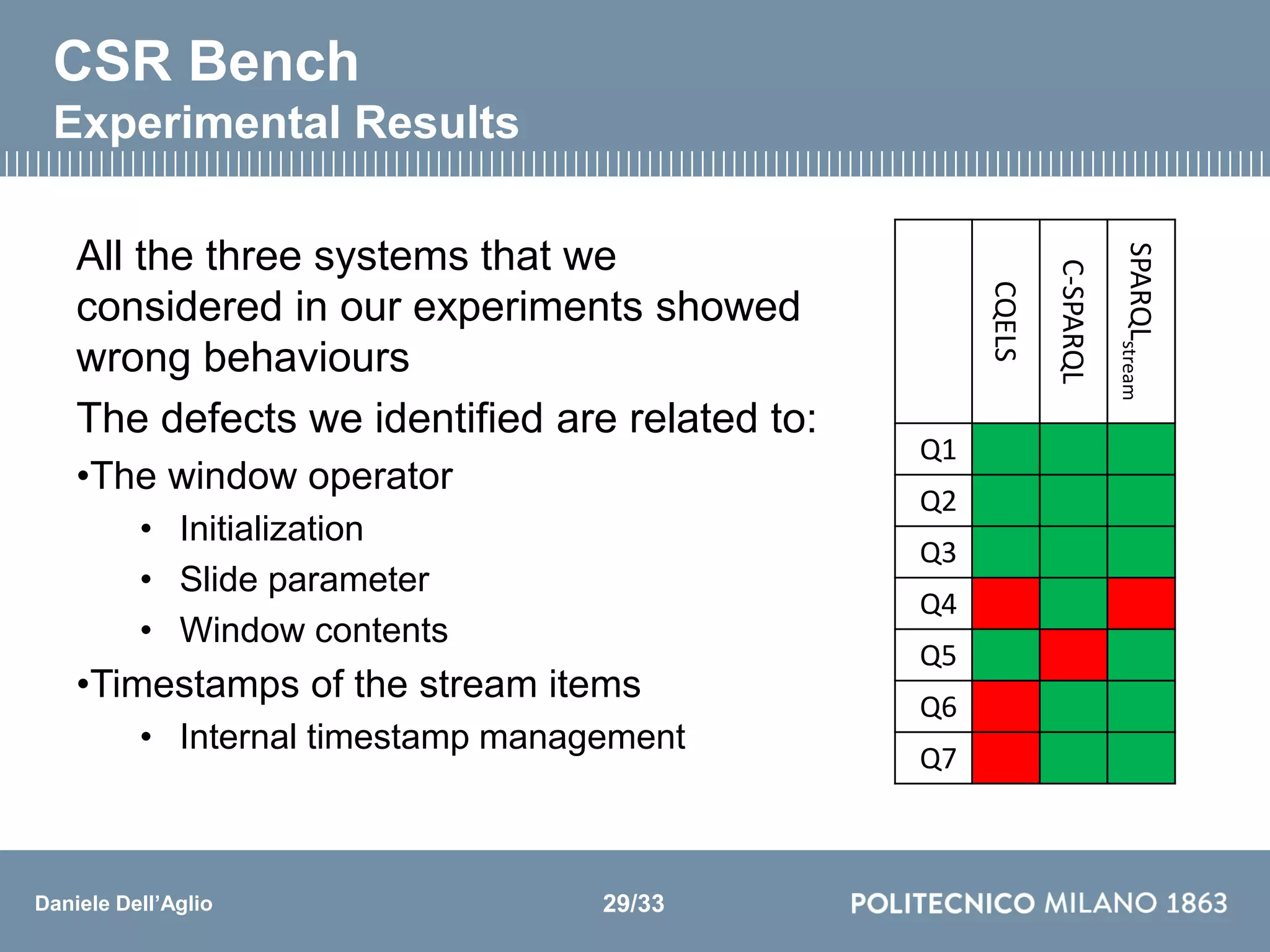
All the three systems that we
considered in our experiments showed
wrong behaviours
The defects we identified are related to:
•The window operator
• Initialization
• Slide parameter
• Window contents
•Timestamps of the stream items
• Internal timestamp management
CQELS
C-SPARQL
SPARQLstream
Q1
Q2
Q3
Q4
Q5
Q6
Q7
29/33
Daniele Dell’Aglio
What’s next?
An RSEP-QL query language
• W3C RSP CG ongoing activities
30/33
Daniele Dell’Aglio
What’s next?
An RSEP-QL query language
• W3C RSP CG ongoing activities
Implementations
30/33
Daniele Dell’Aglio
What’s next?
An RSEP-QL query language
• W3C RSP CG ongoing activities
Implementations
• Yet another RSP engine
30/33
Daniele Dell’Aglio
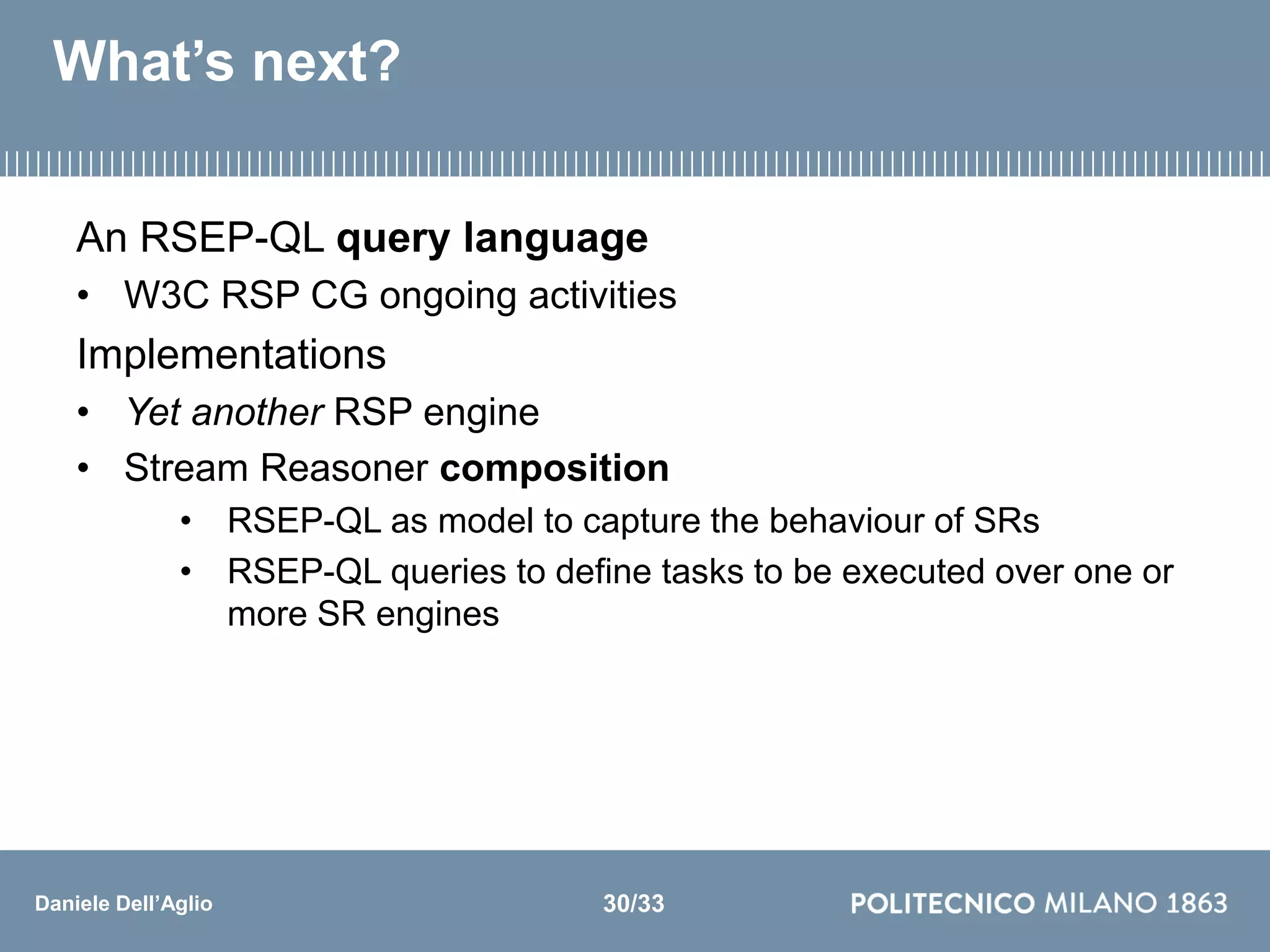
What’s next?
An RSEP-QL query language
• W3C RSP CG ongoing activities
Implementations
• Yet another RSP engine
• Stream Reasoner composition
• RSEP-QL as model to capture the behaviour of SRs
• RSEP-QL queries to define tasks to be executed over one or
more SR engines
30/33
Daniele Dell’Aglio
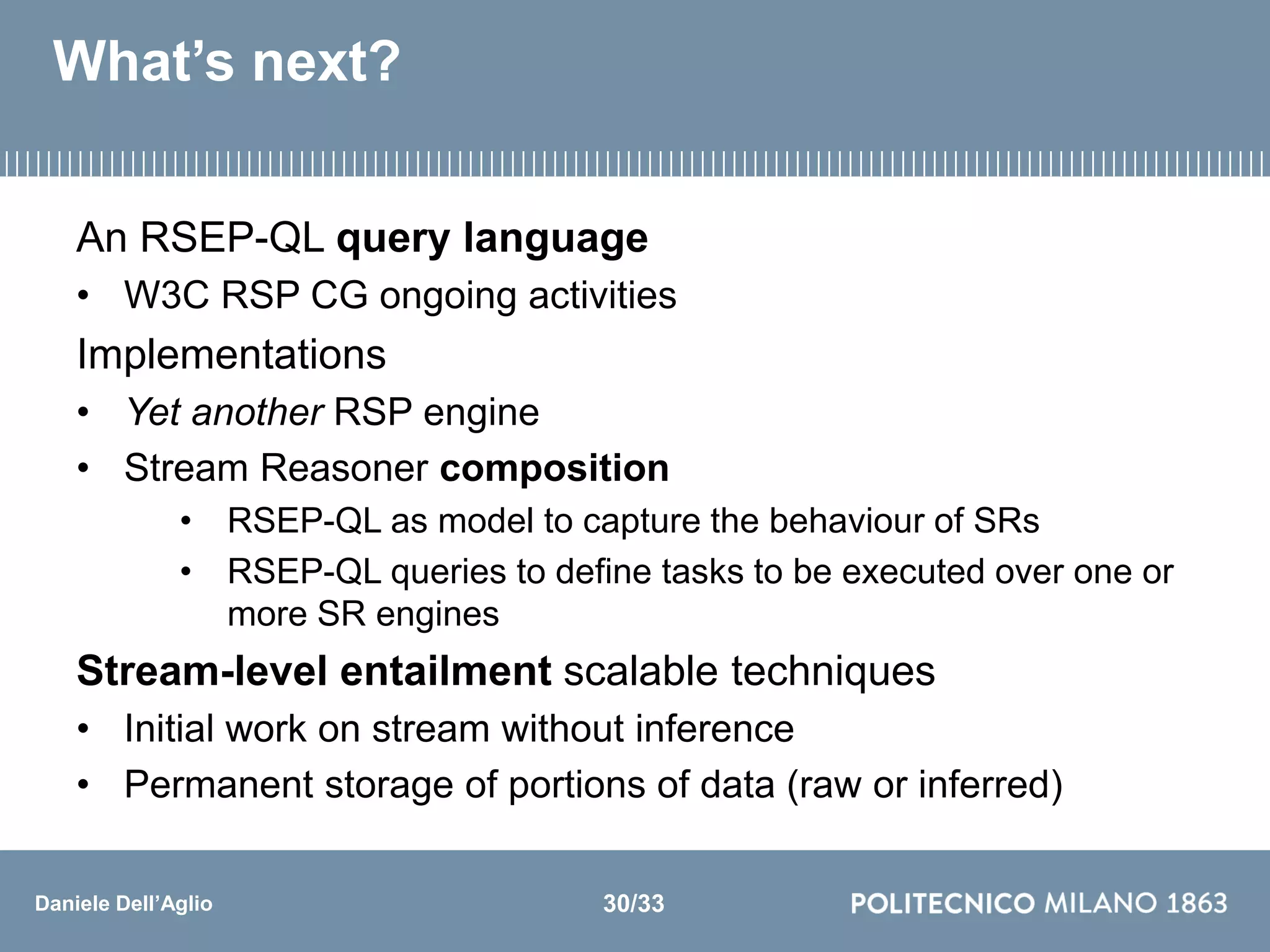
What’s next?
An RSEP-QL query language
• W3C RSP CG ongoing activities
Implementations
• Yet another RSP engine
• Stream Reasoner composition
• RSEP-QL as model to capture the behaviour of SRs
• RSEP-QL queries to define tasks to be executed over one or
more SR engines
Stream-level entailment scalable techniques
• Initial work on stream without inference
• Permanent storage of portions of data (raw or inferred)
30/33
Daniele Dell’Aglio
What’s next?
Reasoning over streams and continuous query answering
over streams are still two different worlds
• Key to show why RDF Stream Processing is useful w.r.t.
DSMS and CEP
• Few initial attempts to put them together
31/33
Daniele Dell’Aglio
What’s next?
Reasoning over streams and continuous query answering
over streams are still two different worlds
• Key to show why RDF Stream Processing is useful w.r.t.
DSMS and CEP
• Few initial attempts to put them together
Streams in the Web are getting popular – applications want
more and more sophisticated features
• Different timestamps, out-of-orders
• Noise (inductive reasoning)
31/33
Daniele Dell’Aglio
Conclusions
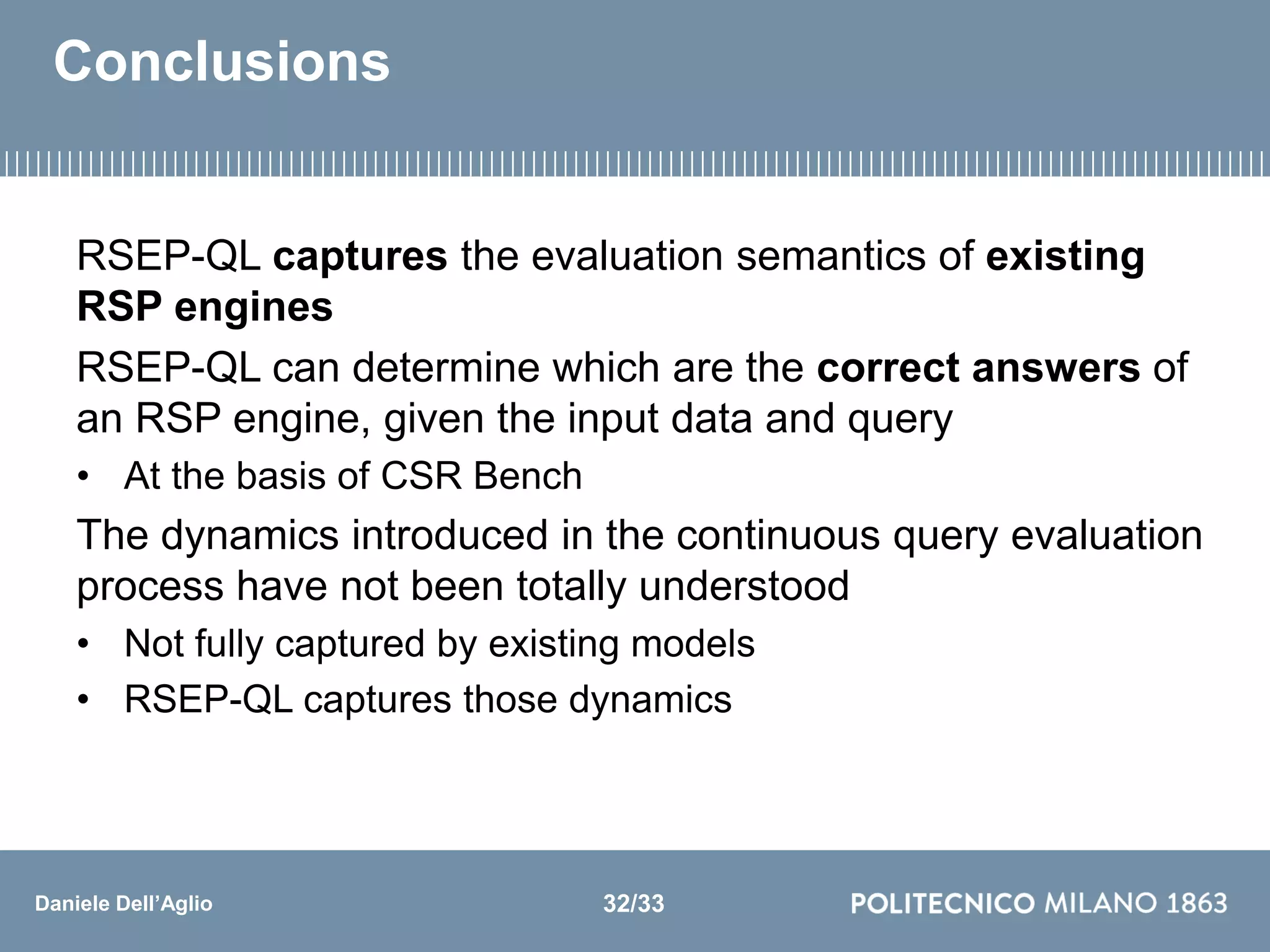
RSEP-QL captures the evaluation semantics of existing
RSP engines
32/33
Daniele Dell’Aglio
Conclusions
RSEP-QL captures the evaluation semantics of existing
RSP engines
RSEP-QL can determine which are the correct answers of
an RSP engine, given the input data and query
• At the basis of CSR Bench
32/33
Daniele Dell’Aglio
Conclusions
RSEP-QL captures the evaluation semantics of existing
RSP engines
RSEP-QL can determine which are the correct answers of
an RSP engine, given the input data and query
• At the basis of CSR Bench
The dynamics introduced in the continuous query evaluation
process have not been totally understood
• Not fully captured by existing models
• RSEP-QL captures those dynamics
32/33
Daniele Dell’Aglio
Thank you! Questions?
On Unified Stream Reasoning
Daniele Dell’Aglio
Advisor: Prof. Emanuele Della Valle
33/33

On Unified Stream Reasoning

  • 1.
    Daniele Dell’Aglio On UnifiedStream Reasoning Daniele Dell’Aglio Advisor: Prof. Emanuele Della Valle Milano, 15/07/2016. Ph.D. Viva
  • 2.
    Daniele Dell’Aglio Problem setting Realtime integration of dynamic data from heterogeneous sources – Traffic Prediction 2/33
  • 3.
    Daniele Dell’Aglio Problem setting Realtime integration of dynamic data from heterogeneous sources – Traffic Prediction – Social media analytics 2/33
  • 4.
    Daniele Dell’Aglio Problem setting Realtime integration of dynamic data from heterogeneous sources – Traffic Prediction – Social media analytics – Personalised services 2/33
  • 5.
    Daniele Dell’Aglio Information FlowProcessing In literature there are two different main approaches to process streams 3/33
  • 6.
    Daniele Dell’Aglio Information FlowProcessing In literature there are two different main approaches to process streams Data Stream Management Systems (DSMSs) • Roots in DBMS research • Aggregations, filters and joins 3/33
  • 7.
    Daniele Dell’Aglio Information FlowProcessing In literature there are two different main approaches to process streams Data Stream Management Systems (DSMSs) • Roots in DBMS research • Aggregations, filters and joins Complex Event Processors (CEPs) • Roots in Distributed Systems (Publish/Subscribe) • Search of relevant patterns in the stream • Non-equi-join on the timestamps (after, before, etc.) 3/33
  • 8.
    Daniele Dell’Aglio Information FlowProcessing In literature there are two different main approaches to process streams Data Stream Management Systems (DSMSs) • Roots in DBMS research • Aggregations, filters and joins Complex Event Processors (CEPs) • Roots in Distributed Systems (Publish/Subscribe) • Search of relevant patterns in the stream • Non-equi-join on the timestamps (after, before, etc.) Current systems implements feature of both of them • EPL (e.g. Esper, ORACLE CEP) 3/33
  • 9.
    Daniele Dell’Aglio Stream Reasoning Information Flow Processing Semantic Technologies Stream Reasoning Inferenceover streams of data Real-time processing of highly dynamic data Integration of heterogeneous data and access through query answering 4/33
  • 10.
    Daniele Dell’Aglio The SRresearch so far EuropeMapfromWikipedia Key 5/33
  • 11.
    Daniele Dell’Aglio The SRresearch so far EuropeMapfromWikipedia Key 5/33
  • 12.
    Daniele Dell’Aglio The SRresearch so far IMaRS STARQL DynamiTE TROWL EuropeMapfromWikipedia StreamRule StarCITY SPARKWAVE LARS Key 5/33 StreamQR
  • 13.
    Daniele Dell’Aglio The problem(1) t3 6 91 {:alice :isIn :hall} {:bob :isIn :hall} {:alice :isIn :kitchen} {:bob :isIn :kitchen} e1 e2 e3 e4S 6/33
  • 14.
    Daniele Dell’Aglio The problem(1) Where are Alice and Bob, when they are together? t3 6 91 {:alice :isIn :hall} {:bob :isIn :hall} {:alice :isIn :kitchen} {:bob :isIn :kitchen} e1 e2 e3 e4S 6/33
  • 15.
    Daniele Dell’Aglio The problem(1) Where are Alice and Bob, when they are together? Let’s consider a tumbling window W of size 5 Let’s execute the experiment 4 times t3 6 91 {:alice :isIn :hall} {:bob :isIn :hall} {:alice :isIn :kitchen} {:bob :isIn :kitchen} e1 e2 e3 e4S 6/33
  • 16.
    Daniele Dell’Aglio The problem(1) Execution 1° answer 2° answer 1 :hall [6] :kitchen [11] 2 :hall [5] :kitchen [10] 3 :hall [6] :kitchen [11] 4 - [7] - [12] Where are Alice and Bob, when they are together? Let’s consider a tumbling window W of size 5 Let’s execute the experiment 4 times t3 6 91 {:alice :isIn :hall} {:bob :isIn :hall} {:alice :isIn :kitchen} {:bob :isIn :kitchen} Which is the correct answer? e1 e2 e3 e4S 6/33
  • 17.
    Daniele Dell’Aglio The problem(2) Execution 1° answer 2° answer 1 :hall [6] :kitchen [11] 2 :hall [5] :kitchen [10] 3 :hall [6] :kitchen [11] 4 - [7] - [12] CSPARQL t3 6 91 {:alice :isIn :hall} {:bob :isIn :hall} {:alice :isIn :kitchen} {:bob :isIn :kitchen} e1 e2 e3 e4S 7/33
  • 18.
    Daniele Dell’Aglio The problem(2) Execution 1° answer 2° answer 1 :hall [6] :kitchen [11] 2 :hall [5] :kitchen [10] 3 :hall [6] :kitchen [11] 4 - [7] - [12] Execution 1° answer 2° answer 1 :hall [3] :kitchen [9] 2 No answers 3 :hall [3] :kitchen [9] 4 No answers CSPARQL CQELS Which system behaves in the correct way? t3 6 91 {:alice :isIn :hall} {:bob :isIn :hall} {:alice :isIn :kitchen} {:bob :isIn :kitchen} e1 e2 e3 e4S 7/33
  • 19.
    Daniele Dell’Aglio Research Question1 In the context of continuous query answering over RDF streams, how can the behaviour of existing systems be captured, compared and contrast when deductive reasoning processes are not involved? 8/33
  • 20.
    Daniele Dell’Aglio Research Question1 In the context of continuous query answering over RDF streams, how can the behaviour of existing systems be captured, compared and contrast when deductive reasoning processes are not involved? Why do we need it? • Comparison and contrast • Study RDF Stream Processing related problems • Standard RSP query language 8/33
  • 21.
    Daniele Dell’Aglio Background data Streams Applications RDF SPARQL RSEP-QL A referencemodel that formally defines the semantics of RDF Stream Processing engines 9/33
  • 22.
    Daniele Dell’Aglio Background data Streams Applications RSP-QL RDF SPARQL RSEP-QL A referencemodel that formally defines the semantics of RDF Stream Processing engines 9/33
  • 23.
    Daniele Dell’Aglio Background data Streams Applications RSP-QL BGPevaluation over background data BGP evaluation over streams Model to express continous queries RDF SPARQL RSEP-QL A reference model that formally defines the semantics of RDF Stream Processing engines 9/33
  • 24.
    Daniele Dell’Aglio Background data Streams RSEP-QL Applications RSP-QL BGPevaluation over background data BGP evaluation over streams Event Pattern detection operators Model to express continous queries RDF SPARQL RSEP-QL A reference model that formally defines the semantics of RDF Stream Processing engines 9/33
  • 25.
    Daniele Dell’Aglio Q (E, DS,QF) RSEP-QL From SPARQL to RSEP-QL Query Interface 10/33
  • 26.
    Daniele Dell’Aglio Q (E, DS,QF) RSEP-QL From SPARQL to RSEP-QL Data layer RDF graphs DS Query Interface 10/33
  • 27.
    Daniele Dell’Aglio Q (E, DS,QF) RSEP-QL From SPARQL to RSEP-QL Evaluator Data layer RDF graphs E DS Query Interface 10/33
  • 28.
    Daniele Dell’Aglio Q (E, DS,QF) RSEP-QL From SPARQL to RSEP-QL Evaluator Data layer Result Formatter Ans(Q)RDF graphs E DS QF Query Interface 10/33
  • 29.
    Daniele Dell’Aglio Q (E, DS,QF) RSEP-QL From SPARQL to RSEP-QL Evaluator Data layer Result Formatter Ans(Q)RDF graphs E DS QF RDF graphs RDF streams Query Interface SDS Q (E, SDS, QF) 10/33
  • 30.
    Daniele Dell’Aglio Q (E, DS,QF) RSEP-QL From SPARQL to RSEP-QL Evaluator Data layer Result Formatter Ans(Q)RDF graphs E DS QF Continuous EvaluatorET RDF graphs RDF streams Query Interface SDS Q (E, SDS, QF) Q (E, SDS, ET, QF) 10/33 Ans(Q,t)
  • 31.
    Daniele Dell’Aglio Q (E, DS,QF) RSEP-QL From SPARQL to RSEP-QL Evaluator Data layer Result Formatter Ans(Q)RDF graphs E DS QF Continuous EvaluatorET RDF graphs RDF streams Query Interface SDS Q (E, SDS, QF) Q (E, SDS, ET, QF) SE 10/33 Q (SE, SDS, ET, QF) Ans(Q,t)
  • 32.
    Daniele Dell’Aglio t S3 S4 S5S6 S7 S8 S9 S10 S11 S S1 S2 RSEP-QL: Dataset Time-based Sliding Window: 𝕎(ω,β,t0) 11/33
  • 33.
    Daniele Dell’Aglio Sequence oftimestamped graphs (stream items) 𝕎(2,1,1) t S3 S4 S5 S6 S7 S8 S9 S10 S11 S S1 S2 RSEP-QL: Dataset Time-based Sliding Window: 𝕎(ω,β,t0) 11/33
  • 34.
    Daniele Dell’Aglio Sequence oftimestamped graphs (stream items) 𝕎(2,1,1) t S3 S4 S5 S6 S7 S8 S9 S10 S11 S S1 S2 RSEP-QL: Dataset Time-based Sliding Window: 𝕎(ω,β,t0) 11/33
  • 35.
    Daniele Dell’Aglio Sequence oftimestamped graphs (stream items) 𝕎(2,1,1) ω t width S3 S4 S5 S6 S7 S8 S9 S10 S11 S S1 S2 t0 RSEP-QL: Dataset Time-based Sliding Window: 𝕎(ω,β,t0) 11/33
  • 36.
    Daniele Dell’Aglio Sequence oftimestamped graphs (stream items) 𝕎(2,1,1) ω t width S3 S4 S5 S6 S7 S8 S9 S10 S11 S S1 S2 t0 RSEP-QL: Dataset Time-based Sliding Window: 𝕎(ω,β,t0) 11/33
  • 37.
    Daniele Dell’Aglio Sequence oftimestamped graphs (stream items) 𝕎(2,1,1) β ω t widthslide S3 S4 S5 S6 S7 S8 S9 S10 S11 S S1 S2 t0 RSEP-QL: Dataset Time-based Sliding Window: 𝕎(ω,β,t0) 11/33
  • 38.
    Daniele Dell’Aglio Sequence oftimestamped graphs (stream items) 𝕎(2,1,1) β ω t widthslide S3 S4 S5 S6 S7 S8 S9 S10 S11 S S1 S2 t0 RSEP-QL: Dataset Time-based Sliding Window: 𝕎(ω,β,t0) 11/33
  • 39.
    Daniele Dell’Aglio 𝕃(2) t S3 S4 S5S6 S7 S8 S9 S10 S11 S S1 S2 t0 Sequence of timestamped graphs (stream items) RSEP-QL: Dataset Landmark window: 𝕃(t0) 12/33
  • 40.
    Daniele Dell’Aglio 𝕃(2) t S3 S4 S5S6 S7 S8 S9 S10 S11 S S1 S2 t0 Sequence of timestamped graphs (stream items) RSEP-QL: Dataset Landmark window: 𝕃(t0) 12/33
  • 41.
    Daniele Dell’Aglio 𝕃(2) t S3 S4 S5S6 S7 S8 S9 S10 S11 S S1 S2 t0 Sequence of timestamped graphs (stream items) RSEP-QL: Dataset Landmark window: 𝕃(t0) 12/33
  • 42.
    Daniele Dell’Aglio 𝕃(2) t S3 S4 S5S6 S7 S8 S9 S10 S11 S S1 S2 t0 Sequence of timestamped graphs (stream items) RSEP-QL: Dataset Landmark window: 𝕃(t0) 12/33
  • 43.
    Daniele Dell’Aglio RSEP-QL: Dataset FromSPARQL to RSEP-QL dataset R={RDF graph} SPARQL dataset 13/33
  • 44.
    Daniele Dell’Aglio RSEP-QL: Dataset FromSPARQL to RSEP-QL dataset R={RDF graph} SPARQL dataset S3 S4 S5 S6 S7 S8 S9 S10 S11 S12 S S1 S2 13/33
  • 45.
    Daniele Dell’Aglio RSEP-QL: Dataset FromSPARQL to RSEP-QL dataset R={RDF graph} SPARQL dataset S3 S4 S5 S6 S7 S8 S9 S10 S11 S12 S S1 S2 𝕎(S) 13/33
  • 46.
    Daniele Dell’Aglio RSEP-QL: Dataset FromSPARQL to RSEP-QL dataset t1 G(t1) T⊆ ℕ R={RDF graph} SPARQL dataset G Instantaneous Graph G(t1)  RTime-Varying Graph G: T R S3 S4 S5 S6 S7 S8 S9 S10 S11 S12 S S1 S2 𝕎(S) 13/33
  • 47.
    Daniele Dell’Aglio RSEP-QL: Dataset FromSPARQL to RSEP-QL dataset t1 G(t1) T⊆ ℕ R={RDF graph} SPARQL dataset G H Instantaneous Graph G(t1)  RTime-Varying Graph G: T R S3 S4 S5 S6 S7 S8 S9 S10 S11 S12 S S1 S2 𝕎(S) 13/33
  • 48.
    Daniele Dell’Aglio RSEP-QL: Dataset FromSPARQL to RSEP-QL dataset t1 G(t1) T⊆ ℕ R={RDF graph} SPARQL dataset G H Instantaneous Graph G(t1)  RTime-Varying Graph G: T R RESP-QL dataset S3 S4 S5 S6 S7 S8 S9 S10 S11 S12 S S1 S2 𝕎(S) 13/33
  • 49.
    Daniele Dell’Aglio RSEP-QL: Operators StreamProcessing operators (RSP-QL) • SPARQL operators • WINDOW to specify that the active element is a window (similar to GRAPH) • RStream, IStream, DStream to create the output stream 14/33
  • 50.
    Daniele Dell’Aglio RSEP-QL: Operators StreamProcessing operators (RSP-QL) • SPARQL operators • WINDOW to specify that the active element is a window (similar to GRAPH) • RStream, IStream, DStream to create the output stream Event Processing operators (RSEP-QL) • EVENT w P (Basic Event Pattern) • E1 SEQ E2 • FIRST E1, LAST E1 • MATCH to describe an event pattern • ... 14/33
  • 51.
    Daniele Dell’Aglio RSEP-QL: EvaluationSemantics Stream Processing Evaluation Semantics The SPARQL evaluation function is defined as ⟦𝑃⟧ 𝐷𝑆(𝐺) 15/33
  • 52.
    Daniele Dell’Aglio RSEP-QL: EvaluationSemantics Stream Processing Evaluation Semantics The SPARQL evaluation function is defined as ⟦𝑃⟧ 𝐷𝑆(𝐺) The RSEP-QL evaluation function extends the SPARQL one by introducing the evaluation time instant ⟪𝑃⟫ 𝑆𝐷𝑆(𝐴) 𝑡 15/33
  • 53.
    Daniele Dell’Aglio RSEP-QL: EvaluationSemantics Stream Processing Evaluation Semantics The SPARQL evaluation function is defined as ⟦𝑃⟧ 𝐷𝑆(𝐺) The RSEP-QL evaluation function extends the SPARQL one by introducing the evaluation time instant ⟪𝑃⟫ 𝑆𝐷𝑆(𝐴) 𝑡 SPARQL operators are straight extended to the new evaluation function Example: JOIN ⟦𝐽𝑂𝐼𝑁(𝑃1, 𝑃2)⟧ 𝐷𝑆(𝐺) = ⟦𝑃1⟧ 𝐷𝑆 𝐺 ⨝⟦𝑃2⟧ 𝐷𝑆 𝐺 ⟪𝐽𝑂𝐼𝑁(𝑃1, 𝑃2)⟫ 𝑆𝐷𝑆 𝐴 𝑡 = ⟪𝑃1⟫ 𝑆𝐷𝑆 𝐴 𝑡 ⨝⟪𝑃2⟫ 𝑆𝐷𝑆 𝐴 𝑡 15/33
  • 54.
    Daniele Dell’Aglio RSEP-QL: EvaluationSemantics Stream Processing Evaluation Semantics The main difference is on the BGP evaluation: ⟪𝐵𝐺𝑃⟫ 𝑆𝐷𝑆(𝐴) 𝑡 =⟦𝐵𝐺𝑃⟧ 𝑆𝐷𝑆(𝐴,𝑡) 16/33
  • 55.
    Daniele Dell’Aglio RSEP-QL: EvaluationSemantics Stream Processing Evaluation Semantics The main difference is on the BGP evaluation: ⟪𝐵𝐺𝑃⟫ 𝑆𝐷𝑆(𝐴) 𝑡 =⟦𝐵𝐺𝑃⟧ 𝑆𝐷𝑆(𝐴,𝑡) SDS(A,t) is: SDS(G,t)= SDS(G(t)) if A is a time-varying graph G 16/33
  • 56.
    Daniele Dell’Aglio RSEP-QL: EvaluationSemantics Stream Processing Evaluation Semantics The main difference is on the BGP evaluation: ⟪𝐵𝐺𝑃⟫ 𝑆𝐷𝑆(𝐴) 𝑡 =⟦𝐵𝐺𝑃⟧ 𝑆𝐷𝑆(𝐴,𝑡) SDS(A,t) is: SDS(G,t)= SDS(G(t)) if A is a time-varying graph G SDS(𝕎(S),t)=SDS(m(𝕎(S,t))) if A is from a sliding window 𝕎 SDS(𝕃(S),t)=SDS(m(𝕃(S,t))) if A is from a landmark window 𝕃 where m denotes a merge function m(𝕎(S,t))= 𝑑 𝑖,𝑡 𝑖 ∈𝕎(S,t) 𝑑𝑖 • takes as input a window content i.e. a sequence of timestamped RDF graphs • produces an RDF graph 16/33
  • 57.
    Daniele Dell’Aglio RSEP-QL: EvaluationSemantics Event Processing Evaluation semantics A new evaluation function ⦅⋅⦆ 𝑜,𝑐 𝑡 • t is the evaluation time instant (as in ⟪⋅⟫ 𝑆𝐷𝑆(𝐴) 𝑡 ), • 𝑜, 𝑐 is an additional window to identify the portion of the data on which the event may happen 17/33
  • 58.
    Daniele Dell’Aglio RSEP-QL: EvaluationSemantics Event Processing Evaluation semantics A new evaluation function ⦅⋅⦆ 𝑜,𝑐 𝑡 • t is the evaluation time instant (as in ⟪⋅⟫ 𝑆𝐷𝑆(𝐴) 𝑡 ), • 𝑜, 𝑐 is an additional window to identify the portion of the data on which the event may happen Event pattern evaluation produces event mappings 𝜇, 𝑡1, 𝑡2 • 𝜇 is a solution mapping • 𝑡1 and 𝑡2 denote the time inverval justifying 𝜇 17/33
  • 59.
    Daniele Dell’Aglio RSEP-QL: EvaluationSemantics Event Processing Evaluation semantics A new evaluation function ⦅⋅⦆ 𝑜,𝑐 𝑡 • t is the evaluation time instant (as in ⟪⋅⟫ 𝑆𝐷𝑆(𝐴) 𝑡 ), • 𝑜, 𝑐 is an additional window to identify the portion of the data on which the event may happen Event pattern evaluation produces event mappings 𝜇, 𝑡1, 𝑡2 • 𝜇 is a solution mapping • 𝑡1 and 𝑡2 denote the time inverval justifying 𝜇 Selection and consumption policies to determine the data involved in the evaluation 17/33
  • 60.
    Daniele Dell’Aglio RSEP-QL: EvaluationSemantics Evaluation semantics - Example ⦅FIRST EVENT 𝑤1 𝑃1 SEQ EVERY EVENT 𝑤2 𝑃2⦆ 9,16 𝑡 S2 S3 S4 S1 S1 S6 S7 S8 S9 S10 S11 S12 S2 FIRST EVENT 𝑤1 𝑃1 SEQ EVERY EVENT 𝑤2 𝑃2 t 10 12 14 1611 13 15 18/33
  • 61.
    Daniele Dell’Aglio RSEP-QL: EvaluationSemantics Evaluation semantics - Example ⦅FIRST EVENT 𝑤1 𝑃1 SEQ EVERY EVENT 𝑤2 𝑃2⦆ 9,16 𝑡 S2 S3 S4 S1 S1 S6 S7 S8 S9 S10 S11 S12 S2 FIRST EVENT 𝑤1 𝑃1 SEQ EVERY EVENT 𝑤2 𝑃2 t 10 12 14 1611 13 15 18/33
  • 62.
    Daniele Dell’Aglio RSEP-QL: EvaluationSemantics Evaluation semantics - Example ⦅FIRST EVENT 𝑤1 𝑃1 SEQ EVERY EVENT 𝑤2 𝑃2⦆ 9,16 𝑡 S2 S3 S4 S1 S1 S6 S7 S8 S9 S10 S11 S12 S2 FIRST EVENT 𝑤1 𝑃1 SEQ EVERY EVENT 𝑤2 𝑃2 t 10 12 14 1611 13 15 18/33
  • 63.
    Daniele Dell’Aglio RSEP-QL: EvaluationSemantics Evaluation semantics - Example ⦅FIRST EVENT 𝑤1 𝑃1 SEQ EVERY EVENT 𝑤2 𝑃2⦆ 9,16 𝑡 S2 S3 S4 S1 S1 S6 S7 S8 S9 S10 S11 S12 S2 FIRST EVENT 𝑤1 𝑃1 SEQ EVERY EVENT 𝑤2 𝑃2 t 10 12 14 1611 13 15 18/33
  • 64.
    Daniele Dell’Aglio RSEP-QL: EvaluationSemantics Evaluation semantics - Example ⦅FIRST EVENT 𝑤1 𝑃1 SEQ EVERY EVENT 𝑤2 𝑃2⦆ 9,16 𝑡 S2 S3 S4 S1 S1 S6 S7 S8 S9 S10 S11 S12 S2 S1 S10 FIRST EVENT 𝑤1 𝑃1 SEQ EVERY EVENT 𝑤2 𝑃2 t 10 12 14 1611 13 15 11 13 18/33
  • 65.
    Daniele Dell’Aglio RSEP-QL: EvaluationSemantics Evaluation semantics - Example ⦅FIRST EVENT 𝑤1 𝑃1 SEQ EVERY EVENT 𝑤2 𝑃2⦆ 9,16 𝑡 S2 S3 S4 S1 S1 S6 S7 S8 S9 S10 S11 S12 S2 S1 S10 FIRST EVENT 𝑤1 𝑃1 SEQ EVERY EVENT 𝑤2 𝑃2 t 10 12 14 1611 13 15 11 13 18/33
  • 66.
    Daniele Dell’Aglio RSEP-QL: EvaluationSemantics Evaluation semantics - Example ⦅FIRST EVENT 𝑤1 𝑃1 SEQ EVERY EVENT 𝑤2 𝑃2⦆ 9,16 𝑡 S2 S3 S4 S1 S1 S6 S7 S8 S9 S10 S11 S12 S2 S1 S10 FIRST EVENT 𝑤1 𝑃1 SEQ EVERY EVENT 𝑤2 𝑃2 t 10 12 14 1611 13 15 11 13 18/33
  • 67.
    Daniele Dell’Aglio RSEP-QL: EvaluationSemantics Evaluation semantics - Example ⦅FIRST EVENT 𝑤1 𝑃1 SEQ EVERY EVENT 𝑤2 𝑃2⦆ 9,16 𝑡 S2 S3 S4 S1 S1 S6 S7 S8 S9 S10 S11 S12 S2 S1 S10 S1 S12 FIRST EVENT 𝑤1 𝑃1 SEQ EVERY EVENT 𝑤2 𝑃2 t 10 12 14 1611 13 15 11 13 11 15 18/33
  • 68.
    Daniele Dell’Aglio RSEP-QL: EvaluationSemantics MATCH graph pattern Event patterns are enclosed in MATCH graph patterns • Event mappings exist only in the context of event patterns • The evaluation of a MATCH graph pattern produces a bag of solution mappings ⟪𝑀𝐴𝑇𝐶𝐻 𝐸⟫ 𝑆𝐷𝑆 𝐴 𝑡 = {𝜇| 𝜇, 𝑡1, 𝑡2 ∈ ⦅𝐸⦆ 0,𝑡 𝑡 } It is possible to combine the MATCH graph pattern with other SPARQL graph patterns 19/33
  • 69.
    Daniele Dell’Aglio RSEP-QL: EvaluationSemantics Continuous evaluation For each evaluation time t ∈ ET: ⟪𝑆𝐸⟫ 𝑆𝐷𝑆(𝐴) 𝑡 • The continuous evaluation is a sequence of instantaneous evaluations 20/33
  • 70.
    Daniele Dell’Aglio RSEP-QL: EvaluationSemantics Continuous evaluation For each evaluation time t ∈ ET: ⟪𝑆𝐸⟫ 𝑆𝐷𝑆(𝐴) 𝑡 • The continuous evaluation is a sequence of instantaneous evaluations It is not always possible to compute ET a priori 20/33
  • 71.
    Daniele Dell’Aglio RSEP-QL: EvaluationSemantics Continuous evaluation For each evaluation time t ∈ ET: ⟪𝑆𝐸⟫ 𝑆𝐷𝑆(𝐴) 𝑡 • The continuous evaluation is a sequence of instantaneous evaluations It is not always possible to compute ET a priori • Can be infinite • Can be data dependent 20/33
  • 72.
    Daniele Dell’Aglio RSEP-QL: EvaluationSemantics Continuous evaluation For each evaluation time t ∈ ET: ⟪𝑆𝐸⟫ 𝑆𝐷𝑆(𝐴) 𝑡 • The continuous evaluation is a sequence of instantaneous evaluations It is not always possible to compute ET a priori • Can be infinite • Can be data dependent ET is expressed through a Report Policy • A set of conditions to one or more window operators in SDS • Initially defined in SECRET for Stream Processing engines 20/33
  • 73.
    Daniele Dell’Aglio RSEP-QL: EvaluationSemantics Continuous evaluation Report Policy examples: • P Periodic: the window reports only at regular intervals • WC Window Close: the window reports if the active window closes • CC Content Change: the window reports if the content changes. 21/33
  • 74.
    Daniele Dell’Aglio Research Question2 Is it possible to add deductive reasoning features to RSEP-QL? 22/33
  • 75.
    Daniele Dell’Aglio Research Question2 Is it possible to add deductive reasoning features to RSEP-QL? Applications RDF SPARQL Ontology 22/33
  • 76.
    Daniele Dell’Aglio Research Question2 Is it possible to add deductive reasoning features to RSEP-QL? Applications RDF SPARQL Ontology SPARQL Entailment Regimes 22/33
  • 77.
    Daniele Dell’Aglio Research Question2 Is it possible to add deductive reasoning features to RSEP-QL? Streams Ontology Background data RSEP-QL Applications RSP-QL RDF SPARQL Ontology SPARQL Entailment Regimes 22/33
  • 78.
    Daniele Dell’Aglio Research Question2 Is it possible to add deductive reasoning features to RSEP-QL? Streams Ontology Background data RSEP-QL Entailment Regimes RSEP-QL Applications RSP-QL RDF SPARQL Ontology SPARQL Entailment Regimes 22/33
  • 79.
    Daniele Dell’Aglio RSEP-QL: Reasoning StreamProcessing At which point of the continuous query answering process should the inference process be taken into account? Event ProcessingWindow merge Window operator Stream S3 4 5 6 7 8 9 S 1 2 6 7 8 9 6-9 t RDF Graph RDF Stream Window 23/33
  • 80.
    Daniele Dell’Aglio RSEP-QL: Reasoning StreamProcessing At which point of the continuous query answering process should the inference process be taken into account? Direct application on SPARQL entailment regimes Event ProcessingWindow merge Window operator Stream S Graph-level entailment 3 4 5 6 7 8 9 S 1 2 6 7 8 9 6-9 t RDF Graph RDF Stream Window 23/33
  • 81.
    Daniele Dell’Aglio RSEP-QL: Reasoning StreamProcessing At which point of the continuous query answering process should the inference process be taken into account? After applying the window operator Direct application on SPARQL entailment regimes Event ProcessingWindow merge Window operator Stream S Graph-level entailment Window-level entailment 3 4 5 6 7 8 9 S 1 2 6 7 8 9 6-9 t RDF Graph RDF Stream Window 23/33
  • 82.
    Daniele Dell’Aglio RSEP-QL: Reasoning StreamProcessing At which point of the continuous query answering process should the inference process be taken into account? A larger, landmark window to include relevant information from the past After applying the window operator Direct application on SPARQL entailment regimes Event ProcessingWindow merge Window operator Stream S Graph-level entailment Window-level entailment Stream-level entailment 3 4 5 6 7 8 9 S 1 2 6 7 8 9 6-9 t 6 7 8 9 3 4 5 RDF Graph RDF Stream Window 23/33
  • 83.
    Daniele Dell’Aglio RSEP-QL: Reasoning Window-leveland stream-level entailment regimes How can DL ontology be extended to capture the window content? 24/33
  • 84.
    Daniele Dell’Aglio RSEP-QL: Reasoning Window-leveland stream-level entailment regimes How can DL ontology be extended to capture the window content? • Ontology stream – a sequence of time-stamped ABoxes 𝑆 𝑜 𝑐 𝑖 w.r.t a static TBox 24/33
  • 85.
    Daniele Dell’Aglio RSEP-QL: Reasoning Window-leveland stream-level entailment regimes How can DL ontology be extended to capture the window content? • Ontology stream – a sequence of time-stamped ABoxes 𝑆 𝑜 𝑐 𝑖 w.r.t a static TBox • Introduction of so-far closure, as the closure of the i-th snapshot w.r.t. the Tbox and the previus snapshots • The so-far closure of 𝑆 𝑜 𝑐 𝑖 is done w.r.t. the TBox and the snapshots 𝑆 𝑜 𝑐 𝑜 … 𝑆 𝑜 𝑐 𝑖 − 1 • The so-far closure of the ontology stream is obtained by so-far closing all the ABox snapshots 24/33
  • 86.
    Daniele Dell’Aglio Event Processing Stream-levelentailment RSEP-QL: Reasoning Results 1. Theorem: in the context of Stream Processing operations, graph- and window-level entailments have the same behaviour as far as no inconsistency is entailed 25/33 Stream Processing Window merge Window operator Stream S Graph-level ent. Window-level entailment
  • 87.
    Daniele Dell’Aglio Event Processing Stream-levelentailment RSEP-QL: Reasoning Results 1. Theorem: in the context of Stream Processing operations, graph- and window-level entailments have the same behaviour as far as no inconsistency is entailed 2. Theorem: The stream-level entailment brings to a larger set of answers w.r.t. graph- and window- entailment ones. 25/33 Stream Processing Event ProcessingWindow merge Window operator Stream S Graph-level ent. Window-level entailment Stream-level entailment
  • 88.
    Daniele Dell’Aglio Execution 1°answer 2° answer 1 :hall [6] :kitchen [11] 2 :hall [5] :kitchen [10] 3 :hall [6] :kitchen [11] 4 - [7] - [12] RSEP-QL in action Correctness assessment t3 6 91 {:alice :isIn :hall} {:bob :isIn :hall} {:alice :isIn :kitchen} {:bob :isIn :kitchen} e1 e2 e3 e4S 26/33
  • 89.
    Daniele Dell’Aglio Execution 1°answer 2° answer 1 :hall [6] :kitchen [11] 2 :hall [5] :kitchen [10] 3 :hall [6] :kitchen [11] 4 - [7] - [12] t0=0 RSEP-QL in action Correctness assessment t3 6 91 {:alice :isIn :hall} {:bob :isIn :hall} {:alice :isIn :kitchen} {:bob :isIn :kitchen} e1 e2 e3 e4S 26/33
  • 90.
    Daniele Dell’Aglio Execution 1°answer 2° answer 1 :hall [6] :kitchen [11] 2 :hall [5] :kitchen [10] 3 :hall [6] :kitchen [11] 4 - [7] - [12] t0=0 Window 1° answer 2° answer t0=0 :hall [5] :kitchen [10] RSEP-QL in action Correctness assessment t3 6 91 {:alice :isIn :hall} {:bob :isIn :hall} {:alice :isIn :kitchen} {:bob :isIn :kitchen} e1 e2 e3 e4S 26/33
  • 91.
    Daniele Dell’Aglio Execution 1°answer 2° answer 1 :hall [6] :kitchen [11] 2 :hall [5] :kitchen [10] 3 :hall [6] :kitchen [11] 4 - [7] - [12] t0=0 Window 1° answer 2° answer t0=0 :hall [5] :kitchen [10] t0=1 RSEP-QL in action Correctness assessment t3 6 91 {:alice :isIn :hall} {:bob :isIn :hall} {:alice :isIn :kitchen} {:bob :isIn :kitchen} e1 e2 e3 e4S 26/33
  • 92.
    Daniele Dell’Aglio Execution 1°answer 2° answer 1 :hall [6] :kitchen [11] 2 :hall [5] :kitchen [10] 3 :hall [6] :kitchen [11] 4 - [7] - [12] t0=0 Window 1° answer 2° answer t0=0 :hall [5] :kitchen [10] t0=1 :hall [6] :kitchen [11] t0=1 RSEP-QL in action Correctness assessment t3 6 91 {:alice :isIn :hall} {:bob :isIn :hall} {:alice :isIn :kitchen} {:bob :isIn :kitchen} e1 e2 e3 e4S 26/33
  • 93.
    Daniele Dell’Aglio Execution 1°answer 2° answer 1 :hall [6] :kitchen [11] 2 :hall [5] :kitchen [10] 3 :hall [6] :kitchen [11] 4 - [7] - [12] t0=0 Window 1° answer 2° answer t0=0 :hall [5] :kitchen [10] t0=1 :hall [6] :kitchen [11] t0=1 t0=2 RSEP-QL in action Correctness assessment t3 6 91 {:alice :isIn :hall} {:bob :isIn :hall} {:alice :isIn :kitchen} {:bob :isIn :kitchen} e1 e2 e3 e4S 26/33
  • 94.
    Daniele Dell’Aglio Execution 1°answer 2° answer 1 :hall [6] :kitchen [11] 2 :hall [5] :kitchen [10] 3 :hall [6] :kitchen [11] 4 - [7] - [12] t0=0 Window 1° answer 2° answer t0=0 :hall [5] :kitchen [10] t0=1 :hall [6] :kitchen [11] t0=2 - [7] - [12] t0=1 t0=2 RSEP-QL in action Correctness assessment t3 6 91 {:alice :isIn :hall} {:bob :isIn :hall} {:alice :isIn :kitchen} {:bob :isIn :kitchen} e1 e2 e3 e4S 26/33
  • 95.
    Daniele Dell’Aglio Execution 1°answer 2° answer 1 :hall [6] :kitchen [11] 2 :hall [5] :kitchen [10] 3 :hall [6] :kitchen [11] 4 - [7] - [12] t0=0 Window 1° answer 2° answer t0=0 :hall [5] :kitchen [10] t0=1 :hall [6] :kitchen [11] t0=2 - [7] - [12] t0=1 t0=2 RSEP-QL in action Correctness assessment t3 6 91 {:alice :isIn :hall} {:bob :isIn :hall} {:alice :isIn :kitchen} {:bob :isIn :kitchen} e1 e2 e3 e4S 26/33
  • 96.
    Daniele Dell’Aglio Execution 1°answer 2° answer 1 :hall [6] :kitchen [11] 2 :hall [5] :kitchen [10] 3 :hall [6] :kitchen [11] 4 - [7] - [12] Execution 1° answer 2° answer 1 :hall [3] :kitchen [9] 2 No answers 3 :hall [3] :kitchen [9] 4 No answers CSPARQL CQELS RSEP-QL in action Correctness assessment 27/33 t3 6 91 {:alice :isIn :hall} {:bob :isIn :hall} {:alice :isIn :kitchen} {:bob :isIn :kitchen} e1 e2 e3 e4S
  • 97.
    Daniele Dell’Aglio Execution 1°answer 2° answer 1 :hall [6] :kitchen [11] 2 :hall [5] :kitchen [10] 3 :hall [6] :kitchen [11] 4 - [7] - [12] Execution 1° answer 2° answer 1 :hall [3] :kitchen [9] 2 No answers 3 :hall [3] :kitchen [9] 4 No answers CSPARQL CQELS Window-close vs content-change Empty relation notification (yes|no) RSEP-QL in action Correctness assessment 27/33 t3 6 91 {:alice :isIn :hall} {:bob :isIn :hall} {:alice :isIn :kitchen} {:bob :isIn :kitchen} e1 e2 e3 e4S
  • 98.
    Daniele Dell’Aglio CSR Bench CSRBench is an extension of the SRbench benchmark that focuses on correctness A test suite • LinkedSensorData as dataset • 8 parametric queries to tests the RSP engines in different conditions An oracle (an automatic correctness validator) • Based on RSP-QL 28/33
  • 99.
    Daniele Dell’Aglio CSR Bench ExperimentalResults All the three systems that we considered in our experiments showed wrong behaviours The defects we identified are related to: •The window operator • Initialization • Slide parameter • Window contents •Timestamps of the stream items • Internal timestamp management CQELS C-SPARQL SPARQLstream Q1 Q2 Q3 Q4 Q5 Q6 Q7 29/33
  • 100.
    Daniele Dell’Aglio What’s next? AnRSEP-QL query language • W3C RSP CG ongoing activities 30/33
  • 101.
    Daniele Dell’Aglio What’s next? AnRSEP-QL query language • W3C RSP CG ongoing activities Implementations 30/33
  • 102.
    Daniele Dell’Aglio What’s next? AnRSEP-QL query language • W3C RSP CG ongoing activities Implementations • Yet another RSP engine 30/33
  • 103.
    Daniele Dell’Aglio What’s next? AnRSEP-QL query language • W3C RSP CG ongoing activities Implementations • Yet another RSP engine • Stream Reasoner composition • RSEP-QL as model to capture the behaviour of SRs • RSEP-QL queries to define tasks to be executed over one or more SR engines 30/33
  • 104.
    Daniele Dell’Aglio What’s next? AnRSEP-QL query language • W3C RSP CG ongoing activities Implementations • Yet another RSP engine • Stream Reasoner composition • RSEP-QL as model to capture the behaviour of SRs • RSEP-QL queries to define tasks to be executed over one or more SR engines Stream-level entailment scalable techniques • Initial work on stream without inference • Permanent storage of portions of data (raw or inferred) 30/33
  • 105.
    Daniele Dell’Aglio What’s next? Reasoningover streams and continuous query answering over streams are still two different worlds • Key to show why RDF Stream Processing is useful w.r.t. DSMS and CEP • Few initial attempts to put them together 31/33
  • 106.
    Daniele Dell’Aglio What’s next? Reasoningover streams and continuous query answering over streams are still two different worlds • Key to show why RDF Stream Processing is useful w.r.t. DSMS and CEP • Few initial attempts to put them together Streams in the Web are getting popular – applications want more and more sophisticated features • Different timestamps, out-of-orders • Noise (inductive reasoning) 31/33
  • 107.
    Daniele Dell’Aglio Conclusions RSEP-QL capturesthe evaluation semantics of existing RSP engines 32/33
  • 108.
    Daniele Dell’Aglio Conclusions RSEP-QL capturesthe evaluation semantics of existing RSP engines RSEP-QL can determine which are the correct answers of an RSP engine, given the input data and query • At the basis of CSR Bench 32/33
  • 109.
    Daniele Dell’Aglio Conclusions RSEP-QL capturesthe evaluation semantics of existing RSP engines RSEP-QL can determine which are the correct answers of an RSP engine, given the input data and query • At the basis of CSR Bench The dynamics introduced in the continuous query evaluation process have not been totally understood • Not fully captured by existing models • RSEP-QL captures those dynamics 32/33
  • 110.
    Daniele Dell’Aglio Thank you!Questions? On Unified Stream Reasoning Daniele Dell’Aglio Advisor: Prof. Emanuele Della Valle 33/33