RPRP SERIAL CHAIN MANIPULATOR 3RPR PLANAR PARALLEL MANIPULATOR Sumit Tripathi Saket Kansara
RPRP serial chain manipulator Forward kinematics Inverse kinematics Trajectory tracking Circle Ellipse Task space control
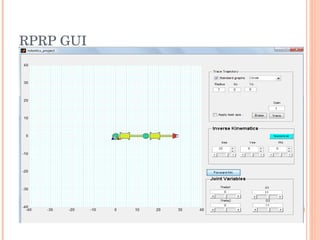
RPRP GUI
USE OF HOMOGENEOUS TRANSFORMATION TO DRAW LINK POLYGONS matlab_th1= theta1_g*pi/180; matlab_th2 = matlab_th1+theta2_g*pi/180; x1_t=x1_g*cos(matlab_th1); % So that prismatic joint 1 is always on top of revolute joint 1(circle) y1_t=y1_g+ r_g*sin(matlab_th1); Tm1 = [  cos(matlab_th1)  -sin(matlab_th1)  0  x1_t  % Transform to frame '1' sin(matlab_th1)  cos(matlab_th1)  0  y1_t 0  0  1  0 0  0  0  1 ];
HOW DO WE APPLY CONTROL ?? xd=(xc+R*cos(w*t)); yd=(yc+R*sin(w*t)); ErrorX=[ (xd-x); (yd-y) ]; K=[g 0;  0 g]; error_correction = jacobian_i*K*ErrorX; qdot=jacobian_i*Xdot + error_correction ;
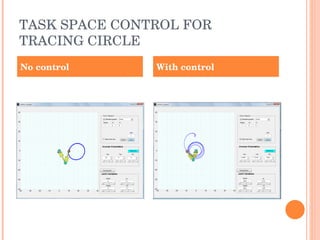
TASK SPACE CONTROL FOR TRACING CIRCLE No control With control
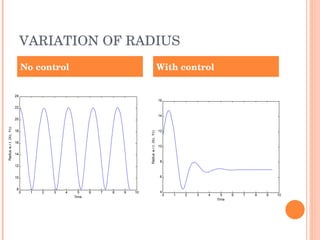
VARIATION OF RADIUS No control With control
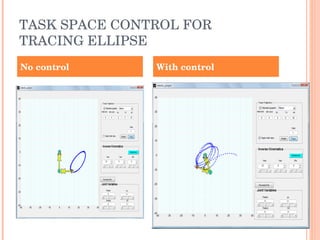
TASK SPACE CONTROL FOR TRACING ELLIPSE No control With control
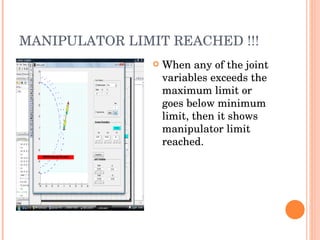
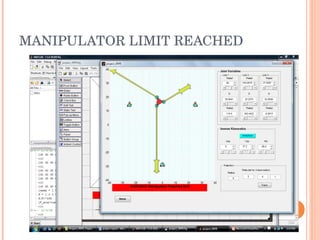
MANIPULATOR LIMIT REACHED !!! When any of the joint variables exceeds the maximum limit or goes below minimum limit, then it shows manipulator limit reached.
3RPR PARALLEL MANIPULATOR
3RPR PARALLEL MANIPULATOR Forward kinematics Inverse kinematics Trajectory tracing GUI
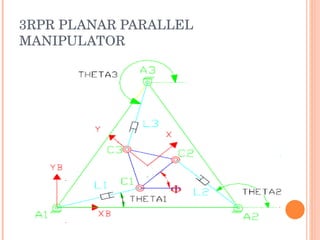
3RPR PLANAR PARALLEL MANIPULATOR
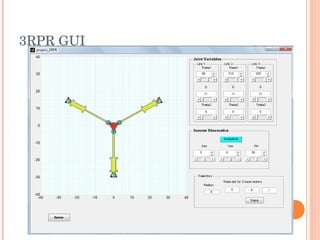
3RPR GUI
MANIPULATOR LIMIT REACHED
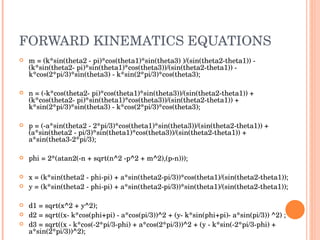
FORWARD KINEMATICS EQUATIONS m = (k*sin(theta2 - pi)*cos(theta1)*sin(theta3) )/(sin(theta2-theta1)) - (k*sin(theta2- pi)*sin(theta1)*cos(theta3))/(sin(theta2-theta1)) - k*cos(2*pi/3)*sin(theta3) - k*sin(2*pi/3)*cos(theta3); n = (-k*cos(theta2- pi)*cos(theta1)*sin(theta3))/(sin(theta2-theta1)) + (k*cos(theta2- pi)*sin(theta1)*cos(theta3))/(sin(theta2-theta1)) + k*sin(2*pi/3)*sin(theta3) - k*cos(2*pi/3)*cos(theta3); p = (-a*sin(theta2 - 2*pi/3)*cos(theta1)*sin(theta3))/(sin(theta2-theta1)) + (a*sin(theta2 - pi/3)*sin(theta1)*cos(theta3))/(sin(theta2-theta1)) + a*sin(theta3-2*pi/3); phi = 2*(atan2(-n + sqrt(n^2 -p^2 + m^2),(p-n))); x = (k*sin(theta2 - phi-pi) + a*sin(theta2-pi/3))*cos(theta1)/(sin(theta2-theta1)); y = (k*sin(theta2 - phi-pi) + a*sin(theta2-pi/3))*sin(theta1)/(sin(theta2-theta1)); d1 = sqrt(x^2 + y^2); d2 = sqrt((x- k*cos(phi+pi) - a*cos(pi/3))^2 + (y- k*sin(phi+pi)- a*sin(pi/3)) ^2) ; d3 = sqrt((x - k*cos(-2*pi/3-phi) + a*cos(2*pi/3))^2 + (y - k*sin(-2*pi/3-phi) + a*sin(2*pi/3))^2);
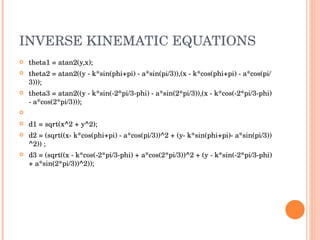
INVERSE KINEMATIC EQUATIONS theta1 = atan2(y,x); theta2 = atan2((y - k*sin(phi+pi) - a*sin(pi/3)),(x - k*cos(phi+pi) - a*cos(pi/3))); theta3 = atan2((y - k*sin(-2*pi/3-phi) - a*sin(2*pi/3)),(x - k*cos(-2*pi/3-phi) - a*cos(2*pi/3))); d1 = sqrt(x^2 + y^2); d2 = (sqrt((x- k*cos(phi+pi) - a*cos(pi/3))^2 + (y- k*sin(phi+pi)- a*sin(pi/3)) ^2)) ; d3 = (sqrt((x - k*cos(-2*pi/3-phi) + a*cos(2*pi/3))^2 + (y - k*sin(-2*pi/3-phi) + a*sin(2*pi/3))^2));
HOW TO DO TRAJECTORY TRACING ?? J1 = [ -d1*sin(theta1)  cos(theta1)  -k*sin(theta4);  d1*cos(theta1)  sin(theta1)  k*cos(theta4); 1  0  1]; Similarly calculate J2 and J3; M = [ J1, -J2,  zeros(3); J1,  zeros(3), -J3]; theta_dependant_dot = -inv(M2)*M1*theta_independant_dot; M1 = matrix of rates of independent variables M2 = matrix of rates of dependent variables theta_dot = [ theta1_dot, d1_dot, theta4_dot, theta2_dot, d2_dot, theta5_dot, theta3_dot, d3_dot, theta6_dot ]'; Integrate theta_dot to get all the joint variables. Then use forward kinematics to plot.
Thank You

Rprp 3 Rpr

  • 1.
    RPRP SERIAL CHAINMANIPULATOR 3RPR PLANAR PARALLEL MANIPULATOR Sumit Tripathi Saket Kansara
  • 2.
    RPRP serial chainmanipulator Forward kinematics Inverse kinematics Trajectory tracking Circle Ellipse Task space control
  • 3.
  • 4.
    USE OF HOMOGENEOUSTRANSFORMATION TO DRAW LINK POLYGONS matlab_th1= theta1_g*pi/180; matlab_th2 = matlab_th1+theta2_g*pi/180; x1_t=x1_g*cos(matlab_th1); % So that prismatic joint 1 is always on top of revolute joint 1(circle) y1_t=y1_g+ r_g*sin(matlab_th1); Tm1 = [ cos(matlab_th1) -sin(matlab_th1) 0 x1_t % Transform to frame '1' sin(matlab_th1) cos(matlab_th1) 0 y1_t 0 0 1 0 0 0 0 1 ];
  • 5.
    HOW DO WEAPPLY CONTROL ?? xd=(xc+R*cos(w*t)); yd=(yc+R*sin(w*t)); ErrorX=[ (xd-x); (yd-y) ]; K=[g 0; 0 g]; error_correction = jacobian_i*K*ErrorX; qdot=jacobian_i*Xdot + error_correction ;
  • 6.
    TASK SPACE CONTROLFOR TRACING CIRCLE No control With control
  • 7.
    VARIATION OF RADIUSNo control With control
  • 8.
    TASK SPACE CONTROLFOR TRACING ELLIPSE No control With control
  • 9.
    MANIPULATOR LIMIT REACHED!!! When any of the joint variables exceeds the maximum limit or goes below minimum limit, then it shows manipulator limit reached.
  • 10.
  • 11.
    3RPR PARALLEL MANIPULATORForward kinematics Inverse kinematics Trajectory tracing GUI
  • 12.
  • 13.
  • 14.
  • 15.
    FORWARD KINEMATICS EQUATIONSm = (k*sin(theta2 - pi)*cos(theta1)*sin(theta3) )/(sin(theta2-theta1)) - (k*sin(theta2- pi)*sin(theta1)*cos(theta3))/(sin(theta2-theta1)) - k*cos(2*pi/3)*sin(theta3) - k*sin(2*pi/3)*cos(theta3); n = (-k*cos(theta2- pi)*cos(theta1)*sin(theta3))/(sin(theta2-theta1)) + (k*cos(theta2- pi)*sin(theta1)*cos(theta3))/(sin(theta2-theta1)) + k*sin(2*pi/3)*sin(theta3) - k*cos(2*pi/3)*cos(theta3); p = (-a*sin(theta2 - 2*pi/3)*cos(theta1)*sin(theta3))/(sin(theta2-theta1)) + (a*sin(theta2 - pi/3)*sin(theta1)*cos(theta3))/(sin(theta2-theta1)) + a*sin(theta3-2*pi/3); phi = 2*(atan2(-n + sqrt(n^2 -p^2 + m^2),(p-n))); x = (k*sin(theta2 - phi-pi) + a*sin(theta2-pi/3))*cos(theta1)/(sin(theta2-theta1)); y = (k*sin(theta2 - phi-pi) + a*sin(theta2-pi/3))*sin(theta1)/(sin(theta2-theta1)); d1 = sqrt(x^2 + y^2); d2 = sqrt((x- k*cos(phi+pi) - a*cos(pi/3))^2 + (y- k*sin(phi+pi)- a*sin(pi/3)) ^2) ; d3 = sqrt((x - k*cos(-2*pi/3-phi) + a*cos(2*pi/3))^2 + (y - k*sin(-2*pi/3-phi) + a*sin(2*pi/3))^2);
  • 16.
    INVERSE KINEMATIC EQUATIONStheta1 = atan2(y,x); theta2 = atan2((y - k*sin(phi+pi) - a*sin(pi/3)),(x - k*cos(phi+pi) - a*cos(pi/3))); theta3 = atan2((y - k*sin(-2*pi/3-phi) - a*sin(2*pi/3)),(x - k*cos(-2*pi/3-phi) - a*cos(2*pi/3))); d1 = sqrt(x^2 + y^2); d2 = (sqrt((x- k*cos(phi+pi) - a*cos(pi/3))^2 + (y- k*sin(phi+pi)- a*sin(pi/3)) ^2)) ; d3 = (sqrt((x - k*cos(-2*pi/3-phi) + a*cos(2*pi/3))^2 + (y - k*sin(-2*pi/3-phi) + a*sin(2*pi/3))^2));
  • 17.
    HOW TO DOTRAJECTORY TRACING ?? J1 = [ -d1*sin(theta1) cos(theta1) -k*sin(theta4); d1*cos(theta1) sin(theta1) k*cos(theta4); 1 0 1]; Similarly calculate J2 and J3; M = [ J1, -J2, zeros(3); J1, zeros(3), -J3]; theta_dependant_dot = -inv(M2)*M1*theta_independant_dot; M1 = matrix of rates of independent variables M2 = matrix of rates of dependent variables theta_dot = [ theta1_dot, d1_dot, theta4_dot, theta2_dot, d2_dot, theta5_dot, theta3_dot, d3_dot, theta6_dot ]'; Integrate theta_dot to get all the joint variables. Then use forward kinematics to plot.
  • 18.