RECOMMENDED PRACTICE
DET NORSKE VERITAS
DNV-RP-F302
SELECTION AND USE OF SUBSEA
LEAK DETECTION SYSTEMS
APRIL 2010
Comments may be sent by e-mail to rules@dnv.com
For subscription orders or information about subscription terms, please use distribution@dnv.com
Comprehensive information about DNV services, research and publications can be found at http://www.dnv.com, or can be obtained from DNV, Veritas-
veien 1, NO-1322 Høvik, Norway; Tel +47 67 57 99 00, Fax +47 67 57 99 11.
© Det Norske Veritas. All rights reserved. No part of this publication may be reproduced or transmitted in any form or by any means, including pho-
tocopying and recording, without the prior written consent of Det Norske Veritas.
Computer Typesetting (Adobe FrameMaker) by Det Norske Veritas.
Printed in Norway.
If any person suffers loss or damage which is proved to have been caused by any negligent act or omission of Det Norske Veritas, then Det Norske Veritas shall pay compensation to such person
for his proved direct loss or damage. However, the compensation shall not exceed an amount equal to ten times the fee charged for the service in question, provided that the maximum compen-
sation shall never exceed USD 2 million.
In this provision "Det Norske Veritas" shall mean the Foundation Det Norske Veritas as well as all its subsidiaries, directors, officers, employees, agents and any other acting on behalf of Det
Norske Veritas.
FOREWORD
DET NORSKE VERITAS (DNV) is an autonomous and independent foundation with the objectives of safeguarding life, prop-
erty and the environment, at sea and onshore. DNV undertakes classification, certification, and other verification and consultancy
services relating to quality of ships, offshore units and installations, and onshore industries worldwide, and carries out research
in relation to these functions.
DNV Offshore Codes consist of a three level hierarchy of documents:
— Offshore Service Specifications. Provide principles and procedures of DNV classification, certification, verification and con-
sultancy services.
— Offshore Standards. Provide technical provisions and acceptance criteria for general use by the offshore industry as well as
the technical basis for DNV offshore services.
— Recommended Practices. Provide proven technology and sound engineering practice as well as guidance for the higher level
Offshore Service Specifications and Offshore Standards.
DNV Offshore Codes are offered within the following areas:
A) Qualification, Quality and Safety Methodology
B) Materials Technology
C) Structures
D) Systems
E) Special Facilities
F) Pipelines and Risers
G) Asset Operation
H) Marine Operations
J) Cleaner Energy
O) Subsea Systems
Amendments and Corrections
This document is valid until superseded by a new revision. Minor amendments and corrections will be published in a separate
document normally updated twice per year (April and October).
For a complete listing of the changes, see the “Amendments and Corrections” document located at:
http://webshop.dnv.com/global/.
The electronic web-versions of the DNV Offshore Codes will be regularly updated to include these amendments and corrections.
DET NORSKE VERITAS
Recommended Practice DNV-RP-F302, April 2010
Introduction – Page 3
INTRODUCTION
— Background
Production systems for hydrocarbons are complex instal-
lations and it is known in the industry that smaller and
larger unwanted leakages occur and cause discharge of hy-
drocarbons to the surroundings. Today, both operators and
authority awareness towards the environmental impact of
oil and gas production is constantly increasing.
In spite of the fact that methods for subsea leak detection
have been available in the market for years, there are still
gaps to fill concerning the design, engineering and opera-
tion of such methods to make them reliable for detection
of discharge to the environment. Thus, there is a need for
an industry reference in this technology field which can
serve as a guideline today and a tool for coordinating the
development of the field in the future.
This Recommended Practice (RP) summarizes current in-
dustry experiences and knowledge with relevance to selec-
tion and use of detectors for a subsea leak detection
system. It covers relevant regulations, field experience and
available technologies and also gives guidance on how to
design and operate a system for subsea leak detection and
recommendations for developments needed in this field of
technology.
— Acknowledgment
This RP is developed within a Joint Industry Project. in-
cluding: ConocoPhillips, ENI Norge, Shell and Statoil. In
addition a broad selection of engineering companies and
subsea leak detection technology suppliers have partici-
pated in workshops and hearing rounds.
DET NORSKE VERITAS
Recommended Practice DNV-RP-F302, April 2010
Page 4 – Introduction
DET NORSKE VERITAS
Recommended Practice DNV-RP-F302, April 2010
Contents – Page 5
CONTENTS
1. INTRODUCTION.................................................. 7
1.1 Objective...................................................................7
1.2 Basis ..........................................................................7
1.3 Regulations...............................................................7
1.3.1 Norway ...............................................................................7
1.3.2 United Kingdom .................................................................8
1.3.3 USA ....................................................................................8
1.3.4 EU.......................................................................................8
1.4 Limitations ...............................................................8
2. EXPERIENCE TO DATE..................................... 8
2.1 Background..............................................................8
2.2 History ......................................................................9
2.3 Field experience ......................................................9
2.4 Where and when leaks occur................................10
3. LEAK DETECTION TECHNOLOGIES
AND THEIR CHARACTERISTICS ................. 11
3.1 Description of technologies...................................11
3.1.1 Active acoustic methods...................................................11
3.1.2 Bio sensor methods...........................................................11
3.1.3 Capacitance methods .......................................................11
3.1.4 Fibre optic methods ..........................................................12
3.1.5 Fluorescent methods.........................................................12
3.1.6 Methane sniffer methods ..................................................12
3.1.7 Semi-conductor methods ..................................................12
3.1.8 Optical NDIR methods .....................................................12
3.1.9 Optical camera methods ...................................................12
3.1.10 Passive acoustic methods..................................................13
3.1.11 Mass balance methods......................................................13
3.2 SINTEF laboratory test ........................................13
4. DESIGN OF SUBSEA LEAK DETECTION
SYSTEMS ............................................................. 14
4.1 General requirements ...........................................14
4.2 System performance requirements
and technology selection .......................................14
4.3 Combining technologies........................................15
5. OPERATING PHILOSOPHY ............................ 15
5.1 Operating procedures...........................................15
5.1.1 Warning display and action..............................................15
5.2 Sensitivity and response time...............................15
5.2.1 Requirements from operators ...........................................15
5.2.2 Findings from laboratory tests..........................................16
5.3 Trouble shooting, data download
and self diagnosis...................................................16
6. INSTALLATION AND INTERFACES............. 16
6.1 General ..................................................................16
6.2 Communication bandwidth..................................16
6.3 Communication interface.....................................16
6.4 Power requirements..............................................16
6.5 Test methods..........................................................16
6.6 Technology specific requirements .......................16
6.6.1 Active acoustic methods...................................................16
6.6.2 Bio sensor methods...........................................................16
6.6.3 Capacitance methods .......................................................17
6.6.4 Methane sniffer methods ..................................................17
6.6.5 Optical Cameras ...............................................................17
6.6.6 Passive acoustic methods..................................................17
7. CALIBRATION, INSPECTION
AND INTERVENTION ...................................... 18
8. CHALLENGES FOR FURTHER
RESEARCH AND DEVELOPMENT .............. 19
8.1 Technology.............................................................19
8.2 Operation of leak detection systems....................19
8.3 Requirements.........................................................19
8.4 Collection of statistical data .................................19
9. REFERENCES..................................................... 20
APP. A SUGGESTED FUNCTIONAL
REQUIREMENTS
FOR SUBSEA LEAK DETECTION SYSTEMS ........... 21
APP. B LEGISLATION.................................................. 22
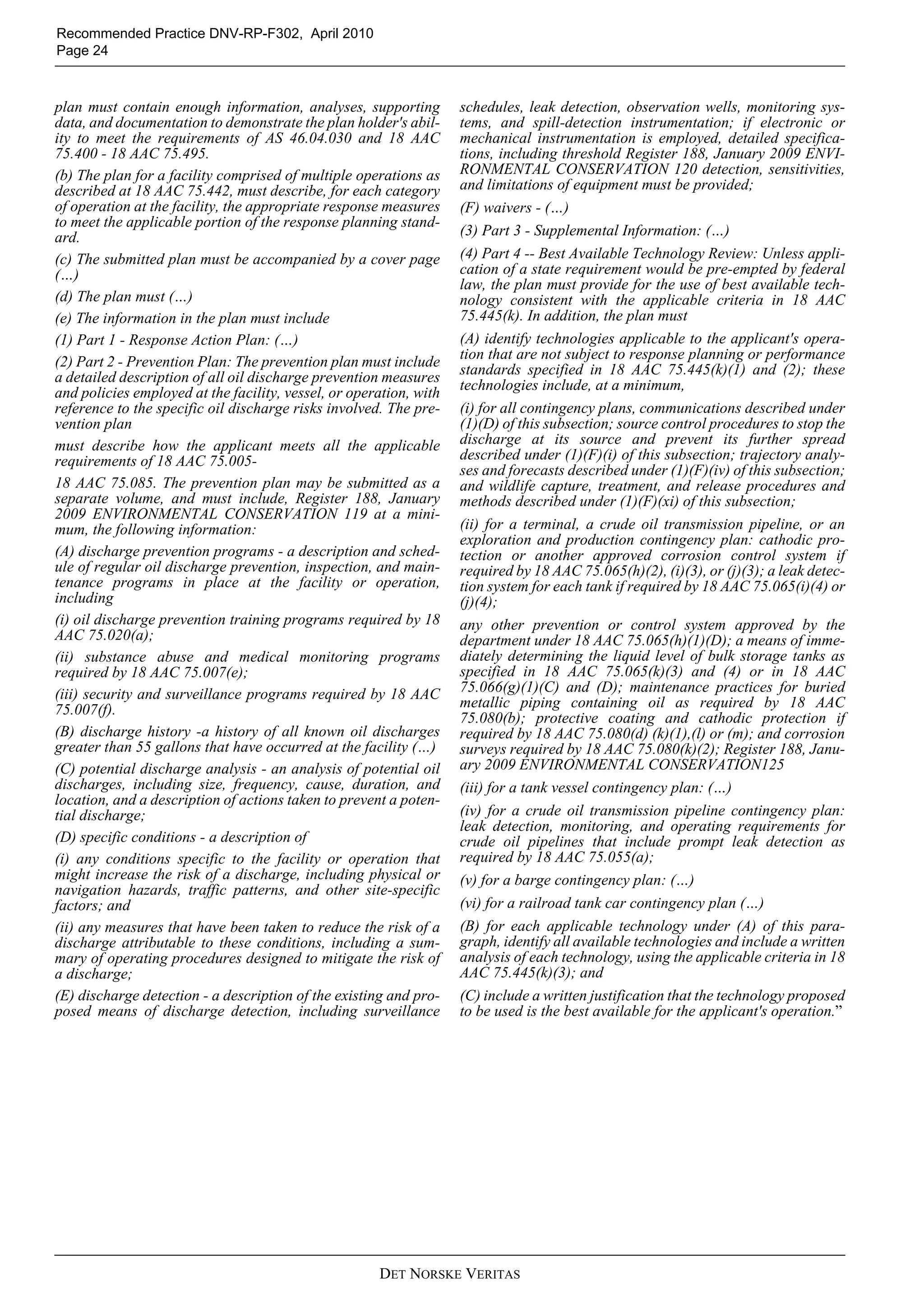
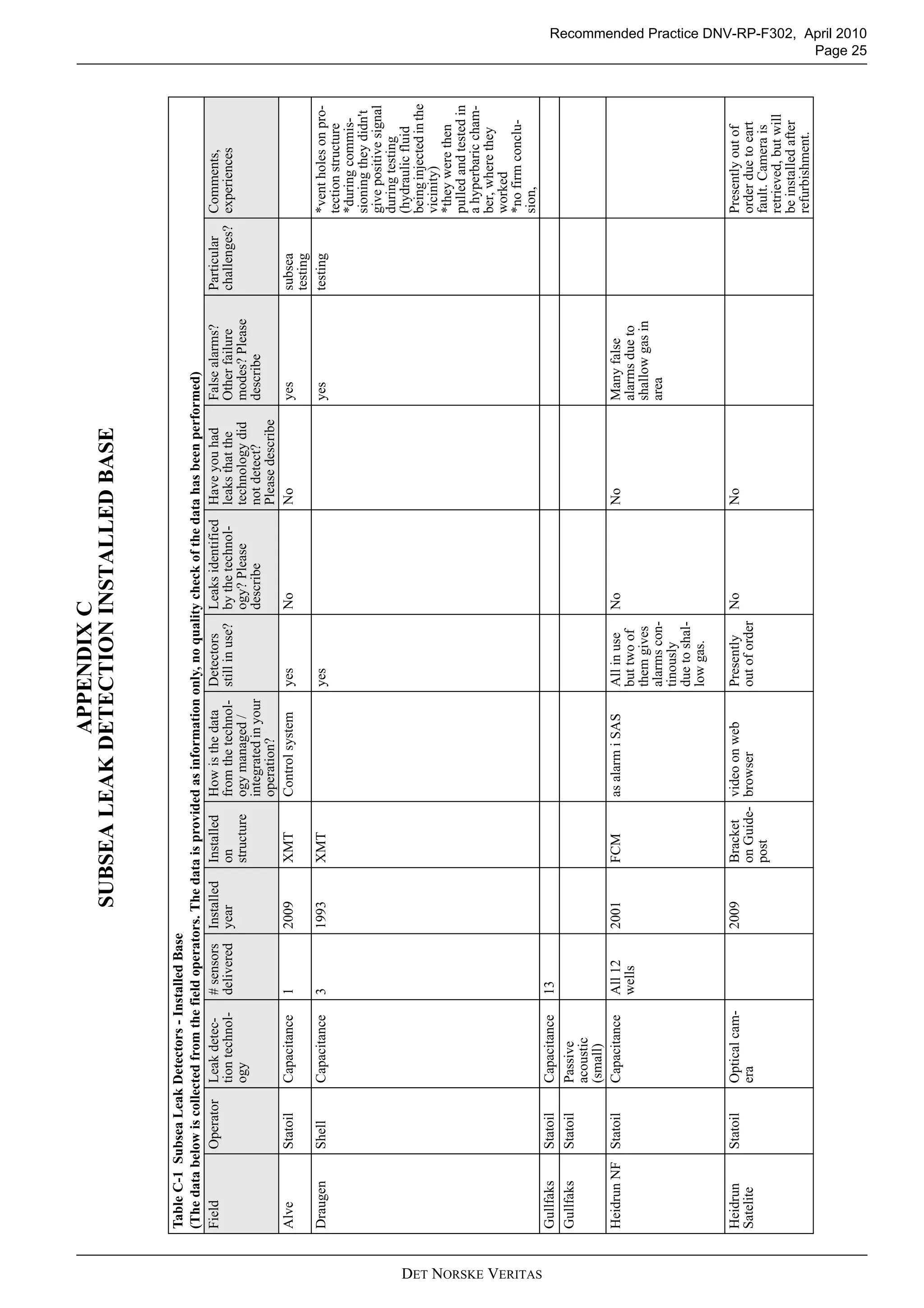
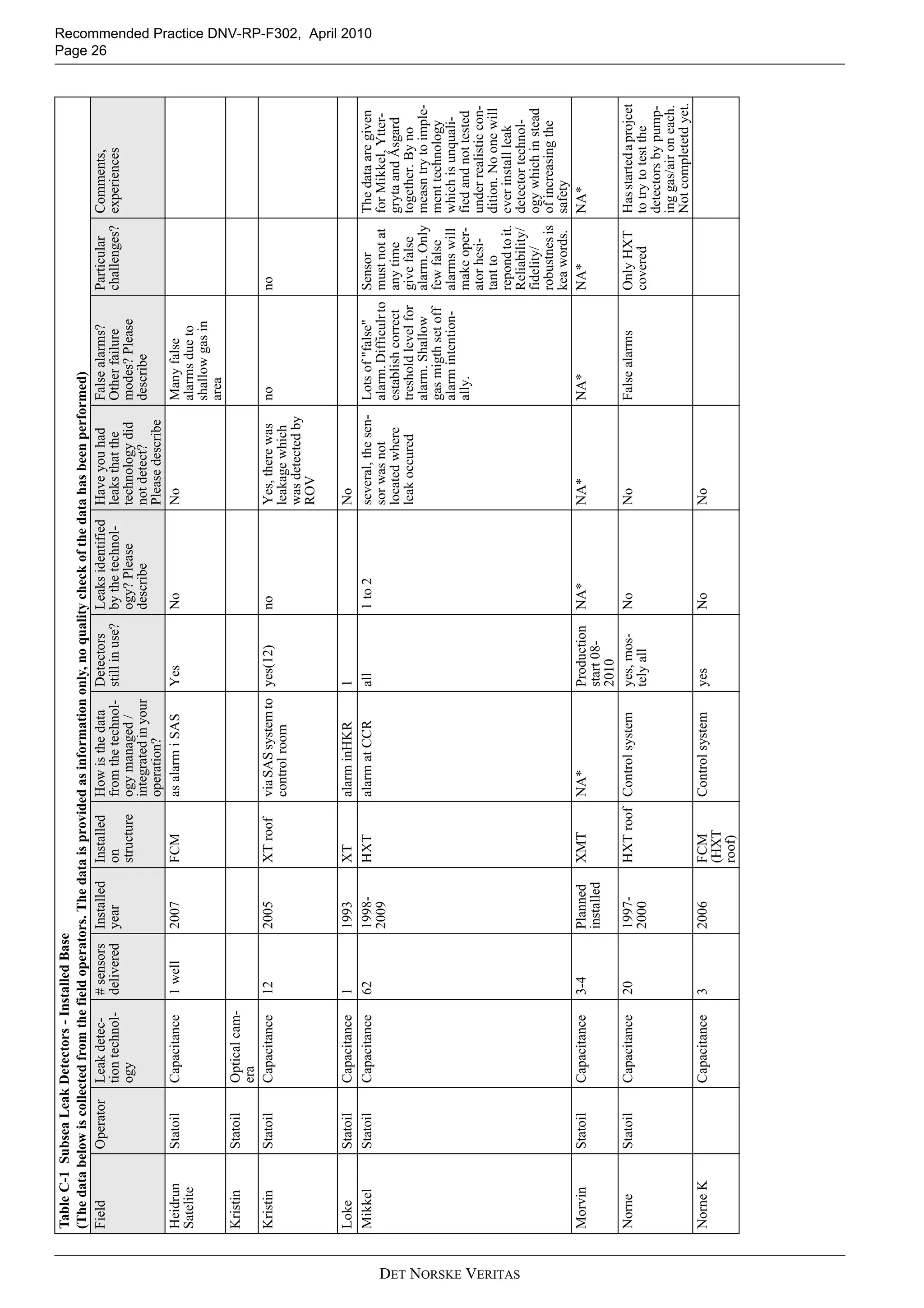
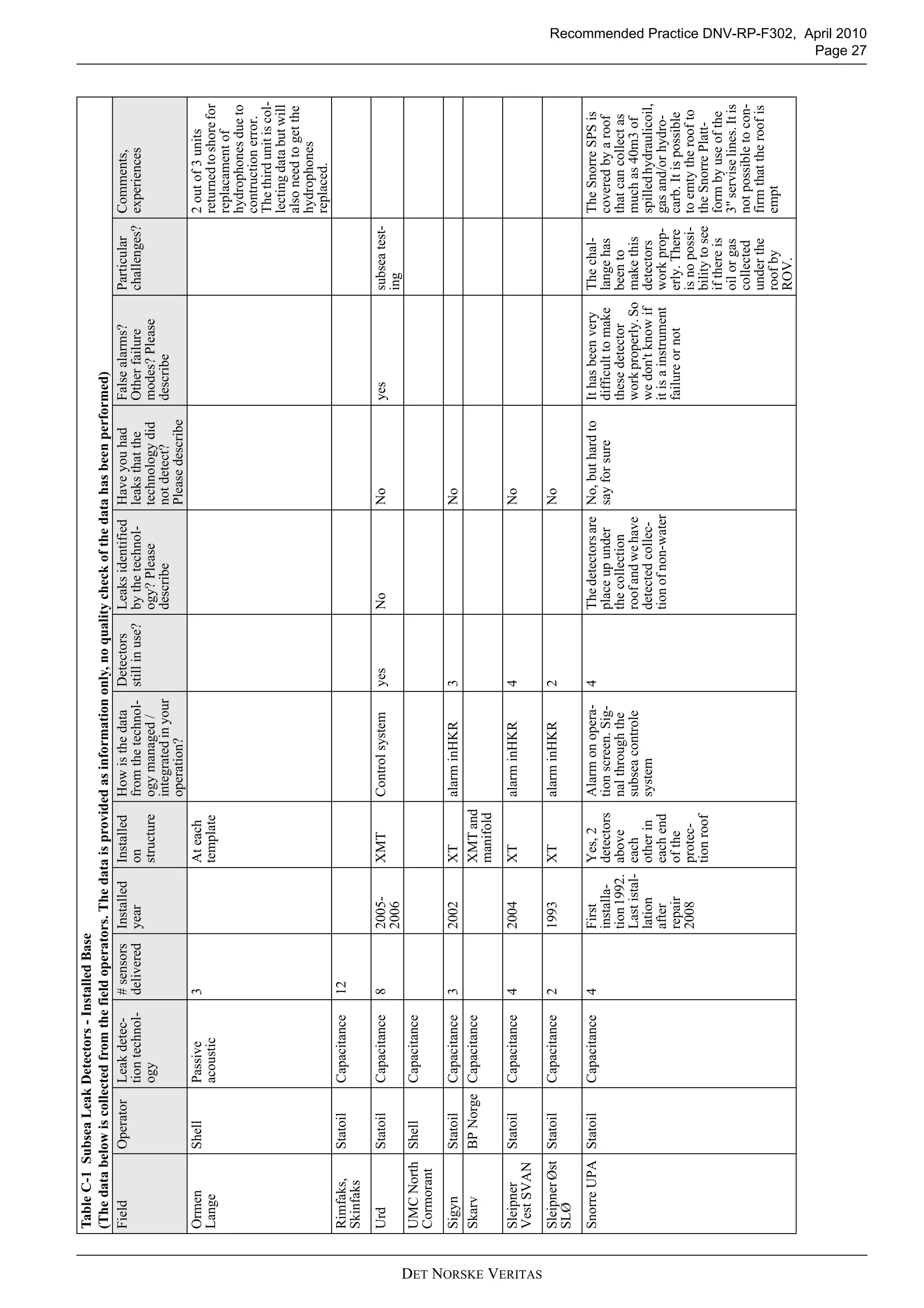
APP. C SUBSEA LEAK DETECTION
INSTALLED BASE........................................................... 25
APP. D SUBSEA LEAK DETECTORS SUPPLIER
TECHNICAL DATA......................................................... 32
DET NORSKE VERITAS
Recommended Practice DNV-RP-F302, April 2010
Page 6 – Contents
DET NORSKE VERITAS
Recommended Practice DNV-RP-F302, April 2010
Page 7
1. Introduction
1.1 Objective
The objective of this best practice is to summarize industry
experiences and knowledge with relevance to selection and use
of detectors for a subsea leak detection system. The intent is
that this document can be used as a technical and practical
guideline and reference for operators, suppliers, regulators and
decision makers in the field of subsea leak detection. The ref-
erencing of this document will not substitute the development
of a field specific leak detection strategy, but can rather be an
element in one.
It is emphasized that the application of subsea leak detection
systems shall not reduce the safety level for subsea systems in
terms of design, manufacture, quality assurance etc.
It is also emphasized that the performance of a subsea leak
detection system is not determined by the technical specifica-
tion of the detector technology alone, but by an overall assess-
ment of technical data, system layout and system operation.
1.2 Basis
OLF (The Norwegian Oil Industry Association) has through a
JIP taken the initiative to improve practice in the industry
regarding detection of subsea hydrocarbon leaks. The JIP part-
ners have been Conoco Philips, ENI, Shell and Statoil. This
best practice is a product of the JIP. The development of this
document has been coordinated by DNV and the content is
based on input from a broad selection of operators and suppli-
ers in the industry.
Production systems for hydrocarbons are complex installations
and it is known in the industry that smaller and larger
unwanted leakages occur and cause discharge of hydrocarbons
to the surroundings. Today, both operators and authority
awareness towards the environmental impact of oil and gas
production is constantly increasing.
Subsea leak detection is becoming more important in the petro-
leum industry. The regulations of PSA (Petroleum Safety
Authority) Norway outline requirements for remote measure-
ment of acute pollution. Regulatory bodies in UK, USA and
also the European Union describe requirements for detection
of acute pollution. This is further covered in Sec.1.3.
As well as detecting leakages, a leak detection system may be
designed to provide condition monitoring data and may form
part of a life extension strategy if for example the risks of leak-
age is considered too high to continue production without con-
tinuous monitoring.
1.3 Regulations
In this section relevant references to legislation are presented.
A further description of the legislation referenced below is
found in Appendix B.
Subsea leak detection is becoming important in the petroleum
industry. A plan for remote measurement is by regulations
required to be included in PDOs in Norway and Alaska. It has
recently been stated by the Norwegian authorities in relation to
future production in the Arctic region that there is a need for
“early warning system based on detecting leaks at the source”
/10/.
1.3.1 Norway
The Facilities Regulations Section 7 states that (ref. /24/)
“Facilities shall be equipped with necessary safety functions
which at all times are able to:
a) detect abnormal conditions
b) prevent abnormal conditions from developing into situa-
tions of hazard and accident
c) limit harm in the event of accidents.
Requirements to performance shall be set in respect of safety
functions. The status of safety functions shall be available in
the central control room.”
The Management Regulations Section 1 states (ref. /22/):
Risk reduction
In risk reduction as mentioned in the Framework Regulations
Section 9 on principles relating to risk reduction,
“The party responsible shall choose technical, operational
and organisational solutions which reduce the probability that
failures and situations of hazard and accident will occur.
In addition barriers shall be established which
a) reduce the probability that any such failures and situa-
tions of hazard and accident will develop further,
b) limit possible harm and nuisance.
Where more than one barrier is required, there shall be suffi-
cient independence between the barriers.
The solutions and the barriers that have the greatest risk
reducing effect shall be chosen based on an individual as well
as an overall evaluation. Collective protective measures shall
be preferred over protective measures aimed at individuals.”
The Management Regulations Section 2 states:
Barriers
“The operator or the one responsible for the operation of a
facility, shall stipulate the strategies and principles on which
the design, use and maintenance of barriers shall be based, so
that the barrier function is ensured throughout the life time of
the facility.
It shall be known what barriers have been established and
which function they are intended to fulfil, ref. Section 1 on risk
reduction, second paragraph, and what performance require-
ments have been defined in respect of the technical, opera-
tional or organisational elements which are necessary for the
individual barrier to be effective.
It shall be known which barriers are not functioning or have
been impaired.
The party responsible shall take necessary actions to correct
or compensate for missing or impaired barriers.”
The Authority say in their Activities Regulations /20/, section
50, that it is the responsibility of the operator to quickly dis-
cover and map pollution from the facility by remote measure-
ments (see Appendix B). Further, the guideline to this section
50 says that:
“a plan for remote measurement should be established, based
on an environmentally oriented risk analysis. The system for
remote measurement should comprise the following:
a) procedures and systems for visual observation and notifi-
cation
b) procedures for interpretation of monitoring data
c) modelling tools to predict transport and spread of acute
pollution,
d) procedures for quantifying the leak
e) other meteorological services that are necessary in order
to support the remote measurement,
f) systems for detection of pollution in the recipients.”
Referring to the Norwegian legislation, addressing the issue of
remote measurement of leak detection comprises having
organizational procedures in place as well as applying moni-
toring technologies. The monitoring technology may be based
on detection subsea, topside or both. The organizational and
technical aspects should all be described in a plan for remote
measurement.
DET NORSKE VERITAS
Recommended Practice DNV-RP-F302, April 2010
Page 8
1.3.2 United Kingdom
The Health and Safety Executive (HSE) in the United Kingdom
have the Pipelines Safety Regulations (PSR) from 1996 /27/ as
the key regulations concerning pipeline safety and integrity.
There are at present no specific regulations concerning subsea
production systems. However, regulation 6 of PSR states:
"The operator shall ensure that no fluid is conveyed in a pipe-
line unless it has been provided with such safety systems as are
necessary for securing that, so far as is reasonably practica-
ble, persons are protected from risk to their health & safety.”
The associated PSR guidance states:
‘Safety systems also include leak detection systems where they
are provided to secure the safe operation of the pipeline. The
method chosen for leak detection should be appropriate for the
fluid conveyed and operating conditions.”
1.3.3 USA
The Pipeline and Hazardous Materials Safety Administration
in the USA say in § 195.452 of “Transportation of Hazardous
Liquids by Pipeline” /26/ about “Pipeline integrity manage-
ment in high consequence areas”:
“Leak detection: An operator must have a means to detect
leaks on its pipeline system. An operator must evaluate the
capability of its leak detection means and modify, as neces-
sary, to protect the high consequence area. An operator’s eval-
uation must, at least, consider, the following factors — length
and size of the pipeline, type of product carried, the pipeline’s
proximity to the high consequence area, the swiftness of leak
detection, location of nearest response personnel, leak history,
and risk assessment results.”
The Alaska Department Of Environmental Conservation says
in 18 AAC 75 “Oil and Other Hazardous Substances Pollution
Control” /25/, paragraph 18 AAC 75.055 “Leak detection,
monitoring, and operating requirements for crude oil transmis-
sion pipelines.”:
“A crude oil transmission pipeline must be equipped with a
leak detection system capable of promptly detecting a leak,
including (1) if technically feasible, the continuous capability
to detect a daily discharge equal to not more than one percent
of daily throughput; (2) flow verification through an account-
ing method, at least once every 24 hours; (3) for a remote pipe-
line not otherwise directly accessible, weekly aerial
surveillance, unless precluded by safety or weather condi-
tions.”
1.3.4 EU
The EU have developed the IPPC (Integrated Pollution Pre-
vention and Control) directive /28/, with the objective to pre-
vent and limit industry pollution. The IPPC is based on 4 main
principles. One of these is BAT – Best Available Techniques.
The IPPC directive shall prevent and limit pollution from
industry activities. Permissions for industrial installation shall
be given following this directive and be based on the BAT
principle. The definition of BAT can be found in Appendix B.
For Norway, SINTEF have written a report on “Use of the
BAT (Best Available Techniques) principle for environmental
safety” /8/ which gives examples of practical implementation
of BAT, including detection of subsea leaks.
1.4 Limitations
Statistical analysis /1/ shows that the majority of leaks
observed in the North Sea are close to subsea installations,
platforms and flow lines. At the current issue, this best practice
is limited to subsea structures with access to the control sys-
tem. The best practice focuses on continuous monitoring prin-
ciples for leak detection.
For pipeline systems, the reader may refer to DNV-RP-F116
Guideline on integrity management of submarine pipeline systems.
Leakages are in this context limited to those originating from
production of hydrocarbons in the form of natural gas, oil or mul-
tiphase, as these are considered to have the greatest environmen-
tal impact. Leak detection may also be of interest for CO2
injection systems and hydraulic control systems. Technologies
for leak detection are, however, still immature and this document
will focus on leakages from oil and natural gas production, as
this is considered to have the greatest environmental impact.
Some detection principles described in this guideline will in the-
ory detect any liquid leaking at a certain pressure; others are
depending on the chemical compound for detection.
The maturity of the technologies described is varying from
concepts to commercially delivered products. However, the
operational experience with subsea leak detection only goes
back to the 1990’s and is limited to a few of the described tech-
nologies. New developments and further developments of
existing technologies are expected and the descriptions and
recommendations given in this document should be developed
accordingly.
This document has been developed based on input from sup-
pliers, integrators and end users of leak detection technologies
as well as PSA Norway. The information has been collected
through questionnaires, seminars and hearings of this docu-
ment. Also, important contributions to this document come
from the results of previous work done under the OLF JIP on
leak detection:
— Statistical analysis performed by ExproSoft in 2005 /1/
— Screening of available technologies done by SINTEF in
2006 /2/.
— Comparative laboratory test of a selection of technologies
done by SINTEF in 2007 /3/.
The technical data on the different technologies found in
Appendix D is based on information given from the suppliers.
Collection of evidence to verify these data has not been per-
formed during the development of this document.
2. Experience to date
2.1 Background
Subsea production systems have been developing since the
first subsea completion as early as 1943 (Lake Erie, USA, 30
feet). The need for cost-effective solutions for offshore pro-
duction has over time led to an extensive use of increasingly
complex subsea solutions for the development of existing and
new fields. In parallel to these developments has been the need
to detect any leakages that may damage the environment.
Currently, most operating companies use a combination of
technical and organizational measures to detect unwanted dis-
charges of oil and gas, among others visual observation. Expe-
rience has shown that the current methods and equipment
available are not as effective as desired (see item 2.3 and
Appendix C).
OLF has coordinated a JIP focusing on leak detection. This
document is a result of the 4th phase of the JIP and is based on
the results from completed phases 1, 2 and 3 spanning from
2005 to 2007:
Phase 1 /1/ was a database review of available information on
reported subsea leaks up to the year of 2005, mainly on the
Norwegian and UK sectors in the North Sea. The main conclu-
sions from Phase 1 were that most leak incidents occur at or
close to subsea installations, most leaks are small and from
smaller diameter pipes.
Phase 2 /2/ of the project was a review of available technolo-
gies for subsea leak detection. The main conclusion was that
there are several different available technologies potentially
suitable for continuous monitoring of subsea installations.
DET NORSKE VERITAS
Recommended Practice DNV-RP-F302, April 2010
Page 9
Phase 3 /3/ consisted of comparable experimental tests of dif-
ferent types of subsea leak detection principles. The main con-
clusions were that all the technologies tested in these
experiments work well under laboratory conditions; both crude
oil and gas leakages were detected. However, the technologies
perform differently under varied conditions, due to their differ-
ent strengths and limitations. Generally, gas leakages are eas-
ier to detect than crude oil leakages.
2.2 History
In the past decades, detection of gas pipeline ruptures near
platforms has been in focus, to protect personnel and structures
from explosion risk. Pipeline emergency shut down systems
based on pressure monitoring have been installed by most
operators. These systems generally work satisfactorily under
normal production operations and when automatic warnings
are included in the system. However, problems may arise dur-
ing transients for example at start-up after shut down periods
and when the systems rely on the operator reacting to the data
instead of automatic warnings.
The forward trend in Norway seems to be adding permanently
installed leak detection systems. The international trend points
towards leak detection systems mounted on mobile units
(ROVs) and deepwater applications. Inspection surveys are
typically done once a year1). However, this may not prove suf-
ficient for an increasing number of complex and large subsea
structures.
1) The inspection interval will depend on the field specific inspection
plan.
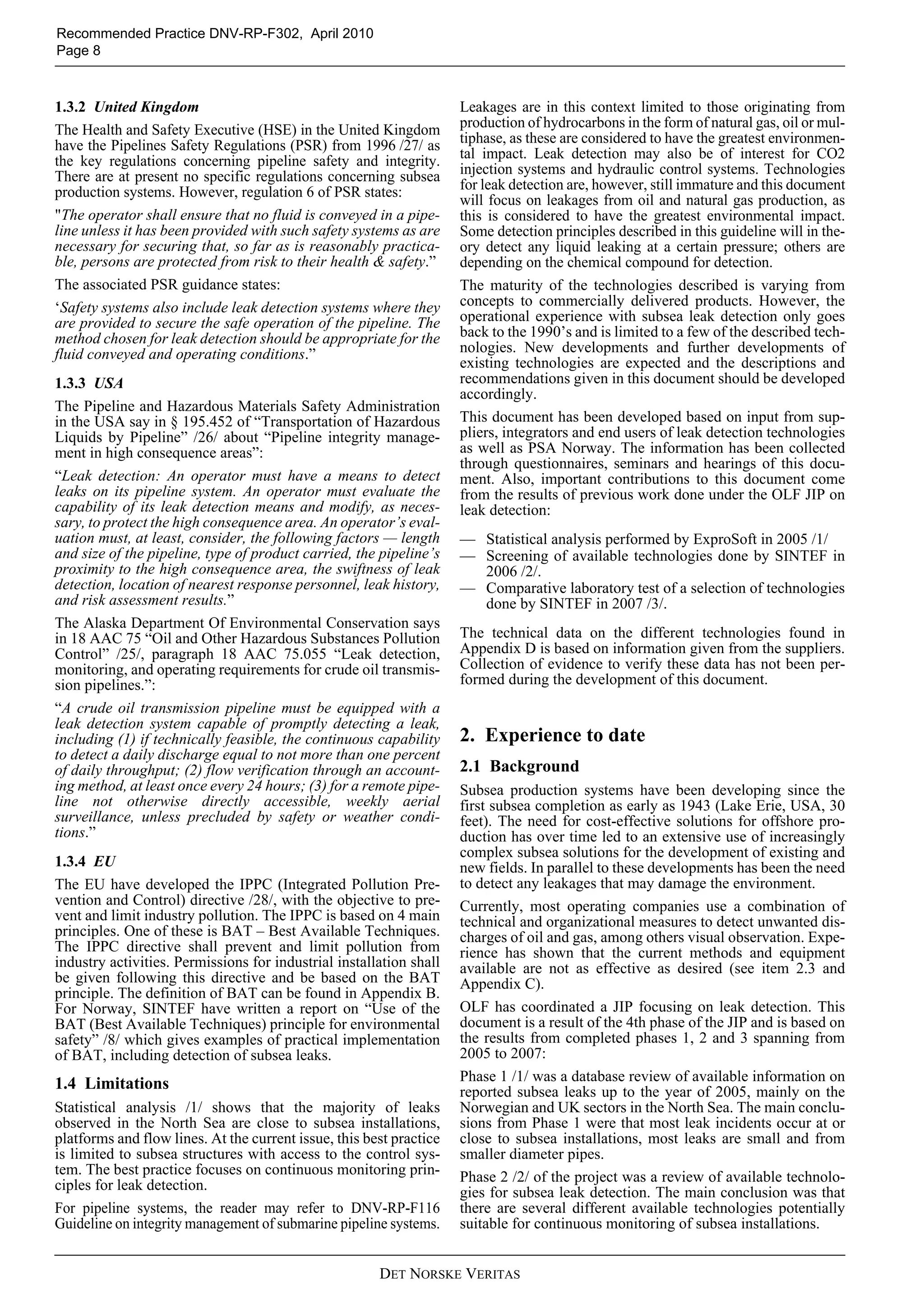
Figure 2-1
Subsea production to shore
2.3 Field experience
The field experience to date with leak detection systems is lim-
ited to the Norwegian sector and this field of technology is
generally young. The existing experience includes problems
with false alarms and consequently disabled sensors as well as
fields where one has accomplished solutions that are described
as promising. Subsea leak detection should be regarded as a
monitoring system and is not at present mature enough to fulfil
the requirements normally set for a safety system.
Below some field developments which include subsea leak
detection systems are listed. The list is not complete, but is
believed to be a representative selection of the experience to
date. In Appendix C, a broader selection of installed leak
detection systems is included.
— Snøhvit, Statoil – The Snøhvit Field is the first field devel-
opment in the Barents Sea and has been developed by Sta-
toil. It is a fully subsea field development concept and the
best available technology at the time was used. The full
development including future wells comprises twenty pro-
duction wells and one CO2 injection well. The leak detec-
tion system is based on capacitive detectors with a
hydrocarbon collector at each wellhead. Snøhvit has expe-
rienced some challenges with its subsea leak detectors in
the sense that they have at times given readings outside the
0 to 100 range, which is the defined range for these detec-
tors. However, Snøhvit has also had one positive identifi-
cation of a gas leakage at one well. At this instance, the
detectors changed values from 0 to 100 and this indication
of leak was verified by a corresponding pressure loss in the
subsea system. This resulted in the well being shut down
and further investigations were conducted. The conclusion
was that there had been an intermittent leak from a stem in
a valve. Snøhvit has also had a leak that was not detected
by the capacitance detector, because the leak was outside
the hydrocarbon collector roof, which is a requirement for
this type of detectors.
— Tampen Link, Statoil – A 23 km long pipeline connecting
the Statfjord field with the UK sector of the North Sea. The
diameter of the pipe is 32”. Tampen link has five subsea
leak monitors on the Norwegian sector in the North Sea.
These detectors are ultrasonic non-intrusive acoustic leak
monitors. The Leak Monitors are retrofitted on two 20”
gas valves on the seabed to verify/disprove through-valve
gas leakage. These valves are open and they will be shut to
close off the bypass alternative. The Leak Monitors are
self-contained and are deployed by ROV to operate con-
tinuously for periods up to one month. The monitors will
be used during the closing of the two valves, and may later
be operated on demand to verify their condition at a later
stage.
— Tordis, Statoil – A passive acoustic leak detector was
installed in 2007. The offshore commissioning included
leakage testing but no positive warnings were triggered
during liquid (water) discharge below 200 bar differential
pressure. Warnings were triggered at 200 bar. Investiga-
tions revealed humidity in the hydrophones which was
believed to explain lack of detection. The passive acoustic
detector will be installed again in 2010 after a new hydro-
phone sealing technique is tested.
— One leak on Norwegian sector in 2003 released 750 m3 of
oil over 6 hours before it was detected. In spite of installed
process surveillance of pressure, flow and temperature, the
leak was detected as an oil slick and odour around the plat-
form. The leak occurred when re-starting the subsea wells
after a 2-week shutdown. Investigations succeeding the
leak found that the process surveillance records showed
the leak as manifold pressure dropping to seabed pressure.
This pressure drop was, however, not recognised during
the re-start. A learning point from this accident was the
need for increased process surveillance and/or ROV
observation when starting up subsea facilities.
DET NORSKE VERITAS
Recommended Practice DNV-RP-F302, April 2010
Page 10
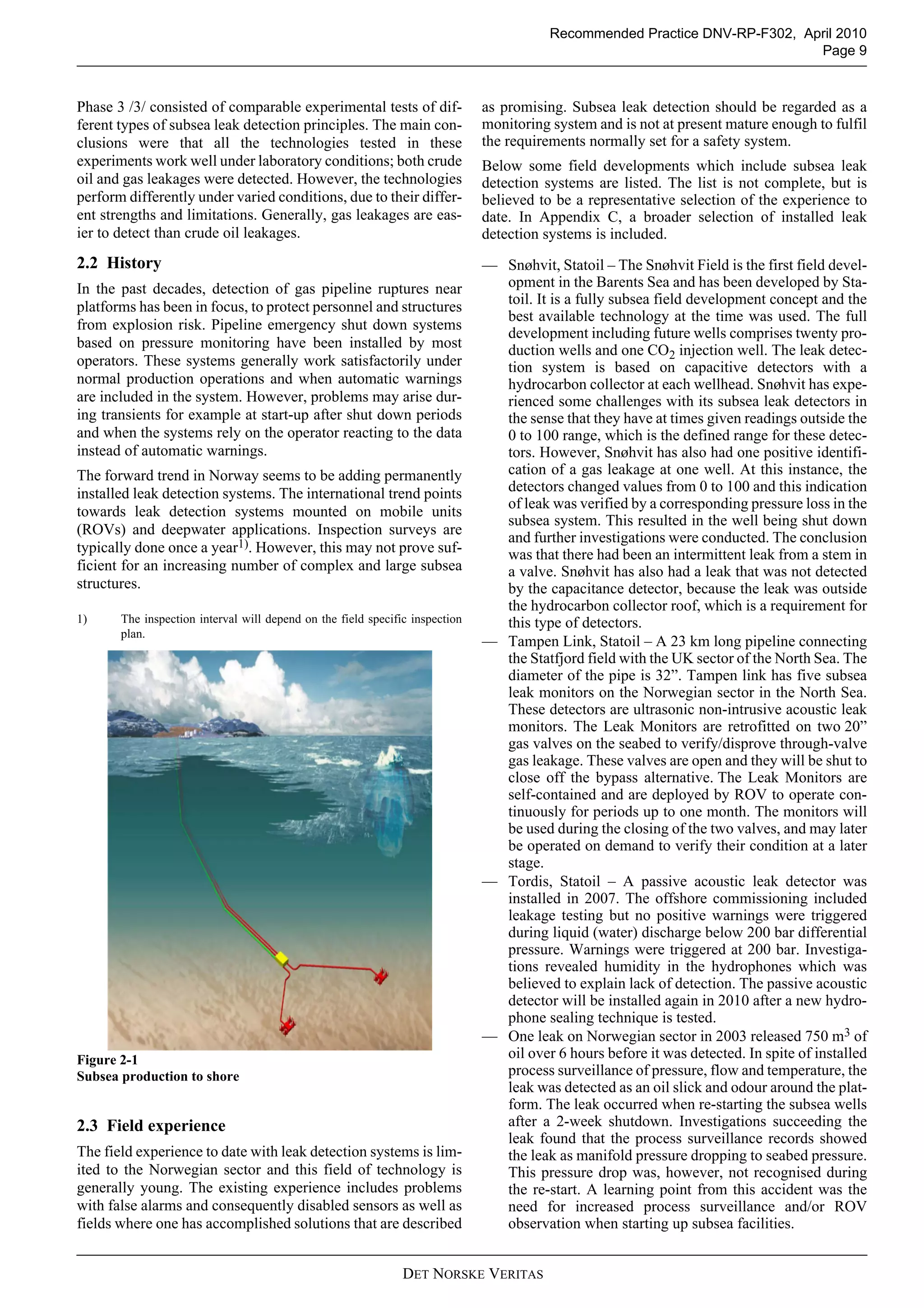
Figure 2-2
Three cone shaped acoustic leak detectors installed on Tordis
2.4 Where and when leaks occur
This section presents available data on where leaks occur on
subsea structures. This information may be used as an input
when evaluating what components are of particular interest for
monitoring.
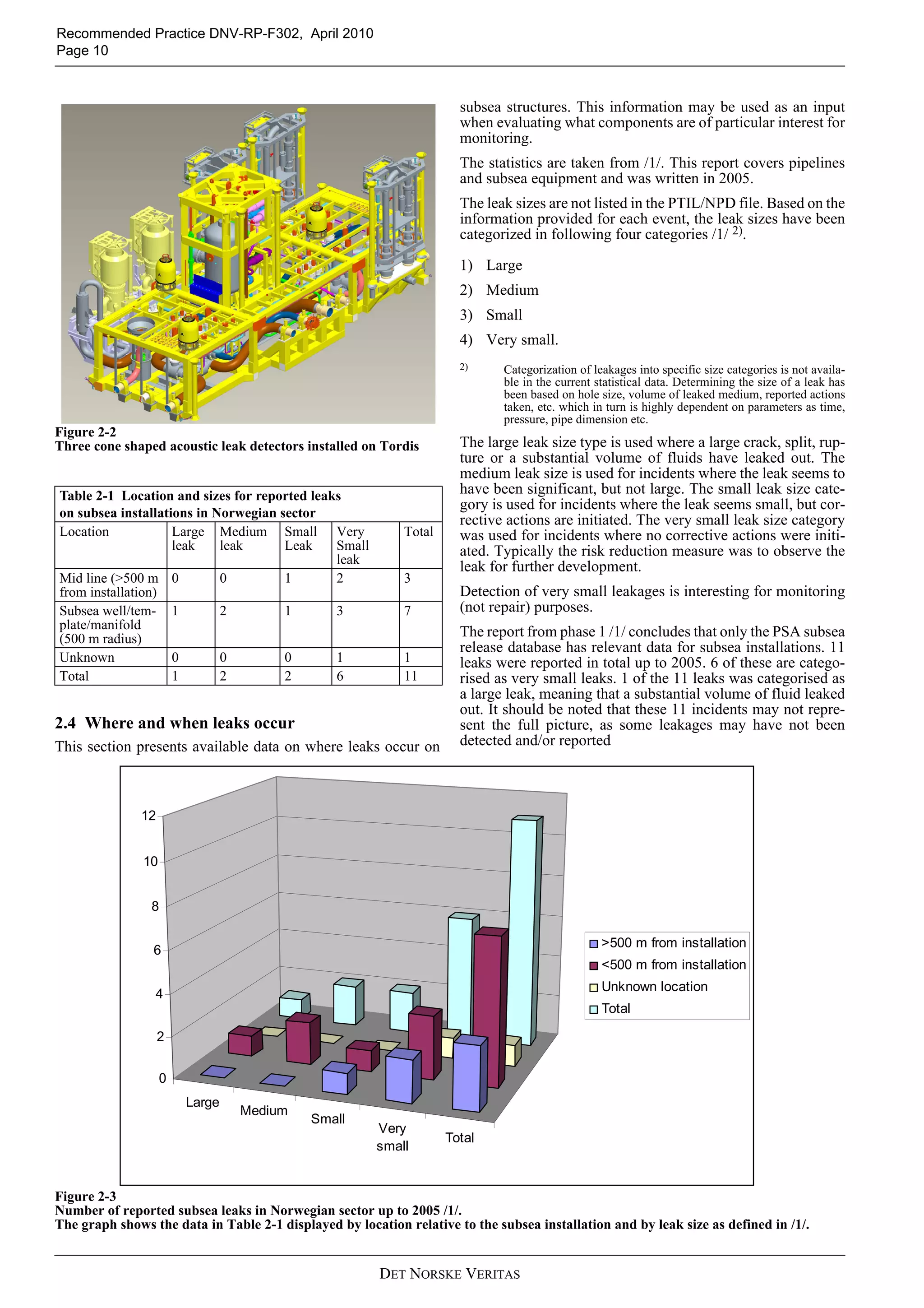
The statistics are taken from /1/. This report covers pipelines
and subsea equipment and was written in 2005.
The leak sizes are not listed in the PTIL/NPD file. Based on the
information provided for each event, the leak sizes have been
categorized in following four categories /1/ 2).
1) Large
2) Medium
3) Small
4) Very small.
2) Categorization of leakages into specific size categories is not availa-
ble in the current statistical data. Determining the size of a leak has
been based on hole size, volume of leaked medium, reported actions
taken, etc. which in turn is highly dependent on parameters as time,
pressure, pipe dimension etc.
The large leak size type is used where a large crack, split, rup-
ture or a substantial volume of fluids have leaked out. The
medium leak size is used for incidents where the leak seems to
have been significant, but not large. The small leak size cate-
gory is used for incidents where the leak seems small, but cor-
rective actions are initiated. The very small leak size category
was used for incidents where no corrective actions were initi-
ated. Typically the risk reduction measure was to observe the
leak for further development.
Detection of very small leakages is interesting for monitoring
(not repair) purposes.
The report from phase 1 /1/ concludes that only the PSA subsea
release database has relevant data for subsea installations. 11
leaks were reported in total up to 2005. 6 of these are catego-
rised as very small leaks. 1 of the 11 leaks was categorised as
a large leak, meaning that a substantial volume of fluid leaked
out. It should be noted that these 11 incidents may not repre-
sent the full picture, as some leakages may have not been
detected and/or reported
Figure 2-3
Number of reported subsea leaks in Norwegian sector up to 2005 /1/.
The graph shows the data in Table 2-1 displayed by location relative to the subsea installation and by leak size as defined in /1/.
Table 2-1 Location and sizes for reported leaks
on subsea installations in Norwegian sector
Location Large
leak
Medium
leak
Small
Leak
Very
Small
leak
Total
Mid line (>500 m
from installation)
0 0 1 2 3
Subsea well/tem-
plate/manifold
(500 m radius)
1 2 1 3 7
Unknown 0 0 0 1 1
Total 1 2 2 6 11
Large
Medium
Small
Very
small
Total
0
2
4
6
8
10
12
>500 m from installation
<500 m from installation
Unknown location
Total
DET NORSKE VERITAS
Recommended Practice DNV-RP-F302, April 2010
Page 11
The detection methods reported are mainly by ROV inspection
and human observations. A few incidents are reported detected
by pressure testing and automatic shut down/pressure loss of
well.
It should be noted that the statistics show that the largest
hydrocarbon leaks occur when the operation is unsteady (shut-
in, start-up, maintenance etc). These are phases when mass
balance cannot be used for leak monitoring due to unstable
flow and pressure readings.
Structure components reported being subject to leaks are con-
nections, connectors, flanges, seals, valves and welds. These
can be considered critical points for monitoring of possible
leaks.
Leaks caused by materials failure, due to corrosion, cracking,
external impact, etc. can in theory occur in all structures and
critical points for these failures may be harder to identify.
However, it can be possible also for these failure modes to
identify where a failure is most likely to occur (based on design
and environmental parameters) and define these locations as
critical points for monitoring.
A questionnaire for industry input /5/ distributed to oil compa-
nies, subsea system suppliers and subsea leak detector suppli-
ers asked the recipients where leaks on subsea structures
normally occur, to their experience. The replies were that leaks
normally occur on flanges/connections and valves. Small bore
piping was also mentioned.
The same questionnaires asked about failure modes causing
leaks. Corrosion and bad installation were reported back as the
most important ones, followed by impact, erosion, non-metal-
lic seal degradation and failure of valve seats.
3. Leak detection technologies
and their characteristics
3.1 Description of technologies
Principles and methods for leak detection are in the literature
associated with many concepts, including surface detection,
inspection and permanent subsea monitoring. An important
target for detection of leakages subsea is to achieve early warn-
ing of small to medium sized leaks for monitoring and correc-
tive actions.
The focus of this text is permanently installed subsea sensors
that require access to the subsea control system for continuous
monitoring subsea. Some of the principles are independent of
the subsea control system.
Some of the principles described below provide area coverage,
which means that they can place the leakage relative to the
position of the sensor. The accuracy of the placement, the
range covered and positioning parameters vary from principle
to principle. Other technologies are point sensors that detect a
leakage in their vicinity but can not determine the location of
the leak. Point sensors may be an option for monitoring of high
risk leak points.
The available technologies are divided into the following cat-
egories:
— active acoustic methods*
— bio sensor methods
— capacitance methods*
— fibre optic methods
— fluorescent methods
— methane sniffer methods*
— optical camera methods*
— passive acoustic methods*
— mass balance methods.
One product representing each of the technologies marked by
“*” were tested in the SINTEF laboratory test, item 3.2.
At the time of writing, mainly qualitative functional descrip-
tions for operation of the different technologies are available.
The descriptions given below are based on information from
suppliers and the industry collected directly and via question-
naires and from technology screening and comparative labora-
tory tests done by SINTEF /2/, /3/, /4/, /5/.
Available supplier technical data for the different technologies
are given in Appendix D. Technical requirements for installa-
tion of each of these technologies are covered in item 6.6.
It should be noted that, although it is the intention, the over-
view presented here may not include all available technolo-
gies.
3.1.1 Active acoustic methods
Active acoustic sensors are sonar detectors. The detector emits
pulses of sound that are reflected by boundaries between dif-
ferent media (boundaries of impedance change3). Fluids of dif-
ferent density will have different acoustic impedance. This
means that as the sound pulse travels through water and hits a
bubble of gas or droplet of oil, sound will be reflected back.
This technology does not depend on the leaking medium being
of a specific composition; however, the acoustic impedance
must be different to that of water.
3) The impedance is a material characteristic and depends on sound ve-
locity, density, salinity and temperature of the medium.
Active acoustic methods give area coverage and leak position-
ing is possible. This technology has high sensitivity for gas,
due to the high impedance contrast to water. Larger droplets or
plumes of a leaking medium will give a stronger backscattered
acoustic signal and are easier to detect.
A limitation to the active acoustic method is that it can be sen-
sitive to shadowing of the acoustic signal by the subsea struc-
tures. This may, however, be solved by using more than one
detector. Also, some active acoustic detectors currently gener-
ate a lot of data. Suppliers are currently working on new solu-
tions that will make subsea interfacing easier and allow more
efficient data transfer. Experience has shown that the perform-
ance will depend on water depth, as gas bubble size will
change with water depth.
Active acoustic sensors have been commercially delivered for
use on ROV and have been used to find leaks in the North Sea.
Solutions for permanent monitoring are under development.
3.1.2 Bio sensor methods
Bio sensors utilize the response of organisms to pollution in
the surroundings. Suitable organisms are placed on the struc-
ture to be monitored. One example of an organism used as sen-
sors are mussels. Sensors register the heart rhythm and the
degree and frequency of opening and closing of the clam.
This is a point sensing method. Positioning the leakage relative
to the sensor will not be possible, but area coverage may be
achieved by using several sensors. The sensitivity compared to
size of leak will be dependent on distance to the leak and drift
of the leaking medium.
Direct contact with the leaking medium is required. Seawater
currents may lead the leaking medium away from the sensor.
This technology concept is currently under testing in shallow
water and with access to topside facilities. The concepts that
include bio sensors combine them with other sensors (e.g.
semi-conductor (item 3.1.7), temperature meters, salinity
meters and hydrophones). Different organisms may be used
when entering into deeper waters.
3.1.3 Capacitance methods
Capacitive sensors measure change in the dielectric constant of
the medium surrounding the sensor. The capacitor is formed
by two concentric, insulated capacitor plates in the same plane,
DET NORSKE VERITAS
Recommended Practice DNV-RP-F302, April 2010
Page 12
the one being a disc and the other being a surrounding annulus.
The sensors capacitance is directly proportional to the dielec-
tric constant of the medium between the capacitor plates. The
dielectric constants of seawater and hydrocarbons are very dif-
ferent. If the sensor gets in direct contact with hydrocarbons,
this will show as a change in the measured capacitance.
The capacitance method is a point sensing method. Positioning
the leakage relative to the sensor will not be possible. The sen-
sitivity compared to size of leak will be dependent on distance
to the leak and drift of the leaking medium. When leaking
medium comes in contact with the sensor, the sensitivity is high.
A limitation to this product is that direct contact with the leak-
ing medium is required. Seawater currents or buoyancy effects
may lead the leaking medium away from the sensor. This can
be solved by installing a collector for hydrocarbons over the
monitored structure. Where template protective covers are
used as protection to fishery, these covers can be modified to
serve as a hydrocarbon collector. Laboratory tests have shown
challenges with collecting oil, since the oil flow does not stop
in the collector. This effect may be less significant in a realistic
subsea environment, due to the much larger size of a template
roof collector compared to the experimental collector. Addi-
tionally, live crude oil always contains some natural gas which
may be easier to collect by the template roof.
The product maturity of capacitance sensors is high. These
sensors have been on the market since the 1990s. Operators
have experienced some false alarms from these sensors (ref.
Appendix C). However, by number of installed sensors, this
type is the most common.
3.1.4 Fibre optic methods
Fibre optic methods are used for locating and measuring
mechanical disturbances at acoustic frequencies along a con-
tinuous optical fibber. Disturbances can be caused by e.g.
vibrations, seismic waves or acoustic signals from for example
leaking gas or liquids. Simultaneous disturbances may be
detected and positioned to approximately one meter accuracy
along the fibre.
By performing comparison with a data library the likely cause
of the disturbance can be proposed.
There is a trade-off between spatial resolution along the sens-
ing fibre and detection sensitivity. For example, if it is not nec-
essary to isolate the detection of vibrations between every
adjacent meter of fibre, but ten meters would be acceptable,
then the detection sensitivity can be increased by roughly a fac-
tor of ten.
A benefit with fibre optic methods is that no power or electron-
ics is required along the length of the cable and it is immune to
electrical interference.
For monitoring of subsea structures, this technology has not
yet been taken beyond the conceptual stage. The concept has
been tested for pipelines onshore.
This technology will not be covered further in this version of
this document. Some technical parameters are found in Appen-
dix D.
3.1.5 Fluorescent methods
Fluorescent detectors use a light source of a certain wavelength
for exciting molecules in the target material to a higher energy
level. The molecules then relax to a lower state and light is
emitted at a different wavelength which can be picked up by a
detector.
To use fluorescent methods, the medium to be detected must
naturally fluoresce or a fluorescent marker must be added into
the fluid. This is the reason why this technology has tradition-
ally been adopted for subsea inspection and pressure testing.
However, many hydraulic fluids have fluorescent markers
added as standard. For hydrocarbon leak detection, crude oil
has significant natural fluorescence.
Fluorescent technology has been proven for use with ROVs
and is currently under development for permanent installation
on subsea structures. However at the time of writing there is no
information about prototype installations available.
Fluorescence based detectors can potentially differentiate
between hydraulic fluid and oil leaks due to the different fluo-
rescence spectrum of these fluids and also provide an indica-
tion of the leak size from the relative signal intensity. These
detectors can be point sensors or can provide coverage over 3-
5 meters line of sight.
As with optical cameras marine growth over optics could
potentially be an issue but may be solved with maintenance
and optimal choice of surface coatings.
This technology will not be covered further in this version of
this document. Some technical parameters are found in Appen-
dix D.
3.1.6 Methane sniffer methods
Two measurement principles exist on the market for measur-
ing methane dissolved in water. Both sensor types are based on
dissolved methane diffusing over a membrane and into a sen-
sor chamber. Methane sniffers are point sensors. Positioning
the leakage relative to the sensor will not be possible.
The sensitivity of these sensor types compared to the size of a
leak will be dependent on the distance to the leak and the drift
of the leaking medium. Both sensor types can detect very small
concentrations of dissolved gas in water.
Limitations to these technologies are that quantification of
leaks is difficult. Also, identifying a leak is dependent on dif-
fusion towards the sensor and seawater currents may lead the
leaking medium away from the sensor.
3.1.7 Semi-conductor methods
For the semi-conductor methods, the dissolved methane
changes the resistance of an internal component in the sensor
chamber. This generates an electrical signal from the detector.
Ongoing developments are aiming at achieving long term sta-
bility of 5-10 years for this type of sensors.
3.1.8 Optical NDIR methods
For the optical non-dispersive infrared spectrometry (NDIR)
method, the methane concentration is measured as degree of
absorption of infrared light at a certain wavelength. The infra-
red light is directed through the sensor chamber towards a
detector. The intensity of infrared light at the detector will thus
be a measure of the methane concentration, which is measured
electronically.
Sensors with a said long term stability of 3+ years are available
today. Ongoing developments are aiming at achieving long
term stability of 5 years or more for this type of sensors.
3.1.9 Optical camera methods
Optical camera methods are based on a video camera for sur-
veillance of the subsea system. This technology provides spa-
tial coverage and determining the direction from the camera to
the leak can be possible. The capabilities of such methods is
typically to record and send 3 -30 min of video and 1 -10 still
pictures per hour.
Optical cameras for subsea leak detection are sensitive to water
turbidity. Another limitation is the need for contrast background
to detect oil (the camera must be directed towards the yellow
structure). It has been shown in laboratory testing /3/ that cam-
eras need additional light for detection beyond 1 m. The limita-
tion with extra light is 3-4 meters. Marine growth may also be a
problem; however this can be solved by maintenance.
The optical camera technology is in use with ROVs and pilots
have been installed subsea.
DET NORSKE VERITAS
Recommended Practice DNV-RP-F302, April 2010
Page 13
3.1.10 Passive acoustic methods
These sensors contain hydrophones (under water micro-
phones) picking up the pressure wave, or sound, generated by
a rupture or leak and transmitted through a structure or water.
As long as there is a sufficiently strong pressure wave, passive
acoustic sensors are not dependent on the chemical compound
of the leaking medium.
Passive acoustic detectors come in variants designed for spa-
tial coverage as well as variants for monitoring of specific crit-
ical components.
Positioning is possible by using more than two sensors for spa-
tial coverage. Arrival time of a sound at each sensor can be
used to locate the origin of the sound.
These sensors are little affected by seawater currents and tur-
bidity. Passive acoustic sensors are available on the market and
have been commercially delivered.
A limitation to this technology is that the sound from small
leaks might not reach the hydrophones. Background noise may
disturb the measurements and shadowing of the acoustic
waves may be a problem. A sufficient pressure drop over the
leak path is a requirement for detection.
Passive acoustic sensors may also be used for monitoring of
valve opening and closure, choke opening or adjustments and
function of rotating machinery.
3.1.11 Mass balance methods
Mass balance methods are based on monitoring the pressure
drop between two or more pressure sensors installed in the sub-
sea production system. According to a SINTEF report /2/ a
leak will have to be above a certain threshold (5% of total flow)
to be detected by mass balance. However, the actual threshold
for detecting a leak will depend on the complexity of the mass
balance system, type of process (gas, liquid or mixed), the
accuracy and quantity of the instrumentation available and the
pressure drop over other system components for each applica-
tion. For example, including pressure and temperature sensors
at the riser base in addition to the Xmas tree and manifold will
improve the system performance. Normally, a feasibility study
is done for each application to calculate the actual achievable
accuracy which may be far better that 5% of the total flow. For
high flow rates, the error band of the pressure sensors will be
relatively small compared to the pressure drop which gives an
improved accuracy for high flow rates.
The economical threshold for applying mass balance methods
is considered low, when assuming that most subsea systems
already apply pressure- and flow sensors. What is needed in
addition is procedures and software for rising and handling
warnings.
Mass balance technology is mature and can act as a comple-
mentary principle to the younger technologies described
above. Mass balance can also cover the pipeline system.
3.2 SINTEF laboratory test
The SINTEF laboratory tests /3/ exposed 5 technologies to the
same, controlled environment and compared their performance
for detecting releases of gas and oil.
There are limitations to a laboratory test when it comes to fully
representing a subsea environment. This must be considered
when reading the results from the laboratory test summarized
in Table 3-1. Due to the size of the basin, there are constraints
to the distance between the leakage and detector and reflec-
tions of acoustic signals from the basin walls. A basin test does
not fully cover the effects of sea water currents and there are
limitations on allowable flow rate of the generated leaks. Also,
the ambient hydrostatic pressure is lower than for real applica-
tions. Life time and effects of marine growth is not tested real-
istically. The pressure difference between process and ambient
will be different than in a real application.
At real subsea conditions there will be some natural leakage or
seeping of hydrocarbons from the ground. The effect of this is
not covered in the lab test. natural leakage is most likely to
affect the principles based on the chemical compound of the
medium, like capacitive sensors, semi-conductor sensors and
bio-sensors.
The main results from the SINTEF research are presented in
Table 3-1.
Table 3-1 Findings from laboratory testing, by SINTEF /4/
Principle Sensitivity Detection of
crude oil
Detection
of gas
Area coverage Detection time Leak
positioning
Limitations
Capacitance High to
moderate.
Small leaks
not detected
due to hole in
collector
Good;
coalescence
problems due
to turbulent
flow
Very good Point sensor.
Area coverage
determined by
size of collector
Gas: 15 sec to 9 min.
Crude oil: approx 10
min
No Sensitive to biological
growth. Dependent upon
size and shape of
collector. Less suited for
oil than gas due to
coalescence problems.
Semi
conductor
Very high N/A Very good Point sensor.
Indirect area
coverage
possible due to
diffusion
of hydrocarbons
in water and by
using several
sensors.
Immediate detection
to no detection
No Quantification of leak
difficult. Long term sta-
bility not proven.
Optical
camera
Moderate.
Dependsupon
colour of
surroundings
Very good;
dependent
upon back-
ground
colour
Very good Yes. Range
limited to 3-4 m
No response time
reported
Yes Sensitive to water
turbidity and biological
growth.
Passive
acoustic
High Good Very good Yes. Range
dependent upon
pressure
difference of
leakage.
No response time
reported
Yes Sensitive to background
noise
Active
acoustic
High,
especially
for gas
Limited Very good Yes. Range
dependent upon
plume size.
No response time
reported
Yes Generates significant
amounts of data.
Sensitive to shadowing
objects.
DET NORSKE VERITAS
Recommended Practice DNV-RP-F302, April 2010
Page 14
4. Design of subsea leak detection systems
The design of the leak detection system should be integrated in
the overall subsea system design. According to industry input
/5/, the structures where leak detectors have been installed to
date are mainly Xmas trees, templates and manifolds. The
feedback from subsea system integrators /12/ is that integrat-
ing the sensors to subsea structures mechanically, and to the
control system, in most cases is solvable, but that it is impor-
tant that this requirement is identified early in the design proc-
ess. The leak detection system should therefore be included as
a primary design requirement and not considered as an add-on
late in the design process.
4.1 General requirements
The leak detection system should as a minimum comply with
the requirements found in ISO 13628-6.
The specific contents of the qualification activities must be tai-
lored for each technology. DNV-RP-A203 Qualification Pro-
cedures for New Technology /15/ may be used as a guideline
for the qualification process.
4.2 System performance requirements and technol-
ogy selection
For designing an appropriate leak detection system to be
applied for a specific field, performance requirements for the
system should be developed. The requirements should be
based on:
— authority requirements
— environmental and safety risk analysis for the specific field
— corporate requirements
— field specific conditions that will affect the performance
— interface to the control system
— integration into the overall operational management phi-
losophy of the subsea equipment.
A leak detection system comprises selected leak detection
technologies as well as tools for data management, operational
procedures (ref. item 5.1) and layout/placement of sensors.
The total system layout should fulfil the developed field spe-
cific performance requirements. This is also discussed in the
OLF guideline “Recommended procedure for evaluating
remote measuring initiatives” /7/.
The selection of sensors must be optimized for each applica-
tion. A risk assessment may be valuable to identify the loca-
tions on subsea production system where it is most likely that
leakages will occur and hence where to place the detectors. It
is also necessary to take into account process medium, process
pressure and external conditions at the site. To enable opera-
tors to select the right sensor types for their system, all com-
mercial available leak detection technologies should have a
specification sheet specifying parameters like:
— mechanical, electrical and communication interfaces
— bandwidth requirements
— power requirements
— requirements to location and environment (current etc.)
— sensitivity to noise and other effects from other compo-
nents
— design pressure, design temperature
— test conditions, e.g. water depth, pressure and temperature,
for qualification testing and FAT testing
— sensitivity and drift
— ability to determine location of leak.
Figure 4-1
The figure gives an illustration of the process for determining the performance requirements for a subsea leak detection system. In this
figure it is assumed that the subsea production system is designed in such a way that the probability of large leaks is lower than the
probability of smaller leaks, as indicated by the graph. This assumption is supported by the statistics described in item 2.4 and /1/.
DET NORSKE VERITAS
Recommended Practice DNV-RP-F302, April 2010
Page 15
A suggested principal for designing a subsea leak detection
system is illustrated by Figure 4-1. The engineering of a subsea
leak detection system for a field will involve determining the
thresholds A, B and C (Figure 4-1) and required detection
times, based on the environmental and safety risk analysis for
the field. Subsequently, the subsea leak detection system is tai-
lored based on the specifications of available technologies, the
field specific conditions, connectivity to the control system
and operational management philosophy of the subsea equip-
ment. There may be gaps between the desired and achievable
performance of the leak detection system. These gaps may be
addressed by adjustments to the mass balance system or the
inspection methods / intervals.
As indicated in Figure 4-1, leaks over a certain size C will be
detectable by mass balance and SLD.
The smallest leaks, below a threshold A, may not be detectable
by any methods.
The conditions specific to the field (environment, production
process, field layout, fluid composition, etc.) will together with
the performance specifications of the technologies determine the
threshold B between what will be detectable by the leak detec-
tion system and what must be detected during inspection. The
inspection interval must be determined from how long a leak of
size B can be allowed to endure, considering the HSE risk.
The target leak regime for the subsea leak detection system
will be the shaded area in the graph, namely leaks of medium
probability and between size thresholds B and C. The detection
time may (depending on technology types) be dependent on
the size of the leak, as indicated by the limit line at leak size
threshold Y. The general principal is that detection time should
be lower for larger leaks in order to reduce the consequences
of the leak.
Suggested functional requirements for subsea leak detection
systems are found in Appendix A.
4.3 Combining technologies
Combining two or more types of sensors may provide more
confidence in the overall leakage detection system. Comple-
mentary sensor technologies should be selected to compensate
for the respective weaknesses and enable indication of a leak
event from one sensor type to be confirmed by positive indica-
tions from the other sensor type.
One of the selected technologies should be able to perform
detection over an area (not be limited to point sensing). Point
sensors may be installed over critical leak points.
The downside of combining more sensors can be the additional
complexity relating to the subsea control system. In addition
there is the commercial impact of having more detectors to
purchase, service and integrate. Further, the scenario of one
sensor type triggering a warning and the other not needs to be
considered.
The selection of one sensor type versus two or more should be
based on system integration and performance requirements
(ref item 4.2). E.g. in an especially sensitive area where a leak-
age of hydrocarbons will have huge safety or environmental
impact, the additional cost and complexity may be acceptable
and even required. In an area where the consequences are less,
and it is less likely that leakage will occur, a more simple sen-
sor solution may be acceptable.
5. Operating Philosophy
The objective of this section is to advise on the operation of
subsea leak detection systems.
5.1 Operating procedures
The operation should be in line with the principle Detect –
Confirm – Act:
— Detect: The subsea detector sends a warning to the topside
control room
— Confirm: The operator checks if the warning is real or
false according to established procedures
— Act: If the warning is false, the warning is cancelled and
an investigation of why the false warning occurred is ini-
tiated. If the warning is real, the operator acts according to
an emergency preparedness plan on what to do with the
operation of the subsea production system and what to do
about further warning of facility personnel, preparedness
personnel and authorities
A general approach to how to operate a measuring system is
found in ISO 10012 “Measurement Management Systems –
Requirements for Measurement Processes and measuring
equipment” /18/.
5.1.1 Warning display and action
Most permanent subsea leak detection principles rely on the
subsea control system to convey the detection of hydrocarbons
to a topside or onshore facility. The signal will trigger a form
of warning.
It is assumed that a warning signal will either be transformed
to an audio or visual warning (e.g. signal lamp), and subse-
quently this signal will be observed by a human operator who
will decide on the actions to follow.
The maturity of subsea leak detection technologies is today too
low to have an independent safety function. Setting firm limits
for what detector response represents a positive finding of a
leak is challenging. Further investigation of a leakage warning
is needed for confirmation and quantification of the leak. The
further investigation may include:
— check of parallel systems (e.g. mass balance)
— downloading of raw data from the detector giving the
warning for further analysis
— inspection on surface visually, by satellite, radar, plane
etc.
— inspection subsea e.g. by ROV.
The operator response upon a warning from the leak detection
system must be captured in operational procedures for the leak
detection system.
5.2 Sensitivity and response time
Field experiences referenced in Appendix C show that
unwanted warnings are frequently experienced with subsea
leak detectors. One reason behind this is natural seepage of gas
from the seabed. Technically, sensitivity and unwanted warn-
ings are not independent factors when designing detectors. A
sensor designed for high sensitivity to hydrocarbons will more
easily trigger a warning due to natural seepage.
The response time and efficiency of a subsea leak detector will
depend on the sensors technical performance but also on how
it is integrated into a system and operated.
5.2.1 Requirements from operators
A requirement from the operators of subsea leak detection sys-
tems is that the number of false warnings is minimized. At the
same time, response time should be as short as possible for
major leaks.
To avoid false warnings and maintain operator confidence in
leak detection system, a longer response time should be
accepted for small leaks.
Specific requirements on response time, allowable leak rates
and released volume (i.e. defining large, medium, small and
very small leaks) should be developed for each field. These
requirements should be based on a field specific environmental
and safety risk analysis and the emergency preparedness for
the field (see also item 4.2).
DET NORSKE VERITAS
Recommended Practice DNV-RP-F302, April 2010
Page 16
The system should be manned by a trained operator who
knows what the detectors measure and the system limitations.
The data display should be of such a quality that it is easy to
interpret for a trained operator.
5.2.2 Findings from laboratory tests
The SINTEF report /3/ describes the response time for some
technologies during the tests. Please see Table 3-1 for the
recorded test results. It should be noted, however, that these
response times are found under laboratory conditions and
should not be directly applied for subsea applications.
5.3 Trouble shooting, data download and self
diagnosis
The leak detectors have limited field history, and will require
close follow up in operation. A high data rate transparent com-
munication interface will enable the operator to evaluate data
from the detector, perform fault tracing, download updated
software or even reprocess raw data on topside computers (see
also item 6.3).
Detector self diagnosis should be developed for known failure
modes. Redundancy and automatic disabling of components
should be implemented to avoid the effect of these failure modes.
6. Installation and interfaces
6.1 General
The various sensor types will have different requirements for
parameters like mechanical interface, required space, power
needs, communication link bandwidth, etc. Likewise, each
subsea system will have different capacities available for such
parameters for the leak detection sensors. Procedures for cor-
rect installation and positioning of the leak detectors should be
available for all commercially available technologies.
Below, some general guidelines are given for interfacing to the
subsea control system and for testing of a subsea leak detection
system, followed by technology specific requirements.
6.2 Communication bandwidth
Bandwidth capacity for subsea leak detectors is in general a
lesser challenge for new fields than for retrofit to existing
fields. However, bandwidth limitations can be imposed on the
subsea leak detection system depending on the field specific
spare bandwidth capacity.
6.3 Communication interface
The SIIS (Subsea Instrumentation Interface Standardization) /9/
JIP is an initiative from the industry. The aim is to standardize
the interface between subsea sensors and the subsea control sys-
tem. SIIS has developed levels for defining subsea instrumenta-
tion interfaces.
Referring to the SIIS definition /9/, advanced detectors should
typically have a SIIS level 3 interface (Ethernet TCP/IP), while
simpler or more proven detectors could use a SIIS level 2
(CANOPEN fault tolerant, ISO 11898-3) interface. In the
future, sensors complying with the SIIS standards are what oil
companies most likely will request and what will be the easiest
to interface to their system designs.
Please also see item 5.3.
6.4 Power requirements
ISO 13628-6 /14/ may serve as a reference for the power
requirements for subsea leak detectors.
Subsea control systems are optimized for power. Thus, keep-
ing the power requirements for the subsea leak detection sys-
tem to a minimum will always be a benefit.
6.5 Test methods
The leak detection system should be tested to verify that it
meets the specified functional requirements (ref item 4.2).
FAT is described in ISO 13628-6 /14/.
System level tests are described in ISO 13628-1 and 13628-6
/14/.
Descriptions of sensor specific test methods should be pro-
vided by the vendor for all commercially available leak detec-
tion systems.
6.6 Technology specific requirements
6.6.1 Active acoustic methods
Due to the active function and high processing demands, some
active acoustic detectors require more bandwidth and power
than passive acoustic detectors.
For size, weight and further technical parameters, please refer
to Appendix D.
6.6.2 Bio sensor methods
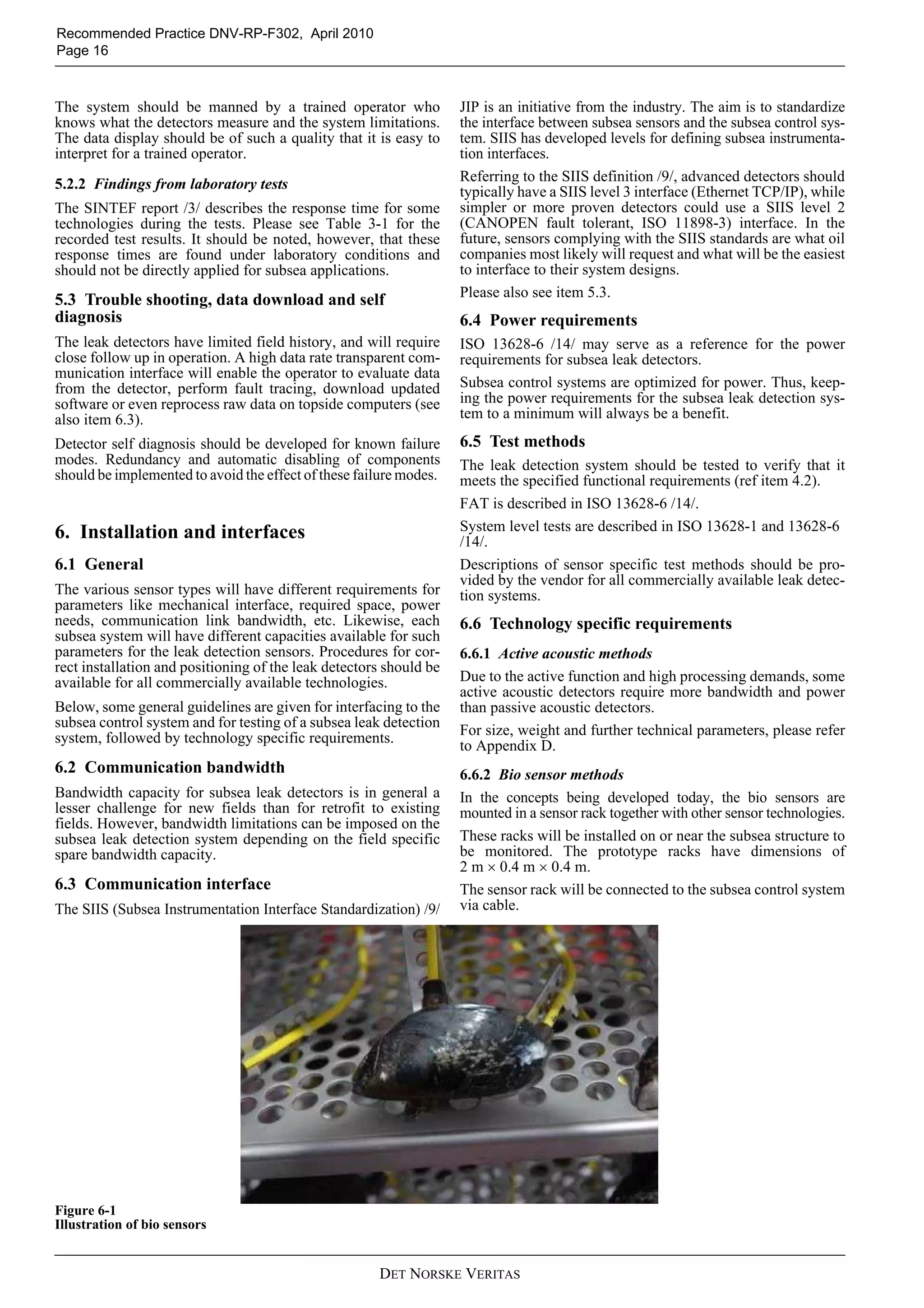
In the concepts being developed today, the bio sensors are
mounted in a sensor rack together with other sensor technologies.
These racks will be installed on or near the subsea structure to
be monitored. The prototype racks have dimensions of
2 m × 0.4 m × 0.4 m.
The sensor rack will be connected to the subsea control system
via cable.
Figure 6-1
Illustration of bio sensors
DET NORSKE VERITAS
Recommended Practice DNV-RP-F302, April 2010
Page 17
6.6.3 Capacitance methods
Capacitive sensors are point sensors dependant on a hydrocar-
bon collector.
Typical location of this type of sensor will be bolted on to a
collector, typically in the shape of a protection structure, above
an expected leak point. The protection structure is produced
out of either steel or composite material or a combination of
these. In order to collect hydrocarbons, the protection structure
needs to be leak tight. A vent hole to release natural seepage
may be required. Protection covers with several holes or in the
shape of grids will not provide the required hydrocarbon col-
lection.
Retrofit of capacitance sensors may be a challenge since many
template covers today are gratings and not solid covers that can
be used for hydrocarbon collection. Solid covers are in general
found on the NCS and in some British fields.
The electrical interface will be via cable.
For size, weight and further technical parameters, please refer
to Appendix D.
6.6.4 Methane sniffer methods
6.6.4.1 Semi-conductor methods
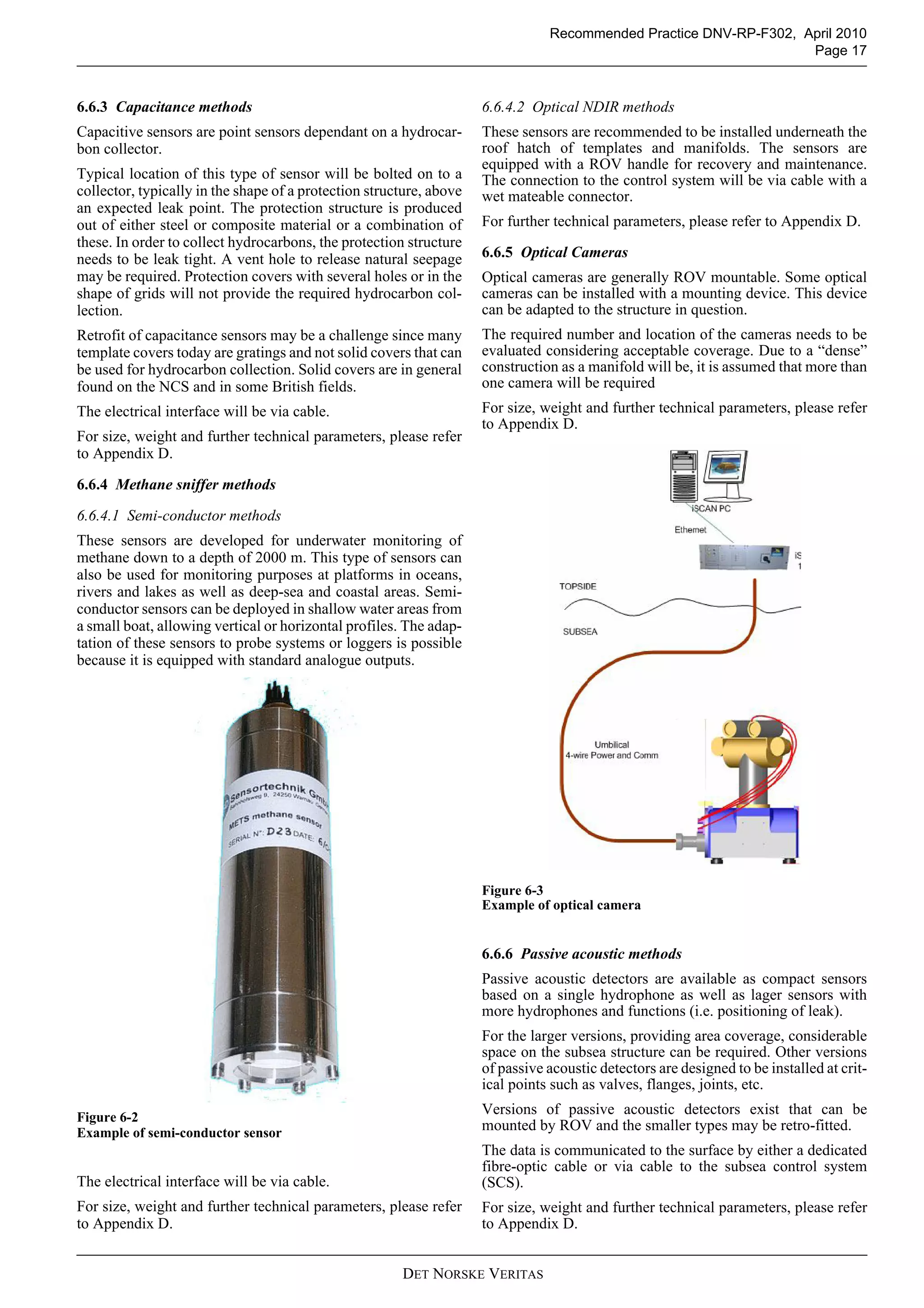
These sensors are developed for underwater monitoring of
methane down to a depth of 2000 m. This type of sensors can
also be used for monitoring purposes at platforms in oceans,
rivers and lakes as well as deep-sea and coastal areas. Semi-
conductor sensors can be deployed in shallow water areas from
a small boat, allowing vertical or horizontal profiles. The adap-
tation of these sensors to probe systems or loggers is possible
because it is equipped with standard analogue outputs.
Figure 6-2
Example of semi-conductor sensor
The electrical interface will be via cable.
For size, weight and further technical parameters, please refer
to Appendix D.
6.6.4.2 Optical NDIR methods
These sensors are recommended to be installed underneath the
roof hatch of templates and manifolds. The sensors are
equipped with a ROV handle for recovery and maintenance.
The connection to the control system will be via cable with a
wet mateable connector.
For further technical parameters, please refer to Appendix D.
6.6.5 Optical Cameras
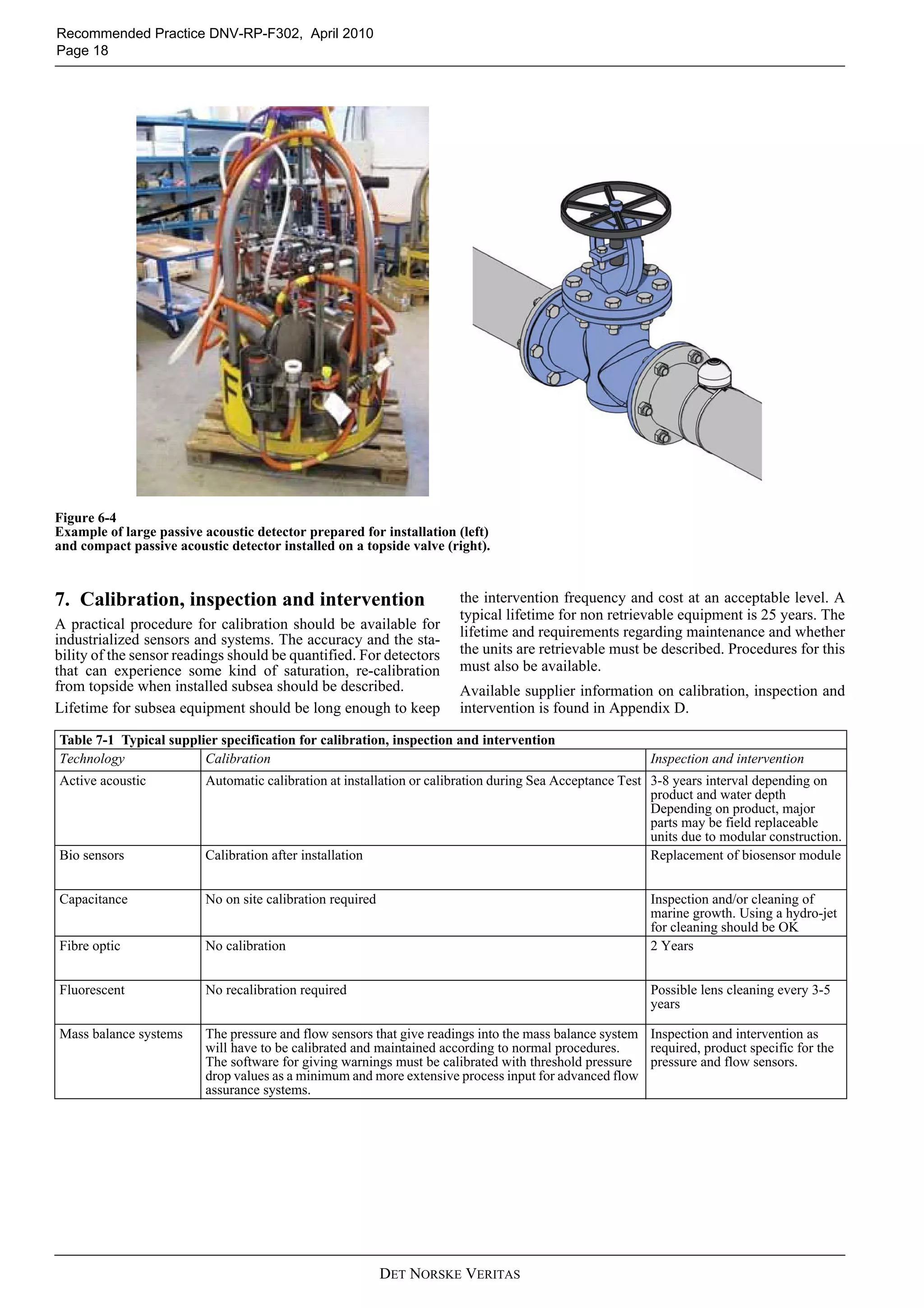
Optical cameras are generally ROV mountable. Some optical
cameras can be installed with a mounting device. This device
can be adapted to the structure in question.
The required number and location of the cameras needs to be
evaluated considering acceptable coverage. Due to a “dense”
construction as a manifold will be, it is assumed that more than
one camera will be required
For size, weight and further technical parameters, please refer
to Appendix D.
Figure 6-3
Example of optical camera
6.6.6 Passive acoustic methods
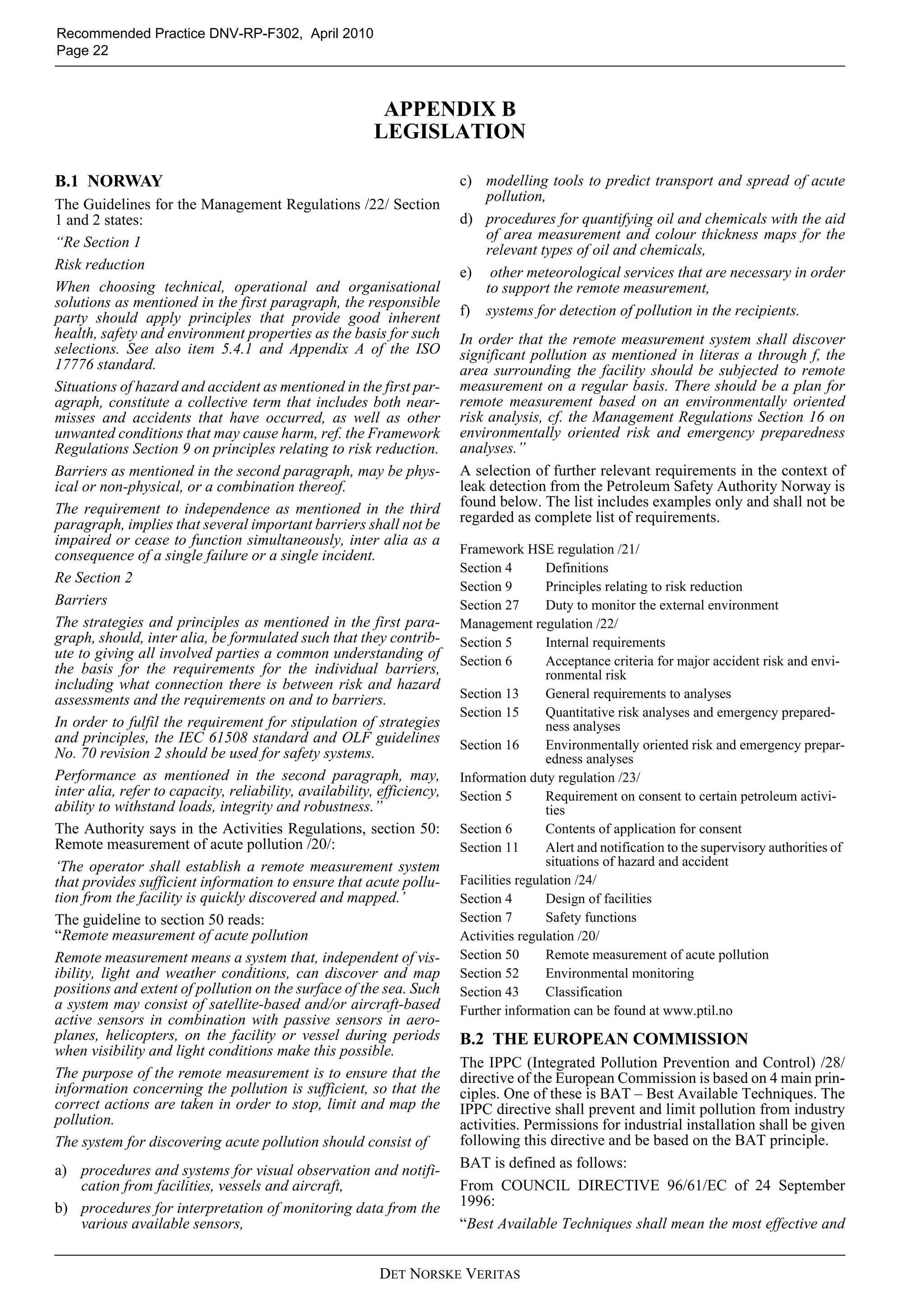
Passive acoustic detectors are available as compact sensors
based on a single hydrophone as well as lager sensors with
more hydrophones and functions (i.e. positioning of leak).
For the larger versions, providing area coverage, considerable
space on the subsea structure can be required. Other versions
of passive acoustic detectors are designed to be installed at crit-
ical points such as valves, flanges, joints, etc.
Versions of passive acoustic detectors exist that can be
mounted by ROV and the smaller types may be retro-fitted.
The data is communicated to the surface by either a dedicated
fibre-optic cable or via cable to the subsea control system
(SCS).
For size, weight and further technical parameters, please refer
to Appendix D.
DET NORSKE VERITAS
Recommended Practice DNV-RP-F302, April 2010
Page 18
Figure 6-4
Example of large passive acoustic detector prepared for installation (left)
and compact passive acoustic detector installed on a topside valve (right).
7. Calibration, inspection and intervention
A practical procedure for calibration should be available for
industrialized sensors and systems. The accuracy and the sta-
bility of the sensor readings should be quantified. For detectors
that can experience some kind of saturation, re-calibration
from topside when installed subsea should be described.
Lifetime for subsea equipment should be long enough to keep
the intervention frequency and cost at an acceptable level. A
typical lifetime for non retrievable equipment is 25 years. The
lifetime and requirements regarding maintenance and whether
the units are retrievable must be described. Procedures for this
must also be available.
Available supplier information on calibration, inspection and
intervention is found in Appendix D.
Table 7-1 Typical supplier specification for calibration, inspection and intervention
Technology Calibration Inspection and intervention
Active acoustic Automatic calibration at installation or calibration during Sea Acceptance Test 3-8 years interval depending on
product and water depth
Depending on product, major
parts may be field replaceable
units due to modular construction.
Bio sensors Calibration after installation Replacement of biosensor module
Capacitance No on site calibration required Inspection and/or cleaning of
marine growth. Using a hydro-jet
for cleaning should be OK
Fibre optic No calibration 2 Years
Fluorescent No recalibration required Possible lens cleaning every 3-5
years
Mass balance systems The pressure and flow sensors that give readings into the mass balance system
will have to be calibrated and maintained according to normal procedures.
The software for giving warnings must be calibrated with threshold pressure
drop values as a minimum and more extensive process input for advanced flow
assurance systems.
Inspection and intervention as
required, product specific for the
pressure and flow sensors.
DET NORSKE VERITAS
Recommended Practice DNV-RP-F302, April 2010
Page 19
8. Challenges for further research
and development
The following topics are mentioned by the industry as direc-
tions one would like to see the leak detection technologies to
take in the future:
8.1 Technology
Detection
The message from the industry today is that there is a need for
improvement of the performance of leak detection technolo-
gies. A leak detector should ideally be able to perform identi-
fication, localization, quantification and classification
(medium, harmful/harmless) of a leakage. Today, no technol-
ogy alone can perform all of these operations and it may even
be hard to accomplish by combining sensors.
One aspect that is mentioned in particular for sensor perform-
ance is unwanted warnings, often generated due to natural
seepage of hydrocarbons from the seabed. Handling of natural
seepage without giving unwanted warnings is a challenge for
further development of subsea leak detection.
To improve performance on detection of leakages it may be
beneficial to develop a better understanding of leakages and
their characteristics through e.g. modelling work.
Robustness
Any technology that is deployed subsea should work reliably
over a defined design life and be robust to impacts and loads
that are present in a subsea environment. The need for mainte-
nance and calibration should be well defined so that this can be
taken care of through planned operations. Potential failure
modes for the technology should be thoroughly identified so
that mitigations can be designed into the technology or be
planned. One such mitigation is built-in self diagnosis and
redundant functionality of a detector for known technical fail-
ure modes and automatic compensation for these failure
modes.
Interfaces
Basing the detector design on standardized interfaces, mechan-
ically and for communication and power, is enabling for easy
integration into the subsea production system. Technologies
that can offer this fulfil one important criterion for being pre-
ferred in the design phase.
For leak detection technologies with relatively high power
consumption, integration into the subsea control system power
supply can be a challenge. Finding solutions for lower power
consumption for technologies where this may be an issue will
be an important task for the future.
Qualification and Testing
Proper qualification is important for technologies being
deployed subsea. Qualifying a product should be done through
defining its functions and limits; assessing what functions are
not proven, identifying failure modes and carrying out activi-
ties that through objective evidence minimize failure modes
and prove functionality. General requirements are found in
ISO 13628 (/14/, /16/); however, the specific contents of the
qualification activities must be tailored for each technology.
As an example, deriving the qualification process may be done
according to DNV-RP-A203 Qualification procedures for new
technology /15/.
It is important for the operator to be able to verify the function
of the leak detectors after deployment. Methods for testing of
the detectors after installation subsea (> 200 m) should be
developed.
8.2 Operation of leak detection systems
The experience with practical application of leak detectors
from field testing and operation is limited today and restricted
to a few detection principles, ref. Appendix C. More system-
atic testing by the industry is needed to get a better understand-
ing of the effect, advantages and limitations of the different
technologies. More experience will also confirm and further
identify gaps in technologies and in the operation of leak detec-
tion systems.
Pilot projects can be a means for providing the interfaces
required for gathering real data. This would potentially allow
for improvements of the integration to power and communica-
tion, detector algorithms and to find better solutions to the
mechanical integration of leak detection technologies into sub-
sea systems. Pilot projects can also give a possibility for trying
combinations of different technologies into systems and give
input to procedures for management and operation of such sys-
tems and requirements for a surface user interface.
8.3 Requirements
The requirements for leak detection will be based on field spe-
cific conditions and will hence vary from field to field, see item
4.2. The operating companies should for each field define clear
and quantified requirements for a subsea leak detection sys-
tem. For each field the magnitude of the minimum detectable
leak should be defined. Further, the leaking medium to be
detected should also be defined.
8.4 Collection of statistical data
For future development of leak detection it is recommended to
conduct statistical analysis on leaks detected or not detected
and to compare the procedures used for reporting and collect-
ing leak data. Further analysis of other regional data and Nor-
wegian subsea leakages in the period since 2005, should also
be addressed.
To establish more experience data on subsea leak detectors, it
Methane sniffer; optical
NDIR method
No recalibration required Subsea interchange of complete
sensor for membrane service
required every 36 months Mem-
brane service every 36 months
Methane sniffer; semi
conductor
2 years 2 years
Optical camera No calibration Check moving parts and lens
cleaning every 2 years. Interven-
tion every 5 years
Passive acoustic No recalibration needed. No requirements for intervention
or maintenance
Table 7-1 Typical supplier specification for calibration, inspection and intervention (Continued)
Technology Calibration Inspection and intervention
DET NORSKE VERITAS
Recommended Practice DNV-RP-F302, April 2010
Page 20
is recommended that this information is reported through
OREDA (Offshore Reliability Data) /19/, preferably per tech-
nology type as described in this document.
Learning from history by collection and analysis of successes
and failures in operation of subsea leak detection system is rec-
ommended. Such an activity may reveal what parameters that
drive the successes and failures and enable better management
of these parameters in the future to increase the number of suc-
cesses within subsea leak detection.
9. References
/1/ ‘Subsea Leak Experience, Pipelines and Subsea Installations’, ExproSoft, Report no 1611104/1, 2005-01-25, Report for OLF’s leak
detection project phase I
/2/ ‘Subsea Leak Detection – Screening of Systems’, SINTEF Petroleumsforskning AS, Report no. 29.6215.00/01/05, 24 November 2006,
Report for OLF’s leak detection project phase II
/3/ ‘Subsea Leak Detection Phase 3 – Comparative experimental tests of different detection principles’, SINTEF Petroleumsforskning AS,
Report no. 31.6911.00/01/07, 25 September 2007, Report for OLF’s leak detection project phase III
/4/ ‘Technology update on subsea leak detection systems - Input to Subsea Leak Detection Phase 4’ SINTEF report no. 31.6965.00/01/09,
08.05.2009
/5/ Results from industry questionnaire by DNV, March 2009, confidential. Respondents involve regulatory bodies, operators, subsea sys-
tem suppliers and subsea leak detector suppliers. Please note that the data collected by this questionnaire cannot be viewed as scientific
data.
/6/ www.ptil.no, Petroleum Safety Authority Norway web page
/7/ ‘Recommended procedure for evaluating remote measuring initiatives’, OLF guideline no.100, 15.09.04
/8/ ‘Bruk av BAT (Beste Tilgjengelige Teknikker) -prinsippet
for miljøsikkerhet (Use of the BAT (Best Available Techniques) principle for environmental safety)’, SINTEF report no. SINTEF A4531,
15.02.2008
/9/ http://www.siis-jip.com/, web site for the Joint Industry Project for Subsea Instrumentation Interface Standardisation
/10/ ‘Technology strategy for the Arctic, Extract from the OG21 Strategy’, OG21 document September 2006, http://www.og21.org/filestore/
Strategy_reports/StrategyforArctic.doc
/11/ ‘Subsea leak detection. Regulatory and environmental aspects’, Trond Sundby, PSA Norway
/12/ OLF seminar on Subsea Leak Detection, Oslo, June 8th and 9th 2009
/13/ DNV-RP-F116, ‘Guideline on integrity management of submarine pipeline systems’, 2009
/14/ ISO 13628-6:2006(E) ‘Petroleum and natural gas industries – Design and operation of subsea production systems- Part 6: Subsea con-
trol systems’, second edition, 2006-05-15
/15/ DNV-RP-A203, ‘Qualification procedures for new technology’, September 2001
/16/ ISO 13628-1:2005(E) ‘Petroleum and natural gas industries – Design and operation of subsea production systems- Part 1: General
requirements and recommendations’, second edition, 2005-11-15
/17/ ISO 11898 / IEC 61162-400:2001(E) ‘Maritime navigation and radio communication equipment and systems - Digital interfaces - Part
400: Multiple talkers and multiple listeners - Ship systems interconnection - Introduction and general principles’, first edition 2001-11
/18/ ISO 10012 ‘Measurement Management Systems – Requirements for Measurement Processes and measuring equipment’, first edition,
2003-04-15
/19/ www.oreda.com, Offshore Reliability Data project web page
/20/ ‘Regulations relating to conduct of activities in the petroleum activities (the activities regulations)’, Petroleum Safety Authority Norway
(PSA), 3 September 2001, last amended 21 August 2008
/21/ ‘Regulations relating to health, environment and safety in the petroleum activities (the framework regulations)’, Petroleum Safety
Authority Norway (PSA), 31 august 2001, last amended 6 June 2008
/22/ ‘Regulations relating to management in the petroleum activities (the management regulations)’, Petroleum Safety Authority Norway
(PSA), 3 September 2001, last amended 21 December 2004.
/23/ ‘Regulations relating to material and information in the petroleum activities (the information duty regulations)’, Petroleum Safety
Authority Norway (PSA), 3 September 2001, last amended 12 February 2007
/24/ ‘Regulations relating to design and outfitting of facilities etc. in the petroleum activities
(the facilities regulations)’, Petroleum Safety Authority Norway (PSA), 3 September 2001, last amended 20 December 2007
/25/ 18 AAC 75 ‘Oil and other hazardous substances pollution control’, revised as of October 9, 2008, Department Of Environmental Con-
servation, Alaska
/26/ DOT 49 CFR Part 195 ‘Transportation of hazardous liquids by pipeline’, October 1st 2008, Pipeline and Hazardous Materials Safety
Administration
/27/ Statutory Instrument 1996 No. 825, ‘The Pipelines Safety Regulations’, 1996, The Health and Safety Executive (HSE), United Kingdom
/28/ Council Directive 96/61/EC of 24 September 1996 ‘Concerning Integrated Pollution Prevention And Control’, The Council of The
European Union
DET NORSKE VERITAS
Recommended Practice DNV-RP-F302, April 2010
Page 21
APPENDIX A
SUGGESTED FUNCTIONAL REQUIREMENTS
FOR SUBSEA LEAK DETECTION SYSTEMS
The list below covers parameters that may be relevant for the
performance of a leak detection system for a particular subsea
installation. This list may be used when identifying the per-
formance requirements of such a system.
Following from the performance requirements, a leak detec-
tion system is designed after evaluating what technologies
must be chosen and integrated and how the total system must
be operated to meet these requirements.
Note that it is not anticipated that a single technology / princi-
ple would be able to detect all of the possible leaks in all pos-
sible environments.
Functional requirements for subsea leak detection systems
may include but not be restricted to:
1) Media to be detected:
— multiphase flow (oil/gas/water)
— natural Gas
— other media that it could be of value to detect:
— produced water
— injection water
— CO2.
— production chemicals including:
— methanol / MEG
— hydraulic fluid – oil based
— hydraulic fluid - water based
— lube oil
— fluorescent dye injected for leak detection.
2) Process operating conditions of the media:
— process pressure
— process temperature.
3) Facilities to be monitored to include:
— subsea manifolds
— subsea PLEMs, PLETs and riser bases
— subsea Xmas trees
— subsea processing plants.
4) Environment
— water depth
— sea temperature
— all year or seasonal ice coverage on water surface.
— for dispersion of leaks:
— salinity
— sea current.
5) Leak quantification / identification
— detection level / concentration
— sensing with some degree of spatial coverage and leakage
localization
— independent principles or technologies for confirmation /
verification of leakages.
6) Monitoring frequency
— continuous
— permanent/temporary installation.
7) Data availability
— real time communication to host
— intermittent download.
8) Design
— high focus on system reliability and remote fault diagnosis
capability in design
— inspection and maintenance requirements to be minimized
by careful material selection and redundancy in design
— critical components to be designed as modules and be eas-
ily retrievable to surface by remote (diver less) systems.
DET NORSKE VERITAS
Recommended Practice DNV-RP-F302, April 2010
Page 22
APPENDIX B
LEGISLATION
B.1 NORWAY
The Guidelines for the Management Regulations /22/ Section
1 and 2 states:
“Re Section 1
Risk reduction
When choosing technical, operational and organisational
solutions as mentioned in the first paragraph, the responsible
party should apply principles that provide good inherent
health, safety and environment properties as the basis for such
selections. See also item 5.4.1 and Appendix A of the ISO
17776 standard.
Situations of hazard and accident as mentioned in the first par-
agraph, constitute a collective term that includes both near-
misses and accidents that have occurred, as well as other
unwanted conditions that may cause harm, ref. the Framework
Regulations Section 9 on principles relating to risk reduction.
Barriers as mentioned in the second paragraph, may be phys-
ical or non-physical, or a combination thereof.
The requirement to independence as mentioned in the third
paragraph, implies that several important barriers shall not be
impaired or cease to function simultaneously, inter alia as a
consequence of a single failure or a single incident.
Re Section 2
Barriers
The strategies and principles as mentioned in the first para-
graph, should, inter alia, be formulated such that they contrib-
ute to giving all involved parties a common understanding of
the basis for the requirements for the individual barriers,
including what connection there is between risk and hazard
assessments and the requirements on and to barriers.
In order to fulfil the requirement for stipulation of strategies
and principles, the IEC 61508 standard and OLF guidelines
No. 70 revision 2 should be used for safety systems.
Performance as mentioned in the second paragraph, may,
inter alia, refer to capacity, reliability, availability, efficiency,
ability to withstand loads, integrity and robustness.”
The Authority says in the Activities Regulations, section 50:
Remote measurement of acute pollution /20/:
‘The operator shall establish a remote measurement system
that provides sufficient information to ensure that acute pollu-
tion from the facility is quickly discovered and mapped.’
The guideline to section 50 reads:
“Remote measurement of acute pollution
Remote measurement means a system that, independent of vis-
ibility, light and weather conditions, can discover and map
positions and extent of pollution on the surface of the sea. Such
a system may consist of satellite-based and/or aircraft-based
active sensors in combination with passive sensors in aero-
planes, helicopters, on the facility or vessel during periods
when visibility and light conditions make this possible.
The purpose of the remote measurement is to ensure that the
information concerning the pollution is sufficient, so that the
correct actions are taken in order to stop, limit and map the
pollution.
The system for discovering acute pollution should consist of
a) procedures and systems for visual observation and notifi-
cation from facilities, vessels and aircraft,
b) procedures for interpretation of monitoring data from the
various available sensors,
c) modelling tools to predict transport and spread of acute
pollution,
d) procedures for quantifying oil and chemicals with the aid
of area measurement and colour thickness maps for the
relevant types of oil and chemicals,
e) other meteorological services that are necessary in order
to support the remote measurement,
f) systems for detection of pollution in the recipients.
In order that the remote measurement system shall discover
significant pollution as mentioned in literas a through f, the
area surrounding the facility should be subjected to remote
measurement on a regular basis. There should be a plan for
remote measurement based on an environmentally oriented
risk analysis, cf. the Management Regulations Section 16 on
environmentally oriented risk and emergency preparedness
analyses.”
A selection of further relevant requirements in the context of
leak detection from the Petroleum Safety Authority Norway is
found below. The list includes examples only and shall not be
regarded as complete list of requirements.
B.2 THE EUROPEAN COMMISSION
The IPPC (Integrated Pollution Prevention and Control) /28/
directive of the European Commission is based on 4 main prin-
ciples. One of these is BAT – Best Available Techniques. The
IPPC directive shall prevent and limit pollution from industry
activities. Permissions for industrial installation shall be given
following this directive and be based on the BAT principle.
BAT is defined as follows:
From COUNCIL DIRECTIVE 96/61/EC of 24 September
1996:
“Best Available Techniques shall mean the most effective and
Framework HSE regulation /21/
Section 4 Definitions
Section 9 Principles relating to risk reduction
Section 27 Duty to monitor the external environment
Management regulation /22/
Section 5 Internal requirements
Section 6 Acceptance criteria for major accident risk and envi-
ronmental risk
Section 13 General requirements to analyses
Section 15 Quantitative risk analyses and emergency prepared-
ness analyses
Section 16 Environmentally oriented risk and emergency prepar-
edness analyses
Information duty regulation /23/
Section 5 Requirement on consent to certain petroleum activi-
ties
Section 6 Contents of application for consent
Section 11 Alert and notification to the supervisory authorities of
situations of hazard and accident
Facilities regulation /24/
Section 4 Design of facilities
Section 7 Safety functions
Activities regulation /20/
Section 50 Remote measurement of acute pollution
Section 52 Environmental monitoring
Section 43 Classification
Further information can be found at www.ptil.no
DET NORSKE VERITAS
Recommended Practice DNV-RP-F302, April 2010
Page 23
advanced stage in the development of activities and their meth-
ods of operation which indicate the practical suitability of par-
ticular techniques for providing in principle the basis for
emission limit values designed to prevent and, where that is not
practicable, generally to reduce emissions and the impact on
the environment as a whole:
- "techniques" shall include both the technology used and the
way in which the installation is designed, built, maintained,
operated and decommissioned,
- "available" techniques shall mean those developed on a scale
which allows implementation in the relevant industrial sector,
under economically and technically viable conditions, taking
into consideration the costs and advantages, whether or not
the techniques are used or produced inside the Member State
in question, as long as they are reasonably accessible to the
operator,
- "best" shall mean most effective in achieving a high general
level of protection of the environment as a whole.”
The BAT principle is also referenced in PSA Norway’s Frame-
work regulation /21/, section 9, paragraph 2:
“In effectuating risk reduction the party responsible shall
choose the technical, operational or organisational solutions
which according to an individual as well as an overall evalua-
tion of the potential harm and present and future use offer the
best results, provided the associated costs are not significantly
disproportionate to the risk reduction achieved.”
From the guideline to section 9:
“The second paragraph expresses the principle of best availa-
ble technology (the BAT principle). This entails that the party
responsible for the petroleum activities must base its planning
and operation on the technology and methods that, based on
an overall assessment, produce the best and most effective
results.”
More information can be found at
http://eippcb.jrc.es/
http://ec.europa.eu/environment/air/pollutants/stationary/
ippc/index.htm
B.3 THE UNITED KINGDOM
The Health and Safety Executive (HSE) in the United King-
dom have the Pipelines Safety Regulations [PSR] (SI 1996/
825) /27/ as the key regulations concerning pipeline safety and
integrity. There are at present no specific regulations concern-
ing subsea production systems. The regulations came into
force in 1996, replacing earlier prescriptive legislation on the
management of pipeline safety with a more integrated, goal-
setting, risk based approach encompassing both onshore and
offshore pipelines. PSR does not cover the environmental
aspects of accidents arising from pipelines but compliance
with the regulations will help to ensure that a pipeline is
designed, constructed and operated safely, provide a means of
securing pipeline integrity and thereby will contribute by
reducing risks to the environment.
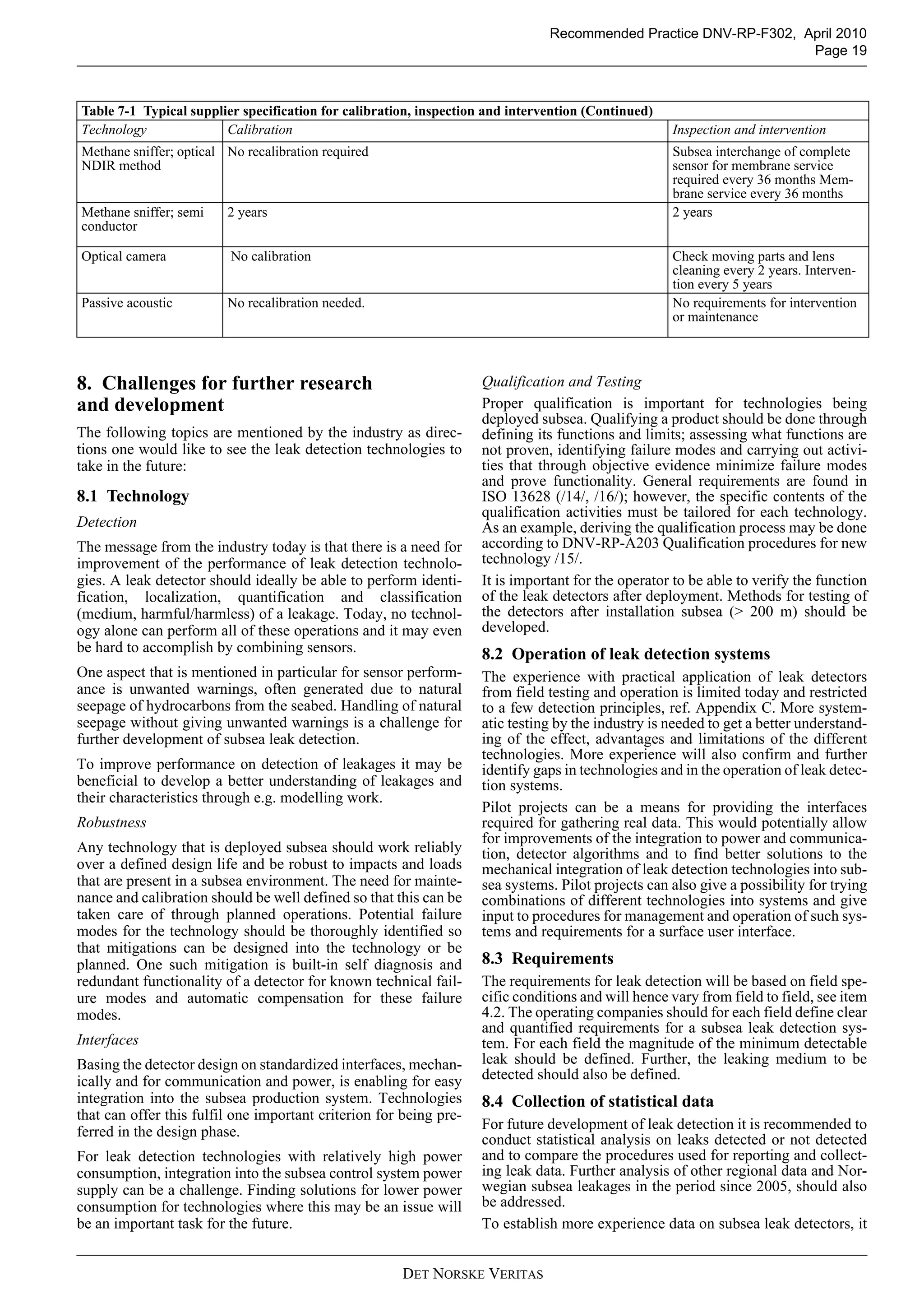
More specifically in relation to pipeline leak detection sys-
tems which are covered (but not explicitly) by Reg. 6 of PSR -
Safety systems. The regulation states:
“The operator shall ensure that no fluid is conveyed in a pipe-
line unless it has been provided with such safety systems as are
necessary for securing that, so far as is reasonably practica-
ble, persons are protected from risk to their health & safety.”
However, the associated PSR guidance L82 booklet (ISBN 0
7176 1182 5) states:
“36 Safety systems also include leak detection systems where
they are provided to secure the safe operation of the pipeline.
The method chosen for leak detection should be appropriate
for the fluid conveyed and operating conditions.”
HSE Information relating to Pipeline safety and integrity can
be found on the HSE web http://www.hse.gov.uk
B.4 THE UNITED STATES
Pipeline and Hazardous Materials Safety Administration, DOT
Part 195 - Transportation Of Hazardous Liquids By Pipeline
/26/
§ 195.134 CPM leak detection.
“This section applies to each hazardous liquid pipeline trans-
porting liquid in single phase (without gas in the liquid). On
such systems, each new computational pipeline monitoring
(CPM) leak detection system and each replaced component of
an existing CPM system must comply with section 4.2 of API
1130 in its design and with any other design criteria addressed
in API 1130 for components of the CPM leak detection sys-
tem.”
§ 195.452 Pipeline integrity management in high consequence
areas.
“Leak detection. An operator must have a means to detect
leaks on its pipeline system. An operator must evaluate the
capability of its leak detection means and modify, as neces-
sary, to protect the high consequence area. An operator’s eval-
uation must, at least, consider, the following factors — length
and size of the pipeline, type of product carried, the pipeline’s
proximity to the high consequence area, the swiftness of leak
detection, location of nearest response personnel, leak history,
and risk assessment results.”
Alaska Department Of Environmental Conservation. 18 AAC
75
“Oil and Other Hazardous Substances Pollution Control”,
Revised as of October 9, 2008 /25/:
18 AAC 75.055 Leak detection, monitoring, and operating
requirements for crude oil transmission pipelines.
“(a) A crude oil transmission pipeline must be equipped with a
leak detection system capable of promptly detecting a leak,
including
(1) if technically feasible, the continuous capability to detect a
daily discharge
equal to not more than one percent of daily throughput;
(2) flow verification through an accounting method, at least
once every 24 hours;
and Register 188, January 2009 ENVIRONMENTAL CON-
SERVATION 12
(3) for a remote pipeline not otherwise directly accessible,
weekly aerial surveillance, unless precluded by safety or
weather conditions.
(b) The owner or operator of a crude oil transmission pipeline
shall ensure that the incoming flow of oil can be completely
stopped within one hour after detection of a discharge.
(c) If aboveground oil storage tanks are present at the crude
oil transmission pipeline facility, the owner or operator shall
meet the applicable requirements of 18 AAC 75.065, 18 AAC
75.066 and 18 AAC 75.075.
(d) For facility oil piping connected to or associated with the
main crude oil transmission
pipeline, the owner or operator shall meet the requirements of
18 AAC 75.080. (Eff. 5/14/92,
Register 122; am 12/30/2006, Register 180)
18 AAC 75.425. Oil discharge prevention and contingency
plan contents.
(a) An oil discharge prevention and contingency plan submit-
ted for approval under 18 AAC 75.400 - 18 AAC 75.495 must
be in a form that is usable as a working plan for oil discharge
prevention, control, containment, cleanup, and disposal. A
DET NORSKE VERITAS
Recommended Practice DNV-RP-F302, April 2010
Page 24
plan must contain enough information, analyses, supporting
data, and documentation to demonstrate the plan holder's abil-
ity to meet the requirements of AS 46.04.030 and 18 AAC
75.400 - 18 AAC 75.495.
(b) The plan for a facility comprised of multiple operations as
described at 18 AAC 75.442, must describe, for each category
of operation at the facility, the appropriate response measures
to meet the applicable portion of the response planning stand-
ard.
(c) The submitted plan must be accompanied by a cover page
(…)
(d) The plan must (…)
(e) The information in the plan must include
(1) Part 1 - Response Action Plan: (…)
(2) Part 2 - Prevention Plan: The prevention plan must include
a detailed description of all oil discharge prevention measures
and policies employed at the facility, vessel, or operation, with
reference to the specific oil discharge risks involved. The pre-
vention plan
must describe how the applicant meets all the applicable
requirements of 18 AAC 75.005-
18 AAC 75.085. The prevention plan may be submitted as a
separate volume, and must include, Register 188, January
2009 ENVIRONMENTAL CONSERVATION 119 at a mini-
mum, the following information:
(A) discharge prevention programs - a description and sched-
ule of regular oil discharge prevention, inspection, and main-
tenance programs in place at the facility or operation,
including
(i) oil discharge prevention training programs required by 18
AAC 75.020(a);
(ii) substance abuse and medical monitoring programs
required by 18 AAC 75.007(e);
(iii) security and surveillance programs required by 18 AAC
75.007(f).
(B) discharge history -a history of all known oil discharges
greater than 55 gallons that have occurred at the facility (…)
(C) potential discharge analysis - an analysis of potential oil
discharges, including size, frequency, cause, duration, and
location, and a description of actions taken to prevent a poten-
tial discharge;
(D) specific conditions - a description of
(i) any conditions specific to the facility or operation that
might increase the risk of a discharge, including physical or
navigation hazards, traffic patterns, and other site-specific
factors; and
(ii) any measures that have been taken to reduce the risk of a
discharge attributable to these conditions, including a sum-
mary of operating procedures designed to mitigate the risk of
a discharge;
(E) discharge detection - a description of the existing and pro-
posed means of discharge detection, including surveillance
schedules, leak detection, observation wells, monitoring sys-
tems, and spill-detection instrumentation; if electronic or
mechanical instrumentation is employed, detailed specifica-
tions, including threshold Register 188, January 2009 ENVI-
RONMENTAL CONSERVATION 120 detection, sensitivities,
and limitations of equipment must be provided;
(F) waivers - (…)
(3) Part 3 - Supplemental Information: (…)
(4) Part 4 -- Best Available Technology Review: Unless appli-
cation of a state requirement would be pre-empted by federal
law, the plan must provide for the use of best available tech-
nology consistent with the applicable criteria in 18 AAC
75.445(k). In addition, the plan must
(A) identify technologies applicable to the applicant's opera-
tion that are not subject to response planning or performance
standards specified in 18 AAC 75.445(k)(1) and (2); these
technologies include, at a minimum,
(i) for all contingency plans, communications described under
(1)(D) of this subsection; source control procedures to stop the
discharge at its source and prevent its further spread
described under (1)(F)(i) of this subsection; trajectory analy-
ses and forecasts described under (1)(F)(iv) of this subsection;
and wildlife capture, treatment, and release procedures and
methods described under (1)(F)(xi) of this subsection;
(ii) for a terminal, a crude oil transmission pipeline, or an
exploration and production contingency plan: cathodic pro-
tection or another approved corrosion control system if
required by 18 AAC 75.065(h)(2), (i)(3), or (j)(3); a leak detec-
tion system for each tank if required by 18 AAC 75.065(i)(4) or
(j)(4);
any other prevention or control system approved by the
department under 18 AAC 75.065(h)(1)(D); a means of imme-
diately determining the liquid level of bulk storage tanks as
specified in 18 AAC 75.065(k)(3) and (4) or in 18 AAC
75.066(g)(1)(C) and (D); maintenance practices for buried
metallic piping containing oil as required by 18 AAC
75.080(b); protective coating and cathodic protection if
required by 18 AAC 75.080(d) (k)(1),(l) or (m); and corrosion
surveys required by 18 AAC 75.080(k)(2); Register 188, Janu-
ary 2009 ENVIRONMENTAL CONSERVATION125
(iii) for a tank vessel contingency plan: (…)
(iv) for a crude oil transmission pipeline contingency plan:
leak detection, monitoring, and operating requirements for
crude oil pipelines that include prompt leak detection as
required by 18 AAC 75.055(a);
(v) for a barge contingency plan: (…)
(vi) for a railroad tank car contingency plan (…)
(B) for each applicable technology under (A) of this para-
graph, identify all available technologies and include a written
analysis of each technology, using the applicable criteria in 18
AAC 75.445(k)(3); and
(C) include a written justification that the technology proposed
to be used is the best available for the applicant's operation.”
Recommended Practice DNV-RP-F302, April 2010
Page 25
DET NORSKE VERITAS
APPENDIXC
SUBSEALEAKDETECTIONINSTALLEDBASE
TableC-1SubseaLeakDetectors-InstalledBase
(Thedatabelowiscollectedfromthefieldoperators.Thedataisprovidedasinformationonly,noqualitycheckofthedatahasbeenperformed)
FieldOperatorLeakdetec-
tiontechnol-
ogy
#sensors
delivered
Installed
year
Installed
on
structure
Howisthedata
fromthetechnol-
ogymanaged/
integratedinyour
operation?
Detectors
stillinuse?
Leaksidentified
bythetechnol-
ogy?Please
describe
Haveyouhad
leaksthatthe
technologydid
notdetect?
Pleasedescribe
Falsealarms?
Otherfailure
modes?Please
describe
Particular
challenges?
Comments,
experiences
AlveStatoilCapacitance12009XMTControlsystemyesNoNoyessubsea
testing
DraugenShellCapacitance31993XMTyesyestesting*ventholesonpro-
tectionstructure
*duringcommis-
sioningtheydidn't
givepositivesignal
duringtesting
(hydraulicfluid
beinginjectedinthe
vicinity)
*theywerethen
pulledandtestedin
ahyperbariccham-
ber,wherethey
worked
*nofirmconclu-
sion,
GullfaksStatoilCapacitance13
GullfaksStatoilPassive
acoustic
(small)
HeidrunNFStatoilCapacitanceAll12
wells
2001FCMasalarmiSASAllinuse
buttwoof
themgives
alarmscon-
tinously
duetoshal-
lowgas.
NoNoManyfalse
alarmsdueto
shallowgasin
area
Heidrun
Satelite
StatoilOpticalcam-
era
2009Bracket
onGuide-
post
videoonweb
browser
Presently
outoforder
NoNoPresentlyoutof
orderduetoeart
fault.Camerais
retrieved,butwill
beinstalledafter
refurbishment.
Recommended Practice DNV-RP-F302, April 2010
Page 26
DET NORSKE VERITAS
Heidrun
Satelite
StatoilCapacitance1well2007FCMasalarmiSASYesNoNoManyfalse
alarmsdueto
shallowgasin
area
KristinStatoilOpticalcam-
era
KristinStatoilCapacitance122005XTroofviaSASsystemto
controlroom
yes(12)noYes,therewas
leakagewhich
wasdetectedby
ROV
nono
LokeStatoilCapacitance11993XTalarminHKR1No
MikkelStatoilCapacitance621998-
2009
HXTalarmatCCRall1to2several,thesen-
sorwasnot
locatedwhere
leakoccured
Lotsof"false"
alarm.Difficulrto
establishcorrect
tresholdlevelfor
alarm.Shallow
gasmigthsetoff
alarmintention-
ally.
Sensor
mustnotat
anytime
givefalse
alarm.Only
fewfalse
alarmswill
makeoper-
atorhesi-
tantto
repondtoit.
Reliability/
fidelity/
robustnesis
keawords.
Thedataaregiven
forMikkel,Ytter-
grytaandÅsgard
together.Byno
measntrytoimple-
menttechnology
whichisunquali-
fiedandnottested
underrealisticcon-
dition.Noonewill
everinstallleak
detectortechnol-
ogywhichinstead
ofincreasingthe
safety
MorvinStatoilCapacitance3-4Planned
installed
XMTNA*Production
start08-
2010
NA*NA*NA*NA*NA*
NorneStatoilCapacitance201997-
2000
HXTroofControlsystemyes,mos-
telyall
NoNoFalsealarmsOnlyHXT
covered
Hasstartedaprojcet
totrytotestthe
detectorsbypump-
inggas/aironeach.
Notcompletetdyet.
NorneKCapacitance32006FCM
(HXT
roof)
ControlsystemyesNoNo
TableC-1SubseaLeakDetectors-InstalledBase
(Thedatabelowiscollectedfromthefieldoperators.Thedataisprovidedasinformationonly,noqualitycheckofthedatahasbeenperformed)
FieldOperatorLeakdetec-
tiontechnol-
ogy
#sensors
delivered
Installed
year
Installed
on
structure
Howisthedata
fromthetechnol-
ogymanaged/
integratedinyour
operation?
Detectors
stillinuse?
Leaksidentified
bythetechnol-
ogy?Please
describe
Haveyouhad
leaksthatthe
technologydid
notdetect?
Pleasedescribe
Falsealarms?
Otherfailure
modes?Please
describe
Particular
challenges?
Comments,
experiences
Recommended Practice DNV-RP-F302, April 2010
Page 27
DET NORSKE VERITAS
Ormen
Lange
ShellPassive
acoustic
3Ateach
template
2outof3units
returnedtoshorefor
replacamentof
hydrophonesdueto
contructionerror.
Thethirdunitiscol-
lectingdatabutwill
alsoneedtogetthe
hydrophones
replaced.
Rimfaks,
Skinfaks
StatoilCapacitance12
UrdStatoilCapacitance82005-
2006
XMTControlsystemyesNoNoyessubseatest-
ing
UMCNorth
Cormorant
ShellCapacitance
SigynStatoilCapacitance32002XTalarminHKR3No
SkarvBPNorgeCapacitanceXMTand
manifold
Sleipner
VestSVAN
StatoilCapacitance42004XTalarminHKR4No
SleipnerØst
SLØ
StatoilCapacitance21993XTalarminHKR2No
SnorreUPAStatoilCapacitance4First
installa-
tion1992.
Lastistal-
lation
after
repair
2008
Yes,2
detectors
above
each
otherin
eachend
ofthe
protec-
tionroof
Alarmonopera-
tionscreen.Sig-
nalthroughthe
subseacontrole
system
4Thedetectorsare
placeupunder
thecollection
roofandwehave
detectedcollec-
tionofnon-water
No,buthardto
sayforsure
Ithasbeenvery
difficulttomake
thesedetector
workproperly.So
wedon'tknowif
itisainstrument
failureornot
Thechal-
langehas
beento
makethis
detectors
workprop-
erly.There
isnopossi-
bilitytosee
ifthereis
oilorgas
collected
underthe
roofby
ROV.
TheSnorreSPSis
coveredbyaroof
thatcancollectas
muchas40m3of
spilledhydraulicoil,
gasand/orhydro-
carb.Itispossible
toemtytheroofto
theSnorrePlatt-
formbyuseofthe
3"serviselines.Itis
notpossibletocon-
firmthattheroofis
empt
TableC-1SubseaLeakDetectors-InstalledBase
(Thedatabelowiscollectedfromthefieldoperators.Thedataisprovidedasinformationonly,noqualitycheckofthedatahasbeenperformed)
FieldOperatorLeakdetec-
tiontechnol-
ogy
#sensors
delivered
Installed
year
Installed
on
structure
Howisthedata
fromthetechnol-
ogymanaged/
integratedinyour
operation?
Detectors
stillinuse?
Leaksidentified
bythetechnol-
ogy?Please
describe
Haveyouhad
leaksthatthe
technologydid
notdetect?
Pleasedescribe
Falsealarms?
Otherfailure
modes?Please
describe
Particular
challenges?
Comments,
experiences
Recommended Practice DNV-RP-F302, April 2010
Page 28
DET NORSKE VERITAS
SnøhvitStatoilCapacitance102005XTAlarmandvalue
incontrolroom
(PCDA)
8stillin
use.2outof
function
duetolost
readings,
refM2
40876817
andM2
40705054.
1temporaryleak
detected.Cause
ofleaknotcon-
cluded,butfrom
theproduction
valveblock,
probablystem
leakinvalve.
RefM2
40913922.
1gasleakfrom
XT/CBMmulti-
borehubnot
detectedbyHC
detector.Ref
Synergi
1001496.Leak
estimatedto0.3
kg/sfor5to51
days,ieatotalof
16-1277tonnes
ofgas.
Nofalsealarms
besidesthe2sen-
sorsoutoffunc-
tion.
Notveryreliable
andnoredundancy
(20%outoffunc-
tionafter4years).
Notabletodetect
leakagesfrom
chokebridgemod-
uleormanifold.
SRIStatoilCapacitance6
Statfjord
Nord
StatoilCapacitance81995XMTAlarmYesNoNoYes
Statfjord
Øst
StatoilCapacitance81995XMTAlarmYesNoNoYes
SygnaStatoilCapacitance32000XMT
(FCM)
AlarmYesNoNoYes
Tampen
Link
StatoilPassive
acoustic
5
TOGI
TrollOse-
bergGas
Injection
StatoilActiveacous-
tic
51989/90XTIntegratedinthe
controlsystem.
SDwhenleak.
0.The
Transpond-
erswere
installedon
a5meter
highpole.
Thepoles
werebro-
kenoverthe
years
causedby
trawling.
No.Therehave
beennoleakson
Togi.Butthe
systemwas
testedyearlyby
releasinggasto
thewater.
NoTherehavebeen
falsealarms
causedbybig
shoaloffish.One
ortwotimes.
NoIthasbeenarelia-
bleandgooddetec-
tionsystem.
(SIMRAD).Togi
hasnotproduced
since2002.Sono
efforthasbeen
madetofixthe
poles.Thetechnol-
ogyinstalledon
Togiisnowoutof
date.
TableC-1SubseaLeakDetectors-InstalledBase
(Thedatabelowiscollectedfromthefieldoperators.Thedataisprovidedasinformationonly,noqualitycheckofthedatahasbeenperformed)
FieldOperatorLeakdetec-
tiontechnol-
ogy
#sensors
delivered
Installed
year
Installed
on
structure
Howisthedata
fromthetechnol-
ogymanaged/
integratedinyour
operation?
Detectors
stillinuse?
Leaksidentified
bythetechnol-
ogy?Please
describe
Haveyouhad
leaksthatthe
technologydid
notdetect?
Pleasedescribe
Falsealarms?
Otherfailure
modes?Please
describe
Particular
challenges?
Comments,
experiences
Recommended Practice DNV-RP-F302, April 2010
Page 29
DET NORSKE VERITAS
TordisStatoilCapacitance1994Tordisfieldwas
installedwith
hydrocarbon
detectors,but
thesewereaban-
doneddueto
manyfalse
alarms.
TordisIORStatoilPassive
acoustic
32007SSBI
(subsea
separator)
Stillnotworking,
modulesonshore
fortestingverifi-
cation
No,willbe
re-installed
whenready.
NoNoNoDefining
thediffer-
entleak
sectors.
Newinstallationsat
T&Vfieldswith
acousticsensors
seemtoshowsome
progress,butstillin
theirinfancy.Most
likelythewayfor-
ward.
TrollPilotStatoilPassive
acoustic
notper-
manent
installa-
tion
TyrihansStatoilCapacitance42008-
2009
XT-RoofDatafromthe
sensoraresentto
controlroom.
Warningsshown
incontrolroom
42leaksduring
start-upofwells
duetoshallow
gas.
NoneShallowgasNoneOnly4of12wells
inproduktion
VegaStatoilPassive
acoustic
0Planned
installed
NA*NA*NA*NA*NA*NA*NA*NA*
VigdisStatoilPassive
acoustic
12008manifoldSectoralarms
backtoCRif
noisesexperi-
enced
yesNoNoYes.Duringves-
seloperationsat
otherlocationsat
thefield.Tuning
ofthesystem
wheninstalled
importantfor
buildingconfi-
denceinthesys-
tem.Falsealarms
lowertheconfi-
denceforthesys-
tem.
Defining
thediffer-
entleak
sectors.
YmeStatoilCapacitance2
TableC-1SubseaLeakDetectors-InstalledBase
(Thedatabelowiscollectedfromthefieldoperators.Thedataisprovidedasinformationonly,noqualitycheckofthedatahasbeenperformed)
FieldOperatorLeakdetec-
tiontechnol-
ogy
#sensors
delivered
Installed
year
Installed
on
structure
Howisthedata
fromthetechnol-
ogymanaged/
integratedinyour
operation?
Detectors
stillinuse?
Leaksidentified
bythetechnol-
ogy?Please
describe
Haveyouhad
leaksthatthe
technologydid
notdetect?
Pleasedescribe
Falsealarms?
Otherfailure
modes?Please
describe
Particular
challenges?
Comments,
experiences
Recommended Practice DNV-RP-F302, April 2010
Page 30
DET NORSKE VERITAS
YttergrytaStatoilCapacitanceSee
Mikkel
See
Mikkel
See
Mikkel
SeeMikkelSeeMikkelSeeMikkelSeeMikkelSeeMikkelSeeMikkelSeeMikkel
ÅsgardStatoilCapacitanceSee
Mikkel
See
Mikkel
See
Mikkel
SeeMikkelSeeMikkelSeeMikkelSeeMikkelSeeMikkelSeeMikkelSeeMikkel
ÅsgardStatoilOpticalcam-
era
valve
*NA=NotApplicable
TableC-1SubseaLeakDetectors-InstalledBase
(Thedatabelowiscollectedfromthefieldoperators.Thedataisprovidedasinformationonly,noqualitycheckofthedatahasbeenperformed)
FieldOperatorLeakdetec-
tiontechnol-
ogy
#sensors
delivered
Installed
year
Installed
on
structure
Howisthedata
fromthetechnol-
ogymanaged/
integratedinyour
operation?
Detectors
stillinuse?
Leaksidentified
bythetechnol-
ogy?Please
describe
Haveyouhad
leaksthatthe
technologydid
notdetect?
Pleasedescribe
Falsealarms?
Otherfailure
modes?Please
describe
Particular
challenges?
Comments,
experiences
TableC-2SubseaLeakDetectors-Fieldswithnoleakdetectioninstalled
FieldOperator
FramVest/ØstStatoil
HeidrunVIKSStatoil
NjordStatoil
OsebergDeltaStatoil
OsebergVestflankenStatoil
OsebergSørKStatoil
OsebergSørJStatoil
Skirne/ByggveStatoilonbeholfofTotal
SnorreBStatoil
TrollBandC.Statoil
TuneStatoil
ValeStatoil
ViljeStatoil
Recommended Practice DNV-RP-F302, April 2010
Page 31
DET NORSKE VERITAS
FigureC-1
Thepie-chartsaboveshowthedatagatheredfromthe40fields(outofatotalof53investigatedfields)thathavesometechnologyinstalledforleakdetection.
Chartashowswhattechnologyisinstalledateachfield
Chartbshowswhetherthefieldhashadfalsealarms
Chartcshowshowmanyofthefieldshavehadleaksidentifiedbytheinstalledleakdetec-
tion(itisnotknownhowmanyleakstherehaveactuallybeenforthevariousfields)
Chartdshowshowmanyofthefileldsthatknowtheyhavehadleaksthattheinstalledleak
detectiondidnotdetect.
Chartb-Experiencewithfalsealarms
Falsealarms
Nofalsealarms
Nodetails
Chartc-Leaksidentifiedbyinstalledtechnology
Havehadleaksidentified
Havenothadleaksidentified
Nodetails
Chartd-Leakshaveoccuredbutnotidentifiedbytechnology
Havehadleaksnotdetected
Havenothadleaksnot
detected
Nodetails
Charta-Typeoftechnologyinstalled
Capacitance
Camera
PassiveAcoustic
Activeacoustic
Recommended Practice DNV-RP-F302, April 2010
Page 32
DET NORSKE VERITAS
APPENDIXD
SUBSEALEAKDETECTORSSUPPLIERTECHNICALDATA
TableD-1Detectors-SupplierTechnicalData
Tech-
nology
Calibra-
tion/
Re-cali-
bration
Mainte-
nance
Mechani-
calinter-
face
Weight
[kg]
DimensionsConnec-
tionto
power
andcom-
munica-
tion
Power
need
Band-
width
need
Maturity1Detectablerelease
limitorotheraccu-
racyinformation
Detectable
media
Detection
range
Reliabil-
itydata2
Design
life
[years]
Water
depth
[m]
Tem-
pera-
ture
[°C]
Active
acoustic
Calibra-
tiondur-
ingSea
Accept-
anceTest
3-5
years
interval
Mounted
onROV
skidor
directlyto
template
structure.
Willbe
designedto
beROV
retievable.
Receive
array9.6
(dry),
subsea
bottle
24.8
(dry),
transmit
array4.5
(dry),
Receiver:
102x496x
131mm
Transmit-
ter:240x86
x99mm
Subsea
Bottle:
530.9x
174mm
48V,
Ethernet
40W-
100W
High,
develop-
ment
goalis
1-
10Mbit
ethernet
interface
Baseline
offshore
product:
Commer-
ciallydeliv-
ered.
Subseaver-
sion:Con-
cept
Smallgasleakages
(0.35mmnozzle,2
barpressurediffer-
ence)detectedat
about30meters.
Fluidleakfrom5mm
nozzlewith15bar
pressuredifference
detectedat50m
Notdepend-
entonchem-
ical
compoundas
longas
acoustic
impedanceis
differentto
thatofsea-
water.
dependson
leaksizeand
media.Small
gasleaksseen
upto125m
range.Fluid
seenupto50m
range(maxi-
mumtestrange
todate
NA*NA*400
and
6000
ver-
sions
avail-
able
-5to40
(opera-
tion)
-30to
55
(stor-
age)
Cali-
brates
automati-
callyat
installa-
tion.No
recalibra-
tion
needed.
Deep-
ening
on
water
depht
from4-
8years
interval
ROV
mountable
onXmas
tree,nopre
installation
required
<11kg
com-
plete
unit
(dry)
226x62x
154mm
15-36V
100Mb/s
Ethernet
16Mb/s
RS-485
Typ:
15W
<30W
-
depend
enton
require
d
updat-
ingrate
Depend-
entom
requier-
ment
and
infroma-
tion,can
below
9600
Baud-
system
spesific
PrototypesAngularresolution<
0.75°
Rangeresolution<
10mm
Notdepend-
entonchem-
ical
compoundas
longas
acoustic
impedanceis
differentto
thatofsea-
water.
Anglehorizon-
tal90°or120°
Anglevertical
20°
Range1to<
100m
NA*25300or
3000
-20-60
Biosen-
sors
Calibra-
tionafter
installa-
tion
Replace
mentof
biosen-
sor
module
Installedin
asensor
rackinte-
gratedorin
proximity
ofthemon-
itored
structure
Biosen-
sormod-
ule:2-3
(inair)
Prototype
racksare2
mx0.4mx
0.4m(phys-
ical,chemi-
caland
biological
sensor
array)
Con-
nectedto
subsea
control
system
viacable.
RS-485
orEther-
net
approx
.10W
LowPilots
installedfor
shallow
water.Con-
ceptfor
deepwater
<0.06ppmon
hydrocarbons(raw
oil)
Notdepend-
entonchem-
ical
compound,
specification
willdepend
onselected
biosensor.
Dependingon
leaksize,
mediaandsea
current
(upstream/
downstream
approach)
NA*NA*100
(500
from
2012)
Ocean
temper-
ature
range.
Recommended Practice DNV-RP-F302, April 2010
Page 33
DET NORSKE VERITAS
Capaci-
tance
Norecali-
bration
required
Clean-
ing.
Usinga
hydro-
jet
should
beOK
Boltedon
tocover
aboveleak
point.
<5<1000ccm
=1l
4-20mA
and
CANBus
24V,
0.5W
LowCommer-
ciallydeliv-
eredand
qualified
Evensmallleaksare
detected.
Allhydro-
carbons
Dependingon
overallsystem
design.
Approx.
300units
deliv-
ered,no
returns
andno
reports
offailure
after
installa-
tion.
254000,
deepe
rif
requir
ed.
Allsea
temper-
atures
OK.
Fiber
optic
Nocali-
bration
2YearsSystem
Specif
20kg-
surface
equip-
ment
56x45x15c
ms
Ethernet
atsur-
face
240/
110v
300w
at
surace
System
spefic
Concept
tested(top-
sidefor
pipelines)
Gasbubbleat1Hz
detected.Lowpres-
surethreshold
approx2bar.No
upperlimit
Notdepend-
entonchem-
ical
compound,
detects
vibrations
causedbya
leak
Dependenton
energy,but
typically5m
NA*204000+5to
+50
(opera-
tion)
Fluores-
cent
Norecali-
bration
required
Possi-
blelens
clean-
ing
every
3-5
years
Boltedon
toXTand
SPS
10-15in
air
Ø200x200m
m,
100x200x20
0mm
4wire
Tronic/
Canbus/
4-20mA
24V,
<10W
LowInusewith
ROV.Con-
ceptversion
forsubsea
Widedynamic
range.<100ppm
@4m
Crudeoil.
Production
fluidswith
fluorescent
markers
3-5mNA*NA*NA*NA*
Meth-
ane
sniffer;
optical
NDIR
method
Norecali-
bration
required
Mem-
brane
service
every
36
months
ROV
mountable/
inter-
changea-
blebywet-
mateable
plugsand
ROVhan-
dle
5,2inair
2,7in
water
Diameter
90mm,
length
700mm
wet-
matea-
bleplug
3Wlowcommer-
ciallydeliv-
ered
verysmallleaksMethaneNA*Stability
3years.
Newver-
sion5
years
106000-4upto
50
Meth-
ane
sniffer;
semi
conduc-
tor
2years2yearsadaptable
tofitappli-
cation
0.5kgin
water
Ø49mmx
200mm
wet-
matea-
bleplug
1WLowBaseline
product
commer-
ciallydeliv-
ered.
Concept
versionfor
subsea
verysmallleaksMethanelowerrange
limit1nM
(oceanicback-
ground)
lifetime
5years
540000-30
TableD-1Detectors-SupplierTechnicalData(Continued)
Tech-
nology
Calibra-
tion/
Re-cali-
bration
Mainte-
nance
Mechani-
calinter-
face
Weight
[kg]
DimensionsConnec-
tionto
power
andcom-
munica-
tion
Power
need
Band-
width
need
Maturity1Detectablerelease
limitorotheraccu-
racyinformation
Detectable
media
Detection
range
Reliabil-
itydata2
Design
life
[years]
Water
depth
[m]
Tem-
pera-
ture
[°C]
Recommended Practice DNV-RP-F302, April 2010
Page 34
DET NORSKE VERITAS
Optical
camera
NoCheck
mov-
ing
parts
and
lens
clean-
ing
every2
years.
Inter-
vention
every5
years
ROV
mountable
onXmas
tree,nopre
installation
required
camera
3.2in
air.
Light
4.1in
air.
ø100x200m
m.
880*550*45
0
4wire
tronic.
Commu-
nication
via
power
line.
96WMedium
.Com-
munica-
tionon
separate
lineor
viasub-
seacon-
trol
system
Firstproto-
typewith
patternrec-
ognition
readyin
2006
NotdefinedAll
hydrocar-
bonsand
injected
chemicals
10metersNA*251000
made
inalu-
min-
ium
3000
made
intita-
nium
Passive
acoustic
Adaptsto
back-
ground
noiseat
installa-
tionsite.
Norecali-
bration
required
NonROV
mounting,
forlarger
typeofsys-
temsaspe-
cialconeis
required
Smaller
type2-3,
larger
type250
inair
Smallertype
ø64x
357mm,
largertype
ø1x1.8m
NA*Larger
type:
25W
Depend-
entom
process-
ingsub-
seaor
topside.
Process-
ingtop-
side
requires
more
band-
width
Commer-
ciallydeliv-
ered,both
largerand
smaller
type
Smallertype:5liter/
min@25Bardiff
pressureat2mdis-
tance.Detection
range50mwith
increasedleakage
rate.Largertype:5
liter/min@5Bar
diffpressureat5m
distance.Detection
range1000mwith
increasedleakage
rate.
Notimpor-
tant,allleaks
asdescribed
under
'Detectable
releaselimit'
Seedetectable
releaselimit
25.8year
calcu-
lated
MTBF
basedon
data-
heets,
EPRD-
97and
MIL-
HDBK-
217F.
5for
small
type
and25
for
large
type.
2500opera-
tional
insea
water:-
5-+30.
Onshor
etest
temper-
ature-
20-
+70.
Stor-
age-40
-+70
Cali-
brates
automati-
callyat
installa-
tion.No
recalibra-
tion
needed.
NonROV
mountable
onXmas
tree,nopre
installation
required
<7kg
sensor
unit
(dry)
<15kg
funnel
(dry)
324x
ø90mm
Con-
nectedto
subsea
control
system
via
RS485,
CanBus,
Profi-
bus,
Modbus
orEther-
net
0,8W,
12-38
VDC
mini-
mum
1200
baud,
upto115
Kbaud
Commer-
ciallydeliv-
ered
Minimumforliquid:
dP>3bar,min.leak-
agerate0.1l/min
Minimumforgas:
dP>1bar,min.leak-
agerate0.1l/min
instrumenttobe
closetoleaksource-
mechanicalonto
structureorvalves
Shortarea
coverage
withinradius
of3meters-
leaksneedto
belargertobe
detected
beyondthis
area
Deliv-
eredin
several
versions
-more
than
1000
systems
installed
subsea
MTBF
calcula-
tions>
140
Years
+304500-20-215
TableD-1Detectors-SupplierTechnicalData(Continued)
Tech-
nology
Calibra-
tion/
Re-cali-
bration
Mainte-
nance
Mechani-
calinter-
face
Weight
[kg]
DimensionsConnec-
tionto
power
andcom-
munica-
tion
Power
need
Band-
width
need
Maturity1Detectablerelease
limitorotheraccu-
racyinformation
Detectable
media
Detection
range
Reliabil-
itydata2
Design
life
[years]
Water
depth
[m]
Tem-
pera-
ture
[°C]
Recommended Practice DNV-RP-F302, April 2010
Page 35
DET NORSKE VERITAS
Note1:Thedatabelowarecollectedfromvarioussuppliersofleakdetectors.Forsomeofthetechnologies,morethanonesupplierisavailableandhavebeengivinginputtothedatabelow.Whenconsidering
aspecificproductforagivenapplication,objectiveevidenceshouldbecollectedfromthesuppliertoverifytheperformancespecificationsforthatspecificproduct.
Note2:Othersuppliersthanthosethathavegiveninputtothistablemayexist
1Maturityclassesareforthistabledefinedasfollows:Concept,ConceptTested,PrototypesorPilotstested,Commerciallydelivered,Commerciallydeliveredandqualified
2Reliabilitydatamaybecalculatedfromfieldexperiencedataormaybecalculatedbyapplyingareliabilitymodel.Inbothcases,thereliabilitydatashouldbespecificandgiveninhardnumbers
*NA=NotApplicable
TableD-1Detectors-SupplierTechnicalData(Continued)
Tech-
nology
Calibra-
tion/
Re-cali-
bration
Mainte-
nance
Mechani-
calinter-
face
Weight
[kg]
DimensionsConnec-
tionto
power
andcom-
munica-
tion
Power
need
Band-
width
need
Maturity1Detectablerelease
limitorotheraccu-
racyinformation
Detectable
media
Detection
range
Reliabil-
itydata2
Design
life
[years]
Water
depth
[m]
Tem-
pera-
ture
[°C]
Recommended Practice DNV-RP-F302, April 2010
Page 36
DET NORSKE VERITAS

Rp f302 2010-04

  • 1.
    RECOMMENDED PRACTICE DET NORSKEVERITAS DNV-RP-F302 SELECTION AND USE OF SUBSEA LEAK DETECTION SYSTEMS APRIL 2010
  • 2.
    Comments may besent by e-mail to rules@dnv.com For subscription orders or information about subscription terms, please use distribution@dnv.com Comprehensive information about DNV services, research and publications can be found at http://www.dnv.com, or can be obtained from DNV, Veritas- veien 1, NO-1322 Høvik, Norway; Tel +47 67 57 99 00, Fax +47 67 57 99 11. © Det Norske Veritas. All rights reserved. No part of this publication may be reproduced or transmitted in any form or by any means, including pho- tocopying and recording, without the prior written consent of Det Norske Veritas. Computer Typesetting (Adobe FrameMaker) by Det Norske Veritas. Printed in Norway. If any person suffers loss or damage which is proved to have been caused by any negligent act or omission of Det Norske Veritas, then Det Norske Veritas shall pay compensation to such person for his proved direct loss or damage. However, the compensation shall not exceed an amount equal to ten times the fee charged for the service in question, provided that the maximum compen- sation shall never exceed USD 2 million. In this provision "Det Norske Veritas" shall mean the Foundation Det Norske Veritas as well as all its subsidiaries, directors, officers, employees, agents and any other acting on behalf of Det Norske Veritas. FOREWORD DET NORSKE VERITAS (DNV) is an autonomous and independent foundation with the objectives of safeguarding life, prop- erty and the environment, at sea and onshore. DNV undertakes classification, certification, and other verification and consultancy services relating to quality of ships, offshore units and installations, and onshore industries worldwide, and carries out research in relation to these functions. DNV Offshore Codes consist of a three level hierarchy of documents: — Offshore Service Specifications. Provide principles and procedures of DNV classification, certification, verification and con- sultancy services. — Offshore Standards. Provide technical provisions and acceptance criteria for general use by the offshore industry as well as the technical basis for DNV offshore services. — Recommended Practices. Provide proven technology and sound engineering practice as well as guidance for the higher level Offshore Service Specifications and Offshore Standards. DNV Offshore Codes are offered within the following areas: A) Qualification, Quality and Safety Methodology B) Materials Technology C) Structures D) Systems E) Special Facilities F) Pipelines and Risers G) Asset Operation H) Marine Operations J) Cleaner Energy O) Subsea Systems Amendments and Corrections This document is valid until superseded by a new revision. Minor amendments and corrections will be published in a separate document normally updated twice per year (April and October). For a complete listing of the changes, see the “Amendments and Corrections” document located at: http://webshop.dnv.com/global/. The electronic web-versions of the DNV Offshore Codes will be regularly updated to include these amendments and corrections.
  • 3.
    DET NORSKE VERITAS RecommendedPractice DNV-RP-F302, April 2010 Introduction – Page 3 INTRODUCTION — Background Production systems for hydrocarbons are complex instal- lations and it is known in the industry that smaller and larger unwanted leakages occur and cause discharge of hy- drocarbons to the surroundings. Today, both operators and authority awareness towards the environmental impact of oil and gas production is constantly increasing. In spite of the fact that methods for subsea leak detection have been available in the market for years, there are still gaps to fill concerning the design, engineering and opera- tion of such methods to make them reliable for detection of discharge to the environment. Thus, there is a need for an industry reference in this technology field which can serve as a guideline today and a tool for coordinating the development of the field in the future. This Recommended Practice (RP) summarizes current in- dustry experiences and knowledge with relevance to selec- tion and use of detectors for a subsea leak detection system. It covers relevant regulations, field experience and available technologies and also gives guidance on how to design and operate a system for subsea leak detection and recommendations for developments needed in this field of technology. — Acknowledgment This RP is developed within a Joint Industry Project. in- cluding: ConocoPhillips, ENI Norge, Shell and Statoil. In addition a broad selection of engineering companies and subsea leak detection technology suppliers have partici- pated in workshops and hearing rounds.
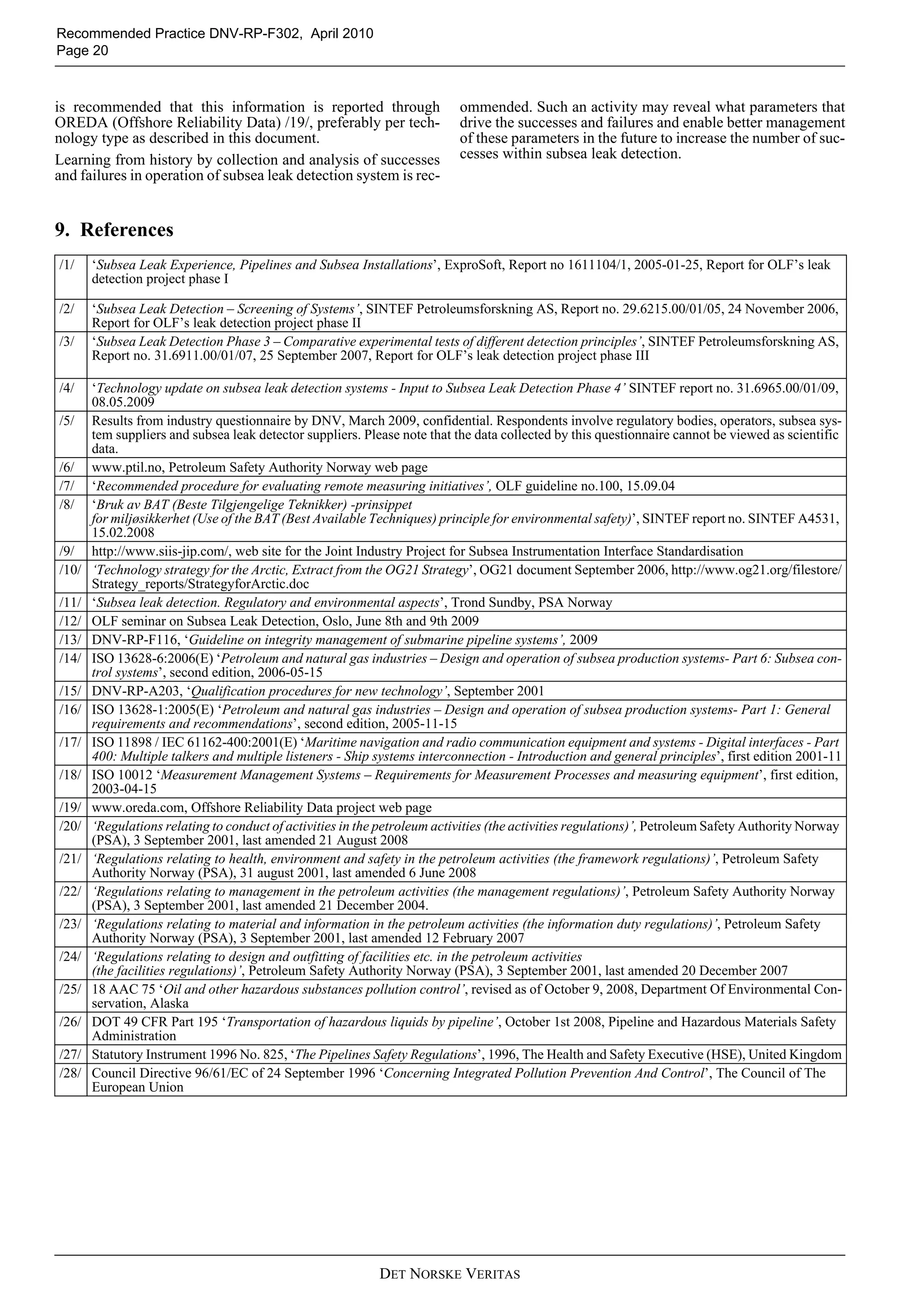
  • 4.
    DET NORSKE VERITAS RecommendedPractice DNV-RP-F302, April 2010 Page 4 – Introduction
  • 5.
    DET NORSKE VERITAS RecommendedPractice DNV-RP-F302, April 2010 Contents – Page 5 CONTENTS 1. INTRODUCTION.................................................. 7 1.1 Objective...................................................................7 1.2 Basis ..........................................................................7 1.3 Regulations...............................................................7 1.3.1 Norway ...............................................................................7 1.3.2 United Kingdom .................................................................8 1.3.3 USA ....................................................................................8 1.3.4 EU.......................................................................................8 1.4 Limitations ...............................................................8 2. EXPERIENCE TO DATE..................................... 8 2.1 Background..............................................................8 2.2 History ......................................................................9 2.3 Field experience ......................................................9 2.4 Where and when leaks occur................................10 3. LEAK DETECTION TECHNOLOGIES AND THEIR CHARACTERISTICS ................. 11 3.1 Description of technologies...................................11 3.1.1 Active acoustic methods...................................................11 3.1.2 Bio sensor methods...........................................................11 3.1.3 Capacitance methods .......................................................11 3.1.4 Fibre optic methods ..........................................................12 3.1.5 Fluorescent methods.........................................................12 3.1.6 Methane sniffer methods ..................................................12 3.1.7 Semi-conductor methods ..................................................12 3.1.8 Optical NDIR methods .....................................................12 3.1.9 Optical camera methods ...................................................12 3.1.10 Passive acoustic methods..................................................13 3.1.11 Mass balance methods......................................................13 3.2 SINTEF laboratory test ........................................13 4. DESIGN OF SUBSEA LEAK DETECTION SYSTEMS ............................................................. 14 4.1 General requirements ...........................................14 4.2 System performance requirements and technology selection .......................................14 4.3 Combining technologies........................................15 5. OPERATING PHILOSOPHY ............................ 15 5.1 Operating procedures...........................................15 5.1.1 Warning display and action..............................................15 5.2 Sensitivity and response time...............................15 5.2.1 Requirements from operators ...........................................15 5.2.2 Findings from laboratory tests..........................................16 5.3 Trouble shooting, data download and self diagnosis...................................................16 6. INSTALLATION AND INTERFACES............. 16 6.1 General ..................................................................16 6.2 Communication bandwidth..................................16 6.3 Communication interface.....................................16 6.4 Power requirements..............................................16 6.5 Test methods..........................................................16 6.6 Technology specific requirements .......................16 6.6.1 Active acoustic methods...................................................16 6.6.2 Bio sensor methods...........................................................16 6.6.3 Capacitance methods .......................................................17 6.6.4 Methane sniffer methods ..................................................17 6.6.5 Optical Cameras ...............................................................17 6.6.6 Passive acoustic methods..................................................17 7. CALIBRATION, INSPECTION AND INTERVENTION ...................................... 18 8. CHALLENGES FOR FURTHER RESEARCH AND DEVELOPMENT .............. 19 8.1 Technology.............................................................19 8.2 Operation of leak detection systems....................19 8.3 Requirements.........................................................19 8.4 Collection of statistical data .................................19 9. REFERENCES..................................................... 20 APP. A SUGGESTED FUNCTIONAL REQUIREMENTS FOR SUBSEA LEAK DETECTION SYSTEMS ........... 21 APP. B LEGISLATION.................................................. 22 APP. C SUBSEA LEAK DETECTION INSTALLED BASE........................................................... 25 APP. D SUBSEA LEAK DETECTORS SUPPLIER TECHNICAL DATA......................................................... 32
  • 6.
    DET NORSKE VERITAS RecommendedPractice DNV-RP-F302, April 2010 Page 6 – Contents
  • 7.
    DET NORSKE VERITAS RecommendedPractice DNV-RP-F302, April 2010 Page 7 1. Introduction 1.1 Objective The objective of this best practice is to summarize industry experiences and knowledge with relevance to selection and use of detectors for a subsea leak detection system. The intent is that this document can be used as a technical and practical guideline and reference for operators, suppliers, regulators and decision makers in the field of subsea leak detection. The ref- erencing of this document will not substitute the development of a field specific leak detection strategy, but can rather be an element in one. It is emphasized that the application of subsea leak detection systems shall not reduce the safety level for subsea systems in terms of design, manufacture, quality assurance etc. It is also emphasized that the performance of a subsea leak detection system is not determined by the technical specifica- tion of the detector technology alone, but by an overall assess- ment of technical data, system layout and system operation. 1.2 Basis OLF (The Norwegian Oil Industry Association) has through a JIP taken the initiative to improve practice in the industry regarding detection of subsea hydrocarbon leaks. The JIP part- ners have been Conoco Philips, ENI, Shell and Statoil. This best practice is a product of the JIP. The development of this document has been coordinated by DNV and the content is based on input from a broad selection of operators and suppli- ers in the industry. Production systems for hydrocarbons are complex installations and it is known in the industry that smaller and larger unwanted leakages occur and cause discharge of hydrocarbons to the surroundings. Today, both operators and authority awareness towards the environmental impact of oil and gas production is constantly increasing. Subsea leak detection is becoming more important in the petro- leum industry. The regulations of PSA (Petroleum Safety Authority) Norway outline requirements for remote measure- ment of acute pollution. Regulatory bodies in UK, USA and also the European Union describe requirements for detection of acute pollution. This is further covered in Sec.1.3. As well as detecting leakages, a leak detection system may be designed to provide condition monitoring data and may form part of a life extension strategy if for example the risks of leak- age is considered too high to continue production without con- tinuous monitoring. 1.3 Regulations In this section relevant references to legislation are presented. A further description of the legislation referenced below is found in Appendix B. Subsea leak detection is becoming important in the petroleum industry. A plan for remote measurement is by regulations required to be included in PDOs in Norway and Alaska. It has recently been stated by the Norwegian authorities in relation to future production in the Arctic region that there is a need for “early warning system based on detecting leaks at the source” /10/. 1.3.1 Norway The Facilities Regulations Section 7 states that (ref. /24/) “Facilities shall be equipped with necessary safety functions which at all times are able to: a) detect abnormal conditions b) prevent abnormal conditions from developing into situa- tions of hazard and accident c) limit harm in the event of accidents. Requirements to performance shall be set in respect of safety functions. The status of safety functions shall be available in the central control room.” The Management Regulations Section 1 states (ref. /22/): Risk reduction In risk reduction as mentioned in the Framework Regulations Section 9 on principles relating to risk reduction, “The party responsible shall choose technical, operational and organisational solutions which reduce the probability that failures and situations of hazard and accident will occur. In addition barriers shall be established which a) reduce the probability that any such failures and situa- tions of hazard and accident will develop further, b) limit possible harm and nuisance. Where more than one barrier is required, there shall be suffi- cient independence between the barriers. The solutions and the barriers that have the greatest risk reducing effect shall be chosen based on an individual as well as an overall evaluation. Collective protective measures shall be preferred over protective measures aimed at individuals.” The Management Regulations Section 2 states: Barriers “The operator or the one responsible for the operation of a facility, shall stipulate the strategies and principles on which the design, use and maintenance of barriers shall be based, so that the barrier function is ensured throughout the life time of the facility. It shall be known what barriers have been established and which function they are intended to fulfil, ref. Section 1 on risk reduction, second paragraph, and what performance require- ments have been defined in respect of the technical, opera- tional or organisational elements which are necessary for the individual barrier to be effective. It shall be known which barriers are not functioning or have been impaired. The party responsible shall take necessary actions to correct or compensate for missing or impaired barriers.” The Authority say in their Activities Regulations /20/, section 50, that it is the responsibility of the operator to quickly dis- cover and map pollution from the facility by remote measure- ments (see Appendix B). Further, the guideline to this section 50 says that: “a plan for remote measurement should be established, based on an environmentally oriented risk analysis. The system for remote measurement should comprise the following: a) procedures and systems for visual observation and notifi- cation b) procedures for interpretation of monitoring data c) modelling tools to predict transport and spread of acute pollution, d) procedures for quantifying the leak e) other meteorological services that are necessary in order to support the remote measurement, f) systems for detection of pollution in the recipients.” Referring to the Norwegian legislation, addressing the issue of remote measurement of leak detection comprises having organizational procedures in place as well as applying moni- toring technologies. The monitoring technology may be based on detection subsea, topside or both. The organizational and technical aspects should all be described in a plan for remote measurement.
  • 8.
    DET NORSKE VERITAS RecommendedPractice DNV-RP-F302, April 2010 Page 8 1.3.2 United Kingdom The Health and Safety Executive (HSE) in the United Kingdom have the Pipelines Safety Regulations (PSR) from 1996 /27/ as the key regulations concerning pipeline safety and integrity. There are at present no specific regulations concerning subsea production systems. However, regulation 6 of PSR states: "The operator shall ensure that no fluid is conveyed in a pipe- line unless it has been provided with such safety systems as are necessary for securing that, so far as is reasonably practica- ble, persons are protected from risk to their health & safety.” The associated PSR guidance states: ‘Safety systems also include leak detection systems where they are provided to secure the safe operation of the pipeline. The method chosen for leak detection should be appropriate for the fluid conveyed and operating conditions.” 1.3.3 USA The Pipeline and Hazardous Materials Safety Administration in the USA say in § 195.452 of “Transportation of Hazardous Liquids by Pipeline” /26/ about “Pipeline integrity manage- ment in high consequence areas”: “Leak detection: An operator must have a means to detect leaks on its pipeline system. An operator must evaluate the capability of its leak detection means and modify, as neces- sary, to protect the high consequence area. An operator’s eval- uation must, at least, consider, the following factors — length and size of the pipeline, type of product carried, the pipeline’s proximity to the high consequence area, the swiftness of leak detection, location of nearest response personnel, leak history, and risk assessment results.” The Alaska Department Of Environmental Conservation says in 18 AAC 75 “Oil and Other Hazardous Substances Pollution Control” /25/, paragraph 18 AAC 75.055 “Leak detection, monitoring, and operating requirements for crude oil transmis- sion pipelines.”: “A crude oil transmission pipeline must be equipped with a leak detection system capable of promptly detecting a leak, including (1) if technically feasible, the continuous capability to detect a daily discharge equal to not more than one percent of daily throughput; (2) flow verification through an account- ing method, at least once every 24 hours; (3) for a remote pipe- line not otherwise directly accessible, weekly aerial surveillance, unless precluded by safety or weather condi- tions.” 1.3.4 EU The EU have developed the IPPC (Integrated Pollution Pre- vention and Control) directive /28/, with the objective to pre- vent and limit industry pollution. The IPPC is based on 4 main principles. One of these is BAT – Best Available Techniques. The IPPC directive shall prevent and limit pollution from industry activities. Permissions for industrial installation shall be given following this directive and be based on the BAT principle. The definition of BAT can be found in Appendix B. For Norway, SINTEF have written a report on “Use of the BAT (Best Available Techniques) principle for environmental safety” /8/ which gives examples of practical implementation of BAT, including detection of subsea leaks. 1.4 Limitations Statistical analysis /1/ shows that the majority of leaks observed in the North Sea are close to subsea installations, platforms and flow lines. At the current issue, this best practice is limited to subsea structures with access to the control sys- tem. The best practice focuses on continuous monitoring prin- ciples for leak detection. For pipeline systems, the reader may refer to DNV-RP-F116 Guideline on integrity management of submarine pipeline systems. Leakages are in this context limited to those originating from production of hydrocarbons in the form of natural gas, oil or mul- tiphase, as these are considered to have the greatest environmen- tal impact. Leak detection may also be of interest for CO2 injection systems and hydraulic control systems. Technologies for leak detection are, however, still immature and this document will focus on leakages from oil and natural gas production, as this is considered to have the greatest environmental impact. Some detection principles described in this guideline will in the- ory detect any liquid leaking at a certain pressure; others are depending on the chemical compound for detection. The maturity of the technologies described is varying from concepts to commercially delivered products. However, the operational experience with subsea leak detection only goes back to the 1990’s and is limited to a few of the described tech- nologies. New developments and further developments of existing technologies are expected and the descriptions and recommendations given in this document should be developed accordingly. This document has been developed based on input from sup- pliers, integrators and end users of leak detection technologies as well as PSA Norway. The information has been collected through questionnaires, seminars and hearings of this docu- ment. Also, important contributions to this document come from the results of previous work done under the OLF JIP on leak detection: — Statistical analysis performed by ExproSoft in 2005 /1/ — Screening of available technologies done by SINTEF in 2006 /2/. — Comparative laboratory test of a selection of technologies done by SINTEF in 2007 /3/. The technical data on the different technologies found in Appendix D is based on information given from the suppliers. Collection of evidence to verify these data has not been per- formed during the development of this document. 2. Experience to date 2.1 Background Subsea production systems have been developing since the first subsea completion as early as 1943 (Lake Erie, USA, 30 feet). The need for cost-effective solutions for offshore pro- duction has over time led to an extensive use of increasingly complex subsea solutions for the development of existing and new fields. In parallel to these developments has been the need to detect any leakages that may damage the environment. Currently, most operating companies use a combination of technical and organizational measures to detect unwanted dis- charges of oil and gas, among others visual observation. Expe- rience has shown that the current methods and equipment available are not as effective as desired (see item 2.3 and Appendix C). OLF has coordinated a JIP focusing on leak detection. This document is a result of the 4th phase of the JIP and is based on the results from completed phases 1, 2 and 3 spanning from 2005 to 2007: Phase 1 /1/ was a database review of available information on reported subsea leaks up to the year of 2005, mainly on the Norwegian and UK sectors in the North Sea. The main conclu- sions from Phase 1 were that most leak incidents occur at or close to subsea installations, most leaks are small and from smaller diameter pipes. Phase 2 /2/ of the project was a review of available technolo- gies for subsea leak detection. The main conclusion was that there are several different available technologies potentially suitable for continuous monitoring of subsea installations.
  • 9.
    DET NORSKE VERITAS RecommendedPractice DNV-RP-F302, April 2010 Page 9 Phase 3 /3/ consisted of comparable experimental tests of dif- ferent types of subsea leak detection principles. The main con- clusions were that all the technologies tested in these experiments work well under laboratory conditions; both crude oil and gas leakages were detected. However, the technologies perform differently under varied conditions, due to their differ- ent strengths and limitations. Generally, gas leakages are eas- ier to detect than crude oil leakages. 2.2 History In the past decades, detection of gas pipeline ruptures near platforms has been in focus, to protect personnel and structures from explosion risk. Pipeline emergency shut down systems based on pressure monitoring have been installed by most operators. These systems generally work satisfactorily under normal production operations and when automatic warnings are included in the system. However, problems may arise dur- ing transients for example at start-up after shut down periods and when the systems rely on the operator reacting to the data instead of automatic warnings. The forward trend in Norway seems to be adding permanently installed leak detection systems. The international trend points towards leak detection systems mounted on mobile units (ROVs) and deepwater applications. Inspection surveys are typically done once a year1). However, this may not prove suf- ficient for an increasing number of complex and large subsea structures. 1) The inspection interval will depend on the field specific inspection plan. Figure 2-1 Subsea production to shore 2.3 Field experience The field experience to date with leak detection systems is lim- ited to the Norwegian sector and this field of technology is generally young. The existing experience includes problems with false alarms and consequently disabled sensors as well as fields where one has accomplished solutions that are described as promising. Subsea leak detection should be regarded as a monitoring system and is not at present mature enough to fulfil the requirements normally set for a safety system. Below some field developments which include subsea leak detection systems are listed. The list is not complete, but is believed to be a representative selection of the experience to date. In Appendix C, a broader selection of installed leak detection systems is included. — Snøhvit, Statoil – The Snøhvit Field is the first field devel- opment in the Barents Sea and has been developed by Sta- toil. It is a fully subsea field development concept and the best available technology at the time was used. The full development including future wells comprises twenty pro- duction wells and one CO2 injection well. The leak detec- tion system is based on capacitive detectors with a hydrocarbon collector at each wellhead. Snøhvit has expe- rienced some challenges with its subsea leak detectors in the sense that they have at times given readings outside the 0 to 100 range, which is the defined range for these detec- tors. However, Snøhvit has also had one positive identifi- cation of a gas leakage at one well. At this instance, the detectors changed values from 0 to 100 and this indication of leak was verified by a corresponding pressure loss in the subsea system. This resulted in the well being shut down and further investigations were conducted. The conclusion was that there had been an intermittent leak from a stem in a valve. Snøhvit has also had a leak that was not detected by the capacitance detector, because the leak was outside the hydrocarbon collector roof, which is a requirement for this type of detectors. — Tampen Link, Statoil – A 23 km long pipeline connecting the Statfjord field with the UK sector of the North Sea. The diameter of the pipe is 32”. Tampen link has five subsea leak monitors on the Norwegian sector in the North Sea. These detectors are ultrasonic non-intrusive acoustic leak monitors. The Leak Monitors are retrofitted on two 20” gas valves on the seabed to verify/disprove through-valve gas leakage. These valves are open and they will be shut to close off the bypass alternative. The Leak Monitors are self-contained and are deployed by ROV to operate con- tinuously for periods up to one month. The monitors will be used during the closing of the two valves, and may later be operated on demand to verify their condition at a later stage. — Tordis, Statoil – A passive acoustic leak detector was installed in 2007. The offshore commissioning included leakage testing but no positive warnings were triggered during liquid (water) discharge below 200 bar differential pressure. Warnings were triggered at 200 bar. Investiga- tions revealed humidity in the hydrophones which was believed to explain lack of detection. The passive acoustic detector will be installed again in 2010 after a new hydro- phone sealing technique is tested. — One leak on Norwegian sector in 2003 released 750 m3 of oil over 6 hours before it was detected. In spite of installed process surveillance of pressure, flow and temperature, the leak was detected as an oil slick and odour around the plat- form. The leak occurred when re-starting the subsea wells after a 2-week shutdown. Investigations succeeding the leak found that the process surveillance records showed the leak as manifold pressure dropping to seabed pressure. This pressure drop was, however, not recognised during the re-start. A learning point from this accident was the need for increased process surveillance and/or ROV observation when starting up subsea facilities.
  • 10.
    DET NORSKE VERITAS RecommendedPractice DNV-RP-F302, April 2010 Page 10 Figure 2-2 Three cone shaped acoustic leak detectors installed on Tordis 2.4 Where and when leaks occur This section presents available data on where leaks occur on subsea structures. This information may be used as an input when evaluating what components are of particular interest for monitoring. The statistics are taken from /1/. This report covers pipelines and subsea equipment and was written in 2005. The leak sizes are not listed in the PTIL/NPD file. Based on the information provided for each event, the leak sizes have been categorized in following four categories /1/ 2). 1) Large 2) Medium 3) Small 4) Very small. 2) Categorization of leakages into specific size categories is not availa- ble in the current statistical data. Determining the size of a leak has been based on hole size, volume of leaked medium, reported actions taken, etc. which in turn is highly dependent on parameters as time, pressure, pipe dimension etc. The large leak size type is used where a large crack, split, rup- ture or a substantial volume of fluids have leaked out. The medium leak size is used for incidents where the leak seems to have been significant, but not large. The small leak size cate- gory is used for incidents where the leak seems small, but cor- rective actions are initiated. The very small leak size category was used for incidents where no corrective actions were initi- ated. Typically the risk reduction measure was to observe the leak for further development. Detection of very small leakages is interesting for monitoring (not repair) purposes. The report from phase 1 /1/ concludes that only the PSA subsea release database has relevant data for subsea installations. 11 leaks were reported in total up to 2005. 6 of these are catego- rised as very small leaks. 1 of the 11 leaks was categorised as a large leak, meaning that a substantial volume of fluid leaked out. It should be noted that these 11 incidents may not repre- sent the full picture, as some leakages may have not been detected and/or reported Figure 2-3 Number of reported subsea leaks in Norwegian sector up to 2005 /1/. The graph shows the data in Table 2-1 displayed by location relative to the subsea installation and by leak size as defined in /1/. Table 2-1 Location and sizes for reported leaks on subsea installations in Norwegian sector Location Large leak Medium leak Small Leak Very Small leak Total Mid line (>500 m from installation) 0 0 1 2 3 Subsea well/tem- plate/manifold (500 m radius) 1 2 1 3 7 Unknown 0 0 0 1 1 Total 1 2 2 6 11 Large Medium Small Very small Total 0 2 4 6 8 10 12 >500 m from installation <500 m from installation Unknown location Total
  • 11.
    DET NORSKE VERITAS RecommendedPractice DNV-RP-F302, April 2010 Page 11 The detection methods reported are mainly by ROV inspection and human observations. A few incidents are reported detected by pressure testing and automatic shut down/pressure loss of well. It should be noted that the statistics show that the largest hydrocarbon leaks occur when the operation is unsteady (shut- in, start-up, maintenance etc). These are phases when mass balance cannot be used for leak monitoring due to unstable flow and pressure readings. Structure components reported being subject to leaks are con- nections, connectors, flanges, seals, valves and welds. These can be considered critical points for monitoring of possible leaks. Leaks caused by materials failure, due to corrosion, cracking, external impact, etc. can in theory occur in all structures and critical points for these failures may be harder to identify. However, it can be possible also for these failure modes to identify where a failure is most likely to occur (based on design and environmental parameters) and define these locations as critical points for monitoring. A questionnaire for industry input /5/ distributed to oil compa- nies, subsea system suppliers and subsea leak detector suppli- ers asked the recipients where leaks on subsea structures normally occur, to their experience. The replies were that leaks normally occur on flanges/connections and valves. Small bore piping was also mentioned. The same questionnaires asked about failure modes causing leaks. Corrosion and bad installation were reported back as the most important ones, followed by impact, erosion, non-metal- lic seal degradation and failure of valve seats. 3. Leak detection technologies and their characteristics 3.1 Description of technologies Principles and methods for leak detection are in the literature associated with many concepts, including surface detection, inspection and permanent subsea monitoring. An important target for detection of leakages subsea is to achieve early warn- ing of small to medium sized leaks for monitoring and correc- tive actions. The focus of this text is permanently installed subsea sensors that require access to the subsea control system for continuous monitoring subsea. Some of the principles are independent of the subsea control system. Some of the principles described below provide area coverage, which means that they can place the leakage relative to the position of the sensor. The accuracy of the placement, the range covered and positioning parameters vary from principle to principle. Other technologies are point sensors that detect a leakage in their vicinity but can not determine the location of the leak. Point sensors may be an option for monitoring of high risk leak points. The available technologies are divided into the following cat- egories: — active acoustic methods* — bio sensor methods — capacitance methods* — fibre optic methods — fluorescent methods — methane sniffer methods* — optical camera methods* — passive acoustic methods* — mass balance methods. One product representing each of the technologies marked by “*” were tested in the SINTEF laboratory test, item 3.2. At the time of writing, mainly qualitative functional descrip- tions for operation of the different technologies are available. The descriptions given below are based on information from suppliers and the industry collected directly and via question- naires and from technology screening and comparative labora- tory tests done by SINTEF /2/, /3/, /4/, /5/. Available supplier technical data for the different technologies are given in Appendix D. Technical requirements for installa- tion of each of these technologies are covered in item 6.6. It should be noted that, although it is the intention, the over- view presented here may not include all available technolo- gies. 3.1.1 Active acoustic methods Active acoustic sensors are sonar detectors. The detector emits pulses of sound that are reflected by boundaries between dif- ferent media (boundaries of impedance change3). Fluids of dif- ferent density will have different acoustic impedance. This means that as the sound pulse travels through water and hits a bubble of gas or droplet of oil, sound will be reflected back. This technology does not depend on the leaking medium being of a specific composition; however, the acoustic impedance must be different to that of water. 3) The impedance is a material characteristic and depends on sound ve- locity, density, salinity and temperature of the medium. Active acoustic methods give area coverage and leak position- ing is possible. This technology has high sensitivity for gas, due to the high impedance contrast to water. Larger droplets or plumes of a leaking medium will give a stronger backscattered acoustic signal and are easier to detect. A limitation to the active acoustic method is that it can be sen- sitive to shadowing of the acoustic signal by the subsea struc- tures. This may, however, be solved by using more than one detector. Also, some active acoustic detectors currently gener- ate a lot of data. Suppliers are currently working on new solu- tions that will make subsea interfacing easier and allow more efficient data transfer. Experience has shown that the perform- ance will depend on water depth, as gas bubble size will change with water depth. Active acoustic sensors have been commercially delivered for use on ROV and have been used to find leaks in the North Sea. Solutions for permanent monitoring are under development. 3.1.2 Bio sensor methods Bio sensors utilize the response of organisms to pollution in the surroundings. Suitable organisms are placed on the struc- ture to be monitored. One example of an organism used as sen- sors are mussels. Sensors register the heart rhythm and the degree and frequency of opening and closing of the clam. This is a point sensing method. Positioning the leakage relative to the sensor will not be possible, but area coverage may be achieved by using several sensors. The sensitivity compared to size of leak will be dependent on distance to the leak and drift of the leaking medium. Direct contact with the leaking medium is required. Seawater currents may lead the leaking medium away from the sensor. This technology concept is currently under testing in shallow water and with access to topside facilities. The concepts that include bio sensors combine them with other sensors (e.g. semi-conductor (item 3.1.7), temperature meters, salinity meters and hydrophones). Different organisms may be used when entering into deeper waters. 3.1.3 Capacitance methods Capacitive sensors measure change in the dielectric constant of the medium surrounding the sensor. The capacitor is formed by two concentric, insulated capacitor plates in the same plane,
  • 12.
    DET NORSKE VERITAS RecommendedPractice DNV-RP-F302, April 2010 Page 12 the one being a disc and the other being a surrounding annulus. The sensors capacitance is directly proportional to the dielec- tric constant of the medium between the capacitor plates. The dielectric constants of seawater and hydrocarbons are very dif- ferent. If the sensor gets in direct contact with hydrocarbons, this will show as a change in the measured capacitance. The capacitance method is a point sensing method. Positioning the leakage relative to the sensor will not be possible. The sen- sitivity compared to size of leak will be dependent on distance to the leak and drift of the leaking medium. When leaking medium comes in contact with the sensor, the sensitivity is high. A limitation to this product is that direct contact with the leak- ing medium is required. Seawater currents or buoyancy effects may lead the leaking medium away from the sensor. This can be solved by installing a collector for hydrocarbons over the monitored structure. Where template protective covers are used as protection to fishery, these covers can be modified to serve as a hydrocarbon collector. Laboratory tests have shown challenges with collecting oil, since the oil flow does not stop in the collector. This effect may be less significant in a realistic subsea environment, due to the much larger size of a template roof collector compared to the experimental collector. Addi- tionally, live crude oil always contains some natural gas which may be easier to collect by the template roof. The product maturity of capacitance sensors is high. These sensors have been on the market since the 1990s. Operators have experienced some false alarms from these sensors (ref. Appendix C). However, by number of installed sensors, this type is the most common. 3.1.4 Fibre optic methods Fibre optic methods are used for locating and measuring mechanical disturbances at acoustic frequencies along a con- tinuous optical fibber. Disturbances can be caused by e.g. vibrations, seismic waves or acoustic signals from for example leaking gas or liquids. Simultaneous disturbances may be detected and positioned to approximately one meter accuracy along the fibre. By performing comparison with a data library the likely cause of the disturbance can be proposed. There is a trade-off between spatial resolution along the sens- ing fibre and detection sensitivity. For example, if it is not nec- essary to isolate the detection of vibrations between every adjacent meter of fibre, but ten meters would be acceptable, then the detection sensitivity can be increased by roughly a fac- tor of ten. A benefit with fibre optic methods is that no power or electron- ics is required along the length of the cable and it is immune to electrical interference. For monitoring of subsea structures, this technology has not yet been taken beyond the conceptual stage. The concept has been tested for pipelines onshore. This technology will not be covered further in this version of this document. Some technical parameters are found in Appen- dix D. 3.1.5 Fluorescent methods Fluorescent detectors use a light source of a certain wavelength for exciting molecules in the target material to a higher energy level. The molecules then relax to a lower state and light is emitted at a different wavelength which can be picked up by a detector. To use fluorescent methods, the medium to be detected must naturally fluoresce or a fluorescent marker must be added into the fluid. This is the reason why this technology has tradition- ally been adopted for subsea inspection and pressure testing. However, many hydraulic fluids have fluorescent markers added as standard. For hydrocarbon leak detection, crude oil has significant natural fluorescence. Fluorescent technology has been proven for use with ROVs and is currently under development for permanent installation on subsea structures. However at the time of writing there is no information about prototype installations available. Fluorescence based detectors can potentially differentiate between hydraulic fluid and oil leaks due to the different fluo- rescence spectrum of these fluids and also provide an indica- tion of the leak size from the relative signal intensity. These detectors can be point sensors or can provide coverage over 3- 5 meters line of sight. As with optical cameras marine growth over optics could potentially be an issue but may be solved with maintenance and optimal choice of surface coatings. This technology will not be covered further in this version of this document. Some technical parameters are found in Appen- dix D. 3.1.6 Methane sniffer methods Two measurement principles exist on the market for measur- ing methane dissolved in water. Both sensor types are based on dissolved methane diffusing over a membrane and into a sen- sor chamber. Methane sniffers are point sensors. Positioning the leakage relative to the sensor will not be possible. The sensitivity of these sensor types compared to the size of a leak will be dependent on the distance to the leak and the drift of the leaking medium. Both sensor types can detect very small concentrations of dissolved gas in water. Limitations to these technologies are that quantification of leaks is difficult. Also, identifying a leak is dependent on dif- fusion towards the sensor and seawater currents may lead the leaking medium away from the sensor. 3.1.7 Semi-conductor methods For the semi-conductor methods, the dissolved methane changes the resistance of an internal component in the sensor chamber. This generates an electrical signal from the detector. Ongoing developments are aiming at achieving long term sta- bility of 5-10 years for this type of sensors. 3.1.8 Optical NDIR methods For the optical non-dispersive infrared spectrometry (NDIR) method, the methane concentration is measured as degree of absorption of infrared light at a certain wavelength. The infra- red light is directed through the sensor chamber towards a detector. The intensity of infrared light at the detector will thus be a measure of the methane concentration, which is measured electronically. Sensors with a said long term stability of 3+ years are available today. Ongoing developments are aiming at achieving long term stability of 5 years or more for this type of sensors. 3.1.9 Optical camera methods Optical camera methods are based on a video camera for sur- veillance of the subsea system. This technology provides spa- tial coverage and determining the direction from the camera to the leak can be possible. The capabilities of such methods is typically to record and send 3 -30 min of video and 1 -10 still pictures per hour. Optical cameras for subsea leak detection are sensitive to water turbidity. Another limitation is the need for contrast background to detect oil (the camera must be directed towards the yellow structure). It has been shown in laboratory testing /3/ that cam- eras need additional light for detection beyond 1 m. The limita- tion with extra light is 3-4 meters. Marine growth may also be a problem; however this can be solved by maintenance. The optical camera technology is in use with ROVs and pilots have been installed subsea.
  • 13.
    DET NORSKE VERITAS RecommendedPractice DNV-RP-F302, April 2010 Page 13 3.1.10 Passive acoustic methods These sensors contain hydrophones (under water micro- phones) picking up the pressure wave, or sound, generated by a rupture or leak and transmitted through a structure or water. As long as there is a sufficiently strong pressure wave, passive acoustic sensors are not dependent on the chemical compound of the leaking medium. Passive acoustic detectors come in variants designed for spa- tial coverage as well as variants for monitoring of specific crit- ical components. Positioning is possible by using more than two sensors for spa- tial coverage. Arrival time of a sound at each sensor can be used to locate the origin of the sound. These sensors are little affected by seawater currents and tur- bidity. Passive acoustic sensors are available on the market and have been commercially delivered. A limitation to this technology is that the sound from small leaks might not reach the hydrophones. Background noise may disturb the measurements and shadowing of the acoustic waves may be a problem. A sufficient pressure drop over the leak path is a requirement for detection. Passive acoustic sensors may also be used for monitoring of valve opening and closure, choke opening or adjustments and function of rotating machinery. 3.1.11 Mass balance methods Mass balance methods are based on monitoring the pressure drop between two or more pressure sensors installed in the sub- sea production system. According to a SINTEF report /2/ a leak will have to be above a certain threshold (5% of total flow) to be detected by mass balance. However, the actual threshold for detecting a leak will depend on the complexity of the mass balance system, type of process (gas, liquid or mixed), the accuracy and quantity of the instrumentation available and the pressure drop over other system components for each applica- tion. For example, including pressure and temperature sensors at the riser base in addition to the Xmas tree and manifold will improve the system performance. Normally, a feasibility study is done for each application to calculate the actual achievable accuracy which may be far better that 5% of the total flow. For high flow rates, the error band of the pressure sensors will be relatively small compared to the pressure drop which gives an improved accuracy for high flow rates. The economical threshold for applying mass balance methods is considered low, when assuming that most subsea systems already apply pressure- and flow sensors. What is needed in addition is procedures and software for rising and handling warnings. Mass balance technology is mature and can act as a comple- mentary principle to the younger technologies described above. Mass balance can also cover the pipeline system. 3.2 SINTEF laboratory test The SINTEF laboratory tests /3/ exposed 5 technologies to the same, controlled environment and compared their performance for detecting releases of gas and oil. There are limitations to a laboratory test when it comes to fully representing a subsea environment. This must be considered when reading the results from the laboratory test summarized in Table 3-1. Due to the size of the basin, there are constraints to the distance between the leakage and detector and reflec- tions of acoustic signals from the basin walls. A basin test does not fully cover the effects of sea water currents and there are limitations on allowable flow rate of the generated leaks. Also, the ambient hydrostatic pressure is lower than for real applica- tions. Life time and effects of marine growth is not tested real- istically. The pressure difference between process and ambient will be different than in a real application. At real subsea conditions there will be some natural leakage or seeping of hydrocarbons from the ground. The effect of this is not covered in the lab test. natural leakage is most likely to affect the principles based on the chemical compound of the medium, like capacitive sensors, semi-conductor sensors and bio-sensors. The main results from the SINTEF research are presented in Table 3-1. Table 3-1 Findings from laboratory testing, by SINTEF /4/ Principle Sensitivity Detection of crude oil Detection of gas Area coverage Detection time Leak positioning Limitations Capacitance High to moderate. Small leaks not detected due to hole in collector Good; coalescence problems due to turbulent flow Very good Point sensor. Area coverage determined by size of collector Gas: 15 sec to 9 min. Crude oil: approx 10 min No Sensitive to biological growth. Dependent upon size and shape of collector. Less suited for oil than gas due to coalescence problems. Semi conductor Very high N/A Very good Point sensor. Indirect area coverage possible due to diffusion of hydrocarbons in water and by using several sensors. Immediate detection to no detection No Quantification of leak difficult. Long term sta- bility not proven. Optical camera Moderate. Dependsupon colour of surroundings Very good; dependent upon back- ground colour Very good Yes. Range limited to 3-4 m No response time reported Yes Sensitive to water turbidity and biological growth. Passive acoustic High Good Very good Yes. Range dependent upon pressure difference of leakage. No response time reported Yes Sensitive to background noise Active acoustic High, especially for gas Limited Very good Yes. Range dependent upon plume size. No response time reported Yes Generates significant amounts of data. Sensitive to shadowing objects.
  • 14.
    DET NORSKE VERITAS RecommendedPractice DNV-RP-F302, April 2010 Page 14 4. Design of subsea leak detection systems The design of the leak detection system should be integrated in the overall subsea system design. According to industry input /5/, the structures where leak detectors have been installed to date are mainly Xmas trees, templates and manifolds. The feedback from subsea system integrators /12/ is that integrat- ing the sensors to subsea structures mechanically, and to the control system, in most cases is solvable, but that it is impor- tant that this requirement is identified early in the design proc- ess. The leak detection system should therefore be included as a primary design requirement and not considered as an add-on late in the design process. 4.1 General requirements The leak detection system should as a minimum comply with the requirements found in ISO 13628-6. The specific contents of the qualification activities must be tai- lored for each technology. DNV-RP-A203 Qualification Pro- cedures for New Technology /15/ may be used as a guideline for the qualification process. 4.2 System performance requirements and technol- ogy selection For designing an appropriate leak detection system to be applied for a specific field, performance requirements for the system should be developed. The requirements should be based on: — authority requirements — environmental and safety risk analysis for the specific field — corporate requirements — field specific conditions that will affect the performance — interface to the control system — integration into the overall operational management phi- losophy of the subsea equipment. A leak detection system comprises selected leak detection technologies as well as tools for data management, operational procedures (ref. item 5.1) and layout/placement of sensors. The total system layout should fulfil the developed field spe- cific performance requirements. This is also discussed in the OLF guideline “Recommended procedure for evaluating remote measuring initiatives” /7/. The selection of sensors must be optimized for each applica- tion. A risk assessment may be valuable to identify the loca- tions on subsea production system where it is most likely that leakages will occur and hence where to place the detectors. It is also necessary to take into account process medium, process pressure and external conditions at the site. To enable opera- tors to select the right sensor types for their system, all com- mercial available leak detection technologies should have a specification sheet specifying parameters like: — mechanical, electrical and communication interfaces — bandwidth requirements — power requirements — requirements to location and environment (current etc.) — sensitivity to noise and other effects from other compo- nents — design pressure, design temperature — test conditions, e.g. water depth, pressure and temperature, for qualification testing and FAT testing — sensitivity and drift — ability to determine location of leak. Figure 4-1 The figure gives an illustration of the process for determining the performance requirements for a subsea leak detection system. In this figure it is assumed that the subsea production system is designed in such a way that the probability of large leaks is lower than the probability of smaller leaks, as indicated by the graph. This assumption is supported by the statistics described in item 2.4 and /1/.
  • 15.
    DET NORSKE VERITAS RecommendedPractice DNV-RP-F302, April 2010 Page 15 A suggested principal for designing a subsea leak detection system is illustrated by Figure 4-1. The engineering of a subsea leak detection system for a field will involve determining the thresholds A, B and C (Figure 4-1) and required detection times, based on the environmental and safety risk analysis for the field. Subsequently, the subsea leak detection system is tai- lored based on the specifications of available technologies, the field specific conditions, connectivity to the control system and operational management philosophy of the subsea equip- ment. There may be gaps between the desired and achievable performance of the leak detection system. These gaps may be addressed by adjustments to the mass balance system or the inspection methods / intervals. As indicated in Figure 4-1, leaks over a certain size C will be detectable by mass balance and SLD. The smallest leaks, below a threshold A, may not be detectable by any methods. The conditions specific to the field (environment, production process, field layout, fluid composition, etc.) will together with the performance specifications of the technologies determine the threshold B between what will be detectable by the leak detec- tion system and what must be detected during inspection. The inspection interval must be determined from how long a leak of size B can be allowed to endure, considering the HSE risk. The target leak regime for the subsea leak detection system will be the shaded area in the graph, namely leaks of medium probability and between size thresholds B and C. The detection time may (depending on technology types) be dependent on the size of the leak, as indicated by the limit line at leak size threshold Y. The general principal is that detection time should be lower for larger leaks in order to reduce the consequences of the leak. Suggested functional requirements for subsea leak detection systems are found in Appendix A. 4.3 Combining technologies Combining two or more types of sensors may provide more confidence in the overall leakage detection system. Comple- mentary sensor technologies should be selected to compensate for the respective weaknesses and enable indication of a leak event from one sensor type to be confirmed by positive indica- tions from the other sensor type. One of the selected technologies should be able to perform detection over an area (not be limited to point sensing). Point sensors may be installed over critical leak points. The downside of combining more sensors can be the additional complexity relating to the subsea control system. In addition there is the commercial impact of having more detectors to purchase, service and integrate. Further, the scenario of one sensor type triggering a warning and the other not needs to be considered. The selection of one sensor type versus two or more should be based on system integration and performance requirements (ref item 4.2). E.g. in an especially sensitive area where a leak- age of hydrocarbons will have huge safety or environmental impact, the additional cost and complexity may be acceptable and even required. In an area where the consequences are less, and it is less likely that leakage will occur, a more simple sen- sor solution may be acceptable. 5. Operating Philosophy The objective of this section is to advise on the operation of subsea leak detection systems. 5.1 Operating procedures The operation should be in line with the principle Detect – Confirm – Act: — Detect: The subsea detector sends a warning to the topside control room — Confirm: The operator checks if the warning is real or false according to established procedures — Act: If the warning is false, the warning is cancelled and an investigation of why the false warning occurred is ini- tiated. If the warning is real, the operator acts according to an emergency preparedness plan on what to do with the operation of the subsea production system and what to do about further warning of facility personnel, preparedness personnel and authorities A general approach to how to operate a measuring system is found in ISO 10012 “Measurement Management Systems – Requirements for Measurement Processes and measuring equipment” /18/. 5.1.1 Warning display and action Most permanent subsea leak detection principles rely on the subsea control system to convey the detection of hydrocarbons to a topside or onshore facility. The signal will trigger a form of warning. It is assumed that a warning signal will either be transformed to an audio or visual warning (e.g. signal lamp), and subse- quently this signal will be observed by a human operator who will decide on the actions to follow. The maturity of subsea leak detection technologies is today too low to have an independent safety function. Setting firm limits for what detector response represents a positive finding of a leak is challenging. Further investigation of a leakage warning is needed for confirmation and quantification of the leak. The further investigation may include: — check of parallel systems (e.g. mass balance) — downloading of raw data from the detector giving the warning for further analysis — inspection on surface visually, by satellite, radar, plane etc. — inspection subsea e.g. by ROV. The operator response upon a warning from the leak detection system must be captured in operational procedures for the leak detection system. 5.2 Sensitivity and response time Field experiences referenced in Appendix C show that unwanted warnings are frequently experienced with subsea leak detectors. One reason behind this is natural seepage of gas from the seabed. Technically, sensitivity and unwanted warn- ings are not independent factors when designing detectors. A sensor designed for high sensitivity to hydrocarbons will more easily trigger a warning due to natural seepage. The response time and efficiency of a subsea leak detector will depend on the sensors technical performance but also on how it is integrated into a system and operated. 5.2.1 Requirements from operators A requirement from the operators of subsea leak detection sys- tems is that the number of false warnings is minimized. At the same time, response time should be as short as possible for major leaks. To avoid false warnings and maintain operator confidence in leak detection system, a longer response time should be accepted for small leaks. Specific requirements on response time, allowable leak rates and released volume (i.e. defining large, medium, small and very small leaks) should be developed for each field. These requirements should be based on a field specific environmental and safety risk analysis and the emergency preparedness for the field (see also item 4.2).
  • 16.
    DET NORSKE VERITAS RecommendedPractice DNV-RP-F302, April 2010 Page 16 The system should be manned by a trained operator who knows what the detectors measure and the system limitations. The data display should be of such a quality that it is easy to interpret for a trained operator. 5.2.2 Findings from laboratory tests The SINTEF report /3/ describes the response time for some technologies during the tests. Please see Table 3-1 for the recorded test results. It should be noted, however, that these response times are found under laboratory conditions and should not be directly applied for subsea applications. 5.3 Trouble shooting, data download and self diagnosis The leak detectors have limited field history, and will require close follow up in operation. A high data rate transparent com- munication interface will enable the operator to evaluate data from the detector, perform fault tracing, download updated software or even reprocess raw data on topside computers (see also item 6.3). Detector self diagnosis should be developed for known failure modes. Redundancy and automatic disabling of components should be implemented to avoid the effect of these failure modes. 6. Installation and interfaces 6.1 General The various sensor types will have different requirements for parameters like mechanical interface, required space, power needs, communication link bandwidth, etc. Likewise, each subsea system will have different capacities available for such parameters for the leak detection sensors. Procedures for cor- rect installation and positioning of the leak detectors should be available for all commercially available technologies. Below, some general guidelines are given for interfacing to the subsea control system and for testing of a subsea leak detection system, followed by technology specific requirements. 6.2 Communication bandwidth Bandwidth capacity for subsea leak detectors is in general a lesser challenge for new fields than for retrofit to existing fields. However, bandwidth limitations can be imposed on the subsea leak detection system depending on the field specific spare bandwidth capacity. 6.3 Communication interface The SIIS (Subsea Instrumentation Interface Standardization) /9/ JIP is an initiative from the industry. The aim is to standardize the interface between subsea sensors and the subsea control sys- tem. SIIS has developed levels for defining subsea instrumenta- tion interfaces. Referring to the SIIS definition /9/, advanced detectors should typically have a SIIS level 3 interface (Ethernet TCP/IP), while simpler or more proven detectors could use a SIIS level 2 (CANOPEN fault tolerant, ISO 11898-3) interface. In the future, sensors complying with the SIIS standards are what oil companies most likely will request and what will be the easiest to interface to their system designs. Please also see item 5.3. 6.4 Power requirements ISO 13628-6 /14/ may serve as a reference for the power requirements for subsea leak detectors. Subsea control systems are optimized for power. Thus, keep- ing the power requirements for the subsea leak detection sys- tem to a minimum will always be a benefit. 6.5 Test methods The leak detection system should be tested to verify that it meets the specified functional requirements (ref item 4.2). FAT is described in ISO 13628-6 /14/. System level tests are described in ISO 13628-1 and 13628-6 /14/. Descriptions of sensor specific test methods should be pro- vided by the vendor for all commercially available leak detec- tion systems. 6.6 Technology specific requirements 6.6.1 Active acoustic methods Due to the active function and high processing demands, some active acoustic detectors require more bandwidth and power than passive acoustic detectors. For size, weight and further technical parameters, please refer to Appendix D. 6.6.2 Bio sensor methods In the concepts being developed today, the bio sensors are mounted in a sensor rack together with other sensor technologies. These racks will be installed on or near the subsea structure to be monitored. The prototype racks have dimensions of 2 m × 0.4 m × 0.4 m. The sensor rack will be connected to the subsea control system via cable. Figure 6-1 Illustration of bio sensors
  • 17.
    DET NORSKE VERITAS RecommendedPractice DNV-RP-F302, April 2010 Page 17 6.6.3 Capacitance methods Capacitive sensors are point sensors dependant on a hydrocar- bon collector. Typical location of this type of sensor will be bolted on to a collector, typically in the shape of a protection structure, above an expected leak point. The protection structure is produced out of either steel or composite material or a combination of these. In order to collect hydrocarbons, the protection structure needs to be leak tight. A vent hole to release natural seepage may be required. Protection covers with several holes or in the shape of grids will not provide the required hydrocarbon col- lection. Retrofit of capacitance sensors may be a challenge since many template covers today are gratings and not solid covers that can be used for hydrocarbon collection. Solid covers are in general found on the NCS and in some British fields. The electrical interface will be via cable. For size, weight and further technical parameters, please refer to Appendix D. 6.6.4 Methane sniffer methods 6.6.4.1 Semi-conductor methods These sensors are developed for underwater monitoring of methane down to a depth of 2000 m. This type of sensors can also be used for monitoring purposes at platforms in oceans, rivers and lakes as well as deep-sea and coastal areas. Semi- conductor sensors can be deployed in shallow water areas from a small boat, allowing vertical or horizontal profiles. The adap- tation of these sensors to probe systems or loggers is possible because it is equipped with standard analogue outputs. Figure 6-2 Example of semi-conductor sensor The electrical interface will be via cable. For size, weight and further technical parameters, please refer to Appendix D. 6.6.4.2 Optical NDIR methods These sensors are recommended to be installed underneath the roof hatch of templates and manifolds. The sensors are equipped with a ROV handle for recovery and maintenance. The connection to the control system will be via cable with a wet mateable connector. For further technical parameters, please refer to Appendix D. 6.6.5 Optical Cameras Optical cameras are generally ROV mountable. Some optical cameras can be installed with a mounting device. This device can be adapted to the structure in question. The required number and location of the cameras needs to be evaluated considering acceptable coverage. Due to a “dense” construction as a manifold will be, it is assumed that more than one camera will be required For size, weight and further technical parameters, please refer to Appendix D. Figure 6-3 Example of optical camera 6.6.6 Passive acoustic methods Passive acoustic detectors are available as compact sensors based on a single hydrophone as well as lager sensors with more hydrophones and functions (i.e. positioning of leak). For the larger versions, providing area coverage, considerable space on the subsea structure can be required. Other versions of passive acoustic detectors are designed to be installed at crit- ical points such as valves, flanges, joints, etc. Versions of passive acoustic detectors exist that can be mounted by ROV and the smaller types may be retro-fitted. The data is communicated to the surface by either a dedicated fibre-optic cable or via cable to the subsea control system (SCS). For size, weight and further technical parameters, please refer to Appendix D.
  • 18.
    DET NORSKE VERITAS RecommendedPractice DNV-RP-F302, April 2010 Page 18 Figure 6-4 Example of large passive acoustic detector prepared for installation (left) and compact passive acoustic detector installed on a topside valve (right). 7. Calibration, inspection and intervention A practical procedure for calibration should be available for industrialized sensors and systems. The accuracy and the sta- bility of the sensor readings should be quantified. For detectors that can experience some kind of saturation, re-calibration from topside when installed subsea should be described. Lifetime for subsea equipment should be long enough to keep the intervention frequency and cost at an acceptable level. A typical lifetime for non retrievable equipment is 25 years. The lifetime and requirements regarding maintenance and whether the units are retrievable must be described. Procedures for this must also be available. Available supplier information on calibration, inspection and intervention is found in Appendix D. Table 7-1 Typical supplier specification for calibration, inspection and intervention Technology Calibration Inspection and intervention Active acoustic Automatic calibration at installation or calibration during Sea Acceptance Test 3-8 years interval depending on product and water depth Depending on product, major parts may be field replaceable units due to modular construction. Bio sensors Calibration after installation Replacement of biosensor module Capacitance No on site calibration required Inspection and/or cleaning of marine growth. Using a hydro-jet for cleaning should be OK Fibre optic No calibration 2 Years Fluorescent No recalibration required Possible lens cleaning every 3-5 years Mass balance systems The pressure and flow sensors that give readings into the mass balance system will have to be calibrated and maintained according to normal procedures. The software for giving warnings must be calibrated with threshold pressure drop values as a minimum and more extensive process input for advanced flow assurance systems. Inspection and intervention as required, product specific for the pressure and flow sensors.
  • 19.
    DET NORSKE VERITAS RecommendedPractice DNV-RP-F302, April 2010 Page 19 8. Challenges for further research and development The following topics are mentioned by the industry as direc- tions one would like to see the leak detection technologies to take in the future: 8.1 Technology Detection The message from the industry today is that there is a need for improvement of the performance of leak detection technolo- gies. A leak detector should ideally be able to perform identi- fication, localization, quantification and classification (medium, harmful/harmless) of a leakage. Today, no technol- ogy alone can perform all of these operations and it may even be hard to accomplish by combining sensors. One aspect that is mentioned in particular for sensor perform- ance is unwanted warnings, often generated due to natural seepage of hydrocarbons from the seabed. Handling of natural seepage without giving unwanted warnings is a challenge for further development of subsea leak detection. To improve performance on detection of leakages it may be beneficial to develop a better understanding of leakages and their characteristics through e.g. modelling work. Robustness Any technology that is deployed subsea should work reliably over a defined design life and be robust to impacts and loads that are present in a subsea environment. The need for mainte- nance and calibration should be well defined so that this can be taken care of through planned operations. Potential failure modes for the technology should be thoroughly identified so that mitigations can be designed into the technology or be planned. One such mitigation is built-in self diagnosis and redundant functionality of a detector for known technical fail- ure modes and automatic compensation for these failure modes. Interfaces Basing the detector design on standardized interfaces, mechan- ically and for communication and power, is enabling for easy integration into the subsea production system. Technologies that can offer this fulfil one important criterion for being pre- ferred in the design phase. For leak detection technologies with relatively high power consumption, integration into the subsea control system power supply can be a challenge. Finding solutions for lower power consumption for technologies where this may be an issue will be an important task for the future. Qualification and Testing Proper qualification is important for technologies being deployed subsea. Qualifying a product should be done through defining its functions and limits; assessing what functions are not proven, identifying failure modes and carrying out activi- ties that through objective evidence minimize failure modes and prove functionality. General requirements are found in ISO 13628 (/14/, /16/); however, the specific contents of the qualification activities must be tailored for each technology. As an example, deriving the qualification process may be done according to DNV-RP-A203 Qualification procedures for new technology /15/. It is important for the operator to be able to verify the function of the leak detectors after deployment. Methods for testing of the detectors after installation subsea (> 200 m) should be developed. 8.2 Operation of leak detection systems The experience with practical application of leak detectors from field testing and operation is limited today and restricted to a few detection principles, ref. Appendix C. More system- atic testing by the industry is needed to get a better understand- ing of the effect, advantages and limitations of the different technologies. More experience will also confirm and further identify gaps in technologies and in the operation of leak detec- tion systems. Pilot projects can be a means for providing the interfaces required for gathering real data. This would potentially allow for improvements of the integration to power and communica- tion, detector algorithms and to find better solutions to the mechanical integration of leak detection technologies into sub- sea systems. Pilot projects can also give a possibility for trying combinations of different technologies into systems and give input to procedures for management and operation of such sys- tems and requirements for a surface user interface. 8.3 Requirements The requirements for leak detection will be based on field spe- cific conditions and will hence vary from field to field, see item 4.2. The operating companies should for each field define clear and quantified requirements for a subsea leak detection sys- tem. For each field the magnitude of the minimum detectable leak should be defined. Further, the leaking medium to be detected should also be defined. 8.4 Collection of statistical data For future development of leak detection it is recommended to conduct statistical analysis on leaks detected or not detected and to compare the procedures used for reporting and collect- ing leak data. Further analysis of other regional data and Nor- wegian subsea leakages in the period since 2005, should also be addressed. To establish more experience data on subsea leak detectors, it Methane sniffer; optical NDIR method No recalibration required Subsea interchange of complete sensor for membrane service required every 36 months Mem- brane service every 36 months Methane sniffer; semi conductor 2 years 2 years Optical camera No calibration Check moving parts and lens cleaning every 2 years. Interven- tion every 5 years Passive acoustic No recalibration needed. No requirements for intervention or maintenance Table 7-1 Typical supplier specification for calibration, inspection and intervention (Continued) Technology Calibration Inspection and intervention
  • 20.
    DET NORSKE VERITAS RecommendedPractice DNV-RP-F302, April 2010 Page 20 is recommended that this information is reported through OREDA (Offshore Reliability Data) /19/, preferably per tech- nology type as described in this document. Learning from history by collection and analysis of successes and failures in operation of subsea leak detection system is rec- ommended. Such an activity may reveal what parameters that drive the successes and failures and enable better management of these parameters in the future to increase the number of suc- cesses within subsea leak detection. 9. References /1/ ‘Subsea Leak Experience, Pipelines and Subsea Installations’, ExproSoft, Report no 1611104/1, 2005-01-25, Report for OLF’s leak detection project phase I /2/ ‘Subsea Leak Detection – Screening of Systems’, SINTEF Petroleumsforskning AS, Report no. 29.6215.00/01/05, 24 November 2006, Report for OLF’s leak detection project phase II /3/ ‘Subsea Leak Detection Phase 3 – Comparative experimental tests of different detection principles’, SINTEF Petroleumsforskning AS, Report no. 31.6911.00/01/07, 25 September 2007, Report for OLF’s leak detection project phase III /4/ ‘Technology update on subsea leak detection systems - Input to Subsea Leak Detection Phase 4’ SINTEF report no. 31.6965.00/01/09, 08.05.2009 /5/ Results from industry questionnaire by DNV, March 2009, confidential. Respondents involve regulatory bodies, operators, subsea sys- tem suppliers and subsea leak detector suppliers. Please note that the data collected by this questionnaire cannot be viewed as scientific data. /6/ www.ptil.no, Petroleum Safety Authority Norway web page /7/ ‘Recommended procedure for evaluating remote measuring initiatives’, OLF guideline no.100, 15.09.04 /8/ ‘Bruk av BAT (Beste Tilgjengelige Teknikker) -prinsippet for miljøsikkerhet (Use of the BAT (Best Available Techniques) principle for environmental safety)’, SINTEF report no. SINTEF A4531, 15.02.2008 /9/ http://www.siis-jip.com/, web site for the Joint Industry Project for Subsea Instrumentation Interface Standardisation /10/ ‘Technology strategy for the Arctic, Extract from the OG21 Strategy’, OG21 document September 2006, http://www.og21.org/filestore/ Strategy_reports/StrategyforArctic.doc /11/ ‘Subsea leak detection. Regulatory and environmental aspects’, Trond Sundby, PSA Norway /12/ OLF seminar on Subsea Leak Detection, Oslo, June 8th and 9th 2009 /13/ DNV-RP-F116, ‘Guideline on integrity management of submarine pipeline systems’, 2009 /14/ ISO 13628-6:2006(E) ‘Petroleum and natural gas industries – Design and operation of subsea production systems- Part 6: Subsea con- trol systems’, second edition, 2006-05-15 /15/ DNV-RP-A203, ‘Qualification procedures for new technology’, September 2001 /16/ ISO 13628-1:2005(E) ‘Petroleum and natural gas industries – Design and operation of subsea production systems- Part 1: General requirements and recommendations’, second edition, 2005-11-15 /17/ ISO 11898 / IEC 61162-400:2001(E) ‘Maritime navigation and radio communication equipment and systems - Digital interfaces - Part 400: Multiple talkers and multiple listeners - Ship systems interconnection - Introduction and general principles’, first edition 2001-11 /18/ ISO 10012 ‘Measurement Management Systems – Requirements for Measurement Processes and measuring equipment’, first edition, 2003-04-15 /19/ www.oreda.com, Offshore Reliability Data project web page /20/ ‘Regulations relating to conduct of activities in the petroleum activities (the activities regulations)’, Petroleum Safety Authority Norway (PSA), 3 September 2001, last amended 21 August 2008 /21/ ‘Regulations relating to health, environment and safety in the petroleum activities (the framework regulations)’, Petroleum Safety Authority Norway (PSA), 31 august 2001, last amended 6 June 2008 /22/ ‘Regulations relating to management in the petroleum activities (the management regulations)’, Petroleum Safety Authority Norway (PSA), 3 September 2001, last amended 21 December 2004. /23/ ‘Regulations relating to material and information in the petroleum activities (the information duty regulations)’, Petroleum Safety Authority Norway (PSA), 3 September 2001, last amended 12 February 2007 /24/ ‘Regulations relating to design and outfitting of facilities etc. in the petroleum activities (the facilities regulations)’, Petroleum Safety Authority Norway (PSA), 3 September 2001, last amended 20 December 2007 /25/ 18 AAC 75 ‘Oil and other hazardous substances pollution control’, revised as of October 9, 2008, Department Of Environmental Con- servation, Alaska /26/ DOT 49 CFR Part 195 ‘Transportation of hazardous liquids by pipeline’, October 1st 2008, Pipeline and Hazardous Materials Safety Administration /27/ Statutory Instrument 1996 No. 825, ‘The Pipelines Safety Regulations’, 1996, The Health and Safety Executive (HSE), United Kingdom /28/ Council Directive 96/61/EC of 24 September 1996 ‘Concerning Integrated Pollution Prevention And Control’, The Council of The European Union
  • 21.
    DET NORSKE VERITAS RecommendedPractice DNV-RP-F302, April 2010 Page 21 APPENDIX A SUGGESTED FUNCTIONAL REQUIREMENTS FOR SUBSEA LEAK DETECTION SYSTEMS The list below covers parameters that may be relevant for the performance of a leak detection system for a particular subsea installation. This list may be used when identifying the per- formance requirements of such a system. Following from the performance requirements, a leak detec- tion system is designed after evaluating what technologies must be chosen and integrated and how the total system must be operated to meet these requirements. Note that it is not anticipated that a single technology / princi- ple would be able to detect all of the possible leaks in all pos- sible environments. Functional requirements for subsea leak detection systems may include but not be restricted to: 1) Media to be detected: — multiphase flow (oil/gas/water) — natural Gas — other media that it could be of value to detect: — produced water — injection water — CO2. — production chemicals including: — methanol / MEG — hydraulic fluid – oil based — hydraulic fluid - water based — lube oil — fluorescent dye injected for leak detection. 2) Process operating conditions of the media: — process pressure — process temperature. 3) Facilities to be monitored to include: — subsea manifolds — subsea PLEMs, PLETs and riser bases — subsea Xmas trees — subsea processing plants. 4) Environment — water depth — sea temperature — all year or seasonal ice coverage on water surface. — for dispersion of leaks: — salinity — sea current. 5) Leak quantification / identification — detection level / concentration — sensing with some degree of spatial coverage and leakage localization — independent principles or technologies for confirmation / verification of leakages. 6) Monitoring frequency — continuous — permanent/temporary installation. 7) Data availability — real time communication to host — intermittent download. 8) Design — high focus on system reliability and remote fault diagnosis capability in design — inspection and maintenance requirements to be minimized by careful material selection and redundancy in design — critical components to be designed as modules and be eas- ily retrievable to surface by remote (diver less) systems.
  • 22.
    DET NORSKE VERITAS RecommendedPractice DNV-RP-F302, April 2010 Page 22 APPENDIX B LEGISLATION B.1 NORWAY The Guidelines for the Management Regulations /22/ Section 1 and 2 states: “Re Section 1 Risk reduction When choosing technical, operational and organisational solutions as mentioned in the first paragraph, the responsible party should apply principles that provide good inherent health, safety and environment properties as the basis for such selections. See also item 5.4.1 and Appendix A of the ISO 17776 standard. Situations of hazard and accident as mentioned in the first par- agraph, constitute a collective term that includes both near- misses and accidents that have occurred, as well as other unwanted conditions that may cause harm, ref. the Framework Regulations Section 9 on principles relating to risk reduction. Barriers as mentioned in the second paragraph, may be phys- ical or non-physical, or a combination thereof. The requirement to independence as mentioned in the third paragraph, implies that several important barriers shall not be impaired or cease to function simultaneously, inter alia as a consequence of a single failure or a single incident. Re Section 2 Barriers The strategies and principles as mentioned in the first para- graph, should, inter alia, be formulated such that they contrib- ute to giving all involved parties a common understanding of the basis for the requirements for the individual barriers, including what connection there is between risk and hazard assessments and the requirements on and to barriers. In order to fulfil the requirement for stipulation of strategies and principles, the IEC 61508 standard and OLF guidelines No. 70 revision 2 should be used for safety systems. Performance as mentioned in the second paragraph, may, inter alia, refer to capacity, reliability, availability, efficiency, ability to withstand loads, integrity and robustness.” The Authority says in the Activities Regulations, section 50: Remote measurement of acute pollution /20/: ‘The operator shall establish a remote measurement system that provides sufficient information to ensure that acute pollu- tion from the facility is quickly discovered and mapped.’ The guideline to section 50 reads: “Remote measurement of acute pollution Remote measurement means a system that, independent of vis- ibility, light and weather conditions, can discover and map positions and extent of pollution on the surface of the sea. Such a system may consist of satellite-based and/or aircraft-based active sensors in combination with passive sensors in aero- planes, helicopters, on the facility or vessel during periods when visibility and light conditions make this possible. The purpose of the remote measurement is to ensure that the information concerning the pollution is sufficient, so that the correct actions are taken in order to stop, limit and map the pollution. The system for discovering acute pollution should consist of a) procedures and systems for visual observation and notifi- cation from facilities, vessels and aircraft, b) procedures for interpretation of monitoring data from the various available sensors, c) modelling tools to predict transport and spread of acute pollution, d) procedures for quantifying oil and chemicals with the aid of area measurement and colour thickness maps for the relevant types of oil and chemicals, e) other meteorological services that are necessary in order to support the remote measurement, f) systems for detection of pollution in the recipients. In order that the remote measurement system shall discover significant pollution as mentioned in literas a through f, the area surrounding the facility should be subjected to remote measurement on a regular basis. There should be a plan for remote measurement based on an environmentally oriented risk analysis, cf. the Management Regulations Section 16 on environmentally oriented risk and emergency preparedness analyses.” A selection of further relevant requirements in the context of leak detection from the Petroleum Safety Authority Norway is found below. The list includes examples only and shall not be regarded as complete list of requirements. B.2 THE EUROPEAN COMMISSION The IPPC (Integrated Pollution Prevention and Control) /28/ directive of the European Commission is based on 4 main prin- ciples. One of these is BAT – Best Available Techniques. The IPPC directive shall prevent and limit pollution from industry activities. Permissions for industrial installation shall be given following this directive and be based on the BAT principle. BAT is defined as follows: From COUNCIL DIRECTIVE 96/61/EC of 24 September 1996: “Best Available Techniques shall mean the most effective and Framework HSE regulation /21/ Section 4 Definitions Section 9 Principles relating to risk reduction Section 27 Duty to monitor the external environment Management regulation /22/ Section 5 Internal requirements Section 6 Acceptance criteria for major accident risk and envi- ronmental risk Section 13 General requirements to analyses Section 15 Quantitative risk analyses and emergency prepared- ness analyses Section 16 Environmentally oriented risk and emergency prepar- edness analyses Information duty regulation /23/ Section 5 Requirement on consent to certain petroleum activi- ties Section 6 Contents of application for consent Section 11 Alert and notification to the supervisory authorities of situations of hazard and accident Facilities regulation /24/ Section 4 Design of facilities Section 7 Safety functions Activities regulation /20/ Section 50 Remote measurement of acute pollution Section 52 Environmental monitoring Section 43 Classification Further information can be found at www.ptil.no
  • 23.
    DET NORSKE VERITAS RecommendedPractice DNV-RP-F302, April 2010 Page 23 advanced stage in the development of activities and their meth- ods of operation which indicate the practical suitability of par- ticular techniques for providing in principle the basis for emission limit values designed to prevent and, where that is not practicable, generally to reduce emissions and the impact on the environment as a whole: - "techniques" shall include both the technology used and the way in which the installation is designed, built, maintained, operated and decommissioned, - "available" techniques shall mean those developed on a scale which allows implementation in the relevant industrial sector, under economically and technically viable conditions, taking into consideration the costs and advantages, whether or not the techniques are used or produced inside the Member State in question, as long as they are reasonably accessible to the operator, - "best" shall mean most effective in achieving a high general level of protection of the environment as a whole.” The BAT principle is also referenced in PSA Norway’s Frame- work regulation /21/, section 9, paragraph 2: “In effectuating risk reduction the party responsible shall choose the technical, operational or organisational solutions which according to an individual as well as an overall evalua- tion of the potential harm and present and future use offer the best results, provided the associated costs are not significantly disproportionate to the risk reduction achieved.” From the guideline to section 9: “The second paragraph expresses the principle of best availa- ble technology (the BAT principle). This entails that the party responsible for the petroleum activities must base its planning and operation on the technology and methods that, based on an overall assessment, produce the best and most effective results.” More information can be found at http://eippcb.jrc.es/ http://ec.europa.eu/environment/air/pollutants/stationary/ ippc/index.htm B.3 THE UNITED KINGDOM The Health and Safety Executive (HSE) in the United King- dom have the Pipelines Safety Regulations [PSR] (SI 1996/ 825) /27/ as the key regulations concerning pipeline safety and integrity. There are at present no specific regulations concern- ing subsea production systems. The regulations came into force in 1996, replacing earlier prescriptive legislation on the management of pipeline safety with a more integrated, goal- setting, risk based approach encompassing both onshore and offshore pipelines. PSR does not cover the environmental aspects of accidents arising from pipelines but compliance with the regulations will help to ensure that a pipeline is designed, constructed and operated safely, provide a means of securing pipeline integrity and thereby will contribute by reducing risks to the environment. More specifically in relation to pipeline leak detection sys- tems which are covered (but not explicitly) by Reg. 6 of PSR - Safety systems. The regulation states: “The operator shall ensure that no fluid is conveyed in a pipe- line unless it has been provided with such safety systems as are necessary for securing that, so far as is reasonably practica- ble, persons are protected from risk to their health & safety.” However, the associated PSR guidance L82 booklet (ISBN 0 7176 1182 5) states: “36 Safety systems also include leak detection systems where they are provided to secure the safe operation of the pipeline. The method chosen for leak detection should be appropriate for the fluid conveyed and operating conditions.” HSE Information relating to Pipeline safety and integrity can be found on the HSE web http://www.hse.gov.uk B.4 THE UNITED STATES Pipeline and Hazardous Materials Safety Administration, DOT Part 195 - Transportation Of Hazardous Liquids By Pipeline /26/ § 195.134 CPM leak detection. “This section applies to each hazardous liquid pipeline trans- porting liquid in single phase (without gas in the liquid). On such systems, each new computational pipeline monitoring (CPM) leak detection system and each replaced component of an existing CPM system must comply with section 4.2 of API 1130 in its design and with any other design criteria addressed in API 1130 for components of the CPM leak detection sys- tem.” § 195.452 Pipeline integrity management in high consequence areas. “Leak detection. An operator must have a means to detect leaks on its pipeline system. An operator must evaluate the capability of its leak detection means and modify, as neces- sary, to protect the high consequence area. An operator’s eval- uation must, at least, consider, the following factors — length and size of the pipeline, type of product carried, the pipeline’s proximity to the high consequence area, the swiftness of leak detection, location of nearest response personnel, leak history, and risk assessment results.” Alaska Department Of Environmental Conservation. 18 AAC 75 “Oil and Other Hazardous Substances Pollution Control”, Revised as of October 9, 2008 /25/: 18 AAC 75.055 Leak detection, monitoring, and operating requirements for crude oil transmission pipelines. “(a) A crude oil transmission pipeline must be equipped with a leak detection system capable of promptly detecting a leak, including (1) if technically feasible, the continuous capability to detect a daily discharge equal to not more than one percent of daily throughput; (2) flow verification through an accounting method, at least once every 24 hours; and Register 188, January 2009 ENVIRONMENTAL CON- SERVATION 12 (3) for a remote pipeline not otherwise directly accessible, weekly aerial surveillance, unless precluded by safety or weather conditions. (b) The owner or operator of a crude oil transmission pipeline shall ensure that the incoming flow of oil can be completely stopped within one hour after detection of a discharge. (c) If aboveground oil storage tanks are present at the crude oil transmission pipeline facility, the owner or operator shall meet the applicable requirements of 18 AAC 75.065, 18 AAC 75.066 and 18 AAC 75.075. (d) For facility oil piping connected to or associated with the main crude oil transmission pipeline, the owner or operator shall meet the requirements of 18 AAC 75.080. (Eff. 5/14/92, Register 122; am 12/30/2006, Register 180) 18 AAC 75.425. Oil discharge prevention and contingency plan contents. (a) An oil discharge prevention and contingency plan submit- ted for approval under 18 AAC 75.400 - 18 AAC 75.495 must be in a form that is usable as a working plan for oil discharge prevention, control, containment, cleanup, and disposal. A
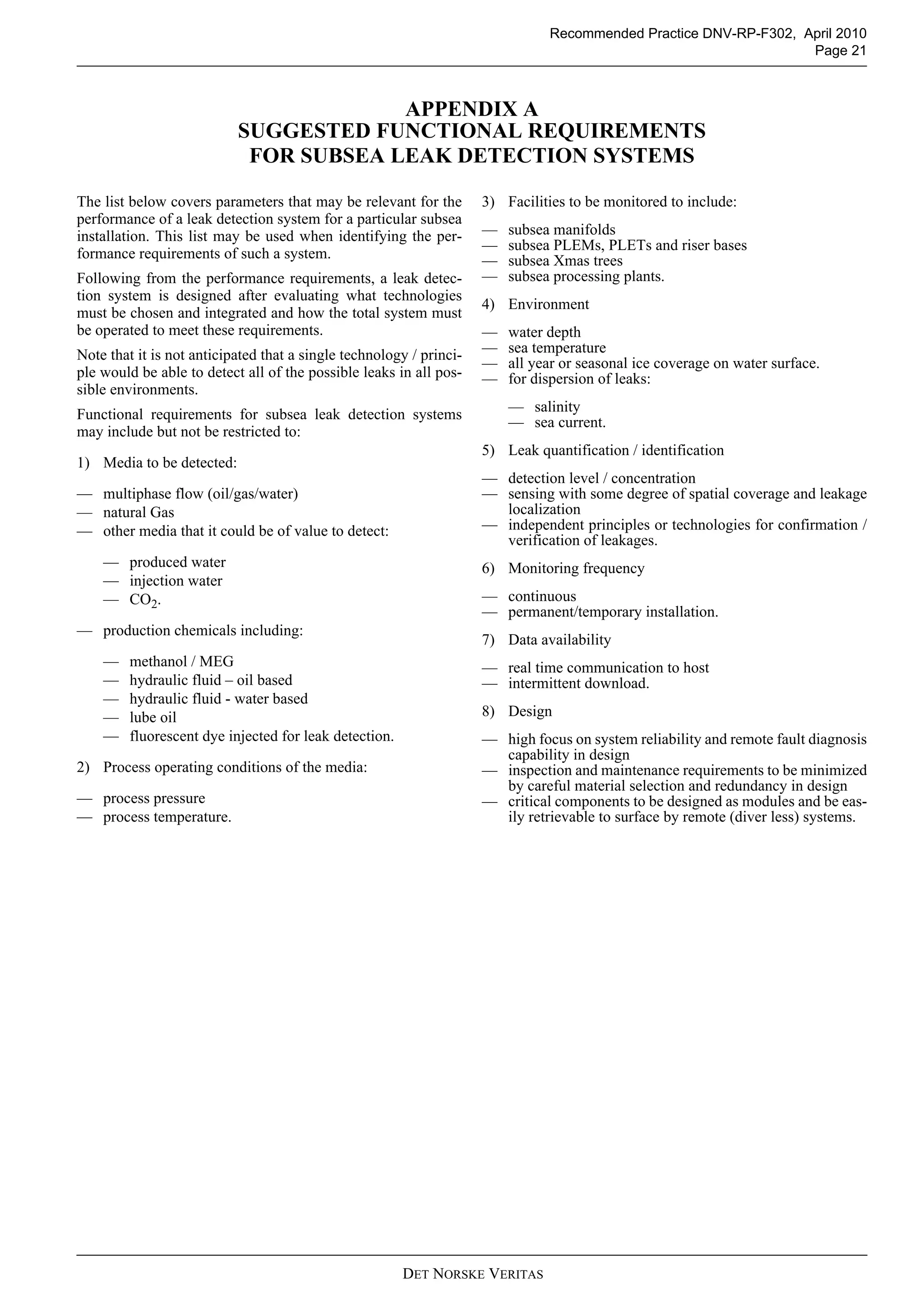
  • 24.
    DET NORSKE VERITAS RecommendedPractice DNV-RP-F302, April 2010 Page 24 plan must contain enough information, analyses, supporting data, and documentation to demonstrate the plan holder's abil- ity to meet the requirements of AS 46.04.030 and 18 AAC 75.400 - 18 AAC 75.495. (b) The plan for a facility comprised of multiple operations as described at 18 AAC 75.442, must describe, for each category of operation at the facility, the appropriate response measures to meet the applicable portion of the response planning stand- ard. (c) The submitted plan must be accompanied by a cover page (…) (d) The plan must (…) (e) The information in the plan must include (1) Part 1 - Response Action Plan: (…) (2) Part 2 - Prevention Plan: The prevention plan must include a detailed description of all oil discharge prevention measures and policies employed at the facility, vessel, or operation, with reference to the specific oil discharge risks involved. The pre- vention plan must describe how the applicant meets all the applicable requirements of 18 AAC 75.005- 18 AAC 75.085. The prevention plan may be submitted as a separate volume, and must include, Register 188, January 2009 ENVIRONMENTAL CONSERVATION 119 at a mini- mum, the following information: (A) discharge prevention programs - a description and sched- ule of regular oil discharge prevention, inspection, and main- tenance programs in place at the facility or operation, including (i) oil discharge prevention training programs required by 18 AAC 75.020(a); (ii) substance abuse and medical monitoring programs required by 18 AAC 75.007(e); (iii) security and surveillance programs required by 18 AAC 75.007(f). (B) discharge history -a history of all known oil discharges greater than 55 gallons that have occurred at the facility (…) (C) potential discharge analysis - an analysis of potential oil discharges, including size, frequency, cause, duration, and location, and a description of actions taken to prevent a poten- tial discharge; (D) specific conditions - a description of (i) any conditions specific to the facility or operation that might increase the risk of a discharge, including physical or navigation hazards, traffic patterns, and other site-specific factors; and (ii) any measures that have been taken to reduce the risk of a discharge attributable to these conditions, including a sum- mary of operating procedures designed to mitigate the risk of a discharge; (E) discharge detection - a description of the existing and pro- posed means of discharge detection, including surveillance schedules, leak detection, observation wells, monitoring sys- tems, and spill-detection instrumentation; if electronic or mechanical instrumentation is employed, detailed specifica- tions, including threshold Register 188, January 2009 ENVI- RONMENTAL CONSERVATION 120 detection, sensitivities, and limitations of equipment must be provided; (F) waivers - (…) (3) Part 3 - Supplemental Information: (…) (4) Part 4 -- Best Available Technology Review: Unless appli- cation of a state requirement would be pre-empted by federal law, the plan must provide for the use of best available tech- nology consistent with the applicable criteria in 18 AAC 75.445(k). In addition, the plan must (A) identify technologies applicable to the applicant's opera- tion that are not subject to response planning or performance standards specified in 18 AAC 75.445(k)(1) and (2); these technologies include, at a minimum, (i) for all contingency plans, communications described under (1)(D) of this subsection; source control procedures to stop the discharge at its source and prevent its further spread described under (1)(F)(i) of this subsection; trajectory analy- ses and forecasts described under (1)(F)(iv) of this subsection; and wildlife capture, treatment, and release procedures and methods described under (1)(F)(xi) of this subsection; (ii) for a terminal, a crude oil transmission pipeline, or an exploration and production contingency plan: cathodic pro- tection or another approved corrosion control system if required by 18 AAC 75.065(h)(2), (i)(3), or (j)(3); a leak detec- tion system for each tank if required by 18 AAC 75.065(i)(4) or (j)(4); any other prevention or control system approved by the department under 18 AAC 75.065(h)(1)(D); a means of imme- diately determining the liquid level of bulk storage tanks as specified in 18 AAC 75.065(k)(3) and (4) or in 18 AAC 75.066(g)(1)(C) and (D); maintenance practices for buried metallic piping containing oil as required by 18 AAC 75.080(b); protective coating and cathodic protection if required by 18 AAC 75.080(d) (k)(1),(l) or (m); and corrosion surveys required by 18 AAC 75.080(k)(2); Register 188, Janu- ary 2009 ENVIRONMENTAL CONSERVATION125 (iii) for a tank vessel contingency plan: (…) (iv) for a crude oil transmission pipeline contingency plan: leak detection, monitoring, and operating requirements for crude oil pipelines that include prompt leak detection as required by 18 AAC 75.055(a); (v) for a barge contingency plan: (…) (vi) for a railroad tank car contingency plan (…) (B) for each applicable technology under (A) of this para- graph, identify all available technologies and include a written analysis of each technology, using the applicable criteria in 18 AAC 75.445(k)(3); and (C) include a written justification that the technology proposed to be used is the best available for the applicant's operation.”
  • 25.
    Recommended Practice DNV-RP-F302,April 2010 Page 25 DET NORSKE VERITAS APPENDIXC SUBSEALEAKDETECTIONINSTALLEDBASE TableC-1SubseaLeakDetectors-InstalledBase (Thedatabelowiscollectedfromthefieldoperators.Thedataisprovidedasinformationonly,noqualitycheckofthedatahasbeenperformed) FieldOperatorLeakdetec- tiontechnol- ogy #sensors delivered Installed year Installed on structure Howisthedata fromthetechnol- ogymanaged/ integratedinyour operation? Detectors stillinuse? Leaksidentified bythetechnol- ogy?Please describe Haveyouhad leaksthatthe technologydid notdetect? Pleasedescribe Falsealarms? Otherfailure modes?Please describe Particular challenges? Comments, experiences AlveStatoilCapacitance12009XMTControlsystemyesNoNoyessubsea testing DraugenShellCapacitance31993XMTyesyestesting*ventholesonpro- tectionstructure *duringcommis- sioningtheydidn't givepositivesignal duringtesting (hydraulicfluid beinginjectedinthe vicinity) *theywerethen pulledandtestedin ahyperbariccham- ber,wherethey worked *nofirmconclu- sion, GullfaksStatoilCapacitance13 GullfaksStatoilPassive acoustic (small) HeidrunNFStatoilCapacitanceAll12 wells 2001FCMasalarmiSASAllinuse buttwoof themgives alarmscon- tinously duetoshal- lowgas. NoNoManyfalse alarmsdueto shallowgasin area Heidrun Satelite StatoilOpticalcam- era 2009Bracket onGuide- post videoonweb browser Presently outoforder NoNoPresentlyoutof orderduetoeart fault.Camerais retrieved,butwill beinstalledafter refurbishment.
  • 26.
    Recommended Practice DNV-RP-F302,April 2010 Page 26 DET NORSKE VERITAS Heidrun Satelite StatoilCapacitance1well2007FCMasalarmiSASYesNoNoManyfalse alarmsdueto shallowgasin area KristinStatoilOpticalcam- era KristinStatoilCapacitance122005XTroofviaSASsystemto controlroom yes(12)noYes,therewas leakagewhich wasdetectedby ROV nono LokeStatoilCapacitance11993XTalarminHKR1No MikkelStatoilCapacitance621998- 2009 HXTalarmatCCRall1to2several,thesen- sorwasnot locatedwhere leakoccured Lotsof"false" alarm.Difficulrto establishcorrect tresholdlevelfor alarm.Shallow gasmigthsetoff alarmintention- ally. Sensor mustnotat anytime givefalse alarm.Only fewfalse alarmswill makeoper- atorhesi- tantto repondtoit. Reliability/ fidelity/ robustnesis keawords. Thedataaregiven forMikkel,Ytter- grytaandÅsgard together.Byno measntrytoimple- menttechnology whichisunquali- fiedandnottested underrealisticcon- dition.Noonewill everinstallleak detectortechnol- ogywhichinstead ofincreasingthe safety MorvinStatoilCapacitance3-4Planned installed XMTNA*Production start08- 2010 NA*NA*NA*NA*NA* NorneStatoilCapacitance201997- 2000 HXTroofControlsystemyes,mos- telyall NoNoFalsealarmsOnlyHXT covered Hasstartedaprojcet totrytotestthe detectorsbypump- inggas/aironeach. Notcompletetdyet. NorneKCapacitance32006FCM (HXT roof) ControlsystemyesNoNo TableC-1SubseaLeakDetectors-InstalledBase (Thedatabelowiscollectedfromthefieldoperators.Thedataisprovidedasinformationonly,noqualitycheckofthedatahasbeenperformed) FieldOperatorLeakdetec- tiontechnol- ogy #sensors delivered Installed year Installed on structure Howisthedata fromthetechnol- ogymanaged/ integratedinyour operation? Detectors stillinuse? Leaksidentified bythetechnol- ogy?Please describe Haveyouhad leaksthatthe technologydid notdetect? Pleasedescribe Falsealarms? Otherfailure modes?Please describe Particular challenges? Comments, experiences
  • 27.
    Recommended Practice DNV-RP-F302,April 2010 Page 27 DET NORSKE VERITAS Ormen Lange ShellPassive acoustic 3Ateach template 2outof3units returnedtoshorefor replacamentof hydrophonesdueto contructionerror. Thethirdunitiscol- lectingdatabutwill alsoneedtogetthe hydrophones replaced. Rimfaks, Skinfaks StatoilCapacitance12 UrdStatoilCapacitance82005- 2006 XMTControlsystemyesNoNoyessubseatest- ing UMCNorth Cormorant ShellCapacitance SigynStatoilCapacitance32002XTalarminHKR3No SkarvBPNorgeCapacitanceXMTand manifold Sleipner VestSVAN StatoilCapacitance42004XTalarminHKR4No SleipnerØst SLØ StatoilCapacitance21993XTalarminHKR2No SnorreUPAStatoilCapacitance4First installa- tion1992. Lastistal- lation after repair 2008 Yes,2 detectors above each otherin eachend ofthe protec- tionroof Alarmonopera- tionscreen.Sig- nalthroughthe subseacontrole system 4Thedetectorsare placeupunder thecollection roofandwehave detectedcollec- tionofnon-water No,buthardto sayforsure Ithasbeenvery difficulttomake thesedetector workproperly.So wedon'tknowif itisainstrument failureornot Thechal- langehas beento makethis detectors workprop- erly.There isnopossi- bilitytosee ifthereis oilorgas collected underthe roofby ROV. TheSnorreSPSis coveredbyaroof thatcancollectas muchas40m3of spilledhydraulicoil, gasand/orhydro- carb.Itispossible toemtytheroofto theSnorrePlatt- formbyuseofthe 3"serviselines.Itis notpossibletocon- firmthattheroofis empt TableC-1SubseaLeakDetectors-InstalledBase (Thedatabelowiscollectedfromthefieldoperators.Thedataisprovidedasinformationonly,noqualitycheckofthedatahasbeenperformed) FieldOperatorLeakdetec- tiontechnol- ogy #sensors delivered Installed year Installed on structure Howisthedata fromthetechnol- ogymanaged/ integratedinyour operation? Detectors stillinuse? Leaksidentified bythetechnol- ogy?Please describe Haveyouhad leaksthatthe technologydid notdetect? Pleasedescribe Falsealarms? Otherfailure modes?Please describe Particular challenges? Comments, experiences
  • 28.
    Recommended Practice DNV-RP-F302,April 2010 Page 28 DET NORSKE VERITAS SnøhvitStatoilCapacitance102005XTAlarmandvalue incontrolroom (PCDA) 8stillin use.2outof function duetolost readings, refM2 40876817 andM2 40705054. 1temporaryleak detected.Cause ofleaknotcon- cluded,butfrom theproduction valveblock, probablystem leakinvalve. RefM2 40913922. 1gasleakfrom XT/CBMmulti- borehubnot detectedbyHC detector.Ref Synergi 1001496.Leak estimatedto0.3 kg/sfor5to51 days,ieatotalof 16-1277tonnes ofgas. Nofalsealarms besidesthe2sen- sorsoutoffunc- tion. Notveryreliable andnoredundancy (20%outoffunc- tionafter4years). Notabletodetect leakagesfrom chokebridgemod- uleormanifold. SRIStatoilCapacitance6 Statfjord Nord StatoilCapacitance81995XMTAlarmYesNoNoYes Statfjord Øst StatoilCapacitance81995XMTAlarmYesNoNoYes SygnaStatoilCapacitance32000XMT (FCM) AlarmYesNoNoYes Tampen Link StatoilPassive acoustic 5 TOGI TrollOse- bergGas Injection StatoilActiveacous- tic 51989/90XTIntegratedinthe controlsystem. SDwhenleak. 0.The Transpond- erswere installedon a5meter highpole. Thepoles werebro- kenoverthe years causedby trawling. No.Therehave beennoleakson Togi.Butthe systemwas testedyearlyby releasinggasto thewater. NoTherehavebeen falsealarms causedbybig shoaloffish.One ortwotimes. NoIthasbeenarelia- bleandgooddetec- tionsystem. (SIMRAD).Togi hasnotproduced since2002.Sono efforthasbeen madetofixthe poles.Thetechnol- ogyinstalledon Togiisnowoutof date. TableC-1SubseaLeakDetectors-InstalledBase (Thedatabelowiscollectedfromthefieldoperators.Thedataisprovidedasinformationonly,noqualitycheckofthedatahasbeenperformed) FieldOperatorLeakdetec- tiontechnol- ogy #sensors delivered Installed year Installed on structure Howisthedata fromthetechnol- ogymanaged/ integratedinyour operation? Detectors stillinuse? Leaksidentified bythetechnol- ogy?Please describe Haveyouhad leaksthatthe technologydid notdetect? Pleasedescribe Falsealarms? Otherfailure modes?Please describe Particular challenges? Comments, experiences
  • 29.
    Recommended Practice DNV-RP-F302,April 2010 Page 29 DET NORSKE VERITAS TordisStatoilCapacitance1994Tordisfieldwas installedwith hydrocarbon detectors,but thesewereaban- doneddueto manyfalse alarms. TordisIORStatoilPassive acoustic 32007SSBI (subsea separator) Stillnotworking, modulesonshore fortestingverifi- cation No,willbe re-installed whenready. NoNoNoDefining thediffer- entleak sectors. Newinstallationsat T&Vfieldswith acousticsensors seemtoshowsome progress,butstillin theirinfancy.Most likelythewayfor- ward. TrollPilotStatoilPassive acoustic notper- manent installa- tion TyrihansStatoilCapacitance42008- 2009 XT-RoofDatafromthe sensoraresentto controlroom. Warningsshown incontrolroom 42leaksduring start-upofwells duetoshallow gas. NoneShallowgasNoneOnly4of12wells inproduktion VegaStatoilPassive acoustic 0Planned installed NA*NA*NA*NA*NA*NA*NA*NA* VigdisStatoilPassive acoustic 12008manifoldSectoralarms backtoCRif noisesexperi- enced yesNoNoYes.Duringves- seloperationsat otherlocationsat thefield.Tuning ofthesystem wheninstalled importantfor buildingconfi- denceinthesys- tem.Falsealarms lowertheconfi- denceforthesys- tem. Defining thediffer- entleak sectors. YmeStatoilCapacitance2 TableC-1SubseaLeakDetectors-InstalledBase (Thedatabelowiscollectedfromthefieldoperators.Thedataisprovidedasinformationonly,noqualitycheckofthedatahasbeenperformed) FieldOperatorLeakdetec- tiontechnol- ogy #sensors delivered Installed year Installed on structure Howisthedata fromthetechnol- ogymanaged/ integratedinyour operation? Detectors stillinuse? Leaksidentified bythetechnol- ogy?Please describe Haveyouhad leaksthatthe technologydid notdetect? Pleasedescribe Falsealarms? Otherfailure modes?Please describe Particular challenges? Comments, experiences
  • 30.
    Recommended Practice DNV-RP-F302,April 2010 Page 30 DET NORSKE VERITAS YttergrytaStatoilCapacitanceSee Mikkel See Mikkel See Mikkel SeeMikkelSeeMikkelSeeMikkelSeeMikkelSeeMikkelSeeMikkelSeeMikkel ÅsgardStatoilCapacitanceSee Mikkel See Mikkel See Mikkel SeeMikkelSeeMikkelSeeMikkelSeeMikkelSeeMikkelSeeMikkelSeeMikkel ÅsgardStatoilOpticalcam- era valve *NA=NotApplicable TableC-1SubseaLeakDetectors-InstalledBase (Thedatabelowiscollectedfromthefieldoperators.Thedataisprovidedasinformationonly,noqualitycheckofthedatahasbeenperformed) FieldOperatorLeakdetec- tiontechnol- ogy #sensors delivered Installed year Installed on structure Howisthedata fromthetechnol- ogymanaged/ integratedinyour operation? Detectors stillinuse? Leaksidentified bythetechnol- ogy?Please describe Haveyouhad leaksthatthe technologydid notdetect? Pleasedescribe Falsealarms? Otherfailure modes?Please describe Particular challenges? Comments, experiences TableC-2SubseaLeakDetectors-Fieldswithnoleakdetectioninstalled FieldOperator FramVest/ØstStatoil HeidrunVIKSStatoil NjordStatoil OsebergDeltaStatoil OsebergVestflankenStatoil OsebergSørKStatoil OsebergSørJStatoil Skirne/ByggveStatoilonbeholfofTotal SnorreBStatoil TrollBandC.Statoil TuneStatoil ValeStatoil ViljeStatoil
  • 31.
    Recommended Practice DNV-RP-F302,April 2010 Page 31 DET NORSKE VERITAS FigureC-1 Thepie-chartsaboveshowthedatagatheredfromthe40fields(outofatotalof53investigatedfields)thathavesometechnologyinstalledforleakdetection. Chartashowswhattechnologyisinstalledateachfield Chartbshowswhetherthefieldhashadfalsealarms Chartcshowshowmanyofthefieldshavehadleaksidentifiedbytheinstalledleakdetec- tion(itisnotknownhowmanyleakstherehaveactuallybeenforthevariousfields) Chartdshowshowmanyofthefileldsthatknowtheyhavehadleaksthattheinstalledleak detectiondidnotdetect. Chartb-Experiencewithfalsealarms Falsealarms Nofalsealarms Nodetails Chartc-Leaksidentifiedbyinstalledtechnology Havehadleaksidentified Havenothadleaksidentified Nodetails Chartd-Leakshaveoccuredbutnotidentifiedbytechnology Havehadleaksnotdetected Havenothadleaksnot detected Nodetails Charta-Typeoftechnologyinstalled Capacitance Camera PassiveAcoustic Activeacoustic
  • 32.
    Recommended Practice DNV-RP-F302,April 2010 Page 32 DET NORSKE VERITAS APPENDIXD SUBSEALEAKDETECTORSSUPPLIERTECHNICALDATA TableD-1Detectors-SupplierTechnicalData Tech- nology Calibra- tion/ Re-cali- bration Mainte- nance Mechani- calinter- face Weight [kg] DimensionsConnec- tionto power andcom- munica- tion Power need Band- width need Maturity1Detectablerelease limitorotheraccu- racyinformation Detectable media Detection range Reliabil- itydata2 Design life [years] Water depth [m] Tem- pera- ture [°C] Active acoustic Calibra- tiondur- ingSea Accept- anceTest 3-5 years interval Mounted onROV skidor directlyto template structure. Willbe designedto beROV retievable. Receive array9.6 (dry), subsea bottle 24.8 (dry), transmit array4.5 (dry), Receiver: 102x496x 131mm Transmit- ter:240x86 x99mm Subsea Bottle: 530.9x 174mm 48V, Ethernet 40W- 100W High, develop- ment goalis 1- 10Mbit ethernet interface Baseline offshore product: Commer- ciallydeliv- ered. Subseaver- sion:Con- cept Smallgasleakages (0.35mmnozzle,2 barpressurediffer- ence)detectedat about30meters. Fluidleakfrom5mm nozzlewith15bar pressuredifference detectedat50m Notdepend- entonchem- ical compoundas longas acoustic impedanceis differentto thatofsea- water. dependson leaksizeand media.Small gasleaksseen upto125m range.Fluid seenupto50m range(maxi- mumtestrange todate NA*NA*400 and 6000 ver- sions avail- able -5to40 (opera- tion) -30to 55 (stor- age) Cali- brates automati- callyat installa- tion.No recalibra- tion needed. Deep- ening on water depht from4- 8years interval ROV mountable onXmas tree,nopre installation required <11kg com- plete unit (dry) 226x62x 154mm 15-36V 100Mb/s Ethernet 16Mb/s RS-485 Typ: 15W <30W - depend enton require d updat- ingrate Depend- entom requier- ment and infroma- tion,can below 9600 Baud- system spesific PrototypesAngularresolution< 0.75° Rangeresolution< 10mm Notdepend- entonchem- ical compoundas longas acoustic impedanceis differentto thatofsea- water. Anglehorizon- tal90°or120° Anglevertical 20° Range1to< 100m NA*25300or 3000 -20-60 Biosen- sors Calibra- tionafter installa- tion Replace mentof biosen- sor module Installedin asensor rackinte- gratedorin proximity ofthemon- itored structure Biosen- sormod- ule:2-3 (inair) Prototype racksare2 mx0.4mx 0.4m(phys- ical,chemi- caland biological sensor array) Con- nectedto subsea control system viacable. RS-485 orEther- net approx .10W LowPilots installedfor shallow water.Con- ceptfor deepwater <0.06ppmon hydrocarbons(raw oil) Notdepend- entonchem- ical compound, specification willdepend onselected biosensor. Dependingon leaksize, mediaandsea current (upstream/ downstream approach) NA*NA*100 (500 from 2012) Ocean temper- ature range.
  • 33.
    Recommended Practice DNV-RP-F302,April 2010 Page 33 DET NORSKE VERITAS Capaci- tance Norecali- bration required Clean- ing. Usinga hydro- jet should beOK Boltedon tocover aboveleak point. <5<1000ccm =1l 4-20mA and CANBus 24V, 0.5W LowCommer- ciallydeliv- eredand qualified Evensmallleaksare detected. Allhydro- carbons Dependingon overallsystem design. Approx. 300units deliv- ered,no returns andno reports offailure after installa- tion. 254000, deepe rif requir ed. Allsea temper- atures OK. Fiber optic Nocali- bration 2YearsSystem Specif 20kg- surface equip- ment 56x45x15c ms Ethernet atsur- face 240/ 110v 300w at surace System spefic Concept tested(top- sidefor pipelines) Gasbubbleat1Hz detected.Lowpres- surethreshold approx2bar.No upperlimit Notdepend- entonchem- ical compound, detects vibrations causedbya leak Dependenton energy,but typically5m NA*204000+5to +50 (opera- tion) Fluores- cent Norecali- bration required Possi- blelens clean- ing every 3-5 years Boltedon toXTand SPS 10-15in air Ø200x200m m, 100x200x20 0mm 4wire Tronic/ Canbus/ 4-20mA 24V, <10W LowInusewith ROV.Con- ceptversion forsubsea Widedynamic range.<100ppm @4m Crudeoil. Production fluidswith fluorescent markers 3-5mNA*NA*NA*NA* Meth- ane sniffer; optical NDIR method Norecali- bration required Mem- brane service every 36 months ROV mountable/ inter- changea- blebywet- mateable plugsand ROVhan- dle 5,2inair 2,7in water Diameter 90mm, length 700mm wet- matea- bleplug 3Wlowcommer- ciallydeliv- ered verysmallleaksMethaneNA*Stability 3years. Newver- sion5 years 106000-4upto 50 Meth- ane sniffer; semi conduc- tor 2years2yearsadaptable tofitappli- cation 0.5kgin water Ø49mmx 200mm wet- matea- bleplug 1WLowBaseline product commer- ciallydeliv- ered. Concept versionfor subsea verysmallleaksMethanelowerrange limit1nM (oceanicback- ground) lifetime 5years 540000-30 TableD-1Detectors-SupplierTechnicalData(Continued) Tech- nology Calibra- tion/ Re-cali- bration Mainte- nance Mechani- calinter- face Weight [kg] DimensionsConnec- tionto power andcom- munica- tion Power need Band- width need Maturity1Detectablerelease limitorotheraccu- racyinformation Detectable media Detection range Reliabil- itydata2 Design life [years] Water depth [m] Tem- pera- ture [°C]
  • 34.
    Recommended Practice DNV-RP-F302,April 2010 Page 34 DET NORSKE VERITAS Optical camera NoCheck mov- ing parts and lens clean- ing every2 years. Inter- vention every5 years ROV mountable onXmas tree,nopre installation required camera 3.2in air. Light 4.1in air. ø100x200m m. 880*550*45 0 4wire tronic. Commu- nication via power line. 96WMedium .Com- munica- tionon separate lineor viasub- seacon- trol system Firstproto- typewith patternrec- ognition readyin 2006 NotdefinedAll hydrocar- bonsand injected chemicals 10metersNA*251000 made inalu- min- ium 3000 made intita- nium Passive acoustic Adaptsto back- ground noiseat installa- tionsite. Norecali- bration required NonROV mounting, forlarger typeofsys- temsaspe- cialconeis required Smaller type2-3, larger type250 inair Smallertype ø64x 357mm, largertype ø1x1.8m NA*Larger type: 25W Depend- entom process- ingsub- seaor topside. Process- ingtop- side requires more band- width Commer- ciallydeliv- ered,both largerand smaller type Smallertype:5liter/ min@25Bardiff pressureat2mdis- tance.Detection range50mwith increasedleakage rate.Largertype:5 liter/min@5Bar diffpressureat5m distance.Detection range1000mwith increasedleakage rate. Notimpor- tant,allleaks asdescribed under 'Detectable releaselimit' Seedetectable releaselimit 25.8year calcu- lated MTBF basedon data- heets, EPRD- 97and MIL- HDBK- 217F. 5for small type and25 for large type. 2500opera- tional insea water:- 5-+30. Onshor etest temper- ature- 20- +70. Stor- age-40 -+70 Cali- brates automati- callyat installa- tion.No recalibra- tion needed. NonROV mountable onXmas tree,nopre installation required <7kg sensor unit (dry) <15kg funnel (dry) 324x ø90mm Con- nectedto subsea control system via RS485, CanBus, Profi- bus, Modbus orEther- net 0,8W, 12-38 VDC mini- mum 1200 baud, upto115 Kbaud Commer- ciallydeliv- ered Minimumforliquid: dP>3bar,min.leak- agerate0.1l/min Minimumforgas: dP>1bar,min.leak- agerate0.1l/min instrumenttobe closetoleaksource- mechanicalonto structureorvalves Shortarea coverage withinradius of3meters- leaksneedto belargertobe detected beyondthis area Deliv- eredin several versions -more than 1000 systems installed subsea MTBF calcula- tions> 140 Years +304500-20-215 TableD-1Detectors-SupplierTechnicalData(Continued) Tech- nology Calibra- tion/ Re-cali- bration Mainte- nance Mechani- calinter- face Weight [kg] DimensionsConnec- tionto power andcom- munica- tion Power need Band- width need Maturity1Detectablerelease limitorotheraccu- racyinformation Detectable media Detection range Reliabil- itydata2 Design life [years] Water depth [m] Tem- pera- ture [°C]
  • 35.
    Recommended Practice DNV-RP-F302,April 2010 Page 35 DET NORSKE VERITAS Note1:Thedatabelowarecollectedfromvarioussuppliersofleakdetectors.Forsomeofthetechnologies,morethanonesupplierisavailableandhavebeengivinginputtothedatabelow.Whenconsidering aspecificproductforagivenapplication,objectiveevidenceshouldbecollectedfromthesuppliertoverifytheperformancespecificationsforthatspecificproduct. Note2:Othersuppliersthanthosethathavegiveninputtothistablemayexist 1Maturityclassesareforthistabledefinedasfollows:Concept,ConceptTested,PrototypesorPilotstested,Commerciallydelivered,Commerciallydeliveredandqualified 2Reliabilitydatamaybecalculatedfromfieldexperiencedataormaybecalculatedbyapplyingareliabilitymodel.Inbothcases,thereliabilitydatashouldbespecificandgiveninhardnumbers *NA=NotApplicable TableD-1Detectors-SupplierTechnicalData(Continued) Tech- nology Calibra- tion/ Re-cali- bration Mainte- nance Mechani- calinter- face Weight [kg] DimensionsConnec- tionto power andcom- munica- tion Power need Band- width need Maturity1Detectablerelease limitorotheraccu- racyinformation Detectable media Detection range Reliabil- itydata2 Design life [years] Water depth [m] Tem- pera- ture [°C]
  • 36.
    Recommended Practice DNV-RP-F302,April 2010 Page 36 DET NORSKE VERITAS