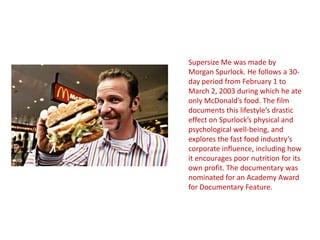
Supersize Me was made by
Morgan Spurlock. He follows a 30-
day period from February 1 to
March 2, 2003 during which he ate
only McDonald’s food. The film
documents this lifestyle’s drastic
effect on Spurlock’s physical and
psychological well-being, and
explores the fast food industry’s
corporate influence, including how
it encourages poor nutrition for its
own profit. The documentary was
nominated for an Academy Award
for Documentary Feature.
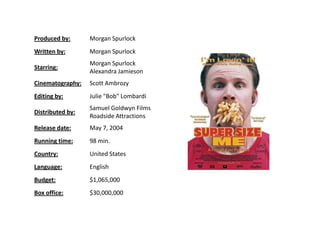
Produced by: Morgan Spurlock
Written by: Morgan Spurlock
Starring:
Morgan Spurlock
Alexandra Jamieson
Cinematography: Scott Ambrozy
Editing by: Julie "Bob" Lombardi
Distributed by:
Samuel Goldwyn Films
Roadside Attractions
Release date: May 7, 2004
Running time: 98 min.
Country: United States
Language: English
Budget: $1,065,000
Box office: $30,000,000
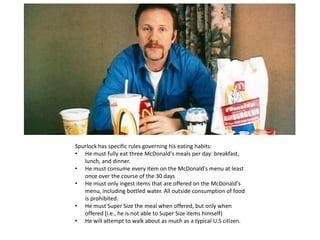
Spurlock has specific rules governing his eating habits:
• He must fully eat three McDonald's meals per day: breakfast,
lunch, and dinner.
• He must consume every item on the McDonald's menu at least
once over the course of the 30 days
• He must only ingest items that are offered on the McDonald's
menu, including bottled water. All outside consumption of food
is prohibited.
• He must Super Size the meal when offered, but only when
offered (i.e., he is not able to Super Size items himself)
• He will attempt to walk about as much as a typical U.S citizen.
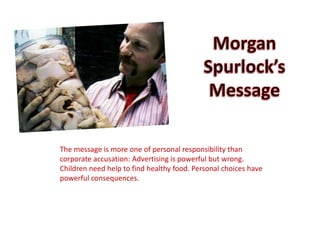
The message is more one of personal responsibility than
corporate accusation: Advertising is powerful but wrong.
Children need help to find healthy food. Personal choices have
powerful consequences.
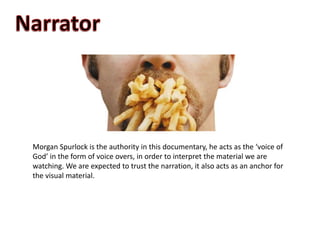
Morgan Spurlock is the authority in this documentary, he acts as the ‘voice of
God’ in the form of voice overs, in order to interpret the material we are
watching. We are expected to trust the narration, it also acts as an anchor for
the visual material.
The script is the exposition, the
argument behind the
documentary, it provides a
structure to the film. Morgan
Spurlock divides his
documentary into
sections/chapters, in each one
Morgan Spurlock addresses
different factors for his
argument.
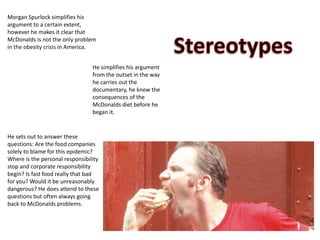
Morgan Spurlock simplifies his
argument to a certain extent,
however he makes it clear that
McDonalds is not the only problem
in the obesity crisis in America.
He sets out to answer these
questions: Are the food companies
solely to blame for this epidemic?
Where is the personal responsibility
stop and corporate responsibility
begin? Is fast food really that bad
for you? Would it be unreasonably
dangerous? He does attend to these
questions but often always going
back to McDonalds problems.
He simplifies his argument
from the outset in the way
he carries out the
documentary, he knew the
consequences of the
McDonalds diet before he
began it.
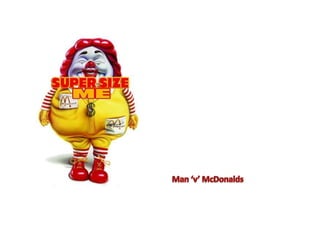
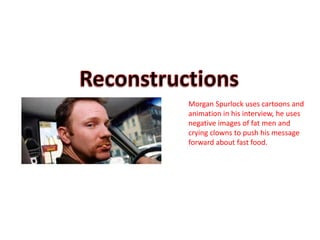
Morgan Spurlock uses cartoons and
animation in his interview, he uses
negative images of fat men and
crying clowns to push his message
forward about fast food.
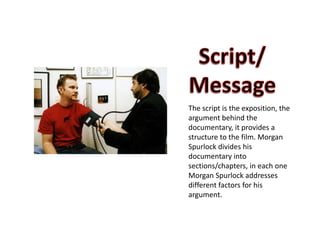
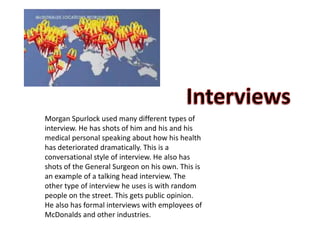
Morgan Spurlock used many different types of
interview. He has shots of him and his and his
medical personal speaking about how his health
has deteriorated dramatically. This is a
conversational style of interview. He also has
shots of the General Surgeon on his own. This is
an example of a talking head interview. The
other type of interview he uses is with random
people on the street. This gets public opinion.
He also has formal interviews with employees of
McDonalds and other industries.
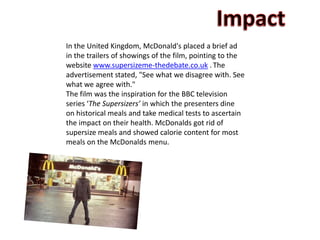
In the United Kingdom, McDonald's placed a brief ad
in the trailers of showings of the film, pointing to the
website www.supersizeme-thedebate.co.uk . The
advertisement stated, "See what we disagree with. See
what we agree with."
The film was the inspiration for the BBC television
series ‘The Supersizers’ in which the presenters dine
on historical meals and take medical tests to ascertain
the impact on their health. McDonalds got rid of
supersize meals and showed calorie content for most
meals on the McDonalds menu.

Analysis of Supersize Me

  • 2.
    Supersize Me wasmade by Morgan Spurlock. He follows a 30- day period from February 1 to March 2, 2003 during which he ate only McDonald’s food. The film documents this lifestyle’s drastic effect on Spurlock’s physical and psychological well-being, and explores the fast food industry’s corporate influence, including how it encourages poor nutrition for its own profit. The documentary was nominated for an Academy Award for Documentary Feature.
  • 3.
    Produced by: MorganSpurlock Written by: Morgan Spurlock Starring: Morgan Spurlock Alexandra Jamieson Cinematography: Scott Ambrozy Editing by: Julie "Bob" Lombardi Distributed by: Samuel Goldwyn Films Roadside Attractions Release date: May 7, 2004 Running time: 98 min. Country: United States Language: English Budget: $1,065,000 Box office: $30,000,000
  • 4.
    Spurlock has specificrules governing his eating habits: • He must fully eat three McDonald's meals per day: breakfast, lunch, and dinner. • He must consume every item on the McDonald's menu at least once over the course of the 30 days • He must only ingest items that are offered on the McDonald's menu, including bottled water. All outside consumption of food is prohibited. • He must Super Size the meal when offered, but only when offered (i.e., he is not able to Super Size items himself) • He will attempt to walk about as much as a typical U.S citizen.
  • 5.
    The message ismore one of personal responsibility than corporate accusation: Advertising is powerful but wrong. Children need help to find healthy food. Personal choices have powerful consequences.
  • 6.
    Morgan Spurlock isthe authority in this documentary, he acts as the ‘voice of God’ in the form of voice overs, in order to interpret the material we are watching. We are expected to trust the narration, it also acts as an anchor for the visual material.
  • 7.
    The script isthe exposition, the argument behind the documentary, it provides a structure to the film. Morgan Spurlock divides his documentary into sections/chapters, in each one Morgan Spurlock addresses different factors for his argument.
  • 8.
    Morgan Spurlock simplifieshis argument to a certain extent, however he makes it clear that McDonalds is not the only problem in the obesity crisis in America. He sets out to answer these questions: Are the food companies solely to blame for this epidemic? Where is the personal responsibility stop and corporate responsibility begin? Is fast food really that bad for you? Would it be unreasonably dangerous? He does attend to these questions but often always going back to McDonalds problems. He simplifies his argument from the outset in the way he carries out the documentary, he knew the consequences of the McDonalds diet before he began it.
  • 9.
    Morgan Spurlock usescartoons and animation in his interview, he uses negative images of fat men and crying clowns to push his message forward about fast food.
  • 10.
    Morgan Spurlock usedmany different types of interview. He has shots of him and his and his medical personal speaking about how his health has deteriorated dramatically. This is a conversational style of interview. He also has shots of the General Surgeon on his own. This is an example of a talking head interview. The other type of interview he uses is with random people on the street. This gets public opinion. He also has formal interviews with employees of McDonalds and other industries.
  • 11.
    In the UnitedKingdom, McDonald's placed a brief ad in the trailers of showings of the film, pointing to the website www.supersizeme-thedebate.co.uk . The advertisement stated, "See what we disagree with. See what we agree with." The film was the inspiration for the BBC television series ‘The Supersizers’ in which the presenters dine on historical meals and take medical tests to ascertain the impact on their health. McDonalds got rid of supersize meals and showed calorie content for most meals on the McDonalds menu.