World Missionary Press
A Bible Study on ROMANS
INTRODUCTION TO ROMANS
The book of Romans in the New Testament is a
letter from the apostle Paul to believers living in
Rome about 58 a.d. It completely explains the
amazing life of Jesus Christ—what He has already
done for us and what He wants to do in us.
Paul shows us how God sees us—as desperately in
need of a Savior. As sinners, we were all
condemned to death and eternal separation from
God. But in this letter we see God's wonderful,
awesome love for us. He sent His own Son to take
the death penalty for our sins so that we might be
free to live in marvelous fellowship with Him now
and for eternity. Isn't that the best news you could ever hear?
Jesus, who is alive from the dead, wants to share His life with all who trust in
Him and make them like Himself. "And this is the testimony: that God has
given us eternal life, and this life is in His Son" (1 John 5:11). Jesus said,
"And you shall know the truth, and the truth shall set you free" (John
8:32). Paul's letter to the Romans is a message of truth about freedom. Ask God
to reveal Jesus to your heart as a living Person, "the eyes of your
understanding being enlightened; that you may know what is the hope of
His calling, . . . and what is the exceeding greatness of His power toward us
who believe" (Ephesians 1:18,19a).
Hundreds of books have been written to analyze Paul's letter to the Romans.
But don't come to this letter to analyze it. Babies don't analyze their mother's
milk; they drink it for nourishment and life. Come to this letter again and again
to drink deeply of it, to digest it, to know the Lord intimately, until Jesus
Himself is formed in you (Galatians 4:19). —V. R. Benson
©2003 by V. R. Benson
The Bible text used is from the New King James Version ©1979, 1980, 1982,
Thomas Nelson, Inc., Publishers. Used by permission.
LESSON 1. PAUL DECLARES THE GOSPEL OF GOD
Romans 1:1-15
1
Paul, a servant of Jesus Christ, called to be an apostle, separated to the gospel
of God 2
which He promised before through His prophets in the Holy Scriptures,
3
concerning His Son Jesus Christ our Lord, who was born of the seed of David
according to the flesh, 4
and declared to be the Son of God with power,
according to the Spirit of holiness, by the resurrection from the dead, 5
through
whom we have received grace and apostleship for obedience to the faith among
all nations for His name, 6
among whom you also are the called of Jesus Christ;
7
to all who are in Rome, beloved of God, called to be saints: Grace to you and
peace from God our Father and the Lord Jesus Christ.
8
First, I thank my God through Jesus Christ for you all, that your faith is spoken
of throughout the whole world. 9
For God is my witness, whom I serve with my
spirit in the gospel of His Son, that without ceasing I make mention of you
always in my prayers, 10
making request if, by some means, now at last I may
find a way in the will of God to come to you. 11
For I long to see you, that I may
impart to you some spiritual gift, so that you may be established— 12
that is, that
I may be encouraged together with you by the mutual faith both of you and me.
13
Now I do not want you to be unaware, brethren, that I often planned to come
to you (but was hindered until now), that I might have some fruit among you
also, just as among the other Gentiles. 14
I am a debtor both to Greeks and to
barbarians, both to wise and to unwise. 15
So, as much as is in me, I am ready to
preach the gospel to you who are in Rome also.
What Is the Gospel?
The word "gospel" means "good news." Paul loved to tell people the good news
he had received from God: "that Christ died for our sins according to the
Scriptures, and that He was buried, and that He rose again the third day
according to the Scriptures" (1 Corinthians 15:3b,4). Paul will explain why
this is such good news and what it means for you. You will be amazed by God's
grace and love for you and the freedom Jesus gives over sin and self. "Thanks
be to God for His indescribable gift!" (2 Corinthians 9:15).
Something to Do
Fill in the blanks from the verses on page 1 to find out more about the gospel of
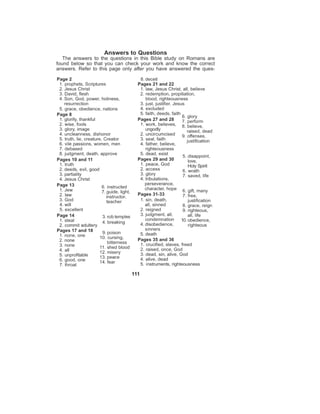
God and about Jesus. (You may check your answers with the answers given on
page 111.)
1. God promised His gospel through His ____________ in the Holy
_______________ (verse 2).
2. The gospel of God is about His Son _______________ _____________ our
Lord (3).
3. Jesus Christ was born of the seed of ______________ according to the
_________ (3).[Jesus was born with a human body. The prophets foretold that
Messiah would descend from King David (Jeremiah 23:5).]
4. Jesus Christ was declared to be the __________ of _________ with
______________, according to the Spirit of ___________, by the
________________ from the dead (4).[Jesus was divine. He was “God with us”
(Matthew 1:23). His resurrection proved it. God would not allow His Holy One
to see corruption (Psalm 16:10), so He raised Him from the dead.]
5. Through Jesus Christ Paul had received ___________ and apostleship for
______________________ to the faith among all ______________ for His
name (5).
The Believers in Rome
Though Paul had not yet visited Rome, he had heard of the believers there
because their faith was spoken of throughout the whole world (the Roman
Empire). He knew Jesus Christ had called them (verse 6), that they were loved
by God and called to be saints or holy ones (verse 7). We know that fifty days
after the resurrection of Jesus Christ from the dead, when His disciples were
filled with the Holy Spirit and spoke to the crowds which were in Jerusalem for
the feast of Pentecost, there were in the crowd “visitors from Rome,” both Jews
and those converted to Judaism (Acts 2:10). No doubt some of these visitors
who believed on the Lord Jesus that day went back to Rome with the joy of
Christ in their hearts. Later, when all Jews were commanded by Claudius to
leave Rome, a precious couple named Aquila and his wife Priscilla went to live
in Corinth as tentmakers (Acts 18:2, 3). When Paul, also a tentmaker, arrived in
Corinth toward the end of his third missionary journey, he stayed with them
and doubtless heard even more about the believers in Rome. Paul probably
wrote this letter while he was staying in Corinth. Believers in Rome were about
to face unbelievable persecution and martyrdom (being killed for their faith in
Jesus). The truths of this letter would strengthen their faith.
Paul, a Bondservant of Jesus Christ
Paul could have introduced himself to the believers in Rome in many ways. As
a Jew he had the highest of credentials and training. He had also been born a
Roman citizen, with all of its privileges. He had a tremendously fruitful
ministry. But he doesn't refer to any of these; he calls himself a bondservant of
Jesus Christ, called to be an apostle (a person sent on a mission, having the
authority of the one who sent him). A bondservant is one who gives total
allegiance to his master. Paul had not always been a servant of Jesus Christ. In
fact, he had once opposed Him with all his might in his misguided zeal for
God.Now Paul is about to share with the believers in Rome and with us today
the key to living a life transformed by the resurrection power of the Lord Jesus.
Paul himself is an example, a living proof, of the truth of his message.
Paul (his Roman name) was once Saul (his Hebrew name) from Tarsus. In his
religious zeal, he consented to the death of Stephen, the first Christian martyr,
who was stoned to death (Acts 7:54-59), setting off a great persecution of
Christians in Jerusalem. "As for Saul, he made havoc of the church, entering
every house, and dragging off men and women, committing them to
prison" (Acts 8:3). Christians scattered far and wide, preaching the Word.
"Then Saul, still breathing threats and murder against the disciples of the
Lord, went to the high priest and asked letters from him to the synagogues
of Damascus, so that if he found any who were of the Way, whether men or
women, he might bring them bound to Jerusalem. And as he journeyed he
came near Damascus, and suddenly a light shone around him from heaven.
Then he fell to the ground, and heard a voice saying to him, ‘Saul, Saul,
why are you persecuting Me?' And he said, ‘Who are You, Lord?' And the
Lord said, ‘I am Jesus, whom you are persecuting. It is hard for you to
kick against the goads [pricks of conscience]' " (Acts 9:1-5).
Later, when Paul testified about this experience, He told more of what Jesus
had said. "But rise and stand on your feet; for I have appeared to you for
this purpose, to make you a minister and a witness both of the things
which you have seen and of the things which I will yet reveal to you. I will
deliver you from the Jewish people, as well as from the Gentiles, to whom I
now send you, to open their eyes and to turn them from darkness to light,
and from the power of Satan to God, that they may receive forgiveness of
sins and an inheritance among those who are sanctified by faith in Me"
(Acts 26:16-18).
LESSON 2. THE GOSPEL REVEALS THE RIGHTEOUSNESS OF GOD
Romans 1:16-17
16
For I am not ashamed of the gospel of Christ, for it is the power of God to
salvation for everyone who believes, for the Jew first and also for the Greek.
17
For in it the righteousness of God is revealed from faith to faith; as it is
written, "The just shall live by faith."
God Offers Us His Own Righteousness
The good news about the righteousness of God is that it is a gift from God to
those who trust in Jesus Christ. The righteousness of God is revealed ‘'from
faith to faith." It is first received by faith—believing that God has declared me
righteous because of what Jesus did for me and has given me a new nature. It
is then lived out by faith—trusting Jesus to empower me to live a holy life by
His Spirit living in me.
Salvation Is For Everyone Who Believes
Salvation means deliverance. In the next lesson we shall see just how
desperately we need deliverance from sin and from God's wrath on those who
sin (John 3:36).
This message of salvation came to the Jews first, because it was God's purpose
that salvation should come through the Jews (John 4:22). Then it was to be
spread throughout the world through them. God had promised Abraham, the
father of the Jewish people, "In you all the families of the earth shall be
blessed" (Genesis 12:3b). Abraham would become the spiritual father of all
who have faith in Jesus (Romans 4).
Something to Do
Memorize Romans 1:16 and 17. These are key verses.
LESSON 3. GOD'S WRATH IS REVEALED FROM HEAVEN
Romans 1:18-32
18
For the wrath of God is revealed from heaven against all ungodliness and
unrighteousness of men, who suppress the truth in unrighteousness, 19
because
what may be known of God is manifest in them, for God has shown it to them.
20
For since the creation of the world His invisible attributes are clearly seen,
being understood by the things that are made, even His eternal power and
Godhead, so that they are without excuse, 21
because, although they knew God,
they did not glorify Him as God, nor were thankful, but became futile in their
thoughts, and their foolish hearts were darkened. 22
Professing to be wise, they
became fools, 23
and changed the glory of the incorruptible God into an image
made like corruptible man—and birds and four-footed beasts and creeping
things. 24
Therefore God also gave them up to uncleanness, in the lusts of their
hearts, to dishonor their bodies among themselves, 25
who exchanged the truth
of God for the lie, and worshiped and served the creature rather than the
Creator, who is blessed forever. Amen. 26
For this reason God gave them up to
vile passions. For even their women exchanged the natural use for what is
against nature. 27
Likewise also the men, leaving the natural use of the woman,
burned in their lust for one another, men with men committing what is
shameful, and receiving in themselves the penalty of their error which was due.
28
And even as they did not like to retain God in their knowledge, God gave
them over to a debased mind, to do those things which are not fitting; 29
being
filled with all unrighteousness, sexual immorality, wickedness, covetousness,
maliciousness; full of envy, murder, strife, deceit, evil-mindedness; they are
whisperers, 30
backbiters, haters of God, violent, proud, boasters, inventors of
evil things, disobedient to parents, 31
undiscerning, untrustworthy, unloving,
unforgiving, unmerciful; 32
who, knowing the righteous judgment of God, that
those who practice such things are deserving of death, not only do the same but
also approve of those who practice them.
God's Wrath Is Against Sin
God is holy. When Adam and Eve, the first couple, sinned by disobeying God,
they had to be thrust out of the beautiful garden God had created for them.
They were separated from God (spiritual death), and their bodies immediately
became subject to physical death. God's wrath is against any attitude and action
that does not meet His high and holy standard of what is right. We need to see
how terrible sin is.
Ungodly Pagans Are Without Excuse
Anyone can know of God's power and character by the things He created, even
if they have no Bible. "Nevertheless He did not leave Himself without
witness, in that He did good, gave us rain from heaven and fruitful
seasons, filling our hearts with food and gladness" (Acts 14:17).
Even those who don't have God's law "show the work of the law written in
their hearts, their conscience also bearing witness, and between themselves
their thoughts accusing or else excusing them" (Romans 2:15b).
Those who do not want to know God suppress the truth about Him. They do not
want to change. "They did not receive the love of the truth, that they might
be saved. And for this reason God will send them strong delusion, that they
should believe the lie, that they all may be condemned who did not believe
the truth but had pleasure in unrighteousness" (2 Thessalonians 2:10b-12).
One of the ways God judges sin is to let sinners go their own way and
experience the natural consequences of their foolish choices. "They soon
forgot His works; they did not wait for His counsel . . . . And He gave them
their request, but sent leanness into their soul" (Psalm 106:13,15).
Something to Do
Fill in the blanks to see the downward spiral of sinful man:
1. Although they knew God, they did not _____________ Him as God, nor
were _________________ (verse 21).
[The first step away from God into darkness is to be unthankful.]
2. Professing to be _______, they became _______ (22). 3. They changed the
___________ of the incorruptible God into an ___________ made like
corruptible man (23).
4. God gave them up to _________________ in the lusts of their hearts, to
_______________ their bodies (24).
5. They exchanged the _________ of God for the _____, and worshiped and
served the _________________ rather than the ______________ (25).
6. God gave them up to __________ _______________. Even their
___________ exchanged the natural use for what is against nature (26). Also
the _________, leaving the natural use of woman, burned in their lust for one
another (27). ["You shall not lie with a male as with a woman. It is an
abomination" (Leviticus 18:22).] 7. As they did not like to keep God in their
knowledge, God gave them over to a _____________ mind, to do those things
which are not fitting (28).
8. Knowing the righteous ___________________ of God, that those who
practice such things are deserving of ______________, they not only do these
things but also _________________ of those who practice them (32).
["Truly, these times of ignorance God overlooked, but now commands all men
everywhere to repent, because He has appointed a day on which He will judge
the world in righteousness by the Man [Jesus] whom He has ordained. He has
given assurance of this to all by raising Him from the dead" (Acts 17:30, 31).]
LESSON 4. GOD'S JUDGMENT IS JUST
Romans 2:1-16
1
Therefore you are inexcusable, O man, whoever you are who judge, for in
whatever you judge another you condemn yourself; for you who judge practice
the same things. 2
But we know that the judgment of God is according to truth
against those who practice such things. 3
And do you think this, O man, you
who judge those practicing such things, and doing the same, that you will
escape the judgment of God? 4
Or do you despise the riches of His goodness,
forbearance, and longsuffering, not knowing that the goodness of God leads
you to repentance? 5
But in accordance with your hardness and your impenitent
heart you are treasuring up for yourself wrath in the day of wrath and revelation
of the righteous judgment of God, 6
who "will render to each one according to
his deeds": 7
Eternal life to those who by patient continuance in doing good seek
for glory, honor, and immortality; 8
but to those who are self-seeking and do not
obey the truth, but obey unrighteousness—indignation and wrath, 9
tribulation
and anguish, on every soul of man who does evil, of the Jew first and also of
the Greek; 10
but glory, honor, and peace to everyone who works what is good,
to the Jew first and also to the Greek. 11
For there is no partiality with God. 12
For
as many as have sinned without law will also perish without law, and as many
as have sinned in the law will be judged by the law 13
(for not the hearers of the
law are just in the sight of God, but the doers of the law will be justified; 14
for
when Gentiles, who do not have the law, by nature do the things contained in
the law, these, although not having the law, are a law to themselves, 15
who
show the work of the law written in their hearts, their conscience also bearing
witness, and between themselves their thoughts accusing or else excusing
them) 16
in the day when God will judge the secrets of men by Jesus Christ,
according to my gospel.
Religious Sinners Will Also Be Judged
In this lesson we see that some people know that God's judgment is against the
wicked, but they feel righteous when sins of others seem much worse than their
own. They do not realize that they are guilty of many of the same things and
are just as sinful in God's eyes. It is only because God is so longsuffering that
they have not already been destroyed.
The goodness of God leads people to repent—to agree with God about their sin
and turn from it. Those who do not repent are despising the goodness of God.
They have hard and unrepenting hearts, because they hear the Word of God but
don't do it. "But be doers of the word, and not hearers only, deceiving
yourselves" (James 1:22).
Jesus said, "Not everyone who says to Me, ‘Lord, Lord,' shall enter the
kingdom of heaven, but he who does the will of My Father in heaven. Now
everyone who hears these sayings of Mine, and does not do them, will be
like a foolish man who built his house on the sand: and the rain descended,
the floods came, and the winds blew and beat on that house; and it fell.
And great was its fall" (Matthew 7:21, 26, 27). ". . .If anyone loves Me, he
will keep My word" (John 14:23a). Those who truly love Jesus will obey Him.
Something to Do
Fill in the blanks with some principles of God's judgment:
1. "The judgment of God is according to __________" (2).
[God will judge by the facts. "The eyes of the Lord are in every place,
keeping watch on the evil and the good" (Proverbs 15:3).]
2. In the day of the righteous judgment of God, He "will render to each one
according to his ___________"(6). Wrath will come on "every soul of man who
does ________"(9), but "glory, honor, and peace to everyone who works what
is __________" (10).
[Jesus was once asked, "What shall we do, that we may work the works of
God?" He answered, "This is the work of God, that you believe in Him
whom He sent" (John 6:28b, 29b). True faith in Jesus results in doing good
works which glorify God (Matthew 5:16).]
3. "There is no ___________________ with God" (11).
[God has no favorites (Galatians 2:6). "But he who does wrong will be repaid
for what he has done, and there is no partiality" (Colossians 3:25). "Do not
be deceived, God is not mocked; for whatever a man sows, that he will also
reap" (Galatians 6:7).]
4. "God will judge the secrets of men by _____________ _____________"
(16).
["For the Father judges no one, but has committed all judgment to the
Son" (John 5:22).]
We Will All Be Judged by Jesus Christ
Our relationship with Jesus is a matter of life and death, because He is the One
who will judge us. "The hour is coming in which all who are in the graves
will hear His voice and come forth—those who have done good, to the
resurrection of life, and those who have done evil, to the resurrection of
condemnation" (John 5:28b, 29). "For we must all appear before the
judgment seat of Christ, that each one may receive the things done in the
body, according to what he has done, whether good or bad" (2 Corinthians
5:10).
There is no way to be good enough to meet the high standards of God's
perfection. We all deserve God's wrath (spiritual death forever). But there is a
way to be raised to life and judged as righteous: Believe that Jesus died for you
and receive His life. "He who believes in the Son has everlasting life; and he
who does not believe the Son shall not see life, but the wrath of God abides
on him" (John 3:36). "He who hears My word and believes in Him who
sent Me has everlasting life, and shall not come into judgment
[condemnation], but has passed from death into life" (John 5:24b).
LESSON 5. SPECIAL PRIVILEGES DO NOT SAVE US
Romans 2:17-29
17
Indeed you are called a Jew, and rest on the law, and make your boast in God,
18
and know His will, and approve the things that are excellent, being instructed
out of the law, 19
and are confident that you yourself are a guide to the blind, a
light to those who are in darkness, 20
an instructor of the foolish, a teacher of
babes, having the form of knowledge and truth in the law. 21
You, therefore,
who teach another, do you not teach yourself? You who preach that a man
should not steal, do you steal? 22
You who say, "Do not commit adultery," do
you commit adultery? You who abhor idols, do you rob temples? 23
You who
make your boast in the law, do you dishonor God through breaking the law?
24
For "The name of God is blasphemed among the Gentiles because of you," as
it is written.
25
For circumcision is indeed profitable if you keep the law; but if you are a
breaker of the law, your circumcision has become uncircumcision. 26
Therefore,
if an uncircumcised man keeps the righteous requirements of the law, will not
his uncircumcision be counted as circumcision? 27
And will not the physically
uncircumcised, if he fulfills the law, judge you who, even with your written
code and circumcision, are a transgressor of the law? 28
For he is not a Jew who
is one outwardly, nor is circumcision that which is outward in the flesh; 29
but he
is a Jew who is one inwardly, and circumcision is that of the heart, in the Spirit,
and not in the letter; whose praise is not from men but from God.
Romans 3:1-8
1
What advantage then has the Jew, or what is the profit of circumcision? 2
Much
in every way! Chiefly because to them were committed the oracles of God. 3
For
what if some did not believe? Will their unbelief make the faithfulness of God
without effect? 4
Certainly not! Indeed, let God be true but every man a liar. As
it is written: "That You may be justified in Your words, and may overcome
when You are judged." 5
But if our unrighteousness demonstrates the
righteousness of God, what shall we say? Is God unjust who inflicts wrath? (I
speak as a man.) 6
Certainly not! For then how will God judge the world? 7
For if
the truth of God has increased through my lie to His glory, why am I also still
judged as a sinner? 8
And why not say, "Let us do evil that good may come"?—
as we are slanderously reported and as some affirm that we say. Their
condemnation is just.
Something to Do
Fill in the blanks to learn what special privileges the Jews as God's people
claimed to have:
1. "You are called a _________" (verse 17).
[The word "Jew" comes from "Judah," meaning "Praise." Judah was one of the
twelve tribes of Israel. God chose the Jews to be a praise to Him. Jesus was
born of this tribe, the tribe of Israel's kings.]
2. You "rest on the ________" (17).
[God's law was given to Moses after he led the children of Israel out of Egypt
to their promised land. The lives of Jewish people were centered around the
laws God had given them.]
3. You "make your boast in _________" (17).
[The Jewish people were proud of the fact that the one true God was their God,
who had chosen them to be His people.]
4. You "know His _________" (18).
5. You "approve the things that are ______________" (18).
6. You have been "________________ out of the law" (18).
[They knew the Word of God in the Old Testament thoroughly.]
7. You are "confident that you yourself are a ___________ to the blind, a
_____________ to those who are in darkness, an _________________ of the
foolish, a _____________ of babes" (19, 20).
[The Jews of Paul's day felt they were superior in every way over all others
because God had entrusted His Word to them. Do you consider yourself also to
be privileged in similar ways?]
The Danger of Hypocrisy
Paul has questions for those who claim to know God well:
1. "You who preach that a man should not steal, do you ____________?" (21).
2. "You who say, ‘Do not commit adultery,' do you ______________
_________________?" (22).
3. "You who abhor idols, do you _____ __________?" (22)
[The Jews would not have anything to do with idols, but they would use things
taken from idol temples for personal pleasure.]
4. "You who make your boast in the law, do you dishonor God through
______________ the law?" (23).
When God's people do not live up to God's standards, they dishonor God's
name. This happened when King David committed adultery and gave ". . .
great occasion to the enemies of the Lord to blaspheme" (2 Samuel 12:14a).
It is a terrible thing to bring disgrace on the name of God. Yet today many
people who call themselves Christians are bringing shame to God's name by
their sinful lifestyle.
Jesus had a lot to say to hypocrites, "Hypocrites! Well did Isaiah prophesy
about you, saying: ‘These people draw near to Me with their mouth, and
honor Me with their lips, but their heart is far from Me. And in vain they
worship Me, teaching as doctrines the commandments of men' " (Matthew
15:7-9). Even worse, hypocrites prevent others from coming to God, or when
they do win people to their way of thinking, Jesus said, "you make him twice
as much a son of hell as yourselves" (Matthew 23:15b).
Those who seem to be righteous to others but are not right with God in their
hearts are in great danger. Jesus said to them, "Serpents, brood of vipers!
How can you escape the condemnation of hell?" (Matthew 23:33). "For
what is the hope of the hypocrite, though he may gain much, if God takes
away his life?" (Job 27:8). "But the hypocrites in heart store up wrath"
(Job 36:13a). Ask God, who knows your heart, to show you your own heart.
A Truly Spiritual Person
The true Jew who brings praise to God has cut sin out of his life by the power
of Christ's death on the cross. Abraham was circumcised (his flesh cut) as a
sign of God's covenant with him—an outward sign of what God wants to do in
our hearts. "In Him you were also circumcised with the circumcision made
without hands, by putting off the body of the sins of the flesh, by the
circumcision of Christ" (Colossians 2:11). Moses had told God's people,
"And the Lord your God will circumcise your heart and the heart of your
descendants, to love the Lord your God with all your heart and with all
your soul, that you may live" (Deuteronomy 30:6).
Paul Answers Jewish Objections
How can it be that even Jews are sinners needing salvation! Some might say,
"What advantage is it to be a Jew, then?" Paul says there are many advantages,
and the chief one is that they were entrusted with the Scriptures. Some might
ask, "Will the unbelief of Jews cause God not to be faithful to His promises to
them?" Paul says, "Certainly not." God is always faithful to His Word even
when people are unfaithful. The last objection could be, "If God is glorified by
salvation apart from works, is God just to judge sin? Why don't we sin all the
more so that good can come from it?" Scoffers who didn't understand God's
grace were slandering Paul by reporting that this was what Paul taught. It is
right to condemn such thinking. It is the thinking of sinful man.
Something to Do
Fill in the blanks to learn what special privileges the Jews as God's people
claimed to have:
1. "You are called a _________" (verse 17).
[The word "Jew" comes from "Judah," meaning "Praise." Judah was one of the
twelve tribes of Israel. God chose the Jews to be a praise to Him. Jesus was
born of this tribe, the tribe of Israel's kings.]
2. You "rest on the ________" (17).
[God's law was given to Moses after he led the children of Israel out of Egypt
to their promised land. The lives of Jewish people were centered around the
laws God had given them.]
3. You "make your boast in _________" (17).
[The Jewish people were proud of the fact that the one true God was their God,
who had chosen them to be His people.]
4. You "know His _________" (18).
5. You "approve the things that are ______________" (18).
6. You have been "________________ out of the law" (18).
[They knew the Word of God in the Old Testament thoroughly.]
7. You are "confident that you yourself are a ___________ to the blind, a
_____________ to those who are in darkness, an _________________ of the
foolish, a _____________ of babes" (19, 20).
[The Jews of Paul's day felt they were superior in every way over all others
because God had entrusted His Word to them. Do you consider yourself also to
be privileged in similar ways?]
The Danger of Hypocrisy
Paul has questions for those who claim to know God well:
1. "You who preach that a man should not steal, do you ____________?" (21).
2. "You who say, ‘Do not commit adultery,' do you ______________
_________________?" (22).
3. "You who abhor idols, do you _____ __________?" (22)
[The Jews would not have anything to do with idols, but they would use things
taken from idol temples for personal pleasure.]
4. "You who make your boast in the law, do you dishonor God through
______________ the law?" (23).
When God's people do not live up to God's standards, they dishonor God's
name. This happened when King David committed adultery and gave ". . .
great occasion to the enemies of the Lord to blaspheme" (2 Samuel 12:14a).
It is a terrible thing to bring disgrace on the name of God. Yet today many
people who call themselves Christians are bringing shame to God's name by
their sinful lifestyle.
Jesus had a lot to say to hypocrites, "Hypocrites! Well did Isaiah prophesy
about you, saying: ‘These people draw near to Me with their mouth, and
honor Me with their lips, but their heart is far from Me. And in vain they
worship Me, teaching as doctrines the commandments of men' " (Matthew
15:7-9). Even worse, hypocrites prevent others from coming to God, or when
they do win people to their way of thinking, Jesus said, "you make him twice
as much a son of hell as yourselves" (Matthew 23:15b).
Those who seem to be righteous to others but are not right with God in their
hearts are in great danger. Jesus said to them, "Serpents, brood of vipers!
How can you escape the condemnation of hell?" (Matthew 23:33). "For
what is the hope of the hypocrite, though he may gain much, if God takes
away his life?" (Job 27:8). "But the hypocrites in heart store up wrath"
(Job 36:13a). Ask God, who knows your heart, to show you your own heart.
A Truly Spiritual Person
The true Jew who brings praise to God is cutting sin out of his life by the power
of Christ's life within him. Abraham was circumcised (his flesh cut) as a sign of
God's covenant with him—an outward sign of what God wants to do in our
hearts. "In Him you were also circumcised with the circumcision made
without hands, by putting off the body of the sins of the flesh, by the
circumcision of Christ" (Colossians 2:11). Moses had told God's people,
"And the Lord your God will circumcise your heart and the heart of your
descendants, to love the Lord your God with all your heart and with all
your soul, that you may live" (Deuteronomy 30:6).
Paul Answers Jewish Objections
How can it be that even Jews are sinners needing salvation! Some might say,
"What advantage is it to be a Jew, then?" Paul says there are many advantages,
and the chief one is that they were entrusted with the Scriptures. Some might
ask, "Will the unbelief of Jews cause God not to be faithful to His promises to
them?" Paul says, "Certainly not." God is always faithful to His Word even
when people are unfaithful. The last objection could be, "If God is glorified by
salvation apart from works, is God just to judge sin? Why don't we sin all the
more so that good can come from it?" Scoffers who didn't understand God's
grace were slandering Paul by reporting that this was what Paul taught. It is
right to condemn such thinking. It is the thinking of sinful man.
LESSON 6. NO ONE IS RIGHTEOUS BEFORE GOD
Romans 3:9-20
9
What then? Are we better than they? Not at all. For we have previously
charged both Jews and Greeks that they are all under sin. 10
As it is written:
"There is none righteous, no, not one; 11
there is none who understands; there is
none who seeks after God. 12
They have all gone out of the way; they have
together become unprofitable; there is none who does good, no, not one."
13
"Their throat is an open tomb; with their tongues they have practiced deceit";
"The poison of asps is under their lips"; 14
"Whose mouth is full of cursing and
bitterness." 15
"Their feet are swift to shed blood; 16
destruction and misery are in
their ways; 17
and the way of peace they have not known." 18
"There is no fear of
God before their eyes." 19
Now we know that whatever the law says, it says to
those who are under the law, that every mouth may be stopped, and all the
world may become guilty before God. 20
Therefore by the deeds of the law no
flesh will be justified in His sight, for by the law is the knowledge of sin.
The Whole World Stands Guilty Before God
Paul has used the approach of an attorney in a court of law to bring charges that
all mankind is guilty of sin before a holy God. Even unbelievers who don't
know the law of God have a conscience and deserve God's wrath, because they
have not glorified the Creator nor have they been thankful (Lesson 3).
Religious people who know the law of God have not obeyed it (Lesson 4). Jews
who are circumcised as a sign of their covenant relationship with God and are
proud of outward conformity to God's laws are also guilty before God because
their hearts are far from Him (Lesson 5).
Something to Do
Fill in the blanks to find the 14 charges which Paul quoted from the Old
Testament. These charges are from God:
1. "There is _________ righteous, no, not _______" (10).
[No one can meet the perfect standard of God's holiness except God Himself,
who came to earth as a man, "Jesus Christ the righteous" (1 John 2:1b).]
2. "There is _________ who understands" (11).
["But the natural man does not receive the things of the Spirit of God, for
they are foolishness to him; nor can he know them, because they are
spiritually discerned" (1 Corinthians 2:14).]
3. "There is _________ who seeks after God" (11).
[Man hides from God. God must seek man. "For the Son of Man has come to
seek and to save that which was lost" (Luke 19:10).]
4. "They have _______ gone out of the way" (12).
[Man wants to go his own way. "All we like sheep have gone astray; we have
turned, every one, to his own way" (Isaiah 53:6a).]
5. "They have together become _______________" (12).
[Sin makes a man of no use to God. When salt loses its flavor, "it is then good
for nothing but to be thrown out . . ." (Matthew 5:13b).]
6. "There is none who does ______________, no, not ________" (12).
["No one is good but One, that is, God . . ." (Matthew 19:17b).]
7. "Their ____________ is an open tomb" (13).
[Apart from God, man is spiritually dead (Ephesians 2:1), so words of
destruction easily come from his mouth.]
8. "With their tongues they have practiced ________" (13).
["The words of his mouth are wickedness and deceit; he has ceased to be
wise and to do good" (Psalm 36:3).]
9. "The ____________ of asps is under their lips" (13).
["But no man can tame the tongue. It is an unruly evil, full of deadly
poison" (James 3:8).]
10. "Whose mouth is full of ___________________ and
____________________" (14).
[Cursing includes speaking unkindly. Blessing includes speaking well of
someone. "Out of the same mouth proceed blessing and cursing. My
brethren, these things ought not to be so" (James 3:10). "Looking diligently
lest anyone fall short of the grace of God; lest any root of bitterness
springing up cause trouble, and by this many become defiled" (Hebrews
12:15).]
11. "Their feet are swift to ________ ___________" (15).
[What a picture of our world today! Hatred is the source of murder. "Whoever
hates his brother is a murderer, and you know that no murderer has
eternal life abiding in him" (1 John 3:15).]
12. "Destruction and __________ are in their ways" (16).
["Because you say, ‘I am rich, have become wealthy, and have need of
nothing'—and do not know that you are wretched, miserable, poor, blind,
and naked" (Revelation 3:17).]
13. "And the way of _________ they have not known" (17).
["But the wicked are like the troubled sea, when it cannot rest, whose
waters cast up mire and dirt. ‘There is no peace,' says my God, ‘for the
wicked' " (Isaiah 57:20, 21).]
14. "There is no ________ of God before their eyes" (18).
["The fear of the Lord is to hate evil; pride and arrogance . . . and the
perverse mouth I hate. The fear of the Lord is a fountain of life, to avoid
the snares of death" (Proverbs 8:13 and 14:27).]
God's Charges Against Mankind
Paul is merely repeating the charges which had already been brought by God
Himself (in the Old Testament). "The heart is deceitful above all things, and
desperately wicked; who can know it? I, the Lord, search the heart, I test
the mind, even to give every man according to his ways, and according to
the fruit of his doings" (Jeremiah 17:9,10).
God's Charges Against Man's Character
The first six charges against the character of unrighteous persons are listed in
Psalm 14:1-3. "The fool has said in his heart, ‘There is no God.' They are
corrupt, they have done abominable works, there is none who does good.
The Lord looks down from heaven upon the children of men, to see if there
are any who understand, who seek God. They have all turned aside, they
have together become corrupt; there is none who does good, no, not one."
God's Charges Against Man's Speech
The next four charges have to do with man's mouth. "For there is no
faithfulness in their mouth; their inward part is destruction; their throat is
an open tomb; they flatter with their tongue" (Psalm 5:9). "They sharpen
their tongues like a serpent; the poison of asps is under their lips" (Psalm
140:3). "His mouth is full of cursing and deceit and oppression; under his
tongue is trouble and iniquity" (Psalm 10:7). Why does our speech reveal our
heart? Jesus said, "For out of the abundance of the heart the mouth speaks"
(Matthew 12:34b). Later He said, "But those things which proceed out of the
mouth come from the heart, and they defile a man" (Matthew 15:18).
God's Charges Against Man's Ways
The next three charges have to do with man's feet—his ways. "Their feet run
to evil, and they make haste to shed innocent blood; their thoughts are
thoughts of iniquity; wasting and destruction are in their paths. The way
of peace they have not known, and there is no justice in their ways; they
have made themselves crooked paths; whoever takes that way shall not
know peace" (Isaiah 59:7,8).
God's Final Charge
The last charge gives the cause of such profound unrighteousness—pride.
"There is no fear of God before his eyes. For he flatters himself in his own
eyes" (Psalm 36:1b,2a).
The Whole World Stands Guilty as Charged
God has searched all hearts. He has brought the charges. His Word and His law
(holy standards) have shown us our sin. Not even by obeying God's laws as
much as possible can a man be counted righteous in God's sight. "For whoever
shall keep the whole law, and yet stumble in one point, he is guilty of all"
(James 2:10).
Now we see the verdict: GUILTY. God finds the whole world guilty on all
counts. Mankind is brought to silence. There is no defense before the great and
awesome God.
The word "guilty" in Romans 3:19 literally means "under sentence." Mankind
is under sentence of death. Adam had been told the consequences of going his
own way in rebellion against God's simple command. "And the Lord God
commanded the man, saying, ‘Of every tree of the garden you may freely
eat; but of the tree of the knowledge of good and evil you shall not eat, for
in the day that you eat of it you shall surely die'" (Genesis 2:16,17). "For
the wages of sin is death" (Romans 6:23a).
Paul wants us to know our guilt before God and to know the absolute
impossibility of being right with God on our own. He wants us to see our
desperate need for a Savior. He rightly paints a dark picture of mankind so that
the brilliant light of the next chapters will shine more gloriously. He wants us
to grasp God's plan of rescue like a drowning man gasps for air. How desperate
is our situation! But—as we shall see in Lesson 7—how glorious is God's
remedy!
LESSON 7. GOD'S SOLUTION TO SAVE SINNERS: THE GIFT OF
RIGHTEOUSNESS BY FAITH
Romans 3:21-31
21
But now the righteousness of God apart from the law is revealed, being
witnessed by the Law and the Prophets, 22
even the righteousness of God which
is through faith in Jesus Christ to all and on all who believe. For there is no
difference; 23
for all have sinned and fall short of the glory of God, 24
being
justified freely by His grace through the redemption that is in Christ Jesus,
25
whom God set forth to be a propitiation by His blood, through faith, to
demonstrate His righteousness, because in His forbearance God had passed
over the sins that were previously committed, 26
to demonstrate at the present
time His righteousness, that He might be just and the justifier of the one who
has faith in Jesus. 27
Where is boasting then? It is excluded. By what law? Of
works? No, but by the law of faith. 28
Therefore we conclude that a man is
justified by faith apart from the deeds of the law. 29
Or is He the God of the Jews
only? Is He not also the God of the Gentiles? Yes, of the Gentiles also, 30
since
there is one God who will justify the circumcised by faith and the
uncircumcised through faith. 31
Do we then make void the law through faith?
Certainly not! On the contrary, we establish the law.
Something to Do
Fill in the blanks to find God's way to be righteous:
1. The righteousness of God is revealed "apart from the _______" (21). It is
"through faith in ________ __________, to ______ and on all who
____________" (22).
2. Those who believe are "justified [declared righteous] freely by His grace
through the _____________________ that is in Christ Jesus" (24). God set
forth Jesus to be a "_____________________ [see page 24] by His _________,
through faith, to demonstrate His _________________"(25).
3. God wanted to demonstrate His righteousness, "that He might be ________
and the _____________ of the one who has faith in ____________" (26).
4. "Where is boasting then? It is _______________" (27).
[We cannot boast about something we receive as a free gift and have not
earned. "Not by works of righteousness which we have done, but according
to His mercy He saved us" (Titus 3:5a).]
5. "We conclude that a man is justified [declared righteous] by ____________
apart from the _________ of the law" (28). This is called "the law of
_____________" (27).
God's Way of Righteousness
We have seen that the Old Testament is a witness to the fact that mankind is
guilty on all charges. The inescapable consequence is a sentence of death. Now
Paul will prove that the Old Testament is also a witness to another truth: the
righteousness of God can be received apart from the law by faith in Jesus
Christ. The witness for the prosecution (God's Word) is also the witness for the
defense!
What an awesome thing God did for sinners when Jesus died on the cross! God
revealed that He is a righteous God, who hates sin and cannot excuse it. Yet at
the same time He revealed that He is a faithful God, who keeps His promises,
and a loving, merciful God, who has compassion on sinners.
What "Justification" Means
The word "justification" is a legal term meaning "acquitted," "regarded as
innocent," or "declared righteous." In the Greek language—the language in
which the New Testament was originally written—this word has the same root
as the word "righteous." There is a way in which God—the Righteous Judge,
who declares man "guilty" on all counts and sentenced to death—can also
declare man "acquitted" or "righteous" on all counts and freed from all
penalties. What wonderful news! How can this be? We learned in Romans 2:13
that "the doers of the law will be justified" (acquitted or declared righteous).
But no one can do all that God's law demands. Yet Someone—Jesus—did! And
He did it for us!
God Himself became flesh and lived among men (John 1:1,14) as a Son who
lived a life in perfect obedience to His Father in heaven. Speaking of the
Messiah (Christ) who would come, Isaiah the prophet said, "My righteous
Servant shall justify many, for He shall bear their iniquities" (Isaiah
53:11b). Yes, "He had done no violence, nor was any deceit in His mouth.
Yet it pleased the Lord to bruise Him; He has put Him to grief" (Isaiah
53:9b, 10a).
God sent Jesus to take our sin upon Himself and pay the death penalty for us. In
exchange He wants to give us His righteousness. "For He made Him who
knew no sin to be sin for us, that we might become the righteousness of
God in Him" (2 Corinthians 5:21). What an amazing exchange!
This righteousness—God's righteousness—is available as a GIFT to all who
trust in Jesus as their substitute. You can be justified (acquitted and declared
righteous) freely (without doing anything to deserve it) because of His grace
(what God does for you that you cannot do for yourself).
"Faith"—just believing that what God says is true—is the way your heart
receives a free gift from God. "For by grace you have been saved through
faith, and that not of yourselves; it is the gift of God, not of works, lest
anyone should boast" (Ephesians 2:8, 9).
What a wonderful salvation! There is no other way to be saved. "Nor is there
salvation in any other, for there is no other name under heaven given
among men by which we must be saved" (Acts 4:12). Jesus said, "For if you
do not believe that I am He, you will die in your sins" (John 8:24b).
What "Redemption" Means
"Redemption" means "to buy back" or "to pay the ransom in full." When Adam
yielded to the temptation of Satan, mankind came under the power of sin and
death. Jesus paid the ransom—the just penalty required by God—to set man
free from sin and death. "The Son of Man did not come to be served, but to
serve, and to give His life a ransom for many" (Matthew 20:28b). "For
there is one God and one Mediator between God and men, the Man Christ
Jesus, who gave Himself a ransom for all" (1 Timothy 2:5, 6a).
"In Him we have redemption through His blood, the forgiveness of sins"
(Ephesians 1:7a). Will you right now thank Him for paying this costly price for
your salvation? He is worthy of our praise through all eternity, "for You were
slain, and have redeemed us to God by Your blood out of every tribe and
tongue and people and nation" (Revelation 5:9b).
What "Propitiation" Means
The word "propitiation" means the satisfying of God's holy law by meeting its
just demands. The blood of Jesus did that for us. "It is the blood that makes
atonement for the soul" (Leviticus 17:11b). When Jesus shed His blood for
the sins of the world, the law was satisfied. The penalty for sin (death) was paid
in full. The same word is used for the "mercy seat" in the temple of God, where
blood was sprinkled and where the presence of a holy God dwelt among His
people. "In this is love, not that we loved God, but that he loved us and sent
His Son to be the propitiation for our sins" (1 John 4:10). "And He Himself
is the propitiation for our sins, and not for ours only but also for the whole
world" (1 John 2:2).
LESSON 8. ABRAHAM IS AN EXAMPLE OF BEING DECLARED
RIGHTEOUS BY FAITH
Romans 4:1-25
1
What then shall we say that Abraham our father has found according to the
flesh? 2
For if Abraham was justified by works, he has something of which to
boast, but not before God. 3
For what does the Scripture say? "Abraham
believed God, and it was accounted to him for righteousness." 4
Now to him
who works, the wages are not counted as grace but as debt. 5
But to him who
does not work but believes on Him who justifies the ungodly, his faith is
accounted for righteousness, 6
just as David also describes the blessedness of the
man to whom God imputes righteousness apart from works: 7
"Blessed are those
whose lawless deeds are forgiven, and whose sins are covered; 8
blessed is the
man to whom the Lord shall not impute sin."
9
Does this blessedness then come upon the circumcised only, or upon the
uncircumcised also? For we say that faith was accounted to Abraham for
righteousness. 10
How then was it accounted? While he was circumcised, or
uncircumcised? Not while circumcised, but while uncircumcised. 11
And he
received the sign of circumcision, a seal of the righteousness of the faith which
he had while still uncircumcised, that he might be the father of all those who
believe, though they are uncircumcised, that righteousness might be imputed to
them also, 12
and the father of circumcision to those who not only are of the
circumcision, but who also walk in the steps of the faith which our father
Abraham had while still uncircumcised.
13
For the promise that he would be the heir of the world was not to Abraham or
to his seed through the law, but through the righteousness of faith. 14
For if those
who are of the law are heirs, faith is made void and the promise made of no
effect, 15
because the law brings about wrath; for where there is no law there is
no transgression. 16
Therefore it is of faith that it might be according to grace, so
that the promise might be sure to all the seed, not only to those who are of the
law, but also to those who are of the faith of Abraham, who is the father of us
all 17
(as it is written, "I have made you a father of many nations") in the
presence of Him whom he believed, even God, who gives life to the dead and
calls those things which do not exist as though they did; 18
who, contrary to
hope, in hope believed, so that he became the father of many nations, according
to what was spoken, "So shall your descendants be." 19
And not being weak in
faith, he did not consider his own body, already dead (since he was about a
hundred years old), and the deadness of Sarah's womb. 20
He did not waver at
the promise of God through unbelief, but was strengthened in faith, giving
glory to God, 21
and being fully convinced that what He had promised He was
also able to perform. 22
And therefore "it was accounted to him for
righteousness." 23
Now it was not written for his sake alone that it was imputed
to him, 24
but also for us. It shall be imputed to us who believe in Him who
raised up Jesus our Lord from the dead, 25
who was delivered up because of our
offenses, and was raised because of our justification.
Two Old Testament Examples of Justification
Paul presents witnesses from the Old Testament Scriptures to prove that God
justifies people by faith and forgives sin. Abraham was declared righteous by
God just because he believed God. David said, "Blessed is he whose
transgression is forgiven, whose sin is covered. Blessed is the man to whom
the Lord does not impute iniquity" (Psalm 32:1, 2a). Do you know the
blessing of your sins forgiven?
How Abraham Was Justified
Was Abraham declared righteous because of the things he did? Was He
declared righteous because he was circumcised? (Circumcision was the sign of
a covenant between God and Abraham.) Paul explains that the answer is "No."
Abraham was not declared righteous because he earned it, like earning wages,
but by receiving a gift from God.
Paul reminded the believers in Rome of God's promise to childless Abraham, "
‘Look now toward heaven, and count the stars if you are able to number
them.' And He said to him, ‘So shall your descendants be.' And he believed
in the Lord, and He accounted it to him for righteousness" (Genesis 15:5b,
6). It would be many years before Abraham saw God's promise fulfilled with
even one child, but Abraham knew God and trusted Him. His faith was strong.
Abraham believed God and was justified (declared righteous) by God 14 years
before he was circumcised and 430 years before God's law was given to Moses.
Although God's promise seemed impossible, Abraham believed God.
Abraham's obedience to God was a result of the faith which had already been
accounted to him for righteousness.
Those Who Believe God Are the True Children of Abraham
Earlier Paul had written in another letter, "Therefore know that only those
who are of faith are sons of Abraham. So then those who are of faith are
blessed with believing Abraham" (Galatians 3:7,9).
Something to Do
Answer these questions from Romans chapter 4:
1. Whose faith is counted as righteousness? "To him who does not _________
but ______________ on Him who justifies the ________________" (verse 5).
2. When was Abraham's faith accounted for righteousness? While he was
_________________________ (10).
[It was before he performed any religious rite.]
3. What was the sign of circumcision [cutting of the flesh]? It was "a ________
of the righteousness of the __________ which he had" before he was
circumcised (11).
[A seal is a sign given to show that something is true.]
4. Why did Abraham receive this seal of righteousness? "That he might be the
________________ of all those who _________________, though they are
uncircumcised, that ________________________ might be imputed [credited]
to them also" (11).
5. What did Abraham believe about God? He "gives life to the ________ and
calls those things which do not ________ as though they did" (17b).
["And you He made alive, who were dead in trespasses and sins"
(Ephesians 2:1). Do you believe that God has done this for you?]
6. How did Abraham show himself strengthened in faith? By "giving
___________ to God" (20).
7. Of what was Abraham fully convinced? "That what [God] had promised He
was also able to _______________" (21).
[Are you fully convinced that the blood of Jesus cleanses you from all sin and
that you have eternal life through Him as He promised? If so, be strengthened
in faith and give Him glory. "I know whom I have believed and am
persuaded that He is able to keep what I have committed to Him until that
Day" (2 Timothy 1:12b).]
8. Who else will have righteousness credited to them? "It shall be imputed to us
who _________________ in Him who ___________ up Jesus our Lord from
the _________" (24).
9. Why was Jesus crucified and raised from the dead? He was "delivered up
because of our __________ [against God], and was raised because of our
___________________" (25).
[Jesus died to take the penalty for our sins and to remove our sins from us. His
resurrection showed that God had accepted the sacrifice and declared us
righteous in Him. "And He died for all, that those who live should live no
longer for themselves, but for Him who died for them and rose again" (2
Corinthians 5:15).]
LESSON 9. THE BLESSINGS OF JUSTIFICATION
Romans 5:1-11
1
Therefore, having been justified by faith, we have peace with God through our
Lord Jesus Christ, 2
through whom also we have access by faith into this grace
in which we stand, and rejoice in hope of the glory of God. 3
And not only that,
but we also glory in tribulations, knowing that tribulation produces
perseverance; 4
and perseverance, character; and character, hope. 5
Now hope
does not disappoint, because the love of God has been poured out in our hearts
by the Holy Spirit who was given to us.
6
For when we were still without strength, in due time Christ died for the
ungodly. 7
For scarcely for a righteous man will one die; yet perhaps for a good
man someone would even dare to die. 8
But God demonstrates His own love
toward us, in that while we were still sinners, Christ died for us. 9
Much more
then, having now been justified by His blood, we shall be saved from wrath
through Him. 10
For if when we were enemies we were reconciled to God
through the death of His Son, much more, having been reconciled, we shall be
saved by His life. 11
And not only that, but we also rejoice in God through our
Lord Jesus Christ, through whom we have now received the reconciliation.
Something to Do
Fill in the blanks to find out the many blessings we have when we are justified
(declared righteous) by faith in Jesus. Are you delighting in each of these
blessings?
1. "We have ____________ with _________ through our Lord Jesus Christ"
(verse 1).
2. Through Jesus "we have _____________ by faith into this grace in which we
stand" (2).
[Because of what Jesus has done for us, we have favor with God and can
approach Him for anything He has promised. "Let us therefore come boldly
to the throne of grace, that we may obtain mercy and find grace to help in
time of need" (Hebrews 4:16).]
3. We "rejoice in hope of the ____________ of God" (2).
[We see God's glory as the Holy Spirit reveals Him to us in God's Word and as
we allow Jesus to live in us. "Christ in you, the hope of glory" (Colossians
1:27b). One day we will see Him face to face and be like Him (1 John 3:2).]
4. "We also glory in ___________________, knowing that tribulation produces
___________________; and perseverance, ________________; and character,
_________" (3, 4).
["My brethren, count it all joy when you fall into various trials, knowing
that the testing of your faith produces patience" (James 1:2, 3). Tribulation
is like a threshing instrument which separates the grain from the husks. By
God's grace, tribulation can purify our lives. If we truly want to be like Christ,
this brings us great joy.] 5. "Hope does not ____________________, because
the __________ of God has been poured out in our hearts by the _________
_____________ who was given to us" (5).
[The Holy Spirit floods us with the knowledge that God loves us and fills us
with love for Him and others. The proof of God's love is that Christ gave His
life for us while we were still sinners (verse 8).]
6. "Much more then, having now been justified [declared righteous] by His
blood, we shall be saved from __________ through Him" (9).
["For God did not appoint us to wrath, but to obtain salvation through our
Lord Jesus Christ, who died for us, that whether we wake or sleep, we
should live together with Him" (1 Thessalonians 5:9, 10).]
7. "Having been reconciled [restored to friendship with God], we shall be
____________ by His _________" (10).
[We are also saved (delivered) from the power of sin in our lives by the
resurrected life of Jesus living in us and His intervening for us in heaven.
"Therefore He is also able to save to the uttermost those who come to God
through Him, since He always lives to make intercession for them"
(Hebrews 7:25).]
LESSON 10. A PICTURE OF TWO ADAMS
Romans 5:12-21
12
Therefore, just as through one man sin entered the world, and death through
sin, and thus death spread to all men, because all sinned— 13
(For until the law
sin was in the world, but sin is not imputed when there is no law. 14
Nevertheless
death reigned from Adam to Moses, even over those who had not sinned
according to the likeness of the transgression of Adam, who is a type of Him
who was to come. 15
But the free gift is not like the offense. For if by the one
man's offense many died, much more the grace of God and the gift by the grace
of the one Man, Jesus Christ, abounded to many. 16
And the gift is not like that
which came through the one who sinned. For the judgment which came from
one offense resulted in condemnation, but the free gift which came from many
offenses resulted in justification. 17
For if by the one man's offense death reigned
through the one, much more those who receive abundance of grace and of the
gift of righteousness will reign in life through the One, Jesus Christ.)
18
Therefore, as through one man's offense judgment came to all men, resulting
in condemnation, even so through one Man's righteous act the free gift came to
all men, resulting in justification of life. 19
For as by one man's disobedience
many were made sinners, so also by one Man's obedience many will be made
righteous. 20
Moreover the law entered that the offense might abound. But where
sin abounded, grace abounded much more, 21
so that as sin reigned in death,
even so grace might reign through righteousness to eternal life through Jesus
Christ our Lord.
Something to Do
Find out the differences between the first Adam (created by God in the
beginning) and the last Adam (Jesus Christ):
The First Adam
1. "Through one man ________ entered the world, and death through sin, and
thus ___________ spread to ______ men, because all _____________" (verse
12).
2. "By one man's offense death _______________" (17a).
3. "Through one man's offense ________________ came to _____ men,
resulting in _____________________" (18a).
[Condemnation means to be "declared guilty." "He who does not believe is
condemned already, because he has not believed in the name of the only
begotten Son of God" (John 3:18b).]
4. "For as by one man's __________________ many were made
______________" (19a).
[When Adam sinned, all of his descendants (who were within him) became
sinners. We are born with a nature that sins.]
5. "Sin reigned in ___________" (21a).
["For as in Adam all die" (1 Corinthians 15:22a).]
The Last Adam, Jesus Christ
6. "The grace of God and the _______ by the grace of the one Man, Jesus
Christ, abounded to __________" (15b).
[Grace is what God does for us that we cannot do for ourselves. The gift of life
is available to all who receive it by faith in Jesus.]
7. "The ________ gift which came from [because of] many offenses resulted in
_____________________" (16b).
[Offenses against God could be taken care of only by a free gift. Jesus paid the
penalty for our sins (death); therefore God could declare those who trust in Him
"not guilty." Justification means being "declared righteous" and right with God.
What a wonderful gift!]
8. "Those who receive abundance of ___________ and of the gift of
righteousness will _____________ in life" (17b).
["Grace and truth came by Jesus Christ" (John 1:17b). Jesus is full of grace,
and those who have His life in them can have plenty of grace for victory in life.
"God resists the proud, but gives grace to the humble" (James 4:6b). "Now
thanks be to God who always leads us in triumph in Christ" (2 Corinthians
2:14a).]
9. "Through one Man's _______________ act the free gift came to _____ men,
resulting in justification of ______" (18b).
[The righteous act of Jesus' dying in our place satisfied the penalty demanded
by God's law, so He is justified (has good reason) to declare us righteous and
give us life. "Even so in Christ all shall be made alive. The last Adam
[Jesus] became a life-giving spirit" (1 Corinthians 15:22b, 45b).]
10. "So also by one Man's ____________________ many will be made
___________________" (19b).
["He humbled Himself and became obedient to the point of death, even the
death of the cross" (Philippians 2:8b). Because Jesus was obedient, all who
are united with Him are declared righteous. His powerful life in them also
makes them righteous (to be like Jesus).]
You Need to Be Born Again
You were born with the sinful tendencies of Adam which lead to death. The
human heart is desperately wicked (Jeremiah 17:9) and cannot be repaired. You
need to be born again with a new heart. God promised, "I will give you a new
heart and put a new spirit within you" (Ezekiel 36:26a).
Jesus did not inherit Adam's sinful nature, because God was His Father, not
Adam. Only the sinless Son of God could begin a new line of people who, by
faith in Him, inherit the righteous characteristics of their Father in heaven.
"But as many as received Him, to them He gave the right to become
children of God, even to those who believe in His name" (John 1:12). Have
you been born a child of God by believing that Jesus died in your place and by
receiving Him? If not, receive Him right now. Then thank God for the gift of
new life in Jesus! "Therefore, if anyone is in Christ, he is a new creation;
old things have passed away; behold, all things have become new" (2
Corinthians 5:17).
In future lessons you will learn how to live this new life.
LESSON 11. HOW TO BE FREED FROM SIN
Romans 6:1-14
1
What shall we say then? Shall we continue in sin that grace may abound?
2
Certainly not! How shall we who died to sin live any longer in it? 3
Or do you
not know that as many of us as were baptized into Christ Jesus were baptized
into His death? 4
Therefore we were buried with Him through baptism into
death, that just as Christ was raised from the dead by the glory of the Father,
even so we also should walk in newness of life. 5
For if we have been united
together in the likeness of His death, certainly we also shall be in the likeness
of His resurrection, 6
knowing this, that our old man was crucified with Him,
that the body of sin might be done away with, that we should no longer be
slaves of sin. 7
For he who has died has been freed from sin. 8
Now if we died
with Christ, we believe that we shall also live with Him, 9
knowing that Christ,
having been raised from the dead, dies no more. Death no longer has dominion
over Him. 10
For the death that He died, He died to sin once for all; but the life
that He lives, He lives to God. 11
Likewise you also, reckon yourselves to be
dead indeed to sin, but alive to God in Christ Jesus our Lord. 12
Therefore do not
let sin reign in your mortal body, that you should obey it in its lusts. 13
And do
not present your members as instruments of unrighteousness to sin, but present
yourselves to God as being alive from the dead, and your members as
instruments of righteousness to God. 14
For sin shall not have dominion over
you, for you are not under law but under grace.
Our Identification with Jesus Christ
In Lesson 10 we learned that in Jesus we gained "much more" than what we
lost in Adam. As condemnation came to the entire human race through one man
—Adam, salvation came to the human race through one Man—Jesus Christ.
Those who draw physical life from Adam are in bondage to sin. Those who
draw spiritual life from Jesus Christ are freed from the bondage to sin. They are
freed to live for God.
Baptism (which literally means "immersion") in water is an outward witness to
what actually happens inside those who trust in Jesus Christ. By faith a true
Christian knows he has been united with Christ in His death, burial, and
resurrection. Going under the water shows that in Christ the believer's old
sinful life has died and been buried. Coming up from the water shows that the
believer is united with Christ in His resurrected new life and is alive with a new
life to serve God and to be fruitful.
"I have been crucified with Christ; it is no longer I who live, but Christ
lives in me; and the life which I now live in the flesh I live by faith in the
Son of God, who loved me and gave Himself for me" (Galatians 2:20).
In Lesson 2 we learned that the righteousness of God is "revealed from faith to
faith." First we are freed from the guilt and penalty of sin when we believe that
Christ died in our place. God can declare us "not guilty" and declare us
righteous by crediting Christ's righteousness to our account.
Now we see that salvation (deliverance) also includes freedom from the power
of sin. Romans 6:1-14 helps us know what to do about sin while we still live in
a physical body in a sinful world. These verses help us to know that we can live
righteously by the power of Christ's resurrected life working in us, making us
more and more like Him. We need not be dominated by sins which controlled
us in the past.
Something to Do
Fill in the blanks from Romans 6 to learn what Paul wants us to KNOW, to
RECKON, and to PRESENT (yield): Paul tells us to truly KNOW
1. "that our old man was ________________ with Him, that the body of sin
might be done away with [meaning ‘not able to operate'], that we should no
longer be ___________ of sin" (verse 6). "He who has died has been
____________ from sin" (7).
2. "that Christ, having been _____________ from the dead, dies no more" (9).
"He died to sin ___________ for all; but the life that He lives, He lives to
__________" (10).
[When Christ died to sin, those who are united with Him died to sin as well.
And as Christ lives to God, they also live to God.]
Paul tells us to RECKON (count on, believe as true)
3. "yourselves to be _________ indeed to ________, but __________ to
________ in Christ Jesus our Lord" (11).
[We can be alive to God only by being in Jesus, who is alive to God. "For you
died, and your life is hidden with Christ in God" (Colossians 3:3). Because
you died, you don't have to obey what your body wants. "If One died for all,
then all died; and He died for all, that those who live should live no longer
for themselves, but for Him who died for them and rose again" (2
Corinthians 5:14b, 15).]
Paul tells us to PRESENT (yield, put at God's disposal)
4. "yourselves to God as being ______________ from the ____________"
(13b).
5. "your members [eyes, ears, mouth, hands, feet, etc.] as ________________
of _________________ to God" (13b).
[We are NOT to allow our bodies to sin as we used to do. Now we give all the
parts of our body to God for doing what is right. What a wonderful, awesome
partnership with God! He wants to live in us, make us like Christ, and do His
work through us, just like He was able to do through Jesus when He was on
earth. As you do this, He promises that sin will not have dominion over you
(verse 14).]
KNOWING and BELIEVING and YIELDING leads to GOD'S DOING in
us and through us what we cannot do.
LESSON 12. BELIEVERS ARE SLAVES OF RIGHTEOUSNESS
15
What then? Shall we sin because we are not under law but under grace?
Certainly not! 16
Do you not know that to whom you present yourselves slaves
to obey, you are that one's slaves whom you obey, whether of sin to death, or of
obedience to righteousness? 17
But God be thanked that though you were slaves
of sin, yet you obeyed from the heart that form of doctrine to which you were
delivered. 18
And having been set free from sin, you became slaves of
righteousness. 19
I speak in human terms because of the weakness of your flesh.
For just as you presented your members as slaves of uncleanness, and of
lawlessness leading to more lawlessness, so now present your members as
slaves of righteousness for holiness. 20
For when you were slaves of sin, you
were free in regard to righteousness. 21
What fruit did you have then in the
things of which you are now ashamed? For the end of those things is death.
22
But now having been set free from sin, and having become slaves of God, you
have your fruit to holiness, and the end, everlasting life. 23
For the wages of sin
is death, but the gift of God is eternal life in Christ Jesus our Lord.
Which Master Do You Serve?
Before God declared us righteous in Christ, we served sin. Sin is a hard
taskmaster, making us do things that lead to misery and death. How wonderful
it is to serve righteousness! Now that we have been freed from sin, we can yield
ourselves to obey the righteous things God wants us to do.
Do you know who your master is? "No one can serve two masters; for either
he will hate the one and love the other, or else he will be loyal to the one
and despise the other" (Matthew 6:24a). "In this the children of God and
the children of the devil are manifest: Whoever does not practice
righteousness is not of God, nor is he who does not love his brother" (1
John 3:10). Jesus clearly described the difference between the two masters:
"The thief does not come except to steal, and to kill, and to destroy. I have
come that they may have life, and that they may have it more abundantly.
I am the good shepherd. The good shepherd gives His life for the sheep"
(John 10:10,11). Satan, the deceiver and thief, tries to make sin look desirable
but comes to destroy us. Jesus, the good Shepherd, came to give us abundant
life and to care for us. He even died for us.
You are a slave of the master you obey. One master, sin, pays wages—death.
The other master, God, offers to give you what you cannot earn—eternal life in
Jesus. "And this is eternal life, that they may know You, the only true God,
and Jesus Christ whom You have sent" (John 17:3).
There Is Fruitfulness in Christ
Jesus says, "I am the vine, you are the branches. He who abides in Me, and
I in him, bears much fruit; for without Me you can do nothing" (John
15:5). Those who are in union with Christ will bear the fruit of becoming like
Him. "But the fruit of the Spirit is love, joy, peace, longsuffering, kindness,
goodness, faithfulness, gentleness, self-control" (Galatians 5:22, 23a). What
Christ does in you and through you will last for eternity.
Both Sin and Righteousness Multiply
Being a slave of sin and using your body for lawlessness (going your own way)
leads only to more lawlessness.
But when God sets you free from sin (salvation), you become a slave of
righteousness with new desires urging you to do what is right. This leads to
more and more holiness (sanctification). "For it is God who works in you
both to will and to do for His good pleasure" (Philippians 2:13).
LESSON 13. FREEDOM FROM BONDAGE TO GOD'S LAW
Romans 7:1-13
1
Or do you not know, brethren (for I speak to those who know the law), that the
law has dominion over a man as long as he lives? 2
For the woman who has a
husband is bound by the law to her husband as long as he lives. But if the
husband dies, she is released from the law of her husband. 3
So then if, while her
husband lives, she marries another man, she will be called an adulteress; but if
her husband dies, she is free from that law, so that she is no adulteress, though
she has married another man. 4
Therefore, my brethren, you also have become
dead to the law through the body of Christ, that you may be married to another,
even to Him who was raised from the dead, that we should bear fruit to God.
5
For when we were in the flesh, the passions of sins which were aroused by the
law were at work in our members to bear fruit to death. 6
But now we have been
delivered from the law, having died to what we were held by, so that we should
serve in the newness of the Spirit and not in the oldness of the letter.
7
What shall we say then? Is the law sin? Certainly not! On the contrary, I would
not have known sin except through the law. For I would not have known
covetousness unless the law had said, "You shall not covet." 8
But sin, taking
opportunity by the commandment, produced in me all manner of evil desire.
For apart from the law sin was dead. 9
I was alive once without the law, but
when the commandment came, sin revived and I died. 10
And the
commandment, which was to bring life, I found to bring death. 11
For sin, taking
occasion by the commandment, deceived me, and by it killed me. 12
Therefore
the law is holy, and the commandment holy and just and good.
13
Has then what is good become death to me? Certainly not! But sin, that it
might appear sin, was producing death in me through what is good, so that sin
through the commandment might become exceedingly sinful.
The Illustration of Marriage
Paul explains the believer's relationship to God's law by comparing it to
marriage, which God intended to be lifelong. Paul says that the law of God is
like a husband. We are tied to that husband as long as he is alive.
God's law has not died. "Forever, O Lord, Your word is settled in heaven"
(Psalm 119:89). Jesus said, "Do not think that I came to destroy the Law or
the Prophets. I did not come to destroy but to fulfill. . . . Till heaven and
earth pass away, one jot or one tittle will by no means pass from the law
till all be fulfilled" (Matthew 5:17, 18). "The word of God stands forever"
(Isaiah 40:8b).
Paul turns the illustration around to show that we can die and no longer be
obligated to the law. We are then free to start a new relationship. Isn't that
interesting? It is our sinful self which must die. How wonderful that Jesus
Christ, who fulfilled all the law with His righteous life, died in our place and
gives us a new life, to be lived by faith in Him! If we are in Christ (by trusting
in Him as our Savior), we died with Christ when He died. We are then free
from bondage to the law. Having risen from the dead with Christ, we are free to
live a new life, "married" (united) with Christ forever. This union produces the
fruit of righteousness. There is no life, no salvation, no holy living apart from
union with Jesus Christ.
The Law Cannot Make You Righteous
The law cannot give life or the power to obey God's law. "For if there had
been a law given which could have given life, truly righteousness would
have been by the law" (Galatians 3:21b). "For the law made nothing
perfect; on the other hand, there is the bringing in of a better hope,
through which we draw near to God" (Hebrews 7:19).
Life is found in a Person, not in obeying laws. Jesus is Life. He said, "I am the
way, the truth, and the life. No one comes to the Father except through
Me" (John 14:6b). Jesus said to those who would not believe in Him, "You
search the Scriptures, for in them you think you have eternal life; and
these are they which testify of Me. But you are not willing to come to Me
that you may have life" (John 5:39, 40). Jesus said, "He who believes in Me,
though he may die, he shall live. And whoever lives and believes in Me
shall never die. Do you believe this?" (John 11:25b, 26).
The Law Sentenced You to Death
The law says, "A person shall be put to death for his own sin"
(Deuteronomy 24:16b). "The soul who sins shall die" (Ezekiel 18:4b). "The
wages of sin is death" (Romans 6:23a).
The Purpose of the Law
1. The law was made for sinners (to restrain sin). "Knowing this: that the law
is not made for a righteous person, but for the lawless and insubordinate
[disobedient], for the ungodly and for sinners" (1 Timothy 1:9a). "So He
declared to you His covenant which He commanded you to perform, that
is, the Ten Commandments" (Deuteronomy 4:13a).
2. The law tells us what sin is. "For by the law is the knowledge of sin"
(Romans 3:20b). For example, Paul knew that coveting was a sin because it
was one of the Ten Commandments (Exodus 20). If we did not know God's
commands, we would not know how sinful we are (Romans 7:13).
3. The law pronounces us guilty before God. "Now we know that whatever
the law says, it says to those who are under the law, that every mouth may
be stopped, and all the world may become guilty before God" (Romans
3:19). The commandments "kill us" because the penalty for breaking them is
death.
4. The law prepared the way for Christ. "What purpose then does the law
serve? It was added because of transgressions, till the Seed should come to
whom the promise was made" (Galatians 3:19a). The Seed was Christ
(Galatians 3:16). The law prepared the people for the coming of a Savior. The
Word of God prepares people for Jesus today by showing them their need for a
Savior.
5. The law was to bring us to Christ. "But before faith came, we were kept
under guard by the law, kept for the faith which would afterward be
revealed. Therefore the law was our tutor to bring us to Christ, that we
might be justified by faith. But after faith has come, we are no longer
under a tutor" (Galatians 3:23-25).
The Law of God Is Holy and Good
Some may say, "If knowing the law makes us sin (rebel) even more, is it
because the law is not good?" Paul says, "Of course not!" (Romans 7:13).
"Your word is very pure; therefore Your servant loves it" (Psalm 119:140).
"The law of the Lord is perfect" (Psalm 19:7a). The law is good; it is we who
were not good, and the law could not make us good. God had to give us new
life by Jesus Christ. "And that you put on the new man which was created
according to God, in righteousness and true holiness" (Ephesians 4:24).
Union with Christ
When God created Adam and Eve, they were one flesh. "And Adam said:
‘This is now bone of my bones and flesh of my flesh'" (Genesis 2:23a).
Marriage is an illustration of how close a believer is to Christ—as close as
being a part of His body. "For we are members of His body, of His flesh and
of His bones. This is a great mystery, but I speak concerning Christ and
the church" (Ephesians 5:30,32).
Jesus nourishes and cherishes His bride, the Church, as His own body
(Ephesians 5:29). Because we are so united with Christ (like parts of His body
and like a bride married to her husband), we are to be holy and let Him nourish
and cleanse us continually. "Christ also loved the church and gave Himself
for it, that He might sanctify and cleanse it with the washing of water by
the word, that He might present it to Himself a glorious church, . . . holy
and without blemish" (Ephesians 5:25b-27). "But he who is joined to the
Lord is one spirit with Him" (1 Corinthians 6:17).
Christ Sets You Free from the Law's Demands
"And you, being dead in your trespasses and the uncircumcision of your
flesh, He has made alive together with Him, having forgiven you all
trespasses, having wiped out the handwriting of requirements that was
against us, which was contrary to us. And He has taken it out of the way,
having nailed it to the cross" (Colossians 2:13,14). It was as if a list of all of
the laws of God we had broken was nailed to the cross of Jesus marked "Paid
in Full." What freedom! This does not mean that we are now free to sin. No!
Our new life in Christ wants to please and honor God. "For I through the law
died to the law that I might live to God" (Galatians 2:19).
We now have the holy life of Jesus in us to empower us to live a holy life. "Or
do you not know that your body is the temple of the Holy Spirit who is in
you, whom you have from God, and you are not your own? For you were
bought at a price; therefore glorify God in your body and in your spirit,
which are God's" (1 Corinthians 6:19,20).
LESSON 14. THE STRUGGLE BETWEEN TWO NATURES
Romans 7:14-25
14
For we know that the law is spiritual, but I am carnal, sold under sin. 15
For
what I am doing, I do not understand. For what I will to do, that I do not
practice; but what I hate, that I do. 16
If, then, I do what I will not to do, I agree
with the law that it is good. 17
But now, it is no longer I who do it, but sin that
dwells in me. 18
For I know that in me (that is, in my flesh) nothing good dwells;
for to will is present with me, but how to perform what is good I do not find.
19
For the good that I will to do, I do not do; but the evil I will not to do, that I
practice. 20
Now if I do what I will not to do, it is no longer I who do it, but sin
that dwells in me. 21
I find then a law, that evil is present with me, the one who
wills to do good. 22
For I delight in the law of God according to the inward man.
23
But I see another law in my members, warring against the law of my mind,
and bringing me into captivity to the law of sin which is in my members.
24
O wretched man that I am! Who will deliver me from this body of death? 25
I
thank God — through Jesus Christ our Lord! So then, with the mind I myself
serve the law of God, but with the flesh the law of sin.
The Total Helplessness of Self
How wonderful it is to be dead to sin and dead to the law's demands! Instead,
we are alive to God and declared righteous through faith in Jesus Christ. We
have seen what Jesus has done for us. Now Paul is showing us a problem that
needs to be dealt with before we can live holy lives to God.
Paul is describing the dilemma of everyone who delights in the law of God. He
knows God's law is good. He wants to do what is right, and he tries his very
best to do it. But everyone who sets out to try to live the Christian life in his
own strength comes to the same conclusion Paul did. The mighty struggle
between the flesh (human wisdom and effort which is independent of God) and
the Spirit of God now living within him (wanting to do what God wants) causes
him to cry out to God for deliverance.
Paul found that his "flesh" was no more able to please God after he was saved
than before he was saved. He concludes that there is no good at all in his flesh.
This is a wonderful revelation, because now Paul calls out for help. There is
only one Person who can help. Paul knew that deliverance is found in Jesus
Christ and gratefully cried out, "I thank God— through Jesus Christ our
Lord!" In the next lessons you will see that we can be delivered from the
struggle with the flesh by walking in the Spirit of Christ, who lives in us.
Believers in the region of Galatia had a similar problem. They had received
Christ by faith, but then they tried to perfect themselves in their own strength
—"in the flesh." Paul, who knew this problem so well, had written to them, "O
foolish Galatians! . . . Did you receive the Spirit by the works of the law, or
by the hearing of faith? Are you so foolish? Having begun in the Spirit, are
you now being made perfect by the flesh?" (Galatians 3:1-3). Those who
have received new life by faith in Jesus can live the Christian life only by faith
in Jesus. "The just [the person justified, or declared righteous, by God] shall
live by faith" (Galatians 3:11b).
The Power of Christ Within Us
After we come to Christ by faith for salvation from the guilt and penalty of sin,
we must continue to come to Christ by faith for sanctification, living a holy life
with power over the pull of sin. "Jesus" means "Jehovah is salvation." "But of
Him you are in Christ Jesus, who became for us wisdom from God—and
righteousness and sanctification and redemption—that, as it is written, ‘He
who glories, let him glory in the Lord' " (1 Corinthians 1:30, 31). A Person
—Jesus Himself—is our sanctification. In our own strength, we cannot live the
Christian life. Only Christ in us can live a holy life. As we live by faith in Him
and yield ourselves to Him, He gives us the desire to do God's will and the
power to live a holy life. "I have been crucified with Christ; it is no longer I
who live, but Christ lives in me; and the life which I now live in the flesh I
live by faith in the Son of God, who loved me and gave Himself for me"
(Galatians 2:20).
The Flesh and the Spirit
As long as we live under the law, trying to meet the obligations of the law, we
will have a problem. Paul explains it this way: "For it is written that
Abraham had two sons: the one by a bondwoman, the other by a
freewoman. But he who was of the bondwoman was born according to the
flesh [by human ideas, by Abraham's going his own way], and he of the
freewoman through promise [born supernaturally, as God's idea and
provision]" (Galatians 4:22,23). The "old man" (our old life) is like the child
who was born according to the flesh—a slave to sin and in bondage to the law.
The "new man" (our new life) is born supernaturally by the Spirit of God, like
the child which God promised, to live in freedom by God's grace.
Since the "old man" and the "new man" can only fight each other, let us do
what the Bible says: "But now you must also put off all these: anger, wrath,
malice, blasphemy, filthy language out of your mouth. Do not lie to one
another, since you have put off the old man with his deeds, and have put
on the new man who is renewed in knowledge according to the image of
Him who created him" (Colossians 3:8-10). You are a new creation in Christ.
If you try in your own strength to follow rules (rather than letting the life of
Christ live in you), you are no longer free. In fact, those who attempt to win
God's favor by keeping the law are estranged from Christ (Galatians 5:2-4).
"Stand fast therefore in the liberty by which Christ has made us free, and
do not be entangled again with a yoke of bondage. For we through the
Spirit eagerly wait for the hope [certainty] of righteousness by faith"
(Galatians 5:1,5).
Paul cautions: "For you, brethren, have been called to liberty; only do not
use liberty as an opportunity for the flesh, but through love serve one
another" (Galatians 5:13). Paul makes it clear that no one can say they have
liberty (which comes by relying on Christ and walking in the Spirit) as an
excuse for doing whatever they want (walking in the flesh). "Put on the new
man which was created according to God, in righteousness and true
holiness" (Ephesians 4:24b).
The flesh (what our old "self" apart from God wanted) will always be opposed
to the Spirit (what God—and our new godly nature—wants). The solution to
this struggle between the flesh and the Spirit is this: "Walk in the Spirit, and
you shall not fulfill the lust of the flesh. For the flesh lusts against the
Spirit, and the Spirit against the flesh; and these are contrary to one
another, so that you do not do the things that you wish. But if you are led
by the Spirit, you are not under the law" (Galatians 5:16b-18). Keep
yielding to the Spirit of God.
Jesus had some good advice for His disciples: "Watch and pray, lest you
enter into temptation. The spirit indeed is willing but the flesh is weak"
(Matthew 26:41).
We will learn more about walking in the Spirit in the next lessons.
LESSON 15. LIFE IN THE SPIRIT OF JESUS CHRIST
Romans 8:1-4
1
There is therefore now no condemnation to those who are in Christ Jesus, who
do not walk according to the flesh, but according to the Spirit. 2
For the law of
the Spirit of life in Christ Jesus has made me free from the law of sin and death.
3
For what the law could not do in that it was weak through the flesh, God did
by sending His own Son in the likeness of sinful flesh, on account of sin: He
condemned sin in the flesh, 4
that the righteous requirement of the law might be
fulfilled in us who do not walk according to the flesh but according to the
Spirit.
Something to Do
A. Fill in the blanks:
1. "There is therefore now no ____________________ to those who are in
____________ ___________" (verse 1).
2. "For the ______ of the Spirit of _______ in Christ Jesus has made me
________ from the ______ of ______ and death" (2).
3. "For what the ______ could not do in that it was _______ through the
___________, God did by sending His own Son in the likeness of sinful
________, on account of ______" (3).
[God's law is holy and wonderful, but it is powerless to make a person
righteous, because the flesh is weak. Jesus came in the likeness of man
(Philippians 2:7), yet He was without sin (Hebrews 4:15).]
4. When Jesus died for us, God "__________________ sin in the flesh" (3b).
Jesus rose from the dead, and we rose with Him, "that the righteous
_____________________ of the law might be _______________ in us who do
not walk according to the __________ but according to the ___________" (4).
B. Memorize Romans 8:1-4.
Two Powerful Laws
In Lesson 14 Paul saw in himself a powerful tendency to do wrong even when
he didn't want to. Now he calls this downward pull "the law of sin and
death." This downward pull which makes us sin (resulting in death) is as
powerful as the law of gravity in the physical world. We cannot overcome it by
our own strength. But another powerful law can overcome it.
Those who are in Christ Jesus are not under condemnation, because they have
been justified (declared righteous) by faith in Jesus' sinless life, death, burial,
and resurrection on their behalf. The flesh (which obeys the law of sin) is
present as long as we live in our mortal bodies. But when we "walk in the
Spirit," having glorious fellowship with our Lord and being sensitive to His
leading, the flesh is not in control, because a more powerful law is at work
—"the law of the Spirit of life in Christ Jesus." This law is like the thrust of
power in jet engines which defies the law of gravity and lifts a huge, heavy
airplane into the air for long flights even across oceans. The law of gravity is
still in force, but it cannot pull the plane down while it is operating under a
stronger power.
Life Is in Jesus Christ
"In Him was life" (John 1:4a). Jesus told us, "I am . . . the life" (John 14:6b).
Whoever has Jesus living in him has life. "He who has the Son has life" (1
John 5:12a).
The life which is in Christ Jesus is so powerful that those who walk in the Spirit
of that life can live free from the downward pull of sin and death. Romans
chapter 8 is rich with truth about life in Christ and how to live the Christian life
by faith. Life in Christ is worth giving up every fleshly desire. "He who loses
his life for My sake will find it" (Matthew 10:39b).
Life in Jesus Is Like Living Water
Life in Christ is meant to be a continual fountain that refreshes and cleanses the
believer's life. Jesus once said to a sinful woman at a well, "But whoever
drinks of the water that I shall give him will never thirst. But the water
that I shall give him will become in him a fountain of water springing up
into everlasting life" (John 4:14).
In the Old Testament God was grieved when His people rejected Him. "For
My people have committed two evils: they have forsaken Me, the fountain
of living waters, and hewn themselves cisterns—broken cisterns that can
hold no water" (Jeremiah 2:13). Isn't this a picture of many people today?
Instead of living in a vital relationship with God, they try to find meaning and
love in their own way. These man-made ways have no life; they "hold no
water."
Life In Jesus Is Far Above Life in the World
Those who are "born from above" have new life in Christ and identify with
Him in His death and resurrection. They can identify with His ascension to the
right hand of the Father as well. While still living in our bodies, we can live in
"heavenly places" with Christ Jesus in our spirit. "Even when we were dead
in trespasses, [God] made us alive together with Christ (by grace you have
been saved), and raised us up together, and made us sit together in the
heavenly places in Christ Jesus" (Ephesians 2:5,6). God has "blessed us
with every spiritual blessing in the heavenly places in Christ" (Ephesians
1:3b). From an airplane or the top of a high mountain, things below seem small
and insignificant. When your spirit lives "in the heavenlies" with Christ Jesus,
the problems and trials of earth seem strangely small. You see from God's
viewpoint.
Life in Jesus Is an Intimate Union
Having the life of Jesus in us, and our life in Him, is a close union like a
marriage. It is a love relationship. We receive His love, and we give Him our
love. He talks with us through His Word and reveals new things about Himself.
As we talk with Him in prayer throughout the day, we confess our sins and
needs and tell Him our concerns. We share our joys and our sorrows. We let
Him live His life in our bodies, prompting us what to say and do. Our bodies
become a temple to honor Him. Even when we wake in the night, we can have
sweet communion with Him. "For He Himself has said, ‘I will never leave
you nor forsake you' " (Hebrews 13:5b).
Life in Jesus Christ Changes You
As we walk in intimate union with Jesus, we are changed to become like Him.
God is restoring us to His image. Our growing love for Him replaces any
lingering love for self or for the world's attractions. Don't struggle against the
flesh—it will just grow stronger. Jesus has already provided you new life—the
life of God Himself. "Walk in the Spirit, and you shall not fulfill the lust of
the flesh" (Galatians 5:16b). As you actively cooperate with God's grace
(given to the humble) and walk in obedience to His Spirit, things of the flesh
are put away by His power. God's Spirit transforms you as you look into the
face of your wonderful Savior-Bridegroom. "But we all, with unveiled face
[with opened understanding], beholding as in a mirror the glory of the Lord,
are being transformed into the same image from glory to glory, just as by
the Spirit of the Lord" (2 Corinthians 3:18). Rest in Him, rejoice in Him,
enjoy rich fellowship with Him!
Let Him work awesome changes in you.
LESSON 16. THE HOLY SPIRIT'S POWER OVER THE FLESH
Romans 8:5-13
5
For those who live according to the flesh set their minds on the things of the
flesh, but those who live according to the Spirit, the things of the Spirit. 6
For to
be carnally minded is death, but to be spiritually minded is life and peace.
7
Because the carnal mind is enmity against God; for it is not subject to the law
of God, nor indeed can be. 8
So then, those who are in the flesh cannot please
God. 9
But you are not in the flesh but in the Spirit, if indeed the Spirit of God
dwells in you. Now if anyone does not have the Spirit of Christ, he is not His.
10
And if Christ is in you, the body is dead because of sin, but the Spirit is life
because of righteousness. 11
But if the Spirit of Him who raised Jesus from the
dead dwells in you, He who raised Christ from the dead will also give life to
your mortal bodies through His Spirit who dwells in you.
12
Therefore, brethren, we are debtors—not to the flesh, to live according to the
flesh. 13
For if you live according to the flesh you will die; but if by the Spirit
you put to death the deeds of the body, you will live.
Something to Do
Fill in the blanks to see the contrast between those who live in the flesh (go
their own way) and those who live in the Spirit (yield to God's way):
1. "Those who live according to the flesh set their __________ on the things of
the _________, but those who live according to the Spirit, the things of the
_________" (5).
2. "To be carnally minded is ___________, but to be spiritually minded is
_________ and ___________" (6). 3. "The carnal mind is ___________ against
God; for it is not __________ to the law of God, nor indeed _____ be" (7).
"Those who are in the flesh cannot ___________ God" (8).
[We can never please God by going our own way. It pleases God when we trust
Him. "But without faith it is impossible to please Him, for he who comes to
God must believe that He is, and that He is a rewarder of those who
diligently seek Him" (Hebrews 11:6).]
Evidence of Life in the Spirit
Are you "in the flesh" or "in the Spirit"? God says you are "in the Spirit" if the
Spirit of God dwells in you (Romans 8:9). "If anyone does not have the
Spirit of Christ, he is not His" (Romans 8:9). This is a very serious word
from God. If the Spirit of Christ is not in you, you are not a Christian.
God's Word says, "For to be carnally minded is death" (Romans 8:6a). "For
if you live according to the flesh you will die" (Romans 8:13a). Please
believe God's Word. Do not be deceived. Some may say to the carnally minded,
to those who make a practice of walking in the flesh, "You will not surely
die." This is what Satan said to Eve in the garden of Eden (Genesis 3:4b). Paul
said, "But I fear, lest somehow, as the serpent deceived Eve by his
craftiness, so your minds may be corrupted from the simplicity that is in
Christ" (2 Corinthians 11:3). Do not put up with a different gospel!
Remember, "There is therefore now no condemnation to those who are in
Christ Jesus" (Romans 8:1). But for those who are not in Christ Jesus, there is
condemnation. "He who believes in Him is not condemned; but he who does
not believe is condemned already, because he has not believed in the name
of the only begotten Son of God" (John 3:18).
The purpose of Jesus' coming was to take away sins and to live in us so that we
would have His power not to sin. Anyone who has the sinless life of Jesus
living in him will not be able to continue a lifestyle of sin. "And you know
that He was manifested to take away our sins, and in Him there is no sin.
Whoever abides in Him does not sin. . . . In this the children of God and
the children of the devil are manifest: Whoever does not practice
righteousness is not of God, nor is he who does not love his brother" (1
John 3:5,6,10).
The apostle John wrote these words so that Christians would not sin. But he
also knew that Christians are not perfect, so he tells us what to do: "And if
anyone sins, we have an Advocate with the Father, Jesus Christ the
righteous" (1 John 2:1b). "If we confess our sins, He is faithful and just to
forgive us our sins and to cleanse us from all unrighteousness" (1 John 1:9).
After we confess our sins and are cleansed, we can continue walking in the
light of God's presence. "But if we walk in the light as He is in the light, we
have fellowship with one another, and the blood of Jesus Christ His Son
cleanses us from all sin" (1 John 1:7).
Walking According to the Spirit
God had promised His people that He would put His Spirit in them to help
them to walk in His ways. "I will put My Spirit within you and cause you to
walk in My statutes, and you will keep My judgments and do them"
(Ezekiel 36:27). Walking in the Spirit means to live by the life of God in you. It
means to walk in your new life (Romans 6:4). It means walking by faith in the
Son of God, who loves you, and has given His life for you (Galatians 2:20). It
means allowing God to make changes in your life as He brings things to your
attention and you depend on His power working within you.
Walking in the Spirit means having fellowship with God throughout the day. It
means asking Him questions, following His directions, rejoicing in hope,
believing His promises. It is becoming continually aware of the presence of
Christ living in you. It is a growing companionship with God, agreeing with
Him and loving Him, honestly sharing your struggles and joys, and honoring
Him in what you think, say, and do. "He who says he abides in Him ought
himself also to walk just as He walked" (1 John 2:6). Jesus is not merely an
example to imitate. He is our life.
The Carnal Mind
"Carnal" in the New Testament is the same word often translated "fleshly." It
describes those who are driven by the passions of their old nature. Sometimes
the word "flesh" refers to the human body, which is not evil. Jesus Himself was
God "made flesh" (John 1:1,14)—given a human body to live among people in
this world—yet He was sinless.
Sometimes immature Christians live in carnal ways, not knowing about or
believing in the deliverance and freedom from sin which they have in Christ.
Paul knew this when he wrote to believers in Corinth. "For where there are
envy, strife, and divisions among you, are you not carnal and behaving like
mere men?" (1 Corinthians 3:3b). The carnal mind is too proud to submit to
God or to depend upon His grace. A true Christian should set his mind on being
spiritual by the power of God. He does not make it a practice to walk in the
flesh. If he acts in carnal ways at times, the Spirit within him will convict him.
He will confess it to God, receive cleansing, and walk again in fellowship with
God. He will depend on God's power within him to bring forth the fruits of
righteousness (see page 38). This is how the carnal deeds of the body are put to
death by the Spirit (Romans 8:13).
The Spiritual Mind
The spiritual mind is the complete opposite of the carnal mind. It is the mind of
Christ—dependent on God, loving God and others, serving God, and thankful
in everything. This kind of mind is life and peace, not discord and death. "But
we have the mind of Christ" (1 Corinthians 2:16b). Paul describes the mind
of Christ: "Let nothing be done through selfish ambition or conceit, but in
lowliness of mind let each esteem others better than himself. Let each of
you look out not only for his own interests, but also for the interests of
others" (Philippians 2:3,4). Do these verses describe you? The spiritual mind
is not proud, but humble. This mind is obedient to God's will and submits to the
death of the cross like Jesus did. Those who are "in Christ" can say with Paul,
"Knowing this, that our old man was crucified with Him, that the body of
sin might be done away with, that we should no longer be slaves of sin"
(Romans 6:6).
We saw in Lesson 3 that the first step toward a depraved mind is to be
unthankful. The spiritual mind is a thankful mind. "Rejoice always, pray
without ceasing, in everything give thanks; for this is the will of God in
Christ Jesus for you. Do not quench the Spirit" (1 Thessalonians 5:16-19).
The Spirit of Christ Gives Life
Your physical body is destined to die (Hebrews 9:27). But if the Spirit of Christ
is in you, you have eternal life because of His righteousness (Romans 8:10). As
the Spirit of God had the power to raise Jesus from the dead, He will one day
raise your physical body from the dead (Romans 8:11). "And God both raised
up the Lord and will also raise us up by His power" (1 Corinthians 6:14).
Even now, the life-giving Spirit of Jesus within you often revives a weary or
sick body for His service when you ask Him. "Therefore we do not lose
heart. Even though our outward man is perishing, yet the inward man is
being renewed day by day" (2 Corinthians 4:16).
LESSON 17. BEING MATURE CHILDREN OF GOD
Romans 8:14-18
14
For as many as are led by the Spirit of God, these are sons of God. 15
For you
did not receive the spirit of bondage again to fear, but you received the Spirit of
adoption by whom we cry out, "Abba, Father." 16
The Spirit Himself bears
witness with our spirit that we are children of God, 17
and if children, then heirs
—heirs of God and joint heirs with Christ, if indeed we suffer with Him, that
we may also be glorified together.
18
For I consider that the sufferings of this present time are not worthy to be
compared with the glory which shall be revealed in us.
Something to Do
Find four ways we can know we are children of God:
1. "As many as are ________ by the ____________ of God, these are sons of
God" (verse 14).
[When God's Spirit pulls us toward holy living, we respond.]
2. "You did not receive the spirit of _____________ again to __________"
(15).
["Now the Lord is the Spirit, and where the Spirit of the Lord is, there is
liberty" (2 Corinthians 3:17). "For God has not given us a spirit of fear, but
of power and of love and of a sound mind" (2 Timothy 1:7).]
3. "The ___________ Himself bears ___________ with our spirit that we are
children of God" (16).
[One witness to the truth that we are children of God is God's Word: "For you
are all sons of God through faith in Christ Jesus" (Galatians 3:26). Another
witness is the "inner witness" of God's Spirit that makes our spirit aware that
we belong to God, that "I am His, and He is mine." We call God "Father" and
know it is true.]
4. We are children of God, and joint heirs with Christ, "if indeed we
_____________ with Him" (17).
Jesus Lived as a Mature Son
Jesus, the Son of God, enjoyed a close relationship with His Father in heaven.
They were one. Jesus said, "The Son can do nothing of Himself, but what
He sees the Father do; for whatever He does the Son also does in like
manner" (John 5:19b). "For I have come down from heaven, not to do My
own will, but the will of Him who sent Me" (John 6:38). "I always do those
things that please Him" (John 8:29b).
The Spirit of Adoption
We come into God's family by the new birth. "Whoever believes that Jesus is
the Christ is born of God" (1 John 5:1a). The word "adoption" in the New
Testament means "being placed as an adult child." The Greeks in Paul's time
raised their children under guardians with many rules and regulations to follow
until the time appointed by the father, when each child would receive his
inheritance as an adult child. A mature child does not have to have rules and
regulations imposed on him. He has an inner desire to please his father.
Children born of God receive the Spirit of adoption with all the privileges and
responsibilities of mature adult children. They will live as Jesus did, willingly
allowing themselves to be led by God's Spirit and God's Word. A child of God
is not in bondage to the "letter" of the written law, but follows the "spirit" of
God's law, which is written in his heart. "The law of his God is in his heart;
none of his steps shall slide" (Psalm 37:31). "I delight to do Your will, O
my God, and Your law is within my heart" (Psalm 40:8).
The Spirit of Christ (God's Son) in us can call God "Father" as Jesus did. "And
because you are sons, God has sent forth the Spirit of His Son into your
hearts, crying out, ‘Abba, Father!' Therefore you are no longer a slave but
a son, and if a son, then an heir of God through Christ" (Galatians 4:6,7).
Just before Jesus was tried and executed on a cross, He prayed to His Father in
heaven, calling Him "Abba, Father" (Mark 14:36). "Abba" in the Aramaic
language was the intimate, personal expression of a small child calling out to
his father, "Da-da!" We can have this same close relationship with our Father in
heaven.
Children of God Share Christ's Suffering and Glory
Jesus, though sinless, had to suffer. "Though He was a Son, yet He learned
obedience by the things which He suffered" (Hebrews 5:8). We, too, may
suffer as we learn to deny ourselves and obey the promptings of God's Spirit in
us.
The world will hate us as it hated Him (John 15:18). Suffering in persecution
give us an opportunity to have deeper fellowship with Jesus. "That I may
know Him and the power of His resurrection, and the fellowship of His
sufferings, being conformed to His death" (Philippians 3:10).
As joint heirs with Christ, we share in His suffering as well as in His glory.
"For to you it has been granted on behalf of Christ, not only to believe in
Him, but also to suffer for His sake" (Philippians 1:29). But any suffering
we experience now is small compared with an eternity of joy and blessing in
heaven. "For our light affliction, which is but for a moment, is working for
us a far more exceeding and eternal weight of glory" (2 Corinthians 4:17).
"Looking unto Jesus, the author and finisher of our faith, who for the joy
that was set before Him endured the cross, despising the shame, and has
sat down at the right hand of the throne of God" (Hebrews 12:2). Jesus said,
"To Him who overcomes I will grant to sit with Me on My throne, as I also
overcame and sat down with My Father on His throne" (Revelation 3:21).
LESSON 18. THE FUTURE GLORY OF THE SONS OF GOD
Romans 8:19-30
19
For the earnest expectation of the creation eagerly waits for the revealing of
the sons of God. 20
For the creation was subjected to futility, not willingly, but
because of Him who subjected it in hope; 21
because the creation itself also will
be delivered from the bondage of corruption into the glorious liberty of the
children of God. 22
For we know that the whole creation groans and labors with
birth pangs together until now. 23
And not only they, but we also who have the
firstfruits of the Spirit, even we ourselves groan within ourselves, eagerly
waiting for the adoption, the redemption of our body. 24
For we were saved in
this hope, but hope that is seen is not hope; for why does one still hope for what
he sees? 25
But if we hope for what we do not see, then we eagerly wait for it
with perseverance. 26
Likewise the Spirit also helps in our weaknesses. For we
do not know what we should pray for as we ought, but the Spirit Himself makes
intercession for us with groanings which cannot be uttered. 27
Now He who
searches the hearts knows what the mind of the Spirit is, because He makes
intercession for the saints according to the will of God. 28
And we know that all
things work together for good to those who love God, to those who are the
called according to His purpose. 29
For whom He foreknew, He also predestined
to be conformed to the image of His Son, that He might be the firstborn among
many brethren.
30
Moreover whom He predestined, these He also called; whom He called, these
He also justified; and whom He justified, these He also glorified.
Something to Do
Fill in the blanks to find out who is groaning and why:
1. "The whole ________________ groans and labors with ___________
_________" (22). "The creation eagerly waits for the revealing of the
_________ ____ ________" (19).
2. "We also who have the firstfruits of the _____________ . . . groan within
ourselves, ________________ waiting for the adoption, the redemption of our
_____________" (23).
3. "The __________ Himself makes _________________ for us with
groanings which cannot be uttered" (26b). "He makes intercession for the
_____________ according to the will of God" (27b).
The Groaning of All Creation
When Adam sinned, bringing sorrow and death on all people, even the earth
itself was cursed. But the earth, along with the children of God, will be
delivered from the bondage of decay when Christ returns. "Nevertheless we,
according to His promise, look for new heavens and a new earth in which
righteousness dwells" (2 Peter 3:13). In that day the Lord of glory will be
revealed to all the world in all His fullness and awesome majesty. With Him
the sons of God—restored in the image of God—will be revealed for all to see.
The Birth Pains of Joyful Expectation
Paul tells us why he experienced "labor" pains. "My little children, for whom
I labor in birth again until Christ is formed in you" (Galatians 4:19). God is
forming us into the image of His Son. This process is hidden from the world.
The child of God is not honored or recognized in this world. But one glorious
day there will be an unveiling! We will be resurrected with new bodies and
presented "faultless before the presence of His glory with exceeding joy"
(Jude verse 24b). All creation yearns for that day of final redemption. Until
then we have the Holy Spirit, "who is the guarantee of our inheritance until
the redemption of the purchased possession, to the praise of His glory"
(Ephesians 1:14).
A Child Bears the Image of His Father
It is very clear whose child a person is, because a child bears the image of his
parents. Jesus knew this very well. When those who were trying to kill Him
said, "Abraham is our father," Jesus said, "If you were Abraham's children,
you would do the works of Abraham. You do the deeds of your father"
(John 8:39b,41a). They said to Him, "‘We have one Father—God.' Jesus
said to them, ‘If God were your Father, you would love Me . . . . You are of
your father the devil, and the desires of your father you want to do. He was
a murderer from the beginning' " (John 8:41b,42a,44a).
This is why we need to be born again—we need a new Father! And this is also
why those who are born of God will begin to resemble their Father in heaven as
they become more and more like Jesus. As the Son of God, Jesus showed us
what God was like because God was His Father.
"Beloved, now we are children of God; and it has not yet been revealed
what we shall be, but we know that when He is revealed, we shall be like
Him, for we shall see Him as He is. And everyone who has this hope in Him
purifies himself, just as He is pure" (1 John 3:2,3). The hope that the Bible
talks about is not the kind of hope where we wish something would happen and
hope it does. "Hope" in the Bible refers to something that is certain to happen.
While you are waiting for it to happen, you can be filled with confident hope.
This is the kind of expectant hope that John was talking about.
God's Purpose for Those Who Belong to Him
Those who love God are born of God and are called for one purpose: "to be
conformed to the image of His Son, that He might be the firstborn among
many brethren" (Romans 8:29b). God knows those who are His. He has
predestined that they be like His Son, Jesus. He called them, He justified them
(declared them righteous), and He has given them His glory. Jesus prayed to
His Father, "And the glory which You gave Me I have given them, that they
may be one just as We are one: I in them, and You in Me" (John
17:22,23a). "To them God willed to make known what are the riches of the
glory of this mystery . . . : which is Christ in you, the hope of glory"
(Colossians 1:27). When Christ lives in you, you can confidently expect to be
with Him forever and share in His glory. Those who are in Christ Jesus glorify
Him when they fulfill God's purpose for their lives. "For we are His
workmanship, created in Christ Jesus for good works, which God
prepared beforehand that we should walk in them" (Ephesians 2:10).
Present Sufferings Work Together for Good
Paul says, "All things work together for good to those who love God"
(Romans 8:28a). God, who is all-powerful, will work even in the midst of
terrible circumstances for the good of those who love Him. It is good to
become like His Son, even though this transformation process includes
suffering. "Beloved, do not think it strange concerning the fiery trial which
is to try you, as though some strange thing happened to you; but rejoice to
the extent that you partake of Christ's sufferings, that when His glory is
revealed, you may also be glad with exceeding joy" (1 Peter 4:12,13).
"In this you greatly rejoice, though now for a little while, if need be, you
have been grieved by various trials, that the genuineness of your faith,
being much more precious than gold that perishes, though it is tested by
fire, may be found to praise, honor, and glory at the revelation of Jesus
Christ" (1 Peter 1:6,7).
LESSON 19. THE BELIEVER'S ETERNAL PLACE IN GOD'S HEART
Romans 8:31-39
31
What then shall we say to these things? If God is for us, who can be against
us? 32
He who did not spare His own Son, but delivered Him up for us all, how
shall He not with Him also freely give us all things? 33
Who shall bring a charge
against God's elect? It is God who justifies. 34
Who is he who condemns? It is
Christ who died, and furthermore is also risen, who is even at the right hand of
God, who also makes intercession for us. 35
Who shall separate us from the love
of Christ? Shall tribulation, or distress, or persecution, or famine, or nakedness,
or peril, or sword? 36
As it is written: "For Your sake we are killed all day long;
we are accounted as sheep for the slaughter." 37
Yet in all these things we are
more than conquerors through Him who loved us. 38
For I am persuaded that
neither death nor life, nor angels nor principalities nor powers, nor things
present nor things to come, 39
nor height nor depth, nor any other created thing,
shall be able to separate us from the love of God which is in Christ Jesus our
Lord.
God Is For Us
This lesson is full of questions and wonderful answers. We have already
learned what God's purpose for us is: to make us like Jesus, restoring us to the
image of God, our Father in heaven. Does God ever fail to accomplish His
purposes? "Being confident of this very thing, that He who has begun a
good work in you will complete it until the day of Jesus Christ"
(Philippians 1:6).
We know God is for us because He sacrificed even His own Son on our behalf.
If He gave us His best when we were sinners, can He possibly withhold
anything good from us now that we have been declared righteous?
Who can bring a charge against you, since you are God's elect (chosen one)? It
certainly can't be God, because if you are in Christ, He Himself has declared
you righteous.
Who can condemn you? It can't be Christ, because He died for you. He rose
again and lives in you. In fact He is at the right hand of God praying for you
right now. "For God did not send His Son into the world to condemn the
world, but that the world through Him might be saved" (John 3:17).
Once some men brought to Jesus a woman caught in the act of adultery. They
wanted Him to agree with their condemnation of her. But in His presence their
consciences were pricked and they slunk away one by one. "When Jesus had
raised Himself up and saw no one but the woman, He said to her, ‘Woman,
where are those accusers of yours? Has no one condemned you?' She said,
‘No one, Lord.' And Jesus said to her, ‘Neither do I condemn you; go and
sin no more'" (John 8:10,11). Jesus doesn't condemn you either, if you are in
Him—but His purpose is for you to stop sinning.
The only thing that can separate a person from God—sin—has been dealt with
by God Himself. We should detest sin because it separated us from God. "But
your iniquities have separated you from your God; and your sins have
hidden His face from you, so that He will not hear" (Isaiah 59:2). But if we
have come to Jesus to take away our sin and have been declared righteous, and
if we are living in union with Jesus, allowing Him to work in us to make us
more and more like Him, what can possibly separate us from Him? Absolutely
nothing! We are free to love Him and "serve Him without fear, in holiness
and righteousness before Him all the days of our life" (Luke 1:74b,75).
Jesus said, "My sheep hear My voice, and I know them, and they follow
Me. And I give them eternal life, and they shall never perish; neither shall
anyone snatch them out of My hand" (John 10:27,28).
LESSON 20. THE SOVEREIGNTY AND MERCY OF GOD
Romans 9:1-29
1
I tell the truth in Christ, I am not lying, my conscience also bearing me witness
in the Holy Spirit, 2
that I have great sorrow and continual grief in my heart.
3
For I could wish that I myself were accursed from Christ for my brethren, my
kinsmen according to the flesh, 4
who are Israelites, to whom pertain the
adoption, the glory, the covenants, the giving of the law, the service of God,
and the promises; 5
of whom are the fathers and from whom, according to the
flesh, Christ came, who is over all, the eternally blessed God. Amen.
6
But it is not that the word of God has taken no effect. For they are not all Israel
who are of Israel, 7
nor are they all children because they are the seed of
Abraham; but, "In Isaac your seed shall be called." 8
That is, those who are the
children of the flesh, these are not the children of God; but the children of the
promise are counted as the seed. 9
For this is the word of promise: "At this time
I will come and Sarah shall have a son." 10
And not only this, but when Rebecca
also had conceived by one man, even by our father Isaac 11
(for the children not
yet being born, nor having done any good or evil, that the purpose of God
according to election might stand, not of works but of Him who calls), 12
it was
said to her, "The older shall serve the younger." 13
As it is written, "Jacob I have
loved, but Esau I have hated."
14
What shall we say then? Is there unrighteousness with God? Certainly not!
15
For He says to Moses, "I will have mercy on whomever I will have mercy,
and I will have compassion on whomever I will have compassion." 16
So then it
is not of him who wills, nor of him who runs, but of God who shows mercy.
17
For the Scripture says to Pharaoh, "Even for this same purpose I have raised
you up, that I might show My power in you, and that My name might be
declared in all the earth." 18
Therefore He has mercy on whom He wills, and
whom He wills He hardens. 19
You will say to me then, "Why does He still find
fault? For who has resisted His will?" 20
But indeed, O man, who are you to
reply against God? Will the thing formed say to him who formed it, "Why have
you made me like this?" 21
Does not the potter have power over the clay, from
the same lump to make one vessel for honor and another for dishonor? 22
What
if God, wanting to show His wrath and to make His power known, endured
with much longsuffering the vessels of wrath prepared for destruction, 23
and
that He might make known the riches of His glory on the vessels of mercy,
which He had prepared beforehand for glory, 24
even us whom He called, not of
the Jews only, but also of the Gentiles? 25
As He says also in Hosea: "I will call
them My people, who were not My people, and her beloved, who was not
beloved. 26
And it shall come to pass in the place where it was said to them,
‘You are not My people,' there they will be called sons of the living God."
27
Isaiah also cries out concerning Israel: "Though the number of the children of
Israel be as the sand of the sea, the remnant will be saved. 28
For He will finish
the work and cut it short in righteousness, because the Lord will make a short
work upon the earth." 29
And as Isaiah said before: "Unless the Lord of Sabaoth
had left us a seed, we would have become like Sodom, and we would have
been made like Gomorrah."
Paul Expresses His Grief
Paul weeps for his people, Israel, because they rejected Christ (Messiah), whom
God had sent to be their Savior and through them to bless the whole world.
Romans chapter 9 tells us how God elected (chose) Israel, not based on
anything they did. Chapter 10 tells us why God had to set Israel aside because
of their unbelief and how God will restore them in the future. These chapters
hold much instruction, warning, and promise for us as God's children.
The Blessings of Israel
Fill the blanks with eight ways Israel was blessed by God:
1. "To whom pertain the _______________" (verse 4a).
[They had been adopted by God as His children. "Thus says the Lord: ‘Israel
is My son, My firstborn' " (Exodus 4:22b).]
2. "the ____________" (4).
[The glory of God's presence was with Israel. "And there I will meet with the
children of Israel, and the tabernacle shall be sanctified by My glory"
(Exodus 29:43).]
3. "the ___________________" (4).
[God made covenants with Abraham, Moses, and David. "You are sons of the
prophets, and of the covenant which God made with our fathers, saying to
Abraham, ‘And in your seed all the families of the earth shall be blessed' "
(Acts 3:25).]
4. "the giving of the _______" (4).
["So He declared to you His covenant which He commanded you to
perform, that is, the Ten Commandments; and He wrote them on two
tablets of stone" (Deuteronomy 4:13).]
5. "the ____________ of God" (4).
["Then indeed, even the first covenant had ordinances of divine service
and the earthly sanctuary" (Hebrews 9:1).]
6. "and the __________________" (4).
[Many promises were given to Israel about their future and about the Messiah
who would come. "And we declare to you glad tidings—that promise which
was made to the fathers" (Acts 13:32).]
7. "of whom are the ______________" (5).
[Israel was proud of their fathers—the patriarchs Abraham, Isaac, and Jacob.
"The Lord delighted only in your fathers, to love them; and He chose their
descendants after them" (Deuteronomy 10:15a).]
8. "and from whom, according to the flesh, ____________ came, who is over
all, the eternally blessed ________" (5).
[The greatest gift of all was the Messiah, who would bless the whole world.
"To Him all the prophets witness that, through His name, whoever
believes in Him will receive remission of sins" (Acts 10:43). Jesus can
forgive sins because He is God.]
Four Illustrations of God's Sovereignty
Because Israel was proud of being God's chosen people, Paul explains that God
is sovereign. He chooses whoever He pleases to accomplish His purposes. His
choice was not based on who they were or on anything they had done.
The Illustration of Isaac
Abraham had other children, but only Isaac—the son promised by God and
born through a miracle of God—received the inheritance. Likewise, not all the
physical descendants of Abraham inherit the promises of God. Only the
spiritual children of Abraham—those born spiritually by a miracle of God, who
have the same faith as Abraham—are God's children. "Therefore know that
only those who are of faith are sons of Abraham. So then those who are of
faith are blessed with believing Abraham" (Galatians 3:7,9). God's purpose
for the sons of Abraham is being carried out by people of God who have true
faith—whether they are Jews or Gentiles.
The Illustration of Jacob and Esau
Isaac, the child of promise, had twin sons. Normally the older son inherited the
blessing and responsibility. But God chose Jacob (later named Israel), the
younger twin, to be the father of the people through whom He planned to bless
the world. Before they were born, before either boy had done anything good or
bad, God chose Jacob for this purpose. His choice was not based on Jacob's
character or conduct.
Paul quotes the prophet Malachi to show that Isaac's descendants through Esau
were not God's people. Hundreds of years after Jacob and Esau died, when the
nation of Israel questioned God's love, Malachi told them that God loved Jacob
—a name for the nation of Israel, but He hated Esau—a name for the nation of
Edom, descendants of Esau—called a "Territory of Wickedness" (Malachi 1:2-
4). God hates all workers of iniquity (Psalm 5:5), but He wants them to repent
and be saved. "For God so loved the world that He gave His only begotten
Son, that whoever believes in Him should not perish but have everlasting
life" (John 3:16).
The Illustration of Pharaoh
"He who is often reproved, and hardens his neck, will suddenly be
destroyed, and that without remedy. When the righteous are in authority,
the people rejoice; but when a wicked man rules, the people groan"
(Proverbs 29:1, 2). We know that Pharaoh was a wicked ruler, because the
people of Israel groaned and cried out to God for deliverance. He hardened his
heart against God and the opportunities God gave him to relent. God caused
Pharaoh's responses to harden his heart even more. God planned to use
Pharaoh's hard heart to demonstrate His great power. "But indeed for this
purpose I have raised you up, that I may show My power in you, and that
My name may be declared in all the earth" (Exodus 9:16). Pharaoh should
have been a great example to Israel of a hardened heart. But the people of Israel
hardened their hearts and would not listen to God.
This should be a warning to us (who have the many blessings of God) not to
harden our hearts through not listening to God or through not believing God.
"Today, if you will hear His voice, do not harden your hearts" (Hebrews
4:7b).
The Illustration of the Potter and the Clay
God once told the prophet Jeremiah to go to the potter's house to understand
God's words. As Jeremiah watched the potter working with the clay on the
wheel, the clay vessel was marred, and the potter made it into another vessel.
God said, "Look, as the clay is in the potter's hand, so are you in My hand,
O house of Israel!" (Jeremiah 18:6b).
A potter doesn't decide to make a vessel for destruction. God doesn't either. He
is "not willing that any should perish . . ." (2 Peter 3:9b). But when a
"vessel" is marred by rebellion against Him, that vessel is worthy of
destruction. God our Maker (Potter) has chosen to show His mercy to those
who will put themselves into His hands and let Him make them anew in the
way He chooses. We cannot fix ourselves. "Not by works of righteousness
which we have done, but according to His mercy He saved us, through the
washing of regeneration and renewing of the Holy Spirit" (Titus 3:5).
If the marred vessel refuses to allow the potter to make it into another vessel, it
is destined for destruction. But God has predestined a glorious purpose for
those who heed His call to "Come!" (Revelation 22:17). "Just as He chose us
in Him before the foundation of the world, that we should be holy and
without blame before Him in love, having predestined us to adoption as
sons by Jesus Christ to Himself, according to the good pleasure of His will"
(Ephesians 1:4, 5). God has the right to decide the conditions of His mercy. He
says, "Choose life!" (Deuteronomy 30:19). Life is in Jesus.
God's Mercy Is Wide Enough to Include You
"Whoever calls upon the name of the Lord shall be saved" (Romans
10:13b). The one who responds to God's invitation to be a vessel showing His
mercy must be willing to allow the Potter to remake him. Jesus said, "If
anyone desires to come after Me, let him deny himself, and take up his
cross daily [by doing what He says], and follow Me. For what advantage is
it to a man if he gains the whole world, and is himself destroyed or lost?"
(Luke 9:23b,25).
LESSON 21. GOD HAD TO SET ISRAEL ASIDE
Romans 9:30-33
30
What shall we say then? That Gentiles, who did not pursue righteousness,
have attained to righteousness, even the righteousness of faith; 31
but Israel,
pursuing the law of righteousness, has not attained to the law of righteousness.
32
Why? Because they did not seek it by faith, but as it were, by the works of the
law. For they stumbled at that stumbling stone. 33
As it is written: "Behold, I lay
in Zion a stumbling stone and rock of offense, and whoever believes on Him
will not be put to shame."
Romans 10:1-21
1
Brethren, my heart's desire and prayer to God for Israel is that they may be
saved. 2
For I bear them witness that they have a zeal for God, but not according
to knowledge. 3
For they being ignorant of God's righteousness, and seeking to
establish their own righteousness, have not submitted to the righteousness of
God. 4
For Christ is the end of the law for righteousness to everyone who
believes. 5
For Moses writes about the righteousness which is of the law, "The
man who does those things shall live by them." 6
But the righteousness of faith
speaks in this way, "Do not say in your heart, ‘Who will ascend into heaven?'"
(that is, to bring Christ down from above) 7
or, "‘Who will descend into the
abyss?'" (that is, to bring Christ up from the dead). 8
But what does it say? "The
word is near you, even in your mouth and in your heart" (that is, the word of
faith which we preach): 9
That if you confess with your mouth the Lord Jesus
and believe in your heart that God has raised Him from the dead, you will be
saved. 10
For with the heart one believes to righteousness, and with the mouth
confession is made to salvation. 11
For the Scripture says, "Whoever believes on
Him will not be put to shame." 12
For there is no distinction between Jew and
Greek, for the same Lord over all is rich to all who call upon Him. 13
For
"whoever calls upon the name of the Lord shall be saved."
14
How then shall they call on Him in whom they have not believed? And how
shall they believe in Him of whom they have not heard? And how shall they
hear without a preacher? 15
And how shall they preach unless they are sent? As
it is written: "How beautiful are the feet of those who preach the gospel of
peace, who bring glad tidings of good things!" 16
But they have not all obeyed
the gospel. For Isaiah says, "Lord, who has believed our report?" 17
So then faith
comes by hearing, and hearing by the word of God. 18
But I say, have they not
heard? Yes indeed: "Their sound has gone out to all the earth, and their words
to the ends of the world." 19
But I say, did Israel not know? First Moses says: "I
will provoke you to jealousy by those who are not a nation, I will anger you by
a foolish nation." 20
But Isaiah is very bold and says: "I was found by those who
did not seek Me; I was made manifest to those who did not ask for Me." 21
But
to Israel he says: "All day long I have stretched out My hands to a disobedient
and contrary people."
Something to Do
Fill in the blanks from Romans chapter 10:
1. To have the righteousness that comes by faith one does not need to search for
Christ far away (10:6,7). "The word is ___________ you, even in your
_____________ and in your _____________" (10:8).
["He is not far from each one of us" (Acts 17:27b). "The Lord is near to all
who call upon Him, to all who call upon Him in truth" (Psalm 145:18).
"The Lord is near to those who have a broken heart, and saves such as
have a contrite spirit" (Psalm 34:18).]
2. Who must you confess with your mouth? "The ________ ____________"
(9).
3. What must you believe in your heart? "That God has _____________ Him
from the _________" (9).
4. What does one do with his heart? "________________ to [receive]
________________________" (10).
5. What does one do with his mouth? "________________ [acknowledgment]
is made to __________________" (10).
6. Who shall be saved? "Whoever ___________ upon the ______________ of
the Lord" (13).
7. How does faith come? "by ________________" (17). How does hearing
come? "by the __________ of God" (17).
The Need for God's Righteousness
At the time Jesus lived, the Pharisees—religious Jews—insisted that all the
laws of God, as well as added interpretations of the laws, must be kept
diligently. When Jesus taught about the need for righteousness, He said, "For I
say to you, that unless your righteousness exceeds the righteousness of the
scribes and Pharisees, you will by no means enter the kingdom of heaven"
(Matthew 5:20). Even the righteousness of the strict Pharisees was not enough
for God.
The laws given to Moses include such things as "You shall not murder" and
"You shall not commit adultery" (Exodus 20:13,14). These are outward acts.
The righteousness Jesus talked about includes inner motivations of the heart.
Jesus taught that even being angry with someone in your heart without a cause,
or calling someone a fool is unrighteousness which deserves judgment. A man
might not commit the act of adultery, but if he lusts after a woman in his heart,
he is guilty of adultery in God's eyes. God's righteousness must be inward first.
Jesus said, "Woe to you, scribes and Pharisees, hypocrites! For you are like
whitewashed tombs which indeed appear beautiful outwardly, but inside
are full of dead men's bones and all uncleanness. Even so, you also
outwardly appear righteous to men, but inside you are full of hypocrisy
and lawlessness" (Matthew 23:27,28).
God's standard of righteousness is so high that nobody could meet it unless God
gave him His own righteousness. And that is what God did! He sent Jesus (God
made flesh) to live among us and live the totally righteous life which God
demands. Jesus is a stumbling block to those who think their own righteousness
pleases God. ". . . All our righteousnesses are like filthy rags" (Isaiah 64:6a).
Those who are humble enough to recognize that they are sinful (and cannot live
a righteous life in their own strength) count themselves dead to their old sinful
life (crucified when Christ died in their place) and alive in the new life that
Jesus gives them. "And be found in Him, not having my own righteousness,
which is from the law, but that which is through faith in Christ, the
righteousness which is from God by faith" (Philippians 3:9).
Why God Had to Set Israel Aside
When Jesus came, Israel was busy trying in their own strength and flesh to
obey God's law. They did not realize that the righteousness God desires can be
attained only by faith in Jesus, who IS righteousness (1 Corinthians 1:30).
God had chosen Israel to be a channel of His blessing to the world. So when
they refused to receive Jesus as the promised Savior, God could not use them to
share this good news with the world. He chose believing Gentiles to be His
people as Hosea had prophesied. "Then I will say to those who were not My
people, ‘You are My people!' And they shall say, ‘You are my God!' "
(Hosea 2:23b).
Jesus told a parable about a landowner who sent servants to his vineyard to
receive its fruit. But the vinedressers in charge of the vineyard killed his
servants one after the other. Finally he sent his only son, thinking they would
respect him. But they killed him also, wanting to seize the inheritance for
themselves (Matthew 21:33-39). Jesus said, "Therefore I say to you, the
kingdom of God will be taken from you and given to a nation bearing the
fruits of it" (Matthew 21:43). As we will see in the next lesson, though, God
was merciful. He did not set Israel aside totally or permanently.
LESSON 22. ISRAEL WILL BE SAVED
Romans 11:1-32
1
I say then, has God cast away His people? Certainly not! For I also am an
Israelite, of the seed of Abraham, of the tribe of Benjamin. 2
God has not cast
away His people whom He foreknew. Or do you not know what the Scripture
says of Elijah, how he pleads with God against Israel, saying, 3
"Lord, they have
killed Your prophets and torn down Your altars, and I alone am left, and they
seek my life?" 4
But what does the divine response say to him? "I have reserved
for Myself seven thousand men who have not bowed the knee to Baal." 5
Even
so then, at this present time there is a remnant according to the election of
grace. 6
And if by grace, then it is no longer of works; otherwise grace is no
longer grace. But if it is of works, it is no longer grace; otherwise work is no
longer work. 7
What then? Israel has not obtained what it seeks; but the elect
have obtained it, and the rest were hardened. 8
Just as it is written: "God has
given them a spirit of stupor, eyes that they should not see and ears that they
should not hear, to this very day." 9
And David says: "Let their table become a
snare and a trap, a stumbling block and a recompense to them; 10
let their eyes
be darkened, that they may not see, and bow down their back always."
11
I say then, have they stumbled that they should fall? Certainly not! But
through their fall, to provoke them to jealousy, salvation has come to the
Gentiles. 12
Now if their fall is riches for the world, and their failure riches for
the Gentiles, how much more their fullness! 13
For I speak to you Gentiles;
inasmuch as I am an apostle to the Gentiles, I magnify my ministry, 14
if by any
means I may provoke to jealousy those who are my flesh and save some of
them. 15
For if their being cast away is the reconciling of the world, what will
their acceptance be but life from the dead? 16
For if the firstfruit is holy, the
lump is also holy; and if the root is holy, so are the branches. 17
And if some of
the branches were broken off, and you, being a wild olive tree, were grafted in
among them, and with them became a partaker of the root and fatness of the
olive tree, 18
do not boast against the branches. But if you boast, remember that
you do not support the root, but the root supports you. 19
You will say then,
"Branches were broken off that I might be grafted in." 20
Well said. Because of
unbelief they were broken off, and you stand by faith. Do not be haughty, but
fear. 21
For if God did not spare the natural branches, He may not spare you
either. 22
Therefore consider the goodness and severity of God: on those who
fell, severity; but toward you, goodness, if you continue in His goodness.
Otherwise you also will be cut off. 23
And they also, if they do not continue in
unbelief, will be grafted in, for God is able to graft them in again. 24
For if you
were cut out of the olive tree which is wild by nature, and were grafted contrary
to nature into a good olive tree, how much more will these, who are the natural
branches, be grafted into their own olive tree? 25
For I do not desire, brethren,
that you should be ignorant of this mystery, lest you should be wise in your
own opinion, that hardening in part has happened to Israel until the fullness of
the Gentiles has come in. 26
And so all Israel will be saved, as it is written: "The
Deliverer will come out of Zion, and He will turn away ungodliness from
Jacob; 27
for this is My covenant with them, when I take away their sins."
28
Concerning the gospel they are enemies for your sake, but concerning the
election they are beloved for the sake of the fathers. 29
For the gifts and the
calling of God are irrevocable. 30
For as you were once disobedient to God, yet
have now obtained mercy through their disobedience, 31
even so these also have
now been disobedient, that through the mercy shown you they also may obtain
mercy. 32
For God has committed them all to disobedience, that He might have
mercy on all.
Blindness Is a Judgment From God
Many individual Jews through the years have believed the promises of God and
trusted in Him. They are called a "remnant"—a "piece" of Israel—who are
God's people. But when people do not want to listen, God allows them to be
blinded to truth. This is what happened to Israel as a nation.
"For the Lord has poured out on you the spirit of deep sleep" (Isaiah
29:10a). "And in them the prophecy of Isaiah is fulfilled, which says,
‘Hearing you will hear and shall not understand, and seeing you will see
and not perceive'" (Matthew 13:14). "But their minds were blinded. For
until this day the same veil remains unlifted in the reading of the Old
Testament. Nevertheless when one turns to the Lord, the veil is taken
away" (2 Corinthians 3:14a,16). Those who turn to Christ receive new
understanding of the Scriptures because the Spirit of God reveals the truth to
them (John 15:26;16:13). "For the message of the cross is foolishness to
those who are perishing, but to us who are being saved it is the power of
God" (1 Corinthians 1:18).
The Illustration of the Olive Tree
Paul uses the example of the olive tree to show that God has not cast Israel
away forever. The people of Israel were like the branches of an olive tree
planted by the Lord. "The Lord called your name, Green Olive Tree, Lovely
and of Good Fruit" (Jeremiah 11:16). Wood from the olive tree was used in
building the temple of God (1 Kings 6:23,32). Olives were pressed to provide
oil (symbol of the Holy Spirit) to keep the lamps burning continually and to be
a holy anointing oil (Exodus 27:20; 30:22-33) for service in the tabernacle.
Cultivating fruitful olive trees takes decades of effort and continual grafting
(inserting a good shoot into a notch cut in the tree, then sealing it). This process
invigorates the tree to get the sap flowing. If graftings of good shoots do not
work, there is one last thing to try: Strip the tree of almost every branch,
leaving only a stalk. Then "shock" it with grafts from a wild olive tree (a
radically different tree) so that the tree can bear fruit. This is what God is
doing. The natural branches (Israel) were broken off, and the Gentiles were
grafted in as the people of God to stir up Israel to return to Him. "But now in
Christ Jesus you who once were far off have been made near by the blood
of Christ" (Ephesians 2:13). "That the blessing of Abraham might come
upon the Gentiles in Jesus Christ, that we might receive the promise of the
Spirit through faith" (Galatians 3:14).
God Will Show Mercy and Restore Israel
Though Israel as a nation opposes the gospel, God still loves Israel because of
His covenant with Abraham (Romans 11:28,29). God has promised that Israel
will return to Him (Isaiah 11:11-16; 12:1-6; 59:20,21; Jeremiah 23:3; 31:1,10-
12; Ezekiel 11:16-20; Zechariah 8:10-23). "Therefore say, ‘Thus says the
Lord God: "Although I have cast them far off among the Gentiles, and
although I have scattered them among the countries, . . . I will . . . assemble
you from the countries where you have been scattered, and I will give you
the land of Israel"'" (Ezekiel 11:16a,17b).
"Because finding fault with them, He says, ‘Behold, the days are coming,'
says the Lord, ‘when I will make a new covenant with the house of Israel . .
. . I will put My laws in their mind and write them on their hearts; and I
will be their God, and they shall be My people. I will be merciful to their
unrighteousness, and their sins and their lawless deeds I will remember no
more'" (Hebrews 8:8,10b,12).
God's purpose is for believing Jews and believing Gentiles to be united in
Christ. "And that He might reconcile them both to God in one body
through the cross, thereby putting to death the enmity" (Ephesians 2:16).
LESSON 23. THE BASIS OF CHRISTIAN FRUITFULNESS
Romans 11:33-36
33
Oh, the depth of the riches both of the wisdom and knowledge of God! How
unsearchable are His judgments and His ways past finding out! 34
"For who has
known the mind of the Lord? Or who has become His counselor? 35
Or who has
first given to Him and it shall be repaid to him?" 36
For of Him and through Him
and to Him are all things, to whom be glory forever. Amen.
Romans 12:1-2
1
I beseech you therefore, brethren, by the mercies of God, that you present your
bodies a living sacrifice, holy, acceptable to God, which is your reasonable
service. 2
And do not be conformed to this world, but be transformed by the
renewing of your mind, that you may prove what is that good and acceptable
and perfect will of God.
Responding to Our Awesome God
As Paul ends his explanation of the good news of God's grace, he breaks out in
praise, astounded by the breathtaking majesty of God, "who does great things,
and unsearchable, marvelous things without number" (Job 5:9).
In light of God's great mercies, Paul pleads with those who are trusting in
Christ to give their bodies to God as a living thank offering. If your old life is
dead (crucified with Christ) and you have the resurrected life of Jesus living in
you, it is only reasonable to give your body to God as a sacrifice that is alive in
Christ, holy and acceptable to God. Will you do that now? For example, give
Him your mouth to praise Him and to tell others of His love for them. Give
Him your eyes to see needs as God sees them. Give Him your hands to do what
He shows you to do. Give Him your feet to go where He wants you to go. "For
in Him we live and move and have our being, . . . ‘For we are also His
offspring'" (Acts 17:28).
Do Not Be Like This World
We are no longer to be like this world. We are not to allow the world to
squeeze us into its shape—its ways of thinking and speaking and acting. "Do
not love the world or the things in the world. If anyone loves the world, the
love of the Father is not in him. For all that is in the world—the lust of the
flesh, the lust of the eyes, and the pride of life—is not of the Father but is
of the world. And the world is passing away, and the lust of it; but he who
does the will of God abides forever" (1 John 2:15-17). "Do you not know
that friendship with the world is enmity with God? Whoever therefore
wants to be a friend of the world makes himself an enemy of God" (James
4:4b). This does not mean you should not be a friend to sinners. Jesus Himself
was a friend of sinners (Luke 19:1-7). But you should not be like them.
The Call to Be Transformed
Instead of being like the world, we are to be transformed (literally,
metamorphosed) by God—changed into a totally different person. This word
means "to change form."
The wormy caterpillar, which can only crawl, is metamorphosed into a
butterfly—a totally new form—beautiful and free to fly with its new wings in a
different world. What a picture of the new-born Christian, who puts off self and
leaves his old world behind! The new Christian puts on the Lord Jesus and
begins to live in the realm of the Spirit.
"But be [continually] filled with the Spirit, speaking to one another in
psalms and hymns and spiritual songs, singing and making melody in your
heart to the Lord, giving thanks always for all things to God the Father in
the name of our Lord Jesus Christ, submitting to one another in the fear of
God" (Ephesians 5:18b-21).
Renew Your Mind
We are transformed by continually renewing our minds, because what we think
about affects how we speak and act. "For as he thinks in his heart, so is he"
(Proverbs 23:7a). "And be renewed in the spirit of your mind" (Ephesians
4:23). "Set your mind on things above, not on things on the earth. For you
died, and your life is hidden with Christ in God" (Colossians 3:2,3).
We have been given many precious promises in Scripture, "that through these
you may be partakers of the divine nature . . ." (2 Peter 1:4b). We can
meditate on God's Word and His great love for us, "bringing every thought
into captivity to the obedience of Christ" (2 Corinthians 10:5b).
Keep your mind on Jesus. Get to know Him through the Bible. "As His divine
power has given to us all things that pertain to life and godliness through
the knowledge of Him who called us" (2 Peter 1:3a). As we grow in our
knowledge of Jesus, we put off our former conduct and put on the new man,
"who is renewed in knowledge according to the image of Him who created
him" (Colossians 3:10b).
Talk to God in your heart and aloud throughout the day. "You will keep him
in perfect peace whose mind is stayed on You, because he trusts in You"
(Isaiah 26:3). "Pray without ceasing" (1 Thessalonians 5:17).
"Finally, brethren, whatever things are true, whatever things are noble,
whatever things are just, whatever things are pure, whatever things are
lovely, whatever things are of good report, if there is any virtue and if
there is anything praiseworthy—meditate on these things" (Philippians
4:8). As we renew our minds and are transformed by the Holy Spirit into the
image of Jesus, we begin to understand by experience how pleasing and perfect
God's will is.
LESSON 24. EACH CHRISTIAN IS A PART OF THE BODY OF
CHRIST
Romans 12:3-21
3
For I say, through the grace given to me, to everyone who is among you, not to
think of himself more highly than he ought to think, but to think soberly, as
God has dealt to each one a measure of faith. 4
For as we have many members in
one body, but all the members do not have the same function, 5
so we, being
many, are one body in Christ, and individually members of one another.
6
Having then gifts differing according to the grace that is given to us, let us use
them: if prophecy, let us prophesy in proportion to our faith; 7
or ministry, let us
use it in our ministering; he who teaches, in teaching; 8
he who exhorts, in
exhortation; he who gives, with liberality; he who leads, with diligence; he who
shows mercy, with cheerfulness.
9
Let love be without hypocrisy. Abhor what is evil. Cling to what is good. 10
Be
kindly affectionate to one another with brotherly love, in honor giving
preference to one another; 11
not lagging in diligence, fervent in spirit, serving
the Lord; 12
rejoicing in hope, patient in tribulation, continuing steadfastly in
prayer; 13
distributing to the needs of the saints, given to hospitality. 14
Bless
those who persecute you; bless and do not curse. 15
Rejoice with those who
rejoice, and weep with those who weep. 16
Be of the same mind toward one
another. Do not set your mind on high things, but associate with the humble.
Do not be wise in your own opinion. 17
Repay no one evil for evil. Have regard
for good things in the sight of all men. 18
If it is possible, as much as depends on
you, live peaceably with all men. 19
Beloved, do not avenge yourselves, but
rather give place to wrath; for it is written, "Vengeance is Mine, I will repay,"
says the Lord. 20
Therefore "If your enemy hungers, feed him; if he thirsts, give
him a drink; for in so doing you will heap coals of fire on his head." 21
Do not be
overcome by evil, but overcome evil with good.
We Are Members of One Body
Romans 12:3-21 describes the life of the Christian who has presented his body
to God and is allowing the Holy Spirit to operate freely in him. He has a
humble attitude and is very aware of his dependence on God. He knows his
place in the body of Christ. He uses the gifts God has given him. He lives in
love toward fellow believers and even toward enemies.
"For as the body is one and has many members, but all the members of
that one body, being many, are one body, so also is Christ" (1 Corinthians
12:12). In the same way that each part of our bodies is in vital communication
with our brain, each believer in the body of Christ needs to be in vital union
with the Head, Jesus, "from whom all the body, nourished and knit together
by joints and ligaments, grows with the increase which is from God"
(Colossians 2:19b). Believers who are nourished by Jesus will work together in
harmony. "And let the peace of God rule in your hearts, to which also you
were called in one body, and be thankful.... That their hearts may be
encouraged, being knit together in love" (Colossians 3:15;2:2a).
Gifts Are Given for Service to the Body of Christ
Just as God has created all the parts of our bodies to work together beautifully,
so each person in Christ has a unique function in the body of Christ. "If the
whole body were an eye, where would be the hearing? If the whole were
hearing, where would be the smelling? But now God has set the members,
each one of them, in the body just as He pleased. And the eye cannot say to
the hand, ‘I have no need of you'" (1 Corinthians 12:17,18,21a).
"Now there are diversities of gifts, but the same Spirit. There are
differences of ministries, but the same Lord. And there are diversities of
activities, but it is the same God who works all in all. But the manifestation
of the Spirit is given to each one for the profit of all" (1 Corinthians 12:4-7).
If you are in Christ, you have been given a gift to be used. "Do not neglect the
gift that is in you" (1 Timothy 4:14a). Gifts are given to build up the body of
Christ, not divide it. "As each one has received a gift, minister it to one
another, as good stewards of the manifold grace of God. . . . If anyone
ministers, let him do it as with the ability which God supplies, that in all
things God may be glorified through Jesus Christ, to whom belong the
glory and the dominion forever and ever. Amen" (1 Peter 4:10,11b).
Gifts Are to Be Used in the Outworking of Love
Gifts from God are wonderful, but they must be used in love. "And though I
have the gift of prophecy, and understand all mysteries and all knowledge,
and though I have all faith, so that I could remove mountains, but have not
love, I am nothing" (1 Corinthians 13:2).
Jesus said in Matthew 22:37-40 that all the Law and the Prophets rested on just
two commandments: "You shall love the Lord your God with all your heart,
with all your soul, and with all your mind" and "You shall love your
neighbor as yourself." We cannot obey these commands on our own, but
when God's love is poured out in our hearts by the Holy Spirit who is given to
us (Romans 5:5), then the Spirit in us can accomplish what we cannot do.
"That the righteous requirement of the law [love] might be fulfilled in us
who do not walk according to the flesh but according to the Spirit"
(Romans 8:4). "For he who loves another has fulfilled the law. Love does no
harm to a neighbor; therefore love is the fulfillment of the law" (Romans
13:8b,10).
LESSON 25. THE CHRISTIAN'S RELATIONSHIP TO GOVERNMENT
Romans 13:1-7
1
Let every soul be subject to the governing authorities. For there is no authority
except from God, and the authorities that exist are appointed by God.
2
Therefore whoever resists the authority resists the ordinance of God, and those
who resist will bring judgment on themselves. 3
For rulers are not a terror to
good works, but to evil. Do you want to be unafraid of the authority? Do what
is good, and you will have praise from the same. 4
For he is God's minister to
you for good. But if you do evil, be afraid; for he does not bear the sword in
vain; for he is God's minister, an avenger to execute wrath on him who
practices evil. 5
Therefore you must be subject, not only because of wrath but
also for conscience' sake. 6
For because of this you also pay taxes, for they are
God's ministers attending continually to this very thing. 7
Render therefore to all
their due: taxes to whom taxes are due, customs to whom customs, fear to
whom fear, honor to whom honor.
Something to Do
1. What example of authority does Paul use? "Let every soul be subject to the
______________ authorities" (verse 1).
2. Who appoints the authorities that exist? __________ (1)
3. What is God's purpose for rulers? "Not a __________ to good works, but to
_________" (3). "He does not bear the ________ in vain, for he is God's
minister, an ____________ to execute __________ on him who practices evil"
(4).
[Government should "bear the sword" only in response to evil.]
4. Why must we be subject to rulers? "Not only because of wrath [punishment
that is deserved for doing wrong] but also for ________________ sake" (5).
["I myself always strive to have a conscience without offense toward God
and men" (Acts 24:16b).]
God Delegates Authority
God Himself delegates authority to whomever He chooses. Nebuchadnezzar
was a great king whose pride was humbled by God until he knew "that the
Most High rules in the kingdom of men, and gives it to whomever He
chooses" (Daniel 4:32b). When Jesus was delivered into the hands of Pilate to
be crucified, "Jesus answered, ‘You could have no power at all against Me
unless it had been given you from above'" (John 19:11a). God is sovereign
over all authorities. "The king's heart is in the hand of the Lord, like the
rivers of water; He turns it wherever He wishes" (Proverbs 21:1).
Resisting Authority Is the Same as Resisting God
One of the fruits (results) of our union with Jesus Christ is submission to
authority. Why? Because rebellion against authority, which God has set up, is
the same thing as rebellion against God. It is the same as serving other gods or
Satan, who is in total rebellion against God. "For rebellion is as the sin of
witchcraft, and stubbornness is as iniquity and idolatry" (1 Samuel
15:23a).
Our attitude is to be submissive as to the Lord Himself. "Therefore, just as
the church is subject to Christ, so let the wives be to their own husbands in
everything" (Ephesians 5:24). "Children, obey your parents in the Lord,
for this is right" (Ephesians 6:1). "Servants, be obedient to those who are
your masters . . . , as to Christ" (Ephesians 6:5).
Those in Authority Are Accountable to God
All who are in authority are responsible to God for how they use the privilege
God has given them. "There is a time in which one man rules over another
to his own hurt" (Ecclesiastes 8:9b). Their actions will be judged by God.
God gives instructions to fathers, husbands, and employers. "And you,
fathers, do not provoke your children to wrath, but bring them up in the
training and admonition of the Lord" (Ephesians 6:4). "Husbands, love
your wives, just as Christ also loved the church and gave Himself for it"
(Ephesians 5:25). "And you, masters, do the same things to them, giving up
threatening, knowing that your own Master also is in heaven" (Ephesians
6:9a).
Must We Always Obey Those in Authority?
There are times when someone in authority may ask you to do something
which is against the instruction of a higher authority. If a parent or husband or
employer asks you to do something which is against the law of the government
or the law of God, you must obey the higher authority. If the government
forbids parents to tell their children about God, parents must humbly obey God,
who says, "And these words which I command you today shall be in your
heart; you shall teach them diligently to your children, and shall talk of
them when you sit in your house, when you walk by the way, when you lie
down, and when you rise up" (Deuteronomy 6:6, 7). But they must respect
the government and obey laws which are not against God's commands. Peter
wrote, "But even if you should suffer for righteousness' sake, you are
blessed. And do not be afraid of their threats, nor be troubled. For it is
better, if it is the will of God, to suffer for doing good than for doing evil"
(1 Peter 3:14, 17).
The Bible tells about Daniel, who disobeyed a decree not to pray for 30 days to
any god but the king. When Daniel was thrown into a den of lions, God
protected him, "because I was found innocent before Him; and also, O king,
I have done no wrong before you" (Daniel 6:22b). Though Daniel could not
obey the king's law, he had a good attitude toward the king, and in the eyes of
God he did no wrong.
Jesus' disciples were put in prison and commanded by the rulers to stop
teaching in Jesus' name. "Then Peter and the other apostles answered and
said: ‘We ought to obey God rather than men'" (Acts 5:29). They continued
to teach, because Jesus had said, "‘All authority has been given to Me in
heaven and on earth. Go therefore and make disciples of all the nations,
baptizing them in the name of the Father and of the Son and of the Holy
Spirit, teaching them to observe all things that I have commanded you;
and lo, I am with you always, even to the end of the age.' Amen" (Matthew
28:18b-20). When we obey God's Word, we know that Jesus, who has ALL
authority, will be with us.
Revelation 13:15b speaks of one who will "cause as many as would not
worship the image of the beast to be killed." We must remember God's
command, "You shall have no other gods before Me" (Exodus 20:3).
Remember Jesus' words: "Do not be afraid of those who kill the body, and
after that have no more that they can do" (Luke 12:4b).
What We Owe to Governing Authorities
Taxes, customs, and proper respect is due to authorities. They serve God (even
if they do not realize it) by accomplishing His purposes. Jesus Himself paid
taxes (Matthew 17:24-27). When asked if it was right to pay taxes to Caesar,
the emperor of Rome, He said, "Render therefore to Caesar the things that
are Caesar's, and to God the things that are God's" (Luke 20:25b). Some
things belong only to God—our worship. Believers do not belong to this world.
"For our citizenship is in heaven, from which we also eagerly wait for the
Savior, the Lord Jesus Christ" (Philippians 3:20).
LESSON 26. THE CHRISTIAN'S RELATIONSHIP TO THE WORLD
Romans 13:8-14
8
Owe no one anything except to love one another, for he who loves another has
fulfilled the law. 9
For the commandments, "You shall not commit adultery,"
"You shall not murder," "You shall not steal," "You shall not bear false
witness," "You shall not covet," and if there is any other commandment, are all
summed up in this saying, namely, "You shall love your neighbor as yourself."
10
Love does no harm to a neighbor; therefore love is the fulfillment of the law.
11
And do this, knowing the time, that now it is high time to awake out of sleep;
for now our salvation is nearer than when we first believed. 12
The night is far
spent, the day is at hand. Therefore let us cast off the works of darkness, and let
us put on the armor of light. 13
Let us walk properly, as in the day, not in revelry
and drunkenness, not in licentiousness and lewdness, not in strife and envy.
14
But put on the Lord Jesus Christ, and make no provision for the flesh, to
fulfill its lusts.
Something to Do
1. Name five commandments that Paul quotes (verse 9):
a. "You shall not commit ________________."
b. "You shall not _______________."
c. "You shall not ____________."
d. "You shall not bear __________ ______________."
e. "You shall not ___________."
2. What one commandment summarizes these five commandments? "You shall
_______ your ________________ as yourself" (verse 9).
3. What one word fulfills the law? _____________ (10).
The Only Debt We Should Owe
After Paul told Christians they need to pay the taxes and customs that are due
to the government, he says that Christians should not owe anything to anyone
except for their debt to love others. Jesus said, "A new commandment I give
to you, that you love one another; as I have loved you, that you also love
one another" (John 13:34). God showed His love to such an extent that He
sent Jesus to die in our place. What love we have received! How much love
will overflow to others if we let God, who IS love, truly live in us!
"Beloved, if God so loved us, we also ought to love one another. . . . If we
love one another, God abides in us, and His love has been perfected in us.
By this we know that we abide in Him, and He in us, because He has given
us of His Spirit" (1 John 4:11-13).
Put On the Armor of Light
Jesus is coming again! It is time to wake up, throw off works that were done
when we lived in darkness, and put on the "armor of light." Armor is
protection. Light is protection from darkness. Jesus said, "I am the light of the
world. He who follows Me shall not walk in darkness, but have the light of
life" (John 8:12b). "I have come as a light into the world, that whoever
believes in Me should not abide in darkness" (John 12:46). "And this is the
condemnation, that the light has come into the world, and men loved
darkness rather than light, because their deeds were evil" (John 3:19).
Those who want to walk in light will come to Jesus.
Jesus also said, "You are the light of the world" (Matthew 5:14a). When He,
the light of the world, lives in us, we also will be light in the world. To "put on
the armor of light" is the same thing as "to put on the Lord Jesus Christ," who
IS light. If Jesus lives in us, then light is in us. "If we say that we have
fellowship with Him, and walk in darkness, we lie and do not practice the
truth" (1 John 1:6).
When we walk in light, we are eager to have Jesus point out anything in our
lives that needs to be confessed as sin and allow Him to cleanse us, that we
might continue to walk with Him in the light. "But if we walk in the light as
He is in the light, we have fellowship with one another, and the blood of
Jesus Christ His Son cleanses us from all sin" (1 John 1:7). What a
wonderful, free way to live!
"For as many of you as were baptized into Christ have put on Christ"
(Galatians 3:27). When you wake up each morning, you dress for the day. This
is a good time to remember that spiritually, too, you have taken off your "night
clothes"—the things you did when you lived in darkness and lived for yourself
—and are to put on clothes for living in daylight. "But let us who are of the
day be sober, putting on the breastplate of faith and love" (1 Thessalonians
5:8a). "But above all these things put on love" (Colossians 3:14a). Only
when you are clothed with Jesus can you put up with others and love them and
so fulfill the law of God—the law of love. How wonderful to be dressed in
Jesus Himself every day! "And now, little children, abide in Him, that when
He appears, we may have confidence and not be ashamed before Him at
His coming" (1 John 2:28).
Make No Provision for the Flesh
Those who are clothed with Christ know that the power for victory over the
flesh is not in themselves, but in the fact that they are in union with a crucified
and risen Christ. There is no room for planning ways to satisfy any wrong
desires of your old self. "And those who are Christ's have crucified the flesh
with its passions and desires" (Galatians 5:24). "I will set nothing wicked
before my eyes" (Psalm 101:3a). "Beloved, I beg you as sojourners and
pilgrims, abstain from fleshly lusts which war against the soul" (1 Peter
2:11).
LESSON 27. WHEN CHRISTIANS DISAGREE
Romans 14:1-23
1
Receive one who is weak in the faith, but not to disputes over doubtful things.
2
For one believes he may eat all things, but he who is weak eats only
vegetables. 3
Let not him who eats despise him who does not eat, and let not him
who does not eat judge him who eats; for God has received him. 4
Who are you
to judge another's servant? To his own master he stands or falls. Indeed, he will
be made to stand, for God is able to make him stand. 5
One person esteems one
day above another; another esteems every day alike. Let each be fully
convinced in his own mind. 6
He who observes the day, observes it to the Lord;
and he who does not observe the day, to the Lord he does not observe it. He
who eats, eats to the Lord, for he gives God thanks; and he who does not eat, to
the Lord he does not eat, and gives God thanks. 7
For none of us lives to
himself, and no one dies to himself. 8
For if we live, we live to the Lord; and if
we die, we die to the Lord. Therefore, whether we live or die, we are the Lord's.
9
For to this end Christ died and rose and lived again, that He might be Lord of
both the dead and the living. 10
But why do you judge your brother? Or why do
you show contempt for your brother? For we shall all stand before the
judgment seat of Christ. 11
For it is written: "As I live, says the Lord, every knee
shall bow to Me, and every tongue shall confess to God." 12
So then each of us
shall give account of himself to God. 13
Therefore let us not judge one another
anymore, but rather resolve this, not to put a stumbling block or a cause to fall
in our brother's way.
14
I know and am convinced by the Lord Jesus that there is nothing unclean of
itself; but to him who considers anything to be unclean, to him it is unclean.
15
Yet if your brother is grieved because of your food, you are no longer walking
in love. Do not destroy with your food the one for whom Christ died.
16
Therefore do not let your good be spoken of as evil; 17
for the kingdom of God
is not food and drink, but righteousness and peace and joy in the Holy Spirit.
18
For he who serves Christ in these things is acceptable to God and approved by
men. 19
Therefore let us pursue the things which make for peace and the things
by which one may edify another. 20
Do not destroy the work of God for the sake
of food. All things indeed are pure, but it is evil for the man who eats with
offense. 21
It is good neither to eat meat nor drink wine nor do anything by
which your brother stumbles or is offended or is made weak. 22
Do you have
faith? Have it to yourself before God. Happy is he who does not condemn
himself in what he approves. 23
But he who doubts is condemned if he eats,
because he does not eat from faith; for whatever is not from faith is sin.
Something to Do
A. What is true of every Christian?
1. "God has ______________ him" (verse 3b).
2. "To his own _____________ he stands or falls" (4).
3. "God is able to make him _____________" (4b).
4. Each does what he does "to the __________" (6).
5. Each "gives God _____________" (6).
6. Whether they live or die, they are the __________ (8b).
7. Each will stand before the judgment seat of _________ (10b) and "give
____________ of himself to ________" (12).
B. Why should we not judge other Christians?
1. "There is nothing ______________ of itself" [in matters that can be
interpreted differently] (14).
["To the pure all things are pure, but to those who are defiled and
unbelieving nothing is pure. They profess to know God but in works they
deny Him" (Titus 1:15a, 16a).]
2. We are "no longer walking in ________" (15).
3. We must not __________ one for whom Christ died (15).
4. Our ________ must not be spoken of as ________ (16).
5. "The kingdom of God is not _______ and ________, but righteousness,
________, and ______ in the Holy Spirit" (17).
[Entering the kingdom of God has nothing to do with what we do or don't do. It
has everything to do with receiving the righteousness of God as a free gift. As
we live out God's righteousness by the power of the Holy Spirit in us, we know
the peace and joy of God.]
6. "He who serves Christ in these things is _______________ to God and
_______________ by men" (18).
7. "Let us pursue the things which make for ___________ and the things by
which one may _____________ [build up] another" (19). "Do not
____________ the work of ________ for the sake of food" (20).
[God's Holy Spirit is working in each Christian (Philippians 2:13), and we
should not hinder His work by tearing Christians down.]
8. It is not good to do anything "by which your brother
_________________ or is _______________ [caused to sin against his
conscience and thus condemn himself] or is made _________" (21). "Whatever
is not from faith is ______" (23).
["But beware lest somehow this liberty of yours becomes a stumbling
block to those who are weak. But when you thus sin against the brethren,
and wound their weak conscience, you sin against Christ" (1 Corinthians
8:9,12). "Let us draw near with a true heart in full assurance of faith,
having our hearts sprinkled [cleansed] from an evil conscience" (Hebrews
10:22a).]
The Problem of Disputes
Paul was sensitive to a common problem among Christians. In Corinth some
Christians were even suing each other in court! "Now therefore, it is already
an utter failure for you that you go to law against one another. Why do
you not rather accept wrong? Why do you not rather let yourselves be
defrauded?" (1 Corinthians 6:7). He wrote to the church in Galatia, "But if
you bite and devour one another, beware lest you be consumed by one
another!" (Galatians 5:15).
Jesus Himself prayed for those who would believe on Him. "That they all
may be one, as You, Father, are in Me, and I in You; that they also may be
one in Us, . . . and that the world may know that You have sent Me, and
have loved them as You have loved Me" (John 17:21,23b). Oh, that we
would let go of self and live only to please the Lord! The psalmist wrote,
"Behold, how good and how pleasant it is for brethren to dwell together in
unity! It is like the precious oil upon the head, running down on the beard,
the beard of Aaron, running down on the edge of his garments" (Psalm
133:1, 2). There is only one way for Christian brothers to live in unity. It is not
by trying to be united. It is by letting Christ Jesus be the Head of the Church,
and letting the oil of His Holy Spirit run down from the Head to all the
members of His body. A believer who is united with Christ will not want to
mar the body of Christ with strife and division. "Seek peace, and pursue it"
(Psalm 34:14b).
Illustrations of Doubtful Things
Paul gives two illustrations of disagreement among true believers: (1) kinds of
things to eat or not to eat and (2) what days to observe or treat alike.
Some Jewish Christians believed that laws about foods in the Old Testament
should still be kept. If the proper meat was not available, they would rather not
eat any at all. They felt that sabbaths and feast days should still be observed.
Some of the Gentile Christians believed that they should not eat meat which
had previously been offered to idols. Some believed that every day was a day to
serve the Lord and that sabbaths foreshadowed our rest in Christ (Colossians
2:16, 17). Those who were strong in their faith that Christ fulfilled all the laws
of the Old Testament felt that they could please the Lord best by walking in the
Spirit and obeying the law of love (which fulfills the law) by the power of the
Spirit living in them. For them, no food was "unclean," and every day was a
day to "rest" from their own works (Hebrews 4:9,10). All had received
"forgiveness of sins and an inheritance among those who are sanctified by
faith in Me" (Acts 26:18b).
True Christians have different convictions about living as a believer, but they
all want to please the Lord and serve Him.
Receive One Another
Paul is clear: "Receive one another, just as Christ also received us, to the
glory of God" (Romans 15:7b). How did Christ receive you? It is by grace that
you are saved, and not by things you do or do not do. In the same way, we must
graciously receive others who have put their trust in Jesus.
When Jesus sent His disciples out to the towns of Israel, He said, "And
whoever will not receive you nor hear your words, when you depart from
that house or city, shake off the dust from your feet. Assuredly, I say to
you, it will be more tolerable for the land of Sodom and Gomorrah [cities
destroyed by fire from heaven] in the day of judgment than for that city!"
(Matthew 10:14,15). This was a strong rebuke against those who did not
receive Jesus' disciples. Those who truly know God will recognize and receive
His children. "He who receives you receives Me, and he who receives Me
receives Him who sent Me" (Matthew 10:40).
Some people have convictions or scruples (for the sake of the kingdom) which
others do not have. Jesus illustrated this when He spoke of those who did not
marry for the sake of God's work, "All cannot accept this saying, but only
those to whom it has been given" (Matthew 19:11b).
Paul is teaching that those who have a personal conviction from God should
follow it in order to please the Lord. But they should not judge someone as
ungodly who does not hold the same conviction. Neither should the person who
is not persuaded about some personal matter look down on a person who is
doing what he feels God has asked him to do.
Each Christian has a different function in the body of Christ. He is given a
unique assignment and may be led to do things differently. Each is responsible
to God and will receive his own reward. "Now he who plants and he who
waters are one, and each one will receive his own reward according to his
own labor" (1 Corinthians 3:8). "That none of you may be puffed up on
behalf of one against the other. For who makes you differ from another?
And what do you have that you did not receive?" (1 Corinthians 4:6b,7a).
How careful and humble we ought to be before God in how we treat the
precious people of God! "Do not speak evil of one another, brethren. . . .
Who are you to judge another?" (James 4:11a,12b). He wants us to restore
those who fall with a spirit of gentleness (Galatians 6:1). "You also be patient.
Establish your hearts, for the coming of the Lord is at hand. Do not
grumble against one another, brethren, lest you be condemned. Behold, the
Judge is standing at the door!" (James 5:8,9).
Do Not Judge Your Brother with Contempt
Jesus Himself knew what it was like to be judged wrongly by people who
considered themselves zealous for God. "Are you angry with Me because I
made a man completely well on the Sabbath? Do not judge according to
appearance, but judge with righteous judgment" (John 7:23b,24). "Judge
not, that you be not judged. For with what judgment you judge, you will be
judged" (Matthew 7:1,2a).
It is better to judge ourselves. "But let a man examine himself. For if we
would judge ourselves, we would not be judged" (1 Corinthians 11:28a,31).
"Let us search out and examine our ways, and turn back to the Lord"
(Lamentations 3:40). The Lord will show us our hearts if we ask Him. "Search
me, O God, and know my heart; try me, and know my anxieties; and see if
there is any wicked way in me, and lead me in the way everlasting" (Psalm
139:23,24).
We Will All Be Judged by Jesus
"Therefore we make it our aim, . . . to be well pleasing to Him. For we must
all appear before the judgment seat of Christ, that each one may receive
the things done in the body, according to what he has done, whether good
or bad" (2 Corinthians 5:9,10). Jesus is the only one who can judge
righteously. "My judgment is righteous, because I do not seek My own will
but the will of the Father who sent Me" (John 5:30b). "He shall judge the
world in righteousness" (Psalm 9:8a).
We Serve the Lord, Not Man
"And whatever you do, do it heartily, as to the Lord and not to men,
knowing that from the Lord you will receive the reward of the inheritance;
for you serve the Lord Christ" (Colossians 3:23,24). Jesus is the Lord of
every true Christian, and He is the one who tells each what to do.
When I asked God to show me His heart concerning Romans chapter 14, I
found myself sobbing with grief. God so longs for us to love each other. Jesus
said, "This is My commandment, that you love one another as I have loved
you. If you love Me, keep My commandments" (John 15:12; 14:15). Do you
love Jesus enough to love as He loved?
LESSON 28. JESUS CHRIST IS OUR EXAMPLE
Romans 15:1-13
1
We then who are strong ought to bear with the scruples of the weak, and not to
please ourselves. 2
Let each of us please his neighbor for his good, leading to
edification. 3
For even Christ did not please Himself; but as it is written, "The
reproaches of those who reproached You fell on Me." 4
For whatever things
were written before were written for our learning, that we through the patience
and comfort of the Scriptures might have hope. 5
Now may the God of patience
and comfort grant you to be like-minded toward one another, according to
Christ Jesus, 6
that you may with one mind and one mouth glorify the God and
Father of our Lord Jesus Christ. 7
Therefore receive one another, just as Christ
also received us, to the glory of God. 8
Now I say that Jesus Christ has become a
servant to the circumcision for the truth of God, to confirm the promises made
to the fathers, 9
and that the Gentiles might glorify God for His mercy, as it is
written: "For this reason I will confess to You among the Gentiles, and sing to
Your name." 10
And again he says: "Rejoice, O Gentiles, with His people!"
11
And again: "Praise the Lord, all you Gentiles! laud Him, all you peoples!"
12
And again, Isaiah says: "There shall be a root of Jesse; and He who shall rise
to reign over the Gentiles, in Him the Gentiles shall hope." 13
Now may the God
of hope fill you with all joy and peace in believing, that you may abound in
hope by the power of the Holy Spirit.
Something to Do
Fill in the blanks to learn what we must do in order to be like-minded with
other believers:
1. "We then who are __________ [in faith and convictions] ought to
_________ ________ the scruples [of conscience] of the ______________ [in
faith and convictions], and not to ___________ ourselves" (verse 1).
2. "Let each of us ________________ his neighbor for his _________, leading
to edification [building up his faith]" (2).
3. "Even Christ did not ____________ Himself" (3).
[Not only is Christ an example of how to live, but also His Spirit lives in us,
working in us "both to will and to do for His good pleasure" (Philippians
2:13b).]
4. The Scriptures were "written for our _______________, that we through the
______________ and _____________ of the Scriptures might have
__________" (4).
[Things we read in the Bible were "written for our admonition" to help us
today (1 Corinthians 10:11b). "All Scripture is given by inspiration of God,
and is profitable for doctrine, for reproof, for correction, for instruction in
righteousness, that the man of God may be complete, thoroughly equipped
for every good work" (2 Timothy 3:16,17). The Scriptures bring hope and
comfort. "This is my comfort in my affliction, for Your word has given me
life" (Psalm 119: 50). "You are my hiding place and my shield; I hope in
Your word" (Psalm 119:114). "In His word I do hope" (Psalm 130:5b).]
5. "Now may the God of _____________ and __________ grant you to be like-
minded toward one another, according to Christ ___________" (5).
6. "With ______ __________ and ______ ____________ glorify the God and
Father of our Lord Jesus Christ" (6).
[Both our thoughts and our words should glorify God. "Let the words of my
mouth and the meditation of my heart be acceptable in Your sight, O
Lord, my strength and my redeemer" (Psalm 19:14).]
7. "Therefore _____________ one another, just as Christ also ______________
us, to the __________ of God" (7).
["He who receives you receives Me" (Matthew 10:40a). To be at peace with
other believers honors God.]
8. "Christ has become a _______________ to the circumcision [Jewish people]
for the _________ of God, to confirm the _______________ made to the
fathers (8), and that the Gentiles might ____________ God for His
__________" (9).
[Jesus humbled Himself to become a servant. "The humble He teaches His
way. All the paths of the Lord are mercy and truth" (Psalm 25:9b,10a). We
can rejoice in God's mercy. "But You, O Lord, are a God full of compassion,
and gracious, longsuffering and abundant in mercy and truth" (Psalm
86:15). Jesus served His Father in heaven joyfully. "I will praise You, O
Lord, among the peoples; I will sing to You among the nations" (Psalm
57:9).]
9. "Now may the God of __________ fill you with all joy and peace in
_________________, that you may abound in __________ by the
_____________ of the Holy Spirit" (13).
[It is impossible for those filled with joy and peace and abounding in confident
hope to engage in strife or division. "For you shall go out with joy, and be
led out with peace" (Isaiah 55:12a).]
Live to Please the Lord, Not Yourself
We have every reason to walk humbly before our God. He has revealed truth to
us and has shown us mercy. "He has shown you, O man, what is good; and
what does the Lord require of you but to do justly, to love mercy, and to
walk humbly with your God?" (Micah 6:8).
The very essence of sin is to go our own way, to live to please ourselves. This
is why Jesus had to die for us. "All we like sheep have gone astray; we have
turned, every one, to his own way; and the Lord has laid on Him the
iniquity of us all" (Isaiah 53:6).
Going our own way, pleasing only ourselves, does not bring glory to God.
"For all have sinned and fall short of the glory of God" (Romans 3:23).
This is why it is so important now to live so that we please Him and so bring
glory to Him. We cannot do it, but Jesus can, and He lives in us.
Jesus Lived to Please the Father
Paul points out that even Jesus did not live to please Himself. "Then Jesus
said to them, ‘When you lift up the Son of Man, then you will know that I
am He, and that I do nothing of Myself; but as My Father taught Me, I
speak these things. For I always do those things that please Him'" (John
8:28,29b). Jesus said, "Behold, I have come . . . to do Your will, O God"
(Hebrews 10:7b). "He went a little farther and fell on His face, and prayed,
saying, ‘O My Father, if it is possible, let this cup pass from Me;
nevertheless, not as I will, but as You will'" (Matthew 26:39). God was
glorified when Jesus lived to please Him. "And suddenly a voice came out of
the cloud, saying, ‘This is My beloved Son, in whom I am well pleased.
Hear Him'" (Matthew 17:5b). "Jesus said, ‘Now the Son of Man is
glorified, and God is glorified in Him'" (John 13:31b).
Our Lives Should Bring Glory to God
When you join with other Christians in glorifying God together (rather than
promoting strife and division where there should be none), this is a witness to
unbelievers of the mercy and love of God (Romans 15:6, 7). They, too, can call
on the Lord and rejoice (Romans 15:9-11). "Let your light so shine before
men, that they may see your good works and glorify your Father in
heaven" (Matthew 5:16). "When a man's ways please the Lord, he makes
even his enemies to be at peace with him" (Proverbs 16:7).
"Or do you not know that your body is the temple of the Holy Spirit who is
in you, whom you have from God, and you are not your own? For you
were bought at a price; therefore glorify God in your body and in your
spirit, which are God's" (1 Corinthians 6:19,20).
"If you are reproached for the name of Christ, blessed are you, for the
Spirit of glory and of God rests upon you. ...But let none of you suffer as a
murderer, a thief, an evildoer, or as a busybody in other people's matters.
Yet if anyone suffers as a Christian, let him not be ashamed, but let him
glorify God in this matter" (1 Peter 4:14-16).
"Fulfill my joy by being like-minded, having the same love, being of one
accord, of one mind. Let nothing be done through selfish ambition or
conceit, but in lowliness of mind let each esteem others better than himself.
Let each of you look out not only for his own interests, but also for the
interests of others" (Philippians 2:2-4).
How Can We Live to Please Others?
Paul knew that he had great liberty in Christ. But he also was willing to lay
down his "rights" in order to help weaker Christians. "All things are lawful
for me, but all things are not helpful; all things are lawful for me, but all
things do not edify. Let no one seek his own, but each one the other's well-
being. Just as I also please all men in all things, not seeking my own profit,
but the profit of many, that they may be saved. Imitate me, just as I also
imitate Christ" (1 Corinthians 10:23,24,33;11:1). We should live to help each
other. "And let us consider one another in order to stir up love and good
works, not forsaking the assembling of ourselves together, as is the manner
of some, but exhorting one another" (Hebrews 10:24,25a).
Yet Paul did not want believers to "be entangled again with a yoke of
bondage" (Galatians 5:1b) by pleasing those who required keeping Old
Testament laws to perfect themselves. He called this "another gospel." "For if
I still pleased men, I would not be a servant of Christ" (Galatians 1:10b).
LESSON 29. PAUL, EXAMPLE OF A TRUE CHRISTIAN
Romans 15:14-33
14
Now I myself am confident concerning you, my brethren, that you also are
full of goodness, filled with all knowledge, able also to admonish one another.
15
Nevertheless, brethren, I have written more boldly to you on some points, as
reminding you, because of the grace given to me by God, 16
that I might be a
minister of Jesus Christ to the Gentiles, ministering the gospel of God, that the
offering of the Gentiles might be acceptable, sanctified by the Holy Spirit.
17
Therefore I have reason to glory in Christ Jesus in the things which pertain to
God. 18
For I will not dare to speak of any of those things which Christ has not
accomplished through me, in word and deed, to make the Gentiles obedient—
19
in mighty signs and wonders, by the power of the Spirit of God, so that from
Jerusalem and round about to Illyricum I have fully preached the gospel of
Christ. 20
And so I have made it my aim to preach the gospel, not where Christ
was named, lest I should build on another man's foundation, 21
but as it is
written: "To whom He was not announced, they shall see; and those who have
not heard shall understand."
22
For this reason I also have been much hindered from coming to you. 23
But
now no longer having a place in these parts, and having a great desire these
many years to come to you, 24
whenever I journey to Spain, I shall come to you.
For I hope to see you on my journey, and to be helped on my way there by you,
if first I may enjoy your company for a while. 25
But now I am going to
Jerusalem to minister to the saints. 26
For it pleased those from Macedonia and
Achaia to make a certain contribution for the poor among the saints who are in
Jerusalem. 27
It pleased them indeed, and they are their debtors. For if the
Gentiles have been partakers of their spiritual things, their duty is also to
minister to them in material things. 28
Therefore, when I have performed this
and have sealed to them this fruit, I shall go by way of you to Spain. 29
But I
know that when I come to you, I shall come in the fullness of the blessing of
the gospel of Christ. 30
Now I beg you, brethren, through the Lord Jesus Christ,
and through the love of the Spirit, that you strive together with me in your
prayers to God for me, 31
that I may be delivered from those in Judea who do not
believe, and that my service for Jerusalem may be acceptable to the saints,
32
that I may come to you with joy by the will of God, and may be refreshed
together with you. 33
Now the God of peace be with you all. Amen.
Something to Do
1. Paul was confident that the Christians in Rome were able to admonish each
other because they were "full of _______________, filled with all
________________" (14).
2. He had written boldly to remind them on some points "because of the
___________ given me by God" (15).
3. Paul was a minister of Jesus to the ____________ (16).
4. Gentiles (non-Jews) who believed the gospel were like Paul's offering to
God, acceptable because they were "_________________ [made holy] by the
Holy Spirit" (16).
5. Paul had "reason to glory in _________ __________" (17). He did not dare
to speak of anything "which _________ has not accomplished through me"
(18).
["But by the grace of God I am what I am, . . . but I labored more
abundantly than they all, yet not I, but the grace of God which was with
me" (1 Corinthians 15:10).]
6. Paul made it his aim to preach the good news where they did not know about
Christ, "lest I should build on another man's __________________" (20).
[Paul was called to pioneer work. He went where no one else had gone. He
based this on what Isaiah had prophesied about the crucified Messiah: "For
what had not been told them they shall see, and what they had not heard
they shall consider" (Isaiah 52:15b).]
7. Paul begged the Christians in Rome to strive together with him in their
"______________ to God" for him (30).
Paul's Three Prayer Requests
Paul had purposed to go to Jerusalem first and then to Rome (Acts 19:21) on
his way to Spain. (We do not know whether Paul ever reached Spain in his
lifetime.) He had already made arrangements to take with him an offering that
had been collected for the Jewish saints in Jerusalem who were suffering great
need (1 Corinthians 16:1). The Gentile Christians were happy to do this,
because they felt indebted to their Jewish brothers and sisters who had shared
the gospel with them. As a Jew, Paul taught this. He had written, "If we have
sown spiritual things for you, is it a great thing if we reap your material
things?" (1 Corinthians 9:11). "Let him who is taught the word share in all
good things with him who teaches" (Galatians 6:6).
Paul begs the Christians in Rome to work together with him by praying for him
concerning three things: (1) that he would be delivered from those in Judea
who did not believe; (2) that his service for Jerusalem would be acceptable to
the saints there; and (3) that by God's will he would be able to come to Rome to
be refreshed together with them.
Answers to Paul's Prayer Requests
God answered Paul's requests in unusual ways (Acts chapters 20-28). "Trust
in the Lord with all your heart, and lean not on your own understanding;
in all your ways acknowledge Him, and He shall direct your paths"
(Proverbs 3:5,6). Paul was protected from a plot to kill him, but he arrived in
Rome as a prisoner for the sake of the gospel. For two years, under house
arrest, he was permitted to teach visitors freely about Jesus. Before he was
executed there, he wrote, "I have fought the good fight, I have finished the
race, I have kept the faith" (2 Timothy 4:7).
LESSON 30. PAUL'S PERSONAL GREETINGS
Romans 16:1-27
1
I commend to you Phoebe our sister, who is a servant of the church in
Cenchrea, 2
that you may receive her in the Lord in a manner worthy of the
saints, and assist her in whatever business she has need of you; for indeed she
has been a helper of many and of myself also.
3
Greet Priscilla and Aquila, my fellow workers in Christ Jesus, 4
who risked
their own necks for my life, to whom not only I give thanks, but also all the
churches of the Gentiles. 5
Likewise greet the church that is in their house. Greet
my beloved Epaenetus, who is the firstfruits of Achaia to Christ. 6
Greet Mary,
who labored much for us. 7
Greet Andronicus and Junia, my kinsmen and my
fellow prisoners, who are of note among the apostles, who also were in Christ
before me. 8
Greet Amplias, my beloved in the Lord. 9
Greet Urbanus, our fellow
worker in Christ, and Stachys, my beloved. 10
Greet Apelles, approved in Christ.
Greet those who are of the household of Aristobulus. 11
Greet Herodion, my
kinsman. Greet those who are of the household of Narcissus who are in the
Lord. 12
Greet Tryphena and Tryphosa, who have labored in the Lord. Greet the
beloved Persis, who labored much in the Lord. 13
Greet Rufus, chosen in the
Lord, and his mother and mine. 14
Greet Asyncritus, Phlegon, Hermas, Patrobas,
Hermes, and the brethren who are with them. 15
Greet Philologus and Julia,
Nereus and his sister, and Olympas, and all the saints who are with them.
16
Greet one another with a holy kiss. The churches of Christ greet you.
17
Now I urge you, brethren, note those who cause divisions and offenses,
contrary to the doctrine which you learned, and avoid them. 18
For those who are
such do not serve our Lord Jesus Christ, but their own belly, and by smooth
words and flattering speech deceive the hearts of the simple. 19
For your
obedience has become known to all. Therefore I am glad on your behalf; but I
want you to be wise in what is good, and simple concerning evil. 20
And the God
of peace will crush Satan under your feet shortly. The grace of our Lord Jesus
Christ be with you. Amen.
21
Timothy, my fellow worker, and Lucius, Jason, and Sosipater, my kinsmen,
greet you. 22
I, Tertius, who wrote this epistle, greet you in the Lord. 23
Gaius, my
host and the host of the whole church, greets you. Erastus, the treasurer of the
city, greets you, and Quartus, a brother. 24
The grace of our Lord Jesus Christ be
with you all. Amen.
25
Now to Him who is able to establish you according to my gospel and the
preaching of Jesus Christ, according to the revelation of the mystery which was
kept secret since the world began 26
but now has been made manifest, and by the
prophetic Scriptures has been made known to all nations, according to the
commandment of the everlasting God, for obedience to the faith— 27
to God,
alone wise, be glory through Jesus Christ forever. Amen.
Something to Do
Fill in the blanks from the last chapter of Romans:
1. Paul commended ___________ (1) and asked the believers in Rome to assist
her with whatever she needed.
[This sister in the Lord served in the church in Cenchrea, about seven miles
south of Corinth, where Paul wrote this letter. Apparently she planned to travel
to Rome and would deliver Paul's letter.]
2. Paul sent greetings to ________________ and _____________, who had
risked their lives for him (3).
[Paul first met this godly couple in Corinth. They had left Italy when all Jews
were commanded to leave Rome. Since both Aquila and Paul were tentmakers
by trade, Paul stayed with them and they worked together (Acts 18:1-3). They
later sailed with Paul as far as Ephesus. Here they heard the eloquent Apollos
speak powerfully from the Scriptures. "When Aquila and Priscilla heard
him, they took him aside and explained to him the way of God more
accurately" (Acts 18:26b). Now this godly couple were back in Rome,
continuing their practice of having a church meet in their house.]
3. Notice how Paul loved these fellow-workers! A number were faithful women
serving the Lord. Paul also sent greetings to ___________ (13), "chosen in the
Lord," and to his mother, who also had been like a mother to Paul. [This Rufus
was probably the son of the man who was forced to carry the cross for Jesus on
His way to be crucified (Mark 15:21).]
4. Several who worked with Paul in Corinth sent greetings, including the man
who wrote the letter as Paul dictated it: "I, ____________, who wrote this
epistle, greet you" (22).
5. Paul's host while he was in Corinth was ___________, who was also host of
the church there (23).
[This man had been baptized by Paul (1 Corinthians 1:14).]
6. Paul warned the Christians in Rome to avoid "those who cause
_____________ and offenses, contrary to the doctrine you learned" (17). These
people did not serve Jesus "but their own __________" (18).
[Paul grieved when professing Christians acted like the world. "For many
walk, of whom I have told you often, and now tell you even weeping, that
they are the enemies of the cross of Christ: whose end is destruction, whose
god is their belly, and whose glory is in their shame—who set their mind
on earthly things" (Philippians 3:18,19). They did not count their old life
crucified with Christ.]
7. Paul wanted them "to be ___________ in what is good, and
______________ [innocent] concerning evil" (19).
Benediction
The gospel, once a mystery, is now revealed clearly in the Scriptures. Paul ends
his marvelous letter by acknowledging that God will be glorified through Jesus
Christ forever and is able to establish you. "Now to Him who is able to keep
you from stumbling, and to present you faultless before the presence of His
glory with exceeding joy, to God our Savior, who alone is wise, be glory
and majesty, dominion and power, both now and forever. Amen" (Jude
24,25).
The Good News in Romans
1. The power of God can save you from His wrath.
"I am not ashamed of the gospel of Christ, for it is the power of God to
salvation for everyone who believes. For the wrath of God is revealed from
heaven against all ungodliness." —Romans 1:16a,18a
2. The goodness of God leads you to repentance.
"Or do you despise the riches of His goodness, . . . not knowing that the
goodness of God leads you to repentance? For all have sinned and fall short of
the glory of God." —Romans 2:4;3:23
3. The righteousness of God is received by faith, not works.
"But to him who does not work but believes on Him who justifies the ungodly,
his faith is accounted for righteousness." —Romans 4:5
4. The love of God is demonstrated by Christ's death for you.
"But God demonstrates His own love toward us, in that while we were still
sinners, Christ died for us."—Romans 5:8
5. The gift of God is eternal life in Christ Jesus.
"The wages of sin is death, but the gift of God is eternal life in Christ Jesus our
Lord." —Romans 6:23
6. The Spirit of life in Christ Jesus sets you free from sin.
"Likewise you also, reckon yourselves to be dead indeed to sin, but alive to
God in Christ Jesus our Lord. There is therefore now no condemnation to those
who are in Christ Jesus. For the law of the Spirit of life in Christ Jesus has
made me free from the law of sin and death." —Romans 6:11; 8:1a,2
7. The will of God (to transform you) is good.
"And we know that all things work together for good to those who love God, to
those who are the called according to His purpose. And do not be conformed to
this world, but be transformed by the renewing of your mind, that you may
prove what is that good and acceptable and perfect will of God." —Romans
8:28;12:2
BELIEVE IN JESUS AND CALL ON HIS NAME TO BE SAVED
"That if you confess with your mouth the Lord Jesus and believe in your
heart that God has raised Him from the dead, you will be saved. For with
the heart one believes to righteousness, and with the mouth confession is
made to salvation. For ‘whoever calls upon the name of the Lord shall be
saved.'" —Romans 10:9,10,13
Answers to Questions
If you are interested in receiving additional Scripture booklets, write to the
publisher in English at the address below or order online:
World Missionary Press, Inc.
P.O. Box 120
New Paris, Indiana 46553-0120 U.S.A.
World Missionary Press Home Page | Go to the Top of This Page
A bible study on romans english

A bible study on romans english

  • 1.
    World Missionary Press ABible Study on ROMANS INTRODUCTION TO ROMANS The book of Romans in the New Testament is a letter from the apostle Paul to believers living in Rome about 58 a.d. It completely explains the amazing life of Jesus Christ—what He has already done for us and what He wants to do in us. Paul shows us how God sees us—as desperately in need of a Savior. As sinners, we were all condemned to death and eternal separation from God. But in this letter we see God's wonderful, awesome love for us. He sent His own Son to take the death penalty for our sins so that we might be free to live in marvelous fellowship with Him now and for eternity. Isn't that the best news you could ever hear? Jesus, who is alive from the dead, wants to share His life with all who trust in Him and make them like Himself. "And this is the testimony: that God has given us eternal life, and this life is in His Son" (1 John 5:11). Jesus said, "And you shall know the truth, and the truth shall set you free" (John 8:32). Paul's letter to the Romans is a message of truth about freedom. Ask God to reveal Jesus to your heart as a living Person, "the eyes of your understanding being enlightened; that you may know what is the hope of His calling, . . . and what is the exceeding greatness of His power toward us who believe" (Ephesians 1:18,19a). Hundreds of books have been written to analyze Paul's letter to the Romans. But don't come to this letter to analyze it. Babies don't analyze their mother's milk; they drink it for nourishment and life. Come to this letter again and again to drink deeply of it, to digest it, to know the Lord intimately, until Jesus Himself is formed in you (Galatians 4:19). —V. R. Benson ©2003 by V. R. Benson
  • 2.
    The Bible textused is from the New King James Version ©1979, 1980, 1982, Thomas Nelson, Inc., Publishers. Used by permission. LESSON 1. PAUL DECLARES THE GOSPEL OF GOD Romans 1:1-15 1 Paul, a servant of Jesus Christ, called to be an apostle, separated to the gospel of God 2 which He promised before through His prophets in the Holy Scriptures, 3 concerning His Son Jesus Christ our Lord, who was born of the seed of David according to the flesh, 4 and declared to be the Son of God with power, according to the Spirit of holiness, by the resurrection from the dead, 5 through whom we have received grace and apostleship for obedience to the faith among all nations for His name, 6 among whom you also are the called of Jesus Christ; 7 to all who are in Rome, beloved of God, called to be saints: Grace to you and peace from God our Father and the Lord Jesus Christ. 8 First, I thank my God through Jesus Christ for you all, that your faith is spoken of throughout the whole world. 9 For God is my witness, whom I serve with my spirit in the gospel of His Son, that without ceasing I make mention of you always in my prayers, 10 making request if, by some means, now at last I may find a way in the will of God to come to you. 11 For I long to see you, that I may impart to you some spiritual gift, so that you may be established— 12 that is, that I may be encouraged together with you by the mutual faith both of you and me. 13 Now I do not want you to be unaware, brethren, that I often planned to come to you (but was hindered until now), that I might have some fruit among you also, just as among the other Gentiles. 14 I am a debtor both to Greeks and to barbarians, both to wise and to unwise. 15 So, as much as is in me, I am ready to preach the gospel to you who are in Rome also. What Is the Gospel? The word "gospel" means "good news." Paul loved to tell people the good news he had received from God: "that Christ died for our sins according to the Scriptures, and that He was buried, and that He rose again the third day according to the Scriptures" (1 Corinthians 15:3b,4). Paul will explain why this is such good news and what it means for you. You will be amazed by God's grace and love for you and the freedom Jesus gives over sin and self. "Thanks be to God for His indescribable gift!" (2 Corinthians 9:15). Something to Do
  • 3.
    Fill in theblanks from the verses on page 1 to find out more about the gospel of God and about Jesus. (You may check your answers with the answers given on page 111.) 1. God promised His gospel through His ____________ in the Holy _______________ (verse 2). 2. The gospel of God is about His Son _______________ _____________ our Lord (3). 3. Jesus Christ was born of the seed of ______________ according to the _________ (3).[Jesus was born with a human body. The prophets foretold that Messiah would descend from King David (Jeremiah 23:5).] 4. Jesus Christ was declared to be the __________ of _________ with ______________, according to the Spirit of ___________, by the ________________ from the dead (4).[Jesus was divine. He was “God with us” (Matthew 1:23). His resurrection proved it. God would not allow His Holy One to see corruption (Psalm 16:10), so He raised Him from the dead.] 5. Through Jesus Christ Paul had received ___________ and apostleship for ______________________ to the faith among all ______________ for His name (5). The Believers in Rome Though Paul had not yet visited Rome, he had heard of the believers there because their faith was spoken of throughout the whole world (the Roman Empire). He knew Jesus Christ had called them (verse 6), that they were loved by God and called to be saints or holy ones (verse 7). We know that fifty days after the resurrection of Jesus Christ from the dead, when His disciples were filled with the Holy Spirit and spoke to the crowds which were in Jerusalem for the feast of Pentecost, there were in the crowd “visitors from Rome,” both Jews and those converted to Judaism (Acts 2:10). No doubt some of these visitors who believed on the Lord Jesus that day went back to Rome with the joy of Christ in their hearts. Later, when all Jews were commanded by Claudius to leave Rome, a precious couple named Aquila and his wife Priscilla went to live in Corinth as tentmakers (Acts 18:2, 3). When Paul, also a tentmaker, arrived in Corinth toward the end of his third missionary journey, he stayed with them and doubtless heard even more about the believers in Rome. Paul probably wrote this letter while he was staying in Corinth. Believers in Rome were about
  • 4.
    to face unbelievablepersecution and martyrdom (being killed for their faith in Jesus). The truths of this letter would strengthen their faith. Paul, a Bondservant of Jesus Christ Paul could have introduced himself to the believers in Rome in many ways. As a Jew he had the highest of credentials and training. He had also been born a Roman citizen, with all of its privileges. He had a tremendously fruitful ministry. But he doesn't refer to any of these; he calls himself a bondservant of Jesus Christ, called to be an apostle (a person sent on a mission, having the authority of the one who sent him). A bondservant is one who gives total allegiance to his master. Paul had not always been a servant of Jesus Christ. In fact, he had once opposed Him with all his might in his misguided zeal for God.Now Paul is about to share with the believers in Rome and with us today the key to living a life transformed by the resurrection power of the Lord Jesus. Paul himself is an example, a living proof, of the truth of his message. Paul (his Roman name) was once Saul (his Hebrew name) from Tarsus. In his religious zeal, he consented to the death of Stephen, the first Christian martyr, who was stoned to death (Acts 7:54-59), setting off a great persecution of Christians in Jerusalem. "As for Saul, he made havoc of the church, entering every house, and dragging off men and women, committing them to prison" (Acts 8:3). Christians scattered far and wide, preaching the Word. "Then Saul, still breathing threats and murder against the disciples of the Lord, went to the high priest and asked letters from him to the synagogues of Damascus, so that if he found any who were of the Way, whether men or women, he might bring them bound to Jerusalem. And as he journeyed he came near Damascus, and suddenly a light shone around him from heaven. Then he fell to the ground, and heard a voice saying to him, ‘Saul, Saul, why are you persecuting Me?' And he said, ‘Who are You, Lord?' And the Lord said, ‘I am Jesus, whom you are persecuting. It is hard for you to kick against the goads [pricks of conscience]' " (Acts 9:1-5). Later, when Paul testified about this experience, He told more of what Jesus had said. "But rise and stand on your feet; for I have appeared to you for this purpose, to make you a minister and a witness both of the things which you have seen and of the things which I will yet reveal to you. I will deliver you from the Jewish people, as well as from the Gentiles, to whom I now send you, to open their eyes and to turn them from darkness to light, and from the power of Satan to God, that they may receive forgiveness of
  • 5.
    sins and aninheritance among those who are sanctified by faith in Me" (Acts 26:16-18). LESSON 2. THE GOSPEL REVEALS THE RIGHTEOUSNESS OF GOD Romans 1:16-17 16 For I am not ashamed of the gospel of Christ, for it is the power of God to salvation for everyone who believes, for the Jew first and also for the Greek. 17 For in it the righteousness of God is revealed from faith to faith; as it is written, "The just shall live by faith." God Offers Us His Own Righteousness The good news about the righteousness of God is that it is a gift from God to those who trust in Jesus Christ. The righteousness of God is revealed ‘'from faith to faith." It is first received by faith—believing that God has declared me righteous because of what Jesus did for me and has given me a new nature. It is then lived out by faith—trusting Jesus to empower me to live a holy life by His Spirit living in me. Salvation Is For Everyone Who Believes Salvation means deliverance. In the next lesson we shall see just how desperately we need deliverance from sin and from God's wrath on those who sin (John 3:36). This message of salvation came to the Jews first, because it was God's purpose that salvation should come through the Jews (John 4:22). Then it was to be spread throughout the world through them. God had promised Abraham, the father of the Jewish people, "In you all the families of the earth shall be blessed" (Genesis 12:3b). Abraham would become the spiritual father of all who have faith in Jesus (Romans 4). Something to Do Memorize Romans 1:16 and 17. These are key verses. LESSON 3. GOD'S WRATH IS REVEALED FROM HEAVEN Romans 1:18-32 18 For the wrath of God is revealed from heaven against all ungodliness and
  • 6.
    unrighteousness of men,who suppress the truth in unrighteousness, 19 because what may be known of God is manifest in them, for God has shown it to them. 20 For since the creation of the world His invisible attributes are clearly seen, being understood by the things that are made, even His eternal power and Godhead, so that they are without excuse, 21 because, although they knew God, they did not glorify Him as God, nor were thankful, but became futile in their thoughts, and their foolish hearts were darkened. 22 Professing to be wise, they became fools, 23 and changed the glory of the incorruptible God into an image made like corruptible man—and birds and four-footed beasts and creeping things. 24 Therefore God also gave them up to uncleanness, in the lusts of their hearts, to dishonor their bodies among themselves, 25 who exchanged the truth of God for the lie, and worshiped and served the creature rather than the Creator, who is blessed forever. Amen. 26 For this reason God gave them up to vile passions. For even their women exchanged the natural use for what is against nature. 27 Likewise also the men, leaving the natural use of the woman, burned in their lust for one another, men with men committing what is shameful, and receiving in themselves the penalty of their error which was due. 28 And even as they did not like to retain God in their knowledge, God gave them over to a debased mind, to do those things which are not fitting; 29 being filled with all unrighteousness, sexual immorality, wickedness, covetousness, maliciousness; full of envy, murder, strife, deceit, evil-mindedness; they are whisperers, 30 backbiters, haters of God, violent, proud, boasters, inventors of evil things, disobedient to parents, 31 undiscerning, untrustworthy, unloving, unforgiving, unmerciful; 32 who, knowing the righteous judgment of God, that those who practice such things are deserving of death, not only do the same but also approve of those who practice them. God's Wrath Is Against Sin God is holy. When Adam and Eve, the first couple, sinned by disobeying God, they had to be thrust out of the beautiful garden God had created for them. They were separated from God (spiritual death), and their bodies immediately became subject to physical death. God's wrath is against any attitude and action that does not meet His high and holy standard of what is right. We need to see how terrible sin is. Ungodly Pagans Are Without Excuse Anyone can know of God's power and character by the things He created, even if they have no Bible. "Nevertheless He did not leave Himself without witness, in that He did good, gave us rain from heaven and fruitful
  • 7.
    seasons, filling ourhearts with food and gladness" (Acts 14:17). Even those who don't have God's law "show the work of the law written in their hearts, their conscience also bearing witness, and between themselves their thoughts accusing or else excusing them" (Romans 2:15b). Those who do not want to know God suppress the truth about Him. They do not want to change. "They did not receive the love of the truth, that they might be saved. And for this reason God will send them strong delusion, that they should believe the lie, that they all may be condemned who did not believe the truth but had pleasure in unrighteousness" (2 Thessalonians 2:10b-12). One of the ways God judges sin is to let sinners go their own way and experience the natural consequences of their foolish choices. "They soon forgot His works; they did not wait for His counsel . . . . And He gave them their request, but sent leanness into their soul" (Psalm 106:13,15). Something to Do Fill in the blanks to see the downward spiral of sinful man: 1. Although they knew God, they did not _____________ Him as God, nor were _________________ (verse 21). [The first step away from God into darkness is to be unthankful.] 2. Professing to be _______, they became _______ (22). 3. They changed the ___________ of the incorruptible God into an ___________ made like corruptible man (23). 4. God gave them up to _________________ in the lusts of their hearts, to _______________ their bodies (24). 5. They exchanged the _________ of God for the _____, and worshiped and served the _________________ rather than the ______________ (25). 6. God gave them up to __________ _______________. Even their ___________ exchanged the natural use for what is against nature (26). Also the _________, leaving the natural use of woman, burned in their lust for one another (27). ["You shall not lie with a male as with a woman. It is an abomination" (Leviticus 18:22).] 7. As they did not like to keep God in their knowledge, God gave them over to a _____________ mind, to do those things which are not fitting (28). 8. Knowing the righteous ___________________ of God, that those who practice such things are deserving of ______________, they not only do these things but also _________________ of those who practice them (32).
  • 8.
    ["Truly, these timesof ignorance God overlooked, but now commands all men everywhere to repent, because He has appointed a day on which He will judge the world in righteousness by the Man [Jesus] whom He has ordained. He has given assurance of this to all by raising Him from the dead" (Acts 17:30, 31).] LESSON 4. GOD'S JUDGMENT IS JUST Romans 2:1-16 1 Therefore you are inexcusable, O man, whoever you are who judge, for in whatever you judge another you condemn yourself; for you who judge practice the same things. 2 But we know that the judgment of God is according to truth against those who practice such things. 3 And do you think this, O man, you who judge those practicing such things, and doing the same, that you will escape the judgment of God? 4 Or do you despise the riches of His goodness, forbearance, and longsuffering, not knowing that the goodness of God leads you to repentance? 5 But in accordance with your hardness and your impenitent heart you are treasuring up for yourself wrath in the day of wrath and revelation of the righteous judgment of God, 6 who "will render to each one according to his deeds": 7 Eternal life to those who by patient continuance in doing good seek for glory, honor, and immortality; 8 but to those who are self-seeking and do not obey the truth, but obey unrighteousness—indignation and wrath, 9 tribulation and anguish, on every soul of man who does evil, of the Jew first and also of the Greek; 10 but glory, honor, and peace to everyone who works what is good, to the Jew first and also to the Greek. 11 For there is no partiality with God. 12 For as many as have sinned without law will also perish without law, and as many as have sinned in the law will be judged by the law 13 (for not the hearers of the law are just in the sight of God, but the doers of the law will be justified; 14 for when Gentiles, who do not have the law, by nature do the things contained in the law, these, although not having the law, are a law to themselves, 15 who show the work of the law written in their hearts, their conscience also bearing witness, and between themselves their thoughts accusing or else excusing them) 16 in the day when God will judge the secrets of men by Jesus Christ, according to my gospel. Religious Sinners Will Also Be Judged In this lesson we see that some people know that God's judgment is against the wicked, but they feel righteous when sins of others seem much worse than their own. They do not realize that they are guilty of many of the same things and are just as sinful in God's eyes. It is only because God is so longsuffering that
  • 9.
    they have notalready been destroyed. The goodness of God leads people to repent—to agree with God about their sin and turn from it. Those who do not repent are despising the goodness of God. They have hard and unrepenting hearts, because they hear the Word of God but don't do it. "But be doers of the word, and not hearers only, deceiving yourselves" (James 1:22). Jesus said, "Not everyone who says to Me, ‘Lord, Lord,' shall enter the kingdom of heaven, but he who does the will of My Father in heaven. Now everyone who hears these sayings of Mine, and does not do them, will be like a foolish man who built his house on the sand: and the rain descended, the floods came, and the winds blew and beat on that house; and it fell. And great was its fall" (Matthew 7:21, 26, 27). ". . .If anyone loves Me, he will keep My word" (John 14:23a). Those who truly love Jesus will obey Him. Something to Do Fill in the blanks with some principles of God's judgment: 1. "The judgment of God is according to __________" (2). [God will judge by the facts. "The eyes of the Lord are in every place, keeping watch on the evil and the good" (Proverbs 15:3).] 2. In the day of the righteous judgment of God, He "will render to each one according to his ___________"(6). Wrath will come on "every soul of man who does ________"(9), but "glory, honor, and peace to everyone who works what is __________" (10). [Jesus was once asked, "What shall we do, that we may work the works of God?" He answered, "This is the work of God, that you believe in Him whom He sent" (John 6:28b, 29b). True faith in Jesus results in doing good works which glorify God (Matthew 5:16).] 3. "There is no ___________________ with God" (11). [God has no favorites (Galatians 2:6). "But he who does wrong will be repaid for what he has done, and there is no partiality" (Colossians 3:25). "Do not be deceived, God is not mocked; for whatever a man sows, that he will also reap" (Galatians 6:7).] 4. "God will judge the secrets of men by _____________ _____________" (16). ["For the Father judges no one, but has committed all judgment to the Son" (John 5:22).] We Will All Be Judged by Jesus Christ
  • 10.
    Our relationship withJesus is a matter of life and death, because He is the One who will judge us. "The hour is coming in which all who are in the graves will hear His voice and come forth—those who have done good, to the resurrection of life, and those who have done evil, to the resurrection of condemnation" (John 5:28b, 29). "For we must all appear before the judgment seat of Christ, that each one may receive the things done in the body, according to what he has done, whether good or bad" (2 Corinthians 5:10). There is no way to be good enough to meet the high standards of God's perfection. We all deserve God's wrath (spiritual death forever). But there is a way to be raised to life and judged as righteous: Believe that Jesus died for you and receive His life. "He who believes in the Son has everlasting life; and he who does not believe the Son shall not see life, but the wrath of God abides on him" (John 3:36). "He who hears My word and believes in Him who sent Me has everlasting life, and shall not come into judgment [condemnation], but has passed from death into life" (John 5:24b). LESSON 5. SPECIAL PRIVILEGES DO NOT SAVE US Romans 2:17-29 17 Indeed you are called a Jew, and rest on the law, and make your boast in God, 18 and know His will, and approve the things that are excellent, being instructed out of the law, 19 and are confident that you yourself are a guide to the blind, a light to those who are in darkness, 20 an instructor of the foolish, a teacher of babes, having the form of knowledge and truth in the law. 21 You, therefore, who teach another, do you not teach yourself? You who preach that a man should not steal, do you steal? 22 You who say, "Do not commit adultery," do you commit adultery? You who abhor idols, do you rob temples? 23 You who make your boast in the law, do you dishonor God through breaking the law? 24 For "The name of God is blasphemed among the Gentiles because of you," as it is written. 25 For circumcision is indeed profitable if you keep the law; but if you are a breaker of the law, your circumcision has become uncircumcision. 26 Therefore, if an uncircumcised man keeps the righteous requirements of the law, will not his uncircumcision be counted as circumcision? 27 And will not the physically uncircumcised, if he fulfills the law, judge you who, even with your written code and circumcision, are a transgressor of the law? 28 For he is not a Jew who is one outwardly, nor is circumcision that which is outward in the flesh; 29 but he
  • 11.
    is a Jewwho is one inwardly, and circumcision is that of the heart, in the Spirit, and not in the letter; whose praise is not from men but from God. Romans 3:1-8 1 What advantage then has the Jew, or what is the profit of circumcision? 2 Much in every way! Chiefly because to them were committed the oracles of God. 3 For what if some did not believe? Will their unbelief make the faithfulness of God without effect? 4 Certainly not! Indeed, let God be true but every man a liar. As it is written: "That You may be justified in Your words, and may overcome when You are judged." 5 But if our unrighteousness demonstrates the righteousness of God, what shall we say? Is God unjust who inflicts wrath? (I speak as a man.) 6 Certainly not! For then how will God judge the world? 7 For if the truth of God has increased through my lie to His glory, why am I also still judged as a sinner? 8 And why not say, "Let us do evil that good may come"?— as we are slanderously reported and as some affirm that we say. Their condemnation is just. Something to Do Fill in the blanks to learn what special privileges the Jews as God's people claimed to have: 1. "You are called a _________" (verse 17). [The word "Jew" comes from "Judah," meaning "Praise." Judah was one of the twelve tribes of Israel. God chose the Jews to be a praise to Him. Jesus was born of this tribe, the tribe of Israel's kings.] 2. You "rest on the ________" (17). [God's law was given to Moses after he led the children of Israel out of Egypt to their promised land. The lives of Jewish people were centered around the laws God had given them.] 3. You "make your boast in _________" (17). [The Jewish people were proud of the fact that the one true God was their God, who had chosen them to be His people.] 4. You "know His _________" (18). 5. You "approve the things that are ______________" (18). 6. You have been "________________ out of the law" (18). [They knew the Word of God in the Old Testament thoroughly.] 7. You are "confident that you yourself are a ___________ to the blind, a _____________ to those who are in darkness, an _________________ of the foolish, a _____________ of babes" (19, 20). [The Jews of Paul's day felt they were superior in every way over all others because God had entrusted His Word to them. Do you consider yourself also to
  • 12.
    be privileged insimilar ways?] The Danger of Hypocrisy Paul has questions for those who claim to know God well: 1. "You who preach that a man should not steal, do you ____________?" (21). 2. "You who say, ‘Do not commit adultery,' do you ______________ _________________?" (22). 3. "You who abhor idols, do you _____ __________?" (22) [The Jews would not have anything to do with idols, but they would use things taken from idol temples for personal pleasure.] 4. "You who make your boast in the law, do you dishonor God through ______________ the law?" (23). When God's people do not live up to God's standards, they dishonor God's name. This happened when King David committed adultery and gave ". . . great occasion to the enemies of the Lord to blaspheme" (2 Samuel 12:14a). It is a terrible thing to bring disgrace on the name of God. Yet today many people who call themselves Christians are bringing shame to God's name by their sinful lifestyle. Jesus had a lot to say to hypocrites, "Hypocrites! Well did Isaiah prophesy about you, saying: ‘These people draw near to Me with their mouth, and honor Me with their lips, but their heart is far from Me. And in vain they worship Me, teaching as doctrines the commandments of men' " (Matthew 15:7-9). Even worse, hypocrites prevent others from coming to God, or when they do win people to their way of thinking, Jesus said, "you make him twice as much a son of hell as yourselves" (Matthew 23:15b). Those who seem to be righteous to others but are not right with God in their hearts are in great danger. Jesus said to them, "Serpents, brood of vipers! How can you escape the condemnation of hell?" (Matthew 23:33). "For what is the hope of the hypocrite, though he may gain much, if God takes away his life?" (Job 27:8). "But the hypocrites in heart store up wrath" (Job 36:13a). Ask God, who knows your heart, to show you your own heart. A Truly Spiritual Person The true Jew who brings praise to God has cut sin out of his life by the power of Christ's death on the cross. Abraham was circumcised (his flesh cut) as a
  • 13.
    sign of God'scovenant with him—an outward sign of what God wants to do in our hearts. "In Him you were also circumcised with the circumcision made without hands, by putting off the body of the sins of the flesh, by the circumcision of Christ" (Colossians 2:11). Moses had told God's people, "And the Lord your God will circumcise your heart and the heart of your descendants, to love the Lord your God with all your heart and with all your soul, that you may live" (Deuteronomy 30:6). Paul Answers Jewish Objections How can it be that even Jews are sinners needing salvation! Some might say, "What advantage is it to be a Jew, then?" Paul says there are many advantages, and the chief one is that they were entrusted with the Scriptures. Some might ask, "Will the unbelief of Jews cause God not to be faithful to His promises to them?" Paul says, "Certainly not." God is always faithful to His Word even when people are unfaithful. The last objection could be, "If God is glorified by salvation apart from works, is God just to judge sin? Why don't we sin all the more so that good can come from it?" Scoffers who didn't understand God's grace were slandering Paul by reporting that this was what Paul taught. It is right to condemn such thinking. It is the thinking of sinful man. Something to Do Fill in the blanks to learn what special privileges the Jews as God's people claimed to have: 1. "You are called a _________" (verse 17). [The word "Jew" comes from "Judah," meaning "Praise." Judah was one of the twelve tribes of Israel. God chose the Jews to be a praise to Him. Jesus was born of this tribe, the tribe of Israel's kings.] 2. You "rest on the ________" (17). [God's law was given to Moses after he led the children of Israel out of Egypt to their promised land. The lives of Jewish people were centered around the laws God had given them.] 3. You "make your boast in _________" (17). [The Jewish people were proud of the fact that the one true God was their God, who had chosen them to be His people.] 4. You "know His _________" (18). 5. You "approve the things that are ______________" (18). 6. You have been "________________ out of the law" (18). [They knew the Word of God in the Old Testament thoroughly.] 7. You are "confident that you yourself are a ___________ to the blind, a _____________ to those who are in darkness, an _________________ of the
  • 14.
    foolish, a _____________of babes" (19, 20). [The Jews of Paul's day felt they were superior in every way over all others because God had entrusted His Word to them. Do you consider yourself also to be privileged in similar ways?] The Danger of Hypocrisy Paul has questions for those who claim to know God well: 1. "You who preach that a man should not steal, do you ____________?" (21). 2. "You who say, ‘Do not commit adultery,' do you ______________ _________________?" (22). 3. "You who abhor idols, do you _____ __________?" (22) [The Jews would not have anything to do with idols, but they would use things taken from idol temples for personal pleasure.] 4. "You who make your boast in the law, do you dishonor God through ______________ the law?" (23). When God's people do not live up to God's standards, they dishonor God's name. This happened when King David committed adultery and gave ". . . great occasion to the enemies of the Lord to blaspheme" (2 Samuel 12:14a). It is a terrible thing to bring disgrace on the name of God. Yet today many people who call themselves Christians are bringing shame to God's name by their sinful lifestyle. Jesus had a lot to say to hypocrites, "Hypocrites! Well did Isaiah prophesy about you, saying: ‘These people draw near to Me with their mouth, and honor Me with their lips, but their heart is far from Me. And in vain they worship Me, teaching as doctrines the commandments of men' " (Matthew 15:7-9). Even worse, hypocrites prevent others from coming to God, or when they do win people to their way of thinking, Jesus said, "you make him twice as much a son of hell as yourselves" (Matthew 23:15b). Those who seem to be righteous to others but are not right with God in their hearts are in great danger. Jesus said to them, "Serpents, brood of vipers! How can you escape the condemnation of hell?" (Matthew 23:33). "For what is the hope of the hypocrite, though he may gain much, if God takes away his life?" (Job 27:8). "But the hypocrites in heart store up wrath" (Job 36:13a). Ask God, who knows your heart, to show you your own heart. A Truly Spiritual Person
  • 15.
    The true Jewwho brings praise to God is cutting sin out of his life by the power of Christ's life within him. Abraham was circumcised (his flesh cut) as a sign of God's covenant with him—an outward sign of what God wants to do in our hearts. "In Him you were also circumcised with the circumcision made without hands, by putting off the body of the sins of the flesh, by the circumcision of Christ" (Colossians 2:11). Moses had told God's people, "And the Lord your God will circumcise your heart and the heart of your descendants, to love the Lord your God with all your heart and with all your soul, that you may live" (Deuteronomy 30:6). Paul Answers Jewish Objections How can it be that even Jews are sinners needing salvation! Some might say, "What advantage is it to be a Jew, then?" Paul says there are many advantages, and the chief one is that they were entrusted with the Scriptures. Some might ask, "Will the unbelief of Jews cause God not to be faithful to His promises to them?" Paul says, "Certainly not." God is always faithful to His Word even when people are unfaithful. The last objection could be, "If God is glorified by salvation apart from works, is God just to judge sin? Why don't we sin all the more so that good can come from it?" Scoffers who didn't understand God's grace were slandering Paul by reporting that this was what Paul taught. It is right to condemn such thinking. It is the thinking of sinful man. LESSON 6. NO ONE IS RIGHTEOUS BEFORE GOD Romans 3:9-20 9 What then? Are we better than they? Not at all. For we have previously charged both Jews and Greeks that they are all under sin. 10 As it is written: "There is none righteous, no, not one; 11 there is none who understands; there is none who seeks after God. 12 They have all gone out of the way; they have together become unprofitable; there is none who does good, no, not one." 13 "Their throat is an open tomb; with their tongues they have practiced deceit"; "The poison of asps is under their lips"; 14 "Whose mouth is full of cursing and bitterness." 15 "Their feet are swift to shed blood; 16 destruction and misery are in their ways; 17 and the way of peace they have not known." 18 "There is no fear of God before their eyes." 19 Now we know that whatever the law says, it says to those who are under the law, that every mouth may be stopped, and all the world may become guilty before God. 20 Therefore by the deeds of the law no
  • 16.
    flesh will bejustified in His sight, for by the law is the knowledge of sin. The Whole World Stands Guilty Before God Paul has used the approach of an attorney in a court of law to bring charges that all mankind is guilty of sin before a holy God. Even unbelievers who don't know the law of God have a conscience and deserve God's wrath, because they have not glorified the Creator nor have they been thankful (Lesson 3). Religious people who know the law of God have not obeyed it (Lesson 4). Jews who are circumcised as a sign of their covenant relationship with God and are proud of outward conformity to God's laws are also guilty before God because their hearts are far from Him (Lesson 5). Something to Do Fill in the blanks to find the 14 charges which Paul quoted from the Old Testament. These charges are from God: 1. "There is _________ righteous, no, not _______" (10). [No one can meet the perfect standard of God's holiness except God Himself, who came to earth as a man, "Jesus Christ the righteous" (1 John 2:1b).] 2. "There is _________ who understands" (11). ["But the natural man does not receive the things of the Spirit of God, for they are foolishness to him; nor can he know them, because they are spiritually discerned" (1 Corinthians 2:14).] 3. "There is _________ who seeks after God" (11). [Man hides from God. God must seek man. "For the Son of Man has come to seek and to save that which was lost" (Luke 19:10).] 4. "They have _______ gone out of the way" (12). [Man wants to go his own way. "All we like sheep have gone astray; we have turned, every one, to his own way" (Isaiah 53:6a).] 5. "They have together become _______________" (12). [Sin makes a man of no use to God. When salt loses its flavor, "it is then good for nothing but to be thrown out . . ." (Matthew 5:13b).] 6. "There is none who does ______________, no, not ________" (12). ["No one is good but One, that is, God . . ." (Matthew 19:17b).] 7. "Their ____________ is an open tomb" (13). [Apart from God, man is spiritually dead (Ephesians 2:1), so words of destruction easily come from his mouth.] 8. "With their tongues they have practiced ________" (13). ["The words of his mouth are wickedness and deceit; he has ceased to be wise and to do good" (Psalm 36:3).]
  • 17.
    9. "The ____________of asps is under their lips" (13). ["But no man can tame the tongue. It is an unruly evil, full of deadly poison" (James 3:8).] 10. "Whose mouth is full of ___________________ and ____________________" (14). [Cursing includes speaking unkindly. Blessing includes speaking well of someone. "Out of the same mouth proceed blessing and cursing. My brethren, these things ought not to be so" (James 3:10). "Looking diligently lest anyone fall short of the grace of God; lest any root of bitterness springing up cause trouble, and by this many become defiled" (Hebrews 12:15).] 11. "Their feet are swift to ________ ___________" (15). [What a picture of our world today! Hatred is the source of murder. "Whoever hates his brother is a murderer, and you know that no murderer has eternal life abiding in him" (1 John 3:15).] 12. "Destruction and __________ are in their ways" (16). ["Because you say, ‘I am rich, have become wealthy, and have need of nothing'—and do not know that you are wretched, miserable, poor, blind, and naked" (Revelation 3:17).] 13. "And the way of _________ they have not known" (17). ["But the wicked are like the troubled sea, when it cannot rest, whose waters cast up mire and dirt. ‘There is no peace,' says my God, ‘for the wicked' " (Isaiah 57:20, 21).] 14. "There is no ________ of God before their eyes" (18). ["The fear of the Lord is to hate evil; pride and arrogance . . . and the perverse mouth I hate. The fear of the Lord is a fountain of life, to avoid the snares of death" (Proverbs 8:13 and 14:27).] God's Charges Against Mankind Paul is merely repeating the charges which had already been brought by God Himself (in the Old Testament). "The heart is deceitful above all things, and desperately wicked; who can know it? I, the Lord, search the heart, I test the mind, even to give every man according to his ways, and according to the fruit of his doings" (Jeremiah 17:9,10). God's Charges Against Man's Character The first six charges against the character of unrighteous persons are listed in Psalm 14:1-3. "The fool has said in his heart, ‘There is no God.' They are corrupt, they have done abominable works, there is none who does good.
  • 18.
    The Lord looksdown from heaven upon the children of men, to see if there are any who understand, who seek God. They have all turned aside, they have together become corrupt; there is none who does good, no, not one." God's Charges Against Man's Speech The next four charges have to do with man's mouth. "For there is no faithfulness in their mouth; their inward part is destruction; their throat is an open tomb; they flatter with their tongue" (Psalm 5:9). "They sharpen their tongues like a serpent; the poison of asps is under their lips" (Psalm 140:3). "His mouth is full of cursing and deceit and oppression; under his tongue is trouble and iniquity" (Psalm 10:7). Why does our speech reveal our heart? Jesus said, "For out of the abundance of the heart the mouth speaks" (Matthew 12:34b). Later He said, "But those things which proceed out of the mouth come from the heart, and they defile a man" (Matthew 15:18). God's Charges Against Man's Ways The next three charges have to do with man's feet—his ways. "Their feet run to evil, and they make haste to shed innocent blood; their thoughts are thoughts of iniquity; wasting and destruction are in their paths. The way of peace they have not known, and there is no justice in their ways; they have made themselves crooked paths; whoever takes that way shall not know peace" (Isaiah 59:7,8). God's Final Charge The last charge gives the cause of such profound unrighteousness—pride. "There is no fear of God before his eyes. For he flatters himself in his own eyes" (Psalm 36:1b,2a). The Whole World Stands Guilty as Charged God has searched all hearts. He has brought the charges. His Word and His law (holy standards) have shown us our sin. Not even by obeying God's laws as much as possible can a man be counted righteous in God's sight. "For whoever shall keep the whole law, and yet stumble in one point, he is guilty of all" (James 2:10). Now we see the verdict: GUILTY. God finds the whole world guilty on all counts. Mankind is brought to silence. There is no defense before the great and
  • 19.
    awesome God. The word"guilty" in Romans 3:19 literally means "under sentence." Mankind is under sentence of death. Adam had been told the consequences of going his own way in rebellion against God's simple command. "And the Lord God commanded the man, saying, ‘Of every tree of the garden you may freely eat; but of the tree of the knowledge of good and evil you shall not eat, for in the day that you eat of it you shall surely die'" (Genesis 2:16,17). "For the wages of sin is death" (Romans 6:23a). Paul wants us to know our guilt before God and to know the absolute impossibility of being right with God on our own. He wants us to see our desperate need for a Savior. He rightly paints a dark picture of mankind so that the brilliant light of the next chapters will shine more gloriously. He wants us to grasp God's plan of rescue like a drowning man gasps for air. How desperate is our situation! But—as we shall see in Lesson 7—how glorious is God's remedy! LESSON 7. GOD'S SOLUTION TO SAVE SINNERS: THE GIFT OF RIGHTEOUSNESS BY FAITH Romans 3:21-31 21 But now the righteousness of God apart from the law is revealed, being witnessed by the Law and the Prophets, 22 even the righteousness of God which is through faith in Jesus Christ to all and on all who believe. For there is no difference; 23 for all have sinned and fall short of the glory of God, 24 being justified freely by His grace through the redemption that is in Christ Jesus, 25 whom God set forth to be a propitiation by His blood, through faith, to demonstrate His righteousness, because in His forbearance God had passed over the sins that were previously committed, 26 to demonstrate at the present time His righteousness, that He might be just and the justifier of the one who has faith in Jesus. 27 Where is boasting then? It is excluded. By what law? Of works? No, but by the law of faith. 28 Therefore we conclude that a man is justified by faith apart from the deeds of the law. 29 Or is He the God of the Jews only? Is He not also the God of the Gentiles? Yes, of the Gentiles also, 30 since there is one God who will justify the circumcised by faith and the uncircumcised through faith. 31 Do we then make void the law through faith? Certainly not! On the contrary, we establish the law.
  • 20.
    Something to Do Fillin the blanks to find God's way to be righteous: 1. The righteousness of God is revealed "apart from the _______" (21). It is "through faith in ________ __________, to ______ and on all who ____________" (22). 2. Those who believe are "justified [declared righteous] freely by His grace through the _____________________ that is in Christ Jesus" (24). God set forth Jesus to be a "_____________________ [see page 24] by His _________, through faith, to demonstrate His _________________"(25). 3. God wanted to demonstrate His righteousness, "that He might be ________ and the _____________ of the one who has faith in ____________" (26). 4. "Where is boasting then? It is _______________" (27). [We cannot boast about something we receive as a free gift and have not earned. "Not by works of righteousness which we have done, but according to His mercy He saved us" (Titus 3:5a).] 5. "We conclude that a man is justified [declared righteous] by ____________ apart from the _________ of the law" (28). This is called "the law of _____________" (27). God's Way of Righteousness We have seen that the Old Testament is a witness to the fact that mankind is guilty on all charges. The inescapable consequence is a sentence of death. Now Paul will prove that the Old Testament is also a witness to another truth: the righteousness of God can be received apart from the law by faith in Jesus Christ. The witness for the prosecution (God's Word) is also the witness for the defense! What an awesome thing God did for sinners when Jesus died on the cross! God revealed that He is a righteous God, who hates sin and cannot excuse it. Yet at the same time He revealed that He is a faithful God, who keeps His promises, and a loving, merciful God, who has compassion on sinners. What "Justification" Means The word "justification" is a legal term meaning "acquitted," "regarded as innocent," or "declared righteous." In the Greek language—the language in which the New Testament was originally written—this word has the same root as the word "righteous." There is a way in which God—the Righteous Judge, who declares man "guilty" on all counts and sentenced to death—can also declare man "acquitted" or "righteous" on all counts and freed from all
  • 21.
    penalties. What wonderfulnews! How can this be? We learned in Romans 2:13 that "the doers of the law will be justified" (acquitted or declared righteous). But no one can do all that God's law demands. Yet Someone—Jesus—did! And He did it for us! God Himself became flesh and lived among men (John 1:1,14) as a Son who lived a life in perfect obedience to His Father in heaven. Speaking of the Messiah (Christ) who would come, Isaiah the prophet said, "My righteous Servant shall justify many, for He shall bear their iniquities" (Isaiah 53:11b). Yes, "He had done no violence, nor was any deceit in His mouth. Yet it pleased the Lord to bruise Him; He has put Him to grief" (Isaiah 53:9b, 10a). God sent Jesus to take our sin upon Himself and pay the death penalty for us. In exchange He wants to give us His righteousness. "For He made Him who knew no sin to be sin for us, that we might become the righteousness of God in Him" (2 Corinthians 5:21). What an amazing exchange! This righteousness—God's righteousness—is available as a GIFT to all who trust in Jesus as their substitute. You can be justified (acquitted and declared righteous) freely (without doing anything to deserve it) because of His grace (what God does for you that you cannot do for yourself). "Faith"—just believing that what God says is true—is the way your heart receives a free gift from God. "For by grace you have been saved through faith, and that not of yourselves; it is the gift of God, not of works, lest anyone should boast" (Ephesians 2:8, 9). What a wonderful salvation! There is no other way to be saved. "Nor is there salvation in any other, for there is no other name under heaven given among men by which we must be saved" (Acts 4:12). Jesus said, "For if you do not believe that I am He, you will die in your sins" (John 8:24b). What "Redemption" Means "Redemption" means "to buy back" or "to pay the ransom in full." When Adam yielded to the temptation of Satan, mankind came under the power of sin and death. Jesus paid the ransom—the just penalty required by God—to set man free from sin and death. "The Son of Man did not come to be served, but to serve, and to give His life a ransom for many" (Matthew 20:28b). "For there is one God and one Mediator between God and men, the Man Christ
  • 22.
    Jesus, who gaveHimself a ransom for all" (1 Timothy 2:5, 6a). "In Him we have redemption through His blood, the forgiveness of sins" (Ephesians 1:7a). Will you right now thank Him for paying this costly price for your salvation? He is worthy of our praise through all eternity, "for You were slain, and have redeemed us to God by Your blood out of every tribe and tongue and people and nation" (Revelation 5:9b). What "Propitiation" Means The word "propitiation" means the satisfying of God's holy law by meeting its just demands. The blood of Jesus did that for us. "It is the blood that makes atonement for the soul" (Leviticus 17:11b). When Jesus shed His blood for the sins of the world, the law was satisfied. The penalty for sin (death) was paid in full. The same word is used for the "mercy seat" in the temple of God, where blood was sprinkled and where the presence of a holy God dwelt among His people. "In this is love, not that we loved God, but that he loved us and sent His Son to be the propitiation for our sins" (1 John 4:10). "And He Himself is the propitiation for our sins, and not for ours only but also for the whole world" (1 John 2:2). LESSON 8. ABRAHAM IS AN EXAMPLE OF BEING DECLARED RIGHTEOUS BY FAITH Romans 4:1-25 1 What then shall we say that Abraham our father has found according to the flesh? 2 For if Abraham was justified by works, he has something of which to boast, but not before God. 3 For what does the Scripture say? "Abraham believed God, and it was accounted to him for righteousness." 4 Now to him who works, the wages are not counted as grace but as debt. 5 But to him who does not work but believes on Him who justifies the ungodly, his faith is accounted for righteousness, 6 just as David also describes the blessedness of the man to whom God imputes righteousness apart from works: 7 "Blessed are those whose lawless deeds are forgiven, and whose sins are covered; 8 blessed is the man to whom the Lord shall not impute sin." 9 Does this blessedness then come upon the circumcised only, or upon the uncircumcised also? For we say that faith was accounted to Abraham for righteousness. 10 How then was it accounted? While he was circumcised, or uncircumcised? Not while circumcised, but while uncircumcised. 11 And he
  • 23.
    received the signof circumcision, a seal of the righteousness of the faith which he had while still uncircumcised, that he might be the father of all those who believe, though they are uncircumcised, that righteousness might be imputed to them also, 12 and the father of circumcision to those who not only are of the circumcision, but who also walk in the steps of the faith which our father Abraham had while still uncircumcised. 13 For the promise that he would be the heir of the world was not to Abraham or to his seed through the law, but through the righteousness of faith. 14 For if those who are of the law are heirs, faith is made void and the promise made of no effect, 15 because the law brings about wrath; for where there is no law there is no transgression. 16 Therefore it is of faith that it might be according to grace, so that the promise might be sure to all the seed, not only to those who are of the law, but also to those who are of the faith of Abraham, who is the father of us all 17 (as it is written, "I have made you a father of many nations") in the presence of Him whom he believed, even God, who gives life to the dead and calls those things which do not exist as though they did; 18 who, contrary to hope, in hope believed, so that he became the father of many nations, according to what was spoken, "So shall your descendants be." 19 And not being weak in faith, he did not consider his own body, already dead (since he was about a hundred years old), and the deadness of Sarah's womb. 20 He did not waver at the promise of God through unbelief, but was strengthened in faith, giving glory to God, 21 and being fully convinced that what He had promised He was also able to perform. 22 And therefore "it was accounted to him for righteousness." 23 Now it was not written for his sake alone that it was imputed to him, 24 but also for us. It shall be imputed to us who believe in Him who raised up Jesus our Lord from the dead, 25 who was delivered up because of our offenses, and was raised because of our justification. Two Old Testament Examples of Justification Paul presents witnesses from the Old Testament Scriptures to prove that God justifies people by faith and forgives sin. Abraham was declared righteous by God just because he believed God. David said, "Blessed is he whose transgression is forgiven, whose sin is covered. Blessed is the man to whom the Lord does not impute iniquity" (Psalm 32:1, 2a). Do you know the blessing of your sins forgiven? How Abraham Was Justified Was Abraham declared righteous because of the things he did? Was He
  • 24.
    declared righteous becausehe was circumcised? (Circumcision was the sign of a covenant between God and Abraham.) Paul explains that the answer is "No." Abraham was not declared righteous because he earned it, like earning wages, but by receiving a gift from God. Paul reminded the believers in Rome of God's promise to childless Abraham, " ‘Look now toward heaven, and count the stars if you are able to number them.' And He said to him, ‘So shall your descendants be.' And he believed in the Lord, and He accounted it to him for righteousness" (Genesis 15:5b, 6). It would be many years before Abraham saw God's promise fulfilled with even one child, but Abraham knew God and trusted Him. His faith was strong. Abraham believed God and was justified (declared righteous) by God 14 years before he was circumcised and 430 years before God's law was given to Moses. Although God's promise seemed impossible, Abraham believed God. Abraham's obedience to God was a result of the faith which had already been accounted to him for righteousness. Those Who Believe God Are the True Children of Abraham Earlier Paul had written in another letter, "Therefore know that only those who are of faith are sons of Abraham. So then those who are of faith are blessed with believing Abraham" (Galatians 3:7,9). Something to Do Answer these questions from Romans chapter 4: 1. Whose faith is counted as righteousness? "To him who does not _________ but ______________ on Him who justifies the ________________" (verse 5). 2. When was Abraham's faith accounted for righteousness? While he was _________________________ (10). [It was before he performed any religious rite.] 3. What was the sign of circumcision [cutting of the flesh]? It was "a ________ of the righteousness of the __________ which he had" before he was circumcised (11). [A seal is a sign given to show that something is true.] 4. Why did Abraham receive this seal of righteousness? "That he might be the ________________ of all those who _________________, though they are uncircumcised, that ________________________ might be imputed [credited] to them also" (11). 5. What did Abraham believe about God? He "gives life to the ________ and calls those things which do not ________ as though they did" (17b).
  • 25.
    ["And you Hemade alive, who were dead in trespasses and sins" (Ephesians 2:1). Do you believe that God has done this for you?] 6. How did Abraham show himself strengthened in faith? By "giving ___________ to God" (20). 7. Of what was Abraham fully convinced? "That what [God] had promised He was also able to _______________" (21). [Are you fully convinced that the blood of Jesus cleanses you from all sin and that you have eternal life through Him as He promised? If so, be strengthened in faith and give Him glory. "I know whom I have believed and am persuaded that He is able to keep what I have committed to Him until that Day" (2 Timothy 1:12b).] 8. Who else will have righteousness credited to them? "It shall be imputed to us who _________________ in Him who ___________ up Jesus our Lord from the _________" (24). 9. Why was Jesus crucified and raised from the dead? He was "delivered up because of our __________ [against God], and was raised because of our ___________________" (25). [Jesus died to take the penalty for our sins and to remove our sins from us. His resurrection showed that God had accepted the sacrifice and declared us righteous in Him. "And He died for all, that those who live should live no longer for themselves, but for Him who died for them and rose again" (2 Corinthians 5:15).] LESSON 9. THE BLESSINGS OF JUSTIFICATION Romans 5:1-11 1 Therefore, having been justified by faith, we have peace with God through our Lord Jesus Christ, 2 through whom also we have access by faith into this grace in which we stand, and rejoice in hope of the glory of God. 3 And not only that, but we also glory in tribulations, knowing that tribulation produces perseverance; 4 and perseverance, character; and character, hope. 5 Now hope does not disappoint, because the love of God has been poured out in our hearts by the Holy Spirit who was given to us. 6 For when we were still without strength, in due time Christ died for the ungodly. 7 For scarcely for a righteous man will one die; yet perhaps for a good man someone would even dare to die. 8 But God demonstrates His own love toward us, in that while we were still sinners, Christ died for us. 9 Much more then, having now been justified by His blood, we shall be saved from wrath through Him. 10 For if when we were enemies we were reconciled to God
  • 26.
    through the deathof His Son, much more, having been reconciled, we shall be saved by His life. 11 And not only that, but we also rejoice in God through our Lord Jesus Christ, through whom we have now received the reconciliation. Something to Do Fill in the blanks to find out the many blessings we have when we are justified (declared righteous) by faith in Jesus. Are you delighting in each of these blessings? 1. "We have ____________ with _________ through our Lord Jesus Christ" (verse 1). 2. Through Jesus "we have _____________ by faith into this grace in which we stand" (2). [Because of what Jesus has done for us, we have favor with God and can approach Him for anything He has promised. "Let us therefore come boldly to the throne of grace, that we may obtain mercy and find grace to help in time of need" (Hebrews 4:16).] 3. We "rejoice in hope of the ____________ of God" (2). [We see God's glory as the Holy Spirit reveals Him to us in God's Word and as we allow Jesus to live in us. "Christ in you, the hope of glory" (Colossians 1:27b). One day we will see Him face to face and be like Him (1 John 3:2).] 4. "We also glory in ___________________, knowing that tribulation produces ___________________; and perseverance, ________________; and character, _________" (3, 4). ["My brethren, count it all joy when you fall into various trials, knowing that the testing of your faith produces patience" (James 1:2, 3). Tribulation is like a threshing instrument which separates the grain from the husks. By God's grace, tribulation can purify our lives. If we truly want to be like Christ, this brings us great joy.] 5. "Hope does not ____________________, because the __________ of God has been poured out in our hearts by the _________ _____________ who was given to us" (5). [The Holy Spirit floods us with the knowledge that God loves us and fills us with love for Him and others. The proof of God's love is that Christ gave His life for us while we were still sinners (verse 8).] 6. "Much more then, having now been justified [declared righteous] by His blood, we shall be saved from __________ through Him" (9). ["For God did not appoint us to wrath, but to obtain salvation through our Lord Jesus Christ, who died for us, that whether we wake or sleep, we should live together with Him" (1 Thessalonians 5:9, 10).] 7. "Having been reconciled [restored to friendship with God], we shall be ____________ by His _________" (10). [We are also saved (delivered) from the power of sin in our lives by the
  • 27.
    resurrected life ofJesus living in us and His intervening for us in heaven. "Therefore He is also able to save to the uttermost those who come to God through Him, since He always lives to make intercession for them" (Hebrews 7:25).] LESSON 10. A PICTURE OF TWO ADAMS Romans 5:12-21 12 Therefore, just as through one man sin entered the world, and death through sin, and thus death spread to all men, because all sinned— 13 (For until the law sin was in the world, but sin is not imputed when there is no law. 14 Nevertheless death reigned from Adam to Moses, even over those who had not sinned according to the likeness of the transgression of Adam, who is a type of Him who was to come. 15 But the free gift is not like the offense. For if by the one man's offense many died, much more the grace of God and the gift by the grace of the one Man, Jesus Christ, abounded to many. 16 And the gift is not like that which came through the one who sinned. For the judgment which came from one offense resulted in condemnation, but the free gift which came from many offenses resulted in justification. 17 For if by the one man's offense death reigned through the one, much more those who receive abundance of grace and of the gift of righteousness will reign in life through the One, Jesus Christ.) 18 Therefore, as through one man's offense judgment came to all men, resulting in condemnation, even so through one Man's righteous act the free gift came to all men, resulting in justification of life. 19 For as by one man's disobedience many were made sinners, so also by one Man's obedience many will be made righteous. 20 Moreover the law entered that the offense might abound. But where sin abounded, grace abounded much more, 21 so that as sin reigned in death, even so grace might reign through righteousness to eternal life through Jesus Christ our Lord. Something to Do Find out the differences between the first Adam (created by God in the beginning) and the last Adam (Jesus Christ): The First Adam 1. "Through one man ________ entered the world, and death through sin, and thus ___________ spread to ______ men, because all _____________" (verse 12). 2. "By one man's offense death _______________" (17a). 3. "Through one man's offense ________________ came to _____ men,
  • 28.
    resulting in _____________________"(18a). [Condemnation means to be "declared guilty." "He who does not believe is condemned already, because he has not believed in the name of the only begotten Son of God" (John 3:18b).] 4. "For as by one man's __________________ many were made ______________" (19a). [When Adam sinned, all of his descendants (who were within him) became sinners. We are born with a nature that sins.] 5. "Sin reigned in ___________" (21a). ["For as in Adam all die" (1 Corinthians 15:22a).] The Last Adam, Jesus Christ 6. "The grace of God and the _______ by the grace of the one Man, Jesus Christ, abounded to __________" (15b). [Grace is what God does for us that we cannot do for ourselves. The gift of life is available to all who receive it by faith in Jesus.] 7. "The ________ gift which came from [because of] many offenses resulted in _____________________" (16b). [Offenses against God could be taken care of only by a free gift. Jesus paid the penalty for our sins (death); therefore God could declare those who trust in Him "not guilty." Justification means being "declared righteous" and right with God. What a wonderful gift!] 8. "Those who receive abundance of ___________ and of the gift of righteousness will _____________ in life" (17b). ["Grace and truth came by Jesus Christ" (John 1:17b). Jesus is full of grace, and those who have His life in them can have plenty of grace for victory in life. "God resists the proud, but gives grace to the humble" (James 4:6b). "Now thanks be to God who always leads us in triumph in Christ" (2 Corinthians 2:14a).] 9. "Through one Man's _______________ act the free gift came to _____ men, resulting in justification of ______" (18b). [The righteous act of Jesus' dying in our place satisfied the penalty demanded by God's law, so He is justified (has good reason) to declare us righteous and give us life. "Even so in Christ all shall be made alive. The last Adam [Jesus] became a life-giving spirit" (1 Corinthians 15:22b, 45b).] 10. "So also by one Man's ____________________ many will be made ___________________" (19b). ["He humbled Himself and became obedient to the point of death, even the death of the cross" (Philippians 2:8b). Because Jesus was obedient, all who are united with Him are declared righteous. His powerful life in them also makes them righteous (to be like Jesus).]
  • 29.
    You Need toBe Born Again You were born with the sinful tendencies of Adam which lead to death. The human heart is desperately wicked (Jeremiah 17:9) and cannot be repaired. You need to be born again with a new heart. God promised, "I will give you a new heart and put a new spirit within you" (Ezekiel 36:26a). Jesus did not inherit Adam's sinful nature, because God was His Father, not Adam. Only the sinless Son of God could begin a new line of people who, by faith in Him, inherit the righteous characteristics of their Father in heaven. "But as many as received Him, to them He gave the right to become children of God, even to those who believe in His name" (John 1:12). Have you been born a child of God by believing that Jesus died in your place and by receiving Him? If not, receive Him right now. Then thank God for the gift of new life in Jesus! "Therefore, if anyone is in Christ, he is a new creation; old things have passed away; behold, all things have become new" (2 Corinthians 5:17). In future lessons you will learn how to live this new life. LESSON 11. HOW TO BE FREED FROM SIN Romans 6:1-14 1 What shall we say then? Shall we continue in sin that grace may abound? 2 Certainly not! How shall we who died to sin live any longer in it? 3 Or do you not know that as many of us as were baptized into Christ Jesus were baptized into His death? 4 Therefore we were buried with Him through baptism into death, that just as Christ was raised from the dead by the glory of the Father, even so we also should walk in newness of life. 5 For if we have been united together in the likeness of His death, certainly we also shall be in the likeness of His resurrection, 6 knowing this, that our old man was crucified with Him, that the body of sin might be done away with, that we should no longer be slaves of sin. 7 For he who has died has been freed from sin. 8 Now if we died with Christ, we believe that we shall also live with Him, 9 knowing that Christ, having been raised from the dead, dies no more. Death no longer has dominion over Him. 10 For the death that He died, He died to sin once for all; but the life that He lives, He lives to God. 11 Likewise you also, reckon yourselves to be dead indeed to sin, but alive to God in Christ Jesus our Lord. 12 Therefore do not
  • 30.
    let sin reignin your mortal body, that you should obey it in its lusts. 13 And do not present your members as instruments of unrighteousness to sin, but present yourselves to God as being alive from the dead, and your members as instruments of righteousness to God. 14 For sin shall not have dominion over you, for you are not under law but under grace. Our Identification with Jesus Christ In Lesson 10 we learned that in Jesus we gained "much more" than what we lost in Adam. As condemnation came to the entire human race through one man —Adam, salvation came to the human race through one Man—Jesus Christ. Those who draw physical life from Adam are in bondage to sin. Those who draw spiritual life from Jesus Christ are freed from the bondage to sin. They are freed to live for God. Baptism (which literally means "immersion") in water is an outward witness to what actually happens inside those who trust in Jesus Christ. By faith a true Christian knows he has been united with Christ in His death, burial, and resurrection. Going under the water shows that in Christ the believer's old sinful life has died and been buried. Coming up from the water shows that the believer is united with Christ in His resurrected new life and is alive with a new life to serve God and to be fruitful. "I have been crucified with Christ; it is no longer I who live, but Christ lives in me; and the life which I now live in the flesh I live by faith in the Son of God, who loved me and gave Himself for me" (Galatians 2:20). In Lesson 2 we learned that the righteousness of God is "revealed from faith to faith." First we are freed from the guilt and penalty of sin when we believe that Christ died in our place. God can declare us "not guilty" and declare us righteous by crediting Christ's righteousness to our account. Now we see that salvation (deliverance) also includes freedom from the power of sin. Romans 6:1-14 helps us know what to do about sin while we still live in a physical body in a sinful world. These verses help us to know that we can live righteously by the power of Christ's resurrected life working in us, making us more and more like Him. We need not be dominated by sins which controlled us in the past. Something to Do
  • 31.
    Fill in theblanks from Romans 6 to learn what Paul wants us to KNOW, to RECKON, and to PRESENT (yield): Paul tells us to truly KNOW 1. "that our old man was ________________ with Him, that the body of sin might be done away with [meaning ‘not able to operate'], that we should no longer be ___________ of sin" (verse 6). "He who has died has been ____________ from sin" (7). 2. "that Christ, having been _____________ from the dead, dies no more" (9). "He died to sin ___________ for all; but the life that He lives, He lives to __________" (10). [When Christ died to sin, those who are united with Him died to sin as well. And as Christ lives to God, they also live to God.] Paul tells us to RECKON (count on, believe as true) 3. "yourselves to be _________ indeed to ________, but __________ to ________ in Christ Jesus our Lord" (11). [We can be alive to God only by being in Jesus, who is alive to God. "For you died, and your life is hidden with Christ in God" (Colossians 3:3). Because you died, you don't have to obey what your body wants. "If One died for all, then all died; and He died for all, that those who live should live no longer for themselves, but for Him who died for them and rose again" (2 Corinthians 5:14b, 15).] Paul tells us to PRESENT (yield, put at God's disposal) 4. "yourselves to God as being ______________ from the ____________" (13b). 5. "your members [eyes, ears, mouth, hands, feet, etc.] as ________________ of _________________ to God" (13b). [We are NOT to allow our bodies to sin as we used to do. Now we give all the parts of our body to God for doing what is right. What a wonderful, awesome partnership with God! He wants to live in us, make us like Christ, and do His work through us, just like He was able to do through Jesus when He was on earth. As you do this, He promises that sin will not have dominion over you (verse 14).] KNOWING and BELIEVING and YIELDING leads to GOD'S DOING in us and through us what we cannot do. LESSON 12. BELIEVERS ARE SLAVES OF RIGHTEOUSNESS
  • 32.
    15 What then? Shallwe sin because we are not under law but under grace? Certainly not! 16 Do you not know that to whom you present yourselves slaves to obey, you are that one's slaves whom you obey, whether of sin to death, or of obedience to righteousness? 17 But God be thanked that though you were slaves of sin, yet you obeyed from the heart that form of doctrine to which you were delivered. 18 And having been set free from sin, you became slaves of righteousness. 19 I speak in human terms because of the weakness of your flesh. For just as you presented your members as slaves of uncleanness, and of lawlessness leading to more lawlessness, so now present your members as slaves of righteousness for holiness. 20 For when you were slaves of sin, you were free in regard to righteousness. 21 What fruit did you have then in the things of which you are now ashamed? For the end of those things is death. 22 But now having been set free from sin, and having become slaves of God, you have your fruit to holiness, and the end, everlasting life. 23 For the wages of sin is death, but the gift of God is eternal life in Christ Jesus our Lord. Which Master Do You Serve? Before God declared us righteous in Christ, we served sin. Sin is a hard taskmaster, making us do things that lead to misery and death. How wonderful it is to serve righteousness! Now that we have been freed from sin, we can yield ourselves to obey the righteous things God wants us to do. Do you know who your master is? "No one can serve two masters; for either he will hate the one and love the other, or else he will be loyal to the one and despise the other" (Matthew 6:24a). "In this the children of God and the children of the devil are manifest: Whoever does not practice righteousness is not of God, nor is he who does not love his brother" (1 John 3:10). Jesus clearly described the difference between the two masters: "The thief does not come except to steal, and to kill, and to destroy. I have come that they may have life, and that they may have it more abundantly. I am the good shepherd. The good shepherd gives His life for the sheep" (John 10:10,11). Satan, the deceiver and thief, tries to make sin look desirable but comes to destroy us. Jesus, the good Shepherd, came to give us abundant life and to care for us. He even died for us. You are a slave of the master you obey. One master, sin, pays wages—death. The other master, God, offers to give you what you cannot earn—eternal life in Jesus. "And this is eternal life, that they may know You, the only true God, and Jesus Christ whom You have sent" (John 17:3).
  • 33.
    There Is Fruitfulnessin Christ Jesus says, "I am the vine, you are the branches. He who abides in Me, and I in him, bears much fruit; for without Me you can do nothing" (John 15:5). Those who are in union with Christ will bear the fruit of becoming like Him. "But the fruit of the Spirit is love, joy, peace, longsuffering, kindness, goodness, faithfulness, gentleness, self-control" (Galatians 5:22, 23a). What Christ does in you and through you will last for eternity. Both Sin and Righteousness Multiply Being a slave of sin and using your body for lawlessness (going your own way) leads only to more lawlessness. But when God sets you free from sin (salvation), you become a slave of righteousness with new desires urging you to do what is right. This leads to more and more holiness (sanctification). "For it is God who works in you both to will and to do for His good pleasure" (Philippians 2:13). LESSON 13. FREEDOM FROM BONDAGE TO GOD'S LAW Romans 7:1-13 1 Or do you not know, brethren (for I speak to those who know the law), that the law has dominion over a man as long as he lives? 2 For the woman who has a husband is bound by the law to her husband as long as he lives. But if the husband dies, she is released from the law of her husband. 3 So then if, while her husband lives, she marries another man, she will be called an adulteress; but if her husband dies, she is free from that law, so that she is no adulteress, though she has married another man. 4 Therefore, my brethren, you also have become dead to the law through the body of Christ, that you may be married to another, even to Him who was raised from the dead, that we should bear fruit to God. 5 For when we were in the flesh, the passions of sins which were aroused by the law were at work in our members to bear fruit to death. 6 But now we have been delivered from the law, having died to what we were held by, so that we should serve in the newness of the Spirit and not in the oldness of the letter. 7 What shall we say then? Is the law sin? Certainly not! On the contrary, I would not have known sin except through the law. For I would not have known covetousness unless the law had said, "You shall not covet." 8 But sin, taking opportunity by the commandment, produced in me all manner of evil desire.
  • 34.
    For apart fromthe law sin was dead. 9 I was alive once without the law, but when the commandment came, sin revived and I died. 10 And the commandment, which was to bring life, I found to bring death. 11 For sin, taking occasion by the commandment, deceived me, and by it killed me. 12 Therefore the law is holy, and the commandment holy and just and good. 13 Has then what is good become death to me? Certainly not! But sin, that it might appear sin, was producing death in me through what is good, so that sin through the commandment might become exceedingly sinful. The Illustration of Marriage Paul explains the believer's relationship to God's law by comparing it to marriage, which God intended to be lifelong. Paul says that the law of God is like a husband. We are tied to that husband as long as he is alive. God's law has not died. "Forever, O Lord, Your word is settled in heaven" (Psalm 119:89). Jesus said, "Do not think that I came to destroy the Law or the Prophets. I did not come to destroy but to fulfill. . . . Till heaven and earth pass away, one jot or one tittle will by no means pass from the law till all be fulfilled" (Matthew 5:17, 18). "The word of God stands forever" (Isaiah 40:8b). Paul turns the illustration around to show that we can die and no longer be obligated to the law. We are then free to start a new relationship. Isn't that interesting? It is our sinful self which must die. How wonderful that Jesus Christ, who fulfilled all the law with His righteous life, died in our place and gives us a new life, to be lived by faith in Him! If we are in Christ (by trusting in Him as our Savior), we died with Christ when He died. We are then free from bondage to the law. Having risen from the dead with Christ, we are free to live a new life, "married" (united) with Christ forever. This union produces the fruit of righteousness. There is no life, no salvation, no holy living apart from union with Jesus Christ. The Law Cannot Make You Righteous The law cannot give life or the power to obey God's law. "For if there had been a law given which could have given life, truly righteousness would have been by the law" (Galatians 3:21b). "For the law made nothing perfect; on the other hand, there is the bringing in of a better hope, through which we draw near to God" (Hebrews 7:19).
  • 35.
    Life is foundin a Person, not in obeying laws. Jesus is Life. He said, "I am the way, the truth, and the life. No one comes to the Father except through Me" (John 14:6b). Jesus said to those who would not believe in Him, "You search the Scriptures, for in them you think you have eternal life; and these are they which testify of Me. But you are not willing to come to Me that you may have life" (John 5:39, 40). Jesus said, "He who believes in Me, though he may die, he shall live. And whoever lives and believes in Me shall never die. Do you believe this?" (John 11:25b, 26). The Law Sentenced You to Death The law says, "A person shall be put to death for his own sin" (Deuteronomy 24:16b). "The soul who sins shall die" (Ezekiel 18:4b). "The wages of sin is death" (Romans 6:23a). The Purpose of the Law 1. The law was made for sinners (to restrain sin). "Knowing this: that the law is not made for a righteous person, but for the lawless and insubordinate [disobedient], for the ungodly and for sinners" (1 Timothy 1:9a). "So He declared to you His covenant which He commanded you to perform, that is, the Ten Commandments" (Deuteronomy 4:13a). 2. The law tells us what sin is. "For by the law is the knowledge of sin" (Romans 3:20b). For example, Paul knew that coveting was a sin because it was one of the Ten Commandments (Exodus 20). If we did not know God's commands, we would not know how sinful we are (Romans 7:13). 3. The law pronounces us guilty before God. "Now we know that whatever the law says, it says to those who are under the law, that every mouth may be stopped, and all the world may become guilty before God" (Romans 3:19). The commandments "kill us" because the penalty for breaking them is death. 4. The law prepared the way for Christ. "What purpose then does the law serve? It was added because of transgressions, till the Seed should come to whom the promise was made" (Galatians 3:19a). The Seed was Christ (Galatians 3:16). The law prepared the people for the coming of a Savior. The Word of God prepares people for Jesus today by showing them their need for a Savior. 5. The law was to bring us to Christ. "But before faith came, we were kept under guard by the law, kept for the faith which would afterward be revealed. Therefore the law was our tutor to bring us to Christ, that we
  • 36.
    might be justifiedby faith. But after faith has come, we are no longer under a tutor" (Galatians 3:23-25). The Law of God Is Holy and Good Some may say, "If knowing the law makes us sin (rebel) even more, is it because the law is not good?" Paul says, "Of course not!" (Romans 7:13). "Your word is very pure; therefore Your servant loves it" (Psalm 119:140). "The law of the Lord is perfect" (Psalm 19:7a). The law is good; it is we who were not good, and the law could not make us good. God had to give us new life by Jesus Christ. "And that you put on the new man which was created according to God, in righteousness and true holiness" (Ephesians 4:24). Union with Christ When God created Adam and Eve, they were one flesh. "And Adam said: ‘This is now bone of my bones and flesh of my flesh'" (Genesis 2:23a). Marriage is an illustration of how close a believer is to Christ—as close as being a part of His body. "For we are members of His body, of His flesh and of His bones. This is a great mystery, but I speak concerning Christ and the church" (Ephesians 5:30,32). Jesus nourishes and cherishes His bride, the Church, as His own body (Ephesians 5:29). Because we are so united with Christ (like parts of His body and like a bride married to her husband), we are to be holy and let Him nourish and cleanse us continually. "Christ also loved the church and gave Himself for it, that He might sanctify and cleanse it with the washing of water by the word, that He might present it to Himself a glorious church, . . . holy and without blemish" (Ephesians 5:25b-27). "But he who is joined to the Lord is one spirit with Him" (1 Corinthians 6:17). Christ Sets You Free from the Law's Demands "And you, being dead in your trespasses and the uncircumcision of your flesh, He has made alive together with Him, having forgiven you all trespasses, having wiped out the handwriting of requirements that was against us, which was contrary to us. And He has taken it out of the way, having nailed it to the cross" (Colossians 2:13,14). It was as if a list of all of the laws of God we had broken was nailed to the cross of Jesus marked "Paid in Full." What freedom! This does not mean that we are now free to sin. No! Our new life in Christ wants to please and honor God. "For I through the law
  • 37.
    died to thelaw that I might live to God" (Galatians 2:19). We now have the holy life of Jesus in us to empower us to live a holy life. "Or do you not know that your body is the temple of the Holy Spirit who is in you, whom you have from God, and you are not your own? For you were bought at a price; therefore glorify God in your body and in your spirit, which are God's" (1 Corinthians 6:19,20). LESSON 14. THE STRUGGLE BETWEEN TWO NATURES Romans 7:14-25 14 For we know that the law is spiritual, but I am carnal, sold under sin. 15 For what I am doing, I do not understand. For what I will to do, that I do not practice; but what I hate, that I do. 16 If, then, I do what I will not to do, I agree with the law that it is good. 17 But now, it is no longer I who do it, but sin that dwells in me. 18 For I know that in me (that is, in my flesh) nothing good dwells; for to will is present with me, but how to perform what is good I do not find. 19 For the good that I will to do, I do not do; but the evil I will not to do, that I practice. 20 Now if I do what I will not to do, it is no longer I who do it, but sin that dwells in me. 21 I find then a law, that evil is present with me, the one who wills to do good. 22 For I delight in the law of God according to the inward man. 23 But I see another law in my members, warring against the law of my mind, and bringing me into captivity to the law of sin which is in my members. 24 O wretched man that I am! Who will deliver me from this body of death? 25 I thank God — through Jesus Christ our Lord! So then, with the mind I myself serve the law of God, but with the flesh the law of sin. The Total Helplessness of Self How wonderful it is to be dead to sin and dead to the law's demands! Instead, we are alive to God and declared righteous through faith in Jesus Christ. We have seen what Jesus has done for us. Now Paul is showing us a problem that needs to be dealt with before we can live holy lives to God. Paul is describing the dilemma of everyone who delights in the law of God. He knows God's law is good. He wants to do what is right, and he tries his very best to do it. But everyone who sets out to try to live the Christian life in his own strength comes to the same conclusion Paul did. The mighty struggle between the flesh (human wisdom and effort which is independent of God) and
  • 38.
    the Spirit ofGod now living within him (wanting to do what God wants) causes him to cry out to God for deliverance. Paul found that his "flesh" was no more able to please God after he was saved than before he was saved. He concludes that there is no good at all in his flesh. This is a wonderful revelation, because now Paul calls out for help. There is only one Person who can help. Paul knew that deliverance is found in Jesus Christ and gratefully cried out, "I thank God— through Jesus Christ our Lord!" In the next lessons you will see that we can be delivered from the struggle with the flesh by walking in the Spirit of Christ, who lives in us. Believers in the region of Galatia had a similar problem. They had received Christ by faith, but then they tried to perfect themselves in their own strength —"in the flesh." Paul, who knew this problem so well, had written to them, "O foolish Galatians! . . . Did you receive the Spirit by the works of the law, or by the hearing of faith? Are you so foolish? Having begun in the Spirit, are you now being made perfect by the flesh?" (Galatians 3:1-3). Those who have received new life by faith in Jesus can live the Christian life only by faith in Jesus. "The just [the person justified, or declared righteous, by God] shall live by faith" (Galatians 3:11b). The Power of Christ Within Us After we come to Christ by faith for salvation from the guilt and penalty of sin, we must continue to come to Christ by faith for sanctification, living a holy life with power over the pull of sin. "Jesus" means "Jehovah is salvation." "But of Him you are in Christ Jesus, who became for us wisdom from God—and righteousness and sanctification and redemption—that, as it is written, ‘He who glories, let him glory in the Lord' " (1 Corinthians 1:30, 31). A Person —Jesus Himself—is our sanctification. In our own strength, we cannot live the Christian life. Only Christ in us can live a holy life. As we live by faith in Him and yield ourselves to Him, He gives us the desire to do God's will and the power to live a holy life. "I have been crucified with Christ; it is no longer I who live, but Christ lives in me; and the life which I now live in the flesh I live by faith in the Son of God, who loved me and gave Himself for me" (Galatians 2:20). The Flesh and the Spirit As long as we live under the law, trying to meet the obligations of the law, we will have a problem. Paul explains it this way: "For it is written that
  • 39.
    Abraham had twosons: the one by a bondwoman, the other by a freewoman. But he who was of the bondwoman was born according to the flesh [by human ideas, by Abraham's going his own way], and he of the freewoman through promise [born supernaturally, as God's idea and provision]" (Galatians 4:22,23). The "old man" (our old life) is like the child who was born according to the flesh—a slave to sin and in bondage to the law. The "new man" (our new life) is born supernaturally by the Spirit of God, like the child which God promised, to live in freedom by God's grace. Since the "old man" and the "new man" can only fight each other, let us do what the Bible says: "But now you must also put off all these: anger, wrath, malice, blasphemy, filthy language out of your mouth. Do not lie to one another, since you have put off the old man with his deeds, and have put on the new man who is renewed in knowledge according to the image of Him who created him" (Colossians 3:8-10). You are a new creation in Christ. If you try in your own strength to follow rules (rather than letting the life of Christ live in you), you are no longer free. In fact, those who attempt to win God's favor by keeping the law are estranged from Christ (Galatians 5:2-4). "Stand fast therefore in the liberty by which Christ has made us free, and do not be entangled again with a yoke of bondage. For we through the Spirit eagerly wait for the hope [certainty] of righteousness by faith" (Galatians 5:1,5). Paul cautions: "For you, brethren, have been called to liberty; only do not use liberty as an opportunity for the flesh, but through love serve one another" (Galatians 5:13). Paul makes it clear that no one can say they have liberty (which comes by relying on Christ and walking in the Spirit) as an excuse for doing whatever they want (walking in the flesh). "Put on the new man which was created according to God, in righteousness and true holiness" (Ephesians 4:24b). The flesh (what our old "self" apart from God wanted) will always be opposed to the Spirit (what God—and our new godly nature—wants). The solution to this struggle between the flesh and the Spirit is this: "Walk in the Spirit, and you shall not fulfill the lust of the flesh. For the flesh lusts against the Spirit, and the Spirit against the flesh; and these are contrary to one another, so that you do not do the things that you wish. But if you are led by the Spirit, you are not under the law" (Galatians 5:16b-18). Keep yielding to the Spirit of God. Jesus had some good advice for His disciples: "Watch and pray, lest you
  • 40.
    enter into temptation.The spirit indeed is willing but the flesh is weak" (Matthew 26:41). We will learn more about walking in the Spirit in the next lessons. LESSON 15. LIFE IN THE SPIRIT OF JESUS CHRIST Romans 8:1-4 1 There is therefore now no condemnation to those who are in Christ Jesus, who do not walk according to the flesh, but according to the Spirit. 2 For the law of the Spirit of life in Christ Jesus has made me free from the law of sin and death. 3 For what the law could not do in that it was weak through the flesh, God did by sending His own Son in the likeness of sinful flesh, on account of sin: He condemned sin in the flesh, 4 that the righteous requirement of the law might be fulfilled in us who do not walk according to the flesh but according to the Spirit. Something to Do A. Fill in the blanks: 1. "There is therefore now no ____________________ to those who are in ____________ ___________" (verse 1). 2. "For the ______ of the Spirit of _______ in Christ Jesus has made me ________ from the ______ of ______ and death" (2). 3. "For what the ______ could not do in that it was _______ through the ___________, God did by sending His own Son in the likeness of sinful ________, on account of ______" (3). [God's law is holy and wonderful, but it is powerless to make a person righteous, because the flesh is weak. Jesus came in the likeness of man (Philippians 2:7), yet He was without sin (Hebrews 4:15).] 4. When Jesus died for us, God "__________________ sin in the flesh" (3b). Jesus rose from the dead, and we rose with Him, "that the righteous _____________________ of the law might be _______________ in us who do not walk according to the __________ but according to the ___________" (4). B. Memorize Romans 8:1-4. Two Powerful Laws In Lesson 14 Paul saw in himself a powerful tendency to do wrong even when he didn't want to. Now he calls this downward pull "the law of sin and death." This downward pull which makes us sin (resulting in death) is as
  • 41.
    powerful as thelaw of gravity in the physical world. We cannot overcome it by our own strength. But another powerful law can overcome it. Those who are in Christ Jesus are not under condemnation, because they have been justified (declared righteous) by faith in Jesus' sinless life, death, burial, and resurrection on their behalf. The flesh (which obeys the law of sin) is present as long as we live in our mortal bodies. But when we "walk in the Spirit," having glorious fellowship with our Lord and being sensitive to His leading, the flesh is not in control, because a more powerful law is at work —"the law of the Spirit of life in Christ Jesus." This law is like the thrust of power in jet engines which defies the law of gravity and lifts a huge, heavy airplane into the air for long flights even across oceans. The law of gravity is still in force, but it cannot pull the plane down while it is operating under a stronger power. Life Is in Jesus Christ "In Him was life" (John 1:4a). Jesus told us, "I am . . . the life" (John 14:6b). Whoever has Jesus living in him has life. "He who has the Son has life" (1 John 5:12a). The life which is in Christ Jesus is so powerful that those who walk in the Spirit of that life can live free from the downward pull of sin and death. Romans chapter 8 is rich with truth about life in Christ and how to live the Christian life by faith. Life in Christ is worth giving up every fleshly desire. "He who loses his life for My sake will find it" (Matthew 10:39b). Life in Jesus Is Like Living Water Life in Christ is meant to be a continual fountain that refreshes and cleanses the believer's life. Jesus once said to a sinful woman at a well, "But whoever drinks of the water that I shall give him will never thirst. But the water that I shall give him will become in him a fountain of water springing up into everlasting life" (John 4:14). In the Old Testament God was grieved when His people rejected Him. "For My people have committed two evils: they have forsaken Me, the fountain of living waters, and hewn themselves cisterns—broken cisterns that can hold no water" (Jeremiah 2:13). Isn't this a picture of many people today? Instead of living in a vital relationship with God, they try to find meaning and love in their own way. These man-made ways have no life; they "hold no
  • 42.
    water." Life In JesusIs Far Above Life in the World Those who are "born from above" have new life in Christ and identify with Him in His death and resurrection. They can identify with His ascension to the right hand of the Father as well. While still living in our bodies, we can live in "heavenly places" with Christ Jesus in our spirit. "Even when we were dead in trespasses, [God] made us alive together with Christ (by grace you have been saved), and raised us up together, and made us sit together in the heavenly places in Christ Jesus" (Ephesians 2:5,6). God has "blessed us with every spiritual blessing in the heavenly places in Christ" (Ephesians 1:3b). From an airplane or the top of a high mountain, things below seem small and insignificant. When your spirit lives "in the heavenlies" with Christ Jesus, the problems and trials of earth seem strangely small. You see from God's viewpoint. Life in Jesus Is an Intimate Union Having the life of Jesus in us, and our life in Him, is a close union like a marriage. It is a love relationship. We receive His love, and we give Him our love. He talks with us through His Word and reveals new things about Himself. As we talk with Him in prayer throughout the day, we confess our sins and needs and tell Him our concerns. We share our joys and our sorrows. We let Him live His life in our bodies, prompting us what to say and do. Our bodies become a temple to honor Him. Even when we wake in the night, we can have sweet communion with Him. "For He Himself has said, ‘I will never leave you nor forsake you' " (Hebrews 13:5b). Life in Jesus Christ Changes You As we walk in intimate union with Jesus, we are changed to become like Him. God is restoring us to His image. Our growing love for Him replaces any lingering love for self or for the world's attractions. Don't struggle against the flesh—it will just grow stronger. Jesus has already provided you new life—the life of God Himself. "Walk in the Spirit, and you shall not fulfill the lust of the flesh" (Galatians 5:16b). As you actively cooperate with God's grace (given to the humble) and walk in obedience to His Spirit, things of the flesh are put away by His power. God's Spirit transforms you as you look into the face of your wonderful Savior-Bridegroom. "But we all, with unveiled face [with opened understanding], beholding as in a mirror the glory of the Lord,
  • 43.
    are being transformedinto the same image from glory to glory, just as by the Spirit of the Lord" (2 Corinthians 3:18). Rest in Him, rejoice in Him, enjoy rich fellowship with Him! Let Him work awesome changes in you. LESSON 16. THE HOLY SPIRIT'S POWER OVER THE FLESH Romans 8:5-13 5 For those who live according to the flesh set their minds on the things of the flesh, but those who live according to the Spirit, the things of the Spirit. 6 For to be carnally minded is death, but to be spiritually minded is life and peace. 7 Because the carnal mind is enmity against God; for it is not subject to the law of God, nor indeed can be. 8 So then, those who are in the flesh cannot please God. 9 But you are not in the flesh but in the Spirit, if indeed the Spirit of God dwells in you. Now if anyone does not have the Spirit of Christ, he is not His. 10 And if Christ is in you, the body is dead because of sin, but the Spirit is life because of righteousness. 11 But if the Spirit of Him who raised Jesus from the dead dwells in you, He who raised Christ from the dead will also give life to your mortal bodies through His Spirit who dwells in you. 12 Therefore, brethren, we are debtors—not to the flesh, to live according to the flesh. 13 For if you live according to the flesh you will die; but if by the Spirit you put to death the deeds of the body, you will live. Something to Do Fill in the blanks to see the contrast between those who live in the flesh (go their own way) and those who live in the Spirit (yield to God's way): 1. "Those who live according to the flesh set their __________ on the things of the _________, but those who live according to the Spirit, the things of the _________" (5). 2. "To be carnally minded is ___________, but to be spiritually minded is _________ and ___________" (6). 3. "The carnal mind is ___________ against God; for it is not __________ to the law of God, nor indeed _____ be" (7). "Those who are in the flesh cannot ___________ God" (8). [We can never please God by going our own way. It pleases God when we trust Him. "But without faith it is impossible to please Him, for he who comes to God must believe that He is, and that He is a rewarder of those who diligently seek Him" (Hebrews 11:6).]
  • 44.
    Evidence of Lifein the Spirit Are you "in the flesh" or "in the Spirit"? God says you are "in the Spirit" if the Spirit of God dwells in you (Romans 8:9). "If anyone does not have the Spirit of Christ, he is not His" (Romans 8:9). This is a very serious word from God. If the Spirit of Christ is not in you, you are not a Christian. God's Word says, "For to be carnally minded is death" (Romans 8:6a). "For if you live according to the flesh you will die" (Romans 8:13a). Please believe God's Word. Do not be deceived. Some may say to the carnally minded, to those who make a practice of walking in the flesh, "You will not surely die." This is what Satan said to Eve in the garden of Eden (Genesis 3:4b). Paul said, "But I fear, lest somehow, as the serpent deceived Eve by his craftiness, so your minds may be corrupted from the simplicity that is in Christ" (2 Corinthians 11:3). Do not put up with a different gospel! Remember, "There is therefore now no condemnation to those who are in Christ Jesus" (Romans 8:1). But for those who are not in Christ Jesus, there is condemnation. "He who believes in Him is not condemned; but he who does not believe is condemned already, because he has not believed in the name of the only begotten Son of God" (John 3:18). The purpose of Jesus' coming was to take away sins and to live in us so that we would have His power not to sin. Anyone who has the sinless life of Jesus living in him will not be able to continue a lifestyle of sin. "And you know that He was manifested to take away our sins, and in Him there is no sin. Whoever abides in Him does not sin. . . . In this the children of God and the children of the devil are manifest: Whoever does not practice righteousness is not of God, nor is he who does not love his brother" (1 John 3:5,6,10). The apostle John wrote these words so that Christians would not sin. But he also knew that Christians are not perfect, so he tells us what to do: "And if anyone sins, we have an Advocate with the Father, Jesus Christ the righteous" (1 John 2:1b). "If we confess our sins, He is faithful and just to forgive us our sins and to cleanse us from all unrighteousness" (1 John 1:9). After we confess our sins and are cleansed, we can continue walking in the light of God's presence. "But if we walk in the light as He is in the light, we have fellowship with one another, and the blood of Jesus Christ His Son cleanses us from all sin" (1 John 1:7).
  • 45.
    Walking According tothe Spirit God had promised His people that He would put His Spirit in them to help them to walk in His ways. "I will put My Spirit within you and cause you to walk in My statutes, and you will keep My judgments and do them" (Ezekiel 36:27). Walking in the Spirit means to live by the life of God in you. It means to walk in your new life (Romans 6:4). It means walking by faith in the Son of God, who loves you, and has given His life for you (Galatians 2:20). It means allowing God to make changes in your life as He brings things to your attention and you depend on His power working within you. Walking in the Spirit means having fellowship with God throughout the day. It means asking Him questions, following His directions, rejoicing in hope, believing His promises. It is becoming continually aware of the presence of Christ living in you. It is a growing companionship with God, agreeing with Him and loving Him, honestly sharing your struggles and joys, and honoring Him in what you think, say, and do. "He who says he abides in Him ought himself also to walk just as He walked" (1 John 2:6). Jesus is not merely an example to imitate. He is our life. The Carnal Mind "Carnal" in the New Testament is the same word often translated "fleshly." It describes those who are driven by the passions of their old nature. Sometimes the word "flesh" refers to the human body, which is not evil. Jesus Himself was God "made flesh" (John 1:1,14)—given a human body to live among people in this world—yet He was sinless. Sometimes immature Christians live in carnal ways, not knowing about or believing in the deliverance and freedom from sin which they have in Christ. Paul knew this when he wrote to believers in Corinth. "For where there are envy, strife, and divisions among you, are you not carnal and behaving like mere men?" (1 Corinthians 3:3b). The carnal mind is too proud to submit to God or to depend upon His grace. A true Christian should set his mind on being spiritual by the power of God. He does not make it a practice to walk in the flesh. If he acts in carnal ways at times, the Spirit within him will convict him. He will confess it to God, receive cleansing, and walk again in fellowship with God. He will depend on God's power within him to bring forth the fruits of righteousness (see page 38). This is how the carnal deeds of the body are put to death by the Spirit (Romans 8:13).
  • 46.
    The Spiritual Mind Thespiritual mind is the complete opposite of the carnal mind. It is the mind of Christ—dependent on God, loving God and others, serving God, and thankful in everything. This kind of mind is life and peace, not discord and death. "But we have the mind of Christ" (1 Corinthians 2:16b). Paul describes the mind of Christ: "Let nothing be done through selfish ambition or conceit, but in lowliness of mind let each esteem others better than himself. Let each of you look out not only for his own interests, but also for the interests of others" (Philippians 2:3,4). Do these verses describe you? The spiritual mind is not proud, but humble. This mind is obedient to God's will and submits to the death of the cross like Jesus did. Those who are "in Christ" can say with Paul, "Knowing this, that our old man was crucified with Him, that the body of sin might be done away with, that we should no longer be slaves of sin" (Romans 6:6). We saw in Lesson 3 that the first step toward a depraved mind is to be unthankful. The spiritual mind is a thankful mind. "Rejoice always, pray without ceasing, in everything give thanks; for this is the will of God in Christ Jesus for you. Do not quench the Spirit" (1 Thessalonians 5:16-19). The Spirit of Christ Gives Life Your physical body is destined to die (Hebrews 9:27). But if the Spirit of Christ is in you, you have eternal life because of His righteousness (Romans 8:10). As the Spirit of God had the power to raise Jesus from the dead, He will one day raise your physical body from the dead (Romans 8:11). "And God both raised up the Lord and will also raise us up by His power" (1 Corinthians 6:14). Even now, the life-giving Spirit of Jesus within you often revives a weary or sick body for His service when you ask Him. "Therefore we do not lose heart. Even though our outward man is perishing, yet the inward man is being renewed day by day" (2 Corinthians 4:16). LESSON 17. BEING MATURE CHILDREN OF GOD Romans 8:14-18 14 For as many as are led by the Spirit of God, these are sons of God. 15 For you did not receive the spirit of bondage again to fear, but you received the Spirit of adoption by whom we cry out, "Abba, Father." 16 The Spirit Himself bears witness with our spirit that we are children of God, 17 and if children, then heirs
  • 47.
    —heirs of Godand joint heirs with Christ, if indeed we suffer with Him, that we may also be glorified together. 18 For I consider that the sufferings of this present time are not worthy to be compared with the glory which shall be revealed in us. Something to Do Find four ways we can know we are children of God: 1. "As many as are ________ by the ____________ of God, these are sons of God" (verse 14). [When God's Spirit pulls us toward holy living, we respond.] 2. "You did not receive the spirit of _____________ again to __________" (15). ["Now the Lord is the Spirit, and where the Spirit of the Lord is, there is liberty" (2 Corinthians 3:17). "For God has not given us a spirit of fear, but of power and of love and of a sound mind" (2 Timothy 1:7).] 3. "The ___________ Himself bears ___________ with our spirit that we are children of God" (16). [One witness to the truth that we are children of God is God's Word: "For you are all sons of God through faith in Christ Jesus" (Galatians 3:26). Another witness is the "inner witness" of God's Spirit that makes our spirit aware that we belong to God, that "I am His, and He is mine." We call God "Father" and know it is true.] 4. We are children of God, and joint heirs with Christ, "if indeed we _____________ with Him" (17). Jesus Lived as a Mature Son Jesus, the Son of God, enjoyed a close relationship with His Father in heaven. They were one. Jesus said, "The Son can do nothing of Himself, but what He sees the Father do; for whatever He does the Son also does in like manner" (John 5:19b). "For I have come down from heaven, not to do My own will, but the will of Him who sent Me" (John 6:38). "I always do those things that please Him" (John 8:29b). The Spirit of Adoption We come into God's family by the new birth. "Whoever believes that Jesus is the Christ is born of God" (1 John 5:1a). The word "adoption" in the New Testament means "being placed as an adult child." The Greeks in Paul's time raised their children under guardians with many rules and regulations to follow
  • 48.
    until the timeappointed by the father, when each child would receive his inheritance as an adult child. A mature child does not have to have rules and regulations imposed on him. He has an inner desire to please his father. Children born of God receive the Spirit of adoption with all the privileges and responsibilities of mature adult children. They will live as Jesus did, willingly allowing themselves to be led by God's Spirit and God's Word. A child of God is not in bondage to the "letter" of the written law, but follows the "spirit" of God's law, which is written in his heart. "The law of his God is in his heart; none of his steps shall slide" (Psalm 37:31). "I delight to do Your will, O my God, and Your law is within my heart" (Psalm 40:8). The Spirit of Christ (God's Son) in us can call God "Father" as Jesus did. "And because you are sons, God has sent forth the Spirit of His Son into your hearts, crying out, ‘Abba, Father!' Therefore you are no longer a slave but a son, and if a son, then an heir of God through Christ" (Galatians 4:6,7). Just before Jesus was tried and executed on a cross, He prayed to His Father in heaven, calling Him "Abba, Father" (Mark 14:36). "Abba" in the Aramaic language was the intimate, personal expression of a small child calling out to his father, "Da-da!" We can have this same close relationship with our Father in heaven. Children of God Share Christ's Suffering and Glory Jesus, though sinless, had to suffer. "Though He was a Son, yet He learned obedience by the things which He suffered" (Hebrews 5:8). We, too, may suffer as we learn to deny ourselves and obey the promptings of God's Spirit in us. The world will hate us as it hated Him (John 15:18). Suffering in persecution give us an opportunity to have deeper fellowship with Jesus. "That I may know Him and the power of His resurrection, and the fellowship of His sufferings, being conformed to His death" (Philippians 3:10). As joint heirs with Christ, we share in His suffering as well as in His glory. "For to you it has been granted on behalf of Christ, not only to believe in Him, but also to suffer for His sake" (Philippians 1:29). But any suffering we experience now is small compared with an eternity of joy and blessing in heaven. "For our light affliction, which is but for a moment, is working for us a far more exceeding and eternal weight of glory" (2 Corinthians 4:17). "Looking unto Jesus, the author and finisher of our faith, who for the joy
  • 49.
    that was setbefore Him endured the cross, despising the shame, and has sat down at the right hand of the throne of God" (Hebrews 12:2). Jesus said, "To Him who overcomes I will grant to sit with Me on My throne, as I also overcame and sat down with My Father on His throne" (Revelation 3:21). LESSON 18. THE FUTURE GLORY OF THE SONS OF GOD Romans 8:19-30 19 For the earnest expectation of the creation eagerly waits for the revealing of the sons of God. 20 For the creation was subjected to futility, not willingly, but because of Him who subjected it in hope; 21 because the creation itself also will be delivered from the bondage of corruption into the glorious liberty of the children of God. 22 For we know that the whole creation groans and labors with birth pangs together until now. 23 And not only they, but we also who have the firstfruits of the Spirit, even we ourselves groan within ourselves, eagerly waiting for the adoption, the redemption of our body. 24 For we were saved in this hope, but hope that is seen is not hope; for why does one still hope for what he sees? 25 But if we hope for what we do not see, then we eagerly wait for it with perseverance. 26 Likewise the Spirit also helps in our weaknesses. For we do not know what we should pray for as we ought, but the Spirit Himself makes intercession for us with groanings which cannot be uttered. 27 Now He who searches the hearts knows what the mind of the Spirit is, because He makes intercession for the saints according to the will of God. 28 And we know that all things work together for good to those who love God, to those who are the called according to His purpose. 29 For whom He foreknew, He also predestined to be conformed to the image of His Son, that He might be the firstborn among many brethren. 30 Moreover whom He predestined, these He also called; whom He called, these He also justified; and whom He justified, these He also glorified. Something to Do Fill in the blanks to find out who is groaning and why: 1. "The whole ________________ groans and labors with ___________ _________" (22). "The creation eagerly waits for the revealing of the _________ ____ ________" (19). 2. "We also who have the firstfruits of the _____________ . . . groan within ourselves, ________________ waiting for the adoption, the redemption of our _____________" (23). 3. "The __________ Himself makes _________________ for us with groanings which cannot be uttered" (26b). "He makes intercession for the
  • 50.
    _____________ according tothe will of God" (27b). The Groaning of All Creation When Adam sinned, bringing sorrow and death on all people, even the earth itself was cursed. But the earth, along with the children of God, will be delivered from the bondage of decay when Christ returns. "Nevertheless we, according to His promise, look for new heavens and a new earth in which righteousness dwells" (2 Peter 3:13). In that day the Lord of glory will be revealed to all the world in all His fullness and awesome majesty. With Him the sons of God—restored in the image of God—will be revealed for all to see. The Birth Pains of Joyful Expectation Paul tells us why he experienced "labor" pains. "My little children, for whom I labor in birth again until Christ is formed in you" (Galatians 4:19). God is forming us into the image of His Son. This process is hidden from the world. The child of God is not honored or recognized in this world. But one glorious day there will be an unveiling! We will be resurrected with new bodies and presented "faultless before the presence of His glory with exceeding joy" (Jude verse 24b). All creation yearns for that day of final redemption. Until then we have the Holy Spirit, "who is the guarantee of our inheritance until the redemption of the purchased possession, to the praise of His glory" (Ephesians 1:14). A Child Bears the Image of His Father It is very clear whose child a person is, because a child bears the image of his parents. Jesus knew this very well. When those who were trying to kill Him said, "Abraham is our father," Jesus said, "If you were Abraham's children, you would do the works of Abraham. You do the deeds of your father" (John 8:39b,41a). They said to Him, "‘We have one Father—God.' Jesus said to them, ‘If God were your Father, you would love Me . . . . You are of your father the devil, and the desires of your father you want to do. He was a murderer from the beginning' " (John 8:41b,42a,44a). This is why we need to be born again—we need a new Father! And this is also why those who are born of God will begin to resemble their Father in heaven as they become more and more like Jesus. As the Son of God, Jesus showed us what God was like because God was His Father.
  • 51.
    "Beloved, now weare children of God; and it has not yet been revealed what we shall be, but we know that when He is revealed, we shall be like Him, for we shall see Him as He is. And everyone who has this hope in Him purifies himself, just as He is pure" (1 John 3:2,3). The hope that the Bible talks about is not the kind of hope where we wish something would happen and hope it does. "Hope" in the Bible refers to something that is certain to happen. While you are waiting for it to happen, you can be filled with confident hope. This is the kind of expectant hope that John was talking about. God's Purpose for Those Who Belong to Him Those who love God are born of God and are called for one purpose: "to be conformed to the image of His Son, that He might be the firstborn among many brethren" (Romans 8:29b). God knows those who are His. He has predestined that they be like His Son, Jesus. He called them, He justified them (declared them righteous), and He has given them His glory. Jesus prayed to His Father, "And the glory which You gave Me I have given them, that they may be one just as We are one: I in them, and You in Me" (John 17:22,23a). "To them God willed to make known what are the riches of the glory of this mystery . . . : which is Christ in you, the hope of glory" (Colossians 1:27). When Christ lives in you, you can confidently expect to be with Him forever and share in His glory. Those who are in Christ Jesus glorify Him when they fulfill God's purpose for their lives. "For we are His workmanship, created in Christ Jesus for good works, which God prepared beforehand that we should walk in them" (Ephesians 2:10). Present Sufferings Work Together for Good Paul says, "All things work together for good to those who love God" (Romans 8:28a). God, who is all-powerful, will work even in the midst of terrible circumstances for the good of those who love Him. It is good to become like His Son, even though this transformation process includes suffering. "Beloved, do not think it strange concerning the fiery trial which is to try you, as though some strange thing happened to you; but rejoice to the extent that you partake of Christ's sufferings, that when His glory is revealed, you may also be glad with exceeding joy" (1 Peter 4:12,13). "In this you greatly rejoice, though now for a little while, if need be, you have been grieved by various trials, that the genuineness of your faith, being much more precious than gold that perishes, though it is tested by
  • 52.
    fire, may befound to praise, honor, and glory at the revelation of Jesus Christ" (1 Peter 1:6,7). LESSON 19. THE BELIEVER'S ETERNAL PLACE IN GOD'S HEART Romans 8:31-39 31 What then shall we say to these things? If God is for us, who can be against us? 32 He who did not spare His own Son, but delivered Him up for us all, how shall He not with Him also freely give us all things? 33 Who shall bring a charge against God's elect? It is God who justifies. 34 Who is he who condemns? It is Christ who died, and furthermore is also risen, who is even at the right hand of God, who also makes intercession for us. 35 Who shall separate us from the love of Christ? Shall tribulation, or distress, or persecution, or famine, or nakedness, or peril, or sword? 36 As it is written: "For Your sake we are killed all day long; we are accounted as sheep for the slaughter." 37 Yet in all these things we are more than conquerors through Him who loved us. 38 For I am persuaded that neither death nor life, nor angels nor principalities nor powers, nor things present nor things to come, 39 nor height nor depth, nor any other created thing, shall be able to separate us from the love of God which is in Christ Jesus our Lord. God Is For Us This lesson is full of questions and wonderful answers. We have already learned what God's purpose for us is: to make us like Jesus, restoring us to the image of God, our Father in heaven. Does God ever fail to accomplish His purposes? "Being confident of this very thing, that He who has begun a good work in you will complete it until the day of Jesus Christ" (Philippians 1:6). We know God is for us because He sacrificed even His own Son on our behalf. If He gave us His best when we were sinners, can He possibly withhold anything good from us now that we have been declared righteous? Who can bring a charge against you, since you are God's elect (chosen one)? It certainly can't be God, because if you are in Christ, He Himself has declared you righteous. Who can condemn you? It can't be Christ, because He died for you. He rose again and lives in you. In fact He is at the right hand of God praying for you
  • 53.
    right now. "ForGod did not send His Son into the world to condemn the world, but that the world through Him might be saved" (John 3:17). Once some men brought to Jesus a woman caught in the act of adultery. They wanted Him to agree with their condemnation of her. But in His presence their consciences were pricked and they slunk away one by one. "When Jesus had raised Himself up and saw no one but the woman, He said to her, ‘Woman, where are those accusers of yours? Has no one condemned you?' She said, ‘No one, Lord.' And Jesus said to her, ‘Neither do I condemn you; go and sin no more'" (John 8:10,11). Jesus doesn't condemn you either, if you are in Him—but His purpose is for you to stop sinning. The only thing that can separate a person from God—sin—has been dealt with by God Himself. We should detest sin because it separated us from God. "But your iniquities have separated you from your God; and your sins have hidden His face from you, so that He will not hear" (Isaiah 59:2). But if we have come to Jesus to take away our sin and have been declared righteous, and if we are living in union with Jesus, allowing Him to work in us to make us more and more like Him, what can possibly separate us from Him? Absolutely nothing! We are free to love Him and "serve Him without fear, in holiness and righteousness before Him all the days of our life" (Luke 1:74b,75). Jesus said, "My sheep hear My voice, and I know them, and they follow Me. And I give them eternal life, and they shall never perish; neither shall anyone snatch them out of My hand" (John 10:27,28). LESSON 20. THE SOVEREIGNTY AND MERCY OF GOD Romans 9:1-29 1 I tell the truth in Christ, I am not lying, my conscience also bearing me witness in the Holy Spirit, 2 that I have great sorrow and continual grief in my heart. 3 For I could wish that I myself were accursed from Christ for my brethren, my kinsmen according to the flesh, 4 who are Israelites, to whom pertain the adoption, the glory, the covenants, the giving of the law, the service of God, and the promises; 5 of whom are the fathers and from whom, according to the flesh, Christ came, who is over all, the eternally blessed God. Amen. 6 But it is not that the word of God has taken no effect. For they are not all Israel who are of Israel, 7 nor are they all children because they are the seed of Abraham; but, "In Isaac your seed shall be called." 8 That is, those who are the children of the flesh, these are not the children of God; but the children of the
  • 54.
    promise are countedas the seed. 9 For this is the word of promise: "At this time I will come and Sarah shall have a son." 10 And not only this, but when Rebecca also had conceived by one man, even by our father Isaac 11 (for the children not yet being born, nor having done any good or evil, that the purpose of God according to election might stand, not of works but of Him who calls), 12 it was said to her, "The older shall serve the younger." 13 As it is written, "Jacob I have loved, but Esau I have hated." 14 What shall we say then? Is there unrighteousness with God? Certainly not! 15 For He says to Moses, "I will have mercy on whomever I will have mercy, and I will have compassion on whomever I will have compassion." 16 So then it is not of him who wills, nor of him who runs, but of God who shows mercy. 17 For the Scripture says to Pharaoh, "Even for this same purpose I have raised you up, that I might show My power in you, and that My name might be declared in all the earth." 18 Therefore He has mercy on whom He wills, and whom He wills He hardens. 19 You will say to me then, "Why does He still find fault? For who has resisted His will?" 20 But indeed, O man, who are you to reply against God? Will the thing formed say to him who formed it, "Why have you made me like this?" 21 Does not the potter have power over the clay, from the same lump to make one vessel for honor and another for dishonor? 22 What if God, wanting to show His wrath and to make His power known, endured with much longsuffering the vessels of wrath prepared for destruction, 23 and that He might make known the riches of His glory on the vessels of mercy, which He had prepared beforehand for glory, 24 even us whom He called, not of the Jews only, but also of the Gentiles? 25 As He says also in Hosea: "I will call them My people, who were not My people, and her beloved, who was not beloved. 26 And it shall come to pass in the place where it was said to them, ‘You are not My people,' there they will be called sons of the living God." 27 Isaiah also cries out concerning Israel: "Though the number of the children of Israel be as the sand of the sea, the remnant will be saved. 28 For He will finish the work and cut it short in righteousness, because the Lord will make a short work upon the earth." 29 And as Isaiah said before: "Unless the Lord of Sabaoth had left us a seed, we would have become like Sodom, and we would have been made like Gomorrah." Paul Expresses His Grief Paul weeps for his people, Israel, because they rejected Christ (Messiah), whom God had sent to be their Savior and through them to bless the whole world. Romans chapter 9 tells us how God elected (chose) Israel, not based on anything they did. Chapter 10 tells us why God had to set Israel aside because
  • 55.
    of their unbeliefand how God will restore them in the future. These chapters hold much instruction, warning, and promise for us as God's children. The Blessings of Israel Fill the blanks with eight ways Israel was blessed by God: 1. "To whom pertain the _______________" (verse 4a). [They had been adopted by God as His children. "Thus says the Lord: ‘Israel is My son, My firstborn' " (Exodus 4:22b).] 2. "the ____________" (4). [The glory of God's presence was with Israel. "And there I will meet with the children of Israel, and the tabernacle shall be sanctified by My glory" (Exodus 29:43).] 3. "the ___________________" (4). [God made covenants with Abraham, Moses, and David. "You are sons of the prophets, and of the covenant which God made with our fathers, saying to Abraham, ‘And in your seed all the families of the earth shall be blessed' " (Acts 3:25).] 4. "the giving of the _______" (4). ["So He declared to you His covenant which He commanded you to perform, that is, the Ten Commandments; and He wrote them on two tablets of stone" (Deuteronomy 4:13).] 5. "the ____________ of God" (4). ["Then indeed, even the first covenant had ordinances of divine service and the earthly sanctuary" (Hebrews 9:1).] 6. "and the __________________" (4). [Many promises were given to Israel about their future and about the Messiah who would come. "And we declare to you glad tidings—that promise which was made to the fathers" (Acts 13:32).] 7. "of whom are the ______________" (5). [Israel was proud of their fathers—the patriarchs Abraham, Isaac, and Jacob. "The Lord delighted only in your fathers, to love them; and He chose their descendants after them" (Deuteronomy 10:15a).] 8. "and from whom, according to the flesh, ____________ came, who is over all, the eternally blessed ________" (5). [The greatest gift of all was the Messiah, who would bless the whole world. "To Him all the prophets witness that, through His name, whoever believes in Him will receive remission of sins" (Acts 10:43). Jesus can forgive sins because He is God.]
  • 56.
    Four Illustrations ofGod's Sovereignty Because Israel was proud of being God's chosen people, Paul explains that God is sovereign. He chooses whoever He pleases to accomplish His purposes. His choice was not based on who they were or on anything they had done. The Illustration of Isaac Abraham had other children, but only Isaac—the son promised by God and born through a miracle of God—received the inheritance. Likewise, not all the physical descendants of Abraham inherit the promises of God. Only the spiritual children of Abraham—those born spiritually by a miracle of God, who have the same faith as Abraham—are God's children. "Therefore know that only those who are of faith are sons of Abraham. So then those who are of faith are blessed with believing Abraham" (Galatians 3:7,9). God's purpose for the sons of Abraham is being carried out by people of God who have true faith—whether they are Jews or Gentiles. The Illustration of Jacob and Esau Isaac, the child of promise, had twin sons. Normally the older son inherited the blessing and responsibility. But God chose Jacob (later named Israel), the younger twin, to be the father of the people through whom He planned to bless the world. Before they were born, before either boy had done anything good or bad, God chose Jacob for this purpose. His choice was not based on Jacob's character or conduct. Paul quotes the prophet Malachi to show that Isaac's descendants through Esau were not God's people. Hundreds of years after Jacob and Esau died, when the nation of Israel questioned God's love, Malachi told them that God loved Jacob —a name for the nation of Israel, but He hated Esau—a name for the nation of Edom, descendants of Esau—called a "Territory of Wickedness" (Malachi 1:2- 4). God hates all workers of iniquity (Psalm 5:5), but He wants them to repent and be saved. "For God so loved the world that He gave His only begotten Son, that whoever believes in Him should not perish but have everlasting life" (John 3:16). The Illustration of Pharaoh "He who is often reproved, and hardens his neck, will suddenly be destroyed, and that without remedy. When the righteous are in authority,
  • 57.
    the people rejoice;but when a wicked man rules, the people groan" (Proverbs 29:1, 2). We know that Pharaoh was a wicked ruler, because the people of Israel groaned and cried out to God for deliverance. He hardened his heart against God and the opportunities God gave him to relent. God caused Pharaoh's responses to harden his heart even more. God planned to use Pharaoh's hard heart to demonstrate His great power. "But indeed for this purpose I have raised you up, that I may show My power in you, and that My name may be declared in all the earth" (Exodus 9:16). Pharaoh should have been a great example to Israel of a hardened heart. But the people of Israel hardened their hearts and would not listen to God. This should be a warning to us (who have the many blessings of God) not to harden our hearts through not listening to God or through not believing God. "Today, if you will hear His voice, do not harden your hearts" (Hebrews 4:7b). The Illustration of the Potter and the Clay God once told the prophet Jeremiah to go to the potter's house to understand God's words. As Jeremiah watched the potter working with the clay on the wheel, the clay vessel was marred, and the potter made it into another vessel. God said, "Look, as the clay is in the potter's hand, so are you in My hand, O house of Israel!" (Jeremiah 18:6b). A potter doesn't decide to make a vessel for destruction. God doesn't either. He is "not willing that any should perish . . ." (2 Peter 3:9b). But when a "vessel" is marred by rebellion against Him, that vessel is worthy of destruction. God our Maker (Potter) has chosen to show His mercy to those who will put themselves into His hands and let Him make them anew in the way He chooses. We cannot fix ourselves. "Not by works of righteousness which we have done, but according to His mercy He saved us, through the washing of regeneration and renewing of the Holy Spirit" (Titus 3:5). If the marred vessel refuses to allow the potter to make it into another vessel, it is destined for destruction. But God has predestined a glorious purpose for those who heed His call to "Come!" (Revelation 22:17). "Just as He chose us in Him before the foundation of the world, that we should be holy and without blame before Him in love, having predestined us to adoption as sons by Jesus Christ to Himself, according to the good pleasure of His will" (Ephesians 1:4, 5). God has the right to decide the conditions of His mercy. He says, "Choose life!" (Deuteronomy 30:19). Life is in Jesus.
  • 58.
    God's Mercy IsWide Enough to Include You "Whoever calls upon the name of the Lord shall be saved" (Romans 10:13b). The one who responds to God's invitation to be a vessel showing His mercy must be willing to allow the Potter to remake him. Jesus said, "If anyone desires to come after Me, let him deny himself, and take up his cross daily [by doing what He says], and follow Me. For what advantage is it to a man if he gains the whole world, and is himself destroyed or lost?" (Luke 9:23b,25). LESSON 21. GOD HAD TO SET ISRAEL ASIDE Romans 9:30-33 30 What shall we say then? That Gentiles, who did not pursue righteousness, have attained to righteousness, even the righteousness of faith; 31 but Israel, pursuing the law of righteousness, has not attained to the law of righteousness. 32 Why? Because they did not seek it by faith, but as it were, by the works of the law. For they stumbled at that stumbling stone. 33 As it is written: "Behold, I lay in Zion a stumbling stone and rock of offense, and whoever believes on Him will not be put to shame." Romans 10:1-21 1 Brethren, my heart's desire and prayer to God for Israel is that they may be saved. 2 For I bear them witness that they have a zeal for God, but not according to knowledge. 3 For they being ignorant of God's righteousness, and seeking to establish their own righteousness, have not submitted to the righteousness of God. 4 For Christ is the end of the law for righteousness to everyone who believes. 5 For Moses writes about the righteousness which is of the law, "The man who does those things shall live by them." 6 But the righteousness of faith speaks in this way, "Do not say in your heart, ‘Who will ascend into heaven?'" (that is, to bring Christ down from above) 7 or, "‘Who will descend into the abyss?'" (that is, to bring Christ up from the dead). 8 But what does it say? "The word is near you, even in your mouth and in your heart" (that is, the word of faith which we preach): 9 That if you confess with your mouth the Lord Jesus and believe in your heart that God has raised Him from the dead, you will be saved. 10 For with the heart one believes to righteousness, and with the mouth confession is made to salvation. 11 For the Scripture says, "Whoever believes on Him will not be put to shame." 12 For there is no distinction between Jew and Greek, for the same Lord over all is rich to all who call upon Him. 13 For
  • 59.
    "whoever calls uponthe name of the Lord shall be saved." 14 How then shall they call on Him in whom they have not believed? And how shall they believe in Him of whom they have not heard? And how shall they hear without a preacher? 15 And how shall they preach unless they are sent? As it is written: "How beautiful are the feet of those who preach the gospel of peace, who bring glad tidings of good things!" 16 But they have not all obeyed the gospel. For Isaiah says, "Lord, who has believed our report?" 17 So then faith comes by hearing, and hearing by the word of God. 18 But I say, have they not heard? Yes indeed: "Their sound has gone out to all the earth, and their words to the ends of the world." 19 But I say, did Israel not know? First Moses says: "I will provoke you to jealousy by those who are not a nation, I will anger you by a foolish nation." 20 But Isaiah is very bold and says: "I was found by those who did not seek Me; I was made manifest to those who did not ask for Me." 21 But to Israel he says: "All day long I have stretched out My hands to a disobedient and contrary people." Something to Do Fill in the blanks from Romans chapter 10: 1. To have the righteousness that comes by faith one does not need to search for Christ far away (10:6,7). "The word is ___________ you, even in your _____________ and in your _____________" (10:8). ["He is not far from each one of us" (Acts 17:27b). "The Lord is near to all who call upon Him, to all who call upon Him in truth" (Psalm 145:18). "The Lord is near to those who have a broken heart, and saves such as have a contrite spirit" (Psalm 34:18).] 2. Who must you confess with your mouth? "The ________ ____________" (9). 3. What must you believe in your heart? "That God has _____________ Him from the _________" (9). 4. What does one do with his heart? "________________ to [receive] ________________________" (10). 5. What does one do with his mouth? "________________ [acknowledgment] is made to __________________" (10). 6. Who shall be saved? "Whoever ___________ upon the ______________ of the Lord" (13). 7. How does faith come? "by ________________" (17). How does hearing come? "by the __________ of God" (17). The Need for God's Righteousness
  • 60.
    At the timeJesus lived, the Pharisees—religious Jews—insisted that all the laws of God, as well as added interpretations of the laws, must be kept diligently. When Jesus taught about the need for righteousness, He said, "For I say to you, that unless your righteousness exceeds the righteousness of the scribes and Pharisees, you will by no means enter the kingdom of heaven" (Matthew 5:20). Even the righteousness of the strict Pharisees was not enough for God. The laws given to Moses include such things as "You shall not murder" and "You shall not commit adultery" (Exodus 20:13,14). These are outward acts. The righteousness Jesus talked about includes inner motivations of the heart. Jesus taught that even being angry with someone in your heart without a cause, or calling someone a fool is unrighteousness which deserves judgment. A man might not commit the act of adultery, but if he lusts after a woman in his heart, he is guilty of adultery in God's eyes. God's righteousness must be inward first. Jesus said, "Woe to you, scribes and Pharisees, hypocrites! For you are like whitewashed tombs which indeed appear beautiful outwardly, but inside are full of dead men's bones and all uncleanness. Even so, you also outwardly appear righteous to men, but inside you are full of hypocrisy and lawlessness" (Matthew 23:27,28). God's standard of righteousness is so high that nobody could meet it unless God gave him His own righteousness. And that is what God did! He sent Jesus (God made flesh) to live among us and live the totally righteous life which God demands. Jesus is a stumbling block to those who think their own righteousness pleases God. ". . . All our righteousnesses are like filthy rags" (Isaiah 64:6a). Those who are humble enough to recognize that they are sinful (and cannot live a righteous life in their own strength) count themselves dead to their old sinful life (crucified when Christ died in their place) and alive in the new life that Jesus gives them. "And be found in Him, not having my own righteousness, which is from the law, but that which is through faith in Christ, the righteousness which is from God by faith" (Philippians 3:9). Why God Had to Set Israel Aside When Jesus came, Israel was busy trying in their own strength and flesh to obey God's law. They did not realize that the righteousness God desires can be attained only by faith in Jesus, who IS righteousness (1 Corinthians 1:30). God had chosen Israel to be a channel of His blessing to the world. So when they refused to receive Jesus as the promised Savior, God could not use them to
  • 61.
    share this goodnews with the world. He chose believing Gentiles to be His people as Hosea had prophesied. "Then I will say to those who were not My people, ‘You are My people!' And they shall say, ‘You are my God!' " (Hosea 2:23b). Jesus told a parable about a landowner who sent servants to his vineyard to receive its fruit. But the vinedressers in charge of the vineyard killed his servants one after the other. Finally he sent his only son, thinking they would respect him. But they killed him also, wanting to seize the inheritance for themselves (Matthew 21:33-39). Jesus said, "Therefore I say to you, the kingdom of God will be taken from you and given to a nation bearing the fruits of it" (Matthew 21:43). As we will see in the next lesson, though, God was merciful. He did not set Israel aside totally or permanently. LESSON 22. ISRAEL WILL BE SAVED Romans 11:1-32 1 I say then, has God cast away His people? Certainly not! For I also am an Israelite, of the seed of Abraham, of the tribe of Benjamin. 2 God has not cast away His people whom He foreknew. Or do you not know what the Scripture says of Elijah, how he pleads with God against Israel, saying, 3 "Lord, they have killed Your prophets and torn down Your altars, and I alone am left, and they seek my life?" 4 But what does the divine response say to him? "I have reserved for Myself seven thousand men who have not bowed the knee to Baal." 5 Even so then, at this present time there is a remnant according to the election of grace. 6 And if by grace, then it is no longer of works; otherwise grace is no longer grace. But if it is of works, it is no longer grace; otherwise work is no longer work. 7 What then? Israel has not obtained what it seeks; but the elect have obtained it, and the rest were hardened. 8 Just as it is written: "God has given them a spirit of stupor, eyes that they should not see and ears that they should not hear, to this very day." 9 And David says: "Let their table become a snare and a trap, a stumbling block and a recompense to them; 10 let their eyes be darkened, that they may not see, and bow down their back always." 11 I say then, have they stumbled that they should fall? Certainly not! But through their fall, to provoke them to jealousy, salvation has come to the Gentiles. 12 Now if their fall is riches for the world, and their failure riches for the Gentiles, how much more their fullness! 13 For I speak to you Gentiles; inasmuch as I am an apostle to the Gentiles, I magnify my ministry, 14 if by any means I may provoke to jealousy those who are my flesh and save some of
  • 62.
    them. 15 For iftheir being cast away is the reconciling of the world, what will their acceptance be but life from the dead? 16 For if the firstfruit is holy, the lump is also holy; and if the root is holy, so are the branches. 17 And if some of the branches were broken off, and you, being a wild olive tree, were grafted in among them, and with them became a partaker of the root and fatness of the olive tree, 18 do not boast against the branches. But if you boast, remember that you do not support the root, but the root supports you. 19 You will say then, "Branches were broken off that I might be grafted in." 20 Well said. Because of unbelief they were broken off, and you stand by faith. Do not be haughty, but fear. 21 For if God did not spare the natural branches, He may not spare you either. 22 Therefore consider the goodness and severity of God: on those who fell, severity; but toward you, goodness, if you continue in His goodness. Otherwise you also will be cut off. 23 And they also, if they do not continue in unbelief, will be grafted in, for God is able to graft them in again. 24 For if you were cut out of the olive tree which is wild by nature, and were grafted contrary to nature into a good olive tree, how much more will these, who are the natural branches, be grafted into their own olive tree? 25 For I do not desire, brethren, that you should be ignorant of this mystery, lest you should be wise in your own opinion, that hardening in part has happened to Israel until the fullness of the Gentiles has come in. 26 And so all Israel will be saved, as it is written: "The Deliverer will come out of Zion, and He will turn away ungodliness from Jacob; 27 for this is My covenant with them, when I take away their sins." 28 Concerning the gospel they are enemies for your sake, but concerning the election they are beloved for the sake of the fathers. 29 For the gifts and the calling of God are irrevocable. 30 For as you were once disobedient to God, yet have now obtained mercy through their disobedience, 31 even so these also have now been disobedient, that through the mercy shown you they also may obtain mercy. 32 For God has committed them all to disobedience, that He might have mercy on all. Blindness Is a Judgment From God Many individual Jews through the years have believed the promises of God and trusted in Him. They are called a "remnant"—a "piece" of Israel—who are God's people. But when people do not want to listen, God allows them to be blinded to truth. This is what happened to Israel as a nation. "For the Lord has poured out on you the spirit of deep sleep" (Isaiah 29:10a). "And in them the prophecy of Isaiah is fulfilled, which says, ‘Hearing you will hear and shall not understand, and seeing you will see and not perceive'" (Matthew 13:14). "But their minds were blinded. For
  • 63.
    until this daythe same veil remains unlifted in the reading of the Old Testament. Nevertheless when one turns to the Lord, the veil is taken away" (2 Corinthians 3:14a,16). Those who turn to Christ receive new understanding of the Scriptures because the Spirit of God reveals the truth to them (John 15:26;16:13). "For the message of the cross is foolishness to those who are perishing, but to us who are being saved it is the power of God" (1 Corinthians 1:18). The Illustration of the Olive Tree Paul uses the example of the olive tree to show that God has not cast Israel away forever. The people of Israel were like the branches of an olive tree planted by the Lord. "The Lord called your name, Green Olive Tree, Lovely and of Good Fruit" (Jeremiah 11:16). Wood from the olive tree was used in building the temple of God (1 Kings 6:23,32). Olives were pressed to provide oil (symbol of the Holy Spirit) to keep the lamps burning continually and to be a holy anointing oil (Exodus 27:20; 30:22-33) for service in the tabernacle. Cultivating fruitful olive trees takes decades of effort and continual grafting (inserting a good shoot into a notch cut in the tree, then sealing it). This process invigorates the tree to get the sap flowing. If graftings of good shoots do not work, there is one last thing to try: Strip the tree of almost every branch, leaving only a stalk. Then "shock" it with grafts from a wild olive tree (a radically different tree) so that the tree can bear fruit. This is what God is doing. The natural branches (Israel) were broken off, and the Gentiles were grafted in as the people of God to stir up Israel to return to Him. "But now in Christ Jesus you who once were far off have been made near by the blood of Christ" (Ephesians 2:13). "That the blessing of Abraham might come upon the Gentiles in Jesus Christ, that we might receive the promise of the Spirit through faith" (Galatians 3:14). God Will Show Mercy and Restore Israel Though Israel as a nation opposes the gospel, God still loves Israel because of His covenant with Abraham (Romans 11:28,29). God has promised that Israel will return to Him (Isaiah 11:11-16; 12:1-6; 59:20,21; Jeremiah 23:3; 31:1,10- 12; Ezekiel 11:16-20; Zechariah 8:10-23). "Therefore say, ‘Thus says the Lord God: "Although I have cast them far off among the Gentiles, and although I have scattered them among the countries, . . . I will . . . assemble you from the countries where you have been scattered, and I will give you the land of Israel"'" (Ezekiel 11:16a,17b).
  • 64.
    "Because finding faultwith them, He says, ‘Behold, the days are coming,' says the Lord, ‘when I will make a new covenant with the house of Israel . . . . I will put My laws in their mind and write them on their hearts; and I will be their God, and they shall be My people. I will be merciful to their unrighteousness, and their sins and their lawless deeds I will remember no more'" (Hebrews 8:8,10b,12). God's purpose is for believing Jews and believing Gentiles to be united in Christ. "And that He might reconcile them both to God in one body through the cross, thereby putting to death the enmity" (Ephesians 2:16). LESSON 23. THE BASIS OF CHRISTIAN FRUITFULNESS Romans 11:33-36 33 Oh, the depth of the riches both of the wisdom and knowledge of God! How unsearchable are His judgments and His ways past finding out! 34 "For who has known the mind of the Lord? Or who has become His counselor? 35 Or who has first given to Him and it shall be repaid to him?" 36 For of Him and through Him and to Him are all things, to whom be glory forever. Amen. Romans 12:1-2 1 I beseech you therefore, brethren, by the mercies of God, that you present your bodies a living sacrifice, holy, acceptable to God, which is your reasonable service. 2 And do not be conformed to this world, but be transformed by the renewing of your mind, that you may prove what is that good and acceptable and perfect will of God. Responding to Our Awesome God As Paul ends his explanation of the good news of God's grace, he breaks out in praise, astounded by the breathtaking majesty of God, "who does great things, and unsearchable, marvelous things without number" (Job 5:9). In light of God's great mercies, Paul pleads with those who are trusting in Christ to give their bodies to God as a living thank offering. If your old life is dead (crucified with Christ) and you have the resurrected life of Jesus living in you, it is only reasonable to give your body to God as a sacrifice that is alive in Christ, holy and acceptable to God. Will you do that now? For example, give Him your mouth to praise Him and to tell others of His love for them. Give
  • 65.
    Him your eyesto see needs as God sees them. Give Him your hands to do what He shows you to do. Give Him your feet to go where He wants you to go. "For in Him we live and move and have our being, . . . ‘For we are also His offspring'" (Acts 17:28). Do Not Be Like This World We are no longer to be like this world. We are not to allow the world to squeeze us into its shape—its ways of thinking and speaking and acting. "Do not love the world or the things in the world. If anyone loves the world, the love of the Father is not in him. For all that is in the world—the lust of the flesh, the lust of the eyes, and the pride of life—is not of the Father but is of the world. And the world is passing away, and the lust of it; but he who does the will of God abides forever" (1 John 2:15-17). "Do you not know that friendship with the world is enmity with God? Whoever therefore wants to be a friend of the world makes himself an enemy of God" (James 4:4b). This does not mean you should not be a friend to sinners. Jesus Himself was a friend of sinners (Luke 19:1-7). But you should not be like them. The Call to Be Transformed Instead of being like the world, we are to be transformed (literally, metamorphosed) by God—changed into a totally different person. This word means "to change form." The wormy caterpillar, which can only crawl, is metamorphosed into a butterfly—a totally new form—beautiful and free to fly with its new wings in a different world. What a picture of the new-born Christian, who puts off self and leaves his old world behind! The new Christian puts on the Lord Jesus and begins to live in the realm of the Spirit. "But be [continually] filled with the Spirit, speaking to one another in psalms and hymns and spiritual songs, singing and making melody in your heart to the Lord, giving thanks always for all things to God the Father in the name of our Lord Jesus Christ, submitting to one another in the fear of God" (Ephesians 5:18b-21). Renew Your Mind We are transformed by continually renewing our minds, because what we think about affects how we speak and act. "For as he thinks in his heart, so is he"
  • 66.
    (Proverbs 23:7a). "Andbe renewed in the spirit of your mind" (Ephesians 4:23). "Set your mind on things above, not on things on the earth. For you died, and your life is hidden with Christ in God" (Colossians 3:2,3). We have been given many precious promises in Scripture, "that through these you may be partakers of the divine nature . . ." (2 Peter 1:4b). We can meditate on God's Word and His great love for us, "bringing every thought into captivity to the obedience of Christ" (2 Corinthians 10:5b). Keep your mind on Jesus. Get to know Him through the Bible. "As His divine power has given to us all things that pertain to life and godliness through the knowledge of Him who called us" (2 Peter 1:3a). As we grow in our knowledge of Jesus, we put off our former conduct and put on the new man, "who is renewed in knowledge according to the image of Him who created him" (Colossians 3:10b). Talk to God in your heart and aloud throughout the day. "You will keep him in perfect peace whose mind is stayed on You, because he trusts in You" (Isaiah 26:3). "Pray without ceasing" (1 Thessalonians 5:17). "Finally, brethren, whatever things are true, whatever things are noble, whatever things are just, whatever things are pure, whatever things are lovely, whatever things are of good report, if there is any virtue and if there is anything praiseworthy—meditate on these things" (Philippians 4:8). As we renew our minds and are transformed by the Holy Spirit into the image of Jesus, we begin to understand by experience how pleasing and perfect God's will is. LESSON 24. EACH CHRISTIAN IS A PART OF THE BODY OF CHRIST Romans 12:3-21 3 For I say, through the grace given to me, to everyone who is among you, not to think of himself more highly than he ought to think, but to think soberly, as God has dealt to each one a measure of faith. 4 For as we have many members in one body, but all the members do not have the same function, 5 so we, being many, are one body in Christ, and individually members of one another. 6 Having then gifts differing according to the grace that is given to us, let us use them: if prophecy, let us prophesy in proportion to our faith; 7 or ministry, let us use it in our ministering; he who teaches, in teaching; 8 he who exhorts, in
  • 67.
    exhortation; he whogives, with liberality; he who leads, with diligence; he who shows mercy, with cheerfulness. 9 Let love be without hypocrisy. Abhor what is evil. Cling to what is good. 10 Be kindly affectionate to one another with brotherly love, in honor giving preference to one another; 11 not lagging in diligence, fervent in spirit, serving the Lord; 12 rejoicing in hope, patient in tribulation, continuing steadfastly in prayer; 13 distributing to the needs of the saints, given to hospitality. 14 Bless those who persecute you; bless and do not curse. 15 Rejoice with those who rejoice, and weep with those who weep. 16 Be of the same mind toward one another. Do not set your mind on high things, but associate with the humble. Do not be wise in your own opinion. 17 Repay no one evil for evil. Have regard for good things in the sight of all men. 18 If it is possible, as much as depends on you, live peaceably with all men. 19 Beloved, do not avenge yourselves, but rather give place to wrath; for it is written, "Vengeance is Mine, I will repay," says the Lord. 20 Therefore "If your enemy hungers, feed him; if he thirsts, give him a drink; for in so doing you will heap coals of fire on his head." 21 Do not be overcome by evil, but overcome evil with good. We Are Members of One Body Romans 12:3-21 describes the life of the Christian who has presented his body to God and is allowing the Holy Spirit to operate freely in him. He has a humble attitude and is very aware of his dependence on God. He knows his place in the body of Christ. He uses the gifts God has given him. He lives in love toward fellow believers and even toward enemies. "For as the body is one and has many members, but all the members of that one body, being many, are one body, so also is Christ" (1 Corinthians 12:12). In the same way that each part of our bodies is in vital communication with our brain, each believer in the body of Christ needs to be in vital union with the Head, Jesus, "from whom all the body, nourished and knit together by joints and ligaments, grows with the increase which is from God" (Colossians 2:19b). Believers who are nourished by Jesus will work together in harmony. "And let the peace of God rule in your hearts, to which also you were called in one body, and be thankful.... That their hearts may be encouraged, being knit together in love" (Colossians 3:15;2:2a). Gifts Are Given for Service to the Body of Christ Just as God has created all the parts of our bodies to work together beautifully,
  • 68.
    so each personin Christ has a unique function in the body of Christ. "If the whole body were an eye, where would be the hearing? If the whole were hearing, where would be the smelling? But now God has set the members, each one of them, in the body just as He pleased. And the eye cannot say to the hand, ‘I have no need of you'" (1 Corinthians 12:17,18,21a). "Now there are diversities of gifts, but the same Spirit. There are differences of ministries, but the same Lord. And there are diversities of activities, but it is the same God who works all in all. But the manifestation of the Spirit is given to each one for the profit of all" (1 Corinthians 12:4-7). If you are in Christ, you have been given a gift to be used. "Do not neglect the gift that is in you" (1 Timothy 4:14a). Gifts are given to build up the body of Christ, not divide it. "As each one has received a gift, minister it to one another, as good stewards of the manifold grace of God. . . . If anyone ministers, let him do it as with the ability which God supplies, that in all things God may be glorified through Jesus Christ, to whom belong the glory and the dominion forever and ever. Amen" (1 Peter 4:10,11b). Gifts Are to Be Used in the Outworking of Love Gifts from God are wonderful, but they must be used in love. "And though I have the gift of prophecy, and understand all mysteries and all knowledge, and though I have all faith, so that I could remove mountains, but have not love, I am nothing" (1 Corinthians 13:2). Jesus said in Matthew 22:37-40 that all the Law and the Prophets rested on just two commandments: "You shall love the Lord your God with all your heart, with all your soul, and with all your mind" and "You shall love your neighbor as yourself." We cannot obey these commands on our own, but when God's love is poured out in our hearts by the Holy Spirit who is given to us (Romans 5:5), then the Spirit in us can accomplish what we cannot do. "That the righteous requirement of the law [love] might be fulfilled in us who do not walk according to the flesh but according to the Spirit" (Romans 8:4). "For he who loves another has fulfilled the law. Love does no harm to a neighbor; therefore love is the fulfillment of the law" (Romans 13:8b,10). LESSON 25. THE CHRISTIAN'S RELATIONSHIP TO GOVERNMENT
  • 69.
    Romans 13:1-7 1 Let everysoul be subject to the governing authorities. For there is no authority except from God, and the authorities that exist are appointed by God. 2 Therefore whoever resists the authority resists the ordinance of God, and those who resist will bring judgment on themselves. 3 For rulers are not a terror to good works, but to evil. Do you want to be unafraid of the authority? Do what is good, and you will have praise from the same. 4 For he is God's minister to you for good. But if you do evil, be afraid; for he does not bear the sword in vain; for he is God's minister, an avenger to execute wrath on him who practices evil. 5 Therefore you must be subject, not only because of wrath but also for conscience' sake. 6 For because of this you also pay taxes, for they are God's ministers attending continually to this very thing. 7 Render therefore to all their due: taxes to whom taxes are due, customs to whom customs, fear to whom fear, honor to whom honor. Something to Do 1. What example of authority does Paul use? "Let every soul be subject to the ______________ authorities" (verse 1). 2. Who appoints the authorities that exist? __________ (1) 3. What is God's purpose for rulers? "Not a __________ to good works, but to _________" (3). "He does not bear the ________ in vain, for he is God's minister, an ____________ to execute __________ on him who practices evil" (4). [Government should "bear the sword" only in response to evil.] 4. Why must we be subject to rulers? "Not only because of wrath [punishment that is deserved for doing wrong] but also for ________________ sake" (5). ["I myself always strive to have a conscience without offense toward God and men" (Acts 24:16b).] God Delegates Authority God Himself delegates authority to whomever He chooses. Nebuchadnezzar was a great king whose pride was humbled by God until he knew "that the Most High rules in the kingdom of men, and gives it to whomever He chooses" (Daniel 4:32b). When Jesus was delivered into the hands of Pilate to be crucified, "Jesus answered, ‘You could have no power at all against Me unless it had been given you from above'" (John 19:11a). God is sovereign over all authorities. "The king's heart is in the hand of the Lord, like the rivers of water; He turns it wherever He wishes" (Proverbs 21:1). Resisting Authority Is the Same as Resisting God
  • 70.
    One of thefruits (results) of our union with Jesus Christ is submission to authority. Why? Because rebellion against authority, which God has set up, is the same thing as rebellion against God. It is the same as serving other gods or Satan, who is in total rebellion against God. "For rebellion is as the sin of witchcraft, and stubbornness is as iniquity and idolatry" (1 Samuel 15:23a). Our attitude is to be submissive as to the Lord Himself. "Therefore, just as the church is subject to Christ, so let the wives be to their own husbands in everything" (Ephesians 5:24). "Children, obey your parents in the Lord, for this is right" (Ephesians 6:1). "Servants, be obedient to those who are your masters . . . , as to Christ" (Ephesians 6:5). Those in Authority Are Accountable to God All who are in authority are responsible to God for how they use the privilege God has given them. "There is a time in which one man rules over another to his own hurt" (Ecclesiastes 8:9b). Their actions will be judged by God. God gives instructions to fathers, husbands, and employers. "And you, fathers, do not provoke your children to wrath, but bring them up in the training and admonition of the Lord" (Ephesians 6:4). "Husbands, love your wives, just as Christ also loved the church and gave Himself for it" (Ephesians 5:25). "And you, masters, do the same things to them, giving up threatening, knowing that your own Master also is in heaven" (Ephesians 6:9a). Must We Always Obey Those in Authority? There are times when someone in authority may ask you to do something which is against the instruction of a higher authority. If a parent or husband or employer asks you to do something which is against the law of the government or the law of God, you must obey the higher authority. If the government forbids parents to tell their children about God, parents must humbly obey God, who says, "And these words which I command you today shall be in your heart; you shall teach them diligently to your children, and shall talk of them when you sit in your house, when you walk by the way, when you lie down, and when you rise up" (Deuteronomy 6:6, 7). But they must respect the government and obey laws which are not against God's commands. Peter wrote, "But even if you should suffer for righteousness' sake, you are
  • 71.
    blessed. And donot be afraid of their threats, nor be troubled. For it is better, if it is the will of God, to suffer for doing good than for doing evil" (1 Peter 3:14, 17). The Bible tells about Daniel, who disobeyed a decree not to pray for 30 days to any god but the king. When Daniel was thrown into a den of lions, God protected him, "because I was found innocent before Him; and also, O king, I have done no wrong before you" (Daniel 6:22b). Though Daniel could not obey the king's law, he had a good attitude toward the king, and in the eyes of God he did no wrong. Jesus' disciples were put in prison and commanded by the rulers to stop teaching in Jesus' name. "Then Peter and the other apostles answered and said: ‘We ought to obey God rather than men'" (Acts 5:29). They continued to teach, because Jesus had said, "‘All authority has been given to Me in heaven and on earth. Go therefore and make disciples of all the nations, baptizing them in the name of the Father and of the Son and of the Holy Spirit, teaching them to observe all things that I have commanded you; and lo, I am with you always, even to the end of the age.' Amen" (Matthew 28:18b-20). When we obey God's Word, we know that Jesus, who has ALL authority, will be with us. Revelation 13:15b speaks of one who will "cause as many as would not worship the image of the beast to be killed." We must remember God's command, "You shall have no other gods before Me" (Exodus 20:3). Remember Jesus' words: "Do not be afraid of those who kill the body, and after that have no more that they can do" (Luke 12:4b). What We Owe to Governing Authorities Taxes, customs, and proper respect is due to authorities. They serve God (even if they do not realize it) by accomplishing His purposes. Jesus Himself paid taxes (Matthew 17:24-27). When asked if it was right to pay taxes to Caesar, the emperor of Rome, He said, "Render therefore to Caesar the things that are Caesar's, and to God the things that are God's" (Luke 20:25b). Some things belong only to God—our worship. Believers do not belong to this world. "For our citizenship is in heaven, from which we also eagerly wait for the Savior, the Lord Jesus Christ" (Philippians 3:20).
  • 72.
    LESSON 26. THECHRISTIAN'S RELATIONSHIP TO THE WORLD Romans 13:8-14 8 Owe no one anything except to love one another, for he who loves another has fulfilled the law. 9 For the commandments, "You shall not commit adultery," "You shall not murder," "You shall not steal," "You shall not bear false witness," "You shall not covet," and if there is any other commandment, are all summed up in this saying, namely, "You shall love your neighbor as yourself." 10 Love does no harm to a neighbor; therefore love is the fulfillment of the law. 11 And do this, knowing the time, that now it is high time to awake out of sleep; for now our salvation is nearer than when we first believed. 12 The night is far spent, the day is at hand. Therefore let us cast off the works of darkness, and let us put on the armor of light. 13 Let us walk properly, as in the day, not in revelry and drunkenness, not in licentiousness and lewdness, not in strife and envy. 14 But put on the Lord Jesus Christ, and make no provision for the flesh, to fulfill its lusts. Something to Do 1. Name five commandments that Paul quotes (verse 9): a. "You shall not commit ________________." b. "You shall not _______________." c. "You shall not ____________." d. "You shall not bear __________ ______________." e. "You shall not ___________." 2. What one commandment summarizes these five commandments? "You shall _______ your ________________ as yourself" (verse 9). 3. What one word fulfills the law? _____________ (10). The Only Debt We Should Owe After Paul told Christians they need to pay the taxes and customs that are due to the government, he says that Christians should not owe anything to anyone except for their debt to love others. Jesus said, "A new commandment I give to you, that you love one another; as I have loved you, that you also love one another" (John 13:34). God showed His love to such an extent that He sent Jesus to die in our place. What love we have received! How much love will overflow to others if we let God, who IS love, truly live in us! "Beloved, if God so loved us, we also ought to love one another. . . . If we love one another, God abides in us, and His love has been perfected in us. By this we know that we abide in Him, and He in us, because He has given
  • 73.
    us of HisSpirit" (1 John 4:11-13). Put On the Armor of Light Jesus is coming again! It is time to wake up, throw off works that were done when we lived in darkness, and put on the "armor of light." Armor is protection. Light is protection from darkness. Jesus said, "I am the light of the world. He who follows Me shall not walk in darkness, but have the light of life" (John 8:12b). "I have come as a light into the world, that whoever believes in Me should not abide in darkness" (John 12:46). "And this is the condemnation, that the light has come into the world, and men loved darkness rather than light, because their deeds were evil" (John 3:19). Those who want to walk in light will come to Jesus. Jesus also said, "You are the light of the world" (Matthew 5:14a). When He, the light of the world, lives in us, we also will be light in the world. To "put on the armor of light" is the same thing as "to put on the Lord Jesus Christ," who IS light. If Jesus lives in us, then light is in us. "If we say that we have fellowship with Him, and walk in darkness, we lie and do not practice the truth" (1 John 1:6). When we walk in light, we are eager to have Jesus point out anything in our lives that needs to be confessed as sin and allow Him to cleanse us, that we might continue to walk with Him in the light. "But if we walk in the light as He is in the light, we have fellowship with one another, and the blood of Jesus Christ His Son cleanses us from all sin" (1 John 1:7). What a wonderful, free way to live! "For as many of you as were baptized into Christ have put on Christ" (Galatians 3:27). When you wake up each morning, you dress for the day. This is a good time to remember that spiritually, too, you have taken off your "night clothes"—the things you did when you lived in darkness and lived for yourself —and are to put on clothes for living in daylight. "But let us who are of the day be sober, putting on the breastplate of faith and love" (1 Thessalonians 5:8a). "But above all these things put on love" (Colossians 3:14a). Only when you are clothed with Jesus can you put up with others and love them and so fulfill the law of God—the law of love. How wonderful to be dressed in Jesus Himself every day! "And now, little children, abide in Him, that when He appears, we may have confidence and not be ashamed before Him at His coming" (1 John 2:28).
  • 74.
    Make No Provisionfor the Flesh Those who are clothed with Christ know that the power for victory over the flesh is not in themselves, but in the fact that they are in union with a crucified and risen Christ. There is no room for planning ways to satisfy any wrong desires of your old self. "And those who are Christ's have crucified the flesh with its passions and desires" (Galatians 5:24). "I will set nothing wicked before my eyes" (Psalm 101:3a). "Beloved, I beg you as sojourners and pilgrims, abstain from fleshly lusts which war against the soul" (1 Peter 2:11). LESSON 27. WHEN CHRISTIANS DISAGREE Romans 14:1-23 1 Receive one who is weak in the faith, but not to disputes over doubtful things. 2 For one believes he may eat all things, but he who is weak eats only vegetables. 3 Let not him who eats despise him who does not eat, and let not him who does not eat judge him who eats; for God has received him. 4 Who are you to judge another's servant? To his own master he stands or falls. Indeed, he will be made to stand, for God is able to make him stand. 5 One person esteems one day above another; another esteems every day alike. Let each be fully convinced in his own mind. 6 He who observes the day, observes it to the Lord; and he who does not observe the day, to the Lord he does not observe it. He who eats, eats to the Lord, for he gives God thanks; and he who does not eat, to the Lord he does not eat, and gives God thanks. 7 For none of us lives to himself, and no one dies to himself. 8 For if we live, we live to the Lord; and if we die, we die to the Lord. Therefore, whether we live or die, we are the Lord's. 9 For to this end Christ died and rose and lived again, that He might be Lord of both the dead and the living. 10 But why do you judge your brother? Or why do you show contempt for your brother? For we shall all stand before the judgment seat of Christ. 11 For it is written: "As I live, says the Lord, every knee shall bow to Me, and every tongue shall confess to God." 12 So then each of us shall give account of himself to God. 13 Therefore let us not judge one another anymore, but rather resolve this, not to put a stumbling block or a cause to fall in our brother's way. 14 I know and am convinced by the Lord Jesus that there is nothing unclean of itself; but to him who considers anything to be unclean, to him it is unclean. 15 Yet if your brother is grieved because of your food, you are no longer walking in love. Do not destroy with your food the one for whom Christ died.
  • 75.
    16 Therefore do notlet your good be spoken of as evil; 17 for the kingdom of God is not food and drink, but righteousness and peace and joy in the Holy Spirit. 18 For he who serves Christ in these things is acceptable to God and approved by men. 19 Therefore let us pursue the things which make for peace and the things by which one may edify another. 20 Do not destroy the work of God for the sake of food. All things indeed are pure, but it is evil for the man who eats with offense. 21 It is good neither to eat meat nor drink wine nor do anything by which your brother stumbles or is offended or is made weak. 22 Do you have faith? Have it to yourself before God. Happy is he who does not condemn himself in what he approves. 23 But he who doubts is condemned if he eats, because he does not eat from faith; for whatever is not from faith is sin. Something to Do A. What is true of every Christian? 1. "God has ______________ him" (verse 3b). 2. "To his own _____________ he stands or falls" (4). 3. "God is able to make him _____________" (4b). 4. Each does what he does "to the __________" (6). 5. Each "gives God _____________" (6). 6. Whether they live or die, they are the __________ (8b). 7. Each will stand before the judgment seat of _________ (10b) and "give ____________ of himself to ________" (12). B. Why should we not judge other Christians? 1. "There is nothing ______________ of itself" [in matters that can be interpreted differently] (14). ["To the pure all things are pure, but to those who are defiled and unbelieving nothing is pure. They profess to know God but in works they deny Him" (Titus 1:15a, 16a).] 2. We are "no longer walking in ________" (15). 3. We must not __________ one for whom Christ died (15). 4. Our ________ must not be spoken of as ________ (16). 5. "The kingdom of God is not _______ and ________, but righteousness, ________, and ______ in the Holy Spirit" (17). [Entering the kingdom of God has nothing to do with what we do or don't do. It has everything to do with receiving the righteousness of God as a free gift. As we live out God's righteousness by the power of the Holy Spirit in us, we know the peace and joy of God.] 6. "He who serves Christ in these things is _______________ to God and _______________ by men" (18). 7. "Let us pursue the things which make for ___________ and the things by
  • 76.
    which one may_____________ [build up] another" (19). "Do not ____________ the work of ________ for the sake of food" (20). [God's Holy Spirit is working in each Christian (Philippians 2:13), and we should not hinder His work by tearing Christians down.] 8. It is not good to do anything "by which your brother _________________ or is _______________ [caused to sin against his conscience and thus condemn himself] or is made _________" (21). "Whatever is not from faith is ______" (23). ["But beware lest somehow this liberty of yours becomes a stumbling block to those who are weak. But when you thus sin against the brethren, and wound their weak conscience, you sin against Christ" (1 Corinthians 8:9,12). "Let us draw near with a true heart in full assurance of faith, having our hearts sprinkled [cleansed] from an evil conscience" (Hebrews 10:22a).] The Problem of Disputes Paul was sensitive to a common problem among Christians. In Corinth some Christians were even suing each other in court! "Now therefore, it is already an utter failure for you that you go to law against one another. Why do you not rather accept wrong? Why do you not rather let yourselves be defrauded?" (1 Corinthians 6:7). He wrote to the church in Galatia, "But if you bite and devour one another, beware lest you be consumed by one another!" (Galatians 5:15). Jesus Himself prayed for those who would believe on Him. "That they all may be one, as You, Father, are in Me, and I in You; that they also may be one in Us, . . . and that the world may know that You have sent Me, and have loved them as You have loved Me" (John 17:21,23b). Oh, that we would let go of self and live only to please the Lord! The psalmist wrote, "Behold, how good and how pleasant it is for brethren to dwell together in unity! It is like the precious oil upon the head, running down on the beard, the beard of Aaron, running down on the edge of his garments" (Psalm 133:1, 2). There is only one way for Christian brothers to live in unity. It is not by trying to be united. It is by letting Christ Jesus be the Head of the Church, and letting the oil of His Holy Spirit run down from the Head to all the members of His body. A believer who is united with Christ will not want to mar the body of Christ with strife and division. "Seek peace, and pursue it" (Psalm 34:14b). Illustrations of Doubtful Things
  • 77.
    Paul gives twoillustrations of disagreement among true believers: (1) kinds of things to eat or not to eat and (2) what days to observe or treat alike. Some Jewish Christians believed that laws about foods in the Old Testament should still be kept. If the proper meat was not available, they would rather not eat any at all. They felt that sabbaths and feast days should still be observed. Some of the Gentile Christians believed that they should not eat meat which had previously been offered to idols. Some believed that every day was a day to serve the Lord and that sabbaths foreshadowed our rest in Christ (Colossians 2:16, 17). Those who were strong in their faith that Christ fulfilled all the laws of the Old Testament felt that they could please the Lord best by walking in the Spirit and obeying the law of love (which fulfills the law) by the power of the Spirit living in them. For them, no food was "unclean," and every day was a day to "rest" from their own works (Hebrews 4:9,10). All had received "forgiveness of sins and an inheritance among those who are sanctified by faith in Me" (Acts 26:18b). True Christians have different convictions about living as a believer, but they all want to please the Lord and serve Him. Receive One Another Paul is clear: "Receive one another, just as Christ also received us, to the glory of God" (Romans 15:7b). How did Christ receive you? It is by grace that you are saved, and not by things you do or do not do. In the same way, we must graciously receive others who have put their trust in Jesus. When Jesus sent His disciples out to the towns of Israel, He said, "And whoever will not receive you nor hear your words, when you depart from that house or city, shake off the dust from your feet. Assuredly, I say to you, it will be more tolerable for the land of Sodom and Gomorrah [cities destroyed by fire from heaven] in the day of judgment than for that city!" (Matthew 10:14,15). This was a strong rebuke against those who did not receive Jesus' disciples. Those who truly know God will recognize and receive His children. "He who receives you receives Me, and he who receives Me receives Him who sent Me" (Matthew 10:40). Some people have convictions or scruples (for the sake of the kingdom) which others do not have. Jesus illustrated this when He spoke of those who did not marry for the sake of God's work, "All cannot accept this saying, but only
  • 78.
    those to whomit has been given" (Matthew 19:11b). Paul is teaching that those who have a personal conviction from God should follow it in order to please the Lord. But they should not judge someone as ungodly who does not hold the same conviction. Neither should the person who is not persuaded about some personal matter look down on a person who is doing what he feels God has asked him to do. Each Christian has a different function in the body of Christ. He is given a unique assignment and may be led to do things differently. Each is responsible to God and will receive his own reward. "Now he who plants and he who waters are one, and each one will receive his own reward according to his own labor" (1 Corinthians 3:8). "That none of you may be puffed up on behalf of one against the other. For who makes you differ from another? And what do you have that you did not receive?" (1 Corinthians 4:6b,7a). How careful and humble we ought to be before God in how we treat the precious people of God! "Do not speak evil of one another, brethren. . . . Who are you to judge another?" (James 4:11a,12b). He wants us to restore those who fall with a spirit of gentleness (Galatians 6:1). "You also be patient. Establish your hearts, for the coming of the Lord is at hand. Do not grumble against one another, brethren, lest you be condemned. Behold, the Judge is standing at the door!" (James 5:8,9). Do Not Judge Your Brother with Contempt Jesus Himself knew what it was like to be judged wrongly by people who considered themselves zealous for God. "Are you angry with Me because I made a man completely well on the Sabbath? Do not judge according to appearance, but judge with righteous judgment" (John 7:23b,24). "Judge not, that you be not judged. For with what judgment you judge, you will be judged" (Matthew 7:1,2a). It is better to judge ourselves. "But let a man examine himself. For if we would judge ourselves, we would not be judged" (1 Corinthians 11:28a,31). "Let us search out and examine our ways, and turn back to the Lord" (Lamentations 3:40). The Lord will show us our hearts if we ask Him. "Search me, O God, and know my heart; try me, and know my anxieties; and see if there is any wicked way in me, and lead me in the way everlasting" (Psalm 139:23,24).
  • 79.
    We Will AllBe Judged by Jesus "Therefore we make it our aim, . . . to be well pleasing to Him. For we must all appear before the judgment seat of Christ, that each one may receive the things done in the body, according to what he has done, whether good or bad" (2 Corinthians 5:9,10). Jesus is the only one who can judge righteously. "My judgment is righteous, because I do not seek My own will but the will of the Father who sent Me" (John 5:30b). "He shall judge the world in righteousness" (Psalm 9:8a). We Serve the Lord, Not Man "And whatever you do, do it heartily, as to the Lord and not to men, knowing that from the Lord you will receive the reward of the inheritance; for you serve the Lord Christ" (Colossians 3:23,24). Jesus is the Lord of every true Christian, and He is the one who tells each what to do. When I asked God to show me His heart concerning Romans chapter 14, I found myself sobbing with grief. God so longs for us to love each other. Jesus said, "This is My commandment, that you love one another as I have loved you. If you love Me, keep My commandments" (John 15:12; 14:15). Do you love Jesus enough to love as He loved? LESSON 28. JESUS CHRIST IS OUR EXAMPLE Romans 15:1-13 1 We then who are strong ought to bear with the scruples of the weak, and not to please ourselves. 2 Let each of us please his neighbor for his good, leading to edification. 3 For even Christ did not please Himself; but as it is written, "The reproaches of those who reproached You fell on Me." 4 For whatever things were written before were written for our learning, that we through the patience and comfort of the Scriptures might have hope. 5 Now may the God of patience and comfort grant you to be like-minded toward one another, according to Christ Jesus, 6 that you may with one mind and one mouth glorify the God and Father of our Lord Jesus Christ. 7 Therefore receive one another, just as Christ also received us, to the glory of God. 8 Now I say that Jesus Christ has become a servant to the circumcision for the truth of God, to confirm the promises made to the fathers, 9 and that the Gentiles might glorify God for His mercy, as it is written: "For this reason I will confess to You among the Gentiles, and sing to Your name." 10 And again he says: "Rejoice, O Gentiles, with His people!"
  • 80.
    11 And again: "Praisethe Lord, all you Gentiles! laud Him, all you peoples!" 12 And again, Isaiah says: "There shall be a root of Jesse; and He who shall rise to reign over the Gentiles, in Him the Gentiles shall hope." 13 Now may the God of hope fill you with all joy and peace in believing, that you may abound in hope by the power of the Holy Spirit. Something to Do Fill in the blanks to learn what we must do in order to be like-minded with other believers: 1. "We then who are __________ [in faith and convictions] ought to _________ ________ the scruples [of conscience] of the ______________ [in faith and convictions], and not to ___________ ourselves" (verse 1). 2. "Let each of us ________________ his neighbor for his _________, leading to edification [building up his faith]" (2). 3. "Even Christ did not ____________ Himself" (3). [Not only is Christ an example of how to live, but also His Spirit lives in us, working in us "both to will and to do for His good pleasure" (Philippians 2:13b).] 4. The Scriptures were "written for our _______________, that we through the ______________ and _____________ of the Scriptures might have __________" (4). [Things we read in the Bible were "written for our admonition" to help us today (1 Corinthians 10:11b). "All Scripture is given by inspiration of God, and is profitable for doctrine, for reproof, for correction, for instruction in righteousness, that the man of God may be complete, thoroughly equipped for every good work" (2 Timothy 3:16,17). The Scriptures bring hope and comfort. "This is my comfort in my affliction, for Your word has given me life" (Psalm 119: 50). "You are my hiding place and my shield; I hope in Your word" (Psalm 119:114). "In His word I do hope" (Psalm 130:5b).] 5. "Now may the God of _____________ and __________ grant you to be like- minded toward one another, according to Christ ___________" (5). 6. "With ______ __________ and ______ ____________ glorify the God and Father of our Lord Jesus Christ" (6). [Both our thoughts and our words should glorify God. "Let the words of my mouth and the meditation of my heart be acceptable in Your sight, O Lord, my strength and my redeemer" (Psalm 19:14).] 7. "Therefore _____________ one another, just as Christ also ______________ us, to the __________ of God" (7). ["He who receives you receives Me" (Matthew 10:40a). To be at peace with other believers honors God.] 8. "Christ has become a _______________ to the circumcision [Jewish people]
  • 81.
    for the _________of God, to confirm the _______________ made to the fathers (8), and that the Gentiles might ____________ God for His __________" (9). [Jesus humbled Himself to become a servant. "The humble He teaches His way. All the paths of the Lord are mercy and truth" (Psalm 25:9b,10a). We can rejoice in God's mercy. "But You, O Lord, are a God full of compassion, and gracious, longsuffering and abundant in mercy and truth" (Psalm 86:15). Jesus served His Father in heaven joyfully. "I will praise You, O Lord, among the peoples; I will sing to You among the nations" (Psalm 57:9).] 9. "Now may the God of __________ fill you with all joy and peace in _________________, that you may abound in __________ by the _____________ of the Holy Spirit" (13). [It is impossible for those filled with joy and peace and abounding in confident hope to engage in strife or division. "For you shall go out with joy, and be led out with peace" (Isaiah 55:12a).] Live to Please the Lord, Not Yourself We have every reason to walk humbly before our God. He has revealed truth to us and has shown us mercy. "He has shown you, O man, what is good; and what does the Lord require of you but to do justly, to love mercy, and to walk humbly with your God?" (Micah 6:8). The very essence of sin is to go our own way, to live to please ourselves. This is why Jesus had to die for us. "All we like sheep have gone astray; we have turned, every one, to his own way; and the Lord has laid on Him the iniquity of us all" (Isaiah 53:6). Going our own way, pleasing only ourselves, does not bring glory to God. "For all have sinned and fall short of the glory of God" (Romans 3:23). This is why it is so important now to live so that we please Him and so bring glory to Him. We cannot do it, but Jesus can, and He lives in us. Jesus Lived to Please the Father Paul points out that even Jesus did not live to please Himself. "Then Jesus said to them, ‘When you lift up the Son of Man, then you will know that I am He, and that I do nothing of Myself; but as My Father taught Me, I speak these things. For I always do those things that please Him'" (John
  • 82.
    8:28,29b). Jesus said,"Behold, I have come . . . to do Your will, O God" (Hebrews 10:7b). "He went a little farther and fell on His face, and prayed, saying, ‘O My Father, if it is possible, let this cup pass from Me; nevertheless, not as I will, but as You will'" (Matthew 26:39). God was glorified when Jesus lived to please Him. "And suddenly a voice came out of the cloud, saying, ‘This is My beloved Son, in whom I am well pleased. Hear Him'" (Matthew 17:5b). "Jesus said, ‘Now the Son of Man is glorified, and God is glorified in Him'" (John 13:31b). Our Lives Should Bring Glory to God When you join with other Christians in glorifying God together (rather than promoting strife and division where there should be none), this is a witness to unbelievers of the mercy and love of God (Romans 15:6, 7). They, too, can call on the Lord and rejoice (Romans 15:9-11). "Let your light so shine before men, that they may see your good works and glorify your Father in heaven" (Matthew 5:16). "When a man's ways please the Lord, he makes even his enemies to be at peace with him" (Proverbs 16:7). "Or do you not know that your body is the temple of the Holy Spirit who is in you, whom you have from God, and you are not your own? For you were bought at a price; therefore glorify God in your body and in your spirit, which are God's" (1 Corinthians 6:19,20). "If you are reproached for the name of Christ, blessed are you, for the Spirit of glory and of God rests upon you. ...But let none of you suffer as a murderer, a thief, an evildoer, or as a busybody in other people's matters. Yet if anyone suffers as a Christian, let him not be ashamed, but let him glorify God in this matter" (1 Peter 4:14-16). "Fulfill my joy by being like-minded, having the same love, being of one accord, of one mind. Let nothing be done through selfish ambition or conceit, but in lowliness of mind let each esteem others better than himself. Let each of you look out not only for his own interests, but also for the interests of others" (Philippians 2:2-4). How Can We Live to Please Others? Paul knew that he had great liberty in Christ. But he also was willing to lay down his "rights" in order to help weaker Christians. "All things are lawful for me, but all things are not helpful; all things are lawful for me, but all
  • 83.
    things do notedify. Let no one seek his own, but each one the other's well- being. Just as I also please all men in all things, not seeking my own profit, but the profit of many, that they may be saved. Imitate me, just as I also imitate Christ" (1 Corinthians 10:23,24,33;11:1). We should live to help each other. "And let us consider one another in order to stir up love and good works, not forsaking the assembling of ourselves together, as is the manner of some, but exhorting one another" (Hebrews 10:24,25a). Yet Paul did not want believers to "be entangled again with a yoke of bondage" (Galatians 5:1b) by pleasing those who required keeping Old Testament laws to perfect themselves. He called this "another gospel." "For if I still pleased men, I would not be a servant of Christ" (Galatians 1:10b). LESSON 29. PAUL, EXAMPLE OF A TRUE CHRISTIAN Romans 15:14-33 14 Now I myself am confident concerning you, my brethren, that you also are full of goodness, filled with all knowledge, able also to admonish one another. 15 Nevertheless, brethren, I have written more boldly to you on some points, as reminding you, because of the grace given to me by God, 16 that I might be a minister of Jesus Christ to the Gentiles, ministering the gospel of God, that the offering of the Gentiles might be acceptable, sanctified by the Holy Spirit. 17 Therefore I have reason to glory in Christ Jesus in the things which pertain to God. 18 For I will not dare to speak of any of those things which Christ has not accomplished through me, in word and deed, to make the Gentiles obedient— 19 in mighty signs and wonders, by the power of the Spirit of God, so that from Jerusalem and round about to Illyricum I have fully preached the gospel of Christ. 20 And so I have made it my aim to preach the gospel, not where Christ was named, lest I should build on another man's foundation, 21 but as it is written: "To whom He was not announced, they shall see; and those who have not heard shall understand." 22 For this reason I also have been much hindered from coming to you. 23 But now no longer having a place in these parts, and having a great desire these many years to come to you, 24 whenever I journey to Spain, I shall come to you. For I hope to see you on my journey, and to be helped on my way there by you, if first I may enjoy your company for a while. 25 But now I am going to Jerusalem to minister to the saints. 26 For it pleased those from Macedonia and Achaia to make a certain contribution for the poor among the saints who are in Jerusalem. 27 It pleased them indeed, and they are their debtors. For if the
  • 84.
    Gentiles have beenpartakers of their spiritual things, their duty is also to minister to them in material things. 28 Therefore, when I have performed this and have sealed to them this fruit, I shall go by way of you to Spain. 29 But I know that when I come to you, I shall come in the fullness of the blessing of the gospel of Christ. 30 Now I beg you, brethren, through the Lord Jesus Christ, and through the love of the Spirit, that you strive together with me in your prayers to God for me, 31 that I may be delivered from those in Judea who do not believe, and that my service for Jerusalem may be acceptable to the saints, 32 that I may come to you with joy by the will of God, and may be refreshed together with you. 33 Now the God of peace be with you all. Amen. Something to Do 1. Paul was confident that the Christians in Rome were able to admonish each other because they were "full of _______________, filled with all ________________" (14). 2. He had written boldly to remind them on some points "because of the ___________ given me by God" (15). 3. Paul was a minister of Jesus to the ____________ (16). 4. Gentiles (non-Jews) who believed the gospel were like Paul's offering to God, acceptable because they were "_________________ [made holy] by the Holy Spirit" (16). 5. Paul had "reason to glory in _________ __________" (17). He did not dare to speak of anything "which _________ has not accomplished through me" (18). ["But by the grace of God I am what I am, . . . but I labored more abundantly than they all, yet not I, but the grace of God which was with me" (1 Corinthians 15:10).] 6. Paul made it his aim to preach the good news where they did not know about Christ, "lest I should build on another man's __________________" (20). [Paul was called to pioneer work. He went where no one else had gone. He based this on what Isaiah had prophesied about the crucified Messiah: "For what had not been told them they shall see, and what they had not heard they shall consider" (Isaiah 52:15b).] 7. Paul begged the Christians in Rome to strive together with him in their "______________ to God" for him (30). Paul's Three Prayer Requests Paul had purposed to go to Jerusalem first and then to Rome (Acts 19:21) on his way to Spain. (We do not know whether Paul ever reached Spain in his lifetime.) He had already made arrangements to take with him an offering that
  • 85.
    had been collectedfor the Jewish saints in Jerusalem who were suffering great need (1 Corinthians 16:1). The Gentile Christians were happy to do this, because they felt indebted to their Jewish brothers and sisters who had shared the gospel with them. As a Jew, Paul taught this. He had written, "If we have sown spiritual things for you, is it a great thing if we reap your material things?" (1 Corinthians 9:11). "Let him who is taught the word share in all good things with him who teaches" (Galatians 6:6). Paul begs the Christians in Rome to work together with him by praying for him concerning three things: (1) that he would be delivered from those in Judea who did not believe; (2) that his service for Jerusalem would be acceptable to the saints there; and (3) that by God's will he would be able to come to Rome to be refreshed together with them. Answers to Paul's Prayer Requests God answered Paul's requests in unusual ways (Acts chapters 20-28). "Trust in the Lord with all your heart, and lean not on your own understanding; in all your ways acknowledge Him, and He shall direct your paths" (Proverbs 3:5,6). Paul was protected from a plot to kill him, but he arrived in Rome as a prisoner for the sake of the gospel. For two years, under house arrest, he was permitted to teach visitors freely about Jesus. Before he was executed there, he wrote, "I have fought the good fight, I have finished the race, I have kept the faith" (2 Timothy 4:7). LESSON 30. PAUL'S PERSONAL GREETINGS Romans 16:1-27 1 I commend to you Phoebe our sister, who is a servant of the church in Cenchrea, 2 that you may receive her in the Lord in a manner worthy of the saints, and assist her in whatever business she has need of you; for indeed she has been a helper of many and of myself also. 3 Greet Priscilla and Aquila, my fellow workers in Christ Jesus, 4 who risked their own necks for my life, to whom not only I give thanks, but also all the churches of the Gentiles. 5 Likewise greet the church that is in their house. Greet my beloved Epaenetus, who is the firstfruits of Achaia to Christ. 6 Greet Mary, who labored much for us. 7 Greet Andronicus and Junia, my kinsmen and my fellow prisoners, who are of note among the apostles, who also were in Christ before me. 8 Greet Amplias, my beloved in the Lord. 9 Greet Urbanus, our fellow
  • 86.
    worker in Christ,and Stachys, my beloved. 10 Greet Apelles, approved in Christ. Greet those who are of the household of Aristobulus. 11 Greet Herodion, my kinsman. Greet those who are of the household of Narcissus who are in the Lord. 12 Greet Tryphena and Tryphosa, who have labored in the Lord. Greet the beloved Persis, who labored much in the Lord. 13 Greet Rufus, chosen in the Lord, and his mother and mine. 14 Greet Asyncritus, Phlegon, Hermas, Patrobas, Hermes, and the brethren who are with them. 15 Greet Philologus and Julia, Nereus and his sister, and Olympas, and all the saints who are with them. 16 Greet one another with a holy kiss. The churches of Christ greet you. 17 Now I urge you, brethren, note those who cause divisions and offenses, contrary to the doctrine which you learned, and avoid them. 18 For those who are such do not serve our Lord Jesus Christ, but their own belly, and by smooth words and flattering speech deceive the hearts of the simple. 19 For your obedience has become known to all. Therefore I am glad on your behalf; but I want you to be wise in what is good, and simple concerning evil. 20 And the God of peace will crush Satan under your feet shortly. The grace of our Lord Jesus Christ be with you. Amen. 21 Timothy, my fellow worker, and Lucius, Jason, and Sosipater, my kinsmen, greet you. 22 I, Tertius, who wrote this epistle, greet you in the Lord. 23 Gaius, my host and the host of the whole church, greets you. Erastus, the treasurer of the city, greets you, and Quartus, a brother. 24 The grace of our Lord Jesus Christ be with you all. Amen. 25 Now to Him who is able to establish you according to my gospel and the preaching of Jesus Christ, according to the revelation of the mystery which was kept secret since the world began 26 but now has been made manifest, and by the prophetic Scriptures has been made known to all nations, according to the commandment of the everlasting God, for obedience to the faith— 27 to God, alone wise, be glory through Jesus Christ forever. Amen. Something to Do Fill in the blanks from the last chapter of Romans: 1. Paul commended ___________ (1) and asked the believers in Rome to assist her with whatever she needed. [This sister in the Lord served in the church in Cenchrea, about seven miles south of Corinth, where Paul wrote this letter. Apparently she planned to travel to Rome and would deliver Paul's letter.] 2. Paul sent greetings to ________________ and _____________, who had risked their lives for him (3).
  • 87.
    [Paul first metthis godly couple in Corinth. They had left Italy when all Jews were commanded to leave Rome. Since both Aquila and Paul were tentmakers by trade, Paul stayed with them and they worked together (Acts 18:1-3). They later sailed with Paul as far as Ephesus. Here they heard the eloquent Apollos speak powerfully from the Scriptures. "When Aquila and Priscilla heard him, they took him aside and explained to him the way of God more accurately" (Acts 18:26b). Now this godly couple were back in Rome, continuing their practice of having a church meet in their house.] 3. Notice how Paul loved these fellow-workers! A number were faithful women serving the Lord. Paul also sent greetings to ___________ (13), "chosen in the Lord," and to his mother, who also had been like a mother to Paul. [This Rufus was probably the son of the man who was forced to carry the cross for Jesus on His way to be crucified (Mark 15:21).] 4. Several who worked with Paul in Corinth sent greetings, including the man who wrote the letter as Paul dictated it: "I, ____________, who wrote this epistle, greet you" (22). 5. Paul's host while he was in Corinth was ___________, who was also host of the church there (23). [This man had been baptized by Paul (1 Corinthians 1:14).] 6. Paul warned the Christians in Rome to avoid "those who cause _____________ and offenses, contrary to the doctrine you learned" (17). These people did not serve Jesus "but their own __________" (18). [Paul grieved when professing Christians acted like the world. "For many walk, of whom I have told you often, and now tell you even weeping, that they are the enemies of the cross of Christ: whose end is destruction, whose god is their belly, and whose glory is in their shame—who set their mind on earthly things" (Philippians 3:18,19). They did not count their old life crucified with Christ.] 7. Paul wanted them "to be ___________ in what is good, and ______________ [innocent] concerning evil" (19). Benediction The gospel, once a mystery, is now revealed clearly in the Scriptures. Paul ends his marvelous letter by acknowledging that God will be glorified through Jesus Christ forever and is able to establish you. "Now to Him who is able to keep you from stumbling, and to present you faultless before the presence of His glory with exceeding joy, to God our Savior, who alone is wise, be glory and majesty, dominion and power, both now and forever. Amen" (Jude 24,25).
  • 88.
    The Good Newsin Romans 1. The power of God can save you from His wrath. "I am not ashamed of the gospel of Christ, for it is the power of God to salvation for everyone who believes. For the wrath of God is revealed from heaven against all ungodliness." —Romans 1:16a,18a 2. The goodness of God leads you to repentance. "Or do you despise the riches of His goodness, . . . not knowing that the goodness of God leads you to repentance? For all have sinned and fall short of the glory of God." —Romans 2:4;3:23 3. The righteousness of God is received by faith, not works. "But to him who does not work but believes on Him who justifies the ungodly, his faith is accounted for righteousness." —Romans 4:5 4. The love of God is demonstrated by Christ's death for you. "But God demonstrates His own love toward us, in that while we were still sinners, Christ died for us."—Romans 5:8 5. The gift of God is eternal life in Christ Jesus. "The wages of sin is death, but the gift of God is eternal life in Christ Jesus our Lord." —Romans 6:23 6. The Spirit of life in Christ Jesus sets you free from sin. "Likewise you also, reckon yourselves to be dead indeed to sin, but alive to God in Christ Jesus our Lord. There is therefore now no condemnation to those who are in Christ Jesus. For the law of the Spirit of life in Christ Jesus has made me free from the law of sin and death." —Romans 6:11; 8:1a,2 7. The will of God (to transform you) is good. "And we know that all things work together for good to those who love God, to those who are the called according to His purpose. And do not be conformed to this world, but be transformed by the renewing of your mind, that you may prove what is that good and acceptable and perfect will of God." —Romans 8:28;12:2 BELIEVE IN JESUS AND CALL ON HIS NAME TO BE SAVED "That if you confess with your mouth the Lord Jesus and believe in your heart that God has raised Him from the dead, you will be saved. For with the heart one believes to righteousness, and with the mouth confession is made to salvation. For ‘whoever calls upon the name of the Lord shall be saved.'" —Romans 10:9,10,13 Answers to Questions
  • 90.
    If you areinterested in receiving additional Scripture booklets, write to the publisher in English at the address below or order online: World Missionary Press, Inc. P.O. Box 120 New Paris, Indiana 46553-0120 U.S.A. World Missionary Press Home Page | Go to the Top of This Page