The Children of God
Produced by Bill Fritz for Adult Sunday School10/4/2019 1
Scripture Reading
Romans 10: 1-4
Produced by Bill Fritz for Adult Sunday School10/4/2019 2
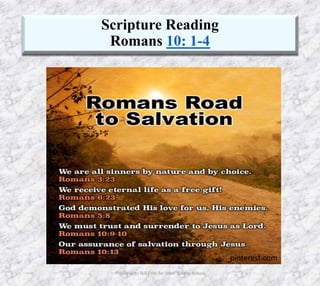
pinterest.com
10/4/2019 Produced by Bill Fritz for Adult Sunday School 3
Paul had a pre-conversion zeal for the Law which he
believed to be God’s will.
Paul was a Pharisee, a son of a Pharisee, a teacher of the
Law (Acts 23:6).
Paul’s pre-conversion zeal was based on a desire to
please God by eliminating all who did not conform to
the Law.
What Paul failed to realize at that time, was that he was
serving the Law not God.
After his conversion and the subsequent revelation of
Jesus, Paul realized he and his Jewish brethren were
misguided.
The Jewish people were of the mindset that salvation
was in adherence to the Law.
The Jews path to righteousness was through
their efforts in compliance with the Law.
However, Paul, after his conversion, knew that
salvation was through Jesus the Christ, who had
satisfied all the tenants of the Law (Ref v4).
Jesus knew the Law, and He also knew the heart of
God.
Jesus fulfilled the Law, and by doing so He ended
the requirements to fulfill the sacrificial
requirements of the Law.
Paul knew his Jewish brethren had a head knowledge
through the Law but lacked the heart knowledge
obtained only through Christ Jesus and subsequently
by the Holy Spirit (John 14:26; 15:26 NJKV).
Scripture Reading
Romans 10:5-13
10/4/2019 Produced by Bill Fritz for Adult Sunday School 4
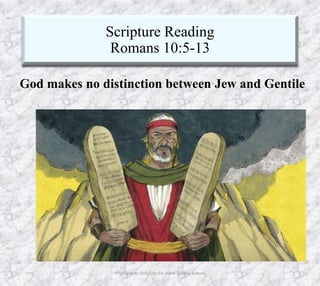
God makes no distinction between Jew and Gentile
10/4/2019 Produced by Bill Fritz for Adult Sunday School 5
Paul quotes Leviticus 18:5: “Ye shall therefore keep my
statutes, and my judgments: which if a man do, he shall
live in them: I [am] the LORD (Lev 18:5 KJV).”
Paul quoting Moses tells us that if a Jew keeps the
Law, in its entirety, they are promised life but not
the righteousness of faith.
There is no mention of faith nor of righteousness in
Lev 18:5.Without faith, can there be righteousness, and
without righteousness, can there be justification?
If anyone could keep all that God requires in the Law,
they would be justified by the Law. However, the Law
is rigid, without mercy, and demands acceptance of
God’s judgments.
Because of man’s imperfection, which is due to his
fall, he cannot understand God’s judgments, much
less keep them.
God warns against judging others unjustly, “you shall
do no injustice in judgment” ( Lev 19:15).
Because of our brokenness, humans cannot keep the
law of God perfectly.
God foreknew man’s fall and for this reason provided
the perfect keeper of the law, in His Son Jesus.
10/4/2019 Produced by Bill Fritz for Adult Sunday School 6
In verses 6-7 Paul quotes Deuteronomy 30:12,13.
Paul quotes these verses to point out the futility of
looking for a Christ to deliver them when their
redemption is at hand through faith in Jesus, who is
the Christ.
In verse 8, Paul states Paul explains Deuteronomy 30:14
by saying that the words of faith are written on their
hearts and preached to all who hear.
Verse 9, has been a stumbling block for many
Christians. Although they love the Lord, for their
comfort sake, keep this feeling captive.
We are to acknowledge to others that Jesus is our
Lord. But what does Lord mean?
“Lord is the translation of the Greek word kurios.
This is the regular way of translating the Hebrew
name for God (Yahweh) in the Greek OT (the LXX).
Jesus is not only the Messiah (Gk Christ = Hb
Messiah), but He is also Yahweh (10:9-10 Holman & staff).”
We are to publically acknowledge that Jesus God.
10/4/2019 Produced by Bill Fritz for Adult Sunday School 7
In verse 10, Paul divides the acknowledgment
that Jesus is Lord into two categories; the
heart, and the mouth.
Paul first addresses belief is a matter of the heart.
That is to say, that this belief goes beyond an
intellectual understanding.
Our inner being feeling this belief which is accounted
as righteousness.
The second and equally important statement by Paul is
that of public confession of faith that Jesus is our Lord
— declaring Jesus the Son of God. God became flesh
to die for the remission of our sin, rose from the dead
on the third day, and sits at the right hand of the
Father.
10/4/2019 Produced by Bill Fritz for Adult Sunday School 8
What shame is Paul talking about in verse 11, it
certainly cannot mean public ridicule he faced daily?
Paul draws from Isaiah 28:16, wherein God speaks
of the Corner Stone, which metaphorically is Christ
Jesus.
The ultimate shame is not from man but from denying
Jesus before men by silence.
Jesus said: “deny Me before men and I will deny you
before the Father” (Mat 10:33 NKJV) this is the
ultimate shame.
How does the Christian publically confess their faith?
There are three different ways to publically confess
one’s belief in the gospel, any one of which satisfies
Paul’s teaching.
10/4/2019 Produced by Bill Fritz for Adult Sunday School 9
The initial public confession is obeying the Holy
Spirit, who calls believers to a public “altar call.”
The cry of the repentant for salvation is a highly
personal and emotional experience.
A public answer to an alter call is NOT a requirement
for salvation.
Answering an alter call is one of three ways to
satisfy Paul’s requirement of a public confession.
The second method of public confession is the
personal baptism of the believer by water
submersion.
Baptism is not only a public confession of faith but
also a symbolic act of the death and resurrection of
Christ Jesus.
The third confession is to evangelize.
To evangelize is to share your belief in the gospel with
others unashamedly.
The Holy Spirit gives not everyone the gift of
evangelism.
Lacking the gift of evangelism does not, or should not,
stop the believer from sharing their testimony of faith
with another.
God does not commission without first equipping
(Eph 2:10; Isa 6:8 NKJV).
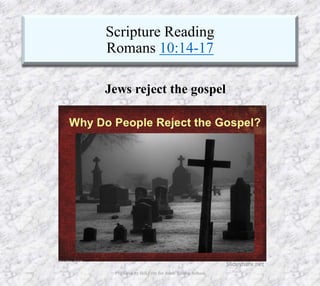
Scripture Reading
Romans 10:14-17
10/4/2019 Produced by Bill Fritz for Adult Sunday School
Slideshare.net
Jews reject the gospel
10/4/2019 Produced by Bill Fritz for Adult Sunday School 11
In verse 14, Paul, referring to his Jewish brethren, asks
the rhetorical question; how can they (the Jews) ask
the Christ who they denied, anything.
In the same manner, the atheist, when facing
certain death, may call out for God to save them.
They deny God’s existence, and yet when death is
eminent they cry out to someone who had not existed
in their lives.
Paul expands the dilemma in 14b to include the
Gentiles by asking a series of logical questions.
Paraphrasing verse14b and verse 15: How are they,
who have never heard of the Christ to be saved, if
they are not told of Christ Jesus? And who is to tell
them of the gospel, unless a preacher is sent? And
who is this preacher?
The preachers are the those God calls and
sends forth into the world to preach the gospel
to all who will listen.
To recap verses 14-17, unless we who call ourselves
Christians take up the great commission (Mat 28:18-20
NKJV), then who will? And if no one goes forth, then
how will the lost be saved?
Scripture Reading
Romans 10:18-21
10/4/2019 Produced by Bill Fritz for Adult Sunday School 12
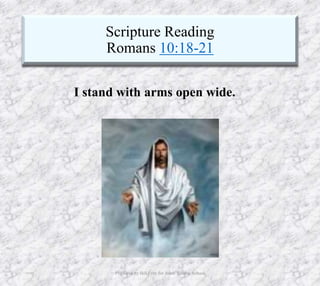
I stand with arms open wide.
10/4/2019 Produced by Bill Fritz for Adult Sunday School 13
In verse 17, Paul says: “So then faith [comes] by
hearing, and hearing by the word of God.”
In verse 18, Paul begins with the conjunctive Hebrew
word “alla” translated as “But” (G235).
Verse 17 is therefore connected to verse 18.
Paul once again is talking about the Jews stating they
have not heard.
Although the word “hear” or “heard” usually means
the physical act of hearing, in this case, it is used
transitively (G191).
The Jewish people had the Torah as the written
word, in which Jesus the coming Messiah is
prophesized.
The Jews were blinded to the prophecies and
did not recognize Jesus as the suffering
prophet of Isaiah 53.
They were told but did not hear (understand).
10/4/2019 Produced by Bill Fritz for Adult Sunday School 14
Paul poses a rhetorical question once again, saying
“…did Israel not know?”
Paul quotes Deuteronomy 32:21 in verse 19.
In Deu 32 God, speaks to Moses, regarding the
misbehaving Jews, saying “they have provoked
me;...”
Jamieson, Fausset and Brown write the following
commentary on Deuteronomy 32:21: “those which are
not a people--that is, not favored with such great and
peculiar privileges as the Israelites (or, rather poor,
despised heathens). The language points to the future
calling of the Gentiles (Jamieson, Fausset & Brown) .”
Therefore Paul is saying that what was told to Moses
by God has come to pass now through Paul’s
commission (Acts 9:15 NKJV).
Bibliography
"G191 - akouō - Strong's Greek Lexicon
(NKJV)." Blue Letter Bible. Accessed 30
Jul, 2019.
https://www.blueletterbible.org//lang/lexi
con/lexicon.cfm?Strongs=G191&t=NKJV
Jamieson, Fausset & Brown, .
"Commentary on Deuteronomy 32 by
Jamieson, Fausset & Brown." Blue
Letter Bible. Last Modified 19 Feb, 2000.
https://www.blueletterbible.org/Comm/jfb
/Deu/Deu_032.cfm
(10:9-10) Holman Bible Staff, Blum, Edwin,
Howard, Jeremy Royal & The HCSB
Translation Team (2010). HCSB Study
Bible. B&H Publishing Group. Retrieved
from https://app.wordsearchbible.com.
10/4/2019 Produced by Bill Fritz for Adult Sunday School 15
10/4/2019 Produced by Bill Fritz for Adult Sunday School 16
"G235 - alla - Strong's Greek Lexicon (NKJV)." Blue
Letter Bible. Accessed 30 Jul, 2019.
https://www.blueletterbible.org//lang/lexicon/lexicon.
cfm?Strongs=G235&t=NKJV
All art work has been taken from what this writer
believes to be free domain (Bing search engine).
Notes
Jewish Law “Halacha” – meaning ‘the path’
or ‘the way’.
Telos - Greek Pronunciation [TEHL ahss]
HCSB Translation end; Uses in Romans 5
Uses in the NT 40; Focus passage Romans
10:4
transitively when the object is expressed,
sometimes in the accusative case,
sometimes in the genitive.
Commission of Paul. [Act 9:15 NKJV] 15
But the Lord said to him, "Go, for he is a
chosen vessel of Mine to bear My name
before Gentiles, kings, and the children of
Israel.
10/4/2019 Produced by Bill Fritz for Adult Sunday School 17

Romans Chapter 10

  • 1.
    The Children ofGod Produced by Bill Fritz for Adult Sunday School10/4/2019 1
  • 2.
    Scripture Reading Romans 10:1-4 Produced by Bill Fritz for Adult Sunday School10/4/2019 2 pinterest.com
  • 3.
    10/4/2019 Produced byBill Fritz for Adult Sunday School 3 Paul had a pre-conversion zeal for the Law which he believed to be God’s will. Paul was a Pharisee, a son of a Pharisee, a teacher of the Law (Acts 23:6). Paul’s pre-conversion zeal was based on a desire to please God by eliminating all who did not conform to the Law. What Paul failed to realize at that time, was that he was serving the Law not God. After his conversion and the subsequent revelation of Jesus, Paul realized he and his Jewish brethren were misguided. The Jewish people were of the mindset that salvation was in adherence to the Law. The Jews path to righteousness was through their efforts in compliance with the Law. However, Paul, after his conversion, knew that salvation was through Jesus the Christ, who had satisfied all the tenants of the Law (Ref v4). Jesus knew the Law, and He also knew the heart of God. Jesus fulfilled the Law, and by doing so He ended the requirements to fulfill the sacrificial requirements of the Law. Paul knew his Jewish brethren had a head knowledge through the Law but lacked the heart knowledge obtained only through Christ Jesus and subsequently by the Holy Spirit (John 14:26; 15:26 NJKV).
  • 4.
    Scripture Reading Romans 10:5-13 10/4/2019Produced by Bill Fritz for Adult Sunday School 4 God makes no distinction between Jew and Gentile
  • 5.
    10/4/2019 Produced byBill Fritz for Adult Sunday School 5 Paul quotes Leviticus 18:5: “Ye shall therefore keep my statutes, and my judgments: which if a man do, he shall live in them: I [am] the LORD (Lev 18:5 KJV).” Paul quoting Moses tells us that if a Jew keeps the Law, in its entirety, they are promised life but not the righteousness of faith. There is no mention of faith nor of righteousness in Lev 18:5.Without faith, can there be righteousness, and without righteousness, can there be justification? If anyone could keep all that God requires in the Law, they would be justified by the Law. However, the Law is rigid, without mercy, and demands acceptance of God’s judgments. Because of man’s imperfection, which is due to his fall, he cannot understand God’s judgments, much less keep them. God warns against judging others unjustly, “you shall do no injustice in judgment” ( Lev 19:15). Because of our brokenness, humans cannot keep the law of God perfectly. God foreknew man’s fall and for this reason provided the perfect keeper of the law, in His Son Jesus.
  • 6.
    10/4/2019 Produced byBill Fritz for Adult Sunday School 6 In verses 6-7 Paul quotes Deuteronomy 30:12,13. Paul quotes these verses to point out the futility of looking for a Christ to deliver them when their redemption is at hand through faith in Jesus, who is the Christ. In verse 8, Paul states Paul explains Deuteronomy 30:14 by saying that the words of faith are written on their hearts and preached to all who hear. Verse 9, has been a stumbling block for many Christians. Although they love the Lord, for their comfort sake, keep this feeling captive. We are to acknowledge to others that Jesus is our Lord. But what does Lord mean? “Lord is the translation of the Greek word kurios. This is the regular way of translating the Hebrew name for God (Yahweh) in the Greek OT (the LXX). Jesus is not only the Messiah (Gk Christ = Hb Messiah), but He is also Yahweh (10:9-10 Holman & staff).” We are to publically acknowledge that Jesus God.
  • 7.
    10/4/2019 Produced byBill Fritz for Adult Sunday School 7 In verse 10, Paul divides the acknowledgment that Jesus is Lord into two categories; the heart, and the mouth. Paul first addresses belief is a matter of the heart. That is to say, that this belief goes beyond an intellectual understanding. Our inner being feeling this belief which is accounted as righteousness. The second and equally important statement by Paul is that of public confession of faith that Jesus is our Lord — declaring Jesus the Son of God. God became flesh to die for the remission of our sin, rose from the dead on the third day, and sits at the right hand of the Father.
  • 8.
    10/4/2019 Produced byBill Fritz for Adult Sunday School 8 What shame is Paul talking about in verse 11, it certainly cannot mean public ridicule he faced daily? Paul draws from Isaiah 28:16, wherein God speaks of the Corner Stone, which metaphorically is Christ Jesus. The ultimate shame is not from man but from denying Jesus before men by silence. Jesus said: “deny Me before men and I will deny you before the Father” (Mat 10:33 NKJV) this is the ultimate shame. How does the Christian publically confess their faith? There are three different ways to publically confess one’s belief in the gospel, any one of which satisfies Paul’s teaching.
  • 9.
    10/4/2019 Produced byBill Fritz for Adult Sunday School 9 The initial public confession is obeying the Holy Spirit, who calls believers to a public “altar call.” The cry of the repentant for salvation is a highly personal and emotional experience. A public answer to an alter call is NOT a requirement for salvation. Answering an alter call is one of three ways to satisfy Paul’s requirement of a public confession. The second method of public confession is the personal baptism of the believer by water submersion. Baptism is not only a public confession of faith but also a symbolic act of the death and resurrection of Christ Jesus. The third confession is to evangelize. To evangelize is to share your belief in the gospel with others unashamedly. The Holy Spirit gives not everyone the gift of evangelism. Lacking the gift of evangelism does not, or should not, stop the believer from sharing their testimony of faith with another. God does not commission without first equipping (Eph 2:10; Isa 6:8 NKJV).
  • 10.
    Scripture Reading Romans 10:14-17 10/4/2019Produced by Bill Fritz for Adult Sunday School Slideshare.net Jews reject the gospel
  • 11.
    10/4/2019 Produced byBill Fritz for Adult Sunday School 11 In verse 14, Paul, referring to his Jewish brethren, asks the rhetorical question; how can they (the Jews) ask the Christ who they denied, anything. In the same manner, the atheist, when facing certain death, may call out for God to save them. They deny God’s existence, and yet when death is eminent they cry out to someone who had not existed in their lives. Paul expands the dilemma in 14b to include the Gentiles by asking a series of logical questions. Paraphrasing verse14b and verse 15: How are they, who have never heard of the Christ to be saved, if they are not told of Christ Jesus? And who is to tell them of the gospel, unless a preacher is sent? And who is this preacher? The preachers are the those God calls and sends forth into the world to preach the gospel to all who will listen. To recap verses 14-17, unless we who call ourselves Christians take up the great commission (Mat 28:18-20 NKJV), then who will? And if no one goes forth, then how will the lost be saved?
  • 12.
    Scripture Reading Romans 10:18-21 10/4/2019Produced by Bill Fritz for Adult Sunday School 12 I stand with arms open wide.
  • 13.
    10/4/2019 Produced byBill Fritz for Adult Sunday School 13 In verse 17, Paul says: “So then faith [comes] by hearing, and hearing by the word of God.” In verse 18, Paul begins with the conjunctive Hebrew word “alla” translated as “But” (G235). Verse 17 is therefore connected to verse 18. Paul once again is talking about the Jews stating they have not heard. Although the word “hear” or “heard” usually means the physical act of hearing, in this case, it is used transitively (G191). The Jewish people had the Torah as the written word, in which Jesus the coming Messiah is prophesized. The Jews were blinded to the prophecies and did not recognize Jesus as the suffering prophet of Isaiah 53. They were told but did not hear (understand).
  • 14.
    10/4/2019 Produced byBill Fritz for Adult Sunday School 14 Paul poses a rhetorical question once again, saying “…did Israel not know?” Paul quotes Deuteronomy 32:21 in verse 19. In Deu 32 God, speaks to Moses, regarding the misbehaving Jews, saying “they have provoked me;...” Jamieson, Fausset and Brown write the following commentary on Deuteronomy 32:21: “those which are not a people--that is, not favored with such great and peculiar privileges as the Israelites (or, rather poor, despised heathens). The language points to the future calling of the Gentiles (Jamieson, Fausset & Brown) .” Therefore Paul is saying that what was told to Moses by God has come to pass now through Paul’s commission (Acts 9:15 NKJV).
  • 15.
    Bibliography "G191 - akouō- Strong's Greek Lexicon (NKJV)." Blue Letter Bible. Accessed 30 Jul, 2019. https://www.blueletterbible.org//lang/lexi con/lexicon.cfm?Strongs=G191&t=NKJV Jamieson, Fausset & Brown, . "Commentary on Deuteronomy 32 by Jamieson, Fausset & Brown." Blue Letter Bible. Last Modified 19 Feb, 2000. https://www.blueletterbible.org/Comm/jfb /Deu/Deu_032.cfm (10:9-10) Holman Bible Staff, Blum, Edwin, Howard, Jeremy Royal & The HCSB Translation Team (2010). HCSB Study Bible. B&H Publishing Group. Retrieved from https://app.wordsearchbible.com. 10/4/2019 Produced by Bill Fritz for Adult Sunday School 15
  • 16.
    10/4/2019 Produced byBill Fritz for Adult Sunday School 16 "G235 - alla - Strong's Greek Lexicon (NKJV)." Blue Letter Bible. Accessed 30 Jul, 2019. https://www.blueletterbible.org//lang/lexicon/lexicon. cfm?Strongs=G235&t=NKJV All art work has been taken from what this writer believes to be free domain (Bing search engine).
  • 17.
    Notes Jewish Law “Halacha”– meaning ‘the path’ or ‘the way’. Telos - Greek Pronunciation [TEHL ahss] HCSB Translation end; Uses in Romans 5 Uses in the NT 40; Focus passage Romans 10:4 transitively when the object is expressed, sometimes in the accusative case, sometimes in the genitive. Commission of Paul. [Act 9:15 NKJV] 15 But the Lord said to him, "Go, for he is a chosen vessel of Mine to bear My name before Gentiles, kings, and the children of Israel. 10/4/2019 Produced by Bill Fritz for Adult Sunday School 17

Editor's Notes

  • #3 Scripture Reading Scripture Reference Commentaries
  • #4 Scripture [Rom 10:1-4 NKJV] 1 Brethren, my heart's desire and prayer to God for Israel is that they may be saved. 2 For I bear them witness that they have a zeal for God, but not according to knowledge. 3 For they being ignorant of God's righteousness, and seeking to establish their own righteousness, have not submitted to the righteousness of God. 4 For Christ [is] the end of the law for righteousness to everyone who believes. Presenters notes: The Jewish Law Halacha – meaning ‘the path’ or ‘the way’. Ref 10:4 bullet Scripture References [Act 23:6 NKJV] 6 But when Paul perceived that one part were Sadducees and the other Pharisees, he cried out in the council, "Men [and] brethren, I am a Pharisee, the son of a Pharisee; concerning the hope and resurrection of the dead I am being judged!" [Jhn 14:26 NKJV] 26 "But the Helper, the Holy Spirit, whom the Father will send in My name, He will teach you all things, and bring to your remembrance all things that I said to you. [Jhn 15:26 NKJV] 26 "But when the Helper comes, whom I shall send to you from the Father, the Spirit of truth who proceeds from the Father, He will testify of Me. [Act 23:6 NKJV] 6 But when Paul perceived that one part were Sadducees and the other Pharisees, he cried out in the council, "Men [and] brethren, I am a Pharisee, the son of a Pharisee; concerning the hope and resurrection of the dead I am being judged!“ Commentaries 10:1 Paul saw no contradiction between election and prayer. Only a sovereign God, who has rights to move unilaterally in the affairs of humanity, can answer prayer. Among unbelievers we do not know beforehand who is elect and will come to faith upon hearing the gospel, but we can know that "God our Savior... wants everyone to be saved and to come to the knowledge of the truth" (1Tim 2:4). Paul therefore prayed for Jewish salvation, and we must be diligent to share the good news of Jesus with everyone. It is never proper to give up on someone as "non-elect." 10:2-3 Both zeal and true knowledge are necessary if one is truly to know God and serve Him. In his zeal as a non-Christian Pharisee, Paul (then called Saul; see Ac 7:58 and note there) persecuted the church (Ac 22:3-5). Likewise, zeal among unbelieving Jews led to Jesus' unjust execution. In spiritual blindness they not only missed God's way of righteousness, they opposed it. 10:4 Christ is the end of the law in being both its fulfillment and its termination. Any system of salvation based on performance is excluded. Word Study: telos telos Greek Pronunciation [TEHL ahss] HCSB Translation end Uses in Romans 5 Uses in the NT 40 Focus passage Romans 10:4 The Greek noun telos is related to the verbs teleo and teleioo, both meaning to complete, perfect, finish, and to the adjective teleion, meaning complete, perfect, whole. The term telos refers to the consummation, completion, or fulfillment of something. In the NT, telos is commonly used for the end of this life (Mt 10:22; Lk 18:5; 1Co 1:8; Php 3:19; Heb 3:14; 6:11; 7:3; Rev 2:26) or for events related to the end times (Mt 24:6,13,14; Mk 13:7,13; Lk 1:33; 21:9; 1Co 10:11; 15:24; 2Co 11:15; 1Pe 4:7,17). In Revelation telos occurs twice in the formula "the Beginning and the End" as a title for deity (Rev 21:6; 22:13). In Romans 10:4 telos refers to Christ as "the end of the law," which is similar to Paul's statement that believers are no longer "under the law" (Rm 6:14). Christians do not relate to God through the old covenant God made with Israel at Mt. Sinai through Moses, but through the new covenant He made at the cross through Christ's blood (see Jer 31:31-34; Lk 22:20; Heb 8:8-12). 10:5-7 Paul quoted Moses on both sides of the issue. In Lv 18:5 (cp. Gal 3:12) obedience to the law brings life, but no one can keep the law and gain righteousness (as implied by Paul's citation of Moses in v. 6). Faith-based righteousness is from Christ. He is accessible. He died for us and was raised from the dead. Moses pointed out that God's revelation was accessible, and Paul quoted his words to show that Christ is accessible. [Blum, Edwin, The HCSB Translation Team, Howard, Jeremy Royal & Holman Bible Staff (2010). HCSB Study Bible. B&H Publishing Group. Retrieved from https://app.wordsearchbible.com.] 1. Brethren, my heart's desire--The word here expresses "entire complacency," that in which the heart would experience full satisfaction.  and prayer--"supplication."  to God for Israel--"for them" is the true reading; the subject being continued from the close of the preceding chapter.  is, that they may be saved--"for their salvation." Having before poured forth the anguish of his soul at the general unbelief of his nation and its dreadful consequences ( Romans 9:1-3 ), he here expresses in the most emphatic terms his desire and prayer for their salvation. 2. For I bear them record--or, "witness," as he well could from his own sad experience.  that they have a zeal of--"for"  God, but not according to knowledge--(Compare Acts 22:3 , 26:9-11 , Galatians 1:13 Galatians 1:14 ). He alludes to this well-meaning of his people, notwithstanding their spiritual blindness, not certainly to excuse their rejection of Christ and rage against His saints, but as some ground of hope regarding them. (See 1 Timothy 1:13 ). 3. For they being ignorant of God's righteousness--that is, for the justification of the guilty  and going about--"seeking"  to establish their own righteousness, have not submitted themselves to the righteousness of God--The apostle views the general rejection of Christ by the nation as one act. 4. For Christ is the end--the object or aim.  of the law for--justifying  righteousness to every one that believeth--that is, contains within Himself all that the law demands for the justification of such as embrace Him, whether Jew or Gentile ( Galatians 3:24 ). 5-10. For Moses describeth the righteousness which is of the law, That the man that doeth--"hath done"  those things--which it commands.  shall live in them--( Leviticus 18:5 ). This is the one way of justification and life--by "the righteousness which is of (or, by our own obedience to) the law."
  • #6 Scripture [Rom 10:5-13 NKJV] 5 For Moses writes about the righteousness which is of the law, "The man who does those things shall live by them." Scripture References [Lev 18:5 KJV] 5 Ye shall therefore keep my statutes, and my judgments: which if a man do, he shall live in them: I [am] the LORD. [Deu 6:5 NKJV] 5 "You shall love the LORD your God with all your heart, with all your soul, and with all your strength. [Deu 11:1 NKJV] 1 "Therefore you shall love the LORD your God, and keep His charge, His statutes, His judgments, and His commandments always. [Deu 30:12 NKJV] 12 "It [is] not in heaven, that you should say, 'Who will ascend into heaven for us and bring it to us, that we may hear it and do it?‘ [Lev 19:15 NKJV] 15 'You shall do no injustice in judgment. You shall not be partial to the poor, nor honor the person of the mighty. In righteousness you shall judge your neighbor. Commentaries 10:5-7 Paul quoted Moses on both sides of the issue. In Lv 18:5 (cp. Gal 3:12) obedience to the law brings life, but no one can keep the law and gain righteousness (as implied by Paul's citation of Moses in v. 6). Faith-based righteousness is from Christ. He is accessible. He died for us and was raised from the dead. Moses pointed out that God's revelation was accessible, and Paul quoted his words to show that Christ is accessible. JFB 5-10. For Moses describeth the righteousness which is of the law, That the man that doeth--"hath done"  those things--which it commands.  shall live in them--( Leviticus 18:5 ). This is the one way of justification and life--by "the righteousness which is of (or, by our own obedience to) the law."
  • #7 Scripture 6 But the righteousness of faith speaks in this way, "Do not say in your heart, 'Who will ascend into heaven?' " (that is, to bring Christ down [from above]) 7 or, " 'Who will descend into the abyss?' " (that is, to bring Christ up from the dead). 8 But what does it say? "The word is near you, in your mouth and in your heart" (that is, the word of faith which we preach): 9 that if you confess with your mouth the Lord Jesus and believe in your heart that God has raised Him from the dead, you will be saved. Scripture References Commentaries 10:8 The nearness of the message of faith is at the heart and mouth of people, just as Moses proclaimed the nearness of God's revelation. 10:9-10 Jesus is Lord is a confession of faith. "Lord" is the translation of the Greek word kurios. This is the regular way of translating the Hebrew name for God (Yahweh) in the Greek OT (the LXX). Jesus is not only the Messiah (Gk Christ = Hb Messiah), but He is also Yahweh. Not only do we believe that the man Jesus was raised... from the dead, but we also believe that He shares the same nature with God. This is the start of the understanding of Christ's two natures, as articulated at the Council of Chalcedon ( a.d. 451). Jesus is fully human and fully God. Christians by definition believe and confess this truth. JFB 6. But the--justifying  righteousness which is of faith speaketh on this wise--"speaketh thus"--its language or import is to this effect (quoting in substance Deuteronomy 30:13 Deuteronomy 30:14 ).  Say not in thine heart, Who shall ascend into heaven? that is, to bring Christ down, &c.--that is, "Ye have not to sigh over the impossibility of attaining to justification; as if one should say, oh! if I could but get someone to mount up to heaven and fetch me down Christ, there might be some hope, but since that cannot be, mine is a desperate case." 7. Or, Who shall descend, &c.--another case of impossibility, suggested by Proverbs 30:4 , and perhaps also Amos 9:2 --probably proverbial expressions of impossibility (compare Psalms 139:7-10 , Proverbs 24:7 , &c.). 8. But what saith it? It saith--continuing the quotation from Deuteronomy 30:14 .  The word is nigh thee--easily accessible.  in thy mouth--when thou confessest Him.  and in thine heart--when thou believest on Him. Though it is of the law which Moses more immediately speaks in the passage quoted, yet it is of the law as Israel shall be brought to look upon it when the Lord their God shall circumcise their heart "to love the Lord their God with all their heart" ( Romans 10:6 ); and thus, in applying it, the apostle (as OLSHAUSEN truly observes) is not merely appropriating the language of Moses, but keeping in the line of his deeper thought.  that is, the word of faith, which we preach--that is, the word which men have to believe for salvation (compare 1 Timothy 4:6 ). 9. That if thou shalt, &c.--So understanding the words, the apostle is here giving the language of the true method of justification; and this sense we prefer (with CALVIN, BEZA, FERME, LOCKE, JOWETT). But able interpreters render the words, "For," or "Because if thou shalt," &c. [Vulgate, LUTHER, DE WETTE, STUART, PHILIPPI, ALFORD, Revised Version]. In this case, these are the apostle's own remarks, confirming the foregoing statements as to the simplicity of the gospel method of salvation.  confess with thy mouth the Lord Jesus--that is, probably, "If thou shalt confess Jesus [to be] the Lord," which is the proper manifestation or evidence of faith ( Matthew 10:32 , 1 John 4:15 ). This is put first merely to correspond with the foregoing quotation--"in thy mouth and in thine heart." So in 1 Peter 1:10 the "calling of believers" is put before their "election," as that which is first "made sure," although in point of time it comes after it.  and shalt believe in thine heart that God hath raised--"that God raised"  him from the dead, Romans 10:10 the two things are placed in their natural order.
  • #8 Scripture 10 For with the heart one believes unto righteousness, and with the mouth confession is made unto salvation. 11 For the Scripture says, "Whoever believes on Him will not be put to shame." 12 For there is no distinction between Jew and Greek, for the same Lord over all is rich to all who call upon Him. 13 For "whoever calls on the name of the LORD shall be saved." Scripture References [Mat 10:33 NKJV] 33 "But whoever denies Me before men, him I will also deny before My Father who is in heaven. Commentaries 10:11-13 Paul cited biblical support for the universal offer of salvation. Salvation is for both Jew and Greek (i.e., Gentiles) since the same Lord (Gk kurios,v. 12) is rich in mercy to all. The promise is for all who call on the name of the Lord ( kurios,v. 13). As the prophet Joel said, "Everyone who calls on the name of Yahweh will be saved" (Joel 2:32). Jesus is Lord, or Yahweh. [Blum, Edwin, The HCSB Translation Team, Howard, Jeremy Royal & Holman Bible Staff (2010). HCSB Study Bible. B&H Publishing Group. Retrieved from https://app.wordsearchbible.com.] JFB 10. For with the heart man believeth unto--justifying  righteousness; and with the mouth confession is made unto salvation--This confession of Christ's name, especially in times of persecution, and whenever obloquy is attached to the Christian profession, is an indispensable test of discipleship. 11-13. For the scripture saith--in Isaiah 28:16 , a glorious Messianic passage.  Whosoever believeth on him shall not be ashamed--Here, as in Romans 9:33 , the quotation is from the Septuagint, which renders those words of the original, "shall not make haste" (that is, fly for escape, as from conscious danger), "shall not be put to shame," which comes to the same thing. 12. For there is no difference--or "distinction"  between Jew and Greek; for the same Lord over all--that is, not God (as CALVIN, GROTIUS, OLSHAUSEN, HODGE), but Christ, as will be seen, we think, by comparing Romans 10:9 Romans 10:12 Romans 10:13 and observing the apostle's usual style on such subjects. (So CHRYSOSTOM, MELVILLE, BENGEL, MEYER, DE WETTE, FRITZSCHE, THOLUCK, STUART, ALFORD, PHILIPPI).  is rich--a favorite Pauline term to express the exuberance of that saving grace which is in Christ Jesus.  unto all that call upon him--This confirms the application of the preceding words to Christ; since to call upon the name of the Lord Jesus is a customary expression. (See Acts 7:59 Acts 7:60 , Acts 9:14 Acts 9:21 , 22:16 , 1 Corinthians 1:2 ,2 Timothy 2:22 ). 13. For--saith the scripture  whosoever--The expression is emphatic, "Everyone whosoever"  shall call upon the name of the Lord shall be saved--( Joel 2:32 ); quoted also by Peter, in his great Pentecostal sermon ( Acts 2:21 ), with evident application to Christ.
  • #9 Scripture Scripture References Commentaries
  • #10 Scripture References [Eph 2:10 NKJV] 10 For we are His workmanship, created in Christ Jesus for good works, which God prepared beforehand that we should walk in them. [Isa 6:8 NKJV] 8 Also I heard the voice of the Lord, saying: "Whom shall I send, And who will go for Us?" Then I said, "Here [am] I! Send me." Commentaries 10:14-15 What must occur for someone to call on the name of the Lord? Someone must first be sent to proclaim the gospel message, and then listeners must pay attention and believe. In the absence of any one of these factors, no one can call on the name of the Lord. 10:16-21 Paul quoted several OT passages to show that the conditions described in verses 14-15 had been met for Israel. The gospel message was proclaimed throughout the Roman Empire. The Jews listened and simply did not believe. The Gentiles heard too, and many embraced it. Paul's citations show that the Gentile conversion was predicted in the OT. Ultimately, all peoples are a disobedient and defiant people. Israel was singled out in this way due to their consistent rejection of God's message and messengers (see Ac 7:51-60). [Blum, Edwin, The HCSB Translation Team, Howard, Jeremy Royal & Holman Bible Staff (2010). HCSB Study Bible. B&H Publishing Group. Retrieved from https://app.wordsearchbible.com.] 14, 15. How then shall they call on him in whom they have not believed? and . . . believe in him of whom they have not heard? and . . . hear without a preacher? and . . . preach except . . . sent?--that is, "True, the same Lord over all is rich unto all alike that call upon Him. But this calling implies believing, and believing hearing, and hearing preaching, and preaching a mission to preach: Why, then, take ye it so ill, O children of Abraham, that in obedience to our heavenly mission ( Acts 26:16-18 ) we preach among the Gentiles the unsearchable riches of Christ?" 15. as it is written--( Isaiah 52:7 ).  How beautiful are the feet of them that preach the gospel of peace, &c.--The whole chapter of Isaiah from which this is taken, and the three that follow, are so richly Messianic, that there can be no doubt "the glad tidings" there spoken of announce a more glorious release than of Judah from the Babylonish captivity, and the very feet of its preachers are called "beautiful" for the sake of their message. 16, 17. But they have not all obeyed the gospel--that is, the Scripture hath prepared us to expect this sad result.  For Esaias saith, Lord, who hath believed our report?--that is,"Where shall one find a believer?" The prophet speaks as if next to none would believe: The apostle softens this into "They have not all believed." 17. So then faith cometh by hearing, and hearing by the word of God--"This is another confirmation of the truth that faith supposes the hearing of the Word, and this a commission to preach it."
  • #12 Scripture [Rom 10:14-17 NKJV] 14 How then shall they call on Him in whom they have not believed? And how shall they believe in Him of whom they have not heard? And how shall they hear without a preacher? 15 And how shall they preach unless they are sent? As it is written: "How beautiful are the feet of those who preach the gospel of peace, Who bring glad tidings of good things!" 16 But they have not all obeyed the gospel. For Isaiah says, "LORD, who has believed our report?" 17 So then faith [comes] by hearing, and hearing by the word of God. Scripture References [Mat 28:18-20 NKJV] 18 And Jesus came and spoke to them, saying, "All authority has been given to Me in heaven and on earth. 19 "Go therefore and make disciples of all the nations, baptizing them in the name of the Father and of the Son and of the Holy Spirit, 20 "teaching them to observe all things that I have commanded you; and lo, I am with you always, [even] to the end of the age." Amen. Commentaries 10:14-15 What must occur for someone to call on the name of the Lord? Someone must first be sent to proclaim the gospel message, and then listeners must pay attention and believe. In the absence of any one of these factors, no one can call on the name of the Lord. 10:16-21 Paul quoted several OT passages to show that the conditions described in verses 14-15 had been met for Israel. The gospel message was proclaimed throughout the Roman Empire. The Jews listened and simply did not believe. The Gentiles heard too, and many embraced it. Paul's citations show that the Gentile conversion was predicted in the OT. Ultimately, all peoples are a disobedient and defiant people. Israel was singled out in this way due to their consistent rejection of God's message and messengers (see Ac 7:51-60). [Blum, Edwin, The HCSB Translation Team, Howard, Jeremy Royal & Holman Bible Staff (2010). HCSB Study Bible. B&H Publishing Group. Retrieved from https://app.wordsearchbible.com.] 14, 15. How then shall they call on him in whom they have not believed? and . . . believe in him of whom they have not heard? and . . . hear without a preacher? and . . . preach except . . . sent?--that is, "True, the same Lord over all is rich unto all alike that call upon Him. But this calling implies believing, and believing hearing, and hearing preaching, and preaching a mission to preach: Why, then, take ye it so ill, O children of Abraham, that in obedience to our heavenly mission ( Acts 26:16-18 ) we preach among the Gentiles the unsearchable riches of Christ?" 15. as it is written--( Isaiah 52:7 ).  How beautiful are the feet of them that preach the gospel of peace, &c.--The whole chapter of Isaiah from which this is taken, and the three that follow, are so richly Messianic, that there can be no doubt "the glad tidings" there spoken of announce a more glorious release than of Judah from the Babylonish captivity, and the very feet of its preachers are called "beautiful" for the sake of their message. 16, 17. But they have not all obeyed the gospel--that is, the Scripture hath prepared us to expect this sad result.  For Esaias saith, Lord, who hath believed our report?--that is,"Where shall one find a believer?" The prophet speaks as if next to none would believe: The apostle softens this into "They have not all believed." 17. So then faith cometh by hearing, and hearing by the word of God--"This is another confirmation of the truth that faith supposes the hearing of the Word, and this a commission to preach it."
  • #14 Scripture [Rom 10:18-21 NKJV] 18 But I say, have they not heard? Yes indeed: "Their sound has gone out to all the earth, And their words to the ends of the world." Scripture References Commentaries 18. But I say, Have they not heard?--"Did they not hear?" Can Israel, through any region of his dispersion, plead ignorance of these glad tidings?  Yes, verily, their sound went--"their voice went out"  into all the earth, and their words unto the end of the world--These beautiful words are from Psalms 19:4 . Whether the apostle quoted them as in their primary intention applicable to his subject (as OLSHAUSEN, ALFORD, &c.), or only "used scriptural language to express his own ideas, as is done involuntarily almost by every preacher in every sermon" [HODGE], expositors are not agreed. But though the latter may seem the more natural since "the rising of the Sun of righteousness upon the world" ( Malachi 4:2 ), "the Dayspring from on high visiting us, giving light to them that sat in darkness, and guiding our feet into the way of peace" ( Luke 1:78 Luke 1:79 ), must have been familiar and delightful to the apostle's ear, we cannot doubt that the irradiation of the world with the beams of a better Sun by the universal diffusion of the Gospel of Christ, must have a mode of speaking quite natural, and to him scarcely figurative. 19. But I say, Did not Israel know?--know, from their own Scriptures, of God's intention to bring in the Gentiles?  First--that is First in the prophetic line [DE WETTE].  Moses saith, &c.--"I will provoke you to jealousy ('against') [them that are] not a nation, and against a nation without understanding will I anger you" ( Deuteronomy 32:21 ). In this verse God warns His ancient people that because they had (that is, in aftertimes would) moved Him to jealousy with their "no-gods," and provoked Him to anger with their vanities, He in requital would move them to jealousy by receiving into His favor a "no-people," and provoke them to anger by adopting a nation void of understanding. 20. But Esaias is very bold, and saith--that is, is still plainer, and goes even the length of saying.  I was found of them that sought me not--until I sought them.  I was made--"became"  manifest unto them that asked not after me--until the invitation from Me came to them. That the calling of the Gentiles was meant by these words of the prophet ( Isaiah 65:1 ) is manifest from what immediately follows, "I said, Behold Me, behold Me, unto a nation that was not called by My name." 21. But to--rather, "with regard to"  Israel he saith, All day--"All the day"  long I have stretched out my hands--"did I stretch forth"  my hands--the attitude of gracious entreaty.  unto a disobedient and gainsaying people--These words, which immediately follow the announcement just quoted of the calling of the Gentiles, were enough to forewarn the Jews both of God's purpose to eject them from their privileges, in favor of the Gentiles, and of the cause of it on their own part. Note, (1) Mere sincerity, and even earnestness in religion--though it may be some ground of hope for a merciful recovery from error--is no excuse, and will not compensate, for the deliberate rejection of saving truth, when in the providence of God presented for acceptance ( Romans 10:1-3 ; and (2) The true cause of such rejection of saving truth, by the otherwise sincere, is the prepossession of the mind by some false notions of its own. So long as the Jews "sought to set up their own righteousness," it was in the nature of things impossible that they should "submit themselves to the righteousness of God"; the one of these two methods of acceptance being in the teeth of the other ( Romans 10:3 ). (3) The essential terms of salvation have in every age been the same: "Whosoever will" is invited to "take of the water of life freely," Revelation 22:17 ( Romans 10:13 ). (4) How will the remembrance of the simplicity, reasonableness, and absolute freeness of God's plan of salvation overwhelm those that perish from under the sound of it ( Romans 10:4-13 ). (5) How piercingly and perpetually should that question--"HOW SHALL THEY HEAR WITHOUT A PREACHER?"--sound in the ears of all churches, as but the apostolic echo of their Lord's parting injunction, "PREACH THE GOSPEL TO EVERY CREATURE" ( Mark 16:15 ), and how far below the proper standard of love, zeal, and self-sacrifice must the churches as yet be, when with so plenteous a harvest the laborers are yet so few ( Matthew 9:37 Matthew 9:38 ), and that cry from the lips of pardoned, gifted, consecrated men--"Here am I, send me" ( Isaiah 6:8 ), is not heard everywhere ( Romans 10:14 Romans 10:15 )! (6) The blessing of a covenant relation to God is the irrevocable privilege of no people and no Church; it can be preserved only by fidelity, on our part, to the covenant itself ( Romans 10:19 ). (7) God is often found by those who apparently are the farthest from Him, while He remains undiscovered by those who think themselves the nearest ( Romans 10:20 Romans 10:21 ). (8) God's dealings even with reprobate sinners are full of tenderness and compassion; all the day long extending the arms of His mercy even to the disobedient and gainsaying. This will be felt and acknowledged at last by all who perish, to the glory of God's forbearance and to their own confusion ( Romans 10:21 ).
  • #15 Scripture 19 But I say, did Israel not know? First Moses says: "I will provoke you to jealousy by [those who are] not a nation, I will move you to anger by a foolish nation." 20 But Isaiah is very bold and says: "I was found by those who did not seek Me; I was made manifest to those who did not ask for Me." 21 But to Israel he says: "All day long I have stretched out My hands To a disobedient and contrary people." Scripture References [Deu 32:21 NKJV] 21 They have provoked Me to jealousy by [what] is not God; They have moved Me to anger by their foolish idols. But I will provoke them to jealousy by [those who are] not a nation; I will move them to anger by a foolish nation. [Act 9:15 NKJV] 15 But the Lord said to him, "Go, for he is a chosen vessel of Mine to bear My name before Gentiles, kings, and the children of Israel. Commentaries 10:14-15 What must occur for someone to call on the name of the Lord? Someone must first be sent to proclaim the gospel message, and then listeners must pay attention and believe. In the absence of any one of these factors, no one can call on the name of the Lord. 10:16-21 Paul quoted several OT passages to show that the conditions described in verses 14-15 had been met for Israel. The gospel message was proclaimed throughout the Roman Empire. The Jews listened and simply did not believe. The Gentiles heard too, and many embraced it. Paul's citations show that the Gentile conversion was predicted in the OT. Ultimately, all peoples are a disobedient and defiant people. Israel was singled out in this way due to their consistent rejection of God's message and messengers (see Ac 7:51-60). [Blum, Edwin, The HCSB Translation Team, Howard, Jeremy Royal & Holman Bible Staff (2010). HCSB Study Bible. B&H Publishing Group. Retrieved from https://app.wordsearchbible.com.] 14, 15. How then shall they call on him in whom they have not believed? and . . . believe in him of whom they have not heard? and . . . hear without a preacher? and . . . preach except . . . sent?--that is, "True, the same Lord over all is rich unto all alike that call upon Him. But this calling implies believing, and believing hearing, and hearing preaching, and preaching a mission to preach: Why, then, take ye it so ill, O children of Abraham, that in obedience to our heavenly mission ( Acts 26:16-18 ) we preach among the Gentiles the unsearchable riches of Christ?" 15. as it is written--( Isaiah 52:7 ).  How beautiful are the feet of them that preach the gospel of peace, &c.--The whole chapter of Isaiah from which this is taken, and the three that follow, are so richly Messianic, that there can be no doubt "the glad tidings" there spoken of announce a more glorious release than of Judah from the Babylonish captivity, and the very feet of its preachers are called "beautiful" for the sake of their message. 16, 17. But they have not all obeyed the gospel--that is, the Scripture hath prepared us to expect this sad result.  For Esaias saith, Lord, who hath believed our report?--that is,"Where shall one find a believer?" The prophet speaks as if next to none would believe: The apostle softens this into "They have not all believed." 17. So then faith cometh by hearing, and hearing by the word of God--"This is another confirmation of the truth that faith supposes the hearing of the Word, and this a commission to preach it."
  • #16 10:9-10 Jesus is Lord is a confession of faith. [Holman Bible Staff, Blum, Edwin, Howard, Jeremy Royal & The HCSB Translation Team (2010). HCSB Study Bible. B&H Publishing Group. Retrieved from https://app.wordsearchbible.com.]
  • #18 [Act 9:15 NKJV] 15 But the Lord said to him, "Go, for he is a chosen vessel of Mine to bear My name before Gentiles, kings, and the children of Israel.