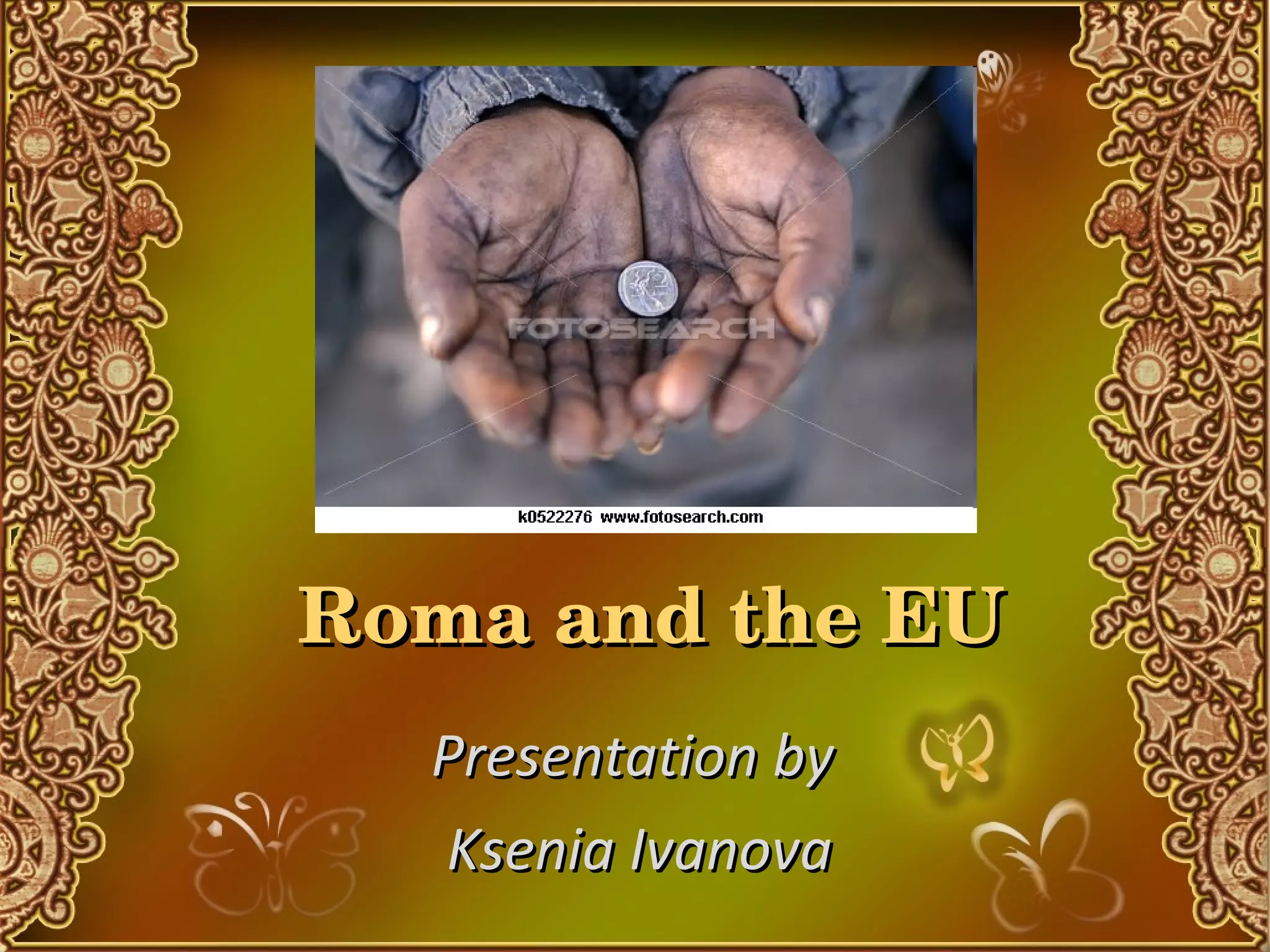
Roma and the EU Presentation by  Ksenia Ivanova
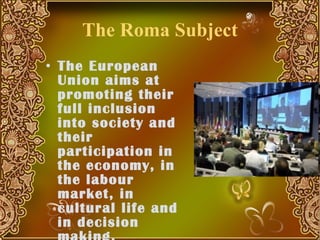
The Roma Subject The European Union aims at promoting their full inclusion into society and their participation in the economy, in the labour market, in cultural life and in decision making.
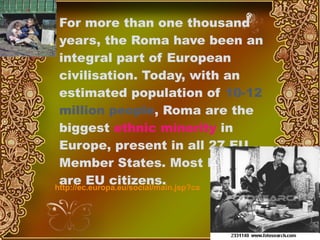
For more than one thousand years, the Roma have been an integral part of European civilisation. Today, with an estimated population of  10-12 million people , Roma are the biggest  ethnic minority  in Europe, present in all 27 EU Member States. Most Roma are EU citizens.   http://ec.europa.eu/social/main.jsp?catId=518&langId=en
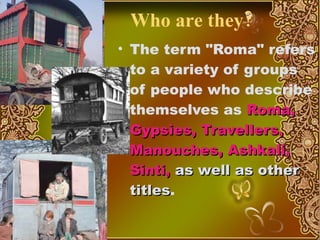
Who are they? T he term "Roma" refers to a variety of groups of people who describe themselves as  Roma, Gypsies, Travellers, Manouches, Ashkali, Sinti,  as well as other titles .
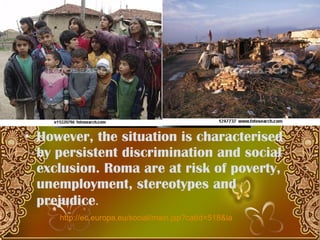
However, the  situation is characterised by persistent discrimination and social exclusion. Roma are at risk of poverty, unemployment, stereotypes and prejudice .  http://ec.europa.eu/social/main.jsp?catId=518&langId=en&videosId=2444&vl=en
The European institutions and Member States have  a joint responsibility  to improve the social inclusion of Roma by using all the instruments and policies for which they have the respective competence.   
EU and Roma a strong legal  framework to combat  Roma  discrimination , based among others, on article 13 of the Treaty of the European Community, the Directive 2000/43/EC on racial equality and the Directive 2000/78/EC prohibiting discrimination in employment and vocational training. Member  States have the duty to translate these Directives into their own national legislations .  stimulating the use of  EU  Structural   Funds  by EU Member States in order to support Roma inclusion. 
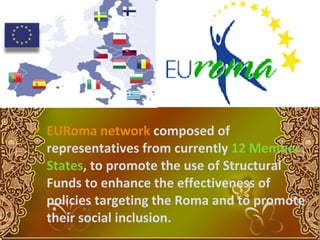
EURoma   network  composed of representatives from currently  12 Member States , to promote the use of Structural Funds to enhance the effectiveness of policies targeting the Roma and to promote their social inclusion. 
Objectives S haring  of strategies, initiatives and approaches, learning based on experience and best practices, and the dissemination and standardisation of such knowledge.  Transmission and exchange  of information, through internal and external communication channels Mutual learning : sharing of approaches and strategies, identification and transfer of experiences, creation of a forum for the organisation and management of projects, development of common and transversal products.
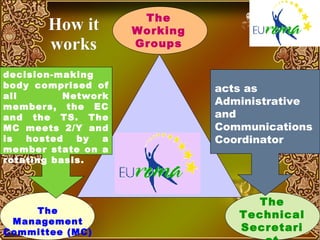
How it works The Management Committee (MC) The Working Groups The Technical Secretariat decision-making body comprised of all Network members, the  EC  and the T S . The MC meets  2/Y  and is hosted by a member state on a rotating basis.   acts as Administrative and Communications Coordinator
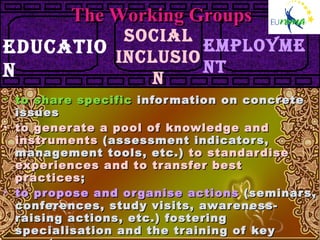
The Working Groups to share specific  information on concrete issues to generate a   pool of knowledge and instruments  (assessment indicators, management tools, etc.)  to standardise experiences and to transfer best practices ;  to propose and organise actions  (seminars, conferences, study visits, awareness-raising actions, etc.) fostering specialisation and the training of key agents; to provide  non-Network member organisations  an opportunity to participate  in information sharing and other actions. Education Social Inclusion Employment
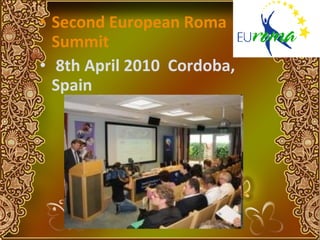
Second   European   Roma   Summit 8th April 2010  Cordoba, Spain
The Sources All the information, videos and pictures source back to:  http://ec.europa.eu/social/main.jsp?catId=518&langId=en  ( The EU site, The EU and Roma) http://www.euromanet.eu/  (The official EURoma site) http://www.fotosearch.com/  (Foto Search Site)

Roma And The EU

  • 1.
    Roma and theEU Presentation by Ksenia Ivanova
  • 2.
    The Roma SubjectThe European Union aims at promoting their full inclusion into society and their participation in the economy, in the labour market, in cultural life and in decision making.
  • 3.
    For more thanone thousand years, the Roma have been an integral part of European civilisation. Today, with an estimated population of 10-12 million people , Roma are the biggest ethnic minority in Europe, present in all 27 EU Member States. Most Roma are EU citizens. http://ec.europa.eu/social/main.jsp?catId=518&langId=en
  • 4.
    Who are they?T he term "Roma" refers to a variety of groups of people who describe themselves as Roma, Gypsies, Travellers, Manouches, Ashkali, Sinti, as well as other titles .
  • 5.
    However, the situation is characterised by persistent discrimination and social exclusion. Roma are at risk of poverty, unemployment, stereotypes and prejudice . http://ec.europa.eu/social/main.jsp?catId=518&langId=en&videosId=2444&vl=en
  • 6.
    The European institutionsand Member States have a joint responsibility to improve the social inclusion of Roma by using all the instruments and policies for which they have the respective competence.   
  • 7.
    EU and Romaa strong legal framework to combat Roma discrimination , based among others, on article 13 of the Treaty of the European Community, the Directive 2000/43/EC on racial equality and the Directive 2000/78/EC prohibiting discrimination in employment and vocational training. Member States have the duty to translate these Directives into their own national legislations .  stimulating the use of EU Structural Funds by EU Member States in order to support Roma inclusion. 
  • 8.
    EURoma network composed of representatives from currently 12 Member States , to promote the use of Structural Funds to enhance the effectiveness of policies targeting the Roma and to promote their social inclusion. 
  • 9.
    Objectives S haring of strategies, initiatives and approaches, learning based on experience and best practices, and the dissemination and standardisation of such knowledge. Transmission and exchange of information, through internal and external communication channels Mutual learning : sharing of approaches and strategies, identification and transfer of experiences, creation of a forum for the organisation and management of projects, development of common and transversal products.
  • 10.
    How it worksThe Management Committee (MC) The Working Groups The Technical Secretariat decision-making body comprised of all Network members, the EC and the T S . The MC meets 2/Y and is hosted by a member state on a rotating basis. acts as Administrative and Communications Coordinator
  • 11.
    The Working Groupsto share specific information on concrete issues to generate a pool of knowledge and instruments (assessment indicators, management tools, etc.) to standardise experiences and to transfer best practices ; to propose and organise actions (seminars, conferences, study visits, awareness-raising actions, etc.) fostering specialisation and the training of key agents; to provide non-Network member organisations an opportunity to participate in information sharing and other actions. Education Social Inclusion Employment
  • 12.
    Second European Roma Summit 8th April 2010 Cordoba, Spain
  • 13.
    The Sources Allthe information, videos and pictures source back to: http://ec.europa.eu/social/main.jsp?catId=518&langId=en ( The EU site, The EU and Roma) http://www.euromanet.eu/ (The official EURoma site) http://www.fotosearch.com/ (Foto Search Site)