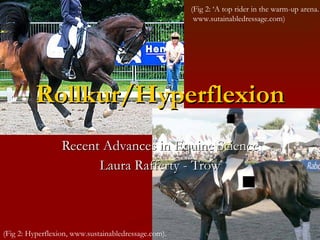
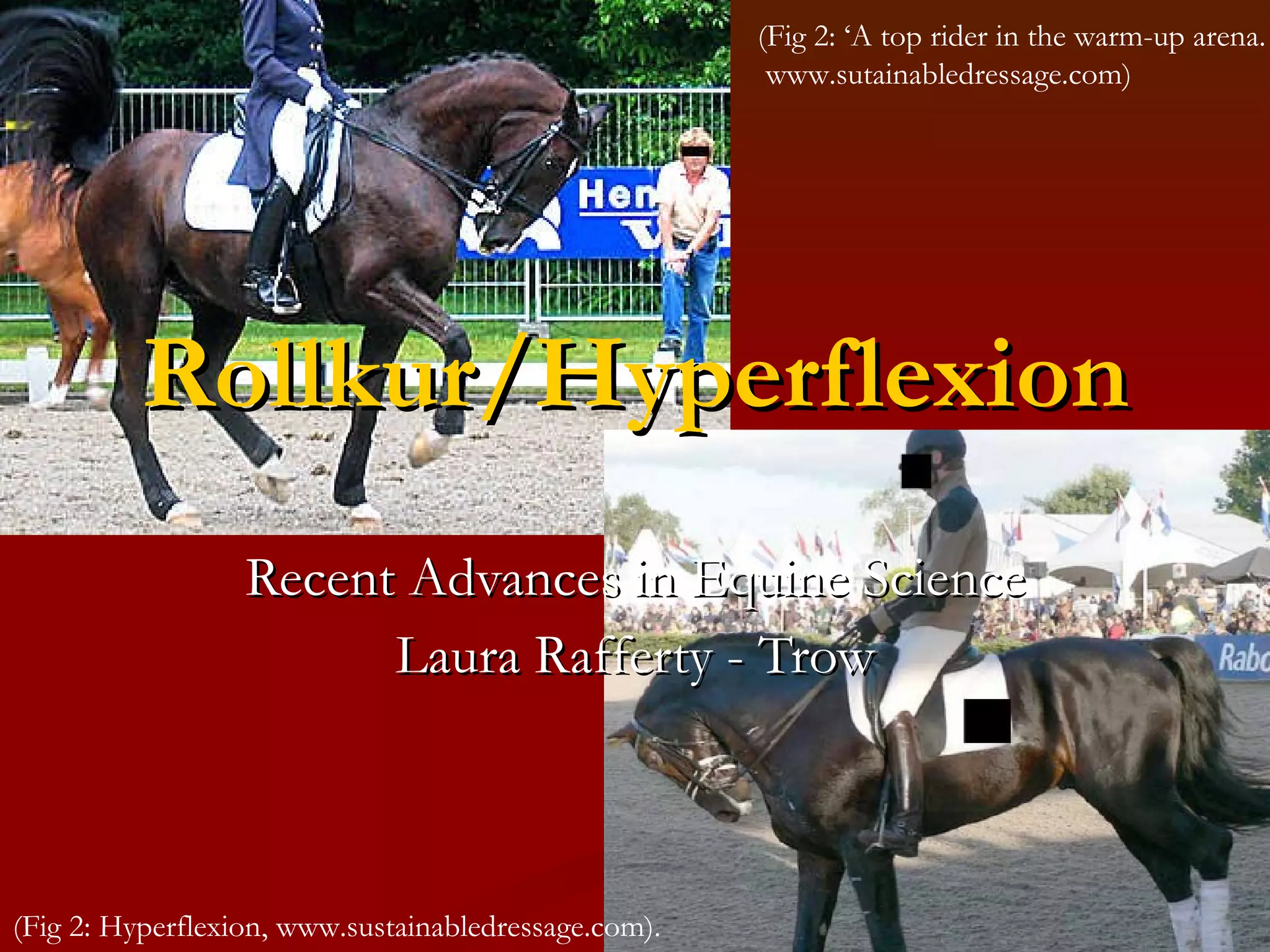
Rollkur/Hyperflexion Recent Advances in Equine Science Laura Rafferty - Trow (Fig 2: Hyperflexion, www.sustainabledressage.com). (Fig 2: ‘A top rider in the warm-up arena. www.sutainabledressage.com)
What is ‘Hyperflexion’ "Hyperflexion of the neck is a technique of working/training to provide a degree of  longitudinal flexion  of the  mid-region  of the neck that  cannot be self-maintained  by the horse for a prolonged time without  welfare implications.”  (FEI 2006) ‘… a training method involving  forced flexion  of the poll and neck with the horse’s head pulled  behind the vertical .’ (FEI 2006) ‘ Deep and round (rolkur):  A modern tendency to train the horse to carry its head low and its  cervical vertebrae maximally flexed  …To critics, the deep and round technique is seen as a form of  false collection  and may have  welfare implications .’ (McGreevy  et al  2005)
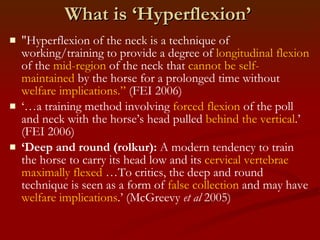
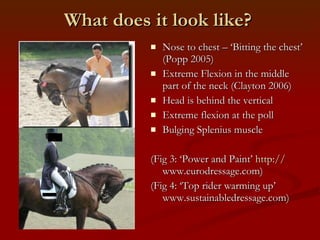
What does it look like? Nose to chest – ‘Bitting the chest’ (Popp 2005) Extreme Flexion in the middle part of the neck (Clayton 2006) Head is behind the vertical Extreme flexion at the poll Bulging Splenius muscle (Fig 3: ‘Power and Paint’  http:// www.eurodressage.com ) (Fig 4: ‘Top rider warming up’ www.sustainabledressage.com)
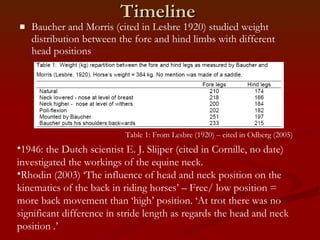
Timeline Baucher and Morris (cited in Lesbre 1920) studied weight distribution between the fore and hind limbs with different head positions 1946: the Dutch scientist E. J. Slijper (cited in Cornille, no date) investigated the workings of the equine neck. Rhodin (2003) ‘ The influence of head and neck position on the kinematics of the back in riding horses’ – Free/ low position = more back movement than ‘high’ position. ‘At trot there was no significant difference in stride length as regards the head and neck position .’ Table 1: From Lesbre (1920) – cited in Odberg (2005)
Timeline Continued August 2005, Dressur Pervers, St Georg – public ‘outing’ of Rollkur 1 st  International Equine Science Symposium (IESS): Australia – discusses the Ethology of training. 2006: Report of the FEI Veterinary and Dressage Committees' Workshop The use of over bending (“Rollkur”) in FEI Competition 2006: ‘Workload and stress in horses: comparison in horses ridden deep and round (‘rollkur’) with a draw rein and horses ridden in a natural frame with only light rein contact’ – Workload was higher when horses were worked in ‘Rollkur’ – however, this study was conducted on riding school horses.  2006: 7 th  International Conference on Equine Exercise Physiology: Skeletal Biomechanics –Head position mainly effects the forelimbs (Weishaupt  et al  2006)  -‘A high position reduces normal back mobility, whereas the Rollkür position increases the range of motion at trot.’ (Gomez  et al  2006) - A low (and out) neck position raises the back – not a curled neck. (Von Peinen  et al  2006) ‘ The draw rein significantly influenced the head and neck angles, but the changes were not found to correlate with kinetics.’ (Bystrom  et al  2006)
Timeline Continued 2008 – ‘Impact of riding in a coercively obtained Rollkur posture on welfare and fear of performance horses’ (Von Borstel  et al)  – Higher behavioural signs of discomfort (p<0.05), chose ‘neutral’ over ‘rollkur’ when given choice (p<0.05) and displayed more fear during ‘rollkur’ condition (p= 0.092, 0.087).
Conclusion ‘ Inappropriate schooling is probably an underestimated welfare problem.’ (Cartier d’Yves and Odberg 2005) ‘ Rollkur’ does increase workload in riding school types. In experienced hands ‘Rollkur’ is not seen to be abuse. (FEI 2006)  However, Von Borstel  et al  (2008) found welfare reducing effects – this was published after the FEI workshop. Rollkur does have an effect on movements of the back (Rhodin 2003 and Gomez  et al  2006) and fore limbs (Weishaupt  et al  2006) but these results are conflicting. Much of the evidence, to date, is conflicting – this could be because they are not all using the same ‘Rollkur’.
Further Questions Effect of ‘Rollkur’ on back, fore and hind limb kinematics at walk, trot and canter with a rider? The effect of ‘Rollkur’ on biokinematics during the advanced movements Do horses trained using ‘Rollkur’ get better results? Can judges tell when a horse has been trained this way? Plasma Cortisol levels as an indicator of stress? Large Epidemiological studies, pre and post mortem, into the long term physiological effects of ‘Rollkur’ There are still a myriad of questions to be answered concerning this controversial technique. As Equitation Science becomes more popular the links between the ‘art’ and science of riding will be explored further – hopefully informing, with facts, this heated debate.
References Bystrom A, Roepstorff L and Johnston C (2006) ‘Influence of draw reins on limb kinematics in relation to kinetics’  Conference Proceedings from the 7 th  International Conference on Equine Exercise Physiology: Skeletal Biomechanics: France Cartier d’Yves A and Odberg F, O (2005)  A preliminary study on the relation between subjectively assessing dressage performances and objective welfare parameters.’ Proceedings of the 1 st  International Equitation Science Symposium: Australian Equine Behaviour Centre, Melbourne, Australia Clayton H, M (2006) ‘ RESEARCH TECHNIQUES FOR STUDYING OVER-BENDING (ROLLKUR)’ Report of the FEI Veterinary and Dressage Committees' Workshop: The use of over bending (“Rollkur”) in FEI Competition Cornille J, L (no date) ‘Long and Low’ www.eurodressage.com  (2008) available at:  http://www.eurodressage.com  accessed on 03/02/09 FEI (2006)  Report of the FEI Veterinary and Dressage Committees Workshop: The use of over bending (“Rollkur”) in FEI Competition, FEI Veterinary Committee meeting at the Olympic Museum, Lausanne. Gomez C, Rhodin M, Poepstorff L, Weishaupt M and Van Weeren R (2006)’ A high head and neck position reduces back movement in dressage horses compared to a natural position, but the “Rollkür position” increases back mobility.’ Conference Proceedings from the 7 th  International Conference on Equine Exercise Physiology: Skeletal Biomechanics: France Lesbre FX. 1920.  Précis d’Extérieur du Cheval.  Cited by: Ollivier D 1999.  La Vérité sur l’Equilibre.  Editions Belin, s.l. 188 pp.
References McGreevy P, D, McLean A, N, Warren-Smith A, K, Waran N and Goodwin D (2005) ‘Defining the terms and processes associated with equitation’ Proceedings of the 1 st  International Equitation Science Symposium: Australian Equine Behaviour Centre, Melbourne, Australia Odberg F, O (2005) ‘ The evolution of schooling principles and their influence on the horse’s welfare.’ Proceedings of the 1 st  International Equitation Science Symposium: Australian Equine Behaviour Centre, Melbourne, Australia. Eds: Editors :  P. McGreevy, A. McLean, A. Warren-Smith, D. Goodwin, N. Waran Popp, B (2005) ‘ Who’s Responsible For Maintaining The Classical Principles Of Dressage?’  The Chronicle of the Horse   (Sept) pp 34 - 35 Rhodin M (2003) ‘ The influence of head and neck position on the kinematics of the back in riding horses’   Degree Project 2003:14 ,Veterinary Programme, Faculty of Veterinary Medicine, SLU, ISSN 1650-7043, Uppsala www.sustainabledressage.com  (2009) available at: http://www.sustainabledressage.com, accessed on 03/02/09 Von Borstel U, U, Heatly I, J, Duncan A, Shoveller A, K (2008)’ Impact of riding in a coercively obtained Rollkur posture on welfare and fear of performance horses’  Applied Animal Behaviour Science  116 (2009) pp 228–236 Von Peinen K, Weistner T, Keel R, Roepstorff Meyer H, Van Weeren R and Weishaupt M, A (2006) ‘Saddle force measurements in relation to ground reaction forces in different head and neck positions in the ridden horse ’  Conference Proceedings from the 7th International Conference on Equine Exercice Physiology: Fontainebleau, France Weishaupt M, A, Von Peinen K, Johnstpon C, Roepstorff L, Van Weeren R, Meyer H and Wiestner T. (2006) ‘ Effect of head and neck position on temporal and force parameters in the unridden and ridden horse at trot’ Conference Proceedings from the 7th International Conference on Equine Exercice Physiology: Fontainebleau, France

Rollkur

  • 1.
    Rollkur/Hyperflexion Recent Advancesin Equine Science Laura Rafferty - Trow (Fig 2: Hyperflexion, www.sustainabledressage.com). (Fig 2: ‘A top rider in the warm-up arena. www.sutainabledressage.com)
  • 2.
    What is ‘Hyperflexion’&quot;Hyperflexion of the neck is a technique of working/training to provide a degree of longitudinal flexion of the mid-region of the neck that cannot be self-maintained by the horse for a prolonged time without welfare implications.” (FEI 2006) ‘… a training method involving forced flexion of the poll and neck with the horse’s head pulled behind the vertical .’ (FEI 2006) ‘ Deep and round (rolkur): A modern tendency to train the horse to carry its head low and its cervical vertebrae maximally flexed …To critics, the deep and round technique is seen as a form of false collection and may have welfare implications .’ (McGreevy et al 2005)
  • 3.
    What does itlook like? Nose to chest – ‘Bitting the chest’ (Popp 2005) Extreme Flexion in the middle part of the neck (Clayton 2006) Head is behind the vertical Extreme flexion at the poll Bulging Splenius muscle (Fig 3: ‘Power and Paint’ http:// www.eurodressage.com ) (Fig 4: ‘Top rider warming up’ www.sustainabledressage.com)
  • 4.
    Timeline Baucher andMorris (cited in Lesbre 1920) studied weight distribution between the fore and hind limbs with different head positions 1946: the Dutch scientist E. J. Slijper (cited in Cornille, no date) investigated the workings of the equine neck. Rhodin (2003) ‘ The influence of head and neck position on the kinematics of the back in riding horses’ – Free/ low position = more back movement than ‘high’ position. ‘At trot there was no significant difference in stride length as regards the head and neck position .’ Table 1: From Lesbre (1920) – cited in Odberg (2005)
  • 5.
    Timeline Continued August2005, Dressur Pervers, St Georg – public ‘outing’ of Rollkur 1 st International Equine Science Symposium (IESS): Australia – discusses the Ethology of training. 2006: Report of the FEI Veterinary and Dressage Committees' Workshop The use of over bending (“Rollkur”) in FEI Competition 2006: ‘Workload and stress in horses: comparison in horses ridden deep and round (‘rollkur’) with a draw rein and horses ridden in a natural frame with only light rein contact’ – Workload was higher when horses were worked in ‘Rollkur’ – however, this study was conducted on riding school horses. 2006: 7 th International Conference on Equine Exercise Physiology: Skeletal Biomechanics –Head position mainly effects the forelimbs (Weishaupt et al 2006) -‘A high position reduces normal back mobility, whereas the Rollkür position increases the range of motion at trot.’ (Gomez et al 2006) - A low (and out) neck position raises the back – not a curled neck. (Von Peinen et al 2006) ‘ The draw rein significantly influenced the head and neck angles, but the changes were not found to correlate with kinetics.’ (Bystrom et al 2006)
  • 6.
    Timeline Continued 2008– ‘Impact of riding in a coercively obtained Rollkur posture on welfare and fear of performance horses’ (Von Borstel et al) – Higher behavioural signs of discomfort (p<0.05), chose ‘neutral’ over ‘rollkur’ when given choice (p<0.05) and displayed more fear during ‘rollkur’ condition (p= 0.092, 0.087).
  • 7.
    Conclusion ‘ Inappropriateschooling is probably an underestimated welfare problem.’ (Cartier d’Yves and Odberg 2005) ‘ Rollkur’ does increase workload in riding school types. In experienced hands ‘Rollkur’ is not seen to be abuse. (FEI 2006) However, Von Borstel et al (2008) found welfare reducing effects – this was published after the FEI workshop. Rollkur does have an effect on movements of the back (Rhodin 2003 and Gomez et al 2006) and fore limbs (Weishaupt et al 2006) but these results are conflicting. Much of the evidence, to date, is conflicting – this could be because they are not all using the same ‘Rollkur’.
  • 8.
    Further Questions Effectof ‘Rollkur’ on back, fore and hind limb kinematics at walk, trot and canter with a rider? The effect of ‘Rollkur’ on biokinematics during the advanced movements Do horses trained using ‘Rollkur’ get better results? Can judges tell when a horse has been trained this way? Plasma Cortisol levels as an indicator of stress? Large Epidemiological studies, pre and post mortem, into the long term physiological effects of ‘Rollkur’ There are still a myriad of questions to be answered concerning this controversial technique. As Equitation Science becomes more popular the links between the ‘art’ and science of riding will be explored further – hopefully informing, with facts, this heated debate.
  • 9.
    References Bystrom A,Roepstorff L and Johnston C (2006) ‘Influence of draw reins on limb kinematics in relation to kinetics’ Conference Proceedings from the 7 th International Conference on Equine Exercise Physiology: Skeletal Biomechanics: France Cartier d’Yves A and Odberg F, O (2005) A preliminary study on the relation between subjectively assessing dressage performances and objective welfare parameters.’ Proceedings of the 1 st International Equitation Science Symposium: Australian Equine Behaviour Centre, Melbourne, Australia Clayton H, M (2006) ‘ RESEARCH TECHNIQUES FOR STUDYING OVER-BENDING (ROLLKUR)’ Report of the FEI Veterinary and Dressage Committees' Workshop: The use of over bending (“Rollkur”) in FEI Competition Cornille J, L (no date) ‘Long and Low’ www.eurodressage.com (2008) available at: http://www.eurodressage.com accessed on 03/02/09 FEI (2006) Report of the FEI Veterinary and Dressage Committees Workshop: The use of over bending (“Rollkur”) in FEI Competition, FEI Veterinary Committee meeting at the Olympic Museum, Lausanne. Gomez C, Rhodin M, Poepstorff L, Weishaupt M and Van Weeren R (2006)’ A high head and neck position reduces back movement in dressage horses compared to a natural position, but the “Rollkür position” increases back mobility.’ Conference Proceedings from the 7 th International Conference on Equine Exercise Physiology: Skeletal Biomechanics: France Lesbre FX. 1920. Précis d’Extérieur du Cheval. Cited by: Ollivier D 1999. La Vérité sur l’Equilibre. Editions Belin, s.l. 188 pp.
  • 10.
    References McGreevy P,D, McLean A, N, Warren-Smith A, K, Waran N and Goodwin D (2005) ‘Defining the terms and processes associated with equitation’ Proceedings of the 1 st International Equitation Science Symposium: Australian Equine Behaviour Centre, Melbourne, Australia Odberg F, O (2005) ‘ The evolution of schooling principles and their influence on the horse’s welfare.’ Proceedings of the 1 st International Equitation Science Symposium: Australian Equine Behaviour Centre, Melbourne, Australia. Eds: Editors : P. McGreevy, A. McLean, A. Warren-Smith, D. Goodwin, N. Waran Popp, B (2005) ‘ Who’s Responsible For Maintaining The Classical Principles Of Dressage?’ The Chronicle of the Horse (Sept) pp 34 - 35 Rhodin M (2003) ‘ The influence of head and neck position on the kinematics of the back in riding horses’ Degree Project 2003:14 ,Veterinary Programme, Faculty of Veterinary Medicine, SLU, ISSN 1650-7043, Uppsala www.sustainabledressage.com (2009) available at: http://www.sustainabledressage.com, accessed on 03/02/09 Von Borstel U, U, Heatly I, J, Duncan A, Shoveller A, K (2008)’ Impact of riding in a coercively obtained Rollkur posture on welfare and fear of performance horses’ Applied Animal Behaviour Science 116 (2009) pp 228–236 Von Peinen K, Weistner T, Keel R, Roepstorff Meyer H, Van Weeren R and Weishaupt M, A (2006) ‘Saddle force measurements in relation to ground reaction forces in different head and neck positions in the ridden horse ’ Conference Proceedings from the 7th International Conference on Equine Exercice Physiology: Fontainebleau, France Weishaupt M, A, Von Peinen K, Johnstpon C, Roepstorff L, Van Weeren R, Meyer H and Wiestner T. (2006) ‘ Effect of head and neck position on temporal and force parameters in the unridden and ridden horse at trot’ Conference Proceedings from the 7th International Conference on Equine Exercice Physiology: Fontainebleau, France