
Swifter, higher, stronger:
Fitness
technology
for athletes
A R O C K R E P O R T B Y
Rock Health is powering the future of the digital health ecosystem, bringing
together the brightest minds across disciplines to build better solutions. Rock
Health funds and supports startups building the next generation of technologies
transforming healthcare.
Rock Health partners include Aberdare Ventures, Accel Partners,
Fenwick & West, GE, Genentech, Harvard Medical School, Mayo Clinic,
Merck, Microsoft, Mohr Davidow Ventures, NEA, Nike, P&G, Qualcomm,
Silicon Valley Bank, United Health and UCSF.
For more information, visit rockhealth.com
About
this
REPORT
We wanted to know more about the convergence of digital health and sports,
and the impact of technology on the fitness consumer market. This report
sources data and feedback from interviews conducted with entrepreneurs and
athletes working in the space as well as industry research.
Caveat: we are not professional white-paperistas, just curious advocates
who like to share knowledge and further the discussion around the
evolving digital health space.
Produced by
Dan DregerLeslie Ziegler
@lesliejz @wunce
Apps & sensors are
transforming
athletic
training &
performance.
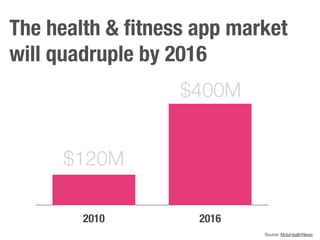
Apps
2010 2016
$400M
The health & fitness app
market
will quadruple by 2016
$120M
Source: MobiHealthNews
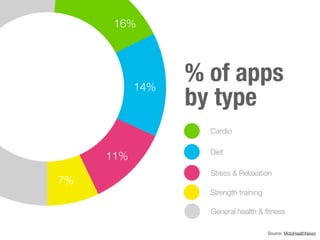
Cardio
Diet
Stress & Relaxation
16%
14%
11%
% of apps
by type
Strength training
General health & fitness
7%
Source: MobiHealthNews
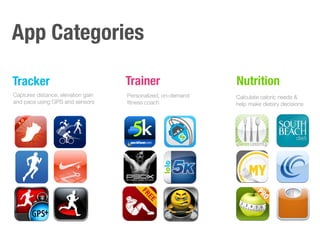
App Categories
Tracker Trainer Nutrition
Captures distance, elevation gain
and pace using GPS and sensors
Personalized, on-demand
fitness coach
Calculate caloric needs &
help make dietary decisions
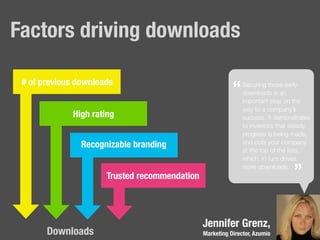
Factors driving downloads
High rating
# of previous downloads
Recognizable branding
Trusted recommendation
Securing those early
downloads is an
important step on the
way to a company’s
success. It demonstrates
to investors that steady
progress is being made,
and puts your company
at the top of the lists,
which, in turn drives
more downloads.
“
”
Jennifer Grenz,
Marketing Director, AzumioDownloads
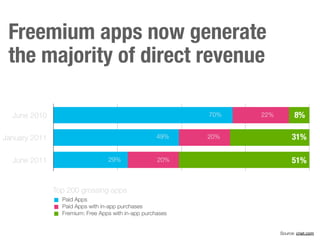
Freemium apps now generate
the majority of direct revenue
June 2010
January 2011
June 2011
Source: cnet.com
Top 200 grossing apps
Paid Apps
Paid Apps with in-app purchases
Fremium: Free Apps with in-app purchases
70%
49%
29% 51%
31%
8%22%
20%
20%
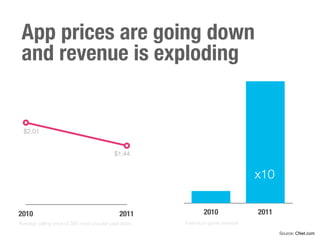
Source: cnet.com
App prices are going down
and revenue is exploding
2010 2011
$1.44
2010 2011
x10
$2.01
Average selling price of 300 most popular paid apps Freemium game revenue
Trends
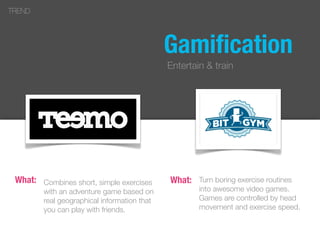
Gamification
Entertain & train
Combines short, simple exercises
with an adventure game based on
real geographical information that
you can play with friends.
TREND
What: Turn boring exercise routines
into awesome video games.
Games are controlled by head
movement and exercise speed.
What:
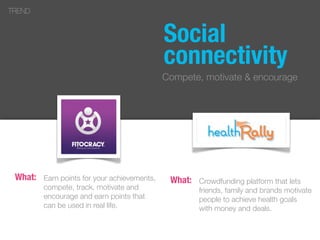
Crowdfunding platform that lets
friends, family and brands motivate
people to achieve health goals
with money and deals.
Social
connectivity
Compete, motivate & encourage
Earn points for your achievements,
compete, track, motivate and
encourage and earn points that
can be used in real life.
TREND
What: What:
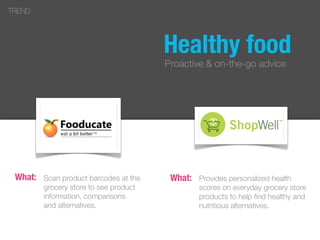
Healthy food
Proactive & on-the-go advice
Scan product barcodes at the
grocery store to see product
information, comparisons
and alternatives.
TREND
What: Provides personalized health
scores on everyday grocery store
products to help find healthy and
nutritious alternatives.
What:
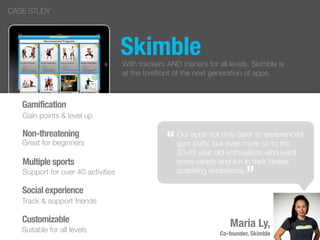
Skimble
Our apps not only cater to experienced
gym buffs, but even more so to the
20-45 year old enthusiasts who want
more variety and fun in their fitness
coaching experience.
Non-threatening
Gamification
Great for beginners
Gain points & level up
“
”
With trackers AND trainers for all levels, Skimble is
at the forefront of the next generation of apps.
Multiple sports
Support for over 40 activities
Social experience
Track & support friends
Customizable
Suitable for all levels
Maria Ly,
Co-founder, Skimble
CASE STUDY
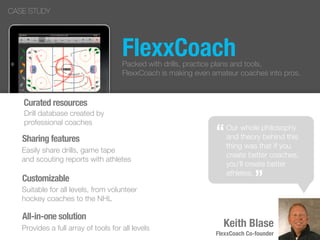
FlexxCoach
“
”
Keith Blase
FlexxCoach Co-founder
CASE STUDY
Our whole philosophy
and theory behind this
thing was that if you
create better coaches,
you’ll create better
athletes.
“
”
Packed with drills, practice plans and tools,
FlexxCoach is making even amateur coaches into pros.
Curated resources
Drill database created by
professional coaches
Sharing features
Easily share drills, game tape
and scouting reports with athletes
Customizable
Suitable for all levels, from volunteer
hockey coaches to the NHL
All-in-one solution
Provides a full array of tools for all levels
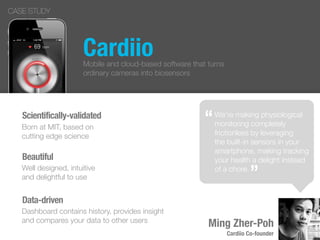
Cardiio
“
”
Ming Zher-Poh
Cardiio Co-founder
CASE STUDY
We’re making physiological
monitoring completely
frictionless by leveraging
the built-in sensors in your
smartphone, making tracking
your health a delight instead
of a chore.
“
”
Mobile and cloud-based software that turns
ordinary cameras into biosensors
Scientifically-validated
Born at MIT, based on
cutting edge science
Beautiful
Well designed, intuitive
and delightful to use
Data-driven
Dashboard contains history, provides insight
and compares your data to other users
Sensors
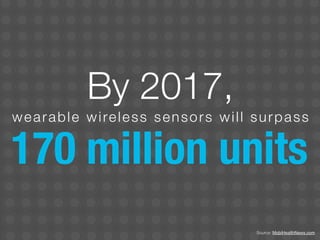
Source: MobiHealthNews.com
170 million units
By 2017,
wearable wireless sensors will surpass
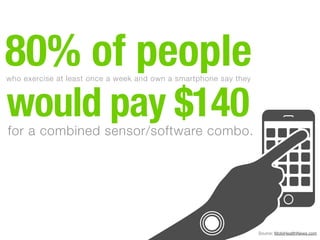
Source: MobiHealthNews.com
80% of people
would pay $140for a combined sensor/software combo.
who exercise at least once a week and own a smartphone say they
Trends
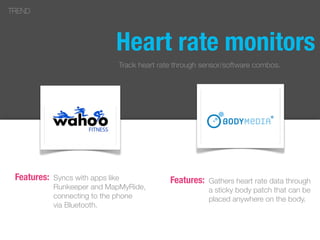
Heart rate monitors
Syncs with apps like
Runkeeper and MapMyRide,
connecting to the phone
via Bluetooth.
TREND
Features: Gathers heart rate data through
a sticky body patch that can be
placed anywhere on the body.
Features:
Track heart rate through sensor/software combos.
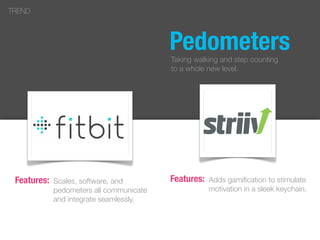
Pedometers
Scales, software, and
pedometers all communicate
and integrate seamlessly.
TREND
Features: Adds gamification to stimulate
motivation in a sleek keychain.
Features:
Striv
Taking walking and step counting
to a whole new level.
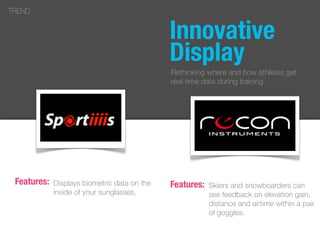
Displays biometric data on the
inside of your sunglasses.
TREND
Features: Skiers and snowboarders can
see feedback on elevation gain,
distance and airtime within a pair
of goggles.
Features:
Innovative
Display
Rethinking where and how athletes get
real-time data during training.
Inertial sensor system equipped
with accelerometers and
gyroscopes sewn into a
swimming suit.
TREND
Features: Developing highly wearable
sensor products and services
for wellness and medical
applications.
Features:
Physilog III
WearablesBringing sensors seamlessly into the
clothing and shoes we wear.
High definition, slow motion
video analysis software with
the tools to mark, highlight,
and compare footage
TREND
What: Captures underwater video or
synchronized video and force
data, providing feedback to
pro swimmers.
What:
Video analysisCutting edge camera systems help track,
record and improve performance
MC10
“
”
David Icke
CEO and Founder, MC10
CASE STUDY
When a sensing technology is
virtually invisible to the user
and available at an affordable
price, continuous access to
high-quality biofeedback can
become a part of everyday life
for all consumers who are
looking to get healthier.
“
”
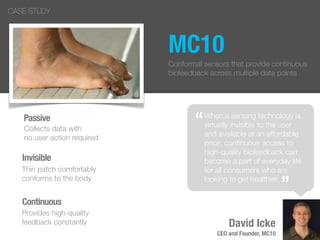
Conformal sensors that provide continuous
biofeedback across multiple data points
Passive
Collects data with
no user action required
Invisible
Thin patch comfortably
conforms to the body
Continuous
Provides high-quality
feedback constantly
What
the
experts
think
Dr. Leslie Saxon
USC Center for Body Computing
on form factor:
on designing for athletes:
on the future:
“
Performance is definitely not a one size fits all solution, and we’ve seen trainers
grow frustrated by the cumbersome nature of many of the tools on the market.
It might seem like you can just strap on a device, get a bunch of data and help
an athlete’s performance, but that is a very engineering-centric approach.
“
Athletes want to be part of the learning process, not just told what to do.
Coaches are interested in solutions that teach and reinforce better technique
and other positive habits. Sports is about winning, so show results and
athletes and coaches will use them.
“
Now you might monitor an athlete for 3 hours a day during training, but we
believe the other 21 hours have equal importance. Front end tools need to be
more engaging and sticky, and the information less dense and confusing.
Monitoring will lead to a more engaging fan experience.
The Doctor
Isaiah Kacyvenski
8-year NFL Veteran & Super Bowl Captain
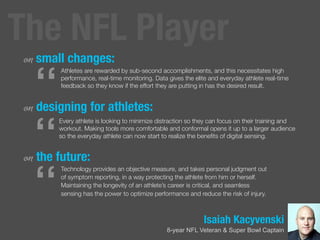
on small changes:
on designing for athletes:
on the future:
“
Athletes are rewarded by sub-second accomplishments, and this necessitates high
performance, real-time monitoring. Data gives the elite and everyday athlete real-time
feedback so they know if the effort they are putting in has the desired result.
“
Every athlete is looking to minimize distraction so they can focus on their training and
workout. Making tools more comfortable and conformal opens it up to a larger audience
so the everyday athlete can now start to realize the benefits of digital sensing.
“
Technology provides an objective measure, and takes personal judgment out
of symptom reporting, in a way protecting the athlete from him or herself.
Maintaining the longevity of an athlete’s career is critical, and seamless
sensing has the power to optimize performance and reduce the risk of injury.
The NFL Player
Mitch Henderson
Head Coach, Princeton Men’s Basketball
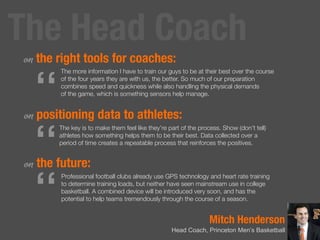
on the right tools for coaches:
on positioning data to athletes:
on the future:
“
The more information I have to train our guys to be at their best over the course
of the four years they are with us, the better. So much of our preparation
combines speed and quickness while also handling the physical demands
of the game, which is something sensors help manage.
“
The key is to make them feel like they’re part of the process. Show (don’t tell)
athletes how something helps them to be their best. Data collected over a
period of time creates a repeatable process that reinforces the positives.
“
Professional football clubs already use GPS technology and heart rate training
to determine training loads, but neither have seen mainstream use in college
basketball. A combined device will be introduced very soon, and has the
potential to help teams tremendously through the course of a season.
The Head Coach
Joanna Zeiger
Olympian & IronMan World Champion
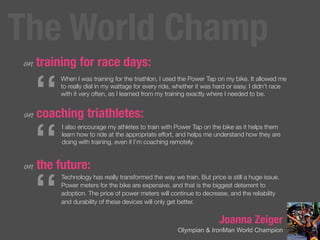
on training for race days:
on coaching triathletes:
on the future:
“
When I was training for the triathlon, I used the Power Tap on my bike. It allowed me
to really dial in my wattage for every ride, whether it was hard or easy. I didn’t race
with it very often, as I learned from my training exactly where I needed to be.
“
I also encourage my athletes to train with Power Tap on the bike as it helps them
learn how to ride at the appropriate effort, and helps me understand how they are
doing with training, even if I’m coaching remotely.
“
Technology has really transformed the way we train. But price is still a huge issue.
Power meters for the bike are expensive, and that is the biggest deterrent to
adoption. The price of power meters will continue to decrease, and the reliability
and durability of these devices will only get better.
The World Champ
David Icke
CEO & Founder, MC10
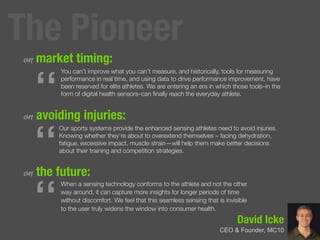
on market timing:
on avoiding injuries:
on the future:
“
You can’t improve what you can’t measure, and historically, tools for measuring
performance in real time, and using data to drive performance improvement, have
been reserved for elite athletes. We are entering an era in which those tools–in the
form of digital health sensors–can finally reach the everyday athlete.
“
Our sports systems provide the enhanced sensing athletes need to avoid injuries.
Knowing whether they’re about to overextend themselves – facing dehydration,
fatigue, excessive impact, muscle strain—will help them make better decisions
about their training and competition strategies.
“
When a sensing technology conforms to the athlete and not the other
way around, it can capture more insights for longer periods of time
without discomfort. We feel that this seamless sensing that is invisible
to the user truly widens the window into consumer health.
The Pioneer
Derek Parra
Olympic Gold Medalist in Speed Skating
on the international market:
on the important role of
research:
on the future:
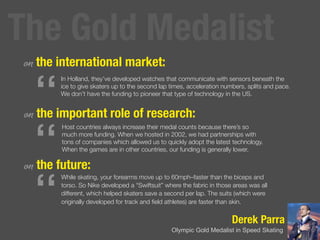
“
In Holland, they’ve developed watches that communicate with sensors beneath the
ice to give skaters up to the second lap times, acceleration numbers, splits and pace.
We don’t have the funding to pioneer that type of technology in the US.
“
Host countries always increase their medal counts because there’s so
much more funding. When we hosted in 2002, we had partnerships with
tons of companies which allowed us to quickly adopt the latest technology.
When the games are in other countries, our funding is generally lower.
“
While skating, your forearms move up to 60mph–faster than the biceps and
torso. So Nike developed a “Swiftsuit” where the fabric in those areas was all
different, which helped skaters save a second per lap. The suits (which were
originally developed for track and field athletes) are faster than skin.
The Gold Medalist
Sources:
Presentation copyright © 2012 Rock Health
GET IN
TOUCH:
Rock_Health
research@rockhealth.org
http://mashable.com/2012/06/11/wwdc-2012-app-store-stats/
http://148apps.biz/app-store-metrics/?mpage=catcount
http://mobihealthnews.com/17802/survey-consumer-interest-in-app-enabled-fitness-sensors/#
http://mobihealthnews.com/11224/by-2016-80m-wearable-wireless-fitness-sensors/
http://mobihealthnews.com/14884/by-2016-400m-market-for-health-fitness-apps/
http://www.insidesocialgames.com/category/user-generated/page/2/
http://www.inc.com/guides/making-money-iphone-apps.htm
http://mashable.com/2011/08/17/price-mobile-app/l
http://www.readwriteweb.com/mobile/2011/07/mobile-game-prices-decline-but-revenue-up.php
http://news.cnet.com/8301-1035_3-57418833-94/freemium-games-are-the-ticket-to-app-profits-study/

Rock Report: Fitness Technology for Athletes by @Rock_Health

  • 1.
    Swifter, higher, stronger: Fitness technology forathletes A R O C K R E P O R T B Y
  • 2.
    Rock Health ispowering the future of the digital health ecosystem, bringing together the brightest minds across disciplines to build better solutions. Rock Health funds and supports startups building the next generation of technologies transforming healthcare. Rock Health partners include Aberdare Ventures, Accel Partners, Fenwick & West, GE, Genentech, Harvard Medical School, Mayo Clinic, Merck, Microsoft, Mohr Davidow Ventures, NEA, Nike, P&G, Qualcomm, Silicon Valley Bank, United Health and UCSF. For more information, visit rockhealth.com About this REPORT We wanted to know more about the convergence of digital health and sports, and the impact of technology on the fitness consumer market. This report sources data and feedback from interviews conducted with entrepreneurs and athletes working in the space as well as industry research. Caveat: we are not professional white-paperistas, just curious advocates who like to share knowledge and further the discussion around the evolving digital health space. Produced by Dan DregerLeslie Ziegler @lesliejz @wunce
  • 3.
    Apps & sensorsare transforming athletic training & performance.
  • 4.
  • 5.
    2010 2016 $400M The health& fitness app market will quadruple by 2016 $120M Source: MobiHealthNews
  • 6.
    Cardio Diet Stress & Relaxation 16% 14% 11% %of apps by type Strength training General health & fitness 7% Source: MobiHealthNews
  • 7.
    App Categories Tracker TrainerNutrition Captures distance, elevation gain and pace using GPS and sensors Personalized, on-demand fitness coach Calculate caloric needs & help make dietary decisions
  • 8.
    Factors driving downloads Highrating # of previous downloads Recognizable branding Trusted recommendation Securing those early downloads is an important step on the way to a company’s success. It demonstrates to investors that steady progress is being made, and puts your company at the top of the lists, which, in turn drives more downloads. “ ” Jennifer Grenz, Marketing Director, AzumioDownloads
  • 9.
    Freemium apps nowgenerate the majority of direct revenue June 2010 January 2011 June 2011 Source: cnet.com Top 200 grossing apps Paid Apps Paid Apps with in-app purchases Fremium: Free Apps with in-app purchases 70% 49% 29% 51% 31% 8%22% 20% 20%
  • 10.
    Source: cnet.com App pricesare going down and revenue is exploding 2010 2011 $1.44 2010 2011 x10 $2.01 Average selling price of 300 most popular paid apps Freemium game revenue
  • 11.
  • 12.
    Gamification Entertain & train Combinesshort, simple exercises with an adventure game based on real geographical information that you can play with friends. TREND What: Turn boring exercise routines into awesome video games. Games are controlled by head movement and exercise speed. What:
  • 13.
    Crowdfunding platform thatlets friends, family and brands motivate people to achieve health goals with money and deals. Social connectivity Compete, motivate & encourage Earn points for your achievements, compete, track, motivate and encourage and earn points that can be used in real life. TREND What: What:
  • 14.
    Healthy food Proactive &on-the-go advice Scan product barcodes at the grocery store to see product information, comparisons and alternatives. TREND What: Provides personalized health scores on everyday grocery store products to help find healthy and nutritious alternatives. What:
  • 15.
    Skimble Our apps notonly cater to experienced gym buffs, but even more so to the 20-45 year old enthusiasts who want more variety and fun in their fitness coaching experience. Non-threatening Gamification Great for beginners Gain points & level up “ ” With trackers AND trainers for all levels, Skimble is at the forefront of the next generation of apps. Multiple sports Support for over 40 activities Social experience Track & support friends Customizable Suitable for all levels Maria Ly, Co-founder, Skimble CASE STUDY
  • 16.
    FlexxCoach “ ” Keith Blase FlexxCoach Co-founder CASESTUDY Our whole philosophy and theory behind this thing was that if you create better coaches, you’ll create better athletes. “ ” Packed with drills, practice plans and tools, FlexxCoach is making even amateur coaches into pros. Curated resources Drill database created by professional coaches Sharing features Easily share drills, game tape and scouting reports with athletes Customizable Suitable for all levels, from volunteer hockey coaches to the NHL All-in-one solution Provides a full array of tools for all levels
  • 17.
    Cardiio “ ” Ming Zher-Poh Cardiio Co-founder CASESTUDY We’re making physiological monitoring completely frictionless by leveraging the built-in sensors in your smartphone, making tracking your health a delight instead of a chore. “ ” Mobile and cloud-based software that turns ordinary cameras into biosensors Scientifically-validated Born at MIT, based on cutting edge science Beautiful Well designed, intuitive and delightful to use Data-driven Dashboard contains history, provides insight and compares your data to other users
  • 18.
  • 19.
    Source: MobiHealthNews.com 170 millionunits By 2017, wearable wireless sensors will surpass
  • 20.
    Source: MobiHealthNews.com 80% ofpeople would pay $140for a combined sensor/software combo. who exercise at least once a week and own a smartphone say they
  • 21.
  • 22.
    Heart rate monitors Syncswith apps like Runkeeper and MapMyRide, connecting to the phone via Bluetooth. TREND Features: Gathers heart rate data through a sticky body patch that can be placed anywhere on the body. Features: Track heart rate through sensor/software combos.
  • 23.
    Pedometers Scales, software, and pedometersall communicate and integrate seamlessly. TREND Features: Adds gamification to stimulate motivation in a sleek keychain. Features: Striv Taking walking and step counting to a whole new level.
  • 24.
    Displays biometric dataon the inside of your sunglasses. TREND Features: Skiers and snowboarders can see feedback on elevation gain, distance and airtime within a pair of goggles. Features: Innovative Display Rethinking where and how athletes get real-time data during training.
  • 25.
    Inertial sensor systemequipped with accelerometers and gyroscopes sewn into a swimming suit. TREND Features: Developing highly wearable sensor products and services for wellness and medical applications. Features: Physilog III WearablesBringing sensors seamlessly into the clothing and shoes we wear.
  • 26.
    High definition, slowmotion video analysis software with the tools to mark, highlight, and compare footage TREND What: Captures underwater video or synchronized video and force data, providing feedback to pro swimmers. What: Video analysisCutting edge camera systems help track, record and improve performance
  • 27.
    MC10 “ ” David Icke CEO andFounder, MC10 CASE STUDY When a sensing technology is virtually invisible to the user and available at an affordable price, continuous access to high-quality biofeedback can become a part of everyday life for all consumers who are looking to get healthier. “ ” Conformal sensors that provide continuous biofeedback across multiple data points Passive Collects data with no user action required Invisible Thin patch comfortably conforms to the body Continuous Provides high-quality feedback constantly
  • 28.
  • 29.
    Dr. Leslie Saxon USCCenter for Body Computing on form factor: on designing for athletes: on the future: “ Performance is definitely not a one size fits all solution, and we’ve seen trainers grow frustrated by the cumbersome nature of many of the tools on the market. It might seem like you can just strap on a device, get a bunch of data and help an athlete’s performance, but that is a very engineering-centric approach. “ Athletes want to be part of the learning process, not just told what to do. Coaches are interested in solutions that teach and reinforce better technique and other positive habits. Sports is about winning, so show results and athletes and coaches will use them. “ Now you might monitor an athlete for 3 hours a day during training, but we believe the other 21 hours have equal importance. Front end tools need to be more engaging and sticky, and the information less dense and confusing. Monitoring will lead to a more engaging fan experience. The Doctor
  • 30.
    Isaiah Kacyvenski 8-year NFLVeteran & Super Bowl Captain on small changes: on designing for athletes: on the future: “ Athletes are rewarded by sub-second accomplishments, and this necessitates high performance, real-time monitoring. Data gives the elite and everyday athlete real-time feedback so they know if the effort they are putting in has the desired result. “ Every athlete is looking to minimize distraction so they can focus on their training and workout. Making tools more comfortable and conformal opens it up to a larger audience so the everyday athlete can now start to realize the benefits of digital sensing. “ Technology provides an objective measure, and takes personal judgment out of symptom reporting, in a way protecting the athlete from him or herself. Maintaining the longevity of an athlete’s career is critical, and seamless sensing has the power to optimize performance and reduce the risk of injury. The NFL Player
  • 31.
    Mitch Henderson Head Coach,Princeton Men’s Basketball on the right tools for coaches: on positioning data to athletes: on the future: “ The more information I have to train our guys to be at their best over the course of the four years they are with us, the better. So much of our preparation combines speed and quickness while also handling the physical demands of the game, which is something sensors help manage. “ The key is to make them feel like they’re part of the process. Show (don’t tell) athletes how something helps them to be their best. Data collected over a period of time creates a repeatable process that reinforces the positives. “ Professional football clubs already use GPS technology and heart rate training to determine training loads, but neither have seen mainstream use in college basketball. A combined device will be introduced very soon, and has the potential to help teams tremendously through the course of a season. The Head Coach
  • 32.
    Joanna Zeiger Olympian &IronMan World Champion on training for race days: on coaching triathletes: on the future: “ When I was training for the triathlon, I used the Power Tap on my bike. It allowed me to really dial in my wattage for every ride, whether it was hard or easy. I didn’t race with it very often, as I learned from my training exactly where I needed to be. “ I also encourage my athletes to train with Power Tap on the bike as it helps them learn how to ride at the appropriate effort, and helps me understand how they are doing with training, even if I’m coaching remotely. “ Technology has really transformed the way we train. But price is still a huge issue. Power meters for the bike are expensive, and that is the biggest deterrent to adoption. The price of power meters will continue to decrease, and the reliability and durability of these devices will only get better. The World Champ
  • 33.
    David Icke CEO &Founder, MC10 on market timing: on avoiding injuries: on the future: “ You can’t improve what you can’t measure, and historically, tools for measuring performance in real time, and using data to drive performance improvement, have been reserved for elite athletes. We are entering an era in which those tools–in the form of digital health sensors–can finally reach the everyday athlete. “ Our sports systems provide the enhanced sensing athletes need to avoid injuries. Knowing whether they’re about to overextend themselves – facing dehydration, fatigue, excessive impact, muscle strain—will help them make better decisions about their training and competition strategies. “ When a sensing technology conforms to the athlete and not the other way around, it can capture more insights for longer periods of time without discomfort. We feel that this seamless sensing that is invisible to the user truly widens the window into consumer health. The Pioneer
  • 34.
    Derek Parra Olympic GoldMedalist in Speed Skating on the international market: on the important role of research: on the future: “ In Holland, they’ve developed watches that communicate with sensors beneath the ice to give skaters up to the second lap times, acceleration numbers, splits and pace. We don’t have the funding to pioneer that type of technology in the US. “ Host countries always increase their medal counts because there’s so much more funding. When we hosted in 2002, we had partnerships with tons of companies which allowed us to quickly adopt the latest technology. When the games are in other countries, our funding is generally lower. “ While skating, your forearms move up to 60mph–faster than the biceps and torso. So Nike developed a “Swiftsuit” where the fabric in those areas was all different, which helped skaters save a second per lap. The suits (which were originally developed for track and field athletes) are faster than skin. The Gold Medalist
  • 35.
    Sources: Presentation copyright ©2012 Rock Health GET IN TOUCH: Rock_Health research@rockhealth.org http://mashable.com/2012/06/11/wwdc-2012-app-store-stats/ http://148apps.biz/app-store-metrics/?mpage=catcount http://mobihealthnews.com/17802/survey-consumer-interest-in-app-enabled-fitness-sensors/# http://mobihealthnews.com/11224/by-2016-80m-wearable-wireless-fitness-sensors/ http://mobihealthnews.com/14884/by-2016-400m-market-for-health-fitness-apps/ http://www.insidesocialgames.com/category/user-generated/page/2/ http://www.inc.com/guides/making-money-iphone-apps.htm http://mashable.com/2011/08/17/price-mobile-app/l http://www.readwriteweb.com/mobile/2011/07/mobile-game-prices-decline-but-revenue-up.php http://news.cnet.com/8301-1035_3-57418833-94/freemium-games-are-the-ticket-to-app-profits-study/