No philosophy, please,
    we are managers!
                        Claude Rochet
                       Professeur des universités

    Institut de la Gestion Publique et du Développement Economique, Paris
Institut de Management Public et de Gouvernance Territoriale, Aix-en-Provence
Summary


           Why managerialism needs to be outstrip?
           Drawing the lessons from nations’
           building: the UK and USA cases
           Back to the basics of political philosophy
           The revival of an euro-atlantic debate
           Consequences for the training of public
           managers


 Malte,
Sept 2,
  2009
                                                    2
                                   Claude Rochet
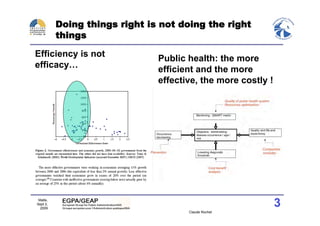
Doing things right is not doing the right
          things

Efficiency is not              Public health: the more
efficacy…                      efficient and the more
                               effective, the more costly !


 Malte,
Sept 2,
  2009
                                                              3
                                      Claude Rochet
So, what is a good public decision?


          Learning from F. Hayek
              Rejection of logical positivism and neoclassical
              economy and social constructivism
              A central role to the State: replacing gov’t by men by
              gov’t by law
              Law as a natural selection process
              But, where does a legitimate law comes from? Hayek
              fails in answering this question:
                   – « J’ai toujours peine, personnellement à croire que moralité et utilité, par harmonie
                     préétablie, coïncident pleinement (…) Je ne refuserai pas mon admiration à la
                     démonstration de Hayek, mais je réserverai ma foi. Les libéraux ont parfois
                     tendance, comme les marxistes, à croire que l’ordre du monde pourrait réconcilier
                     nos aspirations avec la réalité ». (Raymond Aron, coments on « Road to
                     Serfdom »)

              Hayek’s legacy: the question is NOT State or market, but
              a problem embedded within the theory of knowledge
 Malte,
Sept 2,
  2009
                                                                                                       4
                                                                Claude Rochet
Introducing ergodic hypothesis

          If there is no determined law (of history or of the
          market) to drive our decisions
              Can we make anything? No!
          Institutions are rules which reduce uncertainty
          (D. North)
              If the system has an ergodic behavior, deterministic
              methods may work
          But, when technological disruptions trigger
          paradigm shift, institutions do no longer work
              The system has a non ergodic behavior
              Adaptive learning is the key
              The role of the State is to foster this process and to
              update the rules

 Malte,
Sept 2,
  2009
                                                                       5
                                              Claude Rochet
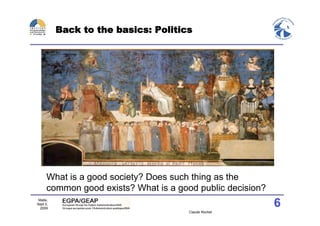
Back to the basics: Politics


      What is a good society? Does such thing as the
      common good exists? What is a good public decision?
 Malte,
Sept 2,
  2009
                                                            6
                                       Claude Rochet
Credit and finance as an
            economic activity per se
            introduce disequilibrium and
            corruptio
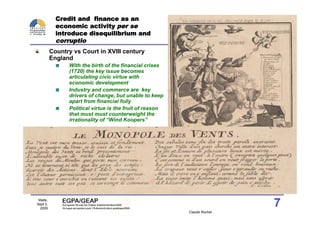
          Country vs Court in XVIII century
          England
                With the birth of the financial crises
                (1720) the key issue becomes
                articulating civic virtue with
                economic development
                Industry and commerce are key
                drivers of change, but unable to keep
                apart from financial folly
                Political virtue is the fruit of reason
                that must must counterweight the
                irrationality of “Wind Koopers”


 Malte,
Sept 2,
  2009
                                                                          7
                                                          Claude Rochet
Learning from history and nations’
          building

           The founding of the USA
               Originates in the corruption of England
               “The end of classical politics” G. Wood
               “ The lesser evil empire”, from positive to negative
               liberty (I. Berlin)
           The classical question of the common good is
           repealed…
               … but it strikes back with the euro-atlantic
               republicanism: The Cambridge School (Skinner,
               Pettit), The French school (Spitz), and the revival of
               Machiavellian studies (Viroli)


 Malte,
Sept 2,
  2009
                                                                        8
                                             Claude Rochet
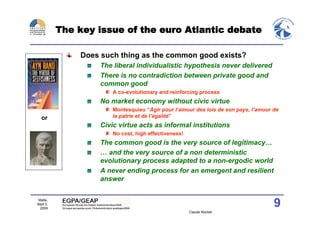
The key issue of the euro Atlantic debate

              Does such thing as the common good exists?
                   The liberal individualistic hypothesis never delivered
                   There is no contradiction between private good and
                   common good
                       A co-evolutionary and reinforcing process
                   No market economy without civic virtue
                       Montesquieu “Agir pour l’amour des lois de son pays, l’amour de
  or                   la patrie et de l’égalité”
                   Civic virtue acts as informal institutions
                       No cost, high effectiveness!
                   The common good is the very source of legitimacy…
                   … and the very source of a non deterministic
                   evolutionary process adapted to a non-ergodic world
                   A never ending process for an emergent and resilient
                   answer

 Malte,
Sept 2,
  2009
                                                                                    9
                                                      Claude Rochet
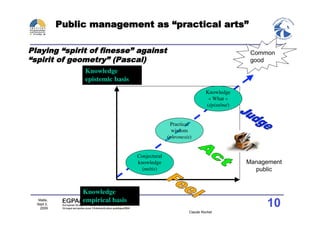
Public management as “practical arts”

Playing “spirit of finesse” against                                              Common
“spirit of geometry” (Pascal)                                                    good
                 Knowledge
                 epistemic basis
                                                                   Knowledge
                                                                    « What »
                                                                   (épistémé)


                                                  Practical
                                                   wisdom
                                                 (phronesis)


                                   Conjectural
                                   knowledge                                    Management
                                     (métis)                                      public


                 Knowledge
   Malte,
  Sept 2,
    2009
                 empirical basis
                                                                                     10
                                                          Claude Rochet
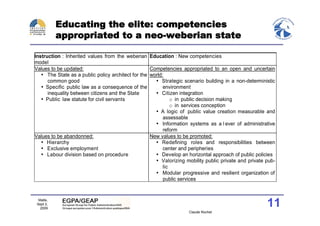
Educating the elite: competencies
           appropriated to a neo-weberian state

Instruction : Inherited values from the weberian Education : New competencies
model
Values to be updated:                               Competencies appropriated to an open and uncertain
   • The State as a public policy architect for the world:
      common good                                     • Strategic scenario building in a non-deterministic
   • Specific public law as a consequence of the          environment
      inequality between citizens and the State       • Citizen integration
   • Public law statute for civil servants                    o in public decision making
                                                              o in services conception
                                                      • A logic of public value creation measurable and
                                                          assessable
                                                      • Information systems as a l ever of administrative
                                                          reform
Values to be abandonned:                            New values to be promoted:
   • Hierarchy                                        • Redefining roles and responsibilities between
   • Exclusive employment                                 center and peripheries
   • Labour division based on procedure               • Develop an horizontal approach of public policies
                                                      • Valorizing mobility public private and private pub-
                                                          lic
                                                      • Modular progressive and resilient organization of
                                                          public services


  Malte,
 Sept 2,
   2009
                                                                                                       11
                                                                    Claude Rochet

"No philosophy, please, we are managers"

  • 1.
    No philosophy, please, we are managers! Claude Rochet Professeur des universités Institut de la Gestion Publique et du Développement Economique, Paris Institut de Management Public et de Gouvernance Territoriale, Aix-en-Provence
  • 2.
    Summary Why managerialism needs to be outstrip? Drawing the lessons from nations’ building: the UK and USA cases Back to the basics of political philosophy The revival of an euro-atlantic debate Consequences for the training of public managers Malte, Sept 2, 2009 2 Claude Rochet
  • 3.
    Doing things rightis not doing the right things Efficiency is not Public health: the more efficacy… efficient and the more effective, the more costly ! Malte, Sept 2, 2009 3 Claude Rochet
  • 4.
    So, what isa good public decision? Learning from F. Hayek Rejection of logical positivism and neoclassical economy and social constructivism A central role to the State: replacing gov’t by men by gov’t by law Law as a natural selection process But, where does a legitimate law comes from? Hayek fails in answering this question: – « J’ai toujours peine, personnellement à croire que moralité et utilité, par harmonie préétablie, coïncident pleinement (…) Je ne refuserai pas mon admiration à la démonstration de Hayek, mais je réserverai ma foi. Les libéraux ont parfois tendance, comme les marxistes, à croire que l’ordre du monde pourrait réconcilier nos aspirations avec la réalité ». (Raymond Aron, coments on « Road to Serfdom ») Hayek’s legacy: the question is NOT State or market, but a problem embedded within the theory of knowledge Malte, Sept 2, 2009 4 Claude Rochet
  • 5.
    Introducing ergodic hypothesis If there is no determined law (of history or of the market) to drive our decisions Can we make anything? No! Institutions are rules which reduce uncertainty (D. North) If the system has an ergodic behavior, deterministic methods may work But, when technological disruptions trigger paradigm shift, institutions do no longer work The system has a non ergodic behavior Adaptive learning is the key The role of the State is to foster this process and to update the rules Malte, Sept 2, 2009 5 Claude Rochet
  • 6.
    Back to thebasics: Politics What is a good society? Does such thing as the common good exists? What is a good public decision? Malte, Sept 2, 2009 6 Claude Rochet
  • 7.
    Credit and financeas an economic activity per se introduce disequilibrium and corruptio Country vs Court in XVIII century England With the birth of the financial crises (1720) the key issue becomes articulating civic virtue with economic development Industry and commerce are key drivers of change, but unable to keep apart from financial folly Political virtue is the fruit of reason that must must counterweight the irrationality of “Wind Koopers” Malte, Sept 2, 2009 7 Claude Rochet
  • 8.
    Learning from historyand nations’ building The founding of the USA Originates in the corruption of England “The end of classical politics” G. Wood “ The lesser evil empire”, from positive to negative liberty (I. Berlin) The classical question of the common good is repealed… … but it strikes back with the euro-atlantic republicanism: The Cambridge School (Skinner, Pettit), The French school (Spitz), and the revival of Machiavellian studies (Viroli) Malte, Sept 2, 2009 8 Claude Rochet
  • 9.
    The key issueof the euro Atlantic debate Does such thing as the common good exists? The liberal individualistic hypothesis never delivered There is no contradiction between private good and common good A co-evolutionary and reinforcing process No market economy without civic virtue Montesquieu “Agir pour l’amour des lois de son pays, l’amour de or la patrie et de l’égalité” Civic virtue acts as informal institutions No cost, high effectiveness! The common good is the very source of legitimacy… … and the very source of a non deterministic evolutionary process adapted to a non-ergodic world A never ending process for an emergent and resilient answer Malte, Sept 2, 2009 9 Claude Rochet
  • 10.
    Public management as“practical arts” Playing “spirit of finesse” against Common “spirit of geometry” (Pascal) good Knowledge epistemic basis Knowledge « What » (épistémé) Practical wisdom (phronesis) Conjectural knowledge Management (métis) public Knowledge Malte, Sept 2, 2009 empirical basis 10 Claude Rochet
  • 11.
    Educating the elite:competencies appropriated to a neo-weberian state Instruction : Inherited values from the weberian Education : New competencies model Values to be updated: Competencies appropriated to an open and uncertain • The State as a public policy architect for the world: common good • Strategic scenario building in a non-deterministic • Specific public law as a consequence of the environment inequality between citizens and the State • Citizen integration • Public law statute for civil servants o in public decision making o in services conception • A logic of public value creation measurable and assessable • Information systems as a l ever of administrative reform Values to be abandonned: New values to be promoted: • Hierarchy • Redefining roles and responsibilities between • Exclusive employment center and peripheries • Labour division based on procedure • Develop an horizontal approach of public policies • Valorizing mobility public private and private pub- lic • Modular progressive and resilient organization of public services Malte, Sept 2, 2009 11 Claude Rochet