Robotics in Education: Research and Practices
for Robotics in STEM Education 1st Edition Munir
Merdan download
https://textbookfull.com/product/robotics-in-education-research-
and-practices-for-robotics-in-stem-education-1st-edition-munir-
merdan/
Download more ebook from https://textbookfull.com
We believe these products will be a great fit for you. Click
the link to download now, or visit textbookfull.com
to discover even more!
Learning robotics with robotics by robotics Educational
Robotics 1st Edition Ilaria Gaudiello
https://textbookfull.com/product/learning-robotics-with-robotics-
by-robotics-educational-robotics-1st-edition-ilaria-gaudiello/
Cognitive Informatics, Computer Modelling, and
Cognitive Science: Application to Neural Engineering,
Robotics, and Stem: Volume 2: Application to Neural
Engineering, Robotics, and STEM 1st Edition Ganesh R.
Sinha
https://textbookfull.com/product/cognitive-informatics-computer-
modelling-and-cognitive-science-application-to-neural-
engineering-robotics-and-stem-volume-2-application-to-neural-
engineering-robotics-and-stem-1st-edition-gan/
New Advances in Mechanisms, Mechanical Transmissions
and Robotics : MTM & Robotics 2020 Erwin-Christian
Lovasz
https://textbookfull.com/product/new-advances-in-mechanisms-
mechanical-transmissions-and-robotics-mtm-robotics-2020-erwin-
christian-lovasz/
Critical Questions in STEM Education Valarie L. Akerson
https://textbookfull.com/product/critical-questions-in-stem-
education-valarie-l-akerson/
Science Education Research and Practices in Taiwan
Challenges and Opportunities 1st Edition Mei-Hung Chiu
(Eds.)
https://textbookfull.com/product/science-education-research-and-
practices-in-taiwan-challenges-and-opportunities-1st-edition-mei-
hung-chiu-eds/
Critical Transdisciplinary and Embodied Approaches in
STEM Education Pratim Sengupta
https://textbookfull.com/product/critical-transdisciplinary-and-
embodied-approaches-in-stem-education-pratim-sengupta/
STEM in the Technopolis The Power of STEM Education in
Regional Technology Policy Cliff Zintgraff
https://textbookfull.com/product/stem-in-the-technopolis-the-
power-of-stem-education-in-regional-technology-policy-cliff-
zintgraff/
Robotics and Mechatronics for Agriculture 1st Edition
Dan Zhang
https://textbookfull.com/product/robotics-and-mechatronics-for-
agriculture-1st-edition-dan-zhang/
2■ Problems for STEM Education 1st Edition Valery
Ochkov (Author)
https://textbookfull.com/product/2%e2%81%b5-problems-for-stem-
education-1st-edition-valery-ochkov-author/
Advances in Intelligent Systems and Computing 457
Munir Merdan
Wilfried Lepuschitz
Gottfried Koppensteiner
Richard Balogh Editors
Robotics in
Education
Research and Practices for Robotics in
STEM Education
Advances in Intelligent Systems and Computing
Volume 457
Series editor
Janusz Kacprzyk, Polish Academy of Sciences, Warsaw, Poland
e-mail: kacprzyk@ibspan.waw.pl
About this Series
The series “Advances in Intelligent Systems and Computing” contains publications on theory,
applications, and design methods of Intelligent Systems and Intelligent Computing. Virtually
all disciplines such as engineering, natural sciences, computer and information science, ICT,
economics, business, e-commerce, environment, healthcare, life science are covered. The list
of topics spans all the areas of modern intelligent systems and computing.
The publications within “Advances in Intelligent Systems and Computing” are primarily
textbooks and proceedings of important conferences, symposia and congresses. They cover
significant recent developments in the field, both of a foundational and applicable character.
An important characteristic feature of the series is the short publication time and world-wide
distribution. This permits a rapid and broad dissemination of research results.
Advisory Board
Chairman
Nikhil R. Pal, Indian Statistical Institute, Kolkata, India
e-mail: nikhil@isical.ac.in
Members
Rafael Bello, Universidad Central “Marta Abreu” de Las Villas, Santa Clara, Cuba
e-mail: rbellop@uclv.edu.cu
Emilio S. Corchado, University of Salamanca, Salamanca, Spain
e-mail: escorchado@usal.es
Hani Hagras, University of Essex, Colchester, UK
e-mail: hani@essex.ac.uk
László T. Kóczy, Széchenyi István University, Győr, Hungary
e-mail: koczy@sze.hu
Vladik Kreinovich, University of Texas at El Paso, El Paso, USA
e-mail: vladik@utep.edu
Chin-Teng Lin, National Chiao Tung University, Hsinchu, Taiwan
e-mail: ctlin@mail.nctu.edu.tw
Jie Lu, University of Technology, Sydney, Australia
e-mail: Jie.Lu@uts.edu.au
Patricia Melin, Tijuana Institute of Technology, Tijuana, Mexico
e-mail: epmelin@hafsamx.org
Nadia Nedjah, State University of Rio de Janeiro, Rio de Janeiro, Brazil
e-mail: nadia@eng.uerj.br
Ngoc Thanh Nguyen, Wroclaw University of Technology, Wroclaw, Poland
e-mail: Ngoc-Thanh.Nguyen@pwr.edu.pl
Jun Wang, The Chinese University of Hong Kong, Shatin, Hong Kong
e-mail: jwang@mae.cuhk.edu.hk
More information about this series at http://www.springer.com/series/11156
Munir Merdan ⋅ Wilfried Lepuschitz
Gottfried Koppensteiner ⋅ Richard Balogh
Editors
Robotics in Education
Research and Practices for Robotics
in STEM Education
123
Editors
Munir Merdan
Practical Robotics Institute Austria (PRIA)
Vienna
Austria
Wilfried Lepuschitz
Practical Robotics Institute Austria (PRIA)
Vienna
Austria
Gottfried Koppensteiner
Practical Robotics Institute Austria (PRIA)
Vienna
Austria
Richard Balogh
URPI FEI STU
Bratislava
Slovakia
ISSN 2194-5357 ISSN 2194-5365 (electronic)
Advances in Intelligent Systems and Computing
ISBN 978-3-319-42974-8 ISBN 978-3-319-42975-5 (eBook)
DOI 10.1007/978-3-319-42975-5
Library of Congress Control Number: 2016946927
© Springer International Publishing Switzerland 2017
This work is subject to copyright. All rights are reserved by the Publisher, whether the whole or part
of the material is concerned, specifically the rights of translation, reprinting, reuse of illustrations,
recitation, broadcasting, reproduction on microfilms or in any other physical way, and transmission
or information storage and retrieval, electronic adaptation, computer software, or by similar or dissimilar
methodology now known or hereafter developed.
The use of general descriptive names, registered names, trademarks, service marks, etc. in this
publication does not imply, even in the absence of a specific statement, that such names are exempt from
the relevant protective laws and regulations and therefore free for general use.
The publisher, the authors and the editors are safe to assume that the advice and information in this
book are believed to be true and accurate at the date of publication. Neither the publisher nor the
authors or the editors give a warranty, express or implied, with respect to the material contained herein or
for any errors or omissions that may have been made.
Printed on acid-free paper
This Springer imprint is published by Springer Nature
The registered company is Springer International Publishing AG Switzerland
Preface
We are glad to present the proceedings of the 7th International Conference on
Robotics in Education (RiE) held in Vienna, Austria, during April 14–15, 2016.
The RiE is organized every year with the goal to provide researchers in the field of
Educational Robotics the opportunity for the presentation of relevant novel
researches in a strongly multidisciplinary context.
Educational Robotics is an innovative way for increasing the attractiveness of
science education and scientific careers in the view of young people. Robotics
represents a multidisciplinary and highly innovative domain encompassing physics,
mathematics, informatics and even industrial design as well as social sciences. As a
multidisciplinary field, it promotes the development of systems thinking and
problem solving. Moreover, due to various application areas, teamwork, creativity
and entrepreneurial skills are required for the design, programming and innovative
exploitation of robots and robotic services. Robotics confronts learners with the
four areas of Science, Technology, Engineering and Mathematics (STEM) through
the design, creation and programming of tangible artifacts for creating personally
meaningful objects and addressing real-world societal needs. As a consequence, it
is regarded as very beneficial if engineering schools and university program studies
include the teaching of both theoretical and practical knowledge on robotics. In this
context current curricula need to be improved and new didactic approaches for an
innovative education need to be developed for improving the STEM skills among
young people. Moreover, an exploration of the multidisciplinary potential of
robotics towards an innovative learning approach is required for fostering the
pupils’ and students’ creativity leading to collaborative entrepreneurial, industrial
and research careers in STEM.
In these proceedings we present the latest achievements in research and devel-
opment in educational robotics. The book offers a range of methodologies for
teaching robotics and presents various educational robotics curricula and activities.
It includes dedicated chapters for the design and analysis of learning environments
as well as evaluation means for measuring the impact of robotics on the students’
learning success. Moreover, the book presents interesting programming approaches
v
as well as new applications, the latest tools, systems and components for using
robotics. The presented applications cover the whole educative range, from ele-
mentary school to high school, college, university and beyond, for continuing
education and possibly outreach and workforce development. The book provides a
framework involving two complementary kinds of contributions: on the one hand
on technical aspects and on the other hand on didactic matters. In total, 25 papers
are part of these proceedings after careful revision. We would like to express our
thanks to all authors who submitted papers to RiE 2016, and our congratulations to
those whose papers were accepted.
This publication would not have been possible without the support of the RiE
International Program Committee and the Conference Co-Chairs. The editors also
wish to express their gratitude to the volunteer students and local staff, which
significantly contributed to the success of the event. All of them deserve many
thanks for having helped to attain the goal of providing a balanced event with a high
level of scientific exchange and a pleasant environment. We acknowledge the use
of the EasyChair conference system for the paper submission and review process.
We would also like to thank Dr. Thomas Ditzinger and Springer for providing
continuous assistance and advice whenever needed.
Vienna, Austria Munir Merdan
Vienna, Austria Wilfried Lepuschitz
Vienna, Austria Gottfried Koppensteiner
Bratislava, Slovakia Richard Balogh
vi Preface
Organization of RiE 2016
Co-Chairpersons
Richard Balogh, Slovak University of Technology in Bratislava, SK
Wilfried Lepuschitz, Practical Robotics Institute Austria, AT
David Obdržálek, Charles University in Prague, CZ
International Program Committee
Dimitris Alimisis, Edumotiva-European Lab for Educational Technology, GR
Julian Angel-Fernandez, Vienna University of Technology, AT
Jenny Carter, De Montfort University in Leicester, GB
Dave Catlin, Valiant Technology, GB
Stavros Demetriadis, Aristotle University of Thessaloniki, GR
G. Barbara Demo, DipartimentoInformatica—Universita Torino, IT
Jean-Daniel Dessimoz, Western Switzerland University of Applied Sciences and
Arts, CH
NikleiaEteokleous, Robotics Academy—Frederick University Cyprus, CY
Hugo Ferreira, Instituto Superior de Engenharia do Porto, PT
Paolo Fiorini, University of Verona, IT
Carina Girvan, Cardiff University, GB
GrzegorzGranosik, Lodz University of Technology, PL
IvayloGueorguiev, European Software Institute Center Eastern Europe, BG
Martin Kandlhofer, Graz University of Technology, AT
BoualemKazed, University of Blida, DZ
Gottfried Koppensteiner, Practical Robotics Institute Austria, AT
TomášKrajník, University of Lincoln, UK
Miroslav Kulich, Czech Technical University in Prague, CZ
Chronis Kynigos, University of Athens, GR
vii
Lara Lammer, Vienna University of Technology, AT
Martin Mellado, Instituto ai2—UniversitatPolitècnica de València, ES
Munir Merdan, Practical Robotics Institute Austria, AT
Michele Moro, University of Padova, IT
MargusPedaste, University of Tartu, EE
Pavel Petrovič, Comenius University in Bratislava, SK
Alfredo Pina, Public University of Navarra, ES
Pericle Salvini, BioRobotics Institute—ScuolaSuperioreSant’Anna, IT
João Machado Santos, University of Lincoln, GB
Alexander Schlaefer, Hamburg University of Technology, DE
Fritz Schmöllebeck, University of Applied SciencedTechnikum Wien, AT
FrantišekŠolc, Brno University of Technology, CZ
Gerald Steinbauer, Graz University of Technology, AT
Roland Stelzer, INNOC—Austrian Society for Innovative Computer Sciences, AT
DavorSvetinovic, Masdar Institute of Science and Technology, AE
Igor M. Verner, Technion—Israel Institute of Technology, IL
Markus Vincze, Vienna University of Technology, AT
Francis Wyffels, Ghent University, BE
Local Conference Organization
Gottfried Koppensteiner, Vienna Institute of Technology/Practical Robotics Insti-
tute Austria, AT
Wilfried Lepuschitz, Practical Robotics Institute Austria, AT
Munir Merdan, Practical Robotics Institute Austria, AT
viii Organization of RiE 2016
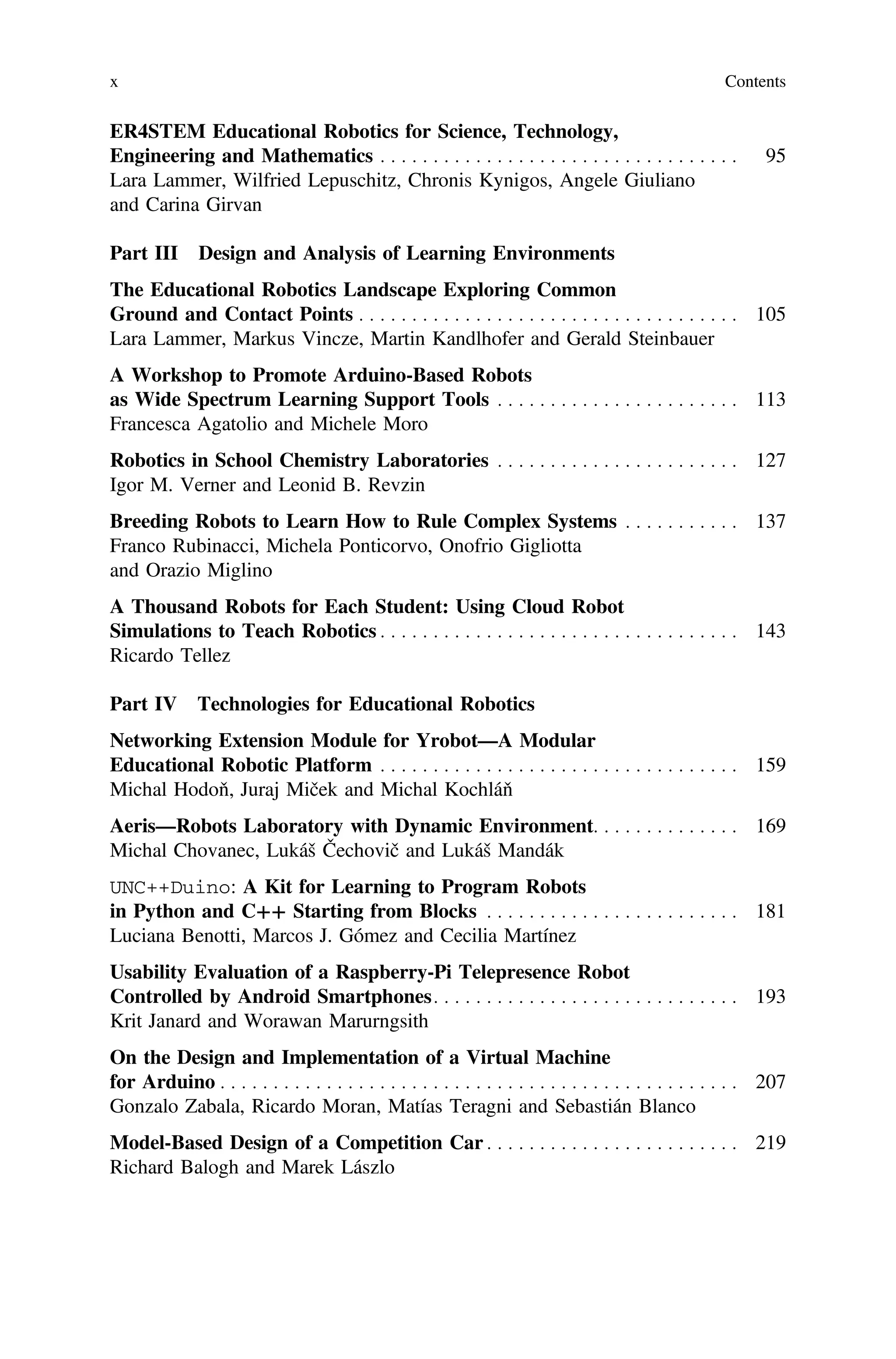
Contents
Part I Didactic and Methodologies for Teaching Robotics
Activity Plan Template: A Mediating Tool for Supporting Learning
Design with Robotics. . . . . . . . . . . . . . . . . . . . . . . . . . . . . . . . . . . . . . . . . . 3
Nikoleta Yiannoutsou, Sofia Nikitopoulou, Chronis Kynigos,
Ivaylo Gueorguiev and Julian Angel Fernandez
V-REP and LabVIEW in the Service of Education . . . . . . . . . . . . . . . . . 15
Marek Gawryszewski, Piotr Kmiecik and Grzegorz Granosik
Applied Social Robotics—Building Interactive Robots
with LEGO Mindstorms. . . . . . . . . . . . . . . . . . . . . . . . . . . . . . . . . . . . . . . 29
Andreas Kipp and Sebastian Schneider
Offering Multiple Entry-Points into STEM for Young People. . . . . . . . . 41
Wilfried Lepuschitz, Gottfried Koppensteiner and Munir Merdan
Part II Educational Robotics Curricula
How to Teach with LEGO WeDo at Primary School. . . . . . . . . . . . . . . . 55
Karolína Mayerové and Michaela Veselovská
Using Modern Software and the ICE Approach When Teaching
University Students Modelling in Robotics . . . . . . . . . . . . . . . . . . . . . . . . 63
Sven Rönnbäck
Developing Extended Real and Virtual Robotics Enhancement
Classes with Years 10–13 . . . . . . . . . . . . . . . . . . . . . . . . . . . . . . . . . . . . . . 69
Peter Samuels and Sheila Poppa
Project Oriented Approach in Educational Robotics: From Robotic
Competition to Practical Appliance . . . . . . . . . . . . . . . . . . . . . . . . . . . . . . 83
Anton Yudin, Maxim Kolesnikov, Andrey Vlasov and Maria Salmina
ix
ER4STEM Educational Robotics for Science, Technology,
Engineering and Mathematics . . . . . . . . . . . . . . . . . . . . . . . . . . . . . . . . . . 95
Lara Lammer, Wilfried Lepuschitz, Chronis Kynigos, Angele Giuliano
and Carina Girvan
Part III Design and Analysis of Learning Environments
The Educational Robotics Landscape Exploring Common
Ground and Contact Points . . . . . . . . . . . . . . . . . . . . . . . . . . . . . . . . . . . . 105
Lara Lammer, Markus Vincze, Martin Kandlhofer and Gerald Steinbauer
A Workshop to Promote Arduino-Based Robots
as Wide Spectrum Learning Support Tools . . . . . . . . . . . . . . . . . . . . . . . 113
Francesca Agatolio and Michele Moro
Robotics in School Chemistry Laboratories . . . . . . . . . . . . . . . . . . . . . . . 127
Igor M. Verner and Leonid B. Revzin
Breeding Robots to Learn How to Rule Complex Systems . . . . . . . . . . . 137
Franco Rubinacci, Michela Ponticorvo, Onofrio Gigliotta
and Orazio Miglino
A Thousand Robots for Each Student: Using Cloud Robot
Simulations to Teach Robotics . . . . . . . . . . . . . . . . . . . . . . . . . . . . . . . . . . 143
Ricardo Tellez
Part IV Technologies for Educational Robotics
Networking Extension Module for Yrobot—A Modular
Educational Robotic Platform . . . . . . . . . . . . . . . . . . . . . . . . . . . . . . . . . . 159
Michal Hodoň, Juraj Miček and Michal Kochláň
Aeris—Robots Laboratory with Dynamic Environment. . . . . . . . . . . . . . 169
Michal Chovanec, Lukáš Čechovič and Lukáš Mandák
UNC++Duino: A Kit for Learning to Program Robots
in Python and C++ Starting from Blocks . . . . . . . . . . . . . . . . . . . . . . . . 181
Luciana Benotti, Marcos J. Gómez and Cecilia Martínez
Usability Evaluation of a Raspberry-Pi Telepresence Robot
Controlled by Android Smartphones. . . . . . . . . . . . . . . . . . . . . . . . . . . . . 193
Krit Janard and Worawan Marurngsith
On the Design and Implementation of a Virtual Machine
for Arduino . . . . . . . . . . . . . . . . . . . . . . . . . . . . . . . . . . . . . . . . . . . . . . . . . 207
Gonzalo Zabala, Ricardo Moran, Matías Teragni and Sebastián Blanco
Model-Based Design of a Competition Car . . . . . . . . . . . . . . . . . . . . . . . . 219
Richard Balogh and Marek Lászlo
x Contents
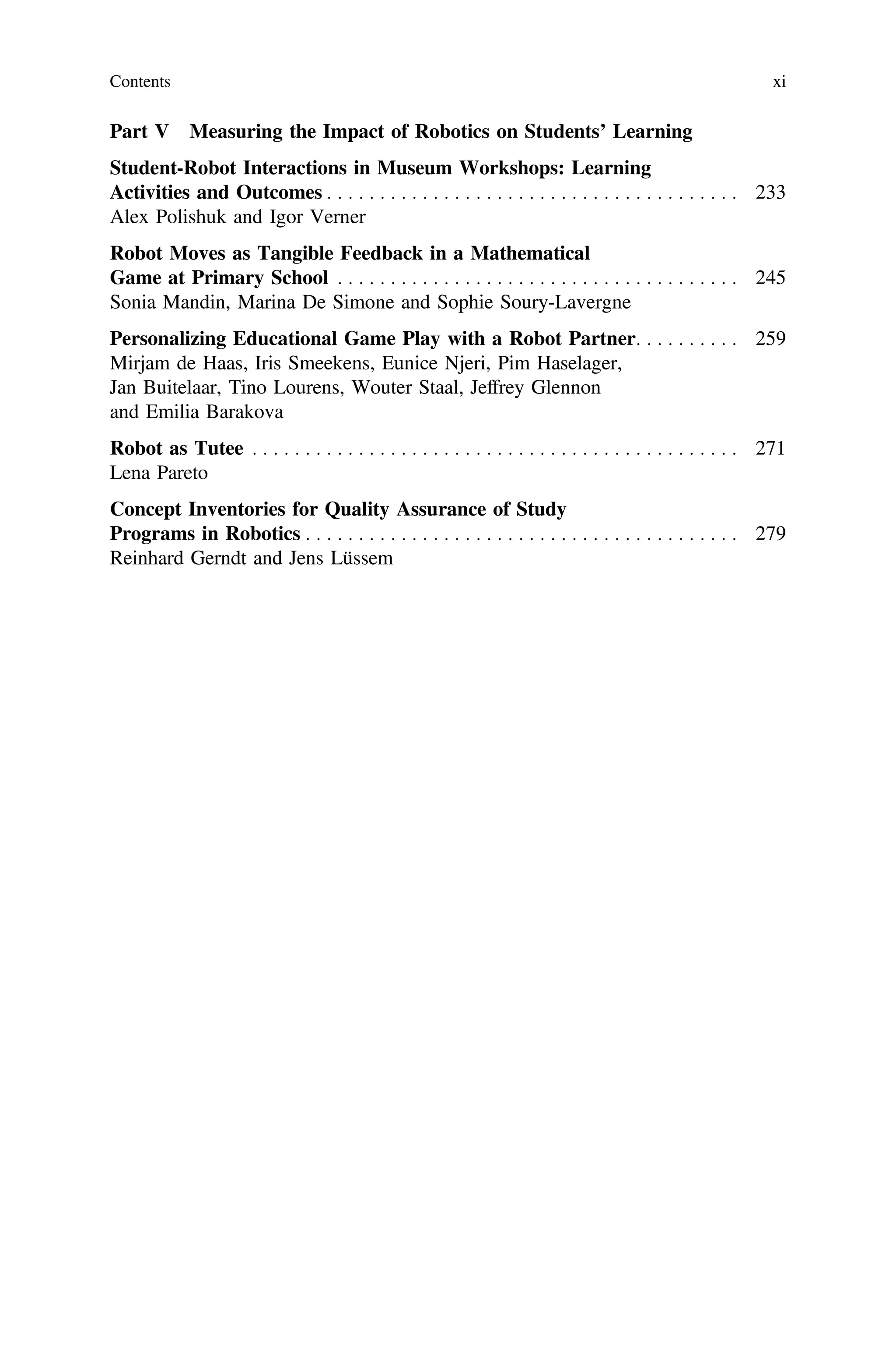
Part V Measuring the Impact of Robotics on Students’ Learning
Student-Robot Interactions in Museum Workshops: Learning
Activities and Outcomes . . . . . . . . . . . . . . . . . . . . . . . . . . . . . . . . . . . . . . . 233
Alex Polishuk and Igor Verner
Robot Moves as Tangible Feedback in a Mathematical
Game at Primary School . . . . . . . . . . . . . . . . . . . . . . . . . . . . . . . . . . . . . . 245
Sonia Mandin, Marina De Simone and Sophie Soury-Lavergne
Personalizing Educational Game Play with a Robot Partner. . . . . . . . . . 259
Mirjam de Haas, Iris Smeekens, Eunice Njeri, Pim Haselager,
Jan Buitelaar, Tino Lourens, Wouter Staal, Jeffrey Glennon
and Emilia Barakova
Robot as Tutee . . . . . . . . . . . . . . . . . . . . . . . . . . . . . . . . . . . . . . . . . . . . . . 271
Lena Pareto
Concept Inventories for Quality Assurance of Study
Programs in Robotics . . . . . . . . . . . . . . . . . . . . . . . . . . . . . . . . . . . . . . . . . 279
Reinhard Gerndt and Jens Lüssem
Contents xi
Part I
Didactic and Methodologies
for Teaching Robotics
Activity Plan Template: A Mediating Tool
for Supporting Learning Design
with Robotics
Nikoleta Yiannoutsou, Sofia Nikitopoulou, Chronis Kynigos,
Ivaylo Gueorguiev and Julian Angel Fernandez
Abstract Although the educational use of robotics is recognised since several
decades, only recently they started being broadly used in education, formal and non
formal. In this context many different technologies have emerged accompanied by
relevant learning material and resources. Our observation is that the vast number of
learning activities is driven by multiple “personal pedagogies” which results in the
fragmentation of the domain. To address this problem we propose the construct of
“activity plan template”, a generic design tool that will facilitate different stake-
holders (teachers, instructors, researchers) to design learning activities for different
robotic toolkits. In this paper we discuss the characteristics of the activity plan
template and the research process employed to generate it. Since we report work in
progress, we present here the first version of the activity plan template, the
construction of which is based on a set of best practices identified and on previous
work for the introduction of digital technologies in education.
Keywords Activity plan template ⋅ Learning design ⋅ Educational robotics
N. Yiannoutsou (✉) ⋅ S. Nikitopoulou ⋅ C. Kynigos
UoA ETL, National and Kapodistrian University of Athens, Athens, Greece
e-mail: nyiannoutsou@ppp.uoa.gr
S. Nikitopoulou
e-mail: sophieniki@ppp.uoa.gr
C. Kynigos
e-mail: kynigos@ppp.uoa.gr
I. Gueorguiev
ESI CEE, European Software Institute Center Eastern Europe, Sofia, Bulgaria
e-mail: ivo@esicenter.bg
J.A. Fernandez
ESI CEE ACIN Institute of Automation and Control,
Vienna University of Technology, Vienna, Austria
e-mail: julian.angel.fernandez@tuwien.ac.at
© Springer International Publishing Switzerland 2017
M. Merdan et al. (eds.), Robotics in Education, Advances in Intelligent
Systems and Computing 457, DOI 10.1007/978-3-319-42975-5_1
3
1 Introduction
The educational robotics landscape is vast and fragmented in and outside schools.
In the last two decades, robots have started their incursion into the formal educa-
tional system. Although diverse researchers have stressed the learning potential of
robotics, the slow pace of their introduction is partially justified by the cost of the
kits and the schools’ different priorities in accessing technology. Recently, the cost
of kits has decreased, whereas their capabilities and the availability of supporting
hardware and software has increased [1, 2]. With these benefits, educational
robotics kits have become more appealing to schools. In this context, various
stakeholders—technology providers, teachers, academics, companies focusing on
delivering educational material etc.—invest in the creation of different learning
activities around robotic kits, in order to showcase their characteristics and make
them attractive in and out of schools. Thus, a growing number of learning activities
have emerged. These activities share common elements but they are also very
diverse in that they address different aspects of Robotics as teaching and learning
technology with their success lying in how well they have identified these aspects
and how well they address them. This is partly due to the fact that Robotics is a
technology with special characteristics when compared to other learning tech-
nologies: they are inherently multidisciplinary, which in terms of designing a
learning activity might mean collaboration and immersion into different subject
matters; they are extensively used in settings of formal and non formal learning and
thus involving different stakeholders; their tangible dimension causes perturbations
—especially in formal educational settings—which are closely related to the
introduction of innovations in organizations and schools (i.e. from considering
classroom orchestrations to establishing or not, connections with the curriculum
etc.); they are at the heart of constructionist philosophy for teaching and learning
[3]; they are relevant to new learning practices flourishing now over the internet like
the maker movement, “Do It Yourself” and “Do It With Others” communities etc.
With this in mind, we argue that we need to take a step back from the level of
specific learning activities and create a more generic design instrument i.e. an
activity plan template, which: (a) it will be pedagogically grounded on the partic-
ular characteristics of robotics as a teaching and learning tool (b) it will be adaptable
to different learning settings (formal−non-formal) (c) it will afford generating dif-
ferent examples of learning activities for different types of kits (d) it will focus on
making explicit the implicit aspects of the learning environment and (e) it will urge
designers to think “out of the box” by reflecting its content. In the following
sections we describe the theoretical background supporting the concept of activity
plan template as a design instrument and the method for developing an activity plan
template for teaching and learning with Robotics.
4 N. Yiannoutsou et al.
2 Theoretical Background
Aiming to explain, in this section, the role of a generic design instrument such as
the activity plan template, in addressing the problem of fragmentation in the
practice of using educational robotics for learning, we will discuss the dimensions
and functions of design in education.
Everyone designs who devises courses of action aimed at changing existing
situations into desired ones [4, cited in 5]. With this definition we aim to highlight
that design is an integral part of the teaching profession. Acknowledging this
dimension in teaching, and with the advent of digital technologies in schools,
design based research has been implemented as an approach to orchestrate and
study the introduction of innovation in education [6]. Furthermore, in the field of
education, design has been introduced as the bridge between theory and practice [5]
because design is expected to play a dual role: (a) to guide practice informed by
theory and (b) to inform back the theory after the evaluation of the design in
practice. Thus, in this context, design is not only an organized sequence of stages,
all of which compose an orchestration of the learning process [7] but it is also a
reflection and an evaluation tool.
Gueudet and Trouche [8] focusing mainly on resources and documents designed
by teachers (e.g. activity or lesson plans), reveal another dimension of design as
they describe it as a tool that not only expresses but also shapes the teacher’s
personal pedagogies, theories, beliefs, knowledge, reflections and practice. The
term they use to describe this process is Documentational Genesis. A core element
of this approach is instrumental theory [9] according to which the characteristics of
the resources teachers select to use, shape their practice on the one hand (instru-
mentation) and on the other hand, the teachers’ knowledge shapes the use of the
resources as teachers appropriate them to fit their personal pedagogies (instru-
mentalization). As a result of the above, teacher designs, according to Pepin et al.
[10], are evolving or living documents—in the sense that they are continuously
renewed, changed and adapted.
Design as expressive medium for teachers and educators, can also function as an
instrument for sharing, communicating, negotiating and expanding ideas within
interdisciplinary environments. This property of teacher designs is linked to the
concept of boundary objects and boundary crossing [11]. The focus here is on the
artefact (in our case activity plan) that mediates a co-design process by helping
members of different disciplines to gain understanding of each other’s perspectives
and knowledge. Educational Robotics for STE(A)M is such an interdisciplinary
environment which involves an understanding of related but different domains (i.e.
Science, Technology, Engineering, Arts, Mathematics) and involves players from
industry, academia and organizers of educational activities.
A problem with all these designs, especially when they involve integration of
technologies, is that they are driven by a multitude of “personal pedagogies” the
restrictions of which result in adapting technologies to existing practices [12].
Conole (ibid) argues that the gap between the potential of digital technologies to
Activity Plan Template: A Mediating Tool for Supporting … 5
support learning and their implementation in practice can be bridged with a “me-
diating artefact” to support teacher designs. She continues claiming that such a
mediating artefact should be structured according to specific pedagogic approaches
and should focus on abstracting essential and transferable properties of learning
activities that are not context bound. The activity plan template can play the role of
the mediating artefact equipping professionals with a structured means to describe,
share and shape their practices. This way we can contribute in addressing the
problem of fragmentation in the learning activities regarding the use of Educational
robotics.
3 Developing an Activity Plan Template for Educational
Robotics
The work reported in this paper takes place in the context of the European project
ER4STEM. The main objective of this project is to refine, unify and enhance
current European approaches to STEM education through robotics in one open
operational and conceptual framework. The development of activity plan templates
contributes towards this direction as it provides a generic design instrument that
identifies critical elements of teaching and learning with robotics based in theory
and practice and in that contributes to the description of effective learning and
teaching with robotics. The process through which we develop the activity plan
templates in this project includes the following steps: We create a first draft based
on (a) on identifying and analyzing a set of good practices and (b) previous work on
activity plans that involve innovative use of technologies for teaching and learning.
The next step is to use this first draft to design and implement workshops with
Robotics in different educational settings and systems. During this implementation
we will collect data that will allow us to evaluate, refine and re-design the activity
plan template so as to be a useful and pedagogically grounded instrument for
designing learning activities. In this paper we are at the first stages of our research
and thus we will report on: (a) a set of criteria that we developed in order to identify
good practices and (b) the first draft of the activity plan template.
3.1 Identifying Best Practices
The criteria for selecting best practices in the domain of educational robotics were
formed through a bottom-up empirical process. Specifically, three researchers from
different research teams of the consortium worked independently to select a set of
best practices from robotics conferences, competitions, seminars and workshops
organized by different institutions. This was the first phase of the selection process,
which was not done in a structured way. The second phase included analysis and
6 N. Yiannoutsou et al.
reflection on phase one. Specifically, the criteria were shaped by (a) an analysis of
the content of five examples of best practices already selected and (b) elaboration of
the criteria that researchers had implicitly applied during the selection of the
specific best practices. Next the items that—from the analytic and the reflective
process—were identified to be part of what could be considered best practice in the
field of educational robotics were synthesized in one document.
The best practice selection criteria are designed to feed into the activity plans
(and not map directly into them) by providing interesting and new ideas for
(a) concepts, objectives, artefacts (b) orchestration (c) teaching interventions and
learning process (d) implementation process and (e) evaluation process.
Criteria.
The criteria developed for identifying best practices are divided in two categories.
One category is mainly a set of prerequisites, which should be covered in order for
an event or activity to be considered. The other category consists of the main
criteria that identify best practice aspects of the activities.
Prerequisites:
• The topic includes concepts related to the following subjects:
Science-Technology-Business-Engineering-Art-Mathematics or something from
another discipline but related to robotics.
• The activity−event shows that it has constructionist elements: i.e. it is not just a
presentation of tools or predefined guidelines.
• The activity−event is innovative, related to student or citizen interests.
• The activity−event includes technology related to educational robotics.
Main Criteria.
In case that the “educational robotic event” is assessed as relevant according to the
aforementioned basic pre-requisites, then the process continues with the assessment
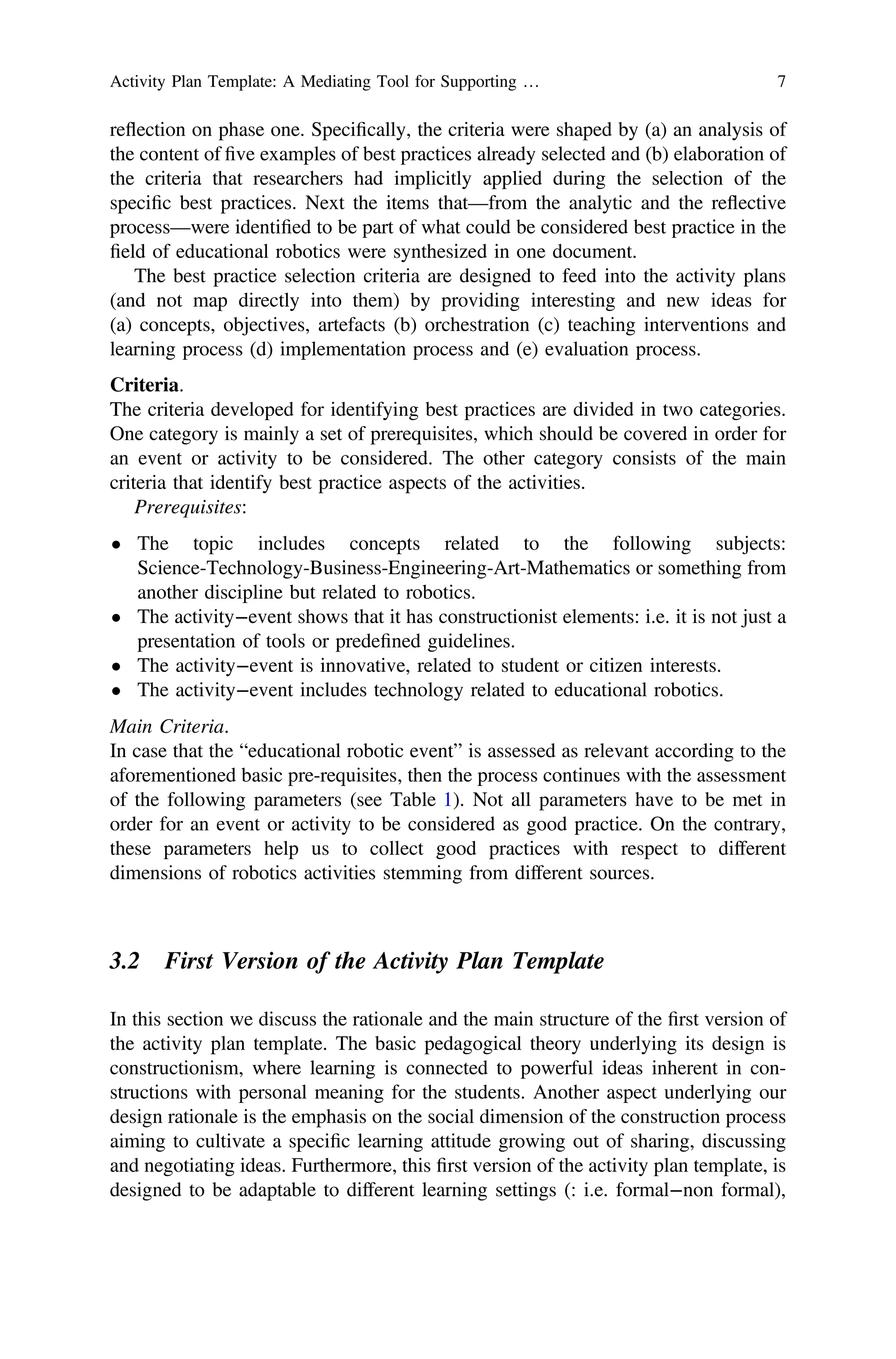
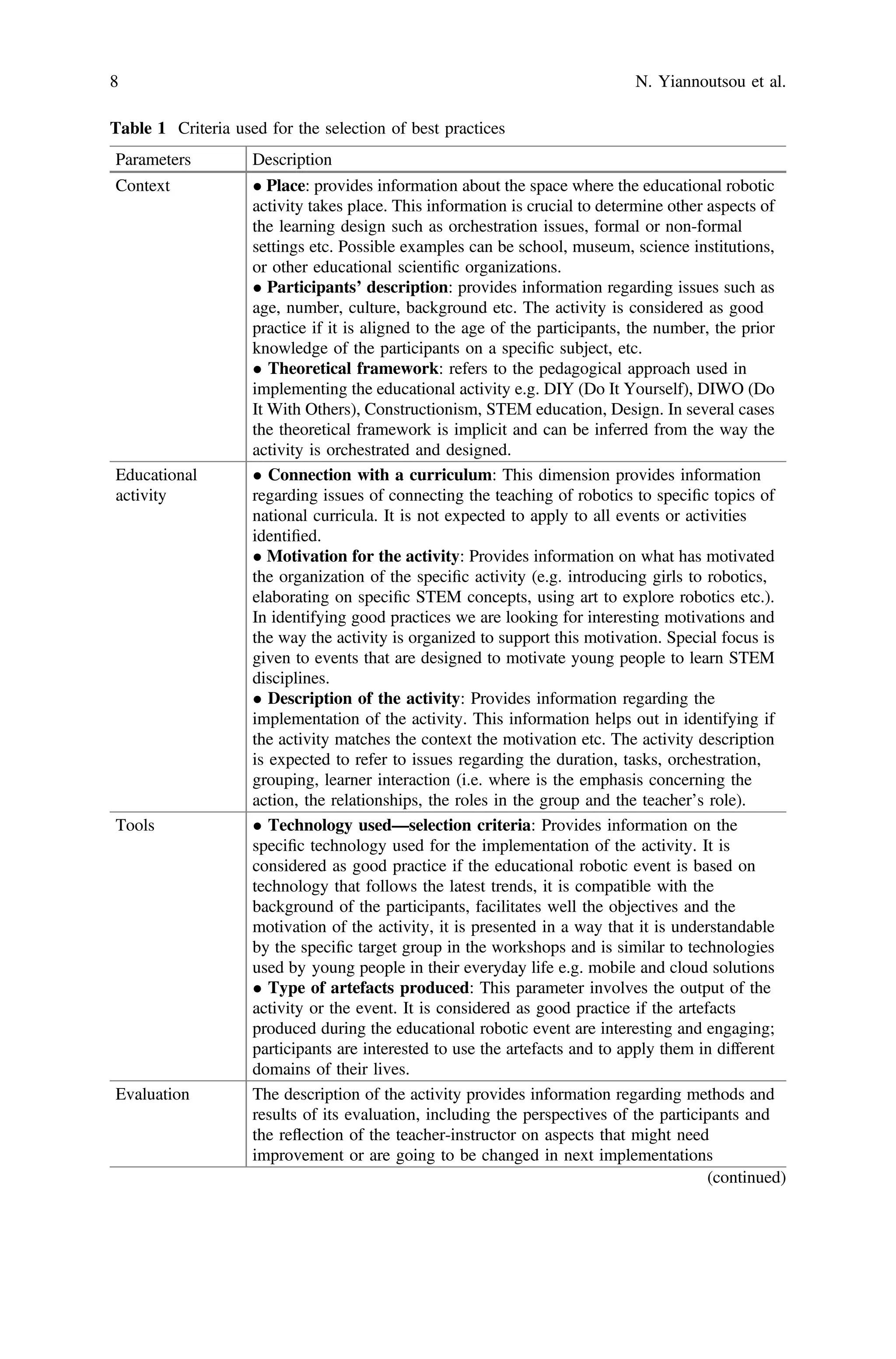
of the following parameters (see Table 1). Not all parameters have to be met in
order for an event or activity to be considered as good practice. On the contrary,
these parameters help us to collect good practices with respect to different
dimensions of robotics activities stemming from different sources.
3.2 First Version of the Activity Plan Template
In this section we discuss the rationale and the main structure of the first version of
the activity plan template. The basic pedagogical theory underlying its design is
constructionism, where learning is connected to powerful ideas inherent in con-
structions with personal meaning for the students. Another aspect underlying our
design rationale is the emphasis on the social dimension of the construction process
aiming to cultivate a specific learning attitude growing out of sharing, discussing
and negotiating ideas. Furthermore, this first version of the activity plan template, is
designed to be adaptable to different learning settings (: i.e. formal−non formal),
Activity Plan Template: A Mediating Tool for Supporting … 7
Table 1 Criteria used for the selection of best practices
Parameters Description
Context • Place: provides information about the space where the educational robotic
activity takes place. This information is crucial to determine other aspects of
the learning design such as orchestration issues, formal or non-formal
settings etc. Possible examples can be school, museum, science institutions,
or other educational scientific organizations.
• Participants’ description: provides information regarding issues such as
age, number, culture, background etc. The activity is considered as good
practice if it is aligned to the age of the participants, the number, the prior
knowledge of the participants on a specific subject, etc.
• Theoretical framework: refers to the pedagogical approach used in
implementing the educational activity e.g. DIY (Do It Yourself), DIWO (Do
It With Others), Constructionism, STEM education, Design. In several cases
the theoretical framework is implicit and can be inferred from the way the
activity is orchestrated and designed.
Educational
activity
• Connection with a curriculum: This dimension provides information
regarding issues of connecting the teaching of robotics to specific topics of
national curricula. It is not expected to apply to all events or activities
identified.
• Motivation for the activity: Provides information on what has motivated
the organization of the specific activity (e.g. introducing girls to robotics,
elaborating on specific STEM concepts, using art to explore robotics etc.).
In identifying good practices we are looking for interesting motivations and
the way the activity is organized to support this motivation. Special focus is
given to events that are designed to motivate young people to learn STEM
disciplines.
• Description of the activity: Provides information regarding the
implementation of the activity. This information helps out in identifying if
the activity matches the context the motivation etc. The activity description
is expected to refer to issues regarding the duration, tasks, orchestration,
grouping, learner interaction (i.e. where is the emphasis concerning the
action, the relationships, the roles in the group and the teacher’s role).
Tools • Technology used—selection criteria: Provides information on the
specific technology used for the implementation of the activity. It is
considered as good practice if the educational robotic event is based on
technology that follows the latest trends, it is compatible with the
background of the participants, facilitates well the objectives and the
motivation of the activity, it is presented in a way that it is understandable
by the specific target group in the workshops and is similar to technologies
used by young people in their everyday life e.g. mobile and cloud solutions
• Type of artefacts produced: This parameter involves the output of the
activity or the event. It is considered as good practice if the artefacts
produced during the educational robotic event are interesting and engaging;
participants are interested to use the artefacts and to apply them in different
domains of their lives.
Evaluation The description of the activity provides information regarding methods and
results of its evaluation, including the perspectives of the participants and
the reflection of the teacher-instructor on aspects that might need
improvement or are going to be changed in next implementations
(continued)
8 N. Yiannoutsou et al.
thus, its structure is modular and the intention is to allow “selective exposure” of its
elements to different stakeholders (the term “selective exposure” is borrowed from
Blikstein [13] to describe the intentional hiding of some of the template elements,
according to the relevant settings or stakeholders).
This first version discussed here, is informed by an analysis of the best practices
identified and it is based on previous work on activity plan templates that aim at the
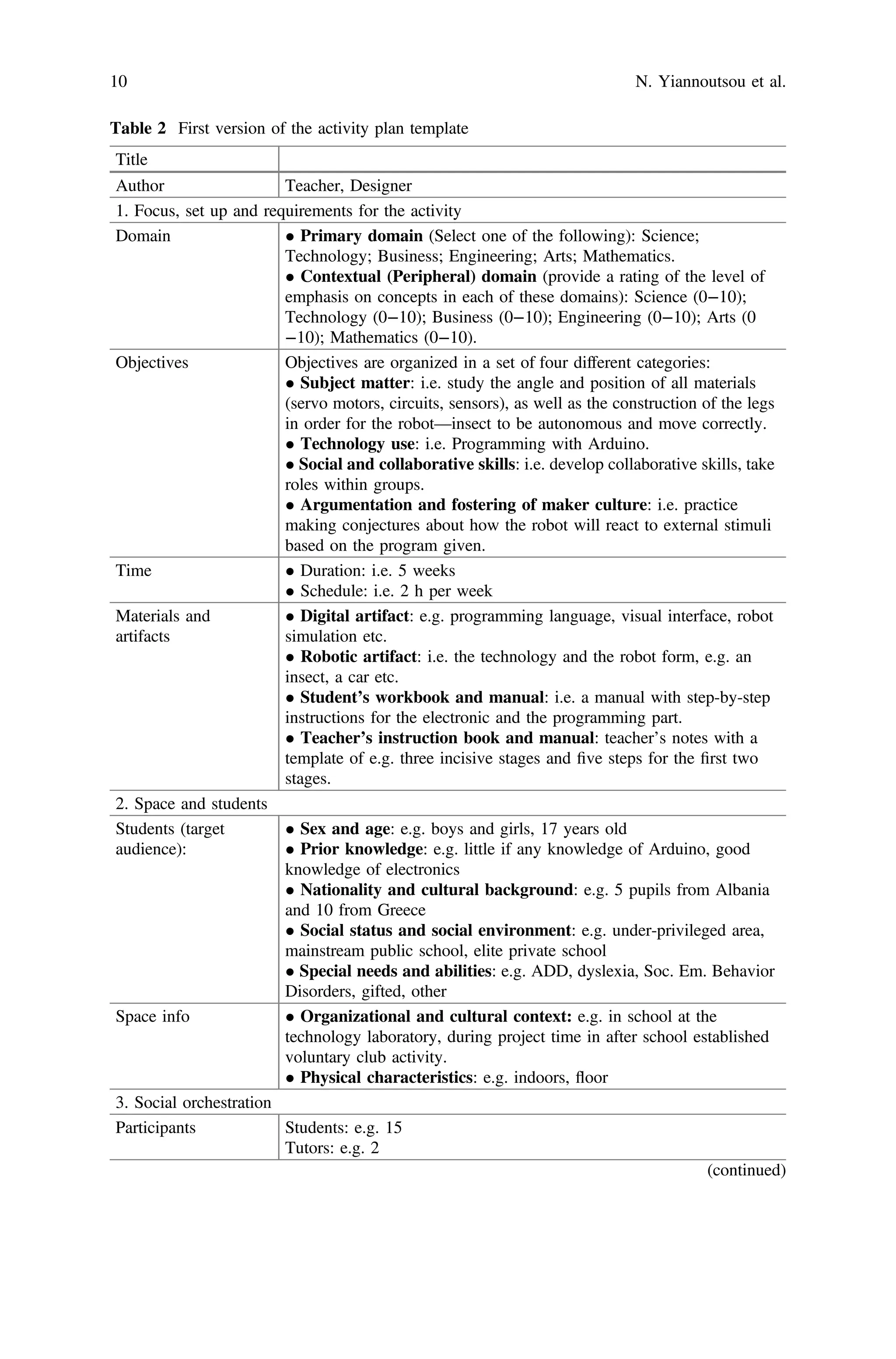
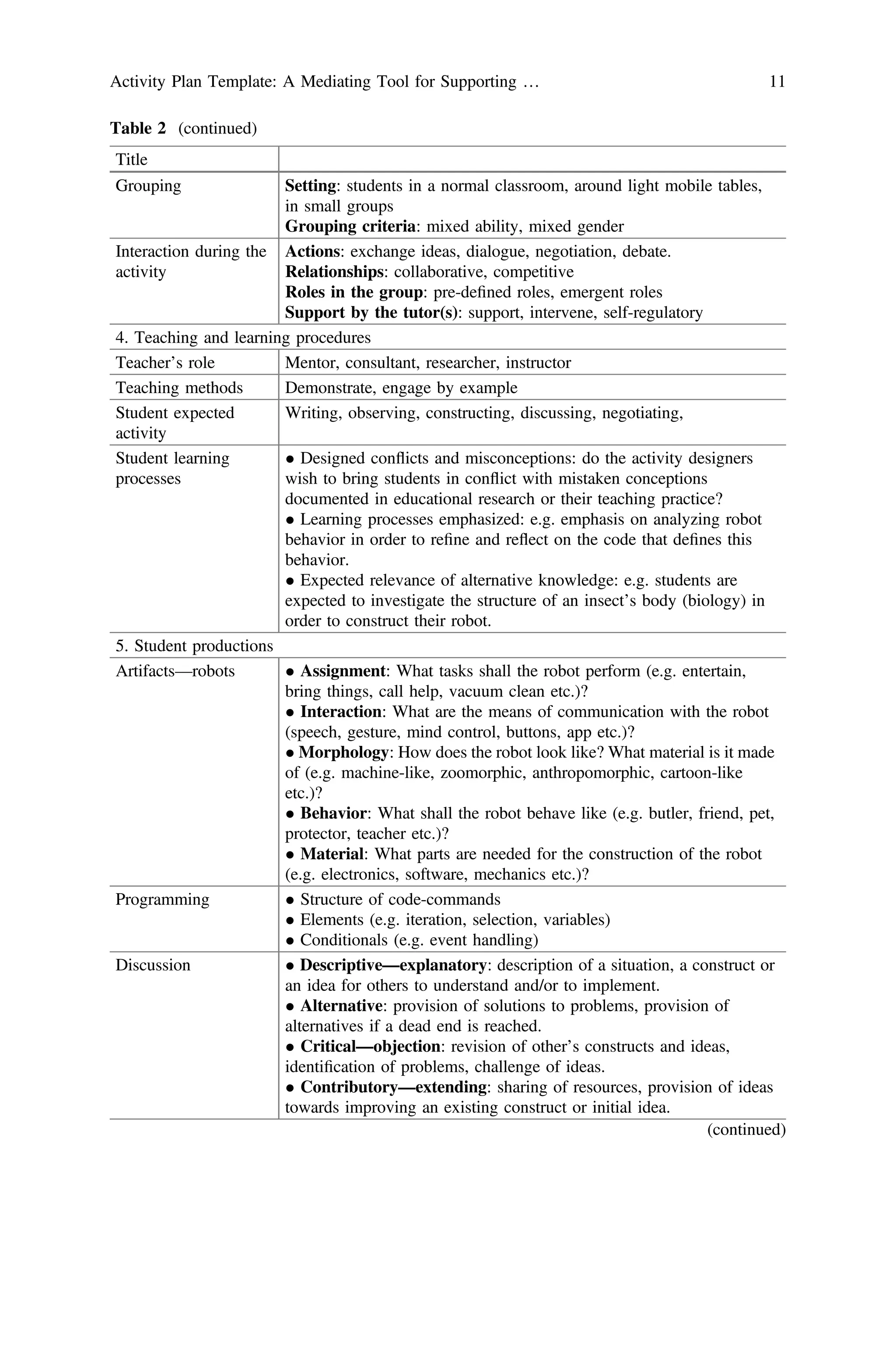
integration of digital technologies in learning [14]. The structure of the Activity
plan template is presented in detail in Table 2 and addresses the following aspects:
(a) the description of the scenario with reference to the different domains involved,
different types of objectives, duration and necessary material; (b) contextual
information regarding space and characteristics of the participants; (c) social
orchestration of the activity (i.e. group or individual work, formulation of groups
etc.); (d) a description of the teaching and learning procedures where the influence
of the pedagogical theory is mostly demonstrated; (e) expected student construc-
tions; (f) description of the sequencing and the focus of activities; (g) means of
evaluation.
Future work will focus on refinement of the activity plan template through its
use by ER4STEM partners to create their activity plans and through data collected
during the implementation of these activity plans in realistic situations (workshops).
Table 1 (continued)
Parameters Description
Sustainability • Cost of the activity: This dimension involves information regarding
mainly costs of the material and organizational costs. It is considered a good
practice if the activity requires materials or tools that are reasonably priced
compared to other related activities.
• Activity Financing: The activity−event is considered a good practice
with respect to this dimension if it has a sustainable model for financing in
mid-term period, e.g. self-financing through fees, wide voluntary base,
partnership with public organizations such as municipalities, schools or long
term sponsorship partners.
• Activity Repetition: An activity−event is considered a good practice if it
is performed sustainably for at least three subsequent periods in close
cooperation with schools or other educational organizations.
Accessibility The information regarding this parameter involves mainly the sharing of
activity related material (i.e. manuals, guidelines etc.), in a way (i.e. open
access, structuring of information) that allows the activity−event to be
replicated by other relevant stakeholders.
Activity Plan Template: A Mediating Tool for Supporting … 9
Table 2 First version of the activity plan template
Title
Author Teacher, Designer
1. Focus, set up and requirements for the activity
Domain • Primary domain (Select one of the following): Science;
Technology; Business; Engineering; Arts; Mathematics.
• Contextual (Peripheral) domain (provide a rating of the level of
emphasis on concepts in each of these domains): Science (0−10);
Technology (0−10); Business (0−10); Engineering (0−10); Arts (0
−10); Mathematics (0−10).
Objectives Objectives are organized in a set of four different categories:
• Subject matter: i.e. study the angle and position of all materials
(servo motors, circuits, sensors), as well as the construction of the legs
in order for the robot—insect to be autonomous and move correctly.
• Technology use: i.e. Programming with Arduino.
• Social and collaborative skills: i.e. develop collaborative skills, take
roles within groups.
• Argumentation and fostering of maker culture: i.e. practice
making conjectures about how the robot will react to external stimuli
based on the program given.
Time • Duration: i.e. 5 weeks
• Schedule: i.e. 2 h per week
Materials and
artifacts
• Digital artifact: e.g. programming language, visual interface, robot
simulation etc.
• Robotic artifact: i.e. the technology and the robot form, e.g. an
insect, a car etc.
• Student’s workbook and manual: i.e. a manual with step-by-step
instructions for the electronic and the programming part.
• Teacher’s instruction book and manual: teacher’s notes with a
template of e.g. three incisive stages and five steps for the first two
stages.
2. Space and students
Students (target
audience):
• Sex and age: e.g. boys and girls, 17 years old
• Prior knowledge: e.g. little if any knowledge of Arduino, good
knowledge of electronics
• Nationality and cultural background: e.g. 5 pupils from Albania
and 10 from Greece
• Social status and social environment: e.g. under-privileged area,
mainstream public school, elite private school
• Special needs and abilities: e.g. ADD, dyslexia, Soc. Em. Behavior
Disorders, gifted, other
Space info • Organizational and cultural context: e.g. in school at the
technology laboratory, during project time in after school established
voluntary club activity.
• Physical characteristics: e.g. indoors, floor
3. Social orchestration
Participants Students: e.g. 15
Tutors: e.g. 2
(continued)
10 N. Yiannoutsou et al.
Table 2 (continued)
Title
Grouping Setting: students in a normal classroom, around light mobile tables,
in small groups
Grouping criteria: mixed ability, mixed gender
Interaction during the
activity
Actions: exchange ideas, dialogue, negotiation, debate.
Relationships: collaborative, competitive
Roles in the group: pre-defined roles, emergent roles
Support by the tutor(s): support, intervene, self-regulatory
4. Teaching and learning procedures
Teacher’s role Mentor, consultant, researcher, instructor
Teaching methods Demonstrate, engage by example
Student expected
activity
Writing, observing, constructing, discussing, negotiating,
Student learning
processes
• Designed conflicts and misconceptions: do the activity designers
wish to bring students in conflict with mistaken conceptions
documented in educational research or their teaching practice?
• Learning processes emphasized: e.g. emphasis on analyzing robot
behavior in order to refine and reflect on the code that defines this
behavior.
• Expected relevance of alternative knowledge: e.g. students are
expected to investigate the structure of an insect’s body (biology) in
order to construct their robot.
5. Student productions
Artifacts—robots • Assignment: What tasks shall the robot perform (e.g. entertain,
bring things, call help, vacuum clean etc.)?
• Interaction: What are the means of communication with the robot
(speech, gesture, mind control, buttons, app etc.)?
• Morphology: How does the robot look like? What material is it made
of (e.g. machine-like, zoomorphic, anthropomorphic, cartoon-like
etc.)?
• Behavior: What shall the robot behave like (e.g. butler, friend, pet,
protector, teacher etc.)?
• Material: What parts are needed for the construction of the robot
(e.g. electronics, software, mechanics etc.)?
Programming • Structure of code-commands
• Elements (e.g. iteration, selection, variables)
• Conditionals (e.g. event handling)
Discussion • Descriptive—explanatory: description of a situation, a construct or
an idea for others to understand and/or to implement.
• Alternative: provision of solutions to problems, provision of
alternatives if a dead end is reached.
• Critical—objection: revision of other’s constructs and ideas,
identification of problems, challenge of ideas.
• Contributory—extending: sharing of resources, provision of ideas
towards improving an existing construct or initial idea.
(continued)
Activity Plan Template: A Mediating Tool for Supporting … 11
4 Conclusion
In this paper we discussed the role of activity plan templates as mediating artifacts
in harnessing the potential of educational Robotics for learning and in addressing
the issue of fragmentation in the domain. The concept of a mediating artifact was
adopted here to describe a generic learning design instrument that is based on: (a) a
specific pedagogical theory and (b) the particularities of robotics as technologies.
The activity plan template is an abstraction of what we have identified as essential
and transferrable elements of learning with robotics. The work reported here is in
progress, thus the activity plan template presented, is going to be evaluated in
practice by teachers who will use it to create their own activity plans and by
researchers and students during the implementation of these plans in practice.
Feedback generated from this process will be used to inform the activity plan
template so as to achieve (a) a level of abstraction that it will make it adaptable to
different settings and (b) a level of detail that will demonstrate the influence of a
specific pedagogical approach and will address the particularities of Robotics.
Acknowledgments The project has received funding from the European Union’s Horizon 2020
research and innovation program under grant agreement No. 665972. Project Educational Robotics
for STEM: ER4STEM
Table 2 (continued)
Title
6. Sequence and description of activities
Phasing • Phase 1: Construction phase—hands on the robot (duration one hour)
• Phase 2: Assembly discussion: All groups present the robots they
have constructed and discuss challenges and problems (Duration
20 min)
• Phase 3: Programming: constructing the robot’s behavior. Groups
can exchange ideas and ask for help from each other (duration 1 h).
• Phase 4: Presentation of the final construct: A short video
demonstrating the robot and its behavior or a blog presentation
including a photograph, a short description and the code.
7. Assessment procedures
Formative • Pupil voice activities (Interviews with students, Questionnaire)
• Observation notes
• Peer assessment
Summative • Essays
• Tests
• Student productions (code-robots-textual discussions)
• Mark sheet
12 N. Yiannoutsou et al.
References
1. Alimisis, D.: Robotic technologies as vehicles of new ways of thinking, about constructivist
teaching and learning: the TERECoP project. IEEE Robot. Autom. Mag. 16, 21–23 (2009)
2. Miller, M.: Mobile building blocks 2014. Mobile Cores. PC Mag. (2014)
3. Papert, S.: Mindstorms: Children, Computers, and Powerful Ideas. Basic Books, Inc. (1980)
4. Simon, H.A.: The sciences of the artificial. MIT Press, Cambridge, MA (1969)
5. Mor, Y., Winters, N.: Design approaches in technology-enhanced learning. Interact. Learn.
Environ. 15, 61–75 (2007)
6. The Design-Based Research Collective: Design-based research: an emerging paradigm for
educational inquiry. Educ. Res. 5–8 (2003)
7. Trouche, L.: Managing the complexity of human/machine interactions in computerized
learning environments: guiding students’ command process through instrumental
orchestrations. Int. J. Comput. Math. Learn. 9, 281–307 (2004)
8. Gueudet, G., Trouche, L.: Towards new documentation systems for mathematics teachers?
Educ. Stud. Math. 71, 199–218 (2009)
9. Verillon, P., Rabardel, P.: Cognition and artifacts: a contribution to the study of though in
relation to instrumented activity. Eur. J. Psychol. Educ. 10, 77–101 (1995)
10. Pepin, B., Gueudet, G., Trouche, L.: Re-sourcing teachers’ work and interactions: a collective
perspective on resources, their use and transformation. ZDM Math. Educ. 45, 929–943 (2013)
11. Kynigos, C., Kalogeria, E.: Boundary crossing through in-service online mathematics teacher
education: the case of scenarios and half-baked microworlds. ZDM 1–13 (2012)
12. Conole, G.: The role of mediating artefacts in learning design. In: Handbook of Research on
Learning Design and Learning Objects: Issues Applications and Technologies, pp. 108–208
(2008)
13. Blikstein, P.: Computationally enhanced toolkits for children: historical review and a
framework for future design. Found. Trends®
. Hum.Comput. Interact. 9, 1–68 (2015)
14. Yiannoutsou, N., Kynigos, C.: Boundary objects in educational design research: designing an
intervention for learning how to learn in collectives with technologies that support
collaboration and exploratory learning. In: Plomp, T., Nieveen, N. (eds.) Educational
Design Research: Introduction and Illustrative Cases, pp. 357–379. SLO, Netherlands Institute
for Curriculum Development, Enschede, The Netherlands (2013)
Activity Plan Template: A Mediating Tool for Supporting … 13
V-REP and LabVIEW in the Service
of Education
Marek Gawryszewski, Piotr Kmiecik and Grzegorz Granosik
Abstract The following paper exposes an effective approach of teaching robotics
by applying very efficient and popular set of tools. It demonstrates a combination
of applications such as V-REP and LabVIEW in order to be later utilized for rapid
prototyping, algorithm design and revival of both simple as well as fairly advanced
robotic environments. The described teaching methodology has been successfully
applied to high-school students during their facultative robotics courses which have
been taking place at the Lodz University of Technology. Detailed summary of the
results of this exertion is also provided.
Keywords Educational robotics ⋅ V-REP ⋅ LabVIEW ⋅ Simulation environment ⋅
Rapid prototyping
1 Introduction
According to various statistics [1, 2], robotics market has been exponentially grow-
ing for the last few years and nothing indicates that this could change in the nearest
future. Becoming more and more specialized, robots take over a significant number
of tasks performed by the human so far. Particular growth can be seen not only in the
industrial process automation area, but also, and especially, in consumer robotics.
Even though the prophecies of robots taking over most people’s jobs still seem to
be a fantasy, the transition is clearly visible.
M. Gawryszewski (✉) ⋅ P. Kmiecik ⋅ G. Granosik
Institute of Automatic Control, Lodz University of Technology,
B. Stefanowskiego 18/22, 90-924, Lodz, Poland
e-mail: marek.gawryszewski@dokt.p.lodz.pl
URL: http://robotyka.p.lodz.pl
P. Kmiecik
e-mail: piotr.kmiecik@aserio.pl
G. Granosik
e-mail: granosik@p.lodz.pl
© Springer International Publishing Switzerland 2017
M. Merdan et al. (eds.), Robotics in Education, Advances in Intelligent
Systems and Computing 457, DOI 10.1007/978-3-319-42975-5_2
15
16 M. Gawryszewski et al.
At the moment, this means that we have to get used to the presence of robotic
devices in our lives and learn to cooperate with them. Even though some of the job
opportunities have already expired, a huge amount of new ones is just opening. How-
ever, the transformation we are witnessing must enforce the change in the way we
perceive robots and in the direction in which potential workforce should be trained.
The conclusion is that robotics should be introduced to the vast majority of students
at possibly early level of education—to get them accustomed to the new technologies
and in the way that is not overwhelming—to let them develop interest in it.
In the following paragraphs we provide an evaluation of two powerful pieces of
software, which when combined together, have a rich potential to significantly facil-
itate the learning process and may also be very useful in further development. Sub-
sequently, we include a set of instructions of how this can be achieved and eventually
we deliver the results of our attempt.
2 Related Work
The demand for having flexible training tools in order to meet the needs of the emerg-
ing robotics market and the potential of virtual reality has been recognized quite a
long time ago. In [3], KUKA’s universal simulation environment, targeted especially
for educational purposes, has been presented in contrast to the other, device-specific
modelling software available at that time. Another virtual visualization environment,
which includes three robotic models and is suitable for teaching robotics at the uni-
versity level has been presented in [4]. A more contemporary approach, based on
Gazebo simulator has been demonstrated in [5]. The summary of the usage of sim-
ilar tools can be found in [6, 7], where the authors share their experiences gained
during the several years of educational activities. The reported results seem to be
satisfactory enough to still take on this subject.
3 Motivation and Background
As an interdisciplinary field of science, robotics requires from its adepts to acquire
an extremely wide range of knowledge in many differed areas in order to be able
to freely express their creativity. It is also worth mentioning, that robotic systems
are usually fairly complex, susceptible to damage or even dangerous when handled
improperly. They are rather expensive as well, which can often result in a limited
access to such devices. Those are only a few reasons why to look for many alternative
ways of targeting the challenges thrown by the world of modern robotics. A short
description of the tools of our choice is presented as follows.
V-REP and LabVIEW in the Service of Education 17
3.1 V-REP
V-REP (Virtual Robot Experimentation Platform) is a versatile, cross-platform, 3D
robotic simulation environment made by Coppelia Robotics [8, 9]. It can be used
for modelling simple robotic components such as sensors and actuators as well as
complex fully functional robotic systems.
The application provides forward and inverse kinematics calculations along with
the four real-time physics engines dedicated for dynamic calculations and simulation
of full objects interactions.
It supports various interchangeable CAD formats such as URDF, COLLADA,
DXF, 3DS, OBJ, STL for easier integration and can be bridged with various external
applications through several remote API’s (C/C++, Python, Java, Matlab, Octave,
Lua, Urbi) and the ROS interface. With its well designed, user friendly and customiz-
able interface it is a very good choice for presenting the basic principles of robotics
as well as designing and testing any robotic device.
3.2 LabVIEW
LabVIEW is a widely spread engineering platform from National Instruments [10].
It comes with a visual programming language named G, which basically means that
the program structure consists of a number of graphical blocks representing indi-
vidual instructions, all connected with wires to ensure a suitable work-flow. Such
an approach guarantees even inexperienced users, unfamiliar with the programming
principles to efficiently learn and operate through the environment. The applica-
tion supports a wide range of data acquisition and instrument control devices which
makes it a great tool for working with the real hardware.
4 Course Description
The main objective of the classes is to enable a group of high school students to
design, simulate and build a factual mobile robot: a Mars rover. By working on this
project, its participants familiarize themselves with a wide range of aspects of the
development process: from making the first design choices to the final testing of a
working machine.
As a part of the introduction, various instruments were presented to them as the
possible ways to solve the whole task: modelling tools, simulators, programming
environments, prototype boards and many others. In this article we focus on the two
aspects of the whole work: simulations and algorithms development.
One of the most important things in the whole process is the fact, that the course
is led by example and try. Students were provided with knowledge of how to begin.
18 M. Gawryszewski et al.
The rest is all about achieving their goals on their own with only a minimal assistance
and supervision coming from a teacher.
4.1 The Role of Selected Software
Harnessing V-REP and LabVIEW enables students to benefit from various, well-
established tools like inverse kinematics solver right out of the box. This means, that
they do not have to understand deeply all aspects of the given problem, e.g. inverse
kinematics. Considering less advanced high school attendees this might be crucial to
preserve motivation, as some problems might be worked around without decreasing
overall complexity of a project.
Up till now, V-REP has been used to demonstrate, how to model and simulate
a robot. The application does not only allow to conduct simulations of a designed
device, but also of the entire surrounding environment.
During the hands-on sessions, students have been creating models of mobile
robots to understand the possibilities and limitations of the whole process. Thanks to
built-in modules, they were able to easily simulate dynamics of their creations and
plan a path to follow, which included taking into account existing obstacles.
Two methods of implementing robot’s algorithms were demonstrated. The first
one was scripting in Lua language [11], which is an internal mechanism of V-REP.
Additionally, the originators of V-REP have established APIs that allow users
to create applications of any kind, which then are able to communicate with the
simulation and control its elements. Thanks to that, it is now possible to create control
algorithm in any modern programming language, but C++, Python, Java, Matlab and
LabVIEW are the preferred ones.
As for the second method, we have chosen V-REP’s LabVIEW interface, which
was originally designed by Peter Mačička [12]. Utilizing his work, we asked the
students to create their own programs to control simulated robots.
4.2 Modelling Basics
Modelling with V-REP involves dealing with three basic groups of elements [13]:
1. Scene objects—twelve types of construction blocks (e.g. shapes, joints, proxim-
ity, force/torque or vision sensors), that can be combined with each other to create
more complex designs
2. Calculation modules—five basic embedded algorithms: forward and inverse kine-
matics, path planning, collision detection, physics and dynamics, minimum dis-
tance calculation
V-REP and LabVIEW in the Service of Education 19
Fig. 1 V-REP’s default user interface running under Linux operating system (with a model of an
authentic Mars rover, built by the students at the Lodz University of Technology [14], imported to
the scene)
3. Control mechanisms—local and remote interfaces like: embedded scripts, plug-
ins, add-ons, remote APIs, ROS nodes and custom (client/server model based)
solutions, that can work simultaneously and cooperate with each other
The main program interface (Fig. 1) is clear and simple. By default, it consists of
standard toolbars offering the ability to access most of the features. A scene pane
which can display multiple views as well as custom user interfaces is available on
the right. On the left, there is a browser with thumbnails of all available models that
can be dragged into the scene and finally a tree view called Scene hierarchy, which
represents dependencies between all objects of the project.
When all elements are finally placed on the scene, they can be easily controlled
via the internal scripting language or provided remote APIs. To illustrate the func-
tionality more accurately, we can imagine creating a rotary joint on the scene and
then setting its velocity by referencing it via the Lua script.
Lua is described as very fast, powerful, yet simple and lightweight scripting lan-
guage ideal for rapid prototyping. In addition to procedural syntax, it provides meta-
mechanisms for implementing elements typical for object-oriented programming
languages, like classes and inheritance [15].
There are several types of embedded scripts that can be applied to the project. The
most important are those used when the simulation is running which divide into four
categories: Main, Child, Joint Control and Contact Callbacks. Then we can also use
the Customization, General callback and finally Dialog and Editor scripts. Below we
Random documents with unrelated
content Scribd suggests to you:
had not spared him. So he and Vaughn with their guns went after
Randolph, and Smith shot him “while Vaughn stood at a respectful
distance.” Randolph lost his leg from the shot. Smith and Vaughn
were put in jail, but through the connivance of the officials made
their escape. Vaughn went to Washington and was given an office in
Utah territory. See Ku Klux Rept., Ala. Test., p. 1979.
[1735] He was a competent man, well educated and possessing
administrative ability. In the secession convention he had led the
coöperationist forces.
[1736] Clark, pp. 99-101; Monitor, Jan. 10 and 25 and March 28,
1871. The Register of the University (p. 218) gives only thirteen
names for the session 1870-1871. No record was kept at the
University.
[1737] See Register of the University of Alabama, p. 217.
[1738] These notices were printed in the Ku Klux Rept., Ala. Test., p.
418. They were fastened to the door with a dagger. The students
who were notified left at once.
[1739] See Ku Klux Rept., Ala. Test., p. 426 (Speed).
[1740] The following table gives the enrolment of students during
Reconstruction:—
Session Students
1868-9
1869-70 30
1870-1 21
1871-2 107
1872-3 135
1873-4 53
1874-5 74
1875-6 111
1876-7 164
[1741] I have this account from the men who furnished the bribes.
[1742] Clark, p. 99.
[1743] Finley had been doorkeeper for the first Board (1868-1870),
and in 1870 was elected to serve four years. He was a member of
the convention of 1867 and of the legislature. He had no education
and no ability, but he was a sensible negro and was an improvement
on the white men of the preceding Board.
[1744] Journal of the Board of Education and Regents, June 20,
1871.
[1745] Act of Dec. 6, 1873, School Laws.
[1746] Clark, p. 232; Report of Cloud, Nov., 1869; Montgomery Mail,
Sept. 16, 1870. In connection with the act merging the Mobile
schools into the state system, the Board of Education took occasion
to enlarge or complete its constitutional powers. There was no limit,
according to the Constitution, to the time for the governor to retain
acts of the Board. Governor Smith had pocketed several obnoxious
educational bills, and the Board now resolved “that the same rules
and provisions which by law govern and define the time and manner
in which the governor of the state shall approve of or object to any
bill or resolution of the General Assembly shall also apply to any bill
or resolution having the force of law passed by this Board of
Education.” The governor approved neither resolution nor the Mobile
act, but they were both declared in force. Montgomery Mail, Nov. 3,
1870.
[1747] Senate Journal, 1869-1870, p. 419.
[1748] Montgomery Mail, Sept. 16, 1870.
[1749] A specimen pay-roll of Emerson Institute (“Blue College”) for
the quarter ending March 31, 1869:—
Months Salary Total
G. L. Putnam, Supt. of Colored
Schools
3 $333.33 $1000.00
H. S. Kelsey, Prin. Emerson
Institute
3 225.00 675.00
E. I. Ethridge, Prin. Grammar
School
3 200.00 600.00
Susie A. Carley, Prin. Lower School 3 180.00 540.00
A. A. Rockfellow, Prin.
Intermediate School
3 105.00 315.00
Sarah A. Primey, Prin. Intermediate
School
3 105.00 315.00
M. L. Harris, Prin. Intermediate
School
3 105.00 315.00
M. A. Cooley, Prin. Intermediate
School
3 105.00 315.00
M. E. F. Smith, Prin. Intermediate
School
3 105.00 315.00
Ruth A. Allen, Primary School 3 105.00 315.00
N. G. Lincoln, Primary School 3 105.00 315.00
M. L. Theyer, Primary School 3 105.00 315.00
Judge Rapier, legal opinion — — 50.00
American Missionary Association,
fuel
— — 40.00
Total $5425.00
At this time the average salary of the teacher in the state schools
was $42 a month.
[1750] Montgomery Mail, Sept. 16, 1876. Cloud’s Report, Nov., 1869,
shows that $10,447.23 had been drawn out of the treasury by
Putnam, and he had also drawn $2000 for his salary as county
superintendent.
[1751] Report of the Auditor, 1871; Report of the Commissioner of
Education, 1871, 1876.
[1752] See Act of Dec. 2, 1869; Somers, “Southern States,” pp. 169,
170.
[1753] The law stated that the trustees were to receive $2 a day,
but Cloud said that it was a mistake, as it should be the clerks who
were paid, and thus it was done. There were 1485 clerks in the
state; they were paid about $60,000 a year. The county
superintendents received about $65,000, an average of $1000 each,
which was paid from the school fund. Before the war the average
salary of the county superintendent was $300 and was paid by the
county. In few counties was the work of the county superintendent
sufficient to keep him busy more than two days in the week. Many
of the superintendents stayed in their offices only one day in the
week. The expenses of the Board of Education were from $3000 to
$5000 a year, not including the salary of the state superintendent.
Montgomery Mail, Sept. 15 and 16, 1870.
[1754] Hodgson’s Report, 1871; Ala. Test., p. 233.
[1755] Cloud, the state superintendent, had power of attorney to act
for certain county superintendents. This he sub-delegated to his son,
W. B. Cloud, who drew warrants for $8551.31, which were allowed
by the auditor. This amount was the school fund for the following
counties: Sumter, $1,535.59; Pickens, $6,423.17; Winston, $215.89;
Calhoun, $176.66; Marshall, $200.00.
A clerk in the office of C. A. Miller, the secretary of state, forged
Miller’s name as attorney and drew $3,238.39 from the Etowah
County fund. Miller swore that he had notified both auditor and
treasurer that he would not act as attorney to draw money for any
one.
John B. Cloud bought whiskey with tax stamps. See Hodgson’s
Report, 1871; Ala. Test., p. 233; Montgomery Advertiser, Sept. 27,
1872.
[1756] Hodgson’s Report, 1871; Montgomery Advertiser, Sept. 27,
1872; Report of the Commission to Examine State Offices, 1871.
[1757] Somers, pp. 169, 170.
[1758] Montgomery Mail, Sept. 15, 1870.
[1759] Somers, “Southern States,” p. 170; voters only counted as
polls.
[1760] Montgomery Mail, Sept. 15, 1870.
[1761] In recent years the people have demanded and obtained a
different class of school histories, such as those of Derry, Lee, Jones,
Thompson, Cooper, Estill, and Lemmon. Adams and Trent is an
example of one of the compromise works that resulted from the
demand of the southerners for books less tinctured with northern
prejudices.
[1762] Cloud’s Report, Nov., 1869; Hodgson’s Report, 1871; Ku Klux
Rept., Ala. Test., p. 426; Montgomery Conference, “Race Problems,”
p. 107.
[1763] See Ala. Test., p. 236 (General Clanton).
[1764] Ku Klux Rept., p. 53; Ku Klux Rept., Ala. Test., pp. 234, 235.
[1765] Ala. Test., p. 1123.
[1766] Montgomery Advertiser, July 30, 1866; Selma Times, June
30, 1866.
[1767] Ala. Test., p. 236.
[1768] Selma Times, Dec. 30, 1865; Gulf States Hist. Mag., Sept.,
1902.
[1769] Trowbridge, “The South,” p. 431.
[1770] Marion Commonwealth; meeting held May 17, 1866.
[1771] Montgomery Advertiser, July 24, 1867; Ala. Test., p. 236.
[1772] Montgomery Advertiser, July 24, 1867; Ala. Test., pp. 236,
246.
[1773] See Ch. XI, Sec. 3.
[1774] For specimen letters written to their homes, see the various
reports of the Freedmen’s Aid Society of the Methodist Church, and
the reports of other aid societies.
[1775] The best-known instances of the killing of such negroes were
in Tuscaloosa and Chambers counties. The Ku Klux Report gives only
about half a dozen cases of outrages on teachers. See Ala. Test., pp.
52, 54, 67, 71, 140, 252, 755, 1047, 1140, 1853. Cloud in his report
made no mention of violence to teachers, nor did the governor. Lakin
said a great deal about it, but gave no instances that were not of the
well-known few. There was much less violence than is generally
supposed, even in the South.
[1776] Ala. Test., p. 252.
[1777] See Ala. Test., pp. 236, 1889; Somers, “Southern States,” p.
169; Report of the Joint Committee on Outrages, 1868. In
Crenshaw, Butler, and Chambers counties some schools existed for a
year or more until teachers of bad character were elected. Then the
neighborhood roughs burned the school buildings. Neither Cloud nor
any other official reported cases of such burnings. The legislative
committee could discover but two, and in both instances the women
teachers were of bad character. In the records can be found only
seventeen reports of burnings, and several of these were evidently
reports of the same instance; few were specific. Lakin, who spent
several years in travelling over north Alabama, and who was much
addicted to fabrication and exaggeration, made a vague report of
“the ruins of a dozen” schoolhouses. (Ala. Test., pp. 140, 141.) There
may have been more than half a dozen burnings in north Alabama,
but there is no evidence that such was the case. The majority of the
reports originated outside the state through pure malice. The houses
burned were principally in the white counties and were, as Lakin
reports, slight affairs costing from $25 to $75. It was so evident that
some of the fires were caused by the carelessness of travellers and
hunters who camped in them at night, that the legislature passed a
law forbidding that practice. See Acts of Ala., p. 187. About as many
schoolhouses for whites were destroyed as for blacks. Some were
fired by negroes for revenge, others were burned by accident.
[1778] Weekly Mail, Aug. 18, 1869.
[1779] Demopolis New Era, April 1, 1868.
[1780] Hodgson’s Report, Nov. 11, 1871.
[1781] Hodgson’s Report, Nov. 15, 1871.
[1782] Hodgson’s Report, Nov. 15, 1871.
[1783] For opinions in regard to the value of the early education
among the negroes, see Washington’s “Future of the American
Negro” and “Up from Slavery”; W. H. Thomas’s “American Negro”; P.
A. Bruce’s “Plantation Negro as a Freeman”; J. L. M. Curry, in
Montgomery Conference.
[1784] Montgomery Advertiser, July 24, 1867.
[1785] Ala. Test., p. 236.
[1786] Ku Klux Rept., Ala. Test. Dr. J. L. M. Curry, who, in 1865,
began his work for the education of the negro, has thus expressed
his opinion of the early attempts to educate the blacks: “The
education was unsettling, demoralizing, pandered to a wild frenzy for
schooling as the quick method of reversing social and political
conditions. Nothing could have been better devised for deluding the
poor negro, and making him the tool, the slave, of corrupt
taskmasters.... With deliberate purpose to subject the southern
states to negro domination and secure the states permanently for
partisan ends, the education adopted was contrary to common
sense, to human experience, to all noble purposes. The aptitude and
capabilities and needs of the negro were wholly disregarded.
Especial stress was laid on classics and liberal culture to bring the
race per saltum to the same plane with their former masters, and
realize the theory of social and political equality. Colleges and
universities, established and conducted by the Freedmen’s Bureau
and northern churches and societies, sprang up like mushrooms, and
the teachers, ignorant and fanatical, without self-poise, proceeded to
make all possible mischief.” Montgomery Conference, “Race
Problems,” p. 109. See also the papers of Rev. D. Clay Lilly and Dr. P.
B. Barringer in Montgomery Conference, “Race Problems,” p. 130;
William H. Baldwin and Dr. Curry in Second Capon Springs
Conference; Barringer, “The American Negro: His Past and Future”;
Barringer, W. T. Harris, and J. D. Dreher in Proceedings Southern
Education Association, 1900; Haygood, “Pleas for Progress” and “Our
Brother in Black”; Abbott, “Rights of Man,” pp. 225-226.
[1787] The United States Commissioner of Education, in his report
for that year, made before the elections, stated that in educational
matters the state of Alabama was about to take a “backward step,”
meaning that it was about to become Democratic. Report, 1870, p.
15. Later he made similar remarks, much to the disgust of Hodgson,
who was an enthusiast in educational matters.
[1788] Journal of the Board of Education and Regents, 1870. Dr. O.
D. Smith, who was one of the newly elected Democratic members of
the Board, says that Cloud refused to inform the Board of the
contents of Hodgson’s communications. Thereupon Hodgson
addressed one to the Board directly and not to Cloud. When it came
in through the mail, Cloud took possession of it, but Dr. Smith, who
was on the lookout, called his attention to the fact that it was
addressed to the Board and reminded him of the penalties for
tampering with the mail of another person. The secretary read
Hodgson’s communication, and the Board was then free to act. The
Democratic members convinced the Radicals that if Cloud continued
in office they would not be able to draw their per diem, so Cloud
was compelled to vacate at once. When he left he had his buggy
brought to the door, and into it he loaded all the government coal
that was in his office and carried it away.
[1789] Hodgson’s Report, 1872.
[1790] See Hodgson’s Report, 1871.
[1791] Hodgson’s Report, 1871; Report of the Commissioner of
Education, 1876, p. 7; Journal of the Board of Education and
Regents, 1871; Acts of the Board of Education, pamphlet.
[1792] And this was the case notwithstanding the fact that the
county superintendents were now allowed mileage at the rate of
eight cents a mile in order to get them to come to Montgomery for
their money and thus to decrease the chances of corrupt practices of
the attorneys. Hodgson complained that many old claims which
should have been settled by Cloud were presented during his
administration.
[1793] Speed was a southern Radical. During the war he was a state
salt agent at the salt works in Virginia. He was a member of the
Board of Education from 1870 to 1872, and was far above the
average Radical office-holder in both character and ability.
[1794] Report of the Commissioner of Education, 1873, 1874, 1876;
Speed’s Report, 1873. Speed was ill much of the time, and his
bookkeeping was little better than Cloud’s. Two clerks, who, a
committee of investigation stated, were distinguished by a “total
want of capacity and want of integrity,” managed the department
with “such a want of system ... as most necessarily kept it involved
in inextricable confusion.” Money was received and not entered on
the books. A sum of money in coin was received in June, 1873, and
six months later was paid into the treasury in depreciated paper.
Vouchers were stolen and used again. Bradshaw, a county
superintendent, died, leaving a shortage of $10,019.06 in his
accounts. A large number of vouchers were abstracted from the
office of Speed by some one and used again by Bradshaw’s
administrator, who was no other than Dr. N. B. Cloud, who made a
settlement with Speed’s clerks, and when the shortage was thus
made good, the administrator still had many vouchers to spare. This
seems to have been Cloud’s last raid on the treasury. Montgomery
Advertiser, Dec. 18, 1873; Report of the Joint Committee on
Irregularities in the Department of Education, 1873.
[1795] Under the Reconstruction administrative expenses amounted
to 16 per cent, and even more.
[1796] The experiences with the American Missionary Association,
etc., made this provision necessary.
[1797] The United States Commissioner of Education gave a
disapproving account of these changes. It was exchanging “a
certainty for an uncertainty,” he said. Speed had not found it a
“certainty” by any means.
[1798] Plus the poll tax, which was not appropriated as required by
the constitution, but diverted to other uses.
[1799] There was a shortage of $187,872.49, diverted to other uses.
[1800] Shortage unknown; teachers were paid in depreciated state
obligations.
[1801] Shortage was $330,036.93.
[1802] Only $68,313.93 was paid, the rest diverted; shortage now
was $1,260,511.92.
[1803] None was paid, all diverted; shortage nearly two millions.
[1804] All was paid (by Democrats, who were now in power).
[1805] McTyeire, “A History of Methodism,” p. 670; Smith, “Life and
Times of George F. Pierce”; Southern Review, April, 1872.
[1806] Buckley, “History of Methodism in the United States,” pp. 516,
517.
[1807] Matlack, “Anti-Slavery Struggle and Triumph in the Methodist
Episcopal Church,” p. 339; Smith, “Life and Times of George F.
Pierce,” p. 530.
[1808] Annual Cyclopædia (1865), p. 552; Caldwell, “Reconstruction
of Church and State in Georgia” (pamphlet).
[1809] Annual Cyclopædia (1865), p. 552.
[1810] “The schismatical plans of the Northern Methodists and the
subtle proselytism of the Episcopalians” (Pierce). See Smith, “Life
and Times of George F. Pierce,” pp. 491, 499, 505, 530; West,
“History of Methodism in Alabama,” p. 717; McTyeire, “A History of
Methodism,” p. 673.
[1811] A Federal official in north Alabama who had known of Lakin
in the North testified that he had had a bad reputation in New York
and in Illinois and had been sent South as a means of discipline. See
Ku Klux Rept., Ala. Test., p. 619 (L. W. Day, United States
Commissioner). Governor Lindsay said that Lakin was a shrewd,
cunning, strong-willed man, given to exaggeration and lying,—one
who had a “jaundiced eye,” “a magnifying eye,” and who among the
blacks was a power for evil. Ala. Test., p. 180.
[1812] N. Y. Herald, May 10, 1868; Buckley, “History of Methodism,”
Vol. II, p. 191.
[1813] In 1871, Lakin stated that of his 15,000 members, three-
fourths were whites of the poorer classes; that there were under his
charge 6 presiding elders’ districts with 70 circuits and stations, and
70 ministers and 150 local preachers; and that he had been assisted
in securing the “loyal” element by several ministers who had been
expelled by the Southern Methodists during the war as traitors. Ala.
Test., pp. 124, 130. Governor Lindsay stated that some of the whites
of Lakin’s church were to be found in the counties of Walker,
Winston, and Blount; that there were few such white congregations,
and that some of these afterward severed their connection with the
northern church, and by 1872 there were only two or three in the
state. Lakin worked among the negro population almost entirely, and
his statement that three-fourths of his members were whites was
not correct. See Ala. Test., pp. 180, 208.
[1814] Ku Klux Rept., Ala. Test., pp. 111, 112, 124, 180, 623, 957.
Lakin secured all church property formerly used by the southern
church for negro congregations.
[1815] Lakin never acknowledged the present existence of the
southern church.
[1816] Ala. Test., pp. 238, 758.
[1817] One of Lakin’s relations was that while he was conducting a
great revival meeting among the hills of north Alabama, Governor
Smith and other prominent and sinful scalawag politicians were
under conviction and were about to become converted. But in came
the Klan and the congregation scattered. Smith and the others were
so angry and frightened that their good feelings were dissipated,
and the devil reëntered them, so that he (Lakin) was never able to
get a hold on them again. Consequently, the Klan was responsible
for the souls lost that night. Lakin told a dozen or more marvellous
stories of his hairbreadth escapes from death by assassination,—
enough, if true, to ruin the reputation of north Alabama men for
marksmanship.
[1818] Shackleford, “History of the Muscle Shoals Baptist
Association,” p. 84.
[1819] Annual Cyclopædia (1865), p. 106. In 1905 there is a much
better spirit, and the churches of the two sections are on good
terms, though not united.
[1820] Annual Cyclopædia (1865), p. 705. See p. 23 and Ch. IV, Sec.
7, above.
[1821] Thompson, “History of the Presbyterian Churches,” p. 167.
[1822] Annual Cyclopædia (1865), p. 706.
[1823] Carroll, “Religious Forces,” p. 281; Thompson, “History of the
Presbyterian Churches,” pp. 163, 171; Johnson, “History of the
Southern Presbyterian Churches,” pp. 333, 339.
[1824] Perry, p. 328 et seq.
[1825] Later the northern congregations of the Methodist Protestant
Church rejoined the main body, which was southern.
[1826] Sen. Ex. Doc., No. 6, 39th Cong., 2d Sess.
[1827] Riley, “History of the Baptists in Alabama,” p. 310;
Montgomery Advertiser, Oct. 15, 1865; N. Y. Times, Oct. 22, 1865;
George Brewer, “History of the Central Association,” pp. 46, 49.
[1828] Huntsville Advocate, May 16, 1866.
[1829] Shackleford, “History of the Muscle Shoals Baptist
Association,” p. 84.
The Radical missionaries, in order to further their own plans,
encouraged the negroes to assert their equality by forcing
themselves into the congregations of the various denominations.
Governor Lindsay related an incident of a negro woman who went
alone into a white church, selected a good pew, and calmly
appropriated it. No one molested her, of course. Ku Klux Rept., Ala.
Test., p. 208.
America Trammell, a negro preacher of east Alabama, before the
war and afterward as late as 1870 preached to mixed congregations
of blacks and whites. A part of the church building was set apart for
the whites and a part for the blacks. Later he became affected by
the work of the missionaries, and in 1871 began to preach that
“Christ never died for the southern people at all; that he died only
for the northern people.” A white woman teacher lived in his house,
and he was killed by the Ku Klux Klan. Ku Klux Rept., Ala. Test., p.
1119.
[1830] Ball, “History of Clarke County,” pp. 591, 630; Statistics of
Churches, p. 171.
[1831] Ku Klux Rept., Ala. Test., pp. 236, 1067.
[1832] “The Work of the Southern Baptists among the Negroes”
(pamphlet).
[1833] See the Southern Baptist Convention Advanced Quarterly, p.
30, “Missionary Lesson, The Negroes,” March 29, 1903, which is a
most interesting, artless, southern lesson. The northern Baptists also
have a mission lesson on the negroes which is distinctly of the
abolitionist spirit. The average student will get about the same
amount of prepared information from each. See “Home Mission
Lesson No. 3, The Negroes.”
[1834] Foster, “Sketch of History of the Cumberland Presbyterian
Church,” p. 300; Carroll, “Religious Forces,” p. 294; Thompson,
“History of the Presbyterian Churches,” p. 193.
[1835] Thompson, “History of the Presbyterian Churches,” p. 193;
Scouller, “History of the United Presbyterian Church of North
America,” p. 246.
[1836] Montgomery Conference, “Race Problems,” p. 114.
[1837] Eighth Annual Report of the Freedmen’s Aid Society.
[1838] House Rept., No. 121, 41st Cong., 2d Sess.
[1839] See “Race Problems,” p. 139, for a statement of the work
now being done among the negroes in Alabama by the Catholic
Church.
[1840] Whitaker, “The Church in Alabama,” pp. 193, 205, 206-212.
The work of the Episcopal Church among the negroes is more
promising in later years. See “Race Problems,” pp. 126-131. It is not
a sectional church, with a northern section hindering the work of a
southern section among the negroes, as is the Methodist Episcopal
Church.
[1841] Carroll, “Religious Forces,” p. 263.
[1842] Montgomery Advertiser, Nov. 24, 1865.
[1843] Montgomery Advertiser, Nov. 11, 1865.
[1844] Report for 1866, Sen. Ex. Doc., No. 6, 39th Cong., 2d Sess.
[1845] Lakin fomented disturbances between the races. His
daughter wrote slanderous letters to northern papers, which were
reprinted by the Alabama papers. Lakin told the negroes that the
whites, if in power, would reëstablish slavery, and advised them, as a
measure of safety, physical as well as religious, to unite with the
northern church. The scalawags did not like Lakin, and one of them
(Nicholas Davis) gave his opinion of him and his talks to the Ku Klux
Committee as follows: “The character of his [Lakin’s] speech was
this: to teach the negroes that every man that was born and raised
in the southern country was their enemy, that there was no use
trusting them, no matter what they said,—if they said they were for
the Union or anything else. ‘No use talking, they are your enemies.’
And he made a pretty good speech, too; awful; a hell of a one; ...
inflammatory and game, too, ... it was enough to provoke the devil.
Did all the mischief he could.... I tell you, that old fellow is a hell of
an old rascal.” Ala. Test., pp. 784, 791. One of Lakin’s negro
congregations complained that they paid for their church and the lot
on which it stood, and that Lakin had the deed made out in his
name.
[1846] In the Black Belt and in the cities the slaveholders often
erected churches or chapels for the use of the negroes, and paid the
salary of the white preacher who was detailed by conference,
convention, association, or presbytery to look after the religious
instruction of the blacks. Nearly always the negro slaves contributed
in work or money towards building these houses of worship, and the
Reconstruction convention in 1867 passed an ordinance which
transferred such property to the negroes whenever they made any
claim to it. See Ordinance No. 25, Dec. 2, 1867. See also Acts of
1868, pp. 176-177; Governor Lindsay in Ku Klux Rept., Ala. Test., p.
180; Montgomery Advertiser, Nov. 24, 1865.
[1847] Huntsville Advocate, May 5, 1865; Carroll, “Religious Forces,”
p. 263.
[1848] Reports of the Freedmen’s Aid Society, 1866-1874.
[1849] The first recognition of such work, I find, is in the Report of
the Freedmen’s Aid Society in 1878.
[1850] Tenth and Eleventh Reports of the Freedmen’s Aid Society.
[1851] These religious bodies were the African Methodist Episcopal
and the African Methodist Episcopal Zion. The former was organized
in Philadelphia in 1816, and the latter in New York in 1820. Both
were secessions from the Methodist Episcopal Church. See Statistics
of Churches, pp. 543, 559. At first there were bitter feuds between
the blacks who wished to join the northern churches and those who
wished to remain in the southern churches, but the latter were in
the minority and they had to go. See Ala. Test., p. 180; Smith,
“History of Methodism in Georgia and Florida”; “Life and Times of
George F. Pierce,” p. 491.
The main difference between the A. M. E. and the A. M. E. Zion
Church, according to a member of the latter, is that in one the dues
are 25 cents a week and in the other 20 cents.
[1852] McTyeire, “History of Methodism,” pp. 670-673. A Southern
Methodist negro preacher in north Alabama was trying to reorganize
his church and was driven away by Lakin, who told his flock that
there was a wolf in the fold. See Ala. Test, p. 430. The statements of
several of the negro ministers would seem to indicate that Lakin
took possession of a number of negro congregations and united
them with the Cincinnati Conference without their knowledge. Few
of the negroes knew of the divisions in the Methodist Episcopal
Church, and most of them thought that Lakin’s course was merely
some authorized reorganization after the destruction of war. One
witness who knew Lakin in the North said that he was an original
secessionist, since, in Peru, Indiana, he broke up a church and
organized a secession congregation because he was opposed to men
and women sitting together. The same person testified that once in
north Alabama Lakin asked for lodging one night at a white man’s
house. The host was treated to a lecture by Lakin on the equality of
the races, and thereupon sent out and got a negro and put him in a
bed to which Lakin was directed at bedtime. He hesitated, but slept
with the negro. Ala. Test., pp. 791-794. Lakin was a strange
character, and for several years was a powerful influence among the
Radicals and negroes of north Alabama. See Ala. Test., p. 959. A
Northern Methodist leader among the negroes of Coosa County was
the Rev. —— Dorman, who had formerly belonged to the southern
church, but had been expelled for immorality. He lived with the
negroes and led a lewd life. He advised the negroes to arm
themselves and assert their rights, and required them to go armed
to church. See Ala. Test., pp. 164, 230. Rev. J. B. F. Hill of Eutaw was
another ex-Southern Methodist who taught a negro school and
preached to the negroes. He had been expelled from the Alabama
Conference (Southern) for stealing money from the church, and it
was charged that he tried to sell a coffin which had been sent him
and in which he was to send to Ohio the body of a Federal soldier
who had died in Eutaw. See Demopolis New Era, April 1, 1868.
During the worst days of Reconstruction a number of negro
churches which were used as Radical headquarters were burned by
the Ku Klux Klan. The Northern Methodist Church is the weakest of
the three negro churches; mountaineers and negroes do not mix
well. The church is not favored by the whites, and there is
opposition to the establishment of a negro university at Anniston by
the Freedmen’s Aid Society of this church, on the ground that
socially, commercially, and educationally the interests of the white
race suffer where an institution is located by this society. See
Brundidge (Ala.) News, Aug. 22, 1903.
[1853] McTyeire, “A History of Southern Methodism,” p. 670; Carroll,
“Religious Forces,” p. 263; Alexander, “Methodist Episcopal Church
South,” pp. 91-133.
[1854] Carroll, “Religious Forces,” p. 263; Bishop Halsey in the N. Y.
Independent, March 5, 1891; Statistics of Churches, p. 604.
[1855] W. T. Harris, Richmond Meeting, Southern Educational
Association (1900), p. 100.
[1856] See Washington, “Up from Slavery.” One church with two
hundred members had eighteen preachers. Exhorters or “zorters”
and “pot liquor” preachers were still more numerous.
[1857] “Race Problems,” pp. 114, 120, 123, 126, 130, 131, 135;
Haygood, “Our Brother in Black,” passim; Statistics of Churches, p.
171.
[1858] The Nation, July 12, 1866, condensed.
[1859] Caldwell, “Reconstruction of Church and State in Georgia”
(pamphlet). The circulars of advice to the blacks by the Freedmen’s
Bureau officials repeatedly mention the advisability of the separation
of the races in religious matters. But this was less the case in
Alabama than in other southern states.
[1860] See Testimony of Minnis in Ku Klux Rept., Ala. Test.; Brown,
“Lower South,” Ch. IV.
[1861] See above, Ch. VIII, Sec. 2.
[1862] Saunders, “Early Settlers”; Miller, “Alabama”; Ku Klux Rept.,
Ala. Test., p. 394 (General Pettus); Somers, “Southern States,” p.
153.
[1863] Ku Klux Rept., pp. 80-81; Ku Klux Rept., Ala. Test., p. 170
(Governor Lindsay).
[1864] Ala. Test., pp. 433, 459 (P. M. Dox, M. C.); p. 1749 (W. S.
Mudd); p. 476 (William H. Forney); Beard, “Ku Klux Sketches.”
[1865] Somers, p. 153; Birmingham Age-Herald, May 19, 1901 (J. W.
DuBose); Ala. Test., p. 487 (Gen. William H. Forney).
[1866] Ala. Test., p. 230 (General Clanton); pp. 1751, 1758, 1765
(W. S. Mudd).
[1867] Planters who before the war were able to raise their own
bacon at a cost of 5 cents a pound now had to kill all the hogs to
keep the negroes from stealing them, and then pay 20 to 28 cents a
pound for bacon. The farmer dared not turn out his stock. Ala. Test.,
pp. 230, 247 (Clanton).
[1868] N. Y. World, April 11, 1868 (Montgomery Advertiser). There
was a plot to burn Selma and Tuscumbia; Talladega was almost
destroyed; the court-house of Greene County was burned and that
of Hale set on fire. In Perry County a young man had a difficulty with
a carpet-bag official and slapped his face. That night the carpet-
bagger’s agents burned the young man’s barn and stables with
horses in them. It was generally believed that the penalty for a
dispute with a carpet-bagger was the burning of a barn, gin, or
stable. See also Brown, “Lower South,” Ch. IV.
[1869] Ala. Test., p. 487 (Gen. William H. Forney).
[1870] Ku Klux Rept., Ala. Test., pp. 377, 381, 382, 400, statement
of General Pettus, the present junior Senator from Alabama. Pope
and Grant continually reminded the old soldiers that their paroles
were still in force. Also Beard, “Ku Klux Sketches”; testimony of John
D. Minnis, a carpet-bag official, in Ku Klux Rept., Ala. Test., pp. 527-
571.
[1871] Ala. Test., p. 224.
[1872] Ala. Test., p. 873 (William M. Lowe).
[1873] See Ch. XXIII.
[1874] For general accounts: Lester and Wilson, “Ku Klux Klan”;
Beard, “Ku Klux Sketches”; Brown, “The Lower South in American
History,” Ch. IV; Nordhoff, “Cotton States in 1875”; Somers, “The
Southern States.” For documents, see Fleming, “Docs. relating to
Reconstruction.” For innumerable details, see the Ku Klux testimony
and the testimony taken by the Coburn investigating committee.
[1875] Independent Monitor (Tuscaloosa), April 14, 1868.
[1876] The negroes called them “paterollers.”
[1877] Ala. Test., p. 490 (William H. Forney).
[1878] Ala. Test., p. 873 (William. M. Lowe); p. 443 (P. M. Dox); oral
accounts. It must be remembered that, so far as numbers of whites
are considered, the Black Belt has always been as a thinly populated
frontier region, where every white must care for himself.
[1879] Rev. W. E. Lloyd and Mr. R. W. Burton, both of Auburn, Ala.,
and numerous negroes have given me accounts of the policy of the
black districts soon after the war.
[1880] Ala. Test., p. 1487 (J. J. Garrett).
[1881] Birmingham Age-Herald, May 19, 1901 (J. W. DuBose).
[1882] Ala. Test., p. 592 (L. W. Day).
[1883] Saunders, “Early Settlers”; oral accounts.
[1884] Ala. Test., p. 445 (P. M. Dox); Miller, “Alabama.” The negroes
still point out and avoid the trees on which these outlaws were
hanged.
[1885] J. W. DuBose and accounts of other members.
[1886] Report of the Joint Committee on Reconstruction, 1866, Pt.
III, p. 140 (Swayne).
[1887] Ala. Test., pp. 1125, 1126 (Daniel Taylor); pp. 1136, 1142
(Col. John J. Holley).
[1888] Ala. Test., p. 877 (Wm. M. Lowe); p. 664 (Daniel Coleman).
[1889] “The so-called Ku Klux organizations were formed in this
state (Alabama) very soon after the return of our soldiers to their
homes, following the surrender. To the best of my recollection, it was
during the winter of 1866 that I first heard of the Klan in
Alabama.”—Ryland Randolph. The quotations from Randolph are
taken from his letters, unless his paper, the Independent Monitor, is
referred to.
[1890] “This fellow Jones up at Pulaski got up a piece of Greek and
originated it, and then General Forrest took hold of it.”—Nicholas
Davis, in Ala. Test., p. 783.
[1891] Lester and Wilson, “Ku Klux Klan,” p. 17; Ala. Test., pp. 660,
661, 1282; accounts of members.
[1892] Ala. Test., p. 660.
[1893] “It [the Klan] originated with the returned soldiers for the
purpose of punishing those negroes who had become notoriously
and offensively insolent to white people, and, in some cases, to
chastise those white-skinned men who, at that particular time,
showed a disposition to affiliate socially with negroes. The
impression sought to be made was that these white-robed night
prowlers were the ghosts of the Confederate dead, who had arisen
from their graves in order to wreak vengeance upon an undesirable
class of white and black men.”—Randolph.
[1894] Lester and Wilson, Ch. I; Ala. Test., p. 1283 (Blackford);
Somers, p. 152; oral accounts.
[1895] General Forrest was the first and only Grand Wizard.
[1896] There could not be more than two Dominions in a single
congressional district.
[1897] There might be two Grand Giants in a province.
[1898] The office of Grand Ensign was abolished by the Revised and
Amended Prescript, adopted in 1868. The banner was in the shape
of an isosceles triangle, five feet by three, of yellow cloth with a
three-inch red border. Painted on it in black was a Draco volans, or
Flying Dragon, and this motto, “Quod semper, quod umbique, quod
ab omnibus.” This, in a note to the Prescript, was translated, “What
always, what everywhere, what by all is held to be true.”
[1899] Sources of revenue: (1) sale of the Prescript to Dens for $10
a copy, of which the treasuries of Province, Dominion, and Realm
each received $2 and the treasury of the Empire $4; (2) a tax levied
by each division on the next lower one, amounting to 10% of the
revenue of the subordinate division; (3) a special tax, unlimited,
might be levied in a similar manner, when absolutely necessary; (4)
the Dens raised money by initiation fees ($1 each), fines, and a poll
tax levied when the Grand Cyclops saw fit.
[1900] The Revised Prescript made all officers appointive except the
Grand Wizard, who was elected by the Grand Dragons,—a long step
toward centralization.
[1901] It was by virtue of this authority that the order was
disbanded in 1869.
[1902] The judiciary was abolished by the Revised Prescript.
[1903] “We had a regular system of by-laws, one or two of which
only do I distinctly remember. One was, that should any member
reveal the names or acts of the Klan, he should suffer the full
penalty of the identical treatment inflicted upon our white and black
enemies. Another was that in case any member of the Klan should
become involved in a personal difficulty with a Radical (white or
black), in the presence of any other member or members, he or they
were bound to take the part of the member, even to the death, if
necessary.”—Randolph.
[1904] “Terrible, horrible, furious, doleful, bloody, appalling, frightful,
gloomy,” etc. The Register was changed in the Revised Prescript. It
was simply a cipher code.
[1905] The Revised Prescript says “the constitutional laws.” Lester
and Wilson, p. 54.
[1906] Compare with the declaration of similar illegal societies,—the
“Confréries” of France in the Middle Ages,—which sprang into
existence under similar conditions seven hundred years before,
“pour defendre les innocents et réprimer les violences iniques.” See
Lavisse et Rambaud, “Histoire Générale,” Vol. II, p. 466.
[1907] See also Lester and Wilson, pp. 55, 56.
[1908] I have before me the original Prescript, a small brown
pamphlet about three inches by five, of sixteen pages. The title-page
has a quotation from “Hamlet” and one from Burns. At the top and
bottom of each page are single-line Latin quotations: “Damnant
quod non intelligunt”; “Amici humani generis”; “Magna est Veritas, et
prevalebit”; “Hic manent vestigia morientis libertatis”; “Cessante
causa, cessat effectus”; “Dormitur aliquando jus, moritur nunquam”;
“Deo adjuvante, non timendum”; “Nemo nos impune lacessit,” etc.
This Prescript belonged to the Grand Giant of the Province of
Tuscaloosa County, the late Ryland Randolph, formerly editor of the
Independent Monitor, and was given to me by him. It is the only
copy known to be in existence. He called it the “Ku Klux Guide
Book,” and states that it was sent to him from headquarters at
Memphis. An imperfect copy of the original Prescript was captured in
1868, and printed in Ho. Mis. Doc., No. 53, pp. 315-321, 41st Cong.,
2d Sess., and again in the Ku Klux Rept., Vol. XIII, pp. 35-41.
There is a copy of the Revised and Amended Prescript in Columbia
University Library, the only copy known to be in existence. No
committee of Congress ever discovered this Prescript, and when the
Klan disbanded, in March, 1869, it was strictly ordered that all
papers be destroyed. A few Prescripts escaped destruction, and
years afterward one of these was given to the Southern Society of
New York by a Nashville lady. The Southern Society gave it to
Columbia University Library. It was printed in the office of the Pulaski
Citizen in 1868. The Revised and Amended Prescript is reproduced in
facsimile as No. 2 of the W. Va. Univ. “Docs, relating to
Reconstruction.” Lester and Wilson use it incorrectly (p. 54) as the
one adopted in Nashville in 1867. At this time General Forrest is said
to have assumed the leadership. See Wyeth, “Life of Forrest,” p.
619; Mathes, “General Forrest,” pp. 371-373; Ku Klux Rept., Vol.
XIII, Forrest’s testimony.
[1909] Somers, p. 153.
[1910] “Breckenridge Democrats, Douglas Democrats, Watts State
Rights Whigs, Langdon Consolidation Know-Nothings,” united in Ku
Klux. Birmingham Age-Herald, May 19, 1901; Ala. Test., p. 323
(Busteed) et passim.
[1911] But some survivors are now inclined to remember all
opposition to the Radical programme as Ku Klux, that is, to have
been a Democrat then was to have been a member of Ku Klux.
[1912] General Terry, in Report of Sec. of War, 1869-1870, Vol. II, p.
88.
[1913] “The Ku Klux organizations flourished chiefly in middle and
southern Alabama; notably in Montgomery, Greene, Tuscaloosa, and
Pickens counties.”—Randolph.
[1914] Ku Klux Rept., p. 21; Ala. Test., pp. 67, 68 (B. W. Norris); pp.
364, 395 (Swayne); p. 443 (P. M. Dox); p. 385 (General Pettus); p.
462 (William H. Forney); p. 77 (Parsons); pp. 1282, 1283
(Blackford); p. 547 (Minnis); p. 660 (Daniel Coleman); p. 323
(Busteed).
[1915] Ala. Test., p. 785 (Nicholas Davis); pp. 79, 80 (Governor
Parsons).
[1916] Ala. Test., p. 1282.
[1917] “Had these organizations confined their operations to their
legitimate objects, then their performances would have effected only
good. Unfortunately the Klan began to degenerate into a vile means
of wreaking revenge for personal dislikes or personal animosities,
and in this way many outrages were perpetrated, ultimately resulting
in casting so much odium on the whole concern that about the year
1870 there was an almost universal collapse, all the good and brave
men abandoning it in disgust. Many outrages were committed in the
name of Ku Klux that really were done by irresponsible parties who
never belonged to the Klan.”—Randolph.
[1918] It was evidently organized May 23, 1867, since the
constitution directed that all orders and correspondence should be
dated with “the year of the B.—computing from the 23d of May,
1867.... Thursday the 20th of July, 1868, shall be the 20th day of the
7th month of the 2d year of the B. of the ——.” Constitution, Title
VIII, Article 77.
[1919] Ala. Test., pp. 1282-1283 (Blackford); p. 9 (William Miller);
accounts of former members. P. J. Glover testified in the Coburn-
Buckner Report, pp. 882-883 (1875), that in 1867-1868 he was a
member of the order of the White Camelia in Marengo County, and
that it coöperated with a similar order in Sumter County. The Ku Klux
testimony relating to Alabama (p. 1338) shows that in 1871 Glover
had denied any knowledge of such secret orders.
[1920] W. Va. Univ. Docs., No. 1; Brown, “Lower South,” Ch. IV.
[1921] The officers of the Supreme Council were: (1) Supreme
Commander, (2) Supreme Lieutenant Commander, (3) Supreme
Sentinel, (4) Supreme Corresponding Secretary, (5) Supreme
Treasurer.
[1922] The officers were Grand Commander, Grand Lieutenant
Commander, etc.
[1923] The officers of a Central Council were Eminent Commander,
etc.; of a Subordinate Council, Commander, etc.
[1924] Dr. G. P. L. Reid, Marion, Alabama, formerly an official in the
order. Mr. William Garrott Brown gives the statement of one of the
Welcome to our website – the ideal destination for book lovers and
knowledge seekers. With a mission to inspire endlessly, we offer a
vast collection of books, ranging from classic literary works to
specialized publications, self-development books, and children's
literature. Each book is a new journey of discovery, expanding
knowledge and enriching the soul of the reade
Our website is not just a platform for buying books, but a bridge
connecting readers to the timeless values of culture and wisdom. With
an elegant, user-friendly interface and an intelligent search system,
we are committed to providing a quick and convenient shopping
experience. Additionally, our special promotions and home delivery
services ensure that you save time and fully enjoy the joy of reading.
Let us accompany you on the journey of exploring knowledge and
personal growth!
textbookfull.com

Robotics in Education: Research and Practices for Robotics in STEM Education 1st Edition Munir Merdan
  • 1.
    Robotics in Education:Research and Practices for Robotics in STEM Education 1st Edition Munir Merdan download https://textbookfull.com/product/robotics-in-education-research- and-practices-for-robotics-in-stem-education-1st-edition-munir- merdan/ Download more ebook from https://textbookfull.com
  • 2.
    We believe theseproducts will be a great fit for you. Click the link to download now, or visit textbookfull.com to discover even more! Learning robotics with robotics by robotics Educational Robotics 1st Edition Ilaria Gaudiello https://textbookfull.com/product/learning-robotics-with-robotics- by-robotics-educational-robotics-1st-edition-ilaria-gaudiello/ Cognitive Informatics, Computer Modelling, and Cognitive Science: Application to Neural Engineering, Robotics, and Stem: Volume 2: Application to Neural Engineering, Robotics, and STEM 1st Edition Ganesh R. Sinha https://textbookfull.com/product/cognitive-informatics-computer- modelling-and-cognitive-science-application-to-neural- engineering-robotics-and-stem-volume-2-application-to-neural- engineering-robotics-and-stem-1st-edition-gan/ New Advances in Mechanisms, Mechanical Transmissions and Robotics : MTM & Robotics 2020 Erwin-Christian Lovasz https://textbookfull.com/product/new-advances-in-mechanisms- mechanical-transmissions-and-robotics-mtm-robotics-2020-erwin- christian-lovasz/ Critical Questions in STEM Education Valarie L. Akerson https://textbookfull.com/product/critical-questions-in-stem- education-valarie-l-akerson/
  • 3.
    Science Education Researchand Practices in Taiwan Challenges and Opportunities 1st Edition Mei-Hung Chiu (Eds.) https://textbookfull.com/product/science-education-research-and- practices-in-taiwan-challenges-and-opportunities-1st-edition-mei- hung-chiu-eds/ Critical Transdisciplinary and Embodied Approaches in STEM Education Pratim Sengupta https://textbookfull.com/product/critical-transdisciplinary-and- embodied-approaches-in-stem-education-pratim-sengupta/ STEM in the Technopolis The Power of STEM Education in Regional Technology Policy Cliff Zintgraff https://textbookfull.com/product/stem-in-the-technopolis-the- power-of-stem-education-in-regional-technology-policy-cliff- zintgraff/ Robotics and Mechatronics for Agriculture 1st Edition Dan Zhang https://textbookfull.com/product/robotics-and-mechatronics-for- agriculture-1st-edition-dan-zhang/ 2■ Problems for STEM Education 1st Edition Valery Ochkov (Author) https://textbookfull.com/product/2%e2%81%b5-problems-for-stem- education-1st-edition-valery-ochkov-author/
  • 4.
    Advances in IntelligentSystems and Computing 457 Munir Merdan Wilfried Lepuschitz Gottfried Koppensteiner Richard Balogh Editors Robotics in Education Research and Practices for Robotics in STEM Education
  • 5.
    Advances in IntelligentSystems and Computing Volume 457 Series editor Janusz Kacprzyk, Polish Academy of Sciences, Warsaw, Poland e-mail: kacprzyk@ibspan.waw.pl
  • 6.
    About this Series Theseries “Advances in Intelligent Systems and Computing” contains publications on theory, applications, and design methods of Intelligent Systems and Intelligent Computing. Virtually all disciplines such as engineering, natural sciences, computer and information science, ICT, economics, business, e-commerce, environment, healthcare, life science are covered. The list of topics spans all the areas of modern intelligent systems and computing. The publications within “Advances in Intelligent Systems and Computing” are primarily textbooks and proceedings of important conferences, symposia and congresses. They cover significant recent developments in the field, both of a foundational and applicable character. An important characteristic feature of the series is the short publication time and world-wide distribution. This permits a rapid and broad dissemination of research results. Advisory Board Chairman Nikhil R. Pal, Indian Statistical Institute, Kolkata, India e-mail: nikhil@isical.ac.in Members Rafael Bello, Universidad Central “Marta Abreu” de Las Villas, Santa Clara, Cuba e-mail: rbellop@uclv.edu.cu Emilio S. Corchado, University of Salamanca, Salamanca, Spain e-mail: escorchado@usal.es Hani Hagras, University of Essex, Colchester, UK e-mail: hani@essex.ac.uk László T. Kóczy, Széchenyi István University, Győr, Hungary e-mail: koczy@sze.hu Vladik Kreinovich, University of Texas at El Paso, El Paso, USA e-mail: vladik@utep.edu Chin-Teng Lin, National Chiao Tung University, Hsinchu, Taiwan e-mail: ctlin@mail.nctu.edu.tw Jie Lu, University of Technology, Sydney, Australia e-mail: Jie.Lu@uts.edu.au Patricia Melin, Tijuana Institute of Technology, Tijuana, Mexico e-mail: epmelin@hafsamx.org Nadia Nedjah, State University of Rio de Janeiro, Rio de Janeiro, Brazil e-mail: nadia@eng.uerj.br Ngoc Thanh Nguyen, Wroclaw University of Technology, Wroclaw, Poland e-mail: Ngoc-Thanh.Nguyen@pwr.edu.pl Jun Wang, The Chinese University of Hong Kong, Shatin, Hong Kong e-mail: jwang@mae.cuhk.edu.hk More information about this series at http://www.springer.com/series/11156
  • 7.
    Munir Merdan ⋅Wilfried Lepuschitz Gottfried Koppensteiner ⋅ Richard Balogh Editors Robotics in Education Research and Practices for Robotics in STEM Education 123
  • 8.
    Editors Munir Merdan Practical RoboticsInstitute Austria (PRIA) Vienna Austria Wilfried Lepuschitz Practical Robotics Institute Austria (PRIA) Vienna Austria Gottfried Koppensteiner Practical Robotics Institute Austria (PRIA) Vienna Austria Richard Balogh URPI FEI STU Bratislava Slovakia ISSN 2194-5357 ISSN 2194-5365 (electronic) Advances in Intelligent Systems and Computing ISBN 978-3-319-42974-8 ISBN 978-3-319-42975-5 (eBook) DOI 10.1007/978-3-319-42975-5 Library of Congress Control Number: 2016946927 © Springer International Publishing Switzerland 2017 This work is subject to copyright. All rights are reserved by the Publisher, whether the whole or part of the material is concerned, specifically the rights of translation, reprinting, reuse of illustrations, recitation, broadcasting, reproduction on microfilms or in any other physical way, and transmission or information storage and retrieval, electronic adaptation, computer software, or by similar or dissimilar methodology now known or hereafter developed. The use of general descriptive names, registered names, trademarks, service marks, etc. in this publication does not imply, even in the absence of a specific statement, that such names are exempt from the relevant protective laws and regulations and therefore free for general use. The publisher, the authors and the editors are safe to assume that the advice and information in this book are believed to be true and accurate at the date of publication. Neither the publisher nor the authors or the editors give a warranty, express or implied, with respect to the material contained herein or for any errors or omissions that may have been made. Printed on acid-free paper This Springer imprint is published by Springer Nature The registered company is Springer International Publishing AG Switzerland
  • 9.
    Preface We are gladto present the proceedings of the 7th International Conference on Robotics in Education (RiE) held in Vienna, Austria, during April 14–15, 2016. The RiE is organized every year with the goal to provide researchers in the field of Educational Robotics the opportunity for the presentation of relevant novel researches in a strongly multidisciplinary context. Educational Robotics is an innovative way for increasing the attractiveness of science education and scientific careers in the view of young people. Robotics represents a multidisciplinary and highly innovative domain encompassing physics, mathematics, informatics and even industrial design as well as social sciences. As a multidisciplinary field, it promotes the development of systems thinking and problem solving. Moreover, due to various application areas, teamwork, creativity and entrepreneurial skills are required for the design, programming and innovative exploitation of robots and robotic services. Robotics confronts learners with the four areas of Science, Technology, Engineering and Mathematics (STEM) through the design, creation and programming of tangible artifacts for creating personally meaningful objects and addressing real-world societal needs. As a consequence, it is regarded as very beneficial if engineering schools and university program studies include the teaching of both theoretical and practical knowledge on robotics. In this context current curricula need to be improved and new didactic approaches for an innovative education need to be developed for improving the STEM skills among young people. Moreover, an exploration of the multidisciplinary potential of robotics towards an innovative learning approach is required for fostering the pupils’ and students’ creativity leading to collaborative entrepreneurial, industrial and research careers in STEM. In these proceedings we present the latest achievements in research and devel- opment in educational robotics. The book offers a range of methodologies for teaching robotics and presents various educational robotics curricula and activities. It includes dedicated chapters for the design and analysis of learning environments as well as evaluation means for measuring the impact of robotics on the students’ learning success. Moreover, the book presents interesting programming approaches v
  • 10.
    as well asnew applications, the latest tools, systems and components for using robotics. The presented applications cover the whole educative range, from ele- mentary school to high school, college, university and beyond, for continuing education and possibly outreach and workforce development. The book provides a framework involving two complementary kinds of contributions: on the one hand on technical aspects and on the other hand on didactic matters. In total, 25 papers are part of these proceedings after careful revision. We would like to express our thanks to all authors who submitted papers to RiE 2016, and our congratulations to those whose papers were accepted. This publication would not have been possible without the support of the RiE International Program Committee and the Conference Co-Chairs. The editors also wish to express their gratitude to the volunteer students and local staff, which significantly contributed to the success of the event. All of them deserve many thanks for having helped to attain the goal of providing a balanced event with a high level of scientific exchange and a pleasant environment. We acknowledge the use of the EasyChair conference system for the paper submission and review process. We would also like to thank Dr. Thomas Ditzinger and Springer for providing continuous assistance and advice whenever needed. Vienna, Austria Munir Merdan Vienna, Austria Wilfried Lepuschitz Vienna, Austria Gottfried Koppensteiner Bratislava, Slovakia Richard Balogh vi Preface
  • 11.
    Organization of RiE2016 Co-Chairpersons Richard Balogh, Slovak University of Technology in Bratislava, SK Wilfried Lepuschitz, Practical Robotics Institute Austria, AT David Obdržálek, Charles University in Prague, CZ International Program Committee Dimitris Alimisis, Edumotiva-European Lab for Educational Technology, GR Julian Angel-Fernandez, Vienna University of Technology, AT Jenny Carter, De Montfort University in Leicester, GB Dave Catlin, Valiant Technology, GB Stavros Demetriadis, Aristotle University of Thessaloniki, GR G. Barbara Demo, DipartimentoInformatica—Universita Torino, IT Jean-Daniel Dessimoz, Western Switzerland University of Applied Sciences and Arts, CH NikleiaEteokleous, Robotics Academy—Frederick University Cyprus, CY Hugo Ferreira, Instituto Superior de Engenharia do Porto, PT Paolo Fiorini, University of Verona, IT Carina Girvan, Cardiff University, GB GrzegorzGranosik, Lodz University of Technology, PL IvayloGueorguiev, European Software Institute Center Eastern Europe, BG Martin Kandlhofer, Graz University of Technology, AT BoualemKazed, University of Blida, DZ Gottfried Koppensteiner, Practical Robotics Institute Austria, AT TomášKrajník, University of Lincoln, UK Miroslav Kulich, Czech Technical University in Prague, CZ Chronis Kynigos, University of Athens, GR vii
  • 12.
    Lara Lammer, ViennaUniversity of Technology, AT Martin Mellado, Instituto ai2—UniversitatPolitècnica de València, ES Munir Merdan, Practical Robotics Institute Austria, AT Michele Moro, University of Padova, IT MargusPedaste, University of Tartu, EE Pavel Petrovič, Comenius University in Bratislava, SK Alfredo Pina, Public University of Navarra, ES Pericle Salvini, BioRobotics Institute—ScuolaSuperioreSant’Anna, IT João Machado Santos, University of Lincoln, GB Alexander Schlaefer, Hamburg University of Technology, DE Fritz Schmöllebeck, University of Applied SciencedTechnikum Wien, AT FrantišekŠolc, Brno University of Technology, CZ Gerald Steinbauer, Graz University of Technology, AT Roland Stelzer, INNOC—Austrian Society for Innovative Computer Sciences, AT DavorSvetinovic, Masdar Institute of Science and Technology, AE Igor M. Verner, Technion—Israel Institute of Technology, IL Markus Vincze, Vienna University of Technology, AT Francis Wyffels, Ghent University, BE Local Conference Organization Gottfried Koppensteiner, Vienna Institute of Technology/Practical Robotics Insti- tute Austria, AT Wilfried Lepuschitz, Practical Robotics Institute Austria, AT Munir Merdan, Practical Robotics Institute Austria, AT viii Organization of RiE 2016
  • 13.
    Contents Part I Didacticand Methodologies for Teaching Robotics Activity Plan Template: A Mediating Tool for Supporting Learning Design with Robotics. . . . . . . . . . . . . . . . . . . . . . . . . . . . . . . . . . . . . . . . . . 3 Nikoleta Yiannoutsou, Sofia Nikitopoulou, Chronis Kynigos, Ivaylo Gueorguiev and Julian Angel Fernandez V-REP and LabVIEW in the Service of Education . . . . . . . . . . . . . . . . . 15 Marek Gawryszewski, Piotr Kmiecik and Grzegorz Granosik Applied Social Robotics—Building Interactive Robots with LEGO Mindstorms. . . . . . . . . . . . . . . . . . . . . . . . . . . . . . . . . . . . . . . 29 Andreas Kipp and Sebastian Schneider Offering Multiple Entry-Points into STEM for Young People. . . . . . . . . 41 Wilfried Lepuschitz, Gottfried Koppensteiner and Munir Merdan Part II Educational Robotics Curricula How to Teach with LEGO WeDo at Primary School. . . . . . . . . . . . . . . . 55 Karolína Mayerové and Michaela Veselovská Using Modern Software and the ICE Approach When Teaching University Students Modelling in Robotics . . . . . . . . . . . . . . . . . . . . . . . . 63 Sven Rönnbäck Developing Extended Real and Virtual Robotics Enhancement Classes with Years 10–13 . . . . . . . . . . . . . . . . . . . . . . . . . . . . . . . . . . . . . . 69 Peter Samuels and Sheila Poppa Project Oriented Approach in Educational Robotics: From Robotic Competition to Practical Appliance . . . . . . . . . . . . . . . . . . . . . . . . . . . . . . 83 Anton Yudin, Maxim Kolesnikov, Andrey Vlasov and Maria Salmina ix
  • 14.
    ER4STEM Educational Roboticsfor Science, Technology, Engineering and Mathematics . . . . . . . . . . . . . . . . . . . . . . . . . . . . . . . . . . 95 Lara Lammer, Wilfried Lepuschitz, Chronis Kynigos, Angele Giuliano and Carina Girvan Part III Design and Analysis of Learning Environments The Educational Robotics Landscape Exploring Common Ground and Contact Points . . . . . . . . . . . . . . . . . . . . . . . . . . . . . . . . . . . . 105 Lara Lammer, Markus Vincze, Martin Kandlhofer and Gerald Steinbauer A Workshop to Promote Arduino-Based Robots as Wide Spectrum Learning Support Tools . . . . . . . . . . . . . . . . . . . . . . . 113 Francesca Agatolio and Michele Moro Robotics in School Chemistry Laboratories . . . . . . . . . . . . . . . . . . . . . . . 127 Igor M. Verner and Leonid B. Revzin Breeding Robots to Learn How to Rule Complex Systems . . . . . . . . . . . 137 Franco Rubinacci, Michela Ponticorvo, Onofrio Gigliotta and Orazio Miglino A Thousand Robots for Each Student: Using Cloud Robot Simulations to Teach Robotics . . . . . . . . . . . . . . . . . . . . . . . . . . . . . . . . . . 143 Ricardo Tellez Part IV Technologies for Educational Robotics Networking Extension Module for Yrobot—A Modular Educational Robotic Platform . . . . . . . . . . . . . . . . . . . . . . . . . . . . . . . . . . 159 Michal Hodoň, Juraj Miček and Michal Kochláň Aeris—Robots Laboratory with Dynamic Environment. . . . . . . . . . . . . . 169 Michal Chovanec, Lukáš Čechovič and Lukáš Mandák UNC++Duino: A Kit for Learning to Program Robots in Python and C++ Starting from Blocks . . . . . . . . . . . . . . . . . . . . . . . . 181 Luciana Benotti, Marcos J. Gómez and Cecilia Martínez Usability Evaluation of a Raspberry-Pi Telepresence Robot Controlled by Android Smartphones. . . . . . . . . . . . . . . . . . . . . . . . . . . . . 193 Krit Janard and Worawan Marurngsith On the Design and Implementation of a Virtual Machine for Arduino . . . . . . . . . . . . . . . . . . . . . . . . . . . . . . . . . . . . . . . . . . . . . . . . . 207 Gonzalo Zabala, Ricardo Moran, Matías Teragni and Sebastián Blanco Model-Based Design of a Competition Car . . . . . . . . . . . . . . . . . . . . . . . . 219 Richard Balogh and Marek Lászlo x Contents
  • 15.
    Part V Measuringthe Impact of Robotics on Students’ Learning Student-Robot Interactions in Museum Workshops: Learning Activities and Outcomes . . . . . . . . . . . . . . . . . . . . . . . . . . . . . . . . . . . . . . . 233 Alex Polishuk and Igor Verner Robot Moves as Tangible Feedback in a Mathematical Game at Primary School . . . . . . . . . . . . . . . . . . . . . . . . . . . . . . . . . . . . . . 245 Sonia Mandin, Marina De Simone and Sophie Soury-Lavergne Personalizing Educational Game Play with a Robot Partner. . . . . . . . . . 259 Mirjam de Haas, Iris Smeekens, Eunice Njeri, Pim Haselager, Jan Buitelaar, Tino Lourens, Wouter Staal, Jeffrey Glennon and Emilia Barakova Robot as Tutee . . . . . . . . . . . . . . . . . . . . . . . . . . . . . . . . . . . . . . . . . . . . . . 271 Lena Pareto Concept Inventories for Quality Assurance of Study Programs in Robotics . . . . . . . . . . . . . . . . . . . . . . . . . . . . . . . . . . . . . . . . . 279 Reinhard Gerndt and Jens Lüssem Contents xi
  • 16.
    Part I Didactic andMethodologies for Teaching Robotics
  • 17.
    Activity Plan Template:A Mediating Tool for Supporting Learning Design with Robotics Nikoleta Yiannoutsou, Sofia Nikitopoulou, Chronis Kynigos, Ivaylo Gueorguiev and Julian Angel Fernandez Abstract Although the educational use of robotics is recognised since several decades, only recently they started being broadly used in education, formal and non formal. In this context many different technologies have emerged accompanied by relevant learning material and resources. Our observation is that the vast number of learning activities is driven by multiple “personal pedagogies” which results in the fragmentation of the domain. To address this problem we propose the construct of “activity plan template”, a generic design tool that will facilitate different stake- holders (teachers, instructors, researchers) to design learning activities for different robotic toolkits. In this paper we discuss the characteristics of the activity plan template and the research process employed to generate it. Since we report work in progress, we present here the first version of the activity plan template, the construction of which is based on a set of best practices identified and on previous work for the introduction of digital technologies in education. Keywords Activity plan template ⋅ Learning design ⋅ Educational robotics N. Yiannoutsou (✉) ⋅ S. Nikitopoulou ⋅ C. Kynigos UoA ETL, National and Kapodistrian University of Athens, Athens, Greece e-mail: nyiannoutsou@ppp.uoa.gr S. Nikitopoulou e-mail: sophieniki@ppp.uoa.gr C. Kynigos e-mail: kynigos@ppp.uoa.gr I. Gueorguiev ESI CEE, European Software Institute Center Eastern Europe, Sofia, Bulgaria e-mail: ivo@esicenter.bg J.A. Fernandez ESI CEE ACIN Institute of Automation and Control, Vienna University of Technology, Vienna, Austria e-mail: julian.angel.fernandez@tuwien.ac.at © Springer International Publishing Switzerland 2017 M. Merdan et al. (eds.), Robotics in Education, Advances in Intelligent Systems and Computing 457, DOI 10.1007/978-3-319-42975-5_1 3
  • 18.
    1 Introduction The educationalrobotics landscape is vast and fragmented in and outside schools. In the last two decades, robots have started their incursion into the formal educa- tional system. Although diverse researchers have stressed the learning potential of robotics, the slow pace of their introduction is partially justified by the cost of the kits and the schools’ different priorities in accessing technology. Recently, the cost of kits has decreased, whereas their capabilities and the availability of supporting hardware and software has increased [1, 2]. With these benefits, educational robotics kits have become more appealing to schools. In this context, various stakeholders—technology providers, teachers, academics, companies focusing on delivering educational material etc.—invest in the creation of different learning activities around robotic kits, in order to showcase their characteristics and make them attractive in and out of schools. Thus, a growing number of learning activities have emerged. These activities share common elements but they are also very diverse in that they address different aspects of Robotics as teaching and learning technology with their success lying in how well they have identified these aspects and how well they address them. This is partly due to the fact that Robotics is a technology with special characteristics when compared to other learning tech- nologies: they are inherently multidisciplinary, which in terms of designing a learning activity might mean collaboration and immersion into different subject matters; they are extensively used in settings of formal and non formal learning and thus involving different stakeholders; their tangible dimension causes perturbations —especially in formal educational settings—which are closely related to the introduction of innovations in organizations and schools (i.e. from considering classroom orchestrations to establishing or not, connections with the curriculum etc.); they are at the heart of constructionist philosophy for teaching and learning [3]; they are relevant to new learning practices flourishing now over the internet like the maker movement, “Do It Yourself” and “Do It With Others” communities etc. With this in mind, we argue that we need to take a step back from the level of specific learning activities and create a more generic design instrument i.e. an activity plan template, which: (a) it will be pedagogically grounded on the partic- ular characteristics of robotics as a teaching and learning tool (b) it will be adaptable to different learning settings (formal−non-formal) (c) it will afford generating dif- ferent examples of learning activities for different types of kits (d) it will focus on making explicit the implicit aspects of the learning environment and (e) it will urge designers to think “out of the box” by reflecting its content. In the following sections we describe the theoretical background supporting the concept of activity plan template as a design instrument and the method for developing an activity plan template for teaching and learning with Robotics. 4 N. Yiannoutsou et al.
  • 19.
    2 Theoretical Background Aimingto explain, in this section, the role of a generic design instrument such as the activity plan template, in addressing the problem of fragmentation in the practice of using educational robotics for learning, we will discuss the dimensions and functions of design in education. Everyone designs who devises courses of action aimed at changing existing situations into desired ones [4, cited in 5]. With this definition we aim to highlight that design is an integral part of the teaching profession. Acknowledging this dimension in teaching, and with the advent of digital technologies in schools, design based research has been implemented as an approach to orchestrate and study the introduction of innovation in education [6]. Furthermore, in the field of education, design has been introduced as the bridge between theory and practice [5] because design is expected to play a dual role: (a) to guide practice informed by theory and (b) to inform back the theory after the evaluation of the design in practice. Thus, in this context, design is not only an organized sequence of stages, all of which compose an orchestration of the learning process [7] but it is also a reflection and an evaluation tool. Gueudet and Trouche [8] focusing mainly on resources and documents designed by teachers (e.g. activity or lesson plans), reveal another dimension of design as they describe it as a tool that not only expresses but also shapes the teacher’s personal pedagogies, theories, beliefs, knowledge, reflections and practice. The term they use to describe this process is Documentational Genesis. A core element of this approach is instrumental theory [9] according to which the characteristics of the resources teachers select to use, shape their practice on the one hand (instru- mentation) and on the other hand, the teachers’ knowledge shapes the use of the resources as teachers appropriate them to fit their personal pedagogies (instru- mentalization). As a result of the above, teacher designs, according to Pepin et al. [10], are evolving or living documents—in the sense that they are continuously renewed, changed and adapted. Design as expressive medium for teachers and educators, can also function as an instrument for sharing, communicating, negotiating and expanding ideas within interdisciplinary environments. This property of teacher designs is linked to the concept of boundary objects and boundary crossing [11]. The focus here is on the artefact (in our case activity plan) that mediates a co-design process by helping members of different disciplines to gain understanding of each other’s perspectives and knowledge. Educational Robotics for STE(A)M is such an interdisciplinary environment which involves an understanding of related but different domains (i.e. Science, Technology, Engineering, Arts, Mathematics) and involves players from industry, academia and organizers of educational activities. A problem with all these designs, especially when they involve integration of technologies, is that they are driven by a multitude of “personal pedagogies” the restrictions of which result in adapting technologies to existing practices [12]. Conole (ibid) argues that the gap between the potential of digital technologies to Activity Plan Template: A Mediating Tool for Supporting … 5
  • 20.
    support learning andtheir implementation in practice can be bridged with a “me- diating artefact” to support teacher designs. She continues claiming that such a mediating artefact should be structured according to specific pedagogic approaches and should focus on abstracting essential and transferable properties of learning activities that are not context bound. The activity plan template can play the role of the mediating artefact equipping professionals with a structured means to describe, share and shape their practices. This way we can contribute in addressing the problem of fragmentation in the learning activities regarding the use of Educational robotics. 3 Developing an Activity Plan Template for Educational Robotics The work reported in this paper takes place in the context of the European project ER4STEM. The main objective of this project is to refine, unify and enhance current European approaches to STEM education through robotics in one open operational and conceptual framework. The development of activity plan templates contributes towards this direction as it provides a generic design instrument that identifies critical elements of teaching and learning with robotics based in theory and practice and in that contributes to the description of effective learning and teaching with robotics. The process through which we develop the activity plan templates in this project includes the following steps: We create a first draft based on (a) on identifying and analyzing a set of good practices and (b) previous work on activity plans that involve innovative use of technologies for teaching and learning. The next step is to use this first draft to design and implement workshops with Robotics in different educational settings and systems. During this implementation we will collect data that will allow us to evaluate, refine and re-design the activity plan template so as to be a useful and pedagogically grounded instrument for designing learning activities. In this paper we are at the first stages of our research and thus we will report on: (a) a set of criteria that we developed in order to identify good practices and (b) the first draft of the activity plan template. 3.1 Identifying Best Practices The criteria for selecting best practices in the domain of educational robotics were formed through a bottom-up empirical process. Specifically, three researchers from different research teams of the consortium worked independently to select a set of best practices from robotics conferences, competitions, seminars and workshops organized by different institutions. This was the first phase of the selection process, which was not done in a structured way. The second phase included analysis and 6 N. Yiannoutsou et al.
  • 21.
    reflection on phaseone. Specifically, the criteria were shaped by (a) an analysis of the content of five examples of best practices already selected and (b) elaboration of the criteria that researchers had implicitly applied during the selection of the specific best practices. Next the items that—from the analytic and the reflective process—were identified to be part of what could be considered best practice in the field of educational robotics were synthesized in one document. The best practice selection criteria are designed to feed into the activity plans (and not map directly into them) by providing interesting and new ideas for (a) concepts, objectives, artefacts (b) orchestration (c) teaching interventions and learning process (d) implementation process and (e) evaluation process. Criteria. The criteria developed for identifying best practices are divided in two categories. One category is mainly a set of prerequisites, which should be covered in order for an event or activity to be considered. The other category consists of the main criteria that identify best practice aspects of the activities. Prerequisites: • The topic includes concepts related to the following subjects: Science-Technology-Business-Engineering-Art-Mathematics or something from another discipline but related to robotics. • The activity−event shows that it has constructionist elements: i.e. it is not just a presentation of tools or predefined guidelines. • The activity−event is innovative, related to student or citizen interests. • The activity−event includes technology related to educational robotics. Main Criteria. In case that the “educational robotic event” is assessed as relevant according to the aforementioned basic pre-requisites, then the process continues with the assessment of the following parameters (see Table 1). Not all parameters have to be met in order for an event or activity to be considered as good practice. On the contrary, these parameters help us to collect good practices with respect to different dimensions of robotics activities stemming from different sources. 3.2 First Version of the Activity Plan Template In this section we discuss the rationale and the main structure of the first version of the activity plan template. The basic pedagogical theory underlying its design is constructionism, where learning is connected to powerful ideas inherent in con- structions with personal meaning for the students. Another aspect underlying our design rationale is the emphasis on the social dimension of the construction process aiming to cultivate a specific learning attitude growing out of sharing, discussing and negotiating ideas. Furthermore, this first version of the activity plan template, is designed to be adaptable to different learning settings (: i.e. formal−non formal), Activity Plan Template: A Mediating Tool for Supporting … 7
  • 22.
    Table 1 Criteriaused for the selection of best practices Parameters Description Context • Place: provides information about the space where the educational robotic activity takes place. This information is crucial to determine other aspects of the learning design such as orchestration issues, formal or non-formal settings etc. Possible examples can be school, museum, science institutions, or other educational scientific organizations. • Participants’ description: provides information regarding issues such as age, number, culture, background etc. The activity is considered as good practice if it is aligned to the age of the participants, the number, the prior knowledge of the participants on a specific subject, etc. • Theoretical framework: refers to the pedagogical approach used in implementing the educational activity e.g. DIY (Do It Yourself), DIWO (Do It With Others), Constructionism, STEM education, Design. In several cases the theoretical framework is implicit and can be inferred from the way the activity is orchestrated and designed. Educational activity • Connection with a curriculum: This dimension provides information regarding issues of connecting the teaching of robotics to specific topics of national curricula. It is not expected to apply to all events or activities identified. • Motivation for the activity: Provides information on what has motivated the organization of the specific activity (e.g. introducing girls to robotics, elaborating on specific STEM concepts, using art to explore robotics etc.). In identifying good practices we are looking for interesting motivations and the way the activity is organized to support this motivation. Special focus is given to events that are designed to motivate young people to learn STEM disciplines. • Description of the activity: Provides information regarding the implementation of the activity. This information helps out in identifying if the activity matches the context the motivation etc. The activity description is expected to refer to issues regarding the duration, tasks, orchestration, grouping, learner interaction (i.e. where is the emphasis concerning the action, the relationships, the roles in the group and the teacher’s role). Tools • Technology used—selection criteria: Provides information on the specific technology used for the implementation of the activity. It is considered as good practice if the educational robotic event is based on technology that follows the latest trends, it is compatible with the background of the participants, facilitates well the objectives and the motivation of the activity, it is presented in a way that it is understandable by the specific target group in the workshops and is similar to technologies used by young people in their everyday life e.g. mobile and cloud solutions • Type of artefacts produced: This parameter involves the output of the activity or the event. It is considered as good practice if the artefacts produced during the educational robotic event are interesting and engaging; participants are interested to use the artefacts and to apply them in different domains of their lives. Evaluation The description of the activity provides information regarding methods and results of its evaluation, including the perspectives of the participants and the reflection of the teacher-instructor on aspects that might need improvement or are going to be changed in next implementations (continued) 8 N. Yiannoutsou et al.
  • 23.
    thus, its structureis modular and the intention is to allow “selective exposure” of its elements to different stakeholders (the term “selective exposure” is borrowed from Blikstein [13] to describe the intentional hiding of some of the template elements, according to the relevant settings or stakeholders). This first version discussed here, is informed by an analysis of the best practices identified and it is based on previous work on activity plan templates that aim at the integration of digital technologies in learning [14]. The structure of the Activity plan template is presented in detail in Table 2 and addresses the following aspects: (a) the description of the scenario with reference to the different domains involved, different types of objectives, duration and necessary material; (b) contextual information regarding space and characteristics of the participants; (c) social orchestration of the activity (i.e. group or individual work, formulation of groups etc.); (d) a description of the teaching and learning procedures where the influence of the pedagogical theory is mostly demonstrated; (e) expected student construc- tions; (f) description of the sequencing and the focus of activities; (g) means of evaluation. Future work will focus on refinement of the activity plan template through its use by ER4STEM partners to create their activity plans and through data collected during the implementation of these activity plans in realistic situations (workshops). Table 1 (continued) Parameters Description Sustainability • Cost of the activity: This dimension involves information regarding mainly costs of the material and organizational costs. It is considered a good practice if the activity requires materials or tools that are reasonably priced compared to other related activities. • Activity Financing: The activity−event is considered a good practice with respect to this dimension if it has a sustainable model for financing in mid-term period, e.g. self-financing through fees, wide voluntary base, partnership with public organizations such as municipalities, schools or long term sponsorship partners. • Activity Repetition: An activity−event is considered a good practice if it is performed sustainably for at least three subsequent periods in close cooperation with schools or other educational organizations. Accessibility The information regarding this parameter involves mainly the sharing of activity related material (i.e. manuals, guidelines etc.), in a way (i.e. open access, structuring of information) that allows the activity−event to be replicated by other relevant stakeholders. Activity Plan Template: A Mediating Tool for Supporting … 9
  • 24.
    Table 2 Firstversion of the activity plan template Title Author Teacher, Designer 1. Focus, set up and requirements for the activity Domain • Primary domain (Select one of the following): Science; Technology; Business; Engineering; Arts; Mathematics. • Contextual (Peripheral) domain (provide a rating of the level of emphasis on concepts in each of these domains): Science (0−10); Technology (0−10); Business (0−10); Engineering (0−10); Arts (0 −10); Mathematics (0−10). Objectives Objectives are organized in a set of four different categories: • Subject matter: i.e. study the angle and position of all materials (servo motors, circuits, sensors), as well as the construction of the legs in order for the robot—insect to be autonomous and move correctly. • Technology use: i.e. Programming with Arduino. • Social and collaborative skills: i.e. develop collaborative skills, take roles within groups. • Argumentation and fostering of maker culture: i.e. practice making conjectures about how the robot will react to external stimuli based on the program given. Time • Duration: i.e. 5 weeks • Schedule: i.e. 2 h per week Materials and artifacts • Digital artifact: e.g. programming language, visual interface, robot simulation etc. • Robotic artifact: i.e. the technology and the robot form, e.g. an insect, a car etc. • Student’s workbook and manual: i.e. a manual with step-by-step instructions for the electronic and the programming part. • Teacher’s instruction book and manual: teacher’s notes with a template of e.g. three incisive stages and five steps for the first two stages. 2. Space and students Students (target audience): • Sex and age: e.g. boys and girls, 17 years old • Prior knowledge: e.g. little if any knowledge of Arduino, good knowledge of electronics • Nationality and cultural background: e.g. 5 pupils from Albania and 10 from Greece • Social status and social environment: e.g. under-privileged area, mainstream public school, elite private school • Special needs and abilities: e.g. ADD, dyslexia, Soc. Em. Behavior Disorders, gifted, other Space info • Organizational and cultural context: e.g. in school at the technology laboratory, during project time in after school established voluntary club activity. • Physical characteristics: e.g. indoors, floor 3. Social orchestration Participants Students: e.g. 15 Tutors: e.g. 2 (continued) 10 N. Yiannoutsou et al.
  • 25.
    Table 2 (continued) Title GroupingSetting: students in a normal classroom, around light mobile tables, in small groups Grouping criteria: mixed ability, mixed gender Interaction during the activity Actions: exchange ideas, dialogue, negotiation, debate. Relationships: collaborative, competitive Roles in the group: pre-defined roles, emergent roles Support by the tutor(s): support, intervene, self-regulatory 4. Teaching and learning procedures Teacher’s role Mentor, consultant, researcher, instructor Teaching methods Demonstrate, engage by example Student expected activity Writing, observing, constructing, discussing, negotiating, Student learning processes • Designed conflicts and misconceptions: do the activity designers wish to bring students in conflict with mistaken conceptions documented in educational research or their teaching practice? • Learning processes emphasized: e.g. emphasis on analyzing robot behavior in order to refine and reflect on the code that defines this behavior. • Expected relevance of alternative knowledge: e.g. students are expected to investigate the structure of an insect’s body (biology) in order to construct their robot. 5. Student productions Artifacts—robots • Assignment: What tasks shall the robot perform (e.g. entertain, bring things, call help, vacuum clean etc.)? • Interaction: What are the means of communication with the robot (speech, gesture, mind control, buttons, app etc.)? • Morphology: How does the robot look like? What material is it made of (e.g. machine-like, zoomorphic, anthropomorphic, cartoon-like etc.)? • Behavior: What shall the robot behave like (e.g. butler, friend, pet, protector, teacher etc.)? • Material: What parts are needed for the construction of the robot (e.g. electronics, software, mechanics etc.)? Programming • Structure of code-commands • Elements (e.g. iteration, selection, variables) • Conditionals (e.g. event handling) Discussion • Descriptive—explanatory: description of a situation, a construct or an idea for others to understand and/or to implement. • Alternative: provision of solutions to problems, provision of alternatives if a dead end is reached. • Critical—objection: revision of other’s constructs and ideas, identification of problems, challenge of ideas. • Contributory—extending: sharing of resources, provision of ideas towards improving an existing construct or initial idea. (continued) Activity Plan Template: A Mediating Tool for Supporting … 11
  • 26.
    4 Conclusion In thispaper we discussed the role of activity plan templates as mediating artifacts in harnessing the potential of educational Robotics for learning and in addressing the issue of fragmentation in the domain. The concept of a mediating artifact was adopted here to describe a generic learning design instrument that is based on: (a) a specific pedagogical theory and (b) the particularities of robotics as technologies. The activity plan template is an abstraction of what we have identified as essential and transferrable elements of learning with robotics. The work reported here is in progress, thus the activity plan template presented, is going to be evaluated in practice by teachers who will use it to create their own activity plans and by researchers and students during the implementation of these plans in practice. Feedback generated from this process will be used to inform the activity plan template so as to achieve (a) a level of abstraction that it will make it adaptable to different settings and (b) a level of detail that will demonstrate the influence of a specific pedagogical approach and will address the particularities of Robotics. Acknowledgments The project has received funding from the European Union’s Horizon 2020 research and innovation program under grant agreement No. 665972. Project Educational Robotics for STEM: ER4STEM Table 2 (continued) Title 6. Sequence and description of activities Phasing • Phase 1: Construction phase—hands on the robot (duration one hour) • Phase 2: Assembly discussion: All groups present the robots they have constructed and discuss challenges and problems (Duration 20 min) • Phase 3: Programming: constructing the robot’s behavior. Groups can exchange ideas and ask for help from each other (duration 1 h). • Phase 4: Presentation of the final construct: A short video demonstrating the robot and its behavior or a blog presentation including a photograph, a short description and the code. 7. Assessment procedures Formative • Pupil voice activities (Interviews with students, Questionnaire) • Observation notes • Peer assessment Summative • Essays • Tests • Student productions (code-robots-textual discussions) • Mark sheet 12 N. Yiannoutsou et al.
  • 27.
    References 1. Alimisis, D.:Robotic technologies as vehicles of new ways of thinking, about constructivist teaching and learning: the TERECoP project. IEEE Robot. Autom. Mag. 16, 21–23 (2009) 2. Miller, M.: Mobile building blocks 2014. Mobile Cores. PC Mag. (2014) 3. Papert, S.: Mindstorms: Children, Computers, and Powerful Ideas. Basic Books, Inc. (1980) 4. Simon, H.A.: The sciences of the artificial. MIT Press, Cambridge, MA (1969) 5. Mor, Y., Winters, N.: Design approaches in technology-enhanced learning. Interact. Learn. Environ. 15, 61–75 (2007) 6. The Design-Based Research Collective: Design-based research: an emerging paradigm for educational inquiry. Educ. Res. 5–8 (2003) 7. Trouche, L.: Managing the complexity of human/machine interactions in computerized learning environments: guiding students’ command process through instrumental orchestrations. Int. J. Comput. Math. Learn. 9, 281–307 (2004) 8. Gueudet, G., Trouche, L.: Towards new documentation systems for mathematics teachers? Educ. Stud. Math. 71, 199–218 (2009) 9. Verillon, P., Rabardel, P.: Cognition and artifacts: a contribution to the study of though in relation to instrumented activity. Eur. J. Psychol. Educ. 10, 77–101 (1995) 10. Pepin, B., Gueudet, G., Trouche, L.: Re-sourcing teachers’ work and interactions: a collective perspective on resources, their use and transformation. ZDM Math. Educ. 45, 929–943 (2013) 11. Kynigos, C., Kalogeria, E.: Boundary crossing through in-service online mathematics teacher education: the case of scenarios and half-baked microworlds. ZDM 1–13 (2012) 12. Conole, G.: The role of mediating artefacts in learning design. In: Handbook of Research on Learning Design and Learning Objects: Issues Applications and Technologies, pp. 108–208 (2008) 13. Blikstein, P.: Computationally enhanced toolkits for children: historical review and a framework for future design. Found. Trends® . Hum.Comput. Interact. 9, 1–68 (2015) 14. Yiannoutsou, N., Kynigos, C.: Boundary objects in educational design research: designing an intervention for learning how to learn in collectives with technologies that support collaboration and exploratory learning. In: Plomp, T., Nieveen, N. (eds.) Educational Design Research: Introduction and Illustrative Cases, pp. 357–379. SLO, Netherlands Institute for Curriculum Development, Enschede, The Netherlands (2013) Activity Plan Template: A Mediating Tool for Supporting … 13
  • 28.
    V-REP and LabVIEWin the Service of Education Marek Gawryszewski, Piotr Kmiecik and Grzegorz Granosik Abstract The following paper exposes an effective approach of teaching robotics by applying very efficient and popular set of tools. It demonstrates a combination of applications such as V-REP and LabVIEW in order to be later utilized for rapid prototyping, algorithm design and revival of both simple as well as fairly advanced robotic environments. The described teaching methodology has been successfully applied to high-school students during their facultative robotics courses which have been taking place at the Lodz University of Technology. Detailed summary of the results of this exertion is also provided. Keywords Educational robotics ⋅ V-REP ⋅ LabVIEW ⋅ Simulation environment ⋅ Rapid prototyping 1 Introduction According to various statistics [1, 2], robotics market has been exponentially grow- ing for the last few years and nothing indicates that this could change in the nearest future. Becoming more and more specialized, robots take over a significant number of tasks performed by the human so far. Particular growth can be seen not only in the industrial process automation area, but also, and especially, in consumer robotics. Even though the prophecies of robots taking over most people’s jobs still seem to be a fantasy, the transition is clearly visible. M. Gawryszewski (✉) ⋅ P. Kmiecik ⋅ G. Granosik Institute of Automatic Control, Lodz University of Technology, B. Stefanowskiego 18/22, 90-924, Lodz, Poland e-mail: marek.gawryszewski@dokt.p.lodz.pl URL: http://robotyka.p.lodz.pl P. Kmiecik e-mail: piotr.kmiecik@aserio.pl G. Granosik e-mail: granosik@p.lodz.pl © Springer International Publishing Switzerland 2017 M. Merdan et al. (eds.), Robotics in Education, Advances in Intelligent Systems and Computing 457, DOI 10.1007/978-3-319-42975-5_2 15
  • 29.
    16 M. Gawryszewskiet al. At the moment, this means that we have to get used to the presence of robotic devices in our lives and learn to cooperate with them. Even though some of the job opportunities have already expired, a huge amount of new ones is just opening. How- ever, the transformation we are witnessing must enforce the change in the way we perceive robots and in the direction in which potential workforce should be trained. The conclusion is that robotics should be introduced to the vast majority of students at possibly early level of education—to get them accustomed to the new technologies and in the way that is not overwhelming—to let them develop interest in it. In the following paragraphs we provide an evaluation of two powerful pieces of software, which when combined together, have a rich potential to significantly facil- itate the learning process and may also be very useful in further development. Sub- sequently, we include a set of instructions of how this can be achieved and eventually we deliver the results of our attempt. 2 Related Work The demand for having flexible training tools in order to meet the needs of the emerg- ing robotics market and the potential of virtual reality has been recognized quite a long time ago. In [3], KUKA’s universal simulation environment, targeted especially for educational purposes, has been presented in contrast to the other, device-specific modelling software available at that time. Another virtual visualization environment, which includes three robotic models and is suitable for teaching robotics at the uni- versity level has been presented in [4]. A more contemporary approach, based on Gazebo simulator has been demonstrated in [5]. The summary of the usage of sim- ilar tools can be found in [6, 7], where the authors share their experiences gained during the several years of educational activities. The reported results seem to be satisfactory enough to still take on this subject. 3 Motivation and Background As an interdisciplinary field of science, robotics requires from its adepts to acquire an extremely wide range of knowledge in many differed areas in order to be able to freely express their creativity. It is also worth mentioning, that robotic systems are usually fairly complex, susceptible to damage or even dangerous when handled improperly. They are rather expensive as well, which can often result in a limited access to such devices. Those are only a few reasons why to look for many alternative ways of targeting the challenges thrown by the world of modern robotics. A short description of the tools of our choice is presented as follows.
  • 30.
    V-REP and LabVIEWin the Service of Education 17 3.1 V-REP V-REP (Virtual Robot Experimentation Platform) is a versatile, cross-platform, 3D robotic simulation environment made by Coppelia Robotics [8, 9]. It can be used for modelling simple robotic components such as sensors and actuators as well as complex fully functional robotic systems. The application provides forward and inverse kinematics calculations along with the four real-time physics engines dedicated for dynamic calculations and simulation of full objects interactions. It supports various interchangeable CAD formats such as URDF, COLLADA, DXF, 3DS, OBJ, STL for easier integration and can be bridged with various external applications through several remote API’s (C/C++, Python, Java, Matlab, Octave, Lua, Urbi) and the ROS interface. With its well designed, user friendly and customiz- able interface it is a very good choice for presenting the basic principles of robotics as well as designing and testing any robotic device. 3.2 LabVIEW LabVIEW is a widely spread engineering platform from National Instruments [10]. It comes with a visual programming language named G, which basically means that the program structure consists of a number of graphical blocks representing indi- vidual instructions, all connected with wires to ensure a suitable work-flow. Such an approach guarantees even inexperienced users, unfamiliar with the programming principles to efficiently learn and operate through the environment. The applica- tion supports a wide range of data acquisition and instrument control devices which makes it a great tool for working with the real hardware. 4 Course Description The main objective of the classes is to enable a group of high school students to design, simulate and build a factual mobile robot: a Mars rover. By working on this project, its participants familiarize themselves with a wide range of aspects of the development process: from making the first design choices to the final testing of a working machine. As a part of the introduction, various instruments were presented to them as the possible ways to solve the whole task: modelling tools, simulators, programming environments, prototype boards and many others. In this article we focus on the two aspects of the whole work: simulations and algorithms development. One of the most important things in the whole process is the fact, that the course is led by example and try. Students were provided with knowledge of how to begin.
  • 31.
    18 M. Gawryszewskiet al. The rest is all about achieving their goals on their own with only a minimal assistance and supervision coming from a teacher. 4.1 The Role of Selected Software Harnessing V-REP and LabVIEW enables students to benefit from various, well- established tools like inverse kinematics solver right out of the box. This means, that they do not have to understand deeply all aspects of the given problem, e.g. inverse kinematics. Considering less advanced high school attendees this might be crucial to preserve motivation, as some problems might be worked around without decreasing overall complexity of a project. Up till now, V-REP has been used to demonstrate, how to model and simulate a robot. The application does not only allow to conduct simulations of a designed device, but also of the entire surrounding environment. During the hands-on sessions, students have been creating models of mobile robots to understand the possibilities and limitations of the whole process. Thanks to built-in modules, they were able to easily simulate dynamics of their creations and plan a path to follow, which included taking into account existing obstacles. Two methods of implementing robot’s algorithms were demonstrated. The first one was scripting in Lua language [11], which is an internal mechanism of V-REP. Additionally, the originators of V-REP have established APIs that allow users to create applications of any kind, which then are able to communicate with the simulation and control its elements. Thanks to that, it is now possible to create control algorithm in any modern programming language, but C++, Python, Java, Matlab and LabVIEW are the preferred ones. As for the second method, we have chosen V-REP’s LabVIEW interface, which was originally designed by Peter Mačička [12]. Utilizing his work, we asked the students to create their own programs to control simulated robots. 4.2 Modelling Basics Modelling with V-REP involves dealing with three basic groups of elements [13]: 1. Scene objects—twelve types of construction blocks (e.g. shapes, joints, proxim- ity, force/torque or vision sensors), that can be combined with each other to create more complex designs 2. Calculation modules—five basic embedded algorithms: forward and inverse kine- matics, path planning, collision detection, physics and dynamics, minimum dis- tance calculation
  • 32.
    V-REP and LabVIEWin the Service of Education 19 Fig. 1 V-REP’s default user interface running under Linux operating system (with a model of an authentic Mars rover, built by the students at the Lodz University of Technology [14], imported to the scene) 3. Control mechanisms—local and remote interfaces like: embedded scripts, plug- ins, add-ons, remote APIs, ROS nodes and custom (client/server model based) solutions, that can work simultaneously and cooperate with each other The main program interface (Fig. 1) is clear and simple. By default, it consists of standard toolbars offering the ability to access most of the features. A scene pane which can display multiple views as well as custom user interfaces is available on the right. On the left, there is a browser with thumbnails of all available models that can be dragged into the scene and finally a tree view called Scene hierarchy, which represents dependencies between all objects of the project. When all elements are finally placed on the scene, they can be easily controlled via the internal scripting language or provided remote APIs. To illustrate the func- tionality more accurately, we can imagine creating a rotary joint on the scene and then setting its velocity by referencing it via the Lua script. Lua is described as very fast, powerful, yet simple and lightweight scripting lan- guage ideal for rapid prototyping. In addition to procedural syntax, it provides meta- mechanisms for implementing elements typical for object-oriented programming languages, like classes and inheritance [15]. There are several types of embedded scripts that can be applied to the project. The most important are those used when the simulation is running which divide into four categories: Main, Child, Joint Control and Contact Callbacks. Then we can also use the Customization, General callback and finally Dialog and Editor scripts. Below we
  • 33.
    Random documents withunrelated content Scribd suggests to you:
  • 34.
    had not sparedhim. So he and Vaughn with their guns went after Randolph, and Smith shot him “while Vaughn stood at a respectful distance.” Randolph lost his leg from the shot. Smith and Vaughn were put in jail, but through the connivance of the officials made their escape. Vaughn went to Washington and was given an office in Utah territory. See Ku Klux Rept., Ala. Test., p. 1979. [1735] He was a competent man, well educated and possessing administrative ability. In the secession convention he had led the coöperationist forces. [1736] Clark, pp. 99-101; Monitor, Jan. 10 and 25 and March 28, 1871. The Register of the University (p. 218) gives only thirteen names for the session 1870-1871. No record was kept at the University. [1737] See Register of the University of Alabama, p. 217. [1738] These notices were printed in the Ku Klux Rept., Ala. Test., p. 418. They were fastened to the door with a dagger. The students who were notified left at once. [1739] See Ku Klux Rept., Ala. Test., p. 426 (Speed). [1740] The following table gives the enrolment of students during Reconstruction:— Session Students 1868-9 1869-70 30 1870-1 21 1871-2 107 1872-3 135 1873-4 53 1874-5 74 1875-6 111
  • 35.
    1876-7 164 [1741] Ihave this account from the men who furnished the bribes. [1742] Clark, p. 99. [1743] Finley had been doorkeeper for the first Board (1868-1870), and in 1870 was elected to serve four years. He was a member of the convention of 1867 and of the legislature. He had no education and no ability, but he was a sensible negro and was an improvement on the white men of the preceding Board. [1744] Journal of the Board of Education and Regents, June 20, 1871. [1745] Act of Dec. 6, 1873, School Laws. [1746] Clark, p. 232; Report of Cloud, Nov., 1869; Montgomery Mail, Sept. 16, 1870. In connection with the act merging the Mobile schools into the state system, the Board of Education took occasion to enlarge or complete its constitutional powers. There was no limit, according to the Constitution, to the time for the governor to retain acts of the Board. Governor Smith had pocketed several obnoxious educational bills, and the Board now resolved “that the same rules and provisions which by law govern and define the time and manner in which the governor of the state shall approve of or object to any bill or resolution of the General Assembly shall also apply to any bill or resolution having the force of law passed by this Board of Education.” The governor approved neither resolution nor the Mobile act, but they were both declared in force. Montgomery Mail, Nov. 3, 1870. [1747] Senate Journal, 1869-1870, p. 419. [1748] Montgomery Mail, Sept. 16, 1870. [1749] A specimen pay-roll of Emerson Institute (“Blue College”) for the quarter ending March 31, 1869:—
  • 36.
    Months Salary Total G.L. Putnam, Supt. of Colored Schools 3 $333.33 $1000.00 H. S. Kelsey, Prin. Emerson Institute 3 225.00 675.00 E. I. Ethridge, Prin. Grammar School 3 200.00 600.00 Susie A. Carley, Prin. Lower School 3 180.00 540.00 A. A. Rockfellow, Prin. Intermediate School 3 105.00 315.00 Sarah A. Primey, Prin. Intermediate School 3 105.00 315.00 M. L. Harris, Prin. Intermediate School 3 105.00 315.00 M. A. Cooley, Prin. Intermediate School 3 105.00 315.00 M. E. F. Smith, Prin. Intermediate School 3 105.00 315.00 Ruth A. Allen, Primary School 3 105.00 315.00 N. G. Lincoln, Primary School 3 105.00 315.00 M. L. Theyer, Primary School 3 105.00 315.00 Judge Rapier, legal opinion — — 50.00 American Missionary Association, fuel — — 40.00 Total $5425.00 At this time the average salary of the teacher in the state schools was $42 a month. [1750] Montgomery Mail, Sept. 16, 1876. Cloud’s Report, Nov., 1869, shows that $10,447.23 had been drawn out of the treasury by Putnam, and he had also drawn $2000 for his salary as county superintendent.
  • 37.
    [1751] Report ofthe Auditor, 1871; Report of the Commissioner of Education, 1871, 1876. [1752] See Act of Dec. 2, 1869; Somers, “Southern States,” pp. 169, 170. [1753] The law stated that the trustees were to receive $2 a day, but Cloud said that it was a mistake, as it should be the clerks who were paid, and thus it was done. There were 1485 clerks in the state; they were paid about $60,000 a year. The county superintendents received about $65,000, an average of $1000 each, which was paid from the school fund. Before the war the average salary of the county superintendent was $300 and was paid by the county. In few counties was the work of the county superintendent sufficient to keep him busy more than two days in the week. Many of the superintendents stayed in their offices only one day in the week. The expenses of the Board of Education were from $3000 to $5000 a year, not including the salary of the state superintendent. Montgomery Mail, Sept. 15 and 16, 1870. [1754] Hodgson’s Report, 1871; Ala. Test., p. 233. [1755] Cloud, the state superintendent, had power of attorney to act for certain county superintendents. This he sub-delegated to his son, W. B. Cloud, who drew warrants for $8551.31, which were allowed by the auditor. This amount was the school fund for the following counties: Sumter, $1,535.59; Pickens, $6,423.17; Winston, $215.89; Calhoun, $176.66; Marshall, $200.00. A clerk in the office of C. A. Miller, the secretary of state, forged Miller’s name as attorney and drew $3,238.39 from the Etowah County fund. Miller swore that he had notified both auditor and treasurer that he would not act as attorney to draw money for any one. John B. Cloud bought whiskey with tax stamps. See Hodgson’s Report, 1871; Ala. Test., p. 233; Montgomery Advertiser, Sept. 27, 1872.
  • 38.
    [1756] Hodgson’s Report,1871; Montgomery Advertiser, Sept. 27, 1872; Report of the Commission to Examine State Offices, 1871. [1757] Somers, pp. 169, 170. [1758] Montgomery Mail, Sept. 15, 1870. [1759] Somers, “Southern States,” p. 170; voters only counted as polls. [1760] Montgomery Mail, Sept. 15, 1870. [1761] In recent years the people have demanded and obtained a different class of school histories, such as those of Derry, Lee, Jones, Thompson, Cooper, Estill, and Lemmon. Adams and Trent is an example of one of the compromise works that resulted from the demand of the southerners for books less tinctured with northern prejudices. [1762] Cloud’s Report, Nov., 1869; Hodgson’s Report, 1871; Ku Klux Rept., Ala. Test., p. 426; Montgomery Conference, “Race Problems,” p. 107. [1763] See Ala. Test., p. 236 (General Clanton). [1764] Ku Klux Rept., p. 53; Ku Klux Rept., Ala. Test., pp. 234, 235. [1765] Ala. Test., p. 1123. [1766] Montgomery Advertiser, July 30, 1866; Selma Times, June 30, 1866. [1767] Ala. Test., p. 236. [1768] Selma Times, Dec. 30, 1865; Gulf States Hist. Mag., Sept., 1902. [1769] Trowbridge, “The South,” p. 431. [1770] Marion Commonwealth; meeting held May 17, 1866.
  • 39.
    [1771] Montgomery Advertiser,July 24, 1867; Ala. Test., p. 236. [1772] Montgomery Advertiser, July 24, 1867; Ala. Test., pp. 236, 246. [1773] See Ch. XI, Sec. 3. [1774] For specimen letters written to their homes, see the various reports of the Freedmen’s Aid Society of the Methodist Church, and the reports of other aid societies. [1775] The best-known instances of the killing of such negroes were in Tuscaloosa and Chambers counties. The Ku Klux Report gives only about half a dozen cases of outrages on teachers. See Ala. Test., pp. 52, 54, 67, 71, 140, 252, 755, 1047, 1140, 1853. Cloud in his report made no mention of violence to teachers, nor did the governor. Lakin said a great deal about it, but gave no instances that were not of the well-known few. There was much less violence than is generally supposed, even in the South. [1776] Ala. Test., p. 252. [1777] See Ala. Test., pp. 236, 1889; Somers, “Southern States,” p. 169; Report of the Joint Committee on Outrages, 1868. In Crenshaw, Butler, and Chambers counties some schools existed for a year or more until teachers of bad character were elected. Then the neighborhood roughs burned the school buildings. Neither Cloud nor any other official reported cases of such burnings. The legislative committee could discover but two, and in both instances the women teachers were of bad character. In the records can be found only seventeen reports of burnings, and several of these were evidently reports of the same instance; few were specific. Lakin, who spent several years in travelling over north Alabama, and who was much addicted to fabrication and exaggeration, made a vague report of “the ruins of a dozen” schoolhouses. (Ala. Test., pp. 140, 141.) There may have been more than half a dozen burnings in north Alabama, but there is no evidence that such was the case. The majority of the reports originated outside the state through pure malice. The houses
  • 40.
    burned were principallyin the white counties and were, as Lakin reports, slight affairs costing from $25 to $75. It was so evident that some of the fires were caused by the carelessness of travellers and hunters who camped in them at night, that the legislature passed a law forbidding that practice. See Acts of Ala., p. 187. About as many schoolhouses for whites were destroyed as for blacks. Some were fired by negroes for revenge, others were burned by accident. [1778] Weekly Mail, Aug. 18, 1869. [1779] Demopolis New Era, April 1, 1868. [1780] Hodgson’s Report, Nov. 11, 1871. [1781] Hodgson’s Report, Nov. 15, 1871. [1782] Hodgson’s Report, Nov. 15, 1871. [1783] For opinions in regard to the value of the early education among the negroes, see Washington’s “Future of the American Negro” and “Up from Slavery”; W. H. Thomas’s “American Negro”; P. A. Bruce’s “Plantation Negro as a Freeman”; J. L. M. Curry, in Montgomery Conference. [1784] Montgomery Advertiser, July 24, 1867. [1785] Ala. Test., p. 236. [1786] Ku Klux Rept., Ala. Test. Dr. J. L. M. Curry, who, in 1865, began his work for the education of the negro, has thus expressed his opinion of the early attempts to educate the blacks: “The education was unsettling, demoralizing, pandered to a wild frenzy for schooling as the quick method of reversing social and political conditions. Nothing could have been better devised for deluding the poor negro, and making him the tool, the slave, of corrupt taskmasters.... With deliberate purpose to subject the southern states to negro domination and secure the states permanently for partisan ends, the education adopted was contrary to common sense, to human experience, to all noble purposes. The aptitude and
  • 41.
    capabilities and needsof the negro were wholly disregarded. Especial stress was laid on classics and liberal culture to bring the race per saltum to the same plane with their former masters, and realize the theory of social and political equality. Colleges and universities, established and conducted by the Freedmen’s Bureau and northern churches and societies, sprang up like mushrooms, and the teachers, ignorant and fanatical, without self-poise, proceeded to make all possible mischief.” Montgomery Conference, “Race Problems,” p. 109. See also the papers of Rev. D. Clay Lilly and Dr. P. B. Barringer in Montgomery Conference, “Race Problems,” p. 130; William H. Baldwin and Dr. Curry in Second Capon Springs Conference; Barringer, “The American Negro: His Past and Future”; Barringer, W. T. Harris, and J. D. Dreher in Proceedings Southern Education Association, 1900; Haygood, “Pleas for Progress” and “Our Brother in Black”; Abbott, “Rights of Man,” pp. 225-226. [1787] The United States Commissioner of Education, in his report for that year, made before the elections, stated that in educational matters the state of Alabama was about to take a “backward step,” meaning that it was about to become Democratic. Report, 1870, p. 15. Later he made similar remarks, much to the disgust of Hodgson, who was an enthusiast in educational matters. [1788] Journal of the Board of Education and Regents, 1870. Dr. O. D. Smith, who was one of the newly elected Democratic members of the Board, says that Cloud refused to inform the Board of the contents of Hodgson’s communications. Thereupon Hodgson addressed one to the Board directly and not to Cloud. When it came in through the mail, Cloud took possession of it, but Dr. Smith, who was on the lookout, called his attention to the fact that it was addressed to the Board and reminded him of the penalties for tampering with the mail of another person. The secretary read Hodgson’s communication, and the Board was then free to act. The Democratic members convinced the Radicals that if Cloud continued in office they would not be able to draw their per diem, so Cloud was compelled to vacate at once. When he left he had his buggy
  • 42.
    brought to thedoor, and into it he loaded all the government coal that was in his office and carried it away. [1789] Hodgson’s Report, 1872. [1790] See Hodgson’s Report, 1871. [1791] Hodgson’s Report, 1871; Report of the Commissioner of Education, 1876, p. 7; Journal of the Board of Education and Regents, 1871; Acts of the Board of Education, pamphlet. [1792] And this was the case notwithstanding the fact that the county superintendents were now allowed mileage at the rate of eight cents a mile in order to get them to come to Montgomery for their money and thus to decrease the chances of corrupt practices of the attorneys. Hodgson complained that many old claims which should have been settled by Cloud were presented during his administration. [1793] Speed was a southern Radical. During the war he was a state salt agent at the salt works in Virginia. He was a member of the Board of Education from 1870 to 1872, and was far above the average Radical office-holder in both character and ability. [1794] Report of the Commissioner of Education, 1873, 1874, 1876; Speed’s Report, 1873. Speed was ill much of the time, and his bookkeeping was little better than Cloud’s. Two clerks, who, a committee of investigation stated, were distinguished by a “total want of capacity and want of integrity,” managed the department with “such a want of system ... as most necessarily kept it involved in inextricable confusion.” Money was received and not entered on the books. A sum of money in coin was received in June, 1873, and six months later was paid into the treasury in depreciated paper. Vouchers were stolen and used again. Bradshaw, a county superintendent, died, leaving a shortage of $10,019.06 in his accounts. A large number of vouchers were abstracted from the office of Speed by some one and used again by Bradshaw’s administrator, who was no other than Dr. N. B. Cloud, who made a
  • 43.
    settlement with Speed’sclerks, and when the shortage was thus made good, the administrator still had many vouchers to spare. This seems to have been Cloud’s last raid on the treasury. Montgomery Advertiser, Dec. 18, 1873; Report of the Joint Committee on Irregularities in the Department of Education, 1873. [1795] Under the Reconstruction administrative expenses amounted to 16 per cent, and even more. [1796] The experiences with the American Missionary Association, etc., made this provision necessary. [1797] The United States Commissioner of Education gave a disapproving account of these changes. It was exchanging “a certainty for an uncertainty,” he said. Speed had not found it a “certainty” by any means. [1798] Plus the poll tax, which was not appropriated as required by the constitution, but diverted to other uses. [1799] There was a shortage of $187,872.49, diverted to other uses. [1800] Shortage unknown; teachers were paid in depreciated state obligations. [1801] Shortage was $330,036.93. [1802] Only $68,313.93 was paid, the rest diverted; shortage now was $1,260,511.92. [1803] None was paid, all diverted; shortage nearly two millions. [1804] All was paid (by Democrats, who were now in power). [1805] McTyeire, “A History of Methodism,” p. 670; Smith, “Life and Times of George F. Pierce”; Southern Review, April, 1872. [1806] Buckley, “History of Methodism in the United States,” pp. 516, 517.
  • 44.
    [1807] Matlack, “Anti-SlaveryStruggle and Triumph in the Methodist Episcopal Church,” p. 339; Smith, “Life and Times of George F. Pierce,” p. 530. [1808] Annual Cyclopædia (1865), p. 552; Caldwell, “Reconstruction of Church and State in Georgia” (pamphlet). [1809] Annual Cyclopædia (1865), p. 552. [1810] “The schismatical plans of the Northern Methodists and the subtle proselytism of the Episcopalians” (Pierce). See Smith, “Life and Times of George F. Pierce,” pp. 491, 499, 505, 530; West, “History of Methodism in Alabama,” p. 717; McTyeire, “A History of Methodism,” p. 673. [1811] A Federal official in north Alabama who had known of Lakin in the North testified that he had had a bad reputation in New York and in Illinois and had been sent South as a means of discipline. See Ku Klux Rept., Ala. Test., p. 619 (L. W. Day, United States Commissioner). Governor Lindsay said that Lakin was a shrewd, cunning, strong-willed man, given to exaggeration and lying,—one who had a “jaundiced eye,” “a magnifying eye,” and who among the blacks was a power for evil. Ala. Test., p. 180. [1812] N. Y. Herald, May 10, 1868; Buckley, “History of Methodism,” Vol. II, p. 191. [1813] In 1871, Lakin stated that of his 15,000 members, three- fourths were whites of the poorer classes; that there were under his charge 6 presiding elders’ districts with 70 circuits and stations, and 70 ministers and 150 local preachers; and that he had been assisted in securing the “loyal” element by several ministers who had been expelled by the Southern Methodists during the war as traitors. Ala. Test., pp. 124, 130. Governor Lindsay stated that some of the whites of Lakin’s church were to be found in the counties of Walker, Winston, and Blount; that there were few such white congregations, and that some of these afterward severed their connection with the northern church, and by 1872 there were only two or three in the
  • 45.
    state. Lakin workedamong the negro population almost entirely, and his statement that three-fourths of his members were whites was not correct. See Ala. Test., pp. 180, 208. [1814] Ku Klux Rept., Ala. Test., pp. 111, 112, 124, 180, 623, 957. Lakin secured all church property formerly used by the southern church for negro congregations. [1815] Lakin never acknowledged the present existence of the southern church. [1816] Ala. Test., pp. 238, 758. [1817] One of Lakin’s relations was that while he was conducting a great revival meeting among the hills of north Alabama, Governor Smith and other prominent and sinful scalawag politicians were under conviction and were about to become converted. But in came the Klan and the congregation scattered. Smith and the others were so angry and frightened that their good feelings were dissipated, and the devil reëntered them, so that he (Lakin) was never able to get a hold on them again. Consequently, the Klan was responsible for the souls lost that night. Lakin told a dozen or more marvellous stories of his hairbreadth escapes from death by assassination,— enough, if true, to ruin the reputation of north Alabama men for marksmanship. [1818] Shackleford, “History of the Muscle Shoals Baptist Association,” p. 84. [1819] Annual Cyclopædia (1865), p. 106. In 1905 there is a much better spirit, and the churches of the two sections are on good terms, though not united. [1820] Annual Cyclopædia (1865), p. 705. See p. 23 and Ch. IV, Sec. 7, above. [1821] Thompson, “History of the Presbyterian Churches,” p. 167. [1822] Annual Cyclopædia (1865), p. 706.
  • 46.
    [1823] Carroll, “ReligiousForces,” p. 281; Thompson, “History of the Presbyterian Churches,” pp. 163, 171; Johnson, “History of the Southern Presbyterian Churches,” pp. 333, 339. [1824] Perry, p. 328 et seq. [1825] Later the northern congregations of the Methodist Protestant Church rejoined the main body, which was southern. [1826] Sen. Ex. Doc., No. 6, 39th Cong., 2d Sess. [1827] Riley, “History of the Baptists in Alabama,” p. 310; Montgomery Advertiser, Oct. 15, 1865; N. Y. Times, Oct. 22, 1865; George Brewer, “History of the Central Association,” pp. 46, 49. [1828] Huntsville Advocate, May 16, 1866. [1829] Shackleford, “History of the Muscle Shoals Baptist Association,” p. 84. The Radical missionaries, in order to further their own plans, encouraged the negroes to assert their equality by forcing themselves into the congregations of the various denominations. Governor Lindsay related an incident of a negro woman who went alone into a white church, selected a good pew, and calmly appropriated it. No one molested her, of course. Ku Klux Rept., Ala. Test., p. 208. America Trammell, a negro preacher of east Alabama, before the war and afterward as late as 1870 preached to mixed congregations of blacks and whites. A part of the church building was set apart for the whites and a part for the blacks. Later he became affected by the work of the missionaries, and in 1871 began to preach that “Christ never died for the southern people at all; that he died only for the northern people.” A white woman teacher lived in his house, and he was killed by the Ku Klux Klan. Ku Klux Rept., Ala. Test., p. 1119.
  • 47.
    [1830] Ball, “Historyof Clarke County,” pp. 591, 630; Statistics of Churches, p. 171. [1831] Ku Klux Rept., Ala. Test., pp. 236, 1067. [1832] “The Work of the Southern Baptists among the Negroes” (pamphlet). [1833] See the Southern Baptist Convention Advanced Quarterly, p. 30, “Missionary Lesson, The Negroes,” March 29, 1903, which is a most interesting, artless, southern lesson. The northern Baptists also have a mission lesson on the negroes which is distinctly of the abolitionist spirit. The average student will get about the same amount of prepared information from each. See “Home Mission Lesson No. 3, The Negroes.” [1834] Foster, “Sketch of History of the Cumberland Presbyterian Church,” p. 300; Carroll, “Religious Forces,” p. 294; Thompson, “History of the Presbyterian Churches,” p. 193. [1835] Thompson, “History of the Presbyterian Churches,” p. 193; Scouller, “History of the United Presbyterian Church of North America,” p. 246. [1836] Montgomery Conference, “Race Problems,” p. 114. [1837] Eighth Annual Report of the Freedmen’s Aid Society. [1838] House Rept., No. 121, 41st Cong., 2d Sess. [1839] See “Race Problems,” p. 139, for a statement of the work now being done among the negroes in Alabama by the Catholic Church. [1840] Whitaker, “The Church in Alabama,” pp. 193, 205, 206-212. The work of the Episcopal Church among the negroes is more promising in later years. See “Race Problems,” pp. 126-131. It is not a sectional church, with a northern section hindering the work of a
  • 48.
    southern section amongthe negroes, as is the Methodist Episcopal Church. [1841] Carroll, “Religious Forces,” p. 263. [1842] Montgomery Advertiser, Nov. 24, 1865. [1843] Montgomery Advertiser, Nov. 11, 1865. [1844] Report for 1866, Sen. Ex. Doc., No. 6, 39th Cong., 2d Sess. [1845] Lakin fomented disturbances between the races. His daughter wrote slanderous letters to northern papers, which were reprinted by the Alabama papers. Lakin told the negroes that the whites, if in power, would reëstablish slavery, and advised them, as a measure of safety, physical as well as religious, to unite with the northern church. The scalawags did not like Lakin, and one of them (Nicholas Davis) gave his opinion of him and his talks to the Ku Klux Committee as follows: “The character of his [Lakin’s] speech was this: to teach the negroes that every man that was born and raised in the southern country was their enemy, that there was no use trusting them, no matter what they said,—if they said they were for the Union or anything else. ‘No use talking, they are your enemies.’ And he made a pretty good speech, too; awful; a hell of a one; ... inflammatory and game, too, ... it was enough to provoke the devil. Did all the mischief he could.... I tell you, that old fellow is a hell of an old rascal.” Ala. Test., pp. 784, 791. One of Lakin’s negro congregations complained that they paid for their church and the lot on which it stood, and that Lakin had the deed made out in his name. [1846] In the Black Belt and in the cities the slaveholders often erected churches or chapels for the use of the negroes, and paid the salary of the white preacher who was detailed by conference, convention, association, or presbytery to look after the religious instruction of the blacks. Nearly always the negro slaves contributed in work or money towards building these houses of worship, and the Reconstruction convention in 1867 passed an ordinance which
  • 49.
    transferred such propertyto the negroes whenever they made any claim to it. See Ordinance No. 25, Dec. 2, 1867. See also Acts of 1868, pp. 176-177; Governor Lindsay in Ku Klux Rept., Ala. Test., p. 180; Montgomery Advertiser, Nov. 24, 1865. [1847] Huntsville Advocate, May 5, 1865; Carroll, “Religious Forces,” p. 263. [1848] Reports of the Freedmen’s Aid Society, 1866-1874. [1849] The first recognition of such work, I find, is in the Report of the Freedmen’s Aid Society in 1878. [1850] Tenth and Eleventh Reports of the Freedmen’s Aid Society. [1851] These religious bodies were the African Methodist Episcopal and the African Methodist Episcopal Zion. The former was organized in Philadelphia in 1816, and the latter in New York in 1820. Both were secessions from the Methodist Episcopal Church. See Statistics of Churches, pp. 543, 559. At first there were bitter feuds between the blacks who wished to join the northern churches and those who wished to remain in the southern churches, but the latter were in the minority and they had to go. See Ala. Test., p. 180; Smith, “History of Methodism in Georgia and Florida”; “Life and Times of George F. Pierce,” p. 491. The main difference between the A. M. E. and the A. M. E. Zion Church, according to a member of the latter, is that in one the dues are 25 cents a week and in the other 20 cents. [1852] McTyeire, “History of Methodism,” pp. 670-673. A Southern Methodist negro preacher in north Alabama was trying to reorganize his church and was driven away by Lakin, who told his flock that there was a wolf in the fold. See Ala. Test, p. 430. The statements of several of the negro ministers would seem to indicate that Lakin took possession of a number of negro congregations and united them with the Cincinnati Conference without their knowledge. Few of the negroes knew of the divisions in the Methodist Episcopal
  • 50.
    Church, and mostof them thought that Lakin’s course was merely some authorized reorganization after the destruction of war. One witness who knew Lakin in the North said that he was an original secessionist, since, in Peru, Indiana, he broke up a church and organized a secession congregation because he was opposed to men and women sitting together. The same person testified that once in north Alabama Lakin asked for lodging one night at a white man’s house. The host was treated to a lecture by Lakin on the equality of the races, and thereupon sent out and got a negro and put him in a bed to which Lakin was directed at bedtime. He hesitated, but slept with the negro. Ala. Test., pp. 791-794. Lakin was a strange character, and for several years was a powerful influence among the Radicals and negroes of north Alabama. See Ala. Test., p. 959. A Northern Methodist leader among the negroes of Coosa County was the Rev. —— Dorman, who had formerly belonged to the southern church, but had been expelled for immorality. He lived with the negroes and led a lewd life. He advised the negroes to arm themselves and assert their rights, and required them to go armed to church. See Ala. Test., pp. 164, 230. Rev. J. B. F. Hill of Eutaw was another ex-Southern Methodist who taught a negro school and preached to the negroes. He had been expelled from the Alabama Conference (Southern) for stealing money from the church, and it was charged that he tried to sell a coffin which had been sent him and in which he was to send to Ohio the body of a Federal soldier who had died in Eutaw. See Demopolis New Era, April 1, 1868. During the worst days of Reconstruction a number of negro churches which were used as Radical headquarters were burned by the Ku Klux Klan. The Northern Methodist Church is the weakest of the three negro churches; mountaineers and negroes do not mix well. The church is not favored by the whites, and there is opposition to the establishment of a negro university at Anniston by the Freedmen’s Aid Society of this church, on the ground that socially, commercially, and educationally the interests of the white race suffer where an institution is located by this society. See Brundidge (Ala.) News, Aug. 22, 1903.
  • 51.
    [1853] McTyeire, “AHistory of Southern Methodism,” p. 670; Carroll, “Religious Forces,” p. 263; Alexander, “Methodist Episcopal Church South,” pp. 91-133. [1854] Carroll, “Religious Forces,” p. 263; Bishop Halsey in the N. Y. Independent, March 5, 1891; Statistics of Churches, p. 604. [1855] W. T. Harris, Richmond Meeting, Southern Educational Association (1900), p. 100. [1856] See Washington, “Up from Slavery.” One church with two hundred members had eighteen preachers. Exhorters or “zorters” and “pot liquor” preachers were still more numerous. [1857] “Race Problems,” pp. 114, 120, 123, 126, 130, 131, 135; Haygood, “Our Brother in Black,” passim; Statistics of Churches, p. 171. [1858] The Nation, July 12, 1866, condensed. [1859] Caldwell, “Reconstruction of Church and State in Georgia” (pamphlet). The circulars of advice to the blacks by the Freedmen’s Bureau officials repeatedly mention the advisability of the separation of the races in religious matters. But this was less the case in Alabama than in other southern states. [1860] See Testimony of Minnis in Ku Klux Rept., Ala. Test.; Brown, “Lower South,” Ch. IV. [1861] See above, Ch. VIII, Sec. 2. [1862] Saunders, “Early Settlers”; Miller, “Alabama”; Ku Klux Rept., Ala. Test., p. 394 (General Pettus); Somers, “Southern States,” p. 153. [1863] Ku Klux Rept., pp. 80-81; Ku Klux Rept., Ala. Test., p. 170 (Governor Lindsay). [1864] Ala. Test., pp. 433, 459 (P. M. Dox, M. C.); p. 1749 (W. S. Mudd); p. 476 (William H. Forney); Beard, “Ku Klux Sketches.”
  • 52.
    [1865] Somers, p.153; Birmingham Age-Herald, May 19, 1901 (J. W. DuBose); Ala. Test., p. 487 (Gen. William H. Forney). [1866] Ala. Test., p. 230 (General Clanton); pp. 1751, 1758, 1765 (W. S. Mudd). [1867] Planters who before the war were able to raise their own bacon at a cost of 5 cents a pound now had to kill all the hogs to keep the negroes from stealing them, and then pay 20 to 28 cents a pound for bacon. The farmer dared not turn out his stock. Ala. Test., pp. 230, 247 (Clanton). [1868] N. Y. World, April 11, 1868 (Montgomery Advertiser). There was a plot to burn Selma and Tuscumbia; Talladega was almost destroyed; the court-house of Greene County was burned and that of Hale set on fire. In Perry County a young man had a difficulty with a carpet-bag official and slapped his face. That night the carpet- bagger’s agents burned the young man’s barn and stables with horses in them. It was generally believed that the penalty for a dispute with a carpet-bagger was the burning of a barn, gin, or stable. See also Brown, “Lower South,” Ch. IV. [1869] Ala. Test., p. 487 (Gen. William H. Forney). [1870] Ku Klux Rept., Ala. Test., pp. 377, 381, 382, 400, statement of General Pettus, the present junior Senator from Alabama. Pope and Grant continually reminded the old soldiers that their paroles were still in force. Also Beard, “Ku Klux Sketches”; testimony of John D. Minnis, a carpet-bag official, in Ku Klux Rept., Ala. Test., pp. 527- 571. [1871] Ala. Test., p. 224. [1872] Ala. Test., p. 873 (William M. Lowe). [1873] See Ch. XXIII. [1874] For general accounts: Lester and Wilson, “Ku Klux Klan”; Beard, “Ku Klux Sketches”; Brown, “The Lower South in American
  • 53.
    History,” Ch. IV;Nordhoff, “Cotton States in 1875”; Somers, “The Southern States.” For documents, see Fleming, “Docs. relating to Reconstruction.” For innumerable details, see the Ku Klux testimony and the testimony taken by the Coburn investigating committee. [1875] Independent Monitor (Tuscaloosa), April 14, 1868. [1876] The negroes called them “paterollers.” [1877] Ala. Test., p. 490 (William H. Forney). [1878] Ala. Test., p. 873 (William. M. Lowe); p. 443 (P. M. Dox); oral accounts. It must be remembered that, so far as numbers of whites are considered, the Black Belt has always been as a thinly populated frontier region, where every white must care for himself. [1879] Rev. W. E. Lloyd and Mr. R. W. Burton, both of Auburn, Ala., and numerous negroes have given me accounts of the policy of the black districts soon after the war. [1880] Ala. Test., p. 1487 (J. J. Garrett). [1881] Birmingham Age-Herald, May 19, 1901 (J. W. DuBose). [1882] Ala. Test., p. 592 (L. W. Day). [1883] Saunders, “Early Settlers”; oral accounts. [1884] Ala. Test., p. 445 (P. M. Dox); Miller, “Alabama.” The negroes still point out and avoid the trees on which these outlaws were hanged. [1885] J. W. DuBose and accounts of other members. [1886] Report of the Joint Committee on Reconstruction, 1866, Pt. III, p. 140 (Swayne). [1887] Ala. Test., pp. 1125, 1126 (Daniel Taylor); pp. 1136, 1142 (Col. John J. Holley). [1888] Ala. Test., p. 877 (Wm. M. Lowe); p. 664 (Daniel Coleman).
  • 54.
    [1889] “The so-calledKu Klux organizations were formed in this state (Alabama) very soon after the return of our soldiers to their homes, following the surrender. To the best of my recollection, it was during the winter of 1866 that I first heard of the Klan in Alabama.”—Ryland Randolph. The quotations from Randolph are taken from his letters, unless his paper, the Independent Monitor, is referred to. [1890] “This fellow Jones up at Pulaski got up a piece of Greek and originated it, and then General Forrest took hold of it.”—Nicholas Davis, in Ala. Test., p. 783. [1891] Lester and Wilson, “Ku Klux Klan,” p. 17; Ala. Test., pp. 660, 661, 1282; accounts of members. [1892] Ala. Test., p. 660. [1893] “It [the Klan] originated with the returned soldiers for the purpose of punishing those negroes who had become notoriously and offensively insolent to white people, and, in some cases, to chastise those white-skinned men who, at that particular time, showed a disposition to affiliate socially with negroes. The impression sought to be made was that these white-robed night prowlers were the ghosts of the Confederate dead, who had arisen from their graves in order to wreak vengeance upon an undesirable class of white and black men.”—Randolph. [1894] Lester and Wilson, Ch. I; Ala. Test., p. 1283 (Blackford); Somers, p. 152; oral accounts. [1895] General Forrest was the first and only Grand Wizard. [1896] There could not be more than two Dominions in a single congressional district. [1897] There might be two Grand Giants in a province. [1898] The office of Grand Ensign was abolished by the Revised and Amended Prescript, adopted in 1868. The banner was in the shape
  • 55.
    of an isoscelestriangle, five feet by three, of yellow cloth with a three-inch red border. Painted on it in black was a Draco volans, or Flying Dragon, and this motto, “Quod semper, quod umbique, quod ab omnibus.” This, in a note to the Prescript, was translated, “What always, what everywhere, what by all is held to be true.” [1899] Sources of revenue: (1) sale of the Prescript to Dens for $10 a copy, of which the treasuries of Province, Dominion, and Realm each received $2 and the treasury of the Empire $4; (2) a tax levied by each division on the next lower one, amounting to 10% of the revenue of the subordinate division; (3) a special tax, unlimited, might be levied in a similar manner, when absolutely necessary; (4) the Dens raised money by initiation fees ($1 each), fines, and a poll tax levied when the Grand Cyclops saw fit. [1900] The Revised Prescript made all officers appointive except the Grand Wizard, who was elected by the Grand Dragons,—a long step toward centralization. [1901] It was by virtue of this authority that the order was disbanded in 1869. [1902] The judiciary was abolished by the Revised Prescript. [1903] “We had a regular system of by-laws, one or two of which only do I distinctly remember. One was, that should any member reveal the names or acts of the Klan, he should suffer the full penalty of the identical treatment inflicted upon our white and black enemies. Another was that in case any member of the Klan should become involved in a personal difficulty with a Radical (white or black), in the presence of any other member or members, he or they were bound to take the part of the member, even to the death, if necessary.”—Randolph. [1904] “Terrible, horrible, furious, doleful, bloody, appalling, frightful, gloomy,” etc. The Register was changed in the Revised Prescript. It was simply a cipher code.
  • 56.
    [1905] The RevisedPrescript says “the constitutional laws.” Lester and Wilson, p. 54. [1906] Compare with the declaration of similar illegal societies,—the “Confréries” of France in the Middle Ages,—which sprang into existence under similar conditions seven hundred years before, “pour defendre les innocents et réprimer les violences iniques.” See Lavisse et Rambaud, “Histoire Générale,” Vol. II, p. 466. [1907] See also Lester and Wilson, pp. 55, 56. [1908] I have before me the original Prescript, a small brown pamphlet about three inches by five, of sixteen pages. The title-page has a quotation from “Hamlet” and one from Burns. At the top and bottom of each page are single-line Latin quotations: “Damnant quod non intelligunt”; “Amici humani generis”; “Magna est Veritas, et prevalebit”; “Hic manent vestigia morientis libertatis”; “Cessante causa, cessat effectus”; “Dormitur aliquando jus, moritur nunquam”; “Deo adjuvante, non timendum”; “Nemo nos impune lacessit,” etc. This Prescript belonged to the Grand Giant of the Province of Tuscaloosa County, the late Ryland Randolph, formerly editor of the Independent Monitor, and was given to me by him. It is the only copy known to be in existence. He called it the “Ku Klux Guide Book,” and states that it was sent to him from headquarters at Memphis. An imperfect copy of the original Prescript was captured in 1868, and printed in Ho. Mis. Doc., No. 53, pp. 315-321, 41st Cong., 2d Sess., and again in the Ku Klux Rept., Vol. XIII, pp. 35-41. There is a copy of the Revised and Amended Prescript in Columbia University Library, the only copy known to be in existence. No committee of Congress ever discovered this Prescript, and when the Klan disbanded, in March, 1869, it was strictly ordered that all papers be destroyed. A few Prescripts escaped destruction, and years afterward one of these was given to the Southern Society of New York by a Nashville lady. The Southern Society gave it to Columbia University Library. It was printed in the office of the Pulaski Citizen in 1868. The Revised and Amended Prescript is reproduced in
  • 57.
    facsimile as No.2 of the W. Va. Univ. “Docs, relating to Reconstruction.” Lester and Wilson use it incorrectly (p. 54) as the one adopted in Nashville in 1867. At this time General Forrest is said to have assumed the leadership. See Wyeth, “Life of Forrest,” p. 619; Mathes, “General Forrest,” pp. 371-373; Ku Klux Rept., Vol. XIII, Forrest’s testimony. [1909] Somers, p. 153. [1910] “Breckenridge Democrats, Douglas Democrats, Watts State Rights Whigs, Langdon Consolidation Know-Nothings,” united in Ku Klux. Birmingham Age-Herald, May 19, 1901; Ala. Test., p. 323 (Busteed) et passim. [1911] But some survivors are now inclined to remember all opposition to the Radical programme as Ku Klux, that is, to have been a Democrat then was to have been a member of Ku Klux. [1912] General Terry, in Report of Sec. of War, 1869-1870, Vol. II, p. 88. [1913] “The Ku Klux organizations flourished chiefly in middle and southern Alabama; notably in Montgomery, Greene, Tuscaloosa, and Pickens counties.”—Randolph. [1914] Ku Klux Rept., p. 21; Ala. Test., pp. 67, 68 (B. W. Norris); pp. 364, 395 (Swayne); p. 443 (P. M. Dox); p. 385 (General Pettus); p. 462 (William H. Forney); p. 77 (Parsons); pp. 1282, 1283 (Blackford); p. 547 (Minnis); p. 660 (Daniel Coleman); p. 323 (Busteed). [1915] Ala. Test., p. 785 (Nicholas Davis); pp. 79, 80 (Governor Parsons). [1916] Ala. Test., p. 1282. [1917] “Had these organizations confined their operations to their legitimate objects, then their performances would have effected only good. Unfortunately the Klan began to degenerate into a vile means
  • 58.
    of wreaking revengefor personal dislikes or personal animosities, and in this way many outrages were perpetrated, ultimately resulting in casting so much odium on the whole concern that about the year 1870 there was an almost universal collapse, all the good and brave men abandoning it in disgust. Many outrages were committed in the name of Ku Klux that really were done by irresponsible parties who never belonged to the Klan.”—Randolph. [1918] It was evidently organized May 23, 1867, since the constitution directed that all orders and correspondence should be dated with “the year of the B.—computing from the 23d of May, 1867.... Thursday the 20th of July, 1868, shall be the 20th day of the 7th month of the 2d year of the B. of the ——.” Constitution, Title VIII, Article 77. [1919] Ala. Test., pp. 1282-1283 (Blackford); p. 9 (William Miller); accounts of former members. P. J. Glover testified in the Coburn- Buckner Report, pp. 882-883 (1875), that in 1867-1868 he was a member of the order of the White Camelia in Marengo County, and that it coöperated with a similar order in Sumter County. The Ku Klux testimony relating to Alabama (p. 1338) shows that in 1871 Glover had denied any knowledge of such secret orders. [1920] W. Va. Univ. Docs., No. 1; Brown, “Lower South,” Ch. IV. [1921] The officers of the Supreme Council were: (1) Supreme Commander, (2) Supreme Lieutenant Commander, (3) Supreme Sentinel, (4) Supreme Corresponding Secretary, (5) Supreme Treasurer. [1922] The officers were Grand Commander, Grand Lieutenant Commander, etc. [1923] The officers of a Central Council were Eminent Commander, etc.; of a Subordinate Council, Commander, etc. [1924] Dr. G. P. L. Reid, Marion, Alabama, formerly an official in the order. Mr. William Garrott Brown gives the statement of one of the
  • 59.
    Welcome to ourwebsite – the ideal destination for book lovers and knowledge seekers. With a mission to inspire endlessly, we offer a vast collection of books, ranging from classic literary works to specialized publications, self-development books, and children's literature. Each book is a new journey of discovery, expanding knowledge and enriching the soul of the reade Our website is not just a platform for buying books, but a bridge connecting readers to the timeless values of culture and wisdom. With an elegant, user-friendly interface and an intelligent search system, we are committed to providing a quick and convenient shopping experience. Additionally, our special promotions and home delivery services ensure that you save time and fully enjoy the joy of reading. Let us accompany you on the journey of exploring knowledge and personal growth! textbookfull.com