Robot End-Effectors
Robot End-Effectors
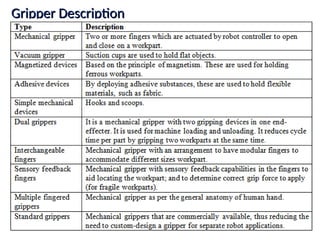
Gripper Description
Gripper Description
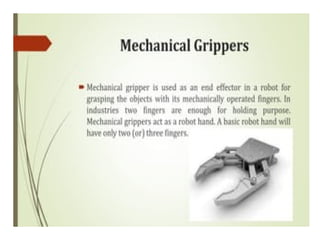
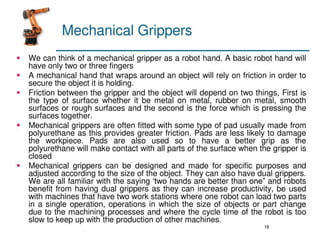
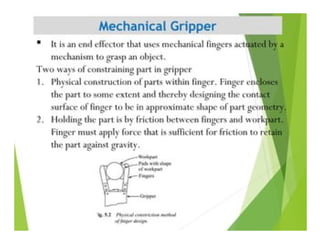
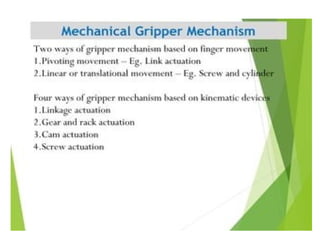
Mechanical Grippers
Mechanical Grippers
Engelberger defines many of the factors that should
be considered in assessing gripping requirements.
1. Consideration must be given to the potential problem of
scratching distorting the part during gripping, if the part is fragile
or has delicate surfaces.
2. If there is a choice between two different dimensions on a part,
the larger dimension should be selected for grasping. Holding the
part by its larger surface will provide better control and stability
of the part in positioning.
3. Gripper fingers can be designed to conform to the part shape by
using resilient pads or self-aligning fingers. The reason for using
sell-aligning fingers is to ensure that each finger makes contact
with the part in more than one place. This provides better part
control and physical stability. Use of replaceable fingers will allow
for wear and also for interchangeability for different part models.
Engelberger defines many of the factors that should
be considered in assessing gripping requirements.
4. The part surface to be grasped must be reachable. For
example, it must no enclosed within a chuck or other holding
fixture.
5. The Size variation of the part must be accounted for, and
how this might influence the accuracy of locating the part.
For example, there might be a problem in placing a rough
casting or forging into a chuck for machining operations.
6. The gripper design must accommodate the change in size
that occurs between part loading and unloading. For
example, the part size is reduced in machining and forging
operations.
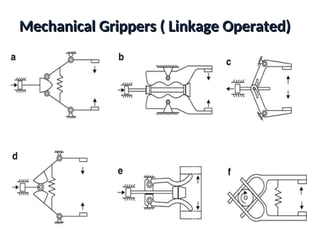
Mechanical Grippers ( Linkage Operated)
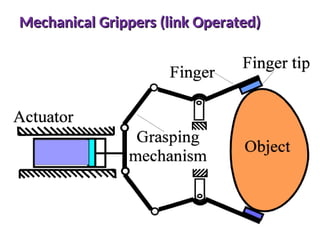
Mechanical Grippers (link Operated)
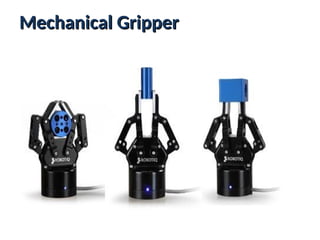
Mechanical Gripper
Mechanical Gripper
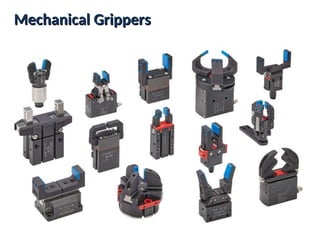
Mechanical Grippers
Mechanical Grippers
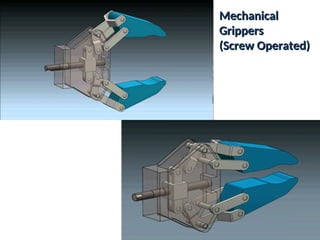
Mechanical
Mechanical
Grippers
Grippers
(Screw Operated)
(Screw Operated)
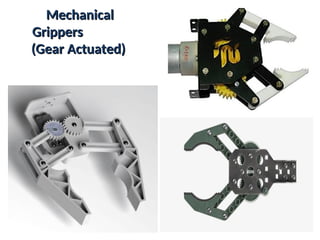
Mechanical
Mechanical
Grippers
Grippers
(Gear Actuated)
(Gear Actuated)
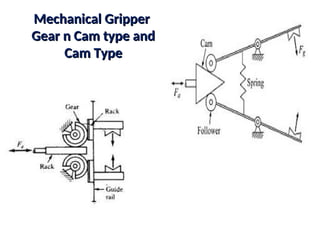
Mechanical Gripper
Mechanical Gripper
Gear n Cam type and
Gear n Cam type and
Cam Type
Cam Type
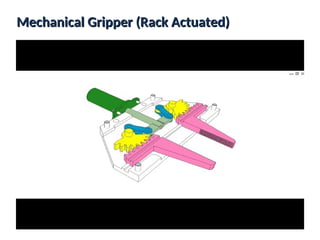
Mechanical Gripper (Rack Actuated)
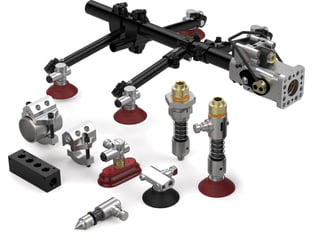
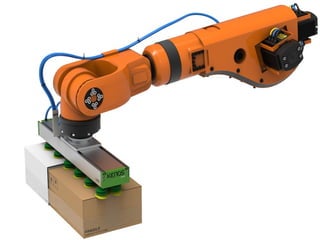
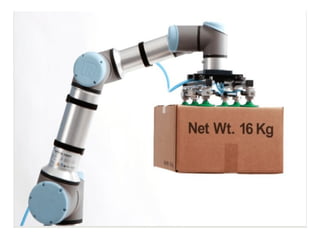
Vacuum Grippers
Vacuum Grippers
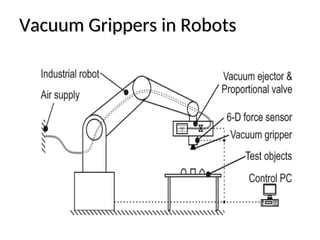
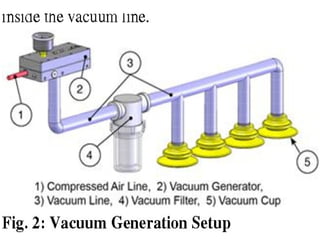
Vacuum Grippers in Robots
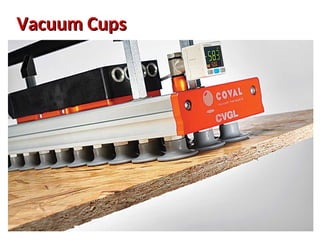
Vacuum Cups
Vacuum Cups
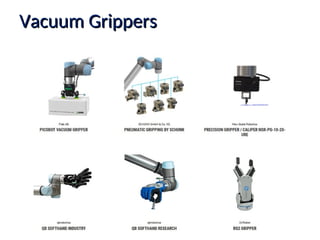
Vacuum Grippers
Vacuum Grippers
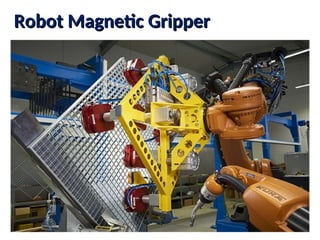
Robot Magnetic Gripper
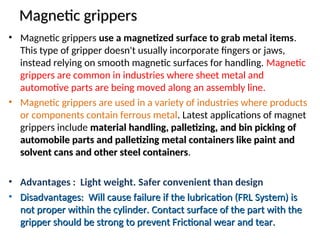
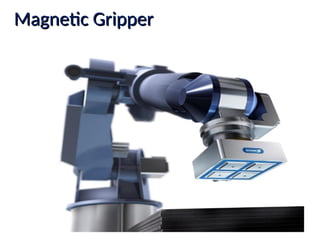
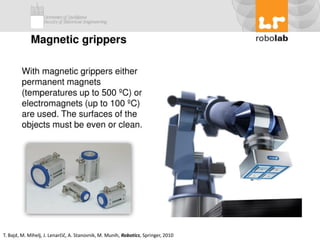
Magnetic grippers
Magnetic grippers
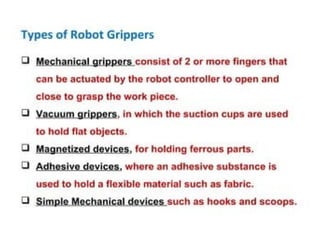
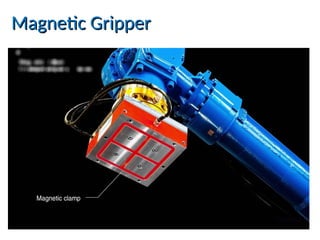
• Magnetic grippers use a magnetized surface to grab metal items.
This type of gripper doesn't usually incorporate fingers or jaws,
instead relying on smooth magnetic surfaces for handling. Magnetic
grippers are common in industries where sheet metal and
automotive parts are being moved along an assembly line.
• Magnetic grippers are used in a variety of industries where products
or components contain ferrous metal. Latest applications of magnet
grippers include material handling, palletizing, and bin picking of
material handling, palletizing, and bin picking of
automobile parts and palletizing metal containers like paint and
solvent cans and other steel containers
solvent cans and other steel containers.
• Advantages : Light weight. Safer convenient than design
• Disadvantages: Will cause failure if the lubrication (FRL System) is
Disadvantages: Will cause failure if the lubrication (FRL System) is
not proper within the cylinder. Contact surface of the part with the
gripper should be strong to prevent Frictional wear and tear.
Magnetic Gripper
Magnetic Gripper
Magnetic Gripper
Magnetic Gripper
Robot Magnetic Gripper
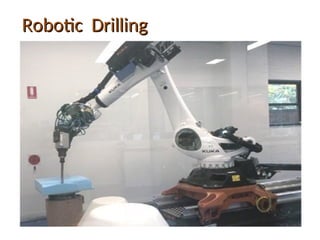
Robotic Drilling
Robotic Drilling
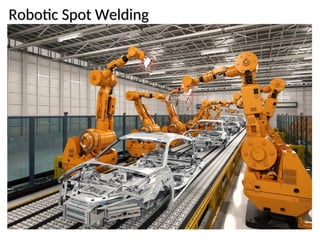
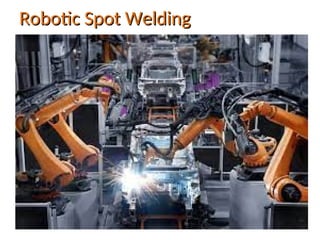
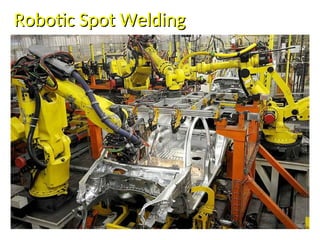
Robotic Spot Welding
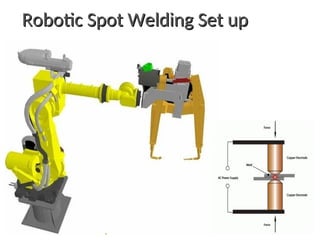
Robotic Spot Welding Set up
Robotic Spot Welding
• Spot welding is a resistance welding process that uses large
electrical current to join two or more sheets of metal in a single
location. Spot welding technology has evolved through its
extensive use in automobile manufacturing using articulated
robots.
• Since spot welding involves joining metals together at specific
points, accuracy is crucial to the success of the weld. Spot
welding industrial robot arms are incredibly accurate. Many have
a point accuracy of 1 mm or less. This means welds will be
completed correctly at the intended point.
• The most common types of robotic welding is the arc process. In
this method, an electric arc generates extreme heat, up to 6,500
degrees Fahrenheit, which melts the metal. Molten metal joins
parts together, solidifying into a stable connection after cooling
Benefits of Robotic Welding
• More Consistent, Higher-Quality Welds. ...
• Greater Productivity, Yields, and Throughput.
• Reduced Waste and Less Rework in
General. ...
• Drastically Reduced Post-Weld Cleanup.
• Faster, More Efficient Road to the Market
Advantages and Disadvantages of Robotic
welding
welding
• Advantages :
Advantages :Robotic welding is ideal for large
jobs. They are advantageous in that they
enhance efficiency, increased employee safety
increased employee safety,
reduced material waste
reduced material waste, and boosts accuracy
boosts accuracy.
• Disadvantages :
Disadvantages :Some of the robotics
disadvantages include high upfront costs,
minimal flexibility
minimal flexibility, and the lack of feasibility
the lack of feasibility
with small projects.
Features Required for robot in spot welding
• Robot spot welding systems have several
considerations and features that come into play:
• Arm reach. ...
• Spot welding guns weigh well over 100 pounds, so
the arm must be able to safely support its weight
(along with the added weight of cables, hoses, etc.).
• Clamping pressure. ...
• Articulation and multi-axis motion. ...
• Power supply.
Robotic Spot Welding
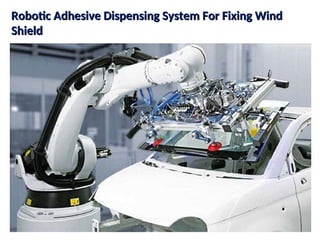
Robotic Adhesive Dispensing System For Fixing Wind
Shield
Shield
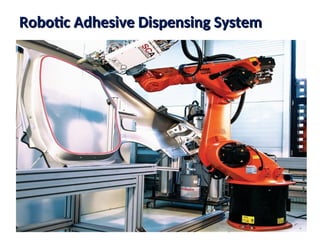
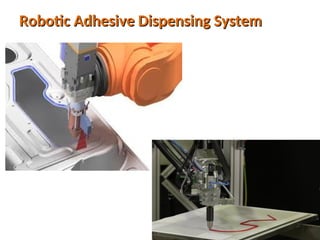
Robotic Adhesive Dispensing System
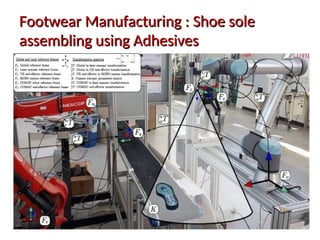
Footwear Manufacturing : Shoe sole
assembling using Adhesives
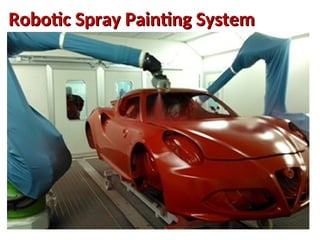
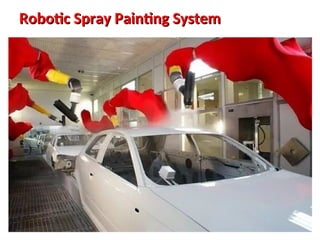
Robotic Spray Painting System
Robotic Spray Painting
• Robotic spray painting arm is a painting process in which spray
painting is done by robots arm to reduce the human load. Robotic
spray painting arm has been used for many year in automotive spray
painting applications.
• The normal spray-painting robot also includes various parts
like base, waist parts, driving rocker, connecting rod, small arm,
wrist parts, forearm and spray nozzle in the last. We can see from
figure the entire stability of the spray-painting robot depends on the
rigidity of base.
• Robots can ensure that the spray gun parameters and spraying
motion are exactly the same each time, which increases quality.
Even the most skilled painters cannot ensure that type of
consistency and precision for each part. Better consistency means
less wasted material.
The Cons of Robotic Paint Arms
Cost – A robotic paint arm can have a high
initial price associated with it. In addition to the
cost of the product there can often be
additional costs associated with installation as
well as training to ensure that you can
effectively operate the paint robot.
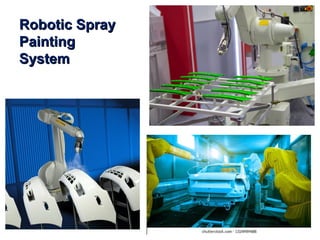
Robotic Spray Painting System
Robotic Spray
Robotic Spray
Painting
Painting
System
System
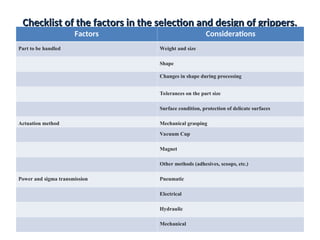
Checklist of the factors in the selection and design of grippers.
Factors Considerations
Part to be handled Weight and size
Shape
Changes in shape during processing
Tolerances on the part size
Surface condition, protection of delicate surfaces
Actuation method Mechanical grasping
Vacuum Cup
Magnet
Other methods (adhesives, scoops, etc.)
Power and sigma transmission Pneumatic
Electrical
Hydraulic
Mechanical
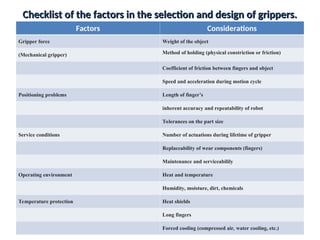
Checklist of the factors in the selection and design of grippers.
Factors Considerations
Gripper force Weight of the object
(Mechanical gripper) Method of holding (physical constriction or friction)
Coefficient of friction between fingers and object
Speed and acceleration during motion cycle
Positioning problems Length of finger’s
inherent accuracy and repeatability of robot
Tolerances on the part size
Service conditions Number of actuations during lifetime of gripper
Replaceability of wear components (fingers)
Maintenance and serviceabilily
Operating environment Heat and temperature
Humidity, moisture, dirt, chemicals
Temperature protection Heat shields
Long fingers
Forced cooling (compressed air, water cooling, etc.)
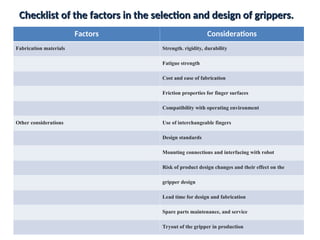
Checklist of the factors in the selection and design of grippers.
Factors Considerations
Fabrication materials Strength. rigidity, durability
Fatigue strength
Cost and ease of fabrication
Friction properties for finger surfaces
Compatibility with operating environment
Other considerations Use of interchangeable fingers
Design standards
Mounting connections and interfacing with robot
Risk of product design changes and their effect on the
gripper design
Lead time for design and fabrication
Spare parts maintenance, and service
Tryout of the gripper in production
*****
THANK YOU
THANK YOU

ROBOT END EFFECTORS in the engineering robotics

  • 1.
  • 9.
  • 10.
  • 13.
    Engelberger defines manyof the factors that should be considered in assessing gripping requirements. 1. Consideration must be given to the potential problem of scratching distorting the part during gripping, if the part is fragile or has delicate surfaces. 2. If there is a choice between two different dimensions on a part, the larger dimension should be selected for grasping. Holding the part by its larger surface will provide better control and stability of the part in positioning. 3. Gripper fingers can be designed to conform to the part shape by using resilient pads or self-aligning fingers. The reason for using sell-aligning fingers is to ensure that each finger makes contact with the part in more than one place. This provides better part control and physical stability. Use of replaceable fingers will allow for wear and also for interchangeability for different part models.
  • 14.
    Engelberger defines manyof the factors that should be considered in assessing gripping requirements. 4. The part surface to be grasped must be reachable. For example, it must no enclosed within a chuck or other holding fixture. 5. The Size variation of the part must be accounted for, and how this might influence the accuracy of locating the part. For example, there might be a problem in placing a rough casting or forging into a chuck for machining operations. 6. The gripper design must accommodate the change in size that occurs between part loading and unloading. For example, the part size is reduced in machining and forging operations.
  • 17.
    Mechanical Grippers (Linkage Operated) Mechanical Grippers ( Linkage Operated)
  • 18.
    Mechanical Grippers (linkOperated) Mechanical Grippers (link Operated)
  • 19.
  • 20.
  • 21.
  • 22.
  • 23.
    Mechanical Gripper Mechanical Gripper Gearn Cam type and Gear n Cam type and Cam Type Cam Type
  • 24.
    Mechanical Gripper (RackActuated) Mechanical Gripper (Rack Actuated)
  • 25.
  • 26.
    Vacuum Grippers inRobots Vacuum Grippers in Robots
  • 29.
  • 30.
  • 33.
  • 34.
    Magnetic grippers Magnetic grippers •Magnetic grippers use a magnetized surface to grab metal items. This type of gripper doesn't usually incorporate fingers or jaws, instead relying on smooth magnetic surfaces for handling. Magnetic grippers are common in industries where sheet metal and automotive parts are being moved along an assembly line. • Magnetic grippers are used in a variety of industries where products or components contain ferrous metal. Latest applications of magnet grippers include material handling, palletizing, and bin picking of material handling, palletizing, and bin picking of automobile parts and palletizing metal containers like paint and automobile parts and palletizing metal containers like paint and solvent cans and other steel containers solvent cans and other steel containers. • Advantages : Light weight. Safer convenient than design • Disadvantages: Will cause failure if the lubrication (FRL System) is Disadvantages: Will cause failure if the lubrication (FRL System) is not proper within the cylinder. Contact surface of the part with the not proper within the cylinder. Contact surface of the part with the gripper should be strong to prevent Frictional wear and tear. gripper should be strong to prevent Frictional wear and tear.
  • 35.
  • 37.
  • 38.
  • 39.
  • 40.
  • 41.
    Robotic Spot WeldingSet up Robotic Spot Welding Set up
  • 42.
    Robotic Spot Welding RoboticSpot Welding • Spot welding is a resistance welding process that uses large electrical current to join two or more sheets of metal in a single location. Spot welding technology has evolved through its extensive use in automobile manufacturing using articulated robots. • Since spot welding involves joining metals together at specific points, accuracy is crucial to the success of the weld. Spot welding industrial robot arms are incredibly accurate. Many have a point accuracy of 1 mm or less. This means welds will be completed correctly at the intended point. • The most common types of robotic welding is the arc process. In this method, an electric arc generates extreme heat, up to 6,500 degrees Fahrenheit, which melts the metal. Molten metal joins parts together, solidifying into a stable connection after cooling
  • 43.
    Benefits of RoboticWelding Benefits of Robotic Welding • More Consistent, Higher-Quality Welds. ... • Greater Productivity, Yields, and Throughput. • Reduced Waste and Less Rework in General. ... • Drastically Reduced Post-Weld Cleanup. • Faster, More Efficient Road to the Market
  • 44.
    Advantages and Disadvantagesof Robotic Advantages and Disadvantages of Robotic welding welding • Advantages : Advantages :Robotic welding is ideal for large jobs. They are advantageous in that they enhance efficiency, increased employee safety increased employee safety, reduced material waste reduced material waste, and boosts accuracy boosts accuracy. • Disadvantages : Disadvantages :Some of the robotics disadvantages include high upfront costs, minimal flexibility minimal flexibility, and the lack of feasibility the lack of feasibility with small projects. with small projects.
  • 45.
    Features Required forrobot in spot welding Features Required for robot in spot welding • Robot spot welding systems have several considerations and features that come into play: • Arm reach. ... • Spot welding guns weigh well over 100 pounds, so the arm must be able to safely support its weight (along with the added weight of cables, hoses, etc.). • Clamping pressure. ... • Articulation and multi-axis motion. ... • Power supply.
  • 46.
  • 47.
  • 48.
  • 49.
    Robotic Adhesive DispensingSystem For Fixing Wind Robotic Adhesive Dispensing System For Fixing Wind Shield Shield
  • 50.
    Robotic Adhesive DispensingSystem Robotic Adhesive Dispensing System
  • 51.
    Robotic Adhesive DispensingSystem Robotic Adhesive Dispensing System
  • 52.
    Footwear Manufacturing :Shoe sole Footwear Manufacturing : Shoe sole assembling using Adhesives assembling using Adhesives
  • 53.
    Robotic Spray PaintingSystem Robotic Spray Painting System
  • 54.
    Robotic Spray Painting RoboticSpray Painting • Robotic spray painting arm is a painting process in which spray painting is done by robots arm to reduce the human load. Robotic spray painting arm has been used for many year in automotive spray painting applications. • The normal spray-painting robot also includes various parts like base, waist parts, driving rocker, connecting rod, small arm, wrist parts, forearm and spray nozzle in the last. We can see from figure the entire stability of the spray-painting robot depends on the rigidity of base. • Robots can ensure that the spray gun parameters and spraying motion are exactly the same each time, which increases quality. Even the most skilled painters cannot ensure that type of consistency and precision for each part. Better consistency means less wasted material.
  • 55.
    The Cons ofRobotic Paint Arms The Cons of Robotic Paint Arms Cost – A robotic paint arm can have a high initial price associated with it. In addition to the cost of the product there can often be additional costs associated with installation as well as training to ensure that you can effectively operate the paint robot.
  • 56.
    Robotic Spray PaintingSystem Robotic Spray Painting System
  • 57.
  • 58.
    Checklist of thefactors in the selection and design of grippers. Checklist of the factors in the selection and design of grippers. Factors Considerations Part to be handled Weight and size Shape Changes in shape during processing Tolerances on the part size Surface condition, protection of delicate surfaces Actuation method Mechanical grasping Vacuum Cup Magnet Other methods (adhesives, scoops, etc.) Power and sigma transmission Pneumatic Electrical Hydraulic Mechanical
  • 59.
    Checklist of thefactors in the selection and design of grippers. Checklist of the factors in the selection and design of grippers. Factors Considerations Gripper force Weight of the object (Mechanical gripper) Method of holding (physical constriction or friction) Coefficient of friction between fingers and object Speed and acceleration during motion cycle Positioning problems Length of finger’s inherent accuracy and repeatability of robot Tolerances on the part size Service conditions Number of actuations during lifetime of gripper Replaceability of wear components (fingers) Maintenance and serviceabilily Operating environment Heat and temperature Humidity, moisture, dirt, chemicals Temperature protection Heat shields Long fingers Forced cooling (compressed air, water cooling, etc.)
  • 60.
    Checklist of thefactors in the selection and design of grippers. Checklist of the factors in the selection and design of grippers. Factors Considerations Fabrication materials Strength. rigidity, durability Fatigue strength Cost and ease of fabrication Friction properties for finger surfaces Compatibility with operating environment Other considerations Use of interchangeable fingers Design standards Mounting connections and interfacing with robot Risk of product design changes and their effect on the gripper design Lead time for design and fabrication Spare parts maintenance, and service Tryout of the gripper in production
  • 61.