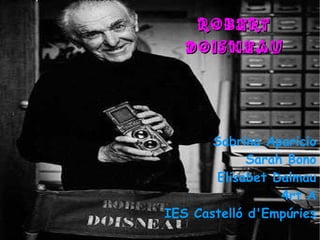
ROBERTROBERT
DOISNEAUDOISNEAU
Sabrina Aparicio
Sarah Bono
Elisabet Dalmau
4rt A
IES Castelló d'Empúries
1. Biography1. Biography
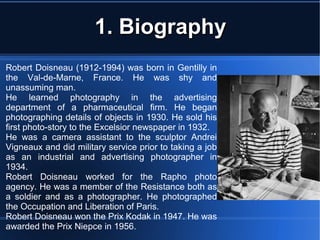
Robert Doisneau (1912-1994) was born in Gentilly in
the Val-de-Marne, France. He was shy and
unassuming man.
He learned photography in the advertising
department of a pharmaceutical firm. He began
photographing details of objects in 1930. He sold his
first photo-story to the Excelsior newspaper in 1932.
He was a camera assistant to the sculptor Andrei
Vigneaux and did military service prior to taking a job
as an industrial and advertising photographer in
1934.
Robert Doisneau worked for the Rapho photo
agency. He was a member of the Resistance both as
a soldier and as a photographer. He photographed
the Occupation and Liberation of Paris.
Robert Doisneau won the Prix Kodak in 1947. He was
awarded the Prix Niepce in 1956.
2. Introduction2. Introduction
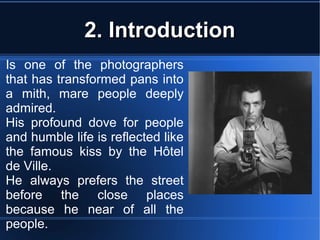
Is one of the photographers
that has transformed pans into
a mith, mare people deeply
admired.
His profound dove for people
and humble life is reflected like
the famous kiss by the Hôtel
de Ville.
He always prefers the street
before the close places
because he near of all the
people.
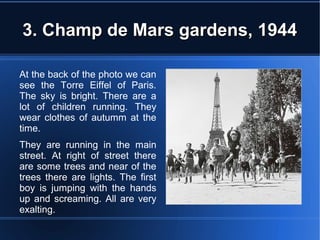
3. Champ de Mars gardens, 19443. Champ de Mars gardens, 1944
At the back of the photo we can
see the Torre Eiffel of Paris.
The sky is bright. There are a
lot of children running. They
wear clothes of autumm at the
time.
They are running in the main
street. At right of street there
are some trees and near of the
trees there are lights. The first
boy is jumping with the hands
up and screaming. All are very
exalting.
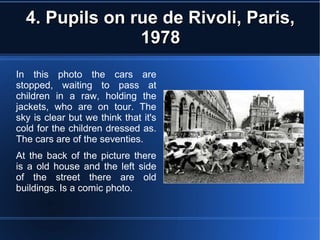
4. Pupils on rue de Rivoli, Paris,4. Pupils on rue de Rivoli, Paris,
19781978
In this photo the cars are
stopped, waiting to pass at
children in a raw, holding the
jackets, who are on tour. The
sky is clear but we think that it's
cold for the children dressed as.
The cars are of the seventies.
At the back of the picture there
is a old house and the left side
of the street there are old
buildings. Is a comic photo.
END =)
END =)

robert doisneau

  • 1.
  • 2.
    1. Biography1. Biography RobertDoisneau (1912-1994) was born in Gentilly in the Val-de-Marne, France. He was shy and unassuming man. He learned photography in the advertising department of a pharmaceutical firm. He began photographing details of objects in 1930. He sold his first photo-story to the Excelsior newspaper in 1932. He was a camera assistant to the sculptor Andrei Vigneaux and did military service prior to taking a job as an industrial and advertising photographer in 1934. Robert Doisneau worked for the Rapho photo agency. He was a member of the Resistance both as a soldier and as a photographer. He photographed the Occupation and Liberation of Paris. Robert Doisneau won the Prix Kodak in 1947. He was awarded the Prix Niepce in 1956.
  • 3.
    2. Introduction2. Introduction Isone of the photographers that has transformed pans into a mith, mare people deeply admired. His profound dove for people and humble life is reflected like the famous kiss by the Hôtel de Ville. He always prefers the street before the close places because he near of all the people.
  • 4.
    3. Champ deMars gardens, 19443. Champ de Mars gardens, 1944 At the back of the photo we can see the Torre Eiffel of Paris. The sky is bright. There are a lot of children running. They wear clothes of autumm at the time. They are running in the main street. At right of street there are some trees and near of the trees there are lights. The first boy is jumping with the hands up and screaming. All are very exalting.
  • 5.
    4. Pupils onrue de Rivoli, Paris,4. Pupils on rue de Rivoli, Paris, 19781978 In this photo the cars are stopped, waiting to pass at children in a raw, holding the jackets, who are on tour. The sky is clear but we think that it's cold for the children dressed as. The cars are of the seventies. At the back of the picture there is a old house and the left side of the street there are old buildings. Is a comic photo.
  • 6.
  • 7.