Roadside Design Guide 2006 With Updated Chapter
6 3rd Edition Anita Vandervalkostrander download

https://ebookbell.com/product/roadside-design-guide-2006-with-
updated-chapter-6-3rd-edition-anita-vandervalkostrander-4695384
Explore and download more ebooks at ebookbell.com
Here are some recommended products that we believe you will be
interested in. You can click the link to download.
Roadside Design Guide 4th Edition Aashto
https://ebookbell.com/product/roadside-design-guide-4th-edition-
aashto-33780186
Roadside Magic Lilith Saintcrow
https://ebookbell.com/product/roadside-magic-lilith-saintcrow-51343572
Roadside Religion In Search Of The Sacred The Strange And The
Substance Of Faith Timothy Beal
https://ebookbell.com/product/roadside-religion-in-search-of-the-
sacred-the-strange-and-the-substance-of-faith-timothy-beal-2113628
Roadside Crosses In Contemporary Memorial Culture 1st Edition Holly J
Everett
https://ebookbell.com/product/roadside-crosses-in-contemporary-
memorial-culture-1st-edition-holly-j-everett-2137324
Roadside Crosses Deaver Jeffery
https://ebookbell.com/product/roadside-crosses-deaver-jeffery-3594852
Roadside Americans Jack Reid
https://ebookbell.com/product/roadside-americans-jack-reid-42315050
Roadside Geology Of Southern California Arthur G Sylvester
https://ebookbell.com/product/roadside-geology-of-southern-california-
arthur-g-sylvester-43223722
Roadside Relics Americas Abandoned Automobiles 1st Edition Will Shiers
https://ebookbell.com/product/roadside-relics-americas-abandoned-
automobiles-1st-edition-will-shiers-4342386
Roadside Sisters Wendy Harmer
https://ebookbell.com/product/roadside-sisters-wendy-harmer-4715416
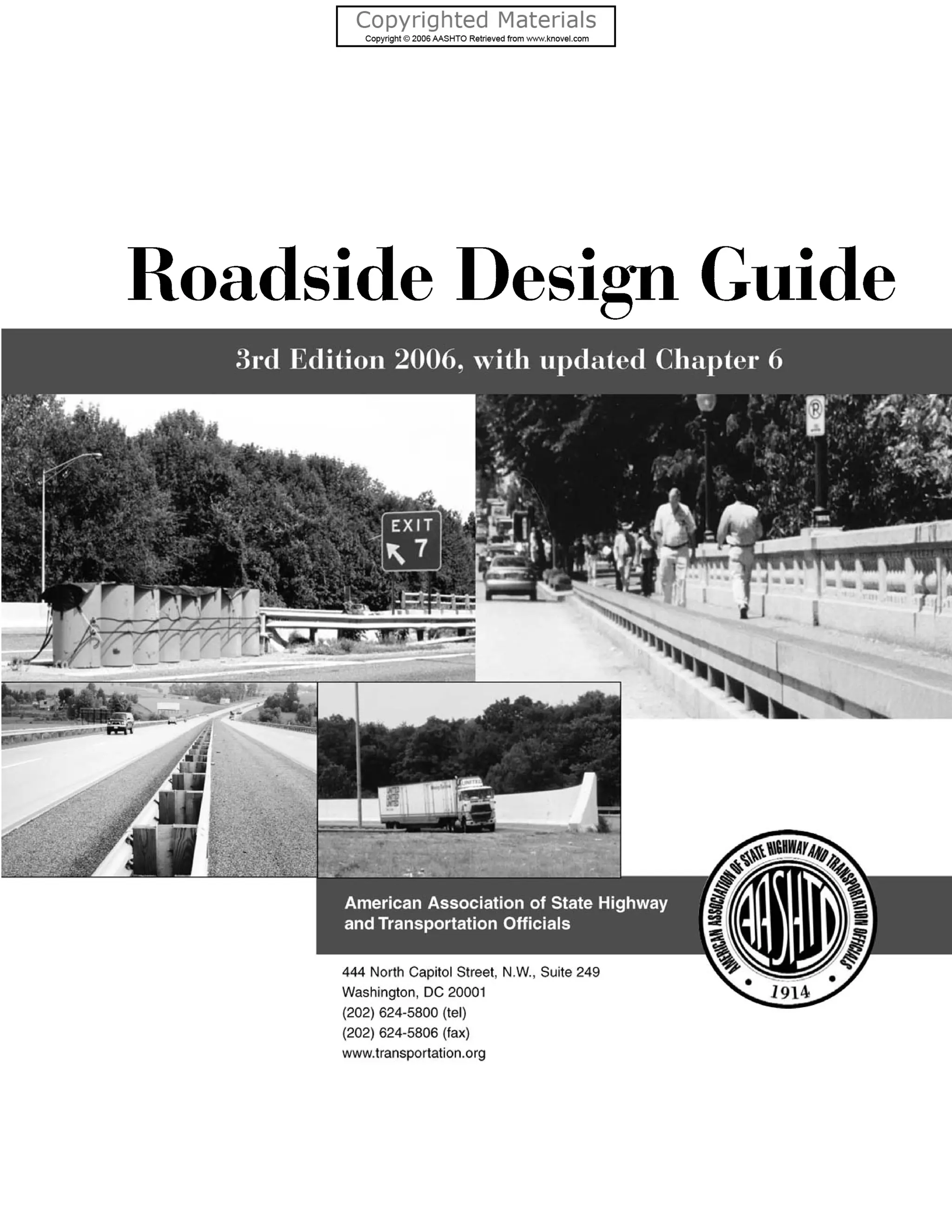
Roadside Design Guide
02006 by the American Association of State Highway and Transportation Officials.All rights reserved. Printed
in the United States of America. This book, or parts thereof, may not be reproduced in any form without written
permission of the publishers.
ISBN: 1-56051-349-7
PublicationCode:RSDGCHP6-3
ii
PREFACE
The Roadside Design Guide is developed and maintained by the AASHTO Subcommittee on Design,
Technical Committee for Roadside Safety.The guide presents a synthesis of current information and operating
practices related to roadside safety and is written in dual units-metric and U.S. Customary units. The 2006
edition of the guide supersedes the 1996AASHTO publication of the same name and includes an update to
Chapter 6, “Median Barriers,” which replaces Chapter 6 of the 2002 edition.
In this guide, the roadside is defined as that area beyond the traveled way (driving lanes) and the shoulder (if
any) of the roadway itself. Consequently, roadside delineation, shoulder surface treatments, and similar on-
roadway safety features are not extensively discussed. While it is a readily accepted fact that safety can best
be served by keeping motorists on the road, the focus of the guide is on safety treatments that minimize the
likelihood of serious injuries when a driver runs off the road.
A second noteworthy point is that this document is a guide. It is not a standard, nor is it a design policy. It is
intended for use as a resource document from which individual highway agencies can develop standards and
policies. While much of the material in the guide can be considered universal in its application, there are several
recommendations that are subjective in nature and may need modification to fit local conditions. However, it is
important that significant deviations from the guide be based on operational experience and objective analysis.
To be consistent with AASHTO’s A Policy on Geometric Design of Highways and Streets, design speed
is as the basic speed parameter to be used in this guide. However, since the design speed is often selected
based on the most restrictive physical features found on a specific project, there may be a significant percent-
age of a project length where that speed will be exceeded by a reasonable and prudent driver. Conversely,
there will be other instances where roadway conditions will prevent most motorists from driving as fast as the
design speed. Because roadside safety design is intended to minimize the consequences of a motorist leaving
the roadway inadvertently, the designer should consider the speed at which encroachments are most likely to
occur when selecting an appropriate roadside design standard or feature.
Design values are presented in this document in both metric and U.S. Customary units. The relationship
between the metric and U.S. Customary values is neither an exact (soft) conversion nor a completely rational-
ized (hard) conversion. The metric values are those that would have been used had the guide been presented
exclusively in metric units; the U.S. Customary values are those that would have been used if the guide had
been presented exclusively in U.S. Customary units. Therefore, the user is advised to work entirely in one
system and not to attempt to convert directly between the two.
The reader is cautioned that roadside safety is a rapidly changing field of study, and changes in policy,
criteria, and technology are certain to occur after this document is published. Efforts should be made to incor-
porate the appropriate current design elements into the project development. Comments from users of this
guide on suggested changes or modifications resulting from further developmental work or hands-on experi-
ence are appreciated. All such comments should be addressed to the American Association of State Highway
and Transportation Officials, Engineering Program, 444 North Capitol Street NW, Suite 249, Washington,
DC 20001.
vii
GLOSSARY
Area of Concern-An object or roadside condition that
may warrant safety treatment.
Barricade-A device which providesa visual indicatorof
a hazardous location or the desired path a motorist should
take. It is not intended to contain or redirect an errant ve-
hicle.
Barrier-A device which provides a physical limitation
through which a vehicle would not normally pass. It is
intended to contain or redirect an errant vehicle.
Breakaway-A design featurewhich allowsa devicesuch
as a sign, luminaire, or traffic signal support to yield or
separate upon impact. The release mechanism may be a
slip plane, plastic hinges, fracture elements, or a combina-
tion of these.
Bridge Railing-A longitudinal barrier whose primary
functionis to prevent an errant vehicle from going over the
side of the bridge structure.
Clearance-Lateral distancefrom edge of traveled way to
a roadside object or feature.
Clear Runout Area-The areaat the toe of a non-recover-
able slope available for safe use by an errant vehicle.
Clear Zone-The total roadside border area, starting at
the edge of the traveled way, available for safe use by
errant vehicles. This area may consist of a shoulder, a re-
coverable slope, a non-recoverable slope, and/or a clear
run-out area. The desired width is dependent upon the
traffic volumes and speeds and on the roadside geometry.
Cost-effective-An item oraction taken that iseconomical
in terms of tangiblebenefitsproduced for the money spent.
Crash Cushion-Device that prevents an errant vehicle
from impacting fixedobjectsby graduallydeceleratingthe
vehicle to a safe stop or by redirecting the vehicle away
from the obstacle.
Crash Tests-Vehicular impact tests by which the struc-
tural and safety performanceof roadsidebarriers and other
highway appurtenancesmay be determined.Threeevalua-
tion criteriaareconsidered, namely (1) structuraladequacy,
(2) impact severity, and (3) vehicular post-impact trajec-
tory.
Crashworthy-A featurethat has been proven acceptable
for use under specified conditions either through crash
testing or in-serviceperformance.
Design Speed-A selected speed used to determine the
various geometric design features of the roadway. The
assumed design speed should be a logical one with re-
spect to the topography, anticipated operating speed, the
adjacentland use, and the functionalclassificationof high-
way.
Drainage Feature-Roadside items whose primary pur-
pose is to provide adequate roadway drainage such as
curbs, culverts, ditches, and drop inlets.
End Treatment-The designed modification of the end of
a roadsideor median barrier.
Experimental Barrier-A barrier that has performed sat-
isfactorily in full-scale crash tests and promises, but has
not yet demonstrated satisfactory in-serviceperformance.
Flare-The variable offset distance of a barrier to move it
farther from the traveled way; generally in referenceto the
upstream end of the barrier.
Frangible-A structure quality or feature that makes the
structure readily or easily broken upon impact.
Fuse Plate-The plate which providesstructuralreinforce-
ment to the sign post hinge to resist wind loads but which
will release or fracture upon impact of a vehicle with the
post.
G-1
Roadside Design Guide
Glare Screen-A deviceused to shield a driver’seye from
the headlights of an oncoming vehicle.
Hinge-The weakened section of a sign post designed to
allow the post to rotate upward when impacted by a ve-
hicle.
Impact Angle-For a longitudinal barrier, it is the angle
between a tangent to the face of the barrier and a tangent
to the vehicle’spath at impact.For a crashcushion, it is the
angle between the axis of symmetry of the crash cushion
and a tangent to the vehicle’s path at impact.
Impact Attenuator-See CrashCushion.
Length of Need-Total length of a longitudinal barrier
needed to shield an area of concern.
Level of Performance-The degree to which a longitudi-
nal barrier, including bridge railing, is designed for con-
tainment and redirection of different types of vehicles.
Longitudinal Barrier-A barrier whoseprimary function
is to prevent penetration and to safely redirect an errant
vehicle away from a roadside or median obstacle.
Median-The portion of a dividedhighway separating the
traveled ways for traffic in opposite directions.
Median Barrier-A longitudinal barrier used to prevent
an errant vehicle from crossing the highway median.
Non-Recoverable Slope-A slopewhich isconsideredtra-
versable but on which the errant vehicle will continue on
to the bottom. Embankment slopes between IV:3H and
IV4H may be consideredtraversablebut non-recoverable
if they are smooth and free of fixed objects.
Offset-Lateral distance from edge of traveled way to a
roadside object or feature.
Operating Speed-The highest speed at which reason-
ably prudent drivers can be expected to operate vehicles
on a section of highway under low traffic densities and
good weather. This speed may be higher or lower than
posted or legislated speed limits or nominal design speeds
where alignment, surface, roadside development, or other
features affect vehicle operations.
OperationalBarrier-One that has performed satisfacto-
rily in full-scale crash tests and has demonstrated satisfac-
tory in-serviceperformance.
Performance Level-See Levelof Performance.
Recoverable Slope-A slopeon which a motoristmay, to a
greateror lesserextent,retain orregaincontrolof a vehicle.
Slopesflatterthan lV:4H aregenerallyconsideredrecover-
able.
Recovery Area-Generally synonymouswith clear zone.
Roadside-That area between the outside shoulder edge
and theright-of-waylimits.The areabetween roadwaysof
a divided highway may also be considered roadside.
Roadside Barrier-A longitudinal barrier used to shield
roadside obstacles or non-traversable terrain features. It
may occasionally be used to protect pedestrians or “by-
standers”from vehicletraffic.
Roadside Signs-Roadside signscan be divided intothree
main categories: overhead signs,large roadside signs, and
small roadside signs.Large roadside signs may be defined
as thosegreaterthan or equal to 5m2 [50ft’] in area. Small
roadside signs may be defined as those less than
5m2[50ft’] in area.
Roadway-The portion of a highway, includingshoulders,
for vehicular use.
Rounding-The introduction of a vertical curve between
two transverse slopes to minimizethe abrupt slopechange
and to maximize vehicle stability and maneuverability.
Severity Index-A severity index (SI) is a number from
zero to ten used to categorize accidents by the probability
of their resulting in property damage, personal injury, or a
fatality, or any combination of these possible outcomes.
The resultant number can then be translated into an acci-
dent cost and the relative effectiveness of alternate safety
treatments can be estimated.
Shielding-The introduction of a barrier or crash cushion
between the vehicle and an obstacle or area of concern to
reduce the severity of impacts of errant vehicles.
Shy Distance-The distance from the edge of the traveled
way beyond which a roadside object will not be perceived
as an obstacle by the typical driver to the extent that the
driver will change the vehicle’s placement or speed.
Slip Base-A structuralelement at or near the bottom of a
post or pole which will allow release of the post from its
base upon impact while resisting wind loads.
Slope-The relative steepness of the terrain expressed as
a ratio or percentage. Slopes may be categorized as posi-
tive (backslopes) or negative (foreslopes) and as parallel
or cross slopes in relation to the direction of traffic.
G-2
Glossarv
Temporary Barrier-Temporary barriersare used to pre-
vent vehicular access into construction or maintenance
work zones and to redirect an impacting vehicle so as to
minimize damage to the vehicle and injury to the occu-
pants while providing worker protection.
Traffic Barrier-A deviceused to prevent a vehiclefrom
striking a more severe obstacle or feature located on the
roadside or in the median or to prevent crossover median
accidents. As defined herein, there are four classes of traf-
ficbarriers,namely,roadsidebarriers,median barriers,bridge
railings, and crash cushions.
Transition-A section of barrier between two different
barriersor,morecommonly,wherea roadsidebarrier iscon-
nected to a bridge railing or to a rigid object such as a
bridge pier. The transition should produce a gradual stiff-
ening of the approach rail so vehicular pocketing, snag-
ging, or penetration at the connection can be avoided.
Traveled Way-The portion of the roadway for the move-
ment of vehicles, exclusive of shoulders.
Through Traveled Way-The portion of roadway for the
movementof vehicles,exclusiveof shouldersand auxiliary
lanes.
Traversable Slope-A slopefromwhich a motoristwill be
unlikely to steer back to the roadway but may be able to
slow and stop safely. Slopes between lV:3H and 1V:4H
generally fall into this category.
Vehicle-A motorized unit for use in transportingpassen-
gers or freight,ranging from an 820-kg [1,800-lb]automo-
bile to a 36000-kg [80,000-lb]van-typetractor-trailer.
Warrants-The criteria by which the need for a safety
treatmentor improvementcan be determined.
G 3
Table of Contents
PREFACE vii
LISTOF FIGURES........................................................................................................................................................ xvii
LISTOF TABLES ......................................................................................................................................................... xxii
CHAPTER 1:
CHAPTER2:
CHAPTER3:
AN INTRODUCTIONTOROADSIDESAFETY
1.0 HISTORY OF ROADSIDESAFETY 1-1
1.1 THE BENEFITSOF ROADSIDE SAFETY 1-1
1.2 THE FORGIVINGROADSIDECONCEPT ...................................................................... 1-2
1.3 THE CONTENTAND FORMAT 1-3
1.4 CRASH TESTING ROADSIDE SAFETY FEATURESAND APPURTENANCES ........ 1-3
1.5 THE APPLICATION OFTHIS GUIDE ............................................................................ 1-4
ROADSIDESAFETYAND ECONOMICS
2.0 OVERVIEW ....................................................................................................................... 2-1
2.1 BENEFITLOSTANALYSIS 2-1
2.1.1 Encroachments ................................................................................................................ 2-2
2.1.2 Roadside Geometry.......................................................................................................... 2-2
2.1.3 Crash Costs ...................................................................................................................... 2-2
2.2 BENEFITiCOSTANALYSISPROGRAMS ..................................................................... 2-2
ROADSIDETOPOGRAPHYANDDRAINAGEFEATURES
3.0
3.1
3.2
3.2.1
3.2.2
3.2.3
3.2.4
3.3
3.3.1
3.3.2
3.3.3
3.3.4
3.3.5
3.4
OVERVIEW ....................................................................................................................... 3-1
THECLEARROADSIDECONCEPT 3-1
ROADSIDEGEOMETRY ................................................................................................. 3-2
Foreslopes ........................................................................................................................ 3-2
Backslopes ....................................................................................................................... 3-8
Transverse Slopes ........................................................................................................... 3-8
Drainage Channels 3-10
APPLICATIONOF THE CLEAR-ZONE CONCEPT .................................................... 3-11
Recoverable Foreslopes ................................................................................................ 3-13
Non-Recoverable Foreslopes 3-13
. .
Critical Foreslopes ......................................................................................................... 3-13
Examples of Clear-ZoneApplication on Variable Slopes............................................ 3-13
Clear-Zone Applications for Drainage Channels and Backslopes ............................. 3-13
DRAINAGEFEATURES................................................................................................ 3-14
ix
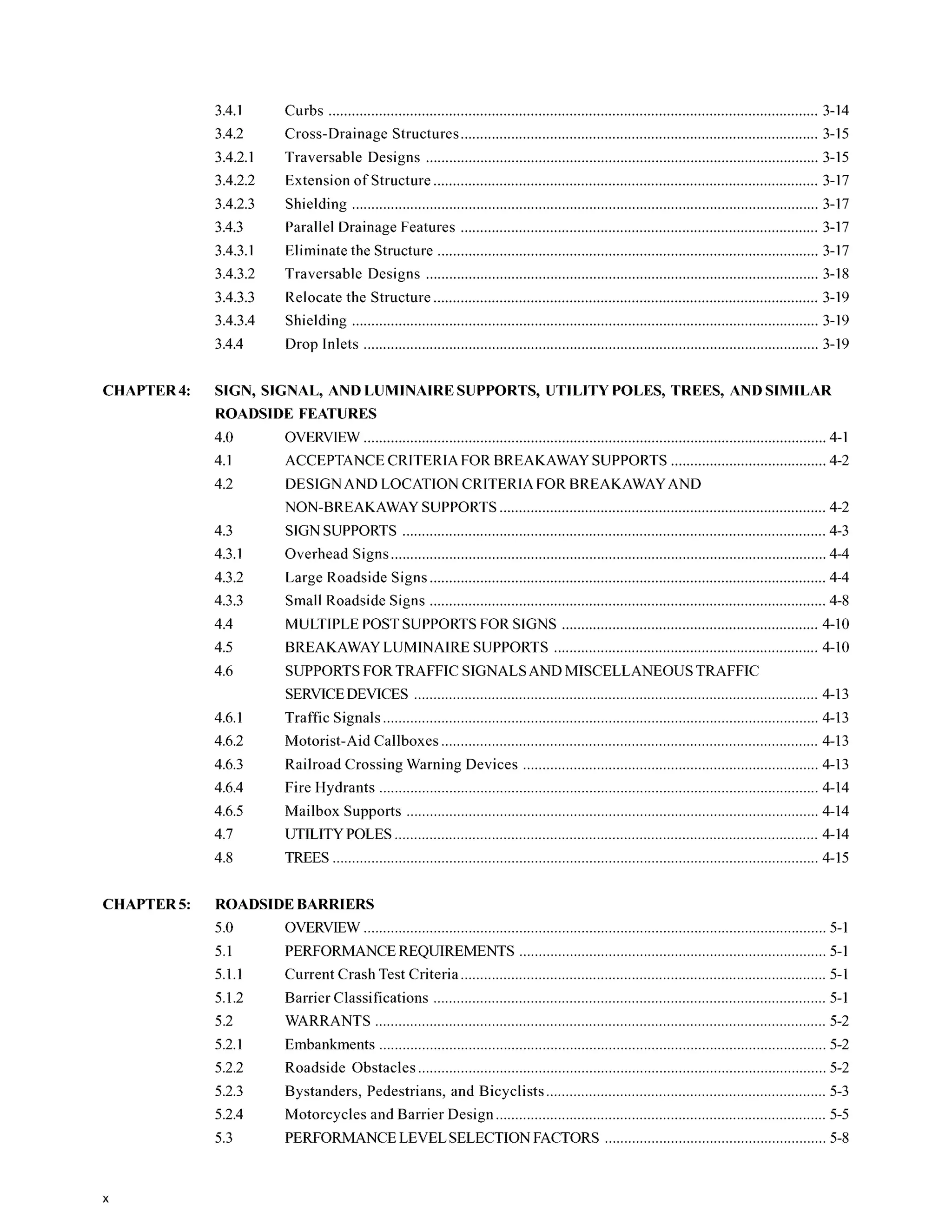
3.4.1
3.4.2
3.4.2.1
3.4.2.2
3.4.2.3
3.4.3
3.4.3.1
3.4.3.2
3.4.3.3
3.4.3.4
3.4.4
Curbs 3-14
Cross-Drainage Structures............................................................................................ 3-15
Extension of Structure ................................................................................................... 3-17
Shielding ........................................................................................................................ 3-17
Eliminate the Structure .................................................................................................. 3-17
Traversable Designs 3-15
Parallel Drainage Features 3-17
Traversable Designs 3-18
Relocate the Structure 3-19
Shielding ........................................................................................................................ 3-19
Drop Inlets 3-19
CHAPTER4: SIGN. SIGNAL. AND LUMINAIRESUPPORTS. UTILITY POLES. TREES. AND SIMILAR
ROADSIDE FEATURES
4.0
4.1
4.2
4.3
4.3.1
4.3.2
4.3.3
4.4
4.5
4.6
4.6.1
4.6.2
4.6.3
4.6.4
4.6.5
4.7
4.8
OVERVIEW....................................................................................................................... 4-1
ACCEPTANCECRITERIA FOR BREAKAWAY SUPPORTS 4-2
DESIGNAND LOCATIONCRITERIA FOR BREAKAWAYAND
NON-BREAKAWAYSUPPORTS.................................................................................... 4-2
SIGN SUPPORTS 4-3
Overhead Signs................................................................................................................ 4-4
Large Roadside Signs...................................................................................................... 4-4
Small Roadside Signs 4-8
MULTIPLE POST SUPPORTSFOR SIGNS .................................................................. 4-10
BREAKAWAYLUMINAIRE SUPPORTS 4-10
SUPPORTSFOR TRAFFIC SIGNALSAND MISCELLANEOUS TRAFFIC
SERVICEDEVICES ........................................................................................................ 4-13
. .
Traffic Signals................................................................................................................ 4-13
Motorist-Aid Callboxes ................................................................................................. 4-13
Railroad Crossing Warning Devices ............................................................................ 4-13
Fire Hydrants 4-14
Mailbox Supports .......................................................................................................... 4-14
UTILITYPOLES ............................................................................................................. 4-14
TREES 4-15
CHAPTER5: ROADSIDEBARRIERS
5.0 OVERVIEW....................................................................................................................... 5-1
5.1 PERFORMANCEREQUIREMENTS ............................................................................... 5-1
5.1.1 Current Crash Test Criteria 5-1
5.1.2 Barrier Classifications ..................................................................................................... 5-1
5.2 WARRANTS .................................................................................................................... 5-2
5.2.1 Embankments 5-2
5.2.2 Roadside Obstacles ......................................................................................................... 5-2
5.2.3 Bystanders, Pedestrians, and Bicyclists ........................................................................ 5-3
5.2.4 Motorcycles and Barrier Design ..................................................................................... 5-5
5.3 PERFORMANCELEVELSELECTIONFACTORS ......................................................... 5-8
X
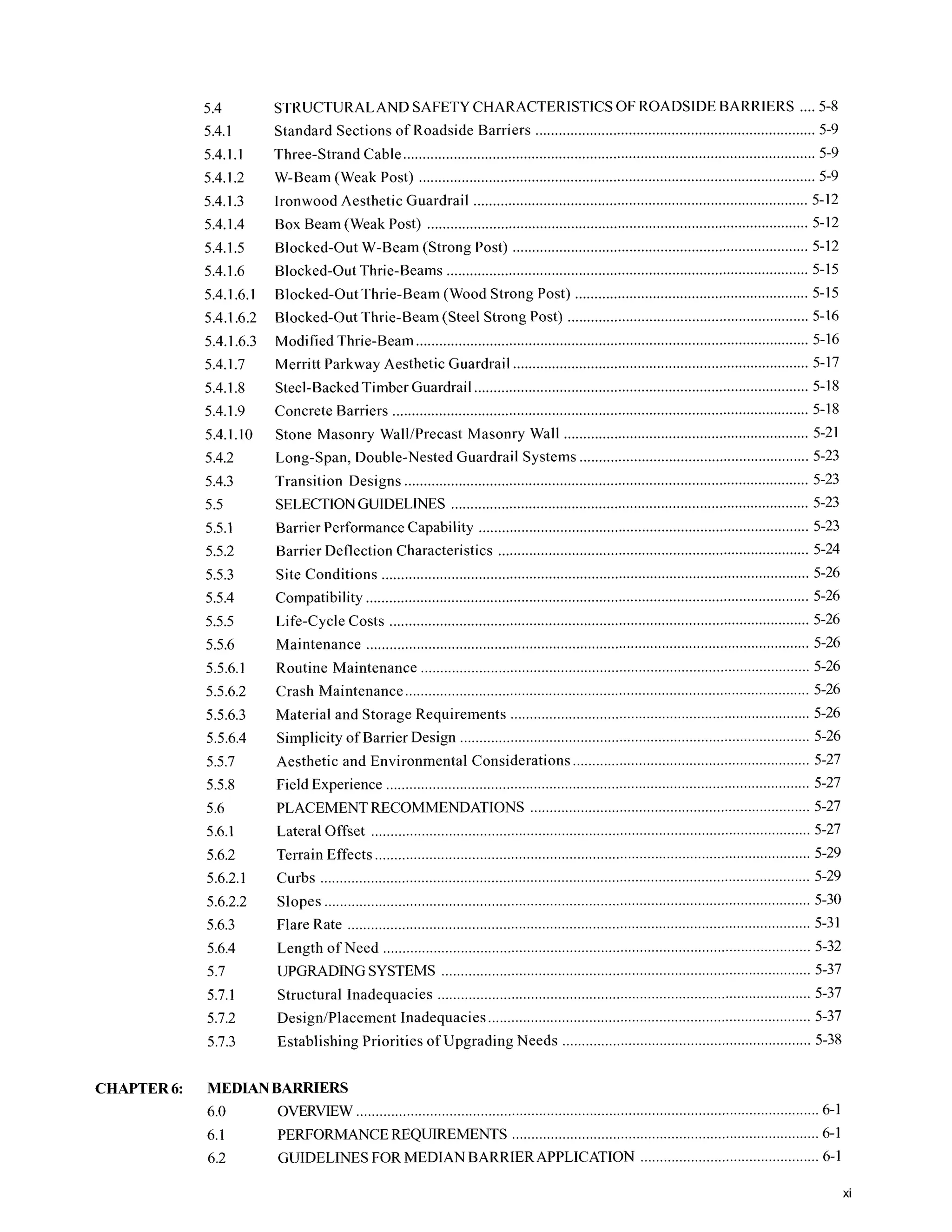
5.4
5.4.1
5.4.1.1
5.4.1.2
5.4.1.3
5.4.1.4
5.4.1.5
5.4.1.6
5.4.1.6.1
5.4.1.6.2
5.4.1.6.3
5.4.1.7
5.4.1.8
5.4.1.9
5.4.1.10
5.4.2
5.4.3
5.5
5.5.1
5.5.2
5.5.3
5.5.4
5.5.5
5.5.6
5.5.6.1
5.5.6.2
5.5.6.3
5.5.6.4
5.5.7
5.5.8
5.6
5.6.1
5.6.2
5.6.2.1
5.6.2.2
5.6.3
5.6.4
5.7
5.7.1
5.7.2
5.7.3
STKUCTURALANDSAFETY CHARACTERISTICS OF ROADSIDE BARRIERS ....5-8
Standard Sections of Roadside Barriers ........................................................................ 5-9
Three-Strand Cable.......................................................................................................... 5-9
W-Beam (Weak Post) ...................................................................................................... 5-9
Ironwood Aesthetic Guardrail ...................................................................................... 5-12
Box Beam (Weak Post) .................................................................................................. 5-12
Blocked-Out W-Beam (Strong Post) ............................................................................ 5-12
Blocked-Out Thrie-Beams ............................................................................................. 5-15
Blocked-Out Thrie-Beam (Wood Strong Post) ............................................................ 5-15
Blocked-Out Thrie-Beam (Steel Strong Post) .............................................................. 5-16
Modified Thrie-Beam ..................................................................................................... 5-16
Merritt Parkway Aesthetic Guardrail ............................................................................ 5-17
Steel-BackedTimber Guardrail ...................................................................................... 5-18
Concrete Barriers ........................................................................................................... 5-18
Stone Masonry WalliPrecast Masonry Wall ............................................................... 5-21
Long.Span. Double-Nested Guardrail Systems ........................................................... 5-23
Transition Designs ........................................................................................................ 5-23
SELECTIONGUIDELINES ............................................................................................ 5-23
Barrier Performance Capability ..................................................................................... 5-23
Site Conditions .............................................................................................................. 5-26
Compatibility .................................................................................................................. 5-26
Life-Cycle Costs ............................................................................................................ 5-26
Routine Maintenance ............................................................................. 5-26
Crash Maintenance ....................................................... ...................... 5-26
Material and Storage Requirements ................................................. 5-26
Simplicity of Barrier Design .................................................................... 5-26
Aesthetic and Environmental Considerations ............ ...................... 5-27
Barrier Deflection Characteristics ................................................................................ 5-24
Maintenance .................................................................................................................. 5-26
. . .
Field Experience ..... ............................................................................. 5-27
PLACEMENT RECOMMENDATIONS .................................................. 5-27
Lateral Offset .................................... ................................................. 5-27
Terrain Effects ........ ............................................................................. 5-29
Curbs ............................................................................. ...................... 5-29
Slopes ................................................ ................................................. 5-30
Flare Rate .................................................................................. 5-31
Length of Need ............................................................. ...................... 5-32
UPGRADING SYSTEMS ............................................................................. 5-37
Structural Inadequacies .......................................................................... 5-37
DesigniPlacement Inadequacies ...... ................................................. 5-37
Establishing Priorities of Upgrading Needs ................................................................ 5-38
CHAPTER6: MEDIANBARRIERS
6.0 OVERVIEW ....................................................................................................................... 6-1
6.1 PERFORMANCE REQUIREMENTS ............................................................................... 6-1
6.2 GUIDELINES FOR MEDIAN BARRIER APPLICATION .............................................. 6-1
xi
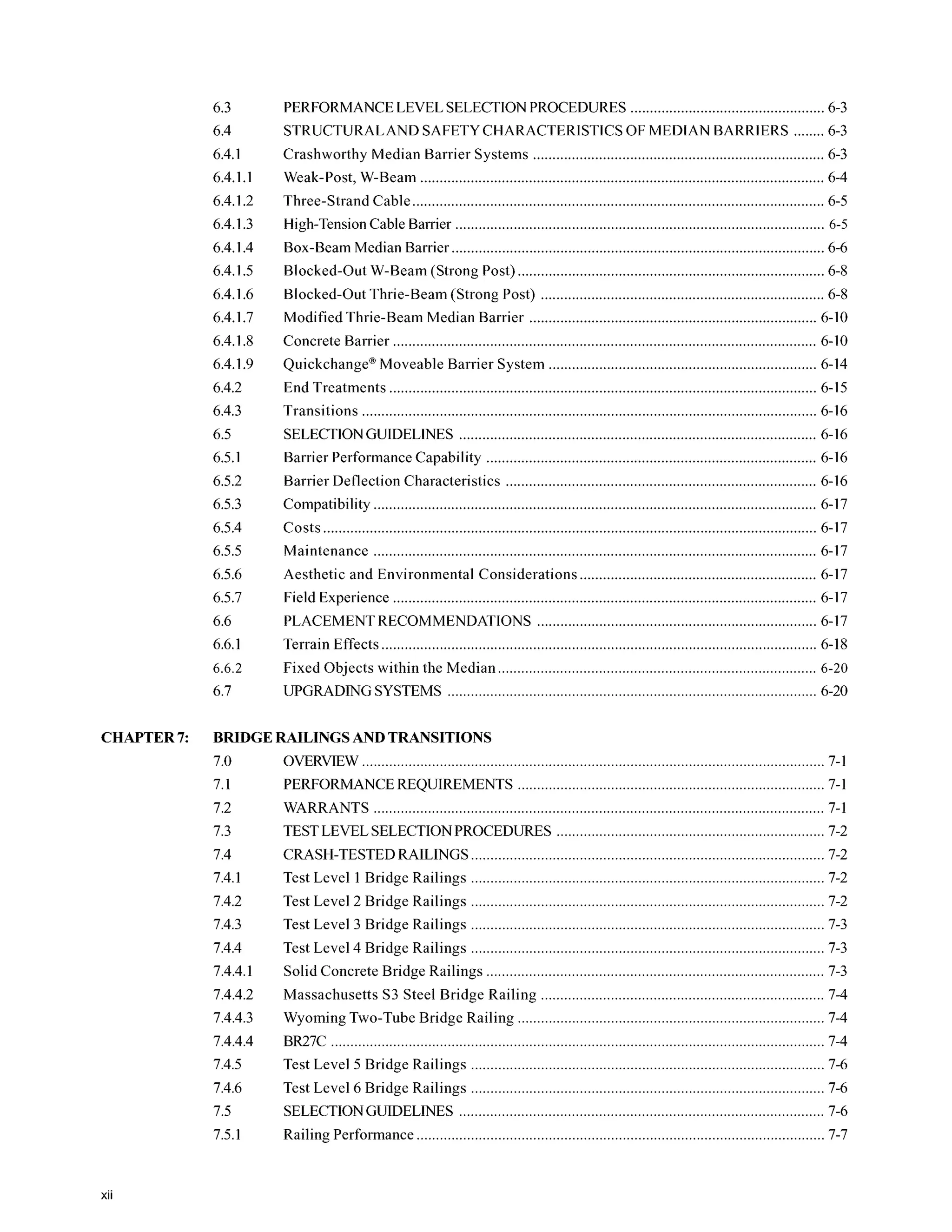
6.3
6.4
6.4.1
6.4.1.1
6.4.1.2
6.4.1.3
6.4.1.4
6.4.1.5
6.4.1.6
6.4.1.7
6.4.1.8
6.4.1.9
6.4.2
6.4.3
6.5
6.5.1
6.5.2
6.5.3
6.5.4
6.5.5
6.5.6
6.5.7
6.6
6.6.1
6.6.2
6.7
PERFORMANCELEVEL SELECTIONPROCEDURES .................................................. 6-3
STRUCTURALAND SAFETYCHARACTERISTICS OF MEDIAN BARRIERS ........6-3
Crashworthy Median Barrier Systems ........................................................................... 6-3
Weak.Post. W-Beam ........................................................................................................ 6-4
Three-Strand Cable.......................................................................................................... 6-5
High-TensionCable Barrier ............................................................................................... 6-5
Box-Beam Median Barrier ................................................................................................ 6-6
Blocked-Out W-Beam (Strong Post) ............................................................................... 6-8
Blocked-Out Thrie-Beam (Strong Post) ......................................................................... 6-8
Modified Thrie-Beam Median Barrier .......................................................................... 6-10
Concrete Barrier ............................................................................................................. 6-10
Quickchange@
Moveable Barrier System ..................................................................... 6-14
End Treatments .............................................................................................................. 6-15
Transitions ..................................................................................................................... 6-16
SELECTIONGUIDELINES ............................................................................................ 6-16
Barrier Performance Capability ..................................................................................... 6-16
Barrier Deflection Characteristics ................................................................................ 6-16
Compatibility .................................................................................................................. 6-17
Maintenance .................................................................................................................. 6-17
Aesthetic and Environmental Considerations ............................................................. 6-17
Field Experience ............................................................................................................. 6-17
Terrain Effects................................................................................................................ 6-18
Costs ............................................................................................................................... 6-17
PLACEMENTRECOMMENDATIONS ........................................................................ 6-17
Fixed Objects within the Median 6-20
UPGRADINGSYSTEMS ............................................................................................... 6-20
CHAPTER7: BRIDGERAILINGSANDTRANSITIONS
7.0
7.1
7.2
7.3
7.4
7.4.1
7.4.2
7.4.3
7.4.4
7.4.4.1
7.4.4.2
7.4.4.3
7.4.4.4
7.4.5
7.4.6
7.5
7.5.1
OVERVIEW....................................................................................................................... 7-1
PERFORMANCEREQUIREMENTS 7-1
WARRANTS .................................................................................................................... 7-1
TESTLEVELSELECTIONPROCEDURES ..................................................................... 7-2
CRASH-TESTEDRAILINGS 7-2
. .
Test Level 1Bridge Railings ........................................................................................... 7-2
Test Level 2 Bridge Railings ........................................................................................... 7-2
Test Level 3 Bridge Railings ........................................................................................... 7-3
Test Level 4 Bridge Railings ........................................................................................... 7-3
. .
. .
. .
Solid Concrete Bridge Railings 7-3
Massachusetts S3 Steel Bridge Railing ......................................................................... 7-4
Wyoming Two-Tube Bridge Railing ............................................................................... 7-4
BR27C 7-4
Test Level 5 Bridge Railings ........................................................................................... 7-6
Test Level 6 Bridge Railings ........................................................................................... 7-6
. .
. .
SELECTIONGUIDELINES .............................................................................................. 7-6
. .
Railing Performance ......................................................................................................... 7-7
xii
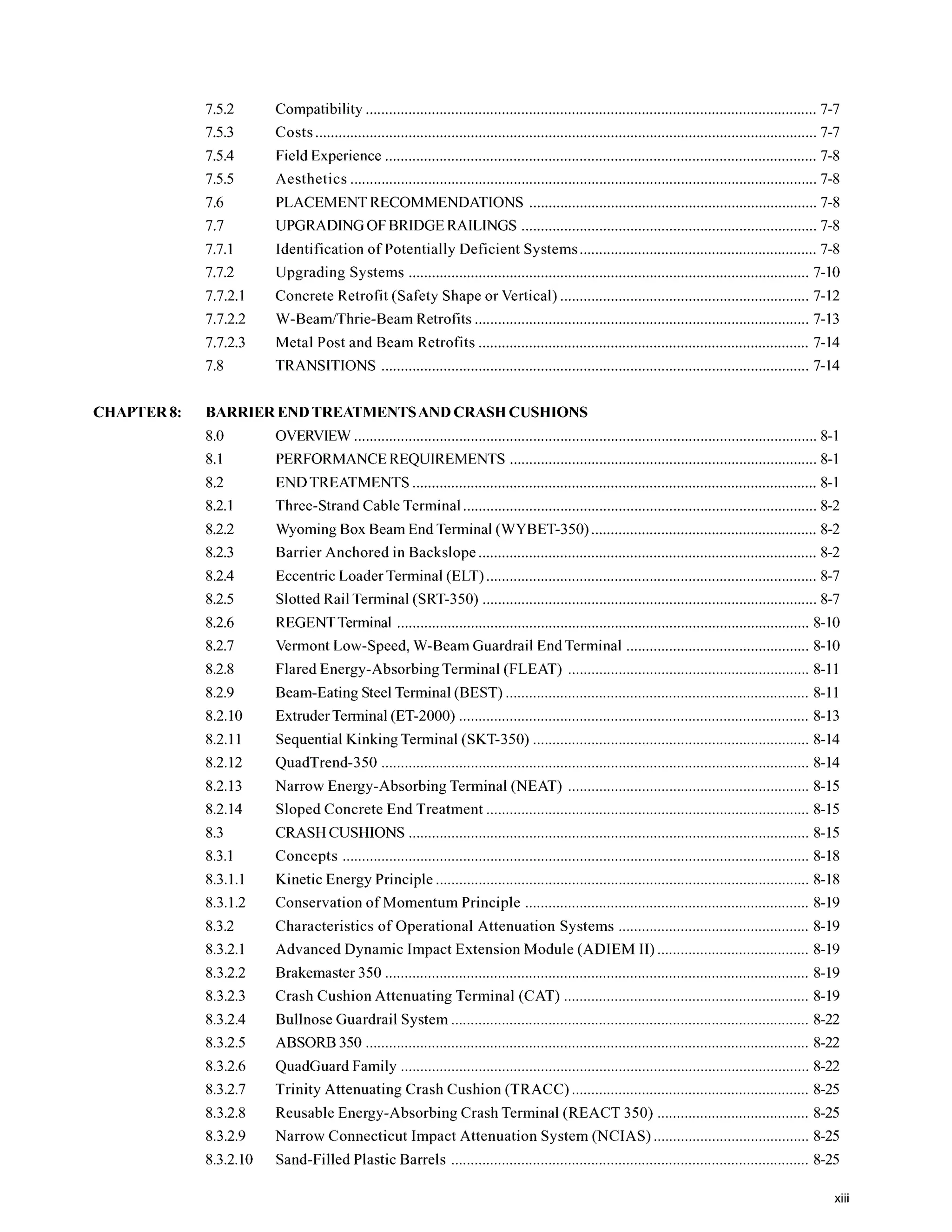
7.5.2
7.5.3
7.5.4
7.5.5
7.6
7.7
7.7.1
7.7.2
7.7.2.1
7.7.2.2
7.7.2.3
7.8
Compatibility 7-7
Costs ................................................................................................................................. 7-7
Field Experience 7-8
Aesthetics ........................................................................................................................ 7-8
PLACEMENTRECOMMENDATIONS .......................................................................... 7-8
UPGRADINGOF BRIDGE RAILINGS 7-8
Identification of Potentially Deficient Systems............................................................. 7-8
Upgrading Systems 7-10
Concrete Retrofit (Safety Shape or Vertical) 7-12
W-BeamiThrie-Beam Retrofits ...................................................................................... 7-13
Metal Post and Beam Retrofits 7-14
TRANSITIONS .............................................................................................................. 7-14
CHAPTER8: BARRIER ENDTREATMENTSANDCRASH CUSHIONS
8.0
8.1
8.2
8.2.1
8.2.2
8.2.3
8.2.4
8.2.5
8.2.6
8.2.7
8.2.8
8.2.9
8.2.10
8.2.11
8.2.12
8.2.13
8.2.14
8.3
8.3.1
8.3.1.1
8.3.1.2
8.3.2
8.3.2.1
8.3.2.2
8.3.2.3
8.3.2.4
8.3.2.5
8.3.2.6
8.3.2.7
8.3.2.8
8.3.2.9
8.3.2.10
OVERVIEW....................................................................................................................... 8-1
PERFORMANCEREQUIREMENTS 8-1
ENDTREATMENTS 8-1
Three-Strand Cable Terminal ........................................................................................... 8-2
Wyoming Box Beam End Terminal (WYBET-350) 8-2
Barrier Anchored in Backslope....................................................................................... 8-2
Eccentric Loader Terminal (ELT)..................................................................................... 8-7
REGENTTerminal .......................................................................................................... 8-10
Slotted Rail Terminal (SRT-350) 8-7
Vermont Low.Speed. W-Beam Guardrail End Terminal 8-10
Flared Energy-AbsorbingTerminal (FLEAT) .............................................................. 8-11
Beam-Eating Steel Terminal (BEST) .............................................................................. 8-11
Extruder Terminal(ET-2000) 8-13
Sequential Kinking Terminal ....................................................................... 8-14
QuadTrend-350 .............................................................................................................. 8-14
Narrow Energy-Absorbing Terminal (NEAT) 8-15
Sloped Concrete End Treatment ................................................................................... 8-15
CRASHCUSHIONS ....................................................................................................... 8-15
Concepts ........................................................................................................................ 8-18
Kinetic Energy Principle ................................................................................................ 8-18
. . . .
Conservation of Momentum Principle 8-19
Characteristics of Operational Attenuation Systems ................................................. 8-19
Advanced Dynamic Impact Extension Module (ADIEM 11)....................................... 8-19
Brakemaster 350 8-19
Crash Cushion Attenuating Terminal (CAT) ............................................................... 8-19
Bullnose Guardrail System ............................................................................................ 8-22
ABSORB350 .................................................................................................................. 8-22
QuadGuard Family ......................................................................................................... 8-22
Trinity Attenuating Crash Cushion (TRACC)
Reusable Energy-Absorbing Crash Terminal (
Narrow Connecticut Impact Attenuation System (NCIAS) ........................................ 8-25
Sand-Filled Plastic Barrels 8-25
xiii
CHAPTER9:
8.3.2.11
8.3.2.12
8.3.2.13
8.4
8.4.1
8.4.2
8.4.3
8.4.4
8.5
8.6
Gravel-BedAttenuator 8-32
Dragnet ........................................................................................................................... 8-33
Water Twister Vehicle Arresting System (VAS) 8-33
SELECTIONGUIDELINES ............................................................................................ 8-34
Site Characteristics ........................................................................................................ 8-34
Structural and Safety Characteristics 8-34
Costs ............................................................................................................................... 8-34
Maintenance Characteristics 8-34
PLACEMENT RECOMMENDATIONS 8-37
DELINEATION ............................................................................................................... 8-37
TRAFFIC BARRIERS. TRAFFICCONTROLDEVICES.AND OTHER SAFETY
FEATURES FOR WORKZONES
9.0 OVERVIEW....................................................................................................................... 9-1
9.1 THE CLEAR-ZONE CONCEPT IN WORKZONES ........................................................ 9-1
9.1.1 Application of the Clear-Zone Concept in Work Zones ............................................... 9-1
9.2.1 Temporary Longitudinal Barriers.................................................................................... 9-2
9.2.1.1 Portable Concrete Safety-Shape Barriers ....................................................................... 9-2
9.2.1.1.1 Flare Rates........................................................................................................................ 9-3
9.2.1.1.2 Offset ................................................................................................................................ 9-3
9.2.1.1.3 Types of Portable Concrete Barrier (PCB) Systems ...................................................... 9-4
9.2.1.1.3.1 NCHRP Report 350 Tested PCB Systems....................................................................... 9-4
9.2.1.1.3.2 Tested and Operational Connections .......................................................................... 9-10
9.2.1.1.3.3 Securing PCBs to the Traveled Way ............................................................................ 9-13
9.2.1.1.3.4 Special Cases ................................................................................................................. 9-13
9.2.1.2 Other Concrete Barriers
9.2.1.3 Other Barriers ................
9.2.1.3.1
9.2 TRAFFIC BARRIERS ...................................................................................................... 9-2
Water-Filled Plastic Shell with Steel Barriers .............................................................. 9-15
9.2.1.3.1.1 Triton Barrier 9-15
9.2.1.3.1.2 GUARDIAN Safety Barrier ............................................................................................ 9-15
9.2.1.3.2 Timber Barrier CurbiRail ................................................................................................ 9-18
9.2.2
9.2.3
9.2.3.1
9.2.4
9.3
9.3.1
9.3.1.1
9.3.1.2
9.3.1.3
9.3.1.4
9.3.1.5
9.3.1.6
9.3.1.7
9.3.1.8
End Treatments .............................................................................................................. 9-18
Transitions ..................................................................................................................... 9-20
. .
PCB Steel Plate Transition 9-20
. .
Applications .................................................................................................................. 9-20
CRASH CUSHIONS ....................................................................................................... 9-20
Stationary Crash Cushions 9-20
Sand-FilledPlastic Barrels ............................................................................................ 9-21
QUADGUARDCZ SYSTEM ......................................................................................... 9-21
TRACC ........................................................................................................................... 9-21
REACT 350 CZ ............................................................................................................... 9-21
Connecticut Impact Attenuation System (CIAS) 9-21
ABSORB 350 .................................................................................................................. 9-24
Advanced Dynamic Impact Extension Modules (ADIEM 11)..................................... 9-24
DRAGNET 9-24
xiv
9.3.2
9.3.2.1
9.3.2.2
9.3.2.2.1
9.3.2.2.2
9.3.2.2.3
9.3.2.3
9.3.2.3.1
9.3.2.3.2
9.3.2.3.3
9.3.2.3.4
9.3.2.3.5
9.3.2.3.6
9.3.2.3.7
9.3.2.3.8
9.3.2.3.9
Truck-Mounted Attenuators (TMAs) ........................................
............................. 9-26
Buffer Distance .........................................
Mass of a Shadow Vehicle ...........................................
Delineation .......................... ........................................
TMAs Meeting NCHRP Report 350 Criteria ...................................
....................
RENCO Ren-Card 815TMA
Connecticut TMA ........................................
ALPHA 70K TMA ..........................................
ALPHA lOOK TMA .................................
............................. 9-26
..............
............................. 9-28
Mobile Protection System 350 .........................................
Vanderbilt TMA ..........................................
Safe-Stop TMA ........................................
U-MAD IOOK TMA ........................................
...................
............................. 9-31
9.3.2.3.10 RENCO RAM IOOKTMA ............................................................................................. 9-31
9.4
9.4.1
9.4.1.I
9.4.1.2
9.4.1.3
9.4.1.4
9.4.1.5
9.4.1.6
9.4.2
9.4.2.1
9.4.2.2
9.4.2.3
9.4.2.4
9.4.2.5
9.5
9.5.1
9.5.2
TRAFFICCONTROLDEVICES ...................................
Performance Evaluation Criteria .........................................
Cones and Tubular Markers ........................................
Vertical Panels ..................... ........................................
Drums .............. .........................................
Channelizing Devices .............................. ............................. 9-32
............................. 9-33
................................................. 9-35
Longitudinal ChannelizingBarricades ...
Signs and Supports ..............................................................
Longhntermediate-Term Work-Zone Sign Supports .
Wheeled Portable Sign Supports .............................................................
Short-Term Work-Zone Sign Supports ...........................................
Trailer-Mounted Devices ........................ ................................................. 9-39
Warning Lights .................. .............................................................
OTHERWORK-ZONEFE .............................. ............................. 9-41
Glare Screens ........................................... ................................................. 9-41
............................. 9-35
Pavement Edge Drop-offs ...............................................................
CHAPTER 10: ROADSIDE SAFETYIN URBANOR RESTRICTEDENVIRONMENTS
10.0 OVERVIEW ...... ........ 10-1
10.1 NEED FOR INDIVIDUALSTUDYOF SITES ................................................. 10-2
................... 10-2
10.2 DESIGN SPEED .............................................................
10.3 ROADSIDE BARRIERS IN URBAN AND RESTRICTED AREAS ............................. 10-3
10.3.1 Barrier Warrants ....................................... ................................................. 10-4
Barriers to Protect Adjacent Land Use ...........................................
10.3.3 Guidelines for Pedestrian and Bicyclist Barriers ........ ............................. 10-4
10.3.4 Pedestrian Restraint Systems .............................................................
..............................................................
10.3.2
xv
10.4
10.5
10.5.1
10.6
10.7
10.8
10.9
10.10
MEDIAN BARRIERS IN URBAN AREAS 10-5
BRIDGERAILINGS........................................................................................................ 10-5
Protective Screening at Overpasses 10-6
IMPACT ATTENUATORS ............................................................................................ 10-7
CURBS ............................................................................................................................ 10-7
DRAINAGE 10-7
LANDSCAPING ............................................................................................................. 10-8
WORK ZONES 10-8
CHAPTER 11: ERECTING MAILBOXES ON STREETSANDHIGHWAYS
11.0 OVERVIEW ..................................................................................................................... 11-1
11.1 MAILBOXES ................................................................................................................. 11-1
11.2 GENERAL PRINCIPLESAND GUIDELINES ................................................................ 11-3
11.2.1 Regulations .................................................................................................................... 11-3
11.2.2 Mail Stop and Mailbox Location .................................................................................. 11-3
11.2.3 Mailbox Turnout Design ............................................................................................... 11-4
11.2.4 Mailbox Support and Attachment Design ................................................................... 11-7
A Cost-Effectiveness Selection Procedure .................................................................................... A-1
Selected Roadside Barrier Design Details ....................................................................................... B-1
Selected Median Barrier Design Details ......................................................................................... C-1
Model Regulation for the Accommodation of Mailboxes and Newspaper
Delivery Boxes on Public Highway Rights-of-way ....................................................................... D-1
Postal Operations and Manual Delivery Services ........................................................................... E-1
11.3 MODELMAILBOX REGULATION ............................................................................ 11-14
APPENDIX A
APPENDIX B
APPENDIX C
APPENDIX D
APPENDIX E
GLOSSARY G-1
INDEX .............................................................................................................................................................................. 1-1
xvi
Chapter I
An Introduction to Roadside Safety
1.0 HISTORY OF ROADSIDESAFETY
Roadside safety design, as one component of total high-
way design, is a relatively recent concept. Most of the
highway design components were established in the late
1940s and the 1950s. These components included hori-
zontal alignment, vertical alignment, hydraulic design, and
sight distance to name some of the most common high-
way design elements. These elements have been revised
and refined over the years through experience and re-
search. However, the highway design components them-
selves have remained about the same for several decades.
Roadside safety design did not become a much dis-
cussed aspect of highway design until the late 1960s,and
it was the decade of the 1970s before this type of design
was regularly incorporated into highway projects. Because
most highways are designed for twenty- to thirty-year
projected traffic volumes, many roadway projects placed
in servicebefore the 1970s are only now becoming candi-
dates for major reconstruction.This reconstruction offers
an opportunity to incorporate cost-effective roadside
safety concepts and design features. The purpose of this
Guide is to present the concepts of roadside safety to the
designer in such a way that the most practical, appropri-
ate, and beneficial roadside design can be accomplished
for each project.
1.1THE BENEFITS OF ROADSIDESAFETY
Roadside design might be defined as the design of the
area between the outside shoulder edge and the
right-of-way limits. Some have referred to this aspect of
highway design as off-pavementdesign. A question com-
monly asked revolves around whether spending resources
off the pavement is really beneficial given the limited na-
ture of infrastructure funds. Perhaps, some statistics bring
the potential of crash reduction and roadside safety into
focus.
The United States suffers approximately 40,000traffic
fatalities each year. The actual number has fluctuated
around this level since the mid- 1960s. At the same time,
the number of vehicle kilometers [miles] traveled each year
has increased approximately two and one-half times since
the mid- 1960s. Therefore, the traffic fatality rate per one
billion vehicle kilometers [miles] given in Figure 1.1has
fallen by more than half since the mid-1960s.
This significant reduction is due to several factors.
Motor vehicles are much safer than they were in the past.
Protected passenger compartments, padded interiors, and
occupant restraints are some features that have added to
passenger safety during impact situations. Roadways
have been made safer through design improvements such
as increased superelevation, intersection geometry, and
the addition of grade separations. Drivers are more edu-
cated about safe vehicle operation as evidenced by the
increased use of occupant restraints and a decrease in
driving under the influence of alcohol or drugs. All these
contributing factors have reduced the motor vehicle fatal-
ity rate.
How significant is the involvement of the roadside en-
vironment in highway crashes? Unfortunately, roadside
crashes account for far too great a portion of the total fatal
highway crashes. About thirty percent, or almost one in
every three fatalities, are the result of a single vehicle
run-off-the-road crash. These figures mean that the road-
side environment comes into play in a very significant
percentage of fatal and serious-injury crashes.
1-1
Roadside Design Guide
FIGURE 1.1 Traffic fatality rate per billion vehicle kilometers [miles] by year
1.2 THE FORGIVING ROADSIDECONCEPT
There are many reasons why a vehicle will leave the pave-
ment and encroach on the roadside, including:
driver fatigue or inattention
excessive speed
driving under the influence of drugs or alcohol
crash avoidance
roadway conditions such as ice, snow, or rain
vehicle component failure
poor visibility
Regardless of the reason for a vehicleleaving the road-
way, a roadside environment free of fixed objects with
stable, flattened slopes enhances the opportunity for re-
ducing crash severity. The forgiving roadside concept al-
lows for errant vehicles leaving the roadway and sup-
ports a roadside design where the serious consequences
of such an incident are reduced.
Through decades of experience and research, the ap-
plication of the forgiving roadside concept has been re-
fined to the point where roadside design is an integral part
of transportation design criteria. Design options for re-
ducing roadside obstacles, in order of preference, are as
follows:
I. Remove the obstacle.
2. Redesign the obstacle so it can be safely tra-
versed.
3. Relocate the obstacle to a point where it is less
likely to be struck.
4. Reduce impact severity by using an appropriate
breakaway device.
5. Shieldthe obstaclewith a longitudinal traffic bar-
rier designed for redirection or use a crash cush-
ion.
6. Delineate the obstacle if the above alternatives
are not appropriate.
One on-roadway safety feature that is becoming more
prevalent nationwide on facilities experiencing a signifi-
cant number of run-off-the-roadcrashesis the use of trans-
verse milled shoulder rumble strips to supplement pave-
ment edge lines. These indentations in the roadway shoul-
ders alert motorists through noise and vibration that their
1-2
An Introduction to Roadside Snfetv
vehicles have crossed the edge line and afford many mo-
torists an opportunity to remain on or return to the trav-
eled way safely. Several transportation agencies have re-
ported significant reductions in single-vehicle crashes
after installing shoulder rumble strips.
1.3 THE CONTENT AND FORMAT
This Guide replaces the 2”dEdition of the AASHTO Road-
side Design Guide (1996).This publication can be consid-
ered a companion document for such current publications
as A Policy on Geometric Design o
f Highways and Streets
and Standard Specificationsfor Structural Supports for
Highway Signs, Luminaires and Traffic Signals. There
are also several research publications and additional ref-
erence literature given at the end of each chapter.
Chapter 2 discusses methods for selecting appropriate
alternative roadside safety enhancements.The discussion
involves benefitkost analysis to determine a ranking of
alternatives in the absence of better local information.
Appendix A offers an example of one methodology for
accomplishing a benefitlcost analysis of various alterna-
tives.
Chapter 3 contains a discussion of the clear roadside
concept. It gives some relative clear zone values from which
design guidance may be derived. Examplesof the applica-
tion of the clear-zone values are also given. The chapter
also includes a discussion of the treatment of drainage
features.
Chapter 4 provides information on the use of sign and
luminaire supports within the roadside environment. Both
small and large signs are included and criteria for
breakaway and non-breakaway supports are presented.
The chapter concludes with discussions of miscellaneous
roadside features such as mailbox supports, utility poles,
and trees.
Chapters 5,6,7, and 8 provide information concerning
roadside barriers and crash cushions. Chapter 5 discusses
roadside barriers. Appendix B gives selected details for
these roadside barriers. Chapter 6provides equivalent in-
formation for median barriers and Appendix C gives se-
lected median barrier details. Chapter 7 includes informa-
tion on appropriate bridge railings. Chapter 8 offers the
latest state-of-the-practice information on barrier end treat-
ments and crash cushions.
Chapter 9 discusses the application of the roadside
safety concept for the temporary conditions found in con-
struction or maintenance work zones. For example, the
chapter contains information on clear zones in a work zone,
temporary barriers, truck-mounted attenuators, and tem-
porary traffic control devices.
Chapter 10discussesthe application of roadside safety
in the urban environment. While much of the information
presented in this publication applies to rural high-speed
conditions,this chapter offers information on urban road-
side practices.
Chapter 11 with Appendices D and E provides informa-
tion on mailboxes and mailbox turnout design.
1.4 CRASHTESTING ROADSIDESAFETY
FEATURESAND APPURTENANCES
This publication has several references to crash-testing
criteria and crash-tested hardware. The intended implica-
tion of referring to a device as crash tested is that the
roadside hardware was tested to the applicable criteria in
existence at the time when full-scale crash testing was
done. While full-scale crash-testing criteria subjectsroad-
side devices to severe vehicle impact conditions, the test-
ing can not duplicate every roadside condition or vehicle
impact situation. The testing provides for an acceptable
level of performance under normalized conditions. How-
ever, every roadside device or installation has limitations
dictated by physical laws, the crashworthiness of vehicles,
and the limitation of resources. Some in-service impact
situations may have more severe consequences if they
occur beyond the design limits, which the testing was
intended to replicate.
National Cooperative Highway Research Program
(NCHRP) Report 350, Recommended Proceduresfor the
Safety Peg7ormance Evaluation o
f Highway Features (l),
contains the current recommendations for testing and
evaluating the performance of longitudinal barriers, termi-
nals, crash cushions, breakaway or yielding supports for
signs and luminaries, breakaway utility poles, truck-
mounted attenuators, and work zone traffic control de-
vices. NCHRP Report 350establishes uniform procedures
for the testing and in-serviceevaluation of permanent and
temporary safety features and supersedes previous rec-
ommendations provided in NCHRP Report 230 (2). Major
revisions from NCHRP Report 230 included test vehicle
changes, number of impact conditions, adoption of the
“Test Level” concept, widened ranges of devices, and
metrication. The uniform testing and evaluation proce-
dures set forth in NCHRP Report 350 provide the follow-
ing benefits:
a basis for comparison of impact performance
merits of candidate safety features;
guidance for safety feature manufacturers; and
a basis for the formulation of safety feature per-
formance specifications.
1-3
Roadside Design Guide
NCHRP Report 350 presents specific impact conditions
for conducting vehicle crash tests. The conditions include
vehicle mass [weight], speed, approach angle, and point
on the safety feature to be hit. Standard test vehicle types
are defined for small passenger cars, standard %-ton pickup
trucks, single-unit van trucks, tractodvan-type trailer
units, and tractorhanker trailer units. The impact speeds
range from 35 to 100km/h [approximately 20 to 60 mph]
and approach angles vary from 0 to 25 degrees. The spe-
cific NCHRP Report 350 test conditions and evaluation
criteria for each type of roadside deviceare summarized in
the chapters that address that type of device. The report
itself is out-of-print but can be viewed and downloaded
from the following web site: http://
www4.nationalacademies.org/trb/crp.nsf/
NCHRP+projects. From this site, NCHRP Report 350can
be found by clicking on Area 22, then on Project 22-7. The
file is very large and is primarily intended for research
personnel who conduct the actual crash testing.
1.5 THE APPLICATION OF THIS GUIDE
This publication is intended to present information on the
latest state-of-the-practice in roadside safety. The con-
cepts, designs, and philosophies presented in the follow-
ing chapters can not, and should not, be included in their
totality on every single project. Each project is unique
and offers an individual opportunity to enhance that par-
ticular roadside environment from a safety perspective.
The guidelines presented in this publication are most
applicable to new construction or major reconstruction
projects. These projects, which often include significant
changes in horizontal or vertical alignment, offer the great-
est opportunity for implementing many of the roadside
safety enhancements presented in this document. For re-
surfacing, rehabilitation, or restoration (3R) projects, the
primary emphasis is generally placed on the roadway it-
self to maintain the structural integrity of the pavement. It
will generally be necessary to selectively incorporate road-
side safety guidelines on 3R projects only at locations
where the greatest safety benefit can be realized. Because
of the scope of 3R projects and the limited nature of most
rehabilitation programs, the identification of areas that
offer the greatest safety enhancement potential is critical.
Accident reports, site investigations, and maintenance
records offer starting points for identifying these loca-
tions.
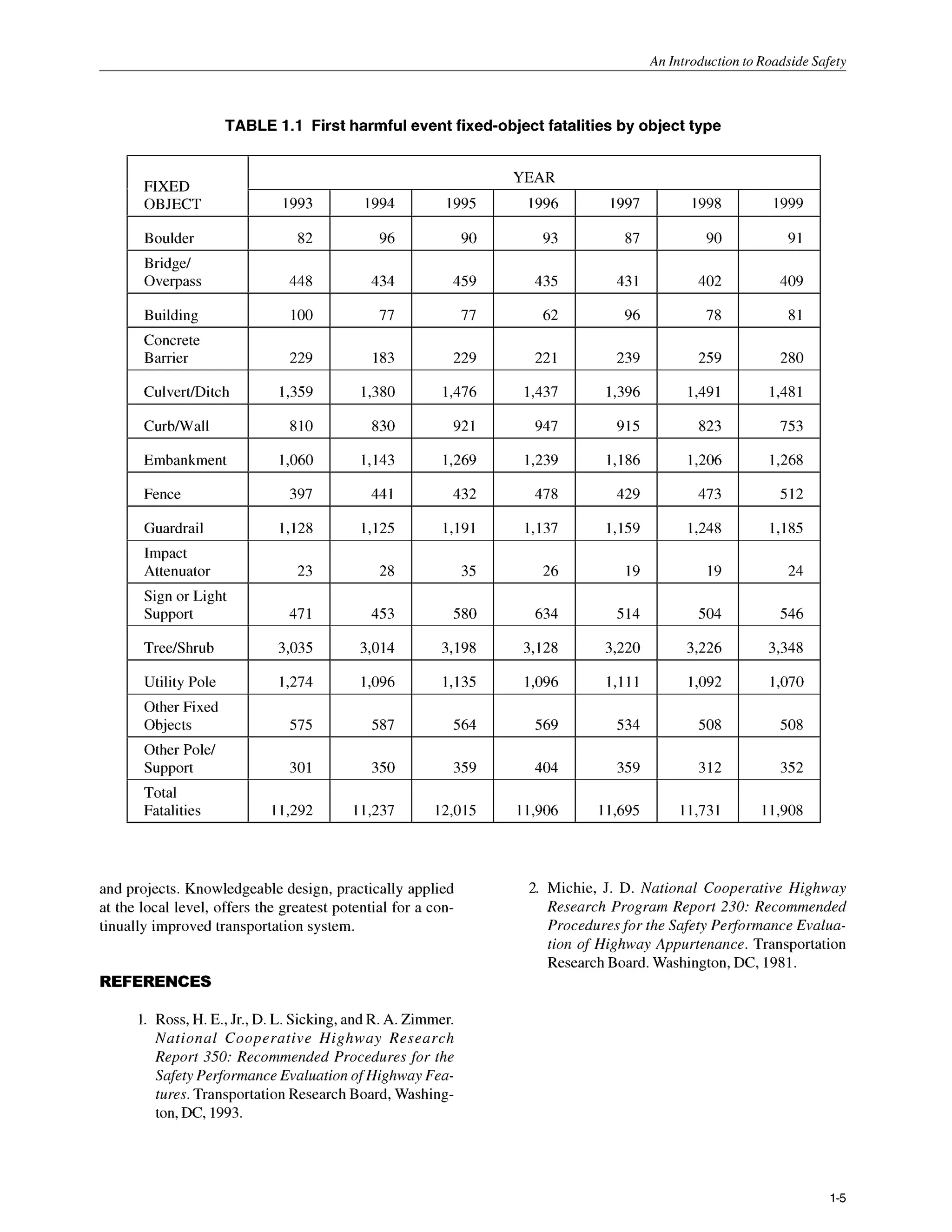
The importance of designing the roadside to be as clear
as practical can be seen by noting which objects and slope
conditions are most frequently associated with fatal run-
off-the-road crashes. Table I .I shows the numbers of fa-
talities in the United States from 1993 to I999 resulting
from collisions with specific roadside objects or slope
conditions. This information was obtained through the
National Highway Traffic Safety Administration’s
(NHTSA) Fatality Analysis Reporting System (FARS) and
identifies the first harmful event in a series of events re-
sulting in a fatal crash. In some cases, the first harmful
event is also identified as the most harmful event. For
example, if a motorist strikesa tree, the impact with the tree
is likely to be classified as both the first and most harmful
event. On the other hand, if the first harmful event is strik-
ing an embankment, the most harmful event is often a
rollover. FARS data for each State can be accessed di-
rectly at http://www-fars.nhtsa.dot.gov.
The amount of monetary resources available for all road-
side safety enhancements is limited. The objective of de-
signers has to be to maximize roadside safety on a
system-wide basis with the given funds. Accomplishing
this objective means addressing those specific roadside
features that can contribute the most to the safety en-
hancement of that individual highway project. If the inclu-
sion of the highest level of roadside design criteria is rou-
tinely required in each highway design project, regardless
of cost or safety effectiveness, it is likely that system-wide
safety may stay static or may be degraded. This potential
will certainly exist if other roadside needs are not improved
because funds were not judiciously applied to the most
viable safety enhancement need.
Given the fact that objects and slope changes must be
introduced at varying points off the pavement edge, the
enhancement of roadside safety involves selecting the
“best” choice among several acceptable design alterna-
tives. The experience gained from decades of selecting
design alternatives, the research done on vehicle dynam-
ics, and the technological advances in materials offers the
potential for maintaining and enhancing one of the safest
national transportation systems in existence.
This document is intended to represent the spectrum
of commonly available roadside design alternatives. In
most cases, these alternatives have shown significant
benefits under appropriately selected field conditions.
Many of these roadside enhancements have, over time,
demonstrated their ability in the field to improve roadside
safety conditions. In many areas, this publication strives
to give the advantages and disadvantages of roadside
technology. With this information, designers can make
more knowledgeable decisions about the best applications
for individual projects. It should be noted that no attempt
is made, or implied, to offer every single roadside enhance-
ment design technique or technology.
Finally, this publication is not intended to be used as a
standard or a policy statement. This document is made
available to be a resource for current information in the
area of roadside design. Agencies may choose to use this
information as one reference upon which to build the road-
side design criteria best suited to their particular location
1-4
An Introduction to Roadside Snfetv
TABLE 1.I First harmful event fixed-object fatalities by object type
and projects. Knowledgeable design, practically applied
at the local level, offers the greatest potential for a con-
tinually improved transportation system.
REFERENCES
2. Michie, J. D. National Cooperative Highway
Research Program Report 230: Recommended
Proceduresfor the Safety Peg7ormance Evalua-
tion o
f Highway Appurtenance. Transportation
Research Board. Washington, DC, 1981.
1. Ross, H. E.,Jr., D. L. Sicking, and R. A. Zimmer.
Nationa1 Cooperative Highway Research
Report 350: Recommended Procedures for the
Safety Peg7ormanceEvaluation o
f Highway Fea-
tures. Transportation Research Board, Washing-
ton, DC, 1993.
1-5
Chapter 2
Roadside Safety and Economics
2.0 OVERVIEW
The consistent application of geometric design standards
for roads and streets provides motorists with a high de-
gree of safety. Design features, such as horizontal and
vertical curvature, lane and shoulder width, signing, shoul-
der rumble strips, and pavement markings, play an impor-
tant role in keeping motorists on the traveled way. Road-
side safety features, such as breakaway supports, barri-
ers, and crash cushions provide an extra margin of safety
to motorists who inadvertently leave the roadway. Most
of these appurtenances are routinely installed based on a
subjective analysis of their benefits to the motorist; how-
ever, in some instances it may not be immediately obvious
that the benefits to be gained from a specific safety de-
sign or treatment equal or exceed the additional costs.
Thus, a designer must decide how and where limited funds
should be spent to achieve the greatest overall benefit.
One method that can be used to make this determination
is a benefitkost analysis.
2.1 BENEFIWCOSTANALYSIS
A benefitlcost analysis is a method by which the esti-
mated benefits to be derived from a specific course of
action are compared to the costs of implementing that
action. If the estimated benefits of a specific design ex-
ceed the cost of constructing and maintaining that design
over a period of time, the safer design may be implemented;
however, simply having a benefitlcost ratio greater than
one is not ample justification for the construction of a
roadside safety treatment. Each project must compete with
others for limited safety funds. The designer must attempt
to build those projects that best meet the public’s need
for safety and mobility.
The primary benefit obtained from selecting one de-
sign over another, relative to safety, is the expected reduc-
tion in the future costs of crashes. These costs typically
include property damage costs and personal injury costs.
To estimate these costs, the expected number and sever-
ity of crashes that may occur for each roadside treatment
must be estimated. In some cases, the total number of
crashes may be reduced by a given treatment, such as
providing a significantly wider roadside recovery area than
previously existed. In other instances, the safety treat-
ment may not reduce the total number of crashes but may
reduce their severity. The installation of a median or road-
side traffic barrier may have this effect.
The costs used in a benefitkost analysis are generally
the direct construction and maintenance costs incurred
by the highway agency. They can usually be estimated
with a high degree of accuracy.
A benefitkost analysis must also consider the period
of time (project life) over which each alternative treatment
provides a benefit. Because different treatments can have
different project lives, both benefits and costs must be
annualized so direct comparisons between alternativede-
sign treatments can be made. To reduce total (life-cycle)
costs to annualized costs, discount rates must be consid-
ered. An annualized benefitkost ratio thus compares the
expected savings (benefits) to society, through reduced
costs from crashes, to the costs (construction and main-
tenance) incurred by the highway agency to provide a
specific treatment.
The following subsections identify the type of data
that are needed to conduct a benefitlcost analysis and the
general availability of this information. The major factors
include:
encroachments,
roadside geometry, and
crash costs.
2-1
Roadside Design Guide
2.1.
IEncroachments 2.1.3 Crash Costs
The benefits derived from a roadside safety treatment can
be calculated by first estimating the number of vehicles
that are likely to run off the road at a particular location.
By definition, an encroachment occurs when a motorist
strays from the traveled way. The primary factors that af-
fect the number of encroachments are traffic volume, road-
way alignment, and lane widths. The number of estimated
encroachments is determined by multiplying an encroach-
ment rate by the number of vehicles using the facility,
resulting in a figurerepresenting the number of encroach-
ments per kilometer [mile] per year. Current encroachment
rates are derived from a limited number of studies con-
ducted over the past 30 years (1,2). These rates should be
adjusted when actual data at a specific location are avail-
able. They may also be modified based on engineering
judgment for non-typical conditions.
It should be further noted that not all encroachments
result in crashes. For example, for small-angle encroach-
ments, even a narrow recovery area may provide enough
space for a driver to regain control and return safely to the
roadway. To estimate the number of crashes that may re-
sult from encroachments,the angles of departurefrom the
roadway and the speeds and types of vehicles involved
must be considered.
Once an estimate has been made of the number of crashes
that can be expected at a given location, this information
must be translated into a cost that is directly related to
crash severity. One method of accomplishing this is by
assigning a Severity Index (SI)to individual crashes. This
SI will vary with the type of vehicle involved, its speed
and impact angle, and the type of obstacle struck.A crash
may range in severity from minor to fatal. If an SI system is
used, a crash involving no personal injuries and negli-
gible property damage might be assigned an SI of zero,
while a crash with a 100percent chance of a fatality might
be assigned an SI of 10. Between these extremes, crashes
typically involve varying degrees of property damage
coupled with slight, moderate, or severepersonal injuries.
Converting severity indices to crash cost is a relatively
easy process, but it does require that a dollar cost be
assigned to each type of crash. This step involves con-
siderable judgment because it requires that a value be
assigned to each crash classification, including fatal
crashes. Primary sources of crash cost data include the
National Safety Council, the National Highway Traffic
Safety Administration,and the Federal Highway Admin-
istration.
2.2 BENEFlTlCOSTANALYSIS PROGRAMS
2.1.2 Roadside Geometry
Once a vehicle has left the roadway, a crash may or may
not occur. The end result of an encroachment depends
upon the physical characteristicsof the roadside environ-
ment. As noted earlier, the highway designerhas a signifi-
cant degree of control over roadside geometry and appur-
tenances. Flat, traversable, stable slopes will minimize
overturning crashes, which are usually severe. Elimina-
tion of roadside hardware, its relocation to less vulnerable
areas, or the use of breakaway-type devices remain the
options of choice in the development of safer roadsides.
Obstructions that cannot otherwise be treated should be
shielded by properly designed and installed traffic barr-
ers or crash cushions if it is cost-effective to do so. Fi-
nally, if a fixed object or other roadside obstacle cannotbe
eliminated, relocated, modified, or shielded for whatever
reason, consideration should be given to delineating the
feature so it is readily visible to a motorist.
Several highway agencies have used the ROADSIDE
analysis program presented in the two earlier editions of
the Roadside Design Guide to both analyze site-specific
alternative safety treatments and to develop design charts
and tables using local data. Information on an updated
and significantly revised version of ROADSIDE, called
the Roadside Safety Analysis Program (RSAP), is included
in Appendix A.
REFERENCES
Hutchinson, J. W., and T. W. Kennedy. Medians
of Divided Highways-Frequency and Nature
of VehicleEncroachments. Bulletin 487. Univer-
sity of Illinois Engineering Experiment Station,
1966.
Cooper, P. “Analysis of Roadside Encroach-
ments-Single Vehicle Run-off-Road Accident
Data Analysis for Five Provinces,” B.C.Research.
Vancouver, British Columbia, Canada, March
1980.
2-2
Roadside Topography and Drainage Features
3.0 OVERVIEW
This chapter includes a discussion on the development
and evaluation of the clear roadside concept and its appli-
cation to roadside design. It also discusses embankment
slopes and ditches and how these features influenceroad-
side features such as curbs, culverts, and drop inlets,
whose purpose is to provide adequate roadway drainage.
The designer is presented with several options that en-
hance safety without affecting the capabilities of these
elements to drain the highway.
Most of the clear roadside design guidelinesdiscussed
in this chapter have been practiced to varying degrees for
several years. This chapter attempts to reemphasize and
collect the currently accepted design principles to pro-
vide guidance in the area of roadside clearances. How-
ever, to include every recommendation or design value in
this chapter on every future highway project is neither
feasible nor possible. Engineeringjudgment will have to
play a part in determining the extent to which improve-
ments can reasonably be made with the limited resources
available.
As the designer studies the options available, some
consideration should be given to the future maintenance
of drainage facilities and roadside topography. Ongoing
repair and upkeep will be necessary to ensure the contin-
ued function and safety of various roadside drainage fea-
tures. Personnel, materials, equipment, and cost are some
of the considerations in every maintenance program. The
designer should take into account the exposure of crews
to traffic conditions while completing repairs. Also, main-
tenance activities can cause various levels of disruption
in the traffic flow, which may increase the potential for
crashes.
3.1 THE CLEAR ROADSIDECONCEPT
Beginning in the early 196Os,as more Interstate highways
and other freeways were opened to traffic, the nature and
characteristics of the typical rural highway crash began to
change. Instead of head-on crashes with other vehicles or
crashes involving trees immediately adjacent to the road-
way, many drivers were running off the new freewaysand
colliding with man-made objects such as bridge piers, sign
supports, culverts, ditches, and other design features of
the roadway. In 1967,the AASHO Traffic Safety Commit-
tee (currently the AASHTO Standing Committee on High-
way Traffic Safety) issued a report entitled Highway De-
sign and Operational Practices Related toHighway Safety
(1).This document became known as the “Yellow Book”
and its principles were widely applied to highway con-
struction projects, particularly high-speed controlled ac-
cess facilities. A second edition of the Yellow Book, pub-
lished by AASHTO in 1974, stated that “for adequate
safety, it is desirable to provide an unencumbered road-
siderecovery area that is as wide as practical on a specific
highway section. Studies have indicated that on high-
speed highways, a width of 9 meters [30feet] or more from
the edge of the through traveled way permits about 80
percent of the vehicles leaving a roadway out of control
to recover.”
Subsequently, most highway agencies began to try to
provide a traversable and unobstructed roadside area
(clear zone) extending approximately 9 m [30 ft] beyond
the edge of the through traveled way, particularly on high-
volume, high-speed roadways. Many obstacles located
within this clear-zone distance were removed, relocated,
redesigned, or shielded by traffic barriers or crash cush-
ions. It soon became apparent, however, that in some lim-
3-1
Roadside Design Guide
ited situationswhere the embankmentsloped significantly
downward, a vehicle could encroach farther from the
through traveled way; thus, a 9 m [30 ft] recovery area
might not be adequate. Conversely, on most low-volume
or low-speed facilities, a 9 m [30 ft] clear-zone distance
was considered excessive and could seldom be justified
for engineering, environmental, or economic reasons.
The 1977AASHTO Guidefor Selecting, Locating and
Designing Traffic Barriers (2) modified the earlier clear-
zoneconcept by introducingvariable clear-zonedistances
based on traffic volumes, speeds and roadside geometry.
Figure 3.1 or Table 3.1 can be used to determine the sug-
gested clear-zone distance for selected traffic volumes
and speeds. However, Figure 3.1 and Table 3.1 only pro-
vide a generalapproximationof the needed clear-zonedis-
tance. The curves are based on limited empirical data that
was extrapolated to provide information for a wide range
of conditions. The designer must keep in mind site-spe-
cific conditions, design speeds, rural versus urban loca-
tions, and practicality. The distances obtained from Fig-
ure 3.1 and Table 3.1 should suggestonly the approximate
center of a range to be considered and not a precise dis-
tance to be held as absolute.
The designer may choose to modify the clear-zone dis-
tance for horizontalcurvature obtained from either Figure
3.1 or Table 3.1 by using Table 3.2. These modifications
are normally considered only when crash histories indi-
cate a need, or a specific site investigation shows a defini-
tive crash potential that could be significantly lessened
by increasing the clear-zone width, and when such in-
creases are cost effective. Horizontal curves, particularly
for high-speed facilities, are usually superelevated to in-
crease safety and provide a more comfortable ride. In-
creased banking on curves where the superelevation is
inadequate is an alternate method of increasing roadway
safety within a horizontal curve, except where snow and
ice conditions limit the use of increased superelevation.
For relatively flat and level roadsides, the clear-zone
concept is simple to apply. However, it is less clear when
the roadway is in a fill or cut section where roadsideslopes
may be either positive, negative, or variable, or where a
drainage channel exists near the through traveled way.
Consequently, these features must be discussed before a
full understanding of the clear-zone concept is possible.
The AASHTO publicationA Policy on Geometric Design
of Highways and Streets (3) may be referenced for addi-
tional clear-zone discussion.
3.2 ROADSIDEGEOMETRY
If a roadsideis not flat, a motoristleavingtheroadway will
encounter a foreslope, a backslope, a transverse slope, or
a drainage channel (change in sideslope from a foreslope
to a backslope). Each of these features has an effect on a
vehicle’s lateral encroachment and trajectory as discussed
in the following sections.
3.2.1 Foreslopes
Foreslopes parallel to the flow of traffic may be identified
as recoverable, non-recoverable, or critical. Recoverable
foreslopesare lV:4H or flatter.If such slopesarerelatively
smoothand traversable,the suggestedclear-zone distance
may be taken directly from Figure 3.1 or Table3.1. Motor-
ists who encroach on recoverable foreslopes can gener-
ally stop their vehicles or slow them enough to return to
the roadway safely. Fixed obstacles such as culvert
headwalls will normally not extend above the foreslope
withintheclear-zonedistance.Examplesof suggestedroad-
side design practices for recoverable foreslopes and the
application of the clear-zone concept are in Section 3.3.1.
A non-recoverable foreslope is defined as one that is
traversable, but from which most vehicles will be unable
to stop or to return to the roadway easily. Vehicles on
such slopes typically can be expected to reach the bot-
tom. Foreslopes between 1V:3H and 1V:4H generally fall
into this category. Since a high percentage of encroach-
ing vehicles will reach the toe of these slopes, the clear-
zone distance cannot logically end on the slope. Fixed
obstacles will normally not be constructed along such
slopes and a clear runout area at the base is desirable.
Section 3.3.2 discusses non-recoverable foreslopes. Ex-
ample C provides an example for a clear-zone computa-
tion.
A criticalforeslopeis one on which a vehicle is likely to
overturn.Foreslopessteeperthan 1V3H generally fall into
this category. If a foreslope steeper than 1V3H begins
closer to the through traveled way than the suggested
clear-zone distance for that specific roadway, a barrier
might be warranted if the slope cannot readily be flat-
tened. Barrierwarrants for criticalforeslopesare discussed
in Chapter 5.
3-2
Roadside Tonoaranhv and Drainage Features
FIGURE 3.la Clear-zonedistancecurves [metric units]
3-3
Roadside Design Guide
FIGURE 3.1b Clear-zone distance curves [U.S. customary units]
3-4
Roadside Tonoaranhv and Drainage Features
1V:SHTO
1V:4H
2.0 - 3.0
3.5 - 4.5
4.5 - 5.0
5.0- 5.5
3.5 - 4.5
5.0- 6.0
6.0 - 8.0
7.5 - 8.5
4.5- 5.5
6.0- 7.5
7.5- 9.0
8.0- 10.0"
TABLE 3.1 Clear-zone distances in meters [feet] from edge of through traveled way
1V:3H
*+
*+
**
*+
*+
*+
**
*+
**
**
*+
**
DESIGN
SPEED
60 k d h
or
less
70-80
k d h
90
k d h
100
kmlh
110
kmlh
DESIGN
ADT
UNDER 750
750 - 1.500
1500 - 6000
OVER 6000
UNDER 750
750 - 1.500
1500 - 6000
OVER 6000
UNDER 750
750 - 1500
1500- 6000
OVER 6000
UNDER 750
750 - 1500
1500- 6000
OVER 6000
UNDER 750
750 - 1500
1500- 6000
OVER 6000
Metric Units
FORESLOPES
1V:6H
or flatter
2.0 - 3.0
3.0 - 3.5
3.5 - 4.5
4.5 - 5.0
3.0 - 3.5
4.5 - 5.0
5.0 - 5.5
6.0 - 6.5
3.5- 4.5
5.0- 5.5
6.0- 6.5
6.5- 7.5
5.0- 5.5
6.0- 7.5
8.0- 9.0
9.0- 10.0"
5.5- 6.0
7.5- 8.0
8.5- 10.0"
9.0- 10.5"
6.0- 7.5
8.0- 10.0"
10.0- 12.0"
11.0- 13.5"
6.0- 8.0
8.5- 1 1.O*
10.5- 13.0"
1 1 .5 - 14.0"
BACKSLOPES
1V:3H
2.0- 3.0
3.0- 3.5
3.5- 4.5
4.5- 5.0
2.5- 3.0
3.0- 3.5
3.5- 4.5
4.5- 5.0
2.5 - 3.0
3.0 - 3.5
4.5 - 5.0
5.0 - 5.5
3.0 - 3.5
3.5 - 4.5
4.5 - 5.5
6.0 - 6.5
3.0 - 3.5
3.5 - 5.0
5.0- 6.0
6.5- 7.5
1V:SHTO
1V:4H
2.0- 3.0
3.0- 3.5
3.5- 4.5
4.5- 5.0
2.5 - 3.0
3.5- 4.5
4.5- 5.0
5.5 - 6.0
3.0 - 3.5
4.5 - 5.0
5.0- 5.5
6.0 - 6.5
3.5 - 4.5
5.0 - 5.5
5.5 - 6.5
7.5 - 8.0
4.5 - 5.0
5.5 - 6.0
6.5 - 7.5
8.0- 9.0
1V:6H
or flatter
2.0- 3.0
3.0- 3.5
3.5- 4.5
4.5 - 5.0
3.0- 3.5
4.5 - 5.0
5.0- 5.5
6.0- 6.5
3.0 - 3.5
5.0- 5.5
6.0 - 6.5
6.5- 7.5
4.5 - 5.0
6.0 - 6.5
7.5 - 8.0
8.0 - 8.5
4.5 - 5.0
6.0 - 6.5
8.0 - 8.5
8.5 - 9.0
+ Where a site specific investigation indicates a high probability of continuing crashes, or such occurrences are indicated by crash
history, the designer may provide clear-zone distances greater than the clear-zone shown in Table 3.1. Clear zones may be limited to
9 m for practicality and to provide a consistent roadway template if previous experience with similar projects or designs indicates
satisfactory performance.
+*Since recovery is less likely on the unshielded, traversable 1V:3Hslopes, fixed objects should not be present in the vicinity of the toe
of these slopes. Recovery of high-speed vehicles that encroach beyond the edge of the shoulder may be expected to occur beyond the
toe of slope. Determination of the width of the recovery area at the toe of slope should take into consideration right-of-way
availability, environmental concerns, economic factors, safety needs, and crash histories. Also, the distance between the edge of the
through traveled lane and the beginning of the 1V:3Hslope should influence the recovery area provided at the toe of slope. While the
application may be limited by several factors, the foreslope parameters which may enter into determining a maximum desirable
recovery area are illustrated in Figure 3.2.
3-5
Roadside Design Guide
DESIGN
ADT
UNDER 750
750 - 1500
1500-6000
OVER 6000
UNDER 750
750 - 1500
1500-6000
OVER 6000
DESIGN
SPEED
40 mph
or
less
45-50
mPh
55 mph
60 mph
1V:6H
or flatter
7- 10
10- 12
12-14
14- 16
10- 12
14- 16
16-18
20 - 22
65-70
mPh
1V:3H
7- 10
10- 12
12- 14
14- 16
8 - 10
10- 12
12- 14
14- 16
1V:5H TO
1V:4H
7- 10
10- 12
12- 14
14- 16
8 - 10
12- 14
14- 16
18-20
UNDER 750
750 - 1500
1500- 6000
OVER 6000
UNDER 750
750 - 1500
1500- 6000
OVER 6000
12- 14
16- 18
20 - 22
22 - 24
16- 18
20 - 24
26 - 30
30-32 *
TABLE 3.1 (Cont'd)
W.S. Customary Units]
IRESLOPE
1V:5H TO
1V:4H
7- 10
12- 14
14- 16
16- 18
12- 14
16-20
20 - 26
24 - 28
14- 18
20 - 24
24 - 30
26-32*
20 - 24
26-32*
32-40*
36-44*
20 - 26
28-36*
34-42 *
38-46*
1V:3H
**
**
**
**
**
**
**
**
**
**
**
**
**
**
**
**
**
**
**
**
10- 12
10- 12 14- 16
14- 16 16- 18
16- 18 20 - 22
10- 12 12- 14
12- 14 16- 18
14- 18 18-22
+
20 - 22 24 - 26
10- 12 14- 16
12- 16 18-20
16-20 22 - 24
22 - 24 26 - 30
1V:6H
or flatter
7- 10
10- 12
12- 14
14- 16
10- 12
14- 16
16- 18
20 - 22
10- 12
16- 18
20 - 22
22 - 24
14- 16
20 - 22
24 - 26
26 - 28
14- 16
20 - 22
26 - 28
28 - 30
* Where a site specific investigation indicates a high probability of continuing crashes, or such occurrences are indicated by crash
history, the designer may provide clear-zone distances greater than the clear-zone shown in Table 3.1. Clear zones may be limited to
30 ft for practicality and to provide a consistent roadway template if previous experience with similar projects or designs indicates
satisfactory performance.
** Since recovery is less likely on the unshielded, traversable 1V:3H slopes, fixed objects should not be present in the vicinity of the toe
of these slopes. Recovery of high-speed vehicles that encroach beyond the edge of the shoulder may be expected to occur beyond the
toe of slope. Determination of the width of the recovery area at the toe of slope should take into consideration right-of-way
availability, environmental concerns, economic factors, safety needs, and crash histories. Also, the distance between the edge of the
through traveled lane and the beginning of the 1V:3H slope should influence the recovery area provided at the toe of slope. While the
application may be limited by several factors, the foreslope parameters which may enter into determining a maximum desirable
recovery area are illustrated in Figure 3.2.
3-6
Roadside Tonoaranhv and Drainage Features
TABLE 3.2 HorizontalCurveAdjustments
Kz(Curve Correction Factor) (Metric Units)
K,, (Curve Correction Factor) [U.S. Customary Units]
c z c = (Lc) (Kcz) Note: The clear-zone correction
factor is applied to the
outside of curves only.
Curves flatter than 900 m
[2860ft] do not require an
adjusted clear zone.
Where:
CZc = clear zone on outside of curvature, meters [feet]
Lc = clear-zone distance, meters [feet] (Figure 3.I or
Table 3.1)
Kcz = curve correction factor
3-7
Roadside Design Guide
FIGURE 3.2 Example of a parallel foreslope design
Many Statehighway agenciestypically construct“barn
roof’ sections, providing a relatively flat recovery area
adjacent to the roadway for some distance, followed by a
steeper foreslope. Such a cross section is more economi-
cal than providing a continuous flat foreslope from the
edge of the through traveled way to the original ground
line and is generally perceived as safer than constructing
a continuous steeper foreslope from the edge of the shoul-
der. Figure 3.2 depicts the clear-zone distance reaching a
non-recoverable parallel foreslope and the subsequent
clear runout area that may be provided at the toe of the
non-recoverable slope to provide a maximum desirable
adjustedclear-zonedistance.Example clear-zonecalcula-
tions for this type of cross section are also included in
Section 3.3.4.
3.2.2 Backslopes
When a highway is located in a cut section, the backslope
may be traversable depending upon its relative smooth-
ness and the presence of fixed obstacles. If the foreslope
between the roadway and the base of the backslope is
traversable (1 V:3H or flatter)and thebackslope is obstacle-
free, it may not be a significant obstacle, regardless of its
distance from the roadway. On the other hand, a steep,
rough-sided rock cut should normally begin outside the
clear zone or be shielded. A rock cut is normally consid-
ered to be rough-sided when the face will cause excessive
vehicle snagging rather than provide relatively smooth
redirection. Warrants for the use of a roadside barrier in
conjunction with backslopes are included in Chapter 5.
3.2.3 Transverse Slopes
Common obstacles on roadsides are transverse slopes
created by median crossovers, berms, driveways, or inter-
secting side roads. These are generally more critical to
errant motorists than foreslopes or backslopes because
they are typically struck head on by run-off-the-road ve-
hicles. Transverseslopes of IV:6H or flatter are suggested
for high-speed roadways, particularly for that section of
the transverse slope that is located immediately adjacent
to traffic. This slope can then be transitioned to a steeper
slope as the distance from the through traveled way in-
creases.
Transverse slopes of IV: IO
H are desirable; however,
their practicality may be limited by width restrictions and
the maintenance problems associated with the long ta-
pered ends of pipes or culverts. Transverse slopes steeper
than 1V6H may be considered for urban areas or for low-
speed facilities. Figures 3.3 and 3.4 show suggested de-
signs for these slopes. Safety treatments for parallel drain-
age structures are discussed in Section 3.4.3.
Some alternative designs for drains at median open-
ingsare shown in Figure 3.5.The water flows into agrated
drop inlet in the median to a cross-drainage structure or
3-8
Roadside Topography and Drainage Features
FIGURE3.3 Preferredcross slope design
FIGURE3.4 Mediantransverse slope design
3-9
Roadside Design Guide
FIGURE 3.5 Examples of alternate median drainage
directly underneath the travel lanes to an outside chan-
nel. This eliminates the two pipe ends that would be ex-
posed to traffic in the median. The transverse slopes of
the median opening would then be desirably sloped at
IV:IOHor flatter.
3.2.4 Drainage Channels
A drainage channel is defined as an open channel usually
paralleling the highway embankment and within the limits
of the highway right-of-way. The primary function of drain-
age channels is to collect surfacerunoff from the highway
and areas that drain to the right-of-way and convey the
accumulated runoff to acceptable outlet points. Channels
must be designed to carry the design runoff and to ac-
commodate excessivestorm water with minimal highway
flooding or damage. However, channels should also be
designed, built, and maintained with consideration given
to their effect on the roadside environment. Figures 3.6
and 3.7 present preferred foreslopes and backslopes for
basic ditch configurations. Cross sections shown in the
shaded region of each of the figures are considered to
have traversable cross sections. Channel sections that
fall outside the shaded region are considered less desir-
able and their use should be limited where high-angle en-
croachments can be expected, such as the outside of rela-
tively sharp curves. Channel sections outside the shaded
region may be acceptable for projects having one or more
of the following characteristics:restrictive right-of-way;
rugged terrain; resurfacing, restoration, or rehabilitation
(3R) construction projects; or on low-volume or low-speed
roads and streets, particularly if the channel bottom and
backslopes are free of any fixed objects.
If practical, drainage channels with cross sectionsout-
side the shaded regions and located in vulnerable areas
may be reshaped and converted to a closed system (cul-
vert or pipe) or, in some cases, shielded by a traffic barrier.
Warrants for the use of roadside barrier to shield non-
traversable channels within the clear zone are included in
Chapter 5.
3-10
Roadside Tonoaranhv and Drainage Features
FIGURE 3.6 Preferred cross sections for channels with abrupt slope changes
3.3 APPLICATION OF THE CLEAR-ZONE
CONCEPT
A basic understanding of the clear-zone concept is criti-
cal to its proper application. The numbers obtained from
Figure 3.1 or Table 3.1 imply a degree of accuracy that
does not exist. Again, the curves are based on limited
empirical data that was then extrapolated to provide data
for a wide range of conditions. Thus, the numbers ob-
tained from these curves represent a reasonable measure
of the degree of safety suggested for a particular road-
side, but they are neither absolute nor precise. In some
cases, it is reasonable to leave a fixed object within the
clear zone; in other instances, an object beyond the clear-
zonedistance may require removal or shielding. Use of an
appropriate clear-zone distance amounts to a compromise
between maximizing safety and minimizing construction
costs. Appropriate application of the clear-zone concept
3-11
Roadside Design Guide
FIGURE 3.7 Preferred cross sections for channels with gradual slope changes
will often result in more than one possible solution. The
following sectionsare intended to illustrate a process that
may be used to determine if a fixed object or non-travers-
able terrain feature warrants relocation, modification, re-
moval, shielding,or no treatment.
The guidelines in this chapter may be most applicable
to new construction or major reconstruction. On resurfac-
ing, rehabilitation, or restoration (3R) projects, the pri-
mary emphasis is placed on the roadway itself. The actual
performance of an existing facility may be measurable
through an evaluation of crash records and on-site in-
spections as part of the design effort or in response to
complaints by citizens or officials. Consequently, it may
not be cost-effectiveor practical because of environmen-
tal impacts or limited right-of-way to bring a 3R project
into full compliance with all of the clear-zone recommen-
dations provided in this guide. Because of the scope of
such projects and the limited funding available, emphasis
3-12
Roadside Topography and Drainage Features
should be placed on correcting or protecting areas within
the project that have identifiable safety problems related
to clear-zone widths. Bodies of water and escarpmentsare
the types of areas that may be considered for special em-
phasis.
3.3.1 Recoverable Foreslopes
The clear-zone distance for recoverable foreslopes of
lV:4Hor flattermay be obtaineddirectlyfromFigure 3.1or
Table 3.1. On new construction or major reconstruction,
smoothslopes with no significantdiscontinuitiesand with
no protruding fixed objects are desirable from a safety
standpoint. It is desirable to have the top of the slope
rounded so an encroaching vehicle remains in contact
with the ground. It is also desirable for the toe of the slope
to be rounded to make it essentially traversable by an
errant vehicle. Designing smoothcross slopes is normally
accomplished by using standard or typical cross sections.
The flatter the selected slope, the easier it is to mow or
otherwise maintain and the safer it becomes to negotiate.
The examplesat the end of this chapter illustratethe appli-
cation of the clear-zoneconcept to recoverableforeslopes.
3.3.2 Non-Recoverable Foreslopes
Foreslopes from lV:3H up to 1V:4H are considered tra-
versable if they are smooth and free of fixedobjects. How-
ever, because many vehicles on slopes this steep will con-
tinue on to the bottom, a clear runout area beyond the toe
of the non-recoverable foreslope is desirable. The extent
of this clear runout area could be determined by first find-
ing the availabledistance between the edge of the through
traveled way and the breakpoint of the recoverable
foreslope to the non-recoverable foreslope. (See Figure
3.2.) This distance is then subtracted from the recom-
mended clear-zone distance based on the steepest recov-
erable foreslope before or after the non-recoverable
foreslope. The result is the desirable clear runout area that
shouldbe provided beyond the non-recoverableforeslope
if practical.The clearrunout area may be reduced in width
based on existing conditions or site investigation. Such a
variable sloped typical section is often used as a compro-
mise between roadside safety and economics. By provid-
ing a relatively flat recovery area immediately adjacent to
the roadway, most errant motorists can recover before
reaching the steeper foreslopebeyond.The foreslopebreak
may be liberally rounded so that an encroaching vehicle
does not become airborne. It is suggested that the steeper
slope be made as smooth as practical and rounded at the
bottom. Figure 3.2 illustrates a recoverable foreslope fol-
lowed by a non-recoverableforeslope.ExampleC demon-
strates the method for calculating the desirable runout
area.
3.3.3 Critical Foreslopes
Criticalforeslopesare those steeperthan 1V:3H.They will
cause most vehicles to overturn and should be treated if
they begin within the clear-zone distance of a particular
highway and meet the warrants for shielding contained in
Chapter 5. Examples C, D, and E illustrate the application
of the clear-zone concept to critical foreslopes.
3.3.4 Examples of Clear-Zone Application
on Variable Slopes
A variable foreslope is often specified on new construc-
tion to provide a relatively flat recovery area immediately
adjacent to the roadway followed by a steeper foreslope.
This design requires less right-of-way and embankment
material than a continuous, relatively flat foreslope and is
commonly called a “barn-roof’ section. If an adequate
recovery area (asdeterminedfrom Figure 3.1 or Table3.1)
exists on the flatter foreslope, the steeper slope may be
critical or non-traversable. Clear-zone distances for em-
bankments with variable foreslopes ranging from essen-
tially flat to 1V:4H may be averagedto produce a compos-
iteclear-zonedistance.Slopesthatchangefrom a foreslope
to a backslope cannot be averaged and should be treated
as drainage channel sections and analyzed for
traversability using Figure 3.6 or 3.7.
Although a “weighted” average of the foreslopes may
be used, a simple average of the clear-zone distances for
each foreslope is accurate enough if the variable slopes
are approximately the same width. If one foreslope is sig-
nificantly wider, the clear-zonecomputationbased on that
slope alone may be used.
3.3.5 Clear-Zone Applications for
Drainage Channels and Backslopes
Drainage channel cross sections that are considered pref-
erable in Figures 3.6 or 3.7 are not obstacles and need not
be constructed at or beyond the clear-zone distance for a
specific roadway. It is important that roadside hardware
not be located in or near ditch bottoms or on the backslope
near the drainage channel. Any vehicle leaving the road-
way may be funneled along the drainage channel bottom
or encroach to someextent on the backslope, thus making
an impactmore likely.Breakaway hardwaremay not func-
3-13
Roadside Design Guide
tion as designed if the vehicle is airborne or sliding side-
ways when contact is made. Non-yielding fixed objects
should be located beyond the clear-zone distance for these
cross sections as determined from Figure 3.1 or Table 3.1.
3.4 DRAINAGEFEATURES
Effective drainage is one of the most critical elements in
the design of a highway or street. However, drainage fea-
tures should be designed and built with consideration
given to their consequences on the roadside environment.
In addition to drainage channels, which were addressed
in Section 3.2.4, curbs, parallel and transverse pipes and
culverts, and drop inlets are common drainage system el-
ements that should be designed, constructed, and main-
tained with both hydraulic efficiency and roadside safety
in mind.
In general, the following options, listed in order of pref-
erence, are applicable to all drainage features:
eliminate non-essential drainage structures;
design or modify drainage structures so they are
traversable or present a minimal obstruction to
an errant vehicle;
if a major drainage feature cannot effectively be
redesigned or relocated, shield it using a suitable
traffic barrier if it is in a vulnerable location.
The remaining sections of this chapter identify the
safety problems associated with curbs,pipes and culverts,
and drop inlets, and offer recommendations concerning
the location and design of these features to improve their
safety characteristics without adversely affecting their
hydraulic capabilities.The information presented applies
to all roadway types and projects. However, as with many
engineering applications, the specific actions taken at a
given location often rely heavily on the exercise of good
engineering judgment and on a case-by-case assessment
of the costs and benefits associated with alternative de-
signs.
3.4.1 Curbs
Curbs are commonly used for drainagecontrol, pavement
edge support and delineation, right-of-way reduction, aes-
thetics, sidewalk separation, and reduction of maintenance
operations. Curb designs are classified as vertical or slop-
ing. Vertical curbs are defined as those having a vertical or
nearly vertical traffic face I50 mm [6in.] or higher. These
are intended to discourage motorists from deliberately
leaving the roadway. Sloping curbs are defined as those
having a sloping traffic face 150mm [6in.] or less in height.
These can be readily traversed by a motorist when neces-
sary, but a designer may prefer a height for sloping curbs
of no greater than 100 mm [4 in.] because higher curbs
may drag the underside of some vehicles.
In general, curbs are not desirable along high-speed
roadways. If a vehicle is spinning or slipping sideways as
it leaves the roadway, wheel contact with a curb could
cause it to trip and overturn. Under other impact condi-
tions, a vehicle may become airborne, which may result in
loss of control by the motorist. The distance over which a
vehicle may be airborne and the height above (or below)
normal bumper height attained after striking a curb may
become critical if secondary crashes occur with traffic
barriers or other roadside appurtenances.
If a curb is used in conjunction with a metal beam traf-
fic barrier, it should ideally be located flush with the face
of the railing or behind it. Where the curb height is 150mm
[6in.] or higher, the barrier should be stiffened to reduce
its deflection to avoid the potential of a vehicle vaulting
the rail. Curbs should not be used in front of sloping faced
concrete barriers because such placement may result in
unsatisfactory barrier performance. Curb/barrier combi-
nations, particularly for bridge railings, should be crash
tested if extensive use of the combination exists or is
planned and a similar combination has not been previ-
ously tested. Refer to Chapter 5, Section 5.6.2, “Terrain
Effects” for additional guidelines about curb usage with
traffic barriers. Also see Chapter 4 ofA Policy on Geomet-
ric Design ofHighwuys and Streets (2) for more informa-
tion on curb configuration and placement. A National
Cooperative Highway Research Program project, sched-
uled for completion in March 2003, is under way to de-
velop design guidelines for the use of curbs and curb-
barrier combinations.
When obstructions exist behind curbs, a minimum hori-
zontal clearance of 0.5 m [1.5ft] should be provided be-
yond the face of curbs to the obstructions. This offset
may be considered the minimum allowable horizontal clear-
ance (or operational offset), but it should not be con-
strued as an acceptable clear zone distance. Since curbs
do not have a significant redirectional capability, obstruc-
tions behind a curb should be located at or beyond the
minimum clear-zone distances shown in Table 3.I. In many
instances, it will not be feasible to obtain the recommended
clear zone distances on existing facilities. On new con-
struction where minimum recommended clear zones can-
not be provided, fixed objects should be located as far
from traffic as practical on a project-by-project basis, but
in no case closer than 0.5 m [1.5 ft] from the face of the
curb.
3-14
Roadside Topography and Drainage Features
3.4.2 Cross-DrainageStructures
Cross-drainage structures are designed to carry water
underneath the roadway embankment and vary in size from
460 mm [18in.] for concrete or corrugated metal pipes to
3 m [10ft] or more for multibarreled concrete box culverts
or structural plate pipes. Typically, their inlets and outlets
consist of concreteheadwalls and wingwalls for the larger
structuresand beveled-end sections for the smallerpipes.
While these types of designs are hydraulically efficient
and minimize erosion problems, they may represent an
obstacle to motorists who run off the road. This type of
design may result in either a fixed object protruding above
an otherwise traversable embankment or an opening into
which a vehicle can drop, causing an abrupt stop. The
options available to a designer to minimize these obstacles
are:
use a traversable design;
extend the structure so that it is less likely to be
hit;
shield the structure;
delineate the structure if the above alternatives
are not appropriate.
Each of these options is discussed in the following
subsections.
3.4.2.1 Traversable Designs
A roadside designed with optimal safety features could
be defined as one that is almost flat, is completely travers-
able from the edge of the through traveled way to the
right-of-way line, and would include sufficient area for all
desirable clear-zone distance requirements. Such a facility
would resemble a landing strip or runway at an airport.
Thus, it is readily apparent from the start that roadside
design must be a series of compromises between “abso-
lute” safety and engineering, environmental, and economic
constraints. The designer should strive for embankments
as smooth or traversable as practical for a given facility.
As indicated in Sections 3.1 and 3.2, traversable, non-
recoverable foreslopes may be rounded at top and bottom
and may provide a relatively flat runout area at the bot-
tom.
If a foreslope is traversable, the preferred treatment for
any cross-drainage structure is to extend (or shorten) it to
intercept the roadway embankment and to match the inlet
or outlet slope to the foreslope. For small culverts, no
other treatment is required. For cross-drainagestructures,
a small pipe culvert is defined as a single round pipe with
a 900 mm [36in.] or less diameter or multiple round pipes
each with a 750 mm [30 in.] or less diameter. Extending
culverts to locate the inlets/outlets a fixed distance from
the through traveled way is not recommended if such treat-
ment introduces discontinuities in an otherwise travers-
able slope. Extending the pipe results in warping the
foreslopes in or out to match the opening, which pro-
duces a significantly longer area that affects the driver
who has run off the road. Matching the inlet to the
foreslope is desirable because it results in an extremely
small “target” to hit, reduces erosion problems, and sim-
plifies mowing operations.
Single structures and end treatments wider than 1 m
[3 ft] can be made traversable for passenger size vehicles
by using bar grates or pipes to reduce the clear opening
width. Modifications to the culvert ends to make them
traversable should not significantly decrease the hydrau-
lic capacity of the culvert. Safety treatments must be hy-
draulically efficient. In order to maintain hydraulic effi-
ciency, it may be necessary to apply bar grates to flared
wingwalls, flared end sections, or to culvert extensions
that are larger in size than the main barrel. The designer
should consider shielding the structure if significant hy-
draulic capacity or clogging problems could result.
Full-scale crash tests have shown that automobilescan
cross grated-culvert end sections on slopes as steep as
lV:3H at speeds as low as 30km/h [20mph] and as high as
100 km/h [60 mph], when steel pipes spaced on 750 mm
[30 in.] centers are used for these cross-drainage struc-
tures. This spacing does not significantly change the flow
capacity of a pipe unless debris accumulates and causes
partial clogging of the inlet. This underscores the impor-
tance of accurately assessing the clogging potential of a
structure during design and the importance of keeping
the inlets free of debris. Figure 3.8 shows recommended
sizes to support a full-sized automobile, and is based on a
750mm [30in.] bar spacing. It is important to note that the
toe of the foreslope and the ditch or stream bed area imme-
diately adjacent to the culvert must be more or less tra-
versable if the use of a grate is to have any significant
safety benefit. Normally, grading within the right-of-way
limits can produce a satisfactory runout path.
For median drainage where flood debris is not a con-
cern and where mowing operations are frequently required,
much smaller openings between bars may be tolerated
and grates similar to those commonly used for drop inlets
may be appropriate. It should also be noted that both the
hydraulic efficiency and the roadside environment may
be improved by making the culverts continuous and add-
ing a median drainage inlet. This alternative eliminates
two end treatments and is usually a practical design when
neither median width nor height of fill are excessive. Fig-
ure 3.9 shows a traversable pipe grate on a concrete box
culvert constructed to match the 1V6H side slope.
3-15
Roadside Design Guide
FIGURE 3.8 Design criteria for safety treatment of pipes and culverts
FIGURE 3.9 Safety treatment for cross-drainage culvert
3-16
Roadside Topography and Drainage Features
3.4.2.2 Extension of Structure
For intermediate sized pipes and culverts whose inlets
and outlets cannot readily be made traversable, an option
often exercised by the designer is to extend the structure
so the obstacle is located at or just beyond the appropri-
ate clear zone. While this practice reduces the likelihood
of the pipe end being hit, it does not completely eliminate
the possibility. As noted in Section 3.1, the clear-zone
distance should not be viewed as a discrete, exact dis-
tance but as the center of a zone, which should then be
analyzed on a site-specific basis.
If the extended culvert headwall remains the only sig-
nificant man-madefixed object immediately at the edge of
the clear zone along the section of roadway under design,
and the roadside is generally traversable to the right-of-
way line elsewhere, simply extending the culvert to the
edge of the clear zone may not be the best alternative,
particularly on freeways and other high-speed, access-
controlled facilities. On the other hand, if the roadway has
numerous fixed objects, both natural and man-made, at
the edge of the clear zone, extending individual structures
to the same minimum distance from traffic may be appro-
priate. However, redesigning the inlet/outlet so it is no
longer an obstacle is usually the preferred safety treat-
ment.
3.4.2.3 Shielding
For major drainage structures that are costly to extend
and whose end sections cannot be made traversable,
shielding with an appropriate traffic barrier is often the
most effective safety treatment. Although the traffic bar-
rier is longer and closer to the roadway than the structure
opening and is likely to be hit more often than an
unshielded culvert located farther from the through trav-
eled way, a properly designed, installed, and maintained
barrier system may provide an increased level of safety
for the errant motorist.
3.4.3 Parallel Drainage Features
Parallel drainage culverts are those that are oriented paral-
lel to the main flow of traffic. They are typically used at
transverse slopes under driveways, field entrances, ac-
cess ramps, intersecting side roads, and median cross-
overs. Most such culverts are designed to carry relatively
small flows until the water can be discharged into outfall
channels or other drainage facilities and carried away from
the roadbed. However, these drainagefeatures can present
a significant roadside obstacle because they can be struck
head-on by impacting vehicles. As with cross-drainage
structures, the designer’s primary concern should be to
design generally traversable slopes and to match the cul-
vert openings with adjacent slopes. Section 3.2.3 recom-
mends that transverse slopes that can be struck at 90 de-
grees by run-off-the-road vehicles be constructed as flat
as practical, with lV:6H or flatter suggested for locations
susceptible to high-speed impacts. On low-volume or low-
speed roads, where crash history does not indicate a high
number of run-off-the-road occurrences, steeper trans-
verse slopes may be considered as a cost-effective ap-
proach. Using these guidelines, safety treatment options
are similar to those for cross-drainagestructures,in order
of preference:
eliminate the structure
use a traversable design
move the structure laterally to a less vulnerable
location
shield the structure
delineate the structure if the above alternatives
are not appropriate
3.4.3.1 Eliminatethe Structure
Unlike cross-drainage pipes and culverts which are es-
sential for proper drainage and operation of a road or street,
parallel pipes can sometimes be eliminated by construct-
ing an overflow section on the field entrance, driveway, or
intersecting side road. To ensure proper performance, care
should be taken when allowing drainage to flow over high-
way access points, particularly if several access points
are closely spaced or the water is subject to freezing. This
treatment will usually be appropriate only at low-volume
locations where this design does not decrease the sight
distance available to drivers entering the main road. Care
must also be exercised to avoid erosion of the entrance
and the area downstream of the crossing. This can usu-
ally be accomplished by paving the overflow section (as-
suming the rest of the facility is not paved) and by adding
an upstream and downstream apron at locations where
water velocities and soil conditions make erosion likely.
Closely spaced driveways with culverts in drainage
channels are relatively common as development occurs
along highways approaching urban areas. Since traffic
speeds and roadway design elements are usually charac-
teristic of rural highways, these culverts may constitute a
significant roadside obstacle. In some locations, such as
along the outside of curves or where records indicate con-
centrations of run-off-the-road crashes, it may be desir-
able to convert the open channel into a storm drain and
3-17
Roadside Design Guide
FIGURE 3.10 InleVoutletdesign example for parallel drainage
backfill the areas between adjacent driveways. This treat-
ment will eliminate the ditch section as well as the trans-
verse slopes with pipe inlets and outlets.
3.4.3.2 Traversable Designs
As emphasized earlier in this chapter, transverse slopes
should be designed with consideration given to their ef-
fect on the roadside environment. The designer should
try to provide the flattest transverse slopes practical in
each situation, particularly in areas where the slope has
shown a high probability of being struck head-on by a
vehicle. Once this has been done, parallel drainage struc-
tures should match the selected transverse slopes and
should be safety treated if possible when they are located
in a vulnerable position relative to main road traffic. While
many of these structures are small and present a minimal
target, the addition of pipes and bars perpendicular to
traffic can reduce wheel snagging in the culvert opening.
Research has shown that, for parallel drainage structures,
a grate consisting of pipes set on 600 mm [24 in.] centers
will significantly reduce wheel snagging. It isrecommended
that the center of the bottom bar or pipe be set at 100 to
200 mm [4to 8 in.] above the culvert invert.
Generally, single pipes with diameters of 600mm [24
in.] or less will not require a grate. However, when a mul-
tiple pipe installation is involved, consideration of a grate
for smaller pipes may be appropriate. Reference may be
made to the Texas Transportation Institute Research Study
2-8-79-280, Safe End Treatmentfor Roadside Culverts (4),
in which researchers concluded that a passenger vehicle
should be able to traverse a pipe/slope combination at
speeds up to 80km/h [50mph] without rollover. To achieve
this result, both the roadway (or ditch) foreslope and the
driveway foreslope should be 1V:6H or flatter and have a
smooth transition between them. Ideally, the culvert should
be cut to match the driveway slope and fitted with cross
members perpendicular to the direction of traffic flow as
described above. This study suggests that it could be
cost-effective to flatten the approach slopes to lV:6H and
match the pipe openings to these slopes for all sizes of
pipes up to 900mm [36in.]in diameter for traffic volumes
above 100vehicles per day. The addition of grated inlets
to these pipes was considered cost-effective for pipes 900
mm [36 in.] or greater for ADTs over 500, and for pipes
over 600 mm [24 in.] in diameter for traffic volumes over
13,000vehicles per day. Because these numbers were based
in part on assumptions by the researchers, they should be
interpreted as approximations and not as absolute num-
bers. Figure 3.10 illustrates a possible design for the inlet
and outlet end of a parallel culvert. When channel grades
permit, the inlet end may use a drop-inlet type design to
reduce the length of grate required.
The recommended grate design may affect culvert ca-
pacity if significant blockage by debris is likely; however,
because capacity is not normally the governing design
criteria for parallel structures, hydraulic efficiency may
3-18
Roadside Topography and Drainage Features
FIGURE 3.11 Alternate locationfor a paralleldrainageculvert
not be an overriding concern. A report issued by the Uni-
versity of Kansas suggestedthat a 25 percent debris block-
age factor should be sufficiently conservative for use as a
basis for culvert design in these cases (5).This report also
suggests that under some flow conditions, the capacity
of a grated culvert may be equal to that of a standard
headwall design as a result of decreased entrance turbu-
lence. In those locations where headwater depth is criti-
cal, a larger pipe should be used or the parallel drainage
structure may be positioned outside the clear zone as dis-
cussed in the following section.
3.4.3.3 Relocate the Structure
Some parallel drainage structures can be moved laterally
farther from the through traveled way. This treatment of-
ten affords the designer the opportunity to flatten the
transverse slope within the selected clear-zone distance
of the roadway under design. If the embankment at the
new culvert locations is traversable and likely to be en-
croached upon by either main road or side road traffic,
safety treatment should be considered. It is suggested
that the inlet or outlet match the transverse slope regard-
lessof whetheror not additional safetytreatment isdeemed
necessary.A suggested design treatment is shown in Fig-
ure 3.I I. Figure 3.12 shows a recommended safety treat-
ment for parallel drainage pipes.
3.4.3.4 Shielding
In cases where the transverse slope cannot be made tra-
versable, the structure is too large to be safety treated
effectively,and relocation is not feasible, it may be neces-
sary to shield the obstacle with a traffic barrier. Specific
information on the selection, location, and design of an
appropriate barrier system is contained in Chapter 5.
3.4.4 Drop Inlets
Drop inlets can be classified as on-roadway or off-road-
way structures. On-roadway inlets are usually located on
or alongside the shoulder of a street or highway and are
designed to intercept runoff from the road surface. These
include curb opening inlets, grated inlets, slotted drain
inlets, or combinations of these three basic designs. Since
they are installed flush with the pavement surface, they
do not constitute a significant safety problem to errant
motorists. However, they must be selected and sized to
accommodate design water runoff. In addition, they must
be capable of supporting vehicle wheel loads and present
no obstacle to pedestrians or bicyclists.
Off-roadwaydrop inletsare used in mediansof divided
roadways and sometimes in roadside ditches. While their
purpose is to collect runoff, they should be designed and
located to present a minimal obstacle to errant motorists.
3-19
Roadside Design Guide
FIGURE3.12 Safetytreatment for parallel drainage pipe
This can be accomplished by building these features flush
with the channel bottom or slope on which they are lo-
cated. No portion of the drop inlet should project more
than 100 mm [4 in.] above the ground line. The opening
should be treated to prevent a vehicle wheel from drop-
ping into it; but unless pedestrians are a consideration,
grates with openings as small as those used for pavement
drainage are not necessary. Neither is it necessary to de-
sign for a smooth ride over the inlet. It is sufficient to
prevent wheel snagging and the resultant sudden decel-
eration or loss of control associated with it.
REFERENCES
1. AASHO.Highway Design and OperationalPrac-
tices Related to Highway Design. American As-
sociation of State Highway Officials, Washing-
ton, DC, 1967.
2. AASHTO. Guide for Selecting, Locating and
Designing Traffic Barriers. American Associa-
tion of State Highway and Transportation Offi-
cials, Washington, DC, 1977.
3. AASHTO. A Policy on Geometric Design o
f
Highways and Streets. American Association of
State Highway and Transportation Officials,
Washington,DC, 2001.
4. Texas Transportation Institute. Research Study
2-8-79-280: Safe End Treatments for Roadside
Culverts.
5. University of Kansas. Development of Hydrau-
lic Design Chartsfor Type IV End Sections for
Pipe Culverts. KU-93-5. 1993.
3-20
Roadside Tonoaranhv and Drainage Features
EXAMPLE A
Design ADT: 4000
Design Speed: 100km/h [60mph]
Recommended clear-zone distance for 1V:5H foreslope: 10m to 12 m [32 ft to 40 ft] (from Table 3.1)
Discussion: The available recovery area of 8.4 m [28 ft] is less than the recommended 10 m to 12 m [32 ft to 40 ft].
If the culvert headwall is greater than 100mm [4 in.] in height and is the only obstruction on an otherwise traversable
foreslope, it should be removed and the inlet modified to match the lV:5H foreslope. If the foreslope contains rough
outcroppings or boulders and the headwall does not significantly increase the obstruction to a motorist, the decision to
do nothing may be appropriate. A review of the highway’s crash history, if available, may be made to determine the
nature and extent of vehicle encroachments and to identify any specific locations that may require special treatment.
3-21
Roadside Design Guide
EXAMPLE B
Design ADT: 300
Design Speed: 60 k d h [40 mph]
Recommended clear-zone distance for 1V:lOH slope: 2 m to 3 m [7 ft to 10ft] (from Table 3.1)
Discussion: The available clear-zone distance is 1.8 m [6ft], 0.2 m to 1.2 m [I ft to 4 ft] less than the recommended
recovery area. When an area has a significant number of run-off-the-road crashes, it may be appropriate to consider
shielding or removing the entire row of trees within the crash area. If this section of road has no significant history of
crashes and is heavily forested with most of the other trees only slightly farther from the road, this tree would
probably not require treatment. If, however, none of the other trees are closer to the roadway than, for example, 4.5 m
[15 ft], this individual tree represents a more significant obstruction and should be considered for removal. If a tree
were 4.5 m [15 ft] from the edge of through traveled way, and all or most of the other trees were 7.5 m [25 ft] or
more, its removal may still be appropriate. This example emphasizes that the clear-zone distance is an approximate
number at best and that individual objects should be analyzed in relation to other nearby obstacles.
3-22
Roadside Tonoaranhv and Drainage Features
EXAMPLE C
Design ADT: 7000
Design Speed: I00 k d h [60mph]
Recommended clear-zone distance for 1V:lOH foreslope: 9 to 10m [30to 32 ft] (from Table 3.1)
Recommended clear-zone distance for 1V:SH foreslope: 9 to 10m [30 to 32 ft] (from Table 3.I )
Available recovery distance before breakpoint of non-recoverableforeslope: 5 m [17 ft]
Clear runout area at toe of foreslope: 9 to 10m [30to 32 ft] minus 5 m [17 ft] or 4 to 5 m [13to I7 ft]
Discussion: Since the non-recoverable foreslope is within the required clear-zone distance of the 1V: IOH foreslope,
a runout area beyond the toe of the non-recoverable foreslope is desirable. Using the steepest recoverable foreslope
before or after the non-recoverable foreslope, a clear-zone distance is selected from Figure 3.I or Table 3.1. In this
example, the 1V:8H foreslope beyond the base of the fill dictates a 9 to 10 m [30 to 32 ft] clear-zone distance. Since
5 m [17 ft] are availableat the top, an additional4 to 5 m [13 to 17 ft] could be provided at the bottom. All foreslope
breaks may be rounded and no fixed objects would normally be built within the upper or lower portions of the clear-
zone or on the intervening foreslope.
It may be practical to provide less than the entire 4 to 5 m [13 to 17 ft] at the toe of the non-recoverable foreslope. A
smaller recovery area could be applicable based on the rounded foreslope breaks, the flatter 1V:IOH foreslope at the
top, or past crash histories. A specific site investigation may be appropriate in determining an approximate runout
area beyond the toe of the non-recoverable foreslope.
3-23
Roadside Design Guide
EXAMPLE D
Design ADT: 12,000
Design Speed: 1 10km/h [70 mph]
Recommended clear-zone distance for 1V:6H foreslope: 9 to 10.5m [30 to 34 ft] (from Table 3.1)
Discussion: Since the critical foreslope is only 7 m [23 ft] from the through traveled way, instead of the suggested 9
to 10.5 m [30 to 34 ft], it should be flattened if practical or considered for shielding. However, if this is an isolated
obstacle and the roadway has no significant crash history, it may be appropriate to do little more than delineate the
drop off in lieu of foreslope flattening or shielding.
Although a "weighted" average of the foreslopes may be used, a simple average of the clear-zone distances for each
foreslope is accurate enough if the variable foreslopes are approximately the same width. If one foreslope is
significantly wider, the clear-zone computation based on that foreslope alone may be used.
EXAMPLE E
Design ADT: 350
Design Speed: 60 km/h [40 mph]
Recommended clear-zone distance for 1V:5H foreslope: 2 m to 3 m [7 ft to 10ft] (from Table 3.1)
Discussion: The available 1.5m [4.5 ft] is 0.5 m to I .5 m [2.5 ft to 5.5 ft] less than the recommended recovery area.
If much of this roadway has a similar cross section and no significant run-off-the-road crash history, neither foreslope
flattening nor a traffic barrier would be recommended. On the other hand, even if the 1V5H foreslope were 3 m
[lo ft] wide and the clear-zone requirement were met, a traffic barrier might be appropriate if this location has
noticeably less recovery area than the rest of the roadway and the embankment was unusually high.
3-24
Roadside Topography and Drainage Features
EXAMPLE F
Design ADT: 5000
Design Speed: 100km/h [60mph]
Recommended clear-zone distance for 1V:SH foreslope: 8 m to 9 m [26 ft to 30 ft] (from Table 3.1)
Recommended clear-zone distance for 1V:5H foreslope: 10m to 12 m [32 ft to 40 ft] (from Table 3.1)
Discussion: The 1V:8H foreslope and the 1V:5H foreslope may be averaged taking into account the distance
available on each foreslope. The distance (6 m [20 ft]) along the 1V:8H slope is multiplied by the slope of 1/8 (V/H).
The distance (5 m [17 ft]) along the l V 5 H foreslope is multiplied by the slope of 1/5. The resulting distances are
added together and divided into the sum of the two distances (6 m [20 ft] plus 5 m [17 ft]) available. The result is an
“average” foreslope which may be used in Figure 3.1 or Table 3.1. For sections flatter than or equal to lV:lOH, a
slope of 1V:1OH is used. Decimal results of 0.5 or greater may be rounded up to the next even numbered slope while
decimal results less than 0.5 may be rounded down to the next even numbered slope. The calculations are given
below:
1.
2.
3.
4.
5.
6 m [20 ft] x (1/8) + 5 m [ 17 ft] x (1/5) = 1.75 m [5.9 ft]
6 m [20 ft] +5 m [17 ft] = 11 m [37 ft]
11 m [37 ftlA.75 m [5.9ft] = 6.3rounded to 6
Enter Table 3.1 for the 1V:6H or flatter slopes
The clear-zone distance from Table 3.1 is 8 m to 9 m [26 ft to 30 ft] for the given speed and traffic
volume. Since the example has 11 m [37 ft] available on the two foreslopes, it is acceptable without
further treatment.
In this example, it would be desirable to have no fixed objects constructed on any part of the l V 5 H foreslope.
Natural obstacles such as trees or boulders at the toe of the slope would not be shielded or removed. However, if the
final foreslope were steeper than 1V:4H, a clear runout area should be considered at the toe of the foreslope. The
designer may choose to limit the clear-zone distance to 9 m [30 ft] if that distance is consistent with the rest of the
roadway template, a crash analysis or site investigation does not indicate a potential run-off-the-road problem in this
area, and the distance selected does not end at the toe of the non-recoverable foreslope.
3-25
Roadside Design Guide
EXAMPLE G
Design ADT: 1400
Design Speed: 100km/h [60 mph]
Recommended clear-zone distance for 1V:6H foreslope (fill): 6 to 7.5 m [20 to 24 ft] (from Table 3.1)
Recommended clear-zone distance for 1V:4H backslope (cut): 5 to 5.5 m [I6 to I8 ft] (from Table 3.1)
Discussion: For channels within the preferred cross-section area of Figures 3.6 or 3.7, the clear zone may be
determined from Figure 3.1 or Table 3.1. However, when the recommended clear zone exceeds the available clear
zone for the foreslope, an adjusted clear zone may be determined as follows:
I. Calculate the percentage of the recommended clear-zone range available from the edge of through traveled way
to the PVI of the foreslope (4.5 m /6 x 100 = 75% and 4.5 m / 7.5 x 100= 60% [14.5 ft / 20 ft x 100 = 73% and
14.5ft / 24 ft x 100= 60 %I).
Subtract these percentages from 100%and multiply results by the recommended range of clear zones for the
backslope (100%-75%) x 5 m = 1.25 m ,and (100%- 60%) x 5.5 m = 2.2 m [(loo%- 73%) x 16 ft = 4.3 ft and
(100%- 60%) x I8 ft = 7.2 ft]. The range of required clear zone on the backslope is 1.25 m to 2.2 m [4.3 to 7.2
ft].
Add the available clear zone on the foreslope to the range of values determined in Step 2 (4.5 m + I .25 m = 5.75
m and 4.5 m + 2.2 m = 6.7 m [14.5 ft + 4.3 ft = 18.8 ft and 14.5 ft + 7.2 ft = 21.7 ft]). The adjusted clear-zone
range is 5.75 to 6.7 meters [18.8 to 21.7 ft].
2.
3.
Because the tree is located beyond the adjusted clear zone, removal is not required. Removal should be considered if
this one obstacle is the only fixed object this close to the through traveled way along a significant length.
To determine the recommended clear zone for the foreslope in the trapezoidal channel, an average foreslope must be
calculated. See Example F for the method of foreslope averaging.
Drainage channels not having the preferred cross section (see Figure 3.6 or 3.7) should be located at or beyond the
clear zone. However, backslopes steeper than 1V:3H are typically located closer to the roadway. If these slopes are
relatively smooth and unobstructed, they present little safety problem to an errant motorist. If the backslope consists
of a rough rock cut or outcropping, shielding may be warranted as discussed in Chapter 5.
3-26
Roadside Tonoaranhv and Drainage Features
EXAMPLE H
Design ADT: 800
Design Speed: 80 km/h [50mph]
Recommended clear-zone distance for 1V:4H foreslope: 5 m to 6 m [16 ft to 20 ft] (from Table 3.1)
Discussion: The ditch is not within the preferred cross section area of Figure 3.6 and is 0.6 m to 1.8 m [2 ft to 6 ft]
less than the recommended clear-zone distance. However, if the ditch bottom and backslope are free of obstacles, no
additional improvement is suggested. A similar cross section on the outside of a curve where encroachments are
more likely and the angle of impact is sharper would probably be flattened if practical.
EXAMPLE I
Design ADT: 3000
Design Speed: 100k d h [60 mph]
Recommended clear-zone distance for 1V:6H foreslope: 8.0 to 9.0 m [26 to 30 ft] (from Table 3.1)
Discussion: The rock cut is within the given clear-zone distance but would probably not warrant removal or
shielding unless the potential for snagging, pocketing, or overturning a vehicle is high. Steep backslopes are clearly
visible to motorists during the day, thus lessening the risk of encroachments. Roadside delineation of sharper than
average curves through cut sections can be an effective countermeasure at locations having a significant crash history
or potential.
3-27
Chapter 4
Sign, Signal, and Luminaire Supports,
Utility Poles, Trees, and Similar Roadside Features
4.0 OVERVIEW
Although a traversable and unobstructed roadside is
highly desirable from a safety standpoint, some appurte-
nances simply must be placed near the traveled way. Man-
made fixed objects that frequently occupy highway rights-
of-way include highway signs, roadway lighting, traffic
signals, railroad warning devices, motorist-aid callboxes,
mailboxes, and utility poles. Approximately 15percent of
all fixed-object fatalities each year involve crashes with
sign and lighting supports and utility poles. Although of
a lesser order of magnitude, collisions with other roadside
hardware are frequently severe as well. Finally, it must be
recognized that approximately 3,000motorists a year are
killed as a result of crashes with trees and other vegeta-
tion.
This chapter is not intended to provide technical de-
sign details. Virtually all highway agencies use standard
drawings for their roadside device installations and it is
assumed that these drawings will comply with the
AASHTO Standard Specificationsfor Structural Sup-
portsfor Highway Signs, Luminaires and Traffic Signals
(1).Similarly,information on existing operational hardware
is included only to the extent necessary to familiarize the
designer with the types of breakaway devices available
and how each is intended to function.
The highway designer is charged with providing the
safest facility practicable within given constraints. As
noted in Chapter 1, there are 6 options from which to
choose a safe design. In order of preference, these are:
1.
2.
3.
4.
5.
6.
Remove the obstacle.
Redesign the obstacle so it can be traversed
safely.
Relocate the obstacle to a point where it is less
likely to be struck.
Reduce impact severity by using an appropriate
breakaway device.
Shield the obstacle with a longitudinal traffic bar-
rier or crash cushion or both if it cannotbe elimi-
nated, relocated, or redesigned.
Delineate the obstacle if the above alternatives
are not appropriate.
While options 1 and 2 above are the preferred choices,
these solutions are not always practical, especially for
highway signingand lighting which must remain near the
roadway to serve their intended functions. This chapter
deals primarily with option 4, the use of breakaway hard-
ware, which has become a cornerstone of the forgiving
roadside concept since its inception in the mid- 1960s.
Emphasis is placed on the selection of the most appropri-
ate device to use in a given location and on installing the
support to ensure acceptable performance when it is hit.
The final section of this chapter addresses the problems
associated with trees and shrubs and provides the de-
signer with some guidelines to follow on this frequently
sensitive topic.
4-1
Roadside Design Guide
4.1 ACCEPTANCECRITERIA FOR
BREAKAWAYSUPPORTS
The term “breakaway support” refers to all types of sign,
luminaire, and traffic signal supports that are designed to
yield when impacted by a vehicle. The release mechanism
may be a slip plane, plastic hinge, fracture element, or a
combination of these. The criteria used to determine if a
support is considered breakaway are found in Reference 1
and NCHRP Report 350, Recommended Procedures for
the Safety Peg7ormance Evaluation o
f Highway Features
(2).Breakaway support hardware previously found ac-
ceptable under the requirements of either the 1985or 1994
editions of the AASHTO Standard Specifications for
Structural Supportsfor Highway Signs, Luminaires and
Traffic Signals (1) are acceptable under NCHRP Report
350guidelines. TheFederal Highway Administration main-
tains lists of acceptable, crashworthy supports.
These criteria require that a breakaway support fail in a
predictable manner when struck head-on by an 820 kg
[1,800lb] vehicle, or its equivalent, at speeds of 35 km/h
[20mph] and 100kmh [60mph]. It is desirable to limit the
longitudinal component of the occupant impact velocity
to 3.0 m/s [10ft/s]; but values as high as 5.0m/s [16ft/s]
are considered acceptable. These specifications also es-
tablish a maximum stub height of 100mm [4 in.] to lessen
the possibility of snagging the undercarriage of a vehicle
after a support has broken away from its base.
In addition to the change in velocity criterion, satisfac-
tory breakaway support performance dependson the crash
vehicle remaining upright during and after the impact with
no significant deformation or intrusion of the passenger
compartment. The appropriateprocedures for acceptance
testing of breakaway supports are described in NCHRP
Report 350.
Full-scale crash tests, bogie tests, and pendulum tests
are used in the acceptance testing of breakaway devices.
In full-scale testing, an actual vehicle is accelerated to the
test speed and impacted into the device being tested. The
point of initial impact is the front of the vehicle, either
centered or at the quarter point of the bumper. Full-scale
tests produce the most accurate results; however, their
main disadvantage is cost. Bogie vehicles are also used to
test breakaway hardware. A bogie is a reusable, adjust-
able surrogate vehicle used to model actual vehicles. A
nose, similar to a pendulum nose, is used to duplicate the
crush characteristicsof the vehicle being modeled. Bogie
vehicles are designed to be used in the speed range of 35
to 100km/h [20to 60mph].
To reduce testing costs, pendulum tests are also used
to evaluate breakaway hardware. Pendulum nose sections
have been developed that model the fronts of vehicles.
Pendulum tests have typically been used to test luminaire
support hardware. However, due to the physical limita-
tions of pendulums, pendulum testing is limited to
35 km/h [20 mph] impacts. Pendulum test results for im-
pacts at 35 km/h [20mph] may be extrapolated to predict
100km/h [60mph] impact behavior providing the support
breaks free with little or no bending in the support. This
extrapolation method should not be used with base-bend-
ing or yielding supports.
4.2 DESIGN AND LOCATION CRITERIA FOR
BREAKAWAYAND NON-BREAKAWAY
SUPPORTS
Sign, luminaire, and similar supports must first be struc-
turally adequate to support the device mounted on them
and to resist ice and wind loads as specified in the
AASHTO Standard Specifications for Structural Sup-
portsfor Highway Signs, Luminaires and Traffic Signals
(1). Other concerns are that they be properly designed
and carefully located to ensure that the breakaway de-
vices perform properly and to minimize the likelihood of
impacts by errant vehicles. For example, supports should
not be placed in drainageditches where erosion and freez-
ing might affect the proper operation of the breakaway
mechanism. It is also possible that a vehicle entering the
ditch might be inadvertently guided into the support. Signs
and supports that are not needed should be removed. If a
sign is needed, then it should be located where it is least
likely to be hit. Whenever possible, signs should be placed
behind existing roadside barriers (beyond the design de-
flection distance), on existing structures, or in similar non-
accessible areas. If this cannot be achieved, then breakaway
supportsshould be used. Only when the use of breakaway
supportsis not practicable should a traffic barrier or crash
cushion be used exclusively to shield sign supports.
As a general rule, breakaway supports should be used
unless an engineering study indicates otherwise. How-
ever, concern for pedestrian involvement has led to the
use of fixed supports in some urban areas. Examples of
sites where breakaway supports may be imprudent are
adjacent to bus shelters or in areas of extensive pedes-
trian concentrations.
Supports placed on roadside slopes must not allow
impacting vehicles to snag on either the foundation or
any substantial remains of the support. Surrounding ter-
rain must be graded to permit vehicles to pass over any
non-breakaway portion of the installation that remains in
the ground or rigidly attached to the foundation. Figure
4.1, adopted from the AASHTO Standard Specifications
for Structural Supports for Highway Signs, Luminaires
and TraflicSignals (I), illustrates the method used to mea-
sure the required 100mm [4 in.] maximum stub height.
Breakaway support mechanisms are designed to func-
tion properly when loaded primarily in shear. Most mecha-
nisms are designed to be impacted at bumper height, typi-
cally about 500 mm [20in.] above the ground. If impacted
4-2
Another Random Document on
Scribd Without Any Related Topics
Sunrise
In this location we spent about a week. We had no difficulty in killing
all the teal (Nettium carolinensis) and Canada geese (Branta
canadensis) that we cared to eat, and, when the tide was down, in
gathering all the clams desired. During the month that we spent in
this part of the country it rained continually, night and day, with the
exception of three days, which I spent in photographing. The sun
would burst through the clouds like a huge search-light, casting its
rays upon the tropical luxuriance of the underbrush, reflecting back
a sparkling radiance from myriads of tiny rain-drops. We changed
our camp occasionally for new grounds, and one evening we had
pitched our tent without pinning it down. It was raining, as usual,
and after eating a scanty meal we threw our blankets on the ground
and retired early. Some time in the night I heard the crackling of the
rank grass. My first impression was that there was a porcupine
skulking near, but as we listened my guide said, “There’s a bear
outside!” We had thrown down on the grass at the edge of the tent
what was left of a side of bacon, and Mr. Bruin was trying to get it
from under the canvas. I immediately jumped up, grabbed my “405,”
and started towards the flap of the tent, but about the time I
reached it there came two loud “woofs,” accompanied by the sound
of crashing bushes, and that was the last we heard of Old Bruin.
Our Permanent Camp
At the head of one of the fiords in the neighborhood, there was a
glacier of considerable size, and on looking over the desolation I half
expected to find a glacier bear (Ursus emmonsi). Comparatively little
is known about the habits of this animal. The only one in captivity is
in the public park at Seattle. It is a fine specimen, and as it walks up
and down behind the bars its wild nature seems to predominate in
every movement. In the adjoining cages are black and grizzly bears,
but they seem to be satisfied in captivity, while the glacier bear
reminds one of a hyena as it paces from end to end, occasionally
throwing its head into the air. The fur is a bluish black beneath, with
outer grayish tips.
In the early morning I started alone in the direction of the dead
glacier, crossed the glacier stream easily to the opposite side, which
looked more inviting of access, working my way up over the lateral
moraine, searching among the crevasses, and now and again getting
into a “pocket,” from which I had to retrace my steps. Towards
evening I turned homeward. When I reached the stream, I thought I
had located the ford where I had previously crossed, but on making
the attempt, I found the water too deep and swift. Many times I
tried to cross at different points, thinking each time I had found the
ford. I would wade out into the ice-cold stream until I felt the swift
current almost lifting me off my feet, and then would make a hasty
return. It was beginning to get dark and I was anxious to get home,
so I lifted a large stone in my arm to give me additional weight and
started toward a little eddy, cautiously feeling my way. When I
reached the eddy I felt my feet sinking in the sand. My first thought
was of a quick-sand, and I shall never forget the sensation as I
hurriedly dropped the stone and made a mad rush for shore.
However, I finally succeeded in reaching the other side safely. Before
arriving at camp I heard the report of a gun from the direction of
home, for the guide had grown uneasy and thought I was lost.
A few more days’ experience in the rain, among the glaciers, then
we broke camp at high tide and drifted with the ebb flow out along
the shore until we reached the outermost projection of rocks, and
there awaited the return of the tug which would take us back to
Valdez.
CHAPTER II
OBSERVATIONS ON KODIAK
ISLAND
An Island near Valdez
In the following spring, about the middle of May, we purchased an
outfit at Valdez for a trip westward along the Alaskan peninsula.
After being bottled up two days in the port of Valdez, we were
anxious to get started. The steamer approached the narrow
entrance to the harbor, with Fort Liscom, a Government post, on the
left, and on the right glaciers and wooded foothills. As we neared
the neck it looked as though the stopper was in the bottle and our
exit barred by an island; but an abrupt curve at the entrance took us
into Prince William Sound, and in due time along Knight’s Island and
Latouche Island, where copper is found in paying quantities. And
here is the most beautiful glacier of Alaska, the Columbia, with its
palisades at times advancing into the forest and at times receding. A
large flock of phalaropes (Phalaropus lobatus) darting back and forth
over the surface of the water, formed geometric figures in the most
graceful manner; occasionally the gray back most conspicuous and
then the silvery underside shining, each little plume helping to make
one perfect reflection in the water as they move in regular form,
without any disarranging of the original positions, until they alight
gracefully on the water. The greater scaup-duck (Aythya marila
nearctica), with its white spots so noticeable as it takes its
occasional upward flight from the water, is always interesting.
However, it prefers diving out of sight for a place of safety as the
steamer approaches, coming to the surface from time to time until
the boat is quite near, when, after a last long dive, it is off on the
wing as fast as possible out of harm’s way.
In the distance to the westward as we entered Resurrection Bay,
loomed up the majestic Cathedral Rock, towering skyward a
thousand feet, with the Government survey cross on the top, and
the roaring breakers washing its foot, filling the coast line with
make-believe soap-suds. Near the water’s edge the rocks were white
with gulls mating for the nesting-time. With the consent of the
captain a shot was fired in that direction, which struck the water
some distance from the rock, and myriads of gulls took to wing with
their wild cry of alarm. Some person shouted, “There’s a whale!” and
all were anxiously waiting for his reappearance, but his huge tail had
disappeared to us for the last time. About this time a gull soared
gracefully over the steamer and a fellow-passenger, rifle in hand,
pointed the muzzle at the bird, and pulled the trigger, bringing down
a feather from its wing. At the same time the first officer shouted,
“Here, here! Don’t shoot that gull! You’ll bring us bad luck.” There is
a well founded superstition among the “old sea-dogs” that to kill a
gull will bring bad luck.
Sea Lion Rocks
About dusk, as we steamed westward, our attention was called to
Sea Lion Rocks, and the genial Captain Jansen steered the ship
within five hundred yards of the island in order that we might see
the lions. The rocks were covered with the large animals, and they
made such an uproar as we passed that they could be heard a long
distance off above the noise of the breakers.
Along the coast of Kenai Peninsula the mountains are covered with
spruce, hemlock, and birch, until we enter Resurrection Bay, at the
head of which Seward is built. The first time I visited Seward it was
practically abandoned. It was the terminus of a new railroad in
process of construction across the peninsula, having as its objective
point the placer mines of the Susitna Valley. Like a great many other
projects of this kind, there was not sufficient money subscribed to
finish the undertaking, and the company was forced into the hands
of a receiver.
Seward
Seldovia
The next stop on our way west was Seldovia. The old Russian
church where we attended services was built on a little knoll that
overlooked the harbor, and from it we could see the native burial
ground with its dilapidated grave marks. When we entered the
church the natives did not seem to be much interested in us. While
the sermon is being delivered the women occupy one side of the
house and the men the other. During the services they paid close
attention to what was going on. There were no seats in the church
and all the parties stood during the entire time of worship. When the
incense was being burned, filling the room with sweet fragrance, the
expression on the features of the worshipers manifested a devout
frame of mind and spirit not often in evidence.
In the harbor were hundreds of gulls, floating leisurely on the
surface of the water or standing on the logs that drifted with the
tide.
Among the passengers on the steamer was a delicate little lady with
her three-year-old child, who was on the way to meet her husband
at Iliamnia, some sixty miles across the bay. I remember how
indignant the passengers were when they learned there was no
person present to meet her when she arrived, and no prospect of
her getting across Cook’s Inlet for more than a week. A purse was
raised among the passengers, all contributing, and with the aid of
the captain of the revenue cutter, who in ordinary cases would take
no passengers, the little lady was started on her trip across the Inlet
the following morning, happy in the expectation of meeting her
husband.
Turbulent Shellicoff
The Ravens
While crossing the entrance to Shellicoff Straits we encountered a
very rough sea and the steamer tossed and pitched among the
billows. That evening, as we steamed towards Kodiak Island, the
clouds were fringed with pink and purple and through a rift the sun
illuminated sky and water with all the splendor and brilliance of
those northwestern sunsets. Passing to the left of Afognak Island,
we entered the harbor at Kodiak. The village, with its Greek church
similar in structure to the old chapel at Sitka, is built on a plateau
and surrounded with sloping, verdure-clad hills. The population
consists of about four hundred, a few of them whites, the rest
Aliutes and Creoles. The ravens (Corvus corax principalis) were very
plentiful, and their croaking could be heard in all directions. One old
fellow continually perched on the top of a shanty used as the district
jail. Two of the prisoners were permitted to wander around, cut
firewood for the warden, plant seed and the like. Once when the
planter was putting in seed at one end of the row and the raven
picking it out at the other, we heard the former call out, “Shoo, shoo,
you’ll be put in jail for stealing next.”
We arrived in Kodiak on the morning of May 26th, and immediately
began our preparations for the hunt. On our way up we became
acquainted with the United States Marshal, who kindly invited us to
stop at his home until we could arrange matters to go farther
westward on the island, where we expected to hunt.
My guide was a man who had spent his early life on the plains as a
cow-puncher and trapper. One day he told me that he and a friend
left their mountain camp to sell their winter’s catch. It was getting
less and less each year because of the slow but sure disappearance
of wild life, as the white hunters and trappers increased and the
demand for furs grew. He was in love with a daughter of the plains
and had returned in the spring with the results of his winter’s work,
intending to lay his all at the feet of his lady love. The season had
been against him in his search for furs. The heavy snows had kept
the fox and lynx from making extensive forages from their dens, and
the low temperature before the snow came froze the creeks so solid
that the mink, otter, and beaver were forced to remain indoors the
greater part of the time. The winter had been long and severe, the
catch was poor, and he left his traps late in the spring when the
pelts were beginning to look hairless. Thus he left his occupation in
the solitude of the wilds with a heavy heart, for the previous fall
when he bade adieu to his fair fiancée, full of hope and expectation,
with the promise of a large yield, he was sure of sufficient funds to
purchase a meager home. When he reached the frontier town he
could not muster up courage enough to see her, but disposed of his
stock, sold his outfit and all his belongings, and made a bee-line for
California; thence he took the first steamer for the Yukon. About this
time a strike was made at Nome and hundreds of gold seekers had
gathered. There was a great demand for fresh meat, so he
conceived the idea of constructing a raft in the upper waters, loading
it with moose meat, and then floating the flat to Nome and getting
rich quick. About the time he was ready to start with a full load,
Congress passed an act making it unlawful to sell or have in
possession any wild game. On his way down he was stopped at the
Government fort, put under arrest, and his load confiscated. He
argued his own case well, for he got off without imprisonment. After
spending several years there he returned to Seattle, and sent for his
little girl from Montana; they were united for better or worse, and
together they left Seattle and landed on the Alaskan Peninsula,
where they spent three years hunting and trapping.
I visited their clean, tidy home in Seattle, was very much delighted,
and spent many pleasant hours listening to the wife’s stories of her
experiences. Among other things she said: “My husband shot during
the three years over one hundred of the big brown bear for the
hides. My part was to assist him with the skinning and do the
general housework. On one occasion he had shot a big bear and had
placed his gun a short distance away while he proceeded to skin the
animal. About the time the steel entered the skin the bear jumped
up, uttered a hair-raising growl, and as I ran away, Grant grabbed
his gun and finished the bear. I tell you that was exciting. For a
whole year we did not see a soul at camp, and when we wanted
provisions, Grant would make a trip across Akuton Pass to Unalaska
to do the buying. One day he left me in the morning with a large
Malamuth dog for my sole companion, saying he would return on
the morrow. When the morrow dawned it brought with it one of the
worst storms that had swept the coast for years, so bad that even
one of the large steamers could not live it out, and was destroyed on
the rocks nearby. The storm kept up for four days, and just imagine
me alone during those four long, weary days, wondering if Grant
had been lost, and what I would do if such were the case.
“The dawning of the fifth day found me looking in the direction of
Unalaska, hoping and praying that he might return safely. A little
black speck in the blue distance caught my eye. At first I thought it
was a bird skimming over the water, but as I looked again and again
it seemed to float on the surface. My spirits rose, and the longer I
looked the more certain I was that it was the little boat. Oh! what
was my joy as the tiny object increased in size as it advanced nearer
and nearer until I recognized the little dory and the frantic waving of
hat and hands of Grant as he approached closer and closer! The
climax came when I recognized his whoop, as he saw me standing
on the beach with arms open to receive him, and woman-like, I
proceeded to swoon away.
“The very next trip I determined to go with him. We set sail in our
little schooner with a strong fair wind, but before long a fierce gale
struck us and was carrying us toward sure destruction on the reef,
where the angry sea would have made kindling wood of our frail
craft. We cast the anchor, but it dragged, dragged, and would not
take hold, and all the while we were drifting nearer and nearer the
reef. Grant had given up all hope, and said: ‘Mollie, dear, it’s all up!
We’re lost!' I encouraged him, saying that there was still hope,
when, much to our relief, the anchor took hold and the bow turned
to windward on the very verge of destruction. It held fast all night.
As the dawn began to appear the wind shifted, and hoisting our little
sail we tacked back and forth to Unalaska. We started on our return
trip, but luck was against us; we were blown far out to sea, and for
four long days and nights we drifted, we knew not where. Almost
the entire time Grant had his head up through the hatchway, around
his neck a canvas spread over the hatchway, to keep the breakers
from filling the boat, and many, many times I cheered him with a
cup of strong tea. Grant had given up all hope of reaching land,
when gradually the wind shifted, blew from the opposite direction,
and took us straight to shore.”
On one of their hunting trips to Knight’s Island, Grant prospected a
little on the side and staked a copper claim which “panned out” very
well, but which eventually cost the life of a partner, who was caught
in a snow slide the following spring.
I bade her good-bye as we left Seattle, when she said: “Oh! how I
long to return to Alaska! Before I went there I was a very delicate
girl and had very poor health; in fact, the opinion of the family
physician was that I did not have long to live; but roughing it in the
open air seemed to be a tonic and built me right up. Is it any
wonder I love Alaska and long for its wild free life?”
Kodiak
Kodiak is a charming little village. The natives are lazy and spend
most of their time in fishing and hunting. We hired a couple of
Aliutes, who owned a schooner, to take our equipment to the
camping ground. Our course lay around the northeastern end of
Kodiak Island, thence westward. After starting, we were becalmed
for some time to leeward of the rocky coast. Along came a couple of
natives, who towed us out a few hundred feet from behind the
island, and presently the sails began to fill. As though it were
human, the schooner responded to the gentle breezes and away we
went toward the open seas. We had to round a distant point in order
to get into another bay. With a fair southeast wind we dropped
anchor at six o’clock some thirty miles west of Kodiak. We followed
the shore line with its picturesque scenery of snow-clad hills covered
with scrubby trees, mostly cottonwood and spruce. Here and there
the tundra, like a great meadow fringed with alder, added charm and
interest to the surroundings. The waters of Shellicoff Straits threw
their breakers far up on the beach, and an occasional whale would
spout in the distance. We passed an island covered with different
species of gulls nesting on the rocks; it was just the beginning of the
nesting season for aquatic birds.
Gull Island
Forget-me-nots
After several days of these interesting sights, the sailboat entered a
beautiful little fiord, where we cast anchor for the night. On the
following day we landed our equipment, dismissed the Indians with
their boat, and pitched our tent in a little sheltered nook among the
cottonwoods, where we expected to spend several weeks in hunting
and photographing the great Kadiak bear (Ursus middendorff). The
snow had disappeared for about a third of the way up the mountain,
visible beyond foothills densely overgrown with alder, elder, and
other bushes. The rocky shore, treeless, save for a stunted
cottonwood here and there, was covered with many varieties of
beautiful spring flowers. A cluster of fragrant forget-me-nots among
the mosses, another of crowfoot, with the long dry grass of the
previous year for a background, and a bunch of pinks with a similar
setting added life and color to the rugged surroundings.
Crow’s Nest and Young
Nests of Eagle and Magpie
While climbing for a specially beautiful bunch of forget-me-nots I
came across a crow’s nest (Corvus americanus) under a ledge of
rocks. In the nest were several young crows waiting for the mother
bird to return to appease their hunger. The bald eagles (Haliætus
leucocephalus) were very plentiful and there were several nests built
in the vicinity. Never having had any experience with eagles rearing
their young, I suggested to my guide that I would climb one of the
trees to the nest and see what effect it would have upon the birds.
He insisted that it was dangerous to climb the tree, but could not
persuade me to forego the experience. At my request he stood
guard near the foot of the cottonwood, with instructions to shoot the
birds if they came too close. Taking off my shoes, coat, and hat, I
started to climb the tree as the old birds were soaring quite a
distance above. As I climbed higher and higher the birds came
nearer and nearer, and when I was about half way up the guide tried
to persuade me to come down, for the birds were getting
dangerously close. When I had covered about two-thirds of the
climb, one of the birds came so near that I could feel the wind from
his wing, when “crack” went the gun and down went the bird. I
remonstrated with him for shooting the bird, for it was not close
enough to do any harm. He again insisted that I come down, saying
that the other bird would strike me and knock me off the tree, but I
still persisted in going higher, with the male coming nearer and
nearer. On one of its circlings it struck me lightly on the head with
the tip of its wing. The guide said, “Is that close enough?” and threw
his gun up as though to shoot the bird, but I insisted that he should
wait a little. All the time my eyes were fixed on the eagle. As he
made the next swoop, if I had not dodged behind a limb he would
surely have knocked me off with his wing. Again the gun cracked,
the bird pitched head-on and, meteor-like, dropped to the ground
with a thud.
Eagle Watching for Prey
Climbing up to the nest, I found it was built of sticks. Some on the
margin of the nest were as large as one’s wrist, those nearer the
center were smaller, while the nest proper was lined with grass. The
nest over all had a diameter of about six feet. In it were three little
eaglets, possibly two days old, and around the nest were the
remains of several species of birds, such as ducks, ptarmigan, and
kingfishers, also pieces of fish, to feed the young. When I saw the
destruction of life I felt, in common with the guide, that eagles
should not receive too much consideration at the hands of the
Nimrod. He was anxious to shoot every eagle in sight, as he said
many a nice piece of fur caught in his traps had been destroyed by
them. Knowing that both the parent birds were dead, I thought it a
pity to leave the young to die of starvation. Pulling my bandanna
handkerchief out of my pocket, I carefully stowed away the little
birds in the pack, swung it over my arm, and slid down to the
ground.
Eagle’s Nest and Young
On the lower branches of the same tree a pair of magpies (Pica pica
hudsonica) had built their nest in the usual way, covered over to the
depth of at least a foot with limbs and sticks, its small entrance at
the side, evidently in pursuance of the natural instinct of the birds
for the protection of their nest and young. It occurred to me as
strange that both of these birds, carnivorous and well known as
destroyers of eggs and nests, seemed to live happily together,
though the eagle, if it so desired, could have destroyed the nest of
the magpie with one grip of its powerful talons.
We took the young eagles to camp, fed them for several days, and
the amount they could devour of fresh codfish, cut up in large
chunks, was surprising. They would fill their craws so full that they
looked like pouter pigeons.
First Sight of Day
For several days we observed with the field-glass that a bald eagle
had built its nest away up among the crags at the end of a
projection on one of the peaks. We noticed that the old bird spent a
great deal of time on the nest, and we knew she was hatching. After
discussing the matter, we decided to take the young eagles and put
them in the nest to be reared by the foster-mother. About dawn we
started for the eyrie on the cliffs, with our kodak, gun, and the
young eaglets. After climbing three or four hours we reached a point
above the rocks, and then by advancing cautiously, sliding and
crawling, we safely reached the nest. I had given the guide positive
instructions that he was under no circumstances to kill the old birds,
but scare them away by shooting into the air occasionally. He took a
position a little above where he could command a good view of the
birds and keep guard over me while I was photographing the nest.
There were two pale buff eggs (size 2.75 × 2.10) in the nest, and
while I was arranging my camera an occasional report from the gun
in the hands of the guide kept the eagles at a respectful distance.
While setting up the kodak I heard the “peep, peep” of the little
eaglets in the eggs trying to get the first sight of day, and about the
time everything was ready to take the picture the egg cracked, with
the result that I obtained a picture of the little bird just coming out.
We left our two little eagles with the others, worked our way down
the mountain-side, and since then I have often wondered if the
foster-mother reared the young.
Sea Parrot Incubating
We decided to change our camping-ground into the adjoining fiord.
Taking the twenty-foot tide at flood, as we thought, we were a little
slow in starting, had some difficulty getting out, and before we
reached deep water were caught and left high and dry on a shoal,
where we were obliged to remain for several hours, waiting for the
return of the tide. During the interim we waded to shore and
scoured the neighboring hills in search of some evidence of Bruin.
We found none, and by the time we came back to the water’s edge,
the tide had set in so far that we were forced to wade for a quarter
of a mile to our boat. The latter was heavily loaded, but as the
current caught it, it moved gently at first, then at last cleared the
sandbar. With a strong wind blowing, we were carried out to the
promontory just about the time the tide was turning and the flood
tide carried us up to the head of the adjoining bay. The breakers
were running high on the point and it was with the greatest difficulty
that we were able to get around with our dory. Frequently the wind
blew the spray all over us, and by the time we reached the return
tide on the other side I was greatly exhausted and gave a sigh of
relief, for conditions were such that we were afraid our little dory
could not stand much more of the kind of sea that was running.
Once around on the other side the wind changed, and with the
inflow of the tide and our little leg-of-mutton sail, we were carried
with race-horse speed to the head of the bay. We steered for a small
island, and as we approached, many gulls, sea-parrots, and ducks
were flying around the bay. We landed the dory on the beach, and
climbed the rocks while the birds hovered about us by the
thousands, uttering their shrill cries of alarm as we gathered a few
fresh eggs for breakfast on the morrow. Sea-parrots (Fratercula
arctica) were quite numerous, and many left their holes in the rocks,
startled no doubt by the warning given by the gulls. Peeping down
into one of the crevices I discovered a sea-parrot’s nest with the
female sitting on it. In order to get in to the nest it was necessary to
pass horizontally between the rocks and drop vertically about five
feet into a small, cavern-like space. Being anxious to photograph the
nest, I discarded a part of my clothing, entered the hole feet first,
with the guide holding on to me until my feet reached solid ground.
Having a pair of buckskin gloves on my hands I caught the parrot,
and at the same time the parrot caught me with its powerful beak,
and if it had not been for the gloves I would have received an ugly
bite. I handed the bird and her one dull-white-and-lilac-marked egg
to the guide, who placed the bird in my kodak box until he helped
me out. I had considerable difficulty in getting out at the hole by
which I had entered, for to do so it was necessary for my body as it
emerged to be at right angles with the wall rock. When I did
succeed in getting out, with the aid of my guide pulling and tugging,
I was minus considerable clothing.
Sea Parrot’s Nest and Egg
A little farther down the rocks we came to a white tern’s nest (Gygis
alba kittlitzi), viz, an egg laid upon the bare rock without a vestige of
any structure. In color it was bluish white, with large liver-colored
spots. It is said of these birds that are very reckless in laying their
eggs, at times selecting a bare limb, and how they succeed in
incubating under certain conditions is remarkable.
Characteristic Nest of Gygis
Nest and Eggs of Herring Gull
We passed about two weeks in this location in the most ideal
weather, without pitching tent, sleeping on the ground rolled in our
blankets, our canopy the heavens glittering with myriads of stars
overhead. The days were long and we spent most of our time from
two o’clock in the morning until eleven at night where the bear love
to roam. They were just coming out of hibernation and had not yet
started to feed. During my brief experience I observed from the
tracks in the snow that the bear do not eat anything for the first two
or three days, then gradually descend toward the snow-line and
begin to nip the new grass. While the salmon run their principal diet
is fish. With the glasses we could see several trails of Old Ephraim
where he came over the very highest peaks of the snow-capped
range, quartering down and again returning to the higher altitudes,
where he evidently spent his time at this season of the year. On one
occasion we pitched camp about dusk, ten o’clock, and having
gathered a good supply of last year’s ferns for bedding, rolled
ourselves up in our blankets and forgot we were tired until five
o’clock the next morning.
A good hot breakfast limbered up our stiff joints considerably, and in
about an hour we were starting for the trails in the snow of the
summit. Up we went, steadily and slowly, at an angle of forty-five
degrees until we reached the snow-line, when we struck the bear
trail where he first had descended the mountain. A part of the time
he had come down on his tail, judging from the slides we found
occasionally. He had circled around quite a distance and ascended
again without even nipping a blade of grass, although in the snow-
slides the grass was beginning to grow. Taking the trail we started
after him up the mountain, but a more difficult task one could not
well imagine. Part of the time the wet snow was up to our waists
and all the time over boot-tops. Up and up we went on the trail until
we reached the drift snow of the side summit, where we were
obliged to crawl on hands and knees in order to get over. Then our
task was easy for some time and we found many old trails on the
top. We were satisfied that the bears were not yet feeding.
Returning along the mountains we saw quite a few small snow-
slides. On one occasion while crossing between two ridges my
companion startled me by shouting, “Run, for Heaven’s sake!” At the
same time he made a dash towards the ridge. My first thought was,
“A bear!” But almost instantly I realized our danger, as a snow-slide
that had started above from some unknown cause, came thundering
down, almost upon us. (It is said that under certain conditions the
report of a gun may start a slide.) As it descended, gathering speed
and bulk and as the loose snow slid over the hard crust, it sounded
like a strong wind roaring through the trees. In speaking about his
long experience in Alaska, my guide informed me that he was more
afraid of a snow-slide than of all the grizzlies in the country. He said
that in the spring of ’98, in what was known as the Sheep Creek
slide on the Chillcoot Pass, he helped to dig out of the snow fifty-two
dead bodies of gold-seekers who were caught on the trail in a big
snow-slide, among them being one woman.
Welcome to our website – the perfect destination for book lovers and
knowledge seekers. We believe that every book holds a new world,
offering opportunities for learning, discovery, and personal growth.
That’s why we are dedicated to bringing you a diverse collection of
books, ranging from classic literature and specialized publications to
self-development guides and children's books.
More than just a book-buying platform, we strive to be a bridge
connecting you with timeless cultural and intellectual values. With an
elegant, user-friendly interface and a smart search system, you can
quickly find the books that best suit your interests. Additionally,
our special promotions and home delivery services help you save time
and fully enjoy the joy of reading.
Join us on a journey of knowledge exploration, passion nurturing, and
personal growth every day!
ebookbell.com

Roadside Design Guide 2006 With Updated Chapter 6 3rd Edition Anita Vandervalkostrander

  • 1.
    Roadside Design Guide2006 With Updated Chapter 6 3rd Edition Anita Vandervalkostrander download https://ebookbell.com/product/roadside-design-guide-2006-with- updated-chapter-6-3rd-edition-anita-vandervalkostrander-4695384 Explore and download more ebooks at ebookbell.com

  • 2.
    Here are somerecommended products that we believe you will be interested in. You can click the link to download. Roadside Design Guide 4th Edition Aashto https://ebookbell.com/product/roadside-design-guide-4th-edition- aashto-33780186 Roadside Magic Lilith Saintcrow https://ebookbell.com/product/roadside-magic-lilith-saintcrow-51343572 Roadside Religion In Search Of The Sacred The Strange And The Substance Of Faith Timothy Beal https://ebookbell.com/product/roadside-religion-in-search-of-the- sacred-the-strange-and-the-substance-of-faith-timothy-beal-2113628 Roadside Crosses In Contemporary Memorial Culture 1st Edition Holly J Everett https://ebookbell.com/product/roadside-crosses-in-contemporary- memorial-culture-1st-edition-holly-j-everett-2137324
  • 3.
    Roadside Crosses DeaverJeffery https://ebookbell.com/product/roadside-crosses-deaver-jeffery-3594852 Roadside Americans Jack Reid https://ebookbell.com/product/roadside-americans-jack-reid-42315050 Roadside Geology Of Southern California Arthur G Sylvester https://ebookbell.com/product/roadside-geology-of-southern-california- arthur-g-sylvester-43223722 Roadside Relics Americas Abandoned Automobiles 1st Edition Will Shiers https://ebookbell.com/product/roadside-relics-americas-abandoned- automobiles-1st-edition-will-shiers-4342386 Roadside Sisters Wendy Harmer https://ebookbell.com/product/roadside-sisters-wendy-harmer-4715416
  • 5.
  • 6.
    02006 by theAmerican Association of State Highway and Transportation Officials.All rights reserved. Printed in the United States of America. This book, or parts thereof, may not be reproduced in any form without written permission of the publishers. ISBN: 1-56051-349-7 PublicationCode:RSDGCHP6-3 ii
  • 7.
    PREFACE The Roadside DesignGuide is developed and maintained by the AASHTO Subcommittee on Design, Technical Committee for Roadside Safety.The guide presents a synthesis of current information and operating practices related to roadside safety and is written in dual units-metric and U.S. Customary units. The 2006 edition of the guide supersedes the 1996AASHTO publication of the same name and includes an update to Chapter 6, “Median Barriers,” which replaces Chapter 6 of the 2002 edition. In this guide, the roadside is defined as that area beyond the traveled way (driving lanes) and the shoulder (if any) of the roadway itself. Consequently, roadside delineation, shoulder surface treatments, and similar on- roadway safety features are not extensively discussed. While it is a readily accepted fact that safety can best be served by keeping motorists on the road, the focus of the guide is on safety treatments that minimize the likelihood of serious injuries when a driver runs off the road. A second noteworthy point is that this document is a guide. It is not a standard, nor is it a design policy. It is intended for use as a resource document from which individual highway agencies can develop standards and policies. While much of the material in the guide can be considered universal in its application, there are several recommendations that are subjective in nature and may need modification to fit local conditions. However, it is important that significant deviations from the guide be based on operational experience and objective analysis. To be consistent with AASHTO’s A Policy on Geometric Design of Highways and Streets, design speed is as the basic speed parameter to be used in this guide. However, since the design speed is often selected based on the most restrictive physical features found on a specific project, there may be a significant percent- age of a project length where that speed will be exceeded by a reasonable and prudent driver. Conversely, there will be other instances where roadway conditions will prevent most motorists from driving as fast as the design speed. Because roadside safety design is intended to minimize the consequences of a motorist leaving the roadway inadvertently, the designer should consider the speed at which encroachments are most likely to occur when selecting an appropriate roadside design standard or feature. Design values are presented in this document in both metric and U.S. Customary units. The relationship between the metric and U.S. Customary values is neither an exact (soft) conversion nor a completely rational- ized (hard) conversion. The metric values are those that would have been used had the guide been presented exclusively in metric units; the U.S. Customary values are those that would have been used if the guide had been presented exclusively in U.S. Customary units. Therefore, the user is advised to work entirely in one system and not to attempt to convert directly between the two. The reader is cautioned that roadside safety is a rapidly changing field of study, and changes in policy, criteria, and technology are certain to occur after this document is published. Efforts should be made to incor- porate the appropriate current design elements into the project development. Comments from users of this guide on suggested changes or modifications resulting from further developmental work or hands-on experi- ence are appreciated. All such comments should be addressed to the American Association of State Highway and Transportation Officials, Engineering Program, 444 North Capitol Street NW, Suite 249, Washington, DC 20001. vii
  • 8.
    GLOSSARY Area of Concern-Anobject or roadside condition that may warrant safety treatment. Barricade-A device which providesa visual indicatorof a hazardous location or the desired path a motorist should take. It is not intended to contain or redirect an errant ve- hicle. Barrier-A device which provides a physical limitation through which a vehicle would not normally pass. It is intended to contain or redirect an errant vehicle. Breakaway-A design featurewhich allowsa devicesuch as a sign, luminaire, or traffic signal support to yield or separate upon impact. The release mechanism may be a slip plane, plastic hinges, fracture elements, or a combina- tion of these. Bridge Railing-A longitudinal barrier whose primary functionis to prevent an errant vehicle from going over the side of the bridge structure. Clearance-Lateral distancefrom edge of traveled way to a roadside object or feature. Clear Runout Area-The areaat the toe of a non-recover- able slope available for safe use by an errant vehicle. Clear Zone-The total roadside border area, starting at the edge of the traveled way, available for safe use by errant vehicles. This area may consist of a shoulder, a re- coverable slope, a non-recoverable slope, and/or a clear run-out area. The desired width is dependent upon the traffic volumes and speeds and on the roadside geometry. Cost-effective-An item oraction taken that iseconomical in terms of tangiblebenefitsproduced for the money spent. Crash Cushion-Device that prevents an errant vehicle from impacting fixedobjectsby graduallydeceleratingthe vehicle to a safe stop or by redirecting the vehicle away from the obstacle. Crash Tests-Vehicular impact tests by which the struc- tural and safety performanceof roadsidebarriers and other highway appurtenancesmay be determined.Threeevalua- tion criteriaareconsidered, namely (1) structuraladequacy, (2) impact severity, and (3) vehicular post-impact trajec- tory. Crashworthy-A featurethat has been proven acceptable for use under specified conditions either through crash testing or in-serviceperformance. Design Speed-A selected speed used to determine the various geometric design features of the roadway. The assumed design speed should be a logical one with re- spect to the topography, anticipated operating speed, the adjacentland use, and the functionalclassificationof high- way. Drainage Feature-Roadside items whose primary pur- pose is to provide adequate roadway drainage such as curbs, culverts, ditches, and drop inlets. End Treatment-The designed modification of the end of a roadsideor median barrier. Experimental Barrier-A barrier that has performed sat- isfactorily in full-scale crash tests and promises, but has not yet demonstrated satisfactory in-serviceperformance. Flare-The variable offset distance of a barrier to move it farther from the traveled way; generally in referenceto the upstream end of the barrier. Frangible-A structure quality or feature that makes the structure readily or easily broken upon impact. Fuse Plate-The plate which providesstructuralreinforce- ment to the sign post hinge to resist wind loads but which will release or fracture upon impact of a vehicle with the post. G-1
  • 9.
    Roadside Design Guide GlareScreen-A deviceused to shield a driver’seye from the headlights of an oncoming vehicle. Hinge-The weakened section of a sign post designed to allow the post to rotate upward when impacted by a ve- hicle. Impact Angle-For a longitudinal barrier, it is the angle between a tangent to the face of the barrier and a tangent to the vehicle’spath at impact.For a crashcushion, it is the angle between the axis of symmetry of the crash cushion and a tangent to the vehicle’s path at impact. Impact Attenuator-See CrashCushion. Length of Need-Total length of a longitudinal barrier needed to shield an area of concern. Level of Performance-The degree to which a longitudi- nal barrier, including bridge railing, is designed for con- tainment and redirection of different types of vehicles. Longitudinal Barrier-A barrier whoseprimary function is to prevent penetration and to safely redirect an errant vehicle away from a roadside or median obstacle. Median-The portion of a dividedhighway separating the traveled ways for traffic in opposite directions. Median Barrier-A longitudinal barrier used to prevent an errant vehicle from crossing the highway median. Non-Recoverable Slope-A slopewhich isconsideredtra- versable but on which the errant vehicle will continue on to the bottom. Embankment slopes between IV:3H and IV4H may be consideredtraversablebut non-recoverable if they are smooth and free of fixed objects. Offset-Lateral distance from edge of traveled way to a roadside object or feature. Operating Speed-The highest speed at which reason- ably prudent drivers can be expected to operate vehicles on a section of highway under low traffic densities and good weather. This speed may be higher or lower than posted or legislated speed limits or nominal design speeds where alignment, surface, roadside development, or other features affect vehicle operations. OperationalBarrier-One that has performed satisfacto- rily in full-scale crash tests and has demonstrated satisfac- tory in-serviceperformance. Performance Level-See Levelof Performance. Recoverable Slope-A slopeon which a motoristmay, to a greateror lesserextent,retain orregaincontrolof a vehicle. Slopesflatterthan lV:4H aregenerallyconsideredrecover- able. Recovery Area-Generally synonymouswith clear zone. Roadside-That area between the outside shoulder edge and theright-of-waylimits.The areabetween roadwaysof a divided highway may also be considered roadside. Roadside Barrier-A longitudinal barrier used to shield roadside obstacles or non-traversable terrain features. It may occasionally be used to protect pedestrians or “by- standers”from vehicletraffic. Roadside Signs-Roadside signscan be divided intothree main categories: overhead signs,large roadside signs, and small roadside signs.Large roadside signs may be defined as thosegreaterthan or equal to 5m2 [50ft’] in area. Small roadside signs may be defined as those less than 5m2[50ft’] in area. Roadway-The portion of a highway, includingshoulders, for vehicular use. Rounding-The introduction of a vertical curve between two transverse slopes to minimizethe abrupt slopechange and to maximize vehicle stability and maneuverability. Severity Index-A severity index (SI) is a number from zero to ten used to categorize accidents by the probability of their resulting in property damage, personal injury, or a fatality, or any combination of these possible outcomes. The resultant number can then be translated into an acci- dent cost and the relative effectiveness of alternate safety treatments can be estimated. Shielding-The introduction of a barrier or crash cushion between the vehicle and an obstacle or area of concern to reduce the severity of impacts of errant vehicles. Shy Distance-The distance from the edge of the traveled way beyond which a roadside object will not be perceived as an obstacle by the typical driver to the extent that the driver will change the vehicle’s placement or speed. Slip Base-A structuralelement at or near the bottom of a post or pole which will allow release of the post from its base upon impact while resisting wind loads. Slope-The relative steepness of the terrain expressed as a ratio or percentage. Slopes may be categorized as posi- tive (backslopes) or negative (foreslopes) and as parallel or cross slopes in relation to the direction of traffic. G-2
  • 10.
    Glossarv Temporary Barrier-Temporary barriersareused to pre- vent vehicular access into construction or maintenance work zones and to redirect an impacting vehicle so as to minimize damage to the vehicle and injury to the occu- pants while providing worker protection. Traffic Barrier-A deviceused to prevent a vehiclefrom striking a more severe obstacle or feature located on the roadside or in the median or to prevent crossover median accidents. As defined herein, there are four classes of traf- ficbarriers,namely,roadsidebarriers,median barriers,bridge railings, and crash cushions. Transition-A section of barrier between two different barriersor,morecommonly,wherea roadsidebarrier iscon- nected to a bridge railing or to a rigid object such as a bridge pier. The transition should produce a gradual stiff- ening of the approach rail so vehicular pocketing, snag- ging, or penetration at the connection can be avoided. Traveled Way-The portion of the roadway for the move- ment of vehicles, exclusive of shoulders. Through Traveled Way-The portion of roadway for the movementof vehicles,exclusiveof shouldersand auxiliary lanes. Traversable Slope-A slopefromwhich a motoristwill be unlikely to steer back to the roadway but may be able to slow and stop safely. Slopes between lV:3H and 1V:4H generally fall into this category. Vehicle-A motorized unit for use in transportingpassen- gers or freight,ranging from an 820-kg [1,800-lb]automo- bile to a 36000-kg [80,000-lb]van-typetractor-trailer. Warrants-The criteria by which the need for a safety treatmentor improvementcan be determined. G 3
  • 11.
    Table of Contents PREFACEvii LISTOF FIGURES........................................................................................................................................................ xvii LISTOF TABLES ......................................................................................................................................................... xxii CHAPTER 1: CHAPTER2: CHAPTER3: AN INTRODUCTIONTOROADSIDESAFETY 1.0 HISTORY OF ROADSIDESAFETY 1-1 1.1 THE BENEFITSOF ROADSIDE SAFETY 1-1 1.2 THE FORGIVINGROADSIDECONCEPT ...................................................................... 1-2 1.3 THE CONTENTAND FORMAT 1-3 1.4 CRASH TESTING ROADSIDE SAFETY FEATURESAND APPURTENANCES ........ 1-3 1.5 THE APPLICATION OFTHIS GUIDE ............................................................................ 1-4 ROADSIDESAFETYAND ECONOMICS 2.0 OVERVIEW ....................................................................................................................... 2-1 2.1 BENEFITLOSTANALYSIS 2-1 2.1.1 Encroachments ................................................................................................................ 2-2 2.1.2 Roadside Geometry.......................................................................................................... 2-2 2.1.3 Crash Costs ...................................................................................................................... 2-2 2.2 BENEFITiCOSTANALYSISPROGRAMS ..................................................................... 2-2 ROADSIDETOPOGRAPHYANDDRAINAGEFEATURES 3.0 3.1 3.2 3.2.1 3.2.2 3.2.3 3.2.4 3.3 3.3.1 3.3.2 3.3.3 3.3.4 3.3.5 3.4 OVERVIEW ....................................................................................................................... 3-1 THECLEARROADSIDECONCEPT 3-1 ROADSIDEGEOMETRY ................................................................................................. 3-2 Foreslopes ........................................................................................................................ 3-2 Backslopes ....................................................................................................................... 3-8 Transverse Slopes ........................................................................................................... 3-8 Drainage Channels 3-10 APPLICATIONOF THE CLEAR-ZONE CONCEPT .................................................... 3-11 Recoverable Foreslopes ................................................................................................ 3-13 Non-Recoverable Foreslopes 3-13 . . Critical Foreslopes ......................................................................................................... 3-13 Examples of Clear-ZoneApplication on Variable Slopes............................................ 3-13 Clear-Zone Applications for Drainage Channels and Backslopes ............................. 3-13 DRAINAGEFEATURES................................................................................................ 3-14 ix
  • 12.
    3.4.1 3.4.2 3.4.2.1 3.4.2.2 3.4.2.3 3.4.3 3.4.3.1 3.4.3.2 3.4.3.3 3.4.3.4 3.4.4 Curbs 3-14 Cross-Drainage Structures............................................................................................3-15 Extension of Structure ................................................................................................... 3-17 Shielding ........................................................................................................................ 3-17 Eliminate the Structure .................................................................................................. 3-17 Traversable Designs 3-15 Parallel Drainage Features 3-17 Traversable Designs 3-18 Relocate the Structure 3-19 Shielding ........................................................................................................................ 3-19 Drop Inlets 3-19 CHAPTER4: SIGN. SIGNAL. AND LUMINAIRESUPPORTS. UTILITY POLES. TREES. AND SIMILAR ROADSIDE FEATURES 4.0 4.1 4.2 4.3 4.3.1 4.3.2 4.3.3 4.4 4.5 4.6 4.6.1 4.6.2 4.6.3 4.6.4 4.6.5 4.7 4.8 OVERVIEW....................................................................................................................... 4-1 ACCEPTANCECRITERIA FOR BREAKAWAY SUPPORTS 4-2 DESIGNAND LOCATIONCRITERIA FOR BREAKAWAYAND NON-BREAKAWAYSUPPORTS.................................................................................... 4-2 SIGN SUPPORTS 4-3 Overhead Signs................................................................................................................ 4-4 Large Roadside Signs...................................................................................................... 4-4 Small Roadside Signs 4-8 MULTIPLE POST SUPPORTSFOR SIGNS .................................................................. 4-10 BREAKAWAYLUMINAIRE SUPPORTS 4-10 SUPPORTSFOR TRAFFIC SIGNALSAND MISCELLANEOUS TRAFFIC SERVICEDEVICES ........................................................................................................ 4-13 . . Traffic Signals................................................................................................................ 4-13 Motorist-Aid Callboxes ................................................................................................. 4-13 Railroad Crossing Warning Devices ............................................................................ 4-13 Fire Hydrants 4-14 Mailbox Supports .......................................................................................................... 4-14 UTILITYPOLES ............................................................................................................. 4-14 TREES 4-15 CHAPTER5: ROADSIDEBARRIERS 5.0 OVERVIEW....................................................................................................................... 5-1 5.1 PERFORMANCEREQUIREMENTS ............................................................................... 5-1 5.1.1 Current Crash Test Criteria 5-1 5.1.2 Barrier Classifications ..................................................................................................... 5-1 5.2 WARRANTS .................................................................................................................... 5-2 5.2.1 Embankments 5-2 5.2.2 Roadside Obstacles ......................................................................................................... 5-2 5.2.3 Bystanders, Pedestrians, and Bicyclists ........................................................................ 5-3 5.2.4 Motorcycles and Barrier Design ..................................................................................... 5-5 5.3 PERFORMANCELEVELSELECTIONFACTORS ......................................................... 5-8 X
  • 13.
    5.4 5.4.1 5.4.1.1 5.4.1.2 5.4.1.3 5.4.1.4 5.4.1.5 5.4.1.6 5.4.1.6.1 5.4.1.6.2 5.4.1.6.3 5.4.1.7 5.4.1.8 5.4.1.9 5.4.1.10 5.4.2 5.4.3 5.5 5.5.1 5.5.2 5.5.3 5.5.4 5.5.5 5.5.6 5.5.6.1 5.5.6.2 5.5.6.3 5.5.6.4 5.5.7 5.5.8 5.6 5.6.1 5.6.2 5.6.2.1 5.6.2.2 5.6.3 5.6.4 5.7 5.7.1 5.7.2 5.7.3 STKUCTURALANDSAFETY CHARACTERISTICS OFROADSIDE BARRIERS ....5-8 Standard Sections of Roadside Barriers ........................................................................ 5-9 Three-Strand Cable.......................................................................................................... 5-9 W-Beam (Weak Post) ...................................................................................................... 5-9 Ironwood Aesthetic Guardrail ...................................................................................... 5-12 Box Beam (Weak Post) .................................................................................................. 5-12 Blocked-Out W-Beam (Strong Post) ............................................................................ 5-12 Blocked-Out Thrie-Beams ............................................................................................. 5-15 Blocked-Out Thrie-Beam (Wood Strong Post) ............................................................ 5-15 Blocked-Out Thrie-Beam (Steel Strong Post) .............................................................. 5-16 Modified Thrie-Beam ..................................................................................................... 5-16 Merritt Parkway Aesthetic Guardrail ............................................................................ 5-17 Steel-BackedTimber Guardrail ...................................................................................... 5-18 Concrete Barriers ........................................................................................................... 5-18 Stone Masonry WalliPrecast Masonry Wall ............................................................... 5-21 Long.Span. Double-Nested Guardrail Systems ........................................................... 5-23 Transition Designs ........................................................................................................ 5-23 SELECTIONGUIDELINES ............................................................................................ 5-23 Barrier Performance Capability ..................................................................................... 5-23 Site Conditions .............................................................................................................. 5-26 Compatibility .................................................................................................................. 5-26 Life-Cycle Costs ............................................................................................................ 5-26 Routine Maintenance ............................................................................. 5-26 Crash Maintenance ....................................................... ...................... 5-26 Material and Storage Requirements ................................................. 5-26 Simplicity of Barrier Design .................................................................... 5-26 Aesthetic and Environmental Considerations ............ ...................... 5-27 Barrier Deflection Characteristics ................................................................................ 5-24 Maintenance .................................................................................................................. 5-26 . . . Field Experience ..... ............................................................................. 5-27 PLACEMENT RECOMMENDATIONS .................................................. 5-27 Lateral Offset .................................... ................................................. 5-27 Terrain Effects ........ ............................................................................. 5-29 Curbs ............................................................................. ...................... 5-29 Slopes ................................................ ................................................. 5-30 Flare Rate .................................................................................. 5-31 Length of Need ............................................................. ...................... 5-32 UPGRADING SYSTEMS ............................................................................. 5-37 Structural Inadequacies .......................................................................... 5-37 DesigniPlacement Inadequacies ...... ................................................. 5-37 Establishing Priorities of Upgrading Needs ................................................................ 5-38 CHAPTER6: MEDIANBARRIERS 6.0 OVERVIEW ....................................................................................................................... 6-1 6.1 PERFORMANCE REQUIREMENTS ............................................................................... 6-1 6.2 GUIDELINES FOR MEDIAN BARRIER APPLICATION .............................................. 6-1 xi
  • 14.
    6.3 6.4 6.4.1 6.4.1.1 6.4.1.2 6.4.1.3 6.4.1.4 6.4.1.5 6.4.1.6 6.4.1.7 6.4.1.8 6.4.1.9 6.4.2 6.4.3 6.5 6.5.1 6.5.2 6.5.3 6.5.4 6.5.5 6.5.6 6.5.7 6.6 6.6.1 6.6.2 6.7 PERFORMANCELEVEL SELECTIONPROCEDURES ..................................................6-3 STRUCTURALAND SAFETYCHARACTERISTICS OF MEDIAN BARRIERS ........6-3 Crashworthy Median Barrier Systems ........................................................................... 6-3 Weak.Post. W-Beam ........................................................................................................ 6-4 Three-Strand Cable.......................................................................................................... 6-5 High-TensionCable Barrier ............................................................................................... 6-5 Box-Beam Median Barrier ................................................................................................ 6-6 Blocked-Out W-Beam (Strong Post) ............................................................................... 6-8 Blocked-Out Thrie-Beam (Strong Post) ......................................................................... 6-8 Modified Thrie-Beam Median Barrier .......................................................................... 6-10 Concrete Barrier ............................................................................................................. 6-10 Quickchange@ Moveable Barrier System ..................................................................... 6-14 End Treatments .............................................................................................................. 6-15 Transitions ..................................................................................................................... 6-16 SELECTIONGUIDELINES ............................................................................................ 6-16 Barrier Performance Capability ..................................................................................... 6-16 Barrier Deflection Characteristics ................................................................................ 6-16 Compatibility .................................................................................................................. 6-17 Maintenance .................................................................................................................. 6-17 Aesthetic and Environmental Considerations ............................................................. 6-17 Field Experience ............................................................................................................. 6-17 Terrain Effects................................................................................................................ 6-18 Costs ............................................................................................................................... 6-17 PLACEMENTRECOMMENDATIONS ........................................................................ 6-17 Fixed Objects within the Median 6-20 UPGRADINGSYSTEMS ............................................................................................... 6-20 CHAPTER7: BRIDGERAILINGSANDTRANSITIONS 7.0 7.1 7.2 7.3 7.4 7.4.1 7.4.2 7.4.3 7.4.4 7.4.4.1 7.4.4.2 7.4.4.3 7.4.4.4 7.4.5 7.4.6 7.5 7.5.1 OVERVIEW....................................................................................................................... 7-1 PERFORMANCEREQUIREMENTS 7-1 WARRANTS .................................................................................................................... 7-1 TESTLEVELSELECTIONPROCEDURES ..................................................................... 7-2 CRASH-TESTEDRAILINGS 7-2 . . Test Level 1Bridge Railings ........................................................................................... 7-2 Test Level 2 Bridge Railings ........................................................................................... 7-2 Test Level 3 Bridge Railings ........................................................................................... 7-3 Test Level 4 Bridge Railings ........................................................................................... 7-3 . . . . . . Solid Concrete Bridge Railings 7-3 Massachusetts S3 Steel Bridge Railing ......................................................................... 7-4 Wyoming Two-Tube Bridge Railing ............................................................................... 7-4 BR27C 7-4 Test Level 5 Bridge Railings ........................................................................................... 7-6 Test Level 6 Bridge Railings ........................................................................................... 7-6 . . . . SELECTIONGUIDELINES .............................................................................................. 7-6 . . Railing Performance ......................................................................................................... 7-7 xii
  • 15.
    7.5.2 7.5.3 7.5.4 7.5.5 7.6 7.7 7.7.1 7.7.2 7.7.2.1 7.7.2.2 7.7.2.3 7.8 Compatibility 7-7 Costs .................................................................................................................................7-7 Field Experience 7-8 Aesthetics ........................................................................................................................ 7-8 PLACEMENTRECOMMENDATIONS .......................................................................... 7-8 UPGRADINGOF BRIDGE RAILINGS 7-8 Identification of Potentially Deficient Systems............................................................. 7-8 Upgrading Systems 7-10 Concrete Retrofit (Safety Shape or Vertical) 7-12 W-BeamiThrie-Beam Retrofits ...................................................................................... 7-13 Metal Post and Beam Retrofits 7-14 TRANSITIONS .............................................................................................................. 7-14 CHAPTER8: BARRIER ENDTREATMENTSANDCRASH CUSHIONS 8.0 8.1 8.2 8.2.1 8.2.2 8.2.3 8.2.4 8.2.5 8.2.6 8.2.7 8.2.8 8.2.9 8.2.10 8.2.11 8.2.12 8.2.13 8.2.14 8.3 8.3.1 8.3.1.1 8.3.1.2 8.3.2 8.3.2.1 8.3.2.2 8.3.2.3 8.3.2.4 8.3.2.5 8.3.2.6 8.3.2.7 8.3.2.8 8.3.2.9 8.3.2.10 OVERVIEW....................................................................................................................... 8-1 PERFORMANCEREQUIREMENTS 8-1 ENDTREATMENTS 8-1 Three-Strand Cable Terminal ........................................................................................... 8-2 Wyoming Box Beam End Terminal (WYBET-350) 8-2 Barrier Anchored in Backslope....................................................................................... 8-2 Eccentric Loader Terminal (ELT)..................................................................................... 8-7 REGENTTerminal .......................................................................................................... 8-10 Slotted Rail Terminal (SRT-350) 8-7 Vermont Low.Speed. W-Beam Guardrail End Terminal 8-10 Flared Energy-AbsorbingTerminal (FLEAT) .............................................................. 8-11 Beam-Eating Steel Terminal (BEST) .............................................................................. 8-11 Extruder Terminal(ET-2000) 8-13 Sequential Kinking Terminal ....................................................................... 8-14 QuadTrend-350 .............................................................................................................. 8-14 Narrow Energy-Absorbing Terminal (NEAT) 8-15 Sloped Concrete End Treatment ................................................................................... 8-15 CRASHCUSHIONS ....................................................................................................... 8-15 Concepts ........................................................................................................................ 8-18 Kinetic Energy Principle ................................................................................................ 8-18 . . . . Conservation of Momentum Principle 8-19 Characteristics of Operational Attenuation Systems ................................................. 8-19 Advanced Dynamic Impact Extension Module (ADIEM 11)....................................... 8-19 Brakemaster 350 8-19 Crash Cushion Attenuating Terminal (CAT) ............................................................... 8-19 Bullnose Guardrail System ............................................................................................ 8-22 ABSORB350 .................................................................................................................. 8-22 QuadGuard Family ......................................................................................................... 8-22 Trinity Attenuating Crash Cushion (TRACC) Reusable Energy-Absorbing Crash Terminal ( Narrow Connecticut Impact Attenuation System (NCIAS) ........................................ 8-25 Sand-Filled Plastic Barrels 8-25 xiii
  • 16.
    CHAPTER9: 8.3.2.11 8.3.2.12 8.3.2.13 8.4 8.4.1 8.4.2 8.4.3 8.4.4 8.5 8.6 Gravel-BedAttenuator 8-32 Dragnet ...........................................................................................................................8-33 Water Twister Vehicle Arresting System (VAS) 8-33 SELECTIONGUIDELINES ............................................................................................ 8-34 Site Characteristics ........................................................................................................ 8-34 Structural and Safety Characteristics 8-34 Costs ............................................................................................................................... 8-34 Maintenance Characteristics 8-34 PLACEMENT RECOMMENDATIONS 8-37 DELINEATION ............................................................................................................... 8-37 TRAFFIC BARRIERS. TRAFFICCONTROLDEVICES.AND OTHER SAFETY FEATURES FOR WORKZONES 9.0 OVERVIEW....................................................................................................................... 9-1 9.1 THE CLEAR-ZONE CONCEPT IN WORKZONES ........................................................ 9-1 9.1.1 Application of the Clear-Zone Concept in Work Zones ............................................... 9-1 9.2.1 Temporary Longitudinal Barriers.................................................................................... 9-2 9.2.1.1 Portable Concrete Safety-Shape Barriers ....................................................................... 9-2 9.2.1.1.1 Flare Rates........................................................................................................................ 9-3 9.2.1.1.2 Offset ................................................................................................................................ 9-3 9.2.1.1.3 Types of Portable Concrete Barrier (PCB) Systems ...................................................... 9-4 9.2.1.1.3.1 NCHRP Report 350 Tested PCB Systems....................................................................... 9-4 9.2.1.1.3.2 Tested and Operational Connections .......................................................................... 9-10 9.2.1.1.3.3 Securing PCBs to the Traveled Way ............................................................................ 9-13 9.2.1.1.3.4 Special Cases ................................................................................................................. 9-13 9.2.1.2 Other Concrete Barriers 9.2.1.3 Other Barriers ................ 9.2.1.3.1 9.2 TRAFFIC BARRIERS ...................................................................................................... 9-2 Water-Filled Plastic Shell with Steel Barriers .............................................................. 9-15 9.2.1.3.1.1 Triton Barrier 9-15 9.2.1.3.1.2 GUARDIAN Safety Barrier ............................................................................................ 9-15 9.2.1.3.2 Timber Barrier CurbiRail ................................................................................................ 9-18 9.2.2 9.2.3 9.2.3.1 9.2.4 9.3 9.3.1 9.3.1.1 9.3.1.2 9.3.1.3 9.3.1.4 9.3.1.5 9.3.1.6 9.3.1.7 9.3.1.8 End Treatments .............................................................................................................. 9-18 Transitions ..................................................................................................................... 9-20 . . PCB Steel Plate Transition 9-20 . . Applications .................................................................................................................. 9-20 CRASH CUSHIONS ....................................................................................................... 9-20 Stationary Crash Cushions 9-20 Sand-FilledPlastic Barrels ............................................................................................ 9-21 QUADGUARDCZ SYSTEM ......................................................................................... 9-21 TRACC ........................................................................................................................... 9-21 REACT 350 CZ ............................................................................................................... 9-21 Connecticut Impact Attenuation System (CIAS) 9-21 ABSORB 350 .................................................................................................................. 9-24 Advanced Dynamic Impact Extension Modules (ADIEM 11)..................................... 9-24 DRAGNET 9-24 xiv
  • 17.
    9.3.2 9.3.2.1 9.3.2.2 9.3.2.2.1 9.3.2.2.2 9.3.2.2.3 9.3.2.3 9.3.2.3.1 9.3.2.3.2 9.3.2.3.3 9.3.2.3.4 9.3.2.3.5 9.3.2.3.6 9.3.2.3.7 9.3.2.3.8 9.3.2.3.9 Truck-Mounted Attenuators (TMAs)........................................ ............................. 9-26 Buffer Distance ......................................... Mass of a Shadow Vehicle ........................................... Delineation .......................... ........................................ TMAs Meeting NCHRP Report 350 Criteria ................................... .................... RENCO Ren-Card 815TMA Connecticut TMA ........................................ ALPHA 70K TMA .......................................... ALPHA lOOK TMA ................................. ............................. 9-26 .............. ............................. 9-28 Mobile Protection System 350 ......................................... Vanderbilt TMA .......................................... Safe-Stop TMA ........................................ U-MAD IOOK TMA ........................................ ................... ............................. 9-31 9.3.2.3.10 RENCO RAM IOOKTMA ............................................................................................. 9-31 9.4 9.4.1 9.4.1.I 9.4.1.2 9.4.1.3 9.4.1.4 9.4.1.5 9.4.1.6 9.4.2 9.4.2.1 9.4.2.2 9.4.2.3 9.4.2.4 9.4.2.5 9.5 9.5.1 9.5.2 TRAFFICCONTROLDEVICES ................................... Performance Evaluation Criteria ......................................... Cones and Tubular Markers ........................................ Vertical Panels ..................... ........................................ Drums .............. ......................................... Channelizing Devices .............................. ............................. 9-32 ............................. 9-33 ................................................. 9-35 Longitudinal ChannelizingBarricades ... Signs and Supports .............................................................. Longhntermediate-Term Work-Zone Sign Supports . Wheeled Portable Sign Supports ............................................................. Short-Term Work-Zone Sign Supports ........................................... Trailer-Mounted Devices ........................ ................................................. 9-39 Warning Lights .................. ............................................................. OTHERWORK-ZONEFE .............................. ............................. 9-41 Glare Screens ........................................... ................................................. 9-41 ............................. 9-35 Pavement Edge Drop-offs ............................................................... CHAPTER 10: ROADSIDE SAFETYIN URBANOR RESTRICTEDENVIRONMENTS 10.0 OVERVIEW ...... ........ 10-1 10.1 NEED FOR INDIVIDUALSTUDYOF SITES ................................................. 10-2 ................... 10-2 10.2 DESIGN SPEED ............................................................. 10.3 ROADSIDE BARRIERS IN URBAN AND RESTRICTED AREAS ............................. 10-3 10.3.1 Barrier Warrants ....................................... ................................................. 10-4 Barriers to Protect Adjacent Land Use ........................................... 10.3.3 Guidelines for Pedestrian and Bicyclist Barriers ........ ............................. 10-4 10.3.4 Pedestrian Restraint Systems ............................................................. .............................................................. 10.3.2 xv
  • 18.
    10.4 10.5 10.5.1 10.6 10.7 10.8 10.9 10.10 MEDIAN BARRIERS INURBAN AREAS 10-5 BRIDGERAILINGS........................................................................................................ 10-5 Protective Screening at Overpasses 10-6 IMPACT ATTENUATORS ............................................................................................ 10-7 CURBS ............................................................................................................................ 10-7 DRAINAGE 10-7 LANDSCAPING ............................................................................................................. 10-8 WORK ZONES 10-8 CHAPTER 11: ERECTING MAILBOXES ON STREETSANDHIGHWAYS 11.0 OVERVIEW ..................................................................................................................... 11-1 11.1 MAILBOXES ................................................................................................................. 11-1 11.2 GENERAL PRINCIPLESAND GUIDELINES ................................................................ 11-3 11.2.1 Regulations .................................................................................................................... 11-3 11.2.2 Mail Stop and Mailbox Location .................................................................................. 11-3 11.2.3 Mailbox Turnout Design ............................................................................................... 11-4 11.2.4 Mailbox Support and Attachment Design ................................................................... 11-7 A Cost-Effectiveness Selection Procedure .................................................................................... A-1 Selected Roadside Barrier Design Details ....................................................................................... B-1 Selected Median Barrier Design Details ......................................................................................... C-1 Model Regulation for the Accommodation of Mailboxes and Newspaper Delivery Boxes on Public Highway Rights-of-way ....................................................................... D-1 Postal Operations and Manual Delivery Services ........................................................................... E-1 11.3 MODELMAILBOX REGULATION ............................................................................ 11-14 APPENDIX A APPENDIX B APPENDIX C APPENDIX D APPENDIX E GLOSSARY G-1 INDEX .............................................................................................................................................................................. 1-1 xvi
  • 19.
    Chapter I An Introductionto Roadside Safety 1.0 HISTORY OF ROADSIDESAFETY Roadside safety design, as one component of total high- way design, is a relatively recent concept. Most of the highway design components were established in the late 1940s and the 1950s. These components included hori- zontal alignment, vertical alignment, hydraulic design, and sight distance to name some of the most common high- way design elements. These elements have been revised and refined over the years through experience and re- search. However, the highway design components them- selves have remained about the same for several decades. Roadside safety design did not become a much dis- cussed aspect of highway design until the late 1960s,and it was the decade of the 1970s before this type of design was regularly incorporated into highway projects. Because most highways are designed for twenty- to thirty-year projected traffic volumes, many roadway projects placed in servicebefore the 1970s are only now becoming candi- dates for major reconstruction.This reconstruction offers an opportunity to incorporate cost-effective roadside safety concepts and design features. The purpose of this Guide is to present the concepts of roadside safety to the designer in such a way that the most practical, appropri- ate, and beneficial roadside design can be accomplished for each project. 1.1THE BENEFITS OF ROADSIDESAFETY Roadside design might be defined as the design of the area between the outside shoulder edge and the right-of-way limits. Some have referred to this aspect of highway design as off-pavementdesign. A question com- monly asked revolves around whether spending resources off the pavement is really beneficial given the limited na- ture of infrastructure funds. Perhaps, some statistics bring the potential of crash reduction and roadside safety into focus. The United States suffers approximately 40,000traffic fatalities each year. The actual number has fluctuated around this level since the mid- 1960s. At the same time, the number of vehicle kilometers [miles] traveled each year has increased approximately two and one-half times since the mid- 1960s. Therefore, the traffic fatality rate per one billion vehicle kilometers [miles] given in Figure 1.1has fallen by more than half since the mid-1960s. This significant reduction is due to several factors. Motor vehicles are much safer than they were in the past. Protected passenger compartments, padded interiors, and occupant restraints are some features that have added to passenger safety during impact situations. Roadways have been made safer through design improvements such as increased superelevation, intersection geometry, and the addition of grade separations. Drivers are more edu- cated about safe vehicle operation as evidenced by the increased use of occupant restraints and a decrease in driving under the influence of alcohol or drugs. All these contributing factors have reduced the motor vehicle fatal- ity rate. How significant is the involvement of the roadside en- vironment in highway crashes? Unfortunately, roadside crashes account for far too great a portion of the total fatal highway crashes. About thirty percent, or almost one in every three fatalities, are the result of a single vehicle run-off-the-road crash. These figures mean that the road- side environment comes into play in a very significant percentage of fatal and serious-injury crashes. 1-1
  • 20.
    Roadside Design Guide FIGURE1.1 Traffic fatality rate per billion vehicle kilometers [miles] by year 1.2 THE FORGIVING ROADSIDECONCEPT There are many reasons why a vehicle will leave the pave- ment and encroach on the roadside, including: driver fatigue or inattention excessive speed driving under the influence of drugs or alcohol crash avoidance roadway conditions such as ice, snow, or rain vehicle component failure poor visibility Regardless of the reason for a vehicleleaving the road- way, a roadside environment free of fixed objects with stable, flattened slopes enhances the opportunity for re- ducing crash severity. The forgiving roadside concept al- lows for errant vehicles leaving the roadway and sup- ports a roadside design where the serious consequences of such an incident are reduced. Through decades of experience and research, the ap- plication of the forgiving roadside concept has been re- fined to the point where roadside design is an integral part of transportation design criteria. Design options for re- ducing roadside obstacles, in order of preference, are as follows: I. Remove the obstacle. 2. Redesign the obstacle so it can be safely tra- versed. 3. Relocate the obstacle to a point where it is less likely to be struck. 4. Reduce impact severity by using an appropriate breakaway device. 5. Shieldthe obstaclewith a longitudinal traffic bar- rier designed for redirection or use a crash cush- ion. 6. Delineate the obstacle if the above alternatives are not appropriate. One on-roadway safety feature that is becoming more prevalent nationwide on facilities experiencing a signifi- cant number of run-off-the-roadcrashesis the use of trans- verse milled shoulder rumble strips to supplement pave- ment edge lines. These indentations in the roadway shoul- ders alert motorists through noise and vibration that their 1-2
  • 21.
    An Introduction toRoadside Snfetv vehicles have crossed the edge line and afford many mo- torists an opportunity to remain on or return to the trav- eled way safely. Several transportation agencies have re- ported significant reductions in single-vehicle crashes after installing shoulder rumble strips. 1.3 THE CONTENT AND FORMAT This Guide replaces the 2”dEdition of the AASHTO Road- side Design Guide (1996).This publication can be consid- ered a companion document for such current publications as A Policy on Geometric Design o f Highways and Streets and Standard Specificationsfor Structural Supports for Highway Signs, Luminaires and Traffic Signals. There are also several research publications and additional ref- erence literature given at the end of each chapter. Chapter 2 discusses methods for selecting appropriate alternative roadside safety enhancements.The discussion involves benefitkost analysis to determine a ranking of alternatives in the absence of better local information. Appendix A offers an example of one methodology for accomplishing a benefitlcost analysis of various alterna- tives. Chapter 3 contains a discussion of the clear roadside concept. It gives some relative clear zone values from which design guidance may be derived. Examplesof the applica- tion of the clear-zone values are also given. The chapter also includes a discussion of the treatment of drainage features. Chapter 4 provides information on the use of sign and luminaire supports within the roadside environment. Both small and large signs are included and criteria for breakaway and non-breakaway supports are presented. The chapter concludes with discussions of miscellaneous roadside features such as mailbox supports, utility poles, and trees. Chapters 5,6,7, and 8 provide information concerning roadside barriers and crash cushions. Chapter 5 discusses roadside barriers. Appendix B gives selected details for these roadside barriers. Chapter 6provides equivalent in- formation for median barriers and Appendix C gives se- lected median barrier details. Chapter 7 includes informa- tion on appropriate bridge railings. Chapter 8 offers the latest state-of-the-practice information on barrier end treat- ments and crash cushions. Chapter 9 discusses the application of the roadside safety concept for the temporary conditions found in con- struction or maintenance work zones. For example, the chapter contains information on clear zones in a work zone, temporary barriers, truck-mounted attenuators, and tem- porary traffic control devices. Chapter 10discussesthe application of roadside safety in the urban environment. While much of the information presented in this publication applies to rural high-speed conditions,this chapter offers information on urban road- side practices. Chapter 11 with Appendices D and E provides informa- tion on mailboxes and mailbox turnout design. 1.4 CRASHTESTING ROADSIDESAFETY FEATURESAND APPURTENANCES This publication has several references to crash-testing criteria and crash-tested hardware. The intended implica- tion of referring to a device as crash tested is that the roadside hardware was tested to the applicable criteria in existence at the time when full-scale crash testing was done. While full-scale crash-testing criteria subjectsroad- side devices to severe vehicle impact conditions, the test- ing can not duplicate every roadside condition or vehicle impact situation. The testing provides for an acceptable level of performance under normalized conditions. How- ever, every roadside device or installation has limitations dictated by physical laws, the crashworthiness of vehicles, and the limitation of resources. Some in-service impact situations may have more severe consequences if they occur beyond the design limits, which the testing was intended to replicate. National Cooperative Highway Research Program (NCHRP) Report 350, Recommended Proceduresfor the Safety Peg7ormance Evaluation o f Highway Features (l), contains the current recommendations for testing and evaluating the performance of longitudinal barriers, termi- nals, crash cushions, breakaway or yielding supports for signs and luminaries, breakaway utility poles, truck- mounted attenuators, and work zone traffic control de- vices. NCHRP Report 350establishes uniform procedures for the testing and in-serviceevaluation of permanent and temporary safety features and supersedes previous rec- ommendations provided in NCHRP Report 230 (2). Major revisions from NCHRP Report 230 included test vehicle changes, number of impact conditions, adoption of the “Test Level” concept, widened ranges of devices, and metrication. The uniform testing and evaluation proce- dures set forth in NCHRP Report 350 provide the follow- ing benefits: a basis for comparison of impact performance merits of candidate safety features; guidance for safety feature manufacturers; and a basis for the formulation of safety feature per- formance specifications. 1-3
  • 22.
    Roadside Design Guide NCHRPReport 350 presents specific impact conditions for conducting vehicle crash tests. The conditions include vehicle mass [weight], speed, approach angle, and point on the safety feature to be hit. Standard test vehicle types are defined for small passenger cars, standard %-ton pickup trucks, single-unit van trucks, tractodvan-type trailer units, and tractorhanker trailer units. The impact speeds range from 35 to 100km/h [approximately 20 to 60 mph] and approach angles vary from 0 to 25 degrees. The spe- cific NCHRP Report 350 test conditions and evaluation criteria for each type of roadside deviceare summarized in the chapters that address that type of device. The report itself is out-of-print but can be viewed and downloaded from the following web site: http:// www4.nationalacademies.org/trb/crp.nsf/ NCHRP+projects. From this site, NCHRP Report 350can be found by clicking on Area 22, then on Project 22-7. The file is very large and is primarily intended for research personnel who conduct the actual crash testing. 1.5 THE APPLICATION OF THIS GUIDE This publication is intended to present information on the latest state-of-the-practice in roadside safety. The con- cepts, designs, and philosophies presented in the follow- ing chapters can not, and should not, be included in their totality on every single project. Each project is unique and offers an individual opportunity to enhance that par- ticular roadside environment from a safety perspective. The guidelines presented in this publication are most applicable to new construction or major reconstruction projects. These projects, which often include significant changes in horizontal or vertical alignment, offer the great- est opportunity for implementing many of the roadside safety enhancements presented in this document. For re- surfacing, rehabilitation, or restoration (3R) projects, the primary emphasis is generally placed on the roadway it- self to maintain the structural integrity of the pavement. It will generally be necessary to selectively incorporate road- side safety guidelines on 3R projects only at locations where the greatest safety benefit can be realized. Because of the scope of 3R projects and the limited nature of most rehabilitation programs, the identification of areas that offer the greatest safety enhancement potential is critical. Accident reports, site investigations, and maintenance records offer starting points for identifying these loca- tions. The importance of designing the roadside to be as clear as practical can be seen by noting which objects and slope conditions are most frequently associated with fatal run- off-the-road crashes. Table I .I shows the numbers of fa- talities in the United States from 1993 to I999 resulting from collisions with specific roadside objects or slope conditions. This information was obtained through the National Highway Traffic Safety Administration’s (NHTSA) Fatality Analysis Reporting System (FARS) and identifies the first harmful event in a series of events re- sulting in a fatal crash. In some cases, the first harmful event is also identified as the most harmful event. For example, if a motorist strikesa tree, the impact with the tree is likely to be classified as both the first and most harmful event. On the other hand, if the first harmful event is strik- ing an embankment, the most harmful event is often a rollover. FARS data for each State can be accessed di- rectly at http://www-fars.nhtsa.dot.gov. The amount of monetary resources available for all road- side safety enhancements is limited. The objective of de- signers has to be to maximize roadside safety on a system-wide basis with the given funds. Accomplishing this objective means addressing those specific roadside features that can contribute the most to the safety en- hancement of that individual highway project. If the inclu- sion of the highest level of roadside design criteria is rou- tinely required in each highway design project, regardless of cost or safety effectiveness, it is likely that system-wide safety may stay static or may be degraded. This potential will certainly exist if other roadside needs are not improved because funds were not judiciously applied to the most viable safety enhancement need. Given the fact that objects and slope changes must be introduced at varying points off the pavement edge, the enhancement of roadside safety involves selecting the “best” choice among several acceptable design alterna- tives. The experience gained from decades of selecting design alternatives, the research done on vehicle dynam- ics, and the technological advances in materials offers the potential for maintaining and enhancing one of the safest national transportation systems in existence. This document is intended to represent the spectrum of commonly available roadside design alternatives. In most cases, these alternatives have shown significant benefits under appropriately selected field conditions. Many of these roadside enhancements have, over time, demonstrated their ability in the field to improve roadside safety conditions. In many areas, this publication strives to give the advantages and disadvantages of roadside technology. With this information, designers can make more knowledgeable decisions about the best applications for individual projects. It should be noted that no attempt is made, or implied, to offer every single roadside enhance- ment design technique or technology. Finally, this publication is not intended to be used as a standard or a policy statement. This document is made available to be a resource for current information in the area of roadside design. Agencies may choose to use this information as one reference upon which to build the road- side design criteria best suited to their particular location 1-4
  • 23.
    An Introduction toRoadside Snfetv TABLE 1.I First harmful event fixed-object fatalities by object type and projects. Knowledgeable design, practically applied at the local level, offers the greatest potential for a con- tinually improved transportation system. REFERENCES 2. Michie, J. D. National Cooperative Highway Research Program Report 230: Recommended Proceduresfor the Safety Peg7ormance Evalua- tion o f Highway Appurtenance. Transportation Research Board. Washington, DC, 1981. 1. Ross, H. E.,Jr., D. L. Sicking, and R. A. Zimmer. Nationa1 Cooperative Highway Research Report 350: Recommended Procedures for the Safety Peg7ormanceEvaluation o f Highway Fea- tures. Transportation Research Board, Washing- ton, DC, 1993. 1-5
  • 24.
    Chapter 2 Roadside Safetyand Economics 2.0 OVERVIEW The consistent application of geometric design standards for roads and streets provides motorists with a high de- gree of safety. Design features, such as horizontal and vertical curvature, lane and shoulder width, signing, shoul- der rumble strips, and pavement markings, play an impor- tant role in keeping motorists on the traveled way. Road- side safety features, such as breakaway supports, barri- ers, and crash cushions provide an extra margin of safety to motorists who inadvertently leave the roadway. Most of these appurtenances are routinely installed based on a subjective analysis of their benefits to the motorist; how- ever, in some instances it may not be immediately obvious that the benefits to be gained from a specific safety de- sign or treatment equal or exceed the additional costs. Thus, a designer must decide how and where limited funds should be spent to achieve the greatest overall benefit. One method that can be used to make this determination is a benefitkost analysis. 2.1 BENEFIWCOSTANALYSIS A benefitlcost analysis is a method by which the esti- mated benefits to be derived from a specific course of action are compared to the costs of implementing that action. If the estimated benefits of a specific design ex- ceed the cost of constructing and maintaining that design over a period of time, the safer design may be implemented; however, simply having a benefitlcost ratio greater than one is not ample justification for the construction of a roadside safety treatment. Each project must compete with others for limited safety funds. The designer must attempt to build those projects that best meet the public’s need for safety and mobility. The primary benefit obtained from selecting one de- sign over another, relative to safety, is the expected reduc- tion in the future costs of crashes. These costs typically include property damage costs and personal injury costs. To estimate these costs, the expected number and sever- ity of crashes that may occur for each roadside treatment must be estimated. In some cases, the total number of crashes may be reduced by a given treatment, such as providing a significantly wider roadside recovery area than previously existed. In other instances, the safety treat- ment may not reduce the total number of crashes but may reduce their severity. The installation of a median or road- side traffic barrier may have this effect. The costs used in a benefitkost analysis are generally the direct construction and maintenance costs incurred by the highway agency. They can usually be estimated with a high degree of accuracy. A benefitkost analysis must also consider the period of time (project life) over which each alternative treatment provides a benefit. Because different treatments can have different project lives, both benefits and costs must be annualized so direct comparisons between alternativede- sign treatments can be made. To reduce total (life-cycle) costs to annualized costs, discount rates must be consid- ered. An annualized benefitkost ratio thus compares the expected savings (benefits) to society, through reduced costs from crashes, to the costs (construction and main- tenance) incurred by the highway agency to provide a specific treatment. The following subsections identify the type of data that are needed to conduct a benefitlcost analysis and the general availability of this information. The major factors include: encroachments, roadside geometry, and crash costs. 2-1
  • 25.
    Roadside Design Guide 2.1. IEncroachments2.1.3 Crash Costs The benefits derived from a roadside safety treatment can be calculated by first estimating the number of vehicles that are likely to run off the road at a particular location. By definition, an encroachment occurs when a motorist strays from the traveled way. The primary factors that af- fect the number of encroachments are traffic volume, road- way alignment, and lane widths. The number of estimated encroachments is determined by multiplying an encroach- ment rate by the number of vehicles using the facility, resulting in a figurerepresenting the number of encroach- ments per kilometer [mile] per year. Current encroachment rates are derived from a limited number of studies con- ducted over the past 30 years (1,2). These rates should be adjusted when actual data at a specific location are avail- able. They may also be modified based on engineering judgment for non-typical conditions. It should be further noted that not all encroachments result in crashes. For example, for small-angle encroach- ments, even a narrow recovery area may provide enough space for a driver to regain control and return safely to the roadway. To estimate the number of crashes that may re- sult from encroachments,the angles of departurefrom the roadway and the speeds and types of vehicles involved must be considered. Once an estimate has been made of the number of crashes that can be expected at a given location, this information must be translated into a cost that is directly related to crash severity. One method of accomplishing this is by assigning a Severity Index (SI)to individual crashes. This SI will vary with the type of vehicle involved, its speed and impact angle, and the type of obstacle struck.A crash may range in severity from minor to fatal. If an SI system is used, a crash involving no personal injuries and negli- gible property damage might be assigned an SI of zero, while a crash with a 100percent chance of a fatality might be assigned an SI of 10. Between these extremes, crashes typically involve varying degrees of property damage coupled with slight, moderate, or severepersonal injuries. Converting severity indices to crash cost is a relatively easy process, but it does require that a dollar cost be assigned to each type of crash. This step involves con- siderable judgment because it requires that a value be assigned to each crash classification, including fatal crashes. Primary sources of crash cost data include the National Safety Council, the National Highway Traffic Safety Administration,and the Federal Highway Admin- istration. 2.2 BENEFlTlCOSTANALYSIS PROGRAMS 2.1.2 Roadside Geometry Once a vehicle has left the roadway, a crash may or may not occur. The end result of an encroachment depends upon the physical characteristicsof the roadside environ- ment. As noted earlier, the highway designerhas a signifi- cant degree of control over roadside geometry and appur- tenances. Flat, traversable, stable slopes will minimize overturning crashes, which are usually severe. Elimina- tion of roadside hardware, its relocation to less vulnerable areas, or the use of breakaway-type devices remain the options of choice in the development of safer roadsides. Obstructions that cannot otherwise be treated should be shielded by properly designed and installed traffic barr- ers or crash cushions if it is cost-effective to do so. Fi- nally, if a fixed object or other roadside obstacle cannotbe eliminated, relocated, modified, or shielded for whatever reason, consideration should be given to delineating the feature so it is readily visible to a motorist. Several highway agencies have used the ROADSIDE analysis program presented in the two earlier editions of the Roadside Design Guide to both analyze site-specific alternative safety treatments and to develop design charts and tables using local data. Information on an updated and significantly revised version of ROADSIDE, called the Roadside Safety Analysis Program (RSAP), is included in Appendix A. REFERENCES Hutchinson, J. W., and T. W. Kennedy. Medians of Divided Highways-Frequency and Nature of VehicleEncroachments. Bulletin 487. Univer- sity of Illinois Engineering Experiment Station, 1966. Cooper, P. “Analysis of Roadside Encroach- ments-Single Vehicle Run-off-Road Accident Data Analysis for Five Provinces,” B.C.Research. Vancouver, British Columbia, Canada, March 1980. 2-2
  • 26.
    Roadside Topography andDrainage Features 3.0 OVERVIEW This chapter includes a discussion on the development and evaluation of the clear roadside concept and its appli- cation to roadside design. It also discusses embankment slopes and ditches and how these features influenceroad- side features such as curbs, culverts, and drop inlets, whose purpose is to provide adequate roadway drainage. The designer is presented with several options that en- hance safety without affecting the capabilities of these elements to drain the highway. Most of the clear roadside design guidelinesdiscussed in this chapter have been practiced to varying degrees for several years. This chapter attempts to reemphasize and collect the currently accepted design principles to pro- vide guidance in the area of roadside clearances. How- ever, to include every recommendation or design value in this chapter on every future highway project is neither feasible nor possible. Engineeringjudgment will have to play a part in determining the extent to which improve- ments can reasonably be made with the limited resources available. As the designer studies the options available, some consideration should be given to the future maintenance of drainage facilities and roadside topography. Ongoing repair and upkeep will be necessary to ensure the contin- ued function and safety of various roadside drainage fea- tures. Personnel, materials, equipment, and cost are some of the considerations in every maintenance program. The designer should take into account the exposure of crews to traffic conditions while completing repairs. Also, main- tenance activities can cause various levels of disruption in the traffic flow, which may increase the potential for crashes. 3.1 THE CLEAR ROADSIDECONCEPT Beginning in the early 196Os,as more Interstate highways and other freeways were opened to traffic, the nature and characteristics of the typical rural highway crash began to change. Instead of head-on crashes with other vehicles or crashes involving trees immediately adjacent to the road- way, many drivers were running off the new freewaysand colliding with man-made objects such as bridge piers, sign supports, culverts, ditches, and other design features of the roadway. In 1967,the AASHO Traffic Safety Commit- tee (currently the AASHTO Standing Committee on High- way Traffic Safety) issued a report entitled Highway De- sign and Operational Practices Related toHighway Safety (1).This document became known as the “Yellow Book” and its principles were widely applied to highway con- struction projects, particularly high-speed controlled ac- cess facilities. A second edition of the Yellow Book, pub- lished by AASHTO in 1974, stated that “for adequate safety, it is desirable to provide an unencumbered road- siderecovery area that is as wide as practical on a specific highway section. Studies have indicated that on high- speed highways, a width of 9 meters [30feet] or more from the edge of the through traveled way permits about 80 percent of the vehicles leaving a roadway out of control to recover.” Subsequently, most highway agencies began to try to provide a traversable and unobstructed roadside area (clear zone) extending approximately 9 m [30 ft] beyond the edge of the through traveled way, particularly on high- volume, high-speed roadways. Many obstacles located within this clear-zone distance were removed, relocated, redesigned, or shielded by traffic barriers or crash cush- ions. It soon became apparent, however, that in some lim- 3-1
  • 27.
    Roadside Design Guide itedsituationswhere the embankmentsloped significantly downward, a vehicle could encroach farther from the through traveled way; thus, a 9 m [30 ft] recovery area might not be adequate. Conversely, on most low-volume or low-speed facilities, a 9 m [30 ft] clear-zone distance was considered excessive and could seldom be justified for engineering, environmental, or economic reasons. The 1977AASHTO Guidefor Selecting, Locating and Designing Traffic Barriers (2) modified the earlier clear- zoneconcept by introducingvariable clear-zonedistances based on traffic volumes, speeds and roadside geometry. Figure 3.1 or Table 3.1 can be used to determine the sug- gested clear-zone distance for selected traffic volumes and speeds. However, Figure 3.1 and Table 3.1 only pro- vide a generalapproximationof the needed clear-zonedis- tance. The curves are based on limited empirical data that was extrapolated to provide information for a wide range of conditions. The designer must keep in mind site-spe- cific conditions, design speeds, rural versus urban loca- tions, and practicality. The distances obtained from Fig- ure 3.1 and Table 3.1 should suggestonly the approximate center of a range to be considered and not a precise dis- tance to be held as absolute. The designer may choose to modify the clear-zone dis- tance for horizontalcurvature obtained from either Figure 3.1 or Table 3.1 by using Table 3.2. These modifications are normally considered only when crash histories indi- cate a need, or a specific site investigation shows a defini- tive crash potential that could be significantly lessened by increasing the clear-zone width, and when such in- creases are cost effective. Horizontal curves, particularly for high-speed facilities, are usually superelevated to in- crease safety and provide a more comfortable ride. In- creased banking on curves where the superelevation is inadequate is an alternate method of increasing roadway safety within a horizontal curve, except where snow and ice conditions limit the use of increased superelevation. For relatively flat and level roadsides, the clear-zone concept is simple to apply. However, it is less clear when the roadway is in a fill or cut section where roadsideslopes may be either positive, negative, or variable, or where a drainage channel exists near the through traveled way. Consequently, these features must be discussed before a full understanding of the clear-zone concept is possible. The AASHTO publicationA Policy on Geometric Design of Highways and Streets (3) may be referenced for addi- tional clear-zone discussion. 3.2 ROADSIDEGEOMETRY If a roadsideis not flat, a motoristleavingtheroadway will encounter a foreslope, a backslope, a transverse slope, or a drainage channel (change in sideslope from a foreslope to a backslope). Each of these features has an effect on a vehicle’s lateral encroachment and trajectory as discussed in the following sections. 3.2.1 Foreslopes Foreslopes parallel to the flow of traffic may be identified as recoverable, non-recoverable, or critical. Recoverable foreslopesare lV:4H or flatter.If such slopesarerelatively smoothand traversable,the suggestedclear-zone distance may be taken directly from Figure 3.1 or Table3.1. Motor- ists who encroach on recoverable foreslopes can gener- ally stop their vehicles or slow them enough to return to the roadway safely. Fixed obstacles such as culvert headwalls will normally not extend above the foreslope withintheclear-zonedistance.Examplesof suggestedroad- side design practices for recoverable foreslopes and the application of the clear-zone concept are in Section 3.3.1. A non-recoverable foreslope is defined as one that is traversable, but from which most vehicles will be unable to stop or to return to the roadway easily. Vehicles on such slopes typically can be expected to reach the bot- tom. Foreslopes between 1V:3H and 1V:4H generally fall into this category. Since a high percentage of encroach- ing vehicles will reach the toe of these slopes, the clear- zone distance cannot logically end on the slope. Fixed obstacles will normally not be constructed along such slopes and a clear runout area at the base is desirable. Section 3.3.2 discusses non-recoverable foreslopes. Ex- ample C provides an example for a clear-zone computa- tion. A criticalforeslopeis one on which a vehicle is likely to overturn.Foreslopessteeperthan 1V3H generally fall into this category. If a foreslope steeper than 1V3H begins closer to the through traveled way than the suggested clear-zone distance for that specific roadway, a barrier might be warranted if the slope cannot readily be flat- tened. Barrierwarrants for criticalforeslopesare discussed in Chapter 5. 3-2
  • 28.
    Roadside Tonoaranhv andDrainage Features FIGURE 3.la Clear-zonedistancecurves [metric units] 3-3
  • 29.
    Roadside Design Guide FIGURE3.1b Clear-zone distance curves [U.S. customary units] 3-4
  • 30.
    Roadside Tonoaranhv andDrainage Features 1V:SHTO 1V:4H 2.0 - 3.0 3.5 - 4.5 4.5 - 5.0 5.0- 5.5 3.5 - 4.5 5.0- 6.0 6.0 - 8.0 7.5 - 8.5 4.5- 5.5 6.0- 7.5 7.5- 9.0 8.0- 10.0" TABLE 3.1 Clear-zone distances in meters [feet] from edge of through traveled way 1V:3H *+ *+ ** *+ *+ *+ ** *+ ** ** *+ ** DESIGN SPEED 60 k d h or less 70-80 k d h 90 k d h 100 kmlh 110 kmlh DESIGN ADT UNDER 750 750 - 1.500 1500 - 6000 OVER 6000 UNDER 750 750 - 1.500 1500 - 6000 OVER 6000 UNDER 750 750 - 1500 1500- 6000 OVER 6000 UNDER 750 750 - 1500 1500- 6000 OVER 6000 UNDER 750 750 - 1500 1500- 6000 OVER 6000 Metric Units FORESLOPES 1V:6H or flatter 2.0 - 3.0 3.0 - 3.5 3.5 - 4.5 4.5 - 5.0 3.0 - 3.5 4.5 - 5.0 5.0 - 5.5 6.0 - 6.5 3.5- 4.5 5.0- 5.5 6.0- 6.5 6.5- 7.5 5.0- 5.5 6.0- 7.5 8.0- 9.0 9.0- 10.0" 5.5- 6.0 7.5- 8.0 8.5- 10.0" 9.0- 10.5" 6.0- 7.5 8.0- 10.0" 10.0- 12.0" 11.0- 13.5" 6.0- 8.0 8.5- 1 1.O* 10.5- 13.0" 1 1 .5 - 14.0" BACKSLOPES 1V:3H 2.0- 3.0 3.0- 3.5 3.5- 4.5 4.5- 5.0 2.5- 3.0 3.0- 3.5 3.5- 4.5 4.5- 5.0 2.5 - 3.0 3.0 - 3.5 4.5 - 5.0 5.0 - 5.5 3.0 - 3.5 3.5 - 4.5 4.5 - 5.5 6.0 - 6.5 3.0 - 3.5 3.5 - 5.0 5.0- 6.0 6.5- 7.5 1V:SHTO 1V:4H 2.0- 3.0 3.0- 3.5 3.5- 4.5 4.5- 5.0 2.5 - 3.0 3.5- 4.5 4.5- 5.0 5.5 - 6.0 3.0 - 3.5 4.5 - 5.0 5.0- 5.5 6.0 - 6.5 3.5 - 4.5 5.0 - 5.5 5.5 - 6.5 7.5 - 8.0 4.5 - 5.0 5.5 - 6.0 6.5 - 7.5 8.0- 9.0 1V:6H or flatter 2.0- 3.0 3.0- 3.5 3.5- 4.5 4.5 - 5.0 3.0- 3.5 4.5 - 5.0 5.0- 5.5 6.0- 6.5 3.0 - 3.5 5.0- 5.5 6.0 - 6.5 6.5- 7.5 4.5 - 5.0 6.0 - 6.5 7.5 - 8.0 8.0 - 8.5 4.5 - 5.0 6.0 - 6.5 8.0 - 8.5 8.5 - 9.0 + Where a site specific investigation indicates a high probability of continuing crashes, or such occurrences are indicated by crash history, the designer may provide clear-zone distances greater than the clear-zone shown in Table 3.1. Clear zones may be limited to 9 m for practicality and to provide a consistent roadway template if previous experience with similar projects or designs indicates satisfactory performance. +*Since recovery is less likely on the unshielded, traversable 1V:3Hslopes, fixed objects should not be present in the vicinity of the toe of these slopes. Recovery of high-speed vehicles that encroach beyond the edge of the shoulder may be expected to occur beyond the toe of slope. Determination of the width of the recovery area at the toe of slope should take into consideration right-of-way availability, environmental concerns, economic factors, safety needs, and crash histories. Also, the distance between the edge of the through traveled lane and the beginning of the 1V:3Hslope should influence the recovery area provided at the toe of slope. While the application may be limited by several factors, the foreslope parameters which may enter into determining a maximum desirable recovery area are illustrated in Figure 3.2. 3-5
  • 31.
    Roadside Design Guide DESIGN ADT UNDER750 750 - 1500 1500-6000 OVER 6000 UNDER 750 750 - 1500 1500-6000 OVER 6000 DESIGN SPEED 40 mph or less 45-50 mPh 55 mph 60 mph 1V:6H or flatter 7- 10 10- 12 12-14 14- 16 10- 12 14- 16 16-18 20 - 22 65-70 mPh 1V:3H 7- 10 10- 12 12- 14 14- 16 8 - 10 10- 12 12- 14 14- 16 1V:5H TO 1V:4H 7- 10 10- 12 12- 14 14- 16 8 - 10 12- 14 14- 16 18-20 UNDER 750 750 - 1500 1500- 6000 OVER 6000 UNDER 750 750 - 1500 1500- 6000 OVER 6000 12- 14 16- 18 20 - 22 22 - 24 16- 18 20 - 24 26 - 30 30-32 * TABLE 3.1 (Cont'd) W.S. Customary Units] IRESLOPE 1V:5H TO 1V:4H 7- 10 12- 14 14- 16 16- 18 12- 14 16-20 20 - 26 24 - 28 14- 18 20 - 24 24 - 30 26-32* 20 - 24 26-32* 32-40* 36-44* 20 - 26 28-36* 34-42 * 38-46* 1V:3H ** ** ** ** ** ** ** ** ** ** ** ** ** ** ** ** ** ** ** ** 10- 12 10- 12 14- 16 14- 16 16- 18 16- 18 20 - 22 10- 12 12- 14 12- 14 16- 18 14- 18 18-22 + 20 - 22 24 - 26 10- 12 14- 16 12- 16 18-20 16-20 22 - 24 22 - 24 26 - 30 1V:6H or flatter 7- 10 10- 12 12- 14 14- 16 10- 12 14- 16 16- 18 20 - 22 10- 12 16- 18 20 - 22 22 - 24 14- 16 20 - 22 24 - 26 26 - 28 14- 16 20 - 22 26 - 28 28 - 30 * Where a site specific investigation indicates a high probability of continuing crashes, or such occurrences are indicated by crash history, the designer may provide clear-zone distances greater than the clear-zone shown in Table 3.1. Clear zones may be limited to 30 ft for practicality and to provide a consistent roadway template if previous experience with similar projects or designs indicates satisfactory performance. ** Since recovery is less likely on the unshielded, traversable 1V:3H slopes, fixed objects should not be present in the vicinity of the toe of these slopes. Recovery of high-speed vehicles that encroach beyond the edge of the shoulder may be expected to occur beyond the toe of slope. Determination of the width of the recovery area at the toe of slope should take into consideration right-of-way availability, environmental concerns, economic factors, safety needs, and crash histories. Also, the distance between the edge of the through traveled lane and the beginning of the 1V:3H slope should influence the recovery area provided at the toe of slope. While the application may be limited by several factors, the foreslope parameters which may enter into determining a maximum desirable recovery area are illustrated in Figure 3.2. 3-6
  • 32.
    Roadside Tonoaranhv andDrainage Features TABLE 3.2 HorizontalCurveAdjustments Kz(Curve Correction Factor) (Metric Units) K,, (Curve Correction Factor) [U.S. Customary Units] c z c = (Lc) (Kcz) Note: The clear-zone correction factor is applied to the outside of curves only. Curves flatter than 900 m [2860ft] do not require an adjusted clear zone. Where: CZc = clear zone on outside of curvature, meters [feet] Lc = clear-zone distance, meters [feet] (Figure 3.I or Table 3.1) Kcz = curve correction factor 3-7
  • 33.
    Roadside Design Guide FIGURE3.2 Example of a parallel foreslope design Many Statehighway agenciestypically construct“barn roof’ sections, providing a relatively flat recovery area adjacent to the roadway for some distance, followed by a steeper foreslope. Such a cross section is more economi- cal than providing a continuous flat foreslope from the edge of the through traveled way to the original ground line and is generally perceived as safer than constructing a continuous steeper foreslope from the edge of the shoul- der. Figure 3.2 depicts the clear-zone distance reaching a non-recoverable parallel foreslope and the subsequent clear runout area that may be provided at the toe of the non-recoverable slope to provide a maximum desirable adjustedclear-zonedistance.Example clear-zonecalcula- tions for this type of cross section are also included in Section 3.3.4. 3.2.2 Backslopes When a highway is located in a cut section, the backslope may be traversable depending upon its relative smooth- ness and the presence of fixed obstacles. If the foreslope between the roadway and the base of the backslope is traversable (1 V:3H or flatter)and thebackslope is obstacle- free, it may not be a significant obstacle, regardless of its distance from the roadway. On the other hand, a steep, rough-sided rock cut should normally begin outside the clear zone or be shielded. A rock cut is normally consid- ered to be rough-sided when the face will cause excessive vehicle snagging rather than provide relatively smooth redirection. Warrants for the use of a roadside barrier in conjunction with backslopes are included in Chapter 5. 3.2.3 Transverse Slopes Common obstacles on roadsides are transverse slopes created by median crossovers, berms, driveways, or inter- secting side roads. These are generally more critical to errant motorists than foreslopes or backslopes because they are typically struck head on by run-off-the-road ve- hicles. Transverseslopes of IV:6H or flatter are suggested for high-speed roadways, particularly for that section of the transverse slope that is located immediately adjacent to traffic. This slope can then be transitioned to a steeper slope as the distance from the through traveled way in- creases. Transverse slopes of IV: IO H are desirable; however, their practicality may be limited by width restrictions and the maintenance problems associated with the long ta- pered ends of pipes or culverts. Transverse slopes steeper than 1V6H may be considered for urban areas or for low- speed facilities. Figures 3.3 and 3.4 show suggested de- signs for these slopes. Safety treatments for parallel drain- age structures are discussed in Section 3.4.3. Some alternative designs for drains at median open- ingsare shown in Figure 3.5.The water flows into agrated drop inlet in the median to a cross-drainage structure or 3-8
  • 34.
    Roadside Topography andDrainage Features FIGURE3.3 Preferredcross slope design FIGURE3.4 Mediantransverse slope design 3-9
  • 35.
    Roadside Design Guide FIGURE3.5 Examples of alternate median drainage directly underneath the travel lanes to an outside chan- nel. This eliminates the two pipe ends that would be ex- posed to traffic in the median. The transverse slopes of the median opening would then be desirably sloped at IV:IOHor flatter. 3.2.4 Drainage Channels A drainage channel is defined as an open channel usually paralleling the highway embankment and within the limits of the highway right-of-way. The primary function of drain- age channels is to collect surfacerunoff from the highway and areas that drain to the right-of-way and convey the accumulated runoff to acceptable outlet points. Channels must be designed to carry the design runoff and to ac- commodate excessivestorm water with minimal highway flooding or damage. However, channels should also be designed, built, and maintained with consideration given to their effect on the roadside environment. Figures 3.6 and 3.7 present preferred foreslopes and backslopes for basic ditch configurations. Cross sections shown in the shaded region of each of the figures are considered to have traversable cross sections. Channel sections that fall outside the shaded region are considered less desir- able and their use should be limited where high-angle en- croachments can be expected, such as the outside of rela- tively sharp curves. Channel sections outside the shaded region may be acceptable for projects having one or more of the following characteristics:restrictive right-of-way; rugged terrain; resurfacing, restoration, or rehabilitation (3R) construction projects; or on low-volume or low-speed roads and streets, particularly if the channel bottom and backslopes are free of any fixed objects. If practical, drainage channels with cross sectionsout- side the shaded regions and located in vulnerable areas may be reshaped and converted to a closed system (cul- vert or pipe) or, in some cases, shielded by a traffic barrier. Warrants for the use of roadside barrier to shield non- traversable channels within the clear zone are included in Chapter 5. 3-10
  • 36.
    Roadside Tonoaranhv andDrainage Features FIGURE 3.6 Preferred cross sections for channels with abrupt slope changes 3.3 APPLICATION OF THE CLEAR-ZONE CONCEPT A basic understanding of the clear-zone concept is criti- cal to its proper application. The numbers obtained from Figure 3.1 or Table 3.1 imply a degree of accuracy that does not exist. Again, the curves are based on limited empirical data that was then extrapolated to provide data for a wide range of conditions. Thus, the numbers ob- tained from these curves represent a reasonable measure of the degree of safety suggested for a particular road- side, but they are neither absolute nor precise. In some cases, it is reasonable to leave a fixed object within the clear zone; in other instances, an object beyond the clear- zonedistance may require removal or shielding. Use of an appropriate clear-zone distance amounts to a compromise between maximizing safety and minimizing construction costs. Appropriate application of the clear-zone concept 3-11
  • 37.
    Roadside Design Guide FIGURE3.7 Preferred cross sections for channels with gradual slope changes will often result in more than one possible solution. The following sectionsare intended to illustrate a process that may be used to determine if a fixed object or non-travers- able terrain feature warrants relocation, modification, re- moval, shielding,or no treatment. The guidelines in this chapter may be most applicable to new construction or major reconstruction. On resurfac- ing, rehabilitation, or restoration (3R) projects, the pri- mary emphasis is placed on the roadway itself. The actual performance of an existing facility may be measurable through an evaluation of crash records and on-site in- spections as part of the design effort or in response to complaints by citizens or officials. Consequently, it may not be cost-effectiveor practical because of environmen- tal impacts or limited right-of-way to bring a 3R project into full compliance with all of the clear-zone recommen- dations provided in this guide. Because of the scope of such projects and the limited funding available, emphasis 3-12
  • 38.
    Roadside Topography andDrainage Features should be placed on correcting or protecting areas within the project that have identifiable safety problems related to clear-zone widths. Bodies of water and escarpmentsare the types of areas that may be considered for special em- phasis. 3.3.1 Recoverable Foreslopes The clear-zone distance for recoverable foreslopes of lV:4Hor flattermay be obtaineddirectlyfromFigure 3.1or Table 3.1. On new construction or major reconstruction, smoothslopes with no significantdiscontinuitiesand with no protruding fixed objects are desirable from a safety standpoint. It is desirable to have the top of the slope rounded so an encroaching vehicle remains in contact with the ground. It is also desirable for the toe of the slope to be rounded to make it essentially traversable by an errant vehicle. Designing smoothcross slopes is normally accomplished by using standard or typical cross sections. The flatter the selected slope, the easier it is to mow or otherwise maintain and the safer it becomes to negotiate. The examplesat the end of this chapter illustratethe appli- cation of the clear-zoneconcept to recoverableforeslopes. 3.3.2 Non-Recoverable Foreslopes Foreslopes from lV:3H up to 1V:4H are considered tra- versable if they are smooth and free of fixedobjects. How- ever, because many vehicles on slopes this steep will con- tinue on to the bottom, a clear runout area beyond the toe of the non-recoverable foreslope is desirable. The extent of this clear runout area could be determined by first find- ing the availabledistance between the edge of the through traveled way and the breakpoint of the recoverable foreslope to the non-recoverable foreslope. (See Figure 3.2.) This distance is then subtracted from the recom- mended clear-zone distance based on the steepest recov- erable foreslope before or after the non-recoverable foreslope. The result is the desirable clear runout area that shouldbe provided beyond the non-recoverableforeslope if practical.The clearrunout area may be reduced in width based on existing conditions or site investigation. Such a variable sloped typical section is often used as a compro- mise between roadside safety and economics. By provid- ing a relatively flat recovery area immediately adjacent to the roadway, most errant motorists can recover before reaching the steeper foreslopebeyond.The foreslopebreak may be liberally rounded so that an encroaching vehicle does not become airborne. It is suggested that the steeper slope be made as smooth as practical and rounded at the bottom. Figure 3.2 illustrates a recoverable foreslope fol- lowed by a non-recoverableforeslope.ExampleC demon- strates the method for calculating the desirable runout area. 3.3.3 Critical Foreslopes Criticalforeslopesare those steeperthan 1V:3H.They will cause most vehicles to overturn and should be treated if they begin within the clear-zone distance of a particular highway and meet the warrants for shielding contained in Chapter 5. Examples C, D, and E illustrate the application of the clear-zone concept to critical foreslopes. 3.3.4 Examples of Clear-Zone Application on Variable Slopes A variable foreslope is often specified on new construc- tion to provide a relatively flat recovery area immediately adjacent to the roadway followed by a steeper foreslope. This design requires less right-of-way and embankment material than a continuous, relatively flat foreslope and is commonly called a “barn-roof’ section. If an adequate recovery area (asdeterminedfrom Figure 3.1 or Table3.1) exists on the flatter foreslope, the steeper slope may be critical or non-traversable. Clear-zone distances for em- bankments with variable foreslopes ranging from essen- tially flat to 1V:4H may be averagedto produce a compos- iteclear-zonedistance.Slopesthatchangefrom a foreslope to a backslope cannot be averaged and should be treated as drainage channel sections and analyzed for traversability using Figure 3.6 or 3.7. Although a “weighted” average of the foreslopes may be used, a simple average of the clear-zone distances for each foreslope is accurate enough if the variable slopes are approximately the same width. If one foreslope is sig- nificantly wider, the clear-zonecomputationbased on that slope alone may be used. 3.3.5 Clear-Zone Applications for Drainage Channels and Backslopes Drainage channel cross sections that are considered pref- erable in Figures 3.6 or 3.7 are not obstacles and need not be constructed at or beyond the clear-zone distance for a specific roadway. It is important that roadside hardware not be located in or near ditch bottoms or on the backslope near the drainage channel. Any vehicle leaving the road- way may be funneled along the drainage channel bottom or encroach to someextent on the backslope, thus making an impactmore likely.Breakaway hardwaremay not func- 3-13
  • 39.
    Roadside Design Guide tionas designed if the vehicle is airborne or sliding side- ways when contact is made. Non-yielding fixed objects should be located beyond the clear-zone distance for these cross sections as determined from Figure 3.1 or Table 3.1. 3.4 DRAINAGEFEATURES Effective drainage is one of the most critical elements in the design of a highway or street. However, drainage fea- tures should be designed and built with consideration given to their consequences on the roadside environment. In addition to drainage channels, which were addressed in Section 3.2.4, curbs, parallel and transverse pipes and culverts, and drop inlets are common drainage system el- ements that should be designed, constructed, and main- tained with both hydraulic efficiency and roadside safety in mind. In general, the following options, listed in order of pref- erence, are applicable to all drainage features: eliminate non-essential drainage structures; design or modify drainage structures so they are traversable or present a minimal obstruction to an errant vehicle; if a major drainage feature cannot effectively be redesigned or relocated, shield it using a suitable traffic barrier if it is in a vulnerable location. The remaining sections of this chapter identify the safety problems associated with curbs,pipes and culverts, and drop inlets, and offer recommendations concerning the location and design of these features to improve their safety characteristics without adversely affecting their hydraulic capabilities.The information presented applies to all roadway types and projects. However, as with many engineering applications, the specific actions taken at a given location often rely heavily on the exercise of good engineering judgment and on a case-by-case assessment of the costs and benefits associated with alternative de- signs. 3.4.1 Curbs Curbs are commonly used for drainagecontrol, pavement edge support and delineation, right-of-way reduction, aes- thetics, sidewalk separation, and reduction of maintenance operations. Curb designs are classified as vertical or slop- ing. Vertical curbs are defined as those having a vertical or nearly vertical traffic face I50 mm [6in.] or higher. These are intended to discourage motorists from deliberately leaving the roadway. Sloping curbs are defined as those having a sloping traffic face 150mm [6in.] or less in height. These can be readily traversed by a motorist when neces- sary, but a designer may prefer a height for sloping curbs of no greater than 100 mm [4 in.] because higher curbs may drag the underside of some vehicles. In general, curbs are not desirable along high-speed roadways. If a vehicle is spinning or slipping sideways as it leaves the roadway, wheel contact with a curb could cause it to trip and overturn. Under other impact condi- tions, a vehicle may become airborne, which may result in loss of control by the motorist. The distance over which a vehicle may be airborne and the height above (or below) normal bumper height attained after striking a curb may become critical if secondary crashes occur with traffic barriers or other roadside appurtenances. If a curb is used in conjunction with a metal beam traf- fic barrier, it should ideally be located flush with the face of the railing or behind it. Where the curb height is 150mm [6in.] or higher, the barrier should be stiffened to reduce its deflection to avoid the potential of a vehicle vaulting the rail. Curbs should not be used in front of sloping faced concrete barriers because such placement may result in unsatisfactory barrier performance. Curb/barrier combi- nations, particularly for bridge railings, should be crash tested if extensive use of the combination exists or is planned and a similar combination has not been previ- ously tested. Refer to Chapter 5, Section 5.6.2, “Terrain Effects” for additional guidelines about curb usage with traffic barriers. Also see Chapter 4 ofA Policy on Geomet- ric Design ofHighwuys and Streets (2) for more informa- tion on curb configuration and placement. A National Cooperative Highway Research Program project, sched- uled for completion in March 2003, is under way to de- velop design guidelines for the use of curbs and curb- barrier combinations. When obstructions exist behind curbs, a minimum hori- zontal clearance of 0.5 m [1.5ft] should be provided be- yond the face of curbs to the obstructions. This offset may be considered the minimum allowable horizontal clear- ance (or operational offset), but it should not be con- strued as an acceptable clear zone distance. Since curbs do not have a significant redirectional capability, obstruc- tions behind a curb should be located at or beyond the minimum clear-zone distances shown in Table 3.I. In many instances, it will not be feasible to obtain the recommended clear zone distances on existing facilities. On new con- struction where minimum recommended clear zones can- not be provided, fixed objects should be located as far from traffic as practical on a project-by-project basis, but in no case closer than 0.5 m [1.5 ft] from the face of the curb. 3-14
  • 40.
    Roadside Topography andDrainage Features 3.4.2 Cross-DrainageStructures Cross-drainage structures are designed to carry water underneath the roadway embankment and vary in size from 460 mm [18in.] for concrete or corrugated metal pipes to 3 m [10ft] or more for multibarreled concrete box culverts or structural plate pipes. Typically, their inlets and outlets consist of concreteheadwalls and wingwalls for the larger structuresand beveled-end sections for the smallerpipes. While these types of designs are hydraulically efficient and minimize erosion problems, they may represent an obstacle to motorists who run off the road. This type of design may result in either a fixed object protruding above an otherwise traversable embankment or an opening into which a vehicle can drop, causing an abrupt stop. The options available to a designer to minimize these obstacles are: use a traversable design; extend the structure so that it is less likely to be hit; shield the structure; delineate the structure if the above alternatives are not appropriate. Each of these options is discussed in the following subsections. 3.4.2.1 Traversable Designs A roadside designed with optimal safety features could be defined as one that is almost flat, is completely travers- able from the edge of the through traveled way to the right-of-way line, and would include sufficient area for all desirable clear-zone distance requirements. Such a facility would resemble a landing strip or runway at an airport. Thus, it is readily apparent from the start that roadside design must be a series of compromises between “abso- lute” safety and engineering, environmental, and economic constraints. The designer should strive for embankments as smooth or traversable as practical for a given facility. As indicated in Sections 3.1 and 3.2, traversable, non- recoverable foreslopes may be rounded at top and bottom and may provide a relatively flat runout area at the bot- tom. If a foreslope is traversable, the preferred treatment for any cross-drainage structure is to extend (or shorten) it to intercept the roadway embankment and to match the inlet or outlet slope to the foreslope. For small culverts, no other treatment is required. For cross-drainagestructures, a small pipe culvert is defined as a single round pipe with a 900 mm [36in.] or less diameter or multiple round pipes each with a 750 mm [30 in.] or less diameter. Extending culverts to locate the inlets/outlets a fixed distance from the through traveled way is not recommended if such treat- ment introduces discontinuities in an otherwise travers- able slope. Extending the pipe results in warping the foreslopes in or out to match the opening, which pro- duces a significantly longer area that affects the driver who has run off the road. Matching the inlet to the foreslope is desirable because it results in an extremely small “target” to hit, reduces erosion problems, and sim- plifies mowing operations. Single structures and end treatments wider than 1 m [3 ft] can be made traversable for passenger size vehicles by using bar grates or pipes to reduce the clear opening width. Modifications to the culvert ends to make them traversable should not significantly decrease the hydrau- lic capacity of the culvert. Safety treatments must be hy- draulically efficient. In order to maintain hydraulic effi- ciency, it may be necessary to apply bar grates to flared wingwalls, flared end sections, or to culvert extensions that are larger in size than the main barrel. The designer should consider shielding the structure if significant hy- draulic capacity or clogging problems could result. Full-scale crash tests have shown that automobilescan cross grated-culvert end sections on slopes as steep as lV:3H at speeds as low as 30km/h [20mph] and as high as 100 km/h [60 mph], when steel pipes spaced on 750 mm [30 in.] centers are used for these cross-drainage struc- tures. This spacing does not significantly change the flow capacity of a pipe unless debris accumulates and causes partial clogging of the inlet. This underscores the impor- tance of accurately assessing the clogging potential of a structure during design and the importance of keeping the inlets free of debris. Figure 3.8 shows recommended sizes to support a full-sized automobile, and is based on a 750mm [30in.] bar spacing. It is important to note that the toe of the foreslope and the ditch or stream bed area imme- diately adjacent to the culvert must be more or less tra- versable if the use of a grate is to have any significant safety benefit. Normally, grading within the right-of-way limits can produce a satisfactory runout path. For median drainage where flood debris is not a con- cern and where mowing operations are frequently required, much smaller openings between bars may be tolerated and grates similar to those commonly used for drop inlets may be appropriate. It should also be noted that both the hydraulic efficiency and the roadside environment may be improved by making the culverts continuous and add- ing a median drainage inlet. This alternative eliminates two end treatments and is usually a practical design when neither median width nor height of fill are excessive. Fig- ure 3.9 shows a traversable pipe grate on a concrete box culvert constructed to match the 1V6H side slope. 3-15
  • 41.
    Roadside Design Guide FIGURE3.8 Design criteria for safety treatment of pipes and culverts FIGURE 3.9 Safety treatment for cross-drainage culvert 3-16
  • 42.
    Roadside Topography andDrainage Features 3.4.2.2 Extension of Structure For intermediate sized pipes and culverts whose inlets and outlets cannot readily be made traversable, an option often exercised by the designer is to extend the structure so the obstacle is located at or just beyond the appropri- ate clear zone. While this practice reduces the likelihood of the pipe end being hit, it does not completely eliminate the possibility. As noted in Section 3.1, the clear-zone distance should not be viewed as a discrete, exact dis- tance but as the center of a zone, which should then be analyzed on a site-specific basis. If the extended culvert headwall remains the only sig- nificant man-madefixed object immediately at the edge of the clear zone along the section of roadway under design, and the roadside is generally traversable to the right-of- way line elsewhere, simply extending the culvert to the edge of the clear zone may not be the best alternative, particularly on freeways and other high-speed, access- controlled facilities. On the other hand, if the roadway has numerous fixed objects, both natural and man-made, at the edge of the clear zone, extending individual structures to the same minimum distance from traffic may be appro- priate. However, redesigning the inlet/outlet so it is no longer an obstacle is usually the preferred safety treat- ment. 3.4.2.3 Shielding For major drainage structures that are costly to extend and whose end sections cannot be made traversable, shielding with an appropriate traffic barrier is often the most effective safety treatment. Although the traffic bar- rier is longer and closer to the roadway than the structure opening and is likely to be hit more often than an unshielded culvert located farther from the through trav- eled way, a properly designed, installed, and maintained barrier system may provide an increased level of safety for the errant motorist. 3.4.3 Parallel Drainage Features Parallel drainage culverts are those that are oriented paral- lel to the main flow of traffic. They are typically used at transverse slopes under driveways, field entrances, ac- cess ramps, intersecting side roads, and median cross- overs. Most such culverts are designed to carry relatively small flows until the water can be discharged into outfall channels or other drainage facilities and carried away from the roadbed. However, these drainagefeatures can present a significant roadside obstacle because they can be struck head-on by impacting vehicles. As with cross-drainage structures, the designer’s primary concern should be to design generally traversable slopes and to match the cul- vert openings with adjacent slopes. Section 3.2.3 recom- mends that transverse slopes that can be struck at 90 de- grees by run-off-the-road vehicles be constructed as flat as practical, with lV:6H or flatter suggested for locations susceptible to high-speed impacts. On low-volume or low- speed roads, where crash history does not indicate a high number of run-off-the-road occurrences, steeper trans- verse slopes may be considered as a cost-effective ap- proach. Using these guidelines, safety treatment options are similar to those for cross-drainagestructures,in order of preference: eliminate the structure use a traversable design move the structure laterally to a less vulnerable location shield the structure delineate the structure if the above alternatives are not appropriate 3.4.3.1 Eliminatethe Structure Unlike cross-drainage pipes and culverts which are es- sential for proper drainage and operation of a road or street, parallel pipes can sometimes be eliminated by construct- ing an overflow section on the field entrance, driveway, or intersecting side road. To ensure proper performance, care should be taken when allowing drainage to flow over high- way access points, particularly if several access points are closely spaced or the water is subject to freezing. This treatment will usually be appropriate only at low-volume locations where this design does not decrease the sight distance available to drivers entering the main road. Care must also be exercised to avoid erosion of the entrance and the area downstream of the crossing. This can usu- ally be accomplished by paving the overflow section (as- suming the rest of the facility is not paved) and by adding an upstream and downstream apron at locations where water velocities and soil conditions make erosion likely. Closely spaced driveways with culverts in drainage channels are relatively common as development occurs along highways approaching urban areas. Since traffic speeds and roadway design elements are usually charac- teristic of rural highways, these culverts may constitute a significant roadside obstacle. In some locations, such as along the outside of curves or where records indicate con- centrations of run-off-the-road crashes, it may be desir- able to convert the open channel into a storm drain and 3-17
  • 43.
    Roadside Design Guide FIGURE3.10 InleVoutletdesign example for parallel drainage backfill the areas between adjacent driveways. This treat- ment will eliminate the ditch section as well as the trans- verse slopes with pipe inlets and outlets. 3.4.3.2 Traversable Designs As emphasized earlier in this chapter, transverse slopes should be designed with consideration given to their ef- fect on the roadside environment. The designer should try to provide the flattest transverse slopes practical in each situation, particularly in areas where the slope has shown a high probability of being struck head-on by a vehicle. Once this has been done, parallel drainage struc- tures should match the selected transverse slopes and should be safety treated if possible when they are located in a vulnerable position relative to main road traffic. While many of these structures are small and present a minimal target, the addition of pipes and bars perpendicular to traffic can reduce wheel snagging in the culvert opening. Research has shown that, for parallel drainage structures, a grate consisting of pipes set on 600 mm [24 in.] centers will significantly reduce wheel snagging. It isrecommended that the center of the bottom bar or pipe be set at 100 to 200 mm [4to 8 in.] above the culvert invert. Generally, single pipes with diameters of 600mm [24 in.] or less will not require a grate. However, when a mul- tiple pipe installation is involved, consideration of a grate for smaller pipes may be appropriate. Reference may be made to the Texas Transportation Institute Research Study 2-8-79-280, Safe End Treatmentfor Roadside Culverts (4), in which researchers concluded that a passenger vehicle should be able to traverse a pipe/slope combination at speeds up to 80km/h [50mph] without rollover. To achieve this result, both the roadway (or ditch) foreslope and the driveway foreslope should be 1V:6H or flatter and have a smooth transition between them. Ideally, the culvert should be cut to match the driveway slope and fitted with cross members perpendicular to the direction of traffic flow as described above. This study suggests that it could be cost-effective to flatten the approach slopes to lV:6H and match the pipe openings to these slopes for all sizes of pipes up to 900mm [36in.]in diameter for traffic volumes above 100vehicles per day. The addition of grated inlets to these pipes was considered cost-effective for pipes 900 mm [36 in.] or greater for ADTs over 500, and for pipes over 600 mm [24 in.] in diameter for traffic volumes over 13,000vehicles per day. Because these numbers were based in part on assumptions by the researchers, they should be interpreted as approximations and not as absolute num- bers. Figure 3.10 illustrates a possible design for the inlet and outlet end of a parallel culvert. When channel grades permit, the inlet end may use a drop-inlet type design to reduce the length of grate required. The recommended grate design may affect culvert ca- pacity if significant blockage by debris is likely; however, because capacity is not normally the governing design criteria for parallel structures, hydraulic efficiency may 3-18
  • 44.
    Roadside Topography andDrainage Features FIGURE 3.11 Alternate locationfor a paralleldrainageculvert not be an overriding concern. A report issued by the Uni- versity of Kansas suggestedthat a 25 percent debris block- age factor should be sufficiently conservative for use as a basis for culvert design in these cases (5).This report also suggests that under some flow conditions, the capacity of a grated culvert may be equal to that of a standard headwall design as a result of decreased entrance turbu- lence. In those locations where headwater depth is criti- cal, a larger pipe should be used or the parallel drainage structure may be positioned outside the clear zone as dis- cussed in the following section. 3.4.3.3 Relocate the Structure Some parallel drainage structures can be moved laterally farther from the through traveled way. This treatment of- ten affords the designer the opportunity to flatten the transverse slope within the selected clear-zone distance of the roadway under design. If the embankment at the new culvert locations is traversable and likely to be en- croached upon by either main road or side road traffic, safety treatment should be considered. It is suggested that the inlet or outlet match the transverse slope regard- lessof whetheror not additional safetytreatment isdeemed necessary.A suggested design treatment is shown in Fig- ure 3.I I. Figure 3.12 shows a recommended safety treat- ment for parallel drainage pipes. 3.4.3.4 Shielding In cases where the transverse slope cannot be made tra- versable, the structure is too large to be safety treated effectively,and relocation is not feasible, it may be neces- sary to shield the obstacle with a traffic barrier. Specific information on the selection, location, and design of an appropriate barrier system is contained in Chapter 5. 3.4.4 Drop Inlets Drop inlets can be classified as on-roadway or off-road- way structures. On-roadway inlets are usually located on or alongside the shoulder of a street or highway and are designed to intercept runoff from the road surface. These include curb opening inlets, grated inlets, slotted drain inlets, or combinations of these three basic designs. Since they are installed flush with the pavement surface, they do not constitute a significant safety problem to errant motorists. However, they must be selected and sized to accommodate design water runoff. In addition, they must be capable of supporting vehicle wheel loads and present no obstacle to pedestrians or bicyclists. Off-roadwaydrop inletsare used in mediansof divided roadways and sometimes in roadside ditches. While their purpose is to collect runoff, they should be designed and located to present a minimal obstacle to errant motorists. 3-19
  • 45.
    Roadside Design Guide FIGURE3.12Safetytreatment for parallel drainage pipe This can be accomplished by building these features flush with the channel bottom or slope on which they are lo- cated. No portion of the drop inlet should project more than 100 mm [4 in.] above the ground line. The opening should be treated to prevent a vehicle wheel from drop- ping into it; but unless pedestrians are a consideration, grates with openings as small as those used for pavement drainage are not necessary. Neither is it necessary to de- sign for a smooth ride over the inlet. It is sufficient to prevent wheel snagging and the resultant sudden decel- eration or loss of control associated with it. REFERENCES 1. AASHO.Highway Design and OperationalPrac- tices Related to Highway Design. American As- sociation of State Highway Officials, Washing- ton, DC, 1967. 2. AASHTO. Guide for Selecting, Locating and Designing Traffic Barriers. American Associa- tion of State Highway and Transportation Offi- cials, Washington, DC, 1977. 3. AASHTO. A Policy on Geometric Design o f Highways and Streets. American Association of State Highway and Transportation Officials, Washington,DC, 2001. 4. Texas Transportation Institute. Research Study 2-8-79-280: Safe End Treatments for Roadside Culverts. 5. University of Kansas. Development of Hydrau- lic Design Chartsfor Type IV End Sections for Pipe Culverts. KU-93-5. 1993. 3-20
  • 46.
    Roadside Tonoaranhv andDrainage Features EXAMPLE A Design ADT: 4000 Design Speed: 100km/h [60mph] Recommended clear-zone distance for 1V:5H foreslope: 10m to 12 m [32 ft to 40 ft] (from Table 3.1) Discussion: The available recovery area of 8.4 m [28 ft] is less than the recommended 10 m to 12 m [32 ft to 40 ft]. If the culvert headwall is greater than 100mm [4 in.] in height and is the only obstruction on an otherwise traversable foreslope, it should be removed and the inlet modified to match the lV:5H foreslope. If the foreslope contains rough outcroppings or boulders and the headwall does not significantly increase the obstruction to a motorist, the decision to do nothing may be appropriate. A review of the highway’s crash history, if available, may be made to determine the nature and extent of vehicle encroachments and to identify any specific locations that may require special treatment. 3-21
  • 47.
    Roadside Design Guide EXAMPLEB Design ADT: 300 Design Speed: 60 k d h [40 mph] Recommended clear-zone distance for 1V:lOH slope: 2 m to 3 m [7 ft to 10ft] (from Table 3.1) Discussion: The available clear-zone distance is 1.8 m [6ft], 0.2 m to 1.2 m [I ft to 4 ft] less than the recommended recovery area. When an area has a significant number of run-off-the-road crashes, it may be appropriate to consider shielding or removing the entire row of trees within the crash area. If this section of road has no significant history of crashes and is heavily forested with most of the other trees only slightly farther from the road, this tree would probably not require treatment. If, however, none of the other trees are closer to the roadway than, for example, 4.5 m [15 ft], this individual tree represents a more significant obstruction and should be considered for removal. If a tree were 4.5 m [15 ft] from the edge of through traveled way, and all or most of the other trees were 7.5 m [25 ft] or more, its removal may still be appropriate. This example emphasizes that the clear-zone distance is an approximate number at best and that individual objects should be analyzed in relation to other nearby obstacles. 3-22
  • 48.
    Roadside Tonoaranhv andDrainage Features EXAMPLE C Design ADT: 7000 Design Speed: I00 k d h [60mph] Recommended clear-zone distance for 1V:lOH foreslope: 9 to 10m [30to 32 ft] (from Table 3.1) Recommended clear-zone distance for 1V:SH foreslope: 9 to 10m [30 to 32 ft] (from Table 3.I ) Available recovery distance before breakpoint of non-recoverableforeslope: 5 m [17 ft] Clear runout area at toe of foreslope: 9 to 10m [30to 32 ft] minus 5 m [17 ft] or 4 to 5 m [13to I7 ft] Discussion: Since the non-recoverable foreslope is within the required clear-zone distance of the 1V: IOH foreslope, a runout area beyond the toe of the non-recoverable foreslope is desirable. Using the steepest recoverable foreslope before or after the non-recoverable foreslope, a clear-zone distance is selected from Figure 3.I or Table 3.1. In this example, the 1V:8H foreslope beyond the base of the fill dictates a 9 to 10 m [30 to 32 ft] clear-zone distance. Since 5 m [17 ft] are availableat the top, an additional4 to 5 m [13 to 17 ft] could be provided at the bottom. All foreslope breaks may be rounded and no fixed objects would normally be built within the upper or lower portions of the clear- zone or on the intervening foreslope. It may be practical to provide less than the entire 4 to 5 m [13 to 17 ft] at the toe of the non-recoverable foreslope. A smaller recovery area could be applicable based on the rounded foreslope breaks, the flatter 1V:IOH foreslope at the top, or past crash histories. A specific site investigation may be appropriate in determining an approximate runout area beyond the toe of the non-recoverable foreslope. 3-23
  • 49.
    Roadside Design Guide EXAMPLED Design ADT: 12,000 Design Speed: 1 10km/h [70 mph] Recommended clear-zone distance for 1V:6H foreslope: 9 to 10.5m [30 to 34 ft] (from Table 3.1) Discussion: Since the critical foreslope is only 7 m [23 ft] from the through traveled way, instead of the suggested 9 to 10.5 m [30 to 34 ft], it should be flattened if practical or considered for shielding. However, if this is an isolated obstacle and the roadway has no significant crash history, it may be appropriate to do little more than delineate the drop off in lieu of foreslope flattening or shielding. Although a "weighted" average of the foreslopes may be used, a simple average of the clear-zone distances for each foreslope is accurate enough if the variable foreslopes are approximately the same width. If one foreslope is significantly wider, the clear-zone computation based on that foreslope alone may be used. EXAMPLE E Design ADT: 350 Design Speed: 60 km/h [40 mph] Recommended clear-zone distance for 1V:5H foreslope: 2 m to 3 m [7 ft to 10ft] (from Table 3.1) Discussion: The available 1.5m [4.5 ft] is 0.5 m to I .5 m [2.5 ft to 5.5 ft] less than the recommended recovery area. If much of this roadway has a similar cross section and no significant run-off-the-road crash history, neither foreslope flattening nor a traffic barrier would be recommended. On the other hand, even if the 1V5H foreslope were 3 m [lo ft] wide and the clear-zone requirement were met, a traffic barrier might be appropriate if this location has noticeably less recovery area than the rest of the roadway and the embankment was unusually high. 3-24
  • 50.
    Roadside Topography andDrainage Features EXAMPLE F Design ADT: 5000 Design Speed: 100km/h [60mph] Recommended clear-zone distance for 1V:SH foreslope: 8 m to 9 m [26 ft to 30 ft] (from Table 3.1) Recommended clear-zone distance for 1V:5H foreslope: 10m to 12 m [32 ft to 40 ft] (from Table 3.1) Discussion: The 1V:8H foreslope and the 1V:5H foreslope may be averaged taking into account the distance available on each foreslope. The distance (6 m [20 ft]) along the 1V:8H slope is multiplied by the slope of 1/8 (V/H). The distance (5 m [17 ft]) along the l V 5 H foreslope is multiplied by the slope of 1/5. The resulting distances are added together and divided into the sum of the two distances (6 m [20 ft] plus 5 m [17 ft]) available. The result is an “average” foreslope which may be used in Figure 3.1 or Table 3.1. For sections flatter than or equal to lV:lOH, a slope of 1V:1OH is used. Decimal results of 0.5 or greater may be rounded up to the next even numbered slope while decimal results less than 0.5 may be rounded down to the next even numbered slope. The calculations are given below: 1. 2. 3. 4. 5. 6 m [20 ft] x (1/8) + 5 m [ 17 ft] x (1/5) = 1.75 m [5.9 ft] 6 m [20 ft] +5 m [17 ft] = 11 m [37 ft] 11 m [37 ftlA.75 m [5.9ft] = 6.3rounded to 6 Enter Table 3.1 for the 1V:6H or flatter slopes The clear-zone distance from Table 3.1 is 8 m to 9 m [26 ft to 30 ft] for the given speed and traffic volume. Since the example has 11 m [37 ft] available on the two foreslopes, it is acceptable without further treatment. In this example, it would be desirable to have no fixed objects constructed on any part of the l V 5 H foreslope. Natural obstacles such as trees or boulders at the toe of the slope would not be shielded or removed. However, if the final foreslope were steeper than 1V:4H, a clear runout area should be considered at the toe of the foreslope. The designer may choose to limit the clear-zone distance to 9 m [30 ft] if that distance is consistent with the rest of the roadway template, a crash analysis or site investigation does not indicate a potential run-off-the-road problem in this area, and the distance selected does not end at the toe of the non-recoverable foreslope. 3-25
  • 51.
    Roadside Design Guide EXAMPLEG Design ADT: 1400 Design Speed: 100km/h [60 mph] Recommended clear-zone distance for 1V:6H foreslope (fill): 6 to 7.5 m [20 to 24 ft] (from Table 3.1) Recommended clear-zone distance for 1V:4H backslope (cut): 5 to 5.5 m [I6 to I8 ft] (from Table 3.1) Discussion: For channels within the preferred cross-section area of Figures 3.6 or 3.7, the clear zone may be determined from Figure 3.1 or Table 3.1. However, when the recommended clear zone exceeds the available clear zone for the foreslope, an adjusted clear zone may be determined as follows: I. Calculate the percentage of the recommended clear-zone range available from the edge of through traveled way to the PVI of the foreslope (4.5 m /6 x 100 = 75% and 4.5 m / 7.5 x 100= 60% [14.5 ft / 20 ft x 100 = 73% and 14.5ft / 24 ft x 100= 60 %I). Subtract these percentages from 100%and multiply results by the recommended range of clear zones for the backslope (100%-75%) x 5 m = 1.25 m ,and (100%- 60%) x 5.5 m = 2.2 m [(loo%- 73%) x 16 ft = 4.3 ft and (100%- 60%) x I8 ft = 7.2 ft]. The range of required clear zone on the backslope is 1.25 m to 2.2 m [4.3 to 7.2 ft]. Add the available clear zone on the foreslope to the range of values determined in Step 2 (4.5 m + I .25 m = 5.75 m and 4.5 m + 2.2 m = 6.7 m [14.5 ft + 4.3 ft = 18.8 ft and 14.5 ft + 7.2 ft = 21.7 ft]). The adjusted clear-zone range is 5.75 to 6.7 meters [18.8 to 21.7 ft]. 2. 3. Because the tree is located beyond the adjusted clear zone, removal is not required. Removal should be considered if this one obstacle is the only fixed object this close to the through traveled way along a significant length. To determine the recommended clear zone for the foreslope in the trapezoidal channel, an average foreslope must be calculated. See Example F for the method of foreslope averaging. Drainage channels not having the preferred cross section (see Figure 3.6 or 3.7) should be located at or beyond the clear zone. However, backslopes steeper than 1V:3H are typically located closer to the roadway. If these slopes are relatively smooth and unobstructed, they present little safety problem to an errant motorist. If the backslope consists of a rough rock cut or outcropping, shielding may be warranted as discussed in Chapter 5. 3-26
  • 52.
    Roadside Tonoaranhv andDrainage Features EXAMPLE H Design ADT: 800 Design Speed: 80 km/h [50mph] Recommended clear-zone distance for 1V:4H foreslope: 5 m to 6 m [16 ft to 20 ft] (from Table 3.1) Discussion: The ditch is not within the preferred cross section area of Figure 3.6 and is 0.6 m to 1.8 m [2 ft to 6 ft] less than the recommended clear-zone distance. However, if the ditch bottom and backslope are free of obstacles, no additional improvement is suggested. A similar cross section on the outside of a curve where encroachments are more likely and the angle of impact is sharper would probably be flattened if practical. EXAMPLE I Design ADT: 3000 Design Speed: 100k d h [60 mph] Recommended clear-zone distance for 1V:6H foreslope: 8.0 to 9.0 m [26 to 30 ft] (from Table 3.1) Discussion: The rock cut is within the given clear-zone distance but would probably not warrant removal or shielding unless the potential for snagging, pocketing, or overturning a vehicle is high. Steep backslopes are clearly visible to motorists during the day, thus lessening the risk of encroachments. Roadside delineation of sharper than average curves through cut sections can be an effective countermeasure at locations having a significant crash history or potential. 3-27
  • 53.
    Chapter 4 Sign, Signal,and Luminaire Supports, Utility Poles, Trees, and Similar Roadside Features 4.0 OVERVIEW Although a traversable and unobstructed roadside is highly desirable from a safety standpoint, some appurte- nances simply must be placed near the traveled way. Man- made fixed objects that frequently occupy highway rights- of-way include highway signs, roadway lighting, traffic signals, railroad warning devices, motorist-aid callboxes, mailboxes, and utility poles. Approximately 15percent of all fixed-object fatalities each year involve crashes with sign and lighting supports and utility poles. Although of a lesser order of magnitude, collisions with other roadside hardware are frequently severe as well. Finally, it must be recognized that approximately 3,000motorists a year are killed as a result of crashes with trees and other vegeta- tion. This chapter is not intended to provide technical de- sign details. Virtually all highway agencies use standard drawings for their roadside device installations and it is assumed that these drawings will comply with the AASHTO Standard Specificationsfor Structural Sup- portsfor Highway Signs, Luminaires and Traffic Signals (1).Similarly,information on existing operational hardware is included only to the extent necessary to familiarize the designer with the types of breakaway devices available and how each is intended to function. The highway designer is charged with providing the safest facility practicable within given constraints. As noted in Chapter 1, there are 6 options from which to choose a safe design. In order of preference, these are: 1. 2. 3. 4. 5. 6. Remove the obstacle. Redesign the obstacle so it can be traversed safely. Relocate the obstacle to a point where it is less likely to be struck. Reduce impact severity by using an appropriate breakaway device. Shield the obstacle with a longitudinal traffic bar- rier or crash cushion or both if it cannotbe elimi- nated, relocated, or redesigned. Delineate the obstacle if the above alternatives are not appropriate. While options 1 and 2 above are the preferred choices, these solutions are not always practical, especially for highway signingand lighting which must remain near the roadway to serve their intended functions. This chapter deals primarily with option 4, the use of breakaway hard- ware, which has become a cornerstone of the forgiving roadside concept since its inception in the mid- 1960s. Emphasis is placed on the selection of the most appropri- ate device to use in a given location and on installing the support to ensure acceptable performance when it is hit. The final section of this chapter addresses the problems associated with trees and shrubs and provides the de- signer with some guidelines to follow on this frequently sensitive topic. 4-1
  • 54.
    Roadside Design Guide 4.1ACCEPTANCECRITERIA FOR BREAKAWAYSUPPORTS The term “breakaway support” refers to all types of sign, luminaire, and traffic signal supports that are designed to yield when impacted by a vehicle. The release mechanism may be a slip plane, plastic hinge, fracture element, or a combination of these. The criteria used to determine if a support is considered breakaway are found in Reference 1 and NCHRP Report 350, Recommended Procedures for the Safety Peg7ormance Evaluation o f Highway Features (2).Breakaway support hardware previously found ac- ceptable under the requirements of either the 1985or 1994 editions of the AASHTO Standard Specifications for Structural Supportsfor Highway Signs, Luminaires and Traffic Signals (1) are acceptable under NCHRP Report 350guidelines. TheFederal Highway Administration main- tains lists of acceptable, crashworthy supports. These criteria require that a breakaway support fail in a predictable manner when struck head-on by an 820 kg [1,800lb] vehicle, or its equivalent, at speeds of 35 km/h [20mph] and 100kmh [60mph]. It is desirable to limit the longitudinal component of the occupant impact velocity to 3.0 m/s [10ft/s]; but values as high as 5.0m/s [16ft/s] are considered acceptable. These specifications also es- tablish a maximum stub height of 100mm [4 in.] to lessen the possibility of snagging the undercarriage of a vehicle after a support has broken away from its base. In addition to the change in velocity criterion, satisfac- tory breakaway support performance dependson the crash vehicle remaining upright during and after the impact with no significant deformation or intrusion of the passenger compartment. The appropriateprocedures for acceptance testing of breakaway supports are described in NCHRP Report 350. Full-scale crash tests, bogie tests, and pendulum tests are used in the acceptance testing of breakaway devices. In full-scale testing, an actual vehicle is accelerated to the test speed and impacted into the device being tested. The point of initial impact is the front of the vehicle, either centered or at the quarter point of the bumper. Full-scale tests produce the most accurate results; however, their main disadvantage is cost. Bogie vehicles are also used to test breakaway hardware. A bogie is a reusable, adjust- able surrogate vehicle used to model actual vehicles. A nose, similar to a pendulum nose, is used to duplicate the crush characteristicsof the vehicle being modeled. Bogie vehicles are designed to be used in the speed range of 35 to 100km/h [20to 60mph]. To reduce testing costs, pendulum tests are also used to evaluate breakaway hardware. Pendulum nose sections have been developed that model the fronts of vehicles. Pendulum tests have typically been used to test luminaire support hardware. However, due to the physical limita- tions of pendulums, pendulum testing is limited to 35 km/h [20 mph] impacts. Pendulum test results for im- pacts at 35 km/h [20mph] may be extrapolated to predict 100km/h [60mph] impact behavior providing the support breaks free with little or no bending in the support. This extrapolation method should not be used with base-bend- ing or yielding supports. 4.2 DESIGN AND LOCATION CRITERIA FOR BREAKAWAYAND NON-BREAKAWAY SUPPORTS Sign, luminaire, and similar supports must first be struc- turally adequate to support the device mounted on them and to resist ice and wind loads as specified in the AASHTO Standard Specifications for Structural Sup- portsfor Highway Signs, Luminaires and Traffic Signals (1). Other concerns are that they be properly designed and carefully located to ensure that the breakaway de- vices perform properly and to minimize the likelihood of impacts by errant vehicles. For example, supports should not be placed in drainageditches where erosion and freez- ing might affect the proper operation of the breakaway mechanism. It is also possible that a vehicle entering the ditch might be inadvertently guided into the support. Signs and supports that are not needed should be removed. If a sign is needed, then it should be located where it is least likely to be hit. Whenever possible, signs should be placed behind existing roadside barriers (beyond the design de- flection distance), on existing structures, or in similar non- accessible areas. If this cannot be achieved, then breakaway supportsshould be used. Only when the use of breakaway supportsis not practicable should a traffic barrier or crash cushion be used exclusively to shield sign supports. As a general rule, breakaway supports should be used unless an engineering study indicates otherwise. How- ever, concern for pedestrian involvement has led to the use of fixed supports in some urban areas. Examples of sites where breakaway supports may be imprudent are adjacent to bus shelters or in areas of extensive pedes- trian concentrations. Supports placed on roadside slopes must not allow impacting vehicles to snag on either the foundation or any substantial remains of the support. Surrounding ter- rain must be graded to permit vehicles to pass over any non-breakaway portion of the installation that remains in the ground or rigidly attached to the foundation. Figure 4.1, adopted from the AASHTO Standard Specifications for Structural Supports for Highway Signs, Luminaires and TraflicSignals (I), illustrates the method used to mea- sure the required 100mm [4 in.] maximum stub height. Breakaway support mechanisms are designed to func- tion properly when loaded primarily in shear. Most mecha- nisms are designed to be impacted at bumper height, typi- cally about 500 mm [20in.] above the ground. If impacted 4-2
  • 55.
    Another Random Documenton Scribd Without Any Related Topics
  • 56.
    Sunrise In this locationwe spent about a week. We had no difficulty in killing all the teal (Nettium carolinensis) and Canada geese (Branta canadensis) that we cared to eat, and, when the tide was down, in gathering all the clams desired. During the month that we spent in this part of the country it rained continually, night and day, with the exception of three days, which I spent in photographing. The sun would burst through the clouds like a huge search-light, casting its rays upon the tropical luxuriance of the underbrush, reflecting back a sparkling radiance from myriads of tiny rain-drops. We changed our camp occasionally for new grounds, and one evening we had pitched our tent without pinning it down. It was raining, as usual, and after eating a scanty meal we threw our blankets on the ground and retired early. Some time in the night I heard the crackling of the rank grass. My first impression was that there was a porcupine skulking near, but as we listened my guide said, “There’s a bear outside!” We had thrown down on the grass at the edge of the tent what was left of a side of bacon, and Mr. Bruin was trying to get it from under the canvas. I immediately jumped up, grabbed my “405,”
  • 57.
    and started towardsthe flap of the tent, but about the time I reached it there came two loud “woofs,” accompanied by the sound of crashing bushes, and that was the last we heard of Old Bruin. Our Permanent Camp At the head of one of the fiords in the neighborhood, there was a glacier of considerable size, and on looking over the desolation I half expected to find a glacier bear (Ursus emmonsi). Comparatively little is known about the habits of this animal. The only one in captivity is in the public park at Seattle. It is a fine specimen, and as it walks up and down behind the bars its wild nature seems to predominate in every movement. In the adjoining cages are black and grizzly bears, but they seem to be satisfied in captivity, while the glacier bear reminds one of a hyena as it paces from end to end, occasionally throwing its head into the air. The fur is a bluish black beneath, with outer grayish tips.
  • 58.
    In the earlymorning I started alone in the direction of the dead glacier, crossed the glacier stream easily to the opposite side, which looked more inviting of access, working my way up over the lateral moraine, searching among the crevasses, and now and again getting into a “pocket,” from which I had to retrace my steps. Towards evening I turned homeward. When I reached the stream, I thought I had located the ford where I had previously crossed, but on making the attempt, I found the water too deep and swift. Many times I tried to cross at different points, thinking each time I had found the ford. I would wade out into the ice-cold stream until I felt the swift current almost lifting me off my feet, and then would make a hasty return. It was beginning to get dark and I was anxious to get home, so I lifted a large stone in my arm to give me additional weight and started toward a little eddy, cautiously feeling my way. When I reached the eddy I felt my feet sinking in the sand. My first thought was of a quick-sand, and I shall never forget the sensation as I hurriedly dropped the stone and made a mad rush for shore. However, I finally succeeded in reaching the other side safely. Before arriving at camp I heard the report of a gun from the direction of home, for the guide had grown uneasy and thought I was lost. A few more days’ experience in the rain, among the glaciers, then we broke camp at high tide and drifted with the ebb flow out along the shore until we reached the outermost projection of rocks, and there awaited the return of the tug which would take us back to Valdez.
  • 59.
    CHAPTER II OBSERVATIONS ONKODIAK ISLAND An Island near Valdez In the following spring, about the middle of May, we purchased an outfit at Valdez for a trip westward along the Alaskan peninsula. After being bottled up two days in the port of Valdez, we were anxious to get started. The steamer approached the narrow entrance to the harbor, with Fort Liscom, a Government post, on the left, and on the right glaciers and wooded foothills. As we neared the neck it looked as though the stopper was in the bottle and our
  • 60.
    exit barred byan island; but an abrupt curve at the entrance took us into Prince William Sound, and in due time along Knight’s Island and Latouche Island, where copper is found in paying quantities. And here is the most beautiful glacier of Alaska, the Columbia, with its palisades at times advancing into the forest and at times receding. A large flock of phalaropes (Phalaropus lobatus) darting back and forth over the surface of the water, formed geometric figures in the most graceful manner; occasionally the gray back most conspicuous and then the silvery underside shining, each little plume helping to make one perfect reflection in the water as they move in regular form, without any disarranging of the original positions, until they alight gracefully on the water. The greater scaup-duck (Aythya marila nearctica), with its white spots so noticeable as it takes its occasional upward flight from the water, is always interesting. However, it prefers diving out of sight for a place of safety as the steamer approaches, coming to the surface from time to time until the boat is quite near, when, after a last long dive, it is off on the wing as fast as possible out of harm’s way. In the distance to the westward as we entered Resurrection Bay, loomed up the majestic Cathedral Rock, towering skyward a thousand feet, with the Government survey cross on the top, and the roaring breakers washing its foot, filling the coast line with make-believe soap-suds. Near the water’s edge the rocks were white with gulls mating for the nesting-time. With the consent of the captain a shot was fired in that direction, which struck the water some distance from the rock, and myriads of gulls took to wing with their wild cry of alarm. Some person shouted, “There’s a whale!” and all were anxiously waiting for his reappearance, but his huge tail had disappeared to us for the last time. About this time a gull soared gracefully over the steamer and a fellow-passenger, rifle in hand, pointed the muzzle at the bird, and pulled the trigger, bringing down a feather from its wing. At the same time the first officer shouted, “Here, here! Don’t shoot that gull! You’ll bring us bad luck.” There is a well founded superstition among the “old sea-dogs” that to kill a gull will bring bad luck.
  • 61.
    Sea Lion Rocks Aboutdusk, as we steamed westward, our attention was called to Sea Lion Rocks, and the genial Captain Jansen steered the ship within five hundred yards of the island in order that we might see the lions. The rocks were covered with the large animals, and they made such an uproar as we passed that they could be heard a long distance off above the noise of the breakers. Along the coast of Kenai Peninsula the mountains are covered with spruce, hemlock, and birch, until we enter Resurrection Bay, at the head of which Seward is built. The first time I visited Seward it was practically abandoned. It was the terminus of a new railroad in process of construction across the peninsula, having as its objective point the placer mines of the Susitna Valley. Like a great many other projects of this kind, there was not sufficient money subscribed to finish the undertaking, and the company was forced into the hands of a receiver.
  • 62.
    Seward Seldovia The next stopon our way west was Seldovia. The old Russian church where we attended services was built on a little knoll that overlooked the harbor, and from it we could see the native burial ground with its dilapidated grave marks. When we entered the
  • 63.
    church the nativesdid not seem to be much interested in us. While the sermon is being delivered the women occupy one side of the house and the men the other. During the services they paid close attention to what was going on. There were no seats in the church and all the parties stood during the entire time of worship. When the incense was being burned, filling the room with sweet fragrance, the expression on the features of the worshipers manifested a devout frame of mind and spirit not often in evidence. In the harbor were hundreds of gulls, floating leisurely on the surface of the water or standing on the logs that drifted with the tide. Among the passengers on the steamer was a delicate little lady with her three-year-old child, who was on the way to meet her husband at Iliamnia, some sixty miles across the bay. I remember how indignant the passengers were when they learned there was no person present to meet her when she arrived, and no prospect of her getting across Cook’s Inlet for more than a week. A purse was raised among the passengers, all contributing, and with the aid of the captain of the revenue cutter, who in ordinary cases would take no passengers, the little lady was started on her trip across the Inlet the following morning, happy in the expectation of meeting her husband.
  • 64.
  • 65.
    While crossing theentrance to Shellicoff Straits we encountered a very rough sea and the steamer tossed and pitched among the billows. That evening, as we steamed towards Kodiak Island, the clouds were fringed with pink and purple and through a rift the sun illuminated sky and water with all the splendor and brilliance of those northwestern sunsets. Passing to the left of Afognak Island, we entered the harbor at Kodiak. The village, with its Greek church similar in structure to the old chapel at Sitka, is built on a plateau and surrounded with sloping, verdure-clad hills. The population consists of about four hundred, a few of them whites, the rest Aliutes and Creoles. The ravens (Corvus corax principalis) were very plentiful, and their croaking could be heard in all directions. One old fellow continually perched on the top of a shanty used as the district jail. Two of the prisoners were permitted to wander around, cut firewood for the warden, plant seed and the like. Once when the planter was putting in seed at one end of the row and the raven picking it out at the other, we heard the former call out, “Shoo, shoo, you’ll be put in jail for stealing next.” We arrived in Kodiak on the morning of May 26th, and immediately began our preparations for the hunt. On our way up we became acquainted with the United States Marshal, who kindly invited us to stop at his home until we could arrange matters to go farther westward on the island, where we expected to hunt. My guide was a man who had spent his early life on the plains as a cow-puncher and trapper. One day he told me that he and a friend left their mountain camp to sell their winter’s catch. It was getting less and less each year because of the slow but sure disappearance of wild life, as the white hunters and trappers increased and the demand for furs grew. He was in love with a daughter of the plains and had returned in the spring with the results of his winter’s work, intending to lay his all at the feet of his lady love. The season had been against him in his search for furs. The heavy snows had kept the fox and lynx from making extensive forages from their dens, and the low temperature before the snow came froze the creeks so solid that the mink, otter, and beaver were forced to remain indoors the
  • 66.
    greater part ofthe time. The winter had been long and severe, the catch was poor, and he left his traps late in the spring when the pelts were beginning to look hairless. Thus he left his occupation in the solitude of the wilds with a heavy heart, for the previous fall when he bade adieu to his fair fiancée, full of hope and expectation, with the promise of a large yield, he was sure of sufficient funds to purchase a meager home. When he reached the frontier town he could not muster up courage enough to see her, but disposed of his stock, sold his outfit and all his belongings, and made a bee-line for California; thence he took the first steamer for the Yukon. About this time a strike was made at Nome and hundreds of gold seekers had gathered. There was a great demand for fresh meat, so he conceived the idea of constructing a raft in the upper waters, loading it with moose meat, and then floating the flat to Nome and getting rich quick. About the time he was ready to start with a full load, Congress passed an act making it unlawful to sell or have in possession any wild game. On his way down he was stopped at the Government fort, put under arrest, and his load confiscated. He argued his own case well, for he got off without imprisonment. After spending several years there he returned to Seattle, and sent for his little girl from Montana; they were united for better or worse, and together they left Seattle and landed on the Alaskan Peninsula, where they spent three years hunting and trapping. I visited their clean, tidy home in Seattle, was very much delighted, and spent many pleasant hours listening to the wife’s stories of her experiences. Among other things she said: “My husband shot during the three years over one hundred of the big brown bear for the hides. My part was to assist him with the skinning and do the general housework. On one occasion he had shot a big bear and had placed his gun a short distance away while he proceeded to skin the animal. About the time the steel entered the skin the bear jumped up, uttered a hair-raising growl, and as I ran away, Grant grabbed his gun and finished the bear. I tell you that was exciting. For a whole year we did not see a soul at camp, and when we wanted provisions, Grant would make a trip across Akuton Pass to Unalaska
  • 67.
    to do thebuying. One day he left me in the morning with a large Malamuth dog for my sole companion, saying he would return on the morrow. When the morrow dawned it brought with it one of the worst storms that had swept the coast for years, so bad that even one of the large steamers could not live it out, and was destroyed on the rocks nearby. The storm kept up for four days, and just imagine me alone during those four long, weary days, wondering if Grant had been lost, and what I would do if such were the case. “The dawning of the fifth day found me looking in the direction of Unalaska, hoping and praying that he might return safely. A little black speck in the blue distance caught my eye. At first I thought it was a bird skimming over the water, but as I looked again and again it seemed to float on the surface. My spirits rose, and the longer I looked the more certain I was that it was the little boat. Oh! what was my joy as the tiny object increased in size as it advanced nearer and nearer until I recognized the little dory and the frantic waving of hat and hands of Grant as he approached closer and closer! The climax came when I recognized his whoop, as he saw me standing on the beach with arms open to receive him, and woman-like, I proceeded to swoon away. “The very next trip I determined to go with him. We set sail in our little schooner with a strong fair wind, but before long a fierce gale struck us and was carrying us toward sure destruction on the reef, where the angry sea would have made kindling wood of our frail craft. We cast the anchor, but it dragged, dragged, and would not take hold, and all the while we were drifting nearer and nearer the reef. Grant had given up all hope, and said: ‘Mollie, dear, it’s all up! We’re lost!' I encouraged him, saying that there was still hope, when, much to our relief, the anchor took hold and the bow turned to windward on the very verge of destruction. It held fast all night. As the dawn began to appear the wind shifted, and hoisting our little sail we tacked back and forth to Unalaska. We started on our return trip, but luck was against us; we were blown far out to sea, and for four long days and nights we drifted, we knew not where. Almost the entire time Grant had his head up through the hatchway, around
  • 68.
    his neck acanvas spread over the hatchway, to keep the breakers from filling the boat, and many, many times I cheered him with a cup of strong tea. Grant had given up all hope of reaching land, when gradually the wind shifted, blew from the opposite direction, and took us straight to shore.” On one of their hunting trips to Knight’s Island, Grant prospected a little on the side and staked a copper claim which “panned out” very well, but which eventually cost the life of a partner, who was caught in a snow slide the following spring. I bade her good-bye as we left Seattle, when she said: “Oh! how I long to return to Alaska! Before I went there I was a very delicate girl and had very poor health; in fact, the opinion of the family physician was that I did not have long to live; but roughing it in the open air seemed to be a tonic and built me right up. Is it any wonder I love Alaska and long for its wild free life?”
  • 69.
    Kodiak Kodiak is acharming little village. The natives are lazy and spend most of their time in fishing and hunting. We hired a couple of Aliutes, who owned a schooner, to take our equipment to the camping ground. Our course lay around the northeastern end of Kodiak Island, thence westward. After starting, we were becalmed for some time to leeward of the rocky coast. Along came a couple of natives, who towed us out a few hundred feet from behind the island, and presently the sails began to fill. As though it were human, the schooner responded to the gentle breezes and away we went toward the open seas. We had to round a distant point in order to get into another bay. With a fair southeast wind we dropped anchor at six o’clock some thirty miles west of Kodiak. We followed the shore line with its picturesque scenery of snow-clad hills covered with scrubby trees, mostly cottonwood and spruce. Here and there the tundra, like a great meadow fringed with alder, added charm and interest to the surroundings. The waters of Shellicoff Straits threw their breakers far up on the beach, and an occasional whale would spout in the distance. We passed an island covered with different species of gulls nesting on the rocks; it was just the beginning of the nesting season for aquatic birds.
  • 70.
  • 71.
    After several daysof these interesting sights, the sailboat entered a beautiful little fiord, where we cast anchor for the night. On the following day we landed our equipment, dismissed the Indians with their boat, and pitched our tent in a little sheltered nook among the cottonwoods, where we expected to spend several weeks in hunting and photographing the great Kadiak bear (Ursus middendorff). The snow had disappeared for about a third of the way up the mountain, visible beyond foothills densely overgrown with alder, elder, and other bushes. The rocky shore, treeless, save for a stunted cottonwood here and there, was covered with many varieties of beautiful spring flowers. A cluster of fragrant forget-me-nots among the mosses, another of crowfoot, with the long dry grass of the previous year for a background, and a bunch of pinks with a similar setting added life and color to the rugged surroundings. Crow’s Nest and Young
  • 72.
    Nests of Eagleand Magpie While climbing for a specially beautiful bunch of forget-me-nots I came across a crow’s nest (Corvus americanus) under a ledge of rocks. In the nest were several young crows waiting for the mother bird to return to appease their hunger. The bald eagles (Haliætus leucocephalus) were very plentiful and there were several nests built in the vicinity. Never having had any experience with eagles rearing their young, I suggested to my guide that I would climb one of the trees to the nest and see what effect it would have upon the birds. He insisted that it was dangerous to climb the tree, but could not persuade me to forego the experience. At my request he stood guard near the foot of the cottonwood, with instructions to shoot the birds if they came too close. Taking off my shoes, coat, and hat, I started to climb the tree as the old birds were soaring quite a distance above. As I climbed higher and higher the birds came nearer and nearer, and when I was about half way up the guide tried to persuade me to come down, for the birds were getting dangerously close. When I had covered about two-thirds of the
  • 73.
    climb, one ofthe birds came so near that I could feel the wind from his wing, when “crack” went the gun and down went the bird. I remonstrated with him for shooting the bird, for it was not close enough to do any harm. He again insisted that I come down, saying that the other bird would strike me and knock me off the tree, but I still persisted in going higher, with the male coming nearer and nearer. On one of its circlings it struck me lightly on the head with the tip of its wing. The guide said, “Is that close enough?” and threw his gun up as though to shoot the bird, but I insisted that he should wait a little. All the time my eyes were fixed on the eagle. As he made the next swoop, if I had not dodged behind a limb he would surely have knocked me off with his wing. Again the gun cracked, the bird pitched head-on and, meteor-like, dropped to the ground with a thud. Eagle Watching for Prey
  • 74.
    Climbing up tothe nest, I found it was built of sticks. Some on the margin of the nest were as large as one’s wrist, those nearer the center were smaller, while the nest proper was lined with grass. The nest over all had a diameter of about six feet. In it were three little eaglets, possibly two days old, and around the nest were the remains of several species of birds, such as ducks, ptarmigan, and kingfishers, also pieces of fish, to feed the young. When I saw the destruction of life I felt, in common with the guide, that eagles should not receive too much consideration at the hands of the Nimrod. He was anxious to shoot every eagle in sight, as he said many a nice piece of fur caught in his traps had been destroyed by them. Knowing that both the parent birds were dead, I thought it a pity to leave the young to die of starvation. Pulling my bandanna handkerchief out of my pocket, I carefully stowed away the little birds in the pack, swung it over my arm, and slid down to the ground. Eagle’s Nest and Young
  • 75.
    On the lowerbranches of the same tree a pair of magpies (Pica pica hudsonica) had built their nest in the usual way, covered over to the depth of at least a foot with limbs and sticks, its small entrance at the side, evidently in pursuance of the natural instinct of the birds for the protection of their nest and young. It occurred to me as strange that both of these birds, carnivorous and well known as destroyers of eggs and nests, seemed to live happily together, though the eagle, if it so desired, could have destroyed the nest of the magpie with one grip of its powerful talons. We took the young eagles to camp, fed them for several days, and the amount they could devour of fresh codfish, cut up in large chunks, was surprising. They would fill their craws so full that they looked like pouter pigeons. First Sight of Day For several days we observed with the field-glass that a bald eagle had built its nest away up among the crags at the end of a
  • 76.
    projection on oneof the peaks. We noticed that the old bird spent a great deal of time on the nest, and we knew she was hatching. After discussing the matter, we decided to take the young eagles and put them in the nest to be reared by the foster-mother. About dawn we started for the eyrie on the cliffs, with our kodak, gun, and the young eaglets. After climbing three or four hours we reached a point above the rocks, and then by advancing cautiously, sliding and crawling, we safely reached the nest. I had given the guide positive instructions that he was under no circumstances to kill the old birds, but scare them away by shooting into the air occasionally. He took a position a little above where he could command a good view of the birds and keep guard over me while I was photographing the nest. There were two pale buff eggs (size 2.75 × 2.10) in the nest, and while I was arranging my camera an occasional report from the gun in the hands of the guide kept the eagles at a respectful distance. While setting up the kodak I heard the “peep, peep” of the little eaglets in the eggs trying to get the first sight of day, and about the time everything was ready to take the picture the egg cracked, with the result that I obtained a picture of the little bird just coming out. We left our two little eagles with the others, worked our way down the mountain-side, and since then I have often wondered if the foster-mother reared the young.
  • 77.
    Sea Parrot Incubating Wedecided to change our camping-ground into the adjoining fiord. Taking the twenty-foot tide at flood, as we thought, we were a little slow in starting, had some difficulty getting out, and before we reached deep water were caught and left high and dry on a shoal, where we were obliged to remain for several hours, waiting for the return of the tide. During the interim we waded to shore and scoured the neighboring hills in search of some evidence of Bruin. We found none, and by the time we came back to the water’s edge, the tide had set in so far that we were forced to wade for a quarter of a mile to our boat. The latter was heavily loaded, but as the current caught it, it moved gently at first, then at last cleared the sandbar. With a strong wind blowing, we were carried out to the promontory just about the time the tide was turning and the flood tide carried us up to the head of the adjoining bay. The breakers were running high on the point and it was with the greatest difficulty
  • 78.
    that we wereable to get around with our dory. Frequently the wind blew the spray all over us, and by the time we reached the return tide on the other side I was greatly exhausted and gave a sigh of relief, for conditions were such that we were afraid our little dory could not stand much more of the kind of sea that was running. Once around on the other side the wind changed, and with the inflow of the tide and our little leg-of-mutton sail, we were carried with race-horse speed to the head of the bay. We steered for a small island, and as we approached, many gulls, sea-parrots, and ducks were flying around the bay. We landed the dory on the beach, and climbed the rocks while the birds hovered about us by the thousands, uttering their shrill cries of alarm as we gathered a few fresh eggs for breakfast on the morrow. Sea-parrots (Fratercula arctica) were quite numerous, and many left their holes in the rocks, startled no doubt by the warning given by the gulls. Peeping down into one of the crevices I discovered a sea-parrot’s nest with the female sitting on it. In order to get in to the nest it was necessary to pass horizontally between the rocks and drop vertically about five feet into a small, cavern-like space. Being anxious to photograph the nest, I discarded a part of my clothing, entered the hole feet first, with the guide holding on to me until my feet reached solid ground. Having a pair of buckskin gloves on my hands I caught the parrot, and at the same time the parrot caught me with its powerful beak, and if it had not been for the gloves I would have received an ugly bite. I handed the bird and her one dull-white-and-lilac-marked egg to the guide, who placed the bird in my kodak box until he helped me out. I had considerable difficulty in getting out at the hole by which I had entered, for to do so it was necessary for my body as it emerged to be at right angles with the wall rock. When I did succeed in getting out, with the aid of my guide pulling and tugging, I was minus considerable clothing.
  • 79.
    Sea Parrot’s Nestand Egg A little farther down the rocks we came to a white tern’s nest (Gygis alba kittlitzi), viz, an egg laid upon the bare rock without a vestige of any structure. In color it was bluish white, with large liver-colored spots. It is said of these birds that are very reckless in laying their eggs, at times selecting a bare limb, and how they succeed in incubating under certain conditions is remarkable.
  • 80.
    Characteristic Nest ofGygis Nest and Eggs of Herring Gull
  • 81.
    We passed abouttwo weeks in this location in the most ideal weather, without pitching tent, sleeping on the ground rolled in our blankets, our canopy the heavens glittering with myriads of stars overhead. The days were long and we spent most of our time from two o’clock in the morning until eleven at night where the bear love to roam. They were just coming out of hibernation and had not yet started to feed. During my brief experience I observed from the tracks in the snow that the bear do not eat anything for the first two or three days, then gradually descend toward the snow-line and begin to nip the new grass. While the salmon run their principal diet is fish. With the glasses we could see several trails of Old Ephraim where he came over the very highest peaks of the snow-capped range, quartering down and again returning to the higher altitudes, where he evidently spent his time at this season of the year. On one occasion we pitched camp about dusk, ten o’clock, and having gathered a good supply of last year’s ferns for bedding, rolled ourselves up in our blankets and forgot we were tired until five o’clock the next morning. A good hot breakfast limbered up our stiff joints considerably, and in about an hour we were starting for the trails in the snow of the summit. Up we went, steadily and slowly, at an angle of forty-five degrees until we reached the snow-line, when we struck the bear trail where he first had descended the mountain. A part of the time he had come down on his tail, judging from the slides we found occasionally. He had circled around quite a distance and ascended again without even nipping a blade of grass, although in the snow- slides the grass was beginning to grow. Taking the trail we started after him up the mountain, but a more difficult task one could not well imagine. Part of the time the wet snow was up to our waists and all the time over boot-tops. Up and up we went on the trail until we reached the drift snow of the side summit, where we were obliged to crawl on hands and knees in order to get over. Then our task was easy for some time and we found many old trails on the top. We were satisfied that the bears were not yet feeding.
  • 82.
    Returning along themountains we saw quite a few small snow- slides. On one occasion while crossing between two ridges my companion startled me by shouting, “Run, for Heaven’s sake!” At the same time he made a dash towards the ridge. My first thought was, “A bear!” But almost instantly I realized our danger, as a snow-slide that had started above from some unknown cause, came thundering down, almost upon us. (It is said that under certain conditions the report of a gun may start a slide.) As it descended, gathering speed and bulk and as the loose snow slid over the hard crust, it sounded like a strong wind roaring through the trees. In speaking about his long experience in Alaska, my guide informed me that he was more afraid of a snow-slide than of all the grizzlies in the country. He said that in the spring of ’98, in what was known as the Sheep Creek slide on the Chillcoot Pass, he helped to dig out of the snow fifty-two dead bodies of gold-seekers who were caught on the trail in a big snow-slide, among them being one woman.
  • 83.
    Welcome to ourwebsite – the perfect destination for book lovers and knowledge seekers. We believe that every book holds a new world, offering opportunities for learning, discovery, and personal growth. That’s why we are dedicated to bringing you a diverse collection of books, ranging from classic literature and specialized publications to self-development guides and children's books. More than just a book-buying platform, we strive to be a bridge connecting you with timeless cultural and intellectual values. With an elegant, user-friendly interface and a smart search system, you can quickly find the books that best suit your interests. Additionally, our special promotions and home delivery services help you save time and fully enjoy the joy of reading. Join us on a journey of knowledge exploration, passion nurturing, and personal growth every day! ebookbell.com