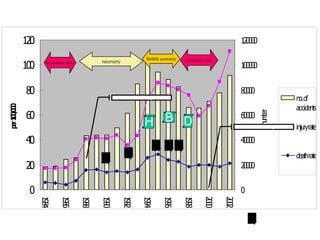
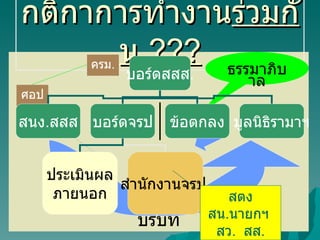
Economic crisis recoveryBubble economy Economic crisis MOPH Thailand Health Profile 1997-1998; www.police.go.th D B H Enforce: H=helmet; B=seat belt; D=drink drive Trends of traffic injury in Thailand 1984-2002 Coordinating bodies = Action plan Coordinating bodies
6.
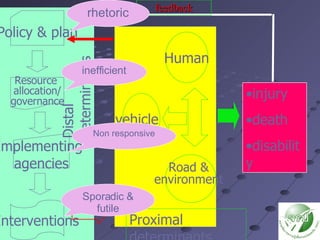
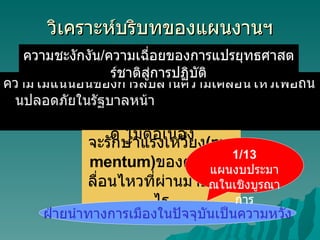
injury death disabilityHuman vehicle Road & environment Resource allocation/ governance Implementing agencies Interventions Policy & plan Proximal determinants Distal determinants feedback rhetoric inefficient Non responsive Sporadic & futile
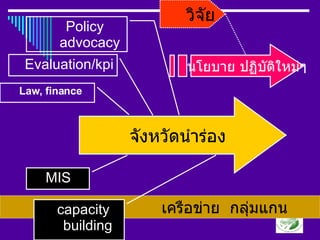
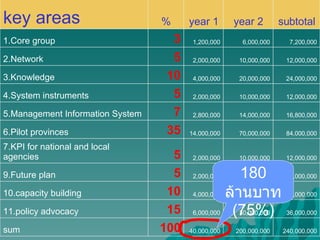
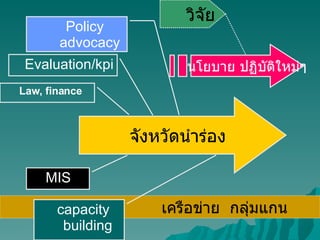
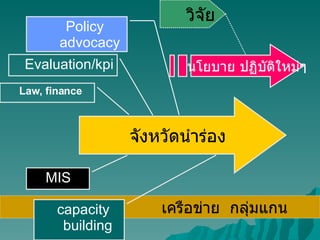
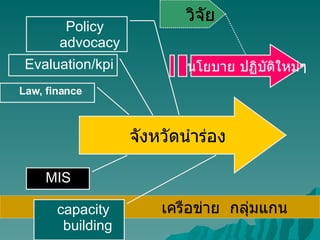
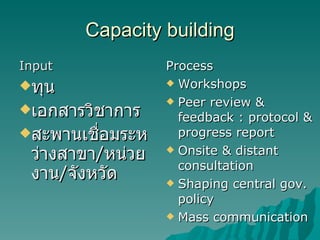
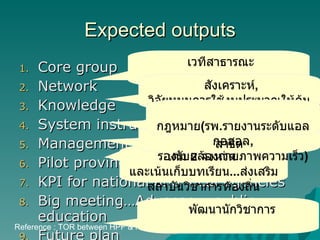
Expected outputs Coregroup Network Knowledge System instruments Management Information System Pilot provinces KPI for national and local agencies Big meeting…Advocacy, public education Future plan Reference : TOR between HPF & Ramathibodi Foundation
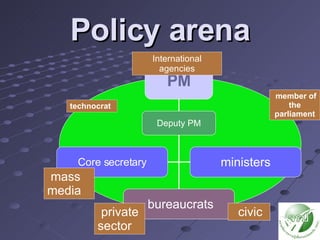
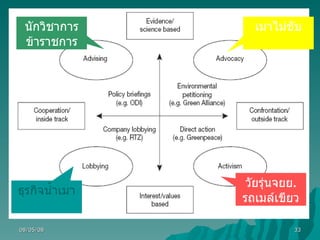
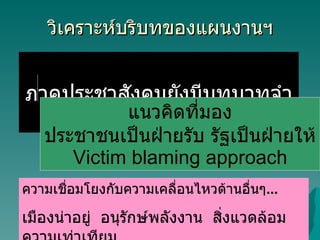
Policy arena technocratmass media civic private sector International agencies member of the parliament PM Deputy PM bureaucrats Core secretary ministers
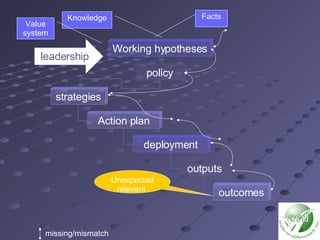
Facts missing/mismatch Unexpectedrelevant Value system leadership Working hypotheses policy strategies Action plan deployment outputs outcomes Knowledge
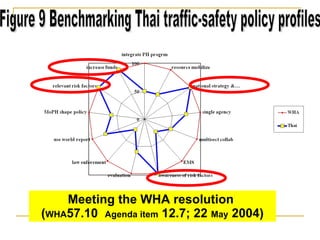
Road safety andhealth FIFTY-SEVENTH WORLD HEALTH ASSEMBLY WHA57.10 Agenda item 12.7 22 May 2004
57.
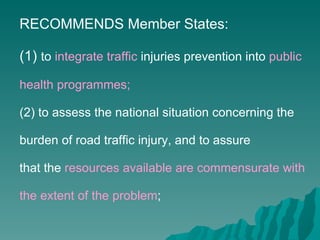
RECOMMENDS Member States:(1) to integrate traffic injuries prevention into public health programmes; (2) to assess the national situation concerning the burden of road traffic injury, and to assure that the resources available are commensurate with the extent of the problem ;
58.
(3) ifthey have not yet done so, to prepare and implement a national strategy on prevention of road traffic injury and appropriate action plans ; (4) to establish government leadership in road safety, including designating a single agency or focal point for road safety or through another effective mechanism according to the national context;
59.
(5) to facilitate multisectoral collaboration between different ministries and sectors, including private transportation companies, communities and civil society; (6) to strengthen emergency and rehabilitation services ; (7) to raise awareness about risk factors in particular the effects of alcohol abuse,psychoactive drugs and the use of mobile phones while driving;
60.
to take specificmeasures to prevent and control mortality and morbidity due to road traffic crashes, and to evaluate the impact of such measures; (9) to enforce existing traffic laws and regulations , and to work with schools, employers and other organizations to promote road-safety education to drivers and pedestrians alike;
61.
(10) to usethe forthcoming world report on traffic injury prevention as a tool to plan and implement appropriate strategies for prevention of road traffic injury; (11) to ensure that ministries of health are involved in the framing of policy on the prevention of road traffic injuries;
62.
(12) especially developingcountries, to legislate and strictly enforce wearing of crash helmets by motorcyclists and pillion riders, and to make mandatory both provision of seat belts by automobile manufacturers and wearing of seat belts by drivers; (13) explore the possibilities to increase funding for road safety, including through the creation of a fund;
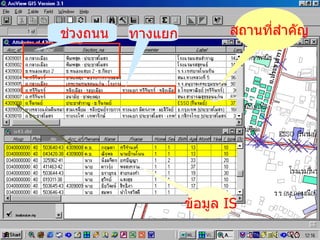
Expected outputs Coregroup Network Knowledge System instruments Management Information System Pilot provinces KPI for national and local agencies Big meeting…Advocacy, public education Future plan Reference : TOR between HPF & Ramathibodi Foundation เติม 2 จังหวัด และเน้นเก็บบทเรียน ... ส่งเสริมสถาบันวิชาการท้องถิ่น เวทีสาธารณะ สังเคราะห์ , วิจัยหนุนการใช้งบประมาณให้คุ้มค่า , วิจัยชี้นำประเด็นใหม่ ( ง่วงแล้วขับ ) ระบบสารสนเทศระดับจังหวัด ... สาธิต พัฒนานักวิชาการ กฎหมาย ( รพ . รายงานระดับแอลกอฮอล , รองรับกล้องถ่ายภาพความเร็ว )
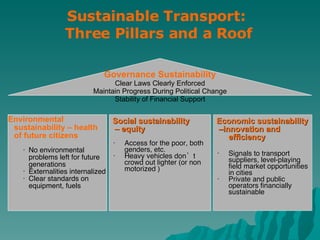
Economic sustainability –innovation and efficiency Signals to transport suppliers, level-playing field market opportunities in cities Private and public operators financially sustainable Governance Sustainability Clear Laws Clearly Enforced Maintain Progress During Political Change Stability of Financial Support Environmental sustainability – health of future citizens No environmental problems left for future generations Externalities internalized Clear standards on equipment, fuels Social sustainability – equity Access for the poor, both genders, etc. Heavy vehicles don’t crowd out lighter (or non motorized ) Sustainable Transport: Three Pillars and a Roof
70.
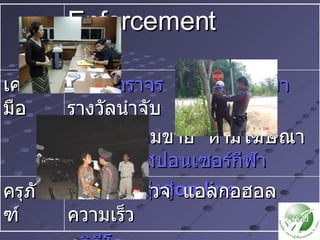
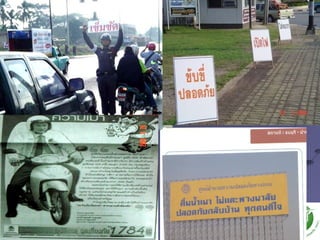
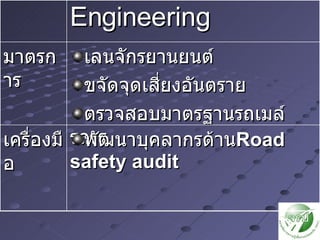
Pollution/Air quality Policy Health risk/morbidity from pollution /exposure Concentrations in air of mobile source pollution Health costs/GDP Emissions/km from vehicles Current/proposed standards and policies Predictive Emissions coefficients and driving cycles Number of vehicles and distance/vehicle Verification Socio-demographic and socio-economic variables Congestion/Access Policy Time lost in traffic; Economic costs of congestion rel. to GDP; Proximity to rapid transport nodes Modal splits by trips and distances Predictive Road hierarchy Non-road transport infrastructure (rail, etc.) Lane or road-km per vehicle and per sq.km of city space Number of light duty vehicles Accidents/Safety Policy Deaths or accidents per vehicle Deaths or accidents per km driven or traveled Accident Costs/GDP Predictive Engineering (seatbelts, safety devices, road barriers, etc) Education (drier ed, drunken driving) Enforcement (drunken driving, safety inspections;speed and other violations) Indicators of Sustainable Transport
















![5 I Moreno[1]](https://cdn.slidesharecdn.com/ss_thumbnails/5imoreno1-1217985922235771-9-thumbnail.jpg?width=640&height=640&fit=bounds)


