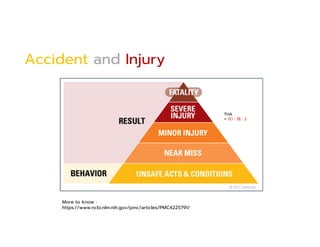
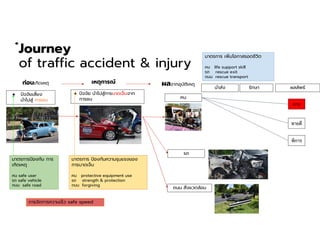
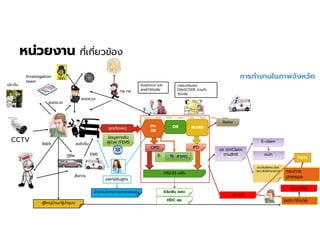
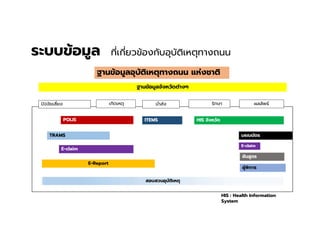
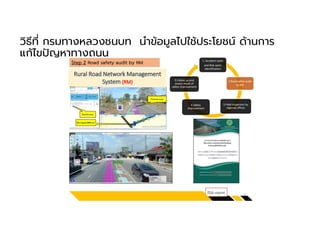
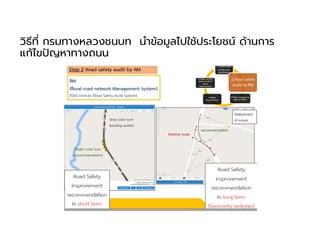
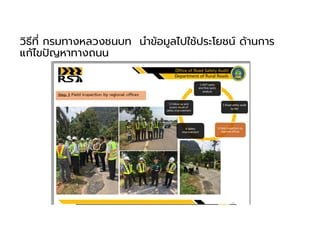
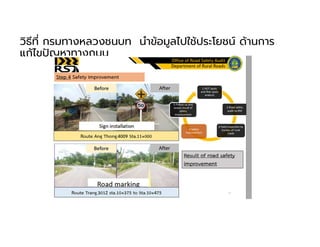
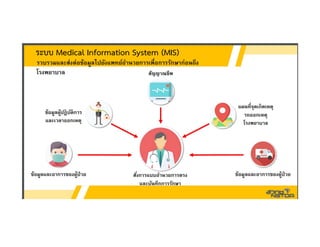
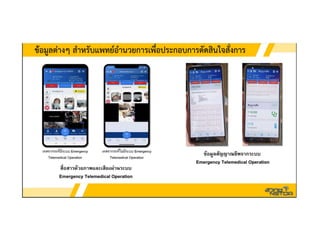
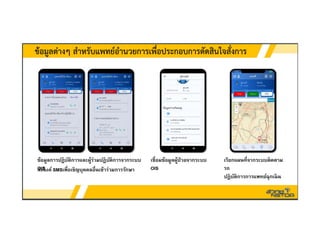
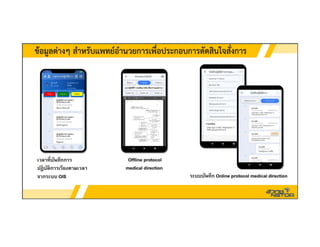
Injury Surveillance (IS)
วัตถุประสงค์ของระบบข้อมูล
1เพือพัฒนาคุณภาพการรักษาพยาบาล
To establish a database for assessing the quality of acute care and inter-facility transfer provided by hospitals
at the provincial level to the injured.
2 เพือเปนข้อมูลด้านการปองกันการบาดเจ็บ
To develop an injury surveillance system that would facilitate injury prevention and control at both local and
national levels.
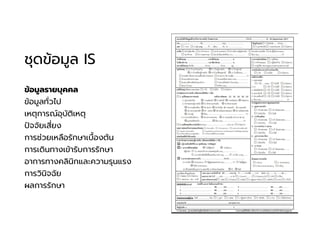
บันทึกข้อมูลผู้บาดเจ็บทีเข้ารับการรักษาที รพ. (Passive data collection)
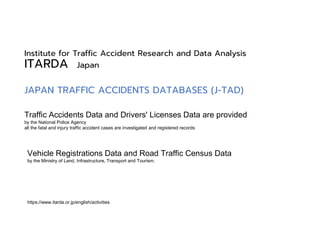
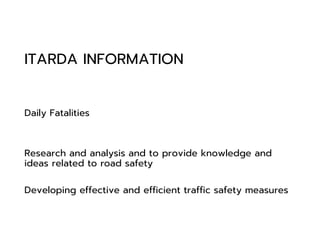
Institute for TrafficAccident Research and Data Analysis
ITARDA Japan
Traffic Accidents Data and Drivers' Licenses Data are provided
by the National Police Agency
all the fatal and injury traffic accident cases are investigated and registered records
Vehicle Registrations Data and Road Traffic Census Data
by the Ministry of Land, Infrastructure, Transport and Tourism.
https://www.itarda.or.jp/english/activities
JAPAN TRAFFIC ACCIDENTS DATABASES (J-TAD)
37.
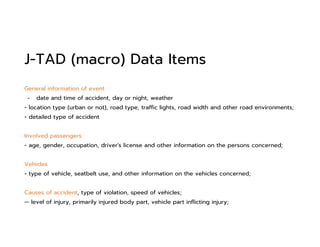
J-TAD (macro) DataItems
General information of event
- date and time of accident, day or night, weather
- location type (urban or not), road type, traffic lights, road width and other road environments;
- detailed type of accident
Involved passengers
- age, gender, occupation, driver's license and other information on the persons concerned;
Vehicles
- type of vehicle, seatbelt use, and other information on the vehicles concerned;
Causes of accident, type of violation, speed of vehicles;
-- level of injury, primarily injured body part, vehicle part inflicting injury;
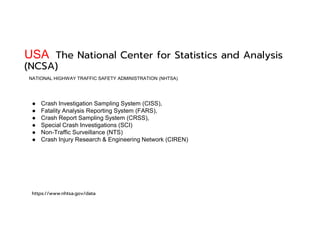
USA The NationalCenter for Statistics and Analysis
(NCSA)
https://www.nhtsa.gov/data
NATIONAL HIGHWAY TRAFFIC SAFETY ADMINISTRATION (NHTSA)
● Crash Investigation Sampling System (CISS),
● Fatality Analysis Reporting System (FARS),
● Crash Report Sampling System (CRSS),
● Special Crash Investigations (SCI)
● Non-Traffic Surveillance (NTS)
● Crash Injury Research & Engineering Network (CIREN)
40.
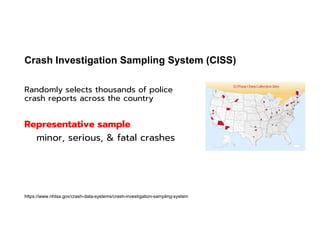
Crash Investigation SamplingSystem (CISS)
Randomly selects thousands of police
crash reports across the country
Representative sample
minor, serious, & fatal crashes
https://www.nhtsa.gov/crash-data-systems/crash-investigation-sampling-system
41.
Crash Investigation SamplingSystem (CISS)
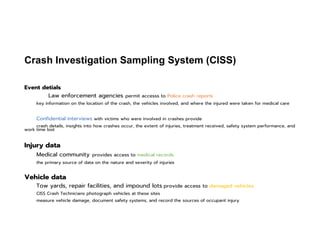
Event detials
Law enforcement agencies permit accesss to Police crash reports
key information on the location of the crash, the vehicles involved, and where the injured were taken for medical care
Confidential interviews with victims who were involved in crashes provide
crash details, insights into how crashes occur, the extent of injuries, treatment received, safety system performance, and
work time lost
Injury data
Medical community provides access to medical records
the primary source of data on the nature and severity of injuries
Vehicle data
Tow yards, repair facilities, and impound lots provide access to damaged vehicles.
CISS Crash Technicians photograph vehicles at these sites
measure vehicle damage, document safety systems, and record the sources of occupant injury.
42.
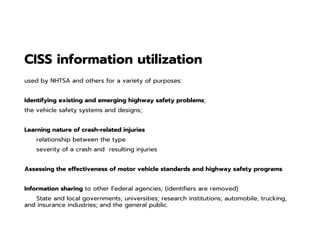
CISS information utilization
usedby NHTSA and others for a variety of purposes:
Identifying existing and emerging highway safety problems;
the vehicle safety systems and designs;
Learning nature of crash-related injuries
relationship between the type
severity of a crash and resulting injuries
Assessing the effectiveness of motor vehicle standards and highway safety programs.
Information sharing to other Federal agencies; (identifiers are removed)
State and local governments; universities; research institutions; automobile, trucking,
and insurance industries; and the general public.
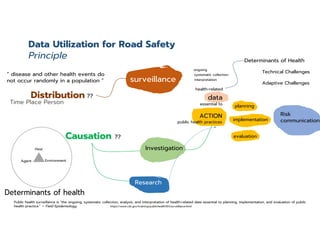
surveillance
data
essential to
Public healthsurveillance is “the ongoing, systematic collection, analysis, and interpretation of health-related data essential to planning, implementation, and evaluation of public
health practice.” — Field Epidemiology https://www.cdc.gov/training/publichealth101/surveillance.html
ACTION
planning
implementation
evaluation
public health practices
ongoing
systematic collection
interpretation
health-related
Determinants of Health
Investigation
Research
Risk
communication
“ disease and other health events do
not occur randomly in a population ”
Causation ??
Distribution ??
Time Place Person
Host
Agent Environment
Data Utilization for Road Safety
Principle
Technical Challenges
Adaptive Challenges
52.
Take Home Messages
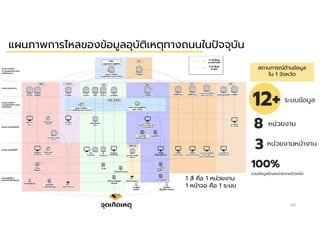
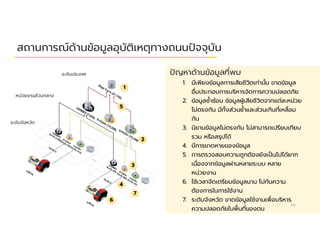
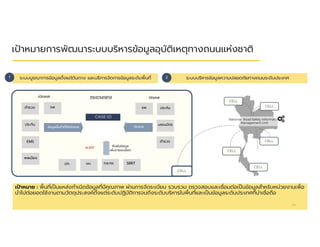
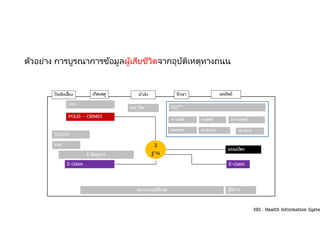
•มีข้อมูลทีเกียวข้องกับอุบัติเหตุทางถนนและการบาดเจ็บ กระจายอยู่ในฐานข้อมูลหลายหน่วยงาน
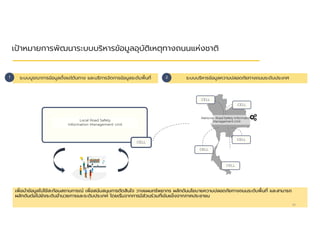
• กลไกการจัดการปญหา อยู่ทีระดับพืนที
• กลไกการบริหารจัดการระบบ อยู่ทีส่วนกลาง
• ระบบข้อมูลต้องดําเนินการเพือให้เอือต่อการทํางานทุกระดับ
• ระบบข้อมูลไม่เปนภาระมากเกินความจําเปน
• นําข้อมูลมาใช้งาน โดยการกําหนดโจทย์ให้ชัดเจน